OPEN19
Open19 Goals
• Create an open standard that can fit any 19” Rack
environment for server, storage, and networking
• Optimize base rack cost
– Reduce commons by 50%
• Enable fast rack integration
– 2-3x faster integration time
• Build an eco system that will consolidate
requirements and volumes
– High adoption level
• Create a solution that will have applicability for large,
medium, and small scale data centers
Open19 Non-Goals
• Create a proprietary form factor
– Low adoption level
• Create restrictive development environment
– Minimized defined specification
• Build a heavy bureaucratic organization
– Minimal organization that will enable collaboration
– Engineering focused first
– Business partners next
Brick
Double Wide
Brick
Power Shelf
Brick Cage
Network Switch
Double High
Brick
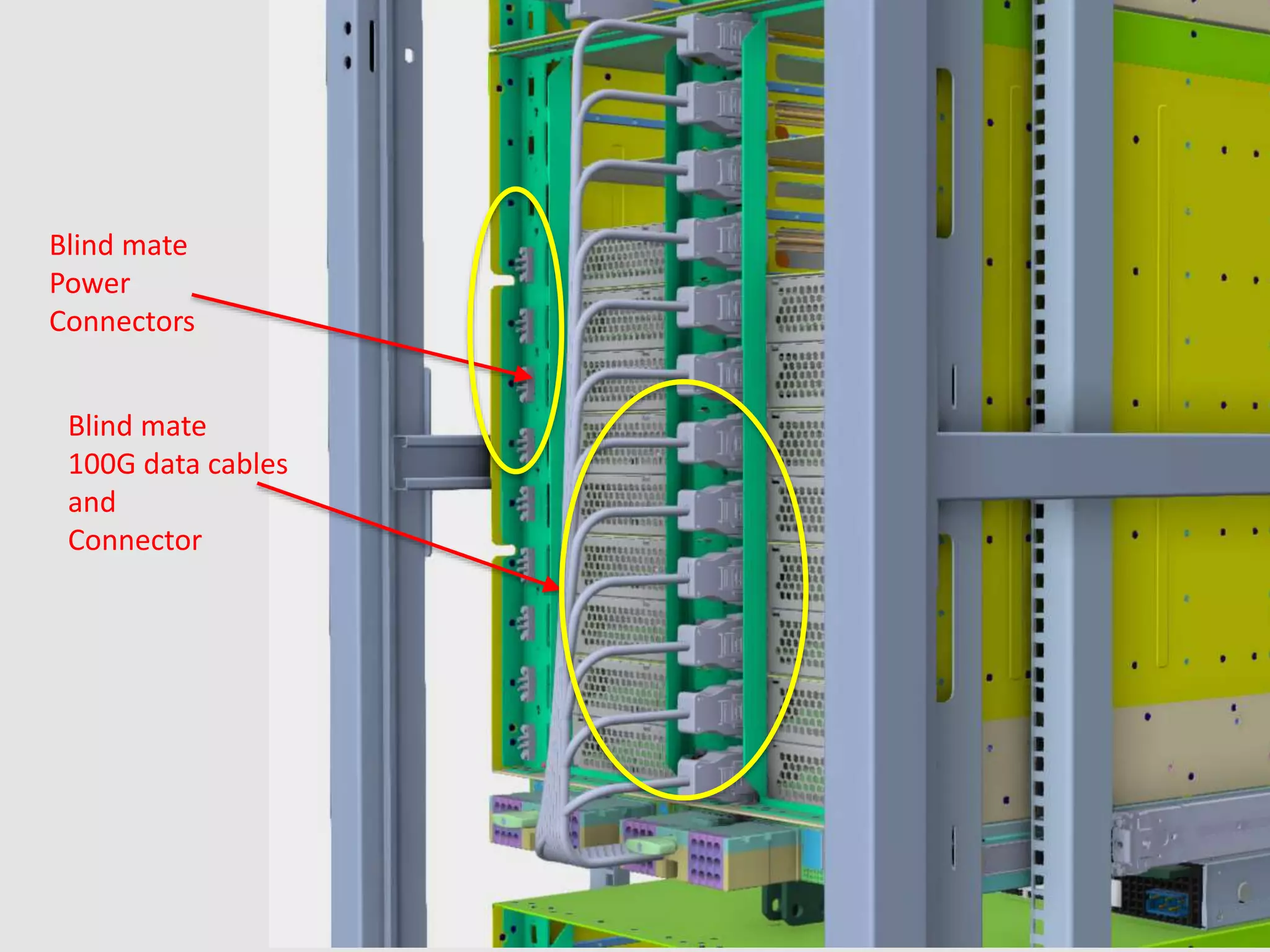
Blind mate
Power
Connectors
Blind mate
100G data cables
and
Connector
Snap-On Data Cable Snap-On Power Cable
Bricks Form Factors
• Three brick form factors
– Brick (½ wide 1RU)
– Double Wide Brick (1RU)
– Double High Brick (2RU)
• Linear power and data
growth
• Self Sustained – EMI &
Safety & cooling
• Blind Mate or QSFP network
Brick Cage
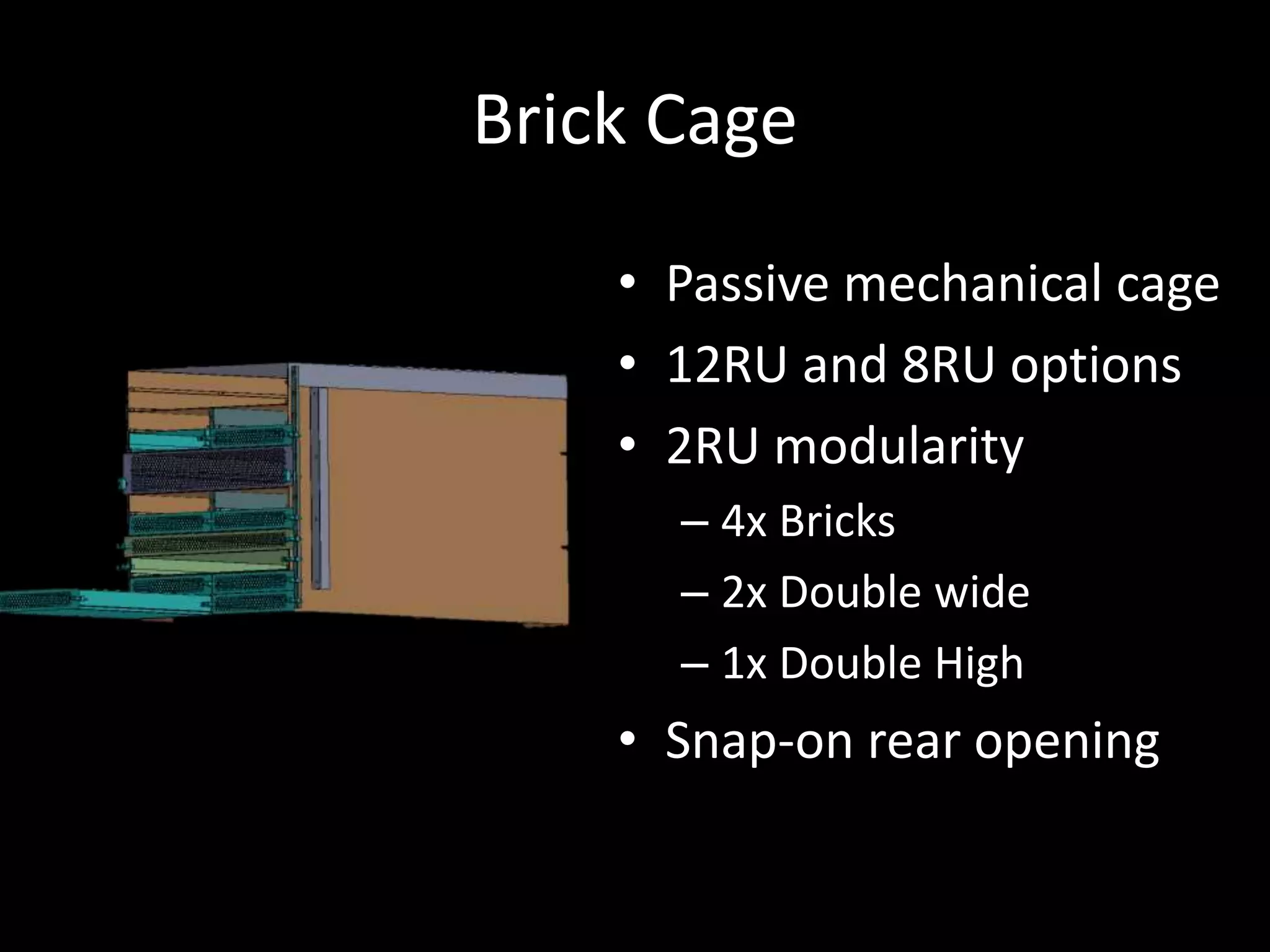
• Passive mechanical cage
• 12RU and 8RU options
• 2RU modularity
– 4x Bricks
– 2x Double wide
– 1x Double High
• Snap-on rear opening
Open19 Switch
• Dual switch – Data Path &
Management
– 50G per server data path
– 1/10G per server management
• 12v input (no power supplies)
• Up to 8x100G uplinks or
local switching ports
• Broadwell-DE CPU with BMC
• Optional
Open19 Power shelf
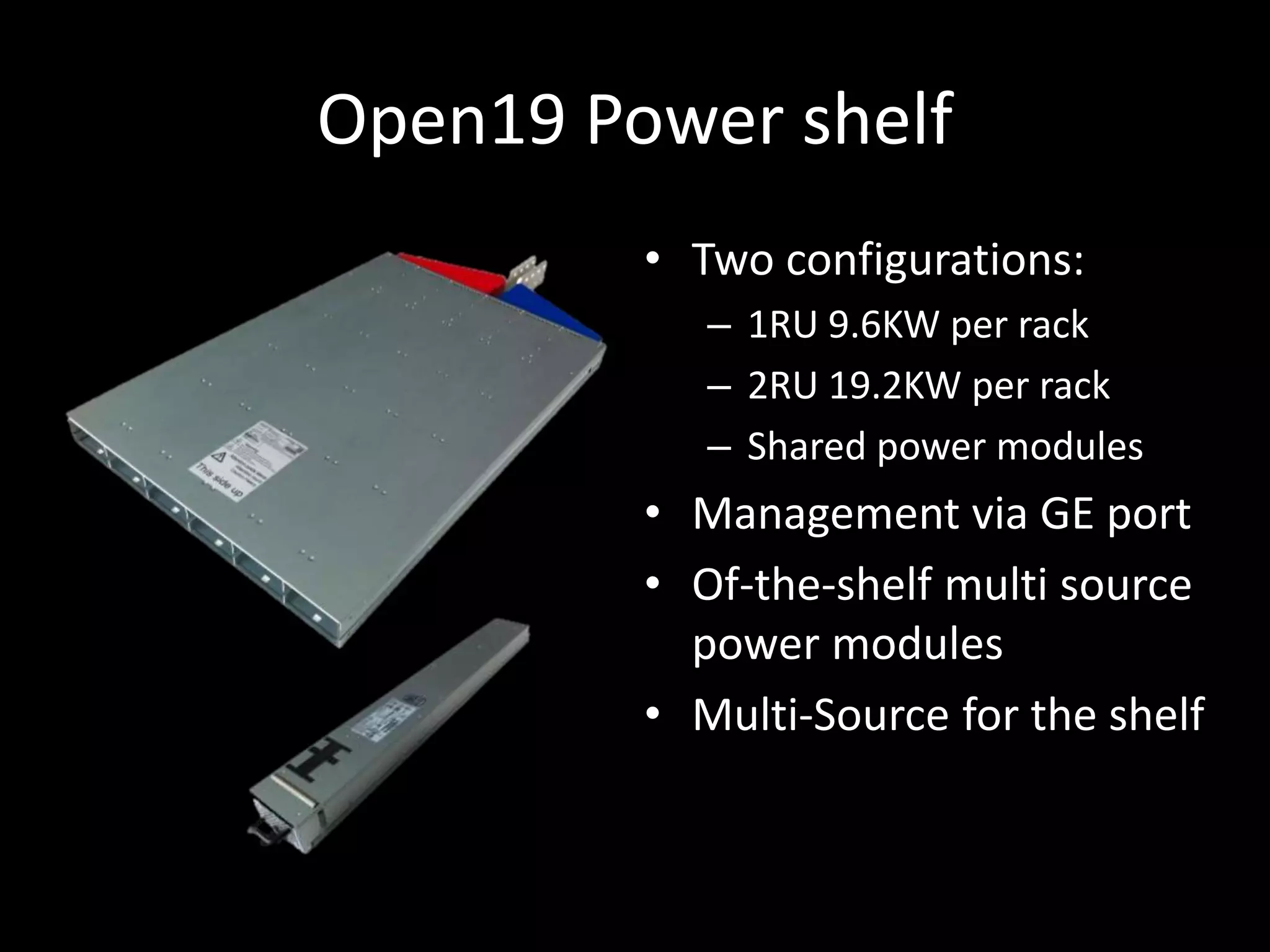
• Two configurations:
– 1RU 9.6KW per rack
– 2RU 19.2KW per rack
– Shared power modules
• Management via GE port
• Of-the-shelf multi source
power modules
• Multi-Source for the shelf
Platform Building Blocks
• Standard 19” rack – Any type 4 posts
• Brick cage
• Brick (B), Double Brick (DB), Double High Brick (DHB)
• Power shelf – 12v snap-on cable distribution
• Networking switch (ToR) - Optional
• Snap-On Power cables – 200w per Brick
• Snap-On data cables – 4 bidirectional channels up 25G
– Optional configuration: 2 diff pairs for data path, 1 diff pair for
OOB, 1 diff pair for console
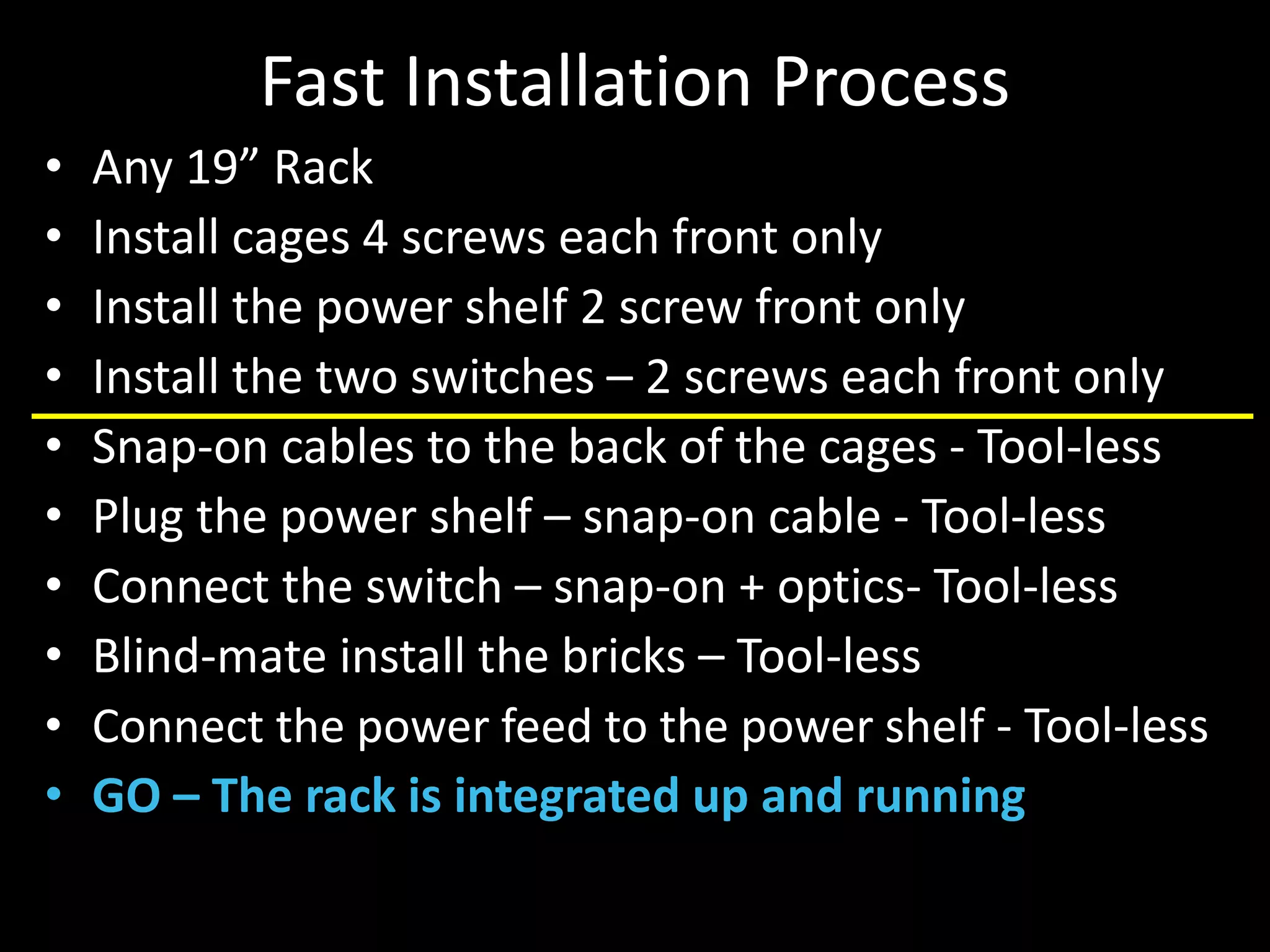
Fast Installation Process
• Any 19” Rack
• Install cages 4 screws each front only
• Install the power shelf 2 screw front only
• Install the two switches – 2 screws each front only
• Snap-on cables to the back of the cages - Tool-less
• Plug the power shelf – snap-on cable - Tool-less
• Connect the switch – snap-on + optics- Tool-less
• Blind-mate install the bricks – Tool-less
• Connect the power feed to the power shelf - Tool-less
• GO – The rack is integrated up and running
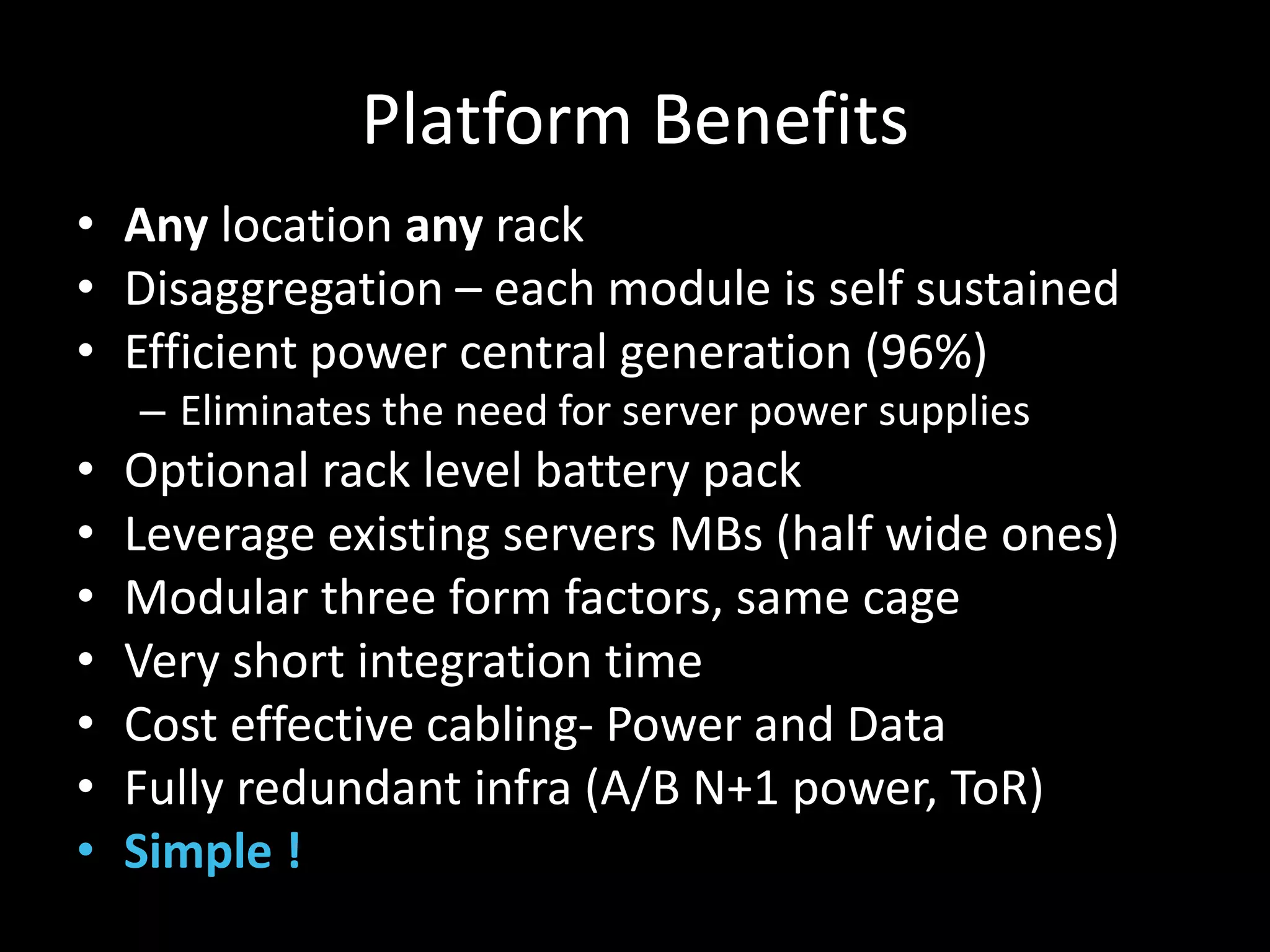
Platform Benefits
• Any location any rack
• Disaggregation – each module is self sustained
• Efficient power central generation (96%)
– Eliminates the need for server power supplies
• Optional rack level battery pack
• Leverage existing servers MBs (half wide ones)
• Modular three form factors, same cage
• Very short integration time
• Cost effective cabling- Power and Data
• Fully redundant infra (A/B N+1 power, ToR)
• Simple !
Open19 vs. OCP - Background
• OCP is an organization that allows different
companies to contribute hardware and
software designs to the shared community
with specialty rack configuration and variety
of form factors which do not interoperate
• Open19 defines an architecture and standard
form factor for compute and storage in any
19” rack environment fully cross supplier
interoperable system
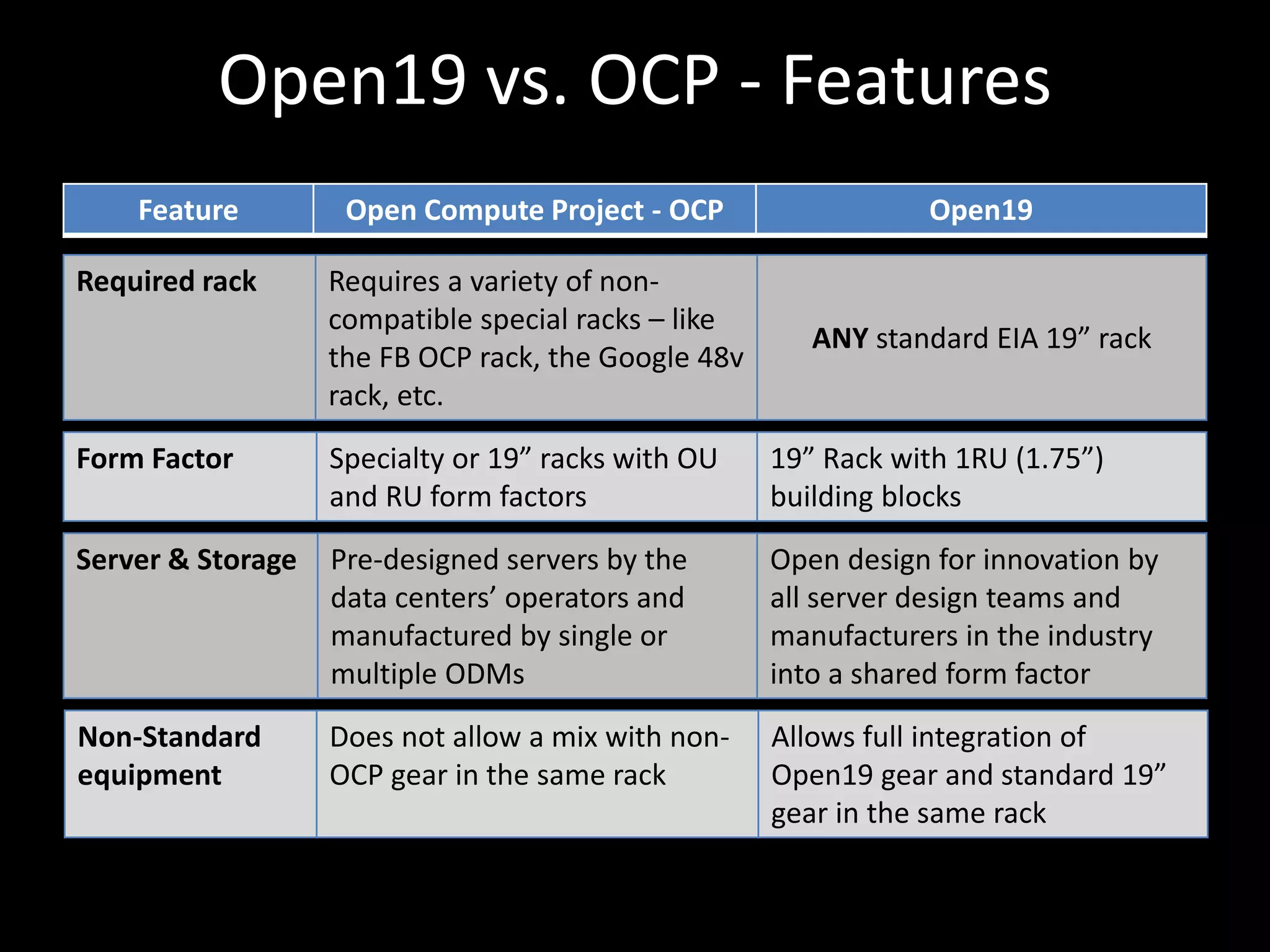
Open19 vs. OCP - Features
Feature Open Compute Project - OCP Open19
Required rack Requires a variety of non-
compatible special racks – like
the FB OCP rack, the Google 48v
rack, etc.
ANY standard EIA 19” rack
Form Factor Specialty or 19” racks with OU
and RU form factors
19” Rack with 1RU (1.75”)
building blocks
Server & Storage Pre-designed servers by the
data centers’ operators and
manufactured by single or
multiple ODMs
Open design for innovation by
all server design teams and
manufacturers in the industry
into a shared form factor
Non-Standard
equipment
Does not allow a mix with non-
OCP gear in the same rack
Allows full integration of
Open19 gear and standard 19”
gear in the same rack
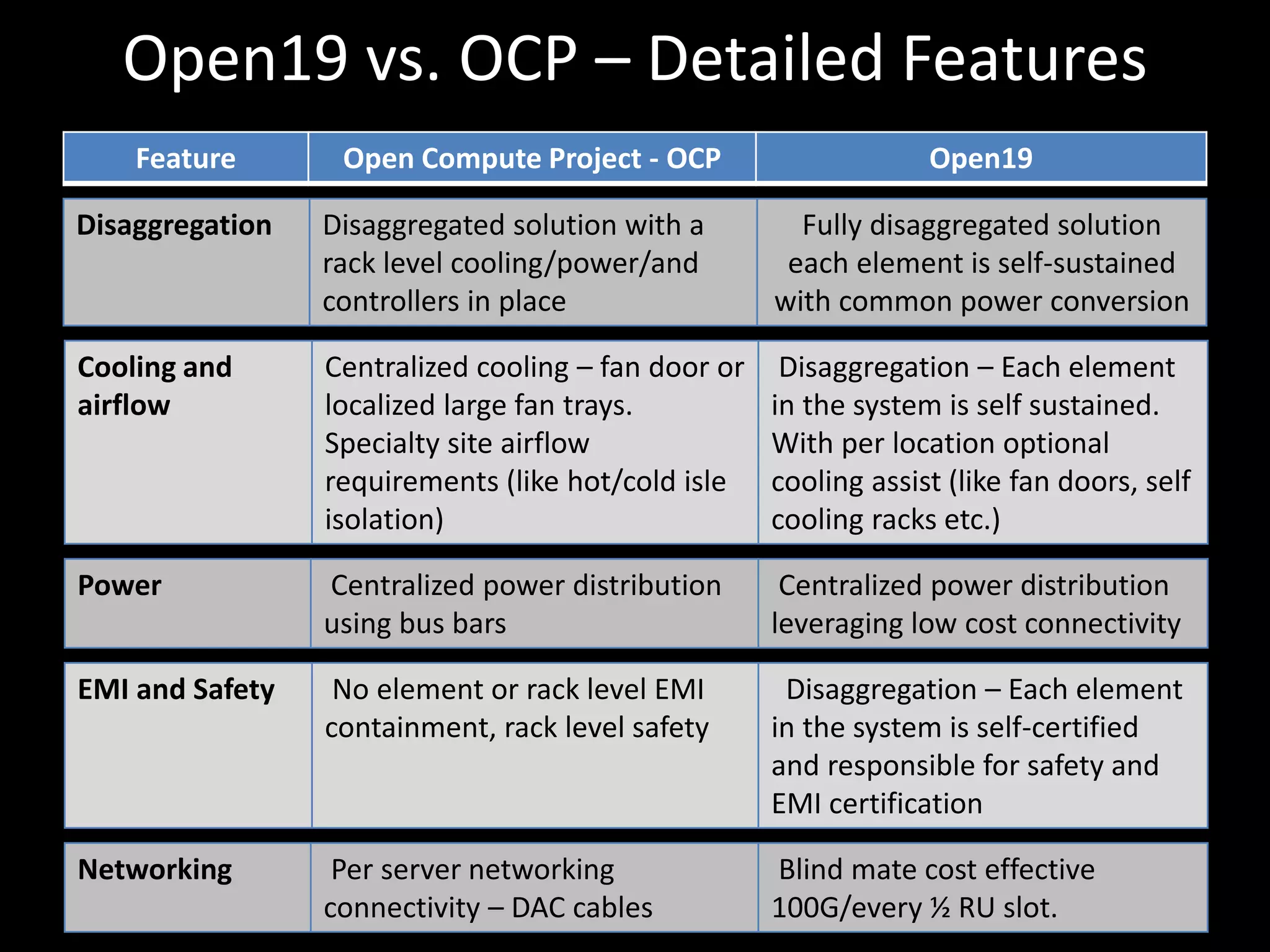
Open19 vs. OCP – Detailed Features
Feature Open Compute Project - OCP Open19
Disaggregation Disaggregated solution with a
rack level cooling/power/and
controllers in place
Fully disaggregated solution
each element is self-sustained
with common power conversion
Cooling and
airflow
Centralized cooling – fan door or
localized large fan trays.
Specialty site airflow
requirements (like hot/cold isle
isolation)
Disaggregation – Each element
in the system is self sustained.
With per location optional
cooling assist (like fan doors, self
cooling racks etc.)
Power Centralized power distribution
using bus bars
Centralized power distribution
leveraging low cost connectivity
EMI and Safety No element or rack level EMI
containment, rack level safety
Disaggregation – Each element
in the system is self-certified
and responsible for safety and
EMI certification
Networking Per server networking
connectivity – DAC cables
Blind mate cost effective
100G/every ½ RU slot.
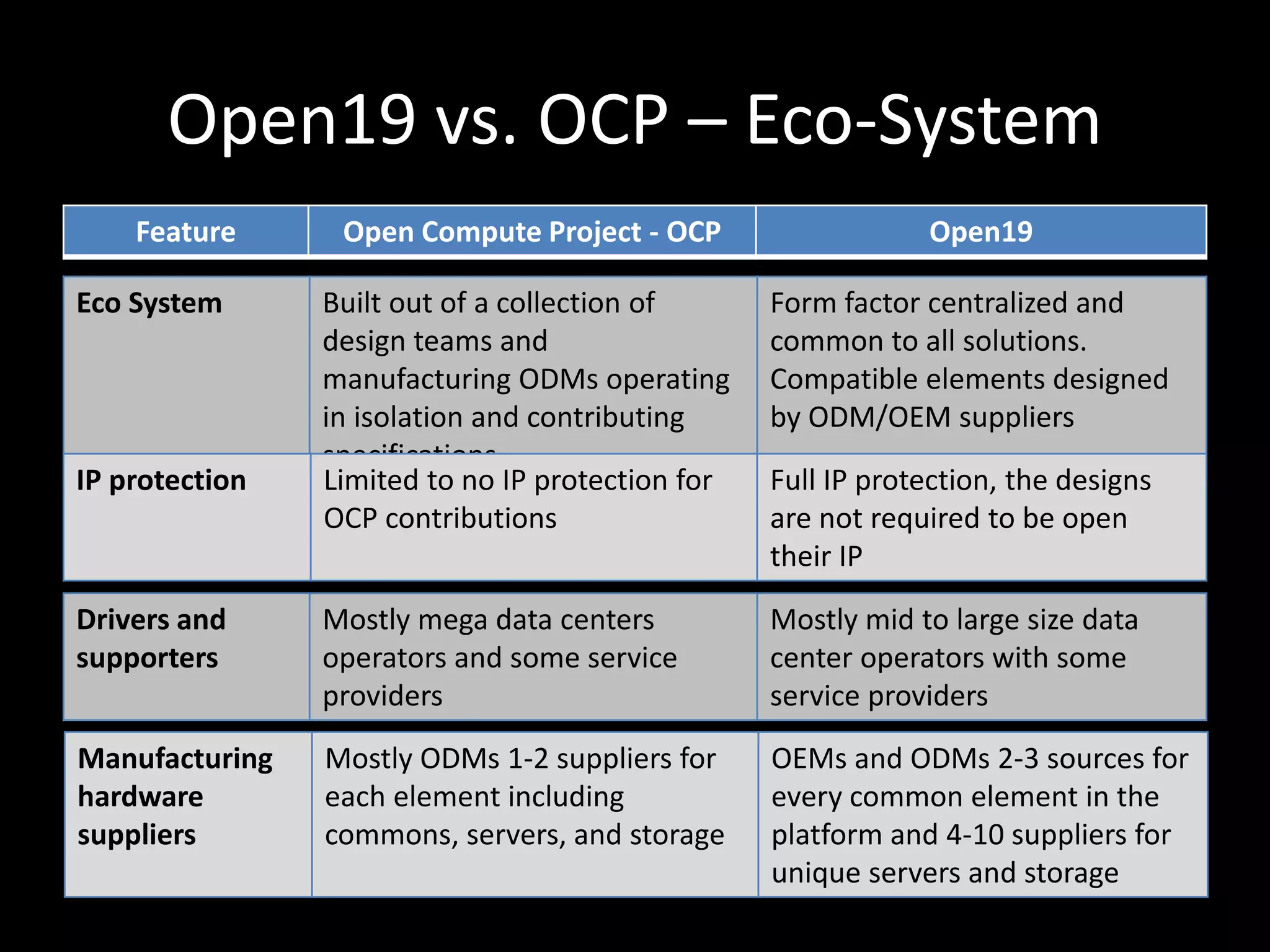
Open19 vs. OCP – Eco-System
Feature Open Compute Project - OCP Open19
Eco System Built out of a collection of
design teams and
manufacturing ODMs operating
in isolation and contributing
specifications
Form factor centralized and
common to all solutions.
Compatible elements designed
by ODM/OEM suppliers
IP protection Limited to no IP protection for
OCP contributions
Full IP protection, the designs
are not required to be open
their IP
Drivers and
supporters
Mostly mega data centers
operators and some service
providers
Mostly mid to large size data
center operators with some
service providers
Manufacturing
hardware
suppliers
Mostly ODMs 1-2 suppliers for
each element including
commons, servers, and storage
OEMs and ODMs 2-3 sources for
every common element in the
platform and 4-10 suppliers for
unique servers and storage
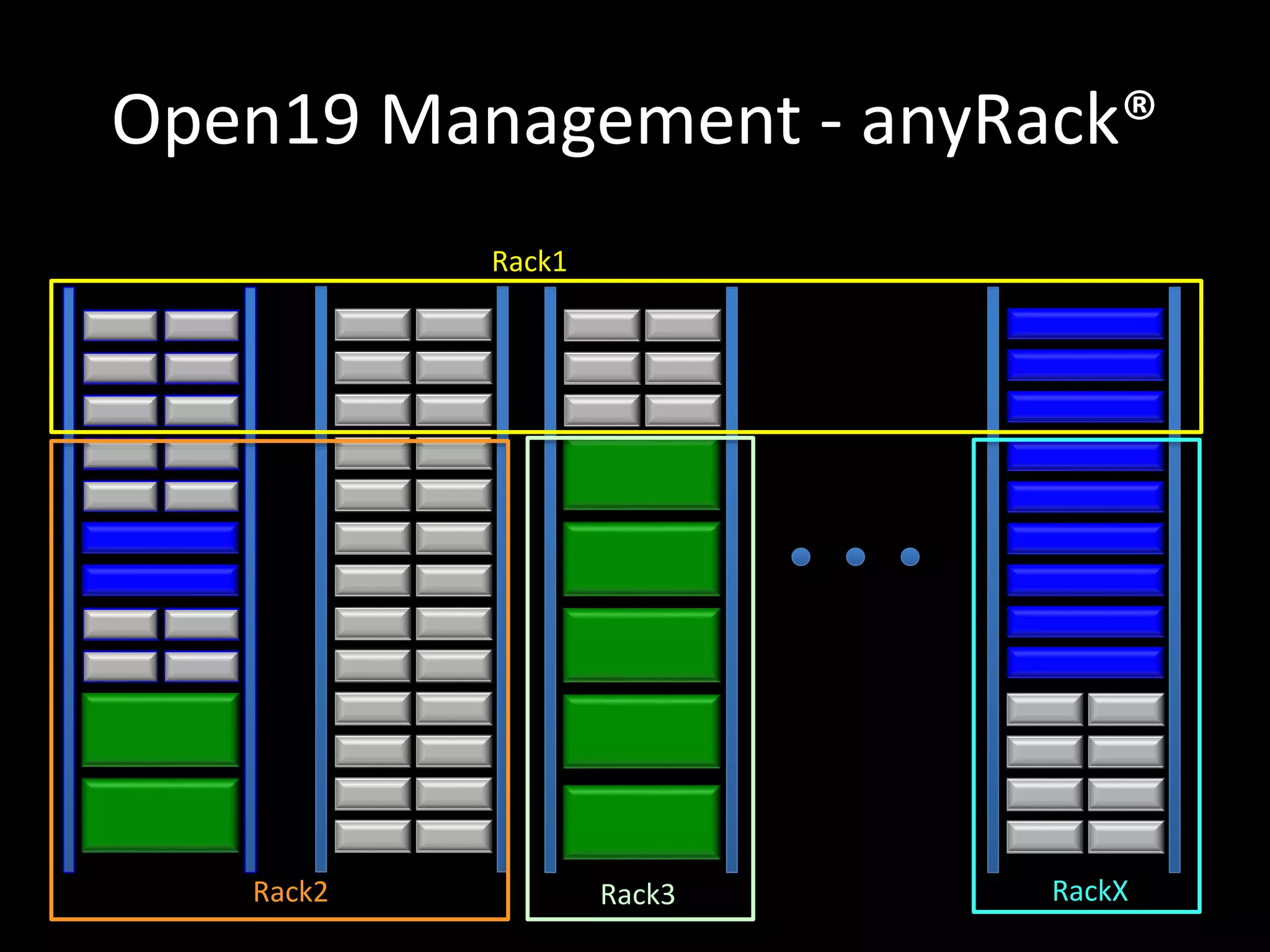
Open19 Management - anyRack®
Rack1 Rack2 Rack3 RackX
Open19 Management - anyRack®
Rack1
Rack3Rack2 RackX
How can you contribute?
• Join our distribution list: www.open19.org
• Support the initiative as a company
• Join the development effort
• Join the Open19 consortium
• Connect your customers and partners to
the Open19 initiative
Check out and join us:
Site: www.open19.org
Twitter: @open19in (please note the in)
LinkedIn & Facebook Open19 discussion groups
LinkedIn blog: https://engineering.linkedin.com/blog

Open19 9/2016

  • 1.
  • 2.
    Open19 Goals • Createan open standard that can fit any 19” Rack environment for server, storage, and networking • Optimize base rack cost – Reduce commons by 50% • Enable fast rack integration – 2-3x faster integration time • Build an eco system that will consolidate requirements and volumes – High adoption level • Create a solution that will have applicability for large, medium, and small scale data centers
  • 3.
    Open19 Non-Goals • Createa proprietary form factor – Low adoption level • Create restrictive development environment – Minimized defined specification • Build a heavy bureaucratic organization – Minimal organization that will enable collaboration – Engineering focused first – Business partners next
  • 4.
    Brick Double Wide Brick Power Shelf BrickCage Network Switch Double High Brick
  • 6.
  • 7.
    Snap-On Data CableSnap-On Power Cable
  • 8.
    Bricks Form Factors •Three brick form factors – Brick (½ wide 1RU) – Double Wide Brick (1RU) – Double High Brick (2RU) • Linear power and data growth • Self Sustained – EMI & Safety & cooling • Blind Mate or QSFP network
  • 9.
    Brick Cage • Passivemechanical cage • 12RU and 8RU options • 2RU modularity – 4x Bricks – 2x Double wide – 1x Double High • Snap-on rear opening
  • 10.
    Open19 Switch • Dualswitch – Data Path & Management – 50G per server data path – 1/10G per server management • 12v input (no power supplies) • Up to 8x100G uplinks or local switching ports • Broadwell-DE CPU with BMC • Optional
  • 11.
    Open19 Power shelf •Two configurations: – 1RU 9.6KW per rack – 2RU 19.2KW per rack – Shared power modules • Management via GE port • Of-the-shelf multi source power modules • Multi-Source for the shelf
  • 12.
    Platform Building Blocks •Standard 19” rack – Any type 4 posts • Brick cage • Brick (B), Double Brick (DB), Double High Brick (DHB) • Power shelf – 12v snap-on cable distribution • Networking switch (ToR) - Optional • Snap-On Power cables – 200w per Brick • Snap-On data cables – 4 bidirectional channels up 25G – Optional configuration: 2 diff pairs for data path, 1 diff pair for OOB, 1 diff pair for console
  • 13.
    Fast Installation Process •Any 19” Rack • Install cages 4 screws each front only • Install the power shelf 2 screw front only • Install the two switches – 2 screws each front only • Snap-on cables to the back of the cages - Tool-less • Plug the power shelf – snap-on cable - Tool-less • Connect the switch – snap-on + optics- Tool-less • Blind-mate install the bricks – Tool-less • Connect the power feed to the power shelf - Tool-less • GO – The rack is integrated up and running
  • 14.
    Platform Benefits • Anylocation any rack • Disaggregation – each module is self sustained • Efficient power central generation (96%) – Eliminates the need for server power supplies • Optional rack level battery pack • Leverage existing servers MBs (half wide ones) • Modular three form factors, same cage • Very short integration time • Cost effective cabling- Power and Data • Fully redundant infra (A/B N+1 power, ToR) • Simple !
  • 15.
    Open19 vs. OCP- Background • OCP is an organization that allows different companies to contribute hardware and software designs to the shared community with specialty rack configuration and variety of form factors which do not interoperate • Open19 defines an architecture and standard form factor for compute and storage in any 19” rack environment fully cross supplier interoperable system
  • 16.
    Open19 vs. OCP- Features Feature Open Compute Project - OCP Open19 Required rack Requires a variety of non- compatible special racks – like the FB OCP rack, the Google 48v rack, etc. ANY standard EIA 19” rack Form Factor Specialty or 19” racks with OU and RU form factors 19” Rack with 1RU (1.75”) building blocks Server & Storage Pre-designed servers by the data centers’ operators and manufactured by single or multiple ODMs Open design for innovation by all server design teams and manufacturers in the industry into a shared form factor Non-Standard equipment Does not allow a mix with non- OCP gear in the same rack Allows full integration of Open19 gear and standard 19” gear in the same rack
  • 17.
    Open19 vs. OCP– Detailed Features Feature Open Compute Project - OCP Open19 Disaggregation Disaggregated solution with a rack level cooling/power/and controllers in place Fully disaggregated solution each element is self-sustained with common power conversion Cooling and airflow Centralized cooling – fan door or localized large fan trays. Specialty site airflow requirements (like hot/cold isle isolation) Disaggregation – Each element in the system is self sustained. With per location optional cooling assist (like fan doors, self cooling racks etc.) Power Centralized power distribution using bus bars Centralized power distribution leveraging low cost connectivity EMI and Safety No element or rack level EMI containment, rack level safety Disaggregation – Each element in the system is self-certified and responsible for safety and EMI certification Networking Per server networking connectivity – DAC cables Blind mate cost effective 100G/every ½ RU slot.
  • 18.
    Open19 vs. OCP– Eco-System Feature Open Compute Project - OCP Open19 Eco System Built out of a collection of design teams and manufacturing ODMs operating in isolation and contributing specifications Form factor centralized and common to all solutions. Compatible elements designed by ODM/OEM suppliers IP protection Limited to no IP protection for OCP contributions Full IP protection, the designs are not required to be open their IP Drivers and supporters Mostly mega data centers operators and some service providers Mostly mid to large size data center operators with some service providers Manufacturing hardware suppliers Mostly ODMs 1-2 suppliers for each element including commons, servers, and storage OEMs and ODMs 2-3 sources for every common element in the platform and 4-10 suppliers for unique servers and storage
  • 19.
    Open19 Management -anyRack® Rack1 Rack2 Rack3 RackX
  • 20.
    Open19 Management -anyRack® Rack1 Rack3Rack2 RackX
  • 21.
    How can youcontribute? • Join our distribution list: www.open19.org • Support the initiative as a company • Join the development effort • Join the Open19 consortium • Connect your customers and partners to the Open19 initiative
  • 22.
    Check out andjoin us: Site: www.open19.org Twitter: @open19in (please note the in) LinkedIn & Facebook Open19 discussion groups LinkedIn blog: https://engineering.linkedin.com/blog