10.1 The Genetic Material Must Exhibit
Four Characteristics
Section 10.1
• For a molecule to serve as the genetic
material, it must be able to
– replicate
– store information
– express information
– allow variation by mutation
Section 10.1
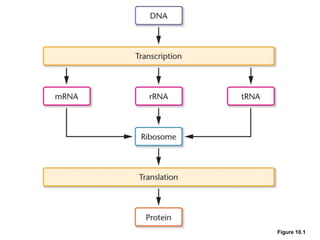
• The central dogma of molecular genetics is
that DNA makes RNA (transcription), which
makes proteins (translation) (Figure 10.1).
Figure 10.1
10.2 Until 1944, Observations Favored
Protein as the Genetic Material
Section 10.2
• The genetic material is physically transmitted
from parent to offspring.
• Proteins and nucleic acids were the major
candidates for the genetic material.
• In the 1940s, many geneticists favored proteins.
Section 10.2
• Proteins are more diverse and abundant in cells.
• They were the subject of the most active areas
of genetic research, with more known about
proteins than nucleic acid chemistry.
• DNA was thought to be too simple to be the
genetic material, with only four types of
nucleotides as compared to the 20 different
amino acids of proteins.
10.3 Evidence Favoring DNA as the
Genetic Material Was First Obtained
during the Study of Bacteria and
Bacteriophages
Section 10.3
• Griffith studied a bacterium (pneumococci) now
known as Streptococcus pneumoniae.
• S. pneumoniae comes in two strains.
– S  Smooth
• Secrete a polysaccharide capsule
– Protects bacterium from the immune system of animals
• Produce smooth colonies on solid media
– R  Rough
• Unable to secrete a capsule
• Produce colonies with a rough appearance
Frederick Griffith Experiments with
Streptococcus pneumoniae
Section 10.3
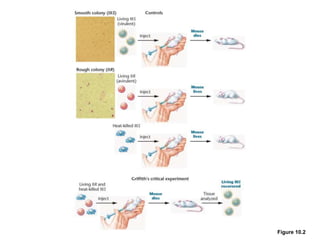
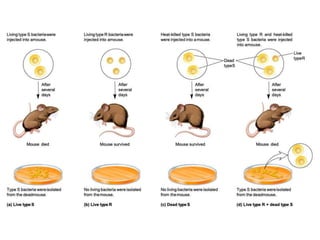
In 1928, Griffith conducted experiments using two strains of S. pneumoniae: type
IIIS and type IIR.
1.Inject mouse with live type IIIS bacteria.
• Mouse died.
• Type IIIS bacteria recovered from the mouse’s blood.
2.Inject mouse with live type IIR bacteria.
• Mouse survived.
• No living bacteria isolated from the mouse’s blood.
3.Inject mouse with heat-killed type IIIS bacteria.
• Mouse survived.
• No living bacteria isolated from the mouse’s blood.
4.Inject mouse with live type IIR + heat-killed type IIIS cells.
• Mouse died.
• Type IIIS bacteria recovered from the mouse’s blood.
Figure 10.2
Section 10.3
• Griffith injected both live and dead bacteria into mice and observed
whether the bacteria caused a lethal infection.
- Type IIIS killed the mouse, but the type IIR did not.
- If type IIIS was first heat killed, the mouse survived.
- If type IIR was mixed with dead IIIS, the mouse died.
Furthermore, live IIIS bacteria were recovered from the mouse.
• Griffith concluded that something from the dead type IIIS was
transforming type IIR into type IIIS.
- He called this process transformation.
• The substance that allowed this to happen was termed the
transformation principle.
- Griffith did not know what it was.
Section 10.3
The Experiments of
Avery, MacLeod and McCarty
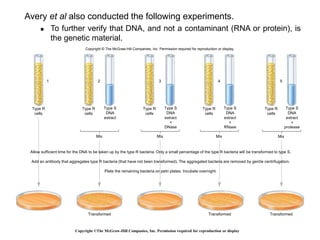
• Avery, MacLeod and McCarty realized that Griffith’s
observations could be used to identify the genetic material.
• They carried out their experiments in the 1940s.
– At that time, it was known that DNA, RNA, proteins and
carbohydrates are the major constituents of living cells.
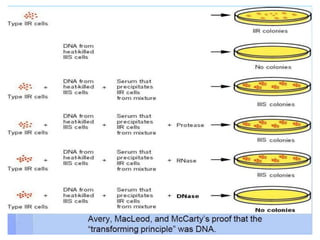
• They prepared cell extracts from type IIIS cells and
purified each type of macromolecule.
– Only the extract that contained purified DNA was able to convert
type IIR bacteria into type IIIS.
– Treatment of the DNA extract with RNase or protease did not
eliminate transformation.
– Treatment with DNase did.
Section 10.3
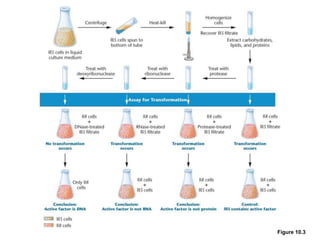
• Avery, MacLeod, and McCarty demonstrated that the
transforming principle was DNA and not protein (Figure
10.3).
• In their 1944 publication they stated, "The evidence
presented supports the belief that a nucleic acid of the
deoxyribose type is the fundamental unit of the transforming
principle of Pneumococcus Type III."
Figure 10.3
Copyright ©The McGraw-Hill Companies, Inc. Permission required for reproduction or display
Mix Mix Mix Mix
Type R
cells
Type R
cells
Type S
DNA
extract
Type R
cells
Type S
DNA
extract
+
DNase
Type R
cells
Type S
DNA
extract
+
RNase
Type R
cells
Type S
DNA
extract
+
protease
Transformed Transformed Transformed
1 2 3 4 5
Copyright © The McGraw-Hill Companies, Inc. Permission required for reproduction or display.
Allow sufficient time for the DNA to be taken up by the type R bacteria. Only a small percentage of the type R bacteria will be transformed to type S.
Add an antibody that aggregates type R bacteria (that have not been transformed). The aggregated bacteria are removed by gentle centrifugation.
Plate the remaining bacteria on petri plates. Incubate overnight.
Avery et al also conducted the following experiments.
 To further verify that DNA, and not a contaminant (RNA or protein), is
the genetic material.
Section 10.3
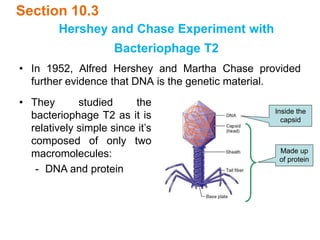
• In 1952, Alfred Hershey and Martha Chase provided
further evidence that DNA is the genetic material.
• They studied the
bacteriophage T2 as it is
relatively simple since it’s
composed of only two
macromolecules:
- DNA and protein
Made up
of protein
Inside the
capsid
Hershey and Chase Experiment with
Bacteriophage T2
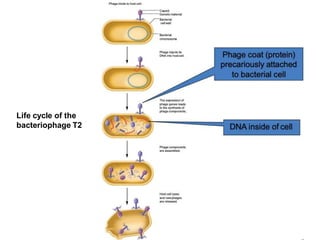
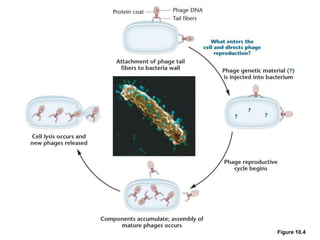
Life cycle of the
bacteriophage T2
Section 10.3
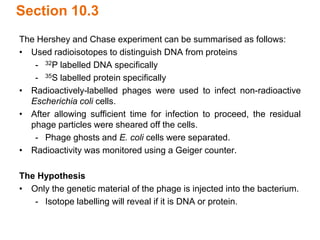
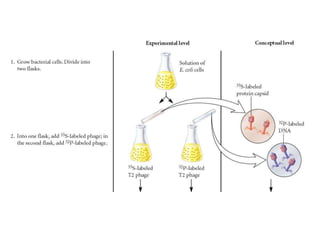
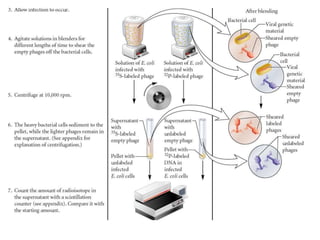
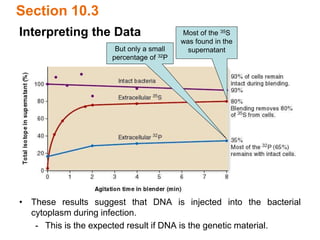
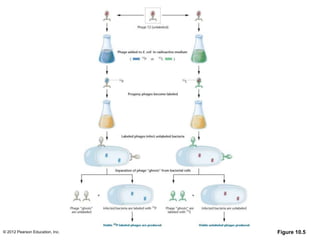
The Hershey and Chase experiment can be summarised as follows:
• Used radioisotopes to distinguish DNA from proteins
- 32P labelled DNA specifically
- 35S labelled protein specifically
• Radioactively-labelled phages were used to infect non-radioactive
Escherichia coli cells.
• After allowing sufficient time for infection to proceed, the residual
phage particles were sheared off the cells.
- Phage ghosts and E. coli cells were separated.
• Radioactivity was monitored using a Geiger counter.
The Hypothesis
• Only the genetic material of the phage is injected into the bacterium.
- Isotope labelling will reveal if it is DNA or protein.
The Data
Section 10.3
Interpreting the Data
Section 10.3
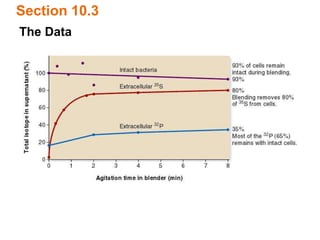
Most of the 35S
was found in the
supernatant
But only a small
percentage of 32P
• These results suggest that DNA is injected into the bacterial
cytoplasm during infection.
- This is the expected result if DNA is the genetic material.
Section 10.3
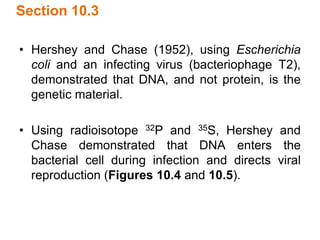
• Hershey and Chase (1952), using Escherichia
coli and an infecting virus (bacteriophage T2),
demonstrated that DNA, and not protein, is the
genetic material.
• Using radioisotope 32P and 35S, Hershey and
Chase demonstrated that DNA enters the
bacterial cell during infection and directs viral
reproduction (Figures 10.4 and 10.5).
Figure 10.4
© 2012 Pearson Education, Inc. Figure 10.5
Section 10.3
• Transfection, the process of infection by
viral DNA into bacterial cells, proved
conclusively that the viral DNA alone
contains all the necessary information for
production of mature viruses.
10.4 Indirect and Direct Evidence
Supports the Concept that DNA Is the
Genetic Material in Eukaryotes
Section 10.4
• Protein is abundant in the cytoplasm and
protein is not.
• Mitochondria and chloroplast perform
genetic function, and DNA is also part of
these organelles.
• DNA is found only where the primary
genetic function occurs.
• This provides indirect evidence for DNA as
the genetic material.
Section 10.4
• UV light is capable of inducing mutations
in the genetic material and is most
mutagenic at a wavelength of 260 nm.
• DNA and RNA absorb UV light most
strongly at 260 nm, but protein absorbs
most strongly at 280 nm, a wavelength at
which no significant mutagenic effects are
observed.
• Again, this provides indirect evidence for
DNA as the genetic material.
Section 10.4
• The strongest direct evidence for DNA as
the genetic material comes from
recombinant DNA technology.
• Segments of eukaryotic DNA
corresponding to specific genes are
isolated and spliced into the bacterial
DNA.
• This complex can be inserted into a
bacterial cell and monitored.
Section 10.4
• The presence of the eukaryotic gene
product in bacteria containing the
eukaryotic gene provides direct evidence
that this DNA is present and functional in
the bacterial cell.
• This has been shown to occur in countless
instances (e.g., insulin production by
bacteria).
10.5 RNA Serves as the Genetic
Material in Some Viruses
Section 10.5
• Some viruses have an RNA core rather
than a DNA core.
• Experiments with tobacco mosaic virus
(1956) demonstrated that RNA serves as
the genetic material for these viruses.
Section 10.5
• Replication of the viral RNA is dependent
on RNA replicase.
Section 10.5
• Retroviruses replicate in an unusual way.
• RNA serves as a template for synthesis of
a complementary DNA by the RNA-
dependent DNA polymerase called
reverse transcriptase.
• This DNA can be incorporated into the
host cell genome; when transcribed,
copies of the original retroviral RNA
chromosomes are also produced.
© 2012 Pearson Education, Inc.
10.6 Knowledge of Nucleic Acid
Chemistry Is Essential to the
Understanding of DNA Structure
© 2012 Pearson Education, Inc.
Section 10.6
• Nucleotides are the building blocks of
DNA
• They consist of
– a nitrogenous base
– a pentose sugar
– a phosphate group
© 2012 Pearson Education, Inc.
Section 10.6
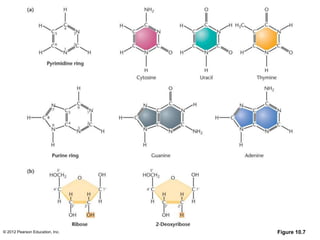
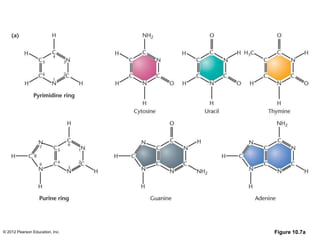
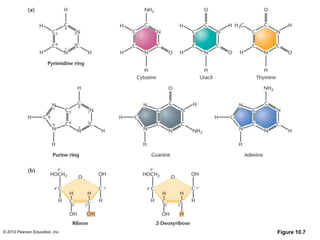
• There are two kinds of nitrogenous bases
– Purines
• Adenine (A)
• Guanine (G)
– Pyrimidines
• Cytosine (C)
• Thymine (T)
• Uracil (U) (Figure 10.7)
© 2012 Pearson Education, Inc. Figure 10.7
© 2012 Pearson Education, Inc. Figure 10.7a
© 2012 Pearson Education, Inc. Figure 10.7b
© 2012 Pearson Education, Inc.
Section 10.6
• DNA and RNA both contain A, C, and G
• Only DNA contains T
• Only RNA contains U
© 2012 Pearson Education, Inc.
Section 10.6
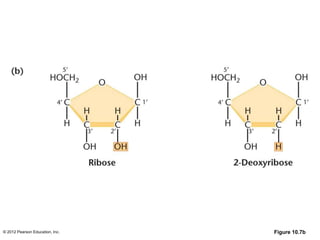
• RNA contains ribose as its sugar
• DNA contains deoxyribose
(Figure 10.7b)
© 2012 Pearson Education, Inc. Figure 10.7
© 2012 Pearson Education, Inc.
Section 10.6
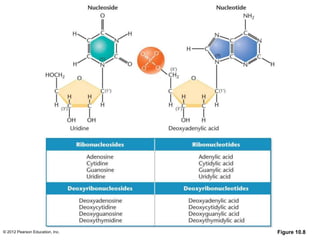
• A nucleoside contains the nitrogenous
base and the pentose sugar
• A nucleotide is a nucleoside with a
phosphate group added (Figure 10.8)
© 2012 Pearson Education, Inc. Figure 10.8
© 2012 Pearson Education, Inc.
Section 10.6
• The C-5' position is the location of the
phosphate group on a nucleotide
© 2012 Pearson Education, Inc.
Section 10.6
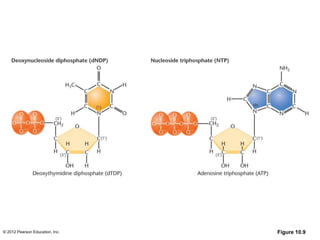
• Nucleotides can have one, two, or three
phosphate groups and are called NMPs,
NDPs, and NTPs, respectively
(Figure 10.9)
© 2012 Pearson Education, Inc. Figure 10.9
© 2012 Pearson Education, Inc.
Section 10.6
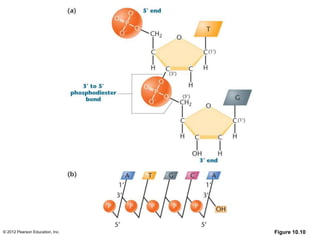
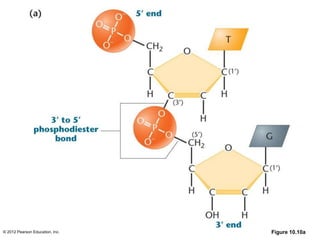
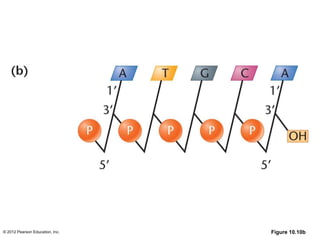
• Nucleotides are linked by a
phosphodiester bond between the
phosphate group at the C-5' position and
the OH group on the C-3' position
(Figure 10.10)
© 2012 Pearson Education, Inc. Figure 10.10
© 2012 Pearson Education, Inc. Figure 10.10a
© 2012 Pearson Education, Inc. Figure 10.10b
© 2012 Pearson Education, Inc.
10.7 The Structure of DNA Holds the Key
to Understanding Its Function
© 2012 Pearson Education, Inc.
Section 10.7
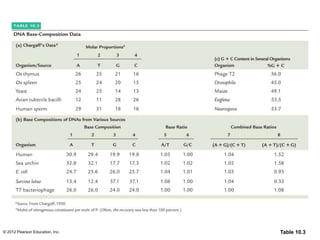
• Chargaff (1949–1953) showed that the
amount of A is proportional to T and the
amount of C is proportional to G, but the
percentage of C + G does not necessarily
equal the percentage of A + T
(Table 10.3)
© 2012 Pearson Education, Inc. Table 10.3
© 2012 Pearson Education, Inc.
Section 10.7
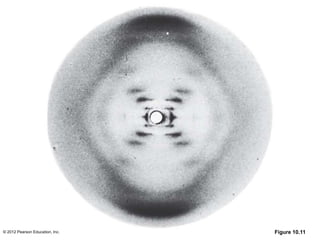
• X-ray diffraction studies by Rosalind
Franklin (1950–1953) of DNA showed a
3.4 angstrom periodicity, characteristic of
a helical structure (Figure 10.11)
© 2012 Pearson Education, Inc. Figure 10.11
© 2012 Pearson Education, Inc.
Section 10.7
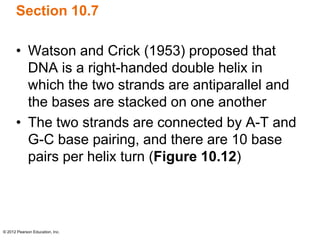
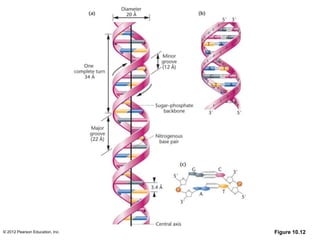
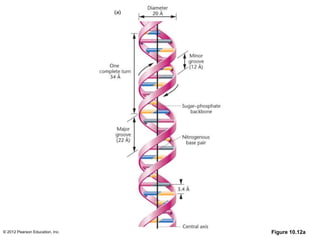
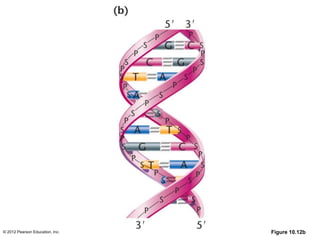
• Watson and Crick (1953) proposed that
DNA is a right-handed double helix in
which the two strands are antiparallel and
the bases are stacked on one another
• The two strands are connected by A-T and
G-C base pairing, and there are 10 base
pairs per helix turn (Figure 10.12)
© 2012 Pearson Education, Inc. Figure 10.12
© 2012 Pearson Education, Inc. Figure 10.12a
© 2012 Pearson Education, Inc. Figure 10.12b
© 2012 Pearson Education, Inc.
Section 10.7
• The A-T and G-C base pairing provides
complementarity of the two strands and
chemical stability to the helix
© 2012 Pearson Education, Inc.
Section 10.7
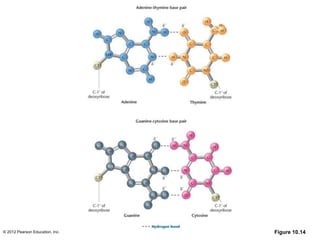
• A-T base pairs form two hydrogen bonds,
and G-C base pairs form three hydrogen
bonds (Figure 10.14)
© 2012 Pearson Education, Inc. Figure 10.14
© 2012 Pearson Education, Inc.
Section 10.7
• The arrangement of sugars and bases
along the axis provides another stabilizing
factor
© 2012 Pearson Education, Inc.
10.9 The Structure of RNA Is Chemically
Similar to DNA, but Single Stranded
© 2012 Pearson Education, Inc.
Section 10.9
• In RNA,
– the sugar ribose replaces deoxyribose of
DNA and
– uracil replaces thymine of DNA
© 2012 Pearson Education, Inc.
Section 10.9
• Most RNA is single stranded, although
some RNAs form double-stranded regions
as they fold into different secondary
structures
• In addition, some viruses have a double-
stranded RNA genome
© 2012 Pearson Education, Inc.
Section 10.9
• There are three classes of cellular RNAs
that function during expression of genetic
information
– messenger RNA (mRNA)
– ribosomal RNA (rRNA)
– transfer RNA (tRNA)
• These all originate as complementary
copies of one of the two DNA strands
during transcription
© 2012 Pearson Education, Inc.
Section 10.9
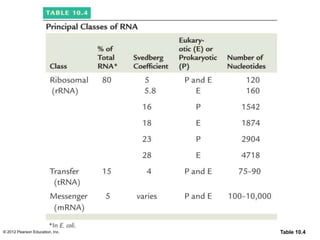
• The characteristics of these RNAs in
prokaryotic and eukaryotic cells are
summarized in Table 10.4
© 2012 Pearson Education, Inc. Table 10.4
© 2012 Pearson Education, Inc.
Section 10.9
• rRNAs are structural components of
ribosomes for protein synthesis
• mRNAs are the template for protein
synthesis
• tRNAs carry amino acids for protein
synthesis

DNA structure.ppt

  • 1.
    10.1 The GeneticMaterial Must Exhibit Four Characteristics
  • 2.
    Section 10.1 • Fora molecule to serve as the genetic material, it must be able to – replicate – store information – express information – allow variation by mutation
  • 3.
    Section 10.1 • Thecentral dogma of molecular genetics is that DNA makes RNA (transcription), which makes proteins (translation) (Figure 10.1).
  • 4.
  • 5.
    10.2 Until 1944,Observations Favored Protein as the Genetic Material
  • 6.
    Section 10.2 • Thegenetic material is physically transmitted from parent to offspring. • Proteins and nucleic acids were the major candidates for the genetic material. • In the 1940s, many geneticists favored proteins.
  • 7.
    Section 10.2 • Proteinsare more diverse and abundant in cells. • They were the subject of the most active areas of genetic research, with more known about proteins than nucleic acid chemistry. • DNA was thought to be too simple to be the genetic material, with only four types of nucleotides as compared to the 20 different amino acids of proteins.
  • 8.
    10.3 Evidence FavoringDNA as the Genetic Material Was First Obtained during the Study of Bacteria and Bacteriophages
  • 9.
    Section 10.3 • Griffithstudied a bacterium (pneumococci) now known as Streptococcus pneumoniae. • S. pneumoniae comes in two strains. – S  Smooth • Secrete a polysaccharide capsule – Protects bacterium from the immune system of animals • Produce smooth colonies on solid media – R  Rough • Unable to secrete a capsule • Produce colonies with a rough appearance Frederick Griffith Experiments with Streptococcus pneumoniae
  • 10.
    Section 10.3 In 1928,Griffith conducted experiments using two strains of S. pneumoniae: type IIIS and type IIR. 1.Inject mouse with live type IIIS bacteria. • Mouse died. • Type IIIS bacteria recovered from the mouse’s blood. 2.Inject mouse with live type IIR bacteria. • Mouse survived. • No living bacteria isolated from the mouse’s blood. 3.Inject mouse with heat-killed type IIIS bacteria. • Mouse survived. • No living bacteria isolated from the mouse’s blood. 4.Inject mouse with live type IIR + heat-killed type IIIS cells. • Mouse died. • Type IIIS bacteria recovered from the mouse’s blood.
  • 11.
  • 13.
    Section 10.3 • Griffithinjected both live and dead bacteria into mice and observed whether the bacteria caused a lethal infection. - Type IIIS killed the mouse, but the type IIR did not. - If type IIIS was first heat killed, the mouse survived. - If type IIR was mixed with dead IIIS, the mouse died. Furthermore, live IIIS bacteria were recovered from the mouse. • Griffith concluded that something from the dead type IIIS was transforming type IIR into type IIIS. - He called this process transformation. • The substance that allowed this to happen was termed the transformation principle. - Griffith did not know what it was.
  • 14.
    Section 10.3 The Experimentsof Avery, MacLeod and McCarty • Avery, MacLeod and McCarty realized that Griffith’s observations could be used to identify the genetic material. • They carried out their experiments in the 1940s. – At that time, it was known that DNA, RNA, proteins and carbohydrates are the major constituents of living cells. • They prepared cell extracts from type IIIS cells and purified each type of macromolecule. – Only the extract that contained purified DNA was able to convert type IIR bacteria into type IIIS. – Treatment of the DNA extract with RNase or protease did not eliminate transformation. – Treatment with DNase did.
  • 15.
    Section 10.3 • Avery,MacLeod, and McCarty demonstrated that the transforming principle was DNA and not protein (Figure 10.3). • In their 1944 publication they stated, "The evidence presented supports the belief that a nucleic acid of the deoxyribose type is the fundamental unit of the transforming principle of Pneumococcus Type III."
  • 16.
  • 17.
    Copyright ©The McGraw-HillCompanies, Inc. Permission required for reproduction or display Mix Mix Mix Mix Type R cells Type R cells Type S DNA extract Type R cells Type S DNA extract + DNase Type R cells Type S DNA extract + RNase Type R cells Type S DNA extract + protease Transformed Transformed Transformed 1 2 3 4 5 Copyright © The McGraw-Hill Companies, Inc. Permission required for reproduction or display. Allow sufficient time for the DNA to be taken up by the type R bacteria. Only a small percentage of the type R bacteria will be transformed to type S. Add an antibody that aggregates type R bacteria (that have not been transformed). The aggregated bacteria are removed by gentle centrifugation. Plate the remaining bacteria on petri plates. Incubate overnight. Avery et al also conducted the following experiments.  To further verify that DNA, and not a contaminant (RNA or protein), is the genetic material.
  • 19.
    Section 10.3 • In1952, Alfred Hershey and Martha Chase provided further evidence that DNA is the genetic material. • They studied the bacteriophage T2 as it is relatively simple since it’s composed of only two macromolecules: - DNA and protein Made up of protein Inside the capsid Hershey and Chase Experiment with Bacteriophage T2
  • 20.
    Life cycle ofthe bacteriophage T2
  • 21.
    Section 10.3 The Hersheyand Chase experiment can be summarised as follows: • Used radioisotopes to distinguish DNA from proteins - 32P labelled DNA specifically - 35S labelled protein specifically • Radioactively-labelled phages were used to infect non-radioactive Escherichia coli cells. • After allowing sufficient time for infection to proceed, the residual phage particles were sheared off the cells. - Phage ghosts and E. coli cells were separated. • Radioactivity was monitored using a Geiger counter. The Hypothesis • Only the genetic material of the phage is injected into the bacterium. - Isotope labelling will reveal if it is DNA or protein.
  • 24.
  • 25.
    Interpreting the Data Section10.3 Most of the 35S was found in the supernatant But only a small percentage of 32P • These results suggest that DNA is injected into the bacterial cytoplasm during infection. - This is the expected result if DNA is the genetic material.
  • 26.
    Section 10.3 • Hersheyand Chase (1952), using Escherichia coli and an infecting virus (bacteriophage T2), demonstrated that DNA, and not protein, is the genetic material. • Using radioisotope 32P and 35S, Hershey and Chase demonstrated that DNA enters the bacterial cell during infection and directs viral reproduction (Figures 10.4 and 10.5).
  • 27.
  • 28.
    © 2012 PearsonEducation, Inc. Figure 10.5
  • 29.
    Section 10.3 • Transfection,the process of infection by viral DNA into bacterial cells, proved conclusively that the viral DNA alone contains all the necessary information for production of mature viruses.
  • 30.
    10.4 Indirect andDirect Evidence Supports the Concept that DNA Is the Genetic Material in Eukaryotes
  • 31.
    Section 10.4 • Proteinis abundant in the cytoplasm and protein is not. • Mitochondria and chloroplast perform genetic function, and DNA is also part of these organelles. • DNA is found only where the primary genetic function occurs. • This provides indirect evidence for DNA as the genetic material.
  • 32.
    Section 10.4 • UVlight is capable of inducing mutations in the genetic material and is most mutagenic at a wavelength of 260 nm. • DNA and RNA absorb UV light most strongly at 260 nm, but protein absorbs most strongly at 280 nm, a wavelength at which no significant mutagenic effects are observed. • Again, this provides indirect evidence for DNA as the genetic material.
  • 33.
    Section 10.4 • Thestrongest direct evidence for DNA as the genetic material comes from recombinant DNA technology. • Segments of eukaryotic DNA corresponding to specific genes are isolated and spliced into the bacterial DNA. • This complex can be inserted into a bacterial cell and monitored.
  • 34.
    Section 10.4 • Thepresence of the eukaryotic gene product in bacteria containing the eukaryotic gene provides direct evidence that this DNA is present and functional in the bacterial cell. • This has been shown to occur in countless instances (e.g., insulin production by bacteria).
  • 35.
    10.5 RNA Servesas the Genetic Material in Some Viruses
  • 36.
    Section 10.5 • Someviruses have an RNA core rather than a DNA core. • Experiments with tobacco mosaic virus (1956) demonstrated that RNA serves as the genetic material for these viruses.
  • 37.
    Section 10.5 • Replicationof the viral RNA is dependent on RNA replicase.
  • 38.
    Section 10.5 • Retrovirusesreplicate in an unusual way. • RNA serves as a template for synthesis of a complementary DNA by the RNA- dependent DNA polymerase called reverse transcriptase. • This DNA can be incorporated into the host cell genome; when transcribed, copies of the original retroviral RNA chromosomes are also produced.
  • 39.
    © 2012 PearsonEducation, Inc. 10.6 Knowledge of Nucleic Acid Chemistry Is Essential to the Understanding of DNA Structure
  • 40.
    © 2012 PearsonEducation, Inc. Section 10.6 • Nucleotides are the building blocks of DNA • They consist of – a nitrogenous base – a pentose sugar – a phosphate group
  • 41.
    © 2012 PearsonEducation, Inc. Section 10.6 • There are two kinds of nitrogenous bases – Purines • Adenine (A) • Guanine (G) – Pyrimidines • Cytosine (C) • Thymine (T) • Uracil (U) (Figure 10.7)
  • 42.
    © 2012 PearsonEducation, Inc. Figure 10.7
  • 43.
    © 2012 PearsonEducation, Inc. Figure 10.7a
  • 44.
    © 2012 PearsonEducation, Inc. Figure 10.7b
  • 45.
    © 2012 PearsonEducation, Inc. Section 10.6 • DNA and RNA both contain A, C, and G • Only DNA contains T • Only RNA contains U
  • 46.
    © 2012 PearsonEducation, Inc. Section 10.6 • RNA contains ribose as its sugar • DNA contains deoxyribose (Figure 10.7b)
  • 47.
    © 2012 PearsonEducation, Inc. Figure 10.7
  • 48.
    © 2012 PearsonEducation, Inc. Section 10.6 • A nucleoside contains the nitrogenous base and the pentose sugar • A nucleotide is a nucleoside with a phosphate group added (Figure 10.8)
  • 49.
    © 2012 PearsonEducation, Inc. Figure 10.8
  • 50.
    © 2012 PearsonEducation, Inc. Section 10.6 • The C-5' position is the location of the phosphate group on a nucleotide
  • 51.
    © 2012 PearsonEducation, Inc. Section 10.6 • Nucleotides can have one, two, or three phosphate groups and are called NMPs, NDPs, and NTPs, respectively (Figure 10.9)
  • 52.
    © 2012 PearsonEducation, Inc. Figure 10.9
  • 53.
    © 2012 PearsonEducation, Inc. Section 10.6 • Nucleotides are linked by a phosphodiester bond between the phosphate group at the C-5' position and the OH group on the C-3' position (Figure 10.10)
  • 54.
    © 2012 PearsonEducation, Inc. Figure 10.10
  • 55.
    © 2012 PearsonEducation, Inc. Figure 10.10a
  • 56.
    © 2012 PearsonEducation, Inc. Figure 10.10b
  • 57.
    © 2012 PearsonEducation, Inc. 10.7 The Structure of DNA Holds the Key to Understanding Its Function
  • 58.
    © 2012 PearsonEducation, Inc. Section 10.7 • Chargaff (1949–1953) showed that the amount of A is proportional to T and the amount of C is proportional to G, but the percentage of C + G does not necessarily equal the percentage of A + T (Table 10.3)
  • 59.
    © 2012 PearsonEducation, Inc. Table 10.3
  • 60.
    © 2012 PearsonEducation, Inc. Section 10.7 • X-ray diffraction studies by Rosalind Franklin (1950–1953) of DNA showed a 3.4 angstrom periodicity, characteristic of a helical structure (Figure 10.11)
  • 61.
    © 2012 PearsonEducation, Inc. Figure 10.11
  • 62.
    © 2012 PearsonEducation, Inc. Section 10.7 • Watson and Crick (1953) proposed that DNA is a right-handed double helix in which the two strands are antiparallel and the bases are stacked on one another • The two strands are connected by A-T and G-C base pairing, and there are 10 base pairs per helix turn (Figure 10.12)
  • 63.
    © 2012 PearsonEducation, Inc. Figure 10.12
  • 64.
    © 2012 PearsonEducation, Inc. Figure 10.12a
  • 65.
    © 2012 PearsonEducation, Inc. Figure 10.12b
  • 66.
    © 2012 PearsonEducation, Inc. Section 10.7 • The A-T and G-C base pairing provides complementarity of the two strands and chemical stability to the helix
  • 67.
    © 2012 PearsonEducation, Inc. Section 10.7 • A-T base pairs form two hydrogen bonds, and G-C base pairs form three hydrogen bonds (Figure 10.14)
  • 68.
    © 2012 PearsonEducation, Inc. Figure 10.14
  • 69.
    © 2012 PearsonEducation, Inc. Section 10.7 • The arrangement of sugars and bases along the axis provides another stabilizing factor
  • 70.
    © 2012 PearsonEducation, Inc. 10.9 The Structure of RNA Is Chemically Similar to DNA, but Single Stranded
  • 71.
    © 2012 PearsonEducation, Inc. Section 10.9 • In RNA, – the sugar ribose replaces deoxyribose of DNA and – uracil replaces thymine of DNA
  • 72.
    © 2012 PearsonEducation, Inc. Section 10.9 • Most RNA is single stranded, although some RNAs form double-stranded regions as they fold into different secondary structures • In addition, some viruses have a double- stranded RNA genome
  • 73.
    © 2012 PearsonEducation, Inc. Section 10.9 • There are three classes of cellular RNAs that function during expression of genetic information – messenger RNA (mRNA) – ribosomal RNA (rRNA) – transfer RNA (tRNA) • These all originate as complementary copies of one of the two DNA strands during transcription
  • 74.
    © 2012 PearsonEducation, Inc. Section 10.9 • The characteristics of these RNAs in prokaryotic and eukaryotic cells are summarized in Table 10.4
  • 75.
    © 2012 PearsonEducation, Inc. Table 10.4
  • 76.
    © 2012 PearsonEducation, Inc. Section 10.9 • rRNAs are structural components of ribosomes for protein synthesis • mRNAs are the template for protein synthesis • tRNAs carry amino acids for protein synthesis