EOSC-hub receives funding from the European Union’s Horizon 2020 research and innovation programme under grant agreement No. 777536.
eosc-hub.eu
@EOSC_eu
EOSC-hub: A Collaborative Framework
for the EOSC Implementation
Tiziana Ferrari, Per Öster
Dissemination level: Public
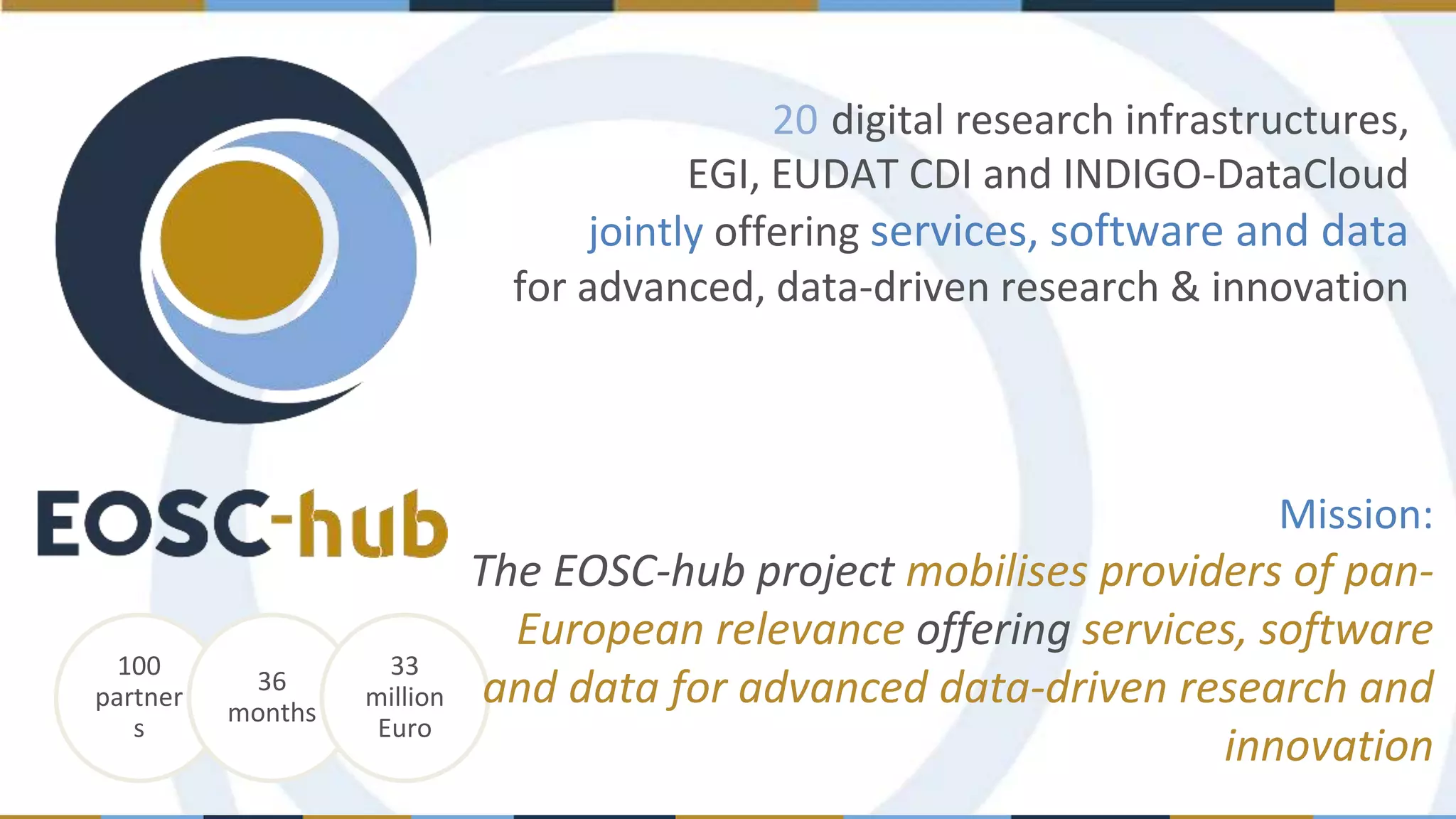
20 digital research infrastructures,
EGI, EUDAT CDI and INDIGO-DataCloud
jointly offering services, software and data
for advanced, data-driven research & innovation
100
partner
s
36
months
33
million
Euro
Mission:
The EOSC-hub project mobilises providers of pan-
European relevance offering services, software
and data for advanced data-driven research and
innovation
3
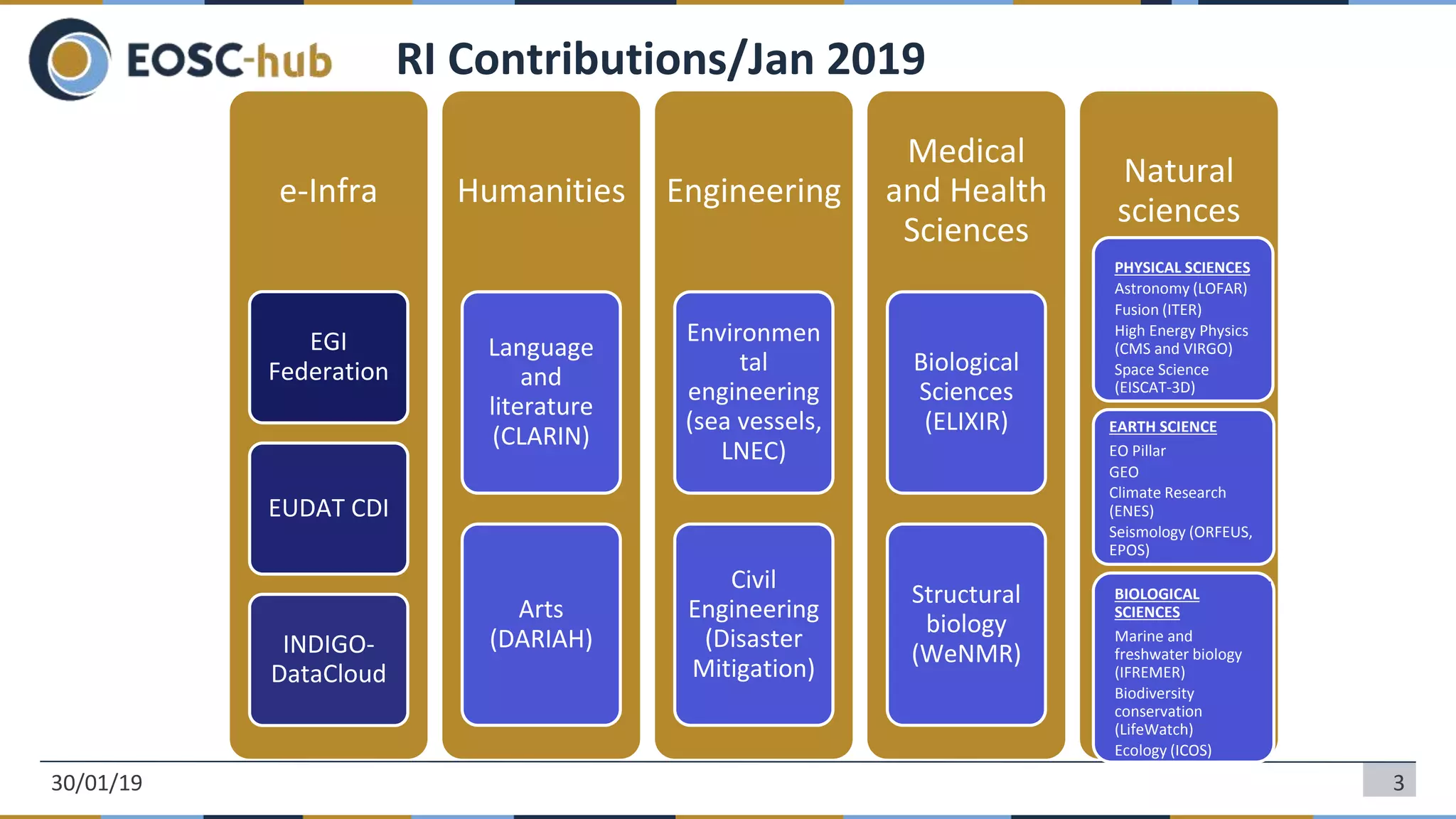
RI Contributions/Jan 2019
e-Infra
EGI
Federation
EUDAT CDI
INDIGO-
DataCloud
Humanities
Language
and
literature
(CLARIN)
Arts
(DARIAH)
Engineering
Environmen
tal
engineering
(sea vessels,
LNEC)
Civil
Engineering
(Disaster
Mitigation)
Medical
and Health
Sciences
Biological
Sciences
(ELIXIR)
Structural
biology
(WeNMR)
Natural
sciences
PHYSICAL SCIENCES
Astronomy (LOFAR)
Fusion (ITER)
High Energy Physics
(CMS and VIRGO)
Space Science
(EISCAT-3D)
EARTH SCIENCE
EO Pillar
GEO
Climate Research
(ENES)
Seismology (ORFEUS,
EPOS)
BIOLOGICAL
SCIENCES
Marine and
freshwater biology
(IFREMER)
Biodiversity
conservation
(LifeWatch)
Ecology (ICOS)
30/01/19
4
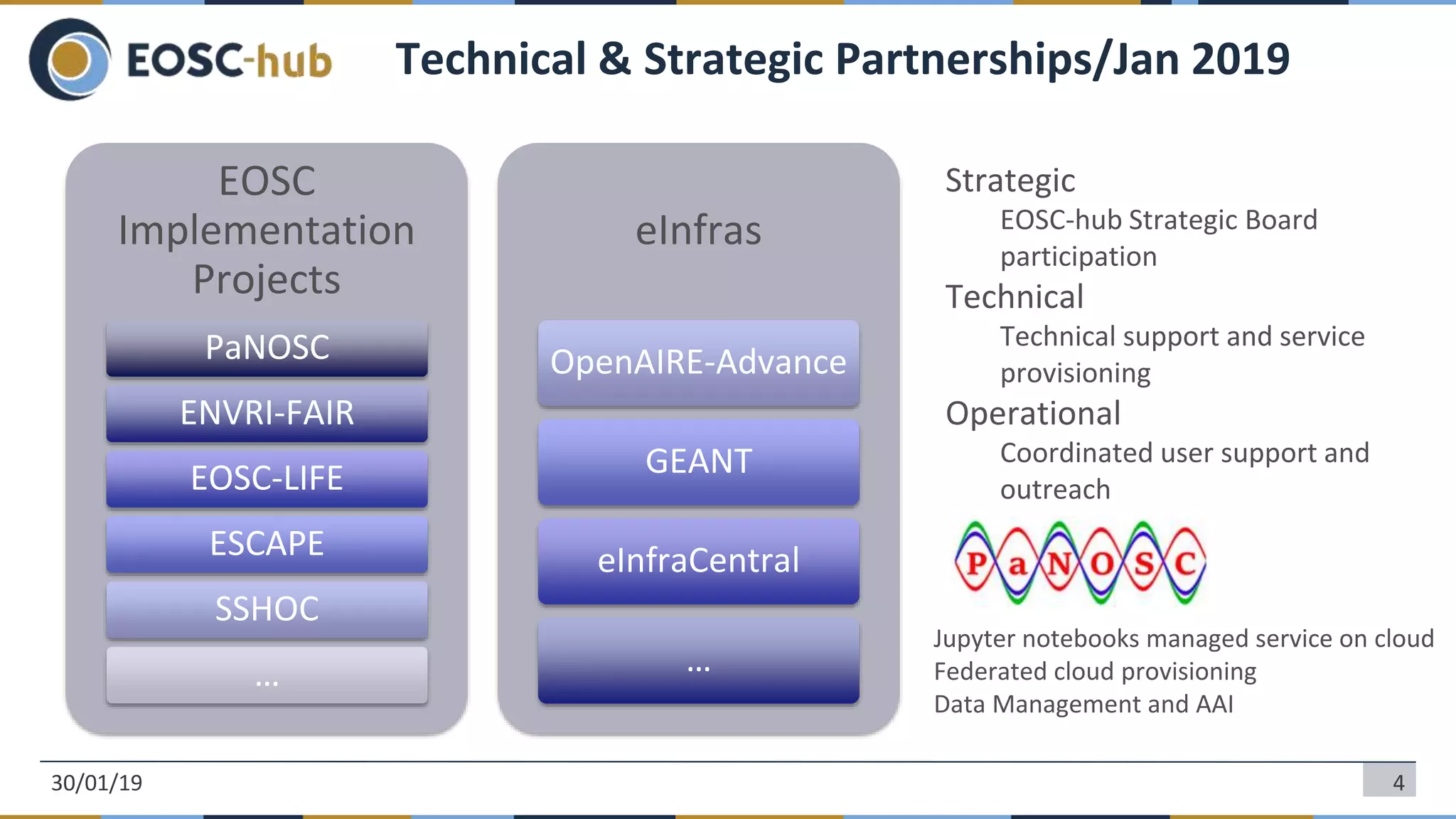
Technical & Strategic Partnerships/Jan 2019
30/01/19
EOSC
Implementation
Projects
PaNOSC
ENVRI-FAIR
EOSC-LIFE
ESCAPE
SSHOC
…
eInfras
OpenAIRE-Advance
GEANT
eInfraCentral
…
Strategic
EOSC-hub Strategic Board
participation
Technical
Technical support and service
provisioning
Operational
Coordinated user support and
outreach
Jupyter notebooks managed service on cloud
Federated cloud provisioning
Data Management and AAI
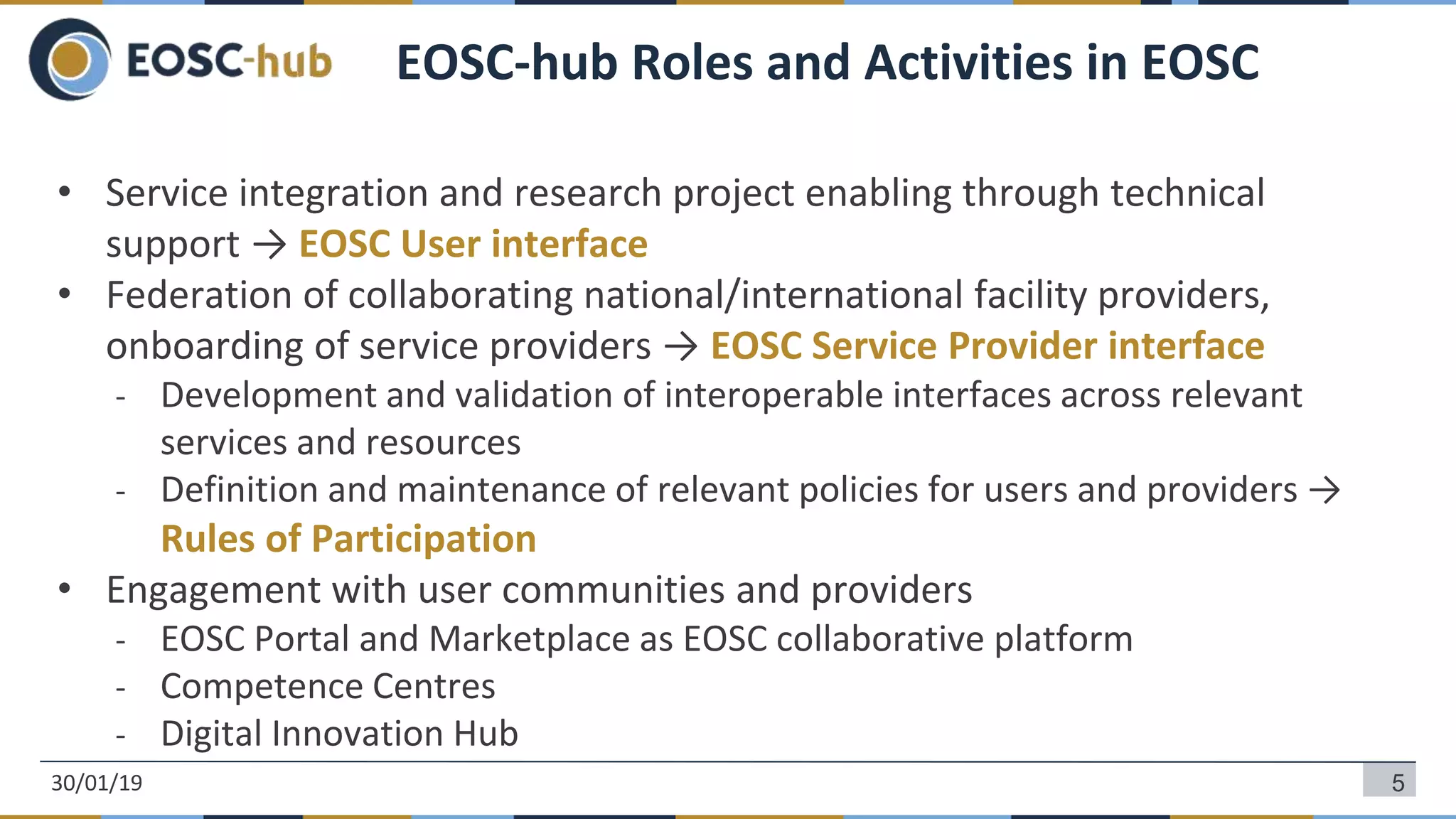
• Service integration and research project enabling through technical
support → EOSC User interface
• Federation of collaborating national/international facility providers,
onboarding of service providers → EOSC Service Provider interface
- Development and validation of interoperable interfaces across relevant
services and resources
- Definition and maintenance of relevant policies for users and providers →
Rules of Participation
• Engagement with user communities and providers
- EOSC Portal and Marketplace as EOSC collaborative platform
- Competence Centres
- Digital Innovation Hub
5
EOSC-hub Roles and Activities in EOSC
30/01/19
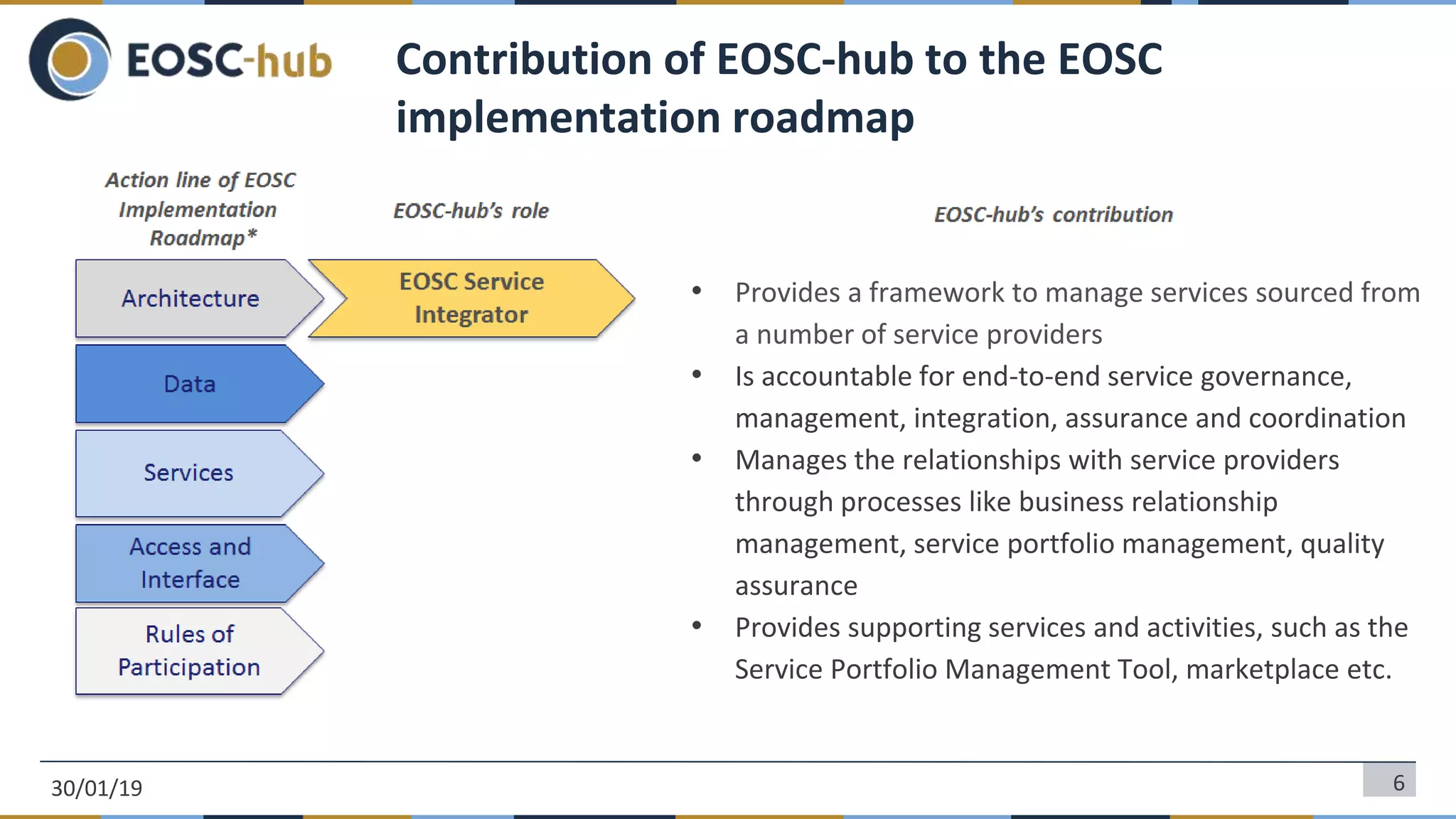
• Provides a framework to manage services sourced from
a number of service providers
• Is accountable for end-to-end service governance,
management, integration, assurance and coordination
• Manages the relationships with service providers
through processes like business relationship
management, service portfolio management, quality
assurance
• Provides supporting services and activities, such as the
Service Portfolio Management Tool, marketplace etc.
6
Contribution of EOSC-hub to the EOSC
implementation roadmap
30/01/19
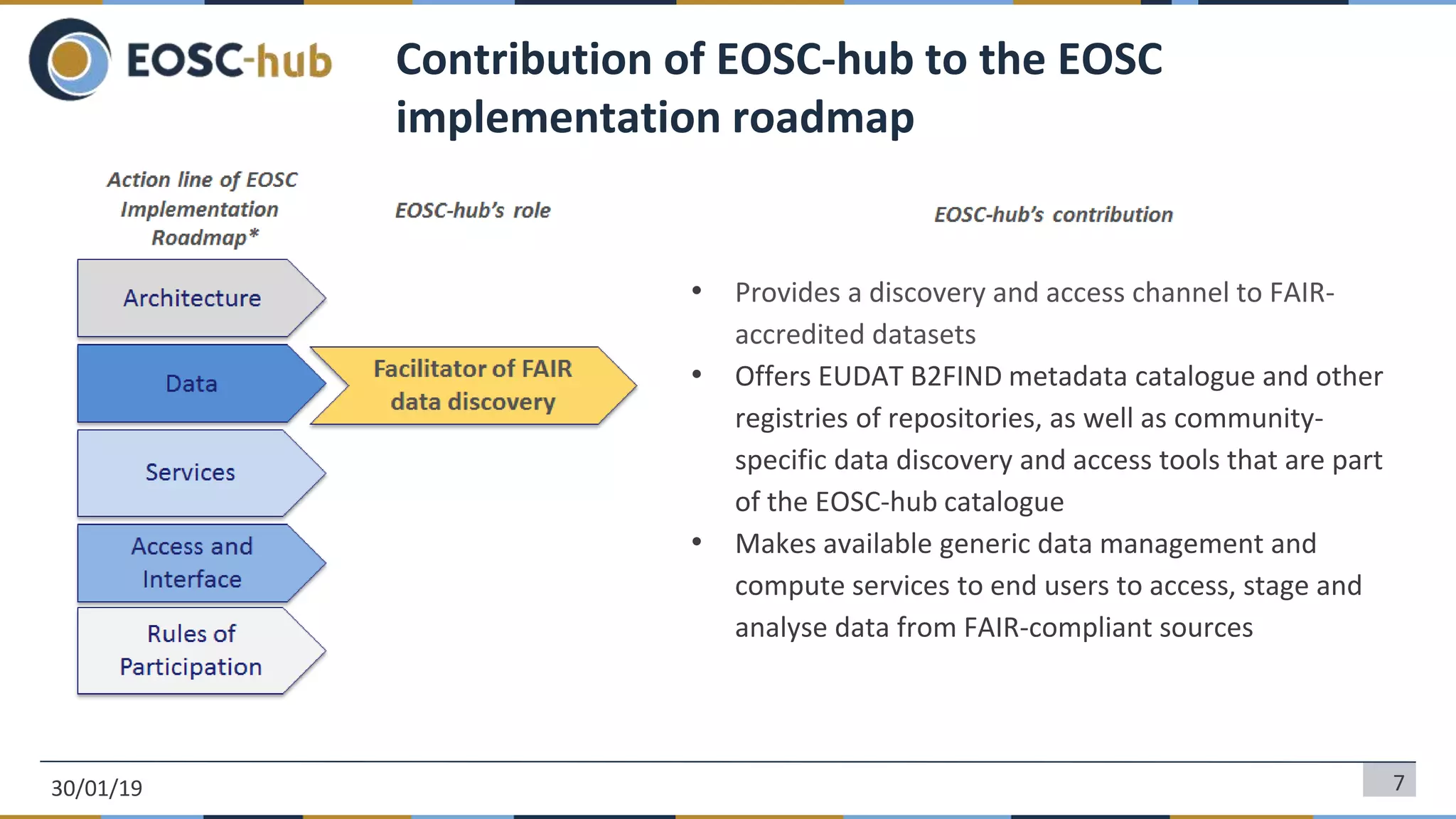
• Provides a discovery and access channel to FAIR-
accredited datasets
• Offers EUDAT B2FIND metadata catalogue and other
registries of repositories, as well as community-
specific data discovery and access tools that are part
of the EOSC-hub catalogue
• Makes available generic data management and
compute services to end users to access, stage and
analyse data from FAIR-compliant sources
7
Contribution of EOSC-hub to the EOSC
implementation roadmap
30/01/19
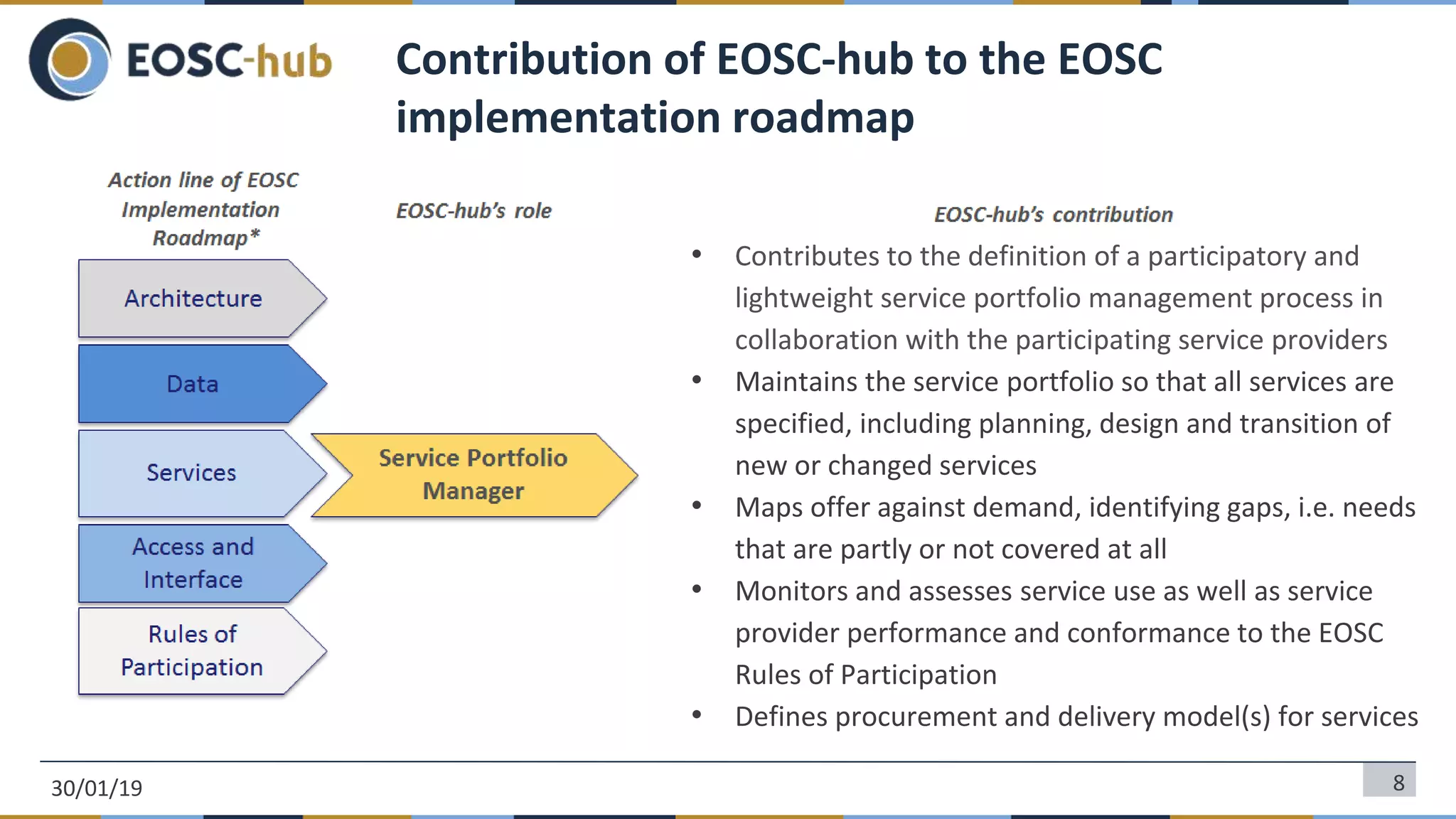
• Contributes to the definition of a participatory and
lightweight service portfolio management process in
collaboration with the participating service providers
• Maintains the service portfolio so that all services are
specified, including planning, design and transition of
new or changed services
• Maps offer against demand, identifying gaps, i.e. needs
that are partly or not covered at all
• Monitors and assesses service use as well as service
provider performance and conformance to the EOSC
Rules of Participation
• Defines procurement and delivery model(s) for services
8
Contribution of EOSC-hub to the EOSC
implementation roadmap
30/01/19
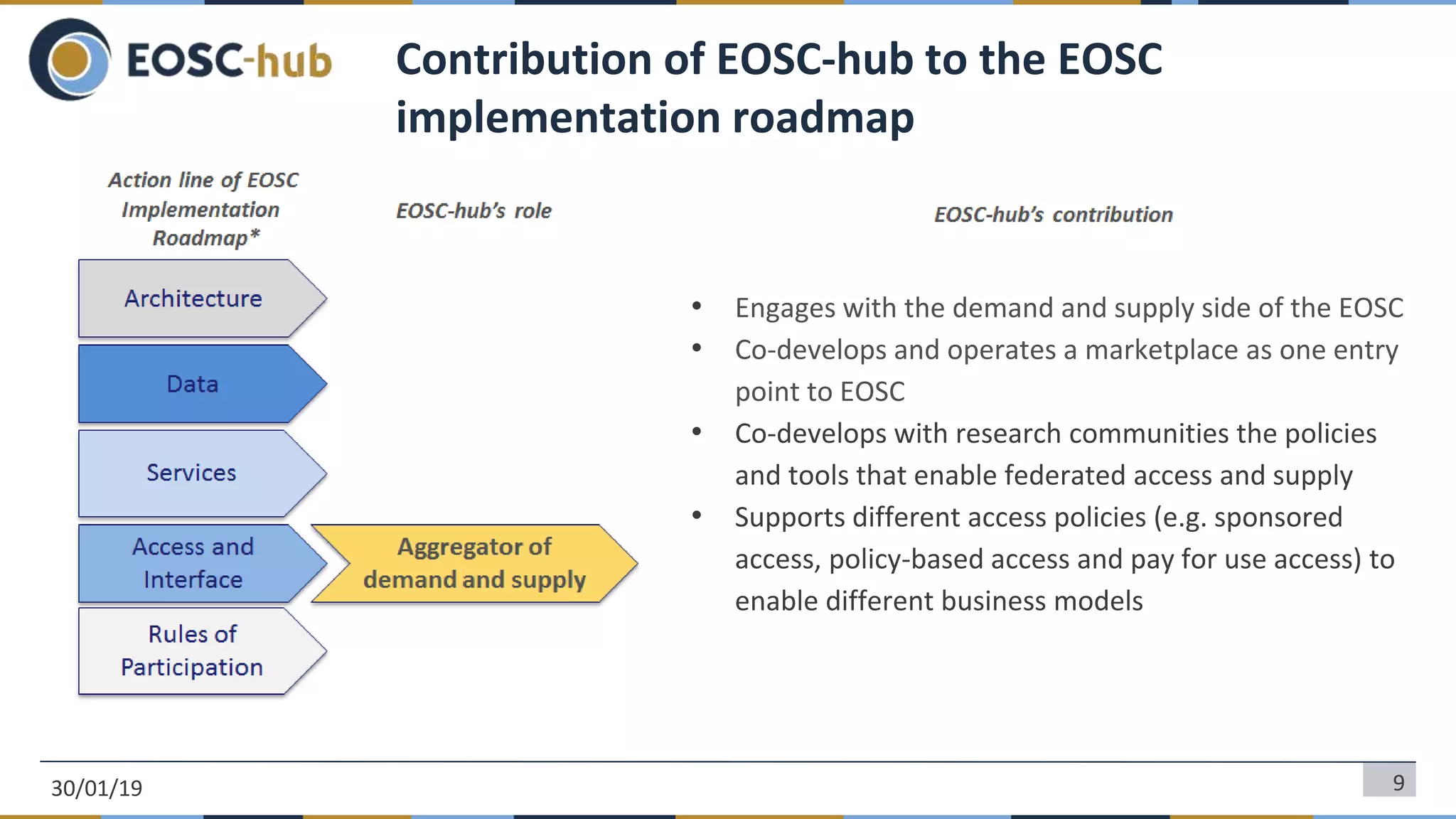
• Engages with the demand and supply side of the EOSC
• Co-develops and operates a marketplace as one entry
point to EOSC
• Co-develops with research communities the policies
and tools that enable federated access and supply
• Supports different access policies (e.g. sponsored
access, policy-based access and pay for use access) to
enable different business models
9
Contribution of EOSC-hub to the EOSC
implementation roadmap
30/01/19
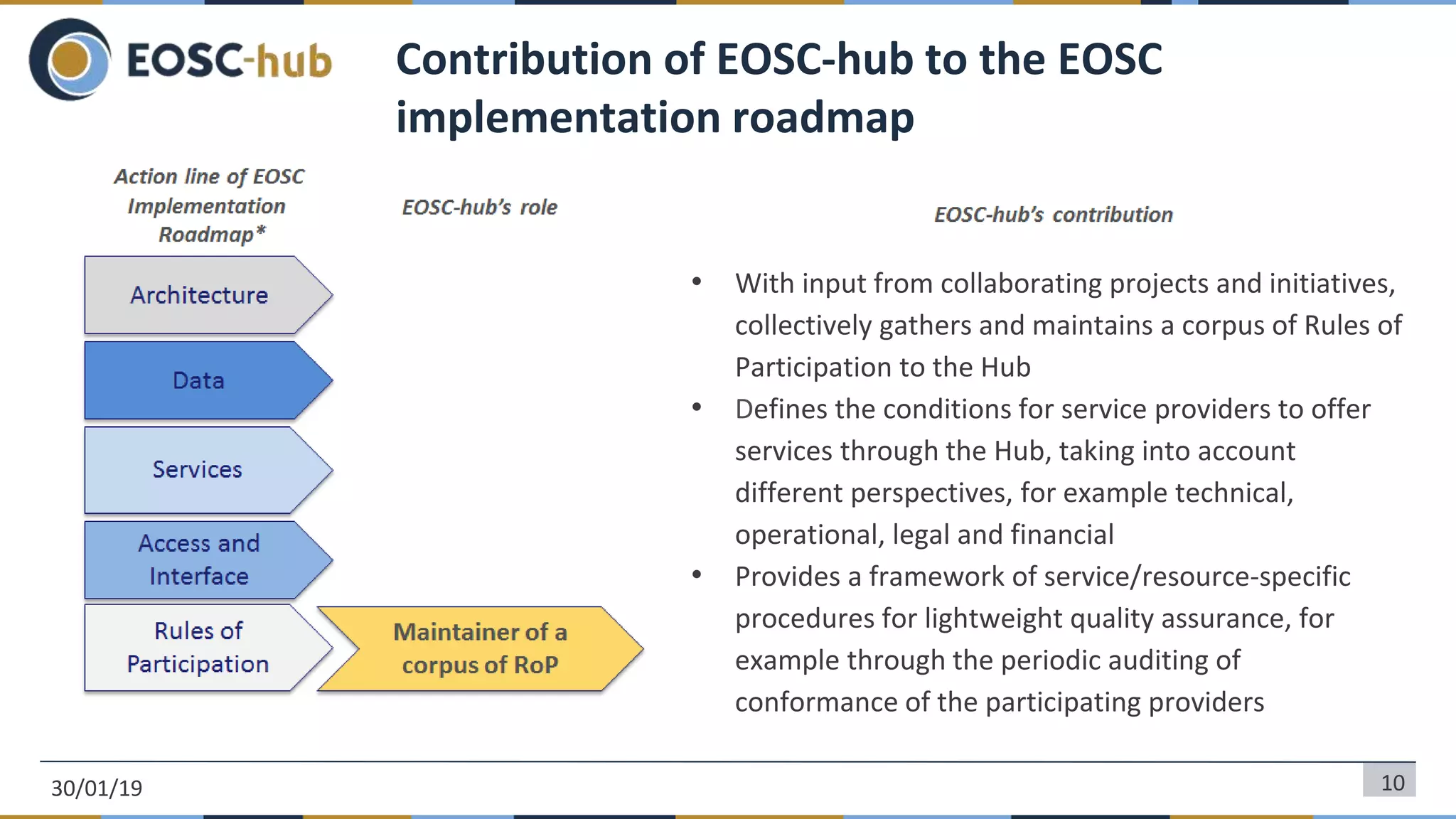
• With input from collaborating projects and initiatives,
collectively gathers and maintains a corpus of Rules of
Participation to the Hub
• Defines the conditions for service providers to offer
services through the Hub, taking into account
different perspectives, for example technical,
operational, legal and financial
• Provides a framework of service/resource-specific
procedures for lightweight quality assurance, for
example through the periodic auditing of
conformance of the participating providers
10
Contribution of EOSC-hub to the EOSC
implementation roadmap
30/01/19
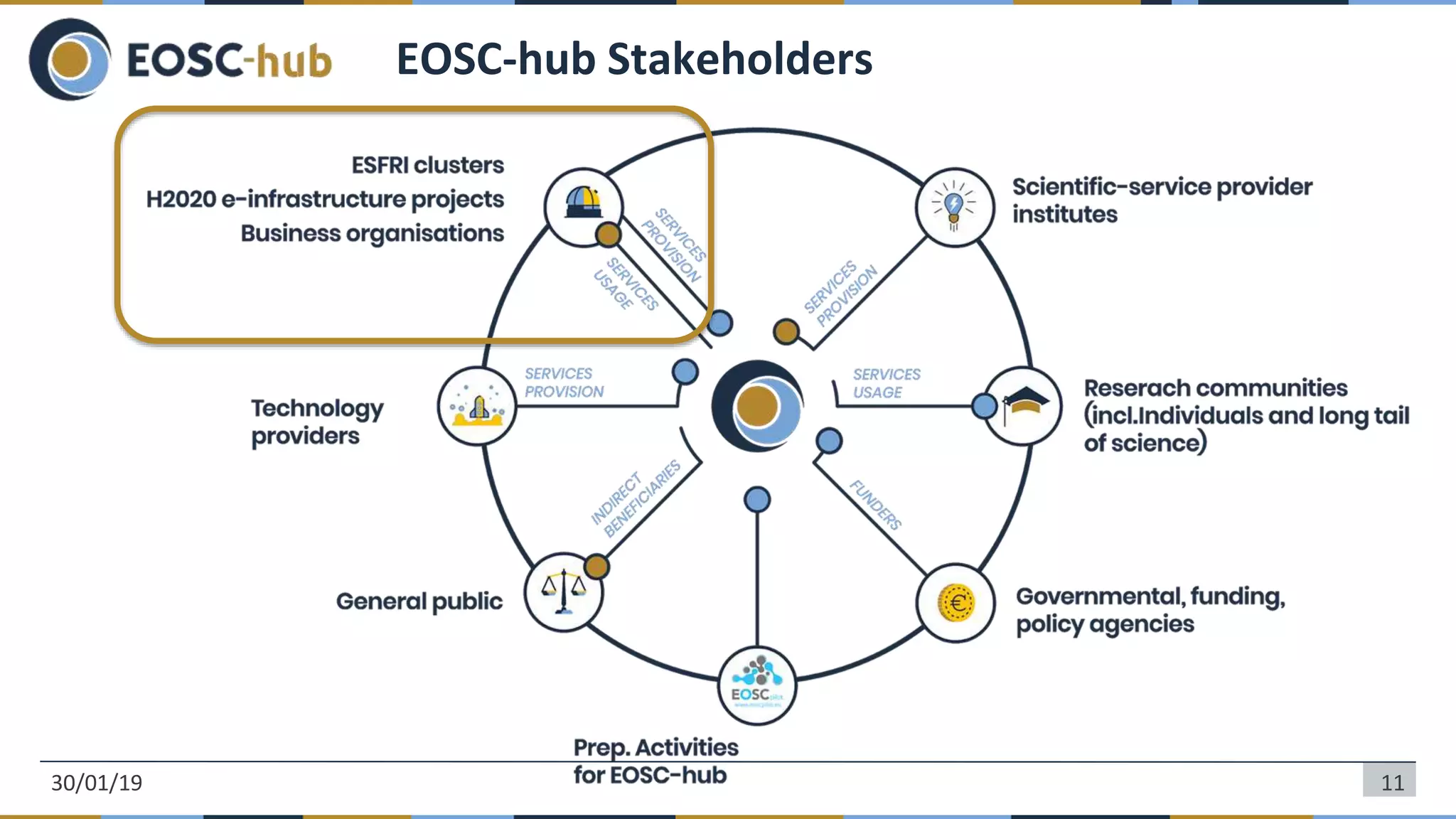
EOSC-hub Stakeholders
30/01/19 11
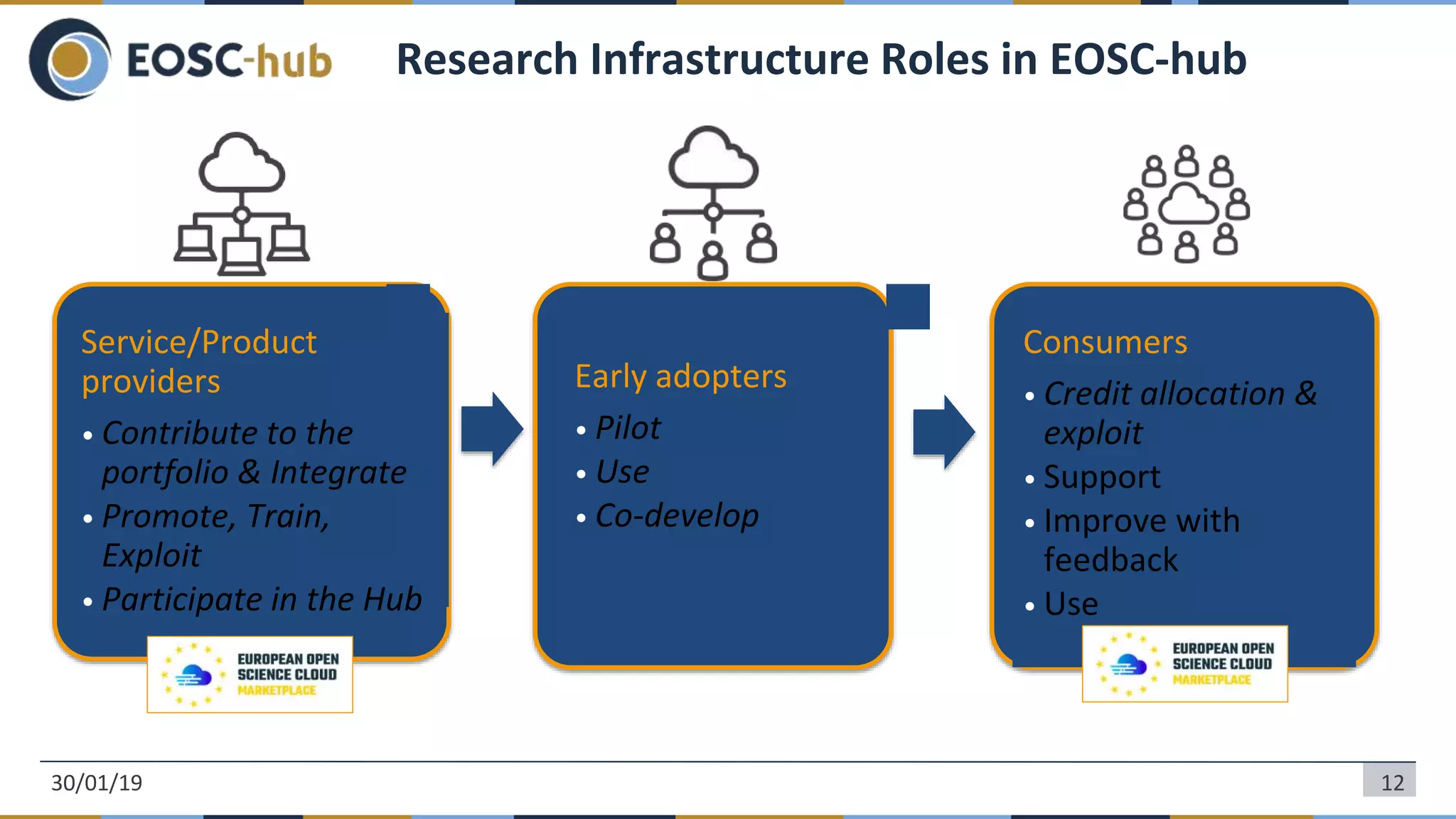
Service/Product
providers
• Contribute to the
portfolio & Integrate
• Promote, Train,
Exploit
• Participate in the Hub
Early adopters
• Pilot
• Use
• Co-develop
Consumers
• Credit allocation &
exploit
• Support
• Improve with
feedback
• Use
12
Research Infrastructure Roles in EOSC-hub
30/01/19
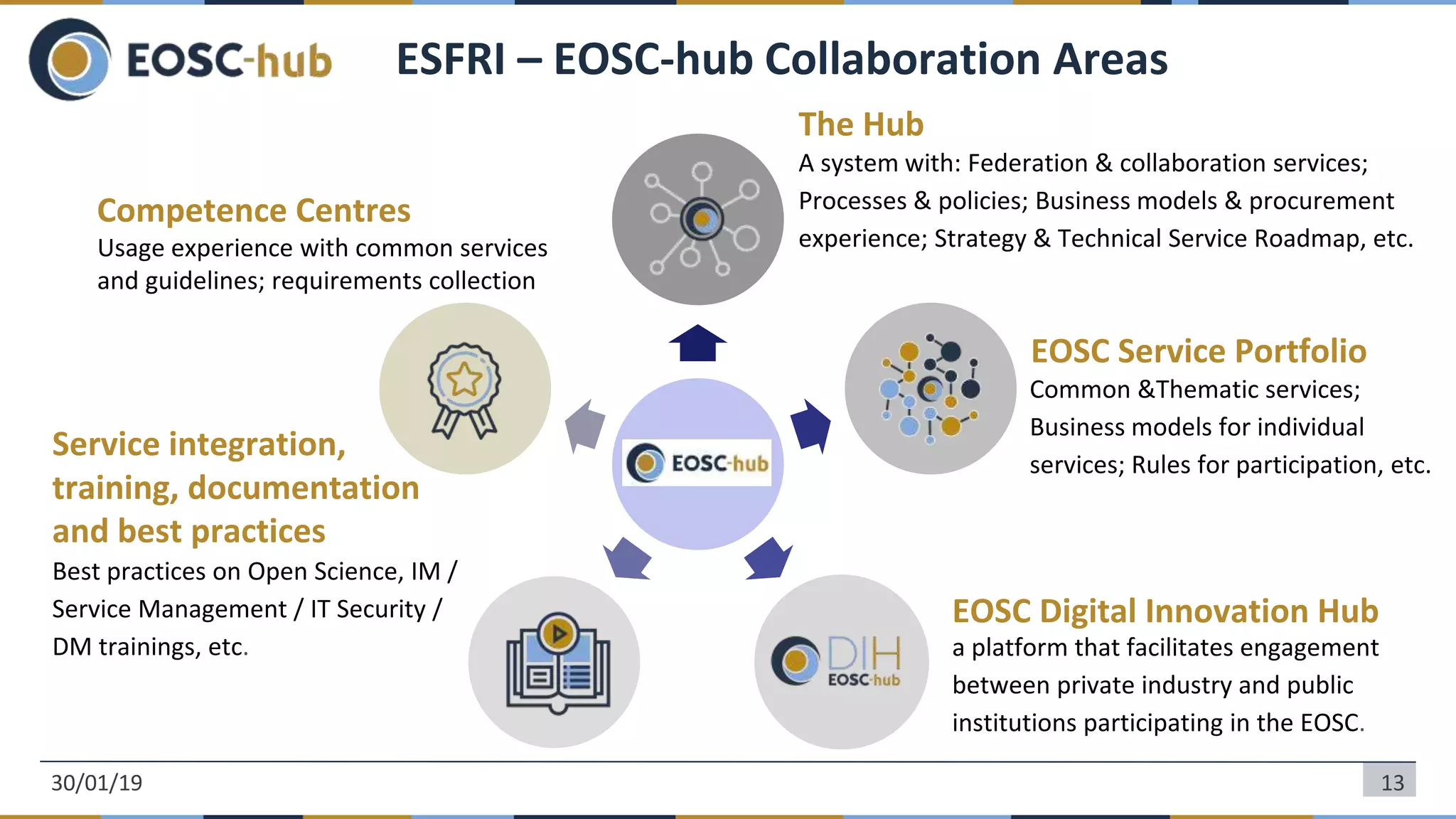
ESFRI – EOSC-hub Collaboration Areas
EOSC Digital Innovation Hub
EOSC Service Portfolio
The Hub
Competence Centres
Service integration,
training, documentation
and best practices
30/01/19
A system with: Federation & collaboration services;
Processes & policies; Business models & procurement
experience; Strategy & Technical Service Roadmap, etc.
Common &Thematic services;
Business models for individual
services; Rules for participation, etc.
a platform that facilitates engagement
between private industry and public
institutions participating in the EOSC.
Best practices on Open Science, IM /
Service Management / IT Security /
DM trainings, etc.
Usage experience with common services
and guidelines; requirements collection
13
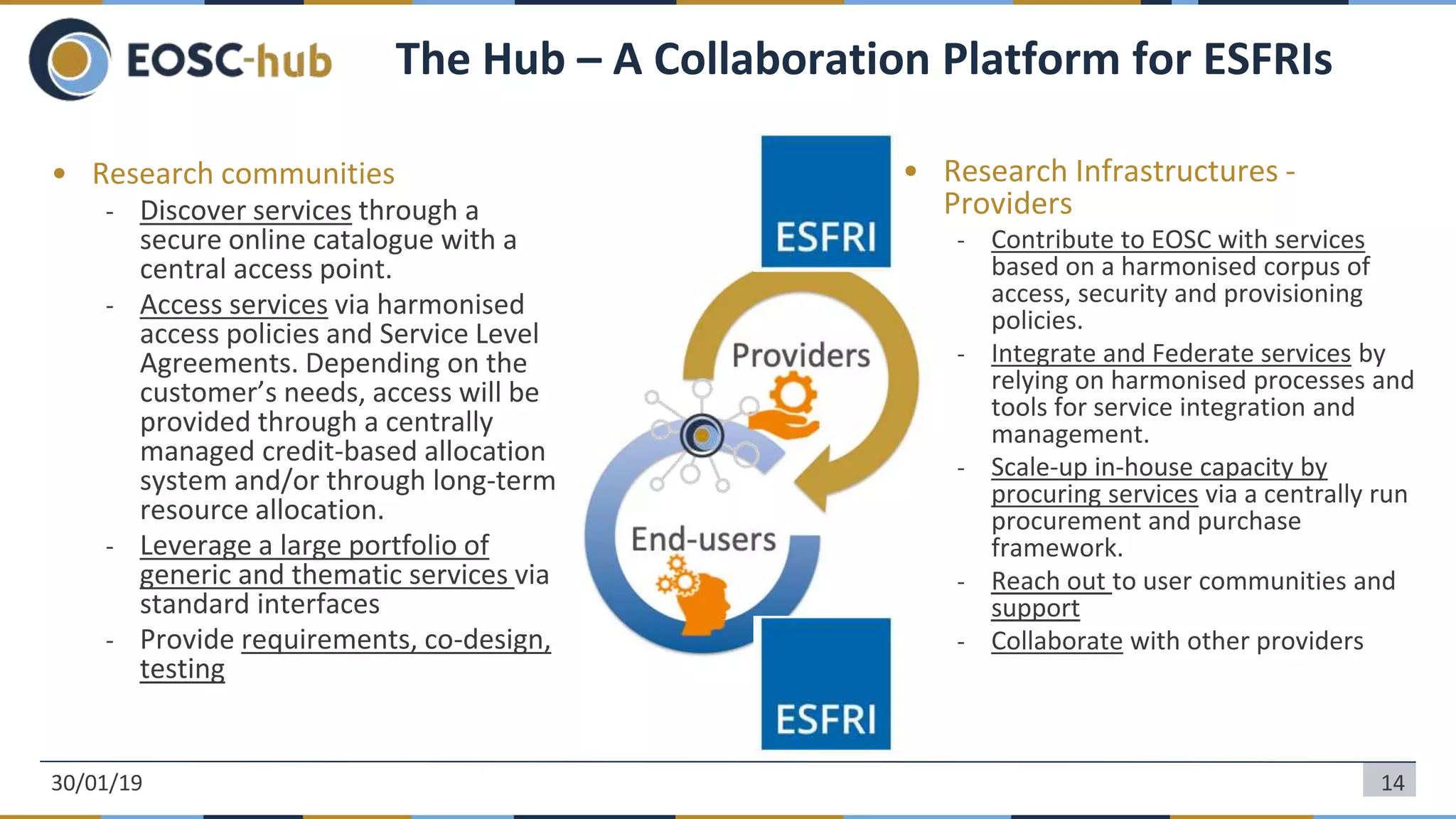
• Research communities
- Discover services through a
secure online catalogue with a
central access point.
- Access services via harmonised
access policies and Service Level
Agreements. Depending on the
customer’s needs, access will be
provided through a centrally
managed credit-based allocation
system and/or through long-term
resource allocation.
- Leverage a large portfolio of
generic and thematic services via
standard interfaces
- Provide requirements, co-design,
testing
• Research Infrastructures -
Providers
- Contribute to EOSC with services
based on a harmonised corpus of
access, security and provisioning
policies.
- Integrate and Federate services by
relying on harmonised processes and
tools for service integration and
management.
- Scale-up in-house capacity by
procuring services via a centrally run
procurement and purchase
framework.
- Reach out to user communities and
support
- Collaborate with other providers
30/01/19 14
The Hub – A Collaboration Platform for ESFRIs
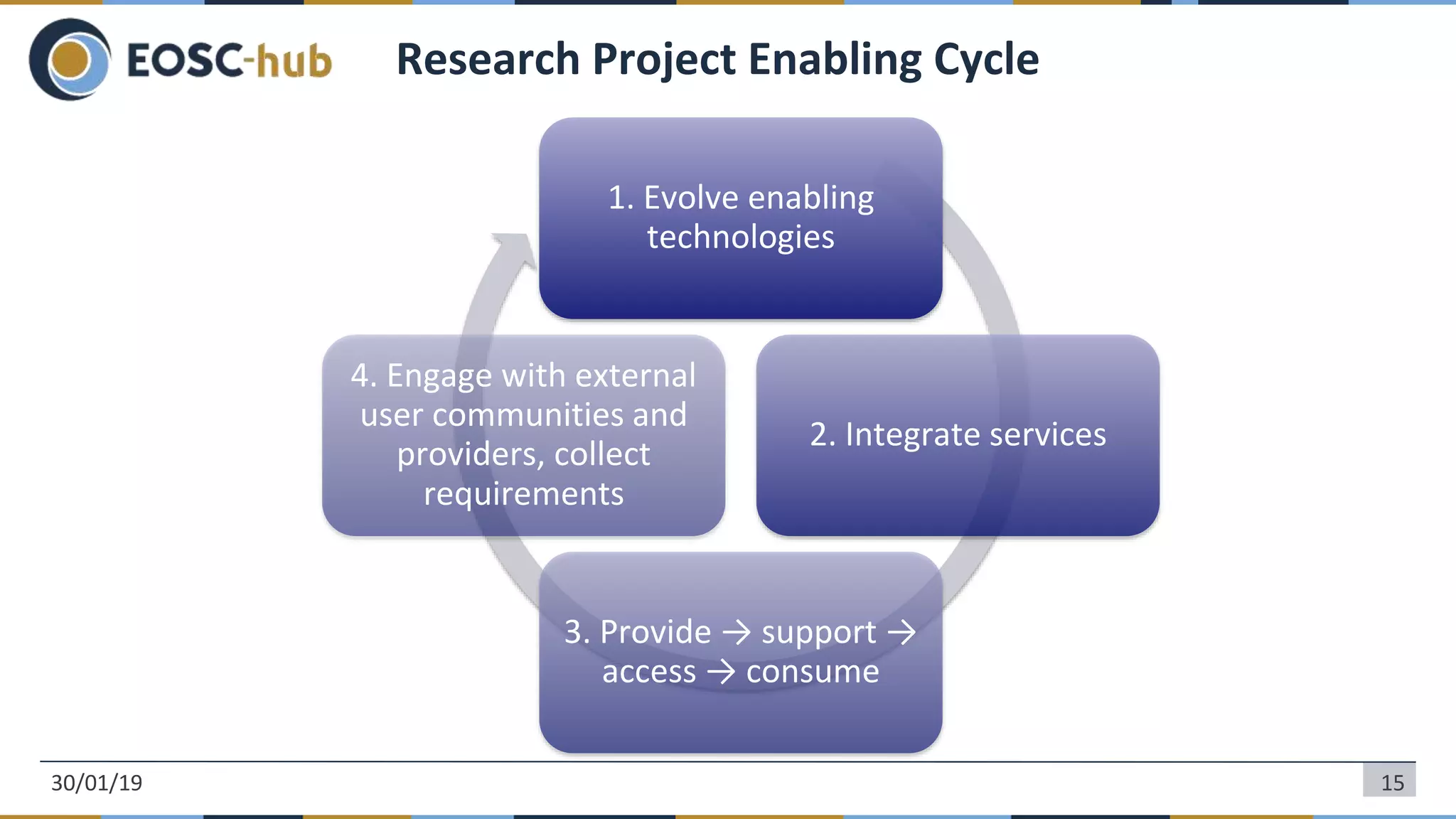
Research Project Enabling Cycle
1. Evolve enabling
technologies
2. Integrate services
3. Provide → support →
access → consume
4. Engage with external
user communities and
providers, collect
requirements
30/01/19 15
• Objective: Widen the access to services to
all user groups including researchers,
high-education, business organizations
and expand the user base
• Objective: Increase innovation capacity of
Research e-Infrastructures Solutions
successfully adopted by user communities
will be supported for broader exploitation
by external stakeholders. In addition to
the DIH, the project stimulates
engagement via large research
collaborations and infrastructures via 8
Competence Centres
Digital Innovation Hub [KER3]
• A platform that allows facilitates
engagement between private
industry and public institutions
participating in the EOSC
Competence Centres [KER5]
• Research communities, service
providers and experts contributing to
- Co-design: Requirements, gap
analysis and technical development
- Piloting and pre-production
30/01/19 16
Collaboration Platforms
Co-design Requirements and
Gap Analysis
Technical
development and
service deployment
Piloting and pre-
production service
provisioning
• Objective: Provide a knowledge
hub
- Access will be opened to all to
overcome the current funding and
policy barriers
- The project engages adjacent, but
fragmented, scientific communities
in Humanities, Physical Sciences,
Earth Sciences, Biological Sciences,
and Medical and Health Sciences
Service integration, training,
documentation and best
practices [KER4]
• Best practices, use cases
and EOSC success stories
• Training resources
- Innovation Management
- Service Management
- IT Security
- Data management
- EOSC services
30/01/19 17
Knowledge hub
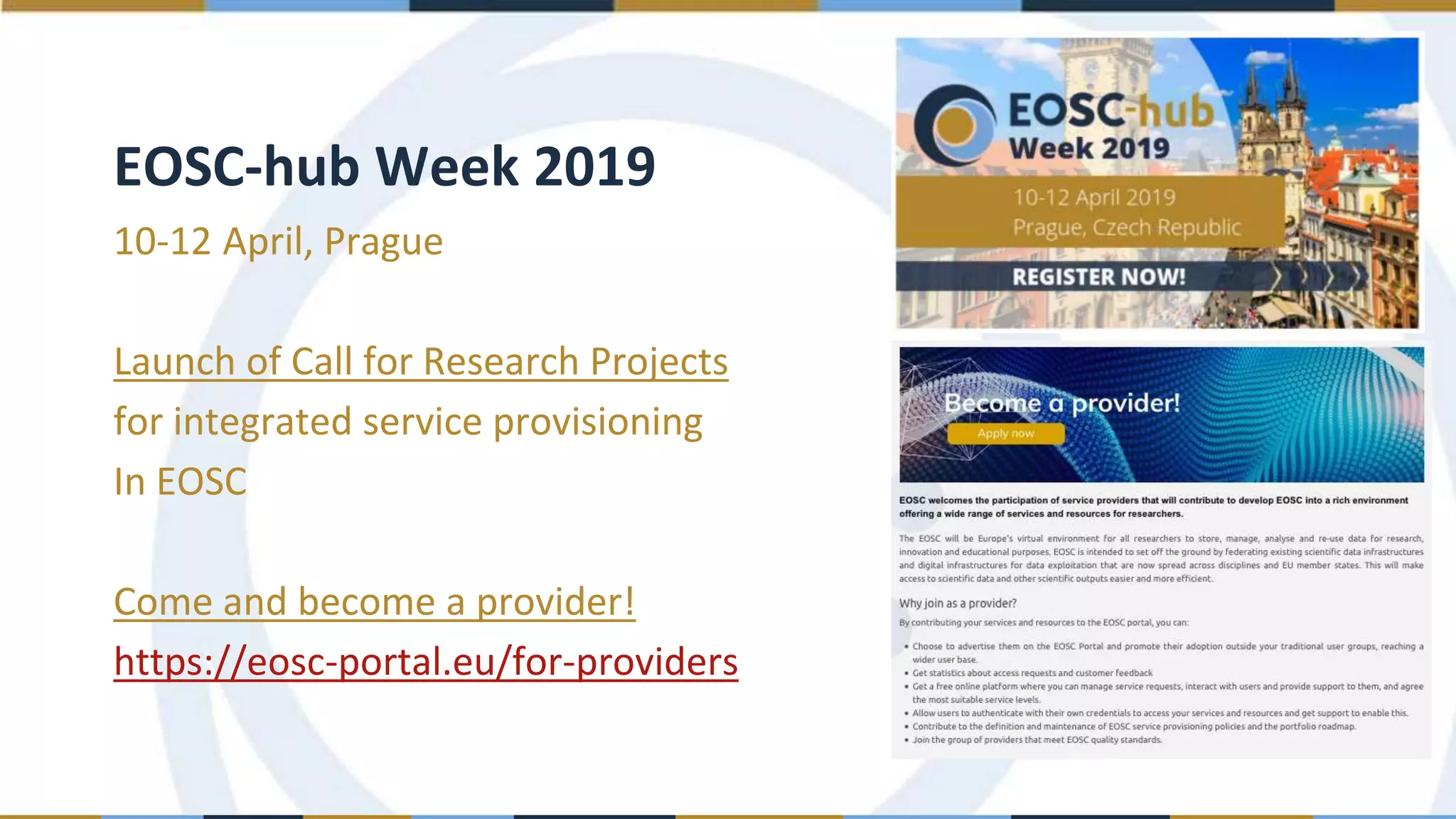
EOSC-hub Week 2019
10-12 April, Prague
Launch of Call for Research Projects
for integrated service provisioning
In EOSC
Come and become a provider!
https://eosc-portal.eu/for-providers
eosc-hub.eu @EOSC_eu
Thank you
for your attention!
Questions?

EOSC-hub: A Collaborative Framework for the EOSC Implementation

  • 1.
    EOSC-hub receives fundingfrom the European Union’s Horizon 2020 research and innovation programme under grant agreement No. 777536. eosc-hub.eu @EOSC_eu EOSC-hub: A Collaborative Framework for the EOSC Implementation Tiziana Ferrari, Per Öster Dissemination level: Public
  • 2.
    20 digital researchinfrastructures, EGI, EUDAT CDI and INDIGO-DataCloud jointly offering services, software and data for advanced, data-driven research & innovation 100 partner s 36 months 33 million Euro Mission: The EOSC-hub project mobilises providers of pan- European relevance offering services, software and data for advanced data-driven research and innovation
  • 3.
    3 RI Contributions/Jan 2019 e-Infra EGI Federation EUDATCDI INDIGO- DataCloud Humanities Language and literature (CLARIN) Arts (DARIAH) Engineering Environmen tal engineering (sea vessels, LNEC) Civil Engineering (Disaster Mitigation) Medical and Health Sciences Biological Sciences (ELIXIR) Structural biology (WeNMR) Natural sciences PHYSICAL SCIENCES Astronomy (LOFAR) Fusion (ITER) High Energy Physics (CMS and VIRGO) Space Science (EISCAT-3D) EARTH SCIENCE EO Pillar GEO Climate Research (ENES) Seismology (ORFEUS, EPOS) BIOLOGICAL SCIENCES Marine and freshwater biology (IFREMER) Biodiversity conservation (LifeWatch) Ecology (ICOS) 30/01/19
  • 4.
    4 Technical & StrategicPartnerships/Jan 2019 30/01/19 EOSC Implementation Projects PaNOSC ENVRI-FAIR EOSC-LIFE ESCAPE SSHOC … eInfras OpenAIRE-Advance GEANT eInfraCentral … Strategic EOSC-hub Strategic Board participation Technical Technical support and service provisioning Operational Coordinated user support and outreach Jupyter notebooks managed service on cloud Federated cloud provisioning Data Management and AAI
  • 5.
    • Service integrationand research project enabling through technical support → EOSC User interface • Federation of collaborating national/international facility providers, onboarding of service providers → EOSC Service Provider interface - Development and validation of interoperable interfaces across relevant services and resources - Definition and maintenance of relevant policies for users and providers → Rules of Participation • Engagement with user communities and providers - EOSC Portal and Marketplace as EOSC collaborative platform - Competence Centres - Digital Innovation Hub 5 EOSC-hub Roles and Activities in EOSC 30/01/19
  • 6.
    • Provides aframework to manage services sourced from a number of service providers • Is accountable for end-to-end service governance, management, integration, assurance and coordination • Manages the relationships with service providers through processes like business relationship management, service portfolio management, quality assurance • Provides supporting services and activities, such as the Service Portfolio Management Tool, marketplace etc. 6 Contribution of EOSC-hub to the EOSC implementation roadmap 30/01/19
  • 7.
    • Provides adiscovery and access channel to FAIR- accredited datasets • Offers EUDAT B2FIND metadata catalogue and other registries of repositories, as well as community- specific data discovery and access tools that are part of the EOSC-hub catalogue • Makes available generic data management and compute services to end users to access, stage and analyse data from FAIR-compliant sources 7 Contribution of EOSC-hub to the EOSC implementation roadmap 30/01/19
  • 8.
    • Contributes tothe definition of a participatory and lightweight service portfolio management process in collaboration with the participating service providers • Maintains the service portfolio so that all services are specified, including planning, design and transition of new or changed services • Maps offer against demand, identifying gaps, i.e. needs that are partly or not covered at all • Monitors and assesses service use as well as service provider performance and conformance to the EOSC Rules of Participation • Defines procurement and delivery model(s) for services 8 Contribution of EOSC-hub to the EOSC implementation roadmap 30/01/19
  • 9.
    • Engages withthe demand and supply side of the EOSC • Co-develops and operates a marketplace as one entry point to EOSC • Co-develops with research communities the policies and tools that enable federated access and supply • Supports different access policies (e.g. sponsored access, policy-based access and pay for use access) to enable different business models 9 Contribution of EOSC-hub to the EOSC implementation roadmap 30/01/19
  • 10.
    • With inputfrom collaborating projects and initiatives, collectively gathers and maintains a corpus of Rules of Participation to the Hub • Defines the conditions for service providers to offer services through the Hub, taking into account different perspectives, for example technical, operational, legal and financial • Provides a framework of service/resource-specific procedures for lightweight quality assurance, for example through the periodic auditing of conformance of the participating providers 10 Contribution of EOSC-hub to the EOSC implementation roadmap 30/01/19
  • 11.
  • 12.
    Service/Product providers • Contribute tothe portfolio & Integrate • Promote, Train, Exploit • Participate in the Hub Early adopters • Pilot • Use • Co-develop Consumers • Credit allocation & exploit • Support • Improve with feedback • Use 12 Research Infrastructure Roles in EOSC-hub 30/01/19
  • 13.
    ESFRI – EOSC-hubCollaboration Areas EOSC Digital Innovation Hub EOSC Service Portfolio The Hub Competence Centres Service integration, training, documentation and best practices 30/01/19 A system with: Federation & collaboration services; Processes & policies; Business models & procurement experience; Strategy & Technical Service Roadmap, etc. Common &Thematic services; Business models for individual services; Rules for participation, etc. a platform that facilitates engagement between private industry and public institutions participating in the EOSC. Best practices on Open Science, IM / Service Management / IT Security / DM trainings, etc. Usage experience with common services and guidelines; requirements collection 13
  • 14.
    • Research communities -Discover services through a secure online catalogue with a central access point. - Access services via harmonised access policies and Service Level Agreements. Depending on the customer’s needs, access will be provided through a centrally managed credit-based allocation system and/or through long-term resource allocation. - Leverage a large portfolio of generic and thematic services via standard interfaces - Provide requirements, co-design, testing • Research Infrastructures - Providers - Contribute to EOSC with services based on a harmonised corpus of access, security and provisioning policies. - Integrate and Federate services by relying on harmonised processes and tools for service integration and management. - Scale-up in-house capacity by procuring services via a centrally run procurement and purchase framework. - Reach out to user communities and support - Collaborate with other providers 30/01/19 14 The Hub – A Collaboration Platform for ESFRIs
  • 15.
    Research Project EnablingCycle 1. Evolve enabling technologies 2. Integrate services 3. Provide → support → access → consume 4. Engage with external user communities and providers, collect requirements 30/01/19 15
  • 16.
    • Objective: Widenthe access to services to all user groups including researchers, high-education, business organizations and expand the user base • Objective: Increase innovation capacity of Research e-Infrastructures Solutions successfully adopted by user communities will be supported for broader exploitation by external stakeholders. In addition to the DIH, the project stimulates engagement via large research collaborations and infrastructures via 8 Competence Centres Digital Innovation Hub [KER3] • A platform that allows facilitates engagement between private industry and public institutions participating in the EOSC Competence Centres [KER5] • Research communities, service providers and experts contributing to - Co-design: Requirements, gap analysis and technical development - Piloting and pre-production 30/01/19 16 Collaboration Platforms Co-design Requirements and Gap Analysis Technical development and service deployment Piloting and pre- production service provisioning
  • 17.
    • Objective: Providea knowledge hub - Access will be opened to all to overcome the current funding and policy barriers - The project engages adjacent, but fragmented, scientific communities in Humanities, Physical Sciences, Earth Sciences, Biological Sciences, and Medical and Health Sciences Service integration, training, documentation and best practices [KER4] • Best practices, use cases and EOSC success stories • Training resources - Innovation Management - Service Management - IT Security - Data management - EOSC services 30/01/19 17 Knowledge hub
  • 18.
    EOSC-hub Week 2019 10-12April, Prague Launch of Call for Research Projects for integrated service provisioning In EOSC Come and become a provider! https://eosc-portal.eu/for-providers
  • 19.
    eosc-hub.eu @EOSC_eu Thank you foryour attention! Questions?