Tao Xiao1, Dong Wang2, Shane Mcintosh3, Hideaki Hata4,
Raula Gaikovina Kula1, Takashi Ishio1, Kenichi Matsumoto1
ESEC/FSE 2022 Journal First
(IEEE Transactions on Software Engineering, 2021)
Characterizing and Mitigating Self-Admitted
Technical Debt in Build Systems
// TODO: use false due CAMEL-3826 until root
cause is fixed in hawtdb
INDEX_FACTORY.setDeferredEncoding(false);
o Technical Debt (TD)
o TD could be admitted or annotated as comments by developers. These
comments are called self-admitted technical debt (SATD) [1].
SATD comment
What is Technical Debt and Self-Admitted Technical Debt?
[1] Potdar, A., & Shihab, E. (2014, September). An exploratory study on self-admitted technical debt. In 2014 IEEE International Conference on Software Maintenance and Evolution (pp. 91-100). IEEE.
2
Design choice Expedient in short term Future change more costly
o SATD existed in 31% of source code files [1].
o SATD can be classfied into five main types [2].
o SATD changes lead to less future defects than non-SATD changes [3].
o 88% of the practitioners mentioned self-admitting their bad
implementations of code through comments [4].
3
[1] Potdar, A., & Shihab, E. (2014, September). An exploratory study on self-admitted technical debt. In 2014 IEEE International Conference on Software Maintenance and Evolution (pp. 91-100). IEEE.
[2] Maldonado, E. D. S., & Shihab, E. (2015, October). Detecting and quantifying different types of self-admitted technical debt. In 2015 IEEE 7Th international workshop on managing technical debt (MTD) (pp. 9-15). IEEE.
[3] Wehaibi, S., Shihab, E., & Guerrouj, L. (2016, March). Examining the impact of self-admitted technical debt on software quality. In 2016 IEEE 23Rd international conference on software analysis, evolution, and reengineering (SANER) (Vol. 1, pp. 179-188).
IEEE.
[4] Vassallo, C., Zampetti, F., Romano, D., Beller, M., Panichella, A., Di Penta, M., & Zaidman, A. (2016, October). Continuous delivery practices in a large financial organization. In 2016 IEEE International Conference on Software Maintenance and Evolution
(ICSME) (pp. 519-528). IEEE.
SATD is widely studied in source code files.
SATD
Design debt
Defect debt
Documentation
debt
Requirement debt
Test Debt
o SATD existed in 31% of source code files [1].
o SATD can be classfied into five main types [2].
o SATD changes lead to less future defects than non-SATD changes [3].
o 88% of the practitioners mentioned self-admitting their bad
implementations of code through comments [4].
4
[1] Potdar, A., & Shihab, E. (2014, September). An exploratory study on self-admitted technical debt. In 2014 IEEE International Conference on Software Maintenance and Evolution (pp. 91-100). IEEE.
[2] Maldonado, E. D. S., & Shihab, E. (2015, October). Detecting and quantifying different types of self-admitted technical debt. In 2015 IEEE 7Th international workshop on managing technical debt (MTD) (pp. 9-15). IEEE.
[3] Wehaibi, S., Shihab, E., & Guerrouj, L. (2016, March). Examining the impact of self-admitted technical debt on software quality. In 2016 IEEE 23Rd international conference on software analysis, evolution, and reengineering (SANER) (Vol. 1, pp. 179-188).
IEEE.
[4] Vassallo, C., Zampetti, F., Romano, D., Beller, M., Panichella, A., Di Penta, M., & Zaidman, A. (2016, October). Continuous delivery practices in a large financial organization. In 2016 IEEE International Conference on Software Maintenance and Evolution
(ICSME) (pp. 519-528). IEEE.
SATD
Design debt
Defect debt
Documentation
debt
Requirement debt
Test Debt
There is a gap in investigating SATD in build systems.
Modern software development has a
broader scope than solely producing source code.
5
[5] McIntosh, S., Adams, B., Nguyen, T. H., Kamei, Y., & Hassan, A. E. (2011, May). An empirical study of build maintenance effort. In 2011 33rd International Conference on Software Engineering (ICSE) (pp. 141-150). IEEE.
Build systems play the critical role in software development.
o Build systems
o How many efforts to maintain build systems?
 Build systems maintenance is 27% overhead
on source code development [5].
DEPENDENCY
Build Files Deliverables
Maintain
Does SATD existed in build systems such as
Maven build systems?
6
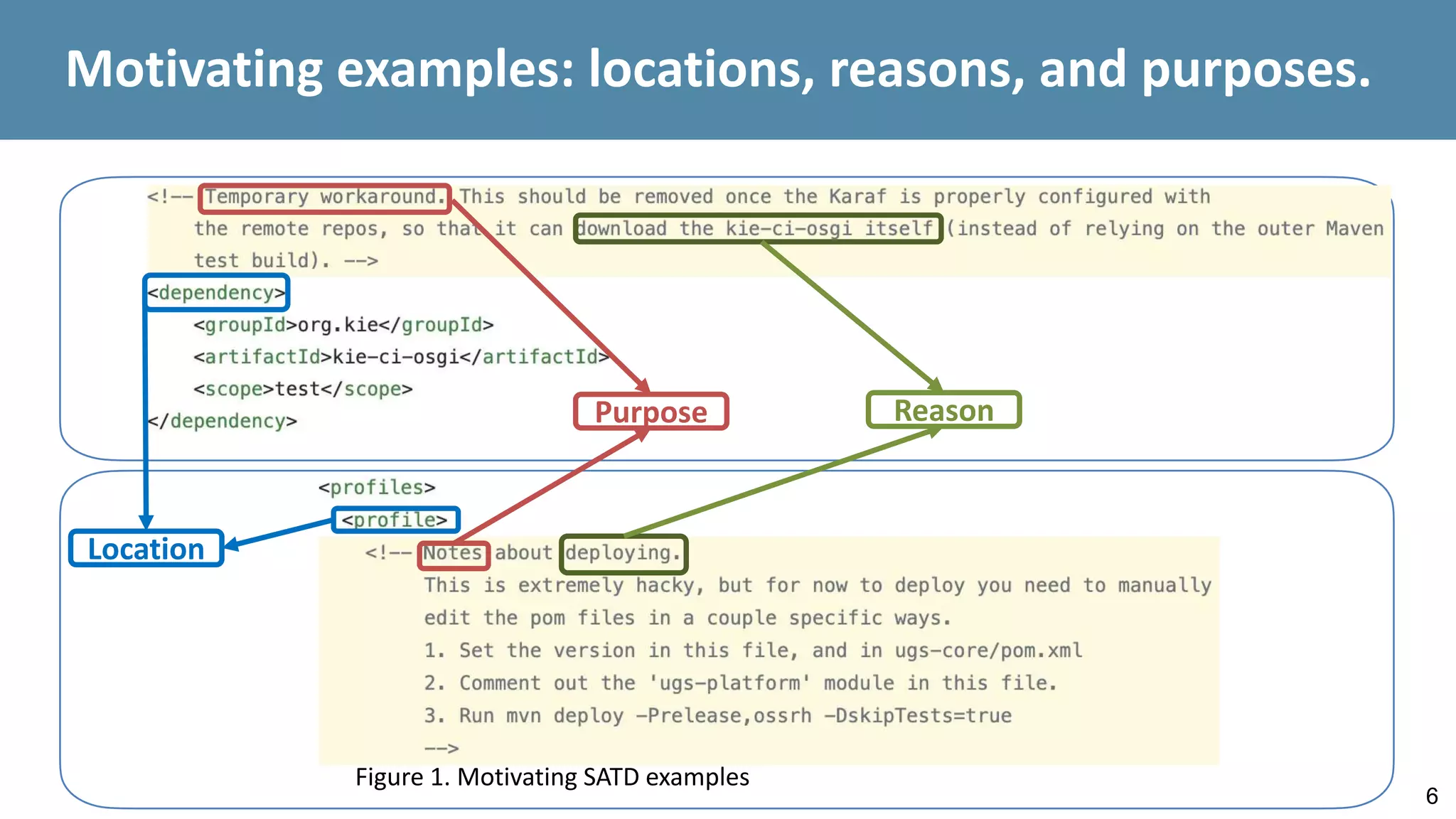
Motivating examples: locations, reasons, and purposes.
Location
Purpose Reason
Figure 1. Motivating SATD examples
7
Location
Purpose Reason
Figure 1. Motivating SATD examples
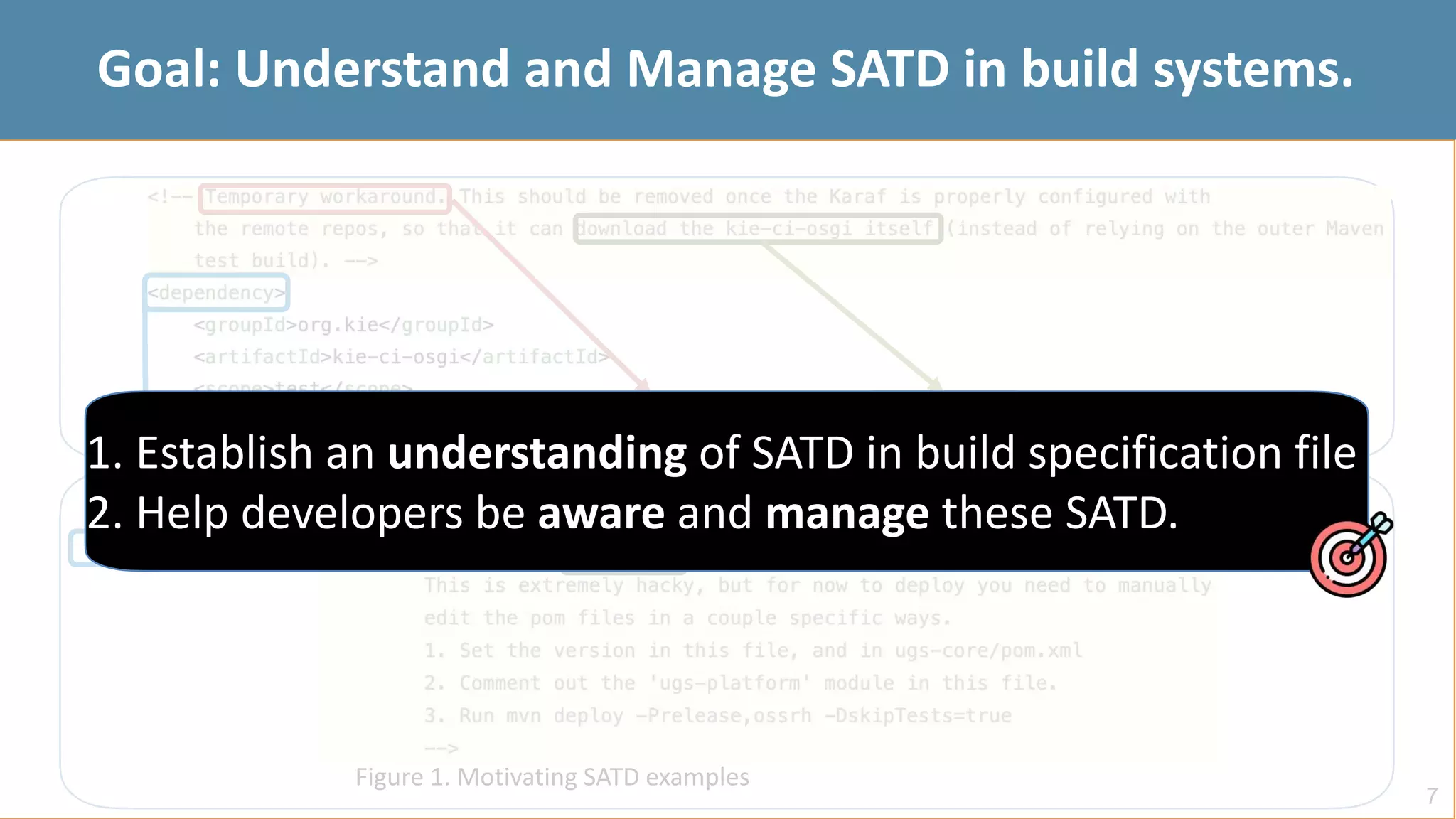
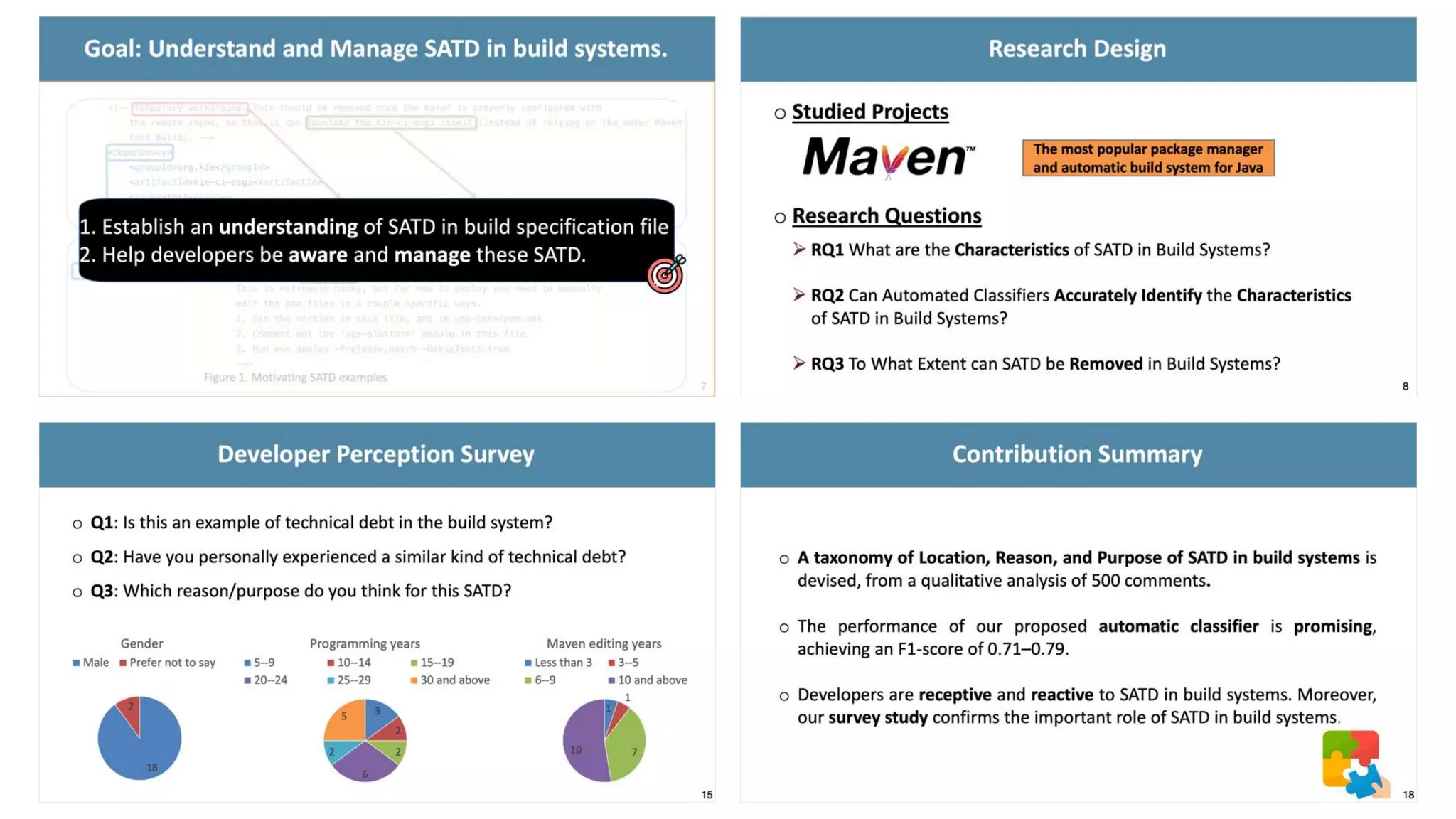
Goal: Understand and Manage SATD in build systems.
1. Establish an understanding of SATD in build specification file
2. Help developers be aware and manage these SATD.
8
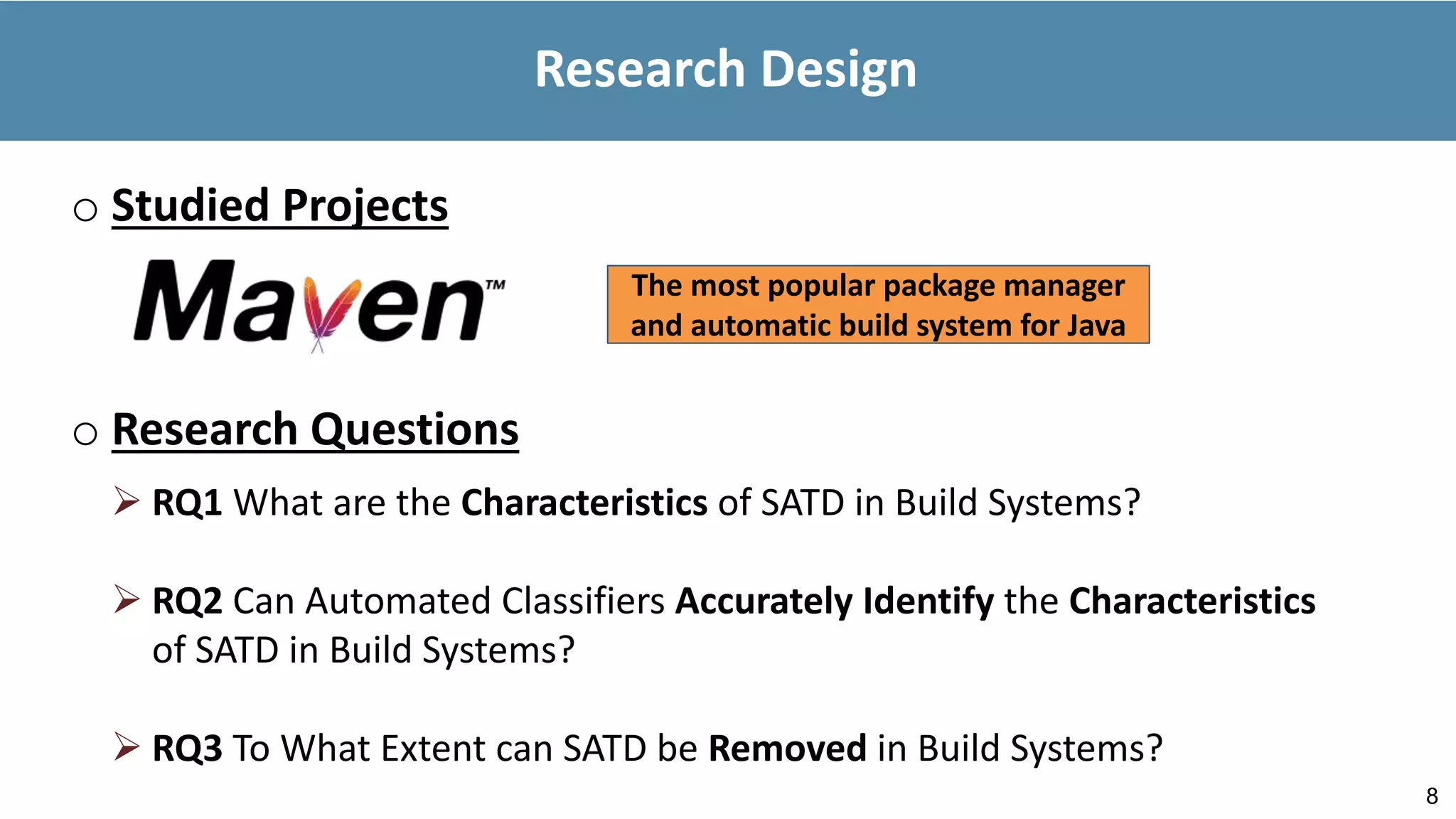
Research Design
o Studied Projects
The most popular package manager
and automatic build system for Java
o Research Questions
 RQ1 What are the Characteristics of SATD in Build Systems?
 RQ2 Can Automated Classifiers Accurately Identify the Characteristics
of SATD in Build Systems?
 RQ3 To What Extent can SATD be Removed in Build Systems?
[CELLRANGE], 2
[CELLRANGE], 3
[CELLRANGE], 6
[CELLRANGE], 9
[CELLRANGE], 10
[CELLRANGE], 10
[CELLRANGE], 57
[CELLRANGE], 159
[CELLRANGE], 24
Software configuration management
Build organization
Project metadata
Repository configuration
Resource configuration
Multi-directory configuration
Build variables
External dependencies configuration
Plugin configuration
Nine locations are identified. SATD tends to occur in the plugin
configuration and the external dependencies configuration code.
9
RQ1 What are the Characteristics of SATD in Build Systems?
(Location)
<plugin> <instructions>
<!-- <scope>compile</scope>
TODO: Fox up again when
comms bug #1561 is fixed-->
<!-- plug-in jackson 2.x annotation
for compatibility with dropwizard
1.3.1 (a bit ugly but this is the only
way to workaround it)-->
<dependency>
<groupId>com.fasterxml.jackson.co
re</groupId>
[CELLRANGE], 17
[CELLRANGE], 2
[CELLRANGE], 7
[CELLRANGE], 2
[CELLRANGE], 17
[CELLRANGE], 20
[CELLRANGE], 11
[CELLRANGE], 12
[CELLRANGE], 40
[CELLRANGE], 4
[CELLRANGE], 5
[CELLRANGE], 47
[CELLRANGE], 67
[CELLRANGE], 16
[CELLRANGE], 27
[CELLRANGE]
No reason
Change propagation
Code smell
Symbol visibility
Compiler configuration
Build break
Licensing
Specify metadata
Recursive call
Post-install dependency resolution
Dependency conflict
Missing dependency
Stale dependency
Build tool limitation
External tool limitation
External library limitation
1
RQ1 What are the Characteristics of SATD in Build Systems?
(Reason)
Limitation
Dependency
Recursive call
Document
Build break
Compiler setting
Code smell
No reason
Change propagation
<!-- plug-in jackson 2.x annotation
for compatibility with dropwizard
1.3.1 (a bit ugly but this is the only
way to workaround it)-->
<dependency>
<groupId>com.fasterxml.jackson.co
re</groupId>
<plugin> <instructions>
<!-- <scope>compile</scope>
TODO: Fox up again when
comms bug #1561 is fixed-->
Nine reasons are identified. The most frequent reasons include the
limitations in tools and libraries, and complexities of dependency
management.
11
RQ1 What are the Characteristics of SATD in Build Systems?
(Purpose)
[CELLRANGE], 9
[CELLRANGE], 13
[CELLRANGE], 79
[CELLRANGE], 95
[CELLRANGE], 110
[CELLRANGE
Silence build warnings
Placeholder for later extension
Document for supoptimal implementation
choice
Warning for future developers
Document workaround
Document for later fix
<!-- plug-in jackson 2.x annotation
for compatibility with dropwizard
1.3.1 (a bit ugly but this is the only
way to workaround it)-->
<dependency>
<groupId>com.fasterxml.jackson.co
re</groupId>
<plugin> <instructions>
<!-- <scope>compile</scope>
TODO: Fox up again when
comms bug #1561 is fixed-->
Six Purposes are identified. With documenting issues to be fixed
later and explaining the rationale for a workaround occurring the
most frequently
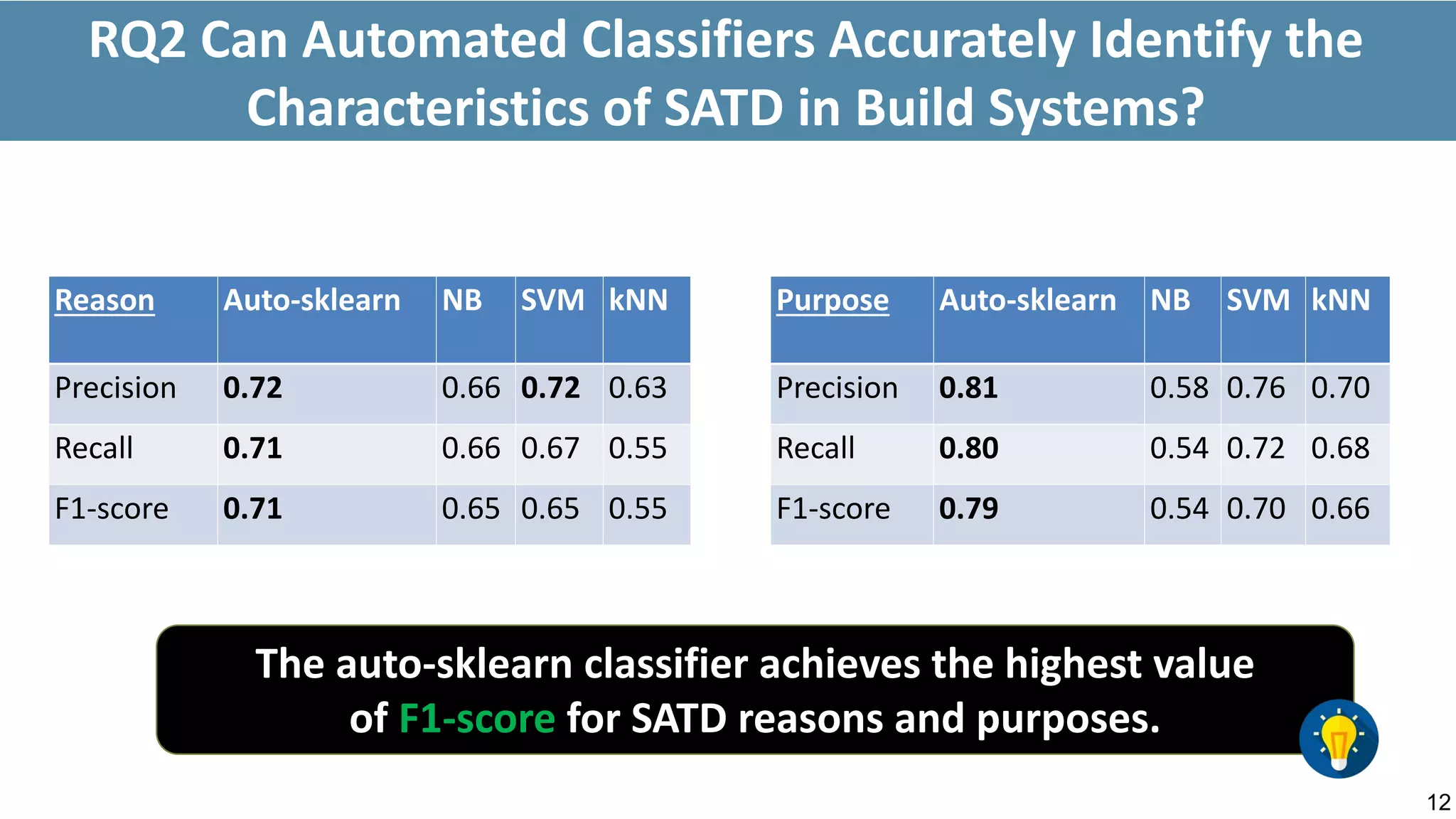
The auto-sklearn classifier achieves the highest value
of F1-score for SATD reasons and purposes.
12
RQ2 Can Automated Classifiers Accurately Identify the
Characteristics of SATD in Build Systems?
Reason Auto-sklearn NB SVM kNN
Precision 0.72 0.66 0.72 0.63
Recall 0.71 0.66 0.67 0.55
F1-score 0.71 0.65 0.65 0.55
Purpose Auto-sklearn NB SVM kNN
Precision 0.81 0.58 0.76 0.70
Recall 0.80 0.54 0.72 0.68
F1-score 0.79 0.54 0.70 0.66
13
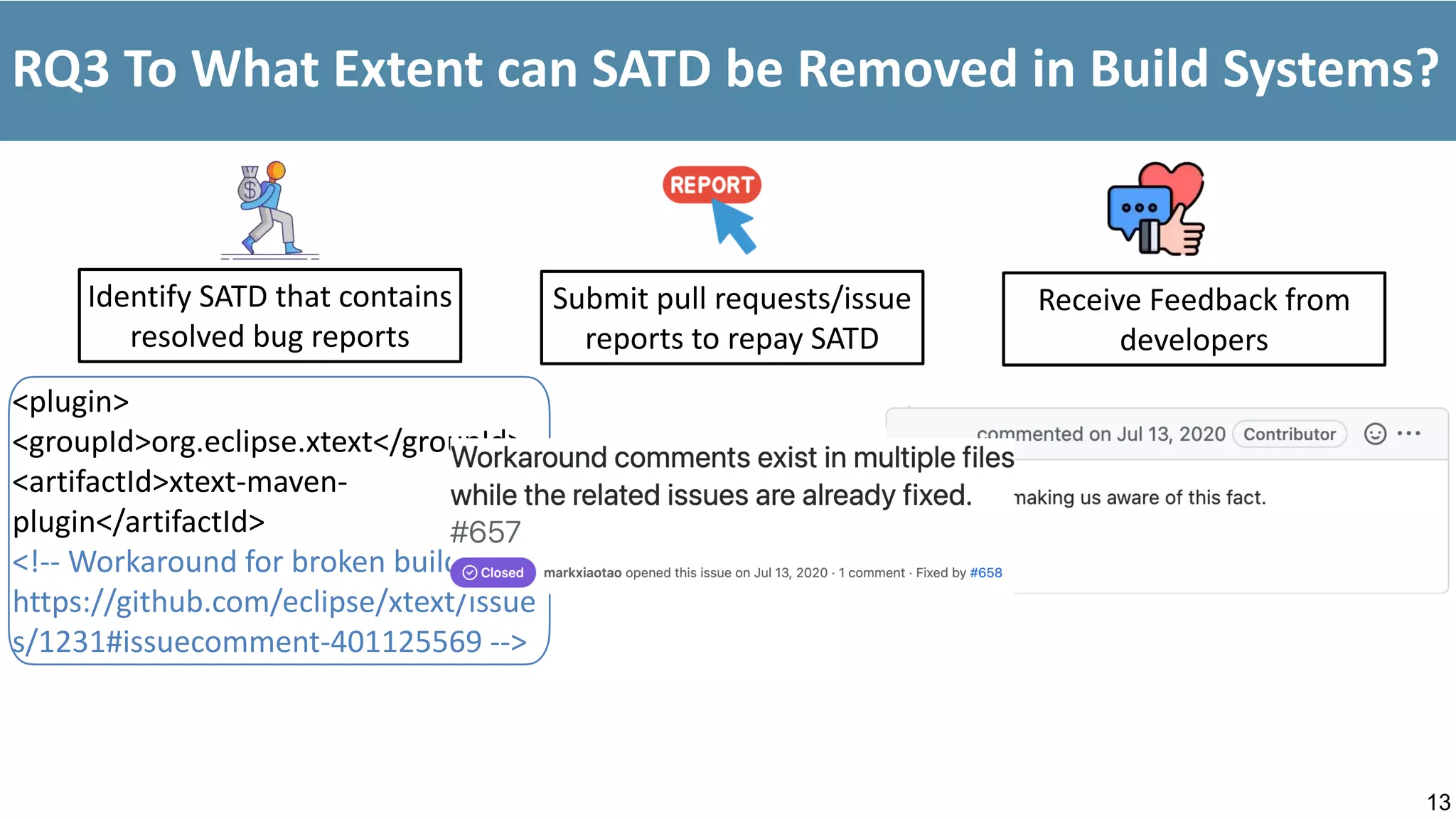
RQ3 To What Extent can SATD be Removed in Build Systems?
<plugin>
<groupId>org.eclipse.xtext</groupId>
<artifactId>xtext-maven-
plugin</artifactId>
<!-- Workaround for broken build from
https://github.com/eclipse/xtext/issue
s/1231#issuecomment-401125569 -->
Identify SATD that contains
resolved bug reports
Submit pull requests/issue
reports to repay SATD
Receive Feedback from
developers
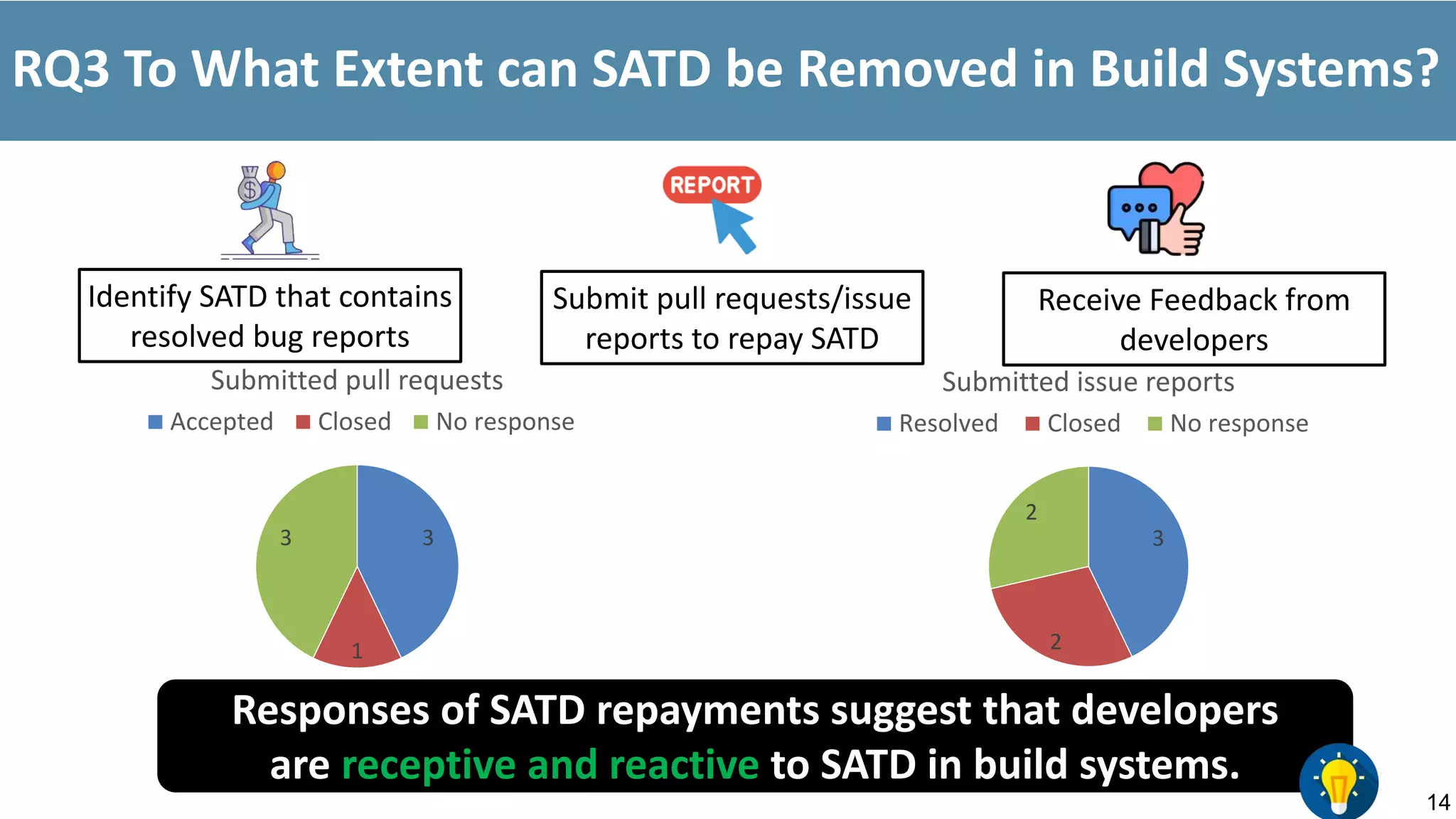
Responses of SATD repayments suggest that developers
are receptive and reactive to SATD in build systems.
14
RQ3 To What Extent can SATD be Removed in Build Systems?
Identify SATD that contains
resolved bug reports
Submit pull requests/issue
reports to repay SATD
Receive Feedback from
developers
3
1
3
Submitted pull requests
Accepted Closed No response
3
2
2
Submitted issue reports
Resolved Closed No response
15
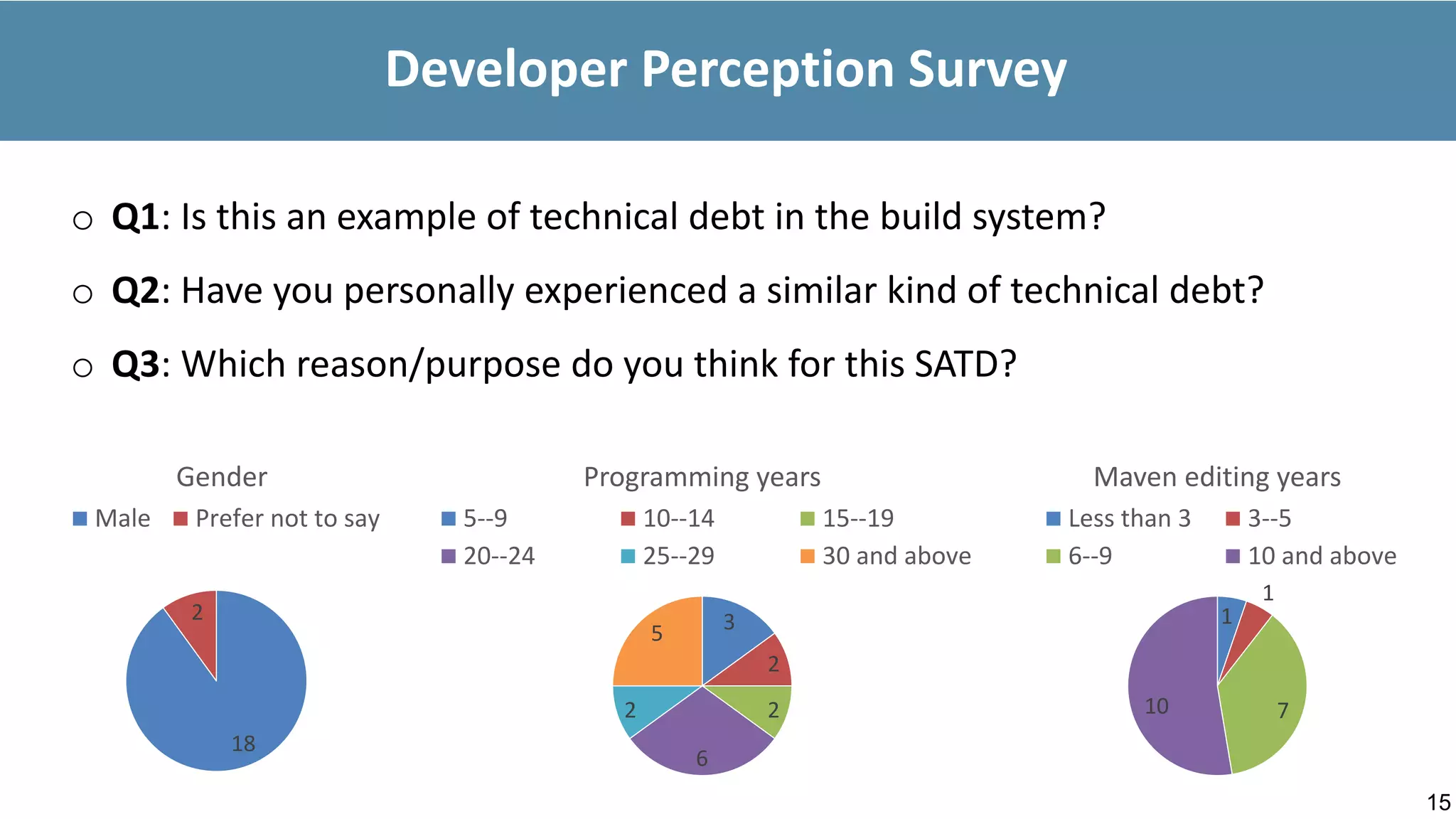
Developer Perception Survey
o Q1: Is this an example of technical debt in the build system?
o Q2: Have you personally experienced a similar kind of technical debt?
o Q3: Which reason/purpose do you think for this SATD?
18
2
Gender
Male Prefer not to say
3
2
2
6
2
5
Programming years
5--9 10--14 15--19
20--24 25--29 30 and above
1
1
7
10
Maven editing years
Less than 3 3--5
6--9 10 and above
16
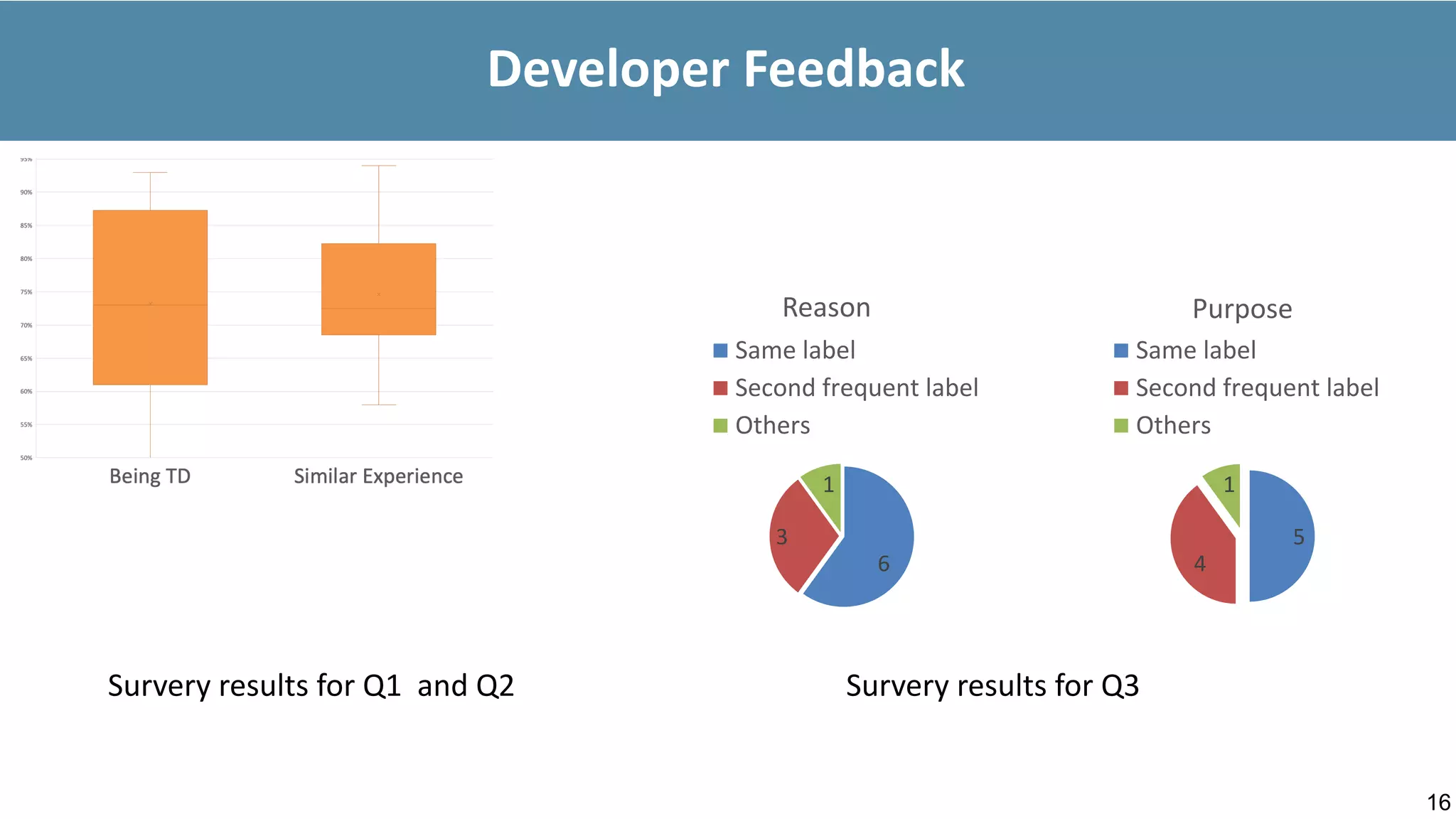
Developer Feedback
6
3
1
Reason
Same label
Second frequent label
Others
5
4
1
Purpose
Same label
Second frequent label
Others
Survery results for Q1 and Q2 Survery results for Q3
17
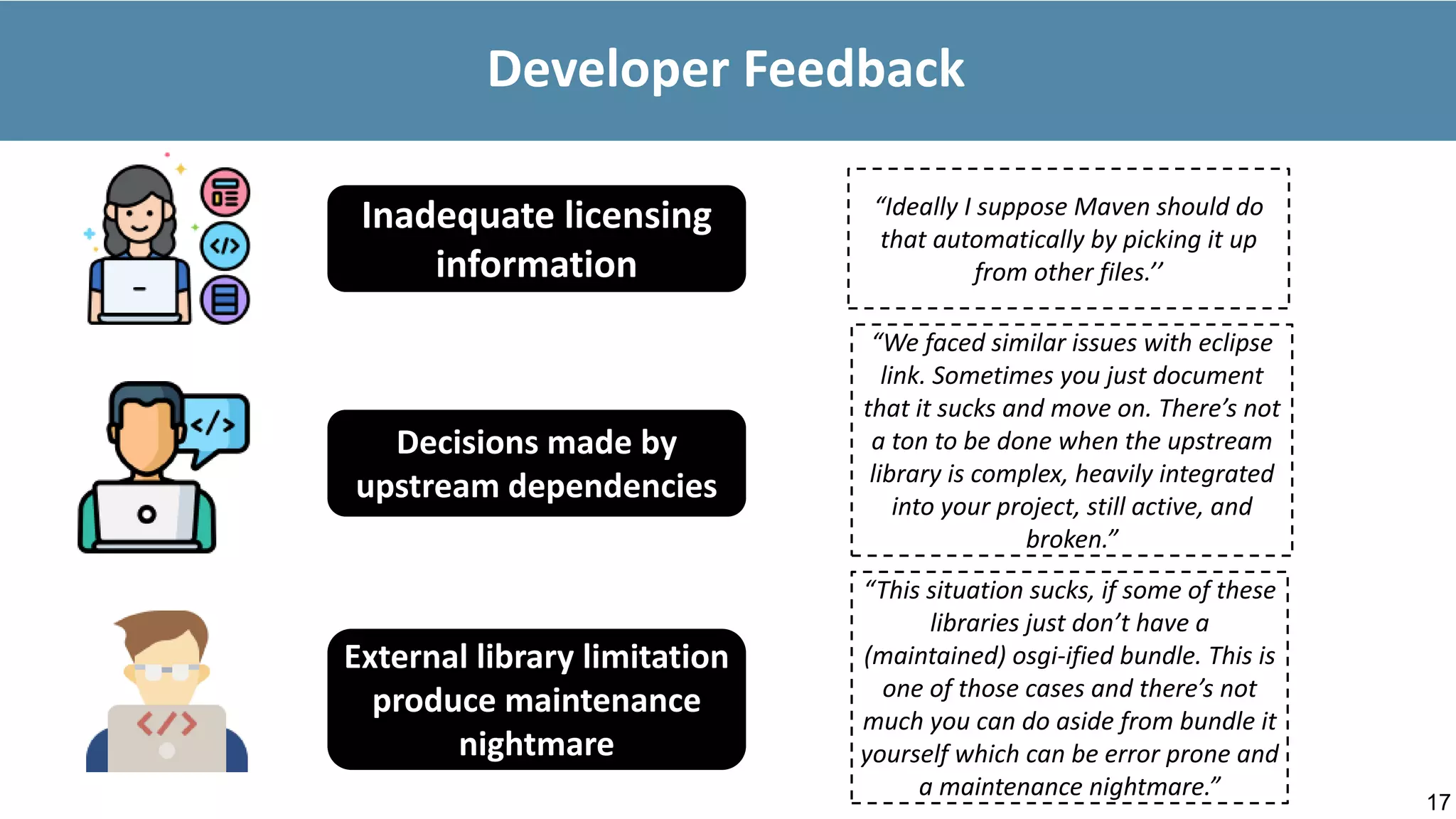
Developer Feedback
“Ideally I suppose Maven should do
that automatically by picking it up
from other files.’’
Inadequate licensing
information
“We faced similar issues with eclipse
link. Sometimes you just document
that it sucks and move on. There’s not
a ton to be done when the upstream
library is complex, heavily integrated
into your project, still active, and
broken.”
“This situation sucks, if some of these
libraries just don’t have a
(maintained) osgi-ified bundle. This is
one of those cases and there’s not
much you can do aside from bundle it
yourself which can be error prone and
a maintenance nightmare.”
Decisions made by
upstream dependencies
External library limitation
produce maintenance
nightmare
18
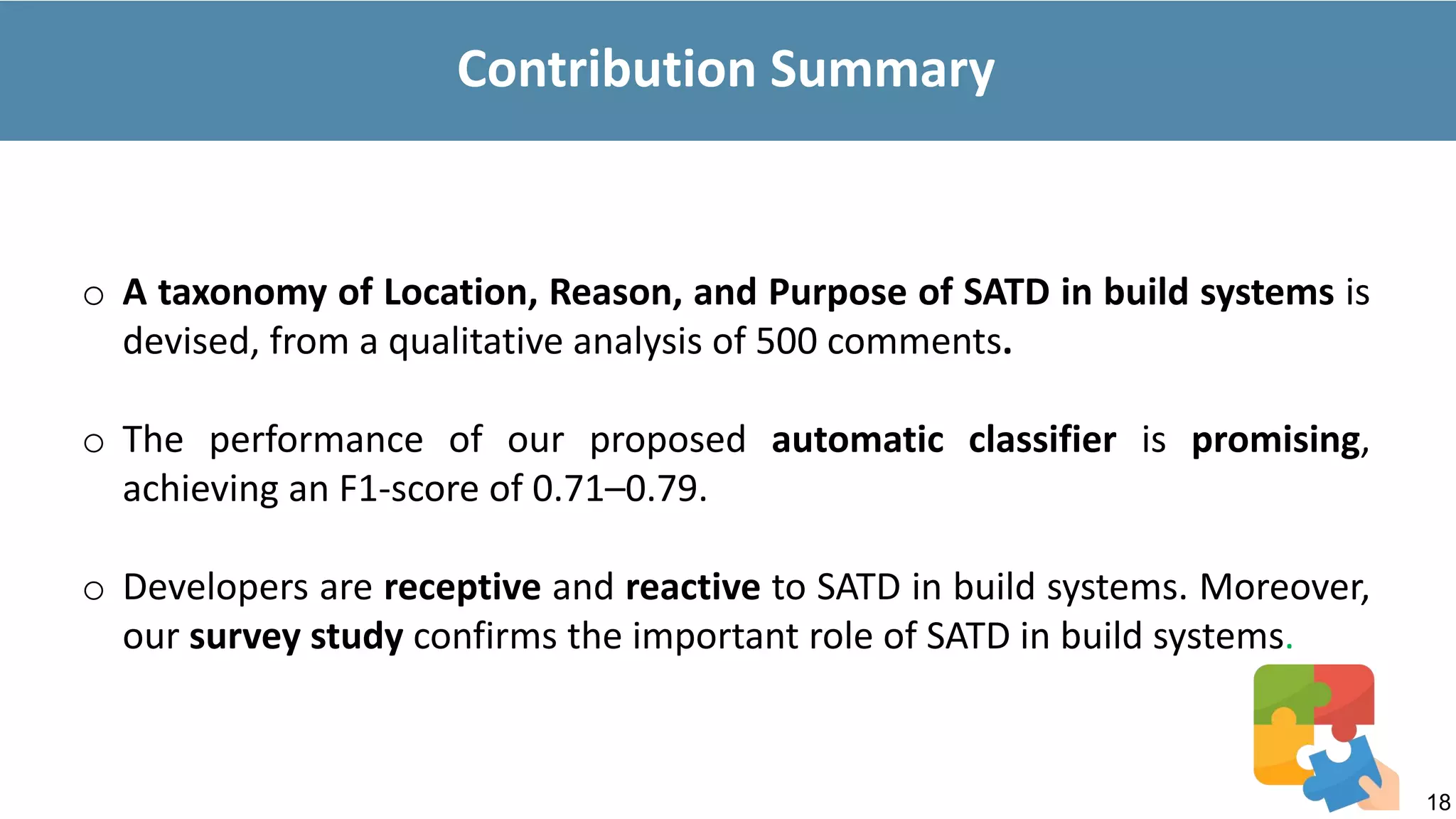
Contribution Summary
o A taxonomy of Location, Reason, and Purpose of SATD in build systems is
devised, from a qualitative analysis of 500 comments.
o The performance of our proposed automatic classifier is promising,
achieving an F1-score of 0.71–0.79.
o Developers are receptive and reactive to SATD in build systems. Moreover,
our survey study confirms the important role of SATD in build systems.
19
Conclusion & Future work
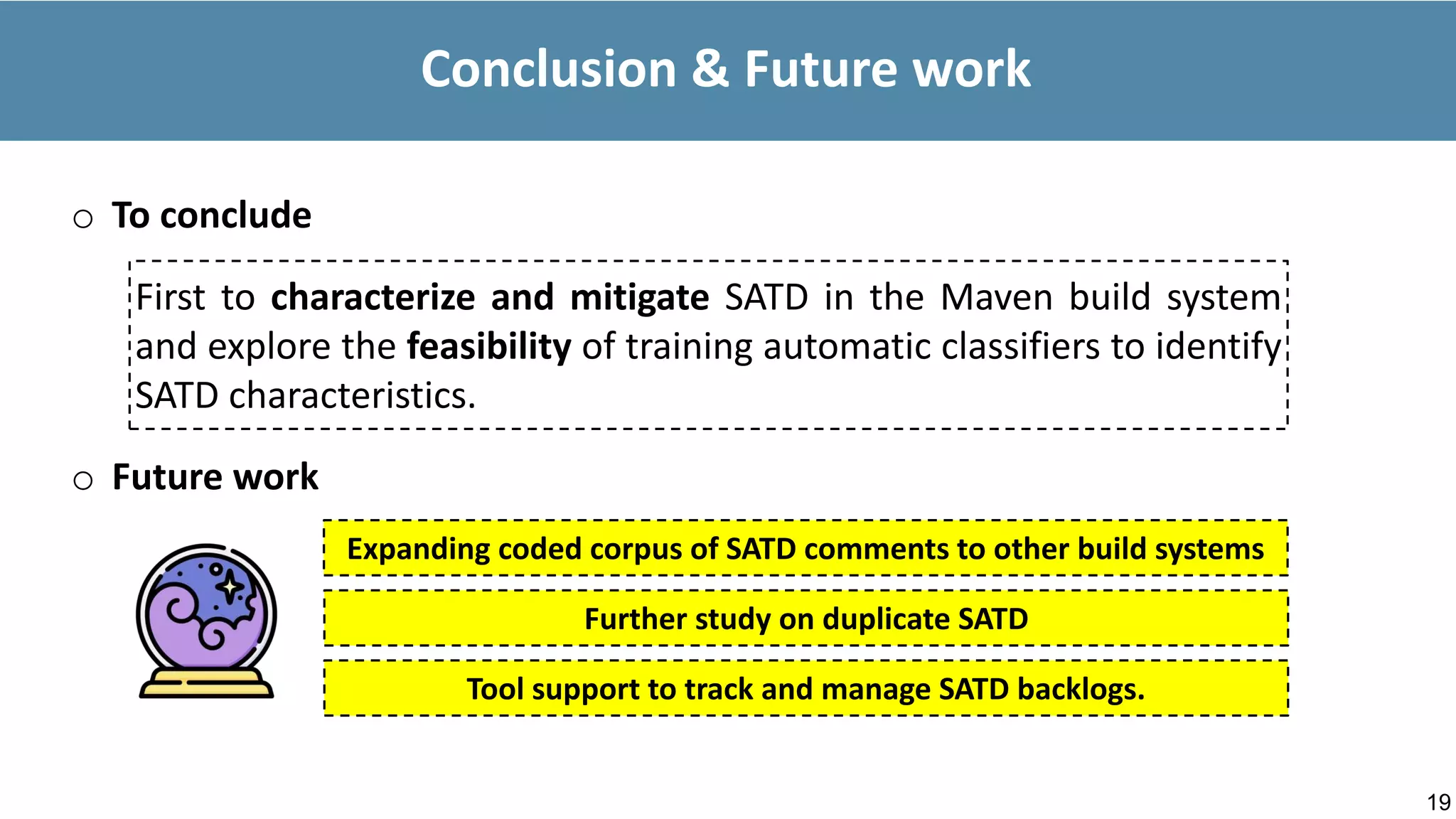
o To conclude
First to characterize and mitigate SATD in the Maven build system
and explore the feasibility of training automatic classifiers to identify
SATD characteristics.
Tool support to track and manage SATD backlogs.
o Future work
Expanding coded corpus of SATD comments to other build systems
Further study on duplicate SATD
20

Characterizing and Mitigating Self-Admitted Technical Debt in Build Systems

  • 1.
    Tao Xiao1, DongWang2, Shane Mcintosh3, Hideaki Hata4, Raula Gaikovina Kula1, Takashi Ishio1, Kenichi Matsumoto1 ESEC/FSE 2022 Journal First (IEEE Transactions on Software Engineering, 2021) Characterizing and Mitigating Self-Admitted Technical Debt in Build Systems
  • 2.
    // TODO: usefalse due CAMEL-3826 until root cause is fixed in hawtdb INDEX_FACTORY.setDeferredEncoding(false); o Technical Debt (TD) o TD could be admitted or annotated as comments by developers. These comments are called self-admitted technical debt (SATD) [1]. SATD comment What is Technical Debt and Self-Admitted Technical Debt? [1] Potdar, A., & Shihab, E. (2014, September). An exploratory study on self-admitted technical debt. In 2014 IEEE International Conference on Software Maintenance and Evolution (pp. 91-100). IEEE. 2 Design choice Expedient in short term Future change more costly
  • 3.
    o SATD existedin 31% of source code files [1]. o SATD can be classfied into five main types [2]. o SATD changes lead to less future defects than non-SATD changes [3]. o 88% of the practitioners mentioned self-admitting their bad implementations of code through comments [4]. 3 [1] Potdar, A., & Shihab, E. (2014, September). An exploratory study on self-admitted technical debt. In 2014 IEEE International Conference on Software Maintenance and Evolution (pp. 91-100). IEEE. [2] Maldonado, E. D. S., & Shihab, E. (2015, October). Detecting and quantifying different types of self-admitted technical debt. In 2015 IEEE 7Th international workshop on managing technical debt (MTD) (pp. 9-15). IEEE. [3] Wehaibi, S., Shihab, E., & Guerrouj, L. (2016, March). Examining the impact of self-admitted technical debt on software quality. In 2016 IEEE 23Rd international conference on software analysis, evolution, and reengineering (SANER) (Vol. 1, pp. 179-188). IEEE. [4] Vassallo, C., Zampetti, F., Romano, D., Beller, M., Panichella, A., Di Penta, M., & Zaidman, A. (2016, October). Continuous delivery practices in a large financial organization. In 2016 IEEE International Conference on Software Maintenance and Evolution (ICSME) (pp. 519-528). IEEE. SATD is widely studied in source code files. SATD Design debt Defect debt Documentation debt Requirement debt Test Debt
  • 4.
    o SATD existedin 31% of source code files [1]. o SATD can be classfied into five main types [2]. o SATD changes lead to less future defects than non-SATD changes [3]. o 88% of the practitioners mentioned self-admitting their bad implementations of code through comments [4]. 4 [1] Potdar, A., & Shihab, E. (2014, September). An exploratory study on self-admitted technical debt. In 2014 IEEE International Conference on Software Maintenance and Evolution (pp. 91-100). IEEE. [2] Maldonado, E. D. S., & Shihab, E. (2015, October). Detecting and quantifying different types of self-admitted technical debt. In 2015 IEEE 7Th international workshop on managing technical debt (MTD) (pp. 9-15). IEEE. [3] Wehaibi, S., Shihab, E., & Guerrouj, L. (2016, March). Examining the impact of self-admitted technical debt on software quality. In 2016 IEEE 23Rd international conference on software analysis, evolution, and reengineering (SANER) (Vol. 1, pp. 179-188). IEEE. [4] Vassallo, C., Zampetti, F., Romano, D., Beller, M., Panichella, A., Di Penta, M., & Zaidman, A. (2016, October). Continuous delivery practices in a large financial organization. In 2016 IEEE International Conference on Software Maintenance and Evolution (ICSME) (pp. 519-528). IEEE. SATD Design debt Defect debt Documentation debt Requirement debt Test Debt There is a gap in investigating SATD in build systems. Modern software development has a broader scope than solely producing source code.
  • 5.
    5 [5] McIntosh, S.,Adams, B., Nguyen, T. H., Kamei, Y., & Hassan, A. E. (2011, May). An empirical study of build maintenance effort. In 2011 33rd International Conference on Software Engineering (ICSE) (pp. 141-150). IEEE. Build systems play the critical role in software development. o Build systems o How many efforts to maintain build systems?  Build systems maintenance is 27% overhead on source code development [5]. DEPENDENCY Build Files Deliverables Maintain Does SATD existed in build systems such as Maven build systems?
  • 6.
    6 Motivating examples: locations,reasons, and purposes. Location Purpose Reason Figure 1. Motivating SATD examples
  • 7.
    7 Location Purpose Reason Figure 1.Motivating SATD examples Goal: Understand and Manage SATD in build systems. 1. Establish an understanding of SATD in build specification file 2. Help developers be aware and manage these SATD.
  • 8.
    8 Research Design o StudiedProjects The most popular package manager and automatic build system for Java o Research Questions  RQ1 What are the Characteristics of SATD in Build Systems?  RQ2 Can Automated Classifiers Accurately Identify the Characteristics of SATD in Build Systems?  RQ3 To What Extent can SATD be Removed in Build Systems?
  • 9.
    [CELLRANGE], 2 [CELLRANGE], 3 [CELLRANGE],6 [CELLRANGE], 9 [CELLRANGE], 10 [CELLRANGE], 10 [CELLRANGE], 57 [CELLRANGE], 159 [CELLRANGE], 24 Software configuration management Build organization Project metadata Repository configuration Resource configuration Multi-directory configuration Build variables External dependencies configuration Plugin configuration Nine locations are identified. SATD tends to occur in the plugin configuration and the external dependencies configuration code. 9 RQ1 What are the Characteristics of SATD in Build Systems? (Location) <plugin> <instructions> <!-- <scope>compile</scope> TODO: Fox up again when comms bug #1561 is fixed--> <!-- plug-in jackson 2.x annotation for compatibility with dropwizard 1.3.1 (a bit ugly but this is the only way to workaround it)--> <dependency> <groupId>com.fasterxml.jackson.co re</groupId>
  • 10.
    [CELLRANGE], 17 [CELLRANGE], 2 [CELLRANGE],7 [CELLRANGE], 2 [CELLRANGE], 17 [CELLRANGE], 20 [CELLRANGE], 11 [CELLRANGE], 12 [CELLRANGE], 40 [CELLRANGE], 4 [CELLRANGE], 5 [CELLRANGE], 47 [CELLRANGE], 67 [CELLRANGE], 16 [CELLRANGE], 27 [CELLRANGE] No reason Change propagation Code smell Symbol visibility Compiler configuration Build break Licensing Specify metadata Recursive call Post-install dependency resolution Dependency conflict Missing dependency Stale dependency Build tool limitation External tool limitation External library limitation 1 RQ1 What are the Characteristics of SATD in Build Systems? (Reason) Limitation Dependency Recursive call Document Build break Compiler setting Code smell No reason Change propagation <!-- plug-in jackson 2.x annotation for compatibility with dropwizard 1.3.1 (a bit ugly but this is the only way to workaround it)--> <dependency> <groupId>com.fasterxml.jackson.co re</groupId> <plugin> <instructions> <!-- <scope>compile</scope> TODO: Fox up again when comms bug #1561 is fixed--> Nine reasons are identified. The most frequent reasons include the limitations in tools and libraries, and complexities of dependency management.
  • 11.
    11 RQ1 What arethe Characteristics of SATD in Build Systems? (Purpose) [CELLRANGE], 9 [CELLRANGE], 13 [CELLRANGE], 79 [CELLRANGE], 95 [CELLRANGE], 110 [CELLRANGE Silence build warnings Placeholder for later extension Document for supoptimal implementation choice Warning for future developers Document workaround Document for later fix <!-- plug-in jackson 2.x annotation for compatibility with dropwizard 1.3.1 (a bit ugly but this is the only way to workaround it)--> <dependency> <groupId>com.fasterxml.jackson.co re</groupId> <plugin> <instructions> <!-- <scope>compile</scope> TODO: Fox up again when comms bug #1561 is fixed--> Six Purposes are identified. With documenting issues to be fixed later and explaining the rationale for a workaround occurring the most frequently
  • 12.
    The auto-sklearn classifierachieves the highest value of F1-score for SATD reasons and purposes. 12 RQ2 Can Automated Classifiers Accurately Identify the Characteristics of SATD in Build Systems? Reason Auto-sklearn NB SVM kNN Precision 0.72 0.66 0.72 0.63 Recall 0.71 0.66 0.67 0.55 F1-score 0.71 0.65 0.65 0.55 Purpose Auto-sklearn NB SVM kNN Precision 0.81 0.58 0.76 0.70 Recall 0.80 0.54 0.72 0.68 F1-score 0.79 0.54 0.70 0.66
  • 13.
    13 RQ3 To WhatExtent can SATD be Removed in Build Systems? <plugin> <groupId>org.eclipse.xtext</groupId> <artifactId>xtext-maven- plugin</artifactId> <!-- Workaround for broken build from https://github.com/eclipse/xtext/issue s/1231#issuecomment-401125569 --> Identify SATD that contains resolved bug reports Submit pull requests/issue reports to repay SATD Receive Feedback from developers
  • 14.
    Responses of SATDrepayments suggest that developers are receptive and reactive to SATD in build systems. 14 RQ3 To What Extent can SATD be Removed in Build Systems? Identify SATD that contains resolved bug reports Submit pull requests/issue reports to repay SATD Receive Feedback from developers 3 1 3 Submitted pull requests Accepted Closed No response 3 2 2 Submitted issue reports Resolved Closed No response
  • 15.
    15 Developer Perception Survey oQ1: Is this an example of technical debt in the build system? o Q2: Have you personally experienced a similar kind of technical debt? o Q3: Which reason/purpose do you think for this SATD? 18 2 Gender Male Prefer not to say 3 2 2 6 2 5 Programming years 5--9 10--14 15--19 20--24 25--29 30 and above 1 1 7 10 Maven editing years Less than 3 3--5 6--9 10 and above
  • 16.
    16 Developer Feedback 6 3 1 Reason Same label Secondfrequent label Others 5 4 1 Purpose Same label Second frequent label Others Survery results for Q1 and Q2 Survery results for Q3
  • 17.
    17 Developer Feedback “Ideally Isuppose Maven should do that automatically by picking it up from other files.’’ Inadequate licensing information “We faced similar issues with eclipse link. Sometimes you just document that it sucks and move on. There’s not a ton to be done when the upstream library is complex, heavily integrated into your project, still active, and broken.” “This situation sucks, if some of these libraries just don’t have a (maintained) osgi-ified bundle. This is one of those cases and there’s not much you can do aside from bundle it yourself which can be error prone and a maintenance nightmare.” Decisions made by upstream dependencies External library limitation produce maintenance nightmare
  • 18.
    18 Contribution Summary o Ataxonomy of Location, Reason, and Purpose of SATD in build systems is devised, from a qualitative analysis of 500 comments. o The performance of our proposed automatic classifier is promising, achieving an F1-score of 0.71–0.79. o Developers are receptive and reactive to SATD in build systems. Moreover, our survey study confirms the important role of SATD in build systems.
  • 19.
    19 Conclusion & Futurework o To conclude First to characterize and mitigate SATD in the Maven build system and explore the feasibility of training automatic classifiers to identify SATD characteristics. Tool support to track and manage SATD backlogs. o Future work Expanding coded corpus of SATD comments to other build systems Further study on duplicate SATD
  • 20.

Editor's Notes

  • #2 Hello everyone, my name is Tao Xiao, a Phd student from Nara Institute of Science and Technology, Japan. Today, I would like to present my Journal-First paper: Characterizing and Mitigating Self-Admitted Technical Debt in Build Systems. We have collaboration across Kyushu university, the university of waterloo, and Shinshu university.
  • #3 First, I will give some context of technical debt and Self-admitted technical debt. Technical Debt (TD) is a design choice that is expedient in the short term, but sets up a technical context that can make a future change more costly or impossible. TD could be admitted or annotated as comments by developers to remind about portions of the software that contain TD. These comments are called self-admitted technical debt (SATD) [1]. This term was introduced by Potdar and Shihab in 2014, as special case of TD. Here is a example of SATD comment. This technical debt are commented due to one issue and it will be fixed in later.
  • #4 SATD is widely studied in source code files in the past. For the aspects of frequency It can be classfied into five main types based reasons of SATD design debt, defect debt, documentation debt, requirement debt and test debt For importance of SATD comments. SATD changes lead to less future defects than non-SATD changes [3]. 88% of the practitioners (570) mentioned self-admitting their bad implementations of code through comments [4]. This reflects the practical importance of addressing SATD during the development process.
  • #5 Current researches mainly focused on SATD in the source code files. Modern software development has a broader scope than solely producing source code. SATD exists in various channels, which should also be considered to gain a global picture of TD.
  • #6 Next I’ll explain why we chose the build systems as one of softwre artifacts to study SATD Build systems are responsible for automatically transforming the source code, test scripts, library into deliverables based on the build file. Build systems combines tools (such as automated test suites, containerization tools, external and internal dependency management) into a repeatable process. In 2011, Prof. Shane McIntosh analyzed ten large, long-live projects by mining the version histories, and their study showed that… This finding bring one question if the build system maintenance is overhead than source code files in term of maintenance. Does SATD existed in build systems such as Maven build systems?
  • #7 Here are two SATD comments that are extracted from Maven build systems as shown in these two examples, we can see that location reason and purpose of a SATD occurrence could be different.  Concerning location。 Upper one occur near dependency tag. while Bottom one occur near profile tag. In terms of reasons, The upper one occur since this code is used to download the kie-ci-osgi dependency. however In the bottom one, it occur because of issue in deployment. For purpose why developer left SATD comments, In upper one, this comment was left by developer to providing workaround. but In bottom one, this comment was left by developer to warn other developers. Motivated by these examples and observations, we conduct an empirical study to analyze the characteristics of SATD comments。
  • #8 The goal of this work is to establish an understanding of SATD in build specification file, and help developers be aware and manage these SATD.
  • #9 With these two goal in mind, we studied Maven projects which is the most popular package manager and automatic build system for Java are targeting to Maven projects, we divide research questions into three parts: The first research question and second research question are connected together. Even though SATD comments are widely investigated in source code files, it is still unclear what kinds of SATD comments exist in build files. Provide a foundation for understanding the scope of the SATD problem in build files. Since RQ1 is not scalable enough for large-scale analyses of SATD categories in build files. RQ2 can Promote large-scale analyses of SATD categories in build files. Then, we look for second goal to help developers be aware and manage SATD. Since the manner of handling SATD is unknown, we investigate a subset of SATD removal by manually submitting pull requests and issue reports. Answering this research question can address the necessity of proposing automatic tools to identify SATD comments for researchers
  • #10 We manually read 500 SATD samples, and identified nine SATD locations. The most frequent location is plugin configuration, here is a example from our dataset. Then, external dependencies configuration is the second most frequent location. Example here is located near dependency tag
  • #11 From 500 SATD comments, we identified 16 sub-reasons, and merge them to 9 reasons that why SATD occur in Maven build systems. The most frequent reason is the limitations in tools and libraries, same example here is to document a SATD due to external library limitation The second frequent reason is due to complexities of dependency management. Another example explain why they add a dependency
  • #12 For why SATD introduced by developer, we identified six purposes in Maven build systems Documenting issues to be fixed later (39%) and explaining the rationale for a workaround (22%) are occurring the most frequently.
  • #13 In RQ2, we compare both traditional and state-of-the-art machine learning techniques to classify SATD reasons and purposes from these 500 SATD samples, We find that the auto-sklearn based classifiers achieve the highest value over the set of baseline classifiers. This results show the feasibility of training automatic classifiers to identify SATD characteristics
  • #14 From these 500 SATD comments, we identified a subset of SATD which refer to SATD comments that contains resolved bug reports. We create issue reports and pull requests to address these comments, After proposing these repayments we received feedback from developers
  • #15 From these 500 SATD comments, we identified a subset of SATD which refer to SATD comments that contains resolved bug reports. We create issue reports and pull requests to address these comments, After proposing these repayments we received feedback from developers
  • #16 We also send survey that contain ten SATD cases to incorporate developer experience on technical debt and evaluate our reason and purpose categories. We ask questions like: We invited 1670 developers who have at least 10 contribution in our studied projects. We received 20 responses. This is gender information, also distribution of programming years, most of developer has at least 20 years coding experience. More than a half of respondents have more than 10 year experience on Maven editing.
  • #17 The figure shows that in each of the ten prepared cases, more than 50% of developers agree with the instance of a TD and at least 58% of developers have had a personal experience with a similar example of TD For evaluate our reason and purpose categories, most of developers are have same label as we do. Even through, some cases are not same label, but our label is the second frequent label by developers
  • #18 We also have some comments from developers. The first comment is elaborated on how best to deal with cases of inadequate licensing information a respondent explained that some debts are inherited because of decisions made by upstream dependencies One response pointed out that external library limitation produce maintenance nightmare
  • #21 That’s all for my presentation Thank you for your listening
  • #22 We characterize SATD comment in build syetsm in three dimensions: where it is located, why it occur, why developers introduced it. From 500 SATD comments, We trained a set of classifiers to classify reasons and purposes of SATD, We resolve a subset of SATD to explore a way to automaticlly repay these SATD.
  • #23 Next I will move to how I prepare data for this research. Finally I am able to identify 3,424 SATD comments from 3,710 repositories.