^^^^

THE

SECRET DOCTRINE
IN ISRAEL
A STUDY OF THE ZOHAR AND
ITS CONNECTIONS

BY

ARTHUR EDWARD WAITE

WITH FOUR ILLUSTRATIONS

LONDON
WILLIAM RIDER & SON, LIMITED
CATHEDRAL HOUSE, PATERNOSTER ROW,

E.G.
Printed by

Ballantyne, Hanson &' Co.

at the Ballantyne Press, Edinburgh

S:iT^

tEB LIBRARY
'i'

FBtl^/O,

UTAH

a^i

-^
PREFACE
endeavoured in The Doctrine and
Literature of the Kabalah to offer a consideration in
detail of the chief texts which
embody the Secret
Tradition in Israel, together with some account of the
manner in which it influenced Christian scholarship in
Europe during the i6th, 17th and i8th centuries, or
broadly speaking, from the period of Picus de Mirandula
until the eve of the French Revolution. The publication
of Sepher Ha Zohar^ or The Book of Splendour^ which is
the palmary Kabalistic text, for the first time in another
language than the original Chaldaic, took place in France
between the years 1906 and 1911/ thus putting into the
hands of modern students the best means of judgment
If there be not at the
concerning the tradition at large.
present day much that remains for our agreement in the
very interesting literary monograph of Adolphe Franck,
entitled La Kahhale^ published in 1843 ^^^ reprinted

1902

In the year

more

I

recently, with

some

corrections, in 1892,

I

believe

with all scholarship that deserves
the name if I express my concurrence when he says that
the later Kabalists, like Isaac de Loria, Abraham Cohen
Irira et hoc genus omne^ added
mainly their personal

that

I

shall be in accord

and enfeebled it precisely in
they sought to develop and reduce it into

reveries to that great text

proportion as
1

Sepher Ha Zohar

{Le Livre de la Splendeur) : Doctrine
Traduit pour la premiere fois sur le texte

EsoUrique dds

Israelites.

Chaldaique

accotnpagni de notes^

et

par Jean DE Pauly. CEuvre
Publiee par les soins de

posthume enti^rement revue^ corrigee et coinpletee.

Emile Lafuma-Giraud.
* La Kabbale^ ou
La
Ad. Franck.

6 vols.
Philosophic Religieuse des Hebreux.

Par
The Secret Doctrine

in

Israel

I am concerned
of the conventional kind.
in the present study with few questions belonging to
purely critical scholarship, but in these prefatory remarks
a word must be said upon the Zohar in respect of its
not
authority or otherwise on the question of date
indeed with the view of discussing, much less of determining so difficult a question, but to shew in the
interests of clearness that such a question exists.
The text itself belongs to a period in literature which
knew nothing of chronological importance and still less
of the values attaching to personalities in authorship.
It is anonymous in respect of its redaction and it is
silent as to the circumstances under which and the
imputed time of the world when it came into the ever
growing circle of Jewish records. By its hypothesis,
however, it is an account of discourses between Rabbi
Simeon Ben Jochai and other masters of the mystic
understanding of the Law and the Prophets, of whom
he was leader and chief.^ This is the first point of the
In respect of the second and last point,
hypothesis.
it is a record of the debates which took place between
certain immediate successors of Rabbi Simeon, who
belongs by tradition to the first century of the Christian
era, or the period of the destruction of Jerusalem by
I put
aside in this connection
Vespasian, a.d. 70.
various texts and extracts or fragments of texts which
are, as one may say, imbedded in the Zohar, introduced
for the most part at arbitrary points, where they have
little or no relation to that which precedes and comes
after.
It is to this that we owe the preservation of
certain parts of a work entitled Sepher Ha Bahir^ or
Book of Brightness.
Their authority has been disputed,
but there seems good ground for believing (i) that if
the Zohar proper is a work of the early Christian

a

system

—

should be observed that he is the traditional author of the text
I suppose, to exceptions in respect of those parts which
either give account of his death or of what transpired among his
successors after that event.
^

itself,

It

subject,

vi
Preface
centuries, then these items are approximately

antiquity

;

or (2) if

we suppose

for a

of similar

moment

—

that the

major was invented at a late period being at or
about the end of the 1 3th century whether by a certain
Moses de Leon or another, then it seems probable, from
the positions assigned to the extracts, that they were
brought in from another source. Speaking generally of
all the additamenta^ their introduction is so apart from
design that they might have been attached by a transcriber where they suited his convenience, or when he
happened to come across some of them.
The Book of
Concealh.mt^ The Greater Holy Synod and The Lesser Holy
Synod^ which have been made available for some years
by more or less pretentious and unsatisfactory translations
into French and English, from the Latin version of
text

—

Rosenroth, are particular instances to the point in this
connection.
There seems no reason whatsoever why the
first should follow one of the closing sections of the
Commentary on Exodus^ why the second should intervene
at an early stage of the Commentary on JSlumbers, or the
third appear at the end of the Zohar, amidst the fragments of a Commentary on Deuteronomy. It may be said
indeed that the last is that which recounts the death of
Simeon Ben Jochai, and that hence it is an appropriate
conclusion to the work ; but there is no chronological
order to be found in the text as a whole, and in the
course of many early discussions between the Sons of the
Doctrine, it is evident that the great master of Kabalistic
sentences has already passed away.
The present study is in no sense a sequel to The
Doctrine and Literature of the Kabalah ; it approaches the
whole question of Zoharic tradition from another point
of view ; but as I do not wish it to cover the same
ground when occasion might prompt this, it will be
sufficient at this point to refer those who are concerned
to the consideration which I have given therein upon
the questions of date and authority in respect of the
vii
The Secret Doctrine
Zohar/

It

in Israel

represents the views of scholarship at the

period, under

all

reserves that are necessary concerning

my own

knowledge.
The French translation of the Zohar is the work of
Jean de Pauly and it has been published posthumously
by Emile Lafuma-Giraud, who has completed and
corrected it with the assistance of other Rabbinical
The personal views of Jean de Pauly on the
scholars.
whole question of Zoharic antiquity are represented
being
sufficiently by his opinion that the three Idras
Lesser
The Assembly of the Sanctuary and the Greater and

—

Holy Assemblies or Synods already
to the second or third century

named

—are

referable

M.
before Christ.
Lafuma-Giraud says justly that this is rejected by all
His personal conclusion is that the
critical learning.
Zohar as a whole embodies very old materials combined
with much that is of modern authorship, which is pre-

my own

1902, while this in
merely the sum of preceding scholarly
its turn was
judgment, or a reasonable mean between various concisely

opinion, as stated in

flicting views.

should add that the Zohar

I

in the sense that

it

bears the

is

a literary

marks of

its

document

making.

It is

already indicated, a record of
Rabbinical debates, and I suppose that there has been
never a champion of its authenticity who dared to say

for

the

most

part,

as

was compiled from notes taken on the spot by
Within its own hypothesis it is
ear and eye witnesses.
such of course, but an occasional lapsus memorice determines the value of the implied claim in the negative
sense, just as we should expect antecedently, and the
unknown editor is found on these occasions reminding
that

^

it

A. E.

Demy

Waite: The

8vo, pp. xx, 508.

Doctrine
1902.

and

See Book

of the Kabalah.
viii

Literature of the Kabalah.
III

:

Source

and Authority
—
Preface
his

readers

of that which

has

been written

previously.^

The Zohar
and certainly

is

de omnibus rehus^ if not

de quibusdam

aliis

—

— being

as

or

it is

said

indeed

phantasies

as

many inventions as well as great realities.
do not know whether I was the first to call it a medley,

well as ideas,
I

but there is no nearer description of the things therein,
It represents not only the conregarded as they are.
flicting views developed in the course of a symposium
and the occasional harmonies established subsequently
between them, as this or another discussion drew to its
term, but at diff^erent stages of the text many irreconcileable points emerge into prominence, and it cannot be said
that the Sons of the Doctrine are left at the close of all
in exact unanimity with themselves, much less with one
The fact does not signify, and this statement
another.
might obtain on the simple ground (i) that the Zohar
embodies many independent texts and (2) does not represent an ordered system ; but it may be justified more especially from my own standpoint, which can be formulated
The work is a development of Secret
briefly thus.
Doctrine, but the root-matter of that doctrine is presumed
to be familiar throughout, as we can understand readily

when

the interlocutors are ex hypothesi initiated therein,
are talking among themselves and not for the elucidation
of the subject before an assembly unversed therein.
While the whole Secret Doctrine may be therefore found
in the Zohar, it is accidentally rather than systematically.

There may be some indeed who will question whether the
complete system can be adduced therefrom, and for its
At all points there is much
warrants no one will look.
that goes before and does not pass into expression, to
In any case, the
say nothing of what may come after.

De

1 See, for example, Z., Pt. I, fol.
lib;
Pauly, I, 65, where the
scribe forgets
as I have mentioned in the text above that Rabbi
Simeon is speaking to his intimate disciples and co-heirs and not writing
a book which may be used by the unprepared and the hostile. See also

—

ib.i fol.

200a

;

II, 393.

ix

—
The Secret Doctrine

in

Israel

of Zoharic Kabalism upon a given doctrinal
matter can only be ascertained by the codification of every
reference thereto, occurring throughout the texts.
This is
the task which I have set before me.
I could have wished
to have added some considerationof the doctrine, so explicated and harmonised, in the light of more general secret
tradition in Christian times, as I understand this and have
dealt with it in other writings
but it has been impossible
within the limits assigned to the present undertaking.
I
have not, however, omitted the application, if any, of
Theosophical Doctrine in Israel to the mind of Christian mysticism in the modern world, which is everywhere
and always my real concern and that which I have taken
for my province.
I said long ago that the Rabbinical
doctors in the chairs of the Holy Assemblies are men
who are our brothers, and as such it is important to
know the kind of message which they communicate to
us at the present day.
In the decade and more than a decade which has
intervened since the publication of my previous study, I
have travelled
if I may venture so to say
very far in
teaching

:

—

—

symbolism and its literature.
There is naturally something to correct in that
which has preceded within the measures of Kabalism,
something on points of fact, something in points of view,
and these things will be seen to when and if an opportunity arises in the future.
Meanwhile The Doctrine and
Literature of the Kahalah may continue to serve its purpose,
the search after Secret Doctrine,

its

as the

corrections here intimated are not vital in their

nature,

more

especially for the

far as concerns the

unadvanced student.

Secret Tradition

in

Israel,

I

So
have

reached my term here.
Several departments belonging
to the same subject in other places and times have been
dealt with in earlier works ; that which remains is the
Hermetic side of transmission, properly so called, by
which I mean the great texts of alchemy. The decoding
of this symbolism in any complete sense presents extra-

X
Preface
ordinary

and

may well

be that several years
I am therefore
will elapse before the task is finished.
indicating only that which is my next concern.
I mention
these personal matters, asking to be forgiven beforehand
for what seems extraneous to my subject here and now.
The Secret Doctrine in Israel is
It is not so in reality.
part of a long series undertaken with one object in view,
being the demonstration of a great experiment which has
been always in the world but has assumed particular forms
during the Christian centuries the literature of the Holy
Graal, the texts of Hermetic Art, the pageant of the Rosy
Cross, the symbolism and ceremonies of Masonry.
I have
intimated elsewhere that the books of Zoharic Kabalism
are to some extent a witness apart, if only for the obvious
reason that they are not Christian evidence, though they
arose in Christian times.
The witness in the open world
throughout the whole period has been that of Christian
mystic literature.
There is one point more which it seems desirable to
mention, so that there may be no misconception as to the
nature of the present study ; it does not pretend to contain direct translation anywhere, save and except in those
rare instances which are marked as such by means of
quotation commas ; it is a work of critical analysis and
collation for the exposition of Zoharic doctrine on the
several subjects indicated by the teachings of its sections,
and this has been attempted for the specific purpose of
proving that behind each and all there lies a single
radical and essential thesis which is spoken of in general
terms as the Mystery of Faith. It is this thesis which
constitutes the vital part of the Secret Doctrine in Israel.
difficulties,

it

—

XI
CONTENTS
CHAP.

The Early Students of Kabalism

I

The Hidden Church of

Israel

8

III.

The Majesty of God

Kabalism

IV.

The Doctrine

I.

II.

V.

VI.

in

.

of Cosmology

The Myth of the Earthly Paradise

The

VIII.

IX.

X.

XIII.

69

80

The Fall of Man

91

The Legend of the Deluge

107

The Covenant with Abraham

115

Of Moses, the Master of the Law

123

XL The
XII.

52

Serpent, Son of the Morning, and Fall
OF THE Angels

VII.

27

Temples

in

Jerusalem

.

135

The Coming of Messiah

141

The Soul

152

in

Kabalism

.

XIV. The Doctrine concerning Sheol

XV. Concerning Resurrection
XVI. The Mystery of Shekinah
XVII. The Mystery of Sex -

.

xiii

173

.

133

.

190
235
The Secret Doctrine

in

Israel

CHAP.

XVIII.

PAGE

The Occult

Sciences

270

XIX. Developments of Later Kabalism

XX. The Alleged Christian Elements
XXI. Conclusion on Jewish Theosophy

INDEX

.284

.

.

.

.

.

292

.

.

.

309

325

XIV
ILLUSTRATIONS
PLATE

I

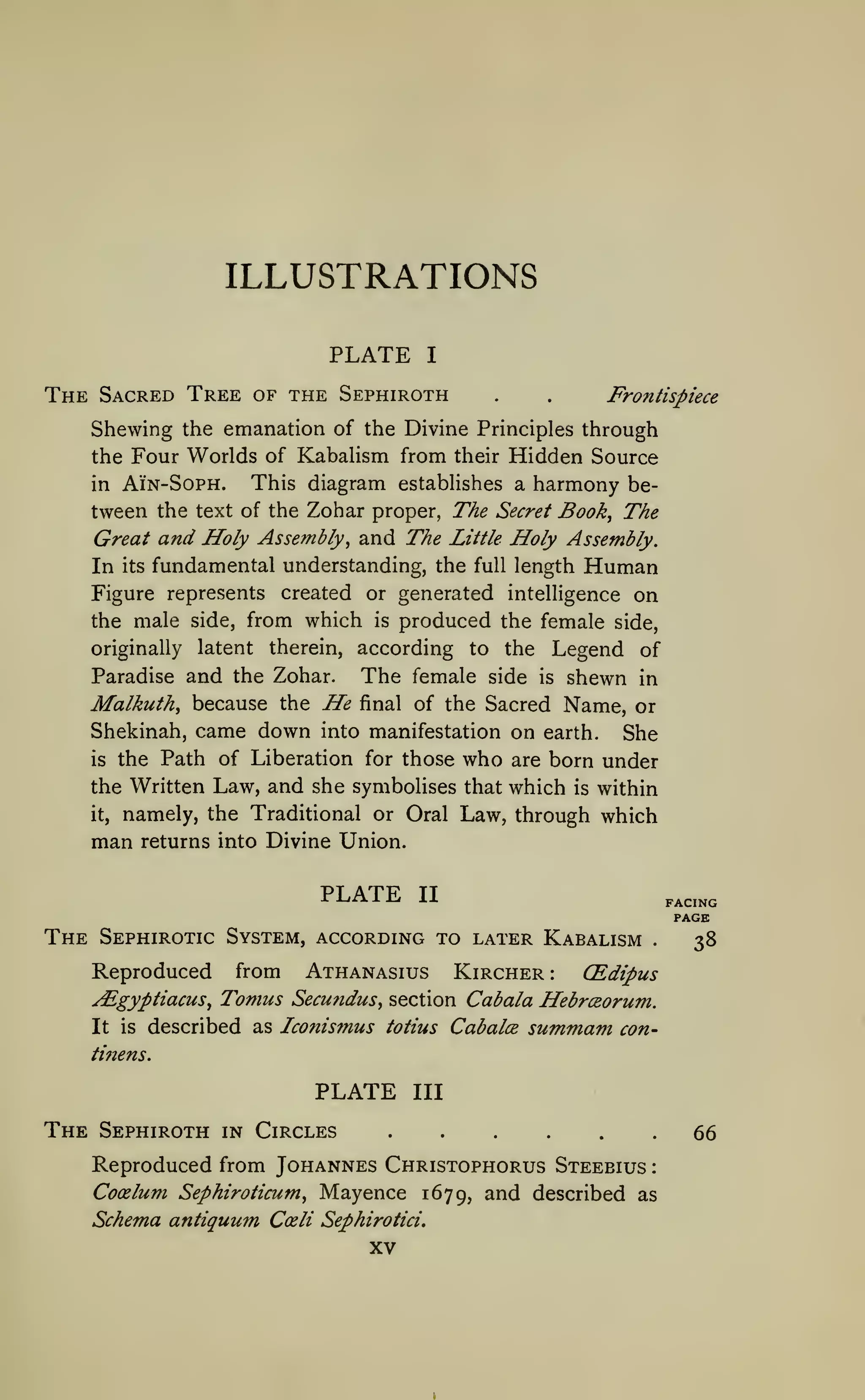
The Sacred Tree of the Sephiroth

.

Frontispiece

.

Shewing the emanation of the Divine Principles through
the Four Worlds of Kabalism from their Hidden Source
This diagram establishes a harmony bein A'in-Soph.
tween the text of the Zohar proper, The Secret Book, The
Great and Holy Assembly, and The Little Holy Assembly.
In its fundamental understanding, the full length Human
Figure represents created or generated intelligence on
the male side, from which is produced the female side,

Legend of
shewn in
Malkuth, because the He final of the Sacred Name, or
Shekinah, came down into manifestation on earth. She
originally

latent

therein,

Paradise and the Zohar.

is

according to the

The

female side

the Path of Liberation for those

who

is

are born under

the Written Law, and she symbolises that which

is

within

namely, the Traditional or Oral Law, through which
man returns into Divine Union.

it,

PLATE
The

II

FACING
PAGE

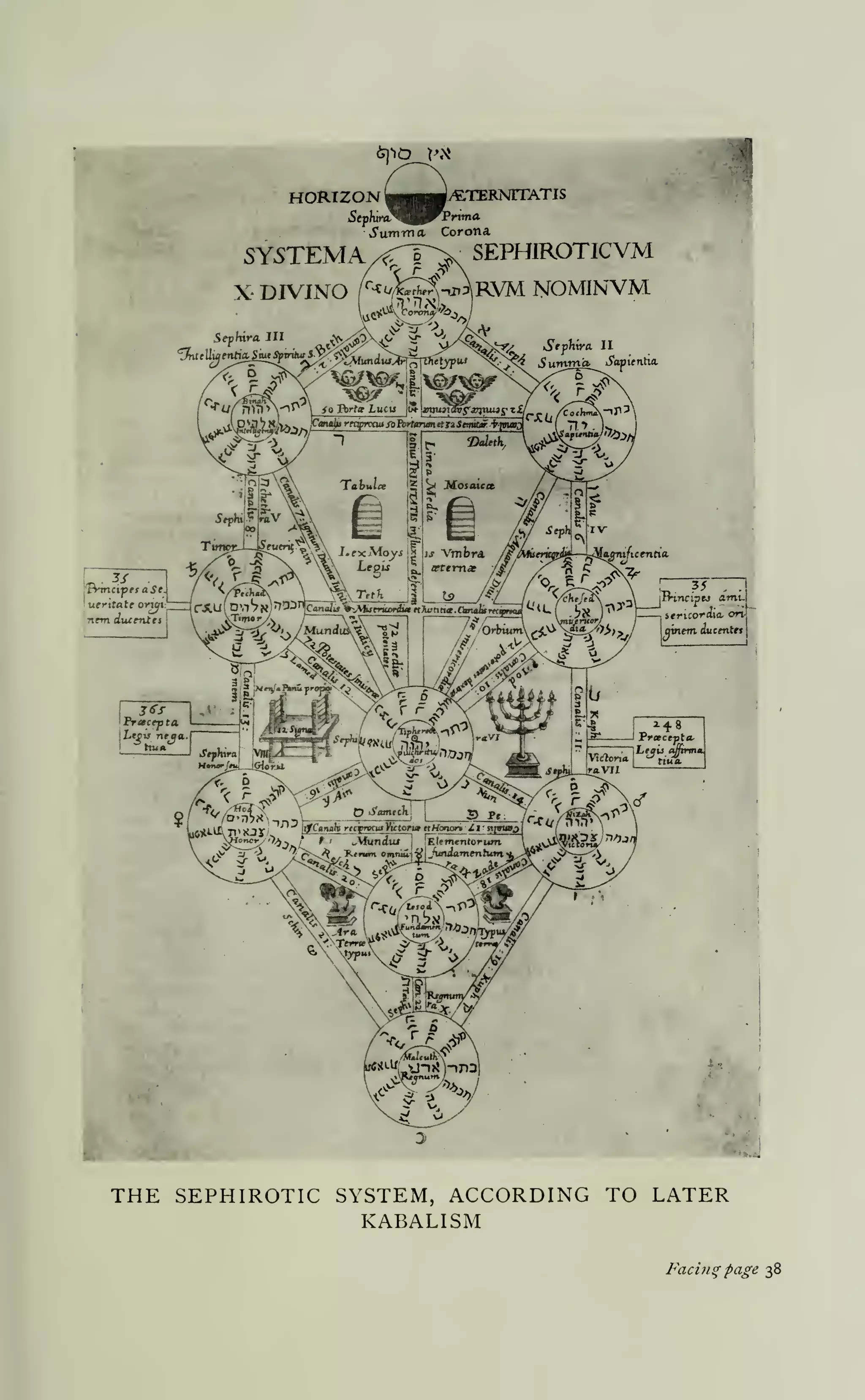
Sephirotic System, according to later Kabalism

Reproduced

from

yEgyptiacus,

Tomus

It is

Athanasius

Kircher

:

.

38

CEdipus

Secundus, section Cabala Hebrceorum.

described as Iconismus totius Cabalce

summam

con-

linens.

PLATE
The Sephiroth

III

in Circles

66

Reproduced from Johannes Christophorus Steebius
Cocelum Sephiroticum, Mayence 1679, ^^^ described as
Schema antiquum Coeli Sephirotici.
:

XV
The Secret Doctrine
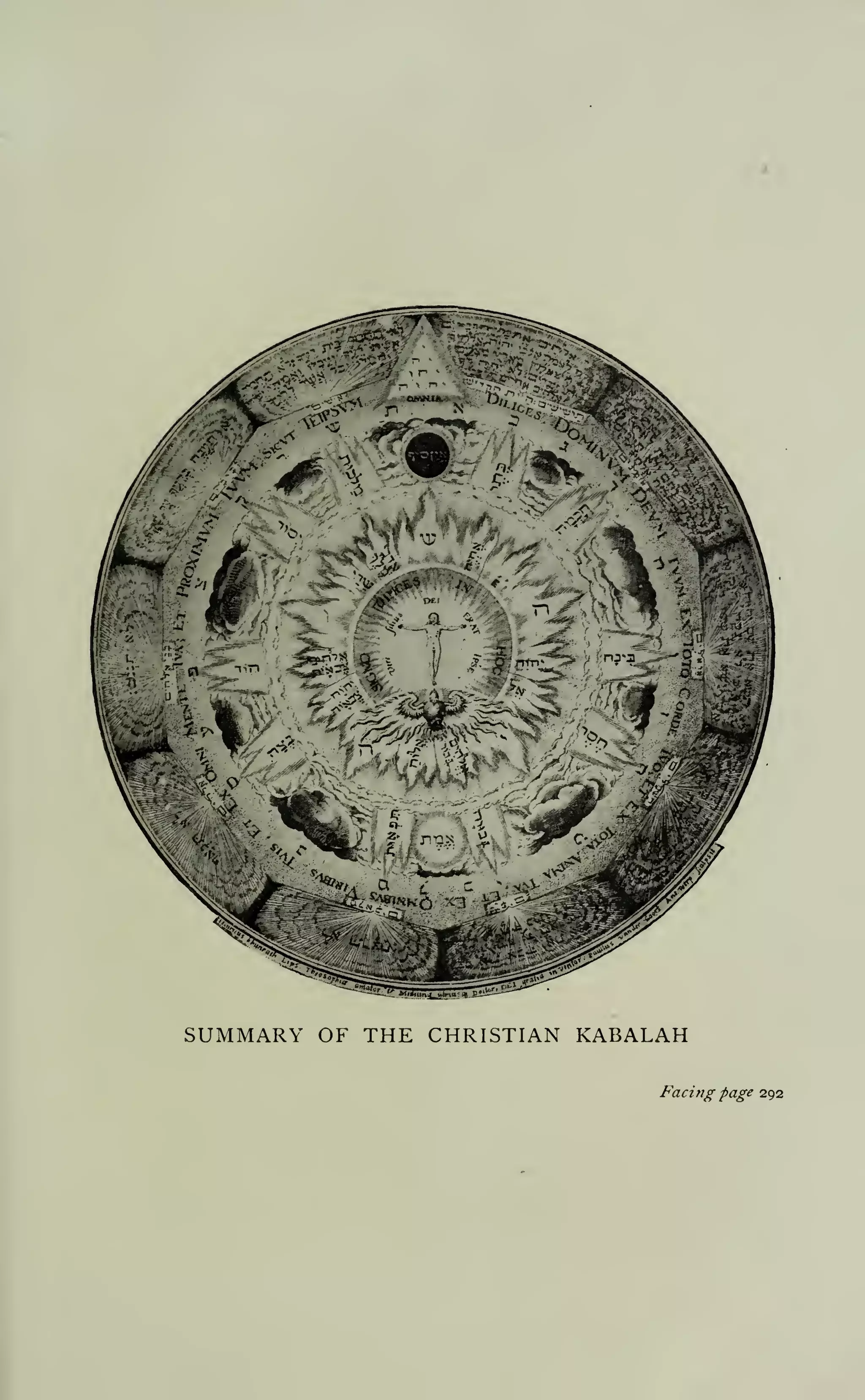
PLATE IV
Summary of the Christian Kabalah

in Israel

....

Reproduced from Heinrich Khunrath
Amphitheatrum Sapientice. ALterncE^ Hanover 1609.
It exhibits
the Cosmic Christ encompassed by the Ten Sephiroth
and the Divine Names.
:

XVI

FACINS
PAGE

292
THE SECRET DOCTRINE
IN ISRAEL
CHAPTER

I

THE EARLY STUDENTS OF KABALISM
The rumour

of a great literature which had subsisted
from time immemorial in Jewry may not have been
heard of first through a signal piece of good fortune
which befell Picus de Mirandula when he purchased,

from an unknown

Israelite,

certain

strange codices in

manuscript, but nothing which came into his hands and
proved to be a treasure of the past was likely to lie
unnoticed on his own part, while this artist of the
schools was a trumpet of fame for anything announced
by his voice during the brilliant, too few years that he
carried the quest of learning and the proof of his attainments from place to place in Europe. He was himself
the pupil in Jewish philosophy of Elias del Medigo,

who

filled

a chair at

Padua and wrote two

treatises at

the instance of Picus, one being on the Intellect and on

Prophecy, in 1481-82, which seems to have remained
unprinted and was written in Hebrew, like its companion De Substantia Orbis^ the work of 1485, but this
It was also edited with a
appeared at Basle in 1629.
commentary by Isaac Reggio and so republished at
Vienna in 1833.
Picus de Mirandula was in some sense a critic of his
day, for he wrote upon the vanity of astrology ; but it
was by no means a period which debated the authority

A
^

"The

Secret Doctrine in Israel

of works referred to antiquity, either by repute or by the
simple audacity of claim, while it was still less concerned
with polemics on questions of authorship. I believe that
1 have mentioned elsewhere how perilous it would have
seemed then to have entered such a field of research.
To deny in the particular case that the Zohar embodies
the actual discourses of Rabbi Simeon Ben Jochai might
have been tantamount to suspecting the authorship of
the Pentateuch
by which I mean that it would have
opened a vast speculative horizon, so that one might
have suggested the other.
There came a time, and it was not far away, when
the treasure of Picus was questioned, when people began
to distinguish between a false and a true Zohar, the first
as the work of one Moses de Leon, belonging to the
late 13th century, and the second as something undemonstrable in respect of age and value. The distinction remains at a high point in the world of speculation,
because no one has heard of the second ; it might not be
worth while to mention it in the present place save that
it gives the opportunity of stating that the manuscript
purchased by Picus represented the identical work which
has been known for six centuries and over under the
An index of the codices
name of Sepher Ha Zohar.
acquired by him was published in 1651 by the French
bibliographer GaiFarel,^ and in the recent translation of

—

the

Zohar

sections.

its

instalments are appended to the various

There

are innumerable

mistaken references,

but the index reflects the text ; what is missing in items
referred to one section may be found sometimes in another,
and though the pains of GafFarel can in no wise be called
it is not even
representative as an attempted summary
there is no question that the treasures of
the shadow
Picus are those which we know under the distinctive

—

—

*

Jacobus Gaffarel

quibus

est

:

usus Joannes

Codicmn Cabbalisticorum manuscriptorum
Picus,

1651.

2

Comes Mirandulanus, Index
—
The Early Students of Kabalism
name of Zohar.
differentiation

There

is

given above

no

alternative text

is

a

and the
mendacity which can

deceive no one.^

The

contribution of Picus de Mirandula to the

know-

ledge of the Zohar in Europe does not exceed to any
considerable extent the simple fact of its existence.
His
short Latin theses, translated in my previous work, cannot
be termed representative, nor can anything else from his
pen.
It remains that he was the first Christian into
whose hands the work came in any form whatsoever, and

seems to have been that authoritative form which was
represented later on by the Cremona and Mantua editions.2
We shall never know under what circumstances
these appeared at their several dates,^ and so far as I
have been able to trace the bibliography of Kabalism, it
does not appear that there is any earlier codex in manuscript.
As he was the first to see the volumes, so Picus
was the first to postulate that the Zohar incorporated
many elements which are capable of a Christian construction.*
I shall deal with this at the close of the
present study, when there will be something to say
on the fact that the Christian predisposition of which
it

^ Curiously enough, the
report has reached us through Richard
Simon, the well-known author of Hist. Critique du Vieux Testament.
See G. C. Sommer Specimen Theologice SohariccB.
It is of course
within possibility that the statement mentioned above does not question
the claims of the work published long after at Mantua and Cremona,
but indicates that there was a false Zohar circulated by Moses de Leon
and presumably now unknown.
^ The edition of Mantua appeared in
1558 and that of Cremona
:

—

almost coincidentally 1558-60. The latter is called bibliographically
the Great Zohar because it contains certain tracts and fragments which
are not found in the Mantua edition, whence the latter has been named
the Little Zohar. Other editions are those of Dublin, 1623 Amsterdam,
Constantinople, 1736; and Venice, with the date of
1714 and 1805
which I am unacquainted.
* The Mantua edition appeared under the auspices of R. Meir ben
Ephraim de Patavio and R. Jacob ben Napthali de Gazulo. See Julius
;

;

Bartolocci Magna Bibliotheca Rabbinica^ vol. iv, p. 416, col. 2, Rome,
They were, however, the printers merely. See lb., p. 15, col. 2.
1693.
:

*

See his Heptaplum^ a sevenfold exposition concerning the

of Genesis.

Opera^ 1572.

3

six

days
—
The Secret Doctrine
Mirandula may be
without exception
indeed, of the

including

called the prototype has been

— the

literati

those

in Israel

the
came after him,

predisposition,

who

who have

translated

—almost

dedication

up

to

and

and edited the

Picus passed away in his youth, ^ or there
are indications which lend colour to the possible realisation of his great dream that the Latin pontificate itself,
in the person of Pope Julius, might have lent an ear
to his eloquence and done something to approach Israel
from the standpoint of Christianity in Kabalism.^
Well, it was after this manner that the work began
to be known in Europe, and there passed something like
a century away, after which the next name to our purIt was he who translated
pose is that of William Postel.
The Sepher Tetzirah for the first time into Latin, and thus
introduced to the curious and learned of Europe the
root of all Kabalism concerning the doctrine of the
Sephiroth^ the powers and virtues of the twenty-two
Hebrew letters and the mystery which resides in numbers.
I must not say that The Book of Formation is like that
legendary grain of mustard which grows into a vast tree,
because the Zohar is in no sense its development except
in so far as letters and numerations are concerned ; but
it ranks as the primitive text of theosophical doctrine in
Israel, and the contribution of Postel to our knowledge
minute as it is seems much more to our purpose than
the detached and almost sporadic Conclusiones Kabhalistica of Picus.
Postel is credited by tradition with a
translation of the Sepher Ha Zohar which would be a rare

French

text.

—

1

He

^

The

died at Florence in 1492.
points of correspondence observed by Picus de Mirandula led
him to infer that the Zohar contains (i) TheDoctrineof the Holy Trinity,
(2) The Fall of the Angels, (3) Original sin, understood as the Fall of
Man, (4) The necessity of redemption, (5) The incarnation of the Divine
Word. With certain reserves in respect of the Trinity, and what is to
be understood by Divine Incarnation, these doctrines are not only to
be found in the text, but are of continual recurrence therein, and yet
the most surprising thing about the work, having regard to the period
of its origin, is the very slight tincture that it has received from the
Christianity in the midst of which it originated and developed.
:
The Early Students of Kabalism
come into existence or been mainI do not know how or with whom the
tained therein.^
attractive story arose, but some years since it took a very
strong hold on the mind of French students and there
treasure had

it

ever

terminating as might have
There is, however, rather more basis
been expected.
for the attempt than mere legend, as it is impossible to
read Postel's most memorable work, or Clavis Abscondi-

was

a great research after

it,

must have been acquainted
and might, therefore, by bare possibility,

sorum^ without inferring that he

with the text,
have undertaken such a task.^

It

speaks of the soul of

God and

the Law,
the reconciler of the universe, referred to the Sephira
Binah^ which titles and which local habitation are those

the Mediator as the

first

creature of

of Shekinah, according to the Zohar.^ It is too early in
our inquiry to dwell upon this point, for much attaches
This is
thereto which will be considered at later stages.
by no means the only direction in which Postel connects
with the chief text of the Secret Tradition in Israel, but
it is sufficient on my part to have established the fact
without enlarging thereon.
Between the period of Mirandula and that of William
Postel I have given some space in my previous work
to the names of Cornelius Agrippa and Paracelsus, but
it has been only to shew that the first connects more
especially with the practical Kabalah so called, powers of
Divine Names, mysteries of numbers, doctrines of angels
and demons, drawn for the most part from sources
other than the Zohar ; while in respect of the second his
^ Picus de Mirandula is said to have caused the Zohar to be translated
into Latin, or alternatively a Latin version was one of the manuscripts
which came into his possession by purchase from the unknown Jew.
^ The legend of a Latin version is recurrent.
French gentleman
of Lyons is supposed to have purchased a copy in 1890, paying many
thousands of francs, and a translation is also ascribed to Gui de Viterbi.
There is nothing improbable in the notion that it may have been so
rendered, and may be in hiding somewhere, though I do not put much
value on the Lyons story.

A

*

Later Kabalism regarded

Adam Kadmon,

as the pre-existent soul of Messiah.

5

the Great Countenance
—

The Secret Doctrine

Israel

in

use of the word Kabalah has no connection with any

theosophy of Jewry.
Contemporary with Postel there was John Reuchlin
or Capnion, who dedicated his three books entitled T>e
Arte Cabalistica to Leo X.
His work may be best described as a study of Messianic doctrine, the object of
which was to shew that He who was expected by Israel
had already come. I am not actually certain, but I believe
that he was the first to point out that the Hebrew name of
Jesus was formed of the consonants of Jehovah = mn'' with
the addition of the second letter Shin = rwn>
i.e, Jehoshuah.
He quotes a large number of post-Zoharic writers
on Kabalism, but does not mention the Zohar, at least by
name.-^
Reuchlin wrote also De Verho Mirifico.
Belonging to the same period as Reuchlin, there was Petrus
Galatinus, an Italian convert from Jewry, the author of
De Arcanis Catholics Veritatis^ drawn from the texts of
Kabalism into twelve great books in the form of a debate
between himself, a certain Hogostratus of whom I know
little otherwise
and Reuchlin. It is a work of much
greater extent and more considerable learning than the
books of the last writer and it does mention the Zohar,

—

—

—

1 There are several editions of both these works, and they are included in the collection of Pistorius entitled, Artis Cabalisticce Scriptores, Tomus Primus, but the second volume
if that was the limit
intended never appeared. This publication belongs to the year 1587.
^ Petri Galatini
De Arcanis Catholics Veritatis, Libri XII,
1672. The text in this edition is followed by Reuchlin
De Arte
Cabalistica.
It is of course a reprint, the work itself having been completed in 1516, according to its colophon. Those who can suffer its
prolixity will not be unrepaid by its reading, even at this day.
The
analysis of contents in respect of the twelve books is worth giving
(i)
Tracts of the Talmud (2) The Trinity of Divine Persons (3) The Incarnation of the Son of God ; (4) The First Advent of Messiah (5) The
Jewish Argument that the Messiah has not come is confuted; (6) The
Redemption of Mankind (7) The Blessed Virgin (8) Mysteries concerning the Messiah (9) Rejection of the Jews and Call of the Gentiles
(10) The Institution of the New Law; (11) The Passing of the Old Law
Galatinus is supposed to have possessed a
(12) The Second Advent.
copy of the lost Targutn or chaldaic paraphrase of Jonathan Ben Huziel
on the hagiographical books of the Old Testament i,e. prophets, &:c.
Op, cit., Book I., c. 3.

—

—

:

:

:

;

;

;

;

;

;

;

;

6
The Early Students of Kabalism
This
but not shewing much first-hand acquaintance.
also is a study of Messianic doctrine and is masterly after
its

own

A

kind.

Paulus Riccius, who
was another Jewish convert to Christianity, but his work
on Celestial Agriculture ^ did not exercise any considerable
influence.
He wrote also Statera Prudentum on the Law
of Moses, Christ and the Gospel, but the work was condemned, and a number of other treatises, including one
on the dogmas of the Kabalists, which appeared at Nuremberg in 1523.
It would be of some bibliographical interest to make
of Alabaster, Gasa complete list of these early students
parellus, Athanasius Kircher, and
above all of Knorr
The rabbinical bibliographies of Wolf,
von Rosenroth.
Bartolocci and Imbonatus, his editor and successor in
research, offer materials for the purpose
but it is enI must hold it sufficient to
tirely outside our subject.
have established the fact that there was a succession of
scholarship, and that its chief or early concern was to
unfold the Christian elements which it discerned in the
Secret Doctrine of Israel, above all in the Zohar and in
the Jewish literature which arose therefrom.
third

name of importance

is

—

—

—

:

^

This

is

the

first

text given in the collection of Pistorius.
CHAPTER

II

THE HIDDEN CHURCH OF ISRAEL

A

STUDY of the

Secret Doctrine or

Theosophy

in Israel,

Book of the Zohar^ might be
made assuredly on any one of several plans, and while
there can be no object in particularising at length those
which it is not intended to adopt, I feel it right to menas

it is

embodied

tion that which

in the great

may seem to be the most
I may explain why it is

natural course

A

of all, so that
set aside.
simple and unpretending analysis of the salient points in
respect of doctrine, designed to throw a light of Secret
Tradition on the faith of the Old Covenant, as this is
found in the Hebrew canonical Scriptures, might be regarded as preferable before any other design. To some
extent along my own lines, it would take, for example,
the myth of the Earthly Paradise and shew how this is
interpreted by the mind of the Zohar; it would take the
story of creation as recited in Genesis and, whether by
quotation or analysis, would ascertain what manner of
light is cast thereon
and so forward in respect of the
Law promulgated on Mount Sinai, the building of the
First and Second Temples and the Messianic expectation.
But seeing that the Zohar is by its own arrangement a
long succession of studies in the five books of the Pentateuch, it would treat these texts point by point under the
heads which I have indicated, and present a digest of the
commentaries, maintaining the aspect of commentary.
As I wish to deal honestly with my readers, I may as
well state that such a design would be considered very
sensible and practical by a number of serious persons.
This notwithstanding, if it had been possible, I should
have neglected to earn the kind of commendation which
;

8
The Hidden Church of Israel
they would have been in a position to bestow, were the
task performed to their satisfaction.
Had it been the
only course open, I should not have undertaken the present study, because
ness.

it

would have been none of

my

busi-

so happens, however, that it is not possible,
because the Zohar is much too loose and elusive
It

firstly,

commentary on the Pentateuch to present it in an
intelligible manner under this guise
and, secondly, because the peculiar nature of its exegesis would prove an
insuperable rock of offence for those to whom the work
would in such case have been addressed. I have therefore approached the subject from the one point of view
which is important to my own mind and in the one way
as a

;

—

—

having regard to the nature of the work.
I have taken it as it is essentially, namely, a store-house of
Secret Doctrine, and for the use of students of Secret
Doctrine I propose to present it, so to speak, at first
hand in all its important aspects for the purpose of
ascertaining
as already mentioned
what light it casts
if indeed any
upon other forms of the Secret Tradition, as these have been presented in earlier and more
ambitious writings with which I have been concerned in
the past.
Here is the keynote in respect of my whole
research, and if there be another which is second only
thereto it is to learn whether the Secret Doctrine in
Israel must remain with us merely as an historical landmark, or whether it conveys an understanding of things
which, when considered in its true light, is of moment to
us as mystics here and now.
To complete the circle of
these preliminary remarks, I will add that the plan thus
that

is

possible,

—

—

—

—
—

—

outlined will be found in the outcome to include

all

that

of importance in the alternative scheme that I have
mentioned, for by the nature of the case there is no paramount doctrine under the aegis of the Old Covenant, no
vital phase of scriptural tradition and no large event in
the history of Israel about which we shall not learn in
due course, and fully, the mind of the Zohar. There
is

9
'The Secret

Doctrine in Israel

one thing more which it may seem well to make clear
as a point of fact
I shall neither assume hereafter an
acquaintance in my readers with the Secret Tradition in
Israel
on which account I have reduced technical expressions to a minimum
nor am 1 producing a kind of prolegomenon to the Book of the Zohar which is intended
primarily to facilitate research when they have recourse
to that work itself.
After due allowance has been made
for the predilection and enthusiasms of a mystic who has
taken the business of the Secret Tradition into his heart
of hearts, I shall be glad if those whom I address will be
content to believe on my testimony that the Zohar is one
of the great books of the world, one also which stands
alone and is comparable to nothing save itself; but I
have no intention of recommending it to their particular
and earnest consideration at full length. In the French
translation it contains, roughly speaking, about 1,250,000
words, distributed throughout six very large volumes,
and in the absence of a special dedication it will prove
perfrankly unreadable, vexatious even and irritating
haps to the last degree. I am giving an account of its
things which
essence on the great subjects of its concern
a careful collation has lifted out of the mass of material.
Beyond these there is all the drift and scattermeal of its
speculation, like a vast waste beyond the garden of the

is

:

—

—

—

—

wise, arid as a field of quest, arbitrary

beyond words

as

reason as thesis and ridiculous at every
I am confusturn and corner of the streets of thought.
ing images or mixing metaphors rather of set purpose, to
produce the kind of effect which is fitting to the kind of
subject.
If the Zohar may be likened otherwise to a

exegesis,

out of

all

temple of learning, then for all ordinary critical minds
the words inscribed on its porch are: "Abandon hope,
all ye who enter here."
In justice to myself I am, however, furnishing the necessary references, firstly, to the

Aramaic text which is paged identically in the epochmaking editions, and, secondly, to the French transla10
—
;

tion, so

have

The Hidden Church of Israel
that those who wish to check my statements may

hands.
In attempting to educe from the Zohar the rootmatter of the Secret Doctrine which it claims to embody,
we are brought very quickly to a pause by the fact not
merely of many inconsistencies characteristic of the text
at large in a variety of lesser respects, but of the obvious manner in which the great record seems continually at issue with itself over matters of prime importance.
and they are comIt is easy to allow for those cases
paratively few
in which the doctors correct one another,
whether or not they reach an agreement subsequently
but one seems to be dealing continually with irremediable variation over clear issues, though in establishing
the simple fact at this early stage there will be no occasion
to cite instances.
I mention it only to indicate my intention to find
as we move forward in our research
a middle way, wherever possible, between statements that
There are two things, however,
exclude one another.
for which allowance must be made from the beginning
one is the distinction of aspects, and then a reconciliation
may be possible not so much in the middle way as by
means of checking and counterchecking allowing for
the point of view; another arises from the fact that the
content of the Zohar is made up of materials belonging
to different dates, and this is much more difficult to deal
with, because the Secret Doctrine of Israel should be in
harmony with itself whatever the period.^ Where either
arises we must deal with cases individually, and it is this
necessity which will tend to swell the annotations much
beyond any limit that I could have desired on my own part.
In the last resource we must recognise that the Secret
Doctrine issues in a mystery in all directions because
full opportunities in their

—

—

—

:

—

—

—

—

Here, as in other cryptic literatures and especially that of alchemy
find something which will serve as a key, the house of
mystery will give up its treasures, which does not mean that every point
of symbolism will be placed of necessity in our hands, but we shall find
^

—

if

we can

the principle at work and the true subject.

II
"The Secret
there

is

no place

at

Doctrine in Israel

which

it

enters into expression fully,

so that the adequate materials are never in our hands.
When things appear mutually or commonly exclusive,

be little to our purpose if we decide that one of
them seems to have a preferential claim, but we may get
to our term if we can find a point of coincidence between
the things which they tend to intimate, though they are
scarcely expressed by any/
According to the form of another school of symbolism, I will proceed now to open the Lodge of Research
by affirming that I am approaching The Book of the Zohar
from a standpoint heretofore unattempted in the whole
history of Kabalistic literature and criticism, so that I
am as usual without precedents, while I am also without
any specific intention of creating them. The remark is
in a sense helpful, because those who are in favour of
established ways and notions can take their proper warning before they go further.
And again, in so far as it
is possible, I should wish to exclude from the auditorium
all those who understand the Scientia Kabalistica as an art
of making, consecrating and using talismans and amulets,
as a magical mystery concerning the power of Divine
Names, or as the root matter of grimoires and ceremonial
rituals of evocation.^
I can at least tell them that they
will be saved from disappointment if they go elsewhere
this is no guide to the perplexed in
for enlightenment
the paths of occult arts.
I mention this matter because
there is a debased Kabalism, improperly so called, which
it

will

:

To give almost a frivolous example of disparities which arise in
way, the Zohar proper everywhere condemns astrology, but The
Faithful Shepherd^ a tract inserted at different points of the text, acknowledges one of its root principles. Z., Pt. II, fol. 42a De Pauly, III, 191.
^ I do not refer here to what is sometimes called the Practical Kabala,
in which are included the artificial methods of Gematria, Notaricon and
^

this

—

;

Temura, which are principles of exegetical interpretation. I have said all
that is necessary on this subject in my earlier study, and they are apart
from the present concern. The reader may consult also Dr. VV. Wynn
Westcott An Introduction to the Kabalah^ 19 10. These methods are
old about the Magical Kabalah, the antiquity must be left unsettled
regarding its folly and iniquity there is no question.
:

;

;

12
—
The Hidden Church of Israel
some roots

deals in these putative mysteries and claims

belonged to the old tradition of Israel
when it is not even a reflection. The mind of the Zohar
on the subject of the occult sciences will be shewn
towards the end of this study, so that there may be no
I mention it at
mistake hereon at the term of quest.
this initial stage, so that there may be no mistake now.
I have termed the present chapter The Hidden Church
of Israel^ but it is not in the sense of suggesting that
there was any formal incorporation,^ much less that there
were secret religious rites and ceremonies in use among
it was an entirely inward, spiritual
a company of adepts
and mystic church, for all purposes of which the oflicial
forms of the external Holy Assembly would have been
held to be of sufficient efficacy, had the Temple, during
the period when the Zoharic records came into existence,
One
stood at Jerusalem, as it did in the days of old.
reason is ^ that the Secret Doctrine was judged to be
inseparable from the literal or written word ; it was
developed sometimes as if to deepen its meaning and
extend its office, never to make it void within its own
measures or in the place to which it belonged.^ Our
in the past, as if
it

;

At the same time we do meet with a number of occasional instances,
the suggestion of which is almost as if the colleagues formed a College
of Initiates. Sometimes it even looks as if there were almost a ceremonial manner of imparting mysteries. See, for example, Z., Pt. I, fol.
133a; De Pauly, II, 124. Again, it is said that the mysteries were
guarded secretly in the hearts of those who possessed them and comFor further
municated secretly to each other. Ib.^ fol. 96b
I, 55c.
allusions, see ib.^ fol. 133a; II, 124 ; ib., fol. 155b
II, 212, shewing that
what was known by one of the adepts was not always familiar to
another; ib.^ Pt. II, fol. 8b; III, 3b; ib., 14a; III, 61; ib.^ fol. i68a;
IV, 116; ib., Pt. Ill, fol. 187a; V, 490.
^ In illustration of this, there is one similitude which says that the
Written Doctrine is the candle or lamp, while the flame is the Oral Law.
De Pauly, IV, 112.
Z., Pt. II, fol. i66a
* The thesis was that the written word of Scripture, in every passage
and syllable, was the word of the living God. The meanings, however,
were many, but they are usually reduced to three
(i) the historical
sense, which corresponds to the Court of the Temple
(2) the moral
sense, which answers to the Holy Place ; and (3) the mystical sense,
which is in analogy with the Holy of Holies.
^

;

;

—

;

:

;

13
;

The Secret Doctrine
first

task

is

therefore to ascertain

in

what

Israel
is

established in

Zohar concerning the fact of the Secret Doctrine
we must then take in succession the chief points of
intimation on external doctrine and religion in Jewry, so as
the

to

elicit

the sense of that tradition respecting each and

we must

—

all.
^

—

indeed be possible
whether the tradition has a central root from which
the great tree of the concealed knowledge has grown
up ; whether also as I have said and how far we
are concerned or perhaps even should be integrated
I must add that while
therein as mystics of this day.
the last point is obviously the most important and vital,
it can only be reached by the
mediation of the two
Lastly,

find

if

this

—

—

others.

The

question

is

therefore as to the fact of the Secret

Doctrine and under what terms it is mentioned in the
It is of course, broadly and generally, a method
records.
of interpreting Scripture,^ but so far as this expression
as an actual
is to be understood in an ordinary sense
and logical construction of the letter the interpretation,
as I have indicated already, is of no value, for the most
It is, however, to be understood after a mode of
part.
its own, and in the light of this it signifies little that
the Doctrine, in respect of exegesis, is often arbitrary

—

—

^ It is perhaps just to myself if I add in this place that, since I am
not concerned with compilations as such, there would have been no
excuse for the present work if I had not satisfied myself: (i) that such
a root exists, and (2) that its nature can be set forth clearly. This has
been implied already in several places.
^ The
symbolism of the Secret Doctrine is also extracted from
Scriptural words and phrases which antecedently seem far from the
mark. The word " waters," as it is used sometimes in the Talmud, is
" Create
said to signify the Secret Doctrine, and when David cried
in me a clean heart, O God, and renew a right spirit within me " (Ps. ii,
12), he was praying for his heart to be opened by the study of divine
mysteries.
So also it is said " Let the waters under the heaven be
gathered together into one place" (Gen. i, 9). The waters refer to the
Secret Doctrine, and the one place designates Israel, whose soul
depends from that region to which Scripture alludes in the words,
" Blessed be the glory of the Lord from His place" (Ezek. ii, 12).
The
"glory of the Lord" signifies the Shekinah below and " from His place "
signifies the Shekinah above.
:

:

14
—
The Hidden Church of Israel
one would scarcely expect it to be
otherwise, having regard to the Rabbinical mind.
And
great point is that the mills of those lesser gods who
the
are called Sons of the Doctrine ground out great things
pure and precious jewels of the spirit
in their processes
as well as much dust and many rough stones from the
matter which they passed through their mills.
It is only
to the last degree

;

—

—

word

can be held
the Secret Doctrine is rather
to apply in any solid sense
the sense below the sense which is found in the literal
word as if one story were written on the obverse side
of the parchment and another on the reverse side. This
is not an exact comparison, but it gives my meaning
clearly enough for the purpose.
There are hard things
said from time to time about the outward sense and
they must not be taken too seriously, for the letter was
always precious, if only as a vesture ; but the difference
between that which was within and without is well
illustrated^ by a similitude which says that those who
interpret Scripture according to the literal sense set the
Sacred King and His Bride upon an ass, while those who
understand it according to a mystic sense mount them
nobly on a horse. ^ This notwithstanding, the two belong
to one another, because the Written Law is completed by
that which is traditional,* and the latter issues from the
as if casually that the

interpretation

^

:

—

^ The canon of interpretation is often exceedingly simple
for example,
any reference to vegetation coming up out of the ground is explicable by
symbolical vegetation, the one and the other being confused together,
and either taken to explain the other. In Ps. Ixxxv, ii, it is said that
" truth shall spring out of the earth," and literal grass is held therefore
:

to signify truth.
^

Law
V,

The Zohar

gives another illustration when
enlightens the Written Law. Z., Pt. Ill,

it

says that the Oral

fol.

23a;

De

Pauly,

61.
»

z.,Pt. 111,275b; VI, 47.

The Written Law

is designated in another place under the name
of heaven, while the Oral Law is called earth. On the surface this
appears somewhat against the more obvious sense and intention, but
what is signified may be an obscure counterchange in virtue of correspondences between things above and below, and this is a recurring
*

Zoharic doctrine.

lb., Pt. I, fol.

247b

15

;

II, 578.
The
former as

Secret Doctrine in Israel

woman was brought

forth from

man

:

it

can

only in union with the Written Law, and this it
serves to enlighten
by the hypothesis at least.
shall see at the proper time that chief among the root
doctrines is that Jehovah is one with Elohim in a sense
which is very far from the theological understanding
of Scripture ; but it is held also that the Written Law
is the image of Jehovah, as the Oral Law is of Elohim,
meaning the Holy Shekinah, from which it would follow
that at heart they are two aspects of one and the same
Law. That which is oral is called the voice of the
turtle,^ and it comes from the side of mercy ; it is
also the green wood, while the literal Law is the dry,^
coming from the side of judgment. But as a further
instance of the unity in both it is laid down that there
are three things which are at once hidden and concealed
being God, the Law and Israel itself.
The vulgar
man sees only the material side, but the initiate discerns
In virtue of this
also that which is buried within it.
bond of union, we meet with intimations occasionally in
which terms are applied to the one that seem referable
It is said, for example, that the
rather^ to the other.
Written Law is above and that which is Oral below, as
exist

—

We

—

also that the former penetrates

That which

and

fructifies the latter.*

without seems, however, to be clearly
a manifestation of that which is within, though there
is a sense also in which the Law was regarded as written
on high ; but this I should understand to signify that
the Oral Law passes into expression here and into
is

^

Z., Pt. Ill, fol.

^

Ib.^ fol.

27b,

4b.

;

and V,

De

Pauly, V,

9.

76.

According to the rabbi in Longfellow's Golden Legend^ all Bible
water and Mishna is a strong wine but according to the Zohar,
it is the Written Law which is wine
the Oral, however, is not water
but milk. I conclude that the one is the lesser, the other is the greater
See Z., Pt. I, fol.
salvation, according to the voice of the Doctrine.
^

lore is

;

;

240a;
*

II, 549.

Z., Pt. II, fol.

and IV,

200a;

De

Pauly, IV, 200;

208.

16

also Z., Pt. II,

fol.

206a
:

l^he

Hidden Church of

Israel

To

conclude upon these analogies
the manifested part bears no comparison with that which
that which is essential is called the
is contained within
the commandments are its body and
Soul of Scripture
This is in the world
the tales are the garments thereof.
below, while in that which is above the Ancient of Days
the soul is that mystery
is the soul of soul in the Law
which is called the Beauty of Israel the body is the
Community of the Elect ; while the vesture is heaven
and its region. Cursed be he, says the text,^ who pretends that the recitals of Scripture have no other meaning
than that which appears on the surface. Scripture, if
this were the case, would not be the Law of Truth, the
Holy Law and the Perfect Witness, more precious than
If it contained only simple stories and
gold and jewels.
such vulgar elements as of Esau, Hagar, Laban and
it would be possible to produce something
Balaam's ass
better, apart from all inspiration, after the manner of
but the truth is that every word of
profane books
Scripture enshrines a supreme mystery, and is capable
of sixty methods of interpretation.^ This is a characteristic extravagance, but every one who has followed the
quest of the mystic sense knows how manifold it is, and
hence no doubt it has been testified that the original
That is like St.
Zohar was a load for seven camels.
" I suppose that even the world itself could
John saying
not contain the books that should be written," if all the
acts of Jesus were reduced into a complete memorial.^
I am very sure that the beloved disciple was guilty herein
of no extravagant utterance, because Christ has been
always in the world
and I am not less certain that the
there.

realisation

;

;

;

;

—

—

;

:

;

1

Z., Pt. Ill,

^ Ib.^

149b;

De Pauly, V,
De Pauly,

386, 387.

26a;

It is said otherwise that
I, 161.
there are sixty sections, which are the sixty queens of the Song oj
Solomon. The "young maids" without number are the Halakhoth.
lb., Pt. Ill, fol. i^2i V, 548.
Another statement concerns seventy
modes of interpreting Scripture, all of which are true in their results.
lb., Pt. I, fol. 54a; I, 310.

Pt.

I, fol.

—

®

St.

John

xxi, 25.

17

B
The Secret Doctrine

in

Israel

extent of the Zohar has been understated, for the variations of inward meanings are numberless as the Sons
of the Doctrine, and they are all true analogically,
though some of them are brighter jewels and the pearls
of greatest price may be few enough. Whatever belongs
to man belongs also to Christ so too the Divine Sayings
are like the Divine Acts, and from the first time of
manifestation until that moment when God shall be all
in all, there is no end to either.
Now, it is said that the inner sense of the Law is not
less concealed than the world from which it emanates,^
wherefore the mysteries known to the Sons of the
:

Doctrine are guarded secretly in their hearts. Those
who apply themselves to its study receive as their inheritance the world to come as well as that of Jacob,
He who is so
for it is the path of the life to come.^
dedicated and so consecrated is accounted as if he had
received its sweet and heavenly words on Mount Sinai
itself.^
It is the way of the Garden of the Sacred King
certain price has
and the way of the King Himself.*
to be paid however, for it is said hyperbolically that the
study of the Law succeeds only in the case of him who
kills himself for the Law, meaning that it is a path of
poverty, and a poor man is considered as one who is dead.^

A

156b De Pauly, II, 215.
58a II, 220. I should perhaps mention here that consecration to the study of the Sacred Doctrine brings down what is called the
Supplementary Soul which Zoharic Kabalism attributes frequently to all
pious children of Israel who observe the Sabbath in the plenary sense.
But
It remains with them during that day and returns whence it came.
it would seem that the Sons of the Doctrine are in permanent enjoyment
of this added part. He who does not cultivate the mystic science is
therefore in a state of deprivation. The soul is brought down by the
voice of him who studies the Secret Doctrine and it comes from the land
of the living, making him whom it overshadows equal to the angels.
When it is said in Ps. ciii, 20, " Bless the Lord, ye His angels," the
reference is to those who study the Doctrine and are called God's angels on
In the world to come they will have wings like those of the eagle.
earth.
8 lb., Pt. Ill, fol. 179b ; V, 471.
^ lb., Pt. I, 224b ; II, 485.
^ lb., Pt. II, fol. 158b
IV, 95. But against this, he who is dedicated
to the study of the Law opens the 50 gates of Binah, corresponding to
the letter F^^ multiplied by the letter He.— lb.. Ill, fol. 216a; V, 548.
1

Z., Pt. I, fol.

^ Ib,^ fol.
1

;

;

;

18
"The

Hidden Church of

Israel

with preliminaries, and if the next
question be how did the Secret Doctrine originate, the
answer seems that it was before the world was with God.
The sense of this must be that it was implied in Elohim,
whose image it is, as we have seen. Another explanation
is that it is on the side of mercy, and by mercy the world
find,
was made it is the henepladtum termino carens.
moreover, that God created the world by joining thereto
the Secret Doctrine.
The world was founded thereon,
and it is added that so long as Israel is consecrated to its
study, so long will the world be stable.
When the lovers
^ rise for its study at midnight ^ the Holy One
of truth
and all the just who are with Him in the Garden of Eden
listen to their voices.^
The versicle appertaining hereto
'*
is
Thou that dwellest in the gardens, the companions
hearken to thy voice cause me to hear it." *
may
understand by this that those who work below are really
listening to the Voice which is above and that when they
hear it, it is the mystery of doctrine which they hear.
There is no need to add that the Voice is speaking in the
heart.
The word Bereshith with which Genesis opens,
and which has been rendered sometimes ^' in wisdom,''
not ** in the beginning," is said to signify the Secret
Doctrine and its joining to the work of creation. The
I

have dealt so

far

We

:

:

We

:

Scriptural allusion is:

'*

The Lord

possessed

me

in the

beginning of His way, before His works of old.
I was
set up from everlasting, from the beginning, or ever the
earth was." ^
It will be observed that this is personified
^

Z., Pt. I, fol.

De

Pauly, I, 454.
;
at its value that the annotator of the

77b

may mention

French version
distinguishes between that which the Zohar designates mysteries of
doctrine and that which it calls mysteries of tradition. The first is the
spiritual sense of Scripture and the second that of tradition.
^ The study of the Doctrine is held to call for adornment of body as
well as attention of mind.
It was needful for the doctors who rose at
midnight to clothe themselves for the purpose of study, out of respect to
the Shekinah, who accompanies students of the Doctrine. Moreover, the
study calls for serenity of mind, and it was held difficult to ensure this in
a reclining posture. Z., Pt. I, fol. 72a ; I, 426.
^

I

*

Song of Solomon^

^

Prov.

—

viii,

22, 23.

viii, 13.

Z., Pt. I, fol.

Z., Pt. I, fol.

24b

19

;

I,

77b;
153.

I,

455.
—
The Secret Doctrine
Wisdom

testifying

on her own

part,

in

Israel

and the application of

the text by the ^cki2X in connection with the beginning of
things is, under the circumstances, rather subtle.
It goes
on to affirm that this was the kind of beginning in which

God

created the heaven and earth, the basis of which

Hence it is
have made existed

His Covenant.

said also

'*
:

If the

is

Covenant

not, there would be neither
which I
day nor night, neither heaven nor earth." ^ All accepted
renderings of this passage from the Vulgate downward
are quite different, but the point to be remembered is the
allusion made to the Covenant in the particular con-

nection, for

we

shall find at a

manual or

much

later stage that

it

of one of the Divine
Hypostases and it is also one of the keys to the whole
mystery of the Zohar.
are not, however, dealing with
the question of creation at this point of our debate, and it
has been mentioned only to indicate the seemingly eternal
pre-existence of the Secret Doctrine.
After what manner
was the latter brought down to earth, so that it came to
the knowledge of the elect ?
The thesis of possession
and successive custody depends from a legend of Paradise,
and this in its turn arises from the Scriptural reference
to a " book of the generations of Adam." ^
It is supposed
the

is

sign

visible

We

by the Zohar to signify that there was a secret and supreme
book, the source of all, including the Hebrew letters^
presumably in that form under which they are manifested
It expounded the holy mystery of wisdom and
below.
the efficiency resident in the Divine Name of seventy-two
letters.*
It was sent down from heaven by the hands of
This is the rendering of the Zohar, but the Authorised Version reads
covenant be not with day and night, and if I have not appointed
the ordinances of heaven and earth then I will cast away the seed of
^

*'

If

:

my

;

my servant," &c. Jer. xxxiii, 25, 26. Compare the
Si pactum meum inter dieTU et noctem, et le^^es ccbIo et tetTce

Jacob, and David

Vulgate

:

nan posui, equidein
^

Gen.

v,

et

semen Jacob

et

David, servi mei, projiciam, &c.

I.

Z., Pt. I, fol. 37a et seq.
De Pauly, I, 231, 233.
There are said to be three books which are opened in heaven on the
first day of the year.
The first is that which was transmitted to Adam,
and this is the book of the just who are perfect. The second has a part
^

;

*

20
—
—

—

The Hidden Church of Israel
the angel RazieP and Adam was entrusted therewith.
Raziel is said to be the angel of the sacred regions and
The gift placed Adam
chief of the supreme mysteries.
in a superior position to that of any celestial being
presumably with the exception of the messenger, though
indeed he may have carried that which he was not per-

mitted to understand.
Adam became acquainted in this
manner with Supernal Wisdom,^ and the celestial choirs
came down to be present when he read the book. He
was cautioned, however, to conceal it, and he seems therefore to have studied it in silence with recollection of the
heart.
The book proved later on to be like the Lihef
Gradalis or fundamental record concerning the Holy
Graal, for

it

took unto

itself

wings

—

at

need when

Adam

fell ultimately into sin.
advantages notwithstanding
It was clasped in his hands when he was driven out of
the Garden of Eden, but thereafter it vanished, and for
long and long he lamented the loss of his treasure.
Ultimately it was given back to him, in answer to his
tears and prayers,^ by the angel Raphael ; he returned to
its study and bequeathed it to his son Seth, who entrusted
it to later messengers, so that the Secret Doctrine might
It became known as the
be spread through the world.
Book of Enoch after passing through the hands of that
patriarch,* and it is said that Abraham penetrated the

his

The
in heaven and a part on earth, but it is not otherwise described.
third is the Written Law, which was designed for the first man and was
presumably known of the heart, for it is not said that it was manifested
lb.
at that time on earth.
1 Z., Pt. I, fol. 55b;
I, 319, 320.
^ The Sacred
of 72 letters was explained in the Genesis of

Man

Name

670 mysteries which it contains. The mystery of
Chokmah discovered the 1500 keys which are not entrusted to any

by means

of the

celestial being.

variant account in fol. 55b says that he smote his forehead
the work vanished and plunged up to his neck in the river Gihon,
being the sacred river which flowed out from the "garden eastward in
Eden." Gen. ii, 13. The result was that all his body was covered with
wrinkles, so that he was no longer recognisable.
* There are several Enochian legends which offer curious points in
themselves, but seldom connect with our subject. According to one
^

The

when

21
—

Doctrine in Israel

T*he Secret

glory of his Master by means of its mysteries.
Moses,
however, was the first man who attained perfection in its
fulness and perhaps on this account it is not suggested
that he derived his knowledge from a book, so that after
Abraham we hear nothing of the secret text it was a
The External Law and
treasure of the patriarchal age.
the Secret Doctrine were both revealed on Mount Sinai,
and as Moses transmitted the one to his nation at large
so he communicated the other to certain elders, by whom
But there are two remarkable passages
it was handed on.
designed to shew that the whole secret knowledge came
down to the Zoharic period under the darkening of successive clouds.
It is said that at the death of Moses the
sun was eclipsed and that the Written Law lost its
At the hour of King David's death the light
splendour.
of the moon diminished and the radiance of the Oral
:

Law was

The

consequence was that discussions and controversies began among the sages of the
Mishna, so that the joy in the study of the Law has
ceased for all future generations.^
It was pursued pretarnished.

viously in clear and full light, so that there was the
union which comes from certitude among the Sons of

the Doctrine, but afterwards it was followed from afar
in a state of doubt and separation, amidst the wrangling
of the schools, who saw only as in a glass and darkly.

of things is sometimes symbolised by a division
in the Divine Name, by the loss of the true method of
pronouncing the Tetragram in conformity with its
Occasionally there are
proper vowels, and so forth.
intimations of a new breaking of light, as when it is said
that Ezekiel was less faithful than Moses, for he divulged
all the treasures of the king,^ but apparently those

This

state

according to
account, Enoch became the great archangel Metatron
another, he was exalted to the high heavens and made guardian of their
treasures, including the 45 keys to the combinations of graven letters.
;

Z., Pt. I, fol.
^ Z.,
2

56b

;

De Pauly,

Pt. II, fol. 156a,

/^., Pt. II, fol.

I,

b; IV,

5a; III,

326.
88.

19.

22
—

e

The Hidden Church of Israel

—

were not cast before doctors who whatever
were unable to value them in
their zeal and sincerity
It was otherwise
understanding at their proper worth.
in the days of Rabbi Simeon, for the glory of the mystic
light was at its zenith in him, according to the Zohar,
which, considering that he was the revealer in chief of its
doctrines, naturally exalts that master of wisdom above all
the stars of heaven.
It is added that from the day when
Rabbi Simeon came out of his cavern ^ the mysteries were
secrets no longer for the colleagues, because the Hidden
Doctrine had become no less familiar to them than it was
to their precursors in that day when it was revealed on
Mount Sinai. But the time came when this great sun
set in the hour of the master's death ; and when afterwards his disciples and successors sought to reproduce
the words which they heard from his lips, the attempt
proved a failure.^ The withdrawal of the Secret Doctrine
these
is also mentioned, but with vestiges remaining over
are to be concealed, as much perhaps because of their incompleteness as because the Doctrine itself was secret.^
The last point which calls for our consideration here
is whether the general references to the Secret Doctrine
as a whole, apart from its various branches, ofFer any
ground of presumption concerning its radical nature.
treasures

—

:

Now,

it is

Supreme Mystery is concealed
the secret of the Law, meaning

said that the

Law,^ that it is
Sacramentum Regis quod absconder
the secret of the King
in the

* The reference is to the Tract Sabbath^ which contains the history
of Rabbi Simeon, the reasons which led him to find refuge in a cave for
twelve years and the circumstances under which he came out. See

Michael Rodkinson

Babylonian Talmud, vol. i, c. 2.
This disposes of the ridiculous tradition that R. Simeon wrote
anything in the cavern where he found a refuge from Roman imperial
:

^

persecution.

2i6b, 217a; De Pauly, II, 453-455. See also Ib.^
from which it follows that the Secret Doctrine is the
explanation and unfoldment of all. This is founded on Ps. xix, 6 " There
is nothing hid from the heat thereof."
But this was the Doctrine in its
^

fol.

Z., Pt.

9a

;

I,

I,

fol.

50,

:

fulness.

*/^.,

fol.

236b; 11,533.

23
"The Secret
bonum

Doctrine in Israel

—revealed only to those who

est

fear sin,

and that

bodied forth by the sacred covenant
concerning circumcision.^
In other words, it is a mystery
of sex.
It was on account of this that Rabbi Simeon
consecrated to the study of the Secret Doctrine the entire
night in which the Heavenly Bride is united to her
Heavenly Spouse, being the night of that day when the
Law was revealed to the Israelites and the Covenant
contracted between God and His people.
The reason
was that the mystic Knowledge constitutes the jewels of
can only understand this on
the Heavenly Bride.
the hypothesis that the science in question is concerned
at some stage or under some aspect with a most holy
mystery of sex, as if some unknown path of splendour
It is
and path to the height might open therefrom.
" the King's daughter is all glorious within,"
said that
and the Zohar explains that there is glory and glory, a
glory of the male and a glory of the female principle.^
It is said also, as if in connection with the pursuit of
this path, that whosoever follows in the train of the
Heavenly Bride on the night of union ^ shall be preserved
from all evil for ever in heaven and on earth as if death
and the second death had no power. He will enjoy
celestial peace to the end of time.
The counsel in this
*
''
respect is
Taste and see that the Lord is sweet."
If the study of the doctrine adorns the Bride of
Heaven with jewels, as we have just seen, it seems that it
also adorns the soul of the student with all manner of

as to its nature, this

is

We

—

:

When

Zohar affirms that
his desert is far above anything which follows on
mere works, there is no doubt that it gives expression

graces and sanctities.

the

237 De Pauly, II. 535.
This is based on Ps. xlv. 13 "The King's daughter is all glorious
within," which the Zohar renders "All the glory of the daughter of the
King is within " and the Vulgate Oinnis gloria ejus filicB regis ab intus.
The words are held to designate the Community of Israel.
^ Z.,Pt. 1,9a;
1,51.
1

Z., Pt. I, fol.

^

;

:

:

;

*

:

Ps. xxxiv, 8.

24
Hidden Church of Israel

"The

to a great truth, though it may be one that
only for the understanding of the elect.

reserved
But in the
is

ordinary sense the explanation is that it enables good
works to be fulfilled with knowledge, under the operaThose who study the Doctrine are
tion of Divine Will.
whether of things in heaven or
set free from fear
things on earth, whether of evils which may overwhelm
mankind for they are grafted on the Tree of Life and
are taught daily thereby.
As regards things in heaven,
the meaning is that the fear of God, which is the
beginning of wisdom, has been absorbed by the love of
God, which is wisdom in realisation, and the Divine
Doctrine cannot be studied without imparting love for
To walk in the path of the Doctrine is
the Divine.
therefore to follow the path of love ; it is said otherwise to lead into the way of truth, so that we learn how
It is not the work
the soul may return to its Master.
of a certain day, nor of a certain hour, but one of the
come to understand in this
day and the night.
manner that the study is a question of life, of living
with the face towards Jerusalem, having the awareness of God in the heart, and herein is the moyen de
parvenir^ the counsel of real living.
shall understand
also why it is added that he who neglects or forsakes
the study of the doctrine is not less guilty than if he
separated himself from the Tree of Life, for he is leading
the life of separation.^

—

—

We

We

The

seems to me, the
ordinary course of thought in the direction to which they
belong ; but the extracts out of which they arise are a
counsel to those who would study the Secret Doctrine
that there is needed a conscious union by intention, contemplation, and the art of finding in the heart, so that
the heart and mind of the student may concur in an
ineffable union which is said to be consummated above.

As

to

last considerations follow, as

its

we know enough to be
Z., Pt. I., fol. iia
De Pauly, I,

nature
^

it

;

25

certain that the
62.
The Secret Doctrine

in Israel

night thereof is not of a festival below but of the eternal
oneness in that Divine Darkness which is called otherwise in the records /iin-Soph^ the limitless and undifferentiated light.
The festival of the Paschal Lamb in
the calendar of Jewry is only a specific memorial on
earth, so that what it is held to signify may be kept
in the soul of Israel ; and this is not really an act of
unreason ; on the contrary the intention is so to proceed
here as if that which is remembered below is in particular
remembrance above, yet the union there is in the still
rest and the changeless simplicity, being infinite and
eternal therein.
Lastly, the extracts out of which these
things arise would be worse than idle words if the quest
concerning their meaning could be carried no further.
It will be seen as we move forward on the strange
path of our research that the Sons of the Doctrine were
only from time to time, and as if by accident, concerned
with reserving any common, or indeed any merely remote
and arbitrary understanding of the Written Word in
Israel ; that in short there was something, on the contrary,
which at least from their point of view imposed a
reasonable and even a zealous reserve, because it was preeminently one of those matters which the unprepared
and sensual mind would wrest to its own destruction.

—

—

26
CHAPTER
THE MAJESTY OF GOD
I

III

IN KABALISM

SUPPOSE that there would be no more interesting study

than the antecedents of Zoharic doctrine in the systems
I speak of the more formal and
of the past.
if I may
more exoteric part, of that also which is not
so put it
within the measures of
after its own order and manner
Such an undertaking is outside my
the mind of Israel.

—

—

—

whole proposition and would demand qualifications to
which 1 make no claim, for it is somewhat late on my
part to serve another apprenticeship.

Special proficiency

not of course required to recognise in how many quarters the great vistas open, and I suppose that in such a
connection the discourse would begin as this chapter
begins that is to say, on the nature of God in the transI will reaffirm at the outset that I am concendence.
cerned here, as I shall be concerned throughout, with an
attempt to ascertain whether there is anything which
leads to some central point of all ; and I believe that we
shall find it almost ready to our hands, as we did in disThis point
cussing the nature of the Secret Doctrine.
will recur continually, and so shall I look to reach in
fine a culmination or term of quest, from which we shall
be able to look back over the whole journey and survey
is

—

under one light.
Speaking generally of God in the transcendence, we
learn that the glory of the Holy One is so sublime and
exalted so highly above all human understanding, that
it remains eternally secret ; no man can penetrate the
depths of the Divine Wisdom.
The place of its exaltait

27
:

The Secret Doctrine
unknown

Israel

in

men and

angels/ and this is held to
be intimated by the prophet when he said '* Blessed be
the glory of the Lord from His place," or as the Zohar
renders it, '* in the place wherein He resides."
I suppose
that this may be regarded as a short introduction to the
Doctrine of the Infinite, as this finds expression in the
Zohar under the name of Ain-Soph^ or the Divine Essence
abiding in the simplicity and undifferentiation of perfect
The Latin equivalent % fine carens^ that is to say,
unity.
without end, and it is customary to translate Ain Soph
tion

is

to

:

Aour

without end being
A'in-Soph is, however,
held to be without beginning.
understood in the 7jO)2^t as the limitless mystery of
Divine Thought, the centre of all and the secret of all
secrets
God unknown and unknowable in respect of
His Essence.^ The references to this state of Deity are
comparatively few in the Zohar,^ and it was unknown to
the Book of Formation which preceded it.
There are important developments concerning it in later Kabalism,
which located it above Kether in the Sephirotic Tree and
regarded this first Sephira sphere or numeration as the
Throne of the Infinite, adding that Ain-Soph dwells in
the hiddenness thereof.*
as Limitless Light, that

which

is

—

—

The Zohar

testifies:

without form,^ but

in

—

(i)

That God

His manifestation

is

essentially

He

is

seen

103a De Pauly, II, 18. See also Ezek. iii, 12.
2ia; I, 129.
^ It is important to establish this point because some confusion has
been created on the subject by modern writers. In those portions of the
Zohar which were rendered into Latin by Rosenroth he has introduced
an interlinear commentary which gives a false impression as to the recurrence of the doctrine throughout the text. M. Franck {La Kabbah^
1843, PP' ^11~^1^) introduces the term Aift-Soph in the course of a long
Zoharic excerpt which is difficult to follow on the assumption that it is
direct translation. Lastly, Mr. Mathers {The Kabbalah Unveiled^ 1887),
who failed to render even Rosenroth's Latin correctly, produces the latter's
commentary with additions of his own and increases the confusion further.
* See Kabbala Denudata : Apparatus in Librum Sohar^ Pars Prima^
^

Z., Pt. I, fol.

^

Ib.yioX.

;

p. 81.

The text derives its autho275a; De Pauly, II, 644.
the usual amazing manner from the Sonor of Solomon, vii, 11, 12
Come, my belovod, let us go forth into the field let us lodge in the
^

Z., Pt. I,

rity in
*'

;

28
—
Majesty of

T^he

God

Kabalism

in

or discerned under different aspects, according to a scale
of degrees extending to 32 and constituting the Paths of

Wisdom, which

mentioned hereafter in connection
with the Book of Formation.
(2) That the most secret of
all mysteries is that which is called Nothing,^ being the
Most Holy Ancient, from Whom the light flows forth.^
This notwithstanding, it is affirmed (3) that in the essence
of the Infinite there are neither intentions nor lights, nor
brightness,^ and the explanation is that although all lights
emanate therefrom they are not in that state of clear
shining which would enable man to grasp the nature of
will be

the Infinite.
It is a Supreme Will.
(4) That again
this fact notwithstanding, the holocaust which has for its
object to effect an union with the Holy of Holies ascends
to Ain-Soph, because all union and all perfection

must

tend to fusion with the Mysterious Unknown * Who is
the object of all desires, though in A'in-Soph there are
no desires, even while they subsist thanks only to Him.
It
(5) That A'in-Soph is symbolised by the letter Aleph.^
seems to follow that later Kabalism was well within the
measures of the symbolism when it posited A'in-Soph as a
hidden light above Kether at the head of the Sephirotic
Tree.
By a kind of flowing forth or emanation, which is
distinct as such from pantheism, there were produced
four worlds in succession, and as again the developments
Let us get up early to the vineyards let us see if the vine
This is contrasted with a Talmudic story concerning the son
of Zoma, one of the four persons who penetrated into the Mysterious
Garden but he remained on the hither side of the vineyard, which is
taken to mean that he did not enter the 32 Paths of Supreme Wisdom.
1 Z., Pt. II, 64b; De Pauly, III, 283.
It is founded on Ex. xvii, 7:
"They tempted the Lord, saying, Is the Lord among us, or not?"
which is supposed to contain a distinction between the Ancient and
Jehovah, contrary to the unity of God in all degrees, and whether

villag^es.

;

flourish."

;

manifest or unmanifest.

43b

2

lb.,

3

lb., Pt. II,

*
^

;

III, 194.

239a; IV, 267.
Ib.,Vi. 111,26b; V, 74, 75.
lb., 257a ; V, 597.

29
The Secret Doctrine
of these are chiefly
rate therein,

it is

Israel

in

Kabalism, being very elabo-

in later

desirable to see exactly

what

is

said

upon

The references are in
the subject in the fountain text.
summary form as follows ( i ) there is a Sephirotic
degree entitled Malkuth^ and it seems clear that to what
world soever this name is allocated, one Sephira alone is
signified, being that which is tenth in numeration and is
actually called Malkuth^ signifying the Kingdom.
(2)
It is testified that Scripture makes use of the three expressions " to create, to form and to make '' ^ in allusion
:

to the three worlds which are below the world of emanaIt follows that the four worlds are those of Emanation.
tion, Creation, Formation and Manifestation, Action, the
material universe, or as
Factionis?

it is

The Hebrew

TetBtrah and Assiah,

called

by Rosenroth Mundus

equivalents are Atziluth^ Briah^

(3)

The

union of

God and His

Shekinah takes place, as we shall see, in Atziluth^^ the
world of Emanation, where there is no separateness the
angels of Briah form the body of Shekinah,^ when she
descends therein, and this world is called the region of
the Throne.
It is said that the princes of Israel, the
wise, the intelligent, the zealous, heroes, men of truth,
prophets, just men and kings are all from the world of
Emanation, but there are others from the world of Creation, whereof Shekinah is the sacrifice.
But this is not to
be taken literally.
(4) There is also a reference to three
worlds of divine hiddenness.^ The first can be neither
seen nor discerned and is known only to Him Who is
concealed therein ; I suppose that this refers to Ain-Soph.
The second is attached to the first and the Holy One is
The third
manifested therein it is presumably Atziluth,
is the beginning of division, signifying created intelligence,
;

:

^ Z., Pt. I, i8a
De Pauly, I, 112.
designated by the word " bow/' when it
the cloud." Gen. ix, 13.
* Ib.,io. 179b; 11,298.

Malkuth

;

—

^

Kabbala Denudata

*

Z., Pt. III,fol.

^ lb.

is

said

:

"

I

is

do

supposed to be
set

: Apparatus, Pars Pri??ta^ p. 12.
109b; V, 276.
• lb., fol. 159a; V,
411, 412.

30

my bow

in
:

The Majesty of

God

in

Kabalism

the world of the superior angels it is therefore
Briah^ according to later Kabalism.
For the Sons of the Doctrine the four worlds of their
conception were understood not only in their first or
universal sense but in a manner particular to themselves,
from which point of view the worlds in their synthesis

and

IS

:

by the Hebrew word
FardeSy signifying a Garden and understood as that of
Paradise, the consonants of which are the initial letters of
four words signifying (a) the literal sense of the word
of Scripture, (b) the symbolical sense, (c) the allegorical
It was a
sense, and (d) the mystical or Kabalistic sense.^
question of correspondence and went to shew in the
eloquent manner of symbolism that the Divine Word
is truly Divine in all its stages and that its study is an
ascent from the world of manifested things to that of
Deity. So also it was out of the literal sense of Scripture
that the doctors derived their exalted notion of things
unseen and of Him Who reigns not alone in the world to
come but in this which we see with our eyes, Who fills
them both and by Whom the soul is replenished on all the
are symbolised in later Kabalism

planes of being.
Now it follows from the Kabalism of every period that
these four worlds are subdivided into ten spheres, which
are called Sephiroth or Numerations, and they are conventionally described thus
1.

KETHER = the Crown.

2.

Chokmah = Wisdom.

6.

BiNAH = Understanding.
Chesed = Mercy.
Gebur AH = Severity or Judgment.
TiPHERETH = Beauty.

7.

Netzach= Victory.

3.

4.
5.

8.

9.

10.
*

Hod = Glory.
Yesod = Foundation.
Malkuth = The Kingdom.

Kabbala Denudata

:

Apparatus Pars Primay

31

p. 12.
;

The Secret Doctrine

Israel

in

Their further consideration will follow, but we are
concerned at the moment with the way in which these
spheres are allocated to the worlds of Kabalism.
Now
the Zohar speaks of three Supernal Degrees or Divine
Hypostases, and the first of them is called Kether} It is
said also that when the world of manifest things was in
the state of Tohu^ God revealed Himself therein under
the Hypostasis Shaddai ; when it had proceeded to the
condition called Bohu He manifested as the Hypostasis
Sabhaoth ; but when the darkness had disappeared from
the face of things He appeared as Elohim.
Hereto
*'
And the spirit of God moved
appertain the words
upon the face of the waters," ^ understood as a reference
to the sweet and harmonious voice heard by Elijah and
termed "The Voice of the Lord is upon the waters."^
This signifies the completion of the Sacred Name
Hence in the vision of Elijah it is said that
Jehovah.
'*
the Lord (Jehovah) was not in the earthquake :" it was
Shaddai.
He was not in the fire ; this was Sabbaoth
but He was in the still small voice, being that of the
Spirit of Elohim, and the name of Jehovah was complete.^
It is said also that this name is composed of four letters,^
the relation of which to the Divine Essence is like that of
:

:

the limbs to the human body ; ^ but this notwithstanding,
the Hypostases are three only.
Now, as Kether is the
first, it is to be inferred that Chokmah and Binah constitute the other two, and the world of Atziluth or

They

tion will be completed in these.

Hebrew

Emana-

are symbolised

by

Shin^ which also
may regard the point
exhibits their essential unity.
as determined by one further statement, according to
which the First Light is symbolised by the Crown and
the Second Light or Hypostasis forms the second Sephira.

the three bars of the

letter

We

'

Z., Pt. I, fol.

^

Ps. xxix,

*

I

«

Kings

lb.

22b;

De

Pauly,

I,

*

139.

Gen.

3.

xix. 11, 12.
'

*

Z., Pt. I, fol.

Ik, Ft. Ill, 194a; V, 502.

32

i6a

;

I,

97.

i,

2.
The Majesty of

God

Kabalism

in

These lights appeared to Abraham/ and the third, which
was seen by Jacob,^ proceeds from the two first.^
It has been necessary to enter at some length into
this involved subject because later Kabalism has compliI
cated almost inextricably the worlds of the Zohar.
now proceed to establish the following Sephirotic division
as that which best represents the mind of the original

To

world of Atziluth are referred Kether^
Chokmah and Binah ; to the second world of Briah are
allocated Chesed^ Geburah and Tiphereth ; Tetzirah comprises Netzach^ Hod and Tesod ; while Assiah is Malkuth^
The ten
as I have said at the beginning of this study.
text.

the

first

Sephiroth are therefore contained within the four worlds.

According to the Zohar, the Sephiroth are comparable
to chariots for the degrees of the Divine Essence, and the
word degrees, which is used very frequently in the text,
simple manner the idea of gradations in
the nature of the Presence as the spheres of manifestation
proceed further from the centre. The supernal world
contains the highest degrees of which the human mind
can conceive by the intellection of faith, and Kether,
Chokmah^ Binah form an unity therein. It will be seen
from previous extracts that Briah is the world of created
intelligence, though it would seem that its content flows
over into Tetzirah.
The third and the fourth world are
not described in the Zohar, but their names indicate that
as in Briah God created the forms of consciousness to
which He could manifest Himself by divine modes, so in
Tetzirah He produced the pattern, idea or archetype of
the visible and material cosmos, referred to Assiah.
The
names allocated to the ten Sephiroth are on their surface
conventional and arbitrary
at least in certain cases.
can recognise that Malkuth is appropriate in respect
of the visible world, and that Kether is the crown or
summit of the entire Sephirotic system.
Mercy and
illustrates after a

—

We

^

Gen.

'

Z., Pt. I, fol.

*

xviii, i.

2ia, b;

Gen.

De
33

xxxii, 31.

Pauly,

I,

130, 131.

c
;

The Secret Doctrine in Israel
found to explain the reason why they are
ascribed to certain Sephiroth when arranged as what is
Tesod has a deep
called the Tree of Life in Kabalism.
significance which we shall come to understand later
but the names of Victory and Glory are without interpretation, even in later Kabalism, which can be said to be

severity will be

of moment.
The source of Zoharic information respecting the
ten Sephiroth or

Numberings

in the

Sepher Tetzirah or

work which is assigned to
by scholarship, and if we take the middle

Book of Formation.^
several periods

is

It is a

view we should place it very early in post-Talmudic
let us say roughly, the fourth century of the
times
summary of what is found concerning
Christian era.
the Sephiroth in this tract is necessary as a point of deThey are termed ineffable, without beginning
parture.
and without end ; they are an abyss of good, but one
also of evil ; they are height and depth unmeasured,
illimitable on the right and on the left, in each of the
They are said to give forth the ten
four quarters.
numbers, and the correspondences established respecting
the latter must apply presumably to the sources from
which they emanate. The sequence however seems arbitrary to the last degree, and I have found nothing in the
Zohar which can be held to connect therewith. They
I. The Spirit of God.
II. The
are briefly as follows
element of air, meaning the air which is set in motion
by the utterance of the voice and which produces in this
manner the twenty-two letters of the Hebrew alphabet.
III. Water, from which is condensed the element of
IV. Fire, in connection with which is the Throne
earth.
of Glory ; there are also the angelic Orders of Auphanim^

—

A

:

^

The

consult Dr. Wynn Westcott's transThe Sepher Yetzirah^ of which two editions have appeared.
See Pt. II, fol. 187b,
text is mentioned twice in the Zohar.

The English reader may

lation of
little

where it is quoted to prove that the Sephiroth are not eleven but ten,
and Ib.y fol. 315a, where its authorship is referred to the patriarch
Abraham, in accordance with tradition.

34
God

The Majesty of
Seraphim

Depth.
North.

in

Kabalism

The Height.
VI. The
VIII. The West.
IX. The
VII. The East.
X. The South. From this point of view, the ten
and

V.

Kerubim.

Sephiroth represent doctrines of extension in space and of

the Divine manifesting therein.
It
ful King rules all these from His

is

said that the Faith-

Holy

Seat, for ever

be observed that the names allocated
to the Sephiroth are wanting in this description, nor do
I pretend to say when or in what work they are met
with for the first time.
Something will depend on the

and

ever.

It will

date to which

we

assign the

Zohar

itself:

if it

is

earlier

than the commentaries on the Sepher Tetzirah by Judah
Halevi and by Eben Ezra, it may have been for all that
I know to the contrary
the authority for the ten names.
It should be noted further that the Sephiroth are represented as good and evil equally, which seems reasonable
in respect of that world of dimensions wherein both
principles manifest.
The Zohar has developments of its
own on this subject and something must be said of them
later.
The diagrams which represent the Sephiroth in
the form of the Tree of Life are unknown to The Book
Here
of Formation^ nor can they be deduced therefrom.
also the origin is doubtful, but a certain form is met
with in the Zohar, or perhaps it would be more accurate
to say that it is implied continually therein.
Passing
to this work, I will give the indications suggesting the
arrangement mentioned. There is firstly the Middle
Pillar and there are the Right and Left sides, corresponding to Mercy and Severity.
Chokmah is on the right of
Kether and Binah on the left.-^
Chesed is the right and
Geburah the left arm.
Netzach and Hod are the right
and left hips. The right side is life and the left is
death.^
The pillars of Mercy and Severity are thus
completed, according to the scheme of the Tree.
The
Middle Pillar is one of the Hypostases in the Divine

—

—

^

Z., Pt. I, fol.

»

Ib.,Vt.

I, fol.

26b
22b;
;

De
I,

35

Pauly,
139.

I,

164, 165.
The Secret Doctrine

in Israel

The light
Essence, and it is called the Perfect Pillar. ^
of the right side, which is active, enters therein, and so
The Word issues
does the passive light of the left.
from this union. Elohim forms the Middle Pillar and
therein are the union and fecundity of the waters above
and below, meaning Sephirotic degrees.^ Children, life
and the means of existence come therefrom ^ it is
" mine eldest son, Israel." * The four rivers of Eden
seem to be Chesed^ Geburah^ Netzach and Hod,^ The
Middle Pillar is the Tree of Life, and perhaps the two
other pillars are together the Tree of Knowledge of
Good and Evil but it is all speculation and all is high
There is no evil when these are united
convention.
with the central pillar, which is called the seventh day,^
It is the peace in
the Sabbath and the tent of peace.'
particular between the light of the right side and that
which in another place is called the darkness of the left.^
The Talmud and the Mishnah come from the Middle
:

—

Pillar.^

There

many

are

contradictory allocations, as

when

the Middle Pillar is called the son
of Tod^^ but also the He^ which is Binah. The Middle
It is said of the
Pillar is also the master of the house.^^
right arm that it draws the immensity of space in love,
The law
like the arm of the male drawing the female. ^^
The left arm draws the
of faith is on the right side.^^
immensity of space in rigour.^* The serpent constitutes
It
the left arm and thence emanates the impure spirit.
These enis the side of water and the side of sadness.
gender darkness and the way of escape is by the harmony

for example,

^
^

i6b

Z., Pt. I, fol.

lb. J fol.

* Z.,

Pt.

24a

I, fol.

28a;

*

lb., fol.

47b

®

lb., fol.

254a;

^^ lb.,

De

;

I,

Pt. II, fol.

Pauly,

^

loi.

I,

lb., Pt. II, fol.

I,

;

103.

22.

48a I, 279.
255a; II, 601.
see that from one point
'

115b;

82a

iv,

III, 445.

We

shall

lb., fol.

*

II, 599.

of view this is supported by an independent text
but the text general presents a different aspect.

»«

17a

Exodus

178.

276.

^1 lb., Pt. 111,272a;
12 lb., Pt. I, fol. 64a ;

Ib.^ fol.

*

I,

149.

I,

;

;

lb., fol.

imbedded

;

in the

Zohar,

VI, 37.
I,
;

375.
III, 343.

"

36

lb., Pt. I, fol.

64a

;

I,

375.
God

Majesty of

T^he

Kabalism

in

which can be instituted between the Mercy or Grace of
Chesed and the Severity of Gehurah}
The left side is
without pity in the state of separation,^ yet she who is

Matrona according
and
day

to another allocation

is

the left side

A

known that
come when

she is the mother of Mercy.^
will
the evil, that is the left, side shall
disappear and good will obtain only.*
It is said further
that the Mercy and Severity of Chesed and Gehurah are
united in Tiphereth,^
The holy degrees are declared to
it is

emanate from the holy side and the impure degrees from
the impure side.^
It follows that the Zohar bears out
the thesis of the Sepher Tetzirah when this work describes
the Sephiroth as the abyss of good and evil.
It gives no
explanation which will help us to understand this, though

speaks in one place of the union between good and
evil ' as a secret or mystery and indicates in another that
there is a sense in which the left side is on the way of

it

attainment.^

It

was possibly the

difficulties arising

the allocation of evil to spheres in which

everywhere
the ten

God was

from

present

^

that led the later Kabalists to suppose that
Sephiroth were repeated in each of the four

but this development does not really deal with
the point at issue, and as there is no further light thereon
we must be content to pass over it, remembering that,
almost in the words of the text, the Middle Pillar draws

worlds

;

the right and left sides, the

good and the evil together,
which union evil dissolves as such and the good obtains
entirely under the name of Benignity
which is that of
the Middle Pillar.
is a question of transmutation.
It
The conventional Tree of Life connects the Sephiroth
in

—

1

Z., Pt. II, fol.

'

lb., fol.

250a

;

103b;

DePauly,

II, 21.
*

II, 584.

^

Ib.yiol.i^Zh; 11,387.
190a
IV, 175.

lb., Pt. II, fol.

;

« lb., I, 203b
233a V, 563.
II, 409.
' Ib.,V.. II, fol. 34a; IV, 166.
^ lb., 6oh III, 268
and 114b 111,443.
• The mystery deepens when it is affirmed that there is no other
God
comprised outside the ten Sephiroth, and that the Shekinah, who is a
Divine Hypostasis, dwells in each Sephira. Z., Pt. Ill, fol. 109b;
V, 276.

«

lb., Pt. Ill, fol.

;

;

;

;

—

37
The Secret Doctrine

in

Israel

together by means of lines which are called paths, being
twenty-two in number, and these in connection with the
Sephiroth themselves constitute the thirty-two paths of the
Sepher Tetzirah.
As there are several forms of the Tree,

according to different commentators, I have reproduced
They do not
those which are regarded as of authority.
represent adequately the mind of the Zohar, and I have
therefore added one which seems to be more in consonServing as it
ance, especially regarding the Tetragram.
does to reconcile statements to which considerable consequence attaches, I am of opinion that it is a proper
must remember,
supplement to the accepted forms.
however, that late Kabalism arose to account for the
difficulties, omissions and discrepancies which prevail in
the fountain text, and though I have had occasion to
make various strictures, these are without prejudice to the
fact that the work as a whole was done with sincerity
and zeal, whence it is helpful in respect of occasional
conciliation and from time to time as reasonable extension
and inference. This notwithstanding, I believe that my
diagram is more within the logic of the symbolism than
It follows
are its alternatives in the printed text-books.
the two Idras^ or Holy Assemblies, and it gives another
aspect of the right and the left sides, which are always

We

presented from the observer's standpoint, so that Chokmah
is on the right of him when he is looking at the figure,
On the contrary, what
while Geburah is on his left.
seems intended obviously in the Zohar is right and left
in the order of procession on the Tree, or en the path of
The distinction may seem
descent into manifestation.
unimportant at first sight, but it has enabled me to rectify
the position of the consonants belonging to the Sacred

Name

of certain Sephiroth^ so that it is Justified
by a particular allocation, as well as by the reason of things.
I will now summarise the correspondences of the ten
Kether is the crown or head of
Sephiroth in succession.
in respect

38
i^'^O

Vii

HORIZON

.TERNTTATIS

Summa, Corona

SY5TEMA.<X>, SEPHIROTICVM
X-

BJVINO

/^-^^^^^-it^^RVM

NOMINVM

o.
lentia.

V.

/

:

MoYJ

:| i!s

Vrnbra

/^

irtnci-pesASeS
uerttate omi:_

'nem duemttt

J?

^^,i>!3-'^^''

/u-,;7fi

•

,__«

i_-

—

_

V-

—

J

.

.

',

Amuenteri

l

1.

1

1

V!,

1

irz.

—

'U*i-i

^LJL^

f'-Ti/' nln»
,/^.>Sf^^
^

THE SEPHIROTIC SYSTEM, ACCORDING TO LATER
KABALISM
Facing page 38
'

God

Majesty of

T*he

Kabalism

in

Hypostasis but not apparently
the First Cause or Cause of causes.^
The meaning seems
to be that the First Cause is A'in-Soph,
Kether contains
within itself two Hypostases, presumably male and female.^
Jehovah manifests with Shekinah in the degree of Kether}
In contradiction hereto it is said that the first and third
Sephiroth are united as male and female.^
It is said also
that Kether and Chokmah are never in separation.^
As regards Chokmah^ it is by the sublime and impenetrable mystery of this Sephira that the world exists
and all other mysteries depend therefrom/
It is the
second Sephira or Hypostasis and is called '^Man.^ The
house is built by Chokmah ;^^ it was concealed like the
Supreme Point before the creation/^ and it is called Tod}^
It is eternal wisdom/^ and therein is concealed the eternal
thought, which is the Great Voice,^* or otherwise the still
small voice which is the house of Eternal Wisdom.
In
the Tree.^

It is

the

first

contradiction to these indications

meaning thereby Shekinah.
mother.
Binah

number

intelligence

or

it is

said to be the sister,

It is

image.^^

all.^^

and

understanding,^^

the concealed world,

It

daughter and

also

is

^^

its

Gates of Under-

said to be fifty because of the

is

standing.^^
is its

It

the beginning of

It is
is

^^

and motherhood

also penitence,^^ the degree of the

is

moon,^^ the mystery of the supreme world, ^^ and the community of Israel.^* The letter Ht is allocated to Binah^ and
it is then described as the only daughter ; ^^ it is the throne
1

^
5
'

'

2ib; De Pauly, I, 131.
2 Ib.,{o. 22b; I, i3cS.
^ lb., Pt. Ill, fol. 242b,
22b I, 139.
243a V, 581.
« lb., Pt. II, fol. lib;
lb., Pt. I, fol. 31b; I, 196.
III, 51.
« lb., fol.
Jb., Pt. I, fol. 3b
I, 18.
I, 38.
7
10 Jb., fol. 29a
lb., fol. 2ib
I, 131.
I, 183.
'2
Jb., fol. 30a
I, 188.
/^^ fol ^ja j^ j^^^
1* Jb., fol. 50b
Jb., fol. 31b
I, 195.
I, 293.
Z., Pt. I,

lb., fol.

;

;

;

;

;

^'

;

.

;

^3

;

^^

Jb., fol.

1 1

^'

Jb., Pt. I,

1'

Jb., fol.

"

Jb., fol.

;

II, 50, 51.

Appendices
I, 420

71a
154a

III, Secrets

of the

^^

Jb.,

/^.,Pt. II,

2*

Jb., fol.

;

lb., fol.

20

II, 206.

Appendices
fol.

Law;

18

y^^

;

2^

<

;

112a

lb,

II, Secrets of the
lib; 111,51.

Law; II, 662.
" /^., fol. 43b
26

85a; III, 349.

39

fQj

II, 732.

io6a
j^g^
;

;
.

II, 34.
jj^ 220.

111,194.
y^ ^^^

j^^^ pt^ iji^ fQi^ 27I3

.
—
Doctrine in Israel

"The Secret

of Mercy and the celestial fire which descends, as Malkuth is the throne of Justice and the fire which goes up/
It is the sweetness of God ^ and constitutes the mystery
of the Levirate.^ The house is built by Chokmah and is

by Binah}
Chesed is the male

established

and the patriarch Abraham
The Divine Name Jehovah is attriis referred thereto.^
buted to Chesed'^ and it is even called in one place the first
side

^

It is merit, as demerit is
degree of the Divine Essence.
Geburah.^ It is the place of revelations ^ and it is the twin
sister who came into the world with the Vau^^ which is
The
contrary to the general trend of the symbolism.
Vau is the son of Yod and He; it unites to the
He^ symbolising Chokmah and itself represents Binah}^
What, however, it represents really is the seven lower

Sephiroth.

Gehurah or Pachad is sometimes used in a good and
sometimes in an evil sense ; ^^ the world is based thereon
in the sense that severity is indispensable
but it could
not subsist without Mercy.^^ It is said also to be the repentance of God^* and it seems even to connect with
Samael.^^
It was by Gehurah that Jerusalem was de-

—

stroyed.^^

Tiphereth

is

beauty

^"^

;

the heart of the Sephirotic

it is

called heaven.^^
Tree and
It is
Hod come from the celestial
and
is

Netzach
1

3
"
^
^

is^

Netzach
In one place

also glory .-^^
river.^^

placed in correspondence with the covenant.^^

z^^^Faithful Shepherd) De Pauly, V, 89.
^ Ib.^ fol. i6ib
V, 416.
215b {Faithful Shepherd) V, 547.
« lb., fol. 94a
lb., Pt. I, fol. 32b
I, 203.
I, 537.
' lb., fol. 173b, 174a; II, 282.
lb. jfol. 132b; II, 123.
lb., Pt. I, Appendices I, fol. 265a (Secrets of the Law)
II, 626.
i«/<^.Pt. III,fol. 77b; V,2IO,2II.
//^., Pt. II,fol. 119b; 111,460.
lb., fol. 247b {Faithful Shepherd) ; V, 585.
^^
lb., Pt. I, fol. i6oa
II, 228.
/^^ foj. jgo^ H, 311.
15 lb., fol. 36a
lb., fol. 163a
II, 237.
I, 223.
1^ lb., fol. 34a
lb., fol. 151a
I, 211.
II, 196.
i»
/<^., fol. 31a; 1,195.
//^.,Pt. 1 1, fol. 79b; 111,332.
^i
lb., Pt. Ill, fol. 68a
V. 186.
I, 152.
/^_^ p^, i^ foj, 24b
Z., Pt. Ill, fol.

;

Id.ffoL

;

;

;

;

;

^
^^
12

,-

;

'*

;

;

1'

'«
20

;

;

;

;

40
God

The Majesty of

in

Kabalism

Netzach and Hod also represent the two Messiahs ^ mentioned by the Talmud. In the macrocosmic human figure
Tesod is the organ of generation, and it receives light from

from the right
meaning that it draws from both as
from Tesod. Malkuth is connected with

the supreme Sephiroth}

and left
Malkuth

sides

issues

—

It is said to issue

—

regarded as the son of the king.^ It is the rainbow,
or at least the arch thereof/
It is also the lower firmament.^
The following points may be drawn together in conclusion.
All supreme degrees and all Sephiroth are one,
and God embraces all the Sephiroth. The Law is Chesed.
Binah is repentance,^ and Malkuth is confession.
God
and the ten crowns are one.^ To ascend to the Paradise
above, it is necessary that souls should cleave to the
Middle Pillar.^ There is an unity of the ten Sephiroth^
and ^ there is joy in the world when order reigns among
them/^ Finally the Holy One manifests in the Sephiroth
Israel,

for those

who comprehend Him."

The

is

doctrine concerning the three Divine Hypostases
obviously that of a Trinity in Kabalism, and the heads

of this subject must be considered in the next place in
view of developments towards the end of my study, not
to speak of the Christian implicits suggested by the
simple expression.
There are three that bear testimony

and these three are one. They are described
after many manners, as, for example, when it is said that
they are three lights, which form a single light.^^ But
the chief symbolism is drawn from the Sacred Name, being
in Atziluth^

Tod^
^

»

//(?,

Vau^ He^

Tod

Z.J Pt. 1 11^ fol. 243a, 243b {Faithful
lb., Pt. I, fol. 30b ; I, 191.

^

lb., Pt. Ill, fol.

*

Jb., Pt. I, fol.

•

= Jehovah.

lb.,

»

lb.,

'«

lb.,

^» lb,,

the Father,

Shepherd)

223a {Faithful Shepherd)

;

;

De

He

is

the

Pauly, V,

581.

V, 563.

33b I, 209.
286a {Secrets of the Law) II, 662.
« lb., Pt. II,fol. 2iia; IV,
Pt. Ill, fol. 70a; V, 190.
219.
fol. 67a
III, 298.
See also Pt. Ill, fol. 28a V, 80.
11 lb., Pt. I, fol. 241a
Pt. II, fol. 78b
III, 329.
II, 554.
Pt. I, fol. 17b; I, 103,
i8a

I,

;

112.

^

/b., fol.

'

is

/b., fol.

;

;

;

;

;

;

41
—
The Secret Doctrine
Mother and

Vau}ci^ begotten

Son/

in

At

Israel

moment we

the

will not affirm that these ineffable personalities are referable

to Kether^

Chokmah and Binah

—

as

might seem probable

because later considerations may intervene to correct this
view.
Let us remember only that the Zoharic Trinity
constitutes a Divine family in the world of heaven.
Like
the Christian Trinity, the letters which are their symbols
are called one on account of the unity of God.
will now proceed one step further.
Tod and He
are the Supreme Mystery,^ for ever impenetrable.^
On
the Tod are all things based,* and it is never in separation
from the He.^ As the prototypical male principle, it has
man for another symbol.^ He is the female principle,'
and it has woman therefore as its emblem ; it signifies
many mysteries,^ and its true name is Shekinah. Because
the letter He is duplicated in the Sacred Name it is said
to terminate both the first and second parts thereof.^
The world was created by the He^^^ or alternatively by the
Tod 2in(i He in the perfection of their concurrence.^^ The
Van is the '' free Son,''^^ and it is this which diffuses all
The Tod unites with the He^ as male with
blessings/^
The three
female, and gives birth to the Vau as Son.^*
^^
Vau is the eternal world.-^^
dwell together in unity.
So far in respect of the three Divine Hypostases ; but
there is the He final which completes the Sacred Name,

We

An

important analogous intimation occurs early in the Zohar. The
is " Let there be light" (Gen. i, 3), which in Hebrew
It should be
is Tij^ TI"", the first word being the verb in the imperative.
remembered here that Hebrew is read from left to right. This word,
Yod, He, Vody is regarded as a symbol of the three Divine Hypostases
occurring at the opening of Genesis and designed to shew that the three
are one. The first Vod is the Heavenly Father, the Ne is the Divine
Mother, while the third Hypostasis is indicated by the second Vod and
proceeds from the first two. Z., I, i6b De Pauly, I, 99, 100.
2 Z., Pt. I, fol. 159a
3 7^.^ foi. 232b
II, 517.
II, 225.
' Jd., fol. 279b
* /^., Pt. Ill, fol. lob
VI, 54.
V, 31.
« 3., Pt. II, fol. I Sob; IV, 152.
« Id., fol. 34a; V, 89.
' /d.
^° Id., fol. 298a
» Id., Pt. Ill, 89b
VI, 125.
V, 240.
12 Eccles. X,
11 Id., Pt. II, 22b; III,
17.
113.
^' Z., Pt. II, 123b
1' Z., Pt. I, 124b
III, 478.
II, 98.
'* /^., fol. 252b
1^ Id., Pt. Ill, 92a
V, 591.
V, 245.
^

Scriptural reference

—

;

;

;

;

;

;

;

;

;

;

;

42
^

The Majesty of

God

in

—

Kabalism

and this is called the Daughter.^ It is said of this
Daughter^ that the He came down to earth. ^ The first He
The
is liberty above and the second is liberty below.*
High Priest depends from the He which is above but
It
the ordinary priest from that He which is below.^
follows that two letters of the Name belong to the male
namely, Tod^vA Van— t^o also to the female,
principle
The engendering of the whole
being He primal and final.
world depends on these two principles.^ The second He
will rise from the earth, meaning that it will be united
with the Divine Hypostases in the world of transcenThe Van will be united to the He^^ and when
dence.
the Van is thus attached, as a bridegroom to the Bride,
between the Tod and
there will be union everywhere
the He above, between the Van and the He final.
The location of these symbolic personalities is our
Now, it is said that the Tod is Chokmah^
next question.
while the He is Binah^^ this being repeated in another place,
where it is added that they sustain the Vau^ but without
intimating the location of this letter or of the second He
which is represented as in union therewith.-^^ For informa-

—

"^

—

1

Z.,

^

/^.,

Pt

27b De Pauly, I, 174.
354b; II, 600. There is another symbolism as follows.

I, fol.

fol.

;

When

the letter Yod is written at length in Hebrew it is composed of
Yod is the Father of all, Vau as seen already
Yod^ Vaic and Daleth.
that is, the Daughter
is the begotten Son, and Daleih is the Daughter
of Matrona. The imagery is exceedingly mixed as this Daughter is said
to proceed from the Father and the Son, whereas it is certain in the
sense of things and is plain from the text elsewhere that the He primal
of the Sacred Name produces in union with the Yod not only the Son,
being Vaii^ but his Sister, who is also her daughter and in the natural
Here however
succession of the Divine Name is therefore the He final.
the Yod as Father is probably implied as abiding with the Divine Mother.
Ib.^ Pt. Ill, lob
V, 31. ^t is not of much consequence to the purpose
in view whether it is possible or not to harmonise distinct symbolisms
on this subject it is sufficient that they help to formulate the Kabalistic
notion of the Trinity in the supernal world.
3 lb., Pt. I, fol. 354b
* lb., Pt. II, fol. 183a
II, 600.
IV, 109.
5 lb.. Pt. Ill, fol. 89b
« lb., Pt. II, fol. 228a
V, 240.
IV, 250.
« /^., fol. 119a
'
/^., Pt. I,fol. ii6b; 11,66.
11,76.
» /^., Pt. Ill, fol. 267b; VI, 23.
10 lb., Pt. II, fol. 123b; 111,478.

—

—

—

;

:

;

;

;

;

;

''

/^., Pt. III,fol.

153b; V,394.

43
"The Secret Doctrine in

Israel

on these points we must transfer our attention from
the Zohar proper to some of the additional materials
connected therewith and mentioned briefly in my preface.
There are four texts incorporated at wide intervals which
have been held to off^er a macrocosmic and microcosmic
scheme of a very different nature to anything that appears
in the Zohar itself, though the latter has certain references
unimportant indeed comparatively and again at wide
which recognise the authority of the increintervals
ments/ These texts contain further strange revelations
of Rabbi Simeon, in the form of disquisitions at length
on his part and occasional remarks elicited by his pupils
from him. It is held, or tends to be held, that these are
the most ancient parts of the whole collection
but as on
the one hand the Zohar proper refers occasionally to these,
so do the latter draw from the body of the work.
While
their symbolism is not only anthropomorphic of set purpose but is what would be called monstrous so far as
tion

—

—

;

modern

concerned, they contain in certain directions the most important intimations to our subject
considered as a whole.
I should perhaps add at this
point that three out of the four tracts are those which
were rendered into Latin by Rosenroth,^ imperfectly
enough from the standpoint of scholarship, though his
version serves practical purposes for the Latin-reading
Unfortunately he added a considerable amount
student.
of commentary and explanation drawn from the later
Kabalists, with the result that the issues are confused
taste

is

For references to what is called the Divine Head, see Z., Pt. I,
De Pauly, I, 381. /^., fol. 232a 11,515. /^., fol. 251b; II,
Ib.^ Pt. II, fol. 192b;
/^., Appendices III, fol. 6a; 11,689.
591, 592.
IV, 302. lb.,
IV, 79, quoted from a Book of Enoch. lb., fol. 268b
^

fol.

65a;

;

;

7b; V, 21. lb., fol. lob V, 30. Jb., fol. 48b; V, 135.
Jb., fol. 66b; V, 183.
For the Doctrine of
lb., fol. 119b; V, 306.
Countenances, see lb., Pt. II, fol. 6ib III. 271. lb., fol. 64b III, 283.
For the Great Adam, see Ib.y Pt. I, fol. 134b II, 132. Jb., Pt. Ill, fol.
48a; V, 132.
^ See
Kabbalce Denudatce Tomus Secundus, Pars Secunda^ pp.
Pt. Ill, fol.

;

;

;

;

347-598.

44
The Majesty of

God

in

Kabalism

and the unversed reader can only obtain with difficulty a
notion of the Zoharic teaching as apart from its developThe tracts in question are The Assembly of the
ments.
Sanctuary^ The Secret Book^ The Great and Holy Assembly
and The Lesser Holy Assembly} We can pass over the
first of these, as Rosenroth was guided wisely in omitting
it ; it seems contradictory and inextricable in its symbolism
and is, speaking roughly, a sort of summary of a good
deal that follows afterwards in a better and fuller form
The Secret Book comprises a discourse concerning The
White Head, the Ancient, or the Great Countenance.
The same subject is continued in The Great and Holy
Assembly^ and therein the White Head is described as
Ancient of Ancients, concealed of all concealed, and
only imperfectly definable.^
He who is symbolised
thereby is the Master with the white mantle and resplenThe
dent visage, and he is also called Holy of Holies.
Countenance is described at great length, the hair and
learn
the beard of snow which depend therefrom.
that the eyes are without lids because the eyes never
close in slumber,^ as their sacred and beautiful light
It has been supposed
shines on the worlds for ever.
by some modern students
who have followed translathat there is no body attached to the White
tions only
Head, but this is an error, as the navel is mentioned

We

—

—

The Assembly of the Sanctuary is inserted towards the end of
and occupies folios 122b to 123b. The Secret Book^ called
sometimes in translation The Book of Concealed Mystery^ follows Part II,
The Great and Holy Assembly is
§ 7, and occupies folios 176b to 179a.
placed early in The Commentary on Numbers^ § i, Z., Pt. Ill, folios
The Little Holy Assembly follows The Commentary on
127b to 145a.
^

Part

II, § 6,

Pt. Ill, folios 287b to 296b.
128a De Pauly, V, 334. The White Head was also
without beginning and without end before its reign was established and the

Deuteronomy,
2

§ 10, Z.,

Z., Pt. Ill, fol.

;

K

Crown, that is, ether was assumed.
fore to Ain-Soph Aour, which pours
that the White Head is called Ain.

The reference would seem theredown into Kether^ and we shall see

At this point the Zohar and the
It
mystical theology of pseudo-Dionysius the Areopagite join hands.
should be understood, however, that the White Head is not Ain-Soph^
but the first procession therefrom.
^

Ib.^ fol.

129b

;

V, 339.

45
^

Secret Doctrine in Israel

T*he

There

however, no further
allusion to parts of the personality below the head and
beard.
It would appear that the Face is turned in a
peculiar manner, for though its eyes are mentioned in
the plural, as if it would confront the observer in a full
aspect, we are assured that it has no left side,^ which
would be that of severity, whereas mercy only and all the
attributes of longanimity abide therein.
Connected by means of a white thread ^ or bond of
union with the Great Countenance, there is that which
is called the Lesser Countenance, Little Form or Figure,
which presents, however, a complete aspect of humanity
and is extended through three symbolical worlds. The
distinction between the two heads is that in this case the
hair and beard are black.^
The Lesser Countenance has
eyelids, because it has periods of sleep,^ a complete
visage in manifestation because severity is one of its
attributes, and a distinctive name, being Lord, whereas
the Great Countenance is called Ain,^ or Nothing.
twice

the

in

text.^

is,

These points notwithstanding, it is laid down (i) that
the Lesser Countenance emanates from the Greater,'
(2) that the Greater metamorphoses into the Lesser,^
(3) that the

latter

actually the

is

former, as

if

seen

through a curtain,^ and more specifically that they are
one and the same.^^ The body of this Sacred Form is
described fully and is that of the male perfect in all its
members.

Of this Form

there

Z., Pt. Ill, fol. 131a ;
2 lb., fol. 130a ; V, 341.

is

De

a counterpart

Pauly, V,

of perfect

and

woman-

134b V, 353.
j28b V, 335, 336.
* Z., Pt. Ill, fol. 132a; V, 346.
The authorities are The Song of
" His locks are bushy, and black as a raven," and
Solomon^ v, 1 1
Dan. vii, 9: "The hair of his head like the pure wool," or as the
Zohar gives it, "whitest and purest wool." It is to be noted, however,
that when severity operates the hair of the White Head becomes black.
® lb., fol. 129a
^ Ib.^ fol. 136b
V, 337.
V, 359.
8 lb., fol. 135a
' lb., fol. 131b
V, 345.
V, 354.
» /^., fol. 128b; V,
335.
1° lb., Pt. Ill, fol. 141a
V, 365. See also The Little Holy Assembly
VI, 82, and fol. 292a VI, 99.
ib.f fol. 288a
^

344,
3

jfy

^

fol.

;

fQ|_

;

:

;

;

;

;

;

;

;

46
—
Majesty of

T*he

God

in

Kabalism

hood, and these two were primordially side by side, till
the Ancient of Days put the Lesser Form to sleep and
detached the female principle/ whose name is Matrona,
for the
Bride, Daughter, Betrothed and Twin-Sister
Zoharic allegories institute strange marriages in the world
above.
The object of separation was that the Bride
might come to the Bridegroom and, in the great sacrament of matrimonial union, that they might become one
body and one flesh. ^ All is mercy in this union ; ^ it
constitutes the true Sabbath
and it is this that God
blessed and sanctified.^
The sacred organ of intercourse
is called Tesod^ on the male side, and it has access to the
concealed and mysterious region on the female side which
is called Zion.^
It is a holy place and all the holiness of
the male enters therein."^
The reference to Tesod shows that the Lesser Form
is extended
through the Lower Sephiroth.
It is the
Begotten Son or Vau^^ whose place we have been seeking on the Tree and as its name is Daath ^ or Knowledge,
being a stmi-Sephira which represents the junction point
of the influences flowing from Chokmah and Binah^ the
inference is that the Lesser Countenance or Head is
located there, while the feet are situated in Malkuth^ as
later Kabalism affirms.
have learned also where the
Daughter and Bride dwells, being side by side or face to
face in union with her Celestial Spouse.
But she is the
He final of the Divine Name and we shall learn at a later
stage that her present dwelling is in Malkuth,
We are now in a position to establish the Doctrine

—

;

;

We

1

Z., Pt. Ill, fol.

^

/^., fol.

143b

;

De

142b;

Pauly, V,

V, 369.

3

368.

/^^^ fol.

143a

V, 368.

;

—

Matrona dwells in the Supernal Sanctuary that is
to say, in Binah
and in the Jerusalem which is manifested on earth
that is to say, in Malkuth; and it is because she is united to the male in
the unseen world that she is joined in manifestation with man. This is
*

It is

said that

—

defined as the quintessence of

all faith, for all faith is

mystery.— Z.,

;

*
'

*

lb., fol.

Pt. Ill, fol.

296a

VI,

143b

1

«

18.

lb.
Ib.f

fol 291a; VI, 94.

47

lb., fol.

8

;

comprised

V, 370.
/^., fol.

296b
290b

;
;

VI, 119.
VI, 92.

in this
)

The Secret Doctrine
concerning the Tree with as

much

in Israel
clearness as

is

possible

considering the subject. According to the symbolism of the

Countenance is in Atziluth^ abode of the
three Supreme Sephiroth^ which are Kether^ Chokmah and
Binah. It is located more especially in Kether, Below this
there is the Lesser Countenance and Form, the head of
which is in Daath^ while the body is extended through
Briah^ Tetzirah and Assiah^ the male being not without the
female. I have indicated, however, that the Great Countenance has a body attached thereto, so that the Holy Ancient
is complete as a type of humanity, like the manifestation that
But, according to The Great and Holy Assembly^
is below.
everything save the head is in concealment.^ It is stated
also that there are three heads,^ and this enables us to
harmonise the symbolism of the Idras with that of the
Zohar proper. The Great Countenance is more especiThe other
ally in Kether^ as Franck also has intimated.^
Abba and Aima, the Father and the
heads are those of
Mother, the Tod and the He of the Divine Name. They
seem to be in one form of symbolism the curtain which
is drawn before the Great Countenance* and in another
the throne on which the Most Holy Ancient is said to be
We have therefore in the Sephirotic Tree ( i
seated.^
The first Divine Manifestation proceeding from AtnSoph and so interpenetrated thereby that it bears someIn so far as it is postulated in
times the same name.
Kether it is not differentiated into male and female, but
these are implied, and according to other testimony the
Shekinah is certainly there.
(2) But when the Sacred
Ancient wished to establish all things. He constituted
male and female in the supreme region,^ namely, the
Father and Mother, owing to whom all is made male
and female. These are the second Divine manifestation
Idras^ the Great

:

1

Z., Pt. Ill, fol.

^

La

KabbalCf

288a

;

De

Pauly, VI,

p. 187.

128b; V, 335.
V, 341.
fol. 290a; VI, 90.

*

Z., Pt. Ill, fol.

^

Ib,^ fol.

«

Z., Pt. Ill,

130a

;

48

83.

2

j^^
;

God

The Majesty of
in

Chokmah and Binah.^

(3)

Kabalism

in

The

third

is

in the

seven

lower Sephiroth^ as Son and Daughter, Brother and Sister,
According to later Kabalism, the
King and Queen.
Great Countenance is Macroprosopus, the soul of the
greater world, while the Lesser Countenance or Figure
is Microprosopus^ the soul of the lesser world, and Adam
They
Protoplastes^ his Bride being the archetypal Eve.
form together the hahitaculum of all created intelligences,
the hierarchies of consciousness ; and we can therefore
sum up the whole subject by saying that The Book of
Mystery and the Idras are a great allegory of man and
Male and female
his analogues coming forth from God.
male and
they were implied and conceived in Him
female He manifested Himself on account of them
male and female they came forth in Him and from Him ;
male and female they abide above and below male and
female they return in fine to Him, as we shall see fully
and clearly in its proper place.
In conclusion as to the Majesty of God in Kabalism,
I must add that there is a Zoharic theosophy of the
Word, but how the term should be referred in respect of
The
the Divine Hypostases is not easy to determine.
name of Elohim is allocated thereto,^ but this is a title of
Shekinah.
Again, it is said that the Word was manifested in the Sanctuary, because it was indispensable to
the existence of the latter on earth that the Divine should
be present therein ; ^ but that which we know to have
appeared between the Kerubim on the Mercy Seat was
the Presence in the form of Shekinah.
In the paraphrase
of Onkelos the term Meimra was substituted for Jehovah,
Who is thus identified with the Word ; but in the Zohar
;

;

Word

designated under
the term Bereshith^ because in order to fulfil the work of
creation this term was engraven " under the form of a
turnstile," * representing the six great celestial directions,
it is

1

held that the

Z.,Pt. IlI,fol.29ob;

* lb., fol.

74a

;

I,

in Scripture

DePauly,VI,92.

is

49

^

/<^.,

*

439.

lb., fol.

Pt.

I, fol.

3b

;

i6b

;

I^ 18.

D

I,

99.
'The

Secret Doctrine in Israel

being the four cardinal points, together with height and
depth.
The Word seems also to be specified under the
name Sabbath ; ^ it had birth by the union of the active
and the passive light, the latter being called darkness,
and it discovers to us the supreme mysteries.
The Supreme Principle and the Word are distinguished
It is
as two, though at the root they harmonise as one.^
said
''While the King sitteth at his table, my spikenard
It is to be understood
sendeth forth the smell thereof.''
here that the king means the Supreme Principle while
the spikenard signifies the Word, Who is king below
and has formed the world below on the model of the
world above. Thought and word are held to be of the
same essence ; seen through the medium of one region,
this essence appears as thought, but through another as
The doctrine of Israel is placed between
the Word.
two voices,^ one of which constitutes the Supreme
Mystery, but the other is more accessible. The first
is the Great Voice, " the voice out of the midst of the
It is interior, imperceptible, without cessadarkness."
Thence cometh the Secret Doction or interruption.
is called the Voice of
trine, which
in its manifestation
The Voice of Jacob is
Jacob, and this voice is heard.
placed between the interior, imperceptible voice and
that Word which resounds abroad and which I should
The Great Voice is the
identify with the Written Law.
house of the Eternal Wisdom and is female, as a house
The Word is the house of the Voice of
always is.
Jacob, that being apparently the literal and this the
When the Song of Solomon testifies
esoteric doctrine.
that the voice of the turtle is heard in our land, the
reference is to that voice which emanates from Him
Who is the inward essence of all.* It is the Voice which
:

—

—

1

Z., Pt. I, fol.

2

Ib.^ fol.

3

*

32a;

De

Ib.^ fol.

74a
50b

lb,, fol.

97b, 98a; II,

;
;

Pauly,

439.
292, 293.

ib.^
I,

5.

50

I,

199.
T^he

Majesty of
Word

—

God

in

Kabalism
Word

which
ordained circumcision for Abraham so that he might
The Voice is added or joined to
be made perfect.
the Word, and this is held to be indicated by the
appearance of the Lord to Abraham, when that tent
before the door of which the patriarch was seated
signified the Supreme World, on the threshold of which
he rested, to receive the light thereof.
utters

the

as

for

example,

the

One of

the chief purposes of this chapter has been
to introduce, almost at the inception of our subject,
some intimations concerning that which will prove to

of the whole mystery concerning
the Secret Doctrine, as this has been enshrined in the
It is that, as intimated more than
Tradition of Israel.
once already, which inheres in the distinction, relation
and union of male and female ; but as there should
be no need to say the principle which inheres is far
removed from anything that belongs in the public ways
of life to the idea of sex.
be the

foundation

—

—

51
CHAPTER

IV

THE DOCTRINE OF COSMOLOGY
If the four worlds of

Kabalism are held

very true
sense to correspond with a path in consciousness by
which the mind of the dedicated seeker after Divine
things may pass from the " sacred and beautiful Kingdom '* of the literal sense on the surface of the Word
of God, and through world on world of experience may
attain at last that place or state of realisation where all
meanings are unified in the light of the Eternal Word,
we shall find no difficulty in understanding those who
devised this analogy when they go on to tell us not
only that Deus non pars est sed totum
as Raymund
LuUy expressed it but that all whatsoever of the
realms in which He is immanent or is held to have
revealed Himself are part of that law of election in
virtue of which those who are drawn by God are
in a

—

—

journeying in Him for ever. So is the spiritual history
of Israel the sole concern of Scripture, from the moment
when Elohim said " Let there be light," that the
minds of the chosen might be enlightened. The same
motive manifests, as a fact, through all the Zoharic story
of creation, nor was there other reason needed for the
Kabalist to account for God passing from the withdrawn
state of n.in-Soph to the manifestation which begins in
Kether and reaches its limit in Malkuth.
The thesis of creation is as follows, but I should
explain that I am drawing from many quarters of the
text and simplifying at every point, so that no remediable
difficulties may be left in respect of expression.
We
are not concerned at the moment with the respective
52
—

:

The Doctrine of Cosmology
share in the

work taken by any

or

all

of the three

Hypostases.
It will
be more intelligible at
this point to speak of the cosmos, in a general sense,
as created by the Holy One, which is indeed a recurring term of the Zohar.
When therefore the Holy
One, Who is the mystery of all mysteries, willed to
manifest Himself, He constituted in the first place a
point of light, which became the Divine Thought^
that is to say, in its application to the purpose then
in view.
Within this point he designed and engraved
all
things, but especially that which is termed the
Sacred and Mysterious Lamp, being an image representing the most holy mystery.^
About the nature of this
mystery, situated
at the heart
if one may so speak
of all the manifested world, we may derive some light
of speculation at a later stage.
Here indeed is one
of those allusions through which a vista opens into
the unwritten Secret Doctrine.
It follows in the meantime that the universe was created by and from thought.^
The authority for this revelation is the prophet Elijah,
and the development is an excursus on the words
" Behold Who hath created these things." *
In the
beginning, however, that is to say, in the point of
Divine Thought, the creation was only in the subject
of the Divine Mind, or as the text says it existed,
yet existed not.
In other words, it was hidden in the

Divine

—

—

—

—

De

I, fol. 2a;
Pauly, I, 8. See ib., II, 98a; III, 395,
said that the words "Lord my God" (Prov. iii, 27) are the
foundation of the mystery concerning the unity and indivisibility of the
world at the moment when it was conceived in the Supreme Thought.
^
shall see that this is identical with what is called so frequently
the Mystery of Faith, and it is to be distinguished therefore from what
is called otherwise the Lamp of God, being simply the general notion of
1

Z.,

where

Pt.
is

it

We

merit.— /<^.,

28b; V, 80.
be noted here though the statement belongs to another
part of the text that thought and the word by which it is formulated
are of the same essence seen under one aspect, this essence appears as
thought and under another as the word, which may really mean that,
for the processes of the human mind, they are inseparable.— Z., Pt. I, fol.
74a De Pauly, I, 439.
^

It

Ill,

may

—

—

:

;

*

Isaiah

xl, 26.

53
Doctrine in Israel

'The Secret
Divine Name, and

would seem to follow that

it

this

was hidden. The symbolism of the thesis is very
The Sacred Name of
curious and deep withal herein.

also

God

who

can pronounce, or at least
conceive it.-^
In this sense the Name exists for man
and as antecedent of necessity thereto are the letters
which are images of the Word. Now the world is
said to have been created by the help of the Hebrew
letters,^ whence it follows that these were produced
They
or rather their archetypes.
in the first place
are said to have emanated from one another,^ presumably on account of the fact that it is possible to reduce
them to a few primitive simple forms. After their
emanation, the sacred letters, the Great Letters the
letters that are above, of which those on earth are a
remained in concealment for a period which
reflection
2000 years before the Holy One prois specified as
When He willed so to
ceeded further in His work.*
do the letters came successively before Him, to shew
cause why each one of them should be utilised as an
This is mere comedy in the
instrument in the task.
literal understanding and is one of the curiosities of
literature in its form of expression, as it is easy to
The
say ; but let us mark what issues therefrom.
letter Beth was chosen, but not because it is the initial
of the word Bara^ meaning to create, nor yet because
that of Bereshith^ or " In the beginning," with
is
it
which the Book of Genesis opens, but because it is the
initial letter of the word Barach^ which signifies to
It serves therefore to illustrate the ineradicable
bless.
optimism of Jewish philosophical thought, which maintains that in the root-sense all is '* right with the
world/' because for ever and ever God is " in His

presupposes those

—

—

—

^ In other words,
consciousness.

204a;
2a; 1,9.

*

Z., Pt. I, fol.

3

/<^., fol.

* Ib.^ fol.

it

2b

;

I,

is

recognised that manifestation can be only to

De

Pauly,

II, 411.

12 ^/ seq.

54
Doctrine of Cosmology

T^he

indeed something more than optimism,
which is often a characteristic rather than a ground in
reason ; it is something more than instinct ; it is an
apprehension in consciousness, the beginning of a work
in knowledge.
It is so permeating and so paramount
that there are moments when the catholic sense of
goodness seems to cast down the last barrier, and one
or another rabbi thinks in his zeal that even the punishment of the Gentile in the world to come shall be for
this or that period or season, but not world without
It is in virtue of the beneplacitum termino carens
end.
that the letter Beth was used in creation, and I care
not by what devious or grotesque path of thought
such a truth is reached, so long as it emerges at last
on the Pisgah height with such a sun shining in the
heaven.'*

It is

eyes.

The Zohar

is

Hebrew

like the

Scriptures, canonical

The
and sub-canonical
it
is
sealed with sanctity.
writers had passed that sacred initiatory degree in which
;

.

the soul looks for '* good things of the Lord in the land
of the living " ^ they had come to see with their own
:

eyes.

Amidst the sorrows and rogations of the Greater

never faltered nor failed over that
faith which opens into sight, or in that hope which
begins already to realise itself in participation.
The
" true of voice," and
Zohar is therefore like Osiris it is
is inspired on every page, not only with the sense of
immortality but with that of a conscious communion
subsisting ever and
continually between the Holy
Assembly that is above and the Assembly which has
There is hence a consolation
attained holiness below.
throughout it which seems for the most part to be
implied only under veils by the Law and the Prophets.
The Divine intention to make use of the letter Beth^
for the reason stated, does not concern further the mind
Exile, their hearts

:

—

^

Ps. xxvii, 13.

55

—
—
Doctrine in Israel

T^he Secret

of the Zohar/ because it has done its work in delineating
the motive of the worlds, shewing that the instrument
of creation was the power to bless all things.
The intention was further to manifest the Divine Name therein
as an indwelling presence of the universe and as a glory
standing about the four quarters thereof.
The procedure is symbolised by reciting that the Holy One
engraved in the ineffable world those letters which
represent the Mystery of Faith, being Tod^ He^ Van,
He, the synthesis of all worlds above and below. ^
Tod
represents the central point and the cause of all things,
concealed and unknown for ever, being the Supreme
Mystery of the Infinite.^ It is that point of Divine
Thought which has been mentioned previously, and from
it there issues a slender thread of light which is itself
concealed but contains all lights, receiving vibrations from
Him Who does not vibrate and reflecting light from Him
Who does not diffuse light that is, the mysterious
point, or God centralised in thought on the world about
to be produced.
The slender light lumen exile gives
birth to a world of light, which enlightens the other

—

—

It is affirmed that when the central point, the
worlds.
thread of light and the light-world are united, then is

the office of the Great Name
shadowed forth in part, but the primordial elements
which were produced at the beginning of creation were

union perfect.

This

is

—

without feature as it is said that *' the earth was without form and void,'' * like " the sign drawn by a pen
overcharged with ink," and it was by the grace of the
Sacred Name of forty-two letters that the world assumed
^ I
ought to say that there is one instance of recurrence to the
general notion when the story of the letters and their pleading is again
mentioned, with variations respecting the letters Resh and Teth, but
they do not now concern us. Z., Pt. I, fol. 204a De Pauly, II, 411.
^ The Mystery of Faith is once more the hidden doctrine that there
is male and female above as there is male and female below.
3 Z., Pt. II, fols. 126b, 127a ; IV,
5, 6.

—

*

Gen.

i,

;

2.

56
—

—

—

:

The Doctrine of Cosmology
All forms emanate from these letters, which
that
are the crown of Tetragrammaton
in a manner
is
to say, the Sacred Name of four letters already
enumerated.
By their combinations, their superposition,
and by the figures thus obtained above and below, the
four cardinal points had birth, with all other images.
The letters of the Sacred Name were the moulds of the
work of formation, and as such they were arranged in

shape/

—

—

which obtains here.
Many things, however, were united or drawn together in the mind of the Holy One for the perfect
purpose of His providence in respect of all that which
was to come into being. He contemplated in His foresight the mystery of the Law, and because it was impossible for the world to subsist without it,^ He created
that Law to rule in all things above and below, and to
sustain them.
But because of the Law, in which the
a reverse order to that

of transgression is implied. He created also
repentance as a path of refuge in Himself, of return at
need to Him. But the Law is said to be contained in
the Sacred Name and to be summarised by the Decalogue,
the ten sections of which correspond to ten other Names.
These appear to be described alternatively as ten creative
words,* which are reducible to three, for it is said
'*
With the Spirit of God, in wisdom and in underpossibility

^

30b De Pauly, I, 189. The name of forty-two
an expansion of Tetragrammaton^ for if the consonants of that
Name are written at length thus Yod^ He, Vaic Vau, He — 11, H, HV,
their sum in numbers is forty-two.
After what manner the letters themselves are extracted to make up the expanded Name it is scarcely worth
while to consider, being not only outside our subject but of no consequence in itself. I will refer, however, to Athanasius Kircher
CEdipus ALgyptiaciis, Tomus III, p. 261 ^/ seq.
2 /^., fol. 207a
De Pauly, II, 429.
' Ib.^ fol. 290a
II, 670.
* lb., Pt. II, fol. 14b; III, 66, 67.
It is said, however, elsewhere
that the words by the help of which the world was made were not
established until it pleased God to create man.
The intention was that
he should be dedicated to the study of the Law, by which the world
1

Z., Pt. I, fols. 30a,

;

letters is

T->

:

;

;

subsists.
fol.

i6ia,

In this study

b; IV,

man

is

said to sustain creation.

loi.

57

Ib.^

Pt. II,
—

The

Secret Doctrine in Israel

standing."^
The end in view was that God might
manifest Himself and be called by His Divine Name.^
It is easy to say that all this is arbitrary in the
extreme, and certainly many developments, which I forbear to cite, represent the casuistry of words pushed into
a region of distraction ; yet I incline to think that any
peg will serve to hang a discourse of Divine Things
upon though some devices are to be preferred before
others
and if it be found to answer the purpose it is
then a good peg. Whether it so does depends upon the
quality of thought which is extracted in such strange
manners as these, and of course it has to be realised that
the peg is only a pretext
whether Jewish theosophy
understood it as such or not. From the manner in which
the Secret Doctrine is externalised in the Zohar one cannot help feeling that some of its authors knew this in
their day, and in no very different manner from that in
which I realise it now. The changes are rung after many
manners by the great bells of tradition when they peal
out the work of creation.
The truth which emerges
from the far-spreading tissue of reveries is the operating
efficacy of the Divine Will in all the manifest universe,
together with that which may be held to lie within the
measures of the Doctrine of Correspondences, which
obtains everywhere in the Secret Doctrine
whatever
the schools thereof and has been reflected thence into
systems which cannot be included in the same category.
It would seem further to have been discovered at first
hand by a few seers as, for example, Jacob Bohme ' and

—
—

—

—

—

—

^

Exodus

xxxi,

3.

De Pauly, I, 8. It is to be noted in this connection that this Name was not revealed to the angels, which is one
instance only of a recurring pretension that man was in a position of
superiority to all other hierarchies of being. Ib.^ Pt. Ill, 78b; V, 214.
^

Z., Pt. I, fol.

2a

;

See also lb., Pt. I, fol. 25a I, 157.
^ A comparison between Bohme's Mysterium Ma^mwt, which is a
commentary on Genesis, and the Zohar on the same text would bring out
some extraordinary parallels and would increase the zeal of speculation
concerning that glass of vision into which the German mystic looked. It
;

58
—
The Doctrine of Cosmology
perhaps Swedenborg.

the erection of an inevitable
anthropomorphism into a philosophical doctrine, and
when I say this I may be sanctifying the seeming limitation.

It is

at

It

is

least true that

man, the measure of the whole

mony of

creation

is

true

—

man

is,

for all concern of

creation,

as Leibnitz

and

if

the testi-

would have held

then that which we discern intellectually is in the likeBut this the Doctrine of
ness of the truth of things.
Correspondences.
Nature, according to the Zohar, is the garment of
God ; ^ it is that in which He appears and wherein He
is veiled, so that we can look upon Him and know Him
in His vestured aspect ; but it is not the body of God
which is more properly Shekinah, at least in one of her
aspects

—and

it is still less

God

manifest.

It is

that which

He

took upon Himself for the purpose of appearing.
Prior to the period when the Divine Name was formulated
for the ends of creation He was apart from the kind of
definition implied therein and this non-defined state is
termed '' Who '' by the Zohar, as in the words *' Behold
Who hath created," ^ while the product of creation is
" Behold Who hath created That "—or
called " That "
these things.
The Hebrew words are respectively Mi
and Elah. The product specified was not, however, for
the Zohar, that which we understand by creation but the
:

:

Elohim below,^ who thus came into being when the
letters emanated from each other.
The explanation is
that by the pairing of Elah and Mi the Sons of the
Doctrine contrived to obtain the word Elohim, and out
was assuredly a glass which was common in several respects to other
His intimations on the first estate of man, on the
seers besides himself.
making of woman, on Paradise and the mystery of the Fall offer recurring
analogies with Jewish theosophy.
1 Z., Pt. I, fol. 2a
De Pauly, I, 8.
;
^ Isaiah xl, 26.
^ It is not difficult to follow the reverie, though it seems
involved at
In the transcendence God and Elohim are inseparable, being
first sight.
male and female, and the first movement towards the production of a
manifested universe was to send forth their living images below. That
which was of the nature of God became of the nature of the Cosmos.

59
:

The Secret Doctrine
of

this

in

Israel

verbal juggle arise the following conclusions

Mi, or Who, the Unnamed,
remains always attached to Elah : That, so (2) in God
these two descriptions are inseparable, and (3) it is thanks
We have here at
to this mystery, that the world exists.
the very inception of the Zohar that identification of
Jehovah and Elohim which we shall find of such capital
importance at the term of our research. At the moment
we have only to observe that what I have called the juggle
educes a doctrine of Divine Immanence in the cosmos of
Apart from this there could be neither
manifested things.
the things themselves nor the harmony which produces
(i)

Even

as in

creation

the music, the accord, the grace, the beauty of creation.
It was to make known this doctrine that Elijah once
shewed himself to Rabbi Simeon on the sea-shore, after
which he took flight, as the text says, and the Master of
Kabalism saw him no more, leastwise at that time.^
The passage of Isaiah which I have quoted twice
already is affirmed elsewhere to express the whole work
of creation.
By " Who " above and " That " below has
all been made.^
When we read in yet another place that
Scripture was the Architect under God,^ the reference is
also to Elohim, either in the vesture of the Written Law
But I have spoken
or in that of the Secret Tradition.
of the word Bereshith and how it is rendered sometimes
"in Wisdom,'* which is recognised by the Zohar on the
authority of the Chaldaic paraphrase of Onkelos.
But
Wisdom is regarded more correctly as the analogical interpretation of the word,* and it is added that the world
exists owing to the " sublime and impenetrable mystery
of Chokmahy It follows that creation is a work of
wisdom, operating by means of benediction. He Who is
ineffable, according to the Secret Doctrine, He Who is
1

Z., Pt. 1, fol.

2

^

Jb.,

2a

De

Pauly,

Ib.y fol.

* /^.,

;

I,

9.

29b, 30a ; I, 186.
Pt. II, fol. i6ia, i6ib; IV, 100, loi.

Pt.

I, fol.

3b;

I,

18.

60
The Doctrine of Cosmology
mysterious and
as

a

priest

unknown/

assuming

delineates

pontifical

Himself

clothing.

in vesture,

He

unfolds

Himself in the voice of blessing and passes continually
from the unknown into the range of apprehension by
means of this voice, uttering the speech of wisdom.
But God said '* Let there be light," and it is affirmed
that all celestial legions and powers emanate therefrom.
When first manifested, its brilliance filled the world from
end to end ; but when God foresaw the number of the
The
guilty He concealed and rendered it inaccessible.^
:

sweet smell of the spikenard in the Song of Solomon
signifies the celestial light,^ while it is said elsewhere that
This is an illusit is designated by the word goodness.*
tration of the way in which from many ingenuities of
Again,
interpretation some appealing lesson is educed.
it
does not signify that the methods are artificial in
their nature ; Zoharic theosophy is in a very marked and
particular sense an illustration beforehand of Matthew
Arnold's idea that God has put " a heap of letters " into

man and

the hands of

has bade

him make with them

*'what word he would."
The distinction between
Arnold's hypothetical case and the one now under notice
is that in place of a painful consciousness on the part of
humanity through the ages that the true Word has never
been formed with the letters, the rabbinical masters
believed that their sacred ciphers produced true words
invariably and could be used in any manner which would
extract a refulgent and Divine idea.
Bereshith has served
on more than a single occasion in this manner, but its
capacities are not exhausted, and so also in respect of the
If that word signifies goodness, it
first created light.
means also perfect love,^ the grand and divine love, that
love of man for God, the correspondence of which is
God's perfect love for man. This love of the Divine is
1

76., fol.

3b

Z., Pt. I, fol.

3
^

Id.,

;

De

Pauly,

30a
I, 188, 189.
fol lib; 1,66.
;

61

^

y^^

*

I, i8.

lb., fol.

foj

^ob
7a

;

;

I,

I,

190, 191.
38.
The Secret Doctrine

in

Israel

not grounded on the self-questing hope of personal
benefit, but is something constant in affliction and in joy,
rooted in the perfection of God.
Hereof is the ground
of union between the Divine Creator and the creature
divinely fashioned by the hands of Him.-^
And because
of this union the word light is said also to be the symbol
of unity. ^ It is in the sense of all these considerations
that our world is held truly to form the centre of that
which is celestial and to be surrounded by doors which
open thereon.^ Like all the streets of thought, all paths
and vistas of the cosmos, the portals in their tens of
thousand open on God.
I must append hereto the symbolism of a certain
myth which connects with the primeval formulation of
the Divine Name and has its origin in the Talmud.
As
developed in the Zohar, it presents another aspect of
that point of Divine Thought about which we heard at
It concerns a mysterious
the beginning of this chapter.
* which was originally in the Throne
stone called Schethiyd
that is to say, it was a precious stone or jewel
of God ^

—

—and was

by Him into the abyss, so to form the
One might
basis of the world and give birth thereto.
say otherwise that it was like a cubical stone or altar,
for its extremity was concealed in the depth, while its
It was the
surface or summit rose above the chaos.
central point in the immensity of the world, the cornercast

stone,^ the tried stone, the sure foundation, but also that

stone which the builders rejected."^

The

last allocation,

^ The authority is The Song
of Solomon^ ,i " Let him kiss me with
the kisses of his mouth " ; and these words are held to express the perfect
and eternal joy which all worlds shall experience in their union with
the Supreme Spirit. The condition of this union is said to be the prayer
De Pauly, I, 262.
of man.— Z., Pt. I, fol. 44b
;

2b; I, 70.
^ Ib.^ fol. 172a
II, 275.
* This is mentioned in the Talmud.
See the tracts called
Sanhedrin.
^ Z., Pt. II, fol. 222a, 222b
IV, 243.
* Ib.y Pt. I, fol. 231a
See also Job xxxviii, 6.
II, 511.
' Ps. cxviii, 22.
See also Z., Ill, 152b V, 392.
2

Ib.,io.

1

;

;

;

;

62

Yoma and
The Doctrine of Cosmology
however, passes understanding, as by the hypothesis of
the legend it was used in the building from the beginning.
but this is not less inscrutable it was that
Finally
stone which served Jacob as a pillow and thereafter for
It was the good stone, the precious stone and
an altar
The Tables of the Law were
the foundation of Zion.^
made from it,^ and it is destined for the salvation of the
world.* Jacob called it the House of the Elohim,^ meaning that the Hypostasis to which this name is attributed
transfers her residence from the world above to that
which is below.^ It is like the lapis exilis of the German
it
Graal legend, for it appears to be a slight stone
is supposed to have been carried by Aaron
when he
entered the Holy Place, and it was held in the hands
of David when he desired to contemplate close at hand
the glory of his Master.^ In a sense it fell from heaven,
like the stone from the crown of Lucifer, and again it
was overturned by the iniquity of man, until Jacob restored it to an upright position.
Solomon was also one
of those who restored it, and thereon he built the sanctuary.^
may not know how to harmonise these references which seem to exhaust all that is said of the
stone in the Old Testament, but its connection with
other and less fabulous elements belonging to the Zoharic
myth of creation resides in the fact that this stone was
inscribed with the Divine Name before it was cast into
the abyss.^^
For the rest it seems part of the inherent
notion that the world was created for Israel and that the
story of its making is a part of the story of election.
So is it said in one place that the world did not obtain
stability until Israel received the Law on Mount Sinai ^^

—

—
.-^

;

"^

We

;

^

Z., Pt. I, fol.

^

/^., fol.

^

231b

Genesis

72b
;

;

De

Pauly,

429.

11,514.

xxviii, 22.

231a
231a;

II, 512.

®

Z., Pt. I, fol.

De Pauly,

II, 512.

*

lb., fol.

*

I,

/<^., fol.

231a

;

;

II, 512.

Leviticus xvi, 3. The reference is merely to Aaron's entry, and
does not carry the suggestion indicated.
® Z.. Pt. I, fol. 72a
I, 427.
* Jb., fol. 91b
I, 429.
;
i«
" lb., Pt. I, fol. 89a; I, 511.
lb., Pt. II, fol. 91b; III, 370.
'

;

63
The Secret Doctrine
God

created the worlds after

in Israel

He

had delivered the
Law ; that He ended his work in the Traditional Law,
which is the basis of the world, and is therefore that
legendary stone with which we have been dealing, for
the Secret Doctrine is a Sabbath ; and that Abraham is
also the foundation, the one just being on whom it rests,
by whom it is made permanent, and who nourishes all
It would be not less idle work to try and
creatures.^
harmonise these references than to shew that they are
They are things that stand by
not to be taken blindly.
themselves, unrelated one to another, and they serve
their purpose as such, being loose lines of thought turnIf we look
ing the student's attention in one direction.
in this direction and read with the heart therein, I think
that we may come to understand how the mystic stone
is the central point of the world and how at this point
there is the Holy of Holies.^
I have spoken of the Word in its relation to the
Divine Transcendence. It is said that the six days were
created thereby, being lights emanating from the Word
and illuminating the world. It is also the Divine Seed
from which manifest things came forth. The specific
affirmation is, however, that the world was created by
the Word united to the Spirit,^ that which operated being
the sound of the Word, as a voice which spoke and it was

that

1

Z., Pt. II, fol.

86b

;

De

Pauly,

I,

498.

—There

is also the stone "cut out
without hands " of Dan. ii, 34, and it is said in the Zohar to
represent Him Who is "the shepherd, the stone of Israel" (Gen. xlix,
that which shall be called the
It is the Community of Israel
24).
House of God {j.b.^ xxviii, 22). The stone of Jacob is that stone which
forms the bond of union between the Divine Essences blessed on the
According to The
right, blessed on the left, blessed above and below.
Faithful Shepherd^ Z., Pt. Ill, fol. 279b, the stone of Daniel was engraved with the letters of Tetragra?nmaton^ and it is not to be identified
with the stone of Moses, being that rock which he smote twice. Num.
XXX, 8-1 1.
3 It is taught that the one is not without the other, and the authority
Ps. xxxiii, 6
"By the Word of the Lord were the heavens made and
is
all the hosts of them by the breath of his mouth."
Z., Pt. I, fol. 156a ;
^

Ib.^ Pt.

I,

fol. i'>i^

II,

511.

—

—

—

:

—

II, 213, 214.

64
—
The Doctrine of Cosmology
done.
For the dispensation of the light this Word was
joined with the Father, the light itself proceeding from
the Father and being as such incompatible with matter.^
In the union of the Father and the Word it became ac-

henceforward it proceeded
from both. Before the manifestation of the Word the
light proceeding from the Father formed seven letters,
which in some inscrutable sense were without body
and for this reason were inaccessible to matter. When
the sacred, nebulous, clouded fire which is called ** darkness upon the face of the deep '* ^ appeared for the transmutation of matter, seven other letters were formed, also
from pure light and hence inaccessible to matter, like the
first seven.
When the Word manifested, the remaining
eight letters were formed, and then the whole alphabet
was rendered accessible by the casting down of that
barrier which separated matter from the celestial rays.
It is for this reason that, according to Scripture, Elohim
" Let there be light.'* ^
The firmament was made
said
likewise and the waters were separated from the waters,
or the light above from the light below.*
It was subject
to this separation that matter became susceptible of light,
and I infer that a spiritual mystery is here indicated which
might be comparable to the distinction between material
light of reason and that of the higher mind.
Now, the
Word is said to be designated by the name Elohim.^ The
firmament constituted the line of division thereunto
matter could ascend and thereunto could the light come
cessible thereto, seeing that

—

—

:

:

1

Z., Pt. I, fol.

i6b

;

De

Pauly,

I,

98 et

seq.

Z., Pt I, i6b
I, 100.
greater light which God made to rule the day is a symbol of
Jehovah, while the lesser which rules the night is the Word, regarded
as the end of thought. Ib.^ fol. 20a
I, 123.
It is said elsewhere that if
the world had been the work of the Divine Essence called Jehovah,
everything would have been indestructible therein, but being the work
of the Divine Essence called Elohim, it is all subject to discussion.
This curious statement arises from Ps. xlvi, 9, but it has been pointed out
that in this Psalm the Divine Name used is not Elohim but Jehovah.
In the text itself a discussion follows and there is a divided view. /^.,
*

Gen.

®

The

i,

2.

»

*

lb., I, 3.

;

;

—

fol.

59b

;

I,

337.
The Secret Doctrine
down

in Israel

but while it is thus a limit in both directions, the
firmament is also a bond of union between the one and
the other, so that both are united thereby in Elohim.
It is said also that the Word assumed the form of the
alphabetical signs, presumably because it is in this form
The six days of
that thought passes into expression.-^
creation are lights emanating from the Word for the
It is thanks, in fine, to the
illumination of the world.^
Word that the waters of the celestial river flow for ever
to irrigate the worlds that are below.^
So far therefore concerning the work of God in
But
creation and the instruments appertaining thereto.
there are certain final intimations which belong more
When the
especially to our subject and lead therein.
Holy One created the world He engraved the Mystery
of Faith in letters of sparkling light ; He engraved it
above and below, because it is the same mystery and
because the world below is the mirror of that which is
above.
By means of the Mystery of Faith He created
Now, in another place it is asked What
the worlds.
worlds? The answer is matrimonial unions.* These
are the worlds which God does not cease from creating.
It follows that creation, as the story is told, is a veil of
the sex mystery ; it follows also that something is understood of which physical union is the shadow as this is
known here the intimations concern union as the result of
a law, which law is literal on the plane of expression and
Another key is given in
mystical on a higher plane.
The union of the male and female printhese words
as indeed it was impossible
ciple engendered the world ^
that it should do otherwise within the measures of Zoharic
;

:

:

:

—

1

Z., Pt. I, fol.

^

lb., fol.

sophy

31b

2ia

in its lighter

;

De

Pauly,

I,

129.

The Zohar is sometimes like scholastic philomoments and seeing that the six days of creation

I,

;

196.

are mentioned by Genesis but not the six nights which are implied
therein, it inquires what has become of the latter and concludes that
God holds them in concealment for some good purpose of His own.

33b

3

lb., fol.

5

lb., Pt. II, fol.

;

I,

*

208.

228a

;

IV, 250.

66

lb., fol.

89a

;

I,

511.
—
The Doctrine of Cosmology
symbolism. So also in the emanation of the letters,
Aleph and Beth are postulated, from which two come
forth the rest of the alphabet, and hence it is said that
Here is a further reason
these two are male and female.^
why Beth was the instrument of creation, as already exAnother story intimates that God took the
plained.
" heap of letters " in His hands and began to make worlds
therewith over and over, but they had no consistence,
the reason being that the covenant had not yet been
made.^ The world under the law of circumcision must
be understood as a specific dispensation within the manifest order, and the destroyed worlds are previous dispenThis is
sations which arose and decayed unceasingly.
illustrated

when

it

is

said

that their

destruction was

who

dwelt therein did not accept the
commandments of the Doctrine. It is not that God
undoes His works, but the works undo themselves
Why, it is asked, should God
by refusing salvation.
put an end to those children whom, according to
tradition, He created by the Second Hypostasis, called
because

those

He?^
only under the Law and the Doctrine, or in
virtue of that inward covenant of which circumcision
was once the shadow, that man is hereby made male and
female by the Elohim, which is another manner of saying
that the cosmic harmony is established in him.
We shall
see in the next chapter that he was created prototypically
in the likeness of the world below and in that of the
He was also so made that he represents
world above.
It

is

De Pauly, I, 187. It is said elsewhere that the
Pt. I, fol. 30a
expressing the male principle are not susceptible of transformation, while those expressing the female principle can be counterchanged
lb., Pt. II, fol. 134a; IV, 29.
by means of certain combinations
Which letters are male and which are female, we are not told. A note
to the French version suggests that the uneven are masculine and the
even feminine, which is theoretically probable but is not borne out in
fact because it is certain that //^, the fifth letter, is female in the Zohar,
while the sixth or Vau is masculine.
« lb.
I, 154.
//^., fol. 25a
1

Z.,

;

letters

'^

;

67
;

The Secret Doctrine

in

Israel

the celestial Lover and Beloved, who are symbolised by
the letfers Yod and He^ and are united by Vau}
In
another form of symbolism he was designed to be the
Spouse or Beloved of God who was never to be separated
from the Lover. So proceeds the mystery with which
we are concerned from stage to stage of unfoldment
but we are at present concerned only in seeing how it

belongs to

all.
1

Z., Pt.

I, fol.

26a

;

De

68

Pauly,

I,

161, 162.
—

CHAPTER V
THE MYTH OF THE EARTHLY PARADISE
In the previous chapters I have been content to lead up
as I could to certain intimations which have formed part
of each concerning that mystery of sex which is called
Mystery of Faith and Supreme Mystery in the Zohar ;
but in the present consideration it will be with us even
from the beginning. It is a matter of some difficulty to
disassociate the subject from that Divine personality
the Indwelling Glory
which is the central figure of the
Aramaic text and the full discussion of which I have decided for good reasons to postpone till the end of our
study.
It must be explained in the first place that there
are two Gardens of Eden which are in communication
one with another, while the one leads to the other.^ The
one is the mystery of sex as it was established or rather
formulated originally on this lower earth by the hypothesis of the Secret Doctrine, but this Garden was
ravished ; the other is a mystery in transcendence as it
subsists in the eternal world, the world of the supernals.
In the symbolism of the whole subject, the word of both
is womanhood
she is the Garden in transcendence and

—

;

^ According to later Kabalism, the Superior Paradise is referable
to
Briah in respect of souls and to Yetzirah in respect of angels, but this is
manifestly opposed to Zoharic teaching, by which it is allocated to Binah
and is therefore in the supernal world of Atziluth. The Inferior Paradise is in Assiah according to both forms of Kabalism.
We shall see in
its proper place that the Higher Eden is probably the abode of souls
awaiting incarnation and that the Lower Eden is, so to speak, the threshold
of entrance into the life of earth.
So also on the return journey through

the gate of death the Lower Paradise is a tarrying-place for the souls of
the just before they ascend higher, that is to say, into the Supernal Eden,
where perfect hberation is enjoyed. Z., Pt. HI, fol. 196b; De Pauly,

—

V, 506.

69
—

—

The Secret Doctrine

Israel

in

the Garden^ below, or alternatively their
mystery is she ; and their image amidst the exile and
woman
penitence of this present order is also woman
in her betrothals, woman in her espousals, woman as wife,
she

is

also

—

mother, daughter and
stage that

all

We

sister.

shall see at a

later

these designations are titles of Shekinah

—

which I have mentioned and
she can be regarded from two points of view, being (i)
as woman in the archetype and (2) as the mystery of sex.
Speaking essentially, these two are reducible to one. But
the male is not without the female, nor is the woman
apart from the man in respect of this mystery, which
It is that of God in His concealment, of
includes all.
God also as He is manifested in the Secret Doctrine, and
It is the mystery of the
of prototypical humanity.
traditional fall of man and of all the banishments which
but as it is
the elect are postulated as having suffered
owing to this mystery that each one of us is incarnate
here so is it also through this that we return homeward
it is with us at
into the refuge whose name is Shekinah
this day in the bondage of our mortality, but it is also
The Zoharic legend of the
the law of our liberation.
as the Divine Personality

;

;

Earthly Paradise may be held to formulate the mystery,
but it does not expound it. The Paradise above is called
" the Sanctuary, O Lord, which Thy hands have estabThe Paradise below has the Holy of Holies
lished.'* ^
for its image and both are at the centre of the earth,
the place and house of
called Zion and Jerusalem
As regards the making of man we know
peace.^

—

^

According to Franck, Paradise

is

always termed by the Kabalists

either ]ny p = the Garden of Eden or s^H D^15; = the World to Come and
never D1"lQ = /'<3:r^^i- = Garden, this being the word of the modern KabaLa Kabbale^ P- 57- It is not their word exclusively. Gan Eden
lists.
is applied in the Zohar both to Binah and Malkuth, as the Sephirotic
locations respectively of the Superior and Inferior Eden.
2 Isaiah xv, 17.
Pauly, I, 38.
Z., Pt. I, fol. 7a
3 See Chapter III, p. 47.
The Palace or Paradise below is modelled
on the pattern of that which is above, for the Divine Presence in Malkuth^
as the Kingdom of this world, does not differ from the Divine Hypostasis
;

in

Binahy which

is

the world to come.

70

De

The Lower Garden was formed
The

Myth

of

the

Rarthly Paradise

two accounts in Genesis, one dovetailed
into the other, a fact which the Zoharic doctors did not
realise, and with the difficulties which thus arose they
dealt as they could.
According to the Elohistic text
man was made in the likeness of the Elohim that is to
say, male and female
for which reason we shall see that
Shekinah
whose title is Elohim
is now male, and
that there are

—

—

—

—

female at another time.
In so far as she represents the
mystery of sex, it is obvious that she is of both sexes, or
male on the right side of the Tree of Life which is the
masculine side
and female on the left side. But the
myth of the Earthly Paradise is a Jehovistic text, and by
its hypothesis Adam, being the male in distinction from
the female, or having the female latent within him, was

—

—

made in the first place. Now, it is said that when the
Holy One created Adam He exhorted him to walk in
the way of goodness and revealed to him the Mystery of
Wisdom, by aid of which he could attain even to the
supreme degree.^ He also gave him the Law and taught
him His ways.^ This is not, however, Adam in distinction from Eve but refers to humanity in its two primordial forms
so also in respect of what follows.
Man
was crowned with celestial crowns and was so endowed
that he could rule over the six directions of space
he
was perfect in all things and bore the seal of the heights
on his countenance. The angels encompassed him and
honoured him, revealing mysteries relating to the knowledge of their Master.
But he on his part beheld all
supreme mysteries and all wisdom exceeding, as we
have seen already, the science of the angels and he
knew the glory of God. The intention was that he
should remain united in heart and mind to Him Who
:

;

—

—

and planted by the Holy One, that He might have joy with the souls of
the just who dwell therein
but the Garden which is planted in the tran;

scendence, under the Wings of Shekinah, is the place of contemplation
for souls in the sweetness of the Lord, and herein is the Blessed Vision.
De Pauly, IV, 8.
Z., Pt. II, fol. 127a
1 Z., Pt. I, fol.
2
140b II, 147.
jjj^^ foi^ jgg^
ij^ 288.

—

;

.

;

71
—
—

Doctrine in Israel

T'he Secret

was

;

model, thus being preserved unchanged, like
Who is the synthesis of all things and in Whom

his

Him

be said that this is mere fantasy in
distraction because man, by the hypothesis of the legend,
did not know good or evil and much less one from
another, I can only point out that authorised Christian
doctrine on the same subject is in the same case precisely,
for it is obvious (a) that in this state no person can be
accountable for disobedience, or (b) if he be so accountable he is at least aware that obedience is on the side of
goodness and its opposite on that of evil but this spoils
The unreason is of course to treat a pure
the postulate.
all

is

If

unified/

it

:

myth
as we

as if

it

were

By
of man

literal history.

elect to exalt the state

so
in

much, however,
Paradise, by so

much

our construction crucifies further the story with

which

it

professes to deal.^

In respect of the Garden itself, we learn that the
whole world is watered by that mysterious river which
went forth out of Eden meaning the Paradise that is

—

above.^

It

came from

on high, and brought
This place is symbolised by the

a secret place

to things below.*

life
1

Z., Pt. I, fol.

22ia, 22ib

;

De

Pauly,

II, 470.

It is

said also that

Adam

with glory from on high {ib.)^ meaning the
God encompassed
resplendent vesture or vehicle in which he was manifested before he
was clothed with skins as one consequence of his fall.
^
are told in Gen. ii, 15 that "the Lord God took the man, and
put him into the Garden of Eden to dress it and to keep it." With this
it is interesting to contrast the Zoharic ideas of those duties which fell to

We

Adam in his original state of radiance. He was set to offer sacrifices in
the Garden, and for this purpose an altar is postulated therein, which he
profaned by his fall, and so became a tiller of the ground. Z., Pt. I, fol.
57b De Pauly, I, 331. It is said in another place that he was set to
grow roses. These things occurred by the hypothesis before the institution of blood offerings ; we can infer therefore that the sacrifices of Adam
were offerings of aspiration, and I think that what is indicated is part of
shall see otherwise the kind of altar that was
the mystery of union.
profaned by the fall it is simply another variant of the mystery of womanhood that Garden which man was given to cultivate. lb., Pt. II, fol.
109a; 111,430. The roses were children of Shekinah, because she is the
rose of the world, and under another aspect is herself the Garden.

—

;

We

;

—

^

/6., fol.

30b

;

I,

192.

In other terms, it brought the celestial waters, and thus gave birth
lb., fol. 59b
to the plants and fruits which flourished in the Garden.
*

I,

348.

72
—
The Myth of
when

;

Earthly Paradise

the

appears for the first time in Genesis.
The meaning is that this letter contains all letters in its
womb, even as the river vivifies all things else. The
secret place resembles a narrow path along which it is
difficult to travel, but there the treasures of the world
are hidden.
The river brings sanctity from on high
and when the Kingdom of Heaven shall have come under
the form of first-fruits of the earth, the latter will be
One might call
raised and made equal with Heaven.
this a keynote for the whole doctrine of cosmology,
except that a keynote of one or another kind seems to
transpire everywhere.
Holiness is life, and the world
If this, its correspondences and
subsists by holiness.
analogues, were not the beginning, middle and end of
Zoharic theosophy, I should have no cause to write
about it, because it would not belong to the Secret
Doctrine of God, which is my concern in the old literaletter Beth

it

tures.

As regards the formation of Eve from the side of
Adam, we meet in the Zohar with another presentation
of a tradition which is found in many places of legend.-^
Adam and Eve were joined side by side originally. The
explanation
I

—which

is

given in one place only, or perhaps

should say rather that there

is

no

alternative

—

is

after

i.e.^ that they
the most inscrutable manner of the text
were not face to face because as yet "the Lord God had
not caused it to rain upon the earth." ^ This is on the
authority of Rabbi Simeon, who forgot, as one might
think, for a moment that the same verse adds: "And
Too much
there was not a man to till the ground."
attention must not be given to inconsistencies of this
kind whether or not some means of escape happens to
as the purpose of the Zohar is
be found subsequently
always to make known a point of its Secret Doctrine

—

—

which can be hooked on to
^

Z., Pt. I, fol.

*

Gen.

ii,

35a

text,

a
;

De

5.

73

and the context

Pauly,

I,

216.

— for
Doctrine in Israel

T'he Secret
this

purpose

—

seldom held to

is

signify.^

The

point in

man

being superior to all the works
of creation,^ the union of man and woman must be
modelled on that of Nature meaning, however, the
Arch-Nature that is above ; but (b) their union face to
face could not be accomplished till after that of heaven
and earth, which was manifested by rain. It is obvious
that a spiritual mystery is here indicated, and one that is
part of the intercourse which constitutes the transcendental unions.
The physical basis is of course that the
sex-union of humanity takes place in an opposite position
to that of all the animals, which was certain to suggest
deep symbolism to the Zoharic doctors, though they do
not make the contrast.
Another intimation is that in
their original state not only was Adam made male and
female but so also was the woman attached to his side.^
I suppose that this notion is the antechamber or threshold
of that "supreme mystery" which is believed to be
expressed in the words " Male and female created He
them/' * It is said to constitute the glory of God and to
In the root-nature it is regarded
be the object of faith.
as inaccessible to human reason, perhaps in the sense that
it has not entered into the heart of man to understand
what God has prepared for those who love Him, or, from
another standpoint, it is a matter of experience and not
this case

is

(a) that

—

:

of dissertation. By this mystery was man created as
It is inferred that
well as the heaven and the earth.
every figure which does not represent male and female
has no likeness to the heavenly figure.^
We shall see in
^ As a matter of fact, the discrepancy is recognised speedily, and the
same master of doctrine explains that there was no man because Eve
had not yet been created, and man was as if non-existent because he was
incomplete in her absence. The last point is not a subtlety of the
moment, but a doctrine which obtains everywhere regarding our human
nature.— Z., Pt. I, fol. 35a; De Pauly, I, 217.

34b;

2

76., fol.

3

Z., Pt. Ill, fol.

*

Gen.

^

Meaning Adam

i,

216.

I,

117a; V, 301.

27.

of what subsists but

is

Protoplastes, the Cosmic Son, himself a reflection
not explicated in Adam Kadmon.

74
The Myth of

the

Rarthly Paradise

due course that the Holy One does not make His dwelling except where male and female are united, and there
only His benedictions are disposed. This is why Scripture
says And God " blessed them and called their name
Adam, on the day when they were created." ^
It is recognised by the Zohar in no uncertain manner
that the condition of side to side was one of imperfection
because it was not a true union in the likeness of heaven
the latter is eye to eye and beyond it there is another
state, in which heaven and earth pass away, like all the
former things, because the distinctions of this and that
are at an end.
Eve was joined to Adam until he was
:

;

and here the text dwells especially on the
fact that the place of his entrancement was that place
where the Temple was built subsequently.^ As regards
the formation of Eve, it is said that " He took one of his
ribs," and here the Zohar develops a great subtlety,
inferring that the second pronoun alludes, like the first,
to Jehovah Elohim.
It says, further, that the plural
**ribs" signify the virgins of Matrona, meaning her
maids of honour, one of whom was taken to be the
put to

sleep,^

''help

meet"

for

However

Adam.*

this

story

is

for-

gotten soon afterwards and yet others are substituted,
but I do not think that we need attach importance to
any.

When

the time came for man and woman to be
joined face to face the text which here follows is applied
" They stand fast for ever and
to the intercourse
:

ever,

and are done

reference
^

Gen.

2

Z.,

3

is

lb., fol.

in truth

and uprightness."

^

The

to the state of true nuptials, ineffable in

V, 2.

Pt

I, fol.

31b;

34b
I,

;

De

Pauly,

I,

215.

215.

* lb., fol. 28a, b;
I, 176-178.
It is even said that "bone of my
bones and flesh of my flesh" (Gen. ii, 23) are words that signify
Shekinah, so close is the connection recognised between the Cohabiting
Glory who is the guide of man on earth and the womanhood which is

part of him.
'^

Ps. cxi,

•

8.

75
—

—

Doctrine in Israel

"The Secret

the holy transcendence, when between the male and
the female, as between the wings of the two cherubim,
the glory of Shekinah manifests, when within and
without are over and there is neither marrying nor
giving in marriage because those which were once in
The
separation have entered into the heaven of union.
words "stand fast" are said to designate male and
female, whose union here below will subsist through
It consists in
all eternity in the world that is above.-^
a sacred union face to face, for Zoharic similitudes
seldom transcend this, though it is only the court of
the Temple, w^here the Lover and Beloved are still clothed
The words '' There went up a
in their vestments.
mist from the earth, and watered the whole face of the
ground " ^ signify the desire of the female for the male,
and here it is added cryptically that man was taken from
his place and transplanted, or changed about, that man
and woman might attain perfection. Now, it is claimed
in one place that the sleep of Adam signifies the captivity, so that it is another episode in the long history
of creation ; but I do not know that these scattered
intimations can be drawn into a true memorial.
word must be added concerning the Trees of the
Garden, though I scarcely feel that the Secret Doctrine
The
offers lights of the first magnitude on this subject.
Tree of Life is identified with the Doctrine,^ presumably
in its inward form, not that which is inculcated by
it is the
the surface sense but by the sense within
Holy Law, which offers aspects of truth in all its
:

A

:

The

interpretations.

ever and give

life

the twelve tribes

to all

who
De

^

it

Pauly,

^

Z., Pt. I, fol.

35a;

Z., Pt. I, fol.

io6b, 107a

*

Ib.^ Pt. II, fol.

;

;

of this Tree subsist for
gave life in particular to

issued therefrom.^

^

2a

fruits

217.

2

Qen.

ii,

those

6.

II, 36.

;

III, 3.

Appendix 3 II, 730.
® At the end of time the

I,

It covers

They are sweeter than honey.

Ib.^ Pt. I,

;

only.

Ib.^ Pt. Ill, fol.

purified Israel will

124b; V, 322.

76

depend from

this

Tree
^

The Myth of the Earthly Paradise
which are pure souls with its wings. It is knowledge in the true sense, which is supernal, the knowledge
those who are attached thereto
that is above reason
possess life in the world to come as well as life in
vessels

:

this world.

of the Knowledge of Good and Evil is
reputed to have been a vine and the forbidden fruit
was the grape,^ whence it is added elsewhere that ScripIt is said also
ture interdicts wine and fermented drink.
to be the female principle,^ which I suppose to mean
when it is unsanctified in the state of separation."*
Among the fables concerning it there is that which
relates how it invited many spirits to revolt before
they were furnished with bodies, meaning possibly in
the state of pre-existence about which we shall hear
in its season.
When so furnished, these spirits conceived a plan to descend on earth and assume possession

The Tree

God

thereof.

classed therefore the spirits in

two

cate-

good being placed on the side of the Tree
of Life and the evil on that of mixed knowledge. He
provided the first with bodies, but when the time had
come to do likewise in respect of the second, the
gories, the

—

Sabbath interrupted the work of creation ^
otherwise
there would have been wreck and ruin from end to
end of the world. By this intervention the Holy One
provided the remedy before the evil, advancing that
is to say
the hour of the Sabbath, so that the evil
spirits had
the mortification of seeing good spirits
invested with desirable bodies, whilst they in their
deprivation were impotent.
It would seem to follow

—

—

1

It is

the centre of

all life.

—

Z., Pt. II, fol.

iia

;

De

Pauly,

III, 48.

158b V, 410 fol. 127a V. 327.
3 lb., Pt. I, fol. 36a; I, 223.
* As a matter of fact, the passage referred to, which is curious in all
respects, seems to suggest that the Tree of Knowledge is that evil woman
who is the wife of Samael and intercourse with whom is incest, idolatry
and murder. It is the averse side of the sex mystery.
5 Z., Pt. I, fol. 14a; I, 82.
2

lb., Pt. Ill,

;

;

:

77
Doctrine in Israel

T*he Secret

that the desire of the evil side
the iniquity to which

it

may

is

towards

be debased.

but in

sex,

The

infernal

hosts are therefore in a state of inhibition, arrestation
and unsatisfied longing.

Generally as regards both trees, the Secret Doctrine
looks forward not only towards that time
and because
of it is glad in all its aspects when the elect will
depend no longer on the Tree of Good and Evil, but
when they will not be subject longer to that Law which
legislates on things permitted and forbidden, on clean
and unclean things.-^ Our entire nature will be drawn
in that day from the Tree of Life and there will be
no further debates about the evil and impure, for con*'
cerning this time it is written
I will cause
the
impure spirit to pass out of the land."^ Herein is
the rest which remains for the people of God and
the fruition is herein of those good things of the Lord
which are gathered into the Land of the Living.^ Now,
there is a strange thing said in another place which
seems to connect with the subject and to issue therefrom in a mystery that seems yet like a path of light.
Between the spirit of good and the spirit of evil " she
must stand who is called woman " and they shall then
abide in harmony or in the turning of the evil to
It is by the help
account on the part of goodness.
of the woman that the spirit of good preponderates
After this manner does the Mystery
over that of evil.
of Faith proceed from more to more in the law of its
self-unfoldment.
In conclusion, I infer that the Tree of Life is also
the female principle in the state of sacramentum ineffahile^ preserving all who are attached to it from death

—

:

1

Z., Pt. Ill, fol.

2

Zechariah,

124b

;

De

Pauly, V,

—

.

.

.

322.

xiii, 2.

The Tree of Knowledge being the Tree of Death, in contrast to
the Tree of Life.— Z., Pt. Ill, fol. 157a ; V, 405.
3

78
The Myth of the Earthly Paradise

My

reason is that when it is said of the
other Tree that those who are attached to it cleave
**
Her feet go down
also to death, the text quoted is
As this is
to death ; her steps take hold on hell." ^
woman on the side of the devil, so is the other womanhood also, but on the side of God.
for ever.^

:

^ Here it is fair to mention that in one place the letter Vau is said
be the Tree of Life.— Z., Pt. I, fol. 12 la V, 309. But the point is that
Vau in the perfect state which I have called sacra7nentU77t ineffabile
is in union with the second He of the Sacred Name, as we have seen

to

already.
2 Prov. V,

;

—

5.

79

—
CHAPTER

VI

THE SERPENT, SON OF THE MORNING
AND FALL OF THE ANGELS

An

adequate study of the Zohar on the subject of
angelology, the fall of the angels, the hierarchy of
demons which came about as a consequence, would
begin in Talmudic literature and would be itself an
undertaking of no inconsiderable magnitude, for behind
that literature lies all oriental belief.
I do not pretend
to know what remains to be said on the subject when
I recall the vast histories which have been written already,
counting only from the days of Van Dale at the end of
the 17th century/
It is fortunate that such an inquiry
does not belong to our subject, for there is very little
in the Zohar which is important hereon from the standpoint of Secret Doctrine, though there is a mass of curious
speculation and ingarnering of bizarre superstition.
It
would be arid and wearisome to collect it without commentary of any kind, and I shall confine my remarks

few general heads, to elucidate things which
led up to the Fall of Man and some which followed
therefrom.
I suppose that in the first place a word must
be said upon the subject of evil and how it is regarded

under

a

in the text.

seems to follow expressly or by implication from
certain statements that there is at least a sense in which
It

Antonio van Dale

Dissertationes de Origine ac Progressu Idolde Divinationibus Idolatricis Judaorum. Quarto, pp. 762.
Amsterdam, 1696. It offers a mass of information on angels and demons
according to Jewish ideas, on false Messiahs and on the magical side of
^

atricE

.

,

.

:

et

Kabalism.

80
The Serpent and Fall of the Angels
God

the author of evil ; ^ a system being given in which
not only do all things come from God, but He is present
immanently in all, it is not unnatural to accept the direct
consequences without debate or refinements, and in this
particular respect no difficulty is created thus in the
The Pauline consciousness that all
Zoharic mind.
Nature groaneth and travaileth, the sense of suffering
is

animate beings had never entered therein, though
there was a very keen sense of the burdens on election
It is admitted quite freely, and indeed the
in Israel.
notion is implied in several places, that the Holy One
has created both the just and the unjust,^ or still more
plainly that He formed man of a spirit of good and a
The exoneration resides in the fact that
spirit of evil.
evil is of service to good, because good turns evil to
Moreover, God created that Tree the eating
account.^
of which meant that the full understanding of the evil
side of things entered into the life of humanity ; but the
saving clause is that it imparted also the knowledge of
There can be no question and we have seen
good.
already
that from this point of view the Tree of the
Trespass is a synonym or image of the Written Law,
for this is prohibition above all things, which defines
in all

—

—

evil

and separates that which

is

so

imputed from what

is

good It is understood, however, that the
on the formal side and stands therein at its

recognised as
definition

is

value, without reference to essentials.^

We

have seen that there is also no difficulty in the Sepher Yetzirah on
the subject, and it is this primitive text which is responsible for Sephirotic
theology throughout the Zohar proper. The evil which is created by God
is to be distinguished, however, from that which man works on his own
This is on the
part.
It is woe to those who make themselves wicked.
authority of Is. iii, ii.
It is ruled, however, that " He hath made everything beautiful in His time " (Eccles. iii, 1 1), because He is glorified by the
works of the just and the occasional good acts of the wicked. Z., Pt. II,
fol. iia
De Pauly, III, 47.
^

—

;

""

lb.

The

^

Ib.,y..

I, fol.

49a

;

I,

283.

exoneration in chief is, however, in a discourse of R. Simeon,
who maintains that merit and demerit would have been equally impossible
for man if God had not (i) created the Spirit of Good and the Spirit of
*

81

F
—

—

The Secret Doctrine

—

— —

in Israel

There is no tabulated account of the Hierarchy of the
Blessed Angels in the Zohar, but we hear generically of
great hosts and cohorts, battalions of guardians, usually
for purposes of honour
as when angels accompany

—

—

Shekinah on some of her missions/ and there are also
It is specified that Metatron is
clouds of messengers.
the leader of the Invisible Host and that his place is
immediately beneath the throne of God ; ^ but we hear
nothing of legions like those of the Nine Choirs of
Dionysius,^ though there are divisions and subdivisions

with correspondences of this kind in late Kabalism. As
regards the Infernal Hierarchy there are various categories
consisting of angels who kept not their first estate and of
demons generated in several ways.*
They are specified as comprising ten degrees or ten
crowns below ^ and corresponding as such to numerous

—

and if He had not (2) composed our nature of both. Z., Pt. I, fol. 23a;
Pauly, I, 142. The Spirit of Good and the Spirit of Evil are on the
right and left of man.
If the last lives in purity, the first acquires an
ascendency over the second, so that both combine to protect him in all
Evil,

De

—

The Spirit of Evil is in a state of
/^., fol. 165b; II, 250.
incompleteness unless man nourishes him by sin. Ib.^ioX. 201a II, 398.
Apparently, those who thus nourish their master are maintained in turn
by him, whence the happiness and prosperity of the Gentiles is a fruit of
the union between Samael and his prostituted wife. lb., Pt. II, iia;
It is admitted, on the other hand, that evil is stronger than
III, 47.
good. Ib.^ Pt. Ill, fol. 263b J VI, 24. But even the demon contains a
particle of sanctity, without which he could not exist.
lb., Pt. II,
fol. 203b
IV, 205.
^ It is mentioned, for example, that 42 sacred angels, commissioned
for her service, came down with Shekinah when she accompanied Israel
Each bore a letter of the Divine Name of 42 letters.
into Egypt.
his ways.

;

;

/^., fol.

4b;

III, 15.

here that Metatron is said to be the
raised to heaven.
^ It is just, however, to say that Picus de Mirandula, in his Condusiones
Cabbalisticce manages to extract nine hierarchies in the following order
Kerubiin, Seraphifft, Chasmalim, Aralim, Tarsisim, OphaJtim, Ishim,
Alalachiin and Elohiin, but it is a purely arbitrary classification.
* Speaking generally, the Empire of the Demon is supposed to be
under the presidency of three chiefs or princes, who are described as
three impure branches, from which depend seventy minor branches, and
these are the leaders or angels of the seventy Gentile nations.
Z.,
Pt, III, fol. 194a; V, 503.
^ Z., Pt. I, fol. 167a; 11,256.
^

lb., fol.

294b

;

IV, 318.

It is

name assumed by Enoch when he was

:

—

82
—

The Serpent

and

Fall of the Angels

hierarchic grades,^ separated in appearance yet

communi-

cating one with another, being ramifications of a single
There are ten crowns to the right and ten also to
tree.

the left,^ for there is a right and there is a left side in
the empire of the demons, this being modelled throughout on that of God. ^ There is even an infernal triad in
correspondence as such with the Sacred Triad that is
above, and the observance of the Paschal Lamb was
There are averse Seraphim
instituted to break its bonds.*
in the form of serpents, emanating from the evil serpent.^
There are finally seven averse palaces corresponding, on
the one hand, to the palaces that are above ® and on the
other to the seven names which are attributed to the
tempting spirit Satan, Impure, Enemy, Stumbling-block,
the Uncircumcised, Wicked, Crafty.'
What I may call the metaphysical account is as follows
When the passive light, designated as darkness in
Scripture, was joined to the active light on the right side,^
following the ordinary arrangement of the Sephirotic
Tree, many celestial legions
concluding that there was
antagonism between the modes in place of harmony or
equilibrium by virtue of the Middle Pillar
declared
themselves for the light of the left side and made ready
to revolt against the other.
When the Middle Pillar
manifested the Perfect Unity of God, the good legions
renounced the struggle and submitted, but those which
:

:

—

were

—

and gave birth as a consequence to hell.
manner discord was introduced into the world

evil

In this

—

^

persisted

177a

De

Pauly,

^

Z., Pt. I,

2

lb., Pt. Ill, fol.

3

ib,^Y. II, fol.

*

lb., Pt. II, fol.

5

lb,, fol.

245a

^

lb., fol.

»

Z., Pt. I, fol.

;

;

II, 296.

207a; V, 527.
40b III, 189.
;

IV, 278.

17b;

I,

'

105.
to be that,

lb., fol.

247b
363a

;

;

37b;

III, 179.

IV, 281.
IV, 295, 296.

^ The inference seems
belonging to the passive side, their
potentiality for evil was greater than that of the active side, though it
subsisted also in this, or the imputed conspiracy could not have been
shared by the intelligences of both sides, as the case was apparently.
It is said also elsewhere that the " Sons of God " (Gen. vi, 2) were angels
of the evil side who were in a state of perversity from the beginning.
lb., fol. 270a ; II, 638.

83
The Secret Doctrine

in Israel

and the sense of the text seems to suggest
that its vibrations remained on that of the good powers,
though apart from any spirit of rebellion. The Scriptural
allusion is " And God made the firmament, and divided
the waters which were under the firmament from the
waters which were above the firmament,''^ a text which
does duty on many sides of interpretation and meaning
in this case that He separated the discord which had its
source in the angels who kept not their first estate from
that which was introduced into the world by those who
were cast into the abyss. Both disruptions had, however, their result below, but that which belonged to the
first class redounded to the glory of heaven, had this as
its end in view and disappeared apparently when the end
This is so far concerning one
in question was reached.
category of souls rejected from heaven and enchained
There was another class, the downfall of which
below.
was consequent on the Holy One assembling several
legions of superior angels and advising them that He
intended to create man.^ They appear to have replied
by quoting the Psalmist when he said '* Nevertheless
man being in honour abideth not he is like the beasts
on both

sides,

:

:

:

that perish."

^

Thereupon the Holy One stretched

forth

and burned these blessed legions, after which He
called others into His presence and made the same statement, to which they answered on their part " What is
man that Thou art mindful of him and the son of man
The Lord explained that man
that Thou visitest him." ^
should be made in His image and would be superior
It does not appear what
to those whom He addressed.
happened to these legions. There were, moreover, those
Sons of God who " saw the daughters of men that they
were fair," ^ and they included Aza and Azael, who entered
into a dispute with Shekinah on the advisability of creating
Adam,^ seeing that he would end by sinning with his wife,

a finger

:

1

Gen.

^Ps.

i,

^

7.

xlix, 12.

*Ps.

Z., Pt. Ill, fol.

viii, 4.

^

Gen.

84

207b, 208a

vi, 2.

®

;

De

Pauly, V,

Z., Pt. I,fol.

23a

;

I,

529.
141.
The Serpent and Fall of

the ^Angels

to which Shekinah replied that before they could make
accusations of this kind it must be postulated that they

would prove more chaste in their own persons/ This
was the conclusion for the moment, but the children of
God had recourse to the daughters of men and *' took
them wives of all that they chose/' ^ The result was
that Shekinah stripped them of their sanctity and of all
part in eternal beatitude,^ which had been the case also
with the rebellious angels belonging to the first category
According to one
these are burnt eternally in Sheol/
version, Aza and Azael became enamoured of the evil
daughters of Cain,^ but the text says also that the sons
We
of Elohim or of God were actually sons of Cain.
can take our choice among alternatives over matters of
no consequence. Elsewhere it is affirmed that before
the corruption of the world all men were called sons of
Elohim.^ When Aza and Azael were cast down, they
assumed bodies on earth and were imprisoned therein.'
according to this version— that they
It was subsequently
were seduced by women and are alive at this day, still
instructing men in the art of magic, which they had begun
They were chained on
to teach soon after their descent.
certain black mountains, which Laban and Balaam frequented for instruction in the forbidden art.^ There
:

—

Certain codices of the Zohar cause the Shekinah to intimate at this
point that Adam will indeed end by sinning with a single woman, but it will
prove also with her that he will be able to repair the fault, while the lost
angels will sin with many women and will be deprived of all reparation.
^

^ Z., Pt. I, fol. 25b
De Pauly, I, 157.
s
« lb.
lb., fol. 37a
17b I, 108.
I, 230.
' lb., fol. 58a
I, 334.
They belonged to that class who appeared
under the form of men, and it was possible therefore for them to exist on
They assumed bodies to come down and because of their revolt
earth.
they could not unclothe to reascend. By their union with women they
engendered giants, the "mighty men of old," and "men of renown,"
mentioned in Gen. vi, 4.
® Z., Pt.
According to another version,
Ill, fol. 208a; V, 530.
Naamah, the sister of Tubal Cain, was from the side of Cain the
murderer she was a seducer of men and spirits, including Aza and Azael,
who again were of the children of God mentioned in Genesis. She became
the mother of demons and is still abroad in the world, exciting the desires
of men, more especially in dreams of the night. She is associated with
2

Gen.

*

lb., fol.

vi, 2.

;

;

;

;

;

85
—
—
The Secret Doctrine

in IsraeL

were In all five orders of intelligence which seem to have
been cast out of heaven, and some of them were inThese were the Giants of Genesis,
carnated as men.^
the ISIephilim^ the descendants of Amalec, the Intruders
of the Talmud, and so forth. It is on record that they
caused the destruction of the Temple.
There is a distinction made in the Zohar between the
serpent mentioned in Genesis and him who rode thereon.
It is said that the serpent was female and was she who is
called the Prostituted Woman.^
She was the wife of him
who rode upon her back,^ and this was Samael the deathIt comes about in this manner that there is male
angel.
and female on the evil, even as on the sacred side*
though in a rough and general sense the right side is
sometimes said to be masculine and the left feminine.
Samael is the tempter-spirit whose purpose is to put man
to the test, and his other name is the End of Darkness,
which is equivalent to the end of all flesh.'' ^ But when
the Zohar speaks of the spirit of evil generically, it affirms
much as European
that this is an old and insensate thing ®
folk-lore was accustomed to represent Satan as a poor

—

whom we

in connection with the fall of Adam.
demons are subject to death in the
same way as human beings, but this must apply to the progeny and not
to the first parents, as Samael, Lilith and Naamah are still in activity.
De Pauly, I, 317.
Z., Pt. Ill, fol. 55a
Lilith,

of

It is testified

by

shall

hear shortly

this tradition that

;

25a; I, 156.
Appendices, Pt.

^

lb., fol.

^

lb.,

Additamenta {Tosseftd)
death."

— Prov.

Ill, Secrets
II, 734.

It

See also
of the Law; II, 727.
is she whose "feet go down to

v, 5.

said also that the adulterous woman by whom the world is
seduced is the sword of the destroying angel. Z., Pt. Ill, fol. 231b;
®

V,

It is

—

571.
*

Ib.t Pt. I,

153a

;

II, 201.

They

are impurity

takmg shape

as such

;

and from their union issue powerful spiritual leaders who are spread
abroad in the world and defile it. Samael mounted on the serpent's
back is a symbol of the evil side of sexual intercourse that is to say,

—

after the
^

manner of the

lb., fol.

152b
179a;

;

I,

beasts.
201.

The reference is to the "old and foolish
Eccles. iv, 13. See also Z., Pt. II, fol. 33b; III, 163, and
Pt. Ill, fol. 219a, The Faithful Shepherd j V, 553, from which it seems to
follow that the demon is a fool.
*

Ib.,io.

II, 307.

King" of

86
The Serpent and Fall of

Angels

the

and witless creature who is cheated easily in the end.
When the serpent was condemned to go upon her belly
this means that God took away those feet which are the
support of the body, and here the text affords one of its
profound intimations when it goes on to say But Israel,
who would not be supported by the Law which was
built up to encompass it, as the hills stand round Jerusalem
has lent feet to the serpent for the support of
:

—

—

her.

As

there

a serpent

is

below which

is

still

at

work

in

the world, so there is a sacred serpent above which
watches over mankind in all the roads and pathways and
It is one of
restrains the power of the impure serpent.^
From the kind
the adornments of the heavenly throne.
of union which is predicated concerning Samael and the
evil serpent, they seem to pass easily one into another,

and

presumably in this way that we hear of a great
which was cast
the dragon of later Kabalism

it is

serpent

—

—

when the Sacred Name of
forty- two letters was first graven upon the seal of God.
But the abyss subsequently gave up the demons and the

into the abyss with his legions

was covered with darkness till
This spirit of evil
celestial light illuminated the world. ^
has chiefs and messengers under his orders, intervening in
surface

all acts

of the

of

man

earth

;

yet the serpent can only defile the soul

by special authorisation therefrom.^ Therefore Israel
still suffers on account of the impurities which came from
the side of the first serpent ; from the impurities of illdoing spirits ; and from those of demons ; but especially
from the impurities of that particular reptile which is
called '^the other god'* and is identified with Amalec*

He

is

said to be the cause of all uncleanliness in the

world, in

all

the degrees thereof.
243b

^

Z., Pt. I, fol.

*

Ib.^ fol.

30b

^

Ib.^ fol.

*

Ib.y fol.

152b, 153a
28b, 29a ;

;

I,

;

De

Pauly,

190.
;

I,

II, 200, 201.

181, 182.

87

He

II, 563.

is

This

apparently on
is

Metatron.
—
Doctrine in Israel

"The Secret

the male side and as such is an assassin, while his wife is
Now,
a mortal poison, because she incites to idolatry.
in Hebrew and "God" is
the word ''poison" is Sam
£/, whence the two words make up the name Samael, or
the God-empoisoner, so that Amalec is apparently a
synonym. There are said, however, to be two demons
of this name and the Divine malediction of the first
serpent applies to both.
For the rest, demons are the excrement of the earth
and are designated by the word Tohou^ while Bohou
signifies that part of the world which is free from demons.-^
It follows that the first state is that of the infernal
cohorts so confused with matter that they formed one
separation was accomplished by the
body therewith.
fire which is referred to under the name of darkness,
when it is said that '' darkness was upon the face of the
deep." ^ But to make the clarification complete, the
Holy Spirit brooded upon the face of the waters.^ It is
added that so long as the purification was unfinished, the
spirit of the demon still interposed between heaven and
matter, to deprive man of the pure vision of God *
another suggestion that the history of creation is one of
Unfortunately the Zohar amidst all
states of the soul.
does not furnish one
its casual information of this kind
per cent, of the materials necessary to elucidate it at
length, and the same remark applies to the general
history of election of which it is a part, so that this
phase of the Secret Doctrine cannot be developed.
shall meet with the Serpent and Samael again in
the next chapter and shall ascertain after what manner
they enter into the mystery of sex. As a conclusion
to this part, it seems desirable to say that the Zoharic
prince of demons is never compared to the morning star
I do not remember
or to any other luminary in heaven.

A

—

—

We

There is apparently a light of the world below which is in separafrom the world above, and this is said to generate demons without
^ q^^. i, 2.
number.— Z., Pt. I, fol. 156b De Pauly, II, 214.
^

tion

;

3

lb,

*

Z., Pt. I, fol.

88

i6a

;

I,

94-96.
—
Serpent

"The

and

Fall of the Angels

word Lucifer occurs anywhere in the text and
Finally, the world
not certainly as a synonym of Satan.
will not be set free from the serpent until the coming of

that the

Messiah the King, who will cast down death for ever.^
As to what may happen thereafter, the mind of the
doctors is divided, which it seems to have been invariably
on all matters that concern eschatology. We shall have
to take back into our hearts every primitive form of
thought before we shall consent to believe that the Holy
One, blessed be He, created the tempter-spirit so that He
might put man to the test ; ^ but this is one of the
theses, as we have seen, and it follows in such case that '' he
Perhaps it is for this reason that
is also God's minister."
there is a counsel not to affront the demon, since in virtue
of such an imposed office he would be sacred, like the
Moreover, as the infernal male and female
executioner.
principles symbolise the sex mystery in the deeps of
corruption, we have to remember that even in these deeps
it is a reflection of the mystery that is on high, and to say
that it may not be without an inward element of redemption seems to connect with the truth of things, working
towards a justification of the Divine Ways in all the
Si descendero ad infernum^
quarters of the universe.^
ades.
One of the fragmentary texts incorporated with
the 7jdh2LT affirms therefore that even the evil spirit will
be restored at the end of days.* The inference is extracted with an all too common perversity out of the
113b, 114a; De Pauly, II, 58, 59. The authority is
Zach. xiii. 2. The point is that Samael is the death-angel,
and it is one of those places in the Zohar where he and the serpent on
which he rides are identified on account of their union.
*

Is.

Z., Pt. I, fol.

XXV, 8

;

Appendix III, The Secret Midrash, fol. 2b De Pauly, II, 686.
Between good and evil the mediating and reconciling principle is
held to be womanhood, and hence, as we have seen, it is said in rather
cryptic language
that the Spirit of Good and the Spirit of Evil can only
abide in harmony so far as the female is between them, she having part
in both.
It is then only that the Spirit of Good, which constitutes true
attracts the female and thus preponderates over the Spirit of Evil.
joy,
2

lb.,

;

3

—

—

lb,, fol.
*

49a

;

I,

284.

Jb., Pt. I, fol.

287b; 11,664.

89
The Secret Doctrine
words

''
:

in Israel

He brought back all the goods,

and

also

brought

again his brother Lot." ^
The imputed authority matters
nothing and the idea which has begotten the interpretation

everything.
I have indicated that the
as exegesis was conceived and born in a
house

signifies

Zohar

of distraction.
^

Gen.

90

xiv, i6.
CHAPTER

VII

THE FALL OF MAN
Matthew Arnold

was of opinion that

it

was impossible

to dispense with Christianity or to be satisfied with

it

in

A

similar impression
the current and accepted forms.
has been created through all the Christian centuries by
the myth of Paradise, and especially that part of it which
concerns the Fall of Man ; ^ but it will be understood
that I am not alluding to persons for whom it is folk-lore
As to these there is no difficulty it is only
or fable.
:

among

those

who

regard

it

as in

some

sense a veil of

problems offered by this
myth are of real consequence, and it is these naturally
who have expended their skill in seeking to construct it
Very few have done otherwise than distort
rationally.
the materials placed in their hands, so that if it is hard
to be satisfied with the plain story, it is impossible to
accept the attempts by which the literal body has been
buried, so that it might be raised a spiritual body.
The
resurrections are worse than the form which used to move
among us in some manner of the life of faith. I believe
that at this day the Latin Church imposes on its members an acceptance of the simple story, exactly as it is

man's

spiritual history that the

^ There is a feeling at the present day in certain schools of interpretation that the idea of a generic difference between man in the first estate
of Paradise and in the exile of the world beyond has no authority in
Scripture and that it was adopted by the Church early in the Christian
However this may be,
centuries as a working hypothesis of doctrine.
the Zohar has very plain instruction on the subject, and the present
section of our research, taken in connection with that on the Myth of
Paradise, will shew that a life of glory and divinity was followed by a
life of shame.
The word fall is of course technical and as such particular to Christian theology, with all its cloud of developments, but about
that which is meant thereby no question will be found in the Zohar.

91
l^he Secret Doctrine in Israel
given in Genesis, so that it is a clear issue and deserving
of our respect as such.-^ It is to be taken or left those
in the fold take it amidst silence in the heaven of faith,
though there may be many wry faces turned to the wall
I have
for concealment ; the rest leave it no doubt.
spent many years among the mystics who have made
excursions into this subject and have produced their various versions, " to perplex the sages '' and others. The
versions stand at their value, and I do not know that
there is much to choose between them, from those of St.
Augustine to Saint-Martin. Readers who are acquainted
with the theses of Jacob Bohme on the Paradisaical state
will remember that Adam, in his system, began to degenerate before the specific occasion of his Fall is supposed to have arisen and, as part of his declension, that a
One consequence was
state of inactivity supervened.^
that Eve had to be removed from within him and maniI do not know how this
fested in a state of separation.
'^
it is
is harmonised with the Lord God's statement that
not good that the man should be alone,'* ^ nor does it
In any case the provision of a helpmate
perhaps signify.
did not save him, for in the obscure providence of those
dealings the woman was the occasion of his literal fall.
The Zohar also recognises a gradual degeneration of
Adam,^ because apparently the workings of the beast
" more subtle than any " were in process prior to
the manifest temptation of Eve.
I do not know why
a time - limit should be drawn about the story so
;

^
It makes a clean sweep of the whole fantastic mass of private interpretations and throws us back on the first principles of the story, forbidding us to exercise our personal and putative wisdom above that which
While it is not possible to accept the asylum offered, there
is written.
is no desire on my part to make salvage in respect of the baggage which
has been "heaved over among the rubbish."
"
It is said that the "tincture" of Adam was quite wearied. The
Three Principles^ c. 13. The reason is given at length in Mysterium
Magnum^ c. 18, being his hunger to eat of good and evil, not indeed
in the mouth but with the imagination.

^

Gen.

* Z.,

ii,

18.

Pt. II, fol.

262b

;

De

Pauly, IV,

92

295.
:

The Fall of

Man

but it is stated more than once that Adam fell
on the very day of his creation/ the notion being drawn
in the usual inscrutable manner from this text of Isaiah
*'
In the day shalt thou make thy plant to grow, and in
the morning shalt thou make thy seed to flourish,'* ^
though the reading is quite different in the Zohar.
It appears that the original union of man, male and
closely,

:

female, was apart from fleshly sensation, and it was
therefore an union in modesty.^
When Adam said

" This is now bone of my bones and flesh of my flesh '* *
he was seeking to dispose Eve in favour of this intercourse, because they were one only.
It was out of
this that the temptation is represented as having arisen,
for immediately after these words of tenderness the
spirit of evil awoke, to substitute carnal pleasures for
its own profit in place of pure affection.^
The object
was also to sully the sanctity above by defiling man
below in the first place. ^ As regards what theology
would call the matter of the sin, there is no need to
add that the apple is not understood literally. It is
called sometimes the fruit of the vine, that is to say,
grapes but this is a veil also and is to be understood
as the explanation of a certain mystery of knowledge,
which knowledge belongs to the domain of sex. These
are the fruits which are said elsewhere to be agreeable, on the authority of Genesis, but they trouble
the spirits of those who make bad use of them, as
;

*

Z., Pt. I, fol.

35b

;

De

Pauly,

I,

219.

According

to

Jacob Bohme,

We

shall see elsewhere that the First Sabbath
the period was forty days.
followed the decree of his expulsion.
^ Is. xvii, II.
The Zoharic rendering is "The day that you have
planted, your seed shall produce only wild fruits."
^
There is an obscure suggestion that children were born to Adam
in the Garden of Eden, that is to say, souls, and if they had come with
him out of the Garden, man would have had eternal life. He was
expelled, however, to engender children outside.
Z., Pt. I, 60b, 6ia

—

I,

;

356.
*

Gen.

*

Ib.f fol.

ii,

'

23.

52a

;

I,

301.

93

Z., Pt. I, fol.

49b

;

I,

287.
The Secret Doctrine in Israel
did in the case of his own vine.^
He who rode
upon the serpent, the Tempter-Spirit or Samael, who
is said also to have descended from heaven so mounted,^
as if he were an accredited messenger, approached Eve

Noah

and

Holy One
Tree of Knowledge ^

testified

help of the

that the

;

and so only, was
if

the

woman

He

created the world by
that by eating thereof,

able to create the world

ate of

it,

on her own

part,

;

and that

she

would

same power.* In a work so multifarious as
the Zohar and so free of all responsibility created by
attain the

the precedents of its own sections, it will be understood
how there are alternative accounts as to the kind of

In another case it is said that Eve was
seduced by the peculiar atmosphere of the demon which
encompassed the mythical fruit, as if it lay in a hot
bed;^ but this is additional detail rather than alternative.
In a third there is exactly the kind of intimation which
we should expect in relation to the mystery which the
it was a seduction arising
text reads into the myth
from the bewrayment of love, which had not appeared
in the world till Adam and Eve were set toward one
another face to face ; ® it was also an outcome of the
blind turning towards conception and generation ; so
that in this sense Eve was made victim as a result of
By reason of one or another
her own womanhood.
cause, she decided to taste the fruit, which had the
faculty of opening the eyes, in those who approached
temptation.

:

De

1 Z., Pt. I, fol. 192a;
Pauly, II, 356. See also Deut. xxxii, 32:
" Their grapes are grapes of gall, their clusters are bitter."
And see Z.,
Pt. I, fol. 36a ; I, 225.
2 Ib.^ fol. 35b ; I, 221.
It is said that all creatures took fright when

he appeared.

The allusion is to the Mystery of Faith and Sex the universe was
a work of generation, and in this sense therefore the testimony of
Samael was true, but that to which it was a preface proved by the
hypothesis of the legend a lying travesty of the true practice.
^ lb., Pt. II, fol. 203b
* Z., Pt. I, fol. 36a
IV, 205.
I, 222.
® Ib.y fol. 231a; IV,
It is suggested again in this place that
253.
Adam and Eve began to engender children from the moment that they
were put face to face.
^

;

—

—

^

;

;

94
—
The Fall of
it,

in respect

was

^

Man

of things concerning the Tree

itself.^

The

and death,^ as if the
peace-insuring Middle Pillar had been removed from
the Sephirotic Tree and the Shekinah had ascended to
Kether, leaving the Sephira Malkuth without God in
the world.
There was division also between the Voice
and the Word, so that the Voice spoke yet the Word
was not uttered.^
God was asleep therefore in the
heart of man.
To speak of events like these in whatever immemorial past is of course to remind the Sons
of the Secret Doctrine how it fares with them in the
actual present ; and so it is added that since Israel
has been in captivity the Voice has been divided from
The init, whence the Word is audible no longer.*
ference is that the Word remains in the heart, but the
lips which should speak are paralysed.
Recurring to the substitution of a mystical vine for
result

a division

between

life

Eve pressed
The opening

the apple-tree, another tradition certifies that

grapes and gave the juice to her husband.
of their eyes was to behold all the ills of the world.

need not specify in what sense these
grapes are to be understood as a sex-symbol, and it
follows that she shewed Adam how they might be
Traditum
enjoyed.
Obviously, according to this version
I

suppose that

est genitales

I

partes Ad^e

existere^

in

some

sense

at

that

though neither he nor his wife had as yet been
clothed with skins, which are understood mystically as
period,

They

material bodies.

discerned also their nakedness,

De

2 lb., fol. 36a; I, 225.
Pauly, I, 224.
It was the consequence of separating
life from death, the analogy of which is separation between man and
woman by the chastisement of the 7nenses, so that she is in hiding
like the moon, which is taken away from the heaven of stars for a
week from month to month. But I question whether the symbolism
is true in this case, for as the phenomenon concerned is a line of
demarcation in sex between woman and the world of animals, it is
1

Z., Pt. I, fol.

^

Ib.^

fol.

36a

36a
;

;

225.

I,

proper sense a dignity rather than a punishment.
suggestion comes from Ps. xxxix, 2
"I was
I held my peace, even from good."
silence.
in the
*

The

s

Z., Pt. I, fol.

:

36b

;

I,

226.

95

dumb

with
—
The Secret Doctrine

in

Israel

and of this fact there are several explanations, the most
important of which must be cited. In the act which
constituted the trespass they lost that celestial lustre
which had covered them previously and they clothed
themselves with leaves of the same Tree of which they
had eaten that is to say, with leaves of the vine or
fig ^
They knew now all secrets of the lower world
vel infra cingulum
and seeing that the leaves of the
tree were the most pleasurable of that region, they
sought to acquire force therein by the means thereof.
Another account renounces symbolism utterly, so
*'
that he who runs may read.
And when the woman
saw that the tree was good for food and pleasant to
the eyes
she took of the fruit thereof, and did

—

!

—

.

.

.

These words are held to designate the first
union of Adam and Eve.^ She consented originally
to union *' as a result of her reflections on the values
of conjugal relations and by reason of that pure affection and tenderness which united her to Adam." *
But
the intervention of the serpent had as its result that
Eve '' gave also to her husband with her," which means
that their conjugal relations changed and that she
filled him with carnal desires.^
Henceforth desire was
first on the part of the woman, she alluring the man.
This evil notwithstanding, the acts performed henceforth between them were in correspondence with those
which obtain above, for the Spirit of Evil imitates the
Spirit of Good, and that which it occasions below in
This
malice the spirit of good fulfils in holiness above.
eat."

^

^ These leaves are
meaning probably the

said in

more than one place

to signify

demons,

not to
think that the Doctors of the Secret Law, who invented a cloud of
parables to explain the parables of Scripture in its literal sense, had a
meaning behind this grotesque woof of symbolism, and sometimes it
shines through the texture.
2

Gen. iii, 6.
I have put

evil side of fleshly desires.

^

It is difficult

Z., Pt. I, fol.

49b

;

I,

287.

sentence literally, to shew that the early Victorian
accent existed prior to the congeries of motives and manners belonging
*

this

to that period.

^

96

Z., Pt. I, fol.

49b

;

I,

287, 288.
The Fall of
correspondence

which

implies,

to

said

is

When Adam

however,

exceed the

and

Man

Eve had

sublime mystery,
capacity of most men.-^
a

sinned

the

Holy One

the cuirass formed by the light of the
it was
sacred letters with which they had been invested
then they saw that they were naked.^ Previously the
cuirass had shielded them from all attacks, whilst they
" And they sewed fig-leaves together
were free therein.
stripped

off

:

and made themselves aprons/' ^ This means that they
betook themselves to the delights of the lower and
material world, leaves of the Tree of Good and Evil,
fleshly pleasures and the consequences thereof.*
But it
is to be observed that the evil is not without the good
it was the profanation of
in the Tree of Knowledge
a great mystery, but the seeds of redemption remained.
It is for this reason that the Zohar discerns a promise of
salvation hidden in the words: ''And the Lord God
commanded the man, saying, Of every tree of the
but of the Tree of
garden thou mayest freely eat
the Knowledge of Good and Evil, thou shalt not eat
for in the day that thou eatest thereof thou
of it
:

:

:

shalt surely die."

against

all

the

that

^

The

interpretation itself

is

extracted

simple sense and reason ; but the fact remains
Sons of the Doctrine recognised a way of

escape.®

A

third

signifies

version

woman

forbidden fruit
herself,' and the versicle appertaining
affirms

that

the

^ Z., Pt. I, fol. 49b ; De Pauly, I, 288.
It is obvious ex hypothesi that
the correspondence existed previously in the putative spiritual intercourse
already mentioned and the fact that the likeness remained in the alleged
grosser union constituted its title to redemption. That the sons of the
Doctrine practised that which they regarded as the path of its transmutation we shall see later.
^ Gen. iii, 7.
* Z., Pt. I, fol. 53b
I, 307.
This was prior to the creation of Eve, according
to the literal account in Genesis and therefore, as a technical point, it is
to be noticed that he alone was commanded and he alone forbidden.
« Z., Pt. I, fol. 35b;
1,219.
' lb., fol. 35b; I, 220.
The Tree is said, moreover, to signify man.
lb., fol. 35b
I, 222.
It must follow in the sense of things that, in this
2

lb., fol.

^

Gen.

ii,

53a;

I,

307.

;

16, 17.

;

97

G
The Secret Doctrine
hereto

is

:

"

Her

feet

in Israel

go down to death

;

her steps take

hold on hell."^ But we know that the extract applies
only to a *' strange woman/' and the application must
have reference to intercourse in unredeemed bonds of
the body of death, as if the jicus religiosus of the Tree
of Life had become the barren fig-tree which Christ
cursed, or as if the letter of the Law remained without
one vestige of its spirit. Woman is also signified by the
" And a river went out of
Garden,^ when it is said
Eden to water the Garden." ^ Prior to the trespass this
river penetrated into the woman and irrigated her waters.
obscurely enough
that when men are in
It is added
such a degree of sanctity there is perfect unity, and of
" In that day there shall be one
this unity it is said
Lord, and His Name one." * Subsequently to their sin
the Holy One clothed Adam and Eve with vestments
belonging to flesh alone.^ The suggestion is that previously the flesh was glorified by light of the spirit ; but
what is stated otherwise is that they had garments of
light, thanks to which they were raised above the higher
who had recourse to them in order to enjoy
angels
:

—

—

:

—

It is
case, the forbidden fruit is an act common to man and woman.
not less certain that in the logic of such symbolism the Tree of Life is
another postulated act performed by male and female according to a law
and life of perfection. I must add that after weighing very carefully all

the counter-symbolism, we must be on our guard how we accept in all its
bearings the somewhat casual and certainly isolated suggestion
It is true in a certain sense, but
that the forbidden fruit was woman.
that sense postulates the kind of relations between the woman and the
serpent, between the man and Lilith, of which we hear otherwise, and
I think, in conclusion as to this
which is the recurring symbolism.
matter, that woman was the forbidden fruit in the same way that she
Here again there is a sense in which
is said to be the Garden of Eden.
the statement is true assuredly she is the Garden in the Kingdom of
Malkuth and she is meant to become the Garden in Binah when man
has been redeemed in her and she in man but this is high mysticism
and would be nonsense according to the letter, if it were so taken.
^ Prov. V,
5.

literal

:

;

2

Z., Pt. I, fol.

^

Gen.

*

35b

De

Pauly,

Zech. xiv,

^

ii,

;

I,

10.

9.
Z., Pt. I, fol.

36b

;

I,

226, 227.

98

221.
—
The Fall of

Man

A

non-Zoharic tradition declares that the beauty
of Adam was reflected from the glorious Throne, while
the beauty of Eve was such that no creature could look
on her. Even Adam could not do so till after the
trespass, when both lost their supernatural loveliness.^
According to yet another account, the sin of Eve
was one of separation, and this would no doubt have
been endorsed by the Bohme school of Christian Mysticism.
Separation, on the other hand, according to the
Zohar, designates death.^ This is on the one side, and
on the correlative it is said elsewhere that when Adam
ate of the Tree of Good and Evil he provoked the
separation of woman from man.*
On the day of transgression both heaven and earth sought to flee away,
because they were established only on the covenant of
God with man, as it is written " If my covenant be not
with day and night, and if I have not appointed the
ordinances of heaven and earth," ^ &c.
When Adam
forsook the way of faith and the Tree which is the
synthesis of all trees, he lapsed from a region of stability
into one susceptible of variation, abandoning life for
death. ^
The Tree of Life preserves all who are attached
light.-^

:

^ Z., Pt. I, fol. 36b
De Pauly, I, 226, 227. Towards the close of the
Zohar, Rabbi Eleazar, in the course of a discussion with another doctor of
the Secret Law, allows that Adam and Eve were clothed with garments of
skin before the Fall, but they were then glorious vestments which became
He adds that their eyes were opened by the trespass
gross subsequently.
to the material form of this world, whereas previously they had beheld
in all things only the celestial side.
Ib.^ Pt. Ill, fol. 261b; VI, 11.
^ Z., Pt.
Ill, fol. 83b; V, 227.
The physical beauty was theirs
afterwards and is the subject of several allusions.
3 lb., Pt. I, fol. 12b; I,
70, 71.
4 lb., fol. 53a;
The intention may be to signify that the
I, 306.
union of physical intercourse is of times and seasons only, but above
it there is a spiritual union, once enjoyed by man, and this is unceasing,
When we come to consider the
like that of Jehovah and Elohim.
question of the soul in Kabalism, we shall find that this union is postulated in a pre-natal state, and it may well be that the myth of the
Earthly Paradise is an allegory thereof, embodying a delineation of
things which led up to the life of earth.
^ Ib.^ fol. 56a; I,
Jer. xxxiii, 25.
321, 322.
^ lb., Pt. Ill, fol. 107a, b ; V,
269, 270.
;

99
The

Secret Doctrine in Israel

from death for ever. Man was made originally in
the likeness of the Elohim, which likeness was obscured
by the Fall, so that the faces of men were transformed,
to

it

with the result that they began to fear the beasts who
had been afraid previously of them.^
I will
put separately another intimation which is
distinct from these and belongs to a different order of
symbolism, though it seems to me a moral consideration
It depends from the
rather than a secret doctrine.
reverie that innumerable pleasant odours are diffused
for ever throughout the Garden of Eden to perfume the
precious vestments of the soul which are formed from
'' And they knew
the good days spent by man on earth. ^
This means, according to
that they were naked." ^
tradition, that they were aware of being without the
precious vestures which are formed of stainless days/
As a result of the trespass, no such day was left to
Adam, and it is in this sense that he was naked. ^ When
he repented, the Holy One clothed him with other
garments, but they were not garments of days.^ If,
however, the garments of skin are on the whole to be
understood as vehicles of manifestation, material in place
of spiritual bodies, the question of nakedness remains
in the absence of a covering belonging to the region of
Alternatively, if the bodies were not already
artifice.
of flesh, in what sense did the trespass open the eyes
of Adam and Eve to the fact that they were naked }
There are two places in which the garments of skin are
said to be robes of glory with which they were clothed
by God, in which they left Paradise, in virtue of which

De Pauly, I, 419.
Z., Pt. I, fol. 71a
For the Earthly Paradise is a place of sojourn
the return whence they came.
^

;

^

^

Gen.

iii,

for the departed

on

7.

224a, b ; II, 482, 483.
rather an unhappy similitude, for so long as he had not eaten
of the Tree of Knowledge, he was incapable of good days, and furthermore that which was stripped from him was a robe of glory, wherein
he had no need for the vesture of stainless days.
* Z., Pt. I, fol. 224a; II, 483.
*

Z., Pt. I, fol.

^

It is

100
;

The Fall of

Man

they resembled those who are on high, and wherein they
were ultimately buried.-^
There is one more point of view before I come to the
It is said that when
suggestion in chief of the story.
Adam sinned the evil serpent cleaved to him and defiled
him, as well as all future generations.^ The serpent was
able to penetrate secretly into man's interior, and Adam
submitted to this so that he might know the mysteries
The serpent showed him all the
of things below.
presumably as Satan took
pleasures of the world ^
Christ into a high mountain whence He beheld all the

—

These intimations depend from a thesis
Kingdoms.
which recurs many times in the Zohar. It is testified
by the colleagues that the fall of man was one of sin
with a woman* in the normal sense which attaches to
It is added almost immediately that
this expression.
sexual desires have caused all
modification assigned to which

—

evils,

—

is

that in themselves they are

to the spirit which inspires them.
to

Eve

is

in the course

good or

Now,

that sin of a sexual order was

question
that

is

who

the

the correction or

seeing that

first

instructed or initiated her

serpent

—meaning

Samael

evil

of debate
according

}

it is

imputed, the
The answer

—had

**

criminal

"

with her and injected his defilement into her,^
Adam not being affected until she communicated in turn
She cohabited with Samael, who corrupted her
to him.^
and by whom she became with child, bringing forth
It is obvious that this is in clear contradiction
Cain.^
relations

1 Z., Pt. II, fol. 39a, 39b;
De Pauly, III, 184,
permeated with the odours of Paradise. See also ib.,

They were

185.

Pt. Ill, fol.

261b

already quoted.
3 lb., fol. 52a
2 lb., Pt. I, fol. 53b
I, 309.
I, 301.
* lb., Pt. I, fol. 23a
I, 142.
This transpires in the course of a conversation, already mentioned, between Shekinah and the two fallen angels
Aza and Azael. Some of the codices add, as we have seen, that with
woman he will repair his fault, which is a very important statement
from the standpoint of the Mystery of Faith, and involves the reintegration of nuptial union in the order of Divine things.
® Jb., fol. 126a
^ lb., fol. 54a
I, 311.
II, loi.
;
' lb., fol. 37a
The story of this cohabitation is of Talmudic
I, 230.
It
origin and will be found in the Tract Sabbath, among other places.

VI,

II,

;

;

;

;

;

lOI
The Secret Doctrine
to the text of Scripture, which says

Eve

:

in
"

Israel

And Adam knew

and she conceived, and bare Cain/' ^ But
the anomaly is so glaring that it must be assuredly of
his wife

;

purpose, or, in other words, that to develop the
sexual nature of the Fall the history on which it is
founded is ignored at need. The Zohar is content
equally to contradict itself, for it affirms in another
place that Adam was defiled by the impure spirit before
his union with Eve, and the son whom he begot in this
so was Cain
state of impurity was from the left side
But when Adam repented he engendered a son
born.
from the right side so was Abel born.^ It is of course
arbitrary to postulate such repentance between the two
nativities rather than before or after.
All that we know
from the text of Genesis is that at the birth of Cain Eve
was of opinion that she had *' gotten a man from God." ^
Another account, on the authority of Rabbi Eleazar,
recurs to the earlier thesis, specifying that Cain was
begotten from the serpent but that after intercourse
with Adam, Eve conceived again, and so brought two
sons into the world
one of the works of the serpent
and one of the works of Adam. The image of Abel
was from on high and that of Cain from below.*
have not finished, however, with the complications

set

:

:

—

We

is

also of general rabbinical authority otherwise,

and

is

stated

by R.

Abraham de Seba in his commentary on the Pentateuch. The Midrash
Ruth affirms that both Adam and Eve were defiled by the serpent.
it is mentioned categorically in the Paraphrase of Jonathan ben
Uziel (Gen. iv, i) that when Adam knew Eve his wife she had conceived
already of the angel Samael. Apparently as a result of the dual intercourse, she brought forth Cain, who is said to have resembled the beings
who are above, not those who are below. Eve is also recorded to have
" I have
said " I have gotten a man, an angel of Jehovah," and not
gotten a man from the Lord" (Gen. iv, i).

Finally,

f

:

^

^

:

Gen.
Gen.

iv, 5.

^

Z., Pt. I, fol.

54a

;

De

Pauly,

I,

311.

iv, i,

be seen that this is at issue with the Paraphrase of
According to Zohar Ha Hadash^ § Yithro^ the seduction of
Adam by Lilith and of Eve by her companion Samael caused our
mortal condition. This is the sense in which death was brought into
the world, "and all our woe." Ex hypothesis the springs of generation
were tainted.
* lb.

It will

Jonathan.

102
The Fall of

Man

another story recites that the relations
of Samael continued for a long time with Eve, who bore
him many children presumably after the expulsion from
Paradise.^
They were not in human likeness. So also,
after the death of Abel,^ Adam separated from his wife
and began to receive visits from two female demons, with
whom he had relations, and engendered those evil spirits
and demons which infest the world.^ It is pointed out that
there is no need for surprise at this, because every man in
his dreams sees such women occasionally, observes them
smiling at him, and if they excite his concupiscence they
conceive and bear demons.
I suppose that one of these
demons was the black Lilith and the other Naamah, who
are both mentioned in the Zohar, though not actually

of

this subject, for

—

We

in this connection.

the wife of

Adam

shall see shortly that Lilith

Adam

in Paradise.

was

remained separated

one hundred and thirty years, continuing
to engender, and so long as he was defiled by the infection
of the impure spirit, he had no desire for union with Eve.
It returned, however, when he purified himself, and he
''
that
begot *'a son in his own likeness, after his image
Dwelling still upon the mystery behind
is to say, Seth.*

from

his wife for

—

Zohar

sex, the

long as

man

his desire

is

on

generalises

this matter, saying that so

follows the path which leads to the left side,

towards the impure only, but the just

^

Z., Pt. I, fol.

^

It is taught,

55a

;

much

De

Pauly, I, 315, 316.
manner of Christian theology,

after the

Adam had

who

that

if

never sinned man would never have tasted death as the condition of his entrance into the world beyond.
But Christian theology
does not encourage us to suppose that in such case the union of Adam
and Eve would have produced children so far at least as I am aware.
On the other hand, the separation of the sexes was primarily for this
See ib.^ Pt. Ill, 159b V, 412. I should add that in a later
purpose.
place one of the doctors maintains that Adam and Eve would have remained alone in the world in the unfallen state, but another answers him
that they would have engendered children emanating from the Holy Spirit.
See also Pt. Ill, fol. 189a V, 495, 496.
Ib.^ Pt. I,fol. 6ia, I, 356, 357.
' Z., Pt. I, fol. 54b; I, 314.
TheTalmudic story is different in this
sense, that the sin of Adam in eating of the forbidden fruit was punished
by an excommunication which lasted 130 years, and it was thereafter that
he began to engender children in his own image.
* Ib.^ fol. 5a; I, 316.

—

—

;

—

;

103
— —

— —

The Secret Doctrine
walk

in the right

way have

The important point to fix
of man was not the result

—

in Israel

children worthy of themselves.
in

of

our minds

human

is

that the fall

intercourse taking

Adam

and Eve but of some aberration in
sex variously described, most accounts being exclusive one
of another. There is an alternative not mentioned previously which balances the copulation of Eve and Samael
by the relations subsisting for a long period of time between Adam and Lilith amidst all the splendours and
place between

perfections of Paradise, prior to the creation of the help-

was to substitute human for infernal pleasures
that Eve was taken ultimately from the side of Adam,
and from this point of view we discern another sense in
which it was '' not good that the man should be alone." ^
To illustrate further that, from the first page of
Genesis to the last of the prophets, the importance of
mate.

It

^ Z., Pt. I, fol. 34b
There are a number of scattered references
; 1,216.
to this female demon, who appears to have been of the Melusine and mermaid type, for when it is said that " God created great whales" (Gen. i,
lb., fol. 346 ; I,
20), the reference is to Leviathan and his wife Lilith.
She is a negotium pera7nbulans i7i tenebris, for she goes abroad in
213.
the night. /<^., fol. 34b; 1,214. She is the instigator of punishments,
clamouring daily for their infliction. /<^., fol. io6a ; II, 33. She is said
to preside over all fish who are charged with missions to this world
presumably other amphibious demons, though the Zohar says that they
The
are called " the first-born in the land of Egypt " (Ex. xii, 29).

—

—

sacred angels of the waters that are above were separated by God from
the emissaries of Lilith in the waters below.
It may be noted here that
she is distinct from the " adulterous woman " who was the wife of Samael,
as the latter is to be distinguished from Leviathan. lb., Pt. II, fol. 35a,
b III, 169, 170. She is termed " servant" in one place, which is in opposition to that servant who is Shekinah.
The latter is like the conjugal
Venus and presides over the birth of children, but LiHth devours them.
/^., fol. 96a, b
111,387. Also Z(^., fol. Ill a, b; 111,435. She is the
mother of demons. lb., fol. 267b ; IV, 301. She is the most terrible of
all evil spirits, but she took refuge in the deep when God created and
adorned Eve. lb., Pt. Ill, fol. 19a; V, 51, 52. See also ib., Pt. I, fol.
;

—

;

III, 442.— Pt. Ill, fol. 222b; V, 562.
II, fol. 114b
legend relates that Lilith was created from the same earth
as Adam and refused in the end to serve him through pride respecting
her origin. I should mention that the word which the Authorised Version
renders "screech-owl" in Is. xxxiv. 14, and the Vulgate lajnia, is Lilith
in the original Hebrew, the root of which is a word signifying night.
Rabbi Elias recognised four mothers of demons, namely, Lilith, Naamah, Ogeret, and Machalath.

169b

;

II,

266.— Pt.

;

A Talmudic

104
—

—
The Fall of

Man

adaptation to the history and election
of Israel, it is said that when the Tables of the Law were
broken, it was then man perceived that he was naked ^
as he was Hterally, according to the account in Exodus.
"They heard the
It is said further that the words:
''
is an allusion to the voice of God
voice of the Lord God

Holy Writ

is

in its

—

the day when
Adam fell the world was in a condition of poverty ^ until
having offered a sacrifice
the arrival of Noah, who
Now, it is obvious that
restored it to the normal state.
e.g.^ the acceptable
there had been sacrifices previously
There must have been therefore someoffering of Abel.
I mean, in the mind
thing particular about that of Noah
of the Zohar and we shall see in the next chapter that

on Mount

Sinai.

And

finally:

since

—

—

—

there was something particular also about his drunkenness, which was an exploration of Divine Mysteries.

We

know

the indignity which befell him, and I shall shew
presently the kind of sin which led ex hypothesis to the

Deluge.

I

believe that all these allusions touch

upon

the same mystery.

The Zohar

contains no suggestion of importance in
respect of the expulsion from Eden or the Flaming
Sword. ^ Adam is said to have chanted the 92nd Psalm

and the Sabbath intervened to protect him,
so that he was not entirely driven out until the end of
that day.
I do not know what purpose this version is
supposed to serve, but the secret lamp of Israel did not
The way of return
diffuse always the same light.
to the Garden was barred, lest worst evils might be
brought upon the world.* The '' Flaming Sword which
in his flight,

28b De Pauly, 1, 181.
63b; 1,371.
' A certain supposed confusion of pronouns in the Hebrew text of
Gen. iii, 24 enables the Zohar to suggest that it was not the Lord God
1

Z., Pt. I, fol.

*

7^., fol.

;

who drove out Adam but rather that the latter expelled the Divine Being,
presumably from his own heart and also, as a manifest Presence, from
that world which man had ravaged by his trespass.
Z., Pt. I, fol. 53b ;

—

1,307*

Z., Pt. I,fol.

53b; 1,308.

105
—
;

T'he Secret

Doctrine in Israel

turned every way " ^ signifies the angels set over the
chastisement of man in this world.^ There is no true
grace herein and there is no mystery ; but if the temptation and the Fall signify an aberration of sex, a declension or a materialisation therein, there is no question
that the Tree of Life is the perfect way of nuptials
and the ascent of the Sephirotic Tree, which accord-

—

—

ing to the secret schools
is a return into union, we shall
find at the proper time to be a journey in the graces and
glories of the Sacred Shekinah, who presides over the
intercourse which, if begun on earth, is completed in the

world of the Supernals.

For there

is

of per-

a grade

which was known to
the Sons of the Doctrine, and in view of it they said that
a day should come when the world will be avenged of
the serpent ; ^ this will be the day of the coming of the
Tree of Life, which will obtain the remission of sins and
will enchain the serpent.
The male and female will be
united in the Garden of Eden as they were before the
Fall.
But now as then the nakedness of the natural
Adam is a nakedness of good works and of obedience
to the commandments of the Law
understood as that
Secret Doctrine which is concerned with the Mystery
of Faith.^
fection attainable in these mysteries

—

^

Gen.

^

It is

whelms
fol.

167a
^

iii,

25.

said also to have symbolised the trials with which
man, that he may be restored to the way of goodness.
;

De

Pauly, IV,

Z., Pt. I, fol.

145b;

God

—

over-

Z., Pt. II,

114.

II, 173,

174.

It

is

an exceedingly suggestive

intimation, and its seeming Christian implicits are plain, almost on
the surface. The world will remain in the toils of the serpent until
that day shall come when a woman who is comparable to Eve and a
man corresponding to Adam shall vanquish not only the serpent but
the angel of death and destruction who rides thereon.
* It is quite extrinsic to my subject at this point, but as there will be
occasion for a subsequent reference, I may add here that Adam and Eve
were interred together in a cave having a door which opened on the
Garden of Eden ; and there also some of the patriarchs were buried.
Z., Pt. Ill, fol. 164a ; V, 423.
There are several other references.

106
CHAPTER

VIII

THE LEGEND OF THE DELUGE
The way

human

generation^ had replaced the higher
intercourse which is outlined faintly and at a far distance
by the Secret Tradition, and so outlined only in deference
to all the covenants expressed and implied, because it is
admittedly a mystery that cannot be revealed to the
The way of humanity had become a sacred way,
world.
a sacrament in virtue of its correspondence with things
above, in virtue also of its reflections from that which
was the design of Nature when it came forth resplendent
Had this been maintained there would
at its first birth.^

of

have been no path of regeneration, for

walked

in

union, as

men would have

Enoch walked with God.

It

is

implied more especially that in the birth of Seth human
generation was uplifted into the sacramental world, and
the path of nuptials was followed by the saints of old
in accordance with a practice of wisdom which will be
towards the end of the present
indicated hereafter
But it was not the way of the world, and we
study.
^

—

^ It should not be inferred that the way of human generation is ever
reduced in its importance or tampered with in its high symbolism. This
is why I have termed it important to observe that the fall of man was
not a sin of natural intercourse with a woman. Under certain prescribed
conditions, that is rather the way of his return into the true likeness of
God though not so much for what it is in itself as for that which it

—

intimates.
2 The point is that the Zohar postulates a mystery of spiritual intercourse belonging to the state of Paradise and in the body of our present
life a natural intercourse which can be raised into a sacrament of things
Divine between these was a sexual iniquity described in the language
of earthly lust and constituting the fall of man.
* Because he only
according to the Zohar was in the image and
likeness of his father, who was in the likeness and image of God.
:

—

—

107
—
The Secret Doctrine in Israel
have next to consider those stages of the downward path
which led up to the Deluge, as this is understood in
Zoharic theosophy.
It will be found that the mystery
of sex belongs thereto, but it is here on the averse side.
In the explanation of this cataclysm the text dwells
naturally on the wickedness of man and has the authority
of Scripture that it was very great over the whole world.
The particular mystery of iniquity indicated by the Zohar
is peculiar thereto.
The patience of God was extended
until the evil began to take that form which is described
as the spilling of blood vainly on the earth.-^
The sex
aberration here designated will be understood by the
expression used.
It is the crime attributed to Onan, and
the Zoharic doctrine affirms that no man who is sullied
in this manner shall enter the heavenly palace nor behold
the face of Shekinah.^
The Shekinah is driven away
thereby, and because of its prevalence the world fell into
corruption, in part through the sin itself and for the
rest by the absence of Shekinah.
It was as if the
principle of life had been withdrawn or that the loss of
the head caused the body to decay.
The world had
become like an unclean woman who has to hide in the
Yet this was not the last
presence of her husband.^
state, for a time came when corruption reached such a
point that there was neither shame nor concealment
The sin of Onan is held to have corrupted the
longer.
earth as well as man,* quia semen fundehat in terram.
Now, the waters above represent the male principle,
while those of the female are the waters below, which is
1

Z., Pt. I, fol.

56b;

De

Pauly,

I,

326.

I believe that the Theologia Moralis of the
327.
Latin Church is not in agreement with the Zohar respecting the nature
of the offence recorded in Gen. xxxviii, 9, and offers a particular alterI mention the matter because
native which there is no need to specify.
the alternative probably represents an old understanding of the subject.
2 lb., fol. 6ia; I,
359, 360.
* lb., fol. 6ia, 6ib; I,
This is, however, qualified later on
359, 360.
when it is said that the earth is called corrupt when man is in a state of

^

Ib.^ fol.

decadence.

57a

;

I,

Ib.^ fol.

62a

;

I,

363,

108
T*he

Legend of

the

Deluge

very simple allegory of posture in the act of interThe sin postulated was concerned with the
course.
waters of the male principle and it was necessary therefore that the whole contaminated earth should be purified
by those of the Deluge/ But the waters above, which
are spiritual, and the spiritual waters below both concurred therein, for the floodgates of heaven were opened
and the fountains of the great deep were broken up.
One explanation of the vicious state of the world is that
at the Deluge period it had as yet not been purified fully
from the infection of the serpent.^ The generation was
also without faith
more especially concerning the secret
subject matter of that which is called the Mystery of
Faith.
Men were attached to the leaves of the Tree of
Good and Evil, meaning the spirit of the demon.
There is something very strange implied in the symbolism of the Ark, and one is inclined to ask What was
this Ark or who.?
It is a symbol of the Ark of the
Covenant, and Noah had to be shut up in such a vessel
here below because this comes to pass also in respect of
the mystery which is on high.^
He could not be so inclosed until God had entered into a covenant with him.*
He was then able to save the world, and this corresponds
with the supreme mystery.
It is said that Noah walked
with Elohim, who is the covenant of peace in the world
he was predestined from the day of creation to be shut
2l

—

:

:

up

Ark. But it is unbecoming for a wife to receive any one as a guest at her house without the consent
of her husband, so when Noah proposed to enter the
Ark, it was necessary that Jehovah, the Spouse or Master
in the

De Pauly, I, 363, 364.
;
The complete purification took place for a
1,371.
moment at the foot of Mount Sinai.
^ It is obvious that the meaning of this passage is not on the surface.
It will be seen from what follows that the Noetic Ark was feminine,
because it was a house for those who were saved from the waters of the
Deluge, and we know otherwise that a house is always feminine.
1

Z., Pt. I, fol.

^

/(^., fol.

* Z.,

Pt.

63b

62a

;

I, fol.

59b

;

1,

349.

109
The Secret Doctrine
of the house, should authorise

was therefore

his

at the invitation of

The

in

Israel

union therewith/

It

God

that he so entered.
" For thee have I seen

reason is found in the words
righteous before me in this generation." ^
But Elohim
is the celestial Bride, who is Shekinah, and it was by her
permission, as Bride, Wife and Mistress of the house, that
he had a license to leave the Ark when the Deluge was
After leaving those hospitable quarters, Noah
over.
made a present to the lady of the house, but it reached
her by the mediation of her spouse, because Scripture
tells us that it was to Jehovah and not to Elohim that
Noah erected an altar and offered sacrifice thereon. It
was direct, however, from the lady of the house that
Noah received his reward, because it is said that Elohim
blessed Noah and his children, saying: ''Increase and
multiply and fill the earth." ^ It follows, as we shall
see otherwise, that Shekinah presides over the fruit of
nuptials, as well as over the nuptials themselves.
In
respect of the altar itself, it may be remembered that the
:

Zohar has occasional references
Adam and to that on which he

to an oflFering
sacrificed.

either destroyed or overturned everything,

made by

The Deluge
and when the

time came for Noah to sacrifice on his part he is supposed to have raised up for this purpose the overthrown
see that his sacrifice is connected,
altar of Adam.*
though obscurely enough, with that mystery of sex which
This would seem
is the subject of allusion throughout.
to be the case with every kind of burnt-offering, and it
is even said that Leviticus i, 17, should be translated to
signify that the holocaust is a woman and as such an
The Authorised Version
agreeable odour to God.^

We

1

Z., Pt. I, fol.

^

Gen.
Gen.

67a;

De

Pauly,

I,

394

;

and

ib., fol.

70b, 71a

;

I,

418.

vii, i.

The name which

the Authorised Version and the VulBut the name in
in the Hebrew.
gate translate "God" is
Gen. viii, 20, 21, which is translated " Lord" in the Authorised Version
and Vulgate is Jehovah in the original.
^ Z., Pt. I, fol. 69b, 70a
I, 412.
^ The translators point out that the Zohar'in this passage alters the
^

iv, i.

"

Elohim"

;

no
TThe

Legend of

the

Deluge

A

**
burnt sacrifice, an offering made by fire, of
reads
It is admitted at the
a sweet savour unto the Lord."
same time that the victim of the holocaust is male,
:

It is
according to the text, a male without blemish.
translated burnt is correct
admitted also that the word
according to the literal sense, but if this were its true
meaning it is argued that the orthography would have
been different. The real purpose of the holocaust was
the union of the male and female principles, as these
Noah offered a sacrifice
should never be in separation.
because he represented the male principle which the
Holy One united to the Ark, the latter representing
the female principle.^
There are two other points which may be mentioned
for the sake of completeness, and the first of these is that
the Holy Land was not covered by the waters of the
Deluge.^ An authority is found in the words " Thou
art the land that is not cleansed, nor rained upon in the
:

day of indignation."

The

second is that the Deluge
came to be called the waters of Noah, because he prayed
for himself only and not for the world.
I believe that
^

Talmudic

no
indication in Genesis of especial prayer on the part of
Noah. The thesis is, however, that, had he chosen, he
could have prevailed with God to spare the whole creation.*
We know from Genesis that Noah planted a vineyard, and according to one Zoharic opinion he transplanted the vine which had grown in the Garden of
Eden, but whether this signifies the Tree of Knowledge
does not transpire
except by inference from the legends.
this idea

attaches to a

story, for there

is

—

sense of Scripture by substituting other vowel-points. But the question
for us is whether it succeeds in conveying its own designed intimation.
shall see in due course that Shekinah, the Divine Woman, is termed
more than once the sacrifice of the Holy One.
^ Z., Pt. I, fol. 70a
Pauly, I, 413.
^ Ib.^ Pt. II, fol. 197a
3 Ezek. xxii, 24.
IV, 192.
;
* Z., Pt. Ill, fol. 14b, 15a; V,
The manner in which he saved
43.
the world, as we have seen that he is supposed to do, was wanting therefore in the seals and characters of perfection.

We

;

De

Ill
The Secret Doctrine

in Israel

According to another view, he moved an ordinary vine of
The fact that Noah
earth to a more favourable place.
pressed the grapes

—

as

Eve

is

said also to have

done—par-

took of the juice and so became drunken, is held to contain
a mystery of wisdom/ We have seen that ex hypothesi the
lady of all our race was making an experiment of knowledge, and we shall understand further that what followed
was an intoxication after its own kind. So also Noah
was concerned with an experiment, having set himself
to fathom that sin which had caused the fall of the first
man. His intention was to find a cure for the world,
*'
in place of Eve and her poison " ; ^ but he became
drunken by laying bare the Divine Essence without
having the intellectual strength to fathom it. This is
why Scripture says that he was drunken and was uncovered within his tent.
The meaning is that he raised
a corner of the veil concerning that breach of the world
which ought always to remain secret.
The physical
symbolism is obvious in this place. Moreover, the tent
of Noah was really the tent of the vine.^
I

do not pretend that the

last sentences are intelligible

from any point of view, nor that the

materials as a

whole

convey anything of especial importance,
beyond the postulated experiment made by Noah for
the purpose of restoring the mystery of sex to its proper
place in the spiritual life of man.
The rest only continues the tale of lapse and degradation from the perfect
union signified by the state of Paradise. I will add here
of

this section

73a ; De Pauly, I, 433.
But not of course Eve apart from the serpent's poison. I cannot
help feeling that it would have been a great relief to the Sons of the
Doctrine and a material simplification of their system, if they had not
been compelled to follow the legend of Genesis which ascribes the fall
*

Z., Pt. I, fol.

^

to the

woman.

Pt. I, fol. 73b; I, 434.
The Ark was the means of transmitting the true knowledge concerning the mystery of sex from one
epoch of the world to the other. Certain literati of the early nineteenth century, like Jacob Bryant, the Rev. G. S. Faber, Godfry Higgins
and Edward Davies seem to have recognised that it conveyed somehow
the mysteries of knowledge, but of what nature they had no conception.
^

Z.,

112
The Legend of

Deluge

the

few vestiges of symbolism on the subject of the confusion of tongues, which was the next event of importance
The builders of Babel are said to have
after the Deluge.
found a book containing certain mysteries of wisdom,
which book had belonged to the generation destroyed
by the Deluge.^ The text is very loosely worded and
it may seem at first sight that it was the primeval memorial of secret knowledge which, as we have seen, was
transmitted to Adam and thence to the chiefs of the
people, leaders of sanctity in the early generations.
I
do not think that this is the case, but that it was rather
a record of magical art as this was attained by Enos,
according to another Zoharic account.^ It is said that
his knowledge and ability in occult science exceeded that
of his predecessors from Adam downward, and this is
the sense in which we are to understand the scriptural
statement that he, Enos, began to " call upon the name
of the Lord"^ that is to say, he used the Divine Name
to compel spirits in accordance with the recognised procedure of magical operations.
The progress of this
science ended by assuming such proportions that the
wicked generation of the Deluge expected to escape the
Divine chastisement by recourse thereto. With the help
of its mysteries they prepared even to make war on the
Holy One, which was also the intention of those who
planned the tower of Babel.* Like their predecessors,
they had great skill in magic it was enough for them
to pronounce words and things were accomplished.
But
the project had its source in a limited knowledge cona

—

:

*

Z., Pt.

2

lb., fol.

I, fol.

56a

;

76a,
I,

b

;

De

Pauly,

I,

449, 450.

323.

" Then began men
Lord " apparently at the time of the birth
of Enos, or soon after. The Revised Version agrees, but the Vulgate
translates the verse in the sense of the Zohar I&ie {id est, Enos) ccepit
invocare nomen Domini. I should mention that the Zohar always recognises the claim of magic as the art of a secret power, but, as we shall
see more fully, it is condemned in all its branches and all its modes.
* Z., Pt. I, fol. 75b et seq.;
, 445, n.
*

Gen.

to call

iv,

26.

upon the

The Authorised Version reads

Name

of the

—

:

:

113

H
'The Secret

Doctrine in Israel

cerning the Mystery of Ancient Wisdom/ and I conclude
therefore that there were two primeval books recognised
in the legend
one that of Adam and the other one of
knowledge which was either evil in itself or could be
At the dispersion which
converted readily to evil.^
arrested the building those concerned therein lost even
The confusion of tongues was
their partial knowledge.
of course a punishment adjudged ; ^ but the apocryphal
prophecy of Sophonias assures us that at the end of days
the Lord will change the tongues of all people into a

—

pure tongue, so that all may invoke His name and all
This is quoted by
pass under His yoke in one spirit/
the Zohar and is, I think, the only instance in which it
cites a text outside

the greater canon.

76a De Pauly, I, 447.
must be admitted that this does not agree with a statement in
fol. 76a
I, 446, where it is said that the celestial book containing the
Mystery of Wisdom was transmitted by Adam to other men who penetrated this Mystery, and seem to have irritated God thereby but this is
not in agreement with the succession of the keepers of the treasure,
^

Z., Pt. I, fol.

^

It

;

;

;

already enumerated.

The union between

the thought and the word already mentioned
have been symbolised by the original existence of one language
only.
When men became separated from God, unity was no longer
The plan of Babel was elaborated with
possible among themselves.
ingenious perversity, as the builders desired to quit the celestial domain
for that of Satan and so substitute a strange glory for the glory of God.
* But the Vulgate rendering of the Prophetia Sophonice reads. Quia
tunc reddam populis labium electum^ ut invocent oinnes in nomine
Domini^ et serviant ei humero uno. This is rendered by the revised
Douay version " Because then I will restore to the people a chosen lip,
that all may call on the name of the Lord, and may serve Him with one
^

seems

to

:

shoulder."

114
CHAPTER

IX

THE COVENANT WITH ABRAHAM
The

considerations arising in the

of Abraham

fall

into

connection therewith.

Zohar out of the history

two

sections for our purpose in

The

first is

consecutive, coherent

and of great length, but it is not of our
especial concern
the second, on account of its content,
is scattered throughout the text and is of prime importin a certain sense

;

ance to the subject of this study.
The first may be said
to open with an interpretation of the call which came
to the patriarch, in answer to which he left '' the land
of his nativity, in Ur of the Chaldees " ^ and entered into
the land of Canaan.
The journey was literal no doubt
for the doctors in Kabalism and stood as such at its
value, but it was also a mystic travelling, and in this
respect it belongs to a higher currency.
Abraham had
been endowed with a spirit of wisdom^ and by the use
of its talents had attained a knowledge of the celestial
chiefs^ who govern the various divisions of the habitable
world.*
He had also gone further than this, having discovered that Palestine was the centre of the earth, and
the point of departure in its creation.
He had not
as yet ascertained by what chief it was ruled but concluded that such a president must be head over all the
cohort.
The study of the Holy Land was therefore the
^

Gen.

2

Z., Pt. I,

*

Z., Pt. I, fol.

31 ; xv, 7.
77b, 78a ;
Pauly, I, 457.
^ It is not quite certain whether this carries the implicit
that he was
addicted to the kind of magic which is an art of dealing with spirits and
is usually called ceremonial because it follows a ritual and prescribed
verbal formulas.
If so, the sequel shews that he was held exonerated in
virtue of his intention.
xi,

De

78b; 1,458.
—
The Secret Doctrine

in Israel

and he drew for the purpose on all
his stores of astrological knowledge, but still was unable
to penetrate the essence and importance of that Supreme
Power which ruled the worlds innumerable and was
intent of his journey

postulated in his mind as the spiritual chief of Palestine.
When at the end of his resources, however, the Holy
One manifested on His own part, counselling that he

should enter into himself, learn

how

to

know himself

and forsake all the false occult sciences to which he had
had recourse previously. This is another sense in which he
was to come out of his own country. The words '' Go
into a land that I will shew thee"^ mean that Abraham
was to be occupied henceforth only by those things which
God would make known to him, though the essential
nature of the Supreme Power which rules the world
could not be included in the revelation, being above
human understanding. It was therefore a journey in the
Divine obedience rather than one of the soul in God
but this path of conformity is itself a ladder of sanctity,
by which man can be united to the Holy One and is
Abraham went up
indeed the one way of our ascent.
^ until he attained that point
this ladder stage by stage
which was designed in his case, as it is written *' And
Abram journeyed, going on still toward the South " ^
being the Holy Land, wherein he was to reach the highest
But it is said that there was famine
degree of holiness.
therein, which means that the country was not as yet
consecrated, and he proceeded therefore to Egypt which
is assimilated to the spiritual Garden of the Lord,* for
it is written: **As the garden of the Lord, as the land
of Egypt." ^ Abraham knew the mystery of this Garden,^
:

;

:

* Gen. xii, i.
The direction to leave his country signified that he
should abandon his studies of the moral influences connected with
different countries
to leave his kindred was to abandon the science
of astrology to leave the house of his father was to cease from the
manner of life observed therein.— Z., Pt. I, fol. 78b De Pauly, I, 458.
2 Z., Pt. I, fol. 80a
I, 468.
* Z., Pt. I, fol. 8ib
3 Gen. xii,
^ Gen. xiii. 10.
I, 469.
9.
* The knowledge of Abraham was the consequence of his absolute
;

;

;

;

;

faith in

God.

116
—

The Covenant with rjtbraham
the degrees of which are in correspondence with those
that are below
that is to say, with Egypt, which is there-

—

But the nearer that he
drew to Egypt the more did he cleave unto God. This
notwithstanding, as the journey had not been authorised
fore

to

said

be

assimilated.

was destined to suffer therein

of
Sarah. ^
It is stated in this connection that Abraham had
lived so modestly with his wife, and in such holiness, that
he had never looked upon her face previously.
Only as
they drew near to Egypt did she raise a corner of her
veil, and then he saw that she was fair.^
In Egypt he
found a great centre of the occult arts and again betook
himself to their study, but this time he penetrated the
secret of evil without being led away thereby.
He returned thence to his own grade or degree, which is indicated by the words ^ "And Abram went up out of
Egyp^
meaning the inward
^^^o ^^ South " *
height of his sanctity.
From this time forward he
knew the Mystery of Supreme Wisdom and became
the right hand of the world.
This is indicated by the
words: '*From the South even to Beth-el,*'^ which is
the integral stone
that stone of the world and Jacob
about which we have heard already. Abraham in other
words had attained what the Zohar understands by
perfect faith.
But he was yet to proceed further,
" going on still toward the South,'* ® rising from grade
divinely, he

:

•

•

in respect

—

•

—

—

—

said that the Holy one was seeking to prove
reason allowed him to act on his own initiative in
visiting Egypt.
De Pauly, I, 474.
Z., Pt. I, fol. 82a
^ Sarah was under the protection of Shekinah, and during the night
that she passed in the palace of Pharaoh she was accompanied by
angels belonging to the superior degrees, who gave thanks to God.
Z., Pt. I, fol. 82b; I, 476.
See also ib., fol. 8ib; I, 470, by which it
appears that the beauty of Sarah was a reflection of the Divine Presence.
I may mention here that the verbal economy or subterfuge to which
Abraham had recourse in respect of his wife and sister occasions no
comment in the Zohar, although it enlarges on the account and adds
miraculous elements. It is actually affirmed that the description of Sarah
as Abraham's sister was a description of Shekinah, who was with her.
^ Ib.^ fol. 83a; I,
* Gen. xiii, i.
478.
® Gen. xiii,
® Gen. xii,
3.
9.
^

Gen.

xii,

14-20.

Abraham and

It is

for this

—

;

117
—

The Secret Doctrine

in Israel

to grade, as one exploring the infinite and winning his

So did the Holy One become his patrimony,
and after Abraham was parted from Lot he " dwelled in
the land of Canaan," ^ which is the place of faith.
When the time comes for the Zohar to speak of
Melchizedek, King of Salem, it says that his offering of
bread and wine symbolised the world above and the world
The sense in which he was " priest of the Most
below.^
High God " is that in the sanctification of himself he
raised the world below to the height of that which is
For once, as it seems to me, the Zohar has
above.
exceeded its own measures at this point and has announced
a spiritual truth the full purport of which it did not realise.
Concerning the mission of the priesthood it gives, howaureole.-^

ever, a proper definition

when

the world below to that which

says that this conjoins

it
is

above by an indissoluble

bond.*

have indicated sufficiently the qualities
of interpretation which appertain to the first section in
the history of Abraham
but the second covers that
period which opens with the making of the covenant
between God and the patriarch, or the whole of his later
I

believe that

I

;

The

from personal
narration to the " token " or sign of the covenant and
history.

subject at this point passes

the mystery foreshewn thereby.^
The characteristic physical sign of all Israel on the
male side has issued in the Zohar from the region of
1

Z., Pt. I, fol.

^

Gen.

xiii,

83b;

De

Pauly,

I,

482.

12.

^ Z., Pt. I, fol. 87a; I, 502.
It seems to follow that, according to
another manner of Zoharic symbolism, bread and wine signify male and
female. The bread and wine of Melchizedek were also symbols of nutri-

ment and blessings
*

/<?., fol.

87a

;

I,

for the world.

Ib.^ fol.

87b

;

I,

505.

502.

^ I have called Abraham throughout by his name in its later form,
but it is said that the addition of the letter He^ by which Abram was
transformed, was not added until he had suffered circumcision and it was
thereafter that the Shekinah became attached to him.
Z., Pt. I, fol. 93a
I, 529.
The letter He was added also to the name of Sara, as a symbol
of the female principle. //^., fol. 96a; I, 546, 547.

—

—

118

;
:

T'he

Abraham

Covenant with

most sacred symbolism.
If at first it was a hygienic observance or one that might
act as an aid to continence, it has become in the Secret
Tradition a seal of purity, and though it is not expressed
it is implied indubitably by the text that it had reference
arbitrary ordinance into that of

also to the purity of

womanhood, because her protection

The proof is that, according to the Zohar,
was therein.
the male side of humanity in its separation from the
female had no true title to the name and prerogative of
man. There is little need to add that the woman was
not without the man, but this is not discussed in the
Zohar, for, with all its illuminations and its strong
tendencies towards the liberal side, it represents the last
development of a purely oriental religion.^ It remains
that while the masculine shares in humanity, it is man
only in union with womanhood.
When Abraham was circumcised ^ he separated himself
from the impure world and entered into the Sacred
Covenant, into that covenant on which the world is
based ; and seeing that he so entered, it follows that the
world is founded on him. Expanding this fantasy, it is
sometimes affirmed that Genesis opens with the words
''
By Abraham God created," &c., and therefore the
covenant of circumcision is the origin of heaven and
earth. ^
The He added to the name of Abram after he
had fulfilled the ordinance is said to symbolise the five
books of the Law, which are the records at length of the
covenant.
But that which begins on earth is raised
gloriously into heaven and prolonged through all the
worlds.
The Sign of the Covenant constitutes the
foundation of the Sacred Name and of the Mystery of
Faith the root of the notion being probably the shape
of the letter Tod with which the Name commences, or

—

this at least
^

the material root.

—

Ib.^ fol.

It

is

said further that

however, that the Covenant implies the union of the two
Pt. II, fol. 26a; De Pauly, III, 127.
91b; I, 519.
Z., Pt. I, fol. 93a; I, 529.

It is said,

principles.
*

is

Z.,

=^

119
a

Doctrine in Israel

T'he Secret

the Sacred Sign of the Covenant is fixed at the base of
the Throne, between the two thighs and the trunk ^
reference to the Sephira Tesod^ when this is placed on the
Tree.^
As the sun enlightens the world, so the sacred
sign enlightens the body; as a buckler protects man, so

—

can approach him who preserves
it in purity.^
By the fact of circumcision man enters
under the wings of the Shekinah.* He who preserves the
Sign as 1 have just said, and fulfils the commandments of
the Law, is righteous from head to foot, and his life in con-

does this

tinence

is

no

:

evil spirit

his title to a part in the

said also that so long as a

man

world to come.^

It is

uncircumcised, he cannot unite himself to the Name of the Holy One ; but after
circumcision, he enters that name and is joined therewith.^
Those who do not preserve the sign in purity make
separation, in a manner, between Israel and the Heavenly
Father.'
All the forces of Nature centre in the organ
of the Covenant, and in the metaphysical principle of the
Covenant it is held ^ that there was subsequently hidden
and enclosed that light created when God said " Let
there be light "^
the alleged reason being that it
symbolises the fructifying principle, qui semen injicit
famine. It is this which is called in Scripture " the fruit
is

—

of a tree yielding
^

:

»»

seed.'

10

When it is said in Gen. xxi, i: "And the Lord visited Sarah," the
Name used in the Hebrew is Jehovah, but according to the Zohar

Divine

was that Degree of the Divine Essence which was symboUsed by the
It is added that all is contained in the mystery of Vau^ and thereby
all is revealed.
De Pauly, II, 69.
Z., Pt. I, fol. 117b
it

Vau.

—

;

149b;

190.
It is very difficult to allocate
sporadic symbolism of this kind to its proper source elsewhere in the
text, but the allusion seems to be to the extension of the Divine Son
''

Z.,

Pt.

fol.

I,

II,

through the lower Sephiroth^ having the head

my

in

Daath, as explained in

third chapter.
* lb., fol.

" lb., fol.

8a ; I, 45, 46.
162a ; II, 235.

—
—

of the just."
Prov. x, 6.
the Covenant.
Z., in loco
^ lb., fol. 89a; I,
510.
®

"

Ib.y fol.

Z., Pt.

la

*

text

is

I, fol.

la

95a

;

I,

543-

:

cit.
'

;

I, 4.

120

lb., fol.

189b

•

I, 4.

;

lb., fol.

" Blessings are upon the head
But the head of the just signifies the Sign of

The

Gen.

3.

i,

;

II, 348.
:

Covenant with

"The
It

is

**

counselled

:

Abraham

Suffer not thy

mouth

to cause

thy flesh to sin," and the exhortation is understood as
a restraint placed upon speech, lest this should generate
evil thoughts, calculated to soil the consecrated flesh
which is marked with the seal of the Holy Covenant.
When the Psalmist says: ''The firmament sheweth His
handiwork," ^ it is to the mark of the Covenant that
that is *' the work of His hands."
reference is made
So also those other words " Wherefore should God be
angry at thy voice and destroy the work of thine
hands } " ^ are an allusion to those who keep the seal
in purity.
In yet other terms, the firmament publishes
the names of those holy men who have lived in chastity,
and our part is to plead for their intercession with God,
^

—

:

—

Who

Their names are written in
the Book of God, which is the great firmament of stars
they are the^ company which follow the Heavenly

them

hears

always.

Spouse.
It is said

otherwise concerning the Sign of the Covenant

that holy flesh

marked with the

is

this letter,

upon the

Tod^

referring

"

organ of sanctity
when circumcision has been performed

to the obvious analogy between the

and

letter

The

''

Tod symbolises

the
configuration of the celestial river which is the source
of souls.
The words " Sanctify unto me all the firstborn, whatsoever openeth the womb among the children
of Israel," ^ is a commentary on the letter Tod^ which is
first.

letter

also

:

the first-born of

the heavenly sanctities.'

all

Finally, there

is

a curious

train

requires to be followed carefully.^

an house builded."
the mystery expressed
is

river

in

is

:

went forth from Eden to water the garden."

^

Eccles. V,

•

Z., Pt. I, fol.

^

Ib.y fol.

•

Ex.

•

Through wisdom

termed an allusion to
" And a
those other words

This

^

of thought which
''

13a;

xiii, 2.

^

6.

8b

;

De

Ps. xix,

Pauly,

I,

i.

^

Eccles.

'^^

It

v, 5.

48.

74.

I,
'

Z., Pt. I, fol.

13b

;

I,

79.

«

^^

Is. iv, 3.

121

lb., fol.

Gen.

ii,

94b
10.

;

I,

539.
T*he Secret
is

said

further:

Doctrine in Israel

'*Thy tabernacle

is

holy,"

^

but our

renderings are not literally the same.
This tabernacle
is
termed the union of all. The verse in question
enumerates three enclosures, one within the other the

Courts,

House and Tabernacle

—and

—

the

Zohar

says,

unexpectedly enough on the surface, that whosoever
subjects his son to the holocaust of circumcision may
be assured that the

Himself and make

Holy One
abode

will

draw the

child to

innermost of these
enclosures, while the father will earn no less merit than
if he had offered all other sacrifices in the world and had
raised up the most perfect altar.
The explanation of these
things can rest only, as I have said, in a most profound
understanding of the mystery of sex, and the final place of
that mystery is indicated by the correspondence alleged
in another part between the Sign of the Covenant and
the Sacred Crown.^
his

in the

See Ps. Ixv, 4 " Even of Thy Holy Temple." Compare, however,
the corresponding passage in the Vulgate, Ps. Ixiv, 5
Sattctum est
templunt tuum.
^

:

:

^ Z., Pt. I, fol. 95a; De Pauly, I,
The following points may
542,
be gathered from other parts of the text: (i) The mark of the Covenant
is imprinted above as well as on man below; but this is probably a
reference to the mark on the Throne, already given. (2) The Kingdom
was removed for a period from David because he had not preserved the
sign in perfect purity. (3) He who so keeps it has nothing to fear from
severity z>., judgment
being united thereby to the Name of the Holy
One. (4) He who defiles it cannot aspire to the mark of God, which is
royalty and Jerusalem. (5) The sign is the gate of the body, to hold
which in sanctity is to find the gate of heaven always open. Z., Pt. I,
fol. 94a
I, 535, 536; and fol. 150b
II, 193.
But that to which all this
applies is surely the idea which lies behind circumcision.

—

—

—

;

;

122
—

"

CHAPTER X
OF MOSES, THE MASTER OF THE LAW

The Biblical story of Moses issues in a mystery, for he
"whom the Lord knew face to face,*' having died in
the Lord on Mount Nebo, was also by Him buried, and
^

" no man knoweth of his sepulchre unto this day." ^
But, according to the Zohar, the story of Moses begins
in a mystery also, for he, about whom it is said that
'*
there arose not a prophet since in Israel like unto
Moses," ^ was not in his conception after the manner of
men who had preceded or of those who came after him.
The distinction belongs more properly to another part
of my subject and will be found therein. I will therefore say only that his parents
the *' man of the house
of Levi " * and she who was '' a daughter of Levi " ^

—

had

their

hearts

unto Her who is
the Divine Hypostases

uplifted

—

called

Shekinah, second of
at the
time of that union when it is said that " the woman
conceived and bare a son."®
The consequence of this
was that Shekinah reposed on the nuptial bed of his
parents.^
He was therefore born, '' not of blood, nor
of the will of the flesh, nor of the will of man " merely,
**
but of God " ; ® and even from the day of his birth
^ lb., v. lo.
^ lb., v. 6.
Deut. xxxiv, lo.
» lb., V. 2.
« lb.
Ex. ii, I.
' See Z.,Pt. n,fol. iia-i2a; De Pauly, HI, 48-52.
It is said in
the most cryptic manner of the text that the " man of the house of Levi
was the angel Gabriel, who is called " man,'' as it is written " Even the
man Gabriel, whom I had seen in the vision at the beginning" (Dan. ix,
The house of Levi signifies the Community of Israel referring
21).
probably to the School of Sanctity above, in the Sephira Binah. The
daughter of Levi is the soul. The meaning is that the parents of Moses
stood for these symbolically.
^

*

:

—

*

St.

John

i,

13.

123
—

The Secret Doctrine
him/

the Shekinah never quitted

in Israel

He ascended

into that

region where she is said to extend her wings,^ as it is
" He did fly upon the wings of the wind." ^
written
The Lawgiver is affirmed, moreover, to have been the
first man who attained perfection, even as Messiah will
be the last ; * but there are good reasons, from the
standpoint of Zoharic Kabalism, why it was requisite
to qualify this statement, and so it is said elsewhere that
he was not perfect in all things, the reason being that he
was separated from his wife.^ There is no authority in
the Pentateuch on this subject, but there is that of
Talmudic tradition, which says that they ceased to
cohabit.
It is probably an arbitrary inference from the
fact that neither she nor his two sons, Gershon and
Eliezer, are mentioned in Exodus or elsewhere after
they were brought back to Moses, '' when he encamped
So
at the Mount of God " in the wilderness of Sinai.^
it is said otherwise that the Lawgiver attained the degree
oi Binah but not that of Chokmah ;'^ in other words, he
did not open the 50th Gate of Understanding which
gives upon the path of Daleth^ leading from Binah to
Chokmah
the Sephirotic Tree.
It is difficult, however, to judge clearly as to the
earthly espousals of Moses, according to the Zohar, for we
learn elsewhere that he separated himself from Sephora
by the ordinance of God, that he might be joined to
:

m

^ The father of Moses is said to have been espoused to Shekinah
apparently in the sense that she was attached to or overshadowed him.
Otherwise he would have been unworthy to beget the Lawgiver. But
that the daughter of Levi whom he espoused was the
it is added
Shekinah perhaps in the sense of being her symbol below. Z., Pt. II,
/^., Pt. I, fol. 1 20b; II, 83.
fol. 19a; De Pauly, III, 92.
2 lb., Pt. II, fol. 78b;
III, 329.

—

—

—

Pt. Ill, fol. 260b
VI, 7.
is that in order to
234b; II, 523.
perfection there must be union not alone with that which is above but
also with that which is below.
A Talmudic tradition on the subject will
be found in the Tract Sabbath, but this is at issue with the Zohar as
it reckons the fact of his separation among his titles of honour.
^

^

Ps. xviii,

* Z.,

9.

The explanation

Ib.y Pt. I, fol.

^

Ex.

'

Z., Pt. Ill, fol.

xviii, 5.

223a; V, 564.

124

;
—
Of

Moses

the

^

Master of

the

Law

the heavenly light of Shekinah.^
Hence it is intimated
elsewhere, on the authority of Rabbi Simeon, that to
attribute him children was in some sense beneath his

had entered into spiritual espousals.^ It
is a question of the Mystery of Faith and a case of
extraordinary exception from the prevailing mind of the
Zohar, which makes children according to the flesh an
indispensable title to union with the glory of that
Second Hypostasis which stands for the nuptials that
are above.
It should be understood at this point that
the Mystery of Faith consists, according to the French
translation of the Zohar, *' in the union of God with a
Female whom He fructifies, after the manner of the
union of male and female." This is true assuredly, yet
it is only a part of the mystery, or rather it is the doctrinal side, and arising therefrom is a practical side about
which we receive intimations at many points of the text,
though it enters into complete expression nowhere. Its
real nature is the sole end of our research.
To conclude as to the marriages of Moses, there was a moment
when God said to the Lawgiver ** Let it suffice thee," ^
but that which was sufficient, says the Zohar,* was the
prophet's union with Shekinah, to Whom he was nearer
in truth than hands and feet, for
as we have seen
they were not in separation even prior to his birth in this
life.
So also he was under the guidance of no angel
and no messenger from heaven but under that of God
Himself,^ because God and His Shekinah are one.
He
represented the male principle,^ though in virtue of his
dignity, as he

:

—

^

Z., Pt. Ill, fol.

i8oa

;

69b;

De

Pauly, V,

472.

The argument

is purely casuistic,
pretending that Scripture attributes the children of Moses to the mother
only, and afterwards
on the authority of Rabbi Simeon, wresting
Ex. xviii, 5 maintaining that Jethro brought his own sons to Moses.
^ Deut. iii, 26.
* Z., Pt. Ill, fol. 260b; VI, 7.
^ lb., fol. 286b;
VI, 72. This is held to follow from the words:
" And he said unto Him, If Thy Presence go not with me, carry us
not up hence." Ex. xxxiii, 15.
« Z., Pt. II, fol. 37b; III, 178.
"^

Ib.y Pt.

II, fol.

III, 308.

—

—

—

125
The Secret Doctrine

in Israel

union with Shekinah he was the light of the moon, the
moon being his symbol, for albeit that she and God are
she shines in the light of the
one
as I have said
Eternal Sun of Justice, more especially in her manifestation below, or in the work of her providence concerning
It is by Moses that the men of
the children of men.
this world are believed to have found salvation, for he
communicated the vital spirit of the Tree of Life. If
Israel had not sinned this spirit would have been pre-

—

—

served for ever in

Israel.-^

There was no servant so

faithful as he

who

is

called

Tradition the Faithful Shepherd. He knew
all the celestial degrees and was never tempted to join
His fidelity
himself otherwise than to the Highest.^
was greater than that of Ezekiel, for the latter is said
This
to have divulged all the treasures of the King.^
statement is not explained by the Zohar,^ but I suppose
that it refers to what is called Kabalistically the work of
the chariot, being that of EzekieFs vision, and it seems
to me that in this respect the later prophet may be held
in the Secret

The title of Moses was that
to deserve exoneration.
he kept the Secret Law secretly, transmitting it only to
the elect,^ and that he made public the Exoteric Law,
which does not contain the Mystery of Faith. In this
sense he is called the elder son of Adam,^ and the reason
which is not readily translatable is quia verenda patris
It is the keeping of the Mystery.
sui operaverat.
I pass now to the promulgation of the Law, and it
would seem that Moses ascended Mount Sinai clothed in
the vesture of Shekinah, being that cloud which he
entered and in virtue of which it was possible for him to
go up."^ The intention of the Law was to place man
^ By virtue of the gracious Law contained in the First Tables.

—

—

2

Z., Pt.

I, fol.

76a

;

I,

'

447.

/^., Pt. II, fol.

5a

;

III, 19.

Except indeed to say that if Ezekiel so acted he had authority from
the Holy One.
* Z., Pt. I, fol. 28b
De Pauly, I, 179.
« lb., Pt. I, fol. 28b; I,
179.
' /^., Pt. II, fol. 99a;
111,398.
*

;

126
Of Moses

^

the

Master of the

Law

under the domination of the Tree of Life,^ which means
that there would have been no mysteries, the Law in
this aspect being the Spouse of God, and therefore it is
Shekinah herself, or the Mystery of Faith expounded. It
is that mystery which is beheld in contemplating the face
of Shekinah in the state which is eye to eye.^ If this
intention had been fulfilled, there would have been no
distinction of Oral and Written Law, and the question is therefore as to what intervened so that another
order followed, contrary to the design of providence.
Now, it is affirmed by the Zohar that a change took
place in Israel at the foot of Mount Sinai,^ and this is
insisted upon so frequently in terms which never vary as
to the alleged fact that one cannot help feeling some
principle is involved, some unstated matter of Secret
It is testified that Israel was joined anew to
Doctrine.
the Tree of Life, so that it beheld the heavenly
splendours and realised their lights ; it experienced the
ineffable joy which fills the hearts of those who desire
The
to know and understand the Supreme Mysteries.
nation was reclothed by the Holy One with that cuirass
formed from the letters of His Sacred Name which was
The
the protection of Adam and Eve before their fall.
serpent could cleave no longer to Israel, and it is affirmed
to have disappeared from the world.
must understand all this as a reflection rather of the Divine intention in its union with the covenant made by the
people on their part " All that the Lord hath spoken
we will do." * They were washed also and sanctified.

We

:

De

^

Z., Pt. Ill, fol.

261b

*

lb., Pt. II, fol.

dph— The

;

Pauly, VI, 10.
Faithful Shepherd; III, 189.

52a, b ; I, 302, 303. See also ib., fol. 36b ; I, 226.
that an arbitrary mode of reasoning is all that lies behind
this subject. In the view of the Zoharic doctors, there was something
so great and beyondi all experience in fallen human nature which
it was designed to promulgate in the first Tables of the Law that for
them it was the Law of Paradise, and its proposed reception by Israel
involved for them a restitution of the paradisaical state.
*

It

lb., Pt. I, fol.

may be

—

*

Ex.

—

xix, 8.

127
—
"The Secret

To

Doctrine in Israel

and I know not
how the Zohar, regarded as commentary, can postulate
such exaltations of Israel either on the basis of the text
or of that which followed.^
For we must remember
that in the absence of Moses, and in the uncertainty as
to what had become of him, but
ex hypothesi
in the
absence otherwise of all temptation, Israel adored the
golden calf; the old evil order was thus reinstated, and
I conclude that. the serpent returned.
It is to be understood further that the riot of the feast which followed

go beyond

this point is unreason,

—

the idol- worship signifies a sexual orgie, so that she who
presides over the mystery of sex in sanctity was driven
from the people, and her secret was taken from them.

When

therefore Moses came down from the mountain
carrying the Tables of the Law he broke them in the
presence of the people, which, according to Scripture,

was because

anger waxed hot," ^ but it is understood
otherwise in the Zohar.
The thesis is that the original
Tables constituted the liberation of all,^ meaning the
separation from that serpent who is called '* the end of
all flesh." *
They were formed originally from a single
block of sapphire, but God breathed upon them and the
They were
precious stone was divided into two parts.^
created prior to the world by the coagulation of the
*'

his

The canon

of criticism seems to be reached by the contrast of two
" And Israel saw that great work which the Lord
did" (Ex. xiv, 31) which the French translation of the Zohar renders
" And Israel saw the mighty hand of the Lord," following apparently
the Vulgate {et nianum inagnam quam exercuerat Dominus contra eos)
this being reputed to mean that Israel was able to contemplate the
The
celestial splendour and enjoy the vision of the supernal lights.
other passage is this " And when Aaron and all the children of Israel
saw Moses, behold, the skin of his face shone, and they were afraid to
come nigh him " (Ex. xxxiv, 30). As to the value of the contrast, it is
enough to point out that the first text belongs to the period when the
Red Sea had just been crossed and has nothing to do with the sojourn
at the foot of Mount Sinai, which was reached three months after
(Ex. xix iV
2 Ex. xxxii,
3 Z., Pt. I, fol. 63b;
Pauly, I, 371.'^"'
19.
^

passages of Scripture

—

:

:

—

:

De

63b; I, 371. It is understood that one consequence
of this separation would have been that there should be no more death.
^ /^., Pt. II, fol. 84a, b; 111,347.
* Ib.^

Pt.

I, fol.

128
Of

Moses

Master of

the

^

the

Law

dew which is said to fall on the Garden of
Apples.^ They were written before and behind, and were
sacred

symbolised by the loaves of proposition.^
It is said in
one place that the writing thereon was like black fire on
white fire,^ while according to another it would appear
that the stones were transparent ^ the writing in front,
or on the obverse side, was read from behind, and that
on the reverse, or behind, was read from in front. ^ It
is an allusion to the inter-connection of the written and
oral Law.
The Tables were given to Moses on the
Sabbath Day.
It is recorded by Scripture ^ that they
were cast from the hands of Moses and were broken,
and here it is explained by the Zohar that this was
because the letters took flight ^
a device designed to
point out that no writing remained upon them which
could possibly be seen by Israel in contemplating the
fragments.
The Tables were broken because Israel was
not worthy to profit by them,^ and that which was
shattered is said to have been not only the written but
the inward and oral Law.^
The meaning is that the
higher order of liberation and mercy which included
these, the revelation of the secret union, was taken
The malediction brought
henceforth into concealment.
upon the world by the trespass, and removed for a
moment as the people passed under the shadow of
Mount Sinai,^^ descended again upon them. The Tables
came out of that region from which all liberties issue
:

—

84b De Pauly, III, 348.
271b VI, 37, and fol. 273a VI, 39.
^ Ib.^Vi. II, fol. 226b; IV, 248.
* lb., fol. 84b
III, 348.
See also fol. 84a III, 347.
^ Ib.,io. 84a; III,
347.
® Ex. xxxii, 19.
According to the Zohar, they fell of themselves from
his hands.— Z., Pt. II, fol. 195a, b
IV, 188.
' lb.
8 lb., Pt. I, fol. 26b
I, 167.
* lb., fol. 28b
"And the Lord said unto Moses, ... I will
I, 181.
give thee tables of stone, and a law, and commandments which I have
Ex. xxiv, 12. According to the Zohar, the word " law " signifies
written.
that which is written, while the word "commandments" refers to the
Oral Law.— /<^., Pt. Ill, fol. 40b V, 109.
i«
lb., Pt. I, fol. 36b
I, 226.
^

Z., Pt. II, fol.

2

lb., Pt. Ill, fol.

;

;

;

;

;

;

;

;

—

;

;

129

I
The Secret Doctrine

in Israel

and on which they all depend.^
Over the mystical
mountain they diffused a sweet odour, because the
sanctities of the world of sanctity inhered therein, but
this passed away when the golden calf was set up for
the worship of the nation.^
It is recognised by the Zohar that the second Tables
embodied another record, which was the Law of opportunism, the Law of mine and thine
of prohibition and
It was sacred after its own
denial, being that of bondage.
manner, because it was a shadow of the first intention,
but it reflected at a very far distance. I do not know
whether it is affirmed literally that it is a work of the
Tree of Knowledge, but this must be held to follow
from numerous unprecise intimations. And the Secret
Doctrine, with all the Oral Law by which that Doctrine
is encompassed, is the Tree of Life ; but the art of its
mastery is long, and of all the Sons thereof, of all the
heir s at law, I suppose that only Rabbi Simeon could

—

have been said to possess
that after

him the

it

in the fulness.^

We

know

reign of certitude was over and the

great quest in the hiddenness was pursued in the attitude
of groping, not erect as heretofore, with the light of true

enlightenment shining from a meridian sun on the heads
of the initiates. There is much more that could be said
upon this subject, but I feel that my purpose is served.
I would add only that amidst the clouded splendours and
substitutions of the surface sense we can understand
readily the great and pressing need for that study of the
inward meaning which is imposed everywhere in the
6b De Pauly, V, 17.
6ib V, 170.
^ I mean, of course, since the days of patriarchs and prophets.
As
regards the work of the Tree of Knowledge, the Law from this point of
view was to preserve the species of the chosen people according to the
mode of human generation in the world beyond the mystic Garden of
Eden but the work of the Tree of Life, for those who could dwell
beneath it, was one of mystic generation and fruition. It is never suggested that the Sons of the Doctrine attained the secret in its fulness ;
^

Z., Pt. Ill, fol.

2

lb., fol.

;

;

—

—
;

they raised a corner of the

veil.

130
—

Of

Moses^ the Master of the

Law

Zohar on those who would enter into the real heritage of
the elect.
To sum up therefore Moses gave other
Tables to Israel, and these were from the side of the
Tree of the Knowledge of Good and Evil, from which
the Law emanates.
The first Tables emanated from the
Tree of Life.
I should add that the written Law seems to be represented by the word Daath^ or Knowing ^ it is completed
by that which is traditional. The Doctrine is sometimes
:

:

Chokmah^ or Wisdom, and sometimes Binah^ or
Understanding.^ The traditional Law has come out of
the written Law, as woman was brought forth from man,
according to the mystery of the Garden
but this we
have seen already.
It can exist only in unison with the
written Law, but I think that the Zoharic treatment of
the latter shews that it was regarded rather as a beast of
burden that ass of a certain comparison already cited
on which the King and Queen of the Secret Mysteries
must never be set to ride.^ There is, however, one more
memorable point concerning the Oral Law, and this is
that although it is a balm of life for the just, for the
unjust it is a mortal poison.*
I believe that as much
has been said concerning the elixir of alchemy.
The
aphorism is not therefore vel sanctum invenit^ vel sanctum
facit^ yet I think that there is a heart of the Doctrine
in which the good must fill us entirely as the student
enters more deeply into its understanding.
But the sorrow of it is that after eating of the Tree of Knowledge
through the years and the ages we are still untutored
children knowing little in the essential manner either of
called

—

—

—

good or
1

—

evil.^

Z., Pt. I, fol.

48b

;

De

Pauly,

I,

282.

The reason given is that it has been formed by the " complete
name" i.e.^ Jehovah Elohim, being the Divine Male and Female.
^ It was like the mule in The High History
of the Holy Graal— "a
^

beast on God's side."
* Z., Pt. I, fol. 268a;
* Deut. xxxiv, 6.

II,

633, 634.

131
—

—

The Secret Doctrine
my

in Israel

Moses was
interred outside the Holy Land and that '' no man
knoweth of his sepulchre unto this day."
But this
have reminded

I

readers already that

sepulchre, according to the Zohar, signifies the Mishna.^

The

—

that end of

that

the written word
But the tradition says

Secret Doctrine was interned in

the

all

inner

revelations.^

meaning

—

like

the

spirit

of Moses

remained with the elders and was handed on secretly.
The Scripture mentions that "the children of Israel wept
They
for Moses in the plains of Moab thirty days.'' ^
might well have mourned him, had they known, through
the triumphs and the exiles continued thenceforward,
for they lost the Secret Doctrine of which he was the
personification.
It was withdrawn when he left, as if
into a secret sanctuary, and no voice issued therefrom
until the days of Rabbi Simeon.
That was the Rose of
Sharon which blossomed on the ruins of Jerusalem in the
I wonder not that there was sorrow
days of Vespasian.
on occasion amidst the Sons of the Doctrine, as with
Marius over the ruins of Carthage. Moses was the life
of the Doctrine, and hence it is affirmed that when he
ascended to the height of Pisgah " his eye was not dim,
nor his natural form abated." ^ It is recorded also of
his figure in its prime that this resembled the sun in
its splendour^
so perfectly did his moon reflect that

—

glory.

One

legend says, however, that he did not die,^ though
the text repeats it on an authority which is not its own,
and it adds rather in the manner of a casuist that no
man dies who is graced by faith. As a fact, the authority
is the Midrash Rabba^ and the Zohar quotes it again in
another place but in a less questioning mood.
Perhaps

—

—

27b

1

Z., Pt. I, fol.

^

The Mishnah

mistress.

Ib.,io.

^

Deut. xxxiv,

^

Z., Pt. I, fol.

*

3.^

fol.

28a

;

De

Pauly,

I,

175.

the maid-servant

is

28b;

I,

who

takes the place of the

175.
*

8,

;

28a
I,

;

I,

176,

Deut. xxxiv,

;

IV, 129.

177.

and

ib.f

Pt. II, fol.

132

174a

7.
—

Of

Moses^ the Master of the

Law

of meaning than transpires on the
we accept the Secret Doctrine on the subject
of Moses and the Law there is an aspect of failure about the
great mission of the Lawgiver.
His stifF-necked generation prevailed against him to the extent that he could
fulfil only the shadow of that which he proposed.
His
intention was to deliver the truth which makes men free,
but they were fit only for a substitute. Now, this is set
forth very curiously in a single passage of the text, where
it is affirmed that Moses sought to bring the Shekinah
out of exile, but he failed.-^ The Shekinah signifies here
the Secret Doctrine and this implies that the First Tables
were written ad clerum, but the content was destined to
remain in exile so long as Israel was incorporated as a people
in its own place and land, while there is no suggestion that
the debates of the Doctors brought Shekinah into liberation.^
It is said therefore, in yet another place, that
Moses will return on earth at the end of time to comthere

a deeper heart

is

surface, for if

plete his mission by revealing the true

which

is

also in the hiddenness,

name of Shekinah,^
no pretence
Those whom he

and there

is

was known to the Doctors.
brought out of Egypt he will then lead into knowledge.
This is why it is exclaimed by Job: ''The Lord hath
given and the Lord hath taken away
Blessed is the
*
name of the Lord."
That will take place which was to
have been fulfilled at first the elect will be set free from
the death-angel by the true Tables of the Law.
Meanwhile Moses obtained the degree of Binah
as we have
seen
but not that of Chokmah.
His death was from
what is called in the Zohar the other side, which means
the right side, the left being the side of the serpent.^
It
that

it

:

:

—

—

Z., Pt. I, fol.

^

28a

;

De Pauly,

On

I,

176.

the contrary, so long as the Shekinah is in captivity, she is
never left by Moses. lb. That which he did on earth was, however, to
attract her to Israel.— /<^., fol. 68a
I, 400.
^ lb., fol. 28b
I, 180.
See also, for the return of Moses, ib., Pt. II,
^

;

;

fol.

255a

;

II, 602.

*

Job

«

Z., Pt. I, fol.

i,

21.

53a

;

I,

306.
1

The Secret Doctrine

in

Israel

was not caused by the sin of Adam but by the operation
of a supreme mystery. It is also recorded of Joshua
that he did not die through his own sinning, but through
the serpent's counsel to Eve, and this is said to be ex''
His servant Joshua, the son of
pressed in the words
Nun, a young man, departed not out of the Tabernacle/' ^
:

^

Ex.

xxxiii,

1

134
CHAPTER
THE TEMPLES
Looking back upon

IN

the

XI

JERUSALEM

chequered

history of their

nation and on the purport of its life generally, the mystic
doctors of Israel did not fail to discern the uplifting of
strange portents in their spiritual sky, the full significance of which was not rightly to be recognised beforehand, supposing that they were real prognostics.
It is

only after the event that most of us become wise in this
manner. In retrospect the portents were everywhere in
retrospect the world's creation, the great myth of the
Garden, the judgment of the Flood, and the rest of the
Divine Providences were like tocsins and trumpet voices
Not alone were the
concerning all that was to follow.
seeds therein, but it was Israel delineated throughout.
Abraham might turn to the South and again he might
turn therefrom, but the reason in either case was of that
or of this to come in respect of the twelve tribes.
Yet it
only to come ; already it was in a sense there, so
was not
that the stories of old look weirdly in a light which suggests that they were recorded before the events with which
The occurrences of the past
they are supposed to deal.
were also fateful in respect of later things that were to
come. For example, when the Tables of the Law were
broken by Moses, this is said to have occasioned the
ultimate destruction of the First and Second Temples.^
There are two aspects under which the Temples come
before us in the Zoharic texts, and as happens so often,
they do not harmonise together, while it is more impossible
than difficult to believe that an adjustment can be effected
;

'

Z., Pt. I, fol.

26b

;

De

Pauly,

I,

167.
T*he Secret

Doctrine in Israel

them under what may be
called the motives attaching to each.
There is firstly
that wherein there is no shadow of vicissitude as to the
between them.

will collate

I

glory and the plenary grace which inhered in the design
and execution of Solomon's Holy House. The inner
sanctuary constituted the heart of the world ; ^ the Shekinah dwelt therein after the manner of a virtuous and
faithful wife who never leaves the abode of her husband.^
It was therefore well with Israel during this period.
The
building plan was sketched by a supernatural hand and
was seemingly delivered to David, by whom it was shewn
to Solomon.^
The Temple was erected on seven pillars,*
the craftsmen following the design, point by point, until
the work was finished.^ There was a sense in which they
followed blindly, but there was also another sense in which
the work was self-executed
This is suggested by the silent
nature of the work, about which we hear in Scripture.^
The analogy is that of creation, for the world evolved of
itself, with God as the beginner of the work.^
Hence
David said " Except the Lord build the house, they
labour in vain that build it." ^
The meaning is that the
Lord designed the Temple and the work went on of
*' Except the Lord watch the
itself.
It is said also
city,
the watchman waketh but in vain."^
This is Jerusalem
in its building.
The moon is symbolised as shining at
the full during the whole period. ^^
The Temple was
built for the union of the King and Matrona,^^ God and
His Church in Israel. Of the structure in its complete.

:

:

84b

1

Z., Pt. I, fol.

2
3

lb., Pt. II, fol.

'^

lb.

^

lb., fol.

De

Pauly,

lb.

"

It

;

I,

487.

164a; IV, 107.

was guarded by the archangel Metatron.
74a

;

I,

438.

And

the house, when it was in building, was built of stone made
ready before it was brought thither so that there was neither hammer
nor axe nor any tool of iron heard in the house, while it was in building."
^

:

—

Kings

I

vi, 7.

'

Z., Pt. II, fol.

*

226a

lb.

"

lb., Pt. Ill, fol.

;

IV, 247.

®
10

74b; V, 203.

136

Ps. cxxvii,

i.

Z., Pt. I, fol.

150a

;

II,

190.
;

Temples

T^he

in

yerusalem

by the Gentiles
encompasses the Holy City, which is the centre of the
the town encircles the Holy Mountain
habitable world
the Mountain surrounds the session-house of the Sanheand the
this in its turn stands about the Temple
drin
Temple encompasses the Holy of Holies, where dwells
the Shekinah and where are the Propitiatory, the Kerubim
and the Ark of the Covenant/ The Holy of Holies
itself was built on that foundation stone which, as we
know already, is held to form the central point of the
It is identified with the celestial throne of
world.
Ezckiel, and in appearance it was like a sapphire.^
Solomon is said to have united Matrona to the Supreme
King by the building of the Temple and there was joy
everywhere, both above and below.^ The Temple itself
is understood as the spiritual union of male and female
It symbolised therefore
apart from any fleshly union/
the mystery of sex at the highest, and this is a point to
be memorised in respect of all these reveries.
Here is the first picture and the alternative is as folThe First and Second Temples were transitory
lows.
they should have been the work
things in their nature
of God Himself, but because of Israel's sin in the wilderness, the First Temple was built by Solomon, and hence
Contrary to the former intimation,
it did not subsist.^
So also at the epoch of
the Lord was not its builder.
Ezra, again on account of sin, the Second Temple was
erected by men and there was no ground of subsistence.
It follows that so far no holy house has been built in
ness

we

are told that the earth inhabited

;

;

;

;

1

i6ib

Z., Pt. Ill, fol.

;

De

Pauly, V,

416.

See Ezek. i, 26: "And above the
was over their heads was the likeness of a throne, as
firmament that
the appearance of a sapphire stone." This stone, according to the Zohar
*

Ib,^ Pt. I, fol.

71b, 72a

;

I,

425.

(ib.)y signified the celestial throne, and the throne of the vision signified
the Traditional Law, while " the appearance of a man" who sat thereon
was the Written Law.

74b; V, 203.
258b; IV, 292.

3

lb., Pt. Ill, fol.

*

lb., Pt. II, fol.

6

/<^.,

Pt. Ill, fol. 22 la; V, 559.
—

"The Secret

Doctrine in Israel

nor has even the

reality at all/

The world

yet constructed.

city

is

of Jerusalem been as

still

awaiting that pro-

mise of the Lord *' I, saith the Lord, will be unto her a
wall of fire round about, and will be the glory in the
midst of her." ^ There are suggestions however which go
much further than mere questions of substitution. It is
:

said that

from the day when the Holy One

raised the

Supreme Sanctuary the celestial favours were never manifested in the terrestrial Temple, built of stones and mortar.^
I suppose that this is the house not made with hands
which

termed elsewhere a place of spiritual nourishment which the kingdom of heaven accords to those in
need of it, and that sanctuary which brings all the poor
under the shadow of Shekinah.*
The Temple of Solomon was a symbol of penitence
as well as a house of prayer, and its destruction signifies
an impenitent state.^ The cause of its destruction is said
otherwise to have been the separation of the He and Van
is

Name

of sin.® The people
exile and the Shekinah was driven out.'
in search of the He^ but she was in a
distant place
it looked towards the sanctuary, but it was
burnt it looked for the chosen people, but they were in
exile
it turned towards the source of benedictions, but
this was dried up.^
It is said otherwise that the destruction of the First Temple dried up the sources of the
Shekinah above and that of the Second Temple dried up
those of the Shekinah below. ^ All light was clouded, so
that the saints of this world were no longer enlightened.-^^
During the exile in Babylon the wings of the Mother in
Transcendence did not cover her children ; ^^ there was
Divine

in the

as the result

were sent into
The Van went
;

;

;

^ Zech. ii, 5.
22 la De Pauly, V, 559.
io8b; 111,427.
Z., Pt. I, fol. 208a; II, 434.
« lb., fol. 122a
lb., Pt. Ill, fol. 75a
V. 316.
V, 204.
lb., fol. 75a
V. 204.
The reason was that the male was united no longer to the female. lb,
10 lb., Pt. II, fol. 9b; III, 40.
lb., Pt. I, fol. 255a; II, 601.
/^., fol. 9b; 111,39,40.

^

Z., Pt. Ill, fol.

^

Z., Pt. II, fol.

*
^
'

;

;

®
»

1^

;

;
The Temples

yerusalem

in

therefore a separation between the

the Divine

Name.

of
exile the Divine

spiritual state

The

reference

Yod and
is

first

He of

of course to the

During the present and greater
is divided now as it was divided

Israel.

Name

one eternally above.
In another form of symboUsm the First Temple was
destroyed because it wanted light/ which was absent
also from the Second Temple, but in a still greater
degree, the Second Temple signifying the fleshly union
of male and female.^ The priests of the First Temple
ascended on the walls of the sanctuary, holding their
keys in their hands, and said to God Hereunto we
henceforth take back
have been Thine administrators
Thy possessions.* The sun turned away from the moon
and enlightened it no longer ; there was no day without
maledictions and sufferings.^
These are the lamentations of the Zohar over its
holy places and houses but another day will come when
It will be that
the moon shall resume its primal light.^
" Behold, My servant
period mentioned in Scripture
shall deal prudently, he shall be exalted and extolled
and be very high." ' The reference is to the Messianic
epoch, when the world will be restored, impurity will
disappear therefrom, and death shall be cast out for ever.
The Holy One will remember His people Israel and the
Temple shall be rebuilt.^ Formerly it was based on
severity and wrath, but it will be restored in charity and
will be founded thereon.®
Meanwhile, since the destruction of the sanctuary here below, the Holy One swore

then,^ albeit that

which

it

signifies is

:

;

;

:

^

Z., Pt. II, fol.

=^

9b

De

Pauly,

/^., fol.

'

Z.,

*

lb.

;

III, 41.

179b; IV, 150.
Pt. II, fol. 258b; IV, 292.
Pt. I, fol. 202b, 203a
1 1, 406.

,

of visions."

—

;

This

Is. xxii, i.

b; 11,315.
iSib; 11,316.
See also Gen. xxiv,
ii, 13.
Pt. I, fol. 134a; II, 128.

^

Ib.,io. i8ia,

*

Ib,,io.

'

Is.

8

Z.,

» lb,,

Pt. II, fol. 59a,

b

;

2.

III, 263, 264.

is

" the

burden of the valley
^

The Secret Doctrine

in

Israel

never to enter the Jerusalem above until Israel returned
No blessings have gone forth,
into the Jerusalem below.^
either in the world above or in that which is below, for
The consolation
these worlds depend on one another.^
of the elect is however that, in the absence of a place of
sacrifice, devotion to the study of the Law will bring the
forgiveness of sin more readily than the burnt-offerings
of old."
231a; De Pauly, II, 511.
70b I, 415.
Appendices III, Secret Mtdrash, fol. 6a

1

Z., Pt. I, fol.

2

lb., fol.

"

Ib.y

;

140

;

11, 680.
;

CHAPTER

XII

THE COMING OF MESSIAH
There

is

no

question

that

the

Kabalistic

teaching

come should

begin by a
consideration of Talmudic intimations on the subject
for these are many and important within their own
There is unfortunately no space for such
measures.
an extension of the materials already in my hands, but
there are several sources of information which are open
to readers, and indeed the whole subject is available if
he can have recourse to the French rendering of the
Jerusalem Talmud ^ and to the valuable English version of
the Babylonian Talmud ^ which appeared some years since
in America.
Outside this question of the past, the first
thing for us to realise on our own part is that there is
not one line, and much less one page, in the Zohar which
can be constructed according to its proper sense on the
assumption that a Messiah has appeared already in Israel,
while there is consequently nothing that can be applied
to a second advent of the Christ of Nazareth.
These
things are dreams, and recent pleadings on the subject
are if possible of less consequence than those of the old
scholars who filled Europe with their debates in the

concerning

a

Deliverer

to

M.Schwab: Le Tabnud de Jirusalein. ii vols. Paris, 1871-1889.
See also Le Talmud de Babylone. Traduit par I'Abbe Chiarini.
8vo.
Leipsic, 1831.
8vo.
It embodies a condensed account of both
2 vols.
^

may serve some general purposes.
Edition of the Babylonian Talmud: English Translation.
Original Text edited, formulated and punctuated by Michael L.
RODKINSON, vol. i, Tract Sabbath^ 1896. In all 18 volumes, various

recensions and
"^

New

years.

141
The Secret Doctrine
1

The

6th and 17th centuries.^

in Israel

points of analogy be-

tween Kabalistic and Christian doctrine are many and
eloquent in their way, but they belong to another order.
There is an attractive hypothesis with which I shall
attempt to deal a little later on, and its whole design
is to construct Zoharic theosophy in a direction opposite
hereto, or not only in a Christian sense but in one which
would place the texts under the particular obedience of
Latin theology; and I who, of all things else, would
desire, were it possible, to look through such enchanted
glasses, have concluded that there is no evidence, so I
would therefore warn others. It should be added in
justice to the interests at large that the
is

much

—

—

countenance officially or
to the interesting view, which is therefore

too wise

extra-officially

Roman Church

to

lend

the outcome of private zeal only.
The first question which concerns us is that of MesThe elect and if
sianic expectations in mystic Israel.

—

these are

more

especially the Sons of the Doctrine

it

is

meaning
must hope always

in the sense that the greater include the lesser,

—

the elect
the race of chosen people
for the coming of the man of holiness,^ for it is said
**
I will wait upon the Lord, that hideth His face from
He is
the house of Israel, and I will look to Him."^
the man in transcendence, the man who is allocated in
one place to the Sephira Chokmah^^ but the point is one
of great complexity and its elucidation belongs to a subIt is said further that
sequent part of our research.
He is the " man more precious than fine gold " who is
:

See Benedictus Poscantinus: Dialogum de Messia^ Venice,
and Antonius Hulsius In Theologiam JudaicaiJt de Messia,
Bremen, 1580. There is a still earlier work, but I can only claim to know
of a report concerning it Epistola R. Samtielzs Judcei missam ad Isaac,
Mantua, 1475. ^t claims to have been translated from the Arabic by a
Dominican, Alphonsiis Bono- Homo, and is an argument from the prophets
that Jesus Christ was the Messiah expected by Jewry.
2 Z., Pt. I, fol. 204a
De Pauly, II, 413.
1

1548,

:

:

;

^

Is. viii, 17.

* I should mention that this reference depends on certain Supplements of the Zohar, which are not included in the text.

142
The Coming of Messiah
mentioned by Isaiah ; ^ and it is on record also that He
shall be raised above all the inhabitants of the world,

As
prostrated in His presence.^
a further witness respecting His eternal generation, the
Spirit of Elohim which brooded over the face of the

who

Him,

will adore

waters is sometimes regarded as the Spirit of Messiah,
who has washed His robes in the heavenly wine from
He is also the sacred moon
the creation of the world.^
on high, having no other light than that which it receives
from the sun above ; * but it is to be noted that the
Shekinah is also symbolised by the moon and this has
led to a precarious and indeed impossible identification
It might be
of the Messiah as the Shekinah incarnate.
said on the same evidence that Solomon was an incarnation of Messiah and Moses also, for both had the

moon

as a

symbol.

According to the Midrash Talpigoth^ the Messiah will
bring eternal peace, which of course was understood by
the Israelites as peace for Israel, plus that which may
follow extermination for all who did not enter by conIt is said in the Zohar
version into the House of Jacob.
that, according to tradition, wherever Solomon is mentioned in the Song of Solomon this King of Peace is
Conversion at the Messianic period will be
designated.^
apparently on a great scale, because all the nations of
the world will gather about the King Messiah when He
shall be manifested,^ seeing that these words of the
Scripture must be fulfilled ^ " And in that day there
shall be a root of Jesse, which shall stand for an ensign
of the people ; to it shall the Gentiles seek and his rest
:

;

be a time for the revelation
of mysteries which the will of God has concealed through
the ages, but as the day of the King approaches even

shall be glorious."

It will

107b;
238a

*

^

lb., fol.

^

73., fol.

"

lb., Pt. II, fol.

240a
29a

;

II, 548.

;

I,

Z., Pt. I, fol.

*

Is. xiii, 12.

^

Ib.^ Pt. I, fol.

De
;

182, 183.

172b

;

IV, 127

'

Pauly,

II, 540.

Is. xi, 10.

II, 39.
The Secret Doctrine
little

children shall

know

in Israel

the mysteries of

wisdom/

It

time of union, for in the Sabbatic millenary
the Holy One will accomplish union between souls.^
All the blessings of Isaac will be realised in Israel,^
which will form one people only on earth, '' and I will
make them one nation in the Lord." * The meaning
seems to be that all nations will become one nation of
the Holy One but the great war of the world will
precede this.
It is unfortunate that the annotations to the French
Zohar are largely polemical in character and elucidations
which would have been valuable on difficult points of
It would seem at first sight
fact are too often wanting.
that there are several Messiahs to come.
There is he
who is to be the Son of Jesse, said to be master of all,
There is secondly
by whom the earth is nourished.^
the Son of Ephra'fm, of whom it is testified that he will
These personalities are
be driven back from Rome.^
mentioned, each of them once or twice only, and it is
suggested in the notes but without offering a reason
that the second is identified with the third Messiah
who is the Son of Joseph. The fourth is the Son of
David' and both these are mentioned in the Talmud;^ but
one of the " omissions " given in the first appendix to
the first part of the Zohar affirms that the last two are
The Midrashim are said to agree, but the disone.^
tinction for what it is worth remains perfectly clear in
will be also a

;

—

—

Ii8a; De Pauly,
119a; II, 77.
145b; II, 172.

1

Z., Pt. I, fol.

2

lb., fol.

3

/^., fol.

*

Ezek, xxxvii, 22.
Z., Pt. I, fol. 29b

II, 71.

Eternal life is possible through him
I, 185, 186.
authority cited is i Kings xx, 31, and a supposed statement therein that " the son of Jesse hves upon the earth," but it is to
be found in i Sam. xx, 31, and refers of course to David.
^ Z.,
III, 461.
See also Part III, fol. 153b;
Pt. II, fol. i2oa;
^

;

The

only.

V, 394.
' The Son of David is said to be
the Sephira Netzach, while the
Son of Ephraim sHod.—Ib., Pt. Ill, fol. 243a, b V, 581.
^ Tracts Aboda-Zara, Succa, Vebamot and Sanhedrin.
;

•

Z., Pt. I, fol.

267b; 11,633.

144
—

The Coming of Messiah
which the Son of
Joseph will suffer a violent death and will be succeeded
Elsewhere in the Zohar it is
by the Son of David.
denied that the Son of Joseph will be killed, because he is
compared to an ox and evil has no hold over him.^ It
''
He was
is of this Messiah that it is said in Scripture
and with his stripes
wounded for our transgressions

Talmudic

the

references, according to
^

:

.

we

are healed."

die

is

On

^

.

.

the contrary, the fact that he will

reaffirmed a few folios subsequently.

It

is

said

one of these alternative deliverers is poor and
mounted on an ass, while the other is the first-born of

also that

They are the two Kerubim stationed before the
Garden of Eden the Flaming Sword is Metatron,^ but

a bull.*

;

symbolism passes into a wilderness of
confusion where it is impossible and would serve no
I do not know that v/e need come
purpose to follow it.
it does
to any decision as to the number of Messiahs
not look in the Zohar as if they can mean states of one
personality, which is the opinion of the editors, for in
another place the text explains by an accident what is
it is said that the
meant by a previous identification
Messiah who is the Son of Joseph will be united that
is,
to the Son of David but will be
in his mission
slain.®
The one is the conqueror of the great Rome
and the other of the little Rome ' whatever the distincThe number 60
tion between these cities may signify.
is fixed for the manifestation of the first and the number
6 for that of the second.^
I do not pretend to explain
the mysticism of these numbers, but I note that the

at this point the

;

:

—

—

—

The Zohar agrees

in one place, but adds that he will rise again.
203b De Pauly, V, 520. See also lb., Pt. I, fol. 267b;
II> 633* from which it follows that there is one Messiah and that he will
VI, 52, where
suffer death. But this is contradicted in Pt. Ill, fol. 279a
a distinction is made between the Son of David and the Son of Joseph,
who will be slain.
2 lb., fol. 276b
* Is. liii,
V, 48.
5.
* lb., Pt. Ill, fol. 279a; VI,
52, 53.
^ lb., Pt. I, fol. 267b, 268a
II, 633.
« lb., Pt. Ill, fol. 203b; V, 520.
^ lb., fol. 252a
' lb., fol. 252a; V,
V, 590.
589.
^

lb., Pt. Ill, fol.

;

;

;

;

;

145

K
—

—

The Secret Doctrine

in Israel

represented by Vau and the Son of David
It is obvious that it
is connected with this number.-^
is convenient for purposes of Christian interpretation to
identify the Son of David and Joseph, as Jesus of NazaI should add in this connection that
reth was both.^
''
Lowly and riding on an ass, and upon a
the words

number

6

is

:

colt the foal of an ass,"

^

which are referred to Messiah,

are not understood literally, for the ass represents that

demon which shall be curbed by the King to come/
The time of the coming of Messiah will be when all
souls who are kept in the treasury of souls against the
day of

their incarnation shall

have actually come hither

Thereafter it would seem that new souls will
Then shall the chosen people
be incarnated in Israel.
and shall not fail herein the beloved
deserve to find
and sister-soul predestined to each from the beginning
It is in allusion to this that the Scripture
of creation.
"
new heart also will I give you, and a new
says
And again " It shall
spirit will I put within you." ^
come to pass that I will pour out my spirit upon all
flesh ; and your sons and your daughters shall prophesy,
your old men shall dream dreams, your young men shall
The Intruders ^ shall be exterminated
see visions." '

in flesh.^

—

—

A

:

:

—

De Pauly, V, 520. The letter Vau as we have
symbohse the Eternal World. Ib,^ fol. 252b V, 591.
^ The Chevalier P. L. B. Drach concludes that the Talmud speaks of
the suffering Messiah as Son of Joseph and of the victorious Messiah as
Son of David, but the evidence which he quotes from the Tract Succa
Hannoiiie entre PEglise et la
seems, on the whole, against him. De
^

seen

Z., fol.

—

is

203b

;

said to

;

U

Synagogue, T.
*

Z.,

Pt.

the demon,

^

i^^% pp. 184, 185.

Ill, fol.

who

is

237a; V,
called the

Zach.

ix, 9.

The explanation given
577.
ass, can be made subservient

is

that

by the

This reference and extract belong to The
Sacred Name Shaddai.
Faithful Shepherd. It follows that Messiah, who connects with the Ox
symbolically, will overcome the ass or demon, and hence it is forbidden
Z., Pt. Ill, fol.
in Deut. xxii, 10, to yoke an ox and an ass together.
207a V, 528.
' Joel ii, 28.
^ lb., Pt. I, fol. 28b
^ Ezek. xxxvi, 26.
I, 179.
^ The reference is primarily to the mixed crowd which followed Israel
during the Exodus from Egypt and were not afterwards separated from
the chosen people. There are recurring allusions, and in one place it
is said that these aliens were souls in transmigration from antecedent,
destroyed worlds. Z., Pt. I, fol. 25a; I, 155.

—

;

;

—

146
The Coming of Messiah
and that tradition shall be accomplished according to
which Moses and Israel shall find the beloved soul
destined to each from the beginning of creation.^
To
this period there

is

referable also that text of Genesis
and Eve were " naked and not

which says that Adam
ashamed," ^ the reason being that the Intruders are the
cause of luxury and when they disappear all leaning
towards incontinence will vanish
this

is

in like wise.^

utterly stultifying disquisition

Now

and mania of

all

inter-

can be said to
have any ; and yet through all one feels that the Secret
Doctrine is sealing and veiling the simplicity which is of
all grace in Nature and Mystic Art.
It is a change
come over the dream of Israel, so that it shall enter into
its own on all the planes and in all the worlds by the help
of the " right spirit '* renewed within them. This is the
" Renew a right
Spirit of the Messiah,* as it is written
pretation in the literal sense, so far as

it

:

within me."^
And as we know that the Christ
is to come in each one of us.
is of Nazareth
and of all the local habitations of the mastery,
is
son of David, son of Joseph, Heir of the true legitimacy,
stands ever at the door and knocks, that rectified period
spirit

Who

Who

Who

the one when all the portals shall open, so that He
shall be welcomed in all the ways.
Out of the heart
and the mind shall the Intruders be cast once and for
is

all,

and the soul

shall find the Spouse.

We

might come

to a pause at this point on the subject of the Messiah

according to the lights and shadows of the
Secret Doctrine.
It is a forecast of that time when the
Mystery of Union, which is now a Mystery of Faith, shall
have entered into realisation in experience on this earth
in

Israel,

^ Gen. ii,
See next chapter.
25.
It will be seen therefore that the alien people are understood spiritually as the prompters towards evil who are within us.
* It is also the Spirit of God which "moved upon the face of the
waters" (Gen. i, 2). It is to this Spirit that David aspired. Z., Pt. I,
fol. 192b; II, 357,358.
^

^

—

^

Ps.

li,

12.

147
—

The Secret Doctrine

in

Israel

of ours, and as in the world above there is no distinction
between Shekinah and the Holy One, so in that which is
below there will be such a spiritual communion between
the Lover and the Beloved that the voice of the turtle,
which is the Canticle of Canticles, shall be heard everywhere, and of that time it may be said '*The male with
the female, neither male nor female."
There are, however, some further points which, being
of an external kind, are of the shadows rather than the
lights, and there is one which is a light of symbolism, so
:

it

shall stand first in the sequence.

—

that is, when the He
In the time of the letter He^
shall rise from the earth
God will fulfil that which is
mentioned in Isaiah. The reference is to c. Ix, at the end
of verse 22, and it reads in the Authorised Version:
" I the Lord will hasten it in his time " ; ^ but the Zohar
*'
gives
I am the Lord ; and it is I who will hasten
these marvels when the time thereof shall have come."
When Israel was driven from its abode the letters of the
Sacred Name were separated one from another, if it be
permissible so to speak ; the He was separated from the
Vau^ and hence the Psalmist said: "I am dumb with
silence." ^
When the Van is separated from the He the
Word is stilled. The day of the letter He is the fifth
the period of Israel in exile.
When the sixth
millenary
millenary comes, the Van shall raise up the He^ and Israel
After six hundred
shall be lifted also from the dust.*
years of the sixth millenary the Gates of Supreme Wisdom

—

:

—

ii6b, 117a;

1

Z., Pt. I, fol.

^

The Vulgate agrees

:

De

Pauly,

Ego Douiinus

II, 66-69.
in teinpore ejus subito

faciam

istud.
^

Ps. xxxix,

2.

To understand

this passage, it is necessary to remember that,
according to more than one Zoharic testimony, the second He of the
Divine Name ri"in'' = Jehovah, fell, as I have mentioned in Chapter III
with a promise to recur in the future, when we pass to the consideration
of Shekinah. We have seen also that the second He is the Daughter
and that whereby she will be raised is the Vau^ or Son. It is well to
observe here how remote these intimations are from the Christian
scheme which is based on the resurrection of the Son.
*

148
The Coming of Messiah
and the springs of Wisdom shall begin to
pour upon this world, which will make ready to enter
worthily into the seventh millenary, and this latter will
constitute the Sabbath of creation.
Assuming that we have a proper point of departure
for calculation, we have in another place ^ the exact year
of the Messiah's advent. When sixty years shall have
shall open,

elapsed after the sixth century of the sixth millenary, it
is said that heaven shall visit the daughter of Jacob.
In the seventieth year the King Messiah shall be

The portents will
revealed in the province of Galilee.
which is now tarnished,
be as follows (i) The rainbow

—

:

because it serves only as a memorial that the world will
will shine with very
be destroyed no more by a deluge
brilliant dyes, like a betrothed lady adorning herself to
enter into the presence of her spouse.^
(2) -^ star will
appear in the East and swallow up seven stars in the

—

North. ^ (3) Presumably after a period, a fixed star will
appear in the middle of the firmament and will be visible
It will have seventy rays and will be
for seventy days.
surrounded by seventy other stars.* (4) The city of
Rome will fall to pieces^ an intimation which should
be of moment to the hot gospel of certain protestant
second-advent preachers, whose vestiges remain among
great King will rise up and will conquer
us.
(5)
There will be war against Israel, but the
the world. ^
chosen people shall be delivered.
According to one

—

A

account, the seventy celestial chiefs who rule the seventy
nations of the earth will marshal all the legions of the

world to make war on the sacred

of Jerusalem, but
they will be exterminated by the power of the Holy
One.''
It is written: *' And the house of Jacob shall
city

119a De Pauly,
72b; I, 429, 430.
fol. 119a; II, 76.
Pt. Ill, fol. 212b; V, 536.

1

Z., Pt. I, fol.

*

Ib.^ fol.

*

/^.,

* lb.,

;

II, 75, 76.

''lb.

212b

*

lb..,

'

Z., Pt. II, fol.

fol

;

V, 537.
58b; 111,260,261.

149
'
;

Doctrine in Israel

"The Secret

and the house of Joseph a flame, and the
house of Esau for stubble." ^
As such stubble, by
such fire and flame shall the nations perish. Thereafter
^
the King Messiah will cause Jerusalem to be rebuilt
the Holy one will remember that covenant which He
and in that day will David be
has made with Israel
The Messiah will draw to him the
also raised up.^
whole world it shall be so to the end of the century
and then the Van shall be united with the HeJ^ It
will be the period of true bridals
the Messiah will
bring about union between the palaces above and below,
as also between El and Shaddai.^
be a

fire,

;

;

;

;

The

of

according to the
prevailing opinion, is in the Garden of Eden, but as
the testimony is not in full accord it must be left open
as to whether this is the Eden above or that which is
Wheresoever it be, there is a most secret place
below.
in the hiddenness which is called the Bird's Nest, and
therein he abides.^
In the Paradise there is also a
certain place which is called the Palace of the Sick
the Messiah enters therein and calls upon all the
diseases, sorrows and troubles of Israel in exile to
present

place

Messiah,

;

assail himself,

and

comes to pass accordingly. Were
no one who could sufl^er the penalty

this

otherwise there is
due to his misdeeds.
it

Hence

Surely he
hath borne our griefs, and carried our sorrows." ^ So
long as Israel dwelt in the Holy Land, and sacrifices
were ofl?ered therein, Israel was preserved thereby from
all maladies and penalties ; now it is the Messiah who
bears them
as it is afiirmed, for the whole world ; but
I fear that this can be understood only as the world of
it

is

said

*'

:

—

Israel.^
1

Obadiah

^

lb., Pt. I, fol.

^

v, i8.

72b
253a

2., Pt. Ill, fol.

* Ib.^
430.
IV, 286, 287.

I,

;

fol.

212b; De Pauly, V, 536.
119a ; II, 76, -j^.

^

Z., Pt. II, fol.

®

various Palaces and the School of Doctrine.
^ Is. liii,
Jb., fol. 212a; IV, 222.
4.
Z., Pt. II, fol. 212b j IV, 222.

'

»

But he

;

visits

150
"The

Coming of Messiah

one statement till the last, that it may
stand for the present by itself, because we shall recur
thereto at a point which is still far away.
It is said
almost at the beginning of the Zohar, and in that
which is called The Preliminaries^ that God created
man with the object of preparing for the advent of
the Lesser Countenance
that Divine Son, corresponding
to the letter Vau^ about Whom we have heard sufficiently
in my third chapter.
It is obvious that this is the
Messiah, and if the fact is not in agreement with some
other intimations about which we have heard also, there
will be an opportunity in the proper place to contrast
them and perhaps also to reach a conclusion on the
I

have

left

—

subject.
1

Z., Pt. I, fol.

19b

;

De

151

Pauly,

I,

119.
—

CHAPTER
THE SOUL

XIII

IN KABALISM

It should be understood that the story of the soul in
Kabalism is part of that central doctrine which the
Zohar calls the Mystery of Faith, or at least the one is
in close connection with the other and they arise toI shall proceed at once to my subject and congether.^
sider it under four heads, being (i) Pre-existence, (2) the
Parts of the Soul, (3) the Soul in the world to come, but
here only in respect of the blessed state, and (4) ReinThe doctrine concerning Sheol will call for
carnation.
separate treatment.
As regards pre-existence,

may be termed

I will

establish first

what

the general thesis, with that which belongs

thereto, and will then illustrate it by such distinctions and
When the
variations as may seem to deserve mention.

He

formed ^
willed to create the universe.
and apparently in the first instance those souls which
were intended subsequently to dwell in human bodies.^

Holy One

—

place of their tarrying is said in more than one place
to be the Paradise below, which is the Earthly Paradise

The

^ It speaks at once for the genesis and term of the mystery
there is
that which must be done in heaven, brought down amongst the similitudes of earthly things and finally restored to heaven.
^ This is the method of expression in the place from which I derive,
but the idea, in its more adequate Zoharic expression, is not one of formation ; it is rather of begetting. The point is that souls are affirmed
to have a father and mother, and they are produced in virtue of the union
between male and female. The basis of the idea is Gen. i. 24 : " Let the
earth bring forth the living creature," this " creature " being held to
mean the soul of the first celestial man. Z., Pt. II, fol. 12a ; De Pauly,
:

—

111,53.
3

96b ; III, 387. " Each has
destined to animate."

lb., fol.

which

it is

152

its

form

like that of the

body
The Soul
Lower Eden.^

in

This

Kabalism

abode of disincarnate souls who have entered that path which leads
to the blessed life
but it is not their final home.^ Like
the Christ of Nazareth, the Zohar seems to know that
there are many mansions in the House of the Father.
Before they left the presence of the Maker, all souls
were conjured to keep the precepts of the Law.^ While
they await incarnation in Paradise they are clothed with
bodies and have countenances like those which they are
destined to possess hereafter, but these vestures are of
or the

is

also an

;

course of a psychic or spiritual kind.* When the time
arrives for embodiment each soul in its turn is called
before the Holy One and is told which physical envelope
to inhabit.^
Paradise is a place of blessing, and it may
be that " from the gold bar " thereof it has leaned out
and seen no reason to descend of its own accord, or to
quit present happiness, as it is said, " for bondage and
temptation.'*
It is assured, however, that from the day
of its creation it had no other mission than to come into
this world. ^
It submits therefore and is stripped of the
paradisaical body, that it may be clothed with that of
earth.
It takes the road of earth sorrowing
and proceeds into the exile of human life.
"^

De

1 Z., Pt. II, fol. iia ;
Pauly, III, 48. It is also said poetically
that souls are formed in Paradise of the four winds which breathe therein,
but the reference is really to that psychic vesture which gives form to
^ 2., pt. II, fol, iia ; III, 48.
III, 59, 60.
the soul.— /<^., fol. 13b
^ lb., Pt. I, fol. 223b; II,
See also Pt. Ill, fol. 13a V, 38, and
520.
Pt. II, fol. i6ib. ; IV, loi, where the soul is pledged to the study of the
Law and the attainment of the Mystery of Faith.
* lb., Pt. II, fol. 150a
IV, 70. There is no real joy for the soul, save
;
in the body of Paradise
in that of earth it is shut out from communication with the Supreme Mysteries.
See also lb.., Pt. I, fol. 90b, 91a ; II,
« /^., Pt. II, fol. 96b; III, 388.
515, 516.
• lb.
Seeing that the Earthly Paradise is the house of pre-existing
souls and the place to which they return after death, it may seem that
the fall which took place therein was in the prototypical humanity, or
Ada?n Protoplastes of later Kabalism, in whom all souls fell, as Recanati
maintained. They are detached from the parent body in succession for
incarnation on earth.
r ' It is even declared that all which is learned by man as a conse/quence of his habitation here below was known previously by him in the
;

;

;

153
—

—

—

The Secret Doctrine

in Israel

Souls descend in a pre-established chronological order,
though there are certain exceptions.-^ As in all the great
events of human life and the universe the precedence
must be taken by Palestine, it is held that descent to
earth reaches its term therein, and this invariably, after
which the souls are thence distributed to the whole world.^

What

much more

important is that all souls awaiting
incarnation are arranged in pairs ; the one which is
destined to animate a male is by the side of one who is
to animate a female, so that those who are united below
have been united previously above,^ because, according to
They
Scripture, there is nothing new under the sun.
descend also together, but they come into the charge of
an angel who presides over the pregnancy of women and
Sometimes the male soul
they are then separated.*
animates a man first, sometimes the reverse.^ When the
time of marriage comes, the Holy One unites them as
After the espousals,
before and proclaims their union.
and apparently when intercourse has taken place, they
become mystically speaking one body and one soul.
is

—

—

—

more especially or only
this is apparently the case
with those who love the truth and are righteous in earthly life. This is
from the Comjnentary on Leviticus^ and it puts an end to the question of
freewill by adding that those who are wicked below have been already
set aside by God, their incarnation being delayed through frequent enforced visits to the abyss. So also those who are headstrong here were
headstrong prior to their incarnation. Z., Pt. Ill, fol. 6ib De Pauly,
V, 169. This was said in the presence of Rabbi Simeon and was suffered
to pass unchallenged.
1 lb., Pt. II, fol. loia; III, 407.
^ lb., Pt. I, fol. 205b; II, 424.
The exceptions correspond to the
It is said that male souls
idea of those who are born out of due time.
come from the Tree of Wisdom and female souls from the Inferior Tree,
but it is a sporadic suggestion which is at issue with recurring notions.
It is explained in another place that
lb., Pt. II, fol. loia; III, 408.
just souls, attached to the sacred King by true love, are longer than others
lb., Pt. Ill, fol. 68a, b
V, 106.
in coming to this earth.
^ This is the blessed union.
lb., fol. 91b ; I, 520.
world above, but

—

;

—

;

''lb.
^

It is

not said that a mistake ever occurs, though this

is

recognised

by one form of occultism and is held to account for certain sex-aberraSee
I have not found any Kabalistic warrant for the opinion.
tions.
Eliphas Levi.

154
—

—

The Soul
If this, however,

in

the law,

is

we

Kahalism
shall see later

on that

it

by exceptions.^ At the moment I
will mention only a variant of the last notion, which says
that, prior to their descent on earth, all souls form an
unity, and are part of the same mystery ; separation into
male and female takes place by reason of incarnation, but
This recalls the
they are again made one in marriage.^
Adamic legend and would seem its application to the
history of individuals above and below.
I have now given the general thesis, supplemented by
counter-theses, but it should be realised that it is drawn
from several places. Among questions which must be
left open when the text is collated at large there is that
which locates the soul prior to incarnation in the Paradise
below, as I have said.
Other accounts substitute the
^ and according to one of these the descent
superior Eden
for a period into the Earthly Garden takes place just prior
to incarnation.
The time is thirty days.* One of the
alternatives has no explicit concern with either Paradise
but affirms that from an epoch which preceded the
creation of the world all souls have been in the presence
of the Holy One and there remain till they are called to
go down on earth.^ According to tradition all emanate
illustrated

is

chiefly

As the Zoharic considerations on the subject of sister-souls, who have
been, so to speak, mismarried, bear ample witness.
^

'

85b

43b
where

;

I,

in this

493, 494,

life

De Pauly,

V, 121. See also ib., Pt. I, fol.
stated that whether or not a man shall meet
with the soul predestined to himself in union, even from the

Z., Pt. Ill, fol.

;

it is

beginning, depends on his own desert.
^ Ib.^ Pt. Ill, fol. 43a; V, 120.
Here it is said that when the soul is in
the act of descending towards this world it visits the Earthly Paradise,
where it sees the souls of the just who have left this life. It goes also to
Sheoldi^di sees the souls of the wicked.
These are object lessons, and the
inference is that they may act as a guide in life.
It is said in another
place that the Soul is from the Sanctuary on high. Ib.^ Pt. I, fol. 205b ;
It is that Temple which is mentioned in Ex. xv, 17, as ^' the
11,424.
Sanctuary, O Lord, which Thy hands have established." Z., Pt. I, fol.

—

7

;

I,

38.

According to another account, they pay only a flying visit also for
purposes of inspection. Ib.^ Pt. Ill, fol. 13a, b
V, 39.
^ Ib.y Pt. II, fol. 282a
IV, 310.
It was especially the union of male
and female souls which existed before creation. The time of intercourse
*

;

;

155
—

The Secret Doctrine

in Israel

from the same region and during their sojourn in heaven
they share in the government of things above and below.^
There are also certain souls which are kept in the hiddcnness and are guarded in a particular manner.
When
these enter into earthly bodies they have power to re-

ascend into heaven without dying.^
Of such were Enoch
and Elias. Speaking for the maj ority of cases, there is some
trouble in effecting a harmonious junction between the soul
and its earthly envelope ^ ; it is not definitely established
therein until after thirty-three days, and for the first
seven it goes in and out continuously.
One reason seems
to be that circumcision, in the Zohar, does not take place
till the thirtieth day and that for three days thereafter
the body is in a state of suffering/
These reveries are
*'
tortured out of two texts
She shall then continue in
the blood of her purifying three and thirty days," ^ which
is of course a reference to the purification of women after
®
childbirth ; and '* It shall be seven days under the dam,"
which is a reference to the birth of animals bullocks,
sheep, or goats.
The '* blood of her purification " is in
some obscure way the blood of circumcision.''
Hereof is the Zohar in one of its exegetical moods ;
but these things are weariness, and I will conclude thereIt is
fore on pre-existence with one further reference.
said that the souls of the patriarchs pre-existed in the
thought of God before the creation and were concealed
in the other world, whence they came forth in their due
:

:

—

corresponds to midnight on earth. It is an union in the contemplation
of God and the joy thereof brings forth other souls, which are those of
Gentiles who become converts to Jewry.
1 Z., Pt. Ill, fol. 68a
De Pauly, V, i86.
2 lb., fol. 68b
V, i86, 187. See also ib., fol. 182b, 183a V, 475, 476.
' It is said to be attached to the body by one end only.
The soul
and its envelope develop simultaneously, meaning that their union becomes more perfect, but care of the soul is needed for this purpose, just
as the body needs care. The soul, however, is in the care of heaven.
lb,, Pt. I, fol. 197a; II, 381.
* Z., Pt. Ill, fol. 43b; V, 121, 122.
;

;

;

^

Leviticus

®

Ex.

xii, 4.

xxii, 30.

'

Z., Pt. Ill, fol.

156

43b, 44a

;

V, 122.
The Soul
The

day.^

Kabalism

in

text apposite hereto

is

:

"

The

flowers appear

meaning that the souls of the patriarchs
One would say that these souls
appear in this world.
were the thoughts of God dwelling in divine men, but if
on the earth/'

we

reflect

^

upon the

subject,

we

shall, I think, see that

the

Zoharic hypothesis really comes to this ; that the soulworld is a world of thought in God that the thought
precedes the Word, as it is shewn to have done in respect
of creation generally and that souls are uttered forth
;

;

continually, passing ultimately into expression in flesh.

Though it is closely connected with pre-existence, the
mode followed in the generation or creation of souls is
hypothetically at least independent and there are important reasons why it should be postponed for consideration

Zoharic theosophy.
I
proceed therefore to the parts or divisions of the soul.
It is taught in a summary way that man is composed of
three things ^ Life, or Nephesh ; Spirit, which is Ruah
By this he beor Ha'ia ; and Soul, that is, Neshamah.
" a living spirit "
a term, however, which is
comes

till I

treat

of the mystery of sex

in

:

—

applied

more

especially to

Neshamah.

They

are called

also three degrees, or vital spirit, intellectual spirit

and

Nephesh is the fallible part, for sin is sugIt is said elsegested neither by Ruah nor Neshamah,^
where and more plainly that the vital spirit sins, but not
The three degrees are superposed one upon
the soul.

soul proper.*

De Pauly,

Song of Solomon ii, 12.
"living spirit" is said to
proceed from the mouth of Shekinah, who is called "living soul."
Here is another aspect of souls being uttered forth by the Divine, and
seeing that this is the Shekinah in transcendence, who is (a) the Third
Hypostasis and (b) the yioih&r = Aim a in the Supernal Sephira Bi7tah^
we shall understand the kind of union which subsists between her and
the Father, who is Abba in Chokmah. There is the Divine Thought in
ether : it is formulated as if mentally in Chokmah: and it is uttered
in Binah, producing the living intelligences, who are therefore begotten
into the higher Paradise.
* Ib.y Pt. I, fol. 205b, 206a; II, 424.
^ Ib.^ Pt. Ill, fol. i6a
V, 46.
It is said, however, elsewhere that the
defilement of Nephesh defiles Rud'h and Neshamah. Ib.^ Pt. II, fol.
182a; IV, 155.
^

Z., Pt. I, fol.

^

Z.,

Pt.

I,

la

fol.

;

27a;

I,

169.

I, 5.

^

The

K

;

—
——

—

—

The Secret Doctrine

in

Israel

another in the order already given,^ and Neshamah is
attached to God,^ but all these are not the imprescriptible
possession of every person in life ; the higher parts are
earned by serving the Master.^
Unfortunately, this thesis which may seem reasonleads to very grave complications
able enough in itself
in respect of that v^hich pre-existed and that which con-

—

—

stitutes

man

a living being in manifestation.

It

is

said

that some persons are judged worthy to possess a
Neshamah^ others a Ruah only, while yet others have a
Nephesh and nothing more.* These last, by reason of their
The
deficiency, are attached to the impure spirit/
Nephesh alone is imprescriptible, or necessary to the
man's existence.^ If he comports himself worthily with
this gift another spirit is poured into him, which is like
The man is
a crown of Nephesh^ and this is Rud*h.
then illuminated by light from a superior region and is
If
in a position to discern the laws of the Sacred King.
he still continues worthy he receives the crown of Ruah^
the name of which is Neshamah^ but it is called also Soul
of God. Now, it seems obvious that it is this only of
which pre-existence, paradisaical life and the Divine Vision
concan be predicated, and the point is therefore that
trary to the very clear doctrine concerning the descent of
Neshamah does not come down and incarnate in
souls
It seems in this case to be mere
every human being. ^
fantasy with which we have been dealing previously.

—

1

Z.,Pt.II,fol.2o6a;

DePauly,

11,425.

2/^^pt.ni,fol.25a;

V M-

* ib., fol. 25a
V, 65.
206a II, 424^ We have to check this by other statements as follows
(a) Man is
endowed with a Nephesh in the first place and it is given him as a pre(b) The
I, 424.
paration for leading a holy life. lb., Pt. I, fol. 206a
lb.,
three degrees constitute one soul and are attached one to another.
Pt. Ill, fol. yob; V, 191. But in further contradistinction hereto^ another
ruling suggests that the possession oi Nephesh and Rua'h leaves man useless for the purposes of Shekinah in captivity and of Moses who abides
with her. lb., Pt. I, fol. 28a I, 175, 176. But the reason seems to be

3

lb., Pt. I, fol.

;

;

:

;

;

that they are unskilled in the Secret Doctrine.
«

Z., Pt. Ill, fol.

70b

;

V, 191, 192.

Alternatively, the successive addition of higher parts of the soul
must be understood as gifts of grace, and there is authority for this view
'

158
—

"The

There

is,

Soul in Kabalism

however, an attempt elsewhere to harmonise

these disparities, for

it

is

said that

when the

soul,

mean-

ing Neshamah, leaves the celestial region and comes down
towards earth it is joined to the intellectual spirit; afterwards both are joined to the spirit of light that is,

—

Nephesh}

The

of light and the intellectual spirit
dwell together and depend one upon the other, but the soul
Another thesis is that when man
is independent of both.
proposes to live in purity heaven comes to his aid, granting him the holy soul, by which he is purified and sanctified ; but if he be unworthy and will not live in purity,
It is obvious
he is animated only by Nephesh and Ruah.
that this fails to concur with the earlier statement, which
represents Ruah as a gift to be earned, but we can read
between the lines of contradiction and conclude that the
real intention is to represent the permanent part of man
as descending and overshading the personality, when this
is born into the world ; it draws nearer with his growth
and improvement ; and it may be, so to speak, incorUnderstood thus, the
porated with him, or it may not.
spirit

is a primitive
it
stand at its value
crudity of materialism, but the Zohar sometimes exceeds
such notions and ascends into a clearer region.
Before giving two or three casual examples, I will cite
another classification because of the extraordinary conse-

speculation will

:

in the text, though I do not propose to consider it, as the multiplication
of aspects beyond what is actually needed must tend only to the reader's
confusion.
I have registered the fact for the use of those who would
carry their research further. When it is said elsewhere that Neshainah
cannot sin the reference from this point of view is to a state of attained
sanctity in which lapse is
by the statement impossible, meaning
unlikely.
It has become not less difficult to sin than before it was to
abstain from sin.

—

—
—

—

^ Z.,
Pt. I, fol. 62a;
De Pauly, I, 365. According to Adolphe
Franck, Nephesh throughout the Old Testament signifies the body of
man, so long as it is alive. La Kaballe^ p. 61. It is identified with the
Psyche by Adunibratio KabbalcB Christiana^ which is one of the rare
supplements to Rosenroth's Kabbala De?iudata. It is here regarded as
the vitality inherent in the natural and instrumental body, and it is vegetative and sensitive in its nature.
There seems to be no Zoharic authority
for such definitions.

159
—
:

The Secret Doctrine

in

Israel

quences which follow.^ Nephesh is the soul which forms
the body and presides over the procreation of beings ;
Ruah is the soul which causes Nephesh to act and determines its kind of action ; ^ Neshamah is the supreme force
These three degrees
issuing from the Tree of Life.^
separate after death, each returning to the place from
which it was brought. Nephesh is presumably of the
but
earth earthy, for it is said to remain in the tomb *
any statement seems to serve which is made on the spur
of the moment ; Ruah enters the Earthly Paradise, where
the High Priest Michael offers it as a holocaust to the
Holy One and it remains in the joy of Paradise ; ^ Neshamah ascends on high.^ What purpose has been attained
by its experience below does not appear in the text ; if it
There is no need
cannot sin, it is not in search of merit.
this version of the tripartite
here again
to add that
personality, postulating independent survival in three
for Nephesh is alive in the tomb
separate directions
cannot be reconciled with the alternatives that have gone
before.
I conclude that the Secret Doctrine in Israel was
unsettled on the subject of the soul and its divisions, that
there is no guide for the perplexed therein, and that
we shall come in the end to recognise only one secret
doctrine in Jewry, which is the secret concerning sex.
Among several intimations which are better than
formal attempts to classify there is one which says that

—

—

—

—

Z., Pt. I, fol. 287b, Appendix II, containing Tossefta or Additions
Pauly, I, 664.
^ Late Kabalism sometimes termed Rua!h the Spirit, meaning the
human soul itself. It was held to extend through the body, to be
rational and self-subsisting, but its mode of comprehension was by intermediaries and not direct. It was also the seat of good and evil, and
^

De

hence of the moral attributes.
^ Neshainah is understanding in late Kabalism, the individual intellect
communicated by the Catholic and Divine Intellect.
* Z., Pt.
This statement is subject to
I, 664, 665.
I, fol. 287b;
considerable modification in other places.
^ This is also qualified
it remains in the Paradise for a period and
then returns whence it came, because the spirit i.e., Rud'h goes back
:

to

God Who gave
^

It

it.

—

—

'

returns to the Tree of Life, because

160

it

came

therefrom.
—

—

The Soul
man

Kabalism

in

acquires the soul of soul by fear of the

He

wisdom.

Lord and by

acquires the soul by penitence.

represents the soul of soul

;

Sarah

is

the soul

Abraham
Isaac

;

is

the intellectual spirit ; and Rebecca is the vital spirit.-^
Another speculation designates Nephesh as the soul in a
state
is

of sleep, and

seems excellent. Ruah
by which I understand the

this definition

the soul in a waking state,

of becoming alive to things above.
It is
said that these two do not differ in essence.
Above
them is Neshamah^ which is the soul proper.^ These
grades of the spirit of man are the image of the Mystery
of Wisdom and to fathom them is to discover that
Wisdom. When Neshamah is pre-eminent in man he
earlier stages

is

called holy.

The

of the spiritual personality are by no
means exhausted in any triadic enumeration,^ for ascent
in the grades of sanctity can provide additionally to
these and in succession: (i) a soul from the world of
emanation on the side of the Daughter of the King ; *
(2) a soul from the world of emanation on the side of
the Son of the King;^ (3) a soul from the side of the
*

parts

Z., Pt. I, fol.

264a,

De

Pauly,

II, 622.

b; 1,480,481.
^ A more simple extension than here follows is given in
Pt. II,
fol. 158b; IV, 95, where it is said that the soul has five names, being
Nephesh^ Rua^hy Neshamah^ Haid and Yehidah. This is an extract
from The Faithful Shepherd. But as we have seen Haid is sometimes a synonym for RucCh. Isaac Myer gives the following definition
" Ye^hu-dah^ the only one, is the personality of man hdfyah is the
2

/^., fol. 83a,

—

:

;

Neshamah the soul or intellect ; Ru^ah the spirit Nephesh
life in man
the animal soul or vital dynameis, the anima. Philosophy of Ibn Gebirol,
Such a classification makes for confusion only as the distinctions
p. 397.
do not correspond to separable aspects of human nature. Late Kabalism
said that Yehidah is individuality the unity or correspondence by which
man becomes like unto his First Cause. Haid is a condition of unity
between the particular and catholic intellect, the union apparently of
our life with that life which is Divine. Franck says that it is the vital
spirit, that its seat is in the heart, and that it is distinct from the principle
of animal life. La Kabbale, p. 235.
* Z.,Pt. II,fol.94b; 111,379.
" Ye are the children of the Lord your
" lb., the authority being
God." Deut. xiv, i.
;

—

;

—

—

:

l6l

L
;

The Secret Doctrine

in Israel

Father and the Mother ; ^ and (4) a soul which reflects
This is
the four letters of the Sacred Name Jehovah.^
one specimen extension, but there are others, some of
which I will omit and some are transferred to their
I have mentioned already that
proper place elsewhere.
there is a casual supplementary soul ^ added to the Students of the Doctrine on the Sabbath Day, after which it
It appears to be a sacred soul
returns whence it came.
issuing from the Tree of Life, and it is adapted to
hrv alternative account
the works of the recipient,
attaches

it

to

all

good

Israelites

who

fulfil

whether they are Students of the Doctrine

Law,

the

in the

deeper

mystic sense or not.
The state of the soul in the world to come is described in several ways, as we should expect assuredly
but those which concern the blessed life of the departed
can be harmonised, or at least there is nothing of essenWhen the good soul is preparing to
tial discrepancy.
leave this world, and while it is suspended from the
body only at the larynx, it beholds three angels to
whom the dying man confesses his sins.'* These spirits
engarner the souls of the just and they accompany the
glorious Shekinah, for no man leaves this world without
The
seeing the Shekinah at the last moment of life.^
It
soul prostrates itself before her and praises God.^
is the door leading
seems then to enter a cavern which
;
to the Earthly Paradise ' there it encounters Adam, the
patriarchs and all the just, who rejoice with her and she
Either then or preis admitted within the Garden.

Dk Pauly, III, 379, 380. The versicle appertaining
Z., fol. 94b
hereto is " breathed into his nostrils the breath of life ; and man became
a living soul." Gen. ii, 7.
^
man in possession of this soul is the image of the Heavenly
Master.
Of him it is said: "And have dominion over the fish of the
^

;

—

A

sea."

— Gen.

i,

28.

88b

^

See

*

Z., Pt. I,

^
'

/<^., fol.

2b; 11,676.

'

3., Pt.

I, fol.

— among many other places.

lb.

Z., Pt. II, fol.

Appendix

127a

;

III, 361

III, Secret

;

II, 103.

Midrash,

See also

162

fol.

fol.

3b

;

287b

II, 677.

;

II, 664.
—

The Soul

in

Kabalism

viously, she has been furnished with an envelope other

having the form thereof.^
It is said as to this that the days of life are a vesture,
and the days of man's life on earth are his vesture in the
world to come, in so far as he has lived them worthily.^
The odours given forth daily in the Garden of Eden
perfume the precious vestments woven out of the days
of man.^ This again is a clear issue at its value, but
it is superseded in other accounts and It complicates its
own position by adding that there is one vesture* for
Neshamah^ another for Ruah^ and one finally of an
external and scarcely perceptible kind for Nephesh^
all
formed from the days of life. At the same time the
commandments of the Law are the vesture of Neshamah?
In this way we are taken to another point of spiritual
progression which may be perhaps without prejudice to
what has gone before. When the soul of a man who
has been consecrated to the study of the Law during
life quits this world, it goes up by the roads and paththan the fleshly body but

still

—

91a De Pauly, I, 516.
See ante, c. 7 and Z., Pt. I, fol. 224a, b II, 482-484. It is said
elsewhere that the soul cannot have two vestures at one and the same
time, even as the spirit of good and the spirit of evil cannot dwell together. The heavenly envelope is assumed, or the soul is clothed thereIt is a
with, when that of earth is decomposed as well as laid aside.
curious theory of vehicles, but it rests on the authority of Rabbi Simeon.
The object of Samael is to hinder man from receiving the garment of
heaven, and this he can do until the fleshly body has dissolved. Ib.^
But the reference is apparently to
Pt. I, fol. 169b, 170a; II, 441.
Nephesh. The Rua^h is itself not at rest it is only after the complete
return of the earthly part to earth that it is drawn back to the Holy Spirit
which gave it.
^

Z., Pt. I, fol.

*

;

;

;

;

^

lb.

*

It is

admitted that the wise

agreement on the

subject, yet the

in doctrine

number of

have not reached a
vestures

is

three.

full
Ib.^

225a I, 485.
Because, notwithstanding previous testimony, Nephesh is bound up
with the body in its tomb for twelve months only, after which it goes
wandering, and enters into communication with those who are still
incarnate to inquire respecting their sufferings and to pray at need for
them.— /^., Pt. II, fol. 141b IV, 48.
* Presumably Neshamah is so clothed with righteousness because it
cannot sin.
fol.

;

^

;

163
T*he Secret

Doctrine in Israel

ways of the Law/ so that

knowledge

his

is

a guide in

attainment, while the souls of those who have neglected
such study go astray in the paths which lead to the
In
region of Geburah^ where they suffer punishment.^

another manner of symbolism the Law goes before the
soul when it rises into the celestial regions, and it opens
The Law remains with the soul
all the doors thereto.^
till the day of resurrection, when it will take up the
This is again in reference to the
defence of the soul.
students of the Law, and it is said that after their resurrection they will preserve intact all knowledge which
Indeed such
they had during their antecedent life.*
knowledge will be extended, so that they will be able to
penetrate mysteries which were concealed from them
It would seem also that those who are
previously.^
dedicated to the study of the Law on earth will be so
also in the world to come, and this apparently apart

from the resurrection life.^
I will make an end of these economies by condensing
one more parable of the soul.' There are seven palaces
on high containing the Mystery of Faith, and I understand these as seven stages of union, like a tower going
up to God. In case I am correct herein, it is said that
six of them are accessible to the understanding of man,
but the seventh is secret and forms part of the Supreme
The reason is the old reason, namely, that
Mysteries.^
" eye hath not seen " ; and considering that in this state
the union is altogether ineffable, it may be worth while

adding that we have no title to term it absorption,
identity, or by any other word which is within the measures
^

Z., Pt. II, fol.

2

//^.,

Pt.

I, fol.

3

lb., fol.

185a;

175b
175b;
',

De

Pauly,

II, 290.

See also

fol.

27a

;

I,

170.

II, 290.

II, 329.

^

lb., fol.

When

185a;

II, 330.

^

lb.

stripped of its conventions, the real meaning which
issues from these extracts is that the pursuit of the Law is the following
of the will of God and that the union hereafter therewith is a penetration of the Divine Mystery, in which the soul progresses for ever.
' lb., fol. 38a
I, 235.
^

lb.

*

lb., fol.

;

38a

;

I,

235.

16.1
The Soul in Kabalism
of things expressible.
There are also seven palaces
below, and among these one is superior to the others, as
For the rest, they
it holds both from heaven and earth.
are postulated in relation to certain grades of advancement in the world to come. When the souls of the
just leave material life they enter the first palace and
are occupied with preparations for the next stage of
their experiences, but there are no particulars.^
The
second palace ^ is the sojourn of those who have suffered
morally and physically in the present world, but have
given daily thanks to their master, this notwithstanding,

De Pauly, I, 236.
Z., Pt. I, fol. 38b
There are several systems of palaces described by the Zohar there
are those in which speech prevails but in others thought or intention.
The latter are more exalted in order, presumably because silence is
1

;

^

;

better than speech, seeing that it stands for the contemplation of God in
the heart.
I do not find for what reason per se or in what manner, but
the object of all the palaces above is to preserve Shekinah in the world
below.
The different accounts arc somewhat confusing, as it is not invariably too easy to see whether the subject of discourse is the palaces
which are above or those which are below. (See, for example, Z., Pt. I,
fol. 38a; I, 236.)
It is said (Ps. xxvii, 4): "That I may dwell in the
House of the Lord all the days of my life, to behold the beauty of the
Lord, and to enquire in His Temple." The beauty of the Lord is held
to designate the palaces above, but the word " beauty " is rendered
" delights " by the Zohar. The Temple means the palaces below. The

seven superior palaces are (i) the basis and beginning of the Mystery of
Faith (2) the abode of Faith (3) the place in which worthy souls are
offered in sacrifice
(4) the place of judgment, whether propitious or
otherwise; (.5) the Palace of Love; (6) the Palace of Mercy; and (7)
the Holy of Holies and final end of souls.
See Tract Palaces^ being
Appendix U., Z., Pt. II, fol. 244b, 261a; IV, 277-294. There are also
seven Palaces of Prayer, provided with doors by which the prayers of man
ascend to the Great Master. The first corresponds to the "paved work
of a sapphire stone."
Ex. xxiv, 10. It leads to the heaven of heavens.
The second is like "the body of heaven in its clearness" {ib.). The
third is a palace of pure untinctured light, having a point of golden
splendour. The fourth is a palace of 70 lights, while the splendour of
the fifth is like that of the lightning and thunderbolt, combining purple
with many colours. The sixth is the palace of will, and it diffuses 12
" Thy lips are like a
lights
its mystery is expressed by the words
thread of scarlet" {Song of Solomon iv, 3).
It is also the Palace of
Love. But the seventh palace is devoid of all form it constitutes the
Mystery of Mysteries and it is separated from the other habitations by
a veil.
Herein sojourns the Infinite Will. Z, Pt. I, fol. 4ib-45b ;
;

;

;

—

—

:

;

;

;

—

I,

248-265.

165
The Secret Doctrine

in Israel

and have not neglected prayer/ The Messiah descends
into this abode and thence he draws souls into the third
palace.

It

is

place of those

the

who have

suffered

extremely in earthly life as the result of serious disease.
It contains also the souls of young children and of such

have shed tears over the destruction of the Temple.
They are consoled by Messiah, who brings them into
the fourth palace, where are the souls of all those who
have shared the sorrow of Zion and those also who have
The fifth palace is the
been slain by the heathens.
sojourn of true penitents who have restored their souls
to a state of purity, and of those who have sanctified
the Name of their Master by going to meet death for
His glory. ^ There also are the souls of those who have
repented on their death-beds, for the Doctors of Kabalism
insist no less on the possibility of saving the situation of
life thus at the last moment than do the doctors of the
Latin church for the one and the other the great
The sixth palace
fatality resides in final impenitence.
is the sojourn of the souls of Zelatores who have proclaimed the Master's unity, and have loved Him with a
The seventh palace is that which I have
true love.^
called superior in respect of the rest ; it is also more
It is not unlike that glimpse of
secret and mysterious.
the Beatific Vision which according to Catholic theology
is
seen for a moment by souls on the threshold of
purgatory, or it is like the vision of Shekinah which is
as we
granted in artlculo mortis^ according to Kabalism
have seen. The soul on its departure from earth enters
for a moment
^though there seems no
this palace
assignable reason and though it is not said to see anything it is then immediately relegated to that sojourn
It will be
which corresponds to its state at death.
noted that the parable has no logical consistence and
as

:

—

—

:

—

1

Z., Pt. I, fol.

2

Ib.y fol.

39a

^

lb.;

38b;

De

Pauly,

240.

I,

;

I,

239.

166

I,

237.
The Soul

in

Kabalisnt

has no concurrence with previous accounts
who have suffered martyrdom for the glory of
it

:

if

those

God have

abode assigned them, it is obvious that
others who have died naturally for example have no
Were it worth while
title therein ; and so of the rest.
to disturb one's mind on the subject, it might be suggested that souls which have reached a certain grade
in life do not pass through the palaces below that grade,
while those who are below work upward and attain the
But
grade after a given period in the world to come.
the Zohar is really concerned only with enforcing the
idea of ascent in the scale hereafter, and the logic of its
fiction is of no consequence in comparison with the main
object. It is therefore idle to rectify on our part ; let
us realise rather that the Zohar is establishing another
point of correspondence between the lesser and greater
world. We have seen how early in the Christian centuries
it has forestalled the modern doctrine of macrocosmic
evolution and this now is a story of evolution in the
microcosm, working on the basis of six periods corresponding to those of creation ; while as the latter was
followed by a period of rest, so is the seventh palace
a place of the secrecy and mystery suggesting a Sabbatic
But above it there is the other and ineffable
state.
order of the supernal palaces, and beyond the present
epoch in created things there is the Messianic age to
come, in which the story of the world and man
reaches its end for Zoharic theosophy, as it does in
the Apocalypse.
The idea of reincarnation in Kabalism has been the
subject of much confusion in the modern occult schools,
which have depended, firstly, on the vague and incor^
rect vestige of elucidation offered by Adolphe Franck

a

particular

^

La

fact of

There is postulated in the first place the
Kabalism on the authority of Z., Pt. II, fol. 99b,

Kabbale, pp. 244-247.

metempsychosis

in

and afterwards the author gives a very imperfect account of the Zoharic
doctrine concerning overshadowing, impingement, or embryonic states of
souls, with which I am proceeding to deal.

167
The Secret Doctrine

in Israel

and, secondly, on the obvious misstatements of Eliphas
Levi.^
It is dismissed by the one in a few paragraphs
and the other states that the doctors of traditional science

not admit the subject.
On the contrary,
there is a very clear system of reincarnation scattered
throughout the Zohar.
To some extent the doctrine hinges on questions of
paternity, for it is stated very plainly that when a man
has failed to have children in this world, the Holy One
will send him back, and many times at need, to fulfil
what has been neglected, so that he is compared to a

in Israel did

plant which

is

removed from the ground and
the hope that it will do better.^

continually

located elsewhere

—

in

Reincarnation is not, however, an universal law, or at
least it is contingent on other cases than the particular
case which has been just specified.
Those who have
accomplished their mission during a single sojourn on
earth rest near to the Holy One ; those who return are
those who have not finished their work, whether it be
that of parentage or otherwise.^ It is rather obvious that
the perfect fulfilment of the Law was a matter of great
difficulty, and we know that St. Paul regarded it as an

burden

intolerable

we know

;

also that failure in certain

points voided the entire fulfilment; and

would seem

the inference

to be that reincarnation ^for the doing of

that which had been previously left

undone and

for the

undoing of that which was amiss formerly must, by the
hypothesis, have been the rule rather than the exception.

one place that the words " seeing that
" * signify that the spirit of man, meaning
he also is flesh
his soul, will be many times reclothed with flesh, until
the time comes when the soul shall be susceptible of

Hence

it is

said in

^ See A. E. Waite
The Mysteries of Magic: A Digest of the
Writings of Aliphas Levi. Second Edition, 1897, where it said that a
multiplicity of incarnations has never been recognised by Kabalists of
:

the

first

order.

131,
—pp,i86b 132. Pauly,
De

2

Z., Pt. II, fol.

^

Ib.y fol.

187b;

;

II, 337.
*

II, 341.

l68

Gen.

vi, 3.
The Soul

Kabalism

in

receiving the spirit of God.

In order that the significance
of the expression should not remain doubtful, it is added
that the Holy One will some day ransom the world and
will grant the spirit in question to men generally, so that
they may live eternally.^ This is said to be shewn by the
words " For as the days of a tree are the days of my
people," ^ and also " He will swallow up death in victory
:

:

:

and the Lord God will wipe away all tears from off all
and the rebuke of His people shall He take away
faces
from off all the earth for the Lord hath spoken it." ^
Reincarnation or transmigration would seem also to be
the invariable fate of the Gentiles I do not know what
happens to those who die in whatever land they belong
to, but there is no reason to suppose that they are better
off in this respect than the souls of Pagans who deliver
up their bodies in the Holy Land.* Of these it is said
that they are not received in heaven, that they wander
about in the universe, transmigrate many times and finally
return to the unclean place whence they came.
The
souls of Israel which leave the body outside Palestine
have also transmigrations and wanderings before reaching
;

:

;

the region assigned them.^

—and do
subsequently — one

If this

is

to be taken as

not think that the view is revised
side of the law of reincarnation
depends upon a merely external accident. It will be
useful to remark here that the Zohar knows nothing
concerning spaces of time intervening between death and
rebirth ; the question does not seem to have arisen within
their consciousness ; the period elapsing may have been
variable, as it is regarded in Eastern doctrine ; but it is
sometimes at least immediate. Seth, for example, was
animated by the soul of Abel, which thus returned to
At the birth of Benjamin, however, his soul
earth. ^
definite

^

An allusion

2

I

Is. IXV, 22.

apparently to the permanence of the resurrection state.
^

Is.

XXV,

8.

lb.
141a De Pauly, IV, 46.
• Ib.^ Pt. I, fol. 55a; I, 315.
Adam is said to have called his son
Seth to mark the end of a situation, the consonants of his name being
the two last letters of the alphabet.
* Z.,

Pt. II, fol.

^

;

169
The Secret Doctrine

in Israel

mother, which it had animated preAt the death of Rachel, her soul animated the
viously.^
It seems to follow that in each case
son of Benjamin.^
It
there were two souls at one time in the same body.
is said further that Phineas received the soul of Nadab
and Abihu, who were alive at the time.^ Rabbi Simeon
testifies that this is a mystery, meaning that their soul
did not find refuge under the wings of Shekinah, because
they left no children and had thus diminished the figure
of the King. The King here is presumably the Adam
Protoplastes of late Kabalism, corresponding to the Lesser
Countenance.
whatever it is,
I have spoken already of the place
in which souls are
for it is indeed described variously
reserved, awaiting the period of their primary embodiment
in flesh ; I have mentioned also the notion that at the
Messianic period the fount of souls will be exhausted,
But
leading to the creation of entirely new cohorts.*
it is said also that there will come a time when old souls,
left the

body of

his

—

—

meaning souls

migration, will be renewed for the
renewal of the world.^ Each of these souls which have
been incarnated previously will be united to a new created
" And it shall come to pass that
soul, as it is written
in

:

Zion, and he that remaineth in Jerusalem, shall be called holy, even every one that is written
see by these
among the living in Jerusalem."®
extracts that reincarnation according to Kabalism is
complicated by several considerations and that the word
impingement or overshadowing would be a better deThe
scription of that which occurred in certain cases.
subject is not developed in the text itself, and it came

he that

is

left in

We

155b

1

Z., Pt. I., fol.

^

Ib.^ Pt. Ill, fol.

;

2i6b

De
;

Pauly,

V, 550.

*

II, 211.

The

suggestion

lb.

is difficult to follow

and would scarcely deserve the pains. It is added that when Phineas
slew Zimri and Cozbi the tribe of Simeon were keen on avenging the
death of their chief; the soul of Phineas fled and the two wandering souls
took possession of its vacant place.
* /^., fol.
^

Pt.

28b;

I, fol.

I,

119a;

179.
II, 76,

^
'J'].

170

Is. iv, 3.
T'he

Soul in Kabalism

hands of later Kabalists, who manufactured
mighty systems thereon. The testimony of Isaac de
Loria in his Book of the Revolutions of Souls is an instance
of the lengths to which the subject could be carried and
I shall have to deal with it at a later stage/
The question of resurrection in connection with reIt was alleged
incarnation created difficulties of its own.
that in the case of souls who take flesh several times the
body which shall rise will be that in which the soul has
succeeded in taking root, meaning presumably that it
into

the

has fulfilled the Law in perfection.^
Those bodies in
which the soul fails to reach its ends are like dried up
trees which fall to dust, and they will rise no more.

There

is

some subtlety in

way out of the

this as a

difficulty

created by the idea of resurrection in connection with the

But

idea of rebirth.

nothing is
said as to those who have been rooted only in wickedness.
I may add that the Zoharic doctrine of the world to come
and the recompenses and punishments therein is quite
independent of any reincarnation hypothesis and cannot be
adjusted thereto.
The two ideas were developed almost
certainly in complete independence of each other.
As
regards resurrection, there is a variant of the above view,
according to which the soul will return into the last body
that was animated, but the previous bodies will rise also and
will be animated with new souls.
*Mf these bodies have
fulfilled meritorious

—

it

will be observed that

works ''

—

Si

I

give the

literal

words

in

they will continue, but if not they will
return again to dust," and as no purpose will have been
served, this reverie does not seem less than imbecile.^
Some incidental points may be summarised as follows.
On the basis of the words " One generation passeth
away, and another generation cometh,'* * it is said that
the generation which comes is that also which has passed.^
this instance

*'

:

^

See Chapter XIX.

^

Z., Pt. I.,

131a

*

Pt.

268b.

I, fol.

;

II, 114.

^

Z., Pt. I, fol.

*

Eccles.

i,

Book of Brightness ;

171

131a

4.

II, 365.

;

De

Pauly,

II, 114.
:

T^he Secret

Doctrine in Israel

Reincarnation is sometimes despite the soul and sometimes apparently otherwise.^ In one place it is formulated
in the terms of uttermost simplicity by affirming that
souls are sent for a second time on earth that they may
repair faults committed on the first occasion.^
They
come back also through the workings of grace, as for
example when husband and wife have been sterile through
no fault of theirs in a previous lifetime ; ^ on the next
occasion they will be enabled to fulfil the Law, though
it is not suggested that they will do so one with another.
This implies that the axiom once an Israelite always an
Israelite obtains automatically, and though I have not
had occasion to mention it previously, it may be said now
that what may be called the primordial generation of
the chosen people insures this
supposing that rebirth
occurs.
There is another point reincarnation is good
because good reasons are, by the hypothesis, behind it,
but as it is not good in itself it is well to be spared
therefrom.
In conclusion, rebirth befalls those who do
not study the Law, the inference being that those who
do and who at the same time fulfil the other precepts
do not suffer transmigration. *

—

:

96b

1

Z., Pt. II, fol.

2

lb., Pt. II, fol.

'

lb., fol.

109a

;

De

;

Pauly,

III, 387, 388.

54a; III, 244.
III, 429, 430.

178b, The Faithful Shepherd; V, 464. According to the testimony at this point, incarnation may take place thrice,
" Lo, all these things worketh God oftenbecause of the words
times with man." Job xxxiii, 29. The Zohar renders the passage
" Behold what God doeth in respect of each man, even to the third time."
Compare the Vulgate Ecce haec omnia operatur Deus tribus vicibus
*

lb., Pt. Ill, fol.

:

—

:

per singulos.

172
CHAPTER XIV
THE DOCTRINE CONCERNING SHEOL
on which it might seem reasonable to expect something like unanimity of opinion in
the traditions of Kabalism, I should have thought that
it would have been the question of rewards and punishments the latter perhaps more especially. The very
contrary happens to be the case, and it is the more
difficult to account for as by no extension of language
can the question of the temporal or eternal punishment
If there be any subject

—

reserved for disincarnate souls be regarded as a real part
of the Secret Doctrine. It seems to me that the Doctors
very often with the unmeasured words of
testified

enthusiasm and that the emotion of the moment gave
the inward meaning to the written word much more
I
frequently than any abstruse law of interpretation.
will speak first of that which is held to occur at the
time of death and then of punishment in SheoU with
special reference to its duration.

Many
heart of

things which are hidden from the

man

so long as the

body

is

mind and

in health are beheld

by the soul when it is hovering between life and death.
Three messengers descend who begin to count up the
days that he has lived, the sins that he has committed,
and all the works which he has accomplished here below.
-^

De

Pauly, I, 462. This is held to be the
of Job xxxvii, 7, which reads thus in the
Authorised Version " He sealeth up the hand of every man that all
men may know His work." In the Revised Version there is the follow" That all men whom He hath made may
ing variant of the last words
'

Z., Pt.

"spiritual

I,

fol.

79a;

interpretation"
:

;

:

Vulgate Qui in nianu omnium hominum signat, ut
noverint singuli opera sua. But the Zohar reads " He causes every man
to sign with his own hand, that each may know His acts."

know

it."

Cf. the

:

:

173
The Secret Doctrine
The

dying

man

in Israel

confesses with his lips to the facts so

related and signs the proces-verbal with his

own

hand,
psychic or not, as you please.^ Thereon is he judged,
for Zoharic theology, like that of the Latin Church,
recognises a particular as well as a general judgment at
the end of time.
On quitting this lower world the man
gives account to his Master on the basis of the record
which has been mentioned. Having crossed the threshold,
he recognises many persons whom he knew on earth. As
we have seen otherwise, he also beholds Adam seated
before the Garden of Eden, so that he may rejoice with
those who have observed the commands of their Master.
Adam is ever encompassed with a multitude of the just,
who have learned how to avoid the path going down to
hell and who have been gathered into the abode of
Paradise.^

Another account says that when the soul leaves this
world, it is stopped by a number of angels who preside
over the offices of severity, and is prevented from passing through that door by which it would attain a place
on high if the person has left no pledge on earth, meaning no son.^
Those who would enjoy the inheritance of
God and be united with Him for ever in the land of
life must have produced male issue, so that the Divine
Law may continue to have its servants through all
generations.*
1 The thesis is that sins are committed while spirit is united to body,
and the account must be taken therefore before their separation is comDe Pauly, I, 463. Zoharic pneumatology
pleted.
Z., Pt. I, fol. 79a
is inextricable, but we may remember that, according to one testimony,
Nesha7nah cannot sin, whence it cannot be under the judgment; Nephesh
remains with the body for twelve months, and it would seem therefore
that it is Rudh only which enters into reward or punishment as a result
of the particular judgment but in contrast hereto, we must remember
further that all parts of the inward personality are one, by another

—

;

;

account, so that the Zohar, like Latin doctrine, recognises fundamentally
only (i) body and (2) soul.

65b I, 386.
115b; 11,63.
* This is the higher side of the desire which prevailed in Israel
towards the increase and predominance of the people
it was not alone
2

lb., fol.

3

/^.,fol.

;

:

174
—

The Doctrine concerning Sheol
elsewhere that the day of death is the
day of the Lord.^ When the Holy One desires that the
soul should return to Him, it does so return if worthy.^
In the case of the just man his approach to the gate of
death is proclaimed in the Garden of Eden throughout
the thirty days which go immediately before the event.^
During these days the soul is separated nightly from the
body and ascends to heaven for the purpose of inspecting
It IS said also

the place reserved for

it

the world to

in

come/

It

follows also from a tradition mentioned by the Zohar
that at the actual hour of death man is allowed to see

and friends, that he recognises
these and that they appear to him with the same
countenances which they wore here below/ If the man
is worthy, his relations and friends salute him full of
joy in the contrary case, he beholds only the guilty
whom he has known and who are expiating their offences
in hell.
They are all plunged in sadness. Relations
and friends accompany the soul into the other world
and shew him the place of his reward or punishment.
This is one side of the story ^ but another is that
when the souls of those who have studied the Doctrine
relinquish the body which is composed of the four
elements they ascend into heaven
or into that part and
his departed

relations

;

—

that they might inherit the earth but that the Law might prevail therein.
The production of children was therefore for the glory of God. It was a
continuous building of houses not made with hands which might become
meet for His habitation.
Here is one sense in which the Zoharic
mystery of sex was a great mystery of sanctity and a divine work in the
world.
*

Z., Pt. I, fol.

There

217b

De

;

Pauly,

II, 457.

a purgation by fire according to fol. 217b ; II, 457,
for those who are imperfect and yet not deserving of entire condemnation.
The purgatorial state of Catholicism is therefore recognised.
^

3

is firstly

Z., Pt. I, fol.

217b

;

*

II, 457.

/^.

^

The

2i8b; 11,463.
point is of interest in connection with
death -bed visions in Jewry at the period to which the text is referable.
' It is said also that the highest place in the world to come is kept in
^

Ib.^ fol.

who have (a) penetrated the mysteries of their
learned how to cleave to Him during life. It follows
that the illumination of mind by Divine Things has a greater reward
than works, but the works are necessary. Ib.^ fol. 130b ; II, iii.
reservation for those

Master and

(b)

175
—

"

The Secret Doctrine

in Israel

region which is allocated to the four living creatures.^
The more general thesis is that the spirit which man
attracts during life will draw his soul after death.
Should it have been the Holy Spirit he will be raised
incorporated
thereby into the higher realms and there
he will become a servant
in the legion of sacred angels
of the Holy One.^ He enjoys in the world above that
It is called
light which he has desired here on earth.
*'
^ reflected by
the splendour of light in reverberation,"
Souls are
that which is in the region above all regions.
clothed in what is characterised as the Mantle of the
Master, in the absence of which they would be incapable
I
of approaching the light and contemplating it.*

—

—

suppose that this mantle is that which is called vestments in another place. These are said to be stored in
a certain palace, each being adapted to that soul for
which it is reserved.^ All the good works which have
been performed by him or her are, so to speak,
The soul is not clothed, howembroidered thereon.
ever, until the thirtieth day after death, because the
sins committed on earth have to be expiated during
It is an
this period, indiff^erently by bad and good.
expiation by fire and a passage through a river of fire.^
There is, moreover, a punishment of the body in the
1

Z., Pt. I, fol. 27a,

b

;

De

Pauly,

I,

170.

looa II, 8. The authority is "I will give thee places to
walk among these that stand by." Zech. iii, 7. Cf. Vulgate Et dabo
The Zoharic version is
tibi ambulantes de his qui nunc his assisiunt.
" I will give thee access among those who stand before me."
^

Ib.^ fol.

;

—

:

:

:

Z., Pt. I., fol. 65b, 66a
* lb., fol. 66a ; I, 388.
3

;

I,

387.

The vestments seem to be
IV, 217.
Pt. II, fol. 2ioa
from that which Latin theology terms " the form of the soul
and from which occultism with its derivatives calls the actual and
psychic body. They are rather the soul's clothing in its literal sense,
corresponding in things above to that worn by the High Priest in the
ceremonies of the Sanctuary. I note further that in the Earthly Paradise
souls are clothed with good works but in the Paradise above they are
clothed more gloriously, namely, with purity of intention, rightness of
heart and prayers. lb., fol. 210b; IV, 218.
• Jb..^ fol. 21 lb ; IV, 221.
II, 397.
Pt. I, fol. 2oia
^

Z.,

;

different

—

;

176
—

T'he
grave

-^

Doctrine concerning Sheol
which the

for a period of twelve months,^ during

so-called animal spirit

— or Nephesh —

is

attracted thereto

but the just are not subject to
this.
As there does not seem to be any purgation in
view the intervention of this ordeal is idle.
And now with regard to those who go down into hell
I will endeavour to tabulate the distinctions and counter-

and

suffers therewith

;

under two heads, collating firstly those
statements which predicate the everlasting notion of
distinctions

It is laid down that the Holy One
torments.
forgives every man who repents of his sins ; but it is
woe to those who will not and who persist in their evil
They will be precipitated after death into hell
conduct.
and will not issue therefrom through all eternity. ^ The
same idea is expressed analogically in another place as
The souls of those who defile their bodies,
follows.
and of the evil generally, go down into hell and never
come forth therefrom,^ Of these it is said ** As the
cloud is consumed and vanisheth away so he that goeth
down to the grave shall come up no more." ^ But the
Zohar here understands the grave (Sheol) in the sense of
Again,
hell, against the obvious meaning of the verse.
to fall into the hands of him who is called the Angel of
These
Vindication is defined to be death in eternity.^
instances will suffice as to one aspect of the subject, and
it will be observed that they are sufficiently unqualified.'

their

:

:

53a De Pauly, V, 144.
225a II, 487. The Nephesh knows also the sufferings of survivors but cannot go to their aid. After the twelve months it
is clothed with that envelope to which I have referred previously and
goes on wings through the world, learning from the Rua^h the misfortunes which befall man and seeking to communicate with these, so
But this we have seen.
that they may pray for the evil to be averted.
3 Pt. I, fol. 66a; I,
389, 390.
^ Job vii, 9.
* lb., fol. 77b
I, 455* Z., Pt. I, fol. 94a
The Angel of Vindication is Doumd, and
I, 535.
the Gentiles seem to be his victims en masse {ib.), while that which is the
protection of Israel against him and his consequences is the sign of the
Covenant, on the understanding that it is preserved in purity.
' Respecting punishment in the other world, man was not considered
to have attained his majority
and therefore to be capable of punishment till he had reached the age of twenty years. Ib.^ fol. i i8b II, 74.
1

Z., Pt. Ill, fol.

;

*

73., Pt. I, fol.

;

;

;

—

—

;

177

M
The Secret Doctrine

in Israel

As much

can be said of those in the opposite category,
though if possible they seem more salient. There are
only two extracts which need especially concern us ; the
first is an unqualified statement
that the guilty are
chastised in the fires of hell, but that they are not
damned for all eternity.^ Indeed the period has been
fixed by tradition at twelve months, being that of the
This is the first statement, and the
sufferings of Job.^
second is that at the end of time all the guilty will be
It is said
saved, with the single exception of Canaan.^
that this mystery is not unknown to those who are
familiar with the highroads and bypaths of the Secret
Doctrine/ The tradition respecting Caanan is part of
an obscure sex-mystery which scarcely calls for notice.
It belongs to the same realm of reverie as another
mystery which presided over the marriage of Bathshebah
It
with Uriah before she was espoused to David .^
is
added that those who know this mystery will be
in a position to see why the Holy Land was given as a
patrimony to Canaan before the coming of the Israelites.
The question is whether there is any middle term by
which we can reconcile the two series of conflicting
testimonies, and if it be granted beforehand that the
Doctors of the Secret Law, as they are reported in the
Zohar, were frequently very loose in their statements,
we may find what we seek almost at the end of the great
There, on the authority of yet another tradition,
text.^
it is aflirmed that there are various compartments in hell,
one beneath another, and corresponding to the different
^ Z.,
Pt. II, fol. 2ib; De Pauly, III, 105.
There is some undemonstrable way in which this assurance and its consolation are drawn
from Is. xxxiii, 12 "And the people shall be as the burnings of lime as
thorns cut up shall they be burned in the fire." But the Zohar gives
"thorn -bush'' and institutes a comparison with the burning but unconsumed bush on Mount Sinai.
2 And also oi Nephesh with the body.
II, in.
Z., Pt. I, fol. 130b
^ Z., Pt. I, fol. 73b
I, 435.
See also fol. 114b II, 60, 61, where it is
argued that all men will be acquitted at the celestial judgment.
* lb.
5 7^.^ fol. 73b
I, 436.
« Z., Pt. Ill, fol. 285b, 286a
VI, 67.
:

:

—

;

;

;

;

;

178
"

The Doctrine concerning Sheol
degrees of culpability found among men.
The lowest
of all bears the name of Abaddon, and the man who is
cast therein is lost through all eternity, because it has no
door through which he can go out therefrom. It is

about

**

As

the cloud is consumed and vanisheth away so he that goeth down to
This notthe grave (^Sheol) shall come up no more."^
withstanding, says the Zohar, we learn otherwise from
Scripture that " He sends down into hell and again He
this place that

it

is

said

:

:

The

of these verses
refers to the lowermost pit and the second to one of
those places from which escape is possible.^
Canaan is
not located and the darksome picture of the deep below
the deep is relieved by the unconscious grotesquerie which
testifies that the denizens of this region are those who,
prompted by disdain, have omitted the word " Amen
which completes the forms of prayer
Two other points deserve to be mentioned in this
connection as they tend to shew that the Zohar might
have furnished some useful material to the pious author
of Hell Opened to Christians, It is said * that the impure
soul which is cast into Sheol is sometimes drawn out
therefrom and carried through celestial realms, with this
''
Such is the lot of those who
cry going before it
transgress the commandment of their Master."
It is
then returned to its place.
There may be some justice
in adding that this moral diversion is meted out in that
part of the text which limits the period of damnation to
twelve months, after which the soul is remitted to a
suitable region.
Here is the first point, and the second
brings

forth

therefrom."

^

first

:

*

Job

vii, 9.

Sam. ii, 6.
The French translators follow the Vulgate, which
says, Liber Primus Samuelis^ qiie7n nos Priinum Reguni dicivius.
^ But as a travesty of the whole situation
as we shall see immediately
the abysmal hell is reserved to punish acts of irreverence.
I make a
point of this because one is inclined to speculate whether Rabbi Simeon
who is the supposed speaker was not secretly insinuating the opposite
of that which he expressed.
* Z., Pt. I,fol. 130b; De Pauly, II, III.
^

—
—

I

—

—

179
The Secret Doctrine
is

a brief picture

of souls located

^

in Israel

in Paradise

proceeding

to view ceremonially the chastisement of the guilty.

So

does eschatology reproduce itself independently in the
minds of its makers. I do not suggest that the Zohar
in this place is really a post-Thomist text, nor that St.
Thomas Aquinas was acquainted with the Zoharic Commentary on Exodus^ but I say that the same notion is found
in both.
(i) There are
In conclusion as to the whole matter
three chiefs in hell, acting as overseers of those who are
doomed for murder, incest and idolatry.^ If this is to
be taken literally, Barabbas would have left the premises
without a stain upon his character; but the inference'^is
doubtless that greater crimes stand at the head of a long
list in their respective sequences.
(2) The chastisement
is by fire and ice,^ but an elucidation in another place*
explains that the waters which fall from above are cold
as ice, while the fire which comes up from below is water
which burns. (3) The souls of the heathens will never
come out of hell.^
I suppose that things more ridiculous have never
been said on the subject of retribution, but there are
gleams here and there of a better sense. It is recorded
for example that those who have been guilty on earth
but have been also punished on earth will not suffer in
And I
eternity if they have shewn resignation here.^
observe rather frequently a disposition in the doctors to
lean towards human mercy and to forget very often even
There is a
their sentence on the heathen in general.
feeling that all men will be acquitted at the general judg:

^ Z.,Pt. IIjfoL 212a
De Pauly, IV, 221,222. As regards both these
points they constitute solitary statements in the text, but the second is on
the authority of Rabbi Simeon, by which I mean that it is imputed to
him and occurs in one of his discourses.
2 73., Pt. Ill, fol. 237a, The Faithful Shepherd ; V, 576.
;

238b; II,
68b I, 405.
4b of Appendix
I, fol. io8aTni,

3

lb., Pt. I, fol.

*

lb., fol.

^

lb., fol.

«

7^., Pt.

542.

;

III, to Pt.
42.

180

I, i.e.

Secret

Midrash;

II, 687.
—

T*he

Doctrine concerning Sheol

seems to
follow that Satan himself will become again an angel of
light.^
So is the " broken circle '* made whole by fits
and starts.
There are the following supplements and alternatives
which have suggestive points, and they serve, moreover,
the unintended purpose of proving that eschatology in
all views were
the Zohar is in a state of complete flux
The souls of
possible and the alternatives of all views.
those who die impenitent go forth naked and find no

ment/ and there

one place from which

is

it

:

envelope,^ but

it is

set forth pretty plainly elsewhere that

some kind of vesture

is

essential to personal existence.

punishment in hell, but many of them are
saved at the end of time, being those who intended to
They take up their
repent but did not get to the work.
task in Sheol and its gates are opened subsequently in
their respect.
There is nothing more agreeable than
this to the Sacred King, a view that is illustrated amply
in another place.
It is laid down furthermore that even
those who are just and nearly approach perfection go
down into hell (i) because all have been guilty of some

They

suffer

offences at least; but (2) because it is theirs to bring
forth those very sinners who had proposed to repent in
this life but succeeded only on the other side of the

So and continually does the Zohar lean towards
mercy, as I have said, though it holds out little hope
for persons who have planned no atonement ^ they reThis is the
main in the place of perdition for ever.^

grave.*

:

114b, 115a; De Pauly, II, 60 61.
even said that while we are to be on our guard against the
attacks of the demon we are not authorised to treat him with contempt.
See also Pt. Ill, fol. 265b; VI, 19.
Jb., Pt. II, fol. 237b; IV, 265.
3 lb., Pt. II, fol. 150a; IV, 70.
* /<^., Pt. 1 1
V, 558. We have seen already that intention
1, fol. 220b
is greater than works and the uttermost sacredness is ascribed thereto.
It may be said therefore that the Zohar is inclined to pave the way to
God with good intentions rather than the road to hell, as the old
proverb puts it. But it is implied of course that such intentions pass
continually into work
it is a question therefore rather of a permanently
right direction of heart and mind.
« See Pt. II, fol. isoa, b
6 lb.
IV, 70, 71.
^

Z., Pt. I, fol.

^

It is

;

;

;

181
—

'The Secret Doctrine in
case especially with those

who have

;

Israel

led a life of

—

debauch

they do not have respite on the Sabbath
like the rest
However, another thesis shews that
of the damned.^
the flames of hell are stilled of necessity on that day.^
By these and all other considerations we are justified in
applying the most liberal sense to the vague suggestions

—

—Jew
kind of

men

and Gentile will enter ultimately
salvation and that hell will give up
into some
all its prey at the end of days, whether demons and the
prince of demons or men, including Canaan.
One last word the doctors of the Zohar countenanced prayers for the dead, one of them asking another
that

all

:

to visit his

tomb

for seven

days following his burial,

there to plead for his soul.^
1

Z., Pt. II, fol.

2

lb., Pt. I, fol.

150b; De Pauly, IV,
14b; 11,84.

72.

^ lb., fol. 217b
It is testified also that the faithful departed
II, 458.
pray for those who are alive, without which the latter would be unable to
lb., Pt. II, fol. i6b
subsist for a single day, or even part of a day.
This is another side of a very clear Christian reflection the
III, 75.
intercession of the just above for those who need help below.
;

—

182

;
CHAPTER XV
CONCERNING RESURRECTION
Seeing that the doctrine of physical resurrection remains
to our confusion as something of a blot on the 'scutcheon

of Catholic theology, it may be reasonable to ascertain
that which is advanced on the subject by Zoharic theoWe shall find that it is pleased to be particular
sophy.
in no common degree ; but my
I was about to say
It will be thought,
readers may judge for themselves.

—

—

and this naturally, that a secret doctrine which offers
no enlightenment on the subject in the sense that we
should attach to this term is scarcely one that can
appeal to the modern mind and much less that of the
mystic but I trust that I have done nothing throughout

—

—

;

the

present

study to reduce the

—

difficulties,

or

—

if

it

the impossible nature of much
be preferred
that has been transmitted from this source.
To say
otherwise would be to pose as unserious.
are, however, concerned in reality only with the root-matter of
the tradition and we have yet to reach a decision thereon.
If the central testimony should prove of moment, it is
of little importance however regrettable otherwise
that
there should be a considerable accretion of waste and
drift from all sources encrusted over it.^
I believe that
so far in our quest we have come across much that is
at least of a certain value, while the curiosities
taken as
In respect of physical
such are not in themselves idle.
resurrection we shall find, in the first place, that it is

should

We

—

—

—

—

The

point is that the root-matter is not one of metaphysical speculadogmatic teaching merely it is a practice connected with a theory,
the latter on account of the practice belonging to a category apart.
^

tion or

:

183
——

—
The Secret Doctrine

in Israel

physical above all things, and as the Sons of the Doctrine
happen to be acquainted with the modus operandi of the

we may have great
wonder-side and, though we can

whole

expectations on the

process,

scarcely look to be

edified, the lessons in other respects

may

not be without

significance.

should record in the first place that it must be left
as an open question whether the Gentiles are included in
This is negatived categorithe scheme of resurrection.-^
cally in one place,^ while in another it is added by way of
re-expression that only the circumcised will subsist at that
dreadful day.^ But even here there are reservations, for
persons
certain persons belonging to the past of Israel
are regarded as blotted
conspicuous by their ill-doing
out completely, so that for them there is neither judgment
nor rising.* The restrictions would be still greater if
several casual statements were to be construed literally
as when it is said, for example, that resurrection is by the
about
merit of chastity.^ The vesture of holy days
^
which we have heard is a particular aid of the just ;
I

—

—

—

—

^ For example, when it is said without quaUfying the statement that
the guilty will rise with the just, will do penance and will enjoy thereafter
the light of God, there can be no question that the reference is to Israel

alone.

—

Z., Pt. I,

Appendix

III,

Mathnitin

;

De

Pauly,

II, 711.

are that God will command his Servant who is charged
with the work of resurrection not to restore their souls to the Gentile
peoples. Ib.^ fol. i8ib; II, 317. The servant is Metatron.
3 lb., Pt. II, fol. 57b; 111,256.
* lb., Pt. I, fol. 69a
The allusion is especially to the sin of
I, 406.
Onan, the enormity of which is ever present to the mind of the Doctrine.
^

The words

;

See also

fol.

66a
220a

I,

;

390.

IV, 234. The remark should perhaps be taken in the
sense of the previous extract.
* Another account tells us that when a man has maintained his soul
in its pristine purity, on leaving this world many lights are poured upon
him and he is preserved against the day of resurrection in a hidden
Palace of Love where the King of Heaven kisses the holy souls. lb.,
The Scriptural authority is Ex. xxi, 9, very
Pt. II, fol. 97a; III, 389.
curiously adapted " He shall deal with her after the manner of daughters."
It follows that all souls in respect of God are held to be female by the
Zohar, and the kind of Divine Union here adumbrated is remarkably
like that which we meet with in many recognised aspects of Christian
^

lb., fol.

;

:

Mysticism.

184
—

—

';

Concerning Resurrection
but as

come

it

to

is

judgment

in their case,

it

is

many of

the wicked will also
possible that evil days may serve

certain that

while making for their condemnation of

course.^

The

general thesis of the subject is put very clearly
When circumstances required it, a simple
as follows
morsel of wood the reference is to Aaron's rod was
transformed by the Holy One into a thing having body
and life. With how much the more reason will He
change into new creatures those forms which possessed
previously a vital spirit and a holy soul, fulfilling the
:

—

—

commandments of

the Law, consecrated to its study.^
It is the same bodies that have existed heretofore which
''
Thy dead men
will be resuscitated, as it is written
;
shall live " ^ and they will be animated by the same
:

There is a sense, however, in which they will
be formed anew, but they will have the aspects of old
and will be therefore recognisable.^ The new formation
is more especially a Divine act of healing, so that the
lame and the blind will be so disqualified no longer.^
This will be effected by the rays of that primitive sun
which shone at the beginning, embracing the whole world
from one extremity to the other.^ After God had beheld
De Pauly, II, 483, 484.
Z., Pt. I, fol. 224a, b
souls.*

1

2

;

lb., Pt. II, fol.

28b

;

III, 135, 136.

* Z., Pt. I, fol. 130b
II, 113.
91a; V, 243.
^ lb.
See also Pt. I, fol. 203b II, 410. The robes of glory, or sacred
vestures and vehicles with which the disembodied soul is clothed in the
state of beatitude, being psychic garments would, by the hypothesis, serve
in the transfiguration of the risen physical body, though there would not
be two envelopes one within the other, this idea being set aside by the
Zohar, as we have seen.
' The Gentile nations will be consumed
by its fire. Ib.^ fol. 203b

3

Is. xxvi, 19.

5

lb., Pt. Ill, fol.

;

;

II, 410.

203b; II, 410. The light of this concealed sun encomMoses as an infant among the bulrushes
surrounded
it
him on Mount Sinai, whence the children of Israel could not look
upon his countenance and in some sense it remained with him for
I, 198.
There is no question that it
the rest of his life. lb., fol. 31b
was the light of Shekinah, which would have been presumably always in
manifestation, if man according to the legend had not proved unworthy
of the mysteries which would have been revealed therein.
*

lb., fol.

passed

;

;

;

—

—

18s
—

—

The Secret Doctrine

:
:

Israel

in

the generations of Enoch, with those of the deluge and
confusion of tongues, He concealed this light, which
had curative properties. Its future restoration as stated
signifies the restoration and enlightenment of Israel.
It is said that "in that day shall there be one Lord, and
His name one." ^
should read between these lines to our destruction
did we seek to spiritualise any of the statements made
there is nothing so fell as their literalness, and the details
to which I have alluded rise up here and there for our
complete confusion. The resurrection of the dead will
take place in the order of their interment ^ if a wife
was the first to be buried, it is she who will rise first,
and this rule seems to prevail through the ages, with
an exception in favour of those who died in the desert
the trumpet will sound for these sooner than for the rest
of humanity.^ When the great day approaches it will
be the task of Metatron to embellish the bodies in the
*
sepulchres and presumably to prepare them for rising ;
but when the hour sounds the Holy One will cause
a dew to fall, and it is thanks to this that the event
It will be a dew of light
itself will be accomplished.
and it will emanate from the Tree of Life.^ There is,
however, a special dispensation in respect of students
of the Doctrine. Whether or not without prejudice to
those who died in the desert, it is those who will be
raised first,^ and they will bear witness in favour of the

We

:

^

Zech. xiv,

3

lb., fol.

1

^

9.

68b

;

Z., Pt. Ill, fol.

164a

;

De

Pauly, V,

II,

705.

423.

V, 437.

* lb., Pt. I, Appendix
Matrona who preserves the

III,

Mathnitin,

fol.

6a;

souls for resurrection.

But it is
222b ;

lb., Pt. Ill, fol.

V, 561.
^ Z., Pt. I, fol. 130b, 131a; II, 113.
It is said elsewhere that at the
time of resurrection (i) the waters of that heavenly fountain which is
represented by the letter Yod will flow forth afresh (2) the 32 paths
;

of communication between things above and below will be open freely ;
and (3) all letters of the Sacred Name will be complete, which has not
been the case in the world heretofore. lb., fol. loa ; I, 42.
* Ib.^ fol. 175b, 176a; II, 290, 291.
The risen bodies of these will
subsist always, because the Law will be their protection.

186
—

—

;

Concerning Resurrection
The

instrument in their case will be a wind which
shall be the synthesis of all winds.
These things stand at their value, but there is a sort
of central fact ex hypothesi which may be held to explain everything ; each man who is born into the world
is
provided with an imperishable bone in his present
physical body, and it is from or on this that his organisation will be built up anew at the time of the resurrection ^
The
it is like the rib taken from the side of Adam.
bone in question will be to the risen body that which the
leaven is to the dough.
So is it sown a natural body
and raised miraculous enough, though scarcely on the
evidence
spiritual.
Now, it is said in one place that
by virtue of the dew of light, already mentioned, the
resurrection of bodies will be as the upspringing of
flowers,^ but this is the poetry of the subject, and there
It was desirable for the
is another side of the question.
peace of the doctors that such an event as resurrection
should take place only in Palestine, and it became necessary to devise a particular scheme for the great majority
of Israel dying outside the precincts of that sacred land.
This was done by postulating that, after their reconstitution, the bodies of such persons will be transported
underground to the Holy Land, and there only will they
receive their souls.^ The complete resurrection will begin
in Galilee.*
Souls will come down through the gates of
heaven and rejoin their bodies.^ At first it will be a day
of severity, for the Holy One will demand an account
of all actions prior to the separation of soul and body
the books of record will be opened and the chiefs of
severity will stand ready to act.^
But Israel is a nation
rest.

—

—

—

—

^

Z., Pt.

I., fol.

69a

Secret Midrash

;

De

Pauly,

I,

406.

See also Appendix III to

130b, 131a ; II, 113.
loa; 111,42.
^ Ib.y Pt. I, Appendix III, Secret Midrash; II, 712.
^ lb. J Pt. I, fol. 20ib; II, 401.
The particular and general judgment
of Latin theology are therefore recognised by the Zohar, as we have seen
previously. It is said also that the " Serpent will rise up to bite and man
Pt.

I,

^

Ib.,io.

131a;

;

II, 716.

II, 115.

shall tremble in all his

members."

^

Z., Pt. I, fol.

*

lb., Pt. II, fol.

lb.

187
—

—

The Secret Doctrine

in Israel

of the elect ; the guilty who rise with the just will do
penance and thereafter will enjoy the Divine splendour.^
as we have seen
that the tempterIt is even testified
spirit will be transformed,^ though whatever is understood
by extermination is meted out to him in other passages.^
The Holy One will bless the bodies of the just and will
render them like the body of Adam in the state of
Such souls will bring with them the higher
Paradise.
lights which nourish them during their sojourn in heaven,
between the death and the rising, and those lights will
make their bodies radiant.* Soul and body in fine shall
know their Master.^ A great festival will follow ; but
in place of the salted leviathan promised to the elect
by the Talmud the refection will be spiritual, because
those who are truly just have no need to eat or drink
but are nourished by the splendour of Shekinah.^
I am no doubt exceeding the restricted province
which I have chosen, but it seems to me difficult to
deny that Zoharic eschatology is permeated with that
of the Christian scheme, as presented by the Latin
Church. Subject to the distinctions not always maintained on the question of the duration of punishment
all souls at death go to the place prepared for them and
the judgment connected with the resurrection determines
There
once and for all the state of humanity for ever.
The just in
is neither change nor vicissitude thereafter.
their risen bodies will behold the Divine, so that the
In
earth shall be filled with the knowledge of God.''
they are in a state of imperas it now is
this world

—

—

—

—

—

I, Appendix III, Mathnitin-, De Pauly, II, 711.
Appendix III, Secret Midrash II, 716. The passage is a good
Ib.^
example of the Zohar in its most cryptic mood. " The tempter spirit and
Formerly he was called Lot,
his two daughters will be transformed.
meaning malediction, but hereafter he will be called Laban, meaning wife."
^ In one place it is said merely that he will disappear.
Ib.^ Pt. I,
1

Z„

Pt.

^

fol.

131a
* Ib.^

;

II, 114.

Pt. I,

Appendix

5
'

/^., Pt. I,

III, Secret

Midrash;

II, 696.

III, Secret

Midrash;

II, 713.

lb.; 11,713.

Appendix

*

188

/^.,p. 714Ib.^ p.

696.
—

—

Concerning Resurrection
fection, but after the resurrection

they will be perfect
and will rejoice with Shekinah/ Their bodies will be
like the splendour of the firmament, or like silver that
has no alloy.^
So also will the earth be renewed.^
1 /<^.,p.
^

698.

Ib.^ Pt, I,

Appendix

III, Secret

mention

Midrash;

II, 699.

connection for the students of
numerical mysticism that the number 40 seems to be a resurrection or
renewing number. lb. Appendix III, Secret Midrash: II, 715, 716
where the recurrences of the number in the Old Testament are tabulated.
It will be remembered that the Ascension of Christ occurred 40 days
after the Resurrection.
^

Ib.^ p.

697.

I

will

in this

189
—

CHAPTER XVI
THE MYSTERY OF SHEKINAH
There

is

a very true sense in

which the Secret Doctrine

of the Zohar must be said to centre in that mystery,
whatsoever it may be, which lies behind the wonder and
a recurring, and speaking literally,
glory of Shekinah
incessant subject of reference in adoring honour throughout the great text. There is a very true sense furthermore in which it may be said that out of this mystery
all Kabalism seems to issue and, moreover, goes back
It would have been very reasonable, if indeed
therein.
it had been possible, to have opened my study of the
Doctrine with this subject, but it would have involved
entering at once into its most recondite and difficult
part, one also which might have made the whole undertaking insuperable for the general and unversed reader.^
As it is, I must proceed carefully, not only on account
of the difficulties but because the keys of the mystery
open into a region about which there are grave motives
for speaking with considerable reserve, when it is possible
It is here, if anywhere in our subject,
to speak at all.

—

^ The old maxim of the mystical
alchemist, Khunrath, seems to
Sigilluin
obtain in every direction without variation or reduction
Natures et Artis siinplicitas^ and I quote it here, as I have quoted it on
several occasions elsewhere, to indicate that it is one which applies in a
paramount manner to the root of the Secret Doctrine in Israel; for the
vast body of cryptic writing and the practice concealed behind it arose
out of that one verse in Scripture which says: "So God" that is
to say, Elohim
" created man in His own image, in the image of God
created He him ; male and female" defining the nature of the image
" created He them."
Gen. i, 27.
The difficulty therefore to which I
have alluded above is not in respect of the fact wherein the Doctrine
centres but in the complications of its development and in the details of
the practical part.
:

—

—

—

—

190
—

The Mystery of Shekinah
whether as mystics we are coming into
something which is our own in the matter of Jewish
theosophy or whether we must relegate it to the
curiosities of past speculation that are not of our vital
that

we

shall find

concern.
" The sole object with which the

be He, sends man into this
Jehovah is Elohim."^ Herein

Holy One, blessed
world is to know that
is

also all

true joy of

open the high
conference respecting the mystery of Shekinah, which
is a mystery of man and God, of man in the likeness
of the Elohim, of the relation between things above
and things below, of intercourse for union upon earth
performed in the spirit of celestial union, and the
transmutation of one by the other for the work of God
in the world.
In this union abides the Mystery of Faith,
which is the synthesis of the whole Law Written and
But union
Oral Law and of all that exists whatsoever.
is not identity,^ whence it is said further that Jehovah
and Elohim are distinct, not synonymous, though together they form an unity.* It must be explained in
the first place that Elohim is a title of Shekinah and so
but presumably for us
also is Adonai,^ in which sense
in manifestation
she is called the Mirror of Jehovah.^
Like the First Matter of the Great Work in alchemy,
Shekinah is almost myrionymous in respect of her
heart.^

Now,

it

in this

is

manner

that

I

—

—

—

—

designations, but the chief ascriptions are feminine.

She

De

Z., Pt. II, fol. i6ib, 162a;
Pauly, IV, loi, 102. There is
also a marriage of the two names in Kabahsm, producing the Sacred
Name of nine letters, the consonants succeeding one another alternately,
1

— D^nniSns^

—

Vod, Aleph^ He, Lamed, Vau, He, He, Yod, Mem.
" And the Lord God formed man " (Gen. ii, 7)
/.^., Jehovah Elohim, the male principle united to the female, according
Man is said to be grafted on Elohim, as the latter is
to the Zohar.
grafted on Jehovah. Z., Pt. II, fol. 260a
IV, 293.
2 lb., Pt. Ill, fol. 8b
3 jij^^ Pt 11^ foi^ 162a
V, 23.
IV, 102.
" Unto thee it was shewed, that thou mightest
* Cf. Deut. iv,
35
know that the Lord He is God" or, as the Zohar quotes it, that Jehovah
thus

Ib.^ iv,

1

5 1.

It is

:

said also

:

—

;

;

;

:

is

—

Elohim.
*

Z., Pt. I, fol.

loia;

«

II, 10.

191

lb,, Pt. II, fol.

124b

;

III, 482.
The Secret Doctrine

in Israel

she is now the Betrothed,
the Bride and the Mother, and she is sister in relation
There is a sense also in
to the world of man at large.^
which this Daughter of God is or becomes the Mother
In respect of the manifest universe, she is the
of man.
architect of worlds, acting in virtue of the Word uttered
is

now the Daughter of the King;

—

—

by God in creation. In respect of the myth of Paradise,
the Shekinah is the Eden which is above, whence the
river of life flows forth that waters the Garden below,
and this is also Shekinah as she is conceived in external
or Bride, Daughter and Sister in the world
things

—

Considered in her Divine Womanhood, in the
world of transcendence, she is the Beloved who ascends
towards the Heavenly Spouse, and she is Matrona who
unites with the King, for the perfection of the Divine
Male is in the Divine Female. Hence it is said that the
She is a trinity in
perfection of Jehovah is in Elohim.^
respect of her title as Elohim, for there is an Elohim
an Elohim
concealed and mysterious
in transcendence
that judges above and one who judges below ; but these
As such, the Oral Law is her image,
three are one.^
So
while the image of Jehovah is the Written Law.^
also she is the waters that are above the firmament in
respect of her title of Elohim, but she is the waters
below the firmament when she manifests as Adonai.^
As Elohim she is the Middle Pillar,^ and all the various
aspects of the one thing that is needful from the standpoint of the Secret Tradition are collocated, their seeming
below.

—

—

exclusiveness notwithstanding, to shew that she abides
1
De Pauly, I, 470. See also Pt. Ill, fol. 297b ;
Z., Pt. I, fol. 8ib
VI, 124, for Shekinah and Matrona Pt. I, fol. 276a, Book of Brightness j
and Pt. II, fol. loob; III, 406 for all
II, 644, for Daughter of the King
the synonyms.
2 lb., P. Ill, fol. 5a; V, II.
3 lb., Pt. II, fol. 257a
IV, 290.
* lb., fol. i6ib
IV, 102.
^ /^., Pt. I, fol. 17b, i8a
I, 108.
* lb., fol. 278a, The Faithful Shepherd; II, 647.
See also fol. 241a;
;

;

;

;

;

;

11,552.

192
;

The Mystery of Shekinah
once above and below, without even as within.
She is that Divine Presence which walked in the Garden
of Eden in the cool of the evening, went before Israel
in the desert and protects the just man who has fulfilled
the precepts, dwelling in his house and going forth with
him in his journeys.-^ As Elohim, in fine, she is the
middle degree of the Divine Essence.^
in all,

is

at

Now,

in all the references cited

up

to this point the

intention of the Zohar has been to shew in the most

and unqualified way that the Shekinah is female
in its essential aspect, whether as the Bride of God in
that transcendent state wherein there is no distinction
between her and the Holy One^ or whether as the
But in preparation for
tutelary guide of humanity.*
another part of our subject it is necessary to glance at
certain alternative allocations which appear in the Zohar.
The Shekinah is the Liberating Angel who delivers the
world in all ages,^ who is ever near to man and never
Of her it is said " Behold,
separated from the just.^
I send an angel before thee, to keep thee in the way,
and to bring thee into the place which I have preBut it is stated that this Liberating Angel
pared.*' ^
manifests as male and female, being male when it dispenses the celestial benedictions on the world below,
because it then resembles a male nourishing the female
positive

:

but when charged with

of judgment it is called
female, as a woman who carries her child in the womb of
her.^
It is said elsewhere that those who understand
these male and female attributions know the great
1

Z., Pt. I, fol.

2

lb., fol.

3

"

*

See

150b

76a
;

;

De

offices

Pauly,

She and God are one."— /<^.,
lb., fol.

I,

448.

II, 194.

Pt. II, fol.

ii8b

;

III, 456.

207a; IV, 210.

228b II, 502.
^ Ex. xxxlii, 20.
II, 508.
230a
® Z., Pt. I, 232a
II, 516.
The " Flaming Sword which turned every
way, to keep the way of the Tree of Life'' (Gen. iii, 24) is a symbol of
Mercy is always
this Angel and of Shekinah in the dual sex of both.
counted as masculine and severity or judgment as feminine.
^

Pt.

^

lb., fol.

I, fol.

;

;

;

193

N
—

'The Secret

wisdom/

much

Doctrine in Israel

But the exposition

later on,

when

it is

wisdom is given
Matrona is feminine

as to this

stated that

not in union, but in that state she is
identified with the male principle, and this is how the
interchange of sex in divine things must be understood
So also Metatron, who is an aspect of
throughout.^
Shekinah, is indifferently male and female, changing
incessantly according to the vibrations of the union.^
Now, it is said that Shekinah is to Metatron what the
Sabbath is to the weekdays.*
In other words, she is
rest and the rapture of rest, yet it is that rest in which
there is the intercourse of spiritual union.
The same
vibrations which are mentioned in the case of Metatron
constitute the beatitude of the soul in heaven.
There are two points which should be memorised on
this subject.
At the apex of the union between male
and female which is to be understood only in a spiritual
it is only from this
sense
the sex distinction has ceased
point of view that the Shekinah is mentioned sometimes
Here is the first point,
as if she were on the male side.
and the second is that in characteristics and in mission,
she is always typically female ; it is she who comprises
as we shall
all women in her mystery,^ and this is why
see
she does not abide except with him who is united
in so far as she

is

—

—

:

—

—

to a

woman.^

We

have next to consider her relation to the

letters

of Tetragrammaton. The He which is above, meaning
the first He of the Sacred Name, is the symbol of the
Shekinah in transcendence, while the He final represents
loob De Pauly, III, 406.
31a; V, 84. It is said distinctly that, in this
respect, whether the feminine or masculine form is used by Scripture
the same degree is always and only designated.
* lb., fol. 243b
^ lb., fol. 73b
V, 581.
V, 201.
5 /^., Pt. I, fol. 228b; II, 501.
^ lb.
The task of lighting the Sabbath candles devolved on the
matrons, because they were in the service of Matrona. The act was
regarded as an earnest (a) of long life for the husbands and (b) of a holy
posterity for both, as well as (c) great personal rewards for themselves.
/^., fol. 48b; I, 281.
^

Z., Pt. II, fol.

^

Ib.^

Pt.

;

Ill, fol.

;

;

194
The Mystery of Shekinah
the Shekinah below, or in manifestation, connected with
^
understood as the world of Assiah,
the idea of Malkuth
According to one account, she has been in manifestation
She is, however,
so long as the world was created.^
above and below at one and the same time there encompassed by twelve sacred legions and the supreme Hayoth^

—

—

The Tod and
here by the twelve sacred tribes of Israel.^
these are
the He constitute the Father and the Mother
She is the Mother, Matrona^
Jehovah and Elohim.*
above and Matrona or Mother below.^ From the constant and ardent love of He for Tod there issues Vau^
:

But
conceived and born of He^ who also nourishes Van,
Van came into the world with a twin sister bearing the
name of Grace ; the two took root on earth and constia reference to the metaphysical contuted the He final
Then and thus was the
ception of their affirmed union.
Vau united to the He^ meaning the second He of the
Divine Name.^ It follows that there is a descent of Vau
into manifestation, but there should be no need to add
that, this notwithstanding, the Vau has its place in the
supernal world and so also has the final He^ because it is
obvious that the Divine Name must be perfect above
before it can manifest below, and from this point of
view, though there is no Zoharic authority, and other
allocations are paramount, the place of the He final is in
Daath."^
As the He in manifestation, the Shekinah is the
repose of beings below and in transcendence of beings

—

more

above,^ referring

^

He

27b;

Z., Pt. I, fol.

De Pauly,

final is the child of the first
2
*

lb., fol.
lb., fol.

have seen by

85a
28a

I,

;

especially to

489.

I,

souls

where

174,

it is

said also that the

He.
'

Z-^., fol.

159b

That is to say, in Chokmah
I, 177.
the evidence collected in Chapter IV.
;

which have

;

II, 227.

and Binah, as we

« /^., fol. 77b; V, 210, 211.
31.
on record in respect of the Sacred Name in the
In the scheme of
Supernals, but it need not concern us further.
Divine Names allocated to the ten Sephiroth, Jehovah is referred to
Chok7nah. But this is late Kabalism.
8 Z., Pt. Ill, fol. io8a, b; V, 274.

^

lb., Pt. Ill, fol.

'

I

have put

this

lob; V,
The Secret Doctrine
attained beatitude, and this

The Van

is

in Israel

defined as the vision of her.^
the male child or the Son.^
The Tod of the

Name

is

ever united to the He^ and when the Vau
is also joined thereto it is union everywhere, including
that which should obtain between the Vau and the He

Sacred

final.^

is

Owing

to the present state of the world,

we

shall

union has been broken. In a withdrawn
sense the Tod of the Sacred Name designates the Supreme
see that this

Thought, while the He designates Shekinah,

as the

Heart

To

Thought/

conclude as to the Divine
Name, its consonants bear the vowel points of the name
Elohim,^ from which two things seem to follow: (i)
That the intimate union between Jehovah and Elohim
is here indicated by the silent eloquence of verbal symbolism, and (2) That the degree or hypostasis, or that part
of the Divine Nature with which man is in communion
on earth, is that which the Secret Tradition understands
It is she who enables the name to be exas Shekinah.
or love in that

pressed on earth, or

God

to be realised in the heart.

I

conclude that in the perfect state the manifestation of
the He final on earth would be in espousals with Vau^
but there is separation in the present order until that
which now hinders shall be taken out of the way.^
The next point which is posed for our consideration
is the place of Shekinah in the Sephirotic Tree, and it
will be well to state at the inception that the attributions

throughout Kabalism seem almost as many as the references, though there is only one which is predominant.
She is the Middle Pillar as we have seen the Pillar of

—

—

1

Z.,

Pt.

II,

fol.

40b,

The Faithful Shepherd;

De

Pauly,

III,

189, 190.

ii8b; V, 305.
267b; VI, 23.
* Ib.^ fol. 230a; V,
570.
^ Ib.^ Pt. I, fol. 90a; I,
511, 512.
the pointing" of Adonai.
2

/^., Pt. Ill, fol.

3

/^., fol.

*

My

Otherwise this Divine

reference is to the period, foretold in the Zohar,
up the He.

shall raise

196

Name

when

the

has

Vau
The Mystery of Shekinah
from Kether to Malkuth^ and she
takes up the Sephiroth to God, or into the place which is
no place, beyond the infinite height and depth, the infinite
of all directions embraced by the Tree.
This is the
place of A'in-Soph}
The Middle Pillar is described
Benignity, extending

otherwise as the trunk of the Tree,^ it being understood
that the root is in Kether^ so far as the genesis and legend
of the soul are concerned, but it is in Malkuth in respect
of the return journey to God, which is a journey through
the Shekinah, or under her glorious leading.
Shekinah
*
is, in another form of symbolism, the body of the Tree
and the elect summarised as Israel are the cloud of
witnesses forming the branches ; but it is said also that
she is the crown of the Middle Pillar,^ the synthesis of
all the Sephiroth and of every Sacred Name expressed or
implied in the wisdom of the Secret Doctrine.
She is to
God that which the vowel point is to the letter a thing
not distinct therefrom but the means of its utterance.
She is further the crown of the seven lower Sephiroth^
and this might account for the allocation of the semi-

—

;

—

—

* This is likely to cause some mental confusion, for which the text is
too often responsible.
have seen that, according to the Id7-as, the
Son or Vail is extended through the three worlds which are below the
world oi Atziluth^ and He also is called the Middle Pillar but He is in
union with the He final, or Bride, thereon. I have spoken in the present
tense, but this was during the perfection of the manifest world.
They
are in separation now, for the He is fallen to earth that is, to Malkuth
and has to be raised by the Van. It is never said that the Van also
has fallen, but as the method and terminology chosen to illustrate the
notion are an adaptation of the Myth of Paradise symbolism, the Van is
certainly involved, as Adam in the calamity of Eve.
The undoing of the
evil rests also with her
as the Zohar itself intimates in one place. The
whole account is an allegory of man and woman involved by a fatal construction respecting the mystery of sex but intended to redeem the
trespass, with the life belonging thereto.
^ This is a matter of inference from one isolated statement,
which
says that Shekinah in her ascent draws up the ten Sephiroth^ and it is a
matter of logic that thither where she draws them is beyond Kether.
Now, beyond Kether is Ain-Soph by the hypothesis of the Tree. See
Z., Pt. I, fol. 24a ; De Pauly, I, 149, where it is said that when she
rises towards God she causes all the ten Sephiroth to go up with her.
3 lb., Pt. I, fol. 241a; II,
* /^., fol.
241 b; II, 555.
552.
5 lb., Pt. II, fol. 158a; IV,
94.

We

;

—

—

—

—
The Secret Doctrine

in Israel

Sefhira Daath or Supernal Knowledge to the centre of
the influence coming from Chokmah and Binah^ as tabulated by later Kabalism.-^

Now,

an appendix to the Sepher Tetzirah
concerning 50 Gates of Understanding referred to
Binah^ also by late Kabalism, but this ascription is
there

is

countenanced by the Zohar when it is said that these
Gates are in the region of the Supreme Mother, who
gives power to the Mother below ^
a reference to the
This
Shekinah in transcendence and in manifestation.
determines absolutely that the Shekinah is in Binah and
that the first He of the Divine Name is also therein.
It is said further that the side of severity emanates
from her, though she is not herself severity,^ and we
know that the Pillar of Severity is on the left side of
"Shekinah
the Tree, at the head of which is Binah}
^
The 50 Gates are another
emanates from the left side/'
symbolism concerning the return of man to the heights
by the operation of Shekinah, as by a journey through
the great distance, for the first gate is in matter and
the last is in God Himself; but this gate was not,
because
according to tradition, opened by Moses
that he ceased
another tradition affirms
as seen already
It is to be observed
to cohabit with his wife on earth.

—

—

—

—

This again leads to confusion, for we have seen that the head of the
in Daath.
I am not, however, attempting to harmonise the inOur object is to study
numerable statements and counter-statements.
the bent of the symbolism, and the glaring discrepancies seeing that
they speak for themselves must take care of their own differences.
2 Z., Pt. Ill, fol. 262a
De Pauly, VI, 12. As regards the number
50 which is allocated otherwise to Shekinah, it should be noted that the
jubilee year, occurring once after every 49 years, is allocated to the Divine
Mother in Binah, as the Sabbatic year occurring every 7 years—-is referred to the Mother below that is, the Shekinah in manifestation, so
that her number on earth is 7.— See 2^.,fol. io8b, The Faithful Shepherd;
^ lb., fol. 262b
VI, 13.
V, 274.
* That is to say, in the ordinary diagrams of the Sephirotic Tree*

Son

is

—

—

;

—

—

;

left

and

right referring to the observer.

VI, 44.
Pt. Ill, fol. 275b
observer as, for example, when he
of the Idras.
See Chapter IV.
^

Z.,

—

this is looking towards the
faced by the two Countenances

But

;

is

198
—

;

Mystery of Shekinah

"The

Binah, so that God is attained by
man in and because of Shekinah, for which reason her
number is said to be 50/ though from another point
of view she is not contained in number.^ There are,
Two Supernals, namely
however, various allocations.
Chokmah and Binah^ are disposed on the right and
the left, and these are said to be united in Shekinah.^
But the complete integration in her of all branches
that

it

a

is

Gate

in

of the Sephirotic Tree will not take place

Who

Man,

shall be called

follows that there

is

Chokmah^ and

it

in

that

is

Adam

He

till

comes

or Shiloh}

It

a sense in which the Shekinah
is supposed to be of her that

is

it

mouth in wisdom."^ For
the purpose of this attribution wisdom is the letter He
The Shekinah in this
and all depends therefrom."^
*'She openeth her

said:

is

concealed and visible, conciliating
the mysteries above and the mysteries below.^
Her
hiddenness is in respect of the Supreme Degree of the
She
Divine Essence, which exceeds understanding.
herself is revealed in wisdom by the mode of the Law
of Mercy, so that she is Mercy on one side although
Severity proceeds from her on the other.
As the
mouth which is opened with wisdom, she is the He
relation

is

called

1

Z., Pt. Ill, fol.

2

lb., Pt. II, fol

io8b,

The Faithfid Shepherd;

164b; IV,

De

Pauly, V,

274.

108.

* lb., Pt. I, fol. 25b
165a; IV, 109.
I, 160.
is indubitably present in things that are united in her
because, in so far as she represents sex conceived transcendently, she is
male and female and because as we have seen in the Supernals
there is no distinction between her and the Holy One.
^ Prov. xxxi, 27.
The reference is to a virtuous woman accentuating in this manner the feminine aspect of Shekinah.
ought, I
think, to remember in this connection that, in the physical order, it is
woman who conceives, contains and brings forth both male and female
a point which must have been present assuredly to the minds of Zoharic

3

lb., fol.

^

Because she

;

;

—

—

—

We

doctors.
' But the attribution is casual or transient and as such fantastic.
There is no question that in the natural allocations of the Tree it is the
Yod that is in Chokmah, and for this as we have seen there is full
evidence. For example, according to The Assembly of the Sanctuary,

—

Z., Pt. II, fol.
8

123b; 111,478.
145a; II, 171.

lb., Pt. I, fol.

199

—
—
—

The Secret Doctrine

in Israel

of the sacred Name, and this Is the word which
emanates from wisdom.^ Again it is said that Eiohim
is seated on the right side, suggesting that the Shekinah
according to the familiar diagrams.
in Chokmah
is
Moreover, wisdom is the glory of and is revealed in
that is to say, by Shekinah.
the tabernacle ^
We must
deal with this as we can, seeing that in another place
Eiohim, who is Shekinah, is said definitely to desigFortunately the harmony between these
nate Binah?
statements is given elsewhere by the Zohar itself, when
that the mother below is sometimes called
it is said
the Betrothed and sometimes Sister.
If she comes
from the side of the Father she is called Chokmah
but if from that of the mother she is Binah} The
truth is that Shekinah is on both sides of the Tree,
and the explanation is that she is the spirit of all
the Holy Assemblies, above and below.^
It is in this
sense and this only that Chokmah is sometimes said
to be female and is that Mother who is allocated alternatively to Binah^ while she is Daughter, Sister and
Bride in the worlds below.
There is also a question
of the unity which obtains throughout the Supernals.
For the same reason she is now located in her manifestation at the foot of the Middle Pillar
that is to
but we have seen that she
say, in the fallen world
is also at the head and is therefore in Kether
that is
to say, as Aima Eiohim covering the Supernals with her
Hence it is mentioned that the Holy One is
wings.
final

—
—

—

;

—

^

145a;

De

Pauly,

1

fol.

Z., Pt. I, fol.

^

Elsewhere the tabernacle
114a

;

is

II, 171.

said itself to be Shekinah.

lb., Pt. Ill,

V, 285.

^ lb., Pt. I, fol. 263a, Secrets
of the Law ; II, 620. It is all a verysimple question of transposing the diagram and bearing in mind what
follows above.
* lb., Pt. Ill, fol. 77b
V, 212. She is known by many names, as
we are told in another place sometimes as an angel simply, sometimes
as the angel of Jehovah and sometimes even as Jehovah. lb., Pt. I,
fol. 113b; II, 58.
^ lb., fol. 103b
V, 262.
;

—

;

200
T'he

Mystery of Shekinah

covered by His Shekinah, both within and without/
I conclude that there are the Father, the Mother and
the Begotten Son, being Chokmah^ Binah and Daath^
overshadowing the lower Sephiroth, though other alloThese three
cations are made and stand at their value.
are symbolised by Tod^ He and Van in the Sacred Name,
while the He final, the Bride in manifestation, is in Malkuth
since the legendary fall, but so that the kingdom of
this world may become in the fulness of the Messianic
day the Kingdom of Heaven. Outside these there is
Kether, and it should be noted in this connection that
Jehovah manifests with Shekinah in that Supernal
Sephira?
The seeming attribution of feminine descriptions to the Shekinah in her threefold aspect, so far
from leading to confusion, really provides the key. She
is the catholic nature of womanhood in all degrees and
grades.
In so far as everything proceeds from Kether^
it
is
in virtue of the union between God and His

Shekinah therein. That which was produced is male
and female also, being the Father and Mother in
Chokmah and Binah, but because of this twofold procession there is a sense in which these two may be
called Son or Word and Daughter.
They beget on
their own part the King and the Queen below, Lover
and Beloved, the Son and Shekinah in manifestation.
But the Supernals are in unity, and this is why the
Zohar is so careless seemingly in its allocation of
Shekinah, so that it is in Chokmah or Binah as the one
The Faithful Shepherd; De Pauly, IV, 96.
represented also by the initial letter Shin of the word
Sabbath, but this would be, I think, the Shekinah below, because of the
Sabbatic year already mentioned.
^ This is a most important point and is on the authority
of The
Faithful Shepherd. Z., Pt. Ill, fol. 243a; V, 581.
It determines
affirmatively a suggestion which I made in considering the symbolism
of the White Head, as this is found in The Book of Mystery and
the Idras. There is no aspect of the manifest Godhead in which the
Male is without the Female, but the distinction is lost in Ain-Soph,
about which nothing can be posited, except that it is shewn forth in
Kelher,
1

Z., Pt.

II, fol. 159a,

The Shekinah

is

—

201
—
—

The Secret Doctrine
other

in Israel

mood happens

to prevail.
There are
Father, Word and Spirit
abide in the Supernal Sephiroth}
must, however,
beware of being misled by apparent correspondences
with Christian Trinitarian doctrine and must remember
or

the

moments even when

it

looks as

if

We

in this connection that the

Zoharic hypostases are never
spoken of as proceeding eternally one from another.
The Word, for example, is strictly a time concept,
postulated in respect of creation and preceded by the
indwelling thought of God.
Shekinah herself, in the state of distinction which
as we have seen
is postulated concerning her, is either
the first of created things or may be such when she
assumes the vesture of Metatron.^ In the state of ineffable union and in that conception which lies behind
her name, she can be only eternal like the Holy One,
save in so far as the Holy One, postulated in Kether^
is also a
time conception in respect of A'in-Soph^ the
inaccessible God, compared with Whom even the world
of Atziluth is a conditioned state, and its conditioning is
in respect of manifestation.
I have mentioned in another connection the work of
Shekinah in creation. In her office as architect of the
v/orld, the word was uttered to her, was by her conceived
and brought or begotten into execution. We have seen
that Shekinah below concurred with the architect above
and was also its builder in what sense does not signify,
nor is it explained by the Zohar.^ In so far, however,
as creation is the history of the elect symbolised, it is
obvious that the work rem.ains unfinished till the great

—

—

1

Z.,

Pt. Ill,

fol.

lob;

De

Pauly, V,

31.

said that Metatron is the vesture of Shaddai, but this Divine
Name, with those of Adonai, Elohim and Shekinah herself are evidently
interchangeable.
See Z., Pt. Ill, fol. 231a; V, 571, in respect of
Metatron, by which it appears that they are so related because the
numerical value of the one name is the same as that of the other.
^ Ib.,Vx. I, fol. 22a, b; I,
It is said, however, that She136-138.
kinah is the object of the mysteries relative to the works of creation.
^

lb.

It is

/^., Pt. Ill, fol.

231a; V, 571.

202
Mystery of Shekinah

T'he
day of

and coincident therewith

the history of Shekinah herself.
On the manifest side it begins
in the Garden of Eden
in that Garden which is she,
according to another symbolism ^
and it continues for
the theosophical Jew through the whole period of the
restitution,

—

is

—

Greater Exile.
I have mentioned that it was Shekinah
who walked with Adam in Paradise under the title of
Lord God,^ that is to say, of Jehovah Elohim, the union
above communicating to the union below and prescribing
the first law of life.
This is the Shekinah in manifestation.
But we know that the trespass followed and that
our prototypical parent was driven out of the Garden.
This might appear to mean that he was cast out from
under the wings of Shekinah ; but he was not deserted
in his need, for she followed him into the captivity of
the senses.
This is one side of the Zoharic doctrine
that Shekinah suffered with mankind,^ but it is put much
more explicitly when it is said " Therefore the man was
driven out and the Mother was driven out with him." *
This was the primal captivity and many captivities followed, wherein Shekinah shared ; for it is said that she
is the sacrifice which God has placed on His right and
on His left hand, and about Him.^
There was separation between the King and Matrona
in respect of the outer world and so came about a separation in the Divine Name, for the final He was detached
:

^ The counterpoise to this is that Shekinah was the companion of
human exile when Adam and Eve were expelled from the Garden as we

—

shall see immediately.
2 Z., Pt. I, fol. 76a
3

Ib.,iQ.

20b;
22b
1

;

De

Pauly,

I,

448.

II, 84, 85.

* Ib.^ fol.
I, 137.
The authority is "Behold, for your iniquities
have ye sold yourselves, and for your transgressions is your mother put
away." Is. 1, i.
^ lb., fol. 256a
V, 275.—//;., Pt. I,
II, 602.— lb., Pt. Ill, fol. 109a
fol. 24a
I, 149.
Sometimes it is a question of drawing into the deeps
and heights of Divine Union. Sometimes it is the same conception
symbolised by the female offering all her members and all the parts of
her personality to the corresponding members and parts on the male
:

;

—

;

;

;

side.

203
—

T'he Secret

and came down on

earth, the source

Though

with her/

Doctrine in Israel
of graces coming

forbidden to separate the
Heavenly Bride and Bridegroom, even in thought, it is
this which has come to pass by reason of the sufferings
of Israel,^ with whom Shekinah was destined as we have
seen
to endure even from the beginning.^
"When
Israel is in exile the Shekinah is also in exile.
It is for
this reason that the Holy One will remember Israel,"
meaning that He remembers His covenant, " which is
Shekinah."^ The symbolical position is summed up in
the statement that the second He was obscured and fell,^
becoming a symbol of penitence.^ The meaning is that
she is with the elect, for better, for worse, for richer,
for poorer ; ' and as in their attainments so is she
with them in their sins, though not after the same
manner, for she is then on the wrath side.
Her shame
is the defiled body of man.^
Again she is in separation
from the King owing to the wickedness of man, and
though she does not leave him the sin of Israel causes
her to turn away.^ To sum up on this subject, she was
driven out of the Garden of Eden with Adam, like a
wife sent away by her husband ; but it was for the
salvation of the world.^^
is

it

—

—

^ Z., Pt. I, fol. 254b
De Pauly, II, 600. The point is expressed in
a very curious way namely, that the world could not exist until the
He final detached itself from the other three letters of the Divine Name

—

;

and descended on earth. The authority seems to'^be " I have said, Mercy
shall be built up for ever (Ps. Ixxxix, 2), which the Zohar renders:
"The world shall be built by mercy." Cf. Vulgate: In ceternum
:

7nisericordia aedificabihcr in

b;
i2ob;

2

Z., Pt. II, fol. 9a,

8

lb.,

Pt.

I, fol.

— Ps.

ccelis.

Ixxxviii, 3.

III, 39.
II, 84.

i2ob; II, 84. Compare Deut. xxx, 3 "The Lord
thy captivity, and have compassion upon thee."
^ /<^., Pt. II, fol. 9a, b; 111,40.
« /^., fol. 114b; 111,442.
' lb., Pt. Ill, fol. 74a; V, 202.
She is weighed down by the sin of
lb., fol. 28a
Israel.
V, 79.
^ lb., fol. 75a
^ lb., fol. 155a, b
V, 204.
V, 397.
^° lb., Pt. I, fol. 237a; II,
It is written: "O Lord our
536.
535,
God (Jehovah Elohim), other lords beside Thee have had dominion over
us but by Thee only will we make mention of Thy Name," or as the
Zohar has it "but, thanks to Thee, we have remembered Thy Name
*

thy

lb., Pt.

God

I,

fol.

:

will turn

;

;

;

;

—

—

204
—

l^he

Mystery of Shekinah

In glancing at the concurrent history of Israel and
that of Shekinah, considerable care is needed to distin-

guish between the allusions to her who is enthroned in
Binah, never leaving the Supernals, and the exiled servant
of God ^ for there is a Shekinah called servant and a
Shekinah who is Daughter of the King.^ The one is
above the angels, like her who in Christian doctrine is
termed Regina Angelorum^ and in respect of all other
lights of creation is that which soul is to body, though
in relation to the Holy One she is as the body to the
She
soul, notwithstanding that she and God are one,*
is the Mistress of the Celestial School, called the Abode
of the Shepherds, and this is a school of Metatron, understood as a vesture or form assumed by Shekinah.^
In another aspect of symbolism she is that great and wide
sea mentioned in Ps. civ. 25, and she embraces the whole
world, which is concentrated in her.^ She is the jubilee
above presumably on account of joy.' All this is in
the world of procession or emanation
the hypostatic
But Shekinah is said otherworld, which is Atziluth.^
wise to receive a body in Tetzirah ^ and so is empowered
to manifest in Assiah^ wherein
among other titles she
^^ who also obtains remission of
is the Lady of Battles,

—

—

—

—

—

This verse is held to contain the Supreme Mystery
only."
Is. xxvi, 13.
of Faith. Jehovah Elohenou is the source of highest mysteries, and
when Israel attains perfection it will make no distinction between
Jehovah and Elohenou. It is forbidden as we have seen to separate
these names even in thought. Yet is their separation now on account
of the sufferings of Israel, and because it is apart from God. /^.,
Pt. II, fol. 9a, b; III, 38-40.

—

—

—

223a
94b;

1

Z., Pt. Ill, fol.

«

/<^.,

3

De

Pauly, V,

/^., fol.

5

lb., Pt. Ill, fol.

®

lb.,

'

lb.,

Pt. II, fol.

;

563.

III, yj'^.

ii6b; 111,450.
197a; V, 508.
Pt. I, fol. 2^6a
II, 530, 531.
II, 593.
fol. 252a

ii8b; 111,456.

*

/^., fol.

«

lb., Pt. Ill, fol.

;

;

109a; V, 276.

''lb.
^^ lb., fol. 75b
V, 205. It is of course obvious that Shekinah as
Daughter of the King did not fall into sin, and hence her exile is willing,
or she is empowered, as this text says.
But that of which she is prototype incarnate womanhood did ex hypothesi—idiW, and that son who
;

—

is

incarnate

—

manhood

fell

with her.

205
—
The Secret Doctrine

in

Israel

the sins of Israel, after the manner of the Agnus 'Dei qui
tollit peccata mundi.^
The Shekinah is held to connect in a particular sense

with the patriarchal age.

was

It

after his circumcision

that the letter He was added to the name of Abram and
it was also thereafter that he was united with Shekinah.^

the divine visions beheld by Abraham were
visions and manifestations of Shekinah,^ who dwelt constantly in the tent of Sarah, and this is why Abraham
on appearing in the presence of Pharaoh,
as we have seen
described Sarah as his sister, not as his wife, his reference being really to Shekinah, who bears this title in

Most of

—

—

When he
respect of man and who accompanied Sarah.^
went to the rescue of Lot,^ on leaving his house, Abraham beheld Shekinah lighting the way before him and
encompassed by many celestial legions.^ She was present
when Isaac blessed Jacob ^ it was she who conferred upon
Jacob the name of Israel,^ and she was with him when he set
;

up the mystic stone as his pillar.^ When seeking a wife
it was with Shekinah that Jacob united his intention, and

—

—

Zoharic symbolism
that
he united heaven and earth. -^^
when he married Rachel
Shekinah, however, did not ignore or forget Leah, but
inspired her so that she knew respectas the Holy Spirit
Rachel
ing her part in the bearing of the twelve tribes.^^
of these tribes were comdied when the progenitors
pleted and her place was taken by Shekinah, but after the
death of Leah she removed to the house of Bala, so that
she might be near Jacob, though she could not dwell in
she resides only where
as we know
his house because

hence

it is

said

in characteristic

—

—

—

191b;

1

Z., Pt. I, fol.

2

/^.,fol.

93a;

*

Ib.^ioX.

nib;

I,

De

Pauly,

I,

353.

529.

^

lb., Pt. II, fol.

II, 50.

^

Gen.

ii2b; II, 55.
173b; 11,283.
^'^
lb., fol. 153a; II, 203.
" Z., Pt. I, fol. 157a; II, 216.
«

Z., Pt. I, fol.

'

//a, fol.

«

Ib.,{o.

^

/^., fol.

206

105a;

II, 27.

xiv, 14.

144b;
148b;

II, 168.
II, 186.
;

Mystery of Shekinah
When Jacob
united to the woman.

"The
the

man

is

-^

lost

Joseph he lost the Shekinah also, either because joy had
left him, and she dwells only with the glad heart, or
because it is said that he ceased to cohabit with his wife,
The part of joy reas a mark of grief and desolation.^
turned to him after reunion with his son, and presumably
also Shekinah, for she accompanied Jacob and his family
into Egypt, and forty-two sacred angels destined for her
service came down with her, each bearing a letter belonging to the Divine Name of forty-two letters.^
So long as
Joseph was with the Israelites the Shekinah was with
them also and they were not enslaved by the Egyptians
but when the day came for him to die, it is said that she
departed,* and we know how it was with the people until
the advent of Moses.
It was he who again attracted the
Shekinah to Israel ^ it is said that she never quitted
him from the day of his birth ® but more even than this,
one of the doctors affirms that the father of Moses was
espoused to Shekinah, or alternatively that both father
and mother aspired towards her in their hearts during the
This
intercourse which was followed by his conception.^
is what is meant by the statement, made elsewhere, that
the Shekinah reposed upon the nuptial bed of the parents
of Moses.^
The nature of the union which subsisted between
Moses and Shekinah is set out very curiously, for it is
said that in a manner she had three husbands, namely,
But the first abode with his
Jacob, Joseph and Moses.
wives on earth and was only united with her after his
death.
The espousals were not dissolved between her
and Joseph until the bones of the latter were interred in
Palestine.
It was for this reason that Moses carried them
out of Egypt, and they accompanied the children of Israel
;

;

^

Z.,Pt.I,fol. 175b;

*

/<^.,

^

lb., fol.

'

/<^.,

DePauly,II,289.

4b; 111,15.
67b, 68a
I, 400.

Pt. II,fol.
Pt. II, fol.

2
*
«

;

i9aj 111,92.

/^.jol. i97a,b; 11,381,382.
//^.,Pt. I,fol. 184a; 11,327
lb., fol.

«/^.,

207

fol,

120b II, 83.
lib; 111,49.
;
—
The Secret Doctrine

in Israel

during the wanderings in the desert. It was somehow
in virtue of their presence that Moses was united to Shekinah, so that she cohabited with him, and in connection
with this it is observed that he detached himself from his
wife
a very strange intimation if the Indwelling Glory
abides only with man in so far as he is wedded in the
Indeed in another place the
ordinary and lawful sense/
fact stated is not counted to Moses exactly as righteousThe whole point rests as already noted
ness.^
on a Talmudic tradition concerning the separation of
Moses from Zipporah, presumably because we hear
nothing further concerning her than is found in the
opening chapters of Exodus.^ Another account, which

—

—

is

in opposition to

the

much

Holy One espoused

that has preceded, says that
Matrona to Moses, and this

time that she made contact with the world
may compare this with the remark on
below.*
the Daughter of God in another place, where it is
said that until she became a Bride, no one spoke
with God face to face ^ it is another reference to the
espousals of Moses, contradicting her alleged union with
Abraham and Jacob and her presence in the world before
its creation.
The meaning is that Shekinah was united
with Moses after a new and more intimate manner than

was the

first

We

:

De Pauly, I, 133-135. I am only giving a
Z., Pt. I, fol. 2ib, 88a
very slight sketch of the whole subject, which would seem to the general
reader a record of utter unreason. The fact that the bones of Jacob were
interred in Palestine means that they belonged to the " celestial beings " ;
it was otherwise with those of Joseph, and he was still counted as belonging to the earth. The bones are symbols of the celestial legions, and these
only needed to be interred in Palestine. The Sons of the Doctrine did
not know that a man in the position of Joseph would have been embalmed
A still more inscrutable suggestion is worded literally
after his death.
" Moses cohabited with Shekinah, who is symbolised by the
as follows
moon, even while the spirit dwelt in his body, and he subjected her to
his desires."
I, 134.
After his death he ascended to the
//^., fol. 22a
degree of the Jubilee, which as we have seen is Binah and the
Shekinah in transcendence therein. She who was the spouse of Moses
was the Shekinah in manifestation, and it is said that after his death she
returned to Jacob.
^ See Tract Sabbath.
^ Ib.^ fol. 234b; II,
523.
4 /^., Pt. II, fol, 145a; IV,
59.
A, fol, 22b 111,115
1

;

:

—

;

—

—

«*

;

208
The Mystery of Shekinah
had been the case previously, just as God revealed Himself to the lawgiver in another way and in a sense under
The exodus brought about by Moses occaa new name.
sioned, moreover, the manifestation of Shekinah before
the people of Israel, she being the pillar of fire by night,
According to
as Jehovah was that of cloud by day.^
another account, she was also the cloud, and it was through
this cloud that Moses passed on his ascent of Mount
Finally, and most important of all, Moses caused
Sinai. ^
Shekinah to manifest in the Ark of the Covenant over
the Mercy-Seat, between the figures of the Kerubim.
The tabernacle was erected to serve as her residence
and at the moment when it was set up by Moses, there
was another erected in the world above. What seems to
have happened, however, was that the Mosaic tabernacle
became the residence of Metatron, who connects so
The latter was also that cloud
curiously with Shekinah.^
which abode on the tent of the congregation while the
glory of the Lord filled the tabernacle.* Alternatively
it was a cloud that rose up to veil her presence, and disIt is called smoke by the
solved when she went forth.
Zohar, which also gives the reason, according to its own
namely, that the Shekinah had been
fantastic symbolism
drawn into this world by the fire which burns in the
hearts of the patriarchs.^
The male principle or Jehovah
is said also to have spoken from the tabernacle by the
;

—

intermediation of Shekinah, who is the female principle.^
The tabernacle itself as we have seen is the Shekinah
under another aspect,' much as the tent of Sarah is so
called on occasion, because she and the Divine Bride dwelt

—

—

therein.^
in

The Shekinah

pledge for the

sins

considered as the tabernacle

of man.^

191b De Pauly, V, 499.
176b; II, 293.
* Ex. xl,
lb,, Pt. 1 1, fol. 143a
IV, 54.
34, 35.
^ lb., fol. 239a
Z., Pt. I, fol. I, 76b
II, 294.
II, 545.
8 lb., Pt. I, fol. loib
lb., Pt. Ill, fol. 114a
V, 285.
II,
lb., Pt. Ill, fol. 114a; V, 285.

^

Z., Pt. Ill, fol.

2

lb., Pt. I, fol.

3

;

;

^
'

;

;

;

;

»

209

O

11.

is
The Secret Doctrine

We know by the

in Israel

scriptural account that in the temple

of Solomon the Shekinah continued to repose between
the wings of the Cherubim.^
She is described as resident
throughout the Holy of Holies,^ yet is connected in an
especial manner with the western wall of the temple.^
The Holy of Holies was guarded moreover by Metatron ^
and was built for the union of the king and Matrona.
It is written: ''Those of the country shall utter cries,
and the angels of peace shall weep bitterly.''^ This is
the Zoharic version of Isaiah xxxiii. 7.
It refers to the
weeping of the angels when the Sanctuary was destroyed
and the Shekinah was exiled into a foreign land.® She
underwent transformation and assumed another form
than that which she had worn previously. So also the
Spouse of the Shekinah referring to the Van of the
Sacred Name, she in manifestation being the second He
reduced that light which enlightens the world,' as it is
*'
written
The sun at his rising shall be covered with
^
darkness, and the moon shall give no light.*'
These are naturally the heads, and such only, of the
history of election in Israel and the glory of all in conIn the Second Temple the Shekinah
nection therewith.
had no part,^ though by the hypothesis of the subject
she had followed her people into the exile of Babylon
and helped them to remember Zion by its sad waters.
Albeit the Sons of the Doctrine had their dark moments
during that day of a thousand years or over which followed

—

—

:

i6b De Pauly, III, 76.
i6ib; V, 416.
3 /^., Pt. II, fol. ii6a; 111,447.
* lb., fol. 164a ; IV, 107.— lb., Pt. Ill, fol. 74b ; V., 203.
^
Ecce videfttes clamabunt fores, angeli pads amare
Cf, Vulgate
Hebiint.
The Authorised Version is " Behold, their valiant ones shall
cry without the ambassadors of peace shall weep bitterly." The Revised
Version agrees.
® Z., Pt. I, fol. 203a
II, /spy.— lb., fol. 182a ; II, 319.
;
1

Z., Pt. II, fol.

2

Ib.,V. Ill,

;

fol.

:

:

:

^

Is. xiii, 10.

'

lb.

^

The First Temple was destroyed, because

Second Temple seems never

to

have had the

IV, 150.

210

light failed therein, but the
Z., Pt. II, fol. 95b ;

light.

—
T^he

Mystery of Shekinah

the destruction of Jerusalem, at some period of which
the Zohar entered into record, and though some of their
sayings in these moments haunt the heart with their
catholic sense of unavailingness, the mood and its clouds
lifted ever and unerringly.
Deeper still in their own
hearts they knew that they had not been deserted, that

on account of the Betrothed of God
saken by

Him/

Were

Israel

was not

—

for-

they not conscious also
I think
in my soul, most surely
as by all the waters and in all
the Babylons of the greater exile, they made up their
dream of Shekinah, that she was more vitally and efficaciously with them than she had been with patriarchs of
old ; that she was married to them not less closely than to
Moses, prince of lawgivers; and that she was better realised
as a presence than when she sat between the Kerubim ?
Ever in Binah her celestial fire abode on the Throne of
Mercy ^ for those who dwelt in her covenant, and by her
mediation an union was still possible, as indeed actual,
between the Holy One and the Community of Israel.^
This is one of the senses in which the souls of Israel arc
said to be attached to Shekinah.*
That is not true, therefore quod unus doctor dixit in excessu suo : ** Israel is dead
for the Shekinah which is above by the destruction of the
First Temple ; it is dead a second time for the Shekinah
which is below by the destruction of the Second Temple."^
And again '* The destruction of the two Temples dried
up the sources of the Shekinah above and below." ^ She

—

:

and Israel are in exile together, in sorrow and loss together,"^
and the path of penitence trodden by the one is the path of
emancipation for both.
Meanwhile, " the earth is the
Lord's, and the fulness thereof; the world, and they
that dwell therein
Z., Pt. Ill, fol.

lb., fol.

*

;

lb., Pt. I, fol.

5

lb., Pt. I, fol.

«

lb., fol.

^

Ps. xxiv,

255a;

;

^

but the fulness thereof

115b De Pauly, V, 297.
3
V, 89.
jfj^^ fo|_ 27b
25a ; I, 154.
26a; I, 164.

^

2

34a

''

is

a refer-

;

II,

601.

'

I.

211

;

V,

lb., Pt. II, fol.

102.

189b; IV, 175.
The Secret Doctrine

in

Israel

ence to Shekinah, as an ample moon enlightened over all
She is full also of celestial beneits surface by the sun.
fits, like a treasury ; and in her manifestation to Israel
Moreshe is a treasury which belongs to the Lord/
over, the exile of Shekinah and Israel, and her residence among other peoples, has its train of extrinsic
consequences in the peace and benefits which are enjoyed
by the latter.^ This is the sense in which it is said that
other nations have attracted the Shekinah towards them.^
Indeed her perfection is throughout the whole earth and
her benedictions over all the world,* for Elohim is a
mystery of life^ and the source of all life. She never
separated from man so long as he observed the commandments of the Law ; ^ but in connection with this we
must take and qualify freely a number of counter-state-

ments (i) Every sin committed in public drives away
Shekinah from the earth ; ^ (2) The generation of Noah
sinned in the sight of the whole world, and the Shekinah
was far from the world ; ^ (3) When owing to the wickedness of the world the latter has been left by Shekinah it
of all defence, and the severity of justice
is deprived
reigns therein ^ (4) After the guilty have been extermiIt is obvious that these
nated the Shekinah returns.^^
statements do not obtain generically on the literal side ;
:

;

the consequences, like the acts, are individual, or, in the
case where they are collective, it is only in a restricted

way.

To sum up

:

the

wounds of

the world and the

wounds

of the church in the world may be wide and deep but
the church and the world go on, for ten persons in the
House of Prayer constitute the body of the Shekinah ^^
and there is a very much truer sense than was ever con;

;

^

Z., Pt. I, fol.

2

lb., fol.

^

lb., Pt. I, fol.

""

'

3

11

84b

;

lb., Pt. I, fol.

lb.,

I,

;

De

Pauly,

i66a
231a;

;

I,

395, 396.
^

488.
II, 251.

ib.

^

lb., fol.

227b

;

II, 516.

57b I, 333.
fol. 68b; 1,406.
Pt. Ill, fol. 126a; V,324.

lb., fol.
/^.,

67a

;

212

«

Ib.

i«

Ib.

II, 497-
—
The Mystery of Shekinah
ceived by the Zohar in which those ten are never wanting

;

the elect are everywhere the true Israel, and it is thanks
to Israel that the Shekinah resides on earth, Israel being
its bodyguard/
In thousands and tens of thousands of
cases, all the wide world over, it is true and glorious that
man acknowledges the kingdom of heaven and submits
thereto ; that the Shekinah rests upon his head, assisting
him in the quality of witness ; that she testifies before
the Sacred King that this man proclaims the Divine Unity

—

—

above and
other words, that Jehovah is Elohim
^ that so far as these are conbelow, twice every day ;
cerned the earth is perfect and all joy is found therein.^
So is Jerusalem rebuilt for ever in the heart ; the Shekinah goes up into the high mountain and announces its
reconstruction to the patriarchs.*
In these also she is
herself delivered,^ and they dwell together henceforward
in the Holy Land.®
It is a foretaste of that time when
all peoples shall enter under the wings of the Shekinah,"^
as also of the day to come when evil shall be entirely exterminated and there shall be the same solemnity of
festival as when the Holy One, blessed be He, created
heaven and earth. ^ Let us therefore join our voice to
those of the doctors who say that the covenant with Shekinah will endure for ever.^
Before attempting to place a reasonable interpretation
on the materials which are now in our hands, it is necessary to complete the collection by certain additional
particulars which to some extent stand by themselves.
The created Law is called the garment of Shekinah ^^
a vesture, as Metatron is also, being perhaps the same
vesture.
It follows that she herself is something that
or, in

6ia De Pauly,
i6ob IV, 99.
fol. 173b
V, 451.

1

Z., Pt. I, fol.

2

lb., Pt. II, fol.

*

lb., Pt. Ill,

®

222a IV, 242.
69b III, 308, 309. Is. ii, 2, 3.
Z., Pt. I, Appendix III, Secret Midrash
V, 597.
/b., Pt. Ill, fol. 257a

'

®
»

"

I,

;

Ib„ Pt.

=

lb., Pt. II, fol.

I, fol.

—

;

;

lb., Pt. I, fol. 23a,

358.
'^

;

;

lb., fol.

lb., fol.

;

b

;

I,

143.

213

;

II, 714.

6ia
2i6b
;

I,
;

357.

IV, 229.
The Secret Doctrine
dwells within

and Secret

it

Law

—

as,

in

Israel

for example, the Traditional, Oral

not disclosed to the rank and
file of believers because of the wickedness of the world.
When the Created or External Law is broken below it
is as if the sinner rent or removed the vestments of
Shekinah, while alternatively those who observe the
commandments have the same merit as if they clothed
Such is the work of
the Shekinah with garments.^
sanctity in the higher conventions, according to the
reverie of Israel.
The Mishna is the servant of

which

is

Shekinah^ and is also that helpmeet for man which
is promised in Scripture.^
Whether this interpretation
could be elucidated by explaining in what sense the
Mishna as part of the story of Israel may be said
to have tempted men, understood as those who are
elect or are at least capable of election, and may have
led them into the exile of the fall, is another question ;
It
but the tour de force is not attempted in the Zohar.
might be affirmed truly that it took them further and
further into the bondage of the letter.
The text itself
says only that the Mishna was the spouse of Israel
during his adolescence,* spouse also during his exile,
though sometimes for and sometimes against him. The
marriage was imperfect at best.
During the adolescent
period the Mishna was pre-eminent over Matrona, so
that the King and Matrona were separated from the
celestial spouse.^
It was the servant who took the place
of the mistress. Perhaps the meaning is that the literal
explanation in its excessive development clouded the

—

—

spiritual sense of
1

Z., Pt. I,fol. 23a,

Gen.

holy doctrine
b;

De

Pauly,

^
;

I,

but
^

143.

27b 1,174.
have had one example previously

if it
lb,, fol.

be

this, it is

27b;

I,

174.

27b, 28a ; 1,175.
^
to shew that the sense of
darkness and uncertainty alternated with the sense of light. The successors of Rabbi Simeon were not like that doctor himself, who had
apparently William Postel's key of things kept secret from the foundation
of the world. They were rather like the second circle of Brothers of the
Rosy Cross, of whom it was said to be doubtful whether they were
admitted to all things. It is clear, by their own confession, that they
did not understand all things.
3

We

ii,

18.

*

Z.,Pt. I,fol.

;

214

^

/^., fol.
;

T^he

Mystery of Shekinah

Who

then is the mistress ?
The answer,
according to the Zohar, is that the Oral Law is the
image of Elohim, and this we know to be Shekinah/
There is one practical application of all this cloud
of doctrine, and it may be summarised in a few words.
It is prayer that attaches man to Shekinah, and as the
Holy One is united constantly to her, it follows that by
prayer man is attached to the Holy One.^
All the
angels open their wings to receive the Shekinah by
prayer, and those on earth who wish their prayers to.
reach heaven should unite themselves with the Shekinah.^
Whereas the gates of the palaces to which prayers ascend
commonly have numerous guardians, those of the palace
of Shekinah have none, and prayers enter unhindered.^
It will seem at first sight that she occupies in Kabalism
the same position of intercessor which is ascribed to the
Blessed Virgin by the devotion of the Latin Church,
yet having regard to Shekinah's incorporation with the
Divine Hypostases, I incline to think that the analogy
is misleading.
In view of all that has been done to
Christianise Kabalism by every good means, and by so
many that are bad intellectually, one has to be very
careful of reading Christian implicits into the text of
also

more.

the literature.^

There

my

next and last point
of analysis had better be taken here or in a later chapter
but as I have mentioned Christian implicits, and as what
I have to say seems to connect with this subject, I will
incorporate it under that motive, though it has also
other issues.
have come across already in our quest
many allusions to the Divine Father, the Divine Son,
being two of the Christian Hypostases, and as we know
is

a question

whether

We

i6ib De Pauly, IV, 102.
24a I, 148, 149.
^
II, 648.
/^., fol. 279b, 280a
*
Ib.^ fol. 24a
I, 148.
5
Undesigned Christian reflections are another matter, and
mentioned a few out of many possible examples.
1

Z., Pt. II, fol.

2

Ib.^ Pt. I, fol.

;

;

;

;

215

I

have
"The Secret
that the Shekinah in

transcendence

Mother, the question

Holy

the

Spirit,

Doctrine

the

arises

in
is

Israel
also

the Divine

naturally whether this

is

Third Person of the Christian

Those who are acquainted with theology will
know that the Third Person is not recognised as feminine,
though there has been a tendency in several modern
Trinity.^

departments of semi-Christian transcendentalism to regard
the Holy Spirit in this light and thus complete the triad
of the Divine Family. They forget, however, that neither
in the East nor the West
under the aegis of the Greek
or Roman Orthodoxy
is the Son held to proceed from
the Father and the Spirit, but on the contrary that the
last is postulated as proceeding from the Father and
the Son.
Albeit the Filioque clause of the Nicene creed
was a ground of division between the two branches of
the Church Catholic, as not of apostolical authority, I
have heard that it is not denied otherwise in the Greek
Rite.
One alternative would be the co-equal and coeternal procession of the Son and the Spirit from the
Divine Father, and the symbol in this case would be a
triangle with the apex upward, not in the reverse position
which characterises Latin theology.
Now it cannot be

—

said that either

—

doctrinal position represents the

mind

of Kabalism.
We have seen that Jehovah Elohim,
Spouse and Bride, Father and Mother, God and His
Shekinah are in Kether in a state of oneness, without
There are very few
separation, if not without distinction.
I have intimated
references to this state in the Zohar.
indeed that there is only one which can be quoted with
complete certainty in the wording, but I am justified
thereby in saying that it is a state corresponding to that
of parentage. They reproduce themselves immediately
^

I

have said that

should do
Kabalism.

much

in

it

this

arises naturally, but I do not mean that we
manner to complete the Christian Triad in
have followed my study up to this point will find

Readers who
ground for comparison between those who dwell in the Sephirotic
Supernals and Father, Son and Holy Ghost in the Heaven of St. Thomas

little

Aquinas, or other of the Latin Doctors.

2l6
—
The Mystery of Shekinah
below

as

Abba and Aima^

referred to Kether and Chokmah,

Supernals there is no distinction between
Shekinah and the Holy One, so the male and female in
these Sephiroth are one with those which are in Kether.
It follows that Shekinah is on both sides of the Tree, as
I have said elsewhere in this book, and it is difficult to
postulate in such a triad either a time conception or
But the Trinity was
passage from subject to object.
working towards manifestation, and the result was that
Abba and Aima begot the Son, who is Van in Daath^
from which His personality was extended through all the
lower Sephiroth, They begot also the Daughter and Bride,
at first implied in the Son, but afterwards separated
and extended with him through the three worlds below
Atziluth.
Later Kabalism locates the conception of Tod
in Chokmah^ excogitated as King and Father ; He in
Binah^ as Queen and Mother ; Vau posited in the Six
Briatic and Yetziratic Sephiroth from Chesed to Tesod
inclusive, but enthroned especially as the Son in Tiphereth ; while the He final is in Malkuth,
The descent
of the second He being into Malkuth^ the two schemes
concur, and have been followed in my special diagram.
It must be recognised otherwise that two separate arrangements of the Tree seem implied in the Zohar. There is
that which I have followed, drawing largely from The Book
of Mystery and the three Idras^ and there is its alternative
which can be extracted not without some confusion
from other parts of the collection. According to this
the Father and Mother are in Kether^ the Son who is
the Word is in Chokmah^ the Daughter and Bride is in
Binah,
Now the Divine Name attributed to Kether
Jah^ formed of Jod and He final belonging to the
is
Tetragam.
It is said to be the Unknown God for
whom the Name in question is that which the propitiatory
was for the Tabernacle a summary of the male world
above and the female world below.
It is the Name of
the Ancient of Ancients ; it is the synthesis of all things

But

as in the

—

—

217
:

The Secret Doctrine
above and below.

Van

It

in Israel

follows in the arrangement that the

to Chokmah and the He

final to Binah^
Malkuth^ as the Bride or Shekinah in
to
Shekinah is really in every part as well
manifestation.
as on both sides of the Tree, being the mistress of the
height and the deep, president over the four quarters
of the universe of created things and all that led up
is

referable

who descended

thereto.

Now

the editor and translator of the Zohar have an
arrangement peculiar to themselves, by virtue of which

Tod or the male

understood as the Father,
He^ understood as Shekinah, is in
;
Chokmah ; while Van in Binah is the Holy Spirit. The
Christian Trinity is thus complete, though the question
of procession is left to account for itself as it may. The
attribution is part of a scheme for decoding the mystery
of Shekinah along a particular line in connection with
the Zoharic doctrine respecting Messiah, and it will be
considered in full later on.
The question which arises
here is whether the Shekinah, by us allocated to Binah^ is
or is not the Holy Spirit.
The editor or translator
maintain that she is not, and the fact that two opinions
are possible on the subject implies that the Zohar is
either not at one with itself or utters an uncertain voice.
There are many references, and perhaps there is a choice
between them. It is manifest in the first place that
the Holy Spirit is personified in the Zohar, and a preliminary point is whether we can find authority for this
''
in the Old Testament.
Take not thy Holy Spirit from
me," 1 says David, and according to Isaiah the people
of Israel vexed God's Holy Spirit.^ He asks also
^'
Where is He that put His Holy Spirit within him ? '' ^
"
meaning Moses, adding that '^ The Spirit of the Lord
caused Moses to rest.
I do not know whether these can
be called personifications, but they exhaust the allusions
in the Old Testament which are connected with the
is

principle,

allocated to Kether

—

^

Ps.

li,

II.

^

Is. Ixiii, lo.

218

^

Is. Ixiii, 14.
:

Mystery of Shekinah

T*he

distinctive qualification of " holy."

"

Lord put his spirit upon them
upon them and they prophesied

man

whom

in

the spirit "

is

^
;

''

^

We

''

the
" the spirit rested
that
^ that Joshua was " a
;

that

;

know

that

God hardened

his

the spirit came upon Amasai " ; ^ that
that
spirit
David gave to Solomon all the designs for the Temple
''
that he had by the spirit " ; ^ that by His spirit God
''
that God sends forth His
garnished the heavens " ;
'' ;

''

*

"^

poured from on high,^ and
the Lord God and His spirit hath
Isaiah also says that
sent me'';^^ that ''the spirit of the Lord God is on
me " ; ^^ that the spirit took up Ezekiel ^^ and that
according to Zechariah God sent in His spirit by former
There is a sheaf of other allusions, but
prophets.^^
enough has been quoted for the purpose in hand. They
may be kept in mind by the reader in connection with
He
the Zoharic allusions which will follow hereon.
as I have no wish to adjudicate
shall decide for himself
whether there is more explicit personification in the
Kabalistic text, and if so whether it is to be accounted
for by (i) natural development of ideas; (2) Jewish
tendencies prior to the Talmuds, represented roughly
by Philo and, as such, a possible common source for
Kabalistic Jew and Christian; (3) Talmudic evidence;
or (4) the atmosphere of Christian doctrine in which the
Kabalistic Jew lived and moved for the most part and
which he can have scarcely failed to absorb in some degree.
I will take first of all those references which are
either dubious or appear to suggest that the Holy Spirit
is not synonymous with Shekinah.
The Zohar asks what is signified by the words
*'
And the Spirit returns to Elohim who gave it " ? ^^

spirit

;

®

that there

a spirit

is

'^

;

—

—

:

*

Numbers

*

Deut.

'

^^

Job

ii,

^

xxvi, 13.

Is. xlviii, 16.

^^

I

^

30.

^

Ps. civ, 30.

Chron.

Is. Ixi, i.

^^

"And

xii, 18.

Ezek.

Ib.^ xxvi, 18.

^

Ib.^ xi, 26.

^

xi, 29.

Ib.^ xxviii, 12.

'
iii,

12.

^^

Is. xxxii, 15.

Zech.

vii, 12.

—

the spirit shall return unto God who gave it."
Eccles. xii, 7.
Authorised Version, for which the Revised Version substitutes " And
Et spiritus redeat ad Deum, qui dedit
the spirit returns." Cf. Vulgate
ilium.
'*

:

:

219
The Secret Doctrine in Israel
The answer

is

that one of the words designates Shekinah,

word being Elohim, while another word designates
the Holy Spirit, i.e. the word '' spirit."
It might seem

that

Holy

not Shekinah but is
in close connection therewith, like a breath that goes
It does not signify for our purpose
forth and returns.-^
seeing
that the Zohar is making a false interpretation
that the spirit mentioned in Scripture is that of man.
Again, it is said that when man is circumcised he is joined
to the sacred crown of Shekinah and the Holy Spirit
In another place three spirits are disrests upon him.^
tinguished (i) The Spirit below, which is called the
Holy Spirit ; (2) the Spirit of the Middle Way, which
is that of Wisdom and Understanding ; (3) The Spirit
which sounds the trumpet and unites the fire to the
water, this being the Superior, Concealed and Mysterious
Spirit, whereunto are suspended all sacred spirits and all
luminous countenances.^ Now, it is stated, after the
prevailing manner of the Zohar, which cannot postulate
a triad apart from an inward unity, that these three are
one and that they form a holocaust, which is the Holy
of Holies.* This, however, is explained elsewhere to be
she is the sacrifice
Shekinah, for as we have seen
which God has placed on His right and His left hand,
and about Him.^ Again, '* she is the sacrifice of the Holy
One," and prayer is the holocaust which in turn is offered
Once more, it is said that when the Shekinah
to her.^
resided in the Holy Land the impure spirit took flight
and found refuge in the abyss, while the Holy Spirit was
diffused throughout the world, so that the one would
seem to be associated closely with the other, if we can presume that there is indeed distinction.' In this connection
therefore that the

Spirit

is

—

:

—

—

1

Z., Pt. II, fol.

97b

;

De

Pauly,

III, 390.

14b; V, 42.
* lb., Pt. Ill, fol. 26a; V,
73, 74* lb.
^ lb., Pt. I, fol. 24a
^ lb., fol. 256a
II, 604.
I, 149.
' lb., Pt. II, fol. 269a;
IV, 303.
I may add that when Joseph saw
Benjamin with the rest of his brethren, as related in Gen. xliii, 16, he
is said by the Zohar to have discerned, by the Holy Spirit, (a) that
2

lb., Pt. Ill, fol.

;

220

;
—
The Mystery of Shekinah
the

Holy

Spirit

spoken of as the cloud that covered
but the same cloud has been identified

is

the Tabernacle ;
otherwise with Shekinah.
It will be seen so far that
it would be difficult to quote anything more indecisive.
There is, however, one memorable passage which I have
reserved

A

to

the

and must

last,

cite

almost

in extenso,

the hour when Moses,
the true prophet, was about to be born into the world,
the Holy One caused the Holy Spirit to come forth
from the Tabernacle " elsewhere that which seems to
God enbe the abode of Shekinah in transcendence.
*'

tradition tells us that at

—

power thereto and innumerable Keys of power,
together with five diadems, the splendour of which enlightened a thousand worlds. " The Sacred King exalted
the Holy Spirit in His palace and set Him above all
trusted

all

—even

Shekinah is placed above all
angels.
These were in great amazement, for they saw
that the Holy One was resolved to change the face
of the world by the intermediation of the Holy Spirit."
They began to inquire concerning '' Him," and were told
to prostrate themselves, because " He " would descend
one day among men, and the Law till then hidden
They did homage accordingly, and
should be revealed.
thereafter the Holy Spirit ascended towards the King
The three letters, Mem^ Shin and He^ belonging to the
name of Moses, offered their worship also and then
the Holy Spirit, in fulfilment of what had been foretold,
came down to earth, bearing the arms necessary to smite
Pharaoh and his entire country. On reaching this world
He found the Shekinah already here, radiant of aspect
and spreading light through all the house.
It will be
observed that the last sentence looks like an unqualified
and conclusive distinction, though in its absence and
from what has preceded in the extract one would have
celestial legions''

as

''

—

;

-^

Benjamin would have part in the Holy Land, and (b) that the Shekinah
would reside therein. Whether this tends to identification or to the
opposite might be difficult to affirm.
See ib., Pt. I, fol. 202b II, 405.

—

^

Z., Pt. II, fol. 53b,

54a

;

De

Pauly,

221

;

III, 241, 242.
The Secret Doctrine
Holy

in Israel

was actually a synonym of
Shekinah.
We hear nothing more, however, of any office
in distinction, for that which henceforward abode with
the Lawgiver was not the Holy Spirit but the glory of
his Spiritual Spouse, who had been with him from his
beginning on earth.
Let us now take the evidence in the contrary sense,
proceeding in the same manner and remembering that
there is only one decisive testimony at most on the negative side of the subject.
In the first place, it is said
as we have seen indeed
said

that the

already

—

Spirit

—

Holy

that the

Spirit inspired

Leah concerning

her work in connection with the foundation of the
twelve tribes ; ^ but we know otherwise that it is
Shekinah who presides over birth, seeming to be in
analogy with the chaste and conjugal Venus.
In connection with the daughter of Jethro
who was the
father-in-law of Moses
the Holy Spirit is affirmed to
have been always with Moses,^ which we may read in
the light of another statement
that the Shekinah was
associated with the orders which Moses gave to the
experts charged with building the Tabernacle, because
such work could not be accomplished properly without
the inspiration of the Holy Spirit.^
The association
of Shekinah meant the enlightenment of the Holy
Spirit.
Here again is at least the close connection in
virtue of which the one is not without the other, and
the kind of nearness is illustrated more clearly by
another passage which speaks of that day when God
shall pour upon us the Holy Spirit of His Shekinah.*
It would seem again to be the breath of Shekinah.

—

—

—

Once more

it

Zoth^ being the
^

is

said

that

name which

"

lb., Pt. II,

Spirit

lb., Pt. Ill, fol.

is

called

designates the sign of the

;

lb., Pt. II, fol.
^

Holy

157a De Pauly, II, 216.
13b; 111,61.
fol. 179b
IV, 149, 150.

Z., Pt. I, fol.

"

the

;

219a; V, 555.

222
—
:

The Mystery of Shekinah
man

but we shall see
that this sign is connected especially with Shekinah.
So also when Balaam lifted up his eyes,^ he is supposed
to have beheld Shekinah resting with poised wings
above the twelve tribes of Israel, and to have questioned
how he could prevail against them, seeing that the
Holy Spirit was thus their stay and their protection.
There seems no doubt that this is an equivalent of
identification.^
It is only at the end of the Zohar that
we obtain a still more decisive voice on the affirmative
side.
The question is one of alleged or suggested
criminal relations between Esther and Ahasuerus, which
are characterised as slander, the Zohar adding that " she
was clothed with the Holy Spirit," * as it is written
" Esther put on her royal apparel "
or, as the passage
renders it, ^' clothed herself with royalty."
The interpretation follows immediately thus " The Holy Spirit
this is the Shekinah with which Esther clothed herself." ^
It is an opportunity for a favourite form of testimony,
and the great text adds " Woe to those who feed upon
the husk of the Law, while the grain of wheat is the
mystic sense."
It will be observed that, if words signify
anything, this is not less than an unqualified and conclusive identification.
If anyone will read over with
care similar to my own the references which I have
now provided on both sides of the question, I believe
that they will conclude with me, as against the one
definite statement on the negative side, that there is
a cumulative affirmative evidence crowned by a most
sacred covenant imprinted on

^

;

—

:

:

affirmation

clear

The

*'

:

Holy

Spirit

—

this

is

the

Shekinah."

When
Zohar
are

the

therefore

and translator of the
it means that they
thereto, as I have done

editor

allocate this Spirit to Binah^

228a

'

Z., Pt. I, fol.

^

As a

^

Z., Pt. Ill, fol.

fact,

Shekinah

the

referring

it is

;

De

actually

275b

;

Pauly, II, 498.
more than a simple

VI, 47.

2

6

223

^^^^

xxj^^

2.

equivalent.
Id.

See Esther

v,

i.
:

The Secret Doctrine
even

in Israel

the opposite sense.
But
this Spirit is not the Third Person in the Blessed Trinity
of Christendom, though it is impossible that it should
not have aspects of likeness, in so far as the root of
both doctrines is in the Holy Scriptures of Israel.
I
conclude on the authority of the text itself which for
once I must repeat at this point that " from the
constant and ardent love of //^ " in Binah "for Tod'''
in Chokmah " there issues Van " in Daath^ conceived
and born of He^ by which also it is nourished.-^ *' But
Vau came into the world with a twin-sister bearing
the name of Grace," which is Chesed because Grace is
Mercy. *' The two took root on earth and constituted
the He final "
that is to say, in Malkulh
because the
male is not without the female as we shall see either
above or below. " Thus was the Vau united to the
He " final. But in the completion, the perfection and
harmony of the Divine Name, letter by letter and
letter within letter, all these are one at the root
there would be separation proclaimed in the Divine
Nature if Tod^ He^ Vau^ He did not bear witness to
also,

if their

design

is

in

—

—

—

His

—

—

—

unity.^

The most

important consideration which

out of
the whole subject is after what manner we are to regard
essentially this Cohabiting or Indwelling Glory which is
termed Shekinah in Scripture and in the sacred texts of
the Zohar. We know that it dwelt between the Kerubim
in the Tabernacle or Ark of Moses, and the Kerubim are
said to have been male and female, types in the Sanctuary
of Israel of things manifested on earth as types in their
arises

77b De Pauly, V, 210, 211.
important to my purpose, but it must be admitted
The meaning may be that in the
that it is exceedingly confused.
extension of Vau through the worlds below Atziluth^ the head of the
Son is in Daath as we have seen otherwise while that of his Bride and
I
Sister is, in Chesed^ which, however, is on the male side of the Tree.
do not pretend to explain fully how the descent of the Son and Daughter
But this
constituted the He final, for the Vau is distinct from the He.
has been touched upon in a previous note.
1

Z., Pt. III., fol.

^

The passage

;

is

—

—

224
Mystery of Shekinah
union that is above.
When the harmony

T*he

turn of the
is
taken between all the cloud of references, it calls for no
gift of interpretation to discern what lies with uttermost
plainness on the surface ; but we have explained nothing
which is vital if we say that Shekinah is the principle
of Divine Motherhood
that is, the feminine side of
Divinity, implied in the logic of our symbolism when we
speak of the Fatherhood in God.
It is a case of being
true to our symbols, and though this is of consequence
intellectually, it remains thereat.
If we turn to the
analogy which subsists in virtue of the symbolism between womanhood above and that which is found below,
we shall not proceed much further if there is brought
home to us merely the notion that the office of the

—

mother on earth

made

above
the hallowed sense of Nature by the conception of its
archetype in heaven.
It has been present to us through
all the Christian centuries in the popular and most
catholic devotion to the Queen of Heaven, which, like
so many other popular interests, but those more especially that are consecrated by the greatest of all the
churches, adumbrates a vital truth in the spiritual life
and a first principle in the world of reality. It has been
a very sincere and whole-hearted devotion in those who
have been drawn thereto but the particular doctrine of
miraculous and virgin birth, though eloquent and suggestive within its own measures, creates a clear line of demarcation between subject and object, so that there is a
world-wide distinction between the honour paid to her
who is ever outside ourselves and the adoration of Him
Who is never understood essentially until He is realised
within.
Now, there are no prayers to Shekinah in the
official liturgies of Jewish religion, but in the Secret
Church of Israel, frequented in spirit and in truth by
the Sons of the Doctrine, she is either the House of
Prayer or else abides therein, and we have seen that
her doors are open to prayers for ever.
She was the
p
225
is

;

sacred in a sense that

is
The Secret Doctrine
great

in

Israel

though it is to be questioned
was by the way of prescribed forms it was

object of prayer,

whether it
rather by that prayer in the stillness of unexpressed
thought about which we hear in the Zohar. The reason
is ready to our hands, and the first light which may be
said to fall on our subject is that the Shekinah is an
The Latin Kabalists made use of the
indwelling glory.
term cohahitans by an imperfect understanding on their
that is to say, by
own part of the mystery involved
a consideration of the external side which obtains in
The proper word is inhabiespousal relations on earth.
tans^ for it is said that the Shekinah dwells in man,^ being
in the heart of those who seek after good works zealously.^
And more definitely Man is the House of the Shekinah.^
The beginning of this inhabitation is when man makes a
firm effort towards self-amendment, for by such turning
the Shekinah is drawn towards him,* and to this condi*'
I am my beloved's and his
tion are applied the words
Those with whom she dwells
desire is towards me.'*^
are those who are humbled and even broken by suffering.^
Yet does she reign only where there is joy rather than sadness, an allusion to the support of trials with resignation.
The suffering is, however, more especially that of which
the root or cause is in love, being the state of those who
these are the
are consumed by the love of the Divine
Brothers of the Shekinah."^ Again, it is said that the
work of Shekinah below is comparable to that which
:

—

:

:

:

the soul accomplishes in the body more accurately still,
it is the same work,^ and this enables us to understand
in what sense she is termed the soul of the Tabernacle
below ,^ which Tabernacle is the sacred body of man.
I have called these intimations a first light, but I have
I speak
not intended to exaggerate their value as such.
:

i66a
128b

^

Z., Pt. I, fol.

2

lb., Pt. II, fol.

*

lb.,

«
8

Pt

I, fol.

;

88b

De
;

Pauly,

IV,

II, 250.
^

II.
^

509.
Z., Pt. I, fol. i8ia; II, 315.
lb., Pt. II, fol. 140b; IV, 45.
;

I,

lb.

Song of Solomon
'^

'

226

lb.
lb.

vii, 10.
"The

is

we have heard

two thousand years that
within and His kingdom, yet the world remains

as a mystic

God

Mystery of Shekinah

;

for

comparable rather to the wilderness without the Floly
City than to the blessed Zion, and if Shekinah is offered
to us in the secret literature of Jewry as that aspect of
the Divine Nature or Principle which is realisable by the
heart of man, I do not see that we have added anything
It is idle to decode books of secret
to our subject.
doctrine unless they have something more definite to tell
us concerning the way, the truth and the life.
So also
it is beautiful to hear that whosoever wrongs a poor
person is guilty of wrong to Shekinah, because she is the
protectress of the poor ; ^ but we know too well already
of the things which grieve the spirit.
I might multiply
these quotations, and it would serve no greater purpose ;
the question would remain then which remains now ; the
Secret Doctrine of Israel either covers a mystery of knowledge wherein there lies possible a mystery of certitude in
experience or it is a temple in a waste of thought, far
from any city of refuge and filled only with confused
rumours or raving of empty words. Now, I have performed many arid journeys in my time and have returned
with an empty wallet but if this had been one of them
I should not have written its itinerary in the present study
of the Zohar.
There have been recurring intimations
there and here in these pages concerning a mystery of
it is imposed upon me now to affirm that this is the
sex
mystery of Shekinah and the nature of such mystery
corresponds
according to its veiled claim
with the
definition which I have just given concerning a knowledge
and an experience. The point and centre of the whole
it is declared everywhere,
subject is the Indwelling Glory
but everywhere it is also concealed one aspect of its
amidst great hiddenness of wording
presentation
suggests that the entrance of the High Priest into the Holy
;

;

;

—

—

;

;

—

1

Z., Pt. II, fol.

86b;

De

Pauly,

III, 355.

227

See also

—

Is. Ivii, 15.
The Secret Doctrine in Israel
of Holies belongs to the mystery of sex ; ^ but I do not
propose to pursue this intimation, as it seems to me like
that fiftieth gate which was not opened by Moses, and,
moreover, the fitting time is not yet. I will rather resume
the conference by saying that, according to the Zohar, the
union of male and female is Modesty,^ and that the title
to behold the face of Shekinah is one of purity.^
It seems
true therefore to say that she is the Law of the Mystery,
and the Zohar quotes concerning her, *' When thou goest,
it shall lead thee
when thou sleepest, it shall keep thee
and when thou awakest, it shall talk with thee." * The
study of this Law is life eternal.^ Considered as a law,
it implies a covenant, and of this covenant Joseph is said
to be the image, because of his continence in respect of
Potiphar's wife.^
Having tabulated these premisses and
thus secured a point of departure, we have again to approach the great text and see after what manner it will
shed light on the research.
It is specified that the Shekinah dwelt with Israel prior
to the captivity, meaning probably the captivity in
Babylon, and the sin which brought about this exile
was equivalent to the uncovering of the hidden physical
I am speaking here under great
centre of Shekinah.
difficulty and am somewhat exchanging terms, for this
Minerva and Diana of Israel is a woman, like Isis, and
The French translators finish
her veil is not to be lifted.
the quotation under notice with the help of the Latin
Traditum est
genitales partes
tongue, and it reads
Shekin^ existere?
This also is a sacrament, but we can
understand the meaning by assuming that the Shekinah
in such a connection signifies the Secret Doctrine in so far
as it was a mystery of sex, and the Zohar goes on to
particularise the alleged sin as a crime of incest, by which
;

;

,

:

^

when
2

*
•

.

,

66b ; De Pauly, V, 182. The hour of entrance
the Sacred King is united to Matrona.
3 lb., Pt. II, fol. 60b ; III, 268, 269.
lb., fol. 145b; V, 375.
* Z., Pt. I, fol. 175b ; II, 290.
Prov. vii, 22.
' lb., fol. 27b;
Ib.y fol. 184a; II, 327.
I, 173.
Z., Pt. Ill, fol.

228

is
—
The Mystery of Shekinah
and reprobate application
matters nothing to our subject if

we must understand some

illegal

It
of the sex doctrine.
on the surface of Scripture the accusation seems without
warrant to justify the hermeneutics of the Zohar would
be a task as much beyond my province as beyond my
powers of pleading.^ But we begin to see in this manner
the kind of problem that has been taken in hand.
It is said further that the mystery of the Shekinah
is why
as we have seen
comprises all women, and this
;

—

—

she does not abide except with

woman.^

when he

She

fixed

marries, et

This

ponit?

is

is

him who

definitely in the

quum

foederis

why the He and

the

is

united to a

house of

suum signum

man

in locum

Vau follow each other

Vau being the symbol of the male and

in the alphabet

He

Husband and wife are one,
of the female principle.
and a ray of celestial grace covers them ; it descends from
Chokmah^ penetrates the male principle, and the latter
We can understand
communicates it to the female.*
therefore in what sense her shame is the defiled body of
man,^ and how she is weighted by the sin of Israel.^ The
reason is that she is a virgin betrothed to the Middle
Pillar,^ and of her it was said by Adam in the great day
of his perfection '' This is now bone of my bones and
flesh of my flesh,'' ^ which is to affirm that in one of her
aspects she is the type of stainless womanhood ; but she
:

passes ever into espousals

pousals above

—

below

—

as she

is

ever in es-

for the fulfilment of herself in humanity,

^ As a matter of fact, the idea is drawn from the Talmud, which
enumerates various cases of the crime in question, but the reference in
the Zohar is to be understood spiritually, as of an assault on Shekinah,
who as we have seen is the sister of all men. From all modern points
of view and feeling, this kind of symbolism is unfortunate and disconcerting
enough but I think that the Sons of the Doctrine, if they had been
challenged on the subject, would have replied with Gerald Massey that
Nature is not ashamed of her emblems.
2 Z., Pt. I, fol. 228b; De Pauly, II,
3 /^^^ foi c)4a
I, 536.
501.
* lb., fol. 94a; I,
^ lb., Pt. 1 1
1, fol. 75a, b ; V, 205.
537.
' lb., Pt. I, fol. 28a
• lb., fol. 28a
V, 29.
I, 178.
® Gen. ii, 23.
The interpretation of this text in this strange manner
is like an opening into a great vista of the Secret Doctrine.

—

—

;

;

;

;

229
The Secret Doctrine

in

Israel

humanity in her. The evidence is that when
there is a just man on earth the Shekinah cleaves to him
and does not leave him henceforth/

and of

all

be observed that in order to gain the particular point at a given moment the Zohar is valiantly
careless of that which goes before, as of that which may
The history of the fall
be designed to come after.
of man through the intermediation of woman, acting
under the virus of the serpent, is by no means the
history of Shekinah, unless under a special aspect and
as a remote reflection ; but when it is sought to shew
that she is nearer to the elect than hands and feet are
near, it is difficult to find anything more complete in
its
correspondence than such words as '' bone of my
bones and flesh of my flesh,'' ^ and the use of the text
so long as it is apart from the context
happens
to be a true one, though it is about as literal in its
application as is the tale of the Garden of Eden.
So
also when the Zohar wishes to apply that idea of a
" field which the Lord has blessed " ^ to the mystery
of sex, it is not above saying that the King who *' tills
the field " * or is " served by the field '* is the Shekinah,
The object is to
sex-contradiction notwithstanding.
indicate that the dwelling of the Shekinah in the house
of those who are married is to bring about the descent
of souls to animate children under her presidency.^
But perhaps there was never an instance so much to
our purpose as the statement that on the day when
the Song of Solomon was revealed below, the Shekinah
descended^
as if for the first time, though we know
It will

—

—

—

1

Z., Pt. I, fol.

^

Gen.

*

by

ii,

66b;

I,

^

lb., xxvii, 27.

The Authorised Version says " The King is served
9.
Et msuper uiUverscB teri'CB 7'ex hnperat
Cf. Vulgate
and the Douay rendering " Moreover there is the King that

Eccles. V,
the field."

servienti,

391.

23,

reigneth over

:

:

:

the land subject to him."

—

Eccles. v, 8.
122a
De Pauly, II, 91, 92.
^ lb., Pt. II, fol. 143b;
IV, 55. The putative authority is I Kings
viii, II: "So that the priests could not stand to minister because of the
cloud for the glory of the Lord had filled the house of the Lord."
^

all

Z., Pt. I, fol.

;

;

230
The Mystery of Shekinah
man from the beginning and
whole creation. The object, however,

that she had been with

had shared in the
is to shew
that

this

glorious

canticle

is

the

world's

man, the beginning and end of all
that belongs to the union, the mystery of the Lover
and the Beloved throughout the ages of election. It

history of her in

the work
of creation, the mystery of the patriarchs, the exile
in Egypt, the exodus of Israel, the Decalogue and
manifestation on Sinai, the emblem of all events during
the sojourn in the desert, thence to the entrance into
the Holy Land and so forward to the building of the
Holy Temple. It is also a summary of the mystery
contained in the Sacred and Supreme Name, of the
dispersal of Israel through the nations, of its deliverance
to come, the resurrection of the dead and the events
leading up to that day which is called the Sabbath
In a word, it contains all that hath
of the Lord.
been, is and ever shall be, for it is the story of that
Isis who is Shekinah, from the first verses concerning
the kisses of his mouth to the last rapture on the

is

the

summary of Holy

Scripture

;

it

is

mountain of spices/

Now, it
man to be

is

said that there

is

desire

on the part of

united with the Mother in transcendence
as well as with the Mother below, to attain her by
perfection and to be blessed on account of her.^
know that this is a desire for Divine Union because
Jehovah is Elohim, and in case such testimony should
not be found full or sufficient, the Zohar adds elsewhere
" I am that I am '* signify
that the memorable words
''
in their inward sense
One, blessed be
I, the Holy
^
He, am the Shekinah."
It is certain that the state
of union is not only deeper than the state of vision

We

:

:

1 Z., Pt. II, fol 144b.; De Pauly, IV,
It should be under55, 56.
stood that while I have not given an actual translation of the passage I
have kept faithfully to its sense.
^ It is a question of integration in the Zoharic law of correspondences.
3

/^., Pt. I, fol.

23a

;

I,

140.

231
The Secret Doctrine

in

Israel

therefrom, and I cannot say
that I have found unquestionable Zoharic authority
for the attainment of Divine Union in this proper
It
is
rather vision which is
sense of the term.
promised to the blessed in the world beyond, to gaze
upon the face of Shekinah,^ as in a substituted state
of union, and the title must be earned in this life
by the following of the path of purity.^ It is affirmed
in reference to this that those only who quit the lower
world in the grace of the Shekinah are judged worthy
of eternal life.^ So also there are some who do not
die as men die commonly, but are ravished by the
attraction which Shekinah exercises on their souls/
The Mother in transcendence is, however, like the
Mother below, and spiritual communion with her is
in so far as man has become a house or abode by
it is then that the
attaching himself to the female
Divine Mother pours down her blessings on both.^
There is in the true sense of this term a spiritual
union below for the Sons of the Doctrine, so that they
are encompassed by two females ^
the wife who is
on earth and the Unseen Helpmate. After what manner
her presence is realised never transpires definitely in
it
is
by
as there is no need to say
the text, but
spiritual apprehension only.
Curiously enough, this
appears at its best not in connection with the nuptial
state itself but in the discourses of the Sons of the
Doctrine on the Traditional Law ; they are conscious
then of the presence of Shekinah and testify respecting
It must be
continually with no uncertain voice.
it
said that the women of Israel are never present at
the debates,^ but their place in the house insured that

but

generically

differs

:

—

—

—

—

—

1

lb., Pt. I, fol.

DePauly,III,i89.

Z.,Pt. II,fol.4ob;

3

^

lb., fol.

50a

;

82a
I,

;

I,

292.

/^., fol.

lb., fol.

^

473.

*

*

6ob

lb.

111,268,269.

;

i6b

;

II, 99.

I remember, however, that there is a soHtary exception in favour of
an innkeeper's daughter, who was present when her husband exhibited
his knowledge of the Hidden Law before a company of adepts.
'

232
The Mystery of Shekinah
When, however, the master of the
of the Divinity.
Law was going by himself upon a journey, and when,
technically speaking, the male was to be apart from
the female, he was not for that reason in a state of
separation from the Shekinah, supposing that he had
prayed to the Holy one before starting,^ in order to
maintain the union between male and female abroad
Another condition was that he
as well as at home.
must watch over all his actions in every phase of
life ^ otherwise he might be separated from his spiritual
companion, putting a stop to the union and rendering
himself an incomplete being.
It is scarcely desirable at this stage to speak of anything so obvious and familiar as the known characteristics of oriental imagery, to recall for example the
personifications of Wisdom in the books ascribed to
King Solomon but the literary vestures of these exThe titles and
perienced two curious developments.
offices of the Hebrew Chokmah were raised bodily from
their setting and transferred to the Blessed Virgin by
the compilers of the Roman Breviary, while through
another channel they passed over to the Gnostic Sophia
and by a last transition into the Virgin Wisdom of Jacob
Bohme and the later mystics of his school. The correspondences between Shekinah and the Christian Mother
of God are rather plausible on the surface and may be
:

;

deceptive to that extent, because shallow analogies still
deceive many ; but even the unusual predispositions which
led up to the French translation of the Zohar have not
permitted its editors to postulate that the Shekinah is a
The correspondences between the Inveil of Mary.
dwelling Glory and the Virgin Sophia of Bohme are so
much closer that they cannot fail to create an impression
that the German theosophist owed something to this
There is nothing in his life to suggest that he
source.

was taught
1

in

Z., Pt. I, fol.

any secret schools or was
49b

;

De

Pauly,

I,

289.

2

in

/^.^ foi.

communica50a

;

I,

289.
The Secret Doctrine
tion with persons

Doctrine

who were

in Israel

acquainted with the Secret

though there were many Kabalistic
period.
There is one possible alternative

in Israel,

scholars at his

—

that the root- matter of Jewish tradition in the Scriptures of the Old Testament developed in his own consciousness, to

some extent

after the

same manner

as

it

did

of the Sons of the Doctrine, so that in his case, as
in others without number, it proved that true men and
seers spoke the same language because they belonged to
the same region of thought.
They saw also in the same
glass of vision.
But the question, however interesting,
is not of our real concern.
have now considered the Shekinah in the light
of all her attributes.
I do not believe that I have omitted
a single reference of the least importance found in the
text of the Zohar, while all have been considered critically.
The conclusion reached is that the Shekinah, as
the president of a mystery of sex, is the direction in which
in that

We

we must

seek

—

if

as labourers in this strange field

to obtain our wages.

—we

The

are

other intimations are excellent
and agreeable in their way, but that which we seek in
what is for us an untrodden region of thought is some
new message, which is not to be found in the other offices,
qualities and virtues that characterise the Holy Guide
of Jewry. I suppose that, here in conclusion, I have no
real need to say that the Secret Doctrine in Israel is not
one of sex only, though intimations concerning the latter
are found everywhere.
Eschatology, for example, is not
of this order, nor are the parts of the soul in man, but
with these things and with several others that are like

—

them

I

have dealt at their value.

234

—
—

CHAPTER

XVII

THE MYSTERY OF SEX
I

AM

entering in this chapter

upon that part of

my

task

most important and difficult. It may
be an open question whether I should begin at the highest
point of the research and thence work downward or take
the opposite course and so
as the proverb counsels
proceed from small beginnings to the greater end.
That
is best which seems the simplest, and I have therefore
chosen to work upwards from below.
I will cite in the
first place certain great axioms of the whole subject
as
these have been proclaimed on the authority of the masters.
It is testified that the union of the male and female must
be a perfect union in the mystery of faith. ^ There is also
another testimony, already given, and this is that the title
which

is

at once

—

—

to behold the face of Shekinah

scholium on which

—though

one of purity,^ the

is

away in the text
is that modesty is the union of the male and female ;^
and it may be noted in this connection that the most
cryptic of all texts in the Zohar
containing the mysteries of Divine personalities
is called The Book of Concealment or of Modesty,
These things being so, we may
consider in the next place what is said on the subject of
espousals, as these are known on earth.
There is one
definition which is in keeping with the tradition at large,
and this is that marriage is the union of the Sacred Name

—

it

—

lies

far

—

loib De Pauly, II, ii.
213a V, 542 ib., Pt. II, fol. 60b; III, 268, 269.
^ lb., Pt. Ill, fol. 145b; V,
Man is perfect only when he com375.
prises male and female it is then that he fears sin and then that the title
of modest is conferred upon him.
1

Z., Pt. I, fol.

2

lb., Pt. Ill, fol.

;

;

;

;
T'he Secret

Doctrine in Israel

—

here below ^
that is, its completion in each person. The
thesis appertaining hereto is that circumcision is the
symbol of all purity in sexual intercourse ; ^ that Israel is
placed on this account in purity as a starting-point and
enters under the wings of the Shekinah.^
This sacred
sign of the Covenant constitutes the root-matter of the

Sacred Name and of the Mystery of Faith. ^ As the
sun enlightens the world, so the sacred sign enlightens
the body ; as a buckler protects man, so does this no evil
spirit can approach him who preserves it in purity.^
But
as the advantage is greater with which the children of
Israel begin their earthly life so is the responsibility
greater if they make the covenant of no effect in their
:

own persons.
Now, the

Sacred Name is never attached to an incomplete man, being one who is unmarried, or one who
Such a person does not penetrate
dies without issue.^
after death into the vestibule of Paradise,^ on account of
He is like a tree that is rooted up,
his incompleteness.
and he must be planted anew that is to say, he must
suffer rebirth, as we have seen, in order that the Sacred
Name may be completed in all directions.^ The command to fulfil the Law, which means the procreation and engendering of children, is to spread the
radiance of the Sacred Name in every direction, by collecting spirits and souls which constitute the glory of the
Holy one above and below. Whosoever fails to apply
himself to the fulfilment of this command diminishes the
figure of his Master and prevents it descending here
The last statement refers of course to the
below.^
making of man, male and female, in the likeness of the
Elohim. It is said also that the paucity in the descent

—

—

^

Z., Pt. Ill, fol.

^

Ib,y Pt. I,

«

/<^., fol.

»

7a

De

Pauly, V,

Id.

'

lb., fol.

8

;

Appendix

95a

III, Secrets

i8.

of the

Law

;

II, 721, 722.

66a

*

1,543.

388

48a

lb.

;

I,

;

ib., fol.

;

/^., Pt. II, fol.

^

;

lb., Pt. I, fol.

I,
»

236

3b; 111,10.
48a; 1,278.

278.
/<^., fol.

272b; 11,641.
The Mystery of Sex
of souls

down

is

the reason

why

world/ but

into this

the Shekinah does not
this

is

come

in contradiction to

the

presence of the Indwelling Glory throughout the whole
creation.
God blessed Adam because they were made
together male and female, and blessings are found only
where male and female are united for the fulfilment of
according to the counsel
the purpose of creation,^ which
of the Elohim was to increase, multiply and replenish
the earth.
It was not good for man to be alone because
this end was in a state of frustration.
It may even be
that the Zoharic legend concerning the male and female
being originally side by side may be only a veiled way of
indicating that they were not in the marital estate.^
Afterwards they were face to face, signifying the fulfilment of the precept.
I have now dealt briefly with what may be called the
principles at issue, and we have next to see after what
manner those who exalted so highly the nuptial state gave
instruction, so to speak, on its practice here below.
The
doctrine was that no marriage is made on earth before
it
is
proclaimed in heaven, and that the Holy One
accomplishes unions in the world above before the descent of souls on earth.*
About the last point we shall
see at a later stage.
In practice the Sons of the Doctrine
were separated as far from the uninitiated world of Israel

—

—

1 Z., Pt I, fol. 272b
De Pauly, II, 641. The reference is really to
her manifestation and not to her immanence. She stands at the door and
knocks, but those who should welcome her in keep fast their precincts and
tyle their portals. This, however, is symbolism ; it is more true to say that
we fail to realise her presence in our consciousness.
2 lb., Pt. I, fol. 165a; II, 245.
' I have put this tentatively, as I wish to leave some conclusions
in
the hands of my readers but there is no question that Zoharic teaching
is clear on the point, not only in what it implies but in what is expressed
frequently.
Whether there was ever such an epoch in the history of the
human soul is another question.
must remember that the object of
the soul's legends is not the delineation of putative histories, but the
symbolical adumbration of possibilities inherent in the soul.
That
which is here indicated is a transcendental union between the Lover
and Beloved, of which the nuptial union on earth is a type and to which
it may be a path of approach.
;

;

We

*

Ib.^ fol,

229a;

II, 503.
—
The Secret Doctrine

in

Israel

chosen people at large were separated ex hypothesi
by the fact of their circumcision. There is a particular
sense in which it is held that the union here below
between husband and wife is the work of the Holy One,
and herefrom, as from other considerations, arises the
sanctity and necessity of that act which is implied by the
word union/ After what manner the Divine is said to
intervene therein, or perhaps I should say to overshadow
it, is indicated by the theory that man is formed below
on the model of that which is above.^ It follows that
he who, in Zoharic terminology, suffers his fount to fail
and produces no fruits here whether because he will
not take a wife, whether his wife is barren, or whether
he abides with her in a way that is against Nature
commits an irreparable crime.^ " It is vain ... to sit
up late " ^ are words that designate those who do not
marry till an advanced age, for it is woman who conHereof, according to the
stitutes the repose of man.^
text, is the peace of espousals, and in further variation
of the testimony which recurs continually, it is added
that man shall participate in the world to come because
he has entered during this life into the joy of living
honourably with his wife.^ The reason is that soul as
well as body shares in the gaudium inexprimabile by
which children are engendered. This is the eroticism
which characterizes the Zohar, according to certain commentators but as the Doctors of the Law beheld the
supreme mystery in sex, it is obvious that whatever
belongs thereto is explained thereby."^
as the

—

:

1

Z., Pt. I, fol.

2

lb., fol.

i86b

i86b;
;

De Pauly,

II, 337.

^

II, 338.

*

II?.

Ps. cxxvii,

2.

V, 274,
Rabbi Eleazar, son of Rabbi Simeon,
where it
that the He is the repose of beings above and below above being the
rest of the Shekinah in transcendence and below of the Shekinah in
« Z.,

See also

Pt. I, fol. 187a ; II, 340.
is said, on the authority of

Pt.

Ill, fol.

io8a

;

—

manifestation.
lb., Pt. I, fol. 90b;
ib.,
14b, 15a ; II, 694

®

fol.

:

'

a

It is

critic

I,

515

fol.

;

187a

ib.,
;

I,

Appendix

III, Secret

Midrashy

340.

about the worst word that could be selected by a scholar and
Coventry Patmore's
is alive to the issues of his subject.

who

238
The Mystery of Sex
And now

as regards the practice, the thesis

is

that

himself at the moment of intercourse
shall have children who will not fear the tempter-spirit.
This is the consequence respecting the fruit of marriages,
but there is also a consequence within the measures of
the union itself so that it is raised from the physical
into a spiritual degree, from the mode of Nature into
the mode of grace/
The fulfilment of a particular precept is the condition attaching hereto and this is the
raising of the heart and mind, on the part of the Lover
and Beloved, to the Most Holy Shekinah, the glory
which cohabits and indwells, during the external act.^
The ahsconditus sponsus enters into the body of the woman
and is joined with the abscondita sponsa.^ This is true
also on the reverse side of the process, so that the two
spirits are melted together and are interchanged constantly between body and body.
The sexes are then also
interchanged in a sense, as the sex of Metatron is said
to be transformed momently before the veil of palms
and pomegranates on the threshold of the inmost shrine
in the Supernals.^
In the indistinguishable state which
arises it may be said almost that the male is with the
female neither male nor female at least they are both
or either.
So is man affirmed to be composed of the

whoever

sanctifies

:

young lady thought

that the sacrament of marriage was rather a wicked
sacrament, but the Zohar raises it into realms of which the Christian
Churches have never dreamed, though I have met with some rare
aspects of Latin theology which seem to indicate that a Redeemer may

hidden therein.

live
^

It is

added

significantly that herein the

man that he may not be lost
many references, but perhaps

providence over

There are
50a De Pauly,

2

fol.

;

I,

Holy One exercises such
in the

world to come.

the most signal

is

Z, Pt.

I,

290.

lb., Pt. II, fol. loib; 111,410.
This intimates what, by the hypothesis, can be accomplished in
nuptials, through the purification of body and mind, towards the union of
souls.
The statement in the Zohar on which my words are based seems
to contain the elements of the whole mystery on the manifest side and
after what manner that which is now only mutual in a complete distinction may be unified by experience in consciousness.
I am somewhat
veiling my meaning because it is not possible to speak ad clerwn.
3
*

239
"The Secret

Doctrine in Israel

world above, which is male, and of the female world
The same is true of woman.
below.
Now according to the Zohar those words in the
Song of Solomon ** Thy breasts are better than wine '' ^
refer to that wine which provokes joy and desire
and
seeing that all things are formed above according to a
pattern which is reproduced faithfully below, it is held
to follow that when desire awakens beneath it awakens
Herein lies the sanctity of espousals on
also on high.^
earth and herefrom depends the need for exalting that
sanctity and all that belongs to espousals into the highest
There are however two classes whose respective
grade.
there are
duties differ with the degrees of their election
those who are termed ordinary mortals, meaning the
rank and file of the chosen people, but there are also
the Sons of the Doctrine, chosen among the chosen out
of thousands. The counsel imposed on the first class
is to sanctify their conjugal relations in respect of the
time thereof, which is fixed at midnight, or forward
from that hour, the reason being that God descends then
into Paradise and the offices of sanctity are operating in
But this is the time when the counsel
the plenary sense.
-^

:

;

;

to the Sons of the Doctrine is that they should arise
for the study of the Law, for union thereby with the

Community of

above and for the praise of the

Israel

Name

*

of God.
The Sons of the Doctrine are described as reserving
conjugal relations for the night of the Sabbath, being the

Sacred

moment when

the

Holy One

is

united to the

Community

Z., Pt. II, fol. 173b; De Pauly, IV, 128.
There can be no question that in the majority of Scriptural quotations the translator of the Zohar has done his best to conform his
rendering to the Vulgate: it was of course unlikely that he would follow
any other version, and I am stating the fact only to shew that he has
seldom translated de novo. Our Authorised Version of I, 2 reads " Thy
love is better than wine," and the Vulgate Quia meliora sunt ubera
^ Z., Pt. I, fol. 70a, b
I, 415.
tua vino.
1

^

:

:

;

*

Ib.,Y.. Ill, fol.

8ia; V, 224.

240
—
The Mystery of Sex
The

of Israel/

thesis

Him

that

is

God

is

One and

as

such

be concerned with a single
people.
Out of this arises the question as to when man
may be called one, and the answer is that this comes about
when the male is united to the female in a holy purpose ;
it is then that man is complete, is one and is without
blemish.^
It is of this that the man and the woman
must think at the moment of their union ; it is in uniting
bodies and souls that the two become one ; man in particular is termed one and perfect ; he draws down the
Holy Spirit upon him and is called the Son of the Holy
One, blessed be He.^ According to Rabbi Simeon, the
relations of the patriarchs with their wives were actuated
by a supreme mystery.* So long as Jacob was unmarried,
God did not manifest to him clearly, and this mystery
is familiar to those who are acquainted with the ways of
the Law.
After marriage he arrived at the perfection
which is above as distinguished from the perfection which
is below, and God
manifested to him clearly.^
The
it

is

1

agreeable to

Z.,

Pt.

I,

fol.

14a,

b;

to

De Pauly,

I,

82.

lb.,

Pt.

Ill, fol.

8ia

;

V, 224.
2

lb.

8ib V, 224. The intention here seems obvious, and it is
to shew that beyond that process indicated by Gen. ii, 24, when it is said
that "they shall be one flesh," there is another and higher process, in
the fulfilment of which it is possible that they shall be one soul. The
man is not, however, without the woman, and this is a thing to be
*

Ib.j fol.

;

marked because the contrary idea may be presented to some minds.
The following curious point may be noticed in this connection. It is
affirmed that the words: "In the beginning God created " (Gen. i, i)
conceal the same mystery as those other words " And the rib which the
Lord God had taken from man made He a woman" {lb., ii, 22). In
" God created the heaven " the two last words conceal the same
:

mystery as the words "And brought her unto the man" {lb., ii, 22).
In " God created the heaven and the earth" the three last words conceal
the same mystery as " bone of my bones;(/Z'., ii, 23). All designate " the
earth of life."
I, 293, 294.
But it is said also that the
Z., Pt. I, fol. 50b
words "the heaven" signify the Shekinah above, while the words "and
the earth " denote the Shekinah below, whose union shall be as perfect
on a glorious day to come as the union of the male and the female.
lb., fol. 50b; I, 295.
* lb., Pt. I, fol. 133b; II, 126.
:

—

^

lb., fol.

150a;

;

II, 192.

241

Q
—
—
The Secret Doctrine

in Israel

explanation seems to be that the Supreme Wisdom is a
mystery of sex/
Out of these considerations there arose a very curious
question, of which I must speak at some length because

way

—

development on the
practical side and, within certain measures, it carries our
The principle is that the male must be
subject further.
always attached to the female for the Shekinah ever to
All holiness might be practised, the
be with him.^
Secret Doctrine might be studied by night and by day,
and the illuminations thereof might overflow the intellecbut failing fulfilment of this radical counsel
tual part
a man was not on the way which leads into true life.^
He was in that condition in which "it is not good for
man to be " ^ alone, like Adam in the Garden.^ But
those who had the precept at heart and were therefore
complete men by their union with women on earth,
remind us in one particular of many students of the
Middle Ages they were travellers in search of wisdom ;
and they were also men of affairs, workers in the vineyard
of this world as well as in the Garden of God. The
Zohar is full of their little journeys, and these as far as
possible were taken one with another, so that the Secret
Doctrine might be studied on the way and that the presence
of Shekinah might be thus secured for their consolation,
Great
protection and instruction as they fared forward.
adventures befell them in the sense of the Mysteries of
Doctrine, for strange people went about in those days
carrying, unknown to one another, the treasures of
in its

it

a

is

characteristic

;

—

:

1

2

150b De Pauly, II, 193.
49b I, 289.
There was otherwise a certain dispensation
Z., Pt. I, fol.
lb., fol.

;

;

for the Sons of the
the assumption that
there was no issue they appear to have been spared the penalty of return
into incarnation.
^

Doctrine

*

in respect of the fruit of intercourse.

Gen.

ii,

On

18.

He was

held to be in a state of sickness, and as such was to be
Only a man completed, and in
isolated from the offices of the altar.
this sense made perfect, by union with a woman, could offer sacrifice.
^

Z., Pt. Ill, fol.

5b; V,

12.

242
The Mystery of Sex
mystic knowledge.

It

was after

all

an unincorporated

and though it looks differently there and here,
initiation was by a segregating principle and not by
communication from a common centre of knowledge.
The son of an instructed doctor might have advanced

fraternity,

a great distance

unknown

to others, while

occasionally

an isolated student entered by his own reflections, and
by grace descending into the heart, into the golden
chain of tradition, so that he was not less in the light
state than if he had sat at the feet of Rabbi Simeon
through the days and the years.
Now, journeys in search of wisdom or in the prosecution
of business which, it may be mentioned, was often of a
humble kind meant separation from the wife of the
doctor's household, and this would seem at first sight to

—
—

involve separation from Shekinah.^

—

To remove

this diffi-

—

was held sufficient as we have seen (a) that the
doctor should pray to the Holy One before starting and (b)
should watch over all his actions during the period of
absence from home.^ He would not then be separated from
his spiritual companion, nor would he put that stop to the
union between male and female which would render him
an incomplete being.
It was understood further that the
counsel which prevailed abroad must prevail at home also,
so that what was inculcated was really a precept of life.
I feel that this might have been almost taken for a point
of departure in respect of the Co-habiting Glory, if considerations of a diflFerent kind had not intervened.
It
culty

it

—

occurs early in the Zohar
as a fact, in the first section
and concerning the Great Presence it postulates the

—

'
The position is a little fantastic, because in such case the same
danger might arise from the isolation of a single hour moreover, the
notion discounts the whole value of unions realised in spirit and in truth,
appearing to make physical contiguity more important than that nearness of heart which spatial considerations do not help nor hinder. But
the question seems raised in reality because it is an opportunity to
enforce a practice of inward dedication after the best manner of the
Zohar. As usual, the peg answers because it supports this lesson.
:

^

Z., Pt. I.J fol.

49b, 50a

;

De

Pauly,

I,

289.
The Secret Doctrine

in Israel

dwelling of Shekinah with man.^ The word cohabiting
seems to be an incorrect word, for it was obviously in
an inward sense only that the Shekinah accompanied the
Sons of the Doctrine in their recurring voyages and ventures.
If not indwelling, she was their overshadowing
grace and power ; but they seem to have been conscious
of a certain marriage state spiritually realised in their
relation with her, though it was of course collective and

—

—

which it
was peculiar and catholic at one time, and this is an important point of analogy between the Holy Guide of the
Sons of the Doctrine and that Christ Who is the Spouse
of the soul. That this, however, h per se an insufficient
ground for the identification of the two Divine Principles
we are likely to see at the end. I need not add that the
Shekinah appears throughout this section of the symbolism as distinctively feminine.
Recurring to the text, after having made these lawful
with Rabbi Simeon as
inferences therefrom, the Zohar
is comprehensive and
the mouthpiece of its teaching
precise in its justice, after the manner which obtains
It is not in virtue of the man being side
throughout.
by side with the woman, as the legend depicts him preWe have
viously, that the Shekinah abides with man.^
not personal.

Alternatively, there

a sense in

is

—

—

^ It is said elsewhere that Shekinah never separates from man so
long as he observes the commandments of the Law. Z., Pt. I, fol. 232a ;
De Pauly, II, 165. The authority is " Behold I send an angel before
thee, to keep thee in the way" (Ex. xxiii, 20); and: "I will send an
angel before thee " {ib. xxxiii, 2). This is held to be the Liberating
Angel, to whom Jacob made allusion (Gen. xlviii, 16 ), who watches
over man, who receives blessings from above and distributes them
II, 502.
II, 508; and fol. 228b
below. Z., Pt. I, fol. 230a
^ See, among other places, Z., Pt. I, fol. 49a
I, 284.
I suppose that
the reason is obvious from the Zoharic standpoint contiguity is not
It is obvious also, or should be, that we are not considering
union.
a Siamese-Twins symbolical legend. What lies at the heart of the
story, regarded as hypothetically something of the far past, would be
very difficult to decide if it were to be accepted as one of fact. It
belongs to *' the hunger and thirst of the heart" after a way to the
blessed life through earthly espousals. Surely the Sons of the Doctrine
must have found in their own marriages pearls of great price which their
And yet
heirs have lost now, and of which we have not even dreamed.

—

:

—

;

;

;

:

244
The Mystery of Sex
mode was before all things imperThe man and the woman must be face to face, at

seen that this ancient
fect.

of the sacred
mystical act.
So also when, after days and weeks of
travel, the Son of Doctrine returns to his home he must
procure nuptial gratification to the wife of his heart,
seeing that he has had the advantage of mystic union in his
absence with the companion or helpmate who is on high.^
In the deepest understanding of the subject, the one
belongs to the other, that which is without being Zoharically as that which is within and all the correspondences being aspects of one thing seen and done upon
The external and expressed
different planes of being.
( )
because there is Talreason is, however, twofold
i
mudic authority that conjugal relations on returning
from a journey constitute a good worlc^ and (2) every
pleasure resulting from a good work is shared by Shekinah.^ Furthermore, it is in such pleasure that the peace
of the house is maintained, for the Zohar is much too
modest and inclined spiritually to have any shyness over
The
the physical and emotional facts of daily life.
Scriptural authority, obtained after the usual manner, is
contained in the words: ''Thou shalt know that thy
tabernacle shall be in peace
and thou shalt visit thy
habitation, and shalt not sin.'' *
To abstain from conjugal relations in such a case would be indeed sinful,
depreciating the work of the companion on high, who
cleaves to the man, but thanks only to union with the
wife.^
If subsequently there be fruit of this intercourse,
the Heavenly Companion will provide a holy soul for the
once in the

continuity and restrictions

:

;

to hear rough things about the position of womanhood in
sometimes even from converted Jews, Hke that Chevaher Drach
Israel,
who chaffered and trafficked in his conversion as it seems to me more
than enough.

we continue

—

—

50a;

De

Pauly,

1

Z., Pt. I, fol.

*

See Talmud, Tract Yebamoth.

'

Z., Pt. I, fol.

50a

;

I,

290.

I,

290.

She who

suffers with Israel enters into

joy with him.
*

Job

V, 24.

*

Z., Pt. I, fol.

245

50a;

I,

290.
—

—

The Secret Doctrine

in Israel

new-born child, the Shekinah being that Covenant which
is termed the Covenant of the Holy One.
The rule on
return from a journey must be fulfilled therefore with
the same zeal as the ordinance laid down by the wise regarding the restriction of conjugal relations to the day of
the Sabbath, and it is apparently the only recognised exception thereto in the matter of times and seasons, unless
of course an exception is made by Nature.
Finally, and this, which is assuredly a most strange
and within my experience of the sacred literature an
unique counsel, has been cited already when man has
in view the Shekinah^ at the moment of his conjugal
relations the pleasure which he experiences is a meritorious work. The reason is that the union below is an
image of the union that is above. The mystery of the
whole subject is that the Mother in transcendence abides
with the male only in so far as he has constituted himself
there must be
a house by his attachment to the female
a local habitation, an union below to offer a point of contact with the union that is on high, and then the Divine
Mother pours down her blessings thereon that is to say,
on male and female in equal measures.^ So is the male
below said to be encompassed by two females, and all the
ways of blessing in the two worlds are open before him.^
He reads the Secret Doctrine in the womanhood on
earth, and it is read to him by her who sits between the
pillars of the eternal Temple with the Book of the Secret
Law lying open on her sacred knees.^

—

:

:

—

^ It is part of the contemplation of the absent and higher beauty in
union with that beauty which, albeit lower, is present, manifest and is or
may become sacramental. It is a memorial also that the union which is
of time has, or may attain, a part in the union which is eternal, described
in one place as the contemplation of the beauty of Shekinah, already

Pt. II, fol. Ii6a

mentioned.— /<^.,
^

Z., Pt. I, fol.

will of the

50a

;

I,

291.

master of the house.
is to Moses.

;

It

De

Pauly, III, 448, 449.
said also that Shekinah does the
Ib.^ fol. 236b ; II, 532.
The reference
is

on the surface

50a I, 292.
important to note here what is involved by the illustration as
namely, that man in his union with woman becomes a house in

^

Ib.^ fol.

*

It is

a whole

—

;

246
—
Mystery of Sex

"The

Among

;

objects the counsel concerning the

its lesser

Day and

the relations therein offers proof to
the spirits of the evil side respecting the superiority
of those on the side of goodness, meaning mankind,
who being provided with bodies can fulfil the duties

Sabbath

of procreation.^
Whosoever has intercourse with his
spouse, on what day soever, must obtain her consent
beforehand with words of affection and tenderness
failing consent, he should
proceed no further, for
the act of union must be willing and not constrained.^
Nuptial intercourse is interdicted during the day
" And he lighted upon a
because of the words
certain place, and tarried there all night, because the
sun was set." ^ Subject to these and the rest of the
provisions, some of which I have omitted, because
of their difficulties of expression,* it is affirmed that
blessed are those who sanctify the Sabbath Day by
intercourse with their wives ; for the Sons of the
Doctrine it is a work consecrated to the Holy One,
for as the union of Matrona with the heavenly King
:

which the Divine Presence can dwell. Let us take another illustration,
which is excellent and indeed admirable in its symbolism. The eye of
man is said to be an image of the world the white of the eye is an
image of the great ocean by which earth is encompassed, and the latter
Within this there is
is represented by the "internal circle" of the eye.
another circle, and it is called the image of Jerusalem, centre of the whole
world. Finally there is the pupil, which corresponds to Zion and this is
So also there are
the abode of Shekinah. Ib.^ foi. 226a
II, 490, 491.
the parts of the human personality physical and mental parts and
there is the conscious centre wherein is the Divine Presence awaiting
realisation within us.
The thesis is that marriage is a condition of
;

;

—

—

realisation.
1 Z., Pt.
*

Ib.^ fol.

I, fol.

49a,

14a,

b

;

b

I,

;

De

Pauly,

I,

82, 83.

286.

* Gen. xxvii, 11.
On the basis of this verse intercourse was forbidden
during daylight hours. Z., Pt. I, fol. 49b I, 286.
* In view of the sanctity which the Zohar attributes to the sex-act
under the obedience of purity which is marriage there was a prohibition
respecting its performance in meditate personaruin. Those who ignore it
are subject to the visitation of demons and will produce epileptic children
obsessed by Lilith. This is the case more especially if the light of a lamp
is used.
I do not know whether this has Talmudic authority.
Z., Pt. I,
fol. 14b; I, 83.

—

;

—

—

—

247
Secret Doctrine in Israel

T*he

has for its object to send down holy souls into this
world, so the colleagues on earth seek to attract
The
these sacred souls into their own children.^
the Holy One and His
theory of conception is that
Shekinah furnish the soul, while the father and mother
heaven, earth and
provide the body between them^
associated in the formaall the stars of heaven being
By the desire which
tion, together with the angels.^
the man experiences for the woman and the woman
for the man at the moment of their intercourse, their
seeds are interblended and produce a child which is
The
said to have two figures, one within the other.

—

child

and

way draws life from father and mother,
why there should be some kind of sancti-

in this
this

fication

is

for

union, so

classes

all

the

that

the

at

about

child

ngure/

moment of
to

be

The

conjugal
born may be

of divine
generation is however a secret of the doctrine and
therein ; it is apparently
is reserved for the initiated
they alone who draw down the holy souls which
are the fruit of the union between God and His
Shekinah.
But there are various kinds and generations
of souls, some being superior to others, and when
apparently of the ordinary man
provokes
the desire
in an equal degree the desire of the male soul for the
female soul, the child born of this union will have
a soul superior to that of other men, since its birth
has come about by the desire of the Tree of Life.^
These things are clear issues at their value, and
in looking at them from the standpoint of Israel we

perfect and complete in

secret

—

—

50a

1

Z., Pt. I, fol.

2

lb., Pt. Ill, fol.

3

De

Pauly,

89b; III, Z^Z.

lb.

*

lb., Pt. I, fol.

;

I,

290.

lb., Pt. II,fol.

219b, The Faithful Shepherd; V, 556.

90b;

I,

514, 515-

This also is important because of that which
implies.
The frigid, uninspired unions oi pro forma marriages are, by
this hypothesis, useless for the higher purposes ; there must be mutual
and equihbrated desire, upspringing from love, and such desire must be
transmuted by the tincture of Divine aspirations.
^

lb., fol.

209a

;

II, 437.

it

248
The Mystery of Sex
must make allowance for national exclusiveness in
what is said about holy souls which can only become
We must make allowance also for
incarnate in Jewry.
that which by inference from the teaching might be
supposed to befall the barren woman. In conclusion
Sons

of the
Doctrine, knowing the mysteries of the Doctrine, turned
all their thoughts to God, and their children were
But those whose marital
called Sons of the King.^
relations are not encompassed with sanctity cause a
breach in the world above.^
to

as

part,

this

The

affirmed

is

it

the

that

of earthly espousals, if I may so term
it, is the part in manifestation of that which is called
so frequently the Mystery of Faith and I will proceed
next to the consideration of what is intimated there
and here on this subject. In the words '* male and
female created He them " ^ there is expressed the
supreme mystery which constitutes the glory of God,
is
inaccessible to human intelligence and is the object
of faith.
By this mystery was man created, as also
the heaven and the earth.*
It is inferred that every
figure which does not represent male and female has
no likeness to the heavenly figure. This is why
religion

Scripture

that

says

God

''

blessed

them and

called

their

name Adam

The

Scriptural authority for the affirmation that there

is

a

but

in the

Mystery of Faith
without

exception

day when they were created."
is

drawn from
on the lucus

^

several sources,

a

non

lucendo

Here then is the counsel of espousals Mens sa?ta in corpore sano
Deo adhcerens ; but such cleaving is in virtue of love uplifted
through all the worlds. See Z., Pt. Ill, fol. 78a De Pauly, V, 213.
^ It is said also that woman is the image of the altar, from which it
seems to follow in the symbolism that man is the priest, and then of the
^

:

et spiritus

—

;

oblations there should be no need to speak.
It is said further, in this
connection, that divorce makes a breach in the altar in the altar below,
because there is separation between male and female, and in the altar
above by the Kabalistic hypothesis of correspondence between things
above and below. Z., Pt. 11^ fol. 102b, 103a; III, 415. See also z2.,

—

—

Pt. Ill, fol.
'

Gen.

i,

78a; V, 213.
27.

*

Z., Pt. I, fol.

249

55b

;

I,

320.

*

Gen.

v, 2.
;

The Secret Doctrine
principle, as

in Israel

impossible to conceive where it
or what it can be on the evidence

it

is

lies

the texts
of
their surface meaning.
I will group a few of them
together and let them speak for themselves.
(i)
in

"O

Thou art my God I will exalt Thee. I will
Thy Name for Thou hast done wonderful
Thy counsels of old are faithfulness and

Lord,

;

praise

things

;

;

truth."

^

heel."^
finished,

"And

hand took hold on Esau's
(3) "Thus the heavens and the earth were
and all the host of them,'' ^ et seq.
This
(2)

his

" I will sing
the Great Mystery.
(4)
unto the Lord, for He hath triumphed gloriously the
horse and his rider hath He thrown into the sea," *

is

to be

said

:

et

Among

seq.

Zohar there

upon the

the intimations which rest

many which seem

are

almost

designed

obviously to confuse the issues and misdirect research
thereon.
The Mystery is said to consist in the examination of good and evil and then in cleaving to the good.^
It is said again to be contained in the fact that Zion
constitutes the foundation and the beauty of the
world and that the world draws its nourishment
therefrom,®
There is Zion, which is severity, and
there is Jerusalem, which is mercy ; but the two are
one.^
may say in respect of both that goodness
and mercy are on the male side of the Sephirotic Tree,
while evil and severity are on the female side ; that
these two must be united by the Middle Pillar ; that
this is entering under the wings of the Shekinah
and that when they are thus joined, goodness, joy
and beauty are found everywhere.
shall speak
in
this
manner the characteristic language of the
Zohar and might deserve the blessing of Rabbi Simeon,
but we shall not have advanced our subject by one
line or syllable belonging to a line.
must there-

We

We

We

^

Is.

3

Gen.

«

Ib,y Pt. I, fol.

XXV,
ii,

I.

2

i.

*

206b

;

Gen. xxv,
Ex. xv, i.
II, 427.

26.

Z., Pt. I, fol.
^

Ib.y fol.

250

199a

Z., Pt. II, fol.

i86a

;

II, 335.

;

II, 387.

34a; III, 166.
'

lb.
—

—

——

——

The Mystery of Sex
go further and

fore

test

the

values

of

a

few

less

obdurate extracts.

which connect with the mystery of the perfect man, composed of
male and female, and with the Mystery of Faith.^ These
are the Gates of Understanding referable to Binah,^ wherein
dwells the Spouse in Transcendence, who is Shekinah,
but there is a fiftieth gate which Moses did not open,
according to the legend, and presumably because he ceased
to abide with his wife on earth, as another legend tells
This gate is the
us, and as we have seen previously.
mystery of espousals in the Divine world. Another

There

are forty-nine gates of compassion

seven degrees above
which are superior to all others, and they constitute
The attachment of Israel
the mystery of perfect faith.^
to the good side is attachment to the Supreme Mystery,

reference

1

tells

Z., Pt. II, fol.

that there are

us

139b

De

;

Pauly, IV,

41, 42.

seems desirable at this point to collect the references to these
Gates which occur throughout the text, so that there may be no misThe points are these in summary,
understanding on the subject.
^

(i)

It

It is

through 50 openings of the mysterious heavenly palaces that the

Word of Yod— which, as we have
the He (n Binah). — Z., Pt. I, fol.

seen,

is

in

Chokmah — penetrates

to

13b; I, 79. (2) There is one Gate
Gates and one Degree which is the

which

is the synthesis of all
synthesis of all Degrees by this Gate and Degree do we enter into
the glory of the Holy One. Ib.y fol. 103b; II, 19. (3) This Gate is
unknown because Israel is in exile, and the result is that all the
Gates are shut. Id., fol. 103b; II, 20. (4) The 50 Gates of Understanding are or may become salvation for the whole world. Id.,
Appendix I, Omissions; fol. 260a; II, 611. (5) The Gates emanate
from or are referable to the side of severity. Id., Appendix III, Secrets
of the Law; II, 723, 724. (6) It was owing to the evil Samael that Moses
could enter only 49 of the 50 Gates of Bmah. lb., Pt. II, fol. 115a;
III, 443.
(7) The union of the Father and the Mother produced 5 lights,
which gave birth in their turn to the 50 Gates of Supreme Lights. lb.,
Assembly of the Sanctuary, {o. 122b, 123a; 111,473. (8) The light of
the Mother above reaches us by 50 Gates. lb., fol. 137b
IV, 37.
He who devotes himself to the study ofthe Law opens the 50 Gates of
(9)
JBiftah, which correspond to the Fl?*^ multiplied by the He.
Jb., Pt. Ill,
V, 548. (10) By such multipHcation Moses attained these Gates.
fol. 2i6a
V, 565. (11) In the absence of these Gates Israel would
lb., fol. 223b
have remained always in the bondage of Egypt. They are in the region
called the Supreme Mother, who gives power to the Mother below.
;

—

;

—

—

;

;

lb., fol.
^

262a

;

VI,

Ib.f Pt. I, fol.

12.

204b;

II, 414.

251
—

—

T'he Secret

Doctrine in Israel

the Mystery of Faith, so that Israel is one therewith.^
On the hypothesis that the Mystery of Faith is a sex
mystery, the practice of perfection therein, on the terms

already indicated, should give a title to the knowledge
of these degrees and thereby the Mystery of Faith would
pass into a perfect mystery of experience.
Probably
these seven degrees are identical with the seven firma-

—

ments the purpose of which as we are told elsewhere
They are also called
is to reveal the Mystery of Faith.^

There

seven palaces.^

which
is

is

is

a

kingdom

and

this also

after that

end of the world

called symbolically the

a sacred reign,

come

to

;

it

said to constitute the

is

Mystery of Faith * but we have seen otherwise that
the advent of Messiah means perfect conformity in the
;

nuptial state, above as well as below.

has been necessary to make these citations ; but
it will be seen that the most which they tell us is (i)
the fact that there is a Mystery of Faith and (2) that
It

concerned with the union of male and female.
We
may take the question one step further by the collation
of some final references. The priestly garment with
fringes ^ and the phylacteries on head and arms ^ designate
the Supreme Mystery, because God is found in that man
who wears them."' It is the Supreme Mystery of Faith.
spring which flows unfailingly is another image of the
Mystery,® and we shall remember in this connection the
sex-interpretation placed on the river which came forth
from Eden to water the Garden in which man was created
male and female and which was afterwards parted and
well fed by a spring also
became into four heads.
symbolises the Mystery of Faith, because it symbolises
the union of male and female,^ and here again we shall
it

is

A

—

—

A

1

^

205a
See Chapter XIII,
Z., Pt. I, fol.

;

De

Pauly,

Z., Pt. II, fol. 134a, b ; IV, 30.
said to contain the Mystery of Faith.
*

^

Numbers

8

/^., fol.

xv, 38.

141b;

2

II, 217.

/^^

fQi^ g^jj

.

i^

4^^^

p. 165, note.

®

Deut.

The Feast

xi, 18.

'

»

II, 151.

252

of the Paschal
135a
IV, 32.
Z., Pt. I, fol. 141a;

Ib.^ fol.

/^., fol.

Lamb

is

;

141b;

II, 150.

II, 152.
——

—

T'he

remember

—

—

;

Mystery of Sex

the *' fountain of gardens,"^ (2) the
''garden inclosed" which is '* my sister, my spouse,"^
" fountain sealed/'^ and (4) the ''well of living
(3) the
waters and streams from Lebanon/' ^ Whoever contemplates such a well is said to contemplate the Mystery
of Faith. ^
The moon is said finally to be another
(i)

image, and we know that this luminary is a symbol of
Shekinah.^
I conclude on all the evidence that the doctors of
the Zohar had no intention of communicating under the
formula which they used so often more than a broad and
general definition of what their convention symbolised.
must again go further therefore, and the key to

We

^

Song of Solomon

^

iv, 15.

lb.,

w,

^

12.

lb.

141b; II, 152.
^ Ib.,{o. 142a, b
As I have by no means exhausted the
II, 157.
references and as so much seems to be implied in the formula_, I will make
a further selection as follows (a) That the Supreme Mystery, which is
synonymous with the Mystery of Faith, is the law of the whole world is
taught in the words " These are the three sons of Noah and of them
was the whole earth overspread" (Gen. ix, 19), as if the Zohar were
indicating that the event in question marked a new epoch in the mode of
generation.
(b) The Mystery of Faith is
Z., Pt. I, fol. 73a; I, 432.
represented by Jacob. lb., fol. 138b
II, 143.
(c) Every word in
Scripture conceals the Supreme Mystery of Faith, because all the works
of the Holy One are based on equity and truth.
lb., fol. 142a
II, 154.
*

^

lb., iv, 15.

Z., Pt.

I, fol.

;

:

:

—

:

—

;

;

(d)
fol.

The Supreme Wisdom is by implication the Mystery of Sex. lb.,
150b; II, 193. (e) The Mystery of Faith and all celestial sanctities

emanate from the union of male and female principles. lb., fol. i6oa
II, 229.
(f) One Mystery of Supreme Wisdom is that the world's
salvation must issue from the union of Juda and Thamar, as if there were
a secret sanctuary somewhere in the world which overwatched that true
legitimacy belonging to the line of David. lb., fol. i88b; II, 344.
(g) The union of the worlds above and below is of the Mystery of Faith.
Ib.,io. 206b; II, 426.
(h) The Supreme Mystery concealed in the
Law is the Secret of the Lord, and this is a secret of the Holy Covenant.
lb., fol. 236b
1 1, 533.
(i) The Cup of Blessings comprises the Mystery
of Faith, which Mystery embraces the four quarters and the Sacred
Throne. /<^., fol. 250b II, 585. (k) The Sacred Reign to come constitutes the Mystery of Faith
meaning union sanctified everywhere.
—lb., Pt. II, fol. 134a
IV, 30. (1) The Mystery of Faith is to know
lb., fol. i6ia
that Jehovah is Elohim.
IV, 100. As I have now omitted
only references that are trivial or obscure and calling for considerable
explanation, the two collections are in all respects adequate and it will
be seen that they are quite clear as to the nature of the Mystery, whether
it is qualified as Supreme or characterised as that of Faith.

—
—

;

—

;

—

;

;

253
—

—
The Secret Doctrine

in Israel

the matter before us will be found, under another form
of symbolism, by the collation of two passages which
^
are separated widely from each other.
It is affirmed

when the Tod

united to the He they give birth
''
And a river
to that river concerning which it is said
went forth from Eden to water the Garden." ^ The
other extract tells us that from the union of the male
and female meaning, of course, in the transcendence
come all souls which animate men.^ The inference is
that the Eden-river is that of life, or synonymously it is
the river of souls,* and in this case we shall understand that
the Higher Eden is the place of Divine Nuptials, while
the Garden which was watered by the river was the place
have seen this illustrated already
of nuptials below.
by various speaking images as, for example, in the
higher degree by the analogy instituted between Shekinah
and the Seed of Solomon,^ the tent of grace,^ and so
forth ; but in the lower degree by the identification of
are not left, howthe Garden with womanhood.'
ever, to mere inferences on the subject, for it is said
elsewhere that at the moment of the union of the Spouse
and Bride all souls came forth from the celestial river.^
Lord, which Thy hands
The one is " the Sanctuary,
" and the other is the repose of man.
have established
that

is

:

—

We

—

We

O

1

Z., Pt. I, fol.

^

Gen.

^

95b

Z., Pt. II, fol.

man

ii,

;

De

Pauly,

545.

1,

10.

70a;

III, 310.

in the likeness of the

Male and Female

It is

Elohim

is

said here that the creation of
to the Mystery of the

an allusion

Principles.

the river of life and of souls in the sense that it issues from the
letter Yod^ regarded as the organ of the Covenant in the Supernal World
semen superinexpritnabile. Sometimes this idea is expressed almost
*

It is

—

literally.

66b; 111,292.
loib; II, II, where the tent of Sarah is understood
There are other
as the tent of Shekinah, or as Shekinah herself.
instances: The Jerusalem above is said to be designated a tent in
III, 288.
lb., Pt. II, fol. 65b
Is. xxiii, 20, and to signify Shekinah.
'
I, 369.
was also the Synod of Israel.—/^., Pt. I, fol. 63a
It
® lb., Pt. I, fol. 207b, 208a; II, 432.
They came forth male and
female, descending confusedly. This intimation is of some importance
in the legend of the soul.
^

Z.,Pt. II,

*

lb., Pt. I, fol.

fol.

;

;

254
—

—
The Mystery of Sex

elsewhere that souls are produced by the union
of male and female/ whence it follows that they have
a father and mother, even as their bodies have when they
It is said

We

learn also that all souls
enter into incarnate life.
emanate from the celestial region called Jah^ which is
explained to be the Unknown God.^ As seen already, this

Name

is

for

—

God

that which the Propitiatory

is

for the

Tabernacle a summary of the male world above and the
female world below.^ We can understand now in what
sense the Shekinah is termed so often the Supreme Mother;
we can understand also why it is joy of heart * to know
that Jehovah is Elohim and why the attainment of such
knowledge is the object with which the Holy One sends
man into this world.^ It is said as we have seen prethat this is the Mystery of Faith which is the
viously
It is said also that Eden
synthesis of the whole Law.
is the Mother above and the Garden which was watered
by the river coming forth out of Eden is the Shekinah
or Mother below, while the river itself is the Middle
It follows that descent
Pillar of the Sephirotic Tree.^
into manifestation is by the central path which comIt is the path
municates between Kether and Malkuth.
of Shekinah, and when it is testified that she was destined
from the beginning to suffer with Israel ' this means that
the nuptial intercourse which was infinite and holy in
the world above, which was pure, spiritual and holy for
ex hypothesi
in the world below, descended
a period
through what is termed the Fall of man into the region
of the shells, or the order of animal things. The physical
sign of the Covenant is held to symbolise Shekinah^

—

—

—

^

See

2

/<^.,

De Pauly,

Z., Pt. I, fol. 207b, 208a ;
Pt. II,fol. 165b; IV, III.

^

Z., Pt. II, fol.

«

lb., Pt. I, fol.

i6ib
26a,

;

b;

3

y^^

1 1,

4

432,

among- other places.
III,fol.8b; V,23.

/^., Pt.

IV, loi, 102.
I,

164.

said here that Shekinah is the first of all
affirmed also of Metatron.
• /^., fol. 278a, b. The Faithful Shepherd ; II, 647.
So also it is said,
we have seen, that the covenant with Shekinah will endure for ever.
as
'

that

Ib.y fol.

is,

lb., Pt.

i2ob

which

;

II, 84.

It is

is

Ill, fol.

•

257a; V, 597.
—
"The Secret

symbolises the path of purification by which
may return into the perfection of spiritual union.-^
have seen that the Supreme Mystery of Faith is

because

man

Doctrine in Israel

it

We

the union of Jehovah and Elohim, which union is the
have seen also
source of all other mysteries.

We

that

when

become perfect, it
between Jehovah and Elohim

Israel

no distinction

shall

will

—

make

the male

female being neither male nor female.
It
follows that the Supreme Mystery and the Mystery
as I have said
of Faith are one
and are also the
Mystery of Union of Male and Female in the Divine
Nature, behind which I infer that there is a mystery of
experience in man.
Let us now take another legend of the soul which is
not quite in consonance with some things that have preceded, as it postulates a continual generation as fruit of
the eternal union between the Father and Mother in
transcendence ^ in place of a creation of souls once and
for all prior to the evolution of the created universe.
That which follows is more in consonance with the
Mystery of Faith, and is in fact one of its aspects. It is
said that at every birth new souls are created and detached

with

the

—

—

from the

Thanks

Celestial Tree.^

to these

the legions of heaven are increased,^ for

new

souls,

which reason

^ I ought to mention here that in one place only of the text it is said
that in forming the prototypical Eve and placing her face to face with man,
it was intended that the union between male and female should take place
after the same manner as that of Jehovah with Elohim, or in the absence
of any fleshly and impure sensation.
Z., Pt. II, fol. 258b ; De Pauly, IV,
This seems to me an allusion to a pre-natal state, for things
291, 292.
must be referred to their natures the spiritual unions are one thing and
have their own end the physical union is another and Nature thereby
insures the perpetuation of species.
^ Hence it is said that man
understood as male and female is the
synthesis of Jehovah and Elohim.
Z., Pt. Ill, fol. 48a; De Pauly,

—

;

;

—

—

—

V, 134.
^ It is repeated also that all souls issue from the celestial region called
Jah^ which is the source of wisdom. It is called the Holy Spirit, and all
IV, 129. According to
Ib.^ Pt. II, 174a
souls are comprised therein.
another version, those souls which animate men issue or emanate from
Him Who is called the Just. Ib.^ fol. 70a III, 310.
* /^., Pt. Ill, fol. i68a ; V,
434 and elsewhere.
;

;

256
:

The Mystery of Sex
Let the waters bring forth abundantly
the moving creature that hath life,** ^ meaning the waters
of the celestial river which has its source in the Holy
and Eternal Alliance.^ It should be understood that this
Alliance, which is the union of Jehovah and Elohim, has
its correspondence below in the Covenant between God
and man on the basis of circumcision as symbolising the
great postulate concerning purity.
The Scripture adds
the Scripture says

*'

:

—

And

may

upon the earth,** ^ because at
the moment when the newly created soul traverses the
heavenly region called "living**
meaning the Land
**

fowl that

fly

—

—

of Life it is accompanied by many angels, who have
followed it from the time that it was detached from the
Tree of Heaven.* Those who abstain from practising the
*' Increase and multiply** diminish
precept
if it be perthe celestial figure, centralisation of all
mitted so to speak
figures
they arrest the course of the celestial river and
defile the Holy Alliance.^
We have seen that this is
a sin against God Himself; the soul of such a man
will never penetrate into the vestibule of Paradise and
shall be repulsed from the world above.^
After this
manner does the Zohar indicate yet again that from the
beginning of the sacred text it is concerned with the history
of man rather than the external cosmos and, by inference,
with the history of Israel rather than of man at large.
We on our part are in a position to understand it in a
higher sense as the catholic history of souls ; it is this
:

—

—

;

^

Gen.

i,

20.

are the waters of Chokmah and Binah^ the Yod and the He
in their union, or alternatively
according to another form of the
symbolism they are those waters proceeding from Kether under the
presidency of the Divine Nameya>^.
^

They

—

—

Gen. i, 20.
This notion is expressed in one place only and seems only semipoetical adornment.
^ Z., Pt. I, fol. 273a, b, Appendix I, Book
of Brightness ; De Pauly,
^

*

11,641.

The guilt of such abstinence is exaggerated
I, 278.
manner of the Zohar, and if we come to discriminate
thereon we shall remember that the man returns to this life in another
body and has the chance to do better.
^

Ib.^ fol.

48a

;

in the prevailing

257

R
—
The Secret Doctrine

in

Israel

though it is cosmic history of course on
This also is the conthe surface of the outward sense.
struction of the Zohar, which naturally does not deny
that on the literal side the first chapters of Genesis are
on the inner

side

the story of creation ; but the vital or palmary interest
as if the one were a question
rests in the internal sense
of accidents and the other of essence.
The souls of all Gentiles emanate from the demons
under circumstances which are not explained in the
The suggestion is sometimes that they are from
Zohar.-^
the left side of the Tree, but the question is exceedingly

—

obscure,^ because

God and His Shekinah

are everywhere

the Tree of the Sephiroth^ and though there is a sense
in which God is allowed to have created evil, the position
is by no means maintained with any consistency throughin

Kabalism to contrive its own way
of escape from the difficulty, for which purpose it devised
the idea of postulating ten Sephiroth in each of the four
There is practically no
worlds, as also in each Sephira.
warrant for this in the original text, though there is a
trace of some septenary repetition of Sephiroth in the inThere was, however, the case of those
dividual Sephiroth,
who were converted from Paganism to Jewry and fulfilled
the whole law thereafter ; it was necessary that they should
be reconciled on all the planes or it would serve no purpose to receive them into the fold and it was therefore
postulated that after undergoing circumcision they entered
under the wings of Shekinah and were separated from the
They did not participate, in the
side of the Demons.^

out.

It

was

left for late

;

1 It is affirmed elsewhere, on the contrary, that they come from the
Divine World but the question is neghgible, as anything that is found
in the Zohar on the subject of unbelievers is antecedently known to be
worthless, all Secret Doctrine notwithstanding. The literal statement
is that human souls come from heaven.
setting contradictions aside
;

—

Z., Pt. I, fol.
2

seem

is

Pauly,

one place at

Sephirotic notion.
3

De

I, 664.
least in

which the right and the left side
be two paths of coming out into manifestation apart from any

There
to

13a;

Jb., fol.

—

Z., Pt. I, fol.

i6oa

;

13a; 1,76.

258

II, 229.
—

—

—

——

—
—

The Mystery of Sex
world to come, in the full beatitude of the elect who
were such by their right of birth they remained under
the wings of Shekinah, but the latter was like a chariot
for Israel, in which Israel passed higher, namely, into the
The Gentiles had no part in the
land of the living.
heavenly Tree and could not therefore return to it.-^ The
view is naturally at issue with much that has preceded,
but the question does not concern us in any important
;

sense.

Returning to the generation of souls,

it

there are three souls in the superior degrees

the

Supreme

on high
nally and

Soul,

which

the soul of

is

;

is
^

said that

the

first is

unintelligible even to beings

concealed eterThe second soul is the
all depends therefrom.
female principle, and by the union of these two Divine
:

it

is

all souls, it

is

^ The records are obscure and contradictory, but I have suggested
previously that the Sephirotic Tree is really the Tree of Life, and there
may be a sense intended in which the Tree of the Knowledge of Good
and Evil is also Sephirotic in its attributions, the good being the right
and the left the evil side. Zoharic Kabalism recognised, moreover, an
averse Tree under the title of Inferior Crowns, in analogy with the
Crowns that are above, namely, the true Sephiroth. The salient allusions
are as follows
(a) There are ten averse Crowns and they are in
analogy with ten varieties of magic, all understood as infernal, for the
Zohar very properly recognises no distinction between Black and White
in the occult arts.
II, 257.
(b) The Inferior
Z., Pt. I, fol. 167a;
Crowns are ramifications of one and the same Tree. Ib.^ fol. 177a ;
(c) The Law of Correspondence obtains in these things, for
II, 296.
as we have seen the Empire of the demon is modelled on that of
God. Ib.^ Pt. II, fol. 37b III, 179. (d) There is further a demoniacal
triad in imitation of that Triad which is Supernal.
II, 189.
/^., fol. 40b
(e) There are also inferior palaces corresponding to the Palaces that are
above and like these they are seven in number. Ib.^ fol. 245a ;
IV, 278. (f) There are hierarchies of demons answering to the Hierarchies of Blessed Angels
Seraphim to Seraphim, and so forth. Ib.^
fol. 247b ; IV, 281.
(g) The titles of the averse Sephiroth are the same
as those above Wisdom and so forth, all the qualities being illustrated
by their opposites. lb., Pt. Ill, fol. 70a; V, 190. (h) It is said finally,
and this is a further light on another subject which has been under consideration just previously, that there are ten averse Sephiroth on the
right and ten upon the left, even as in the Holy World. Here is another
way of understanding the right and left side in the Zohar, but I do not
afifirm that there is a single ruling idea throughout the references, yet if
there be the modes of expression have been not less obscure than they
have been otherwise misleading. Ib.^ Pt. Ill, fol. 207a ; V, 527.
* Ib.^ Pt. I, fol. 245a, b; II,
570, 571.
:

—

—

;

—

—

—

—

—

259

;
"The Secret

Works

Doctrine in Israel

whole world, even as all
acts of the human soul are manifested by the human
The third soul is that of all holy souls emanatbody.
ing from the Male and Female in the transcendence.^

The

are manifested to the

multiplication of symbolical

modes

for the expression

of the same speculative doctrines is disconcerting enough
and sometimes tends to confusion, but the meaning is in
no sense remote, as it happens, in the present instance.
see in the first place the root-postulate belonging to
that the union of male and female
the Mystery of Faith
in the Ineffable Persons causes conception and birth everlastingly ; that what is born is souls ; that these descend,
and that they are male and female. One account says
that at the moment of earthly marriage the souls must
sort themselves out, each male soul discovering the female
who was its companion before incarnation ; but this is so
rough and crude that it is set aside tacitly, without,
however, establishing any general law in its place.
The
implicit is of course that the male body contains a male
soul and that the soul of a woman is female, though
there is an obscure sense in which any soul is male to
any body but is female to the degree which is above it.^
Another implicit can be recognised which is more to our
purpose that he who abides in the true way will meet
in marriage with the woman-soul which was his preIf he has deviated it may happen
natal companion.^
that the woman predestined to him is espoused to

We

—

—

Though there has been no occasion to dwell upon it, seeing that I
not concerned with the maintenance of orthodox theological views
or their opposites, I think that the reader has abundant proof in his
hands by this time that the Zoharic system as a whole is no more
emanationist than pantheistic. That which proceeds from Ain-Soph
into the complete concealment and yet comparative manifestation of the
^

am

Three Supernal

Sephi7'oth

may be

called an emanation from Ain-Soph^

a question of Divine Essences, that is an orthodox view at
value.
In the present instance the symbol is one of begetting, which
not synonymous with emanation.

but as

it is

its

is

Appendix III, Mathnitin; De Pauly, II, 703.
See on the general subject ib., Pt. Ill, fol. 283b, 284a; VI, 64, 65.
Also, ib.^ fol. 43b; V, 120, 121, and Pt. I, Appendix III, Mathniiin;
^

lb., Pt. I,

^

n,

703.

260
—

The Mystery of Sex
another, but in the event of his repentance a time will

come when

the alien male will disappear, thus yielding

the woman to her true mate.^
obvious that there must be

In a scheme like this

it

is

and

mischances
innumerable when it comes to be worked out among
others there is that in virtue of which a male soul will
come into this world without a sister-soul, and presumably vice versd.
It is held that such a person will not
marry and cannot therefore have children, but in the
event of his keeping the Law and proving worthy, he
will find the means of rehabilitation in another earthly
In the alternative case, he will be judged unworthy
life.
of a new transmigration.^ It is part of the Divine Plan
for the salvation and felicity of man that a sister-soul is
not permitted to remain the wife of another.^
The considerations with which I have been dealing lead
up to other dreams which are significant of the concern
of Israel on another and higher side of the sex mystery.
It is
not to be supposed, the union of humanity
below according to the manner of the flesh being, at
least in its consecration, a reflection of the Divine Union,
that there should not be an union of souls in the world
to come so that in the beatitude of the true region of
life they should not continue to reflect the Supernal
work and its mystery. This is why, as we shall see, the
union between God and the soul is in the sense of vision,
though there are indications of deeper stages.
That
which is substituted is the union in heaven of souls who
have been espoused on earth being those who were
espoused previously before the world began. ^
When it
fatalities

;

—

^

See on the general question

And on

this special point,

We

ib.,

ib.,

Pt. Ill, fol.

Pt. II, fol.

229a

283b

;

De Pauly, V,

II, 503.
in itself desirable

64.

;

have seen that reincarnation is not
but that
ex hypothesi by adequate reasons. It follows from the
above statement that there is a less favourable alternative. That which
is embodied is, however, only a sporadic or casual notion, and it is quite
out of harmony with much that goes before and comes after.
^ This is somewhat fully discounted in other places of the text.
* It is a recurring subject of reference and we see that the triad
obtains here as otherwhere. There are (a) Pre-natal union (b) Union
^

it is

justified

—

;

261
— ——
—

—

The Secret Doctrine
said that the Blessed Vision

—

in Israel

the sight of the Shekinah and the contemplation of her Divine Face/ we are
to understand apparently that the union of sister-souls is
under her eyes and in her presence. It is said that in the
heights of heaven there is yet another union of two born
is

is

of love and for ever inseparable.^
It is contemplated by
those who have part in the life to come.
The way which
leads to the Tree of Life, the Tree which is kept by the
Cherubim and the Flaming Sword, is the grand Matrona
She is the way of the Sacred City, the way of
herself.
the Heavenly Jerusalem, the intermediary of communication between things above and below in both directions
she is the perfect Mediatrix, to whom all the Divine
Powers are confided.^ The intimation is vague, but as
:

in the risen life of the spirit.
Two things are to
that we hear nothing concerning the marriage life
after the resurrection, or in that state wherein the perpetuation of a

on earth and
be observed,

(c)

Union

firstly,

physical envelope seems to pronounce separation for ever between God
and man, so far as all that is understood by mysticism respecting the
union is concerned but, secondly, following all the analogies, there can
be no doubt that the risen bodies will enter into the life of intercourse,
because they are complete bodies.
^
Z., Pt. II, fol. 40b, The Faithful Shepherd; De Pauly, III, 189.
But there are other references.
;

2

lb., Pt. II, fol.

^

lb., fol.

entrusted to

now
may

50b;

III, 229.

The same Divine Powers were said
Enoch when he became Metatron, concerning whom
51a; III, 230.

to be
I

will

collect the following references, premising only that whatever we
think of his sex transformations and their meaning, neither he nor

any of the angels beneath him were truly in the likeness of the Elohim
and they did not therefore beget their own kind or species. The chief
points are as follows (a) He is charged with the government of the
earth.

—

:

Z.,

Pt.

I,

fol.

143a:

161.

II,

He

(b)

sets all

his legions

in

—

motion by the power of a single letter in his name presumably any
Ib.^ Appendix III, Mathnitin; II, 705.
letter, as none is specified.
(d) This
Ib.^ Pt. II, fol. 28a; III, 134.
(c) He is the Serpent above.
I, 171, which says that he is favouris explained by ib., Pt. I., fol. 27a
able to man when he is transformed into a wand e.g. that of Aaron or
Moses but as a serpent he is against man. (d) The river which went
out of Eden to water the Garden (Gen. ii, 10) is Enoch, who is called
otherwise Metatron, but it is the Lower Eden and not that in the Supernal
World. It is the place called Pardes, which name according to Franck
was never so used in the Zohar. lb., fol. 27a I, 168, 169. (e) He is to the
cohorts above apparently that which is Samael to the cohorts below. lb.,
(f) He is called Server and he embraces the
Pt. II, fol. 42a; III, 191.
III, 377.
lb., fol. 94a
six directions of space.
(g) It is said that souls
;

—

—

;

;

262

—
— —
— —

——

—

—

—

— ——

The Mystery of Sex
the contemplation of Matrona sanctified nuptials below,
so is the path by which the elect enter into the higher
nuptials as if they ascended that Middle Pillar of the
can proSephiroth which is so often said to be she.
ceed therefore to glance at another question of those
palaces for which the Zohar has a natural attraction, while
When souls leave
their number is most usually seven.

We

the lower world they enter into a certain palace which is
above, if they carry the proper warrants, and therein
those which are male are again united to the female, in
This
which union they radiate light as in sparkles.^
palace is said to be the throne of Faith and, I infer, is the
proceed from the side of Metatron and from the side of Shekinah, but it
does not seem to be by the way of generation, as between male and
female. lb., fol. 94b III, 379. (h) He is also called " Young Man," and
lb., Pt. II., fol. 143a
it was he who dwelt in the Tabernacle of Moses.
IV, 96.
IV, 54. (i) He helped to build the Tabernacle. lb., fol. 159a
(k)
(j) He guarded the Temple of Solomon. —/(^., fol. 164a; IV, 107.
School of Metatron is the School of the Holy One. lb., Appendix
The
III, fol. 287a; IV, 314.
(1) The curtain of the Tabernacle was his
symbol. lb., fol. 293a IV, 317. (m) He is like Michael, for he offers
the souls of the just to God. lb., Pt. Ill, The Faithful Shepherd, fol.
29a, b; V, 81.
(n) There is an obscure suggestion that he may be the
Angel of the Sun, and it is said also that he draws milk for his purification from his mother, as if she were the Matrona in Binah and he were
the Begotten Son or Vau. lb., fol. 64b V, 177. (o) He has the Keys
of Heaven. lb., fol. 171b; V, 445. (p) During the exile, he has the
government of the House; he is the rambow, and he is called Shaddai,
lb., fol.
lb., fol. 215b; V, 547.
(q) He is old and he is again young.
that is
217a, b; V, 530. (r) He is the Man of the Lesser Countenance
to say, he is the tenth Sephira, Malkuthj and here we must remember
that there is a sense in which the Vau came down to earth in union with
the He final. lb., fol. 223b V, 565. (s) As otherwise noted, he is the
vesture of Shaddai. lb., fol. 231a; V, 571. (t) As noted also, he is to
Shekinah that which are the week days to the Sabbath as if he were
lb., fol. 243b; V, 381.
(u) He is poor in exile
activity and she rest.
that is to say, in the exile of Israel, and his nourishment is prayer. lb.,
fol. 278a; V, 51.
I have omitted only a few minor allusions and one
Apart
fantastic comparison which would tend to confuse the issues.
;

;

;

;

—

;

—

;

;

—

stultifying intervention of the Enoch motive, I think that these
extracts tend very clearly towards the identification of Metatron with the
Son who is extended through the worlds below Atziluth, and who is not
exactly in union with Shekinah and yet not apart from her during the
At times perhaps generally they are
fall and exile of the elect.
distinct from one another ; at times they are found together ; and their
end is complete union.
1 Z., Pt. II, fol. 246a; IV, 279.

from the

—

263

—
—
The Secret Doctrine

Israel

in

mystery.
Yet another story of palaces tells
us that there are four which are exclusive to women, or
at least to holy mothers, but it is forbidden to reveal
their nature/
During the day the females are separated
from the males, but the spouses are in union at night,
and in their mutual embrace the lights of both dissolve
The conclusion reached on this subinto a single light.
ject is that blessed is the lot of the just, male as well as
female, for they shall enjoy all delights in the world to
come.^
are led on in this manner to the great mystery
of the subject, as to which there are several testimonies.
It rests on the witness of a testament bequeathed by
Rabbi Eleazar the Great ^ that when the Holy One comes
down into Paradise at midnight the male souls are united
to the female ; fecundation follows from the joy which
they experience in the contemplation of God, and they
bring forth other souls * which are destined to occupy the
bodies of Gentiles who will become converts to the Law of
Israel.^
But, almost immediately, this is explained after
the souls born of celestial unions are
a different manner
reserved in a palace, and when a man is converted one
of them takes flight and comes under the wings of Shekinah, who embraces her
because she is the fruit of the
just in their intercourse
and sends her into the body of
remains, and from that
a convert where she
or he
moment the convert acquires the title of just.^ This is
" The fruit of
the mystery of those words in Scripture
place of

its

We

:

—
—
— —

:

the Tree of Life.'' ^
There is, however, by
yet another testimony, a general sense in which the Holy
the just

is

2 /^^
167b De Pauly, V, 434.
not clear whether this means the son of Rabbi Simeon.
* I must not omit to mention that this is contradicted in The Faithful
Shepherd^ which says that in the world to come there is neither eating nor
drinking, that there are no conjugal relations, and that the beatitude of
the just as we have seen is to contemplate the beauty of Shekinah.
lb. Pt. II, fol. ii6a; III, 448, 449.
« lb., Pt. Ill, fol. i68a
' lb,
V, 4341

Z., Pt. Ill, fol.

^

It is

—

;

—
;

*

Proverbs

xi, 30.

264
—

T*he

One

Mystery of Sex

union of sister-souls so that they may
engender other souls, themselves animated by those sacred
forces which are above them.-^
effects the

The

more

fact that these passages are all less or

irre-

of no consequence the object is to indicate
the nature of beatitude in the world above, and they are
all independent fables belonging to the motive, inspiration or casual spur of the moment,^ and no one would
have been more astonished possibly than a Son of the
Doctrine, had he heard that they were to be collated and
harmonised, were that possible.
There are a few minor points which I will mention
concilable

is

;

depends on thought and
intention
holiness is attracted by good thought ; but
he who defiles himself by thought, and he who at the
moment of fulfilling the act of intercourse with his wife
thinks of another woman changes the degree above
the
degree of holiness into one that is impure.^ We may
compare the elective affinities of Goethe, for the child
born of such union is called a substituted son soul and
body are held to be alike substituted. The second point
at this stage.

It is said that all

;

—

—

:

is

that there are rare occasions

when conjugal

relations

seem forbidden, even on the Sabbath, and periods of
famine are a case

the child born at such a season
will be from the side of the demon.
Lastly, there is
the question of virginity
by which I mean among
in point

:

*

—

women.^

That such

a

condition on earth should be

i86b De Pauly, II, 337.
must except, however, conditionally at least, one other quality of
testimony which seems to suggest that the way of the generation of souls
has been always by conception and birth, following intercourse.
^ Z., Pt.
I, Appendices III, Secrets of the Law; II, 730.
Yet it
would seem permissible on occasion to think of another, because in
cohabiting with Leah, Jacob thought of Rachel, though unintentionally,
1

^

as

Z., Pt. I, fol.

it is

*

;

I

said.

Ib.^ fol.

Ib.^ p. 731.

204a;

II, 412, 413.

arbitrary, as usual, but

The consequence threatened seems

— according to Rabbi Simeon —a supreme mystery

involved. Ordinary sense would assume that the regulation was a
question of doing penance.
lb,, Pt. II, fol. 131b; IV, 23.

is

«*

265
The Secret Doctrine

in

Israel

considered as tolerable, much less as a title of sanctity,
never entered into heart or mind of any Son of the
Doctrine.
The only Zoharic reference to virgins in an
exalted state specifies that the third among several legions
is composed of celestial virgins who are in the service of
Matrona and adorn her when she is presented to the
King these are her maids of honour.
It is a very
simple transfer of an earthly image, but the legion does
:

human souls.-^
now at the end of our

not consist of

We

are

inquiry into the

Mystery of Sex, so far as the statements in the text
are concerned, and that which remains is to determine
whether the path which was followed by the early
Kabalists may have led them into any experience of the
kind that

implied rather than expressed in
I will suppose that they followed
the records before us.
the counsel on which those records insist, and as it involved a distinct mode of procedure in connection with
an important fact of life, the insistence, as it seems to
me, must indicate that in the experience of things the
method had proved of practical service. In other words,
they had found that there is a mystery of nuptials of
which it has not entered into the heart of man to conceive in the ordinary ways and under the common
motives of desire.^ There is one beautiful point to
observe in this connection
that their mystery lay within
the pure offices of Nature, under all the accepted warrants.
Those who conceived it had already fulfilled the
Law in respect of marriage ; they sought no new way
of the physical kind ; they were not lovers at white heat
on the quest of the ideal beloved ; ^ they were not in
spiritual

is

—

^

Z., Pt. II, fol.

131b;

De

Pauly, IV,

We

23.

must remember that there is no lawful act of life and no law of
Nature which cannot be raised above its own degree by the consecration
of motive, or otherwise that the will of man in all its authorised ways and
places can be united to the Divine Will.
^ More correctly, they had an inward, spiritual and godly ideal, on
which they dwelt, and by which they seem to have accomplished trans^

mutations below.

266
;

T'he

Mystery of Sex

search of an excuse for setting aside old pledges and old
bonds ; they were content with that which they had

they made use of the elements which had been given
already into their hands, like true craftsmen and masters.
The genesis of their practice is of course outside our
knowledge it may be that those who sought to make
all things holy in their life had sanctified by intention of
their own the fulfilment of that Law which told them
to " increase and multiply/' and that which they experienced in its sanctification may then have developed subsequently the sequence of theosophical speculations with
which 1 have been dealing ; it may be that they had
come across teaching in unfrequented paths, something
handed down from the past. 1 know nothing of written
records on the subject outside the Zohar ; but I do know
that there is some vestige of teaching in the East ^ which
:

is

communicated on

rare occasions,

though

I

believe that

concerned with the act itself rather than with the
fruit thereof, and it is not the kind of secret which the
Two things followed
East keeps to itself exclusively.
in respect of Kabalistic doctrine and practice.
Marriage
for the mystic Jew had become a sacrament, and I care
supposing that it were to take
nothing if scholarship
up the question should decide in its wisdom that the
Zoharic notion of marriage owes something to the sacramental system of the Catholic Church.
I reject the proposition in advance
for what my view is worth
and
I do not think that it will be put forward ; but it would
signify nothing if it were true.
There has been no
failure so great on the register of Latin orthodoxy as
its consecration of marriage ; there has been nothing that
is so skin-deep, nothing so reluctant and half-hearted.
It
never did a wiser thing, a greater or a truer, than when
it instituted the seventh sacrament
how it ever came
to do it is another question, having regard to all the
it is

—

—

—

—

;

It is precisely the same teaching as that of the Zohar, though not
of course in the same terms.
^

267
—
The Secret Doctrine

in Israel

of interests, the so-called counsels of perfection,
the intolerable and melancholy burden brought over from
Theban deserts and everything that has been collected
conflict

into that strange edifice which

Palladius/

The

is

termed the Paradise of
two

result has been that after nearly

thousand years of so-called sacramental rites there is
nothing less consecrated either in the East or West than
are the offices of earthly marriage.
On the other hand,
the ideal presented in the Zohar stands for true and
life-long consecration on the highest plane ; it is not
the ceremonial of a moment which puts a kind of ecclesiastical veneer over something that was less or more
abhorred.
Here is the first point, and the second in all
simplicity is added on the hypothesis, at its value, that
the ideal did more than exist on paper and may repreWe are told by the
sent the practice of a secret school.
records that the fruit of the mystic intercourse was the
begetting of children from what is called the Holy Side,
as against the side of the demons, and I believe that this
was a Kabalistic way of accounting for the literal fact
that children born of such unions belonged to another
category than we are accustomed to meet with in the
streets and byways of daily life all the world over, or
to be familiar with in our own homes.
for that matter
They were children of Grace rather than what we call
Nature, though Grace is only Nature better understood.
of the personal conThere is one word more
sequences which befell the Sons of the Doctrine in
their delineated life of espousals we hear nothing
directly, but the claim is that they came to realise
the Divine Presence in their hearts as the general
They were
recompense of their consecrated lives.
^ Dr. E. A. Wallis Budge: The Paradise or Garden
of the Holy

—

:

Compiled by Athanasius Archbishop of Alexandria; Palladius
Fathers
Bishop of Helenopolis Saint Jerome and others. Translated out of the
Syriac.
2 vols., 1907.
I do not wish to be understood as making a
sweeping condemnation I speak chiefly of processes and atmosphere.
There are other respects in which the text is worthy to rank with The
Golden Legend.
.

.

.

;

;

268
—
The Mystery of Sex
not ascetics and they were not solitaries ; truly they
were a company of scholars in the city and along the
country-side, in village and in wilderness.
For them
the world of Nature was grace externalised ; the Presence was about them therein, and they attained it after
another manner—which was one of very life and
testimony each of them in his proper heart and
mind.
conclude that they had found the true
I
" It is not good for man to
meaning of the words
be alone," ^ and that there is a very secret path in
which " the joy of living honourably with his wife " ^
may bring the completed man male and female
into the spiritual city of joy, great city of praise,^
wherein is the joy of the Lord.*
So the souls go up male and female into the world
beyond ; if they are prepared souls, they find one
another, and the union that is everlasting begins in
the light of God.

—

:

—

^

Gen.

ii,

i8.

*

See page 238.

269

^

Jer. xlix, 25.

*

Is. xxix, 19.
CHAPTER

XVIII

THE OCCULT SCIENCES
Those who

approach the Zohar with a general knowledge concerning the common repute of Kabalism will
not improbably assume and I have suggested it indeed
that the text is a
already in my prefatory remarks
storehouse of magic and that it belongs, properly
speaking, to the domain of so-called occult science.
With all his imperfections, the writings of Eliphas
Levi, who is now well known in England, should have

—

done much to correct

—

this

view, and there are

other

When William Postel transsources of information.
lated the Sepher Tetzirah and so made a certain beginning of public knowledge concerning the literature of
Kabalism, the magical grimoires, which are a depravery far distance of certain Kabalistic
notions, were already extant in manuscript and indeed
To describe these testimonies
in some printed forms.
of the dregs and lees of life and quest as holding in
any true sense from the tradition of Israel is unquestionably to place upon them an undue imputed importThey contain ignorant travesties of Hebrew
ance.
Divine Names, angelical titles and things of this order.
There is no doctrine attached to them, no practice
which reflects anything in the sacred literature at
it would be almost as reasonable at first sight
large
to suggest that the makers of grimoires had drawn
from Hebrew copies of the Old Testament with some
additions from the Greek of the Gospels or the Rites
But as a matter of fact,
of the Orthodox Church.
beyond the literature on any side of its subject, there

vation

at

a

:

270
—
The Occult Sciences
were obscure ways of superstition in magical practice
among the Jews and their root is in the power of
Divine Names, Hebrew letters and so forth, which
belief prevailed in Israel and is found in the Zohar.
To this extent it has to be admitted that, out of
all proper sequence, the question of occult sciences
Beyond this, and much
connects with our subject.
more important that is to say, from the mystic standpoint
there is the fact that the voice of the Zohar
testifies in no uncertain manner as to the view concerning magic, its connections and derivations, held by
all Sons of the Doctrine and imposed by inference on
those who might seek to come after them, following in
their path.
This notwithstanding, we may find here
and there in the long sequence of debate that the
same standpoint is not maintained invariably on specific
details, and there are certain statements which might
lend colour to an opinion that the root-matter of one
and another department of occult experiment may be
found therein.
It is said, for example, that there is
a mystery known to the holy thaumaturgists concerning the miraculous powers which inhere in the
sacred celestial letters and that if these are written
inversely, after a certain manner, the extinction of
the guilty can be brought about thereby.^
Now it is
to be observed that the celestial characters are not
those which are written with the hand by human
scribes, but are the Great Letters, alive and givers of
life, emblems of all intelligence and therefore endowed
with understanding.
By the Zoharic hypothesis, they
existed before the creation and
as we saw long ago
one of them was concerned therewith.
The explanation of this fable is that, for all the sages of Israel,
thought must pass into expression, because that which
is done in heaven must be done also on
earth.
The
Sons of the Doctrine must reflect therefore in their

—

—

—

1

Z., Pt. I, fol.

67b

;

De

271

Pauly,

I,

398.
The Secret Doctrine

in Israel

hearts on the Secret Doctrine, as the Divine Thought
was turned upon itself in the eternity which preceded
creation ; but it must also pass into expression, because
at length the creation was formulated, and this expres-

means of letters. These are
further the elements of that Law by which the world
was made, and the use of their reflections on earth
was another instance of accomplishing below that which
is performed
on high. After what manner the holy
thaumaturgists brought down the celestial letters for
the purpose under consideration, or for any other, is
not told in the story, and I suppose that for sane
persons there can be no question that the intimation
must be understood allegorically, though I am not proposing to explain after what manner
as the unexpressed
meaning exceeds my purpose. For the rest, I am certain
that the Zohar was unknown to the adepts of magical
workings
it
reflects there and here some practices
which obtained in Jewry and the Talmuds are a source
of sporadic information to those who would pursue the
sion enters into record by

—

;

subject.

The

general thesis of the Zohar

is

that the science

of magic came from the sages of the East,^ and as it
is said by the Scriptures that the wisdom of Solomon
surpassed that of the Egyptians, as well as of all the
East,^ it seems to be understood that he drew from
some superior source, in respect of occult science. The
intention is not, however, either to exonerate the science
or to justify the king in this branch of his learning.
He seems to have pursued it when he fell away from
justice, but it was otherwise during the building of the
Temple ^ then he beheld wisdom face to face and
:

1

Z., Pt. I, fol.

^

I

Kings

223a

V, 10.

;

It is

De

Pauly,

very

II, 478.

difficult to

understand the purpose of the

Somehow Shekinah was his teacher, but it is
in this reference.
See Z., Pt. I,
not certain, and the question is scarcely worth pursuing.

Zohar
fol.

—

223a, b; 11,478-481.
^

lb., fol.

150a

be quoted here.

;

1 1,

We

There is more on the subject which need not
190.
have seen in our study of the Deluge- Myth that

272
—

The Occult
had no need of the occult

Sciences

arts.

That of the Egyptians

regarded as the lowest of all,^ presumably because
the subjugation of Israel is said to have been its chief

is

object and

it

failed

in

the

end therein. It was not,
the wands which changed

mere trickery
into serpents became actual serpents, not only in dream
or vision, and those of Aaron which devoured them

however,

;

The Egyptian masters
were actual in like manner.^
had acquired ten degrees of magic, corresponding to
the averse or evil Sephiroth^ the Inferior Crowns,^ which
In virtue of his communications
rule in all magic.
with the abyss, Pharaoh himself was skilled more
highly in occult practices than any of the magicians
he employed.* Abraham as we have seen was drawn
in this direction, and when he first went into Egypt
it
was for the profound study of Egyptian occult
science, though not as one who was seduced nor one
who became attached thereto.^
He penetrated the
secret of evil only to reascend towards the good.
As
regards the later children of the East and their wisdom,
there is a sense in which Abraham was himself a
fountain of knowledge, for the presents made by him
to the children of his concubines seem to have been
a medley of true knowledge and occult arts, which
were taken eastward and deteriorated in the course
of the centuries.^ There is therefore a vestige of
truth in the eastern wisdom, but it is combined with

—

—

magic is older than the Deluge it existed also during the patriarchal age.
Laban was the greatest magician in the world and by the aid of his idols
learned all that he wished to know. Ib.^ Pt. I,fol. 164b; De Pauly, II, 243.
" It is designated under the name of
^ Z., Pt. I, fol. 223b
II, 481.
;

:

the maid-servant seated behind the mill."
2

lb., Pt. II, fol.

28a;

III, 134.

" All the streets of
Jb., fol. 35b
III, 171.
were full of magicians, and in each house were to be found
Egypt
articles belonging to the works of magic."
* lb., Pt. II, fol. 37b
III, 179.
Also, fol. 52b
III, 236.
3

lb., fol.

30b

;

III, 145.

;

:

6 lb.,

Pt.

I, fol.

83a

;

;

I,

478.

* Eliphas L6vi makes a great point of these "presents."
rendering of The History of Magic, p. 48. See also Z., Pt. I,

II, 127.

273

S

See my
133b

fol.

;
The Secret Doctrine

in

Israel

impure magic. The source of all magical power,
howsoever it may be derived through individual persons, is the first serpent, who is the impure spirit,
and the theory is that in order to attract this spirit
the magicians must begin by defiling themselves,
The workings
apparently by sex acts against Nature/
are facilitated by the fact that the impure spirit
bestows himself for nothing, so that the path to the
The
abyss looks easier than the path to the heights.
authority for this statement is not fortunately the Secret
Tradition in Israel but a book of magic said to have
been transmitted to Solomon by the demon Asmodeus.^
affirms also that the

It

Holy

must be bought and the

Spirit

cost

is

demands

a

price,

The Zohar

high.

explains that this price is one of effort for the purification of heart and soul, that the aspirant may be
made worthy of serving in the tabernacle of the
The present state of the art is defined at
spirit.

the end of the Zohar when it is said that magic has
In other words
been abolished by the Holy One.^
has prevailed which is always above magic,
that
namely faith, this being friendship with God, whereas
magic is friendship with the demon.*
The term magic is sufficiently general to answer for
^

Z., Pt. I, fol.

125b;

De

Pauly,

II, 100.

The very opposite is taught in
the Grimoires concerning evil spirits, of whom it is said that this kind
of creature gives nothing for nothing. Whatsoever is evoked, for example, must be satisfied on its own part; if it be a question of obtaining some hidden treasure, a coin must be thrown to the fiend who assists
in securing it.
^ " The Holy One, blessed be He, has caused magic to disappear
from the world, in order to prevent men, under the seduction thereof,
from forsaking the fear of God."— /<^., Pt. Ill, fol. 299b VI, 128. They
I observe that Parisian occultism,
are the final message of the text.
false-seeming and ignorant ascriptions respecting
after all its futilities,
Kabalistic magic, has preserved a discreet silence since the publication
*

Ib.^

Pt. II,

fol.

128a;

IV,

10.

;

of the Zohar in

its

own

* lb.,

language.

Pharaoh was unconfirmation of the doctrine
no
Jehovah, as formulated by Moses, had dominion

It
Pt. II, fol. 52b; III, 237.
acquainted with this truth and had found

that the Divine Name
over the whole earth.

274

is

said that
—

'

The Occult Sciences
the rest of the things included in the department of
Astrology stands to some extent apart,
occult science.
and it is perhaps for this reason that it is a subject of
The thesis is that
distinct and particular condemnation.

understood as the prediction of
future events of the human order by the constellation
rising at nativity, and the consequent pretension that the
day, hour and minute of each man's birth exercises an
When God directed Abraham
influence on his future.-^
to look up to heaven, it was a counsel to forsake astrology, this having predicted apparently that he would die
without children, whereas God promised him a posterity
not less numerous than those stars which in this matter
seemed to have been in combination against him.^ The
point is, and it appears fully elsewhere, that Abraham
had studied astrology, presumably in Egypt ; that he
was wrong in fact, was told to neglect the study and
have faith in the Divine Name, when a son would be
given to him.^ When it is said in the Scriptures that
Abraham believed in God,* this means in contradistinction from the testimony of stars, and this faith was
imputed to him for righteousness. At the same time
it is not denied that many things are indicated by the
course of the stars in heaven, but the Holy One changes
them according to His will.^ This is one aspect of the
admission in respect of the subject another says that,
according to an old book, there are times when the
moon is hollowed, and souls born at this period will
be overwhelmed with sufferings and poverty, without
it

is

a

lying

science,

;

On

reference to their personal deserts.^
^

Z., Pt. I, fol.

2 /^., fol.

90b;

78a
1,

;

De

Pauly,

I,

458.
»

lb.

lb.

»

514.

the other hand

lb.

When it is said that the moon is
that it is sometimes waxing and sometimes
waning, through the wiles of the old serpent. lb.
' There is another point
the ancient and prevailing connection of
angels and certain stars is admitted by the Zohar, which holds also that
angel succeeds angel, and in some manner that does not transpire this
• lb., fol. i8ob, i8ia
hollowed, the meaning

;

II, 313, 314.

is

:

275
The Secret Doctrine
who come down

those

into incarnate

in Israel
life

when

the

moon

enjoy all earthly prosperity.
The Zohar
explains that in the first case the souls are those whom
the Holy One loves the most and allows to suffer in
this world, so that they may be purified from stain.^
This notwithstanding, the lunar intimation remains
correct and astrology is justified by the hypothesis.
The subject of occult science suggests that of
demonology, as to which there is much information
scattered throughout the text, and it may be well to
summarise the doctrine concerning demons and the rest of
the evil spirits
though I have dealt shortly with the subSpeaking
ject when concerned with the fall of the angels.
generally, the evil spirit is a serpent and he who rides
on the serpent is Samael.^ The wife of SamaSl is that
adulterous woman who seduces the world.^ It is suggested
that demons existed prior to the creation of the world,
and there came a time when in company with all other
maleficent and impure spirits, they were authorised to
go about the world and ravage therein.'* Their abodes
full

is

.

will

.

.

—

They are
why the evil

are in ruins, in great forests and in deserts.^

emanations from the serpent and this is
These are apparently one
spirit reigns in the world. ^
class and another are the scourges, or demons already
mentioned, which Adam engendered during those years
third class
when he was in separation from his wife.''
all

A

from the fact that when the soul is apart from
the body during sleep the impure spirit may attach it-

arises

self to the latter, or in other words, that female

may

cohabit therewith.^

They

demons

conceive and bring forth

putative fact places human temperaments under the ascendant of that
It will be seen that
constellation which happens to preside at birth.
the principles on which astrology rests do not seem to be denied,
and that the "lying scierce" is the attempt to calculate the influences
and predict thereby. The authority in the present instance is The

Faithful Shepherd.— Z., Pt.
1
"^

2

lb.

See Chapter VI,

6

Z., Pt. I, fol.

p. 86.

lb.

»

II, fol.

/^.^foi.

^

169b

;

42a De Pauly, III, 191, 192.
35b; 1,221.
* lb., fol. 169b
II, 265, 266.
' See Chapter VII,
p. 103 et
;

;

lb.

seq.

II, 266, 267.

276

i
The Occult

Sciences

Such demons are in
the likeness of man but without hair on their heads.^
It would appear that holy men, or people having holy
children as a result of the union.

souls, are not less liable than others to be thus defiled in

the body.
I do not know whether these three categories
correspond to those of the Mishna, some of whom
resemble angels while some are like men and others are
comparable to beasts.^ They are occasionally versed in
the oral law for the better misdirection of mankind.^
Another account says that there are many hierarchic
Every three
degrees in the kingdom of the demons.
groups have at their head a chief placed in charge of one
These chiefs in their turn
or other nation of the earth.*
are overruled by superiors entrusted with the direction
of the stars, so that each nation is indirectly under the
influence of a certain star, which, it will be seen, is another
Hence the destiny of one nation
astrological intimation.
The reign of these chiefs
is never like that of another.^
will continue till the Holy One shall Himself come down
and govern here below. ^ Most curious of all is the
intimation that if these degrees or groups are disintegrated
there will be found at the centre a sacred kernel which
draws all, even the impure side."^
Having regard to the consideration allotted to the
interpretation of dreams by the Old Testament, it would
surpass expectation if the Zohar rejected the possibility,
more especially with the authority of the Talmud to
support the affirmative view.
It does something, how1

Z., Pt. I, fol.

An

169b

;

De

Pauly,

II, 266, 267.

exact description of the Infernal Hierarchies according to the
Grimoires not that they are borrowing from the Zohar but because the
province of images is restricted.
^ So also one of the demons in Goetic Theurgy is supposed to give
true answers respecting things human and divine.
* Z., Pt. I, fol. 177a; 11,296.
^

—

177b II, 297.
This has been mentioned previously in other terms. It does
not seem to differ from the doctrine of Latin theology.
' The logical consequence is realised in another place, where it is
said that this vestige or kernel can never be lost utterly.
^

/^., fol.

*

lb.

;

277
—
The Secret Doctrine

;

in Israel

rank of dreams. They are the gross
form of that which the soul sees when it is separated
from the body. The soul then discerns things as they
actually are, while the body perceives them only in a
ever, to reduce the

form corresponding to

its

own

degree.^

Every dream

regarded as an admixture of truth and falsehood ^
but the most curious thesis of all is that a dream is
realised according to the interpretation placed upon it
should this be favourable,^ favours will overwhelm the
man, but in the contrary case he will be weighed down
by adversity. The reason is that the word governs,^ and it
follows that no dream must be disclosed to any one by
whom the dreamer is not loved. There are in all three
dream, vision and prophecy ; the greatest of
degrees
is

;

—

these

is

prophecy.^

Now

it

so happens that the Doctrine of Signatures, of

which we seem to hear

first

in

Paracelsus

—

— so

far as

Europe is concerned and which was derived from him into the theosophical system of Jacob
Bohme, is a doctrine of Kabalism, and though the Zoharic
Latin-writing

few and

between in respect of actual
definition, they enable us
with the aid of their developments to conclude that the book-knowledge of
Paracelsus, at once vast and confused, included some
reflections from Zoharic sources.
According to the sage
of Hohenheim, there are elements and signatures of
elements ; ^ a science of the signatures exists, and it
allusions are

—

far

—

194a ; De Pauly, II, 367.
3 lb., fol. 183a; II,
183a; II, 322.
323.
* lb.
I think that this is the only place in which a definite, overruling power is attributed to the formulation of thought in speech, apart
from those words which like Divine Names are supposed to be
The explanation is probably that the dream-interessentially potent.
preter was in a kind of prophetic state, but this is to be distinguished
from the ceremonial and magical use of words, as for example when
it is said of the pre-diluvian sorcerers that, with the aid of the mysteries
contained in their secret book, it was enough for them to utter words
and the desired things were accompUshed. lb., fol. 76a, b ; I, 449.
^ lb., fol. 183a; II,
323, 324.
* PhilosophicE ad Athetiienses Liber II, Textus x, p.
247.
^ Z.,

2

Pt.

I, fol.

lb., fol.

—

—

—

278

—
The Occult Sciences
teaches

how heaven produces man

also he

is

at his conception,

how

Stones, herbs, seeds,

constellated thereby.^

whatsoever are known by their
signatures, that which lies within them being discovered
thereby.^
In respect of man, signature has three species,
which are chiromancy, physiognomy and proportion.^
The Zohar has a good deal to tell us on the first two,
while it has a supplement, so to speak, concerning character and hair.*
I do not know how the findings would
appeal to those artists of our own day who deal in such
within the
subjects ; but it is desirable to point out that
such things were no
consciousness of Kabalistic doctors
they were matters of
part of the decried occult sciences
observation arising from that doctrine of correspondences
which obtained in all directions. I append the following
particulars, gleaned from there and here, without pretending to know whether they have points of concurrence with later readings of character on the same bases,
I should expect that
or whether they diiFer therefrom.
the Zohar would be found peculiar to itself here, as in
more important matters.
There are seven considerations regarding hair and the
dispositions indicated thereby: (i) Hair which is crisp
or frizzy and inclined to stand up signifies a choleric
temper the heart is tortuous like the hair, and such a
person should be shunned ;
(2) Straight and silky hair
is usually that of a good companion, one who succeeds in
He is prudent reif not undertaken alone.
business
specting supreme mysteries, but cannot hold his tongue
about matters of daily life.
(3) Hair that is coarse and

roots and

all

things

—

—

;

—

;

—

Explicatio Totius AstronomicE : Interpretatio Alia^ p. 666.
Ib.^ In Scientiam Signatatn Probatio^ p. 669.
^ Ib.^ s.v.
De Massa et Materia ex qua Homo factus est^ p. 666. See
Opera Qjnnia^ Vol. II, Geneva edition, 1658. See also my Hermetic and
Alchemical Writings of Paracelsus^ Vol. II, pp. 268, 294, 305, 295. The
9th book De Natura Kerum treats at considerable length de signatura
rerum naturaliu7n.
* The general references are to Z., Pt. II, fol. 70b to 78a ; De Pauly,
IH) 311-328, and ib., fol. 284b to 288b IV, 312-315.
^

^

—

;

279
7he Secret Doctrine

in Israel

who

does not fear God, but does
evil knowingly.
He will become better, however, if he
reaches an advanced age.
man having black and
(4)
glossy hair will succeed in material things, but he must
work alone.
(5) The success of a black and dullhaired man is rather of an intermittent kind, and he may
quarrel with his business associates ; should he take to
the study of the Holy Law, he will make progress
prematurely bald man will do well in
therein.
(6)
business ; but he will be crafty, avaricious, hypocritical
and one who makes a pretence of religion. (7)
man
who grows bald in the natural course of years will
undergo great changes otherwise ; if he has been of good
conduct previously, he will now be bad, but he will turn
I
into paths of virtue if he has been so far an evil liver.
dare not furnish particulars, but these ascriptions are
referable to mysteries belonging to certain Hebrew letters.
Since some of the conclusions are a little hard and arbiunder the reserve of sacred letters I will add
trary
that certain alternative readings at a later stage do not
endorse them entirely but from this secondary account
on
I will draw only a decision in respect of auburn hair
the understanding that it is curly, the head which wears
it will fear sin, will feel compassion for all in misfortune
and will have the welfare of others as much at heart as

straight signifies one

A

A

A

—

—

;

;

its

own.

Physiognomy is a larger subject and being treated at
some length, I shall be content with a few typical exThe man whose forehead is low and jflat acts
amples.
without thinking, is fickle in notions, believes himself
His tongue is like a
wise and understands nothing.
The man who has deep wrinkles on his
biting serpent.
forehead which are not in parallel lines, and which are
replaced when he speaks by parallel and less deep wrinkles,
is to be shunned under most circumstances, as he seeks
nothing but personal interests and will keep no secrets.
large and full forehead denotes the best kind of per-

A

280
'The

Occult Sciences

capable of acquiring knowledge with the least
pains and successful in all search after spiritual felicity.
In money questions he may succeed at one time and
fail at another, but he is not solicitous regarding material

sonality,

The man

with blue eyes has a tender heart and
one that is free from wickedness, but he follows his own
ends and is careless proportionally about wrong done to
others.
He seeks pleasure but not of an unlawful kind,
yet if he should fall into evil ways, he would remain
therein.
man with green, shining eyes is touched with
madness, believes himself superior to others and lets them
know it ; he will not prevail against enemies, and he is
inapt for the Mysteries of the Law.
man with clear
but yellowish eyes is passionate, though often sympathetic
towards the sufferings of others ; yet is he cruel in his
anger, and he also cannot keep secrets.
man with dark
grey eyes will succeed in the Mysteries of the Law, and
if he perseveres in its study he will make steady progress
therein ; he will also prevail over his enemies.
The distinctive marks of the countenance are modified
by conduct, and differ from the general inherited types,
which correspond broadly to the four living creatures of
things.

A

A

A

There are those which are distinctively
human, those which are leonine, bovine and in aspect like
that of the eagle.
There are also four types which are
Ezekiel's vision.

by the soul, being (i) that of the
virtuous man, who is distinguished by a small horizontal
vein on either temple, the one on the left being bifurcated
and crossed by another small, vertical vein. (2) That
of a man who returns to his Master after leading a bad
life.
He is repulsive at first, but one is finally drawn towards him ; he does not care to be looked straight in the
face, because he thinks that his past may be legible ; he
said to be imprinted

:

and yellow. He has one vein descending from right temple to cheek, another under the nose
and this joins with two veins on the left cheek. These
last are united by another vein, but the last will disappear
is

alternately pale

281
The Secret Doctrine
when

man
man who

in Israel

habituated to a virtuous life.
(3) That
of a
has fallen off completely from the good
He has three red pimples on either cheek and
way.
some faint red veins beneath them should he be converted the pimples remain but the veinlets vanish.
(4)
That of a man who has been incarnated a second time,
to repair the imperfections of his first sojourn on earth.
He has a vertical line on the right cheek, near the mouth,
and two deep lines on the left cheek, also vertical. His
eyes are never bright, his health is poor, and the cutting of his hair and beard changes his appearance comThick lips are those of the evil speaking. If a
pletely.
medium lower lip is cleft the person will be of violent
temper, but he will succeed in business.
Unusually large
ears are a sign of stupidity and even of tendencies to
mania ; persons with very small and well-shaped ears are
awakened in mind and yearn for knowledge.
I need some indulgence for bringing in these details,
and I will forbear from dwelling on chiromancy, except
to say that the lines of the hand are believed to shew
forth great mysteries, including those of the fingers.
On the contrary I might not be forgiven by the few
who know if I omitted to certify that a man with two
great hairs between the shoulders is one who swears
without ceasing and to no purpose. The presence of
three such hairs is the sign of a happy nature.
To make
an end of these fantasies, he who has been guilty of
adultery and has not done penance is identifiable by
an excrescence with two hairs, below the navel.
If he
repents, the swellings will remain but the hairs will
the

is

:

fall oiF.

Hereof

the Zohar

when

makes an excursion into
by-ways beyond its province, and it is likely enough that
those who take palmistry and physiognomy seriously
will regard the indications as worthless, even from their
standpoint.

is

It

is

none of

it

my own

concern.

in general concerning the occult sciences

282

is

The

lesson

another matter
The Occult
and

Sciences

counts to the text for righteousness ; it stands also
much better in the context than can be made to appear
herein.
For the rest, even when it says that they are
lying, the Zohar does not deny the arts ; they come
from the pit and are deceptions belonging to the pit, but
they are not vagrant trickeries.
There is the greater
reason to eschew them, and the work of condemnation
has more than philosophy behind it ; there is the sense
mystic of the essence and truth of things.
The Book of
the Secret Law in Israel puts forth its arms to draw those
for whom it was written, among the Academies and
Synagogues of the past, from the world of pictures,
wherein the images of mind are multiplied and superposed one upon another, into the inward ways of thought,
to a true refuge, where
in processes of silent prayer and
contemplation the mind is released from images and the
Glory of the Indwelling Presence is understood and seen
in the heart.
it

—

—

283
—

CHAPTER XIX
DEVELOPMENTS OF LATER KABALISM

The

circulation of the

Zohar by Rabbi Moses de Leon

—

end of the thirteenth century he being its concealed author, according to one section of opinion
proved unquestionably as great a surprise to the community of Israel as it was to the Christian scholars when

at the

I speak here with a qualithey came to know of it later.
fication because our first information concerning Zoharic
MSS. comes to us from Picus de Mirandula towards
the end of the fifteenth century and we have seen that his
was the first voice which testified to the presence of ChrisOn the other hand, the Jewish extian elements therein.
positors belong to the sixteenth century and later ; but
I speak of those who are of repute, and if any one wishes
to go farther into the matter there are the great rabbinical
biographers to tell of things unprinted which are among
the treasures of the Vatican and other libraries of Europe.^
Speaking generally as I have mentioned elsewhere the
impetus of studies in both directions must be sought
So
in the Cremona and Mantua editions of the Zohar.
far as the records are concerned, it must not be said that
there is a very large literature on either side ; but a few
sons of Israel had recourse to the wonderful memorial
with as much zeal as Mirandula and his successors.

—

—

^ The most important bibliographies are (i) Johannes Btjxtgrf
Bibliotheca Rabbinica novo ordine aiphabetico disposita. 8vo, Basle, 1613.
Bibliotheca Magna Rabbinica : De Scriptoribus et
(2) Bartolocci
Rabbifiicis^ ^ vols. Folio, Rome, 1678-92.
Scriptis
(3) Imbonatus :
Bibliotheca Latina-Hebraica (a sequel to No. 2, by the editor of
Bartolocci's work, most of which was published posthumously), Folio,
Rome, 1694. (4) O. Christoph. Wolf Bibliotheca Hebrcea^ 4 vols.
4to, Leipzic, 171 5.
:

:

:

284
Developments of Later Kabalism

To

the Kabalistic

Jew

it

ofFered an illimitable field of

development and the indulgence of that particular sort
of metaphysical speculation which was dear to his heart
There could be no greater opportunity,
at the period.
for I have indicated that the Zohar assumes throughout
a more or less perfect familiarity with the chief heads
of its subject, and it is not therefore concerned with

The
presenting a formal system of the Secret Doctrine.
there and
later Kabalists provided that which was wanted
here out of their own heads, with the help of any flotsam
and jetsam of theosophical reverie which was passing
from mouth to mouth in and about the Academies from
know that about the middle of
Sapeth to Beaucaire.
the eighteenth century two sects arose in Jewry, claiming
One was the sect
the Zohar as their authority in chief.
of Pietists or New 'Hassiaim^ which rejected the Talmud,
together with external forms, and was zealous in the

We

practice of Contemplative Prayers, as

recommended by
of inward know-

the Zohar to those who are in search
It was incorporated
ledge concerning Divine Mysteries.
for the quest of perfection along these lines.
Solomon
Maimon has left some particulars concerning the vagaries
of these enthusiasts, who were followers of Israel Baal
Shem, and its vestiges were to be found in Poland at the
middle of the nineteenth century. The second was the
sect of Zoharists who belonged to the same country.
It
was established by Jacob Frank, and it embraced Christianity.
I mention these matters, because they shew the
kind of influence exercised by the Zohar at one period in

Of

on remote
continental Jewry, in places like Galicia above all, we
shall probably never know, so that the later developments
of Kabalism are without adequate records.
There is, however, no need to burden this study even
with a comprehensive summary of the contributions of
the sixteenth and seventeenth centuries to the extension
and understanding of the Zohar. I suppose that to all
285

a particular locality.

its

secret influence
The

Secret Doctrine in Israel

have said that which is needed
on the subject in my previous work. The most notable
expositions and variations are on the four worlds, the
Sephiroth and the mode of their distribution, the soul
and the places of its emanation in respect of its various
parts, the regions to which they return and the sequence
of speculative theses which connect with the idea of
reincarnation.
I have met with nothing on the mystery
of sex which can be said to carry the subject further,
and except for one contribution by Isaac de Loria^
the concern was slight therein.
Wherever there have
been important developments on any matter they have
appeared already in the annotations, and they stand at
their proper value.
In respect of one and all I may
say that for those who believe that there was a floating
tradition preserved among the doctors of Israel and
intents

and purposes

I

transmitted from mouth to mouth, it will be advisable
that they should not regard the later Kabalists as having
reduced that tradition to writing. As I have indicated,
that which they may have done was to reproduce current
speculation
to which they added their own.
If the
debates at Salamanca had ever been reduced into what
the Fama Fraternitatis R.C. calls "a true memorial," the
supposing that they had been admitted
later Kabalists
might have made a contribution which
to the conclave
would have been within the law and the order in respect
of the rule of debate, and this is where they stand within
their particular subject ; nor have I found that they
make a higher claim, all their contentious voice of certitude notwithstanding.^

—

—
—

I know of this only through Rosenroth, who in the preface to his
second volume gives a list of the Loria literary remains as collected by
R. Chaim Vital. There are nearly 200 sections drawn into six volumes,
but I believe that they have never been printed, except in so far as they
were incorporated by Rosenroth himself. See Rosenroth
Kabbala
Denudata^ Toinus Secundus^ Pars Prinia^ pp. 10 et seq.
* The worship of intellectual heroes seems to have reached a zenith
in the schools and sects of Kabalistic Israel.
For example, the adulation
offered by his disciples to Rabbi Simeon, and by him accepted freely,

^

—

286

:
Developments of I^ater Kabalism
have drawn very
their testimony, and it is of this only that I
the ground, if there
feel called to speak at some length
be need to confess it, being that of previous silence
when there was an occasional opportunity rather than
It is
essential importance in what there is left to say.
the question of the Revolution of Souls, which was treated
So far as his repute
at great length by Isaac de Loria.^.
being that of the
is concerned at his particular period
he was of almost indescribable
seventeenth century
The account of his literary memorials occupies
lustre.
a considerable space in the Kahhala Denudata^ which also
incorporated many hundreds of Loria extracts in the
alphabetical apparatus which constitutes the bulk of the
The treatise entitled T)e Revolutionibus Anifirst volume.
marum is given in its entirety, and it is from this that my
points are drawn.
The sin of Adam resulted in an admixture of good
and evil, and hence we are obliged to fulfil many re-

There
little from

is

one subject on which

—

—

—

volutions before

I

we

Two

attain reintegration.

followed, being (i) the necessity that

man should

things
sepa-

good from evil and then (2) reintegrate the good
part.
These dedications were accomplished by the
perfect keeping of the Law, but this had to be done in
thought and word and deed. Moreover, the Law must
rate

be studied according to

anagogic
and mystical or Kabalistic sense, and the soul who has
neglected one or more of these must return again and
again to earth till he has become proficient in each and
all.^
There are two modes of return, one of which is
passes almost through extravagance to blasphemy. The same befell
its

literal, allegorical,

other doctors and teachers within the particular measures of their
influence.
^ De Revolutionibus Animaru7n^ translatus e manuscripto quodam
Loriensi^ rarissimo et viagnce inter JudcEOs aucioritatis.
Kabbala Denudata, Tomus Secundus^ Pt. Ill, Tract 2.
^ For this there is no authority in the Zohar, which
at least in one
place limited possible incarnations to three.
It seems to have been
supposed, rather roughly and broadly, that the moral failings of one life
would be put right in another, and those who were not students of the

—
—

—

287
—

:

"The Secret Doctrine in Israel
and the other Embryonic Return.^ It
is the state of Revolution ^ when a soul enters a child at
the time of birth and suffers all whatsoever that may
afflict its body until the death thereof.
The embryonic
state is that of a soul who enters into a man already born
into the world and
as it may be
of adult age. The
analogy which is instituted is one of the sex-order, for it
is said that when a soul enters into such a person it is
like entering the body of a woman who has conceived
it is this correspondence indeed which accounts for the
conventional name
and the state is like a new fecundation taking place in the adult man, who receives a new
soul in addition to that which is called his radical soul.^
This cannot occur till he has reached the age of thirty
years and one day, being the period when he is held to
called Revolution

—

—

;

when they were

first made flesh could so be on a second
Moreover, the Zohar never assumed that man could attain the
knowledge of the whole Law, for that Law was infinite in depth of
meaning. At the same time the conclusion of Isaac de Loria was natural
enough, as in Law and in conduct the task imposed on Jewry was so
arduous that it seemed antecedently unlikely for deficiencies to be fully
atoned for if reincarnations were limited.
1 The hypothesis is that all souls, as a consequence of the catastrophe
which befell Adam Protoplastes in the mystical garden, are suffering
from an admixture of good and evil they come into this world to remake
themselves by separating the good from the evil. It is the whole work of

doctrine
occasion.

:

Cai). 11.

life.
^

This

is

There

called Gilgul.

an overshadowing of the embodied by a disembodied
personality recognised by the Zohar and referred to twice by the text,
namely, in the discourse of the Ancient Man in Section Mishpatim. It
is a very important section for many doctrines and ideas connected with
transmigration. The thesis is (i) Thatallholy and superior souls which are
destined to enter this world are accustomed while awaiting incarnation
to descend from their residence on high and visit the Earthly Paradise
at stated periods.
(2) That they meet therein the souls of proselytes and
other inferior souls which have been incarnated once only and cannot
ascend higher.
(3) That the superior souls clothe themselves with
inferior souls, as if with a vesture, and are so joined to these during their
sojourn in Paradise but they unclothe to return above. It is a particular
illustration of the invariable teaching that the spirit is draped to come
down and undraped to go up. (4) That the inferior soul, so far from being
degraded by this use as a vesture, profits through the experience but
unfortunately at this point there is a break in the discourse of the Ancient
Man, and the same thread is not resumed. Z., Pt. II, fol. 98b; De
^

is

—

—

;

;

—

Pauly,

III, 396, 397.

288
Developments of Later Kabalism
have attained the full stature of manhood and to have
assumed all the duties imposed on the elect people by
the Law of Israel.
The embryonic state is twofold ; there is the case of

added to a man because it is in a condition
of imperfection, something having been wanting in the
fulfilment of one or another precept during a prea soul

which

is

Alternatively there may have been
ceding revolution.
some precept which a particular calling or condition
may have made it impossible to carry out the levirate
There is no occasion for a soul
is an example in point.
to descend into reincarnation for the repair of such a
formal deficiency ; therefore it enters into the embryonic
condition and fulfils the precept in the person of that
man to whom it is attached. Secondly, a soul may
fructify a man solely in the interest of the latter, that he
may be led to perfection in obedience to the Law. There
is a difference in the two cases, for when a soul returns
to improve its own condition it is extended through the
whole body of the man, like his own soul, and shares all
misfortunes which befall the body.
On the other hand,
:

when

the soul comes for ministration and assistance to

man on

not subject to his bodily sufferings and there is no fixed time for the indwelling ; it
seems to be at the discretion of the soul and may continue so long as there is good will in the personality.
But if the man falls into evil ways, separation follows
and presumably the experiment has proved a failure.
There is also more than one kind of reincarnation,
though it is difficult to present the details in an exact
manner without carrying explanations much further than
one is warranted by their value or interest. Speaking
rather roughly, more than one soul may reincarnate in a
If one person has led another person away
single body.
both will suffer rebirth in the same body, he who was
seducer that he may help the other to fulfil those duties
from which he has turned him previously and thus repair
the

earth

it

is

289

T
'The Secret

Doctrine in Israel

the evil of which he has been the cause.
The fructification which is implied by the embryonic state may take
place between two living beings ; for example, if a just

man

engrossed by the observance of
a particular precept and if there is another of the same
period who is making a struggle to fulfil it, the Nephesh
or lower soul of the just man may impregnate the other,
though both are leading their separate personal lives.
There are several reasons for reincarnation but they
(i)
are reduced to four as follows.
soul returns
because it contracted a vice in its previous life and its
period of rebirth is consecrated to the reparation of the sin
in question.
In this case it is easy for reincarnate man to
sin afresh.
(2) Another soul returns to fulfil and perfect
some neglected precept, and this soul will be less likely
to sin than one who comes back to atone for a specific
vice.
(3) Yet other souls come to lead men into justice,
to conduct them along the path of goodness and not for
any concern of their own. These are absolutely certain
to avoid sin.
(4) Finally some souls return because in
the previous incarnation they have not deserved to receive
the beloved spouse or sister-soul belonging to them, but
they will do so in their second birth. The number of
alive

on

this earth

is

A

souls

who

will reincarnate in a single

body

limited to
soul, not previously incar-

may

is

be a new
nated and now appearing in conjunction with three old
souls.
The same rule applies to the embryonic state,
the limit being three souls therein in addition to the
root-soul belonging to the incarnate personality.
I have spoken here of the principles which are held
to be at work in the two states specified, and I feel that
the matter can be left at this point.
are far already
from the intimations contained in the Zohar, and it will
serve no purpose to show the complications at full length
or how the reincarnation of male souls differs from that
of female, much less how rebirth and the embryonic state
with exhaustive particulars
are developed
throughout
four, or there

We

—

—

290
Developments of Later Kabalism
the history of Israel.
It is a side view of the secret
history of the soul among the elect people through the
ages and generations, but it must be said that it is high
fantasy.
The office of the great Kabalistic text, amidst
all its cloud of doctrine on the subject of pneumatology,
is always and everywhere to shew that there are many
ways which lead to the height, that the opportunity of
salvation comes from many quarters of Divine Providence, on the understanding that they are all quarters
wherein the Law reigns. But these later dreams strive
to reduce the intimations into an arbitrary system, with
confusion and all failure as a result.
I have indicated that the literary memorials of Isaac
de Loria are vast in their dimensions but nothing has
entered into print, save through the medium of the
Kabbala Denudata^ and as to where the remainder are
deposited, I do not pretend to know.
He died in the
odour of sanctity, leaving instructions that all his writings should be entombed with him, which ordinance was
observed by his faithful disciples, who had however made

world did not suffer through
the humility and self-effacement of their master.
One thing more it is never suggested in Zoharic
Kabalism nor, I think, in any later developments, outside
those of Isaac de Loria
that there is any office of rebirth
for the souls of women
it may be said that the male is
not without the female therein as in all else, but the fact
remains and must be taken in connection with another
fact, mentioned already
that there is no instance of a
woman being an initiate of the Secret Doctrine.
transcripts in full, so that the

—

:

—
;

—

291
CHAPTER XX
THE ALLEGED CHRISTIAN ELEMENTS
I

HAVE made some

the matter of the

occasional allusions, as required

moment,

by

to those particular interests,

circumstances and dedications in religion under which
the Zoharl seems to have assumed the luminous vesture
of the French language. It has been owing to a group
of literati^ incorporated so to speak for the purpose
and actuated by an old and time-honoured zeal for its
at least as regards
interpretation in a Christian sense ^
I have indicated also at
the chief elements of the text.
need the personal gratitude and joy with which I should

—

—

—

proof in this direction.
I believe in my heart
that the mystery of the Christ in Palestine is the mystery
of a Holy Sanctuary, hidden in the mystery of the Providence which moves humanity forward ; but it is not my
intention to say anything on this subject until I have
opened another path in the mystic quest. It is one thing,
however, to confess, under every prudent qualification,
to such a view, but it is another to affirm that the Zohar,
written long after the advent of Christ, is a secret storehouse of Christian doctrine, confessing under veils to the
The bias of
Divine Mission of the Master of Nazareth.
the translator in this direction was in several cases so
strong that some paraphrasings, in which Christian pre-

welcome

^

a

The claim is not only the old claim but the expression is almost
when it is said that Christian teaching is neither more nor less

identical

—

than a continuation of Jewish tradition, and that the Zohar as the
formulates plainly,
reflection of that tradition within certain measures
amidst all its obscurities, the doctrine of the Trinity and of the ManGod, Who came upon earth 2000 years ago. See Epilogue to the French

—

translation,

fol. b.

292
SUMMARY OF THE CHRISTIAN KABALAH
Facing page 292
I
The Alleged Christian Elements
dilections obscured the true sense, have been excised

and

The supplementary task of annotaredone by revisers.
tion, which is partly the work of De Pauly but in the
main that of his editor, is the storehouse of debate on
the whole subject, and it goes even so far as to suggest
that a considerable portion of the text, or of its codification at a given period, was the production of a Christian
school which, in some undemonstrable manner, lay
hidden in Jewry.
It is not worth while to follow out a speculation of
this kind unless the canon of criticism on which it rests
should be found to speak with authority, and this is by
no means the case. But seeing that the Zohar does not
correspond internally to that which it would appear on
the surface, namely, verbatim reports of debates held in
the first century of the Christian era, but is
on the
contrary
a work of various periods and multifarious
authorship, having further a certain rough method and
sequence preserved moderately throughout, a certain
unity of purpose, there is nothing improbable in the idea
that it was the work of an exegetical school
if only for
the very innocent and candid reason that Kabalism sup-

—

—

—

poses Kabalists.
apart

My reference

is

here to the text

from the additional documents which

itself,

are brought

Speaking rather in a tentative and
fluidic sense than in one that is dogmatic and formal, I
believe personally that some of these ^ have their roots in
a further past than can be claimed for the Commentaries
on the Pentateuch, at least in their extant form. It is,
however, no part of my concern to insist on the question
of antiquity, either in respect of the fact or its importance.
The existence of a Secret Tradition in preChristian times is beyond my province of research, as I
in at various points.

On the other hand it is thought that some are later still, and one
has been even ascribed to the fourteenth century. If this be correct, it
follows of course that they were added by the editors of the first printed
^

editions,

and

it

is

of

common knowledge

their contents.

293

that these varied in respect of
—
The Secret Doctrine
do not happen to have taken

all

in Israel

knowledge for

my

sub-

Herein, as in my other writings, I am dealing only
If it could be shewn
with an epoch of Christendom.
that the Zohar did not antecede the twelfth or thirteenth
century in any part of the collection, even this substituted antiquity would be adequate for my purpose, if I
found that its intimations offered aspects of importance
within the measures of Secret Tradition.
There was assuredly a Secret School of Kabalism, and
it is a subject of incessant reference in the Zohar under
Whether it
the general title of Sons of the Doctrine.
was an incorporated school is another question. It is said
in one place that man is renewed or reborn by every new
almost as if the
idea respecting the Secret Doctrine^
latter constitutes a sequence of principles, presupposed
and wholly understood, out of which many developments
might issue. It was not consequently always a matter
of tradition. Granting that there was this common or
general root, not only were fresh lights possible but their
where and whendiscovery became a source of joy
soever it rose, with whomsoever it might be for a mouthpiece.^
The disciples of the Zohar held open minds,
even rapturous welcome to any new idea,
giving ready
But it is said further,
if it carried the proper warrants.
and not in full consonance with what I have just intimated,
meaning prethat the message must be one of a master
sumably that he must either be known as such or must
prove himself.^ It was a case, however, that by his own
stranger in the course of
words ye shall know him.

ject.

—

—

—

—

—

A

Z., Pt. I, fol. 5a; De Pauly, I, 25.
For example, in the section Mishpatim^ which contains the discourse of Rabbi Yebba the Ancient, as we have seen, that master of
theosophy is treated at first with derision, for he is unknown and appears
anonymously, with some crooked questions in his mouth but before he
has finished the colleagues have thrown themselves more than once at
his feet, with tears in their eyes, protesting that had they come into the
1

'

;

world for no other purpose than to hear his words, their existence would
They were hearIII, 398.
not have been useless. Ib.^ Pt. II, fol. 99a
;

ing

new
3

things.

Z., Pt. I, fol.

5a

;

I,

27.

294
—
The Alleged Christian Elements
some journey, a poor and outwardly despised person,
might so exhibit his titles, when he was recognised and
acclaimed on the spot.-^
It follows that the masters, as
such or otherwise, were not always known to one another,
so that if the Society of the Secret Doctrine was after
any manner incorporated, it must have been scattered
if I
widely and propagated by a process of segregation

may

so call

it

—by

—

instruction or

communication from

As to the
master to disciple, from father also to son.
latter classes the counsel was one of silence, because he
who pronounces sentences without having attained the
grade of a master of sentences would produce only misfortunes.^
Under the guide of ordinary reason, one
would say that this must be interpreted intellectually, as
of the misfortunes of ignorance, mistakes and mental
mischances, or confusions arising therefrom.
However,
Rabbi Simeon ben Jochai cautioned his auditors on one
occasion never to pronounce a word touching the Secret
Doctrine without being entirely certain as to its exactness.^
To do otherwise might cause the death of legions.
This is an alleged consequence which calls to be understood physically, and I mention it because
although it
can be nothing but a grotesque hyperbole of speech *
it looks for a moment as if the great teacher of Kabalism
were quoting the penal clause of a pledge by which the
Sons of the Doctrine were bound together.
It reads like

—

^

5a De Pauly, I, 27.
of the incidents to which allusion

Z., Pt. I, fol.

;

is made here are quite in
the dramatic manner perhaps it is only to our modern minds that they
betray the literary hand, but this is how they impress at least one sympathetic mind. The section Mishpati?n is again a case in point, but there
are several instances.
^ Z., Pt. I, fol. 5b; 1,27.
* There are analogies on the other side of the scale, as, for example,
when it is said that the Holy One, blessed be He, comes down into three
of the Heavenly Schools one of them being that of Rabbi Simeon and
listens to the expositions of the Secret Law.
Moreover, a new idea produced with authority concerning the Doctrine ascends to the Ancient of
Days and is ornamented with 370,000 crowns, after which it becomes a
heaven. Others are metamorphosed into lands of the living. /^., fol.
4b, 5a
I, 22, 23, 25.
^

Some

;

—

—

—

;

295
The Secret Doctrine

in

Israel

the vengeance threatened in the obligations of secret
societies
if their mysteries arc betrayed by the recipients.

—

Another counsel was to examine the Secret Doctrine
attentively before

error

might be

Being,

passed

—

ex

it

all

avoided.-^
hypothesis

in so far as

into writing,

was given out or taught, so that

was

it

it

originally

did pass

—

oral

at a

much

obviously stored in

which

doctrine

later period

memory, by the

of the claim ; and the glaring inconsistencies
which are met with ever and continually throughout the
text of the Zohar are really a rather strong presumptive
If Rabbi Moses
testimony to this kind of transmission.
de Leon had, as it used to be suggested, conceived
and begotten the whole colossus of words out of his
own head, he would not have fallen out with himself
even if we grant that
in quite such an obvious manner
forgeries have an ill-starred manner of betraying themimplicit

—

selves there

and

here, so that they are for the

making.

a miscarriage rather than a

most part

But while accepting

under all necessary reserves the general idea that the
Zohar embodies some ancient Midrashim^ which are less
or more complete and is, for the rest, a late compilation
made up from similar sources, it must be recognised that
it bears in an extraordinary degree the marks of comIn connection with my present
pilation
as I have said.
point it would be possible to quote several cases in which
the imaginary turha philosophorum seem to have been
making up the Secret Doctrine as they went along at the

—

moment.

It is better

to face these facts, but

added that they and the
1

Z., Pt. I, fol.

5a

;

De

late editing

Pauly,

I,

it

may

— otherwise so

be

trans-

28.

This was the opinion of S. MUNK, in Melanges de Philosophie
Juirue et Arabe, as far back as 1859, but the work as a whole, "in the
form under which it has been transmitted," is not older than the thirteenth century, and its authors lived in Spain. The last point seems to
rest on the evidence of a single word, and, according to the French
Munk, however, recognised that
edition of the Zohar, it fails thereon.
go back to
certain doctrines
as, for example, that of the microcosm
2

—

—

the ninth century.

296
;

The Alleged Christian Elements

—

parent
leave untouched that which is necessary to my
purpose, being the existence of older material belonging to
the Secret Doctrine.
It may be of the tenth century and
to
it may be earlier; some vestiges may even go back
pre-Christian times, but this does not signify/
The literature of alchemy made a great and nev7
beginning,

somewhere about

that

when it
Holy Graal

period,

or

assumed a Latin garb the literature of the
was posterior by some two centuries the other written
testimonies to the Secret Doctrine under the aegis of
Christendom were products of a still later period. What
was the message of theosophical Jewry in comparison
with the alternative messages ? As a purpose in literature, does it connect with the other and the later purposes, as a school with some other schools in respect of
the end proposed
or is it of itself and no other ?
The
mystery of the Graal is of the mystical body of Christ
the mystery of alchemy is many sided, but on one side
it is of the body of man in its transmutation
the mystery
of Rosicrucianism is one of Divine Union, but here again
there is more than a single aspect and one is the body
of resurrection the mystery of speculative Masonry is
of the building up of man into a spiritual house, meet
for the inhabitation of God.
And the Secret Doctrine
of Israel concerns a mystery of sex summarised as the
mystical body of Shekinah, while it includes the shadows
and outlines of a science ot perfection, of union also,
therein, so that amidst all variations of process, distinction
in symbolism and diversity as to root-ideas in doctrine,
the question is answered by saying that it is not only in
:

;

—

;

;

analogy but

As

such,

concurrence with the other witnesses.
to my own mind a matter of consider-

in living
it is

^ I mean that it does not matter so far as my purpose is concerned.
have been trying for some years past to hold up a certain glass of
vision which tends to shew that the same term of research was sought
everywhere in the secret literary schools and in two instituted mysteries
belonging to the Christian centuries. It is not essential that Kabalism,
being a non-Christian system, should be linked into the chain, but it is
important if it does enter therein, whether late or early in its origin.
I

297
—
The Secret Doct?^ine
able consequence that

in

Israel

not a Christian witness, v/hile
acknowledging that if it were it would be of consequence
even greater, though of another kind ; and my task in
the present chapter is to shew that the case on the contrary side presented by those who have put forward the
French version of the Zohar is a case unproved.
Now, the points at issue between Israel and Christendom on the subject of Messiah are obviously of a very
simple kind, so far as the ground is concerned, for unless
the Christ of Nazareth
as His story appears in the
records
had not offered, or had not been represented as
offering, at least some considerable proportion of the
marks and seals by which He might be entitled to
acknowledgment, the claim could not have been proffered
on His own part, nor sustained on that of His believers.
Otherwise, the expectation of Jewry was one thing and
the event another, or there would have been no colourable
basis for His rejection in the natural reason of things.
I
suppose that the time has gone past when it was thought
possible to affirm that Jesus, Son of Mary and putative
Son of the carpenter Joseph, was antecedently likely or
tolerable as the Deliverer to come and that it was owing
to wilfully hardened hearts, to eyes that were blinded
wilfully, that He was not recognised as such.
It is not
less true that any claimant was, in a sense, antecedently
improbable, because of the complete vagueness characterising every intimation by which He is supposed to be
foreshadowed.
As it so happens ^justly or unjustly
Israel expected a Deliverer who would be a mighty
warrior before the face of the Lord Who sent him and
before the faces of the nations whom he was to scatter,
who was to deliver the Gentiles into the hands of Jews,
that the one might be sacrificed by the other to that
Samael who is the master of the Gentiles. In other
words, they expected a personality as much and as little
promised in prophetic literature as it was foretold that
He who was to come would be crucified between two

—

it is

—

—

298
I

The Alleged Christian Rlements
who

would rise
up on the third day and would ascend into Heaven.
Jewry was entitled to its dream in proportion to the
thieves,

sincerity

of

are the Written and Oral Laws,

its

expectation, whether this was warranted

or not ; the little company of disciples, whom the events
of the crucifixion had scandalised, were entitled no less
to theirs, when after the resurrection they received their
Christ as the Lord of Glory, and so far as the present
consideration is concerned, the question on either side
is not of our business further.
The speculative thesis before us is that by the
evidence, expressed or implied, of Sepher Ha Zohar the
Messiah has come. So far as expression is concerned
this thesis is manifestly untrue, while so far as implicacation goes I am very certain that the text is on the
opposite side.
It contains no particle of real evidence
concerning that imputed sect in Jewry which
under the
title of Sons of the Doctrine
had confessed to the
Christ of Nazareth and were putting forward their views
under veils. It is clear, in the first place, that if such
evidence exists it lies within the veils ; it is not
repeat
suggested that it is part of the surface sense,
and hence the question is reduced to its minimum so far
as circumstances will permit.
In the second place, I have
to shew that it is not contained in the hidden sense.
Let me solicit my readers at the outset to recall and
recur at need to all that which has been ingarnered and to
the conclusions reached in preceding chapters (i) On the
Sephirotic allocations of the consonants comprised in the
Divine Name, but especially those of the f^au and final
He; (2) On the feminine nature and offices, the betrothals and espousals of Shekinah above and below,
but on those in particular which concern our Lady of
Providence in her manifestation here on earth, the companion and guide of our exile ; (3) on the relation of
Shekinah to the Holy Spirit ; and (4) on the coming
of Messiah.
found that the Fau is the begotten Son

—

—

—

—

:

We

299
T^he Secret

Doctrine

in

Israel

of the Tod and He^ being Ahha and Aima abiding in
Chokmah and Binah ; that he is extended through three
Kabalistic worlds below the Supernals in Atziluth ; that
he came into the world with a twin-sister, namely, the
He final, who was also his predestined spouse ; that she
was at first latent within him but was afterwards drawn
forth and put with him in the nuptial state, that is to
say, face to face, like Adam and Eve
that she descended
or fell to earth, as Eve also fell, and is to be raised up
by the Van hereafter ; that the Shekinah and Holy Spirit
are in a condition of superincession and that the Messiah
is he who has been always expected, a warrior and king
to come.
The counter-thesis requires very careful tabulation,
as it is scattered through a great many notes and is
I shall connect it with two
not presented formally.
subsidiary points, which will illustrate further the uncritical bias with which we are called to deal.
In respect of Shekinah and Messiah it is maintained
that the former designates the Second Degree of the
Divine Essence, otherwise the Second Person, in Chokmah
and is also the Word. The Shekinah in transcendence
is the Word before incarnation and below is the Word
made flesh. It is stated in the Zohar that the Shekinah
does become incarnate and in so doing assumes the form
of man. The incarnation of Messiah is by operation
of the Vau^ and the Zohar indicates that there is unity
between God and the Redeemer. This incarnation of
the He^ or Word, is recognised by Rabbi Simeon.
The
Messiah is Metatron, or the body of Shekinah which
is said to be the same thing.
The Lesser Countenance
of the Idras designates the Word incarnate on earth, and
the Greater Countenance is the Word prior to manifestation in created things.
One passage of the Zohar is
declared to have no meaning unless the incarnation is
admitted, while it is held that another announces the
mystery in formal words.
Finally, it is believed that
;

;

—

—

300
The Alleged Christian Elements
an allusion to Mary the Mother of Messiah and
as we have
to her son Jesus Christ when it is affirmed
" the world will remain under the
seen otherwise
that
domination of the serpent until the coming of a woman
like unto Eve and of a man like unto Adam, who shall
vanquish the evil serpent and him who rides thereon." ^
As I have presented and collated these points, so that
they may carry their own message with all the force that
is possible, they would look rather plausible on the surface, if we knew nothing of the state of things as the
result of our research.
I feel that the whole question
is determined already in a negative sense by my readers
as well as myself, but I will analyse the various clauses,
so that no false impression may be possible.
(i) We have seen that the Shekinah is on both sides
of the Tree ; that it is in Chokmah as well as Binah^
because the Supernals are in unity ; that it is in Kether
for the same reason.
have seen that the Holy
(2)
One uttered forth the Word and that the Builder who
is Shekinah
acted thereon
there is thus a distinction
between God, His Word and the Architect, but again
the Three are One, because all is one in Atziluth,
The
statement that Shekinah in transcendence is the Word
before manifestation and below is the incarnate Word
is made on several occasions, but unfortunately in respect
of extracts which carry no conviction because they do
not convey the intended message. It is said, for example,
there

is

—

—

We

—

—

;

the Zohar that the daily morning sacrifice ^ is signified
''
in the words of Isaiah which it renders
And the Lord
shall keep thee always in repose " ; ^ but this sacrifice
of the morning-tide is held by the French editors to
mean the Shekinah above, while the afternoon sacrifice
signifies the Shekinah in manifestation.
Now, if this is
in

:

^

Ib.^ fol.

145b, 146a

Z., Pt. I, fol.

2

141a

;

;

De

Pauly,

II, 174.

II, 151.

The Authorised Version reads " And the Lord shall guide
Compare the Vulgate: Et requiem
Is. Iviii, 11.
dabit Dominus semper.
^

continually."

—

:

301

thee
tibi
The Secret Doctrine

—

in Israel

—

there is no reference to the Word
be
and much less to the Word made flesh.
find further
in the Zohar a fantastic etymology of the word Sabbath/
according to which it is identified with that only begotten Daughter who is Shekinah below.
This is for
our delectation ; but as an instance of their canon of
criticism the editors have recourse to the Talmud, where
they find that the Sabbath came secretly into the world,
unlike other gifts of God to Israel, and thence they
conclude that the only Daughter is the only Son and
was born secretly in flesh. (3) It is never said in the
Zohar that the Shekinah becomes incarnate and much
less that then it assumes the form of man.
The passage
referred to specifies that the letter Van is a symbol of
the body of man in an erect position, and adds cryptically ^ '' Hence God willed that Shekinah should be
present at the building of the Tabernacle'' by Moses.
The editors argue that if this does not mean what they
The second
postulate there is no sense in the passage.
alternative is preferable to the arbitrary construction.
(4) The Zohar does not say that the incarnation of
Messiah is operated by the Van, The passage in question is dealing with Gen. xix, 33, concerning the first*'
born daughter of Lot
And he perceived not when
she lay down, nor when she arose."
The word which
" in Hebrew " is augmented by a
*'
arose
corresponds to
Vau^'' to shew that the child whom she conceived was
to constitute the stem of Messiah.^
(5) The incarnation of the He or Word is not recognised by Rabbi
Simeon, who is referring only to the descent of Shekinah
into Egypt,* accompanying Israel and guarded by 42
angels, as we have seen elsewhere.
(6) Metatron is not
It is said in the place referred
identified with Messiah.^
correct

as

it

may

We

:

:

23b

^

Z., Pt. I, fol.

2

lb., Pt. II, fol.

^

lb., Pt. I, fol.

*
*

lb,, Pt. I, fol.

De

Pauly,

lb., Pt. II, fol.

;

I,

146, 147.

i8ia; IV, 152, 153.

nob;

11,48.

4b; III, 15.
iSib; 11,316.

302
The Alleged Christian Elements
to that the ''eldest servant "^ of

of Metatron,
(7) The
tenances

who

is

Abraham

is

the image

the servant sent by his Master.

Lesser and Greater Counis purely arbitrary.
The passage out of which
it arises says (a) that the Little Van shall awaken to
unite and renew the souls in migration, and (b) that at
the period in question God shall send down new souls
The editors add that the Great Van is the
to earth. ^
Holy Spirit above and the Little Vau the Holy Spirit
below after descent to earth but I know of no place
in which the Vau is said to descend except in connection
with the He final and then what is stated is not in conThe Vau must
sonance with the prevailing symbolism.
descend also to raise up the He final.
(8) The passage
reference

to

the

—

—

which

is

affirmed to have no meaning unless

to the incarnation of Shekinah
tion tells us that

when

the

is

as follows

Holy One,

:

it

"A

relates

tradi-

He,

blessed be

regards the world and finds that the works of men are
good here below, the Sacred Ancient is revealed to the
world in the form of the Lesser Countenance, so that

God and be blessed thereby." ^ Whatmeaning may be, the construction offered by

men may

all

ever the
the editors

see

is

impossible, as the Lesser Countenance

is

the Vau in its extension through the worlds, and this is
not the Shekinah.
(9) Here also is the passage which is
" I
held to announce the said incarnation formally
have found in the book of King Solomon that it^^i^ =
AS HER was born in the Heavenly Palace of Delight from
the embrace of two other Supreme Degrees. ... It is
a prediction that n"'n&< = EHEiEH will engender asher.'**
:

^
2

Gen.

xxiv, 2.

119a;

De Pauly,

The

period is that of
be united to the
all other nations about
the precincts of Jerusalem. The reference to new souls shews also that it
As regards the Greater and Lesser
is just before the great resurrection.
Vau, the ground and nature of the distinction do not appear.
3 lb., Vt. Ill, fol. 15a; V,
44.
* Ib.y 116, fol. 65b ; V,
179.
Z.,

Ft.

I,

fol.

II,

yj.

Messiah the King in his triumph, when the Vati
He, when the sons of Ishmael shall make war on

shall
The Secret Doctrine
The
I

reference

am, and

is

to the words

:

in

n^n« ^^^

Israel
n''nK

the text itself explains that it is

Name

= I am

that

dealing with
degrees

the revelation of the Sacred
(l) EHEIEH, (2) ASHER EHEIEH, (3) JEHOVAH.
The
revelation was to Moses.
(lo) The alleged allusion to
Mary and her Son Jesus in the words quoted above is
negatived by the fact that the Blessed Virgin was the
mother of Christ, whereas Eve happens to have been
the wife of Adam.^
It is a pity to create analogies over
in successive

:

things which have no similitude.

mention only one thing more on this part of
The He final comes down to earth and has
the subject.
done so from the beginning of things, according to the
If we could suppose for a moment that there
Zohar.
is authority in the text for an actual incarnation of the
He that is, of Shekinah she could appear only as a
woman, or the whole symbolism would be falsified.
There is indeed one passage in which the Daughter of
the King is said to have taken flesh ^ but Metatron was
her body, even as Shekinah herself is said in another
It is flesh of
place to be the body of the Holy One.
If any personality
the Land of Life and not of earth.
symbolised by any consonant of the Sacred Name is
really expected by Kabalism to assume the limitations
of mortality in the bonds of the body of earth, that
consonant is Vau^ and what is meant can be only the
incarnation of the Begotten Son, who is assuredly the
At this point I will
Lesser Countenance of the Idras.
remind my readers of that which was stated at the end
of Chapter XII, concerning the coming of Messiah.^
There on the authority of the Zohar we have seen that
the creation of man was designed to prepare the way
The memorfor the advent of that Divine Personality.^
I will

—

—

De

Pauly, II, 174.
3 sge
III, 378, 379.
p^ 151^
* lb., Pt. I, fol.
sorry to add that the subject is
I, 119.
I
connected with the notion of an infernal "shell" or "mark" Lilith,
or one of her type said to be the cause of epilepsy in children.
^

Z., Pt. I, fol. 145,

2

lb., Pt. II., fol.

146a;

94b
19b;

—

;

am

—
Alleged Christian Elements

"The

passed over by the French editors without
a word of comment, owing no doubt to their unfortunate
and impossible predilection for Shekinah as Christ. They
could have done much better with the alternative materials,
so far as the logic of symbolism is concerned.
They
would not of course have made out a case in favour of
Jesus of Nazareth as Messiah of the Zohar, because it
is obviously the intention of the text to shew that its
New Adam, the Deliverer to come, is not without an
Eve who is at once his sister and spouse, who has had
an office in creation through all ages. For this feminine
personality there is no room in the Christian scheme,
because although I regard Shekinah as practically identical
with the Blessed and Holy Spirit, the suggestion that
this latter is in the relation of wife to Messiah or belongs
to the side of womanhood means that Latin Trinitarian
doctrine calls to be revised and the French editors are
evidently under the obedience of Rome in respect of
able passage

is

official religion.

Having reached

we can deal shortly with
of the Holy Spirit, Which is

this point,

on the subject
identified with the Van of the Sacred Name and is located
in Binah,
There is one passage in the Zohar where, in
consonance with much that precedes and comes after,
the Van is said to issue from the He in transcendence,
while the second He issues from the Van}
The first
clause of this statement is understood as the Holy Spirit
proceeding from the Word and the second as intimating
that the Messiah or Christ takes flesh by the operation
of the Holy Spirit. The real intention is that which
their views

recurs everywhere

—namely,

to indicate that the union

of Tod and He causes the He as Mother to conceive and
beget of Tod^ the Father and Spouse, that which is Son
of both, namely, the Fan, who comes into being carrying
the second He latent within him but this is subsequently
removed from him in a profound Adamic sleep and they
;

1

Z., Pt. I, fol.

193b;

De

305

Pauly,

II, 365.

u
The Secret Doctrine

in Israel

dwell as spouses in unity.
As there is no need to say,
it would be difficult to find symbolism in more complete
opposition to Christian Trinitarian doctrine or to the
Christian scheme of the Incarnation.
By an accident of
things, we are reminded in another note that the Holy
Spirit is compared to the light of the moon ; but we
know that the moon is Shekinah, and the Holy Spirit
is therefore the light of Shekinah, which seems to correspond with its office otherwise but analogically indicated
when it is implied that the Spirit is the breath of Shekinah.
As regards that place in the Zohar where the Indwelling
Glory is plainly identified with the Holy Spirit,^ the
difficulty is disposed of by saying that it is a transcriber's
mistake ; but to justify this, even in a preliminary sense,
the error would have to be characteristic of one codex
only, plus any edition or manuscript which may have
derived indubitably therefrom.
Now we have seen that
the trend of all collated extracts seems towards identification rather than distinction, or to something so like it
that the two principles pass one into another and are
interchanged continually, while in respect of the single
extract which makes distinction absolute, I should be
if I
not less or more in order perhaps even more
suggested, on the contrary, that the copyist's mistake is
there.
I do not adopt such devices ; the Zohar is a
contradictory collection ; but I abide by the consensus of

—

—

—

intimations.

however, we wish for even more typical specimens
of the true value attaching to the annotations on their
polemical side, we must have recourse to what is said
about the Eucharist. According to the Zohar, there is
a wine which is the synthesis of all joys,^ an ancient and
sacred wine which was known to Jacob,^ Joseph, and
David.^ Metatron in the personality of Enoch is said
If,

^

See Chapter XVI,

2

Z., Pt. I, fol.

^

Gen.

*

142b

xxvii, 25.
Z., Pt. Ill, fol.

p. 223.
;

De

Pauly,

189a; V, 496.

306

II, 157.
—
"The

Alleged Christian Elements

have administered it to the patriarchs/ It is not
connected with the wine carried by Melchizedek, but
we have here an
according to the French editors
So also
allusion to the mystery of transubstantiation.
the unleavened bread, which is called bread of affliction
in the Old Testament, and is therefore the very antithesis
of Eucharistic bread, is declared in the Zohar to represent
the female in separation from the male,^ who would be
presumably represented by the yeast. Such separation
means of course affliction for Kabalism. There is, however, some undemonstrable way in which this understanding of unleavened bread is held to mean the
Eucharist
in which case it can be only that of the
Latin rite, where the bread is in separation from the
wine.
There is also a Zoharic reference to the offering
of bread and wine, the one representing joy and the right
side, while the other is the left and is therefore affliction,
though it is not specified in the text.^ This, say the
editors, exposes clearly the
mystery of the Blessed
Sacrament.
We are prepared in such manner for the
last suggestion which I feel called to mention here.
At
the death of Rabbi Simeon, his son. Rabbi Eleazar,
overcome with grief, exclaims that '*all the colleagues
should drink blood." * This indicates the " offering of
the Holy Sacrifice and proceeding to transubstantiation."
Under all these considerations, not to speak of many
others of similar purport and intention, we can understand that the Kabalistic Community of Israel is regarded as the Church of God, in the sense of the
Christian Church.
When it is said to be above, it is
to

—

—

^ Z.,
Pt. Ill, fol. 189b; De Pauly, V, 496.
Seven firmaments,
seven palaces, six directions, and five pathways issue from this wine.
2 Id., Pt. I, fol. 157a
II, 216, 217.
^ lb,, Pt. II, fol. 29a;
III, 139.
I
suppose that when any sacred
text speaks of bread and wine, our Christian pre-occupations on
the subject will look inevitably for Eucharistic analogies.
I was on the
watch myself anxiously at the beginning of my Zoharic studies, but I
suffered disappointment only.
* /^., Pt. Ill, fol. 296b
Idra Zouta^ VI, 120.
;

;
The Secret Doctrine

in Israel

the Church triumphant and glorious in Heaven ; below
it is the Church militant on earth ; but it is left to the
reader's discrimination whether it is centred at Rome.
I am sure that the work of annotation has been done
by the French editors with sincerity and even with zeal,
but on the side of their palmary concern it has not been
done with insight. There seems to me nothing more
unfortunate in the long story of attempts to construe
the Kabalah in a Christian sense than the presentation
of Shekinah as Christ, and, as I have indicated, without
dwelling thereon, another way was possible
by no means
satisfactory, but not at least ridiculous.
Our Blessed
Saviour has been placed in many anomalous positions by
those who seek to glorify Him and desire that His cause
should prevail, but in none surely which is quite so
curious as this.

—

308
CHAPTER XXI
CONCLUSION ON JEWISH THEOSOPHY
Those who

seek in the Zohar for a deeper knowledge
concerning the term of mystic experience, as it has
reached expression in the great texts of mystic literature,
will not find what they need in the way that they are
likely to need it, though I believe that the experience is
there.
It follows, however, another path of symbolism,
and there is this further to be said that, perhaps more
than most others in the great schools, the doctors of the
hidden Law realised that it has not entered into the
heart of man to conceive what God has prepared for
those who love Him.
They must have known at least
how the experience transcends expression, as the mournful failures of mystic literature bear witness on every
side.
I take it that this is why the union of male and
female which is their adopted form of symbolism
the
more it is raised into the transcendence is the deeper
covered with veils.
On the sanctification of the natural
act and the path therein, they speak with reasonable
fulness, all things perhaps considered.
They are explicit also on the correspondence between things above
and below therein, but there is not a word or part of a
word which tells of the end attained. This is not to say
that the terminology of the Divine Union is never indicated ; but we shall see by collating the allusions that
they are not spoken from the centre, or at least in the
wording itself the centre seems very far away. In the
first place, as to the path which may lead to the mystery
of union the thesis is that the just aspire to contem-

—

—

—

:

plate the delights of the

Lord and
309

in

Him

their delights
:

The Secret Doctrine
found

are

^
;

it

in the

is

in Israel

Lord Himself, and

so only, that

The counsel in symbolism is that
they desire to rejoice.
those who seek to contemplate the mystery of sacred
union shall consider the flame which springs from a
lighted candle. Two colours will be perceived, one being
The one is above
white and the other a kind of blue.
and the other is the pedestal of the first ; they are united
and yet distinct.^ Here is an analogy borrowed from a
material object and indicating something which is postuThe
lated concerning the state of integration in God.
path is one of holiness,^ for it is by the ascent of this as
by a ladder that man is able to be joined with the Holy
One. Hence God said to Abraham '' Get thee out of
:

thy country."*

The

life.

It

is

from earthly into spiritual
call and the departure which

a call

necessity of this

follows thereon resides in the fact that whatsoever is produced in this world is in a state of separation ; union

only in the world above, according to the words
From thence it was parted and became into four
This is held to be the doctrine of distinction,
heads." ^
diversity and inevitable separateness in the way of maniThe path is followed in the faith which prefestation.
cedes experience, and the postulate of this faith abides in
the recognition of unity in heaven, on earth and in all
Those who can realise along this line are
the worlds.
counted among the just whose will is done by the Holy
One.^ The Zohar in this place is either written more
wisely than its makers knew or we have a hint of secret
The
doctrine which never passed fully into expression.
essential of progress in the path is that man shall apply
himself to the study of the Law and shall cleave thereto,
so that he may be judged worthy of being united to the
Tree of Life.' This is another symbol of the union, for
exists
'*

^

Z., Pt. I, fol.

2

lb., fol.

*

Gen.

51a;

219a

;

De

Pauly,

II, 465.
^

xii, i.

«

Z., Pt. I, fol.

'

/<^., fol.

193a,

191b; 11,355-

b;

II, 364.

310

lb., fol.

79b;

^

296.

I,

Gen.

10.

ii,

I,

465.
—

;

Conclusion on yewish Theosophy
composed of leaves, branches and trunk, so
are the souls which emanate from the Tree of Life
grafted in the Holy One.^
But there are distinctions,
states and stages, and for this reason some souls may
be compared to the leaves and some to the branches
yet a common faith unites them and makes of them one
tree.
Prayer is an aid on the path, and there are two
kinds of prayer held to be indicated by David when he
speaks of the words of his mouth and the secret meditation of his heart.^
The one is the prayer of words and
as a tree

is

the prayer of silence, the state of the latter
being very deep, according to the Zohar.
It is foretold
the other

is

multiply thy race as the sands of the sea,
the multitude of which is innumerable," ^ and this refers
to the state of silent, unexpressed and inexpressible prayer,
for which reason it is said to conceal the mystery of
perfect union in the Divine Essence.^
While the intellectual idea of a final union between
the soul and God emerges with tolerable clearness in the
sense that a state is suggested which seems to exceed that
understood by the Blessed Vision of theology, the evidence is as usual rather out of harmony with itself.
It
is said on the one hand that in their communion the
Holy One and the Community of Israel are called one,^
as also that there is no separation in the joy of heaven,^
yet there are other modes of expression which are less clear
in their nature.
That of integration in the body of the
heavenly King must be counted in this class,"^ and again
it is said that the Master is in the midst of those who
that

''

I will

^

Z., fol.

^

Ib.^ fol.

^

Gen.

193a,

169a

De

Pauly,

b

;

;

II, 264, 265.

II, 364.
xix, 14.

— Ps.

xxxii, 12.

another place that man
necessary, or he is not
likely to be heard.
The reason is that true prayer is made in silence.
There is an obscure suggestion also that the prayer of silence is spoken
by the Divine Voice within us. So also the later mystics say that Christ
prays in us. Ib.^ fol. 209b, 210a II, 440.
5 lb., Pt. Ill, fol. 93b; V, 248.
' lb., Pt. II, fol. 87a
« lb., fol. 4a
V, 7.
III, 358.
*

169a
II, 265.
It is said in
raise his voice in prayer higher than

Z., Pt. I, fol.

must not

;

is

;

;

;

3^1
—

—

'The Secret
love

Doctrine in Israel

Him,^ which corresponds more probably

the

to

state of eye to eye than to that of oneness.^

Perhaps
the clearest intimation is in a short commentary on the
words, '^ Let him kiss me with the kisses of his mouth,^
which are held as referring to the union of all spirits
with the Supreme Spirit, called otherwise the condition
of grand, perfect and eternal joy.* Imperfect spirits
will enter into perfection by its means, and spirits that
would be otherwise apart from life will diffuse a great
This mystery is expressed also
brilliance by its aid.^
''
in those other words of Scripture
And Jacob kissed
®
Rachael."
It is obvious therefore that the analogy
is that of human union, and it is said cryptically that
the perfect union above is accomplished only in so
far as seed shall be communicated by the seventh
palace above to the seventh palace below.'
It is
then perfect, and blessed is he who knows how to
effect it, for he is loved above and below ^ he is the
just man who is the foundation of the world. ^
In
the state of perfect union all is concentrated in the
Supreme Thought, the forms and images disappear, and
this Thought animates and enlightens all.^^
:

:

1

Z., Pt. II, fol.

2iia;

De

Pauly, IV,

220.

The words, " to behold the beauty of the Lord, and to inquire in
His Temple" (Ps. xxvii, 4) are contrasted with, "Then shalt thou delight
^

thyself in the Lord " (Is. Iviii, 14) to shew that the latter signifies a deeper
state of union ; but those who attain hereto are very few in number.
Ib.y Pt. I, fol. 219a ; II, 465.
^ Song of Solomon, i, 2.
* Z., Pt. I, fol. 44b; I, 262.
^ lb.
This union is said to depend entirely on the prayer of man.
^

Gen.

xxiv, 11.

45a, b ; I, 263.
^ Prov. x,
I, 263, 264.
25.
^° Z., Pt. I, fol, 45b
I, 264, 265.
There are the following additional
;
{a) By following
allusions on the subject of union and its correlatives
the ascending path of the Sephiroth^ there is reached that supreme place
where all is united and all henceforth is one. lb., fol. i8a ; I, in.
(b) So long as severity rules this world there is no union, the reason being
that this is mercy, peace and the covenant.
It is thought to be proved
by the words " And God remembered Noah" (Gen. viii, i). Z., Pt. I,
'

Z., Pt. I, fol.

^

Ib.^ fol.

45b

;

:

—

:

fol.

69b

,•

I,

409, 410.

True unity depends on attachment to the
the river which went forth out of Eden was

(c)

Supreme King. When
divided into four heads, this signified separation in manifest things

312

;

but
—

— —

Conclusion on Jewish Theosophy
have

I

left until

suggestions which

Mystery of Sex

it

the present concluding section the
is my intention to offer
on the

Kabalism, as it seemed desirable to
isolate my own views from the evidence or intimations
of the text. It will be observed that the Mystery in
its unfolding comprises (i) the doctrine concerning an
union between male and female principles postulated
as inherent in Deity and illustrated as to its nature by
analogies in physical humanity, which analogies have to
be checked by (2) the doctrine of the essential unity
between Jehovah and Elohim, Who are the male and
female principles in question.
The analogy breaks at
this point and is not restored by (3) the hypothesis
that Adam and Eve were originally side by side, which
in

hypothesis is grounded on certain monstrous births
that occur from time to time in humanity and are a

yoking but not an unity. Nor is it restored by a literal
understanding of Genesis, according to which Eve was
dormant in Adam, not active and conscious within him, for
in the latter case he could not have been said to be alone.
There is finally no intention of maintaining the correspondence, because (4) the original generation of souls
was in separation as male and female, and (5) this discontinue to be maintained in the eternal
world by the mode of simple reunion in companionship,
plus a transcendental intercourse the rapture of which is
increased by a visual contemplation therein of God and
His Shekinah, Who is also God. (6) But an important
content of the Mystery is the generation of souls as a
tinction

will

was in union at the source itself. lb., fol. 74b I, 440, 441. {d) A
sacred union is attained at times in prayer. lb., Pt. II, fol. 57a III, 254.
the higher region are united in joy and never
(<?) Those who dwell in
separated. lb., Pt. Ill, fol. 4a V, 7. (f) Lastly, the union of God in
Himself which is the ground of all other unions is believed to be
exhibited perfectly in the vfords—Jehovah Elohenov Jehovah (Deut. vi, 4).
Elohenov is the root mentioned in Is. xi, i " And there shall come forth
a rod out of the stem of Jesse, and a branch shall grow out of his roots."
The final Jehovah is the pathway here below in order to know the
mystery of union it is indispensable to follow the pathway. Z., Pt. Ill,
V, 20,
fol. 7a
it

;

;

;

—

—

:

;

;

313

—
The Secret Doctrine

in Israel

Intercourse, and this

imitated on
earth by incarnate man, as it (7) will continue to be
imitated in heaven, where the union of created souls
will produce fruit after their own kind.

result

of Divine

is

We

are not concerned with applying tests of value to
the metaphysical part of the doctrine, for its collation with

other doctrines leads to insuperable difficulties, some of
which have been illustrated by the lights of later Kabalism.
There is, however, the doctrine of experience, and I
wish to say that if we accept Zoharic teaching on its
own warrants, then the imitation on earth of that
which is operated in the transcendence, being done if
in the sense of God's ineffable
I may so express it
union, did not unreasonably become, in the eyes of those
who not only held the doctrine but performed the pracNow, the question is
tice, a work of sanctification.

—

—

where

it

may have brought them.

The Zohar

is

silent

thereon, except in so far as it testifies with no uncertain
voice to the presence of the Shekinah in the houses of
But this presence followed
the holy doctors of the Law.

and there is one allusion at
least to a state in which it was realised invariably as
It seems to me that there are
indwelling in the soul.^

them

in their travels abroad,

three qualities of intimation as to a Divine Realisation
in consciousness resulting from the manner of life laid
down as indispensable thereto. In this case the Sons
of the Doctrine walked not only by faith but by expe-

follows that this mystery in its practice
had a consequence within themselves as well as in their
More than this cannot be said on the evidence
children.
which lies before us, and of the issue which came of the
rience,

and

it

unions thus adumbrated it is obvious that we can say
One of the Instituted Mysteries tells us in
nothing.
its moving ritual that the children of philosophers belong
to philosophy, and

notice they were

we may

believe that in the case

worthy of

their high calling

right.
1

Z., Pt. I, fol.

i66a

;

De

3H

Pauly,

II, 250.

under

and birth-
;

Conclusion on yewish Theosophy
In what manner does this secret doctrine of Israel
There
afFect us as mystics in the twentieth century ?
is firstly the doctrinal side, and it will be seen that those
among us who belong to the Christian tradition, more
especially on the orthodox side, must be conscious that
they are moving through the great text as through a
vestiges of many pantheons,
strange world of images
many systems of the past, and legends of the soul of
man. I have mentioned already that the theological
doctrine of the Trinity must complete its own symbolism,
if it is to be held as a product of the logical mind,
and that therefore the Eternal Father is ex hypothesi the
Eternal Mother, or in the sense and reason of things
The
there could be no generation of an Eternal Son.
Zoharic male and female in the Deity cannot be therefore
repugnant to the Trinitarian. Beyond this point the
Kabalistic system moves farther and farther, as it proIf it were
ceeds, from the authorised fields of theology.
not complicated by irreconcilable elements in the medley
of texts and testimonies, so that on the one hand we have
the creation of souls en masse, as if by the conventional
Fiat, and on the other their unceasing generation as the
result of Divine Communion, to say nothing of the
minor alternatives, there is much that is suggestive in
the second dream, and for those who feel able to accept
any definite hypothesis on the subject it may have an
know also that the tradition of
appealing aspect.
souls being created, generated or otherwise evolved in
I am not sure that it does
pairs is old and far diffused.
" the hunger and thirst of the heart " after
not belong to
something like a timeless sanction of human relations
but it is difficult to regard it either as part of a secret
doctrine or as convincing per se if it were.^
The kind

—

We

^ A distinction on secret doctrine is desirable in this connection, it
being understood that I am speaking <?;ir hyPothesi on both sides of the
There is that which is based on experience and is kept secret
subject.
because the nature of the experience is regarded as a thing to conceal
from public knowledge. If an Order of Alchemists discovered a very
The Secret Doctrine

in Israel

of reunion which constitutes the beatitude of the Elect
who experience the rapture of intercourse one with
another in the sight of God is rather like an houri's
paradise conducted on monogamic lines, and it looks
a little strange, moreover, in the face of its contrasts at
I refer to the continued study
other points in the text.^
of the doctrine by the Elect in the Lower Paradise and
by the Community of Israel gathered into the transcendence of Binah} I do not say that these ideas of a
paradise of espousals and a college of transfigured adepts
are absolutely exclusive, but 1 am equally certain that
they were never meant to dwell together in unity. The
nuptials of Rabbi Simeon at the close of the Lesser Holy
Assembly were, one feels, of another order ^ than most of
When,
the psychic marriages proclaimed in the Zohar.
however, the scheme is detached to some extent from
its setting, it is worth while formulating its irreducible
minimum as follows (i) The Communion of the Divine
Duality, Ineffable Male and Female, in the supernal
world, generates human souls, male and female, in Its
own likeness, who assume flesh according to a law of
succession.
(2) They are intended to find one another
in earthly life and to enter into marriage therein ; but
there are various interventions which postpone and even
seem to frustrate the general design, yet it is accom-

—

—

:

—

simple process of transmuting metals, they would keep it secret presumably for their own benefit. If they discovered a simple way to compose an
elixir of life which would confer physical immortality, they might keep it
This is one side of the question, and the
secret out of mercy to mankind.
other is speculative doctrine, which there is no true reason to reserve from
others, more especially as it seldom differs essentially from independent
analogous forms and is usually not new at all.
^ It is beautiful and moving, however, within its own measures, and
the heart goes out to greet it.
^ This is a subject of continual reference and is a cltar issue in respect
of departed souls gathered into the Lower Paradise. Israel in the supernal
world offers points of difficulty in most allusions. It is even described as
a Degree of the Divine Essence uniting all legions above. Z., Pt. Ill,
fol. 197a
De Pauly, V, 507. Presumably it is the Israel of souls in
perfect union, almost in the state of absorption.

—

;

^

See Idra Zoutct,

ib.jioX.

296b

;

VI,

316

121,

and

Pt.

I, foi.

218a

;

II, 461.
—

Conclusion on yewish Theosophy
plished unfailingly in the case of those

who keep

the

(3) The souls return into the spiritual world and
are reunited for ever therein.
(4) The keeping of the
Sex Law, which is part of the Secret Doctrine, ensures the

Law.

procreation of those who may be called the Children of
the Doctrine, assuredly a '* peculiar people."
It

would not be worth while to place on record

a

personal opinion if it were not one which I feel is likely
to be shared
in the detached manner that I design to
put it forward. If we draw from all sources whatever
the soul's legends, her travels and metamorphoses, together
into a single storehouse of memorials, I question very

—

much whether we should

find in our collection a

tolerable proposition at

value,

its

and

I

make

more

this qualifi-

am

not suggesting that either one or
another is convincing.
I do not know of any light on
the mystery of man's beginning in his inward state which
carries the seals of mastery, for the literature of mystic
attainment, the records of our precursors on the path
which leads to God, have nothing to testify thereon, as
it is not the concern of their experience.
Each school
reproduces therefore the accepted teaching of its time
cation because

and

place. 1

the end

is

I

The Zohar shews

like the beginning,

faerie, it is

Having

in its

and

if it

own manner

that

be only a tale of

one of grace as such.

what

on

of the
subject, there arises in the next place that which must be
called indubitably the most important question of all, and
though it is one that is difficult to approach it would be
said

is

possible

this part

The inference is obvious and is, I think, utterly true. If we take
the Christian records, that part of them which deserves to be called
mystic is either a study of conditions, processes, practices leading to the
term in God or it is concerned with the experience attained in the term.
The first may depend from dogma e.g. the idea that an ascetic path is
of Divine counsel but it does not explain the counsel or ordinance the
second is a realisation of the Divine in consciousness and has nothing to
do with vision, as when Dr. John Pordage seems to have seen the Trinity
manifest in arbitrary forms. The deep mystic state is imageless and is
not a light on theological teaching.
^

—

;

317
The Secret Doctrine

in Israel

over and not miss the whole
point of the present study.
I have said at the beginning
of this chapter that the form of symbolism adopted in
respect of Divine attainment by the doctors of the Hidden
Law is that of male and female in their union ; it begins
here on earth and it is raised into all the heavens ; mutatis
mutandis it is the same kind of intercourse on all the
planes^ and all planes or worlds are in communication
one with another, not merely by the analogy which obtains but in a manner which is represented by the recurring
image of the world above being married to the world
below.
have seen that he is called perfect and
blessed who knows how to effect such an union, and
this so far as the individual is concerned can be only by
fulfilling that which he is appointed to do under the provisions of the Secret Law.
hypothesis is that in so
doing he became conscious of what for want of a better
expression
I must term the cosmic union, in which the
personal act was merged, so that he shared in the loving
intercourse which obtains, according to Kabalism, above
and below. By this also the worlds are bound together,
God is united to creation and the soul of man partakes
within its proper measures
and under the reserves of
all the veils by which he is covered during the life of
of that universal and divine communion.
earth
I have said that there are intimations of this state in
so far
eastern teaching, by which I mean India, but that
It
they have not passed into writing.
as I am aware
was testified also in the past once at least by a spiritual
alchemist that he was acquainted with the mystery of his
art but had never proceeded to the practice because he
quite impossible to

pass

We

My

—

—

—

—

—

—

—

—

^ I hope that the quaHfication will be quite clear to my readers.
The
body of man was the most sacred thing for Kabalists and there is
absolutely no question that it was in perfect analogy with the body of
heaven in its clearness they were not afraid of their symbolism and they
accepted all its consequences. The result was what on the surface is
;

called gross physicalism ; but there is sufficient evidence that when they
to drop their symbolism, or to adopt another form, they
realised that the things of the spirit are understood spiritually.

happened

318
—

Conclusion on yewish T'heosophy
had not found a woman who could help him in the work.^
So also when Thomas Vaughan speaks of '' the conjugal
mystery of heaven and earth " I believe that he had
some notion of these workings, whether as the result of
experience or merely in an intellectual way, by the study
of the concealed literatures.
It

much

would be
further, but

to carry these considerations
not feel that they are meant for

possible
I

do

The suggestion is
presentation at length in this place.
that, expressed in very plain language, there is something
man and woman by

of
Nature and Grace of which the sacramental aspect sometimes attributed to earthly marriage is the merest shadow
and vestige. We have seen what Zoharic theosophy adumbrates on this work
I have found the same testimony
in the allegories of some alchemical books,^ and there are
vestiges of the experience or of notions concerning the
experience in the Philadelphian mystical school of the
for
late seventeenth century in England.^
It is better
to be fulfilled between

a marriage

;

the

moment

at least

—

—

that those

direction, with clean hearts

who

feel

drawn

in this

and minds turned towards

God, should follow out the research for themselves in the
literatures to which I have alluded.
They may come to
whether this is the open door of the Hermetic
aperius ad occlusuni regis palatiuin in so far as the
It was
Hterature is apart from experiments in the mineral kingdom.
once suggested that the key was to be sought in something done between
operator and subject, after the manner of the trance-state induced by
mesmerism. In The Hidden Church of the Holy Graal I have sought to
establish certain crude analogies between the spiritual work in alchemy
and that in the Eucharist ; it obtains within its own measures, but everything depends on the true meaning of the breaking of the Host into the
^

The

Mystery

question

is

—

int7'oiturn

Chalice.

The Liber Mutus^ first published at Rupella in 1677, and reprinted
Mangetus, Bibliotheca Chemica Curiosa, is of some importance as a
^

in

case in point, but the allegories are in pictures only. I have called it
elsewhere l^he Book of the Silence of Hermes.
^ From this point of view and otherwise all the writings belonging to
the Philadelphian school demand consideration anew, including Robert
Roach's Imperial Standard of Messiah TriuTnphant^ Theologia Mystica
of John Pordage, the works of Jane Lead, and the rare Philadelphian
Transactions,

319
The Secret Doctrine

in

Israel

by the Latin Church between those who are joined in wedlock and the union of
Christ with His Church has a deeper meaning than has
see that the analogy instituted

been discerned in the public ways, that in certain grades
of consecration the spouse and the beloved on earth do
stand for Christ the Lover of the soul and for the soul in
that nuptial union which is called the mystic marriage in
great and holy texts; the absconditus sponsus may be
under veils of the living man, and the sponsa may realise
in the person of her own consciousness that the soul is
indeed the bride.
I am the last person in the world to enforce practical
conclusions, but if those who are prepared thereto within
and without and this not too late in life were to enter
the nuptial state and fulfil it consistently, as also with high
reverence, in the sense of the Zohar, I think that the world
might be changed and that a generation to come born of
such unions would be children of a risen life.
For the rest, in conclusion, it will be seen that I have
not put forward the Secret Doctrine in Israel as one who
regards its part major as of great theosophical and high
mystical importance, though I hold its memorials not
merely as of living interest but as belonging to that kind
which does not die, for at the back of all its reverie, the
strange fantasia of symbols and images, there is the
pulsating heart of a dedicated humanity, set in and out
of season to justify the ways of God to those who could
see through its particular glass of vision.
I speak as one
who has found God in many strange ways of thought,
and what is perhaps more unusual in very simple and
homely ways. I look to go further, for much that has
never been spoken or said, and so remains for expression,
is
But the Kabalistic Jew,
not indeed beyond it.
dreaming of liberation and of union under the grievous
yoke of his law, giving it the wings of interpretation and
rising himself thereon, is of my own lineage in the spirit,
His fall of man is
of my kinship in the heart of quest.

—

—

—

—

320
Conclusion on yewish "Theosophy
high symboHsm. His myth
of Paradise has a voice speaking within it from a far
home of the consciousness ; though the eyes of flesh may
be dazzled and the longing of sense may sink when the
glories of our end are published, I know that, be it ever
The Jew's
so splendid, there is no place like home.
covenant in the flesh is assuredly, in Zoharic understanding, one of God's most true covenants ; the Master
Who seals us within does often seal us without, whence
peers and co-heirs have always known one another in
every place of the world, and every sign-manual of heaven
is honourable and worshipful, since it sets apart to His
service.
The outward and inward Law is like the book
of our life itself, intus et forts scriptus ; there is nothing so
allusive in the whole world of images ; it is illustrated in
without in the rule of our conventions,
all our ways
without in the external veneer of our too imperfect conformities, without in the age-long tale of our schooling
and self-schooling ; but within in our hungers and
raptures after the '' good things of the Lord in the Land
of the Living," in the thirst after righteousness which we
cannot attain ourselves and can scarcely formulate, in the
ineradicable covetousness with which we would grasp at
what God has prepared for those who love Him. The
beauty of the courts of the Temple
the Temple of
Solomon and Esdras of its Holy Place and the Holy
of Holies beyond, has eaten up our hearts with desire.
Do we not also expect the coming of Messiah, while
confessing to the Messiah Which has come. Whose star
we have seen in the East, nor yet in the East alone but
all the quarters of Heaven, through the ages and nations
Son of Issachar, Son of David, Son of Joseph, true
legitimate and true King for ever, do we not know that
for us He has never come without until He has come
Domine, non sum dignus utintres sub tectum meum:
within }
yet are we His stable in Bethlehem, yet is He born in us.
Sed tantum die verbo O Word of Words, speak it in the
X
321

no mere dream, because

it is

—

—

—

:

—
—
The Secret Doctrine

in

Israel

inward silence et sanahitur anima mea. And the legend
of the soul in Kabalism, at however far a distance, flashes
and reflects within us its changing aspects of that long,
strange journey of old taken by those who came forth,
and perchance are still coming, taken by those who go
back ; God-speed them in both respects, and give to
those who seek it safe conduct and the blessed end.
Yes, there is truth in Kabalism, all its contradictory
messages notwithstanding ; the contradictions themselves
are but turnings of the glass of mind, hither and thither,
opposites included, and into encompass all directions
cluded the pairs of these. But the great message of all
is the message of the Indwelling Presence, though it
comes to us who are mystics under unwonted forms and
The Divine Fatherin a peculiar radiance of vesture.
hood is one side of the shield of faith and the other is
Whether we regard it as doctrine
Divine Motherhood.
handed down from an immemorial past few of us can
or whether we decide in our excess that it
so regard it
was conceived by Moses de Leon and born of his brain
and pen, it is a wonderful heritage of mind which has
come into our hands, and perhaps at this day it has a
greater message for us than it had ever for our brothers
I could almost wish that this Moses were the
in Jewry.
one and very man, for I do not think that in the wide
world there would be the same kind of greatness as his.
But taking things as they are, and by what we know of
his writings, there is nothing so unlikely.
It follows that I have not put forward the Secret
Doctrine in Israel as one who believes that it is literally
what it claims to be in respect of antiquity, though I have

—

—

—

my

opinion the Zohar incorporates
It makes no claim except as to oral
old Midrashim.
It follows
tradition, and about this I have no feeling.
also that I have not put it forward as a sum total of
wisdom, written or unwritten ; but I do believe that in
the expounded mystery of sex
so far as it is indeed

made

evident that in

—

322
—
Conclusion

—

072

yewish Theosophy

experiment which
" once in time and somewhere in the world "
was
practised in hidden sanctuaries that were homes of man
and woman. The doctrine of sex in the Zohar is the
desideratum which I mentioned at the beginning, a key
general to the House of Doctrine ; all other teaching in

expounded

it

suggests

a

great

—

the great theosophical miscellany may be said to encompass it, as the Divine Names and Sephiroth stand about

the figure of the Cosmic Christ in the eloquent diagram
of Khunrath. It is the central root which I have mentioned, and from this root the Tree of Knowledge grows
It becomes, as the Zohar intimates, the Tree of
up.
Life.
At this end of our travelling, I feel that in these
final words I have reached what was set before us when
the work was first undertaken, namely, a term of quest,
from which we can look back over the strange path that

we have followed and can survey it under one light.
The Shekinah is the high light which shines thereon.
We have seen that this Lady of Mediation is the president
over that nuptial intercourse which I have described as
begun on earth and completed in the World of the
Supernals.
The return journey of the soul is therefore
under her light, in and by her grace, with the sustenance
and aid of her mysterious power. For us at this day the
Shekinah can be no more than a principle, but it is Divine
as such, and after what manner
if indeed differently
from this it was understood by Sons of the Doctrine
during earlier days of their exile through the long centuries of Christendom, we must be content to leave.
It would be a satisfaction to find the answer, but it is
not of our vital concern.
It is sufficient to have assured
ourselves
and this I feel that we have done that the
central testimony is of moment.

—

—

—

It

—

follows, in fine, therefore, that Sephir

—

The Book
this
I

He Zohar

—

of Splendour has something to tell us at
day which is worth hearing by those who have ears.

do not

affirm,

God

preventing, that

323

it

is

the only way,
—
The Secret Doctrine

in Israel

ways are many to the height. From the beginning
of things He has called man and woman in all the states
of life in childhood and virginity, in espousals and
widowhood and He Who makes all things one has
called the Lover and Beloved, that they may go up hand
in hand and become one in Him.
Hereunto is that
which can be said in the public places, and for all that
for

—

—

remains over

^acramentum Kegis
fionum

324

eiSt

aftsconOere
;

INDEX
In the compilation of these references the annotations have been treated
as if they were part of the text.

Aaron, 273; Rod of, 185
Abba and Aima, 48, 157,
217,

232,

Mother,

Ark

256, 300; Supreme
198,
232, 246, 305 ;

Mother below, 232

of the Covenant, 109, no, in,

n2, 137,209,224
Arnold, Matthew, 61, 91

162, 203,

Asher, 303, 304
Asmodeus, 274

Father, 43,
65, 200, 201, 215, 216, 256, 305
Abel, 102, 105, 169
Abraham, 21, 22, 33, 51, 115-119,
;

Assiah, 30, 48, 69, 195, 205
Astrology, 116, 274, 275
Atziluth, 30, 32, 33, 41, 48, 69, 197,
202, 205, 217, 301

135, 206, 208, 273, 275, 303, 310
Abraham de Seba, R., 102

Augustine,

Adam,

St.,

92

71, 73, 74, 75, 76, 84, 85, 92,
93, 94, 95, 96, 97, 9^, 99, 100, loi,
102, 103, 104, 105, no, 113, 114,
127, 134, 147, 162, 169, 174, 187,

Aza and Azael,

188, 203, 204, 229, 237, 242, 249,
276, 287, 300, 301, 313

Balaam, 85, 223
Balance, 85, 223

Adam Kadmon, 5, 74
Adam Protoplastes, 49,

26, 28,

52, 197, 201, 202,

29,

Binah,

45, 46, 48,

Aour, 28, 45
Alabaster, 7

Alchemy,

x, xi, 9, 131, 191,

297, 319
See Cove-

nant
Altar, 72,

Amalec,

no, ni, 249
;

;

;

under God, 60

as, 202, 301

Bono-Homo, Alphonsus, 142
Book, Secret, 20, 21, 49; Book
of Concealment or Modesty,
Book of God, 121 Book
235
of Enoch, 21, 217 Book of Mysteries, n3, n4
Book of Magic,
274 Book of Brightness, vi
Bread and Wine, 118, 306, 307
;

;

Ancient, 29 Ancient of Days, 47,
48 Ancient of Ancients, 217
Angelic Orders, 34, 35, 80, 82
Apple, 93, 95, 96
Garden of
Apples, 129
Apron, 96, 97, 100. See Vestures
Aquinas, St. Thomas, 180, 216

kinah

31, 33,35, 36, 39, 40, 42,43, 47,
48,49,69,70, 98, 123, 124, 131, 133,
157, 198, 199, 200, 201, 205, 2n,
217, 218, 223, 224, 254, 301, 316
Bohme, Jacob, 58, 92, 93, 233, 278
Bohu, 32, 88

;

86, 87, 88

Architect,

Benjamin, 169, 170
Bereshith, 19, 49, 54, 60, 61
Beth-el, ^^ 200
Betrothed, 47, 211

260; Ain-Soph

Alliance, Eternal, 257.

Israel, 285

Babel, 113

Bartalocci, Julius, 7
74, 153, 170,

288
Adonai, 191, 192, 202
Agrippa, Cornelius, 5
Ahasuerus, 223
Aima Elohim, 200

Ain-Soph,

Baal-shem,

84, 85, loi

;

She-

;

;

Briah, 30, 31, 48, 69, 217

Bride and Bridegroom, 47, 49, 192,
Bride of Heaven, 24
204
Bride of God, 193 ;
Divine
Bride, 209
Bryant, Jacob, 112
;

25
The Secret Doctrine in Israel
Eben

Cain, 85, loi, 102
Canaan, 118, 178, 182

Lovi^er, 72, 93,
98, 99, 100, 106, 116, 135, 145,
163,
153, 154, 162,
174,
175,
176, 192, 193, 203, 204, 230, 240,

Celestial Chiefs, 115, 116

Chesed, 31,
217, 224

33, 35, 36, yj, 4o, 41,

Chiromancy, 279, 282

254, 255, 257, 264, 288; Rivers

Chokmah,

of, 36, 72, 17i, 121, 192, 254
Egypt, 116, 117,133,272, 303
Eheieh, 303, 304

31, 32, 33, 35, 38, 39, 40,
42, 43, 47, 48, 49, 60, 124, 131,
133, 142, 157, 195, 199? 200, 201,
217, 218, 224, 233, 300, 301
Christ, loi, 141, 147, 153, 292, 298,

El, 150

Eleazar, R., 102, 238, 307
the Great, R., 264
Elias del Medigo, i
Elijah, 32, 53, 60, 156

299, 308

Christian Trinitarian Doctrine, 306
Circumcision, 51, 67, 1 18-122, 156.

136,211,240, 307, 311, 316
Correspondences, 58, 59, 61, 259
Countenance, Great, 45, 46, 48,
303; Lesser, 46, 48, 49, 51, 170,
303, 304
Covenant, 20, 1 18-122; Sign of,
236, 255

See Doctrine of
136.
Cosmology^ 52-68

Creation,

Daath,

See Vestures.

47, 120, 131, 198, 201, 217,

224
Daleth, Path of, 124
Daughter, 43, 47, 192, 200, 302
Daughter of the King, 24, 49,
148, 161, 304

219, 256

Embryonic Return,
Enoch, 21,
Enos, 113

Daughters of Men, 85
David, 22, 63, 136, 311
Davis, Edward, 112

288, 289, 290

82, 107, 156, 186,

262

Eschatology, 188, 234. See also
Chapters XIII, XIV
Essence, Divine, 28, 35, 36, 65,
112, 199, 260, 311, 316
Esther, 223
Eucharist, 306, 307
Eve, 49, 71, 73, 75, 93, 94, 96, 97,
98, 99, 100, loi, 102, 103, 104,
106, 112, 127, 134, 147, 300, 301,

313

;

Deluge, 108, 109,

Eleazar

32, 36, 49, 52, 59, 60, 63,
65, 70, 99, 100, 109, no, 143, 191,
192, 193, 196, 200, 202, 215, 216,

of Israel, 55, 64, 123,

Cuirass, 97.

;

Elohim,

See Covenant.

Community

Ezra, 35

Eden, Higher and

Evil, 37, 80, 81, 86, 96
Evolution, 136, 167
Ezekiel, 22, 126, 137, 281

Ezra, 137
135.

113,

See

ChapterVIII, passim
De Pauly, viii, ix, 293, and Notes,
passim
Dionysius, Pseudo-, 45, 82
Doctrine, Secret, ix, x, 3,

Faber, G. S., Rev., 112
Fall of Man, 80, 255. See Chapter
VII, passim; also Chapter VI,
for Fall of the Angels
Fraternitatis, 286

Fama
14?

I5)

Filioque clause, 216

18, 19, 20, 23, 25, 26, 50, 51,

53,

Flaming

58, 60, 69, 70, 73, 78,

106,

130,

132, 133,147, 158, 173, 178, 190,
227, 230, 234, 241, 246, 258, 272,

sv^^ord, 105, 145, 193,

Franck, Adolphe, v,
159, 161, 167, 262
Frank, Jacob, 285

295, 296, 297

Douma, Angel
Drach, P. L.

Dreams,

of Vindication, 177

B., Chevalier, 146

277, 278

Earthly Paradise.
East, Wisdom of, 272,

See
273

Eden

Gabriel, 123
Gaffarel, Jacob, 2
Galatinus, Petrus, 6
Galicia, 285
Galilee, 187
Gasparellus, 7

26

28,

48,

262
70,
Index
Gates of Understanding,

i8,

124,

198, 251

Geburah,

31, 33, 35, 36, 37, 38, 40,
4i» 164
Gentiles, 184, 258, 259, 264, 298
God, 5, 6, 16, 19, 20, 24, 25, 27, 28,

^% 34, 37, 40, 42, 49, 52, 54,
56, 58, 59, 60, 61, 62, 64, 66, 67,
70, 71, 74, 75, 77, 79, 81, 83, 84,
32,

88, 92, 95, 99, 100, 105, 108,
no. III, 117, 119, 120, 123,
128, 136, 139, 148, 151, 156,
158, 162, 164, 169, 185, 188,
196, 198, 201, 203, 211, 219,
237, 241, 249, 252, 257, 261,

109,

125,
157,
191,

225,
264,

269, 275, 297, 301, 303, 310, 319,
320, 321
Graal, Holy, xi, 21, 297, 319
Grapes, 112

Jah, 217
Jeheshuah, connection with the
Tetragram, 6
Jehovah, 60, 65, no, 148, 191, 192,
195, 196, 201, 209, 216, 256, 304
Jehovah Elohim, 75, 203, 204
Jehovah Elohenou, 205-, 313
Jehovah is Elohim, 191, 213, 231,

255
Jerusalem, 40, 70, 137, 140, 150,
170, 210, 213, 250
Jesse, Root of, 143
Jesus of Nazareth, 146, 147, 304,
305
Job, sufferings of, 178
Jonathan-ben-Uziel, 102
Joseph, 207, 208
Joshua, 134, 219
Judah Halevi, 35

Greek Church, 216
Grimoires,

12, 270,

Gui de Viterbi,

Kabalah,

274

266,

Hair, character by, 279, 280
Hassidim, New, or Pietists, 285

6, 12, 31,

33, 34, 41, 49,
141, 152, 173, 259,
270, 284 et seq.^ 293, 294,

52, 115,

5

124,

297, 313, 314, 322

See Sacred Name
44, 45, 46, 48
Hierarchy, Angelic, 82 Infernal,
82, 277
Higgins, Godfrey, 112

//>, 148, 150.

Head, Divine,

Kabalah, Practical, 5, 12
Kerubim, 145, 209, 210, 224, 262
Kether, 28, 29, 31, 32, 33, 35, 39,
42, 48, 52, 94, 157, 197, 202, 216,
217, 218, 255

;

Hod, 31,33,35,36,40,41

Khunrath, Heinrich, 190, 323
King, Supreme, 137 Sacred King,
King and Queen, 49,
213, 311
;

Hogostratus, 6

;

Holy

of Holies, 45, 210, 220, 224,
227, 228
Holy Spirit, 88, 176, 206, 216 ^/ seq.^
241, 274, 299, 305, 306
Hulsius, Antonius, 142

136, 201
Kircher, Athanasius,

Hypostases, Divine, 20,
43,49,70, 123, 215

Lamb, Paschal,

32, 35, 42,

Laban,

Land

Abraham Cohen,

Written Law,

13, 15, 16, 22, 50,
60, 81, 98, 130, 131, 191, 214, 223,

•299; Oral Law,

v

13,

15,

16,

130, 191, 192, 214, 215, 232,

17,

299

Lead, Jane, 319
Leah, 206, 222, 265

228

Jacob,

83, 252
of God, 206
of the Living, 78, 257, 321

iii, 115, 116, 132, 150,
154, 187, 213, 220, 231
Latin Church, 91, 108, 142, 174,
188, 216, 308, 320
Law, in general, 57, 64, 71, 87, 192 ;

Isaiah, 60, 143
Isis,

273

Land, Holy,

Intruders, 146
Irira,

57

Lafuma-Giraud, Emile, v

Lamb

Idras, /.(?., Texts of the Holy
Assemblies, 45, 48, 49, 201, 217,
304
Imbonatus, Jos., 7
Immanence, Divine, 60
Incarnation, 306

85, 188,

7,

63, 206, 207, 208, 241, 265,

Letters,

312

271

3 27

;

Hebrew,
Great

29, 32, 54, 55, 56,
letters, 271
"The Secret

Doctrine in Israel

Levi, Eliphas, 154, 168, 270, 273

Mystery of Faith,

xi, 50, 53, 56,
69, 78, 94, loi, 109, 119, 125, 126,
127, 152, 153, 164, 191,249,251,

Leviathan, 104, 188
Levirate, 40
Liberating Angel, 193

252, 253, 255, 256, 260

Lilith, 86, 98, 102, 104, 276
Loria, Isaac de, v, 171, 287,

291

Naamah,

Lover and Beloved,

68, 76,

(including
Sacred
separate consonants Tlin),

148,

237

22, 32, 36, 38, 39,
47, 48, 54, 56, 57,
98, 113, 120, 127,
194, 195, 196, 198,
203, 204, 206, 210,

Lucifer, 63, 89
Lully, Raymund, 52

Macroprosopus, 49
Magic,

12, 85, 113,

Male and Female

115,274
Principles, 209

Malkuth,

30, 33, 41, 47, 52, 70, 95?
195, 197, 217, 218, 255

Mangetus, 319
See Mystery of Sex
See Queen of

Marriage.

Mary the
Heaven

Virgin.

47, 75, 136,
137, 192, 194, 195, 203, 208, 210,

214,247, 263
Mediatrix, 262

Melchizedek, 118
Mercy-Seat, 209
Messiah, 5, 40, 124, 141, 143, 166,
218, 252, 298, 299, 300, 302, 304,
305, 321 ; Messianic Epoch, 139,

199, 200, 201,
217, 218, 224,

Name, Sacred, of 42 letters, 207
Name, Sacred, of 72 letters, 21, 87
Names, Power of Divine, 5
Names, Divine, 270, 271, 299
Nephilim, 86
Netzach, 31, 33,

Noah,

94, 109,

Michael, as High Priest, 160
Microprosopus, 49

Midrash Rabba, 132
Midrash Talpiga, 143
Midrashim, Ancient, 296, 322
Mishna, 22, 36, 132, 214, 277

Moab, Plains

of,

132

Modesty, 235
212

Moses, 22,

135, 185, 198, 207, 208,
209, 218, 221, 222
Moses de Leon, R., vii, 2, 284, 322

Mother of God.
Heaven

See Queen of

Myer, Isaac, 161

35, 36, 40, 144
III, 112, 212,

no,

312
Nuptials, Divine, 254
Sciences, 12, 13, 116,

and

Chapter XV III, passim
Onan, sin of, 108
Onkelos, 49, 60
Osiris, 55

Palaces,
22, 82, 136, 145, 184, 186,

194, 202, 205, 210, 213, 262, 263,
300, 302, 303, 304

22,

40, 41, 42, 43,
58, 62, 63, 68,
138, 139, 186,

229, 236, 240, 254, 275, 299, 300,
302, 303, 305
Name, Sacred, of 9 letters, 191

Occult

Meimra, 49

Moon,

its

18,

Nebo, Mount, 123

Masonry, xi, 297
Mathers, S. L. M., 28
Matrona, 41, 42, 43^

170
Metatron,

85, 103, 104

Name,

Lot, 90, 118, 188

165, 251, 263

;

Palace of

Delight, 303
Palladius, Paradise of, 268
Paracelsus, 5, 6, 278
Pardes, 31, 70
Parts of the Soul, 157, 158,
160, 161, 167, 174, 177, 178

Chapter XIII,

^(a:j'i'my

159,
;

and

Genera-

tion of Souls, 315
Paths, the, xxxii, 29, 38, 186
Patmore, Coventry, 238
Paul, St., 81, 168
Pharaoh, 273
Philadelphian School, 319

Philo, 219

Physiognomy, 279, 280, 281, 282
Picus de Mirandula, i, 2, 3, 4, 82
Pillar of Benignity, Middle, 35, 36,
n^ 83, 95, 192, 196, 200, 229,

263

Mysteries, Instituted, 314

28
Index
Mercy,

of

Pillar

See

35.

also

Sephiroth, 31, 33, 34, 35,

2>7^ 3^, 40,
41, 47, 120, 195, 197, 202, 217,
258, 259, 260, 286, 312

Sephiroth
of Severity,

Pillar

See also

3$.

Sephiroth
Pisgah, 132

Sephiroth,

Pistorius, 6, 7

Pordage, Dr. John, 317
Poscantius, Benedictus, 142
Postel, William, 4, 5, 214, 270
Prayer, 166, 215, 225, 276; Prayer
of Contemplation, 285 House of
Prayer, 212 Prayer of Silence,
;

311
Pre-existence, <^i et seq.
Principles, Supreme, 50
Procreation, 94
Propitiatory, 137, 255
Punishment, everlasting, 177 not
everlasting, 178.
See Chapter
.

;

XIV
of Heaven, 203, 225, 233,

298, 301, 304

Rachel,

273

Serpent, 36, 86, Zj, loi, 109, 128,
134, 187, 275
Seth, 103, 107, 169
Sex, Question of, 51, 69, 93, 94, 97,
loi, 107, 137, 228, 234, 313,

76, 82, 84, 85, 95, loi, 104,
108, no, III, 117, 120, 123,
125, 126, 127, 133, 137, 138,
157, 162, 168, 185, 188, 237,

Raziel, 21

Riccius, Paulus, 7

Roach, Robert, 319

Robe

of Glory, 100
Rodkinson, Michael, 23, 141

Roses, 72
132
Rosenroth, Baron Knorr von, 7, 28,
30, 44, 159, 286
Rosicrucians, xi, 297
;

124, 127, 128, 129, 185, 231
63, 136, 137, 143,
233, 254, 272, 274, 321

24, 97, 106, 142, 162, 184, 186,
210, 225, 232, 234, 237, 240, 242,
244, 245, 266, 271, 294

Spirit of
102,

Schethiya. See Mystic Stone
Seed, Divine, 64
Sepher Dzenioutha, 45
38, 81,

28, 29, 34, 35, 37,

210,

Sommer, G. C, 3
Son, Begotten, 42, 43, 74, 149, 151,
201,215,217, 305, 315
Sons of God, 83, 84, 85
Sons of the Doctrine, 13, 18, 22,

Saint-Martin, L. C. de, 92

Sepher Yetzirah,

278

Solomon,

Sophia, Gnostic, 233
Sophia, Virgin, 233
Sophonias, Prophecy

loi,

of,

R., 2, 23, 24,
44, 60, 73, 81, 124, 130, 132, 170,
178, 180, 214, 238, 241, 243, 244,
250, 265, 295, 300, 302, 307, 316
Sinai, Mount, 18, 22, 23, 63, 105,

32, 47
Sabbath, 36, 46, jj^ 129, 162, 182,
246, 247, 265, 302
82, 86, 89, 94,
103, 104, 163, 276
Sarah, 117, 206, 209
Satan, 86, loi, 181, 188

124,
148,

239,
241, 242, 243, 244, 245, 248, 251,
255, 258, 259, 283, 297, 300, 303,
304, 305, 306, 313, 314, 323, 324.
See also Chapter XNl^ passim
Sheol, 177, 178, 181
Shiloh, 199

Sabbaoth,

Samacl,

106,

Simeon Ben Jochai,

Reggio, Isaac, i
Reincarnation, 167 et seq.y 261,
289, 290
Reuchlin, John, 6
Revolution of Souls, 287, 288

Rome, 145
Rose of Sharon,

Shaddai, 32, 146
Shekinah, 2>o, 39, 42, 69, 70, 71, 75,

Signatures, Doctrine

170, 206, 265, 312

and

Chapter X.Vll^ passim

;

Queen

evil,

Seraphim, 83

of,

114

God, 34

Stone, Mystic, 62, 63

Supplementary Soul,

18

Supreme Mysteries, 23, 164, 251,
252, 253, 256
Supreme Soul,
259 Supreme Spirit, 62
;

;

Swedenborg, 59

Tabernacle,

270

224, 226, 255

29

122,

209, 217, 221,
;
;

The Secret Doctrine
Tables of the Law,

128,

129,

Wolf, bibliographer of Kabalism,

14, 29, 36, 62, 81, 86,

loi,

Womanhood,

63,

131, 135

Talmud,

in Israel

7

103, 104, III, 124, 141, 144, 188,
219, 229, 245, 272, 277, 285
Temples, First and Second, 76, 86,
122, 210, 211, 272.
See also

Chapter Xl^passhn
Tetragram. See Sacred
Tiphereth, 31, 2,2>y 37, 40
Tohu, 32, 88
Transcendence, 64

Name

254

300

95, 201, 202,

Worlds,

Four,

30,

31,

33,

;

R., 294

31, 33, 34, 41, 47, 120,
Yetzirah, 30, 48, 69, 205, 217

Yod,

262, 264, 310, 311, 323

52

Worlds made and destroyed, 67

Yesod,

79, 81, 94, 97, 99, 100, 109, 130,
131, 154, 323
Tree of Life, 36, 76, yy, 78, 79, 97,
99, 106, 127, 130, 131, 154, 160,
162, 186, 193, 217, 256, 257, 259,

48, 196, 198, 199
Triad, Sacred, %^^

98, 201, 246,

31, 36, 49, 50, 51, 54, 64, 65,

Yebba,

Transubstantiation, 307
Tree of Knowledge, 36, 76, yy, 78,

Tree of the Sephiroth,

Word,

217

119, 121, 186

Zechariah, 219
Zion, 47, 63, 70, 166, 170, 210, 227,
247, 250

Zipporah, 208
Zohar, its influence on Christian
scholarship, v traditional authorship, vi
general content, vi, vii
its chief
false and true Zohar, 2
editions, 3; alleged Christian elements and complexion, 3; possible plans of its study, 8
a
storehouse of Secret Doctrine, 9
scope of the present work, 9, 10
value of its exegesis, 10, 14; its
contradictions, 11
of various
dates, 1 1 connection with magic
and other branches of occultism,
;

;

29, 34, 37,

224

Triad, Infernal, 83
Tubal Cain, 85

;

;

Union, Divine,

25, 184, 191, 203,
231, 232, 235, 256, 261, 297, 309-

312
Unity, 213

;

;

Unknown God,

217, 255

12,

13; original extent, 16, 18;
its Mystery, 18; ante-

Keys of

Van Dale,
Vau,

120,

Antonio, 80

146,

also Sacred

148,

150,

See

Name

Vestures, 72, 100, 106, 184 Mantle
of the Master, 176
Vision, Blessed, 71, 261, 262, 311
Voice, 95 ; Great Voice, 50 Divine
Voice, 311
;

;

Waite, a. E., viii, 168
White Head, 45, 46
Will, Divine, 25, 29, 58, 165, 266,

275

Wisdom,

27, 39, 71, 114, 117, 161,

200

Printed by

cedents of Zoharic Doctrine, 27
its testimony on God, 28; concerning the Sephiroth, 33; theosophy of the Word, 49. See
;

151.

also 55, 56, 59, 69, 73, 75, 80, 86,
92, 99, 105, 108, 115,
127, 128, 129, 130, 135,
144, 151, 152, 156, 167,
178, 181, 182, 183, 190,

125,
139, 142,
168, 174,
193, 211,

213, 215, 216, 227, 230, 235, 244,
258, 267, 268, 270, 272, 274, 277,
279, 283, 284, 285, 292, 294, 296,
299, 302, 304, 306, 307, 309, 2>^7i
319, 320, 321, 322
Zoth, i.e.^ Sign of Covenant, 222

Ballantyne, Hanson
Work, Edinburgh

at Paul's

123,

&= Co.
—

—

THE HISTORY OF

MAGIC,

including a clear

and precise Exposition of its Processes, Rites, and
Mysteries.
Translated,
By ^liphas Lt^vi.
Annotated and Introduced by Arthur Edward
Waite. 9 by 6 inches, 572 pages, with Twenty
Plates.

Bound

Artistically

in

Purple Cloth.

Gilt

Edition de Luxe,
printed on rag paper, bound in Real Vellum, Gilt
Tops,

15s.

Tops, jQly

Special

net.

IS. net.

Summary of Contents.

—

Book I. The Derivations of Magic.
Formation and Development of Dogmas. Book III.
Divine Synthesis and Realisation of Magic by the Christian RevelaBook IV. Magic and Civilisation. Book V. The Adepts
tion.
and the Priesthood.
Book VI. Magic and the Revolution.
Book VII. Magic in the Nineteenth Century.

Book

II.

Eliphas Levi has been regarded as the founder of modern occultism.

A

philosopher as well as a historian, he added remarkable

of interpretation to scholarship of

gifts

**

The volume

is

no ordinary kind.

a remarkable one, and

is

very well worth the

anybody who, from whatever point of view, is interested
in the curious subject with which the author deals.
The translation
impresses us as a scholarly piece of work, and both the preface and
the footnotes are of considerable value."
The Globe.

attention of

**This extraordinary book
tation of the mysteries

dawn of history

and

is

rites

of value as a record

and

interpre-

practised by the illuminati from the

to comparatively

modern

times."

— Yorkshire Daily

Post
Mr. Waite's careful and scholarly notes, in which he corrects
some of Constant's misstatements and throws further light on the
obscure subject of Magic, add very greatly to the scientific value of
Knowledge.
the book."
**

—

" Should be eagerly welcomed by

all

interested in the occult."

Tatler.

WILLIAM RIDER & SON, LIMITED
8-1

1

Paternoster Row, London, E.C.
I
—

—

—

THE BOOK OF CEREMONIAL
including

the

Theurgy,

Sorcery,

By

A.

376

pages.

and

Illustrated

Bound

in

Mysteries of Goetic

Necromancy.

Infernal

Crown

Waite.

E.

gravings.

and

Rites

MAGIC,

4to,

with

about

top,

gilt

180 En-

Art Canvas, gold Design.

Price 15s. net.

In

Two

Parts.

—

chief Magical Rituals extant,

The two

Magic.

and

Analytical

I.

A

II.

Critical

Account of the

Complete Grimoire of Black

chief sections are subdivided as follows

Studies on the Antiquity of Magical Rituals

Transcendental Magic, so-called

;

{c)

{l?)

;

The

:

{a)

Rituals of

Composite Rituals

{d)

;

The
The

The Descending Hierarchy (/)
Lesser Key of Solomon the King {g) The Mystery of the Sanctum
Regnum ; {fi) The Rite of Lucifuge ; (/) The method of Honorius,
Rituals of Black

Magic

;

{e)

;

;

&c., &c.

" It

surprising

is

sequel to Michelet's

we have had

La

Sorciere.

worthy

to wait so long for a

Mr. Waite

is

the

first

writer

who

has carefully explored this mass of forbidding and somewhat perilous
literature

.

.

.

illustrations."

its

wealth of well-sifted information and

many

curious

The Times,

Book of Ceremonial Magic is concerned entirely
with magic which uses the agency of spirits, and it is a remarkable
account of the rituals of magic, the names and offices of demons,
*'Mr. Waite's

the mysteries of infernal evocation, and infernal necromancy.

a book of wonder and horror as well as learning."

It is

The Bookman.

WILLIAM RIDER & SON, LIMITED
8-1 1 Paternoster Row, London, E.C.
——

—
—

—

—

—

—

THE LIFE OF LOUIS CLAUDE DE
SAINT-MARTIN,

the

Unknown

Philosopher,

and the Substance of His Transcendental DocBy Arthur Edward Waite. Demy
trine.
8vo, 464 pages, 6s. net.

—

Contents. Book I. Louis Claude de Saint- Martin. Book II.
Book III. The Nature and State
Sources of Martinistic Doctrine.
Book IV. The Doctrine of the Repairer. Book V. The
of Man.
Way of Reintegration. Book VI. Minor Doctrines of Saint-Martin.
Appendices.

—

of Saint-Martin.
Index.

"The
heaven."

feet

i.

3.

Prayers of Saint-Martin. 2. Metrical Exercises
Bibliography of the Writings of Saint-Martin.

of Saint-Martin are on earth, but his head

in

is

Joubert.

SOME OPINIONS OF THE PRESS
"

A

an interpretation of
;
though free, is also suggestive, and a handling
of the moral problems of life which is marked by insight and
profoundly spiritual view of the world

Christianity which,

Scotsman.
of distinction have spoken of Louis Claude de SaintMartin with respect and even admiration as a modern mystic who
had more to recommend him than obscurity and extravagance."
The Times.
" The literature of occultism has few more learned students than
An elaborate study of
Saint- Martin
Mr. A. E. Waite.
should be a valuable contribution to the study of transcendental
and high-grade Freemasonry in favour at the time of the revolution
There is a great resemblance
and to the history of Mysticism.
Literature.
to Schopenhauer in Saint- Martin's writings."
"A granary, of fruitful thought, which in congenial soil gives
promise of good harvests." Sheffield Telegraph.
" Mr. Waite's book throws a great deal of light on the personality
and the inner life of an eminent man." Nottingham Daily Guardian.
" Mr. Waite has placed the English reading student of philosophy

power."
"

Men

.

.

.

.

.

.

.

.

.

who

his

keenly alive to the necessity of a thoroughly scientific
and on the other a writer who is entirely sympathat is good and sane in mysticism."
Theosophical

is

literary criticism,

thetic to all

.

.

under great obligations." Theosophist.
*'
In Mr. Waite we have, on the one hand, a scholar of
subject

.

Review.

WILLIAM RIDER & SON, LIMITED
8-1

1

Paternoster Row, London, E.C.
—

—
—

OBERMANN.

By Etienne Pivert de Senan-

Translated from the

couR.

—
—

—

French, with Bio-

Arthur

graphical and Critical Introduction by

Edward Watte.
*'

Crown

A Spiritual Autobiography,

8vo, 6s. net.

rich in the invitation to think, alive

with the quest of truth, and yet

full

Matthew Arnold, who was the

Englishman of any eminence to

first

of speculative unrest.

recognise the great claims of Senancour, asserted that the

the main forces by which

The

modern

life is

stir

.

of

.

.

all

impelled lives in the letters

enhanced by the
critical appreciation with which Mr. Waite has enriched a book that
The Standard.
deserves to be much more widely known."
of Obermann.

"An

value of this edition

excellent translation."

" Mr. Waite

Mystic; even those

who

We

greatly

The Times.

must be well known

hold him in respect.

is

as a learned

and enchanting

are not mystics or even thyrsus-bearers
are, therefore,

not surprised that he treats

Obermann as A great book of the soul,' and De Senancour as a
'man of vision,' belonging 'at his best to eternity.'" The Daily
'

Chronicle.

STEPS TO THE CROWN.
Edward

Waite.

Foolscap

By Arthur
8vo,

buckram,

2S. 6d. net.
Part

many

I.

The Fashions

Sanctuaries.

of this World.

Part II. Thresholds of

Part III. Shadows of Secret Light.

Part IV.

Consolations of the Greater Law.
" Transcendental Mysticism, tempered by cynicism,

is

the key-

note of this decidedly clever volume of aphorisms. Epigram follows
epigram like the swift passes of rapier play ; many are brilliant and
illuminative."
"

A

Christian World.

pasture in which

all

thinkers will find food."

Theosophical

Review.
"

all

There are several hundreds of aphorisms in
The Tribune.
of them terse and pregnant."

this slender

WILLIAM RIDER & SON, LIMITED
8-1

1

Paternoster Row, London, E.C.

volume,
——
—

—

—

STRANGE HOUSES OF SLEEP.
Arthur Edward Waite.

With Frontispiece

Fcap.

Portrait of the Author.

Parchment

4to.

Printed at the Ballantyne Press.

gilt.

Limited

Edition

250

of

By

I2S. net.

signed

and

The Hidden

Sacra-

copies,

numbered.

Part

I.

Shadows of Sacraments.

ment of The Holy

Book

:

containing a

who

children

Graal.

and Chantry

*'

Part III.

Method

Part IV.

for Plain

Through

Song

glory of the world

and

all

A

:

one comes

all

The Poor

in

that

There

Mass

Brother's

Holy

of Assisting at the

are not of this World.

assistance to Servers.

Part II.

Sacrifice for

also implied a certain

is

The Book

of the King's Dole,

Greater Initiation.

touch with a fine

spirit, alive

to the

charms the heart and sense of man,

yet seeing past these with something of the soul of Galahad.

Rich

*'

in

memorable verse and

annals of that most spiritual of arts

"A

drama of a soul ...

into the very

Temple

" His language
insight.

... His

is

of Life."

of

mark an epoch

—poetry."
how such

The

is

in the

a soul advances

.

Waite

is

of ecstatic quality."

.

.

.

He

has keen

a deep-voiced, imaginative, cunning rhymer."

WILLIAM RIDER & SON, LIMITED
1

.

Birmingham Daily

Daily Chronicle.

8-1

.

Seeker.

Gazette.

" Mr.

.

The Occult Revieiv.

the language of true poetry.

verse

.

Glasgow Herald.

significant thought."

Surely this remarkable volume must

.

Paternoster Row, London, E.G.
—

—

—

PSYCHIC PHILOSOPHY,

as the Foundation
of a Religion of Natural Causes. By V. C.
Desertis. With Introductory Note by Professor
Alfred Russel Wallace, O.M., D.C.L., LL.D.,
F.R.S. New and cheaper edition, cloth gilt, gilt

Crown

tops.

8vo, 421 pages, 3s. 6d. net.

—

Contents. Introductory note and Preface. Part I.
of Experimental Fact.
Part II. Theory and Inferences.
Practical Mysticism.
"

The Bases
Part III.

The book is replete with sound, scholarly, cogent, and practical
on the scientific and religious as well as on the psychic
and may well be taken as a treasury of arguments proving that

reasoning,
side,

the spiritual philosophy is a necessity for the future well-being of the
world." Light.
"In every way worthy of study." Christian World.

NOTES ON THE MARGINS.
tions of

Thought and

Clifford Harrison.

Being SuggesFive Essays by

Inquiry.
Crown 8vo, 3s. 6d. net.

—An

Inquiry into Mysticism.
The Illusion of
Realism. The Lines of Coincidence. Arrest or Advance? The
Lost Riches of the World,

Contents.

" Perhaps the most readable introduction to the understanding
of the spirit and meaning of Occultism, or, as the author prefers to
call it, Mysticism, which we could offer to any one desirous of information on the subject."
Theosophical Review.

AZOTH

;

or,

THE STAR

(A New Light

IN

of Mysticism).

THE EAST
Embracing the

Magnum

Opus, the Evolution
of Aphrodite- Urania, and the Alchemical Transfiguration of Humanity.
By Arthur Edward
Waite. Cloth gilt, 239 pages, imp. 8vo, 6s. net.
First Matter of the

—

Contents. Preface. The Gate of the Sanctuary. IntroducThe Outward Man. The Inward Man. Appendices.
tion.

The
and

its

various phases of mysticism,
glory, are treated seriatim in

its

philosophy,

its

students of mysticism.

WILLIAM RIDER & SON, LIMITED
8-1 1 Paternoster Row, London, E.C.
6

discipline

a volume of great value to

all

The Secret Doctrine In Israel

  • 1.
    ^^^^ THE SECRET DOCTRINE IN ISRAEL ASTUDY OF THE ZOHAR AND ITS CONNECTIONS BY ARTHUR EDWARD WAITE WITH FOUR ILLUSTRATIONS LONDON WILLIAM RIDER & SON, LIMITED CATHEDRAL HOUSE, PATERNOSTER ROW, E.G.
  • 2.
    Printed by Ballantyne, Hanson&' Co. at the Ballantyne Press, Edinburgh S:iT^ tEB LIBRARY 'i' FBtl^/O, UTAH a^i -^
  • 3.
    PREFACE endeavoured in TheDoctrine and Literature of the Kabalah to offer a consideration in detail of the chief texts which embody the Secret Tradition in Israel, together with some account of the manner in which it influenced Christian scholarship in Europe during the i6th, 17th and i8th centuries, or broadly speaking, from the period of Picus de Mirandula until the eve of the French Revolution. The publication of Sepher Ha Zohar^ or The Book of Splendour^ which is the palmary Kabalistic text, for the first time in another language than the original Chaldaic, took place in France between the years 1906 and 1911/ thus putting into the hands of modern students the best means of judgment If there be not at the concerning the tradition at large. present day much that remains for our agreement in the very interesting literary monograph of Adolphe Franck, entitled La Kahhale^ published in 1843 ^^^ reprinted 1902 In the year more I recently, with some corrections, in 1892, I believe with all scholarship that deserves the name if I express my concurrence when he says that the later Kabalists, like Isaac de Loria, Abraham Cohen Irira et hoc genus omne^ added mainly their personal that I shall be in accord and enfeebled it precisely in they sought to develop and reduce it into reveries to that great text proportion as 1 Sepher Ha Zohar {Le Livre de la Splendeur) : Doctrine Traduit pour la premiere fois sur le texte EsoUrique dds Israelites. Chaldaique accotnpagni de notes^ et par Jean DE Pauly. CEuvre Publiee par les soins de posthume enti^rement revue^ corrigee et coinpletee. Emile Lafuma-Giraud. * La Kabbale^ ou La Ad. Franck. 6 vols. Philosophic Religieuse des Hebreux. Par
  • 4.
    The Secret Doctrine in Israel Iam concerned of the conventional kind. in the present study with few questions belonging to purely critical scholarship, but in these prefatory remarks a word must be said upon the Zohar in respect of its not authority or otherwise on the question of date indeed with the view of discussing, much less of determining so difficult a question, but to shew in the interests of clearness that such a question exists. The text itself belongs to a period in literature which knew nothing of chronological importance and still less of the values attaching to personalities in authorship. It is anonymous in respect of its redaction and it is silent as to the circumstances under which and the imputed time of the world when it came into the ever growing circle of Jewish records. By its hypothesis, however, it is an account of discourses between Rabbi Simeon Ben Jochai and other masters of the mystic understanding of the Law and the Prophets, of whom he was leader and chief.^ This is the first point of the In respect of the second and last point, hypothesis. it is a record of the debates which took place between certain immediate successors of Rabbi Simeon, who belongs by tradition to the first century of the Christian era, or the period of the destruction of Jerusalem by I put aside in this connection Vespasian, a.d. 70. various texts and extracts or fragments of texts which are, as one may say, imbedded in the Zohar, introduced for the most part at arbitrary points, where they have little or no relation to that which precedes and comes after. It is to this that we owe the preservation of certain parts of a work entitled Sepher Ha Bahir^ or Book of Brightness. Their authority has been disputed, but there seems good ground for believing (i) that if the Zohar proper is a work of the early Christian a system — should be observed that he is the traditional author of the text I suppose, to exceptions in respect of those parts which either give account of his death or of what transpired among his successors after that event. ^ itself, It subject, vi
  • 5.
    Preface centuries, then theseitems are approximately antiquity ; or (2) if we suppose for a of similar moment — that the major was invented at a late period being at or about the end of the 1 3th century whether by a certain Moses de Leon or another, then it seems probable, from the positions assigned to the extracts, that they were brought in from another source. Speaking generally of all the additamenta^ their introduction is so apart from design that they might have been attached by a transcriber where they suited his convenience, or when he happened to come across some of them. The Book of Concealh.mt^ The Greater Holy Synod and The Lesser Holy Synod^ which have been made available for some years by more or less pretentious and unsatisfactory translations into French and English, from the Latin version of text — Rosenroth, are particular instances to the point in this connection. There seems no reason whatsoever why the first should follow one of the closing sections of the Commentary on Exodus^ why the second should intervene at an early stage of the Commentary on JSlumbers, or the third appear at the end of the Zohar, amidst the fragments of a Commentary on Deuteronomy. It may be said indeed that the last is that which recounts the death of Simeon Ben Jochai, and that hence it is an appropriate conclusion to the work ; but there is no chronological order to be found in the text as a whole, and in the course of many early discussions between the Sons of the Doctrine, it is evident that the great master of Kabalistic sentences has already passed away. The present study is in no sense a sequel to The Doctrine and Literature of the Kabalah ; it approaches the whole question of Zoharic tradition from another point of view ; but as I do not wish it to cover the same ground when occasion might prompt this, it will be sufficient at this point to refer those who are concerned to the consideration which I have given therein upon the questions of date and authority in respect of the vii
  • 6.
    The Secret Doctrine Zohar/ It inIsrael represents the views of scholarship at the period, under all reserves that are necessary concerning my own knowledge. The French translation of the Zohar is the work of Jean de Pauly and it has been published posthumously by Emile Lafuma-Giraud, who has completed and corrected it with the assistance of other Rabbinical The personal views of Jean de Pauly on the scholars. whole question of Zoharic antiquity are represented being sufficiently by his opinion that the three Idras Lesser The Assembly of the Sanctuary and the Greater and — Holy Assemblies or Synods already to the second or third century named —are referable M. before Christ. Lafuma-Giraud says justly that this is rejected by all His personal conclusion is that the critical learning. Zohar as a whole embodies very old materials combined with much that is of modern authorship, which is pre- my own 1902, while this in merely the sum of preceding scholarly its turn was judgment, or a reasonable mean between various concisely opinion, as stated in flicting views. should add that the Zohar I in the sense that it bears the is a literary marks of its document making. It is already indicated, a record of Rabbinical debates, and I suppose that there has been never a champion of its authenticity who dared to say for the most part, as was compiled from notes taken on the spot by Within its own hypothesis it is ear and eye witnesses. such of course, but an occasional lapsus memorice determines the value of the implied claim in the negative sense, just as we should expect antecedently, and the unknown editor is found on these occasions reminding that ^ it A. E. Demy Waite: The 8vo, pp. xx, 508. Doctrine 1902. and See Book of the Kabalah. viii Literature of the Kabalah. III : Source and Authority
  • 7.
    — Preface his readers of that which has beenwritten previously.^ The Zohar and certainly is de omnibus rehus^ if not de quibusdam aliis — — being as or it is said indeed phantasies as many inventions as well as great realities. do not know whether I was the first to call it a medley, well as ideas, I but there is no nearer description of the things therein, It represents not only the conregarded as they are. flicting views developed in the course of a symposium and the occasional harmonies established subsequently between them, as this or another discussion drew to its term, but at diff^erent stages of the text many irreconcileable points emerge into prominence, and it cannot be said that the Sons of the Doctrine are left at the close of all in exact unanimity with themselves, much less with one The fact does not signify, and this statement another. might obtain on the simple ground (i) that the Zohar embodies many independent texts and (2) does not represent an ordered system ; but it may be justified more especially from my own standpoint, which can be formulated The work is a development of Secret briefly thus. Doctrine, but the root-matter of that doctrine is presumed to be familiar throughout, as we can understand readily when the interlocutors are ex hypothesi initiated therein, are talking among themselves and not for the elucidation of the subject before an assembly unversed therein. While the whole Secret Doctrine may be therefore found in the Zohar, it is accidentally rather than systematically. There may be some indeed who will question whether the complete system can be adduced therefrom, and for its At all points there is much warrants no one will look. that goes before and does not pass into expression, to In any case, the say nothing of what may come after. De 1 See, for example, Z., Pt. I, fol. lib; Pauly, I, 65, where the scribe forgets as I have mentioned in the text above that Rabbi Simeon is speaking to his intimate disciples and co-heirs and not writing a book which may be used by the unprepared and the hostile. See also — ib.i fol. 200a ; II, 393. ix —
  • 8.
    The Secret Doctrine in Israel ofZoharic Kabalism upon a given doctrinal matter can only be ascertained by the codification of every reference thereto, occurring throughout the texts. This is the task which I have set before me. I could have wished to have added some considerationof the doctrine, so explicated and harmonised, in the light of more general secret tradition in Christian times, as I understand this and have dealt with it in other writings but it has been impossible within the limits assigned to the present undertaking. I have not, however, omitted the application, if any, of Theosophical Doctrine in Israel to the mind of Christian mysticism in the modern world, which is everywhere and always my real concern and that which I have taken for my province. I said long ago that the Rabbinical doctors in the chairs of the Holy Assemblies are men who are our brothers, and as such it is important to know the kind of message which they communicate to us at the present day. In the decade and more than a decade which has intervened since the publication of my previous study, I have travelled if I may venture so to say very far in teaching : — — symbolism and its literature. There is naturally something to correct in that which has preceded within the measures of Kabalism, something on points of fact, something in points of view, and these things will be seen to when and if an opportunity arises in the future. Meanwhile The Doctrine and Literature of the Kahalah may continue to serve its purpose, the search after Secret Doctrine, its as the corrections here intimated are not vital in their nature, more especially for the far as concerns the unadvanced student. Secret Tradition in Israel, I So have reached my term here. Several departments belonging to the same subject in other places and times have been dealt with in earlier works ; that which remains is the Hermetic side of transmission, properly so called, by which I mean the great texts of alchemy. The decoding of this symbolism in any complete sense presents extra- X
  • 9.
    Preface ordinary and may well be thatseveral years I am therefore will elapse before the task is finished. indicating only that which is my next concern. I mention these personal matters, asking to be forgiven beforehand for what seems extraneous to my subject here and now. The Secret Doctrine in Israel is It is not so in reality. part of a long series undertaken with one object in view, being the demonstration of a great experiment which has been always in the world but has assumed particular forms during the Christian centuries the literature of the Holy Graal, the texts of Hermetic Art, the pageant of the Rosy Cross, the symbolism and ceremonies of Masonry. I have intimated elsewhere that the books of Zoharic Kabalism are to some extent a witness apart, if only for the obvious reason that they are not Christian evidence, though they arose in Christian times. The witness in the open world throughout the whole period has been that of Christian mystic literature. There is one point more which it seems desirable to mention, so that there may be no misconception as to the nature of the present study ; it does not pretend to contain direct translation anywhere, save and except in those rare instances which are marked as such by means of quotation commas ; it is a work of critical analysis and collation for the exposition of Zoharic doctrine on the several subjects indicated by the teachings of its sections, and this has been attempted for the specific purpose of proving that behind each and all there lies a single radical and essential thesis which is spoken of in general terms as the Mystery of Faith. It is this thesis which constitutes the vital part of the Secret Doctrine in Israel. difficulties, it — XI
  • 11.
    CONTENTS CHAP. The Early Studentsof Kabalism I The Hidden Church of Israel 8 III. The Majesty of God Kabalism IV. The Doctrine I. II. V. VI. in . of Cosmology The Myth of the Earthly Paradise The VIII. IX. X. XIII. 69 80 The Fall of Man 91 The Legend of the Deluge 107 The Covenant with Abraham 115 Of Moses, the Master of the Law 123 XL The XII. 52 Serpent, Son of the Morning, and Fall OF THE Angels VII. 27 Temples in Jerusalem . 135 The Coming of Messiah 141 The Soul 152 in Kabalism . XIV. The Doctrine concerning Sheol XV. Concerning Resurrection XVI. The Mystery of Shekinah XVII. The Mystery of Sex - . xiii 173 . 133 . 190 235
  • 12.
    The Secret Doctrine in Israel CHAP. XVIII. PAGE TheOccult Sciences 270 XIX. Developments of Later Kabalism XX. The Alleged Christian Elements XXI. Conclusion on Jewish Theosophy INDEX .284 . . . . . 292 . . . 309 325 XIV
  • 13.
    ILLUSTRATIONS PLATE I The Sacred Treeof the Sephiroth . Frontispiece . Shewing the emanation of the Divine Principles through the Four Worlds of Kabalism from their Hidden Source This diagram establishes a harmony bein A'in-Soph. tween the text of the Zohar proper, The Secret Book, The Great and Holy Assembly, and The Little Holy Assembly. In its fundamental understanding, the full length Human Figure represents created or generated intelligence on the male side, from which is produced the female side, Legend of shewn in Malkuth, because the He final of the Sacred Name, or Shekinah, came down into manifestation on earth. She originally latent therein, Paradise and the Zohar. is according to the The female side the Path of Liberation for those who is are born under the Written Law, and she symbolises that which is within namely, the Traditional or Oral Law, through which man returns into Divine Union. it, PLATE The II FACING PAGE Sephirotic System, according to later Kabalism Reproduced from yEgyptiacus, Tomus It is Athanasius Kircher : . 38 CEdipus Secundus, section Cabala Hebrceorum. described as Iconismus totius Cabalce summam con- linens. PLATE The Sephiroth III in Circles 66 Reproduced from Johannes Christophorus Steebius Cocelum Sephiroticum, Mayence 1679, ^^^ described as Schema antiquum Coeli Sephirotici. : XV
  • 14.
    The Secret Doctrine PLATEIV Summary of the Christian Kabalah in Israel .... Reproduced from Heinrich Khunrath Amphitheatrum Sapientice. ALterncE^ Hanover 1609. It exhibits the Cosmic Christ encompassed by the Ten Sephiroth and the Divine Names. : XVI FACINS PAGE 292
  • 15.
    THE SECRET DOCTRINE INISRAEL CHAPTER I THE EARLY STUDENTS OF KABALISM The rumour of a great literature which had subsisted from time immemorial in Jewry may not have been heard of first through a signal piece of good fortune which befell Picus de Mirandula when he purchased, from an unknown Israelite, certain strange codices in manuscript, but nothing which came into his hands and proved to be a treasure of the past was likely to lie unnoticed on his own part, while this artist of the schools was a trumpet of fame for anything announced by his voice during the brilliant, too few years that he carried the quest of learning and the proof of his attainments from place to place in Europe. He was himself the pupil in Jewish philosophy of Elias del Medigo, who filled a chair at Padua and wrote two treatises at the instance of Picus, one being on the Intellect and on Prophecy, in 1481-82, which seems to have remained unprinted and was written in Hebrew, like its companion De Substantia Orbis^ the work of 1485, but this It was also edited with a appeared at Basle in 1629. commentary by Isaac Reggio and so republished at Vienna in 1833. Picus de Mirandula was in some sense a critic of his day, for he wrote upon the vanity of astrology ; but it was by no means a period which debated the authority A
  • 16.
    ^ "The Secret Doctrine inIsrael of works referred to antiquity, either by repute or by the simple audacity of claim, while it was still less concerned with polemics on questions of authorship. I believe that 1 have mentioned elsewhere how perilous it would have seemed then to have entered such a field of research. To deny in the particular case that the Zohar embodies the actual discourses of Rabbi Simeon Ben Jochai might have been tantamount to suspecting the authorship of the Pentateuch by which I mean that it would have opened a vast speculative horizon, so that one might have suggested the other. There came a time, and it was not far away, when the treasure of Picus was questioned, when people began to distinguish between a false and a true Zohar, the first as the work of one Moses de Leon, belonging to the late 13th century, and the second as something undemonstrable in respect of age and value. The distinction remains at a high point in the world of speculation, because no one has heard of the second ; it might not be worth while to mention it in the present place save that it gives the opportunity of stating that the manuscript purchased by Picus represented the identical work which has been known for six centuries and over under the An index of the codices name of Sepher Ha Zohar. acquired by him was published in 1651 by the French bibliographer GaiFarel,^ and in the recent translation of — the Zohar sections. its instalments are appended to the various There are innumerable mistaken references, but the index reflects the text ; what is missing in items referred to one section may be found sometimes in another, and though the pains of GafFarel can in no wise be called it is not even representative as an attempted summary there is no question that the treasures of the shadow Picus are those which we know under the distinctive — — * Jacobus Gaffarel quibus est : usus Joannes Codicmn Cabbalisticorum manuscriptorum Picus, 1651. 2 Comes Mirandulanus, Index
  • 17.
    — The Early Studentsof Kabalism name of Zohar. differentiation There is given above no alternative text is a and the mendacity which can deceive no one.^ The contribution of Picus de Mirandula to the know- ledge of the Zohar in Europe does not exceed to any considerable extent the simple fact of its existence. His short Latin theses, translated in my previous work, cannot be termed representative, nor can anything else from his pen. It remains that he was the first Christian into whose hands the work came in any form whatsoever, and seems to have been that authoritative form which was represented later on by the Cremona and Mantua editions.2 We shall never know under what circumstances these appeared at their several dates,^ and so far as I have been able to trace the bibliography of Kabalism, it does not appear that there is any earlier codex in manuscript. As he was the first to see the volumes, so Picus was the first to postulate that the Zohar incorporated many elements which are capable of a Christian construction.* I shall deal with this at the close of the present study, when there will be something to say on the fact that the Christian predisposition of which it ^ Curiously enough, the report has reached us through Richard Simon, the well-known author of Hist. Critique du Vieux Testament. See G. C. Sommer Specimen Theologice SohariccB. It is of course within possibility that the statement mentioned above does not question the claims of the work published long after at Mantua and Cremona, but indicates that there was a false Zohar circulated by Moses de Leon and presumably now unknown. ^ The edition of Mantua appeared in 1558 and that of Cremona : — almost coincidentally 1558-60. The latter is called bibliographically the Great Zohar because it contains certain tracts and fragments which are not found in the Mantua edition, whence the latter has been named the Little Zohar. Other editions are those of Dublin, 1623 Amsterdam, Constantinople, 1736; and Venice, with the date of 1714 and 1805 which I am unacquainted. * The Mantua edition appeared under the auspices of R. Meir ben Ephraim de Patavio and R. Jacob ben Napthali de Gazulo. See Julius ; ; Bartolocci Magna Bibliotheca Rabbinica^ vol. iv, p. 416, col. 2, Rome, They were, however, the printers merely. See lb., p. 15, col. 2. 1693. : * See his Heptaplum^ a sevenfold exposition concerning the of Genesis. Opera^ 1572. 3 six days
  • 18.
    — The Secret Doctrine Mirandulamay be without exception indeed, of the including called the prototype has been — the literati those in Israel the came after him, predisposition, who who have translated —almost dedication up to and and edited the Picus passed away in his youth, ^ or there are indications which lend colour to the possible realisation of his great dream that the Latin pontificate itself, in the person of Pope Julius, might have lent an ear to his eloquence and done something to approach Israel from the standpoint of Christianity in Kabalism.^ Well, it was after this manner that the work began to be known in Europe, and there passed something like a century away, after which the next name to our purIt was he who translated pose is that of William Postel. The Sepher Tetzirah for the first time into Latin, and thus introduced to the curious and learned of Europe the root of all Kabalism concerning the doctrine of the Sephiroth^ the powers and virtues of the twenty-two Hebrew letters and the mystery which resides in numbers. I must not say that The Book of Formation is like that legendary grain of mustard which grows into a vast tree, because the Zohar is in no sense its development except in so far as letters and numerations are concerned ; but it ranks as the primitive text of theosophical doctrine in Israel, and the contribution of Postel to our knowledge minute as it is seems much more to our purpose than the detached and almost sporadic Conclusiones Kabhalistica of Picus. Postel is credited by tradition with a translation of the Sepher Ha Zohar which would be a rare French text. — 1 He ^ The died at Florence in 1492. points of correspondence observed by Picus de Mirandula led him to infer that the Zohar contains (i) TheDoctrineof the Holy Trinity, (2) The Fall of the Angels, (3) Original sin, understood as the Fall of Man, (4) The necessity of redemption, (5) The incarnation of the Divine Word. With certain reserves in respect of the Trinity, and what is to be understood by Divine Incarnation, these doctrines are not only to be found in the text, but are of continual recurrence therein, and yet the most surprising thing about the work, having regard to the period of its origin, is the very slight tincture that it has received from the Christianity in the midst of which it originated and developed. :
  • 19.
    The Early Studentsof Kabalism come into existence or been mainI do not know how or with whom the tained therein.^ attractive story arose, but some years since it took a very strong hold on the mind of French students and there treasure had it ever terminating as might have There is, however, rather more basis been expected. for the attempt than mere legend, as it is impossible to read Postel's most memorable work, or Clavis Abscondi- was a great research after it, must have been acquainted and might, therefore, by bare possibility, sorum^ without inferring that he with the text, have undertaken such a task.^ It speaks of the soul of God and the Law, the reconciler of the universe, referred to the Sephira Binah^ which titles and which local habitation are those the Mediator as the first creature of of Shekinah, according to the Zohar.^ It is too early in our inquiry to dwell upon this point, for much attaches This is thereto which will be considered at later stages. by no means the only direction in which Postel connects with the chief text of the Secret Tradition in Israel, but it is sufficient on my part to have established the fact without enlarging thereon. Between the period of Mirandula and that of William Postel I have given some space in my previous work to the names of Cornelius Agrippa and Paracelsus, but it has been only to shew that the first connects more especially with the practical Kabalah so called, powers of Divine Names, mysteries of numbers, doctrines of angels and demons, drawn for the most part from sources other than the Zohar ; while in respect of the second his ^ Picus de Mirandula is said to have caused the Zohar to be translated into Latin, or alternatively a Latin version was one of the manuscripts which came into his possession by purchase from the unknown Jew. ^ The legend of a Latin version is recurrent. French gentleman of Lyons is supposed to have purchased a copy in 1890, paying many thousands of francs, and a translation is also ascribed to Gui de Viterbi. There is nothing improbable in the notion that it may have been so rendered, and may be in hiding somewhere, though I do not put much value on the Lyons story. A * Later Kabalism regarded Adam Kadmon, as the pre-existent soul of Messiah. 5 the Great Countenance
  • 20.
    — The Secret Doctrine Israel in useof the word Kabalah has no connection with any theosophy of Jewry. Contemporary with Postel there was John Reuchlin or Capnion, who dedicated his three books entitled T>e Arte Cabalistica to Leo X. His work may be best described as a study of Messianic doctrine, the object of which was to shew that He who was expected by Israel had already come. I am not actually certain, but I believe that he was the first to point out that the Hebrew name of Jesus was formed of the consonants of Jehovah = mn'' with the addition of the second letter Shin = rwn> i.e, Jehoshuah. He quotes a large number of post-Zoharic writers on Kabalism, but does not mention the Zohar, at least by name.-^ Reuchlin wrote also De Verho Mirifico. Belonging to the same period as Reuchlin, there was Petrus Galatinus, an Italian convert from Jewry, the author of De Arcanis Catholics Veritatis^ drawn from the texts of Kabalism into twelve great books in the form of a debate between himself, a certain Hogostratus of whom I know little otherwise and Reuchlin. It is a work of much greater extent and more considerable learning than the books of the last writer and it does mention the Zohar, — — — 1 There are several editions of both these works, and they are included in the collection of Pistorius entitled, Artis Cabalisticce Scriptores, Tomus Primus, but the second volume if that was the limit intended never appeared. This publication belongs to the year 1587. ^ Petri Galatini De Arcanis Catholics Veritatis, Libri XII, 1672. The text in this edition is followed by Reuchlin De Arte Cabalistica. It is of course a reprint, the work itself having been completed in 1516, according to its colophon. Those who can suffer its prolixity will not be unrepaid by its reading, even at this day. The analysis of contents in respect of the twelve books is worth giving (i) Tracts of the Talmud (2) The Trinity of Divine Persons (3) The Incarnation of the Son of God ; (4) The First Advent of Messiah (5) The Jewish Argument that the Messiah has not come is confuted; (6) The Redemption of Mankind (7) The Blessed Virgin (8) Mysteries concerning the Messiah (9) Rejection of the Jews and Call of the Gentiles (10) The Institution of the New Law; (11) The Passing of the Old Law Galatinus is supposed to have possessed a (12) The Second Advent. copy of the lost Targutn or chaldaic paraphrase of Jonathan Ben Huziel on the hagiographical books of the Old Testament i,e. prophets, &:c. Op, cit., Book I., c. 3. — — : : : ; ; ; ; ; ; ; ; 6
  • 21.
    The Early Studentsof Kabalism This but not shewing much first-hand acquaintance. also is a study of Messianic doctrine and is masterly after its own A kind. Paulus Riccius, who was another Jewish convert to Christianity, but his work on Celestial Agriculture ^ did not exercise any considerable influence. He wrote also Statera Prudentum on the Law of Moses, Christ and the Gospel, but the work was condemned, and a number of other treatises, including one on the dogmas of the Kabalists, which appeared at Nuremberg in 1523. It would be of some bibliographical interest to make of Alabaster, Gasa complete list of these early students parellus, Athanasius Kircher, and above all of Knorr The rabbinical bibliographies of Wolf, von Rosenroth. Bartolocci and Imbonatus, his editor and successor in research, offer materials for the purpose but it is enI must hold it sufficient to tirely outside our subject. have established the fact that there was a succession of scholarship, and that its chief or early concern was to unfold the Christian elements which it discerned in the Secret Doctrine of Israel, above all in the Zohar and in the Jewish literature which arose therefrom. third name of importance is — — — : ^ This is the first text given in the collection of Pistorius.
  • 22.
    CHAPTER II THE HIDDEN CHURCHOF ISRAEL A STUDY of the Secret Doctrine or Theosophy in Israel, Book of the Zohar^ might be made assuredly on any one of several plans, and while there can be no object in particularising at length those which it is not intended to adopt, I feel it right to menas it is embodied tion that which in the great may seem to be the most I may explain why it is natural course A of all, so that set aside. simple and unpretending analysis of the salient points in respect of doctrine, designed to throw a light of Secret Tradition on the faith of the Old Covenant, as this is found in the Hebrew canonical Scriptures, might be regarded as preferable before any other design. To some extent along my own lines, it would take, for example, the myth of the Earthly Paradise and shew how this is interpreted by the mind of the Zohar; it would take the story of creation as recited in Genesis and, whether by quotation or analysis, would ascertain what manner of light is cast thereon and so forward in respect of the Law promulgated on Mount Sinai, the building of the First and Second Temples and the Messianic expectation. But seeing that the Zohar is by its own arrangement a long succession of studies in the five books of the Pentateuch, it would treat these texts point by point under the heads which I have indicated, and present a digest of the commentaries, maintaining the aspect of commentary. As I wish to deal honestly with my readers, I may as well state that such a design would be considered very sensible and practical by a number of serious persons. This notwithstanding, if it had been possible, I should have neglected to earn the kind of commendation which ; 8
  • 23.
    The Hidden Churchof Israel they would have been in a position to bestow, were the task performed to their satisfaction. Had it been the only course open, I should not have undertaken the present study, because ness. it would have been none of my busi- so happens, however, that it is not possible, because the Zohar is much too loose and elusive It firstly, commentary on the Pentateuch to present it in an intelligible manner under this guise and, secondly, because the peculiar nature of its exegesis would prove an insuperable rock of offence for those to whom the work would in such case have been addressed. I have therefore approached the subject from the one point of view which is important to my own mind and in the one way as a ; — — having regard to the nature of the work. I have taken it as it is essentially, namely, a store-house of Secret Doctrine, and for the use of students of Secret Doctrine I propose to present it, so to speak, at first hand in all its important aspects for the purpose of ascertaining as already mentioned what light it casts if indeed any upon other forms of the Secret Tradition, as these have been presented in earlier and more ambitious writings with which I have been concerned in the past. Here is the keynote in respect of my whole research, and if there be another which is second only thereto it is to learn whether the Secret Doctrine in Israel must remain with us merely as an historical landmark, or whether it conveys an understanding of things which, when considered in its true light, is of moment to us as mystics here and now. To complete the circle of these preliminary remarks, I will add that the plan thus that is possible, — — — — — — outlined will be found in the outcome to include all that of importance in the alternative scheme that I have mentioned, for by the nature of the case there is no paramount doctrine under the aegis of the Old Covenant, no vital phase of scriptural tradition and no large event in the history of Israel about which we shall not learn in due course, and fully, the mind of the Zohar. There is 9
  • 24.
    'The Secret Doctrine inIsrael one thing more which it may seem well to make clear as a point of fact I shall neither assume hereafter an acquaintance in my readers with the Secret Tradition in Israel on which account I have reduced technical expressions to a minimum nor am 1 producing a kind of prolegomenon to the Book of the Zohar which is intended primarily to facilitate research when they have recourse to that work itself. After due allowance has been made for the predilection and enthusiasms of a mystic who has taken the business of the Secret Tradition into his heart of hearts, I shall be glad if those whom I address will be content to believe on my testimony that the Zohar is one of the great books of the world, one also which stands alone and is comparable to nothing save itself; but I have no intention of recommending it to their particular and earnest consideration at full length. In the French translation it contains, roughly speaking, about 1,250,000 words, distributed throughout six very large volumes, and in the absence of a special dedication it will prove perfrankly unreadable, vexatious even and irritating haps to the last degree. I am giving an account of its things which essence on the great subjects of its concern a careful collation has lifted out of the mass of material. Beyond these there is all the drift and scattermeal of its speculation, like a vast waste beyond the garden of the is : — — — — wise, arid as a field of quest, arbitrary beyond words as reason as thesis and ridiculous at every I am confusturn and corner of the streets of thought. ing images or mixing metaphors rather of set purpose, to produce the kind of effect which is fitting to the kind of subject. If the Zohar may be likened otherwise to a exegesis, out of all temple of learning, then for all ordinary critical minds the words inscribed on its porch are: "Abandon hope, all ye who enter here." In justice to myself I am, however, furnishing the necessary references, firstly, to the Aramaic text which is paged identically in the epochmaking editions, and, secondly, to the French transla10
  • 25.
    — ; tion, so have The HiddenChurch of Israel that those who wish to check my statements may hands. In attempting to educe from the Zohar the rootmatter of the Secret Doctrine which it claims to embody, we are brought very quickly to a pause by the fact not merely of many inconsistencies characteristic of the text at large in a variety of lesser respects, but of the obvious manner in which the great record seems continually at issue with itself over matters of prime importance. and they are comIt is easy to allow for those cases paratively few in which the doctors correct one another, whether or not they reach an agreement subsequently but one seems to be dealing continually with irremediable variation over clear issues, though in establishing the simple fact at this early stage there will be no occasion to cite instances. I mention it only to indicate my intention to find as we move forward in our research a middle way, wherever possible, between statements that There are two things, however, exclude one another. for which allowance must be made from the beginning one is the distinction of aspects, and then a reconciliation may be possible not so much in the middle way as by means of checking and counterchecking allowing for the point of view; another arises from the fact that the content of the Zohar is made up of materials belonging to different dates, and this is much more difficult to deal with, because the Secret Doctrine of Israel should be in harmony with itself whatever the period.^ Where either arises we must deal with cases individually, and it is this necessity which will tend to swell the annotations much beyond any limit that I could have desired on my own part. In the last resource we must recognise that the Secret Doctrine issues in a mystery in all directions because full opportunities in their — — — : — — — — Here, as in other cryptic literatures and especially that of alchemy find something which will serve as a key, the house of mystery will give up its treasures, which does not mean that every point of symbolism will be placed of necessity in our hands, but we shall find ^ — if we can the principle at work and the true subject. II
  • 26.
    "The Secret there is no place at Doctrinein Israel which it enters into expression fully, so that the adequate materials are never in our hands. When things appear mutually or commonly exclusive, be little to our purpose if we decide that one of them seems to have a preferential claim, but we may get to our term if we can find a point of coincidence between the things which they tend to intimate, though they are scarcely expressed by any/ According to the form of another school of symbolism, I will proceed now to open the Lodge of Research by affirming that I am approaching The Book of the Zohar from a standpoint heretofore unattempted in the whole history of Kabalistic literature and criticism, so that I am as usual without precedents, while I am also without any specific intention of creating them. The remark is in a sense helpful, because those who are in favour of established ways and notions can take their proper warning before they go further. And again, in so far as it is possible, I should wish to exclude from the auditorium all those who understand the Scientia Kabalistica as an art of making, consecrating and using talismans and amulets, as a magical mystery concerning the power of Divine Names, or as the root matter of grimoires and ceremonial rituals of evocation.^ I can at least tell them that they will be saved from disappointment if they go elsewhere this is no guide to the perplexed in for enlightenment the paths of occult arts. I mention this matter because there is a debased Kabalism, improperly so called, which it will : To give almost a frivolous example of disparities which arise in way, the Zohar proper everywhere condemns astrology, but The Faithful Shepherd^ a tract inserted at different points of the text, acknowledges one of its root principles. Z., Pt. II, fol. 42a De Pauly, III, 191. ^ I do not refer here to what is sometimes called the Practical Kabala, in which are included the artificial methods of Gematria, Notaricon and ^ this — ; Temura, which are principles of exegetical interpretation. I have said all that is necessary on this subject in my earlier study, and they are apart from the present concern. The reader may consult also Dr. VV. Wynn Westcott An Introduction to the Kabalah^ 19 10. These methods are old about the Magical Kabalah, the antiquity must be left unsettled regarding its folly and iniquity there is no question. : ; ; 12
  • 27.
    — The Hidden Churchof Israel some roots deals in these putative mysteries and claims belonged to the old tradition of Israel when it is not even a reflection. The mind of the Zohar on the subject of the occult sciences will be shewn towards the end of this study, so that there may be no I mention it at mistake hereon at the term of quest. this initial stage, so that there may be no mistake now. I have termed the present chapter The Hidden Church of Israel^ but it is not in the sense of suggesting that there was any formal incorporation,^ much less that there were secret religious rites and ceremonies in use among it was an entirely inward, spiritual a company of adepts and mystic church, for all purposes of which the oflicial forms of the external Holy Assembly would have been held to be of sufficient efficacy, had the Temple, during the period when the Zoharic records came into existence, One stood at Jerusalem, as it did in the days of old. reason is ^ that the Secret Doctrine was judged to be inseparable from the literal or written word ; it was developed sometimes as if to deepen its meaning and extend its office, never to make it void within its own measures or in the place to which it belonged.^ Our in the past, as if it ; At the same time we do meet with a number of occasional instances, the suggestion of which is almost as if the colleagues formed a College of Initiates. Sometimes it even looks as if there were almost a ceremonial manner of imparting mysteries. See, for example, Z., Pt. I, fol. 133a; De Pauly, II, 124. Again, it is said that the mysteries were guarded secretly in the hearts of those who possessed them and comFor further municated secretly to each other. Ib.^ fol. 96b I, 55c. allusions, see ib.^ fol. 133a; II, 124 ; ib., fol. 155b II, 212, shewing that what was known by one of the adepts was not always familiar to another; ib.^ Pt. II, fol. 8b; III, 3b; ib., 14a; III, 61; ib.^ fol. i68a; IV, 116; ib., Pt. Ill, fol. 187a; V, 490. ^ In illustration of this, there is one similitude which says that the Written Doctrine is the candle or lamp, while the flame is the Oral Law. De Pauly, IV, 112. Z., Pt. II, fol. i66a * The thesis was that the written word of Scripture, in every passage and syllable, was the word of the living God. The meanings, however, were many, but they are usually reduced to three (i) the historical sense, which corresponds to the Court of the Temple (2) the moral sense, which answers to the Holy Place ; and (3) the mystical sense, which is in analogy with the Holy of Holies. ^ ; ; — ; : ; 13
  • 28.
    ; The Secret Doctrine first task is thereforeto ascertain in what Israel is established in Zohar concerning the fact of the Secret Doctrine we must then take in succession the chief points of intimation on external doctrine and religion in Jewry, so as the to elicit the sense of that tradition respecting each and we must — all. ^ — indeed be possible whether the tradition has a central root from which the great tree of the concealed knowledge has grown up ; whether also as I have said and how far we are concerned or perhaps even should be integrated I must add that while therein as mystics of this day. the last point is obviously the most important and vital, it can only be reached by the mediation of the two Lastly, find if this — — others. The question is therefore as to the fact of the Secret Doctrine and under what terms it is mentioned in the It is of course, broadly and generally, a method records. of interpreting Scripture,^ but so far as this expression as an actual is to be understood in an ordinary sense and logical construction of the letter the interpretation, as I have indicated already, is of no value, for the most It is, however, to be understood after a mode of part. its own, and in the light of this it signifies little that the Doctrine, in respect of exegesis, is often arbitrary — — ^ It is perhaps just to myself if I add in this place that, since I am not concerned with compilations as such, there would have been no excuse for the present work if I had not satisfied myself: (i) that such a root exists, and (2) that its nature can be set forth clearly. This has been implied already in several places. ^ The symbolism of the Secret Doctrine is also extracted from Scriptural words and phrases which antecedently seem far from the mark. The word " waters," as it is used sometimes in the Talmud, is " Create said to signify the Secret Doctrine, and when David cried in me a clean heart, O God, and renew a right spirit within me " (Ps. ii, 12), he was praying for his heart to be opened by the study of divine mysteries. So also it is said " Let the waters under the heaven be gathered together into one place" (Gen. i, 9). The waters refer to the Secret Doctrine, and the one place designates Israel, whose soul depends from that region to which Scripture alludes in the words, " Blessed be the glory of the Lord from His place" (Ezek. ii, 12). The "glory of the Lord" signifies the Shekinah below and " from His place " signifies the Shekinah above. : : 14
  • 29.
    — The Hidden Churchof Israel one would scarcely expect it to be otherwise, having regard to the Rabbinical mind. And great point is that the mills of those lesser gods who the are called Sons of the Doctrine ground out great things pure and precious jewels of the spirit in their processes as well as much dust and many rough stones from the matter which they passed through their mills. It is only to the last degree ; — — word can be held the Secret Doctrine is rather to apply in any solid sense the sense below the sense which is found in the literal word as if one story were written on the obverse side of the parchment and another on the reverse side. This is not an exact comparison, but it gives my meaning clearly enough for the purpose. There are hard things said from time to time about the outward sense and they must not be taken too seriously, for the letter was always precious, if only as a vesture ; but the difference between that which was within and without is well illustrated^ by a similitude which says that those who interpret Scripture according to the literal sense set the Sacred King and His Bride upon an ass, while those who understand it according to a mystic sense mount them nobly on a horse. ^ This notwithstanding, the two belong to one another, because the Written Law is completed by that which is traditional,* and the latter issues from the as if casually that the interpretation ^ : — ^ The canon of interpretation is often exceedingly simple for example, any reference to vegetation coming up out of the ground is explicable by symbolical vegetation, the one and the other being confused together, and either taken to explain the other. In Ps. Ixxxv, ii, it is said that " truth shall spring out of the earth," and literal grass is held therefore : to signify truth. ^ Law V, The Zohar gives another illustration when enlightens the Written Law. Z., Pt. Ill, it says that the Oral fol. 23a; De Pauly, 61. » z.,Pt. 111,275b; VI, 47. The Written Law is designated in another place under the name of heaven, while the Oral Law is called earth. On the surface this appears somewhat against the more obvious sense and intention, but what is signified may be an obscure counterchange in virtue of correspondences between things above and below, and this is a recurring * Zoharic doctrine. lb., Pt. I, fol. 247b 15 ; II, 578.
  • 30.
    The former as Secret Doctrinein Israel woman was brought forth from man : it can only in union with the Written Law, and this it serves to enlighten by the hypothesis at least. shall see at the proper time that chief among the root doctrines is that Jehovah is one with Elohim in a sense which is very far from the theological understanding of Scripture ; but it is held also that the Written Law is the image of Jehovah, as the Oral Law is of Elohim, meaning the Holy Shekinah, from which it would follow that at heart they are two aspects of one and the same Law. That which is oral is called the voice of the turtle,^ and it comes from the side of mercy ; it is also the green wood, while the literal Law is the dry,^ coming from the side of judgment. But as a further instance of the unity in both it is laid down that there are three things which are at once hidden and concealed being God, the Law and Israel itself. The vulgar man sees only the material side, but the initiate discerns In virtue of this also that which is buried within it. bond of union, we meet with intimations occasionally in which terms are applied to the one that seem referable It is said, for example, that the rather^ to the other. Written Law is above and that which is Oral below, as exist — We — also that the former penetrates That which and fructifies the latter.* without seems, however, to be clearly a manifestation of that which is within, though there is a sense also in which the Law was regarded as written on high ; but this I should understand to signify that the Oral Law passes into expression here and into is ^ Z., Pt. Ill, fol. ^ Ib.^ fol. 27b, 4b. ; and V, De Pauly, V, 9. 76. According to the rabbi in Longfellow's Golden Legend^ all Bible water and Mishna is a strong wine but according to the Zohar, it is the Written Law which is wine the Oral, however, is not water but milk. I conclude that the one is the lesser, the other is the greater See Z., Pt. I, fol. salvation, according to the voice of the Doctrine. ^ lore is ; ; 240a; * II, 549. Z., Pt. II, fol. and IV, 200a; De Pauly, IV, 200; 208. 16 also Z., Pt. II, fol. 206a
  • 31.
    : l^he Hidden Church of Israel To concludeupon these analogies the manifested part bears no comparison with that which that which is essential is called the is contained within the commandments are its body and Soul of Scripture This is in the world the tales are the garments thereof. below, while in that which is above the Ancient of Days the soul is that mystery is the soul of soul in the Law which is called the Beauty of Israel the body is the Community of the Elect ; while the vesture is heaven and its region. Cursed be he, says the text,^ who pretends that the recitals of Scripture have no other meaning than that which appears on the surface. Scripture, if this were the case, would not be the Law of Truth, the Holy Law and the Perfect Witness, more precious than If it contained only simple stories and gold and jewels. such vulgar elements as of Esau, Hagar, Laban and it would be possible to produce something Balaam's ass better, apart from all inspiration, after the manner of but the truth is that every word of profane books Scripture enshrines a supreme mystery, and is capable of sixty methods of interpretation.^ This is a characteristic extravagance, but every one who has followed the quest of the mystic sense knows how manifold it is, and hence no doubt it has been testified that the original That is like St. Zohar was a load for seven camels. " I suppose that even the world itself could John saying not contain the books that should be written," if all the acts of Jesus were reduced into a complete memorial.^ I am very sure that the beloved disciple was guilty herein of no extravagant utterance, because Christ has been always in the world and I am not less certain that the there. realisation ; ; ; ; — — ; : ; 1 Z., Pt. Ill, ^ Ib.^ 149b; De Pauly, V, De Pauly, 386, 387. 26a; It is said otherwise that I, 161. there are sixty sections, which are the sixty queens of the Song oj Solomon. The "young maids" without number are the Halakhoth. lb., Pt. Ill, fol. i^2i V, 548. Another statement concerns seventy modes of interpreting Scripture, all of which are true in their results. lb., Pt. I, fol. 54a; I, 310. Pt. I, fol. — ® St. John xxi, 25. 17 B
  • 32.
    The Secret Doctrine in Israel extentof the Zohar has been understated, for the variations of inward meanings are numberless as the Sons of the Doctrine, and they are all true analogically, though some of them are brighter jewels and the pearls of greatest price may be few enough. Whatever belongs to man belongs also to Christ so too the Divine Sayings are like the Divine Acts, and from the first time of manifestation until that moment when God shall be all in all, there is no end to either. Now, it is said that the inner sense of the Law is not less concealed than the world from which it emanates,^ wherefore the mysteries known to the Sons of the : Doctrine are guarded secretly in their hearts. Those who apply themselves to its study receive as their inheritance the world to come as well as that of Jacob, He who is so for it is the path of the life to come.^ dedicated and so consecrated is accounted as if he had received its sweet and heavenly words on Mount Sinai itself.^ It is the way of the Garden of the Sacred King certain price has and the way of the King Himself.* to be paid however, for it is said hyperbolically that the study of the Law succeeds only in the case of him who kills himself for the Law, meaning that it is a path of poverty, and a poor man is considered as one who is dead.^ A 156b De Pauly, II, 215. 58a II, 220. I should perhaps mention here that consecration to the study of the Sacred Doctrine brings down what is called the Supplementary Soul which Zoharic Kabalism attributes frequently to all pious children of Israel who observe the Sabbath in the plenary sense. But It remains with them during that day and returns whence it came. it would seem that the Sons of the Doctrine are in permanent enjoyment of this added part. He who does not cultivate the mystic science is therefore in a state of deprivation. The soul is brought down by the voice of him who studies the Secret Doctrine and it comes from the land of the living, making him whom it overshadows equal to the angels. When it is said in Ps. ciii, 20, " Bless the Lord, ye His angels," the reference is to those who study the Doctrine and are called God's angels on In the world to come they will have wings like those of the eagle. earth. 8 lb., Pt. Ill, fol. 179b ; V, 471. ^ lb., Pt. I, 224b ; II, 485. ^ lb., Pt. II, fol. 158b IV, 95. But against this, he who is dedicated to the study of the Law opens the 50 gates of Binah, corresponding to the letter F^^ multiplied by the letter He.— lb.. Ill, fol. 216a; V, 548. 1 Z., Pt. I, fol. ^ Ib,^ fol. 1 ; ; ; 18
  • 33.
    "The Hidden Church of Israel withpreliminaries, and if the next question be how did the Secret Doctrine originate, the answer seems that it was before the world was with God. The sense of this must be that it was implied in Elohim, whose image it is, as we have seen. Another explanation is that it is on the side of mercy, and by mercy the world find, was made it is the henepladtum termino carens. moreover, that God created the world by joining thereto the Secret Doctrine. The world was founded thereon, and it is added that so long as Israel is consecrated to its study, so long will the world be stable. When the lovers ^ rise for its study at midnight ^ the Holy One of truth and all the just who are with Him in the Garden of Eden listen to their voices.^ The versicle appertaining hereto '* is Thou that dwellest in the gardens, the companions hearken to thy voice cause me to hear it." * may understand by this that those who work below are really listening to the Voice which is above and that when they hear it, it is the mystery of doctrine which they hear. There is no need to add that the Voice is speaking in the heart. The word Bereshith with which Genesis opens, and which has been rendered sometimes ^' in wisdom,'' not ** in the beginning," is said to signify the Secret Doctrine and its joining to the work of creation. The I have dealt so far We : : We : Scriptural allusion is: '* The Lord possessed me in the beginning of His way, before His works of old. I was set up from everlasting, from the beginning, or ever the earth was." ^ It will be observed that this is personified ^ Z., Pt. I, fol. De Pauly, I, 454. ; at its value that the annotator of the 77b may mention French version distinguishes between that which the Zohar designates mysteries of doctrine and that which it calls mysteries of tradition. The first is the spiritual sense of Scripture and the second that of tradition. ^ The study of the Doctrine is held to call for adornment of body as well as attention of mind. It was needful for the doctors who rose at midnight to clothe themselves for the purpose of study, out of respect to the Shekinah, who accompanies students of the Doctrine. Moreover, the study calls for serenity of mind, and it was held difficult to ensure this in a reclining posture. Z., Pt. I, fol. 72a ; I, 426. ^ I * Song of Solomon^ ^ Prov. — viii, 22, 23. viii, 13. Z., Pt. I, fol. Z., Pt. I, fol. 24b 19 ; I, 77b; 153. I, 455.
  • 34.
    — The Secret Doctrine Wisdom testifying onher own part, in Israel and the application of the text by the ^cki2X in connection with the beginning of things is, under the circumstances, rather subtle. It goes on to affirm that this was the kind of beginning in which God created the heaven and earth, the basis of which Hence it is have made existed His Covenant. said also '* : If the is Covenant not, there would be neither which I day nor night, neither heaven nor earth." ^ All accepted renderings of this passage from the Vulgate downward are quite different, but the point to be remembered is the allusion made to the Covenant in the particular con- nection, for we shall find at a manual or much later stage that it of one of the Divine Hypostases and it is also one of the keys to the whole mystery of the Zohar. are not, however, dealing with the question of creation at this point of our debate, and it has been mentioned only to indicate the seemingly eternal pre-existence of the Secret Doctrine. After what manner was the latter brought down to earth, so that it came to the knowledge of the elect ? The thesis of possession and successive custody depends from a legend of Paradise, and this in its turn arises from the Scriptural reference to a " book of the generations of Adam." ^ It is supposed the is sign visible We by the Zohar to signify that there was a secret and supreme book, the source of all, including the Hebrew letters^ presumably in that form under which they are manifested It expounded the holy mystery of wisdom and below. the efficiency resident in the Divine Name of seventy-two letters.* It was sent down from heaven by the hands of This is the rendering of the Zohar, but the Authorised Version reads covenant be not with day and night, and if I have not appointed the ordinances of heaven and earth then I will cast away the seed of ^ *' If : my ; my servant," &c. Jer. xxxiii, 25, 26. Compare the Si pactum meum inter dieTU et noctem, et le^^es ccbIo et tetTce Jacob, and David Vulgate : nan posui, equidein ^ Gen. v, et semen Jacob et David, servi mei, projiciam, &c. I. Z., Pt. I, fol. 37a et seq. De Pauly, I, 231, 233. There are said to be three books which are opened in heaven on the first day of the year. The first is that which was transmitted to Adam, and this is the book of the just who are perfect. The second has a part ^ ; * 20
  • 35.
    — — — The Hidden Churchof Israel the angel RazieP and Adam was entrusted therewith. Raziel is said to be the angel of the sacred regions and The gift placed Adam chief of the supreme mysteries. in a superior position to that of any celestial being presumably with the exception of the messenger, though indeed he may have carried that which he was not per- mitted to understand. Adam became acquainted in this manner with Supernal Wisdom,^ and the celestial choirs came down to be present when he read the book. He was cautioned, however, to conceal it, and he seems therefore to have studied it in silence with recollection of the heart. The book proved later on to be like the Lihef Gradalis or fundamental record concerning the Holy Graal, for it took unto itself wings — at need when Adam fell ultimately into sin. advantages notwithstanding It was clasped in his hands when he was driven out of the Garden of Eden, but thereafter it vanished, and for long and long he lamented the loss of his treasure. Ultimately it was given back to him, in answer to his tears and prayers,^ by the angel Raphael ; he returned to its study and bequeathed it to his son Seth, who entrusted it to later messengers, so that the Secret Doctrine might It became known as the be spread through the world. Book of Enoch after passing through the hands of that patriarch,* and it is said that Abraham penetrated the his The in heaven and a part on earth, but it is not otherwise described. third is the Written Law, which was designed for the first man and was presumably known of the heart, for it is not said that it was manifested lb. at that time on earth. 1 Z., Pt. I, fol. 55b; I, 319, 320. ^ The Sacred of 72 letters was explained in the Genesis of Man Name 670 mysteries which it contains. The mystery of Chokmah discovered the 1500 keys which are not entrusted to any by means of the celestial being. variant account in fol. 55b says that he smote his forehead the work vanished and plunged up to his neck in the river Gihon, being the sacred river which flowed out from the "garden eastward in Eden." Gen. ii, 13. The result was that all his body was covered with wrinkles, so that he was no longer recognisable. * There are several Enochian legends which offer curious points in themselves, but seldom connect with our subject. According to one ^ The when 21
  • 36.
    — Doctrine in Israel T*heSecret glory of his Master by means of its mysteries. Moses, however, was the first man who attained perfection in its fulness and perhaps on this account it is not suggested that he derived his knowledge from a book, so that after Abraham we hear nothing of the secret text it was a The External Law and treasure of the patriarchal age. the Secret Doctrine were both revealed on Mount Sinai, and as Moses transmitted the one to his nation at large so he communicated the other to certain elders, by whom But there are two remarkable passages it was handed on. designed to shew that the whole secret knowledge came down to the Zoharic period under the darkening of successive clouds. It is said that at the death of Moses the sun was eclipsed and that the Written Law lost its At the hour of King David's death the light splendour. of the moon diminished and the radiance of the Oral : Law was The consequence was that discussions and controversies began among the sages of the Mishna, so that the joy in the study of the Law has ceased for all future generations.^ It was pursued pretarnished. viously in clear and full light, so that there was the union which comes from certitude among the Sons of the Doctrine, but afterwards it was followed from afar in a state of doubt and separation, amidst the wrangling of the schools, who saw only as in a glass and darkly. of things is sometimes symbolised by a division in the Divine Name, by the loss of the true method of pronouncing the Tetragram in conformity with its Occasionally there are proper vowels, and so forth. intimations of a new breaking of light, as when it is said that Ezekiel was less faithful than Moses, for he divulged all the treasures of the king,^ but apparently those This state according to account, Enoch became the great archangel Metatron another, he was exalted to the high heavens and made guardian of their treasures, including the 45 keys to the combinations of graven letters. ; Z., Pt. I, fol. ^ Z., 2 56b ; De Pauly, Pt. II, fol. 156a, /^., Pt. II, fol. I, b; IV, 5a; III, 326. 88. 19. 22
  • 37.
    — e The Hidden Churchof Israel — were not cast before doctors who whatever were unable to value them in their zeal and sincerity It was otherwise understanding at their proper worth. in the days of Rabbi Simeon, for the glory of the mystic light was at its zenith in him, according to the Zohar, which, considering that he was the revealer in chief of its doctrines, naturally exalts that master of wisdom above all the stars of heaven. It is added that from the day when Rabbi Simeon came out of his cavern ^ the mysteries were secrets no longer for the colleagues, because the Hidden Doctrine had become no less familiar to them than it was to their precursors in that day when it was revealed on Mount Sinai. But the time came when this great sun set in the hour of the master's death ; and when afterwards his disciples and successors sought to reproduce the words which they heard from his lips, the attempt proved a failure.^ The withdrawal of the Secret Doctrine these is also mentioned, but with vestiges remaining over are to be concealed, as much perhaps because of their incompleteness as because the Doctrine itself was secret.^ The last point which calls for our consideration here is whether the general references to the Secret Doctrine as a whole, apart from its various branches, ofFer any ground of presumption concerning its radical nature. treasures — : Now, it is Supreme Mystery is concealed the secret of the Law, meaning said that the Law,^ that it is Sacramentum Regis quod absconder the secret of the King in the * The reference is to the Tract Sabbath^ which contains the history of Rabbi Simeon, the reasons which led him to find refuge in a cave for twelve years and the circumstances under which he came out. See Michael Rodkinson Babylonian Talmud, vol. i, c. 2. This disposes of the ridiculous tradition that R. Simeon wrote anything in the cavern where he found a refuge from Roman imperial : ^ persecution. 2i6b, 217a; De Pauly, II, 453-455. See also Ib.^ from which it follows that the Secret Doctrine is the explanation and unfoldment of all. This is founded on Ps. xix, 6 " There is nothing hid from the heat thereof." But this was the Doctrine in its ^ fol. Z., Pt. 9a ; I, I, fol. 50, : fulness. */^., fol. 236b; 11,533. 23
  • 38.
    "The Secret bonum Doctrine inIsrael —revealed only to those who est fear sin, and that bodied forth by the sacred covenant concerning circumcision.^ In other words, it is a mystery of sex. It was on account of this that Rabbi Simeon consecrated to the study of the Secret Doctrine the entire night in which the Heavenly Bride is united to her Heavenly Spouse, being the night of that day when the Law was revealed to the Israelites and the Covenant contracted between God and His people. The reason was that the mystic Knowledge constitutes the jewels of can only understand this on the Heavenly Bride. the hypothesis that the science in question is concerned at some stage or under some aspect with a most holy mystery of sex, as if some unknown path of splendour It is and path to the height might open therefrom. " the King's daughter is all glorious within," said that and the Zohar explains that there is glory and glory, a glory of the male and a glory of the female principle.^ It is said also, as if in connection with the pursuit of this path, that whosoever follows in the train of the Heavenly Bride on the night of union ^ shall be preserved from all evil for ever in heaven and on earth as if death and the second death had no power. He will enjoy celestial peace to the end of time. The counsel in this * '' respect is Taste and see that the Lord is sweet." If the study of the doctrine adorns the Bride of Heaven with jewels, as we have just seen, it seems that it also adorns the soul of the student with all manner of as to its nature, this is We — : When Zohar affirms that his desert is far above anything which follows on mere works, there is no doubt that it gives expression graces and sanctities. the 237 De Pauly, II. 535. This is based on Ps. xlv. 13 "The King's daughter is all glorious within," which the Zohar renders "All the glory of the daughter of the King is within " and the Vulgate Oinnis gloria ejus filicB regis ab intus. The words are held to designate the Community of Israel. ^ Z.,Pt. 1,9a; 1,51. 1 Z., Pt. I, fol. ^ ; : : ; * : Ps. xxxiv, 8. 24
  • 39.
    Hidden Church ofIsrael "The to a great truth, though it may be one that only for the understanding of the elect. reserved But in the is ordinary sense the explanation is that it enables good works to be fulfilled with knowledge, under the operaThose who study the Doctrine are tion of Divine Will. whether of things in heaven or set free from fear things on earth, whether of evils which may overwhelm mankind for they are grafted on the Tree of Life and are taught daily thereby. As regards things in heaven, the meaning is that the fear of God, which is the beginning of wisdom, has been absorbed by the love of God, which is wisdom in realisation, and the Divine Doctrine cannot be studied without imparting love for To walk in the path of the Doctrine is the Divine. therefore to follow the path of love ; it is said otherwise to lead into the way of truth, so that we learn how It is not the work the soul may return to its Master. of a certain day, nor of a certain hour, but one of the come to understand in this day and the night. manner that the study is a question of life, of living with the face towards Jerusalem, having the awareness of God in the heart, and herein is the moyen de parvenir^ the counsel of real living. shall understand also why it is added that he who neglects or forsakes the study of the doctrine is not less guilty than if he separated himself from the Tree of Life, for he is leading the life of separation.^ — — We We The seems to me, the ordinary course of thought in the direction to which they belong ; but the extracts out of which they arise are a counsel to those who would study the Secret Doctrine that there is needed a conscious union by intention, contemplation, and the art of finding in the heart, so that the heart and mind of the student may concur in an ineffable union which is said to be consummated above. As to last considerations follow, as its we know enough to be Z., Pt. I., fol. iia De Pauly, I, nature ^ it ; 25 certain that the 62.
  • 40.
    The Secret Doctrine inIsrael night thereof is not of a festival below but of the eternal oneness in that Divine Darkness which is called otherwise in the records /iin-Soph^ the limitless and undifferentiated light. The festival of the Paschal Lamb in the calendar of Jewry is only a specific memorial on earth, so that what it is held to signify may be kept in the soul of Israel ; and this is not really an act of unreason ; on the contrary the intention is so to proceed here as if that which is remembered below is in particular remembrance above, yet the union there is in the still rest and the changeless simplicity, being infinite and eternal therein. Lastly, the extracts out of which these things arise would be worse than idle words if the quest concerning their meaning could be carried no further. It will be seen as we move forward on the strange path of our research that the Sons of the Doctrine were only from time to time, and as if by accident, concerned with reserving any common, or indeed any merely remote and arbitrary understanding of the Written Word in Israel ; that in short there was something, on the contrary, which at least from their point of view imposed a reasonable and even a zealous reserve, because it was preeminently one of those matters which the unprepared and sensual mind would wrest to its own destruction. — — 26
  • 41.
    CHAPTER THE MAJESTY OFGOD I III IN KABALISM SUPPOSE that there would be no more interesting study than the antecedents of Zoharic doctrine in the systems I speak of the more formal and of the past. if I may more exoteric part, of that also which is not so put it within the measures of after its own order and manner Such an undertaking is outside my the mind of Israel. — — — whole proposition and would demand qualifications to which 1 make no claim, for it is somewhat late on my part to serve another apprenticeship. Special proficiency not of course required to recognise in how many quarters the great vistas open, and I suppose that in such a connection the discourse would begin as this chapter begins that is to say, on the nature of God in the transI will reaffirm at the outset that I am concendence. cerned here, as I shall be concerned throughout, with an attempt to ascertain whether there is anything which leads to some central point of all ; and I believe that we shall find it almost ready to our hands, as we did in disThis point cussing the nature of the Secret Doctrine. will recur continually, and so shall I look to reach in fine a culmination or term of quest, from which we shall be able to look back over the whole journey and survey is — under one light. Speaking generally of God in the transcendence, we learn that the glory of the Holy One is so sublime and exalted so highly above all human understanding, that it remains eternally secret ; no man can penetrate the depths of the Divine Wisdom. The place of its exaltait 27
  • 42.
    : The Secret Doctrine unknown Israel in menand angels/ and this is held to be intimated by the prophet when he said '* Blessed be the glory of the Lord from His place," or as the Zohar renders it, '* in the place wherein He resides." I suppose that this may be regarded as a short introduction to the Doctrine of the Infinite, as this finds expression in the Zohar under the name of Ain-Soph^ or the Divine Essence abiding in the simplicity and undifferentiation of perfect The Latin equivalent % fine carens^ that is to say, unity. without end, and it is customary to translate Ain Soph tion is to : Aour without end being A'in-Soph is, however, held to be without beginning. understood in the 7jO)2^t as the limitless mystery of Divine Thought, the centre of all and the secret of all secrets God unknown and unknowable in respect of His Essence.^ The references to this state of Deity are comparatively few in the Zohar,^ and it was unknown to the Book of Formation which preceded it. There are important developments concerning it in later Kabalism, which located it above Kether in the Sephirotic Tree and regarded this first Sephira sphere or numeration as the Throne of the Infinite, adding that Ain-Soph dwells in the hiddenness thereof.* as Limitless Light, that which is — — The Zohar testifies: without form,^ but in — (i) That God His manifestation is essentially He is seen 103a De Pauly, II, 18. See also Ezek. iii, 12. 2ia; I, 129. ^ It is important to establish this point because some confusion has been created on the subject by modern writers. In those portions of the Zohar which were rendered into Latin by Rosenroth he has introduced an interlinear commentary which gives a false impression as to the recurrence of the doctrine throughout the text. M. Franck {La Kabbah^ 1843, PP' ^11~^1^) introduces the term Aift-Soph in the course of a long Zoharic excerpt which is difficult to follow on the assumption that it is direct translation. Lastly, Mr. Mathers {The Kabbalah Unveiled^ 1887), who failed to render even Rosenroth's Latin correctly, produces the latter's commentary with additions of his own and increases the confusion further. * See Kabbala Denudata : Apparatus in Librum Sohar^ Pars Prima^ ^ Z., Pt. I, fol. ^ Ib.yioX. ; p. 81. The text derives its autho275a; De Pauly, II, 644. the usual amazing manner from the Sonor of Solomon, vii, 11, 12 Come, my belovod, let us go forth into the field let us lodge in the ^ Z., Pt. I, rity in *' ; 28
  • 43.
    — Majesty of T^he God Kabalism in or discernedunder different aspects, according to a scale of degrees extending to 32 and constituting the Paths of Wisdom, which mentioned hereafter in connection with the Book of Formation. (2) That the most secret of all mysteries is that which is called Nothing,^ being the Most Holy Ancient, from Whom the light flows forth.^ This notwithstanding, it is affirmed (3) that in the essence of the Infinite there are neither intentions nor lights, nor brightness,^ and the explanation is that although all lights emanate therefrom they are not in that state of clear shining which would enable man to grasp the nature of will be the Infinite. It is a Supreme Will. (4) That again this fact notwithstanding, the holocaust which has for its object to effect an union with the Holy of Holies ascends to Ain-Soph, because all union and all perfection must tend to fusion with the Mysterious Unknown * Who is the object of all desires, though in A'in-Soph there are no desires, even while they subsist thanks only to Him. It (5) That A'in-Soph is symbolised by the letter Aleph.^ seems to follow that later Kabalism was well within the measures of the symbolism when it posited A'in-Soph as a hidden light above Kether at the head of the Sephirotic Tree. By a kind of flowing forth or emanation, which is distinct as such from pantheism, there were produced four worlds in succession, and as again the developments Let us get up early to the vineyards let us see if the vine This is contrasted with a Talmudic story concerning the son of Zoma, one of the four persons who penetrated into the Mysterious Garden but he remained on the hither side of the vineyard, which is taken to mean that he did not enter the 32 Paths of Supreme Wisdom. 1 Z., Pt. II, 64b; De Pauly, III, 283. It is founded on Ex. xvii, 7: "They tempted the Lord, saying, Is the Lord among us, or not?" which is supposed to contain a distinction between the Ancient and Jehovah, contrary to the unity of God in all degrees, and whether villag^es. ; flourish." ; manifest or unmanifest. 43b 2 lb., 3 lb., Pt. II, * ^ ; III, 194. 239a; IV, 267. Ib.,Vi. 111,26b; V, 74, 75. lb., 257a ; V, 597. 29
  • 44.
    The Secret Doctrine ofthese are chiefly rate therein, it is Israel in Kabalism, being very elabo- in later desirable to see exactly what is said upon The references are in the subject in the fountain text. summary form as follows ( i ) there is a Sephirotic degree entitled Malkuth^ and it seems clear that to what world soever this name is allocated, one Sephira alone is signified, being that which is tenth in numeration and is actually called Malkuth^ signifying the Kingdom. (2) It is testified that Scripture makes use of the three expressions " to create, to form and to make '' ^ in allusion : to the three worlds which are below the world of emanaIt follows that the four worlds are those of Emanation. tion, Creation, Formation and Manifestation, Action, the material universe, or as Factionis? it is The Hebrew TetBtrah and Assiah, called by Rosenroth Mundus equivalents are Atziluth^ Briah^ (3) The union of God and His Shekinah takes place, as we shall see, in Atziluth^^ the world of Emanation, where there is no separateness the angels of Briah form the body of Shekinah,^ when she descends therein, and this world is called the region of the Throne. It is said that the princes of Israel, the wise, the intelligent, the zealous, heroes, men of truth, prophets, just men and kings are all from the world of Emanation, but there are others from the world of Creation, whereof Shekinah is the sacrifice. But this is not to be taken literally. (4) There is also a reference to three worlds of divine hiddenness.^ The first can be neither seen nor discerned and is known only to Him Who is concealed therein ; I suppose that this refers to Ain-Soph. The second is attached to the first and the Holy One is The third manifested therein it is presumably Atziluth, is the beginning of division, signifying created intelligence, ; : ^ Z., Pt. I, i8a De Pauly, I, 112. designated by the word " bow/' when it the cloud." Gen. ix, 13. * Ib.,io. 179b; 11,298. Malkuth ; — ^ Kabbala Denudata * Z., Pt. III,fol. ^ lb. is said : " I is do supposed to be set : Apparatus, Pars Pri??ta^ p. 12. 109b; V, 276. • lb., fol. 159a; V, 411, 412. 30 my bow in
  • 45.
    : The Majesty of God in Kabalism theworld of the superior angels it is therefore Briah^ according to later Kabalism. For the Sons of the Doctrine the four worlds of their conception were understood not only in their first or universal sense but in a manner particular to themselves, from which point of view the worlds in their synthesis and IS : by the Hebrew word FardeSy signifying a Garden and understood as that of Paradise, the consonants of which are the initial letters of four words signifying (a) the literal sense of the word of Scripture, (b) the symbolical sense, (c) the allegorical It was a sense, and (d) the mystical or Kabalistic sense.^ question of correspondence and went to shew in the eloquent manner of symbolism that the Divine Word is truly Divine in all its stages and that its study is an ascent from the world of manifested things to that of Deity. So also it was out of the literal sense of Scripture that the doctors derived their exalted notion of things unseen and of Him Who reigns not alone in the world to come but in this which we see with our eyes, Who fills them both and by Whom the soul is replenished on all the are symbolised in later Kabalism planes of being. Now it follows from the Kabalism of every period that these four worlds are subdivided into ten spheres, which are called Sephiroth or Numerations, and they are conventionally described thus 1. KETHER = the Crown. 2. Chokmah = Wisdom. 6. BiNAH = Understanding. Chesed = Mercy. Gebur AH = Severity or Judgment. TiPHERETH = Beauty. 7. Netzach= Victory. 3. 4. 5. 8. 9. 10. * Hod = Glory. Yesod = Foundation. Malkuth = The Kingdom. Kabbala Denudata : Apparatus Pars Primay 31 p. 12.
  • 46.
    ; The Secret Doctrine Israel in Theirfurther consideration will follow, but we are concerned at the moment with the way in which these spheres are allocated to the worlds of Kabalism. Now the Zohar speaks of three Supernal Degrees or Divine Hypostases, and the first of them is called Kether} It is said also that when the world of manifest things was in the state of Tohu^ God revealed Himself therein under the Hypostasis Shaddai ; when it had proceeded to the condition called Bohu He manifested as the Hypostasis Sabhaoth ; but when the darkness had disappeared from the face of things He appeared as Elohim. Hereto *' And the spirit of God moved appertain the words upon the face of the waters," ^ understood as a reference to the sweet and harmonious voice heard by Elijah and termed "The Voice of the Lord is upon the waters."^ This signifies the completion of the Sacred Name Hence in the vision of Elijah it is said that Jehovah. '* the Lord (Jehovah) was not in the earthquake :" it was Shaddai. He was not in the fire ; this was Sabbaoth but He was in the still small voice, being that of the Spirit of Elohim, and the name of Jehovah was complete.^ It is said also that this name is composed of four letters,^ the relation of which to the Divine Essence is like that of : : the limbs to the human body ; ^ but this notwithstanding, the Hypostases are three only. Now, as Kether is the first, it is to be inferred that Chokmah and Binah constitute the other two, and the world of Atziluth or They tion will be completed in these. Hebrew Emana- are symbolised by Shin^ which also may regard the point exhibits their essential unity. as determined by one further statement, according to which the First Light is symbolised by the Crown and the Second Light or Hypostasis forms the second Sephira. the three bars of the letter We ' Z., Pt. I, fol. ^ Ps. xxix, * I « Kings lb. 22b; De Pauly, I, * 139. Gen. 3. xix. 11, 12. ' * Z., Pt. I, fol. Ik, Ft. Ill, 194a; V, 502. 32 i6a ; I, 97. i, 2.
  • 47.
    The Majesty of God Kabalism in Theselights appeared to Abraham/ and the third, which was seen by Jacob,^ proceeds from the two first.^ It has been necessary to enter at some length into this involved subject because later Kabalism has compliI cated almost inextricably the worlds of the Zohar. now proceed to establish the following Sephirotic division as that which best represents the mind of the original To world of Atziluth are referred Kether^ Chokmah and Binah ; to the second world of Briah are allocated Chesed^ Geburah and Tiphereth ; Tetzirah comprises Netzach^ Hod and Tesod ; while Assiah is Malkuth^ The ten as I have said at the beginning of this study. text. the first Sephiroth are therefore contained within the four worlds. According to the Zohar, the Sephiroth are comparable to chariots for the degrees of the Divine Essence, and the word degrees, which is used very frequently in the text, simple manner the idea of gradations in the nature of the Presence as the spheres of manifestation proceed further from the centre. The supernal world contains the highest degrees of which the human mind can conceive by the intellection of faith, and Kether, Chokmah^ Binah form an unity therein. It will be seen from previous extracts that Briah is the world of created intelligence, though it would seem that its content flows over into Tetzirah. The third and the fourth world are not described in the Zohar, but their names indicate that as in Briah God created the forms of consciousness to which He could manifest Himself by divine modes, so in Tetzirah He produced the pattern, idea or archetype of the visible and material cosmos, referred to Assiah. The names allocated to the ten Sephiroth are on their surface conventional and arbitrary at least in certain cases. can recognise that Malkuth is appropriate in respect of the visible world, and that Kether is the crown or summit of the entire Sephirotic system. Mercy and illustrates after a — We ^ Gen. ' Z., Pt. I, fol. * xviii, i. 2ia, b; Gen. De 33 xxxii, 31. Pauly, I, 130, 131. c
  • 48.
    ; The Secret Doctrinein Israel found to explain the reason why they are ascribed to certain Sephiroth when arranged as what is Tesod has a deep called the Tree of Life in Kabalism. significance which we shall come to understand later but the names of Victory and Glory are without interpretation, even in later Kabalism, which can be said to be severity will be of moment. The source of Zoharic information respecting the ten Sephiroth or Numberings in the Sepher Tetzirah or work which is assigned to by scholarship, and if we take the middle Book of Formation.^ several periods is It is a view we should place it very early in post-Talmudic let us say roughly, the fourth century of the times summary of what is found concerning Christian era. the Sephiroth in this tract is necessary as a point of deThey are termed ineffable, without beginning parture. and without end ; they are an abyss of good, but one also of evil ; they are height and depth unmeasured, illimitable on the right and on the left, in each of the They are said to give forth the ten four quarters. numbers, and the correspondences established respecting the latter must apply presumably to the sources from which they emanate. The sequence however seems arbitrary to the last degree, and I have found nothing in the Zohar which can be held to connect therewith. They I. The Spirit of God. II. The are briefly as follows element of air, meaning the air which is set in motion by the utterance of the voice and which produces in this manner the twenty-two letters of the Hebrew alphabet. III. Water, from which is condensed the element of IV. Fire, in connection with which is the Throne earth. of Glory ; there are also the angelic Orders of Auphanim^ — A : ^ The consult Dr. Wynn Westcott's transThe Sepher Yetzirah^ of which two editions have appeared. See Pt. II, fol. 187b, text is mentioned twice in the Zohar. The English reader may lation of little where it is quoted to prove that the Sephiroth are not eleven but ten, and Ib.y fol. 315a, where its authorship is referred to the patriarch Abraham, in accordance with tradition. 34
  • 49.
    God The Majesty of Seraphim Depth. North. in Kabalism TheHeight. VI. The VIII. The West. IX. The VII. The East. X. The South. From this point of view, the ten and V. Kerubim. Sephiroth represent doctrines of extension in space and of the Divine manifesting therein. It ful King rules all these from His is said that the Faith- Holy Seat, for ever be observed that the names allocated to the Sephiroth are wanting in this description, nor do I pretend to say when or in what work they are met with for the first time. Something will depend on the and ever. It will date to which we assign the Zohar itself: if it is earlier than the commentaries on the Sepher Tetzirah by Judah Halevi and by Eben Ezra, it may have been for all that I know to the contrary the authority for the ten names. It should be noted further that the Sephiroth are represented as good and evil equally, which seems reasonable in respect of that world of dimensions wherein both principles manifest. The Zohar has developments of its own on this subject and something must be said of them later. The diagrams which represent the Sephiroth in the form of the Tree of Life are unknown to The Book Here of Formation^ nor can they be deduced therefrom. also the origin is doubtful, but a certain form is met with in the Zohar, or perhaps it would be more accurate to say that it is implied continually therein. Passing to this work, I will give the indications suggesting the arrangement mentioned. There is firstly the Middle Pillar and there are the Right and Left sides, corresponding to Mercy and Severity. Chokmah is on the right of Kether and Binah on the left.-^ Chesed is the right and Geburah the left arm. Netzach and Hod are the right and left hips. The right side is life and the left is death.^ The pillars of Mercy and Severity are thus completed, according to the scheme of the Tree. The Middle Pillar is one of the Hypostases in the Divine — — ^ Z., Pt. I, fol. » Ib.,Vt. I, fol. 26b 22b; ; De I, 35 Pauly, 139. I, 164, 165.
  • 50.
    The Secret Doctrine inIsrael The light Essence, and it is called the Perfect Pillar. ^ of the right side, which is active, enters therein, and so The Word issues does the passive light of the left. from this union. Elohim forms the Middle Pillar and therein are the union and fecundity of the waters above and below, meaning Sephirotic degrees.^ Children, life and the means of existence come therefrom ^ it is " mine eldest son, Israel." * The four rivers of Eden seem to be Chesed^ Geburah^ Netzach and Hod,^ The Middle Pillar is the Tree of Life, and perhaps the two other pillars are together the Tree of Knowledge of Good and Evil but it is all speculation and all is high There is no evil when these are united convention. with the central pillar, which is called the seventh day,^ It is the peace in the Sabbath and the tent of peace.' particular between the light of the right side and that which in another place is called the darkness of the left.^ The Talmud and the Mishnah come from the Middle : — Pillar.^ There many are contradictory allocations, as when the Middle Pillar is called the son of Tod^^ but also the He^ which is Binah. The Middle It is said of the Pillar is also the master of the house.^^ right arm that it draws the immensity of space in love, The law like the arm of the male drawing the female. ^^ The left arm draws the of faith is on the right side.^^ immensity of space in rigour.^* The serpent constitutes It the left arm and thence emanates the impure spirit. These enis the side of water and the side of sadness. gender darkness and the way of escape is by the harmony for example, ^ ^ i6b Z., Pt. I, fol. lb. J fol. * Z., Pt. 24a I, fol. 28a; * lb., fol. 47b ® lb., fol. 254a; ^^ lb., De ; I, Pt. II, fol. Pauly, ^ loi. I, lb., Pt. II, fol. I, ; 103. 22. 48a I, 279. 255a; II, 601. see that from one point ' 115b; 82a iv, III, 445. We shall lb., fol. * II, 599. of view this is supported by an independent text but the text general presents a different aspect. »« 17a Exodus 178. 276. ^1 lb., Pt. 111,272a; 12 lb., Pt. I, fol. 64a ; Ib.^ fol. * I, 149. I, ; ; lb., fol. imbedded ; in the Zohar, VI, 37. I, ; 375. III, 343. " 36 lb., Pt. I, fol. 64a ; I, 375.
  • 51.
    God Majesty of T^he Kabalism in which canbe instituted between the Mercy or Grace of Chesed and the Severity of Gehurah} The left side is without pity in the state of separation,^ yet she who is Matrona according and day to another allocation is the left side A known that come when she is the mother of Mercy.^ will the evil, that is the left, side shall disappear and good will obtain only.* It is said further that the Mercy and Severity of Chesed and Gehurah are united in Tiphereth,^ The holy degrees are declared to it is emanate from the holy side and the impure degrees from the impure side.^ It follows that the Zohar bears out the thesis of the Sepher Tetzirah when this work describes the Sephiroth as the abyss of good and evil. It gives no explanation which will help us to understand this, though speaks in one place of the union between good and evil ' as a secret or mystery and indicates in another that there is a sense in which the left side is on the way of it attainment.^ It was possibly the difficulties arising the allocation of evil to spheres in which everywhere the ten God was from present ^ that led the later Kabalists to suppose that Sephiroth were repeated in each of the four but this development does not really deal with the point at issue, and as there is no further light thereon we must be content to pass over it, remembering that, almost in the words of the text, the Middle Pillar draws worlds ; the right and left sides, the good and the evil together, which union evil dissolves as such and the good obtains entirely under the name of Benignity which is that of the Middle Pillar. is a question of transmutation. It The conventional Tree of Life connects the Sephiroth in — 1 Z., Pt. II, fol. ' lb., fol. 250a ; 103b; DePauly, II, 21. * II, 584. ^ Ib.yiol.i^Zh; 11,387. 190a IV, 175. lb., Pt. II, fol. ; « lb., I, 203b 233a V, 563. II, 409. ' Ib.,V.. II, fol. 34a; IV, 166. ^ lb., 6oh III, 268 and 114b 111,443. • The mystery deepens when it is affirmed that there is no other God comprised outside the ten Sephiroth, and that the Shekinah, who is a Divine Hypostasis, dwells in each Sephira. Z., Pt. Ill, fol. 109b; V, 276. « lb., Pt. Ill, fol. ; ; ; ; — 37
  • 52.
    The Secret Doctrine in Israel togetherby means of lines which are called paths, being twenty-two in number, and these in connection with the Sephiroth themselves constitute the thirty-two paths of the Sepher Tetzirah. As there are several forms of the Tree, according to different commentators, I have reproduced They do not those which are regarded as of authority. represent adequately the mind of the Zohar, and I have therefore added one which seems to be more in consonServing as it ance, especially regarding the Tetragram. does to reconcile statements to which considerable consequence attaches, I am of opinion that it is a proper must remember, supplement to the accepted forms. however, that late Kabalism arose to account for the difficulties, omissions and discrepancies which prevail in the fountain text, and though I have had occasion to make various strictures, these are without prejudice to the fact that the work as a whole was done with sincerity and zeal, whence it is helpful in respect of occasional conciliation and from time to time as reasonable extension and inference. This notwithstanding, I believe that my diagram is more within the logic of the symbolism than It follows are its alternatives in the printed text-books. the two Idras^ or Holy Assemblies, and it gives another aspect of the right and the left sides, which are always We presented from the observer's standpoint, so that Chokmah is on the right of him when he is looking at the figure, On the contrary, what while Geburah is on his left. seems intended obviously in the Zohar is right and left in the order of procession on the Tree, or en the path of The distinction may seem descent into manifestation. unimportant at first sight, but it has enabled me to rectify the position of the consonants belonging to the Sacred Name of certain Sephiroth^ so that it is Justified by a particular allocation, as well as by the reason of things. I will now summarise the correspondences of the ten Kether is the crown or head of Sephiroth in succession. in respect 38
  • 53.
    i^'^O Vii HORIZON .TERNTTATIS Summa, Corona SY5TEMA.<X>, SEPHIROTICVM X- BJVINO /^-^^^^^-it^^RVM NOMINVM o. lentia. V. / : MoYJ :|i!s Vrnbra /^ irtnci-pesASeS uerttate omi:_ 'nem duemttt J? ^^,i>!3-'^^'' /u-,;7fi • ,__« i_- — _ V- — J . . ', Amuenteri l 1. 1 1 V!, 1 irz. — 'U*i-i ^LJL^ f'-Ti/' nln» ,/^.>Sf^^ ^ THE SEPHIROTIC SYSTEM, ACCORDING TO LATER KABALISM Facing page 38
  • 55.
    ' God Majesty of T*he Kabalism in Hypostasis butnot apparently the First Cause or Cause of causes.^ The meaning seems to be that the First Cause is A'in-Soph, Kether contains within itself two Hypostases, presumably male and female.^ Jehovah manifests with Shekinah in the degree of Kether} In contradiction hereto it is said that the first and third Sephiroth are united as male and female.^ It is said also that Kether and Chokmah are never in separation.^ As regards Chokmah^ it is by the sublime and impenetrable mystery of this Sephira that the world exists and all other mysteries depend therefrom/ It is the second Sephira or Hypostasis and is called '^Man.^ The house is built by Chokmah ;^^ it was concealed like the Supreme Point before the creation/^ and it is called Tod}^ It is eternal wisdom/^ and therein is concealed the eternal thought, which is the Great Voice,^* or otherwise the still small voice which is the house of Eternal Wisdom. In the Tree.^ It is the first contradiction to these indications meaning thereby Shekinah. mother. Binah number intelligence or it is said to be the sister, It is image.^^ all.^^ and understanding,^^ the concealed world, It daughter and also is ^^ its Gates of Under- said to be fifty because of the is standing.^^ is its It the beginning of It is is ^^ and motherhood also penitence,^^ the degree of the is moon,^^ the mystery of the supreme world, ^^ and the community of Israel.^* The letter Ht is allocated to Binah^ and it is then described as the only daughter ; ^^ it is the throne 1 ^ 5 ' ' 2ib; De Pauly, I, 131. 2 Ib.,{o. 22b; I, i3cS. ^ lb., Pt. Ill, fol. 242b, 22b I, 139. 243a V, 581. « lb., Pt. II, fol. lib; lb., Pt. I, fol. 31b; I, 196. III, 51. « lb., fol. Jb., Pt. I, fol. 3b I, 18. I, 38. 7 10 Jb., fol. 29a lb., fol. 2ib I, 131. I, 183. '2 Jb., fol. 30a I, 188. /^^ fol ^ja j^ j^^^ 1* Jb., fol. 50b Jb., fol. 31b I, 195. I, 293. Z., Pt. I, lb., fol. ; ; ; ; ; ^' ; . ; ^3 ; ^^ Jb., fol. 1 1 ^' Jb., Pt. I, 1' Jb., fol. " Jb., fol. ; II, 50, 51. Appendices I, 420 71a 154a III, Secrets of the ^^ Jb., /^.,Pt. II, 2* Jb., fol. ; lb., fol. 20 II, 206. Appendices fol. Law; 18 y^^ ; 2^ < ; 112a lb, II, Secrets of the lib; 111,51. Law; II, 662. " /^., fol. 43b 26 85a; III, 349. 39 fQj II, 732. io6a j^g^ ; ; . II, 34. jj^ 220. 111,194. y^ ^^^ j^^^ pt^ iji^ fQi^ 27I3 .
  • 56.
    — Doctrine in Israel "TheSecret of Mercy and the celestial fire which descends, as Malkuth is the throne of Justice and the fire which goes up/ It is the sweetness of God ^ and constitutes the mystery of the Levirate.^ The house is built by Chokmah and is by Binah} Chesed is the male established and the patriarch Abraham The Divine Name Jehovah is attriis referred thereto.^ buted to Chesed'^ and it is even called in one place the first side ^ It is merit, as demerit is degree of the Divine Essence. Geburah.^ It is the place of revelations ^ and it is the twin sister who came into the world with the Vau^^ which is The contrary to the general trend of the symbolism. Vau is the son of Yod and He; it unites to the He^ symbolising Chokmah and itself represents Binah}^ What, however, it represents really is the seven lower Sephiroth. Gehurah or Pachad is sometimes used in a good and sometimes in an evil sense ; ^^ the world is based thereon in the sense that severity is indispensable but it could not subsist without Mercy.^^ It is said also to be the repentance of God^* and it seems even to connect with Samael.^^ It was by Gehurah that Jerusalem was de- — stroyed.^^ Tiphereth is beauty ^"^ ; the heart of the Sephirotic it is called heaven.^^ Tree and It is Hod come from the celestial and is Netzach 1 3 " ^ ^ is^ Netzach In one place also glory .-^^ river.^^ placed in correspondence with the covenant.^^ z^^^Faithful Shepherd) De Pauly, V, 89. ^ Ib.^ fol. i6ib V, 416. 215b {Faithful Shepherd) V, 547. « lb., fol. 94a lb., Pt. I, fol. 32b I, 203. I, 537. ' lb., fol. 173b, 174a; II, 282. lb. jfol. 132b; II, 123. lb., Pt. I, Appendices I, fol. 265a (Secrets of the Law) II, 626. i«/<^.Pt. III,fol. 77b; V,2IO,2II. //^., Pt. II,fol. 119b; 111,460. lb., fol. 247b {Faithful Shepherd) ; V, 585. ^^ lb., Pt. I, fol. i6oa II, 228. /^^ foj. jgo^ H, 311. 15 lb., fol. 36a lb., fol. 163a II, 237. I, 223. 1^ lb., fol. 34a lb., fol. 151a I, 211. II, 196. i» /<^., fol. 31a; 1,195. //^.,Pt. 1 1, fol. 79b; 111,332. ^i lb., Pt. Ill, fol. 68a V. 186. I, 152. /^_^ p^, i^ foj, 24b Z., Pt. Ill, fol. ; Id.ffoL ; ; ; ; ; ^ ^^ 12 ,- ; '* ; ; 1' '« 20 ; ; ; ; 40
  • 57.
    God The Majesty of in Kabalism Netzachand Hod also represent the two Messiahs ^ mentioned by the Talmud. In the macrocosmic human figure Tesod is the organ of generation, and it receives light from from the right meaning that it draws from both as from Tesod. Malkuth is connected with the supreme Sephiroth} and left Malkuth sides issues — It is said to issue — regarded as the son of the king.^ It is the rainbow, or at least the arch thereof/ It is also the lower firmament.^ The following points may be drawn together in conclusion. All supreme degrees and all Sephiroth are one, and God embraces all the Sephiroth. The Law is Chesed. Binah is repentance,^ and Malkuth is confession. God and the ten crowns are one.^ To ascend to the Paradise above, it is necessary that souls should cleave to the Middle Pillar.^ There is an unity of the ten Sephiroth^ and ^ there is joy in the world when order reigns among them/^ Finally the Holy One manifests in the Sephiroth Israel, for those who comprehend Him." The is doctrine concerning the three Divine Hypostases obviously that of a Trinity in Kabalism, and the heads of this subject must be considered in the next place in view of developments towards the end of my study, not to speak of the Christian implicits suggested by the simple expression. There are three that bear testimony and these three are one. They are described after many manners, as, for example, when it is said that they are three lights, which form a single light.^^ But the chief symbolism is drawn from the Sacred Name, being in Atziluth^ Tod^ ^ » //(?, Vau^ He^ Tod Z.J Pt. 1 11^ fol. 243a, 243b {Faithful lb., Pt. I, fol. 30b ; I, 191. ^ lb., Pt. Ill, fol. * Jb., Pt. I, fol. • = Jehovah. lb., » lb., '« lb., ^» lb,, the Father, Shepherd) 223a {Faithful Shepherd) ; ; De He is the Pauly, V, 581. V, 563. 33b I, 209. 286a {Secrets of the Law) II, 662. « lb., Pt. II,fol. 2iia; IV, Pt. Ill, fol. 70a; V, 190. 219. fol. 67a III, 298. See also Pt. Ill, fol. 28a V, 80. 11 lb., Pt. I, fol. 241a Pt. II, fol. 78b III, 329. II, 554. Pt. I, fol. 17b; I, 103, i8a I, ; 112. ^ /b., fol. ' is /b., fol. ; ; ; ; ; ; 41
  • 58.
    — The Secret Doctrine Motherand Vau}ci^ begotten Son/ in At Israel moment we the will not affirm that these ineffable personalities are referable to Kether^ Chokmah and Binah — as might seem probable because later considerations may intervene to correct this view. Let us remember only that the Zoharic Trinity constitutes a Divine family in the world of heaven. Like the Christian Trinity, the letters which are their symbols are called one on account of the unity of God. will now proceed one step further. Tod and He are the Supreme Mystery,^ for ever impenetrable.^ On the Tod are all things based,* and it is never in separation from the He.^ As the prototypical male principle, it has man for another symbol.^ He is the female principle,' and it has woman therefore as its emblem ; it signifies many mysteries,^ and its true name is Shekinah. Because the letter He is duplicated in the Sacred Name it is said to terminate both the first and second parts thereof.^ The world was created by the He^^^ or alternatively by the Tod 2in(i He in the perfection of their concurrence.^^ The Van is the '' free Son,''^^ and it is this which diffuses all The Tod unites with the He^ as male with blessings/^ The three female, and gives birth to the Vau as Son.^* ^^ Vau is the eternal world.-^^ dwell together in unity. So far in respect of the three Divine Hypostases ; but there is the He final which completes the Sacred Name, We An important analogous intimation occurs early in the Zohar. The is " Let there be light" (Gen. i, 3), which in Hebrew It should be is Tij^ TI"", the first word being the verb in the imperative. remembered here that Hebrew is read from left to right. This word, Yod, He, Vody is regarded as a symbol of the three Divine Hypostases occurring at the opening of Genesis and designed to shew that the three are one. The first Vod is the Heavenly Father, the Ne is the Divine Mother, while the third Hypostasis is indicated by the second Vod and proceeds from the first two. Z., I, i6b De Pauly, I, 99, 100. 2 Z., Pt. I, fol. 159a 3 7^.^ foi. 232b II, 517. II, 225. ' Jd., fol. 279b * /^., Pt. Ill, fol. lob VI, 54. V, 31. « 3., Pt. II, fol. I Sob; IV, 152. « Id., fol. 34a; V, 89. ' /d. ^° Id., fol. 298a » Id., Pt. Ill, 89b VI, 125. V, 240. 12 Eccles. X, 11 Id., Pt. II, 22b; III, 17. 113. ^' Z., Pt. II, 123b 1' Z., Pt. I, 124b III, 478. II, 98. '* /^., fol. 252b 1^ Id., Pt. Ill, 92a V, 591. V, 245. ^ Scriptural reference — ; ; ; ; ; ; ; ; ; ; ; 42
  • 59.
    ^ The Majesty of God in — Kabalism andthis is called the Daughter.^ It is said of this Daughter^ that the He came down to earth. ^ The first He The is liberty above and the second is liberty below.* High Priest depends from the He which is above but It the ordinary priest from that He which is below.^ follows that two letters of the Name belong to the male namely, Tod^vA Van— t^o also to the female, principle The engendering of the whole being He primal and final. world depends on these two principles.^ The second He will rise from the earth, meaning that it will be united with the Divine Hypostases in the world of transcenThe Van will be united to the He^^ and when dence. the Van is thus attached, as a bridegroom to the Bride, between the Tod and there will be union everywhere the He above, between the Van and the He final. The location of these symbolic personalities is our Now, it is said that the Tod is Chokmah^ next question. while the He is Binah^^ this being repeated in another place, where it is added that they sustain the Vau^ but without intimating the location of this letter or of the second He which is represented as in union therewith.-^^ For informa- — "^ — 1 Z., ^ /^., Pt 27b De Pauly, I, 174. 354b; II, 600. There is another symbolism as follows. I, fol. fol. ; When the letter Yod is written at length in Hebrew it is composed of Yod is the Father of all, Vau as seen already Yod^ Vaic and Daleth. that is, the Daughter is the begotten Son, and Daleih is the Daughter of Matrona. The imagery is exceedingly mixed as this Daughter is said to proceed from the Father and the Son, whereas it is certain in the sense of things and is plain from the text elsewhere that the He primal of the Sacred Name produces in union with the Yod not only the Son, being Vaii^ but his Sister, who is also her daughter and in the natural Here however succession of the Divine Name is therefore the He final. the Yod as Father is probably implied as abiding with the Divine Mother. Ib.^ Pt. Ill, lob V, 31. ^t is not of much consequence to the purpose in view whether it is possible or not to harmonise distinct symbolisms on this subject it is sufficient that they help to formulate the Kabalistic notion of the Trinity in the supernal world. 3 lb., Pt. I, fol. 354b * lb., Pt. II, fol. 183a II, 600. IV, 109. 5 lb.. Pt. Ill, fol. 89b « lb., Pt. II, fol. 228a V, 240. IV, 250. « /^., fol. 119a ' /^., Pt. I,fol. ii6b; 11,66. 11,76. » /^., Pt. Ill, fol. 267b; VI, 23. 10 lb., Pt. II, fol. 123b; 111,478. — — — ; : ; ; ; ; ; '' /^., Pt. III,fol. 153b; V,394. 43
  • 60.
    "The Secret Doctrinein Israel on these points we must transfer our attention from the Zohar proper to some of the additional materials connected therewith and mentioned briefly in my preface. There are four texts incorporated at wide intervals which have been held to off^er a macrocosmic and microcosmic scheme of a very different nature to anything that appears in the Zohar itself, though the latter has certain references unimportant indeed comparatively and again at wide which recognise the authority of the increintervals ments/ These texts contain further strange revelations of Rabbi Simeon, in the form of disquisitions at length on his part and occasional remarks elicited by his pupils from him. It is held, or tends to be held, that these are the most ancient parts of the whole collection but as on the one hand the Zohar proper refers occasionally to these, so do the latter draw from the body of the work. While their symbolism is not only anthropomorphic of set purpose but is what would be called monstrous so far as tion — — ; modern concerned, they contain in certain directions the most important intimations to our subject considered as a whole. I should perhaps add at this point that three out of the four tracts are those which were rendered into Latin by Rosenroth,^ imperfectly enough from the standpoint of scholarship, though his version serves practical purposes for the Latin-reading Unfortunately he added a considerable amount student. of commentary and explanation drawn from the later Kabalists, with the result that the issues are confused taste is For references to what is called the Divine Head, see Z., Pt. I, De Pauly, I, 381. /^., fol. 232a 11,515. /^., fol. 251b; II, Ib.^ Pt. II, fol. 192b; /^., Appendices III, fol. 6a; 11,689. 591, 592. IV, 302. lb., IV, 79, quoted from a Book of Enoch. lb., fol. 268b ^ fol. 65a; ; ; 7b; V, 21. lb., fol. lob V, 30. Jb., fol. 48b; V, 135. Jb., fol. 66b; V, 183. For the Doctrine of lb., fol. 119b; V, 306. Countenances, see lb., Pt. II, fol. 6ib III. 271. lb., fol. 64b III, 283. For the Great Adam, see Ib.y Pt. I, fol. 134b II, 132. Jb., Pt. Ill, fol. 48a; V, 132. ^ See Kabbalce Denudatce Tomus Secundus, Pars Secunda^ pp. Pt. Ill, fol. ; ; ; ; 347-598. 44
  • 61.
    The Majesty of God in Kabalism andthe unversed reader can only obtain with difficulty a notion of the Zoharic teaching as apart from its developThe tracts in question are The Assembly of the ments. Sanctuary^ The Secret Book^ The Great and Holy Assembly and The Lesser Holy Assembly} We can pass over the first of these, as Rosenroth was guided wisely in omitting it ; it seems contradictory and inextricable in its symbolism and is, speaking roughly, a sort of summary of a good deal that follows afterwards in a better and fuller form The Secret Book comprises a discourse concerning The White Head, the Ancient, or the Great Countenance. The same subject is continued in The Great and Holy Assembly^ and therein the White Head is described as Ancient of Ancients, concealed of all concealed, and only imperfectly definable.^ He who is symbolised thereby is the Master with the white mantle and resplenThe dent visage, and he is also called Holy of Holies. Countenance is described at great length, the hair and learn the beard of snow which depend therefrom. that the eyes are without lids because the eyes never close in slumber,^ as their sacred and beautiful light It has been supposed shines on the worlds for ever. by some modern students who have followed translathat there is no body attached to the White tions only Head, but this is an error, as the navel is mentioned We — — The Assembly of the Sanctuary is inserted towards the end of and occupies folios 122b to 123b. The Secret Book^ called sometimes in translation The Book of Concealed Mystery^ follows Part II, The Great and Holy Assembly is § 7, and occupies folios 176b to 179a. placed early in The Commentary on Numbers^ § i, Z., Pt. Ill, folios The Little Holy Assembly follows The Commentary on 127b to 145a. ^ Part II, § 6, Pt. Ill, folios 287b to 296b. 128a De Pauly, V, 334. The White Head was also without beginning and without end before its reign was established and the Deuteronomy, 2 § 10, Z., Z., Pt. Ill, fol. ; K Crown, that is, ether was assumed. fore to Ain-Soph Aour, which pours that the White Head is called Ain. The reference would seem theredown into Kether^ and we shall see At this point the Zohar and the It mystical theology of pseudo-Dionysius the Areopagite join hands. should be understood, however, that the White Head is not Ain-Soph^ but the first procession therefrom. ^ Ib.^ fol. 129b ; V, 339. 45
  • 62.
    ^ Secret Doctrine inIsrael T*he There however, no further allusion to parts of the personality below the head and beard. It would appear that the Face is turned in a peculiar manner, for though its eyes are mentioned in the plural, as if it would confront the observer in a full aspect, we are assured that it has no left side,^ which would be that of severity, whereas mercy only and all the attributes of longanimity abide therein. Connected by means of a white thread ^ or bond of union with the Great Countenance, there is that which is called the Lesser Countenance, Little Form or Figure, which presents, however, a complete aspect of humanity and is extended through three symbolical worlds. The distinction between the two heads is that in this case the hair and beard are black.^ The Lesser Countenance has eyelids, because it has periods of sleep,^ a complete visage in manifestation because severity is one of its attributes, and a distinctive name, being Lord, whereas the Great Countenance is called Ain,^ or Nothing. twice the in text.^ is, These points notwithstanding, it is laid down (i) that the Lesser Countenance emanates from the Greater,' (2) that the Greater metamorphoses into the Lesser,^ (3) that the latter actually the is former, as if seen through a curtain,^ and more specifically that they are one and the same.^^ The body of this Sacred Form is described fully and is that of the male perfect in all its members. Of this Form there Z., Pt. Ill, fol. 131a ; 2 lb., fol. 130a ; V, 341. is De a counterpart Pauly, V, of perfect and woman- 134b V, 353. j28b V, 335, 336. * Z., Pt. Ill, fol. 132a; V, 346. The authorities are The Song of " His locks are bushy, and black as a raven," and Solomon^ v, 1 1 Dan. vii, 9: "The hair of his head like the pure wool," or as the Zohar gives it, "whitest and purest wool." It is to be noted, however, that when severity operates the hair of the White Head becomes black. ® lb., fol. 129a ^ Ib.^ fol. 136b V, 337. V, 359. 8 lb., fol. 135a ' lb., fol. 131b V, 345. V, 354. » /^., fol. 128b; V, 335. 1° lb., Pt. Ill, fol. 141a V, 365. See also The Little Holy Assembly VI, 82, and fol. 292a VI, 99. ib.f fol. 288a ^ 344, 3 jfy ^ fol. ; fQ|_ ; : ; ; ; ; ; ; ; 46
  • 63.
    — Majesty of T*he God in Kabalism hood, andthese two were primordially side by side, till the Ancient of Days put the Lesser Form to sleep and detached the female principle/ whose name is Matrona, for the Bride, Daughter, Betrothed and Twin-Sister Zoharic allegories institute strange marriages in the world above. The object of separation was that the Bride might come to the Bridegroom and, in the great sacrament of matrimonial union, that they might become one body and one flesh. ^ All is mercy in this union ; ^ it constitutes the true Sabbath and it is this that God blessed and sanctified.^ The sacred organ of intercourse is called Tesod^ on the male side, and it has access to the concealed and mysterious region on the female side which is called Zion.^ It is a holy place and all the holiness of the male enters therein."^ The reference to Tesod shows that the Lesser Form is extended through the Lower Sephiroth. It is the Begotten Son or Vau^^ whose place we have been seeking on the Tree and as its name is Daath ^ or Knowledge, being a stmi-Sephira which represents the junction point of the influences flowing from Chokmah and Binah^ the inference is that the Lesser Countenance or Head is located there, while the feet are situated in Malkuth^ as later Kabalism affirms. have learned also where the Daughter and Bride dwells, being side by side or face to face in union with her Celestial Spouse. But she is the He final of the Divine Name and we shall learn at a later stage that her present dwelling is in Malkuth, We are now in a position to establish the Doctrine — ; ; We 1 Z., Pt. Ill, fol. ^ /^., fol. 143b ; De 142b; Pauly, V, V, 369. 3 368. /^^^ fol. 143a V, 368. ; — Matrona dwells in the Supernal Sanctuary that is to say, in Binah and in the Jerusalem which is manifested on earth that is to say, in Malkuth; and it is because she is united to the male in the unseen world that she is joined in manifestation with man. This is * It is said that — defined as the quintessence of all faith, for all faith is mystery.— Z., ; * ' * lb., fol. Pt. Ill, fol. 296a VI, 143b 1 « 18. lb. Ib.f fol 291a; VI, 94. 47 lb., fol. 8 ; comprised V, 370. /^., fol. 296b 290b ; ; VI, 119. VI, 92. in this
  • 64.
    ) The Secret Doctrine concerningthe Tree with as much in Israel clearness as is possible considering the subject. According to the symbolism of the Countenance is in Atziluth^ abode of the three Supreme Sephiroth^ which are Kether^ Chokmah and Binah. It is located more especially in Kether, Below this there is the Lesser Countenance and Form, the head of which is in Daath^ while the body is extended through Briah^ Tetzirah and Assiah^ the male being not without the female. I have indicated, however, that the Great Countenance has a body attached thereto, so that the Holy Ancient is complete as a type of humanity, like the manifestation that But, according to The Great and Holy Assembly^ is below. everything save the head is in concealment.^ It is stated also that there are three heads,^ and this enables us to harmonise the symbolism of the Idras with that of the Zohar proper. The Great Countenance is more especiThe other ally in Kether^ as Franck also has intimated.^ Abba and Aima, the Father and the heads are those of Mother, the Tod and the He of the Divine Name. They seem to be in one form of symbolism the curtain which is drawn before the Great Countenance* and in another the throne on which the Most Holy Ancient is said to be We have therefore in the Sephirotic Tree ( i seated.^ The first Divine Manifestation proceeding from AtnSoph and so interpenetrated thereby that it bears someIn so far as it is postulated in times the same name. Kether it is not differentiated into male and female, but these are implied, and according to other testimony the Shekinah is certainly there. (2) But when the Sacred Ancient wished to establish all things. He constituted male and female in the supreme region,^ namely, the Father and Mother, owing to whom all is made male and female. These are the second Divine manifestation Idras^ the Great : 1 Z., Pt. Ill, fol. ^ La KabbalCf 288a ; De Pauly, VI, p. 187. 128b; V, 335. V, 341. fol. 290a; VI, 90. * Z., Pt. Ill, fol. ^ Ib,^ fol. « Z., Pt. Ill, 130a ; 48 83. 2 j^^
  • 65.
    ; God The Majesty of in Chokmahand Binah.^ (3) Kabalism in The third is in the seven lower Sephiroth^ as Son and Daughter, Brother and Sister, According to later Kabalism, the King and Queen. Great Countenance is Macroprosopus, the soul of the greater world, while the Lesser Countenance or Figure is Microprosopus^ the soul of the lesser world, and Adam They Protoplastes^ his Bride being the archetypal Eve. form together the hahitaculum of all created intelligences, the hierarchies of consciousness ; and we can therefore sum up the whole subject by saying that The Book of Mystery and the Idras are a great allegory of man and Male and female his analogues coming forth from God. male and they were implied and conceived in Him female He manifested Himself on account of them male and female they came forth in Him and from Him ; male and female they abide above and below male and female they return in fine to Him, as we shall see fully and clearly in its proper place. In conclusion as to the Majesty of God in Kabalism, I must add that there is a Zoharic theosophy of the Word, but how the term should be referred in respect of The the Divine Hypostases is not easy to determine. name of Elohim is allocated thereto,^ but this is a title of Shekinah. Again, it is said that the Word was manifested in the Sanctuary, because it was indispensable to the existence of the latter on earth that the Divine should be present therein ; ^ but that which we know to have appeared between the Kerubim on the Mercy Seat was the Presence in the form of Shekinah. In the paraphrase of Onkelos the term Meimra was substituted for Jehovah, Who is thus identified with the Word ; but in the Zohar ; ; Word designated under the term Bereshith^ because in order to fulfil the work of creation this term was engraven " under the form of a turnstile," * representing the six great celestial directions, it is 1 held that the Z.,Pt. IlI,fol.29ob; * lb., fol. 74a ; I, in Scripture DePauly,VI,92. is 49 ^ /<^., * 439. lb., fol. Pt. I, fol. 3b ; i6b ; I^ 18. D I, 99.
  • 66.
    'The Secret Doctrine inIsrael being the four cardinal points, together with height and depth. The Word seems also to be specified under the name Sabbath ; ^ it had birth by the union of the active and the passive light, the latter being called darkness, and it discovers to us the supreme mysteries. The Supreme Principle and the Word are distinguished It is as two, though at the root they harmonise as one.^ said ''While the King sitteth at his table, my spikenard It is to be understood sendeth forth the smell thereof.'' here that the king means the Supreme Principle while the spikenard signifies the Word, Who is king below and has formed the world below on the model of the world above. Thought and word are held to be of the same essence ; seen through the medium of one region, this essence appears as thought, but through another as The doctrine of Israel is placed between the Word. two voices,^ one of which constitutes the Supreme Mystery, but the other is more accessible. The first is the Great Voice, " the voice out of the midst of the It is interior, imperceptible, without cessadarkness." Thence cometh the Secret Doction or interruption. is called the Voice of trine, which in its manifestation The Voice of Jacob is Jacob, and this voice is heard. placed between the interior, imperceptible voice and that Word which resounds abroad and which I should The Great Voice is the identify with the Written Law. house of the Eternal Wisdom and is female, as a house The Word is the house of the Voice of always is. Jacob, that being apparently the literal and this the When the Song of Solomon testifies esoteric doctrine. that the voice of the turtle is heard in our land, the reference is to that voice which emanates from Him Who is the inward essence of all.* It is the Voice which : — — 1 Z., Pt. I, fol. 2 Ib.^ fol. 3 * 32a; De Ib.^ fol. 74a 50b lb,, fol. 97b, 98a; II, ; ; Pauly, 439. 292, 293. ib.^ I, 5. 50 I, 199.
  • 67.
    T^he Majesty of Word — God in Kabalism Word which ordained circumcisionfor Abraham so that he might The Voice is added or joined to be made perfect. the Word, and this is held to be indicated by the appearance of the Lord to Abraham, when that tent before the door of which the patriarch was seated signified the Supreme World, on the threshold of which he rested, to receive the light thereof. utters the as for example, the One of the chief purposes of this chapter has been to introduce, almost at the inception of our subject, some intimations concerning that which will prove to of the whole mystery concerning the Secret Doctrine, as this has been enshrined in the It is that, as intimated more than Tradition of Israel. once already, which inheres in the distinction, relation and union of male and female ; but as there should be no need to say the principle which inheres is far removed from anything that belongs in the public ways of life to the idea of sex. be the foundation — — 51
  • 68.
    CHAPTER IV THE DOCTRINE OFCOSMOLOGY If the four worlds of Kabalism are held very true sense to correspond with a path in consciousness by which the mind of the dedicated seeker after Divine things may pass from the " sacred and beautiful Kingdom '* of the literal sense on the surface of the Word of God, and through world on world of experience may attain at last that place or state of realisation where all meanings are unified in the light of the Eternal Word, we shall find no difficulty in understanding those who devised this analogy when they go on to tell us not only that Deus non pars est sed totum as Raymund LuUy expressed it but that all whatsoever of the realms in which He is immanent or is held to have revealed Himself are part of that law of election in virtue of which those who are drawn by God are in a — — journeying in Him for ever. So is the spiritual history of Israel the sole concern of Scripture, from the moment when Elohim said " Let there be light," that the minds of the chosen might be enlightened. The same motive manifests, as a fact, through all the Zoharic story of creation, nor was there other reason needed for the Kabalist to account for God passing from the withdrawn state of n.in-Soph to the manifestation which begins in Kether and reaches its limit in Malkuth. The thesis of creation is as follows, but I should explain that I am drawing from many quarters of the text and simplifying at every point, so that no remediable difficulties may be left in respect of expression. We are not concerned at the moment with the respective 52
  • 69.
    — : The Doctrine ofCosmology share in the work taken by any or all of the three Hypostases. It will be more intelligible at this point to speak of the cosmos, in a general sense, as created by the Holy One, which is indeed a recurring term of the Zohar. When therefore the Holy One, Who is the mystery of all mysteries, willed to manifest Himself, He constituted in the first place a point of light, which became the Divine Thought^ that is to say, in its application to the purpose then in view. Within this point he designed and engraved all things, but especially that which is termed the Sacred and Mysterious Lamp, being an image representing the most holy mystery.^ About the nature of this mystery, situated at the heart if one may so speak of all the manifested world, we may derive some light of speculation at a later stage. Here indeed is one of those allusions through which a vista opens into the unwritten Secret Doctrine. It follows in the meantime that the universe was created by and from thought.^ The authority for this revelation is the prophet Elijah, and the development is an excursus on the words " Behold Who hath created these things." * In the beginning, however, that is to say, in the point of Divine Thought, the creation was only in the subject of the Divine Mind, or as the text says it existed, yet existed not. In other words, it was hidden in the Divine — — — — De I, fol. 2a; Pauly, I, 8. See ib., II, 98a; III, 395, said that the words "Lord my God" (Prov. iii, 27) are the foundation of the mystery concerning the unity and indivisibility of the world at the moment when it was conceived in the Supreme Thought. ^ shall see that this is identical with what is called so frequently the Mystery of Faith, and it is to be distinguished therefore from what is called otherwise the Lamp of God, being simply the general notion of 1 Z., where Pt. is it We merit.— /<^., 28b; V, 80. be noted here though the statement belongs to another part of the text that thought and the word by which it is formulated are of the same essence seen under one aspect, this essence appears as thought and under another as the word, which may really mean that, for the processes of the human mind, they are inseparable.— Z., Pt. I, fol. 74a De Pauly, I, 439. ^ It Ill, may — — : ; * Isaiah xl, 26. 53
  • 70.
    Doctrine in Israel 'TheSecret Divine Name, and would seem to follow that it this was hidden. The symbolism of the thesis is very The Sacred Name of curious and deep withal herein. also God who can pronounce, or at least conceive it.-^ In this sense the Name exists for man and as antecedent of necessity thereto are the letters which are images of the Word. Now the world is said to have been created by the help of the Hebrew letters,^ whence it follows that these were produced They or rather their archetypes. in the first place are said to have emanated from one another,^ presumably on account of the fact that it is possible to reduce them to a few primitive simple forms. After their emanation, the sacred letters, the Great Letters the letters that are above, of which those on earth are a remained in concealment for a period which reflection 2000 years before the Holy One prois specified as When He willed so to ceeded further in His work.* do the letters came successively before Him, to shew cause why each one of them should be utilised as an This is mere comedy in the instrument in the task. literal understanding and is one of the curiosities of literature in its form of expression, as it is easy to The say ; but let us mark what issues therefrom. letter Beth was chosen, but not because it is the initial of the word Bara^ meaning to create, nor yet because that of Bereshith^ or " In the beginning," with is it which the Book of Genesis opens, but because it is the initial letter of the word Barach^ which signifies to It serves therefore to illustrate the ineradicable bless. optimism of Jewish philosophical thought, which maintains that in the root-sense all is '* right with the world/' because for ever and ever God is " in His presupposes those — — — ^ In other words, consciousness. 204a; 2a; 1,9. * Z., Pt. I, fol. 3 /<^., fol. * Ib.^ fol. it 2b ; I, is recognised that manifestation can be only to De Pauly, II, 411. 12 ^/ seq. 54
  • 71.
    Doctrine of Cosmology T^he indeedsomething more than optimism, which is often a characteristic rather than a ground in reason ; it is something more than instinct ; it is an apprehension in consciousness, the beginning of a work in knowledge. It is so permeating and so paramount that there are moments when the catholic sense of goodness seems to cast down the last barrier, and one or another rabbi thinks in his zeal that even the punishment of the Gentile in the world to come shall be for this or that period or season, but not world without It is in virtue of the beneplacitum termino carens end. that the letter Beth was used in creation, and I care not by what devious or grotesque path of thought such a truth is reached, so long as it emerges at last on the Pisgah height with such a sun shining in the heaven.'* It is eyes. The Zohar is Hebrew like the Scriptures, canonical The and sub-canonical it is sealed with sanctity. writers had passed that sacred initiatory degree in which ; . the soul looks for '* good things of the Lord in the land of the living " ^ they had come to see with their own : eyes. Amidst the sorrows and rogations of the Greater never faltered nor failed over that faith which opens into sight, or in that hope which begins already to realise itself in participation. The " true of voice," and Zohar is therefore like Osiris it is is inspired on every page, not only with the sense of immortality but with that of a conscious communion subsisting ever and continually between the Holy Assembly that is above and the Assembly which has There is hence a consolation attained holiness below. throughout it which seems for the most part to be implied only under veils by the Law and the Prophets. The Divine intention to make use of the letter Beth^ for the reason stated, does not concern further the mind Exile, their hearts : — ^ Ps. xxvii, 13. 55 —
  • 72.
    — Doctrine in Israel T^heSecret of the Zohar/ because it has done its work in delineating the motive of the worlds, shewing that the instrument of creation was the power to bless all things. The intention was further to manifest the Divine Name therein as an indwelling presence of the universe and as a glory standing about the four quarters thereof. The procedure is symbolised by reciting that the Holy One engraved in the ineffable world those letters which represent the Mystery of Faith, being Tod^ He^ Van, He, the synthesis of all worlds above and below. ^ Tod represents the central point and the cause of all things, concealed and unknown for ever, being the Supreme Mystery of the Infinite.^ It is that point of Divine Thought which has been mentioned previously, and from it there issues a slender thread of light which is itself concealed but contains all lights, receiving vibrations from Him Who does not vibrate and reflecting light from Him Who does not diffuse light that is, the mysterious point, or God centralised in thought on the world about to be produced. The slender light lumen exile gives birth to a world of light, which enlightens the other — — It is affirmed that when the central point, the worlds. thread of light and the light-world are united, then is the office of the Great Name shadowed forth in part, but the primordial elements which were produced at the beginning of creation were union perfect. This is — without feature as it is said that *' the earth was without form and void,'' * like " the sign drawn by a pen overcharged with ink," and it was by the grace of the Sacred Name of forty-two letters that the world assumed ^ I ought to say that there is one instance of recurrence to the general notion when the story of the letters and their pleading is again mentioned, with variations respecting the letters Resh and Teth, but they do not now concern us. Z., Pt. I, fol. 204a De Pauly, II, 411. ^ The Mystery of Faith is once more the hidden doctrine that there is male and female above as there is male and female below. 3 Z., Pt. II, fols. 126b, 127a ; IV, 5, 6. — * Gen. i, ; 2. 56
  • 73.
    — — — : The Doctrine ofCosmology All forms emanate from these letters, which that are the crown of Tetragrammaton in a manner is to say, the Sacred Name of four letters already enumerated. By their combinations, their superposition, and by the figures thus obtained above and below, the four cardinal points had birth, with all other images. The letters of the Sacred Name were the moulds of the work of formation, and as such they were arranged in shape/ — — which obtains here. Many things, however, were united or drawn together in the mind of the Holy One for the perfect purpose of His providence in respect of all that which was to come into being. He contemplated in His foresight the mystery of the Law, and because it was impossible for the world to subsist without it,^ He created that Law to rule in all things above and below, and to sustain them. But because of the Law, in which the a reverse order to that of transgression is implied. He created also repentance as a path of refuge in Himself, of return at need to Him. But the Law is said to be contained in the Sacred Name and to be summarised by the Decalogue, the ten sections of which correspond to ten other Names. These appear to be described alternatively as ten creative words,* which are reducible to three, for it is said '* With the Spirit of God, in wisdom and in underpossibility ^ 30b De Pauly, I, 189. The name of forty-two an expansion of Tetragrammaton^ for if the consonants of that Name are written at length thus Yod^ He, Vaic Vau, He — 11, H, HV, their sum in numbers is forty-two. After what manner the letters themselves are extracted to make up the expanded Name it is scarcely worth while to consider, being not only outside our subject but of no consequence in itself. I will refer, however, to Athanasius Kircher CEdipus ALgyptiaciis, Tomus III, p. 261 ^/ seq. 2 /^., fol. 207a De Pauly, II, 429. ' Ib.^ fol. 290a II, 670. * lb., Pt. II, fol. 14b; III, 66, 67. It is said, however, elsewhere that the words by the help of which the world was made were not established until it pleased God to create man. The intention was that he should be dedicated to the study of the Law, by which the world 1 Z., Pt. I, fols. 30a, ; letters is T-> : ; ; subsists. fol. i6ia, In this study b; IV, man is said to sustain creation. loi. 57 Ib.^ Pt. II,
  • 74.
    — The Secret Doctrine inIsrael standing."^ The end in view was that God might manifest Himself and be called by His Divine Name.^ It is easy to say that all this is arbitrary in the extreme, and certainly many developments, which I forbear to cite, represent the casuistry of words pushed into a region of distraction ; yet I incline to think that any peg will serve to hang a discourse of Divine Things upon though some devices are to be preferred before others and if it be found to answer the purpose it is then a good peg. Whether it so does depends upon the quality of thought which is extracted in such strange manners as these, and of course it has to be realised that the peg is only a pretext whether Jewish theosophy understood it as such or not. From the manner in which the Secret Doctrine is externalised in the Zohar one cannot help feeling that some of its authors knew this in their day, and in no very different manner from that in which I realise it now. The changes are rung after many manners by the great bells of tradition when they peal out the work of creation. The truth which emerges from the far-spreading tissue of reveries is the operating efficacy of the Divine Will in all the manifest universe, together with that which may be held to lie within the measures of the Doctrine of Correspondences, which obtains everywhere in the Secret Doctrine whatever the schools thereof and has been reflected thence into systems which cannot be included in the same category. It would seem further to have been discovered at first hand by a few seers as, for example, Jacob Bohme ' and — — — — — — ^ Exodus xxxi, 3. De Pauly, I, 8. It is to be noted in this connection that this Name was not revealed to the angels, which is one instance only of a recurring pretension that man was in a position of superiority to all other hierarchies of being. Ib.^ Pt. Ill, 78b; V, 214. ^ Z., Pt. I, fol. 2a ; See also lb., Pt. I, fol. 25a I, 157. ^ A comparison between Bohme's Mysterium Ma^mwt, which is a commentary on Genesis, and the Zohar on the same text would bring out some extraordinary parallels and would increase the zeal of speculation concerning that glass of vision into which the German mystic looked. It ; 58
  • 75.
    — The Doctrine ofCosmology perhaps Swedenborg. the erection of an inevitable anthropomorphism into a philosophical doctrine, and when I say this I may be sanctifying the seeming limitation. It is at It is least true that man, the measure of the whole mony of creation is true — man is, for all concern of creation, as Leibnitz and if the testi- would have held then that which we discern intellectually is in the likeBut this the Doctrine of ness of the truth of things. Correspondences. Nature, according to the Zohar, is the garment of God ; ^ it is that in which He appears and wherein He is veiled, so that we can look upon Him and know Him in His vestured aspect ; but it is not the body of God which is more properly Shekinah, at least in one of her aspects —and it is still less God manifest. It is that which He took upon Himself for the purpose of appearing. Prior to the period when the Divine Name was formulated for the ends of creation He was apart from the kind of definition implied therein and this non-defined state is termed '' Who '' by the Zohar, as in the words *' Behold Who hath created," ^ while the product of creation is " Behold Who hath created That "—or called " That " these things. The Hebrew words are respectively Mi and Elah. The product specified was not, however, for the Zohar, that which we understand by creation but the : : Elohim below,^ who thus came into being when the letters emanated from each other. The explanation is that by the pairing of Elah and Mi the Sons of the Doctrine contrived to obtain the word Elohim, and out was assuredly a glass which was common in several respects to other His intimations on the first estate of man, on the seers besides himself. making of woman, on Paradise and the mystery of the Fall offer recurring analogies with Jewish theosophy. 1 Z., Pt. I, fol. 2a De Pauly, I, 8. ; ^ Isaiah xl, 26. ^ It is not difficult to follow the reverie, though it seems involved at In the transcendence God and Elohim are inseparable, being first sight. male and female, and the first movement towards the production of a manifested universe was to send forth their living images below. That which was of the nature of God became of the nature of the Cosmos. 59
  • 76.
    : The Secret Doctrine of this in Israel verbaljuggle arise the following conclusions Mi, or Who, the Unnamed, remains always attached to Elah : That, so (2) in God these two descriptions are inseparable, and (3) it is thanks We have here at to this mystery, that the world exists. the very inception of the Zohar that identification of Jehovah and Elohim which we shall find of such capital importance at the term of our research. At the moment we have only to observe that what I have called the juggle educes a doctrine of Divine Immanence in the cosmos of Apart from this there could be neither manifested things. the things themselves nor the harmony which produces (i) Even as in creation the music, the accord, the grace, the beauty of creation. It was to make known this doctrine that Elijah once shewed himself to Rabbi Simeon on the sea-shore, after which he took flight, as the text says, and the Master of Kabalism saw him no more, leastwise at that time.^ The passage of Isaiah which I have quoted twice already is affirmed elsewhere to express the whole work of creation. By " Who " above and " That " below has all been made.^ When we read in yet another place that Scripture was the Architect under God,^ the reference is also to Elohim, either in the vesture of the Written Law But I have spoken or in that of the Secret Tradition. of the word Bereshith and how it is rendered sometimes "in Wisdom,'* which is recognised by the Zohar on the authority of the Chaldaic paraphrase of Onkelos. But Wisdom is regarded more correctly as the analogical interpretation of the word,* and it is added that the world exists owing to the " sublime and impenetrable mystery of Chokmahy It follows that creation is a work of wisdom, operating by means of benediction. He Who is ineffable, according to the Secret Doctrine, He Who is 1 Z., Pt. 1, fol. 2 ^ Jb., 2a De Pauly, Ib.y fol. * /^., ; I, 9. 29b, 30a ; I, 186. Pt. II, fol. i6ia, i6ib; IV, 100, loi. Pt. I, fol. 3b; I, 18. 60
  • 77.
    The Doctrine ofCosmology mysterious and as a priest unknown/ assuming delineates pontifical Himself clothing. in vesture, He unfolds Himself in the voice of blessing and passes continually from the unknown into the range of apprehension by means of this voice, uttering the speech of wisdom. But God said '* Let there be light," and it is affirmed that all celestial legions and powers emanate therefrom. When first manifested, its brilliance filled the world from end to end ; but when God foresaw the number of the The guilty He concealed and rendered it inaccessible.^ : sweet smell of the spikenard in the Song of Solomon signifies the celestial light,^ while it is said elsewhere that This is an illusit is designated by the word goodness.* tration of the way in which from many ingenuities of Again, interpretation some appealing lesson is educed. it does not signify that the methods are artificial in their nature ; Zoharic theosophy is in a very marked and particular sense an illustration beforehand of Matthew Arnold's idea that God has put " a heap of letters " into man and the hands of has bade him make with them *'what word he would." The distinction between Arnold's hypothetical case and the one now under notice is that in place of a painful consciousness on the part of humanity through the ages that the true Word has never been formed with the letters, the rabbinical masters believed that their sacred ciphers produced true words invariably and could be used in any manner which would extract a refulgent and Divine idea. Bereshith has served on more than a single occasion in this manner, but its capacities are not exhausted, and so also in respect of the If that word signifies goodness, it first created light. means also perfect love,^ the grand and divine love, that love of man for God, the correspondence of which is God's perfect love for man. This love of the Divine is 1 76., fol. 3b Z., Pt. I, fol. 3 ^ Id., ; De Pauly, 30a I, 188, 189. fol lib; 1,66. ; 61 ^ y^^ * I, i8. lb., fol. foj ^ob 7a ; ; I, I, 190, 191. 38.
  • 78.
    The Secret Doctrine in Israel notgrounded on the self-questing hope of personal benefit, but is something constant in affliction and in joy, rooted in the perfection of God. Hereof is the ground of union between the Divine Creator and the creature divinely fashioned by the hands of Him.-^ And because of this union the word light is said also to be the symbol of unity. ^ It is in the sense of all these considerations that our world is held truly to form the centre of that which is celestial and to be surrounded by doors which open thereon.^ Like all the streets of thought, all paths and vistas of the cosmos, the portals in their tens of thousand open on God. I must append hereto the symbolism of a certain myth which connects with the primeval formulation of the Divine Name and has its origin in the Talmud. As developed in the Zohar, it presents another aspect of that point of Divine Thought about which we heard at It concerns a mysterious the beginning of this chapter. * which was originally in the Throne stone called Schethiyd that is to say, it was a precious stone or jewel of God ^ — —and was by Him into the abyss, so to form the One might basis of the world and give birth thereto. say otherwise that it was like a cubical stone or altar, for its extremity was concealed in the depth, while its It was the surface or summit rose above the chaos. central point in the immensity of the world, the cornercast stone,^ the tried stone, the sure foundation, but also that stone which the builders rejected."^ The last allocation, ^ The authority is The Song of Solomon^ ,i " Let him kiss me with the kisses of his mouth " ; and these words are held to express the perfect and eternal joy which all worlds shall experience in their union with the Supreme Spirit. The condition of this union is said to be the prayer De Pauly, I, 262. of man.— Z., Pt. I, fol. 44b ; 2b; I, 70. ^ Ib.^ fol. 172a II, 275. * This is mentioned in the Talmud. See the tracts called Sanhedrin. ^ Z., Pt. II, fol. 222a, 222b IV, 243. * Ib.y Pt. I, fol. 231a See also Job xxxviii, 6. II, 511. ' Ps. cxviii, 22. See also Z., Ill, 152b V, 392. 2 Ib.,io. 1 ; ; ; ; 62 Yoma and
  • 79.
    The Doctrine ofCosmology however, passes understanding, as by the hypothesis of the legend it was used in the building from the beginning. but this is not less inscrutable it was that Finally stone which served Jacob as a pillow and thereafter for It was the good stone, the precious stone and an altar The Tables of the Law were the foundation of Zion.^ made from it,^ and it is destined for the salvation of the world.* Jacob called it the House of the Elohim,^ meaning that the Hypostasis to which this name is attributed transfers her residence from the world above to that which is below.^ It is like the lapis exilis of the German it Graal legend, for it appears to be a slight stone is supposed to have been carried by Aaron when he entered the Holy Place, and it was held in the hands of David when he desired to contemplate close at hand the glory of his Master.^ In a sense it fell from heaven, like the stone from the crown of Lucifer, and again it was overturned by the iniquity of man, until Jacob restored it to an upright position. Solomon was also one of those who restored it, and thereon he built the sanctuary.^ may not know how to harmonise these references which seem to exhaust all that is said of the stone in the Old Testament, but its connection with other and less fabulous elements belonging to the Zoharic myth of creation resides in the fact that this stone was inscribed with the Divine Name before it was cast into the abyss.^^ For the rest it seems part of the inherent notion that the world was created for Israel and that the story of its making is a part of the story of election. So is it said in one place that the world did not obtain stability until Israel received the Law on Mount Sinai ^^ — — .-^ ; "^ We ; ^ Z., Pt. I, fol. ^ /^., fol. ^ 231b Genesis 72b ; ; De Pauly, 429. 11,514. xxviii, 22. 231a 231a; II, 512. ® Z., Pt. I, fol. De Pauly, II, 512. * lb., fol. * I, /<^., fol. 231a ; ; II, 512. Leviticus xvi, 3. The reference is merely to Aaron's entry, and does not carry the suggestion indicated. ® Z.. Pt. I, fol. 72a I, 427. * Jb., fol. 91b I, 429. ; i« " lb., Pt. I, fol. 89a; I, 511. lb., Pt. II, fol. 91b; III, 370. ' ; 63
  • 80.
    The Secret Doctrine God createdthe worlds after in Israel He had delivered the Law ; that He ended his work in the Traditional Law, which is the basis of the world, and is therefore that legendary stone with which we have been dealing, for the Secret Doctrine is a Sabbath ; and that Abraham is also the foundation, the one just being on whom it rests, by whom it is made permanent, and who nourishes all It would be not less idle work to try and creatures.^ harmonise these references than to shew that they are They are things that stand by not to be taken blindly. themselves, unrelated one to another, and they serve their purpose as such, being loose lines of thought turnIf we look ing the student's attention in one direction. in this direction and read with the heart therein, I think that we may come to understand how the mystic stone is the central point of the world and how at this point there is the Holy of Holies.^ I have spoken of the Word in its relation to the Divine Transcendence. It is said that the six days were created thereby, being lights emanating from the Word and illuminating the world. It is also the Divine Seed from which manifest things came forth. The specific affirmation is, however, that the world was created by the Word united to the Spirit,^ that which operated being the sound of the Word, as a voice which spoke and it was that 1 Z., Pt. II, fol. 86b ; De Pauly, I, 498. —There is also the stone "cut out without hands " of Dan. ii, 34, and it is said in the Zohar to represent Him Who is "the shepherd, the stone of Israel" (Gen. xlix, that which shall be called the It is the Community of Israel 24). House of God {j.b.^ xxviii, 22). The stone of Jacob is that stone which forms the bond of union between the Divine Essences blessed on the According to The right, blessed on the left, blessed above and below. Faithful Shepherd^ Z., Pt. Ill, fol. 279b, the stone of Daniel was engraved with the letters of Tetragra?nmaton^ and it is not to be identified with the stone of Moses, being that rock which he smote twice. Num. XXX, 8-1 1. 3 It is taught that the one is not without the other, and the authority Ps. xxxiii, 6 "By the Word of the Lord were the heavens made and is all the hosts of them by the breath of his mouth." Z., Pt. I, fol. 156a ; ^ Ib.^ Pt. I, fol. i'>i^ II, 511. — — — : — II, 213, 214. 64
  • 81.
    — The Doctrine ofCosmology done. For the dispensation of the light this Word was joined with the Father, the light itself proceeding from the Father and being as such incompatible with matter.^ In the union of the Father and the Word it became ac- henceforward it proceeded from both. Before the manifestation of the Word the light proceeding from the Father formed seven letters, which in some inscrutable sense were without body and for this reason were inaccessible to matter. When the sacred, nebulous, clouded fire which is called ** darkness upon the face of the deep '* ^ appeared for the transmutation of matter, seven other letters were formed, also from pure light and hence inaccessible to matter, like the first seven. When the Word manifested, the remaining eight letters were formed, and then the whole alphabet was rendered accessible by the casting down of that barrier which separated matter from the celestial rays. It is for this reason that, according to Scripture, Elohim " Let there be light.'* ^ The firmament was made said likewise and the waters were separated from the waters, or the light above from the light below.* It was subject to this separation that matter became susceptible of light, and I infer that a spiritual mystery is here indicated which might be comparable to the distinction between material light of reason and that of the higher mind. Now, the Word is said to be designated by the name Elohim.^ The firmament constituted the line of division thereunto matter could ascend and thereunto could the light come cessible thereto, seeing that — — : : 1 Z., Pt. I, fol. i6b ; De Pauly, I, 98 et seq. Z., Pt I, i6b I, 100. greater light which God made to rule the day is a symbol of Jehovah, while the lesser which rules the night is the Word, regarded as the end of thought. Ib.^ fol. 20a I, 123. It is said elsewhere that if the world had been the work of the Divine Essence called Jehovah, everything would have been indestructible therein, but being the work of the Divine Essence called Elohim, it is all subject to discussion. This curious statement arises from Ps. xlvi, 9, but it has been pointed out that in this Psalm the Divine Name used is not Elohim but Jehovah. In the text itself a discussion follows and there is a divided view. /^., * Gen. ® The i, 2. » * lb., I, 3. ; ; — fol. 59b ; I, 337.
  • 82.
    The Secret Doctrine down inIsrael but while it is thus a limit in both directions, the firmament is also a bond of union between the one and the other, so that both are united thereby in Elohim. It is said also that the Word assumed the form of the alphabetical signs, presumably because it is in this form The six days of that thought passes into expression.-^ creation are lights emanating from the Word for the It is thanks, in fine, to the illumination of the world.^ Word that the waters of the celestial river flow for ever to irrigate the worlds that are below.^ So far therefore concerning the work of God in But creation and the instruments appertaining thereto. there are certain final intimations which belong more When the especially to our subject and lead therein. Holy One created the world He engraved the Mystery of Faith in letters of sparkling light ; He engraved it above and below, because it is the same mystery and because the world below is the mirror of that which is above. By means of the Mystery of Faith He created Now, in another place it is asked What the worlds. worlds? The answer is matrimonial unions.* These are the worlds which God does not cease from creating. It follows that creation, as the story is told, is a veil of the sex mystery ; it follows also that something is understood of which physical union is the shadow as this is known here the intimations concern union as the result of a law, which law is literal on the plane of expression and Another key is given in mystical on a higher plane. The union of the male and female printhese words as indeed it was impossible ciple engendered the world ^ that it should do otherwise within the measures of Zoharic ; : : : — 1 Z., Pt. I, fol. ^ lb., fol. sophy 31b 2ia in its lighter ; De Pauly, I, 129. The Zohar is sometimes like scholastic philomoments and seeing that the six days of creation I, ; 196. are mentioned by Genesis but not the six nights which are implied therein, it inquires what has become of the latter and concludes that God holds them in concealment for some good purpose of His own. 33b 3 lb., fol. 5 lb., Pt. II, fol. ; I, * 208. 228a ; IV, 250. 66 lb., fol. 89a ; I, 511.
  • 83.
    — The Doctrine ofCosmology symbolism. So also in the emanation of the letters, Aleph and Beth are postulated, from which two come forth the rest of the alphabet, and hence it is said that Here is a further reason these two are male and female.^ why Beth was the instrument of creation, as already exAnother story intimates that God took the plained. " heap of letters " in His hands and began to make worlds therewith over and over, but they had no consistence, the reason being that the covenant had not yet been made.^ The world under the law of circumcision must be understood as a specific dispensation within the manifest order, and the destroyed worlds are previous dispenThis is sations which arose and decayed unceasingly. illustrated when it is said that their destruction was who dwelt therein did not accept the commandments of the Doctrine. It is not that God undoes His works, but the works undo themselves Why, it is asked, should God by refusing salvation. put an end to those children whom, according to tradition, He created by the Second Hypostasis, called because those He?^ only under the Law and the Doctrine, or in virtue of that inward covenant of which circumcision was once the shadow, that man is hereby made male and female by the Elohim, which is another manner of saying that the cosmic harmony is established in him. We shall see in the next chapter that he was created prototypically in the likeness of the world below and in that of the He was also so made that he represents world above. It is De Pauly, I, 187. It is said elsewhere that the Pt. I, fol. 30a expressing the male principle are not susceptible of transformation, while those expressing the female principle can be counterchanged lb., Pt. II, fol. 134a; IV, 29. by means of certain combinations Which letters are male and which are female, we are not told. A note to the French version suggests that the uneven are masculine and the even feminine, which is theoretically probable but is not borne out in fact because it is certain that //^, the fifth letter, is female in the Zohar, while the sixth or Vau is masculine. « lb. I, 154. //^., fol. 25a 1 Z., ; letters '^ ; 67
  • 84.
    ; The Secret Doctrine in Israel thecelestial Lover and Beloved, who are symbolised by the letfers Yod and He^ and are united by Vau} In another form of symbolism he was designed to be the Spouse or Beloved of God who was never to be separated from the Lover. So proceeds the mystery with which we are concerned from stage to stage of unfoldment but we are at present concerned only in seeing how it belongs to all. 1 Z., Pt. I, fol. 26a ; De 68 Pauly, I, 161, 162.
  • 85.
    — CHAPTER V THE MYTHOF THE EARTHLY PARADISE In the previous chapters I have been content to lead up as I could to certain intimations which have formed part of each concerning that mystery of sex which is called Mystery of Faith and Supreme Mystery in the Zohar ; but in the present consideration it will be with us even from the beginning. It is a matter of some difficulty to disassociate the subject from that Divine personality the Indwelling Glory which is the central figure of the Aramaic text and the full discussion of which I have decided for good reasons to postpone till the end of our study. It must be explained in the first place that there are two Gardens of Eden which are in communication one with another, while the one leads to the other.^ The one is the mystery of sex as it was established or rather formulated originally on this lower earth by the hypothesis of the Secret Doctrine, but this Garden was ravished ; the other is a mystery in transcendence as it subsists in the eternal world, the world of the supernals. In the symbolism of the whole subject, the word of both is womanhood she is the Garden in transcendence and — ; ^ According to later Kabalism, the Superior Paradise is referable to Briah in respect of souls and to Yetzirah in respect of angels, but this is manifestly opposed to Zoharic teaching, by which it is allocated to Binah and is therefore in the supernal world of Atziluth. The Inferior Paradise is in Assiah according to both forms of Kabalism. We shall see in its proper place that the Higher Eden is probably the abode of souls awaiting incarnation and that the Lower Eden is, so to speak, the threshold of entrance into the life of earth. So also on the return journey through the gate of death the Lower Paradise is a tarrying-place for the souls of the just before they ascend higher, that is to say, into the Supernal Eden, where perfect hberation is enjoyed. Z., Pt. HI, fol. 196b; De Pauly, — V, 506. 69
  • 86.
    — — The Secret Doctrine Israel in theGarden^ below, or alternatively their mystery is she ; and their image amidst the exile and woman penitence of this present order is also woman in her betrothals, woman in her espousals, woman as wife, she is also — mother, daughter and stage that all We sister. shall see at a later these designations are titles of Shekinah — which I have mentioned and she can be regarded from two points of view, being (i) as woman in the archetype and (2) as the mystery of sex. Speaking essentially, these two are reducible to one. But the male is not without the female, nor is the woman apart from the man in respect of this mystery, which It is that of God in His concealment, of includes all. God also as He is manifested in the Secret Doctrine, and It is the mystery of the of prototypical humanity. traditional fall of man and of all the banishments which but as it is the elect are postulated as having suffered owing to this mystery that each one of us is incarnate here so is it also through this that we return homeward it is with us at into the refuge whose name is Shekinah this day in the bondage of our mortality, but it is also The Zoharic legend of the the law of our liberation. as the Divine Personality ; ; Earthly Paradise may be held to formulate the mystery, but it does not expound it. The Paradise above is called " the Sanctuary, O Lord, which Thy hands have estabThe Paradise below has the Holy of Holies lished.'* ^ for its image and both are at the centre of the earth, the place and house of called Zion and Jerusalem As regards the making of man we know peace.^ — ^ According to Franck, Paradise is always termed by the Kabalists either ]ny p = the Garden of Eden or s^H D^15; = the World to Come and never D1"lQ = /'<3:r^^i- = Garden, this being the word of the modern KabaLa Kabbale^ P- 57- It is not their word exclusively. Gan Eden lists. is applied in the Zohar both to Binah and Malkuth, as the Sephirotic locations respectively of the Superior and Inferior Eden. 2 Isaiah xv, 17. Pauly, I, 38. Z., Pt. I, fol. 7a 3 See Chapter III, p. 47. The Palace or Paradise below is modelled on the pattern of that which is above, for the Divine Presence in Malkuth^ as the Kingdom of this world, does not differ from the Divine Hypostasis ; in Binahy which is the world to come. 70 De The Lower Garden was formed
  • 87.
    The Myth of the Rarthly Paradise two accountsin Genesis, one dovetailed into the other, a fact which the Zoharic doctors did not realise, and with the difficulties which thus arose they dealt as they could. According to the Elohistic text man was made in the likeness of the Elohim that is to say, male and female for which reason we shall see that Shekinah whose title is Elohim is now male, and that there are — — — — female at another time. In so far as she represents the mystery of sex, it is obvious that she is of both sexes, or male on the right side of the Tree of Life which is the masculine side and female on the left side. But the myth of the Earthly Paradise is a Jehovistic text, and by its hypothesis Adam, being the male in distinction from the female, or having the female latent within him, was — — made in the first place. Now, it is said that when the Holy One created Adam He exhorted him to walk in the way of goodness and revealed to him the Mystery of Wisdom, by aid of which he could attain even to the supreme degree.^ He also gave him the Law and taught him His ways.^ This is not, however, Adam in distinction from Eve but refers to humanity in its two primordial forms so also in respect of what follows. Man was crowned with celestial crowns and was so endowed that he could rule over the six directions of space he was perfect in all things and bore the seal of the heights on his countenance. The angels encompassed him and honoured him, revealing mysteries relating to the knowledge of their Master. But he on his part beheld all supreme mysteries and all wisdom exceeding, as we have seen already, the science of the angels and he knew the glory of God. The intention was that he should remain united in heart and mind to Him Who : ; — — and planted by the Holy One, that He might have joy with the souls of the just who dwell therein but the Garden which is planted in the tran; scendence, under the Wings of Shekinah, is the place of contemplation for souls in the sweetness of the Lord, and herein is the Blessed Vision. De Pauly, IV, 8. Z., Pt. II, fol. 127a 1 Z., Pt. I, fol. 2 140b II, 147. jjj^^ foi^ jgg^ ij^ 288. — ; . ; 71
  • 88.
    — — Doctrine in Israel T'heSecret was ; model, thus being preserved unchanged, like Who is the synthesis of all things and in Whom his Him be said that this is mere fantasy in distraction because man, by the hypothesis of the legend, did not know good or evil and much less one from another, I can only point out that authorised Christian doctrine on the same subject is in the same case precisely, for it is obvious (a) that in this state no person can be accountable for disobedience, or (b) if he be so accountable he is at least aware that obedience is on the side of goodness and its opposite on that of evil but this spoils The unreason is of course to treat a pure the postulate. all is If unified/ it : myth as we as if it were By of man literal history. elect to exalt the state so in much, however, Paradise, by so much our construction crucifies further the story with which it professes to deal.^ In respect of the Garden itself, we learn that the whole world is watered by that mysterious river which went forth out of Eden meaning the Paradise that is — above.^ It came from on high, and brought This place is symbolised by the a secret place to things below.* life 1 Z., Pt. I, fol. 22ia, 22ib ; De Pauly, II, 470. It is said also that Adam with glory from on high {ib.)^ meaning the God encompassed resplendent vesture or vehicle in which he was manifested before he was clothed with skins as one consequence of his fall. ^ are told in Gen. ii, 15 that "the Lord God took the man, and put him into the Garden of Eden to dress it and to keep it." With this it is interesting to contrast the Zoharic ideas of those duties which fell to We Adam in his original state of radiance. He was set to offer sacrifices in the Garden, and for this purpose an altar is postulated therein, which he profaned by his fall, and so became a tiller of the ground. Z., Pt. I, fol. 57b De Pauly, I, 331. It is said in another place that he was set to grow roses. These things occurred by the hypothesis before the institution of blood offerings ; we can infer therefore that the sacrifices of Adam were offerings of aspiration, and I think that what is indicated is part of shall see otherwise the kind of altar that was the mystery of union. profaned by the fall it is simply another variant of the mystery of womanhood that Garden which man was given to cultivate. lb., Pt. II, fol. 109a; 111,430. The roses were children of Shekinah, because she is the rose of the world, and under another aspect is herself the Garden. — ; We ; — ^ /6., fol. 30b ; I, 192. In other terms, it brought the celestial waters, and thus gave birth lb., fol. 59b to the plants and fruits which flourished in the Garden. * I, 348. 72
  • 89.
    — The Myth of when ; EarthlyParadise the appears for the first time in Genesis. The meaning is that this letter contains all letters in its womb, even as the river vivifies all things else. The secret place resembles a narrow path along which it is difficult to travel, but there the treasures of the world are hidden. The river brings sanctity from on high and when the Kingdom of Heaven shall have come under the form of first-fruits of the earth, the latter will be One might call raised and made equal with Heaven. this a keynote for the whole doctrine of cosmology, except that a keynote of one or another kind seems to transpire everywhere. Holiness is life, and the world If this, its correspondences and subsists by holiness. analogues, were not the beginning, middle and end of Zoharic theosophy, I should have no cause to write about it, because it would not belong to the Secret Doctrine of God, which is my concern in the old literaletter Beth it tures. As regards the formation of Eve from the side of Adam, we meet in the Zohar with another presentation of a tradition which is found in many places of legend.-^ Adam and Eve were joined side by side originally. The explanation I —which is given in one place only, or perhaps should say rather that there is no alternative — is after i.e.^ that they the most inscrutable manner of the text were not face to face because as yet "the Lord God had not caused it to rain upon the earth." ^ This is on the authority of Rabbi Simeon, who forgot, as one might think, for a moment that the same verse adds: "And Too much there was not a man to till the ground." attention must not be given to inconsistencies of this kind whether or not some means of escape happens to as the purpose of the Zohar is be found subsequently always to make known a point of its Secret Doctrine — — which can be hooked on to ^ Z., Pt. I, fol. * Gen. ii, 35a text, a ; De 5. 73 and the context Pauly, I, 216. — for
  • 90.
    Doctrine in Israel T'heSecret this purpose — seldom held to is signify.^ The point in man being superior to all the works of creation,^ the union of man and woman must be modelled on that of Nature meaning, however, the Arch-Nature that is above ; but (b) their union face to face could not be accomplished till after that of heaven and earth, which was manifested by rain. It is obvious that a spiritual mystery is here indicated, and one that is part of the intercourse which constitutes the transcendental unions. The physical basis is of course that the sex-union of humanity takes place in an opposite position to that of all the animals, which was certain to suggest deep symbolism to the Zoharic doctors, though they do not make the contrast. Another intimation is that in their original state not only was Adam made male and female but so also was the woman attached to his side.^ I suppose that this notion is the antechamber or threshold of that "supreme mystery" which is believed to be expressed in the words " Male and female created He them/' * It is said to constitute the glory of God and to In the root-nature it is regarded be the object of faith. as inaccessible to human reason, perhaps in the sense that it has not entered into the heart of man to understand what God has prepared for those who love Him, or, from another standpoint, it is a matter of experience and not this case is (a) that — : of dissertation. By this mystery was man created as It is inferred that well as the heaven and the earth. every figure which does not represent male and female has no likeness to the heavenly figure.^ We shall see in ^ As a matter of fact, the discrepancy is recognised speedily, and the same master of doctrine explains that there was no man because Eve had not yet been created, and man was as if non-existent because he was incomplete in her absence. The last point is not a subtlety of the moment, but a doctrine which obtains everywhere regarding our human nature.— Z., Pt. I, fol. 35a; De Pauly, I, 217. 34b; 2 76., fol. 3 Z., Pt. Ill, fol. * Gen. ^ Meaning Adam i, 216. I, 117a; V, 301. 27. of what subsists but is Protoplastes, the Cosmic Son, himself a reflection not explicated in Adam Kadmon. 74
  • 91.
    The Myth of the RarthlyParadise due course that the Holy One does not make His dwelling except where male and female are united, and there only His benedictions are disposed. This is why Scripture says And God " blessed them and called their name Adam, on the day when they were created." ^ It is recognised by the Zohar in no uncertain manner that the condition of side to side was one of imperfection because it was not a true union in the likeness of heaven the latter is eye to eye and beyond it there is another state, in which heaven and earth pass away, like all the former things, because the distinctions of this and that are at an end. Eve was joined to Adam until he was : ; and here the text dwells especially on the fact that the place of his entrancement was that place where the Temple was built subsequently.^ As regards the formation of Eve, it is said that " He took one of his ribs," and here the Zohar develops a great subtlety, inferring that the second pronoun alludes, like the first, to Jehovah Elohim. It says, further, that the plural **ribs" signify the virgins of Matrona, meaning her maids of honour, one of whom was taken to be the put to sleep,^ ''help meet" for However Adam.* this story is for- gotten soon afterwards and yet others are substituted, but I do not think that we need attach importance to any. When the time came for man and woman to be joined face to face the text which here follows is applied " They stand fast for ever and to the intercourse : ever, and are done reference ^ Gen. 2 Z., 3 is lb., fol. in truth and uprightness." ^ The to the state of true nuptials, ineffable in V, 2. Pt I, fol. 31b; 34b I, ; De Pauly, I, 215. 215. * lb., fol. 28a, b; I, 176-178. It is even said that "bone of my bones and flesh of my flesh" (Gen. ii, 23) are words that signify Shekinah, so close is the connection recognised between the Cohabiting Glory who is the guide of man on earth and the womanhood which is part of him. '^ Ps. cxi, • 8. 75
  • 92.
    — — Doctrine in Israel "TheSecret the holy transcendence, when between the male and the female, as between the wings of the two cherubim, the glory of Shekinah manifests, when within and without are over and there is neither marrying nor giving in marriage because those which were once in The separation have entered into the heaven of union. words "stand fast" are said to designate male and female, whose union here below will subsist through It consists in all eternity in the world that is above.-^ a sacred union face to face, for Zoharic similitudes seldom transcend this, though it is only the court of the Temple, w^here the Lover and Beloved are still clothed The words '' There went up a in their vestments. mist from the earth, and watered the whole face of the ground " ^ signify the desire of the female for the male, and here it is added cryptically that man was taken from his place and transplanted, or changed about, that man and woman might attain perfection. Now, it is claimed in one place that the sleep of Adam signifies the captivity, so that it is another episode in the long history of creation ; but I do not know that these scattered intimations can be drawn into a true memorial. word must be added concerning the Trees of the Garden, though I scarcely feel that the Secret Doctrine The offers lights of the first magnitude on this subject. Tree of Life is identified with the Doctrine,^ presumably in its inward form, not that which is inculcated by it is the the surface sense but by the sense within Holy Law, which offers aspects of truth in all its : A : The interpretations. ever and give life the twelve tribes to all who De ^ it Pauly, ^ Z., Pt. I, fol. 35a; Z., Pt. I, fol. io6b, 107a * Ib.^ Pt. II, fol. ; ; of this Tree subsist for gave life in particular to issued therefrom.^ ^ 2a fruits 217. 2 Qen. ii, those 6. II, 36. ; III, 3. Appendix 3 II, 730. ® At the end of time the I, It covers They are sweeter than honey. Ib.^ Pt. I, ; only. Ib.^ Pt. Ill, fol. purified Israel will 124b; V, 322. 76 depend from this Tree
  • 93.
    ^ The Myth ofthe Earthly Paradise which are pure souls with its wings. It is knowledge in the true sense, which is supernal, the knowledge those who are attached thereto that is above reason possess life in the world to come as well as life in vessels : this world. of the Knowledge of Good and Evil is reputed to have been a vine and the forbidden fruit was the grape,^ whence it is added elsewhere that ScripIt is said also ture interdicts wine and fermented drink. to be the female principle,^ which I suppose to mean when it is unsanctified in the state of separation."* Among the fables concerning it there is that which relates how it invited many spirits to revolt before they were furnished with bodies, meaning possibly in the state of pre-existence about which we shall hear in its season. When so furnished, these spirits conceived a plan to descend on earth and assume possession The Tree God thereof. classed therefore the spirits in two cate- good being placed on the side of the Tree of Life and the evil on that of mixed knowledge. He provided the first with bodies, but when the time had come to do likewise in respect of the second, the gories, the — Sabbath interrupted the work of creation ^ otherwise there would have been wreck and ruin from end to end of the world. By this intervention the Holy One provided the remedy before the evil, advancing that is to say the hour of the Sabbath, so that the evil spirits had the mortification of seeing good spirits invested with desirable bodies, whilst they in their deprivation were impotent. It would seem to follow — — 1 It is the centre of all life. — Z., Pt. II, fol. iia ; De Pauly, III, 48. 158b V, 410 fol. 127a V. 327. 3 lb., Pt. I, fol. 36a; I, 223. * As a matter of fact, the passage referred to, which is curious in all respects, seems to suggest that the Tree of Knowledge is that evil woman who is the wife of Samael and intercourse with whom is incest, idolatry and murder. It is the averse side of the sex mystery. 5 Z., Pt. I, fol. 14a; I, 82. 2 lb., Pt. Ill, ; ; : 77
  • 94.
    Doctrine in Israel T*heSecret that the desire of the evil side the iniquity to which it may is towards be debased. but in sex, The infernal hosts are therefore in a state of inhibition, arrestation and unsatisfied longing. Generally as regards both trees, the Secret Doctrine looks forward not only towards that time and because of it is glad in all its aspects when the elect will depend no longer on the Tree of Good and Evil, but when they will not be subject longer to that Law which legislates on things permitted and forbidden, on clean and unclean things.-^ Our entire nature will be drawn in that day from the Tree of Life and there will be no further debates about the evil and impure, for con*' cerning this time it is written I will cause the impure spirit to pass out of the land."^ Herein is the rest which remains for the people of God and the fruition is herein of those good things of the Lord which are gathered into the Land of the Living.^ Now, there is a strange thing said in another place which seems to connect with the subject and to issue therefrom in a mystery that seems yet like a path of light. Between the spirit of good and the spirit of evil " she must stand who is called woman " and they shall then abide in harmony or in the turning of the evil to It is by the help account on the part of goodness. of the woman that the spirit of good preponderates After this manner does the Mystery over that of evil. of Faith proceed from more to more in the law of its self-unfoldment. In conclusion, I infer that the Tree of Life is also the female principle in the state of sacramentum ineffahile^ preserving all who are attached to it from death — : 1 Z., Pt. Ill, fol. 2 Zechariah, 124b ; De Pauly, V, — . . . 322. xiii, 2. The Tree of Knowledge being the Tree of Death, in contrast to the Tree of Life.— Z., Pt. Ill, fol. 157a ; V, 405. 3 78
  • 95.
    The Myth ofthe Earthly Paradise My reason is that when it is said of the other Tree that those who are attached to it cleave ** Her feet go down also to death, the text quoted is As this is to death ; her steps take hold on hell." ^ woman on the side of the devil, so is the other womanhood also, but on the side of God. for ever.^ : ^ Here it is fair to mention that in one place the letter Vau is said be the Tree of Life.— Z., Pt. I, fol. 12 la V, 309. But the point is that Vau in the perfect state which I have called sacra7nentU77t ineffabile is in union with the second He of the Sacred Name, as we have seen to already. 2 Prov. V, ; — 5. 79 —
  • 96.
    CHAPTER VI THE SERPENT, SONOF THE MORNING AND FALL OF THE ANGELS An adequate study of the Zohar on the subject of angelology, the fall of the angels, the hierarchy of demons which came about as a consequence, would begin in Talmudic literature and would be itself an undertaking of no inconsiderable magnitude, for behind that literature lies all oriental belief. I do not pretend to know what remains to be said on the subject when I recall the vast histories which have been written already, counting only from the days of Van Dale at the end of the 17th century/ It is fortunate that such an inquiry does not belong to our subject, for there is very little in the Zohar which is important hereon from the standpoint of Secret Doctrine, though there is a mass of curious speculation and ingarnering of bizarre superstition. It would be arid and wearisome to collect it without commentary of any kind, and I shall confine my remarks few general heads, to elucidate things which led up to the Fall of Man and some which followed therefrom. I suppose that in the first place a word must be said upon the subject of evil and how it is regarded under a in the text. seems to follow expressly or by implication from certain statements that there is at least a sense in which It Antonio van Dale Dissertationes de Origine ac Progressu Idolde Divinationibus Idolatricis Judaorum. Quarto, pp. 762. Amsterdam, 1696. It offers a mass of information on angels and demons according to Jewish ideas, on false Messiahs and on the magical side of ^ atricE . , . : et Kabalism. 80
  • 97.
    The Serpent andFall of the Angels God the author of evil ; ^ a system being given in which not only do all things come from God, but He is present immanently in all, it is not unnatural to accept the direct consequences without debate or refinements, and in this particular respect no difficulty is created thus in the The Pauline consciousness that all Zoharic mind. Nature groaneth and travaileth, the sense of suffering is animate beings had never entered therein, though there was a very keen sense of the burdens on election It is admitted quite freely, and indeed the in Israel. notion is implied in several places, that the Holy One has created both the just and the unjust,^ or still more plainly that He formed man of a spirit of good and a The exoneration resides in the fact that spirit of evil. evil is of service to good, because good turns evil to Moreover, God created that Tree the eating account.^ of which meant that the full understanding of the evil side of things entered into the life of humanity ; but the saving clause is that it imparted also the knowledge of There can be no question and we have seen good. already that from this point of view the Tree of the Trespass is a synonym or image of the Written Law, for this is prohibition above all things, which defines in all — — evil and separates that which is so imputed from what is good It is understood, however, that the on the formal side and stands therein at its recognised as definition is value, without reference to essentials.^ We have seen that there is also no difficulty in the Sepher Yetzirah on the subject, and it is this primitive text which is responsible for Sephirotic theology throughout the Zohar proper. The evil which is created by God is to be distinguished, however, from that which man works on his own This is on the part. It is woe to those who make themselves wicked. authority of Is. iii, ii. It is ruled, however, that " He hath made everything beautiful in His time " (Eccles. iii, 1 1), because He is glorified by the works of the just and the occasional good acts of the wicked. Z., Pt. II, fol. iia De Pauly, III, 47. ^ — ; "" lb. The ^ Ib.,y.. I, fol. 49a ; I, 283. exoneration in chief is, however, in a discourse of R. Simeon, who maintains that merit and demerit would have been equally impossible for man if God had not (i) created the Spirit of Good and the Spirit of * 81 F
  • 98.
    — — The Secret Doctrine — —— in Israel There is no tabulated account of the Hierarchy of the Blessed Angels in the Zohar, but we hear generically of great hosts and cohorts, battalions of guardians, usually for purposes of honour as when angels accompany — — Shekinah on some of her missions/ and there are also It is specified that Metatron is clouds of messengers. the leader of the Invisible Host and that his place is immediately beneath the throne of God ; ^ but we hear nothing of legions like those of the Nine Choirs of Dionysius,^ though there are divisions and subdivisions with correspondences of this kind in late Kabalism. As regards the Infernal Hierarchy there are various categories consisting of angels who kept not their first estate and of demons generated in several ways.* They are specified as comprising ten degrees or ten crowns below ^ and corresponding as such to numerous — and if He had not (2) composed our nature of both. Z., Pt. I, fol. 23a; Pauly, I, 142. The Spirit of Good and the Spirit of Evil are on the right and left of man. If the last lives in purity, the first acquires an ascendency over the second, so that both combine to protect him in all Evil, De — The Spirit of Evil is in a state of /^., fol. 165b; II, 250. incompleteness unless man nourishes him by sin. Ib.^ioX. 201a II, 398. Apparently, those who thus nourish their master are maintained in turn by him, whence the happiness and prosperity of the Gentiles is a fruit of the union between Samael and his prostituted wife. lb., Pt. II, iia; It is admitted, on the other hand, that evil is stronger than III, 47. good. Ib.^ Pt. Ill, fol. 263b J VI, 24. But even the demon contains a particle of sanctity, without which he could not exist. lb., Pt. II, fol. 203b IV, 205. ^ It is mentioned, for example, that 42 sacred angels, commissioned for her service, came down with Shekinah when she accompanied Israel Each bore a letter of the Divine Name of 42 letters. into Egypt. his ways. ; ; /^., fol. 4b; III, 15. here that Metatron is said to be the raised to heaven. ^ It is just, however, to say that Picus de Mirandula, in his Condusiones Cabbalisticce manages to extract nine hierarchies in the following order Kerubiin, Seraphifft, Chasmalim, Aralim, Tarsisim, OphaJtim, Ishim, Alalachiin and Elohiin, but it is a purely arbitrary classification. * Speaking generally, the Empire of the Demon is supposed to be under the presidency of three chiefs or princes, who are described as three impure branches, from which depend seventy minor branches, and these are the leaders or angels of the seventy Gentile nations. Z., Pt, III, fol. 194a; V, 503. ^ Z., Pt. I, fol. 167a; 11,256. ^ lb., fol. 294b ; IV, 318. It is name assumed by Enoch when he was : — 82
  • 99.
    — The Serpent and Fall ofthe Angels hierarchic grades,^ separated in appearance yet communi- cating one with another, being ramifications of a single There are ten crowns to the right and ten also to tree. the left,^ for there is a right and there is a left side in the empire of the demons, this being modelled throughout on that of God. ^ There is even an infernal triad in correspondence as such with the Sacred Triad that is above, and the observance of the Paschal Lamb was There are averse Seraphim instituted to break its bonds.* in the form of serpents, emanating from the evil serpent.^ There are finally seven averse palaces corresponding, on the one hand, to the palaces that are above ® and on the other to the seven names which are attributed to the tempting spirit Satan, Impure, Enemy, Stumbling-block, the Uncircumcised, Wicked, Crafty.' What I may call the metaphysical account is as follows When the passive light, designated as darkness in Scripture, was joined to the active light on the right side,^ following the ordinary arrangement of the Sephirotic Tree, many celestial legions concluding that there was antagonism between the modes in place of harmony or equilibrium by virtue of the Middle Pillar declared themselves for the light of the left side and made ready to revolt against the other. When the Middle Pillar manifested the Perfect Unity of God, the good legions renounced the struggle and submitted, but those which : : — were — and gave birth as a consequence to hell. manner discord was introduced into the world evil In this — ^ persisted 177a De Pauly, ^ Z., Pt. I, 2 lb., Pt. Ill, fol. 3 ib,^Y. II, fol. * lb., Pt. II, fol. 5 lb,, fol. 245a ^ lb., fol. » Z., Pt. I, fol. ; ; II, 296. 207a; V, 527. 40b III, 189. ; IV, 278. 17b; I, ' 105. to be that, lb., fol. 247b 363a ; ; 37b; III, 179. IV, 281. IV, 295, 296. ^ The inference seems belonging to the passive side, their potentiality for evil was greater than that of the active side, though it subsisted also in this, or the imputed conspiracy could not have been shared by the intelligences of both sides, as the case was apparently. It is said also elsewhere that the " Sons of God " (Gen. vi, 2) were angels of the evil side who were in a state of perversity from the beginning. lb., fol. 270a ; II, 638. 83
  • 100.
    The Secret Doctrine inIsrael and the sense of the text seems to suggest that its vibrations remained on that of the good powers, though apart from any spirit of rebellion. The Scriptural allusion is " And God made the firmament, and divided the waters which were under the firmament from the waters which were above the firmament,''^ a text which does duty on many sides of interpretation and meaning in this case that He separated the discord which had its source in the angels who kept not their first estate from that which was introduced into the world by those who were cast into the abyss. Both disruptions had, however, their result below, but that which belonged to the first class redounded to the glory of heaven, had this as its end in view and disappeared apparently when the end This is so far concerning one in question was reached. category of souls rejected from heaven and enchained There was another class, the downfall of which below. was consequent on the Holy One assembling several legions of superior angels and advising them that He intended to create man.^ They appear to have replied by quoting the Psalmist when he said '* Nevertheless man being in honour abideth not he is like the beasts on both sides, : : : that perish." ^ Thereupon the Holy One stretched forth and burned these blessed legions, after which He called others into His presence and made the same statement, to which they answered on their part " What is man that Thou art mindful of him and the son of man The Lord explained that man that Thou visitest him." ^ should be made in His image and would be superior It does not appear what to those whom He addressed. happened to these legions. There were, moreover, those Sons of God who " saw the daughters of men that they were fair," ^ and they included Aza and Azael, who entered into a dispute with Shekinah on the advisability of creating Adam,^ seeing that he would end by sinning with his wife, a finger : 1 Gen. ^Ps. i, ^ 7. xlix, 12. *Ps. Z., Pt. Ill, fol. viii, 4. ^ Gen. 84 207b, 208a vi, 2. ® ; De Pauly, V, Z., Pt. I,fol. 23a ; I, 529. 141.
  • 101.
    The Serpent andFall of the ^Angels to which Shekinah replied that before they could make accusations of this kind it must be postulated that they would prove more chaste in their own persons/ This was the conclusion for the moment, but the children of God had recourse to the daughters of men and *' took them wives of all that they chose/' ^ The result was that Shekinah stripped them of their sanctity and of all part in eternal beatitude,^ which had been the case also with the rebellious angels belonging to the first category According to one these are burnt eternally in Sheol/ version, Aza and Azael became enamoured of the evil daughters of Cain,^ but the text says also that the sons We of Elohim or of God were actually sons of Cain. can take our choice among alternatives over matters of no consequence. Elsewhere it is affirmed that before the corruption of the world all men were called sons of Elohim.^ When Aza and Azael were cast down, they assumed bodies on earth and were imprisoned therein.' according to this version— that they It was subsequently were seduced by women and are alive at this day, still instructing men in the art of magic, which they had begun They were chained on to teach soon after their descent. certain black mountains, which Laban and Balaam frequented for instruction in the forbidden art.^ There : — Certain codices of the Zohar cause the Shekinah to intimate at this point that Adam will indeed end by sinning with a single woman, but it will prove also with her that he will be able to repair the fault, while the lost angels will sin with many women and will be deprived of all reparation. ^ ^ Z., Pt. I, fol. 25b De Pauly, I, 157. s « lb. lb., fol. 37a 17b I, 108. I, 230. ' lb., fol. 58a I, 334. They belonged to that class who appeared under the form of men, and it was possible therefore for them to exist on They assumed bodies to come down and because of their revolt earth. they could not unclothe to reascend. By their union with women they engendered giants, the "mighty men of old," and "men of renown," mentioned in Gen. vi, 4. ® Z., Pt. According to another version, Ill, fol. 208a; V, 530. Naamah, the sister of Tubal Cain, was from the side of Cain the murderer she was a seducer of men and spirits, including Aza and Azael, who again were of the children of God mentioned in Genesis. She became the mother of demons and is still abroad in the world, exciting the desires of men, more especially in dreams of the night. She is associated with 2 Gen. * lb., fol. vi, 2. ; ; ; ; ; 85
  • 102.
    — — The Secret Doctrine inIsraeL were In all five orders of intelligence which seem to have been cast out of heaven, and some of them were inThese were the Giants of Genesis, carnated as men.^ the ISIephilim^ the descendants of Amalec, the Intruders of the Talmud, and so forth. It is on record that they caused the destruction of the Temple. There is a distinction made in the Zohar between the serpent mentioned in Genesis and him who rode thereon. It is said that the serpent was female and was she who is called the Prostituted Woman.^ She was the wife of him who rode upon her back,^ and this was Samael the deathIt comes about in this manner that there is male angel. and female on the evil, even as on the sacred side* though in a rough and general sense the right side is sometimes said to be masculine and the left feminine. Samael is the tempter-spirit whose purpose is to put man to the test, and his other name is the End of Darkness, which is equivalent to the end of all flesh.'' ^ But when the Zohar speaks of the spirit of evil generically, it affirms much as European that this is an old and insensate thing ® folk-lore was accustomed to represent Satan as a poor — whom we in connection with the fall of Adam. demons are subject to death in the same way as human beings, but this must apply to the progeny and not to the first parents, as Samael, Lilith and Naamah are still in activity. De Pauly, I, 317. Z., Pt. Ill, fol. 55a Lilith, of It is testified by shall hear shortly this tradition that ; 25a; I, 156. Appendices, Pt. ^ lb., fol. ^ lb., Additamenta {Tosseftd) death." — Prov. Ill, Secrets II, 734. It See also of the Law; II, 727. is she whose "feet go down to v, 5. said also that the adulterous woman by whom the world is seduced is the sword of the destroying angel. Z., Pt. Ill, fol. 231b; ® V, It is — 571. * Ib.t Pt. I, 153a ; II, 201. They are impurity takmg shape as such ; and from their union issue powerful spiritual leaders who are spread abroad in the world and defile it. Samael mounted on the serpent's back is a symbol of the evil side of sexual intercourse that is to say, — after the ^ manner of the lb., fol. 152b 179a; ; I, beasts. 201. The reference is to the "old and foolish Eccles. iv, 13. See also Z., Pt. II, fol. 33b; III, 163, and Pt. Ill, fol. 219a, The Faithful Shepherd j V, 553, from which it seems to follow that the demon is a fool. * Ib.,io. II, 307. King" of 86
  • 103.
    The Serpent andFall of Angels the and witless creature who is cheated easily in the end. When the serpent was condemned to go upon her belly this means that God took away those feet which are the support of the body, and here the text affords one of its profound intimations when it goes on to say But Israel, who would not be supported by the Law which was built up to encompass it, as the hills stand round Jerusalem has lent feet to the serpent for the support of : — — her. As there a serpent is below which is still at work in the world, so there is a sacred serpent above which watches over mankind in all the roads and pathways and It is one of restrains the power of the impure serpent.^ From the kind the adornments of the heavenly throne. of union which is predicated concerning Samael and the evil serpent, they seem to pass easily one into another, and presumably in this way that we hear of a great which was cast the dragon of later Kabalism it is serpent — — when the Sacred Name of forty- two letters was first graven upon the seal of God. But the abyss subsequently gave up the demons and the into the abyss with his legions was covered with darkness till This spirit of evil celestial light illuminated the world. ^ has chiefs and messengers under his orders, intervening in surface all acts of the of man earth ; yet the serpent can only defile the soul by special authorisation therefrom.^ Therefore Israel still suffers on account of the impurities which came from the side of the first serpent ; from the impurities of illdoing spirits ; and from those of demons ; but especially from the impurities of that particular reptile which is called '^the other god'* and is identified with Amalec* He is said to be the cause of all uncleanliness in the world, in all the degrees thereof. 243b ^ Z., Pt. I, fol. * Ib.^ fol. 30b ^ Ib.^ fol. * Ib.y fol. 152b, 153a 28b, 29a ; ; I, ; De Pauly, 190. ; I, II, 200, 201. 181, 182. 87 He II, 563. is This apparently on is Metatron.
  • 104.
    — Doctrine in Israel "TheSecret the male side and as such is an assassin, while his wife is Now, a mortal poison, because she incites to idolatry. in Hebrew and "God" is the word ''poison" is Sam £/, whence the two words make up the name Samael, or the God-empoisoner, so that Amalec is apparently a synonym. There are said, however, to be two demons of this name and the Divine malediction of the first serpent applies to both. For the rest, demons are the excrement of the earth and are designated by the word Tohou^ while Bohou signifies that part of the world which is free from demons.-^ It follows that the first state is that of the infernal cohorts so confused with matter that they formed one separation was accomplished by the body therewith. fire which is referred to under the name of darkness, when it is said that '' darkness was upon the face of the deep." ^ But to make the clarification complete, the Holy Spirit brooded upon the face of the waters.^ It is added that so long as the purification was unfinished, the spirit of the demon still interposed between heaven and matter, to deprive man of the pure vision of God * another suggestion that the history of creation is one of Unfortunately the Zohar amidst all states of the soul. does not furnish one its casual information of this kind per cent, of the materials necessary to elucidate it at length, and the same remark applies to the general history of election of which it is a part, so that this phase of the Secret Doctrine cannot be developed. shall meet with the Serpent and Samael again in the next chapter and shall ascertain after what manner they enter into the mystery of sex. As a conclusion to this part, it seems desirable to say that the Zoharic prince of demons is never compared to the morning star I do not remember or to any other luminary in heaven. A — — We There is apparently a light of the world below which is in separafrom the world above, and this is said to generate demons without ^ q^^. i, 2. number.— Z., Pt. I, fol. 156b De Pauly, II, 214. ^ tion ; 3 lb, * Z., Pt. I, fol. 88 i6a ; I, 94-96.
  • 105.
    — Serpent "The and Fall of theAngels word Lucifer occurs anywhere in the text and Finally, the world not certainly as a synonym of Satan. will not be set free from the serpent until the coming of that the Messiah the King, who will cast down death for ever.^ As to what may happen thereafter, the mind of the doctors is divided, which it seems to have been invariably on all matters that concern eschatology. We shall have to take back into our hearts every primitive form of thought before we shall consent to believe that the Holy One, blessed be He, created the tempter-spirit so that He might put man to the test ; ^ but this is one of the theses, as we have seen, and it follows in such case that '' he Perhaps it is for this reason that is also God's minister." there is a counsel not to affront the demon, since in virtue of such an imposed office he would be sacred, like the Moreover, as the infernal male and female executioner. principles symbolise the sex mystery in the deeps of corruption, we have to remember that even in these deeps it is a reflection of the mystery that is on high, and to say that it may not be without an inward element of redemption seems to connect with the truth of things, working towards a justification of the Divine Ways in all the Si descendero ad infernum^ quarters of the universe.^ ades. One of the fragmentary texts incorporated with the 7jdh2LT affirms therefore that even the evil spirit will be restored at the end of days.* The inference is extracted with an all too common perversity out of the 113b, 114a; De Pauly, II, 58, 59. The authority is Zach. xiii. 2. The point is that Samael is the death-angel, and it is one of those places in the Zohar where he and the serpent on which he rides are identified on account of their union. * Is. Z., Pt. I, fol. XXV, 8 ; Appendix III, The Secret Midrash, fol. 2b De Pauly, II, 686. Between good and evil the mediating and reconciling principle is held to be womanhood, and hence, as we have seen, it is said in rather cryptic language that the Spirit of Good and the Spirit of Evil can only abide in harmony so far as the female is between them, she having part in both. It is then only that the Spirit of Good, which constitutes true attracts the female and thus preponderates over the Spirit of Evil. joy, 2 lb., ; 3 — — lb,, fol. * 49a ; I, 284. Jb., Pt. I, fol. 287b; 11,664. 89
  • 106.
    The Secret Doctrine words '' : inIsrael He brought back all the goods, and also brought again his brother Lot." ^ The imputed authority matters nothing and the idea which has begotten the interpretation everything. I have indicated that the as exegesis was conceived and born in a house signifies Zohar of distraction. ^ Gen. 90 xiv, i6.
  • 107.
    CHAPTER VII THE FALL OFMAN Matthew Arnold was of opinion that it was impossible to dispense with Christianity or to be satisfied with it in A similar impression the current and accepted forms. has been created through all the Christian centuries by the myth of Paradise, and especially that part of it which concerns the Fall of Man ; ^ but it will be understood that I am not alluding to persons for whom it is folk-lore As to these there is no difficulty it is only or fable. : among those who regard it as in some sense a veil of problems offered by this myth are of real consequence, and it is these naturally who have expended their skill in seeking to construct it Very few have done otherwise than distort rationally. the materials placed in their hands, so that if it is hard to be satisfied with the plain story, it is impossible to accept the attempts by which the literal body has been buried, so that it might be raised a spiritual body. The resurrections are worse than the form which used to move among us in some manner of the life of faith. I believe that at this day the Latin Church imposes on its members an acceptance of the simple story, exactly as it is man's spiritual history that the ^ There is a feeling at the present day in certain schools of interpretation that the idea of a generic difference between man in the first estate of Paradise and in the exile of the world beyond has no authority in Scripture and that it was adopted by the Church early in the Christian However this may be, centuries as a working hypothesis of doctrine. the Zohar has very plain instruction on the subject, and the present section of our research, taken in connection with that on the Myth of Paradise, will shew that a life of glory and divinity was followed by a life of shame. The word fall is of course technical and as such particular to Christian theology, with all its cloud of developments, but about that which is meant thereby no question will be found in the Zohar. 91
  • 108.
    l^he Secret Doctrinein Israel given in Genesis, so that it is a clear issue and deserving of our respect as such.-^ It is to be taken or left those in the fold take it amidst silence in the heaven of faith, though there may be many wry faces turned to the wall I have for concealment ; the rest leave it no doubt. spent many years among the mystics who have made excursions into this subject and have produced their various versions, " to perplex the sages '' and others. The versions stand at their value, and I do not know that there is much to choose between them, from those of St. Augustine to Saint-Martin. Readers who are acquainted with the theses of Jacob Bohme on the Paradisaical state will remember that Adam, in his system, began to degenerate before the specific occasion of his Fall is supposed to have arisen and, as part of his declension, that a One consequence was state of inactivity supervened.^ that Eve had to be removed from within him and maniI do not know how this fested in a state of separation. '^ it is is harmonised with the Lord God's statement that not good that the man should be alone,'* ^ nor does it In any case the provision of a helpmate perhaps signify. did not save him, for in the obscure providence of those dealings the woman was the occasion of his literal fall. The Zohar also recognises a gradual degeneration of Adam,^ because apparently the workings of the beast " more subtle than any " were in process prior to the manifest temptation of Eve. I do not know why a time - limit should be drawn about the story so ; ^ It makes a clean sweep of the whole fantastic mass of private interpretations and throws us back on the first principles of the story, forbidding us to exercise our personal and putative wisdom above that which While it is not possible to accept the asylum offered, there is written. is no desire on my part to make salvage in respect of the baggage which has been "heaved over among the rubbish." " It is said that the "tincture" of Adam was quite wearied. The Three Principles^ c. 13. The reason is given at length in Mysterium Magnum^ c. 18, being his hunger to eat of good and evil, not indeed in the mouth but with the imagination. ^ Gen. * Z., ii, 18. Pt. II, fol. 262b ; De Pauly, IV, 92 295.
  • 109.
    : The Fall of Man butit is stated more than once that Adam fell on the very day of his creation/ the notion being drawn in the usual inscrutable manner from this text of Isaiah *' In the day shalt thou make thy plant to grow, and in the morning shalt thou make thy seed to flourish,'* ^ though the reading is quite different in the Zohar. It appears that the original union of man, male and closely, : female, was apart from fleshly sensation, and it was therefore an union in modesty.^ When Adam said " This is now bone of my bones and flesh of my flesh '* * he was seeking to dispose Eve in favour of this intercourse, because they were one only. It was out of this that the temptation is represented as having arisen, for immediately after these words of tenderness the spirit of evil awoke, to substitute carnal pleasures for its own profit in place of pure affection.^ The object was also to sully the sanctity above by defiling man below in the first place. ^ As regards what theology would call the matter of the sin, there is no need to add that the apple is not understood literally. It is called sometimes the fruit of the vine, that is to say, grapes but this is a veil also and is to be understood as the explanation of a certain mystery of knowledge, which knowledge belongs to the domain of sex. These are the fruits which are said elsewhere to be agreeable, on the authority of Genesis, but they trouble the spirits of those who make bad use of them, as ; * Z., Pt. I, fol. 35b ; De Pauly, I, 219. According to Jacob Bohme, We shall see elsewhere that the First Sabbath the period was forty days. followed the decree of his expulsion. ^ Is. xvii, II. The Zoharic rendering is "The day that you have planted, your seed shall produce only wild fruits." ^ There is an obscure suggestion that children were born to Adam in the Garden of Eden, that is to say, souls, and if they had come with him out of the Garden, man would have had eternal life. He was expelled, however, to engender children outside. Z., Pt. I, 60b, 6ia — I, ; 356. * Gen. * Ib.f fol. ii, ' 23. 52a ; I, 301. 93 Z., Pt. I, fol. 49b ; I, 287.
  • 110.
    The Secret Doctrinein Israel did in the case of his own vine.^ He who rode upon the serpent, the Tempter-Spirit or Samael, who is said also to have descended from heaven so mounted,^ as if he were an accredited messenger, approached Eve Noah and Holy One Tree of Knowledge ^ testified help of the that the ; and so only, was if the woman He created the world by that by eating thereof, able to create the world ate of it, on her own part, ; and that she would same power.* In a work so multifarious as the Zohar and so free of all responsibility created by attain the the precedents of its own sections, it will be understood how there are alternative accounts as to the kind of In another case it is said that Eve was seduced by the peculiar atmosphere of the demon which encompassed the mythical fruit, as if it lay in a hot bed;^ but this is additional detail rather than alternative. In a third there is exactly the kind of intimation which we should expect in relation to the mystery which the it was a seduction arising text reads into the myth from the bewrayment of love, which had not appeared in the world till Adam and Eve were set toward one another face to face ; ® it was also an outcome of the blind turning towards conception and generation ; so that in this sense Eve was made victim as a result of By reason of one or another her own womanhood. cause, she decided to taste the fruit, which had the faculty of opening the eyes, in those who approached temptation. : De 1 Z., Pt. I, fol. 192a; Pauly, II, 356. See also Deut. xxxii, 32: " Their grapes are grapes of gall, their clusters are bitter." And see Z., Pt. I, fol. 36a ; I, 225. 2 Ib.^ fol. 35b ; I, 221. It is said that all creatures took fright when he appeared. The allusion is to the Mystery of Faith and Sex the universe was a work of generation, and in this sense therefore the testimony of Samael was true, but that to which it was a preface proved by the hypothesis of the legend a lying travesty of the true practice. ^ lb., Pt. II, fol. 203b * Z., Pt. I, fol. 36a IV, 205. I, 222. ® Ib.y fol. 231a; IV, It is suggested again in this place that 253. Adam and Eve began to engender children from the moment that they were put face to face. ^ ; — — ^ ; ; 94
  • 111.
    — The Fall of it, inrespect was ^ Man of things concerning the Tree itself.^ The and death,^ as if the peace-insuring Middle Pillar had been removed from the Sephirotic Tree and the Shekinah had ascended to Kether, leaving the Sephira Malkuth without God in the world. There was division also between the Voice and the Word, so that the Voice spoke yet the Word was not uttered.^ God was asleep therefore in the heart of man. To speak of events like these in whatever immemorial past is of course to remind the Sons of the Secret Doctrine how it fares with them in the actual present ; and so it is added that since Israel has been in captivity the Voice has been divided from The init, whence the Word is audible no longer.* ference is that the Word remains in the heart, but the lips which should speak are paralysed. Recurring to the substitution of a mystical vine for result a division between life Eve pressed The opening the apple-tree, another tradition certifies that grapes and gave the juice to her husband. of their eyes was to behold all the ills of the world. need not specify in what sense these grapes are to be understood as a sex-symbol, and it follows that she shewed Adam how they might be Traditum enjoyed. Obviously, according to this version I suppose that est genitales I partes Ad^e existere^ in some sense at that though neither he nor his wife had as yet been clothed with skins, which are understood mystically as period, They material bodies. discerned also their nakedness, De 2 lb., fol. 36a; I, 225. Pauly, I, 224. It was the consequence of separating life from death, the analogy of which is separation between man and woman by the chastisement of the 7nenses, so that she is in hiding like the moon, which is taken away from the heaven of stars for a week from month to month. But I question whether the symbolism is true in this case, for as the phenomenon concerned is a line of demarcation in sex between woman and the world of animals, it is 1 Z., Pt. I, fol. ^ Ib.^ fol. 36a 36a ; ; 225. I, proper sense a dignity rather than a punishment. suggestion comes from Ps. xxxix, 2 "I was I held my peace, even from good." silence. in the * The s Z., Pt. I, fol. : 36b ; I, 226. 95 dumb with
  • 112.
    — The Secret Doctrine in Israel andof this fact there are several explanations, the most important of which must be cited. In the act which constituted the trespass they lost that celestial lustre which had covered them previously and they clothed themselves with leaves of the same Tree of which they had eaten that is to say, with leaves of the vine or fig ^ They knew now all secrets of the lower world vel infra cingulum and seeing that the leaves of the tree were the most pleasurable of that region, they sought to acquire force therein by the means thereof. Another account renounces symbolism utterly, so *' that he who runs may read. And when the woman saw that the tree was good for food and pleasant to the eyes she took of the fruit thereof, and did — ! — . . . These words are held to designate the first union of Adam and Eve.^ She consented originally to union *' as a result of her reflections on the values of conjugal relations and by reason of that pure affection and tenderness which united her to Adam." * But the intervention of the serpent had as its result that Eve '' gave also to her husband with her," which means that their conjugal relations changed and that she filled him with carnal desires.^ Henceforth desire was first on the part of the woman, she alluring the man. This evil notwithstanding, the acts performed henceforth between them were in correspondence with those which obtain above, for the Spirit of Evil imitates the Spirit of Good, and that which it occasions below in This malice the spirit of good fulfils in holiness above. eat." ^ ^ These leaves are meaning probably the said in more than one place to signify demons, not to think that the Doctors of the Secret Law, who invented a cloud of parables to explain the parables of Scripture in its literal sense, had a meaning behind this grotesque woof of symbolism, and sometimes it shines through the texture. 2 Gen. iii, 6. I have put evil side of fleshly desires. ^ It is difficult Z., Pt. I, fol. 49b ; I, 287. sentence literally, to shew that the early Victorian accent existed prior to the congeries of motives and manners belonging * this to that period. ^ 96 Z., Pt. I, fol. 49b ; I, 287, 288.
  • 113.
    The Fall of correspondence which implies, to said is WhenAdam however, exceed the and Man Eve had sublime mystery, capacity of most men.-^ a sinned the Holy One the cuirass formed by the light of the it was sacred letters with which they had been invested then they saw that they were naked.^ Previously the cuirass had shielded them from all attacks, whilst they " And they sewed fig-leaves together were free therein. stripped off : and made themselves aprons/' ^ This means that they betook themselves to the delights of the lower and material world, leaves of the Tree of Good and Evil, fleshly pleasures and the consequences thereof.* But it is to be observed that the evil is not without the good it was the profanation of in the Tree of Knowledge a great mystery, but the seeds of redemption remained. It is for this reason that the Zohar discerns a promise of salvation hidden in the words: ''And the Lord God commanded the man, saying, Of every tree of the but of the Tree of garden thou mayest freely eat the Knowledge of Good and Evil, thou shalt not eat for in the day that thou eatest thereof thou of it : : : shalt surely die." against all the that ^ The interpretation itself is extracted simple sense and reason ; but the fact remains Sons of the Doctrine recognised a way of escape.® A third signifies version woman forbidden fruit herself,' and the versicle appertaining affirms that the ^ Z., Pt. I, fol. 49b ; De Pauly, I, 288. It is obvious ex hypothesi that the correspondence existed previously in the putative spiritual intercourse already mentioned and the fact that the likeness remained in the alleged grosser union constituted its title to redemption. That the sons of the Doctrine practised that which they regarded as the path of its transmutation we shall see later. ^ Gen. iii, 7. * Z., Pt. I, fol. 53b I, 307. This was prior to the creation of Eve, according to the literal account in Genesis and therefore, as a technical point, it is to be noticed that he alone was commanded and he alone forbidden. « Z., Pt. I, fol. 35b; 1,219. ' lb., fol. 35b; I, 220. The Tree is said, moreover, to signify man. lb., fol. 35b I, 222. It must follow in the sense of things that, in this 2 lb., fol. ^ Gen. ii, 53a; I, 307. ; 16, 17. ; 97 G
  • 114.
    The Secret Doctrine hereto is : " Her feet inIsrael go down to death ; her steps take hold on hell."^ But we know that the extract applies only to a *' strange woman/' and the application must have reference to intercourse in unredeemed bonds of the body of death, as if the jicus religiosus of the Tree of Life had become the barren fig-tree which Christ cursed, or as if the letter of the Law remained without one vestige of its spirit. Woman is also signified by the " And a river went out of Garden,^ when it is said Eden to water the Garden." ^ Prior to the trespass this river penetrated into the woman and irrigated her waters. obscurely enough that when men are in It is added such a degree of sanctity there is perfect unity, and of " In that day there shall be one this unity it is said Lord, and His Name one." * Subsequently to their sin the Holy One clothed Adam and Eve with vestments belonging to flesh alone.^ The suggestion is that previously the flesh was glorified by light of the spirit ; but what is stated otherwise is that they had garments of light, thanks to which they were raised above the higher who had recourse to them in order to enjoy angels : — — : — It is case, the forbidden fruit is an act common to man and woman. not less certain that in the logic of such symbolism the Tree of Life is another postulated act performed by male and female according to a law and life of perfection. I must add that after weighing very carefully all the counter-symbolism, we must be on our guard how we accept in all its bearings the somewhat casual and certainly isolated suggestion It is true in a certain sense, but that the forbidden fruit was woman. that sense postulates the kind of relations between the woman and the serpent, between the man and Lilith, of which we hear otherwise, and I think, in conclusion as to this which is the recurring symbolism. matter, that woman was the forbidden fruit in the same way that she Here again there is a sense in which is said to be the Garden of Eden. the statement is true assuredly she is the Garden in the Kingdom of Malkuth and she is meant to become the Garden in Binah when man has been redeemed in her and she in man but this is high mysticism and would be nonsense according to the letter, if it were so taken. ^ Prov. V, 5. literal : ; 2 Z., Pt. I, fol. ^ Gen. * 35b De Pauly, Zech. xiv, ^ ii, ; I, 10. 9. Z., Pt. I, fol. 36b ; I, 226, 227. 98 221.
  • 115.
    — The Fall of Man A non-Zoharictradition declares that the beauty of Adam was reflected from the glorious Throne, while the beauty of Eve was such that no creature could look on her. Even Adam could not do so till after the trespass, when both lost their supernatural loveliness.^ According to yet another account, the sin of Eve was one of separation, and this would no doubt have been endorsed by the Bohme school of Christian Mysticism. Separation, on the other hand, according to the Zohar, designates death.^ This is on the one side, and on the correlative it is said elsewhere that when Adam ate of the Tree of Good and Evil he provoked the separation of woman from man.* On the day of transgression both heaven and earth sought to flee away, because they were established only on the covenant of God with man, as it is written " If my covenant be not with day and night, and if I have not appointed the ordinances of heaven and earth," ^ &c. When Adam forsook the way of faith and the Tree which is the synthesis of all trees, he lapsed from a region of stability into one susceptible of variation, abandoning life for death. ^ The Tree of Life preserves all who are attached light.-^ : ^ Z., Pt. I, fol. 36b De Pauly, I, 226, 227. Towards the close of the Zohar, Rabbi Eleazar, in the course of a discussion with another doctor of the Secret Law, allows that Adam and Eve were clothed with garments of skin before the Fall, but they were then glorious vestments which became He adds that their eyes were opened by the trespass gross subsequently. to the material form of this world, whereas previously they had beheld in all things only the celestial side. Ib.^ Pt. Ill, fol. 261b; VI, 11. ^ Z., Pt. Ill, fol. 83b; V, 227. The physical beauty was theirs afterwards and is the subject of several allusions. 3 lb., Pt. I, fol. 12b; I, 70, 71. 4 lb., fol. 53a; The intention may be to signify that the I, 306. union of physical intercourse is of times and seasons only, but above it there is a spiritual union, once enjoyed by man, and this is unceasing, When we come to consider the like that of Jehovah and Elohim. question of the soul in Kabalism, we shall find that this union is postulated in a pre-natal state, and it may well be that the myth of the Earthly Paradise is an allegory thereof, embodying a delineation of things which led up to the life of earth. ^ Ib.^ fol. 56a; I, Jer. xxxiii, 25. 321, 322. ^ lb., Pt. Ill, fol. 107a, b ; V, 269, 270. ; 99
  • 116.
    The Secret Doctrine inIsrael from death for ever. Man was made originally in the likeness of the Elohim, which likeness was obscured by the Fall, so that the faces of men were transformed, to it with the result that they began to fear the beasts who had been afraid previously of them.^ I will put separately another intimation which is distinct from these and belongs to a different order of symbolism, though it seems to me a moral consideration It depends from the rather than a secret doctrine. reverie that innumerable pleasant odours are diffused for ever throughout the Garden of Eden to perfume the precious vestments of the soul which are formed from '' And they knew the good days spent by man on earth. ^ This means, according to that they were naked." ^ tradition, that they were aware of being without the precious vestures which are formed of stainless days/ As a result of the trespass, no such day was left to Adam, and it is in this sense that he was naked. ^ When he repented, the Holy One clothed him with other garments, but they were not garments of days.^ If, however, the garments of skin are on the whole to be understood as vehicles of manifestation, material in place of spiritual bodies, the question of nakedness remains in the absence of a covering belonging to the region of Alternatively, if the bodies were not already artifice. of flesh, in what sense did the trespass open the eyes of Adam and Eve to the fact that they were naked } There are two places in which the garments of skin are said to be robes of glory with which they were clothed by God, in which they left Paradise, in virtue of which De Pauly, I, 419. Z., Pt. I, fol. 71a For the Earthly Paradise is a place of sojourn the return whence they came. ^ ; ^ ^ Gen. iii, for the departed on 7. 224a, b ; II, 482, 483. rather an unhappy similitude, for so long as he had not eaten of the Tree of Knowledge, he was incapable of good days, and furthermore that which was stripped from him was a robe of glory, wherein he had no need for the vesture of stainless days. * Z., Pt. I, fol. 224a; II, 483. * Z., Pt. I, fol. ^ It is 100
  • 117.
    ; The Fall of Man theyresembled those who are on high, and wherein they were ultimately buried.-^ There is one more point of view before I come to the It is said that when suggestion in chief of the story. Adam sinned the evil serpent cleaved to him and defiled him, as well as all future generations.^ The serpent was able to penetrate secretly into man's interior, and Adam submitted to this so that he might know the mysteries The serpent showed him all the of things below. presumably as Satan took pleasures of the world ^ Christ into a high mountain whence He beheld all the — These intimations depend from a thesis Kingdoms. which recurs many times in the Zohar. It is testified by the colleagues that the fall of man was one of sin with a woman* in the normal sense which attaches to It is added almost immediately that this expression. sexual desires have caused all modification assigned to which — evils, — is that in themselves they are to the spirit which inspires them. to Eve is in the course good or Now, that sin of a sexual order was question that is who the the correction or seeing that first instructed or initiated her serpent —meaning Samael evil of debate according } it is imputed, the The answer —had ** criminal " with her and injected his defilement into her,^ Adam not being affected until she communicated in turn She cohabited with Samael, who corrupted her to him.^ and by whom she became with child, bringing forth It is obvious that this is in clear contradiction Cain.^ relations 1 Z., Pt. II, fol. 39a, 39b; De Pauly, III, 184, permeated with the odours of Paradise. See also ib., They were 185. Pt. Ill, fol. 261b already quoted. 3 lb., fol. 52a 2 lb., Pt. I, fol. 53b I, 309. I, 301. * lb., Pt. I, fol. 23a I, 142. This transpires in the course of a conversation, already mentioned, between Shekinah and the two fallen angels Aza and Azael. Some of the codices add, as we have seen, that with woman he will repair his fault, which is a very important statement from the standpoint of the Mystery of Faith, and involves the reintegration of nuptial union in the order of Divine things. ® Jb., fol. 126a ^ lb., fol. 54a I, 311. II, loi. ; ' lb., fol. 37a The story of this cohabitation is of Talmudic I, 230. It origin and will be found in the Tract Sabbath, among other places. VI, II, ; ; ; ; ; lOI
  • 118.
    The Secret Doctrine tothe text of Scripture, which says Eve : in " Israel And Adam knew and she conceived, and bare Cain/' ^ But the anomaly is so glaring that it must be assuredly of his wife ; purpose, or, in other words, that to develop the sexual nature of the Fall the history on which it is founded is ignored at need. The Zohar is content equally to contradict itself, for it affirms in another place that Adam was defiled by the impure spirit before his union with Eve, and the son whom he begot in this so was Cain state of impurity was from the left side But when Adam repented he engendered a son born. from the right side so was Abel born.^ It is of course arbitrary to postulate such repentance between the two nativities rather than before or after. All that we know from the text of Genesis is that at the birth of Cain Eve was of opinion that she had *' gotten a man from God." ^ Another account, on the authority of Rabbi Eleazar, recurs to the earlier thesis, specifying that Cain was begotten from the serpent but that after intercourse with Adam, Eve conceived again, and so brought two sons into the world one of the works of the serpent and one of the works of Adam. The image of Abel was from on high and that of Cain from below.* have not finished, however, with the complications set : : — We is also of general rabbinical authority otherwise, and is stated by R. Abraham de Seba in his commentary on the Pentateuch. The Midrash Ruth affirms that both Adam and Eve were defiled by the serpent. it is mentioned categorically in the Paraphrase of Jonathan ben Uziel (Gen. iv, i) that when Adam knew Eve his wife she had conceived already of the angel Samael. Apparently as a result of the dual intercourse, she brought forth Cain, who is said to have resembled the beings who are above, not those who are below. Eve is also recorded to have " I have said " I have gotten a man, an angel of Jehovah," and not gotten a man from the Lord" (Gen. iv, i). Finally, f : ^ ^ : Gen. Gen. iv, 5. ^ Z., Pt. I, fol. 54a ; De Pauly, I, 311. iv, i, be seen that this is at issue with the Paraphrase of According to Zohar Ha Hadash^ § Yithro^ the seduction of Adam by Lilith and of Eve by her companion Samael caused our mortal condition. This is the sense in which death was brought into the world, "and all our woe." Ex hypothesis the springs of generation were tainted. * lb. It will Jonathan. 102
  • 119.
    The Fall of Man anotherstory recites that the relations of Samael continued for a long time with Eve, who bore him many children presumably after the expulsion from Paradise.^ They were not in human likeness. So also, after the death of Abel,^ Adam separated from his wife and began to receive visits from two female demons, with whom he had relations, and engendered those evil spirits and demons which infest the world.^ It is pointed out that there is no need for surprise at this, because every man in his dreams sees such women occasionally, observes them smiling at him, and if they excite his concupiscence they conceive and bear demons. I suppose that one of these demons was the black Lilith and the other Naamah, who are both mentioned in the Zohar, though not actually of this subject, for — We in this connection. the wife of Adam shall see shortly that Lilith Adam in Paradise. was remained separated one hundred and thirty years, continuing to engender, and so long as he was defiled by the infection of the impure spirit, he had no desire for union with Eve. It returned, however, when he purified himself, and he '' that begot *'a son in his own likeness, after his image Dwelling still upon the mystery behind is to say, Seth.* from his wife for — Zohar sex, the long as man his desire is on generalises this matter, saying that so follows the path which leads to the left side, towards the impure only, but the just ^ Z., Pt. I, fol. ^ It is taught, 55a ; much De Pauly, I, 315, 316. manner of Christian theology, after the Adam had who that if never sinned man would never have tasted death as the condition of his entrance into the world beyond. But Christian theology does not encourage us to suppose that in such case the union of Adam and Eve would have produced children so far at least as I am aware. On the other hand, the separation of the sexes was primarily for this See ib.^ Pt. Ill, 159b V, 412. I should add that in a later purpose. place one of the doctors maintains that Adam and Eve would have remained alone in the world in the unfallen state, but another answers him that they would have engendered children emanating from the Holy Spirit. See also Pt. Ill, fol. 189a V, 495, 496. Ib.^ Pt. I,fol. 6ia, I, 356, 357. ' Z., Pt. I, fol. 54b; I, 314. TheTalmudic story is different in this sense, that the sin of Adam in eating of the forbidden fruit was punished by an excommunication which lasted 130 years, and it was thereafter that he began to engender children in his own image. * Ib.^ fol. 5a; I, 316. — — ; — ; 103
  • 120.
    — — — — TheSecret Doctrine walk in the right way have The important point to fix of man was not the result — in Israel children worthy of themselves. in of our minds human is that the fall intercourse taking Adam and Eve but of some aberration in sex variously described, most accounts being exclusive one of another. There is an alternative not mentioned previously which balances the copulation of Eve and Samael by the relations subsisting for a long period of time between Adam and Lilith amidst all the splendours and place between perfections of Paradise, prior to the creation of the help- was to substitute human for infernal pleasures that Eve was taken ultimately from the side of Adam, and from this point of view we discern another sense in which it was '' not good that the man should be alone." ^ To illustrate further that, from the first page of Genesis to the last of the prophets, the importance of mate. It ^ Z., Pt. I, fol. 34b There are a number of scattered references ; 1,216. to this female demon, who appears to have been of the Melusine and mermaid type, for when it is said that " God created great whales" (Gen. i, lb., fol. 346 ; I, 20), the reference is to Leviathan and his wife Lilith. She is a negotium pera7nbulans i7i tenebris, for she goes abroad in 213. the night. /<^., fol. 34b; 1,214. She is the instigator of punishments, clamouring daily for their infliction. /<^., fol. io6a ; II, 33. She is said to preside over all fish who are charged with missions to this world presumably other amphibious demons, though the Zohar says that they The are called " the first-born in the land of Egypt " (Ex. xii, 29). — — sacred angels of the waters that are above were separated by God from the emissaries of Lilith in the waters below. It may be noted here that she is distinct from the " adulterous woman " who was the wife of Samael, as the latter is to be distinguished from Leviathan. lb., Pt. II, fol. 35a, b III, 169, 170. She is termed " servant" in one place, which is in opposition to that servant who is Shekinah. The latter is like the conjugal Venus and presides over the birth of children, but LiHth devours them. /^., fol. 96a, b 111,387. Also Z(^., fol. Ill a, b; 111,435. She is the mother of demons. lb., fol. 267b ; IV, 301. She is the most terrible of all evil spirits, but she took refuge in the deep when God created and adorned Eve. lb., Pt. Ill, fol. 19a; V, 51, 52. See also ib., Pt. I, fol. ; — ; III, 442.— Pt. Ill, fol. 222b; V, 562. II, fol. 114b legend relates that Lilith was created from the same earth as Adam and refused in the end to serve him through pride respecting her origin. I should mention that the word which the Authorised Version renders "screech-owl" in Is. xxxiv. 14, and the Vulgate lajnia, is Lilith in the original Hebrew, the root of which is a word signifying night. Rabbi Elias recognised four mothers of demons, namely, Lilith, Naamah, Ogeret, and Machalath. 169b ; II, 266.— Pt. ; A Talmudic 104
  • 121.
    — — The Fall of Man adaptationto the history and election of Israel, it is said that when the Tables of the Law were broken, it was then man perceived that he was naked ^ as he was Hterally, according to the account in Exodus. "They heard the It is said further that the words: '' is an allusion to the voice of God voice of the Lord God Holy Writ is in its — the day when Adam fell the world was in a condition of poverty ^ until having offered a sacrifice the arrival of Noah, who Now, it is obvious that restored it to the normal state. e.g.^ the acceptable there had been sacrifices previously There must have been therefore someoffering of Abel. I mean, in the mind thing particular about that of Noah of the Zohar and we shall see in the next chapter that on Mount Sinai. And finally: since — — — there was something particular also about his drunkenness, which was an exploration of Divine Mysteries. We know the indignity which befell him, and I shall shew presently the kind of sin which led ex hypothesis to the Deluge. I believe that all these allusions touch upon the same mystery. The Zohar contains no suggestion of importance in respect of the expulsion from Eden or the Flaming Sword. ^ Adam is said to have chanted the 92nd Psalm and the Sabbath intervened to protect him, so that he was not entirely driven out until the end of that day. I do not know what purpose this version is supposed to serve, but the secret lamp of Israel did not The way of return diffuse always the same light. to the Garden was barred, lest worst evils might be brought upon the world.* The '' Flaming Sword which in his flight, 28b De Pauly, 1, 181. 63b; 1,371. ' A certain supposed confusion of pronouns in the Hebrew text of Gen. iii, 24 enables the Zohar to suggest that it was not the Lord God 1 Z., Pt. I, fol. * 7^., fol. ; who drove out Adam but rather that the latter expelled the Divine Being, presumably from his own heart and also, as a manifest Presence, from that world which man had ravaged by his trespass. Z., Pt. I, fol. 53b ; — 1,307* Z., Pt. I,fol. 53b; 1,308. 105
  • 122.
    — ; T'he Secret Doctrine inIsrael turned every way " ^ signifies the angels set over the chastisement of man in this world.^ There is no true grace herein and there is no mystery ; but if the temptation and the Fall signify an aberration of sex, a declension or a materialisation therein, there is no question that the Tree of Life is the perfect way of nuptials and the ascent of the Sephirotic Tree, which accord- — — ing to the secret schools is a return into union, we shall find at the proper time to be a journey in the graces and glories of the Sacred Shekinah, who presides over the intercourse which, if begun on earth, is completed in the world of the Supernals. For there is of per- a grade which was known to the Sons of the Doctrine, and in view of it they said that a day should come when the world will be avenged of the serpent ; ^ this will be the day of the coming of the Tree of Life, which will obtain the remission of sins and will enchain the serpent. The male and female will be united in the Garden of Eden as they were before the Fall. But now as then the nakedness of the natural Adam is a nakedness of good works and of obedience to the commandments of the Law understood as that Secret Doctrine which is concerned with the Mystery of Faith.^ fection attainable in these mysteries — ^ Gen. ^ It is whelms fol. 167a ^ iii, 25. said also to have symbolised the trials with which man, that he may be restored to the way of goodness. ; De Pauly, IV, Z., Pt. I, fol. 145b; God — over- Z., Pt. II, 114. II, 173, 174. It is an exceedingly suggestive intimation, and its seeming Christian implicits are plain, almost on the surface. The world will remain in the toils of the serpent until that day shall come when a woman who is comparable to Eve and a man corresponding to Adam shall vanquish not only the serpent but the angel of death and destruction who rides thereon. * It is quite extrinsic to my subject at this point, but as there will be occasion for a subsequent reference, I may add here that Adam and Eve were interred together in a cave having a door which opened on the Garden of Eden ; and there also some of the patriarchs were buried. Z., Pt. Ill, fol. 164a ; V, 423. There are several other references. 106
  • 123.
    CHAPTER VIII THE LEGEND OFTHE DELUGE The way human generation^ had replaced the higher intercourse which is outlined faintly and at a far distance by the Secret Tradition, and so outlined only in deference to all the covenants expressed and implied, because it is admittedly a mystery that cannot be revealed to the The way of humanity had become a sacred way, world. a sacrament in virtue of its correspondence with things above, in virtue also of its reflections from that which was the design of Nature when it came forth resplendent Had this been maintained there would at its first birth.^ of have been no path of regeneration, for walked in union, as men would have Enoch walked with God. It is implied more especially that in the birth of Seth human generation was uplifted into the sacramental world, and the path of nuptials was followed by the saints of old in accordance with a practice of wisdom which will be towards the end of the present indicated hereafter But it was not the way of the world, and we study. ^ — ^ It should not be inferred that the way of human generation is ever reduced in its importance or tampered with in its high symbolism. This is why I have termed it important to observe that the fall of man was not a sin of natural intercourse with a woman. Under certain prescribed conditions, that is rather the way of his return into the true likeness of God though not so much for what it is in itself as for that which it — intimates. 2 The point is that the Zohar postulates a mystery of spiritual intercourse belonging to the state of Paradise and in the body of our present life a natural intercourse which can be raised into a sacrament of things Divine between these was a sexual iniquity described in the language of earthly lust and constituting the fall of man. * Because he only according to the Zohar was in the image and likeness of his father, who was in the likeness and image of God. : — — 107
  • 124.
    — The Secret Doctrinein Israel have next to consider those stages of the downward path which led up to the Deluge, as this is understood in Zoharic theosophy. It will be found that the mystery of sex belongs thereto, but it is here on the averse side. In the explanation of this cataclysm the text dwells naturally on the wickedness of man and has the authority of Scripture that it was very great over the whole world. The particular mystery of iniquity indicated by the Zohar is peculiar thereto. The patience of God was extended until the evil began to take that form which is described as the spilling of blood vainly on the earth.-^ The sex aberration here designated will be understood by the expression used. It is the crime attributed to Onan, and the Zoharic doctrine affirms that no man who is sullied in this manner shall enter the heavenly palace nor behold the face of Shekinah.^ The Shekinah is driven away thereby, and because of its prevalence the world fell into corruption, in part through the sin itself and for the rest by the absence of Shekinah. It was as if the principle of life had been withdrawn or that the loss of the head caused the body to decay. The world had become like an unclean woman who has to hide in the Yet this was not the last presence of her husband.^ state, for a time came when corruption reached such a point that there was neither shame nor concealment The sin of Onan is held to have corrupted the longer. earth as well as man,* quia semen fundehat in terram. Now, the waters above represent the male principle, while those of the female are the waters below, which is 1 Z., Pt. I, fol. 56b; De Pauly, I, 326. I believe that the Theologia Moralis of the 327. Latin Church is not in agreement with the Zohar respecting the nature of the offence recorded in Gen. xxxviii, 9, and offers a particular alterI mention the matter because native which there is no need to specify. the alternative probably represents an old understanding of the subject. 2 lb., fol. 6ia; I, 359, 360. * lb., fol. 6ia, 6ib; I, This is, however, qualified later on 359, 360. when it is said that the earth is called corrupt when man is in a state of ^ Ib.^ fol. decadence. 57a ; I, Ib.^ fol. 62a ; I, 363, 108
  • 125.
    T*he Legend of the Deluge very simpleallegory of posture in the act of interThe sin postulated was concerned with the course. waters of the male principle and it was necessary therefore that the whole contaminated earth should be purified by those of the Deluge/ But the waters above, which are spiritual, and the spiritual waters below both concurred therein, for the floodgates of heaven were opened and the fountains of the great deep were broken up. One explanation of the vicious state of the world is that at the Deluge period it had as yet not been purified fully from the infection of the serpent.^ The generation was also without faith more especially concerning the secret subject matter of that which is called the Mystery of Faith. Men were attached to the leaves of the Tree of Good and Evil, meaning the spirit of the demon. There is something very strange implied in the symbolism of the Ark, and one is inclined to ask What was this Ark or who.? It is a symbol of the Ark of the Covenant, and Noah had to be shut up in such a vessel here below because this comes to pass also in respect of the mystery which is on high.^ He could not be so inclosed until God had entered into a covenant with him.* He was then able to save the world, and this corresponds with the supreme mystery. It is said that Noah walked with Elohim, who is the covenant of peace in the world he was predestined from the day of creation to be shut 2l — : : up Ark. But it is unbecoming for a wife to receive any one as a guest at her house without the consent of her husband, so when Noah proposed to enter the Ark, it was necessary that Jehovah, the Spouse or Master in the De Pauly, I, 363, 364. ; The complete purification took place for a 1,371. moment at the foot of Mount Sinai. ^ It is obvious that the meaning of this passage is not on the surface. It will be seen from what follows that the Noetic Ark was feminine, because it was a house for those who were saved from the waters of the Deluge, and we know otherwise that a house is always feminine. 1 Z., Pt. I, fol. ^ /(^., fol. * Z., Pt. 63b 62a ; I, fol. 59b ; 1, 349. 109
  • 126.
    The Secret Doctrine ofthe house, should authorise was therefore his at the invitation of The in Israel union therewith/ It God that he so entered. " For thee have I seen reason is found in the words righteous before me in this generation." ^ But Elohim is the celestial Bride, who is Shekinah, and it was by her permission, as Bride, Wife and Mistress of the house, that he had a license to leave the Ark when the Deluge was After leaving those hospitable quarters, Noah over. made a present to the lady of the house, but it reached her by the mediation of her spouse, because Scripture tells us that it was to Jehovah and not to Elohim that Noah erected an altar and offered sacrifice thereon. It was direct, however, from the lady of the house that Noah received his reward, because it is said that Elohim blessed Noah and his children, saying: ''Increase and multiply and fill the earth." ^ It follows, as we shall see otherwise, that Shekinah presides over the fruit of nuptials, as well as over the nuptials themselves. In respect of the altar itself, it may be remembered that the : Zohar has occasional references Adam and to that on which he to an oflFering sacrificed. either destroyed or overturned everything, made by The Deluge and when the time came for Noah to sacrifice on his part he is supposed to have raised up for this purpose the overthrown see that his sacrifice is connected, altar of Adam.* though obscurely enough, with that mystery of sex which This would seem is the subject of allusion throughout. to be the case with every kind of burnt-offering, and it is even said that Leviticus i, 17, should be translated to signify that the holocaust is a woman and as such an The Authorised Version agreeable odour to God.^ We 1 Z., Pt. I, fol. ^ Gen. Gen. 67a; De Pauly, I, 394 ; and ib., fol. 70b, 71a ; I, 418. vii, i. The name which the Authorised Version and the VulBut the name in in the Hebrew. gate translate "God" is Gen. viii, 20, 21, which is translated " Lord" in the Authorised Version and Vulgate is Jehovah in the original. ^ Z., Pt. I, fol. 69b, 70a I, 412. ^ The translators point out that the Zohar'in this passage alters the ^ iv, i. " Elohim" ; no
  • 127.
    TThe Legend of the Deluge A ** burnt sacrifice,an offering made by fire, of reads It is admitted at the a sweet savour unto the Lord." same time that the victim of the holocaust is male, : It is according to the text, a male without blemish. translated burnt is correct admitted also that the word according to the literal sense, but if this were its true meaning it is argued that the orthography would have been different. The real purpose of the holocaust was the union of the male and female principles, as these Noah offered a sacrifice should never be in separation. because he represented the male principle which the Holy One united to the Ark, the latter representing the female principle.^ There are two other points which may be mentioned for the sake of completeness, and the first of these is that the Holy Land was not covered by the waters of the Deluge.^ An authority is found in the words " Thou art the land that is not cleansed, nor rained upon in the : day of indignation." The second is that the Deluge came to be called the waters of Noah, because he prayed for himself only and not for the world. I believe that ^ Talmudic no indication in Genesis of especial prayer on the part of Noah. The thesis is, however, that, had he chosen, he could have prevailed with God to spare the whole creation.* We know from Genesis that Noah planted a vineyard, and according to one Zoharic opinion he transplanted the vine which had grown in the Garden of Eden, but whether this signifies the Tree of Knowledge does not transpire except by inference from the legends. this idea attaches to a story, for there is — sense of Scripture by substituting other vowel-points. But the question for us is whether it succeeds in conveying its own designed intimation. shall see in due course that Shekinah, the Divine Woman, is termed more than once the sacrifice of the Holy One. ^ Z., Pt. I, fol. 70a Pauly, I, 413. ^ Ib.^ Pt. II, fol. 197a 3 Ezek. xxii, 24. IV, 192. ; * Z., Pt. Ill, fol. 14b, 15a; V, The manner in which he saved 43. the world, as we have seen that he is supposed to do, was wanting therefore in the seals and characters of perfection. We ; De Ill
  • 128.
    The Secret Doctrine inIsrael According to another view, he moved an ordinary vine of The fact that Noah earth to a more favourable place. pressed the grapes — as Eve is said also to have done—par- took of the juice and so became drunken, is held to contain a mystery of wisdom/ We have seen that ex hypothesi the lady of all our race was making an experiment of knowledge, and we shall understand further that what followed was an intoxication after its own kind. So also Noah was concerned with an experiment, having set himself to fathom that sin which had caused the fall of the first man. His intention was to find a cure for the world, *' in place of Eve and her poison " ; ^ but he became drunken by laying bare the Divine Essence without having the intellectual strength to fathom it. This is why Scripture says that he was drunken and was uncovered within his tent. The meaning is that he raised a corner of the veil concerning that breach of the world which ought always to remain secret. The physical symbolism is obvious in this place. Moreover, the tent of Noah was really the tent of the vine.^ I do not pretend that the last sentences are intelligible from any point of view, nor that the materials as a whole convey anything of especial importance, beyond the postulated experiment made by Noah for the purpose of restoring the mystery of sex to its proper place in the spiritual life of man. The rest only continues the tale of lapse and degradation from the perfect union signified by the state of Paradise. I will add here of this section 73a ; De Pauly, I, 433. But not of course Eve apart from the serpent's poison. I cannot help feeling that it would have been a great relief to the Sons of the Doctrine and a material simplification of their system, if they had not been compelled to follow the legend of Genesis which ascribes the fall * Z., Pt. I, fol. ^ to the woman. Pt. I, fol. 73b; I, 434. The Ark was the means of transmitting the true knowledge concerning the mystery of sex from one epoch of the world to the other. Certain literati of the early nineteenth century, like Jacob Bryant, the Rev. G. S. Faber, Godfry Higgins and Edward Davies seem to have recognised that it conveyed somehow the mysteries of knowledge, but of what nature they had no conception. ^ Z., 112
  • 129.
    The Legend of Deluge the fewvestiges of symbolism on the subject of the confusion of tongues, which was the next event of importance The builders of Babel are said to have after the Deluge. found a book containing certain mysteries of wisdom, which book had belonged to the generation destroyed by the Deluge.^ The text is very loosely worded and it may seem at first sight that it was the primeval memorial of secret knowledge which, as we have seen, was transmitted to Adam and thence to the chiefs of the people, leaders of sanctity in the early generations. I do not think that this is the case, but that it was rather a record of magical art as this was attained by Enos, according to another Zoharic account.^ It is said that his knowledge and ability in occult science exceeded that of his predecessors from Adam downward, and this is the sense in which we are to understand the scriptural statement that he, Enos, began to " call upon the name of the Lord"^ that is to say, he used the Divine Name to compel spirits in accordance with the recognised procedure of magical operations. The progress of this science ended by assuming such proportions that the wicked generation of the Deluge expected to escape the Divine chastisement by recourse thereto. With the help of its mysteries they prepared even to make war on the Holy One, which was also the intention of those who planned the tower of Babel.* Like their predecessors, they had great skill in magic it was enough for them to pronounce words and things were accomplished. But the project had its source in a limited knowledge cona — : * Z., Pt. 2 lb., fol. I, fol. 56a ; 76a, I, b ; De Pauly, I, 449, 450. 323. " Then began men Lord " apparently at the time of the birth of Enos, or soon after. The Revised Version agrees, but the Vulgate translates the verse in the sense of the Zohar I&ie {id est, Enos) ccepit invocare nomen Domini. I should mention that the Zohar always recognises the claim of magic as the art of a secret power, but, as we shall see more fully, it is condemned in all its branches and all its modes. * Z., Pt. I, fol. 75b et seq.; , 445, n. * Gen. to call iv, 26. upon the The Authorised Version reads Name of the — : : 113 H
  • 130.
    'The Secret Doctrine inIsrael cerning the Mystery of Ancient Wisdom/ and I conclude therefore that there were two primeval books recognised in the legend one that of Adam and the other one of knowledge which was either evil in itself or could be At the dispersion which converted readily to evil.^ arrested the building those concerned therein lost even The confusion of tongues was their partial knowledge. of course a punishment adjudged ; ^ but the apocryphal prophecy of Sophonias assures us that at the end of days the Lord will change the tongues of all people into a — pure tongue, so that all may invoke His name and all This is quoted by pass under His yoke in one spirit/ the Zohar and is, I think, the only instance in which it cites a text outside the greater canon. 76a De Pauly, I, 447. must be admitted that this does not agree with a statement in fol. 76a I, 446, where it is said that the celestial book containing the Mystery of Wisdom was transmitted by Adam to other men who penetrated this Mystery, and seem to have irritated God thereby but this is not in agreement with the succession of the keepers of the treasure, ^ Z., Pt. I, fol. ^ It ; ; ; already enumerated. The union between the thought and the word already mentioned have been symbolised by the original existence of one language only. When men became separated from God, unity was no longer The plan of Babel was elaborated with possible among themselves. ingenious perversity, as the builders desired to quit the celestial domain for that of Satan and so substitute a strange glory for the glory of God. * But the Vulgate rendering of the Prophetia Sophonice reads. Quia tunc reddam populis labium electum^ ut invocent oinnes in nomine Domini^ et serviant ei humero uno. This is rendered by the revised Douay version " Because then I will restore to the people a chosen lip, that all may call on the name of the Lord, and may serve Him with one ^ seems to : shoulder." 114
  • 131.
    CHAPTER IX THE COVENANT WITHABRAHAM The considerations arising in the of Abraham fall into connection therewith. Zohar out of the history two sections for our purpose in The first is consecutive, coherent and of great length, but it is not of our especial concern the second, on account of its content, is scattered throughout the text and is of prime importin a certain sense ; ance to the subject of this study. The first may be said to open with an interpretation of the call which came to the patriarch, in answer to which he left '' the land of his nativity, in Ur of the Chaldees " ^ and entered into the land of Canaan. The journey was literal no doubt for the doctors in Kabalism and stood as such at its value, but it was also a mystic travelling, and in this respect it belongs to a higher currency. Abraham had been endowed with a spirit of wisdom^ and by the use of its talents had attained a knowledge of the celestial chiefs^ who govern the various divisions of the habitable world.* He had also gone further than this, having discovered that Palestine was the centre of the earth, and the point of departure in its creation. He had not as yet ascertained by what chief it was ruled but concluded that such a president must be head over all the cohort. The study of the Holy Land was therefore the ^ Gen. 2 Z., Pt. I, * Z., Pt. I, fol. 31 ; xv, 7. 77b, 78a ; Pauly, I, 457. ^ It is not quite certain whether this carries the implicit that he was addicted to the kind of magic which is an art of dealing with spirits and is usually called ceremonial because it follows a ritual and prescribed verbal formulas. If so, the sequel shews that he was held exonerated in virtue of his intention. xi, De 78b; 1,458.
  • 132.
    — The Secret Doctrine inIsrael and he drew for the purpose on all his stores of astrological knowledge, but still was unable to penetrate the essence and importance of that Supreme Power which ruled the worlds innumerable and was intent of his journey postulated in his mind as the spiritual chief of Palestine. When at the end of his resources, however, the Holy One manifested on His own part, counselling that he should enter into himself, learn how to know himself and forsake all the false occult sciences to which he had had recourse previously. This is another sense in which he was to come out of his own country. The words '' Go into a land that I will shew thee"^ mean that Abraham was to be occupied henceforth only by those things which God would make known to him, though the essential nature of the Supreme Power which rules the world could not be included in the revelation, being above human understanding. It was therefore a journey in the Divine obedience rather than one of the soul in God but this path of conformity is itself a ladder of sanctity, by which man can be united to the Holy One and is Abraham went up indeed the one way of our ascent. ^ until he attained that point this ladder stage by stage which was designed in his case, as it is written *' And Abram journeyed, going on still toward the South " ^ being the Holy Land, wherein he was to reach the highest But it is said that there was famine degree of holiness. therein, which means that the country was not as yet consecrated, and he proceeded therefore to Egypt which is assimilated to the spiritual Garden of the Lord,* for it is written: **As the garden of the Lord, as the land of Egypt." ^ Abraham knew the mystery of this Garden,^ : ; : * Gen. xii, i. The direction to leave his country signified that he should abandon his studies of the moral influences connected with different countries to leave his kindred was to abandon the science of astrology to leave the house of his father was to cease from the manner of life observed therein.— Z., Pt. I, fol. 78b De Pauly, I, 458. 2 Z., Pt. I, fol. 80a I, 468. * Z., Pt. I, fol. 8ib 3 Gen. xii, ^ Gen. xiii. 10. I, 469. 9. * The knowledge of Abraham was the consequence of his absolute ; ; ; ; ; faith in God. 116
  • 133.
    — The Covenant withrjtbraham the degrees of which are in correspondence with those that are below that is to say, with Egypt, which is there- — But the nearer that he drew to Egypt the more did he cleave unto God. This notwithstanding, as the journey had not been authorised fore to said be assimilated. was destined to suffer therein of Sarah. ^ It is stated in this connection that Abraham had lived so modestly with his wife, and in such holiness, that he had never looked upon her face previously. Only as they drew near to Egypt did she raise a corner of her veil, and then he saw that she was fair.^ In Egypt he found a great centre of the occult arts and again betook himself to their study, but this time he penetrated the secret of evil without being led away thereby. He returned thence to his own grade or degree, which is indicated by the words ^ "And Abram went up out of Egyp^ meaning the inward ^^^o ^^ South " * height of his sanctity. From this time forward he knew the Mystery of Supreme Wisdom and became the right hand of the world. This is indicated by the words: '*From the South even to Beth-el,*'^ which is the integral stone that stone of the world and Jacob about which we have heard already. Abraham in other words had attained what the Zohar understands by perfect faith. But he was yet to proceed further, " going on still toward the South,'* ® rising from grade divinely, he : • • in respect — • — — — said that the Holy one was seeking to prove reason allowed him to act on his own initiative in visiting Egypt. De Pauly, I, 474. Z., Pt. I, fol. 82a ^ Sarah was under the protection of Shekinah, and during the night that she passed in the palace of Pharaoh she was accompanied by angels belonging to the superior degrees, who gave thanks to God. Z., Pt. I, fol. 82b; I, 476. See also ib., fol. 8ib; I, 470, by which it appears that the beauty of Sarah was a reflection of the Divine Presence. I may mention here that the verbal economy or subterfuge to which Abraham had recourse in respect of his wife and sister occasions no comment in the Zohar, although it enlarges on the account and adds miraculous elements. It is actually affirmed that the description of Sarah as Abraham's sister was a description of Shekinah, who was with her. ^ Ib.^ fol. 83a; I, * Gen. xiii, i. 478. ® Gen. xiii, ® Gen. xii, 3. 9. ^ Gen. xii, 14-20. Abraham and It is for this — ; 117
  • 134.
    — The Secret Doctrine inIsrael to grade, as one exploring the infinite and winning his So did the Holy One become his patrimony, and after Abraham was parted from Lot he " dwelled in the land of Canaan," ^ which is the place of faith. When the time comes for the Zohar to speak of Melchizedek, King of Salem, it says that his offering of bread and wine symbolised the world above and the world The sense in which he was " priest of the Most below.^ High God " is that in the sanctification of himself he raised the world below to the height of that which is For once, as it seems to me, the Zohar has above. exceeded its own measures at this point and has announced a spiritual truth the full purport of which it did not realise. Concerning the mission of the priesthood it gives, howaureole.-^ ever, a proper definition when the world below to that which says that this conjoins it is above by an indissoluble bond.* have indicated sufficiently the qualities of interpretation which appertain to the first section in the history of Abraham but the second covers that period which opens with the making of the covenant between God and the patriarch, or the whole of his later I believe that I ; The from personal narration to the " token " or sign of the covenant and history. subject at this point passes the mystery foreshewn thereby.^ The characteristic physical sign of all Israel on the male side has issued in the Zohar from the region of 1 Z., Pt. I, fol. ^ Gen. xiii, 83b; De Pauly, I, 482. 12. ^ Z., Pt. I, fol. 87a; I, 502. It seems to follow that, according to another manner of Zoharic symbolism, bread and wine signify male and female. The bread and wine of Melchizedek were also symbols of nutri- ment and blessings * /<?., fol. 87a ; I, for the world. Ib.^ fol. 87b ; I, 505. 502. ^ I have called Abraham throughout by his name in its later form, but it is said that the addition of the letter He^ by which Abram was transformed, was not added until he had suffered circumcision and it was thereafter that the Shekinah became attached to him. Z., Pt. I, fol. 93a I, 529. The letter He was added also to the name of Sara, as a symbol of the female principle. //^., fol. 96a; I, 546, 547. — — 118 ;
  • 135.
    : T'he Abraham Covenant with most sacredsymbolism. If at first it was a hygienic observance or one that might act as an aid to continence, it has become in the Secret Tradition a seal of purity, and though it is not expressed it is implied indubitably by the text that it had reference arbitrary ordinance into that of also to the purity of womanhood, because her protection The proof is that, according to the Zohar, was therein. the male side of humanity in its separation from the female had no true title to the name and prerogative of man. There is little need to add that the woman was not without the man, but this is not discussed in the Zohar, for, with all its illuminations and its strong tendencies towards the liberal side, it represents the last development of a purely oriental religion.^ It remains that while the masculine shares in humanity, it is man only in union with womanhood. When Abraham was circumcised ^ he separated himself from the impure world and entered into the Sacred Covenant, into that covenant on which the world is based ; and seeing that he so entered, it follows that the world is founded on him. Expanding this fantasy, it is sometimes affirmed that Genesis opens with the words '' By Abraham God created," &c., and therefore the covenant of circumcision is the origin of heaven and earth. ^ The He added to the name of Abram after he had fulfilled the ordinance is said to symbolise the five books of the Law, which are the records at length of the covenant. But that which begins on earth is raised gloriously into heaven and prolonged through all the worlds. The Sign of the Covenant constitutes the foundation of the Sacred Name and of the Mystery of Faith the root of the notion being probably the shape of the letter Tod with which the Name commences, or — this at least ^ the material root. — Ib.^ fol. It is said further that however, that the Covenant implies the union of the two Pt. II, fol. 26a; De Pauly, III, 127. 91b; I, 519. Z., Pt. I, fol. 93a; I, 529. It is said, principles. * is Z., =^ 119
  • 136.
    a Doctrine in Israel T'heSecret the Sacred Sign of the Covenant is fixed at the base of the Throne, between the two thighs and the trunk ^ reference to the Sephira Tesod^ when this is placed on the Tree.^ As the sun enlightens the world, so the sacred sign enlightens the body; as a buckler protects man, so — can approach him who preserves it in purity.^ By the fact of circumcision man enters under the wings of the Shekinah.* He who preserves the Sign as 1 have just said, and fulfils the commandments of the Law, is righteous from head to foot, and his life in con- does this tinence is no : evil spirit his title to a part in the said also that so long as a man world to come.^ It is uncircumcised, he cannot unite himself to the Name of the Holy One ; but after circumcision, he enters that name and is joined therewith.^ Those who do not preserve the sign in purity make separation, in a manner, between Israel and the Heavenly Father.' All the forces of Nature centre in the organ of the Covenant, and in the metaphysical principle of the Covenant it is held ^ that there was subsequently hidden and enclosed that light created when God said " Let there be light "^ the alleged reason being that it symbolises the fructifying principle, qui semen injicit famine. It is this which is called in Scripture " the fruit is — of a tree yielding ^ : »» seed.' 10 When it is said in Gen. xxi, i: "And the Lord visited Sarah," the Name used in the Hebrew is Jehovah, but according to the Zohar Divine was that Degree of the Divine Essence which was symboUsed by the It is added that all is contained in the mystery of Vau^ and thereby all is revealed. De Pauly, II, 69. Z., Pt. I, fol. 117b it Vau. — ; 149b; 190. It is very difficult to allocate sporadic symbolism of this kind to its proper source elsewhere in the text, but the allusion seems to be to the extension of the Divine Son '' Z., Pt. fol. I, II, through the lower Sephiroth^ having the head my in Daath, as explained in third chapter. * lb., fol. " lb., fol. 8a ; I, 45, 46. 162a ; II, 235. — — of the just." Prov. x, 6. the Covenant. Z., in loco ^ lb., fol. 89a; I, 510. ® " Ib.y fol. Z., Pt. la * text is I, fol. la 95a ; I, 543- : cit. ' ; I, 4. 120 lb., fol. 189b • I, 4. ; lb., fol. " Blessings are upon the head But the head of the just signifies the Sign of The Gen. 3. i, ; II, 348.
  • 137.
    : Covenant with "The It is ** counselled : Abraham Suffer notthy mouth to cause thy flesh to sin," and the exhortation is understood as a restraint placed upon speech, lest this should generate evil thoughts, calculated to soil the consecrated flesh which is marked with the seal of the Holy Covenant. When the Psalmist says: ''The firmament sheweth His handiwork," ^ it is to the mark of the Covenant that that is *' the work of His hands." reference is made So also those other words " Wherefore should God be angry at thy voice and destroy the work of thine hands } " ^ are an allusion to those who keep the seal in purity. In yet other terms, the firmament publishes the names of those holy men who have lived in chastity, and our part is to plead for their intercession with God, ^ — : — Who Their names are written in the Book of God, which is the great firmament of stars they are the^ company which follow the Heavenly them hears always. Spouse. It is said otherwise concerning the Sign of the Covenant that holy flesh marked with the is this letter, upon the Tod^ referring " organ of sanctity when circumcision has been performed to the obvious analogy between the and letter The '' Tod symbolises the configuration of the celestial river which is the source of souls. The words " Sanctify unto me all the firstborn, whatsoever openeth the womb among the children of Israel," ^ is a commentary on the letter Tod^ which is first. letter also : the first-born of the heavenly sanctities.' all Finally, there is a curious train requires to be followed carefully.^ an house builded." the mystery expressed is river in is : went forth from Eden to water the garden." ^ Eccles. V, • Z., Pt. I, fol. ^ Ib.y fol. • Ex. • Through wisdom termed an allusion to " And a those other words This ^ of thought which '' 13a; xiii, 2. ^ 6. 8b ; De Ps. xix, Pauly, I, i. ^ Eccles. '^^ It v, 5. 48. 74. I, ' Z., Pt. I, fol. 13b ; I, 79. « ^^ Is. iv, 3. 121 lb., fol. Gen. ii, 94b 10. ; I, 539.
  • 138.
    T*he Secret is said further: Doctrine inIsrael '*Thy tabernacle is holy," ^ but our renderings are not literally the same. This tabernacle is termed the union of all. The verse in question enumerates three enclosures, one within the other the Courts, House and Tabernacle —and — the Zohar says, unexpectedly enough on the surface, that whosoever subjects his son to the holocaust of circumcision may be assured that the Himself and make Holy One abode will draw the child to innermost of these enclosures, while the father will earn no less merit than if he had offered all other sacrifices in the world and had raised up the most perfect altar. The explanation of these things can rest only, as I have said, in a most profound understanding of the mystery of sex, and the final place of that mystery is indicated by the correspondence alleged in another part between the Sign of the Covenant and the Sacred Crown.^ his in the See Ps. Ixv, 4 " Even of Thy Holy Temple." Compare, however, the corresponding passage in the Vulgate, Ps. Ixiv, 5 Sattctum est templunt tuum. ^ : : ^ Z., Pt. I, fol. 95a; De Pauly, I, The following points may 542, be gathered from other parts of the text: (i) The mark of the Covenant is imprinted above as well as on man below; but this is probably a reference to the mark on the Throne, already given. (2) The Kingdom was removed for a period from David because he had not preserved the sign in perfect purity. (3) He who so keeps it has nothing to fear from severity z>., judgment being united thereby to the Name of the Holy One. (4) He who defiles it cannot aspire to the mark of God, which is royalty and Jerusalem. (5) The sign is the gate of the body, to hold which in sanctity is to find the gate of heaven always open. Z., Pt. I, fol. 94a I, 535, 536; and fol. 150b II, 193. But that to which all this applies is surely the idea which lies behind circumcision. — — — ; ; 122
  • 139.
    — " CHAPTER X OF MOSES,THE MASTER OF THE LAW The Biblical story of Moses issues in a mystery, for he "whom the Lord knew face to face,*' having died in the Lord on Mount Nebo, was also by Him buried, and ^ " no man knoweth of his sepulchre unto this day." ^ But, according to the Zohar, the story of Moses begins in a mystery also, for he, about whom it is said that '* there arose not a prophet since in Israel like unto Moses," ^ was not in his conception after the manner of men who had preceded or of those who came after him. The distinction belongs more properly to another part of my subject and will be found therein. I will therefore say only that his parents the *' man of the house of Levi " * and she who was '' a daughter of Levi " ^ — had their hearts unto Her who is the Divine Hypostases uplifted — called Shekinah, second of at the time of that union when it is said that " the woman conceived and bare a son."® The consequence of this was that Shekinah reposed on the nuptial bed of his parents.^ He was therefore born, '' not of blood, nor of the will of the flesh, nor of the will of man " merely, ** but of God " ; ® and even from the day of his birth ^ lb., v. lo. ^ lb., v. 6. Deut. xxxiv, lo. » lb., V. 2. « lb. Ex. ii, I. ' See Z.,Pt. n,fol. iia-i2a; De Pauly, HI, 48-52. It is said in the most cryptic manner of the text that the " man of the house of Levi was the angel Gabriel, who is called " man,'' as it is written " Even the man Gabriel, whom I had seen in the vision at the beginning" (Dan. ix, The house of Levi signifies the Community of Israel referring 21). probably to the School of Sanctity above, in the Sephira Binah. The daughter of Levi is the soul. The meaning is that the parents of Moses stood for these symbolically. ^ * : — * St. John i, 13. 123
  • 140.
    — The Secret Doctrine him/ theShekinah never quitted in Israel He ascended into that region where she is said to extend her wings,^ as it is " He did fly upon the wings of the wind." ^ written The Lawgiver is affirmed, moreover, to have been the first man who attained perfection, even as Messiah will be the last ; * but there are good reasons, from the standpoint of Zoharic Kabalism, why it was requisite to qualify this statement, and so it is said elsewhere that he was not perfect in all things, the reason being that he was separated from his wife.^ There is no authority in the Pentateuch on this subject, but there is that of Talmudic tradition, which says that they ceased to cohabit. It is probably an arbitrary inference from the fact that neither she nor his two sons, Gershon and Eliezer, are mentioned in Exodus or elsewhere after they were brought back to Moses, '' when he encamped So at the Mount of God " in the wilderness of Sinai.^ it is said otherwise that the Lawgiver attained the degree oi Binah but not that of Chokmah ;'^ in other words, he did not open the 50th Gate of Understanding which gives upon the path of Daleth^ leading from Binah to Chokmah the Sephirotic Tree. It is difficult, however, to judge clearly as to the earthly espousals of Moses, according to the Zohar, for we learn elsewhere that he separated himself from Sephora by the ordinance of God, that he might be joined to : m ^ The father of Moses is said to have been espoused to Shekinah apparently in the sense that she was attached to or overshadowed him. Otherwise he would have been unworthy to beget the Lawgiver. But that the daughter of Levi whom he espoused was the it is added Shekinah perhaps in the sense of being her symbol below. Z., Pt. II, /^., Pt. I, fol. 1 20b; II, 83. fol. 19a; De Pauly, III, 92. 2 lb., Pt. II, fol. 78b; III, 329. — — — Pt. Ill, fol. 260b VI, 7. is that in order to 234b; II, 523. perfection there must be union not alone with that which is above but also with that which is below. A Talmudic tradition on the subject will be found in the Tract Sabbath, but this is at issue with the Zohar as it reckons the fact of his separation among his titles of honour. ^ ^ Ps. xviii, * Z., 9. The explanation Ib.y Pt. I, fol. ^ Ex. ' Z., Pt. Ill, fol. xviii, 5. 223a; V, 564. 124 ;
  • 141.
    — Of Moses the ^ Master of the Law the heavenlylight of Shekinah.^ Hence it is intimated elsewhere, on the authority of Rabbi Simeon, that to attribute him children was in some sense beneath his had entered into spiritual espousals.^ It is a question of the Mystery of Faith and a case of extraordinary exception from the prevailing mind of the Zohar, which makes children according to the flesh an indispensable title to union with the glory of that Second Hypostasis which stands for the nuptials that are above. It should be understood at this point that the Mystery of Faith consists, according to the French translation of the Zohar, *' in the union of God with a Female whom He fructifies, after the manner of the union of male and female." This is true assuredly, yet it is only a part of the mystery, or rather it is the doctrinal side, and arising therefrom is a practical side about which we receive intimations at many points of the text, though it enters into complete expression nowhere. Its real nature is the sole end of our research. To conclude as to the marriages of Moses, there was a moment when God said to the Lawgiver ** Let it suffice thee," ^ but that which was sufficient, says the Zohar,* was the prophet's union with Shekinah, to Whom he was nearer in truth than hands and feet, for as we have seen they were not in separation even prior to his birth in this life. So also he was under the guidance of no angel and no messenger from heaven but under that of God Himself,^ because God and His Shekinah are one. He represented the male principle,^ though in virtue of his dignity, as he : — ^ Z., Pt. Ill, fol. i8oa ; 69b; De Pauly, V, 472. The argument is purely casuistic, pretending that Scripture attributes the children of Moses to the mother only, and afterwards on the authority of Rabbi Simeon, wresting Ex. xviii, 5 maintaining that Jethro brought his own sons to Moses. ^ Deut. iii, 26. * Z., Pt. Ill, fol. 260b; VI, 7. ^ lb., fol. 286b; VI, 72. This is held to follow from the words: " And he said unto Him, If Thy Presence go not with me, carry us not up hence." Ex. xxxiii, 15. « Z., Pt. II, fol. 37b; III, 178. "^ Ib.y Pt. II, fol. III, 308. — — — 125
  • 142.
    The Secret Doctrine inIsrael union with Shekinah he was the light of the moon, the moon being his symbol, for albeit that she and God are she shines in the light of the one as I have said Eternal Sun of Justice, more especially in her manifestation below, or in the work of her providence concerning It is by Moses that the men of the children of men. this world are believed to have found salvation, for he communicated the vital spirit of the Tree of Life. If Israel had not sinned this spirit would have been pre- — — served for ever in Israel.-^ There was no servant so faithful as he who is called Tradition the Faithful Shepherd. He knew all the celestial degrees and was never tempted to join His fidelity himself otherwise than to the Highest.^ was greater than that of Ezekiel, for the latter is said This to have divulged all the treasures of the King.^ statement is not explained by the Zohar,^ but I suppose that it refers to what is called Kabalistically the work of the chariot, being that of EzekieFs vision, and it seems to me that in this respect the later prophet may be held in the Secret The title of Moses was that to deserve exoneration. he kept the Secret Law secretly, transmitting it only to the elect,^ and that he made public the Exoteric Law, which does not contain the Mystery of Faith. In this sense he is called the elder son of Adam,^ and the reason which is not readily translatable is quia verenda patris It is the keeping of the Mystery. sui operaverat. I pass now to the promulgation of the Law, and it would seem that Moses ascended Mount Sinai clothed in the vesture of Shekinah, being that cloud which he entered and in virtue of which it was possible for him to go up."^ The intention of the Law was to place man ^ By virtue of the gracious Law contained in the First Tables. — — 2 Z., Pt. I, fol. 76a ; I, ' 447. /^., Pt. II, fol. 5a ; III, 19. Except indeed to say that if Ezekiel so acted he had authority from the Holy One. * Z., Pt. I, fol. 28b De Pauly, I, 179. « lb., Pt. I, fol. 28b; I, 179. ' /^., Pt. II, fol. 99a; 111,398. * ; 126
  • 143.
    Of Moses ^ the Master ofthe Law under the domination of the Tree of Life,^ which means that there would have been no mysteries, the Law in this aspect being the Spouse of God, and therefore it is Shekinah herself, or the Mystery of Faith expounded. It is that mystery which is beheld in contemplating the face of Shekinah in the state which is eye to eye.^ If this intention had been fulfilled, there would have been no distinction of Oral and Written Law, and the question is therefore as to what intervened so that another order followed, contrary to the design of providence. Now, it is affirmed by the Zohar that a change took place in Israel at the foot of Mount Sinai,^ and this is insisted upon so frequently in terms which never vary as to the alleged fact that one cannot help feeling some principle is involved, some unstated matter of Secret It is testified that Israel was joined anew to Doctrine. the Tree of Life, so that it beheld the heavenly splendours and realised their lights ; it experienced the ineffable joy which fills the hearts of those who desire The to know and understand the Supreme Mysteries. nation was reclothed by the Holy One with that cuirass formed from the letters of His Sacred Name which was The the protection of Adam and Eve before their fall. serpent could cleave no longer to Israel, and it is affirmed to have disappeared from the world. must understand all this as a reflection rather of the Divine intention in its union with the covenant made by the people on their part " All that the Lord hath spoken we will do." * They were washed also and sanctified. We : De ^ Z., Pt. Ill, fol. 261b * lb., Pt. II, fol. dph— The ; Pauly, VI, 10. Faithful Shepherd; III, 189. 52a, b ; I, 302, 303. See also ib., fol. 36b ; I, 226. that an arbitrary mode of reasoning is all that lies behind this subject. In the view of the Zoharic doctors, there was something so great and beyondi all experience in fallen human nature which it was designed to promulgate in the first Tables of the Law that for them it was the Law of Paradise, and its proposed reception by Israel involved for them a restitution of the paradisaical state. * It lb., Pt. I, fol. may be — * Ex. — xix, 8. 127
  • 144.
    — "The Secret To Doctrine inIsrael and I know not how the Zohar, regarded as commentary, can postulate such exaltations of Israel either on the basis of the text or of that which followed.^ For we must remember that in the absence of Moses, and in the uncertainty as to what had become of him, but ex hypothesi in the absence otherwise of all temptation, Israel adored the golden calf; the old evil order was thus reinstated, and I conclude that. the serpent returned. It is to be understood further that the riot of the feast which followed go beyond this point is unreason, — the idol- worship signifies a sexual orgie, so that she who presides over the mystery of sex in sanctity was driven from the people, and her secret was taken from them. When therefore Moses came down from the mountain carrying the Tables of the Law he broke them in the presence of the people, which, according to Scripture, was because anger waxed hot," ^ but it is understood otherwise in the Zohar. The thesis is that the original Tables constituted the liberation of all,^ meaning the separation from that serpent who is called '* the end of all flesh." * They were formed originally from a single block of sapphire, but God breathed upon them and the They were precious stone was divided into two parts.^ created prior to the world by the coagulation of the *' his The canon of criticism seems to be reached by the contrast of two " And Israel saw that great work which the Lord did" (Ex. xiv, 31) which the French translation of the Zohar renders " And Israel saw the mighty hand of the Lord," following apparently the Vulgate {et nianum inagnam quam exercuerat Dominus contra eos) this being reputed to mean that Israel was able to contemplate the The celestial splendour and enjoy the vision of the supernal lights. other passage is this " And when Aaron and all the children of Israel saw Moses, behold, the skin of his face shone, and they were afraid to come nigh him " (Ex. xxxiv, 30). As to the value of the contrast, it is enough to point out that the first text belongs to the period when the Red Sea had just been crossed and has nothing to do with the sojourn at the foot of Mount Sinai, which was reached three months after (Ex. xix iV 2 Ex. xxxii, 3 Z., Pt. I, fol. 63b; Pauly, I, 371.'^"' 19. ^ passages of Scripture — : : — : De 63b; I, 371. It is understood that one consequence of this separation would have been that there should be no more death. ^ /^., Pt. II, fol. 84a, b; 111,347. * Ib.^ Pt. I, fol. 128
  • 145.
    Of Moses Master of the ^ the Law dew whichis said to fall on the Garden of Apples.^ They were written before and behind, and were sacred symbolised by the loaves of proposition.^ It is said in one place that the writing thereon was like black fire on white fire,^ while according to another it would appear that the stones were transparent ^ the writing in front, or on the obverse side, was read from behind, and that on the reverse, or behind, was read from in front. ^ It is an allusion to the inter-connection of the written and oral Law. The Tables were given to Moses on the Sabbath Day. It is recorded by Scripture ^ that they were cast from the hands of Moses and were broken, and here it is explained by the Zohar that this was because the letters took flight ^ a device designed to point out that no writing remained upon them which could possibly be seen by Israel in contemplating the fragments. The Tables were broken because Israel was not worthy to profit by them,^ and that which was shattered is said to have been not only the written but the inward and oral Law.^ The meaning is that the higher order of liberation and mercy which included these, the revelation of the secret union, was taken The malediction brought henceforth into concealment. upon the world by the trespass, and removed for a moment as the people passed under the shadow of Mount Sinai,^^ descended again upon them. The Tables came out of that region from which all liberties issue : — 84b De Pauly, III, 348. 271b VI, 37, and fol. 273a VI, 39. ^ Ib.^Vi. II, fol. 226b; IV, 248. * lb., fol. 84b III, 348. See also fol. 84a III, 347. ^ Ib.,io. 84a; III, 347. ® Ex. xxxii, 19. According to the Zohar, they fell of themselves from his hands.— Z., Pt. II, fol. 195a, b IV, 188. ' lb. 8 lb., Pt. I, fol. 26b I, 167. * lb., fol. 28b "And the Lord said unto Moses, ... I will I, 181. give thee tables of stone, and a law, and commandments which I have Ex. xxiv, 12. According to the Zohar, the word " law " signifies written. that which is written, while the word "commandments" refers to the Oral Law.— /<^., Pt. Ill, fol. 40b V, 109. i« lb., Pt. I, fol. 36b I, 226. ^ Z., Pt. II, fol. 2 lb., Pt. Ill, fol. ; ; ; ; ; ; ; ; — ; ; 129 I
  • 146.
    The Secret Doctrine inIsrael and on which they all depend.^ Over the mystical mountain they diffused a sweet odour, because the sanctities of the world of sanctity inhered therein, but this passed away when the golden calf was set up for the worship of the nation.^ It is recognised by the Zohar that the second Tables embodied another record, which was the Law of opportunism, the Law of mine and thine of prohibition and It was sacred after its own denial, being that of bondage. manner, because it was a shadow of the first intention, but it reflected at a very far distance. I do not know whether it is affirmed literally that it is a work of the Tree of Knowledge, but this must be held to follow from numerous unprecise intimations. And the Secret Doctrine, with all the Oral Law by which that Doctrine is encompassed, is the Tree of Life ; but the art of its mastery is long, and of all the Sons thereof, of all the heir s at law, I suppose that only Rabbi Simeon could — have been said to possess that after him the it in the fulness.^ We know reign of certitude was over and the great quest in the hiddenness was pursued in the attitude of groping, not erect as heretofore, with the light of true enlightenment shining from a meridian sun on the heads of the initiates. There is much more that could be said upon this subject, but I feel that my purpose is served. I would add only that amidst the clouded splendours and substitutions of the surface sense we can understand readily the great and pressing need for that study of the inward meaning which is imposed everywhere in the 6b De Pauly, V, 17. 6ib V, 170. ^ I mean, of course, since the days of patriarchs and prophets. As regards the work of the Tree of Knowledge, the Law from this point of view was to preserve the species of the chosen people according to the mode of human generation in the world beyond the mystic Garden of Eden but the work of the Tree of Life, for those who could dwell beneath it, was one of mystic generation and fruition. It is never suggested that the Sons of the Doctrine attained the secret in its fulness ; ^ Z., Pt. Ill, fol. 2 lb., fol. ; ; — — ; they raised a corner of the veil. 130
  • 147.
    — Of Moses^ the Masterof the Law Zohar on those who would enter into the real heritage of the elect. To sum up therefore Moses gave other Tables to Israel, and these were from the side of the Tree of the Knowledge of Good and Evil, from which the Law emanates. The first Tables emanated from the Tree of Life. I should add that the written Law seems to be represented by the word Daath^ or Knowing ^ it is completed by that which is traditional. The Doctrine is sometimes : : Chokmah^ or Wisdom, and sometimes Binah^ or Understanding.^ The traditional Law has come out of the written Law, as woman was brought forth from man, according to the mystery of the Garden but this we have seen already. It can exist only in unison with the written Law, but I think that the Zoharic treatment of the latter shews that it was regarded rather as a beast of burden that ass of a certain comparison already cited on which the King and Queen of the Secret Mysteries must never be set to ride.^ There is, however, one more memorable point concerning the Oral Law, and this is that although it is a balm of life for the just, for the unjust it is a mortal poison.* I believe that as much has been said concerning the elixir of alchemy. The aphorism is not therefore vel sanctum invenit^ vel sanctum facit^ yet I think that there is a heart of the Doctrine in which the good must fill us entirely as the student enters more deeply into its understanding. But the sorrow of it is that after eating of the Tree of Knowledge through the years and the ages we are still untutored children knowing little in the essential manner either of called — — — good or 1 — evil.^ Z., Pt. I, fol. 48b ; De Pauly, I, 282. The reason given is that it has been formed by the " complete name" i.e.^ Jehovah Elohim, being the Divine Male and Female. ^ It was like the mule in The High History of the Holy Graal— "a ^ beast on God's side." * Z., Pt. I, fol. 268a; * Deut. xxxiv, 6. II, 633, 634. 131
  • 148.
    — — The Secret Doctrine my inIsrael Moses was interred outside the Holy Land and that '' no man knoweth of his sepulchre unto this day." But this have reminded I readers already that sepulchre, according to the Zohar, signifies the Mishna.^ The — that end of that the written word But the tradition says Secret Doctrine was interned in the all inner revelations.^ meaning — like the spirit of Moses remained with the elders and was handed on secretly. The Scripture mentions that "the children of Israel wept They for Moses in the plains of Moab thirty days.'' ^ might well have mourned him, had they known, through the triumphs and the exiles continued thenceforward, for they lost the Secret Doctrine of which he was the personification. It was withdrawn when he left, as if into a secret sanctuary, and no voice issued therefrom until the days of Rabbi Simeon. That was the Rose of Sharon which blossomed on the ruins of Jerusalem in the I wonder not that there was sorrow days of Vespasian. on occasion amidst the Sons of the Doctrine, as with Marius over the ruins of Carthage. Moses was the life of the Doctrine, and hence it is affirmed that when he ascended to the height of Pisgah " his eye was not dim, nor his natural form abated." ^ It is recorded also of his figure in its prime that this resembled the sun in its splendour^ so perfectly did his moon reflect that — glory. One legend says, however, that he did not die,^ though the text repeats it on an authority which is not its own, and it adds rather in the manner of a casuist that no man dies who is graced by faith. As a fact, the authority is the Midrash Rabba^ and the Zohar quotes it again in another place but in a less questioning mood. Perhaps — — 27b 1 Z., Pt. I, fol. ^ The Mishnah mistress. Ib.,io. ^ Deut. xxxiv, ^ Z., Pt. I, fol. * 3.^ fol. 28a ; De Pauly, I, 175. the maid-servant is 28b; I, who takes the place of the 175. * 8, ; 28a I, ; I, 176, Deut. xxxiv, ; IV, 129. 177. and ib.f Pt. II, fol. 132 174a 7.
  • 149.
    — Of Moses^ the Masterof the Law of meaning than transpires on the we accept the Secret Doctrine on the subject of Moses and the Law there is an aspect of failure about the great mission of the Lawgiver. His stifF-necked generation prevailed against him to the extent that he could fulfil only the shadow of that which he proposed. His intention was to deliver the truth which makes men free, but they were fit only for a substitute. Now, this is set forth very curiously in a single passage of the text, where it is affirmed that Moses sought to bring the Shekinah out of exile, but he failed.-^ The Shekinah signifies here the Secret Doctrine and this implies that the First Tables were written ad clerum, but the content was destined to remain in exile so long as Israel was incorporated as a people in its own place and land, while there is no suggestion that the debates of the Doctors brought Shekinah into liberation.^ It is said therefore, in yet another place, that Moses will return on earth at the end of time to comthere a deeper heart is surface, for if plete his mission by revealing the true which is also in the hiddenness, name of Shekinah,^ no pretence Those whom he and there is was known to the Doctors. brought out of Egypt he will then lead into knowledge. This is why it is exclaimed by Job: ''The Lord hath given and the Lord hath taken away Blessed is the * name of the Lord." That will take place which was to have been fulfilled at first the elect will be set free from the death-angel by the true Tables of the Law. Meanwhile Moses obtained the degree of Binah as we have seen but not that of Chokmah. His death was from what is called in the Zohar the other side, which means the right side, the left being the side of the serpent.^ It that it : : — — Z., Pt. I, fol. ^ 28a ; De Pauly, On I, 176. the contrary, so long as the Shekinah is in captivity, she is never left by Moses. lb. That which he did on earth was, however, to attract her to Israel.— /<^., fol. 68a I, 400. ^ lb., fol. 28b I, 180. See also, for the return of Moses, ib., Pt. II, ^ ; ; fol. 255a ; II, 602. * Job « Z., Pt. I, fol. i, 21. 53a ; I, 306.
  • 150.
    1 The Secret Doctrine in Israel wasnot caused by the sin of Adam but by the operation of a supreme mystery. It is also recorded of Joshua that he did not die through his own sinning, but through the serpent's counsel to Eve, and this is said to be ex'' His servant Joshua, the son of pressed in the words Nun, a young man, departed not out of the Tabernacle/' ^ : ^ Ex. xxxiii, 1 134
  • 151.
    CHAPTER THE TEMPLES Looking backupon IN the XI JERUSALEM chequered history of their nation and on the purport of its life generally, the mystic doctors of Israel did not fail to discern the uplifting of strange portents in their spiritual sky, the full significance of which was not rightly to be recognised beforehand, supposing that they were real prognostics. It is only after the event that most of us become wise in this manner. In retrospect the portents were everywhere in retrospect the world's creation, the great myth of the Garden, the judgment of the Flood, and the rest of the Divine Providences were like tocsins and trumpet voices Not alone were the concerning all that was to follow. seeds therein, but it was Israel delineated throughout. Abraham might turn to the South and again he might turn therefrom, but the reason in either case was of that or of this to come in respect of the twelve tribes. Yet it only to come ; already it was in a sense there, so was not that the stories of old look weirdly in a light which suggests that they were recorded before the events with which The occurrences of the past they are supposed to deal. were also fateful in respect of later things that were to come. For example, when the Tables of the Law were broken by Moses, this is said to have occasioned the ultimate destruction of the First and Second Temples.^ There are two aspects under which the Temples come before us in the Zoharic texts, and as happens so often, they do not harmonise together, while it is more impossible than difficult to believe that an adjustment can be effected ; ' Z., Pt. I, fol. 26b ; De Pauly, I, 167.
  • 152.
    T*he Secret Doctrine inIsrael them under what may be called the motives attaching to each. There is firstly that wherein there is no shadow of vicissitude as to the between them. will collate I glory and the plenary grace which inhered in the design and execution of Solomon's Holy House. The inner sanctuary constituted the heart of the world ; ^ the Shekinah dwelt therein after the manner of a virtuous and faithful wife who never leaves the abode of her husband.^ It was therefore well with Israel during this period. The building plan was sketched by a supernatural hand and was seemingly delivered to David, by whom it was shewn to Solomon.^ The Temple was erected on seven pillars,* the craftsmen following the design, point by point, until the work was finished.^ There was a sense in which they followed blindly, but there was also another sense in which the work was self-executed This is suggested by the silent nature of the work, about which we hear in Scripture.^ The analogy is that of creation, for the world evolved of itself, with God as the beginner of the work.^ Hence David said " Except the Lord build the house, they labour in vain that build it." ^ The meaning is that the Lord designed the Temple and the work went on of *' Except the Lord watch the itself. It is said also city, the watchman waketh but in vain."^ This is Jerusalem in its building. The moon is symbolised as shining at the full during the whole period. ^^ The Temple was built for the union of the King and Matrona,^^ God and His Church in Israel. Of the structure in its complete. : : 84b 1 Z., Pt. I, fol. 2 3 lb., Pt. II, fol. '^ lb. ^ lb., fol. De Pauly, lb. " It ; I, 487. 164a; IV, 107. was guarded by the archangel Metatron. 74a ; I, 438. And the house, when it was in building, was built of stone made ready before it was brought thither so that there was neither hammer nor axe nor any tool of iron heard in the house, while it was in building." ^ : — Kings I vi, 7. ' Z., Pt. II, fol. * 226a lb. " lb., Pt. Ill, fol. ; IV, 247. ® 10 74b; V, 203. 136 Ps. cxxvii, i. Z., Pt. I, fol. 150a ; II, 190.
  • 153.
    ; Temples T^he in yerusalem by the Gentiles encompassesthe Holy City, which is the centre of the the town encircles the Holy Mountain habitable world the Mountain surrounds the session-house of the Sanheand the this in its turn stands about the Temple drin Temple encompasses the Holy of Holies, where dwells the Shekinah and where are the Propitiatory, the Kerubim and the Ark of the Covenant/ The Holy of Holies itself was built on that foundation stone which, as we know already, is held to form the central point of the It is identified with the celestial throne of world. Ezckiel, and in appearance it was like a sapphire.^ Solomon is said to have united Matrona to the Supreme King by the building of the Temple and there was joy everywhere, both above and below.^ The Temple itself is understood as the spiritual union of male and female It symbolised therefore apart from any fleshly union/ the mystery of sex at the highest, and this is a point to be memorised in respect of all these reveries. Here is the first picture and the alternative is as folThe First and Second Temples were transitory lows. they should have been the work things in their nature of God Himself, but because of Israel's sin in the wilderness, the First Temple was built by Solomon, and hence Contrary to the former intimation, it did not subsist.^ So also at the epoch of the Lord was not its builder. Ezra, again on account of sin, the Second Temple was erected by men and there was no ground of subsistence. It follows that so far no holy house has been built in ness we are told that the earth inhabited ; ; ; ; 1 i6ib Z., Pt. Ill, fol. ; De Pauly, V, 416. See Ezek. i, 26: "And above the was over their heads was the likeness of a throne, as firmament that the appearance of a sapphire stone." This stone, according to the Zohar * Ib,^ Pt. I, fol. 71b, 72a ; I, 425. (ib.)y signified the celestial throne, and the throne of the vision signified the Traditional Law, while " the appearance of a man" who sat thereon was the Written Law. 74b; V, 203. 258b; IV, 292. 3 lb., Pt. Ill, fol. * lb., Pt. II, fol. 6 /<^., Pt. Ill, fol. 22 la; V, 559.
  • 154.
    — "The Secret Doctrine inIsrael nor has even the reality at all/ The world yet constructed. city is of Jerusalem been as still awaiting that pro- mise of the Lord *' I, saith the Lord, will be unto her a wall of fire round about, and will be the glory in the midst of her." ^ There are suggestions however which go much further than mere questions of substitution. It is : said that from the day when the Holy One raised the Supreme Sanctuary the celestial favours were never manifested in the terrestrial Temple, built of stones and mortar.^ I suppose that this is the house not made with hands which termed elsewhere a place of spiritual nourishment which the kingdom of heaven accords to those in need of it, and that sanctuary which brings all the poor under the shadow of Shekinah.* The Temple of Solomon was a symbol of penitence as well as a house of prayer, and its destruction signifies an impenitent state.^ The cause of its destruction is said otherwise to have been the separation of the He and Van is Name of sin.® The people exile and the Shekinah was driven out.' in search of the He^ but she was in a distant place it looked towards the sanctuary, but it was burnt it looked for the chosen people, but they were in exile it turned towards the source of benedictions, but this was dried up.^ It is said otherwise that the destruction of the First Temple dried up the sources of the Shekinah above and that of the Second Temple dried up those of the Shekinah below. ^ All light was clouded, so that the saints of this world were no longer enlightened.-^^ During the exile in Babylon the wings of the Mother in Transcendence did not cover her children ; ^^ there was Divine in the as the result were sent into The Van went ; ; ; ^ Zech. ii, 5. 22 la De Pauly, V, 559. io8b; 111,427. Z., Pt. I, fol. 208a; II, 434. « lb., fol. 122a lb., Pt. Ill, fol. 75a V. 316. V, 204. lb., fol. 75a V. 204. The reason was that the male was united no longer to the female. lb, 10 lb., Pt. II, fol. 9b; III, 40. lb., Pt. I, fol. 255a; II, 601. /^., fol. 9b; 111,39,40. ^ Z., Pt. Ill, fol. ^ Z., Pt. II, fol. * ^ ' ; ; ® » 1^ ; ;
  • 155.
    The Temples yerusalem in therefore aseparation between the the Divine Name. of exile the Divine spiritual state The reference Yod and is first He of of course to the During the present and greater is divided now as it was divided Israel. Name one eternally above. In another form of symboUsm the First Temple was destroyed because it wanted light/ which was absent also from the Second Temple, but in a still greater degree, the Second Temple signifying the fleshly union of male and female.^ The priests of the First Temple ascended on the walls of the sanctuary, holding their keys in their hands, and said to God Hereunto we henceforth take back have been Thine administrators Thy possessions.* The sun turned away from the moon and enlightened it no longer ; there was no day without maledictions and sufferings.^ These are the lamentations of the Zohar over its holy places and houses but another day will come when It will be that the moon shall resume its primal light.^ " Behold, My servant period mentioned in Scripture shall deal prudently, he shall be exalted and extolled and be very high." ' The reference is to the Messianic epoch, when the world will be restored, impurity will disappear therefrom, and death shall be cast out for ever. The Holy One will remember His people Israel and the Temple shall be rebuilt.^ Formerly it was based on severity and wrath, but it will be restored in charity and will be founded thereon.® Meanwhile, since the destruction of the sanctuary here below, the Holy One swore then,^ albeit that which it signifies is : ; ; : ^ Z., Pt. II, fol. =^ 9b De Pauly, /^., fol. ' Z., * lb. ; III, 41. 179b; IV, 150. Pt. II, fol. 258b; IV, 292. Pt. I, fol. 202b, 203a 1 1, 406. , of visions." — ; This Is. xxii, i. b; 11,315. iSib; 11,316. See also Gen. xxiv, ii, 13. Pt. I, fol. 134a; II, 128. ^ Ib.,io. i8ia, * Ib,,io. ' Is. 8 Z., » lb,, Pt. II, fol. 59a, b ; 2. III, 263, 264. is " the burden of the valley
  • 156.
    ^ The Secret Doctrine in Israel neverto enter the Jerusalem above until Israel returned No blessings have gone forth, into the Jerusalem below.^ either in the world above or in that which is below, for The consolation these worlds depend on one another.^ of the elect is however that, in the absence of a place of sacrifice, devotion to the study of the Law will bring the forgiveness of sin more readily than the burnt-offerings of old." 231a; De Pauly, II, 511. 70b I, 415. Appendices III, Secret Mtdrash, fol. 6a 1 Z., Pt. I, fol. 2 lb., fol. " Ib.y ; 140 ; 11, 680.
  • 157.
    ; CHAPTER XII THE COMING OFMESSIAH There is no question that the Kabalistic teaching come should begin by a consideration of Talmudic intimations on the subject for these are many and important within their own There is unfortunately no space for such measures. an extension of the materials already in my hands, but there are several sources of information which are open to readers, and indeed the whole subject is available if he can have recourse to the French rendering of the Jerusalem Talmud ^ and to the valuable English version of the Babylonian Talmud ^ which appeared some years since in America. Outside this question of the past, the first thing for us to realise on our own part is that there is not one line, and much less one page, in the Zohar which can be constructed according to its proper sense on the assumption that a Messiah has appeared already in Israel, while there is consequently nothing that can be applied to a second advent of the Christ of Nazareth. These things are dreams, and recent pleadings on the subject are if possible of less consequence than those of the old scholars who filled Europe with their debates in the concerning a Deliverer to M.Schwab: Le Tabnud de Jirusalein. ii vols. Paris, 1871-1889. See also Le Talmud de Babylone. Traduit par I'Abbe Chiarini. 8vo. Leipsic, 1831. 8vo. It embodies a condensed account of both 2 vols. ^ may serve some general purposes. Edition of the Babylonian Talmud: English Translation. Original Text edited, formulated and punctuated by Michael L. RODKINSON, vol. i, Tract Sabbath^ 1896. In all 18 volumes, various recensions and "^ New years. 141
  • 158.
    The Secret Doctrine 1 The 6thand 17th centuries.^ in Israel points of analogy be- tween Kabalistic and Christian doctrine are many and eloquent in their way, but they belong to another order. There is an attractive hypothesis with which I shall attempt to deal a little later on, and its whole design is to construct Zoharic theosophy in a direction opposite hereto, or not only in a Christian sense but in one which would place the texts under the particular obedience of Latin theology; and I who, of all things else, would desire, were it possible, to look through such enchanted glasses, have concluded that there is no evidence, so I would therefore warn others. It should be added in justice to the interests at large that the is much — — countenance officially or to the interesting view, which is therefore too wise extra-officially Roman Church to lend the outcome of private zeal only. The first question which concerns us is that of MesThe elect and if sianic expectations in mystic Israel. — these are more especially the Sons of the Doctrine it is meaning must hope always in the sense that the greater include the lesser, — the elect the race of chosen people for the coming of the man of holiness,^ for it is said ** I will wait upon the Lord, that hideth His face from He is the house of Israel, and I will look to Him."^ the man in transcendence, the man who is allocated in one place to the Sephira Chokmah^^ but the point is one of great complexity and its elucidation belongs to a subIt is said further that sequent part of our research. He is the " man more precious than fine gold " who is : See Benedictus Poscantinus: Dialogum de Messia^ Venice, and Antonius Hulsius In Theologiam JudaicaiJt de Messia, Bremen, 1580. There is a still earlier work, but I can only claim to know of a report concerning it Epistola R. Samtielzs Judcei missam ad Isaac, Mantua, 1475. ^t claims to have been translated from the Arabic by a Dominican, Alphonsiis Bono- Homo, and is an argument from the prophets that Jesus Christ was the Messiah expected by Jewry. 2 Z., Pt. I, fol. 204a De Pauly, II, 413. 1 1548, : : ; ^ Is. viii, 17. * I should mention that this reference depends on certain Supplements of the Zohar, which are not included in the text. 142
  • 159.
    The Coming ofMessiah mentioned by Isaiah ; ^ and it is on record also that He shall be raised above all the inhabitants of the world, As prostrated in His presence.^ a further witness respecting His eternal generation, the Spirit of Elohim which brooded over the face of the who Him, will adore waters is sometimes regarded as the Spirit of Messiah, who has washed His robes in the heavenly wine from He is also the sacred moon the creation of the world.^ on high, having no other light than that which it receives from the sun above ; * but it is to be noted that the Shekinah is also symbolised by the moon and this has led to a precarious and indeed impossible identification It might be of the Messiah as the Shekinah incarnate. said on the same evidence that Solomon was an incarnation of Messiah and Moses also, for both had the moon as a symbol. According to the Midrash Talpigoth^ the Messiah will bring eternal peace, which of course was understood by the Israelites as peace for Israel, plus that which may follow extermination for all who did not enter by conIt is said in the Zohar version into the House of Jacob. that, according to tradition, wherever Solomon is mentioned in the Song of Solomon this King of Peace is Conversion at the Messianic period will be designated.^ apparently on a great scale, because all the nations of the world will gather about the King Messiah when He shall be manifested,^ seeing that these words of the Scripture must be fulfilled ^ " And in that day there shall be a root of Jesse, which shall stand for an ensign of the people ; to it shall the Gentiles seek and his rest : ; be a time for the revelation of mysteries which the will of God has concealed through the ages, but as the day of the King approaches even shall be glorious." It will 107b; 238a * ^ lb., fol. ^ 73., fol. " lb., Pt. II, fol. 240a 29a ; II, 548. ; I, Z., Pt. I, fol. * Is. xiii, 12. ^ Ib.^ Pt. I, fol. De ; 182, 183. 172b ; IV, 127 ' Pauly, II, 540. Is. xi, 10. II, 39.
  • 160.
    The Secret Doctrine little childrenshall know in Israel the mysteries of wisdom/ It time of union, for in the Sabbatic millenary the Holy One will accomplish union between souls.^ All the blessings of Isaac will be realised in Israel,^ which will form one people only on earth, '' and I will make them one nation in the Lord." * The meaning seems to be that all nations will become one nation of the Holy One but the great war of the world will precede this. It is unfortunate that the annotations to the French Zohar are largely polemical in character and elucidations which would have been valuable on difficult points of It would seem at first sight fact are too often wanting. that there are several Messiahs to come. There is he who is to be the Son of Jesse, said to be master of all, There is secondly by whom the earth is nourished.^ the Son of Ephra'fm, of whom it is testified that he will These personalities are be driven back from Rome.^ mentioned, each of them once or twice only, and it is suggested in the notes but without offering a reason that the second is identified with the third Messiah who is the Son of Joseph. The fourth is the Son of David' and both these are mentioned in the Talmud;^ but one of the " omissions " given in the first appendix to the first part of the Zohar affirms that the last two are The Midrashim are said to agree, but the disone.^ tinction for what it is worth remains perfectly clear in will be also a ; — — Ii8a; De Pauly, 119a; II, 77. 145b; II, 172. 1 Z., Pt. I, fol. 2 lb., fol. 3 /^., fol. * Ezek, xxxvii, 22. Z., Pt. I, fol. 29b II, 71. Eternal life is possible through him I, 185, 186. authority cited is i Kings xx, 31, and a supposed statement therein that " the son of Jesse hves upon the earth," but it is to be found in i Sam. xx, 31, and refers of course to David. ^ Z., III, 461. See also Part III, fol. 153b; Pt. II, fol. i2oa; ^ ; The only. V, 394. ' The Son of David is said to be the Sephira Netzach, while the Son of Ephraim sHod.—Ib., Pt. Ill, fol. 243a, b V, 581. ^ Tracts Aboda-Zara, Succa, Vebamot and Sanhedrin. ; • Z., Pt. I, fol. 267b; 11,633. 144
  • 161.
    — The Coming ofMessiah which the Son of Joseph will suffer a violent death and will be succeeded Elsewhere in the Zohar it is by the Son of David. denied that the Son of Joseph will be killed, because he is compared to an ox and evil has no hold over him.^ It '' He was is of this Messiah that it is said in Scripture and with his stripes wounded for our transgressions Talmudic the references, according to ^ : . we are healed." die is On ^ . . the contrary, the fact that he will reaffirmed a few folios subsequently. It is said one of these alternative deliverers is poor and mounted on an ass, while the other is the first-born of also that They are the two Kerubim stationed before the Garden of Eden the Flaming Sword is Metatron,^ but a bull.* ; symbolism passes into a wilderness of confusion where it is impossible and would serve no I do not know that v/e need come purpose to follow it. it does to any decision as to the number of Messiahs not look in the Zohar as if they can mean states of one personality, which is the opinion of the editors, for in another place the text explains by an accident what is it is said that the meant by a previous identification Messiah who is the Son of Joseph will be united that is, to the Son of David but will be in his mission slain.® The one is the conqueror of the great Rome and the other of the little Rome ' whatever the distincThe number 60 tion between these cities may signify. is fixed for the manifestation of the first and the number 6 for that of the second.^ I do not pretend to explain the mysticism of these numbers, but I note that the at this point the ; : — — — The Zohar agrees in one place, but adds that he will rise again. 203b De Pauly, V, 520. See also lb., Pt. I, fol. 267b; II> 633* from which it follows that there is one Messiah and that he will VI, 52, where suffer death. But this is contradicted in Pt. Ill, fol. 279a a distinction is made between the Son of David and the Son of Joseph, who will be slain. 2 lb., fol. 276b * Is. liii, V, 48. 5. * lb., Pt. Ill, fol. 279a; VI, 52, 53. ^ lb., Pt. I, fol. 267b, 268a II, 633. « lb., Pt. Ill, fol. 203b; V, 520. ^ lb., fol. 252a ' lb., fol. 252a; V, V, 590. 589. ^ lb., Pt. Ill, fol. ; ; ; ; ; 145 K
  • 162.
    — — The Secret Doctrine inIsrael represented by Vau and the Son of David It is obvious that it is connected with this number.-^ is convenient for purposes of Christian interpretation to identify the Son of David and Joseph, as Jesus of NazaI should add in this connection that reth was both.^ '' Lowly and riding on an ass, and upon a the words number 6 is : colt the foal of an ass," ^ which are referred to Messiah, are not understood literally, for the ass represents that demon which shall be curbed by the King to come/ The time of the coming of Messiah will be when all souls who are kept in the treasury of souls against the day of their incarnation shall have actually come hither Thereafter it would seem that new souls will Then shall the chosen people be incarnated in Israel. and shall not fail herein the beloved deserve to find and sister-soul predestined to each from the beginning It is in allusion to this that the Scripture of creation. " new heart also will I give you, and a new says And again " It shall spirit will I put within you." ^ come to pass that I will pour out my spirit upon all flesh ; and your sons and your daughters shall prophesy, your old men shall dream dreams, your young men shall The Intruders ^ shall be exterminated see visions." ' in flesh.^ — — A : : — De Pauly, V, 520. The letter Vau as we have symbohse the Eternal World. Ib,^ fol. 252b V, 591. ^ The Chevalier P. L. B. Drach concludes that the Talmud speaks of the suffering Messiah as Son of Joseph and of the victorious Messiah as Son of David, but the evidence which he quotes from the Tract Succa Hannoiiie entre PEglise et la seems, on the whole, against him. De ^ seen Z., fol. — is 203b ; said to ; U Synagogue, T. * Z., Pt. the demon, ^ i^^% pp. 184, 185. Ill, fol. who is 237a; V, called the Zach. ix, 9. The explanation given 577. ass, can be made subservient is that by the This reference and extract belong to The Sacred Name Shaddai. Faithful Shepherd. It follows that Messiah, who connects with the Ox symbolically, will overcome the ass or demon, and hence it is forbidden Z., Pt. Ill, fol. in Deut. xxii, 10, to yoke an ox and an ass together. 207a V, 528. ' Joel ii, 28. ^ lb., Pt. I, fol. 28b ^ Ezek. xxxvi, 26. I, 179. ^ The reference is primarily to the mixed crowd which followed Israel during the Exodus from Egypt and were not afterwards separated from the chosen people. There are recurring allusions, and in one place it is said that these aliens were souls in transmigration from antecedent, destroyed worlds. Z., Pt. I, fol. 25a; I, 155. — ; ; — 146
  • 163.
    The Coming ofMessiah and that tradition shall be accomplished according to which Moses and Israel shall find the beloved soul destined to each from the beginning of creation.^ To this period there is referable also that text of Genesis and Eve were " naked and not which says that Adam ashamed," ^ the reason being that the Intruders are the cause of luxury and when they disappear all leaning towards incontinence will vanish this is in like wise.^ utterly stultifying disquisition Now and mania of all inter- can be said to have any ; and yet through all one feels that the Secret Doctrine is sealing and veiling the simplicity which is of all grace in Nature and Mystic Art. It is a change come over the dream of Israel, so that it shall enter into its own on all the planes and in all the worlds by the help of the " right spirit '* renewed within them. This is the " Renew a right Spirit of the Messiah,* as it is written pretation in the literal sense, so far as it : within me."^ And as we know that the Christ is to come in each one of us. is of Nazareth and of all the local habitations of the mastery, is son of David, son of Joseph, Heir of the true legitimacy, stands ever at the door and knocks, that rectified period spirit Who Who Who the one when all the portals shall open, so that He shall be welcomed in all the ways. Out of the heart and the mind shall the Intruders be cast once and for is all, and the soul shall find the Spouse. We might come to a pause at this point on the subject of the Messiah according to the lights and shadows of the Secret Doctrine. It is a forecast of that time when the Mystery of Union, which is now a Mystery of Faith, shall have entered into realisation in experience on this earth in Israel, ^ Gen. ii, See next chapter. 25. It will be seen therefore that the alien people are understood spiritually as the prompters towards evil who are within us. * It is also the Spirit of God which "moved upon the face of the waters" (Gen. i, 2). It is to this Spirit that David aspired. Z., Pt. I, fol. 192b; II, 357,358. ^ ^ — ^ Ps. li, 12. 147
  • 164.
    — The Secret Doctrine in Israel ofours, and as in the world above there is no distinction between Shekinah and the Holy One, so in that which is below there will be such a spiritual communion between the Lover and the Beloved that the voice of the turtle, which is the Canticle of Canticles, shall be heard everywhere, and of that time it may be said '*The male with the female, neither male nor female." There are, however, some further points which, being of an external kind, are of the shadows rather than the lights, and there is one which is a light of symbolism, so : it shall stand first in the sequence. — that is, when the He In the time of the letter He^ shall rise from the earth God will fulfil that which is mentioned in Isaiah. The reference is to c. Ix, at the end of verse 22, and it reads in the Authorised Version: " I the Lord will hasten it in his time " ; ^ but the Zohar *' gives I am the Lord ; and it is I who will hasten these marvels when the time thereof shall have come." When Israel was driven from its abode the letters of the Sacred Name were separated one from another, if it be permissible so to speak ; the He was separated from the Vau^ and hence the Psalmist said: "I am dumb with silence." ^ When the Van is separated from the He the Word is stilled. The day of the letter He is the fifth the period of Israel in exile. When the sixth millenary millenary comes, the Van shall raise up the He^ and Israel After six hundred shall be lifted also from the dust.* years of the sixth millenary the Gates of Supreme Wisdom — : — ii6b, 117a; 1 Z., Pt. I, fol. ^ The Vulgate agrees : De Pauly, Ego Douiinus II, 66-69. in teinpore ejus subito faciam istud. ^ Ps. xxxix, 2. To understand this passage, it is necessary to remember that, according to more than one Zoharic testimony, the second He of the Divine Name ri"in'' = Jehovah, fell, as I have mentioned in Chapter III with a promise to recur in the future, when we pass to the consideration of Shekinah. We have seen also that the second He is the Daughter and that whereby she will be raised is the Vau^ or Son. It is well to observe here how remote these intimations are from the Christian scheme which is based on the resurrection of the Son. * 148
  • 165.
    The Coming ofMessiah and the springs of Wisdom shall begin to pour upon this world, which will make ready to enter worthily into the seventh millenary, and this latter will constitute the Sabbath of creation. Assuming that we have a proper point of departure for calculation, we have in another place ^ the exact year of the Messiah's advent. When sixty years shall have shall open, elapsed after the sixth century of the sixth millenary, it is said that heaven shall visit the daughter of Jacob. In the seventieth year the King Messiah shall be The portents will revealed in the province of Galilee. which is now tarnished, be as follows (i) The rainbow — : because it serves only as a memorial that the world will will shine with very be destroyed no more by a deluge brilliant dyes, like a betrothed lady adorning herself to enter into the presence of her spouse.^ (2) -^ star will appear in the East and swallow up seven stars in the — North. ^ (3) Presumably after a period, a fixed star will appear in the middle of the firmament and will be visible It will have seventy rays and will be for seventy days. surrounded by seventy other stars.* (4) The city of Rome will fall to pieces^ an intimation which should be of moment to the hot gospel of certain protestant second-advent preachers, whose vestiges remain among great King will rise up and will conquer us. (5) There will be war against Israel, but the the world. ^ chosen people shall be delivered. According to one — A account, the seventy celestial chiefs who rule the seventy nations of the earth will marshal all the legions of the world to make war on the sacred of Jerusalem, but they will be exterminated by the power of the Holy One.'' It is written: *' And the house of Jacob shall city 119a De Pauly, 72b; I, 429, 430. fol. 119a; II, 76. Pt. Ill, fol. 212b; V, 536. 1 Z., Pt. I, fol. * Ib.^ fol. * /^., * lb., ; II, 75, 76. ''lb. 212b * lb.., ' Z., Pt. II, fol. fol ; V, 537. 58b; 111,260,261. 149
  • 166.
    ' ; Doctrine in Israel "TheSecret and the house of Joseph a flame, and the house of Esau for stubble." ^ As such stubble, by such fire and flame shall the nations perish. Thereafter ^ the King Messiah will cause Jerusalem to be rebuilt the Holy one will remember that covenant which He and in that day will David be has made with Israel The Messiah will draw to him the also raised up.^ whole world it shall be so to the end of the century and then the Van shall be united with the HeJ^ It will be the period of true bridals the Messiah will bring about union between the palaces above and below, as also between El and Shaddai.^ be a fire, ; ; ; ; The of according to the prevailing opinion, is in the Garden of Eden, but as the testimony is not in full accord it must be left open as to whether this is the Eden above or that which is Wheresoever it be, there is a most secret place below. in the hiddenness which is called the Bird's Nest, and therein he abides.^ In the Paradise there is also a certain place which is called the Palace of the Sick the Messiah enters therein and calls upon all the diseases, sorrows and troubles of Israel in exile to present place Messiah, ; assail himself, and comes to pass accordingly. Were no one who could sufl^er the penalty this otherwise there is due to his misdeeds. it Hence Surely he hath borne our griefs, and carried our sorrows." ^ So long as Israel dwelt in the Holy Land, and sacrifices were ofl?ered therein, Israel was preserved thereby from all maladies and penalties ; now it is the Messiah who bears them as it is afiirmed, for the whole world ; but I fear that this can be understood only as the world of it is said *' : — Israel.^ 1 Obadiah ^ lb., Pt. I, fol. ^ v, i8. 72b 253a 2., Pt. Ill, fol. * Ib.^ 430. IV, 286, 287. I, ; fol. 212b; De Pauly, V, 536. 119a ; II, 76, -j^. ^ Z., Pt. II, fol. ® various Palaces and the School of Doctrine. ^ Is. liii, Jb., fol. 212a; IV, 222. 4. Z., Pt. II, fol. 212b j IV, 222. ' » But he ; visits 150
  • 167.
    "The Coming of Messiah onestatement till the last, that it may stand for the present by itself, because we shall recur thereto at a point which is still far away. It is said almost at the beginning of the Zohar, and in that which is called The Preliminaries^ that God created man with the object of preparing for the advent of the Lesser Countenance that Divine Son, corresponding to the letter Vau^ about Whom we have heard sufficiently in my third chapter. It is obvious that this is the Messiah, and if the fact is not in agreement with some other intimations about which we have heard also, there will be an opportunity in the proper place to contrast them and perhaps also to reach a conclusion on the I have left — subject. 1 Z., Pt. I, fol. 19b ; De 151 Pauly, I, 119.
  • 168.
    — CHAPTER THE SOUL XIII IN KABALISM Itshould be understood that the story of the soul in Kabalism is part of that central doctrine which the Zohar calls the Mystery of Faith, or at least the one is in close connection with the other and they arise toI shall proceed at once to my subject and congether.^ sider it under four heads, being (i) Pre-existence, (2) the Parts of the Soul, (3) the Soul in the world to come, but here only in respect of the blessed state, and (4) ReinThe doctrine concerning Sheol will call for carnation. separate treatment. As regards pre-existence, may be termed I will establish first what the general thesis, with that which belongs thereto, and will then illustrate it by such distinctions and When the variations as may seem to deserve mention. He formed ^ willed to create the universe. and apparently in the first instance those souls which were intended subsequently to dwell in human bodies.^ Holy One — place of their tarrying is said in more than one place to be the Paradise below, which is the Earthly Paradise The ^ It speaks at once for the genesis and term of the mystery there is that which must be done in heaven, brought down amongst the similitudes of earthly things and finally restored to heaven. ^ This is the method of expression in the place from which I derive, but the idea, in its more adequate Zoharic expression, is not one of formation ; it is rather of begetting. The point is that souls are affirmed to have a father and mother, and they are produced in virtue of the union between male and female. The basis of the idea is Gen. i. 24 : " Let the earth bring forth the living creature," this " creature " being held to mean the soul of the first celestial man. Z., Pt. II, fol. 12a ; De Pauly, : — 111,53. 3 96b ; III, 387. " Each has destined to animate." lb., fol. which it is 152 its form like that of the body
  • 169.
    The Soul Lower Eden.^ in This Kabalism abodeof disincarnate souls who have entered that path which leads to the blessed life but it is not their final home.^ Like the Christ of Nazareth, the Zohar seems to know that there are many mansions in the House of the Father. Before they left the presence of the Maker, all souls were conjured to keep the precepts of the Law.^ While they await incarnation in Paradise they are clothed with bodies and have countenances like those which they are destined to possess hereafter, but these vestures are of or the is also an ; course of a psychic or spiritual kind.* When the time arrives for embodiment each soul in its turn is called before the Holy One and is told which physical envelope to inhabit.^ Paradise is a place of blessing, and it may be that " from the gold bar " thereof it has leaned out and seen no reason to descend of its own accord, or to quit present happiness, as it is said, " for bondage and temptation.'* It is assured, however, that from the day of its creation it had no other mission than to come into this world. ^ It submits therefore and is stripped of the paradisaical body, that it may be clothed with that of earth. It takes the road of earth sorrowing and proceeds into the exile of human life. "^ De 1 Z., Pt. II, fol. iia ; Pauly, III, 48. It is also said poetically that souls are formed in Paradise of the four winds which breathe therein, but the reference is really to that psychic vesture which gives form to ^ 2., pt. II, fol, iia ; III, 48. III, 59, 60. the soul.— /<^., fol. 13b ^ lb., Pt. I, fol. 223b; II, See also Pt. Ill, fol. 13a V, 38, and 520. Pt. II, fol. i6ib. ; IV, loi, where the soul is pledged to the study of the Law and the attainment of the Mystery of Faith. * lb., Pt. II, fol. 150a IV, 70. There is no real joy for the soul, save ; in the body of Paradise in that of earth it is shut out from communication with the Supreme Mysteries. See also lb.., Pt. I, fol. 90b, 91a ; II, « /^., Pt. II, fol. 96b; III, 388. 515, 516. • lb. Seeing that the Earthly Paradise is the house of pre-existing souls and the place to which they return after death, it may seem that the fall which took place therein was in the prototypical humanity, or Ada?n Protoplastes of later Kabalism, in whom all souls fell, as Recanati maintained. They are detached from the parent body in succession for incarnation on earth. r ' It is even declared that all which is learned by man as a conse/quence of his habitation here below was known previously by him in the ; ; ; 153
  • 170.
    — — — The Secret Doctrine inIsrael Souls descend in a pre-established chronological order, though there are certain exceptions.-^ As in all the great events of human life and the universe the precedence must be taken by Palestine, it is held that descent to earth reaches its term therein, and this invariably, after which the souls are thence distributed to the whole world.^ What much more important is that all souls awaiting incarnation are arranged in pairs ; the one which is destined to animate a male is by the side of one who is to animate a female, so that those who are united below have been united previously above,^ because, according to They Scripture, there is nothing new under the sun. descend also together, but they come into the charge of an angel who presides over the pregnancy of women and Sometimes the male soul they are then separated.* animates a man first, sometimes the reverse.^ When the time of marriage comes, the Holy One unites them as After the espousals, before and proclaims their union. and apparently when intercourse has taken place, they become mystically speaking one body and one soul. is — — — more especially or only this is apparently the case with those who love the truth and are righteous in earthly life. This is from the Comjnentary on Leviticus^ and it puts an end to the question of freewill by adding that those who are wicked below have been already set aside by God, their incarnation being delayed through frequent enforced visits to the abyss. So also those who are headstrong here were headstrong prior to their incarnation. Z., Pt. Ill, fol. 6ib De Pauly, V, 169. This was said in the presence of Rabbi Simeon and was suffered to pass unchallenged. 1 lb., Pt. II, fol. loia; III, 407. ^ lb., Pt. I, fol. 205b; II, 424. The exceptions correspond to the It is said that male souls idea of those who are born out of due time. come from the Tree of Wisdom and female souls from the Inferior Tree, but it is a sporadic suggestion which is at issue with recurring notions. It is explained in another place that lb., Pt. II, fol. loia; III, 408. just souls, attached to the sacred King by true love, are longer than others lb., Pt. Ill, fol. 68a, b V, 106. in coming to this earth. ^ This is the blessed union. lb., fol. 91b ; I, 520. world above, but — ; — ; ''lb. ^ It is not said that a mistake ever occurs, though this is recognised by one form of occultism and is held to account for certain sex-aberraSee I have not found any Kabalistic warrant for the opinion. tions. Eliphas Levi. 154
  • 171.
    — — The Soul If this,however, in the law, is we Kahalism shall see later on that it by exceptions.^ At the moment I will mention only a variant of the last notion, which says that, prior to their descent on earth, all souls form an unity, and are part of the same mystery ; separation into male and female takes place by reason of incarnation, but This recalls the they are again made one in marriage.^ Adamic legend and would seem its application to the history of individuals above and below. I have now given the general thesis, supplemented by counter-theses, but it should be realised that it is drawn from several places. Among questions which must be left open when the text is collated at large there is that which locates the soul prior to incarnation in the Paradise below, as I have said. Other accounts substitute the ^ and according to one of these the descent superior Eden for a period into the Earthly Garden takes place just prior to incarnation. The time is thirty days.* One of the alternatives has no explicit concern with either Paradise but affirms that from an epoch which preceded the creation of the world all souls have been in the presence of the Holy One and there remain till they are called to go down on earth.^ According to tradition all emanate illustrated is chiefly As the Zoharic considerations on the subject of sister-souls, who have been, so to speak, mismarried, bear ample witness. ^ ' 85b 43b where ; I, in this 493, 494, life De Pauly, V, 121. See also ib., Pt. I, fol. stated that whether or not a man shall meet with the soul predestined to himself in union, even from the Z., Pt. Ill, fol. ; it is beginning, depends on his own desert. ^ Ib.^ Pt. Ill, fol. 43a; V, 120. Here it is said that when the soul is in the act of descending towards this world it visits the Earthly Paradise, where it sees the souls of the just who have left this life. It goes also to Sheoldi^di sees the souls of the wicked. These are object lessons, and the inference is that they may act as a guide in life. It is said in another place that the Soul is from the Sanctuary on high. Ib.^ Pt. I, fol. 205b ; It is that Temple which is mentioned in Ex. xv, 17, as ^' the 11,424. Sanctuary, O Lord, which Thy hands have established." Z., Pt. I, fol. — 7 ; I, 38. According to another account, they pay only a flying visit also for purposes of inspection. Ib.^ Pt. Ill, fol. 13a, b V, 39. ^ Ib.y Pt. II, fol. 282a IV, 310. It was especially the union of male and female souls which existed before creation. The time of intercourse * ; ; 155
  • 172.
    — The Secret Doctrine inIsrael from the same region and during their sojourn in heaven they share in the government of things above and below.^ There are also certain souls which are kept in the hiddcnness and are guarded in a particular manner. When these enter into earthly bodies they have power to re- ascend into heaven without dying.^ Of such were Enoch and Elias. Speaking for the maj ority of cases, there is some trouble in effecting a harmonious junction between the soul and its earthly envelope ^ ; it is not definitely established therein until after thirty-three days, and for the first seven it goes in and out continuously. One reason seems to be that circumcision, in the Zohar, does not take place till the thirtieth day and that for three days thereafter the body is in a state of suffering/ These reveries are *' tortured out of two texts She shall then continue in the blood of her purifying three and thirty days," ^ which is of course a reference to the purification of women after ® childbirth ; and '* It shall be seven days under the dam," which is a reference to the birth of animals bullocks, sheep, or goats. The '* blood of her purification " is in some obscure way the blood of circumcision.'' Hereof is the Zohar in one of its exegetical moods ; but these things are weariness, and I will conclude thereIt is fore on pre-existence with one further reference. said that the souls of the patriarchs pre-existed in the thought of God before the creation and were concealed in the other world, whence they came forth in their due : : — corresponds to midnight on earth. It is an union in the contemplation of God and the joy thereof brings forth other souls, which are those of Gentiles who become converts to Jewry. 1 Z., Pt. Ill, fol. 68a De Pauly, V, i86. 2 lb., fol. 68b V, i86, 187. See also ib., fol. 182b, 183a V, 475, 476. ' It is said to be attached to the body by one end only. The soul and its envelope develop simultaneously, meaning that their union becomes more perfect, but care of the soul is needed for this purpose, just as the body needs care. The soul, however, is in the care of heaven. lb,, Pt. I, fol. 197a; II, 381. * Z., Pt. Ill, fol. 43b; V, 121, 122. ; ; ; ^ Leviticus ® Ex. xii, 4. xxii, 30. ' Z., Pt. Ill, fol. 156 43b, 44a ; V, 122.
  • 173.
    The Soul The day.^ Kabalism in text appositehereto is : " The flowers appear meaning that the souls of the patriarchs One would say that these souls appear in this world. were the thoughts of God dwelling in divine men, but if on the earth/' we reflect ^ upon the subject, we shall, I think, see that the Zoharic hypothesis really comes to this ; that the soulworld is a world of thought in God that the thought precedes the Word, as it is shewn to have done in respect of creation generally and that souls are uttered forth ; ; continually, passing ultimately into expression in flesh. Though it is closely connected with pre-existence, the mode followed in the generation or creation of souls is hypothetically at least independent and there are important reasons why it should be postponed for consideration Zoharic theosophy. I proceed therefore to the parts or divisions of the soul. It is taught in a summary way that man is composed of three things ^ Life, or Nephesh ; Spirit, which is Ruah By this he beor Ha'ia ; and Soul, that is, Neshamah. " a living spirit " a term, however, which is comes till I treat of the mystery of sex in : — applied more especially to Neshamah. They are called also three degrees, or vital spirit, intellectual spirit and Nephesh is the fallible part, for sin is sugIt is said elsegested neither by Ruah nor Neshamah,^ where and more plainly that the vital spirit sins, but not The three degrees are superposed one upon the soul. soul proper.* De Pauly, Song of Solomon ii, 12. "living spirit" is said to proceed from the mouth of Shekinah, who is called "living soul." Here is another aspect of souls being uttered forth by the Divine, and seeing that this is the Shekinah in transcendence, who is (a) the Third Hypostasis and (b) the yioih&r = Aim a in the Supernal Sephira Bi7tah^ we shall understand the kind of union which subsists between her and the Father, who is Abba in Chokmah. There is the Divine Thought in ether : it is formulated as if mentally in Chokmah: and it is uttered in Binah, producing the living intelligences, who are therefore begotten into the higher Paradise. * Ib.y Pt. I, fol. 205b, 206a; II, 424. ^ Ib.^ Pt. Ill, fol. i6a V, 46. It is said, however, elsewhere that the defilement of Nephesh defiles Rud'h and Neshamah. Ib.^ Pt. II, fol. 182a; IV, 155. ^ Z., Pt. I, fol. ^ Z., Pt. I, la fol. ; 27a; I, 169. I, 5. ^ The K ; —
  • 174.
    —— — — The Secret Doctrine in Israel anotherin the order already given,^ and Neshamah is attached to God,^ but all these are not the imprescriptible possession of every person in life ; the higher parts are earned by serving the Master.^ Unfortunately, this thesis which may seem reasonleads to very grave complications able enough in itself in respect of that v^hich pre-existed and that which con- — — stitutes man a living being in manifestation. It is said that some persons are judged worthy to possess a Neshamah^ others a Ruah only, while yet others have a Nephesh and nothing more.* These last, by reason of their The deficiency, are attached to the impure spirit/ Nephesh alone is imprescriptible, or necessary to the man's existence.^ If he comports himself worthily with this gift another spirit is poured into him, which is like The man is a crown of Nephesh^ and this is Rud*h. then illuminated by light from a superior region and is If in a position to discern the laws of the Sacred King. he still continues worthy he receives the crown of Ruah^ the name of which is Neshamah^ but it is called also Soul of God. Now, it seems obvious that it is this only of which pre-existence, paradisaical life and the Divine Vision concan be predicated, and the point is therefore that trary to the very clear doctrine concerning the descent of Neshamah does not come down and incarnate in souls It seems in this case to be mere every human being. ^ fantasy with which we have been dealing previously. — 1 Z.,Pt.II,fol.2o6a; DePauly, 11,425. 2/^^pt.ni,fol.25a; V M- * ib., fol. 25a V, 65. 206a II, 424^ We have to check this by other statements as follows (a) Man is endowed with a Nephesh in the first place and it is given him as a pre(b) The I, 424. paration for leading a holy life. lb., Pt. I, fol. 206a lb., three degrees constitute one soul and are attached one to another. Pt. Ill, fol. yob; V, 191. But in further contradistinction hereto^ another ruling suggests that the possession oi Nephesh and Rua'h leaves man useless for the purposes of Shekinah in captivity and of Moses who abides with her. lb., Pt. I, fol. 28a I, 175, 176. But the reason seems to be 3 lb., Pt. I, fol. ; ; : ; ; that they are unskilled in the Secret Doctrine. « Z., Pt. Ill, fol. 70b ; V, 191, 192. Alternatively, the successive addition of higher parts of the soul must be understood as gifts of grace, and there is authority for this view ' 158
  • 175.
    — "The There is, Soul in Kabalism however,an attempt elsewhere to harmonise these disparities, for it is said that when the soul, mean- ing Neshamah, leaves the celestial region and comes down towards earth it is joined to the intellectual spirit; afterwards both are joined to the spirit of light that is, — Nephesh} The of light and the intellectual spirit dwell together and depend one upon the other, but the soul Another thesis is that when man is independent of both. proposes to live in purity heaven comes to his aid, granting him the holy soul, by which he is purified and sanctified ; but if he be unworthy and will not live in purity, It is obvious he is animated only by Nephesh and Ruah. that this fails to concur with the earlier statement, which represents Ruah as a gift to be earned, but we can read between the lines of contradiction and conclude that the real intention is to represent the permanent part of man as descending and overshading the personality, when this is born into the world ; it draws nearer with his growth and improvement ; and it may be, so to speak, incorUnderstood thus, the porated with him, or it may not. spirit is a primitive it stand at its value crudity of materialism, but the Zohar sometimes exceeds such notions and ascends into a clearer region. Before giving two or three casual examples, I will cite another classification because of the extraordinary conse- speculation will : in the text, though I do not propose to consider it, as the multiplication of aspects beyond what is actually needed must tend only to the reader's confusion. I have registered the fact for the use of those who would carry their research further. When it is said elsewhere that Neshainah cannot sin the reference from this point of view is to a state of attained sanctity in which lapse is by the statement impossible, meaning unlikely. It has become not less difficult to sin than before it was to abstain from sin. — — — — ^ Z., Pt. I, fol. 62a; De Pauly, I, 365. According to Adolphe Franck, Nephesh throughout the Old Testament signifies the body of man, so long as it is alive. La Kaballe^ p. 61. It is identified with the Psyche by Adunibratio KabbalcB Christiana^ which is one of the rare supplements to Rosenroth's Kabbala De?iudata. It is here regarded as the vitality inherent in the natural and instrumental body, and it is vegetative and sensitive in its nature. There seems to be no Zoharic authority for such definitions. 159
  • 176.
    — : The Secret Doctrine in Israel quenceswhich follow.^ Nephesh is the soul which forms the body and presides over the procreation of beings ; Ruah is the soul which causes Nephesh to act and determines its kind of action ; ^ Neshamah is the supreme force These three degrees issuing from the Tree of Life.^ separate after death, each returning to the place from which it was brought. Nephesh is presumably of the but earth earthy, for it is said to remain in the tomb * any statement seems to serve which is made on the spur of the moment ; Ruah enters the Earthly Paradise, where the High Priest Michael offers it as a holocaust to the Holy One and it remains in the joy of Paradise ; ^ Neshamah ascends on high.^ What purpose has been attained by its experience below does not appear in the text ; if it There is no need cannot sin, it is not in search of merit. this version of the tripartite here again to add that personality, postulating independent survival in three for Nephesh is alive in the tomb separate directions cannot be reconciled with the alternatives that have gone before. I conclude that the Secret Doctrine in Israel was unsettled on the subject of the soul and its divisions, that there is no guide for the perplexed therein, and that we shall come in the end to recognise only one secret doctrine in Jewry, which is the secret concerning sex. Among several intimations which are better than formal attempts to classify there is one which says that — — — — Z., Pt. I, fol. 287b, Appendix II, containing Tossefta or Additions Pauly, I, 664. ^ Late Kabalism sometimes termed Rua!h the Spirit, meaning the human soul itself. It was held to extend through the body, to be rational and self-subsisting, but its mode of comprehension was by intermediaries and not direct. It was also the seat of good and evil, and ^ De hence of the moral attributes. ^ Neshainah is understanding in late Kabalism, the individual intellect communicated by the Catholic and Divine Intellect. * Z., Pt. This statement is subject to I, 664, 665. I, fol. 287b; considerable modification in other places. ^ This is also qualified it remains in the Paradise for a period and then returns whence it came, because the spirit i.e., Rud'h goes back : to God Who gave ^ It it. — — ' returns to the Tree of Life, because 160 it came therefrom.
  • 177.
    — — The Soul man Kabalism in acquires thesoul of soul by fear of the He wisdom. Lord and by acquires the soul by penitence. represents the soul of soul ; Sarah is the soul Abraham Isaac ; is the intellectual spirit ; and Rebecca is the vital spirit.-^ Another speculation designates Nephesh as the soul in a state is of sleep, and seems excellent. Ruah by which I understand the this definition the soul in a waking state, of becoming alive to things above. It is said that these two do not differ in essence. Above them is Neshamah^ which is the soul proper.^ These grades of the spirit of man are the image of the Mystery of Wisdom and to fathom them is to discover that Wisdom. When Neshamah is pre-eminent in man he earlier stages is called holy. The of the spiritual personality are by no means exhausted in any triadic enumeration,^ for ascent in the grades of sanctity can provide additionally to these and in succession: (i) a soul from the world of emanation on the side of the Daughter of the King ; * (2) a soul from the world of emanation on the side of the Son of the King;^ (3) a soul from the side of the * parts Z., Pt. I, fol. 264a, De Pauly, II, 622. b; 1,480,481. ^ A more simple extension than here follows is given in Pt. II, fol. 158b; IV, 95, where it is said that the soul has five names, being Nephesh^ Rua^hy Neshamah^ Haid and Yehidah. This is an extract from The Faithful Shepherd. But as we have seen Haid is sometimes a synonym for RucCh. Isaac Myer gives the following definition " Ye^hu-dah^ the only one, is the personality of man hdfyah is the 2 /^., fol. 83a, — : ; Neshamah the soul or intellect ; Ru^ah the spirit Nephesh life in man the animal soul or vital dynameis, the anima. Philosophy of Ibn Gebirol, Such a classification makes for confusion only as the distinctions p. 397. do not correspond to separable aspects of human nature. Late Kabalism said that Yehidah is individuality the unity or correspondence by which man becomes like unto his First Cause. Haid is a condition of unity between the particular and catholic intellect, the union apparently of our life with that life which is Divine. Franck says that it is the vital spirit, that its seat is in the heart, and that it is distinct from the principle of animal life. La Kabbale, p. 235. * Z.,Pt. II,fol.94b; 111,379. " Ye are the children of the Lord your " lb., the authority being God." Deut. xiv, i. ; — ; — — : l6l L
  • 178.
    ; The Secret Doctrine inIsrael Father and the Mother ; ^ and (4) a soul which reflects This is the four letters of the Sacred Name Jehovah.^ one specimen extension, but there are others, some of which I will omit and some are transferred to their I have mentioned already that proper place elsewhere. there is a casual supplementary soul ^ added to the Students of the Doctrine on the Sabbath Day, after which it It appears to be a sacred soul returns whence it came. issuing from the Tree of Life, and it is adapted to hrv alternative account the works of the recipient, attaches it to all good Israelites who fulfil whether they are Students of the Doctrine Law, the in the deeper mystic sense or not. The state of the soul in the world to come is described in several ways, as we should expect assuredly but those which concern the blessed life of the departed can be harmonised, or at least there is nothing of essenWhen the good soul is preparing to tial discrepancy. leave this world, and while it is suspended from the body only at the larynx, it beholds three angels to whom the dying man confesses his sins.'* These spirits engarner the souls of the just and they accompany the glorious Shekinah, for no man leaves this world without The seeing the Shekinah at the last moment of life.^ It soul prostrates itself before her and praises God.^ is the door leading seems then to enter a cavern which ; to the Earthly Paradise ' there it encounters Adam, the patriarchs and all the just, who rejoice with her and she Either then or preis admitted within the Garden. Dk Pauly, III, 379, 380. The versicle appertaining Z., fol. 94b hereto is " breathed into his nostrils the breath of life ; and man became a living soul." Gen. ii, 7. ^ man in possession of this soul is the image of the Heavenly Master. Of him it is said: "And have dominion over the fish of the ^ ; — A sea." — Gen. i, 28. 88b ^ See * Z., Pt. I, ^ ' /<^., fol. 2b; 11,676. ' 3., Pt. I, fol. — among many other places. lb. Z., Pt. II, fol. Appendix 127a ; III, 361 III, Secret ; II, 103. Midrash, See also 162 fol. fol. 3b ; 287b II, 677. ; II, 664.
  • 179.
    — The Soul in Kabalism viously, shehas been furnished with an envelope other having the form thereof.^ It is said as to this that the days of life are a vesture, and the days of man's life on earth are his vesture in the world to come, in so far as he has lived them worthily.^ The odours given forth daily in the Garden of Eden perfume the precious vestments woven out of the days of man.^ This again is a clear issue at its value, but it is superseded in other accounts and It complicates its own position by adding that there is one vesture* for Neshamah^ another for Ruah^ and one finally of an external and scarcely perceptible kind for Nephesh^ all formed from the days of life. At the same time the commandments of the Law are the vesture of Neshamah? In this way we are taken to another point of spiritual progression which may be perhaps without prejudice to what has gone before. When the soul of a man who has been consecrated to the study of the Law during life quits this world, it goes up by the roads and paththan the fleshly body but still — 91a De Pauly, I, 516. See ante, c. 7 and Z., Pt. I, fol. 224a, b II, 482-484. It is said elsewhere that the soul cannot have two vestures at one and the same time, even as the spirit of good and the spirit of evil cannot dwell together. The heavenly envelope is assumed, or the soul is clothed thereIt is a with, when that of earth is decomposed as well as laid aside. curious theory of vehicles, but it rests on the authority of Rabbi Simeon. The object of Samael is to hinder man from receiving the garment of heaven, and this he can do until the fleshly body has dissolved. Ib.^ But the reference is apparently to Pt. I, fol. 169b, 170a; II, 441. Nephesh. The Rua^h is itself not at rest it is only after the complete return of the earthly part to earth that it is drawn back to the Holy Spirit which gave it. ^ Z., Pt. I, fol. * ; ; ; ; ^ lb. * It is admitted that the wise agreement on the subject, yet the in doctrine number of have not reached a vestures is three. full Ib.^ 225a I, 485. Because, notwithstanding previous testimony, Nephesh is bound up with the body in its tomb for twelve months only, after which it goes wandering, and enters into communication with those who are still incarnate to inquire respecting their sufferings and to pray at need for them.— /^., Pt. II, fol. 141b IV, 48. * Presumably Neshamah is so clothed with righteousness because it cannot sin. fol. ; ^ ; 163
  • 180.
    T*he Secret Doctrine inIsrael ways of the Law/ so that knowledge his is a guide in attainment, while the souls of those who have neglected such study go astray in the paths which lead to the In region of Geburah^ where they suffer punishment.^ another manner of symbolism the Law goes before the soul when it rises into the celestial regions, and it opens The Law remains with the soul all the doors thereto.^ till the day of resurrection, when it will take up the This is again in reference to the defence of the soul. students of the Law, and it is said that after their resurrection they will preserve intact all knowledge which Indeed such they had during their antecedent life.* knowledge will be extended, so that they will be able to penetrate mysteries which were concealed from them It would seem also that those who are previously.^ dedicated to the study of the Law on earth will be so also in the world to come, and this apparently apart from the resurrection life.^ I will make an end of these economies by condensing one more parable of the soul.' There are seven palaces on high containing the Mystery of Faith, and I understand these as seven stages of union, like a tower going up to God. In case I am correct herein, it is said that six of them are accessible to the understanding of man, but the seventh is secret and forms part of the Supreme The reason is the old reason, namely, that Mysteries.^ " eye hath not seen " ; and considering that in this state the union is altogether ineffable, it may be worth while adding that we have no title to term it absorption, identity, or by any other word which is within the measures ^ Z., Pt. II, fol. 2 //^., Pt. I, fol. 3 lb., fol. 185a; 175b 175b; ', De Pauly, II, 290. See also fol. 27a ; I, 170. II, 290. II, 329. ^ lb., fol. When 185a; II, 330. ^ lb. stripped of its conventions, the real meaning which issues from these extracts is that the pursuit of the Law is the following of the will of God and that the union hereafter therewith is a penetration of the Divine Mystery, in which the soul progresses for ever. ' lb., fol. 38a I, 235. ^ lb. * lb., fol. ; 38a ; I, 235. 16.1
  • 181.
    The Soul inKabalism of things expressible. There are also seven palaces below, and among these one is superior to the others, as For the rest, they it holds both from heaven and earth. are postulated in relation to certain grades of advancement in the world to come. When the souls of the just leave material life they enter the first palace and are occupied with preparations for the next stage of their experiences, but there are no particulars.^ The second palace ^ is the sojourn of those who have suffered morally and physically in the present world, but have given daily thanks to their master, this notwithstanding, De Pauly, I, 236. Z., Pt. I, fol. 38b There are several systems of palaces described by the Zohar there are those in which speech prevails but in others thought or intention. The latter are more exalted in order, presumably because silence is 1 ; ^ ; better than speech, seeing that it stands for the contemplation of God in the heart. I do not find for what reason per se or in what manner, but the object of all the palaces above is to preserve Shekinah in the world below. The different accounts arc somewhat confusing, as it is not invariably too easy to see whether the subject of discourse is the palaces which are above or those which are below. (See, for example, Z., Pt. I, fol. 38a; I, 236.) It is said (Ps. xxvii, 4): "That I may dwell in the House of the Lord all the days of my life, to behold the beauty of the Lord, and to enquire in His Temple." The beauty of the Lord is held to designate the palaces above, but the word " beauty " is rendered " delights " by the Zohar. The Temple means the palaces below. The seven superior palaces are (i) the basis and beginning of the Mystery of Faith (2) the abode of Faith (3) the place in which worthy souls are offered in sacrifice (4) the place of judgment, whether propitious or otherwise; (.5) the Palace of Love; (6) the Palace of Mercy; and (7) the Holy of Holies and final end of souls. See Tract Palaces^ being Appendix U., Z., Pt. II, fol. 244b, 261a; IV, 277-294. There are also seven Palaces of Prayer, provided with doors by which the prayers of man ascend to the Great Master. The first corresponds to the "paved work of a sapphire stone." Ex. xxiv, 10. It leads to the heaven of heavens. The second is like "the body of heaven in its clearness" {ib.). The third is a palace of pure untinctured light, having a point of golden splendour. The fourth is a palace of 70 lights, while the splendour of the fifth is like that of the lightning and thunderbolt, combining purple with many colours. The sixth is the palace of will, and it diffuses 12 " Thy lips are like a lights its mystery is expressed by the words thread of scarlet" {Song of Solomon iv, 3). It is also the Palace of Love. But the seventh palace is devoid of all form it constitutes the Mystery of Mysteries and it is separated from the other habitations by a veil. Herein sojourns the Infinite Will. Z, Pt. I, fol. 4ib-45b ; ; ; ; — — : ; ; ; — I, 248-265. 165
  • 182.
    The Secret Doctrine inIsrael and have not neglected prayer/ The Messiah descends into this abode and thence he draws souls into the third palace. It is place of those the who have suffered extremely in earthly life as the result of serious disease. It contains also the souls of young children and of such have shed tears over the destruction of the Temple. They are consoled by Messiah, who brings them into the fourth palace, where are the souls of all those who have shared the sorrow of Zion and those also who have The fifth palace is the been slain by the heathens. sojourn of true penitents who have restored their souls to a state of purity, and of those who have sanctified the Name of their Master by going to meet death for His glory. ^ There also are the souls of those who have repented on their death-beds, for the Doctors of Kabalism insist no less on the possibility of saving the situation of life thus at the last moment than do the doctors of the Latin church for the one and the other the great The sixth palace fatality resides in final impenitence. is the sojourn of the souls of Zelatores who have proclaimed the Master's unity, and have loved Him with a The seventh palace is that which I have true love.^ called superior in respect of the rest ; it is also more It is not unlike that glimpse of secret and mysterious. the Beatific Vision which according to Catholic theology is seen for a moment by souls on the threshold of purgatory, or it is like the vision of Shekinah which is as we granted in artlculo mortis^ according to Kabalism have seen. The soul on its departure from earth enters for a moment ^though there seems no this palace assignable reason and though it is not said to see anything it is then immediately relegated to that sojourn It will be which corresponds to its state at death. noted that the parable has no logical consistence and as : — — : — 1 Z., Pt. I, fol. 2 Ib.y fol. 39a ^ lb.; 38b; De Pauly, 240. I, ; I, 239. 166 I, 237.
  • 183.
    The Soul in Kabalisnt has noconcurrence with previous accounts who have suffered martyrdom for the glory of it : if those God have abode assigned them, it is obvious that others who have died naturally for example have no Were it worth while title therein ; and so of the rest. to disturb one's mind on the subject, it might be suggested that souls which have reached a certain grade in life do not pass through the palaces below that grade, while those who are below work upward and attain the But grade after a given period in the world to come. the Zohar is really concerned only with enforcing the idea of ascent in the scale hereafter, and the logic of its fiction is of no consequence in comparison with the main object. It is therefore idle to rectify on our part ; let us realise rather that the Zohar is establishing another point of correspondence between the lesser and greater world. We have seen how early in the Christian centuries it has forestalled the modern doctrine of macrocosmic evolution and this now is a story of evolution in the microcosm, working on the basis of six periods corresponding to those of creation ; while as the latter was followed by a period of rest, so is the seventh palace a place of the secrecy and mystery suggesting a Sabbatic But above it there is the other and ineffable state. order of the supernal palaces, and beyond the present epoch in created things there is the Messianic age to come, in which the story of the world and man reaches its end for Zoharic theosophy, as it does in the Apocalypse. The idea of reincarnation in Kabalism has been the subject of much confusion in the modern occult schools, which have depended, firstly, on the vague and incor^ rect vestige of elucidation offered by Adolphe Franck a particular ^ La fact of There is postulated in the first place the Kabalism on the authority of Z., Pt. II, fol. 99b, Kabbale, pp. 244-247. metempsychosis in and afterwards the author gives a very imperfect account of the Zoharic doctrine concerning overshadowing, impingement, or embryonic states of souls, with which I am proceeding to deal. 167
  • 184.
    The Secret Doctrine inIsrael and, secondly, on the obvious misstatements of Eliphas Levi.^ It is dismissed by the one in a few paragraphs and the other states that the doctors of traditional science not admit the subject. On the contrary, there is a very clear system of reincarnation scattered throughout the Zohar. To some extent the doctrine hinges on questions of paternity, for it is stated very plainly that when a man has failed to have children in this world, the Holy One will send him back, and many times at need, to fulfil what has been neglected, so that he is compared to a in Israel did plant which is removed from the ground and the hope that it will do better.^ continually located elsewhere — in Reincarnation is not, however, an universal law, or at least it is contingent on other cases than the particular case which has been just specified. Those who have accomplished their mission during a single sojourn on earth rest near to the Holy One ; those who return are those who have not finished their work, whether it be that of parentage or otherwise.^ It is rather obvious that the perfect fulfilment of the Law was a matter of great difficulty, and we know that St. Paul regarded it as an burden intolerable we know ; also that failure in certain points voided the entire fulfilment; and would seem the inference to be that reincarnation ^for the doing of that which had been previously left undone and for the undoing of that which was amiss formerly must, by the hypothesis, have been the rule rather than the exception. one place that the words " seeing that " * signify that the spirit of man, meaning he also is flesh his soul, will be many times reclothed with flesh, until the time comes when the soul shall be susceptible of Hence it is said in ^ See A. E. Waite The Mysteries of Magic: A Digest of the Writings of Aliphas Levi. Second Edition, 1897, where it said that a multiplicity of incarnations has never been recognised by Kabalists of : the first order. 131, —pp,i86b 132. Pauly, De 2 Z., Pt. II, fol. ^ Ib.y fol. 187b; ; II, 337. * II, 341. l68 Gen. vi, 3.
  • 185.
    The Soul Kabalism in receiving thespirit of God. In order that the significance of the expression should not remain doubtful, it is added that the Holy One will some day ransom the world and will grant the spirit in question to men generally, so that they may live eternally.^ This is said to be shewn by the words " For as the days of a tree are the days of my people," ^ and also " He will swallow up death in victory : : : and the Lord God will wipe away all tears from off all and the rebuke of His people shall He take away faces from off all the earth for the Lord hath spoken it." ^ Reincarnation or transmigration would seem also to be the invariable fate of the Gentiles I do not know what happens to those who die in whatever land they belong to, but there is no reason to suppose that they are better off in this respect than the souls of Pagans who deliver up their bodies in the Holy Land.* Of these it is said that they are not received in heaven, that they wander about in the universe, transmigrate many times and finally return to the unclean place whence they came. The souls of Israel which leave the body outside Palestine have also transmigrations and wanderings before reaching ; : ; the region assigned them.^ —and do subsequently — one If this is to be taken as not think that the view is revised side of the law of reincarnation depends upon a merely external accident. It will be useful to remark here that the Zohar knows nothing concerning spaces of time intervening between death and rebirth ; the question does not seem to have arisen within their consciousness ; the period elapsing may have been variable, as it is regarded in Eastern doctrine ; but it is sometimes at least immediate. Seth, for example, was animated by the soul of Abel, which thus returned to At the birth of Benjamin, however, his soul earth. ^ definite ^ An allusion 2 I Is. IXV, 22. apparently to the permanence of the resurrection state. ^ Is. XXV, 8. lb. 141a De Pauly, IV, 46. • Ib.^ Pt. I, fol. 55a; I, 315. Adam is said to have called his son Seth to mark the end of a situation, the consonants of his name being the two last letters of the alphabet. * Z., Pt. II, fol. ^ ; 169
  • 186.
    The Secret Doctrine inIsrael mother, which it had animated preAt the death of Rachel, her soul animated the viously.^ It seems to follow that in each case son of Benjamin.^ It there were two souls at one time in the same body. is said further that Phineas received the soul of Nadab and Abihu, who were alive at the time.^ Rabbi Simeon testifies that this is a mystery, meaning that their soul did not find refuge under the wings of Shekinah, because they left no children and had thus diminished the figure of the King. The King here is presumably the Adam Protoplastes of late Kabalism, corresponding to the Lesser Countenance. whatever it is, I have spoken already of the place in which souls are for it is indeed described variously reserved, awaiting the period of their primary embodiment in flesh ; I have mentioned also the notion that at the Messianic period the fount of souls will be exhausted, But leading to the creation of entirely new cohorts.* it is said also that there will come a time when old souls, left the body of his — — meaning souls migration, will be renewed for the renewal of the world.^ Each of these souls which have been incarnated previously will be united to a new created " And it shall come to pass that soul, as it is written in : Zion, and he that remaineth in Jerusalem, shall be called holy, even every one that is written see by these among the living in Jerusalem."® extracts that reincarnation according to Kabalism is complicated by several considerations and that the word impingement or overshadowing would be a better deThe scription of that which occurred in certain cases. subject is not developed in the text itself, and it came he that is left in We 155b 1 Z., Pt. I., fol. ^ Ib.^ Pt. Ill, fol. ; 2i6b De ; Pauly, V, 550. * II, 211. The suggestion lb. is difficult to follow and would scarcely deserve the pains. It is added that when Phineas slew Zimri and Cozbi the tribe of Simeon were keen on avenging the death of their chief; the soul of Phineas fled and the two wandering souls took possession of its vacant place. * /^., fol. ^ Pt. 28b; I, fol. I, 119a; 179. II, 76, ^ 'J']. 170 Is. iv, 3.
  • 187.
    T'he Soul in Kabalism handsof later Kabalists, who manufactured mighty systems thereon. The testimony of Isaac de Loria in his Book of the Revolutions of Souls is an instance of the lengths to which the subject could be carried and I shall have to deal with it at a later stage/ The question of resurrection in connection with reIt was alleged incarnation created difficulties of its own. that in the case of souls who take flesh several times the body which shall rise will be that in which the soul has succeeded in taking root, meaning presumably that it into the has fulfilled the Law in perfection.^ Those bodies in which the soul fails to reach its ends are like dried up trees which fall to dust, and they will rise no more. There is some subtlety in way out of the this as a difficulty created by the idea of resurrection in connection with the But idea of rebirth. nothing is said as to those who have been rooted only in wickedness. I may add that the Zoharic doctrine of the world to come and the recompenses and punishments therein is quite independent of any reincarnation hypothesis and cannot be adjusted thereto. The two ideas were developed almost certainly in complete independence of each other. As regards resurrection, there is a variant of the above view, according to which the soul will return into the last body that was animated, but the previous bodies will rise also and will be animated with new souls. *Mf these bodies have fulfilled meritorious — it will be observed that works '' — Si I give the literal words in they will continue, but if not they will return again to dust," and as no purpose will have been served, this reverie does not seem less than imbecile.^ Some incidental points may be summarised as follows. On the basis of the words " One generation passeth away, and another generation cometh,'* * it is said that the generation which comes is that also which has passed.^ this instance *' : ^ See Chapter XIX. ^ Z., Pt. I., 131a * Pt. 268b. I, fol. ; II, 114. ^ Z., Pt. I, fol. * Eccles. i, Book of Brightness ; 171 131a 4. II, 365. ; De Pauly, II, 114.
  • 188.
    : T^he Secret Doctrine inIsrael Reincarnation is sometimes despite the soul and sometimes apparently otherwise.^ In one place it is formulated in the terms of uttermost simplicity by affirming that souls are sent for a second time on earth that they may repair faults committed on the first occasion.^ They come back also through the workings of grace, as for example when husband and wife have been sterile through no fault of theirs in a previous lifetime ; ^ on the next occasion they will be enabled to fulfil the Law, though it is not suggested that they will do so one with another. This implies that the axiom once an Israelite always an Israelite obtains automatically, and though I have not had occasion to mention it previously, it may be said now that what may be called the primordial generation of the chosen people insures this supposing that rebirth occurs. There is another point reincarnation is good because good reasons are, by the hypothesis, behind it, but as it is not good in itself it is well to be spared therefrom. In conclusion, rebirth befalls those who do not study the Law, the inference being that those who do and who at the same time fulfil the other precepts do not suffer transmigration. * — : 96b 1 Z., Pt. II, fol. 2 lb., Pt. II, fol. ' lb., fol. 109a ; De ; Pauly, III, 387, 388. 54a; III, 244. III, 429, 430. 178b, The Faithful Shepherd; V, 464. According to the testimony at this point, incarnation may take place thrice, " Lo, all these things worketh God oftenbecause of the words times with man." Job xxxiii, 29. The Zohar renders the passage " Behold what God doeth in respect of each man, even to the third time." Compare the Vulgate Ecce haec omnia operatur Deus tribus vicibus * lb., Pt. Ill, fol. : — : per singulos. 172
  • 189.
    CHAPTER XIV THE DOCTRINECONCERNING SHEOL on which it might seem reasonable to expect something like unanimity of opinion in the traditions of Kabalism, I should have thought that it would have been the question of rewards and punishments the latter perhaps more especially. The very contrary happens to be the case, and it is the more difficult to account for as by no extension of language can the question of the temporal or eternal punishment If there be any subject — reserved for disincarnate souls be regarded as a real part of the Secret Doctrine. It seems to me that the Doctors very often with the unmeasured words of testified enthusiasm and that the emotion of the moment gave the inward meaning to the written word much more I frequently than any abstruse law of interpretation. will speak first of that which is held to occur at the time of death and then of punishment in SheoU with special reference to its duration. Many heart of things which are hidden from the man so long as the body is mind and in health are beheld by the soul when it is hovering between life and death. Three messengers descend who begin to count up the days that he has lived, the sins that he has committed, and all the works which he has accomplished here below. -^ De Pauly, I, 462. This is held to be the of Job xxxvii, 7, which reads thus in the Authorised Version " He sealeth up the hand of every man that all men may know His work." In the Revised Version there is the follow" That all men whom He hath made may ing variant of the last words ' Z., Pt. "spiritual I, fol. 79a; interpretation" : ; : Vulgate Qui in nianu omnium hominum signat, ut noverint singuli opera sua. But the Zohar reads " He causes every man to sign with his own hand, that each may know His acts." know it." Cf. the : : 173
  • 190.
    The Secret Doctrine The dying man inIsrael confesses with his lips to the facts so related and signs the proces-verbal with his own hand, psychic or not, as you please.^ Thereon is he judged, for Zoharic theology, like that of the Latin Church, recognises a particular as well as a general judgment at the end of time. On quitting this lower world the man gives account to his Master on the basis of the record which has been mentioned. Having crossed the threshold, he recognises many persons whom he knew on earth. As we have seen otherwise, he also beholds Adam seated before the Garden of Eden, so that he may rejoice with those who have observed the commands of their Master. Adam is ever encompassed with a multitude of the just, who have learned how to avoid the path going down to hell and who have been gathered into the abode of Paradise.^ Another account says that when the soul leaves this world, it is stopped by a number of angels who preside over the offices of severity, and is prevented from passing through that door by which it would attain a place on high if the person has left no pledge on earth, meaning no son.^ Those who would enjoy the inheritance of God and be united with Him for ever in the land of life must have produced male issue, so that the Divine Law may continue to have its servants through all generations.* 1 The thesis is that sins are committed while spirit is united to body, and the account must be taken therefore before their separation is comDe Pauly, I, 463. Zoharic pneumatology pleted. Z., Pt. I, fol. 79a is inextricable, but we may remember that, according to one testimony, Nesha7nah cannot sin, whence it cannot be under the judgment; Nephesh remains with the body for twelve months, and it would seem therefore that it is Rudh only which enters into reward or punishment as a result of the particular judgment but in contrast hereto, we must remember further that all parts of the inward personality are one, by another — ; ; account, so that the Zohar, like Latin doctrine, recognises fundamentally only (i) body and (2) soul. 65b I, 386. 115b; 11,63. * This is the higher side of the desire which prevailed in Israel towards the increase and predominance of the people it was not alone 2 lb., fol. 3 /^.,fol. ; : 174
  • 191.
    — The Doctrine concerningSheol elsewhere that the day of death is the day of the Lord.^ When the Holy One desires that the soul should return to Him, it does so return if worthy.^ In the case of the just man his approach to the gate of death is proclaimed in the Garden of Eden throughout the thirty days which go immediately before the event.^ During these days the soul is separated nightly from the body and ascends to heaven for the purpose of inspecting It IS said also the place reserved for it the world to in come/ It follows also from a tradition mentioned by the Zohar that at the actual hour of death man is allowed to see and friends, that he recognises these and that they appear to him with the same countenances which they wore here below/ If the man is worthy, his relations and friends salute him full of joy in the contrary case, he beholds only the guilty whom he has known and who are expiating their offences in hell. They are all plunged in sadness. Relations and friends accompany the soul into the other world and shew him the place of his reward or punishment. This is one side of the story ^ but another is that when the souls of those who have studied the Doctrine relinquish the body which is composed of the four elements they ascend into heaven or into that part and his departed relations ; — that they might inherit the earth but that the Law might prevail therein. The production of children was therefore for the glory of God. It was a continuous building of houses not made with hands which might become meet for His habitation. Here is one sense in which the Zoharic mystery of sex was a great mystery of sanctity and a divine work in the world. * Z., Pt. I, fol. There 217b De ; Pauly, II, 457. a purgation by fire according to fol. 217b ; II, 457, for those who are imperfect and yet not deserving of entire condemnation. The purgatorial state of Catholicism is therefore recognised. ^ 3 is firstly Z., Pt. I, fol. 217b ; * II, 457. /^. ^ The 2i8b; 11,463. point is of interest in connection with death -bed visions in Jewry at the period to which the text is referable. ' It is said also that the highest place in the world to come is kept in ^ Ib.^ fol. who have (a) penetrated the mysteries of their learned how to cleave to Him during life. It follows that the illumination of mind by Divine Things has a greater reward than works, but the works are necessary. Ib.^ fol. 130b ; II, iii. reservation for those Master and (b) 175
  • 192.
    — " The Secret Doctrine inIsrael region which is allocated to the four living creatures.^ The more general thesis is that the spirit which man attracts during life will draw his soul after death. Should it have been the Holy Spirit he will be raised incorporated thereby into the higher realms and there he will become a servant in the legion of sacred angels of the Holy One.^ He enjoys in the world above that It is called light which he has desired here on earth. *' ^ reflected by the splendour of light in reverberation," Souls are that which is in the region above all regions. clothed in what is characterised as the Mantle of the Master, in the absence of which they would be incapable I of approaching the light and contemplating it.* — — suppose that this mantle is that which is called vestments in another place. These are said to be stored in a certain palace, each being adapted to that soul for which it is reserved.^ All the good works which have been performed by him or her are, so to speak, The soul is not clothed, howembroidered thereon. ever, until the thirtieth day after death, because the sins committed on earth have to be expiated during It is an this period, indiff^erently by bad and good. expiation by fire and a passage through a river of fire.^ There is, moreover, a punishment of the body in the 1 Z., Pt. I, fol. 27a, b ; De Pauly, I, 170. looa II, 8. The authority is "I will give thee places to walk among these that stand by." Zech. iii, 7. Cf. Vulgate Et dabo The Zoharic version is tibi ambulantes de his qui nunc his assisiunt. " I will give thee access among those who stand before me." ^ Ib.^ fol. ; — : : : Z., Pt. I., fol. 65b, 66a * lb., fol. 66a ; I, 388. 3 ; I, 387. The vestments seem to be IV, 217. Pt. II, fol. 2ioa from that which Latin theology terms " the form of the soul and from which occultism with its derivatives calls the actual and psychic body. They are rather the soul's clothing in its literal sense, corresponding in things above to that worn by the High Priest in the ceremonies of the Sanctuary. I note further that in the Earthly Paradise souls are clothed with good works but in the Paradise above they are clothed more gloriously, namely, with purity of intention, rightness of heart and prayers. lb., fol. 210b; IV, 218. • Jb..^ fol. 21 lb ; IV, 221. II, 397. Pt. I, fol. 2oia ^ Z., ; different — ; 176
  • 193.
    — T'he grave -^ Doctrine concerning Sheol whichthe for a period of twelve months,^ during so-called animal spirit — or Nephesh — is attracted thereto but the just are not subject to this. As there does not seem to be any purgation in view the intervention of this ordeal is idle. And now with regard to those who go down into hell I will endeavour to tabulate the distinctions and counter- and suffers therewith ; under two heads, collating firstly those statements which predicate the everlasting notion of distinctions It is laid down that the Holy One torments. forgives every man who repents of his sins ; but it is woe to those who will not and who persist in their evil They will be precipitated after death into hell conduct. and will not issue therefrom through all eternity. ^ The same idea is expressed analogically in another place as The souls of those who defile their bodies, follows. and of the evil generally, go down into hell and never come forth therefrom,^ Of these it is said ** As the cloud is consumed and vanisheth away so he that goeth down to the grave shall come up no more." ^ But the Zohar here understands the grave (Sheol) in the sense of Again, hell, against the obvious meaning of the verse. to fall into the hands of him who is called the Angel of These Vindication is defined to be death in eternity.^ instances will suffice as to one aspect of the subject, and it will be observed that they are sufficiently unqualified.' their : : 53a De Pauly, V, 144. 225a II, 487. The Nephesh knows also the sufferings of survivors but cannot go to their aid. After the twelve months it is clothed with that envelope to which I have referred previously and goes on wings through the world, learning from the Rua^h the misfortunes which befall man and seeking to communicate with these, so But this we have seen. that they may pray for the evil to be averted. 3 Pt. I, fol. 66a; I, 389, 390. ^ Job vii, 9. * lb., fol. 77b I, 455* Z., Pt. I, fol. 94a The Angel of Vindication is Doumd, and I, 535. the Gentiles seem to be his victims en masse {ib.), while that which is the protection of Israel against him and his consequences is the sign of the Covenant, on the understanding that it is preserved in purity. ' Respecting punishment in the other world, man was not considered to have attained his majority and therefore to be capable of punishment till he had reached the age of twenty years. Ib.^ fol. i i8b II, 74. 1 Z., Pt. Ill, fol. ; * 73., Pt. I, fol. ; ; ; — — ; 177 M
  • 194.
    The Secret Doctrine inIsrael As much can be said of those in the opposite category, though if possible they seem more salient. There are only two extracts which need especially concern us ; the first is an unqualified statement that the guilty are chastised in the fires of hell, but that they are not damned for all eternity.^ Indeed the period has been fixed by tradition at twelve months, being that of the This is the first statement, and the sufferings of Job.^ second is that at the end of time all the guilty will be It is said saved, with the single exception of Canaan.^ that this mystery is not unknown to those who are familiar with the highroads and bypaths of the Secret Doctrine/ The tradition respecting Caanan is part of an obscure sex-mystery which scarcely calls for notice. It belongs to the same realm of reverie as another mystery which presided over the marriage of Bathshebah It with Uriah before she was espoused to David .^ is added that those who know this mystery will be in a position to see why the Holy Land was given as a patrimony to Canaan before the coming of the Israelites. The question is whether there is any middle term by which we can reconcile the two series of conflicting testimonies, and if it be granted beforehand that the Doctors of the Secret Law, as they are reported in the Zohar, were frequently very loose in their statements, we may find what we seek almost at the end of the great There, on the authority of yet another tradition, text.^ it is aflirmed that there are various compartments in hell, one beneath another, and corresponding to the different ^ Z., Pt. II, fol. 2ib; De Pauly, III, 105. There is some undemonstrable way in which this assurance and its consolation are drawn from Is. xxxiii, 12 "And the people shall be as the burnings of lime as thorns cut up shall they be burned in the fire." But the Zohar gives "thorn -bush'' and institutes a comparison with the burning but unconsumed bush on Mount Sinai. 2 And also oi Nephesh with the body. II, in. Z., Pt. I, fol. 130b ^ Z., Pt. I, fol. 73b I, 435. See also fol. 114b II, 60, 61, where it is argued that all men will be acquitted at the celestial judgment. * lb. 5 7^.^ fol. 73b I, 436. « Z., Pt. Ill, fol. 285b, 286a VI, 67. : : — ; ; ; ; ; 178
  • 195.
    " The Doctrine concerningSheol degrees of culpability found among men. The lowest of all bears the name of Abaddon, and the man who is cast therein is lost through all eternity, because it has no door through which he can go out therefrom. It is about ** As the cloud is consumed and vanisheth away so he that goeth down to This notthe grave (^Sheol) shall come up no more."^ withstanding, says the Zohar, we learn otherwise from Scripture that " He sends down into hell and again He this place that it is said : : The of these verses refers to the lowermost pit and the second to one of those places from which escape is possible.^ Canaan is not located and the darksome picture of the deep below the deep is relieved by the unconscious grotesquerie which testifies that the denizens of this region are those who, prompted by disdain, have omitted the word " Amen which completes the forms of prayer Two other points deserve to be mentioned in this connection as they tend to shew that the Zohar might have furnished some useful material to the pious author of Hell Opened to Christians, It is said * that the impure soul which is cast into Sheol is sometimes drawn out therefrom and carried through celestial realms, with this '' Such is the lot of those who cry going before it transgress the commandment of their Master." It is then returned to its place. There may be some justice in adding that this moral diversion is meted out in that part of the text which limits the period of damnation to twelve months, after which the soul is remitted to a suitable region. Here is the first point, and the second brings forth therefrom." ^ first : * Job vii, 9. Sam. ii, 6. The French translators follow the Vulgate, which says, Liber Primus Samuelis^ qiie7n nos Priinum Reguni dicivius. ^ But as a travesty of the whole situation as we shall see immediately the abysmal hell is reserved to punish acts of irreverence. I make a point of this because one is inclined to speculate whether Rabbi Simeon who is the supposed speaker was not secretly insinuating the opposite of that which he expressed. * Z., Pt. I,fol. 130b; De Pauly, II, III. ^ — — I — — 179
  • 196.
    The Secret Doctrine is abrief picture of souls located ^ in Israel in Paradise proceeding to view ceremonially the chastisement of the guilty. So does eschatology reproduce itself independently in the minds of its makers. I do not suggest that the Zohar in this place is really a post-Thomist text, nor that St. Thomas Aquinas was acquainted with the Zoharic Commentary on Exodus^ but I say that the same notion is found in both. (i) There are In conclusion as to the whole matter three chiefs in hell, acting as overseers of those who are doomed for murder, incest and idolatry.^ If this is to be taken literally, Barabbas would have left the premises without a stain upon his character; but the inference'^is doubtless that greater crimes stand at the head of a long list in their respective sequences. (2) The chastisement is by fire and ice,^ but an elucidation in another place* explains that the waters which fall from above are cold as ice, while the fire which comes up from below is water which burns. (3) The souls of the heathens will never come out of hell.^ I suppose that things more ridiculous have never been said on the subject of retribution, but there are gleams here and there of a better sense. It is recorded for example that those who have been guilty on earth but have been also punished on earth will not suffer in And I eternity if they have shewn resignation here.^ observe rather frequently a disposition in the doctors to lean towards human mercy and to forget very often even There is a their sentence on the heathen in general. feeling that all men will be acquitted at the general judg: ^ Z.,Pt. IIjfoL 212a De Pauly, IV, 221,222. As regards both these points they constitute solitary statements in the text, but the second is on the authority of Rabbi Simeon, by which I mean that it is imputed to him and occurs in one of his discourses. 2 73., Pt. Ill, fol. 237a, The Faithful Shepherd ; V, 576. ; 238b; II, 68b I, 405. 4b of Appendix I, fol. io8aTni, 3 lb., Pt. I, fol. * lb., fol. ^ lb., fol. « 7^., Pt. 542. ; III, to Pt. 42. 180 I, i.e. Secret Midrash; II, 687.
  • 197.
    — T*he Doctrine concerning Sheol seemsto follow that Satan himself will become again an angel of light.^ So is the " broken circle '* made whole by fits and starts. There are the following supplements and alternatives which have suggestive points, and they serve, moreover, the unintended purpose of proving that eschatology in all views were the Zohar is in a state of complete flux The souls of possible and the alternatives of all views. those who die impenitent go forth naked and find no ment/ and there one place from which is it : envelope,^ but it is set forth pretty plainly elsewhere that some kind of vesture is essential to personal existence. punishment in hell, but many of them are saved at the end of time, being those who intended to They take up their repent but did not get to the work. task in Sheol and its gates are opened subsequently in their respect. There is nothing more agreeable than this to the Sacred King, a view that is illustrated amply in another place. It is laid down furthermore that even those who are just and nearly approach perfection go down into hell (i) because all have been guilty of some They suffer offences at least; but (2) because it is theirs to bring forth those very sinners who had proposed to repent in this life but succeeded only on the other side of the So and continually does the Zohar lean towards mercy, as I have said, though it holds out little hope for persons who have planned no atonement ^ they reThis is the main in the place of perdition for ever.^ grave.* : 114b, 115a; De Pauly, II, 60 61. even said that while we are to be on our guard against the attacks of the demon we are not authorised to treat him with contempt. See also Pt. Ill, fol. 265b; VI, 19. Jb., Pt. II, fol. 237b; IV, 265. 3 lb., Pt. II, fol. 150a; IV, 70. * /<^., Pt. 1 1 V, 558. We have seen already that intention 1, fol. 220b is greater than works and the uttermost sacredness is ascribed thereto. It may be said therefore that the Zohar is inclined to pave the way to God with good intentions rather than the road to hell, as the old proverb puts it. But it is implied of course that such intentions pass continually into work it is a question therefore rather of a permanently right direction of heart and mind. « See Pt. II, fol. isoa, b 6 lb. IV, 70, 71. ^ Z., Pt. I, fol. ^ It is ; ; ; 181
  • 198.
    — 'The Secret Doctrinein case especially with those who have ; Israel led a life of — debauch they do not have respite on the Sabbath like the rest However, another thesis shews that of the damned.^ the flames of hell are stilled of necessity on that day.^ By these and all other considerations we are justified in applying the most liberal sense to the vague suggestions — —Jew kind of men and Gentile will enter ultimately salvation and that hell will give up into some all its prey at the end of days, whether demons and the prince of demons or men, including Canaan. One last word the doctors of the Zohar countenanced prayers for the dead, one of them asking another that all : to visit his tomb for seven days following his burial, there to plead for his soul.^ 1 Z., Pt. II, fol. 2 lb., Pt. I, fol. 150b; De Pauly, IV, 14b; 11,84. 72. ^ lb., fol. 217b It is testified also that the faithful departed II, 458. pray for those who are alive, without which the latter would be unable to lb., Pt. II, fol. i6b subsist for a single day, or even part of a day. This is another side of a very clear Christian reflection the III, 75. intercession of the just above for those who need help below. ; — 182 ;
  • 199.
    CHAPTER XV CONCERNING RESURRECTION Seeingthat the doctrine of physical resurrection remains to our confusion as something of a blot on the 'scutcheon of Catholic theology, it may be reasonable to ascertain that which is advanced on the subject by Zoharic theoWe shall find that it is pleased to be particular sophy. in no common degree ; but my I was about to say It will be thought, readers may judge for themselves. — — and this naturally, that a secret doctrine which offers no enlightenment on the subject in the sense that we should attach to this term is scarcely one that can appeal to the modern mind and much less that of the mystic but I trust that I have done nothing throughout — — ; the present study to reduce the — difficulties, or — if it the impossible nature of much be preferred that has been transmitted from this source. To say otherwise would be to pose as unserious. are, however, concerned in reality only with the root-matter of the tradition and we have yet to reach a decision thereon. If the central testimony should prove of moment, it is of little importance however regrettable otherwise that there should be a considerable accretion of waste and drift from all sources encrusted over it.^ I believe that so far in our quest we have come across much that is at least of a certain value, while the curiosities taken as In respect of physical such are not in themselves idle. resurrection we shall find, in the first place, that it is should We — — — — The point is that the root-matter is not one of metaphysical speculadogmatic teaching merely it is a practice connected with a theory, the latter on account of the practice belonging to a category apart. ^ tion or : 183
  • 200.
    —— — The Secret Doctrine inIsrael physical above all things, and as the Sons of the Doctrine happen to be acquainted with the modus operandi of the we may have great wonder-side and, though we can whole expectations on the process, scarcely look to be edified, the lessons in other respects may not be without significance. should record in the first place that it must be left as an open question whether the Gentiles are included in This is negatived categorithe scheme of resurrection.-^ cally in one place,^ while in another it is added by way of re-expression that only the circumcised will subsist at that dreadful day.^ But even here there are reservations, for persons certain persons belonging to the past of Israel are regarded as blotted conspicuous by their ill-doing out completely, so that for them there is neither judgment nor rising.* The restrictions would be still greater if several casual statements were to be construed literally as when it is said, for example, that resurrection is by the about merit of chastity.^ The vesture of holy days ^ which we have heard is a particular aid of the just ; I — — — — ^ For example, when it is said without quaUfying the statement that the guilty will rise with the just, will do penance and will enjoy thereafter the light of God, there can be no question that the reference is to Israel alone. — Z., Pt. I, Appendix III, Mathnitin ; De Pauly, II, 711. are that God will command his Servant who is charged with the work of resurrection not to restore their souls to the Gentile peoples. Ib.^ fol. i8ib; II, 317. The servant is Metatron. 3 lb., Pt. II, fol. 57b; 111,256. * lb., Pt. I, fol. 69a The allusion is especially to the sin of I, 406. Onan, the enormity of which is ever present to the mind of the Doctrine. ^ The words ; See also fol. 66a 220a I, ; 390. IV, 234. The remark should perhaps be taken in the sense of the previous extract. * Another account tells us that when a man has maintained his soul in its pristine purity, on leaving this world many lights are poured upon him and he is preserved against the day of resurrection in a hidden Palace of Love where the King of Heaven kisses the holy souls. lb., The Scriptural authority is Ex. xxi, 9, very Pt. II, fol. 97a; III, 389. curiously adapted " He shall deal with her after the manner of daughters." It follows that all souls in respect of God are held to be female by the Zohar, and the kind of Divine Union here adumbrated is remarkably like that which we meet with in many recognised aspects of Christian ^ lb., fol. ; : Mysticism. 184
  • 201.
    — — '; Concerning Resurrection but as come it to is judgment intheir case, it is many of the wicked will also possible that evil days may serve certain that while making for their condemnation of course.^ The general thesis of the subject is put very clearly When circumstances required it, a simple as follows morsel of wood the reference is to Aaron's rod was transformed by the Holy One into a thing having body and life. With how much the more reason will He change into new creatures those forms which possessed previously a vital spirit and a holy soul, fulfilling the : — — commandments of the Law, consecrated to its study.^ It is the same bodies that have existed heretofore which '' Thy dead men will be resuscitated, as it is written ; shall live " ^ and they will be animated by the same : There is a sense, however, in which they will be formed anew, but they will have the aspects of old and will be therefore recognisable.^ The new formation is more especially a Divine act of healing, so that the lame and the blind will be so disqualified no longer.^ This will be effected by the rays of that primitive sun which shone at the beginning, embracing the whole world from one extremity to the other.^ After God had beheld De Pauly, II, 483, 484. Z., Pt. I, fol. 224a, b souls.* 1 2 ; lb., Pt. II, fol. 28b ; III, 135, 136. * Z., Pt. I, fol. 130b II, 113. 91a; V, 243. ^ lb. See also Pt. I, fol. 203b II, 410. The robes of glory, or sacred vestures and vehicles with which the disembodied soul is clothed in the state of beatitude, being psychic garments would, by the hypothesis, serve in the transfiguration of the risen physical body, though there would not be two envelopes one within the other, this idea being set aside by the Zohar, as we have seen. ' The Gentile nations will be consumed by its fire. Ib.^ fol. 203b 3 Is. xxvi, 19. 5 lb., Pt. Ill, fol. ; ; II, 410. 203b; II, 410. The light of this concealed sun encomMoses as an infant among the bulrushes surrounded it him on Mount Sinai, whence the children of Israel could not look upon his countenance and in some sense it remained with him for I, 198. There is no question that it the rest of his life. lb., fol. 31b was the light of Shekinah, which would have been presumably always in manifestation, if man according to the legend had not proved unworthy of the mysteries which would have been revealed therein. * lb., fol. passed ; ; ; — — 18s
  • 202.
    — — The Secret Doctrine : : Israel in thegenerations of Enoch, with those of the deluge and confusion of tongues, He concealed this light, which had curative properties. Its future restoration as stated signifies the restoration and enlightenment of Israel. It is said that "in that day shall there be one Lord, and His name one." ^ should read between these lines to our destruction did we seek to spiritualise any of the statements made there is nothing so fell as their literalness, and the details to which I have alluded rise up here and there for our complete confusion. The resurrection of the dead will take place in the order of their interment ^ if a wife was the first to be buried, it is she who will rise first, and this rule seems to prevail through the ages, with an exception in favour of those who died in the desert the trumpet will sound for these sooner than for the rest of humanity.^ When the great day approaches it will be the task of Metatron to embellish the bodies in the * sepulchres and presumably to prepare them for rising ; but when the hour sounds the Holy One will cause a dew to fall, and it is thanks to this that the event It will be a dew of light itself will be accomplished. and it will emanate from the Tree of Life.^ There is, however, a special dispensation in respect of students of the Doctrine. Whether or not without prejudice to those who died in the desert, it is those who will be raised first,^ and they will bear witness in favour of the We : ^ Zech. xiv, 3 lb., fol. 1 ^ 9. 68b ; Z., Pt. Ill, fol. 164a ; De Pauly, V, II, 705. 423. V, 437. * lb., Pt. I, Appendix Matrona who preserves the III, Mathnitin, fol. 6a; souls for resurrection. But it is 222b ; lb., Pt. Ill, fol. V, 561. ^ Z., Pt. I, fol. 130b, 131a; II, 113. It is said elsewhere that at the time of resurrection (i) the waters of that heavenly fountain which is represented by the letter Yod will flow forth afresh (2) the 32 paths ; of communication between things above and below will be open freely ; and (3) all letters of the Sacred Name will be complete, which has not been the case in the world heretofore. lb., fol. loa ; I, 42. * Ib.^ fol. 175b, 176a; II, 290, 291. The risen bodies of these will subsist always, because the Law will be their protection. 186
  • 203.
    — — ; Concerning Resurrection The instrument intheir case will be a wind which shall be the synthesis of all winds. These things stand at their value, but there is a sort of central fact ex hypothesi which may be held to explain everything ; each man who is born into the world is provided with an imperishable bone in his present physical body, and it is from or on this that his organisation will be built up anew at the time of the resurrection ^ The it is like the rib taken from the side of Adam. bone in question will be to the risen body that which the leaven is to the dough. So is it sown a natural body and raised miraculous enough, though scarcely on the evidence spiritual. Now, it is said in one place that by virtue of the dew of light, already mentioned, the resurrection of bodies will be as the upspringing of flowers,^ but this is the poetry of the subject, and there It was desirable for the is another side of the question. peace of the doctors that such an event as resurrection should take place only in Palestine, and it became necessary to devise a particular scheme for the great majority of Israel dying outside the precincts of that sacred land. This was done by postulating that, after their reconstitution, the bodies of such persons will be transported underground to the Holy Land, and there only will they receive their souls.^ The complete resurrection will begin in Galilee.* Souls will come down through the gates of heaven and rejoin their bodies.^ At first it will be a day of severity, for the Holy One will demand an account of all actions prior to the separation of soul and body the books of record will be opened and the chiefs of severity will stand ready to act.^ But Israel is a nation rest. — — — — ^ Z., Pt. I., fol. 69a Secret Midrash ; De Pauly, I, 406. See also Appendix III to 130b, 131a ; II, 113. loa; 111,42. ^ Ib.y Pt. I, Appendix III, Secret Midrash; II, 712. ^ lb. J Pt. I, fol. 20ib; II, 401. The particular and general judgment of Latin theology are therefore recognised by the Zohar, as we have seen previously. It is said also that the " Serpent will rise up to bite and man Pt. I, ^ Ib.,io. 131a; ; II, 716. II, 115. shall tremble in all his members." ^ Z., Pt. I, fol. * lb., Pt. II, fol. lb. 187
  • 204.
    — — The Secret Doctrine inIsrael of the elect ; the guilty who rise with the just will do penance and thereafter will enjoy the Divine splendour.^ as we have seen that the tempterIt is even testified spirit will be transformed,^ though whatever is understood by extermination is meted out to him in other passages.^ The Holy One will bless the bodies of the just and will render them like the body of Adam in the state of Such souls will bring with them the higher Paradise. lights which nourish them during their sojourn in heaven, between the death and the rising, and those lights will make their bodies radiant.* Soul and body in fine shall know their Master.^ A great festival will follow ; but in place of the salted leviathan promised to the elect by the Talmud the refection will be spiritual, because those who are truly just have no need to eat or drink but are nourished by the splendour of Shekinah.^ I am no doubt exceeding the restricted province which I have chosen, but it seems to me difficult to deny that Zoharic eschatology is permeated with that of the Christian scheme, as presented by the Latin Church. Subject to the distinctions not always maintained on the question of the duration of punishment all souls at death go to the place prepared for them and the judgment connected with the resurrection determines There once and for all the state of humanity for ever. The just in is neither change nor vicissitude thereafter. their risen bodies will behold the Divine, so that the In earth shall be filled with the knowledge of God.'' they are in a state of imperas it now is this world — — — — — I, Appendix III, Mathnitin-, De Pauly, II, 711. Appendix III, Secret Midrash II, 716. The passage is a good Ib.^ example of the Zohar in its most cryptic mood. " The tempter spirit and Formerly he was called Lot, his two daughters will be transformed. meaning malediction, but hereafter he will be called Laban, meaning wife." ^ In one place it is said merely that he will disappear. Ib.^ Pt. I, 1 Z„ Pt. ^ fol. 131a * Ib.^ ; II, 114. Pt. I, Appendix 5 ' /^., Pt. I, III, Secret Midrash; II, 696. III, Secret Midrash; II, 713. lb.; 11,713. Appendix * 188 /^.,p. 714Ib.^ p. 696.
  • 205.
    — — Concerning Resurrection fection, butafter the resurrection they will be perfect and will rejoice with Shekinah/ Their bodies will be like the splendour of the firmament, or like silver that has no alloy.^ So also will the earth be renewed.^ 1 /<^.,p. ^ 698. Ib.^ Pt, I, Appendix III, Secret mention Midrash; II, 699. connection for the students of numerical mysticism that the number 40 seems to be a resurrection or renewing number. lb. Appendix III, Secret Midrash: II, 715, 716 where the recurrences of the number in the Old Testament are tabulated. It will be remembered that the Ascension of Christ occurred 40 days after the Resurrection. ^ Ib.^ p. 697. I will in this 189
  • 206.
    — CHAPTER XVI THE MYSTERYOF SHEKINAH There is a very true sense in which the Secret Doctrine of the Zohar must be said to centre in that mystery, whatsoever it may be, which lies behind the wonder and a recurring, and speaking literally, glory of Shekinah incessant subject of reference in adoring honour throughout the great text. There is a very true sense furthermore in which it may be said that out of this mystery all Kabalism seems to issue and, moreover, goes back It would have been very reasonable, if indeed therein. it had been possible, to have opened my study of the Doctrine with this subject, but it would have involved entering at once into its most recondite and difficult part, one also which might have made the whole undertaking insuperable for the general and unversed reader.^ As it is, I must proceed carefully, not only on account of the difficulties but because the keys of the mystery open into a region about which there are grave motives for speaking with considerable reserve, when it is possible It is here, if anywhere in our subject, to speak at all. — ^ The old maxim of the mystical alchemist, Khunrath, seems to Sigilluin obtain in every direction without variation or reduction Natures et Artis siinplicitas^ and I quote it here, as I have quoted it on several occasions elsewhere, to indicate that it is one which applies in a paramount manner to the root of the Secret Doctrine in Israel; for the vast body of cryptic writing and the practice concealed behind it arose out of that one verse in Scripture which says: "So God" that is to say, Elohim " created man in His own image, in the image of God created He him ; male and female" defining the nature of the image " created He them." Gen. i, 27. The difficulty therefore to which I have alluded above is not in respect of the fact wherein the Doctrine centres but in the complications of its development and in the details of the practical part. : — — — — 190
  • 207.
    — The Mystery ofShekinah whether as mystics we are coming into something which is our own in the matter of Jewish theosophy or whether we must relegate it to the curiosities of past speculation that are not of our vital that we shall find concern. " The sole object with which the be He, sends man into this Jehovah is Elohim."^ Herein Holy One, blessed world is to know that is also all true joy of open the high conference respecting the mystery of Shekinah, which is a mystery of man and God, of man in the likeness of the Elohim, of the relation between things above and things below, of intercourse for union upon earth performed in the spirit of celestial union, and the transmutation of one by the other for the work of God in the world. In this union abides the Mystery of Faith, which is the synthesis of the whole Law Written and But union Oral Law and of all that exists whatsoever. is not identity,^ whence it is said further that Jehovah and Elohim are distinct, not synonymous, though together they form an unity.* It must be explained in the first place that Elohim is a title of Shekinah and so but presumably for us also is Adonai,^ in which sense in manifestation she is called the Mirror of Jehovah.^ Like the First Matter of the Great Work in alchemy, Shekinah is almost myrionymous in respect of her heart.^ Now, it in this is manner that I — — — — designations, but the chief ascriptions are feminine. She De Z., Pt. II, fol. i6ib, 162a; Pauly, IV, loi, 102. There is also a marriage of the two names in Kabahsm, producing the Sacred Name of nine letters, the consonants succeeding one another alternately, 1 — D^nniSns^ — Vod, Aleph^ He, Lamed, Vau, He, He, Yod, Mem. " And the Lord God formed man " (Gen. ii, 7) /.^., Jehovah Elohim, the male principle united to the female, according Man is said to be grafted on Elohim, as the latter is to the Zohar. grafted on Jehovah. Z., Pt. II, fol. 260a IV, 293. 2 lb., Pt. Ill, fol. 8b 3 jij^^ Pt 11^ foi^ 162a V, 23. IV, 102. " Unto thee it was shewed, that thou mightest * Cf. Deut. iv, 35 know that the Lord He is God" or, as the Zohar quotes it, that Jehovah thus Ib.^ iv, 1 5 1. It is : said also : — ; ; ; : is — Elohim. * Z., Pt. I, fol. loia; « II, 10. 191 lb,, Pt. II, fol. 124b ; III, 482.
  • 208.
    The Secret Doctrine inIsrael she is now the Betrothed, the Bride and the Mother, and she is sister in relation There is a sense also in to the world of man at large.^ which this Daughter of God is or becomes the Mother In respect of the manifest universe, she is the of man. architect of worlds, acting in virtue of the Word uttered is now the Daughter of the King; — — by God in creation. In respect of the myth of Paradise, the Shekinah is the Eden which is above, whence the river of life flows forth that waters the Garden below, and this is also Shekinah as she is conceived in external or Bride, Daughter and Sister in the world things — Considered in her Divine Womanhood, in the world of transcendence, she is the Beloved who ascends towards the Heavenly Spouse, and she is Matrona who unites with the King, for the perfection of the Divine Male is in the Divine Female. Hence it is said that the She is a trinity in perfection of Jehovah is in Elohim.^ respect of her title as Elohim, for there is an Elohim an Elohim concealed and mysterious in transcendence that judges above and one who judges below ; but these As such, the Oral Law is her image, three are one.^ So while the image of Jehovah is the Written Law.^ also she is the waters that are above the firmament in respect of her title of Elohim, but she is the waters below the firmament when she manifests as Adonai.^ As Elohim she is the Middle Pillar,^ and all the various aspects of the one thing that is needful from the standpoint of the Secret Tradition are collocated, their seeming below. — — exclusiveness notwithstanding, to shew that she abides 1 De Pauly, I, 470. See also Pt. Ill, fol. 297b ; Z., Pt. I, fol. 8ib VI, 124, for Shekinah and Matrona Pt. I, fol. 276a, Book of Brightness j and Pt. II, fol. loob; III, 406 for all II, 644, for Daughter of the King the synonyms. 2 lb., P. Ill, fol. 5a; V, II. 3 lb., Pt. II, fol. 257a IV, 290. * lb., fol. i6ib IV, 102. ^ /^., Pt. I, fol. 17b, i8a I, 108. * lb., fol. 278a, The Faithful Shepherd; II, 647. See also fol. 241a; ; ; ; ; ; ; 11,552. 192
  • 209.
    ; The Mystery ofShekinah once above and below, without even as within. She is that Divine Presence which walked in the Garden of Eden in the cool of the evening, went before Israel in the desert and protects the just man who has fulfilled the precepts, dwelling in his house and going forth with him in his journeys.-^ As Elohim, in fine, she is the middle degree of the Divine Essence.^ in all, is at Now, in all the references cited up to this point the intention of the Zohar has been to shew in the most and unqualified way that the Shekinah is female in its essential aspect, whether as the Bride of God in that transcendent state wherein there is no distinction between her and the Holy One^ or whether as the But in preparation for tutelary guide of humanity.* another part of our subject it is necessary to glance at certain alternative allocations which appear in the Zohar. The Shekinah is the Liberating Angel who delivers the world in all ages,^ who is ever near to man and never Of her it is said " Behold, separated from the just.^ I send an angel before thee, to keep thee in the way, and to bring thee into the place which I have preBut it is stated that this Liberating Angel pared.*' ^ manifests as male and female, being male when it dispenses the celestial benedictions on the world below, because it then resembles a male nourishing the female positive : but when charged with of judgment it is called female, as a woman who carries her child in the womb of her.^ It is said elsewhere that those who understand these male and female attributions know the great 1 Z., Pt. I, fol. 2 lb., fol. 3 " * See 150b 76a ; ; De offices Pauly, She and God are one."— /<^., lb., fol. I, 448. II, 194. Pt. II, fol. ii8b ; III, 456. 207a; IV, 210. 228b II, 502. ^ Ex. xxxlii, 20. II, 508. 230a ® Z., Pt. I, 232a II, 516. The " Flaming Sword which turned every way, to keep the way of the Tree of Life'' (Gen. iii, 24) is a symbol of Mercy is always this Angel and of Shekinah in the dual sex of both. counted as masculine and severity or judgment as feminine. ^ Pt. ^ lb., fol. I, fol. ; ; ; 193 N
  • 210.
    — 'The Secret wisdom/ much Doctrine inIsrael But the exposition later on, when it is wisdom is given Matrona is feminine as to this stated that not in union, but in that state she is identified with the male principle, and this is how the interchange of sex in divine things must be understood So also Metatron, who is an aspect of throughout.^ Shekinah, is indifferently male and female, changing incessantly according to the vibrations of the union.^ Now, it is said that Shekinah is to Metatron what the Sabbath is to the weekdays.* In other words, she is rest and the rapture of rest, yet it is that rest in which there is the intercourse of spiritual union. The same vibrations which are mentioned in the case of Metatron constitute the beatitude of the soul in heaven. There are two points which should be memorised on this subject. At the apex of the union between male and female which is to be understood only in a spiritual it is only from this sense the sex distinction has ceased point of view that the Shekinah is mentioned sometimes Here is the first point, as if she were on the male side. and the second is that in characteristics and in mission, she is always typically female ; it is she who comprises as we shall all women in her mystery,^ and this is why see she does not abide except with him who is united in so far as she is — — : — — to a woman.^ We have next to consider her relation to the letters of Tetragrammaton. The He which is above, meaning the first He of the Sacred Name, is the symbol of the Shekinah in transcendence, while the He final represents loob De Pauly, III, 406. 31a; V, 84. It is said distinctly that, in this respect, whether the feminine or masculine form is used by Scripture the same degree is always and only designated. * lb., fol. 243b ^ lb., fol. 73b V, 581. V, 201. 5 /^., Pt. I, fol. 228b; II, 501. ^ lb. The task of lighting the Sabbath candles devolved on the matrons, because they were in the service of Matrona. The act was regarded as an earnest (a) of long life for the husbands and (b) of a holy posterity for both, as well as (c) great personal rewards for themselves. /^., fol. 48b; I, 281. ^ Z., Pt. II, fol. ^ Ib.^ Pt. ; Ill, fol. ; ; 194
  • 211.
    The Mystery ofShekinah the Shekinah below, or in manifestation, connected with ^ understood as the world of Assiah, the idea of Malkuth According to one account, she has been in manifestation She is, however, so long as the world was created.^ above and below at one and the same time there encompassed by twelve sacred legions and the supreme Hayoth^ — — The Tod and here by the twelve sacred tribes of Israel.^ these are the He constitute the Father and the Mother She is the Mother, Matrona^ Jehovah and Elohim.* above and Matrona or Mother below.^ From the constant and ardent love of He for Tod there issues Vau^ : But conceived and born of He^ who also nourishes Van, Van came into the world with a twin sister bearing the name of Grace ; the two took root on earth and constia reference to the metaphysical contuted the He final Then and thus was the ception of their affirmed union. Vau united to the He^ meaning the second He of the Divine Name.^ It follows that there is a descent of Vau into manifestation, but there should be no need to add that, this notwithstanding, the Vau has its place in the supernal world and so also has the final He^ because it is obvious that the Divine Name must be perfect above before it can manifest below, and from this point of view, though there is no Zoharic authority, and other allocations are paramount, the place of the He final is in Daath."^ As the He in manifestation, the Shekinah is the repose of beings below and in transcendence of beings — more above,^ referring ^ He 27b; Z., Pt. I, fol. De Pauly, final is the child of the first 2 * lb., fol. lb., fol. have seen by 85a 28a I, ; especially to 489. I, souls where 174, it is said also that the He. ' Z-^., fol. 159b That is to say, in Chokmah I, 177. the evidence collected in Chapter IV. ; which have ; II, 227. and Binah, as we « /^., fol. 77b; V, 210, 211. 31. on record in respect of the Sacred Name in the In the scheme of Supernals, but it need not concern us further. Divine Names allocated to the ten Sephiroth, Jehovah is referred to Chok7nah. But this is late Kabalism. 8 Z., Pt. Ill, fol. io8a, b; V, 274. ^ lb., Pt. Ill, fol. ' I have put this lob; V,
  • 212.
    The Secret Doctrine attainedbeatitude, and this The Van is in Israel defined as the vision of her.^ the male child or the Son.^ The Tod of the Name is ever united to the He^ and when the Vau is also joined thereto it is union everywhere, including that which should obtain between the Vau and the He Sacred final.^ is Owing to the present state of the world, we shall union has been broken. In a withdrawn sense the Tod of the Sacred Name designates the Supreme see that this Thought, while the He designates Shekinah, as the Heart To Thought/ conclude as to the Divine Name, its consonants bear the vowel points of the name Elohim,^ from which two things seem to follow: (i) That the intimate union between Jehovah and Elohim is here indicated by the silent eloquence of verbal symbolism, and (2) That the degree or hypostasis, or that part of the Divine Nature with which man is in communion on earth, is that which the Secret Tradition understands It is she who enables the name to be exas Shekinah. or love in that pressed on earth, or God to be realised in the heart. I conclude that in the perfect state the manifestation of the He final on earth would be in espousals with Vau^ but there is separation in the present order until that which now hinders shall be taken out of the way.^ The next point which is posed for our consideration is the place of Shekinah in the Sephirotic Tree, and it will be well to state at the inception that the attributions throughout Kabalism seem almost as many as the references, though there is only one which is predominant. She is the Middle Pillar as we have seen the Pillar of — — 1 Z., Pt. II, fol. 40b, The Faithful Shepherd; De Pauly, III, 189, 190. ii8b; V, 305. 267b; VI, 23. * Ib.^ fol. 230a; V, 570. ^ Ib.^ Pt. I, fol. 90a; I, 511, 512. the pointing" of Adonai. 2 /^., Pt. Ill, fol. 3 /^., fol. * My Otherwise this Divine reference is to the period, foretold in the Zohar, up the He. shall raise 196 Name when the has Vau
  • 213.
    The Mystery ofShekinah from Kether to Malkuth^ and she takes up the Sephiroth to God, or into the place which is no place, beyond the infinite height and depth, the infinite of all directions embraced by the Tree. This is the place of A'in-Soph} The Middle Pillar is described Benignity, extending otherwise as the trunk of the Tree,^ it being understood that the root is in Kether^ so far as the genesis and legend of the soul are concerned, but it is in Malkuth in respect of the return journey to God, which is a journey through the Shekinah, or under her glorious leading. Shekinah * is, in another form of symbolism, the body of the Tree and the elect summarised as Israel are the cloud of witnesses forming the branches ; but it is said also that she is the crown of the Middle Pillar,^ the synthesis of all the Sephiroth and of every Sacred Name expressed or implied in the wisdom of the Secret Doctrine. She is to God that which the vowel point is to the letter a thing not distinct therefrom but the means of its utterance. She is further the crown of the seven lower Sephiroth^ and this might account for the allocation of the semi- — ; — — * This is likely to cause some mental confusion, for which the text is too often responsible. have seen that, according to the Id7-as, the Son or Vail is extended through the three worlds which are below the world oi Atziluth^ and He also is called the Middle Pillar but He is in union with the He final, or Bride, thereon. I have spoken in the present tense, but this was during the perfection of the manifest world. They are in separation now, for the He is fallen to earth that is, to Malkuth and has to be raised by the Van. It is never said that the Van also has fallen, but as the method and terminology chosen to illustrate the notion are an adaptation of the Myth of Paradise symbolism, the Van is certainly involved, as Adam in the calamity of Eve. The undoing of the evil rests also with her as the Zohar itself intimates in one place. The whole account is an allegory of man and woman involved by a fatal construction respecting the mystery of sex but intended to redeem the trespass, with the life belonging thereto. ^ This is a matter of inference from one isolated statement, which says that Shekinah in her ascent draws up the ten Sephiroth^ and it is a matter of logic that thither where she draws them is beyond Kether. Now, beyond Kether is Ain-Soph by the hypothesis of the Tree. See Z., Pt. I, fol. 24a ; De Pauly, I, 149, where it is said that when she rises towards God she causes all the ten Sephiroth to go up with her. 3 lb., Pt. I, fol. 241a; II, * /^., fol. 241 b; II, 555. 552. 5 lb., Pt. II, fol. 158a; IV, 94. We ; — — — —
  • 214.
    The Secret Doctrine inIsrael Sefhira Daath or Supernal Knowledge to the centre of the influence coming from Chokmah and Binah^ as tabulated by later Kabalism.-^ Now, an appendix to the Sepher Tetzirah concerning 50 Gates of Understanding referred to Binah^ also by late Kabalism, but this ascription is there is countenanced by the Zohar when it is said that these Gates are in the region of the Supreme Mother, who gives power to the Mother below ^ a reference to the This Shekinah in transcendence and in manifestation. determines absolutely that the Shekinah is in Binah and that the first He of the Divine Name is also therein. It is said further that the side of severity emanates from her, though she is not herself severity,^ and we know that the Pillar of Severity is on the left side of "Shekinah the Tree, at the head of which is Binah} ^ The 50 Gates are another emanates from the left side/' symbolism concerning the return of man to the heights by the operation of Shekinah, as by a journey through the great distance, for the first gate is in matter and the last is in God Himself; but this gate was not, because according to tradition, opened by Moses that he ceased another tradition affirms as seen already It is to be observed to cohabit with his wife on earth. — — — — This again leads to confusion, for we have seen that the head of the in Daath. I am not, however, attempting to harmonise the inOur object is to study numerable statements and counter-statements. the bent of the symbolism, and the glaring discrepancies seeing that they speak for themselves must take care of their own differences. 2 Z., Pt. Ill, fol. 262a De Pauly, VI, 12. As regards the number 50 which is allocated otherwise to Shekinah, it should be noted that the jubilee year, occurring once after every 49 years, is allocated to the Divine Mother in Binah, as the Sabbatic year occurring every 7 years—-is referred to the Mother below that is, the Shekinah in manifestation, so that her number on earth is 7.— See 2^.,fol. io8b, The Faithful Shepherd; ^ lb., fol. 262b VI, 13. V, 274. * That is to say, in the ordinary diagrams of the Sephirotic Tree* Son is — — ; — — ; left and right referring to the observer. VI, 44. Pt. Ill, fol. 275b observer as, for example, when he of the Idras. See Chapter IV. ^ Z., — this is looking towards the faced by the two Countenances But ; is 198
  • 215.
    — ; Mystery of Shekinah "The Binah,so that God is attained by man in and because of Shekinah, for which reason her number is said to be 50/ though from another point of view she is not contained in number.^ There are, Two Supernals, namely however, various allocations. Chokmah and Binah^ are disposed on the right and the left, and these are said to be united in Shekinah.^ But the complete integration in her of all branches that it a is Gate in of the Sephirotic Tree will not take place Who Man, shall be called follows that there is Chokmah^ and it in that is Adam He till comes or Shiloh} It a sense in which the Shekinah is supposed to be of her that is it mouth in wisdom."^ For the purpose of this attribution wisdom is the letter He The Shekinah in this and all depends therefrom."^ *'She openeth her said: is concealed and visible, conciliating the mysteries above and the mysteries below.^ Her hiddenness is in respect of the Supreme Degree of the She Divine Essence, which exceeds understanding. herself is revealed in wisdom by the mode of the Law of Mercy, so that she is Mercy on one side although Severity proceeds from her on the other. As the mouth which is opened with wisdom, she is the He relation is called 1 Z., Pt. Ill, fol. 2 lb., Pt. II, fol io8b, The Faithfid Shepherd; 164b; IV, De Pauly, V, 274. 108. * lb., Pt. I, fol. 25b 165a; IV, 109. I, 160. is indubitably present in things that are united in her because, in so far as she represents sex conceived transcendently, she is male and female and because as we have seen in the Supernals there is no distinction between her and the Holy One. ^ Prov. xxxi, 27. The reference is to a virtuous woman accentuating in this manner the feminine aspect of Shekinah. ought, I think, to remember in this connection that, in the physical order, it is woman who conceives, contains and brings forth both male and female a point which must have been present assuredly to the minds of Zoharic 3 lb., fol. ^ Because she ; ; — — — We doctors. ' But the attribution is casual or transient and as such fantastic. There is no question that in the natural allocations of the Tree it is the Yod that is in Chokmah, and for this as we have seen there is full evidence. For example, according to The Assembly of the Sanctuary, — Z., Pt. II, fol. 8 123b; 111,478. 145a; II, 171. lb., Pt. I, fol. 199 —
  • 216.
    — — The Secret Doctrine inIsrael of the sacred Name, and this Is the word which emanates from wisdom.^ Again it is said that Eiohim is seated on the right side, suggesting that the Shekinah according to the familiar diagrams. in Chokmah is Moreover, wisdom is the glory of and is revealed in that is to say, by Shekinah. the tabernacle ^ We must deal with this as we can, seeing that in another place Eiohim, who is Shekinah, is said definitely to desigFortunately the harmony between these nate Binah? statements is given elsewhere by the Zohar itself, when that the mother below is sometimes called it is said the Betrothed and sometimes Sister. If she comes from the side of the Father she is called Chokmah but if from that of the mother she is Binah} The truth is that Shekinah is on both sides of the Tree, and the explanation is that she is the spirit of all the Holy Assemblies, above and below.^ It is in this sense and this only that Chokmah is sometimes said to be female and is that Mother who is allocated alternatively to Binah^ while she is Daughter, Sister and Bride in the worlds below. There is also a question of the unity which obtains throughout the Supernals. For the same reason she is now located in her manifestation at the foot of the Middle Pillar that is to but we have seen that she say, in the fallen world is also at the head and is therefore in Kether that is to say, as Aima Eiohim covering the Supernals with her Hence it is mentioned that the Holy One is wings. final — — — ; — ^ 145a; De Pauly, 1 fol. Z., Pt. I, fol. ^ Elsewhere the tabernacle 114a ; is II, 171. said itself to be Shekinah. lb., Pt. Ill, V, 285. ^ lb., Pt. I, fol. 263a, Secrets of the Law ; II, 620. It is all a verysimple question of transposing the diagram and bearing in mind what follows above. * lb., Pt. Ill, fol. 77b V, 212. She is known by many names, as we are told in another place sometimes as an angel simply, sometimes as the angel of Jehovah and sometimes even as Jehovah. lb., Pt. I, fol. 113b; II, 58. ^ lb., fol. 103b V, 262. ; — ; 200
  • 217.
    T'he Mystery of Shekinah coveredby His Shekinah, both within and without/ I conclude that there are the Father, the Mother and the Begotten Son, being Chokmah^ Binah and Daath^ overshadowing the lower Sephiroth, though other alloThese three cations are made and stand at their value. are symbolised by Tod^ He and Van in the Sacred Name, while the He final, the Bride in manifestation, is in Malkuth since the legendary fall, but so that the kingdom of this world may become in the fulness of the Messianic day the Kingdom of Heaven. Outside these there is Kether, and it should be noted in this connection that Jehovah manifests with Shekinah in that Supernal Sephira? The seeming attribution of feminine descriptions to the Shekinah in her threefold aspect, so far from leading to confusion, really provides the key. She is the catholic nature of womanhood in all degrees and grades. In so far as everything proceeds from Kether^ it is in virtue of the union between God and His Shekinah therein. That which was produced is male and female also, being the Father and Mother in Chokmah and Binah, but because of this twofold procession there is a sense in which these two may be called Son or Word and Daughter. They beget on their own part the King and the Queen below, Lover and Beloved, the Son and Shekinah in manifestation. But the Supernals are in unity, and this is why the Zohar is so careless seemingly in its allocation of Shekinah, so that it is in Chokmah or Binah as the one The Faithful Shepherd; De Pauly, IV, 96. represented also by the initial letter Shin of the word Sabbath, but this would be, I think, the Shekinah below, because of the Sabbatic year already mentioned. ^ This is a most important point and is on the authority of The Faithful Shepherd. Z., Pt. Ill, fol. 243a; V, 581. It determines affirmatively a suggestion which I made in considering the symbolism of the White Head, as this is found in The Book of Mystery and the Idras. There is no aspect of the manifest Godhead in which the Male is without the Female, but the distinction is lost in Ain-Soph, about which nothing can be posited, except that it is shewn forth in Kelher, 1 Z., Pt. II, fol. 159a, The Shekinah is — 201
  • 218.
    — — The Secret Doctrine other inIsrael mood happens to prevail. There are Father, Word and Spirit abide in the Supernal Sephiroth} must, however, beware of being misled by apparent correspondences with Christian Trinitarian doctrine and must remember or the moments even when it looks as if We in this connection that the Zoharic hypostases are never spoken of as proceeding eternally one from another. The Word, for example, is strictly a time concept, postulated in respect of creation and preceded by the indwelling thought of God. Shekinah herself, in the state of distinction which as we have seen is postulated concerning her, is either the first of created things or may be such when she assumes the vesture of Metatron.^ In the state of ineffable union and in that conception which lies behind her name, she can be only eternal like the Holy One, save in so far as the Holy One, postulated in Kether^ is also a time conception in respect of A'in-Soph^ the inaccessible God, compared with Whom even the world of Atziluth is a conditioned state, and its conditioning is in respect of manifestation. I have mentioned in another connection the work of Shekinah in creation. In her office as architect of the v/orld, the word was uttered to her, was by her conceived and brought or begotten into execution. We have seen that Shekinah below concurred with the architect above and was also its builder in what sense does not signify, nor is it explained by the Zohar.^ In so far, however, as creation is the history of the elect symbolised, it is obvious that the work rem.ains unfinished till the great — — 1 Z., Pt. Ill, fol. lob; De Pauly, V, 31. said that Metatron is the vesture of Shaddai, but this Divine Name, with those of Adonai, Elohim and Shekinah herself are evidently interchangeable. See Z., Pt. Ill, fol. 231a; V, 571, in respect of Metatron, by which it appears that they are so related because the numerical value of the one name is the same as that of the other. ^ Ib.,Vx. I, fol. 22a, b; I, It is said, however, that She136-138. kinah is the object of the mysteries relative to the works of creation. ^ lb. It is /^., Pt. Ill, fol. 231a; V, 571. 202
  • 219.
    Mystery of Shekinah T'he dayof and coincident therewith the history of Shekinah herself. On the manifest side it begins in the Garden of Eden in that Garden which is she, according to another symbolism ^ and it continues for the theosophical Jew through the whole period of the restitution, — is — Greater Exile. I have mentioned that it was Shekinah who walked with Adam in Paradise under the title of Lord God,^ that is to say, of Jehovah Elohim, the union above communicating to the union below and prescribing the first law of life. This is the Shekinah in manifestation. But we know that the trespass followed and that our prototypical parent was driven out of the Garden. This might appear to mean that he was cast out from under the wings of Shekinah ; but he was not deserted in his need, for she followed him into the captivity of the senses. This is one side of the Zoharic doctrine that Shekinah suffered with mankind,^ but it is put much more explicitly when it is said " Therefore the man was driven out and the Mother was driven out with him." * This was the primal captivity and many captivities followed, wherein Shekinah shared ; for it is said that she is the sacrifice which God has placed on His right and on His left hand, and about Him.^ There was separation between the King and Matrona in respect of the outer world and so came about a separation in the Divine Name, for the final He was detached : ^ The counterpoise to this is that Shekinah was the companion of human exile when Adam and Eve were expelled from the Garden as we — shall see immediately. 2 Z., Pt. I, fol. 76a 3 Ib.,iQ. 20b; 22b 1 ; De Pauly, I, 448. II, 84, 85. * Ib.^ fol. I, 137. The authority is "Behold, for your iniquities have ye sold yourselves, and for your transgressions is your mother put away." Is. 1, i. ^ lb., fol. 256a V, 275.—//;., Pt. I, II, 602.— lb., Pt. Ill, fol. 109a fol. 24a I, 149. Sometimes it is a question of drawing into the deeps and heights of Divine Union. Sometimes it is the same conception symbolised by the female offering all her members and all the parts of her personality to the corresponding members and parts on the male : ; — ; ; ; side. 203
  • 220.
    — T'he Secret and camedown on earth, the source Though with her/ Doctrine in Israel of graces coming forbidden to separate the Heavenly Bride and Bridegroom, even in thought, it is this which has come to pass by reason of the sufferings of Israel,^ with whom Shekinah was destined as we have seen to endure even from the beginning.^ "When Israel is in exile the Shekinah is also in exile. It is for this reason that the Holy One will remember Israel," meaning that He remembers His covenant, " which is Shekinah."^ The symbolical position is summed up in the statement that the second He was obscured and fell,^ becoming a symbol of penitence.^ The meaning is that she is with the elect, for better, for worse, for richer, for poorer ; ' and as in their attainments so is she with them in their sins, though not after the same manner, for she is then on the wrath side. Her shame is the defiled body of man.^ Again she is in separation from the King owing to the wickedness of man, and though she does not leave him the sin of Israel causes her to turn away.^ To sum up on this subject, she was driven out of the Garden of Eden with Adam, like a wife sent away by her husband ; but it was for the salvation of the world.^^ is it — — ^ Z., Pt. I, fol. 254b De Pauly, II, 600. The point is expressed in a very curious way namely, that the world could not exist until the He final detached itself from the other three letters of the Divine Name — ; and descended on earth. The authority seems to'^be " I have said, Mercy shall be built up for ever (Ps. Ixxxix, 2), which the Zohar renders: "The world shall be built by mercy." Cf. Vulgate: In ceternum : 7nisericordia aedificabihcr in b; i2ob; 2 Z., Pt. II, fol. 9a, 8 lb., Pt. I, fol. — Ps. ccelis. Ixxxviii, 3. III, 39. II, 84. i2ob; II, 84. Compare Deut. xxx, 3 "The Lord thy captivity, and have compassion upon thee." ^ /<^., Pt. II, fol. 9a, b; 111,40. « /^., fol. 114b; 111,442. ' lb., Pt. Ill, fol. 74a; V, 202. She is weighed down by the sin of lb., fol. 28a Israel. V, 79. ^ lb., fol. 75a ^ lb., fol. 155a, b V, 204. V, 397. ^° lb., Pt. I, fol. 237a; II, It is written: "O Lord our 536. 535, God (Jehovah Elohim), other lords beside Thee have had dominion over us but by Thee only will we make mention of Thy Name," or as the Zohar has it "but, thanks to Thee, we have remembered Thy Name * thy lb., Pt. God I, fol. : will turn ; ; ; ; — — 204
  • 221.
    — l^he Mystery of Shekinah Inglancing at the concurrent history of Israel and that of Shekinah, considerable care is needed to distin- guish between the allusions to her who is enthroned in Binah, never leaving the Supernals, and the exiled servant of God ^ for there is a Shekinah called servant and a Shekinah who is Daughter of the King.^ The one is above the angels, like her who in Christian doctrine is termed Regina Angelorum^ and in respect of all other lights of creation is that which soul is to body, though in relation to the Holy One she is as the body to the She soul, notwithstanding that she and God are one,* is the Mistress of the Celestial School, called the Abode of the Shepherds, and this is a school of Metatron, understood as a vesture or form assumed by Shekinah.^ In another aspect of symbolism she is that great and wide sea mentioned in Ps. civ. 25, and she embraces the whole world, which is concentrated in her.^ She is the jubilee above presumably on account of joy.' All this is in the world of procession or emanation the hypostatic But Shekinah is said otherworld, which is Atziluth.^ wise to receive a body in Tetzirah ^ and so is empowered to manifest in Assiah^ wherein among other titles she ^^ who also obtains remission of is the Lady of Battles, — — — — — This verse is held to contain the Supreme Mystery only." Is. xxvi, 13. of Faith. Jehovah Elohenou is the source of highest mysteries, and when Israel attains perfection it will make no distinction between Jehovah and Elohenou. It is forbidden as we have seen to separate these names even in thought. Yet is their separation now on account of the sufferings of Israel, and because it is apart from God. /^., Pt. II, fol. 9a, b; III, 38-40. — — — 223a 94b; 1 Z., Pt. Ill, fol. « /<^., 3 De Pauly, V, /^., fol. 5 lb., Pt. Ill, fol. ® lb., ' lb., Pt. II, fol. ; 563. III, yj'^. ii6b; 111,450. 197a; V, 508. Pt. I, fol. 2^6a II, 530, 531. II, 593. fol. 252a ii8b; 111,456. * /^., fol. « lb., Pt. Ill, fol. ; ; 109a; V, 276. ''lb. ^^ lb., fol. 75b V, 205. It is of course obvious that Shekinah as Daughter of the King did not fall into sin, and hence her exile is willing, or she is empowered, as this text says. But that of which she is prototype incarnate womanhood did ex hypothesi—idiW, and that son who ; — is incarnate — manhood fell with her. 205
  • 222.
    — The Secret Doctrine in Israel thesins of Israel, after the manner of the Agnus 'Dei qui tollit peccata mundi.^ The Shekinah is held to connect in a particular sense with the patriarchal age. was It after his circumcision that the letter He was added to the name of Abram and it was also thereafter that he was united with Shekinah.^ the divine visions beheld by Abraham were visions and manifestations of Shekinah,^ who dwelt constantly in the tent of Sarah, and this is why Abraham on appearing in the presence of Pharaoh, as we have seen described Sarah as his sister, not as his wife, his reference being really to Shekinah, who bears this title in Most of — — When he respect of man and who accompanied Sarah.^ went to the rescue of Lot,^ on leaving his house, Abraham beheld Shekinah lighting the way before him and encompassed by many celestial legions.^ She was present when Isaac blessed Jacob ^ it was she who conferred upon Jacob the name of Israel,^ and she was with him when he set ; up the mystic stone as his pillar.^ When seeking a wife it was with Shekinah that Jacob united his intention, and — — Zoharic symbolism that he united heaven and earth. -^^ when he married Rachel Shekinah, however, did not ignore or forget Leah, but inspired her so that she knew respectas the Holy Spirit Rachel ing her part in the bearing of the twelve tribes.^^ of these tribes were comdied when the progenitors pleted and her place was taken by Shekinah, but after the death of Leah she removed to the house of Bala, so that she might be near Jacob, though she could not dwell in she resides only where as we know his house because hence it is said in characteristic — — — 191b; 1 Z., Pt. I, fol. 2 /^.,fol. 93a; * Ib.^ioX. nib; I, De Pauly, I, 353. 529. ^ lb., Pt. II, fol. II, 50. ^ Gen. ii2b; II, 55. 173b; 11,283. ^'^ lb., fol. 153a; II, 203. " Z., Pt. I, fol. 157a; II, 216. « Z., Pt. I, fol. ' //a, fol. « Ib.,{o. ^ /^., fol. 206 105a; II, 27. xiv, 14. 144b; 148b; II, 168. II, 186.
  • 223.
    ; Mystery of Shekinah WhenJacob united to the woman. "The the man is -^ lost Joseph he lost the Shekinah also, either because joy had left him, and she dwells only with the glad heart, or because it is said that he ceased to cohabit with his wife, The part of joy reas a mark of grief and desolation.^ turned to him after reunion with his son, and presumably also Shekinah, for she accompanied Jacob and his family into Egypt, and forty-two sacred angels destined for her service came down with her, each bearing a letter belonging to the Divine Name of forty-two letters.^ So long as Joseph was with the Israelites the Shekinah was with them also and they were not enslaved by the Egyptians but when the day came for him to die, it is said that she departed,* and we know how it was with the people until the advent of Moses. It was he who again attracted the Shekinah to Israel ^ it is said that she never quitted him from the day of his birth ® but more even than this, one of the doctors affirms that the father of Moses was espoused to Shekinah, or alternatively that both father and mother aspired towards her in their hearts during the This intercourse which was followed by his conception.^ is what is meant by the statement, made elsewhere, that the Shekinah reposed upon the nuptial bed of the parents of Moses.^ The nature of the union which subsisted between Moses and Shekinah is set out very curiously, for it is said that in a manner she had three husbands, namely, But the first abode with his Jacob, Joseph and Moses. wives on earth and was only united with her after his death. The espousals were not dissolved between her and Joseph until the bones of the latter were interred in Palestine. It was for this reason that Moses carried them out of Egypt, and they accompanied the children of Israel ; ; ^ Z.,Pt.I,fol. 175b; * /<^., ^ lb., fol. ' /<^., DePauly,II,289. 4b; 111,15. 67b, 68a I, 400. Pt. II,fol. Pt. II, fol. 2 * « ; i9aj 111,92. /^.jol. i97a,b; 11,381,382. //^.,Pt. I,fol. 184a; 11,327 lb., fol. «/^., 207 fol, 120b II, 83. lib; 111,49. ;
  • 224.
    — The Secret Doctrine inIsrael during the wanderings in the desert. It was somehow in virtue of their presence that Moses was united to Shekinah, so that she cohabited with him, and in connection with this it is observed that he detached himself from his wife a very strange intimation if the Indwelling Glory abides only with man in so far as he is wedded in the Indeed in another place the ordinary and lawful sense/ fact stated is not counted to Moses exactly as righteousThe whole point rests as already noted ness.^ on a Talmudic tradition concerning the separation of Moses from Zipporah, presumably because we hear nothing further concerning her than is found in the opening chapters of Exodus.^ Another account, which — — is in opposition to the much Holy One espoused that has preceded, says that Matrona to Moses, and this time that she made contact with the world may compare this with the remark on below.* the Daughter of God in another place, where it is said that until she became a Bride, no one spoke with God face to face ^ it is another reference to the espousals of Moses, contradicting her alleged union with Abraham and Jacob and her presence in the world before its creation. The meaning is that Shekinah was united with Moses after a new and more intimate manner than was the first We : De Pauly, I, 133-135. I am only giving a Z., Pt. I, fol. 2ib, 88a very slight sketch of the whole subject, which would seem to the general reader a record of utter unreason. The fact that the bones of Jacob were interred in Palestine means that they belonged to the " celestial beings " ; it was otherwise with those of Joseph, and he was still counted as belonging to the earth. The bones are symbols of the celestial legions, and these only needed to be interred in Palestine. The Sons of the Doctrine did not know that a man in the position of Joseph would have been embalmed A still more inscrutable suggestion is worded literally after his death. " Moses cohabited with Shekinah, who is symbolised by the as follows moon, even while the spirit dwelt in his body, and he subjected her to his desires." I, 134. After his death he ascended to the //^., fol. 22a degree of the Jubilee, which as we have seen is Binah and the Shekinah in transcendence therein. She who was the spouse of Moses was the Shekinah in manifestation, and it is said that after his death she returned to Jacob. ^ See Tract Sabbath. ^ Ib.^ fol. 234b; II, 523. 4 /^., Pt. II, fol, 145a; IV, 59. A, fol, 22b 111,115 1 ; : — ; — — «* ; 208
  • 225.
    The Mystery ofShekinah had been the case previously, just as God revealed Himself to the lawgiver in another way and in a sense under The exodus brought about by Moses occaa new name. sioned, moreover, the manifestation of Shekinah before the people of Israel, she being the pillar of fire by night, According to as Jehovah was that of cloud by day.^ another account, she was also the cloud, and it was through this cloud that Moses passed on his ascent of Mount Finally, and most important of all, Moses caused Sinai. ^ Shekinah to manifest in the Ark of the Covenant over the Mercy-Seat, between the figures of the Kerubim. The tabernacle was erected to serve as her residence and at the moment when it was set up by Moses, there was another erected in the world above. What seems to have happened, however, was that the Mosaic tabernacle became the residence of Metatron, who connects so The latter was also that cloud curiously with Shekinah.^ which abode on the tent of the congregation while the glory of the Lord filled the tabernacle.* Alternatively it was a cloud that rose up to veil her presence, and disIt is called smoke by the solved when she went forth. Zohar, which also gives the reason, according to its own namely, that the Shekinah had been fantastic symbolism drawn into this world by the fire which burns in the hearts of the patriarchs.^ The male principle or Jehovah is said also to have spoken from the tabernacle by the ; — intermediation of Shekinah, who is the female principle.^ The tabernacle itself as we have seen is the Shekinah under another aspect,' much as the tent of Sarah is so called on occasion, because she and the Divine Bride dwelt — — therein.^ in The Shekinah pledge for the sins considered as the tabernacle of man.^ 191b De Pauly, V, 499. 176b; II, 293. * Ex. xl, lb,, Pt. 1 1, fol. 143a IV, 54. 34, 35. ^ lb., fol. 239a Z., Pt. I, fol. I, 76b II, 294. II, 545. 8 lb., Pt. I, fol. loib lb., Pt. Ill, fol. 114a V, 285. II, lb., Pt. Ill, fol. 114a; V, 285. ^ Z., Pt. Ill, fol. 2 lb., Pt. I, fol. 3 ; ; ^ ' ; ; ; ; » 209 O 11. is
  • 226.
    The Secret Doctrine Weknow by the in Israel scriptural account that in the temple of Solomon the Shekinah continued to repose between the wings of the Cherubim.^ She is described as resident throughout the Holy of Holies,^ yet is connected in an especial manner with the western wall of the temple.^ The Holy of Holies was guarded moreover by Metatron ^ and was built for the union of the king and Matrona. It is written: ''Those of the country shall utter cries, and the angels of peace shall weep bitterly.''^ This is the Zoharic version of Isaiah xxxiii. 7. It refers to the weeping of the angels when the Sanctuary was destroyed and the Shekinah was exiled into a foreign land.® She underwent transformation and assumed another form than that which she had worn previously. So also the Spouse of the Shekinah referring to the Van of the Sacred Name, she in manifestation being the second He reduced that light which enlightens the world,' as it is *' written The sun at his rising shall be covered with ^ darkness, and the moon shall give no light.*' These are naturally the heads, and such only, of the history of election in Israel and the glory of all in conIn the Second Temple the Shekinah nection therewith. had no part,^ though by the hypothesis of the subject she had followed her people into the exile of Babylon and helped them to remember Zion by its sad waters. Albeit the Sons of the Doctrine had their dark moments during that day of a thousand years or over which followed — — : i6b De Pauly, III, 76. i6ib; V, 416. 3 /^., Pt. II, fol. ii6a; 111,447. * lb., fol. 164a ; IV, 107.— lb., Pt. Ill, fol. 74b ; V., 203. ^ Ecce videfttes clamabunt fores, angeli pads amare Cf, Vulgate Hebiint. The Authorised Version is " Behold, their valiant ones shall cry without the ambassadors of peace shall weep bitterly." The Revised Version agrees. ® Z., Pt. I, fol. 203a II, /spy.— lb., fol. 182a ; II, 319. ; 1 Z., Pt. II, fol. 2 Ib.,V. Ill, ; fol. : : : ^ Is. xiii, 10. ' lb. ^ The First Temple was destroyed, because Second Temple seems never to have had the IV, 150. 210 light failed therein, but the Z., Pt. II, fol. 95b ; light. —
  • 227.
    T^he Mystery of Shekinah thedestruction of Jerusalem, at some period of which the Zohar entered into record, and though some of their sayings in these moments haunt the heart with their catholic sense of unavailingness, the mood and its clouds lifted ever and unerringly. Deeper still in their own hearts they knew that they had not been deserted, that on account of the Betrothed of God saken by Him/ Were Israel was not — for- they not conscious also I think in my soul, most surely as by all the waters and in all the Babylons of the greater exile, they made up their dream of Shekinah, that she was more vitally and efficaciously with them than she had been with patriarchs of old ; that she was married to them not less closely than to Moses, prince of lawgivers; and that she was better realised as a presence than when she sat between the Kerubim ? Ever in Binah her celestial fire abode on the Throne of Mercy ^ for those who dwelt in her covenant, and by her mediation an union was still possible, as indeed actual, between the Holy One and the Community of Israel.^ This is one of the senses in which the souls of Israel arc said to be attached to Shekinah.* That is not true, therefore quod unus doctor dixit in excessu suo : ** Israel is dead for the Shekinah which is above by the destruction of the First Temple ; it is dead a second time for the Shekinah which is below by the destruction of the Second Temple."^ And again '* The destruction of the two Temples dried up the sources of the Shekinah above and below." ^ She — : and Israel are in exile together, in sorrow and loss together,"^ and the path of penitence trodden by the one is the path of emancipation for both. Meanwhile, " the earth is the Lord's, and the fulness thereof; the world, and they that dwell therein Z., Pt. Ill, fol. lb., fol. * ; lb., Pt. I, fol. 5 lb., Pt. I, fol. « lb., fol. ^ Ps. xxiv, 255a; ; ^ but the fulness thereof 115b De Pauly, V, 297. 3 V, 89. jfj^^ fo|_ 27b 25a ; I, 154. 26a; I, 164. ^ 2 34a '' is a refer- ; II, 601. ' I. 211 ; V, lb., Pt. II, fol. 102. 189b; IV, 175.
  • 228.
    The Secret Doctrine in Israel enceto Shekinah, as an ample moon enlightened over all She is full also of celestial beneits surface by the sun. fits, like a treasury ; and in her manifestation to Israel Moreshe is a treasury which belongs to the Lord/ over, the exile of Shekinah and Israel, and her residence among other peoples, has its train of extrinsic consequences in the peace and benefits which are enjoyed by the latter.^ This is the sense in which it is said that other nations have attracted the Shekinah towards them.^ Indeed her perfection is throughout the whole earth and her benedictions over all the world,* for Elohim is a mystery of life^ and the source of all life. She never separated from man so long as he observed the commandments of the Law ; ^ but in connection with this we must take and qualify freely a number of counter-state- ments (i) Every sin committed in public drives away Shekinah from the earth ; ^ (2) The generation of Noah sinned in the sight of the whole world, and the Shekinah was far from the world ; ^ (3) When owing to the wickedness of the world the latter has been left by Shekinah it of all defence, and the severity of justice is deprived reigns therein ^ (4) After the guilty have been extermiIt is obvious that these nated the Shekinah returns.^^ statements do not obtain generically on the literal side ; : ; the consequences, like the acts, are individual, or, in the case where they are collective, it is only in a restricted way. To sum up : the wounds of the world and the wounds of the church in the world may be wide and deep but the church and the world go on, for ten persons in the House of Prayer constitute the body of the Shekinah ^^ and there is a very much truer sense than was ever con; ; ^ Z., Pt. I, fol. 2 lb., fol. ^ lb., Pt. I, fol. "" ' 3 11 84b ; lb., Pt. I, fol. lb., I, ; De Pauly, i66a 231a; ; I, 395, 396. ^ 488. II, 251. ib. ^ lb., fol. 227b ; II, 516. 57b I, 333. fol. 68b; 1,406. Pt. Ill, fol. 126a; V,324. lb., fol. /^., 67a ; 212 « Ib. i« Ib. II, 497-
  • 229.
    — The Mystery ofShekinah ceived by the Zohar in which those ten are never wanting ; the elect are everywhere the true Israel, and it is thanks to Israel that the Shekinah resides on earth, Israel being its bodyguard/ In thousands and tens of thousands of cases, all the wide world over, it is true and glorious that man acknowledges the kingdom of heaven and submits thereto ; that the Shekinah rests upon his head, assisting him in the quality of witness ; that she testifies before the Sacred King that this man proclaims the Divine Unity — — above and other words, that Jehovah is Elohim ^ that so far as these are conbelow, twice every day ; cerned the earth is perfect and all joy is found therein.^ So is Jerusalem rebuilt for ever in the heart ; the Shekinah goes up into the high mountain and announces its reconstruction to the patriarchs.* In these also she is herself delivered,^ and they dwell together henceforward in the Holy Land.® It is a foretaste of that time when all peoples shall enter under the wings of the Shekinah,"^ as also of the day to come when evil shall be entirely exterminated and there shall be the same solemnity of festival as when the Holy One, blessed be He, created heaven and earth. ^ Let us therefore join our voice to those of the doctors who say that the covenant with Shekinah will endure for ever.^ Before attempting to place a reasonable interpretation on the materials which are now in our hands, it is necessary to complete the collection by certain additional particulars which to some extent stand by themselves. The created Law is called the garment of Shekinah ^^ a vesture, as Metatron is also, being perhaps the same vesture. It follows that she herself is something that or, in 6ia De Pauly, i6ob IV, 99. fol. 173b V, 451. 1 Z., Pt. I, fol. 2 lb., Pt. II, fol. * lb., Pt. Ill, ® 222a IV, 242. 69b III, 308, 309. Is. ii, 2, 3. Z., Pt. I, Appendix III, Secret Midrash V, 597. /b., Pt. Ill, fol. 257a ' ® » " I, ; Ib„ Pt. = lb., Pt. II, fol. I, fol. — ; ; lb., Pt. I, fol. 23a, 358. '^ ; ; lb., fol. lb., fol. ; b ; I, 143. 213 ; II, 714. 6ia 2i6b ; I, ; 357. IV, 229.
  • 230.
    The Secret Doctrine dwellswithin and Secret it Law — as, in Israel for example, the Traditional, Oral not disclosed to the rank and file of believers because of the wickedness of the world. When the Created or External Law is broken below it is as if the sinner rent or removed the vestments of Shekinah, while alternatively those who observe the commandments have the same merit as if they clothed Such is the work of the Shekinah with garments.^ sanctity in the higher conventions, according to the reverie of Israel. The Mishna is the servant of which is Shekinah^ and is also that helpmeet for man which is promised in Scripture.^ Whether this interpretation could be elucidated by explaining in what sense the Mishna as part of the story of Israel may be said to have tempted men, understood as those who are elect or are at least capable of election, and may have led them into the exile of the fall, is another question ; It but the tour de force is not attempted in the Zohar. might be affirmed truly that it took them further and further into the bondage of the letter. The text itself says only that the Mishna was the spouse of Israel during his adolescence,* spouse also during his exile, though sometimes for and sometimes against him. The marriage was imperfect at best. During the adolescent period the Mishna was pre-eminent over Matrona, so that the King and Matrona were separated from the celestial spouse.^ It was the servant who took the place of the mistress. Perhaps the meaning is that the literal explanation in its excessive development clouded the — — spiritual sense of 1 Z., Pt. I,fol. 23a, Gen. holy doctrine b; De Pauly, ^ ; I, but ^ 143. 27b 1,174. have had one example previously if it lb,, fol. be this, it is 27b; I, 174. 27b, 28a ; 1,175. ^ to shew that the sense of darkness and uncertainty alternated with the sense of light. The successors of Rabbi Simeon were not like that doctor himself, who had apparently William Postel's key of things kept secret from the foundation of the world. They were rather like the second circle of Brothers of the Rosy Cross, of whom it was said to be doubtful whether they were admitted to all things. It is clear, by their own confession, that they did not understand all things. 3 We ii, 18. * Z.,Pt. I,fol. ; 214 ^ /^., fol.
  • 231.
    ; T^he Mystery of Shekinah Who thenis the mistress ? The answer, according to the Zohar, is that the Oral Law is the image of Elohim, and this we know to be Shekinah/ There is one practical application of all this cloud of doctrine, and it may be summarised in a few words. It is prayer that attaches man to Shekinah, and as the Holy One is united constantly to her, it follows that by prayer man is attached to the Holy One.^ All the angels open their wings to receive the Shekinah by prayer, and those on earth who wish their prayers to. reach heaven should unite themselves with the Shekinah.^ Whereas the gates of the palaces to which prayers ascend commonly have numerous guardians, those of the palace of Shekinah have none, and prayers enter unhindered.^ It will seem at first sight that she occupies in Kabalism the same position of intercessor which is ascribed to the Blessed Virgin by the devotion of the Latin Church, yet having regard to Shekinah's incorporation with the Divine Hypostases, I incline to think that the analogy is misleading. In view of all that has been done to Christianise Kabalism by every good means, and by so many that are bad intellectually, one has to be very careful of reading Christian implicits into the text of also more. the literature.^ There my next and last point of analysis had better be taken here or in a later chapter but as I have mentioned Christian implicits, and as what I have to say seems to connect with this subject, I will incorporate it under that motive, though it has also other issues. have come across already in our quest many allusions to the Divine Father, the Divine Son, being two of the Christian Hypostases, and as we know is a question whether We i6ib De Pauly, IV, 102. 24a I, 148, 149. ^ II, 648. /^., fol. 279b, 280a * Ib.^ fol. 24a I, 148. 5 Undesigned Christian reflections are another matter, and mentioned a few out of many possible examples. 1 Z., Pt. II, fol. 2 Ib.^ Pt. I, fol. ; ; ; ; 215 I have
  • 232.
    "The Secret that theShekinah in transcendence Mother, the question Holy the Spirit, Doctrine the arises in is Israel also the Divine naturally whether this is Third Person of the Christian Those who are acquainted with theology will know that the Third Person is not recognised as feminine, though there has been a tendency in several modern Trinity.^ departments of semi-Christian transcendentalism to regard the Holy Spirit in this light and thus complete the triad of the Divine Family. They forget, however, that neither in the East nor the West under the aegis of the Greek or Roman Orthodoxy is the Son held to proceed from the Father and the Spirit, but on the contrary that the last is postulated as proceeding from the Father and the Son. Albeit the Filioque clause of the Nicene creed was a ground of division between the two branches of the Church Catholic, as not of apostolical authority, I have heard that it is not denied otherwise in the Greek Rite. One alternative would be the co-equal and coeternal procession of the Son and the Spirit from the Divine Father, and the symbol in this case would be a triangle with the apex upward, not in the reverse position which characterises Latin theology. Now it cannot be — said that either — doctrinal position represents the mind of Kabalism. We have seen that Jehovah Elohim, Spouse and Bride, Father and Mother, God and His Shekinah are in Kether in a state of oneness, without There are very few separation, if not without distinction. I have intimated references to this state in the Zohar. indeed that there is only one which can be quoted with complete certainty in the wording, but I am justified thereby in saying that it is a state corresponding to that of parentage. They reproduce themselves immediately ^ I have said that should do Kabalism. much in it this arises naturally, but I do not mean that we manner to complete the Christian Triad in have followed my study up to this point will find Readers who ground for comparison between those who dwell in the Sephirotic Supernals and Father, Son and Holy Ghost in the Heaven of St. Thomas little Aquinas, or other of the Latin Doctors. 2l6
  • 233.
    — The Mystery ofShekinah below as Abba and Aima^ referred to Kether and Chokmah, Supernals there is no distinction between Shekinah and the Holy One, so the male and female in these Sephiroth are one with those which are in Kether. It follows that Shekinah is on both sides of the Tree, as I have said elsewhere in this book, and it is difficult to postulate in such a triad either a time conception or But the Trinity was passage from subject to object. working towards manifestation, and the result was that Abba and Aima begot the Son, who is Van in Daath^ from which His personality was extended through all the lower Sephiroth, They begot also the Daughter and Bride, at first implied in the Son, but afterwards separated and extended with him through the three worlds below Atziluth. Later Kabalism locates the conception of Tod in Chokmah^ excogitated as King and Father ; He in Binah^ as Queen and Mother ; Vau posited in the Six Briatic and Yetziratic Sephiroth from Chesed to Tesod inclusive, but enthroned especially as the Son in Tiphereth ; while the He final is in Malkuth, The descent of the second He being into Malkuth^ the two schemes concur, and have been followed in my special diagram. It must be recognised otherwise that two separate arrangements of the Tree seem implied in the Zohar. There is that which I have followed, drawing largely from The Book of Mystery and the three Idras^ and there is its alternative which can be extracted not without some confusion from other parts of the collection. According to this the Father and Mother are in Kether^ the Son who is the Word is in Chokmah^ the Daughter and Bride is in Binah, Now the Divine Name attributed to Kether Jah^ formed of Jod and He final belonging to the is Tetragam. It is said to be the Unknown God for whom the Name in question is that which the propitiatory was for the Tabernacle a summary of the male world above and the female world below. It is the Name of the Ancient of Ancients ; it is the synthesis of all things But as in the — — 217
  • 234.
    : The Secret Doctrine aboveand below. Van It in Israel follows in the arrangement that the to Chokmah and the He final to Binah^ Malkuth^ as the Bride or Shekinah in to Shekinah is really in every part as well manifestation. as on both sides of the Tree, being the mistress of the height and the deep, president over the four quarters of the universe of created things and all that led up is referable who descended thereto. Now the editor and translator of the Zohar have an arrangement peculiar to themselves, by virtue of which Tod or the male understood as the Father, He^ understood as Shekinah, is in ; Chokmah ; while Van in Binah is the Holy Spirit. The Christian Trinity is thus complete, though the question of procession is left to account for itself as it may. The attribution is part of a scheme for decoding the mystery of Shekinah along a particular line in connection with the Zoharic doctrine respecting Messiah, and it will be considered in full later on. The question which arises here is whether the Shekinah, by us allocated to Binah^ is or is not the Holy Spirit. The editor or translator maintain that she is not, and the fact that two opinions are possible on the subject implies that the Zohar is either not at one with itself or utters an uncertain voice. There are many references, and perhaps there is a choice between them. It is manifest in the first place that the Holy Spirit is personified in the Zohar, and a preliminary point is whether we can find authority for this '' in the Old Testament. Take not thy Holy Spirit from me," 1 says David, and according to Isaiah the people of Israel vexed God's Holy Spirit.^ He asks also ^' Where is He that put His Holy Spirit within him ? '' ^ " meaning Moses, adding that '^ The Spirit of the Lord caused Moses to rest. I do not know whether these can be called personifications, but they exhaust the allusions in the Old Testament which are connected with the is principle, allocated to Kether — ^ Ps. li, II. ^ Is. Ixiii, lo. 218 ^ Is. Ixiii, 14.
  • 235.
    : Mystery of Shekinah T*he distinctivequalification of " holy." " Lord put his spirit upon them upon them and they prophesied man whom in the spirit " is ^ ; '' ^ We '' the " the spirit rested that ^ that Joshua was " a ; that ; know that God hardened his the spirit came upon Amasai " ; ^ that that spirit David gave to Solomon all the designs for the Temple '' that he had by the spirit " ; ^ that by His spirit God '' that God sends forth His garnished the heavens " ; '' ; '' * "^ poured from on high,^ and the Lord God and His spirit hath Isaiah also says that sent me'';^^ that ''the spirit of the Lord God is on me " ; ^^ that the spirit took up Ezekiel ^^ and that according to Zechariah God sent in His spirit by former There is a sheaf of other allusions, but prophets.^^ enough has been quoted for the purpose in hand. They may be kept in mind by the reader in connection with He the Zoharic allusions which will follow hereon. as I have no wish to adjudicate shall decide for himself whether there is more explicit personification in the Kabalistic text, and if so whether it is to be accounted for by (i) natural development of ideas; (2) Jewish tendencies prior to the Talmuds, represented roughly by Philo and, as such, a possible common source for Kabalistic Jew and Christian; (3) Talmudic evidence; or (4) the atmosphere of Christian doctrine in which the Kabalistic Jew lived and moved for the most part and which he can have scarcely failed to absorb in some degree. I will take first of all those references which are either dubious or appear to suggest that the Holy Spirit is not synonymous with Shekinah. The Zohar asks what is signified by the words *' And the Spirit returns to Elohim who gave it " ? ^^ spirit ; ® that there a spirit is '^ ; — — : * Numbers * Deut. ' ^^ Job ii, ^ xxvi, 13. Is. xlviii, 16. ^^ I ^ 30. ^ Ps. civ, 30. Chron. Is. Ixi, i. ^^ "And xii, 18. Ezek. Ib.^ xxvi, 18. ^ Ib.^ xi, 26. ^ xi, 29. Ib.^ xxviii, 12. ' iii, 12. ^^ Is. xxxii, 15. Zech. vii, 12. — the spirit shall return unto God who gave it." Eccles. xii, 7. Authorised Version, for which the Revised Version substitutes " And Et spiritus redeat ad Deum, qui dedit the spirit returns." Cf. Vulgate ilium. '* : : 219
  • 236.
    The Secret Doctrinein Israel The answer is that one of the words designates Shekinah, word being Elohim, while another word designates the Holy Spirit, i.e. the word '' spirit." It might seem that Holy not Shekinah but is in close connection therewith, like a breath that goes It does not signify for our purpose forth and returns.-^ seeing that the Zohar is making a false interpretation that the spirit mentioned in Scripture is that of man. Again, it is said that when man is circumcised he is joined to the sacred crown of Shekinah and the Holy Spirit In another place three spirits are disrests upon him.^ tinguished (i) The Spirit below, which is called the Holy Spirit ; (2) the Spirit of the Middle Way, which is that of Wisdom and Understanding ; (3) The Spirit which sounds the trumpet and unites the fire to the water, this being the Superior, Concealed and Mysterious Spirit, whereunto are suspended all sacred spirits and all luminous countenances.^ Now, it is stated, after the prevailing manner of the Zohar, which cannot postulate a triad apart from an inward unity, that these three are one and that they form a holocaust, which is the Holy of Holies.* This, however, is explained elsewhere to be she is the sacrifice Shekinah, for as we have seen which God has placed on His right and His left hand, and about Him.^ Again, '* she is the sacrifice of the Holy One," and prayer is the holocaust which in turn is offered Once more, it is said that when the Shekinah to her.^ resided in the Holy Land the impure spirit took flight and found refuge in the abyss, while the Holy Spirit was diffused throughout the world, so that the one would seem to be associated closely with the other, if we can presume that there is indeed distinction.' In this connection therefore that the Spirit is — : — — 1 Z., Pt. II, fol. 97b ; De Pauly, III, 390. 14b; V, 42. * lb., Pt. Ill, fol. 26a; V, 73, 74* lb. ^ lb., Pt. I, fol. 24a ^ lb., fol. 256a II, 604. I, 149. ' lb., Pt. II, fol. 269a; IV, 303. I may add that when Joseph saw Benjamin with the rest of his brethren, as related in Gen. xliii, 16, he is said by the Zohar to have discerned, by the Holy Spirit, (a) that 2 lb., Pt. Ill, fol. ; 220 ;
  • 237.
    — The Mystery ofShekinah the Holy Spirit spoken of as the cloud that covered but the same cloud has been identified is the Tabernacle ; otherwise with Shekinah. It will be seen so far that it would be difficult to quote anything more indecisive. There is, however, one memorable passage which I have reserved A to the and must last, cite almost in extenso, the hour when Moses, the true prophet, was about to be born into the world, the Holy One caused the Holy Spirit to come forth from the Tabernacle " elsewhere that which seems to God enbe the abode of Shekinah in transcendence. *' tradition tells us that at — power thereto and innumerable Keys of power, together with five diadems, the splendour of which enlightened a thousand worlds. " The Sacred King exalted the Holy Spirit in His palace and set Him above all trusted all —even Shekinah is placed above all angels. These were in great amazement, for they saw that the Holy One was resolved to change the face of the world by the intermediation of the Holy Spirit." They began to inquire concerning '' Him," and were told to prostrate themselves, because " He " would descend one day among men, and the Law till then hidden They did homage accordingly, and should be revealed. thereafter the Holy Spirit ascended towards the King The three letters, Mem^ Shin and He^ belonging to the name of Moses, offered their worship also and then the Holy Spirit, in fulfilment of what had been foretold, came down to earth, bearing the arms necessary to smite Pharaoh and his entire country. On reaching this world He found the Shekinah already here, radiant of aspect and spreading light through all the house. It will be observed that the last sentence looks like an unqualified and conclusive distinction, though in its absence and from what has preceded in the extract one would have celestial legions'' as '' — ; -^ Benjamin would have part in the Holy Land, and (b) that the Shekinah would reside therein. Whether this tends to identification or to the opposite might be difficult to affirm. See ib., Pt. I, fol. 202b II, 405. — ^ Z., Pt. II, fol. 53b, 54a ; De Pauly, 221 ; III, 241, 242.
  • 238.
    The Secret Doctrine Holy inIsrael was actually a synonym of Shekinah. We hear nothing more, however, of any office in distinction, for that which henceforward abode with the Lawgiver was not the Holy Spirit but the glory of his Spiritual Spouse, who had been with him from his beginning on earth. Let us now take the evidence in the contrary sense, proceeding in the same manner and remembering that there is only one decisive testimony at most on the negative side of the subject. In the first place, it is said as we have seen indeed said that the already — Spirit — Holy that the Spirit inspired Leah concerning her work in connection with the foundation of the twelve tribes ; ^ but we know otherwise that it is Shekinah who presides over birth, seeming to be in analogy with the chaste and conjugal Venus. In connection with the daughter of Jethro who was the father-in-law of Moses the Holy Spirit is affirmed to have been always with Moses,^ which we may read in the light of another statement that the Shekinah was associated with the orders which Moses gave to the experts charged with building the Tabernacle, because such work could not be accomplished properly without the inspiration of the Holy Spirit.^ The association of Shekinah meant the enlightenment of the Holy Spirit. Here again is at least the close connection in virtue of which the one is not without the other, and the kind of nearness is illustrated more clearly by another passage which speaks of that day when God shall pour upon us the Holy Spirit of His Shekinah.* It would seem again to be the breath of Shekinah. — — — Once more it Zoth^ being the ^ is said that name which " lb., Pt. II, Spirit lb., Pt. Ill, fol. is called designates the sign of the ; lb., Pt. II, fol. ^ Holy 157a De Pauly, II, 216. 13b; 111,61. fol. 179b IV, 149, 150. Z., Pt. I, fol. " the ; 219a; V, 555. 222
  • 239.
    — : The Mystery ofShekinah man but we shall see that this sign is connected especially with Shekinah. So also when Balaam lifted up his eyes,^ he is supposed to have beheld Shekinah resting with poised wings above the twelve tribes of Israel, and to have questioned how he could prevail against them, seeing that the Holy Spirit was thus their stay and their protection. There seems no doubt that this is an equivalent of identification.^ It is only at the end of the Zohar that we obtain a still more decisive voice on the affirmative side. The question is one of alleged or suggested criminal relations between Esther and Ahasuerus, which are characterised as slander, the Zohar adding that " she was clothed with the Holy Spirit," * as it is written " Esther put on her royal apparel " or, as the passage renders it, ^' clothed herself with royalty." The interpretation follows immediately thus " The Holy Spirit this is the Shekinah with which Esther clothed herself." ^ It is an opportunity for a favourite form of testimony, and the great text adds " Woe to those who feed upon the husk of the Law, while the grain of wheat is the mystic sense." It will be observed that, if words signify anything, this is not less than an unqualified and conclusive identification. If anyone will read over with care similar to my own the references which I have now provided on both sides of the question, I believe that they will conclude with me, as against the one definite statement on the negative side, that there is a cumulative affirmative evidence crowned by a most sacred covenant imprinted on ^ ; — : : affirmation clear The *' : Holy Spirit — this is the Shekinah." When Zohar are the therefore and translator of the it means that they thereto, as I have done editor allocate this Spirit to Binah^ 228a ' Z., Pt. I, fol. ^ As a ^ Z., Pt. Ill, fol. fact, Shekinah the referring it is ; De actually 275b ; Pauly, II, 498. more than a simple VI, 47. 2 6 223 ^^^^ xxj^^ 2. equivalent. Id. See Esther v, i.
  • 240.
    : The Secret Doctrine even inIsrael the opposite sense. But this Spirit is not the Third Person in the Blessed Trinity of Christendom, though it is impossible that it should not have aspects of likeness, in so far as the root of both doctrines is in the Holy Scriptures of Israel. I conclude on the authority of the text itself which for once I must repeat at this point that " from the constant and ardent love of //^ " in Binah "for Tod''' in Chokmah " there issues Van " in Daath^ conceived and born of He^ by which also it is nourished.-^ *' But Vau came into the world with a twin-sister bearing the name of Grace," which is Chesed because Grace is Mercy. *' The two took root on earth and constituted the He final " that is to say, in Malkulh because the male is not without the female as we shall see either above or below. " Thus was the Vau united to the He " final. But in the completion, the perfection and harmony of the Divine Name, letter by letter and letter within letter, all these are one at the root there would be separation proclaimed in the Divine Nature if Tod^ He^ Vau^ He did not bear witness to also, if their design is in — — — His — — — unity.^ The most important consideration which out of the whole subject is after what manner we are to regard essentially this Cohabiting or Indwelling Glory which is termed Shekinah in Scripture and in the sacred texts of the Zohar. We know that it dwelt between the Kerubim in the Tabernacle or Ark of Moses, and the Kerubim are said to have been male and female, types in the Sanctuary of Israel of things manifested on earth as types in their arises 77b De Pauly, V, 210, 211. important to my purpose, but it must be admitted The meaning may be that in the that it is exceedingly confused. extension of Vau through the worlds below Atziluth^ the head of the Son is in Daath as we have seen otherwise while that of his Bride and I Sister is, in Chesed^ which, however, is on the male side of the Tree. do not pretend to explain fully how the descent of the Son and Daughter But this constituted the He final, for the Vau is distinct from the He. has been touched upon in a previous note. 1 Z., Pt. III., fol. ^ The passage ; is — — 224
  • 241.
    Mystery of Shekinah unionthat is above. When the harmony T*he turn of the is taken between all the cloud of references, it calls for no gift of interpretation to discern what lies with uttermost plainness on the surface ; but we have explained nothing which is vital if we say that Shekinah is the principle of Divine Motherhood that is, the feminine side of Divinity, implied in the logic of our symbolism when we speak of the Fatherhood in God. It is a case of being true to our symbols, and though this is of consequence intellectually, it remains thereat. If we turn to the analogy which subsists in virtue of the symbolism between womanhood above and that which is found below, we shall not proceed much further if there is brought home to us merely the notion that the office of the — mother on earth made above the hallowed sense of Nature by the conception of its archetype in heaven. It has been present to us through all the Christian centuries in the popular and most catholic devotion to the Queen of Heaven, which, like so many other popular interests, but those more especially that are consecrated by the greatest of all the churches, adumbrates a vital truth in the spiritual life and a first principle in the world of reality. It has been a very sincere and whole-hearted devotion in those who have been drawn thereto but the particular doctrine of miraculous and virgin birth, though eloquent and suggestive within its own measures, creates a clear line of demarcation between subject and object, so that there is a world-wide distinction between the honour paid to her who is ever outside ourselves and the adoration of Him Who is never understood essentially until He is realised within. Now, there are no prayers to Shekinah in the official liturgies of Jewish religion, but in the Secret Church of Israel, frequented in spirit and in truth by the Sons of the Doctrine, she is either the House of Prayer or else abides therein, and we have seen that her doors are open to prayers for ever. She was the p 225 is ; sacred in a sense that is
  • 242.
    The Secret Doctrine great in Israel thoughit is to be questioned was by the way of prescribed forms it was object of prayer, whether it rather by that prayer in the stillness of unexpressed thought about which we hear in the Zohar. The reason is ready to our hands, and the first light which may be said to fall on our subject is that the Shekinah is an The Latin Kabalists made use of the indwelling glory. term cohahitans by an imperfect understanding on their that is to say, by own part of the mystery involved a consideration of the external side which obtains in The proper word is inhabiespousal relations on earth. tans^ for it is said that the Shekinah dwells in man,^ being in the heart of those who seek after good works zealously.^ And more definitely Man is the House of the Shekinah.^ The beginning of this inhabitation is when man makes a firm effort towards self-amendment, for by such turning the Shekinah is drawn towards him,* and to this condi*' I am my beloved's and his tion are applied the words Those with whom she dwells desire is towards me.'*^ are those who are humbled and even broken by suffering.^ Yet does she reign only where there is joy rather than sadness, an allusion to the support of trials with resignation. The suffering is, however, more especially that of which the root or cause is in love, being the state of those who these are the are consumed by the love of the Divine Brothers of the Shekinah."^ Again, it is said that the work of Shekinah below is comparable to that which : — : : : the soul accomplishes in the body more accurately still, it is the same work,^ and this enables us to understand in what sense she is termed the soul of the Tabernacle below ,^ which Tabernacle is the sacred body of man. I have called these intimations a first light, but I have I speak not intended to exaggerate their value as such. : i66a 128b ^ Z., Pt. I, fol. 2 lb., Pt. II, fol. * lb., « 8 Pt I, fol. ; 88b De ; Pauly, IV, II, 250. ^ II. ^ 509. Z., Pt. I, fol. i8ia; II, 315. lb., Pt. II, fol. 140b; IV, 45. ; I, lb. Song of Solomon '^ ' 226 lb. lb. vii, 10.
  • 243.
    "The is we have heard twothousand years that within and His kingdom, yet the world remains as a mystic God Mystery of Shekinah ; for comparable rather to the wilderness without the Floly City than to the blessed Zion, and if Shekinah is offered to us in the secret literature of Jewry as that aspect of the Divine Nature or Principle which is realisable by the heart of man, I do not see that we have added anything It is idle to decode books of secret to our subject. doctrine unless they have something more definite to tell us concerning the way, the truth and the life. So also it is beautiful to hear that whosoever wrongs a poor person is guilty of wrong to Shekinah, because she is the protectress of the poor ; ^ but we know too well already of the things which grieve the spirit. I might multiply these quotations, and it would serve no greater purpose ; the question would remain then which remains now ; the Secret Doctrine of Israel either covers a mystery of knowledge wherein there lies possible a mystery of certitude in experience or it is a temple in a waste of thought, far from any city of refuge and filled only with confused rumours or raving of empty words. Now, I have performed many arid journeys in my time and have returned with an empty wallet but if this had been one of them I should not have written its itinerary in the present study of the Zohar. There have been recurring intimations there and here in these pages concerning a mystery of it is imposed upon me now to affirm that this is the sex mystery of Shekinah and the nature of such mystery corresponds according to its veiled claim with the definition which I have just given concerning a knowledge and an experience. The point and centre of the whole it is declared everywhere, subject is the Indwelling Glory but everywhere it is also concealed one aspect of its amidst great hiddenness of wording presentation suggests that the entrance of the High Priest into the Holy ; ; ; — — ; ; — 1 Z., Pt. II, fol. 86b; De Pauly, III, 355. 227 See also — Is. Ivii, 15.
  • 244.
    The Secret Doctrinein Israel of Holies belongs to the mystery of sex ; ^ but I do not propose to pursue this intimation, as it seems to me like that fiftieth gate which was not opened by Moses, and, moreover, the fitting time is not yet. I will rather resume the conference by saying that, according to the Zohar, the union of male and female is Modesty,^ and that the title to behold the face of Shekinah is one of purity.^ It seems true therefore to say that she is the Law of the Mystery, and the Zohar quotes concerning her, *' When thou goest, it shall lead thee when thou sleepest, it shall keep thee and when thou awakest, it shall talk with thee." * The study of this Law is life eternal.^ Considered as a law, it implies a covenant, and of this covenant Joseph is said to be the image, because of his continence in respect of Potiphar's wife.^ Having tabulated these premisses and thus secured a point of departure, we have again to approach the great text and see after what manner it will shed light on the research. It is specified that the Shekinah dwelt with Israel prior to the captivity, meaning probably the captivity in Babylon, and the sin which brought about this exile was equivalent to the uncovering of the hidden physical I am speaking here under great centre of Shekinah. difficulty and am somewhat exchanging terms, for this Minerva and Diana of Israel is a woman, like Isis, and The French translators finish her veil is not to be lifted. the quotation under notice with the help of the Latin Traditum est genitales partes tongue, and it reads Shekin^ existere? This also is a sacrament, but we can understand the meaning by assuming that the Shekinah in such a connection signifies the Secret Doctrine in so far as it was a mystery of sex, and the Zohar goes on to particularise the alleged sin as a crime of incest, by which ; ; , : ^ when 2 * • . , 66b ; De Pauly, V, 182. The hour of entrance the Sacred King is united to Matrona. 3 lb., Pt. II, fol. 60b ; III, 268, 269. lb., fol. 145b; V, 375. * Z., Pt. I, fol. 175b ; II, 290. Prov. vii, 22. ' lb., fol. 27b; Ib.y fol. 184a; II, 327. I, 173. Z., Pt. Ill, fol. 228 is
  • 245.
    — The Mystery ofShekinah and reprobate application matters nothing to our subject if we must understand some illegal It of the sex doctrine. on the surface of Scripture the accusation seems without warrant to justify the hermeneutics of the Zohar would be a task as much beyond my province as beyond my powers of pleading.^ But we begin to see in this manner the kind of problem that has been taken in hand. It is said further that the mystery of the Shekinah is why as we have seen comprises all women, and this ; — — she does not abide except with woman.^ when he She fixed marries, et This ponit? is is him who definitely in the quum foederis why the He and the is united to a house of suum signum man in locum Vau follow each other Vau being the symbol of the male and in the alphabet He Husband and wife are one, of the female principle. and a ray of celestial grace covers them ; it descends from Chokmah^ penetrates the male principle, and the latter We can understand communicates it to the female.* therefore in what sense her shame is the defiled body of man,^ and how she is weighted by the sin of Israel.^ The reason is that she is a virgin betrothed to the Middle Pillar,^ and of her it was said by Adam in the great day of his perfection '' This is now bone of my bones and flesh of my flesh,'' ^ which is to affirm that in one of her aspects she is the type of stainless womanhood ; but she : passes ever into espousals pousals above — below — as she is ever in es- for the fulfilment of herself in humanity, ^ As a matter of fact, the idea is drawn from the Talmud, which enumerates various cases of the crime in question, but the reference in the Zohar is to be understood spiritually, as of an assault on Shekinah, who as we have seen is the sister of all men. From all modern points of view and feeling, this kind of symbolism is unfortunate and disconcerting enough but I think that the Sons of the Doctrine, if they had been challenged on the subject, would have replied with Gerald Massey that Nature is not ashamed of her emblems. 2 Z., Pt. I, fol. 228b; De Pauly, II, 3 /^^^ foi c)4a I, 536. 501. * lb., fol. 94a; I, ^ lb., Pt. 1 1 1, fol. 75a, b ; V, 205. 537. ' lb., Pt. I, fol. 28a • lb., fol. 28a V, 29. I, 178. ® Gen. ii, 23. The interpretation of this text in this strange manner is like an opening into a great vista of the Secret Doctrine. — — ; ; ; ; 229
  • 246.
    The Secret Doctrine in Israel humanityin her. The evidence is that when there is a just man on earth the Shekinah cleaves to him and does not leave him henceforth/ and of all be observed that in order to gain the particular point at a given moment the Zohar is valiantly careless of that which goes before, as of that which may The history of the fall be designed to come after. of man through the intermediation of woman, acting under the virus of the serpent, is by no means the history of Shekinah, unless under a special aspect and as a remote reflection ; but when it is sought to shew that she is nearer to the elect than hands and feet are near, it is difficult to find anything more complete in its correspondence than such words as '' bone of my bones and flesh of my flesh,'' ^ and the use of the text so long as it is apart from the context happens to be a true one, though it is about as literal in its application as is the tale of the Garden of Eden. So also when the Zohar wishes to apply that idea of a " field which the Lord has blessed " ^ to the mystery of sex, it is not above saying that the King who *' tills the field " * or is " served by the field '* is the Shekinah, The object is to sex-contradiction notwithstanding. indicate that the dwelling of the Shekinah in the house of those who are married is to bring about the descent of souls to animate children under her presidency.^ But perhaps there was never an instance so much to our purpose as the statement that on the day when the Song of Solomon was revealed below, the Shekinah descended^ as if for the first time, though we know It will — — — 1 Z., Pt. I, fol. ^ Gen. * by ii, 66b; I, ^ lb., xxvii, 27. The Authorised Version says " The King is served 9. Et msuper uiUverscB teri'CB 7'ex hnperat Cf. Vulgate and the Douay rendering " Moreover there is the King that Eccles. V, the field." servienti, 391. 23, reigneth over : : : the land subject to him." — Eccles. v, 8. 122a De Pauly, II, 91, 92. ^ lb., Pt. II, fol. 143b; IV, 55. The putative authority is I Kings viii, II: "So that the priests could not stand to minister because of the cloud for the glory of the Lord had filled the house of the Lord." ^ all Z., Pt. I, fol. ; ; 230
  • 247.
    The Mystery ofShekinah man from the beginning and whole creation. The object, however, that she had been with had shared in the is to shew that this glorious canticle is the world's man, the beginning and end of all that belongs to the union, the mystery of the Lover and the Beloved throughout the ages of election. It history of her in the work of creation, the mystery of the patriarchs, the exile in Egypt, the exodus of Israel, the Decalogue and manifestation on Sinai, the emblem of all events during the sojourn in the desert, thence to the entrance into the Holy Land and so forward to the building of the Holy Temple. It is also a summary of the mystery contained in the Sacred and Supreme Name, of the dispersal of Israel through the nations, of its deliverance to come, the resurrection of the dead and the events leading up to that day which is called the Sabbath In a word, it contains all that hath of the Lord. been, is and ever shall be, for it is the story of that Isis who is Shekinah, from the first verses concerning the kisses of his mouth to the last rapture on the is the summary of Holy Scripture ; it is mountain of spices/ Now, it man to be is said that there is desire on the part of united with the Mother in transcendence as well as with the Mother below, to attain her by perfection and to be blessed on account of her.^ know that this is a desire for Divine Union because Jehovah is Elohim, and in case such testimony should not be found full or sufficient, the Zohar adds elsewhere " I am that I am '* signify that the memorable words '' in their inward sense One, blessed be I, the Holy ^ He, am the Shekinah." It is certain that the state of union is not only deeper than the state of vision We : : 1 Z., Pt. II, fol 144b.; De Pauly, IV, It should be under55, 56. stood that while I have not given an actual translation of the passage I have kept faithfully to its sense. ^ It is a question of integration in the Zoharic law of correspondences. 3 /^., Pt. I, fol. 23a ; I, 140. 231
  • 248.
    The Secret Doctrine in Israel therefrom,and I cannot say that I have found unquestionable Zoharic authority for the attainment of Divine Union in this proper It is rather vision which is sense of the term. promised to the blessed in the world beyond, to gaze upon the face of Shekinah,^ as in a substituted state of union, and the title must be earned in this life by the following of the path of purity.^ It is affirmed in reference to this that those only who quit the lower world in the grace of the Shekinah are judged worthy of eternal life.^ So also there are some who do not die as men die commonly, but are ravished by the attraction which Shekinah exercises on their souls/ The Mother in transcendence is, however, like the Mother below, and spiritual communion with her is in so far as man has become a house or abode by it is then that the attaching himself to the female Divine Mother pours down her blessings on both.^ There is in the true sense of this term a spiritual union below for the Sons of the Doctrine, so that they are encompassed by two females ^ the wife who is on earth and the Unseen Helpmate. After what manner her presence is realised never transpires definitely in it is by as there is no need to say the text, but spiritual apprehension only. Curiously enough, this appears at its best not in connection with the nuptial state itself but in the discourses of the Sons of the Doctrine on the Traditional Law ; they are conscious then of the presence of Shekinah and testify respecting It must be continually with no uncertain voice. it said that the women of Israel are never present at the debates,^ but their place in the house insured that but generically differs : — — — — — 1 lb., Pt. I, fol. DePauly,III,i89. Z.,Pt. II,fol.4ob; 3 ^ lb., fol. 50a ; 82a I, ; I, 292. /^., fol. lb., fol. ^ 473. * * 6ob lb. 111,268,269. ; i6b ; II, 99. I remember, however, that there is a soHtary exception in favour of an innkeeper's daughter, who was present when her husband exhibited his knowledge of the Hidden Law before a company of adepts. ' 232
  • 249.
    The Mystery ofShekinah When, however, the master of the of the Divinity. Law was going by himself upon a journey, and when, technically speaking, the male was to be apart from the female, he was not for that reason in a state of separation from the Shekinah, supposing that he had prayed to the Holy one before starting,^ in order to maintain the union between male and female abroad Another condition was that he as well as at home. must watch over all his actions in every phase of life ^ otherwise he might be separated from his spiritual companion, putting a stop to the union and rendering himself an incomplete being. It is scarcely desirable at this stage to speak of anything so obvious and familiar as the known characteristics of oriental imagery, to recall for example the personifications of Wisdom in the books ascribed to King Solomon but the literary vestures of these exThe titles and perienced two curious developments. offices of the Hebrew Chokmah were raised bodily from their setting and transferred to the Blessed Virgin by the compilers of the Roman Breviary, while through another channel they passed over to the Gnostic Sophia and by a last transition into the Virgin Wisdom of Jacob Bohme and the later mystics of his school. The correspondences between Shekinah and the Christian Mother of God are rather plausible on the surface and may be : ; deceptive to that extent, because shallow analogies still deceive many ; but even the unusual predispositions which led up to the French translation of the Zohar have not permitted its editors to postulate that the Shekinah is a The correspondences between the Inveil of Mary. dwelling Glory and the Virgin Sophia of Bohme are so much closer that they cannot fail to create an impression that the German theosophist owed something to this There is nothing in his life to suggest that he source. was taught 1 in Z., Pt. I, fol. any secret schools or was 49b ; De Pauly, I, 289. 2 in /^.^ foi. communica50a ; I, 289.
  • 250.
    The Secret Doctrine tionwith persons Doctrine who were in Israel acquainted with the Secret though there were many Kabalistic period. There is one possible alternative in Israel, scholars at his — that the root- matter of Jewish tradition in the Scriptures of the Old Testament developed in his own consciousness, to some extent after the same manner as it did of the Sons of the Doctrine, so that in his case, as in others without number, it proved that true men and seers spoke the same language because they belonged to the same region of thought. They saw also in the same glass of vision. But the question, however interesting, is not of our real concern. have now considered the Shekinah in the light of all her attributes. I do not believe that I have omitted a single reference of the least importance found in the text of the Zohar, while all have been considered critically. The conclusion reached is that the Shekinah, as the president of a mystery of sex, is the direction in which in that We we must seek — if as labourers in this strange field to obtain our wages. —we The are other intimations are excellent and agreeable in their way, but that which we seek in what is for us an untrodden region of thought is some new message, which is not to be found in the other offices, qualities and virtues that characterise the Holy Guide of Jewry. I suppose that, here in conclusion, I have no real need to say that the Secret Doctrine in Israel is not one of sex only, though intimations concerning the latter are found everywhere. Eschatology, for example, is not of this order, nor are the parts of the soul in man, but with these things and with several others that are like — them I have dealt at their value. 234 —
  • 251.
    — CHAPTER XVII THE MYSTERY OFSEX I AM entering in this chapter upon that part of my task most important and difficult. It may be an open question whether I should begin at the highest point of the research and thence work downward or take the opposite course and so as the proverb counsels proceed from small beginnings to the greater end. That is best which seems the simplest, and I have therefore chosen to work upwards from below. I will cite in the first place certain great axioms of the whole subject as these have been proclaimed on the authority of the masters. It is testified that the union of the male and female must be a perfect union in the mystery of faith. ^ There is also another testimony, already given, and this is that the title which is at once — — to behold the face of Shekinah scholium on which —though one of purity,^ the is away in the text is that modesty is the union of the male and female ;^ and it may be noted in this connection that the most cryptic of all texts in the Zohar containing the mysteries of Divine personalities is called The Book of Concealment or of Modesty, These things being so, we may consider in the next place what is said on the subject of espousals, as these are known on earth. There is one definition which is in keeping with the tradition at large, and this is that marriage is the union of the Sacred Name — it — lies far — loib De Pauly, II, ii. 213a V, 542 ib., Pt. II, fol. 60b; III, 268, 269. ^ lb., Pt. Ill, fol. 145b; V, Man is perfect only when he com375. prises male and female it is then that he fears sin and then that the title of modest is conferred upon him. 1 Z., Pt. I, fol. 2 lb., Pt. Ill, fol. ; ; ; ;
  • 252.
    T'he Secret Doctrine inIsrael — here below ^ that is, its completion in each person. The thesis appertaining hereto is that circumcision is the symbol of all purity in sexual intercourse ; ^ that Israel is placed on this account in purity as a starting-point and enters under the wings of the Shekinah.^ This sacred sign of the Covenant constitutes the root-matter of the Sacred Name and of the Mystery of Faith. ^ As the sun enlightens the world, so the sacred sign enlightens the body ; as a buckler protects man, so does this no evil spirit can approach him who preserves it in purity.^ But as the advantage is greater with which the children of Israel begin their earthly life so is the responsibility greater if they make the covenant of no effect in their : own persons. Now, the Sacred Name is never attached to an incomplete man, being one who is unmarried, or one who Such a person does not penetrate dies without issue.^ after death into the vestibule of Paradise,^ on account of He is like a tree that is rooted up, his incompleteness. and he must be planted anew that is to say, he must suffer rebirth, as we have seen, in order that the Sacred Name may be completed in all directions.^ The command to fulfil the Law, which means the procreation and engendering of children, is to spread the radiance of the Sacred Name in every direction, by collecting spirits and souls which constitute the glory of the Holy one above and below. Whosoever fails to apply himself to the fulfilment of this command diminishes the figure of his Master and prevents it descending here The last statement refers of course to the below.^ making of man, male and female, in the likeness of the Elohim. It is said also that the paucity in the descent — — ^ Z., Pt. Ill, fol. ^ Ib,y Pt. I, « /<^., fol. » 7a De Pauly, V, Id. ' lb., fol. 8 ; Appendix 95a III, Secrets i8. of the Law ; II, 721, 722. 66a * 1,543. 388 48a lb. ; I, ; ib., fol. ; /^., Pt. II, fol. ^ ; lb., Pt. I, fol. I, » 236 3b; 111,10. 48a; 1,278. 278. /<^., fol. 272b; 11,641.
  • 253.
    The Mystery ofSex of souls down is the reason why world/ but into this the Shekinah does not this is come in contradiction to the presence of the Indwelling Glory throughout the whole creation. God blessed Adam because they were made together male and female, and blessings are found only where male and female are united for the fulfilment of according to the counsel the purpose of creation,^ which of the Elohim was to increase, multiply and replenish the earth. It was not good for man to be alone because this end was in a state of frustration. It may even be that the Zoharic legend concerning the male and female being originally side by side may be only a veiled way of indicating that they were not in the marital estate.^ Afterwards they were face to face, signifying the fulfilment of the precept. I have now dealt briefly with what may be called the principles at issue, and we have next to see after what manner those who exalted so highly the nuptial state gave instruction, so to speak, on its practice here below. The doctrine was that no marriage is made on earth before it is proclaimed in heaven, and that the Holy One accomplishes unions in the world above before the descent of souls on earth.* About the last point we shall see at a later stage. In practice the Sons of the Doctrine were separated as far from the uninitiated world of Israel — — 1 Z., Pt I, fol. 272b De Pauly, II, 641. The reference is really to her manifestation and not to her immanence. She stands at the door and knocks, but those who should welcome her in keep fast their precincts and tyle their portals. This, however, is symbolism ; it is more true to say that we fail to realise her presence in our consciousness. 2 lb., Pt. I, fol. 165a; II, 245. ' I have put this tentatively, as I wish to leave some conclusions in the hands of my readers but there is no question that Zoharic teaching is clear on the point, not only in what it implies but in what is expressed frequently. Whether there was ever such an epoch in the history of the human soul is another question. must remember that the object of the soul's legends is not the delineation of putative histories, but the symbolical adumbration of possibilities inherent in the soul. That which is here indicated is a transcendental union between the Lover and Beloved, of which the nuptial union on earth is a type and to which it may be a path of approach. ; ; We * Ib.^ fol, 229a; II, 503.
  • 254.
    — The Secret Doctrine in Israel chosenpeople at large were separated ex hypothesi by the fact of their circumcision. There is a particular sense in which it is held that the union here below between husband and wife is the work of the Holy One, and herefrom, as from other considerations, arises the sanctity and necessity of that act which is implied by the word union/ After what manner the Divine is said to intervene therein, or perhaps I should say to overshadow it, is indicated by the theory that man is formed below on the model of that which is above.^ It follows that he who, in Zoharic terminology, suffers his fount to fail and produces no fruits here whether because he will not take a wife, whether his wife is barren, or whether he abides with her in a way that is against Nature commits an irreparable crime.^ " It is vain ... to sit up late " ^ are words that designate those who do not marry till an advanced age, for it is woman who conHereof, according to the stitutes the repose of man.^ text, is the peace of espousals, and in further variation of the testimony which recurs continually, it is added that man shall participate in the world to come because he has entered during this life into the joy of living honourably with his wife.^ The reason is that soul as well as body shares in the gaudium inexprimabile by which children are engendered. This is the eroticism which characterizes the Zohar, according to certain commentators but as the Doctors of the Law beheld the supreme mystery in sex, it is obvious that whatever belongs thereto is explained thereby."^ as the — : 1 Z., Pt. I, fol. 2 lb., fol. i86b i86b; ; De Pauly, II, 337. ^ II, 338. * II?. Ps. cxxvii, 2. V, 274, Rabbi Eleazar, son of Rabbi Simeon, where it that the He is the repose of beings above and below above being the rest of the Shekinah in transcendence and below of the Shekinah in « Z., See also Pt. I, fol. 187a ; II, 340. is said, on the authority of Pt. Ill, fol. io8a ; — manifestation. lb., Pt. I, fol. 90b; ib., 14b, 15a ; II, 694 ® fol. : ' a It is critic I, 515 fol. ; 187a ib., ; I, Appendix III, Secret Midrashy 340. about the worst word that could be selected by a scholar and Coventry Patmore's is alive to the issues of his subject. who 238
  • 255.
    The Mystery ofSex And now as regards the practice, the thesis is that himself at the moment of intercourse shall have children who will not fear the tempter-spirit. This is the consequence respecting the fruit of marriages, but there is also a consequence within the measures of the union itself so that it is raised from the physical into a spiritual degree, from the mode of Nature into the mode of grace/ The fulfilment of a particular precept is the condition attaching hereto and this is the raising of the heart and mind, on the part of the Lover and Beloved, to the Most Holy Shekinah, the glory which cohabits and indwells, during the external act.^ The ahsconditus sponsus enters into the body of the woman and is joined with the abscondita sponsa.^ This is true also on the reverse side of the process, so that the two spirits are melted together and are interchanged constantly between body and body. The sexes are then also interchanged in a sense, as the sex of Metatron is said to be transformed momently before the veil of palms and pomegranates on the threshold of the inmost shrine in the Supernals.^ In the indistinguishable state which arises it may be said almost that the male is with the female neither male nor female at least they are both or either. So is man affirmed to be composed of the whoever sanctifies : young lady thought that the sacrament of marriage was rather a wicked sacrament, but the Zohar raises it into realms of which the Christian Churches have never dreamed, though I have met with some rare aspects of Latin theology which seem to indicate that a Redeemer may hidden therein. live ^ It is added significantly that herein the man that he may not be lost many references, but perhaps providence over There are 50a De Pauly, 2 fol. ; I, Holy One exercises such in the world to come. the most signal is Z, Pt. I, 290. lb., Pt. II, fol. loib; 111,410. This intimates what, by the hypothesis, can be accomplished in nuptials, through the purification of body and mind, towards the union of souls. The statement in the Zohar on which my words are based seems to contain the elements of the whole mystery on the manifest side and after what manner that which is now only mutual in a complete distinction may be unified by experience in consciousness. I am somewhat veiling my meaning because it is not possible to speak ad clerwn. 3 * 239
  • 256.
    "The Secret Doctrine inIsrael world above, which is male, and of the female world The same is true of woman. below. Now according to the Zohar those words in the Song of Solomon ** Thy breasts are better than wine '' ^ refer to that wine which provokes joy and desire and seeing that all things are formed above according to a pattern which is reproduced faithfully below, it is held to follow that when desire awakens beneath it awakens Herein lies the sanctity of espousals on also on high.^ earth and herefrom depends the need for exalting that sanctity and all that belongs to espousals into the highest There are however two classes whose respective grade. there are duties differ with the degrees of their election those who are termed ordinary mortals, meaning the rank and file of the chosen people, but there are also the Sons of the Doctrine, chosen among the chosen out of thousands. The counsel imposed on the first class is to sanctify their conjugal relations in respect of the time thereof, which is fixed at midnight, or forward from that hour, the reason being that God descends then into Paradise and the offices of sanctity are operating in But this is the time when the counsel the plenary sense. -^ : ; ; to the Sons of the Doctrine is that they should arise for the study of the Law, for union thereby with the Community of above and for the praise of the Israel Name * of God. The Sons of the Doctrine are described as reserving conjugal relations for the night of the Sabbath, being the Sacred moment when the Holy One is united to the Community Z., Pt. II, fol. 173b; De Pauly, IV, 128. There can be no question that in the majority of Scriptural quotations the translator of the Zohar has done his best to conform his rendering to the Vulgate: it was of course unlikely that he would follow any other version, and I am stating the fact only to shew that he has seldom translated de novo. Our Authorised Version of I, 2 reads " Thy love is better than wine," and the Vulgate Quia meliora sunt ubera ^ Z., Pt. I, fol. 70a, b I, 415. tua vino. 1 ^ : : ; * Ib.,Y.. Ill, fol. 8ia; V, 224. 240
  • 257.
    — The Mystery ofSex The of Israel/ thesis Him that is God is One and as such be concerned with a single people. Out of this arises the question as to when man may be called one, and the answer is that this comes about when the male is united to the female in a holy purpose ; it is then that man is complete, is one and is without blemish.^ It is of this that the man and the woman must think at the moment of their union ; it is in uniting bodies and souls that the two become one ; man in particular is termed one and perfect ; he draws down the Holy Spirit upon him and is called the Son of the Holy One, blessed be He.^ According to Rabbi Simeon, the relations of the patriarchs with their wives were actuated by a supreme mystery.* So long as Jacob was unmarried, God did not manifest to him clearly, and this mystery is familiar to those who are acquainted with the ways of the Law. After marriage he arrived at the perfection which is above as distinguished from the perfection which is below, and God manifested to him clearly.^ The it is 1 agreeable to Z., Pt. I, fol. 14a, b; to De Pauly, I, 82. lb., Pt. Ill, fol. 8ia ; V, 224. 2 lb. 8ib V, 224. The intention here seems obvious, and it is to shew that beyond that process indicated by Gen. ii, 24, when it is said that "they shall be one flesh," there is another and higher process, in the fulfilment of which it is possible that they shall be one soul. The man is not, however, without the woman, and this is a thing to be * Ib.j fol. ; marked because the contrary idea may be presented to some minds. The following curious point may be noticed in this connection. It is affirmed that the words: "In the beginning God created " (Gen. i, i) conceal the same mystery as those other words " And the rib which the Lord God had taken from man made He a woman" {lb., ii, 22). In " God created the heaven " the two last words conceal the same : mystery as the words "And brought her unto the man" {lb., ii, 22). In " God created the heaven and the earth" the three last words conceal the same mystery as " bone of my bones;(/Z'., ii, 23). All designate " the earth of life." I, 293, 294. But it is said also that the Z., Pt. I, fol. 50b words "the heaven" signify the Shekinah above, while the words "and the earth " denote the Shekinah below, whose union shall be as perfect on a glorious day to come as the union of the male and the female. lb., fol. 50b; I, 295. * lb., Pt. I, fol. 133b; II, 126. : — ^ lb., fol. 150a; ; II, 192. 241 Q
  • 258.
    — — The Secret Doctrine inIsrael explanation seems to be that the Supreme Wisdom is a mystery of sex/ Out of these considerations there arose a very curious question, of which I must speak at some length because way — development on the practical side and, within certain measures, it carries our The principle is that the male must be subject further. always attached to the female for the Shekinah ever to All holiness might be practised, the be with him.^ Secret Doctrine might be studied by night and by day, and the illuminations thereof might overflow the intellecbut failing fulfilment of this radical counsel tual part a man was not on the way which leads into true life.^ He was in that condition in which "it is not good for man to be " ^ alone, like Adam in the Garden.^ But those who had the precept at heart and were therefore complete men by their union with women on earth, remind us in one particular of many students of the Middle Ages they were travellers in search of wisdom ; and they were also men of affairs, workers in the vineyard of this world as well as in the Garden of God. The Zohar is full of their little journeys, and these as far as possible were taken one with another, so that the Secret Doctrine might be studied on the way and that the presence of Shekinah might be thus secured for their consolation, Great protection and instruction as they fared forward. adventures befell them in the sense of the Mysteries of Doctrine, for strange people went about in those days carrying, unknown to one another, the treasures of in its it a is characteristic ; — : 1 2 150b De Pauly, II, 193. 49b I, 289. There was otherwise a certain dispensation Z., Pt. I, fol. lb., fol. ; ; for the Sons of the the assumption that there was no issue they appear to have been spared the penalty of return into incarnation. ^ Doctrine * in respect of the fruit of intercourse. Gen. ii, On 18. He was held to be in a state of sickness, and as such was to be Only a man completed, and in isolated from the offices of the altar. this sense made perfect, by union with a woman, could offer sacrifice. ^ Z., Pt. Ill, fol. 5b; V, 12. 242
  • 259.
    The Mystery ofSex mystic knowledge. It was after all an unincorporated and though it looks differently there and here, initiation was by a segregating principle and not by communication from a common centre of knowledge. The son of an instructed doctor might have advanced fraternity, a great distance unknown to others, while occasionally an isolated student entered by his own reflections, and by grace descending into the heart, into the golden chain of tradition, so that he was not less in the light state than if he had sat at the feet of Rabbi Simeon through the days and the years. Now, journeys in search of wisdom or in the prosecution of business which, it may be mentioned, was often of a humble kind meant separation from the wife of the doctor's household, and this would seem at first sight to — — involve separation from Shekinah.^ — To remove this diffi- — was held sufficient as we have seen (a) that the doctor should pray to the Holy One before starting and (b) should watch over all his actions during the period of absence from home.^ He would not then be separated from his spiritual companion, nor would he put that stop to the union between male and female which would render him an incomplete being. It was understood further that the counsel which prevailed abroad must prevail at home also, so that what was inculcated was really a precept of life. I feel that this might have been almost taken for a point of departure in respect of the Co-habiting Glory, if considerations of a diflFerent kind had not intervened. It culty it — occurs early in the Zohar as a fact, in the first section and concerning the Great Presence it postulates the — ' The position is a little fantastic, because in such case the same danger might arise from the isolation of a single hour moreover, the notion discounts the whole value of unions realised in spirit and in truth, appearing to make physical contiguity more important than that nearness of heart which spatial considerations do not help nor hinder. But the question seems raised in reality because it is an opportunity to enforce a practice of inward dedication after the best manner of the Zohar. As usual, the peg answers because it supports this lesson. : ^ Z., Pt. I.J fol. 49b, 50a ; De Pauly, I, 289.
  • 260.
    The Secret Doctrine inIsrael dwelling of Shekinah with man.^ The word cohabiting seems to be an incorrect word, for it was obviously in an inward sense only that the Shekinah accompanied the Sons of the Doctrine in their recurring voyages and ventures. If not indwelling, she was their overshadowing grace and power ; but they seem to have been conscious of a certain marriage state spiritually realised in their relation with her, though it was of course collective and — — which it was peculiar and catholic at one time, and this is an important point of analogy between the Holy Guide of the Sons of the Doctrine and that Christ Who is the Spouse of the soul. That this, however, h per se an insufficient ground for the identification of the two Divine Principles we are likely to see at the end. I need not add that the Shekinah appears throughout this section of the symbolism as distinctively feminine. Recurring to the text, after having made these lawful with Rabbi Simeon as inferences therefrom, the Zohar is comprehensive and the mouthpiece of its teaching precise in its justice, after the manner which obtains It is not in virtue of the man being side throughout. by side with the woman, as the legend depicts him preWe have viously, that the Shekinah abides with man.^ not personal. Alternatively, there a sense in is — — ^ It is said elsewhere that Shekinah never separates from man so long as he observes the commandments of the Law. Z., Pt. I, fol. 232a ; De Pauly, II, 165. The authority is " Behold I send an angel before thee, to keep thee in the way" (Ex. xxiii, 20); and: "I will send an angel before thee " {ib. xxxiii, 2). This is held to be the Liberating Angel, to whom Jacob made allusion (Gen. xlviii, 16 ), who watches over man, who receives blessings from above and distributes them II, 502. II, 508; and fol. 228b below. Z., Pt. I, fol. 230a ^ See, among other places, Z., Pt. I, fol. 49a I, 284. I suppose that the reason is obvious from the Zoharic standpoint contiguity is not It is obvious also, or should be, that we are not considering union. a Siamese-Twins symbolical legend. What lies at the heart of the story, regarded as hypothetically something of the far past, would be very difficult to decide if it were to be accepted as one of fact. It belongs to *' the hunger and thirst of the heart" after a way to the blessed life through earthly espousals. Surely the Sons of the Doctrine must have found in their own marriages pearls of great price which their And yet heirs have lost now, and of which we have not even dreamed. — : — ; ; ; : 244
  • 261.
    The Mystery ofSex mode was before all things imperThe man and the woman must be face to face, at seen that this ancient fect. of the sacred mystical act. So also when, after days and weeks of travel, the Son of Doctrine returns to his home he must procure nuptial gratification to the wife of his heart, seeing that he has had the advantage of mystic union in his absence with the companion or helpmate who is on high.^ In the deepest understanding of the subject, the one belongs to the other, that which is without being Zoharically as that which is within and all the correspondences being aspects of one thing seen and done upon The external and expressed different planes of being. ( ) because there is Talreason is, however, twofold i mudic authority that conjugal relations on returning from a journey constitute a good worlc^ and (2) every pleasure resulting from a good work is shared by Shekinah.^ Furthermore, it is in such pleasure that the peace of the house is maintained, for the Zohar is much too modest and inclined spiritually to have any shyness over The the physical and emotional facts of daily life. Scriptural authority, obtained after the usual manner, is contained in the words: ''Thou shalt know that thy tabernacle shall be in peace and thou shalt visit thy habitation, and shalt not sin.'' * To abstain from conjugal relations in such a case would be indeed sinful, depreciating the work of the companion on high, who cleaves to the man, but thanks only to union with the wife.^ If subsequently there be fruit of this intercourse, the Heavenly Companion will provide a holy soul for the once in the continuity and restrictions : ; to hear rough things about the position of womanhood in sometimes even from converted Jews, Hke that Chevaher Drach Israel, who chaffered and trafficked in his conversion as it seems to me more than enough. we continue — — 50a; De Pauly, 1 Z., Pt. I, fol. * See Talmud, Tract Yebamoth. ' Z., Pt. I, fol. 50a ; I, 290. I, 290. She who suffers with Israel enters into joy with him. * Job V, 24. * Z., Pt. I, fol. 245 50a; I, 290.
  • 262.
    — — The Secret Doctrine inIsrael new-born child, the Shekinah being that Covenant which is termed the Covenant of the Holy One. The rule on return from a journey must be fulfilled therefore with the same zeal as the ordinance laid down by the wise regarding the restriction of conjugal relations to the day of the Sabbath, and it is apparently the only recognised exception thereto in the matter of times and seasons, unless of course an exception is made by Nature. Finally, and this, which is assuredly a most strange and within my experience of the sacred literature an unique counsel, has been cited already when man has in view the Shekinah^ at the moment of his conjugal relations the pleasure which he experiences is a meritorious work. The reason is that the union below is an image of the union that is above. The mystery of the whole subject is that the Mother in transcendence abides with the male only in so far as he has constituted himself there must be a house by his attachment to the female a local habitation, an union below to offer a point of contact with the union that is on high, and then the Divine Mother pours down her blessings thereon that is to say, on male and female in equal measures.^ So is the male below said to be encompassed by two females, and all the ways of blessing in the two worlds are open before him.^ He reads the Secret Doctrine in the womanhood on earth, and it is read to him by her who sits between the pillars of the eternal Temple with the Book of the Secret Law lying open on her sacred knees.^ — : : — ^ It is part of the contemplation of the absent and higher beauty in union with that beauty which, albeit lower, is present, manifest and is or may become sacramental. It is a memorial also that the union which is of time has, or may attain, a part in the union which is eternal, described in one place as the contemplation of the beauty of Shekinah, already Pt. II, fol. Ii6a mentioned.— /<^., ^ Z., Pt. I, fol. will of the 50a ; I, 291. master of the house. is to Moses. ; It De Pauly, III, 448, 449. said also that Shekinah does the Ib.^ fol. 236b ; II, 532. The reference is on the surface 50a I, 292. important to note here what is involved by the illustration as namely, that man in his union with woman becomes a house in ^ Ib.^ fol. * It is a whole — ; 246
  • 263.
    — Mystery of Sex "The Among ; objectsthe counsel concerning the its lesser Day and the relations therein offers proof to the spirits of the evil side respecting the superiority of those on the side of goodness, meaning mankind, who being provided with bodies can fulfil the duties Sabbath of procreation.^ Whosoever has intercourse with his spouse, on what day soever, must obtain her consent beforehand with words of affection and tenderness failing consent, he should proceed no further, for the act of union must be willing and not constrained.^ Nuptial intercourse is interdicted during the day " And he lighted upon a because of the words certain place, and tarried there all night, because the sun was set." ^ Subject to these and the rest of the provisions, some of which I have omitted, because of their difficulties of expression,* it is affirmed that blessed are those who sanctify the Sabbath Day by intercourse with their wives ; for the Sons of the Doctrine it is a work consecrated to the Holy One, for as the union of Matrona with the heavenly King : which the Divine Presence can dwell. Let us take another illustration, which is excellent and indeed admirable in its symbolism. The eye of man is said to be an image of the world the white of the eye is an image of the great ocean by which earth is encompassed, and the latter Within this there is is represented by the "internal circle" of the eye. another circle, and it is called the image of Jerusalem, centre of the whole world. Finally there is the pupil, which corresponds to Zion and this is So also there are the abode of Shekinah. Ib.^ foi. 226a II, 490, 491. the parts of the human personality physical and mental parts and there is the conscious centre wherein is the Divine Presence awaiting realisation within us. The thesis is that marriage is a condition of ; ; — — realisation. 1 Z., Pt. * Ib.^ fol. I, fol. 49a, 14a, b ; b I, ; De Pauly, I, 82, 83. 286. * Gen. xxvii, 11. On the basis of this verse intercourse was forbidden during daylight hours. Z., Pt. I, fol. 49b I, 286. * In view of the sanctity which the Zohar attributes to the sex-act under the obedience of purity which is marriage there was a prohibition respecting its performance in meditate personaruin. Those who ignore it are subject to the visitation of demons and will produce epileptic children obsessed by Lilith. This is the case more especially if the light of a lamp is used. I do not know whether this has Talmudic authority. Z., Pt. I, fol. 14b; I, 83. — ; — — — 247
  • 264.
    Secret Doctrine inIsrael T*he has for its object to send down holy souls into this world, so the colleagues on earth seek to attract The these sacred souls into their own children.^ the Holy One and His theory of conception is that Shekinah furnish the soul, while the father and mother heaven, earth and provide the body between them^ associated in the formaall the stars of heaven being By the desire which tion, together with the angels.^ the man experiences for the woman and the woman for the man at the moment of their intercourse, their seeds are interblended and produce a child which is The said to have two figures, one within the other. — child and way draws life from father and mother, why there should be some kind of sancti- in this this fication is for union, so classes all the that the at about child ngure/ moment of to be The conjugal born may be of divine generation is however a secret of the doctrine and therein ; it is apparently is reserved for the initiated they alone who draw down the holy souls which are the fruit of the union between God and His Shekinah. But there are various kinds and generations of souls, some being superior to others, and when apparently of the ordinary man provokes the desire in an equal degree the desire of the male soul for the female soul, the child born of this union will have a soul superior to that of other men, since its birth has come about by the desire of the Tree of Life.^ These things are clear issues at their value, and in looking at them from the standpoint of Israel we perfect and complete in secret — — 50a 1 Z., Pt. I, fol. 2 lb., Pt. Ill, fol. 3 De Pauly, 89b; III, Z^Z. lb. * lb., Pt. I, fol. ; I, 290. lb., Pt. II,fol. 219b, The Faithful Shepherd; V, 556. 90b; I, 514, 515- This also is important because of that which implies. The frigid, uninspired unions oi pro forma marriages are, by this hypothesis, useless for the higher purposes ; there must be mutual and equihbrated desire, upspringing from love, and such desire must be transmuted by the tincture of Divine aspirations. ^ lb., fol. 209a ; II, 437. it 248
  • 265.
    The Mystery ofSex must make allowance for national exclusiveness in what is said about holy souls which can only become We must make allowance also for incarnate in Jewry. that which by inference from the teaching might be supposed to befall the barren woman. In conclusion Sons of the Doctrine, knowing the mysteries of the Doctrine, turned all their thoughts to God, and their children were But those whose marital called Sons of the King.^ relations are not encompassed with sanctity cause a breach in the world above.^ to as part, this The affirmed is it the that of earthly espousals, if I may so term it, is the part in manifestation of that which is called so frequently the Mystery of Faith and I will proceed next to the consideration of what is intimated there and here on this subject. In the words '* male and female created He them " ^ there is expressed the supreme mystery which constitutes the glory of God, is inaccessible to human intelligence and is the object of faith. By this mystery was man created, as also the heaven and the earth.* It is inferred that every figure which does not represent male and female has no likeness to the heavenly figure. This is why religion Scripture that says God '' blessed them and called their name Adam The Scriptural authority for the affirmation that there is a but in the Mystery of Faith without exception day when they were created." is drawn from on the lucus ^ several sources, a non lucendo Here then is the counsel of espousals Mens sa?ta in corpore sano Deo adhcerens ; but such cleaving is in virtue of love uplifted through all the worlds. See Z., Pt. Ill, fol. 78a De Pauly, V, 213. ^ It is said also that woman is the image of the altar, from which it seems to follow in the symbolism that man is the priest, and then of the ^ : et spiritus — ; oblations there should be no need to speak. It is said further, in this connection, that divorce makes a breach in the altar in the altar below, because there is separation between male and female, and in the altar above by the Kabalistic hypothesis of correspondence between things above and below. Z., Pt. 11^ fol. 102b, 103a; III, 415. See also z2., — — Pt. Ill, fol. ' Gen. i, 78a; V, 213. 27. * Z., Pt. I, fol. 249 55b ; I, 320. * Gen. v, 2.
  • 266.
    ; The Secret Doctrine principle,as in Israel impossible to conceive where it or what it can be on the evidence it is lies the texts of their surface meaning. I will group a few of them together and let them speak for themselves. (i) in "O Thou art my God I will exalt Thee. I will Thy Name for Thou hast done wonderful Thy counsels of old are faithfulness and Lord, ; praise things ; ; truth." ^ heel."^ finished, "And hand took hold on Esau's (3) "Thus the heavens and the earth were and all the host of them,'' ^ et seq. This (2) his " I will sing the Great Mystery. (4) unto the Lord, for He hath triumphed gloriously the horse and his rider hath He thrown into the sea," * is to be said : et Among seq. Zohar there upon the the intimations which rest many which seem are almost designed obviously to confuse the issues and misdirect research thereon. The Mystery is said to consist in the examination of good and evil and then in cleaving to the good.^ It is said again to be contained in the fact that Zion constitutes the foundation and the beauty of the world and that the world draws its nourishment therefrom,® There is Zion, which is severity, and there is Jerusalem, which is mercy ; but the two are one.^ may say in respect of both that goodness and mercy are on the male side of the Sephirotic Tree, while evil and severity are on the female side ; that these two must be united by the Middle Pillar ; that this is entering under the wings of the Shekinah and that when they are thus joined, goodness, joy and beauty are found everywhere. shall speak in this manner the characteristic language of the Zohar and might deserve the blessing of Rabbi Simeon, but we shall not have advanced our subject by one line or syllable belonging to a line. must there- We We We ^ Is. 3 Gen. « Ib,y Pt. I, fol. XXV, ii, I. 2 i. * 206b ; Gen. xxv, Ex. xv, i. II, 427. 26. Z., Pt. I, fol. ^ Ib.y fol. 250 199a Z., Pt. II, fol. i86a ; II, 335. ; II, 387. 34a; III, 166. ' lb.
  • 267.
    — — —— —— The Mystery ofSex go further and fore test the values of a few less obdurate extracts. which connect with the mystery of the perfect man, composed of male and female, and with the Mystery of Faith.^ These are the Gates of Understanding referable to Binah,^ wherein dwells the Spouse in Transcendence, who is Shekinah, but there is a fiftieth gate which Moses did not open, according to the legend, and presumably because he ceased to abide with his wife on earth, as another legend tells This gate is the us, and as we have seen previously. mystery of espousals in the Divine world. Another There are forty-nine gates of compassion seven degrees above which are superior to all others, and they constitute The attachment of Israel the mystery of perfect faith.^ to the good side is attachment to the Supreme Mystery, reference 1 tells Z., Pt. II, fol. that there are us 139b De ; Pauly, IV, 41, 42. seems desirable at this point to collect the references to these Gates which occur throughout the text, so that there may be no misThe points are these in summary, understanding on the subject. ^ (i) It It is through 50 openings of the mysterious heavenly palaces that the Word of Yod— which, as we have the He (n Binah). — Z., Pt. I, fol. seen, is in Chokmah — penetrates to 13b; I, 79. (2) There is one Gate Gates and one Degree which is the which is the synthesis of all synthesis of all Degrees by this Gate and Degree do we enter into the glory of the Holy One. Ib.y fol. 103b; II, 19. (3) This Gate is unknown because Israel is in exile, and the result is that all the Gates are shut. Id., fol. 103b; II, 20. (4) The 50 Gates of Understanding are or may become salvation for the whole world. Id., Appendix I, Omissions; fol. 260a; II, 611. (5) The Gates emanate from or are referable to the side of severity. Id., Appendix III, Secrets of the Law; II, 723, 724. (6) It was owing to the evil Samael that Moses could enter only 49 of the 50 Gates of Bmah. lb., Pt. II, fol. 115a; III, 443. (7) The union of the Father and the Mother produced 5 lights, which gave birth in their turn to the 50 Gates of Supreme Lights. lb., Assembly of the Sanctuary, {o. 122b, 123a; 111,473. (8) The light of the Mother above reaches us by 50 Gates. lb., fol. 137b IV, 37. He who devotes himself to the study ofthe Law opens the 50 Gates of (9) JBiftah, which correspond to the Fl?*^ multiplied by the He. Jb., Pt. Ill, V, 548. (10) By such multipHcation Moses attained these Gates. fol. 2i6a V, 565. (11) In the absence of these Gates Israel would lb., fol. 223b have remained always in the bondage of Egypt. They are in the region called the Supreme Mother, who gives power to the Mother below. ; — ; — — ; ; lb., fol. ^ 262a ; VI, Ib.f Pt. I, fol. 12. 204b; II, 414. 251
  • 268.
    — — T'he Secret Doctrine inIsrael the Mystery of Faith, so that Israel is one therewith.^ On the hypothesis that the Mystery of Faith is a sex mystery, the practice of perfection therein, on the terms already indicated, should give a title to the knowledge of these degrees and thereby the Mystery of Faith would pass into a perfect mystery of experience. Probably these seven degrees are identical with the seven firma- — ments the purpose of which as we are told elsewhere They are also called is to reveal the Mystery of Faith.^ There seven palaces.^ which is is is a kingdom and this also after that end of the world called symbolically the a sacred reign, come to ; it said to constitute the is Mystery of Faith * but we have seen otherwise that the advent of Messiah means perfect conformity in the ; nuptial state, above as well as below. has been necessary to make these citations ; but it will be seen that the most which they tell us is (i) the fact that there is a Mystery of Faith and (2) that It concerned with the union of male and female. We may take the question one step further by the collation of some final references. The priestly garment with fringes ^ and the phylacteries on head and arms ^ designate the Supreme Mystery, because God is found in that man who wears them."' It is the Supreme Mystery of Faith. spring which flows unfailingly is another image of the Mystery,® and we shall remember in this connection the sex-interpretation placed on the river which came forth from Eden to water the Garden in which man was created male and female and which was afterwards parted and well fed by a spring also became into four heads. symbolises the Mystery of Faith, because it symbolises the union of male and female,^ and here again we shall it is A — — A 1 ^ 205a See Chapter XIII, Z., Pt. I, fol. ; De Pauly, Z., Pt. II, fol. 134a, b ; IV, 30. said to contain the Mystery of Faith. * ^ Numbers 8 /^., fol. xv, 38. 141b; 2 II, 217. /^^ fQi^ g^jj . i^ 4^^^ p. 165, note. ® Deut. The Feast xi, 18. ' » II, 151. 252 of the Paschal 135a IV, 32. Z., Pt. I, fol. 141a; Ib.^ fol. /^., fol. Lamb is ; 141b; II, 150. II, 152.
  • 269.
    —— — T'he remember — — ; Mystery of Sex the*' fountain of gardens,"^ (2) the ''garden inclosed" which is '* my sister, my spouse,"^ " fountain sealed/'^ and (4) the ''well of living (3) the waters and streams from Lebanon/' ^ Whoever contemplates such a well is said to contemplate the Mystery of Faith. ^ The moon is said finally to be another (i) image, and we know that this luminary is a symbol of Shekinah.^ I conclude on all the evidence that the doctors of the Zohar had no intention of communicating under the formula which they used so often more than a broad and general definition of what their convention symbolised. must again go further therefore, and the key to We ^ Song of Solomon ^ iv, 15. lb., w, ^ 12. lb. 141b; II, 152. ^ Ib.,{o. 142a, b As I have by no means exhausted the II, 157. references and as so much seems to be implied in the formula_, I will make a further selection as follows (a) That the Supreme Mystery, which is synonymous with the Mystery of Faith, is the law of the whole world is taught in the words " These are the three sons of Noah and of them was the whole earth overspread" (Gen. ix, 19), as if the Zohar were indicating that the event in question marked a new epoch in the mode of generation. (b) The Mystery of Faith is Z., Pt. I, fol. 73a; I, 432. represented by Jacob. lb., fol. 138b II, 143. (c) Every word in Scripture conceals the Supreme Mystery of Faith, because all the works of the Holy One are based on equity and truth. lb., fol. 142a II, 154. * ^ lb., iv, 15. Z., Pt. I, fol. ; : : — : — ; ; (d) fol. The Supreme Wisdom is by implication the Mystery of Sex. lb., 150b; II, 193. (e) The Mystery of Faith and all celestial sanctities emanate from the union of male and female principles. lb., fol. i6oa II, 229. (f) One Mystery of Supreme Wisdom is that the world's salvation must issue from the union of Juda and Thamar, as if there were a secret sanctuary somewhere in the world which overwatched that true legitimacy belonging to the line of David. lb., fol. i88b; II, 344. (g) The union of the worlds above and below is of the Mystery of Faith. Ib.,io. 206b; II, 426. (h) The Supreme Mystery concealed in the Law is the Secret of the Lord, and this is a secret of the Holy Covenant. lb., fol. 236b 1 1, 533. (i) The Cup of Blessings comprises the Mystery of Faith, which Mystery embraces the four quarters and the Sacred Throne. /<^., fol. 250b II, 585. (k) The Sacred Reign to come constitutes the Mystery of Faith meaning union sanctified everywhere. —lb., Pt. II, fol. 134a IV, 30. (1) The Mystery of Faith is to know lb., fol. i6ia that Jehovah is Elohim. IV, 100. As I have now omitted only references that are trivial or obscure and calling for considerable explanation, the two collections are in all respects adequate and it will be seen that they are quite clear as to the nature of the Mystery, whether it is qualified as Supreme or characterised as that of Faith. — — ; — ; — ; ; 253
  • 270.
    — — The Secret Doctrine inIsrael the matter before us will be found, under another form of symbolism, by the collation of two passages which ^ are separated widely from each other. It is affirmed when the Tod united to the He they give birth '' And a river to that river concerning which it is said went forth from Eden to water the Garden." ^ The other extract tells us that from the union of the male and female meaning, of course, in the transcendence come all souls which animate men.^ The inference is that the Eden-river is that of life, or synonymously it is the river of souls,* and in this case we shall understand that the Higher Eden is the place of Divine Nuptials, while the Garden which was watered by the river was the place have seen this illustrated already of nuptials below. by various speaking images as, for example, in the higher degree by the analogy instituted between Shekinah and the Seed of Solomon,^ the tent of grace,^ and so forth ; but in the lower degree by the identification of are not left, howthe Garden with womanhood.' ever, to mere inferences on the subject, for it is said elsewhere that at the moment of the union of the Spouse and Bride all souls came forth from the celestial river.^ Lord, which Thy hands The one is " the Sanctuary, " and the other is the repose of man. have established that is : — We — We O 1 Z., Pt. I, fol. ^ Gen. ^ 95b Z., Pt. II, fol. man ii, ; De Pauly, 545. 1, 10. 70a; III, 310. in the likeness of the Male and Female It is Elohim is said here that the creation of to the Mystery of the an allusion Principles. the river of life and of souls in the sense that it issues from the letter Yod^ regarded as the organ of the Covenant in the Supernal World semen superinexpritnabile. Sometimes this idea is expressed almost * It is — literally. 66b; 111,292. loib; II, II, where the tent of Sarah is understood There are other as the tent of Shekinah, or as Shekinah herself. instances: The Jerusalem above is said to be designated a tent in III, 288. lb., Pt. II, fol. 65b Is. xxiii, 20, and to signify Shekinah. ' I, 369. was also the Synod of Israel.—/^., Pt. I, fol. 63a It ® lb., Pt. I, fol. 207b, 208a; II, 432. They came forth male and female, descending confusedly. This intimation is of some importance in the legend of the soul. ^ Z.,Pt. II, * lb., Pt. I, fol. fol. ; ; 254
  • 271.
    — — The Mystery ofSex elsewhere that souls are produced by the union of male and female/ whence it follows that they have a father and mother, even as their bodies have when they It is said We learn also that all souls enter into incarnate life. emanate from the celestial region called Jah^ which is explained to be the Unknown God.^ As seen already, this Name is for — God that which the Propitiatory is for the Tabernacle a summary of the male world above and the female world below.^ We can understand now in what sense the Shekinah is termed so often the Supreme Mother; we can understand also why it is joy of heart * to know that Jehovah is Elohim and why the attainment of such knowledge is the object with which the Holy One sends man into this world.^ It is said as we have seen prethat this is the Mystery of Faith which is the viously It is said also that Eden synthesis of the whole Law. is the Mother above and the Garden which was watered by the river coming forth out of Eden is the Shekinah or Mother below, while the river itself is the Middle It follows that descent Pillar of the Sephirotic Tree.^ into manifestation is by the central path which comIt is the path municates between Kether and Malkuth. of Shekinah, and when it is testified that she was destined from the beginning to suffer with Israel ' this means that the nuptial intercourse which was infinite and holy in the world above, which was pure, spiritual and holy for ex hypothesi in the world below, descended a period through what is termed the Fall of man into the region of the shells, or the order of animal things. The physical sign of the Covenant is held to symbolise Shekinah^ — — — ^ See 2 /<^., De Pauly, Z., Pt. I, fol. 207b, 208a ; Pt. II,fol. 165b; IV, III. ^ Z., Pt. II, fol. « lb., Pt. I, fol. i6ib 26a, ; b; 3 y^^ 1 1, 4 432, among- other places. III,fol.8b; V,23. /^., Pt. IV, loi, 102. I, 164. said here that Shekinah is the first of all affirmed also of Metatron. • /^., fol. 278a, b. The Faithful Shepherd ; II, 647. So also it is said, we have seen, that the covenant with Shekinah will endure for ever. as ' that Ib.y fol. is, lb., Pt. i2ob which ; II, 84. It is is Ill, fol. • 257a; V, 597.
  • 272.
    — "The Secret symbolises thepath of purification by which may return into the perfection of spiritual union.-^ have seen that the Supreme Mystery of Faith is because man Doctrine in Israel it We the union of Jehovah and Elohim, which union is the have seen also source of all other mysteries. We that when become perfect, it between Jehovah and Elohim Israel no distinction shall will — make the male female being neither male nor female. It follows that the Supreme Mystery and the Mystery as I have said of Faith are one and are also the Mystery of Union of Male and Female in the Divine Nature, behind which I infer that there is a mystery of experience in man. Let us now take another legend of the soul which is not quite in consonance with some things that have preceded, as it postulates a continual generation as fruit of the eternal union between the Father and Mother in transcendence ^ in place of a creation of souls once and for all prior to the evolution of the created universe. That which follows is more in consonance with the Mystery of Faith, and is in fact one of its aspects. It is said that at every birth new souls are created and detached with the — — from the Thanks Celestial Tree.^ to these the legions of heaven are increased,^ for new souls, which reason ^ I ought to mention here that in one place only of the text it is said that in forming the prototypical Eve and placing her face to face with man, it was intended that the union between male and female should take place after the same manner as that of Jehovah with Elohim, or in the absence of any fleshly and impure sensation. Z., Pt. II, fol. 258b ; De Pauly, IV, This seems to me an allusion to a pre-natal state, for things 291, 292. must be referred to their natures the spiritual unions are one thing and have their own end the physical union is another and Nature thereby insures the perpetuation of species. ^ Hence it is said that man understood as male and female is the synthesis of Jehovah and Elohim. Z., Pt. Ill, fol. 48a; De Pauly, — ; ; — — — V, 134. ^ It is repeated also that all souls issue from the celestial region called Jah^ which is the source of wisdom. It is called the Holy Spirit, and all IV, 129. According to Ib.^ Pt. II, 174a souls are comprised therein. another version, those souls which animate men issue or emanate from Him Who is called the Just. Ib.^ fol. 70a III, 310. * /^., Pt. Ill, fol. i68a ; V, 434 and elsewhere. ; ; 256
  • 273.
    : The Mystery ofSex Let the waters bring forth abundantly the moving creature that hath life,** ^ meaning the waters of the celestial river which has its source in the Holy and Eternal Alliance.^ It should be understood that this Alliance, which is the union of Jehovah and Elohim, has its correspondence below in the Covenant between God and man on the basis of circumcision as symbolising the great postulate concerning purity. The Scripture adds the Scripture says *' : — And may upon the earth,** ^ because at the moment when the newly created soul traverses the heavenly region called "living** meaning the Land ** fowl that fly — — of Life it is accompanied by many angels, who have followed it from the time that it was detached from the Tree of Heaven.* Those who abstain from practising the *' Increase and multiply** diminish precept if it be perthe celestial figure, centralisation of all mitted so to speak figures they arrest the course of the celestial river and defile the Holy Alliance.^ We have seen that this is a sin against God Himself; the soul of such a man will never penetrate into the vestibule of Paradise and shall be repulsed from the world above.^ After this manner does the Zohar indicate yet again that from the beginning of the sacred text it is concerned with the history of man rather than the external cosmos and, by inference, with the history of Israel rather than of man at large. We on our part are in a position to understand it in a higher sense as the catholic history of souls ; it is this : — — ; ^ Gen. i, 20. are the waters of Chokmah and Binah^ the Yod and the He in their union, or alternatively according to another form of the symbolism they are those waters proceeding from Kether under the presidency of the Divine Nameya>^. ^ They — — Gen. i, 20. This notion is expressed in one place only and seems only semipoetical adornment. ^ Z., Pt. I, fol. 273a, b, Appendix I, Book of Brightness ; De Pauly, ^ * 11,641. The guilt of such abstinence is exaggerated I, 278. manner of the Zohar, and if we come to discriminate thereon we shall remember that the man returns to this life in another body and has the chance to do better. ^ Ib.^ fol. 48a ; in the prevailing 257 R
  • 274.
    — The Secret Doctrine in Israel thoughit is cosmic history of course on This also is the conthe surface of the outward sense. struction of the Zohar, which naturally does not deny that on the literal side the first chapters of Genesis are on the inner side the story of creation ; but the vital or palmary interest as if the one were a question rests in the internal sense of accidents and the other of essence. The souls of all Gentiles emanate from the demons under circumstances which are not explained in the The suggestion is sometimes that they are from Zohar.-^ the left side of the Tree, but the question is exceedingly — obscure,^ because God and His Shekinah are everywhere the Tree of the Sephiroth^ and though there is a sense in which God is allowed to have created evil, the position is by no means maintained with any consistency throughin Kabalism to contrive its own way of escape from the difficulty, for which purpose it devised the idea of postulating ten Sephiroth in each of the four There is practically no worlds, as also in each Sephira. warrant for this in the original text, though there is a trace of some septenary repetition of Sephiroth in the inThere was, however, the case of those dividual Sephiroth, who were converted from Paganism to Jewry and fulfilled the whole law thereafter ; it was necessary that they should be reconciled on all the planes or it would serve no purpose to receive them into the fold and it was therefore postulated that after undergoing circumcision they entered under the wings of Shekinah and were separated from the They did not participate, in the side of the Demons.^ out. It was left for late ; 1 It is affirmed elsewhere, on the contrary, that they come from the Divine World but the question is neghgible, as anything that is found in the Zohar on the subject of unbelievers is antecedently known to be worthless, all Secret Doctrine notwithstanding. The literal statement is that human souls come from heaven. setting contradictions aside ; — Z., Pt. I, fol. 2 seem is Pauly, one place at Sephirotic notion. 3 De I, 664. least in which the right and the left side be two paths of coming out into manifestation apart from any There to 13a; Jb., fol. — Z., Pt. I, fol. i6oa ; 13a; 1,76. 258 II, 229.
  • 275.
    — — — —— — — The Mystery ofSex world to come, in the full beatitude of the elect who were such by their right of birth they remained under the wings of Shekinah, but the latter was like a chariot for Israel, in which Israel passed higher, namely, into the The Gentiles had no part in the land of the living. heavenly Tree and could not therefore return to it.-^ The view is naturally at issue with much that has preceded, but the question does not concern us in any important ; sense. Returning to the generation of souls, it there are three souls in the superior degrees the Supreme on high nally and Soul, which the soul of is ; is ^ said that the first is unintelligible even to beings concealed eterThe second soul is the all depends therefrom. female principle, and by the union of these two Divine : it is all souls, it is ^ The records are obscure and contradictory, but I have suggested previously that the Sephirotic Tree is really the Tree of Life, and there may be a sense intended in which the Tree of the Knowledge of Good and Evil is also Sephirotic in its attributions, the good being the right and the left the evil side. Zoharic Kabalism recognised, moreover, an averse Tree under the title of Inferior Crowns, in analogy with the Crowns that are above, namely, the true Sephiroth. The salient allusions are as follows (a) There are ten averse Crowns and they are in analogy with ten varieties of magic, all understood as infernal, for the Zohar very properly recognises no distinction between Black and White in the occult arts. II, 257. (b) The Inferior Z., Pt. I, fol. 167a; Crowns are ramifications of one and the same Tree. Ib.^ fol. 177a ; (c) The Law of Correspondence obtains in these things, for II, 296. as we have seen the Empire of the demon is modelled on that of God. Ib.^ Pt. II, fol. 37b III, 179. (d) There is further a demoniacal triad in imitation of that Triad which is Supernal. II, 189. /^., fol. 40b (e) There are also inferior palaces corresponding to the Palaces that are above and like these they are seven in number. Ib.^ fol. 245a ; IV, 278. (f) There are hierarchies of demons answering to the Hierarchies of Blessed Angels Seraphim to Seraphim, and so forth. Ib.^ fol. 247b ; IV, 281. (g) The titles of the averse Sephiroth are the same as those above Wisdom and so forth, all the qualities being illustrated by their opposites. lb., Pt. Ill, fol. 70a; V, 190. (h) It is said finally, and this is a further light on another subject which has been under consideration just previously, that there are ten averse Sephiroth on the right and ten upon the left, even as in the Holy World. Here is another way of understanding the right and left side in the Zohar, but I do not afifirm that there is a single ruling idea throughout the references, yet if there be the modes of expression have been not less obscure than they have been otherwise misleading. Ib.^ Pt. Ill, fol. 207a ; V, 527. * Ib.^ Pt. I, fol. 245a, b; II, 570, 571. : — — ; — — — — — 259 ;
  • 276.
    "The Secret Works Doctrine inIsrael whole world, even as all acts of the human soul are manifested by the human The third soul is that of all holy souls emanatbody. ing from the Male and Female in the transcendence.^ The are manifested to the multiplication of symbolical modes for the expression of the same speculative doctrines is disconcerting enough and sometimes tends to confusion, but the meaning is in no sense remote, as it happens, in the present instance. see in the first place the root-postulate belonging to that the union of male and female the Mystery of Faith in the Ineffable Persons causes conception and birth everlastingly ; that what is born is souls ; that these descend, and that they are male and female. One account says that at the moment of earthly marriage the souls must sort themselves out, each male soul discovering the female who was its companion before incarnation ; but this is so rough and crude that it is set aside tacitly, without, however, establishing any general law in its place. The implicit is of course that the male body contains a male soul and that the soul of a woman is female, though there is an obscure sense in which any soul is male to any body but is female to the degree which is above it.^ Another implicit can be recognised which is more to our purpose that he who abides in the true way will meet in marriage with the woman-soul which was his preIf he has deviated it may happen natal companion.^ that the woman predestined to him is espoused to We — — Though there has been no occasion to dwell upon it, seeing that I not concerned with the maintenance of orthodox theological views or their opposites, I think that the reader has abundant proof in his hands by this time that the Zoharic system as a whole is no more emanationist than pantheistic. That which proceeds from Ain-Soph into the complete concealment and yet comparative manifestation of the ^ am Three Supernal Sephi7'oth may be called an emanation from Ain-Soph^ a question of Divine Essences, that is an orthodox view at value. In the present instance the symbol is one of begetting, which not synonymous with emanation. but as it is its is Appendix III, Mathnitin; De Pauly, II, 703. See on the general subject ib., Pt. Ill, fol. 283b, 284a; VI, 64, 65. Also, ib.^ fol. 43b; V, 120, 121, and Pt. I, Appendix III, Mathniiin; ^ lb., Pt. I, ^ n, 703. 260
  • 277.
    — The Mystery ofSex another, but in the event of his repentance a time will come when the alien male will disappear, thus yielding the woman to her true mate.^ obvious that there must be In a scheme like this it is and mischances innumerable when it comes to be worked out among others there is that in virtue of which a male soul will come into this world without a sister-soul, and presumably vice versd. It is held that such a person will not marry and cannot therefore have children, but in the event of his keeping the Law and proving worthy, he will find the means of rehabilitation in another earthly In the alternative case, he will be judged unworthy life. of a new transmigration.^ It is part of the Divine Plan for the salvation and felicity of man that a sister-soul is not permitted to remain the wife of another.^ The considerations with which I have been dealing lead up to other dreams which are significant of the concern of Israel on another and higher side of the sex mystery. It is not to be supposed, the union of humanity below according to the manner of the flesh being, at least in its consecration, a reflection of the Divine Union, that there should not be an union of souls in the world to come so that in the beatitude of the true region of life they should not continue to reflect the Supernal work and its mystery. This is why, as we shall see, the union between God and the soul is in the sense of vision, though there are indications of deeper stages. That which is substituted is the union in heaven of souls who have been espoused on earth being those who were espoused previously before the world began. ^ When it fatalities ; — ^ See on the general question And on this special point, We ib., ib., Pt. Ill, fol. Pt. II, fol. 229a 283b ; De Pauly, V, II, 503. in itself desirable 64. ; have seen that reincarnation is not but that ex hypothesi by adequate reasons. It follows from the above statement that there is a less favourable alternative. That which is embodied is, however, only a sporadic or casual notion, and it is quite out of harmony with much that goes before and comes after. ^ This is somewhat fully discounted in other places of the text. * It is a recurring subject of reference and we see that the triad obtains here as otherwhere. There are (a) Pre-natal union (b) Union ^ it is justified — ; 261
  • 278.
    — —— — — The SecretDoctrine said that the Blessed Vision — in Israel the sight of the Shekinah and the contemplation of her Divine Face/ we are to understand apparently that the union of sister-souls is under her eyes and in her presence. It is said that in the heights of heaven there is yet another union of two born is is of love and for ever inseparable.^ It is contemplated by those who have part in the life to come. The way which leads to the Tree of Life, the Tree which is kept by the Cherubim and the Flaming Sword, is the grand Matrona She is the way of the Sacred City, the way of herself. the Heavenly Jerusalem, the intermediary of communication between things above and below in both directions she is the perfect Mediatrix, to whom all the Divine Powers are confided.^ The intimation is vague, but as : in the risen life of the spirit. Two things are to that we hear nothing concerning the marriage life after the resurrection, or in that state wherein the perpetuation of a on earth and be observed, (c) Union firstly, physical envelope seems to pronounce separation for ever between God and man, so far as all that is understood by mysticism respecting the union is concerned but, secondly, following all the analogies, there can be no doubt that the risen bodies will enter into the life of intercourse, because they are complete bodies. ^ Z., Pt. II, fol. 40b, The Faithful Shepherd; De Pauly, III, 189. But there are other references. ; 2 lb., Pt. II, fol. ^ lb., fol. entrusted to now may 50b; III, 229. The same Divine Powers were said Enoch when he became Metatron, concerning whom 51a; III, 230. to be I will collect the following references, premising only that whatever we think of his sex transformations and their meaning, neither he nor any of the angels beneath him were truly in the likeness of the Elohim and they did not therefore beget their own kind or species. The chief points are as follows (a) He is charged with the government of the earth. — : Z., Pt. I, fol. 143a: 161. II, He (b) sets all his legions in — motion by the power of a single letter in his name presumably any Ib.^ Appendix III, Mathnitin; II, 705. letter, as none is specified. (d) This Ib.^ Pt. II, fol. 28a; III, 134. (c) He is the Serpent above. I, 171, which says that he is favouris explained by ib., Pt. I., fol. 27a able to man when he is transformed into a wand e.g. that of Aaron or Moses but as a serpent he is against man. (d) The river which went out of Eden to water the Garden (Gen. ii, 10) is Enoch, who is called otherwise Metatron, but it is the Lower Eden and not that in the Supernal World. It is the place called Pardes, which name according to Franck was never so used in the Zohar. lb., fol. 27a I, 168, 169. (e) He is to the cohorts above apparently that which is Samael to the cohorts below. lb., (f) He is called Server and he embraces the Pt. II, fol. 42a; III, 191. III, 377. lb., fol. 94a six directions of space. (g) It is said that souls ; — — ; ; 262 —
  • 279.
    — — — — —— — — — ——— The Mystery of Sex the contemplation of Matrona sanctified nuptials below, so is the path by which the elect enter into the higher nuptials as if they ascended that Middle Pillar of the can proSephiroth which is so often said to be she. ceed therefore to glance at another question of those palaces for which the Zohar has a natural attraction, while When souls leave their number is most usually seven. We the lower world they enter into a certain palace which is above, if they carry the proper warrants, and therein those which are male are again united to the female, in This which union they radiate light as in sparkles.^ palace is said to be the throne of Faith and, I infer, is the proceed from the side of Metatron and from the side of Shekinah, but it does not seem to be by the way of generation, as between male and female. lb., fol. 94b III, 379. (h) He is also called " Young Man," and lb., Pt. II., fol. 143a it was he who dwelt in the Tabernacle of Moses. IV, 96. IV, 54. (i) He helped to build the Tabernacle. lb., fol. 159a (k) (j) He guarded the Temple of Solomon. —/(^., fol. 164a; IV, 107. School of Metatron is the School of the Holy One. lb., Appendix The III, fol. 287a; IV, 314. (1) The curtain of the Tabernacle was his symbol. lb., fol. 293a IV, 317. (m) He is like Michael, for he offers the souls of the just to God. lb., Pt. Ill, The Faithful Shepherd, fol. 29a, b; V, 81. (n) There is an obscure suggestion that he may be the Angel of the Sun, and it is said also that he draws milk for his purification from his mother, as if she were the Matrona in Binah and he were the Begotten Son or Vau. lb., fol. 64b V, 177. (o) He has the Keys of Heaven. lb., fol. 171b; V, 445. (p) During the exile, he has the government of the House; he is the rambow, and he is called Shaddai, lb., fol. lb., fol. 215b; V, 547. (q) He is old and he is again young. that is 217a, b; V, 530. (r) He is the Man of the Lesser Countenance to say, he is the tenth Sephira, Malkuthj and here we must remember that there is a sense in which the Vau came down to earth in union with the He final. lb., fol. 223b V, 565. (s) As otherwise noted, he is the vesture of Shaddai. lb., fol. 231a; V, 571. (t) As noted also, he is to Shekinah that which are the week days to the Sabbath as if he were lb., fol. 243b; V, 381. (u) He is poor in exile activity and she rest. that is to say, in the exile of Israel, and his nourishment is prayer. lb., fol. 278a; V, 51. I have omitted only a few minor allusions and one Apart fantastic comparison which would tend to confuse the issues. ; ; ; ; — ; — ; ; — stultifying intervention of the Enoch motive, I think that these extracts tend very clearly towards the identification of Metatron with the Son who is extended through the worlds below Atziluth, and who is not exactly in union with Shekinah and yet not apart from her during the At times perhaps generally they are fall and exile of the elect. distinct from one another ; at times they are found together ; and their end is complete union. 1 Z., Pt. II, fol. 246a; IV, 279. from the — 263 —
  • 280.
    — The Secret Doctrine Israel in mystery. Yetanother story of palaces tells us that there are four which are exclusive to women, or at least to holy mothers, but it is forbidden to reveal their nature/ During the day the females are separated from the males, but the spouses are in union at night, and in their mutual embrace the lights of both dissolve The conclusion reached on this subinto a single light. ject is that blessed is the lot of the just, male as well as female, for they shall enjoy all delights in the world to come.^ are led on in this manner to the great mystery of the subject, as to which there are several testimonies. It rests on the witness of a testament bequeathed by Rabbi Eleazar the Great ^ that when the Holy One comes down into Paradise at midnight the male souls are united to the female ; fecundation follows from the joy which they experience in the contemplation of God, and they bring forth other souls * which are destined to occupy the bodies of Gentiles who will become converts to the Law of Israel.^ But, almost immediately, this is explained after the souls born of celestial unions are a different manner reserved in a palace, and when a man is converted one of them takes flight and comes under the wings of Shekinah, who embraces her because she is the fruit of the just in their intercourse and sends her into the body of remains, and from that a convert where she or he moment the convert acquires the title of just.^ This is " The fruit of the mystery of those words in Scripture place of its We : — — — — : the Tree of Life.'' ^ There is, however, by yet another testimony, a general sense in which the Holy the just is 2 /^^ 167b De Pauly, V, 434. not clear whether this means the son of Rabbi Simeon. * I must not omit to mention that this is contradicted in The Faithful Shepherd^ which says that in the world to come there is neither eating nor drinking, that there are no conjugal relations, and that the beatitude of the just as we have seen is to contemplate the beauty of Shekinah. lb. Pt. II, fol. ii6a; III, 448, 449. « lb., Pt. Ill, fol. i68a ' lb, V, 4341 Z., Pt. Ill, fol. ^ It is — ; — ; * Proverbs xi, 30. 264
  • 281.
    — T*he One Mystery of Sex unionof sister-souls so that they may engender other souls, themselves animated by those sacred forces which are above them.-^ effects the The more fact that these passages are all less or irre- of no consequence the object is to indicate the nature of beatitude in the world above, and they are all independent fables belonging to the motive, inspiration or casual spur of the moment,^ and no one would have been more astonished possibly than a Son of the Doctrine, had he heard that they were to be collated and harmonised, were that possible. There are a few minor points which I will mention concilable is ; depends on thought and intention holiness is attracted by good thought ; but he who defiles himself by thought, and he who at the moment of fulfilling the act of intercourse with his wife thinks of another woman changes the degree above the degree of holiness into one that is impure.^ We may compare the elective affinities of Goethe, for the child born of such union is called a substituted son soul and body are held to be alike substituted. The second point at this stage. It is said that all ; — — : is that there are rare occasions when conjugal relations seem forbidden, even on the Sabbath, and periods of famine are a case the child born at such a season will be from the side of the demon. Lastly, there is the question of virginity by which I mean among in point : * — women.^ That such a condition on earth should be i86b De Pauly, II, 337. must except, however, conditionally at least, one other quality of testimony which seems to suggest that the way of the generation of souls has been always by conception and birth, following intercourse. ^ Z., Pt. I, Appendices III, Secrets of the Law; II, 730. Yet it would seem permissible on occasion to think of another, because in cohabiting with Leah, Jacob thought of Rachel, though unintentionally, 1 ^ as Z., Pt. I, fol. it is * ; I said. Ib.^ fol. Ib.^ p. 731. 204a; II, 412, 413. arbitrary, as usual, but The consequence threatened seems — according to Rabbi Simeon —a supreme mystery involved. Ordinary sense would assume that the regulation was a question of doing penance. lb,, Pt. II, fol. 131b; IV, 23. is «* 265
  • 282.
    The Secret Doctrine in Israel consideredas tolerable, much less as a title of sanctity, never entered into heart or mind of any Son of the Doctrine. The only Zoharic reference to virgins in an exalted state specifies that the third among several legions is composed of celestial virgins who are in the service of Matrona and adorn her when she is presented to the King these are her maids of honour. It is a very simple transfer of an earthly image, but the legion does : human souls.-^ now at the end of our not consist of We are inquiry into the Mystery of Sex, so far as the statements in the text are concerned, and that which remains is to determine whether the path which was followed by the early Kabalists may have led them into any experience of the kind that implied rather than expressed in I will suppose that they followed the records before us. the counsel on which those records insist, and as it involved a distinct mode of procedure in connection with an important fact of life, the insistence, as it seems to me, must indicate that in the experience of things the method had proved of practical service. In other words, they had found that there is a mystery of nuptials of which it has not entered into the heart of man to conceive in the ordinary ways and under the common motives of desire.^ There is one beautiful point to observe in this connection that their mystery lay within the pure offices of Nature, under all the accepted warrants. Those who conceived it had already fulfilled the Law in respect of marriage ; they sought no new way of the physical kind ; they were not lovers at white heat on the quest of the ideal beloved ; ^ they were not in spiritual is — ^ Z., Pt. II, fol. 131b; De Pauly, IV, We 23. must remember that there is no lawful act of life and no law of Nature which cannot be raised above its own degree by the consecration of motive, or otherwise that the will of man in all its authorised ways and places can be united to the Divine Will. ^ More correctly, they had an inward, spiritual and godly ideal, on which they dwelt, and by which they seem to have accomplished trans^ mutations below. 266
  • 283.
    ; T'he Mystery of Sex searchof an excuse for setting aside old pledges and old bonds ; they were content with that which they had they made use of the elements which had been given already into their hands, like true craftsmen and masters. The genesis of their practice is of course outside our knowledge it may be that those who sought to make all things holy in their life had sanctified by intention of their own the fulfilment of that Law which told them to " increase and multiply/' and that which they experienced in its sanctification may then have developed subsequently the sequence of theosophical speculations with which 1 have been dealing ; it may be that they had come across teaching in unfrequented paths, something handed down from the past. 1 know nothing of written records on the subject outside the Zohar ; but I do know that there is some vestige of teaching in the East ^ which : is communicated on rare occasions, though I believe that concerned with the act itself rather than with the fruit thereof, and it is not the kind of secret which the Two things followed East keeps to itself exclusively. in respect of Kabalistic doctrine and practice. Marriage for the mystic Jew had become a sacrament, and I care supposing that it were to take nothing if scholarship up the question should decide in its wisdom that the Zoharic notion of marriage owes something to the sacramental system of the Catholic Church. I reject the proposition in advance for what my view is worth and I do not think that it will be put forward ; but it would signify nothing if it were true. There has been no failure so great on the register of Latin orthodoxy as its consecration of marriage ; there has been nothing that is so skin-deep, nothing so reluctant and half-hearted. It never did a wiser thing, a greater or a truer, than when it instituted the seventh sacrament how it ever came to do it is another question, having regard to all the it is — — — — ; It is precisely the same teaching as that of the Zohar, though not of course in the same terms. ^ 267
  • 284.
    — The Secret Doctrine inIsrael of interests, the so-called counsels of perfection, the intolerable and melancholy burden brought over from Theban deserts and everything that has been collected conflict into that strange edifice which Palladius/ The is termed the Paradise of two result has been that after nearly thousand years of so-called sacramental rites there is nothing less consecrated either in the East or West than are the offices of earthly marriage. On the other hand, the ideal presented in the Zohar stands for true and life-long consecration on the highest plane ; it is not the ceremonial of a moment which puts a kind of ecclesiastical veneer over something that was less or more abhorred. Here is the first point, and the second in all simplicity is added on the hypothesis, at its value, that the ideal did more than exist on paper and may repreWe are told by the sent the practice of a secret school. records that the fruit of the mystic intercourse was the begetting of children from what is called the Holy Side, as against the side of the demons, and I believe that this was a Kabalistic way of accounting for the literal fact that children born of such unions belonged to another category than we are accustomed to meet with in the streets and byways of daily life all the world over, or to be familiar with in our own homes. for that matter They were children of Grace rather than what we call Nature, though Grace is only Nature better understood. of the personal conThere is one word more sequences which befell the Sons of the Doctrine in their delineated life of espousals we hear nothing directly, but the claim is that they came to realise the Divine Presence in their hearts as the general They were recompense of their consecrated lives. ^ Dr. E. A. Wallis Budge: The Paradise or Garden of the Holy — : Compiled by Athanasius Archbishop of Alexandria; Palladius Fathers Bishop of Helenopolis Saint Jerome and others. Translated out of the Syriac. 2 vols., 1907. I do not wish to be understood as making a sweeping condemnation I speak chiefly of processes and atmosphere. There are other respects in which the text is worthy to rank with The Golden Legend. . . . ; ; 268
  • 285.
    — The Mystery ofSex not ascetics and they were not solitaries ; truly they were a company of scholars in the city and along the country-side, in village and in wilderness. For them the world of Nature was grace externalised ; the Presence was about them therein, and they attained it after another manner—which was one of very life and testimony each of them in his proper heart and mind. conclude that they had found the true I " It is not good for man to meaning of the words be alone," ^ and that there is a very secret path in which " the joy of living honourably with his wife " ^ may bring the completed man male and female into the spiritual city of joy, great city of praise,^ wherein is the joy of the Lord.* So the souls go up male and female into the world beyond ; if they are prepared souls, they find one another, and the union that is everlasting begins in the light of God. — : — ^ Gen. ii, i8. * See page 238. 269 ^ Jer. xlix, 25. * Is. xxix, 19.
  • 286.
    CHAPTER XVIII THE OCCULT SCIENCES Thosewho approach the Zohar with a general knowledge concerning the common repute of Kabalism will not improbably assume and I have suggested it indeed that the text is a already in my prefatory remarks storehouse of magic and that it belongs, properly speaking, to the domain of so-called occult science. With all his imperfections, the writings of Eliphas Levi, who is now well known in England, should have — done much to correct — this view, and there are other When William Postel transsources of information. lated the Sepher Tetzirah and so made a certain beginning of public knowledge concerning the literature of Kabalism, the magical grimoires, which are a depravery far distance of certain Kabalistic notions, were already extant in manuscript and indeed To describe these testimonies in some printed forms. of the dregs and lees of life and quest as holding in any true sense from the tradition of Israel is unquestionably to place upon them an undue imputed importThey contain ignorant travesties of Hebrew ance. Divine Names, angelical titles and things of this order. There is no doctrine attached to them, no practice which reflects anything in the sacred literature at it would be almost as reasonable at first sight large to suggest that the makers of grimoires had drawn from Hebrew copies of the Old Testament with some additions from the Greek of the Gospels or the Rites But as a matter of fact, of the Orthodox Church. beyond the literature on any side of its subject, there vation at a : 270
  • 287.
    — The Occult Sciences wereobscure ways of superstition in magical practice among the Jews and their root is in the power of Divine Names, Hebrew letters and so forth, which belief prevailed in Israel and is found in the Zohar. To this extent it has to be admitted that, out of all proper sequence, the question of occult sciences Beyond this, and much connects with our subject. more important that is to say, from the mystic standpoint there is the fact that the voice of the Zohar testifies in no uncertain manner as to the view concerning magic, its connections and derivations, held by all Sons of the Doctrine and imposed by inference on those who might seek to come after them, following in their path. This notwithstanding, we may find here and there in the long sequence of debate that the same standpoint is not maintained invariably on specific details, and there are certain statements which might lend colour to an opinion that the root-matter of one and another department of occult experiment may be found therein. It is said, for example, that there is a mystery known to the holy thaumaturgists concerning the miraculous powers which inhere in the sacred celestial letters and that if these are written inversely, after a certain manner, the extinction of the guilty can be brought about thereby.^ Now it is to be observed that the celestial characters are not those which are written with the hand by human scribes, but are the Great Letters, alive and givers of life, emblems of all intelligence and therefore endowed with understanding. By the Zoharic hypothesis, they existed before the creation and as we saw long ago one of them was concerned therewith. The explanation of this fable is that, for all the sages of Israel, thought must pass into expression, because that which is done in heaven must be done also on earth. The Sons of the Doctrine must reflect therefore in their — — — 1 Z., Pt. I, fol. 67b ; De 271 Pauly, I, 398.
  • 288.
    The Secret Doctrine inIsrael hearts on the Secret Doctrine, as the Divine Thought was turned upon itself in the eternity which preceded creation ; but it must also pass into expression, because at length the creation was formulated, and this expres- means of letters. These are further the elements of that Law by which the world was made, and the use of their reflections on earth was another instance of accomplishing below that which is performed on high. After what manner the holy thaumaturgists brought down the celestial letters for the purpose under consideration, or for any other, is not told in the story, and I suppose that for sane persons there can be no question that the intimation must be understood allegorically, though I am not proposing to explain after what manner as the unexpressed meaning exceeds my purpose. For the rest, I am certain that the Zohar was unknown to the adepts of magical workings it reflects there and here some practices which obtained in Jewry and the Talmuds are a source of sporadic information to those who would pursue the sion enters into record by — ; subject. The general thesis of the Zohar is that the science of magic came from the sages of the East,^ and as it is said by the Scriptures that the wisdom of Solomon surpassed that of the Egyptians, as well as of all the East,^ it seems to be understood that he drew from some superior source, in respect of occult science. The intention is not, however, either to exonerate the science or to justify the king in this branch of his learning. He seems to have pursued it when he fell away from justice, but it was otherwise during the building of the Temple ^ then he beheld wisdom face to face and : 1 Z., Pt. I, fol. ^ I Kings 223a V, 10. ; It is De Pauly, very II, 478. difficult to understand the purpose of the Somehow Shekinah was his teacher, but it is in this reference. See Z., Pt. I, not certain, and the question is scarcely worth pursuing. Zohar fol. — 223a, b; 11,478-481. ^ lb., fol. 150a be quoted here. ; 1 1, We There is more on the subject which need not 190. have seen in our study of the Deluge- Myth that 272
  • 289.
    — The Occult had noneed of the occult Sciences arts. That of the Egyptians regarded as the lowest of all,^ presumably because the subjugation of Israel is said to have been its chief is object and it failed in the end therein. It was not, the wands which changed mere trickery into serpents became actual serpents, not only in dream or vision, and those of Aaron which devoured them however, ; The Egyptian masters were actual in like manner.^ had acquired ten degrees of magic, corresponding to the averse or evil Sephiroth^ the Inferior Crowns,^ which In virtue of his communications rule in all magic. with the abyss, Pharaoh himself was skilled more highly in occult practices than any of the magicians he employed.* Abraham as we have seen was drawn in this direction, and when he first went into Egypt it was for the profound study of Egyptian occult science, though not as one who was seduced nor one who became attached thereto.^ He penetrated the secret of evil only to reascend towards the good. As regards the later children of the East and their wisdom, there is a sense in which Abraham was himself a fountain of knowledge, for the presents made by him to the children of his concubines seem to have been a medley of true knowledge and occult arts, which were taken eastward and deteriorated in the course of the centuries.^ There is therefore a vestige of truth in the eastern wisdom, but it is combined with — — magic is older than the Deluge it existed also during the patriarchal age. Laban was the greatest magician in the world and by the aid of his idols learned all that he wished to know. Ib.^ Pt. I,fol. 164b; De Pauly, II, 243. " It is designated under the name of ^ Z., Pt. I, fol. 223b II, 481. ; : the maid-servant seated behind the mill." 2 lb., Pt. II, fol. 28a; III, 134. " All the streets of Jb., fol. 35b III, 171. were full of magicians, and in each house were to be found Egypt articles belonging to the works of magic." * lb., Pt. II, fol. 37b III, 179. Also, fol. 52b III, 236. 3 lb., fol. 30b ; III, 145. ; : 6 lb., Pt. I, fol. 83a ; ; I, 478. * Eliphas L6vi makes a great point of these "presents." rendering of The History of Magic, p. 48. See also Z., Pt. I, II, 127. 273 S See my 133b fol. ;
  • 290.
    The Secret Doctrine in Israel impuremagic. The source of all magical power, howsoever it may be derived through individual persons, is the first serpent, who is the impure spirit, and the theory is that in order to attract this spirit the magicians must begin by defiling themselves, The workings apparently by sex acts against Nature/ are facilitated by the fact that the impure spirit bestows himself for nothing, so that the path to the The abyss looks easier than the path to the heights. authority for this statement is not fortunately the Secret Tradition in Israel but a book of magic said to have been transmitted to Solomon by the demon Asmodeus.^ affirms also that the It Holy must be bought and the Spirit cost is demands a price, The Zohar high. explains that this price is one of effort for the purification of heart and soul, that the aspirant may be made worthy of serving in the tabernacle of the The present state of the art is defined at spirit. the end of the Zohar when it is said that magic has In other words been abolished by the Holy One.^ has prevailed which is always above magic, that namely faith, this being friendship with God, whereas magic is friendship with the demon.* The term magic is sufficiently general to answer for ^ Z., Pt. I, fol. 125b; De Pauly, II, 100. The very opposite is taught in the Grimoires concerning evil spirits, of whom it is said that this kind of creature gives nothing for nothing. Whatsoever is evoked, for example, must be satisfied on its own part; if it be a question of obtaining some hidden treasure, a coin must be thrown to the fiend who assists in securing it. ^ " The Holy One, blessed be He, has caused magic to disappear from the world, in order to prevent men, under the seduction thereof, from forsaking the fear of God."— /<^., Pt. Ill, fol. 299b VI, 128. They I observe that Parisian occultism, are the final message of the text. false-seeming and ignorant ascriptions respecting after all its futilities, Kabalistic magic, has preserved a discreet silence since the publication * Ib.^ Pt. II, fol. 128a; IV, 10. ; of the Zohar in its own * lb., language. Pharaoh was unconfirmation of the doctrine no Jehovah, as formulated by Moses, had dominion It Pt. II, fol. 52b; III, 237. acquainted with this truth and had found that the Divine Name over the whole earth. 274 is said that
  • 291.
    — ' The Occult Sciences therest of the things included in the department of Astrology stands to some extent apart, occult science. and it is perhaps for this reason that it is a subject of The thesis is that distinct and particular condemnation. understood as the prediction of future events of the human order by the constellation rising at nativity, and the consequent pretension that the day, hour and minute of each man's birth exercises an When God directed Abraham influence on his future.-^ to look up to heaven, it was a counsel to forsake astrology, this having predicted apparently that he would die without children, whereas God promised him a posterity not less numerous than those stars which in this matter seemed to have been in combination against him.^ The point is, and it appears fully elsewhere, that Abraham had studied astrology, presumably in Egypt ; that he was wrong in fact, was told to neglect the study and have faith in the Divine Name, when a son would be given to him.^ When it is said in the Scriptures that Abraham believed in God,* this means in contradistinction from the testimony of stars, and this faith was imputed to him for righteousness. At the same time it is not denied that many things are indicated by the course of the stars in heaven, but the Holy One changes them according to His will.^ This is one aspect of the admission in respect of the subject another says that, according to an old book, there are times when the moon is hollowed, and souls born at this period will be overwhelmed with sufferings and poverty, without it is a lying science, ; On reference to their personal deserts.^ ^ Z., Pt. I, fol. 2 /^., fol. 90b; 78a 1, ; De Pauly, I, 458. » lb. lb. » 514. the other hand lb. When it is said that the moon is that it is sometimes waxing and sometimes waning, through the wiles of the old serpent. lb. ' There is another point the ancient and prevailing connection of angels and certain stars is admitted by the Zohar, which holds also that angel succeeds angel, and in some manner that does not transpire this • lb., fol. i8ob, i8ia hollowed, the meaning ; II, 313, 314. is : 275
  • 292.
    The Secret Doctrine whocome down those into incarnate in Israel life when the moon enjoy all earthly prosperity. The Zohar explains that in the first case the souls are those whom the Holy One loves the most and allows to suffer in this world, so that they may be purified from stain.^ This notwithstanding, the lunar intimation remains correct and astrology is justified by the hypothesis. The subject of occult science suggests that of demonology, as to which there is much information scattered throughout the text, and it may be well to summarise the doctrine concerning demons and the rest of the evil spirits though I have dealt shortly with the subSpeaking ject when concerned with the fall of the angels. generally, the evil spirit is a serpent and he who rides on the serpent is Samael.^ The wife of SamaSl is that adulterous woman who seduces the world.^ It is suggested that demons existed prior to the creation of the world, and there came a time when in company with all other maleficent and impure spirits, they were authorised to go about the world and ravage therein.'* Their abodes full is . will . . — They are why the evil are in ruins, in great forests and in deserts.^ emanations from the serpent and this is These are apparently one spirit reigns in the world. ^ class and another are the scourges, or demons already mentioned, which Adam engendered during those years third class when he was in separation from his wife.'' all A from the fact that when the soul is apart from the body during sleep the impure spirit may attach it- arises self to the latter, or in other words, that female may cohabit therewith.^ They demons conceive and bring forth putative fact places human temperaments under the ascendant of that It will be seen that constellation which happens to preside at birth. the principles on which astrology rests do not seem to be denied, and that the "lying scierce" is the attempt to calculate the influences and predict thereby. The authority in the present instance is The Faithful Shepherd.— Z., Pt. 1 "^ 2 lb. See Chapter VI, 6 Z., Pt. I, fol. p. 86. lb. » II, fol. /^.^foi. ^ 169b ; 42a De Pauly, III, 191, 192. 35b; 1,221. * lb., fol. 169b II, 265, 266. ' See Chapter VII, p. 103 et ; ; lb. seq. II, 266, 267. 276 i
  • 293.
    The Occult Sciences Such demonsare in the likeness of man but without hair on their heads.^ It would appear that holy men, or people having holy children as a result of the union. souls, are not less liable than others to be thus defiled in the body. I do not know whether these three categories correspond to those of the Mishna, some of whom resemble angels while some are like men and others are comparable to beasts.^ They are occasionally versed in the oral law for the better misdirection of mankind.^ Another account says that there are many hierarchic Every three degrees in the kingdom of the demons. groups have at their head a chief placed in charge of one These chiefs in their turn or other nation of the earth.* are overruled by superiors entrusted with the direction of the stars, so that each nation is indirectly under the influence of a certain star, which, it will be seen, is another Hence the destiny of one nation astrological intimation. The reign of these chiefs is never like that of another.^ will continue till the Holy One shall Himself come down and govern here below. ^ Most curious of all is the intimation that if these degrees or groups are disintegrated there will be found at the centre a sacred kernel which draws all, even the impure side."^ Having regard to the consideration allotted to the interpretation of dreams by the Old Testament, it would surpass expectation if the Zohar rejected the possibility, more especially with the authority of the Talmud to support the affirmative view. It does something, how1 Z., Pt. I, fol. An 169b ; De Pauly, II, 266, 267. exact description of the Infernal Hierarchies according to the Grimoires not that they are borrowing from the Zohar but because the province of images is restricted. ^ So also one of the demons in Goetic Theurgy is supposed to give true answers respecting things human and divine. * Z., Pt. I, fol. 177a; 11,296. ^ — 177b II, 297. This has been mentioned previously in other terms. It does not seem to differ from the doctrine of Latin theology. ' The logical consequence is realised in another place, where it is said that this vestige or kernel can never be lost utterly. ^ /^., fol. * lb. ; 277
  • 294.
    — The Secret Doctrine ; inIsrael rank of dreams. They are the gross form of that which the soul sees when it is separated from the body. The soul then discerns things as they actually are, while the body perceives them only in a ever, to reduce the form corresponding to its own degree.^ Every dream regarded as an admixture of truth and falsehood ^ but the most curious thesis of all is that a dream is realised according to the interpretation placed upon it should this be favourable,^ favours will overwhelm the man, but in the contrary case he will be weighed down by adversity. The reason is that the word governs,^ and it follows that no dream must be disclosed to any one by whom the dreamer is not loved. There are in all three dream, vision and prophecy ; the greatest of degrees is ; — these is prophecy.^ Now it so happens that the Doctrine of Signatures, of which we seem to hear first in Paracelsus — — so far as Europe is concerned and which was derived from him into the theosophical system of Jacob Bohme, is a doctrine of Kabalism, and though the Zoharic Latin-writing few and between in respect of actual definition, they enable us with the aid of their developments to conclude that the book-knowledge of Paracelsus, at once vast and confused, included some reflections from Zoharic sources. According to the sage of Hohenheim, there are elements and signatures of elements ; ^ a science of the signatures exists, and it allusions are — far — 194a ; De Pauly, II, 367. 3 lb., fol. 183a; II, 183a; II, 322. 323. * lb. I think that this is the only place in which a definite, overruling power is attributed to the formulation of thought in speech, apart from those words which like Divine Names are supposed to be The explanation is probably that the dream-interessentially potent. preter was in a kind of prophetic state, but this is to be distinguished from the ceremonial and magical use of words, as for example when it is said of the pre-diluvian sorcerers that, with the aid of the mysteries contained in their secret book, it was enough for them to utter words and the desired things were accompUshed. lb., fol. 76a, b ; I, 449. ^ lb., fol. 183a; II, 323, 324. * PhilosophicE ad Athetiienses Liber II, Textus x, p. 247. ^ Z., 2 Pt. I, fol. lb., fol. — — — 278 —
  • 295.
    The Occult Sciences teaches howheaven produces man also he is at his conception, how Stones, herbs, seeds, constellated thereby.^ whatsoever are known by their signatures, that which lies within them being discovered thereby.^ In respect of man, signature has three species, which are chiromancy, physiognomy and proportion.^ The Zohar has a good deal to tell us on the first two, while it has a supplement, so to speak, concerning character and hair.* I do not know how the findings would appeal to those artists of our own day who deal in such within the subjects ; but it is desirable to point out that such things were no consciousness of Kabalistic doctors they were matters of part of the decried occult sciences observation arising from that doctrine of correspondences which obtained in all directions. I append the following particulars, gleaned from there and here, without pretending to know whether they have points of concurrence with later readings of character on the same bases, I should expect that or whether they diiFer therefrom. the Zohar would be found peculiar to itself here, as in more important matters. There are seven considerations regarding hair and the dispositions indicated thereby: (i) Hair which is crisp or frizzy and inclined to stand up signifies a choleric temper the heart is tortuous like the hair, and such a person should be shunned ; (2) Straight and silky hair is usually that of a good companion, one who succeeds in He is prudent reif not undertaken alone. business specting supreme mysteries, but cannot hold his tongue about matters of daily life. (3) Hair that is coarse and roots and all things — — ; — ; — Explicatio Totius AstronomicE : Interpretatio Alia^ p. 666. Ib.^ In Scientiam Signatatn Probatio^ p. 669. ^ Ib.^ s.v. De Massa et Materia ex qua Homo factus est^ p. 666. See Opera Qjnnia^ Vol. II, Geneva edition, 1658. See also my Hermetic and Alchemical Writings of Paracelsus^ Vol. II, pp. 268, 294, 305, 295. The 9th book De Natura Kerum treats at considerable length de signatura rerum naturaliu7n. * The general references are to Z., Pt. II, fol. 70b to 78a ; De Pauly, IH) 311-328, and ib., fol. 284b to 288b IV, 312-315. ^ ^ — ; 279
  • 296.
    7he Secret Doctrine inIsrael who does not fear God, but does evil knowingly. He will become better, however, if he reaches an advanced age. man having black and (4) glossy hair will succeed in material things, but he must work alone. (5) The success of a black and dullhaired man is rather of an intermittent kind, and he may quarrel with his business associates ; should he take to the study of the Holy Law, he will make progress prematurely bald man will do well in therein. (6) business ; but he will be crafty, avaricious, hypocritical and one who makes a pretence of religion. (7) man who grows bald in the natural course of years will undergo great changes otherwise ; if he has been of good conduct previously, he will now be bad, but he will turn I into paths of virtue if he has been so far an evil liver. dare not furnish particulars, but these ascriptions are referable to mysteries belonging to certain Hebrew letters. Since some of the conclusions are a little hard and arbiunder the reserve of sacred letters I will add trary that certain alternative readings at a later stage do not endorse them entirely but from this secondary account on I will draw only a decision in respect of auburn hair the understanding that it is curly, the head which wears it will fear sin, will feel compassion for all in misfortune and will have the welfare of others as much at heart as straight signifies one A A A — — ; ; its own. Physiognomy is a larger subject and being treated at some length, I shall be content with a few typical exThe man whose forehead is low and jflat acts amples. without thinking, is fickle in notions, believes himself His tongue is like a wise and understands nothing. The man who has deep wrinkles on his biting serpent. forehead which are not in parallel lines, and which are replaced when he speaks by parallel and less deep wrinkles, is to be shunned under most circumstances, as he seeks nothing but personal interests and will keep no secrets. large and full forehead denotes the best kind of per- A 280
  • 297.
    'The Occult Sciences capable ofacquiring knowledge with the least pains and successful in all search after spiritual felicity. In money questions he may succeed at one time and fail at another, but he is not solicitous regarding material sonality, The man with blue eyes has a tender heart and one that is free from wickedness, but he follows his own ends and is careless proportionally about wrong done to others. He seeks pleasure but not of an unlawful kind, yet if he should fall into evil ways, he would remain therein. man with green, shining eyes is touched with madness, believes himself superior to others and lets them know it ; he will not prevail against enemies, and he is inapt for the Mysteries of the Law. man with clear but yellowish eyes is passionate, though often sympathetic towards the sufferings of others ; yet is he cruel in his anger, and he also cannot keep secrets. man with dark grey eyes will succeed in the Mysteries of the Law, and if he perseveres in its study he will make steady progress therein ; he will also prevail over his enemies. The distinctive marks of the countenance are modified by conduct, and differ from the general inherited types, which correspond broadly to the four living creatures of things. A A A There are those which are distinctively human, those which are leonine, bovine and in aspect like that of the eagle. There are also four types which are Ezekiel's vision. by the soul, being (i) that of the virtuous man, who is distinguished by a small horizontal vein on either temple, the one on the left being bifurcated and crossed by another small, vertical vein. (2) That of a man who returns to his Master after leading a bad life. He is repulsive at first, but one is finally drawn towards him ; he does not care to be looked straight in the face, because he thinks that his past may be legible ; he said to be imprinted : and yellow. He has one vein descending from right temple to cheek, another under the nose and this joins with two veins on the left cheek. These last are united by another vein, but the last will disappear is alternately pale 281
  • 298.
    The Secret Doctrine when man manwho in Israel habituated to a virtuous life. (3) That of a has fallen off completely from the good He has three red pimples on either cheek and way. some faint red veins beneath them should he be converted the pimples remain but the veinlets vanish. (4) That of a man who has been incarnated a second time, to repair the imperfections of his first sojourn on earth. He has a vertical line on the right cheek, near the mouth, and two deep lines on the left cheek, also vertical. His eyes are never bright, his health is poor, and the cutting of his hair and beard changes his appearance comThick lips are those of the evil speaking. If a pletely. medium lower lip is cleft the person will be of violent temper, but he will succeed in business. Unusually large ears are a sign of stupidity and even of tendencies to mania ; persons with very small and well-shaped ears are awakened in mind and yearn for knowledge. I need some indulgence for bringing in these details, and I will forbear from dwelling on chiromancy, except to say that the lines of the hand are believed to shew forth great mysteries, including those of the fingers. On the contrary I might not be forgiven by the few who know if I omitted to certify that a man with two great hairs between the shoulders is one who swears without ceasing and to no purpose. The presence of three such hairs is the sign of a happy nature. To make an end of these fantasies, he who has been guilty of adultery and has not done penance is identifiable by an excrescence with two hairs, below the navel. If he repents, the swellings will remain but the hairs will the is : fall oiF. Hereof the Zohar when makes an excursion into by-ways beyond its province, and it is likely enough that those who take palmistry and physiognomy seriously will regard the indications as worthless, even from their standpoint. is It is none of it my own concern. in general concerning the occult sciences 282 is The lesson another matter
  • 299.
    The Occult and Sciences counts tothe text for righteousness ; it stands also much better in the context than can be made to appear herein. For the rest, even when it says that they are lying, the Zohar does not deny the arts ; they come from the pit and are deceptions belonging to the pit, but they are not vagrant trickeries. There is the greater reason to eschew them, and the work of condemnation has more than philosophy behind it ; there is the sense mystic of the essence and truth of things. The Book of the Secret Law in Israel puts forth its arms to draw those for whom it was written, among the Academies and Synagogues of the past, from the world of pictures, wherein the images of mind are multiplied and superposed one upon another, into the inward ways of thought, to a true refuge, where in processes of silent prayer and contemplation the mind is released from images and the Glory of the Indwelling Presence is understood and seen in the heart. it — — 283
  • 300.
    — CHAPTER XIX DEVELOPMENTS OFLATER KABALISM The circulation of the Zohar by Rabbi Moses de Leon — end of the thirteenth century he being its concealed author, according to one section of opinion proved unquestionably as great a surprise to the community of Israel as it was to the Christian scholars when at the I speak here with a qualithey came to know of it later. fication because our first information concerning Zoharic MSS. comes to us from Picus de Mirandula towards the end of the fifteenth century and we have seen that his was the first voice which testified to the presence of ChrisOn the other hand, the Jewish extian elements therein. positors belong to the sixteenth century and later ; but I speak of those who are of repute, and if any one wishes to go farther into the matter there are the great rabbinical biographers to tell of things unprinted which are among the treasures of the Vatican and other libraries of Europe.^ Speaking generally as I have mentioned elsewhere the impetus of studies in both directions must be sought So in the Cremona and Mantua editions of the Zohar. far as the records are concerned, it must not be said that there is a very large literature on either side ; but a few sons of Israel had recourse to the wonderful memorial with as much zeal as Mirandula and his successors. — — ^ The most important bibliographies are (i) Johannes Btjxtgrf Bibliotheca Rabbinica novo ordine aiphabetico disposita. 8vo, Basle, 1613. Bibliotheca Magna Rabbinica : De Scriptoribus et (2) Bartolocci Rabbifiicis^ ^ vols. Folio, Rome, 1678-92. Scriptis (3) Imbonatus : Bibliotheca Latina-Hebraica (a sequel to No. 2, by the editor of Bartolocci's work, most of which was published posthumously), Folio, Rome, 1694. (4) O. Christoph. Wolf Bibliotheca Hebrcea^ 4 vols. 4to, Leipzic, 171 5. : : : 284
  • 301.
    Developments of LaterKabalism To the Kabalistic Jew it ofFered an illimitable field of development and the indulgence of that particular sort of metaphysical speculation which was dear to his heart There could be no greater opportunity, at the period. for I have indicated that the Zohar assumes throughout a more or less perfect familiarity with the chief heads of its subject, and it is not therefore concerned with The presenting a formal system of the Secret Doctrine. there and later Kabalists provided that which was wanted here out of their own heads, with the help of any flotsam and jetsam of theosophical reverie which was passing from mouth to mouth in and about the Academies from know that about the middle of Sapeth to Beaucaire. the eighteenth century two sects arose in Jewry, claiming One was the sect the Zohar as their authority in chief. of Pietists or New 'Hassiaim^ which rejected the Talmud, together with external forms, and was zealous in the We practice of Contemplative Prayers, as recommended by of inward know- the Zohar to those who are in search It was incorporated ledge concerning Divine Mysteries. for the quest of perfection along these lines. Solomon Maimon has left some particulars concerning the vagaries of these enthusiasts, who were followers of Israel Baal Shem, and its vestiges were to be found in Poland at the middle of the nineteenth century. The second was the sect of Zoharists who belonged to the same country. It was established by Jacob Frank, and it embraced Christianity. I mention these matters, because they shew the kind of influence exercised by the Zohar at one period in Of on remote continental Jewry, in places like Galicia above all, we shall probably never know, so that the later developments of Kabalism are without adequate records. There is, however, no need to burden this study even with a comprehensive summary of the contributions of the sixteenth and seventeenth centuries to the extension and understanding of the Zohar. I suppose that to all 285 a particular locality. its secret influence
  • 302.
    The Secret Doctrine inIsrael have said that which is needed on the subject in my previous work. The most notable expositions and variations are on the four worlds, the Sephiroth and the mode of their distribution, the soul and the places of its emanation in respect of its various parts, the regions to which they return and the sequence of speculative theses which connect with the idea of reincarnation. I have met with nothing on the mystery of sex which can be said to carry the subject further, and except for one contribution by Isaac de Loria^ the concern was slight therein. Wherever there have been important developments on any matter they have appeared already in the annotations, and they stand at their proper value. In respect of one and all I may say that for those who believe that there was a floating tradition preserved among the doctors of Israel and intents and purposes I transmitted from mouth to mouth, it will be advisable that they should not regard the later Kabalists as having reduced that tradition to writing. As I have indicated, that which they may have done was to reproduce current speculation to which they added their own. If the debates at Salamanca had ever been reduced into what the Fama Fraternitatis R.C. calls "a true memorial," the supposing that they had been admitted later Kabalists might have made a contribution which to the conclave would have been within the law and the order in respect of the rule of debate, and this is where they stand within their particular subject ; nor have I found that they make a higher claim, all their contentious voice of certitude notwithstanding.^ — — — I know of this only through Rosenroth, who in the preface to his second volume gives a list of the Loria literary remains as collected by R. Chaim Vital. There are nearly 200 sections drawn into six volumes, but I believe that they have never been printed, except in so far as they were incorporated by Rosenroth himself. See Rosenroth Kabbala Denudata^ Toinus Secundus^ Pars Prinia^ pp. 10 et seq. * The worship of intellectual heroes seems to have reached a zenith in the schools and sects of Kabalistic Israel. For example, the adulation offered by his disciples to Rabbi Simeon, and by him accepted freely, ^ — 286 :
  • 303.
    Developments of I^aterKabalism have drawn very their testimony, and it is of this only that I the ground, if there feel called to speak at some length be need to confess it, being that of previous silence when there was an occasional opportunity rather than It is essential importance in what there is left to say. the question of the Revolution of Souls, which was treated So far as his repute at great length by Isaac de Loria.^. being that of the is concerned at his particular period he was of almost indescribable seventeenth century The account of his literary memorials occupies lustre. a considerable space in the Kahhala Denudata^ which also incorporated many hundreds of Loria extracts in the alphabetical apparatus which constitutes the bulk of the The treatise entitled T)e Revolutionibus Anifirst volume. marum is given in its entirety, and it is from this that my points are drawn. The sin of Adam resulted in an admixture of good and evil, and hence we are obliged to fulfil many re- There little from is one subject on which — — — volutions before I we Two attain reintegration. followed, being (i) the necessity that man should things sepa- good from evil and then (2) reintegrate the good part. These dedications were accomplished by the perfect keeping of the Law, but this had to be done in thought and word and deed. Moreover, the Law must rate be studied according to anagogic and mystical or Kabalistic sense, and the soul who has neglected one or more of these must return again and again to earth till he has become proficient in each and all.^ There are two modes of return, one of which is passes almost through extravagance to blasphemy. The same befell its literal, allegorical, other doctors and teachers within the particular measures of their influence. ^ De Revolutionibus Animaru7n^ translatus e manuscripto quodam Loriensi^ rarissimo et viagnce inter JudcEOs aucioritatis. Kabbala Denudata, Tomus Secundus^ Pt. Ill, Tract 2. ^ For this there is no authority in the Zohar, which at least in one place limited possible incarnations to three. It seems to have been supposed, rather roughly and broadly, that the moral failings of one life would be put right in another, and those who were not students of the — — — 287
  • 304.
    — : "The Secret Doctrinein Israel and the other Embryonic Return.^ It is the state of Revolution ^ when a soul enters a child at the time of birth and suffers all whatsoever that may afflict its body until the death thereof. The embryonic state is that of a soul who enters into a man already born into the world and as it may be of adult age. The analogy which is instituted is one of the sex-order, for it is said that when a soul enters into such a person it is like entering the body of a woman who has conceived it is this correspondence indeed which accounts for the conventional name and the state is like a new fecundation taking place in the adult man, who receives a new soul in addition to that which is called his radical soul.^ This cannot occur till he has reached the age of thirty years and one day, being the period when he is held to called Revolution — — ; when they were first made flesh could so be on a second Moreover, the Zohar never assumed that man could attain the knowledge of the whole Law, for that Law was infinite in depth of meaning. At the same time the conclusion of Isaac de Loria was natural enough, as in Law and in conduct the task imposed on Jewry was so arduous that it seemed antecedently unlikely for deficiencies to be fully atoned for if reincarnations were limited. 1 The hypothesis is that all souls, as a consequence of the catastrophe which befell Adam Protoplastes in the mystical garden, are suffering from an admixture of good and evil they come into this world to remake themselves by separating the good from the evil. It is the whole work of doctrine occasion. : Cai). 11. life. ^ This is There called Gilgul. an overshadowing of the embodied by a disembodied personality recognised by the Zohar and referred to twice by the text, namely, in the discourse of the Ancient Man in Section Mishpatim. It is a very important section for many doctrines and ideas connected with transmigration. The thesis is (i) Thatallholy and superior souls which are destined to enter this world are accustomed while awaiting incarnation to descend from their residence on high and visit the Earthly Paradise at stated periods. (2) That they meet therein the souls of proselytes and other inferior souls which have been incarnated once only and cannot ascend higher. (3) That the superior souls clothe themselves with inferior souls, as if with a vesture, and are so joined to these during their sojourn in Paradise but they unclothe to return above. It is a particular illustration of the invariable teaching that the spirit is draped to come down and undraped to go up. (4) That the inferior soul, so far from being degraded by this use as a vesture, profits through the experience but unfortunately at this point there is a break in the discourse of the Ancient Man, and the same thread is not resumed. Z., Pt. II, fol. 98b; De ^ is — — ; ; — Pauly, III, 396, 397. 288
  • 305.
    Developments of LaterKabalism have attained the full stature of manhood and to have assumed all the duties imposed on the elect people by the Law of Israel. The embryonic state is twofold ; there is the case of added to a man because it is in a condition of imperfection, something having been wanting in the fulfilment of one or another precept during a prea soul which is Alternatively there may have been ceding revolution. some precept which a particular calling or condition may have made it impossible to carry out the levirate There is no occasion for a soul is an example in point. to descend into reincarnation for the repair of such a formal deficiency ; therefore it enters into the embryonic condition and fulfils the precept in the person of that man to whom it is attached. Secondly, a soul may fructify a man solely in the interest of the latter, that he may be led to perfection in obedience to the Law. There is a difference in the two cases, for when a soul returns to improve its own condition it is extended through the whole body of the man, like his own soul, and shares all misfortunes which befall the body. On the other hand, : when the soul comes for ministration and assistance to man on not subject to his bodily sufferings and there is no fixed time for the indwelling ; it seems to be at the discretion of the soul and may continue so long as there is good will in the personality. But if the man falls into evil ways, separation follows and presumably the experiment has proved a failure. There is also more than one kind of reincarnation, though it is difficult to present the details in an exact manner without carrying explanations much further than one is warranted by their value or interest. Speaking rather roughly, more than one soul may reincarnate in a If one person has led another person away single body. both will suffer rebirth in the same body, he who was seducer that he may help the other to fulfil those duties from which he has turned him previously and thus repair the earth it is 289 T
  • 306.
    'The Secret Doctrine inIsrael the evil of which he has been the cause. The fructification which is implied by the embryonic state may take place between two living beings ; for example, if a just man engrossed by the observance of a particular precept and if there is another of the same period who is making a struggle to fulfil it, the Nephesh or lower soul of the just man may impregnate the other, though both are leading their separate personal lives. There are several reasons for reincarnation but they (i) are reduced to four as follows. soul returns because it contracted a vice in its previous life and its period of rebirth is consecrated to the reparation of the sin in question. In this case it is easy for reincarnate man to sin afresh. (2) Another soul returns to fulfil and perfect some neglected precept, and this soul will be less likely to sin than one who comes back to atone for a specific vice. (3) Yet other souls come to lead men into justice, to conduct them along the path of goodness and not for any concern of their own. These are absolutely certain to avoid sin. (4) Finally some souls return because in the previous incarnation they have not deserved to receive the beloved spouse or sister-soul belonging to them, but they will do so in their second birth. The number of alive on this earth is A souls who will reincarnate in a single body limited to soul, not previously incar- may is be a new nated and now appearing in conjunction with three old souls. The same rule applies to the embryonic state, the limit being three souls therein in addition to the root-soul belonging to the incarnate personality. I have spoken here of the principles which are held to be at work in the two states specified, and I feel that the matter can be left at this point. are far already from the intimations contained in the Zohar, and it will serve no purpose to show the complications at full length or how the reincarnation of male souls differs from that of female, much less how rebirth and the embryonic state with exhaustive particulars are developed throughout four, or there We — — 290
  • 307.
    Developments of LaterKabalism the history of Israel. It is a side view of the secret history of the soul among the elect people through the ages and generations, but it must be said that it is high fantasy. The office of the great Kabalistic text, amidst all its cloud of doctrine on the subject of pneumatology, is always and everywhere to shew that there are many ways which lead to the height, that the opportunity of salvation comes from many quarters of Divine Providence, on the understanding that they are all quarters wherein the Law reigns. But these later dreams strive to reduce the intimations into an arbitrary system, with confusion and all failure as a result. I have indicated that the literary memorials of Isaac de Loria are vast in their dimensions but nothing has entered into print, save through the medium of the Kabbala Denudata^ and as to where the remainder are deposited, I do not pretend to know. He died in the odour of sanctity, leaving instructions that all his writings should be entombed with him, which ordinance was observed by his faithful disciples, who had however made world did not suffer through the humility and self-effacement of their master. One thing more it is never suggested in Zoharic Kabalism nor, I think, in any later developments, outside those of Isaac de Loria that there is any office of rebirth for the souls of women it may be said that the male is not without the female therein as in all else, but the fact remains and must be taken in connection with another fact, mentioned already that there is no instance of a woman being an initiate of the Secret Doctrine. transcripts in full, so that the — : — ; — 291
  • 308.
    CHAPTER XX THE ALLEGEDCHRISTIAN ELEMENTS I HAVE made some the matter of the occasional allusions, as required moment, by to those particular interests, circumstances and dedications in religion under which the Zoharl seems to have assumed the luminous vesture of the French language. It has been owing to a group of literati^ incorporated so to speak for the purpose and actuated by an old and time-honoured zeal for its at least as regards interpretation in a Christian sense ^ I have indicated also at the chief elements of the text. need the personal gratitude and joy with which I should — — — proof in this direction. I believe in my heart that the mystery of the Christ in Palestine is the mystery of a Holy Sanctuary, hidden in the mystery of the Providence which moves humanity forward ; but it is not my intention to say anything on this subject until I have opened another path in the mystic quest. It is one thing, however, to confess, under every prudent qualification, to such a view, but it is another to affirm that the Zohar, written long after the advent of Christ, is a secret storehouse of Christian doctrine, confessing under veils to the The bias of Divine Mission of the Master of Nazareth. the translator in this direction was in several cases so strong that some paraphrasings, in which Christian pre- welcome ^ a The claim is not only the old claim but the expression is almost when it is said that Christian teaching is neither more nor less identical — than a continuation of Jewish tradition, and that the Zohar as the formulates plainly, reflection of that tradition within certain measures amidst all its obscurities, the doctrine of the Trinity and of the ManGod, Who came upon earth 2000 years ago. See Epilogue to the French — translation, fol. b. 292
  • 309.
    SUMMARY OF THECHRISTIAN KABALAH Facing page 292
  • 310.
  • 311.
    The Alleged ChristianElements dilections obscured the true sense, have been excised and The supplementary task of annotaredone by revisers. tion, which is partly the work of De Pauly but in the main that of his editor, is the storehouse of debate on the whole subject, and it goes even so far as to suggest that a considerable portion of the text, or of its codification at a given period, was the production of a Christian school which, in some undemonstrable manner, lay hidden in Jewry. It is not worth while to follow out a speculation of this kind unless the canon of criticism on which it rests should be found to speak with authority, and this is by no means the case. But seeing that the Zohar does not correspond internally to that which it would appear on the surface, namely, verbatim reports of debates held in the first century of the Christian era, but is on the contrary a work of various periods and multifarious authorship, having further a certain rough method and sequence preserved moderately throughout, a certain unity of purpose, there is nothing improbable in the idea that it was the work of an exegetical school if only for the very innocent and candid reason that Kabalism sup- — — — poses Kabalists. apart My reference is here to the text from the additional documents which itself, are brought Speaking rather in a tentative and fluidic sense than in one that is dogmatic and formal, I believe personally that some of these ^ have their roots in a further past than can be claimed for the Commentaries on the Pentateuch, at least in their extant form. It is, however, no part of my concern to insist on the question of antiquity, either in respect of the fact or its importance. The existence of a Secret Tradition in preChristian times is beyond my province of research, as I in at various points. On the other hand it is thought that some are later still, and one has been even ascribed to the fourteenth century. If this be correct, it follows of course that they were added by the editors of the first printed ^ editions, and it is of common knowledge their contents. 293 that these varied in respect of
  • 312.
    — The Secret Doctrine donot happen to have taken all in Israel knowledge for my sub- Herein, as in my other writings, I am dealing only If it could be shewn with an epoch of Christendom. that the Zohar did not antecede the twelfth or thirteenth century in any part of the collection, even this substituted antiquity would be adequate for my purpose, if I found that its intimations offered aspects of importance within the measures of Secret Tradition. There was assuredly a Secret School of Kabalism, and it is a subject of incessant reference in the Zohar under Whether it the general title of Sons of the Doctrine. was an incorporated school is another question. It is said in one place that man is renewed or reborn by every new almost as if the idea respecting the Secret Doctrine^ latter constitutes a sequence of principles, presupposed and wholly understood, out of which many developments might issue. It was not consequently always a matter of tradition. Granting that there was this common or general root, not only were fresh lights possible but their where and whendiscovery became a source of joy soever it rose, with whomsoever it might be for a mouthpiece.^ The disciples of the Zohar held open minds, even rapturous welcome to any new idea, giving ready But it is said further, if it carried the proper warrants. and not in full consonance with what I have just intimated, meaning prethat the message must be one of a master sumably that he must either be known as such or must prove himself.^ It was a case, however, that by his own stranger in the course of words ye shall know him. ject. — — — — — A Z., Pt. I, fol. 5a; De Pauly, I, 25. For example, in the section Mishpatim^ which contains the discourse of Rabbi Yebba the Ancient, as we have seen, that master of theosophy is treated at first with derision, for he is unknown and appears anonymously, with some crooked questions in his mouth but before he has finished the colleagues have thrown themselves more than once at his feet, with tears in their eyes, protesting that had they come into the 1 ' ; world for no other purpose than to hear his words, their existence would They were hearIII, 398. not have been useless. Ib.^ Pt. II, fol. 99a ; ing new 3 things. Z., Pt. I, fol. 5a ; I, 27. 294
  • 313.
    — The Alleged ChristianElements some journey, a poor and outwardly despised person, might so exhibit his titles, when he was recognised and acclaimed on the spot.-^ It follows that the masters, as such or otherwise, were not always known to one another, so that if the Society of the Secret Doctrine was after any manner incorporated, it must have been scattered if I widely and propagated by a process of segregation may so call it —by — instruction or communication from As to the master to disciple, from father also to son. latter classes the counsel was one of silence, because he who pronounces sentences without having attained the grade of a master of sentences would produce only misfortunes.^ Under the guide of ordinary reason, one would say that this must be interpreted intellectually, as of the misfortunes of ignorance, mistakes and mental mischances, or confusions arising therefrom. However, Rabbi Simeon ben Jochai cautioned his auditors on one occasion never to pronounce a word touching the Secret Doctrine without being entirely certain as to its exactness.^ To do otherwise might cause the death of legions. This is an alleged consequence which calls to be understood physically, and I mention it because although it can be nothing but a grotesque hyperbole of speech * it looks for a moment as if the great teacher of Kabalism were quoting the penal clause of a pledge by which the Sons of the Doctrine were bound together. It reads like — ^ 5a De Pauly, I, 27. of the incidents to which allusion Z., Pt. I, fol. ; is made here are quite in the dramatic manner perhaps it is only to our modern minds that they betray the literary hand, but this is how they impress at least one sympathetic mind. The section Mishpati?n is again a case in point, but there are several instances. ^ Z., Pt. I, fol. 5b; 1,27. * There are analogies on the other side of the scale, as, for example, when it is said that the Holy One, blessed be He, comes down into three of the Heavenly Schools one of them being that of Rabbi Simeon and listens to the expositions of the Secret Law. Moreover, a new idea produced with authority concerning the Doctrine ascends to the Ancient of Days and is ornamented with 370,000 crowns, after which it becomes a heaven. Others are metamorphosed into lands of the living. /^., fol. 4b, 5a I, 22, 23, 25. ^ Some ; — — — ; 295
  • 314.
    The Secret Doctrine in Israel thevengeance threatened in the obligations of secret societies if their mysteries arc betrayed by the recipients. — Another counsel was to examine the Secret Doctrine attentively before error might be Being, passed — ex it all avoided.-^ hypothesis in so far as into writing, was given out or taught, so that was it it originally did pass — oral at a much obviously stored in which doctrine later period memory, by the of the claim ; and the glaring inconsistencies which are met with ever and continually throughout the text of the Zohar are really a rather strong presumptive If Rabbi Moses testimony to this kind of transmission. de Leon had, as it used to be suggested, conceived and begotten the whole colossus of words out of his own head, he would not have fallen out with himself even if we grant that in quite such an obvious manner forgeries have an ill-starred manner of betraying themimplicit — selves there and here, so that they are for the making. a miscarriage rather than a most part But while accepting under all necessary reserves the general idea that the Zohar embodies some ancient Midrashim^ which are less or more complete and is, for the rest, a late compilation made up from similar sources, it must be recognised that it bears in an extraordinary degree the marks of comIn connection with my present pilation as I have said. point it would be possible to quote several cases in which the imaginary turha philosophorum seem to have been making up the Secret Doctrine as they went along at the — moment. It is better to face these facts, but added that they and the 1 Z., Pt. I, fol. 5a ; De late editing Pauly, I, it may — otherwise so be trans- 28. This was the opinion of S. MUNK, in Melanges de Philosophie Juirue et Arabe, as far back as 1859, but the work as a whole, "in the form under which it has been transmitted," is not older than the thirteenth century, and its authors lived in Spain. The last point seems to rest on the evidence of a single word, and, according to the French Munk, however, recognised that edition of the Zohar, it fails thereon. go back to certain doctrines as, for example, that of the microcosm 2 — — the ninth century. 296
  • 315.
    ; The Alleged ChristianElements — parent leave untouched that which is necessary to my purpose, being the existence of older material belonging to the Secret Doctrine. It may be of the tenth century and to it may be earlier; some vestiges may even go back pre-Christian times, but this does not signify/ The literature of alchemy made a great and nev7 beginning, somewhere about that when it Holy Graal period, or assumed a Latin garb the literature of the was posterior by some two centuries the other written testimonies to the Secret Doctrine under the aegis of Christendom were products of a still later period. What was the message of theosophical Jewry in comparison with the alternative messages ? As a purpose in literature, does it connect with the other and the later purposes, as a school with some other schools in respect of the end proposed or is it of itself and no other ? The mystery of the Graal is of the mystical body of Christ the mystery of alchemy is many sided, but on one side it is of the body of man in its transmutation the mystery of Rosicrucianism is one of Divine Union, but here again there is more than a single aspect and one is the body of resurrection the mystery of speculative Masonry is of the building up of man into a spiritual house, meet for the inhabitation of God. And the Secret Doctrine of Israel concerns a mystery of sex summarised as the mystical body of Shekinah, while it includes the shadows and outlines of a science ot perfection, of union also, therein, so that amidst all variations of process, distinction in symbolism and diversity as to root-ideas in doctrine, the question is answered by saying that it is not only in : ; — ; ; analogy but As such, concurrence with the other witnesses. to my own mind a matter of consider- in living it is ^ I mean that it does not matter so far as my purpose is concerned. have been trying for some years past to hold up a certain glass of vision which tends to shew that the same term of research was sought everywhere in the secret literary schools and in two instituted mysteries belonging to the Christian centuries. It is not essential that Kabalism, being a non-Christian system, should be linked into the chain, but it is important if it does enter therein, whether late or early in its origin. I 297
  • 316.
    — The Secret Doct?^ine ableconsequence that in Israel not a Christian witness, v/hile acknowledging that if it were it would be of consequence even greater, though of another kind ; and my task in the present chapter is to shew that the case on the contrary side presented by those who have put forward the French version of the Zohar is a case unproved. Now, the points at issue between Israel and Christendom on the subject of Messiah are obviously of a very simple kind, so far as the ground is concerned, for unless the Christ of Nazareth as His story appears in the records had not offered, or had not been represented as offering, at least some considerable proportion of the marks and seals by which He might be entitled to acknowledgment, the claim could not have been proffered on His own part, nor sustained on that of His believers. Otherwise, the expectation of Jewry was one thing and the event another, or there would have been no colourable basis for His rejection in the natural reason of things. I suppose that the time has gone past when it was thought possible to affirm that Jesus, Son of Mary and putative Son of the carpenter Joseph, was antecedently likely or tolerable as the Deliverer to come and that it was owing to wilfully hardened hearts, to eyes that were blinded wilfully, that He was not recognised as such. It is not less true that any claimant was, in a sense, antecedently improbable, because of the complete vagueness characterising every intimation by which He is supposed to be foreshadowed. As it so happens ^justly or unjustly Israel expected a Deliverer who would be a mighty warrior before the face of the Lord Who sent him and before the faces of the nations whom he was to scatter, who was to deliver the Gentiles into the hands of Jews, that the one might be sacrificed by the other to that Samael who is the master of the Gentiles. In other words, they expected a personality as much and as little promised in prophetic literature as it was foretold that He who was to come would be crucified between two — it is — — 298
  • 317.
    I The Alleged ChristianRlements who would rise up on the third day and would ascend into Heaven. Jewry was entitled to its dream in proportion to the thieves, sincerity of are the Written and Oral Laws, its expectation, whether this was warranted or not ; the little company of disciples, whom the events of the crucifixion had scandalised, were entitled no less to theirs, when after the resurrection they received their Christ as the Lord of Glory, and so far as the present consideration is concerned, the question on either side is not of our business further. The speculative thesis before us is that by the evidence, expressed or implied, of Sepher Ha Zohar the Messiah has come. So far as expression is concerned this thesis is manifestly untrue, while so far as implicacation goes I am very certain that the text is on the opposite side. It contains no particle of real evidence concerning that imputed sect in Jewry which under the title of Sons of the Doctrine had confessed to the Christ of Nazareth and were putting forward their views under veils. It is clear, in the first place, that if such evidence exists it lies within the veils ; it is not repeat suggested that it is part of the surface sense, and hence the question is reduced to its minimum so far as circumstances will permit. In the second place, I have to shew that it is not contained in the hidden sense. Let me solicit my readers at the outset to recall and recur at need to all that which has been ingarnered and to the conclusions reached in preceding chapters (i) On the Sephirotic allocations of the consonants comprised in the Divine Name, but especially those of the f^au and final He; (2) On the feminine nature and offices, the betrothals and espousals of Shekinah above and below, but on those in particular which concern our Lady of Providence in her manifestation here on earth, the companion and guide of our exile ; (3) on the relation of Shekinah to the Holy Spirit ; and (4) on the coming of Messiah. found that the Fau is the begotten Son — — — — : We 299
  • 318.
    T^he Secret Doctrine in Israel of theTod and He^ being Ahha and Aima abiding in Chokmah and Binah ; that he is extended through three Kabalistic worlds below the Supernals in Atziluth ; that he came into the world with a twin-sister, namely, the He final, who was also his predestined spouse ; that she was at first latent within him but was afterwards drawn forth and put with him in the nuptial state, that is to say, face to face, like Adam and Eve that she descended or fell to earth, as Eve also fell, and is to be raised up by the Van hereafter ; that the Shekinah and Holy Spirit are in a condition of superincession and that the Messiah is he who has been always expected, a warrior and king to come. The counter-thesis requires very careful tabulation, as it is scattered through a great many notes and is I shall connect it with two not presented formally. subsidiary points, which will illustrate further the uncritical bias with which we are called to deal. In respect of Shekinah and Messiah it is maintained that the former designates the Second Degree of the Divine Essence, otherwise the Second Person, in Chokmah and is also the Word. The Shekinah in transcendence is the Word before incarnation and below is the Word made flesh. It is stated in the Zohar that the Shekinah does become incarnate and in so doing assumes the form of man. The incarnation of Messiah is by operation of the Vau^ and the Zohar indicates that there is unity between God and the Redeemer. This incarnation of the He^ or Word, is recognised by Rabbi Simeon. The Messiah is Metatron, or the body of Shekinah which is said to be the same thing. The Lesser Countenance of the Idras designates the Word incarnate on earth, and the Greater Countenance is the Word prior to manifestation in created things. One passage of the Zohar is declared to have no meaning unless the incarnation is admitted, while it is held that another announces the mystery in formal words. Finally, it is believed that ; ; — — 300
  • 319.
    The Alleged ChristianElements an allusion to Mary the Mother of Messiah and as we have to her son Jesus Christ when it is affirmed " the world will remain under the seen otherwise that domination of the serpent until the coming of a woman like unto Eve and of a man like unto Adam, who shall vanquish the evil serpent and him who rides thereon." ^ As I have presented and collated these points, so that they may carry their own message with all the force that is possible, they would look rather plausible on the surface, if we knew nothing of the state of things as the result of our research. I feel that the whole question is determined already in a negative sense by my readers as well as myself, but I will analyse the various clauses, so that no false impression may be possible. (i) We have seen that the Shekinah is on both sides of the Tree ; that it is in Chokmah as well as Binah^ because the Supernals are in unity ; that it is in Kether for the same reason. have seen that the Holy (2) One uttered forth the Word and that the Builder who is Shekinah acted thereon there is thus a distinction between God, His Word and the Architect, but again the Three are One, because all is one in Atziluth, The statement that Shekinah in transcendence is the Word before manifestation and below is the incarnate Word is made on several occasions, but unfortunately in respect of extracts which carry no conviction because they do not convey the intended message. It is said, for example, there is — — We — — ; the Zohar that the daily morning sacrifice ^ is signified '' in the words of Isaiah which it renders And the Lord shall keep thee always in repose " ; ^ but this sacrifice of the morning-tide is held by the French editors to mean the Shekinah above, while the afternoon sacrifice signifies the Shekinah in manifestation. Now, if this is in : ^ Ib.^ fol. 145b, 146a Z., Pt. I, fol. 2 141a ; ; De Pauly, II, 174. II, 151. The Authorised Version reads " And the Lord shall guide Compare the Vulgate: Et requiem Is. Iviii, 11. dabit Dominus semper. ^ continually." — : 301 thee tibi
  • 320.
    The Secret Doctrine — inIsrael — there is no reference to the Word be and much less to the Word made flesh. find further in the Zohar a fantastic etymology of the word Sabbath/ according to which it is identified with that only begotten Daughter who is Shekinah below. This is for our delectation ; but as an instance of their canon of criticism the editors have recourse to the Talmud, where they find that the Sabbath came secretly into the world, unlike other gifts of God to Israel, and thence they conclude that the only Daughter is the only Son and was born secretly in flesh. (3) It is never said in the Zohar that the Shekinah becomes incarnate and much less that then it assumes the form of man. The passage referred to specifies that the letter Van is a symbol of the body of man in an erect position, and adds cryptically ^ '' Hence God willed that Shekinah should be present at the building of the Tabernacle'' by Moses. The editors argue that if this does not mean what they The second postulate there is no sense in the passage. alternative is preferable to the arbitrary construction. (4) The Zohar does not say that the incarnation of Messiah is operated by the Van, The passage in question is dealing with Gen. xix, 33, concerning the first*' born daughter of Lot And he perceived not when she lay down, nor when she arose." The word which " in Hebrew " is augmented by a *' arose corresponds to Vau^'' to shew that the child whom she conceived was to constitute the stem of Messiah.^ (5) The incarnation of the He or Word is not recognised by Rabbi Simeon, who is referring only to the descent of Shekinah into Egypt,* accompanying Israel and guarded by 42 angels, as we have seen elsewhere. (6) Metatron is not It is said in the place referred identified with Messiah.^ correct as it may We : : 23b ^ Z., Pt. I, fol. 2 lb., Pt. II, fol. ^ lb., Pt. I, fol. * * lb,, Pt. I, fol. De Pauly, lb., Pt. II, fol. ; I, 146, 147. i8ia; IV, 152, 153. nob; 11,48. 4b; III, 15. iSib; 11,316. 302
  • 321.
    The Alleged ChristianElements to that the ''eldest servant "^ of of Metatron, (7) The tenances who is Abraham is the image the servant sent by his Master. Lesser and Greater Counis purely arbitrary. The passage out of which it arises says (a) that the Little Van shall awaken to unite and renew the souls in migration, and (b) that at the period in question God shall send down new souls The editors add that the Great Van is the to earth. ^ Holy Spirit above and the Little Vau the Holy Spirit below after descent to earth but I know of no place in which the Vau is said to descend except in connection with the He final and then what is stated is not in conThe Vau must sonance with the prevailing symbolism. descend also to raise up the He final. (8) The passage reference to the — — which is affirmed to have no meaning unless to the incarnation of Shekinah tion tells us that when the is as follows Holy One, : it "A relates tradi- He, blessed be regards the world and finds that the works of men are good here below, the Sacred Ancient is revealed to the world in the form of the Lesser Countenance, so that God and be blessed thereby." ^ Whatmeaning may be, the construction offered by men may all ever the the editors see is impossible, as the Lesser Countenance is the Vau in its extension through the worlds, and this is not the Shekinah. (9) Here also is the passage which is " I held to announce the said incarnation formally have found in the book of King Solomon that it^^i^ = AS HER was born in the Heavenly Palace of Delight from the embrace of two other Supreme Degrees. ... It is a prediction that n"'n&< = EHEiEH will engender asher.'** : ^ 2 Gen. xxiv, 2. 119a; De Pauly, The period is that of be united to the all other nations about the precincts of Jerusalem. The reference to new souls shews also that it As regards the Greater and Lesser is just before the great resurrection. Vau, the ground and nature of the distinction do not appear. 3 lb., Vt. Ill, fol. 15a; V, 44. * Ib.y 116, fol. 65b ; V, 179. Z., Ft. I, fol. II, yj. Messiah the King in his triumph, when the Vati He, when the sons of Ishmael shall make war on shall
  • 322.
    The Secret Doctrine The I reference am,and is to the words : in n^n« ^^^ Israel n''nK the text itself explains that it is Name = I am that dealing with degrees the revelation of the Sacred (l) EHEIEH, (2) ASHER EHEIEH, (3) JEHOVAH. The revelation was to Moses. (lo) The alleged allusion to Mary and her Son Jesus in the words quoted above is negatived by the fact that the Blessed Virgin was the mother of Christ, whereas Eve happens to have been the wife of Adam.^ It is a pity to create analogies over in successive : things which have no similitude. mention only one thing more on this part of The He final comes down to earth and has the subject. done so from the beginning of things, according to the If we could suppose for a moment that there Zohar. is authority in the text for an actual incarnation of the He that is, of Shekinah she could appear only as a woman, or the whole symbolism would be falsified. There is indeed one passage in which the Daughter of the King is said to have taken flesh ^ but Metatron was her body, even as Shekinah herself is said in another It is flesh of place to be the body of the Holy One. If any personality the Land of Life and not of earth. symbolised by any consonant of the Sacred Name is really expected by Kabalism to assume the limitations of mortality in the bonds of the body of earth, that consonant is Vau^ and what is meant can be only the incarnation of the Begotten Son, who is assuredly the At this point I will Lesser Countenance of the Idras. remind my readers of that which was stated at the end of Chapter XII, concerning the coming of Messiah.^ There on the authority of the Zohar we have seen that the creation of man was designed to prepare the way The memorfor the advent of that Divine Personality.^ I will — — De Pauly, II, 174. 3 sge III, 378, 379. p^ 151^ * lb., Pt. I, fol. sorry to add that the subject is I, 119. I connected with the notion of an infernal "shell" or "mark" Lilith, or one of her type said to be the cause of epilepsy in children. ^ Z., Pt. I, fol. 145, 2 lb., Pt. II., fol. 146a; 94b 19b; — ; am —
  • 323.
    Alleged Christian Elements "The passedover by the French editors without a word of comment, owing no doubt to their unfortunate and impossible predilection for Shekinah as Christ. They could have done much better with the alternative materials, so far as the logic of symbolism is concerned. They would not of course have made out a case in favour of Jesus of Nazareth as Messiah of the Zohar, because it is obviously the intention of the text to shew that its New Adam, the Deliverer to come, is not without an Eve who is at once his sister and spouse, who has had an office in creation through all ages. For this feminine personality there is no room in the Christian scheme, because although I regard Shekinah as practically identical with the Blessed and Holy Spirit, the suggestion that this latter is in the relation of wife to Messiah or belongs to the side of womanhood means that Latin Trinitarian doctrine calls to be revised and the French editors are evidently under the obedience of Rome in respect of able passage is official religion. Having reached we can deal shortly with of the Holy Spirit, Which is this point, on the subject identified with the Van of the Sacred Name and is located in Binah, There is one passage in the Zohar where, in consonance with much that precedes and comes after, the Van is said to issue from the He in transcendence, while the second He issues from the Van} The first clause of this statement is understood as the Holy Spirit proceeding from the Word and the second as intimating that the Messiah or Christ takes flesh by the operation of the Holy Spirit. The real intention is that which their views recurs everywhere —namely, to indicate that the union of Tod and He causes the He as Mother to conceive and beget of Tod^ the Father and Spouse, that which is Son of both, namely, the Fan, who comes into being carrying the second He latent within him but this is subsequently removed from him in a profound Adamic sleep and they ; 1 Z., Pt. I, fol. 193b; De 305 Pauly, II, 365. u
  • 324.
    The Secret Doctrine inIsrael dwell as spouses in unity. As there is no need to say, it would be difficult to find symbolism in more complete opposition to Christian Trinitarian doctrine or to the Christian scheme of the Incarnation. By an accident of things, we are reminded in another note that the Holy Spirit is compared to the light of the moon ; but we know that the moon is Shekinah, and the Holy Spirit is therefore the light of Shekinah, which seems to correspond with its office otherwise but analogically indicated when it is implied that the Spirit is the breath of Shekinah. As regards that place in the Zohar where the Indwelling Glory is plainly identified with the Holy Spirit,^ the difficulty is disposed of by saying that it is a transcriber's mistake ; but to justify this, even in a preliminary sense, the error would have to be characteristic of one codex only, plus any edition or manuscript which may have derived indubitably therefrom. Now we have seen that the trend of all collated extracts seems towards identification rather than distinction, or to something so like it that the two principles pass one into another and are interchanged continually, while in respect of the single extract which makes distinction absolute, I should be if I not less or more in order perhaps even more suggested, on the contrary, that the copyist's mistake is there. I do not adopt such devices ; the Zohar is a contradictory collection ; but I abide by the consensus of — — — intimations. however, we wish for even more typical specimens of the true value attaching to the annotations on their polemical side, we must have recourse to what is said about the Eucharist. According to the Zohar, there is a wine which is the synthesis of all joys,^ an ancient and sacred wine which was known to Jacob,^ Joseph, and David.^ Metatron in the personality of Enoch is said If, ^ See Chapter XVI, 2 Z., Pt. I, fol. ^ Gen. * 142b xxvii, 25. Z., Pt. Ill, fol. p. 223. ; De Pauly, 189a; V, 496. 306 II, 157.
  • 325.
    — "The Alleged Christian Elements haveadministered it to the patriarchs/ It is not connected with the wine carried by Melchizedek, but we have here an according to the French editors So also allusion to the mystery of transubstantiation. the unleavened bread, which is called bread of affliction in the Old Testament, and is therefore the very antithesis of Eucharistic bread, is declared in the Zohar to represent the female in separation from the male,^ who would be presumably represented by the yeast. Such separation means of course affliction for Kabalism. There is, however, some undemonstrable way in which this understanding of unleavened bread is held to mean the Eucharist in which case it can be only that of the Latin rite, where the bread is in separation from the wine. There is also a Zoharic reference to the offering of bread and wine, the one representing joy and the right side, while the other is the left and is therefore affliction, though it is not specified in the text.^ This, say the editors, exposes clearly the mystery of the Blessed Sacrament. We are prepared in such manner for the last suggestion which I feel called to mention here. At the death of Rabbi Simeon, his son. Rabbi Eleazar, overcome with grief, exclaims that '*all the colleagues should drink blood." * This indicates the " offering of the Holy Sacrifice and proceeding to transubstantiation." Under all these considerations, not to speak of many others of similar purport and intention, we can understand that the Kabalistic Community of Israel is regarded as the Church of God, in the sense of the Christian Church. When it is said to be above, it is to — — ^ Z., Pt. Ill, fol. 189b; De Pauly, V, 496. Seven firmaments, seven palaces, six directions, and five pathways issue from this wine. 2 Id., Pt. I, fol. 157a II, 216, 217. ^ lb,, Pt. II, fol. 29a; III, 139. I suppose that when any sacred text speaks of bread and wine, our Christian pre-occupations on the subject will look inevitably for Eucharistic analogies. I was on the watch myself anxiously at the beginning of my Zoharic studies, but I suffered disappointment only. * /^., Pt. Ill, fol. 296b Idra Zouta^ VI, 120. ; ;
  • 326.
    The Secret Doctrine inIsrael the Church triumphant and glorious in Heaven ; below it is the Church militant on earth ; but it is left to the reader's discrimination whether it is centred at Rome. I am sure that the work of annotation has been done by the French editors with sincerity and even with zeal, but on the side of their palmary concern it has not been done with insight. There seems to me nothing more unfortunate in the long story of attempts to construe the Kabalah in a Christian sense than the presentation of Shekinah as Christ, and, as I have indicated, without dwelling thereon, another way was possible by no means satisfactory, but not at least ridiculous. Our Blessed Saviour has been placed in many anomalous positions by those who seek to glorify Him and desire that His cause should prevail, but in none surely which is quite so curious as this. — 308
  • 327.
    CHAPTER XXI CONCLUSION ONJEWISH THEOSOPHY Those who seek in the Zohar for a deeper knowledge concerning the term of mystic experience, as it has reached expression in the great texts of mystic literature, will not find what they need in the way that they are likely to need it, though I believe that the experience is there. It follows, however, another path of symbolism, and there is this further to be said that, perhaps more than most others in the great schools, the doctors of the hidden Law realised that it has not entered into the heart of man to conceive what God has prepared for those who love Him. They must have known at least how the experience transcends expression, as the mournful failures of mystic literature bear witness on every side. I take it that this is why the union of male and female which is their adopted form of symbolism the more it is raised into the transcendence is the deeper covered with veils. On the sanctification of the natural act and the path therein, they speak with reasonable fulness, all things perhaps considered. They are explicit also on the correspondence between things above and below therein, but there is not a word or part of a word which tells of the end attained. This is not to say that the terminology of the Divine Union is never indicated ; but we shall see by collating the allusions that they are not spoken from the centre, or at least in the wording itself the centre seems very far away. In the first place, as to the path which may lead to the mystery of union the thesis is that the just aspire to contem- — — — : plate the delights of the Lord and 309 in Him their delights
  • 328.
    : The Secret Doctrine found are ^ ; it inthe is in Israel Lord Himself, and so only, that The counsel in symbolism is that they desire to rejoice. those who seek to contemplate the mystery of sacred union shall consider the flame which springs from a lighted candle. Two colours will be perceived, one being The one is above white and the other a kind of blue. and the other is the pedestal of the first ; they are united and yet distinct.^ Here is an analogy borrowed from a material object and indicating something which is postuThe lated concerning the state of integration in God. path is one of holiness,^ for it is by the ascent of this as by a ladder that man is able to be joined with the Holy One. Hence God said to Abraham '' Get thee out of : thy country."* The life. It is from earthly into spiritual call and the departure which a call necessity of this follows thereon resides in the fact that whatsoever is produced in this world is in a state of separation ; union only in the world above, according to the words From thence it was parted and became into four This is held to be the doctrine of distinction, heads." ^ diversity and inevitable separateness in the way of maniThe path is followed in the faith which prefestation. cedes experience, and the postulate of this faith abides in the recognition of unity in heaven, on earth and in all Those who can realise along this line are the worlds. counted among the just whose will is done by the Holy One.^ The Zohar in this place is either written more wisely than its makers knew or we have a hint of secret The doctrine which never passed fully into expression. essential of progress in the path is that man shall apply himself to the study of the Law and shall cleave thereto, so that he may be judged worthy of being united to the Tree of Life.' This is another symbol of the union, for exists '* ^ Z., Pt. I, fol. 2 lb., fol. * Gen. 51a; 219a ; De Pauly, II, 465. ^ xii, i. « Z., Pt. I, fol. ' /<^., fol. 193a, 191b; 11,355- b; II, 364. 310 lb., fol. 79b; ^ 296. I, Gen. 10. ii, I, 465.
  • 329.
    — ; Conclusion on yewishTheosophy composed of leaves, branches and trunk, so are the souls which emanate from the Tree of Life grafted in the Holy One.^ But there are distinctions, states and stages, and for this reason some souls may be compared to the leaves and some to the branches yet a common faith unites them and makes of them one tree. Prayer is an aid on the path, and there are two kinds of prayer held to be indicated by David when he speaks of the words of his mouth and the secret meditation of his heart.^ The one is the prayer of words and as a tree is the prayer of silence, the state of the latter being very deep, according to the Zohar. It is foretold the other is multiply thy race as the sands of the sea, the multitude of which is innumerable," ^ and this refers to the state of silent, unexpressed and inexpressible prayer, for which reason it is said to conceal the mystery of perfect union in the Divine Essence.^ While the intellectual idea of a final union between the soul and God emerges with tolerable clearness in the sense that a state is suggested which seems to exceed that understood by the Blessed Vision of theology, the evidence is as usual rather out of harmony with itself. It is said on the one hand that in their communion the Holy One and the Community of Israel are called one,^ as also that there is no separation in the joy of heaven,^ yet there are other modes of expression which are less clear in their nature. That of integration in the body of the heavenly King must be counted in this class,"^ and again it is said that the Master is in the midst of those who that '' I will ^ Z., fol. ^ Ib.^ fol. ^ Gen. 193a, 169a De Pauly, b ; ; II, 264, 265. II, 364. xix, 14. — Ps. xxxii, 12. another place that man necessary, or he is not likely to be heard. The reason is that true prayer is made in silence. There is an obscure suggestion also that the prayer of silence is spoken by the Divine Voice within us. So also the later mystics say that Christ prays in us. Ib.^ fol. 209b, 210a II, 440. 5 lb., Pt. Ill, fol. 93b; V, 248. ' lb., Pt. II, fol. 87a « lb., fol. 4a V, 7. III, 358. * 169a II, 265. It is said in raise his voice in prayer higher than Z., Pt. I, fol. must not ; is ; ; ; 3^1
  • 330.
    — — 'The Secret love Doctrine inIsrael Him,^ which corresponds more probably the to state of eye to eye than to that of oneness.^ Perhaps the clearest intimation is in a short commentary on the words, '^ Let him kiss me with the kisses of his mouth,^ which are held as referring to the union of all spirits with the Supreme Spirit, called otherwise the condition of grand, perfect and eternal joy.* Imperfect spirits will enter into perfection by its means, and spirits that would be otherwise apart from life will diffuse a great This mystery is expressed also brilliance by its aid.^ '' in those other words of Scripture And Jacob kissed ® Rachael." It is obvious therefore that the analogy is that of human union, and it is said cryptically that the perfect union above is accomplished only in so far as seed shall be communicated by the seventh palace above to the seventh palace below.' It is then perfect, and blessed is he who knows how to effect it, for he is loved above and below ^ he is the just man who is the foundation of the world. ^ In the state of perfect union all is concentrated in the Supreme Thought, the forms and images disappear, and this Thought animates and enlightens all.^^ : : 1 Z., Pt. II, fol. 2iia; De Pauly, IV, 220. The words, " to behold the beauty of the Lord, and to inquire in His Temple" (Ps. xxvii, 4) are contrasted with, "Then shalt thou delight ^ thyself in the Lord " (Is. Iviii, 14) to shew that the latter signifies a deeper state of union ; but those who attain hereto are very few in number. Ib.y Pt. I, fol. 219a ; II, 465. ^ Song of Solomon, i, 2. * Z., Pt. I, fol. 44b; I, 262. ^ lb. This union is said to depend entirely on the prayer of man. ^ Gen. xxiv, 11. 45a, b ; I, 263. ^ Prov. x, I, 263, 264. 25. ^° Z., Pt. I, fol, 45b I, 264, 265. There are the following additional ; {a) By following allusions on the subject of union and its correlatives the ascending path of the Sephiroth^ there is reached that supreme place where all is united and all henceforth is one. lb., fol. i8a ; I, in. (b) So long as severity rules this world there is no union, the reason being that this is mercy, peace and the covenant. It is thought to be proved by the words " And God remembered Noah" (Gen. viii, i). Z., Pt. I, ' Z., Pt. I, fol. ^ Ib.^ fol. 45b ; : — : fol. 69b ,• I, 409, 410. True unity depends on attachment to the the river which went forth out of Eden was (c) Supreme King. When divided into four heads, this signified separation in manifest things 312 ; but
  • 331.
    — — — Conclusion onJewish Theosophy have I left until suggestions which Mystery of Sex it the present concluding section the is my intention to offer on the Kabalism, as it seemed desirable to isolate my own views from the evidence or intimations of the text. It will be observed that the Mystery in its unfolding comprises (i) the doctrine concerning an union between male and female principles postulated as inherent in Deity and illustrated as to its nature by analogies in physical humanity, which analogies have to be checked by (2) the doctrine of the essential unity between Jehovah and Elohim, Who are the male and female principles in question. The analogy breaks at this point and is not restored by (3) the hypothesis that Adam and Eve were originally side by side, which in hypothesis is grounded on certain monstrous births that occur from time to time in humanity and are a yoking but not an unity. Nor is it restored by a literal understanding of Genesis, according to which Eve was dormant in Adam, not active and conscious within him, for in the latter case he could not have been said to be alone. There is finally no intention of maintaining the correspondence, because (4) the original generation of souls was in separation as male and female, and (5) this discontinue to be maintained in the eternal world by the mode of simple reunion in companionship, plus a transcendental intercourse the rapture of which is increased by a visual contemplation therein of God and His Shekinah, Who is also God. (6) But an important content of the Mystery is the generation of souls as a tinction will was in union at the source itself. lb., fol. 74b I, 440, 441. {d) A sacred union is attained at times in prayer. lb., Pt. II, fol. 57a III, 254. the higher region are united in joy and never (<?) Those who dwell in separated. lb., Pt. Ill, fol. 4a V, 7. (f) Lastly, the union of God in Himself which is the ground of all other unions is believed to be exhibited perfectly in the vfords—Jehovah Elohenov Jehovah (Deut. vi, 4). Elohenov is the root mentioned in Is. xi, i " And there shall come forth a rod out of the stem of Jesse, and a branch shall grow out of his roots." The final Jehovah is the pathway here below in order to know the mystery of union it is indispensable to follow the pathway. Z., Pt. Ill, V, 20, fol. 7a it ; ; ; — — : ; ; 313 —
  • 332.
    The Secret Doctrine inIsrael Intercourse, and this imitated on earth by incarnate man, as it (7) will continue to be imitated in heaven, where the union of created souls will produce fruit after their own kind. result of Divine is We are not concerned with applying tests of value to the metaphysical part of the doctrine, for its collation with other doctrines leads to insuperable difficulties, some of which have been illustrated by the lights of later Kabalism. There is, however, the doctrine of experience, and I wish to say that if we accept Zoharic teaching on its own warrants, then the imitation on earth of that which is operated in the transcendence, being done if in the sense of God's ineffable I may so express it union, did not unreasonably become, in the eyes of those who not only held the doctrine but performed the pracNow, the question is tice, a work of sanctification. — — where it may have brought them. The Zohar is silent thereon, except in so far as it testifies with no uncertain voice to the presence of the Shekinah in the houses of But this presence followed the holy doctors of the Law. and there is one allusion at least to a state in which it was realised invariably as It seems to me that there are indwelling in the soul.^ them in their travels abroad, three qualities of intimation as to a Divine Realisation in consciousness resulting from the manner of life laid down as indispensable thereto. In this case the Sons of the Doctrine walked not only by faith but by expe- follows that this mystery in its practice had a consequence within themselves as well as in their More than this cannot be said on the evidence children. which lies before us, and of the issue which came of the rience, and it unions thus adumbrated it is obvious that we can say One of the Instituted Mysteries tells us in nothing. its moving ritual that the children of philosophers belong to philosophy, and notice they were we may believe that in the case worthy of their high calling right. 1 Z., Pt. I, fol. i66a ; De 3H Pauly, II, 250. under and birth-
  • 333.
    ; Conclusion on yewishTheosophy In what manner does this secret doctrine of Israel There afFect us as mystics in the twentieth century ? is firstly the doctrinal side, and it will be seen that those among us who belong to the Christian tradition, more especially on the orthodox side, must be conscious that they are moving through the great text as through a vestiges of many pantheons, strange world of images many systems of the past, and legends of the soul of man. I have mentioned already that the theological doctrine of the Trinity must complete its own symbolism, if it is to be held as a product of the logical mind, and that therefore the Eternal Father is ex hypothesi the Eternal Mother, or in the sense and reason of things The there could be no generation of an Eternal Son. Zoharic male and female in the Deity cannot be therefore repugnant to the Trinitarian. Beyond this point the Kabalistic system moves farther and farther, as it proIf it were ceeds, from the authorised fields of theology. not complicated by irreconcilable elements in the medley of texts and testimonies, so that on the one hand we have the creation of souls en masse, as if by the conventional Fiat, and on the other their unceasing generation as the result of Divine Communion, to say nothing of the minor alternatives, there is much that is suggestive in the second dream, and for those who feel able to accept any definite hypothesis on the subject it may have an know also that the tradition of appealing aspect. souls being created, generated or otherwise evolved in I am not sure that it does pairs is old and far diffused. " the hunger and thirst of the heart " after not belong to something like a timeless sanction of human relations but it is difficult to regard it either as part of a secret doctrine or as convincing per se if it were.^ The kind — We ^ A distinction on secret doctrine is desirable in this connection, it being understood that I am speaking <?;ir hyPothesi on both sides of the There is that which is based on experience and is kept secret subject. because the nature of the experience is regarded as a thing to conceal from public knowledge. If an Order of Alchemists discovered a very
  • 334.
    The Secret Doctrine inIsrael of reunion which constitutes the beatitude of the Elect who experience the rapture of intercourse one with another in the sight of God is rather like an houri's paradise conducted on monogamic lines, and it looks a little strange, moreover, in the face of its contrasts at I refer to the continued study other points in the text.^ of the doctrine by the Elect in the Lower Paradise and by the Community of Israel gathered into the transcendence of Binah} I do not say that these ideas of a paradise of espousals and a college of transfigured adepts are absolutely exclusive, but 1 am equally certain that they were never meant to dwell together in unity. The nuptials of Rabbi Simeon at the close of the Lesser Holy Assembly were, one feels, of another order ^ than most of When, the psychic marriages proclaimed in the Zohar. however, the scheme is detached to some extent from its setting, it is worth while formulating its irreducible minimum as follows (i) The Communion of the Divine Duality, Ineffable Male and Female, in the supernal world, generates human souls, male and female, in Its own likeness, who assume flesh according to a law of succession. (2) They are intended to find one another in earthly life and to enter into marriage therein ; but there are various interventions which postpone and even seem to frustrate the general design, yet it is accom- — — : — simple process of transmuting metals, they would keep it secret presumably for their own benefit. If they discovered a simple way to compose an elixir of life which would confer physical immortality, they might keep it This is one side of the question, and the secret out of mercy to mankind. other is speculative doctrine, which there is no true reason to reserve from others, more especially as it seldom differs essentially from independent analogous forms and is usually not new at all. ^ It is beautiful and moving, however, within its own measures, and the heart goes out to greet it. ^ This is a subject of continual reference and is a cltar issue in respect of departed souls gathered into the Lower Paradise. Israel in the supernal world offers points of difficulty in most allusions. It is even described as a Degree of the Divine Essence uniting all legions above. Z., Pt. Ill, fol. 197a De Pauly, V, 507. Presumably it is the Israel of souls in perfect union, almost in the state of absorption. — ; ^ See Idra Zoutct, ib.jioX. 296b ; VI, 316 121, and Pt. I, foi. 218a ; II, 461.
  • 335.
    — Conclusion on yewishTheosophy plished unfailingly in the case of those who keep the (3) The souls return into the spiritual world and are reunited for ever therein. (4) The keeping of the Sex Law, which is part of the Secret Doctrine, ensures the Law. procreation of those who may be called the Children of the Doctrine, assuredly a '* peculiar people." It would not be worth while to place on record a personal opinion if it were not one which I feel is likely to be shared in the detached manner that I design to put it forward. If we draw from all sources whatever the soul's legends, her travels and metamorphoses, together into a single storehouse of memorials, I question very — much whether we should find in our collection a tolerable proposition at value, its and I make more this qualifi- am not suggesting that either one or another is convincing. I do not know of any light on the mystery of man's beginning in his inward state which carries the seals of mastery, for the literature of mystic attainment, the records of our precursors on the path which leads to God, have nothing to testify thereon, as it is not the concern of their experience. Each school reproduces therefore the accepted teaching of its time cation because and place. 1 the end is I The Zohar shews like the beginning, faerie, it is Having in its and if it own manner that be only a tale of one of grace as such. what on of the subject, there arises in the next place that which must be called indubitably the most important question of all, and though it is one that is difficult to approach it would be said is possible this part The inference is obvious and is, I think, utterly true. If we take the Christian records, that part of them which deserves to be called mystic is either a study of conditions, processes, practices leading to the term in God or it is concerned with the experience attained in the term. The first may depend from dogma e.g. the idea that an ascetic path is of Divine counsel but it does not explain the counsel or ordinance the second is a realisation of the Divine in consciousness and has nothing to do with vision, as when Dr. John Pordage seems to have seen the Trinity manifest in arbitrary forms. The deep mystic state is imageless and is not a light on theological teaching. ^ — ; 317
  • 336.
    The Secret Doctrine inIsrael over and not miss the whole point of the present study. I have said at the beginning of this chapter that the form of symbolism adopted in respect of Divine attainment by the doctors of the Hidden Law is that of male and female in their union ; it begins here on earth and it is raised into all the heavens ; mutatis mutandis it is the same kind of intercourse on all the planes^ and all planes or worlds are in communication one with another, not merely by the analogy which obtains but in a manner which is represented by the recurring image of the world above being married to the world below. have seen that he is called perfect and blessed who knows how to effect such an union, and this so far as the individual is concerned can be only by fulfilling that which he is appointed to do under the provisions of the Secret Law. hypothesis is that in so doing he became conscious of what for want of a better expression I must term the cosmic union, in which the personal act was merged, so that he shared in the loving intercourse which obtains, according to Kabalism, above and below. By this also the worlds are bound together, God is united to creation and the soul of man partakes within its proper measures and under the reserves of all the veils by which he is covered during the life of of that universal and divine communion. earth I have said that there are intimations of this state in so far eastern teaching, by which I mean India, but that It they have not passed into writing. as I am aware was testified also in the past once at least by a spiritual alchemist that he was acquainted with the mystery of his art but had never proceeded to the practice because he quite impossible to pass We My — — — — — — — — ^ I hope that the quaHfication will be quite clear to my readers. The body of man was the most sacred thing for Kabalists and there is absolutely no question that it was in perfect analogy with the body of heaven in its clearness they were not afraid of their symbolism and they accepted all its consequences. The result was what on the surface is ; called gross physicalism ; but there is sufficient evidence that when they to drop their symbolism, or to adopt another form, they realised that the things of the spirit are understood spiritually. happened 318
  • 337.
    — Conclusion on yewishT'heosophy had not found a woman who could help him in the work.^ So also when Thomas Vaughan speaks of '' the conjugal mystery of heaven and earth " I believe that he had some notion of these workings, whether as the result of experience or merely in an intellectual way, by the study of the concealed literatures. It much would be further, but to carry these considerations not feel that they are meant for possible I do The suggestion is presentation at length in this place. that, expressed in very plain language, there is something man and woman by of Nature and Grace of which the sacramental aspect sometimes attributed to earthly marriage is the merest shadow and vestige. We have seen what Zoharic theosophy adumbrates on this work I have found the same testimony in the allegories of some alchemical books,^ and there are vestiges of the experience or of notions concerning the experience in the Philadelphian mystical school of the for late seventeenth century in England.^ It is better to be fulfilled between a marriage ; the moment at least — — that those direction, with clean hearts who feel drawn in this and minds turned towards God, should follow out the research for themselves in the literatures to which I have alluded. They may come to whether this is the open door of the Hermetic aperius ad occlusuni regis palatiuin in so far as the It was Hterature is apart from experiments in the mineral kingdom. once suggested that the key was to be sought in something done between operator and subject, after the manner of the trance-state induced by mesmerism. In The Hidden Church of the Holy Graal I have sought to establish certain crude analogies between the spiritual work in alchemy and that in the Eucharist ; it obtains within its own measures, but everything depends on the true meaning of the breaking of the Host into the ^ The Mystery question is — int7'oiturn Chalice. The Liber Mutus^ first published at Rupella in 1677, and reprinted Mangetus, Bibliotheca Chemica Curiosa, is of some importance as a ^ in case in point, but the allegories are in pictures only. I have called it elsewhere l^he Book of the Silence of Hermes. ^ From this point of view and otherwise all the writings belonging to the Philadelphian school demand consideration anew, including Robert Roach's Imperial Standard of Messiah TriuTnphant^ Theologia Mystica of John Pordage, the works of Jane Lead, and the rare Philadelphian Transactions, 319
  • 338.
    The Secret Doctrine in Israel bythe Latin Church between those who are joined in wedlock and the union of Christ with His Church has a deeper meaning than has see that the analogy instituted been discerned in the public ways, that in certain grades of consecration the spouse and the beloved on earth do stand for Christ the Lover of the soul and for the soul in that nuptial union which is called the mystic marriage in great and holy texts; the absconditus sponsus may be under veils of the living man, and the sponsa may realise in the person of her own consciousness that the soul is indeed the bride. I am the last person in the world to enforce practical conclusions, but if those who are prepared thereto within and without and this not too late in life were to enter the nuptial state and fulfil it consistently, as also with high reverence, in the sense of the Zohar, I think that the world might be changed and that a generation to come born of such unions would be children of a risen life. For the rest, in conclusion, it will be seen that I have not put forward the Secret Doctrine in Israel as one who regards its part major as of great theosophical and high mystical importance, though I hold its memorials not merely as of living interest but as belonging to that kind which does not die, for at the back of all its reverie, the strange fantasia of symbols and images, there is the pulsating heart of a dedicated humanity, set in and out of season to justify the ways of God to those who could see through its particular glass of vision. I speak as one who has found God in many strange ways of thought, and what is perhaps more unusual in very simple and homely ways. I look to go further, for much that has never been spoken or said, and so remains for expression, is But the Kabalistic Jew, not indeed beyond it. dreaming of liberation and of union under the grievous yoke of his law, giving it the wings of interpretation and rising himself thereon, is of my own lineage in the spirit, His fall of man is of my kinship in the heart of quest. — — — — 320
  • 339.
    Conclusion on yewish"Theosophy high symboHsm. His myth of Paradise has a voice speaking within it from a far home of the consciousness ; though the eyes of flesh may be dazzled and the longing of sense may sink when the glories of our end are published, I know that, be it ever The Jew's so splendid, there is no place like home. covenant in the flesh is assuredly, in Zoharic understanding, one of God's most true covenants ; the Master Who seals us within does often seal us without, whence peers and co-heirs have always known one another in every place of the world, and every sign-manual of heaven is honourable and worshipful, since it sets apart to His service. The outward and inward Law is like the book of our life itself, intus et forts scriptus ; there is nothing so allusive in the whole world of images ; it is illustrated in without in the rule of our conventions, all our ways without in the external veneer of our too imperfect conformities, without in the age-long tale of our schooling and self-schooling ; but within in our hungers and raptures after the '' good things of the Lord in the Land of the Living," in the thirst after righteousness which we cannot attain ourselves and can scarcely formulate, in the ineradicable covetousness with which we would grasp at what God has prepared for those who love Him. The beauty of the courts of the Temple the Temple of Solomon and Esdras of its Holy Place and the Holy of Holies beyond, has eaten up our hearts with desire. Do we not also expect the coming of Messiah, while confessing to the Messiah Which has come. Whose star we have seen in the East, nor yet in the East alone but all the quarters of Heaven, through the ages and nations Son of Issachar, Son of David, Son of Joseph, true legitimate and true King for ever, do we not know that for us He has never come without until He has come Domine, non sum dignus utintres sub tectum meum: within } yet are we His stable in Bethlehem, yet is He born in us. Sed tantum die verbo O Word of Words, speak it in the X 321 no mere dream, because it is — — — : —
  • 340.
    — The Secret Doctrine in Israel inwardsilence et sanahitur anima mea. And the legend of the soul in Kabalism, at however far a distance, flashes and reflects within us its changing aspects of that long, strange journey of old taken by those who came forth, and perchance are still coming, taken by those who go back ; God-speed them in both respects, and give to those who seek it safe conduct and the blessed end. Yes, there is truth in Kabalism, all its contradictory messages notwithstanding ; the contradictions themselves are but turnings of the glass of mind, hither and thither, opposites included, and into encompass all directions cluded the pairs of these. But the great message of all is the message of the Indwelling Presence, though it comes to us who are mystics under unwonted forms and The Divine Fatherin a peculiar radiance of vesture. hood is one side of the shield of faith and the other is Whether we regard it as doctrine Divine Motherhood. handed down from an immemorial past few of us can or whether we decide in our excess that it so regard it was conceived by Moses de Leon and born of his brain and pen, it is a wonderful heritage of mind which has come into our hands, and perhaps at this day it has a greater message for us than it had ever for our brothers I could almost wish that this Moses were the in Jewry. one and very man, for I do not think that in the wide world there would be the same kind of greatness as his. But taking things as they are, and by what we know of his writings, there is nothing so unlikely. It follows that I have not put forward the Secret Doctrine in Israel as one who believes that it is literally what it claims to be in respect of antiquity, though I have — — — my opinion the Zohar incorporates It makes no claim except as to oral old Midrashim. It follows tradition, and about this I have no feeling. also that I have not put it forward as a sum total of wisdom, written or unwritten ; but I do believe that in the expounded mystery of sex so far as it is indeed made evident that in — 322
  • 341.
    — Conclusion — 072 yewish Theosophy experiment which "once in time and somewhere in the world " was practised in hidden sanctuaries that were homes of man and woman. The doctrine of sex in the Zohar is the desideratum which I mentioned at the beginning, a key general to the House of Doctrine ; all other teaching in expounded it suggests a great — the great theosophical miscellany may be said to encompass it, as the Divine Names and Sephiroth stand about the figure of the Cosmic Christ in the eloquent diagram of Khunrath. It is the central root which I have mentioned, and from this root the Tree of Knowledge grows It becomes, as the Zohar intimates, the Tree of up. Life. At this end of our travelling, I feel that in these final words I have reached what was set before us when the work was first undertaken, namely, a term of quest, from which we can look back over the strange path that we have followed and can survey it under one light. The Shekinah is the high light which shines thereon. We have seen that this Lady of Mediation is the president over that nuptial intercourse which I have described as begun on earth and completed in the World of the Supernals. The return journey of the soul is therefore under her light, in and by her grace, with the sustenance and aid of her mysterious power. For us at this day the Shekinah can be no more than a principle, but it is Divine as such, and after what manner if indeed differently from this it was understood by Sons of the Doctrine during earlier days of their exile through the long centuries of Christendom, we must be content to leave. It would be a satisfaction to find the answer, but it is not of our vital concern. It is sufficient to have assured ourselves and this I feel that we have done that the central testimony is of moment. — — — It — follows, in fine, therefore, that Sephir — The Book this I He Zohar — of Splendour has something to tell us at day which is worth hearing by those who have ears. do not affirm, God preventing, that 323 it is the only way,
  • 342.
    — The Secret Doctrine inIsrael ways are many to the height. From the beginning of things He has called man and woman in all the states of life in childhood and virginity, in espousals and widowhood and He Who makes all things one has called the Lover and Beloved, that they may go up hand in hand and become one in Him. Hereunto is that which can be said in the public places, and for all that for — — remains over ^acramentum Kegis fionum 324 eiSt aftsconOere
  • 343.
    ; INDEX In the compilationof these references the annotations have been treated as if they were part of the text. Aaron, 273; Rod of, 185 Abba and Aima, 48, 157, 217, 232, Mother, Ark 256, 300; Supreme 198, 232, 246, 305 ; Mother below, 232 of the Covenant, 109, no, in, n2, 137,209,224 Arnold, Matthew, 61, 91 162, 203, Asher, 303, 304 Asmodeus, 274 Father, 43, 65, 200, 201, 215, 216, 256, 305 Abel, 102, 105, 169 Abraham, 21, 22, 33, 51, 115-119, ; Assiah, 30, 48, 69, 195, 205 Astrology, 116, 274, 275 Atziluth, 30, 32, 33, 41, 48, 69, 197, 202, 205, 217, 301 135, 206, 208, 273, 275, 303, 310 Abraham de Seba, R., 102 Augustine, Adam, St., 92 71, 73, 74, 75, 76, 84, 85, 92, 93, 94, 95, 96, 97, 9^, 99, 100, loi, 102, 103, 104, 105, no, 113, 114, 127, 134, 147, 162, 169, 174, 187, Aza and Azael, 188, 203, 204, 229, 237, 242, 249, 276, 287, 300, 301, 313 Balaam, 85, 223 Balance, 85, 223 Adam Kadmon, 5, 74 Adam Protoplastes, 49, 26, 28, 52, 197, 201, 202, 29, Binah, 45, 46, 48, Aour, 28, 45 Alabaster, 7 Alchemy, x, xi, 9, 131, 191, 297, 319 See Cove- nant Altar, 72, Amalec, no, ni, 249 ; ; ; under God, 60 as, 202, 301 Bono-Homo, Alphonsus, 142 Book, Secret, 20, 21, 49; Book of Concealment or Modesty, Book of God, 121 Book 235 of Enoch, 21, 217 Book of Mysteries, n3, n4 Book of Magic, 274 Book of Brightness, vi Bread and Wine, 118, 306, 307 ; ; Ancient, 29 Ancient of Days, 47, 48 Ancient of Ancients, 217 Angelic Orders, 34, 35, 80, 82 Apple, 93, 95, 96 Garden of Apples, 129 Apron, 96, 97, 100. See Vestures Aquinas, St. Thomas, 180, 216 kinah 31, 33,35, 36, 39, 40, 42,43, 47, 48,49,69,70, 98, 123, 124, 131, 133, 157, 198, 199, 200, 201, 205, 2n, 217, 218, 223, 224, 254, 301, 316 Bohme, Jacob, 58, 92, 93, 233, 278 Bohu, 32, 88 ; 86, 87, 88 Architect, Benjamin, 169, 170 Bereshith, 19, 49, 54, 60, 61 Beth-el, ^^ 200 Betrothed, 47, 211 260; Ain-Soph Alliance, Eternal, 257. Israel, 285 Babel, 113 Bartalocci, Julius, 7 74, 153, 170, 288 Adonai, 191, 192, 202 Agrippa, Cornelius, 5 Ahasuerus, 223 Aima Elohim, 200 Ain-Soph, Baal-shem, 84, 85, loi ; She- ; ; Briah, 30, 31, 48, 69, 217 Bride and Bridegroom, 47, 49, 192, Bride of Heaven, 24 204 Bride of God, 193 ; Divine Bride, 209 Bryant, Jacob, 112 ; 25
  • 344.
    The Secret Doctrinein Israel Eben Cain, 85, loi, 102 Canaan, 118, 178, 182 Lovi^er, 72, 93, 98, 99, 100, 106, 116, 135, 145, 163, 153, 154, 162, 174, 175, 176, 192, 193, 203, 204, 230, 240, Celestial Chiefs, 115, 116 Chesed, 31, 217, 224 33, 35, 36, yj, 4o, 41, Chiromancy, 279, 282 254, 255, 257, 264, 288; Rivers Chokmah, of, 36, 72, 17i, 121, 192, 254 Egypt, 116, 117,133,272, 303 Eheieh, 303, 304 31, 32, 33, 35, 38, 39, 40, 42, 43, 47, 48, 49, 60, 124, 131, 133, 142, 157, 195, 199? 200, 201, 217, 218, 224, 233, 300, 301 Christ, loi, 141, 147, 153, 292, 298, El, 150 Eleazar, R., 102, 238, 307 the Great, R., 264 Elias del Medigo, i Elijah, 32, 53, 60, 156 299, 308 Christian Trinitarian Doctrine, 306 Circumcision, 51, 67, 1 18-122, 156. 136,211,240, 307, 311, 316 Correspondences, 58, 59, 61, 259 Countenance, Great, 45, 46, 48, 303; Lesser, 46, 48, 49, 51, 170, 303, 304 Covenant, 20, 1 18-122; Sign of, 236, 255 See Doctrine of 136. Cosmology^ 52-68 Creation, Daath, See Vestures. 47, 120, 131, 198, 201, 217, 224 Daleth, Path of, 124 Daughter, 43, 47, 192, 200, 302 Daughter of the King, 24, 49, 148, 161, 304 219, 256 Embryonic Return, Enoch, 21, Enos, 113 Daughters of Men, 85 David, 22, 63, 136, 311 Davis, Edward, 112 288, 289, 290 82, 107, 156, 186, 262 Eschatology, 188, 234. See also Chapters XIII, XIV Essence, Divine, 28, 35, 36, 65, 112, 199, 260, 311, 316 Esther, 223 Eucharist, 306, 307 Eve, 49, 71, 73, 75, 93, 94, 96, 97, 98, 99, 100, loi, 102, 103, 104, 106, 112, 127, 134, 147, 300, 301, 313 ; Deluge, 108, 109, Eleazar 32, 36, 49, 52, 59, 60, 63, 65, 70, 99, 100, 109, no, 143, 191, 192, 193, 196, 200, 202, 215, 216, of Israel, 55, 64, 123, Cuirass, 97. ; Elohim, See Covenant. Community Ezra, 35 Eden, Higher and Evil, 37, 80, 81, 86, 96 Evolution, 136, 167 Ezekiel, 22, 126, 137, 281 Ezra, 137 135. 113, See ChapterVIII, passim De Pauly, viii, ix, 293, and Notes, passim Dionysius, Pseudo-, 45, 82 Doctrine, Secret, ix, x, 3, Faber, G. S., Rev., 112 Fall of Man, 80, 255. See Chapter VII, passim; also Chapter VI, for Fall of the Angels Fraternitatis, 286 Fama 14? I5) Filioque clause, 216 18, 19, 20, 23, 25, 26, 50, 51, 53, Flaming 58, 60, 69, 70, 73, 78, 106, 130, 132, 133,147, 158, 173, 178, 190, 227, 230, 234, 241, 246, 258, 272, sv^^ord, 105, 145, 193, Franck, Adolphe, v, 159, 161, 167, 262 Frank, Jacob, 285 295, 296, 297 Douma, Angel Drach, P. L. Dreams, of Vindication, 177 B., Chevalier, 146 277, 278 Earthly Paradise. East, Wisdom of, 272, See 273 Eden Gabriel, 123 Gaffarel, Jacob, 2 Galatinus, Petrus, 6 Galicia, 285 Galilee, 187 Gasparellus, 7 26 28, 48, 262 70,
  • 345.
    Index Gates of Understanding, i8, 124, 198,251 Geburah, 31, 33, 35, 36, 37, 38, 40, 4i» 164 Gentiles, 184, 258, 259, 264, 298 God, 5, 6, 16, 19, 20, 24, 25, 27, 28, ^% 34, 37, 40, 42, 49, 52, 54, 56, 58, 59, 60, 61, 62, 64, 66, 67, 70, 71, 74, 75, 77, 79, 81, 83, 84, 32, 88, 92, 95, 99, 100, 105, 108, no. III, 117, 119, 120, 123, 128, 136, 139, 148, 151, 156, 158, 162, 164, 169, 185, 188, 196, 198, 201, 203, 211, 219, 237, 241, 249, 252, 257, 261, 109, 125, 157, 191, 225, 264, 269, 275, 297, 301, 303, 310, 319, 320, 321 Graal, Holy, xi, 21, 297, 319 Grapes, 112 Jah, 217 Jeheshuah, connection with the Tetragram, 6 Jehovah, 60, 65, no, 148, 191, 192, 195, 196, 201, 209, 216, 256, 304 Jehovah Elohim, 75, 203, 204 Jehovah Elohenou, 205-, 313 Jehovah is Elohim, 191, 213, 231, 255 Jerusalem, 40, 70, 137, 140, 150, 170, 210, 213, 250 Jesse, Root of, 143 Jesus of Nazareth, 146, 147, 304, 305 Job, sufferings of, 178 Jonathan-ben-Uziel, 102 Joseph, 207, 208 Joshua, 134, 219 Judah Halevi, 35 Greek Church, 216 Grimoires, 12, 270, Gui de Viterbi, Kabalah, 274 266, Hair, character by, 279, 280 Hassidim, New, or Pietists, 285 6, 12, 31, 33, 34, 41, 49, 141, 152, 173, 259, 270, 284 et seq.^ 293, 294, 52, 115, 5 124, 297, 313, 314, 322 See Sacred Name 44, 45, 46, 48 Hierarchy, Angelic, 82 Infernal, 82, 277 Higgins, Godfrey, 112 //>, 148, 150. Head, Divine, Kabalah, Practical, 5, 12 Kerubim, 145, 209, 210, 224, 262 Kether, 28, 29, 31, 32, 33, 35, 39, 42, 48, 52, 94, 157, 197, 202, 216, 217, 218, 255 ; Hod, 31,33,35,36,40,41 Khunrath, Heinrich, 190, 323 King, Supreme, 137 Sacred King, King and Queen, 49, 213, 311 ; Hogostratus, 6 ; Holy of Holies, 45, 210, 220, 224, 227, 228 Holy Spirit, 88, 176, 206, 216 ^/ seq.^ 241, 274, 299, 305, 306 Hulsius, Antonius, 142 136, 201 Kircher, Athanasius, Hypostases, Divine, 20, 43,49,70, 123, 215 Lamb, Paschal, 32, 35, 42, Laban, Land Abraham Cohen, Written Law, 13, 15, 16, 22, 50, 60, 81, 98, 130, 131, 191, 214, 223, •299; Oral Law, v 13, 15, 16, 130, 191, 192, 214, 215, 232, 17, 299 Lead, Jane, 319 Leah, 206, 222, 265 228 Jacob, 83, 252 of God, 206 of the Living, 78, 257, 321 iii, 115, 116, 132, 150, 154, 187, 213, 220, 231 Latin Church, 91, 108, 142, 174, 188, 216, 308, 320 Law, in general, 57, 64, 71, 87, 192 ; Isaiah, 60, 143 Isis, 273 Land, Holy, Intruders, 146 Irira, 57 Lafuma-Giraud, Emile, v Lamb Idras, /.(?., Texts of the Holy Assemblies, 45, 48, 49, 201, 217, 304 Imbonatus, Jos., 7 Immanence, Divine, 60 Incarnation, 306 85, 188, 7, 63, 206, 207, 208, 241, 265, Letters, 312 271 3 27 ; Hebrew, Great 29, 32, 54, 55, 56, letters, 271
  • 346.
    "The Secret Doctrine inIsrael Levi, Eliphas, 154, 168, 270, 273 Mystery of Faith, xi, 50, 53, 56, 69, 78, 94, loi, 109, 119, 125, 126, 127, 152, 153, 164, 191,249,251, Leviathan, 104, 188 Levirate, 40 Liberating Angel, 193 252, 253, 255, 256, 260 Lilith, 86, 98, 102, 104, 276 Loria, Isaac de, v, 171, 287, 291 Naamah, Lover and Beloved, 68, 76, (including Sacred separate consonants Tlin), 148, 237 22, 32, 36, 38, 39, 47, 48, 54, 56, 57, 98, 113, 120, 127, 194, 195, 196, 198, 203, 204, 206, 210, Lucifer, 63, 89 Lully, Raymund, 52 Macroprosopus, 49 Magic, 12, 85, 113, Male and Female 115,274 Principles, 209 Malkuth, 30, 33, 41, 47, 52, 70, 95? 195, 197, 217, 218, 255 Mangetus, 319 See Mystery of Sex See Queen of Marriage. Mary the Heaven Virgin. 47, 75, 136, 137, 192, 194, 195, 203, 208, 210, 214,247, 263 Mediatrix, 262 Melchizedek, 118 Mercy-Seat, 209 Messiah, 5, 40, 124, 141, 143, 166, 218, 252, 298, 299, 300, 302, 304, 305, 321 ; Messianic Epoch, 139, 199, 200, 201, 217, 218, 224, Name, Sacred, of 42 letters, 207 Name, Sacred, of 72 letters, 21, 87 Names, Power of Divine, 5 Names, Divine, 270, 271, 299 Nephilim, 86 Netzach, 31, 33, Noah, 94, 109, Michael, as High Priest, 160 Microprosopus, 49 Midrash Rabba, 132 Midrash Talpiga, 143 Midrashim, Ancient, 296, 322 Mishna, 22, 36, 132, 214, 277 Moab, Plains of, 132 Modesty, 235 212 Moses, 22, 135, 185, 198, 207, 208, 209, 218, 221, 222 Moses de Leon, R., vii, 2, 284, 322 Mother of God. Heaven See Queen of Myer, Isaac, 161 35, 36, 40, 144 III, 112, 212, no, 312 Nuptials, Divine, 254 Sciences, 12, 13, 116, and Chapter XV III, passim Onan, sin of, 108 Onkelos, 49, 60 Osiris, 55 Palaces, 22, 82, 136, 145, 184, 186, 194, 202, 205, 210, 213, 262, 263, 300, 302, 303, 304 22, 40, 41, 42, 43, 58, 62, 63, 68, 138, 139, 186, 229, 236, 240, 254, 275, 299, 300, 302, 303, 305 Name, Sacred, of 9 letters, 191 Occult Meimra, 49 Moon, its 18, Nebo, Mount, 123 Masonry, xi, 297 Mathers, S. L. M., 28 Matrona, 41, 42, 43^ 170 Metatron, 85, 103, 104 Name, Lot, 90, 118, 188 165, 251, 263 ; Palace of Delight, 303 Palladius, Paradise of, 268 Paracelsus, 5, 6, 278 Pardes, 31, 70 Parts of the Soul, 157, 158, 160, 161, 167, 174, 177, 178 Chapter XIII, ^(a:j'i'my 159, ; and Genera- tion of Souls, 315 Paths, the, xxxii, 29, 38, 186 Patmore, Coventry, 238 Paul, St., 81, 168 Pharaoh, 273 Philadelphian School, 319 Philo, 219 Physiognomy, 279, 280, 281, 282 Picus de Mirandula, i, 2, 3, 4, 82 Pillar of Benignity, Middle, 35, 36, n^ 83, 95, 192, 196, 200, 229, 263 Mysteries, Instituted, 314 28
  • 347.
    Index Mercy, of Pillar See 35. also Sephiroth, 31, 33,34, 35, 2>7^ 3^, 40, 41, 47, 120, 195, 197, 202, 217, 258, 259, 260, 286, 312 Sephiroth of Severity, Pillar See also 3$. Sephiroth Pisgah, 132 Sephiroth, Pistorius, 6, 7 Pordage, Dr. John, 317 Poscantius, Benedictus, 142 Postel, William, 4, 5, 214, 270 Prayer, 166, 215, 225, 276; Prayer of Contemplation, 285 House of Prayer, 212 Prayer of Silence, ; 311 Pre-existence, <^i et seq. Principles, Supreme, 50 Procreation, 94 Propitiatory, 137, 255 Punishment, everlasting, 177 not everlasting, 178. See Chapter . ; XIV of Heaven, 203, 225, 233, 298, 301, 304 Rachel, 273 Serpent, 36, 86, Zj, loi, 109, 128, 134, 187, 275 Seth, 103, 107, 169 Sex, Question of, 51, 69, 93, 94, 97, loi, 107, 137, 228, 234, 313, 76, 82, 84, 85, 95, loi, 104, 108, no, III, 117, 120, 123, 125, 126, 127, 133, 137, 138, 157, 162, 168, 185, 188, 237, Raziel, 21 Riccius, Paulus, 7 Roach, Robert, 319 Robe of Glory, 100 Rodkinson, Michael, 23, 141 Roses, 72 132 Rosenroth, Baron Knorr von, 7, 28, 30, 44, 159, 286 Rosicrucians, xi, 297 ; 124, 127, 128, 129, 185, 231 63, 136, 137, 143, 233, 254, 272, 274, 321 24, 97, 106, 142, 162, 184, 186, 210, 225, 232, 234, 237, 240, 242, 244, 245, 266, 271, 294 Spirit of 102, Schethiya. See Mystic Stone Seed, Divine, 64 Sepher Dzenioutha, 45 38, 81, 28, 29, 34, 35, 37, 210, Sommer, G. C, 3 Son, Begotten, 42, 43, 74, 149, 151, 201,215,217, 305, 315 Sons of God, 83, 84, 85 Sons of the Doctrine, 13, 18, 22, Saint-Martin, L. C. de, 92 Sepher Yetzirah, 278 Solomon, Sophia, Gnostic, 233 Sophia, Virgin, 233 Sophonias, Prophecy loi, of, R., 2, 23, 24, 44, 60, 73, 81, 124, 130, 132, 170, 178, 180, 214, 238, 241, 243, 244, 250, 265, 295, 300, 302, 307, 316 Sinai, Mount, 18, 22, 23, 63, 105, 32, 47 Sabbath, 36, 46, jj^ 129, 162, 182, 246, 247, 265, 302 82, 86, 89, 94, 103, 104, 163, 276 Sarah, 117, 206, 209 Satan, 86, loi, 181, 188 124, 148, 239, 241, 242, 243, 244, 245, 248, 251, 255, 258, 259, 283, 297, 300, 303, 304, 305, 306, 313, 314, 323, 324. See also Chapter XNl^ passim Sheol, 177, 178, 181 Shiloh, 199 Sabbaoth, Samacl, 106, Simeon Ben Jochai, Reggio, Isaac, i Reincarnation, 167 et seq.y 261, 289, 290 Reuchlin, John, 6 Revolution of Souls, 287, 288 Rome, 145 Rose of Sharon, Shaddai, 32, 146 Shekinah, 2>o, 39, 42, 69, 70, 71, 75, Signatures, Doctrine 170, 206, 265, 312 and Chapter X.Vll^ passim ; Queen evil, Seraphim, 83 of, 114 God, 34 Stone, Mystic, 62, 63 Supplementary Soul, 18 Supreme Mysteries, 23, 164, 251, 252, 253, 256 Supreme Soul, 259 Supreme Spirit, 62 ; ; Swedenborg, 59 Tabernacle, 270 224, 226, 255 29 122, 209, 217, 221,
  • 348.
    ; ; The Secret Doctrine Tablesof the Law, 128, 129, Wolf, bibliographer of Kabalism, 14, 29, 36, 62, 81, 86, loi, Womanhood, 63, 131, 135 Talmud, in Israel 7 103, 104, III, 124, 141, 144, 188, 219, 229, 245, 272, 277, 285 Temples, First and Second, 76, 86, 122, 210, 211, 272. See also Chapter Xl^passhn Tetragram. See Sacred Tiphereth, 31, 2,2>y 37, 40 Tohu, 32, 88 Transcendence, 64 Name 254 300 95, 201, 202, Worlds, Four, 30, 31, 33, ; R., 294 31, 33, 34, 41, 47, 120, Yetzirah, 30, 48, 69, 205, 217 Yod, 262, 264, 310, 311, 323 52 Worlds made and destroyed, 67 Yesod, 79, 81, 94, 97, 99, 100, 109, 130, 131, 154, 323 Tree of Life, 36, 76, yy, 78, 79, 97, 99, 106, 127, 130, 131, 154, 160, 162, 186, 193, 217, 256, 257, 259, 48, 196, 198, 199 Triad, Sacred, %^^ 98, 201, 246, 31, 36, 49, 50, 51, 54, 64, 65, Yebba, Transubstantiation, 307 Tree of Knowledge, 36, 76, yy, 78, Tree of the Sephiroth, Word, 217 119, 121, 186 Zechariah, 219 Zion, 47, 63, 70, 166, 170, 210, 227, 247, 250 Zipporah, 208 Zohar, its influence on Christian scholarship, v traditional authorship, vi general content, vi, vii its chief false and true Zohar, 2 editions, 3; alleged Christian elements and complexion, 3; possible plans of its study, 8 a storehouse of Secret Doctrine, 9 scope of the present work, 9, 10 value of its exegesis, 10, 14; its contradictions, 11 of various dates, 1 1 connection with magic and other branches of occultism, ; ; 29, 34, 37, 224 Triad, Infernal, 83 Tubal Cain, 85 ; ; Union, Divine, 25, 184, 191, 203, 231, 232, 235, 256, 261, 297, 309- 312 Unity, 213 ; ; Unknown God, 217, 255 12, 13; original extent, 16, 18; its Mystery, 18; ante- Keys of Van Dale, Vau, 120, Antonio, 80 146, also Sacred 148, 150, See Name Vestures, 72, 100, 106, 184 Mantle of the Master, 176 Vision, Blessed, 71, 261, 262, 311 Voice, 95 ; Great Voice, 50 Divine Voice, 311 ; ; Waite, a. E., viii, 168 White Head, 45, 46 Will, Divine, 25, 29, 58, 165, 266, 275 Wisdom, 27, 39, 71, 114, 117, 161, 200 Printed by cedents of Zoharic Doctrine, 27 its testimony on God, 28; concerning the Sephiroth, 33; theosophy of the Word, 49. See ; 151. also 55, 56, 59, 69, 73, 75, 80, 86, 92, 99, 105, 108, 115, 127, 128, 129, 130, 135, 144, 151, 152, 156, 167, 178, 181, 182, 183, 190, 125, 139, 142, 168, 174, 193, 211, 213, 215, 216, 227, 230, 235, 244, 258, 267, 268, 270, 272, 274, 277, 279, 283, 284, 285, 292, 294, 296, 299, 302, 304, 306, 307, 309, 2>^7i 319, 320, 321, 322 Zoth, i.e.^ Sign of Covenant, 222 Ballantyne, Hanson Work, Edinburgh at Paul's 123, &= Co.
  • 349.
    — — THE HISTORY OF MAGIC, includinga clear and precise Exposition of its Processes, Rites, and Mysteries. Translated, By ^liphas Lt^vi. Annotated and Introduced by Arthur Edward Waite. 9 by 6 inches, 572 pages, with Twenty Plates. Bound Artistically in Purple Cloth. Gilt Edition de Luxe, printed on rag paper, bound in Real Vellum, Gilt Tops, 15s. Tops, jQly Special net. IS. net. Summary of Contents. — Book I. The Derivations of Magic. Formation and Development of Dogmas. Book III. Divine Synthesis and Realisation of Magic by the Christian RevelaBook IV. Magic and Civilisation. Book V. The Adepts tion. and the Priesthood. Book VI. Magic and the Revolution. Book VII. Magic in the Nineteenth Century. Book II. Eliphas Levi has been regarded as the founder of modern occultism. A philosopher as well as a historian, he added remarkable of interpretation to scholarship of gifts ** The volume is no ordinary kind. a remarkable one, and is very well worth the anybody who, from whatever point of view, is interested in the curious subject with which the author deals. The translation impresses us as a scholarly piece of work, and both the preface and the footnotes are of considerable value." The Globe. attention of **This extraordinary book tation of the mysteries dawn of history and is rites of value as a record and interpre- practised by the illuminati from the to comparatively modern times." — Yorkshire Daily Post Mr. Waite's careful and scholarly notes, in which he corrects some of Constant's misstatements and throws further light on the obscure subject of Magic, add very greatly to the scientific value of Knowledge. the book." ** — " Should be eagerly welcomed by all interested in the occult." Tatler. WILLIAM RIDER & SON, LIMITED 8-1 1 Paternoster Row, London, E.C. I
  • 350.
    — — — THE BOOK OFCEREMONIAL including the Theurgy, Sorcery, By A. 376 pages. and Illustrated Bound in Mysteries of Goetic Necromancy. Infernal Crown Waite. E. gravings. and Rites MAGIC, 4to, with about top, gilt 180 En- Art Canvas, gold Design. Price 15s. net. In Two Parts. — chief Magical Rituals extant, The two Magic. and Analytical I. A II. Critical Account of the Complete Grimoire of Black chief sections are subdivided as follows Studies on the Antiquity of Magical Rituals Transcendental Magic, so-called ; {c) {l?) ; The : {a) Rituals of Composite Rituals {d) ; The The The Descending Hierarchy (/) Lesser Key of Solomon the King {g) The Mystery of the Sanctum Regnum ; {fi) The Rite of Lucifuge ; (/) The method of Honorius, Rituals of Black Magic ; {e) ; ; &c., &c. " It surprising is sequel to Michelet's we have had La Sorciere. worthy to wait so long for a Mr. Waite is the first writer who has carefully explored this mass of forbidding and somewhat perilous literature . . . illustrations." its wealth of well-sifted information and many curious The Times, Book of Ceremonial Magic is concerned entirely with magic which uses the agency of spirits, and it is a remarkable account of the rituals of magic, the names and offices of demons, *'Mr. Waite's the mysteries of infernal evocation, and infernal necromancy. a book of wonder and horror as well as learning." It is The Bookman. WILLIAM RIDER & SON, LIMITED 8-1 1 Paternoster Row, London, E.C.
  • 351.
    —— — — — — — — THE LIFE OFLOUIS CLAUDE DE SAINT-MARTIN, the Unknown Philosopher, and the Substance of His Transcendental DocBy Arthur Edward Waite. Demy trine. 8vo, 464 pages, 6s. net. — Contents. Book I. Louis Claude de Saint- Martin. Book II. Book III. The Nature and State Sources of Martinistic Doctrine. Book IV. The Doctrine of the Repairer. Book V. The of Man. Way of Reintegration. Book VI. Minor Doctrines of Saint-Martin. Appendices. — of Saint-Martin. Index. "The heaven." feet i. 3. Prayers of Saint-Martin. 2. Metrical Exercises Bibliography of the Writings of Saint-Martin. of Saint-Martin are on earth, but his head in is Joubert. SOME OPINIONS OF THE PRESS " A an interpretation of ; though free, is also suggestive, and a handling of the moral problems of life which is marked by insight and profoundly spiritual view of the world Christianity which, Scotsman. of distinction have spoken of Louis Claude de SaintMartin with respect and even admiration as a modern mystic who had more to recommend him than obscurity and extravagance." The Times. " The literature of occultism has few more learned students than An elaborate study of Saint- Martin Mr. A. E. Waite. should be a valuable contribution to the study of transcendental and high-grade Freemasonry in favour at the time of the revolution There is a great resemblance and to the history of Mysticism. Literature. to Schopenhauer in Saint- Martin's writings." "A granary, of fruitful thought, which in congenial soil gives promise of good harvests." Sheffield Telegraph. " Mr. Waite's book throws a great deal of light on the personality and the inner life of an eminent man." Nottingham Daily Guardian. " Mr. Waite has placed the English reading student of philosophy power." " Men . . . . . . . . . who his keenly alive to the necessity of a thoroughly scientific and on the other a writer who is entirely sympathat is good and sane in mysticism." Theosophical is literary criticism, thetic to all . . under great obligations." Theosophist. *' In Mr. Waite we have, on the one hand, a scholar of subject . Review. WILLIAM RIDER & SON, LIMITED 8-1 1 Paternoster Row, London, E.C.
  • 352.
    — — — OBERMANN. By Etienne Pivertde Senan- Translated from the couR. — — — French, with Bio- Arthur graphical and Critical Introduction by Edward Watte. *' Crown A Spiritual Autobiography, 8vo, 6s. net. rich in the invitation to think, alive with the quest of truth, and yet full Matthew Arnold, who was the Englishman of any eminence to first of speculative unrest. recognise the great claims of Senancour, asserted that the the main forces by which The modern life is stir . of . . all impelled lives in the letters enhanced by the critical appreciation with which Mr. Waite has enriched a book that The Standard. deserves to be much more widely known." of Obermann. "An value of this edition excellent translation." " Mr. Waite Mystic; even those who We greatly The Times. must be well known hold him in respect. is as a learned and enchanting are not mystics or even thyrsus-bearers are, therefore, not surprised that he treats Obermann as A great book of the soul,' and De Senancour as a 'man of vision,' belonging 'at his best to eternity.'" The Daily ' Chronicle. STEPS TO THE CROWN. Edward Waite. Foolscap By Arthur 8vo, buckram, 2S. 6d. net. Part many I. The Fashions Sanctuaries. of this World. Part II. Thresholds of Part III. Shadows of Secret Light. Part IV. Consolations of the Greater Law. " Transcendental Mysticism, tempered by cynicism, is the key- note of this decidedly clever volume of aphorisms. Epigram follows epigram like the swift passes of rapier play ; many are brilliant and illuminative." " A Christian World. pasture in which all thinkers will find food." Theosophical Review. " all There are several hundreds of aphorisms in The Tribune. of them terse and pregnant." this slender WILLIAM RIDER & SON, LIMITED 8-1 1 Paternoster Row, London, E.C. volume,
  • 353.
    —— — — — STRANGE HOUSES OFSLEEP. Arthur Edward Waite. With Frontispiece Fcap. Portrait of the Author. Parchment 4to. Printed at the Ballantyne Press. gilt. Limited Edition 250 of By I2S. net. signed and The Hidden Sacra- copies, numbered. Part I. Shadows of Sacraments. ment of The Holy Book : containing a who children Graal. and Chantry *' Part III. Method Part IV. for Plain Through Song glory of the world and all A : one comes all The Poor in that There Mass Brother's Holy of Assisting at the are not of this World. assistance to Servers. Part II. Sacrifice for also implied a certain is The Book of the King's Dole, Greater Initiation. touch with a fine spirit, alive to the charms the heart and sense of man, yet seeing past these with something of the soul of Galahad. Rich *' in memorable verse and annals of that most spiritual of arts "A drama of a soul ... into the very Temple " His language insight. ... His is of Life." of mark an epoch —poetry." how such The is in the a soul advances . Waite is of ecstatic quality." . . . He has keen a deep-voiced, imaginative, cunning rhymer." WILLIAM RIDER & SON, LIMITED 1 . Birmingham Daily Daily Chronicle. 8-1 . Seeker. Gazette. " Mr. . The Occult Revieiv. the language of true poetry. verse . Glasgow Herald. significant thought." Surely this remarkable volume must . Paternoster Row, London, E.G.
  • 354.
    — — — PSYCHIC PHILOSOPHY, as theFoundation of a Religion of Natural Causes. By V. C. Desertis. With Introductory Note by Professor Alfred Russel Wallace, O.M., D.C.L., LL.D., F.R.S. New and cheaper edition, cloth gilt, gilt Crown tops. 8vo, 421 pages, 3s. 6d. net. — Contents. Introductory note and Preface. Part I. of Experimental Fact. Part II. Theory and Inferences. Practical Mysticism. " The Bases Part III. The book is replete with sound, scholarly, cogent, and practical on the scientific and religious as well as on the psychic and may well be taken as a treasury of arguments proving that reasoning, side, the spiritual philosophy is a necessity for the future well-being of the world." Light. "In every way worthy of study." Christian World. NOTES ON THE MARGINS. tions of Thought and Clifford Harrison. Being SuggesFive Essays by Inquiry. Crown 8vo, 3s. 6d. net. —An Inquiry into Mysticism. The Illusion of Realism. The Lines of Coincidence. Arrest or Advance? The Lost Riches of the World, Contents. " Perhaps the most readable introduction to the understanding of the spirit and meaning of Occultism, or, as the author prefers to call it, Mysticism, which we could offer to any one desirous of information on the subject." Theosophical Review. AZOTH ; or, THE STAR (A New Light IN of Mysticism). THE EAST Embracing the Magnum Opus, the Evolution of Aphrodite- Urania, and the Alchemical Transfiguration of Humanity. By Arthur Edward Waite. Cloth gilt, 239 pages, imp. 8vo, 6s. net. First Matter of the — Contents. Preface. The Gate of the Sanctuary. IntroducThe Outward Man. The Inward Man. Appendices. tion. The and its various phases of mysticism, glory, are treated seriatim in its philosophy, its students of mysticism. WILLIAM RIDER & SON, LIMITED 8-1 1 Paternoster Row, London, E.C. 6 discipline a volume of great value to all