MAGAZINE OF TRINITY COLLEGE THE UNIVERSITY OF MELBOURNE
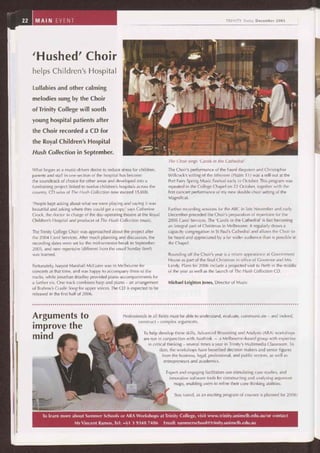
► Trinity College
► Trinity College Foundation Studies
► Trinity College Theological School
December 2005
Number 62
Australia Post Publication Number
PP 337 834/00021
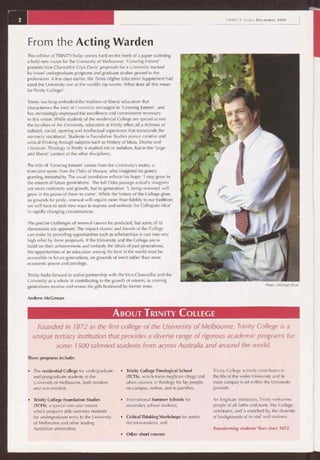
From the Acting Warden
This edition ofTRINITYToday comes hard on the heels of a paper outlining
a bold new vision for the University of Melbourne. 'Growing Esteem'
presents Vice-Chancellor Glyn Davis' proposals for a University marked
by broad undergraduate programs and graduate studies geared to the
professions. A few days earlier, the Times Higher Education Supplement had
rated the University one of the world's top twenty. What does all this mean
for Trinity College?
Trinity has long embodied the tradition of liberal education that
characterises the kind of University envisaged in 'Growing Esteem', and
has increasingly expressed the excellence and commitment necessary
to this vision. While students of the residential College are spread across
the faculties of the University, education at Trinity offers all a richness of
cultural, social, sporting and intellectual experience that transcends the
narrowly vocational. Students in Foundation Studies pursue creative and
critical thinking through subjects such as History of Ideas, Drama and
Literature. Theology at Trinity is studied not in isolation, but in the 'large
and liberal' context of the other disciplines.
The title of 'Growing Esteem' comes from the University's motto, a
truncated quote from the Odes of Horace, who imagined his poetry
granting immortality. The usual translation reflects his hope: 'I may grow in
the esteem of future generations'. The full Odes passage actually imagines
not mere continuity and growth, but re-generation: 'I, being renewed, will
grow in the praise of those to come'. While the history of the College gives
us grounds for pride, renewal will require more than fidelity to our tradition;
we will have to seek new ways to express and embody the Collegiate ideal
in rapidly changing circumstances.
The precise challenges of renewal cannot be predicted, but some of its
dimensions are apparent. The impact alumni and friends of the College
can make by providing opportunities such as scholarships is cast into very
high relief by these proposals. If the University and the College are to
build on their achievements and embody the ideals of past generations,
the opportunities of an education among the best in the world must be
accessible to future generations, on grounds of merit rather than mere
economic power and privilege.
Trinity looks forward to active partnership with the Vice-Chancellor and the
University as a whole in contributing to the growth of esteem, as coming
generations receive and renew the gifts bestowed by former ones.
Andrew McGowan
Photo: Michael Silver
ABOUT TRINITY COLLEGE
Founded in 1872 as the first college of the University of Melbourne, Trinity College is a
unique tertiary institution that provides a diverse range of rigorous academic programs for
some 1500 talented students from across Australia and around the world.
These programs include:
• The residential College for undergraduate
and postgraduate students of the
University of Melbourne, both resident
and non-resident,
• Trinity College Foundation Studies
(TCFS), a special one-year course
which prepares able overseas students
for undergraduate entry to the University
of Melbourne and other leading
Australian universities,
• Trinity College Theological School
(TCTS), which trains Anglican clergy and
offers courses in theology for lay people,
on campus, online, and in parishes,
• International Summer Schools for
secondary school students,
• Critical Thinking Workshops for senior
decision-makers, and
• Other short courses
Trinity College actively contributes to
the life of the wider University and its
main campus is set within the University
grounds.
An Anglican institution, Trinity welcomes
people of all faiths and none. The College
celebrates, and is enriched by, the diversity
of backgrounds of its staff and students.
Transforming students' lives since 1872
TRIN ITYTodaMAGAZINE OF TRINITY COLLEGE THE UNIVERSITY OF MELBOURNE
December 2005 In this issue...
The Main Event
Editor: Rosemary Sheludko
'Growing Esteem': the University's bold new vision 5
Woodheap on the way! 6
American Friends 'make a difference' 7
Ethics in Business: Launch of a world first 8
Masterminds: 2005 Visiting Scholars 10
Global Leaders 11
A spirit of 'modest audacity' 12
Ali's story 14
Learning from Minyerri 15
A rich tradition takes tangible form: new portraits unveiled 16
Leeper's legacy: the admission of women at Trinity 18
Learning Hebrew in Jerusalem 20
'Hushed' Choir helps Children's Hospital 22
Summer Schools: A life-changing experience 23
Academic Adventures of Trinity Staff 24
Residential 26
Outstanding educator appointed Dean 26
Setting the pace in Australia 26
Living in a global village 28
Student Awards and Scholarships 30
Student activities 34
Non-resident program 43
Theology 44
Growth in Ministry Formation 44
Moorhouse, Melbourne and Manchester 45
The marvels of 'Moodie': Theology Online 45
Trinity College Foundation Studies 46
Taking Trinity to Indonesia 46
Welcome to new October Fast Track program 46
More than classes and exams 47
Trinity Community 49
USA Alumni gatherings 49
VP Day 49
The Warden's Circle 50
Syd Wynne in bronze 51
Deaths, Obituaries and Honours 52
Postcards from the Warden 55
Graphic Design: Blue Apple Design Photographs: Rosemary Sheludko
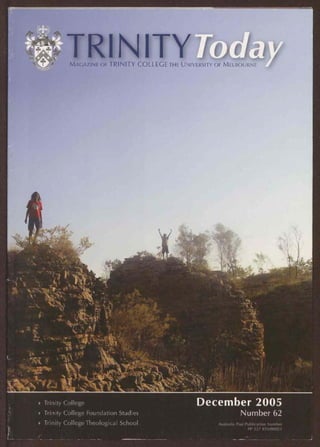
Cover Learning from an ancient land — an annual 'Outreach' visit to Minyerri, a remote Indigenous community
in the Northern Territory, is broadening the horizons of resident students (see story page 15) and enabling
Minyerri students to attend Summer Schools at Trinity (see page 23). Photo: Dr /on Ritchie
4 MAIN EVENT TRINITY Today December 2005
University leaders
encourage diversity . . •
'There are educational advantages for all students in interacting
with people who have different experiences from their own,'
Professor Loane Skene, President of the Academic Board of the
University of Melbourne, said at Trinity in August.
Speaking at the Academic Awards Ceremony for Trinity College
Foundation Studies (TCFS) students from 2004, she outlined the
new initiatives being considered by the University to increase both
understanding of other cultures, and participation of a wide range
of students and staff in teaching and learning activities.
The University believes that encouraging diversity is also fair and
equitable, and is in line with the aims of the Access Melbourne
Scholarships available to students from backgrounds that are
traditionally under-represented at Melbourne.
'The draft policy recognises that cultural diversity encompasses not
only race, ethnicity and language, but also religion, values and belief
systems, disability, class, sexuality, gender, age, regional difference
and educational background,' Professor Skene said.
'It recommends that all new course proposals show how they will
address the cultural diversity guidelines. Departments should offer
10% of subjects dealing with non-Western subject matter; recruit
staff fluent in a second, non-European language; and train staff,
especially receptionists, in diversity issues.
'The university will also aim to make its student handbooks more
welcoming for those from non-English speaking backgrounds by
replacing jargon with plain language, and ensuring that pictorial
representations reflect student diversity.'
Professor Skene invited TCFS graduates to send her feedback
— positive or negative — on how the University experience of
overseas students can be enriched.
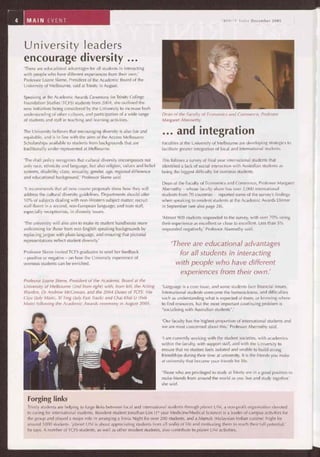
Professor Loane Skene, President of the Academic Board at the
University of Melbourne (2nd from right) with, from left, the Acting
Warden, Dr Andrew McGowan, and the 2004 Duxes of TCFS: Nie
Ciyu (July Main), Xi Ting (July Fast Track) and Chai Khai Li (Feb
Main) following the Academic Awards ceremony in August 2005.
Dean of the Faculty of Economics and Commerce, Professor
Margaret Abernethy
... and integration
Faculties at the University of Melbourne are developing strategies to
facilitate greater integration of local and international students.
This follows a survey of final year international students that
identified a lack of social interaction with Australian students as
being the biggest difficulty for overseas students.
Dean of the Faculty of Economics and Commerce, Professor Margaret
Abernethy — whose faculty alone has over 2,000 international
students from 70 countries — reported some of the survey's findings
when speaking to resident students at the Academic Awards Dinner
in September (see also page 28).
'Almost 900 students responded to the survey, with over 70% rating
their experience as excellent or close to excellent. Less than 5%
responded negatively,' Professor Abernethy said.
'There are educational advantages
for all students in interacting
with people who have different
experiences from their own.'
'Language is a core issue, and some students face financial issues.
International students overcome the homesickness, and difficulties
such as understanding what is expected of them, or knowing where
to find resources, but the most important continuing problem is
"socialising with Australian students".'
'Our faculty has the highest proportion of international students and
we are most concerned about this,' Professor Abernethy said.
'I am currently working with the student societies, with academics
within the faculty, with support staff, and with the University to
ensure that no student feels isolated and unable to build strong
friendships during their time at university. It is the friends you make
at university that become your friends for life.
'Those who are privileged to study at Trinity are in a good position to
make friends from around the world as you live and study together,'
she said.
Forging links
Trinity students are helping to forge links between local and international students through planet UNi, a non-profit organisation devoted
to caring for international students. Resident student Jonathan Lim (1st year Medicine/Medical Science) is a leader of campus activities for
the group and played a major role in arranging a Trivia Night for over 200 students, and a Mamak (Malaysian-Indian cuisine) Night for
around 1000 students. 'planet UNi is about appreciating students from all walks of life and motivating them to reach their full potential,'
he says. A number of TCFS students, as well as other resident students, also contribute to planet UNi activities.
www.trinity.unimelb.edu.au
'Growing
Esteem'—
the University's
bold new vision
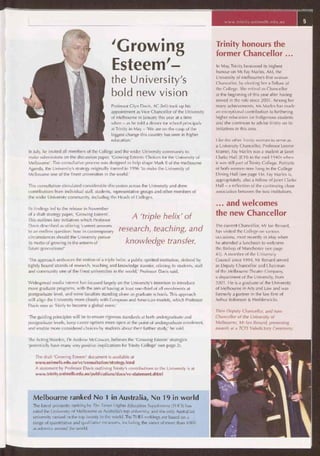
Professor Glyn Davis, AC (left) took up his
appointment as Vice-Chancellor of the University
of Melbourne in January this year at a time
when — as he told a dinner for school principals
at Trinity in May — 'We are on the cusp of the
biggest change this country has seen in higher
education.'
In July, he invited all members of the College and the wider University community to
make submissions on the discussion paper, 'Growing Esteem: Choices for the University of
Melbourne'. This consultative process was designed to help shape Mark II of the Melbourne
Agenda, the University's strategy originally framed in 1996 'to make the University of
Melbourne one of the finest universities in the world.'
This consultation stimulated considerable discussion across the University and drew
contributions from individual staff, students, representative groups and other members of
the wider University community, including the Heads of Colleges.
Its findings led to the release in November
of a draft strategy paper, 'Growing Esteem'.
This outlines key initiatives which Professor
Davis described as offering 'current answers
to an endless question: how in contemporary
circumstances should the University pursue
its motto of growing in the esteem of
future generations?'
A 'triple helix' of
research, teaching, and
knowledge transfer.
'The approach embraces the notion of a triple helix: a public-spirited institution, defined by
tightly bound strands of research, teaching and knowledge transfer, offering its students, staff
and community one of the finest universities in the world,' Professor Davis said.
Widespread media interest has focused largely on the University's intention to introduce
more graduate programs, with the aim of having at least one-third of all enrolments at
postgraduate level, and some faculties standing alone as graduate schools. This approach
will align the University more closely with European and American models, which Professor
Davis sees as 'likely to become a global norm.'
'The guiding principles will be to ensure rigorous standards at both undergraduate and
postgraduate levels, keep career options more open at the point of undergraduate enrolment,
and enable more considered choices by students about their further study,' he said.
The Acting Warden, Dr Andrew McGowan, believes the 'Growing Esteem' strategies
'potentially have many very positive implications for Trinity College' (see page 2).
The draft 'Growing Esteem' document is available at
www.unimelb.edu.au/vc/consultation/strategy.html
A statement by Professor Davis outlining Trinity's contributions to the University is at
www.trinity.unimelb.edu.au/publications/docs/vc-statement.shtml
Melbourne ranked No 1 in Australia, No 19 in world
The latest university ranking by The Times Higher Education Supplement (THES) has
rated the University of Melbourne as Australia's top university, and the only Australian
university ranked in the top twenty in the world. The THES rankings are based on a
range of quantitative and qualitative measures, including the views of more than 1000
academics around the world.
Trinity honours the
former Chancellor ...
In May, Trinity bestowed its highest
honour on Ms Fay Maries, AM, the
University of Melbourne's first woman
Chancellor, by electing her a Fellow of
the College. She retired as Chancellor
at the beginning of this year after having
served in the role since 2001. Among her
many achievements, Ms Martes has made
an exceptional contribution to furthering
higher education for Indigenous students
and she continues to advise Trinity on its
initiatives in this area.
Like the other Trinity woman to serve as
a University Chancellor, Professor Leonie
Kramer, Fay Martes was a student at Janet
Clarke Hall QCH) in the mid 1940s when
it was still part of Trinity College. Portraits
of both women now hang in the College
Dining Hall (see page 16). Fay Martes is,
appropriately, also a Fellow of Janet Clarke
Hall — a reflection of the continuing close
association between the two institutions.
... and welcomes
the new Chancellor
The current Chancellor, Mr Ian Renard,
has visited the College on various
occasions, most recently in May when
he attended a luncheon to welcome
the Bishop of Manchester (see page
45). A member of the University
Council since 1994, Mr Renard served
as Deputy Chancellor and Chairman
of the Melbourne Theatre Company,
a department of the University, from
2001. He is a graduate of the University
of Melbourne in Arts and Law and was
formerly a partner in the law firm of
Arthur Robinson & Hedderwicks.
Then Deputy Chancellor, and now
Chancellor of the University of
Melbourne, Mr Ian Renard, presenting
awards at a TCFS Valedictory Ceremony.
CAR PARK
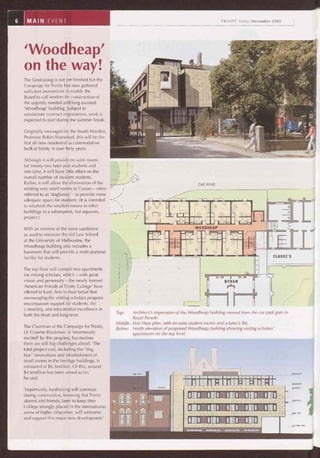
Top: Architect's impression of the Woodheap building viewed from the car park gate in
Royal Parade.
Middle: First Floor plan, with en suite student rooms and a tutor's flat.
Below: North elevation of proposed Woodheap building showing visiting scholars'
apartments on the top level.
11111111:11111s11s111:1 _
ém~~~A~~~°~~~~~ó
11111 1111 1111 1111 111113
1NI1 a®m ivMEEv WIR!
1s1~ 1111 . 1111 i11iP
4 v =Ha ~é
1~ L~1111 11111
~ï~L!Z__
6 MAIN EVENT TRINITY Today December 2005
'Woodheap'
on the way!
The fundraising is not yet finished but the
Campaign for Trinity has now gathered
sufficient momentum to enable the
Board to call tenders for construction of
the urgently needed and long-awaited
'Woodheap' building. Subject to
satisfactory contract negotiations, work is
expected to start during the summer break.
Originally envisaged by the fourth Warden,
Professor Robin Sharwood, this will be the
first all-new residential accommodation
built at Trinity in over forty years.
Although it will provide en suite rooms
for twenty-two later year students and
one tutor, it will have little effect on the
overall number of resident students.
Rather, it will allow the elimination of the
existing very small rooms in Cowan — often
referred to as 'dogboxes' — to provide more
adequate space for students. (It is intended
to refurbish the smallest rooms in other
buildings in a subsequent, but separate,
project.)
With an exterior of the same sandstone
as used to renovate the old Law School
at the University of Melbourne, the
Woodheap building also includes a
basement that will provide a multi-purpose
facility for students.
The top floor will contain two apartments
for visiting scholars, which — with great
vision and generosity — the newly formed
'American Friends of Trinity College' have
offered to fund, firm in their belief that
encouraging the visiting scholars program
encompasses support for students, the
University, and educational excellence in
both the short and long term.
The Chairman of the Campaign for Trinity,
Dr Graeme Blackman, is 'enormously
excited' by this progress, but realises
there are still big challenges ahead. 'The
total project cost, including the "dog
box" renovations and refurbishment of
small rooms in the heritage buildings, is
estimated at $6.3million. Of this, around
$4.6million has been raised so far,'
he said.
'Importantly, fundraising will continue
during construction, knowing that Trinity
alumni and friends, keen to keep their
College strongly placed in the international
arena of higher education, will welcome
and support this major new development.'
www.trinityunimelb.edu.au
The Campaign for Trinity is still in its 'quiet'
stage, but having so far raised some $18million,
has made good progress towards its provisional
five-year goal of $26million in cash, pledges,
and notified bequests. Now,
Leaders of Trinity's American
Friends 'make a difference
'The American Friends of Trinity College' — formally launched in New
York in October at the inaugural meeting of its Board of Directors —
will help bring the widespread American Trinity community together
by organising special events in major cities across the USA. As a
charitable foundation, it can receive tax-deductible, philanthropic
gifts in cash or kind from alumni and friends to support the College.
Inspired by the Campaign for Trinity, the American Friends have
elected to raise US$3million to enhance the College's capacity to host eminent visiting
scholars from around the world. This will finance the visiting scholars' apartments on the top
floor of the new Woodheap building, and strengthen the endowment which funds visiting
scholars. Their initial pledges already exceed US$1.2million.
The Trinity community in the USA and Canada numbers well over 300 and includes both
Australian expatriates and American 'study abroad' students. American students have been
coming to Trinity since about 1945 and many report that attending the College brought
unexpected and positive outcomes which often transformed their lives.
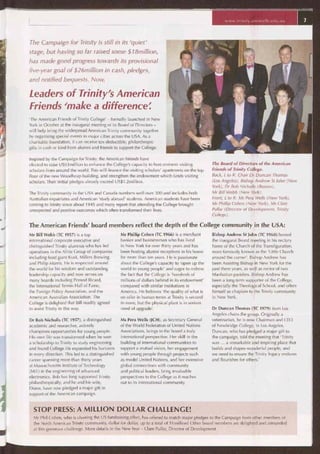
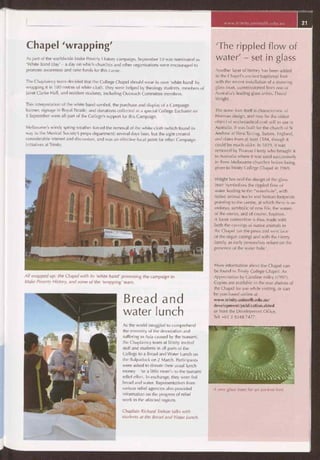
The Board of Directors of the American •
Friends of Trinity College.
Back, L to R: Chair Dr Duncan Thomas
(Los Angeles), Bishop Andrew St John (New
York), Dr Bob Nicholls (Boston),
Mr Bill Webb (New York).
Front, L to R: Ms Pera Wells (New York),
Mr Phillip Cohen (New York), Ms Clare
Pullar (Director of Development, Trinity
College).
The American Friends' board members reflect the depth of the College community in the USA:
Mr Bill Webb (TC 1957) is a top
international corporate executive and
distinguished Trinity alumnus who has led
operations in the Altria Group of companies
including food giant Kraft, Millers Brewing,
and Philip Morris. He is respected around
the world for his wisdom and outstanding
leadership capacity and now serves on
many boards including Pernod Ricard,
the International Tennis Hall of Fame,
the Foreign Policy Association, and the
American Australian Association. The
College is delighted that Bill readily agreed
to assist Trinity in this way.
Dr Bob Nicholls (TC 1957), a distinguished
academic and researcher, ardently
champions opportunities for young people.
His own life was transformed when he won
a scholarship to Trinity to study engineering
and found College life expanded his horizons
in every direction. This led to a distinguished
career spanning more than thirty years
at Massachusetts Institute of Technology
(MIT) in the engineering of advanced
electronics. Bob has long supported Trinity
philanthropically, and he and his wife,
Diane, have now pledged a major gift in
support of the American campaign.
Mr Phillip Cohen (TC 1966) is a merchant
banker and businessman who has lived
in New York for over thirty years and has
been hosting alumni receptions in his home
for more than ten years. He is passionate
about the College's capacity to 'open up the
world to young people' and eager to redress
the fact that the College is 'hundreds of
millions of dollars behind in its endowment'
compared with similar institutions in
America. He believes 'the quality of what is
on offer in human terms at Trinity is second
to none, but the physical plant is in serious
need of upgrade'.
Ms Pera Wells (JCH), as Secretary General
of the World Federation of United Nations
Associations, brings to the board a truly
international perspective. Her skill in the
building of international communities to
support a mutual vision, her engagement
with young people through projects such
as model United Nations, and her extensive
global connections with community
and political leaders, bring invaluable
perspectives to the College as it reaches
out to its international community.
Bishop Andrew St John (TC 1968) hosted
the inaugural Board meeting in his rectory
home of the Church of the Transfiguration,
more famously known as the 'Little Church
around the corner'. Bishop Andrew has
been Assisting Bishop in New York for the
past three years, as well as rector of two
Manhattan parishes. Bishop Andrew has
been a long-term supporter of the College,
especially the Theological School, and offers
himself as chaplain to' the Trinity community
in New York.
Dr Duncan Thomas (TC 1979) from Los
Angeles chairs the group. Originally a
veterinarian, he is now Chairman and CEO
of Newbridge College, in Los Angeles.
Duncan, who has pledged a major gift to
the campaign, told the meeting that 'Trinity
was ... a remarkable and inspiring place that
builds and shapes wonderful people, and
we need to ensure the Trinity legacy endures
and flourishes for others.'
STOP PRESS: A MILLION DOLLAR CHALLENGE!
Mr Phil Cohen, who is chairing the US fundraising effort, has offered to match major pledges to the Campaign from other members of
the North American Trinity community, dollar for dollar, up to a total of $1 million! Other board members are delighted and astounded
at this generous challenge. More details in the New Year — Clare Pullar, Director of Development
PP 411W
41111" o
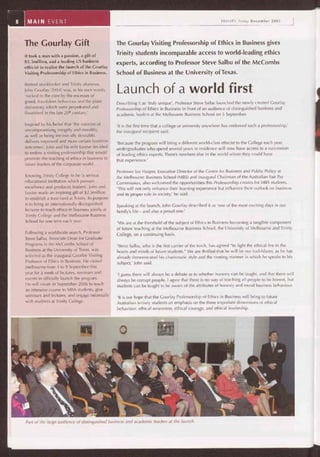
Part of the large audience of distinguished business and academic leaders at the launch.
The Gourlay Visiting Professorship of Ethics in Business gives
Trinity students incomparable access to world-leading ethics
experts, according to Professor Steve Salbu of the McCombs
School of Business at the University of Texas.
Launch of a world first
Describing it as 'truly unique', Professor Steve Salbu launched the newly created Gourlay
Professorship of Ethics in Business in front of an audience of distinguished business and
academic leaders at the Melbourne Business School on 5 September.
'It is the first time that a college or university anywhere has endowed such a professorship,'
the inaugural recipient said.
'Because the program will bring a different world-class ethicist to the College each year,
undergraduates who spend several years in residence will now have access to a succession
of leading ethics experts. There's nowhere else in the world where they could have
that experience.'
Professor Ian Harper, Executive Director of the Centre for Business and Public Policy at
the Melbourne Business School (MBS) and inaugural Chairman of the Australian Fair Pay
Commission, also welcomed the opportunities this Professorship creates for MBS students.
'This will not only enhance their learning experience but influence their outlook on business
and its proper role in society,' he said.
Speaking at the launch, John Gourlay described it as 'one of the most exciting days in our
family's life — and also a proud one.'
'We are at the threshold of the subject of Ethics in Business becoming a tangible component
of future teaching at the Melbourne Business School, the University of Melbourne and Trinity
College, on a continuing basis.
'Steve Salbu, who is the first carrier of the torch, has agreed "to light the ethical fire in the
hearts and minds of future students." We are thrilled that he will be our trail-blazer, as he has
already demonstrated his charismatic style and the riveting manner in which he speaks to his
subject,' John said.
'I guess there will always be a debate as to whether honesty can be taught, and that there will
always be corrupt people. I agree that there is no way of teaching all people to be honest, but
students can be taught to be aware of the attributes of honesty and moral business behaviour.
'It is our hope that the Gourlay Professorship of Ethics in Business will bring to future
Australian tertiary students an emphasis on the three important dimensions of ethical
behaviour: ethical awareness, ethical courage, and ethical leadership.
The Gourlay Gift
It took a man with a passion, a gift of
$2.5million, and a leading US business
ethicist to realise the launch of the Gourlay
Visiting Professorship of Ethics in Business.
Retired stockbroker and Trinity alumnus,
John Gourlay (1954) was, in his own words,
'rocked to the core by the excesses of
greed, fraudulent behaviour and the plain
dishonesty which were perpetrated and
flourished in the late 20th century.'
Inspired by his belief that 'the exercise of
uncompromising integrity and morality,
as well as being intrinsically desirable,
delivers improved and more certain business
outcomes', John and his wife Louise decided
to endow a visiting professorship that would
promote the teaching of ethics in business to
future leaders of the corporate world.
Knowing Trinity College to be 'a serious
educational institution which pursues
excellence and produces leaders', John and
Louise made an inspiring gift of $2.5million
to establish a trust fund at Trinity. Its purpose
is to bring an internationally distinguished
lecturer to teach ethics in business jointly at
Trinity College and the Melbourne Business
School for one term each year.
Following a worldwide search, Professor
Steve Salbu, Associate Dean for Graduate
Programs in the McCombs School of
Business at the University of Texas, was
selected as the inaugural Gourlay Visiting
Professor of Ethics in Business. He visited
Melbourne from 4 to 9 September this
year for a week of lectures, seminars and
events to officially launch the program.
He will return in September 2006 to teach
an intensive course to MBA students, give
seminars and lectures, and engage informally
with students at Trinity College.
'You have created something that will inspire
many to reach their greatest potential'
Professor Steve Salbu,
writing to John and Louise Gourlay.
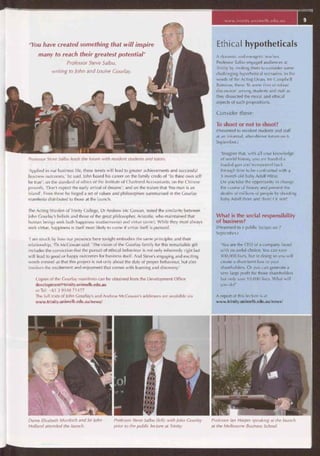
Professor Steve Salbu leads the forum with resident students and tutors.
'Applied in our business life, these tenets will lead to greater achievements and successful
business outcomes,' he said. John based his career on the family credo of 'To thine own self
be true'; on the standard of ethics of the Institute of Chartered Accountants; on the Chinese
proverb, 'Don't expect the early arrival of dreams'; and on the truism that 'No man is an
island'. From these he forged a set of values and philosophies summarised in the Gourlay
manifesto distributed to those at the launch.
The Acting Warden of Trinity College, Dr Andrew Mc Gowan, noted the similarity between
John Gourlay's beliefs and those of the great philosopher, Aristotle, who maintained that
human beings seek both happiness (eudaemonia) and virtue (arete). While they must always
seek virtue, happiness is itself most likely to come if virtue itself is pursued.
'I am struck by how our presence here tonight embodies the same principles and their
relationship, 'Dr McGowan said. 'The vision of the Gourlay family for this remarkable gift
includes the conviction that the pursuit of ethical behaviour is not only inherently right but
will lead to good or happy outcomes for business itself. And Steve's engaging and exciting
words remind us that this project is not only about the duty of proper behaviour, but also
involves the excitement and enjoyment that comes with learning and discovery.'
Copies of the Gourlay manifesto can be obtained from the Development Office
development@trinity.unimelb.edu.au
or Tel: +61 3 9348 71477
The full texts of John Gourlay's and Andrew McGowan's addresses are available via
www.trinity.unimelb.edu.au/news/
Ethical hypotheticals
A dynamic and energetic teacher,
Professor Salbu engaged audiences at
Trinity by inviting them to consider some
challenging hypothetical scenarios. In the
words of the Acting Dean, Mr Campbell
Bairstow, these 'lit some fires of robust
discussion' among students and staff as
they dissected the moral and ethical
aspects of such propositions.
Consider these:
To shoot or not to shoot?
(Presented to resident students and staff
at an informal, after-dinner forum on 6
September.)
'Imagine that, with all your knowledge
of world history, you are handed a
loaded gun and transported back
through time to be confronted with a
3-month old baby Adolf Hitler.
Do you take the opportunity to change
the course of history and prevent the
deaths of millions of people by shooting
baby Adolf there and then? Or not?'
What is the social responsibility
of business?
(Presented to a public lecture on 7
September.)
'You are the CEO of a company faced
with an awful choice. You can save
100,000 lives, but in doing so you will
create a short-term loss to your
shareholders. Or you can generate a
very large profit for those shareholders
but only save 10,000 lives. What will
you do?'
A report of this lecture is at
www.trinity.unimelb.edu.au/news/
Dame Elisabeth Murdoch and Sir John
Holland attended the launch.
Professor Steve Salbu (left) with John Gourlay Professor Ian Harper speaking at the launch
prior to the public lecture at Trinity. at the Melbourne Business School.
www.trinity.unìmelb.edu,au
10 MAIN EVENT TRINITY Today December 2005
Masterminds
Trinity attracts a bright constellation of some of the most interesting
and innovative thinkers from around the world. During 2005, they
included not only students, but also a select list of more than twenty
of the world's great thinkers who came to the College as visiting
scholars.
All those chosen as visiting scholars are leaders in their own
field — from art history to physics, genetics to law, economics to
permaculture, and dentistry to anthropology. All took pleasure
in imparting some of their knowledge to our students and tutors,
whether over dessert and coffee in the Senior Common Room, at
more formal College events and lectures, or in the comfort of the
Junior Common Room.
Professor Beth Noveck, Director of the Institute for Information
Law and Policy at the New York Law School, and Professor Michael
Taussig, Professor of Anthropology at Columbia University and
one of the University of Melbourne's Miegunyah Fellows for 2005,
enthralled students and tutors who participated in the Senior
Common Room series of after dinner conversations — Professor
Noveck exploring the cutting edge of law, the internet, online
gaming, and democracy, and Professor Taussig recounting some
of his experiences conducting research into shamanism and the
intrusion of western culture among indigenous peoples in
South America.
On another evening, Dr David Lomas, Director of the AHRB
Research Centre for the Studies of Surrealism and its Legacies at the
University of Manchester, spoke on the art of Diego Rivera, the
Mexican social realist artist. He also critically analysed some of the
students' artwork entered in the intercollegiate art competition.
Dr Susan Rodrigues met with teaching staff from all parts of the
College to talk about her work at the Institute of Science Education
in Scotland on the use of the internet to promote science education.
Towards the end of the year, Professor Sankar Das Sarma, Director of
the Condensed Matter Theory Center at the University of Maryland
and another of the University of Melbourne's Miegunyah Fellows,
met Physics students and tutors over dinner, and Bill Mollison, the
founder of permaculture (an environmental design strategy taught
around the world, with the aim of establishing integrated, self-
sustaining systems for agriculture and human settlement) met with
interested staff in Foundation Studies.
Joe Gumbala — the University's Linga Narra Fellow, member of the
seminal Aboriginal music group Soft Sands, and elder of the Yolngu
people from Guliwin'ku in Arnhem Land — returned for a third
consecutive year.
The visit of the inaugural holder of the Gourlay Visiting Professorship
in the Ethics of Business, Professor Steve Salbu of the University
of Texas (see page 8), provided a wonderful demonstration of the
capacity of the visiting scholar program to link Trinity's students,
its staff, its wider community at the University of Melbourne and
the world of business. Professor Salbu will return in 2006, but in
common with all our academic visitors, he has taken away with
him fond memories of his time at Trinity, his engagement with our
students and staff, and the supportive and stimulating environment,
of which he and all visiting scholars have formed an essential part.
Dr Jon Ritchie
Director of Academic Studies
When Professor Sir James Mirrlees (Nobel Laureate in Economics,
1996) joined Professor Sir Clive Granger (Nobel Laureate in
Economics, 2003) in the Junior Common Room one Sunday
evening in April to talk about how they both came to the Nobel
experience, it would not have been surprising if at least some of
the students present felt inspired to set their sights on similar goals.
The group talked late into the night in a most memorable academic
engagement for students.
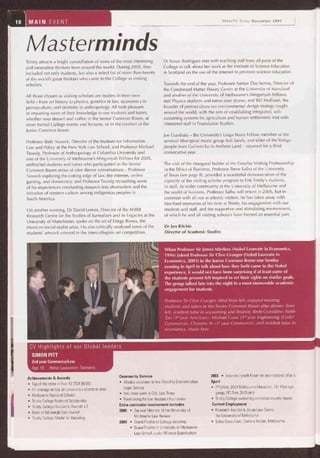
Professor Sir Clive Granger, third from left, enjoyed meeting
students and tutors in the Senior Common Room after dinner: from
left, resident tutor in accounting and finance, Brett Considine; Keith
Tan (3'd year Arts/Law); Michael Conn (3id year Engineering (Civil)/
Commerce); Christine Ye (l'' year Commerce); and resident tutor in
economics, Hsein Kew.
CV Highlights of our Global leaders
SIMON PITT
2nd year Commerce/Law
Age: 19 Home: Launceston, Tasmania
Achievements & Awards
• Top of the state in Year 12 (TER 99.95)
• H1 average across all university subjects to date
• Melbourne National Scholar
• Trinity College National Scholarship
• Trinity College Academic Awards x 3
• Duke of Edinburgh Gold Award
• Trinity College Medal for Debating
Community Service
• Weekly volunteer at the Disablity Discrimination
Legal Service
• Volunteer work in Dili, East Timor
• Fundraising for Eye Research Foundation
Extra curricular involvement includes
2005 • General Member of the University of
Melbourne Law Review
2004 • Grand Finalist in College debating
• Grand Finalist in University of Melbourne
Law School Junior Witness Examination
2003 • Attended youth forum on international affairs
Sport
• 2,d place, 2004 Melbourne Marathon, 18-19yo age
group, (42.2km, 3h29min)
• Trinity College swimming and cross country teams
Current Employment
• Research Assistant, Asian Law Centre,
the University of Melbourne
• Sales Consultant, Camera Action, Melbourne.
www.trinity.unimelb.edu.au
Phyl Georgiou reflects on the highlights of
an 'empowering experience':
1
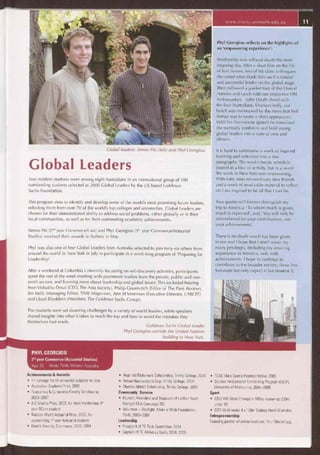
Global leaders: Simon Pitt (left) and Phyl Georgiou.
Global Leaders
Two resident students were among eight Australians in an international group of 100
outstanding students selected as 2005 Global Leaders by the US-based Goldman
Sachs Foundation.
This program aims to identify and develop some of the world's most promising future leaders,
selecting them from over 70 of the world's top colleges and universities. Global Leaders are
chosen for their demonstrated ability to address social problems, either globally or in their
local communities, as well as for their outstanding academic achievements.
Simon Pitt (2nd year Commerce/Law) and Phyl Georgiou (3rd year Commerce/Actuarial
Studies) received their awards in Sydney in May.
Phyl was also one of four Global Leaders from Australia selected to join forty-six others from
around the world in New York in July to participate in a week-long program of 'Preparing for
Leadership'.
After a weekend at Columbia University focussing on self-discovery activities, participants
spent the rest of the week meeting with prominent leaders from the private, public and non-
profit sectors, and learning more about leadership and global issues. This included hearing
from Vishakha Desai (CEO, The Asia Society), Philip Gourevitch (Editor of The Paris Review),
Jim Kelly (Managing Editor, TIME Magazine), Ann M Veneman (Executive Director, UNICEF)
and Lloyd Blankfein (President, The Goldman Sachs Group).
The students were set daunting challenges by a variety of world leaders, while speakers
shared insights into what it takes to reach the top and how to avoid the mistakes they
themselves had made.
Goldman Sachs Global Leader
Phyl Georgiou outside the United Nations
building in New York.
ri Wednesday was without doubt the most
inspiring day. After a short film on the life
of Kofi Annan, two of his close colleagues
discussed what made him such a natural
and successful leader on the global stage.
Then followed a guided tour of the United
Nations and lunch with our respective UN
Ambassadors — John Dauth dined with
the four Australians. Unexpectedly, our
lunch was interrupted by the news that Kofi
Annan was to make a short appearance.
With his five-minute speech he transfixed
the normally confident and bold young
global leaders into a state of awe and
silence.
It is hard to summarise a week of inspired
learning and reflection into a few
paragraphs. The week's hectic schedule
passed in a blur of activity, but in a word,
the week in New York was empowering.
With forty-nine extraordinary new friends
and a week of invaluable material to reflect
on I am inspired to be all that I can be.
Two quotes will forever distinguish my
trip to America: 'To whom much is given,
much is expected', and, 'You will only be
remembered for your contributions, not
your achievements'.
There is no doubt much has been given
to me and I hope that I don't waste my
many privileges, including my amazing
experience in America, only with
achievements. I hope to continue to
contribute to the broader society; those less
fortunate not only expect it but deserve it.
PHYL GEORGIOU
3rd year Commerce (Actuarial Studies)
Age: 20 Home: Perth, Western Australia
Achievements & Awards
• H1 average for all university subjects to date
• Australian Students Prize, 2002
• Economics & Commerce Faculty Scholarship,
2003-2007
• A C Morley Prize, 2003, for most meritorious 1st
year BCom student
• Watson Wyatt Actuarial Prize, 2003, for
outstanding 1"year Actuarial student
• Dean's Awards, Commerce, 2003, 2004
• Reginald Blakemore Scholarship, Trinity College, 2004
• Bohan Humberstone Cup, Trinity College, 2004
• Charles Abbott Scholarship, Trinity College, 2005
Community Service
• Founder, President and Treasurer of Carlton Youth
Football Club (see page 35)
• Volunteer—Starlight: Make a Wish Foundation,
Perth, 2003-2004
Leadership
• President of TC Tech Committee, 2004
• Captain of TC Athletics Team, 2004, 2005
• TCAC Male Sports Representative, 2005
• Student Ambassador Leadership Program (SALP),
University of Melbourne, 2004-2005
Sport
• 2002 WA State Champion 100m, runner-up 200m,
under 18
• 2001 Gold medal 4 x 100m Sydney Youth Olympics
Entrepreneurship
Founding partner of online business, Your Shutterbug.
A spirit of
'modest audacity'
Dr Susan Lim's installation as the
youngest and first Singaporean
Fellow of Trinity College on 22
May was truly an international
affair. More than fifty family
members, friends, and colleagues
of Susan and her husband, Mr
Deepak Sharma, came from
Bangladesh, Brunei, China, Hong
Kong, Malaysia, Singapore and
the USA, to join guests from
around Australia in honouring this
remarkable Trinity woman.
Among the international guests was Brigadier
General Peter M Dawkins who flew in
from New York to be guest speaker at the
dinner following the installation service.
Previously one of America's leading military
strategists and now Vice Chairman of the
Citigroup Private Bank, General Dawkins
was President of his West Point Class of
1959, at the top of his class in academics,
and won the prestigious Heisman Trophy
for the nation's most outstanding college
football player. A Rhodes Scholar, he spent
three years at Brasenose College, Oxford,
and holds a Master of Public Affairs and a
Doctorate from Princeton University. Asked
by the Vietnam Veterans organisation to
lead a $2 million fundraising drive in 1984,
General Dawkins raised over $3.5 million in
fourteen weeks.
TRINITY Today December 2005
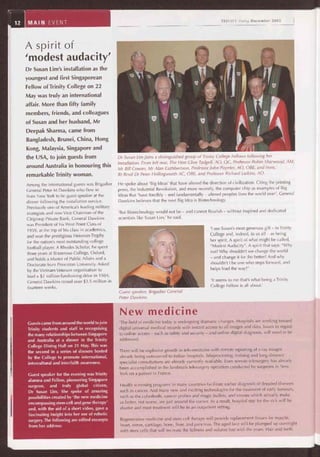
Dr Susan Lim joins a distinguished group of Trinity College Fellòws following her
installation. From left rear, The Hon Clive Tadgell, AO, QC, Professor Robin Sharwood, AM,
Mr Bill Cowan, Mr Alan Cuthbertson, Professor John Poynter, AO, OBE, and front,
Rt Revd Dr Peter Hollingworth AC, OBE, and Professor Richard Larkins, AO.
He spoke about 'Big Ideas' that have altered the direction of civilization. Citing the printing
press, the Industrial Revolution, and more recently, the computer chip as examples of Big
Ideas that 'have forcibly — and fundamentally — altered peoples lives the world over', General
Dawkins believes that the next Big Idea is Biotechnology.
'But Biotechnology would not be — and cannot flourish — without inspired and dedicated
scientists like Susan Lim,' he said.
Guest speaker, Brigadier General
Peter Dawkins.
New medicine
'The field of medicine today is undergoing dramatic changes. Hospitals are working toward
digital universal medical records with instant access to all images and data. Issues in regard
to online access — such as safety and security — and online digital diagnosis, will need to be
addressed.
There will be explosive growth in tele-medicine with remote reporting of x-ray images
already being outsourced to Indian hospitals. Teleproctoring, training and long distance
specialist consultations are already currently available. Even remote telesurgery has already
been accomplished in the landmark telesurgery operation conducted by surgeons in New
York on a patient in France.
Health screening programs in many countries facilitate earlier diagnosis of dreaded diseases
such as cancer. And many new and exciting technologies for the treatment of early tumours,
such as the cyberknife, cancer probes and magic bullets, and viruses which actually make
us better, not worse, are just around the corner. As a result, hospital stay for the sick will be
shorter and most treatment will be in an outpatient setting.
Regenerative medicine and stem cell therapy will provide replacement tissues for muscle,
heart, nerve, cartilage, bone, liver, and pancreas. The aged face will be plumped up overnight
with stem cells that will recreate the fullness and volume lost with the years. Hair and teeth
12 MAIN EVENT
Guests came from around the world to join
Trinity students and staff in recognising
the many relationships between Singapore
and Australia at a dinner in the Trinity
College Dining Hall on 21 May. This was
the second in a series of dinners hosted
by the College to promote international,
intercultural and interfaith awareness.
Guest speaker for the evening was Trinity
alumna and Fellow, pioneering Singapore
surgeon, and truly global citizen,
Dr Susan Lim. She spoke of amazing
possibilities created by 'the new medicine
encompassing stem cell and gene therapy'
and, with the aid of a short video, gave a
fascinating insight into her use of robotic
surgery. The following are edited excerpts
from her address:
'I see Susan's most generous gift — to Trinity
College and, indeed, to us all — as being
her spirit. A spirit of what might be called,
"Modest Audacity". A spirit that says: "Why
not? Why shouldn't we change the world
— and change it for the better? And why
shouldn't I be one who steps forward, and
helps lead the way!"
'It seems to me that's what being a Trinity
College Fellow is all about.'
www.trinity.unimelb.edu.au
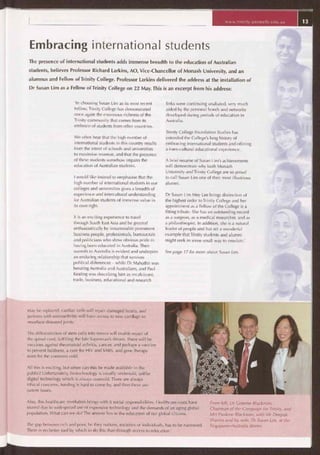
Embracing international students
The presence of international students adds immense breadth to the education of Australian
students, believes Professor Richard Larkins, AO, Vice-Chancellor of Monash University, and an
alumnus and Fellow of Trinity College. Professor Larkins delivered the address at the installation of
Dr Susan Lim as a Fellow of Trinity College on 22 May. This is an excerpt from his address:
'In choosing Susan Lim as its most recent
Fellow, Trinity College has demonstrated
once again the enormous richness of the
Trinity community that comes from its
embrace of students from other countries.
We often hear that the high number of
international students in this country results
from the intent of schools and universities
to maximise revenue, and that the presence
of these students somehow impairs the
education of Australian students.
I would like instead to emphasise that the
high number of international students in our
colleges and universities gives a breadth of
experience and intercultural understanding
for Australian students of immense value in
its own right.
It is an exciting experience to travel
through South East Asia and be greeted
enthusiastically by innumerable prominent
business people, professionals, bureaucrats
and politicians who show obvious pride in
having been educated in Australia. Their
warmth to Australia is evident and underpins
an enduring relationship that survives
political differences — while Dr Mahathir was
berating Australia and Australians, and Paul
Keating was describing him as recalcitrant,
trade, business, educational and research
links were continuing unabated, very much
aided by the personal bonds and networks
developed during periods of education in
Australia.
Trinity College Foundation Studies has
extended the College's long history of
embracing international students and offering
a trans-cultural educational experience.
A brief resume of Susan Lim's achievements
will demonstrate why both Monash
University and Trinity College are so proud
to call Susan Lim one of their most illustrious
alumni.
Dr Susan Lim Mey Lee brings distinction of
the highest order to Trinity College and her
appointment as a Fellow of the College is a
fitting tribute. She has an outstanding record
as a surgeon, as a medical researcher, and as
a philanthropist. In addition, she is a natural
leader of people and has set a wonderful
example that Trinity students and alumni
might seek in some small way to emulate.'
See page 17 for more about Susan Lim.
may be replaced, cardiac cells will repair damaged hearts, and
patients with osteoarthritis will have access to new cartilage to
resurface diseased joints.
The differentiation of stem cells into nerves will enable repair of
the spinal cord, fulfilling the late Superman's dream. There will be
vaccines against rheumatoid arthritis, cancer, and perhaps a vaccine
to prevent baldness, a cure for HIV and SARS, and gene therapy
even for the common cold.
All this is exciting, but when can this be made available to the
public? Unfortunately, biotechnology is usually undersold, unlike
digital technology which is always oversold. There are always
ethical concerns, funding is hard to come by, and then there are
patent issues.
Also, this healthcare revolution brings with it social responsibilities. Healthcare costs have
soared due to widespread use of expensive technology and the demands of an aging global
population. What can we do? The answer lies in the education of our global citizens.
The gap between rich and poor, be they nations, societies or individuals, has to be narrowed.
There is no better tool by which to do this than through access to education.'
From left, Dr Graeme Blackman,
Chairman of the Campaign for Trinity, and
Mrs Paulene Blackman, with Mr Deepak
Sharma and his wife, Dr Susan Lim, at the
Singapore—Australia dinner.
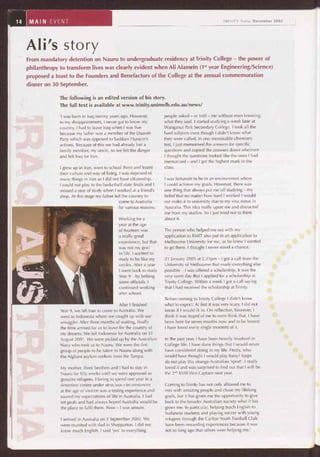
Ali's story
From mandatory detention on Nauru to undergraduate residency at Trinity College - the power of
philanthropy to transform lives was clearly evident when Ali Alamein (1st year Engineering/Science)
proposed a toast to the Founders and Benefactors of the College at the annual commemoration
dinner on 30 September.
The following is an edited version of his story.
The full text is available at www.trinity.unimelb.edu.au/news/
'I was born in Iraq twenty years ago. However,
to my disappointment, I never got to know my
country. I had to leave Iraq when I was five
because my father was a member of the Daaveh
Party which was opposed to Saddam Hussein's
actions. Because of this we had already lost a
family member, my uncle, so we felt the danger
and left Iraq for Iran.
I grew up in Iran, went to school there and learnt
their culture and way of living. I was deprived of
many things in Iran as I did not have citizenship.
I could not play in the basketball state finals and I
missed a year of study when I worked at a friend's
shop. At this stage my father left the country to
come to Australia
for various reasons.
Working for a
year at the age
of fourteen was
a really good
experience, but that
was not my goal
in life. I wanted to
study to be like my
uncles. After a year
I went back to study
Year 9 — by bribing
some officials. I
continued working
after school.
After I finished
Year 9, we left Iran to come to Australia. We
went to Indonesia where we caught up with our
smuggler. After three months of waiting, finally
the time arrived for us to leave for the country of
my dreams. We left Indonesia for Australia on 31
August 2001. We were picked up by the Australian
Navy who took us to Nauru. We were the first
group of people to be taken to Nauru along with
the Afghani asylum seekers from the Tampa.
My mother, three brothers and I had to stay in
Nauru for fifty weeks until we were approved as
genuine refugees. Having to spend one year in a
detention centre under atrocious circumstances
at the age of sixteen was a testing experience and
soured my expectations of life in Australia. I had
set goals and had always hoped Australia would be
the place to fulfil them. Now — I was unsure.
I arrived in Australia on 3 September 2002. We
were reunited with dad in Shepparton. I did not
know much English. I said 'yes' to everything
people asked — or told — me without even knowing
what they said. I started studying a week later at
Wanganui Park Secondary College. I took all the
hard subjects even though I didn't know what
they were called. In one memorable chemistry
test, I just memorised the answers for specific
questions and copied the answers down wherever
I thought the questions looked like the ones I had
memorized — and I got the highest mark in the
class.
I was fortunate to be in an environment where
I could achieve my goals. However, there was
one thing that always put me off studying — my
belief that no matter how hard I worked I would
not make it to university due to my visa status in
Australia. This idea really upset me and distracted
me from my studies. So I just tried not to think
about it.
The person who helped me out with my
application to RMIT also put in an application to
Melbourne University for me, as he knew I wanted
to go there. I thought I never stood a chance.
21 January 2005 at 2.33pm — I got a call from the
University of Melbourne that made everything else
possible — I was offered a scholarship. It was the
very same day that I applied for a scholarship at
Trinity College. Within a week I got a call saying
that I had received the scholarship at Trinity.
Before coming to Trinity College I didn't know
what to expect. At first it was very scary. I did not
know if I would fit in. On reflection, however, I
think it was stupid of me to even think that. I have
been here for seven months now and to be honest
I have loved every single moment of it.
In the past year, I have been heavily involved in
College life. I have done things that I would never
have considered doing in my life. Firstly, who
would have thought I would play footy? Iraqis
do not play this strange Australian 'sport'. I really
loved it and was surprised to find out that I will be
the 2nd XVIII Vice-Captain next year.
Coming to Trinity has not only allowed me to
mix with amazing people and chase my lifelong
goals, but it has given me the opportunity to give
back to the broader Australian society what it has
given me. In particular, helping teach English to
Sudanese students and playing soccer with young
refugees through the Carlton Youth Football Club
have been rewarding experiences because it was
not so long ago that others were helping me.'
www.trinity.unimelb.edu.au 15
Learning from Minyerri
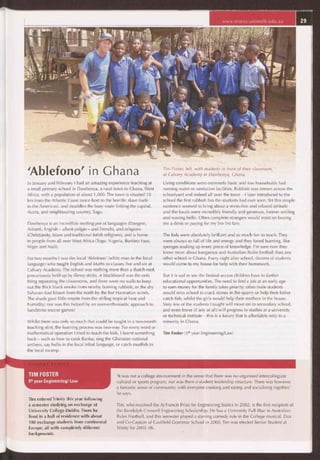
This September marked the third visit to the Northern Territory
by students involved in the Trinity College Indigenous Awareness
Project. This community-focused program has been developed with
the aim of furthering our collective understanding of Aboriginal
culture and our awareness of the challenges posed by cross-
cultural dynamics in Australia. The seven members of the College
community involved this year found it deeply enriching; it was
always fascinating, challenging, and inspiring.
Central to the trip was the time we spent in Minyerri — a remote
Aboriginal community with a population of approximately 500
people, located 270km south-east of Katherine — which Trinity
students also visited last year. This was a particularly powerful
experience.
We were primarily based at Minyerri School, where we were
involved in classroom activities with vibrant and friendly students
of a range of ages. It was fascinating to be immersed in such a
different culture. In particular, we experienced first-hand the
children's extraordinary connection with their land, their deep
nurturing respect for it, and their ability to see things in it that we
could not.
... we experienced first-hand the
children's extraordinary connection
with their land, their deep nurturing
respect for it, and their ability to see
things in it that we could not.
Our time in the community exposed us to issues related to public
policy and Indigenous affairs. We discussed the challenges
associated with the community's eighty-five percent unemployment
rate, with the provision of funding and welfare, and methods of
governance. We also talked about the complex act of balancing
cultural sensitivity with the provision of economic opportunity
and education in its Western context. In particular, we identified
the strong need for Indigenous communities to be able to have
effective choice and autonomy.
Our experiences at Minyerri showed us that difficult cross-cultural
issues do exist. At the same time, it revealed to us a culture that
is vibrant and multifaceted, and made up of different but equally
valid values to our own. Having now visited Minyerri for a second
year, the College is hoping to establish a long-term connection with
the community through the ongoing provision of Summer School
scholarships for Minyerri secondary school students.
The trip represents a powerful affirmation of the College's
commitment to Indigenous education and community involvement,
and the vision of Trinity as an 'outreaching' community. It was also
a time of great personal growth and friendship. It showed us that
if we are to be socially responsible and politically aware members
of the community, we need to open our eyes to difference. In this
way, we can come to recognise both the diversity and universality
of human experience.
Edwina Watson (2nd year Arts/Law)
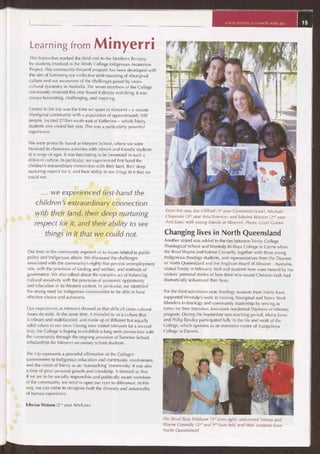
From left rear, Joe Clifford (151 year Commerce/Law), Michael
Chapman (3rd year Arts/Science) and Edwina Watson (2^d year
Arts/Law) with young friends at Minyerri. Photo: Geoff Golden
Changing lives in North Queensland
Another strand was added to the ties between Trinity College
Theological School and Wontulp-Bi-Buya College in Cairns when
the Revd Wayne and Valmai Connelly, together with three young
Indigenous theology students, and representatives from the Diocese
of North Queensland and the Anglican Board of Mission —Australia,
visited Trinity in February. Staff and students here were moved by the
visitors' personal stories of how their new-found Christian faith had
dramatically influenced their lives.
For the third successive year, theology students from Trinity have
supported Wontulp's work in training Aboriginal and Torres Strait
Islanders in theology and community leadership by serving as
tutors for their intensive, two-week residential Diploma of Ministry
program. During the September non-teaching period, Moira Evers
and Philip Bewley participated fully in the life and work of the
College, which operates as an extension centre of Nungalinya
College in Darwin.
The Revd Ross Fishburn (3rd from right) welcomed Valmai and
Wayne Connelly (2^d and 3'd
from left) and their students from
North Queensland.
16 MAIN EVENT TRINITY Today December 2005
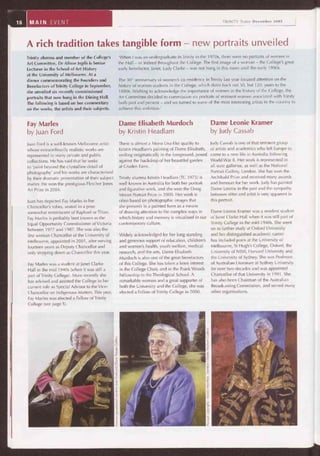
A rich tradition takes tangible form - new portraits unveiled
Trinity alumna and member of the College's
Art Committee, Dr Alison Inglis is Senior
Lecturer in the School of Art History
at the University of Melbourne. At a
dinner commemorating the Founders and
Benefactors of Trinity College in September,
she unveiled six recently commissioned
portraits that now hang in the Dining Hall.
The following is based on her commentary
on the works, the artists and their subjects.
'When I was an undergraduate in Trinity in the 1970s, there were no portraits of women in
the Hall — or indeed throughout the College. The first image of a woman — the College's great
early benefactor, Janet, Lady Clarke — was not hung in this room until the early 1990s.
The 301' anniversary of women's co-residency in Trinity last year focused attention on the
history of women students in the College, which dates back not 30, but 120, years to the
1880s. Wishing to acknowledge the importance of women in the history of the College, the
Art Committee decided to commission six portraits of eminent women associated with Trinity
both past and present — and we turned to some of the most interesting artists in the country to
achieve this ambition.'
Fay Martes
by Juan Ford
Juan Ford is a well-known Melbourne artist
whose extraordinarily realistic works are
represented in many private and public
collections. He has said that he seeks
to 'paint beyond the crystalline detail of
photography' and his works are characterised
by their dramatic presentation of their subject
matter. He won the prestigious Fletcher Jones
Art Prize in 2004.
Juan has depicted Fay Marles in her
Chancellor's robes, seated in a pose
somewhat reminiscent of Raphael or Titian.
Fay Marles is probably best known as the
Equal Opportunity Commissioner of Victoria
between 1977 and 1987. She was also the
first woman Chancellor of the University of
Melbourne, appointed in 2001, after serving
fourteen years as Deputy Chancellor and
only stepping down as Chancellor this year.
Fay Marles was a student at Janet Clarke
Hall in the mid 1940s (when it was still a
part of Trinity College). More recently she
has advised and assisted the College in her
current role as Special Advisor to the Vice-
Chancellor on Indigenous Matters. This year,
Fay Marles was elected a Fellow of Trinity
College (see page 5).
Dame Elisabeth Murdoch
by Kristin Headlam
There is almost a Mona Lisa-like quality to
Kristin Headlam's painting of Dame Elisabeth,
smiling enigmatically in the foreground, posed
against the backdrop of her beautiful garden
at Cruden Farm.
Trinity alumna Kristin Headlam (TC 1975) is
well-known in Australia for both her portrait
and figurative work, and she won the Doug
Moran Portrait Prize in 2000. Her work is
often based on photographic images that
she presents in a painted form as a means
of drawing attention to the complex ways in
which history and memory is visualised in our
contemporary culture.
Widely acknowledged for her long-standing
and generous support of education, children's
and women's health, youth welfare, medical
research, and the arts, Dame Elisabeth
Murdoch is also one of the great benefactors
of this College. She has taken a keen interest
in the College Choir, and in the Frank Woods
Fellowship in the Theological School. A
remarkable woman and a great supporter of
both the University and the College, she was
elected a Fellow of Trinity College in 2000.
Dame Leonie Kramer
by Judy Cassab
Judy Cassab is one of that eminent group
of artists and academics who left Europe to
come to a new life in Australia following
World War ll. Her work is represented in
all state galleries, as well as the National
Portrait Gallery, London. She has won the
Archibald Prize and received many awards
and honours for her work. Judy has painted
Dame Leonie in the past and the sympathy
between sitter and artist is very apparent in
this portrait.
Dame Leonie Kramer was a resident student
of Janet Clarke Hall when it was still part of
Trinity College in the mid-1940s. She went
on to further study at Oxford University
and her distinguished academic career
has included posts at the University of
Melbourne, St Hugh's College, Oxford, the
University of NSW, Harvard University and
the University of Sydney:She was Professor
of Australian Literature at Sydney University
for over two decades and was appointed
Chancellor of that University in 1991. She
has also been Chairman of the Australian
Broadcasting Commission, and served many
other organisations.
www.trinity.unimelb.edu.au
Lilian Alexander and Melian Stawell
by Caroline Williams
In painting two of the College's earliest women, New Zealand-born Melbourne artist,
Caroline Williams, based the compositions on surviving 19th century photographs, but also
sought to convey something of the passion and commitment of these extraordinary women.
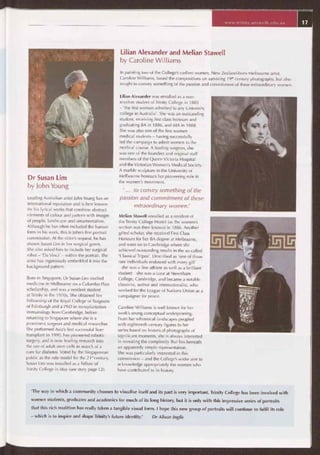
Dr Susan Lim
by John Young
Leading Australian artist John Young has an
international reputation and is best known
for his lyrical works that combine abstract
elements of colour and pattern with images
of people, landscape and ornamentation.
Although he has often included the human
form in his work, this is John's first portrait
commission. At the sitter's request, he has
shown Susan Lim in her surgical gown.
She also asked him to include her surgical
robot — 'Da Vinci' — within the portrait. The
artist has ingeniously embedded it into the
background pattern.
Born in Singapore, Dr Susan Lim studied
medicine in Melbourne on a Colombo Plan
scholarship, and was a resident student
at Trinity in the 1970s. She obtained her
Fellowship of the Royal College of Surgeons
of Edinburgh and a PhD in transplantation
immunology from Cambridge, before
returning to Singapore where she is a
prominent surgeon and medical researcher.
She performed Asia's first successful liver
transplant in 1990, has pioneered robotic
surgery, and is now leading research into
the use of adult stem cells in search of a
cure for diabetes. Voted by the Singaporean
public as the role model for the 21 "century,
Susan Lim was installed as a Fellow of
Trinity College in May (see story page 12).
Lilian Alexander was enrolled as a non-
resident student of Trinity College in 1883
— 'the first woman admitted to any University
college in Australia'. She was an outstanding
student, receiving first class honours and
graduating BA in 1886, and MA in 1888.
She was also one of the first women
medical students — having successfully
led the campaign to admit women to the
medical course. A leading surgeon, she
was one of the founders and original staff
members of the Queen Victoria Hospital
and the Victorian Women's Medical Society.
A marble sculpture in the University of
Melbourne honours her pioneering role in
the women's movement.
' ... to convey something of the
passion and commitment of these
extraordinary women.'
Melian Stawell enrolled as a resident of
the Trinity College Hostel (as the women's
section was then known) in 1886. Another
gifted scholar, she received First Class
Honours for her BA degree at Melbourne,
and went on to Cambridge where she
achieved outstanding results in the so-called
'Classical Tripos'. Described as 'one of those
rare individuals endowed with every gift'
— she was a fine athlete as well as a brilliant
student — she was a tutor at Newnham
College, Cambridge, and became a notable
classicist, author and internationalist, who
worked for the League of Nations Union as a
campaigner for peace.
Caroline Williams is well known for her
work's strong conceptual underpinning.
From her whimsical landscapes peopled
with eighteenth century figures to her
series based on historical photographs of
significant moments, she is always interested
in revealing the complexity that lies beneath
an apparently simple representation.
She was particularly interested in this
commission — and the College's wider aim to
acknowledge appropriately the women who
have contributed to its history.
'The way in which a community chooses to visualise itself and its past is very important. Trinity College has been involved with
women students, graduates and academics for much of its long history, but it is only with this impressive series of portraits
that this rich tradition has really taken a tangible visual form. I hope this new group of portraits will continue to fulfil its role
— which is to inspire and shape Trinity's future identity.' Dr Alison Inglis
18 MAIN EVENT
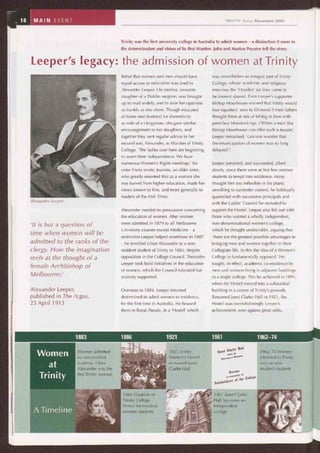
Alexander Leeper.
1:886 Creation of
Trinity College
Hostel for resident
women students
1961 Janet Clarke
Hall becomes an
independent
college
Women
at
Trinity
Women admitted_r(
as non-resident
students. Lilian
Alexander was the
first Trinity woman
1921 Trinity
Women's Hostel
re-named Janet
Clarke Hall
not (matte íf4alt
mtlóln Ih~
flnlortn,41 DC
0,IbvNnr
fecnice
~nfnlr IF,r
~nòepenaen
ce et the ~iulle9e
1962-74 Women
admitted to Trinity
only as non-
resident students
A Time,
TRINITY Today December 2005
Trinity was the first university college in Australia to admit women — a distinction it owes to
the determination and vision of its first Warden. John and Marion Poynter tell the story:
Leeper's legacy: the admission of women at Trinity
'It is but a question of
time when women will be
admitted to the ranks of the
clergy. How the imagination
reels at the thought of a
female Archbishop of
Melbourne.'
Alexander Leeper,
published in The Argus,
23 April 1913
Belief that women and men should have
equal access to education was bred in
Alexander Leeper. His mother, favourite
daughter of a Dublin surgeon, was brought
up to read widely, and to state her opinions
as frankly as she chose. Though educated
at home and destined for domesticity
as wife of a clergyman, she gave similar
encouragement to her daughters, and
together they sent regular advice to her
second son, Alexander, as Warden of Trinity
College. 'The ladies over here are beginning
to assert their independence. We have
numerous Women's Rights meetings,' his
sister Freda wrote; Jeannie, an older sister,
who greatly resented that as a woman she
was barred from higher education, made her
views known to him, and more generally to
readers of the Irish Times.
Alexander needed no persuasion concerning
the education of women. After women
were admitted in 1879 to all Melbourne
University courses except Medicine — a
restriction Leeper helped overthrow in 1887
— he enrolled Lilian Alexander as a non-
resident student of Trinity in 1883, despite
opposition in the College Council. Thereafter
Leeper took bold initiatives in the education
of women, which the Council tolerated but
scarcely supported.
Overseas in 1884, Leeper returned
determined to admit women to residence,
for the first time in Australia. He housed
them in Royal Parade, in a 'Hostel' which
was nevertheless an integral part of Trinity
College, whose academic and religious
exercises the 'Hostiles' (as they came to
be known) shared. Even Leeper's supporter
Bishop Moorhouse warned that Trinity would
lose squatters' sons to Ormond if their fathers
thought them at risk of falling in love with
penniless bluestockings. ('When a man like
Bishop Moorhouse can offer such a reason,'
Leeper remarked, 'can one wonder that
the emancipation of women was so long
delayed?')
Leeper persisted, and succeeded, albeit
slowly, since there were at first few women
students to tempt into residence. Many
thought him too inflexible in his plans;
unwilling to surrender control, he habitually
quarrelled with successive principals and
with the Ladies' Council he recruited to
support the Hostel. Leeper also fell out with
those who wanted a wholly independent,
non-denominational women's college,
which he thought undesirable, arguing that
'there are the greatest possible advantages in
bringing men and women together in their
Collegiate life. To this the idea of a Women's
College is fundamentally opposed.' He
sought, in effect, academic co-residence by
men and women living in adjacent buildings
in a single college. This he achieved in 1891,
when the Hostel moved into a substantial
building in a corner of Trinity's grounds.
Renamed Janet Clarke Hall in 1921, the
Hostel was overwhelmingly Leeper's
achievement, won against great odds.
1883 1886 1921 1961 1962-74
e~a
1974 1978 1982 1983 1987 2005+
1978 Margot Foster
becomes the first
woman on the
TCAC
1983 Lisa Stewart
is elected as the
first female Senior
Student
As in the
University, some
55% of Trinity's
resident students
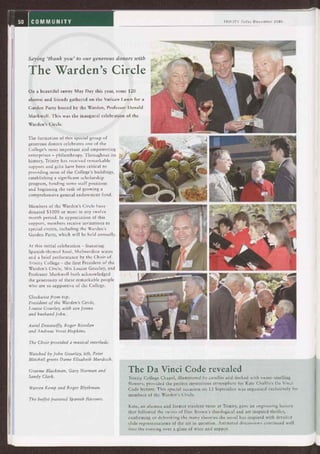
are women
1974 Women
admitted to
Trinity on a fully
co-residential basis.
The first woman
resident student was
Romayne Holmes
Dame Margaret
Blackwood
becomes Trinity's
first female Fellow
Leith Hancock
becomes the first
female Dean
www.trinìty.unimelb.edu.au 19
Valentine Alexa Leeper, the oldest child
in Alexander Leeper's second family, was
his companion from her birth in 1900
until his death in 1934, and the champion
of his beliefs and values all her long life.
From him she inherited his deep interest
in international politics, his devotion to
classical scholarship, to the Anglican
church and its doctrines (which, as he
defined them, included the ordination of
women) and above all his commitment to
liberal education, especially collegiate, for
women and men alike. All these causes she
championed until her death at the age of 101
in 2001.
All seven of the children from Leeper's two
marriages received, at school and at home,
a Classical training 'to cultivate mental and
moral power'. Of the four girls, Valentine
was the most dedicated student. In 1918,
the year of her father's retirement, she
enrolled in Science as a Trinity non-resident;
transferring to Arts two years later, she gained
Honours in several subjects.
Valentine intended to teach, but it was
thirty years before she did so. As with so
many women, family duties came first;
both parents, now living in South Yarra,
were aging and ailing. Valentine became
secretary to her still-busy father, involved
in all the causes he still pursued; and after
his death she and her sister Molly had to
care for their mother, now blind. Valentine
nevertheless found time to be part of an
extensive network of women active in a large
number of organisations, and, increasingly,
she voiced her well-considered opinions
publicly and very forcefully.
Like her father, Valentine believed that
Janet Clarke Hall should remain an integral
part of Trinity College. When political
circumstances made an amicable divorce
expedient in 1961, she was fierce in her
opposition. But she lived long enough to see
both colleges become co-residential in the
1970s. Later, when an apprehensive local
vicar called to warn her of the appointment
of a woman curate, she responded 'And
about time too!', in the best Leeper tradition.
'there are the
greatest possible
advantages in bringing
men and women
together in their
Collegiate life.'
Valentine Leeper, aged about twenty.
A legacy in letters
Valentine Leeper was a remarkable letter
writer for nearly all of her 101 years
(1900-2001). She left letters that range
from childhood letters to her parents,
through letters expressing views on many
of the great issues of the 20th century, to
letters in her last years which retain the
vigour of opinion which was always her
trademark.
Marion Poynter, who knew Miss Leeper
well, is now editing a selection of her
letters for publication. They will reflect a
life of extraordinary interest, casting light
on a century of international and domestic
politics, and issues in education, religion,
society, and more.
Trinity has had an unbroken line
of women students, resident or
non-resident, since 1883.
~i nuaaTMw
„011
The support from the University was excellent.
We had three student guides (madrichim)
who looked after our daily needs. These were
senior students in undergraduate or post-
Learning Hebrew - and
more - in Jerusalem
In January, under a scholarship from
the Melbourne Chapter of the Friends
of the Hebrew University, resident
student Grace Sharon (4th year
Theology) attended a Winter Ulpan
(an intensive language course) to
learn Modern Hebrew at the Hebrew
University in Jerusalem. Here, she
shares her experience with
TRINITYToday:
Grace Sharon at the Western (wailing) Wall in Jerusalem.
In the Ulpan, we had approximately 192
students from thirty-four different countries.
There were many Christians, laity and priests
from many denominations, Jews from the
Diaspora and those returning to Israel,
Moslems from Israel and beyond, and some
with no faith. It was an enjoyable learning
experience, enhanced by our diversity.
The six-week course involved classes five
days a week, Sunday to Thursday. Teaching
was only in Hebrew but if something was
extremely important for us to grasp, it was
also said in English. I am still amazed at how
much vocabulary we learnt and how we were
then able to use it in the street. The teachers
took great pride in their teaching and made
sure they gave us extra time for tutorials. We
were tested three times a week on spelling,
grammar and comprehension, plus an oral
and written examination at the end.
We were housed in various university colleges
and hotels and I cannot stress enough how
safe it was. If we didn't have a mobile phone
on enrolment, we were asked to hire one so
we could always be contacted in case of a
security alert. A shuttle bus carried us door to
door between our accommodation and our
University building.
graduate study, resident with us at the dorms.
Each religion had its own advisers and there
was a beautiful synagogue on campus.
One of the joys for me was sitting in the
classroom and being able to look out over
the Jordan Hills; to sit there and wonder,
because these were the very hills our
ancestors walked over in the biblical stories.
As well as study, there was much to do for
soul and spirit. Tours were conducted to
various places with biblical relevance, and
others for pure joy. I took 'The Battlefields'
bus tour to the place where David slew
Goliath. Our tour guide explained to us how
the Philistines came from the coastlands
and how the Israelites came through the
mountain valleys to reach the spot where
David had triumphed.
We travelled to the caves where the Jewish
people were killed around the fall of
Jerusalem in 70 AD. We climbed down
the tunnels to these caves one by one.
Sometimes it was so narrow, our feet had
to go one way and our head another. We
stopped at a place far underground where
the Jewish people had hidden.
the tunnels, right where we were standing.
The Jews perished. I still don't know how
to describe the feeling of being there and
imagining the fire coming through the tunnels
— numbness, anguish, anger, and a desire to
stop the rage against the Jewish people.
We went to the Jewish Quarter of the
Old City, visited the Western Wall and
experienced Prayers, and a Shabbat Dinner in
the Orthodox Hotel where we were staying.
These were well attended and helped us to
understand the Jewish faith and traditions.
One Friday night, all the students worked
together and held our own Shabbat Dinner
in the lift lobby of our hotel. It was a joyous
occasion where Jewish young people led
us in a time of revelation about their faith
and how much it means to them. I was also
involved at my end of the table talking about
the Christian faith, not proselytising but
sharing the sheer enjoyment of our
faiths together.
Jerusalem, the students I met, and the
studies I did at the Hebrew University, meant
for me a love for mankind like I had never
experienced before. It changed my life
forever.
Here, they had to make a decision. Did they
kill the babies so the Romans couldn't hear
their cries, or did they obey the Torah and let
them live? They let them live and eventually
the Romans found them and threw fire down
In December 2004 the College was
honoured by the visit of the former President
of Indonesia and leading Islamic Scholar,
Abdurrahman Wahid. During the visit,
arranged under the auspices of the Global
Foundation, the Warden and the Rt Revd Dr
Peter Hollingworth, Fellow of Trinity College,
hosted a lunch-time discussion with him on
interfaith relations.
Abdurrahman Wahid with, left, TCFS
Chaplain the Revd Kim Cruickshank, and the
Warden, following the discussion at Trinity.
(Adapted from an article published in Gesher
2005 - the official journal of the Council of
Christians and Jews, Victoria.)
The Warden has often quoted from Wahid's
writings when stressing the importance of a
'large and liberal' education. Wahid argues
that young Muslim students sent overseas to
study technology and science, but lacking
training in Islamic scholarship, often take a
literalistic approach to the textual sources of
Islam. On the other hand 'students studying
liberal arts are rather better served when it
comes to reflect on the place of Islam in the
modern world'.
(See TRINITYToday Vol 60, page 6.)
Visit of Abdurrahman Wahid
www.trinity.unimelb.edu.au 21
'The rippled flow of
water' - set in glass
Another layer of history has been added
to the Chapel's ancient baptismal font
with the recent installation of a stunning
glass inset, commissioned from one of
Australia's leading glass artists, David
Wright.
The stone font itself is characteristic of
Norman design, and may be the oldest
object of ecclesiastical craft still in use in
Australia. It was built for the church of St
Andrew at West Tarring, Sussex, England,
and dates from at least 1584, though it
could be much older. In 1829, it was
removed by Thomas Henty who brought it
to Australia where it was used successively
in three Melbourne churches before being
given to Trinity College Chapel in 1969.
Wright has said the design of the glass
inset 'symbolises the rippled flow of
water leading to the "waterhole", with
native animal tracks and human footprints
pointing to the centre, at which there is an
embryo, symbolic of new life, the waters
of the uterus, and of course, baptism.
A loose connection is thus made with
both the carvings of native animals in
the Chapel (on the pews and west face
of the organ casing) and with the Henty
family, as early pastoralists reliant on the
presence of the water hole.'
More information about the Chapel can
be found in Trinity College Chapel: An
Appreciation by Caroline Miley (1997).
Copies are available in the rear shelves of
the Chapel for use while visiting, or can
be purchased online at
www.trinity.unimelb.edu.au/
development/publication.shtml
or from the Development Office,
Tel: +61 3 9348 7477.
A new glass inset for an ancient font.
Chapel 'wrapping'
As part of the worldwide Make Poverty History campaign, September 10 was nominated as
'White Band Day' — a day on which churches and other organisations were encouraged to
promote awareness and raise funds for this cause.
The Chaplaincy team decided that the College Chapel should wear its own 'white band' by
wrapping it in 100 metres of white cloth. They were helped by theology students, members of
Janet Clarke Hall, and resident students, including Outreach Committee members.
This interpretation of the white band symbol, the purchase and display of a Campaign
banner, signage in Royal Parade, and donations collected at a special College Eucharist on
5 September were all part of the College's support for this Campaign.
Melbourne's windy spring weather forced the removal of the white cloth (which found its
way to the Musical Society's props department) several days later, but the sight created
considerable interest and discussion, and was an effective focal point for other Campaign
initiatives at Trinity.
All wrapped up: the Chapel with its 'white band' promoting the campaign to
Make Poverty History, and some of the 'wrapping' team.
Bread and
water lunch
As the world struggled to comprehend
the enormity of the devastation and
suffering in Asia caused by the tsunami,
the Chaplaincy team at Trinity invited
staff and students in all parts of the
College to a Bread and Water Lunch on
the Bulpadock on 2 March. Participants
were asked to donate their usual lunch
money — 'or a little more'— to the tsunami
relief effort. In exchange, they were fed
bread and water. Representatives from
various relief agencies also provided
information on the progress of relief
work in the affected regions.
Chaplain Richard Treloar talks with
students at the Bread and Water Lunch.
22 MAIN EVENT TRINITY Today December 2005
'Hushed' Choir
helps Children's Hospital
Lullabies and other calming
melodies sung by the Choir
of Trinity College will sooth
young hospital patients after
the Choir recorded a CD for
the Royal Children's Hospital
Hush Collection in September.
What began as a music-driven desire to reduce stress for children,
parents and staff in one section of the hospital has become
the soundtrack of choice for other areas and developed into a
fundraising project linked to twelve children's hospitals across the
country. CD sales of The Hush Collection now exceed 15,000.
'People kept asking about what we were playing and saying it was
beautiful and asking where they could get a copy,' says Catherine
Crock, the doctor in charge of the day-operating theatre at the Royal
Children's Hospital and producer of The Hush Collection music.
The Trinity College Choir was approached about the project after
the 2004 Carol Services. After much planning and discussion, the
recording dates were set for the mid-semester break in September
2005, and new repertoire (different from the usual Sunday fare!)
was learned.
Fortunately, harpist Marshall McGuire was in Melbourne for
concerts at that time, and was happy to accompany three of the
tracks, while Jonathan Bradley provided piano accompaniments for
a further six. One track combines harp and piano — an arrangement
of Brahms's Cradle Song for upper voices. The CD is expected to be
released in the first half of 2006.
The Choir sings 'Carols in the Cathedral'.
The Choir's performance of the Fauré Requiem and Christopher
Willcock's setting of the Miserere (Psalm 51) was a sell-out at the
Port Fairy Spring Music Festival early in October. This program was
repeated in the College Chapel on 22 October, together with the
first concert performance of my new double choir setting of the
Magnificat.
Further recording sessions for the ABC in late November and early
December preceded the Choir's preparation of repertoire for the
2005 Carol Services. The 'Carols in the Cathedral' is fast becoming
an integral part of Christmas in Melbourne. It regularly draws a
capacity congregation in St Paul's Cathedral and allows the Choir to
be heard and appreciated by a far wider audience than is possible in
the Chapel.
Rounding off the Choir's year is a return appearance at Government
House as part of the final Christmas in office of Governor and Mrs
Landy. Plans for 2006 include a projected visit to Perth in the middle
of the year as well as the launch of The Hush Collection CD.
Michael Leighton Jones, Director of Music
Arguments to
improve the
mind
Professionals in all fields must be able to understand, evaluate, communicate — and indeed,
construct — complex arguments.
To help develop these skills, Advanced Reasoning and Analysis (ARA) workshops
are run in conjunction with Austhink — a Melbourne-based group with expertise
in critical thinking — several times a year in Trinity's Multimedia Classroom. To
date, the workshops have benefited decision makers and senior figures
from the business, legal, professional, and public sectors, as well as
entrepreneurs and academics.
Expert and engaging facilitators use stimulating case studies, and
innovative software tools for constructing and analysing argument
maps, enabling users to refine their core thinking abilities.
Stay tuned, as an exciting program of courses is planned for 2006!
To learn more about Summer Schools or ARA Workshops at Trinity College, visit www.trinity.unimelb.edu.au/or contact
Mr Vincent Ramos, Tel: +61 3 9348 7486 Email: summerschool@trinity.unimelb.edu.au
www.triníty.unimélb.edu.au
Minyerri girls at Summer School
As a result of the strong relationship
developed with the Minyerri community
during the 2004 visit by Trinity residents, two
Indigenous students from Minyerri attended
the 2004 Creative Thinking Summer School at
Trinity and two are at the 2005 program. Their
enrolment was made possible with assistance
from Indigenous scholarships and it is hoped
that Minyerri students will now be regular
participants in the Summer Schools program.
Linda Billy (left) and Antonella Millar
travelled from the Minyerri community in
the Northern Territory to attend the 2004
Creative Thinking Summer School
'A life-changing experience'
Summer Schools are an exciting way for students in their final years of
high school to experience learning in a university setting, make friends
from other countries, and have a taste of independence within a safe,
supportive environment.
The Creative Thinking Summer School (CTSS) and Science Summer School (SSS) are two-
week residential programs held simultaneously in December each year. In the students' own
words, they are 'an exhilarating experience'. Zara Ebrahim (CTSS 2004, India) told us that it
was 'life changing', while Bridget Ryan (SSS 2004, Australia) declared: 'The lessons I learnt at
SSS couldn't have been learnt anywhere else'.
Each School offers innovative academic programs that provide the intellectual framework
to guide students in gaining broad knowledge in science or thinking processes. They allow
students to explore real world issues and fresh approaches to learning — both inside and
outside the classroom — and help them clarify the directions their schooling and careers
might take.
Students work with and are challenged by leading academics. Always a particular highlight is
the Combined Summer Schools Seminar, with the keynote speech in 2005 being delivered by
Nobel Laureate and Summer School Patron, Professor Peter Doherty.
'The lessons I learnt at SSS couldn't have
been learnt anywhere else.'
Extensive extracurricular activities provide
plenty of variety, as well as opportunities
to build new friendships. Ongoing contact
between these intelligent and enthusiastic
students from different backgrounds is
maintained via email, web logs, and
reunions.
In 2004, it was exhilarating to see over
120 students from both Summer Schools
connect for a remarkable fortnight of
learning. As TRINITYToday goes to print,
the 2005 Summer Schools are in full
swing, and a new group is once again
being challenged and exhilarated.
At the September launch of his book
The Beginner's Guide to Winning the
Nobel Prize (MUP, 2005), Professor Peter
Doherty (below right) signs a copy for
the Warden, Professor Donald Markwell.
Professor Mark well has since described
the book as 'engaging and stimulating -
a superb introduction for non-scientists to
science and scientific research.'
Photo: Peter Pockley (TC 1954)
TRINITY Today December 2005
Late Antiquity seminar series
Does education lead to heresy? Why did
olive oil technology change? Why were
bodies buried in the bathhouse at Corinth?
What was new in early Christian art?
These are some of the topics discussed in
seminars hosted at the College in 2005 by
Trinity's Late Antiquity group, comprising
Dr Andrew McGowan, Dr Tamar Lewit,
Dr David O'Brien, and Dr Jonathan
Barlow, together with colleagues from
other academic institutions working in
Late Antiquity (the Roman, Barbarian and
Byzantine worlds, in the 3"d to 8t" century
AD) and related fields.
Academic Adventures of Trinity Staff 2005
Students in all parts of Trinity are fortunate to be taught, guided, and mentored by
academic staff of outstanding quality. In addition to their teaching and pastoral roles,
most of these undertake other professional activities — pursuing research interests,
studying for higher degrees, giving presentations at national and international
conferences, publishing articles, papers and books, and more. Some of their activities
in 2005 are summarised below:
Russell Beedles, Drama Lecturer (TCFS), wrote Dr Fallon was a Vice-President on the ISANA
three plays short-listed in the 'Short & Sweet' National Council for 2005, and gave an
Play Festival at the Victorian Arts Centre in invited talk, 'Chinese Students from South
December, one of which was performed. East Asia and Mainland China — similarities
An exhibition of Russell's photographs will and differences, and how we cope with
be held at Glen Eira City Council Gallery in them', at an ISANA meeting at the University
March 2006. of Melbourne in August 2005.
Speakers in 2005 have included Professor
Chrysos of the University of Athens;
Dr Tamar Lewit, Foundation Studies
Lecturer in Charge of History of Ideas;
University of Melbourne graduate student
Sonya Wurster; Dr Felicity Harley, recently
Raleigh Radford Fellow at the British School
at Rome; and Professor Julian Henderson
of Nottingham University, Director of the
Raqqa (Syria) Ancient Industry Project.
Seminars are open to all. To join the mailing
list email tlewit@trinity.unimelb.edu.au
The chemistry of conservation
In November, Trinity conducted its third
Chemistry Bridging Course for students
entering the University of Melbourne
Master of Arts (Cultural Material
Conservation). The course teaches the
fundamentals of Chemistry to students
who lack the necessary background in this
subject for the Masters program, but who
wish to gain a professional qualification
in conservation for work in archives,
museums, galleries, libraries, etc. The
intensive four-week bridging course is
designed and taught by Foundation Studies
Chemistry staff, led by Lecturer in Charge
Dr Patricia Jackson, in cooperation with the
Centre for Cultural Materials Conservation
at the University of Melbourne. The Masters
course is unique in Australia and the
Bridging Course is the only short course
specially tailored to its needs.
Preparing for research
'Really excellent and utterly relevant,
particularly at the beginning of a research
degree where you must resolve the
questions of "why?" and "how?".' This was
one student's reaction to a Trinity-run short
course that helps postgraduate students in
all disciplines understand the ideas that
shape their research. Designed for both
local and international students and taught
by Foundation Studies History of Ideas
lecturer Dr Jonathan Barlow, the course
is offered through the School of Graduate
Studies Upskills Program and has run twice
yearly since 2003.
Susan Bendall, English for Academic Purposes
Lecturer (TCFS), was co-author with Michael
Carolan of Towards An Enterprising You,
published in November. A second edition of
Towards An Enterprising Australia by Michael
Carolan, edited by Susan, also appeared
this year.
Mark Dorset, IT Operations
Manager and Systems Administrator,
won scholarships to Apple's X-World and
System Administrators' Guild of Australia
Conferences, and is one of only eleven
Australians awarded a scholarship to attend
the MacWorld Conference and Expo in San
Francisco, USA in January 2006. Mark and
Tim Bell, new Director of IT, featured on
the cover of Apple University Consortium's
magazine Wheels for the Mind which reported
the installation of the new Mac computer labs
in Foundation Studies in Spring 2005.
Dr Felicity Fallon, Director of Student Welfare
(TCFS), gave conference presentations on
'Does Culture Affect Cognitive Style?', at the
Cross-Cultural Psychology (IACCP) Regional
Congress, Spain, July 2005; 'Students
Under 18 Years of Age, "Guardianship"
and Accommodation: How do we get it
right?', at the International Student Advisors'
Network of Australia (ISANA) Victorian
Conference, October 2005; and (jointly)
'Are Our International Students Using the
Health System Effectively?', at the ISANA
International Conference in New Zealand,
November 2005.
Bell Foozwell, Mathematics Lecturer
(TCFS), attended the 'Future Directions in
3-manifolds' conference at the University of
Michigan in October. He also gave seminars
on 'The topology of Haken n-manifolds' at
Michigan and at the University of Illinois
at Chicago.
Bishop James Grant has two entries in
the new Encyclopedia of Melbourne, edited
by Andrew Brown-May and Shurlee Swain
(CUP, 2005).
Dr Mike Heald, Literature Lecturer (TCFS),
saw his third book of poetry, Focusing
Saturn, short-listed for both the WA Premier's
Book Award and the Arts Queensland Judith
Wright Calanthe Award (the poetry section of
the Queensland Premier's Literary Awards).
Judges' comments included: 'This is deeply
enjoyable work with a stunning range and
powerful grasp of detail. Heald has written
his way into the front rank of contemporary
Australian poets with consistent integrity and
intelligence.'
Here's a brief taste of his work:
in the poem, 'Piece', Heald describes a
piece of graffiti as
'jagged like the chanted
bulging like the chorused
word...'
Dr Paul Lee, Tutor in Medicine (resident),
passed examinations for the Fellowship of
the Royal Australasian College of Physicians
(FRACP). He also contributed to two articles:
'Lymphocytic hypophysitis: a rare cause
of hypoglycaemia in a man with Type 2
Diabetes' and 'Substance Abuse in Young
Patients with Type 1 Diabetes — easily
neglected in complex medical management',
both in the Internal Medicine Journal, 2005.
E3, 16. s.• 3. E..+,..A, L.A f;.L
;:d Ci I ......3.6e...
Melâds 'VIItLIaI I4tCEC.oaid - 71a:e ',•'4
Melbourne
.:1`.Wf.3 i'Oli.-
i,L^lors1111
qL~~s
a, 11,.... ..•,.l
Local ÿe..rC.i^ -
~1 ;,s
.. A'.(
FCY
3 Lia E:)
Li>?u,•r i.
aeIACUIne wcancrIn :e
Oarrl..r
n rn.n•1•
yUv i L y,.,W.+
eh r.,
now 1).S
Min 1111.103
~ !tN1):
L.:1
.
ecc.z
üM..+" ,. v • . I
Stephen Lew, Liaison Officer (International
Students) (TCFS), has a degree in Information
Systems from the University of Melbourne,
and has practiced his skills developing a
'virtual noticeboard' website for students.
The 'Melbourne Ads' website, www.melads.
com.au/ went live in June and attracted over
28,000 hits within two months. Despite
describing it as 'the most time consuming
hobby I have ever undertaken', Stephen plans
to continue adding features and services 'to
make students' lives easier.'
Dr Tamar Lewit, Director of Special
Academic Projects and Lecturer in Charge
of History of Ideas (TCFS), has contributed
chapters on archaeology to three books:
Late Antique Archaeology 4: Technology in
Transition (Brill, in press); Dopo la fine delle
ville. Evoluzione delle campagne tra VI e IX
secolo. Documenti di Archeologia 40 (Società
Archeologia, Padova, in press); and Byzantina
Australiensia 2005 (Australian Association for
Byzantine Studies, Melbourne, in press).
Tamar also helped coordinate a Late
Antiquity Seminar Series at Trinity in 2005.
She presented on 'Invisible warlords and
innovating peasants: An archaeological view
of the changing countrysides in West and East
in the 5th and 6th centuries AD' at its meeting
in April (see story page 24).
The Warden, Professor Donald Markwell,
delivered a lecture entitled 'Education for
our times' at St Agnes's Church, Glen Huntly,
Melbourne, on 30 August, the full text of
which is at http://www.trinity.unimelb.
edu.au/publications/papers/abstracts.
shtml#paper28 He has also contributed to
The Oxford Companion to Australian Politics,
and the Oxford Dictionary of National
Biography.
Jack Migdalek, Drama Lecturer (TCFS),
wrote and directed Cho Cho San and the
Cherry Blossom for the Victorian Arts Centre's
Chookahs children's performing arts festival in
October. This piece, presented in the Japanese
'Kamishibai' storytelling tradition, was based
on Puccini's Madama Butterfly. The cast
included Faye Bendrups, a former TCFS staff
member.
Dr Benjamin Namdarian, Tutor in Medicine
(resident), graduated with a Postgraduate
Diploma in Surgical Anatomy in September.
He has been appointed an Honorary Fellow in
the Department of Anatomy and Cell Biology
in the University of Melbourne.
The Revd Dr Ruwan Palapathwala, Noel
Carter Lecturer in Pastoral Theology, has
published: 'Ageing and Death: A Buddhist-
Christian Conceptual Framework for
Spirituality in Later Life', Journal of Spirituality
& Religious Gerontology; Engaged Interfaith
Dialogue: Sex, Desire and Companionship:
Buddhist & Christian Interfaith Perspectives
on Sexuality, Melbourne, CSIRID, 2005; and
Samalinggika Sangwasaya Pilibada Bhaudda
Ha Kithunu Dakma, Melbourne, CSIRID,
2005. He has co-edited The lntertextuality of
the Holy Books, published in Kerala, India.
Ruwan has presented at the Australian
Association for the Study of Religion,
University of Sydney; the Australian
Missiology Conference, at Whitley College,
Melbourne, in September; and the 2nd
International Conference on Middle Eastern
Spirituality and Peace, Edinburgh, in February.
Clare Pullar, Director of Development,
continued to serve as President of the Victoria
and Tasmania Branch of the Association of
Development and Alumni Professionals in
Education (ADAPE). She also gave the key-
note presentation at the South Australian
Conference of ADAPE.
Rosemary Sheludko, Director of
Communications, was invited to present a
session on 'Marketing and Communications'
at the 2005 'Discover Development' course
conducted by ADAPE at Methodist Ladies
College, Melbourne, in June.
Cathy Symington, Biology Lecturer (TCFS),
performs in the Brazilian ensemble Borboleta,
which played in this year's Melbourne Fringe
Festival and featured in September on the
Good Morning Australia program. The group's
music is Brazilian — so Cathy has to sing in
Portugese (although she doesn't speak it).
The Revd Dr Richard Treloar, College
Chaplain, participated in the World Council
of Churches Faith and Order Standing
Commission meeting in Crete in June. At
the Society of Biblical Literature Congress
in Philadelphia, in November, he presented
a paper, "'Come Out and Stay Out":
Homosexuality, Hermeneutics, and Schism
in Anglicanism'. His PhD thesis has been
accepted for publication in the Australian
Theological Forum's dissertation series.
Megan Warner, Tutor in Theology (resident),
has had two articles published recently:
'Uncertain Women: Sexual Irregularity and
the Greater Righteousness in Matthew 1', in
Pacifica, and 'Genesis 20 — 22:19: Abraham's
Test of Allegiance', in Australian Biblical
Review.
Dr Alexandra Williams, Lecturer in Charge
of Music History (TCFS), received her PhD
in Music from the University of Melbourne
in August. Her thesis was titled, 'The Dodo
was Really a Phoenix: the Renaissance and
Revival of the Recorder in England,
1879-1941.' Her paper, 'Social Justice
as a By-product: Instrumental Tuition for
English Schoolchildren in the 1930s' was
accepted for the National Conference of the
Musicological Society of Australia.
Rebecca Lucas, Literature Lecturer (TCFS),
has written two commissioned reviews:
Space and Place in Modern Fiction by Wesley
A Kort, in Religion & Literature, and For Love
of Matter: A Contemporary Panpsychism by
Freya Mathews, in Environmental Values.
She also spoke on 'Human Rights from an
Earth-Based Ethic' at the Association for
the Study of Literature and the Environment
2005 Conference, and was invited to give a
seminar at the Victorian Schools' Colloquium
in Critical Theory, both at Monash University.
Rebecca is currently completing a PhD in
the Centre for Comparative Literature and
Cultural Studies at Monash.
Evelyn Wee, Administration
Coordinator (ICES), was
awarded a scholarship
to the European Business
School in Germany as part
of her studies for a Master
of Applied Commerce
degree at the University
of Melbourne. Evelyn
undertook a summer
program at EBS on 'Global
Governance in the 21"
Century', including a study
trip to Istanbul.
Evelyn Wee (5"' from right) with fellow class members in
the grounds of the European Business School in Germany.
'Setting the pace in Australia'
Driven by a desire to keep Trinity at the forefront of educational practice
world-wide, late in 2004 the Board of Management established two
committees to review student leadership models and Orientation and
Transition programs at Trinity.
Over the last ten to fifteen years, the profile of resident students at Trinity —
and of students in other internationally focussed institutions around the world
— has changed profoundly. Inevitably, this profile will continue to evolve as it
mirrors our increasingly globalised economic, cultural, and political climate.
Faced with such change, it has never been more important for educational
institutions to regularly review what they deliver to students.
- in Orientation and Transition
As the first such review for some decades, the committee was encouraged to start from 'bare
earth' to create the best policies and programs for a university college in the 21' century.
Chaired by Clare Pullar — an educator with over thirty years' experience in secondary and
tertiary sectors — the group looked at what was happening around the world in similar
institutions and in the larger universities, both public and private. The review also included
extensive consultation with all sectors of the Trinity community, and beyond.
It was clear that everywhere, and particularly at the University of Melbourne and Trinity
College, women and men are coming to university with increasingly higher expectations
of equity in terms of gender, sexual orientation, religious and cultural understanding and
acceptance, and socio-economic status.
The committee's report— which the Board accepted without amendment— suggests a
blueprint for future programs that could see Trinity's Orientation and Transition policy and
programs setting the pace in Australia.
Some of the key elements of the new policy include the notion that Orientation and
Transition is a process which extends over some months and connects closely with individual
mentoring of students.
The new program, which will continue to evolve and develop over the coming years, requires
dedicated and focussed leadership by trained staff and students thinking freshly and working
together for the best outcomes for students.
The report can be accessed on the College website at
www.trinity.unimelb.edu.au/publications/
Fresher Breakfast on the Bulpadock, 0-Week 2005.
Energy, enthusiasm,
an engaging manner,
and extensive
educational
experience in
a collegiate
environment — these
are just some of the
attributes that the
incoming Dean and Deputy Warden of
Trinity College, Dr Peter Tregear, will bring
with him when he takes up his appointment
in January 2006.
Currently a Fellow of Fitzwilliam College,
Cambridge, where he has been Director
of Studies in Music since 2000, he holds
Bachelor of Music (Honours), Master of
Music, and Bachelor of Arts degrees from
the University of Melbourne, and a PhD
in musicology from the University of
Cambridge.
A tutor in Music at Trinity in 1993-95,
and before that a resident student at
Ormond College, Peter Tregear was a
'supervisor' (tutor) of undergraduates at
King's College, Cambridge from 1996-98,
and has also taught in the University of
Melbourne, King's College London, and
the University of Queensland.
He is known as an outstanding and
inspiring teacher who is passionate about
encouraging students to set ambitious but
achievable goals, and about helping them
to realise those goals.
With many fine orchestral and operatic
productions to his credit, as well as a
Cambridge Blue in athletics, and a silver
medal from the 1998 British Universities
Marathon Championships, Trinity's wide
range of extra-curricular activities looks
set to flourish under his guidance.
Dr Tregear's research interests include both
European and Australian music history and
his book Ernst Krenek and the Politics of
Musical Style is soon to be published in
the United States.
a
26 RESIDENTIAL COLLEGE TRINITY Today December 2005
'It has never been more important for
Outstanding educator educational institutions to regularly review what they
appointed Dean of Trinity deliver to students.'
www.trinity.unimelb.edu.au
Residential advisers —
defining a different leadership role
With their number increased from two to seven this year, the
Residential Adviser Team — senior students selected for their
outstanding personal qualities to assist staff members in providing
pastoral care to resident students — were given room to define their
own role within the residential community.
They responded with well-considered innovation, demonstrating
strong leadership by engaging with students through a successful
and challenging series of discussion forums, dining expeditions
that introduced students to international cuisines, and fun activities
attractive to all students in Trinity's diverse residential community.
Throughout the year, their maturity and thoughtfulness proved
invaluable in aiding staff efforts to care for students wrestling with
particular difficulties.
Students' views: Ceri Lawley and Leanne Habeeb (3'd and 2^d from
right) discuss leadership models with a student focus group in the
Junior Common Room.
- and in Student Leadership
Over the past fifteen months, this review committee has been
addressing such questions as: How can Trinity best help each student
to realise his or her full leadership potential, now and in preparation
for later life? What do we expect of our student leaders? Can we
enhance the current student leadership structures and initiatives to
reflect changes in the composition of the residential student body
over the last decade? Can we achieve greater inclusiveness to ensure
that as the student body continues to evolve, students are represented
irrespective of their culture, gender, race, ethnicity, religion and
sexual orientation?
Chaired by Ms Ceri Lawley, a member of the Board of Management,
the review has sought comments and submissions from staff, tutors,
students, alumni and friends of the College. Models of student
leadership at comparable educational institutions in Australia and
overseas have been examined and current students engaged as fully
as possible through small focus groups and interviews.
Despite having very different personalities, these extraordinary senior
students, who did not know each other well at the start of the year,
beautifully demonstrated the capacity for strong-minded, intelligent,
caring, and independent leaders to come together cooperatively and
as equals, sharing leadership among all members of the group. Their
dedication, energy, and good natures have inspired both students
and staff members, reminding everyone at Trinity College that we live
among a group of very exceptional and capable young people.
Dr Leanne Habeeb
Director of Student Welfare
The 2005 Residential Adviser Team, from left: Dr Sally Dalton-
Brown (Director of Mentoring), Tamara Vu (5th year Arts/Law),
Anna Hood (4th year Arts/Law), Nicholas Ward (4th year
Engineering/Commerce), Brieana Dance (3'd year Science), Lachlan
Harrison-Smith (4th year Arts/Law), Lacey Laken (4th year Arts/
Law), Jeremy Nicholls (5th year Arts/Law), and Dr Leanne Habeeb
(Director of Student Welfare).
1
Speaking of leadership ... Two Senior Students, past and present, offer their thoughts on student leadership at Trinity:
Tim Foster (5th year Engineering/Law), Senior Student 2005-06
'There are a plethora of fantastic opportunities for students to develop leadership skills at Trinity.'
'Whilst there are positions that officially recognise student leadership, great leadership has also been shown by students in the development of
such inspiring initiatives as the Sudalog Project (see page 36), and the Carlton Youth Soccer Club (see page 35).'
'A core leadership body should truly reflect the whole of the student body.'
'It is twenty-three years since the TCAC Committee was expanded from five to six members. We should continue to progress so that the TCAC
Committee can function in the best interests of all members of the residential community.'
Jeremy Nicholls (5th year Arts/Law), Senior Student 2002-03, Student of the Year 2004
'It's part of what makes the Trinity experience great — that so much is done by students for the benefit of other students. It's fantastic that within
the College so many opportunities exist for people to take on leadership roles and to enrich the lives of their fellow Trinitarians.'
While the review has yet to finalise its
recommendations, it has generated invigorating and
constructive debate, with strong contributions from
all parts of the student body.
Tim Foster receives his academic award
from Professor Abernethy, watched by
Dr Andrew McGowan.
Nick Ward (in navy shirt) with students at Mastatal.
NICHOLAS WARD
4'h year Engineering/ Commerce
Born in New Zealand, Nick has also lived
in Fiji, but moved to Melbourne with his
family as a ten year old. He completed his
first year at university before applying for
residence at Trinity, so fully appreciates
the difference that living in College makes
to the undergraduate experience.
'The opportunity to socialise, play sport, participate in the arts and perform community
service with people you live with is an absolutely awesome one,' he says. 'Trinity's great
strength is the diversity of its students. This enables its residents to enrich their extra-curricular
life many times over. Students are encouraged to extend their lives beyond their studies as
they are likely to find other Trinitarians who share their interests.'
Awarded the RA Must Scholarship in 2005, Nick has involved himself fully in College life,
having captained the All-Stars football team and been a member of the Ball Committee, IT
Committee, treasurer of Outreach and of the Brewing Society. This year he was also treasurer
of the Intercollegiate Council. But Nick says serving as a Residential Advisor in 2005 has
been 'the best thing I've done in College' and 'a real privilege'.
TRINITY Today December 2005
Living in a
global village
Survival in a competitive world will require
'an ability to live in a global community',
Professor Margaret Abernethy, Dean of the
Faculty of Economics and Commerce, told
students at the Academic Awards Dinner
in September.
'You have an ideal opportunity as students
at the University of Melbourne to develop
the skills you will need to work in this
global community,' Professor Abernethy
said. 'With over 7,500 international
students from more than 100 countries, the
University of Melbourne is a global village
with one of the largest and highest quality
international cohorts in the world.'
She urged all students to participate in
international exchange programs or to
undertake volunteer work in developing
countries, 'so that you can experience
first hand what it is like to live or study in
another culture.'
'If you don't do it as a student, do it when
you finish Uni. It will change the way
you view the world and change the way
you think — it is this experience that will
equip you to live and work in a global
community,' she said.
Professor Abernethy presented Academic
Awards to 76 students with first semester
H1 averages. She also congratulated all
students on achieving a College-wide
average of 72% — describing this as 'very
high indeed'.
My experience in Costa Rica last summer was
simply awesome. From December 2004 to
February 2005, I was 'on project' with Youth
Challenge International, an organisation
which sends young Australians and Canadians
to four countries with the goal of community
and youth development.
I chose to participate in an 'aqueduct' project,
upgrading and extending the fresh water
infrastructure of two communities: Zapaton
and Mastatal in south-west Costa Rica.
An indigenous community, Zapaton was
particularly underdeveloped, with the older
children having to travel by bus for two-and-
a-half hours each way to high school. Local
businesses were almost non-existent, and
adults either worked on nearby plantations, or
tended subsistence farms.
Using only picks and shovels, our work was
mainly reburying existing pipes — quite hard
under the tropical sun! We also helped with
extensions to the church, and with teaching
and painting at the school.
We were really well received by the local
population, who were very poor but generally
very happy; they invited us to birthday parties,
a wedding, and a New Year party. A few even
tried to teach us cooking! At 4pm every day,
the entire town stopped to play 'mejenga'
('pick up' soccer) at the primary school. We
tried to play as well, but with limited success.
Our living arrangements were certainly cosy,
with all fourteen members of our group
sharing one small house, next-door to the
only phone in the community.
Mastatal was smaller but a little more
developed. It had a sustainable living centre
(owned and frequented by Americans) and
commercially oriented local farms. As we
were not the only white people, our presence
had less impact on the community, but we
did meet more people our own age.
Our group became even closer here, with all
of us sharing a single room — and a toilet and
shower across the road.
We helped out in a new National Park nearby
and served as labourers for local farmers. This
was fantastic because we were invited to
share meals with them and meet their
families. After work, the daily games of soccer
(and even a bit of Frisbee) were great!
The two individual highlights for me were
Christmas and Australia Day. We celebrated
both in style, all pitching in to cook. Both
proved to be great group bonding
experiences. Certainly, I have made wonderful
lifelong friends and been strengthened by the
experience, which I hope will shape my life
in many ways, whatever the future holds.
Nicholas Ward
(4th year Engineering/Commerce)
Two Trinity students who have already sampled life as volunteers in
another culture — as Professor Margaret Abernethy (see story left) strongly
encourages all students to do — look back on times they will never forget:
Building aqueducts in Costa Rica
www.trinity.unimelb.edu.au
'Ablefono' in Ghana
In January and February I had an amazing experience teaching at
a small primary school in Dawhenya, a rural town in Ghana, West
Africa, with a population of about 1,000. The town is situated 10
km from the Atlantic Coast (once host to the horrific slave trade
to the Americas), and straddles the busy route linking the capital,
Accra, and neighbouring country, Togo.
Dawhenya is an incredible melting pot of languages (Dangme,
Ashanti, English — albeit pidgin — and French), and religions
(Christianity, Islam and traditional fetish religions), and is home
to people from all over West Africa (Togo, Nigeria, Burkina Faso,
Niger and Mali).
For two months I was the local 'Ablefono' (white man in the local
language) who taught English and Maths to classes five and six at
Calvary Academy. The school was nothing more than a thatch roof,
precariously held up by flimsy sticks. A blackboard was the only
thing separating the classrooms, and there were no walls to keep
out the thick black smoke from nearby burning rubbish, or the dry
Saharan dust blown from the north by the hot Harmattan winds.
The shade gave little respite from the stifling tropical heat and
humidity; nor was this helped by an over-enthusiastic approach to
lunchtime soccer games!
Whilst there was only so much that could be taught in a two-month
teaching stint, the learning process was two-way. For every word or
mathematical operation I tried to teach the kids, I learnt something
back — such as how to cook Banku, sing the Ghanaian national
anthem, say hello in the local tribal language, or catch mudfish in
the local swamp.
Tim Foster, left, with students in front of their classroom,
at Calvary Academy in Dawhenya, Ghana.
Living conditions were extremely basic and few households had
running water or sanitation facilities. Rubbish was strewn across the
schoolyard and indeed all over the town — I later introduced to the
school the first rubbish bin the students had ever seen. Yet this simple
existence seemed to bring about a stress-free and relaxed attitude
and the locals were incredibly friendly and generous, forever smiling
and waving hello. Often complete strangers would insist on buying
me a drink or paying for my Tro-Tro fare.
The kids were absolutely brilliant and so much fun to teach. They
were always so full of life and energy and they loved learning, like
sponges soaking up every piece of knowledge. I'm sure now they
know more about kangaroos and Australian Rules football than any
other school in Ghana. Every night after school, dozens of students
would come to my house for help with their homework.
But it is sad to see the limited access children have to further
educational opportunities. The need to find a job at an early age
to earn money for the family takes priority; often male students
would miss school to crack stones in the quarry or help their father
catch fish, whilst the girls would help their mothers in the house.
Very few of the students I taught will move on to secondary school,
and even fewer (if any at all) will progress to studies at a university
or technical institute — this is a luxury that is affordable only to a
minority in Ghana.
Tim Foster (5th year Engineering/Law)
TIM FOSTER
5" year Engineering/ Law
Tim entered Trinity this year following
a semester studying on exchange at
University College Dublin. There he
lived in a hall of residence with about
180 exchange students from continental
Europe, all with completely different
backgrounds.
'It was not a college environment in the sense that there was no organised intercollegiate
cultural or sports program, nor was there a student leadership structure. There was however
a fantastic sense of community, with everyone cooking and eating and socialising together,'
he says.
Tim, who received the AJ Francis Prize for Engineering Statics in 2002, is the first recipient of
the Randolph Creswell Engineering Scholarship. He has a University Full Blue in Australian
Rules Football, and this semester played a starring comedy role in the College musical. Dux
and Co-Captain of Caulfield Grammar School in 2000, Tim was elected Senior Student at
Trinity for 2005-06.
New awards
Named in honour of high-achieving former
students, four new awards recognise
outstanding current resident students:
The Rohan Humberstone Cup is given
in memory of young alumnus Rohan
Humberstone, a brilliant medical student
and outstanding sportsman who died in
2001. The Cup is to be awarded annually
to the resident student who best combines
outstanding sporting achievement
— especially displaying good sportsmanship
in one or more College teams — with
outstanding academic achievement.
Awarded in 2004 to Phyl Georgiou (then
2nd year Commerce/Actuarial Studies) and
in 2005 to Meredith Moodie (3rd year Arts/
Science).
The other three new awards are named after
remarkable Trinity women of the late 19th
and early 20th centuries — brilliant students
who went on to careers of distinguished
service —all of whom are listed in the
Australian Dictionary of Biography. These
awards are given to male or female resident
students of the College on the basis of
outstanding personal qualities.
The Lilian Alexander Medal is named for the
first woman student of the College (see page
17). Awarded in 2004 to Tamara Vu (then 4th
year Arts/Law) and in 2005 to Nicholas Ward
(4th year Engineering/Commerce).
The Melian Stawell Medal is named for one
of the first resident students in the women's
section of Trinity (see page 17). Awarded in
2004 to Simon Atkinson (then 3rd year Arts/
Science) and in 2005 to Regina Tan (1" year
Music).
The Susie Williams Medal is named for
an 1890s resident student of the women's
section who was tutor in classics at Trinity
in 1900 and head of the women's section
in 1919. She became Principal of Women's
College at the University of Sydney, later
returning to Melbourne as founding head of
what is now University College.
Awarded in 2004 to Sana Nakata (then 4th
year Arts/Law) and in 2005 to Brieana Dance
(3rd year Science).
More information about these three
women is at www.trinity.unimelb.edu.au/
publications/womenattrinity/
At the presentation of the Rotary Club of
Melbourne's Young Achiever Awards for
2005, from left: Governor John Landy,
David Smerdon, Chris Lewin, and
Club President, Anne Jacques.
Young
Achiever
Awards
For the third consecutive year, Trinity
students were among recipients of the
prestigious Rotary Club of Melbourne
Young Achiever Awards.
The Governor of Victoria, John Landy,
presented yachtsman Chris Lewin (4th year
Arts/Engineering) and chess champion David
Smerdon (4th year Commerce/Science) with
their awards in March.
Chris, 21, received the Sir Albert Coates
Award for his achievements as skipper of
Team Melbourne Uni — believed to be the
youngest team ever to enter the demanding
Sydney to Hobart Yacht Race. Chris's
exceptional leadership skills guided the
entire project from initial idea to the team's
safe arrival in Hobart, placing 3rd in their
class, and 25th in overall line honours. In all,
more than thirty Trinity students were directly
involved in various aspects of the Team
Melbourne Uni project.
National Scholar David Smerdon, now 21,
has won the Australian Masters, Queensland
Open, and Victorian Open Chess titles. In
2004, he represented Australia in the World
Under-20 Championships in India, and was
also a member of the six-man Australian
Men's team that competed in the 2004
World Chess Championships in Spain.
Other Trinity students to have received Young
Achiever Awards in recent years include:
2003 Ben Namdarian
John Dethridge
2004 Cameron Rahles-Rahbula — also
Young Victorian of the Year for 2004.
www.trinity.unimelb.edu.au/news/
2005 Student of the Year
Anna Hood
Anna has won multiple scholarships and
Academic Awards, produced the College
musical (West Side Story, 2004), served on
the Outreach Committee and the production
team for two College plays, represented
students on the Orientation and Transition
Review Committee, chaired the Music
Theatre Society, and this year served as a
Residential Adviser. In 2004 she received the
College's Award for Outstanding Contribution
to the Arts.
But what Anna loves most about Trinity is
the care and concern students show for one
another. 'I love the communal living and the
energy and drive people have here to do all
sorts of things, whether it's organising social
events for other students or being involved
in a million and one different sports and
activities,' she says.
'Living at Trinity has been without doubt the
best part of coming to university. I arrived in
Melbourne from Auckland, New Zealand,
four years ago knowing no one. Trinity
enabled me to meet a wide range of people
and make some fantastic friends. It has
become my second home.'
Anna's strong interest in human rights and
justice issues has also involved her in pro
bono legal work at the Asylum Seeker
Resource Centre, and internships with the
Fulbright Symposium on Peace and Human
Rights Education 2005, and the Melbourne
Law School. This summer she will be
competing as a member of Melbourne's
Jessup International Law Mooting Team.
www.trinity.unimelb.edu.au
'It's a dynamic
environment to live in and
I've had the best time
of my life...'
2004 Student of the Year
Jeremy Nicholls
(5th year Arts/Law)
'I've made some great friends, met some
unforgettable characters and done some
memorable things.' That's how Jeremy sums
up his five years at Trinity. Along the way he
has participated in almost every aspect of
College life.
Elected Senior Student for 2003-04, this
year he has served as a Residential Advisor,
manager of the College Bar, and secretary
of the Cripps Middle Common Room.
'Particularly in my later years at College, I
have really enjoyed the opportunity to have
an affirmative influence in people's lives to
help ensure their College experience is a
positive and fun one,' he says.
He has been a member of the Chapel
Committee for five years, and in 2002 was
president of the Billiards Room Committee,
and a committee member for the Wine
Cellar and Drama Clubs. He has performed
in one College musical and four College
plays, including taking the lead role of Stan
in A Streetcar Named Desire.
On the Trinity sporting field, Jeremy has
captained the rugby, basketball and table
tennis teams, and also played in the football,
cricket and hockey teams. 'College sport
brings people together, and its importance in
establishing bonds of friendship should not
be underestimated,' he says.
Although from Adelaide, Jeremy now
feels equally at home in Melbourne. 'All
the shared experiences at Trinity create
a tremendous sense of connection with
the people with whom you live. It is this
opportunity to get to know a whole range of
interesting and talented people, in different
activities and settings, that I have appreciated
most from my time at Trinity.'
'I've made some great
friends, met some
unforgettable characters
and done some
memorable things.'
2004 Valedictorian of
the Year Peter Hawkins
(4th year Engineering/Science)
Now undertaking a PhD in computer
science at Stanford University in Palo Alto,
California, Peter Hawkins received the Trinity
College Medal for Outstanding Academic
Achievement for three years consecutively,
from 2001 to 2003.
He was a Melbourne National Scholar and
received a succession of University and
College awards and prizes, not only for his
exceptional academic performance, but also
as a result of his broad involvement in extra-
curricular activities.
He joined the cast or crew of numerous
College plays and musicals, was a successful
cross-country. runner, served as a fire
warden, and chaired the resident student IT
Committee. In 2002, he was instrumental
in developing the College's 'Trafficwatch'
system — which tracks students' internet
usage and bills them if they exceed their
allocated quota — and co-authored a paper
on that topic.
Peter was also a much-valued member of the
Choir and participated in two overseas tours.
In 2004, despite the demands of his Science
Honours year, he not only continued these
activities but also co-authored a conference
paper and a journal article on solving
set constraint satisfaction problems. His
provisional PhD topic is automatic software
fault detection.
Jayne Thompson and, right, Dougal Maclaurin
2004 Joint
Academic Medallists
Both are interstate National Scholars who
enjoy maths and physics, and both won
the Trinity College Medal for Academic
Achievement in their first year at University.
Jayne Thompson (2^d year Science), from
Brisbane, was also on the 2004 Dean's
Honours List in the Faculty of Science.
Initially attracted to Trinity by its reputation
for academic excellence, she says: 'It's a
dynamic environment to live in and I've had
the best time of my life getting to know the
people in College.'
In particular, Jayne has enjoyed the support
and interaction with staff offered by the
mentoring system at Trinity. Mindful of the
difference such care makes, she in turn has
been helping to tutor a Sudanese theology
student this year. Jayne's long-term direction
is unclear at this stage. 'I want to do
something I am passionate about, but I don't
know what that will be yet,' she says.
Dougal Maclaurin (2^d year Engineering/
Science) won the 2003 Beazely Medal,
awarded to the top Year 12 student in
Western Australia and in 2004 won the
Dwight's Award for the top 1st year physics
student at the University of Melbourne.
Originally a New Zealander, Dougal and his
family have lived in Perth since 1996.
He likes 'the people' and 'the feeling of
community' that exists at Trinity. He was in
both the College play and the musical in
2004, and this year has been president of the
Fitzstaneith Polling Society. Dougal's future
aspirations are straightforward and appealing:
'Do original research, live a joyous life, make
people happy.'
32 RESIDENTIAL COLLEGE TRINITY Today December 2005
2005 SCHOLARSHIPS
The College congratulates the following students who were awarded scholarships in 2005 and recognises, with
gratitude, the individuals and foundations who have supported Trinity College by establishing scholarships.
CHARLES ABBOTT SCHOLARSHIP (1986)
Daniel Cowen (1st year Engineering/Science)
and Phylaktis Georgiou (3rd year Commerce/
Actuarial Studies)
RANDAL AND LOUISA ALCOCK SCHOLARSHIP (1927)
Henrietta Zeffert (3'd year Arts/Law)
LILIAN ALEXANDER MEDICAL SCHOLARSHIP (1999)
Marissa Daniels (5t" year Medicine)
MARY ARMYTAGE SCHOLARSHIP (1883)
Sasa McMurray (1st year Commerce/Law)
FREDA BAGE SCHOLARSHIP (2005)
Grace Liu (1" year Biomedical Science)
W J BANKS SCHOLARSHIP
Meredith Moodie (3'd year Arts/Science),
Emma Sandford (3rd year Arts (Media
& Communication)/Law )
BERTHON SCHOLARSHIP (1886)
Andrea Chong (2"d year Arts/Commerce),
Cindy Huang (2"d year Information Systems),
Charlotte Lau (3rd year Science/Law),
Meredith Moodie (3rd year Arts/Science)
REGINALD BLAKEMORE SCHOLARSHIP (1991)
Julijana Baltinas (2"d year Optometry)
EVAN BURGE ENTRANCE SCHOLARSHIP (1995)
Stephanie Curnow (1st year Education — Early
Childhood), Grace Liu (1"t year Biomedical
Science), Briony Mackenzie (1St year Arts),
Amanda Smythe (2 5d year Music)
KATE CAMPBELL SCHOLARSHIP (2005)
Gihan Wijetunga (1styear Medicine/Medical
Science)
MILTIADES AND ALKESTIS CHRYSSAVGIS
SCHOLARSHIP (1995)
Megan O'Connor (35d year Arts),
Charlotte Walker (2"d year Arts),
Henrietta Zeffert (3rd year Arts/Law)
CHAMPION DE CRESPIGNY SCHOLARSHIP (2000)
Ryan Atkinson (2"d year Medicine)
CLARKE SCHOLARSHIPS (1880)
Walter Chen (2nd year Commerce),
Dina Daswani (2 5d year Biomedical Science),
Geoffrey Golden (3rd year Commerce/Law),
Allen Hsu (2nd year Biomedical Science),
Blake Loughran (3rd year Engineering/Science),
Edwina Watson (2"d year Arts/Law)
RANDOLPH CRESWELL ENGINEERING
SCHOLARSHIP (2005)
Timothy Foster (5t"year Engineering/Law)
ROBERT W H CRIPPS CHORAL SCHOLARSHIP (1994)
Sophie Chapman (35d year Arts & Sciences)
NANCY CURRY CHORAL SCHOLARSHIP (2001)
Amelia Ballard (1" year Arts/Commerce)
CYBEC NEWCOMERS SCHOLARSHIP
Established in 2005 by Roger and Pat Riordan.
Ali Alamein (1st year Engineering/Science)
CYBEC SCHOLARSHIP (1995)
Simon Griffiths (5" year Engineering/
Commerce), Zidi Zhao (2 5d year Commerce/
Prop & Construction)
PETER DENNISON SCHOLARSHIP (2002)
Nicholas Carter (2"d year Music)
CONSTANCE ELLIS MEDICAL SCHOLARSHIP (2005)
Georgina Lyons (3'd year Medicine)
N H M FORSYTH CHORAL SCHOLARSHIP (1997)
Alice O'Kane (3rd year Arts/Law)
N H M FORSYTH ASSISTANT DIRECTORSHIP OF
MUSIC SCHOLARSHIP (2001)
Thomas Drent, BMus Melb
SIMON FRASER SCHOLARSHIP
Blake Loughran (3'd year Engineering/
Science), Stella Moretti (45" year
Engineering/Science)
THE FRIENDS' SCHOLARSHIP
Set up by a group of people to assist an
Indigenous student to study at the University
of Melbourne and Trinity, recognising that the
College community is enriched in every way
by the presence of Indigenous scholars.
This is currently a fixed term scholarship.
Awarded to Joseph Clifford (1" year
Commerce/Law)
FULFORD RESEARCH SCHOLARSHIP
Wen Xu (4t" year Medicine)
JAMES GRANT ENTRANCE SCHOLARSHIP (2001)
Amelia Ballard (1st year Arts/Commerce)
R GRICE SCHOLARSHIP (1879)
Laura Cashman (2nd year Creative Arts)
PETER GODFREY CHORAL SCHOLARSHIP (2002)
Paul E Tulloch (1St year Arts/Music)
LEITH HANCOCK SCHOLARSHIP (1992)
Amelia Ballard (1st year Arts/Commerce)
C HEBDEN SCHOLARSHIP (1918)
Timothy Molesworth (4t" year Arts)
ELIZABETH HEBDEN SCHOLARSHIP (1942)
Jennifer Greentree (2"d year Animal Science
& Management)
A J HERD SCHOLARSHIP (1996)
Samuel McMahon (5t" year Arts/Law)
ARTHUR HILLS SCHOLARSHIP (1987)
Dougal Maclaurin (2"d year Engineering/
Science)
KEN HORN CHORAL SCHOLARSHIP (2002)
Gillick Bilson (2nd year Arts/Dip Modern
Languages)
MAURICE HURRY LAW SCHOLARSHIP (1982)
Timothy Kern (4t" year Commerce/Law/Dip
Modern Languages), Charlotte Lau (3rd year
Science/Law)
DAVID JACKSON SCHOLARSHIPS (1999 AND 2001)
David Smerdon (4t" year Commerce/Science)
F F KNIGHT SCHOLARSHIP (1993)
Fergus Green (3'd year Arts/Law)
ROBERT B LEWIS SCHOLARSHIP (1989)
Julijana Baltinas (2"d year Optometry)
IAN MCKENZIE MEDICAL SCHOLARSHIP (2001)
Mark Cicchiello (6t" year Medicine)
ELLA MCKNIGHT SCHOLARSHIP (2005)
Jonathan Lim (1st year Medicine/Medical
Science)
A G MILLER SCHOLARSHIP
Amanda Smythe (2"d year Music),
Richard Vaudrey (4t" year Music)
BRUCE MUNRO SCHOLARSHIP (1984)
Akane Kanai (3'd year Arts/Law), Amanda
Smythe (2"d year Music), Paula Fong (5t" year
Science/Law), Lachlan Harrison-Smith (4t"
year Arts/Law) and Richard Vaudrey (4t" year
Music)
BRUCE MUNRO ORGAN SCHOLARSHIP (1984)
Jonathan Bradley
R A MUST SCHOLARSHIPS
James Balfour (5t" year Engineering/
Computer Science), Oliver Hodson (4th year
Arts/Science) , Jonathon Holding (4t" year
Commerce/Information Systems), Samuel
Huang (5t" year Dental Science), Dinusha
Kularatne (5t" year Medicine), Jeremy
Nicholls (5t" year Arts/Law), Gareema Prasad
(4th year Dental Science), Neha Shah Singh
(4t" year Arts), Timothy Tai (4t" year Medicine),
Nicholas Ward (4"year Engineering/
Commerce), Wen Xu (4t" year Medicine)
OODGEROO SCHOLARSHIPS (2000 AND 2003)
Lucy Nakata (3'd year Arts), Andreas
Vorst-Hopkins (3rd year Arts (Media &
Communications))
www.trinity.unimelb.edu.au 33
2005 scholarships
ALAN PATTERSON INTERNATIONAL
SCHOLARSHIP (2002)
Kathryn Lee (1 "year Medicine/Medical
Science)
THE PERRY SCHOLARSHIP
Timothy Molesworth (4th year Arts),
Nicholas Carter (2"d year Arts/Music)
S A F POND ENTRANCE SCHOLARSHIP
Briony MacKenzie (1' year Arts)
S A F POND SCHOLARSHIPS FOR
COMMUNITY SERVICE
Daniel Cowen (15t year Engineering/Science),
Anna Hood (4th year Arts/Law)
AGNES ROBERTSON CHORAL SCHOLARSHIP (1999)
Kristy Biber (1st year Music)
HELEN MACPHERSON SMITH TRUST
SCHOLARSHIPS (1985)
Timothy Kern (4th year Commerce/Law/Dip
Modern Languages), Amanda Smythe (2"d
year Music), Henrietta Zeffert (3rd year Arts/
Law)
HELEN MACPHERSON SMITH TRUST CHORAL
SCHOLARSHIP (1990)
Fiona Scarlett (1"year Music)
AMY SMITH SCHOLARSHIP (1985)
Timothy Molesworth (4" year Arts)
ANDREW SPRAGUE BURSARY FOR PHOTOGRAPHY AND
ARCHIVES (1989)
Elizabeth Shelton (2"d year Science/Diploma
Modern Languages)
R F STUART-BURNETT SCHOLARSHIP (1994)
Laura Dooley (3t year Veterinary Science),
Karina Harding (2"d year Veterinary Science),
Jassia Pang (3'd year Veterinary Science)
J H SUTTON SCHOLARSHIP (1925)
Henrietta Zeffert (3'd year Arts/Law)
A C THOMPSON SCHOLARSHIP
Geoffrey Lang (3'dyear Engineering(IT)/Law),
Thomas Rowland (4th year Engineering/
Science)
TRINITY COLLEGE FOUNDATION
SCHOLARSHIP (1996)
Daniel Cowen (1st year Engineering/Science)
TRINITY COLLEGE SENIOR SCHOLARSHIPS
Simon Atkinson (4th year Arts/Science)
TRINITY INTERNATIONAL SCHOLARSHIPS
Win Bin Chew (2"d year Design & Planning),
Ee Lin Ong (1tt year Medicine), Regina Tan
(1st year Music), Christina Wong (1 "year Arts/
Science)
TRINITY SCHOLARSHIP
Martin Stradling (2"d year Computer
Science), Kylie Telford (2'd year Science)
TRINITY THEOLOGICAL SCHOLARSHIP (2004)
Andrew Coleman (1 "year Master of
Divinity), Robyn Boyd (3rd year Master of
Divinity)
DAVID WELLS LAW SCHOLARSHIP (1997)
Tamara Vu (5th year Arts/Law)
A M WHITE SCHOLARSHIP (1918)
Daisy McGregor (2"d year Commerce)
H L WILKINSON SCHOLARSHIP (1930)
Brieana Dance (3rd year Science),
Samuel McMahon (5th year Arts/Law)
NERIDA WYLIE SCHOLARSHIP (2001)
Simon Atkinson (4" year Arts/Science),
Vanessa Ilicic (2"d year Arts/Law)
SYDNEY WYNNE SCHOLARSHIP
Allen Hsu (2"d year Biomedical Science)
YORTA YORTA SCHOLARSHIP
Established in 2004 by Dr George and
Mrs Betty Hale and the S N Trust Fund to
encourage and enable Indigenous students
to study at the University of Melbourne
and Trinity, recognising that the College
community is enriched in every way by
the presence of indigenous scholars. The
Scholarship is named in honour of the Yorta
Yorta nation whose people occupy the land
now known as the Murray—Goulburn region.
Awarded to Katie Cahill (1st year
Physiotherapy)
2004 TRINITY NATIONAL SCHOLARSHIPS
were awarded to the following first and
second year students who received
Melbourne National Scholarships:
David Allen (1st year Science),
Timothy Leung (1" year Science/Law),
Grace Liu (1" year Biomedical Science),
Daniel Ong (1" year Medicine/Medical
Science), Caroline Wong (1" year Commerce/
Law), Chika Chandrashekar (2nd year
Commerce/Law), Michael Chou (2"d year
Medicine/Arts), Dougal Maclaurin (2" d year
Engineering/Science), Simon Pitt (2"d year
Commerce/Law), Jayne Thompson (2"d year
Science), Edwina Watson (2"d year Arts/Law)
www.trinity.unimelb.edu.au/res
Year of 1955 honours
John Ross-Perrier
The 1955 Homecoming Weekend, held in
June, saw the launch of the John Ross-Perrier
Bursary, an initiative of the 1955 Year to
celebrate the memory of their friend and
former Senior Student of the College. John
was an outstanding intelligence officer and
served ASIO and his country with great
distinction for twenty-six years. He is also
remembered for significant contributions
through community service roles. John died
in 1997, aged 62.
Gifts and pledges approaching $70,000
have already been made to this endowment
fund, which will assist resident students who
experience genuine financial hardship after
commencing at College. Gifts have been
received from John's Trinity contemporaries,
family members and former ASIO colleagues.
More information can be obtained from
the Development Office, +61 3 9348 7116
development@trinity.unimelb.edu.au
Another special feature of this 50-year
reunion weekend was a superb musical
recital given by fellow alumnus,
internationally renowned flautist, John Wion
(1955), and pianist Stephen McIntyre.
Agnes Robertson
Creative Arts Scholarship
This new scholarship, to be awarded for the
first time in 2006, will assist a financially
disadvantaged, second or higher year scholar
of exceptional merit, who has earned a
place at the University of Melbourne or the
Victorian College of the Arts in the field of
music, art, dance or drama and who would
not otherwise be able to study as a resident
student. The Agnes Robertson Creative Arts
Scholarship was established this year by the
Trustees of the Estate of Agnes Robertson.
Trinity College warmly thanks alumnus
Martin Armstrong for his vision in bringing
into existence this exciting scholarship.
Yorta Yorta makes six
Resident student Katie Cahill (lttyear
Physiotherapy) from Echuca in northern
Victoria, is not only the first recipient of the
Yorta Yorta Scholarship, but is also a member
of the Yorta Yorta people after whom the
scholarship is named.
The creation of this new scholarship
brings to six the number of Indigenous
scholars at Trinity this year. The College
is determined to fully endow ten such
scholarships and donors George and Betty
Hale are keen to encourage others to join
them in this transformational project.
Indigenous vet graduates
Trinity's second Indigenous scholarship
recipient, Lilly Brophy from Yeppoon,
Queensland, has just graduated with a
Bachelor of Veterinary Science. She is only
the second Indigenous graduate in the
faculty's 97-year history.
34 RESIDENTIAL COLLEGE
FACULTY OF SCIENCE
Dean's Honours List
Commencing Level: David Allen
(1"" year Science)
Undergraduate Level: Charlotte Lau
(3rd year Science/Law)
Reaching out
A very real desire among current students to be involved in projects that benefit others is
reflected in the exciting range of activities undertaken this year by Outreach, Trinity's student-
run community service and development society.
2005 saw the launch of the Trinity tutoring program at Fitzroy Primary School, with around
twenty Trinity students tutoring primary school students for an afternoon each week. Tutors
were able to interact with different ages, social and cultural groups, while the students
developed role models and received academic guidance.
A visit by Father Michael Lapsley, a world renowned anti-apartheid activist whose arms were
blown off by a letter bomb, inspired students with his remarkable story of courage and hope
in the face of hatred, racism and violence.
Playing sport against inmates of the Melbourne Juvenile Justice Centre forced students to
leave their comfort zone and confront fears and preconceptions head on. Students are richer
for the experience.
Other highlights for the year have included organising a first-aid course for students, raising
money for tsunami victims, supporting Daffodil Day, helping to 'wrap the chapel' to raise
awareness of the Make Poverty History campaign (see story page 21) and sponsoring a child
in Sri Lanka.
While the year 2005 has seen community service become an integral part of student life,
the future offers even more opportunities for participation in the community at all levels
of commitment.
Timothy Kern (4th year Commerce/Law/Dip Modern Languages), Outreach President
Tamara Vu (5' year Arts/Law) works with a Fitzroy Primary School student as part of the
Trinity tutoring program.
An active contributor to the Chapel and Outreach Committees, she has also given continuous
service as a fire warden, being deputy chief fire warden for the last three years. Her interest
in the performing arts has manifested itself in back-stage, technical and production roles
for a succession of College plays and musicals, including as assistant director and assistant
producer. She has contributed to, and been sub-editor of, the Bulpadok literary journal, and
was awarded the 2002 Franc Carse Essay Prize. She has twice won the intercollegiate writing
competition for non-fiction prose.
From Brisbane, Tamara believes 'living in a diverse academic community' has given her a
broader education with 'opportunities and experiences I would never have had elsewhere.'
'I have particularly enjoyed the opportunity to engage with the community in a pastoral sense
as a Residential Adviser this year,' she said. The recipient of a number of Trinity scholarships
and Academic Awards, Tamara's outstanding personal qualities earned her the inaugural
Lilian Alexander Medal in 2004.
TRINITY Today December 2005
University Awards
During Dr Leeper's Wardenship, Trinity
College established a tradition of academic
excellence that was evidenced in the large
number of College students who won
University prizes and scholarships. This
tradition continues, with the following
being among those whose academic
achievements in 2004 have been
recognised by the University in 2005:
FACULTY OF ARTS
Dean's Honours List
Lilli Cooper (resident student 2003-04)
Timothy Armstrong (2"d year Arts/
Engineering (IT)), Sally Davies (3rd year Arts/
Law/Diploma Modern Languages), Megan
O'Connor (3rd year Arts), Huw Hallam
(resident student 2001-04), Sarah Bolton
(resident student 2000-03)
FACULTY OF ECONOMICS AND COMMERCE
Dean's Honours List
Andrea Su Lynn Chong (2"d year Arts/
Commerce), Phyl Georgiou (3rd year
Commerce/Actuarial Studies), Geoffrey
Golden (3rd year Commerce/Law), Helen
Hughson (2" year Arts/Commerce),
Christopher Ingram (resident student
2003-04), Yi Zhou (TCFS 2002, resident
student 2003)
AC Whitlam Undergraduate Scholarship
Stephanus Hieronymus (TCFS 2004)
FACULTY OF ENGINEERING
Dean's Honours List
Ju-Han Soon (resident student 2003-04,
TCFS graduate), Nicholas Mackenzie
(resident student 2002-04), Dougal
Maclaurin (2"dyear Engineering/Science),
Christopher Ingram (resident student
2003-04)
TAMARA VU
5th
year Arts/ Law
Entering Trinity on a scholarship in
2001, Tamara Vu (5th year Arts/Law)
immediately involved herself in a range
of cómmittees and service activities, a
pattern she has followed throughout her
five years at the College.
www.trinity.unimelb.edu.au
Carlton Youth Football Club
A community service initiative started by students of Trinity College,
the Carlton Youth Football Club (CYFC) aims 'to create a competitive
junior soccer club for the refugees of Carlton/Parkville Youth Centre to
assist with their integration into Australian society (including the
Trinity community), while developing their passion for the game and
uniting their own community.'
The CYFC committee formed as a result of a successful application
by Phyl Georgiou (3'd year Commerce/Actuarial Studies) to the Trinity
College Grants Committee in October 2004. The club subsequently
applied to a number of organisations and was rewarded with grants
in excess of $10,000.
The Carlton Knights were the only team of the CYFC in 2005 and they
competed in the Melbourne under-16 North, A Division. The eighteen
team-members come from a variety of countries including Eritrea,
Hungary, Somalia, Sudan, Turkey and Vietnam, with most players
residing in government housing throughout Carlton.
Made up entirely of resident students, the CYFC committee secured
a clubhouse and home field, purchased uniforms, completed player
registrations and organised transport to and from training and matches.
Ably organised by Club secretary Jenny Huang (3'd year Medicine),
committee members have found themselves playing all sorts of roles,
including team manager, supporter, photographer, water boy and often
indeed the role of the parent!
The Carlton Knights with Trinity students Phyl Georgiou (2"d from
left) and Ali Alamein (2"d from right).
On the field, the Carlton Knights won five games, drew four and
lost five, finishing mid-table. During the season Carlton drew 3-3
with the eventual winners of the competition, Bundoora. It was a
tremendous effort for a new side, most of whose players had not
previously competed in an outdoor season. A Club Awards Dinner
held in the Trinity Dining Hall provided a happy conclusion to this
first season. Having improved so substantially this year, players are
now keenly anticipating the 2006 season.
All those involved in running CYFC feel we are well on our way to
achieving our goals and wish to thank our sponsors for giving us
the opportunity to be involved in this worthy cause — the Victorian
Multicultural Commission, the Adult Multicultural Education Service,
The Foundation for Young Australians, On-Side Soccer, Vic Health,
YMCA, Football Federation of Victoria, and of course Trinity.
With the continued support of these organisations we foresee a bright
future for the Carlton Youth Football Club with even bigger and better
activities planned for season 2006 and beyond!
Raymond Wu (2'd year Medicine) and
Chika Chandrashekar (2nd year Commerce/Law),
Carlton Youth FC Committee
JENNY HUANG
3'd year Medicine
Jenny lives in Brisbane, but was born
in Taiwan and emigrated to Australia
with her parents when she was ten.
She believes that 'the more you become
involved, the more opportunities arise as
a result.' In College she has competed
in table tennis, played flute in the
orchestra — and fundraised — for the
musical. But her main involvement
has extended beyond Trinity.
This year she was president of Outlook — the University of
Melbourne Rural, Indigenous and International Health Society -
a student organisation committed to raising awareness of the health
needs of under-resourced communities, including rural and
Indigenous Australia, and developing countries. Through the Red
Cross Y-Connect program, Jenny has undertaken tutoring and sporting
visits to the Melbourne Juvenile Justice Centre, and in January 2006
will serve as a leader for the Youth Diabetes Camp.
But she has dedicated most of her energy — and hours of voluntary work — to her role as
secretary of the Carlton Youth Football Club. Regarding her own upbringing as privileged,
Jenny saw working with the young refugees as a way to broaden her perspective. 'Never in
my life have I been so passionate about a project, and I have gained so much in the process,'
she says.
36 RESIDENTIAL COLLEGE
Sudalog Project
In 2004, the College introduced a scheme of
Community Service Grants to provide modest financial
support for student-initiated projects designed to benefit
the wider community. This spawned two major projects
— the CYFC (see page 35) and the Sudalog Project —
both of which have grown to involve a large number
of Trinity students.
The Sudalog Project, formed in 2004, is now a fully independent,
officially recognised charity. It is believed to be one of the only
organisations in the country dedicated solely to the concept of aid
independence — delivering help in a sustainable way that encourages
self-sufficiency.
This has seen students involved in a pilot visiting-scheme for
Sudanese refugees in West Footscray. Working with refugees who
have been living in Australia for more than two years, the aim is to
foster their everyday living skills and so enable them to become fully
participating members of the Australian community.
Resident students have also been tutoring Sudanese refugees
studying in the Theological School, assisting them with their
academic English. In May, students staged a brilliant concert in
the Dining Hall to benefit the Project.
The Sudalog Project is currently designing further programs
to foster self-sufficiency in refugee communities in Australia,
while also looking at issues in charity governance as a whole,
particularly through encouraging efficiency and the objective of aid
independence.
Tim Molesworth (3'd year Arts)
CEO, The Sudalog Project Inc.
sudalog@trinity.unimelb.edu.au
Sudanese theology students worked with resident
students in planning the Sudalog Project.
TRINITY Toda y December 2005
Beyond the
Bulpadock 2005
As well as participating in College
activities, undergraduates and tutors
spread their energy and talents across a huge range of
activities both within and beyond the University. Some
current examples include:
David Smerdon (4th year Commerce/Science) travelled to Belfort,
France, in July as one of three official coaches of the Australian team
competing in the World Youth Chess Championships, and has been
asked to coach again in 2006. David will be playing in both the
Australian Chess Championships in Brisbane in January and the New
Zealand Chess Championships in Queenstown in February
(see page 30).
This semester Keith Tan (3rd year Arts/Law) has served as an intern
for the state Labor MP for Narre Warren North, Mr Luke Donnellan.
Keith is also treasurer of the Melbourne University Labor Club, and a
member of the State Education Committee of the National Union of
Students in Victoria. Keith was staying in a hostel in London on 7 July
when he was woken by the bomb blast on bus 38, just 200 metres
around the corner. He discovered that 'being caught in the middle of
a bomb blast really does put things into perspective.'
Nicholas Carter (2^d year Music) conducted OzOpera's production
of The Beggars' Opera at the Opera Centre at Southbank,
Melbourne, in August. (OzOpera is Opera Australia's educational
and touring arm.) He also conducted a concert at the BMW Edge in
Federation Square as part of the State Government's 'Winter Opera
Celebration'. Gaining a place in the 2005 Symphony Australia
conductor course has taken Nick to Adelaide for workshops with
the Adelaide Symphony Orchestra, to Sydney to work on Opera
Australia's production of Don Giovanni, and to Queensland to work
with the Queensland Symphony Orchestra.
Violinists Hugh Middleton (1" year Arts/Music) and Paul E Tulloch
(1st year Arts/Music), together with cellist Richard Vaudrey (4th
year Music), have performed throughout the year with the Royal
Melbourne Philharmonic Orchestra, the Australian Classical Players,
and the Melbourne Orchestra Project working under the direction of
the Melbourne Symphony Orchestra's chief conductor, Oleg Caetani.
Hugh also played in the orchestra for Lyric Opera's production of
Orlando and the Whitehorse Theatre Company's production of West
Side Story.
www.trinity.unimelb.edu.au
Trinity string quartet, from left, Hugh Middleton, Paul E Tulloch,
Amelia Ballard, and Briony Mackenzie, played at the garden party
to launch the Warden's Circle in May.
Paul ETulloch and Kristy Biber (1st year Music) are members of the
Melbourne Youth Orchestra and, together with Hugh Middleton and
cellist Briony Mackenzie (1' year Arts), have formed a string quartet
that plays at various private functions.
Trinity musicians who perform with the Engineering Music Society's
orchestra include Michael Laczko (2"d year Science/Law) on
euphonium, Alison David (1st year Arts/Commerce) on handbells,
and Liz Chong (2nd year Biomedical Science) on violin.
Fergus Green (3rd year Arts/Law) has been elected 2006 Editor of
the Melbourne Journal of International Law, one of the two scholarly
law journals produced by the University of Melbourne Law School.
Fergus will join the two other Editors-elect, including former resident
student Frances Dunn (TC 2001-03), in leading an editorial board
of more than sixty students to produce the Journal's seventh volume.
Fergus's article on China's foreign policy, 'Dancing with the Dictator.
Bilateral Ties with China', appeared in the September edition of
Farrago, the University's student newspaper, while he and Henrietta
Zeffert (3rdyear Arts/Law) were runners-up in the prestigious
University of Melbourne Law School's 2005 Senior Mooting
Competition.
The College is always well represented in the mooting competitions
at both junior and senior levels. Stephanie Gray (1st year Arts/Law),
Alice O'Kane (3rd year Arts/Law), Joe Clifford (1st year Commerce/
Law) and Caroline Green (1st year Commerce/Law) were among those
taking part in this year's junior competition.
Gihan Wijetunga (1st year Medicine/Medical Science) and Vanessa
Elliott (1st year Arts) collaborated to make a short film entitled No
U-Turn which was one of nineteen entries in the University's'UFilm
Festival'. In September, Gihan co-hosted a TV segment, the 'Sri Lanka
Morning Show', on Channel 31.
Shu Qing Tan (3rd year Commerce/Law) was co-opted to serve as
Education Officer for 2004-05 on the Central Committee of the
Melbourne University Overseas Students Service (MUOSS), which
represents 9,000 international students. She published the first
edition of the International Student Rights Handbook and joined
the editorial board of international student magazine, The Voice.
In July, Shu led the University of Melbourne delegation at the
National Liaison Committee for International Students 20th Annual
Conference at the University of Newcastle, NSW.
Shu is one of a number of Trinity students involved in the University's
Student Ambassador Leadership Program (SALP), which aims to help
students realise leadership potential by developing their initiative,
confidence and community spirit. Others include, from the 2004
SALP intake: Phyl Georgiou (3rd year
Commerce/Actuarial Studies), Matthew
Hamlet (3" year Commerce/Science),
Natalie Ross-Lapointe (3rd year Arts/Science),
Emma Sandford (3rd year Arts (Media &
Communication)/Law), Zidi Zhao (2"d year
Commerce/Prop & Construction); and
from the 2005 intake: Julie Chan (3rd year
Medicine), Chika Chandrashekar (2"d year
Commerce/Law), Matthew Lee (3rd year
Medicine), Tim Foster (5th year Engineering/
Law), Tony Zhang (2nd year Commerce/Law).
Charlotte Peel (1" year Arts) entered a short
work of fiction entitled 'The Torturer' in the
'Above Water' undergraduate creative writing competition at the
University. It was chosen for publication in the resultant journal, also
titled Above Water.
Trinity's medical students are very active in Outlook, the University's
Rural, Indigenous and International Health Society. Having both
been 'rural coordinators' last year — responsible for arranging student
visits to medical centres in rural and regional areas — President Jenny
Huang (3rd year Medicine) (see page 35), and Vice-President Julie
Chan (3rd year Medicine) this year organised, among other events,
the Outlook Annual Discussion Dinner with Dr Bill Glasson, Federal
President of the Australian Medical Association 2003-04, and
Mr Hugh Evans, Young Australian of the Year 2004.
National Scholar, pianist and composer, Daniel Ong (1 "year
Medicine/Medical Science), performed in the 'Encore' concert at
the Sydney Opera House on 21 February. Daniel was nominated for
both his composition for Music 2 and his ensemble performance of
Tarantella, the 4th movement from Rachmaninoff's 2nd Suite for Two
Pianos, which he performed with his brother, Jonathan. Daniel also
played at the alumni reception in Sydney on 25 August and won the
Classical section of the Intercollegiate Soirée.
Elizabeth Paratz (1' year Medicine) is secretary of the Australasian
Union of Jewish Students (AUJS) — the national body for Jewish
student societies — and helped organise various events, including an
interfaith dialogue with Melbourne University's Islamic and Christian
societies. Elizabeth is also an executive member of the AUJS Public
Relations and Marketing Committees, and recently completed a
Leadership Development Institute program. In August, she was
among fifty students selected nationally to attend a Political Training
Seminar with senior politicians in Canberra, and this summer is
travelling to Israel and France for an eight-week leadership program.
Community service also happens informally at Trinity. In October,
Caroline Kelly (1st year Arts/Law) sent an email to all resident students
seeking volunteers to be waiters, free of charge, at a charity ball
supporting Mercy Care for Women and Children In Crisis. Despite
looming exams and other commitments, thirteen students turned
out to assist.
Caroline Kelly (right) with
her mother Liz Kelly (née
Henham) following this
year's admission ceremony.
Liz was one of the first ten
women to enter into full
co-residence at Trinity in
1974, so Caroline is believed
to be the first second-
generation co-resident
Trinity woman. Liz Kelly
joined the College Council
this year.
38 RESIDENTIAL COLLEGE TRINITY Today December 2005
A. TRINITY
WOMEN'S SPORTS REP
PRODUCTION IN ASSOCIATION WITH
TCAC INC.
TITLE: SPECTACULAR MOMENTS IN SPORT 2005 CAST: CAPTAINS, COACHES, TEAM MEMBERS, JESTERS, FRANK HENAGAN
SET: THE BUL, UNIVERSITY GYM, YARRA RIVER, NAUGHTON'S HOTEL
SCRIPT
[Fade in. Long shot across the empty Bul.
Voiceover begins.]
'Welcome to the Bul, site of many a
Trinity sporting triumph. In 2005, this
grass has been subject to the pounding
feet of the soccer team, the grubby knees
of the footballers perfecting their tackling
techniques, the full impact of the softballers'
bodies desperately diving for home base,
and many other spectacular moments in
Women's Sport.'
[Close up shots of softballers/tennis players/
Nutri-Grain-eating supporters.]
'Early morning starts after 0-Week could not
deter the tennis players who, despite fielding
a very strong team, lost a tightly contested
quarter-final. Concurrently, the softball team,
full of new recruits, enthusiastically battled
their opponents but were unable to progress
past their initial pool games.'
[Superimposed shot of bike-short clad
athletes with muddier, zoot-suit-wearing
rowers. Music: Eye of the Tiger.]
'Outstanding individual performances
combined with inspiring efforts in the relays
saw the Trinity women placing third in
Athletics. Next, the rowing crews, who for
weeks had risen at 5am, amazed the crowds
on Regatta Day by revealing the guts and
determination it takes to race. The women's
first VIII came third and the second VIII
came ninth.'
[Zoom from bright banks of the Yarra to the
sepia-toned, seventies-inspired Uni Gym.]
'The volleyball team, resplendent in long
red socks and sweatbands, dominated in
their pool matches and progressed through
to the quarter-finals. While it was at the
quarter-finals that this team ceded defeat, the
formidable squash team, having improved
immensely in the lead up to the competition,
made it all the way to the Grand Final. Tying
three rubbers apiece, Trinity disappointingly
lost by three sets in a count-back. Displaying
similar ability, the table tennis team reached
the Grand Final without dropping a single
match, yet were unfortunately beaten by
a stronger opponent. The badminton team
battled hard, the basketball team played
resiliently, and the netball team, in new lycra
dresses, put in their all in very tough matches
against even tougher teams.'
'The hockey pitch was the arena where
the soccer team practised their dribbling,
headers and goal-kicking (and the TV room
the arena for watching inspirational premier
league highlights). Unable to convert their
recently acquired skills on the match pitch,
the team bowed out of the competition
after two losses. The football team was also
unable to come away with a win, but the
weeks of spirited training were evident in
the team's tackling, shepherding and goal
scoring ability (breaking last year's drought!).
More successful was the hockey team who
played extremely well, as testified by their
achievement of third place.'
[Dramatic splash. Water covers camera.]
'Considering the brevity of the training
season, the swimming team impressed with
their stamina and dedication. The highlight
of the evening's races was the freestyle
relay, in which Trinity gained a place. More
comfortable out of the water was the cross
country team, whose superb running around
Princes Park resulted in Trinity coming third.'
[Full Shot. Bright sunshine. The Bul is full
with people kicking footballs, throwing
frisbees and tackling each other.]
'And so ends another great year of sport
typified by enthusiastic team participation,
dedicated training, and a lot of fun'. Thank
you to each person who contributed to
2005's many Spectacular Sporting Moments.
See you out on the Bul.'
[Fade Out.]
SCREENPLAY: MEREDITH MOODIE
(3RD YEAR ARTS) WOMEN'S SPORTS REPRESENTATIVE
CAMERA: PIP DUFFY AND LILY SHELTON
' Note: 7'h placing in the Holmes Shield
inadequately reflects the talent and dedication
of Trinity's very fine sportswomen.
We'll show them next year!!
www.trinity.unimelb.edu.au 39
Men's Sport 2005
2005 was always going to be a challenging year for men's sport at Trinity
after losing an incredible amount of talent, including two sportsmen of
the Crescent. Despite this, the results have lived up to the Trinity standard
thanks to a well-balanced combination of experienced seniors and fresher
talent in most squads. Success has been particularly abundant in the non-
traditional sports such as squash, volleyball and badminton.
Special mention to the victorious rugby,
squash and volleyball sides who proved
too strong for their opposition. The rugby 7s
squad, confident of retaining their title,
breezed through the early rounds and
managed to out-run JCH in the final. With a
31 — 0 victory against Ormond in the 15s,
Trinity rugby once again had a successful year.
The squash team progressed through their
tournament dropping only a handful
of sets, while the volleyball team, which
included many members from the successful
2004 squad, were patient in their very close
victory against Queen's in the final.
Unfortunately this year saw the end of an
era for our men's athletics team which was
not able to defend its title, losing to a fit and
talented Ormond side, but still finishing well
ahead of the rest of the field in second.
Results in badminton (2nd) and tennis (3'd)
proved we could hold more than just a
squash racquet. The hockey and soccer teams
dominated their third and fourth playoffs to
confirm, despite finishing third, that they had
the talent to go all the way had results
gone differently.
Particular mention should be made of the
seconds rowing crew who, although not
winning their competition, finished third —
an outstanding achievement for a second VIII.
The result is testimony to the squad's hard
work and determination.
Beyond the sporting arena the Intercollegiate
Sports Council (ICSC) has been busy
preparing the calendar for next year. A
rotational system has been adopted which
sees many of the 'minor' sports being
rotated biannually, with a group of 'core'
sports remaining yearly fixtures. There is
also potential for some racquet sports to be
combined into mixed sports. The ICSC has
spent much time deliberating the changes
and, given our constraints, we believe
the proposed calendar has achieved our
objectives — notably to reduce the amount
of sport played each year. Next year will
be important for the future of Intercollegiate
sport as an experimental run for the new
system.
2006 will be a challenging year for Trinity
sport considering the impending voluntary
student union legislation, the changes to
ICSC calendars, and the realisation that we
may not be outright favourites to win the
Cowan Cup. However, there were many
encouraging results and performances which
suggest the future of College sport is in good
hands.
The spirit in which all College sport has
been played this year has been heartening
and, despite struggling in some of the more
traditional sports, the commitment shown
was admirable. Unfortunately the good
results were not enough to hold off both
Ormond and Queen's who managed to keep
pace with Trinity in the race for the Cowan
Cup. In one of the tightest competitions for
many years — with the final result depending
on the very last event — Trinity was the
unlucky one, finishing third, only a few
points short of first place.
Phyl Georgiou
(3rd year Commerce/Actuarial Studies)
Men's Sports Representative
40 RESIDENTIAL COLLEGE TRINITY Today December 2005
così
Comedy, pathos, and memorable characters made for a highly
successful 2005 College play, reports Cat Moroney (15tyear Arts):
Any performance that is good enough to penetrate through a
tediously small, angulated, square, glass viewing-space with
dimensions really not worth mentioning, is certainly one that should
be applauded. From my perch in the 'bio box', Così had me in
continuous fits of laughter and entertained me night after night. If
one standing ovation equates to a triumphant performance, Trinity
College's 2005 production of Così surpassed this achievement by
receiving numerous standing ovations over its April 26-30 season.
Written by Louis Nowra, Così is classic Australian comedy at its best.
The story begins with university student Lewis (Michael Levine, 1"
year Arts (Media & Communications)), agreeing to direct the inmates
of a Melbourne psychiatric institution in a theatrical performance.
It is here in the institution that we unearth characters of all colours,
shapes and forms: the slightly—eccentric—theatre—enthusiast Roy
(Simon Atkinson, 4th year Arts/Science); pyromaniac—with—a-
particular—inexplicable—fondness—for—burning—cats Doug (Alex
Oppes, 3rd year Arts/Law); and institutional isationist-extraordinaire
Cherry (Georgia Dunphy, 2nd year Arts/Law/Dip Modern Languages),
just to highlight a few. However disparate these characters may be,
they come together with a chemistry that enlightens the setting and
draws out the comedic elements of the script.
The transference from script to stage is a fascinating
process. When thought about, the numerous possibilities
for the interpretation of words on a page is astounding,
considering they are just that — words. The script doesn't tell you how
the character would speak, or move, or interact with others. It is when
the actor brings his or her self to the character, and this is shaped and
moulded by the director, that this process of interpretation comes
to life. This aspect was of particular interest in relation to Trinity's
performance of Così. Directed by Elizabeth Ryan, the characters thus
created elevated the humorous side of the script and drew continuous
laughter from the audience — not only spontaneous bursts, titters
and giggles, but also good, solid, hearty, uncontrollable, involuntary
laughter that continually had audiences rolling.
But there were also a number of serious moments, their poignancy
heightened by the sharp contrast with the preceding comedy. The
beautiful ballet performed by the Dancer (Sarah Delamore, 1" year
Architecture) and Nick (Gillie Bilson, 2nd year Arts/Dip Modern
Languages) was one such memorable moment, while the tragic
fragility of Julie (Rebecca Nyst, 3rd year Creative Arts/Law) was also
intensified by the juxtapositioning of comedy and pathos.
What an outstanding cast this was! Brilliantly sustained
characterisations, like those of Zac (David Smerdon, 4th year
Commerce/Science), and Henry (Sam McMahon, 5th year Arts/
Law), really rocketed this performance to success. The individuals'
idiosyncrasies and interplay between the characters on stage were
continuously authentic and gave audiences a convincing snapshot of
the institutionalised world in which they resided. By the end of the
performance you felt as though you really knew, and could relate to,
these characters. I'm sure there is a little bit of Doug in all of us!
There were many talented and enthusiastic people
involved in this production, but a special thank you to
producers Sally Davies, (3rd year Arts/Laws/Dip
Modern Languages), and Brie Dance (3rd year
Science), stage manager Stephanie Brotchie
(2nd year Creative Arts) and lighting guru,
Verena Tan (1" year Arts/Law).
Congratulations to Trinity College
and all the cast and crew of Così
(I wish I could name you all but
there isn't room!) who put in so
much time to create a sensational
and memorable production.
A memorable collection of
characters — the cast of Cos'.
Photo: Lily Shelton
r
SIMON ATKINSON
4th year Arts/ Science
For Simon Atkinson (4th year Arts/
Science), life at Trinity is 'definitely
defined by the vibrant and communal
atmosphere. Where else could you
meet 270 people who are so talented,
creative, and supportive?' he asks. 'But
most importantly, Trinity is a community
that fosters strong friendships between
people from all walks of life.'
Born in New Zealand, Simon has lived in England, Saudi Arabia, and now
Melbourne, but he hopes to head overseas to study postgraduate chemistry
— an interesting aspiration for the 2004-05 winner of the prestigious Menzies
History Scholarship, which he eventually declined. Indeed, Simon has talents
in many areas. He has held both faculty and Trinity scholarships throughout
his time at university, and has consistently received Trinity Academic Awards.
He has played hockey for the College, and been a volunteer tutor for the
Sudalog Project (see story page 36). He has competed in intercollegiate debating, public
speaking, and writing, and served on the Intercollegiate Activities Committee in 2004.
But his greatest love is reserved for the stage, and especially what he calls 'my unhealthy
obsession with musical theatre'. This has seen him treading the boards in every College play
and musical, as well as superbly producing this year's musical. In 2003, he received the Leeper
Award for Oratory and the Award for Outstanding Contribution to the Arts. Last year he was the
inaugural recipient of the Melian Stawell Medal for outstanding personal qualities.
www.trinity.unimelb.edu.au
Reviewed by Peter Camp[<
Union House Theatre, 31 August — 3 September 2005
Don't get me wrong; there was a lot that was great about the
Trinity College Music Theatre Society's production of Frank Loesser's
How to Succeed in Business without Really Trying. The singing was
uniformly excellent, the acting was even better, the sets were spartan
but innovative, and the entire premise of the story was intriguing; but
as a whole, the show dragged on until after 11 o'clock, unhelped
by unnecessary set changes without any covering music. A little
more careful direction and a lot of tightening of the action (or, more
precisely, of the inaction) and it would have been more than
merely impressive.
How to Succeed is a 1960s satire of big business and even bigger
businessmen. Corruption, nepotism and sexism in the workplace
are all dealt with in a manner calculated to make us cringe with
the acknowledgement that this was the way of the world of 1960s
corporate America (and all its imitators). These are issues that have
not disappeared despite our advances in workplace practices. Buried
not so deeply is a lesson for us all.
The hero of the show is J Pierrepont Finch, played with his usual
fine acting and innate mastery of the musical style by Gillick Bilson
(2'1 year Arts). Finch is ambitious, and not above using every trick
in his newly discovered 'how to' book to climb to the top as swiftly
as possible. Along the way he makes enemies of his superiors,
chief among these being the insufferable Bert Bratt — played in
his inimitable, suave style by Michael Levine (1' year Arts) — the
obsequious Mr Twimble (Hugh Middleton, 1'' year Arts/Music), the
lecherous Mr Gatch (David Allen, 1" year Science) and the repulsive,
pitiful and pathetic Wally Womper, acted with unfortunate empathy
by Lachlan Harrison-Smith (4"' year Arts/Law).
In his final appearance in a Trinity show, Samuel McMahon (5'h year
Arts/Law) made the best of his brief cameos as Mr Ovington, first
usurped by a beautiful woman, and then fired for having attended
the 'wrong' university! Michael Rooke (3'" year non-resident) was
vocally strong and characterfully dominant as J B Biggley, the head
of the firm, while Tim Foster (5"' year Engineering/Law) was superbly
slimy and mean as Biggley's nephew, Bud Frump, the undeserving,
you-can't-touch-me-because-my-uncle-is-the-boss, executive. Of
course, in the end, the good guy gets the girl.
Oh, the girls. Right. Cynthia Sear (1" year Arts/Commerce) has a
delightful, clear, innocent voice to match her character, Rosemary,
who falls for the young, upwardly mobile Finch. Competition comes
from the glamorous, head-turning, ditzy bombshell 'seCREETary',
Hedy La Rue, played with infectious vacuousness by Kate Fazio (2"`'
year non-resident). Sophie Chapman (3"' year Engineering/Arts),
Bronwyn Innes (1" year Engineering) and Rebecca Nyst (3rd year
Creative Arts/Law) all presented delightful portraits of their 'type' (the
motherly, the indolent, the just plain crazy) as the senior secretaries.
The chorus work was energetic and, on the whole, nicely co-
ordinated, as befits the employees of such a well-oiled, finely
tuned, and tightly drilled outfit as the World Wide Wicket
Company. Highlights of the evening were the secretaries' desk
ballet and the polka-dot cocktail-dress fiasco. The dance scenes
were expertly choreographed (if not always as expertly danced) by
TCFS graduate, Ju-Han Soon, and director Andrew Plant drew from
his cast some effective and entertaining acting. The staging was
minimal yet effective, but would have served better had it not been
moved around so frequently and unnecessarily. The large, mostly
submerged, band was again handled effectively by Trinity alumnus,
Gordon Little.
Final mention goes to two stalwarts of the Trinity stage: David
Smerdon (4''' year Commerce/Science) brought poise, sophistication
and deep resonance to his role as the voice of the eponymous self-
help book that Finch uses to propel his career; while the producer,
Simon Atkinson (4"' year Arts/Science), doing his last show for Trinity,
set an immensely high standard for his successor. To gather together
and rehearse such a talented cast and crew was a truly herculean
effort. Unlike the business world, there are no short-cuts to a
successful musical. The Trinity team has once again worked hard to
produce the goods. And what a very good Wicket it turned out to be!
Intercollegiate Art Exhibition in the Trinity Dining Hall
42 RESIDENTIAL COLLEGE TRINITY Today December 2005
Arts at Trinity
'Education is an admirable thing, but it is well to remember from time to time
that nothing that is worth knowing can be taught.' Oscar Wilde
Wilde's words, though cheeky, are both resonant and wise: they
reflect the reason for the invaluable role that the arts play in Trinity's
residential life.
Indeed, art, in all its forms, powerfully facilitates learning by virtue
of the duality inherent in the artistic experience. Specifically, the
artists learn more about themselves, their thought processes and their
emotional space, and the listener, appreciater or voyeur becomes a
party to the emotional space of the artist, while likewise being asked
to reflect upon themselves as they interpret the work. Through the
arts, we learn things that our teachers cannot tell us.
In 2005 the College sought to expand the diversity and inclusiveness
of the cultural activities undertaken in the residential community.
Opportunities for students to showcase their artwork were increased
with the installation of an easel in the Dining Hall, on which a
different student artwork was displayed each fortnight, accompanied
by the artist's comments. Similarly, steps were taken towards
displaying student artwork in the Junior Common Room (JCR)
on a permanent basis.
This year Trinity proudly hosted the Intercollegiate Art and Writing
Competition for the first time. Over 300 artworks drawn from all
twelve colleges were displayed, with prizewinners announced at an
Art and Writing Gala Night. Six Trinity students gained prizes in the
Art section, and six were successful in the Writing competition.
Many thanks to exhibition curators Briony Mackenzie (1" year Arts)
and Michael Levine (1st year Arts (Media & Communications)), and
committee members Laura Cashman (2md year Creative Arts), Vanessa
Elliott (1" year Arts), Frank Hofheins (1" year Arts), and Grace Sharon
(4th year Theology), whose tireless work made the exhibition possible.
Other recent arts events included the Intercollegiate Soirée in
which Amanda Smythe (2"d year Music) came third in the
contemporary section, Daniel Ong (1st year Medicine/Medical
Science) placed first in classical, and resident medical tutor Kieran
Rowe gave an awesome clarinet performance in the jazz category.
The inaugural Intercollegiate Chess Competition, initiated by
Australian Master's Chess Champion, David Smerdon (4th year
Commerce/Science), resulted in a win for the Trinity team, expertly
coached and captained by David.
A third placing in the Battle of the Bands and a fourth in Debating
saw Trinity gain second place overall in the 2005 Intercollegiate
Arts Shield.
Rebecca Nyst (3'd year Creative Arts/Law)
Arts Representative
INTRODUCING
The Trinity College
Dance Club
the newest club affiliated
with the TCAC.
REBECCA NYST
3rd year Creative Arts/ Law
It is hardly surprising that the energetic
2004-05 Arts Representative on both
the TCAC and ICAC, Rebecca Nyst (3'd
year Creative Arts/Law) has this year
received a Trinity College Award for her
Outstanding Contribution to the Arts.
Launched in September with a highly successful 'Hip Hop' class in the JCR under the guidance
of an outside instructor, the Dance Club has been greeted enthusiastically by students — male
and female, local and international. Further evenings are planned, each featuring instruction in a
different dance style. In the longer term, the Club hopes to organise associated activities such as
early morning yoga and pilates, excursions to various dance spaces, and even a Trinity College
Cheerleader Squad! Sarah Delamore (1st year Architecture)
Since entering Trinity in 2003, Rebecca, who comes from Brisbane, has served
on the Bulpadok and Beer Garden editorial committees, consistently represented
Trinity in Theatresports, Debating, and Public Speaking, served as secretary of
the Dialectic Society, and curated the first intercollegiate Art Exhibition hosted
by Trinity. She has played netball, basketball and women's football for Trinity,
received medals for academic achievement and debating, and been Highly
Commended in intercollegiate competitions for her painting and fiction writing.
From backstage in the College play, to assistant producer of West Side Story, and starring roles on
stage in Così and in this year's musical, Bec has been heavily involved in all aspects of theatre at
Trinity. And she loves creating costumes — anything from Toxic Waste to an Oompa Loompa — for
theme parties.
But what she likes most about Trinity is the genuine concern held by the residents for communal
welfare. 'Most of us contribute all that we can — by participating in sporting events, supporting the
debating, or volunteering in the library, each individual gives of their own time to ensure that the
community flourishes.'
The Non-Resident
Program is adding
the Trinity touch to the
Melbourne experience
Nearly a third of Trinity's University
of Melbourne students did not live
at the College in 2005.
Instead, more than 100 undergraduates
representing nine of the eleven faculties
at the University were enrolled in Trinity's
non-resident program. This enabled them
to participate in College tutorials, meet
regularly with their mentors, and use the
College's facilities, including the Library
and IT resources. Non-resident students
also sang in the Choir, starred in the College
musical, and joined with resident students
in cultural, community, and social activities.
Among the 2005 non-resident cohort
were a number of overseas students aged
under eighteen, for whom the non-resident
program offers additional support services,
including assistance with meeting the
accommodation and welfare provisions
of government visa requirements for
responsible supervision.
In welcoming the 2005 non-resident
students, the Warden encouraged them
to really engage with academic life by
getting to know their teachers, and learn by
working with small groups of like-minded
students. Both strategies, he noted, were
facilitated by joining the College's non-
resident program. Judging by their strong
academic performance during 2005, it
appears his message was heeded and
non-resident students are using the Trinity
program to enhance their time at University.
Dr Jon Ritchie
Director of Academic Studies
www.trinity.unimelb.edu.au/res/
The Warden (right) welcomes non-resident
students from left: Rosezalina Lazim
(Engineering (IT)), Yi Man Lee (Medicine),
and Alex Wong (Engineering), all from
Malaysia; and Oliver Ramsay (Creative
Arts/Law) from Melbourne.
www.trinity.unimelb.edu.au
West Wing in the Sharwood Room
What happens if the US Congress is hit by an attack that kills more than half its members and
leaves it unable to be reconstituted for many months? Or if any attack kills both the President
and Vice-President? Where once these were merely the plots of television shows and Tom
Clancy novels, their likelihood is now sufficiently real to necessitate Dr John Fortier's job at
the US Continuity of Government Commission, a project of the American Enterprise Institute
and the Brookings Institution, with former US Presidents Ford and Carter as honorary co-
chairs.
Speaking with a group of students and tutors at a Dean's Lunch in the Sharwood Room in
September, Dr Fortier discussed how the United States could continue to be governed in the
event of a catastrophic attack on its Congress, its Supreme Court, and its President — an event
all too possible in the post-September 11 world.
Dean's Lunches are held three or four times each year and provide opportunities for small
groups of resident students and staff to discuss, in an intimate setting, real-world issues and
recent research findings with a range of distinguished College visitors. Among other guests in
2005 were Nobel prize-winning economist Professor Sir James Mirrlees, and the young Thai-
American author, Rattawut Lapcharoensap.
Discussing the continuity of government in a crisis-hit USA were, from left, resident
students, Charlotte Lau (3'd year Science/Law), Anna Hood (4th year Arts/Law), visiting USA
exchange student Marc Frenkel (University of Pennsylvania), Fergus Green (3rd year Arts/
Law), and Dr John Fortier.
Alumni offer career advice
Trinity not only welcomes, but actively seeks, the involvement of alumni as professional
mentors for current resident or non-resident students in the later years of their undergraduate
courses. This can involve giving one-on-one advice to students, or holding a company
information session for those soon to
graduate in order to encourage them to apply
for internships or to undertake vacation work
with the firm.
In August, Anthony Strong (TC 1989) from
Boston Consulting Group met students
over dinner and afterwards held a question
and answer session in the Senior Common
Room. Also present was recent alumnus,
MattTilleard (TC 2001) who, together with
Anthony Strong answers students' questions Paula Fong (TC 2001), won a place with the
about working with Boston Consulting Group. firm in 2005. Trinity's links with international
consulting firm McKinsey continue to
prosper, with five students being shortlisted for McKinsey internships in 2006. The John
Holland Group offered four Trinity engineers work experience over the winter break, and
will offer further placements this summer as part of their ongoing commitment to finding and
fostering practical engineers.
For more information contact the Director of Academic Mentoring, Dr Sally Dalton-Brown.
Email: sdaltonb@trinity.unimelb.edu.au, Tel: +61 3 9348 7149
Students from the Ministry Formation program with the Director of the Theological School,
the Revd Dr Andrew McGowan, 2"° from right.
Growth in Ministry Formation
An influx of younger women and men, and a substantial growth in the number of participants
— from 22 in 2004, to 36 in 2005 — has made this a particularly exciting year for the
Theological School's Ministry Formation Program.
Students in the program represent a wide range of backgrounds, ages and experience. Some
come to explore their vocations to ministry, whether lay or ordained. Some simply come to
explore faith; others are sent by the church specifically for the purpose of ministry formation
prior to ordination. This year the program included eleven ordination candidates from the
dioceses of Melbourne, Gippsland and Wangaratta.
Conducted on Fridays, Trinity's Ministry Formation Program supplements the degree programs
in academic theology at the United Faculty of Theology, which are taught from Monday to
Thursday. While most students undertake both programs concurrently, some have already
completed formal theological studies in another institution and are seeking a specifically
Anglican focus for their final ministry formation work.
The program covers introductory and final integrative units, and in the middle years looks at
practical ministry management issues and the ecumenical and multi-faith context in which
the church's mission is conducted. Guest speakers enliven the program on a variety of issues.
This year special focus has been given to spirituality, and to issues of connecting the church
with the surrounding community. The formal Friday class work is supplemented by field
placements and action-reflection learning models.
Students from Sudan, Burma, and the Solomon Islands enhance the multi-cultural ethos of
the Friday community and enrich both worship and the plenary and group discussions with
their different perspectives.
Body and Soul
In September, ABC Radio
National visited Trinity to record
a discussion about the Christian
understanding of body and soul,
church and culture. Director of
the Theological School, the Revd
Dr Andrew McGowan, and the
Professor of New Testament in
the Uniting Church Theological
College and Dean of Chapel
at Queen's College, the Revd
Professor Dorothy Lee, led an
invited audience in considering
some interesting questions for
present day Christian belief in
Australia. The discussions were
broadcast on the 'Encounter'
program on 20 November.
The Revd Dr Andrew McGowan and the Revd Professor
Dorothy Lee prepare for the Radio National recording
session at Trinity.
www.abc.net.au/rn/relig/enc/index/chrono.htm
44 THEOLOGY
Being a bishop
'You are to be a pastorally sensitive
administrative genius; you are to turn
around complex correspondence within
two days, while always having your door
open to anyone who might drop by.'
The new Primate of the Anglican Church of
Australia, the Most Revd Dr Philip Aspinall,
gave this advice to the Ven Peter Danaher
during his consecration as Assistant Bishop
of Bathurst in July. Archbishop Aspinall
and Bishop Danaher were friends during
their time as students at the Trinity College
Theological School in the mid-1980s.
Dr Aspinall went on to explore the difficult,
often contradictory demands of the bishop's
leadership role. A bishop is called both 'to
defend the rights of the poor, the weak and
the vulnerable while avoiding any dabbling
in politics.... You are to be a strong,
decisive, innovative leader ... who always
acts collegially and consultatively, keeping
everyone happy, never departing from
received orthodoxy.... You will be a holy
person immersed in prayer and meditation,
while always keeping closely in touch with
the real world of budgets and finance.
... That much is perfectly clear.'
Of course what wasn't clear was how to
manage being such a person! The way
forward to which the Primate pointed was
in being a shepherd. Only by keeping the
pastoral relationship with all members of
the church at the heart of the ministry of a
bishop can these competing expectations
be held in creative tension and resolved.
Bishop Danaher leads the Company of
the Good Shepherd, a body of clergy
and lay workers in the outlying parts of
Bathurst Diocese. It is the successor to the
Brotherhood of the Good Shepherd, which
served the outback church over many years,
and of which the Revd Dr Barry Marshall
(College Chaplain from 1961-69) was a
beloved member.
The Revd Ross Fishburn
Associate Director,
Trinity College Theological School
Abp Aspinall at his installation as Primate
in September.
Photo: courtesy Anglican Diocese of Brisbane
TRINITY Today December 2005
Students from the UK, USA, Netherlands,
Malaysia, Hong Kong, Japan, Singapore and
New Zealand are joining the Trinity College
community through the Theology Online
program.
www.trinitycollege.vic.edu.au/moodle/
Dr David O'Brien, coordinator of Theology
Online, demonstrates the new Moodle
platform.
Moorhouse, Melbourne and Manchester
The great achievement in the ten-year episcopate of James Moorhouse, second Anglican
Bishop of Melbourne, was his founding of the Trinity College Theological School (TCTS).
This clearly emerges in Morna Sturrock's book, Bishop of Magnetic Power: lames Moorhouse
in Melbourne 1876-1886 (Australian Scholarly Publishing, Melbourne, 2005), launched in St
Paul's Cathedral Chapter House on 13 May by Graeme Davison, Emeritus Professor of History
at Monash University.
The launch happily coincided with the 1251 ' anniversary celebrations of the laying of the
foundation stone of the Cathedral — another of Moorhouse's great achievements — for which
the current Bishop of Manchester, Nigel McCulloch, was guest of honour.
Speaking at a lunch at Trinity College on 3 May, Bishop McCulloch made much of Bishop
Moorhouse's inspirational ministry, both in Melbourne and Manchester, to which he moved
in 1886. Bishop McCulloch noted that — as many Australian visitors observe when visiting
Manchester Cathedral — the carved kangaroos on the arms of his bishop's chair serve as an
ever-present reminder of his distinguished predecessor.
Morna Sturrock, whose
book is based on her recent
doctoral thesis, began her
theological studies at TCTS
nearly twenty years ago.
She has since gained an
MA, and two theological
degrees, as well as her
PhD. She says that without
the records in the Trinity
College Library, her five-
year task of researching the
man she calls 'Victoria's
greatest prelate' would
have been impossible.
Connecting with Manchester: From left, the. Revd Dr Andrew
McGowan, the Rt Revd Nigel McCulloch, Dr Morna Sturrock,
Mrs Celia McCulloch, and theology student Ms Robyn Boyd.
The marvels of 'Moodle'
'Moodle', an exciting new platform for Trinity's innovative Theology Online program, was
launched in July and is already proving immensely successful in facilitating distance learning
on the World Wide Web.
Installed and maintained through the technical expertise of Trinity College's IT department,
the Moodle platform enhances the delivery of lessons, quizzes, virtual tutorials and real-time
chats, and enables students to receive direct feedback for their assignment submissions.
Now in its sixth year, Theology Online is the joint initiative of Trinity College Theological
School and the United Faculty of Theology. It offers units for graduate and undergraduate
degrees and diplomas awarded by the Melbourne College of Divinity.
Theology Online lies at the forefront of distance theological education world-wide. It gives
students living in remote areas, and busy professionals who are unable to attend traditional
face-to-face classes, access to a world-class theological education which would otherwise
be practically impossible.
www.trinity.unimelb.edu.au 45
Resident theology scholarships
Introduced in 2004, resident scholarships
are now assisting two academically able
theology students to live in residence.
Robyn Boyd (3'd year Master of Divinity)
has a Masters degree in Social Work and
was previously Deputy General Manager of
Anglicare Welfare Services in Sydney. She
began her theological studies through the
Online program, but in 2004 was able to
relocate to Melbourne to train for ordination
when she received the first resident theolog y
scholarship.
This year, a second scholarship was awarded
to Andrew Coleman (1' year Master of
Divinity), an ordination candidate for the
Diocese of Wangaratta. Originally from
Albury, he has a BA from Monash University
and has worked in disabled patient
administration in the United Kingdom, and
as a voluntary carer for the Friends of the
Elderly in Dublin.
Both Robyn and Andrew have continued
their strong academic performance as they
have moved into theology. Robyn says the
College residential environment is making
it easy to focus on the tasks of study and
formation.
These scholarships help ensure that the study
of theology is seen in the place envisaged for
it by the founder of the Theological School,
Bishop Moorhouse — as a serious academic
discipline standing beside other studies,
with theological students enriching the life
of the College by their presence, and being
enriched by it.
Resident theology scholars, Andrew
Coleman and Robyn Boyd.
School Chaplaincy program?
Despite an increasing demand for chaplains
in both independent and government
schools, to date little or no specific provision
has been made for their training. Now, thanks
to a generous donation from Douglas and
Rosemary Meagher, the Theological School
has commissioned well-known Melbourne
educators Dr Barbara and Dr Norman Fary
to conduct a feasibility study to assess the
demand for, and propose the content of, a
specific course for chaplains in educational
settings. The feasibility study is due to be
completed by mid-2006.
Taking Trinity
to Indonesia
Many hundreds of students from
Indonesia have studied at Trinity in the
last decade and in 2003, Trinity College
Foundation Studies (TCFS) staff began
creating a program designed to give
something back to the Indonesian
educational community.
This vision was realised in September
2005 when Acting Lecturer in Charge of Seated, from left, Dr Shannon Smith, Dr Andrew McGowan, Mr Richard Finch,
Drama Rosemary Blight, and History of Ms Rosemary Blight and Ms Alison Menzies who joined TCFS alumni and staff from
Ideas Lecturer Richard Finch conducted the University of Melbourne/Trinity College Jakarta Office for a dinner reception.
the inaugural `Thinking in English' two-day
workshop in Jakarta. Jakarta Receptions
The Acting Warden, Dr Andrew McGowan, and Associate Director of Foundation Studies
'I didn't know you could do such things Ms Alison Menzies also travelled to Indonesia for the workshop and various other activities.
with young people. I didn't know that you
could give them a chance to express their In addition to giving a lengthy and lively joint interview on Jakarta radio, they hosted a buffet
ideas,' was the response from one of the dinner at the Mandarin Oriental Hotel on 23 September for about twenty TCFS alumni.
twelve specially selected teachers who, Guests were welcomed by the Acting Warden, and Dr Shannon Smith from Australian
along with thirty of their students, attended Education International also spoke about the importance and value of alumni relations in
the workshop. building links. Mostly of course, it was a welcome opportunity to renew many friendships
and catch up on news of Trinity.
A similar dinner on the following evening enabled more than twenty parents of current and
prospective students to meet each other and learn more about the educational opportunities
and support services offered at Trinity. Both Andrew and Alison spoke at this function, while
Dr Lesleyanne Hawthorne from the Medical Faculty at the University of Melbourne, and
several leading education agents were also present to answer parents' questions.
Welcome to new October Fast Track program
Sixty-three high achieving students from ten countries - Bahrain, China, Hong Kong,
Indonesia, Malaysia, Mexico, Pakistan, Singapore, Sri Lanka and Taiwan - were welcomed
to Trinity on 3 October. They are the first to enter the newly-introduced October Fast Track
program, designed to prepare students for entry to University in second semester, 2006.
Centred on the theme of `Choice', the
program combined drama, philosophy
and poetry writing to demonstrate the
use of creative, independent thinking,
active discussion, and improvisation and
performance in teaching. Fundamental
ideas from each core subject area were
incorporated, enabling both students and
teachers to experience the flavour of the
TCFS Core Curriculum: 'I didn't know
that Trinity prepared students for Western
culture in this way. It's fantastic,'
concluded another teacher.
The particularly challenging feature for
all was the fact that the workshops were
delivered in English and the students had
to express their ideas in English - a first
for many of them.
This new program is set to mirror the success of the July Fast Track program, which
prepares students for first semester University entry. On average, over 95% of graduates
from that program are offered places at the University of Melbourne, but in the last two
years this figure has risen to an impressive 98%.
The introduction of the October Fast Track program has been welcomed by the Academic
Board of the University of Melbourne which oversees all TCFS courses to ensure the
maintenance of the high academic standards for which they are noted.
Enquiries regarding this or any TCFS program should be directed to
foundationstudies@trinity.unimelb.edu.au
www.trinity.unimelb.edu.au
More than classes and exams ...
Trinity College Foundation Studies (TCFS) is well known
for its high academic standards. But as well as preparing
students for university, TCFS aims to help prepare them for
life as socially responsible, global citizens by encouraging
participation in extra-curricular activities and providing
opportunities to develop leadership skills. TRINITYToday
looks at just a few of the many possibilities:
... being part of the FSSC has shown us that
College life is not just about textbook-learning,
it is also about the character building and
personal growth that we gain from contributing
to our peers and the College in general.'
2005 Foundation Studies Student Committee
Leadership through teamwork
Each year, TCFS students with strong academic performances can
apply to join one of several committees that work closely with the
staff in TCFS Student Services.
The application process for all committees is itself designed as a
learning experience with candidates required to submit a written
application and attend an interview, just as if they were seeking
employment. All applicants also attend leadership workshops on
'How groups work' and 'Running meetings effectively.'
The contributions of committee members are recognised with a
special presentation at their Valedictory Ceremony. Sometimes,
additional presentations are made to individual students who,
although not actually part of a formal committee, have made an
'exemplary contribution to student activities' throughout the year.
In addition to developing skills of leadership and teamwork, serving
on the Foundation Studies Student Committee (FSSC) is a lot of
fun. This group of up to ten students organises the glittering, annual
Foundation Studies Ball — this year with a masquerade theme — and
various other extra-curricular activities designed for the benefit and
enjoyment of all students. In August, the 2005 FSSC organised
a hugely successful Trinity Idol competition. This showcased the
many musical talents of students while creating a lively night's
entertainment for an enthusiastic capacity audience.
'The Unknowns' give their Trinity Idol winning performance to a
delighted audience.
A taste of Aussie activities
Sampling an Aussie barbeque was just one new experience on offer
at the `Fair Dinkum' event for students in the TCFS February 2005
program. This event showcases the wide range of extra-curricular
clubs and activities in which students are encouraged to participate
while pursuing their academic studies. Activities available include
chess, soccer, music, tennis, cooking, dancing, and many more.
Another busy team of students work together on the Yearbook
Committee to produce a permanent record for their class of their
time at TCFS. This develops their writing, design, editing and
photography skills as well as fundraising (to help offset production
costs) and marketing. Last year, the July program used their IT skills
to produce a 'Virtual' Yearbook on CD.
The Student Gift Committee raises funds for the purchase of
a Class Gift to benefit future Foundation Studies students. This
program aims to introduce and nurture a culture of philanthropy and
volunteerism among students, continuing an inspiring Trinity tradition
that encourages each generation of graduates to assist those who
follow them. In 2005, this committee organised a fundraising party
in the Trinity Dining Hall, featuring live music and performances by
current students. Ticket sales from this well-supported event raised
$400 towards the purchase of a PlayStation 2, to be enjoyed by
students in future TCFS intakes.
The Peer Mentoring Program matches current TCFS students
with new students entering the smaller Extended and Early
Entry programs during the year and is designed to help the new
arrivals settle in and make friends. Those mentors who have been
conscientious and effective in this role receive special certificates.
Making music
'It is important that students find ways to relax,' advises TCFS
Director of Student Welfare Dr Felicity Fallon. A number choose to
do this by making music — playing or singing with one of the two
TCFS music groups, run voluntarily by some of the teaching staff.
While students often bring their own instruments, the College music
room also provides some, including an electronic keyboard, drum
kit and percussion instruments.
Both the instrumental and vocal groups perform in the TCFS
Autumn and Spring Music Concerts, where they are joined by
various small ensembles and solo performers, some of whom are
undertaking formal studies in Music. These free concerts are held
at the University, where the pianists can perform on a grand piano.
The theatre is always packed with students who appreciate the wide
variety of musical styles provided by their friends.
48 FOUNDATION STUDIES
But while Trinity College has lost a staff
member of unique character, vitality and
warmth, the College community's thoughts
and concerns are for Frank's wife, Fortina,
and young children, Vincent and Marissa,
who have lost their loving husband and
father.
www.trinity.unimelb.edu.au/news/
m e d i a/2005/20050902. s h t mI
Last year, Frank's research led him to
publish two papers and make over eighty
email contributions to an international
technical stereoscopy mailing list
discussing various aspects of mathematical
stereoscopy. It was on this mailing list
that US stereographic expert Mike Davis
praised Frank's research project, saying:
`The new Di Marzio equation for calculating
stereo base is absolutely brilliant!' and
`Thank you Frank for giving us something
truly innovative AND practical!'.
He was passionate also about his
research, and gained his PhD in 1985 with
a thesis in nuclear theory entitled, `An
analytic distorted wave approximation for
nuclear scattering'. More recently, he had
developed a keen interest in astronomy,
and with Brian Mackness co-authored
a book, Astronomy: a practical teaching
guide (Dellasta, 1994).
Frank had been sharing his love of physics
with students in Trinity College Foundation
Studies since February 1995. His
enthusiasm for his subject and his rapport
with students are evident in his message
to the July 2004-2005 Virtual Yearbook,
written in May this year:
`These students were fun to teach and the
interaction was great. Where else but in a
physics tutorial can you discuss "turtle"
power, sumo wrestlers, billiards, exploding
satellites, skidding cars, pulling jumbo jets
and laughing at the way Americans still use
imperial units?'
Dr Frank Di Marzio, at only 46 years of
age. A heart attack on the evening of
Wednesday 31 August claimed the life of
this outstanding educator and researcher,
and deprived the College community of
one of its most dedicated teachers.
Remembering Dr Frank Di Marzio
Staff and
students were
shocked and
saddened by
the sudden
death of
popular and
talented
Physics
Irs lecturer,
TRINITY Today December 2005
International Scholarship Winners
Nine students from eight countries received the inaugural TCFS International Scholarships
in February, with a further four being awarded to students in the April Accelerated program,
seven to students entering TCFS in July, and one in the new October Fast Track program.
Competition for these scholarships, established in November 2004, was extremely keen,
and the winners not only had outstanding academic results but most also held leadership
positions in their schools and participated in a range of extra-curricular activities.
www.trinity.unimelb.edu.au/tcfs/scholarships/
Recipients of Trinity College Foundation Studies International Scholarships from the July
Fast Track program are, from left, (rear): Widjaya Adrian (Indonesia), Anzani Danapaul Nabil
Anzaz Bin (Malaysia), and (front): Burhan Verly (Indonesia), Vanessa (Malaysia), Yang Xi
(China), Wong Chu Wen (Singapore), and Lee Yaan Hanna (Malaysia).
Scholarship recipients in the April Accelerated program were: Purnata Reynard (Indonesia),
Ng Yun Ling (Malaysia), Suherman Stephan (Indonesia) and Nguyen Anh Thu (Vietnam).
The winner of the TCFS International Scholarship from the October Fast Track 2005 intake is
Yip Wing Tung (Hong Kong).
TCFS Awards for Academic Excellence
Students from the 2004 intakes who achieved an average of 96% or higher in their best four
subjects were presented with Awards for Academic Excellence by Professor Loane Skene,
President of the Academic Board of the University of Melbourne, at a ceremony on 29
August (see story and photo page 4).
February Program 2004 Paramesvaran Haresh July Fast Track Program 2004-2005
Chai Khai Li (Dux) Poh Sheanee Xi Ting (Dux)
Ang Joo Chuan Prayogo Halim Chai Syn Yiing
Chan Chi Yau Pun Jia Hsian Gracie Hu Wen Qing
Cheang Wai Hong Seow Mei Yuan Katerina Teresa Wong Chi Wai
Cheng Jiew Min Melissa Sie Boon Shih
Chin Shie Han Tan Pramudana Kumara Alison Wehrmann Medal
Chin Yue Ya Melissa Tan Yoon Weng Established 1997. Awarded for
Chong Emily Jin Shyan Tham Li Yuan Nicole the highest mark in Environment
Chua Chong Chyn Wong Chia Min & Development
Feng Wen Wong Su-Min
Goh Kai Jin Wong Yong Yi February Program 2004
Hieronymus Stephanus YU Hee Hung Wong Chia Min
Iskandar Florence Yong Ee Fang Sarah
Kee Chi Kwan Kelvin July Main & July Fast Track
Kurniawan Indra July Main Program 2004-2005 Programs 2004-05
Kwan Kok Chin Nie Ciyu (Dux) Lu Xianyang Kingsley
Lee Ai Ern Sarah Cheng Ping Kai Ng Kym
Lee Tian Mei Kathryn Cheng Yu Ying
Liu Xiang Cuyegkeng Christopher Karl
Ong Ee Lin Yu Yanting
Ong Ee May Cindy
COMMUNITY www.trinity.unimelb.edu.au 49
USA alumni gatherings
Alumni and friends of the College from among Trinity's USA community of over 300,
came together for receptions in New York, Los Angeles and San Francisco in October.
The New York reception, where Trinity has its biggest community, was generously hosted
in great style by Phillip Cohen and Maria Valmorbida in Manhattan. The College is
presently building alumni committees in each of the three cities to organise further events
between these annual receptions. If you would like to be involved please contact Jennifer
Wraight in the Development Office. Email: jwraight@trinity.unimelb.edu.au
Photos of the receptions can be found at
www.trinity.unimelb.edu.au/development/gallery
Director of Development Clare Pullar
catches up with Kate Reid (TC 1994) in
New York. Kate is working for Macquarie
Bank in NY and is one of a number of
young professionals always ready to
welcome new Trinity alums to the city.
Diane Nicholls, wife of Bob (TC 1957),
and Peter Bucknell (TC 1986) at the
New York gathering. Peter is the Viola
Professor at the Crane School of Music,
State University of New York at Potsdam.
In 2005, his CD releases include two of
chamber music recorded with the Atlantis
Ensemble for the Musica Omnia label.
VP Day
The sixtieth anniversary of the
ending of World War II was
commemorated at the College on
14 August, the Eve of VP Day, with a
reunion of ex-servicemen and women,
together with service widows. This
was followed by Evensong in the
Chapel with special music for choir,
organ and trumpet arranged and
directed by Michael Leighton Jones.
The lessons were read by ex-service
personnel: Trinity alumnus and Fellow
Mr James Guest, AM, OBE, VRD, and
Janet Clarke Hall alumna and Fellow
Dr Margaret Henderson, OBE. Bishop
Tom Frame, Bishop to the Australian
Defence Force, delivered the address
and the service concluded with the
reading of the Roll of the Fallen
and the sounding of the Last Post
and Reveille.
Arabella Georges (née Scott, TC 1980)
with Jennifer Wraight (Development
Executive Assistant) in San Francisco.
Arabella is an architect and practices in
San Francisco. She has three young sons.
She has very fond memories of College
days and is keen to catch up with Trinity
friends from her years.
Former Study Abroad students, almost
forty years apart, Li Ming (TC 2001) and
Jeff Schubert (TC 1964) are members of
the Trinity community in San Francisco.
They enjoyed reminiscing over a Trinity
slide show at the reception for alumni
and friends. Li Ming is working for the
Professional Association for Childhood
Education (PACE) and studying for
her masters degree. Jeff had a most
distinguished career in the securities
industry and is now consulting. He and
his wife Jacque are passionate about
education and last year visited the College
for the first time in over thirty years.
Top: Andrew Fraser (TC 1933) at the
afternoon tea in the JCR to mark VP Day.
Middle: Ken Sillcock (TC 1929) left, had
plenty of wartime tales to share with the
Revd Alexander Reid (TC 1946).
Below: Trinity Fellow Mr James Guest,
Bp James Grant, the Revd Dr Andrew
McGowan, and Bp Tom Frame.
50 COMMUNITY
Saying `thank you' to our generous donors with
The Warden's Circle
On a beautiful sunny May Day this year, some 120
alumni and friends gathered on the Vatican Lawn for a
Garden Party hosted by the Warden, Professor Donald
Markwell. This was the inaugural celebration of the
Warden's Circle.
The formation of this special group of
generous donors celebrates one of the
College's most important and empowering
enterprises — philanthropy. Throughout its
history, Trinity has received remarkable
support and gifts have been critical to
providing most of the College's buildings,
establishing a significant scholarship
program, funding some staff positions
and beginning the task of growing a
comprehensive general endowment fund.
Members of the Warden's Circle have
donated $1000 or more in any twelve
month period. In appreciation of this
support, members receive invitations to
special events, including the Warden's
Garden Party, which will be held annually.
At this initial celebration — featuring
Spanish-themed food, Shelmerdine wines
and a brief performance by the Choir of
Trinity College — the first President of the
Warden's Circle, Mrs Louise Gourlay, and
Professor Markwell both acknowledged
the generosity of these remarkable people
who are so supportive of the College.
Clockwise from top:
President of the Warden's Circle,
Louise Gourlay, with son Jonno
and husband John.
Aurei Dessewffy, Roger Riordan
and Andreas Vorst-Hopkins.
The Choir provided a musical interlude.
Watched by John Gourlay, left, Peter
Mitchell greets Dame Elisabeth Murdoch.
TRINITY Today December 2005
Graeme Blackman, Gary Norman and
Sandy Clark.
Warren Kemp and Roger Blythman.
The buffet featured Spanish flavours.
The Da Vinci Code revealed
Trinity College Chapel, illuminated by candles and decked with sweet-smelling
flowers, provided the perfect mysterious atmosphere for Kate Challis's Da Vinci
Code lecture. This special occasion on 13 September was organised exclusively for
members of the Warden's Circle.
Kate, an alumna and former resident tutor at Trinity, gave an engrossing lecture
that followed the twists of Dan Brown's theological and art inspired thriller,
confirming or debunking the many theories the novel has inspired with detailed
slide representations of the art in question. Animated discussions continued well
into the evening over a glass of wine and supper.
www.trinity.unimelb.edu.au 51
Syd Wynne in bronze
Following the installation in 2003 of a bronze plaque in the
Clarke's cloister honouring nearly thirty years of service by
Frank Henagan, the Art Committee has recommended that the
College commission a similar plaque also immortalising his
predecessor, Syd Wynne.
and, with his father, built
the Vatican and the Summer
House. He later built the
Men's Domestic Block and
the Deanery. In 1950 when
the College had trouble
finding a matron he took on
responsibility for house and
catering in addition to his
duties as porter. He became
the very embodiment of Trinity tradition and on his retirement
he was brought into a meeting of the College Council to
receive their formal citation of thanks. Soon after retiring, he
suffered a heart attack and died on 23 April 1971.
Many alumni and friends of the College remember Syd as an
inimitable Trinity `character'. Those wishing to contribute
to the plaque in his memory can forward donations to the
Trinity College Development Office, or contact Development
Executive Assistant, Ms Jennifer Wraight
Tel: + 61 3 9348 7116.
The bronze plaque of Frank Henagan by sculptor Peter Corlett
Sydney Alumni Reception
Thursday 25 August 2005
The newly restored, award winning, heritage function centre,
`The Mint', in Macquarie Street, proved an excellent venue
for the 2005 Sydney Reception for Alumni and Friends. It
provided two rooms: one in which the sixty or so guests could
gather, and one for the more formal program.
Gifts to the Library, Art and
Archives in 2005
Gifts have been received from Mr Campbell Bairstow, the
Revd and Mrs McBride, Miss Jane Carnegie, the Revd Dr
James Connelly, Professor Derek Denton, Mr Chester Eagle,
Mr Ian Fry, Bishop James Grant, Ms Leith Hancock, Professor
Bill Hare, Mr John Hutchinson, Mr Don Johnston, Mr Paul
McSweeney, Professor Donald Markwell, Mrs Helen Moffatt
(theological books from the Purbrick estate), Ms Brenda Niall
(author of the biography of Judy Cassab), Dr David O'Brien
(his thesis), Mr William Peden, Ms Amanda Ring (an American
Study Abroad student), Mr Neil Saul, Professor Robin
Sharwood, Mr Charles Sitch (copies of the new McKinsey
Quarterly), Mr Rob Southey (a copy of The Bible in English:
its history and influence by David Daniell), Mr Henry Speagle
(a copy of his book launched at the College, Editor's Odyssey:
a reminiscence of Civil Service: 1945 to 1985), Mr Richard
Waddell, Mr John H. Wilson.
A special gift from Professor AGL Shaw and Bishop Grant
enabled the purchase of the 61-volume Oxford Dictionary
of National Biography (2004 edition) which also includes
electronic access. Sir Andrew Grimwade has given many
art books from his own personal collection and art auction
catalogues. Lady April Hamer kindly gave many books from
Sir Rupert's library and also historical maps from World War
II, including a copy of the Instrument of Japan's surrender.
Lady Patricia Mirrlees presented 29 books of American poetry.
Mr Angus Trumble, Curator of Paintings and Sculpture at the
Yale Center for British Art, continues to send us runs of six
scholarly art journals.
Sir Andrew Grimwade has given the College a beautiful pewter
panel for the Art Collection entitled `Thai Fishing Village'.
Judge Peter Gebhardt has loaned three works for a period
of two years. These are "Two gums" by Janet Dawson (a
previous Archibald Prize winner), a bark painting by Johnny
Wanimalil (Maningrida Art Co-op) and a landscape by Mary
Kuni (from the Daly River).
Gifts to the Archives have included Mrs Edith Todd's
collection of memorabilia given by her daughter Miss Leonie
Ransom. Mrs Todd was at Trinity College in 1908 and the
collection contains fascinating photographs and documents,
including a handwritten diary for the entire year starting with
her trip from Hobart to Trinity, and includes all meals served
on a daily basis! Some wonderful early photographs of Trinity
women and men are also included. These will be scanned and
hosted on the College's Gallery website.
Nina Waters
Leeper and Mollison Librarian
Curator, Art Collection
Acting Warden, Andrew McGowan, and a fifteen-minute
piano recital by first-year resident student, Daniel Ong.
Despite his lifelong involvement in music as both performer
and composer, Daniel is actually studying at Trinity as a
first year National Medical Scholar.
Those attending represented Trinity entry years ranging
from 1936 to 2000 and included four Senior Students.
Alumni came from Canberra and rural NSW, as well as
Sydney and its environs.
Sydney Arthur Wynne
was connected with Trinity
College for more than
fifty years, first assisting
his father, then being
permanently employed from
1920 to 1970. Initially
responsible for property
maintenance, he was later
given the title of Overseer
This comprised introductions and a welcome by the Director
of Development, Clare Pullar, a report on the College by the Bishop James Grant
!oubt, as so of en
the times produced
the right man for the task;
he brought to an immensely
difficult, role vision, success
and great distinction.'
TRINITY Today December 2005
Obituaries
Deaths
AUGUST — NOVEMBER 2005
Richard Gilbert Alexander A BECKETT
(TC 1962)
Dr John Lawrence BIGNELL
(TC 1935)
Peter Matheson BIRRELL
(TC 1939)
Dr Howard Windham COOPER
(TC 1978)
Alan GORDON
(TC 1937)
Peter Francis HART FRACS
(TC 1951)
Lt Cdr (Rtd) Jeremy Charles KEDGE
(TC 1958)
The Revd Dr Harry Reynolds SMYTHE
(TC 1960)
John Herbert STANDISH
(TC 1927)
Michael Rayner THWAITES
(TC 1934)
Fellow of Trinity College
Dr Horace Finn TUCKER
(TC 1934)
Sir Rupert Marner, AC, KCMG, ED
29 July 1916 — 23 March 2004
Rupert James Hamer, usually known as
Dick Hamer, was born in Melbourne,
and educated at Melbourne and Geelong
Grammar Schools, and Trinity College,
the University of Melbourne. Resident
at Trinity from 1935 to 1938, he was an
outstanding student, winning the Supreme
Court Prize in 1938. He was most active
in College life, serving as secretary of the
TCAC, representing Trinity in both cricket
and football, and securing the Franc
Carse Essay Prize and the Leeper Prize for
Oratory. He was also a firm and public
opponent of appeasement. Dick Hamer
graduated LL M in 1940 and was called to
the Victorian Bar in the same year.
Joining the AIF in 1940, Dick Hamer
served in North Africa in the crucial
battles of Tobruk and El Alamein, and in
New Guinea, where he was mentioned in
despatches. He took part in the Normandy
landings in 1944, and was involved in
planning the crossing of the Rhine. On
returning home with the rank of major,
he joined the family law firm of Smith &
Emmerton, but maintained his army links,
serving as Commanding Officer of the
Victorian Scottish Regiment from 1954
to 1958.
In 1958, Dick Hamer was elected to the
Legislative Council seat of East Yarra
for the Liberal Party. He was appointed
Minister for Immigration from 1962 to
1964, and Minister for Local Government
from 1964 to 1971. Resigning from the
Council in 1971, he entered the Legislative
Assembly, winning the seat of Kew. In the
same year he became Chief Secretary and
Deputy Premier.
In August 1972, Dick Hamer succeeded
Sir Henry Bolte as Premier. His term of
office was characterised by a great concern
for cultural and environmental matters.
He demonstrated this by holding the Arts
portfolio, concurrently with the office of
Premier, from 1972 to 1979. This was the
first Arts ministry established by a State
Government. He played a central role in
the development of the Victorian Arts
Centre and at a tribute concert following
his death (in which the Choir of Trinity
College performed), the Melbourne
Concert Hall was renamed Hamer Hall in
his honour.
Sir Rupert coined the term, `Victoria, The
Garden State', introduced legislation for
town and regional planning, founded the
Environment Protection Authority, and
undertook other conservation measures.
He also introduced legislation to provide
for equal opportunity for women, and for
the abolition of capital punishment. He
gave up the post of Treasurer in 1979, but
added the portfolios of State Development,
Decentralisation and Tourism to his
responsibilities. Dick Hamer resigned
as Premier in June 1981, retiring from
Parliament in the following month.
For the remainder of his life he remained
extraordinarily active in many community
organisations, perhaps most notably as
Chairman of the Victorian State Opera
from 1982 to 1995, and as President of the
Victorian College of the Arts from 1982
to 1986. He supported the Republican
Movement and spoke strongly for a more
compassionate approach to refugees. He
served on the Council of Trinity College
from 1949 to 1966, was made a Fellow
of the College in 1980, and maintained
a close connection with Trinity. An
enthusiastic supporter of the Choir, it was
fitting that they sang for his state funeral
service in St Paul's Cathedral, and for the
special Memorial Evensong in the Trinity
College Chapel in September 2004.
Married to April Mackintosh in 1944, the
couple had three sons and two daughters,
and celebrated their sixtieth wedding
anniversary just a few weeks before his
death. Dick Hamer, imbued with a life-
long commitment to public service, has
been described as one of Australia's finest
representatives of classical liberal values in
the Deakinite tradition.
Geoff Browne
words written by the late Sir
Rupert (Dick) Hamer in 1957
following the death of the second
Warden of Trinity, Sir John Behan,
but which, the sixth Warden noted
at the special Memorial Service for
Sir Rupert on 5 September 2004,
also apply to Dick himself.
www.trinity.unimelb.edu.au
Sir Rupert Clarke, AM, MBE(mil)
5 November 1919 - 4 February 2005
Although not an undergraduate member of
the College, Sir Rupert Clarke, 3rd Baronet
of Rupertswood, continued the connection
which his grandfather, Sir William Clarke
and Janet, Lady Clarke began with their
substantial benefactions to the College in its
early days.
His sons, Rupert and Peter, were enrolled
at the College and, in 1971, he accepted
Warden Sharwood's invitation to chair
the Appeal for the Centenary Endowment
Fund. This raised over $100,000 in its first
phase and, in following years, the Fund has
enabled a number of significant initiatives.
Sir Rupert was an active member of the
College's Art Committee from its inception
in 1987 to 1999. He was appointed a
member of the College Council and in 1979
was elected a Fellow of the College. In
this role he maintained his interest and he
and Lady Clarke were welcome visitors on
many College occasions.
Bishop James Grant
Michael Rayner Thwaites, AO
30 May 1915 — 1 November 2005
He was born in Brisbane, the son of Robert
Ernest Thwaites, a schoolmaster, and Jessie
Elizabeth (née Nelson). During the 1920s,
the family moved to Melbourne where
Michael attended Ivanhoe and Geelong
Grammar Schools. He continued his studies
at the University of Melbourne, as a resident
student of Trinity College, from 1934-36.
A brilliant all-rounder, he graduated with
first-class honours in Classics, was sprint
champion of the University in 1936, and
was elected Victorian Rhodes Scholar for
1937. He was active in student life, editing
Fleur-de-Lys. He met his future wife, Honor
Mary Good, while she was a student at Janet
Clarke Hall.
At Oxford, Thwaites secured the Newdigate
Prize for his poem Milton Blind, for which
he was also awarded the King's Gold Medal
for Poetry. This was the beginning of a
long and distinguished career as a poet.
His collected verse, stretching over nearly
seventy years, was published last year under
the title Unfinished Journey. The hymn,
`For Australia', written by Thwaites and his
wife, was sung at the opening of the New
Parliament House, Canberra, in 1996, and
in 1997 at the Anzac Service in Westminster
Abbey. Michael Thwaites was a devout
Christian and at Oxford he was active in the
group later known as Moral Rearmament.
This was central to his life for many years.
On the outbreak of war, Thwaites enlisted
in the Royal Naval Volunteer Reserve and
served throughout the war in the Atlantic
and North Sea. In 1999, he published
Atlantic Odyssey, a vivid account of his
20-month voyage on an anti-submarine
escort trawler. Thwaites' best-known poem,
The Jervis Bay, published in 1943, reflects
his wartime experiences.
Returning to Australia after the War,
Thwaites became a Lecturer in English
at the University of Melbourne. In 1950,
he was appointed to ASIO as Director of
Counter-Espionage, and in 1954 his branch
supervised the sensational defection of the
KGB officers Vladimir and Eudokia Petrov.
He remained with ASIO until 1971, when
he took up the post of Deputy Head of the
Federal Parliamentary Library in Canberra,
retiring in 1976.
Always a staunch supporter of the College,
Thwaites was installed as a Fellow of Trinity
in November 2000. In 2002, he was made
an Officer in the Order of Australia (AO).
The citation referred to his `service to the
community, to the Anglican Diocese of
Canberra-Goulburn, and to literature as
an author of poetry and narrative works
reflecting the emergence of Australia's
nationhood.'
Obituaries
Yvonne Aitken, AM
1911-2004
From her enrolment in 1930, Yvonne
Aitken, as student, tutor, Vice-Principal
and Fellow of Janet Clarke Hall, had a
close and continuing association with
Trinity College.
The elder daughter of David Aitken and
Arabella Miller, she was educated at the
Convents of Mercy in the several country
towns where her bank manager father
worked. Graduating with honours in 1936,
she had a distinguished career as teacher
and researcher.
She was tutor, lecturer, senior lecturer and
reader in plant sciences and, from 1977,
honorary senior associate of the Institute
of Land and Food Resources. Her research,
for which she was awarded her Doctorate
of Agricultural Science, addressed the
question of why day length determined
the time over which crops matured. This
involved expeditions from Greenland to
Hawaii and she became a world authority
on predicting geographic and climatic
limits for plant varieties. She collected
an enormous number of pea varieties to
preserve genetic diversity for plant breeders
of the future. Notable, too, were her
pictorial records of her work and
field expeditions.
Yvonne was a familiar figure to generations
of Trinity students, in Chapel and en route
to the University. At her funeral, JCH
Principal, Dr Damien Powell, eulogised her
quality of mind, her unfailing graciousness
and her Franciscan love of nature.
Bishop James Grant
(Acknowledgements to Susan Hudson.)
Michael Thwaites enjoyed a remarkably
varied life. A Rhodes Scholar, a naval
officer during World War II, and a poet of
rare talent, he also played a vital counter-
intelligence role during the Cold War.
Predeceased by his wife, Honor, in 1993, he
is survived by his children, Peter, Penelope,
Richard and John, and nine grandchildren.
Bishop James Grant
TRINITY Today December 2005
HonoursObituaries
Peter Balmford
10 May 1924 - 18 January 2005
Peter Balmford's first sight of Melbourne, in
November 1938, was from the deck of the
Orama which brought him with his parents,
Walter and Val, and younger brother, John, to
Australia. His initial impression, `Melbourne
is a very nice town' was to be confirmed over
the next sixty-six years.
Peter's father had been appointed
Commonwealth Actuary so the family
proceeded immediately to Canberra. From
1939, Peter boarded happily at Geelong
Grammar. His Leaving Honours year in
1942 was cut short when he returned briefly
to Canberra to a temporary position in the
Commonwealth Treasury before volunteering
for the air force. His war service in Signals,
spent mainly at Goodenough Island, New
Guinea, was uneventful except for a charge,
later dismissed, of negligently discharging his
rifle when on guard duty!
Following his discharge, Peter enrolled to
study Law at Melbourne University and
came into residence at Trinity. Here he was
well remembered for his appetite and for his
performances in Trinity and University plays.
In 1950, Peter started as an articled clerk
in the law firm, Whiting & Byrne, where
he became a partner two years later. That
same year he married Glen Tomasetti and,
as Acting-Dean, began married life in the
Leeper Building. The birth of, first, Clare and
then Jonathan meant a move to Balwyn but
after the breakdown of his marriage, Peter
returned to Trinity as a resident tutor.
There, he enlivened the Senior Common
Room, acted as Dean, was Senior Tutor,
recruited an outstanding team of Law tutors
and established a separate Law Library.
His own tutorials were, as Robert Todd
remembers them, `infused with humour,
history and a sense of purpose'. Peter
continued in residence until 1963 when,
following his marriage to Rosemary Norris,
the Balmfords moved to East Ivanhoe where
Christopher was born.
Photo courtesy News Ltd.
That same year, Peter was appointed
Chairman of the Executive and Finance
Committee of the College Council. For the
next twenty-five years nothing happened at
Trinity without his scrutiny and approval.
He abhorred imprecision and worked hard
against it in resolution and record. `Do you
really mean that, Warden?' `Is our meaning
clear?' `Have we got the wording right?'
Following the incorporation of the College
by Act of Parliament in 1979, he oversaw
the implementation of the College's new
Constitution.
In 1977, he retired from Whiting & Byrne
to take up an appointment as Senior
Lecturer in the Monash Law School. As a
practitioner, he had, as Jim Merralls QC
has written, `excelled in drafting complex
documents without precedents that were
both felicitously worded and legally
faultless'. Now, as University lecturer, his
impact was to extend beyond his articled
clerks and his Trinity tutorials. His forte
was as Moot Master, a role he continued in
early retirement.
Living at East Ivanhoe with a native garden,
Peter and Rosemary became interested in
birds and were involved in ornithological
activities which prompted many overseas
expeditions. In his study, Peter pursued
his historical interests contributing entries
to the Oxford Dictionary of National
Biography and the Encyclopedia of
Melbourne and preparing material for a
History of the Supreme Court of Victoria.
Peter is warmly remembered at Trinity for
his service to the College and, as elsewhere,
for his erudition, his generous spirit,
his good humour, and his large-hearted
persona.
Bishop James Grant
(Acknowledgements to Christopher
Balmford's eulogy.)
2005 AUSTRALIA DAY HONOURS
AC
Professor Derek Ashworth DENTON
(TC 1943), Toorak, Victoria. For service
to science through leadership in medical
research in the field of physiology relating
to sodium homeostasis and the body's
regulation of fluid and electrolyte balances,
and to the arts.
AM
Professor Stephen Moile CORDNER
(TC 1971), Caulfield, Victoria. For service
to forensic medicine, particularly as a
contributor to the development of forensic
pathology in Australia and internationally.
The Honourable Kenneth Henry MARKS
(TC 1941), Malvern, Victoria. For service
to the judiciary and to the law, particularly
in the area of law reform and through the
implementation of innovative changes to
court administration.
Mr Rupert Hordern MYER
(TC 1976), Melbourne, Victoria. For service
to the arts, to support for museums and
galleries, and to the community through
a range of philanthropic and service
organisations.
PSM
Dr Edward John OGDEN
(TC 1971), Doncaster, Victoria. For
outstanding public service to Victoria Police
in the area of forensic medicine.
QUEENS BIRTHDAY HONOURS 2005
AO
The Honourable Robert Clive TADGELL
(TC 1956)
Malvern, Victoria. For service to the
judiciary, to the law, and to the community
through contributions to higher education
institutions and the Anglican Church in
Australia.
AM
Professor Richard Graham Hay COTTON
(TC 1959)
Kooyong, Victoria. For service to science
through genetic research, particularly
through the development of technologies
to detect gene mutations that underlie birth
defects or cause disease and through efforts
to document findings.
Mr John HASKER
(TC 1958)
Toorak, Victoria. For service to the energy
industry and to the community through
leadership roles, particularly with the
Australian Red Cross Blood Service.
OAM
The Revd Nanette GOOD
(TC 1984)
Werribee, Victoria. For service to the
community through the provision of
chaplaincy and pastoral care services.
www.trinity.unimelb.edu.au 55
Postcards
from the Warden
Currently on study leave until February 2006
Trinity College
Royal Parade
Parlcville
Victoria 3052
AUSTRALIA
Highlights here in Oxford have included celebrations of the 450th
anniversary of Trinity College (my own alma mater as well as our Oxford
sister college), and I have now settled down to my own academic
research, focussed on the history of thought about international
relations. On my way home, I will be visiting universities in China,
including the University of Melbourne's Universitas 21 partner, Fudan
University in Shanghai.
With the Honourable Michael Setoff, OC, the President of Trinity College,
Oxford, at the celebrations of that College's 450th anniversary. Mr Beloff
will visit Trinity, Melbourne, when he is in Melbourne for the Commonwealth
Games next March.
Trinity Col"!"ege
Royal Parade
Parkville
Victoria 3052
AUSTRALIA
UNITED STATES
POSTALSERVICE.;
Over recent weeks (weeks of extraordinary tension in US political life), I have
visited universities and colleges in the United States — including doing a
short management course run by the Stanford Business School, and a short
leadership program at Harvard. At Princeton, I took part in 75th anniversary
events for the Woodrow Wilson School of Public and International Affairs
(of which I am an alumnus) — speakers included Condoleezza Rice and
Homeland Security czar Michael Chertoff. It has been inspirational to visit
liberal arts colleges — such as Wellesley (with its mission to educate women
who will make a difference in the world) and Amherst — which provide a rich
undergraduate experience, encouraging close connections between students
and those who teach them. Our need for much greater resources—for teaching
positions, facilities, scholarships, and general purposes — is manifestly clear.
The Warden with Professor Anne-Marie Slaughter, Dean of the Woodrow
Wilson School of Public and International Affairs at Princeton, during the
School's 75th anniversary events.
When Warden Leeper was overseas in 1884,
he studied the provision of higher education
for women, visiting the new women's
colleges in Cambridge. He returned to Trinity
committed to creating a women's section
of the College that would give women `the
same educational and social advantages the
existing Colleges offer to men'. The `Trinity
College Hostel' he created in 1886 — the
first residential higher education facility for
women in the southern hemisphere — later
became Janet Clarke Hall, and ultimately in
1961, a separate college.
Like Leeper and other Wardens, I am
keen to learn from leading universities and
colleges around the world — above all, to
help ensure that Trinity's founding and
continuing purpose, of offering students
educational opportunities within the
University of Melbourne that are equal to
the best in the world, is increasingly realised.
My study leave may not have as profound
an impact as Dr Leeper's 1884 leave, but
I hope that some of what I learn will help
continue to make Trinity truly a `jewel in the
crown' of Australian higher education,
and a college of the highest international
standing.
Thank you for your support for the
College, and warmest good wishes
for Christmas and for a great year
in 2006!
Don Markwell
•
Trinity College
THE UNIVERSITY OF MELBOURNE
Large and liberal education I Global awareness I Education for leadership and service
Royal Parade Parkville Victoria 3052 Australia
Phone +61 3 9348 7100 Facsimile +61 3 9348 7610 Email tt@trinity.unimelb.edu.au
www.trinity.unimelb.edu.au
ABN 39 485 211 756 CRICOS PROVIDER CODE 00709G

Dr. Susan Lim Trinity College

  • 1.
    MAGAZINE OF TRINITYCOLLEGE THE UNIVERSITY OF MELBOURNE ► Trinity College ► Trinity College Foundation Studies ► Trinity College Theological School December 2005 Number 62 Australia Post Publication Number PP 337 834/00021
  • 2.
    From the ActingWarden This edition ofTRINITYToday comes hard on the heels of a paper outlining a bold new vision for the University of Melbourne. 'Growing Esteem' presents Vice-Chancellor Glyn Davis' proposals for a University marked by broad undergraduate programs and graduate studies geared to the professions. A few days earlier, the Times Higher Education Supplement had rated the University one of the world's top twenty. What does all this mean for Trinity College? Trinity has long embodied the tradition of liberal education that characterises the kind of University envisaged in 'Growing Esteem', and has increasingly expressed the excellence and commitment necessary to this vision. While students of the residential College are spread across the faculties of the University, education at Trinity offers all a richness of cultural, social, sporting and intellectual experience that transcends the narrowly vocational. Students in Foundation Studies pursue creative and critical thinking through subjects such as History of Ideas, Drama and Literature. Theology at Trinity is studied not in isolation, but in the 'large and liberal' context of the other disciplines. The title of 'Growing Esteem' comes from the University's motto, a truncated quote from the Odes of Horace, who imagined his poetry granting immortality. The usual translation reflects his hope: 'I may grow in the esteem of future generations'. The full Odes passage actually imagines not mere continuity and growth, but re-generation: 'I, being renewed, will grow in the praise of those to come'. While the history of the College gives us grounds for pride, renewal will require more than fidelity to our tradition; we will have to seek new ways to express and embody the Collegiate ideal in rapidly changing circumstances. The precise challenges of renewal cannot be predicted, but some of its dimensions are apparent. The impact alumni and friends of the College can make by providing opportunities such as scholarships is cast into very high relief by these proposals. If the University and the College are to build on their achievements and embody the ideals of past generations, the opportunities of an education among the best in the world must be accessible to future generations, on grounds of merit rather than mere economic power and privilege. Trinity looks forward to active partnership with the Vice-Chancellor and the University as a whole in contributing to the growth of esteem, as coming generations receive and renew the gifts bestowed by former ones. Andrew McGowan Photo: Michael Silver ABOUT TRINITY COLLEGE Founded in 1872 as the first college of the University of Melbourne, Trinity College is a unique tertiary institution that provides a diverse range of rigorous academic programs for some 1500 talented students from across Australia and around the world. These programs include: • The residential College for undergraduate and postgraduate students of the University of Melbourne, both resident and non-resident, • Trinity College Foundation Studies (TCFS), a special one-year course which prepares able overseas students for undergraduate entry to the University of Melbourne and other leading Australian universities, • Trinity College Theological School (TCTS), which trains Anglican clergy and offers courses in theology for lay people, on campus, online, and in parishes, • International Summer Schools for secondary school students, • Critical Thinking Workshops for senior decision-makers, and • Other short courses Trinity College actively contributes to the life of the wider University and its main campus is set within the University grounds. An Anglican institution, Trinity welcomes people of all faiths and none. The College celebrates, and is enriched by, the diversity of backgrounds of its staff and students. Transforming students' lives since 1872
  • 3.
    TRIN ITYTodaMAGAZINE OFTRINITY COLLEGE THE UNIVERSITY OF MELBOURNE December 2005 In this issue... The Main Event Editor: Rosemary Sheludko 'Growing Esteem': the University's bold new vision 5 Woodheap on the way! 6 American Friends 'make a difference' 7 Ethics in Business: Launch of a world first 8 Masterminds: 2005 Visiting Scholars 10 Global Leaders 11 A spirit of 'modest audacity' 12 Ali's story 14 Learning from Minyerri 15 A rich tradition takes tangible form: new portraits unveiled 16 Leeper's legacy: the admission of women at Trinity 18 Learning Hebrew in Jerusalem 20 'Hushed' Choir helps Children's Hospital 22 Summer Schools: A life-changing experience 23 Academic Adventures of Trinity Staff 24 Residential 26 Outstanding educator appointed Dean 26 Setting the pace in Australia 26 Living in a global village 28 Student Awards and Scholarships 30 Student activities 34 Non-resident program 43 Theology 44 Growth in Ministry Formation 44 Moorhouse, Melbourne and Manchester 45 The marvels of 'Moodie': Theology Online 45 Trinity College Foundation Studies 46 Taking Trinity to Indonesia 46 Welcome to new October Fast Track program 46 More than classes and exams 47 Trinity Community 49 USA Alumni gatherings 49 VP Day 49 The Warden's Circle 50 Syd Wynne in bronze 51 Deaths, Obituaries and Honours 52 Postcards from the Warden 55 Graphic Design: Blue Apple Design Photographs: Rosemary Sheludko Cover Learning from an ancient land — an annual 'Outreach' visit to Minyerri, a remote Indigenous community in the Northern Territory, is broadening the horizons of resident students (see story page 15) and enabling Minyerri students to attend Summer Schools at Trinity (see page 23). Photo: Dr /on Ritchie
  • 4.
    4 MAIN EVENTTRINITY Today December 2005 University leaders encourage diversity . . • 'There are educational advantages for all students in interacting with people who have different experiences from their own,' Professor Loane Skene, President of the Academic Board of the University of Melbourne, said at Trinity in August. Speaking at the Academic Awards Ceremony for Trinity College Foundation Studies (TCFS) students from 2004, she outlined the new initiatives being considered by the University to increase both understanding of other cultures, and participation of a wide range of students and staff in teaching and learning activities. The University believes that encouraging diversity is also fair and equitable, and is in line with the aims of the Access Melbourne Scholarships available to students from backgrounds that are traditionally under-represented at Melbourne. 'The draft policy recognises that cultural diversity encompasses not only race, ethnicity and language, but also religion, values and belief systems, disability, class, sexuality, gender, age, regional difference and educational background,' Professor Skene said. 'It recommends that all new course proposals show how they will address the cultural diversity guidelines. Departments should offer 10% of subjects dealing with non-Western subject matter; recruit staff fluent in a second, non-European language; and train staff, especially receptionists, in diversity issues. 'The university will also aim to make its student handbooks more welcoming for those from non-English speaking backgrounds by replacing jargon with plain language, and ensuring that pictorial representations reflect student diversity.' Professor Skene invited TCFS graduates to send her feedback — positive or negative — on how the University experience of overseas students can be enriched. Professor Loane Skene, President of the Academic Board at the University of Melbourne (2nd from right) with, from left, the Acting Warden, Dr Andrew McGowan, and the 2004 Duxes of TCFS: Nie Ciyu (July Main), Xi Ting (July Fast Track) and Chai Khai Li (Feb Main) following the Academic Awards ceremony in August 2005. Dean of the Faculty of Economics and Commerce, Professor Margaret Abernethy ... and integration Faculties at the University of Melbourne are developing strategies to facilitate greater integration of local and international students. This follows a survey of final year international students that identified a lack of social interaction with Australian students as being the biggest difficulty for overseas students. Dean of the Faculty of Economics and Commerce, Professor Margaret Abernethy — whose faculty alone has over 2,000 international students from 70 countries — reported some of the survey's findings when speaking to resident students at the Academic Awards Dinner in September (see also page 28). 'Almost 900 students responded to the survey, with over 70% rating their experience as excellent or close to excellent. Less than 5% responded negatively,' Professor Abernethy said. 'There are educational advantages for all students in interacting with people who have different experiences from their own.' 'Language is a core issue, and some students face financial issues. International students overcome the homesickness, and difficulties such as understanding what is expected of them, or knowing where to find resources, but the most important continuing problem is "socialising with Australian students".' 'Our faculty has the highest proportion of international students and we are most concerned about this,' Professor Abernethy said. 'I am currently working with the student societies, with academics within the faculty, with support staff, and with the University to ensure that no student feels isolated and unable to build strong friendships during their time at university. It is the friends you make at university that become your friends for life. 'Those who are privileged to study at Trinity are in a good position to make friends from around the world as you live and study together,' she said. Forging links Trinity students are helping to forge links between local and international students through planet UNi, a non-profit organisation devoted to caring for international students. Resident student Jonathan Lim (1st year Medicine/Medical Science) is a leader of campus activities for the group and played a major role in arranging a Trivia Night for over 200 students, and a Mamak (Malaysian-Indian cuisine) Night for around 1000 students. 'planet UNi is about appreciating students from all walks of life and motivating them to reach their full potential,' he says. A number of TCFS students, as well as other resident students, also contribute to planet UNi activities.
  • 5.
    www.trinity.unimelb.edu.au 'Growing Esteem'— the University's bold newvision Professor Glyn Davis, AC (left) took up his appointment as Vice-Chancellor of the University of Melbourne in January this year at a time when — as he told a dinner for school principals at Trinity in May — 'We are on the cusp of the biggest change this country has seen in higher education.' In July, he invited all members of the College and the wider University community to make submissions on the discussion paper, 'Growing Esteem: Choices for the University of Melbourne'. This consultative process was designed to help shape Mark II of the Melbourne Agenda, the University's strategy originally framed in 1996 'to make the University of Melbourne one of the finest universities in the world.' This consultation stimulated considerable discussion across the University and drew contributions from individual staff, students, representative groups and other members of the wider University community, including the Heads of Colleges. Its findings led to the release in November of a draft strategy paper, 'Growing Esteem'. This outlines key initiatives which Professor Davis described as offering 'current answers to an endless question: how in contemporary circumstances should the University pursue its motto of growing in the esteem of future generations?' A 'triple helix' of research, teaching, and knowledge transfer. 'The approach embraces the notion of a triple helix: a public-spirited institution, defined by tightly bound strands of research, teaching and knowledge transfer, offering its students, staff and community one of the finest universities in the world,' Professor Davis said. Widespread media interest has focused largely on the University's intention to introduce more graduate programs, with the aim of having at least one-third of all enrolments at postgraduate level, and some faculties standing alone as graduate schools. This approach will align the University more closely with European and American models, which Professor Davis sees as 'likely to become a global norm.' 'The guiding principles will be to ensure rigorous standards at both undergraduate and postgraduate levels, keep career options more open at the point of undergraduate enrolment, and enable more considered choices by students about their further study,' he said. The Acting Warden, Dr Andrew McGowan, believes the 'Growing Esteem' strategies 'potentially have many very positive implications for Trinity College' (see page 2). The draft 'Growing Esteem' document is available at www.unimelb.edu.au/vc/consultation/strategy.html A statement by Professor Davis outlining Trinity's contributions to the University is at www.trinity.unimelb.edu.au/publications/docs/vc-statement.shtml Melbourne ranked No 1 in Australia, No 19 in world The latest university ranking by The Times Higher Education Supplement (THES) has rated the University of Melbourne as Australia's top university, and the only Australian university ranked in the top twenty in the world. The THES rankings are based on a range of quantitative and qualitative measures, including the views of more than 1000 academics around the world. Trinity honours the former Chancellor ... In May, Trinity bestowed its highest honour on Ms Fay Maries, AM, the University of Melbourne's first woman Chancellor, by electing her a Fellow of the College. She retired as Chancellor at the beginning of this year after having served in the role since 2001. Among her many achievements, Ms Martes has made an exceptional contribution to furthering higher education for Indigenous students and she continues to advise Trinity on its initiatives in this area. Like the other Trinity woman to serve as a University Chancellor, Professor Leonie Kramer, Fay Martes was a student at Janet Clarke Hall QCH) in the mid 1940s when it was still part of Trinity College. Portraits of both women now hang in the College Dining Hall (see page 16). Fay Martes is, appropriately, also a Fellow of Janet Clarke Hall — a reflection of the continuing close association between the two institutions. ... and welcomes the new Chancellor The current Chancellor, Mr Ian Renard, has visited the College on various occasions, most recently in May when he attended a luncheon to welcome the Bishop of Manchester (see page 45). A member of the University Council since 1994, Mr Renard served as Deputy Chancellor and Chairman of the Melbourne Theatre Company, a department of the University, from 2001. He is a graduate of the University of Melbourne in Arts and Law and was formerly a partner in the law firm of Arthur Robinson & Hedderwicks. Then Deputy Chancellor, and now Chancellor of the University of Melbourne, Mr Ian Renard, presenting awards at a TCFS Valedictory Ceremony.
  • 6.
    CAR PARK Top: Architect'simpression of the Woodheap building viewed from the car park gate in Royal Parade. Middle: First Floor plan, with en suite student rooms and a tutor's flat. Below: North elevation of proposed Woodheap building showing visiting scholars' apartments on the top level. 11111111:11111s11s111:1 _ ém~~~A~~~°~~~~~ó 11111 1111 1111 1111 111113 1NI1 a®m ivMEEv WIR! 1s1~ 1111 . 1111 i11iP 4 v =Ha ~é 1~ L~1111 11111 ~ï~L!Z__ 6 MAIN EVENT TRINITY Today December 2005 'Woodheap' on the way! The fundraising is not yet finished but the Campaign for Trinity has now gathered sufficient momentum to enable the Board to call tenders for construction of the urgently needed and long-awaited 'Woodheap' building. Subject to satisfactory contract negotiations, work is expected to start during the summer break. Originally envisaged by the fourth Warden, Professor Robin Sharwood, this will be the first all-new residential accommodation built at Trinity in over forty years. Although it will provide en suite rooms for twenty-two later year students and one tutor, it will have little effect on the overall number of resident students. Rather, it will allow the elimination of the existing very small rooms in Cowan — often referred to as 'dogboxes' — to provide more adequate space for students. (It is intended to refurbish the smallest rooms in other buildings in a subsequent, but separate, project.) With an exterior of the same sandstone as used to renovate the old Law School at the University of Melbourne, the Woodheap building also includes a basement that will provide a multi-purpose facility for students. The top floor will contain two apartments for visiting scholars, which — with great vision and generosity — the newly formed 'American Friends of Trinity College' have offered to fund, firm in their belief that encouraging the visiting scholars program encompasses support for students, the University, and educational excellence in both the short and long term. The Chairman of the Campaign for Trinity, Dr Graeme Blackman, is 'enormously excited' by this progress, but realises there are still big challenges ahead. 'The total project cost, including the "dog box" renovations and refurbishment of small rooms in the heritage buildings, is estimated at $6.3million. Of this, around $4.6million has been raised so far,' he said. 'Importantly, fundraising will continue during construction, knowing that Trinity alumni and friends, keen to keep their College strongly placed in the international arena of higher education, will welcome and support this major new development.'
  • 7.
    www.trinityunimelb.edu.au The Campaign forTrinity is still in its 'quiet' stage, but having so far raised some $18million, has made good progress towards its provisional five-year goal of $26million in cash, pledges, and notified bequests. Now, Leaders of Trinity's American Friends 'make a difference 'The American Friends of Trinity College' — formally launched in New York in October at the inaugural meeting of its Board of Directors — will help bring the widespread American Trinity community together by organising special events in major cities across the USA. As a charitable foundation, it can receive tax-deductible, philanthropic gifts in cash or kind from alumni and friends to support the College. Inspired by the Campaign for Trinity, the American Friends have elected to raise US$3million to enhance the College's capacity to host eminent visiting scholars from around the world. This will finance the visiting scholars' apartments on the top floor of the new Woodheap building, and strengthen the endowment which funds visiting scholars. Their initial pledges already exceed US$1.2million. The Trinity community in the USA and Canada numbers well over 300 and includes both Australian expatriates and American 'study abroad' students. American students have been coming to Trinity since about 1945 and many report that attending the College brought unexpected and positive outcomes which often transformed their lives. The Board of Directors of the American • Friends of Trinity College. Back, L to R: Chair Dr Duncan Thomas (Los Angeles), Bishop Andrew St John (New York), Dr Bob Nicholls (Boston), Mr Bill Webb (New York). Front, L to R: Ms Pera Wells (New York), Mr Phillip Cohen (New York), Ms Clare Pullar (Director of Development, Trinity College). The American Friends' board members reflect the depth of the College community in the USA: Mr Bill Webb (TC 1957) is a top international corporate executive and distinguished Trinity alumnus who has led operations in the Altria Group of companies including food giant Kraft, Millers Brewing, and Philip Morris. He is respected around the world for his wisdom and outstanding leadership capacity and now serves on many boards including Pernod Ricard, the International Tennis Hall of Fame, the Foreign Policy Association, and the American Australian Association. The College is delighted that Bill readily agreed to assist Trinity in this way. Dr Bob Nicholls (TC 1957), a distinguished academic and researcher, ardently champions opportunities for young people. His own life was transformed when he won a scholarship to Trinity to study engineering and found College life expanded his horizons in every direction. This led to a distinguished career spanning more than thirty years at Massachusetts Institute of Technology (MIT) in the engineering of advanced electronics. Bob has long supported Trinity philanthropically, and he and his wife, Diane, have now pledged a major gift in support of the American campaign. Mr Phillip Cohen (TC 1966) is a merchant banker and businessman who has lived in New York for over thirty years and has been hosting alumni receptions in his home for more than ten years. He is passionate about the College's capacity to 'open up the world to young people' and eager to redress the fact that the College is 'hundreds of millions of dollars behind in its endowment' compared with similar institutions in America. He believes 'the quality of what is on offer in human terms at Trinity is second to none, but the physical plant is in serious need of upgrade'. Ms Pera Wells (JCH), as Secretary General of the World Federation of United Nations Associations, brings to the board a truly international perspective. Her skill in the building of international communities to support a mutual vision, her engagement with young people through projects such as model United Nations, and her extensive global connections with community and political leaders, bring invaluable perspectives to the College as it reaches out to its international community. Bishop Andrew St John (TC 1968) hosted the inaugural Board meeting in his rectory home of the Church of the Transfiguration, more famously known as the 'Little Church around the corner'. Bishop Andrew has been Assisting Bishop in New York for the past three years, as well as rector of two Manhattan parishes. Bishop Andrew has been a long-term supporter of the College, especially the Theological School, and offers himself as chaplain to' the Trinity community in New York. Dr Duncan Thomas (TC 1979) from Los Angeles chairs the group. Originally a veterinarian, he is now Chairman and CEO of Newbridge College, in Los Angeles. Duncan, who has pledged a major gift to the campaign, told the meeting that 'Trinity was ... a remarkable and inspiring place that builds and shapes wonderful people, and we need to ensure the Trinity legacy endures and flourishes for others.' STOP PRESS: A MILLION DOLLAR CHALLENGE! Mr Phil Cohen, who is chairing the US fundraising effort, has offered to match major pledges to the Campaign from other members of the North American Trinity community, dollar for dollar, up to a total of $1 million! Other board members are delighted and astounded at this generous challenge. More details in the New Year — Clare Pullar, Director of Development
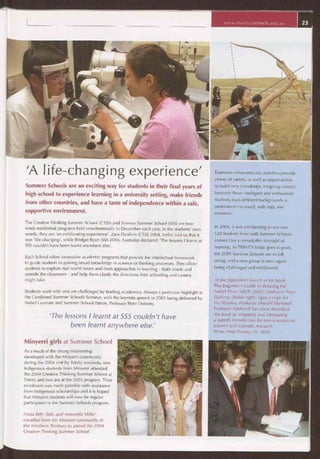
  • 8.
    PP 411W 41111" o Partof the large audience of distinguished business and academic leaders at the launch. The Gourlay Visiting Professorship of Ethics in Business gives Trinity students incomparable access to world-leading ethics experts, according to Professor Steve Salbu of the McCombs School of Business at the University of Texas. Launch of a world first Describing it as 'truly unique', Professor Steve Salbu launched the newly created Gourlay Professorship of Ethics in Business in front of an audience of distinguished business and academic leaders at the Melbourne Business School on 5 September. 'It is the first time that a college or university anywhere has endowed such a professorship,' the inaugural recipient said. 'Because the program will bring a different world-class ethicist to the College each year, undergraduates who spend several years in residence will now have access to a succession of leading ethics experts. There's nowhere else in the world where they could have that experience.' Professor Ian Harper, Executive Director of the Centre for Business and Public Policy at the Melbourne Business School (MBS) and inaugural Chairman of the Australian Fair Pay Commission, also welcomed the opportunities this Professorship creates for MBS students. 'This will not only enhance their learning experience but influence their outlook on business and its proper role in society,' he said. Speaking at the launch, John Gourlay described it as 'one of the most exciting days in our family's life — and also a proud one.' 'We are at the threshold of the subject of Ethics in Business becoming a tangible component of future teaching at the Melbourne Business School, the University of Melbourne and Trinity College, on a continuing basis. 'Steve Salbu, who is the first carrier of the torch, has agreed "to light the ethical fire in the hearts and minds of future students." We are thrilled that he will be our trail-blazer, as he has already demonstrated his charismatic style and the riveting manner in which he speaks to his subject,' John said. 'I guess there will always be a debate as to whether honesty can be taught, and that there will always be corrupt people. I agree that there is no way of teaching all people to be honest, but students can be taught to be aware of the attributes of honesty and moral business behaviour. 'It is our hope that the Gourlay Professorship of Ethics in Business will bring to future Australian tertiary students an emphasis on the three important dimensions of ethical behaviour: ethical awareness, ethical courage, and ethical leadership. The Gourlay Gift It took a man with a passion, a gift of $2.5million, and a leading US business ethicist to realise the launch of the Gourlay Visiting Professorship of Ethics in Business. Retired stockbroker and Trinity alumnus, John Gourlay (1954) was, in his own words, 'rocked to the core by the excesses of greed, fraudulent behaviour and the plain dishonesty which were perpetrated and flourished in the late 20th century.' Inspired by his belief that 'the exercise of uncompromising integrity and morality, as well as being intrinsically desirable, delivers improved and more certain business outcomes', John and his wife Louise decided to endow a visiting professorship that would promote the teaching of ethics in business to future leaders of the corporate world. Knowing Trinity College to be 'a serious educational institution which pursues excellence and produces leaders', John and Louise made an inspiring gift of $2.5million to establish a trust fund at Trinity. Its purpose is to bring an internationally distinguished lecturer to teach ethics in business jointly at Trinity College and the Melbourne Business School for one term each year. Following a worldwide search, Professor Steve Salbu, Associate Dean for Graduate Programs in the McCombs School of Business at the University of Texas, was selected as the inaugural Gourlay Visiting Professor of Ethics in Business. He visited Melbourne from 4 to 9 September this year for a week of lectures, seminars and events to officially launch the program. He will return in September 2006 to teach an intensive course to MBA students, give seminars and lectures, and engage informally with students at Trinity College.
  • 9.
    'You have createdsomething that will inspire many to reach their greatest potential' Professor Steve Salbu, writing to John and Louise Gourlay. Professor Steve Salbu leads the forum with resident students and tutors. 'Applied in our business life, these tenets will lead to greater achievements and successful business outcomes,' he said. John based his career on the family credo of 'To thine own self be true'; on the standard of ethics of the Institute of Chartered Accountants; on the Chinese proverb, 'Don't expect the early arrival of dreams'; and on the truism that 'No man is an island'. From these he forged a set of values and philosophies summarised in the Gourlay manifesto distributed to those at the launch. The Acting Warden of Trinity College, Dr Andrew Mc Gowan, noted the similarity between John Gourlay's beliefs and those of the great philosopher, Aristotle, who maintained that human beings seek both happiness (eudaemonia) and virtue (arete). While they must always seek virtue, happiness is itself most likely to come if virtue itself is pursued. 'I am struck by how our presence here tonight embodies the same principles and their relationship, 'Dr McGowan said. 'The vision of the Gourlay family for this remarkable gift includes the conviction that the pursuit of ethical behaviour is not only inherently right but will lead to good or happy outcomes for business itself. And Steve's engaging and exciting words remind us that this project is not only about the duty of proper behaviour, but also involves the excitement and enjoyment that comes with learning and discovery.' Copies of the Gourlay manifesto can be obtained from the Development Office development@trinity.unimelb.edu.au or Tel: +61 3 9348 71477 The full texts of John Gourlay's and Andrew McGowan's addresses are available via www.trinity.unimelb.edu.au/news/ Ethical hypotheticals A dynamic and energetic teacher, Professor Salbu engaged audiences at Trinity by inviting them to consider some challenging hypothetical scenarios. In the words of the Acting Dean, Mr Campbell Bairstow, these 'lit some fires of robust discussion' among students and staff as they dissected the moral and ethical aspects of such propositions. Consider these: To shoot or not to shoot? (Presented to resident students and staff at an informal, after-dinner forum on 6 September.) 'Imagine that, with all your knowledge of world history, you are handed a loaded gun and transported back through time to be confronted with a 3-month old baby Adolf Hitler. Do you take the opportunity to change the course of history and prevent the deaths of millions of people by shooting baby Adolf there and then? Or not?' What is the social responsibility of business? (Presented to a public lecture on 7 September.) 'You are the CEO of a company faced with an awful choice. You can save 100,000 lives, but in doing so you will create a short-term loss to your shareholders. Or you can generate a very large profit for those shareholders but only save 10,000 lives. What will you do?' A report of this lecture is at www.trinity.unimelb.edu.au/news/ Dame Elisabeth Murdoch and Sir John Holland attended the launch. Professor Steve Salbu (left) with John Gourlay Professor Ian Harper speaking at the launch prior to the public lecture at Trinity. at the Melbourne Business School. www.trinity.unìmelb.edu,au
  • 10.
    10 MAIN EVENTTRINITY Today December 2005 Masterminds Trinity attracts a bright constellation of some of the most interesting and innovative thinkers from around the world. During 2005, they included not only students, but also a select list of more than twenty of the world's great thinkers who came to the College as visiting scholars. All those chosen as visiting scholars are leaders in their own field — from art history to physics, genetics to law, economics to permaculture, and dentistry to anthropology. All took pleasure in imparting some of their knowledge to our students and tutors, whether over dessert and coffee in the Senior Common Room, at more formal College events and lectures, or in the comfort of the Junior Common Room. Professor Beth Noveck, Director of the Institute for Information Law and Policy at the New York Law School, and Professor Michael Taussig, Professor of Anthropology at Columbia University and one of the University of Melbourne's Miegunyah Fellows for 2005, enthralled students and tutors who participated in the Senior Common Room series of after dinner conversations — Professor Noveck exploring the cutting edge of law, the internet, online gaming, and democracy, and Professor Taussig recounting some of his experiences conducting research into shamanism and the intrusion of western culture among indigenous peoples in South America. On another evening, Dr David Lomas, Director of the AHRB Research Centre for the Studies of Surrealism and its Legacies at the University of Manchester, spoke on the art of Diego Rivera, the Mexican social realist artist. He also critically analysed some of the students' artwork entered in the intercollegiate art competition. Dr Susan Rodrigues met with teaching staff from all parts of the College to talk about her work at the Institute of Science Education in Scotland on the use of the internet to promote science education. Towards the end of the year, Professor Sankar Das Sarma, Director of the Condensed Matter Theory Center at the University of Maryland and another of the University of Melbourne's Miegunyah Fellows, met Physics students and tutors over dinner, and Bill Mollison, the founder of permaculture (an environmental design strategy taught around the world, with the aim of establishing integrated, self- sustaining systems for agriculture and human settlement) met with interested staff in Foundation Studies. Joe Gumbala — the University's Linga Narra Fellow, member of the seminal Aboriginal music group Soft Sands, and elder of the Yolngu people from Guliwin'ku in Arnhem Land — returned for a third consecutive year. The visit of the inaugural holder of the Gourlay Visiting Professorship in the Ethics of Business, Professor Steve Salbu of the University of Texas (see page 8), provided a wonderful demonstration of the capacity of the visiting scholar program to link Trinity's students, its staff, its wider community at the University of Melbourne and the world of business. Professor Salbu will return in 2006, but in common with all our academic visitors, he has taken away with him fond memories of his time at Trinity, his engagement with our students and staff, and the supportive and stimulating environment, of which he and all visiting scholars have formed an essential part. Dr Jon Ritchie Director of Academic Studies When Professor Sir James Mirrlees (Nobel Laureate in Economics, 1996) joined Professor Sir Clive Granger (Nobel Laureate in Economics, 2003) in the Junior Common Room one Sunday evening in April to talk about how they both came to the Nobel experience, it would not have been surprising if at least some of the students present felt inspired to set their sights on similar goals. The group talked late into the night in a most memorable academic engagement for students. Professor Sir Clive Granger, third from left, enjoyed meeting students and tutors in the Senior Common Room after dinner: from left, resident tutor in accounting and finance, Brett Considine; Keith Tan (3'd year Arts/Law); Michael Conn (3id year Engineering (Civil)/ Commerce); Christine Ye (l'' year Commerce); and resident tutor in economics, Hsein Kew. CV Highlights of our Global leaders SIMON PITT 2nd year Commerce/Law Age: 19 Home: Launceston, Tasmania Achievements & Awards • Top of the state in Year 12 (TER 99.95) • H1 average across all university subjects to date • Melbourne National Scholar • Trinity College National Scholarship • Trinity College Academic Awards x 3 • Duke of Edinburgh Gold Award • Trinity College Medal for Debating Community Service • Weekly volunteer at the Disablity Discrimination Legal Service • Volunteer work in Dili, East Timor • Fundraising for Eye Research Foundation Extra curricular involvement includes 2005 • General Member of the University of Melbourne Law Review 2004 • Grand Finalist in College debating • Grand Finalist in University of Melbourne Law School Junior Witness Examination 2003 • Attended youth forum on international affairs Sport • 2,d place, 2004 Melbourne Marathon, 18-19yo age group, (42.2km, 3h29min) • Trinity College swimming and cross country teams Current Employment • Research Assistant, Asian Law Centre, the University of Melbourne • Sales Consultant, Camera Action, Melbourne.
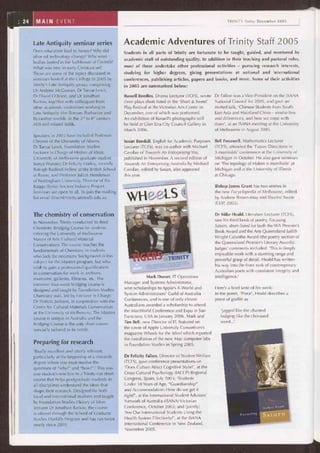
  • 11.
    www.trinity.unimelb.edu.au Phyl Georgiou reflectson the highlights of an 'empowering experience': 1 Global leaders: Simon Pitt (left) and Phyl Georgiou. Global Leaders Two resident students were among eight Australians in an international group of 100 outstanding students selected as 2005 Global Leaders by the US-based Goldman Sachs Foundation. This program aims to identify and develop some of the world's most promising future leaders, selecting them from over 70 of the world's top colleges and universities. Global Leaders are chosen for their demonstrated ability to address social problems, either globally or in their local communities, as well as for their outstanding academic achievements. Simon Pitt (2nd year Commerce/Law) and Phyl Georgiou (3rd year Commerce/Actuarial Studies) received their awards in Sydney in May. Phyl was also one of four Global Leaders from Australia selected to join forty-six others from around the world in New York in July to participate in a week-long program of 'Preparing for Leadership'. After a weekend at Columbia University focussing on self-discovery activities, participants spent the rest of the week meeting with prominent leaders from the private, public and non- profit sectors, and learning more about leadership and global issues. This included hearing from Vishakha Desai (CEO, The Asia Society), Philip Gourevitch (Editor of The Paris Review), Jim Kelly (Managing Editor, TIME Magazine), Ann M Veneman (Executive Director, UNICEF) and Lloyd Blankfein (President, The Goldman Sachs Group). The students were set daunting challenges by a variety of world leaders, while speakers shared insights into what it takes to reach the top and how to avoid the mistakes they themselves had made. Goldman Sachs Global Leader Phyl Georgiou outside the United Nations building in New York. ri Wednesday was without doubt the most inspiring day. After a short film on the life of Kofi Annan, two of his close colleagues discussed what made him such a natural and successful leader on the global stage. Then followed a guided tour of the United Nations and lunch with our respective UN Ambassadors — John Dauth dined with the four Australians. Unexpectedly, our lunch was interrupted by the news that Kofi Annan was to make a short appearance. With his five-minute speech he transfixed the normally confident and bold young global leaders into a state of awe and silence. It is hard to summarise a week of inspired learning and reflection into a few paragraphs. The week's hectic schedule passed in a blur of activity, but in a word, the week in New York was empowering. With forty-nine extraordinary new friends and a week of invaluable material to reflect on I am inspired to be all that I can be. Two quotes will forever distinguish my trip to America: 'To whom much is given, much is expected', and, 'You will only be remembered for your contributions, not your achievements'. There is no doubt much has been given to me and I hope that I don't waste my many privileges, including my amazing experience in America, only with achievements. I hope to continue to contribute to the broader society; those less fortunate not only expect it but deserve it. PHYL GEORGIOU 3rd year Commerce (Actuarial Studies) Age: 20 Home: Perth, Western Australia Achievements & Awards • H1 average for all university subjects to date • Australian Students Prize, 2002 • Economics & Commerce Faculty Scholarship, 2003-2007 • A C Morley Prize, 2003, for most meritorious 1st year BCom student • Watson Wyatt Actuarial Prize, 2003, for outstanding 1"year Actuarial student • Dean's Awards, Commerce, 2003, 2004 • Reginald Blakemore Scholarship, Trinity College, 2004 • Bohan Humberstone Cup, Trinity College, 2004 • Charles Abbott Scholarship, Trinity College, 2005 Community Service • Founder, President and Treasurer of Carlton Youth Football Club (see page 35) • Volunteer—Starlight: Make a Wish Foundation, Perth, 2003-2004 Leadership • President of TC Tech Committee, 2004 • Captain of TC Athletics Team, 2004, 2005 • TCAC Male Sports Representative, 2005 • Student Ambassador Leadership Program (SALP), University of Melbourne, 2004-2005 Sport • 2002 WA State Champion 100m, runner-up 200m, under 18 • 2001 Gold medal 4 x 100m Sydney Youth Olympics Entrepreneurship Founding partner of online business, Your Shutterbug.
  • 12.
    A spirit of 'modestaudacity' Dr Susan Lim's installation as the youngest and first Singaporean Fellow of Trinity College on 22 May was truly an international affair. More than fifty family members, friends, and colleagues of Susan and her husband, Mr Deepak Sharma, came from Bangladesh, Brunei, China, Hong Kong, Malaysia, Singapore and the USA, to join guests from around Australia in honouring this remarkable Trinity woman. Among the international guests was Brigadier General Peter M Dawkins who flew in from New York to be guest speaker at the dinner following the installation service. Previously one of America's leading military strategists and now Vice Chairman of the Citigroup Private Bank, General Dawkins was President of his West Point Class of 1959, at the top of his class in academics, and won the prestigious Heisman Trophy for the nation's most outstanding college football player. A Rhodes Scholar, he spent three years at Brasenose College, Oxford, and holds a Master of Public Affairs and a Doctorate from Princeton University. Asked by the Vietnam Veterans organisation to lead a $2 million fundraising drive in 1984, General Dawkins raised over $3.5 million in fourteen weeks. TRINITY Today December 2005 Dr Susan Lim joins a distinguished group of Trinity College Fellòws following her installation. From left rear, The Hon Clive Tadgell, AO, QC, Professor Robin Sharwood, AM, Mr Bill Cowan, Mr Alan Cuthbertson, Professor John Poynter, AO, OBE, and front, Rt Revd Dr Peter Hollingworth AC, OBE, and Professor Richard Larkins, AO. He spoke about 'Big Ideas' that have altered the direction of civilization. Citing the printing press, the Industrial Revolution, and more recently, the computer chip as examples of Big Ideas that 'have forcibly — and fundamentally — altered peoples lives the world over', General Dawkins believes that the next Big Idea is Biotechnology. 'But Biotechnology would not be — and cannot flourish — without inspired and dedicated scientists like Susan Lim,' he said. Guest speaker, Brigadier General Peter Dawkins. New medicine 'The field of medicine today is undergoing dramatic changes. Hospitals are working toward digital universal medical records with instant access to all images and data. Issues in regard to online access — such as safety and security — and online digital diagnosis, will need to be addressed. There will be explosive growth in tele-medicine with remote reporting of x-ray images already being outsourced to Indian hospitals. Teleproctoring, training and long distance specialist consultations are already currently available. Even remote telesurgery has already been accomplished in the landmark telesurgery operation conducted by surgeons in New York on a patient in France. Health screening programs in many countries facilitate earlier diagnosis of dreaded diseases such as cancer. And many new and exciting technologies for the treatment of early tumours, such as the cyberknife, cancer probes and magic bullets, and viruses which actually make us better, not worse, are just around the corner. As a result, hospital stay for the sick will be shorter and most treatment will be in an outpatient setting. Regenerative medicine and stem cell therapy will provide replacement tissues for muscle, heart, nerve, cartilage, bone, liver, and pancreas. The aged face will be plumped up overnight with stem cells that will recreate the fullness and volume lost with the years. Hair and teeth 12 MAIN EVENT Guests came from around the world to join Trinity students and staff in recognising the many relationships between Singapore and Australia at a dinner in the Trinity College Dining Hall on 21 May. This was the second in a series of dinners hosted by the College to promote international, intercultural and interfaith awareness. Guest speaker for the evening was Trinity alumna and Fellow, pioneering Singapore surgeon, and truly global citizen, Dr Susan Lim. She spoke of amazing possibilities created by 'the new medicine encompassing stem cell and gene therapy' and, with the aid of a short video, gave a fascinating insight into her use of robotic surgery. The following are edited excerpts from her address: 'I see Susan's most generous gift — to Trinity College and, indeed, to us all — as being her spirit. A spirit of what might be called, "Modest Audacity". A spirit that says: "Why not? Why shouldn't we change the world — and change it for the better? And why shouldn't I be one who steps forward, and helps lead the way!" 'It seems to me that's what being a Trinity College Fellow is all about.'
  • 13.
    www.trinity.unimelb.edu.au Embracing international students Thepresence of international students adds immense breadth to the education of Australian students, believes Professor Richard Larkins, AO, Vice-Chancellor of Monash University, and an alumnus and Fellow of Trinity College. Professor Larkins delivered the address at the installation of Dr Susan Lim as a Fellow of Trinity College on 22 May. This is an excerpt from his address: 'In choosing Susan Lim as its most recent Fellow, Trinity College has demonstrated once again the enormous richness of the Trinity community that comes from its embrace of students from other countries. We often hear that the high number of international students in this country results from the intent of schools and universities to maximise revenue, and that the presence of these students somehow impairs the education of Australian students. I would like instead to emphasise that the high number of international students in our colleges and universities gives a breadth of experience and intercultural understanding for Australian students of immense value in its own right. It is an exciting experience to travel through South East Asia and be greeted enthusiastically by innumerable prominent business people, professionals, bureaucrats and politicians who show obvious pride in having been educated in Australia. Their warmth to Australia is evident and underpins an enduring relationship that survives political differences — while Dr Mahathir was berating Australia and Australians, and Paul Keating was describing him as recalcitrant, trade, business, educational and research links were continuing unabated, very much aided by the personal bonds and networks developed during periods of education in Australia. Trinity College Foundation Studies has extended the College's long history of embracing international students and offering a trans-cultural educational experience. A brief resume of Susan Lim's achievements will demonstrate why both Monash University and Trinity College are so proud to call Susan Lim one of their most illustrious alumni. Dr Susan Lim Mey Lee brings distinction of the highest order to Trinity College and her appointment as a Fellow of the College is a fitting tribute. She has an outstanding record as a surgeon, as a medical researcher, and as a philanthropist. In addition, she is a natural leader of people and has set a wonderful example that Trinity students and alumni might seek in some small way to emulate.' See page 17 for more about Susan Lim. may be replaced, cardiac cells will repair damaged hearts, and patients with osteoarthritis will have access to new cartilage to resurface diseased joints. The differentiation of stem cells into nerves will enable repair of the spinal cord, fulfilling the late Superman's dream. There will be vaccines against rheumatoid arthritis, cancer, and perhaps a vaccine to prevent baldness, a cure for HIV and SARS, and gene therapy even for the common cold. All this is exciting, but when can this be made available to the public? Unfortunately, biotechnology is usually undersold, unlike digital technology which is always oversold. There are always ethical concerns, funding is hard to come by, and then there are patent issues. Also, this healthcare revolution brings with it social responsibilities. Healthcare costs have soared due to widespread use of expensive technology and the demands of an aging global population. What can we do? The answer lies in the education of our global citizens. The gap between rich and poor, be they nations, societies or individuals, has to be narrowed. There is no better tool by which to do this than through access to education.' From left, Dr Graeme Blackman, Chairman of the Campaign for Trinity, and Mrs Paulene Blackman, with Mr Deepak Sharma and his wife, Dr Susan Lim, at the Singapore—Australia dinner.
  • 14.
    Ali's story From mandatorydetention on Nauru to undergraduate residency at Trinity College - the power of philanthropy to transform lives was clearly evident when Ali Alamein (1st year Engineering/Science) proposed a toast to the Founders and Benefactors of the College at the annual commemoration dinner on 30 September. The following is an edited version of his story. The full text is available at www.trinity.unimelb.edu.au/news/ 'I was born in Iraq twenty years ago. However, to my disappointment, I never got to know my country. I had to leave Iraq when I was five because my father was a member of the Daaveh Party which was opposed to Saddam Hussein's actions. Because of this we had already lost a family member, my uncle, so we felt the danger and left Iraq for Iran. I grew up in Iran, went to school there and learnt their culture and way of living. I was deprived of many things in Iran as I did not have citizenship. I could not play in the basketball state finals and I missed a year of study when I worked at a friend's shop. At this stage my father left the country to come to Australia for various reasons. Working for a year at the age of fourteen was a really good experience, but that was not my goal in life. I wanted to study to be like my uncles. After a year I went back to study Year 9 — by bribing some officials. I continued working after school. After I finished Year 9, we left Iran to come to Australia. We went to Indonesia where we caught up with our smuggler. After three months of waiting, finally the time arrived for us to leave for the country of my dreams. We left Indonesia for Australia on 31 August 2001. We were picked up by the Australian Navy who took us to Nauru. We were the first group of people to be taken to Nauru along with the Afghani asylum seekers from the Tampa. My mother, three brothers and I had to stay in Nauru for fifty weeks until we were approved as genuine refugees. Having to spend one year in a detention centre under atrocious circumstances at the age of sixteen was a testing experience and soured my expectations of life in Australia. I had set goals and had always hoped Australia would be the place to fulfil them. Now — I was unsure. I arrived in Australia on 3 September 2002. We were reunited with dad in Shepparton. I did not know much English. I said 'yes' to everything people asked — or told — me without even knowing what they said. I started studying a week later at Wanganui Park Secondary College. I took all the hard subjects even though I didn't know what they were called. In one memorable chemistry test, I just memorised the answers for specific questions and copied the answers down wherever I thought the questions looked like the ones I had memorized — and I got the highest mark in the class. I was fortunate to be in an environment where I could achieve my goals. However, there was one thing that always put me off studying — my belief that no matter how hard I worked I would not make it to university due to my visa status in Australia. This idea really upset me and distracted me from my studies. So I just tried not to think about it. The person who helped me out with my application to RMIT also put in an application to Melbourne University for me, as he knew I wanted to go there. I thought I never stood a chance. 21 January 2005 at 2.33pm — I got a call from the University of Melbourne that made everything else possible — I was offered a scholarship. It was the very same day that I applied for a scholarship at Trinity College. Within a week I got a call saying that I had received the scholarship at Trinity. Before coming to Trinity College I didn't know what to expect. At first it was very scary. I did not know if I would fit in. On reflection, however, I think it was stupid of me to even think that. I have been here for seven months now and to be honest I have loved every single moment of it. In the past year, I have been heavily involved in College life. I have done things that I would never have considered doing in my life. Firstly, who would have thought I would play footy? Iraqis do not play this strange Australian 'sport'. I really loved it and was surprised to find out that I will be the 2nd XVIII Vice-Captain next year. Coming to Trinity has not only allowed me to mix with amazing people and chase my lifelong goals, but it has given me the opportunity to give back to the broader Australian society what it has given me. In particular, helping teach English to Sudanese students and playing soccer with young refugees through the Carlton Youth Football Club have been rewarding experiences because it was not so long ago that others were helping me.'
  • 15.
    www.trinity.unimelb.edu.au 15 Learning fromMinyerri This September marked the third visit to the Northern Territory by students involved in the Trinity College Indigenous Awareness Project. This community-focused program has been developed with the aim of furthering our collective understanding of Aboriginal culture and our awareness of the challenges posed by cross- cultural dynamics in Australia. The seven members of the College community involved this year found it deeply enriching; it was always fascinating, challenging, and inspiring. Central to the trip was the time we spent in Minyerri — a remote Aboriginal community with a population of approximately 500 people, located 270km south-east of Katherine — which Trinity students also visited last year. This was a particularly powerful experience. We were primarily based at Minyerri School, where we were involved in classroom activities with vibrant and friendly students of a range of ages. It was fascinating to be immersed in such a different culture. In particular, we experienced first-hand the children's extraordinary connection with their land, their deep nurturing respect for it, and their ability to see things in it that we could not. ... we experienced first-hand the children's extraordinary connection with their land, their deep nurturing respect for it, and their ability to see things in it that we could not. Our time in the community exposed us to issues related to public policy and Indigenous affairs. We discussed the challenges associated with the community's eighty-five percent unemployment rate, with the provision of funding and welfare, and methods of governance. We also talked about the complex act of balancing cultural sensitivity with the provision of economic opportunity and education in its Western context. In particular, we identified the strong need for Indigenous communities to be able to have effective choice and autonomy. Our experiences at Minyerri showed us that difficult cross-cultural issues do exist. At the same time, it revealed to us a culture that is vibrant and multifaceted, and made up of different but equally valid values to our own. Having now visited Minyerri for a second year, the College is hoping to establish a long-term connection with the community through the ongoing provision of Summer School scholarships for Minyerri secondary school students. The trip represents a powerful affirmation of the College's commitment to Indigenous education and community involvement, and the vision of Trinity as an 'outreaching' community. It was also a time of great personal growth and friendship. It showed us that if we are to be socially responsible and politically aware members of the community, we need to open our eyes to difference. In this way, we can come to recognise both the diversity and universality of human experience. Edwina Watson (2nd year Arts/Law) From left rear, Joe Clifford (151 year Commerce/Law), Michael Chapman (3rd year Arts/Science) and Edwina Watson (2^d year Arts/Law) with young friends at Minyerri. Photo: Geoff Golden Changing lives in North Queensland Another strand was added to the ties between Trinity College Theological School and Wontulp-Bi-Buya College in Cairns when the Revd Wayne and Valmai Connelly, together with three young Indigenous theology students, and representatives from the Diocese of North Queensland and the Anglican Board of Mission —Australia, visited Trinity in February. Staff and students here were moved by the visitors' personal stories of how their new-found Christian faith had dramatically influenced their lives. For the third successive year, theology students from Trinity have supported Wontulp's work in training Aboriginal and Torres Strait Islanders in theology and community leadership by serving as tutors for their intensive, two-week residential Diploma of Ministry program. During the September non-teaching period, Moira Evers and Philip Bewley participated fully in the life and work of the College, which operates as an extension centre of Nungalinya College in Darwin. The Revd Ross Fishburn (3rd from right) welcomed Valmai and Wayne Connelly (2^d and 3'd from left) and their students from North Queensland.
  • 16.
    16 MAIN EVENTTRINITY Today December 2005 A rich tradition takes tangible form - new portraits unveiled Trinity alumna and member of the College's Art Committee, Dr Alison Inglis is Senior Lecturer in the School of Art History at the University of Melbourne. At a dinner commemorating the Founders and Benefactors of Trinity College in September, she unveiled six recently commissioned portraits that now hang in the Dining Hall. The following is based on her commentary on the works, the artists and their subjects. 'When I was an undergraduate in Trinity in the 1970s, there were no portraits of women in the Hall — or indeed throughout the College. The first image of a woman — the College's great early benefactor, Janet, Lady Clarke — was not hung in this room until the early 1990s. The 301' anniversary of women's co-residency in Trinity last year focused attention on the history of women students in the College, which dates back not 30, but 120, years to the 1880s. Wishing to acknowledge the importance of women in the history of the College, the Art Committee decided to commission six portraits of eminent women associated with Trinity both past and present — and we turned to some of the most interesting artists in the country to achieve this ambition.' Fay Martes by Juan Ford Juan Ford is a well-known Melbourne artist whose extraordinarily realistic works are represented in many private and public collections. He has said that he seeks to 'paint beyond the crystalline detail of photography' and his works are characterised by their dramatic presentation of their subject matter. He won the prestigious Fletcher Jones Art Prize in 2004. Juan has depicted Fay Marles in her Chancellor's robes, seated in a pose somewhat reminiscent of Raphael or Titian. Fay Marles is probably best known as the Equal Opportunity Commissioner of Victoria between 1977 and 1987. She was also the first woman Chancellor of the University of Melbourne, appointed in 2001, after serving fourteen years as Deputy Chancellor and only stepping down as Chancellor this year. Fay Marles was a student at Janet Clarke Hall in the mid 1940s (when it was still a part of Trinity College). More recently she has advised and assisted the College in her current role as Special Advisor to the Vice- Chancellor on Indigenous Matters. This year, Fay Marles was elected a Fellow of Trinity College (see page 5). Dame Elisabeth Murdoch by Kristin Headlam There is almost a Mona Lisa-like quality to Kristin Headlam's painting of Dame Elisabeth, smiling enigmatically in the foreground, posed against the backdrop of her beautiful garden at Cruden Farm. Trinity alumna Kristin Headlam (TC 1975) is well-known in Australia for both her portrait and figurative work, and she won the Doug Moran Portrait Prize in 2000. Her work is often based on photographic images that she presents in a painted form as a means of drawing attention to the complex ways in which history and memory is visualised in our contemporary culture. Widely acknowledged for her long-standing and generous support of education, children's and women's health, youth welfare, medical research, and the arts, Dame Elisabeth Murdoch is also one of the great benefactors of this College. She has taken a keen interest in the College Choir, and in the Frank Woods Fellowship in the Theological School. A remarkable woman and a great supporter of both the University and the College, she was elected a Fellow of Trinity College in 2000. Dame Leonie Kramer by Judy Cassab Judy Cassab is one of that eminent group of artists and academics who left Europe to come to a new life in Australia following World War ll. Her work is represented in all state galleries, as well as the National Portrait Gallery, London. She has won the Archibald Prize and received many awards and honours for her work. Judy has painted Dame Leonie in the past and the sympathy between sitter and artist is very apparent in this portrait. Dame Leonie Kramer was a resident student of Janet Clarke Hall when it was still part of Trinity College in the mid-1940s. She went on to further study at Oxford University and her distinguished academic career has included posts at the University of Melbourne, St Hugh's College, Oxford, the University of NSW, Harvard University and the University of Sydney:She was Professor of Australian Literature at Sydney University for over two decades and was appointed Chancellor of that University in 1991. She has also been Chairman of the Australian Broadcasting Commission, and served many other organisations.
  • 17.
    www.trinity.unimelb.edu.au Lilian Alexander andMelian Stawell by Caroline Williams In painting two of the College's earliest women, New Zealand-born Melbourne artist, Caroline Williams, based the compositions on surviving 19th century photographs, but also sought to convey something of the passion and commitment of these extraordinary women. Dr Susan Lim by John Young Leading Australian artist John Young has an international reputation and is best known for his lyrical works that combine abstract elements of colour and pattern with images of people, landscape and ornamentation. Although he has often included the human form in his work, this is John's first portrait commission. At the sitter's request, he has shown Susan Lim in her surgical gown. She also asked him to include her surgical robot — 'Da Vinci' — within the portrait. The artist has ingeniously embedded it into the background pattern. Born in Singapore, Dr Susan Lim studied medicine in Melbourne on a Colombo Plan scholarship, and was a resident student at Trinity in the 1970s. She obtained her Fellowship of the Royal College of Surgeons of Edinburgh and a PhD in transplantation immunology from Cambridge, before returning to Singapore where she is a prominent surgeon and medical researcher. She performed Asia's first successful liver transplant in 1990, has pioneered robotic surgery, and is now leading research into the use of adult stem cells in search of a cure for diabetes. Voted by the Singaporean public as the role model for the 21 "century, Susan Lim was installed as a Fellow of Trinity College in May (see story page 12). Lilian Alexander was enrolled as a non- resident student of Trinity College in 1883 — 'the first woman admitted to any University college in Australia'. She was an outstanding student, receiving first class honours and graduating BA in 1886, and MA in 1888. She was also one of the first women medical students — having successfully led the campaign to admit women to the medical course. A leading surgeon, she was one of the founders and original staff members of the Queen Victoria Hospital and the Victorian Women's Medical Society. A marble sculpture in the University of Melbourne honours her pioneering role in the women's movement. ' ... to convey something of the passion and commitment of these extraordinary women.' Melian Stawell enrolled as a resident of the Trinity College Hostel (as the women's section was then known) in 1886. Another gifted scholar, she received First Class Honours for her BA degree at Melbourne, and went on to Cambridge where she achieved outstanding results in the so-called 'Classical Tripos'. Described as 'one of those rare individuals endowed with every gift' — she was a fine athlete as well as a brilliant student — she was a tutor at Newnham College, Cambridge, and became a notable classicist, author and internationalist, who worked for the League of Nations Union as a campaigner for peace. Caroline Williams is well known for her work's strong conceptual underpinning. From her whimsical landscapes peopled with eighteenth century figures to her series based on historical photographs of significant moments, she is always interested in revealing the complexity that lies beneath an apparently simple representation. She was particularly interested in this commission — and the College's wider aim to acknowledge appropriately the women who have contributed to its history. 'The way in which a community chooses to visualise itself and its past is very important. Trinity College has been involved with women students, graduates and academics for much of its long history, but it is only with this impressive series of portraits that this rich tradition has really taken a tangible visual form. I hope this new group of portraits will continue to fulfil its role — which is to inspire and shape Trinity's future identity.' Dr Alison Inglis
  • 18.
    18 MAIN EVENT AlexanderLeeper. 1:886 Creation of Trinity College Hostel for resident women students 1961 Janet Clarke Hall becomes an independent college Women at Trinity Women admitted_r( as non-resident students. Lilian Alexander was the first Trinity woman 1921 Trinity Women's Hostel re-named Janet Clarke Hall not (matte íf4alt mtlóln Ih~ flnlortn,41 DC 0,IbvNnr fecnice ~nfnlr IF,r ~nòepenaen ce et the ~iulle9e 1962-74 Women admitted to Trinity only as non- resident students A Time, TRINITY Today December 2005 Trinity was the first university college in Australia to admit women — a distinction it owes to the determination and vision of its first Warden. John and Marion Poynter tell the story: Leeper's legacy: the admission of women at Trinity 'It is but a question of time when women will be admitted to the ranks of the clergy. How the imagination reels at the thought of a female Archbishop of Melbourne.' Alexander Leeper, published in The Argus, 23 April 1913 Belief that women and men should have equal access to education was bred in Alexander Leeper. His mother, favourite daughter of a Dublin surgeon, was brought up to read widely, and to state her opinions as frankly as she chose. Though educated at home and destined for domesticity as wife of a clergyman, she gave similar encouragement to her daughters, and together they sent regular advice to her second son, Alexander, as Warden of Trinity College. 'The ladies over here are beginning to assert their independence. We have numerous Women's Rights meetings,' his sister Freda wrote; Jeannie, an older sister, who greatly resented that as a woman she was barred from higher education, made her views known to him, and more generally to readers of the Irish Times. Alexander needed no persuasion concerning the education of women. After women were admitted in 1879 to all Melbourne University courses except Medicine — a restriction Leeper helped overthrow in 1887 — he enrolled Lilian Alexander as a non- resident student of Trinity in 1883, despite opposition in the College Council. Thereafter Leeper took bold initiatives in the education of women, which the Council tolerated but scarcely supported. Overseas in 1884, Leeper returned determined to admit women to residence, for the first time in Australia. He housed them in Royal Parade, in a 'Hostel' which was nevertheless an integral part of Trinity College, whose academic and religious exercises the 'Hostiles' (as they came to be known) shared. Even Leeper's supporter Bishop Moorhouse warned that Trinity would lose squatters' sons to Ormond if their fathers thought them at risk of falling in love with penniless bluestockings. ('When a man like Bishop Moorhouse can offer such a reason,' Leeper remarked, 'can one wonder that the emancipation of women was so long delayed?') Leeper persisted, and succeeded, albeit slowly, since there were at first few women students to tempt into residence. Many thought him too inflexible in his plans; unwilling to surrender control, he habitually quarrelled with successive principals and with the Ladies' Council he recruited to support the Hostel. Leeper also fell out with those who wanted a wholly independent, non-denominational women's college, which he thought undesirable, arguing that 'there are the greatest possible advantages in bringing men and women together in their Collegiate life. To this the idea of a Women's College is fundamentally opposed.' He sought, in effect, academic co-residence by men and women living in adjacent buildings in a single college. This he achieved in 1891, when the Hostel moved into a substantial building in a corner of Trinity's grounds. Renamed Janet Clarke Hall in 1921, the Hostel was overwhelmingly Leeper's achievement, won against great odds. 1883 1886 1921 1961 1962-74
  • 19.
    e~a 1974 1978 19821983 1987 2005+ 1978 Margot Foster becomes the first woman on the TCAC 1983 Lisa Stewart is elected as the first female Senior Student As in the University, some 55% of Trinity's resident students are women 1974 Women admitted to Trinity on a fully co-residential basis. The first woman resident student was Romayne Holmes Dame Margaret Blackwood becomes Trinity's first female Fellow Leith Hancock becomes the first female Dean www.trinìty.unimelb.edu.au 19 Valentine Alexa Leeper, the oldest child in Alexander Leeper's second family, was his companion from her birth in 1900 until his death in 1934, and the champion of his beliefs and values all her long life. From him she inherited his deep interest in international politics, his devotion to classical scholarship, to the Anglican church and its doctrines (which, as he defined them, included the ordination of women) and above all his commitment to liberal education, especially collegiate, for women and men alike. All these causes she championed until her death at the age of 101 in 2001. All seven of the children from Leeper's two marriages received, at school and at home, a Classical training 'to cultivate mental and moral power'. Of the four girls, Valentine was the most dedicated student. In 1918, the year of her father's retirement, she enrolled in Science as a Trinity non-resident; transferring to Arts two years later, she gained Honours in several subjects. Valentine intended to teach, but it was thirty years before she did so. As with so many women, family duties came first; both parents, now living in South Yarra, were aging and ailing. Valentine became secretary to her still-busy father, involved in all the causes he still pursued; and after his death she and her sister Molly had to care for their mother, now blind. Valentine nevertheless found time to be part of an extensive network of women active in a large number of organisations, and, increasingly, she voiced her well-considered opinions publicly and very forcefully. Like her father, Valentine believed that Janet Clarke Hall should remain an integral part of Trinity College. When political circumstances made an amicable divorce expedient in 1961, she was fierce in her opposition. But she lived long enough to see both colleges become co-residential in the 1970s. Later, when an apprehensive local vicar called to warn her of the appointment of a woman curate, she responded 'And about time too!', in the best Leeper tradition. 'there are the greatest possible advantages in bringing men and women together in their Collegiate life.' Valentine Leeper, aged about twenty. A legacy in letters Valentine Leeper was a remarkable letter writer for nearly all of her 101 years (1900-2001). She left letters that range from childhood letters to her parents, through letters expressing views on many of the great issues of the 20th century, to letters in her last years which retain the vigour of opinion which was always her trademark. Marion Poynter, who knew Miss Leeper well, is now editing a selection of her letters for publication. They will reflect a life of extraordinary interest, casting light on a century of international and domestic politics, and issues in education, religion, society, and more. Trinity has had an unbroken line of women students, resident or non-resident, since 1883.
  • 20.
    ~i nuaaTMw „011 The supportfrom the University was excellent. We had three student guides (madrichim) who looked after our daily needs. These were senior students in undergraduate or post- Learning Hebrew - and more - in Jerusalem In January, under a scholarship from the Melbourne Chapter of the Friends of the Hebrew University, resident student Grace Sharon (4th year Theology) attended a Winter Ulpan (an intensive language course) to learn Modern Hebrew at the Hebrew University in Jerusalem. Here, she shares her experience with TRINITYToday: Grace Sharon at the Western (wailing) Wall in Jerusalem. In the Ulpan, we had approximately 192 students from thirty-four different countries. There were many Christians, laity and priests from many denominations, Jews from the Diaspora and those returning to Israel, Moslems from Israel and beyond, and some with no faith. It was an enjoyable learning experience, enhanced by our diversity. The six-week course involved classes five days a week, Sunday to Thursday. Teaching was only in Hebrew but if something was extremely important for us to grasp, it was also said in English. I am still amazed at how much vocabulary we learnt and how we were then able to use it in the street. The teachers took great pride in their teaching and made sure they gave us extra time for tutorials. We were tested three times a week on spelling, grammar and comprehension, plus an oral and written examination at the end. We were housed in various university colleges and hotels and I cannot stress enough how safe it was. If we didn't have a mobile phone on enrolment, we were asked to hire one so we could always be contacted in case of a security alert. A shuttle bus carried us door to door between our accommodation and our University building. graduate study, resident with us at the dorms. Each religion had its own advisers and there was a beautiful synagogue on campus. One of the joys for me was sitting in the classroom and being able to look out over the Jordan Hills; to sit there and wonder, because these were the very hills our ancestors walked over in the biblical stories. As well as study, there was much to do for soul and spirit. Tours were conducted to various places with biblical relevance, and others for pure joy. I took 'The Battlefields' bus tour to the place where David slew Goliath. Our tour guide explained to us how the Philistines came from the coastlands and how the Israelites came through the mountain valleys to reach the spot where David had triumphed. We travelled to the caves where the Jewish people were killed around the fall of Jerusalem in 70 AD. We climbed down the tunnels to these caves one by one. Sometimes it was so narrow, our feet had to go one way and our head another. We stopped at a place far underground where the Jewish people had hidden. the tunnels, right where we were standing. The Jews perished. I still don't know how to describe the feeling of being there and imagining the fire coming through the tunnels — numbness, anguish, anger, and a desire to stop the rage against the Jewish people. We went to the Jewish Quarter of the Old City, visited the Western Wall and experienced Prayers, and a Shabbat Dinner in the Orthodox Hotel where we were staying. These were well attended and helped us to understand the Jewish faith and traditions. One Friday night, all the students worked together and held our own Shabbat Dinner in the lift lobby of our hotel. It was a joyous occasion where Jewish young people led us in a time of revelation about their faith and how much it means to them. I was also involved at my end of the table talking about the Christian faith, not proselytising but sharing the sheer enjoyment of our faiths together. Jerusalem, the students I met, and the studies I did at the Hebrew University, meant for me a love for mankind like I had never experienced before. It changed my life forever. Here, they had to make a decision. Did they kill the babies so the Romans couldn't hear their cries, or did they obey the Torah and let them live? They let them live and eventually the Romans found them and threw fire down In December 2004 the College was honoured by the visit of the former President of Indonesia and leading Islamic Scholar, Abdurrahman Wahid. During the visit, arranged under the auspices of the Global Foundation, the Warden and the Rt Revd Dr Peter Hollingworth, Fellow of Trinity College, hosted a lunch-time discussion with him on interfaith relations. Abdurrahman Wahid with, left, TCFS Chaplain the Revd Kim Cruickshank, and the Warden, following the discussion at Trinity. (Adapted from an article published in Gesher 2005 - the official journal of the Council of Christians and Jews, Victoria.) The Warden has often quoted from Wahid's writings when stressing the importance of a 'large and liberal' education. Wahid argues that young Muslim students sent overseas to study technology and science, but lacking training in Islamic scholarship, often take a literalistic approach to the textual sources of Islam. On the other hand 'students studying liberal arts are rather better served when it comes to reflect on the place of Islam in the modern world'. (See TRINITYToday Vol 60, page 6.) Visit of Abdurrahman Wahid
  • 21.
    www.trinity.unimelb.edu.au 21 'The rippledflow of water' - set in glass Another layer of history has been added to the Chapel's ancient baptismal font with the recent installation of a stunning glass inset, commissioned from one of Australia's leading glass artists, David Wright. The stone font itself is characteristic of Norman design, and may be the oldest object of ecclesiastical craft still in use in Australia. It was built for the church of St Andrew at West Tarring, Sussex, England, and dates from at least 1584, though it could be much older. In 1829, it was removed by Thomas Henty who brought it to Australia where it was used successively in three Melbourne churches before being given to Trinity College Chapel in 1969. Wright has said the design of the glass inset 'symbolises the rippled flow of water leading to the "waterhole", with native animal tracks and human footprints pointing to the centre, at which there is an embryo, symbolic of new life, the waters of the uterus, and of course, baptism. A loose connection is thus made with both the carvings of native animals in the Chapel (on the pews and west face of the organ casing) and with the Henty family, as early pastoralists reliant on the presence of the water hole.' More information about the Chapel can be found in Trinity College Chapel: An Appreciation by Caroline Miley (1997). Copies are available in the rear shelves of the Chapel for use while visiting, or can be purchased online at www.trinity.unimelb.edu.au/ development/publication.shtml or from the Development Office, Tel: +61 3 9348 7477. A new glass inset for an ancient font. Chapel 'wrapping' As part of the worldwide Make Poverty History campaign, September 10 was nominated as 'White Band Day' — a day on which churches and other organisations were encouraged to promote awareness and raise funds for this cause. The Chaplaincy team decided that the College Chapel should wear its own 'white band' by wrapping it in 100 metres of white cloth. They were helped by theology students, members of Janet Clarke Hall, and resident students, including Outreach Committee members. This interpretation of the white band symbol, the purchase and display of a Campaign banner, signage in Royal Parade, and donations collected at a special College Eucharist on 5 September were all part of the College's support for this Campaign. Melbourne's windy spring weather forced the removal of the white cloth (which found its way to the Musical Society's props department) several days later, but the sight created considerable interest and discussion, and was an effective focal point for other Campaign initiatives at Trinity. All wrapped up: the Chapel with its 'white band' promoting the campaign to Make Poverty History, and some of the 'wrapping' team. Bread and water lunch As the world struggled to comprehend the enormity of the devastation and suffering in Asia caused by the tsunami, the Chaplaincy team at Trinity invited staff and students in all parts of the College to a Bread and Water Lunch on the Bulpadock on 2 March. Participants were asked to donate their usual lunch money — 'or a little more'— to the tsunami relief effort. In exchange, they were fed bread and water. Representatives from various relief agencies also provided information on the progress of relief work in the affected regions. Chaplain Richard Treloar talks with students at the Bread and Water Lunch.
  • 22.
    22 MAIN EVENTTRINITY Today December 2005 'Hushed' Choir helps Children's Hospital Lullabies and other calming melodies sung by the Choir of Trinity College will sooth young hospital patients after the Choir recorded a CD for the Royal Children's Hospital Hush Collection in September. What began as a music-driven desire to reduce stress for children, parents and staff in one section of the hospital has become the soundtrack of choice for other areas and developed into a fundraising project linked to twelve children's hospitals across the country. CD sales of The Hush Collection now exceed 15,000. 'People kept asking about what we were playing and saying it was beautiful and asking where they could get a copy,' says Catherine Crock, the doctor in charge of the day-operating theatre at the Royal Children's Hospital and producer of The Hush Collection music. The Trinity College Choir was approached about the project after the 2004 Carol Services. After much planning and discussion, the recording dates were set for the mid-semester break in September 2005, and new repertoire (different from the usual Sunday fare!) was learned. Fortunately, harpist Marshall McGuire was in Melbourne for concerts at that time, and was happy to accompany three of the tracks, while Jonathan Bradley provided piano accompaniments for a further six. One track combines harp and piano — an arrangement of Brahms's Cradle Song for upper voices. The CD is expected to be released in the first half of 2006. The Choir sings 'Carols in the Cathedral'. The Choir's performance of the Fauré Requiem and Christopher Willcock's setting of the Miserere (Psalm 51) was a sell-out at the Port Fairy Spring Music Festival early in October. This program was repeated in the College Chapel on 22 October, together with the first concert performance of my new double choir setting of the Magnificat. Further recording sessions for the ABC in late November and early December preceded the Choir's preparation of repertoire for the 2005 Carol Services. The 'Carols in the Cathedral' is fast becoming an integral part of Christmas in Melbourne. It regularly draws a capacity congregation in St Paul's Cathedral and allows the Choir to be heard and appreciated by a far wider audience than is possible in the Chapel. Rounding off the Choir's year is a return appearance at Government House as part of the final Christmas in office of Governor and Mrs Landy. Plans for 2006 include a projected visit to Perth in the middle of the year as well as the launch of The Hush Collection CD. Michael Leighton Jones, Director of Music Arguments to improve the mind Professionals in all fields must be able to understand, evaluate, communicate — and indeed, construct — complex arguments. To help develop these skills, Advanced Reasoning and Analysis (ARA) workshops are run in conjunction with Austhink — a Melbourne-based group with expertise in critical thinking — several times a year in Trinity's Multimedia Classroom. To date, the workshops have benefited decision makers and senior figures from the business, legal, professional, and public sectors, as well as entrepreneurs and academics. Expert and engaging facilitators use stimulating case studies, and innovative software tools for constructing and analysing argument maps, enabling users to refine their core thinking abilities. Stay tuned, as an exciting program of courses is planned for 2006! To learn more about Summer Schools or ARA Workshops at Trinity College, visit www.trinity.unimelb.edu.au/or contact Mr Vincent Ramos, Tel: +61 3 9348 7486 Email: summerschool@trinity.unimelb.edu.au
  • 23.
    www.triníty.unimélb.edu.au Minyerri girls atSummer School As a result of the strong relationship developed with the Minyerri community during the 2004 visit by Trinity residents, two Indigenous students from Minyerri attended the 2004 Creative Thinking Summer School at Trinity and two are at the 2005 program. Their enrolment was made possible with assistance from Indigenous scholarships and it is hoped that Minyerri students will now be regular participants in the Summer Schools program. Linda Billy (left) and Antonella Millar travelled from the Minyerri community in the Northern Territory to attend the 2004 Creative Thinking Summer School 'A life-changing experience' Summer Schools are an exciting way for students in their final years of high school to experience learning in a university setting, make friends from other countries, and have a taste of independence within a safe, supportive environment. The Creative Thinking Summer School (CTSS) and Science Summer School (SSS) are two- week residential programs held simultaneously in December each year. In the students' own words, they are 'an exhilarating experience'. Zara Ebrahim (CTSS 2004, India) told us that it was 'life changing', while Bridget Ryan (SSS 2004, Australia) declared: 'The lessons I learnt at SSS couldn't have been learnt anywhere else'. Each School offers innovative academic programs that provide the intellectual framework to guide students in gaining broad knowledge in science or thinking processes. They allow students to explore real world issues and fresh approaches to learning — both inside and outside the classroom — and help them clarify the directions their schooling and careers might take. Students work with and are challenged by leading academics. Always a particular highlight is the Combined Summer Schools Seminar, with the keynote speech in 2005 being delivered by Nobel Laureate and Summer School Patron, Professor Peter Doherty. 'The lessons I learnt at SSS couldn't have been learnt anywhere else.' Extensive extracurricular activities provide plenty of variety, as well as opportunities to build new friendships. Ongoing contact between these intelligent and enthusiastic students from different backgrounds is maintained via email, web logs, and reunions. In 2004, it was exhilarating to see over 120 students from both Summer Schools connect for a remarkable fortnight of learning. As TRINITYToday goes to print, the 2005 Summer Schools are in full swing, and a new group is once again being challenged and exhilarated. At the September launch of his book The Beginner's Guide to Winning the Nobel Prize (MUP, 2005), Professor Peter Doherty (below right) signs a copy for the Warden, Professor Donald Markwell. Professor Mark well has since described the book as 'engaging and stimulating - a superb introduction for non-scientists to science and scientific research.' Photo: Peter Pockley (TC 1954)
  • 24.
    TRINITY Today December2005 Late Antiquity seminar series Does education lead to heresy? Why did olive oil technology change? Why were bodies buried in the bathhouse at Corinth? What was new in early Christian art? These are some of the topics discussed in seminars hosted at the College in 2005 by Trinity's Late Antiquity group, comprising Dr Andrew McGowan, Dr Tamar Lewit, Dr David O'Brien, and Dr Jonathan Barlow, together with colleagues from other academic institutions working in Late Antiquity (the Roman, Barbarian and Byzantine worlds, in the 3"d to 8t" century AD) and related fields. Academic Adventures of Trinity Staff 2005 Students in all parts of Trinity are fortunate to be taught, guided, and mentored by academic staff of outstanding quality. In addition to their teaching and pastoral roles, most of these undertake other professional activities — pursuing research interests, studying for higher degrees, giving presentations at national and international conferences, publishing articles, papers and books, and more. Some of their activities in 2005 are summarised below: Russell Beedles, Drama Lecturer (TCFS), wrote Dr Fallon was a Vice-President on the ISANA three plays short-listed in the 'Short & Sweet' National Council for 2005, and gave an Play Festival at the Victorian Arts Centre in invited talk, 'Chinese Students from South December, one of which was performed. East Asia and Mainland China — similarities An exhibition of Russell's photographs will and differences, and how we cope with be held at Glen Eira City Council Gallery in them', at an ISANA meeting at the University March 2006. of Melbourne in August 2005. Speakers in 2005 have included Professor Chrysos of the University of Athens; Dr Tamar Lewit, Foundation Studies Lecturer in Charge of History of Ideas; University of Melbourne graduate student Sonya Wurster; Dr Felicity Harley, recently Raleigh Radford Fellow at the British School at Rome; and Professor Julian Henderson of Nottingham University, Director of the Raqqa (Syria) Ancient Industry Project. Seminars are open to all. To join the mailing list email tlewit@trinity.unimelb.edu.au The chemistry of conservation In November, Trinity conducted its third Chemistry Bridging Course for students entering the University of Melbourne Master of Arts (Cultural Material Conservation). The course teaches the fundamentals of Chemistry to students who lack the necessary background in this subject for the Masters program, but who wish to gain a professional qualification in conservation for work in archives, museums, galleries, libraries, etc. The intensive four-week bridging course is designed and taught by Foundation Studies Chemistry staff, led by Lecturer in Charge Dr Patricia Jackson, in cooperation with the Centre for Cultural Materials Conservation at the University of Melbourne. The Masters course is unique in Australia and the Bridging Course is the only short course specially tailored to its needs. Preparing for research 'Really excellent and utterly relevant, particularly at the beginning of a research degree where you must resolve the questions of "why?" and "how?".' This was one student's reaction to a Trinity-run short course that helps postgraduate students in all disciplines understand the ideas that shape their research. Designed for both local and international students and taught by Foundation Studies History of Ideas lecturer Dr Jonathan Barlow, the course is offered through the School of Graduate Studies Upskills Program and has run twice yearly since 2003. Susan Bendall, English for Academic Purposes Lecturer (TCFS), was co-author with Michael Carolan of Towards An Enterprising You, published in November. A second edition of Towards An Enterprising Australia by Michael Carolan, edited by Susan, also appeared this year. Mark Dorset, IT Operations Manager and Systems Administrator, won scholarships to Apple's X-World and System Administrators' Guild of Australia Conferences, and is one of only eleven Australians awarded a scholarship to attend the MacWorld Conference and Expo in San Francisco, USA in January 2006. Mark and Tim Bell, new Director of IT, featured on the cover of Apple University Consortium's magazine Wheels for the Mind which reported the installation of the new Mac computer labs in Foundation Studies in Spring 2005. Dr Felicity Fallon, Director of Student Welfare (TCFS), gave conference presentations on 'Does Culture Affect Cognitive Style?', at the Cross-Cultural Psychology (IACCP) Regional Congress, Spain, July 2005; 'Students Under 18 Years of Age, "Guardianship" and Accommodation: How do we get it right?', at the International Student Advisors' Network of Australia (ISANA) Victorian Conference, October 2005; and (jointly) 'Are Our International Students Using the Health System Effectively?', at the ISANA International Conference in New Zealand, November 2005. Bell Foozwell, Mathematics Lecturer (TCFS), attended the 'Future Directions in 3-manifolds' conference at the University of Michigan in October. He also gave seminars on 'The topology of Haken n-manifolds' at Michigan and at the University of Illinois at Chicago. Bishop James Grant has two entries in the new Encyclopedia of Melbourne, edited by Andrew Brown-May and Shurlee Swain (CUP, 2005). Dr Mike Heald, Literature Lecturer (TCFS), saw his third book of poetry, Focusing Saturn, short-listed for both the WA Premier's Book Award and the Arts Queensland Judith Wright Calanthe Award (the poetry section of the Queensland Premier's Literary Awards). Judges' comments included: 'This is deeply enjoyable work with a stunning range and powerful grasp of detail. Heald has written his way into the front rank of contemporary Australian poets with consistent integrity and intelligence.' Here's a brief taste of his work: in the poem, 'Piece', Heald describes a piece of graffiti as 'jagged like the chanted bulging like the chorused word...'
  • 25.
    Dr Paul Lee,Tutor in Medicine (resident), passed examinations for the Fellowship of the Royal Australasian College of Physicians (FRACP). He also contributed to two articles: 'Lymphocytic hypophysitis: a rare cause of hypoglycaemia in a man with Type 2 Diabetes' and 'Substance Abuse in Young Patients with Type 1 Diabetes — easily neglected in complex medical management', both in the Internal Medicine Journal, 2005. E3, 16. s.• 3. E..+,..A, L.A f;.L ;:d Ci I ......3.6e... Melâds 'VIItLIaI I4tCEC.oaid - 71a:e ',•'4 Melbourne .:1`.Wf.3 i'Oli.- i,L^lors1111 qL~~s a, 11,.... ..•,.l Local ÿe..rC.i^ - ~1 ;,s .. A'.( FCY 3 Lia E:) Li>?u,•r i. aeIACUIne wcancrIn :e Oarrl..r n rn.n•1• yUv i L y,.,W.+ eh r., now 1).S Min 1111.103 ~ !tN1): L.:1 . ecc.z üM..+" ,. v • . I Stephen Lew, Liaison Officer (International Students) (TCFS), has a degree in Information Systems from the University of Melbourne, and has practiced his skills developing a 'virtual noticeboard' website for students. The 'Melbourne Ads' website, www.melads. com.au/ went live in June and attracted over 28,000 hits within two months. Despite describing it as 'the most time consuming hobby I have ever undertaken', Stephen plans to continue adding features and services 'to make students' lives easier.' Dr Tamar Lewit, Director of Special Academic Projects and Lecturer in Charge of History of Ideas (TCFS), has contributed chapters on archaeology to three books: Late Antique Archaeology 4: Technology in Transition (Brill, in press); Dopo la fine delle ville. Evoluzione delle campagne tra VI e IX secolo. Documenti di Archeologia 40 (Società Archeologia, Padova, in press); and Byzantina Australiensia 2005 (Australian Association for Byzantine Studies, Melbourne, in press). Tamar also helped coordinate a Late Antiquity Seminar Series at Trinity in 2005. She presented on 'Invisible warlords and innovating peasants: An archaeological view of the changing countrysides in West and East in the 5th and 6th centuries AD' at its meeting in April (see story page 24). The Warden, Professor Donald Markwell, delivered a lecture entitled 'Education for our times' at St Agnes's Church, Glen Huntly, Melbourne, on 30 August, the full text of which is at http://www.trinity.unimelb. edu.au/publications/papers/abstracts. shtml#paper28 He has also contributed to The Oxford Companion to Australian Politics, and the Oxford Dictionary of National Biography. Jack Migdalek, Drama Lecturer (TCFS), wrote and directed Cho Cho San and the Cherry Blossom for the Victorian Arts Centre's Chookahs children's performing arts festival in October. This piece, presented in the Japanese 'Kamishibai' storytelling tradition, was based on Puccini's Madama Butterfly. The cast included Faye Bendrups, a former TCFS staff member. Dr Benjamin Namdarian, Tutor in Medicine (resident), graduated with a Postgraduate Diploma in Surgical Anatomy in September. He has been appointed an Honorary Fellow in the Department of Anatomy and Cell Biology in the University of Melbourne. The Revd Dr Ruwan Palapathwala, Noel Carter Lecturer in Pastoral Theology, has published: 'Ageing and Death: A Buddhist- Christian Conceptual Framework for Spirituality in Later Life', Journal of Spirituality & Religious Gerontology; Engaged Interfaith Dialogue: Sex, Desire and Companionship: Buddhist & Christian Interfaith Perspectives on Sexuality, Melbourne, CSIRID, 2005; and Samalinggika Sangwasaya Pilibada Bhaudda Ha Kithunu Dakma, Melbourne, CSIRID, 2005. He has co-edited The lntertextuality of the Holy Books, published in Kerala, India. Ruwan has presented at the Australian Association for the Study of Religion, University of Sydney; the Australian Missiology Conference, at Whitley College, Melbourne, in September; and the 2nd International Conference on Middle Eastern Spirituality and Peace, Edinburgh, in February. Clare Pullar, Director of Development, continued to serve as President of the Victoria and Tasmania Branch of the Association of Development and Alumni Professionals in Education (ADAPE). She also gave the key- note presentation at the South Australian Conference of ADAPE. Rosemary Sheludko, Director of Communications, was invited to present a session on 'Marketing and Communications' at the 2005 'Discover Development' course conducted by ADAPE at Methodist Ladies College, Melbourne, in June. Cathy Symington, Biology Lecturer (TCFS), performs in the Brazilian ensemble Borboleta, which played in this year's Melbourne Fringe Festival and featured in September on the Good Morning Australia program. The group's music is Brazilian — so Cathy has to sing in Portugese (although she doesn't speak it). The Revd Dr Richard Treloar, College Chaplain, participated in the World Council of Churches Faith and Order Standing Commission meeting in Crete in June. At the Society of Biblical Literature Congress in Philadelphia, in November, he presented a paper, "'Come Out and Stay Out": Homosexuality, Hermeneutics, and Schism in Anglicanism'. His PhD thesis has been accepted for publication in the Australian Theological Forum's dissertation series. Megan Warner, Tutor in Theology (resident), has had two articles published recently: 'Uncertain Women: Sexual Irregularity and the Greater Righteousness in Matthew 1', in Pacifica, and 'Genesis 20 — 22:19: Abraham's Test of Allegiance', in Australian Biblical Review. Dr Alexandra Williams, Lecturer in Charge of Music History (TCFS), received her PhD in Music from the University of Melbourne in August. Her thesis was titled, 'The Dodo was Really a Phoenix: the Renaissance and Revival of the Recorder in England, 1879-1941.' Her paper, 'Social Justice as a By-product: Instrumental Tuition for English Schoolchildren in the 1930s' was accepted for the National Conference of the Musicological Society of Australia. Rebecca Lucas, Literature Lecturer (TCFS), has written two commissioned reviews: Space and Place in Modern Fiction by Wesley A Kort, in Religion & Literature, and For Love of Matter: A Contemporary Panpsychism by Freya Mathews, in Environmental Values. She also spoke on 'Human Rights from an Earth-Based Ethic' at the Association for the Study of Literature and the Environment 2005 Conference, and was invited to give a seminar at the Victorian Schools' Colloquium in Critical Theory, both at Monash University. Rebecca is currently completing a PhD in the Centre for Comparative Literature and Cultural Studies at Monash. Evelyn Wee, Administration Coordinator (ICES), was awarded a scholarship to the European Business School in Germany as part of her studies for a Master of Applied Commerce degree at the University of Melbourne. Evelyn undertook a summer program at EBS on 'Global Governance in the 21" Century', including a study trip to Istanbul. Evelyn Wee (5"' from right) with fellow class members in the grounds of the European Business School in Germany.
  • 26.
    'Setting the pacein Australia' Driven by a desire to keep Trinity at the forefront of educational practice world-wide, late in 2004 the Board of Management established two committees to review student leadership models and Orientation and Transition programs at Trinity. Over the last ten to fifteen years, the profile of resident students at Trinity — and of students in other internationally focussed institutions around the world — has changed profoundly. Inevitably, this profile will continue to evolve as it mirrors our increasingly globalised economic, cultural, and political climate. Faced with such change, it has never been more important for educational institutions to regularly review what they deliver to students. - in Orientation and Transition As the first such review for some decades, the committee was encouraged to start from 'bare earth' to create the best policies and programs for a university college in the 21' century. Chaired by Clare Pullar — an educator with over thirty years' experience in secondary and tertiary sectors — the group looked at what was happening around the world in similar institutions and in the larger universities, both public and private. The review also included extensive consultation with all sectors of the Trinity community, and beyond. It was clear that everywhere, and particularly at the University of Melbourne and Trinity College, women and men are coming to university with increasingly higher expectations of equity in terms of gender, sexual orientation, religious and cultural understanding and acceptance, and socio-economic status. The committee's report— which the Board accepted without amendment— suggests a blueprint for future programs that could see Trinity's Orientation and Transition policy and programs setting the pace in Australia. Some of the key elements of the new policy include the notion that Orientation and Transition is a process which extends over some months and connects closely with individual mentoring of students. The new program, which will continue to evolve and develop over the coming years, requires dedicated and focussed leadership by trained staff and students thinking freshly and working together for the best outcomes for students. The report can be accessed on the College website at www.trinity.unimelb.edu.au/publications/ Fresher Breakfast on the Bulpadock, 0-Week 2005. Energy, enthusiasm, an engaging manner, and extensive educational experience in a collegiate environment — these are just some of the attributes that the incoming Dean and Deputy Warden of Trinity College, Dr Peter Tregear, will bring with him when he takes up his appointment in January 2006. Currently a Fellow of Fitzwilliam College, Cambridge, where he has been Director of Studies in Music since 2000, he holds Bachelor of Music (Honours), Master of Music, and Bachelor of Arts degrees from the University of Melbourne, and a PhD in musicology from the University of Cambridge. A tutor in Music at Trinity in 1993-95, and before that a resident student at Ormond College, Peter Tregear was a 'supervisor' (tutor) of undergraduates at King's College, Cambridge from 1996-98, and has also taught in the University of Melbourne, King's College London, and the University of Queensland. He is known as an outstanding and inspiring teacher who is passionate about encouraging students to set ambitious but achievable goals, and about helping them to realise those goals. With many fine orchestral and operatic productions to his credit, as well as a Cambridge Blue in athletics, and a silver medal from the 1998 British Universities Marathon Championships, Trinity's wide range of extra-curricular activities looks set to flourish under his guidance. Dr Tregear's research interests include both European and Australian music history and his book Ernst Krenek and the Politics of Musical Style is soon to be published in the United States. a 26 RESIDENTIAL COLLEGE TRINITY Today December 2005 'It has never been more important for Outstanding educator educational institutions to regularly review what they appointed Dean of Trinity deliver to students.'
  • 27.
    www.trinity.unimelb.edu.au Residential advisers — defininga different leadership role With their number increased from two to seven this year, the Residential Adviser Team — senior students selected for their outstanding personal qualities to assist staff members in providing pastoral care to resident students — were given room to define their own role within the residential community. They responded with well-considered innovation, demonstrating strong leadership by engaging with students through a successful and challenging series of discussion forums, dining expeditions that introduced students to international cuisines, and fun activities attractive to all students in Trinity's diverse residential community. Throughout the year, their maturity and thoughtfulness proved invaluable in aiding staff efforts to care for students wrestling with particular difficulties. Students' views: Ceri Lawley and Leanne Habeeb (3'd and 2^d from right) discuss leadership models with a student focus group in the Junior Common Room. - and in Student Leadership Over the past fifteen months, this review committee has been addressing such questions as: How can Trinity best help each student to realise his or her full leadership potential, now and in preparation for later life? What do we expect of our student leaders? Can we enhance the current student leadership structures and initiatives to reflect changes in the composition of the residential student body over the last decade? Can we achieve greater inclusiveness to ensure that as the student body continues to evolve, students are represented irrespective of their culture, gender, race, ethnicity, religion and sexual orientation? Chaired by Ms Ceri Lawley, a member of the Board of Management, the review has sought comments and submissions from staff, tutors, students, alumni and friends of the College. Models of student leadership at comparable educational institutions in Australia and overseas have been examined and current students engaged as fully as possible through small focus groups and interviews. Despite having very different personalities, these extraordinary senior students, who did not know each other well at the start of the year, beautifully demonstrated the capacity for strong-minded, intelligent, caring, and independent leaders to come together cooperatively and as equals, sharing leadership among all members of the group. Their dedication, energy, and good natures have inspired both students and staff members, reminding everyone at Trinity College that we live among a group of very exceptional and capable young people. Dr Leanne Habeeb Director of Student Welfare The 2005 Residential Adviser Team, from left: Dr Sally Dalton- Brown (Director of Mentoring), Tamara Vu (5th year Arts/Law), Anna Hood (4th year Arts/Law), Nicholas Ward (4th year Engineering/Commerce), Brieana Dance (3'd year Science), Lachlan Harrison-Smith (4th year Arts/Law), Lacey Laken (4th year Arts/ Law), Jeremy Nicholls (5th year Arts/Law), and Dr Leanne Habeeb (Director of Student Welfare). 1 Speaking of leadership ... Two Senior Students, past and present, offer their thoughts on student leadership at Trinity: Tim Foster (5th year Engineering/Law), Senior Student 2005-06 'There are a plethora of fantastic opportunities for students to develop leadership skills at Trinity.' 'Whilst there are positions that officially recognise student leadership, great leadership has also been shown by students in the development of such inspiring initiatives as the Sudalog Project (see page 36), and the Carlton Youth Soccer Club (see page 35).' 'A core leadership body should truly reflect the whole of the student body.' 'It is twenty-three years since the TCAC Committee was expanded from five to six members. We should continue to progress so that the TCAC Committee can function in the best interests of all members of the residential community.' Jeremy Nicholls (5th year Arts/Law), Senior Student 2002-03, Student of the Year 2004 'It's part of what makes the Trinity experience great — that so much is done by students for the benefit of other students. It's fantastic that within the College so many opportunities exist for people to take on leadership roles and to enrich the lives of their fellow Trinitarians.' While the review has yet to finalise its recommendations, it has generated invigorating and constructive debate, with strong contributions from all parts of the student body.
  • 28.
    Tim Foster receiveshis academic award from Professor Abernethy, watched by Dr Andrew McGowan. Nick Ward (in navy shirt) with students at Mastatal. NICHOLAS WARD 4'h year Engineering/ Commerce Born in New Zealand, Nick has also lived in Fiji, but moved to Melbourne with his family as a ten year old. He completed his first year at university before applying for residence at Trinity, so fully appreciates the difference that living in College makes to the undergraduate experience. 'The opportunity to socialise, play sport, participate in the arts and perform community service with people you live with is an absolutely awesome one,' he says. 'Trinity's great strength is the diversity of its students. This enables its residents to enrich their extra-curricular life many times over. Students are encouraged to extend their lives beyond their studies as they are likely to find other Trinitarians who share their interests.' Awarded the RA Must Scholarship in 2005, Nick has involved himself fully in College life, having captained the All-Stars football team and been a member of the Ball Committee, IT Committee, treasurer of Outreach and of the Brewing Society. This year he was also treasurer of the Intercollegiate Council. But Nick says serving as a Residential Advisor in 2005 has been 'the best thing I've done in College' and 'a real privilege'. TRINITY Today December 2005 Living in a global village Survival in a competitive world will require 'an ability to live in a global community', Professor Margaret Abernethy, Dean of the Faculty of Economics and Commerce, told students at the Academic Awards Dinner in September. 'You have an ideal opportunity as students at the University of Melbourne to develop the skills you will need to work in this global community,' Professor Abernethy said. 'With over 7,500 international students from more than 100 countries, the University of Melbourne is a global village with one of the largest and highest quality international cohorts in the world.' She urged all students to participate in international exchange programs or to undertake volunteer work in developing countries, 'so that you can experience first hand what it is like to live or study in another culture.' 'If you don't do it as a student, do it when you finish Uni. It will change the way you view the world and change the way you think — it is this experience that will equip you to live and work in a global community,' she said. Professor Abernethy presented Academic Awards to 76 students with first semester H1 averages. She also congratulated all students on achieving a College-wide average of 72% — describing this as 'very high indeed'. My experience in Costa Rica last summer was simply awesome. From December 2004 to February 2005, I was 'on project' with Youth Challenge International, an organisation which sends young Australians and Canadians to four countries with the goal of community and youth development. I chose to participate in an 'aqueduct' project, upgrading and extending the fresh water infrastructure of two communities: Zapaton and Mastatal in south-west Costa Rica. An indigenous community, Zapaton was particularly underdeveloped, with the older children having to travel by bus for two-and- a-half hours each way to high school. Local businesses were almost non-existent, and adults either worked on nearby plantations, or tended subsistence farms. Using only picks and shovels, our work was mainly reburying existing pipes — quite hard under the tropical sun! We also helped with extensions to the church, and with teaching and painting at the school. We were really well received by the local population, who were very poor but generally very happy; they invited us to birthday parties, a wedding, and a New Year party. A few even tried to teach us cooking! At 4pm every day, the entire town stopped to play 'mejenga' ('pick up' soccer) at the primary school. We tried to play as well, but with limited success. Our living arrangements were certainly cosy, with all fourteen members of our group sharing one small house, next-door to the only phone in the community. Mastatal was smaller but a little more developed. It had a sustainable living centre (owned and frequented by Americans) and commercially oriented local farms. As we were not the only white people, our presence had less impact on the community, but we did meet more people our own age. Our group became even closer here, with all of us sharing a single room — and a toilet and shower across the road. We helped out in a new National Park nearby and served as labourers for local farmers. This was fantastic because we were invited to share meals with them and meet their families. After work, the daily games of soccer (and even a bit of Frisbee) were great! The two individual highlights for me were Christmas and Australia Day. We celebrated both in style, all pitching in to cook. Both proved to be great group bonding experiences. Certainly, I have made wonderful lifelong friends and been strengthened by the experience, which I hope will shape my life in many ways, whatever the future holds. Nicholas Ward (4th year Engineering/Commerce) Two Trinity students who have already sampled life as volunteers in another culture — as Professor Margaret Abernethy (see story left) strongly encourages all students to do — look back on times they will never forget: Building aqueducts in Costa Rica
  • 29.
    www.trinity.unimelb.edu.au 'Ablefono' in Ghana InJanuary and February I had an amazing experience teaching at a small primary school in Dawhenya, a rural town in Ghana, West Africa, with a population of about 1,000. The town is situated 10 km from the Atlantic Coast (once host to the horrific slave trade to the Americas), and straddles the busy route linking the capital, Accra, and neighbouring country, Togo. Dawhenya is an incredible melting pot of languages (Dangme, Ashanti, English — albeit pidgin — and French), and religions (Christianity, Islam and traditional fetish religions), and is home to people from all over West Africa (Togo, Nigeria, Burkina Faso, Niger and Mali). For two months I was the local 'Ablefono' (white man in the local language) who taught English and Maths to classes five and six at Calvary Academy. The school was nothing more than a thatch roof, precariously held up by flimsy sticks. A blackboard was the only thing separating the classrooms, and there were no walls to keep out the thick black smoke from nearby burning rubbish, or the dry Saharan dust blown from the north by the hot Harmattan winds. The shade gave little respite from the stifling tropical heat and humidity; nor was this helped by an over-enthusiastic approach to lunchtime soccer games! Whilst there was only so much that could be taught in a two-month teaching stint, the learning process was two-way. For every word or mathematical operation I tried to teach the kids, I learnt something back — such as how to cook Banku, sing the Ghanaian national anthem, say hello in the local tribal language, or catch mudfish in the local swamp. Tim Foster, left, with students in front of their classroom, at Calvary Academy in Dawhenya, Ghana. Living conditions were extremely basic and few households had running water or sanitation facilities. Rubbish was strewn across the schoolyard and indeed all over the town — I later introduced to the school the first rubbish bin the students had ever seen. Yet this simple existence seemed to bring about a stress-free and relaxed attitude and the locals were incredibly friendly and generous, forever smiling and waving hello. Often complete strangers would insist on buying me a drink or paying for my Tro-Tro fare. The kids were absolutely brilliant and so much fun to teach. They were always so full of life and energy and they loved learning, like sponges soaking up every piece of knowledge. I'm sure now they know more about kangaroos and Australian Rules football than any other school in Ghana. Every night after school, dozens of students would come to my house for help with their homework. But it is sad to see the limited access children have to further educational opportunities. The need to find a job at an early age to earn money for the family takes priority; often male students would miss school to crack stones in the quarry or help their father catch fish, whilst the girls would help their mothers in the house. Very few of the students I taught will move on to secondary school, and even fewer (if any at all) will progress to studies at a university or technical institute — this is a luxury that is affordable only to a minority in Ghana. Tim Foster (5th year Engineering/Law) TIM FOSTER 5" year Engineering/ Law Tim entered Trinity this year following a semester studying on exchange at University College Dublin. There he lived in a hall of residence with about 180 exchange students from continental Europe, all with completely different backgrounds. 'It was not a college environment in the sense that there was no organised intercollegiate cultural or sports program, nor was there a student leadership structure. There was however a fantastic sense of community, with everyone cooking and eating and socialising together,' he says. Tim, who received the AJ Francis Prize for Engineering Statics in 2002, is the first recipient of the Randolph Creswell Engineering Scholarship. He has a University Full Blue in Australian Rules Football, and this semester played a starring comedy role in the College musical. Dux and Co-Captain of Caulfield Grammar School in 2000, Tim was elected Senior Student at Trinity for 2005-06.
  • 30.
    New awards Named inhonour of high-achieving former students, four new awards recognise outstanding current resident students: The Rohan Humberstone Cup is given in memory of young alumnus Rohan Humberstone, a brilliant medical student and outstanding sportsman who died in 2001. The Cup is to be awarded annually to the resident student who best combines outstanding sporting achievement — especially displaying good sportsmanship in one or more College teams — with outstanding academic achievement. Awarded in 2004 to Phyl Georgiou (then 2nd year Commerce/Actuarial Studies) and in 2005 to Meredith Moodie (3rd year Arts/ Science). The other three new awards are named after remarkable Trinity women of the late 19th and early 20th centuries — brilliant students who went on to careers of distinguished service —all of whom are listed in the Australian Dictionary of Biography. These awards are given to male or female resident students of the College on the basis of outstanding personal qualities. The Lilian Alexander Medal is named for the first woman student of the College (see page 17). Awarded in 2004 to Tamara Vu (then 4th year Arts/Law) and in 2005 to Nicholas Ward (4th year Engineering/Commerce). The Melian Stawell Medal is named for one of the first resident students in the women's section of Trinity (see page 17). Awarded in 2004 to Simon Atkinson (then 3rd year Arts/ Science) and in 2005 to Regina Tan (1" year Music). The Susie Williams Medal is named for an 1890s resident student of the women's section who was tutor in classics at Trinity in 1900 and head of the women's section in 1919. She became Principal of Women's College at the University of Sydney, later returning to Melbourne as founding head of what is now University College. Awarded in 2004 to Sana Nakata (then 4th year Arts/Law) and in 2005 to Brieana Dance (3rd year Science). More information about these three women is at www.trinity.unimelb.edu.au/ publications/womenattrinity/ At the presentation of the Rotary Club of Melbourne's Young Achiever Awards for 2005, from left: Governor John Landy, David Smerdon, Chris Lewin, and Club President, Anne Jacques. Young Achiever Awards For the third consecutive year, Trinity students were among recipients of the prestigious Rotary Club of Melbourne Young Achiever Awards. The Governor of Victoria, John Landy, presented yachtsman Chris Lewin (4th year Arts/Engineering) and chess champion David Smerdon (4th year Commerce/Science) with their awards in March. Chris, 21, received the Sir Albert Coates Award for his achievements as skipper of Team Melbourne Uni — believed to be the youngest team ever to enter the demanding Sydney to Hobart Yacht Race. Chris's exceptional leadership skills guided the entire project from initial idea to the team's safe arrival in Hobart, placing 3rd in their class, and 25th in overall line honours. In all, more than thirty Trinity students were directly involved in various aspects of the Team Melbourne Uni project. National Scholar David Smerdon, now 21, has won the Australian Masters, Queensland Open, and Victorian Open Chess titles. In 2004, he represented Australia in the World Under-20 Championships in India, and was also a member of the six-man Australian Men's team that competed in the 2004 World Chess Championships in Spain. Other Trinity students to have received Young Achiever Awards in recent years include: 2003 Ben Namdarian John Dethridge 2004 Cameron Rahles-Rahbula — also Young Victorian of the Year for 2004. www.trinity.unimelb.edu.au/news/ 2005 Student of the Year Anna Hood Anna has won multiple scholarships and Academic Awards, produced the College musical (West Side Story, 2004), served on the Outreach Committee and the production team for two College plays, represented students on the Orientation and Transition Review Committee, chaired the Music Theatre Society, and this year served as a Residential Adviser. In 2004 she received the College's Award for Outstanding Contribution to the Arts. But what Anna loves most about Trinity is the care and concern students show for one another. 'I love the communal living and the energy and drive people have here to do all sorts of things, whether it's organising social events for other students or being involved in a million and one different sports and activities,' she says. 'Living at Trinity has been without doubt the best part of coming to university. I arrived in Melbourne from Auckland, New Zealand, four years ago knowing no one. Trinity enabled me to meet a wide range of people and make some fantastic friends. It has become my second home.' Anna's strong interest in human rights and justice issues has also involved her in pro bono legal work at the Asylum Seeker Resource Centre, and internships with the Fulbright Symposium on Peace and Human Rights Education 2005, and the Melbourne Law School. This summer she will be competing as a member of Melbourne's Jessup International Law Mooting Team.
  • 31.
    www.trinity.unimelb.edu.au 'It's a dynamic environmentto live in and I've had the best time of my life...' 2004 Student of the Year Jeremy Nicholls (5th year Arts/Law) 'I've made some great friends, met some unforgettable characters and done some memorable things.' That's how Jeremy sums up his five years at Trinity. Along the way he has participated in almost every aspect of College life. Elected Senior Student for 2003-04, this year he has served as a Residential Advisor, manager of the College Bar, and secretary of the Cripps Middle Common Room. 'Particularly in my later years at College, I have really enjoyed the opportunity to have an affirmative influence in people's lives to help ensure their College experience is a positive and fun one,' he says. He has been a member of the Chapel Committee for five years, and in 2002 was president of the Billiards Room Committee, and a committee member for the Wine Cellar and Drama Clubs. He has performed in one College musical and four College plays, including taking the lead role of Stan in A Streetcar Named Desire. On the Trinity sporting field, Jeremy has captained the rugby, basketball and table tennis teams, and also played in the football, cricket and hockey teams. 'College sport brings people together, and its importance in establishing bonds of friendship should not be underestimated,' he says. Although from Adelaide, Jeremy now feels equally at home in Melbourne. 'All the shared experiences at Trinity create a tremendous sense of connection with the people with whom you live. It is this opportunity to get to know a whole range of interesting and talented people, in different activities and settings, that I have appreciated most from my time at Trinity.' 'I've made some great friends, met some unforgettable characters and done some memorable things.' 2004 Valedictorian of the Year Peter Hawkins (4th year Engineering/Science) Now undertaking a PhD in computer science at Stanford University in Palo Alto, California, Peter Hawkins received the Trinity College Medal for Outstanding Academic Achievement for three years consecutively, from 2001 to 2003. He was a Melbourne National Scholar and received a succession of University and College awards and prizes, not only for his exceptional academic performance, but also as a result of his broad involvement in extra- curricular activities. He joined the cast or crew of numerous College plays and musicals, was a successful cross-country. runner, served as a fire warden, and chaired the resident student IT Committee. In 2002, he was instrumental in developing the College's 'Trafficwatch' system — which tracks students' internet usage and bills them if they exceed their allocated quota — and co-authored a paper on that topic. Peter was also a much-valued member of the Choir and participated in two overseas tours. In 2004, despite the demands of his Science Honours year, he not only continued these activities but also co-authored a conference paper and a journal article on solving set constraint satisfaction problems. His provisional PhD topic is automatic software fault detection. Jayne Thompson and, right, Dougal Maclaurin 2004 Joint Academic Medallists Both are interstate National Scholars who enjoy maths and physics, and both won the Trinity College Medal for Academic Achievement in their first year at University. Jayne Thompson (2^d year Science), from Brisbane, was also on the 2004 Dean's Honours List in the Faculty of Science. Initially attracted to Trinity by its reputation for academic excellence, she says: 'It's a dynamic environment to live in and I've had the best time of my life getting to know the people in College.' In particular, Jayne has enjoyed the support and interaction with staff offered by the mentoring system at Trinity. Mindful of the difference such care makes, she in turn has been helping to tutor a Sudanese theology student this year. Jayne's long-term direction is unclear at this stage. 'I want to do something I am passionate about, but I don't know what that will be yet,' she says. Dougal Maclaurin (2^d year Engineering/ Science) won the 2003 Beazely Medal, awarded to the top Year 12 student in Western Australia and in 2004 won the Dwight's Award for the top 1st year physics student at the University of Melbourne. Originally a New Zealander, Dougal and his family have lived in Perth since 1996. He likes 'the people' and 'the feeling of community' that exists at Trinity. He was in both the College play and the musical in 2004, and this year has been president of the Fitzstaneith Polling Society. Dougal's future aspirations are straightforward and appealing: 'Do original research, live a joyous life, make people happy.'
  • 32.
    32 RESIDENTIAL COLLEGETRINITY Today December 2005 2005 SCHOLARSHIPS The College congratulates the following students who were awarded scholarships in 2005 and recognises, with gratitude, the individuals and foundations who have supported Trinity College by establishing scholarships. CHARLES ABBOTT SCHOLARSHIP (1986) Daniel Cowen (1st year Engineering/Science) and Phylaktis Georgiou (3rd year Commerce/ Actuarial Studies) RANDAL AND LOUISA ALCOCK SCHOLARSHIP (1927) Henrietta Zeffert (3'd year Arts/Law) LILIAN ALEXANDER MEDICAL SCHOLARSHIP (1999) Marissa Daniels (5t" year Medicine) MARY ARMYTAGE SCHOLARSHIP (1883) Sasa McMurray (1st year Commerce/Law) FREDA BAGE SCHOLARSHIP (2005) Grace Liu (1" year Biomedical Science) W J BANKS SCHOLARSHIP Meredith Moodie (3'd year Arts/Science), Emma Sandford (3rd year Arts (Media & Communication)/Law ) BERTHON SCHOLARSHIP (1886) Andrea Chong (2"d year Arts/Commerce), Cindy Huang (2"d year Information Systems), Charlotte Lau (3rd year Science/Law), Meredith Moodie (3rd year Arts/Science) REGINALD BLAKEMORE SCHOLARSHIP (1991) Julijana Baltinas (2"d year Optometry) EVAN BURGE ENTRANCE SCHOLARSHIP (1995) Stephanie Curnow (1st year Education — Early Childhood), Grace Liu (1"t year Biomedical Science), Briony Mackenzie (1St year Arts), Amanda Smythe (2 5d year Music) KATE CAMPBELL SCHOLARSHIP (2005) Gihan Wijetunga (1styear Medicine/Medical Science) MILTIADES AND ALKESTIS CHRYSSAVGIS SCHOLARSHIP (1995) Megan O'Connor (35d year Arts), Charlotte Walker (2"d year Arts), Henrietta Zeffert (3rd year Arts/Law) CHAMPION DE CRESPIGNY SCHOLARSHIP (2000) Ryan Atkinson (2"d year Medicine) CLARKE SCHOLARSHIPS (1880) Walter Chen (2nd year Commerce), Dina Daswani (2 5d year Biomedical Science), Geoffrey Golden (3rd year Commerce/Law), Allen Hsu (2nd year Biomedical Science), Blake Loughran (3rd year Engineering/Science), Edwina Watson (2"d year Arts/Law) RANDOLPH CRESWELL ENGINEERING SCHOLARSHIP (2005) Timothy Foster (5t"year Engineering/Law) ROBERT W H CRIPPS CHORAL SCHOLARSHIP (1994) Sophie Chapman (35d year Arts & Sciences) NANCY CURRY CHORAL SCHOLARSHIP (2001) Amelia Ballard (1" year Arts/Commerce) CYBEC NEWCOMERS SCHOLARSHIP Established in 2005 by Roger and Pat Riordan. Ali Alamein (1st year Engineering/Science) CYBEC SCHOLARSHIP (1995) Simon Griffiths (5" year Engineering/ Commerce), Zidi Zhao (2 5d year Commerce/ Prop & Construction) PETER DENNISON SCHOLARSHIP (2002) Nicholas Carter (2"d year Music) CONSTANCE ELLIS MEDICAL SCHOLARSHIP (2005) Georgina Lyons (3'd year Medicine) N H M FORSYTH CHORAL SCHOLARSHIP (1997) Alice O'Kane (3rd year Arts/Law) N H M FORSYTH ASSISTANT DIRECTORSHIP OF MUSIC SCHOLARSHIP (2001) Thomas Drent, BMus Melb SIMON FRASER SCHOLARSHIP Blake Loughran (3'd year Engineering/ Science), Stella Moretti (45" year Engineering/Science) THE FRIENDS' SCHOLARSHIP Set up by a group of people to assist an Indigenous student to study at the University of Melbourne and Trinity, recognising that the College community is enriched in every way by the presence of Indigenous scholars. This is currently a fixed term scholarship. Awarded to Joseph Clifford (1" year Commerce/Law) FULFORD RESEARCH SCHOLARSHIP Wen Xu (4t" year Medicine) JAMES GRANT ENTRANCE SCHOLARSHIP (2001) Amelia Ballard (1st year Arts/Commerce) R GRICE SCHOLARSHIP (1879) Laura Cashman (2nd year Creative Arts) PETER GODFREY CHORAL SCHOLARSHIP (2002) Paul E Tulloch (1St year Arts/Music) LEITH HANCOCK SCHOLARSHIP (1992) Amelia Ballard (1st year Arts/Commerce) C HEBDEN SCHOLARSHIP (1918) Timothy Molesworth (4t" year Arts) ELIZABETH HEBDEN SCHOLARSHIP (1942) Jennifer Greentree (2"d year Animal Science & Management) A J HERD SCHOLARSHIP (1996) Samuel McMahon (5t" year Arts/Law) ARTHUR HILLS SCHOLARSHIP (1987) Dougal Maclaurin (2"d year Engineering/ Science) KEN HORN CHORAL SCHOLARSHIP (2002) Gillick Bilson (2nd year Arts/Dip Modern Languages) MAURICE HURRY LAW SCHOLARSHIP (1982) Timothy Kern (4t" year Commerce/Law/Dip Modern Languages), Charlotte Lau (3rd year Science/Law) DAVID JACKSON SCHOLARSHIPS (1999 AND 2001) David Smerdon (4t" year Commerce/Science) F F KNIGHT SCHOLARSHIP (1993) Fergus Green (3'd year Arts/Law) ROBERT B LEWIS SCHOLARSHIP (1989) Julijana Baltinas (2"d year Optometry) IAN MCKENZIE MEDICAL SCHOLARSHIP (2001) Mark Cicchiello (6t" year Medicine) ELLA MCKNIGHT SCHOLARSHIP (2005) Jonathan Lim (1st year Medicine/Medical Science) A G MILLER SCHOLARSHIP Amanda Smythe (2"d year Music), Richard Vaudrey (4t" year Music) BRUCE MUNRO SCHOLARSHIP (1984) Akane Kanai (3'd year Arts/Law), Amanda Smythe (2"d year Music), Paula Fong (5t" year Science/Law), Lachlan Harrison-Smith (4t" year Arts/Law) and Richard Vaudrey (4t" year Music) BRUCE MUNRO ORGAN SCHOLARSHIP (1984) Jonathan Bradley R A MUST SCHOLARSHIPS James Balfour (5t" year Engineering/ Computer Science), Oliver Hodson (4th year Arts/Science) , Jonathon Holding (4t" year Commerce/Information Systems), Samuel Huang (5t" year Dental Science), Dinusha Kularatne (5t" year Medicine), Jeremy Nicholls (5t" year Arts/Law), Gareema Prasad (4th year Dental Science), Neha Shah Singh (4t" year Arts), Timothy Tai (4t" year Medicine), Nicholas Ward (4"year Engineering/ Commerce), Wen Xu (4t" year Medicine) OODGEROO SCHOLARSHIPS (2000 AND 2003) Lucy Nakata (3'd year Arts), Andreas Vorst-Hopkins (3rd year Arts (Media & Communications))
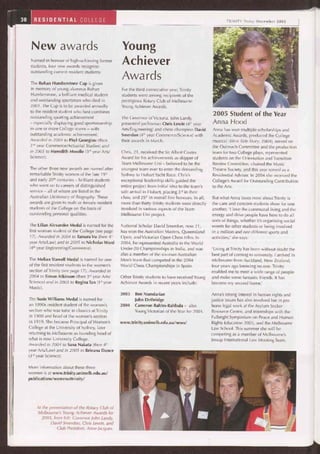
  • 33.
    www.trinity.unimelb.edu.au 33 2005 scholarships ALANPATTERSON INTERNATIONAL SCHOLARSHIP (2002) Kathryn Lee (1 "year Medicine/Medical Science) THE PERRY SCHOLARSHIP Timothy Molesworth (4th year Arts), Nicholas Carter (2"d year Arts/Music) S A F POND ENTRANCE SCHOLARSHIP Briony MacKenzie (1' year Arts) S A F POND SCHOLARSHIPS FOR COMMUNITY SERVICE Daniel Cowen (15t year Engineering/Science), Anna Hood (4th year Arts/Law) AGNES ROBERTSON CHORAL SCHOLARSHIP (1999) Kristy Biber (1st year Music) HELEN MACPHERSON SMITH TRUST SCHOLARSHIPS (1985) Timothy Kern (4th year Commerce/Law/Dip Modern Languages), Amanda Smythe (2"d year Music), Henrietta Zeffert (3rd year Arts/ Law) HELEN MACPHERSON SMITH TRUST CHORAL SCHOLARSHIP (1990) Fiona Scarlett (1"year Music) AMY SMITH SCHOLARSHIP (1985) Timothy Molesworth (4" year Arts) ANDREW SPRAGUE BURSARY FOR PHOTOGRAPHY AND ARCHIVES (1989) Elizabeth Shelton (2"d year Science/Diploma Modern Languages) R F STUART-BURNETT SCHOLARSHIP (1994) Laura Dooley (3t year Veterinary Science), Karina Harding (2"d year Veterinary Science), Jassia Pang (3'd year Veterinary Science) J H SUTTON SCHOLARSHIP (1925) Henrietta Zeffert (3'd year Arts/Law) A C THOMPSON SCHOLARSHIP Geoffrey Lang (3'dyear Engineering(IT)/Law), Thomas Rowland (4th year Engineering/ Science) TRINITY COLLEGE FOUNDATION SCHOLARSHIP (1996) Daniel Cowen (1st year Engineering/Science) TRINITY COLLEGE SENIOR SCHOLARSHIPS Simon Atkinson (4th year Arts/Science) TRINITY INTERNATIONAL SCHOLARSHIPS Win Bin Chew (2"d year Design & Planning), Ee Lin Ong (1tt year Medicine), Regina Tan (1st year Music), Christina Wong (1 "year Arts/ Science) TRINITY SCHOLARSHIP Martin Stradling (2"d year Computer Science), Kylie Telford (2'd year Science) TRINITY THEOLOGICAL SCHOLARSHIP (2004) Andrew Coleman (1 "year Master of Divinity), Robyn Boyd (3rd year Master of Divinity) DAVID WELLS LAW SCHOLARSHIP (1997) Tamara Vu (5th year Arts/Law) A M WHITE SCHOLARSHIP (1918) Daisy McGregor (2"d year Commerce) H L WILKINSON SCHOLARSHIP (1930) Brieana Dance (3rd year Science), Samuel McMahon (5th year Arts/Law) NERIDA WYLIE SCHOLARSHIP (2001) Simon Atkinson (4" year Arts/Science), Vanessa Ilicic (2"d year Arts/Law) SYDNEY WYNNE SCHOLARSHIP Allen Hsu (2"d year Biomedical Science) YORTA YORTA SCHOLARSHIP Established in 2004 by Dr George and Mrs Betty Hale and the S N Trust Fund to encourage and enable Indigenous students to study at the University of Melbourne and Trinity, recognising that the College community is enriched in every way by the presence of indigenous scholars. The Scholarship is named in honour of the Yorta Yorta nation whose people occupy the land now known as the Murray—Goulburn region. Awarded to Katie Cahill (1st year Physiotherapy) 2004 TRINITY NATIONAL SCHOLARSHIPS were awarded to the following first and second year students who received Melbourne National Scholarships: David Allen (1st year Science), Timothy Leung (1" year Science/Law), Grace Liu (1" year Biomedical Science), Daniel Ong (1" year Medicine/Medical Science), Caroline Wong (1" year Commerce/ Law), Chika Chandrashekar (2nd year Commerce/Law), Michael Chou (2"d year Medicine/Arts), Dougal Maclaurin (2" d year Engineering/Science), Simon Pitt (2"d year Commerce/Law), Jayne Thompson (2"d year Science), Edwina Watson (2"d year Arts/Law) www.trinity.unimelb.edu.au/res Year of 1955 honours John Ross-Perrier The 1955 Homecoming Weekend, held in June, saw the launch of the John Ross-Perrier Bursary, an initiative of the 1955 Year to celebrate the memory of their friend and former Senior Student of the College. John was an outstanding intelligence officer and served ASIO and his country with great distinction for twenty-six years. He is also remembered for significant contributions through community service roles. John died in 1997, aged 62. Gifts and pledges approaching $70,000 have already been made to this endowment fund, which will assist resident students who experience genuine financial hardship after commencing at College. Gifts have been received from John's Trinity contemporaries, family members and former ASIO colleagues. More information can be obtained from the Development Office, +61 3 9348 7116 development@trinity.unimelb.edu.au Another special feature of this 50-year reunion weekend was a superb musical recital given by fellow alumnus, internationally renowned flautist, John Wion (1955), and pianist Stephen McIntyre. Agnes Robertson Creative Arts Scholarship This new scholarship, to be awarded for the first time in 2006, will assist a financially disadvantaged, second or higher year scholar of exceptional merit, who has earned a place at the University of Melbourne or the Victorian College of the Arts in the field of music, art, dance or drama and who would not otherwise be able to study as a resident student. The Agnes Robertson Creative Arts Scholarship was established this year by the Trustees of the Estate of Agnes Robertson. Trinity College warmly thanks alumnus Martin Armstrong for his vision in bringing into existence this exciting scholarship. Yorta Yorta makes six Resident student Katie Cahill (lttyear Physiotherapy) from Echuca in northern Victoria, is not only the first recipient of the Yorta Yorta Scholarship, but is also a member of the Yorta Yorta people after whom the scholarship is named. The creation of this new scholarship brings to six the number of Indigenous scholars at Trinity this year. The College is determined to fully endow ten such scholarships and donors George and Betty Hale are keen to encourage others to join them in this transformational project. Indigenous vet graduates Trinity's second Indigenous scholarship recipient, Lilly Brophy from Yeppoon, Queensland, has just graduated with a Bachelor of Veterinary Science. She is only the second Indigenous graduate in the faculty's 97-year history.
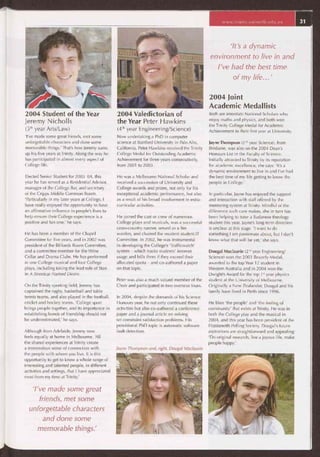
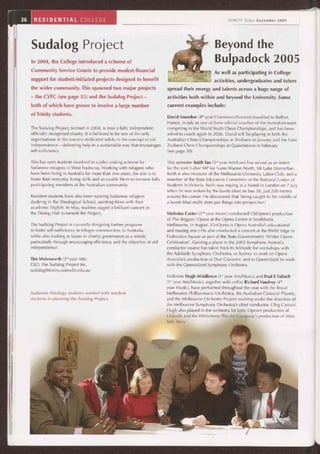
  • 34.
    34 RESIDENTIAL COLLEGE FACULTYOF SCIENCE Dean's Honours List Commencing Level: David Allen (1"" year Science) Undergraduate Level: Charlotte Lau (3rd year Science/Law) Reaching out A very real desire among current students to be involved in projects that benefit others is reflected in the exciting range of activities undertaken this year by Outreach, Trinity's student- run community service and development society. 2005 saw the launch of the Trinity tutoring program at Fitzroy Primary School, with around twenty Trinity students tutoring primary school students for an afternoon each week. Tutors were able to interact with different ages, social and cultural groups, while the students developed role models and received academic guidance. A visit by Father Michael Lapsley, a world renowned anti-apartheid activist whose arms were blown off by a letter bomb, inspired students with his remarkable story of courage and hope in the face of hatred, racism and violence. Playing sport against inmates of the Melbourne Juvenile Justice Centre forced students to leave their comfort zone and confront fears and preconceptions head on. Students are richer for the experience. Other highlights for the year have included organising a first-aid course for students, raising money for tsunami victims, supporting Daffodil Day, helping to 'wrap the chapel' to raise awareness of the Make Poverty History campaign (see story page 21) and sponsoring a child in Sri Lanka. While the year 2005 has seen community service become an integral part of student life, the future offers even more opportunities for participation in the community at all levels of commitment. Timothy Kern (4th year Commerce/Law/Dip Modern Languages), Outreach President Tamara Vu (5' year Arts/Law) works with a Fitzroy Primary School student as part of the Trinity tutoring program. An active contributor to the Chapel and Outreach Committees, she has also given continuous service as a fire warden, being deputy chief fire warden for the last three years. Her interest in the performing arts has manifested itself in back-stage, technical and production roles for a succession of College plays and musicals, including as assistant director and assistant producer. She has contributed to, and been sub-editor of, the Bulpadok literary journal, and was awarded the 2002 Franc Carse Essay Prize. She has twice won the intercollegiate writing competition for non-fiction prose. From Brisbane, Tamara believes 'living in a diverse academic community' has given her a broader education with 'opportunities and experiences I would never have had elsewhere.' 'I have particularly enjoyed the opportunity to engage with the community in a pastoral sense as a Residential Adviser this year,' she said. The recipient of a number of Trinity scholarships and Academic Awards, Tamara's outstanding personal qualities earned her the inaugural Lilian Alexander Medal in 2004. TRINITY Today December 2005 University Awards During Dr Leeper's Wardenship, Trinity College established a tradition of academic excellence that was evidenced in the large number of College students who won University prizes and scholarships. This tradition continues, with the following being among those whose academic achievements in 2004 have been recognised by the University in 2005: FACULTY OF ARTS Dean's Honours List Lilli Cooper (resident student 2003-04) Timothy Armstrong (2"d year Arts/ Engineering (IT)), Sally Davies (3rd year Arts/ Law/Diploma Modern Languages), Megan O'Connor (3rd year Arts), Huw Hallam (resident student 2001-04), Sarah Bolton (resident student 2000-03) FACULTY OF ECONOMICS AND COMMERCE Dean's Honours List Andrea Su Lynn Chong (2"d year Arts/ Commerce), Phyl Georgiou (3rd year Commerce/Actuarial Studies), Geoffrey Golden (3rd year Commerce/Law), Helen Hughson (2" year Arts/Commerce), Christopher Ingram (resident student 2003-04), Yi Zhou (TCFS 2002, resident student 2003) AC Whitlam Undergraduate Scholarship Stephanus Hieronymus (TCFS 2004) FACULTY OF ENGINEERING Dean's Honours List Ju-Han Soon (resident student 2003-04, TCFS graduate), Nicholas Mackenzie (resident student 2002-04), Dougal Maclaurin (2"dyear Engineering/Science), Christopher Ingram (resident student 2003-04) TAMARA VU 5th year Arts/ Law Entering Trinity on a scholarship in 2001, Tamara Vu (5th year Arts/Law) immediately involved herself in a range of cómmittees and service activities, a pattern she has followed throughout her five years at the College.
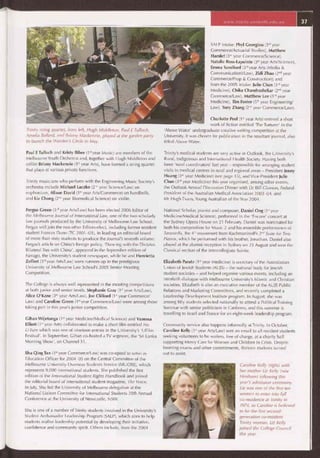
  • 35.
    www.trinity.unimelb.edu.au Carlton Youth FootballClub A community service initiative started by students of Trinity College, the Carlton Youth Football Club (CYFC) aims 'to create a competitive junior soccer club for the refugees of Carlton/Parkville Youth Centre to assist with their integration into Australian society (including the Trinity community), while developing their passion for the game and uniting their own community.' The CYFC committee formed as a result of a successful application by Phyl Georgiou (3'd year Commerce/Actuarial Studies) to the Trinity College Grants Committee in October 2004. The club subsequently applied to a number of organisations and was rewarded with grants in excess of $10,000. The Carlton Knights were the only team of the CYFC in 2005 and they competed in the Melbourne under-16 North, A Division. The eighteen team-members come from a variety of countries including Eritrea, Hungary, Somalia, Sudan, Turkey and Vietnam, with most players residing in government housing throughout Carlton. Made up entirely of resident students, the CYFC committee secured a clubhouse and home field, purchased uniforms, completed player registrations and organised transport to and from training and matches. Ably organised by Club secretary Jenny Huang (3'd year Medicine), committee members have found themselves playing all sorts of roles, including team manager, supporter, photographer, water boy and often indeed the role of the parent! The Carlton Knights with Trinity students Phyl Georgiou (2"d from left) and Ali Alamein (2"d from right). On the field, the Carlton Knights won five games, drew four and lost five, finishing mid-table. During the season Carlton drew 3-3 with the eventual winners of the competition, Bundoora. It was a tremendous effort for a new side, most of whose players had not previously competed in an outdoor season. A Club Awards Dinner held in the Trinity Dining Hall provided a happy conclusion to this first season. Having improved so substantially this year, players are now keenly anticipating the 2006 season. All those involved in running CYFC feel we are well on our way to achieving our goals and wish to thank our sponsors for giving us the opportunity to be involved in this worthy cause — the Victorian Multicultural Commission, the Adult Multicultural Education Service, The Foundation for Young Australians, On-Side Soccer, Vic Health, YMCA, Football Federation of Victoria, and of course Trinity. With the continued support of these organisations we foresee a bright future for the Carlton Youth Football Club with even bigger and better activities planned for season 2006 and beyond! Raymond Wu (2'd year Medicine) and Chika Chandrashekar (2nd year Commerce/Law), Carlton Youth FC Committee JENNY HUANG 3'd year Medicine Jenny lives in Brisbane, but was born in Taiwan and emigrated to Australia with her parents when she was ten. She believes that 'the more you become involved, the more opportunities arise as a result.' In College she has competed in table tennis, played flute in the orchestra — and fundraised — for the musical. But her main involvement has extended beyond Trinity. This year she was president of Outlook — the University of Melbourne Rural, Indigenous and International Health Society - a student organisation committed to raising awareness of the health needs of under-resourced communities, including rural and Indigenous Australia, and developing countries. Through the Red Cross Y-Connect program, Jenny has undertaken tutoring and sporting visits to the Melbourne Juvenile Justice Centre, and in January 2006 will serve as a leader for the Youth Diabetes Camp. But she has dedicated most of her energy — and hours of voluntary work — to her role as secretary of the Carlton Youth Football Club. Regarding her own upbringing as privileged, Jenny saw working with the young refugees as a way to broaden her perspective. 'Never in my life have I been so passionate about a project, and I have gained so much in the process,' she says.
  • 36.
    36 RESIDENTIAL COLLEGE SudalogProject In 2004, the College introduced a scheme of Community Service Grants to provide modest financial support for student-initiated projects designed to benefit the wider community. This spawned two major projects — the CYFC (see page 35) and the Sudalog Project — both of which have grown to involve a large number of Trinity students. The Sudalog Project, formed in 2004, is now a fully independent, officially recognised charity. It is believed to be one of the only organisations in the country dedicated solely to the concept of aid independence — delivering help in a sustainable way that encourages self-sufficiency. This has seen students involved in a pilot visiting-scheme for Sudanese refugees in West Footscray. Working with refugees who have been living in Australia for more than two years, the aim is to foster their everyday living skills and so enable them to become fully participating members of the Australian community. Resident students have also been tutoring Sudanese refugees studying in the Theological School, assisting them with their academic English. In May, students staged a brilliant concert in the Dining Hall to benefit the Project. The Sudalog Project is currently designing further programs to foster self-sufficiency in refugee communities in Australia, while also looking at issues in charity governance as a whole, particularly through encouraging efficiency and the objective of aid independence. Tim Molesworth (3'd year Arts) CEO, The Sudalog Project Inc. sudalog@trinity.unimelb.edu.au Sudanese theology students worked with resident students in planning the Sudalog Project. TRINITY Toda y December 2005 Beyond the Bulpadock 2005 As well as participating in College activities, undergraduates and tutors spread their energy and talents across a huge range of activities both within and beyond the University. Some current examples include: David Smerdon (4th year Commerce/Science) travelled to Belfort, France, in July as one of three official coaches of the Australian team competing in the World Youth Chess Championships, and has been asked to coach again in 2006. David will be playing in both the Australian Chess Championships in Brisbane in January and the New Zealand Chess Championships in Queenstown in February (see page 30). This semester Keith Tan (3rd year Arts/Law) has served as an intern for the state Labor MP for Narre Warren North, Mr Luke Donnellan. Keith is also treasurer of the Melbourne University Labor Club, and a member of the State Education Committee of the National Union of Students in Victoria. Keith was staying in a hostel in London on 7 July when he was woken by the bomb blast on bus 38, just 200 metres around the corner. He discovered that 'being caught in the middle of a bomb blast really does put things into perspective.' Nicholas Carter (2^d year Music) conducted OzOpera's production of The Beggars' Opera at the Opera Centre at Southbank, Melbourne, in August. (OzOpera is Opera Australia's educational and touring arm.) He also conducted a concert at the BMW Edge in Federation Square as part of the State Government's 'Winter Opera Celebration'. Gaining a place in the 2005 Symphony Australia conductor course has taken Nick to Adelaide for workshops with the Adelaide Symphony Orchestra, to Sydney to work on Opera Australia's production of Don Giovanni, and to Queensland to work with the Queensland Symphony Orchestra. Violinists Hugh Middleton (1" year Arts/Music) and Paul E Tulloch (1st year Arts/Music), together with cellist Richard Vaudrey (4th year Music), have performed throughout the year with the Royal Melbourne Philharmonic Orchestra, the Australian Classical Players, and the Melbourne Orchestra Project working under the direction of the Melbourne Symphony Orchestra's chief conductor, Oleg Caetani. Hugh also played in the orchestra for Lyric Opera's production of Orlando and the Whitehorse Theatre Company's production of West Side Story.
  • 37.
    www.trinity.unimelb.edu.au Trinity string quartet,from left, Hugh Middleton, Paul E Tulloch, Amelia Ballard, and Briony Mackenzie, played at the garden party to launch the Warden's Circle in May. Paul ETulloch and Kristy Biber (1st year Music) are members of the Melbourne Youth Orchestra and, together with Hugh Middleton and cellist Briony Mackenzie (1' year Arts), have formed a string quartet that plays at various private functions. Trinity musicians who perform with the Engineering Music Society's orchestra include Michael Laczko (2"d year Science/Law) on euphonium, Alison David (1st year Arts/Commerce) on handbells, and Liz Chong (2nd year Biomedical Science) on violin. Fergus Green (3rd year Arts/Law) has been elected 2006 Editor of the Melbourne Journal of International Law, one of the two scholarly law journals produced by the University of Melbourne Law School. Fergus will join the two other Editors-elect, including former resident student Frances Dunn (TC 2001-03), in leading an editorial board of more than sixty students to produce the Journal's seventh volume. Fergus's article on China's foreign policy, 'Dancing with the Dictator. Bilateral Ties with China', appeared in the September edition of Farrago, the University's student newspaper, while he and Henrietta Zeffert (3rdyear Arts/Law) were runners-up in the prestigious University of Melbourne Law School's 2005 Senior Mooting Competition. The College is always well represented in the mooting competitions at both junior and senior levels. Stephanie Gray (1st year Arts/Law), Alice O'Kane (3rd year Arts/Law), Joe Clifford (1st year Commerce/ Law) and Caroline Green (1st year Commerce/Law) were among those taking part in this year's junior competition. Gihan Wijetunga (1st year Medicine/Medical Science) and Vanessa Elliott (1st year Arts) collaborated to make a short film entitled No U-Turn which was one of nineteen entries in the University's'UFilm Festival'. In September, Gihan co-hosted a TV segment, the 'Sri Lanka Morning Show', on Channel 31. Shu Qing Tan (3rd year Commerce/Law) was co-opted to serve as Education Officer for 2004-05 on the Central Committee of the Melbourne University Overseas Students Service (MUOSS), which represents 9,000 international students. She published the first edition of the International Student Rights Handbook and joined the editorial board of international student magazine, The Voice. In July, Shu led the University of Melbourne delegation at the National Liaison Committee for International Students 20th Annual Conference at the University of Newcastle, NSW. Shu is one of a number of Trinity students involved in the University's Student Ambassador Leadership Program (SALP), which aims to help students realise leadership potential by developing their initiative, confidence and community spirit. Others include, from the 2004 SALP intake: Phyl Georgiou (3rd year Commerce/Actuarial Studies), Matthew Hamlet (3" year Commerce/Science), Natalie Ross-Lapointe (3rd year Arts/Science), Emma Sandford (3rd year Arts (Media & Communication)/Law), Zidi Zhao (2"d year Commerce/Prop & Construction); and from the 2005 intake: Julie Chan (3rd year Medicine), Chika Chandrashekar (2"d year Commerce/Law), Matthew Lee (3rd year Medicine), Tim Foster (5th year Engineering/ Law), Tony Zhang (2nd year Commerce/Law). Charlotte Peel (1" year Arts) entered a short work of fiction entitled 'The Torturer' in the 'Above Water' undergraduate creative writing competition at the University. It was chosen for publication in the resultant journal, also titled Above Water. Trinity's medical students are very active in Outlook, the University's Rural, Indigenous and International Health Society. Having both been 'rural coordinators' last year — responsible for arranging student visits to medical centres in rural and regional areas — President Jenny Huang (3rd year Medicine) (see page 35), and Vice-President Julie Chan (3rd year Medicine) this year organised, among other events, the Outlook Annual Discussion Dinner with Dr Bill Glasson, Federal President of the Australian Medical Association 2003-04, and Mr Hugh Evans, Young Australian of the Year 2004. National Scholar, pianist and composer, Daniel Ong (1 "year Medicine/Medical Science), performed in the 'Encore' concert at the Sydney Opera House on 21 February. Daniel was nominated for both his composition for Music 2 and his ensemble performance of Tarantella, the 4th movement from Rachmaninoff's 2nd Suite for Two Pianos, which he performed with his brother, Jonathan. Daniel also played at the alumni reception in Sydney on 25 August and won the Classical section of the Intercollegiate Soirée. Elizabeth Paratz (1' year Medicine) is secretary of the Australasian Union of Jewish Students (AUJS) — the national body for Jewish student societies — and helped organise various events, including an interfaith dialogue with Melbourne University's Islamic and Christian societies. Elizabeth is also an executive member of the AUJS Public Relations and Marketing Committees, and recently completed a Leadership Development Institute program. In August, she was among fifty students selected nationally to attend a Political Training Seminar with senior politicians in Canberra, and this summer is travelling to Israel and France for an eight-week leadership program. Community service also happens informally at Trinity. In October, Caroline Kelly (1st year Arts/Law) sent an email to all resident students seeking volunteers to be waiters, free of charge, at a charity ball supporting Mercy Care for Women and Children In Crisis. Despite looming exams and other commitments, thirteen students turned out to assist. Caroline Kelly (right) with her mother Liz Kelly (née Henham) following this year's admission ceremony. Liz was one of the first ten women to enter into full co-residence at Trinity in 1974, so Caroline is believed to be the first second- generation co-resident Trinity woman. Liz Kelly joined the College Council this year.
  • 38.
    38 RESIDENTIAL COLLEGETRINITY Today December 2005 A. TRINITY WOMEN'S SPORTS REP PRODUCTION IN ASSOCIATION WITH TCAC INC. TITLE: SPECTACULAR MOMENTS IN SPORT 2005 CAST: CAPTAINS, COACHES, TEAM MEMBERS, JESTERS, FRANK HENAGAN SET: THE BUL, UNIVERSITY GYM, YARRA RIVER, NAUGHTON'S HOTEL SCRIPT [Fade in. Long shot across the empty Bul. Voiceover begins.] 'Welcome to the Bul, site of many a Trinity sporting triumph. In 2005, this grass has been subject to the pounding feet of the soccer team, the grubby knees of the footballers perfecting their tackling techniques, the full impact of the softballers' bodies desperately diving for home base, and many other spectacular moments in Women's Sport.' [Close up shots of softballers/tennis players/ Nutri-Grain-eating supporters.] 'Early morning starts after 0-Week could not deter the tennis players who, despite fielding a very strong team, lost a tightly contested quarter-final. Concurrently, the softball team, full of new recruits, enthusiastically battled their opponents but were unable to progress past their initial pool games.' [Superimposed shot of bike-short clad athletes with muddier, zoot-suit-wearing rowers. Music: Eye of the Tiger.] 'Outstanding individual performances combined with inspiring efforts in the relays saw the Trinity women placing third in Athletics. Next, the rowing crews, who for weeks had risen at 5am, amazed the crowds on Regatta Day by revealing the guts and determination it takes to race. The women's first VIII came third and the second VIII came ninth.' [Zoom from bright banks of the Yarra to the sepia-toned, seventies-inspired Uni Gym.] 'The volleyball team, resplendent in long red socks and sweatbands, dominated in their pool matches and progressed through to the quarter-finals. While it was at the quarter-finals that this team ceded defeat, the formidable squash team, having improved immensely in the lead up to the competition, made it all the way to the Grand Final. Tying three rubbers apiece, Trinity disappointingly lost by three sets in a count-back. Displaying similar ability, the table tennis team reached the Grand Final without dropping a single match, yet were unfortunately beaten by a stronger opponent. The badminton team battled hard, the basketball team played resiliently, and the netball team, in new lycra dresses, put in their all in very tough matches against even tougher teams.' 'The hockey pitch was the arena where the soccer team practised their dribbling, headers and goal-kicking (and the TV room the arena for watching inspirational premier league highlights). Unable to convert their recently acquired skills on the match pitch, the team bowed out of the competition after two losses. The football team was also unable to come away with a win, but the weeks of spirited training were evident in the team's tackling, shepherding and goal scoring ability (breaking last year's drought!). More successful was the hockey team who played extremely well, as testified by their achievement of third place.' [Dramatic splash. Water covers camera.] 'Considering the brevity of the training season, the swimming team impressed with their stamina and dedication. The highlight of the evening's races was the freestyle relay, in which Trinity gained a place. More comfortable out of the water was the cross country team, whose superb running around Princes Park resulted in Trinity coming third.' [Full Shot. Bright sunshine. The Bul is full with people kicking footballs, throwing frisbees and tackling each other.] 'And so ends another great year of sport typified by enthusiastic team participation, dedicated training, and a lot of fun'. Thank you to each person who contributed to 2005's many Spectacular Sporting Moments. See you out on the Bul.' [Fade Out.] SCREENPLAY: MEREDITH MOODIE (3RD YEAR ARTS) WOMEN'S SPORTS REPRESENTATIVE CAMERA: PIP DUFFY AND LILY SHELTON ' Note: 7'h placing in the Holmes Shield inadequately reflects the talent and dedication of Trinity's very fine sportswomen. We'll show them next year!!
  • 39.
    www.trinity.unimelb.edu.au 39 Men's Sport2005 2005 was always going to be a challenging year for men's sport at Trinity after losing an incredible amount of talent, including two sportsmen of the Crescent. Despite this, the results have lived up to the Trinity standard thanks to a well-balanced combination of experienced seniors and fresher talent in most squads. Success has been particularly abundant in the non- traditional sports such as squash, volleyball and badminton. Special mention to the victorious rugby, squash and volleyball sides who proved too strong for their opposition. The rugby 7s squad, confident of retaining their title, breezed through the early rounds and managed to out-run JCH in the final. With a 31 — 0 victory against Ormond in the 15s, Trinity rugby once again had a successful year. The squash team progressed through their tournament dropping only a handful of sets, while the volleyball team, which included many members from the successful 2004 squad, were patient in their very close victory against Queen's in the final. Unfortunately this year saw the end of an era for our men's athletics team which was not able to defend its title, losing to a fit and talented Ormond side, but still finishing well ahead of the rest of the field in second. Results in badminton (2nd) and tennis (3'd) proved we could hold more than just a squash racquet. The hockey and soccer teams dominated their third and fourth playoffs to confirm, despite finishing third, that they had the talent to go all the way had results gone differently. Particular mention should be made of the seconds rowing crew who, although not winning their competition, finished third — an outstanding achievement for a second VIII. The result is testimony to the squad's hard work and determination. Beyond the sporting arena the Intercollegiate Sports Council (ICSC) has been busy preparing the calendar for next year. A rotational system has been adopted which sees many of the 'minor' sports being rotated biannually, with a group of 'core' sports remaining yearly fixtures. There is also potential for some racquet sports to be combined into mixed sports. The ICSC has spent much time deliberating the changes and, given our constraints, we believe the proposed calendar has achieved our objectives — notably to reduce the amount of sport played each year. Next year will be important for the future of Intercollegiate sport as an experimental run for the new system. 2006 will be a challenging year for Trinity sport considering the impending voluntary student union legislation, the changes to ICSC calendars, and the realisation that we may not be outright favourites to win the Cowan Cup. However, there were many encouraging results and performances which suggest the future of College sport is in good hands. The spirit in which all College sport has been played this year has been heartening and, despite struggling in some of the more traditional sports, the commitment shown was admirable. Unfortunately the good results were not enough to hold off both Ormond and Queen's who managed to keep pace with Trinity in the race for the Cowan Cup. In one of the tightest competitions for many years — with the final result depending on the very last event — Trinity was the unlucky one, finishing third, only a few points short of first place. Phyl Georgiou (3rd year Commerce/Actuarial Studies) Men's Sports Representative
  • 40.
    40 RESIDENTIAL COLLEGETRINITY Today December 2005 così Comedy, pathos, and memorable characters made for a highly successful 2005 College play, reports Cat Moroney (15tyear Arts): Any performance that is good enough to penetrate through a tediously small, angulated, square, glass viewing-space with dimensions really not worth mentioning, is certainly one that should be applauded. From my perch in the 'bio box', Così had me in continuous fits of laughter and entertained me night after night. If one standing ovation equates to a triumphant performance, Trinity College's 2005 production of Così surpassed this achievement by receiving numerous standing ovations over its April 26-30 season. Written by Louis Nowra, Così is classic Australian comedy at its best. The story begins with university student Lewis (Michael Levine, 1" year Arts (Media & Communications)), agreeing to direct the inmates of a Melbourne psychiatric institution in a theatrical performance. It is here in the institution that we unearth characters of all colours, shapes and forms: the slightly—eccentric—theatre—enthusiast Roy (Simon Atkinson, 4th year Arts/Science); pyromaniac—with—a- particular—inexplicable—fondness—for—burning—cats Doug (Alex Oppes, 3rd year Arts/Law); and institutional isationist-extraordinaire Cherry (Georgia Dunphy, 2nd year Arts/Law/Dip Modern Languages), just to highlight a few. However disparate these characters may be, they come together with a chemistry that enlightens the setting and draws out the comedic elements of the script. The transference from script to stage is a fascinating process. When thought about, the numerous possibilities for the interpretation of words on a page is astounding, considering they are just that — words. The script doesn't tell you how the character would speak, or move, or interact with others. It is when the actor brings his or her self to the character, and this is shaped and moulded by the director, that this process of interpretation comes to life. This aspect was of particular interest in relation to Trinity's performance of Così. Directed by Elizabeth Ryan, the characters thus created elevated the humorous side of the script and drew continuous laughter from the audience — not only spontaneous bursts, titters and giggles, but also good, solid, hearty, uncontrollable, involuntary laughter that continually had audiences rolling. But there were also a number of serious moments, their poignancy heightened by the sharp contrast with the preceding comedy. The beautiful ballet performed by the Dancer (Sarah Delamore, 1" year Architecture) and Nick (Gillie Bilson, 2nd year Arts/Dip Modern Languages) was one such memorable moment, while the tragic fragility of Julie (Rebecca Nyst, 3rd year Creative Arts/Law) was also intensified by the juxtapositioning of comedy and pathos. What an outstanding cast this was! Brilliantly sustained characterisations, like those of Zac (David Smerdon, 4th year Commerce/Science), and Henry (Sam McMahon, 5th year Arts/ Law), really rocketed this performance to success. The individuals' idiosyncrasies and interplay between the characters on stage were continuously authentic and gave audiences a convincing snapshot of the institutionalised world in which they resided. By the end of the performance you felt as though you really knew, and could relate to, these characters. I'm sure there is a little bit of Doug in all of us! There were many talented and enthusiastic people involved in this production, but a special thank you to producers Sally Davies, (3rd year Arts/Laws/Dip Modern Languages), and Brie Dance (3rd year Science), stage manager Stephanie Brotchie (2nd year Creative Arts) and lighting guru, Verena Tan (1" year Arts/Law). Congratulations to Trinity College and all the cast and crew of Così (I wish I could name you all but there isn't room!) who put in so much time to create a sensational and memorable production. A memorable collection of characters — the cast of Cos'. Photo: Lily Shelton r SIMON ATKINSON 4th year Arts/ Science For Simon Atkinson (4th year Arts/ Science), life at Trinity is 'definitely defined by the vibrant and communal atmosphere. Where else could you meet 270 people who are so talented, creative, and supportive?' he asks. 'But most importantly, Trinity is a community that fosters strong friendships between people from all walks of life.' Born in New Zealand, Simon has lived in England, Saudi Arabia, and now Melbourne, but he hopes to head overseas to study postgraduate chemistry — an interesting aspiration for the 2004-05 winner of the prestigious Menzies History Scholarship, which he eventually declined. Indeed, Simon has talents in many areas. He has held both faculty and Trinity scholarships throughout his time at university, and has consistently received Trinity Academic Awards. He has played hockey for the College, and been a volunteer tutor for the Sudalog Project (see story page 36). He has competed in intercollegiate debating, public speaking, and writing, and served on the Intercollegiate Activities Committee in 2004. But his greatest love is reserved for the stage, and especially what he calls 'my unhealthy obsession with musical theatre'. This has seen him treading the boards in every College play and musical, as well as superbly producing this year's musical. In 2003, he received the Leeper Award for Oratory and the Award for Outstanding Contribution to the Arts. Last year he was the inaugural recipient of the Melian Stawell Medal for outstanding personal qualities.
  • 41.
    www.trinity.unimelb.edu.au Reviewed by PeterCamp[< Union House Theatre, 31 August — 3 September 2005 Don't get me wrong; there was a lot that was great about the Trinity College Music Theatre Society's production of Frank Loesser's How to Succeed in Business without Really Trying. The singing was uniformly excellent, the acting was even better, the sets were spartan but innovative, and the entire premise of the story was intriguing; but as a whole, the show dragged on until after 11 o'clock, unhelped by unnecessary set changes without any covering music. A little more careful direction and a lot of tightening of the action (or, more precisely, of the inaction) and it would have been more than merely impressive. How to Succeed is a 1960s satire of big business and even bigger businessmen. Corruption, nepotism and sexism in the workplace are all dealt with in a manner calculated to make us cringe with the acknowledgement that this was the way of the world of 1960s corporate America (and all its imitators). These are issues that have not disappeared despite our advances in workplace practices. Buried not so deeply is a lesson for us all. The hero of the show is J Pierrepont Finch, played with his usual fine acting and innate mastery of the musical style by Gillick Bilson (2'1 year Arts). Finch is ambitious, and not above using every trick in his newly discovered 'how to' book to climb to the top as swiftly as possible. Along the way he makes enemies of his superiors, chief among these being the insufferable Bert Bratt — played in his inimitable, suave style by Michael Levine (1' year Arts) — the obsequious Mr Twimble (Hugh Middleton, 1'' year Arts/Music), the lecherous Mr Gatch (David Allen, 1" year Science) and the repulsive, pitiful and pathetic Wally Womper, acted with unfortunate empathy by Lachlan Harrison-Smith (4"' year Arts/Law). In his final appearance in a Trinity show, Samuel McMahon (5'h year Arts/Law) made the best of his brief cameos as Mr Ovington, first usurped by a beautiful woman, and then fired for having attended the 'wrong' university! Michael Rooke (3'" year non-resident) was vocally strong and characterfully dominant as J B Biggley, the head of the firm, while Tim Foster (5"' year Engineering/Law) was superbly slimy and mean as Biggley's nephew, Bud Frump, the undeserving, you-can't-touch-me-because-my-uncle-is-the-boss, executive. Of course, in the end, the good guy gets the girl. Oh, the girls. Right. Cynthia Sear (1" year Arts/Commerce) has a delightful, clear, innocent voice to match her character, Rosemary, who falls for the young, upwardly mobile Finch. Competition comes from the glamorous, head-turning, ditzy bombshell 'seCREETary', Hedy La Rue, played with infectious vacuousness by Kate Fazio (2"`' year non-resident). Sophie Chapman (3"' year Engineering/Arts), Bronwyn Innes (1" year Engineering) and Rebecca Nyst (3rd year Creative Arts/Law) all presented delightful portraits of their 'type' (the motherly, the indolent, the just plain crazy) as the senior secretaries. The chorus work was energetic and, on the whole, nicely co- ordinated, as befits the employees of such a well-oiled, finely tuned, and tightly drilled outfit as the World Wide Wicket Company. Highlights of the evening were the secretaries' desk ballet and the polka-dot cocktail-dress fiasco. The dance scenes were expertly choreographed (if not always as expertly danced) by TCFS graduate, Ju-Han Soon, and director Andrew Plant drew from his cast some effective and entertaining acting. The staging was minimal yet effective, but would have served better had it not been moved around so frequently and unnecessarily. The large, mostly submerged, band was again handled effectively by Trinity alumnus, Gordon Little. Final mention goes to two stalwarts of the Trinity stage: David Smerdon (4''' year Commerce/Science) brought poise, sophistication and deep resonance to his role as the voice of the eponymous self- help book that Finch uses to propel his career; while the producer, Simon Atkinson (4"' year Arts/Science), doing his last show for Trinity, set an immensely high standard for his successor. To gather together and rehearse such a talented cast and crew was a truly herculean effort. Unlike the business world, there are no short-cuts to a successful musical. The Trinity team has once again worked hard to produce the goods. And what a very good Wicket it turned out to be!
  • 42.
    Intercollegiate Art Exhibitionin the Trinity Dining Hall 42 RESIDENTIAL COLLEGE TRINITY Today December 2005 Arts at Trinity 'Education is an admirable thing, but it is well to remember from time to time that nothing that is worth knowing can be taught.' Oscar Wilde Wilde's words, though cheeky, are both resonant and wise: they reflect the reason for the invaluable role that the arts play in Trinity's residential life. Indeed, art, in all its forms, powerfully facilitates learning by virtue of the duality inherent in the artistic experience. Specifically, the artists learn more about themselves, their thought processes and their emotional space, and the listener, appreciater or voyeur becomes a party to the emotional space of the artist, while likewise being asked to reflect upon themselves as they interpret the work. Through the arts, we learn things that our teachers cannot tell us. In 2005 the College sought to expand the diversity and inclusiveness of the cultural activities undertaken in the residential community. Opportunities for students to showcase their artwork were increased with the installation of an easel in the Dining Hall, on which a different student artwork was displayed each fortnight, accompanied by the artist's comments. Similarly, steps were taken towards displaying student artwork in the Junior Common Room (JCR) on a permanent basis. This year Trinity proudly hosted the Intercollegiate Art and Writing Competition for the first time. Over 300 artworks drawn from all twelve colleges were displayed, with prizewinners announced at an Art and Writing Gala Night. Six Trinity students gained prizes in the Art section, and six were successful in the Writing competition. Many thanks to exhibition curators Briony Mackenzie (1" year Arts) and Michael Levine (1st year Arts (Media & Communications)), and committee members Laura Cashman (2md year Creative Arts), Vanessa Elliott (1" year Arts), Frank Hofheins (1" year Arts), and Grace Sharon (4th year Theology), whose tireless work made the exhibition possible. Other recent arts events included the Intercollegiate Soirée in which Amanda Smythe (2"d year Music) came third in the contemporary section, Daniel Ong (1st year Medicine/Medical Science) placed first in classical, and resident medical tutor Kieran Rowe gave an awesome clarinet performance in the jazz category. The inaugural Intercollegiate Chess Competition, initiated by Australian Master's Chess Champion, David Smerdon (4th year Commerce/Science), resulted in a win for the Trinity team, expertly coached and captained by David. A third placing in the Battle of the Bands and a fourth in Debating saw Trinity gain second place overall in the 2005 Intercollegiate Arts Shield. Rebecca Nyst (3'd year Creative Arts/Law) Arts Representative INTRODUCING The Trinity College Dance Club the newest club affiliated with the TCAC. REBECCA NYST 3rd year Creative Arts/ Law It is hardly surprising that the energetic 2004-05 Arts Representative on both the TCAC and ICAC, Rebecca Nyst (3'd year Creative Arts/Law) has this year received a Trinity College Award for her Outstanding Contribution to the Arts. Launched in September with a highly successful 'Hip Hop' class in the JCR under the guidance of an outside instructor, the Dance Club has been greeted enthusiastically by students — male and female, local and international. Further evenings are planned, each featuring instruction in a different dance style. In the longer term, the Club hopes to organise associated activities such as early morning yoga and pilates, excursions to various dance spaces, and even a Trinity College Cheerleader Squad! Sarah Delamore (1st year Architecture) Since entering Trinity in 2003, Rebecca, who comes from Brisbane, has served on the Bulpadok and Beer Garden editorial committees, consistently represented Trinity in Theatresports, Debating, and Public Speaking, served as secretary of the Dialectic Society, and curated the first intercollegiate Art Exhibition hosted by Trinity. She has played netball, basketball and women's football for Trinity, received medals for academic achievement and debating, and been Highly Commended in intercollegiate competitions for her painting and fiction writing. From backstage in the College play, to assistant producer of West Side Story, and starring roles on stage in Così and in this year's musical, Bec has been heavily involved in all aspects of theatre at Trinity. And she loves creating costumes — anything from Toxic Waste to an Oompa Loompa — for theme parties. But what she likes most about Trinity is the genuine concern held by the residents for communal welfare. 'Most of us contribute all that we can — by participating in sporting events, supporting the debating, or volunteering in the library, each individual gives of their own time to ensure that the community flourishes.'
  • 43.
    The Non-Resident Program isadding the Trinity touch to the Melbourne experience Nearly a third of Trinity's University of Melbourne students did not live at the College in 2005. Instead, more than 100 undergraduates representing nine of the eleven faculties at the University were enrolled in Trinity's non-resident program. This enabled them to participate in College tutorials, meet regularly with their mentors, and use the College's facilities, including the Library and IT resources. Non-resident students also sang in the Choir, starred in the College musical, and joined with resident students in cultural, community, and social activities. Among the 2005 non-resident cohort were a number of overseas students aged under eighteen, for whom the non-resident program offers additional support services, including assistance with meeting the accommodation and welfare provisions of government visa requirements for responsible supervision. In welcoming the 2005 non-resident students, the Warden encouraged them to really engage with academic life by getting to know their teachers, and learn by working with small groups of like-minded students. Both strategies, he noted, were facilitated by joining the College's non- resident program. Judging by their strong academic performance during 2005, it appears his message was heeded and non-resident students are using the Trinity program to enhance their time at University. Dr Jon Ritchie Director of Academic Studies www.trinity.unimelb.edu.au/res/ The Warden (right) welcomes non-resident students from left: Rosezalina Lazim (Engineering (IT)), Yi Man Lee (Medicine), and Alex Wong (Engineering), all from Malaysia; and Oliver Ramsay (Creative Arts/Law) from Melbourne. www.trinity.unimelb.edu.au West Wing in the Sharwood Room What happens if the US Congress is hit by an attack that kills more than half its members and leaves it unable to be reconstituted for many months? Or if any attack kills both the President and Vice-President? Where once these were merely the plots of television shows and Tom Clancy novels, their likelihood is now sufficiently real to necessitate Dr John Fortier's job at the US Continuity of Government Commission, a project of the American Enterprise Institute and the Brookings Institution, with former US Presidents Ford and Carter as honorary co- chairs. Speaking with a group of students and tutors at a Dean's Lunch in the Sharwood Room in September, Dr Fortier discussed how the United States could continue to be governed in the event of a catastrophic attack on its Congress, its Supreme Court, and its President — an event all too possible in the post-September 11 world. Dean's Lunches are held three or four times each year and provide opportunities for small groups of resident students and staff to discuss, in an intimate setting, real-world issues and recent research findings with a range of distinguished College visitors. Among other guests in 2005 were Nobel prize-winning economist Professor Sir James Mirrlees, and the young Thai- American author, Rattawut Lapcharoensap. Discussing the continuity of government in a crisis-hit USA were, from left, resident students, Charlotte Lau (3'd year Science/Law), Anna Hood (4th year Arts/Law), visiting USA exchange student Marc Frenkel (University of Pennsylvania), Fergus Green (3rd year Arts/ Law), and Dr John Fortier. Alumni offer career advice Trinity not only welcomes, but actively seeks, the involvement of alumni as professional mentors for current resident or non-resident students in the later years of their undergraduate courses. This can involve giving one-on-one advice to students, or holding a company information session for those soon to graduate in order to encourage them to apply for internships or to undertake vacation work with the firm. In August, Anthony Strong (TC 1989) from Boston Consulting Group met students over dinner and afterwards held a question and answer session in the Senior Common Room. Also present was recent alumnus, MattTilleard (TC 2001) who, together with Anthony Strong answers students' questions Paula Fong (TC 2001), won a place with the about working with Boston Consulting Group. firm in 2005. Trinity's links with international consulting firm McKinsey continue to prosper, with five students being shortlisted for McKinsey internships in 2006. The John Holland Group offered four Trinity engineers work experience over the winter break, and will offer further placements this summer as part of their ongoing commitment to finding and fostering practical engineers. For more information contact the Director of Academic Mentoring, Dr Sally Dalton-Brown. Email: sdaltonb@trinity.unimelb.edu.au, Tel: +61 3 9348 7149
  • 44.
    Students from theMinistry Formation program with the Director of the Theological School, the Revd Dr Andrew McGowan, 2"° from right. Growth in Ministry Formation An influx of younger women and men, and a substantial growth in the number of participants — from 22 in 2004, to 36 in 2005 — has made this a particularly exciting year for the Theological School's Ministry Formation Program. Students in the program represent a wide range of backgrounds, ages and experience. Some come to explore their vocations to ministry, whether lay or ordained. Some simply come to explore faith; others are sent by the church specifically for the purpose of ministry formation prior to ordination. This year the program included eleven ordination candidates from the dioceses of Melbourne, Gippsland and Wangaratta. Conducted on Fridays, Trinity's Ministry Formation Program supplements the degree programs in academic theology at the United Faculty of Theology, which are taught from Monday to Thursday. While most students undertake both programs concurrently, some have already completed formal theological studies in another institution and are seeking a specifically Anglican focus for their final ministry formation work. The program covers introductory and final integrative units, and in the middle years looks at practical ministry management issues and the ecumenical and multi-faith context in which the church's mission is conducted. Guest speakers enliven the program on a variety of issues. This year special focus has been given to spirituality, and to issues of connecting the church with the surrounding community. The formal Friday class work is supplemented by field placements and action-reflection learning models. Students from Sudan, Burma, and the Solomon Islands enhance the multi-cultural ethos of the Friday community and enrich both worship and the plenary and group discussions with their different perspectives. Body and Soul In September, ABC Radio National visited Trinity to record a discussion about the Christian understanding of body and soul, church and culture. Director of the Theological School, the Revd Dr Andrew McGowan, and the Professor of New Testament in the Uniting Church Theological College and Dean of Chapel at Queen's College, the Revd Professor Dorothy Lee, led an invited audience in considering some interesting questions for present day Christian belief in Australia. The discussions were broadcast on the 'Encounter' program on 20 November. The Revd Dr Andrew McGowan and the Revd Professor Dorothy Lee prepare for the Radio National recording session at Trinity. www.abc.net.au/rn/relig/enc/index/chrono.htm 44 THEOLOGY Being a bishop 'You are to be a pastorally sensitive administrative genius; you are to turn around complex correspondence within two days, while always having your door open to anyone who might drop by.' The new Primate of the Anglican Church of Australia, the Most Revd Dr Philip Aspinall, gave this advice to the Ven Peter Danaher during his consecration as Assistant Bishop of Bathurst in July. Archbishop Aspinall and Bishop Danaher were friends during their time as students at the Trinity College Theological School in the mid-1980s. Dr Aspinall went on to explore the difficult, often contradictory demands of the bishop's leadership role. A bishop is called both 'to defend the rights of the poor, the weak and the vulnerable while avoiding any dabbling in politics.... You are to be a strong, decisive, innovative leader ... who always acts collegially and consultatively, keeping everyone happy, never departing from received orthodoxy.... You will be a holy person immersed in prayer and meditation, while always keeping closely in touch with the real world of budgets and finance. ... That much is perfectly clear.' Of course what wasn't clear was how to manage being such a person! The way forward to which the Primate pointed was in being a shepherd. Only by keeping the pastoral relationship with all members of the church at the heart of the ministry of a bishop can these competing expectations be held in creative tension and resolved. Bishop Danaher leads the Company of the Good Shepherd, a body of clergy and lay workers in the outlying parts of Bathurst Diocese. It is the successor to the Brotherhood of the Good Shepherd, which served the outback church over many years, and of which the Revd Dr Barry Marshall (College Chaplain from 1961-69) was a beloved member. The Revd Ross Fishburn Associate Director, Trinity College Theological School Abp Aspinall at his installation as Primate in September. Photo: courtesy Anglican Diocese of Brisbane TRINITY Today December 2005
  • 45.
    Students from theUK, USA, Netherlands, Malaysia, Hong Kong, Japan, Singapore and New Zealand are joining the Trinity College community through the Theology Online program. www.trinitycollege.vic.edu.au/moodle/ Dr David O'Brien, coordinator of Theology Online, demonstrates the new Moodle platform. Moorhouse, Melbourne and Manchester The great achievement in the ten-year episcopate of James Moorhouse, second Anglican Bishop of Melbourne, was his founding of the Trinity College Theological School (TCTS). This clearly emerges in Morna Sturrock's book, Bishop of Magnetic Power: lames Moorhouse in Melbourne 1876-1886 (Australian Scholarly Publishing, Melbourne, 2005), launched in St Paul's Cathedral Chapter House on 13 May by Graeme Davison, Emeritus Professor of History at Monash University. The launch happily coincided with the 1251 ' anniversary celebrations of the laying of the foundation stone of the Cathedral — another of Moorhouse's great achievements — for which the current Bishop of Manchester, Nigel McCulloch, was guest of honour. Speaking at a lunch at Trinity College on 3 May, Bishop McCulloch made much of Bishop Moorhouse's inspirational ministry, both in Melbourne and Manchester, to which he moved in 1886. Bishop McCulloch noted that — as many Australian visitors observe when visiting Manchester Cathedral — the carved kangaroos on the arms of his bishop's chair serve as an ever-present reminder of his distinguished predecessor. Morna Sturrock, whose book is based on her recent doctoral thesis, began her theological studies at TCTS nearly twenty years ago. She has since gained an MA, and two theological degrees, as well as her PhD. She says that without the records in the Trinity College Library, her five- year task of researching the man she calls 'Victoria's greatest prelate' would have been impossible. Connecting with Manchester: From left, the. Revd Dr Andrew McGowan, the Rt Revd Nigel McCulloch, Dr Morna Sturrock, Mrs Celia McCulloch, and theology student Ms Robyn Boyd. The marvels of 'Moodle' 'Moodle', an exciting new platform for Trinity's innovative Theology Online program, was launched in July and is already proving immensely successful in facilitating distance learning on the World Wide Web. Installed and maintained through the technical expertise of Trinity College's IT department, the Moodle platform enhances the delivery of lessons, quizzes, virtual tutorials and real-time chats, and enables students to receive direct feedback for their assignment submissions. Now in its sixth year, Theology Online is the joint initiative of Trinity College Theological School and the United Faculty of Theology. It offers units for graduate and undergraduate degrees and diplomas awarded by the Melbourne College of Divinity. Theology Online lies at the forefront of distance theological education world-wide. It gives students living in remote areas, and busy professionals who are unable to attend traditional face-to-face classes, access to a world-class theological education which would otherwise be practically impossible. www.trinity.unimelb.edu.au 45 Resident theology scholarships Introduced in 2004, resident scholarships are now assisting two academically able theology students to live in residence. Robyn Boyd (3'd year Master of Divinity) has a Masters degree in Social Work and was previously Deputy General Manager of Anglicare Welfare Services in Sydney. She began her theological studies through the Online program, but in 2004 was able to relocate to Melbourne to train for ordination when she received the first resident theolog y scholarship. This year, a second scholarship was awarded to Andrew Coleman (1' year Master of Divinity), an ordination candidate for the Diocese of Wangaratta. Originally from Albury, he has a BA from Monash University and has worked in disabled patient administration in the United Kingdom, and as a voluntary carer for the Friends of the Elderly in Dublin. Both Robyn and Andrew have continued their strong academic performance as they have moved into theology. Robyn says the College residential environment is making it easy to focus on the tasks of study and formation. These scholarships help ensure that the study of theology is seen in the place envisaged for it by the founder of the Theological School, Bishop Moorhouse — as a serious academic discipline standing beside other studies, with theological students enriching the life of the College by their presence, and being enriched by it. Resident theology scholars, Andrew Coleman and Robyn Boyd. School Chaplaincy program? Despite an increasing demand for chaplains in both independent and government schools, to date little or no specific provision has been made for their training. Now, thanks to a generous donation from Douglas and Rosemary Meagher, the Theological School has commissioned well-known Melbourne educators Dr Barbara and Dr Norman Fary to conduct a feasibility study to assess the demand for, and propose the content of, a specific course for chaplains in educational settings. The feasibility study is due to be completed by mid-2006.
  • 46.
    Taking Trinity to Indonesia Manyhundreds of students from Indonesia have studied at Trinity in the last decade and in 2003, Trinity College Foundation Studies (TCFS) staff began creating a program designed to give something back to the Indonesian educational community. This vision was realised in September 2005 when Acting Lecturer in Charge of Seated, from left, Dr Shannon Smith, Dr Andrew McGowan, Mr Richard Finch, Drama Rosemary Blight, and History of Ms Rosemary Blight and Ms Alison Menzies who joined TCFS alumni and staff from Ideas Lecturer Richard Finch conducted the University of Melbourne/Trinity College Jakarta Office for a dinner reception. the inaugural `Thinking in English' two-day workshop in Jakarta. Jakarta Receptions The Acting Warden, Dr Andrew McGowan, and Associate Director of Foundation Studies 'I didn't know you could do such things Ms Alison Menzies also travelled to Indonesia for the workshop and various other activities. with young people. I didn't know that you could give them a chance to express their In addition to giving a lengthy and lively joint interview on Jakarta radio, they hosted a buffet ideas,' was the response from one of the dinner at the Mandarin Oriental Hotel on 23 September for about twenty TCFS alumni. twelve specially selected teachers who, Guests were welcomed by the Acting Warden, and Dr Shannon Smith from Australian along with thirty of their students, attended Education International also spoke about the importance and value of alumni relations in the workshop. building links. Mostly of course, it was a welcome opportunity to renew many friendships and catch up on news of Trinity. A similar dinner on the following evening enabled more than twenty parents of current and prospective students to meet each other and learn more about the educational opportunities and support services offered at Trinity. Both Andrew and Alison spoke at this function, while Dr Lesleyanne Hawthorne from the Medical Faculty at the University of Melbourne, and several leading education agents were also present to answer parents' questions. Welcome to new October Fast Track program Sixty-three high achieving students from ten countries - Bahrain, China, Hong Kong, Indonesia, Malaysia, Mexico, Pakistan, Singapore, Sri Lanka and Taiwan - were welcomed to Trinity on 3 October. They are the first to enter the newly-introduced October Fast Track program, designed to prepare students for entry to University in second semester, 2006. Centred on the theme of `Choice', the program combined drama, philosophy and poetry writing to demonstrate the use of creative, independent thinking, active discussion, and improvisation and performance in teaching. Fundamental ideas from each core subject area were incorporated, enabling both students and teachers to experience the flavour of the TCFS Core Curriculum: 'I didn't know that Trinity prepared students for Western culture in this way. It's fantastic,' concluded another teacher. The particularly challenging feature for all was the fact that the workshops were delivered in English and the students had to express their ideas in English - a first for many of them. This new program is set to mirror the success of the July Fast Track program, which prepares students for first semester University entry. On average, over 95% of graduates from that program are offered places at the University of Melbourne, but in the last two years this figure has risen to an impressive 98%. The introduction of the October Fast Track program has been welcomed by the Academic Board of the University of Melbourne which oversees all TCFS courses to ensure the maintenance of the high academic standards for which they are noted. Enquiries regarding this or any TCFS program should be directed to foundationstudies@trinity.unimelb.edu.au
  • 47.
    www.trinity.unimelb.edu.au More than classesand exams ... Trinity College Foundation Studies (TCFS) is well known for its high academic standards. But as well as preparing students for university, TCFS aims to help prepare them for life as socially responsible, global citizens by encouraging participation in extra-curricular activities and providing opportunities to develop leadership skills. TRINITYToday looks at just a few of the many possibilities: ... being part of the FSSC has shown us that College life is not just about textbook-learning, it is also about the character building and personal growth that we gain from contributing to our peers and the College in general.' 2005 Foundation Studies Student Committee Leadership through teamwork Each year, TCFS students with strong academic performances can apply to join one of several committees that work closely with the staff in TCFS Student Services. The application process for all committees is itself designed as a learning experience with candidates required to submit a written application and attend an interview, just as if they were seeking employment. All applicants also attend leadership workshops on 'How groups work' and 'Running meetings effectively.' The contributions of committee members are recognised with a special presentation at their Valedictory Ceremony. Sometimes, additional presentations are made to individual students who, although not actually part of a formal committee, have made an 'exemplary contribution to student activities' throughout the year. In addition to developing skills of leadership and teamwork, serving on the Foundation Studies Student Committee (FSSC) is a lot of fun. This group of up to ten students organises the glittering, annual Foundation Studies Ball — this year with a masquerade theme — and various other extra-curricular activities designed for the benefit and enjoyment of all students. In August, the 2005 FSSC organised a hugely successful Trinity Idol competition. This showcased the many musical talents of students while creating a lively night's entertainment for an enthusiastic capacity audience. 'The Unknowns' give their Trinity Idol winning performance to a delighted audience. A taste of Aussie activities Sampling an Aussie barbeque was just one new experience on offer at the `Fair Dinkum' event for students in the TCFS February 2005 program. This event showcases the wide range of extra-curricular clubs and activities in which students are encouraged to participate while pursuing their academic studies. Activities available include chess, soccer, music, tennis, cooking, dancing, and many more. Another busy team of students work together on the Yearbook Committee to produce a permanent record for their class of their time at TCFS. This develops their writing, design, editing and photography skills as well as fundraising (to help offset production costs) and marketing. Last year, the July program used their IT skills to produce a 'Virtual' Yearbook on CD. The Student Gift Committee raises funds for the purchase of a Class Gift to benefit future Foundation Studies students. This program aims to introduce and nurture a culture of philanthropy and volunteerism among students, continuing an inspiring Trinity tradition that encourages each generation of graduates to assist those who follow them. In 2005, this committee organised a fundraising party in the Trinity Dining Hall, featuring live music and performances by current students. Ticket sales from this well-supported event raised $400 towards the purchase of a PlayStation 2, to be enjoyed by students in future TCFS intakes. The Peer Mentoring Program matches current TCFS students with new students entering the smaller Extended and Early Entry programs during the year and is designed to help the new arrivals settle in and make friends. Those mentors who have been conscientious and effective in this role receive special certificates. Making music 'It is important that students find ways to relax,' advises TCFS Director of Student Welfare Dr Felicity Fallon. A number choose to do this by making music — playing or singing with one of the two TCFS music groups, run voluntarily by some of the teaching staff. While students often bring their own instruments, the College music room also provides some, including an electronic keyboard, drum kit and percussion instruments. Both the instrumental and vocal groups perform in the TCFS Autumn and Spring Music Concerts, where they are joined by various small ensembles and solo performers, some of whom are undertaking formal studies in Music. These free concerts are held at the University, where the pianists can perform on a grand piano. The theatre is always packed with students who appreciate the wide variety of musical styles provided by their friends.
  • 48.
    48 FOUNDATION STUDIES Butwhile Trinity College has lost a staff member of unique character, vitality and warmth, the College community's thoughts and concerns are for Frank's wife, Fortina, and young children, Vincent and Marissa, who have lost their loving husband and father. www.trinity.unimelb.edu.au/news/ m e d i a/2005/20050902. s h t mI Last year, Frank's research led him to publish two papers and make over eighty email contributions to an international technical stereoscopy mailing list discussing various aspects of mathematical stereoscopy. It was on this mailing list that US stereographic expert Mike Davis praised Frank's research project, saying: `The new Di Marzio equation for calculating stereo base is absolutely brilliant!' and `Thank you Frank for giving us something truly innovative AND practical!'. He was passionate also about his research, and gained his PhD in 1985 with a thesis in nuclear theory entitled, `An analytic distorted wave approximation for nuclear scattering'. More recently, he had developed a keen interest in astronomy, and with Brian Mackness co-authored a book, Astronomy: a practical teaching guide (Dellasta, 1994). Frank had been sharing his love of physics with students in Trinity College Foundation Studies since February 1995. His enthusiasm for his subject and his rapport with students are evident in his message to the July 2004-2005 Virtual Yearbook, written in May this year: `These students were fun to teach and the interaction was great. Where else but in a physics tutorial can you discuss "turtle" power, sumo wrestlers, billiards, exploding satellites, skidding cars, pulling jumbo jets and laughing at the way Americans still use imperial units?' Dr Frank Di Marzio, at only 46 years of age. A heart attack on the evening of Wednesday 31 August claimed the life of this outstanding educator and researcher, and deprived the College community of one of its most dedicated teachers. Remembering Dr Frank Di Marzio Staff and students were shocked and saddened by the sudden death of popular and talented Physics Irs lecturer, TRINITY Today December 2005 International Scholarship Winners Nine students from eight countries received the inaugural TCFS International Scholarships in February, with a further four being awarded to students in the April Accelerated program, seven to students entering TCFS in July, and one in the new October Fast Track program. Competition for these scholarships, established in November 2004, was extremely keen, and the winners not only had outstanding academic results but most also held leadership positions in their schools and participated in a range of extra-curricular activities. www.trinity.unimelb.edu.au/tcfs/scholarships/ Recipients of Trinity College Foundation Studies International Scholarships from the July Fast Track program are, from left, (rear): Widjaya Adrian (Indonesia), Anzani Danapaul Nabil Anzaz Bin (Malaysia), and (front): Burhan Verly (Indonesia), Vanessa (Malaysia), Yang Xi (China), Wong Chu Wen (Singapore), and Lee Yaan Hanna (Malaysia). Scholarship recipients in the April Accelerated program were: Purnata Reynard (Indonesia), Ng Yun Ling (Malaysia), Suherman Stephan (Indonesia) and Nguyen Anh Thu (Vietnam). The winner of the TCFS International Scholarship from the October Fast Track 2005 intake is Yip Wing Tung (Hong Kong). TCFS Awards for Academic Excellence Students from the 2004 intakes who achieved an average of 96% or higher in their best four subjects were presented with Awards for Academic Excellence by Professor Loane Skene, President of the Academic Board of the University of Melbourne, at a ceremony on 29 August (see story and photo page 4). February Program 2004 Paramesvaran Haresh July Fast Track Program 2004-2005 Chai Khai Li (Dux) Poh Sheanee Xi Ting (Dux) Ang Joo Chuan Prayogo Halim Chai Syn Yiing Chan Chi Yau Pun Jia Hsian Gracie Hu Wen Qing Cheang Wai Hong Seow Mei Yuan Katerina Teresa Wong Chi Wai Cheng Jiew Min Melissa Sie Boon Shih Chin Shie Han Tan Pramudana Kumara Alison Wehrmann Medal Chin Yue Ya Melissa Tan Yoon Weng Established 1997. Awarded for Chong Emily Jin Shyan Tham Li Yuan Nicole the highest mark in Environment Chua Chong Chyn Wong Chia Min & Development Feng Wen Wong Su-Min Goh Kai Jin Wong Yong Yi February Program 2004 Hieronymus Stephanus YU Hee Hung Wong Chia Min Iskandar Florence Yong Ee Fang Sarah Kee Chi Kwan Kelvin July Main & July Fast Track Kurniawan Indra July Main Program 2004-2005 Programs 2004-05 Kwan Kok Chin Nie Ciyu (Dux) Lu Xianyang Kingsley Lee Ai Ern Sarah Cheng Ping Kai Ng Kym Lee Tian Mei Kathryn Cheng Yu Ying Liu Xiang Cuyegkeng Christopher Karl Ong Ee Lin Yu Yanting Ong Ee May Cindy
  • 49.
    COMMUNITY www.trinity.unimelb.edu.au 49 USAalumni gatherings Alumni and friends of the College from among Trinity's USA community of over 300, came together for receptions in New York, Los Angeles and San Francisco in October. The New York reception, where Trinity has its biggest community, was generously hosted in great style by Phillip Cohen and Maria Valmorbida in Manhattan. The College is presently building alumni committees in each of the three cities to organise further events between these annual receptions. If you would like to be involved please contact Jennifer Wraight in the Development Office. Email: jwraight@trinity.unimelb.edu.au Photos of the receptions can be found at www.trinity.unimelb.edu.au/development/gallery Director of Development Clare Pullar catches up with Kate Reid (TC 1994) in New York. Kate is working for Macquarie Bank in NY and is one of a number of young professionals always ready to welcome new Trinity alums to the city. Diane Nicholls, wife of Bob (TC 1957), and Peter Bucknell (TC 1986) at the New York gathering. Peter is the Viola Professor at the Crane School of Music, State University of New York at Potsdam. In 2005, his CD releases include two of chamber music recorded with the Atlantis Ensemble for the Musica Omnia label. VP Day The sixtieth anniversary of the ending of World War II was commemorated at the College on 14 August, the Eve of VP Day, with a reunion of ex-servicemen and women, together with service widows. This was followed by Evensong in the Chapel with special music for choir, organ and trumpet arranged and directed by Michael Leighton Jones. The lessons were read by ex-service personnel: Trinity alumnus and Fellow Mr James Guest, AM, OBE, VRD, and Janet Clarke Hall alumna and Fellow Dr Margaret Henderson, OBE. Bishop Tom Frame, Bishop to the Australian Defence Force, delivered the address and the service concluded with the reading of the Roll of the Fallen and the sounding of the Last Post and Reveille. Arabella Georges (née Scott, TC 1980) with Jennifer Wraight (Development Executive Assistant) in San Francisco. Arabella is an architect and practices in San Francisco. She has three young sons. She has very fond memories of College days and is keen to catch up with Trinity friends from her years. Former Study Abroad students, almost forty years apart, Li Ming (TC 2001) and Jeff Schubert (TC 1964) are members of the Trinity community in San Francisco. They enjoyed reminiscing over a Trinity slide show at the reception for alumni and friends. Li Ming is working for the Professional Association for Childhood Education (PACE) and studying for her masters degree. Jeff had a most distinguished career in the securities industry and is now consulting. He and his wife Jacque are passionate about education and last year visited the College for the first time in over thirty years. Top: Andrew Fraser (TC 1933) at the afternoon tea in the JCR to mark VP Day. Middle: Ken Sillcock (TC 1929) left, had plenty of wartime tales to share with the Revd Alexander Reid (TC 1946). Below: Trinity Fellow Mr James Guest, Bp James Grant, the Revd Dr Andrew McGowan, and Bp Tom Frame.
  • 50.
    50 COMMUNITY Saying `thankyou' to our generous donors with The Warden's Circle On a beautiful sunny May Day this year, some 120 alumni and friends gathered on the Vatican Lawn for a Garden Party hosted by the Warden, Professor Donald Markwell. This was the inaugural celebration of the Warden's Circle. The formation of this special group of generous donors celebrates one of the College's most important and empowering enterprises — philanthropy. Throughout its history, Trinity has received remarkable support and gifts have been critical to providing most of the College's buildings, establishing a significant scholarship program, funding some staff positions and beginning the task of growing a comprehensive general endowment fund. Members of the Warden's Circle have donated $1000 or more in any twelve month period. In appreciation of this support, members receive invitations to special events, including the Warden's Garden Party, which will be held annually. At this initial celebration — featuring Spanish-themed food, Shelmerdine wines and a brief performance by the Choir of Trinity College — the first President of the Warden's Circle, Mrs Louise Gourlay, and Professor Markwell both acknowledged the generosity of these remarkable people who are so supportive of the College. Clockwise from top: President of the Warden's Circle, Louise Gourlay, with son Jonno and husband John. Aurei Dessewffy, Roger Riordan and Andreas Vorst-Hopkins. The Choir provided a musical interlude. Watched by John Gourlay, left, Peter Mitchell greets Dame Elisabeth Murdoch. TRINITY Today December 2005 Graeme Blackman, Gary Norman and Sandy Clark. Warren Kemp and Roger Blythman. The buffet featured Spanish flavours. The Da Vinci Code revealed Trinity College Chapel, illuminated by candles and decked with sweet-smelling flowers, provided the perfect mysterious atmosphere for Kate Challis's Da Vinci Code lecture. This special occasion on 13 September was organised exclusively for members of the Warden's Circle. Kate, an alumna and former resident tutor at Trinity, gave an engrossing lecture that followed the twists of Dan Brown's theological and art inspired thriller, confirming or debunking the many theories the novel has inspired with detailed slide representations of the art in question. Animated discussions continued well into the evening over a glass of wine and supper.
  • 51.
    www.trinity.unimelb.edu.au 51 Syd Wynnein bronze Following the installation in 2003 of a bronze plaque in the Clarke's cloister honouring nearly thirty years of service by Frank Henagan, the Art Committee has recommended that the College commission a similar plaque also immortalising his predecessor, Syd Wynne. and, with his father, built the Vatican and the Summer House. He later built the Men's Domestic Block and the Deanery. In 1950 when the College had trouble finding a matron he took on responsibility for house and catering in addition to his duties as porter. He became the very embodiment of Trinity tradition and on his retirement he was brought into a meeting of the College Council to receive their formal citation of thanks. Soon after retiring, he suffered a heart attack and died on 23 April 1971. Many alumni and friends of the College remember Syd as an inimitable Trinity `character'. Those wishing to contribute to the plaque in his memory can forward donations to the Trinity College Development Office, or contact Development Executive Assistant, Ms Jennifer Wraight Tel: + 61 3 9348 7116. The bronze plaque of Frank Henagan by sculptor Peter Corlett Sydney Alumni Reception Thursday 25 August 2005 The newly restored, award winning, heritage function centre, `The Mint', in Macquarie Street, proved an excellent venue for the 2005 Sydney Reception for Alumni and Friends. It provided two rooms: one in which the sixty or so guests could gather, and one for the more formal program. Gifts to the Library, Art and Archives in 2005 Gifts have been received from Mr Campbell Bairstow, the Revd and Mrs McBride, Miss Jane Carnegie, the Revd Dr James Connelly, Professor Derek Denton, Mr Chester Eagle, Mr Ian Fry, Bishop James Grant, Ms Leith Hancock, Professor Bill Hare, Mr John Hutchinson, Mr Don Johnston, Mr Paul McSweeney, Professor Donald Markwell, Mrs Helen Moffatt (theological books from the Purbrick estate), Ms Brenda Niall (author of the biography of Judy Cassab), Dr David O'Brien (his thesis), Mr William Peden, Ms Amanda Ring (an American Study Abroad student), Mr Neil Saul, Professor Robin Sharwood, Mr Charles Sitch (copies of the new McKinsey Quarterly), Mr Rob Southey (a copy of The Bible in English: its history and influence by David Daniell), Mr Henry Speagle (a copy of his book launched at the College, Editor's Odyssey: a reminiscence of Civil Service: 1945 to 1985), Mr Richard Waddell, Mr John H. Wilson. A special gift from Professor AGL Shaw and Bishop Grant enabled the purchase of the 61-volume Oxford Dictionary of National Biography (2004 edition) which also includes electronic access. Sir Andrew Grimwade has given many art books from his own personal collection and art auction catalogues. Lady April Hamer kindly gave many books from Sir Rupert's library and also historical maps from World War II, including a copy of the Instrument of Japan's surrender. Lady Patricia Mirrlees presented 29 books of American poetry. Mr Angus Trumble, Curator of Paintings and Sculpture at the Yale Center for British Art, continues to send us runs of six scholarly art journals. Sir Andrew Grimwade has given the College a beautiful pewter panel for the Art Collection entitled `Thai Fishing Village'. Judge Peter Gebhardt has loaned three works for a period of two years. These are "Two gums" by Janet Dawson (a previous Archibald Prize winner), a bark painting by Johnny Wanimalil (Maningrida Art Co-op) and a landscape by Mary Kuni (from the Daly River). Gifts to the Archives have included Mrs Edith Todd's collection of memorabilia given by her daughter Miss Leonie Ransom. Mrs Todd was at Trinity College in 1908 and the collection contains fascinating photographs and documents, including a handwritten diary for the entire year starting with her trip from Hobart to Trinity, and includes all meals served on a daily basis! Some wonderful early photographs of Trinity women and men are also included. These will be scanned and hosted on the College's Gallery website. Nina Waters Leeper and Mollison Librarian Curator, Art Collection Acting Warden, Andrew McGowan, and a fifteen-minute piano recital by first-year resident student, Daniel Ong. Despite his lifelong involvement in music as both performer and composer, Daniel is actually studying at Trinity as a first year National Medical Scholar. Those attending represented Trinity entry years ranging from 1936 to 2000 and included four Senior Students. Alumni came from Canberra and rural NSW, as well as Sydney and its environs. Sydney Arthur Wynne was connected with Trinity College for more than fifty years, first assisting his father, then being permanently employed from 1920 to 1970. Initially responsible for property maintenance, he was later given the title of Overseer This comprised introductions and a welcome by the Director of Development, Clare Pullar, a report on the College by the Bishop James Grant
  • 52.
    !oubt, as soof en the times produced the right man for the task; he brought to an immensely difficult, role vision, success and great distinction.' TRINITY Today December 2005 Obituaries Deaths AUGUST — NOVEMBER 2005 Richard Gilbert Alexander A BECKETT (TC 1962) Dr John Lawrence BIGNELL (TC 1935) Peter Matheson BIRRELL (TC 1939) Dr Howard Windham COOPER (TC 1978) Alan GORDON (TC 1937) Peter Francis HART FRACS (TC 1951) Lt Cdr (Rtd) Jeremy Charles KEDGE (TC 1958) The Revd Dr Harry Reynolds SMYTHE (TC 1960) John Herbert STANDISH (TC 1927) Michael Rayner THWAITES (TC 1934) Fellow of Trinity College Dr Horace Finn TUCKER (TC 1934) Sir Rupert Marner, AC, KCMG, ED 29 July 1916 — 23 March 2004 Rupert James Hamer, usually known as Dick Hamer, was born in Melbourne, and educated at Melbourne and Geelong Grammar Schools, and Trinity College, the University of Melbourne. Resident at Trinity from 1935 to 1938, he was an outstanding student, winning the Supreme Court Prize in 1938. He was most active in College life, serving as secretary of the TCAC, representing Trinity in both cricket and football, and securing the Franc Carse Essay Prize and the Leeper Prize for Oratory. He was also a firm and public opponent of appeasement. Dick Hamer graduated LL M in 1940 and was called to the Victorian Bar in the same year. Joining the AIF in 1940, Dick Hamer served in North Africa in the crucial battles of Tobruk and El Alamein, and in New Guinea, where he was mentioned in despatches. He took part in the Normandy landings in 1944, and was involved in planning the crossing of the Rhine. On returning home with the rank of major, he joined the family law firm of Smith & Emmerton, but maintained his army links, serving as Commanding Officer of the Victorian Scottish Regiment from 1954 to 1958. In 1958, Dick Hamer was elected to the Legislative Council seat of East Yarra for the Liberal Party. He was appointed Minister for Immigration from 1962 to 1964, and Minister for Local Government from 1964 to 1971. Resigning from the Council in 1971, he entered the Legislative Assembly, winning the seat of Kew. In the same year he became Chief Secretary and Deputy Premier. In August 1972, Dick Hamer succeeded Sir Henry Bolte as Premier. His term of office was characterised by a great concern for cultural and environmental matters. He demonstrated this by holding the Arts portfolio, concurrently with the office of Premier, from 1972 to 1979. This was the first Arts ministry established by a State Government. He played a central role in the development of the Victorian Arts Centre and at a tribute concert following his death (in which the Choir of Trinity College performed), the Melbourne Concert Hall was renamed Hamer Hall in his honour. Sir Rupert coined the term, `Victoria, The Garden State', introduced legislation for town and regional planning, founded the Environment Protection Authority, and undertook other conservation measures. He also introduced legislation to provide for equal opportunity for women, and for the abolition of capital punishment. He gave up the post of Treasurer in 1979, but added the portfolios of State Development, Decentralisation and Tourism to his responsibilities. Dick Hamer resigned as Premier in June 1981, retiring from Parliament in the following month. For the remainder of his life he remained extraordinarily active in many community organisations, perhaps most notably as Chairman of the Victorian State Opera from 1982 to 1995, and as President of the Victorian College of the Arts from 1982 to 1986. He supported the Republican Movement and spoke strongly for a more compassionate approach to refugees. He served on the Council of Trinity College from 1949 to 1966, was made a Fellow of the College in 1980, and maintained a close connection with Trinity. An enthusiastic supporter of the Choir, it was fitting that they sang for his state funeral service in St Paul's Cathedral, and for the special Memorial Evensong in the Trinity College Chapel in September 2004. Married to April Mackintosh in 1944, the couple had three sons and two daughters, and celebrated their sixtieth wedding anniversary just a few weeks before his death. Dick Hamer, imbued with a life- long commitment to public service, has been described as one of Australia's finest representatives of classical liberal values in the Deakinite tradition. Geoff Browne words written by the late Sir Rupert (Dick) Hamer in 1957 following the death of the second Warden of Trinity, Sir John Behan, but which, the sixth Warden noted at the special Memorial Service for Sir Rupert on 5 September 2004, also apply to Dick himself.
  • 53.
    www.trinity.unimelb.edu.au Sir Rupert Clarke,AM, MBE(mil) 5 November 1919 - 4 February 2005 Although not an undergraduate member of the College, Sir Rupert Clarke, 3rd Baronet of Rupertswood, continued the connection which his grandfather, Sir William Clarke and Janet, Lady Clarke began with their substantial benefactions to the College in its early days. His sons, Rupert and Peter, were enrolled at the College and, in 1971, he accepted Warden Sharwood's invitation to chair the Appeal for the Centenary Endowment Fund. This raised over $100,000 in its first phase and, in following years, the Fund has enabled a number of significant initiatives. Sir Rupert was an active member of the College's Art Committee from its inception in 1987 to 1999. He was appointed a member of the College Council and in 1979 was elected a Fellow of the College. In this role he maintained his interest and he and Lady Clarke were welcome visitors on many College occasions. Bishop James Grant Michael Rayner Thwaites, AO 30 May 1915 — 1 November 2005 He was born in Brisbane, the son of Robert Ernest Thwaites, a schoolmaster, and Jessie Elizabeth (née Nelson). During the 1920s, the family moved to Melbourne where Michael attended Ivanhoe and Geelong Grammar Schools. He continued his studies at the University of Melbourne, as a resident student of Trinity College, from 1934-36. A brilliant all-rounder, he graduated with first-class honours in Classics, was sprint champion of the University in 1936, and was elected Victorian Rhodes Scholar for 1937. He was active in student life, editing Fleur-de-Lys. He met his future wife, Honor Mary Good, while she was a student at Janet Clarke Hall. At Oxford, Thwaites secured the Newdigate Prize for his poem Milton Blind, for which he was also awarded the King's Gold Medal for Poetry. This was the beginning of a long and distinguished career as a poet. His collected verse, stretching over nearly seventy years, was published last year under the title Unfinished Journey. The hymn, `For Australia', written by Thwaites and his wife, was sung at the opening of the New Parliament House, Canberra, in 1996, and in 1997 at the Anzac Service in Westminster Abbey. Michael Thwaites was a devout Christian and at Oxford he was active in the group later known as Moral Rearmament. This was central to his life for many years. On the outbreak of war, Thwaites enlisted in the Royal Naval Volunteer Reserve and served throughout the war in the Atlantic and North Sea. In 1999, he published Atlantic Odyssey, a vivid account of his 20-month voyage on an anti-submarine escort trawler. Thwaites' best-known poem, The Jervis Bay, published in 1943, reflects his wartime experiences. Returning to Australia after the War, Thwaites became a Lecturer in English at the University of Melbourne. In 1950, he was appointed to ASIO as Director of Counter-Espionage, and in 1954 his branch supervised the sensational defection of the KGB officers Vladimir and Eudokia Petrov. He remained with ASIO until 1971, when he took up the post of Deputy Head of the Federal Parliamentary Library in Canberra, retiring in 1976. Always a staunch supporter of the College, Thwaites was installed as a Fellow of Trinity in November 2000. In 2002, he was made an Officer in the Order of Australia (AO). The citation referred to his `service to the community, to the Anglican Diocese of Canberra-Goulburn, and to literature as an author of poetry and narrative works reflecting the emergence of Australia's nationhood.' Obituaries Yvonne Aitken, AM 1911-2004 From her enrolment in 1930, Yvonne Aitken, as student, tutor, Vice-Principal and Fellow of Janet Clarke Hall, had a close and continuing association with Trinity College. The elder daughter of David Aitken and Arabella Miller, she was educated at the Convents of Mercy in the several country towns where her bank manager father worked. Graduating with honours in 1936, she had a distinguished career as teacher and researcher. She was tutor, lecturer, senior lecturer and reader in plant sciences and, from 1977, honorary senior associate of the Institute of Land and Food Resources. Her research, for which she was awarded her Doctorate of Agricultural Science, addressed the question of why day length determined the time over which crops matured. This involved expeditions from Greenland to Hawaii and she became a world authority on predicting geographic and climatic limits for plant varieties. She collected an enormous number of pea varieties to preserve genetic diversity for plant breeders of the future. Notable, too, were her pictorial records of her work and field expeditions. Yvonne was a familiar figure to generations of Trinity students, in Chapel and en route to the University. At her funeral, JCH Principal, Dr Damien Powell, eulogised her quality of mind, her unfailing graciousness and her Franciscan love of nature. Bishop James Grant (Acknowledgements to Susan Hudson.) Michael Thwaites enjoyed a remarkably varied life. A Rhodes Scholar, a naval officer during World War II, and a poet of rare talent, he also played a vital counter- intelligence role during the Cold War. Predeceased by his wife, Honor, in 1993, he is survived by his children, Peter, Penelope, Richard and John, and nine grandchildren. Bishop James Grant
  • 54.
    TRINITY Today December2005 HonoursObituaries Peter Balmford 10 May 1924 - 18 January 2005 Peter Balmford's first sight of Melbourne, in November 1938, was from the deck of the Orama which brought him with his parents, Walter and Val, and younger brother, John, to Australia. His initial impression, `Melbourne is a very nice town' was to be confirmed over the next sixty-six years. Peter's father had been appointed Commonwealth Actuary so the family proceeded immediately to Canberra. From 1939, Peter boarded happily at Geelong Grammar. His Leaving Honours year in 1942 was cut short when he returned briefly to Canberra to a temporary position in the Commonwealth Treasury before volunteering for the air force. His war service in Signals, spent mainly at Goodenough Island, New Guinea, was uneventful except for a charge, later dismissed, of negligently discharging his rifle when on guard duty! Following his discharge, Peter enrolled to study Law at Melbourne University and came into residence at Trinity. Here he was well remembered for his appetite and for his performances in Trinity and University plays. In 1950, Peter started as an articled clerk in the law firm, Whiting & Byrne, where he became a partner two years later. That same year he married Glen Tomasetti and, as Acting-Dean, began married life in the Leeper Building. The birth of, first, Clare and then Jonathan meant a move to Balwyn but after the breakdown of his marriage, Peter returned to Trinity as a resident tutor. There, he enlivened the Senior Common Room, acted as Dean, was Senior Tutor, recruited an outstanding team of Law tutors and established a separate Law Library. His own tutorials were, as Robert Todd remembers them, `infused with humour, history and a sense of purpose'. Peter continued in residence until 1963 when, following his marriage to Rosemary Norris, the Balmfords moved to East Ivanhoe where Christopher was born. Photo courtesy News Ltd. That same year, Peter was appointed Chairman of the Executive and Finance Committee of the College Council. For the next twenty-five years nothing happened at Trinity without his scrutiny and approval. He abhorred imprecision and worked hard against it in resolution and record. `Do you really mean that, Warden?' `Is our meaning clear?' `Have we got the wording right?' Following the incorporation of the College by Act of Parliament in 1979, he oversaw the implementation of the College's new Constitution. In 1977, he retired from Whiting & Byrne to take up an appointment as Senior Lecturer in the Monash Law School. As a practitioner, he had, as Jim Merralls QC has written, `excelled in drafting complex documents without precedents that were both felicitously worded and legally faultless'. Now, as University lecturer, his impact was to extend beyond his articled clerks and his Trinity tutorials. His forte was as Moot Master, a role he continued in early retirement. Living at East Ivanhoe with a native garden, Peter and Rosemary became interested in birds and were involved in ornithological activities which prompted many overseas expeditions. In his study, Peter pursued his historical interests contributing entries to the Oxford Dictionary of National Biography and the Encyclopedia of Melbourne and preparing material for a History of the Supreme Court of Victoria. Peter is warmly remembered at Trinity for his service to the College and, as elsewhere, for his erudition, his generous spirit, his good humour, and his large-hearted persona. Bishop James Grant (Acknowledgements to Christopher Balmford's eulogy.) 2005 AUSTRALIA DAY HONOURS AC Professor Derek Ashworth DENTON (TC 1943), Toorak, Victoria. For service to science through leadership in medical research in the field of physiology relating to sodium homeostasis and the body's regulation of fluid and electrolyte balances, and to the arts. AM Professor Stephen Moile CORDNER (TC 1971), Caulfield, Victoria. For service to forensic medicine, particularly as a contributor to the development of forensic pathology in Australia and internationally. The Honourable Kenneth Henry MARKS (TC 1941), Malvern, Victoria. For service to the judiciary and to the law, particularly in the area of law reform and through the implementation of innovative changes to court administration. Mr Rupert Hordern MYER (TC 1976), Melbourne, Victoria. For service to the arts, to support for museums and galleries, and to the community through a range of philanthropic and service organisations. PSM Dr Edward John OGDEN (TC 1971), Doncaster, Victoria. For outstanding public service to Victoria Police in the area of forensic medicine. QUEENS BIRTHDAY HONOURS 2005 AO The Honourable Robert Clive TADGELL (TC 1956) Malvern, Victoria. For service to the judiciary, to the law, and to the community through contributions to higher education institutions and the Anglican Church in Australia. AM Professor Richard Graham Hay COTTON (TC 1959) Kooyong, Victoria. For service to science through genetic research, particularly through the development of technologies to detect gene mutations that underlie birth defects or cause disease and through efforts to document findings. Mr John HASKER (TC 1958) Toorak, Victoria. For service to the energy industry and to the community through leadership roles, particularly with the Australian Red Cross Blood Service. OAM The Revd Nanette GOOD (TC 1984) Werribee, Victoria. For service to the community through the provision of chaplaincy and pastoral care services.
  • 55.
    www.trinity.unimelb.edu.au 55 Postcards from theWarden Currently on study leave until February 2006 Trinity College Royal Parade Parlcville Victoria 3052 AUSTRALIA Highlights here in Oxford have included celebrations of the 450th anniversary of Trinity College (my own alma mater as well as our Oxford sister college), and I have now settled down to my own academic research, focussed on the history of thought about international relations. On my way home, I will be visiting universities in China, including the University of Melbourne's Universitas 21 partner, Fudan University in Shanghai. With the Honourable Michael Setoff, OC, the President of Trinity College, Oxford, at the celebrations of that College's 450th anniversary. Mr Beloff will visit Trinity, Melbourne, when he is in Melbourne for the Commonwealth Games next March. Trinity Col"!"ege Royal Parade Parkville Victoria 3052 AUSTRALIA UNITED STATES POSTALSERVICE.; Over recent weeks (weeks of extraordinary tension in US political life), I have visited universities and colleges in the United States — including doing a short management course run by the Stanford Business School, and a short leadership program at Harvard. At Princeton, I took part in 75th anniversary events for the Woodrow Wilson School of Public and International Affairs (of which I am an alumnus) — speakers included Condoleezza Rice and Homeland Security czar Michael Chertoff. It has been inspirational to visit liberal arts colleges — such as Wellesley (with its mission to educate women who will make a difference in the world) and Amherst — which provide a rich undergraduate experience, encouraging close connections between students and those who teach them. Our need for much greater resources—for teaching positions, facilities, scholarships, and general purposes — is manifestly clear. The Warden with Professor Anne-Marie Slaughter, Dean of the Woodrow Wilson School of Public and International Affairs at Princeton, during the School's 75th anniversary events. When Warden Leeper was overseas in 1884, he studied the provision of higher education for women, visiting the new women's colleges in Cambridge. He returned to Trinity committed to creating a women's section of the College that would give women `the same educational and social advantages the existing Colleges offer to men'. The `Trinity College Hostel' he created in 1886 — the first residential higher education facility for women in the southern hemisphere — later became Janet Clarke Hall, and ultimately in 1961, a separate college. Like Leeper and other Wardens, I am keen to learn from leading universities and colleges around the world — above all, to help ensure that Trinity's founding and continuing purpose, of offering students educational opportunities within the University of Melbourne that are equal to the best in the world, is increasingly realised. My study leave may not have as profound an impact as Dr Leeper's 1884 leave, but I hope that some of what I learn will help continue to make Trinity truly a `jewel in the crown' of Australian higher education, and a college of the highest international standing. Thank you for your support for the College, and warmest good wishes for Christmas and for a great year in 2006! Don Markwell
  • 56.
    • Trinity College THE UNIVERSITYOF MELBOURNE Large and liberal education I Global awareness I Education for leadership and service Royal Parade Parkville Victoria 3052 Australia Phone +61 3 9348 7100 Facsimile +61 3 9348 7610 Email tt@trinity.unimelb.edu.au www.trinity.unimelb.edu.au ABN 39 485 211 756 CRICOS PROVIDER CODE 00709G