Sustainable
Development
Sustainable Development
 Sustainable development (SD) is
a pattern of economic
development in which resource
use aims to meet human needs
while preserving the
environment so that these needs
can be met not only in the present,
but also for generations to come.
UNCED at Rio de Janeiro
Sustainable Development
 The term 'sustainable development' was used by the
Brundtland Commission (1987 ) as per it "meets
the needs of the present without compromising
the ability of future generations to meet their
own needs.
 According to above definition two key concepts:
 the concept of 'needs', in particular the essential
needs of the world's poor, to which overriding priority
should be given
 the idea of limitations imposed by the state of
technology and social organization on the
environment's ability to meet present and future
needs.
Sustainable Development
 Sustainability educator Michael Thomas
Needham referred to 'Sustainable Development'
"as the ability to meet the needs of the present
while contributing to the future generations
needs.”
 Additional focus on the present generations'
responsibility to improve the future
generations' life by restoring the previous
ecosystem damage and resisting to
contribute to further ecosystem damage.
 "sustainability" was employed to describe an
economy "in equilibrium with basic
ecological support systems."
Scheme of sustainable
development
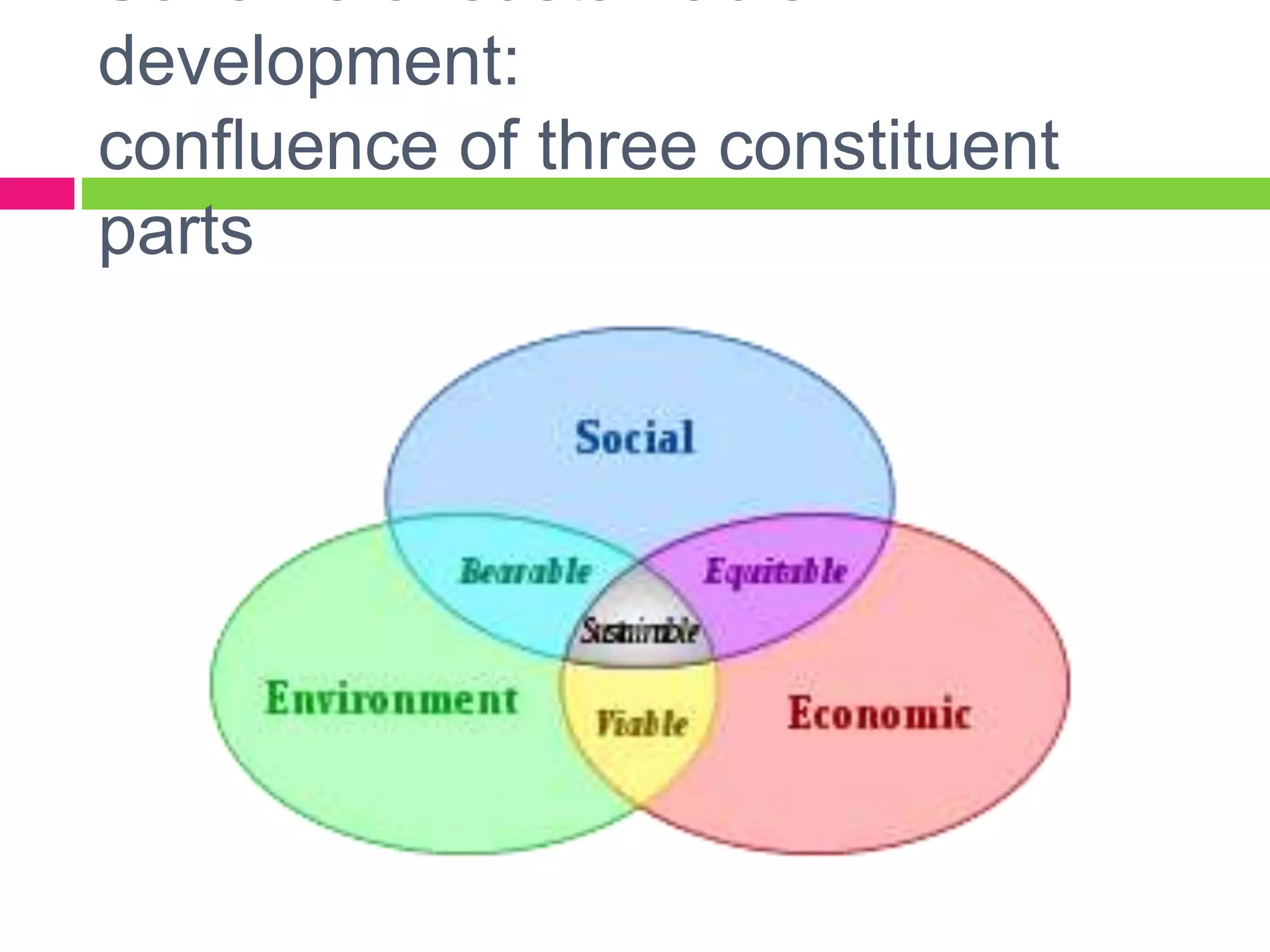
 Sustainability necessitates an interrelationship
of the social, economic and environmental
needs of a developing world
 The concept of sustainable development has
in the past most often been broken out into
three constituent parts:
 Environmental sustainability,
 Economic sustainability
 Socio political sustainability.
development:
confluence of three constituent
parts
Environmental Sustainability
 Environmental sustainability is the process of
making sure current processes of
interaction with the environment are
pursued with the idea of keeping the
environment as pristine as naturally .
 Environmental sustainability demands that
society designs activities to meet human
needs while indefinitely preserving the life
support systems of the planet.
Environmental Sustainability
 An "unsustainable situation" occurs when natural
resources are used up faster than it can be
replenished.
 Sustainability requires that human activity only
uses nature's resources at a rate at which they
can be replenished naturally.
 Sustainable development is intertwined with the
concept of carrying capacity.
 This entails using water sustainably, only
utilizing renewable energy, and sustainable
material supplies (e.g. harvesting wood from
forests at a rate that maintains the biomass
and biodiversity).
Economic Sustainability
 Economic progress is evaluated in terms of
welfare(GNP),more efficient production and consumption
of goods and services.
 The stability of prices and employment are among other
important objectives.
 To utilize resource to best advantage (efficient and
responsible)
 Difference between need and greed
 No economic system is sustainable unless it accommodates
the ecosystem it depends
 Unlike traditional societies, modern economies have only
recently acknowledged the need to manage scarce
natural resources in a prudent manner – because human
welfare ultimately depends on ecological services
 Ignoring safe ecological limits will increase the risk of
undermining long-run prospects for development.
Social Sustainability
 Social development refers to improvements in both
individual well-being and the overall social welfare
 Social Sustainability includes human rights, labor
rights and corporate governance
 It emphasizes on individuals behavior, attitude and
actions
 Ideal sustainable life style is not to end consumption
but understanding the minimalistic requirement of it
 Difference between wants and needs
 Challenge to current infrastructure and common
expectations
 Thus, social goals includes protective strategies that
reduce vulnerability, improve equity and ensure that
basic needs are met.
MEASURES FOR
SUSTAINABLE
DEVELOPMENT
Appropriate Technology (AT)
 The term appropriate technology is used to describe
the use of technology that results in less negative
impacts on the environment and society, i.e.,
technology should be both environmentally
sustainable and socially appropriate.
 It is characterized by "low investment cost per
work-place, low capital investment per unit of output,
organizational simplicity, high adaptability to a
particular social or cultural environment, sparing
use of natural resources, low cost of final
product or high potential for employment
 Found in both developing and developed
countries.
Appropriate technology
 “Design with nature”
 The goal of Appropriate Technology (AT)
is to increase the standard of living for
the developing world without
condescension, complication, or
environmental damage.
 Appropriate technology was meant to
address four problems: extreme poverty,
starvation, unemployment and urban
migration.
Solar Powered Lightbulb
 Nokero’s N100 solar-powered light bulb .
 This clever product stores electricity from daylight, one
of the few commodities rural India, Africa and most of
the third world has abundantly.
 Designed specifically for use in developing nations, the
LED bulbs can provide four hours of light when the
battery is fully charged.
 That may not sound like much to you or me, but
consider the scarce wood burning fuel this replaces.
 The N100 is constructed from impact-resistant plastic
and includes four solar panels, five LEDs and
replaceable NiMH batteries said to last two years.
 Complete units cost $15 apiece, but may someday
cost as little as $6 per unit in bulk.
Pot-In-Pot Refrigerator
 Pot-in-Pot refrigerator, It is a simple cooling
system to preserve food in rural areas with no
electricity.
 Which relies on the concept of evaporative
cooling.
 The system works by putting a smaller clay pot
inside a larger one, separating the two by
constantly moist sand.
 Evaporation causes a cooling effect in the inner
pot.
 Eggplants are reported to stay fresh for 27 days,
nine times their usual expiration date. Tomatoes
and peppers can last for up to 21 days
Bonus Corn Sheller
 Designing products for developing nations is
challenge because inventors are creating
technologies for cultures of which they have little,
or no, experience.
 Compatible Technology International visited
Guatemala and observed women hand-shelling
corn.
 They saw how labor-intensive the manual shelling
process was, they quickly developed a corn
sheller out of a piece of wood with a hole in the
middle.
 The women pushed the ear of corn through the
hole, shaving the kernels from the cob MUCH
Lifestraw
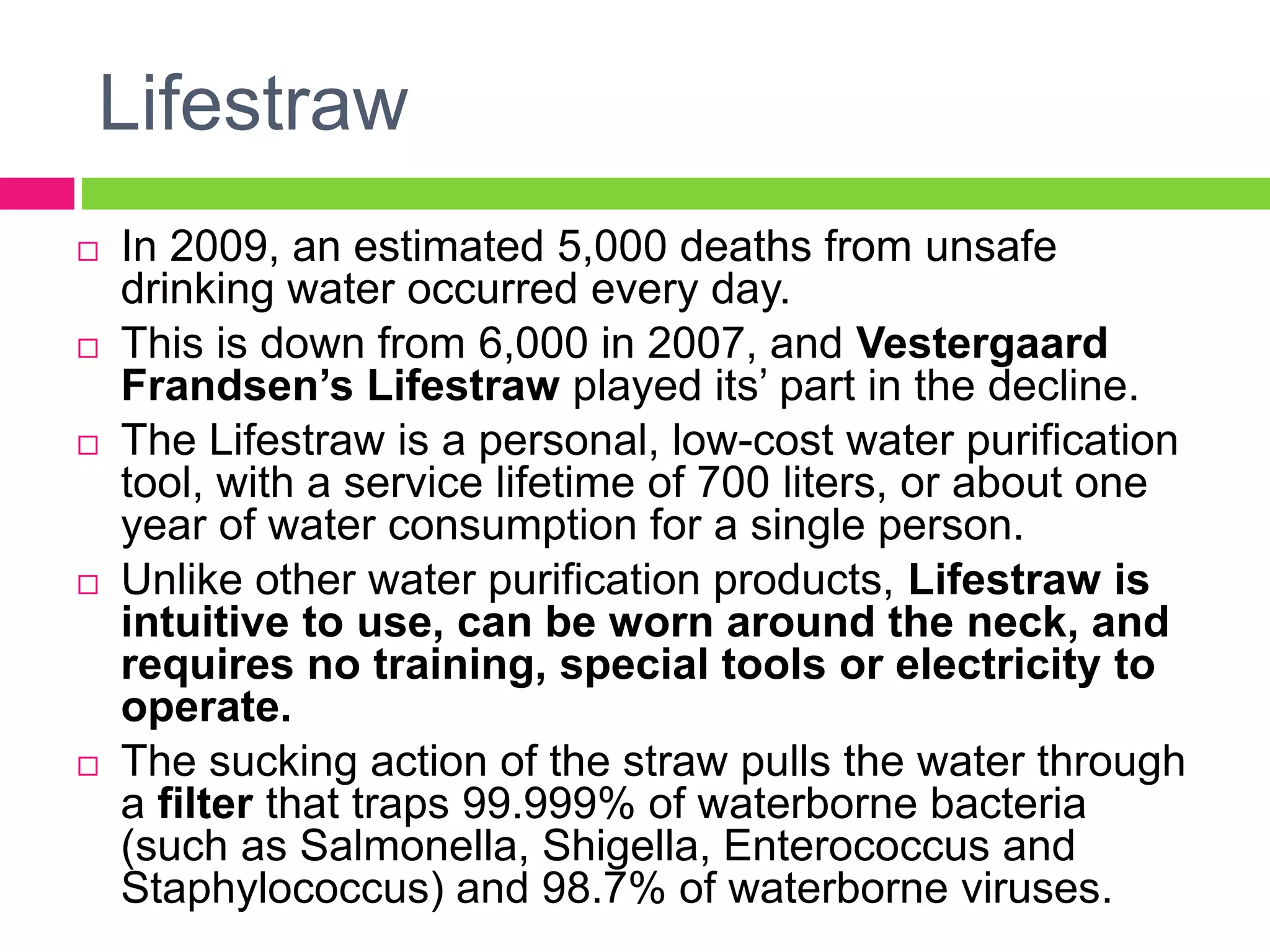
 In 2009, an estimated 5,000 deaths from unsafe
drinking water occurred every day.
 This is down from 6,000 in 2007, and Vestergaard
Frandsen’s Lifestraw played its’ part in the decline.
 The Lifestraw is a personal, low-cost water purification
tool, with a service lifetime of 700 liters, or about one
year of water consumption for a single person.
 Unlike other water purification products, Lifestraw is
intuitive to use, can be worn around the neck, and
requires no training, special tools or electricity to
operate.
 The sucking action of the straw pulls the water through
a filter that traps 99.999% of waterborne bacteria
(such as Salmonella, Shigella, Enterococcus and
Staphylococcus) and 98.7% of waterborne viruses.
Hippo Roller Water Project
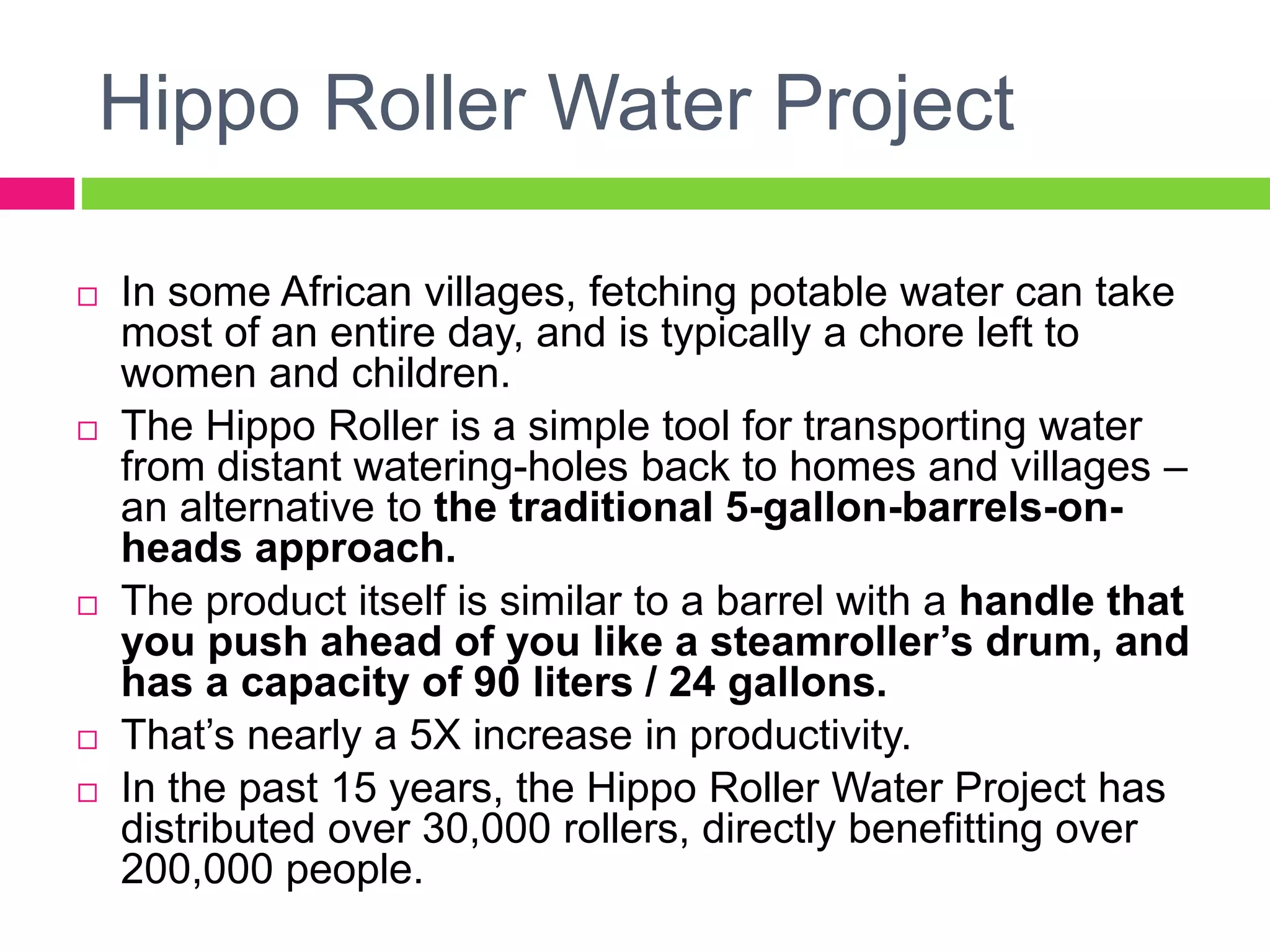
 In some African villages, fetching potable water can take
most of an entire day, and is typically a chore left to
women and children.
 The Hippo Roller is a simple tool for transporting water
from distant watering-holes back to homes and villages –
an alternative to the traditional 5-gallon-barrels-on-
heads approach.
 The product itself is similar to a barrel with a handle that
you push ahead of you like a steamroller’s drum, and
has a capacity of 90 liters / 24 gallons.
 That’s nearly a 5X increase in productivity.
 In the past 15 years, the Hippo Roller Water Project has
distributed over 30,000 rollers, directly benefitting over
200,000 people.
3R – REDUCE, REUSE &
RECYCLE
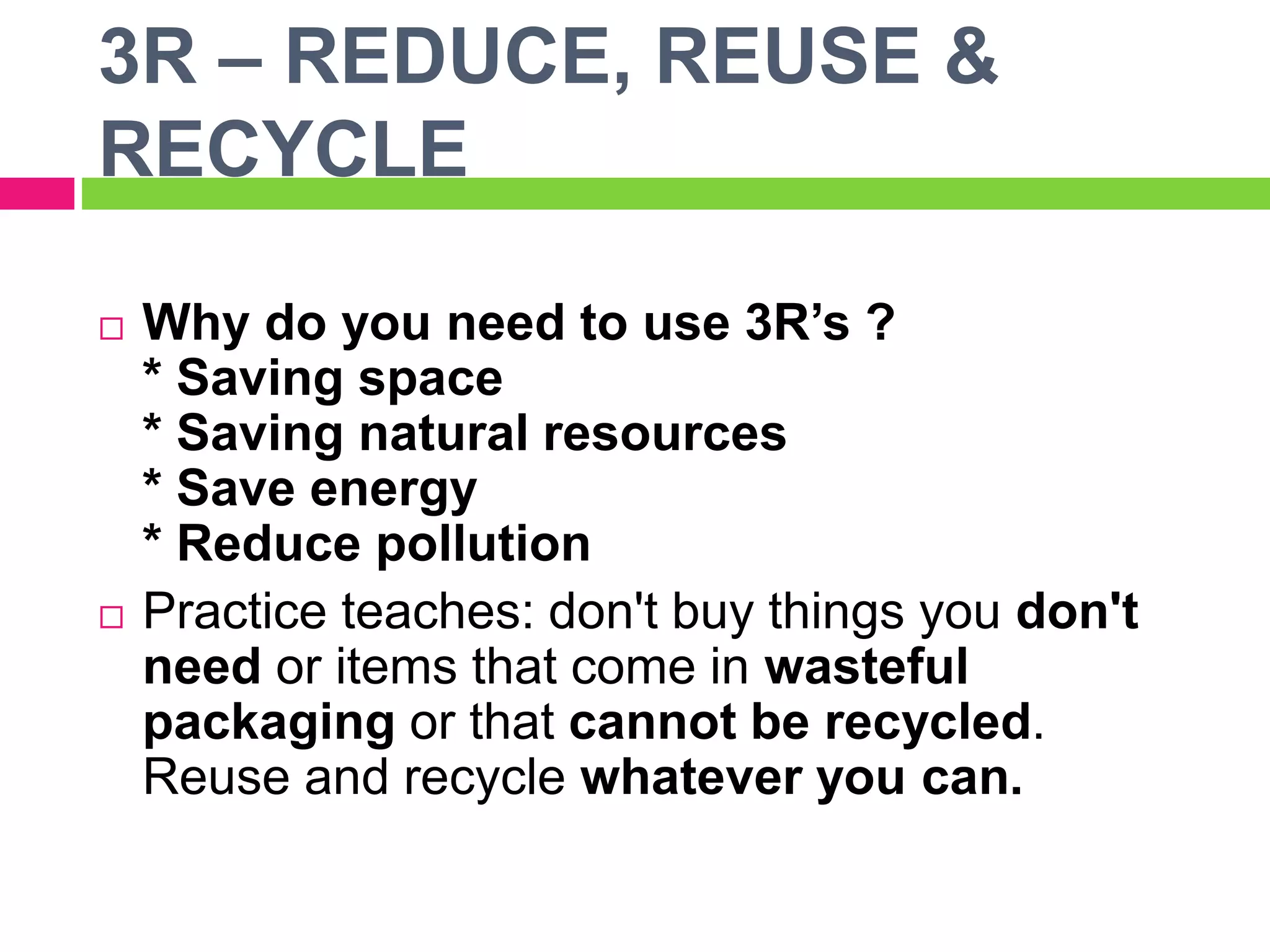
 Why do you need to use 3R’s ?
* Saving space
* Saving natural resources
* Save energy
* Reduce pollution
 Practice teaches: don't buy things you don't
need or items that come in wasteful
packaging or that cannot be recycled.
Reuse and recycle whatever you can.
REDUCE
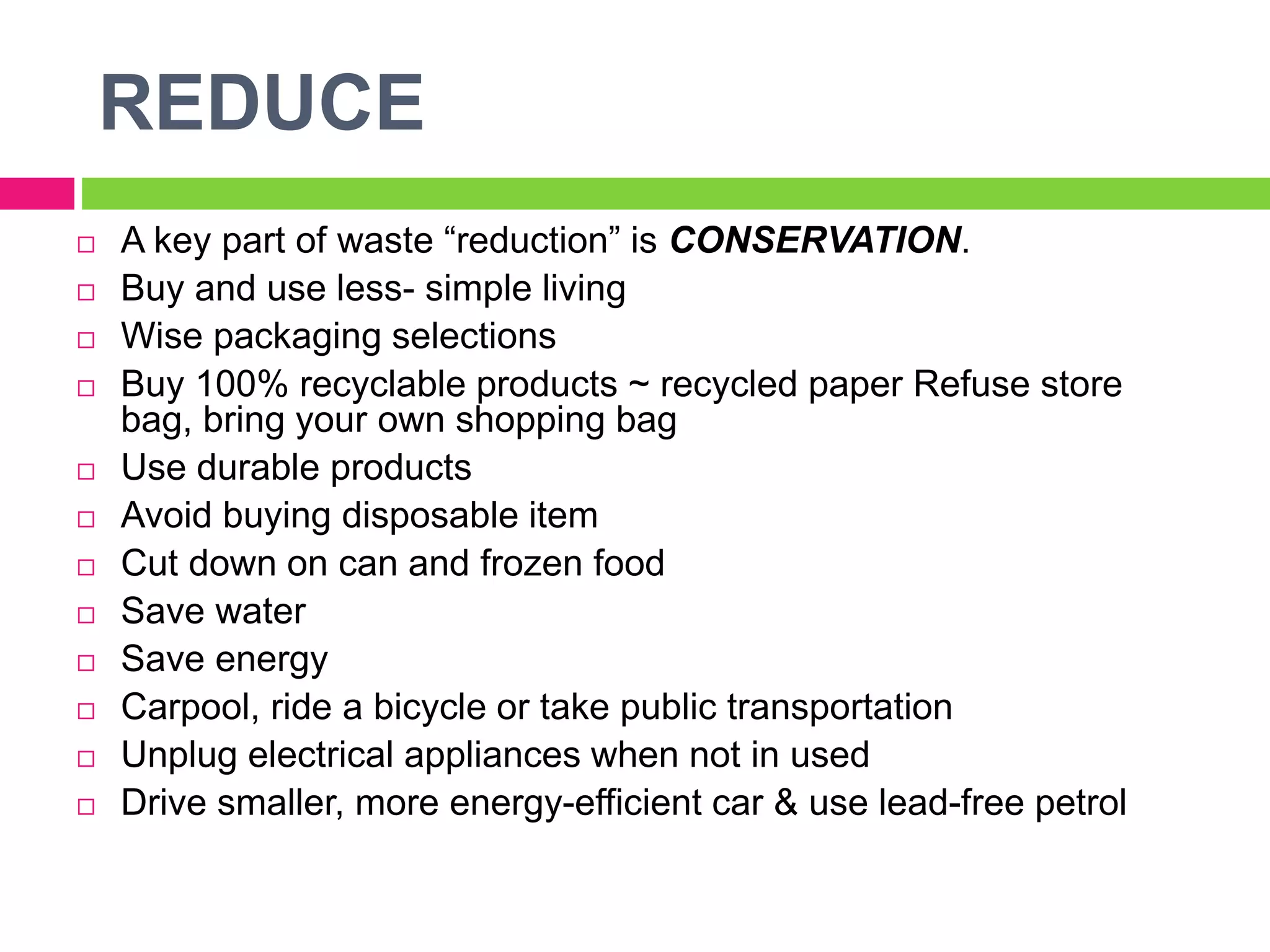
 A key part of waste “reduction” is CONSERVATION.
 Buy and use less- simple living
 Wise packaging selections
 Buy 100% recyclable products ~ recycled paper Refuse store
bag, bring your own shopping bag
 Use durable products
 Avoid buying disposable item
 Cut down on can and frozen food
 Save water
 Save energy
 Carpool, ride a bicycle or take public transportation
 Unplug electrical appliances when not in used
 Drive smaller, more energy-efficient car & use lead-free petrol
REUSE
 Do not throw away things that are still usable, Pass on to others who can
use them.
 One man’s waste is another man’s treasure.
 Reuse disposables like plastic cups, plates, utensils and plastic food storage
bags.
 Donate to charity
 Use canvas or cloth bags when shopping
 Reuse plastic bags
 Buy product in refillable containers e.g. washing powder, coffee, tea etc.
 Reuse old envelop
 Use both sides of paper
 save old egg cartons, toilet rolls, margarine and ice-cream tubs for art &
crafts
 use rechargeable batteries and refillable print cartridge
RECYCLE
 Recycling means turning something old into something new.
 Recycling is not only a great way to conserve resources but
even to reduce waste
 Just about anything in your home that cannot be reused
CAN be recycled into something else.
 Set up a system of separating your waste for recycling.
 Deposit them at the various recycle centre.
 Make sure you put the waste in the correct bin.
 * Paper ~ tie into bundles
* Aluminium can ~ empty contents, rinse, dry and crush
& metal containers ~ empty contents and clean
* Glass ~ empty contents and clean
* Plastic : drinking bottle ~ remove cap, empty bottle,
rinse and crush; plastic containers ~ empty contents and
clean
Environmental Education
 In order to achieve the acceptable level of
global environmental sustainability
 The citizens must be empowered with
essential knowledge and information.
 Then only they can exert pressure on their
elected representatives to develop and
implement policies for securing
environmental sustainability.
 These can be achieved through
environmental education .
Environmental Education
 Environmental education has two essential
components:
 Alerting the public to the need to achieve global
sustainable development and the likely
consequences of failing to do so.
 Focusing the educational curriculum for global
sustainable development by incorporating the
know-how and skills and also the moral
imperatives.
 To have a clear idea about the environmental
education, more awareness about the following
issues are needed.
 Difference between unsustainable development and
environmental sustainability.
 Depending on Science and Technology alone will
Environmental Education
 Progress towards sustainable development is
dependent upon a fundamental change in
societies' attitude to nature and the
environment.
 Individual would be willing to adopt less
consumptive lifestyles commensurate with the
Earth's ecological capacity.
 Science and technology, however advanced, cannot
help in this matter.
 Hence, what is needed to bring about this change
of attitude is education in moral and ethical
philosophy.
 In the young minds, it is essential to reinforce the
environment-respecting moral values.
Environmental Education
 Thinking
 Attitude
 Action
Carrying Capacity
 The carrying capacity is the maximum
population size of a species that the environment
can sustain indefinitely, given the food, habitat,
water and other necessities available in the
environment.
 Supported indefinitely by an ecosystem
without destroying that ecosystem
 Ciriacy-Wantrup introduced the idea of safe
thresholds
 Depends on available resources and per capita
consumption
 Not "caring" capacity
Carrying Capacity
 The carrying capacity of an environment may
vary for different species and may change
over time due to a variety of factors, including:
 Food availability
 Water supply
 Environmental conditions and living space.
 Function of the number of people,
 The amount of resources each person
consumes
 The ability of the earth to process all the
wastes produced.
Carrying Capacity
 For example, consider an island onto which is dropped
a colony of rabbits.
 As long as there is an adequate supply of food and
water, the rabbits will not only survive but they will
reproduce and the colony will get larger.
 The rabbit population can continue to grow as long as
food and water are adequate.
 However, if at some point, there are more rabbits
than is food to feed them, then the rabbit population
will start to decline.
 It depends upon factors such as how much each rabbit
eats,
 How fast the food grows,
 How well the natural systems of the island can handle
the waste produced by the rabbits.
Carrying Capacity
 The earth is our island.
 We have developed technology to grow,
process, and store food
 We have also developed technologies for
handling wastes that we create.
 However, there is still a carrying capacity that
the earth can support.
 Sustainability is about finding the balance point
among population, consumption, and waste
assimilation
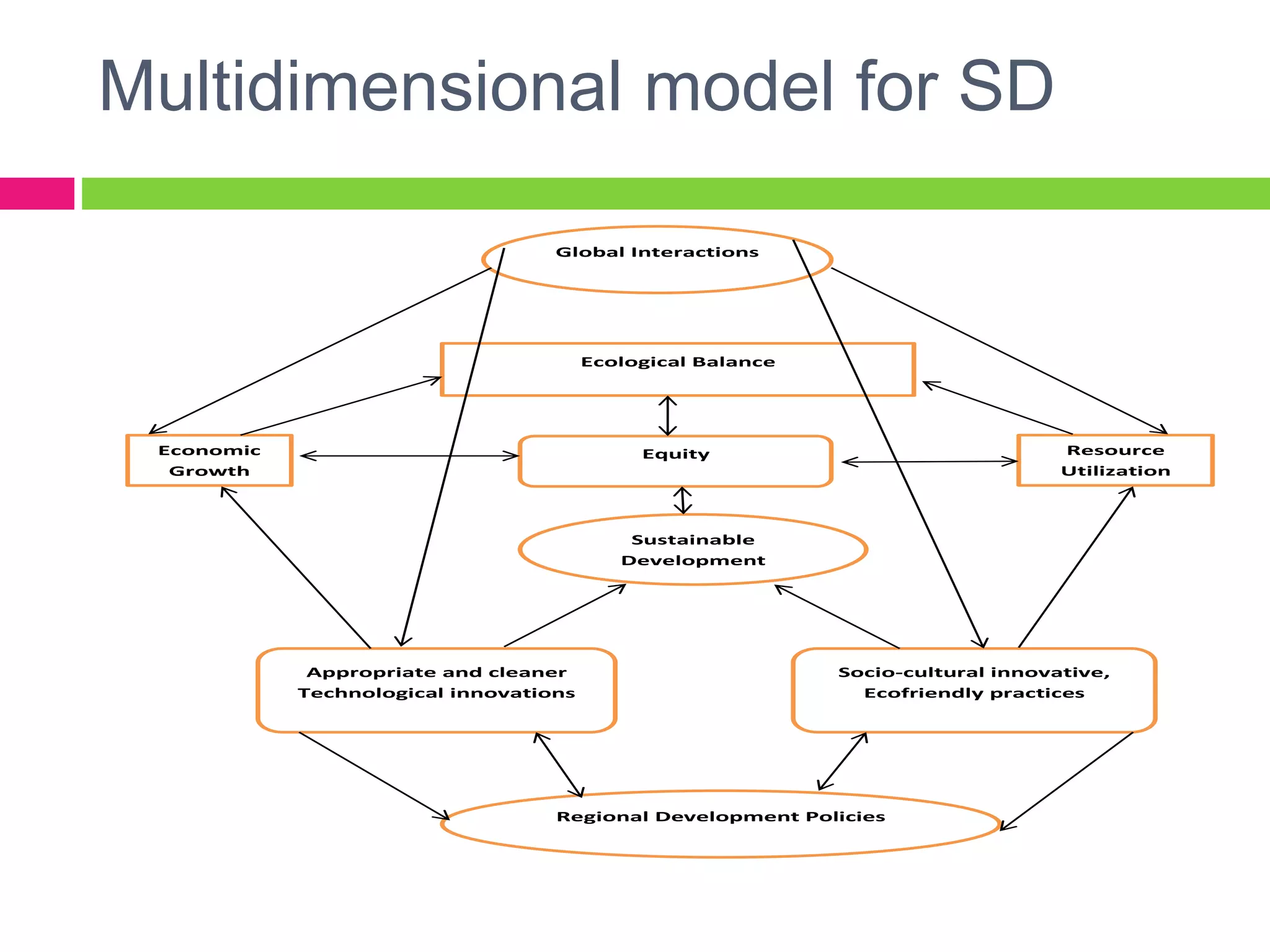
Multidimensional model for SD
Global Interactions
Ecological Balance
Economic
Growth
Resource
Utilization
Equity
Sustainable
Development
Appropriate and cleaner
Technological innovations
Socio-cultural innovative,
Ecofriendly practices
Regional Development Policies
 Sustainable development ties together
concern for the carrying capacity of natural
systems with the social challenges faced by
humanity
 According to Hasna Vancock, sustainability is
a process which tells of a development of all
aspects of human life affecting sustenance. It
means resolving the conflict between the
various competing goals, and involves the
simultaneous pursuit of economic prosperity,
environmental quality and social equity
famously known as three dimensions

Sustainable development by SP

  • 1.
  • 2.
    Sustainable Development  Sustainabledevelopment (SD) is a pattern of economic development in which resource use aims to meet human needs while preserving the environment so that these needs can be met not only in the present, but also for generations to come. UNCED at Rio de Janeiro
  • 3.
    Sustainable Development  Theterm 'sustainable development' was used by the Brundtland Commission (1987 ) as per it "meets the needs of the present without compromising the ability of future generations to meet their own needs.  According to above definition two key concepts:  the concept of 'needs', in particular the essential needs of the world's poor, to which overriding priority should be given  the idea of limitations imposed by the state of technology and social organization on the environment's ability to meet present and future needs.
  • 4.
    Sustainable Development  Sustainabilityeducator Michael Thomas Needham referred to 'Sustainable Development' "as the ability to meet the needs of the present while contributing to the future generations needs.”  Additional focus on the present generations' responsibility to improve the future generations' life by restoring the previous ecosystem damage and resisting to contribute to further ecosystem damage.  "sustainability" was employed to describe an economy "in equilibrium with basic ecological support systems."
  • 5.
    Scheme of sustainable development Sustainability necessitates an interrelationship of the social, economic and environmental needs of a developing world  The concept of sustainable development has in the past most often been broken out into three constituent parts:  Environmental sustainability,  Economic sustainability  Socio political sustainability.
  • 6.
  • 7.
    Environmental Sustainability  Environmentalsustainability is the process of making sure current processes of interaction with the environment are pursued with the idea of keeping the environment as pristine as naturally .  Environmental sustainability demands that society designs activities to meet human needs while indefinitely preserving the life support systems of the planet.
  • 8.
    Environmental Sustainability  An"unsustainable situation" occurs when natural resources are used up faster than it can be replenished.  Sustainability requires that human activity only uses nature's resources at a rate at which they can be replenished naturally.  Sustainable development is intertwined with the concept of carrying capacity.  This entails using water sustainably, only utilizing renewable energy, and sustainable material supplies (e.g. harvesting wood from forests at a rate that maintains the biomass and biodiversity).
  • 9.
    Economic Sustainability  Economicprogress is evaluated in terms of welfare(GNP),more efficient production and consumption of goods and services.  The stability of prices and employment are among other important objectives.  To utilize resource to best advantage (efficient and responsible)  Difference between need and greed  No economic system is sustainable unless it accommodates the ecosystem it depends  Unlike traditional societies, modern economies have only recently acknowledged the need to manage scarce natural resources in a prudent manner – because human welfare ultimately depends on ecological services  Ignoring safe ecological limits will increase the risk of undermining long-run prospects for development.
  • 10.
    Social Sustainability  Socialdevelopment refers to improvements in both individual well-being and the overall social welfare  Social Sustainability includes human rights, labor rights and corporate governance  It emphasizes on individuals behavior, attitude and actions  Ideal sustainable life style is not to end consumption but understanding the minimalistic requirement of it  Difference between wants and needs  Challenge to current infrastructure and common expectations  Thus, social goals includes protective strategies that reduce vulnerability, improve equity and ensure that basic needs are met.
  • 11.
  • 12.
    Appropriate Technology (AT) The term appropriate technology is used to describe the use of technology that results in less negative impacts on the environment and society, i.e., technology should be both environmentally sustainable and socially appropriate.  It is characterized by "low investment cost per work-place, low capital investment per unit of output, organizational simplicity, high adaptability to a particular social or cultural environment, sparing use of natural resources, low cost of final product or high potential for employment  Found in both developing and developed countries.
  • 13.
    Appropriate technology  “Designwith nature”  The goal of Appropriate Technology (AT) is to increase the standard of living for the developing world without condescension, complication, or environmental damage.  Appropriate technology was meant to address four problems: extreme poverty, starvation, unemployment and urban migration.
  • 14.
    Solar Powered Lightbulb Nokero’s N100 solar-powered light bulb .  This clever product stores electricity from daylight, one of the few commodities rural India, Africa and most of the third world has abundantly.  Designed specifically for use in developing nations, the LED bulbs can provide four hours of light when the battery is fully charged.  That may not sound like much to you or me, but consider the scarce wood burning fuel this replaces.  The N100 is constructed from impact-resistant plastic and includes four solar panels, five LEDs and replaceable NiMH batteries said to last two years.  Complete units cost $15 apiece, but may someday cost as little as $6 per unit in bulk.
  • 15.
    Pot-In-Pot Refrigerator  Pot-in-Potrefrigerator, It is a simple cooling system to preserve food in rural areas with no electricity.  Which relies on the concept of evaporative cooling.  The system works by putting a smaller clay pot inside a larger one, separating the two by constantly moist sand.  Evaporation causes a cooling effect in the inner pot.  Eggplants are reported to stay fresh for 27 days, nine times their usual expiration date. Tomatoes and peppers can last for up to 21 days
  • 16.
    Bonus Corn Sheller Designing products for developing nations is challenge because inventors are creating technologies for cultures of which they have little, or no, experience.  Compatible Technology International visited Guatemala and observed women hand-shelling corn.  They saw how labor-intensive the manual shelling process was, they quickly developed a corn sheller out of a piece of wood with a hole in the middle.  The women pushed the ear of corn through the hole, shaving the kernels from the cob MUCH
  • 17.
    Lifestraw  In 2009,an estimated 5,000 deaths from unsafe drinking water occurred every day.  This is down from 6,000 in 2007, and Vestergaard Frandsen’s Lifestraw played its’ part in the decline.  The Lifestraw is a personal, low-cost water purification tool, with a service lifetime of 700 liters, or about one year of water consumption for a single person.  Unlike other water purification products, Lifestraw is intuitive to use, can be worn around the neck, and requires no training, special tools or electricity to operate.  The sucking action of the straw pulls the water through a filter that traps 99.999% of waterborne bacteria (such as Salmonella, Shigella, Enterococcus and Staphylococcus) and 98.7% of waterborne viruses.
  • 18.
    Hippo Roller WaterProject  In some African villages, fetching potable water can take most of an entire day, and is typically a chore left to women and children.  The Hippo Roller is a simple tool for transporting water from distant watering-holes back to homes and villages – an alternative to the traditional 5-gallon-barrels-on- heads approach.  The product itself is similar to a barrel with a handle that you push ahead of you like a steamroller’s drum, and has a capacity of 90 liters / 24 gallons.  That’s nearly a 5X increase in productivity.  In the past 15 years, the Hippo Roller Water Project has distributed over 30,000 rollers, directly benefitting over 200,000 people.
  • 19.
    3R – REDUCE,REUSE & RECYCLE  Why do you need to use 3R’s ? * Saving space * Saving natural resources * Save energy * Reduce pollution  Practice teaches: don't buy things you don't need or items that come in wasteful packaging or that cannot be recycled. Reuse and recycle whatever you can.
  • 20.
    REDUCE  A keypart of waste “reduction” is CONSERVATION.  Buy and use less- simple living  Wise packaging selections  Buy 100% recyclable products ~ recycled paper Refuse store bag, bring your own shopping bag  Use durable products  Avoid buying disposable item  Cut down on can and frozen food  Save water  Save energy  Carpool, ride a bicycle or take public transportation  Unplug electrical appliances when not in used  Drive smaller, more energy-efficient car & use lead-free petrol
  • 21.
    REUSE  Do notthrow away things that are still usable, Pass on to others who can use them.  One man’s waste is another man’s treasure.  Reuse disposables like plastic cups, plates, utensils and plastic food storage bags.  Donate to charity  Use canvas or cloth bags when shopping  Reuse plastic bags  Buy product in refillable containers e.g. washing powder, coffee, tea etc.  Reuse old envelop  Use both sides of paper  save old egg cartons, toilet rolls, margarine and ice-cream tubs for art & crafts  use rechargeable batteries and refillable print cartridge
  • 22.
    RECYCLE  Recycling meansturning something old into something new.  Recycling is not only a great way to conserve resources but even to reduce waste  Just about anything in your home that cannot be reused CAN be recycled into something else.  Set up a system of separating your waste for recycling.  Deposit them at the various recycle centre.  Make sure you put the waste in the correct bin.  * Paper ~ tie into bundles * Aluminium can ~ empty contents, rinse, dry and crush & metal containers ~ empty contents and clean * Glass ~ empty contents and clean * Plastic : drinking bottle ~ remove cap, empty bottle, rinse and crush; plastic containers ~ empty contents and clean
  • 23.
    Environmental Education  Inorder to achieve the acceptable level of global environmental sustainability  The citizens must be empowered with essential knowledge and information.  Then only they can exert pressure on their elected representatives to develop and implement policies for securing environmental sustainability.  These can be achieved through environmental education .
  • 24.
    Environmental Education  Environmentaleducation has two essential components:  Alerting the public to the need to achieve global sustainable development and the likely consequences of failing to do so.  Focusing the educational curriculum for global sustainable development by incorporating the know-how and skills and also the moral imperatives.  To have a clear idea about the environmental education, more awareness about the following issues are needed.  Difference between unsustainable development and environmental sustainability.  Depending on Science and Technology alone will
  • 25.
    Environmental Education  Progresstowards sustainable development is dependent upon a fundamental change in societies' attitude to nature and the environment.  Individual would be willing to adopt less consumptive lifestyles commensurate with the Earth's ecological capacity.  Science and technology, however advanced, cannot help in this matter.  Hence, what is needed to bring about this change of attitude is education in moral and ethical philosophy.  In the young minds, it is essential to reinforce the environment-respecting moral values.
  • 26.
  • 27.
    Carrying Capacity  Thecarrying capacity is the maximum population size of a species that the environment can sustain indefinitely, given the food, habitat, water and other necessities available in the environment.  Supported indefinitely by an ecosystem without destroying that ecosystem  Ciriacy-Wantrup introduced the idea of safe thresholds  Depends on available resources and per capita consumption  Not "caring" capacity
  • 28.
    Carrying Capacity  Thecarrying capacity of an environment may vary for different species and may change over time due to a variety of factors, including:  Food availability  Water supply  Environmental conditions and living space.  Function of the number of people,  The amount of resources each person consumes  The ability of the earth to process all the wastes produced.
  • 29.
    Carrying Capacity  Forexample, consider an island onto which is dropped a colony of rabbits.  As long as there is an adequate supply of food and water, the rabbits will not only survive but they will reproduce and the colony will get larger.  The rabbit population can continue to grow as long as food and water are adequate.  However, if at some point, there are more rabbits than is food to feed them, then the rabbit population will start to decline.  It depends upon factors such as how much each rabbit eats,  How fast the food grows,  How well the natural systems of the island can handle the waste produced by the rabbits.
  • 30.
    Carrying Capacity  Theearth is our island.  We have developed technology to grow, process, and store food  We have also developed technologies for handling wastes that we create.  However, there is still a carrying capacity that the earth can support.  Sustainability is about finding the balance point among population, consumption, and waste assimilation
  • 31.
    Multidimensional model forSD Global Interactions Ecological Balance Economic Growth Resource Utilization Equity Sustainable Development Appropriate and cleaner Technological innovations Socio-cultural innovative, Ecofriendly practices Regional Development Policies
  • 32.
     Sustainable developmentties together concern for the carrying capacity of natural systems with the social challenges faced by humanity  According to Hasna Vancock, sustainability is a process which tells of a development of all aspects of human life affecting sustenance. It means resolving the conflict between the various competing goals, and involves the simultaneous pursuit of economic prosperity, environmental quality and social equity famously known as three dimensions