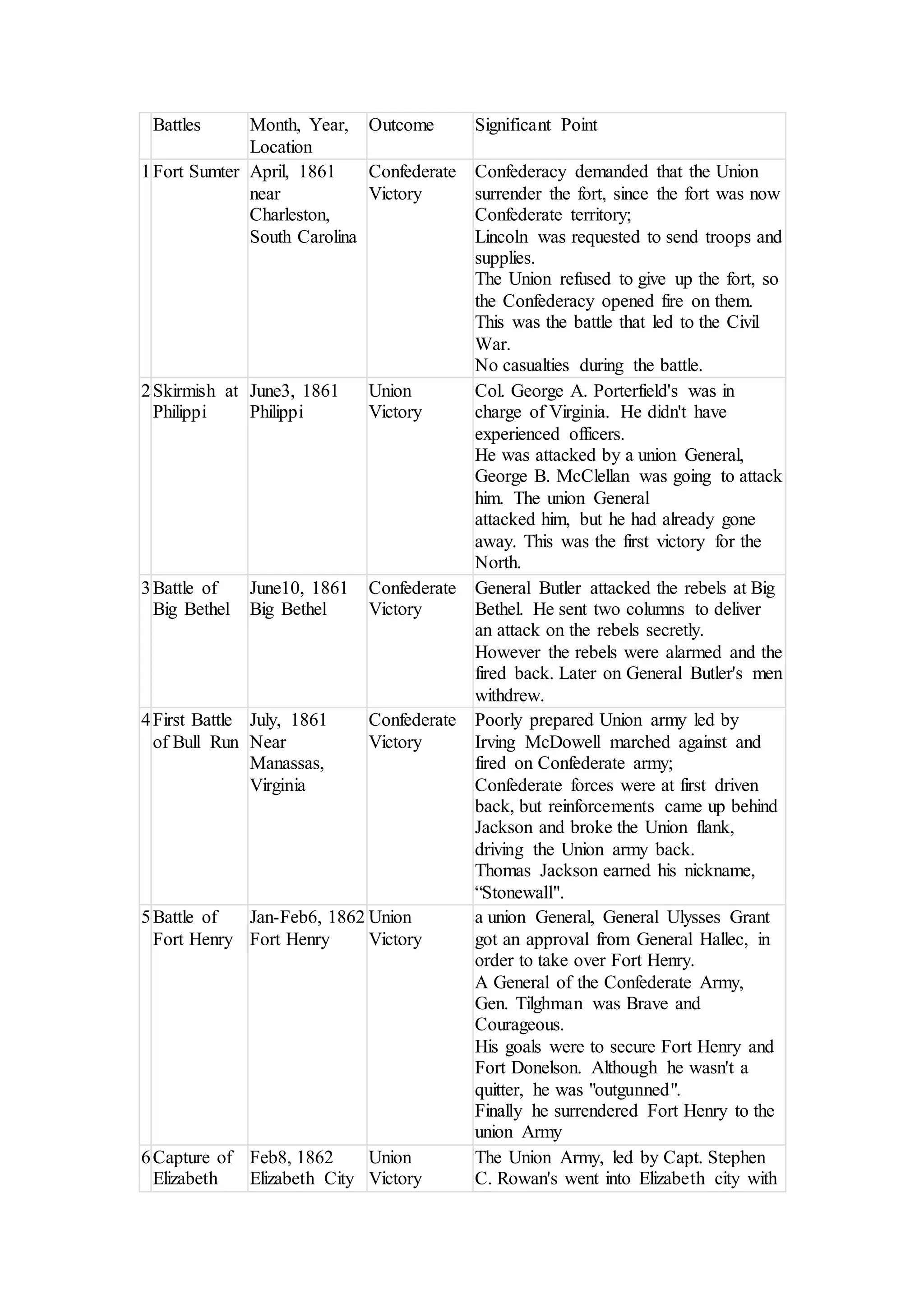
Battles Month, Year,
Location
Outcome Significant Point
1Fort Sumter April, 1861
near
Charleston,
South Carolina
Confederate
Victory
Confederacy demanded that the Union
surrender the fort, since the fort was now
Confederate territory;
Lincoln was requested to send troops and
supplies.
The Union refused to give up the fort, so
the Confederacy opened fire on them.
This was the battle that led to the Civil
War.
No casualties during the battle.
2Skirmish at
Philippi
June3, 1861
Philippi
Union
Victory
Col. George A. Porterfield's was in
charge of Virginia. He didn't have
experienced officers.
He was attacked by a union General,
George B. McClellan was going to attack
him. The union General
attacked him, but he had already gone
away. This was the first victory for the
North.
3Battle of
Big Bethel
June10, 1861
Big Bethel
Confederate
Victory
General Butler attacked the rebels at Big
Bethel. He sent two columns to deliver
an attack on the rebels secretly.
However the rebels were alarmed and the
fired back. Later on General Butler's men
withdrew.
4First Battle
of Bull Run
July, 1861
Near
Manassas,
Virginia
Confederate
Victory
Poorly prepared Union army led by
Irving McDowell marched against and
fired on Confederate army;
Confederate forces were at first driven
back, but reinforcements came up behind
Jackson and broke the Union flank,
driving the Union army back.
Thomas Jackson earned his nickname,
“Stonewall".
5Battle of
Fort Henry
Jan-Feb6, 1862
Fort Henry
Union
Victory
a union General, General Ulysses Grant
got an approval from General Hallec, in
order to take over Fort Henry.
A General of the Confederate Army,
Gen. Tilghman was Brave and
Courageous.
His goals were to secure Fort Henry and
Fort Donelson. Although he wasn't a
quitter, he was "outgunned".
Finally he surrendered Fort Henry to the
union Army
6Capture of
Elizabeth
Feb8, 1862
Elizabeth City
Union
Victory
The Union Army, led by Capt. Stephen
C. Rowan's went into Elizabeth city with
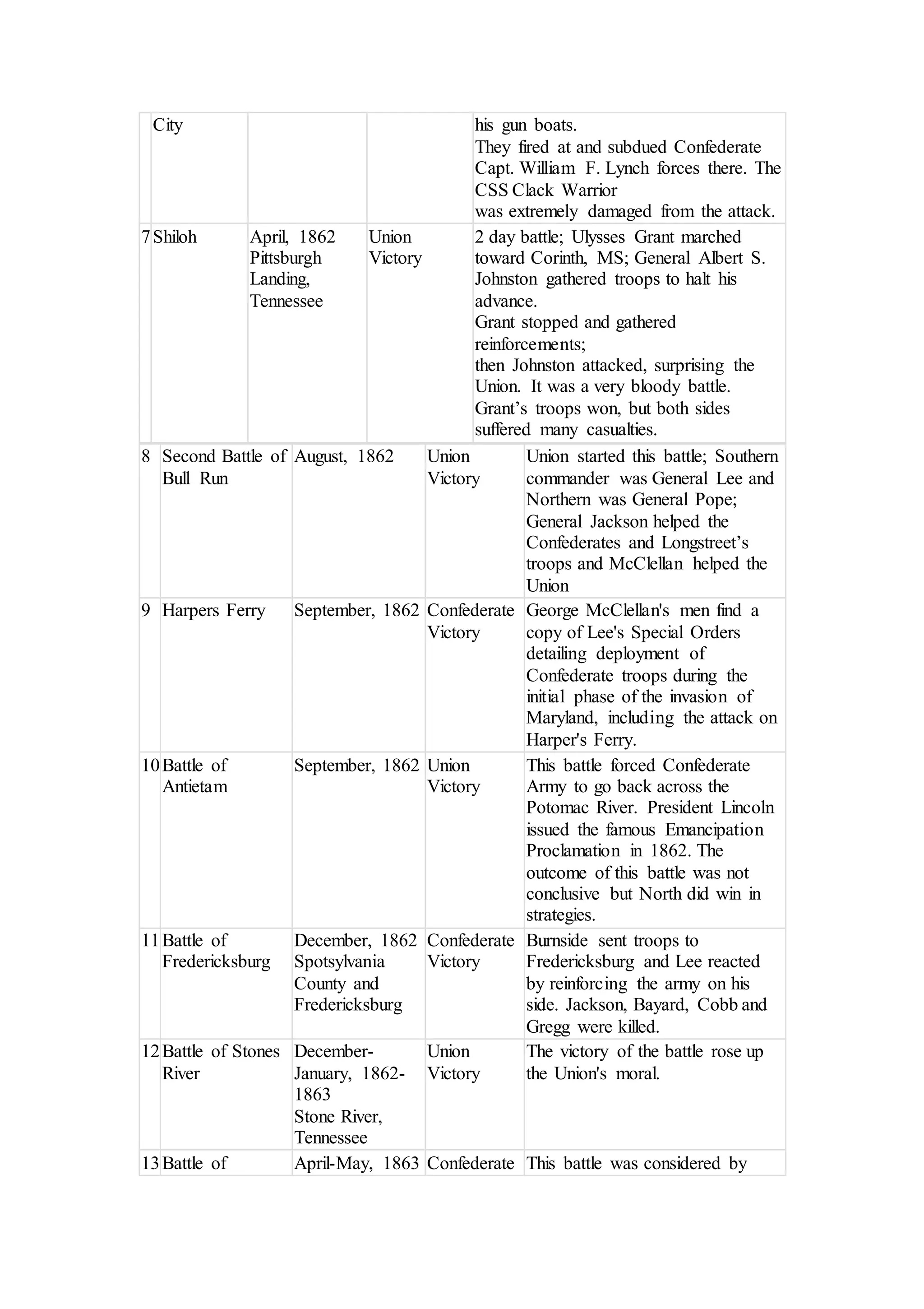
City his gun boats.
They fired at and subdued Confederate
Capt. William F. Lynch forces there. The
CSS Clack Warrior
was extremely damaged from the attack.
7Shiloh April, 1862
Pittsburgh
Landing,
Tennessee
Union
Victory
2 day battle; Ulysses Grant marched
toward Corinth, MS; General Albert S.
Johnston gathered troops to halt his
advance.
Grant stopped and gathered
reinforcements;
then Johnston attacked, surprising the
Union. It was a very bloody battle.
Grant’s troops won, but both sides
suffered many casualties.
8 Second Battle of
Bull Run
August, 1862 Union
Victory
Union started this battle; Southern
commander was General Lee and
Northern was General Pope;
General Jackson helped the
Confederates and Longstreet’s
troops and McClellan helped the
Union
9 Harpers Ferry September, 1862 Confederate
Victory
George McClellan's men find a
copy of Lee's Special Orders
detailing deployment of
Confederate troops during the
initial phase of the invasion of
Maryland, including the attack on
Harper's Ferry.
10Battle of
Antietam
September, 1862 Union
Victory
This battle forced Confederate
Army to go back across the
Potomac River. President Lincoln
issued the famous Emancipation
Proclamation in 1862. The
outcome of this battle was not
conclusive but North did win in
strategies.
11Battle of
Fredericksburg
December, 1862
Spotsylvania
County and
Fredericksburg
Confederate
Victory
Burnside sent troops to
Fredericksburg and Lee reacted
by reinforcing the army on his
side. Jackson, Bayard, Cobb and
Gregg were killed.
12Battle of Stones
River
December-
January, 1862-
1863
Stone River,
Tennessee
Union
Victory
The victory of the battle rose up
the Union's moral.
13Battle of April-May, 1863 Confederate This battle was considered by
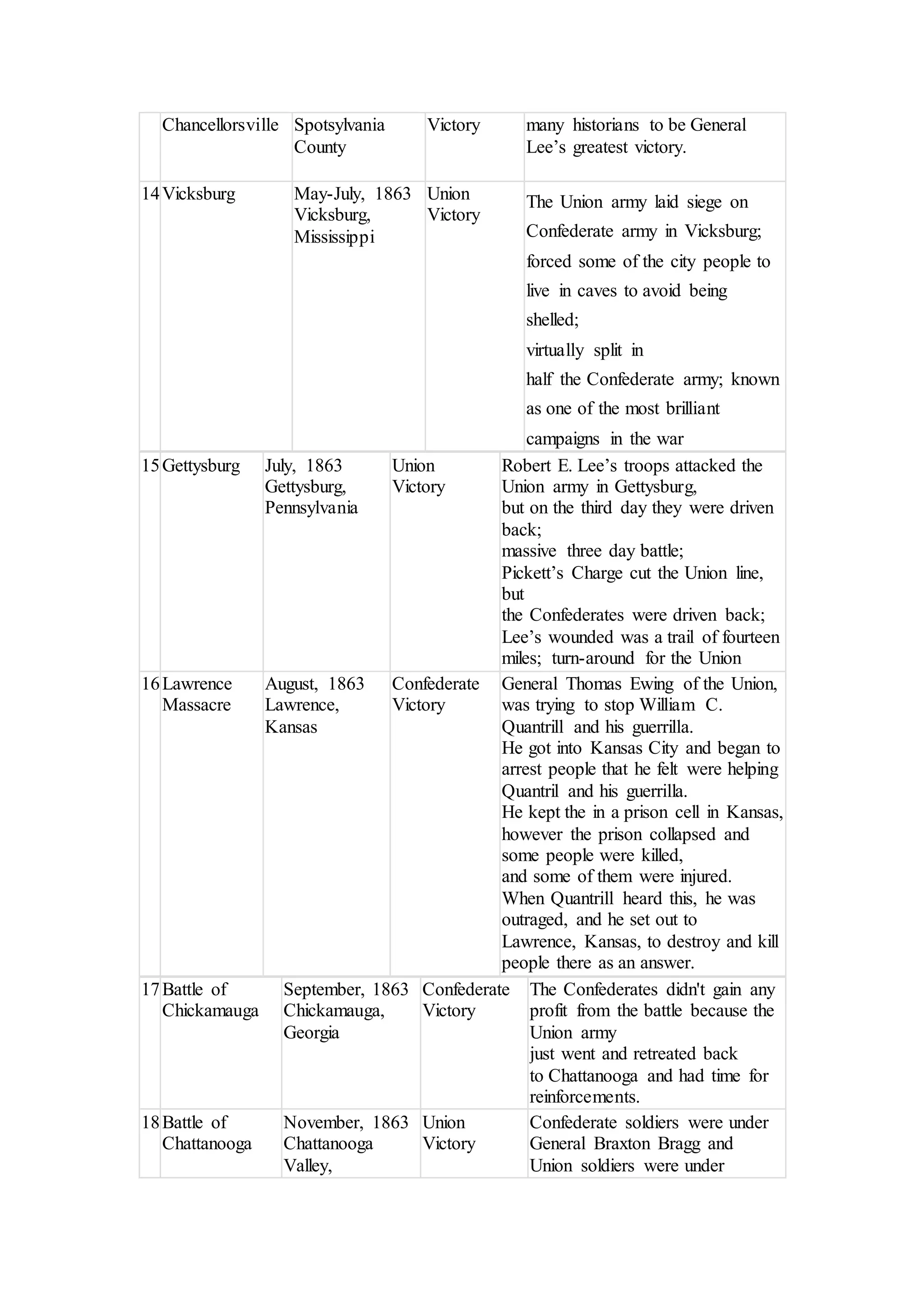
Chancellorsville Spotsylvania
County
Victory many historians to be General
Lee’s greatest victory.
14Vicksburg May-July, 1863
Vicksburg,
Mississippi
Union
Victory
The Union army laid siege on
Confederate army in Vicksburg;
forced some of the city people to
live in caves to avoid being
shelled;
virtually split in
half the Confederate army; known
as one of the most brilliant
campaigns in the war
15Gettysburg July, 1863
Gettysburg,
Pennsylvania
Union
Victory
Robert E. Lee’s troops attacked the
Union army in Gettysburg,
but on the third day they were driven
back;
massive three day battle;
Pickett’s Charge cut the Union line,
but
the Confederates were driven back;
Lee’s wounded was a trail of fourteen
miles; turn-around for the Union
16Lawrence
Massacre
August, 1863
Lawrence,
Kansas
Confederate
Victory
General Thomas Ewing of the Union,
was trying to stop William C.
Quantrill and his guerrilla.
He got into Kansas City and began to
arrest people that he felt were helping
Quantril and his guerrilla.
He kept the in a prison cell in Kansas,
however the prison collapsed and
some people were killed,
and some of them were injured.
When Quantrill heard this, he was
outraged, and he set out to
Lawrence, Kansas, to destroy and kill
people there as an answer.
17Battle of
Chickamauga
September, 1863
Chickamauga,
Georgia
Confederate
Victory
The Confederates didn't gain any
profit from the battle because the
Union army
just went and retreated back
to Chattanooga and had time for
reinforcements.
18Battle of
Chattanooga
November, 1863
Chattanooga
Valley,
Union
Victory
Confederate soldiers were under
General Braxton Bragg and
Union soldiers were under
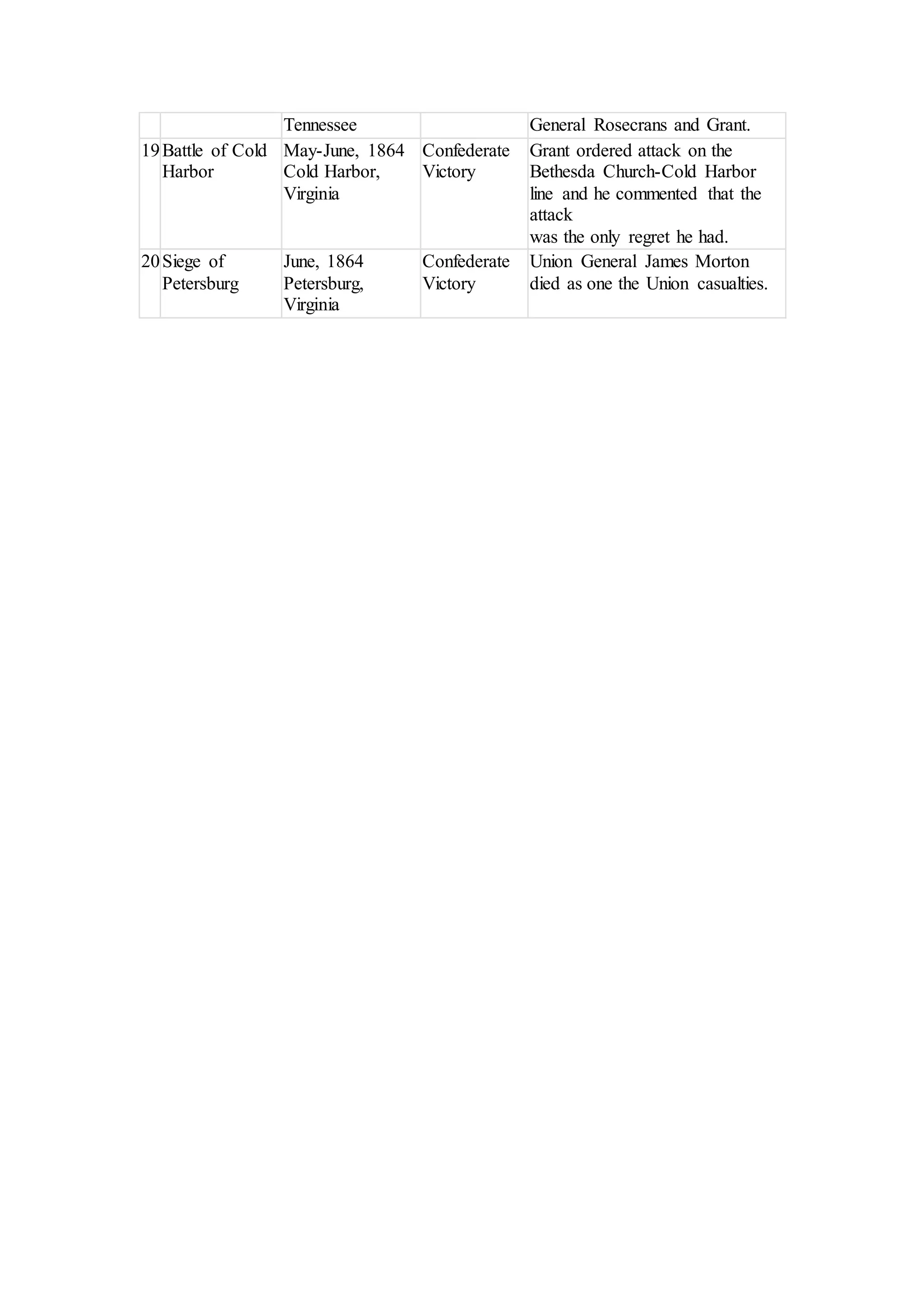
Tennessee General Rosecrans and Grant.
19Battle of Cold
Harbor
May-June, 1864
Cold Harbor,
Virginia
Confederate
Victory
Grant ordered attack on the
Bethesda Church-Cold Harbor
line and he commented that the
attack
was the only regret he had.
20Siege of
Petersburg
June, 1864
Petersburg,
Virginia
Confederate
Victory
Union General James Morton
died as one the Union casualties.

Finalbattlechart

  • 1.
    Battles Month, Year, Location OutcomeSignificant Point 1Fort Sumter April, 1861 near Charleston, South Carolina Confederate Victory Confederacy demanded that the Union surrender the fort, since the fort was now Confederate territory; Lincoln was requested to send troops and supplies. The Union refused to give up the fort, so the Confederacy opened fire on them. This was the battle that led to the Civil War. No casualties during the battle. 2Skirmish at Philippi June3, 1861 Philippi Union Victory Col. George A. Porterfield's was in charge of Virginia. He didn't have experienced officers. He was attacked by a union General, George B. McClellan was going to attack him. The union General attacked him, but he had already gone away. This was the first victory for the North. 3Battle of Big Bethel June10, 1861 Big Bethel Confederate Victory General Butler attacked the rebels at Big Bethel. He sent two columns to deliver an attack on the rebels secretly. However the rebels were alarmed and the fired back. Later on General Butler's men withdrew. 4First Battle of Bull Run July, 1861 Near Manassas, Virginia Confederate Victory Poorly prepared Union army led by Irving McDowell marched against and fired on Confederate army; Confederate forces were at first driven back, but reinforcements came up behind Jackson and broke the Union flank, driving the Union army back. Thomas Jackson earned his nickname, “Stonewall". 5Battle of Fort Henry Jan-Feb6, 1862 Fort Henry Union Victory a union General, General Ulysses Grant got an approval from General Hallec, in order to take over Fort Henry. A General of the Confederate Army, Gen. Tilghman was Brave and Courageous. His goals were to secure Fort Henry and Fort Donelson. Although he wasn't a quitter, he was "outgunned". Finally he surrendered Fort Henry to the union Army 6Capture of Elizabeth Feb8, 1862 Elizabeth City Union Victory The Union Army, led by Capt. Stephen C. Rowan's went into Elizabeth city with
  • 2.
    City his gunboats. They fired at and subdued Confederate Capt. William F. Lynch forces there. The CSS Clack Warrior was extremely damaged from the attack. 7Shiloh April, 1862 Pittsburgh Landing, Tennessee Union Victory 2 day battle; Ulysses Grant marched toward Corinth, MS; General Albert S. Johnston gathered troops to halt his advance. Grant stopped and gathered reinforcements; then Johnston attacked, surprising the Union. It was a very bloody battle. Grant’s troops won, but both sides suffered many casualties. 8 Second Battle of Bull Run August, 1862 Union Victory Union started this battle; Southern commander was General Lee and Northern was General Pope; General Jackson helped the Confederates and Longstreet’s troops and McClellan helped the Union 9 Harpers Ferry September, 1862 Confederate Victory George McClellan's men find a copy of Lee's Special Orders detailing deployment of Confederate troops during the initial phase of the invasion of Maryland, including the attack on Harper's Ferry. 10Battle of Antietam September, 1862 Union Victory This battle forced Confederate Army to go back across the Potomac River. President Lincoln issued the famous Emancipation Proclamation in 1862. The outcome of this battle was not conclusive but North did win in strategies. 11Battle of Fredericksburg December, 1862 Spotsylvania County and Fredericksburg Confederate Victory Burnside sent troops to Fredericksburg and Lee reacted by reinforcing the army on his side. Jackson, Bayard, Cobb and Gregg were killed. 12Battle of Stones River December- January, 1862- 1863 Stone River, Tennessee Union Victory The victory of the battle rose up the Union's moral. 13Battle of April-May, 1863 Confederate This battle was considered by
  • 3.
    Chancellorsville Spotsylvania County Victory manyhistorians to be General Lee’s greatest victory. 14Vicksburg May-July, 1863 Vicksburg, Mississippi Union Victory The Union army laid siege on Confederate army in Vicksburg; forced some of the city people to live in caves to avoid being shelled; virtually split in half the Confederate army; known as one of the most brilliant campaigns in the war 15Gettysburg July, 1863 Gettysburg, Pennsylvania Union Victory Robert E. Lee’s troops attacked the Union army in Gettysburg, but on the third day they were driven back; massive three day battle; Pickett’s Charge cut the Union line, but the Confederates were driven back; Lee’s wounded was a trail of fourteen miles; turn-around for the Union 16Lawrence Massacre August, 1863 Lawrence, Kansas Confederate Victory General Thomas Ewing of the Union, was trying to stop William C. Quantrill and his guerrilla. He got into Kansas City and began to arrest people that he felt were helping Quantril and his guerrilla. He kept the in a prison cell in Kansas, however the prison collapsed and some people were killed, and some of them were injured. When Quantrill heard this, he was outraged, and he set out to Lawrence, Kansas, to destroy and kill people there as an answer. 17Battle of Chickamauga September, 1863 Chickamauga, Georgia Confederate Victory The Confederates didn't gain any profit from the battle because the Union army just went and retreated back to Chattanooga and had time for reinforcements. 18Battle of Chattanooga November, 1863 Chattanooga Valley, Union Victory Confederate soldiers were under General Braxton Bragg and Union soldiers were under
  • 4.
    Tennessee General Rosecransand Grant. 19Battle of Cold Harbor May-June, 1864 Cold Harbor, Virginia Confederate Victory Grant ordered attack on the Bethesda Church-Cold Harbor line and he commented that the attack was the only regret he had. 20Siege of Petersburg June, 1864 Petersburg, Virginia Confederate Victory Union General James Morton died as one the Union casualties.