SignWriting in
Unicode Next
Updated for UTC # 156 (Late 2018)
a Unicode Technical Committee meeting
by Stephen E Slevinski Jr
in association with the Center for Sutton Movement Writing
Version 4
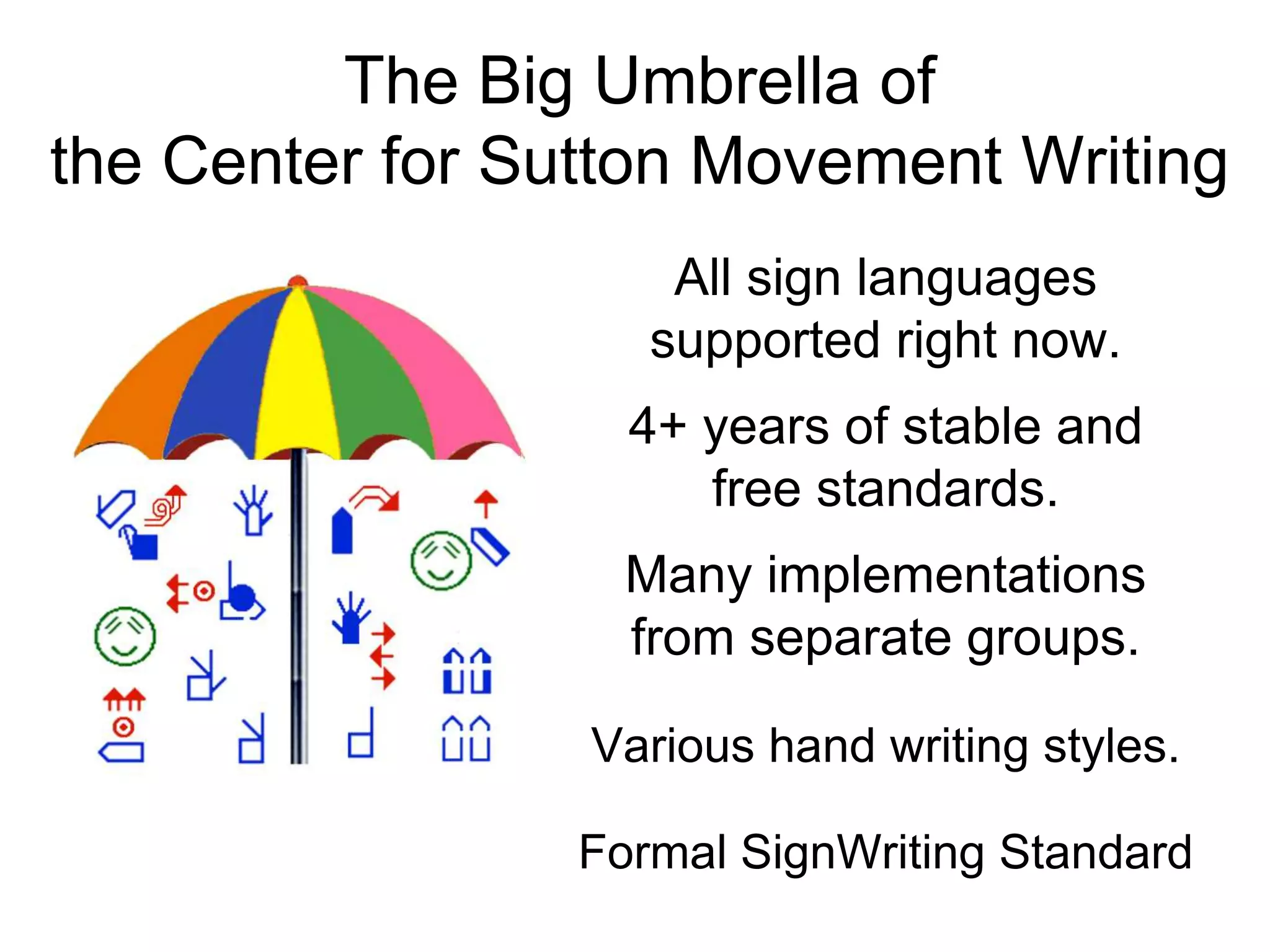
The Big Umbrella of
the Center for Sutton Movement Writing
All sign languages
supported right now.
5+ years of stable and
free standards.
Many implementations
from separate groups.
Various hand writing styles.
Formal SignWriting (FSW) specification
“a worldwide character standard”
The Unicode Standard
Principles of the Unicode Standard
• Universal repertoire
• Logical order
• Efficiency
• Unification
• Characters, not glyphs
• Dynamic composition
• Semantics
• Stability
• Plain Text
• Convertibility
“used for representation of text for computer processing.”
http://unicode.org/standard/principles.html
“addresses only the encoding and semantics of text.”
“The Unicode Standard groups characters together by scripts in blocks.
A script is any system of related characters.”
672 Unicode characters have been officially accepted
in the Sutton SignWriting block.
a complex script with a wide variety of processing available
Sutton SignWriting
17 additional control characters are proposed.
https://en.wikipedia.org/wiki/SignWriting#Unicode
Sutton SignWriting Characters
since Unicode version 8
Description
Base Characters
Fill Modifiers 2 to 6
Rotation Modifiers 2 to 16
Unicode Range
U+1D800 to U+1DA8B
U+1DA9B to U+1DA9F
U+1DAA1 to U+1DAAF
672 characters already accepted.
The Center for Sutton Movement Writing
Proposal for Full Unicode
17 new characters for full script support.
Description
Fill Modifier 1
Rotation Modifier 1
Numbers 0 to 9
Sequence Marker (A)
SignBox Marker (B)
Left Lane Marker (L)
Middle Lane Marker (M)
Right Lane Marker (R)
Proposed Unicode
U+1DA9A
U+1DAA0
U+1DAB0 to U+1DAB9
U+1DABA
U+1DABB
U+1DABC
U+1DABD
U+1DABE
Fix Sorting and Simplify Processing
Under the triadic symbol definition, each symbol is written
as 3 Unicode characters of a base, a fill, and a rotation.
“The standard retains the order of characters in a source set where
possible. When the characters of a script are traditionally arranged in a
certain order—alphabetic order, for example—the Unicode Standard
arranges them in its codespace using the same order whenever possible.”
http://unicode.org/standard/principles.html
Fill Modifier 1
Rotation Modifier 1
U+1DA9A
U+1DAA0
Using a binary string comparison, efficient sorting is
available for all programming languages and applications.
Number Characters for Distance
Numbers 0 to 9 U+1DAB0 to U+1DAB9
Distance is fundamental to the meaning of a sign.
Formatting
CAT
C A T
C A T
Meaning
Sequence Marker
Supports multiple theories
Not formatting nor style
Meaning that can not be
derived from main string
Rendered in dictionary
A = U+1DABA
Marks the start of the
temporal prefix
Temporal Prefix
SignBox Marker
B = U+1DABB
Marks the start of the
SignBox cluster
Lane Markers
Left = U+1DABC
Middle = U+1DABD
Right = U+1DABE
Marks the lane of the
SignBox for vertical writing
Complex Script Support
with the Universal Shaping Engine
Full Script Encoding
MicroSoft Volt
TrueType Font Import
https://www.microsoft.com/en-us/Typography/volt.aspx
Using characters for
structural markers
and numbers
Utilizing the GPOS feature
with cartesian coordinates
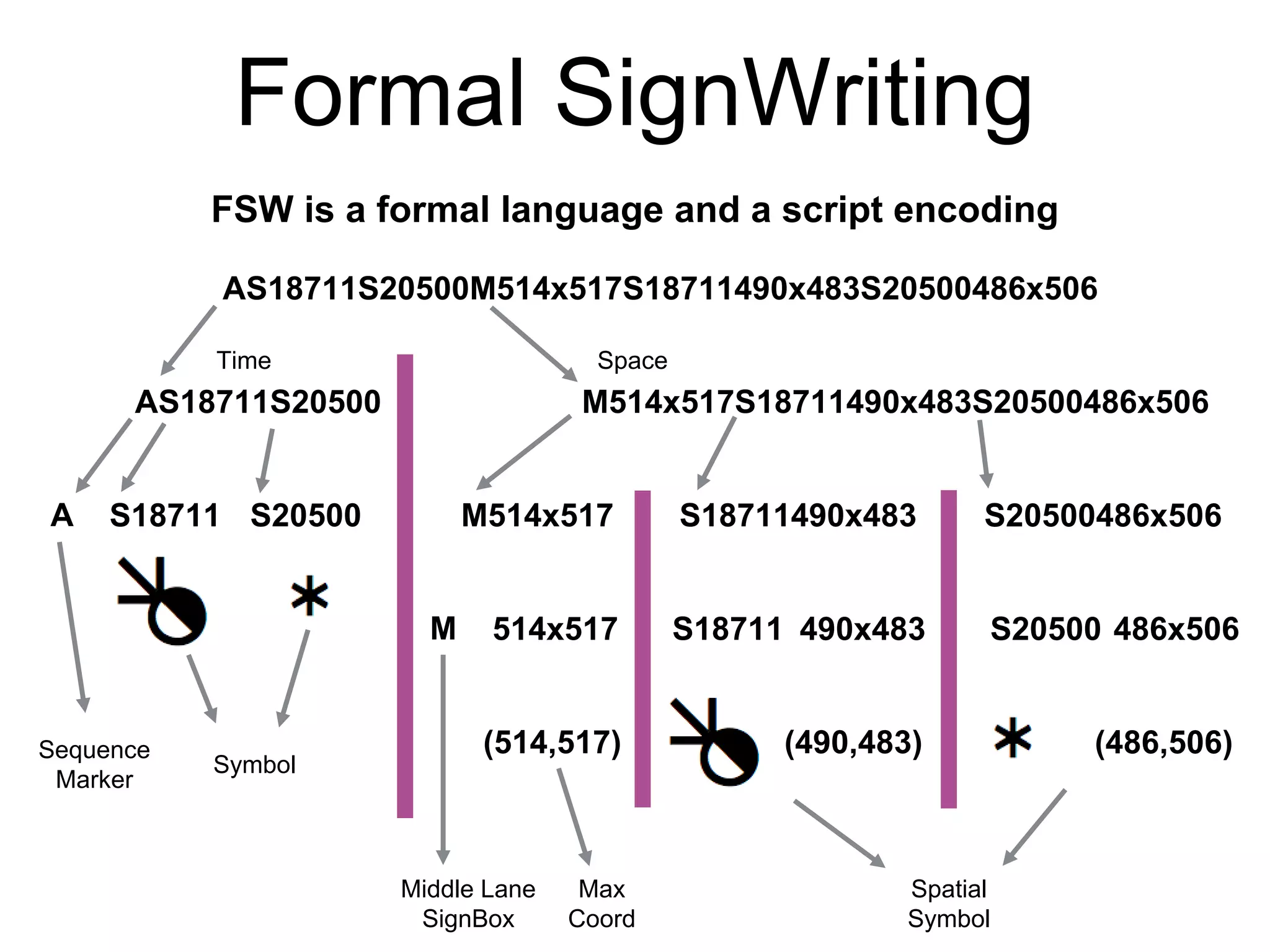
Formal SignWriting
Regular Expressions
Query Strings
SVGUnicode
TrueType Font
10% to 50% reduction
15 to 50 times expansion
process million of characters per second
search results
15 times expansioncharacters for symbols
CSS
style text
JS
Isomorphic Unicode
6 KB zipped
16-bit
SignWriting Server
SVG Shapes
paths without Unicode text and fonts
Remote Website
Open Type Font
Targeting MS’s Universal Shaping Engine
Formatting
style text
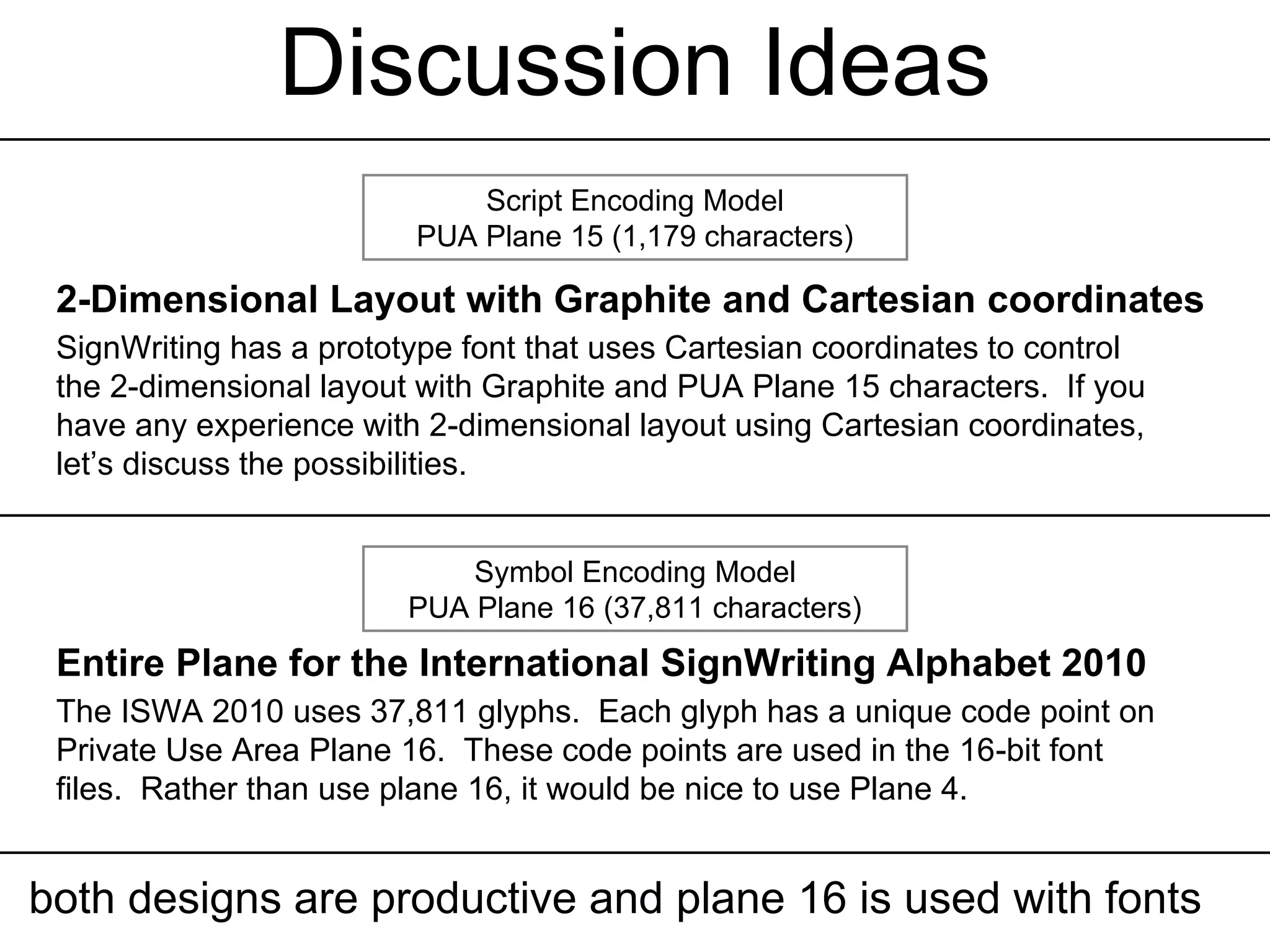
Discussion Ideas
2-Color Fonts
SignWriting relies on a 2-color font. Currently, SignWriting mimics a 2-color
font by using 2 TrueType Fonts: one for the line and another for the filling. If
you have any experience with 2-color fonts, let’s discuss the possibilities.
Glyphs with 2 Types of Space
SignWriting creates signs as 2-dimensional arrangements of symbols. The
glyphs for the SignWriting symbols have 2 types of space: a positive space
and a negative space. The positive space is visible and reveals the line or
shape of the glyph. The negative space is set to a background color or made
transparent. When 2 symbols overlap, the symbols are placed in order on a 2-
dimensional canvas. The negative space of the top symbol will overwrite the
positive space of the symbol underneath. Current software uses a
background color for the negative space. MicroSoft has a solution for making
the negative space transparent and still overwriting the positive space of the
symbol underneath.
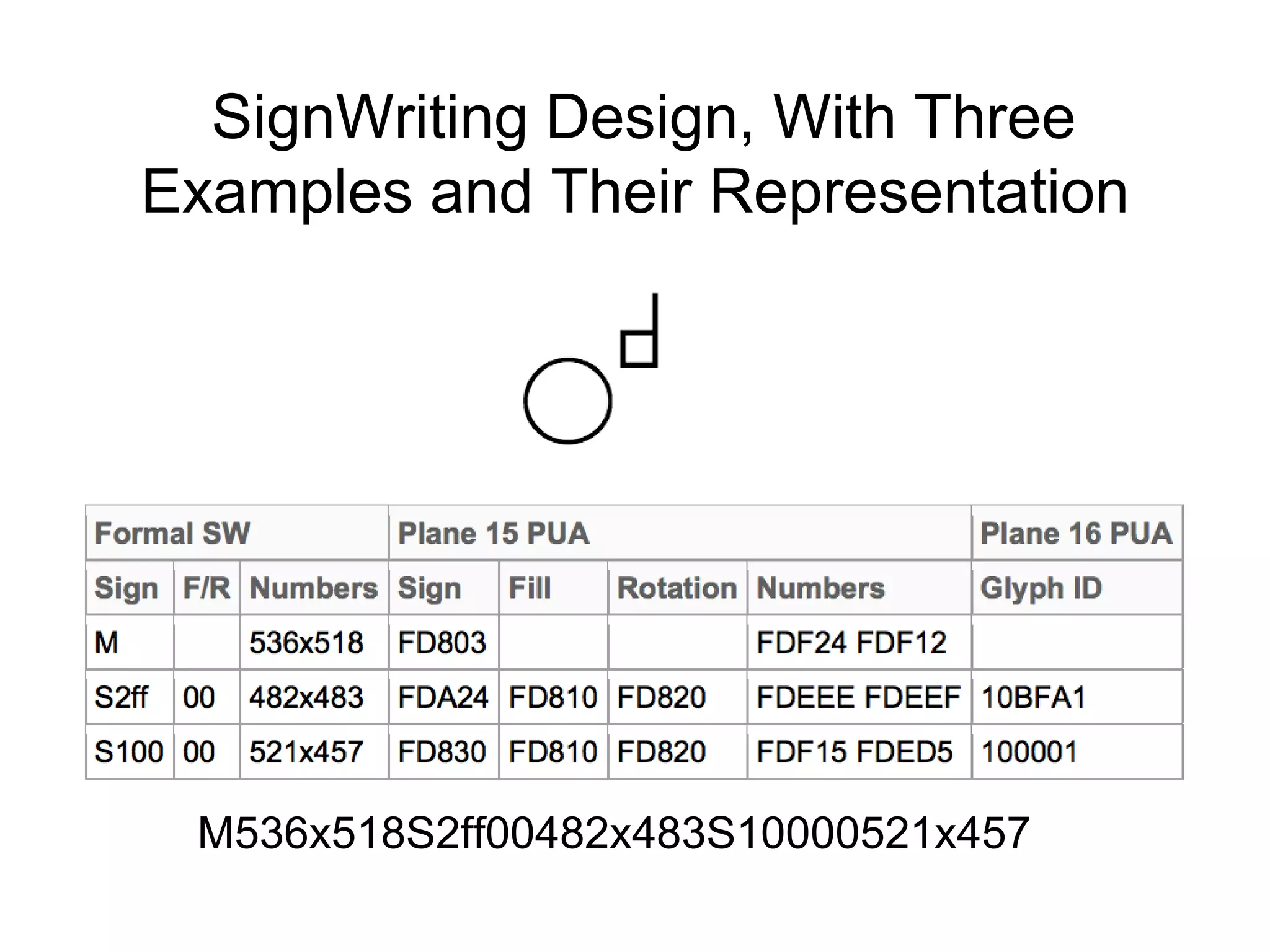
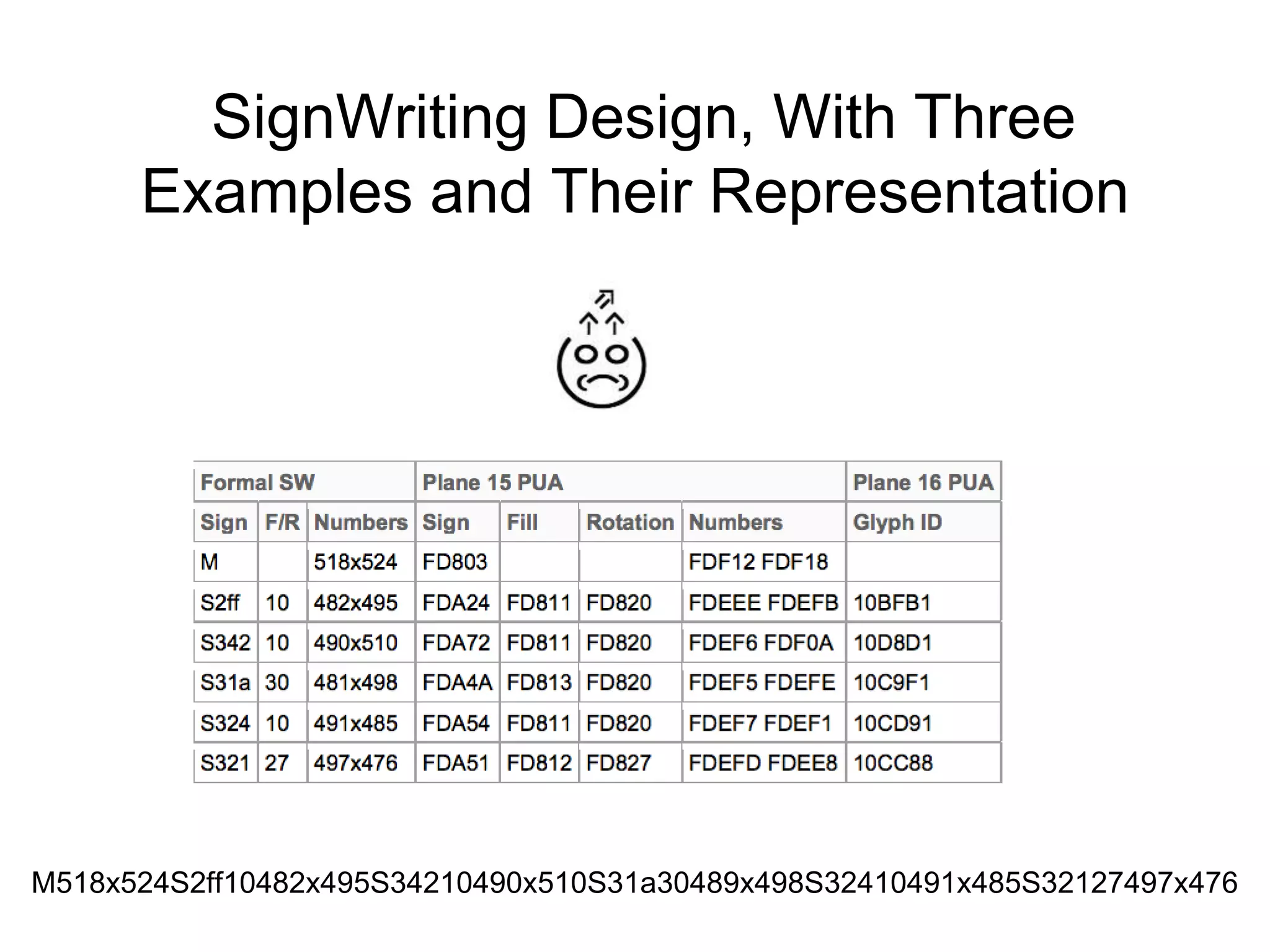
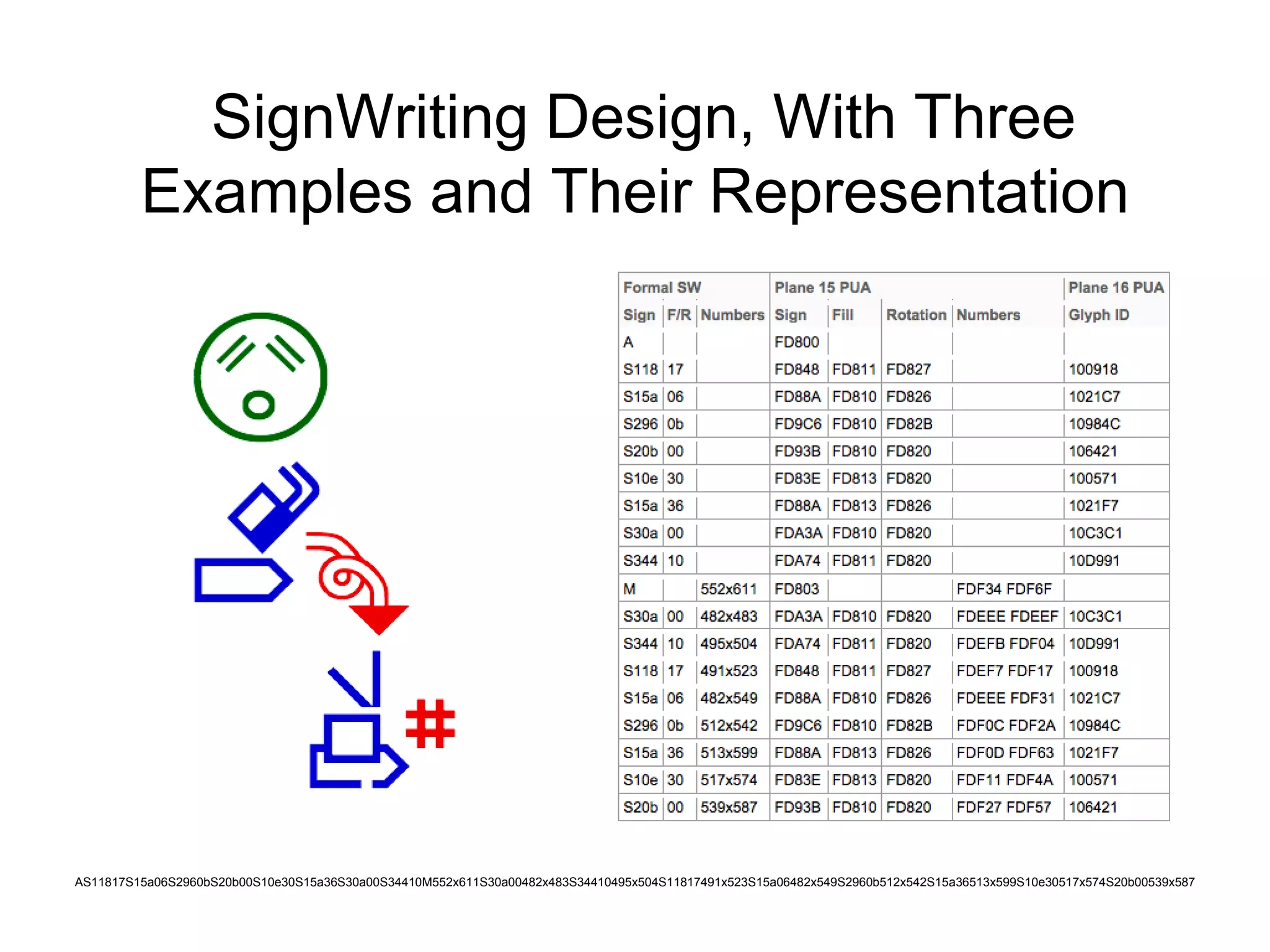
SignWriting Design, With Three
Examples and Their Representation
http://www.unicode.org/L2/L2015/15219-signwriting-design.pdf
SignWriting in
Unicode Next
by Stephen E Slevinski Jr
http://signpuddle.com
slevinski@signwriting.org
http://www.slideshare.net/StephenSlevinski/presentations

SignWriting in Unicode Next

  • 1.
    SignWriting in Unicode Next Updatedfor UTC # 156 (Late 2018) a Unicode Technical Committee meeting by Stephen E Slevinski Jr in association with the Center for Sutton Movement Writing Version 4
  • 2.
    The Big Umbrellaof the Center for Sutton Movement Writing All sign languages supported right now. 5+ years of stable and free standards. Many implementations from separate groups. Various hand writing styles. Formal SignWriting (FSW) specification
  • 3.
    “a worldwide characterstandard” The Unicode Standard Principles of the Unicode Standard • Universal repertoire • Logical order • Efficiency • Unification • Characters, not glyphs • Dynamic composition • Semantics • Stability • Plain Text • Convertibility “used for representation of text for computer processing.” http://unicode.org/standard/principles.html “addresses only the encoding and semantics of text.” “The Unicode Standard groups characters together by scripts in blocks. A script is any system of related characters.”
  • 4.
    672 Unicode charactershave been officially accepted in the Sutton SignWriting block. a complex script with a wide variety of processing available Sutton SignWriting 17 additional control characters are proposed. https://en.wikipedia.org/wiki/SignWriting#Unicode
  • 5.
    Sutton SignWriting Characters sinceUnicode version 8 Description Base Characters Fill Modifiers 2 to 6 Rotation Modifiers 2 to 16 Unicode Range U+1D800 to U+1DA8B U+1DA9B to U+1DA9F U+1DAA1 to U+1DAAF 672 characters already accepted.
  • 6.
    The Center forSutton Movement Writing Proposal for Full Unicode 17 new characters for full script support. Description Fill Modifier 1 Rotation Modifier 1 Numbers 0 to 9 Sequence Marker (A) SignBox Marker (B) Left Lane Marker (L) Middle Lane Marker (M) Right Lane Marker (R) Proposed Unicode U+1DA9A U+1DAA0 U+1DAB0 to U+1DAB9 U+1DABA U+1DABB U+1DABC U+1DABD U+1DABE
  • 7.
    Fix Sorting andSimplify Processing Under the triadic symbol definition, each symbol is written as 3 Unicode characters of a base, a fill, and a rotation. “The standard retains the order of characters in a source set where possible. When the characters of a script are traditionally arranged in a certain order—alphabetic order, for example—the Unicode Standard arranges them in its codespace using the same order whenever possible.” http://unicode.org/standard/principles.html Fill Modifier 1 Rotation Modifier 1 U+1DA9A U+1DAA0 Using a binary string comparison, efficient sorting is available for all programming languages and applications.
  • 8.
    Number Characters forDistance Numbers 0 to 9 U+1DAB0 to U+1DAB9 Distance is fundamental to the meaning of a sign. Formatting CAT C A T C A T Meaning
  • 9.
    Sequence Marker Supports multipletheories Not formatting nor style Meaning that can not be derived from main string Rendered in dictionary A = U+1DABA Marks the start of the temporal prefix Temporal Prefix
  • 10.
    SignBox Marker B =U+1DABB Marks the start of the SignBox cluster Lane Markers Left = U+1DABC Middle = U+1DABD Right = U+1DABE Marks the lane of the SignBox for vertical writing
  • 11.
    Complex Script Support withthe Universal Shaping Engine Full Script Encoding MicroSoft Volt TrueType Font Import https://www.microsoft.com/en-us/Typography/volt.aspx Using characters for structural markers and numbers Utilizing the GPOS feature with cartesian coordinates
  • 12.
    Formal SignWriting Regular Expressions QueryStrings SVGUnicode TrueType Font 10% to 50% reduction 15 to 50 times expansion process million of characters per second search results 15 times expansioncharacters for symbols CSS style text JS Isomorphic Unicode 6 KB zipped 16-bit SignWriting Server SVG Shapes paths without Unicode text and fonts Remote Website Open Type Font Targeting MS’s Universal Shaping Engine Formatting style text
  • 13.
    Discussion Ideas 2-Color Fonts SignWritingrelies on a 2-color font. Currently, SignWriting mimics a 2-color font by using 2 TrueType Fonts: one for the line and another for the filling. If you have any experience with 2-color fonts, let’s discuss the possibilities. Glyphs with 2 Types of Space SignWriting creates signs as 2-dimensional arrangements of symbols. The glyphs for the SignWriting symbols have 2 types of space: a positive space and a negative space. The positive space is visible and reveals the line or shape of the glyph. The negative space is set to a background color or made transparent. When 2 symbols overlap, the symbols are placed in order on a 2- dimensional canvas. The negative space of the top symbol will overwrite the positive space of the symbol underneath. Current software uses a background color for the negative space. MicroSoft has a solution for making the negative space transparent and still overwriting the positive space of the symbol underneath.
  • 14.
    SignWriting Design, WithThree Examples and Their Representation http://www.unicode.org/L2/L2015/15219-signwriting-design.pdf
  • 15.
    SignWriting in Unicode Next byStephen E Slevinski Jr http://signpuddle.com slevinski@signwriting.org http://www.slideshare.net/StephenSlevinski/presentations