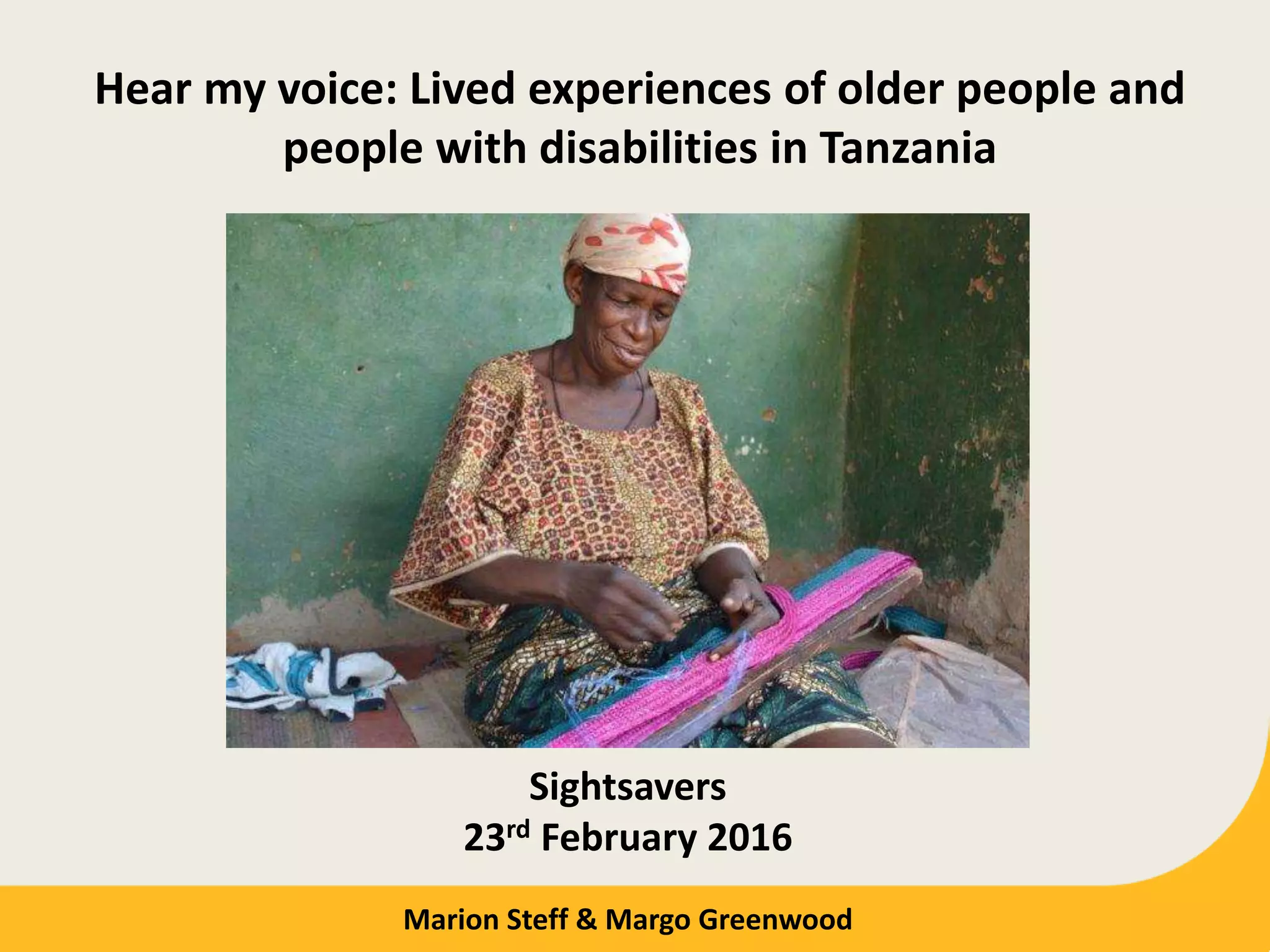
Hear my voice: Lived experiences of older people and
people with disabilities in Tanzania
Sightsavers
23rd February 2016
Marion Steff & Margo Greenwood
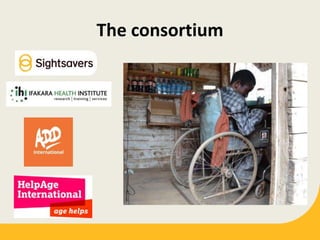
The consortium
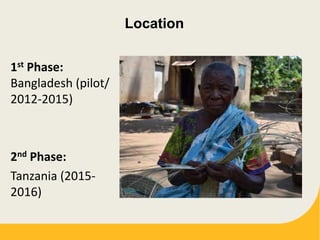
Location
1st Phase:
Bangladesh (pilot/
2012-2015)
2nd Phase:
Tanzania (2015-
2016)
Purpose
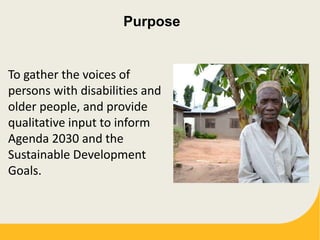
To gather the voices of
persons with disabilities and
older people, and provide
qualitative input to inform
Agenda 2030 and the
Sustainable Development
Goals.
Research information
• Peer researchers: 26 (16 community, 10 NGO)
• Two districts: Kibaha and Nachingwea
• Stories: 106 (approx. 76 from people with
disabilities and older people, 30 from local
NGOs)
Methodology
Community-based participatory research (CBPR). It
involves:
– Committing to sharing power and resources
– Working towards beneficial outcomes for all
participants
– Equitably involving community members,
organisational representatives and researchers
– Sharing expertise, decision-making and ownership
– Bringing unique strengths from all
Aim of CBPR
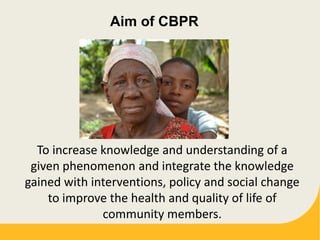
To increase knowledge and understanding of a
given phenomenon and integrate the knowledge
gained with interventions, policy and social change
to improve the health and quality of life of
community members.
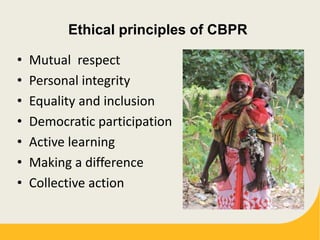
Ethical principles of CBPR
• Mutual respect
• Personal integrity
• Equality and inclusion
• Democratic participation
• Active learning
• Making a difference
• Collective action
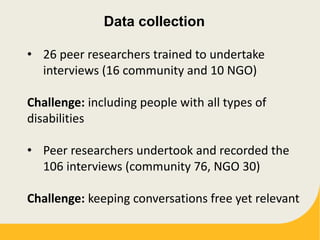
Data collection
• 26 peer researchers trained to undertake
interviews (16 community and 10 NGO)
Challenge: including people with all types of
disabilities
• Peer researchers undertook and recorded the
106 interviews (community 76, NGO 30)
Challenge: keeping conversations free yet relevant
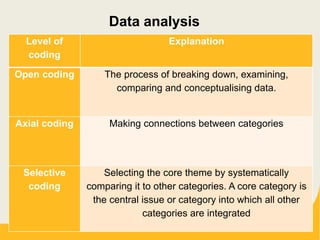
Data analysis
Level of
coding
Explanation
Open coding The process of breaking down, examining,
comparing and conceptualising data.
Axial coding Making connections between categories
Selective
coding
Selecting the core theme by systematically
comparing it to other categories. A core category is
the central issue or category into which all other
categories are integrated
G
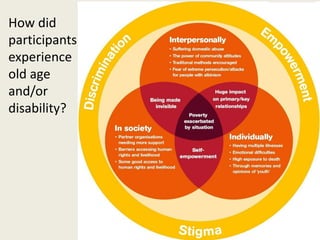
How did
participants
experience
old age
and/or
disability?
Your turn! Get to know our participants
Our peer researchers were asked:
1. What is the story telling us?
2. What is important?
3. Why is this important?
Read out one or two phrases that stand out to you
and explain what struck you.
Eight identified priorities
• Access to education
• Health services
• NGO issues
• Poverty, income & dependence
• Witchcraft & albinism mistreatment
• Family difficulties & marriage breakup
• Sexual violence & gender issues
• Poor treatment from family & taking advantage of
people with disabilities
Passages from stories (1/3)
“(…) I have problems related to health services. If I
become sick, my relatives do not take me to the
hospital. I usually go alone but I have been
experiencing a lot of difficulties because I don’t
know how to express myself because health care
providers do not understand sign language.” Person
with a hearing disability, 32, Kibaha district
Passages from stories (2/3)
“When I was in primary school, I would tell the
teacher that I could not see. I would ask him to
read for me. But the teacher would tell me that if I
don’t see, why do you come to school then?”
Person with visual impairment, 25, Kibaha district
(Tanzania)
Passages from stories (3/3)
Talking about witchcraft and albinism: “The
way I see it, politic is the source of killing of
people with albinism. The reason for my
argument is that whenever there is an
election, the killing of people with albinism
increases. This year, the community raised its
voice and it stopped for a while.” Participant
from a NGO, Dar es Salaam
Local recommendations
The peer researchers enable to:
• Take a lead in providing sexual education to
respective communities;
• Educate and empower families of older people and
people with disabilities to provide better support;
• Raise awareness among village leaders and attend
villages meeting;
• Engage with the government to implement the
National Disability Policy of 2004.
National recommendations
The Tanzanian government should:
• Work with traditional healers and seek for the
causes of people with albinism’ killings;
• Provide counselling for parents of children with
disabilities;
• Legislate the national policy on ageing so that there
is a binding legal framework under the new Ministry
of Health, Social Development, Gender, Older
People and Children.
Global recommendations (1/2)
• Ratify, implement & monitor the UN Convention on
the Rights of Persons with Disabilities (UNCRPD);
• Support the elaboration of a UN Convention on the
Rights of Older People (UNCROP).
• Improve disability and older-person data gathering
and analysis mechanisms (SDGs)
• Disaggregate data by age, gender, location,
ethnicity and disability (SDGs targets & indicators)
Global recommendations (2/2)
• Promote the full and equal participation of older
people and persons with disabilities in policy
making at all levels.
• Raise awareness about the experiences of
people with disabilities and older people to
reduce stigma and discrimination.
• Ensure SDGs-compliant development to provide
public services that are inclusive to people with
disabilities and older people
Reflections /our own learning
• Strong partnership between research and policy
teams
• Partnering with research institute based in
Tanzania
• Importance of using qualitative methodology
• Approach is costly and time consuming
• ‘Messiness’ linked to the methodology
• How to involve participants in the analysis while
keeping the analysis rigorous.
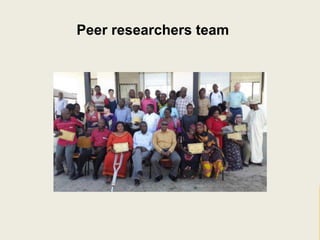
Peer researchers team
Thank you! Questions?
Web page: www.sightsavers.org/voices
Contact details: msteff@sightsavers.org
mgreenwood@sightsavers.org
Twitter: @mllemarionamtl
@MargoGreenwood
@Sightsavers_Pol

Marion Steff and Margo Greenwood (February 2016). Hear my voice: Lived experiences of older people and people with disabilities in Tanzania.

  • 1.
    Hear my voice:Lived experiences of older people and people with disabilities in Tanzania Sightsavers 23rd February 2016 Marion Steff & Margo Greenwood
  • 2.
  • 3.
  • 4.
    Purpose To gather thevoices of persons with disabilities and older people, and provide qualitative input to inform Agenda 2030 and the Sustainable Development Goals.
  • 5.
    Research information • Peerresearchers: 26 (16 community, 10 NGO) • Two districts: Kibaha and Nachingwea • Stories: 106 (approx. 76 from people with disabilities and older people, 30 from local NGOs)
  • 6.
    Methodology Community-based participatory research(CBPR). It involves: – Committing to sharing power and resources – Working towards beneficial outcomes for all participants – Equitably involving community members, organisational representatives and researchers – Sharing expertise, decision-making and ownership – Bringing unique strengths from all
  • 7.
    Aim of CBPR Toincrease knowledge and understanding of a given phenomenon and integrate the knowledge gained with interventions, policy and social change to improve the health and quality of life of community members.
  • 8.
    Ethical principles ofCBPR • Mutual respect • Personal integrity • Equality and inclusion • Democratic participation • Active learning • Making a difference • Collective action
  • 9.
    Data collection • 26peer researchers trained to undertake interviews (16 community and 10 NGO) Challenge: including people with all types of disabilities • Peer researchers undertook and recorded the 106 interviews (community 76, NGO 30) Challenge: keeping conversations free yet relevant
  • 10.
    Data analysis Level of coding Explanation Opencoding The process of breaking down, examining, comparing and conceptualising data. Axial coding Making connections between categories Selective coding Selecting the core theme by systematically comparing it to other categories. A core category is the central issue or category into which all other categories are integrated
  • 11.
  • 12.
    Your turn! Getto know our participants Our peer researchers were asked: 1. What is the story telling us? 2. What is important? 3. Why is this important? Read out one or two phrases that stand out to you and explain what struck you.
  • 13.
    Eight identified priorities •Access to education • Health services • NGO issues • Poverty, income & dependence • Witchcraft & albinism mistreatment • Family difficulties & marriage breakup • Sexual violence & gender issues • Poor treatment from family & taking advantage of people with disabilities
  • 14.
    Passages from stories(1/3) “(…) I have problems related to health services. If I become sick, my relatives do not take me to the hospital. I usually go alone but I have been experiencing a lot of difficulties because I don’t know how to express myself because health care providers do not understand sign language.” Person with a hearing disability, 32, Kibaha district
  • 15.
    Passages from stories(2/3) “When I was in primary school, I would tell the teacher that I could not see. I would ask him to read for me. But the teacher would tell me that if I don’t see, why do you come to school then?” Person with visual impairment, 25, Kibaha district (Tanzania)
  • 16.
    Passages from stories(3/3) Talking about witchcraft and albinism: “The way I see it, politic is the source of killing of people with albinism. The reason for my argument is that whenever there is an election, the killing of people with albinism increases. This year, the community raised its voice and it stopped for a while.” Participant from a NGO, Dar es Salaam
  • 17.
    Local recommendations The peerresearchers enable to: • Take a lead in providing sexual education to respective communities; • Educate and empower families of older people and people with disabilities to provide better support; • Raise awareness among village leaders and attend villages meeting; • Engage with the government to implement the National Disability Policy of 2004.
  • 18.
    National recommendations The Tanzaniangovernment should: • Work with traditional healers and seek for the causes of people with albinism’ killings; • Provide counselling for parents of children with disabilities; • Legislate the national policy on ageing so that there is a binding legal framework under the new Ministry of Health, Social Development, Gender, Older People and Children.
  • 19.
    Global recommendations (1/2) •Ratify, implement & monitor the UN Convention on the Rights of Persons with Disabilities (UNCRPD); • Support the elaboration of a UN Convention on the Rights of Older People (UNCROP). • Improve disability and older-person data gathering and analysis mechanisms (SDGs) • Disaggregate data by age, gender, location, ethnicity and disability (SDGs targets & indicators)
  • 20.
    Global recommendations (2/2) •Promote the full and equal participation of older people and persons with disabilities in policy making at all levels. • Raise awareness about the experiences of people with disabilities and older people to reduce stigma and discrimination. • Ensure SDGs-compliant development to provide public services that are inclusive to people with disabilities and older people
  • 21.
    Reflections /our ownlearning • Strong partnership between research and policy teams • Partnering with research institute based in Tanzania • Importance of using qualitative methodology • Approach is costly and time consuming • ‘Messiness’ linked to the methodology • How to involve participants in the analysis while keeping the analysis rigorous.
  • 22.
  • 23.
    Thank you! Questions? Webpage: www.sightsavers.org/voices Contact details: msteff@sightsavers.org mgreenwood@sightsavers.org Twitter: @mllemarionamtl @MargoGreenwood @Sightsavers_Pol

Editor's Notes

  • #4 Explained why.
  • #7 Aim To increase knowledge and understanding of a given phenomenon and integrate the knowledge gained with interventions, policy and social change to improve the health and quality of life of community members
  • #8 Aim To increase knowledge and understanding of a given phenomenon and integrate the knowledge gained with interventions, policy and social change to improve the health and quality of life of community members
  • #10 Aim To increase knowledge and understanding of a given phenomenon and integrate the knowledge gained with interventions, policy and social change to improve the health and quality of life of community members
  • #11 Aim To increase knowledge and understanding of a given phenomenon and integrate the knowledge gained with interventions, policy and social change to improve the health and quality of life of community members
  • #13 Explained why.