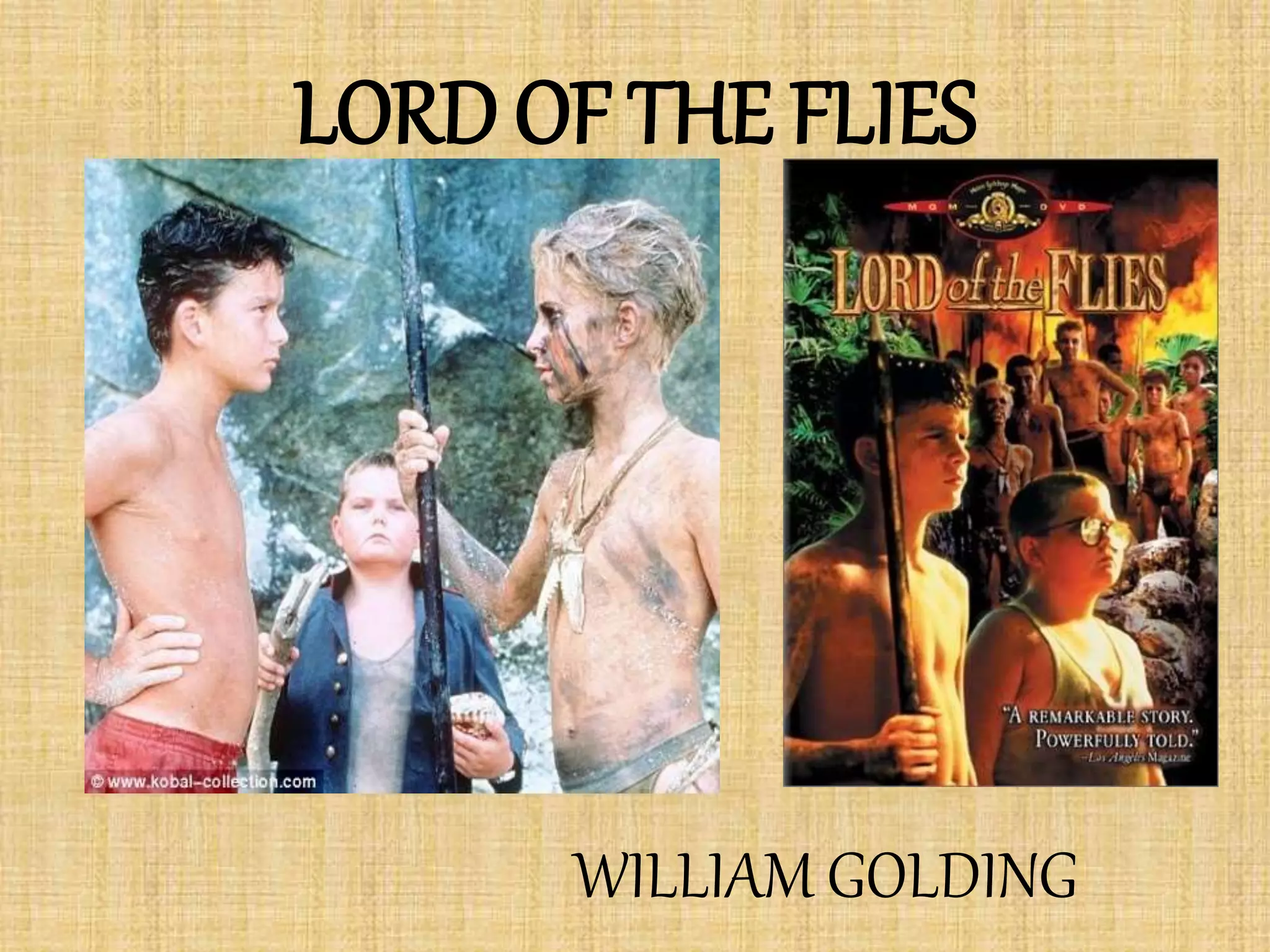
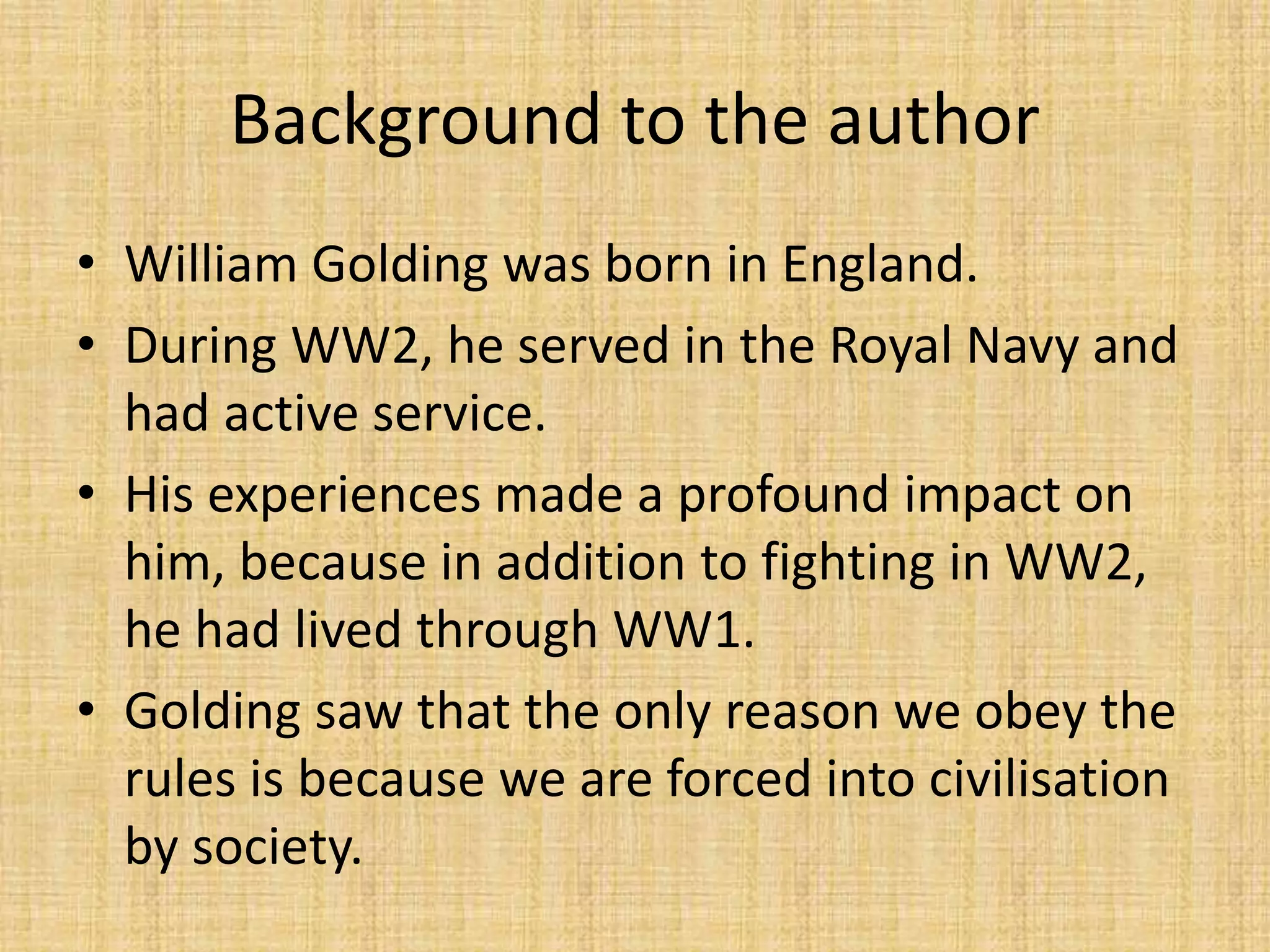
LORD OF THE FLIES
WILLIAM GOLDING
Background to the author
• William Golding was born in England.
• During WW2, he served in the Royal Navy and
had active service.
• His experiences made a profound impact on
him, because in addition to fighting in WW2,
he had lived through WW1.
• Golding saw that the only reason we obey the
rules is because we are forced into civilisation
by society.
Golding’s views on mankind after WW2
• Golding could no longer view humanity as
innocent and noble.
• He believed that when people were forced
into extreme situations (like a war), their
darker and more sinful side of his/her nature
surfaces.
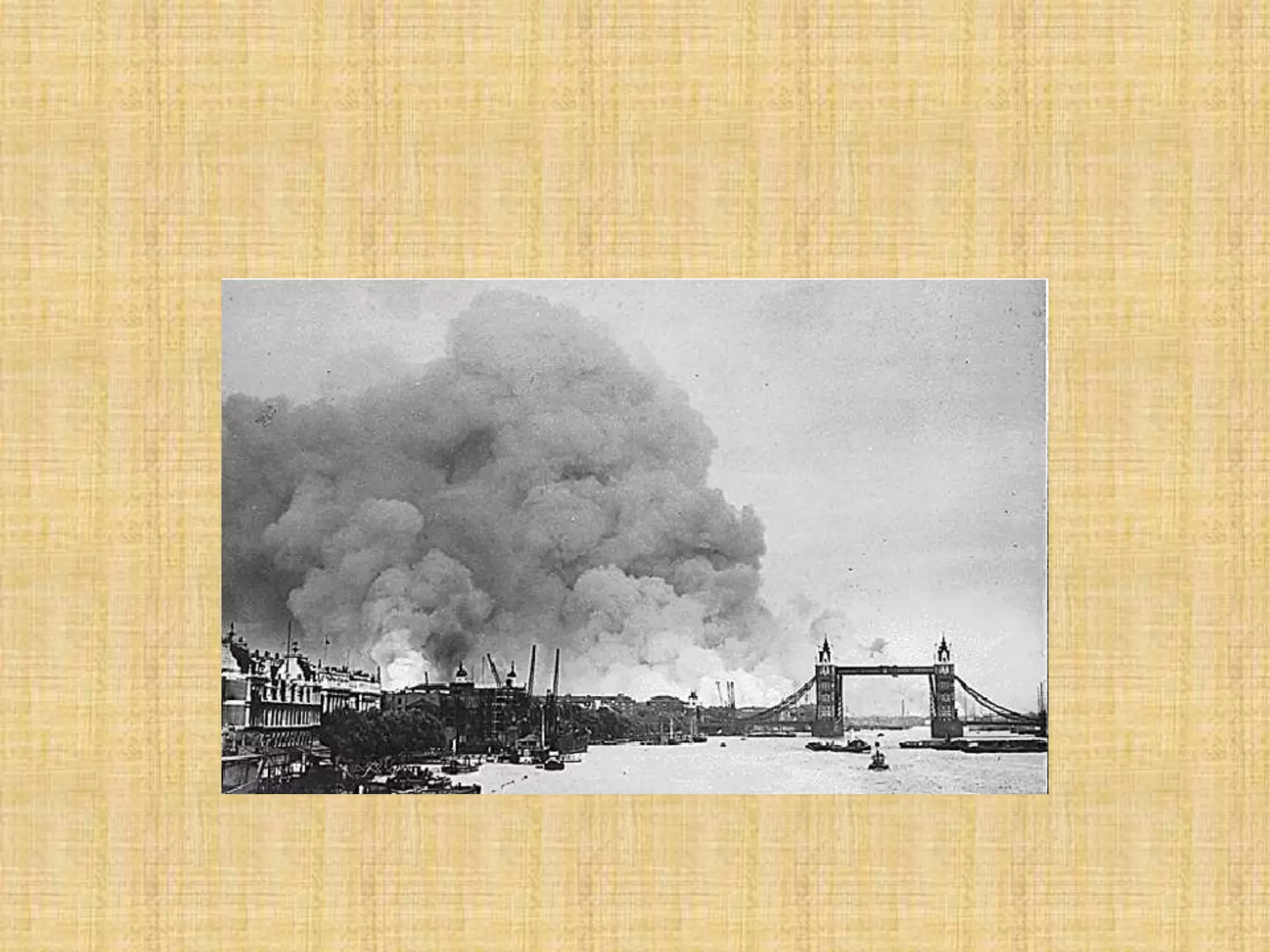
The Blitz on London
• On 7 September 1940, Hitler launched an internal
attack on Britain – starting with London.
• These raids lasted for about 3 months and took place
almost every night.
• Many Londoners sought shelter in the underground
railway system or considered leaving the city.
• A lot of parents made the decision to send their
children away – either to relatives in the countryside or
to countries not affected by the war against Nazi
Germany.
• This process of evacuation saved thousands of lives
that would have been lost during the bombings.
LONDON DURING THE BLITZ
WHY ARE THE BOYS ON THE ISLAND?
• The story is set against the backdrop of a war
(presumably informed by Golding’s experiences
during the war).
• The boys were being evacuated from England for
their safety.
• Many children were taken out of London during
this time, saving thousands of lives that may have
been lost as a result of the bombings.
• These boys were travelling by plane and it was
either shot down or damaged in a storm –
consequently it crash lands on the island.
THE NARRATOR
• The story is told by an anonymous third-person
narrator who describes the events of the novel
without commenting on or becoming involved in the
events.
• The narrator speaks in the third person, focusing
mainly on Ralph’s point of view but following Jack
and Simon at certain times.
• The narrator is in the unique position of seeing and
knowing everything, which gives the reader access to
the characters’ inner thoughts and feelings.
RALPH
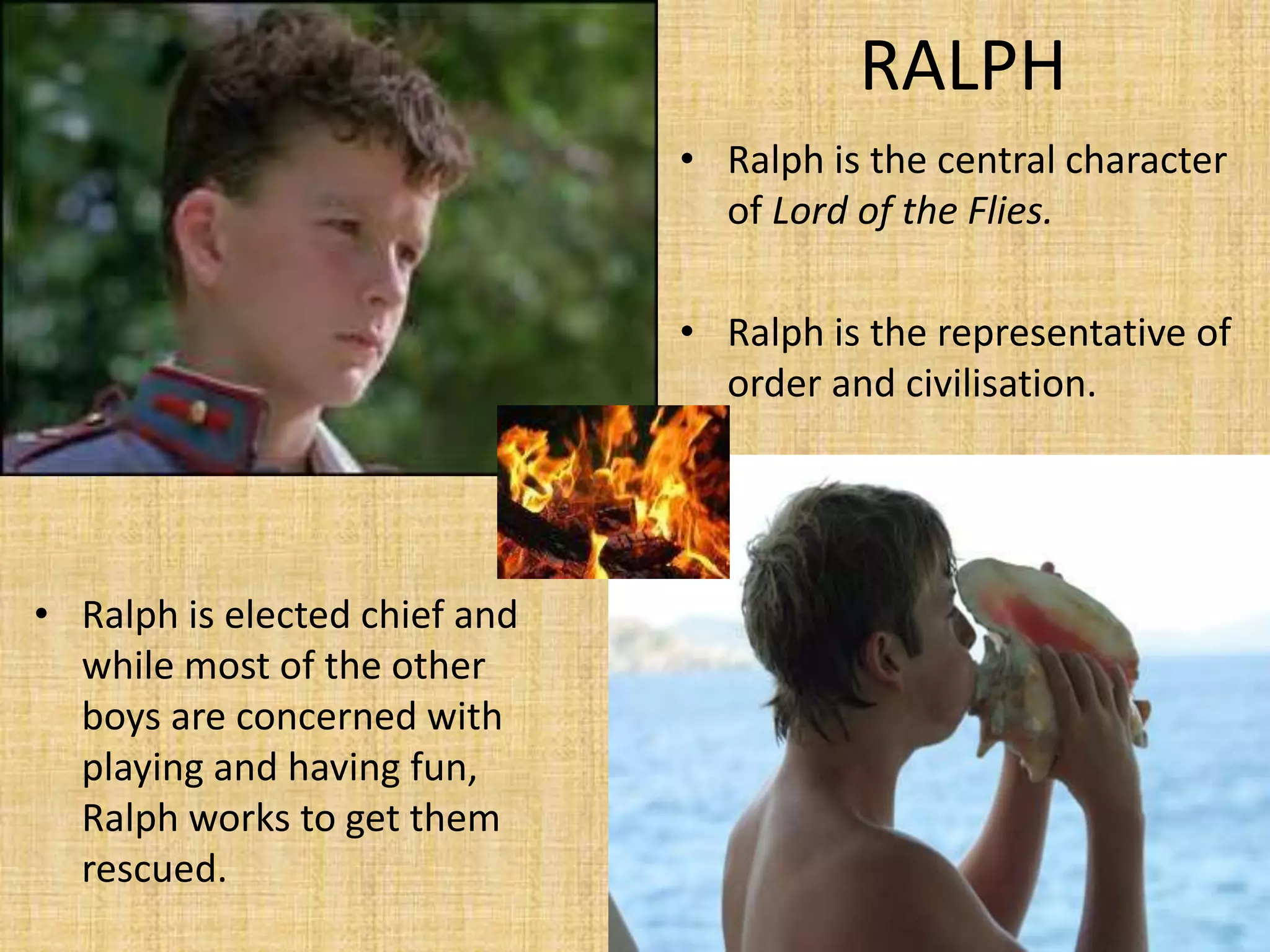
• Ralph is the central character
of Lord of the Flies.
• Ralph is the representative of
order and civilisation.
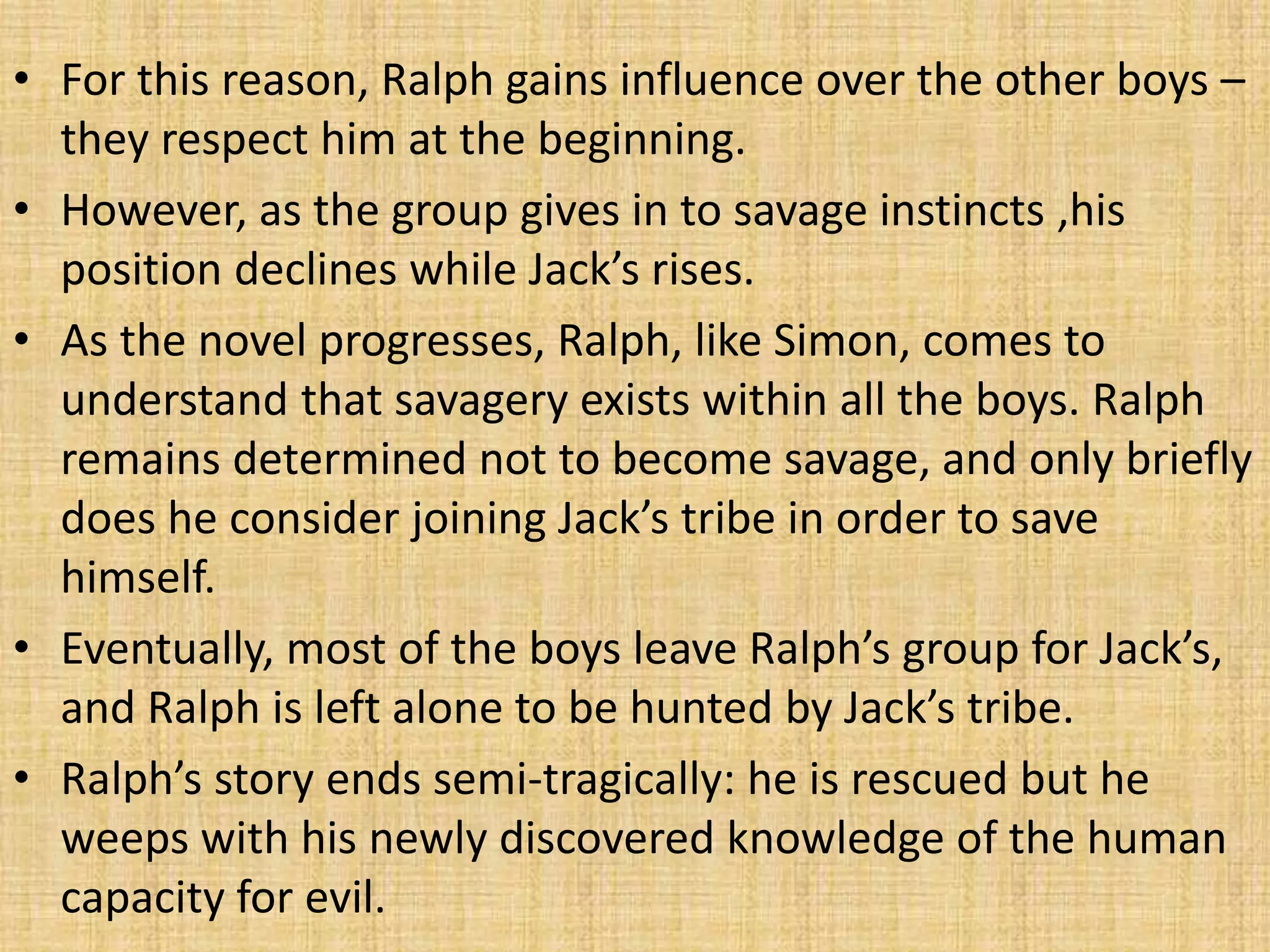
• Ralph is elected chief and
while most of the other
boys are concerned with
playing and having fun,
Ralph works to get them
rescued.
• For this reason, Ralph gains influence over the other boys –
they respect him at the beginning.
• However, as the group gives in to savage instincts ,his
position declines while Jack’s rises.
• As the novel progresses, Ralph, like Simon, comes to
understand that savagery exists within all the boys. Ralph
remains determined not to become savage, and only briefly
does he consider joining Jack’s tribe in order to save
himself.
• Eventually, most of the boys leave Ralph’s group for Jack’s,
and Ralph is left alone to be hunted by Jack’s tribe.
• Ralph’s story ends semi-tragically: he is rescued but he
weeps with his newly discovered knowledge of the human
capacity for evil.
Jack
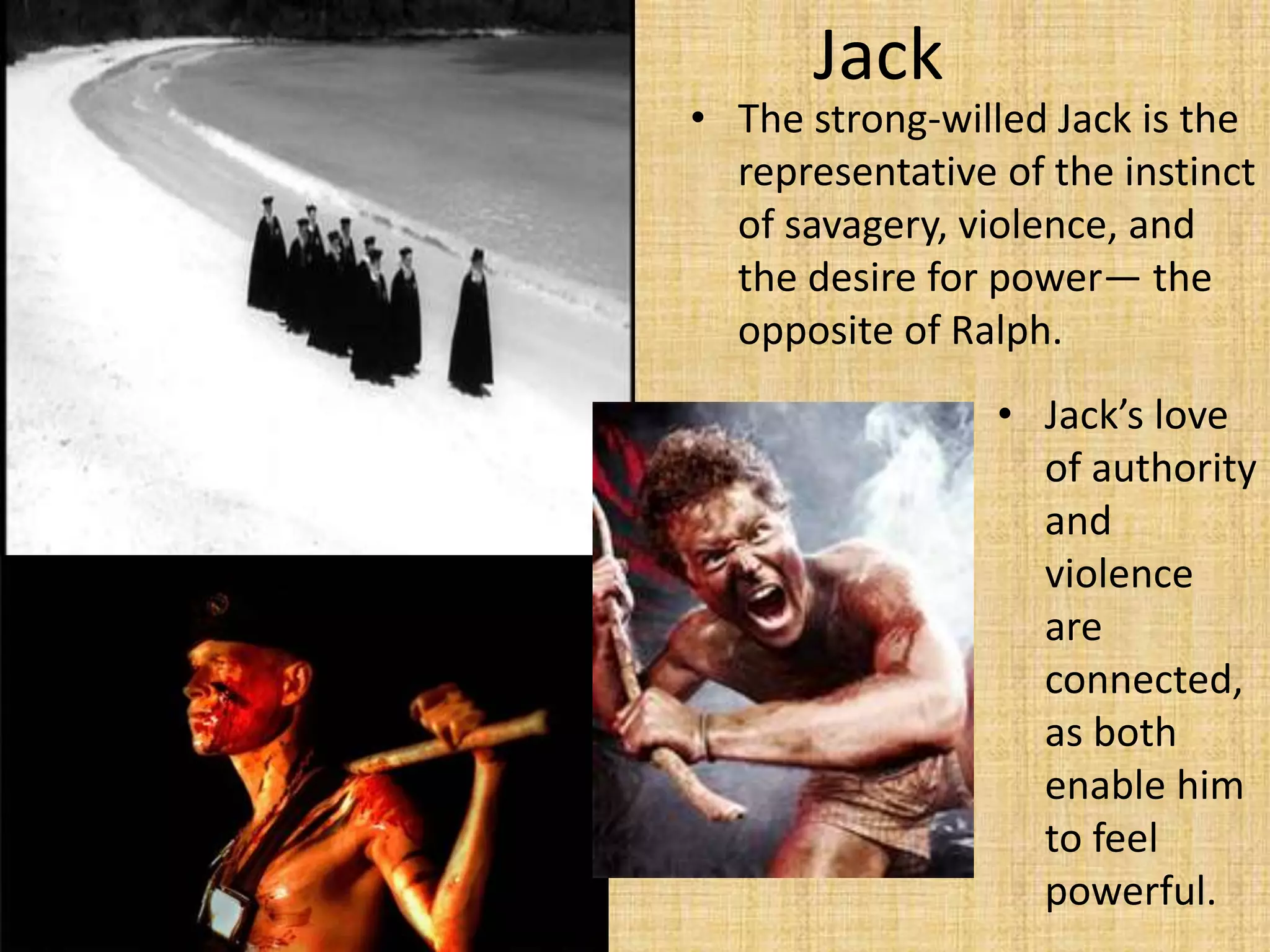
• The strong-willed Jack is the
representative of the instinct
of savagery, violence, and
the desire for power— the
opposite of Ralph.
• Jack’s love
of authority
and
violence
are
connected,
as both
enable him
to feel
powerful.
• He is furious when he loses the election to Ralph and
pushes the boundaries of his role in the group. Early on,
Jack retains his morality and good behaviour – this soon
changes.
• The first time he encounters a pig, he is unable to kill it.
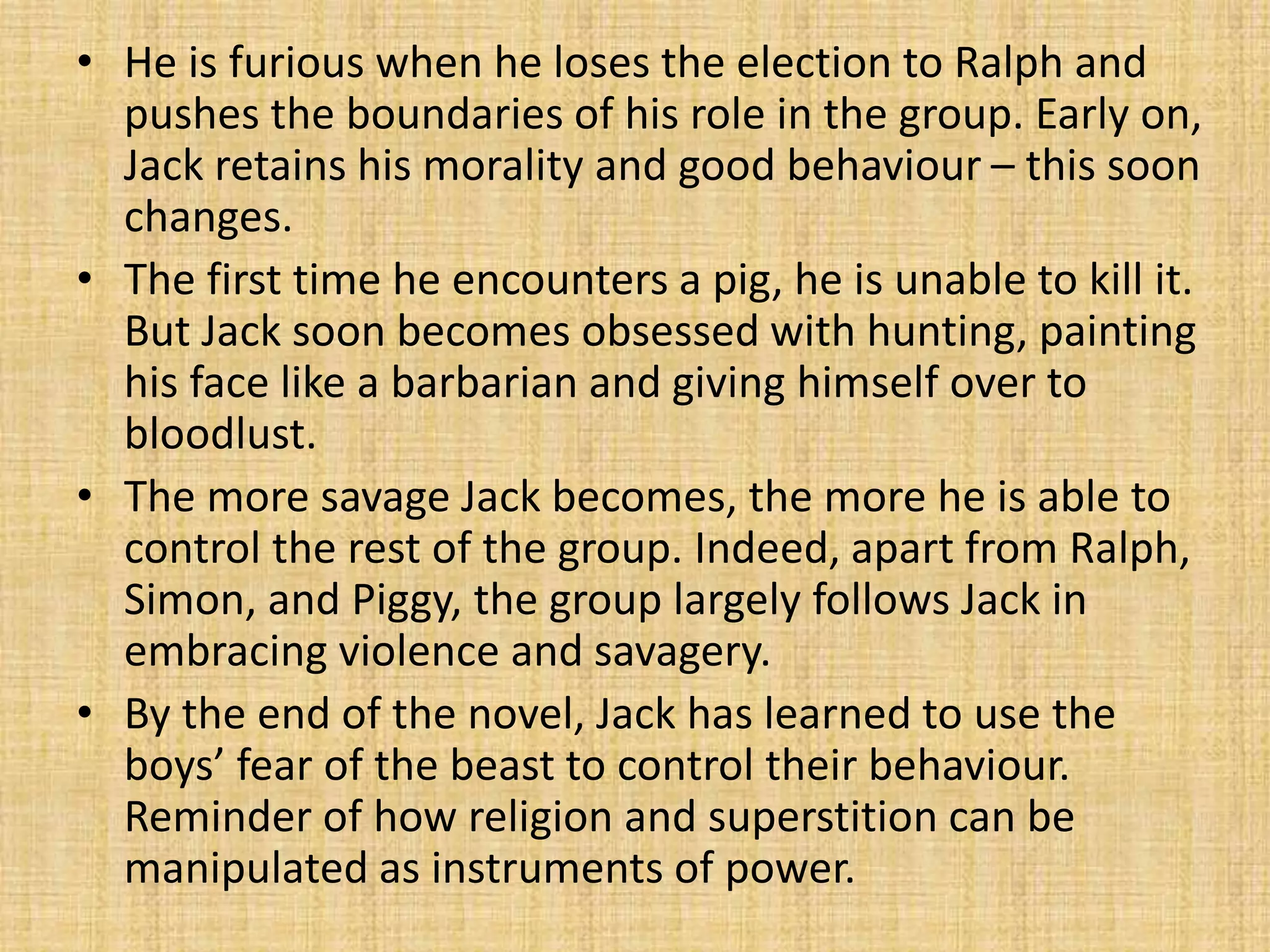
But Jack soon becomes obsessed with hunting, painting
his face like a barbarian and giving himself over to
bloodlust.
• The more savage Jack becomes, the more he is able to
control the rest of the group. Indeed, apart from Ralph,
Simon, and Piggy, the group largely follows Jack in
embracing violence and savagery.
• By the end of the novel, Jack has learned to use the
boys’ fear of the beast to control their behaviour.
Reminder of how religion and superstition can be
manipulated as instruments of power.
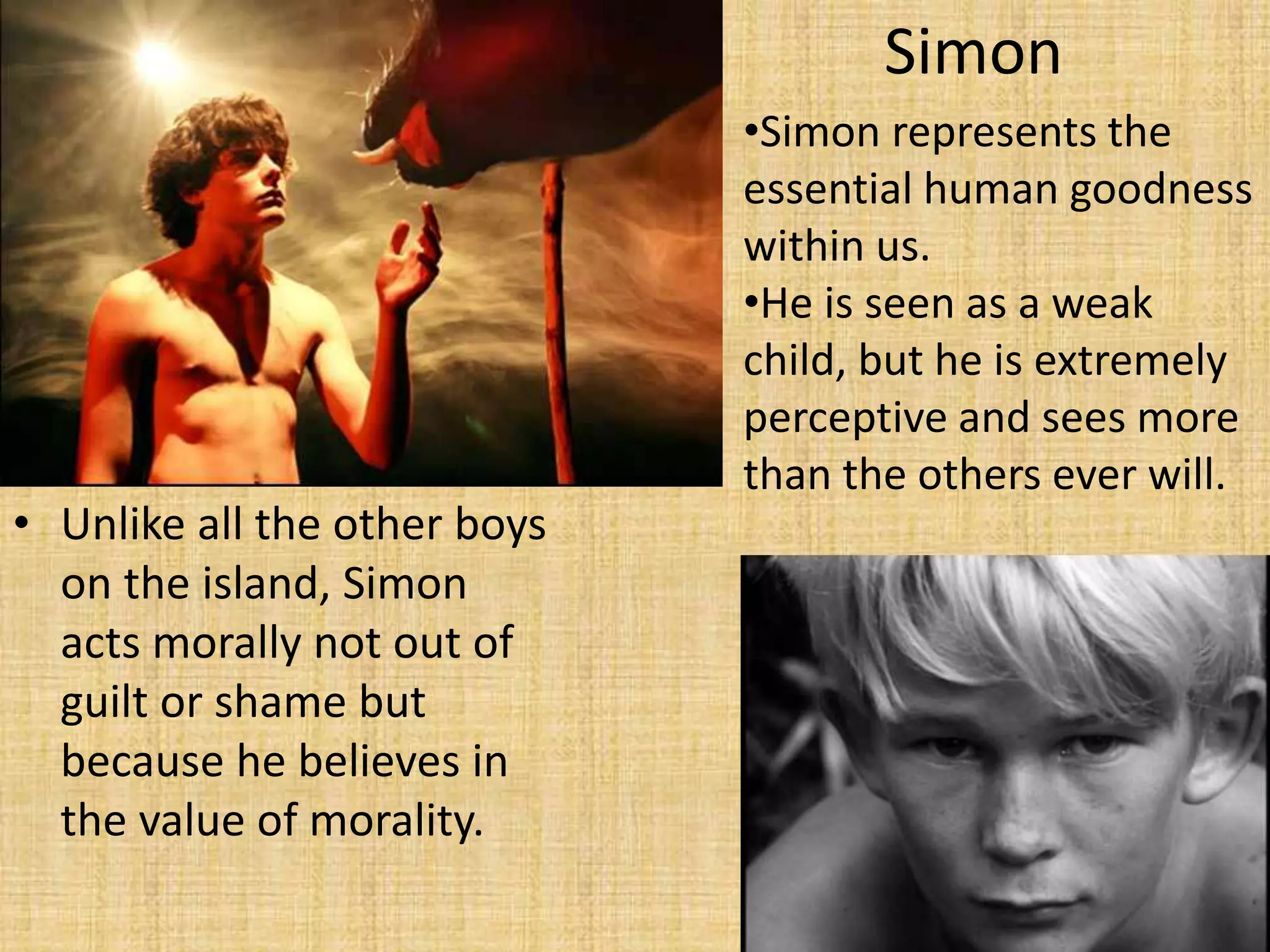
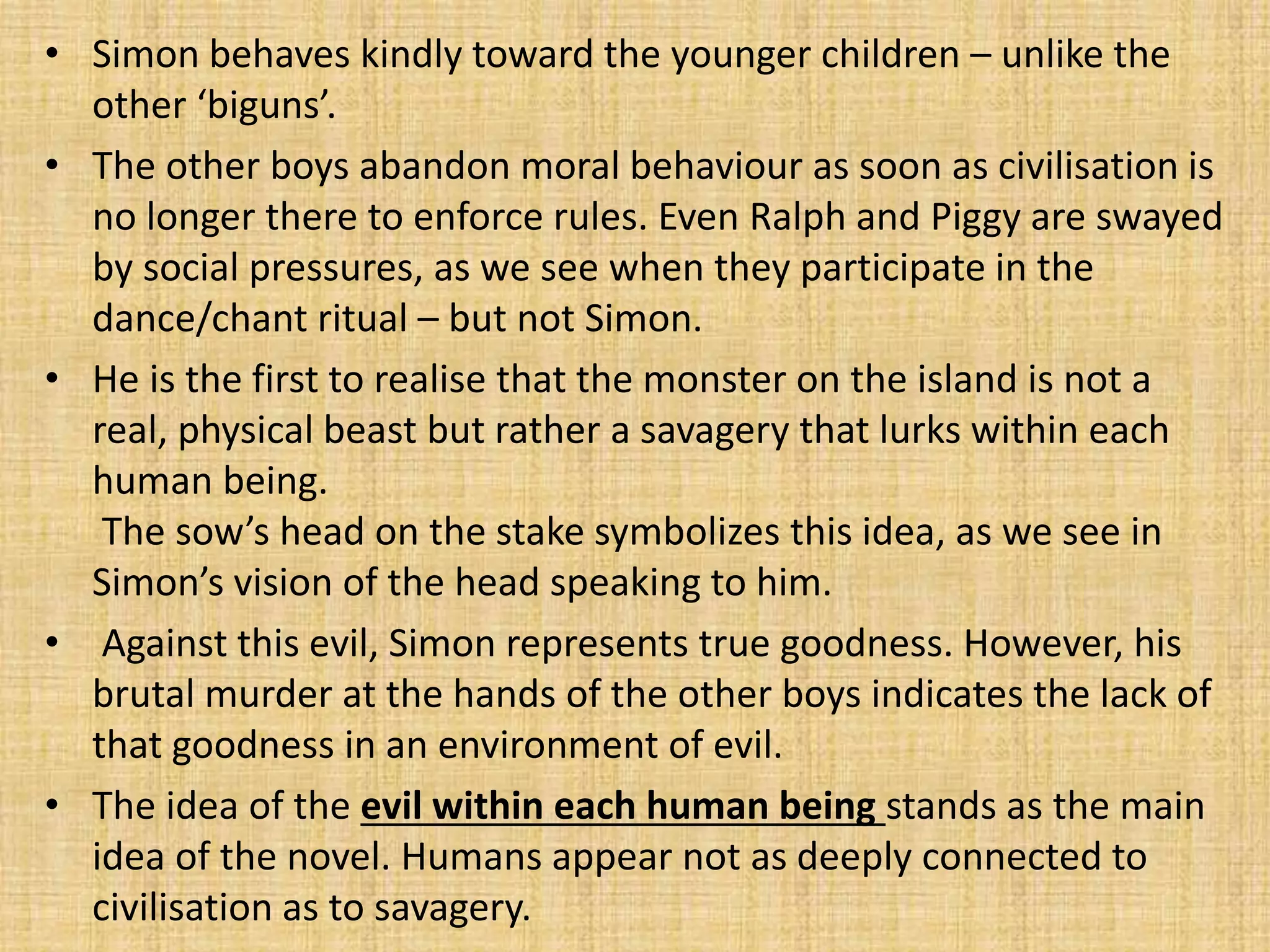
Simon
•Simon represents the
essential human goodness
within us.
•He is seen as a weak
child, but he is extremely
perceptive and sees more
than the others ever will.
• Unlike all the other boys
on the island, Simon
acts morally not out of
guilt or shame but
because he believes in
the value of morality.
• Simon behaves kindly toward the younger children – unlike the
other ‘biguns’.
• The other boys abandon moral behaviour as soon as civilisation is
no longer there to enforce rules. Even Ralph and Piggy are swayed
by social pressures, as we see when they participate in the
dance/chant ritual – but not Simon.
• He is the first to realise that the monster on the island is not a
real, physical beast but rather a savagery that lurks within each
human being.
The sow’s head on the stake symbolizes this idea, as we see in
Simon’s vision of the head speaking to him.
• Against this evil, Simon represents true goodness. However, his
brutal murder at the hands of the other boys indicates the lack of
that goodness in an environment of evil.
• The idea of the evil within each human being stands as the main
idea of the novel. Humans appear not as deeply connected to
civilisation as to savagery.
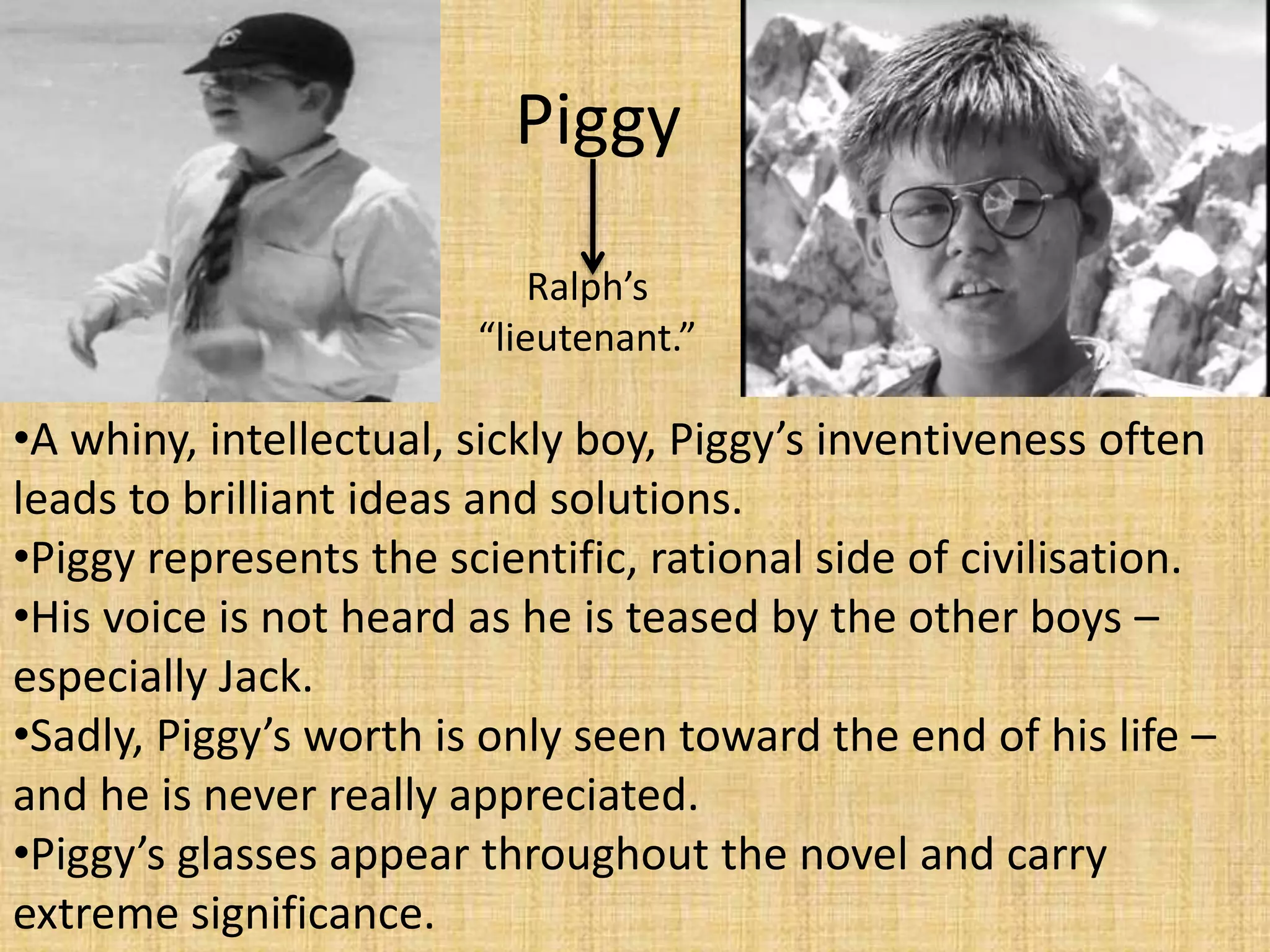
Piggy
•A whiny, intellectual, sickly boy, Piggy’s inventiveness often
leads to brilliant ideas and solutions.
•Piggy represents the scientific, rational side of civilisation.
•His voice is not heard as he is teased by the other boys –
especially Jack.
•Sadly, Piggy’s worth is only seen toward the end of his life –
and he is never really appreciated.
•Piggy’s glasses appear throughout the novel and carry
extreme significance.
Ralph’s
“lieutenant.”
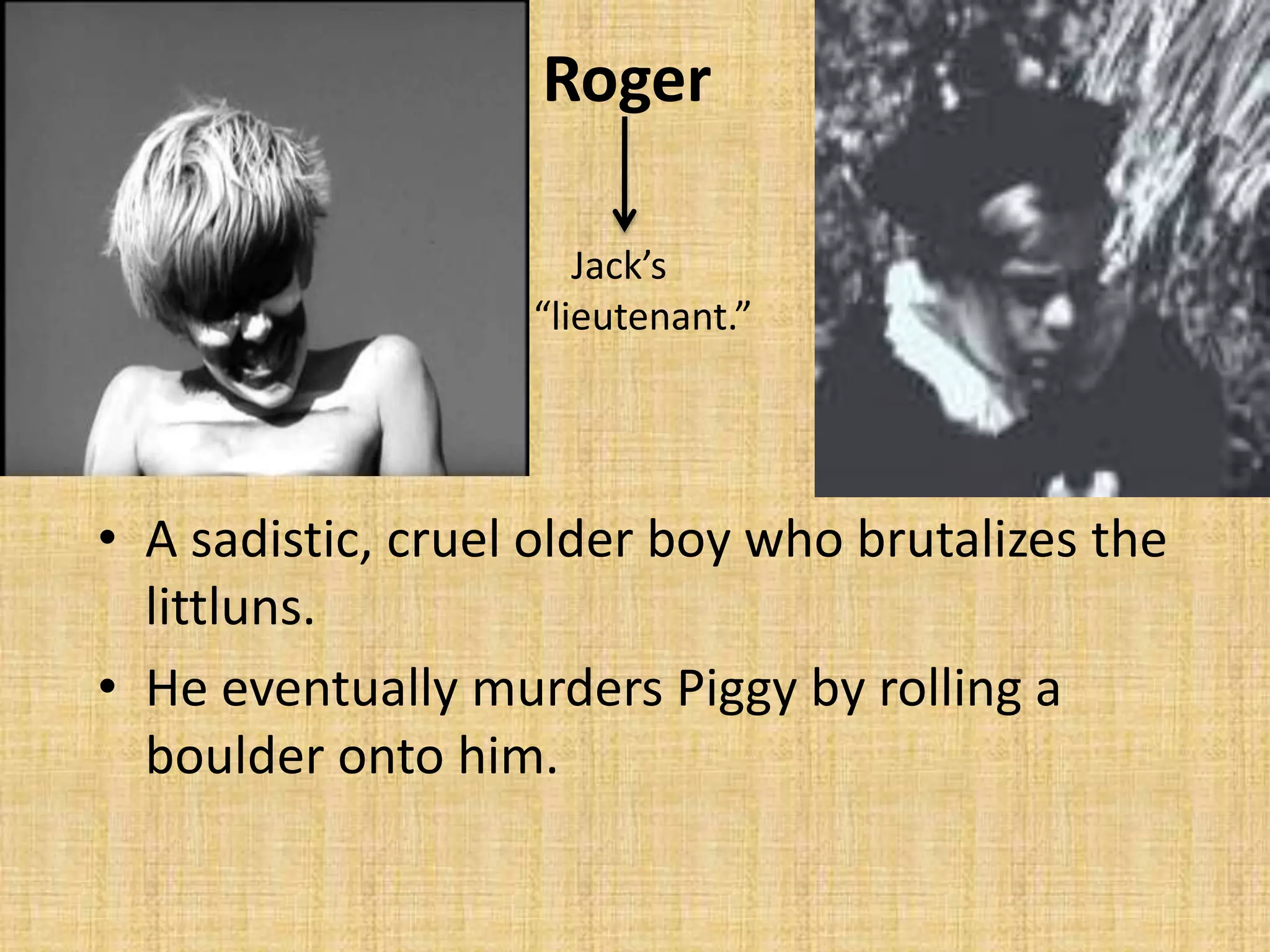
Roger
• A sadistic, cruel older boy who brutalizes the
littluns.
• He eventually murders Piggy by rolling a
boulder onto him.
Jack’s
“lieutenant.”
Sam and Eric
• A pair of twins allied with
Ralph.
• Sam and Eric are always
together, and the other boys
often treat them as a single
entity, calling them
“Samneric.”
• The easily excitable Sam
and Eric are part of the
group known as the
“bigguns.”
• At the end of the novel, they
fall victim to Jack’s
manipulation.
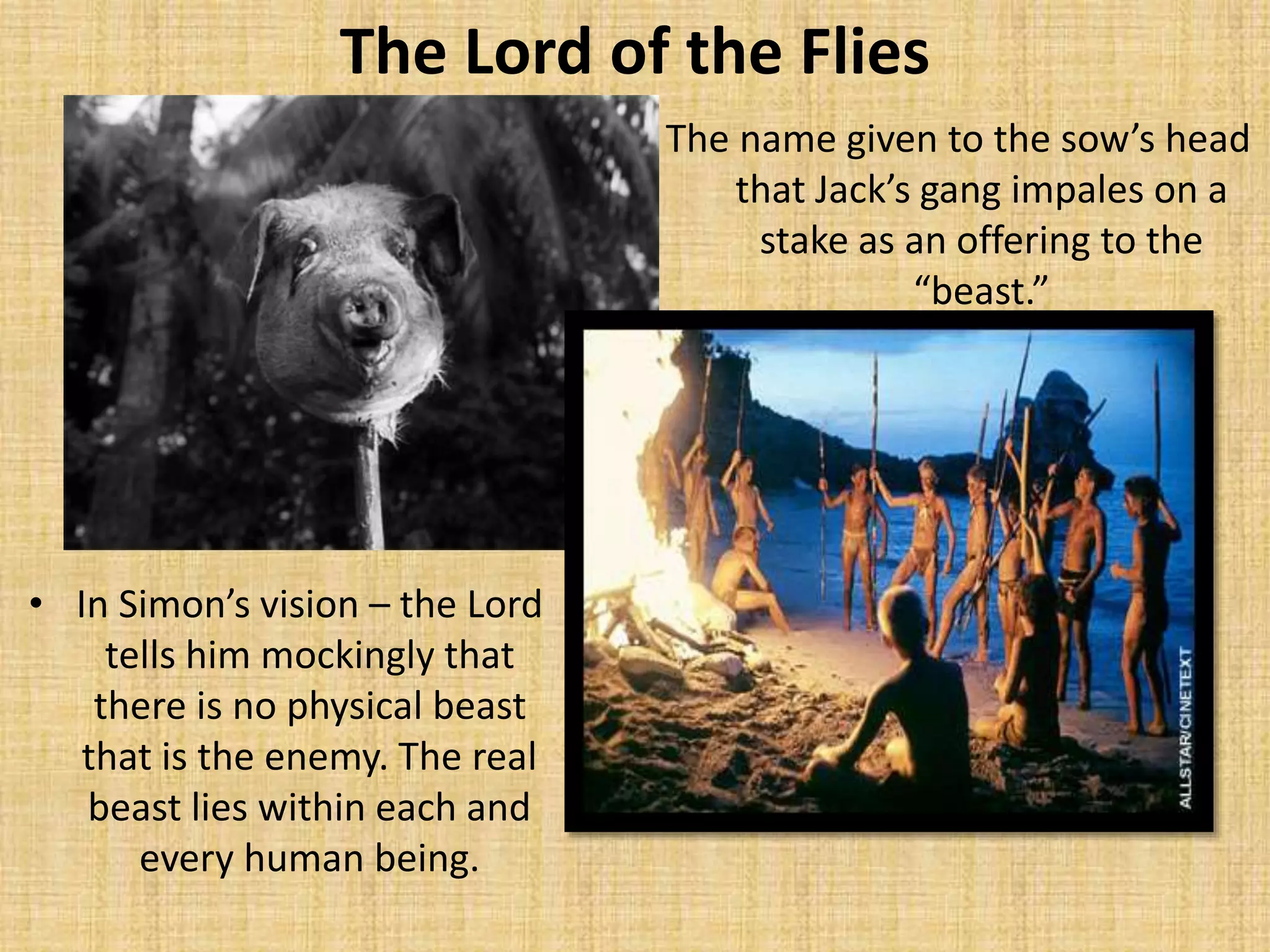
The Lord of the Flies
The name given to the sow’s head
that Jack’s gang impales on a
stake as an offering to the
“beast.”
• In Simon’s vision – the Lord
tells him mockingly that
there is no physical beast
that is the enemy. The real
beast lies within each and
every human being.
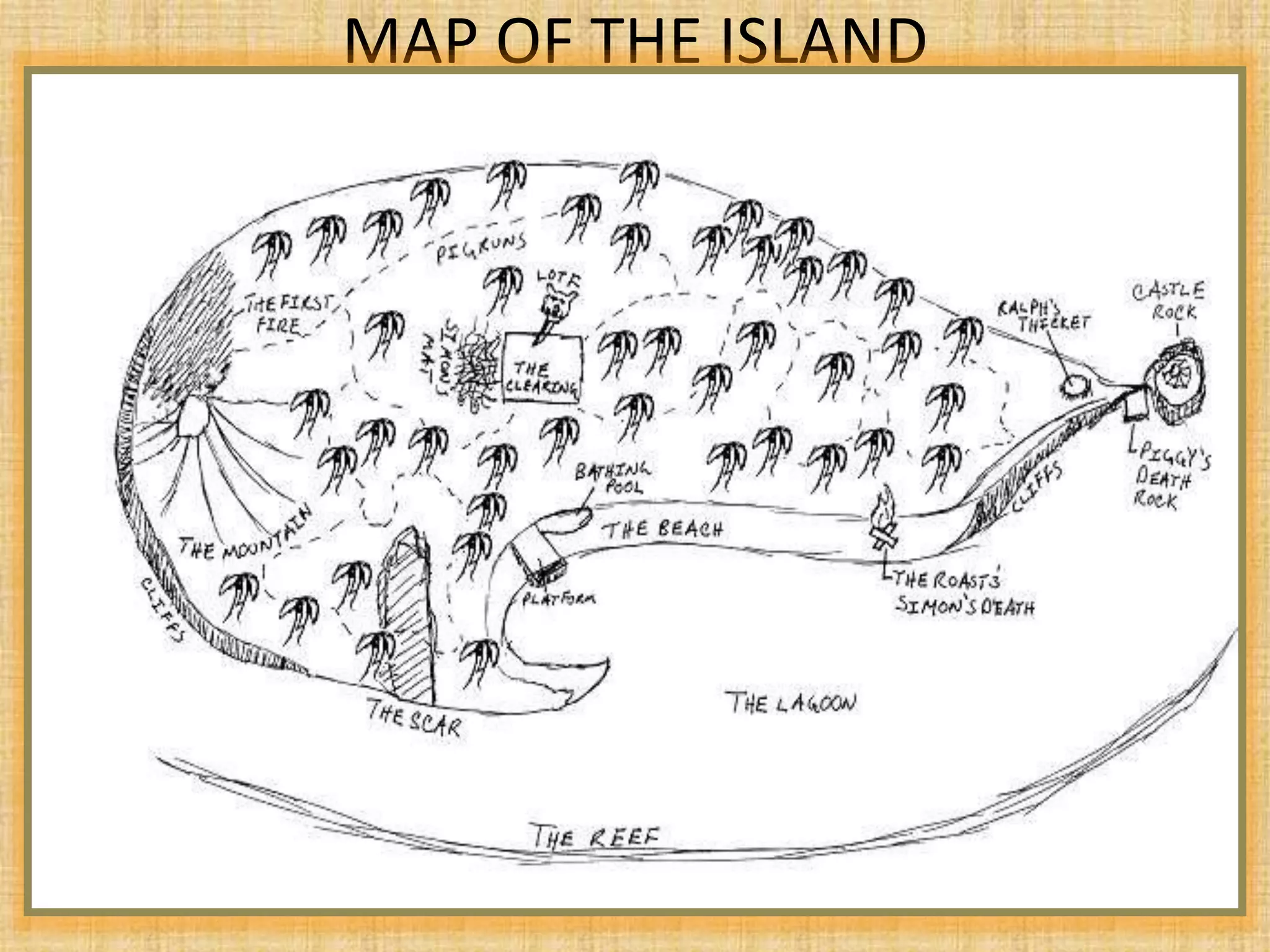
MAP OF THE ISLAND
SYMBOLS:
• Symbols are objects, characters, figures, and
colors used to represent abstract ideas or
concepts.
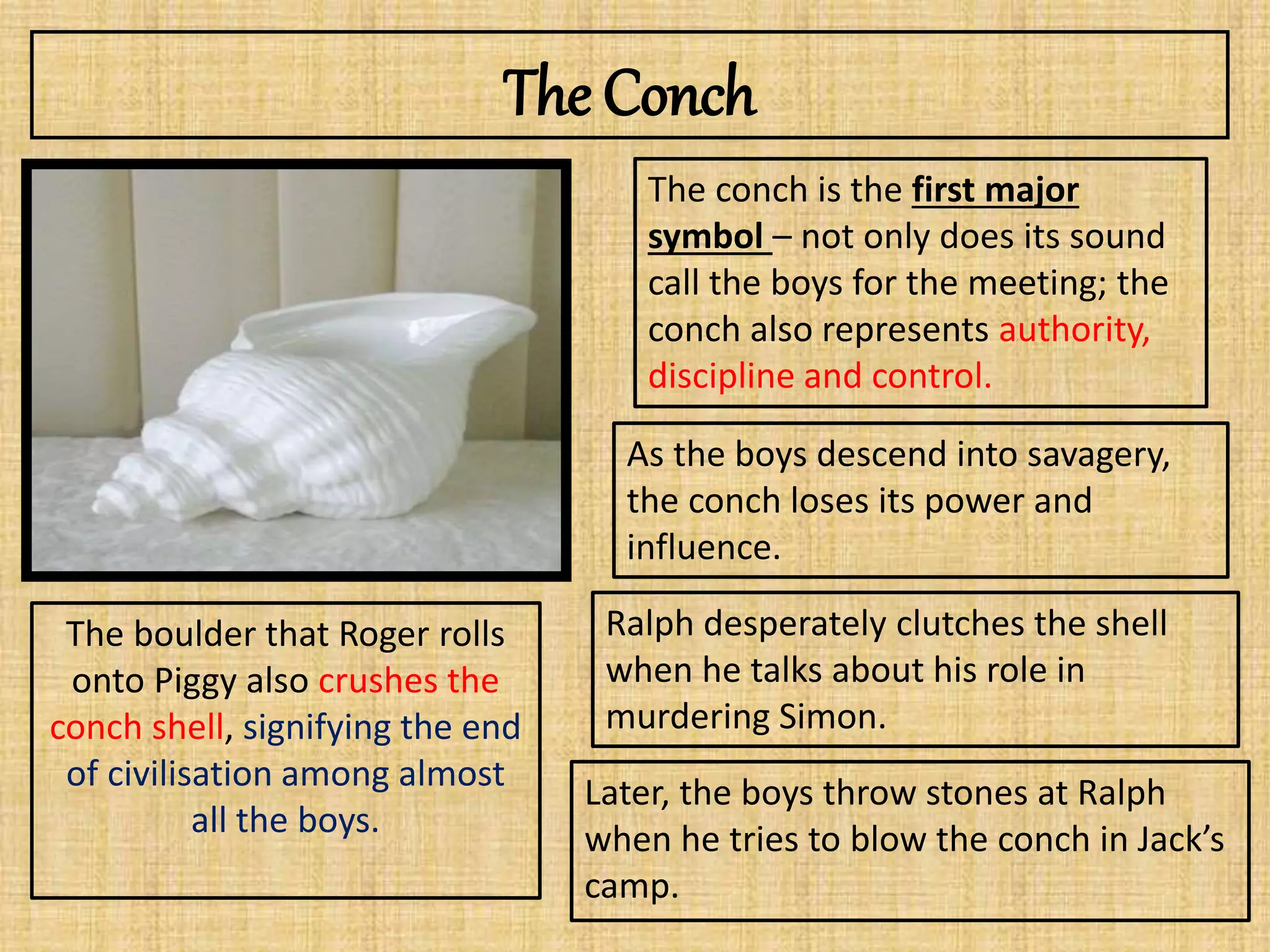
The Conch
The conch is the first major
symbol – not only does its sound
call the boys for the meeting; the
conch also represents authority,
discipline and control.
As the boys descend into savagery,
the conch loses its power and
influence.
The boulder that Roger rolls
onto Piggy also crushes the
conch shell, signifying the end
of civilisation among almost
all the boys.
Ralph desperately clutches the shell
when he talks about his role in
murdering Simon.
Later, the boys throw stones at Ralph
when he tries to blow the conch in Jack’s
camp.
• Represents rescue – without the fire, the boys will never get the attention of
a ship/plane passing by and at this point, every one is eager to light a fire and
get home.
• However, as the story progresses and Jack begins to enjoy the island, the fire
is less important to him.
• The signal fire thus functions as a kind of measurement of the strength of the
civilized instinct remaining on the island.
• Ironically, at the end of the novel, a fire finally summons a ship to the island,
but not the signal fire.
• Piggy is the most intelligent, rational boy in the group, and his glasses
represent the power of science and intellectual endeavor in society.
• This symbolic significance is clear from the start of the novel, when the
boys use the lenses from Piggy’s glasses to focus the sunlight and start a
fire.
• When Jack’s hunters raid Ralph’s camp and steal the glasses, the savages
effectively take the power to make fire, leaving Ralph’s group helpless.
• The imaginary beast that frightens all the boys stands for
the instinct of savagery that exists within all human beings.
• The boys are afraid of the beast, but only Simon reaches
the realization that they fear the beast because it exists
within each of them.
• As the boys grow more savage, their belief in the beast
grows stronger.
• By the end of the novel, the boys are leaving it sacrifices
and treating it as a god. The boys’ behavior is what brings
the beast into existence, so the more savagely the boys act,
the more real the beast seems to become.
• The huts represent the organised world – they
try to replicate their homes in England by
building the huts.
• The idea of working together also indicates
unity and cooperation.
• Unfortunately, the boys do not work together
and this tells us they are actually a very
divided group and have left civilisation very far
away..
THEMES:
• GOOD VS. EVIL:
– CIVILISATION VS. SAVAGERY
– LIGHT VS. DARK
• DESIRE FOR POWER
• PAINTED FACES
Character Sketches:
• Ralph
• Jack Merridew
• Piggy
• Simon
• Roger
• Sam and Eric
• Robert & Maurice
• The littl’uns (refers to
the boys under 10
years old.)
Create character sketches for these
characters focusing on their physical
appearance and their personality.
Minor characters
• Johnny
• Percival
• Bill
• Harold
• Henry
• The boy with the mulberry birthmark
• Phil
• Wilfred
Task: Chapter 1
• Write a brief summary of the chapter
– Bullet points or paragraphs

Lord of the Flies - full overview

  • 1.
    LORD OF THEFLIES WILLIAM GOLDING
  • 2.
    Background to theauthor • William Golding was born in England. • During WW2, he served in the Royal Navy and had active service. • His experiences made a profound impact on him, because in addition to fighting in WW2, he had lived through WW1. • Golding saw that the only reason we obey the rules is because we are forced into civilisation by society.
  • 3.
    Golding’s views onmankind after WW2 • Golding could no longer view humanity as innocent and noble. • He believed that when people were forced into extreme situations (like a war), their darker and more sinful side of his/her nature surfaces.
  • 4.
    The Blitz onLondon • On 7 September 1940, Hitler launched an internal attack on Britain – starting with London. • These raids lasted for about 3 months and took place almost every night. • Many Londoners sought shelter in the underground railway system or considered leaving the city. • A lot of parents made the decision to send their children away – either to relatives in the countryside or to countries not affected by the war against Nazi Germany. • This process of evacuation saved thousands of lives that would have been lost during the bombings.
  • 5.
  • 8.
    WHY ARE THEBOYS ON THE ISLAND? • The story is set against the backdrop of a war (presumably informed by Golding’s experiences during the war). • The boys were being evacuated from England for their safety. • Many children were taken out of London during this time, saving thousands of lives that may have been lost as a result of the bombings. • These boys were travelling by plane and it was either shot down or damaged in a storm – consequently it crash lands on the island.
  • 9.
    THE NARRATOR • Thestory is told by an anonymous third-person narrator who describes the events of the novel without commenting on or becoming involved in the events. • The narrator speaks in the third person, focusing mainly on Ralph’s point of view but following Jack and Simon at certain times. • The narrator is in the unique position of seeing and knowing everything, which gives the reader access to the characters’ inner thoughts and feelings.
  • 10.
    RALPH • Ralph isthe central character of Lord of the Flies. • Ralph is the representative of order and civilisation. • Ralph is elected chief and while most of the other boys are concerned with playing and having fun, Ralph works to get them rescued.
  • 11.
    • For thisreason, Ralph gains influence over the other boys – they respect him at the beginning. • However, as the group gives in to savage instincts ,his position declines while Jack’s rises. • As the novel progresses, Ralph, like Simon, comes to understand that savagery exists within all the boys. Ralph remains determined not to become savage, and only briefly does he consider joining Jack’s tribe in order to save himself. • Eventually, most of the boys leave Ralph’s group for Jack’s, and Ralph is left alone to be hunted by Jack’s tribe. • Ralph’s story ends semi-tragically: he is rescued but he weeps with his newly discovered knowledge of the human capacity for evil.
  • 12.
    Jack • The strong-willedJack is the representative of the instinct of savagery, violence, and the desire for power— the opposite of Ralph. • Jack’s love of authority and violence are connected, as both enable him to feel powerful.
  • 13.
    • He isfurious when he loses the election to Ralph and pushes the boundaries of his role in the group. Early on, Jack retains his morality and good behaviour – this soon changes. • The first time he encounters a pig, he is unable to kill it. But Jack soon becomes obsessed with hunting, painting his face like a barbarian and giving himself over to bloodlust. • The more savage Jack becomes, the more he is able to control the rest of the group. Indeed, apart from Ralph, Simon, and Piggy, the group largely follows Jack in embracing violence and savagery. • By the end of the novel, Jack has learned to use the boys’ fear of the beast to control their behaviour. Reminder of how religion and superstition can be manipulated as instruments of power.
  • 14.
    Simon •Simon represents the essentialhuman goodness within us. •He is seen as a weak child, but he is extremely perceptive and sees more than the others ever will. • Unlike all the other boys on the island, Simon acts morally not out of guilt or shame but because he believes in the value of morality.
  • 15.
    • Simon behaveskindly toward the younger children – unlike the other ‘biguns’. • The other boys abandon moral behaviour as soon as civilisation is no longer there to enforce rules. Even Ralph and Piggy are swayed by social pressures, as we see when they participate in the dance/chant ritual – but not Simon. • He is the first to realise that the monster on the island is not a real, physical beast but rather a savagery that lurks within each human being. The sow’s head on the stake symbolizes this idea, as we see in Simon’s vision of the head speaking to him. • Against this evil, Simon represents true goodness. However, his brutal murder at the hands of the other boys indicates the lack of that goodness in an environment of evil. • The idea of the evil within each human being stands as the main idea of the novel. Humans appear not as deeply connected to civilisation as to savagery.
  • 16.
    Piggy •A whiny, intellectual,sickly boy, Piggy’s inventiveness often leads to brilliant ideas and solutions. •Piggy represents the scientific, rational side of civilisation. •His voice is not heard as he is teased by the other boys – especially Jack. •Sadly, Piggy’s worth is only seen toward the end of his life – and he is never really appreciated. •Piggy’s glasses appear throughout the novel and carry extreme significance. Ralph’s “lieutenant.”
  • 17.
    Roger • A sadistic,cruel older boy who brutalizes the littluns. • He eventually murders Piggy by rolling a boulder onto him. Jack’s “lieutenant.”
  • 18.
    Sam and Eric •A pair of twins allied with Ralph. • Sam and Eric are always together, and the other boys often treat them as a single entity, calling them “Samneric.” • The easily excitable Sam and Eric are part of the group known as the “bigguns.” • At the end of the novel, they fall victim to Jack’s manipulation.
  • 19.
    The Lord ofthe Flies The name given to the sow’s head that Jack’s gang impales on a stake as an offering to the “beast.” • In Simon’s vision – the Lord tells him mockingly that there is no physical beast that is the enemy. The real beast lies within each and every human being.
  • 20.
    MAP OF THEISLAND
  • 21.
    SYMBOLS: • Symbols areobjects, characters, figures, and colors used to represent abstract ideas or concepts.
  • 22.
    The Conch The conchis the first major symbol – not only does its sound call the boys for the meeting; the conch also represents authority, discipline and control. As the boys descend into savagery, the conch loses its power and influence. The boulder that Roger rolls onto Piggy also crushes the conch shell, signifying the end of civilisation among almost all the boys. Ralph desperately clutches the shell when he talks about his role in murdering Simon. Later, the boys throw stones at Ralph when he tries to blow the conch in Jack’s camp.
  • 23.
    • Represents rescue– without the fire, the boys will never get the attention of a ship/plane passing by and at this point, every one is eager to light a fire and get home. • However, as the story progresses and Jack begins to enjoy the island, the fire is less important to him. • The signal fire thus functions as a kind of measurement of the strength of the civilized instinct remaining on the island. • Ironically, at the end of the novel, a fire finally summons a ship to the island, but not the signal fire.
  • 24.
    • Piggy isthe most intelligent, rational boy in the group, and his glasses represent the power of science and intellectual endeavor in society. • This symbolic significance is clear from the start of the novel, when the boys use the lenses from Piggy’s glasses to focus the sunlight and start a fire. • When Jack’s hunters raid Ralph’s camp and steal the glasses, the savages effectively take the power to make fire, leaving Ralph’s group helpless.
  • 25.
    • The imaginarybeast that frightens all the boys stands for the instinct of savagery that exists within all human beings. • The boys are afraid of the beast, but only Simon reaches the realization that they fear the beast because it exists within each of them. • As the boys grow more savage, their belief in the beast grows stronger. • By the end of the novel, the boys are leaving it sacrifices and treating it as a god. The boys’ behavior is what brings the beast into existence, so the more savagely the boys act, the more real the beast seems to become.
  • 26.
    • The hutsrepresent the organised world – they try to replicate their homes in England by building the huts. • The idea of working together also indicates unity and cooperation. • Unfortunately, the boys do not work together and this tells us they are actually a very divided group and have left civilisation very far away..
  • 27.
    THEMES: • GOOD VS.EVIL: – CIVILISATION VS. SAVAGERY – LIGHT VS. DARK • DESIRE FOR POWER • PAINTED FACES
  • 28.
    Character Sketches: • Ralph •Jack Merridew • Piggy • Simon • Roger • Sam and Eric • Robert & Maurice • The littl’uns (refers to the boys under 10 years old.) Create character sketches for these characters focusing on their physical appearance and their personality.
  • 29.
    Minor characters • Johnny •Percival • Bill • Harold • Henry • The boy with the mulberry birthmark • Phil • Wilfred
  • 30.
    Task: Chapter 1 •Write a brief summary of the chapter – Bullet points or paragraphs