Academic skills for computer
studies
karunya devi S.T
BSC IT (A)
21BIT025
LEARNING TECHNIQUES
What is Learning?
•Learning is the process of acquiring new
understanding,knowledge,behaviour,skills,va
lues,attitudes and preferences.
•Learning is something which is not done to
students rather something students do
THEMSELVES.
Nature of Learning
•Modification of behaviour is Learning .
•Learning depends on practice and experience.
•Learning is acquiring new experience.
•Learning is a continous process.
Benefits of learning
•To improve brain functioning.
•To make new friends and meet new people.
•To be involved with community
•To gain more knowledge
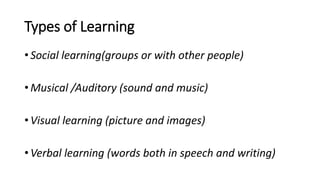
Types of Learning
• Social learning(groups or with other people)
• Musical /Auditory (sound and music)
• Visual learning (picture and images)
• Verbal learning (words both in speech and writing)
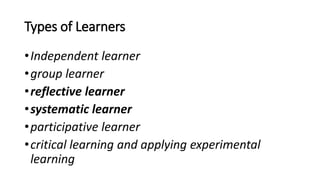
Types of Learners
•Independent learner
•group learner
•reflective learner
•systematic learner
•participative learner
•critical learning and applying experimental
learning
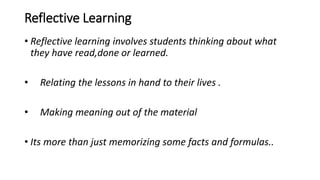
Reflective Learning
• Reflective learning involves students thinking about what
they have read,done or learned.
• Relating the lessons in hand to their lives .
• Making meaning out of the material
• Its more than just memorizing some facts and formulas..
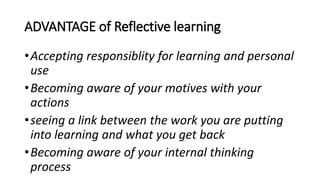
ADVANTAGE of Reflective learning
•Accepting responsiblity for learning and personal
use
•Becoming aware of your motives with your
actions
•seeing a link between the work you are putting
into learning and what you get back
•Becoming aware of your internal thinking
process
Systematic learning
•systematic learning is defined as those
behaviour,performance and /or outcomes
that are accomplished in a series of
regmented, thought out of steps that lead to
a specific accomplishment of a specific
objective or behaviour.
.
THANKYOU

Academic skills for computer studies.pptx

  • 1.
    Academic skills forcomputer studies karunya devi S.T BSC IT (A) 21BIT025 LEARNING TECHNIQUES
  • 2.
    What is Learning? •Learningis the process of acquiring new understanding,knowledge,behaviour,skills,va lues,attitudes and preferences. •Learning is something which is not done to students rather something students do THEMSELVES.
  • 3.
    Nature of Learning •Modificationof behaviour is Learning . •Learning depends on practice and experience. •Learning is acquiring new experience. •Learning is a continous process.
  • 4.
    Benefits of learning •Toimprove brain functioning. •To make new friends and meet new people. •To be involved with community •To gain more knowledge
  • 5.
    Types of Learning •Social learning(groups or with other people) • Musical /Auditory (sound and music) • Visual learning (picture and images) • Verbal learning (words both in speech and writing)
  • 6.
    Types of Learners •Independentlearner •group learner •reflective learner •systematic learner •participative learner •critical learning and applying experimental learning
  • 7.
    Reflective Learning • Reflectivelearning involves students thinking about what they have read,done or learned. • Relating the lessons in hand to their lives . • Making meaning out of the material • Its more than just memorizing some facts and formulas..
  • 8.
    ADVANTAGE of Reflectivelearning •Accepting responsiblity for learning and personal use •Becoming aware of your motives with your actions •seeing a link between the work you are putting into learning and what you get back •Becoming aware of your internal thinking process
  • 9.
    Systematic learning •systematic learningis defined as those behaviour,performance and /or outcomes that are accomplished in a series of regmented, thought out of steps that lead to a specific accomplishment of a specific objective or behaviour.
  • 10.