Structure of an Essay
Faculty: Naeema Bakhat
Generic BS-Nursing year I, semester II
Jinnah College of Nursing
Objectives
At the end of this presentation, learners will be able to:
Define an essay
Identify main parts of an essay
Construct ‘thesis statement’
Lay out a ‘plan of development’ in introductory paragraph.
Develop body paragraphs.
Conclude the essay effectively.
What is an Essay
An essay is a:
short non-fiction, non-imaginary work about a subject
 focused piece of writing that explains, argues, describes, or
narrates.
has many purposes depending on what the writer wants to
write about and what he/she wants to affect the reader
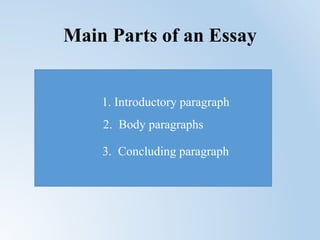
Main Parts of an Essay
1. Introductory paragraph
2. Body paragraphs
3. Concluding paragraph
Introductory Paragraph
• A well-written introductory paragraph will often do the
following:
Grabs the reader’s interest.
Presents the thesis statement.
Lay out a plan of development.
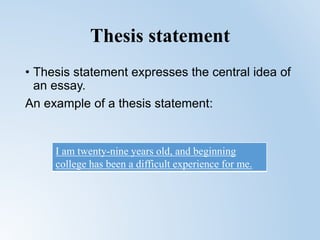
Thesis statement
• Thesis statement expresses the central idea of
an essay.
An example of a thesis statement:
I am twenty-nine years old, and beginning
college has been a difficult experience for me.
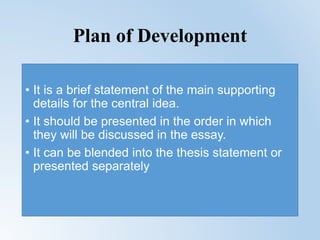
Plan of Development
• It is a brief statement of the main supporting
details for the central idea.
• It should be presented in the order in which
they will be discussed in the essay.
• It can be blended into the thesis statement or
presented separately
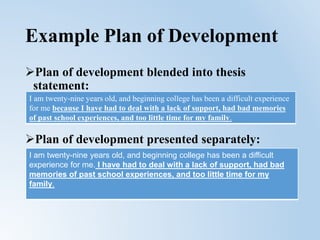
Example Plan of Development
Plan of development blended into thesis
statement:
Plan of development presented separately:
I am twenty-nine years old, and beginning college has been a difficult experience
for me because I have had to deal with a lack of support, had bad memories
of past school experiences, and too little time for my family.
I am twenty-nine years old, and beginning college has been a difficult
experience for me. I have had to deal with a lack of support, had bad
memories of past school experiences, and too little time for my
family.
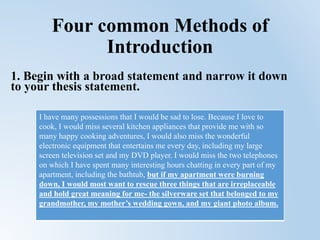
Four common Methods of
Introduction
1. Begin with a broad statement and narrow it down
to your thesis statement.
I have many possessions that I would be sad to lose. Because I love to
cook, I would miss several kitchen appliances that provide me with so
many happy cooking adventures, I would also miss the wonderful
electronic equipment that entertains me every day, including my large
screen television set and my DVD player. I would miss the two telephones
on which I have spent many interesting hours chatting in every part of my
apartment, including the bathtub, but if my apartment were burning
down, I would most want to rescue three things that are irreplaceable
and hold great meaning for me- the silverware set that belonged to my
grandmother, my mother’s wedding gown, and my giant photo album.
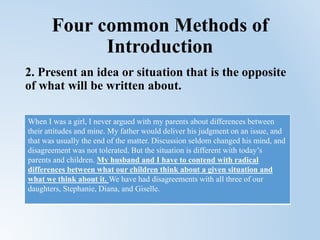
Four common Methods of
Introduction
2. Present an idea or situation that is the opposite
of what will be written about.
When I was a girl, I never argued with my parents about differences between
their attitudes and mine. My father would deliver his judgment on an issue, and
that was usually the end of the matter. Discussion seldom changed his mind, and
disagreement was not tolerated. But the situation is different with today’s
parents and children. My husband and I have to contend with radical
differences between what our children think about a given situation and
what we think about it. We have had disagreements with all three of our
daughters, Stephanie, Diana, and Giselle.
Four common Methods of
Introduction
3. Tell a brief story related meaningfully to the
central idea.
The husky man pushes open the door of the bedroom and grins as he pulls
out a. 38 revolver. An elderly man wearing thin pajamas looks at him and
whimpers. In a feeble effort at escape, the old man slides out of his bed and
moves to the door of the room. The husky man, still grinning, blocks his
way. With the face of a small, frightened animal, the old man looks up and
whispers, “Oh, god, please don’t hurt me. “The grinning man then fires
four times. The television movie cuts now to a soap commercial, but the
little boy who has been watching the set has begun to cry. Such scenes of
direct violence on television must surely be harmful to children for a
number of psychological reasons.
Four common Methods of
Introduction
4.Ask one or more questions.
Does your will to study collapse when someone suggests getting a pizza?
Does your social life compete with your class attendance? Is there a huge
gap between your intentions and your actions? If the answers to these
questions are yes, yes, and yes, read on. You can benefit from some
powerful ways to motivate yourself: setting goals and consciously
working to reach them, using rational thinking, and developing a positive
personality.
Body Paragraphs
Body of an essay contains 3 or more fully developed
paragraphs (each paragraph to support for one main idea
specified in thesis statement).
Each body paragraph should contain topic sentence,
supporting detail and concluding sentence.
Example Body Paragraphs
First body paragraph:
Few people in my life are supportive of my decision to enter college.
My father is especially bewildered by the choice I have made. He
himself quit school after finishing eight grade, and he assumes that I
should hate school as much as he did. My mother is a little more
understanding of my desire for an education, but the cost of college
terrifies her. “Where in the world will all that money come from?’’ she
says. Also, my friends seem threatened by my decision. They make fun
of me, “Ooooh, here comes the college man,” they say when they see
me approach
Example Body Paragraphs
Second body paragraph
I have had to deal not only with my friends and family but also
with unhappy memories of my earlier school career. I attended an
enormous high school where I was just one more faceless kid in the
crowd. My classes seemed meaningless to me. I can remember
almost none of them in detail. What I do remember about high school
was just sitting, bored until I felt nearly brain-dead, watching the
clock hands move ever so slowly toward dismissal time. Such
periods of boredom were occasionally interrupted by moments of
acute embarrassment.
Example Body Paragraphs
Third body paragraph:
Furthermore, my decision to enter college has meant I have much
less time to spend with my family. I work eight hours a day. Then I
rush home and have all of an hour and ten minutes to eat dinner and
spend time with my wife and daughter before I rush off again, this
time to class. When I return from class, I am dead tired. My little girl
is already asleep. My wife and I have a little time to talk before I
collapse into bed. Weekends are a little better, but not much. And I am
missing out on a lot of special times in my daughter’s life. For
instance, I did not realize she had begun to walk until three days after
it happened.
Concluding Paragraph
Concluding paragraph:
is the last paragraph, and wraps up the paper.
restates the thesis, and summarizes body’s main
points.
include final insight and recommendation
may end on an interesting idea, quotation or your
personal interpretation of the subject.
any new thought should never be introduced into
the conclusion.
Example Concluding
Paragraph
Why, then, do I put myself through all these difficulties? Despite a lack of
support, bad memories, and little family time, I dream about a different kind
of future. I believe that I will benefit financially and become a better
provider for my family. I also feel that I will become a more rounded human
being as a result of achieving my goal of obtaining a college degree.
References
 Langan, J. (2013). College writing skills with readings. Tata McGraw-Hill
Education.
 Kirszner, L. G., & Mandell, S. R. (2011). Patterns for college writing: A
rhetorical reader and guide. Macmillan.
 Langan, J., & Goldstein, J. M. (2007). English brushup(4th ed.). New York:
McGraw-Hill Higher Education.

Essay Structure ppt (2).pptx

  • 1.
    Structure of anEssay Faculty: Naeema Bakhat Generic BS-Nursing year I, semester II Jinnah College of Nursing
  • 2.
    Objectives At the endof this presentation, learners will be able to: Define an essay Identify main parts of an essay Construct ‘thesis statement’ Lay out a ‘plan of development’ in introductory paragraph. Develop body paragraphs. Conclude the essay effectively.
  • 3.
    What is anEssay An essay is a: short non-fiction, non-imaginary work about a subject  focused piece of writing that explains, argues, describes, or narrates. has many purposes depending on what the writer wants to write about and what he/she wants to affect the reader
  • 4.
    Main Parts ofan Essay 1. Introductory paragraph 2. Body paragraphs 3. Concluding paragraph
  • 5.
    Introductory Paragraph • Awell-written introductory paragraph will often do the following: Grabs the reader’s interest. Presents the thesis statement. Lay out a plan of development.
  • 6.
    Thesis statement • Thesisstatement expresses the central idea of an essay. An example of a thesis statement: I am twenty-nine years old, and beginning college has been a difficult experience for me.
  • 7.
    Plan of Development •It is a brief statement of the main supporting details for the central idea. • It should be presented in the order in which they will be discussed in the essay. • It can be blended into the thesis statement or presented separately
  • 8.
    Example Plan ofDevelopment Plan of development blended into thesis statement: Plan of development presented separately: I am twenty-nine years old, and beginning college has been a difficult experience for me because I have had to deal with a lack of support, had bad memories of past school experiences, and too little time for my family. I am twenty-nine years old, and beginning college has been a difficult experience for me. I have had to deal with a lack of support, had bad memories of past school experiences, and too little time for my family.
  • 9.
    Four common Methodsof Introduction 1. Begin with a broad statement and narrow it down to your thesis statement. I have many possessions that I would be sad to lose. Because I love to cook, I would miss several kitchen appliances that provide me with so many happy cooking adventures, I would also miss the wonderful electronic equipment that entertains me every day, including my large screen television set and my DVD player. I would miss the two telephones on which I have spent many interesting hours chatting in every part of my apartment, including the bathtub, but if my apartment were burning down, I would most want to rescue three things that are irreplaceable and hold great meaning for me- the silverware set that belonged to my grandmother, my mother’s wedding gown, and my giant photo album.
  • 10.
    Four common Methodsof Introduction 2. Present an idea or situation that is the opposite of what will be written about. When I was a girl, I never argued with my parents about differences between their attitudes and mine. My father would deliver his judgment on an issue, and that was usually the end of the matter. Discussion seldom changed his mind, and disagreement was not tolerated. But the situation is different with today’s parents and children. My husband and I have to contend with radical differences between what our children think about a given situation and what we think about it. We have had disagreements with all three of our daughters, Stephanie, Diana, and Giselle.
  • 11.
    Four common Methodsof Introduction 3. Tell a brief story related meaningfully to the central idea. The husky man pushes open the door of the bedroom and grins as he pulls out a. 38 revolver. An elderly man wearing thin pajamas looks at him and whimpers. In a feeble effort at escape, the old man slides out of his bed and moves to the door of the room. The husky man, still grinning, blocks his way. With the face of a small, frightened animal, the old man looks up and whispers, “Oh, god, please don’t hurt me. “The grinning man then fires four times. The television movie cuts now to a soap commercial, but the little boy who has been watching the set has begun to cry. Such scenes of direct violence on television must surely be harmful to children for a number of psychological reasons.
  • 12.
    Four common Methodsof Introduction 4.Ask one or more questions. Does your will to study collapse when someone suggests getting a pizza? Does your social life compete with your class attendance? Is there a huge gap between your intentions and your actions? If the answers to these questions are yes, yes, and yes, read on. You can benefit from some powerful ways to motivate yourself: setting goals and consciously working to reach them, using rational thinking, and developing a positive personality.
  • 13.
    Body Paragraphs Body ofan essay contains 3 or more fully developed paragraphs (each paragraph to support for one main idea specified in thesis statement). Each body paragraph should contain topic sentence, supporting detail and concluding sentence.
  • 14.
    Example Body Paragraphs Firstbody paragraph: Few people in my life are supportive of my decision to enter college. My father is especially bewildered by the choice I have made. He himself quit school after finishing eight grade, and he assumes that I should hate school as much as he did. My mother is a little more understanding of my desire for an education, but the cost of college terrifies her. “Where in the world will all that money come from?’’ she says. Also, my friends seem threatened by my decision. They make fun of me, “Ooooh, here comes the college man,” they say when they see me approach
  • 15.
    Example Body Paragraphs Secondbody paragraph I have had to deal not only with my friends and family but also with unhappy memories of my earlier school career. I attended an enormous high school where I was just one more faceless kid in the crowd. My classes seemed meaningless to me. I can remember almost none of them in detail. What I do remember about high school was just sitting, bored until I felt nearly brain-dead, watching the clock hands move ever so slowly toward dismissal time. Such periods of boredom were occasionally interrupted by moments of acute embarrassment.
  • 16.
    Example Body Paragraphs Thirdbody paragraph: Furthermore, my decision to enter college has meant I have much less time to spend with my family. I work eight hours a day. Then I rush home and have all of an hour and ten minutes to eat dinner and spend time with my wife and daughter before I rush off again, this time to class. When I return from class, I am dead tired. My little girl is already asleep. My wife and I have a little time to talk before I collapse into bed. Weekends are a little better, but not much. And I am missing out on a lot of special times in my daughter’s life. For instance, I did not realize she had begun to walk until three days after it happened.
  • 17.
    Concluding Paragraph Concluding paragraph: isthe last paragraph, and wraps up the paper. restates the thesis, and summarizes body’s main points. include final insight and recommendation may end on an interesting idea, quotation or your personal interpretation of the subject. any new thought should never be introduced into the conclusion.
  • 18.
    Example Concluding Paragraph Why, then,do I put myself through all these difficulties? Despite a lack of support, bad memories, and little family time, I dream about a different kind of future. I believe that I will benefit financially and become a better provider for my family. I also feel that I will become a more rounded human being as a result of achieving my goal of obtaining a college degree.
  • 19.
    References  Langan, J.(2013). College writing skills with readings. Tata McGraw-Hill Education.  Kirszner, L. G., & Mandell, S. R. (2011). Patterns for college writing: A rhetorical reader and guide. Macmillan.  Langan, J., & Goldstein, J. M. (2007). English brushup(4th ed.). New York: McGraw-Hill Higher Education.