© Fraunhofer • Seite 1
PHD MODEL CANVAS
PhD Overview on one Slide
Sebastian Opriel and Yevgen Pikus, Fraunhofer ISST, Dortmund, August 16th, 2017
© Fraunhofer • Seite 2
Motivation
 The beginning of a PhD process is cumbersome.
 Usually objectives, research methods, expected
outcomes etc. are changing in early stages.
 Therefore, it is of paramount importance to find the
promising direction and to answer the right questions.
 Inspired by the Business Model Canvas we have
developed the PhD Model Canvas
 PhD Model Canvas is a Big Picture of a PhD thesis on a
single page
Business Model Canvas: Osterwalder, Alexander and Pigneur, Yves “Business model generation: a handbook for visionaries,
game changers, and challengers.“ John Wiley & Sons, 2010.
© Fraunhofer • Seite 3
Vision
Motivation Problems Research Questions
Existing Knowledge Goals Commercial Exploitation
Required Knowledge Risks
Copyright: Yevgen Pikus and Sebastian Opriel, Fraunhofer Institute for Software and Systems Engineering
Research MethodologyResearch Area
PhD Model Canvas
© Fraunhofer • Seite 4
Explanation of Fields
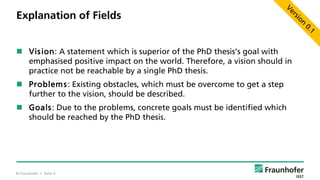
 Vision: A statement which is superior of the PhD thesis’s goal with
emphasised positive impact on the world. Therefore, a vision should in
practice not be reachable by a single PhD thesis.
 Problems: Existing obstacles, which must be overcome to get a step
further to the vision, should be described.
 Goals: Due to the problems, concrete goals must be identified which
should be reached by the PhD thesis.
© Fraunhofer • Seite 5
Explanation of Fields
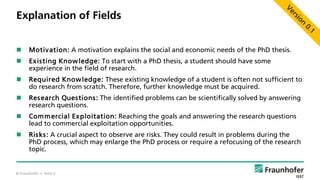
 Motivation: A motivation explains the social and economic needs of the PhD thesis.
 Existing Knowledge: To start with a PhD thesis, a student should have some
experience in the field of research.
 Required Knowledge: These existing knowledge of a student is often not sufficient to
do research from scratch. Therefore, further knowledge must be acquired.
 Research Questions: The identified problems can be scientifically solved by answering
research questions.
 Commercial Exploitation: Reaching the goals and answering the research questions
lead to commercial exploitation opportunities.
 Risks: A crucial aspect to observe are risks. They could result in problems during the
PhD process, which may enlarge the PhD process or require a refocusing of the research
topic.
© Fraunhofer • Seite 6
Explanation of Fields
 Research Methodology: Connected to the PhD process, a research
methodology like Design Science Research is needed.
 Research Area: Outcomes of the PhD process, should benefit a specific
research area.
Design Science Research: Alan, R. Hevner, et al. “Design science in information systems research.“ MIS quarterly 28.1 (2004): 75-105.
© Fraunhofer • Seite 7
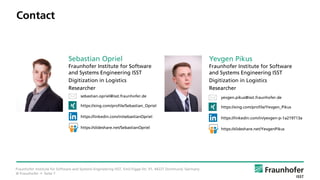
Contact
Fraunhofer Institute for Software and Systems Engineering ISST, Emil-Figge-Str. 91, 44227 Dortmund, Germany
yevgen.pikus@isst.fraunhofer.de
https://xing.com/profile/Yevgen_Pikus
https://linkedin.com/in/yevgen-p-1a219713a
https://slideshare.net/YevgenPikus
Yevgen Pikus
Fraunhofer Institute for Software
and Systems Engineering ISST
Digitization in Logistics
Researcher
sebastian.opriel@isst.fraunhofer.de
https://xing.com/profile/Sebastian_Opriel
https://linkedin.com/in/sebastianOpriel
https://slideshare.net/SebastianOpriel
Sebastian Opriel
Fraunhofer Institute for Software
and Systems Engineering ISST
Digitization in Logistics
Researcher

PhD Model Canvas

  • 1.
    © Fraunhofer •Seite 1 PHD MODEL CANVAS PhD Overview on one Slide Sebastian Opriel and Yevgen Pikus, Fraunhofer ISST, Dortmund, August 16th, 2017
  • 2.
    © Fraunhofer •Seite 2 Motivation  The beginning of a PhD process is cumbersome.  Usually objectives, research methods, expected outcomes etc. are changing in early stages.  Therefore, it is of paramount importance to find the promising direction and to answer the right questions.  Inspired by the Business Model Canvas we have developed the PhD Model Canvas  PhD Model Canvas is a Big Picture of a PhD thesis on a single page Business Model Canvas: Osterwalder, Alexander and Pigneur, Yves “Business model generation: a handbook for visionaries, game changers, and challengers.“ John Wiley & Sons, 2010.
  • 3.
    © Fraunhofer •Seite 3 Vision Motivation Problems Research Questions Existing Knowledge Goals Commercial Exploitation Required Knowledge Risks Copyright: Yevgen Pikus and Sebastian Opriel, Fraunhofer Institute for Software and Systems Engineering Research MethodologyResearch Area PhD Model Canvas
  • 4.
    © Fraunhofer •Seite 4 Explanation of Fields  Vision: A statement which is superior of the PhD thesis’s goal with emphasised positive impact on the world. Therefore, a vision should in practice not be reachable by a single PhD thesis.  Problems: Existing obstacles, which must be overcome to get a step further to the vision, should be described.  Goals: Due to the problems, concrete goals must be identified which should be reached by the PhD thesis.
  • 5.
    © Fraunhofer •Seite 5 Explanation of Fields  Motivation: A motivation explains the social and economic needs of the PhD thesis.  Existing Knowledge: To start with a PhD thesis, a student should have some experience in the field of research.  Required Knowledge: These existing knowledge of a student is often not sufficient to do research from scratch. Therefore, further knowledge must be acquired.  Research Questions: The identified problems can be scientifically solved by answering research questions.  Commercial Exploitation: Reaching the goals and answering the research questions lead to commercial exploitation opportunities.  Risks: A crucial aspect to observe are risks. They could result in problems during the PhD process, which may enlarge the PhD process or require a refocusing of the research topic.
  • 6.
    © Fraunhofer •Seite 6 Explanation of Fields  Research Methodology: Connected to the PhD process, a research methodology like Design Science Research is needed.  Research Area: Outcomes of the PhD process, should benefit a specific research area. Design Science Research: Alan, R. Hevner, et al. “Design science in information systems research.“ MIS quarterly 28.1 (2004): 75-105.
  • 7.
    © Fraunhofer •Seite 7 Contact Fraunhofer Institute for Software and Systems Engineering ISST, Emil-Figge-Str. 91, 44227 Dortmund, Germany yevgen.pikus@isst.fraunhofer.de https://xing.com/profile/Yevgen_Pikus https://linkedin.com/in/yevgen-p-1a219713a https://slideshare.net/YevgenPikus Yevgen Pikus Fraunhofer Institute for Software and Systems Engineering ISST Digitization in Logistics Researcher sebastian.opriel@isst.fraunhofer.de https://xing.com/profile/Sebastian_Opriel https://linkedin.com/in/sebastianOpriel https://slideshare.net/SebastianOpriel Sebastian Opriel Fraunhofer Institute for Software and Systems Engineering ISST Digitization in Logistics Researcher