Merchandise Mix
By,
Sameer Dhurat (83)
Anand Kalambe (84)
Ahire Krutica (80)
• Term Merchandising literally means "buying and
selling“
• It is planning, development and presentation of
product lines for identified target markets.
• Merchandising is the planning, buying and selling
of merchandise
• It is integral part of retailing.
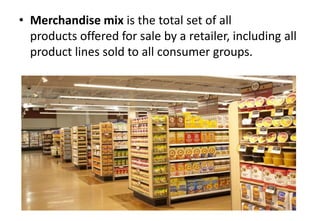
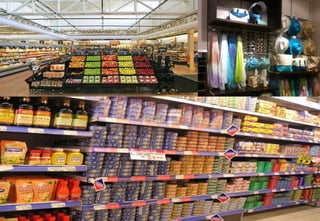
• Merchandise mix is the total set of all
products offered for sale by a retailer, including all
product lines sold to all consumer groups.
• The retail industry covers everything from
large supercenters (Big-box stores) to small vendors
pedaling goods along the roadside.
• The biggest dilemma a retail store owner faces, is what to
sell, or what their merchandise mix should consist of. If
retailers stock too much of a variety of merchandise, they
risk appearing like a jack-of-all-trades, potentially losing
money in the long run.
• If they stock a small merchandise mix (few items) they run
the risk of losing business, especially to local brick-and-
mortar stores and online competitors.
• For retailers, deciding on their marketing mix is similar to
deciding on their market segments. Retailers need to decide
who they are selling to and the needs of their market
segment.
'The Rights of Merchandising' are :
• The right merchandise
• The right quantity
• The right price
• The right time
• The right place
• The right quality
• Selecting and presenting the right merchandise is
critical as product is the focal point of customers
buying
• Each market segment and geographical region
demands a different merchandise mix
• Seasonal and trend changes effect the merchandise
mix
• The product assortment must have all types of
merchandise -basic, trendy, seasonal
• Assortment is the number of pieces per size per
color for each style or product variety.
• The right colors / sizes /product features to fulfill
needs and desires of customer have to be offered
by retailer
• Enough stock must be available to meet planned
sales and give customer wide assortment for
selection
• Quantity is all about demand and supply.
• Enough stock must be available in the right
assortment of color and sizes.
• Deciding the correct quantity of each style is
critical.
• Price is a function of profit and cost.
• Price should be high enough to make the desired
profit, at the same time low enough to get
business and meet target sales.
• Price should make production feasible and
product saleable at a profit accepted by the target
customer.
• Timing is critical so that the merchandise does not
get wasted.
• In seasonal products like apparel, umbrellas,
woolens, if the planned delivery date is not
adhered to the selling season will be missed and
the entire merchandise becomes a dead stock.
• Quality is a standard acceptable to customer and
satisfies the need of the product.
• It includes reliability, responsiveness, compliance
and compatibility.
• Quality has to be appropriate for the product and
that target customer.
• Quality has to' be compatible with the product
price also.
• The importance of location for a retailer cannot be
emphasized enough.
• The right store location is the first step towards
retail success.
• The location should have enough footfall of the
target segment to achieve sales.
• Even withhold store the placement of various
sections or departments is critical to achieving the
desired sales.
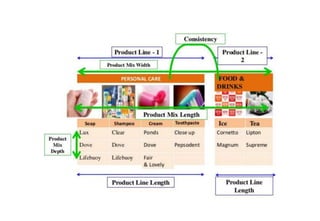
• Breadth:
The breadth of a company's products relates to the number of product lines a
company produces or a retailer carries.
Ex. An automobile manufacturer, may have a line of sedans, a line of SUVs, and a
line of trucks.
• Length:
This refers to the number of products in a particular product chain or line.
Ex. An automobile manufacturer may have four models of sedans, three models
of SUVs, and two models of trucks in each respective product line.
• Depth:
A product line's depth relates to the different versions of the same product that
may exist in each product line.
Ex. An automobile manufacturer may have a basic, standard and luxury version
for each of its sedans and SUVs but only a basic and standard model for its trucks.
Planning merchandise variety involves
Planning & Controlling Product Lines
Retailers use many factors to
evaluate product lines
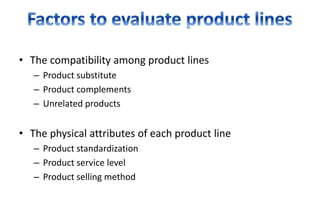
• The compatibility among product lines
– Product substitute
– Product complements
– Unrelated products
• The physical attributes of each product line
– Product standardization
– Product service level
– Product selling method
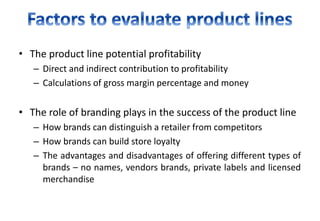
• The product line potential profitability
– Direct and indirect contribution to profitability
– Calculations of gross margin percentage and money
• The role of branding plays in the success of the product line
– How brands can distinguish a retailer from competitors
– How brands can build store loyalty
– The advantages and disadvantages of offering different types of
brands – no names, vendors brands, private labels and licensed
merchandise
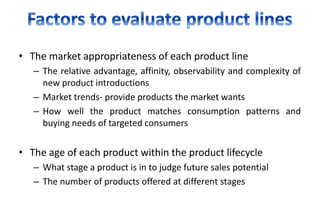
• The market appropriateness of each product line
– The relative advantage, affinity, observability and complexity of
new product introductions
– Market trends- provide products the market wants
– How well the product matches consumption patterns and
buying needs of targeted consumers
• The age of each product within the product lifecycle
– What stage a product is in to judge future sales potential
– The number of products offered at different stages
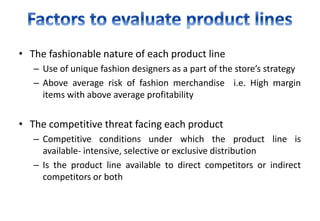
• The fashionable nature of each product line
– Use of unique fashion designers as a part of the store’s strategy
– Above average risk of fashion merchandise i.e. High margin
items with above average profitability
• The competitive threat facing each product
– Competitive conditions under which the product line is
available- intensive, selective or exclusive distribution
– Is the product line available to direct competitors or indirect
competitors or both
• The impact of lifecycle on product line acceptance
– Targeted customer activities, interest and opinions
– Match between consumers lifestyles and retailers image
– Usefulness of trade to identity product lines for targeted
consumer lifestyles
• The conditions under which each product line will be
procurable
– Availability and reliability of various suppliers
– Terms and conditions under which the product will be made
available
• No rules for what should be included in the merchandise
mix and what should be excluded
• Two useful methods
– Category management: each product managed as a business
unit at the store level
– ABC Analysis: each product line is rank ordered based on
performance levels
• Involves monitoring and adjusting the types of product lines
that are added and dropped from the merchandise mix
• Two widely used methods to control assortments and
support:
– Inventory turnover: rate at which the retailer depletes and
replenishes stock
– Open to buy: amount of new merchandise a retailer can
buy during a specific time period without exceeding
planned purchases for the period
• Goal- to ensure that the product choice must meets the targeted
consumer needs
• Planning should be done carefully for the number of units to
have on hand to meet the expected sales for the brands
• Must organise the merchandise mix as to the number of
different product lines carried
• It depends on:
- Brands - Materials
- Sizes - Styles
- Colors - Price
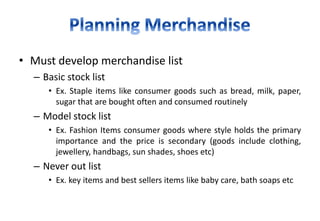
• Must develop merchandise list
– Basic stock list
• Ex. Staple items like consumer goods such as bread, milk, paper,
sugar that are bought often and consumed routinely
– Model stock list
• Ex. Fashion Items consumer goods where style holds the primary
importance and the price is secondary (goods include clothing,
jewellery, handbags, sun shades, shoes etc)
– Never out list
• Ex. key items and best sellers items like baby care, bath soaps etc
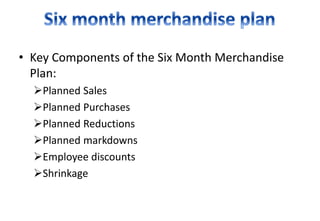
• Key Components of the Six Month Merchandise
Plan:
Planned Sales
Planned Purchases
Planned Reductions
Planned markdowns
Employee discounts
Shrinkage
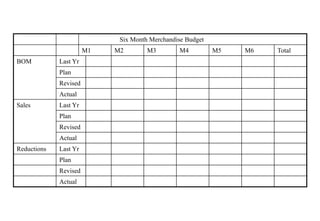
Six Month Merchandise Budget
M1 M2 M3 M4 M5 M6 Total
BOM Last Yr
Plan
Revised
Actual
Sales Last Yr
Plan
Revised
Actual
Reductions Last Yr
Plan
Revised
Actual
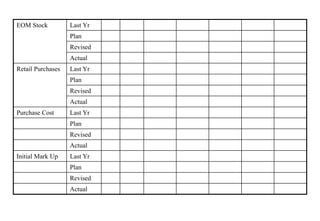
EOM Stock Last Yr
Plan
Revised
Actual
Retail Purchases Last Yr
Plan
Revised
Actual
Purchase Cost Last Yr
Plan
Revised
Actual
Initial Mark Up Last Yr
Plan
Revised
Actual
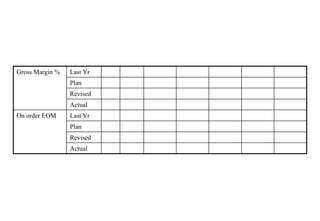
Gross Margin % Last Yr
Plan
Revised
Actual
On order EOM Last Yr
Plan
Revised
Actual
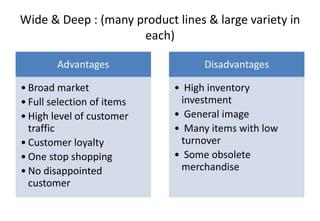
Wide & Deep : (many product lines & large variety in
each)
Advantages
• Broad market
• Full selection of items
• High level of customer
traffic
• Customer loyalty
• One stop shopping
• No disappointed
customer
Disadvantages
• High inventory
investment
• General image
• Many items with low
turnover
• Some obsolete
merchandise
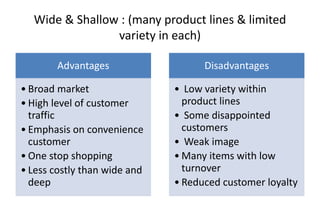
Wide & Shallow : (many product lines & limited
variety in each)
Advantages
• Broad market
• High level of customer
traffic
• Emphasis on convenience
customer
• One stop shopping
• Less costly than wide and
deep
Disadvantages
• Low variety within
product lines
• Some disappointed
customers
• Weak image
• Many items with low
turnover
• Reduced customer loyalty
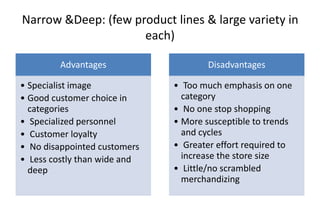
Narrow &Deep: (few product lines & large variety in
each)
Advantages
• Specialist image
• Good customer choice in
categories
• Specialized personnel
• Customer loyalty
• No disappointed customers
• Less costly than wide and
deep
Disadvantages
• Too much emphasis on one
category
• No one stop shopping
• More susceptible to trends
and cycles
• Greater effort required to
increase the store size
• Little/no scrambled
merchandizing
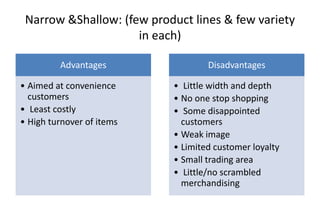
Narrow &Shallow: (few product lines & few variety
in each)
Advantages
• Aimed at convenience
customers
• Least costly
• High turnover of items
Disadvantages
• Little width and depth
• No one stop shopping
• Some disappointed
customers
• Weak image
• Limited customer loyalty
• Small trading area
• Little/no scrambled
merchandising
1/2/2018 Retailing Management - Swapna Pradhan 35
• The model stock plan gives the precise items and
quantities that should be on hand for each
merchandise line.
• A model stock plan needs to be compiled for each
line of merchandise.
1/2/2018 Retailing Management - Swapna Pradhan 36
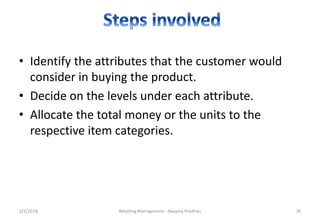
• Identify the attributes that the customer would
consider in buying the product.
• Decide on the levels under each attribute.
• Allocate the total money or the units to the
respective item categories.
1/2/2018 Retailing Management - Swapna Pradhan 37
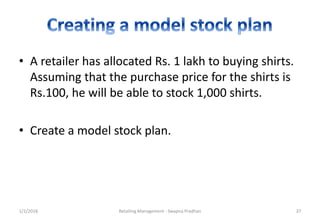
• A retailer has allocated Rs. 1 lakh to buying shirts.
Assuming that the purchase price for the shirts is
Rs.100, he will be able to stock 1,000 shirts.
• Create a model stock plan.
1/2/2018 Retailing Management - Swapna Pradhan 38
• Identify the number of levels under each
attribute.
Type of shirt – Dress, Casual, Formal, Sport
Size – Small, Medium, Large, Extra Large
Sleeve Length – Full Sleeves, Short Sleeves
Collar Type – Saville, Button Down
Color – White, Blue, Cream, Grey
Fabric – Cotton, Cotton Blend
1/2/2018 Retailing Management - Swapna Pradhan 39
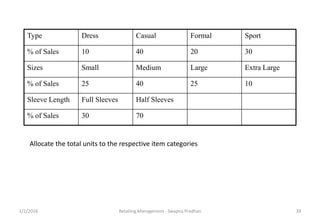
Type Dress Casual Formal Sport
% of Sales 10 40 20 30
Sizes Small Medium Large Extra Large
% of Sales 25 40 25 10
Sleeve Length Full Sleeves Half Sleeves
% of Sales 30 70
Allocate the total units to the respective item categories
1/2/2018 Retailing Management - Swapna Pradhan 40
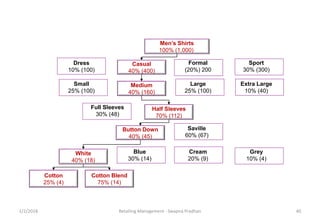
Men’s Shirts
100% (1,000)
Dress
10% (100)
Casual
40% (400)
Formal
(20%) 200
Sport
30% (300)
Small
25% (100)
Medium
40% (160)
Large
25% (100)
Extra Large
10% (40)
Full Sleeves
30% (48)
Half Sleeves
70% (112)
Button Down
40% (45)
Saville
60% (67)
White
40% (18)
Blue
30% (14)
Cream
20% (9)
Grey
10% (4)
Cotton
25% (4)
Cotton Blend
75% (14)
References
• https://www.thebalance.com/merchandise-mix-
2890200
• https://www.dotactiv.com/blog/merchandise-mix
• http://study.com/academy/lesson/product-
assortment-definition-strategy-quiz.html
• http://www.mytotalretail.com/article/how-develop-
profitable-merchandise-mix-15726/all/
• http://vasantkothari.com/content/view_presentation
/511/16-Merchandise-Mix
Merchandise mix

Merchandise mix

  • 1.
    Merchandise Mix By, Sameer Dhurat(83) Anand Kalambe (84) Ahire Krutica (80)
  • 2.
    • Term Merchandisingliterally means "buying and selling“ • It is planning, development and presentation of product lines for identified target markets. • Merchandising is the planning, buying and selling of merchandise • It is integral part of retailing.
  • 3.
    • Merchandise mixis the total set of all products offered for sale by a retailer, including all product lines sold to all consumer groups.
  • 4.
    • The retailindustry covers everything from large supercenters (Big-box stores) to small vendors pedaling goods along the roadside. • The biggest dilemma a retail store owner faces, is what to sell, or what their merchandise mix should consist of. If retailers stock too much of a variety of merchandise, they risk appearing like a jack-of-all-trades, potentially losing money in the long run. • If they stock a small merchandise mix (few items) they run the risk of losing business, especially to local brick-and- mortar stores and online competitors. • For retailers, deciding on their marketing mix is similar to deciding on their market segments. Retailers need to decide who they are selling to and the needs of their market segment.
  • 6.
    'The Rights ofMerchandising' are : • The right merchandise • The right quantity • The right price • The right time • The right place • The right quality
  • 7.
    • Selecting andpresenting the right merchandise is critical as product is the focal point of customers buying • Each market segment and geographical region demands a different merchandise mix • Seasonal and trend changes effect the merchandise mix • The product assortment must have all types of merchandise -basic, trendy, seasonal
  • 8.
    • Assortment isthe number of pieces per size per color for each style or product variety. • The right colors / sizes /product features to fulfill needs and desires of customer have to be offered by retailer • Enough stock must be available to meet planned sales and give customer wide assortment for selection
  • 9.
    • Quantity isall about demand and supply. • Enough stock must be available in the right assortment of color and sizes. • Deciding the correct quantity of each style is critical.
  • 10.
    • Price isa function of profit and cost. • Price should be high enough to make the desired profit, at the same time low enough to get business and meet target sales. • Price should make production feasible and product saleable at a profit accepted by the target customer.
  • 11.
    • Timing iscritical so that the merchandise does not get wasted. • In seasonal products like apparel, umbrellas, woolens, if the planned delivery date is not adhered to the selling season will be missed and the entire merchandise becomes a dead stock.
  • 12.
    • Quality isa standard acceptable to customer and satisfies the need of the product. • It includes reliability, responsiveness, compliance and compatibility. • Quality has to be appropriate for the product and that target customer. • Quality has to' be compatible with the product price also.
  • 13.
    • The importanceof location for a retailer cannot be emphasized enough. • The right store location is the first step towards retail success. • The location should have enough footfall of the target segment to achieve sales. • Even withhold store the placement of various sections or departments is critical to achieving the desired sales.
  • 14.
    • Breadth: The breadthof a company's products relates to the number of product lines a company produces or a retailer carries. Ex. An automobile manufacturer, may have a line of sedans, a line of SUVs, and a line of trucks. • Length: This refers to the number of products in a particular product chain or line. Ex. An automobile manufacturer may have four models of sedans, three models of SUVs, and two models of trucks in each respective product line. • Depth: A product line's depth relates to the different versions of the same product that may exist in each product line. Ex. An automobile manufacturer may have a basic, standard and luxury version for each of its sedans and SUVs but only a basic and standard model for its trucks.
  • 16.
    Planning merchandise varietyinvolves Planning & Controlling Product Lines Retailers use many factors to evaluate product lines
  • 17.
    • The compatibilityamong product lines – Product substitute – Product complements – Unrelated products • The physical attributes of each product line – Product standardization – Product service level – Product selling method
  • 18.
    • The productline potential profitability – Direct and indirect contribution to profitability – Calculations of gross margin percentage and money • The role of branding plays in the success of the product line – How brands can distinguish a retailer from competitors – How brands can build store loyalty – The advantages and disadvantages of offering different types of brands – no names, vendors brands, private labels and licensed merchandise
  • 19.
    • The marketappropriateness of each product line – The relative advantage, affinity, observability and complexity of new product introductions – Market trends- provide products the market wants – How well the product matches consumption patterns and buying needs of targeted consumers • The age of each product within the product lifecycle – What stage a product is in to judge future sales potential – The number of products offered at different stages
  • 20.
    • The fashionablenature of each product line – Use of unique fashion designers as a part of the store’s strategy – Above average risk of fashion merchandise i.e. High margin items with above average profitability • The competitive threat facing each product – Competitive conditions under which the product line is available- intensive, selective or exclusive distribution – Is the product line available to direct competitors or indirect competitors or both
  • 21.
    • The impactof lifecycle on product line acceptance – Targeted customer activities, interest and opinions – Match between consumers lifestyles and retailers image – Usefulness of trade to identity product lines for targeted consumer lifestyles • The conditions under which each product line will be procurable – Availability and reliability of various suppliers – Terms and conditions under which the product will be made available
  • 22.
    • No rulesfor what should be included in the merchandise mix and what should be excluded • Two useful methods – Category management: each product managed as a business unit at the store level – ABC Analysis: each product line is rank ordered based on performance levels • Involves monitoring and adjusting the types of product lines that are added and dropped from the merchandise mix
  • 23.
    • Two widelyused methods to control assortments and support: – Inventory turnover: rate at which the retailer depletes and replenishes stock – Open to buy: amount of new merchandise a retailer can buy during a specific time period without exceeding planned purchases for the period
  • 24.
    • Goal- toensure that the product choice must meets the targeted consumer needs • Planning should be done carefully for the number of units to have on hand to meet the expected sales for the brands • Must organise the merchandise mix as to the number of different product lines carried • It depends on: - Brands - Materials - Sizes - Styles - Colors - Price
  • 25.
    • Must developmerchandise list – Basic stock list • Ex. Staple items like consumer goods such as bread, milk, paper, sugar that are bought often and consumed routinely – Model stock list • Ex. Fashion Items consumer goods where style holds the primary importance and the price is secondary (goods include clothing, jewellery, handbags, sun shades, shoes etc) – Never out list • Ex. key items and best sellers items like baby care, bath soaps etc
  • 26.
    • Key Componentsof the Six Month Merchandise Plan: Planned Sales Planned Purchases Planned Reductions Planned markdowns Employee discounts Shrinkage
  • 27.
    Six Month MerchandiseBudget M1 M2 M3 M4 M5 M6 Total BOM Last Yr Plan Revised Actual Sales Last Yr Plan Revised Actual Reductions Last Yr Plan Revised Actual
  • 28.
    EOM Stock LastYr Plan Revised Actual Retail Purchases Last Yr Plan Revised Actual Purchase Cost Last Yr Plan Revised Actual Initial Mark Up Last Yr Plan Revised Actual
  • 29.
    Gross Margin %Last Yr Plan Revised Actual On order EOM Last Yr Plan Revised Actual
  • 31.
    Wide & Deep: (many product lines & large variety in each) Advantages • Broad market • Full selection of items • High level of customer traffic • Customer loyalty • One stop shopping • No disappointed customer Disadvantages • High inventory investment • General image • Many items with low turnover • Some obsolete merchandise
  • 32.
    Wide & Shallow: (many product lines & limited variety in each) Advantages • Broad market • High level of customer traffic • Emphasis on convenience customer • One stop shopping • Less costly than wide and deep Disadvantages • Low variety within product lines • Some disappointed customers • Weak image • Many items with low turnover • Reduced customer loyalty
  • 33.
    Narrow &Deep: (fewproduct lines & large variety in each) Advantages • Specialist image • Good customer choice in categories • Specialized personnel • Customer loyalty • No disappointed customers • Less costly than wide and deep Disadvantages • Too much emphasis on one category • No one stop shopping • More susceptible to trends and cycles • Greater effort required to increase the store size • Little/no scrambled merchandizing
  • 34.
    Narrow &Shallow: (fewproduct lines & few variety in each) Advantages • Aimed at convenience customers • Least costly • High turnover of items Disadvantages • Little width and depth • No one stop shopping • Some disappointed customers • Weak image • Limited customer loyalty • Small trading area • Little/no scrambled merchandising
  • 35.
    1/2/2018 Retailing Management- Swapna Pradhan 35 • The model stock plan gives the precise items and quantities that should be on hand for each merchandise line. • A model stock plan needs to be compiled for each line of merchandise.
  • 36.
    1/2/2018 Retailing Management- Swapna Pradhan 36 • Identify the attributes that the customer would consider in buying the product. • Decide on the levels under each attribute. • Allocate the total money or the units to the respective item categories.
  • 37.
    1/2/2018 Retailing Management- Swapna Pradhan 37 • A retailer has allocated Rs. 1 lakh to buying shirts. Assuming that the purchase price for the shirts is Rs.100, he will be able to stock 1,000 shirts. • Create a model stock plan.
  • 38.
    1/2/2018 Retailing Management- Swapna Pradhan 38 • Identify the number of levels under each attribute. Type of shirt – Dress, Casual, Formal, Sport Size – Small, Medium, Large, Extra Large Sleeve Length – Full Sleeves, Short Sleeves Collar Type – Saville, Button Down Color – White, Blue, Cream, Grey Fabric – Cotton, Cotton Blend
  • 39.
    1/2/2018 Retailing Management- Swapna Pradhan 39 Type Dress Casual Formal Sport % of Sales 10 40 20 30 Sizes Small Medium Large Extra Large % of Sales 25 40 25 10 Sleeve Length Full Sleeves Half Sleeves % of Sales 30 70 Allocate the total units to the respective item categories
  • 40.
    1/2/2018 Retailing Management- Swapna Pradhan 40 Men’s Shirts 100% (1,000) Dress 10% (100) Casual 40% (400) Formal (20%) 200 Sport 30% (300) Small 25% (100) Medium 40% (160) Large 25% (100) Extra Large 10% (40) Full Sleeves 30% (48) Half Sleeves 70% (112) Button Down 40% (45) Saville 60% (67) White 40% (18) Blue 30% (14) Cream 20% (9) Grey 10% (4) Cotton 25% (4) Cotton Blend 75% (14)
  • 41.
    References • https://www.thebalance.com/merchandise-mix- 2890200 • https://www.dotactiv.com/blog/merchandise-mix •http://study.com/academy/lesson/product- assortment-definition-strategy-quiz.html • http://www.mytotalretail.com/article/how-develop- profitable-merchandise-mix-15726/all/ • http://vasantkothari.com/content/view_presentation /511/16-Merchandise-Mix