
Iranian wedding Tradition
By samin
Critical thinking and logic
Professor Naomi Holey
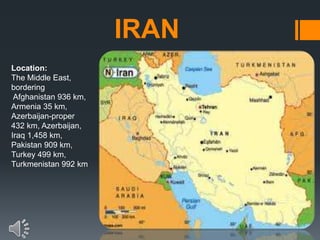
IRAN
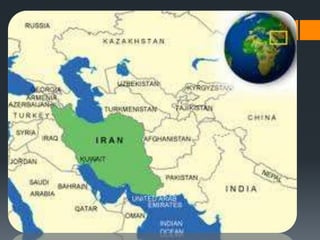
Location:
The Middle East,
bordering
Afghanistan 936 km,
Armenia 35 km,
Azerbaijan-proper
432 km, Azerbaijan,
Iraq 1,458 km,
Pakistan 909 km,
Turkey 499 km,
Turkmenistan 992 km
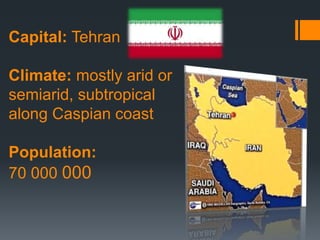
Capital: Tehran
Climate: mostly arid or
semiarid, subtropical
along Caspian coast
Population:
70 000 000
Gift Giving Etiquette
Iranians give gifts at various social occasions such as returning from
a trip or if someone achieves a major success in their personal or
business life.
. On birthdays, businesspeople bring sweets and cakes to the office
and do not expect to receive gifts.
. It is common to give monetary gifts to servants or others who have
provided services during the year on Now Ruz (The Iranian New
Year). Money should be new bank notes or gold coins.
.
If you are invited to an Iranian's house, bring flowers, or pastry to the
hosts. When giving a gift, always apologize for its inadequacy.
.
Gifts should be elegantly wrapped - most shops will wrap them for
you.
. Gifts are not generally opened when received. In fact, they may be
put on a table and not mentioned.
Iranian Wedding Tradition
 Persian wedding traditions, despite its local and regional variations,
like many other rituals in Persia goes back to the ancient Zoroastrian
tradition.
 Though the concepts and theory of the marriage have changed
drastically by Islamic traditions, the actual ceremonies have remained
more or less the same as they were originally in the ancient
Zoroastrian culture.
Before the marriage
Khastegari
Khastegari is the first step of the traditional Persian marriage process.
When it is time for a young man to get married, his family will look around
to identify a number of potential brides. Some men ask their parents to
suggest potential brides, if they have been unable to find one themselves.
However, this has become rarer in recent years, with men and women
mixing and meeting freely themselves. Once the man, or his family, have
decided on a potential bride, the khastegari process takes place. For this
ceremony, one or more representatives of the man’s family pay a visit to
the woman's family. The first visit is purely for the parties to become
acquainted with one another. The first visit does not include a formal
proposal and there is no commitment - it is perfectly acceptable for the man
and his family to go for more than one khastegari in a short period of time.
Following the first visit, both parties can begin to think more seriously about
whether they would like to pursue a relationship. Both the woman and the
man have their say in whether or not they would like a follow up to this visit.
The second khastegari
 A marriage proposal is made by the suitor and his family. The woman’s
family welcome the party and invite them to sit in the reception room.
 At first, members of the bride’s family talk about the virtues of the girl.
Traditionally, modesty was among the most highly valued qualities, along
with domestic skills like cooking, embroidery, and entertaining at social
gatherings (mehman-navazi); less emphasis is placed on these
characteristics nowadays. In modern times important characteristics are
the intelligence of the girl, her ability to make the most of the situation
when times get tough, and her future prospects. After hearing about the
potential bride, the man's family will discuss his own merits, usually his
education and/or career prospects. The woman's parents will normally ask
the suitor if he is able to provide her with accommodation, and if he is able
to support their daughter financially. They may also discuss any religious
commitments.
 The most important part comes when the bride’s father calls for the tea to
be served. Traditionally, the first time that the man and woman see each
other is when she enters to offer tea and pastries to the guests. At the end
of second khastegari, the man and the woman will be given time alone to
talk in private. This usually involves a discussion about what they want for
the future.
 Note that, in most modern families, the first two khastegaris are done in
one step, and the man and the woman already know each other and are
the instigators of the ceremony
Bale Boroun
 Bale Boroun is the ceremony which takes place a short period of time
after the formal proposal, publicly announcing the couple's intention to
form a union. At this stage, both the man and woman are happy with
each other and, traditionally, both their families have agreed to the union
and any conditions surrounding the marriage.
 The groom's parents usually give a gift to the bride at this ceremony.
According to an ancient Zoroastrian practice, this is done by the groom's
family in order to persuade the bride to accept the proposal. The
traditional gift is a piece of cloth (to be made into a gown) and a ring. In
religious families, the cloth is given to be made into a chador.
Majless and Namzadi
(engagement)
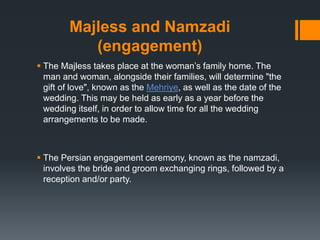
 The Majless takes place at the woman’s family home. The
man and woman, alongside their families, will determine "the
gift of love", known as the Mehriye, as well as the date of the
wedding. This may be held as early as a year before the
wedding itself, in order to allow time for all the wedding
arrangements to be made.
 The Persian engagement ceremony, known as the namzadi,
involves the bride and groom exchanging rings, followed by a
reception and/or party.
Shirini Khoran
The sharing of refreshments that follows the
namzadi ceremony is called shirin khoran (eating
sweets) including tea and shirini (desserts) such as
bamiye (light doughnut balls), nun-e berenji (rice
flour cookies), chocolates, ajil (nuts and dried fruit),
are served as part of the festivities. Eating sweet
food stuffs at celebratory events such as an
engagement ceremony carry symbolism such as
wishing for sweetness in the couple's life in general.
Aghd
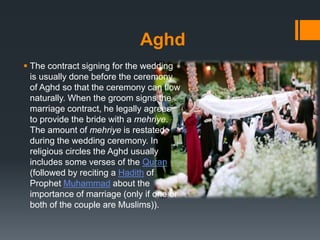
 The contract signing for the wedding
is usually done before the ceremony
of Aghd so that the ceremony can flow
naturally. When the groom signs the
marriage contract, he legally agrees
to provide the bride with a mehriye.
The amount of mehriye is restated
during the wedding ceremony. In
religious circles the Aghd usually
includes some verses of the Quran
(followed by reciting a Hadith of
Prophet Muhammad about the
importance of marriage (only if one or
both of the couple are Muslims)).
The wedding ceremony
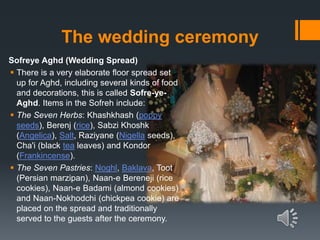
Sofreye Aghd (Wedding Spread)
 There is a very elaborate floor spread set
up for Aghd, including several kinds of food
and decorations, this is called Sofre-ye-
Aghd. Items in the Sofreh include:
 The Seven Herbs: Khashkhash (poppy
seeds), Berenj (rice), Sabzi Khoshk
(Angelica), Salt, Raziyane (Nigella seeds),
Cha'i (black tea leaves) and Kondor
(Frankincense).
 The Seven Pastries: Noghl, Baklava, Toot
(Persian marzipan), Naan-e Bereneji (rice
cookies), Naan-e Badami (almond cookies)
and Naan-Nokhodchi (chickpea cookie) are
placed on the spread and traditionally
served to the guests after the ceremony.
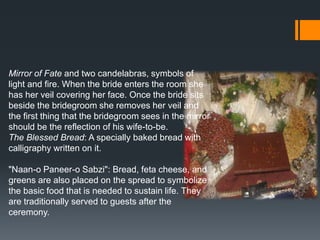
Mirror of Fate and two candelabras, symbols of
light and fire. When the bride enters the room she
has her veil covering her face. Once the bride sits
beside the bridegroom she removes her veil and
the first thing that the bridegroom sees in the mirror
should be the reflection of his wife-to-be.
The Blessed Bread: A specially baked bread with
calligraphy written on it.
"Naan-o Paneer-o Sabzi": Bread, feta cheese, and
greens are also placed on the spread to symbolize
the basic food that is needed to sustain life. They
are traditionally served to guests after the
ceremony.
 Symbols of Fertility: Decorated eggs, almonds, walnuts and
hazelnuts.
 The Heavenly Fruits: pomegranates, grapes, apples.
 Persian Rose: A cup of rose-water and a rose extracted from the
Gol-e Mohammadi (Mohammadan flower). This is to perfume the
air.
 Shakh-e-Nabat: A bowl made out of rock candy.
 "Honey": A cup of honey should be on the spread. Immediately
after the couple is married, the bride and groom each dip one
pinky finger in the cup of honey and feed it to one another.
 Esphand: The esphand and frankincense are sprinkled on a
brazier holding hot coals producing a smoke to ward off evil eyes
and purification.
 Coins: A bowl of gold or silver coins representing wealth and
prosperity.
 The Sacred Text: The Avesta, Qur'an, Bible, or Torah is placed in
front of the couple on the spread. Some families also add a
poetry book such as Rumi's Diwan-e Shams-e Tabrizi, Hafiz's
Divan, or the Shahnameh by Ferdowsi..
 Prayer Rug: A prayer rug (Jaa-ye Namaaz) or a traditional
Iranian Termeh is placed in the center of the wedding spread.
The prayer rug, open in the Aghd-cloth is to remind the couple of
the importance of prayer to god, the prayer carpet also includes
a small cube of clay with prayers written on it (Mohr) and a
rosary (Tasbih). Non-Muslim families may or may not omit the
prayer kit.
 A scarf or shawl made out of silk or any other fine fabric is held
over the bride and bridegroom's head (who are sitting by the
Sofreh) by a few unmarried female relatives (bridesmaids). Two
sugar cones made out of hardened sugar are used during the
ceremony. These sugar cones are softly ground together above
the bride and bridegroom's head by a happily married female
relative (and/or maid of honor) throughout the ceremony to
shower them in sweetness. The sugar drops in the held fabric,
not on their heads.
 In spirit of humor, sometimes a few stitches are sewn on the
cloth which is held over the bride and the groom's head. The
needle will have seven threads of seven colors and will
symbolize sewing the mother-in-law's tongue against saying
anything rude or unholy to the bride in her future life.
Then the ceremony administer (or marriage
officiant) asks the mutual consent of the couple.
First the groom is asked if he wishes to enter into
the marriage. Then the bride is asked the same
question. Here the bride makes the groom wait for
her hand in marriage by not answering the question
right away. This is usually accompanied by a relative
yelling out something (funny) that the bride could
have gone to do. The scenario will often be as
follows:
 The officiant: Do you wish to accept x as your husband?
 The bride remains silent, while one of the guests/bridesmaids
says "the bride has gone to pick flowers.“
 The officiant: For the second time I ask, do you accept x to
be your husband?
 Again the bride remains silent and a female
relative/bridesmaid may say "the bride has gone to bring
rose-water.“
 The officiant: For the third time I ask, will you accept x as
your husband?
 This time the bride says "with the permission of my parents
and elders, yes" and they are declared man and wife. From
that moment, the man and the woman will be considered
married (or mahram in religious families).
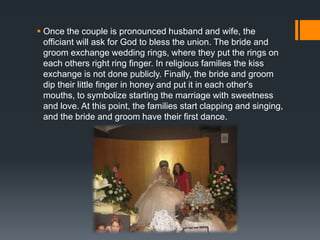
 Once the couple is pronounced husband and wife, the
officiant will ask for God to bless the union. The bride and
groom exchange wedding rings, where they put the rings on
each others right ring finger. In religious families the kiss
exchange is not done publicly. Finally, the bride and groom
dip their little finger in honey and put it in each other's
mouths, to symbolize starting the marriage with sweetness
and love. At this point, the families start clapping and singing,
and the bride and groom have their first dance.
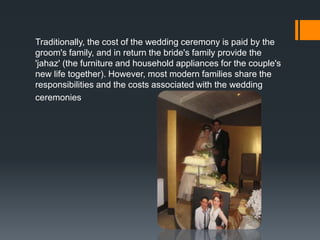
Traditionally, the cost of the wedding ceremony is paid by the
groom's family, and in return the bride's family provide the
'jahaz' (the furniture and household appliances for the couple's
new life together). However, most modern families share the
responsibilities and the costs associated with the wedding
ceremonies
Knife dance
https://www.youtube.com/watch?v=KDi0uFYw8TQ
After the wedding
Patakhti
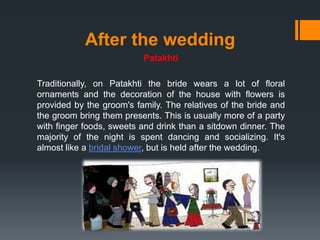
Traditionally, on Patakhti the bride wears a lot of floral
ornaments and the decoration of the house with flowers is
provided by the groom's family. The relatives of the bride and
the groom bring them presents. This is usually more of a party
with finger foods, sweets and drink than a sitdown dinner. The
majority of the night is spent dancing and socializing. It's
almost like a bridal shower, but is held after the wedding.
Pagosha
A Pagosha is when a family tributes the newly-married couple
by throwing a party for them shortly after the wedding.
In a way, the new couple's are getting welcome in both family
as they are getting invited from one Pagosha to another one
and as much as it can seem, it is exhausting for the new bride
and groom and their parents.
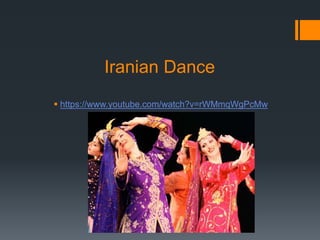
Iranian Dance
 https://www.youtube.com/watch?v=rWMmqWgPcMw
UP TO NIGERIA

Iranian wedding tradition

  • 1.
    Iranian wedding Tradition Bysamin Critical thinking and logic Professor Naomi Holey
  • 2.
    IRAN Location: The Middle East, bordering Afghanistan936 km, Armenia 35 km, Azerbaijan-proper 432 km, Azerbaijan, Iraq 1,458 km, Pakistan 909 km, Turkey 499 km, Turkmenistan 992 km
  • 4.
    Capital: Tehran Climate: mostlyarid or semiarid, subtropical along Caspian coast Population: 70 000 000
  • 5.
    Gift Giving Etiquette Iraniansgive gifts at various social occasions such as returning from a trip or if someone achieves a major success in their personal or business life. . On birthdays, businesspeople bring sweets and cakes to the office and do not expect to receive gifts. . It is common to give monetary gifts to servants or others who have provided services during the year on Now Ruz (The Iranian New Year). Money should be new bank notes or gold coins. . If you are invited to an Iranian's house, bring flowers, or pastry to the hosts. When giving a gift, always apologize for its inadequacy. . Gifts should be elegantly wrapped - most shops will wrap them for you. . Gifts are not generally opened when received. In fact, they may be put on a table and not mentioned.
  • 6.
    Iranian Wedding Tradition Persian wedding traditions, despite its local and regional variations, like many other rituals in Persia goes back to the ancient Zoroastrian tradition.  Though the concepts and theory of the marriage have changed drastically by Islamic traditions, the actual ceremonies have remained more or less the same as they were originally in the ancient Zoroastrian culture.
  • 7.
    Before the marriage Khastegari Khastegariis the first step of the traditional Persian marriage process. When it is time for a young man to get married, his family will look around to identify a number of potential brides. Some men ask their parents to suggest potential brides, if they have been unable to find one themselves. However, this has become rarer in recent years, with men and women mixing and meeting freely themselves. Once the man, or his family, have decided on a potential bride, the khastegari process takes place. For this ceremony, one or more representatives of the man’s family pay a visit to the woman's family. The first visit is purely for the parties to become acquainted with one another. The first visit does not include a formal proposal and there is no commitment - it is perfectly acceptable for the man and his family to go for more than one khastegari in a short period of time. Following the first visit, both parties can begin to think more seriously about whether they would like to pursue a relationship. Both the woman and the man have their say in whether or not they would like a follow up to this visit.
  • 8.
    The second khastegari A marriage proposal is made by the suitor and his family. The woman’s family welcome the party and invite them to sit in the reception room.  At first, members of the bride’s family talk about the virtues of the girl. Traditionally, modesty was among the most highly valued qualities, along with domestic skills like cooking, embroidery, and entertaining at social gatherings (mehman-navazi); less emphasis is placed on these characteristics nowadays. In modern times important characteristics are the intelligence of the girl, her ability to make the most of the situation when times get tough, and her future prospects. After hearing about the potential bride, the man's family will discuss his own merits, usually his education and/or career prospects. The woman's parents will normally ask the suitor if he is able to provide her with accommodation, and if he is able to support their daughter financially. They may also discuss any religious commitments.  The most important part comes when the bride’s father calls for the tea to be served. Traditionally, the first time that the man and woman see each other is when she enters to offer tea and pastries to the guests. At the end of second khastegari, the man and the woman will be given time alone to talk in private. This usually involves a discussion about what they want for the future.  Note that, in most modern families, the first two khastegaris are done in one step, and the man and the woman already know each other and are the instigators of the ceremony
  • 9.
    Bale Boroun  BaleBoroun is the ceremony which takes place a short period of time after the formal proposal, publicly announcing the couple's intention to form a union. At this stage, both the man and woman are happy with each other and, traditionally, both their families have agreed to the union and any conditions surrounding the marriage.  The groom's parents usually give a gift to the bride at this ceremony. According to an ancient Zoroastrian practice, this is done by the groom's family in order to persuade the bride to accept the proposal. The traditional gift is a piece of cloth (to be made into a gown) and a ring. In religious families, the cloth is given to be made into a chador.
  • 10.
    Majless and Namzadi (engagement) The Majless takes place at the woman’s family home. The man and woman, alongside their families, will determine "the gift of love", known as the Mehriye, as well as the date of the wedding. This may be held as early as a year before the wedding itself, in order to allow time for all the wedding arrangements to be made.  The Persian engagement ceremony, known as the namzadi, involves the bride and groom exchanging rings, followed by a reception and/or party.
  • 11.
    Shirini Khoran The sharingof refreshments that follows the namzadi ceremony is called shirin khoran (eating sweets) including tea and shirini (desserts) such as bamiye (light doughnut balls), nun-e berenji (rice flour cookies), chocolates, ajil (nuts and dried fruit), are served as part of the festivities. Eating sweet food stuffs at celebratory events such as an engagement ceremony carry symbolism such as wishing for sweetness in the couple's life in general.
  • 12.
    Aghd  The contractsigning for the wedding is usually done before the ceremony of Aghd so that the ceremony can flow naturally. When the groom signs the marriage contract, he legally agrees to provide the bride with a mehriye. The amount of mehriye is restated during the wedding ceremony. In religious circles the Aghd usually includes some verses of the Quran (followed by reciting a Hadith of Prophet Muhammad about the importance of marriage (only if one or both of the couple are Muslims)).
  • 13.
    The wedding ceremony SofreyeAghd (Wedding Spread)  There is a very elaborate floor spread set up for Aghd, including several kinds of food and decorations, this is called Sofre-ye- Aghd. Items in the Sofreh include:  The Seven Herbs: Khashkhash (poppy seeds), Berenj (rice), Sabzi Khoshk (Angelica), Salt, Raziyane (Nigella seeds), Cha'i (black tea leaves) and Kondor (Frankincense).  The Seven Pastries: Noghl, Baklava, Toot (Persian marzipan), Naan-e Bereneji (rice cookies), Naan-e Badami (almond cookies) and Naan-Nokhodchi (chickpea cookie) are placed on the spread and traditionally served to the guests after the ceremony.
  • 14.
    Mirror of Fateand two candelabras, symbols of light and fire. When the bride enters the room she has her veil covering her face. Once the bride sits beside the bridegroom she removes her veil and the first thing that the bridegroom sees in the mirror should be the reflection of his wife-to-be. The Blessed Bread: A specially baked bread with calligraphy written on it. "Naan-o Paneer-o Sabzi": Bread, feta cheese, and greens are also placed on the spread to symbolize the basic food that is needed to sustain life. They are traditionally served to guests after the ceremony.
  • 15.
     Symbols ofFertility: Decorated eggs, almonds, walnuts and hazelnuts.  The Heavenly Fruits: pomegranates, grapes, apples.  Persian Rose: A cup of rose-water and a rose extracted from the Gol-e Mohammadi (Mohammadan flower). This is to perfume the air.  Shakh-e-Nabat: A bowl made out of rock candy.  "Honey": A cup of honey should be on the spread. Immediately after the couple is married, the bride and groom each dip one pinky finger in the cup of honey and feed it to one another.  Esphand: The esphand and frankincense are sprinkled on a brazier holding hot coals producing a smoke to ward off evil eyes and purification.  Coins: A bowl of gold or silver coins representing wealth and prosperity.  The Sacred Text: The Avesta, Qur'an, Bible, or Torah is placed in front of the couple on the spread. Some families also add a poetry book such as Rumi's Diwan-e Shams-e Tabrizi, Hafiz's Divan, or the Shahnameh by Ferdowsi..
  • 16.
     Prayer Rug:A prayer rug (Jaa-ye Namaaz) or a traditional Iranian Termeh is placed in the center of the wedding spread. The prayer rug, open in the Aghd-cloth is to remind the couple of the importance of prayer to god, the prayer carpet also includes a small cube of clay with prayers written on it (Mohr) and a rosary (Tasbih). Non-Muslim families may or may not omit the prayer kit.  A scarf or shawl made out of silk or any other fine fabric is held over the bride and bridegroom's head (who are sitting by the Sofreh) by a few unmarried female relatives (bridesmaids). Two sugar cones made out of hardened sugar are used during the ceremony. These sugar cones are softly ground together above the bride and bridegroom's head by a happily married female relative (and/or maid of honor) throughout the ceremony to shower them in sweetness. The sugar drops in the held fabric, not on their heads.  In spirit of humor, sometimes a few stitches are sewn on the cloth which is held over the bride and the groom's head. The needle will have seven threads of seven colors and will symbolize sewing the mother-in-law's tongue against saying anything rude or unholy to the bride in her future life.
  • 17.
    Then the ceremonyadminister (or marriage officiant) asks the mutual consent of the couple. First the groom is asked if he wishes to enter into the marriage. Then the bride is asked the same question. Here the bride makes the groom wait for her hand in marriage by not answering the question right away. This is usually accompanied by a relative yelling out something (funny) that the bride could have gone to do. The scenario will often be as follows:
  • 18.
     The officiant:Do you wish to accept x as your husband?  The bride remains silent, while one of the guests/bridesmaids says "the bride has gone to pick flowers.“  The officiant: For the second time I ask, do you accept x to be your husband?  Again the bride remains silent and a female relative/bridesmaid may say "the bride has gone to bring rose-water.“  The officiant: For the third time I ask, will you accept x as your husband?  This time the bride says "with the permission of my parents and elders, yes" and they are declared man and wife. From that moment, the man and the woman will be considered married (or mahram in religious families).
  • 19.
     Once thecouple is pronounced husband and wife, the officiant will ask for God to bless the union. The bride and groom exchange wedding rings, where they put the rings on each others right ring finger. In religious families the kiss exchange is not done publicly. Finally, the bride and groom dip their little finger in honey and put it in each other's mouths, to symbolize starting the marriage with sweetness and love. At this point, the families start clapping and singing, and the bride and groom have their first dance.
  • 20.
    Traditionally, the costof the wedding ceremony is paid by the groom's family, and in return the bride's family provide the 'jahaz' (the furniture and household appliances for the couple's new life together). However, most modern families share the responsibilities and the costs associated with the wedding ceremonies
  • 21.
  • 22.
    After the wedding Patakhti Traditionally,on Patakhti the bride wears a lot of floral ornaments and the decoration of the house with flowers is provided by the groom's family. The relatives of the bride and the groom bring them presents. This is usually more of a party with finger foods, sweets and drink than a sitdown dinner. The majority of the night is spent dancing and socializing. It's almost like a bridal shower, but is held after the wedding.
  • 23.
    Pagosha A Pagosha iswhen a family tributes the newly-married couple by throwing a party for them shortly after the wedding. In a way, the new couple's are getting welcome in both family as they are getting invited from one Pagosha to another one and as much as it can seem, it is exhausting for the new bride and groom and their parents.
  • 24.
  • 25.