Dhote Bandhu Science
College,Gondia
Presentation By : Sachin k. Sakure
Under Guidance of Shruti ma’am
Name Of Subject : Mathematics-2
Name of Unit : Laplace Transforms
Topic : L.T. of derivative of (t)
Laplace Transform of Derivative
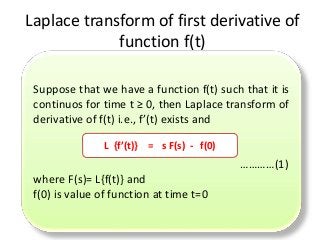
Laplace transform of first derivative of
function f(t)
Suppose that we have a function f(t) such that it is
continuos for time t ≥ 0, then Laplace transform of
derivative of f(t) i.e., f’(t) exists and
…………(1)
where F(s)= L{f(t)} and
f(0) is value of function at time t=0
L {f’(t)} = s F(s) - f(0)
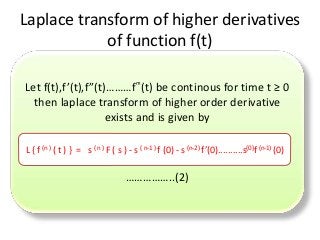
Laplace transform of higher derivatives
of function f(t)
Let f(t),f’(t),f”(t)………f ͫ(t) be continous for time t ≥ 0
then laplace transform of higher order derivative
exists and is given by
……………..(2)
L { f (n ) ( t ) } = s ( n ) F ( s ) - s ( n-1 ) f (0) - s (n-2) f’(0)..........s(0)f (n-1) (0)
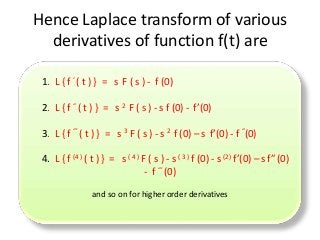
Hence Laplace transform of various
derivatives of function f(t) are
. 1. L { f ‘ ( t ) } = s F ( s ) - f (0)
2. L { f “ ( t ) } = s 2 F ( s ) - s f (0) - f’(0)
3. L { f “’ ( t ) } = s 3 F ( s ) - s 2 f (0) – s f’(0) - f “(0)
4. L { f (4 ) ( t ) } = s ( 4 ) F ( s ) - s ( 3 ) f (0) - s (2) f’(0) – sf” (0)
- f “’ (0)
and so on for higher order derivatives
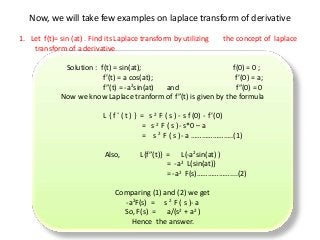
Now, we will take few examples on laplace transform of derivative
1. Let f(t)= sin (at) . Find its Laplace transform by utilizing the concept of laplace
transform of a derivative
Solution : f(t) = sin(at); f(0) = 0 ;
f’(t) = a cos(at); f’(0) = a;
f”(t) = -a2sin(at) and f”(0) = 0
Now we know Laplace tranform of f”(t) is given by the formula
L { f “ ( t ) } = s 2 F ( s ) - s f (0) - f’(0)
= s 2 F ( s )- s*0 – a
= s 2 F ( s )- a …………………..(1)
Also, L{f”(t)} = L(-a2sin(at) )
= -a2 L(sin(at)}
= -a2 F(s)………………....(2)
Comparing (1) and (2) we get
-a2F(s) = s 2 F ( s )- a
So, F(s) = a/(s2 + a2 )
Hence the answer.
Laplace Transform Of Derivative

Laplace Transform Of Derivative

  • 1.
    Dhote Bandhu Science College,Gondia PresentationBy : Sachin k. Sakure Under Guidance of Shruti ma’am Name Of Subject : Mathematics-2 Name of Unit : Laplace Transforms Topic : L.T. of derivative of (t)
  • 2.
  • 3.
    Laplace transform offirst derivative of function f(t) Suppose that we have a function f(t) such that it is continuos for time t ≥ 0, then Laplace transform of derivative of f(t) i.e., f’(t) exists and …………(1) where F(s)= L{f(t)} and f(0) is value of function at time t=0 L {f’(t)} = s F(s) - f(0)
  • 4.
    Laplace transform ofhigher derivatives of function f(t) Let f(t),f’(t),f”(t)………f ͫ(t) be continous for time t ≥ 0 then laplace transform of higher order derivative exists and is given by ……………..(2) L { f (n ) ( t ) } = s ( n ) F ( s ) - s ( n-1 ) f (0) - s (n-2) f’(0)..........s(0)f (n-1) (0)
  • 5.
    Hence Laplace transformof various derivatives of function f(t) are . 1. L { f ‘ ( t ) } = s F ( s ) - f (0) 2. L { f “ ( t ) } = s 2 F ( s ) - s f (0) - f’(0) 3. L { f “’ ( t ) } = s 3 F ( s ) - s 2 f (0) – s f’(0) - f “(0) 4. L { f (4 ) ( t ) } = s ( 4 ) F ( s ) - s ( 3 ) f (0) - s (2) f’(0) – sf” (0) - f “’ (0) and so on for higher order derivatives
  • 6.
    Now, we willtake few examples on laplace transform of derivative 1. Let f(t)= sin (at) . Find its Laplace transform by utilizing the concept of laplace transform of a derivative Solution : f(t) = sin(at); f(0) = 0 ; f’(t) = a cos(at); f’(0) = a; f”(t) = -a2sin(at) and f”(0) = 0 Now we know Laplace tranform of f”(t) is given by the formula L { f “ ( t ) } = s 2 F ( s ) - s f (0) - f’(0) = s 2 F ( s )- s*0 – a = s 2 F ( s )- a …………………..(1) Also, L{f”(t)} = L(-a2sin(at) ) = -a2 L(sin(at)} = -a2 F(s)………………....(2) Comparing (1) and (2) we get -a2F(s) = s 2 F ( s )- a So, F(s) = a/(s2 + a2 ) Hence the answer.