PSY11O
Who am i by; Casting Crowns
Who am I, that the lord of all the earth
Would care to know my nameWould care to feel my hurt?
Who am I, that the bright and morning star
Would choose to light the wayFor my ever wandering heart?
Not because of who I am
But because of what you've done
Not because of what I've done
But because of who you are
I am a flower quickly fadingHere today and gone tomorrow
A wave tossed in the oceanA vapor in the windStill you hear me when I'm callingLord,
you catch me when I'm falling
And you've told me who I amI am yours
Who am I, that the eyes that see my sin
Would look on me with love
And watch me rise again?
Who am I,
that the voice that calmed the sea
Would call out through the rain
And calm the storm in me?
Not because of who I am
But because of what you've… Source:
• Analysis/ Processing Questions:
• 1.What is the message of the song?
• 2.Does the song maybe applied to you? Why & Why not?
• 3.Choose a line in the song which you like most and
reflect it to yourself.
The Self from
Various Philosophical
Perspective
• The different perspectives and views about
self can be best seen and understood by
revisiting its prime movers and identify the
most important conjectures made by
philosophers from the ancient times to the
contemporary period.
The Self According to Philosophers
LESSON 1
The Philosophical
View of Self
“ Know Thyself”
• Socrates is principally concerned
with man. He considers man from
the point of view of his inner life.
The famous line of Socrates, “Know
thyself”, tells each man to bring his
inner self to light. Socrates is best
known as a questioner of everything
and everyone. His own style of
teaching is known as “Socratic
Method”.
His teachings include the following:
“The only true wisdom is in knowing you
know nothing”
“Wonder is the beginning of wisdom”
“The unexamined life is not worth living”
The more a person knows, the greater his or
her ability to reason and make choices that
will bring true happiness.
Socrates believe that every man is composed of
body and soul. This means that every human
person is dualistic, that is he is composed of two
important aspects of his personhood.
This means all individuals have an imperfect,
impermanent aspect to him, and the body, while
maintaining that there is also a soul that is perfect
and permanent.
Socrates believed that one must
concentrate more on self-development
than on material things. He
encouraged people to develop
friendship and love among themselves.
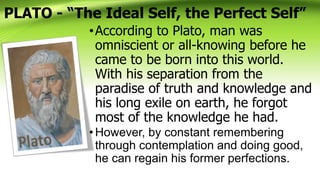
PLATO - “The Ideal Self, the Perfect Self”
•According to Plato, man was
omniscient or all-knowing before he
came to be born into this world.
With his separation from the
paradise of truth and knowledge and
his long exile on earth, he forgot
most of the knowledge he had.
•However, by constant remembering
through contemplation and doing good,
he can regain his former perfections.
•Plato believes that “Ignorance is the root
and stem of every evil”. He supported
the idea of Socrates that man is a dual
nature of body and soul.
• In addition to what Socrates earlier
espoused, Plato added that there are three
components of the soul.
Three Components of Soul
a.Rational soul – the thinking portion, located in the head,
judges what is true and what is false and wisely makes the
rational decisions in accordance with which human life is
most properly lived.
b.Spiritual soul – located in the heart (will or volition) – in
charge of emotion. Its function is to carry out the dictates of
reason in practical life
c.Appetitive soul – located in diaphragm (desire) is the portion
of each of us that wants and feels many things.
ST. AUGUSTINE – Love
and Justice as the
Foundation of the
Individual Self
 St. Augustine believes that virtuous life is
dynamism of love. It is a constant following of
and turning towards love while a wicked life is
a constant turning away from love.
 Loving God means loving one’s fellowmen; and
loving one’s fellowmen denotes never doing any
harm to another or, as the golden principle of
justice states, doing unto others as you would
have them do unto you.
• He introduced the concept of freewill which
means that humans are morally responsible
for their actions. Reason is a human cognitive
that comprehends deductive truths and logical
necessity.
• He also creates a new concept of individual
identity. The identity is achieved through a
twofold process: self-presentation which leads
to self-realization.
Rene Descartes “I think therefore I am”
• Father of Modern Philosophy
which conceived the human person
as having a body and a mind.
Dualistic distinction of the
immaterial mind from the body, all
that we really are, or our identity,
comes from the mind.
• His famous principle was “Cogito,
ergo sum”, which means “I think,
therefore I am”.
• Although the mind and the body are
independent from each other and
serve their own function, man must
use his own mind and thinking abilities
to investigate, analyze, experiment,
and develop himself.
JOHN LOCKE
Personal Identity
• John Locke holds that personal identity (the self) is a matter
of psychological continuity. For him, personal identity is
founded on consciousness (memory), and not on the
substance of either the soul or the body.
• Personal identity is the concept about oneself that evolves
over the course of an individual’s life. It may include aspects
of life that man has no control over, such as where he grew
up or the color of his skin as well as the choices he makes,
how he spends his time and what he believes. He believes
about “A sound mind and a sound body”.
SIGMUND FREUD -
“The mind is like an
iceberg; it floats with
one-seventh of its bulk
above water
• Sigmund Freud, a psychoanalyst believes
that the conscious mind (everything we are
aware of) is seen as the tip of the iceberg,
with the unconscious mind a repository of a
“cauldron” of primitive wishes and impulse
kept as bay and mediated by the
preconscious area.
• He emphasized the importance of the
unconscious mind that govern behavior
to greater degree. The goal of
psychoanalysis is to make unconscious
conscious.
Structural model of the mind by Sigmund Freud
Id – operated at an unconscious level according to the pleasure
principle.
The two biological instincts are Eros and Thanatos (life and death
instinct). Freud believe that eros is stronger than Thanatos, thus
enabling people to survive rather than aggression or violence.
Ego – this is to satisfy the demand of the id in a safe and socially
acceptable way. It follows the reality principle and it operates in both
the conscious and unconscious mind.
Superego – responsible for ensuring moral standards are followed.
Motivates to behave in a socially responsible and acceptable manner. It
makes a person feel guilty if the rules are not followed.
GILBERT RYLE – “Man need
not be degraded to a machine
by being denied to be a ghost
in a machine”
• Gilbert Ryle (1900 - 1976) was a a British philosopher
who opposed the Cartesian dualism of mind versus
matter. He coined the phrase "the ghost in the machine".
He explains that there is no hidden entity called “the
mind” inside a mechanical apparatus called “the body”.
• Self is not an entity one can locate and analyze but
simply the convenient name that people use to refer to all
the behaviors that people make. The behavior that a
person manifest in his day-to-day life.
The self in their understanding has 7 level
of awareness. The first 4 levels are:
1. Basic Awareness,
2. Self-Controlling Awareness,
3. Intuitive Awareness and
4. Fulfilling Awareness.

PPT-Chapter-1-Philosophy.pptx

  • 1.
  • 2.
    Who am iby; Casting Crowns Who am I, that the lord of all the earth Would care to know my nameWould care to feel my hurt? Who am I, that the bright and morning star Would choose to light the wayFor my ever wandering heart? Not because of who I am But because of what you've done Not because of what I've done But because of who you are I am a flower quickly fadingHere today and gone tomorrow A wave tossed in the oceanA vapor in the windStill you hear me when I'm callingLord, you catch me when I'm falling And you've told me who I amI am yours Who am I, that the eyes that see my sin Would look on me with love And watch me rise again? Who am I, that the voice that calmed the sea Would call out through the rain And calm the storm in me? Not because of who I am But because of what you've… Source:
  • 3.
    • Analysis/ ProcessingQuestions: • 1.What is the message of the song? • 2.Does the song maybe applied to you? Why & Why not? • 3.Choose a line in the song which you like most and reflect it to yourself.
  • 4.
    The Self from VariousPhilosophical Perspective
  • 5.
    • The differentperspectives and views about self can be best seen and understood by revisiting its prime movers and identify the most important conjectures made by philosophers from the ancient times to the contemporary period. The Self According to Philosophers LESSON 1
  • 6.
  • 7.
    “ Know Thyself” •Socrates is principally concerned with man. He considers man from the point of view of his inner life. The famous line of Socrates, “Know thyself”, tells each man to bring his inner self to light. Socrates is best known as a questioner of everything and everyone. His own style of teaching is known as “Socratic Method”.
  • 8.
    His teachings includethe following: “The only true wisdom is in knowing you know nothing” “Wonder is the beginning of wisdom” “The unexamined life is not worth living” The more a person knows, the greater his or her ability to reason and make choices that will bring true happiness.
  • 9.
    Socrates believe thatevery man is composed of body and soul. This means that every human person is dualistic, that is he is composed of two important aspects of his personhood. This means all individuals have an imperfect, impermanent aspect to him, and the body, while maintaining that there is also a soul that is perfect and permanent.
  • 10.
    Socrates believed thatone must concentrate more on self-development than on material things. He encouraged people to develop friendship and love among themselves.
  • 11.
    PLATO - “TheIdeal Self, the Perfect Self” •According to Plato, man was omniscient or all-knowing before he came to be born into this world. With his separation from the paradise of truth and knowledge and his long exile on earth, he forgot most of the knowledge he had. •However, by constant remembering through contemplation and doing good, he can regain his former perfections.
  • 12.
    •Plato believes that“Ignorance is the root and stem of every evil”. He supported the idea of Socrates that man is a dual nature of body and soul. • In addition to what Socrates earlier espoused, Plato added that there are three components of the soul.
  • 13.
    Three Components ofSoul a.Rational soul – the thinking portion, located in the head, judges what is true and what is false and wisely makes the rational decisions in accordance with which human life is most properly lived. b.Spiritual soul – located in the heart (will or volition) – in charge of emotion. Its function is to carry out the dictates of reason in practical life c.Appetitive soul – located in diaphragm (desire) is the portion of each of us that wants and feels many things.
  • 15.
    ST. AUGUSTINE –Love and Justice as the Foundation of the Individual Self
  • 16.
     St. Augustinebelieves that virtuous life is dynamism of love. It is a constant following of and turning towards love while a wicked life is a constant turning away from love.  Loving God means loving one’s fellowmen; and loving one’s fellowmen denotes never doing any harm to another or, as the golden principle of justice states, doing unto others as you would have them do unto you.
  • 18.
    • He introducedthe concept of freewill which means that humans are morally responsible for their actions. Reason is a human cognitive that comprehends deductive truths and logical necessity. • He also creates a new concept of individual identity. The identity is achieved through a twofold process: self-presentation which leads to self-realization.
  • 19.
    Rene Descartes “Ithink therefore I am” • Father of Modern Philosophy which conceived the human person as having a body and a mind. Dualistic distinction of the immaterial mind from the body, all that we really are, or our identity, comes from the mind. • His famous principle was “Cogito, ergo sum”, which means “I think, therefore I am”.
  • 20.
    • Although themind and the body are independent from each other and serve their own function, man must use his own mind and thinking abilities to investigate, analyze, experiment, and develop himself.
  • 21.
  • 22.
    • John Lockeholds that personal identity (the self) is a matter of psychological continuity. For him, personal identity is founded on consciousness (memory), and not on the substance of either the soul or the body. • Personal identity is the concept about oneself that evolves over the course of an individual’s life. It may include aspects of life that man has no control over, such as where he grew up or the color of his skin as well as the choices he makes, how he spends his time and what he believes. He believes about “A sound mind and a sound body”.
  • 23.
    SIGMUND FREUD - “Themind is like an iceberg; it floats with one-seventh of its bulk above water
  • 24.
    • Sigmund Freud,a psychoanalyst believes that the conscious mind (everything we are aware of) is seen as the tip of the iceberg, with the unconscious mind a repository of a “cauldron” of primitive wishes and impulse kept as bay and mediated by the preconscious area.
  • 25.
    • He emphasizedthe importance of the unconscious mind that govern behavior to greater degree. The goal of psychoanalysis is to make unconscious conscious.
  • 26.
    Structural model ofthe mind by Sigmund Freud Id – operated at an unconscious level according to the pleasure principle. The two biological instincts are Eros and Thanatos (life and death instinct). Freud believe that eros is stronger than Thanatos, thus enabling people to survive rather than aggression or violence. Ego – this is to satisfy the demand of the id in a safe and socially acceptable way. It follows the reality principle and it operates in both the conscious and unconscious mind. Superego – responsible for ensuring moral standards are followed. Motivates to behave in a socially responsible and acceptable manner. It makes a person feel guilty if the rules are not followed.
  • 27.
    GILBERT RYLE –“Man need not be degraded to a machine by being denied to be a ghost in a machine”
  • 28.
    • Gilbert Ryle(1900 - 1976) was a a British philosopher who opposed the Cartesian dualism of mind versus matter. He coined the phrase "the ghost in the machine". He explains that there is no hidden entity called “the mind” inside a mechanical apparatus called “the body”. • Self is not an entity one can locate and analyze but simply the convenient name that people use to refer to all the behaviors that people make. The behavior that a person manifest in his day-to-day life.
  • 29.
    The self intheir understanding has 7 level of awareness. The first 4 levels are: 1. Basic Awareness, 2. Self-Controlling Awareness, 3. Intuitive Awareness and 4. Fulfilling Awareness.