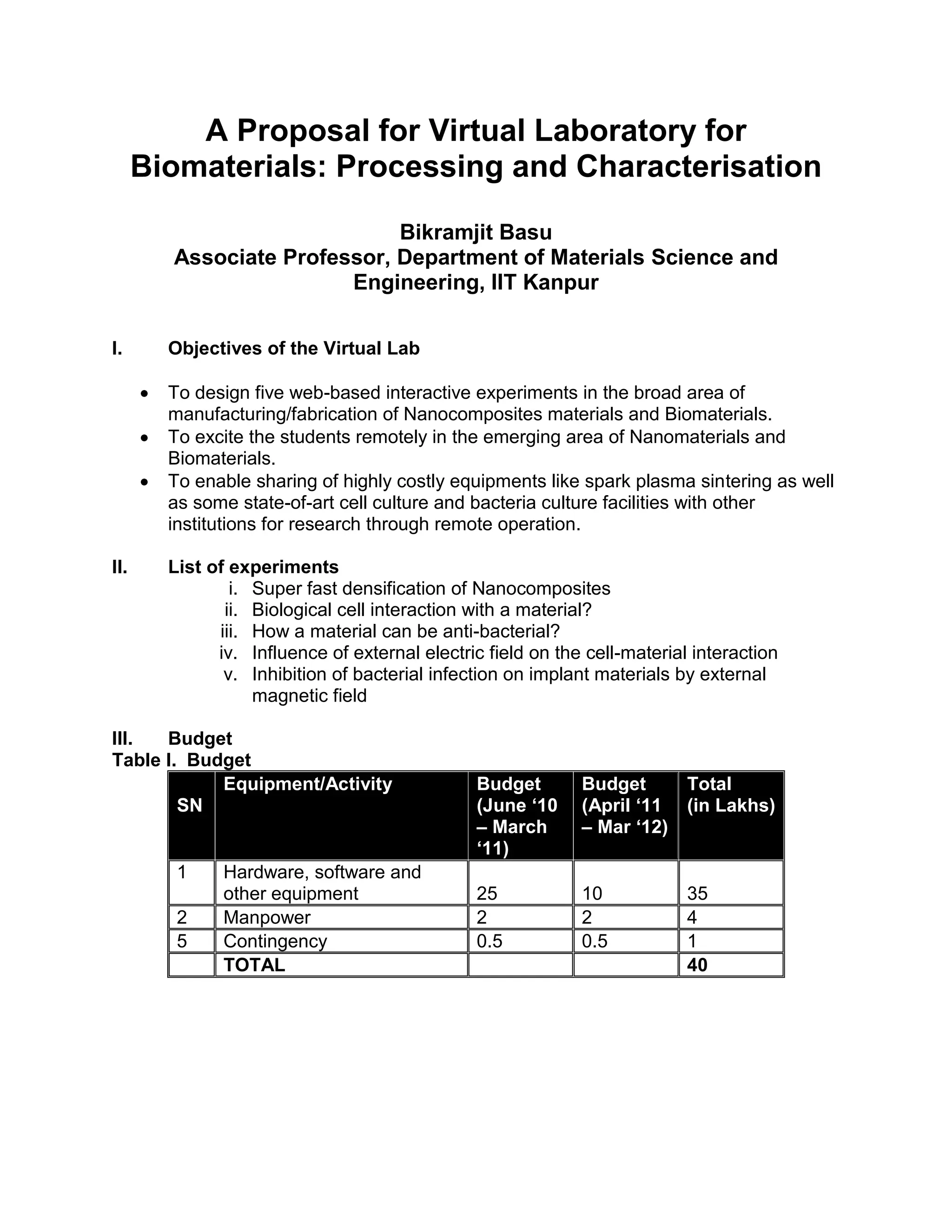
A Proposal for Virtual Laboratory for
Biomaterials: Processing and Characterisation
Bikramjit Basu
Associate Professor, Department of Materials Science and
Engineering, IIT Kanpur
I. Objectives of the Virtual Lab
To design five web-based interactive experiments in the broad area of
manufacturing/fabrication of Nanocomposites materials and Biomaterials.
To excite the students remotely in the emerging area of Nanomaterials and
Biomaterials.
To enable sharing of highly costly equipments like spark plasma sintering as well
as some state-of-art cell culture and bacteria culture facilities with other
institutions for research through remote operation.
II. List of experiments
i. Super fast densification of Nanocomposites
ii. Biological cell interaction with a material?
iii. How a material can be anti-bacterial?
iv. Influence of external electric field on the cell-material interaction
v. Inhibition of bacterial infection on implant materials by external
magnetic field
III. Budget
Table I. Budget
SN
Equipment/Activity Budget
(June ‘10
– March
‘11)
Budget
(April ‘11
– Mar ‘12)
Total
(in Lakhs)
1 Hardware, software and
other equipment 25 10 35
2 Manpower 2 2 4
5 Contingency 0.5 0.5 1
TOTAL 40
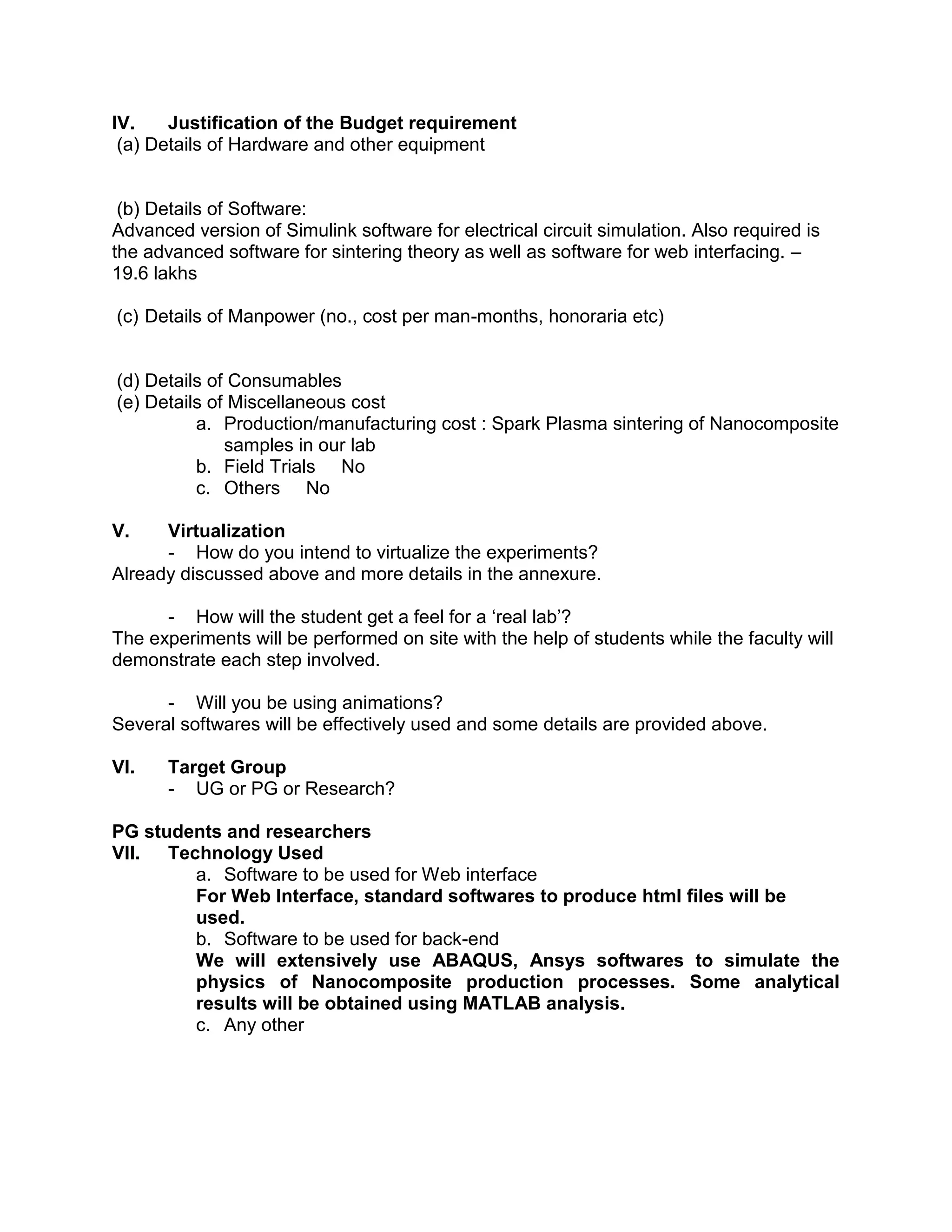
IV. Justification of the Budget requirement
(a) Details of Hardware and other equipment
(b) Details of Software:
Advanced version of Simulink software for electrical circuit simulation. Also required is
the advanced software for sintering theory as well as software for web interfacing. –
19.6 lakhs
(c) Details of Manpower (no., cost per man-months, honoraria etc)
(d) Details of Consumables
(e) Details of Miscellaneous cost
a. Production/manufacturing cost : Spark Plasma sintering of Nanocomposite
samples in our lab
b. Field Trials No
c. Others No
V. Virtualization
- How do you intend to virtualize the experiments?
Already discussed above and more details in the annexure.
- How will the student get a feel for a ‘real lab’?
The experiments will be performed on site with the help of students while the faculty will
demonstrate each step involved.
- Will you be using animations?
Several softwares will be effectively used and some details are provided above.
VI. Target Group
- UG or PG or Research?
PG students and researchers
VII. Technology Used
a. Software to be used for Web interface
For Web Interface, standard softwares to produce html files will be
used.
b. Software to be used for back-end
We will extensively use ABAQUS, Ansys softwares to simulate the
physics of Nanocomposite production processes. Some analytical
results will be obtained using MATLAB analysis.
c. Any other
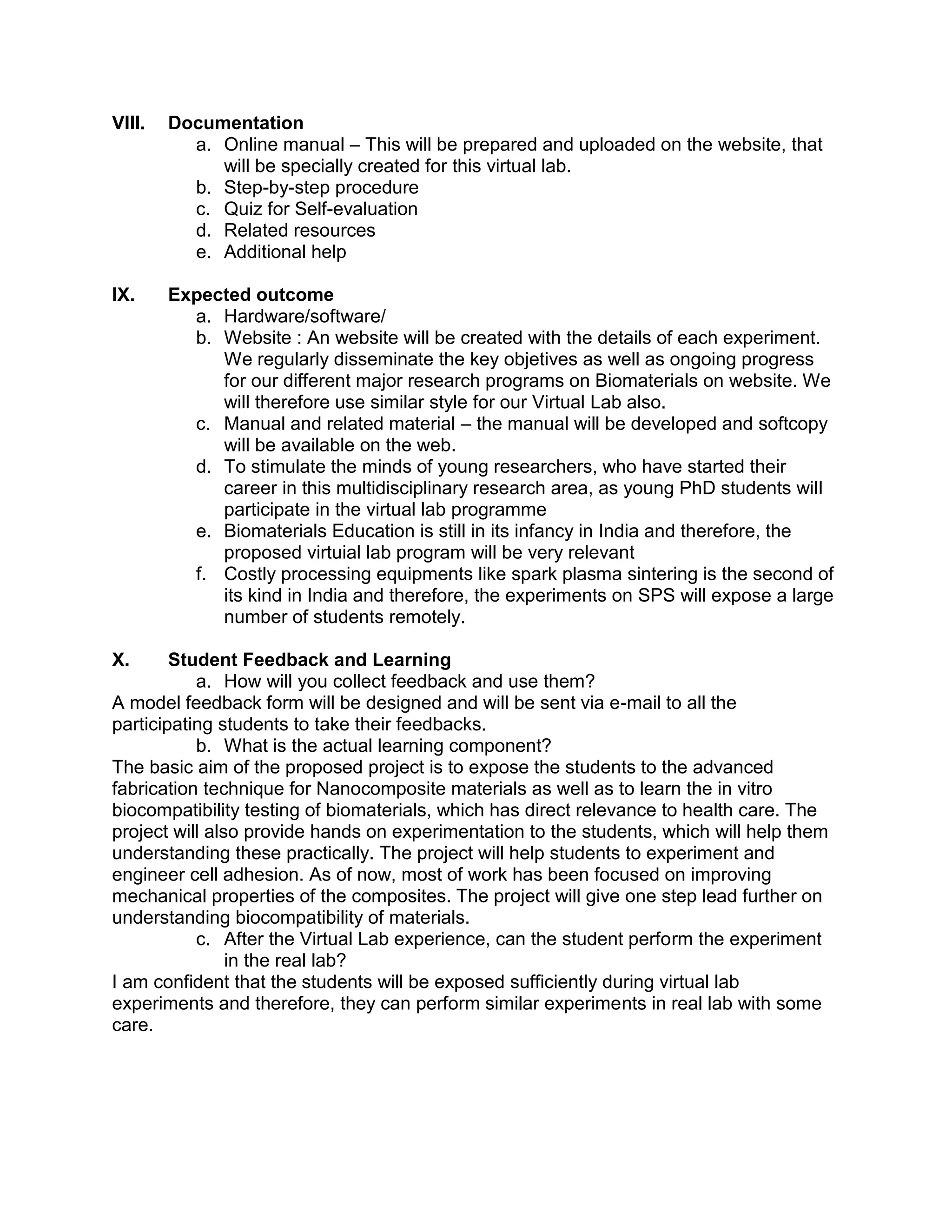
VIII. Documentation
a. Online manual – This will be prepared and uploaded on the website, that
will be specially created for this virtual lab.
b. Step-by-step procedure
c. Quiz for Self-evaluation
d. Related resources
e. Additional help
IX. Expected outcome
a. Hardware/software/
b. Website : An website will be created with the details of each experiment.
We regularly disseminate the key objetives as well as ongoing progress
for our different major research programs on Biomaterials on website. We
will therefore use similar style for our Virtual Lab also.
c. Manual and related material – the manual will be developed and softcopy
will be available on the web.
d. To stimulate the minds of young researchers, who have started their
career in this multidisciplinary research area, as young PhD students will
participate in the virtual lab programme
e. Biomaterials Education is still in its infancy in India and therefore, the
proposed virtuial lab program will be very relevant
f. Costly processing equipments like spark plasma sintering is the second of
its kind in India and therefore, the experiments on SPS will expose a large
number of students remotely.
X. Student Feedback and Learning
a. How will you collect feedback and use them?
A model feedback form will be designed and will be sent via e-mail to all the
participating students to take their feedbacks.
b. What is the actual learning component?
The basic aim of the proposed project is to expose the students to the advanced
fabrication technique for Nanocomposite materials as well as to learn the in vitro
biocompatibility testing of biomaterials, which has direct relevance to health care. The
project will also provide hands on experimentation to the students, which will help them
understanding these practically. The project will help students to experiment and
engineer cell adhesion. As of now, most of work has been focused on improving
mechanical properties of the composites. The project will give one step lead further on
understanding biocompatibility of materials.
c. After the Virtual Lab experience, can the student perform the experiment
in the real lab?
I am confident that the students will be exposed sufficiently during virtual lab
experiments and therefore, they can perform similar experiments in real lab with some
care.
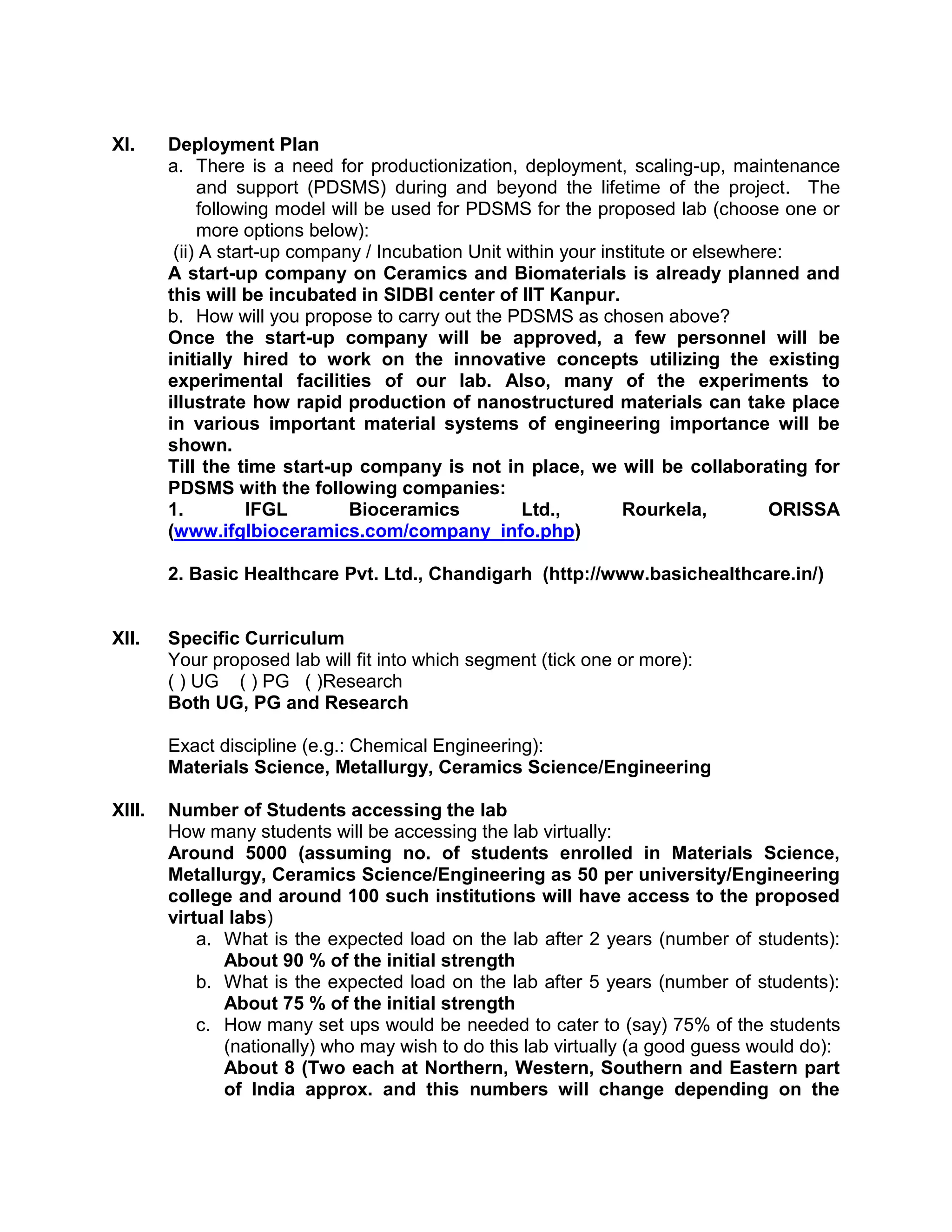
XI. Deployment Plan
a. There is a need for productionization, deployment, scaling-up, maintenance
and support (PDSMS) during and beyond the lifetime of the project. The
following model will be used for PDSMS for the proposed lab (choose one or
more options below):
(ii) A start-up company / Incubation Unit within your institute or elsewhere:
A start-up company on Ceramics and Biomaterials is already planned and
this will be incubated in SIDBI center of IIT Kanpur.
b. How will you propose to carry out the PDSMS as chosen above?
Once the start-up company will be approved, a few personnel will be
initially hired to work on the innovative concepts utilizing the existing
experimental facilities of our lab. Also, many of the experiments to
illustrate how rapid production of nanostructured materials can take place
in various important material systems of engineering importance will be
shown.
Till the time start-up company is not in place, we will be collaborating for
PDSMS with the following companies:
1. IFGL Bioceramics Ltd., Rourkela, ORISSA
(www.ifglbioceramics.com/company_info.php)
2. Basic Healthcare Pvt. Ltd., Chandigarh (http://www.basichealthcare.in/)
XII. Specific Curriculum
Your proposed lab will fit into which segment (tick one or more):
( ) UG ( ) PG ( )Research
Both UG, PG and Research
Exact discipline (e.g.: Chemical Engineering):
Materials Science, Metallurgy, Ceramics Science/Engineering
XIII. Number of Students accessing the lab
How many students will be accessing the lab virtually:
Around 5000 (assuming no. of students enrolled in Materials Science,
Metallurgy, Ceramics Science/Engineering as 50 per university/Engineering
college and around 100 such institutions will have access to the proposed
virtual labs)
a. What is the expected load on the lab after 2 years (number of students):
About 90 % of the initial strength
b. What is the expected load on the lab after 5 years (number of students):
About 75 % of the initial strength
c. How many set ups would be needed to cater to (say) 75% of the students
(nationally) who may wish to do this lab virtually (a good guess would do):
About 8 (Two each at Northern, Western, Southern and Eastern part
of India approx. and this numbers will change depending on the
number of institutes at various part of our country will actually
access on a regular basis)
XIV. Plan for popularization of the Virtual Lab
How do you plan to popularize your Virtual Lab (tick one):
( ) Local Workshops - Some short term courses will be organized in 2010 to
popularize this virtual lab.
( ) Website The information about the proposed Virtual Lab will be advertised
on the following websites:
URL: http://home.iitk.ac.in/~bikram
Laboratory for Biomaterials website: http://www.iitk.ac.in/biomaterialslab/
Indo-US Center on Biomaterials: http://www.iitk.ac.in/indo_us_biomaterials/
Indo-UK (UKIERI) project on Biomaterials:
http://www.iitk.ac.in/UKIERI_biomaterials/
( ) Print Media - National Newspaper : Times of India

Laboratory_Proposal.pdf

  • 1.
    A Proposal forVirtual Laboratory for Biomaterials: Processing and Characterisation Bikramjit Basu Associate Professor, Department of Materials Science and Engineering, IIT Kanpur I. Objectives of the Virtual Lab To design five web-based interactive experiments in the broad area of manufacturing/fabrication of Nanocomposites materials and Biomaterials. To excite the students remotely in the emerging area of Nanomaterials and Biomaterials. To enable sharing of highly costly equipments like spark plasma sintering as well as some state-of-art cell culture and bacteria culture facilities with other institutions for research through remote operation. II. List of experiments i. Super fast densification of Nanocomposites ii. Biological cell interaction with a material? iii. How a material can be anti-bacterial? iv. Influence of external electric field on the cell-material interaction v. Inhibition of bacterial infection on implant materials by external magnetic field III. Budget Table I. Budget SN Equipment/Activity Budget (June ‘10 – March ‘11) Budget (April ‘11 – Mar ‘12) Total (in Lakhs) 1 Hardware, software and other equipment 25 10 35 2 Manpower 2 2 4 5 Contingency 0.5 0.5 1 TOTAL 40
  • 2.
    IV. Justification ofthe Budget requirement (a) Details of Hardware and other equipment (b) Details of Software: Advanced version of Simulink software for electrical circuit simulation. Also required is the advanced software for sintering theory as well as software for web interfacing. – 19.6 lakhs (c) Details of Manpower (no., cost per man-months, honoraria etc) (d) Details of Consumables (e) Details of Miscellaneous cost a. Production/manufacturing cost : Spark Plasma sintering of Nanocomposite samples in our lab b. Field Trials No c. Others No V. Virtualization - How do you intend to virtualize the experiments? Already discussed above and more details in the annexure. - How will the student get a feel for a ‘real lab’? The experiments will be performed on site with the help of students while the faculty will demonstrate each step involved. - Will you be using animations? Several softwares will be effectively used and some details are provided above. VI. Target Group - UG or PG or Research? PG students and researchers VII. Technology Used a. Software to be used for Web interface For Web Interface, standard softwares to produce html files will be used. b. Software to be used for back-end We will extensively use ABAQUS, Ansys softwares to simulate the physics of Nanocomposite production processes. Some analytical results will be obtained using MATLAB analysis. c. Any other
  • 3.
    VIII. Documentation a. Onlinemanual – This will be prepared and uploaded on the website, that will be specially created for this virtual lab. b. Step-by-step procedure c. Quiz for Self-evaluation d. Related resources e. Additional help IX. Expected outcome a. Hardware/software/ b. Website : An website will be created with the details of each experiment. We regularly disseminate the key objetives as well as ongoing progress for our different major research programs on Biomaterials on website. We will therefore use similar style for our Virtual Lab also. c. Manual and related material – the manual will be developed and softcopy will be available on the web. d. To stimulate the minds of young researchers, who have started their career in this multidisciplinary research area, as young PhD students will participate in the virtual lab programme e. Biomaterials Education is still in its infancy in India and therefore, the proposed virtuial lab program will be very relevant f. Costly processing equipments like spark plasma sintering is the second of its kind in India and therefore, the experiments on SPS will expose a large number of students remotely. X. Student Feedback and Learning a. How will you collect feedback and use them? A model feedback form will be designed and will be sent via e-mail to all the participating students to take their feedbacks. b. What is the actual learning component? The basic aim of the proposed project is to expose the students to the advanced fabrication technique for Nanocomposite materials as well as to learn the in vitro biocompatibility testing of biomaterials, which has direct relevance to health care. The project will also provide hands on experimentation to the students, which will help them understanding these practically. The project will help students to experiment and engineer cell adhesion. As of now, most of work has been focused on improving mechanical properties of the composites. The project will give one step lead further on understanding biocompatibility of materials. c. After the Virtual Lab experience, can the student perform the experiment in the real lab? I am confident that the students will be exposed sufficiently during virtual lab experiments and therefore, they can perform similar experiments in real lab with some care.
  • 4.
    XI. Deployment Plan a.There is a need for productionization, deployment, scaling-up, maintenance and support (PDSMS) during and beyond the lifetime of the project. The following model will be used for PDSMS for the proposed lab (choose one or more options below): (ii) A start-up company / Incubation Unit within your institute or elsewhere: A start-up company on Ceramics and Biomaterials is already planned and this will be incubated in SIDBI center of IIT Kanpur. b. How will you propose to carry out the PDSMS as chosen above? Once the start-up company will be approved, a few personnel will be initially hired to work on the innovative concepts utilizing the existing experimental facilities of our lab. Also, many of the experiments to illustrate how rapid production of nanostructured materials can take place in various important material systems of engineering importance will be shown. Till the time start-up company is not in place, we will be collaborating for PDSMS with the following companies: 1. IFGL Bioceramics Ltd., Rourkela, ORISSA (www.ifglbioceramics.com/company_info.php) 2. Basic Healthcare Pvt. Ltd., Chandigarh (http://www.basichealthcare.in/) XII. Specific Curriculum Your proposed lab will fit into which segment (tick one or more): ( ) UG ( ) PG ( )Research Both UG, PG and Research Exact discipline (e.g.: Chemical Engineering): Materials Science, Metallurgy, Ceramics Science/Engineering XIII. Number of Students accessing the lab How many students will be accessing the lab virtually: Around 5000 (assuming no. of students enrolled in Materials Science, Metallurgy, Ceramics Science/Engineering as 50 per university/Engineering college and around 100 such institutions will have access to the proposed virtual labs) a. What is the expected load on the lab after 2 years (number of students): About 90 % of the initial strength b. What is the expected load on the lab after 5 years (number of students): About 75 % of the initial strength c. How many set ups would be needed to cater to (say) 75% of the students (nationally) who may wish to do this lab virtually (a good guess would do): About 8 (Two each at Northern, Western, Southern and Eastern part of India approx. and this numbers will change depending on the
  • 5.
    number of institutesat various part of our country will actually access on a regular basis) XIV. Plan for popularization of the Virtual Lab How do you plan to popularize your Virtual Lab (tick one): ( ) Local Workshops - Some short term courses will be organized in 2010 to popularize this virtual lab. ( ) Website The information about the proposed Virtual Lab will be advertised on the following websites: URL: http://home.iitk.ac.in/~bikram Laboratory for Biomaterials website: http://www.iitk.ac.in/biomaterialslab/ Indo-US Center on Biomaterials: http://www.iitk.ac.in/indo_us_biomaterials/ Indo-UK (UKIERI) project on Biomaterials: http://www.iitk.ac.in/UKIERI_biomaterials/ ( ) Print Media - National Newspaper : Times of India