ICT DiplomaLevel 1 and 2
OverviewWootton and Bedford is ideally suited to the ICT Diploma. With significant regeneration projects in the offing , the Bedford Hospital Trust, Cranfield University , Nissan, Ford and other motoring development centres of excellence all lending an inspirational opportunity for individual Diplomas.ICT has the major skill-set to cut across all areas of interest in addition to it’s specific areas.
Our purpose to make the Diploma a successEncourage our corporate membership to invest their skills, resources, ideas and perspectives to create innovative solutions to local employment issues.'The business case for recruiting locally is clear.  As well as helping to tackle unemployment in Bedford, businesses  will benefit from lowered recruitment costs, higher retention rates, increased diversity, new business / increased market penetration, reduced travel to work time and good PR.  It makes sense to be involved'.Graham Mallet, Thames Water – Chair of the ELBA Jobs and Enterprise Board
Our purpose to make the Diploma a successDeliver a proportion of our Diploma work for these programmes through employee volunteering service – Nationally advocated through the Government and CBI.  Work with local businesses to ensure they get the most out of their employee community involvement programme – through the DIploma.
Some of the effects.Many companies in other Areas now recognise the potential value of community-based team-building events:  they allow groups to bond and experiment with different leadership and teamwork skills,they raise morale and motivation and help raise brand awareness.
How Diplomas help StudentsDiplomas are a completely new way of studying which changes the emphasis onto future employability skills.  Students learn about a wide range of career opportunities within the Diploma sector.Diplomas can be studied at 3 levels, Foundation which is equivalent to 5 GCSEs grades D-G, Higher equivalent to 7 GCSEs A*-C and Advanced equivalent to 3.5 A levels grades A*-E.
How Diplomas help StudentsA Diploma will provide you with lots of information about careers in its subject area but not provide you with practical skills.To pass a Diploma students  need to pass Functional Skills tests in Maths, English and ICT. Students also develop knowledge about careers and progression routes within the Diploma sector.
How Diplomas help StudentsDiplomas are designed to develop skills that would be useful to any career not just in the Diploma sector you are studying. Employers were fully involved in the creation of these qualifications and continue to be involved in their development. It was the needs of industry both in the UK and worldwide that prompted the introduction of these qualifications.
AssessmentNot a formal examinationIndividual coursework evidences.Teamwork evidences – how you work together and get along with others to achieve a result.
The Course topicsThese list below has been specifically designed to provide learners with the opportunity to undertake some Specialist Learning in a chosen aspect of IT. The choice of units and structure will specifically allow it to be used as the specialist learning component of the IT line of learning of the Diploma.It can also act as Additional Learning within the Diploma for other diplomas.
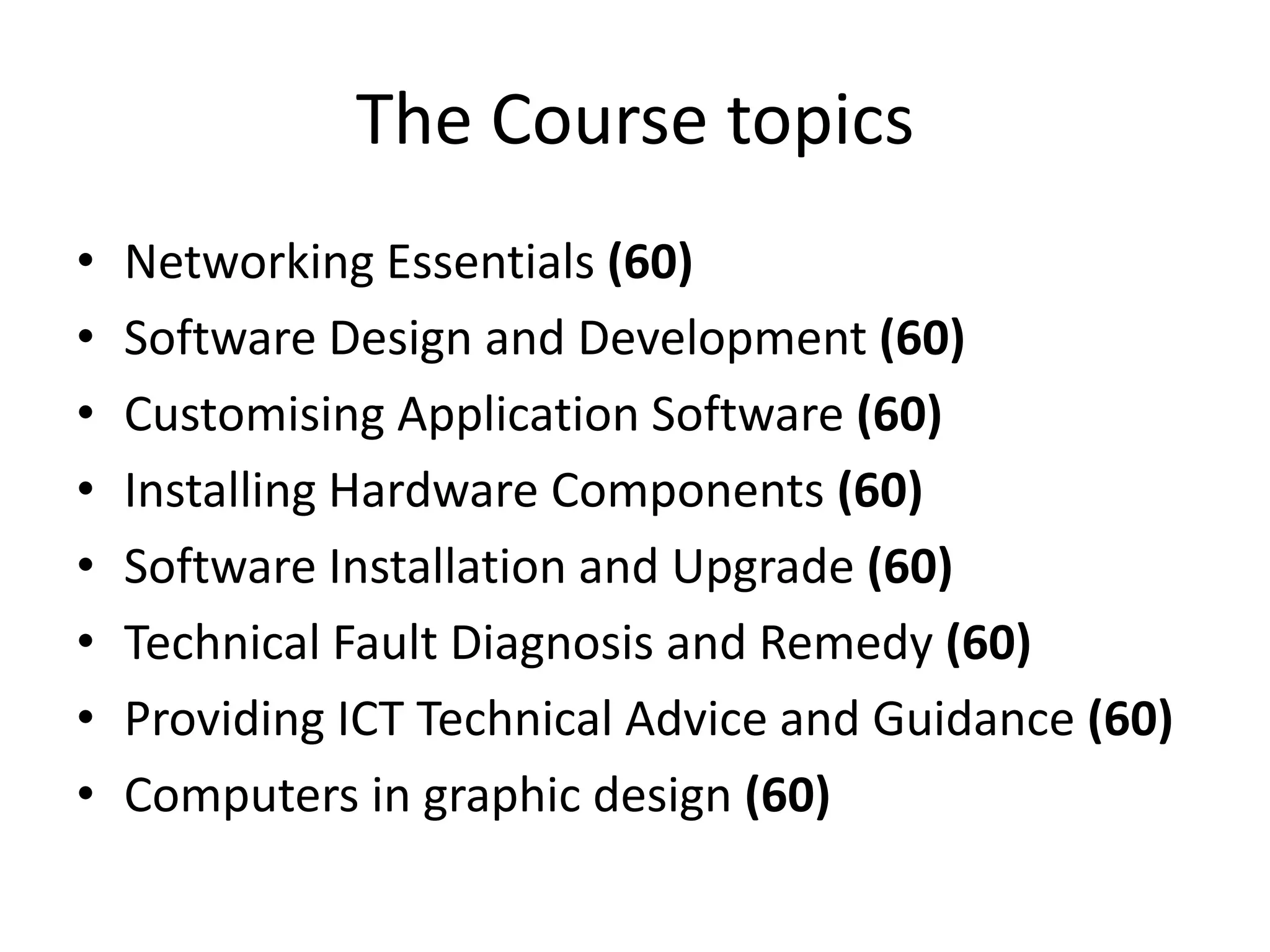
The Course topicsNetworking Essentials (60)Software Design and Development (60)Customising Application Software (60)Installing Hardware Components (60)Software Installation and Upgrade (60)Technical Fault Diagnosis and Remedy (60)Providing ICT Technical Advice and Guidance (60)Computers in graphic design (60)
The Course topicsSecurity of ICT Systems (30)Telecommunications Technology (60)Mobile Communications Technology (30)Core ICT Hardware (60) Operating System Technologies (60)
In AdditionSome areas of the Country are combining this Diploma programme with External mentoring .The objectives of this project are in line with The Learning Trust’s overarching Getting students achieving strategy.

Ict Diploma 2

  • 1.
  • 2.
    OverviewWootton and Bedfordis ideally suited to the ICT Diploma. With significant regeneration projects in the offing , the Bedford Hospital Trust, Cranfield University , Nissan, Ford and other motoring development centres of excellence all lending an inspirational opportunity for individual Diplomas.ICT has the major skill-set to cut across all areas of interest in addition to it’s specific areas.
  • 3.
    Our purpose tomake the Diploma a successEncourage our corporate membership to invest their skills, resources, ideas and perspectives to create innovative solutions to local employment issues.'The business case for recruiting locally is clear.  As well as helping to tackle unemployment in Bedford, businesses will benefit from lowered recruitment costs, higher retention rates, increased diversity, new business / increased market penetration, reduced travel to work time and good PR.  It makes sense to be involved'.Graham Mallet, Thames Water – Chair of the ELBA Jobs and Enterprise Board
  • 4.
    Our purpose tomake the Diploma a successDeliver a proportion of our Diploma work for these programmes through employee volunteering service – Nationally advocated through the Government and CBI.  Work with local businesses to ensure they get the most out of their employee community involvement programme – through the DIploma.
  • 5.
    Some of theeffects.Many companies in other Areas now recognise the potential value of community-based team-building events:  they allow groups to bond and experiment with different leadership and teamwork skills,they raise morale and motivation and help raise brand awareness.
  • 6.
    How Diplomas helpStudentsDiplomas are a completely new way of studying which changes the emphasis onto future employability skills.  Students learn about a wide range of career opportunities within the Diploma sector.Diplomas can be studied at 3 levels, Foundation which is equivalent to 5 GCSEs grades D-G, Higher equivalent to 7 GCSEs A*-C and Advanced equivalent to 3.5 A levels grades A*-E.
  • 7.
    How Diplomas helpStudentsA Diploma will provide you with lots of information about careers in its subject area but not provide you with practical skills.To pass a Diploma students need to pass Functional Skills tests in Maths, English and ICT. Students also develop knowledge about careers and progression routes within the Diploma sector.
  • 8.
    How Diplomas helpStudentsDiplomas are designed to develop skills that would be useful to any career not just in the Diploma sector you are studying. Employers were fully involved in the creation of these qualifications and continue to be involved in their development. It was the needs of industry both in the UK and worldwide that prompted the introduction of these qualifications.
  • 9.
    AssessmentNot a formalexaminationIndividual coursework evidences.Teamwork evidences – how you work together and get along with others to achieve a result.
  • 10.
    The Course topicsTheselist below has been specifically designed to provide learners with the opportunity to undertake some Specialist Learning in a chosen aspect of IT. The choice of units and structure will specifically allow it to be used as the specialist learning component of the IT line of learning of the Diploma.It can also act as Additional Learning within the Diploma for other diplomas.
  • 11.
    The Course topicsNetworkingEssentials (60)Software Design and Development (60)Customising Application Software (60)Installing Hardware Components (60)Software Installation and Upgrade (60)Technical Fault Diagnosis and Remedy (60)Providing ICT Technical Advice and Guidance (60)Computers in graphic design (60)
  • 12.
    The Course topicsSecurityof ICT Systems (30)Telecommunications Technology (60)Mobile Communications Technology (30)Core ICT Hardware (60) Operating System Technologies (60)
  • 13.
    In AdditionSome areasof the Country are combining this Diploma programme with External mentoring .The objectives of this project are in line with The Learning Trust’s overarching Getting students achieving strategy.