Diversity and Characters in
Linseed-Flax
Pat Heslop-Harrison
phh4@le.ac.uk
www.molcyt.com – talk on slideshare
@Pathh1
With Trude Schwarzacher, Qing Liu
and Worku Mhiret
The eight Fs of farming
• Food
• Fibre
• Feed
• (Feedstock / Industrial)
• (Fuel)
• (Pharmaceuticals)
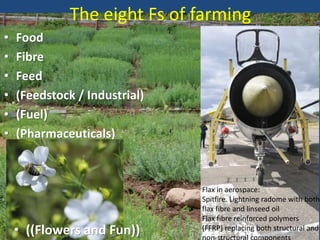
Flax in aerospace:
Spitfire. Lightning radome with both
flax fibre and linseed oil
Flax fibre reinforced polymers
(FFRP) replacing both structural and
• ((Flowers and Fun))
Breeding for one product, two, or many?
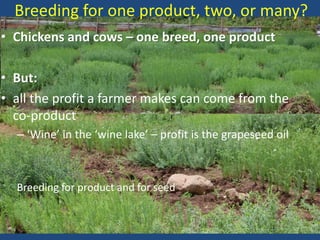
• Chickens and cows – one breed, one product
• But:
• all the profit a farmer makes can come from the
co-product
– ‘Wine’ in the ‘wine lake’ – profit is the grapeseed oil
Breeding for product and for seed
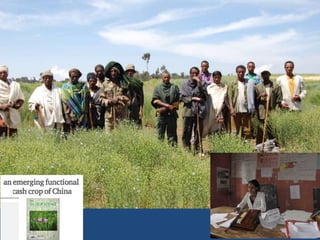
Ethiopia
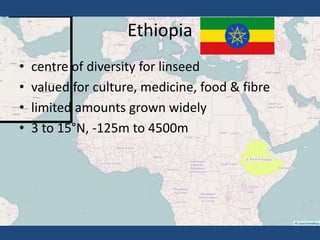
• centre of diversity for linseed
• valued for culture, medicine, food & fibre
• limited amounts grown widely
• 3 to 15°N, -125m to 4500m
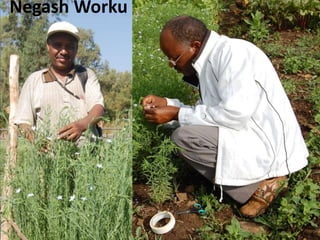
Negash Worku
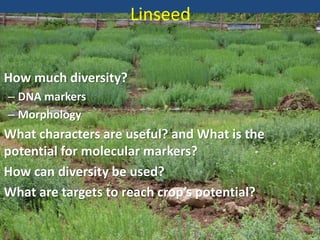
Linseed
How much diversity?
– DNA markers
– Morphology
What characters are useful? and What is the
potential for molecular markers?
How can diversity be used?
What are targets to reach crop’s potential?
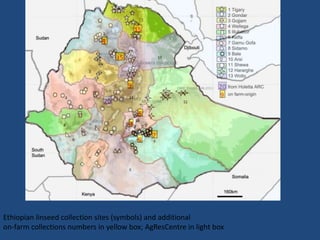
Ethiopian linseed collection sites (symbols) and additional
on-farm collections numbers in yellow box; AgResCentre in light box
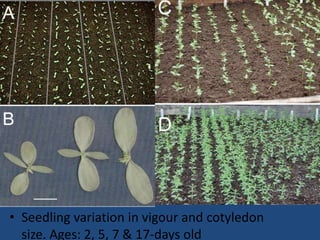
• Seedling variation in vigour and cotyledon
size. Ages: 2, 5, 7 & 17-days old
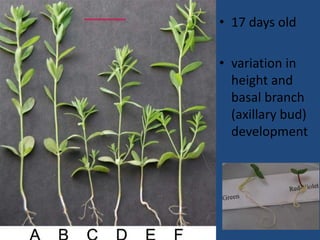
• 17 days old
• variation in
height and
basal branch
(axillary bud)
development
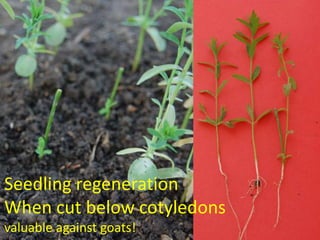
Seedling regeneration
When cut below cotyledons
valuable against goats!
V
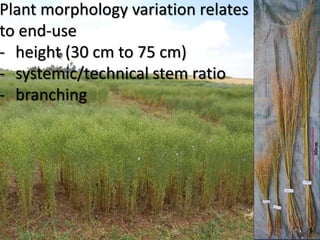
Plant morphology variation relates
to end-use
- height (30 cm to 75 cm)
- systemic/technical stem ratio
- branching
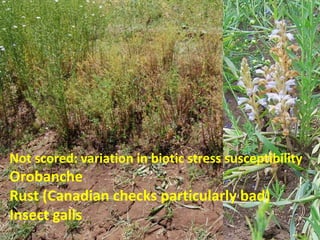
Not scored: variation in biotic stress susceptibility
Orobanche
Rust (Canadian checks particularly bad)
Insect galls
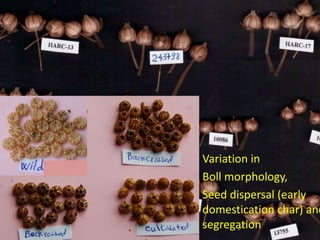
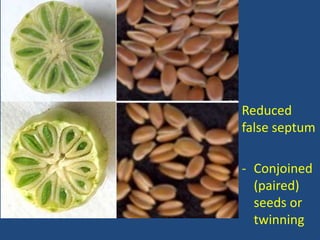
Variation in
Boll morphology,
Seed dispersal (early
domestication char) and
segregation
Reduced
false septum
- Conjoined
(paired)
seeds or
twinning
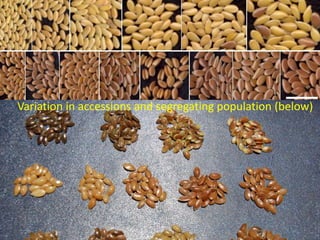
• Biodiversity in linseed seed size and colour.
Lower panel, centre right shows twinned
seeds; cf Fig. 7. (Bar: 10 mm)
• Fig. 7. Cross-section of bolls of linseed with A)
normal; and B) twin-seeds (bar = 3 mm),
showing the difference in development with
much reduced false septum resulting in
conjoined (paired) seeds (cf Fig. 6) or
twinning.
Variation in accessions and segregating population (below)
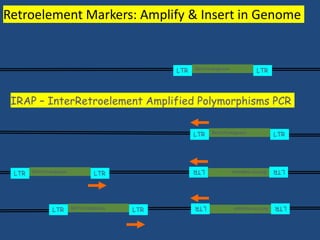
Retroelement Markers: Amplify & Insert in Genome
Retrotransposon
LTR
LTR
Retrotransposon
LTR
LTR
Retrotransposon
LTR LTR
Retrotransposon
LTR
LTR
IRAP – InterRetroelement Amplified Polymorphisms PCR
Retrotransposon
LTR
LTR
Retrotransposon
LTR LTR
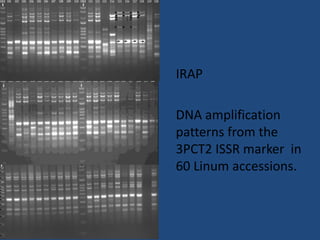
IRAP
DNA amplification
patterns from the
3PCT2 ISSR marker in
60 Linum accessions.
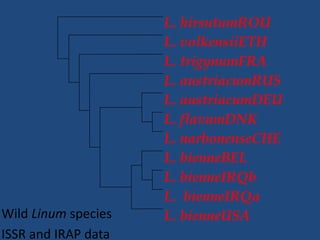
Wild Linum species
ISSR and IRAP data
L. hirsutumROU
L. volkensiiETH
L. trigynumFRA
L. austriacumRUS
L. austriacumDEU
L. flavumDNK
L. narbonenseCHE
L. bienneBEL
L. bienneIRQb
L. bienneIRQa
L. bienneUSA
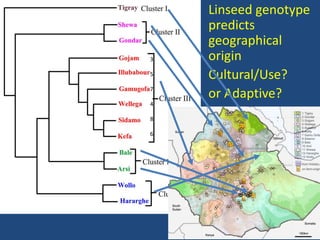
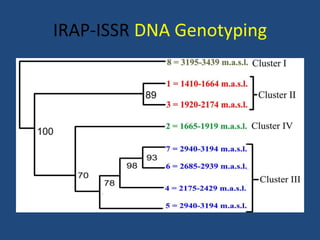
Linseed genotype
predicts
geographical
origin
Cultural/Use?
or Adaptive?
3
5
7
4
8
6
IRAP-ISSR DNA Genotyping
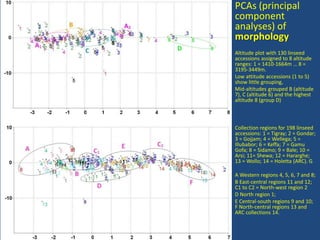
PCAs (principal
component
analyses) of
morphology
Altitude plot with 130 linseed
accessions assigned to 8 altitude
ranges: 1 = 1410-1664m … 8 =
3195-3449m.
Low attitude accessions (1 to 5)
show little grouping,
Mid-altitudes grouped B (altitude
7), C (altitude 6) and the highest
altitude 8 (group D)
Collection regions for 198 linseed
accessions: 1 = Tigray; 2 = Gondar;
3 = Gojjam; 4 = Wellega; 5 =
Illubabor; 6 = Keffa; 7 = Gamu
Gofa; 8 = Sidamo; 9 = Bale; 10 =
Arsi; 11= Shewa; 12 = Hararghe;
13 = Wollo; 14 = Holetta (ARC). G
A Western regions 4, 5, 6, 7 and 8;
B East-central regions 11 and 12;
C1 to C2 = North-west region 2
D North region 1;
E Central-south regions 9 and 10;
F North-central regions 13 and
ARC collections 14.
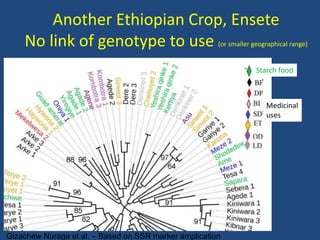
Another Ethiopian Crop, Ensete
No link of genotype to use (or smaller geographical range)
Medicinal
uses
Gizachew Nuraga et al. – Based on SSR marker amplication
Starch food
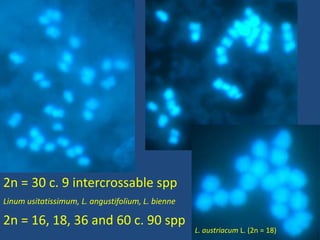
2n = 30 c. 9 intercrossable spp
Linum usitatissimum, L. angustifolium, L. bienne
2n = 16, 18, 36 and 60 c. 90 spp
L. austriacum L. (2n = 18)
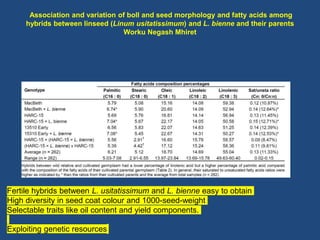
Association and variation of boll and seed morphology and fatty acids among
hybrids between linseed (Linum usitatissimum) and L. bienne and their parents
Worku Negash Mhiret
Fertile hybrids between L. usitatissimum and L. bienne easy to obtain
High diversity in seed coat colour and 1000-seed-weight
Selectable traits like oil content and yield components.
Exploiting genetic resources
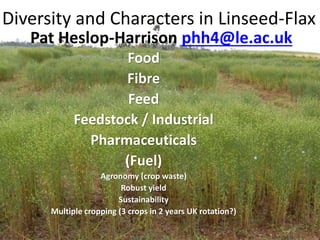
Diversity and Characters in Linseed-Flax
Pat Heslop-Harrison phh4@le.ac.uk
Food
Fibre
Feed
Feedstock / Industrial
Pharmaceuticals
(Fuel)
Agronomy (crop waste)
Robust yield
Sustainability
Multiple cropping (3 crops in 2 years UK rotation?)
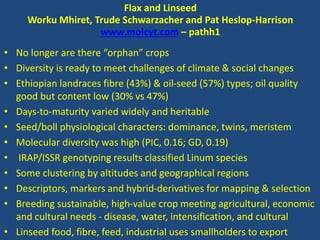
Flax and Linseed
Worku Mhiret, Trude Schwarzacher and Pat Heslop-Harrison
www.molcyt.com – pathh1
• No longer are there “orphan” crops
• Diversity is ready to meet challenges of climate & social changes
• Ethiopian landraces fibre (43%) & oil-seed (57%) types; oil quality
good but content low (30% vs 47%)
• Days-to-maturity varied widely and heritable
• Seed/boll physiological characters: dominance, twins, meristem
• Molecular diversity was high (PIC, 0.16; GD, 0.19)
• IRAP/ISSR genotyping results classified Linum species
• Some clustering by altitudes and geographical regions
• Descriptors, markers and hybrid-derivatives for mapping & selection
• Breeding sustainable, high-value crop meeting agricultural, economic
and cultural needs - disease, water, intensification, and cultural
• Linseed food, fibre, feed, industrial uses smallholders to export
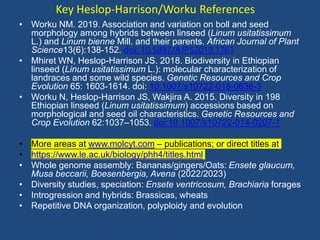
• Worku NM. 2019. Association and variation on boll and seed
morphology among hybrids between linseed (Linum usitatissimum
L.) and Linum bienne Mill. and their parents. African Journal of Plant
Science13(6):138-152. doi: 10.5897/AJPS2019.1761
• Mhiret WN, Heslop-Harrison JS. 2018. Biodiversity in Ethiopian
linseed (Linum usitatissimum L.): molecular characterization of
landraces and some wild species. Genetic Resources and Crop
Evolution 65: 1603-1614. doi: 10.1007/s10722-018-0636-3
• Worku N, Heslop-Harrison JS, Wakjira A. 2015. Diversity in 198
Ethiopian linseed (Linum usitatissimum) accessions based on
morphological and seed oil characteristics. Genetic Resources and
Crop Evolution 62:1037–1053. doi:10.1007/s10722-014-0207-1
• More areas at www.molcyt.com – publications; or direct titles at
• https://www.le.ac.uk/biology/phh4/titles.html
• Whole genome assembly: Bananas/gingers/Oats: Ensete glaucum,
Musa beccarii, Boesenbergia, Avena (2022/2023)
• Diversity studies, speciation: Ensete ventricosum, Brachiaria forages
• Introgression and hybrids: Brassicas, wheats
• Repetitive DNA organization, polyploidy and evolution
Key Heslop-Harrison/Worku References

HeslopHarrisonDurhamFlax.pptx

  • 1.
    Diversity and Charactersin Linseed-Flax Pat Heslop-Harrison phh4@le.ac.uk www.molcyt.com – talk on slideshare @Pathh1 With Trude Schwarzacher, Qing Liu and Worku Mhiret
  • 2.
    The eight Fsof farming • Food • Fibre • Feed • (Feedstock / Industrial) • (Fuel) • (Pharmaceuticals) Flax in aerospace: Spitfire. Lightning radome with both flax fibre and linseed oil Flax fibre reinforced polymers (FFRP) replacing both structural and • ((Flowers and Fun))
  • 3.
    Breeding for oneproduct, two, or many? • Chickens and cows – one breed, one product • But: • all the profit a farmer makes can come from the co-product – ‘Wine’ in the ‘wine lake’ – profit is the grapeseed oil Breeding for product and for seed
  • 4.
    Ethiopia • centre ofdiversity for linseed • valued for culture, medicine, food & fibre • limited amounts grown widely • 3 to 15°N, -125m to 4500m
  • 5.
  • 6.
    Linseed How much diversity? –DNA markers – Morphology What characters are useful? and What is the potential for molecular markers? How can diversity be used? What are targets to reach crop’s potential?
  • 8.
    Ethiopian linseed collectionsites (symbols) and additional on-farm collections numbers in yellow box; AgResCentre in light box
  • 9.
    • Seedling variationin vigour and cotyledon size. Ages: 2, 5, 7 & 17-days old
  • 10.
    • 17 daysold • variation in height and basal branch (axillary bud) development
  • 11.
    Seedling regeneration When cutbelow cotyledons valuable against goats!
  • 13.
    V Plant morphology variationrelates to end-use - height (30 cm to 75 cm) - systemic/technical stem ratio - branching
  • 14.
    Not scored: variationin biotic stress susceptibility Orobanche Rust (Canadian checks particularly bad) Insect galls
  • 16.
    Variation in Boll morphology, Seeddispersal (early domestication char) and segregation
  • 17.
  • 18.
    • Biodiversity inlinseed seed size and colour. Lower panel, centre right shows twinned seeds; cf Fig. 7. (Bar: 10 mm) • Fig. 7. Cross-section of bolls of linseed with A) normal; and B) twin-seeds (bar = 3 mm), showing the difference in development with much reduced false septum resulting in conjoined (paired) seeds (cf Fig. 6) or twinning. Variation in accessions and segregating population (below)
  • 21.
    Retroelement Markers: Amplify& Insert in Genome Retrotransposon LTR LTR Retrotransposon LTR LTR Retrotransposon LTR LTR Retrotransposon LTR LTR IRAP – InterRetroelement Amplified Polymorphisms PCR Retrotransposon LTR LTR Retrotransposon LTR LTR
  • 22.
    IRAP DNA amplification patterns fromthe 3PCT2 ISSR marker in 60 Linum accessions.
  • 23.
    Wild Linum species ISSRand IRAP data L. hirsutumROU L. volkensiiETH L. trigynumFRA L. austriacumRUS L. austriacumDEU L. flavumDNK L. narbonenseCHE L. bienneBEL L. bienneIRQb L. bienneIRQa L. bienneUSA
  • 24.
  • 25.
  • 26.
    PCAs (principal component analyses) of morphology Altitudeplot with 130 linseed accessions assigned to 8 altitude ranges: 1 = 1410-1664m … 8 = 3195-3449m. Low attitude accessions (1 to 5) show little grouping, Mid-altitudes grouped B (altitude 7), C (altitude 6) and the highest altitude 8 (group D) Collection regions for 198 linseed accessions: 1 = Tigray; 2 = Gondar; 3 = Gojjam; 4 = Wellega; 5 = Illubabor; 6 = Keffa; 7 = Gamu Gofa; 8 = Sidamo; 9 = Bale; 10 = Arsi; 11= Shewa; 12 = Hararghe; 13 = Wollo; 14 = Holetta (ARC). G A Western regions 4, 5, 6, 7 and 8; B East-central regions 11 and 12; C1 to C2 = North-west region 2 D North region 1; E Central-south regions 9 and 10; F North-central regions 13 and ARC collections 14.
  • 27.
    Another Ethiopian Crop,Ensete No link of genotype to use (or smaller geographical range) Medicinal uses Gizachew Nuraga et al. – Based on SSR marker amplication Starch food
  • 28.
    2n = 30c. 9 intercrossable spp Linum usitatissimum, L. angustifolium, L. bienne 2n = 16, 18, 36 and 60 c. 90 spp L. austriacum L. (2n = 18)
  • 29.
    Association and variationof boll and seed morphology and fatty acids among hybrids between linseed (Linum usitatissimum) and L. bienne and their parents Worku Negash Mhiret Fertile hybrids between L. usitatissimum and L. bienne easy to obtain High diversity in seed coat colour and 1000-seed-weight Selectable traits like oil content and yield components. Exploiting genetic resources
  • 30.
    Diversity and Charactersin Linseed-Flax Pat Heslop-Harrison phh4@le.ac.uk Food Fibre Feed Feedstock / Industrial Pharmaceuticals (Fuel) Agronomy (crop waste) Robust yield Sustainability Multiple cropping (3 crops in 2 years UK rotation?)
  • 31.
    Flax and Linseed WorkuMhiret, Trude Schwarzacher and Pat Heslop-Harrison www.molcyt.com – pathh1 • No longer are there “orphan” crops • Diversity is ready to meet challenges of climate & social changes • Ethiopian landraces fibre (43%) & oil-seed (57%) types; oil quality good but content low (30% vs 47%) • Days-to-maturity varied widely and heritable • Seed/boll physiological characters: dominance, twins, meristem • Molecular diversity was high (PIC, 0.16; GD, 0.19) • IRAP/ISSR genotyping results classified Linum species • Some clustering by altitudes and geographical regions • Descriptors, markers and hybrid-derivatives for mapping & selection • Breeding sustainable, high-value crop meeting agricultural, economic and cultural needs - disease, water, intensification, and cultural • Linseed food, fibre, feed, industrial uses smallholders to export
  • 32.
    • Worku NM.2019. Association and variation on boll and seed morphology among hybrids between linseed (Linum usitatissimum L.) and Linum bienne Mill. and their parents. African Journal of Plant Science13(6):138-152. doi: 10.5897/AJPS2019.1761 • Mhiret WN, Heslop-Harrison JS. 2018. Biodiversity in Ethiopian linseed (Linum usitatissimum L.): molecular characterization of landraces and some wild species. Genetic Resources and Crop Evolution 65: 1603-1614. doi: 10.1007/s10722-018-0636-3 • Worku N, Heslop-Harrison JS, Wakjira A. 2015. Diversity in 198 Ethiopian linseed (Linum usitatissimum) accessions based on morphological and seed oil characteristics. Genetic Resources and Crop Evolution 62:1037–1053. doi:10.1007/s10722-014-0207-1 • More areas at www.molcyt.com – publications; or direct titles at • https://www.le.ac.uk/biology/phh4/titles.html • Whole genome assembly: Bananas/gingers/Oats: Ensete glaucum, Musa beccarii, Boesenbergia, Avena (2022/2023) • Diversity studies, speciation: Ensete ventricosum, Brachiaria forages • Introgression and hybrids: Brassicas, wheats • Repetitive DNA organization, polyploidy and evolution Key Heslop-Harrison/Worku References