GP2DRS Update
Andrea Hewins (was Procter), ITSpecialist, NHS
Screening Programmes
Public Health England leads the NHS Screening Programmes
GP2DRS
Email: gp2drs.support@nhs.net
2 GP2DRS Update
Acentrally endorsed and standardised solution
to simplify the sharing of patient data between
GP practices and local DES programmes
3 GP2DRS Update
Key benefits of GP2DRS
• Reduced risk of sight loss caused by
• Delayed screening due to new referrals being missed
• Screening invitations not being received due to out of date demographics
• Timely and accurate identification of demographic changes (moves, deaths
etc.)
• Reduced data transcription errors
• A standard approach to the acquisition of demographics from GP Practices
• Reduced workload for GP practice staff as the information is gathered
automatically
• Some potential reduction for administrative workload from programmes in
the long term
Future Benefits of GP2DRS
• GP2DRS will be automatically moved over to SNOMED coding
• MIQUEST support is being withdrawn and will not support the move to
SNOMED
• Possibility in the future of obtaining extra information
• Pregnancy?
• Special requirements?
• Etc.
4 GP2DRS Update
5 GP2DRS Update
What does GP2DRS provide
• Currently
• Monthly list of all patients at a GP practice 12 and over coded as having diabetes
on the date of the extract
• Each list every month which will include new registrations, changes to currently
registered patients
• Patients will be removed from the list if they
• Have withheld consent
• Died
• De registered from that GP (but should appear with a new GP if re registered)
• Been coded as diabetes resolved (GPs should not be using this code in most
cases)
• Future
• Missing patients list which will give the reason a patient is no longer on the
register.
6 GP2DRS Update
Current status of GP2DRS
Local DES programmes
• 16 Programmes extracting from all their GP practices
• 14 extracting from at least some of their practices
• 6 in planning stages or interested
• 3 will notify us when they are ready to look at GP2DRS
• 2 not yet interested
• 23 yet to engage
7 GP2DRS Update
Implementation of GP2DRS
• In pilot sites GP2DRS has identified up to 3% more patients than using
manual methods
• Programmes need to plan the extra capacity to manage this increased
workload to ensure these patients are all screened quickly
• Extra capacity may be required in HES as this may generate more
referrals
• Extra admin time will be required to
• Reconcile the GP2DRS list with the programmes current list
• Follow up with GPs patients not showing on the GP2DRS list (could be
for example incorrect coding or could be they haven’t notified you they
are deceased or moved away)
• Don’t let this put you off as there are clear benefits to patients who may
have been missed prior to GP2DRS
8 GP2DRS Update
GP engagement
• GP Engagement is key
• GP’s must sign up to the service to allow the patients to be extracted
(many already have)
• They then have the option to say no to each monthly extract both when
the data is requested and when it is collated for sending
• If they don’t say no the data is automatically sent
• Ensure GPs
• Continue to send you patients through current channels to allow parallel
running and checking of possibly miscoded patients
• Sign up to the service (full details will be given to programmes to pass onto
GPs to ensure they have done this)
• Don’t block the extracts
• Respond to your queries about potentially incorrectly coded patients and
correct these
9 GP2DRS Update
Stakeholders
• QA lead – please ensure you consult with your QA lead prior to
implementation
• CCG – ensuring your CCG is engaged will help with the sign up of GPs
• Hospital Eye Services – To ensure they are ready to manage any increased
demand
• GPs – As per previous slide
• LMC clinical leads
Extraction process
List of GP
practices from
programmes
• Do you have an accurate list of all your GP practices
• Is it up to date?
• GP2DRS support can help validate the list against NHS digitals list by CCG
List filtered by
CQRS
• Practices need to sign up to GP2DRS on the CQRS service to participate
• Many have already signed up but still some who haven’t
• GP2DRS support can provide you with a list of those who haven’t signed up
• Instructions on how they can sign up can also be provided
S1N – can we
run the query?
• Every extract practices will be asked if they’re happy to run the query to
extract the patients
• Will run if they don’t respond
• Will not run if they say no
10 GP2DRS Update
Extraction process continued
S2N – can we
take the data?
• Once the query has been run practices will be asked if they agree to send the resulting
data
• Data will be sent if they do not respond
• Data will not be sent if they say no
GPES
processing
• Data returned from practices is gathered by GPES (NHS Digital)
• Data is pre processed and reports produced and sent to GP2DRS support
Data loaded
into GP2DRS
• Resulting can be downloaded from GP2DRS as a programme wide CSV file, by individual
practice or viewed on a per patient basis
• Each programme has the ability to view and download the data for their GP practices
• Reports sent to programme regarding practices who did not send any data that month to
allow programmes to chase these practices
11 GP2DRS Update
Example Data
12 GP2DRS Update
13 GP2DRS Update
Policies & procedures
Examples include:
• An approach for managing non-participating GP Practices
• A process for providing data quality feedback to GP Practices
• Failsafe process for patients who opt out of screening
• Failsafe process for patients who withhold or withdraw consent for the
transfer and use of their demographic data
• Processes for reporting and resolving GP2DRS associated issues, i.e.
interaction with the GP2DRS Helpdesk
These should be reviewed as your experience with GP2DRS grows
14 GP2DRS Update
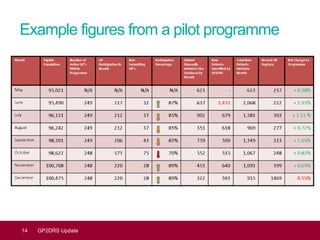
Example figures from a pilot programme
Incidents
Incidents regarding SCL/validation continue to be reported – this is
encouraging for SQAS and demonstrates services are making improvements
for the benefits of patients
15 GP2DRS Update
Safety Screening
Incidents
Serious Incidents Patients affected
Q1 2015/16 1 1 37
Q2 2015/16 7 1 131
Q3 2015/16 9 1 6616
Q4 2015/16 7 1 1814
Q1 2016/17 5 6 1874
total 29 10 10472
17% of all reported
incidents
Expect a GP2DRS incident
• ?High number of patients not referred from GP practices
• ?High number of patients requiring demographic update/amendments
• ?High number of deceased and off-register patients
To resolve:
• May need additional administration/failsafe capacity
• Many need additional screening/grading/ROG sessions
• Introduce a risk stratification process
• Alert the HES/Clinical Lead to the potential increase in referrals
• Speak to the GP2DRS support desk
• Develop an action plan/implementation strategy for GP2DRS
16 GP2DRS Update
GP Practices
Pros
Automated extract – once set up they
don’t have to do anything each month
17 GP2DRS Update
Cons
May have to investigate coding errors.
Need to ensure they code correctly
Local Programmes
Pros
Standardised extract approved using
nationally agreed criteria
It’s free to use
Will be updated to work with new
coding schemes (e.g. SNOMED)
Provides an electronic extract each
month
Reduced requirement of resources
once in steady state
Timely update of patient demographics
Can be used to QA a current electronic
extract
18 GP2DRS Update
Cons
Initial increase in admin/failsafe
workload
Possibly initial increase in screening
workload if new patients are identified
Patients
Pros
Timely invites
Automatic update of changes in
address etc.
Won’t be invited if not eligible
19 GP2DRS Update
Cons
IG concerns?
Future work
• Test and assure the missing patients extract
• See if we can obtain a legal “direction” for the data which would remove the
need for the 2 stage extract process
• Evidence the benefits of GP2DRS
• Input from programmes using GP2DRS or moving to GP2DRS required!!
• Form a GP2DRS user group
• Test and assure the move to SNOMED
• Test and assure a system upgrade in NHS Digital
• Continue roll out to all who wish to use it
• Make improvements to the usability of the system
• Investigate additional information which may be included in the long term
20 GP2DRS Update
Q&A
21 GP2DRS Update
gp2drs.support@nhs.net

Gp2 drs update a proctor

  • 1.
    GP2DRS Update Andrea Hewins(was Procter), ITSpecialist, NHS Screening Programmes Public Health England leads the NHS Screening Programmes
  • 2.
    GP2DRS Email: gp2drs.support@nhs.net 2 GP2DRSUpdate Acentrally endorsed and standardised solution to simplify the sharing of patient data between GP practices and local DES programmes
  • 3.
    3 GP2DRS Update Keybenefits of GP2DRS • Reduced risk of sight loss caused by • Delayed screening due to new referrals being missed • Screening invitations not being received due to out of date demographics • Timely and accurate identification of demographic changes (moves, deaths etc.) • Reduced data transcription errors • A standard approach to the acquisition of demographics from GP Practices • Reduced workload for GP practice staff as the information is gathered automatically • Some potential reduction for administrative workload from programmes in the long term
  • 4.
    Future Benefits ofGP2DRS • GP2DRS will be automatically moved over to SNOMED coding • MIQUEST support is being withdrawn and will not support the move to SNOMED • Possibility in the future of obtaining extra information • Pregnancy? • Special requirements? • Etc. 4 GP2DRS Update
  • 5.
    5 GP2DRS Update Whatdoes GP2DRS provide • Currently • Monthly list of all patients at a GP practice 12 and over coded as having diabetes on the date of the extract • Each list every month which will include new registrations, changes to currently registered patients • Patients will be removed from the list if they • Have withheld consent • Died • De registered from that GP (but should appear with a new GP if re registered) • Been coded as diabetes resolved (GPs should not be using this code in most cases) • Future • Missing patients list which will give the reason a patient is no longer on the register.
  • 6.
    6 GP2DRS Update Currentstatus of GP2DRS Local DES programmes • 16 Programmes extracting from all their GP practices • 14 extracting from at least some of their practices • 6 in planning stages or interested • 3 will notify us when they are ready to look at GP2DRS • 2 not yet interested • 23 yet to engage
  • 7.
    7 GP2DRS Update Implementationof GP2DRS • In pilot sites GP2DRS has identified up to 3% more patients than using manual methods • Programmes need to plan the extra capacity to manage this increased workload to ensure these patients are all screened quickly • Extra capacity may be required in HES as this may generate more referrals • Extra admin time will be required to • Reconcile the GP2DRS list with the programmes current list • Follow up with GPs patients not showing on the GP2DRS list (could be for example incorrect coding or could be they haven’t notified you they are deceased or moved away) • Don’t let this put you off as there are clear benefits to patients who may have been missed prior to GP2DRS
  • 8.
    8 GP2DRS Update GPengagement • GP Engagement is key • GP’s must sign up to the service to allow the patients to be extracted (many already have) • They then have the option to say no to each monthly extract both when the data is requested and when it is collated for sending • If they don’t say no the data is automatically sent • Ensure GPs • Continue to send you patients through current channels to allow parallel running and checking of possibly miscoded patients • Sign up to the service (full details will be given to programmes to pass onto GPs to ensure they have done this) • Don’t block the extracts • Respond to your queries about potentially incorrectly coded patients and correct these
  • 9.
    9 GP2DRS Update Stakeholders •QA lead – please ensure you consult with your QA lead prior to implementation • CCG – ensuring your CCG is engaged will help with the sign up of GPs • Hospital Eye Services – To ensure they are ready to manage any increased demand • GPs – As per previous slide • LMC clinical leads
  • 10.
    Extraction process List ofGP practices from programmes • Do you have an accurate list of all your GP practices • Is it up to date? • GP2DRS support can help validate the list against NHS digitals list by CCG List filtered by CQRS • Practices need to sign up to GP2DRS on the CQRS service to participate • Many have already signed up but still some who haven’t • GP2DRS support can provide you with a list of those who haven’t signed up • Instructions on how they can sign up can also be provided S1N – can we run the query? • Every extract practices will be asked if they’re happy to run the query to extract the patients • Will run if they don’t respond • Will not run if they say no 10 GP2DRS Update
  • 11.
    Extraction process continued S2N– can we take the data? • Once the query has been run practices will be asked if they agree to send the resulting data • Data will be sent if they do not respond • Data will not be sent if they say no GPES processing • Data returned from practices is gathered by GPES (NHS Digital) • Data is pre processed and reports produced and sent to GP2DRS support Data loaded into GP2DRS • Resulting can be downloaded from GP2DRS as a programme wide CSV file, by individual practice or viewed on a per patient basis • Each programme has the ability to view and download the data for their GP practices • Reports sent to programme regarding practices who did not send any data that month to allow programmes to chase these practices 11 GP2DRS Update
  • 12.
  • 13.
    13 GP2DRS Update Policies& procedures Examples include: • An approach for managing non-participating GP Practices • A process for providing data quality feedback to GP Practices • Failsafe process for patients who opt out of screening • Failsafe process for patients who withhold or withdraw consent for the transfer and use of their demographic data • Processes for reporting and resolving GP2DRS associated issues, i.e. interaction with the GP2DRS Helpdesk These should be reviewed as your experience with GP2DRS grows
  • 14.
    14 GP2DRS Update Examplefigures from a pilot programme
  • 15.
    Incidents Incidents regarding SCL/validationcontinue to be reported – this is encouraging for SQAS and demonstrates services are making improvements for the benefits of patients 15 GP2DRS Update Safety Screening Incidents Serious Incidents Patients affected Q1 2015/16 1 1 37 Q2 2015/16 7 1 131 Q3 2015/16 9 1 6616 Q4 2015/16 7 1 1814 Q1 2016/17 5 6 1874 total 29 10 10472 17% of all reported incidents
  • 16.
    Expect a GP2DRSincident • ?High number of patients not referred from GP practices • ?High number of patients requiring demographic update/amendments • ?High number of deceased and off-register patients To resolve: • May need additional administration/failsafe capacity • Many need additional screening/grading/ROG sessions • Introduce a risk stratification process • Alert the HES/Clinical Lead to the potential increase in referrals • Speak to the GP2DRS support desk • Develop an action plan/implementation strategy for GP2DRS 16 GP2DRS Update
  • 17.
    GP Practices Pros Automated extract– once set up they don’t have to do anything each month 17 GP2DRS Update Cons May have to investigate coding errors. Need to ensure they code correctly
  • 18.
    Local Programmes Pros Standardised extractapproved using nationally agreed criteria It’s free to use Will be updated to work with new coding schemes (e.g. SNOMED) Provides an electronic extract each month Reduced requirement of resources once in steady state Timely update of patient demographics Can be used to QA a current electronic extract 18 GP2DRS Update Cons Initial increase in admin/failsafe workload Possibly initial increase in screening workload if new patients are identified
  • 19.
    Patients Pros Timely invites Automatic updateof changes in address etc. Won’t be invited if not eligible 19 GP2DRS Update Cons IG concerns?
  • 20.
    Future work • Testand assure the missing patients extract • See if we can obtain a legal “direction” for the data which would remove the need for the 2 stage extract process • Evidence the benefits of GP2DRS • Input from programmes using GP2DRS or moving to GP2DRS required!! • Form a GP2DRS user group • Test and assure the move to SNOMED • Test and assure a system upgrade in NHS Digital • Continue roll out to all who wish to use it • Make improvements to the usability of the system • Investigate additional information which may be included in the long term 20 GP2DRS Update
  • 21.

Editor's Notes

  • #13 It is your single collated list Data is extracted and GP2DRS is updated every month It will contain all patients who are deemed ‘in cohort’ and to be invited
  • #15 Not submitting GPs are the ones who need to be chased Went up in October as there was an issue with the extract Large number removed from register was due to Christmas lull in clinics where admin team did a lot of list cleansing
  • #16 Prior to GP2DRS – why do anything? Lots of incidents reported since Q1 2015/16 and these continue to be reported. SCL/Validation incidents account for 17% of all DES reported incidents to the screening QA service. The number of patients affected are high and unless thorough validation is in place, affected patient numbers and incidents are likely to continue to increase
  • #17 Expect an incident – that way there are no surprises. Warn the commissioners this is likely to happen