REBOOTING DESIGN
Oren Eini
oren@ravendb.net
JOEL SPOLSKY
“…the single worst strategic
mistake that any software
company can make: They decided
to rewrite the code from scratch.”
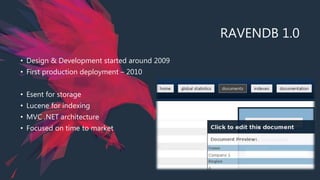
RAVENDB 1.0
• Design & Development started around 2009
• First production deployment – 2010
• Esent for storage
• Lucene for indexing
• MVC .NET architecture
• Focused on time to market
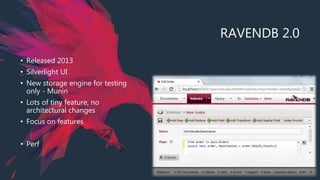
RAVENDB 2.0
• Released 2013
• Silverlight UI
• New storage engine for testing
only - Munin
• Lots of tiny feature, no
architectural changes
• Focus on features
• Perf
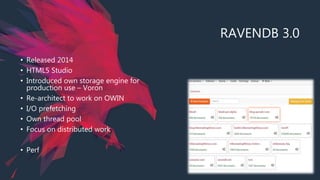
RAVENDB 3.0
• Released 2014
• HTML5 Studio
• Introduced own storage engine for
production use – Voron
• Re-architect to work on OWIN
• I/O prefetching
• Own thread pool
• Focus on distributed work
• Perf
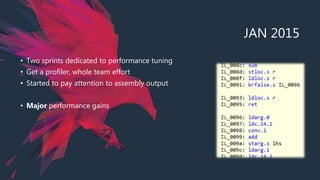
JAN 2015
• Two sprints dedicated to performance tuning
• Get a profiler, whole team effort
• Started to pay attention to assembly output
• Major performance gains
SUPPORT
• We are a database…
• Complex deployments
• Harsh environment
• 24/7
• High availability
• Lots of data, lots of requests
• High sensitivity to hiccups
Q3 2015 – WHAT CAN WE DO?
• Backward compatibility
• Deployed to (literally in the literal
sense) millions of nodes world wide at
various customer sites
• Existing technical debt
• Can’t run on Linux
• Running on tech stack that is not fully
owned by us
• Existing complexity
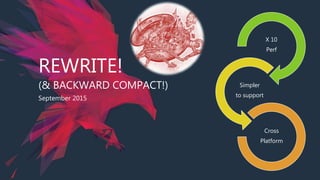
REWRITE!
(& BACKWARD COMPACT!)
September 2015
X 10
Perf
Simpler
to support
Cross
Platform
EXPECTED OUTCOME?
EFFECT?
• We have a decade+ of knowing how our software is used
• Hindsight
• Where does it hurts?
• UX study
• Deep dive with customers
• Going over support incident reports
ARCHITECTURAL DECISIONS
• Multiple OS
• OWN the stack
• Build for performance
• Build of operations
• Support as a key consideration
• Key scenarios impact whole system
design
WE ARE A JSON DOCUMENT DB…
• JSON Parsing • Parsing means:
• Text parsing
• Allocating managed memory
• Reading data from disk
GOING ALL THE WAY DOWN…
• JSON documents are stored using
blittable format.
• No parsing / manipulation required to
process
• .NET representation:
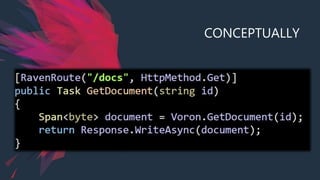
• byte* ptr, int len
• Storage engine: Voron
• Zero copy
• Memory mapped
• Can search a give value and give result:
• byte* ptr, int len
CONCEPTUALLY
RESULT?
• Zero copy throughout the process
• No parsing costs
• Therefor, reduced CPU
• Therefor, no need to cache in memory
• Therefor, reduced managed memory
• Memory mapped
• Therefor, OS already keep in memory
• Avoid duplicate data caching
• Reduce memory consumption
• Lean on OS for eviction
MEMORY MANAGEMENT
• Need to own that, important for perf!
• Reduce managed allocations
• Use unmanaged memory and take
advantage of internal knowledge
• Simple solutions can work well, in well
defined context
• Arena Allocator
• Context
DESIGN FOR THE DEBUGGER
• Support burden optimization
• Single threaded execution for long running tasks
• Named threads
• Build data structure for analysis in dumps
• Singular architecture focus
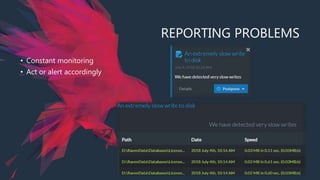
REPORTING PROBLEMS
• Constant monitoring
• Act or alert accordingly
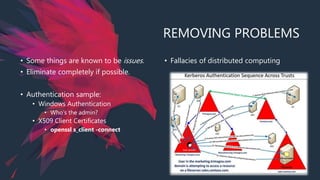
REMOVING PROBLEMS
• Some things are known to be issues.
• Eliminate completely if possible.
• Authentication sample:
• Windows Authentication
• Who’s the admin?
• X509 Client Certificates
• openssl s_client -connect
• Fallacies of distributed computing
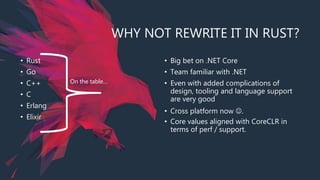
WHY NOT REWRITE IT IN RUST?
• Rust
• Go
• C++
• C
• Erlang
• Elixir
• Big bet on .NET Core
• Team familiar with .NET
• Even with added complications of
design, tooling and language support
are very good
• Cross platform now .
• Core values aligned with CoreCLR in
terms of perf / support.
On the table…
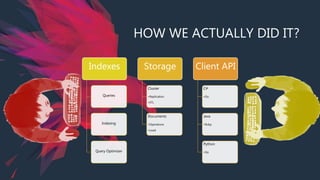
HOW WE ACTUALLY DID IT?
Indexes
Queries
Indexing
Query Optimizer
Storage
Cluster
•Replication
•ETL
Documents
•Operations
•Load
Client API
C#
•Go
Java
•Ruby
Python
•Go
PARALLEL VERSION DEVELOPMENT
• 3.5 released while working on 4.0
• Identify bottlenecks in the design
• As infrastructure completes, parallelize
• Slowly transition team members to the new release
• Prioritizing demo-abiblity of the system
• 30% of the team dedicated to the UI
WHERE ARE WE NOW?
• Initially budgeted for 1 year
development
• Team size: 25
• Started Sep 2015
• OMG, we have so many features!
• Mid 2016 changed schedule to June
2017
• Released 3.5 while working on 4.0
• Ramp up time internally
• Supporting older versions
simultaneously
• Actual release – Feb 2018
• Some features cut
• Actual completion of all planned
features
• Aug 2018 – (3 years!)
• With a lot extras, of course
IMPACT ON SUPPORT?
• Support call time reduced
• Typical 3.x tier 2 support call:
1 week
• Typical 4.x tier 2 support call:
2 hours
PERFORMANCE
• 100,000+ writes / second
• 1,000,000 reads / second
• < 1,000$ machine
• On the wild
• X 20
• X 52
PLATFORMS
• Windows
• Linux
• Arm (Raspberry PI)
• Mac OS X
• Production deployed to ARM in
industrial settings
END RESULT?
• However:
• 14 months overdue
• Deadline extended twice
• Much larger in scope than expected
• Even when took this to account
• Features in 3.0 are only in the 4.1
release, expected next month
• 20 months over expected time
• Mostly minor, though
• Full support by whole team and
company essential
QUESTIONS?

Rebooting design in RavenDB

  • 1.
  • 2.
    JOEL SPOLSKY “…the singleworst strategic mistake that any software company can make: They decided to rewrite the code from scratch.”
  • 3.
    RAVENDB 1.0 • Design& Development started around 2009 • First production deployment – 2010 • Esent for storage • Lucene for indexing • MVC .NET architecture • Focused on time to market
  • 4.
    RAVENDB 2.0 • Released2013 • Silverlight UI • New storage engine for testing only - Munin • Lots of tiny feature, no architectural changes • Focus on features • Perf
  • 5.
    RAVENDB 3.0 • Released2014 • HTML5 Studio • Introduced own storage engine for production use – Voron • Re-architect to work on OWIN • I/O prefetching • Own thread pool • Focus on distributed work • Perf
  • 6.
    JAN 2015 • Twosprints dedicated to performance tuning • Get a profiler, whole team effort • Started to pay attention to assembly output • Major performance gains
  • 7.
    SUPPORT • We area database… • Complex deployments • Harsh environment • 24/7 • High availability • Lots of data, lots of requests • High sensitivity to hiccups
  • 8.
    Q3 2015 –WHAT CAN WE DO? • Backward compatibility • Deployed to (literally in the literal sense) millions of nodes world wide at various customer sites • Existing technical debt • Can’t run on Linux • Running on tech stack that is not fully owned by us • Existing complexity
  • 9.
    REWRITE! (& BACKWARD COMPACT!) September2015 X 10 Perf Simpler to support Cross Platform
  • 10.
  • 11.
    EFFECT? • We havea decade+ of knowing how our software is used • Hindsight • Where does it hurts? • UX study • Deep dive with customers • Going over support incident reports
  • 12.
    ARCHITECTURAL DECISIONS • MultipleOS • OWN the stack • Build for performance • Build of operations • Support as a key consideration • Key scenarios impact whole system design
  • 13.
    WE ARE AJSON DOCUMENT DB… • JSON Parsing • Parsing means: • Text parsing • Allocating managed memory • Reading data from disk
  • 14.
    GOING ALL THEWAY DOWN… • JSON documents are stored using blittable format. • No parsing / manipulation required to process • .NET representation: • byte* ptr, int len • Storage engine: Voron • Zero copy • Memory mapped • Can search a give value and give result: • byte* ptr, int len
  • 15.
  • 16.
    RESULT? • Zero copythroughout the process • No parsing costs • Therefor, reduced CPU • Therefor, no need to cache in memory • Therefor, reduced managed memory • Memory mapped • Therefor, OS already keep in memory • Avoid duplicate data caching • Reduce memory consumption • Lean on OS for eviction
  • 17.
    MEMORY MANAGEMENT • Needto own that, important for perf! • Reduce managed allocations • Use unmanaged memory and take advantage of internal knowledge • Simple solutions can work well, in well defined context • Arena Allocator • Context
  • 18.
    DESIGN FOR THEDEBUGGER • Support burden optimization • Single threaded execution for long running tasks • Named threads • Build data structure for analysis in dumps • Singular architecture focus
  • 19.
    REPORTING PROBLEMS • Constantmonitoring • Act or alert accordingly
  • 20.
    REMOVING PROBLEMS • Somethings are known to be issues. • Eliminate completely if possible. • Authentication sample: • Windows Authentication • Who’s the admin? • X509 Client Certificates • openssl s_client -connect • Fallacies of distributed computing
  • 21.
    WHY NOT REWRITEIT IN RUST? • Rust • Go • C++ • C • Erlang • Elixir • Big bet on .NET Core • Team familiar with .NET • Even with added complications of design, tooling and language support are very good • Cross platform now . • Core values aligned with CoreCLR in terms of perf / support. On the table…
  • 22.
    HOW WE ACTUALLYDID IT? Indexes Queries Indexing Query Optimizer Storage Cluster •Replication •ETL Documents •Operations •Load Client API C# •Go Java •Ruby Python •Go
  • 23.
    PARALLEL VERSION DEVELOPMENT •3.5 released while working on 4.0 • Identify bottlenecks in the design • As infrastructure completes, parallelize • Slowly transition team members to the new release • Prioritizing demo-abiblity of the system • 30% of the team dedicated to the UI
  • 24.
    WHERE ARE WENOW? • Initially budgeted for 1 year development • Team size: 25 • Started Sep 2015 • OMG, we have so many features! • Mid 2016 changed schedule to June 2017 • Released 3.5 while working on 4.0 • Ramp up time internally • Supporting older versions simultaneously • Actual release – Feb 2018 • Some features cut • Actual completion of all planned features • Aug 2018 – (3 years!) • With a lot extras, of course
  • 25.
    IMPACT ON SUPPORT? •Support call time reduced • Typical 3.x tier 2 support call: 1 week • Typical 4.x tier 2 support call: 2 hours
  • 26.
    PERFORMANCE • 100,000+ writes/ second • 1,000,000 reads / second • < 1,000$ machine • On the wild • X 20 • X 52
  • 27.
    PLATFORMS • Windows • Linux •Arm (Raspberry PI) • Mac OS X • Production deployed to ARM in industrial settings
  • 28.
    END RESULT? • However: •14 months overdue • Deadline extended twice • Much larger in scope than expected • Even when took this to account • Features in 3.0 are only in the 4.1 release, expected next month • 20 months over expected time • Mostly minor, though • Full support by whole team and company essential
  • 29.