


















IBM and Node.js: Old Doge, 
New Tricks 
Dejan Glozic, Full-Stack Architect, IBM Bluemix DevOps
Show Us Your 
Stack
About Me 
IBM Canada Toronto Lab 
Full-Stack Architect 
IBM Bluemix DevOps 
@dglozic 
http://dejanglozic.com
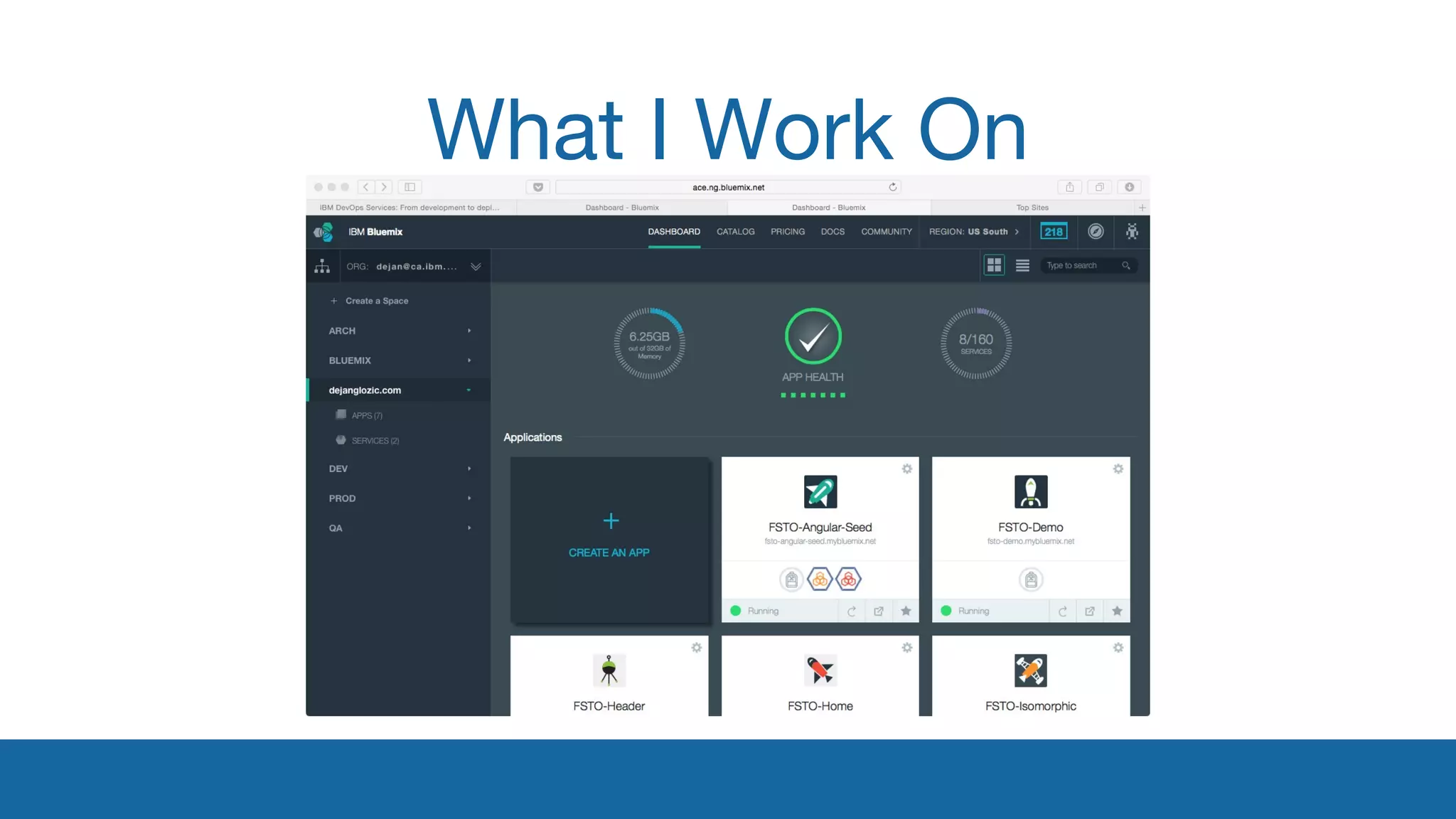
What I Work On
Part 1 
Motivation for change
Enterprise products 
Yearly release cycle, moves at the speed of the slowest component.
Large teams 
Complex coordination, large change sets, difficult to get a good stable build.
Products run on premise 
Managed by customer admins, limited control over hardware choices.
Enterprise stacks 
Java Enterprise Something Something, WS*, Apache, SQL
Overindulgence in JavaScript 
‘Extreme Ajax’ - Dojo/Dijit pushed well beyond sane limits 
desktop != server != client
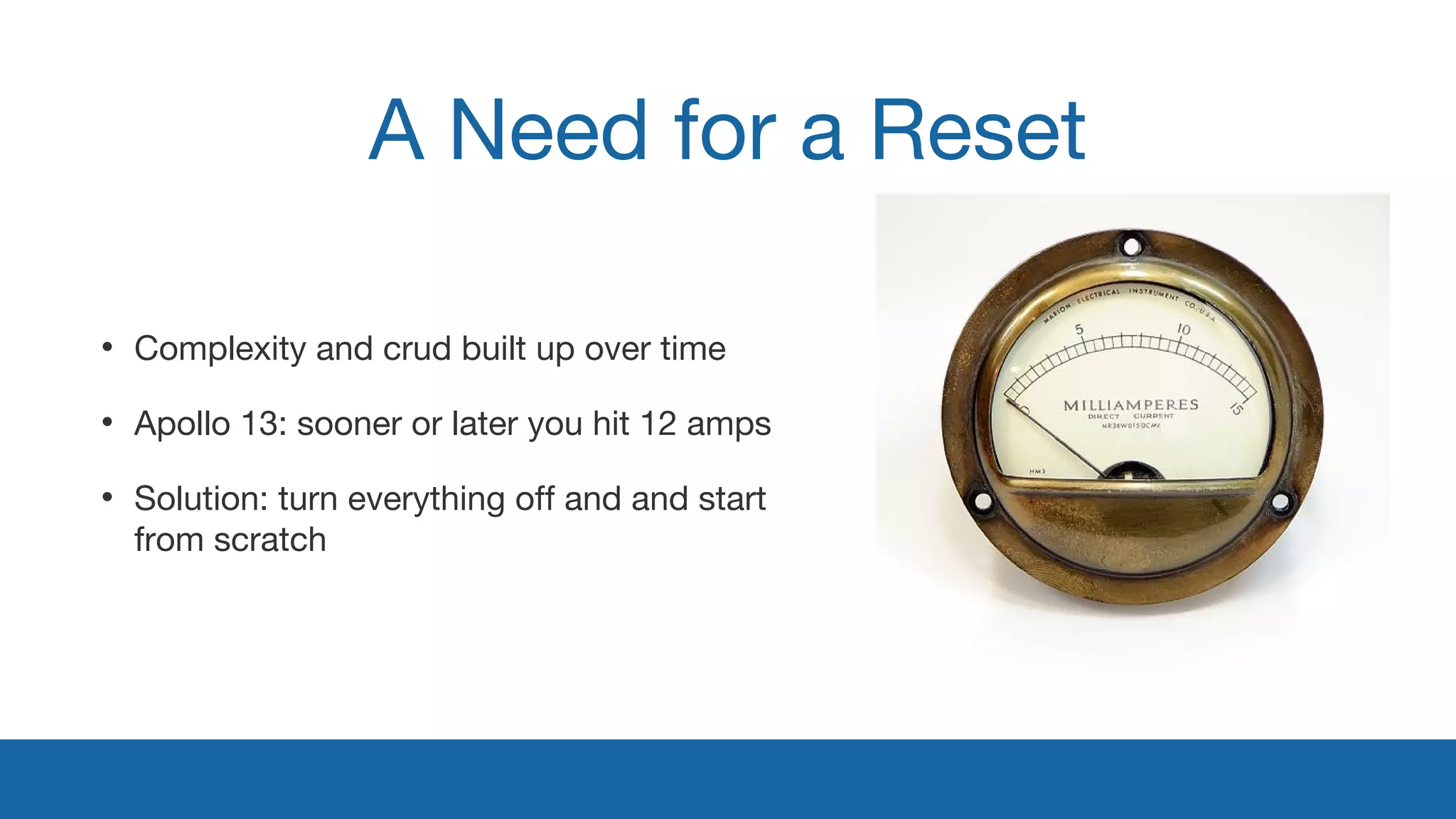
A Need for a Reset 
• Complexity and crud built up over time 
• Apollo 13: sooner or later you hit 12 amps 
• Solution: turn everything off and and start 
from scratch
Motivators 
• New attractive stacks built for humans 
• The need to bring the fun back 
• The need to built ‘fit for cloud’ software 
• The need to ‘do it right this time’
Evolution of Thought 
• 12-factors 
• Netflix 
• Reactive Manifesto 
• Micro-services
Part 2 
From Dojo/Dijit to jQuery/Bootstrap/MV* 
JS
Client Side Reset 
Swapping Dojo/Dijit for jQuery/Bootstrap. No point arguing with gravity.
Bootstrap 
We love the emphasis on HTML5/CSS and away from JavaScript.
After jQuery? 
• Sometimes jQuery is too big 
• Alternatives for newer browsers: zepto, jqLite 
• Or nothing? http://youmightnotneedjquery.com
Part 3 
From Java to Node.js 
JS
Now The Server Side 
Nothing much wrong with servlets and JSPs, but we wanted more.
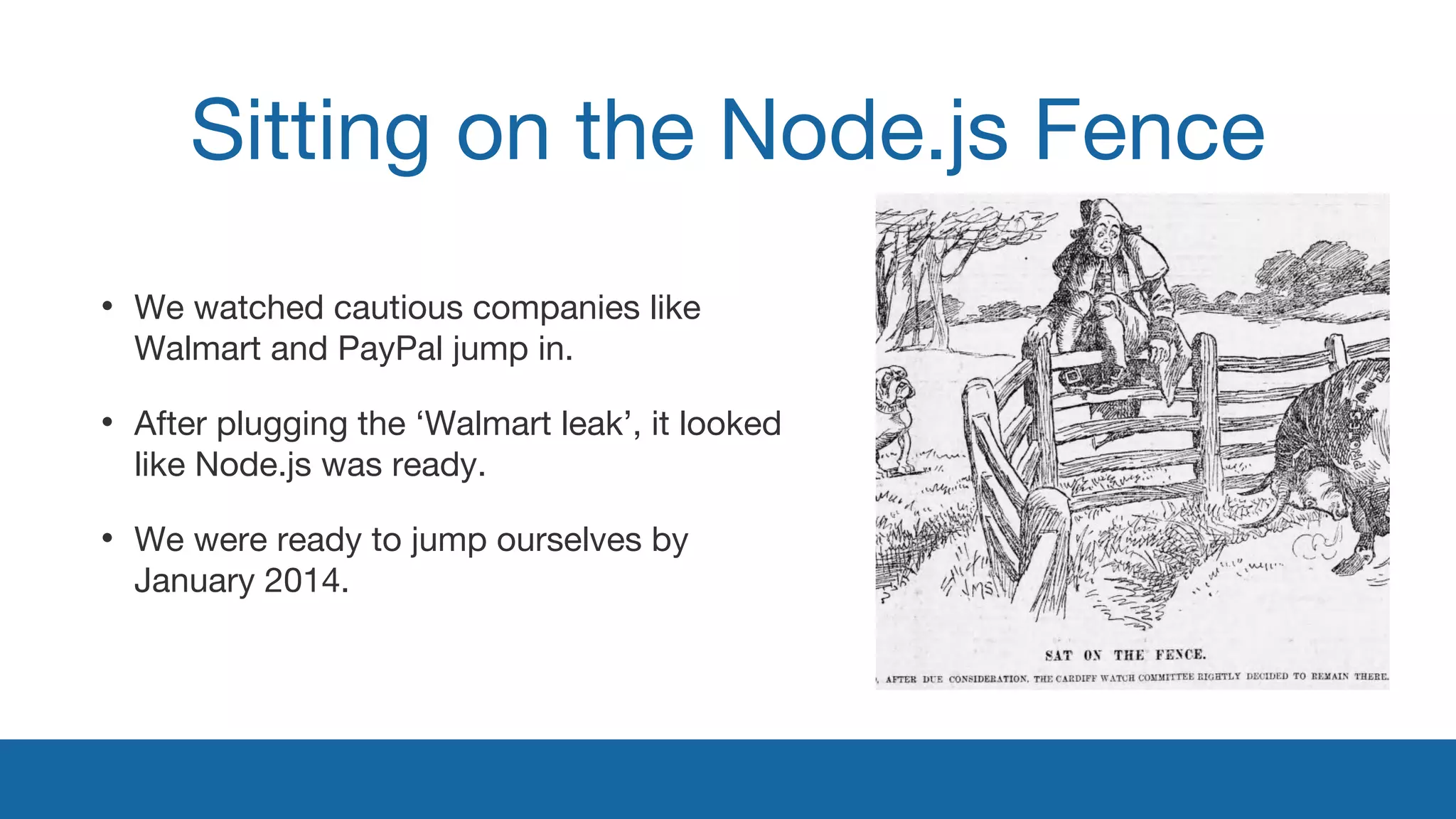
Sitting on the Node.js Fence 
• We watched cautious companies like 
Walmart and PayPal jump in. 
• After plugging the ‘Walmart leak’, it looked 
like Node.js was ready. 
• We were ready to jump ourselves by 
January 2014.
‘Control Your Urges’ Rule 
We will use a new technology to solve a real problem, not as an excuse to play 
with the new hotness.
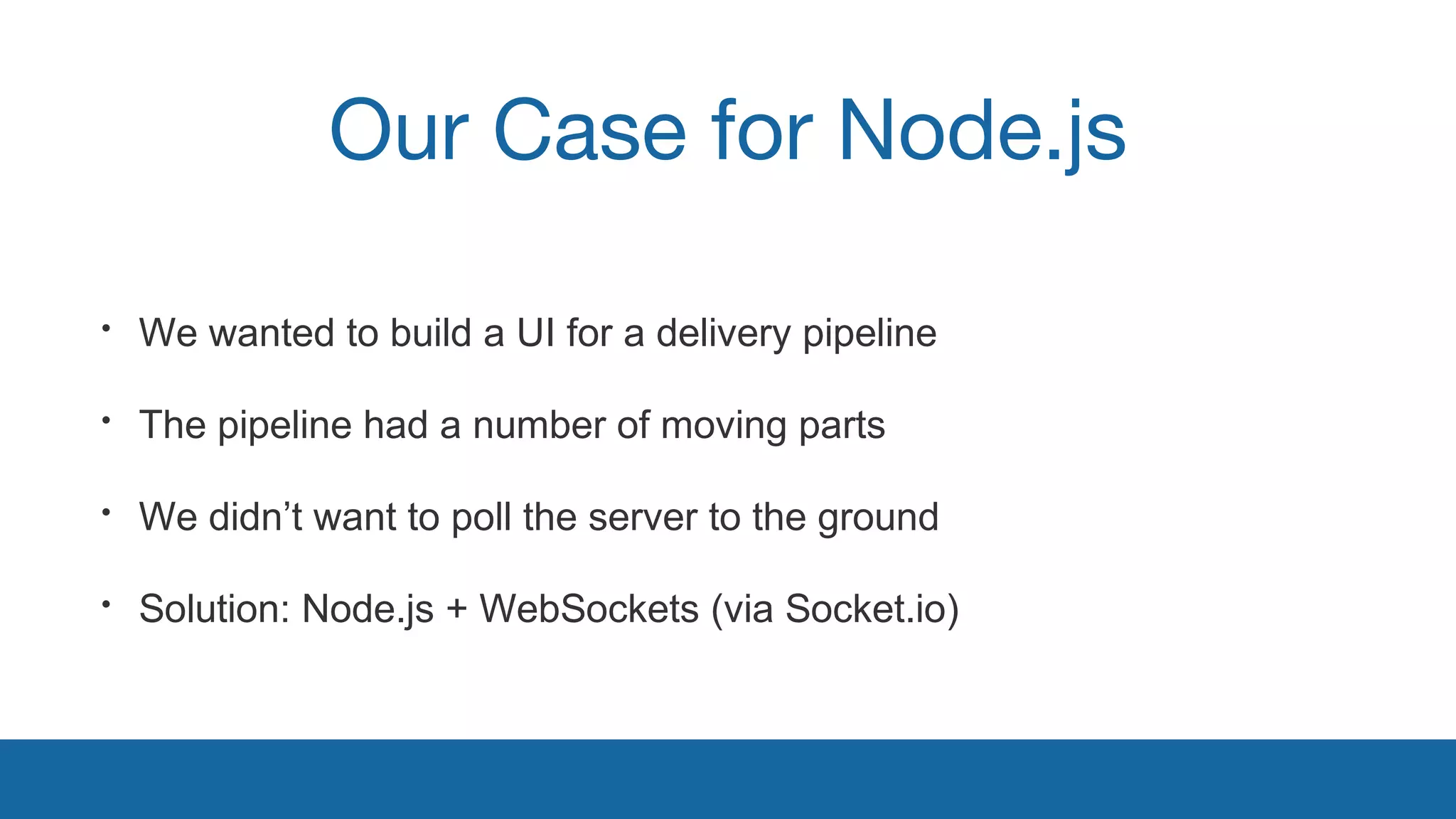
Our Case for Node.js 
• We wanted to build a UI for a delivery pipeline 
• The pipeline had a number of moving parts 
• We didn’t want to poll the server to the ground 
• Solution: Node.js + WebSockets (via Socket.io)
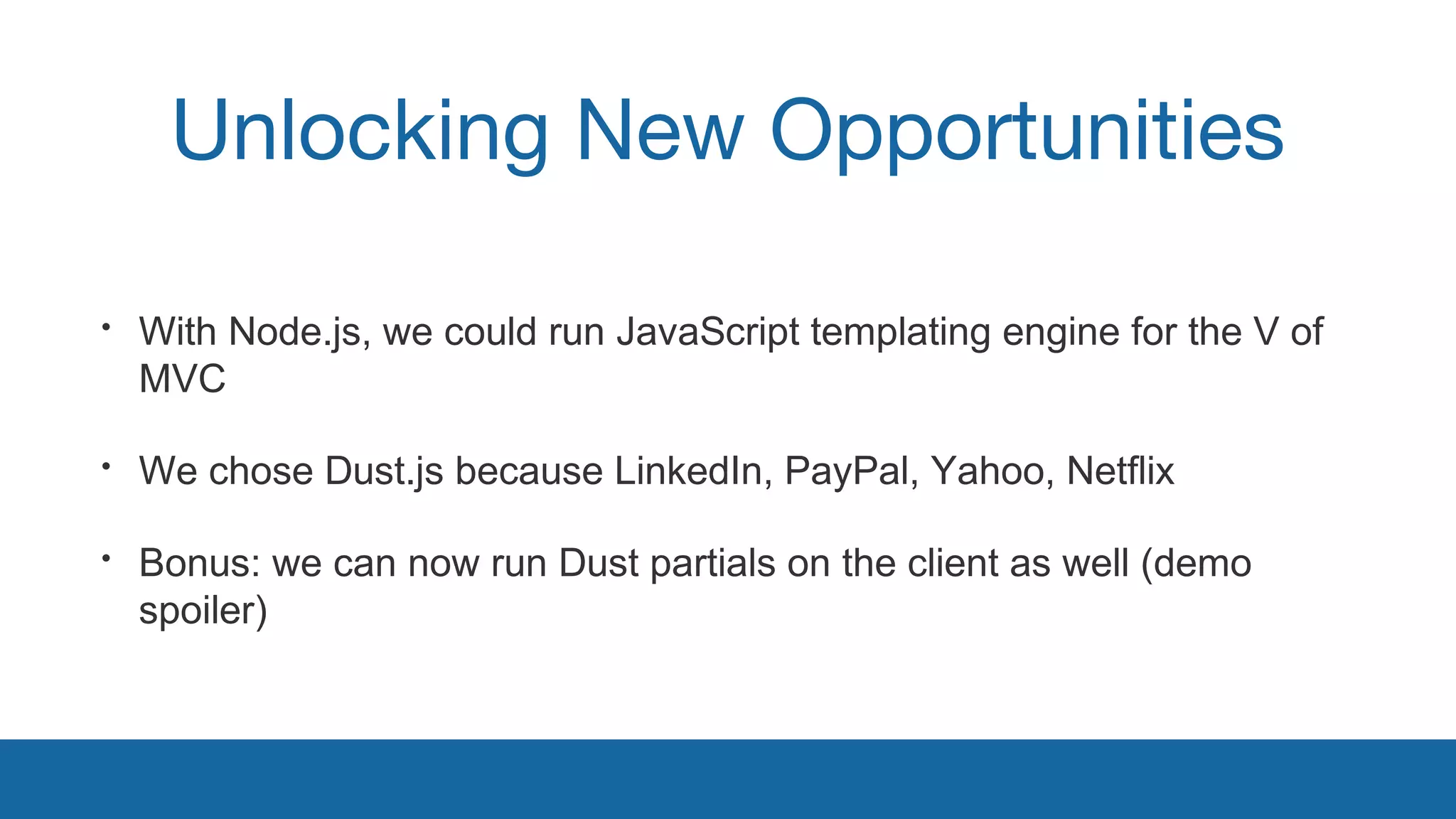
Unlocking New Opportunities 
• With Node.js, we could run JavaScript templating engine for the V of 
MVC 
• We chose Dust.js because LinkedIn, PayPal, Yahoo, Netflix 
• Bonus: we can now run Dust partials on the client as well (demo 
spoiler)
Part 4 
From a monolith to micro-services
Tackling the Hard Problems 
So far we upgraded our stack but didn’t handle any of our systemic problems.
Architectural Impasse 
If monoliths were pain for on-premise products, they were killing us in the cloud.
Cloud Imposter Rule 
Standing up a traditional product in a VM does not mean you ‘solved the cloud’.
Putting Manifestos To Work 
This is where the principles of micro-services, reactive manifesto and 12 factors 
come into play.
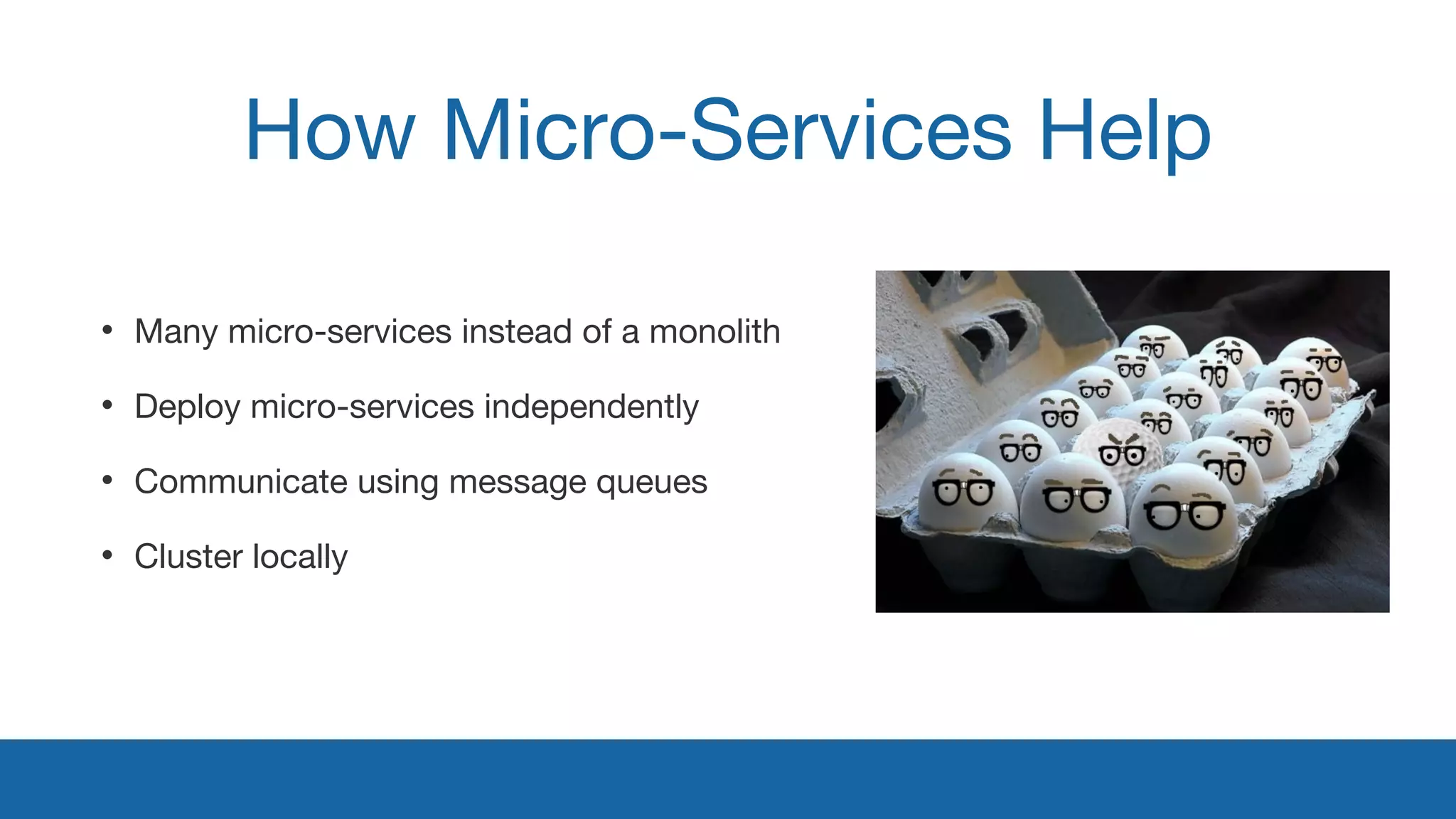
How Micro-Services Help 
• Many micro-services instead of a monolith 
• Deploy micro-services independently 
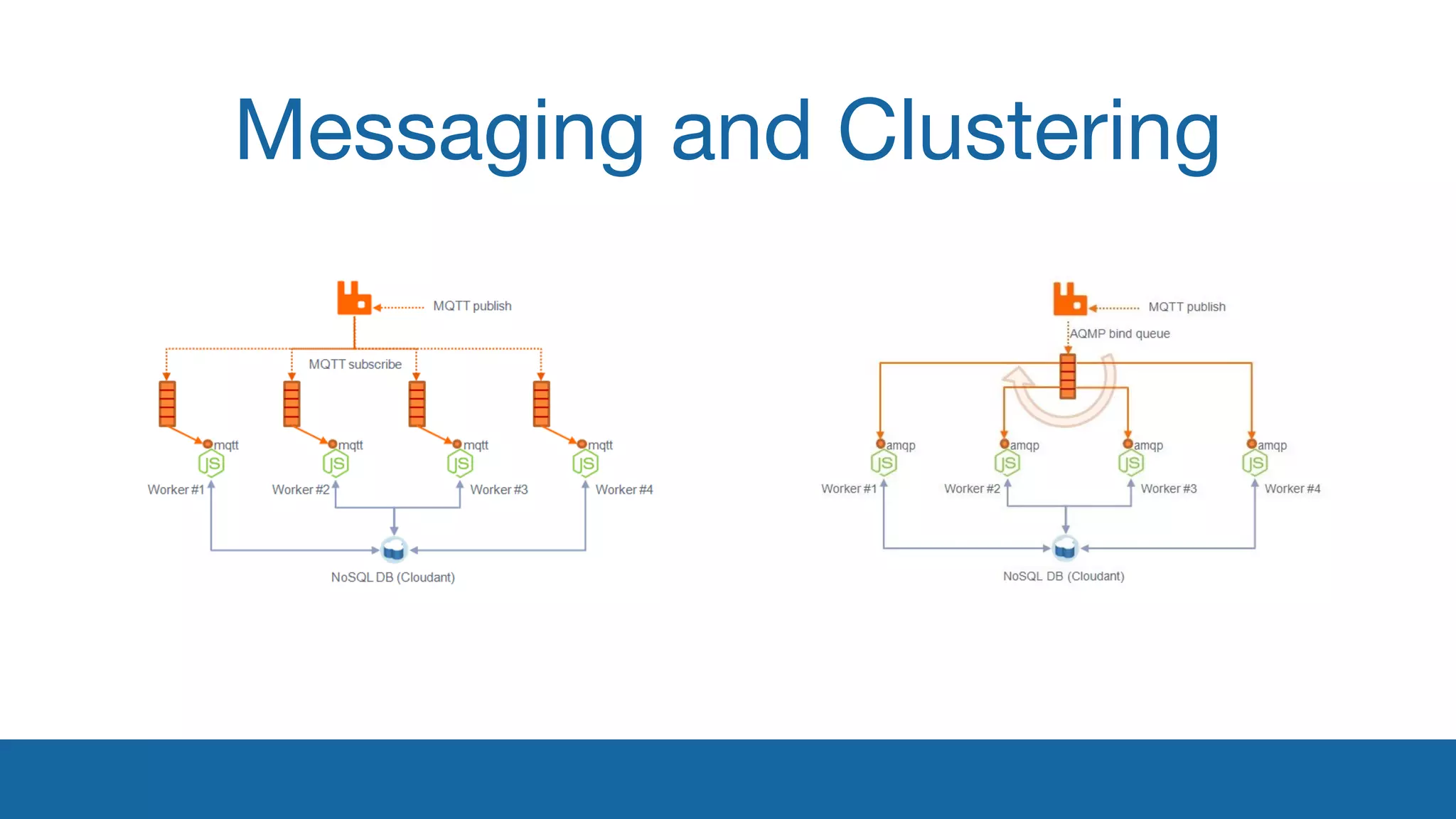
• Communicate using message queues 
• Cluster locally
This Is Not A Micro-Service Talk 
There are others at this conference, and tons of material online.
Part 5 
From REST to REST+Messaging
What Monolith Giveth, Micro- 
Service Taketh Away 
In-process, we just add event listeners to objects. Between processes, we need a 
distributed event notification.
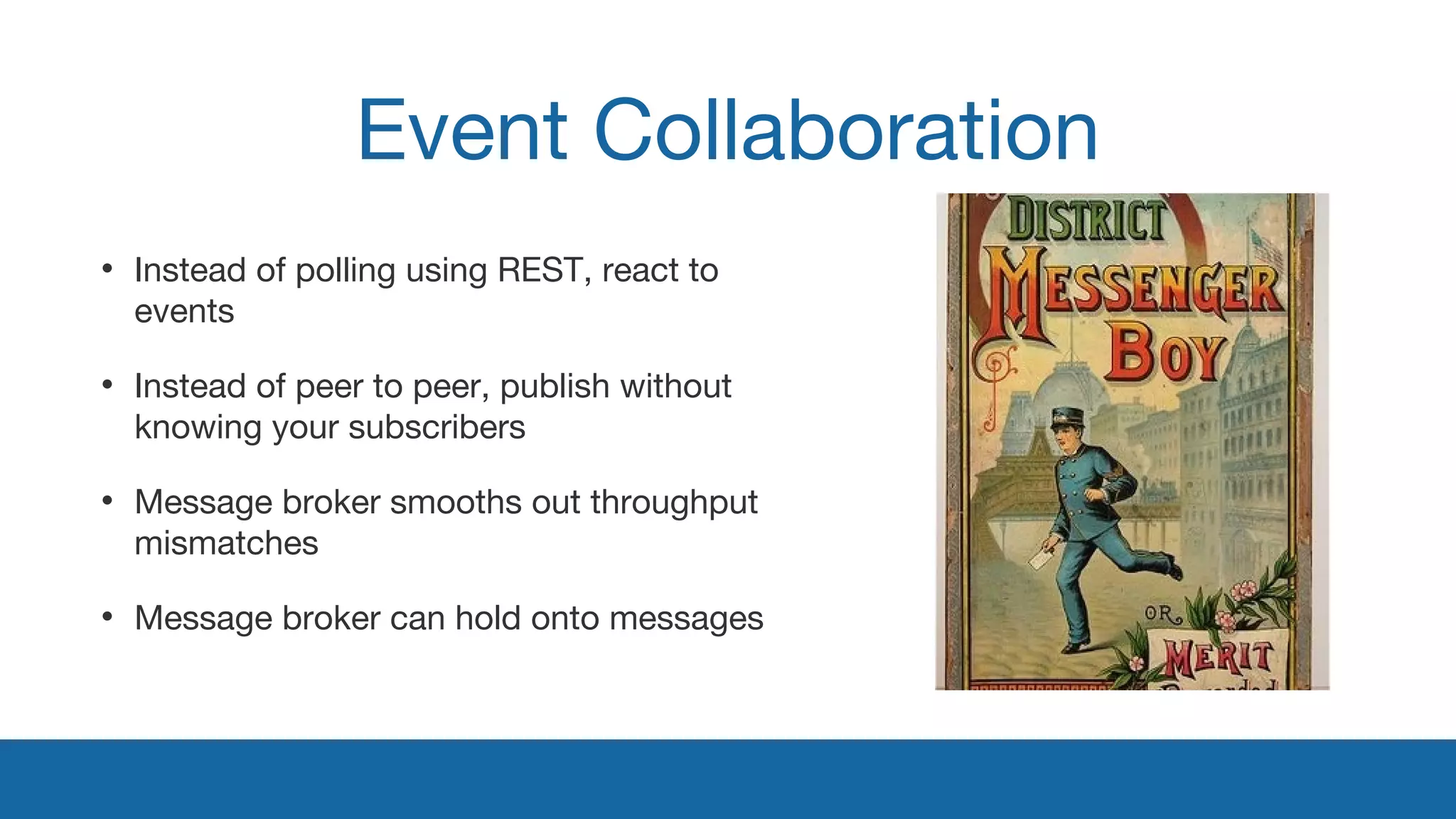
Event Collaboration 
• Instead of polling using REST, react to 
events 
• Instead of peer to peer, publish without 
knowing your subscribers 
• Message broker smooths out throughput 
mismatches 
• Message broker can hold onto messages
REST/MQ Mirroring 
• Yin and Yang of micro-service communication 
• API services own state 
• MQ broadcasts stage changes on matching topics 
• Example: 
• DELETE /v1/projects/ffya14 
• Subscribe to: /v1/projects/+ (MQTT) 
• Message body: 
{ “event”: “deleted” }
Messaging and Clustering
Part 6 
From SQL to, well, NoSQL (duh)
Our Data is Aggregate 
It is a pain to join data from a number of tables using foreign keys
Our Integration Points Are API 
Services 
Persistance is implementation detail.
JavaScript All The Way Down 
With Node.js, JSON-based NoSQL DB like CouchDB is a natural choice.
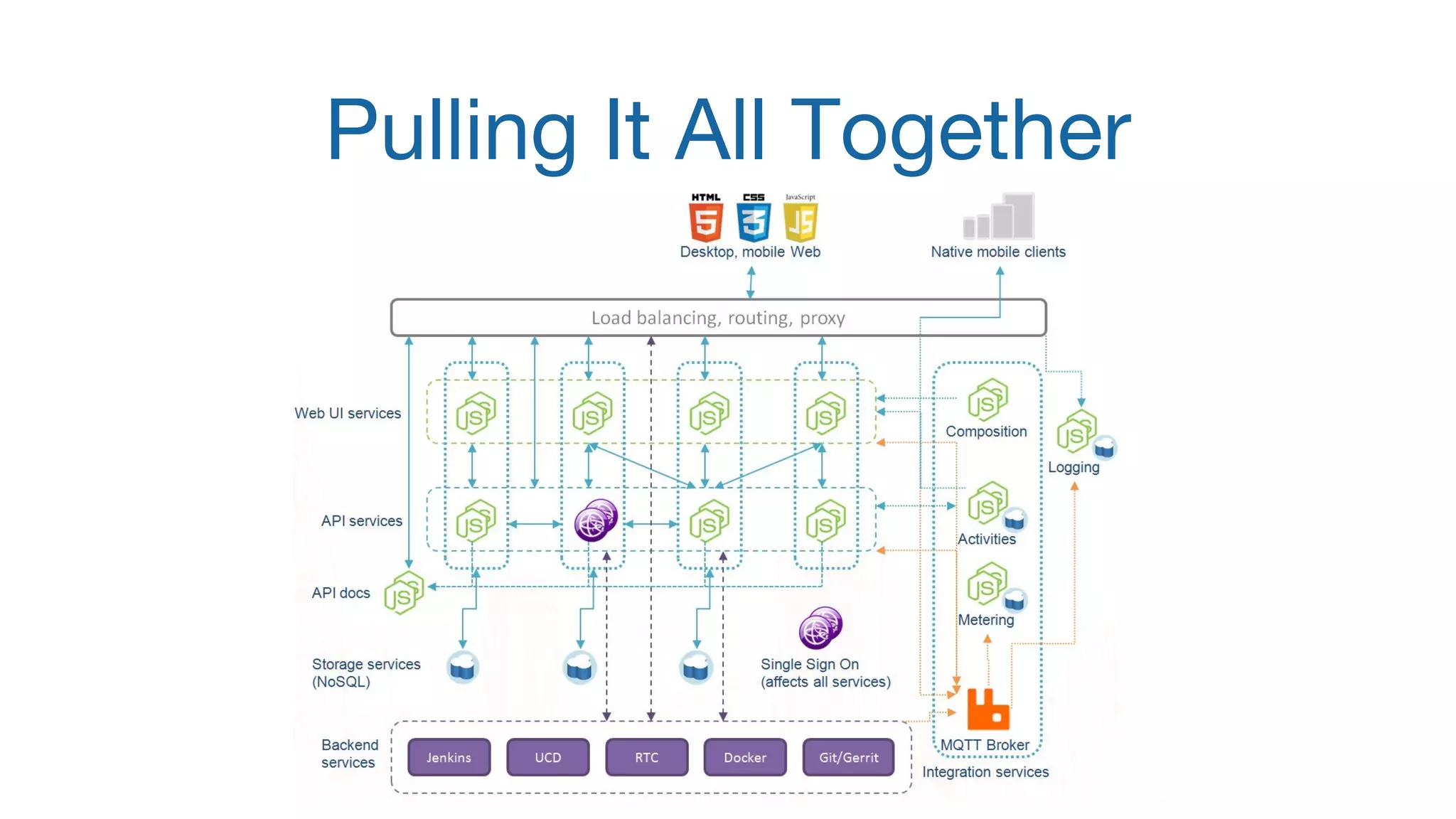
Pulling It All Together
Part 7 
No free lunch - micro-services introduce new problems.
Latency Needs Mitigation 
Keeping micro-services in co-located VMs, strategic caching (combined with MQ 
invalidation).
Guards Against Brownouts 
Circuit breakers, using ‘last good values’, exponential back-off. See Netflix libraries 
for ideas.
Authentication 
We need to stay authenticated as we transition between micro-services.
UI Composition 
Including page fragments is easy in monoliths using partials. In micro-service 
systems, we need distributed solutions.
Part 8 
Lessons from the trenches
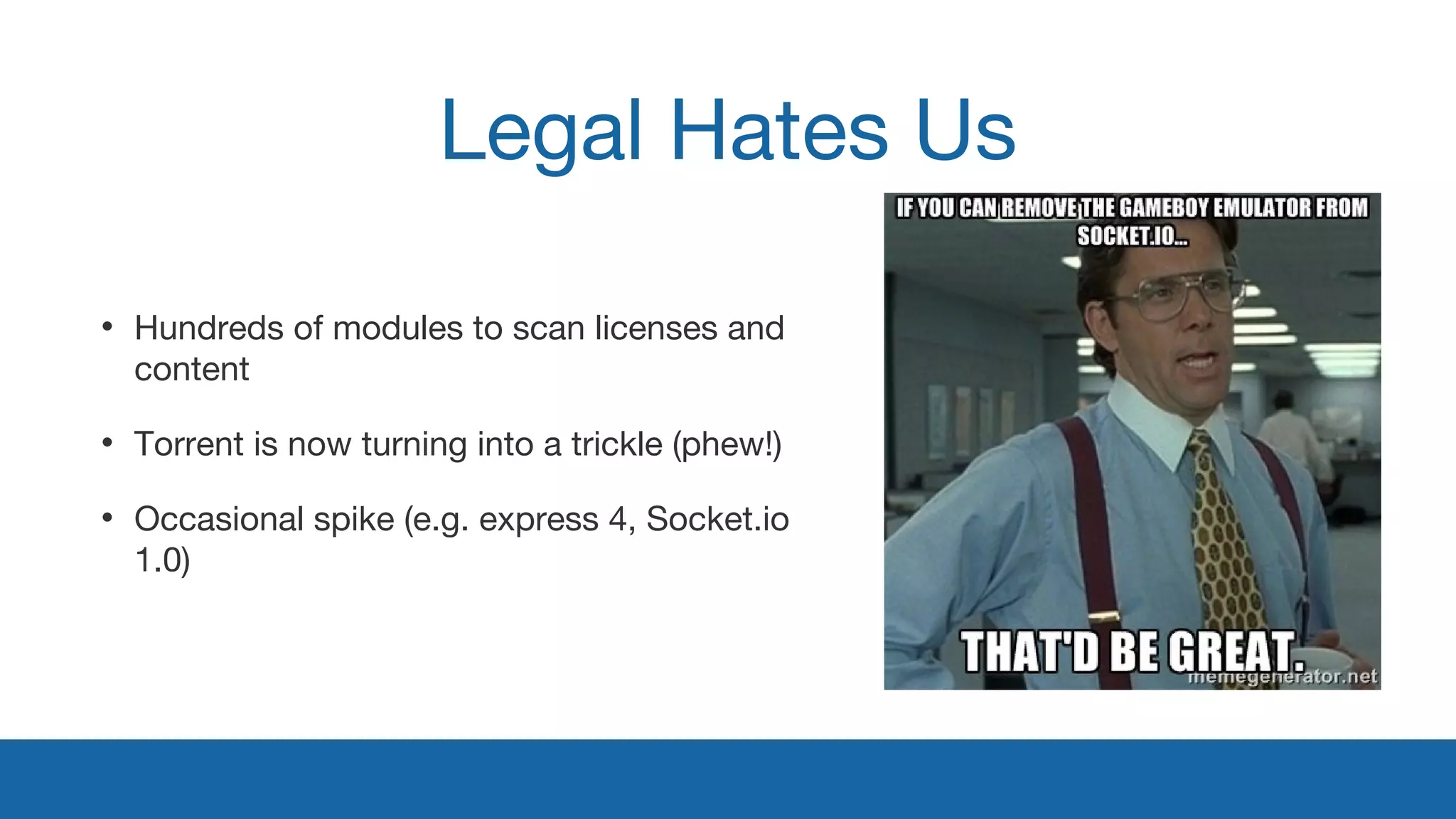
Legal Hates Us 
• Hundreds of modules to scan licenses and 
content 
• Torrent is now turning into a trickle (phew!) 
• Occasional spike (e.g. express 4, Socket.io 
1.0)
Ops Hate Us 
• Operational complexity 
• Many firewall rules for service to service links 
• Many proxy_pass rules 
• Unknown new platforms and tools (what is ‘PM2’?)
IaaS Too Low for Micro-Services 
• Sweet spot - highly customized back-end systems 
• Node.js services are a shoe-in for a PaaS 
• DBaaS takes away storage management headaches 
• We are moving to a PaaS now (Cloud Foundry/Bluemix)
“Use the simplest solution you can get away withTM.” 
–Dejan’s Razor (in honour of William of Ockham)
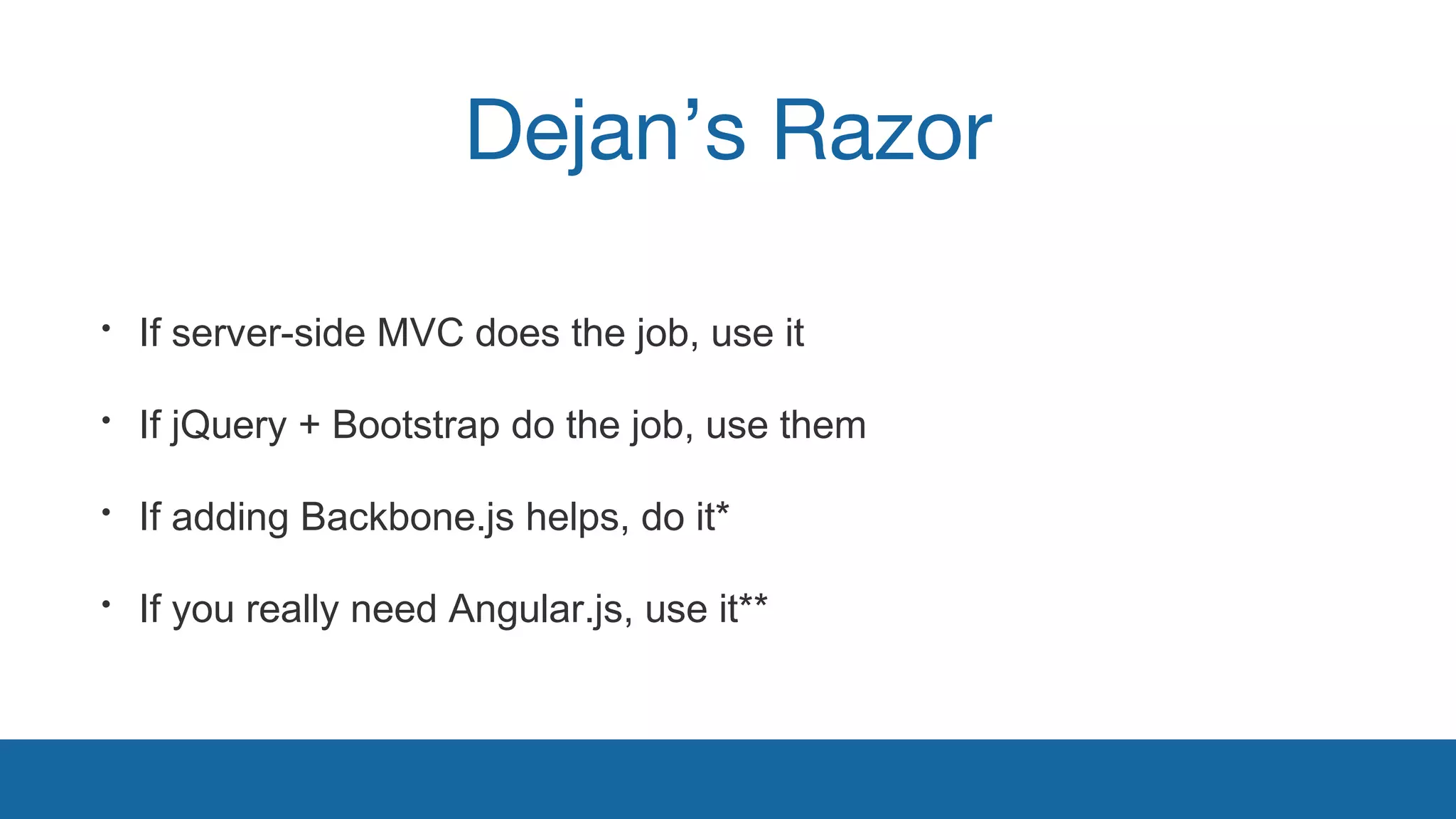
Dejan’s Razor 
• If server-side MVC does the job, use it 
• If jQuery + Bootstrap do the job, use them 
• If adding Backbone.js helps, do it* 
• If you really need Angular.js, use it**
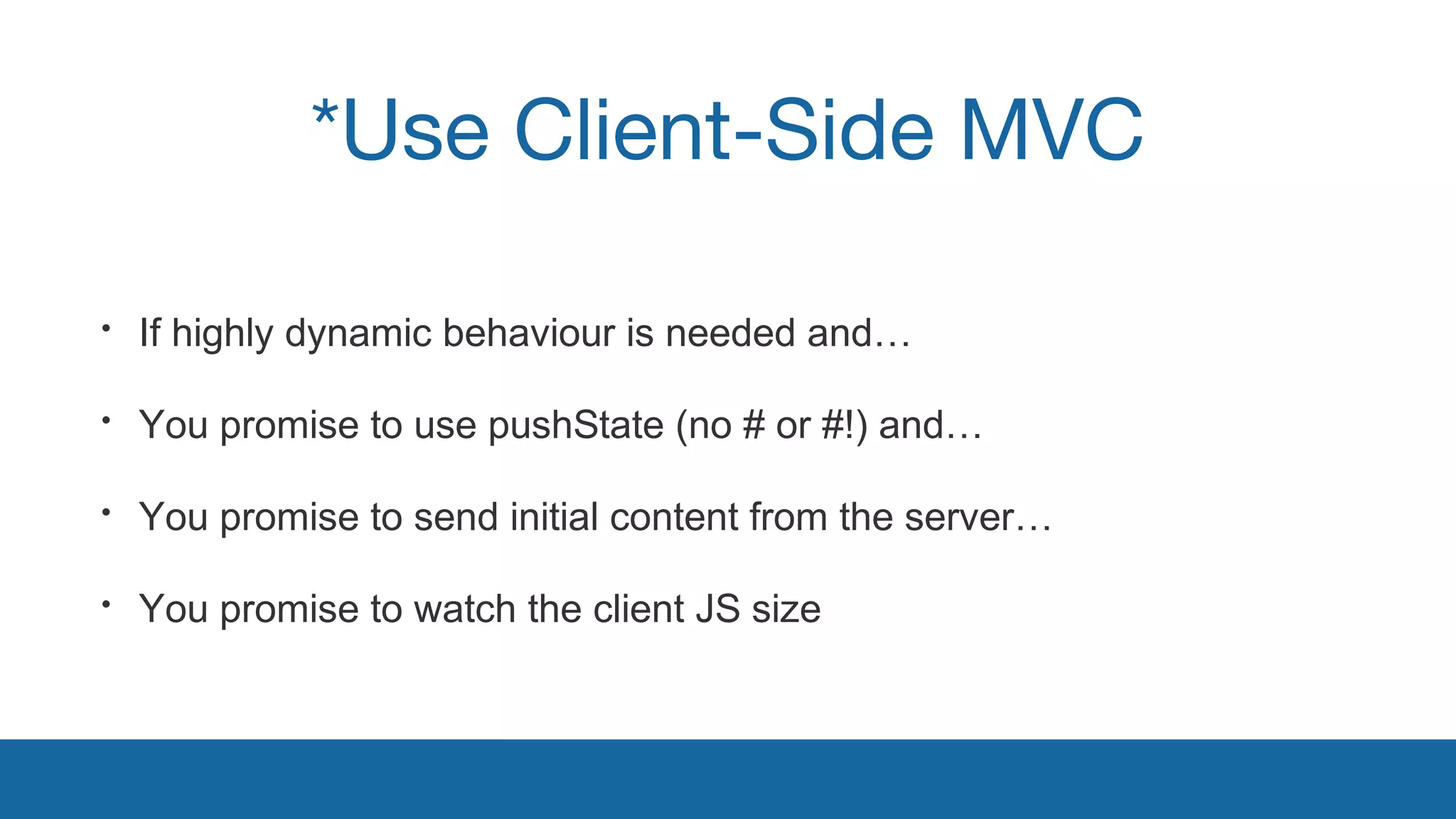
*Use Client-Side MVC 
• If highly dynamic behaviour is needed and… 
• You promise to use pushState (no # or #!) and… 
• You promise to send initial content from the server… 
• You promise to watch the client JS size
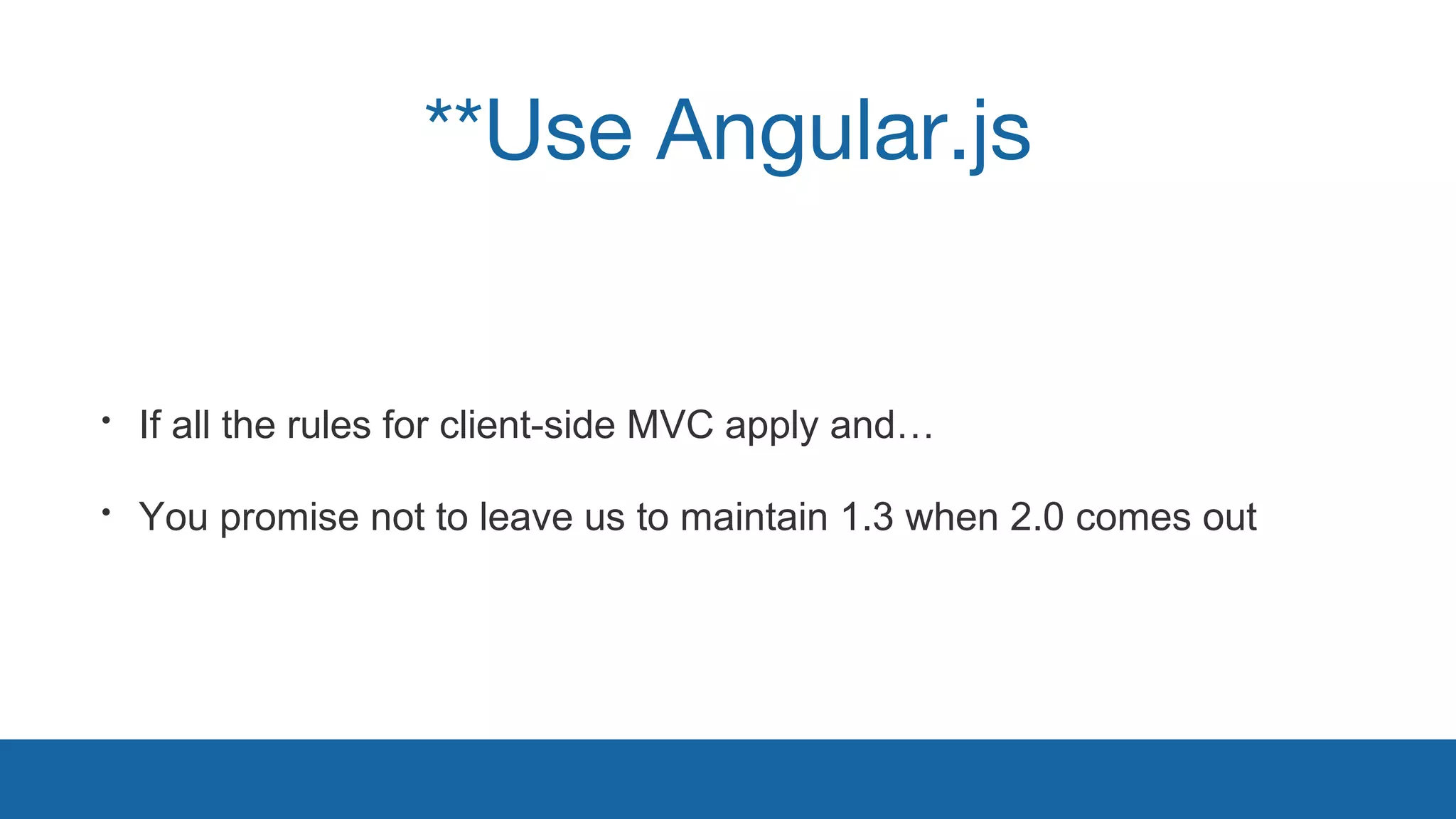
**Use Angular.js 
• If all the rules for client-side MVC apply and… 
• You promise not to leave us to maintain 1.3 when 2.0 comes out
Micro-Service Benefit 
We can apply Dejan’s Razor on each service independently. Each service can be 
only as smart as needed for the task at hand.
DEMO
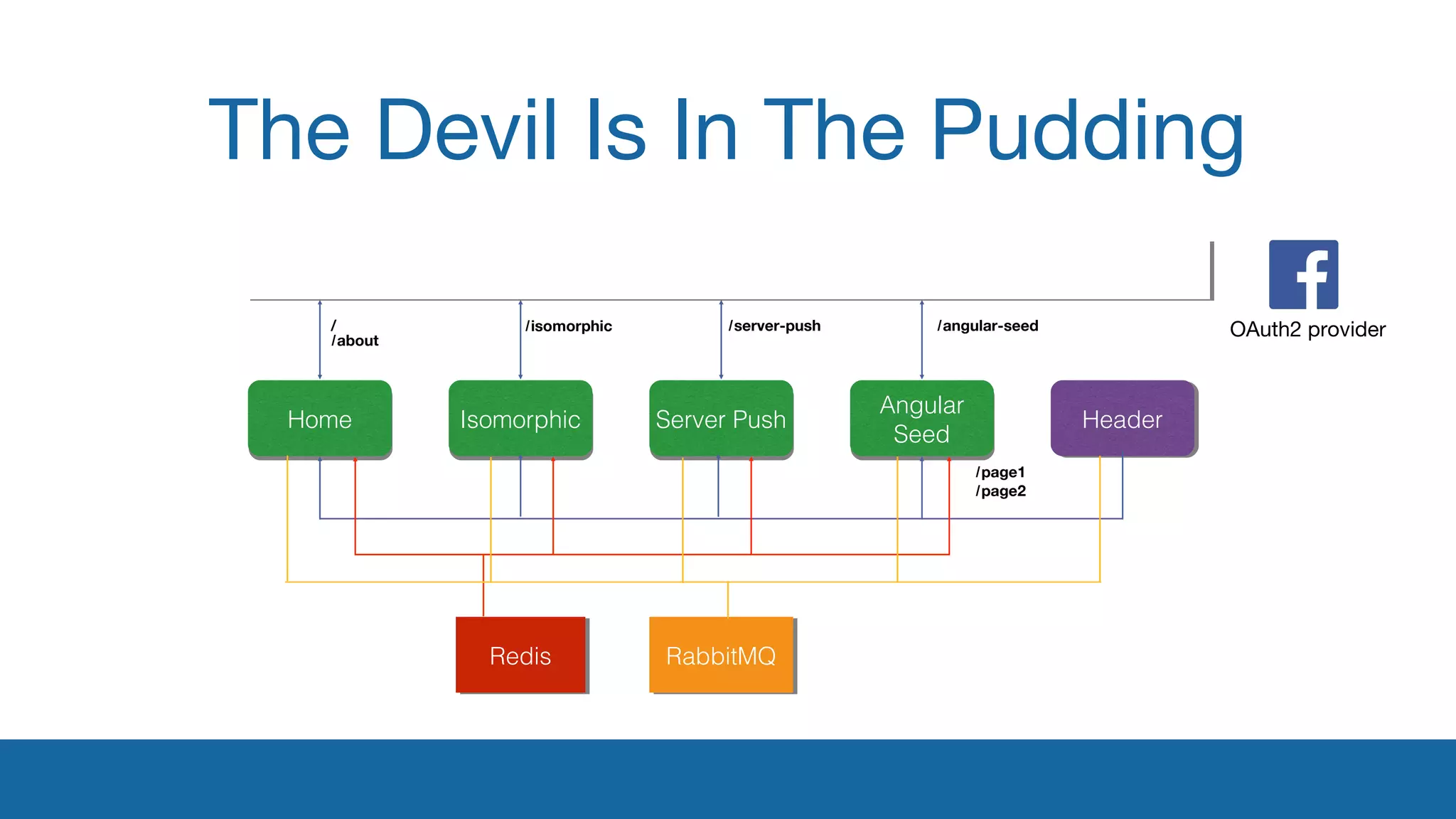
The Devil Is In The Pudding 
NNggiinnxx 
Angular 
Seed HHeeaaddeerr 
HHoommee IIssoommoorrpphhiicc SSeerrvveerr PPuusshh Angular 
Seed 
RReeddiiss RRaabbbbiittMMQQ 
// 
about 
/isomorphic /server-push /angular-seed 
/page1 
/page2 
OAuth2 provider
How To Follow 
• Source code on GitHub: https://github.com/dglozic/fsto-demo 
• Hosted on Bluemix: http://fsto-demo.mybluemix.net
Q/A 
?
Thank you! 
Follow me on Twitter: @dglozic 
Read my blog: dejanglozic.com

IBM and Node.js - Old Doge, New Tricks

  • 1.
    IBM and Node.js:Old Doge, New Tricks Dejan Glozic, Full-Stack Architect, IBM Bluemix DevOps
  • 2.
  • 3.
    About Me IBMCanada Toronto Lab Full-Stack Architect IBM Bluemix DevOps @dglozic http://dejanglozic.com
  • 4.
  • 5.
  • 6.
    Enterprise products Yearlyrelease cycle, moves at the speed of the slowest component.
  • 7.
    Large teams Complexcoordination, large change sets, difficult to get a good stable build.
  • 8.
    Products run onpremise Managed by customer admins, limited control over hardware choices.
  • 9.
    Enterprise stacks JavaEnterprise Something Something, WS*, Apache, SQL
  • 10.
    Overindulgence in JavaScript ‘Extreme Ajax’ - Dojo/Dijit pushed well beyond sane limits desktop != server != client
  • 11.
    A Need fora Reset • Complexity and crud built up over time • Apollo 13: sooner or later you hit 12 amps • Solution: turn everything off and and start from scratch
  • 12.
    Motivators • Newattractive stacks built for humans • The need to bring the fun back • The need to built ‘fit for cloud’ software • The need to ‘do it right this time’
  • 13.
    Evolution of Thought • 12-factors • Netflix • Reactive Manifesto • Micro-services
  • 14.
    Part 2 FromDojo/Dijit to jQuery/Bootstrap/MV* JS
  • 15.
    Client Side Reset Swapping Dojo/Dijit for jQuery/Bootstrap. No point arguing with gravity.
  • 16.
    Bootstrap We lovethe emphasis on HTML5/CSS and away from JavaScript.
  • 17.
    After jQuery? •Sometimes jQuery is too big • Alternatives for newer browsers: zepto, jqLite • Or nothing? http://youmightnotneedjquery.com
  • 18.
    Part 3 FromJava to Node.js JS
  • 19.
    Now The ServerSide Nothing much wrong with servlets and JSPs, but we wanted more.
  • 20.
    Sitting on theNode.js Fence • We watched cautious companies like Walmart and PayPal jump in. • After plugging the ‘Walmart leak’, it looked like Node.js was ready. • We were ready to jump ourselves by January 2014.
  • 21.
    ‘Control Your Urges’Rule We will use a new technology to solve a real problem, not as an excuse to play with the new hotness.
  • 22.
    Our Case forNode.js • We wanted to build a UI for a delivery pipeline • The pipeline had a number of moving parts • We didn’t want to poll the server to the ground • Solution: Node.js + WebSockets (via Socket.io)
  • 23.
    Unlocking New Opportunities • With Node.js, we could run JavaScript templating engine for the V of MVC • We chose Dust.js because LinkedIn, PayPal, Yahoo, Netflix • Bonus: we can now run Dust partials on the client as well (demo spoiler)
  • 24.
    Part 4 Froma monolith to micro-services
  • 25.
    Tackling the HardProblems So far we upgraded our stack but didn’t handle any of our systemic problems.
  • 26.
    Architectural Impasse Ifmonoliths were pain for on-premise products, they were killing us in the cloud.
  • 27.
    Cloud Imposter Rule Standing up a traditional product in a VM does not mean you ‘solved the cloud’.
  • 28.
    Putting Manifestos ToWork This is where the principles of micro-services, reactive manifesto and 12 factors come into play.
  • 29.
    How Micro-Services Help • Many micro-services instead of a monolith • Deploy micro-services independently • Communicate using message queues • Cluster locally
  • 30.
    This Is NotA Micro-Service Talk There are others at this conference, and tons of material online.
  • 31.
    Part 5 FromREST to REST+Messaging
  • 32.
    What Monolith Giveth,Micro- Service Taketh Away In-process, we just add event listeners to objects. Between processes, we need a distributed event notification.
  • 33.
    Event Collaboration •Instead of polling using REST, react to events • Instead of peer to peer, publish without knowing your subscribers • Message broker smooths out throughput mismatches • Message broker can hold onto messages
  • 34.
    REST/MQ Mirroring •Yin and Yang of micro-service communication • API services own state • MQ broadcasts stage changes on matching topics • Example: • DELETE /v1/projects/ffya14 • Subscribe to: /v1/projects/+ (MQTT) • Message body: { “event”: “deleted” }
  • 35.
  • 36.
    Part 6 FromSQL to, well, NoSQL (duh)
  • 37.
    Our Data isAggregate It is a pain to join data from a number of tables using foreign keys
  • 38.
    Our Integration PointsAre API Services Persistance is implementation detail.
  • 39.
    JavaScript All TheWay Down With Node.js, JSON-based NoSQL DB like CouchDB is a natural choice.
  • 40.
  • 41.
    Part 7 Nofree lunch - micro-services introduce new problems.
  • 42.
    Latency Needs Mitigation Keeping micro-services in co-located VMs, strategic caching (combined with MQ invalidation).
  • 43.
    Guards Against Brownouts Circuit breakers, using ‘last good values’, exponential back-off. See Netflix libraries for ideas.
  • 44.
    Authentication We needto stay authenticated as we transition between micro-services.
  • 45.
    UI Composition Includingpage fragments is easy in monoliths using partials. In micro-service systems, we need distributed solutions.
  • 46.
    Part 8 Lessonsfrom the trenches
  • 47.
    Legal Hates Us • Hundreds of modules to scan licenses and content • Torrent is now turning into a trickle (phew!) • Occasional spike (e.g. express 4, Socket.io 1.0)
  • 48.
    Ops Hate Us • Operational complexity • Many firewall rules for service to service links • Many proxy_pass rules • Unknown new platforms and tools (what is ‘PM2’?)
  • 49.
    IaaS Too Lowfor Micro-Services • Sweet spot - highly customized back-end systems • Node.js services are a shoe-in for a PaaS • DBaaS takes away storage management headaches • We are moving to a PaaS now (Cloud Foundry/Bluemix)
  • 50.
    “Use the simplestsolution you can get away withTM.” –Dejan’s Razor (in honour of William of Ockham)
  • 51.
    Dejan’s Razor •If server-side MVC does the job, use it • If jQuery + Bootstrap do the job, use them • If adding Backbone.js helps, do it* • If you really need Angular.js, use it**
  • 52.
    *Use Client-Side MVC • If highly dynamic behaviour is needed and… • You promise to use pushState (no # or #!) and… • You promise to send initial content from the server… • You promise to watch the client JS size
  • 53.
    **Use Angular.js •If all the rules for client-side MVC apply and… • You promise not to leave us to maintain 1.3 when 2.0 comes out
  • 54.
    Micro-Service Benefit Wecan apply Dejan’s Razor on each service independently. Each service can be only as smart as needed for the task at hand.
  • 55.
  • 56.
    The Devil IsIn The Pudding NNggiinnxx Angular Seed HHeeaaddeerr HHoommee IIssoommoorrpphhiicc SSeerrvveerr PPuusshh Angular Seed RReeddiiss RRaabbbbiittMMQQ // about /isomorphic /server-push /angular-seed /page1 /page2 OAuth2 provider
  • 57.
    How To Follow • Source code on GitHub: https://github.com/dglozic/fsto-demo • Hosted on Bluemix: http://fsto-demo.mybluemix.net
  • 58.
  • 59.
    Thank you! Followme on Twitter: @dglozic Read my blog: dejanglozic.com