Rafael C Jimenez
on behalf of
Peter McQuilton, Susanna-Assunta Sansone
and the FAIRsharing team
A web-based, curated, and searchable portal that monitors the
development and evolution of data and metadata standards,
across all disciplines, inter-related to databases/repositories and
data policies
FAIRsharing has grown organically from BioSharing.org, which covered standards,
databases and policies in the life, environmental and biomedical sciences. All data is
manually curated and reviewed by FAIRsharing curators and the maintainers of the
resources themselves
*
*
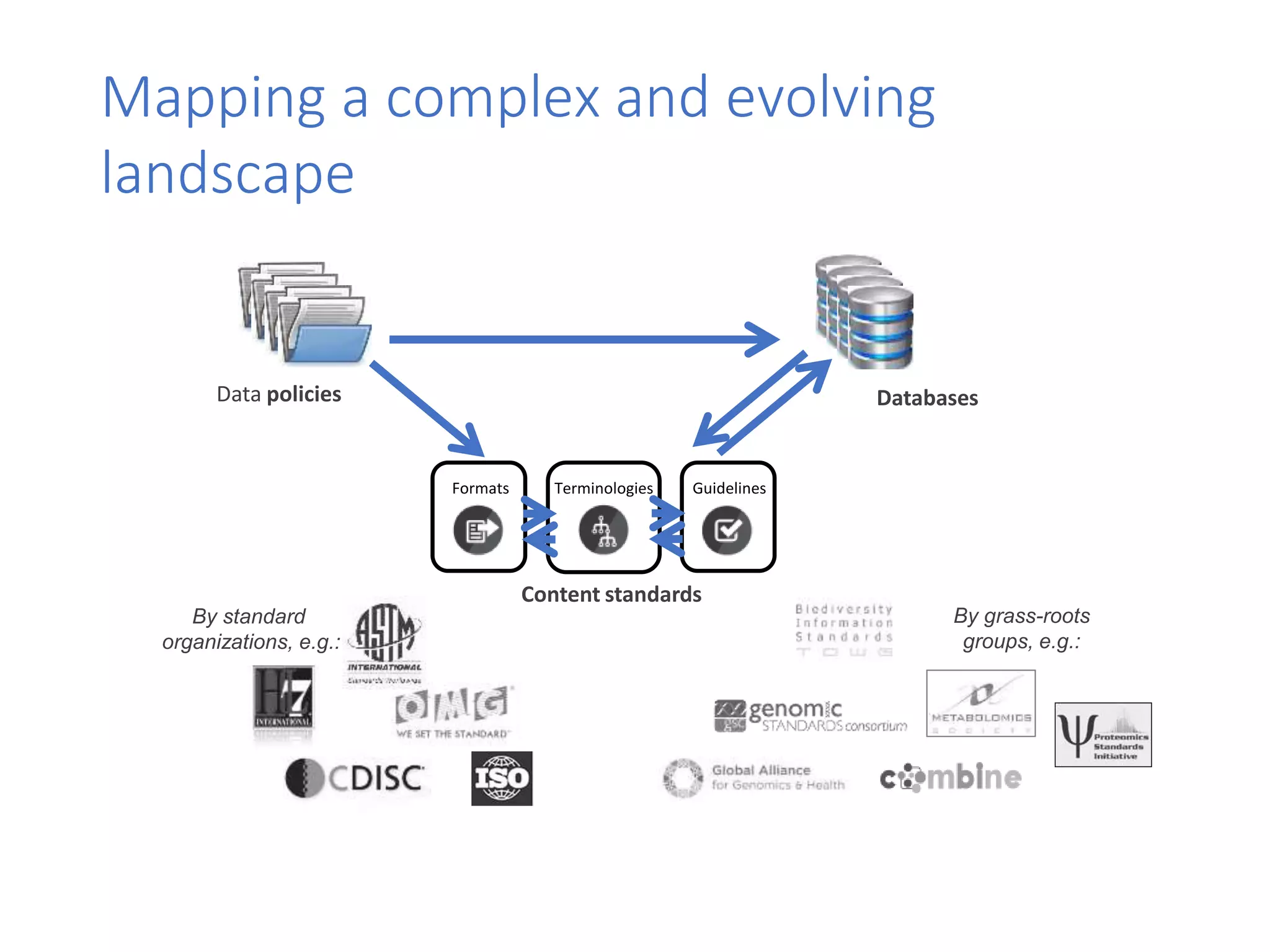
Data policies Databases
Content standards
Formats Terminologies Guidelines
Models/Formats = Conceptual
model, conceptual schema,
exchange formats
Terminologies = Controlled
vocabularies, taxonomies,
thesauri, ontologies etc.
Guidelines = Minimum information
reporting requirements, checklists
Mapping a complex and evolving
landscape
Content standards
Data policies Databases
Formats Terminologies Guidelines
By grass-roots
groups, e.g.:
By standard
organizations, e.g.:
Mapping a complex and evolving
landscape
My funder’s data policy recommends the use of established
standards, but which are widely endorsed and applicable to
my crop data?
We need a standard for sharing
social science data, what’s out there
and who should we talk to?
I have some old rice genomic data in
format X, which is now deprecated;
what format has replaced X?
Which are the mature standards and
standards-compliant databases that
we should recommend to our authors?
How can FAIRsharing help you?
Data Policy
FAIRsharing visualizes relationships
• For more information on FAIR/BioSharing, please see our database paper:
• FAIRsharing is developing an API and shares data with a number of other resources
including the ELIXIR TeSS training portal and the Japanese Integbio database catalogue
• FAIRsharing works with publishers and funders to create and refine their data policies
• FAIRsharing is an ELIXIR-UK contributed resource and has active community working
groups in Research Data Alliance and Force11
• Go to https://fairsharing.org/new/ to add your standard, data repository or policy to
FAIRsharing.

OSFair2017 Workshop | FAIRSharing

  • 1.
    Rafael C Jimenez onbehalf of Peter McQuilton, Susanna-Assunta Sansone and the FAIRsharing team
  • 2.
    A web-based, curated,and searchable portal that monitors the development and evolution of data and metadata standards, across all disciplines, inter-related to databases/repositories and data policies FAIRsharing has grown organically from BioSharing.org, which covered standards, databases and policies in the life, environmental and biomedical sciences. All data is manually curated and reviewed by FAIRsharing curators and the maintainers of the resources themselves * *
  • 4.
    Data policies Databases Contentstandards Formats Terminologies Guidelines Models/Formats = Conceptual model, conceptual schema, exchange formats Terminologies = Controlled vocabularies, taxonomies, thesauri, ontologies etc. Guidelines = Minimum information reporting requirements, checklists Mapping a complex and evolving landscape
  • 5.
    Content standards Data policiesDatabases Formats Terminologies Guidelines By grass-roots groups, e.g.: By standard organizations, e.g.: Mapping a complex and evolving landscape
  • 6.
    My funder’s datapolicy recommends the use of established standards, but which are widely endorsed and applicable to my crop data? We need a standard for sharing social science data, what’s out there and who should we talk to? I have some old rice genomic data in format X, which is now deprecated; what format has replaced X? Which are the mature standards and standards-compliant databases that we should recommend to our authors? How can FAIRsharing help you?
  • 7.
  • 8.
    • For moreinformation on FAIR/BioSharing, please see our database paper: • FAIRsharing is developing an API and shares data with a number of other resources including the ELIXIR TeSS training portal and the Japanese Integbio database catalogue • FAIRsharing works with publishers and funders to create and refine their data policies • FAIRsharing is an ELIXIR-UK contributed resource and has active community working groups in Research Data Alliance and Force11 • Go to https://fairsharing.org/new/ to add your standard, data repository or policy to FAIRsharing.

Editor's Notes

  • #4 This is the homepage, which you’ll find if you go to FAIRsharing.org. I’m not going to go through it, other than to say that it allows various ways in which you can enter the data (top part), and gives access to a number of search tools (dark blue banner across the middle). I want to draw your attention though to the section at the bottom here (highlighted), which gives you an idea as to the scale and type of resources currently curated on FAIRsharing.
  • #5 In the centre we have the Content standards: these descriptors are essential for the interpretation, verification, reproducibility, sharing etc. of datasets. We've split them into three. Models – e.g. FASTA - protein and nucleotide sequence Terminologies – e.g. Gene Ontologies - Biological Process, Cellular Component, Molecular Function Guidelines – e.g. ARRIVE for in vivo animal testing
  • #6 But where do these content standards come from? Some are created by Standard Organisations, which design and implement standards for a particular domain, e.g. CDISC for clinical standards; Others are more grass-root, community groups, such as combine for computational biology and the genomics standards consortium for genomics.
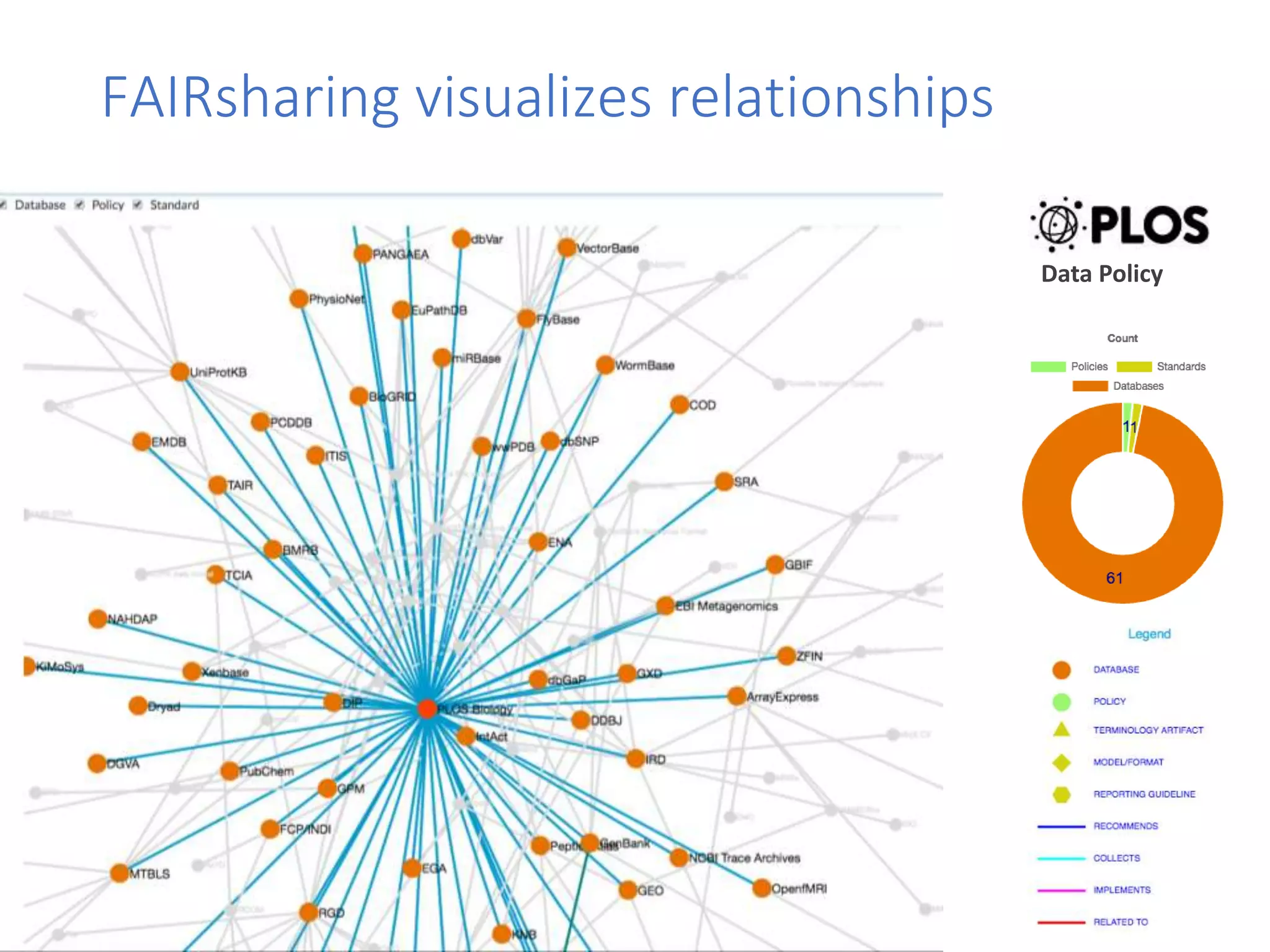
  • #8 This is the PLOS Publisher’s data policy (red dot in centre), with the related data repositories and standards mentioned therein.