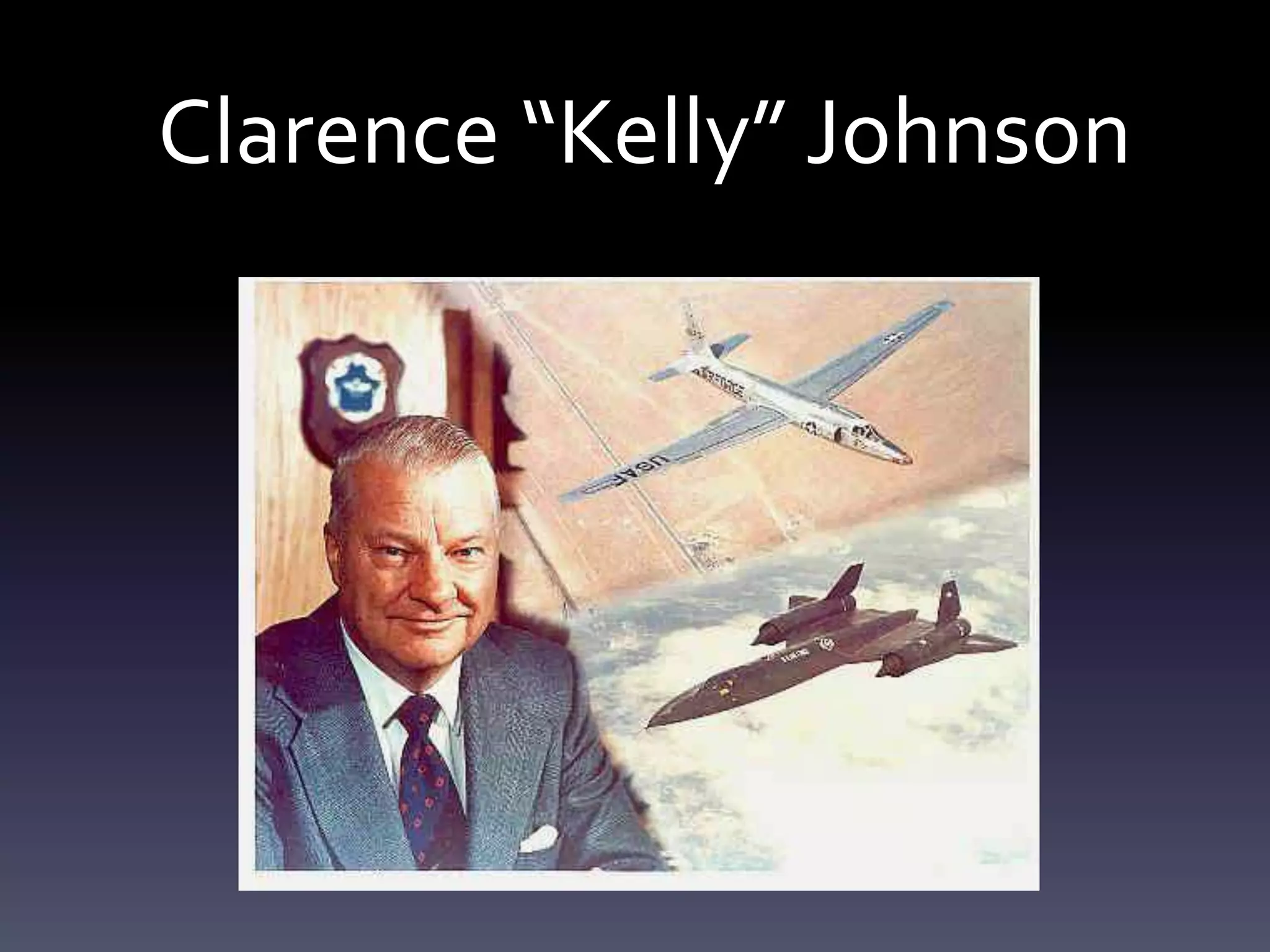
Clarence “Kelly” Johnson
Kelly Johnson’s Career
• While atThe University of Michigan, he did wind tunnel tests for Lockheed’s
Electra aircraft and found the plane had instability issues. His professor did not
agree.
• After completing his Masters, he joined Lockheed in 1933. He urged Hal Hibbard
that the Electra had instability issues. Hibbard allowed Johnson to conduct more
tests.
• Johnson’s changes to the Electra Model 10 were implemented and he was
promoted aeronautical engineer.
• In 1956, he becomes theVP of Research and Development
• In 1958, Kelly becomes theVP of Advanced Research and Development
• He becomesVP of Lockheed in 1969
• He remains on the board of Lockheed Martin from 1964 to 1980.
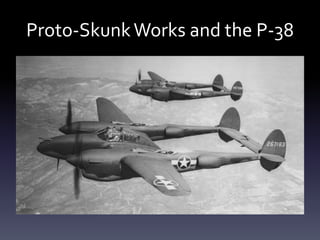
Proto-SkunkWorks and the P-38
• In 1938, Lockheed had Kelly and Hal Hibbard lead a team to develop the P-38 in a
sectioned-off area of Lockheed’s Burbank facility that was off-limits to anyone not
working on the project
• The P-38 was first flown in 1939 and was the fastest attack aircraft then built.
• Many of the top pilots of the war flew P-38s. It was the primary fight in the
Southwest Pacific theater. Most P-38s were lost to bad weather, not to enemies
• Kelly’s team designed a long range “drop tank” for the plane before it was
requested. When the military later approached Lockheed about long range full
tanks, Kelly already had the solution
• It was the primary long range fighter until the P-51 Mustang was introduced
• The P-38 was the only plane to be in production for the entirety of the war,
numbering more than 10,000 built. It was retired in 1965
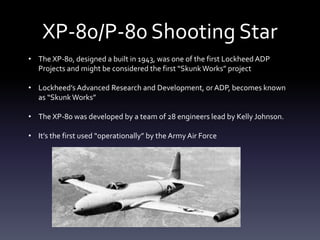
XP-80/P-80 Shooting Star
• The XP-80, designed a built in 1943, was one of the first Lockheed ADP
Projects and might be considered the first “SkunkWorks” project
• Lockheed’s Advanced Research and Development, or ADP, becomes known
as “SkunkWorks”
• The XP-80 was developed by a team of 28 engineers lead by Kelly Johnson.
• It’s the first used “operationally” by the Army Air Force
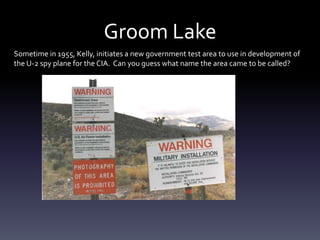
Groom Lake
Sometime in 1955, Kelly, initiates a new government test area to use in development of
the U-2 spy plane for the CIA. Can you guess what name the area came to be called?
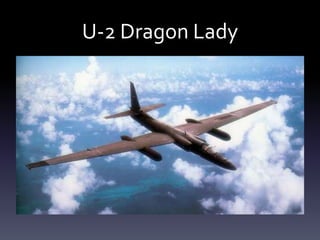
U-2 Dragon Lady
Lockheed U-2 “Dragon Lady”
• AfterWorldWar II, there were no current intelligence photos of the
Soviet Union
• Spy Satellites didn’t exist
• It was believed that Soviet radar could not reach about 65,000 FT.
• The highest altitude a Soviet plane could reach was 45,000 FT
• The CIA approached Lockheed to design a plane that could fly above
Soviet radar and take photos of sensitive locations
• Kelly Johnson designs the aircraft, using a jet engine from a previous
plane, and uses long, glider like wings that are 103 feet long
• It first flies in 1955 and becomes operational in 1957
• It can fly above 70K feet and cruise 420 miles per hour for around 6,500
miles
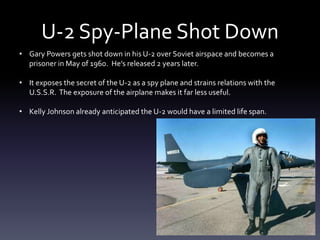
U-2 Spy-Plane Shot Down
• Gary Powers gets shot down in his U-2 over Soviet airspace and becomes a
prisoner in May of 1960. He’s released 2 years later.
• It exposes the secret of the U-2 as a spy plane and strains relations with the
U.S.S.R. The exposure of the airplane makes it far less useful.
• Kelly Johnson already anticipated the U-2 would have a limited life span.
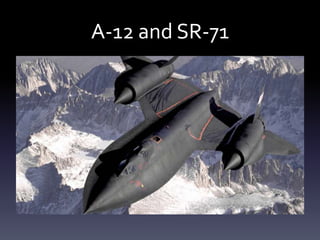
A-12 and SR-71
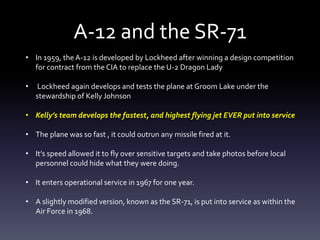
A-12 and the SR-71
• In 1959, the A-12 is developed by Lockheed after winning a design competition
for contract from the CIA to replace the U-2 Dragon Lady
• Lockheed again develops and tests the plane at Groom Lake under the
stewardship of Kelly Johnson
• Kelly’s team develops the fastest, and highest flying jet EVER put into service
• The plane was so fast , it could outrun any missile fired at it.
• It’s speed allowed it to fly over sensitive targets and take photos before local
personnel could hide what they were doing.
• It enters operational service in 1967 for one year.
• A slightly modified version, known as the SR-71, is put into service as within the
Air Force in 1968.
Why was he an intrepreneur
• Kelly worked within Lockheed. He didn’t own the company he
worked for, but they gave him the freedom to sort of exist as
company within a company
• SkunkWorks is essentially a sandbox of development.
• Kelly SkunkWork teams were given a set of goals or task, and that
was their only instruction. Their job was (and is) to fulfill the goal.
No limitations really existed. Kelly maintained this attitude when he
becameVP of ADP
• SkunkWorks was known to take on projects before a formal
contract would arrive.
• Additionally, Kelly and his teams would anticipate their buyer, and
have solutions before solicited
Kelly’s Legacy
• Kelly’s work has inspired UFO stories of all kinds. Area 51 is known throughout the
world as a sort of mythological place where science fiction happens.
• In truth, it was a few geniuses in the desert playing with the best toys while trying to
accomplish some incredibly advanced goals
• As far as we know, this tradition continues to this day
• The B-2 Stealth Bomber,The f-117 Stealth Fighter, and many other aircraft were tested
and developed at Groom Lake. Some of the technologies there have made their way
into our everyday lives
• The SR-71 was retired in 1990…
Any Questions?

Kelly johnson

  • 1.
  • 2.
    Kelly Johnson’s Career •While atThe University of Michigan, he did wind tunnel tests for Lockheed’s Electra aircraft and found the plane had instability issues. His professor did not agree. • After completing his Masters, he joined Lockheed in 1933. He urged Hal Hibbard that the Electra had instability issues. Hibbard allowed Johnson to conduct more tests. • Johnson’s changes to the Electra Model 10 were implemented and he was promoted aeronautical engineer. • In 1956, he becomes theVP of Research and Development • In 1958, Kelly becomes theVP of Advanced Research and Development • He becomesVP of Lockheed in 1969 • He remains on the board of Lockheed Martin from 1964 to 1980.
  • 3.
  • 4.
    • In 1938,Lockheed had Kelly and Hal Hibbard lead a team to develop the P-38 in a sectioned-off area of Lockheed’s Burbank facility that was off-limits to anyone not working on the project • The P-38 was first flown in 1939 and was the fastest attack aircraft then built. • Many of the top pilots of the war flew P-38s. It was the primary fight in the Southwest Pacific theater. Most P-38s were lost to bad weather, not to enemies • Kelly’s team designed a long range “drop tank” for the plane before it was requested. When the military later approached Lockheed about long range full tanks, Kelly already had the solution • It was the primary long range fighter until the P-51 Mustang was introduced • The P-38 was the only plane to be in production for the entirety of the war, numbering more than 10,000 built. It was retired in 1965
  • 5.
    XP-80/P-80 Shooting Star •The XP-80, designed a built in 1943, was one of the first Lockheed ADP Projects and might be considered the first “SkunkWorks” project • Lockheed’s Advanced Research and Development, or ADP, becomes known as “SkunkWorks” • The XP-80 was developed by a team of 28 engineers lead by Kelly Johnson. • It’s the first used “operationally” by the Army Air Force
  • 6.
    Groom Lake Sometime in1955, Kelly, initiates a new government test area to use in development of the U-2 spy plane for the CIA. Can you guess what name the area came to be called?
  • 7.
  • 8.
    Lockheed U-2 “DragonLady” • AfterWorldWar II, there were no current intelligence photos of the Soviet Union • Spy Satellites didn’t exist • It was believed that Soviet radar could not reach about 65,000 FT. • The highest altitude a Soviet plane could reach was 45,000 FT • The CIA approached Lockheed to design a plane that could fly above Soviet radar and take photos of sensitive locations • Kelly Johnson designs the aircraft, using a jet engine from a previous plane, and uses long, glider like wings that are 103 feet long • It first flies in 1955 and becomes operational in 1957 • It can fly above 70K feet and cruise 420 miles per hour for around 6,500 miles
  • 9.
    U-2 Spy-Plane ShotDown • Gary Powers gets shot down in his U-2 over Soviet airspace and becomes a prisoner in May of 1960. He’s released 2 years later. • It exposes the secret of the U-2 as a spy plane and strains relations with the U.S.S.R. The exposure of the airplane makes it far less useful. • Kelly Johnson already anticipated the U-2 would have a limited life span.
  • 10.
  • 11.
    A-12 and theSR-71 • In 1959, the A-12 is developed by Lockheed after winning a design competition for contract from the CIA to replace the U-2 Dragon Lady • Lockheed again develops and tests the plane at Groom Lake under the stewardship of Kelly Johnson • Kelly’s team develops the fastest, and highest flying jet EVER put into service • The plane was so fast , it could outrun any missile fired at it. • It’s speed allowed it to fly over sensitive targets and take photos before local personnel could hide what they were doing. • It enters operational service in 1967 for one year. • A slightly modified version, known as the SR-71, is put into service as within the Air Force in 1968.
  • 12.
    Why was hean intrepreneur • Kelly worked within Lockheed. He didn’t own the company he worked for, but they gave him the freedom to sort of exist as company within a company • SkunkWorks is essentially a sandbox of development. • Kelly SkunkWork teams were given a set of goals or task, and that was their only instruction. Their job was (and is) to fulfill the goal. No limitations really existed. Kelly maintained this attitude when he becameVP of ADP • SkunkWorks was known to take on projects before a formal contract would arrive. • Additionally, Kelly and his teams would anticipate their buyer, and have solutions before solicited
  • 13.
    Kelly’s Legacy • Kelly’swork has inspired UFO stories of all kinds. Area 51 is known throughout the world as a sort of mythological place where science fiction happens. • In truth, it was a few geniuses in the desert playing with the best toys while trying to accomplish some incredibly advanced goals • As far as we know, this tradition continues to this day • The B-2 Stealth Bomber,The f-117 Stealth Fighter, and many other aircraft were tested and developed at Groom Lake. Some of the technologies there have made their way into our everyday lives • The SR-71 was retired in 1990…
  • 14.