1	

Tél : +33 (0)1 58 56 10 00
Fax : +33 (0)1 58 56 10 01
www.octo.com© OCTO 2015
50, avenue des Champs-Elysées
75008 Paris - FRANCE
Top 7 wrong common beliefs
about Enterprise API
implementation
2	

Mohamed KISSA
API	
  Consultant	


  mkissa@octo.com	


  @MedKissa	
  
Antoine CHANTALOU
Head	
  of	
  WOA	
  &	
  API	


  achantalou@octo.com	


  @achantalou	
  
3	

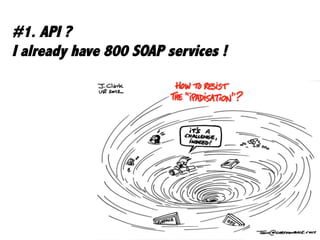
#1. API ?
I already have 800 SOAP services !
4	

SOAP
vs
REST
5	

Nick Gall [VP Gartner Group]
! “WS-* style Web Services are "Web" in name only…
! The W3C should extricate itself from further direct work on SOAP, WDSL, or
any other WS-* specifications”
David Orchard [Web Services standards – BEA]
! “Given the complexity of just SOAP and WSDL, how many developers will
really be able to move to the full stack?...
! The promise of WSDL 2.0 has not materialized and is unlikely to do so”
Paul Downey [Technical Architect at the Government Digital Service]
! “The SOAP "stack" is a mess, and currently only the simplest of services are
able to interoperate”
Steve Loughran [Apache Axis commiter]
! “The only place SOAP survives is in the enterprise because you can control
both ends of the conversation, you can use the same toolkit and eliminate
interop”
Steve Vinoski [Former VP & Chief Architect of IONA Technologies]
! “if I were an enterprise architect today…I’d be looking to solve everything I
possibly could with dynamic languages and REST
! I’d avoid ESBs and the typical enterprise middleware frameworks unless I had a
problem that really required them. I’d also try to totally avoid SOAP and WS-*”
SOAP vs REST
6	

SOAP vs REST
It’s about architecture
Style
7	

SOAP vs REST
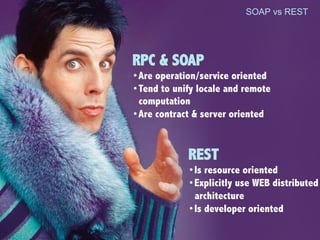
RPC & SOAP
• Are operation/service oriented
• Tend to unify locale and remote
computation
• Are contract & server oriented
REST
• Is resource oriented
• Explicitly use WEB distributed
architecture
• Is developer oriented
8	

SOAP vs REST
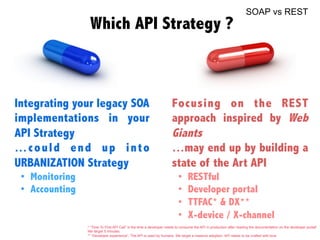
Integrating your legacy SOA
implementations in your
API Strategy
…could end up into
URBANIZATION Strategy
•  Monitoring
•  Accounting
Focusing on the REST
approach inspired by Web
Giants
…may end up by building a
state of the Art API
•  RESTful
•  Developer portal
•  TTFAC* & DX**
•  X-device / X-channel
* “Time To First API Call” is the time a developer needs to consume the API in production after reading the documentation on the developer portal!
We target 5 minutes.
** “Developer experience”. The API is used by humans. We target a massive adoption. API needs to be crafted with love.
Which API Strategy ?
9	

SOAP vs REST
10	

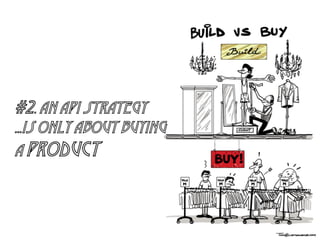
#2. An API strategy
…is only about buying
a product
11	

Build vs Buy
Cheaper resources
Unique,
differentiating
Perceived
as a
competitive
advantage
Common to all
companies in the sector
Perceived as a
production asset
BPO*
Common to all companies
Perceived as a resource
Strategic assets and fast innovation
*Business Process Outsourcing
API PORTALS & SECURITY
API
! The API becomes the main entry point
to your CORE IT
! Critical & differentiating components
! A Key to a competitive advantage
! API Management are ineffective to
build good API
! API Management portal
! Resource publication & versioning
! Usage Statistics
! Quotas
! Developers’ portal
! Developers enrolment
! API documentation
! Security
! OAuth2 / OpenID connect
12	

#3. API Management
…it’s an ESB right?
13	

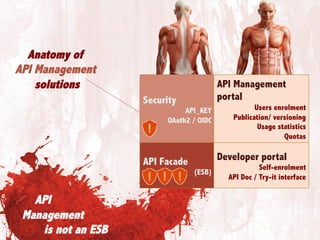
Anatomy of
API Management
solutions
API
Management
is not an ESB
Security
API_KEY
OAuth2 / OIDC
API Facade
(ESB)
API Management
portal
Users enrolment
Publication/ versioning
Usage statistics
Quotas
Developer portal
Self-enrolment
API Doc / Try-it interface
14	

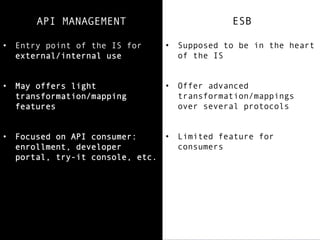
ESB et API Management
API MANAGEMENT
•  Entry point of the IS for
external/internal use
•  May offers light
transformation/mapping
features
•  Focused on API consumer:
enrollment, developer
portal, try-it console, etc.
ESB
•  Supposed to be in the heart
of the IS
•  Offer advanced
transformation/mappings
over several protocols
•  Limited feature for
consumers
15	

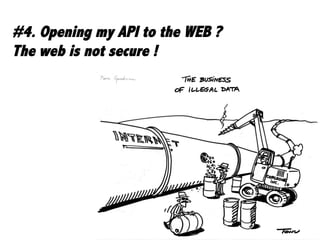
#4. Opening my API to the WEB ?
The web is not secure !
16	

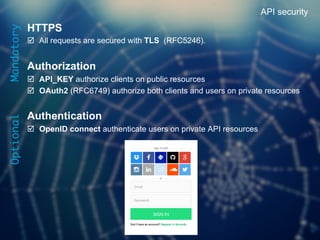
HTTPS
þ  All requests are secured with TLS (RFC5246).
Authorization
þ  API_KEY authorize clients on public resources
þ  OAuth2 (RFC6749) authorize both clients and users on private resources
Authentication
þ  OpenID connect authenticate users on private API resources
API securityMandatory
Optional
17	

« Everything
should be
made as
simple as
possible,
but not
simpler.»
A.Einstein
API security
18	

Beware of OAuth2
complexity
v  OAuth2 out-of-the-box
implementation almost
never work without
specifics developments
v  OAuth2 flows are
often partially
implemented
v  Four flows must be
POCed
API security
19	

API security
What about other
protocols ?
•  Don’t use other legacy protocols
•  OAuth1, SAML2, etc.
•  Don’t use encryption/signatures on
the applicative side
•  Don’t implement customs security
solutions
20	

#5. API facade is the right pattern !
21	

+ Short time to market (good for a
MVP)
- Put dependency toward the API
Management/ESB editor
- May not handle the complexity of
your business logic
- A performance overhead should be
considered
- The API Management/ESB and your
existing service become highly
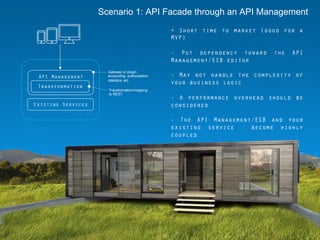
coupled
IS
Existing Services
API Management
Gateway or plugin
accounting, authorization,
statistics, etc.
Transformation/mapping
to REST
Scenario 1: API Facade through an API Management
Transformation
22	

+ Short time to market (good for a
MVP)
+ Will handle the complexity of
your business logic
- A performance overhead should be
considered
- The facade and your existing
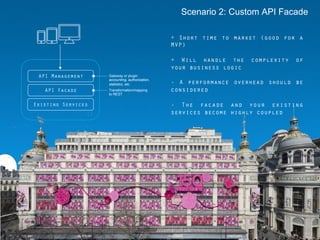
services become highly coupledIS
Existing Services
API Facade
API Management Gateway or plugin
accounting, authorization,
statistics, etc.
Transformation/mapping
to REST
Scenario 2: Custom API Facade
23	

A great API on
bad services
is lipstick on a pig
API Facade pattern
24	

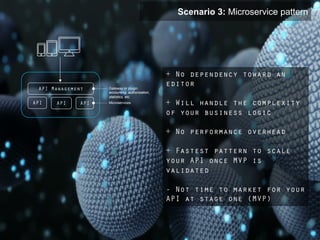
Scenario 3: Microservice pattern
+ No dependency toward an
editor
+ Will handle the complexity
of your business logic
+ No performance overhead
+ Fastest pattern to scale
your API once MVP is
validated
- Not time to market for your
API at stage one (MVP)
IS
API
API Management
Microservices
Gateway or plugin
accounting, authorization,
statistics, etc.
API API
25	

#6. API strategy?
It’s just
technical !
26	

API technical stakes
•  Security, stateless, asyncronisme, non-transactional,
microservices, cloud hosting, ect.
API functional stakes
•  API design
•  Identify enterprise’ resources (X-channels, X-device)
•  Building a REST API state diagram
•  HATEOAS
API organizational stakes
•  Conway’s Law : “Any organization that designs a system
[...] will inevitably produce a design whose structure is a
copy of the organization's communication structure”
•  Organize your teams as you would like your IT system to
be !
API 360 impacts
API 360 impacts
27	

API 360 impacts
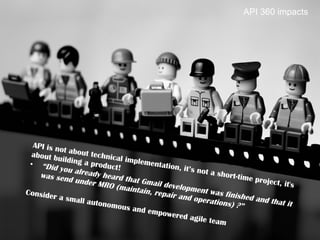
API is not about technical implementation, it’s not a short-time project, it's
about building a product!•  “Did you already heard that Gmail development was finished and that it
was send under MRO (maintain, repair and operations) ?”
Consider a small autonomous and empowered agile team
28	

API 360 impacts
Product Owner [Business]
•  Sync development with other
teams
•  Responsible for API success
•  Define Follow-up indicators
•  Mesure, learn and build
Tech-lead / Devs [IT]
•  Design & develop API
resources
•  Write API documentation
•  Measure and improve API
performance
•  Write unit automated test
A
P
I
S
Q
U
A
D
Business analysts
[Business/IT]
•  Co-design API resources
•  Write automated
functional tests (TDR)
OPS [IT]
•  Automated testing
•  Automated deployment
•  Scalability (elasticity)
and SLA
Community manager
[Marketing]
•  Animate External Developers
community (API users)
•  Social networking
•  Administrate developer portal
29	

#7. I want to build an API for me & my partners,
but I’m NOT interested in OPEN API !
30	

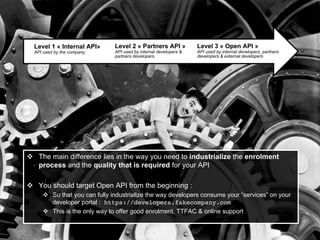
v  The main difference lies in the way you need to industrialize the enrolment
process and the quality that is required for your API
v  You should target Open API from the beginning :
v  So that you can fully industrialize the way developers consume your “services” on your
developer portal : https://developers.fakecompany.com!
v  This is the only way to offer good enrolment, TTFAC & online support
Level 1 « Internal API»
API used by the company
Level 2 « Partners API »
API used by internal developers &
partners developers
Level 3 « Open API »
API used by internal developers, partners
developers & external developers
31	

Tél : +33 (0)1 58 56 10 00
Fax : +33 (0)1 58 56 10 01
www.octo.com© OCTO 2015
50, avenue des Champs-Elysées
75008 Paris - FRANCE
Thank you !
Mohamed KISSA
API	
  Consultant	
  
@OCTO	
  Technology	


  mkissa@octo.com	


  @MedKissa	
  
Antoine CHANTALOU
Head	
  of	
  WOA	
  &	
  API	
  
@OCTO	
  Technology	


  achantalou@octo.com	


  @achantalou	
  

Top 7 wrong common beliefs about Enterprise API implementation

  • 1.
    1 Tél : +33(0)1 58 56 10 00 Fax : +33 (0)1 58 56 10 01 www.octo.com© OCTO 2015 50, avenue des Champs-Elysées 75008 Paris - FRANCE Top 7 wrong common beliefs about Enterprise API implementation
  • 2.
    2 Mohamed KISSA API  Consultant                          mkissa@octo.com                                @MedKissa   Antoine CHANTALOU Head  of  WOA  &  API                          achantalou@octo.com                                @achantalou  
  • 3.
    3 #1. API ? Ialready have 800 SOAP services !
  • 4.
  • 5.
    5 Nick Gall [VPGartner Group] ! “WS-* style Web Services are "Web" in name only… ! The W3C should extricate itself from further direct work on SOAP, WDSL, or any other WS-* specifications” David Orchard [Web Services standards – BEA] ! “Given the complexity of just SOAP and WSDL, how many developers will really be able to move to the full stack?... ! The promise of WSDL 2.0 has not materialized and is unlikely to do so” Paul Downey [Technical Architect at the Government Digital Service] ! “The SOAP "stack" is a mess, and currently only the simplest of services are able to interoperate” Steve Loughran [Apache Axis commiter] ! “The only place SOAP survives is in the enterprise because you can control both ends of the conversation, you can use the same toolkit and eliminate interop” Steve Vinoski [Former VP & Chief Architect of IONA Technologies] ! “if I were an enterprise architect today…I’d be looking to solve everything I possibly could with dynamic languages and REST ! I’d avoid ESBs and the typical enterprise middleware frameworks unless I had a problem that really required them. I’d also try to totally avoid SOAP and WS-*” SOAP vs REST
  • 6.
    6 SOAP vs REST It’sabout architecture Style
  • 7.
    7 SOAP vs REST RPC& SOAP • Are operation/service oriented • Tend to unify locale and remote computation • Are contract & server oriented REST • Is resource oriented • Explicitly use WEB distributed architecture • Is developer oriented
  • 8.
    8 SOAP vs REST Integratingyour legacy SOA implementations in your API Strategy …could end up into URBANIZATION Strategy •  Monitoring •  Accounting Focusing on the REST approach inspired by Web Giants …may end up by building a state of the Art API •  RESTful •  Developer portal •  TTFAC* & DX** •  X-device / X-channel * “Time To First API Call” is the time a developer needs to consume the API in production after reading the documentation on the developer portal! We target 5 minutes. ** “Developer experience”. The API is used by humans. We target a massive adoption. API needs to be crafted with love. Which API Strategy ?
  • 9.
  • 10.
    10 #2. An APIstrategy …is only about buying a product
  • 11.
    11 Build vs Buy Cheaperresources Unique, differentiating Perceived as a competitive advantage Common to all companies in the sector Perceived as a production asset BPO* Common to all companies Perceived as a resource Strategic assets and fast innovation *Business Process Outsourcing API PORTALS & SECURITY API ! The API becomes the main entry point to your CORE IT ! Critical & differentiating components ! A Key to a competitive advantage ! API Management are ineffective to build good API ! API Management portal ! Resource publication & versioning ! Usage Statistics ! Quotas ! Developers’ portal ! Developers enrolment ! API documentation ! Security ! OAuth2 / OpenID connect
  • 12.
  • 13.
    13 Anatomy of API Management solutions API Management isnot an ESB Security API_KEY OAuth2 / OIDC API Facade (ESB) API Management portal Users enrolment Publication/ versioning Usage statistics Quotas Developer portal Self-enrolment API Doc / Try-it interface
  • 14.
    14 ESB et APIManagement API MANAGEMENT •  Entry point of the IS for external/internal use •  May offers light transformation/mapping features •  Focused on API consumer: enrollment, developer portal, try-it console, etc. ESB •  Supposed to be in the heart of the IS •  Offer advanced transformation/mappings over several protocols •  Limited feature for consumers
  • 15.
    15 #4. Opening myAPI to the WEB ? The web is not secure !
  • 16.
    16 HTTPS þ  All requestsare secured with TLS (RFC5246). Authorization þ  API_KEY authorize clients on public resources þ  OAuth2 (RFC6749) authorize both clients and users on private resources Authentication þ  OpenID connect authenticate users on private API resources API securityMandatory Optional
  • 17.
    17 « Everything should be made as simpleas possible, but not simpler.» A.Einstein API security
  • 18.
    18 Beware of OAuth2 complexity v OAuth2 out-of-the-box implementation almost never work without specifics developments v  OAuth2 flows are often partially implemented v  Four flows must be POCed API security
  • 19.
    19 API security What aboutother protocols ? •  Don’t use other legacy protocols •  OAuth1, SAML2, etc. •  Don’t use encryption/signatures on the applicative side •  Don’t implement customs security solutions
  • 20.
    20 #5. API facadeis the right pattern !
  • 21.
    21 + Short timeto market (good for a MVP) - Put dependency toward the API Management/ESB editor - May not handle the complexity of your business logic - A performance overhead should be considered - The API Management/ESB and your existing service become highly coupled IS Existing Services API Management Gateway or plugin accounting, authorization, statistics, etc. Transformation/mapping to REST Scenario 1: API Facade through an API Management Transformation
  • 22.
    22 + Short timeto market (good for a MVP) + Will handle the complexity of your business logic - A performance overhead should be considered - The facade and your existing services become highly coupledIS Existing Services API Facade API Management Gateway or plugin accounting, authorization, statistics, etc. Transformation/mapping to REST Scenario 2: Custom API Facade
  • 23.
    23 A great APIon bad services is lipstick on a pig API Facade pattern
  • 24.
    24 Scenario 3: Microservicepattern + No dependency toward an editor + Will handle the complexity of your business logic + No performance overhead + Fastest pattern to scale your API once MVP is validated - Not time to market for your API at stage one (MVP) IS API API Management Microservices Gateway or plugin accounting, authorization, statistics, etc. API API
  • 25.
  • 26.
    26 API technical stakes • Security, stateless, asyncronisme, non-transactional, microservices, cloud hosting, ect. API functional stakes •  API design •  Identify enterprise’ resources (X-channels, X-device) •  Building a REST API state diagram •  HATEOAS API organizational stakes •  Conway’s Law : “Any organization that designs a system [...] will inevitably produce a design whose structure is a copy of the organization's communication structure” •  Organize your teams as you would like your IT system to be ! API 360 impacts API 360 impacts
  • 27.
    27 API 360 impacts APIis not about technical implementation, it’s not a short-time project, it's about building a product!•  “Did you already heard that Gmail development was finished and that it was send under MRO (maintain, repair and operations) ?” Consider a small autonomous and empowered agile team
  • 28.
    28 API 360 impacts ProductOwner [Business] •  Sync development with other teams •  Responsible for API success •  Define Follow-up indicators •  Mesure, learn and build Tech-lead / Devs [IT] •  Design & develop API resources •  Write API documentation •  Measure and improve API performance •  Write unit automated test A P I S Q U A D Business analysts [Business/IT] •  Co-design API resources •  Write automated functional tests (TDR) OPS [IT] •  Automated testing •  Automated deployment •  Scalability (elasticity) and SLA Community manager [Marketing] •  Animate External Developers community (API users) •  Social networking •  Administrate developer portal
  • 29.
    29 #7. I wantto build an API for me & my partners, but I’m NOT interested in OPEN API !
  • 30.
    30 v  The maindifference lies in the way you need to industrialize the enrolment process and the quality that is required for your API v  You should target Open API from the beginning : v  So that you can fully industrialize the way developers consume your “services” on your developer portal : https://developers.fakecompany.com! v  This is the only way to offer good enrolment, TTFAC & online support Level 1 « Internal API» API used by the company Level 2 « Partners API » API used by internal developers & partners developers Level 3 « Open API » API used by internal developers, partners developers & external developers
  • 31.
    31 Tél : +33(0)1 58 56 10 00 Fax : +33 (0)1 58 56 10 01 www.octo.com© OCTO 2015 50, avenue des Champs-Elysées 75008 Paris - FRANCE Thank you ! Mohamed KISSA API  Consultant   @OCTO  Technology                          mkissa@octo.com                                @MedKissa   Antoine CHANTALOU Head  of  WOA  &  API   @OCTO  Technology                          achantalou@octo.com                                @achantalou