21.09.2019
Knowledge Engineering
Introduction to
Knowledge Engineering
Knowledge Engineering - Natig Vahabov 2
scientia potentia est
Knowledge Engineering - Natig Vahabov 3
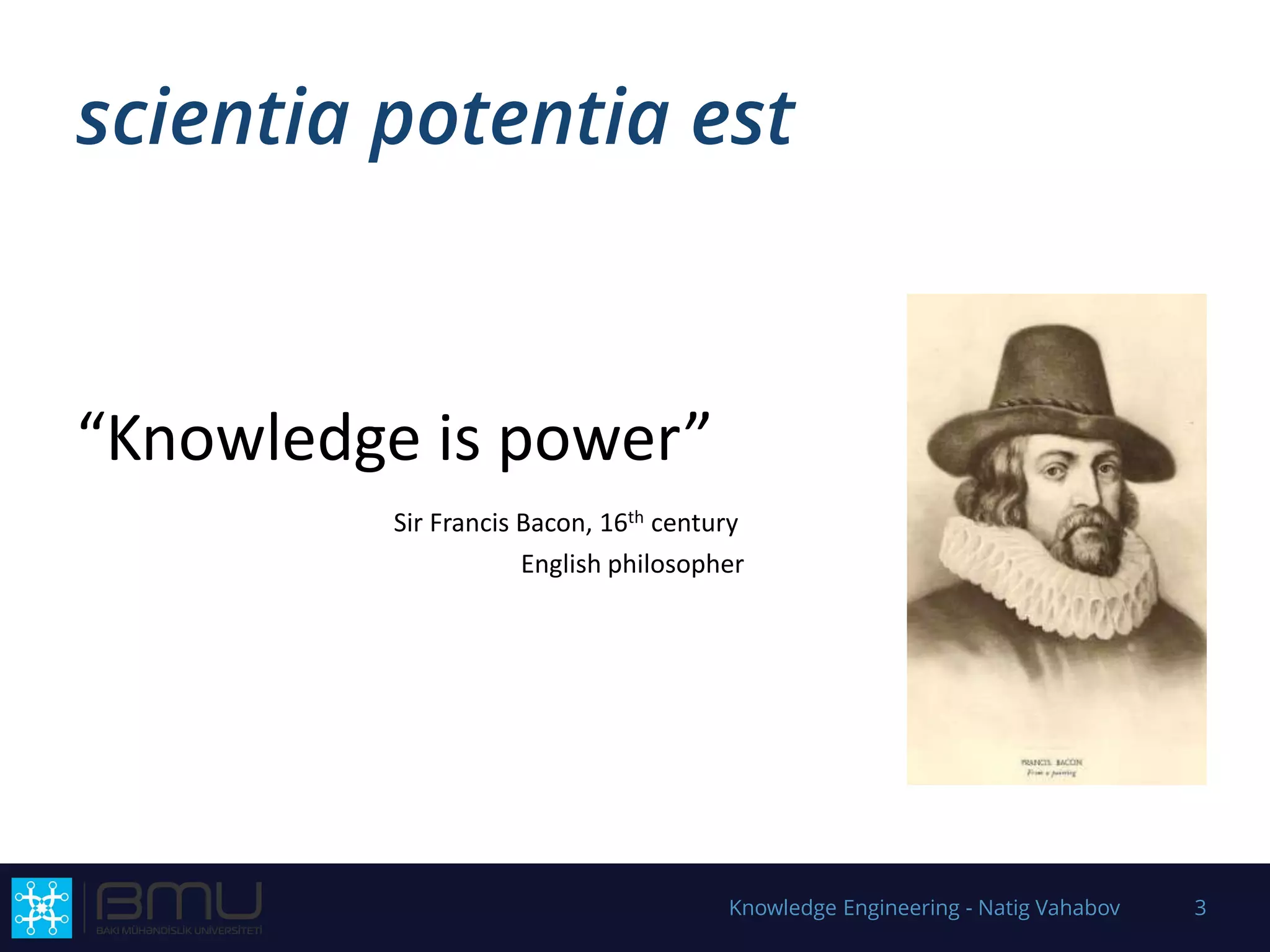
“Knowledge is power”
Sir Francis Bacon, 16th century
English philosopher
Agenda
• Knowledge as a weapon
• Knowledge pyramid
• Information Processing Views of Knowledge
• Philosophy of knowledge
– Plato’s Formula, Gettier Problem
• Taxonomies of knowledge
– Types, Classifications, Levels
• Knowledge Creation
– SECI Model
• Knowledge Engineering
– History, MYCIN, KBS, Knowledge Steps, FOL, Semantic Network, Views
• CommonKADS
• Roles in Knowledge Engineering
Knowledge Engineering - Natig Vahabov 4
Knowledge as a weapon
In 2017, China’s government put out its plan to lead the
world in AI by 2030
By the end of 2019, with a $14 trillion GDP(gross
domestic product), China is predicted to account for
over 35 % of global economic growth. AI’s deployment
will add $15.7 trillion to the global GDP by 2030.
What are 4 main factors help China to become a world
giant?
Knowledge Engineering - Natig Vahabov 5
Knowledge as a weapon
• Mass government funding and support
– Government have already spent more than $300 billion
Knowledge Engineering - Natig Vahabov 6
Knowledge as a weapon
• Mass government funding and support
– Government have already spent more than $300 billion
• Hungry entrepreneurs
– AI giant Alibaba has unveiled plans to invest $15 billion in international
research labs from the US to Israel, with others following suit
Knowledge Engineering - Natig Vahabov 7
Knowledge as a weapon
• Mass government funding and support
– Government have already spent more than $300 billion
• Hungry entrepreneurs
– AI giant Alibaba has unveiled plans to invest $15 billion in international
research labs from the US to Israel, with others following suit
• Growing AI expertise
– Meanwhile, Baidu, Didi, and Tencent have all set up their own research labs.
China’s Face++ now leads the world in face and image recognition AI, beating
out top teams from Google, Microsoft and Facebook at the 2017 COCO
image-recognition competition
Knowledge Engineering - Natig Vahabov 8
Knowledge as a weapon
• Mass government funding and support
– Government have already spent more than $300 billion
• Hungry entrepreneurs
– AI giant Alibaba has unveiled plans to invest $15 billion in international
research labs from the US to Israel, with others following suit
• Growing AI expertise
– Meanwhile, Baidu, Didi, and Tencent have all set up their own research labs.
China’s Face++ now leads the world in face and image recognition AI, beating
out top teams from Google, Microsoft and Facebook at the 2017 COCO
image-recognition competition
• Abundant Data
Knowledge Engineering - Natig Vahabov 9
Knowledge as a weapon
Abundant Data
- Government prohibited to use of west world social medias.
- WeChat platform alone has over one billion monthly active users.
That’s more than the entire population of Europe.
- Chinese AI giants like Tencent have created unified online
ecosystems that concentrate all your data in one place.
- China’s facial recognition capacities explode, these maps are
increasingly populated with faces even when you’re not online.
- Chinese mobile payments exceeded $9 trillion just in 2016
- Mobile payment platforms like WeChat Wallet and Alipay have
data on everything
Knowledge Engineering - Natig Vahabov 10
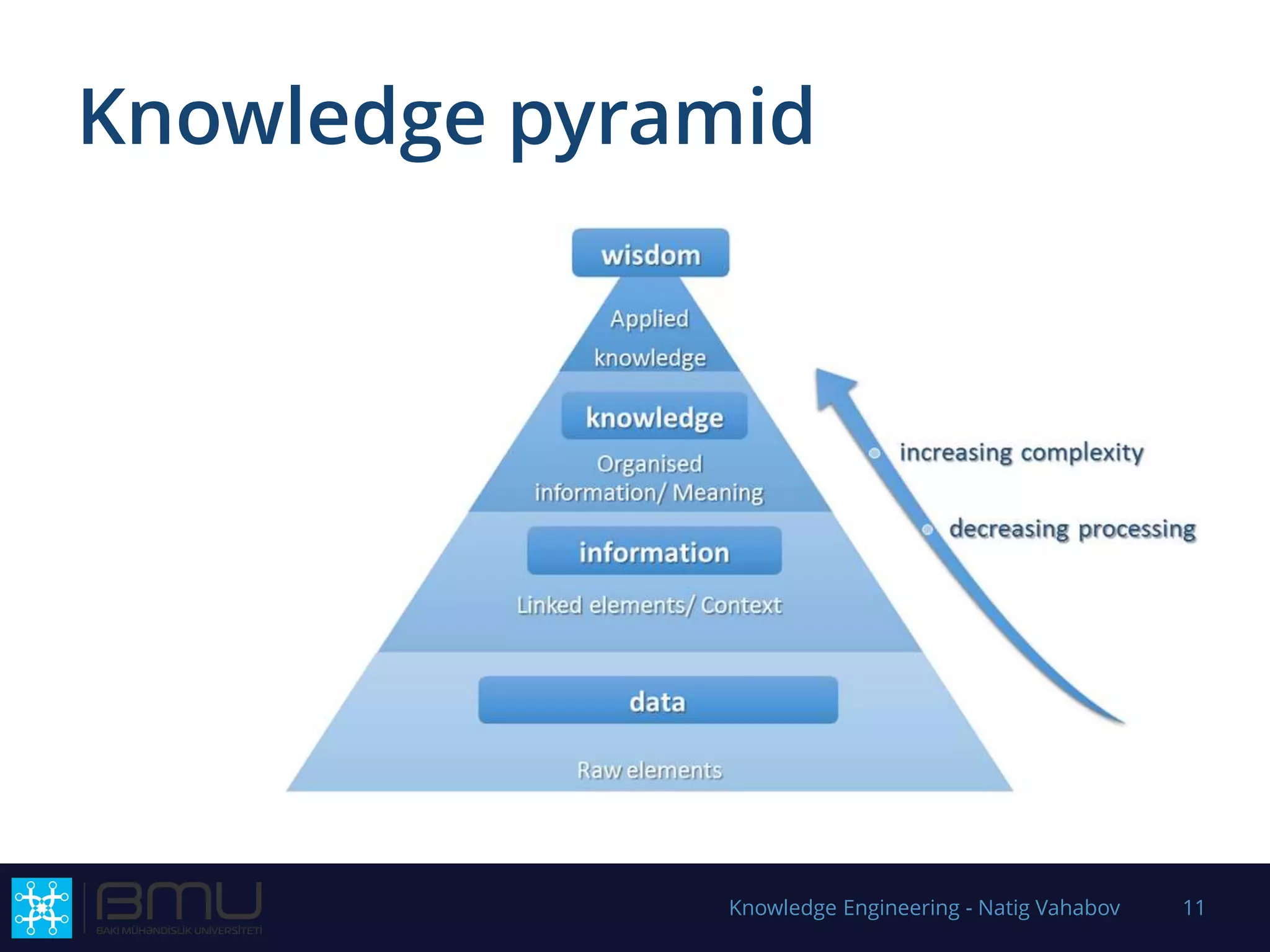
Knowledge pyramid
Knowledge Engineering - Natig Vahabov 11
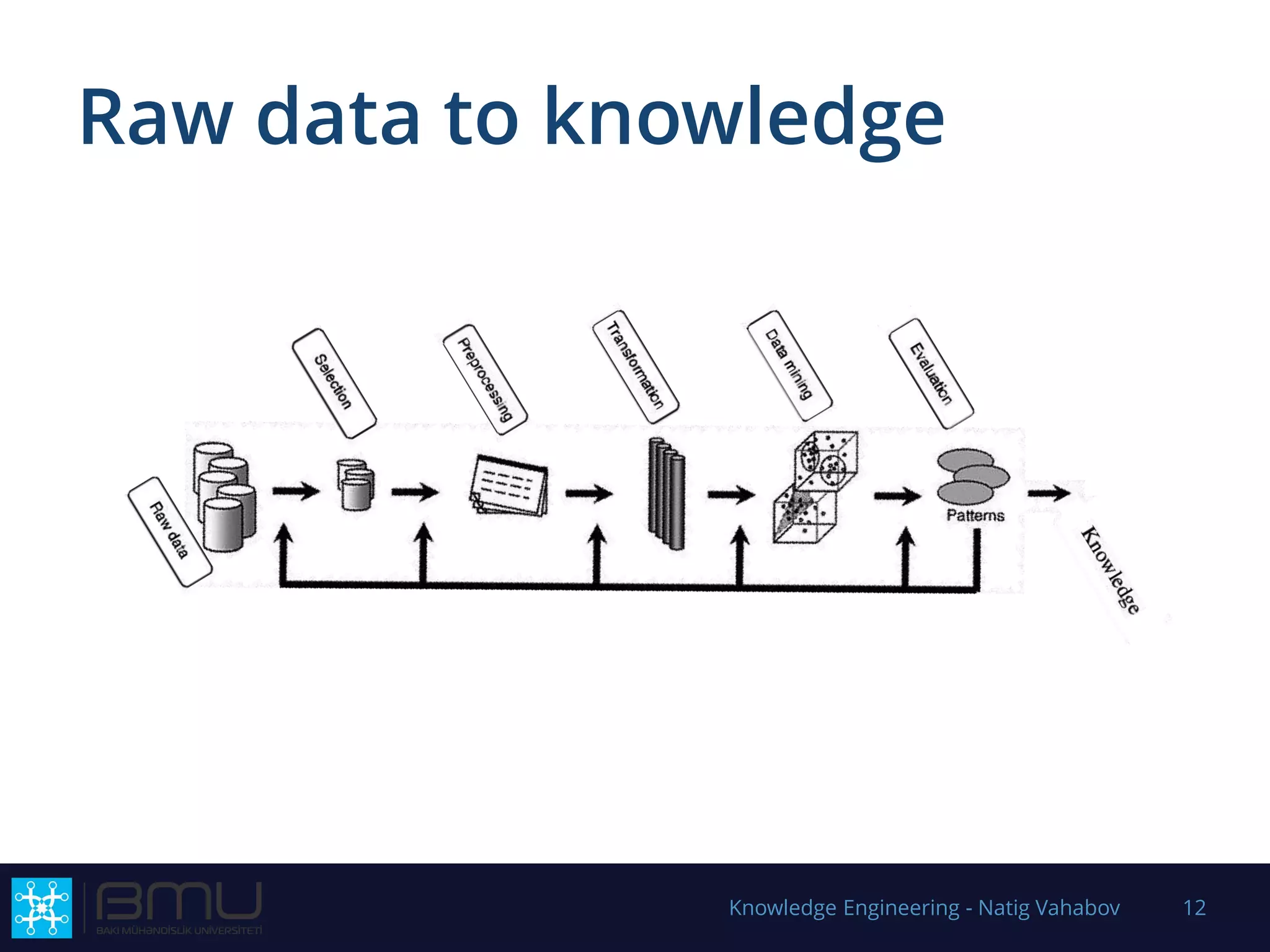
Raw data to knowledge
Knowledge Engineering - Natig Vahabov 12
Information Processing Views
of Knowledge
• Hierarchical view
• Reversed hierarchical view
• Non-hierarchical view
Knowledge Engineering - Natig Vahabov 13
Information Processing Views
of Knowledge
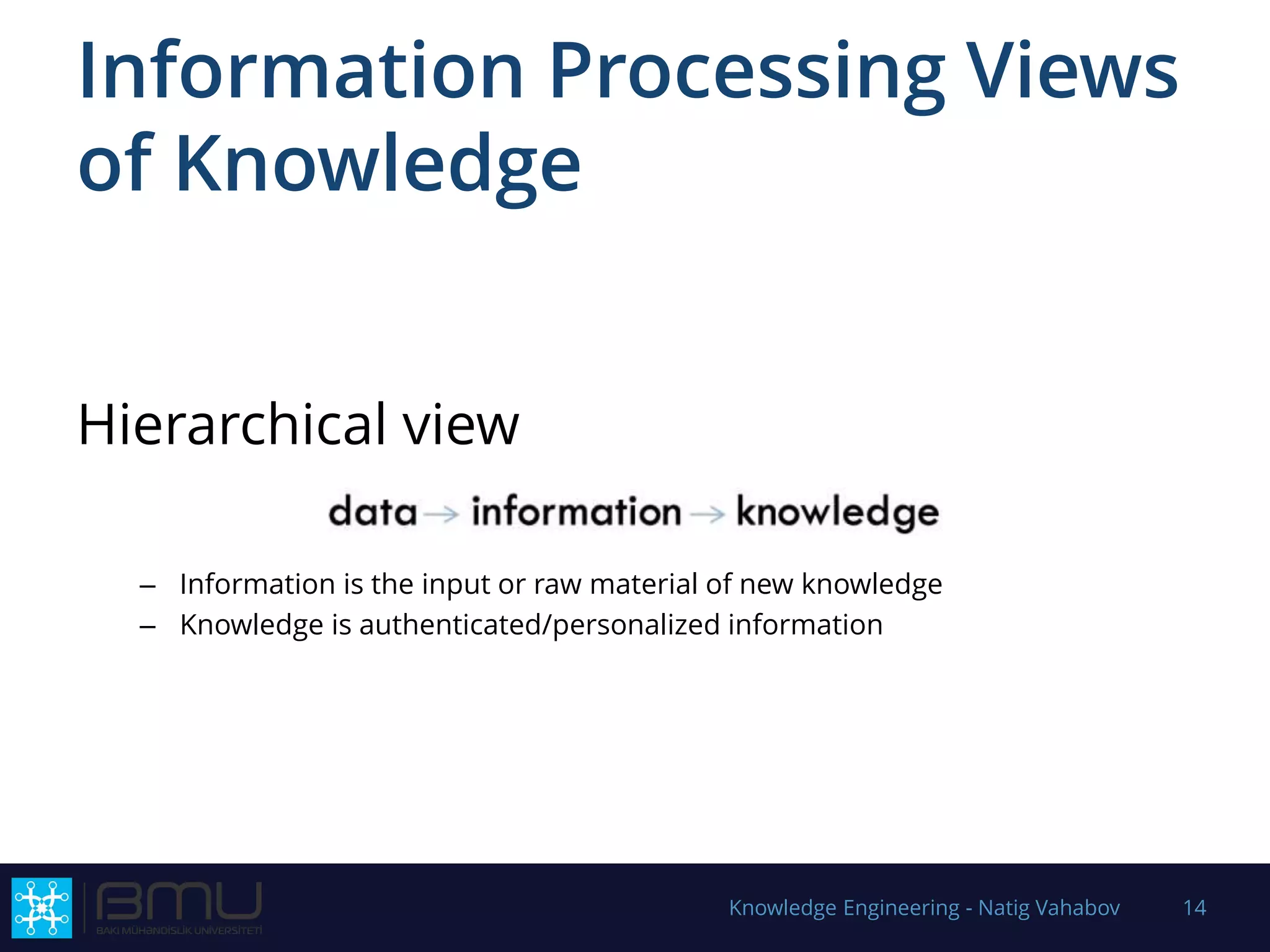
Hierarchical view
– Information is the input or raw material of new knowledge
– Knowledge is authenticated/personalized information
Knowledge Engineering - Natig Vahabov 14
Information Processing Views
of Knowledge
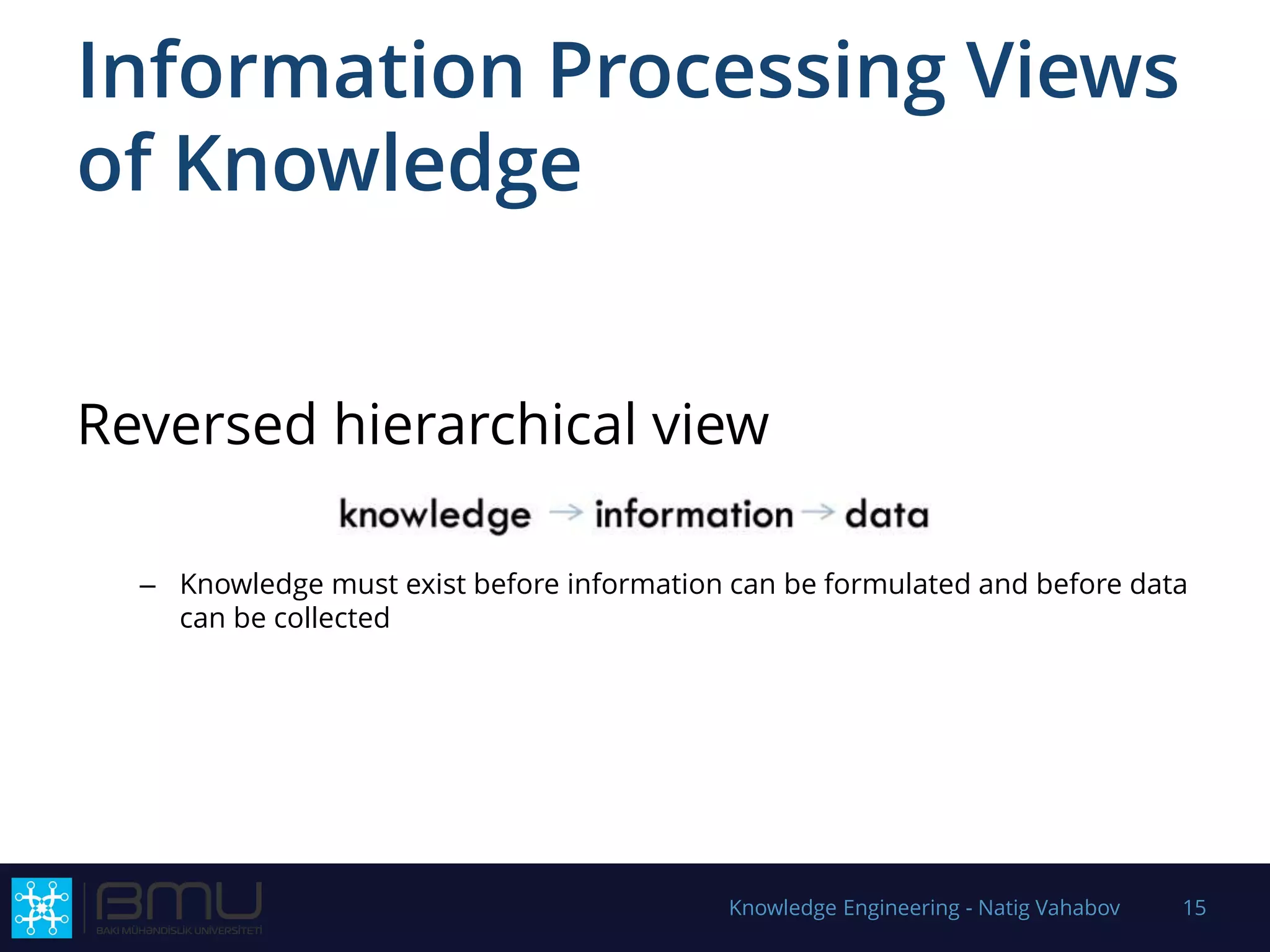
Reversed hierarchical view
– Knowledge must exist before information can be formulated and before data
can be collected
Knowledge Engineering - Natig Vahabov 15
Information Processing Views
of Knowledge
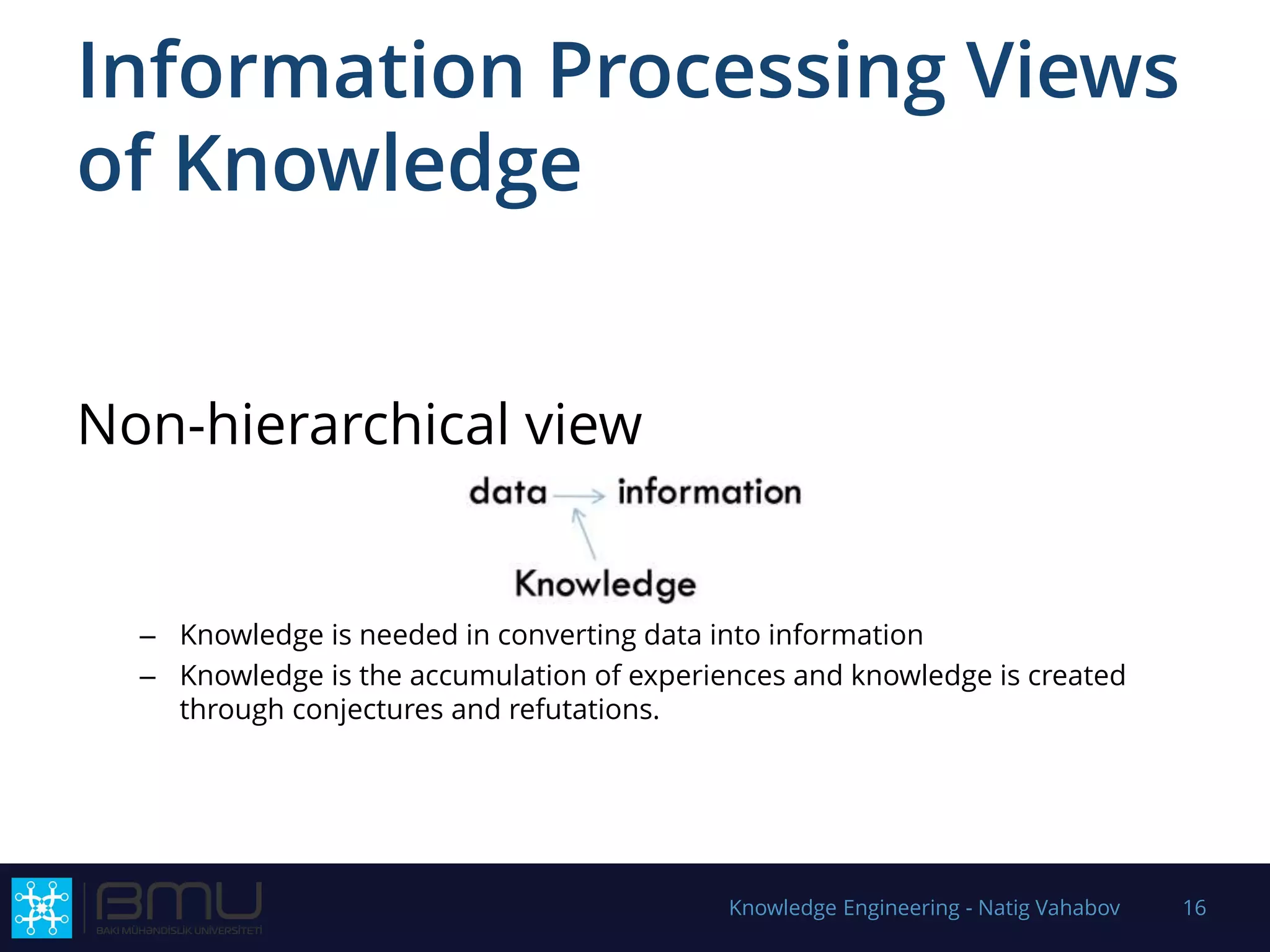
Non-hierarchical view
– Knowledge is needed in converting data into information
– Knowledge is the accumulation of experiences and knowledge is created
through conjectures and refutations.
Knowledge Engineering - Natig Vahabov 16
Philosophy of knowledge
‘Knowledge is a familiarity, awareness, or
understanding of someone or something, such
as facts, information, descriptions, or skills, which is
acquired through experience or education by
perceiving, discovering, or learning’.
Wikipedia
Knowledge Engineering - Natig Vahabov 17
Philosophy of knowledge
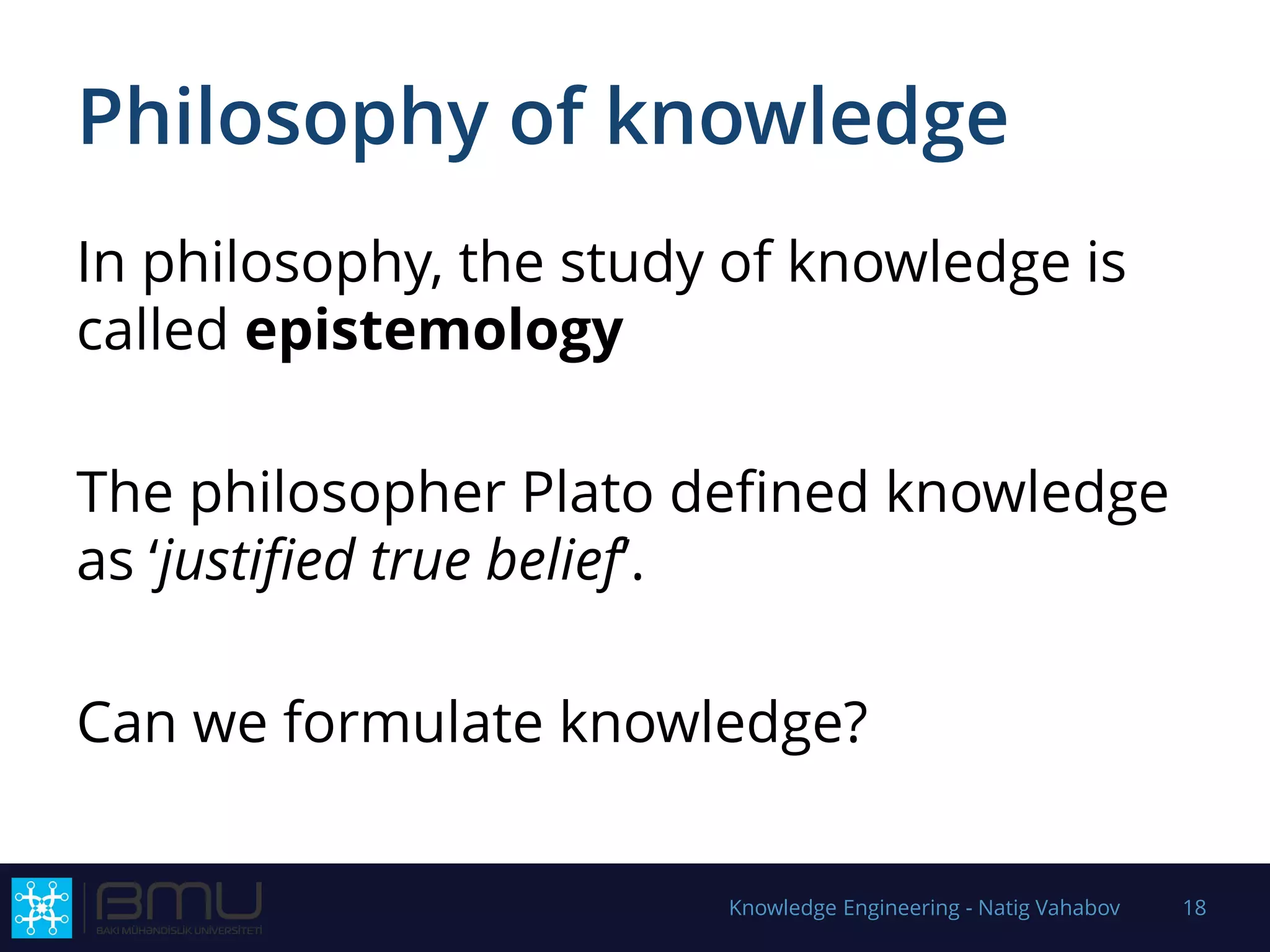
In philosophy, the study of knowledge is
called epistemology
The philosopher Plato defined knowledge
as ‘justified true belief’.
Can we formulate knowledge?
Knowledge Engineering - Natig Vahabov 18
Philosophy of knowledge
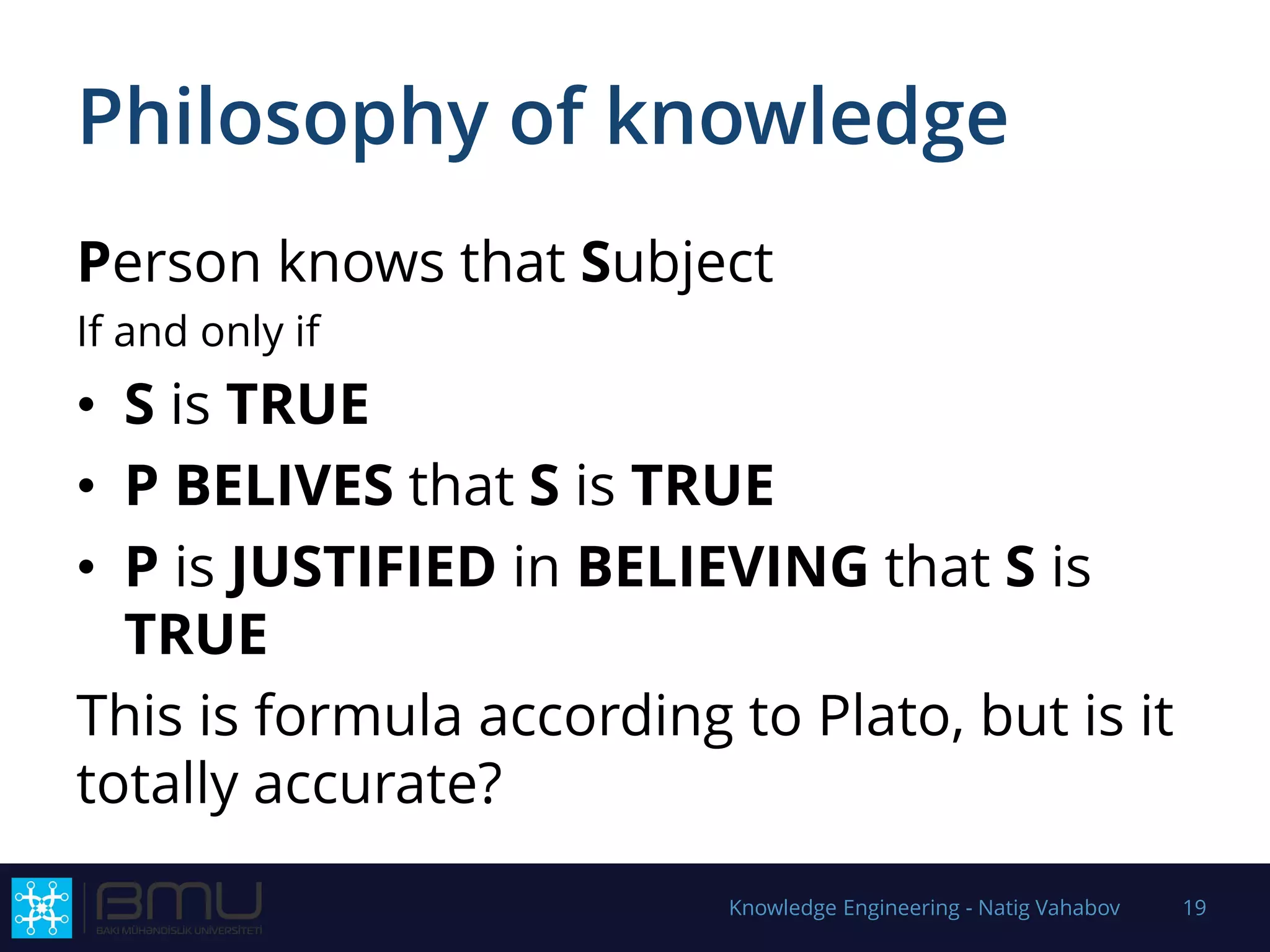
Person knows that Subject
If and only if
• S is TRUE
• P BELIVES that S is TRUE
• P is JUSTIFIED in BELIEVING that S is
TRUE
This is formula according to Plato, but is it
totally accurate?
Knowledge Engineering - Natig Vahabov 19
Philosophy of knowledge
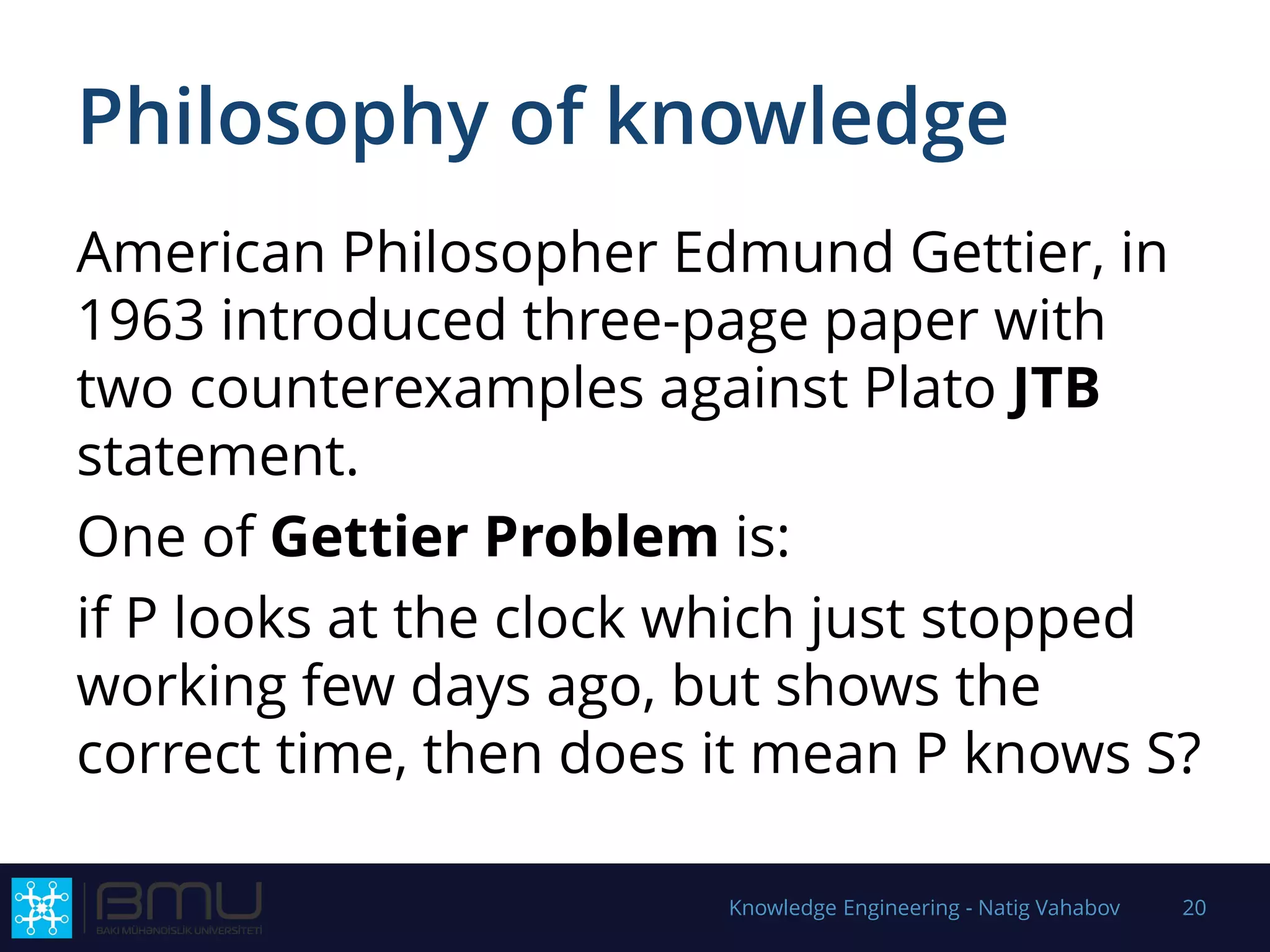
American Philosopher Edmund Gettier, in
1963 introduced three-page paper with
two counterexamples against Plato JTB
statement.
One of Gettier Problem is:
if P looks at the clock which just stopped
working few days ago, but shows the
correct time, then does it mean P knows S?
Knowledge Engineering - Natig Vahabov 20
Philosophy of knowledge
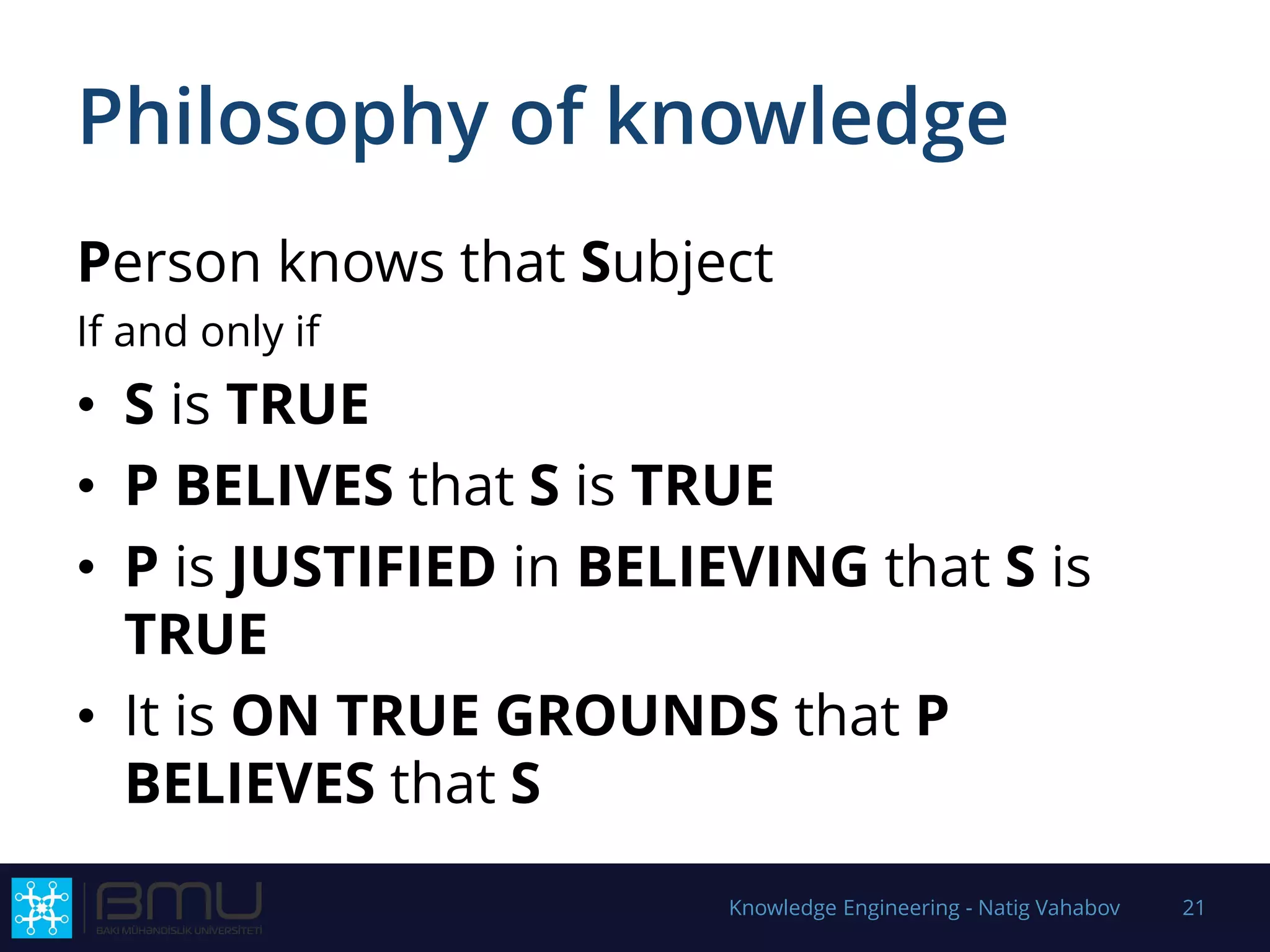
Person knows that Subject
If and only if
• S is TRUE
• P BELIVES that S is TRUE
• P is JUSTIFIED in BELIEVING that S is
TRUE
• It is ON TRUE GROUNDS that P
BELIEVES that S
Knowledge Engineering - Natig Vahabov 21
Taxonomies of Knowledge
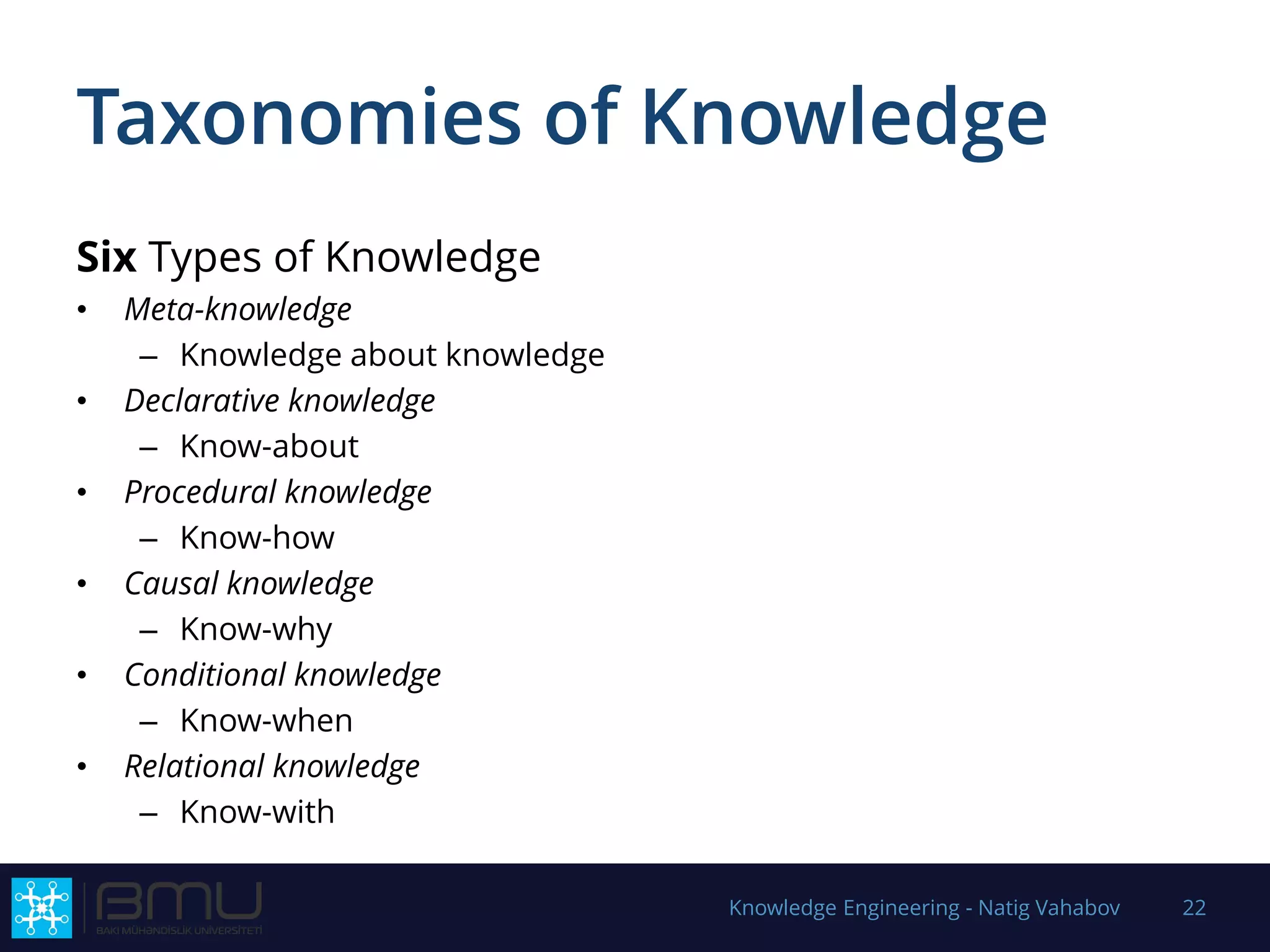
Six Types of Knowledge
• Meta-knowledge
– Knowledge about knowledge
• Declarative knowledge
– Know-about
• Procedural knowledge
– Know-how
• Causal knowledge
– Know-why
• Conditional knowledge
– Know-when
• Relational knowledge
– Know-with
Knowledge Engineering - Natig Vahabov 22
Taxonomies of Knowledge
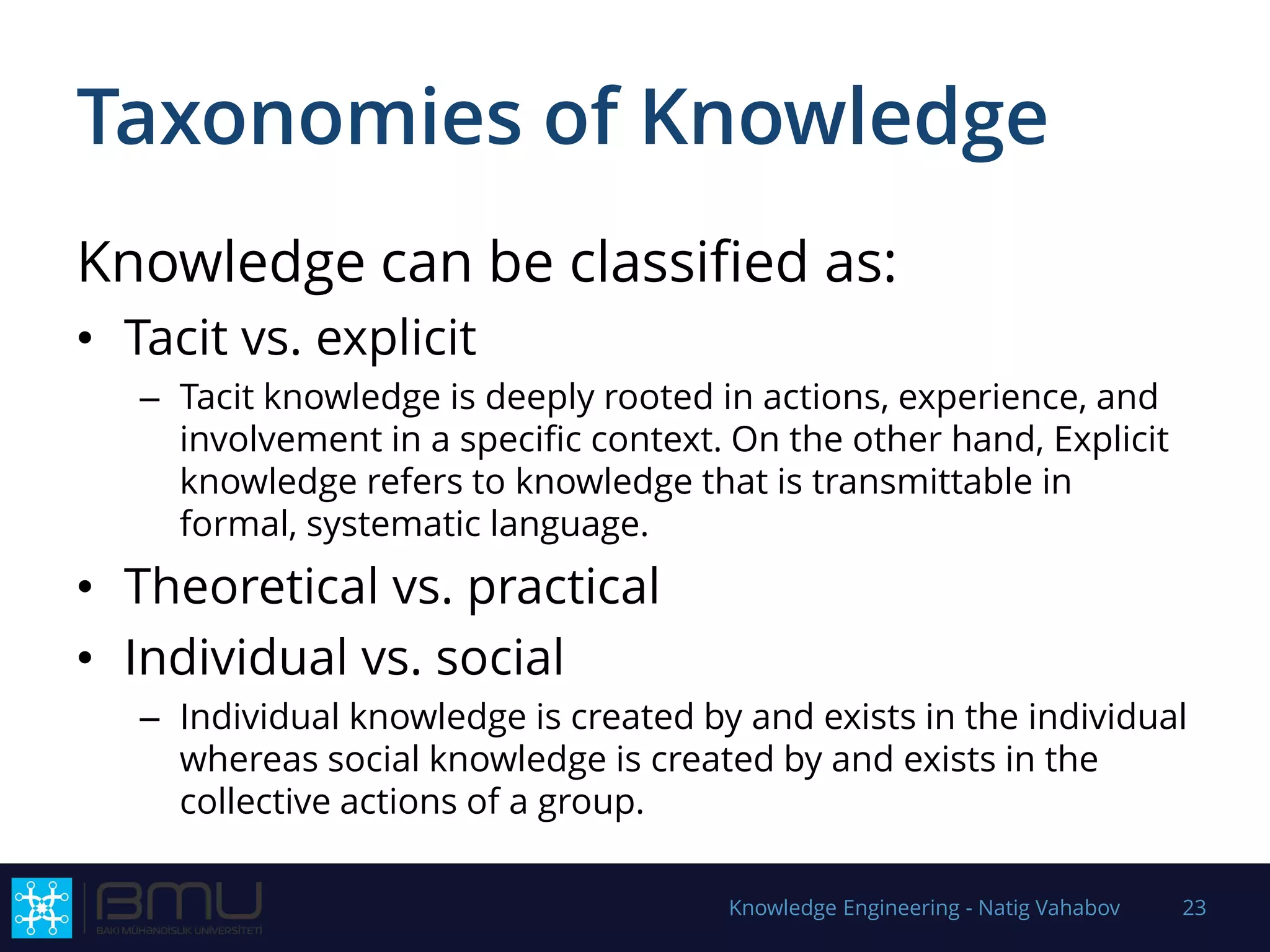
Knowledge can be classified as:
• Tacit vs. explicit
– Tacit knowledge is deeply rooted in actions, experience, and
involvement in a specific context. On the other hand, Explicit
knowledge refers to knowledge that is transmittable in
formal, systematic language.
• Theoretical vs. practical
• Individual vs. social
– Individual knowledge is created by and exists in the individual
whereas social knowledge is created by and exists in the
collective actions of a group.
Knowledge Engineering - Natig Vahabov 23
Knowledge Levels
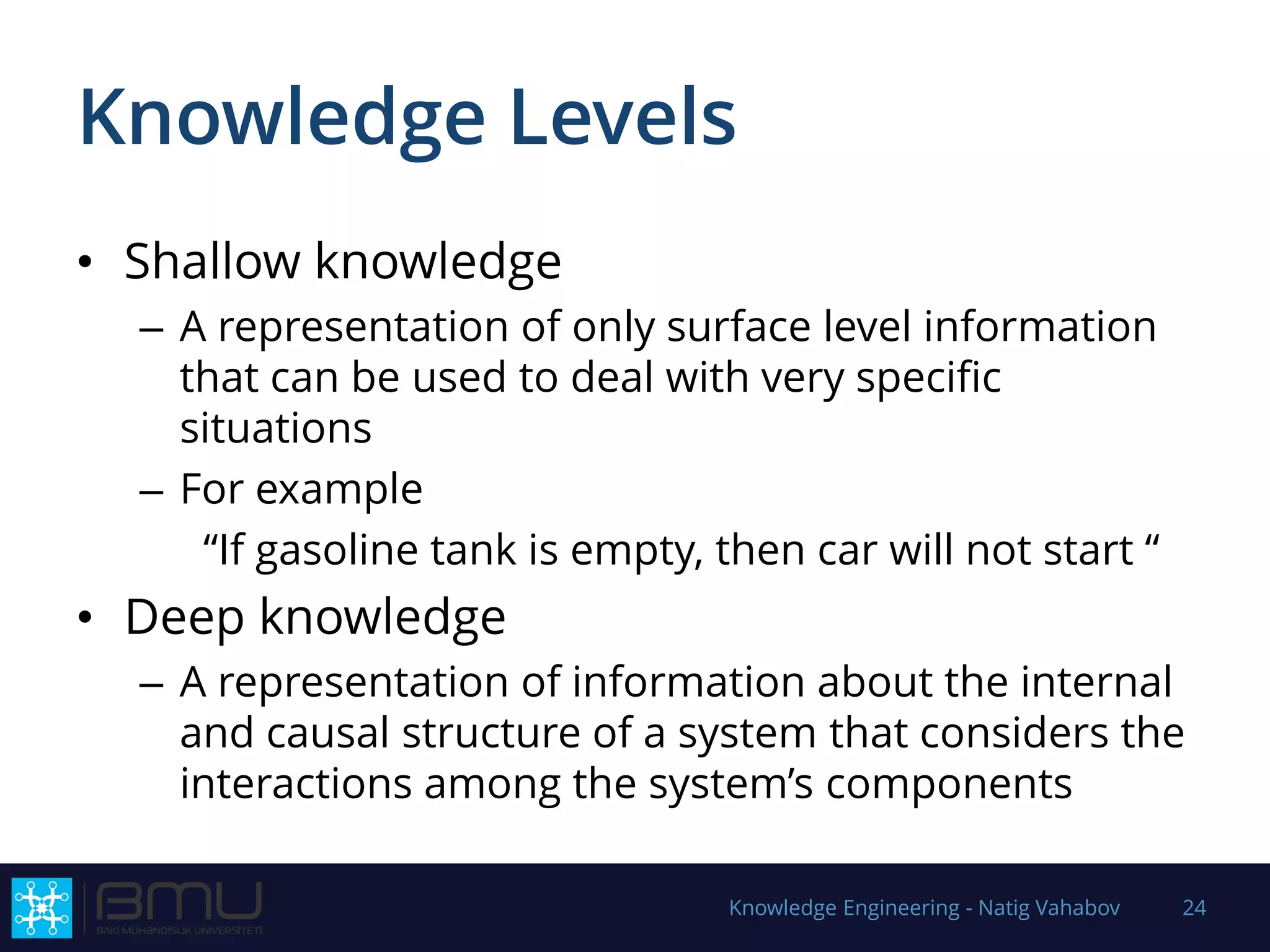
• Shallow knowledge
– A representation of only surface level information
that can be used to deal with very specific
situations
– For example
“If gasoline tank is empty, then car will not start “
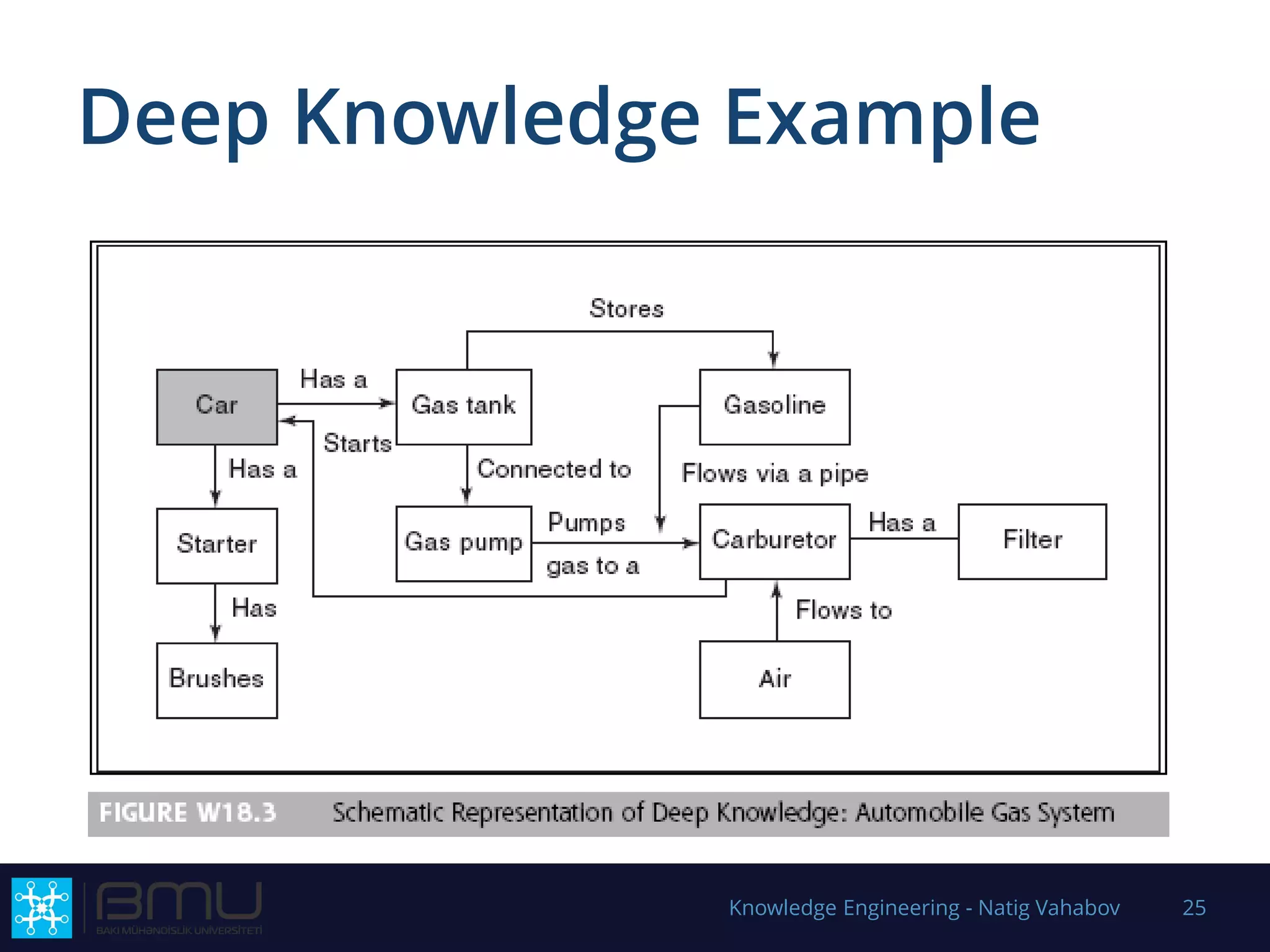
• Deep knowledge
– A representation of information about the internal
and causal structure of a system that considers the
interactions among the system’s components
Knowledge Engineering - Natig Vahabov 24
Deep Knowledge Example
Knowledge Engineering - Natig Vahabov 25
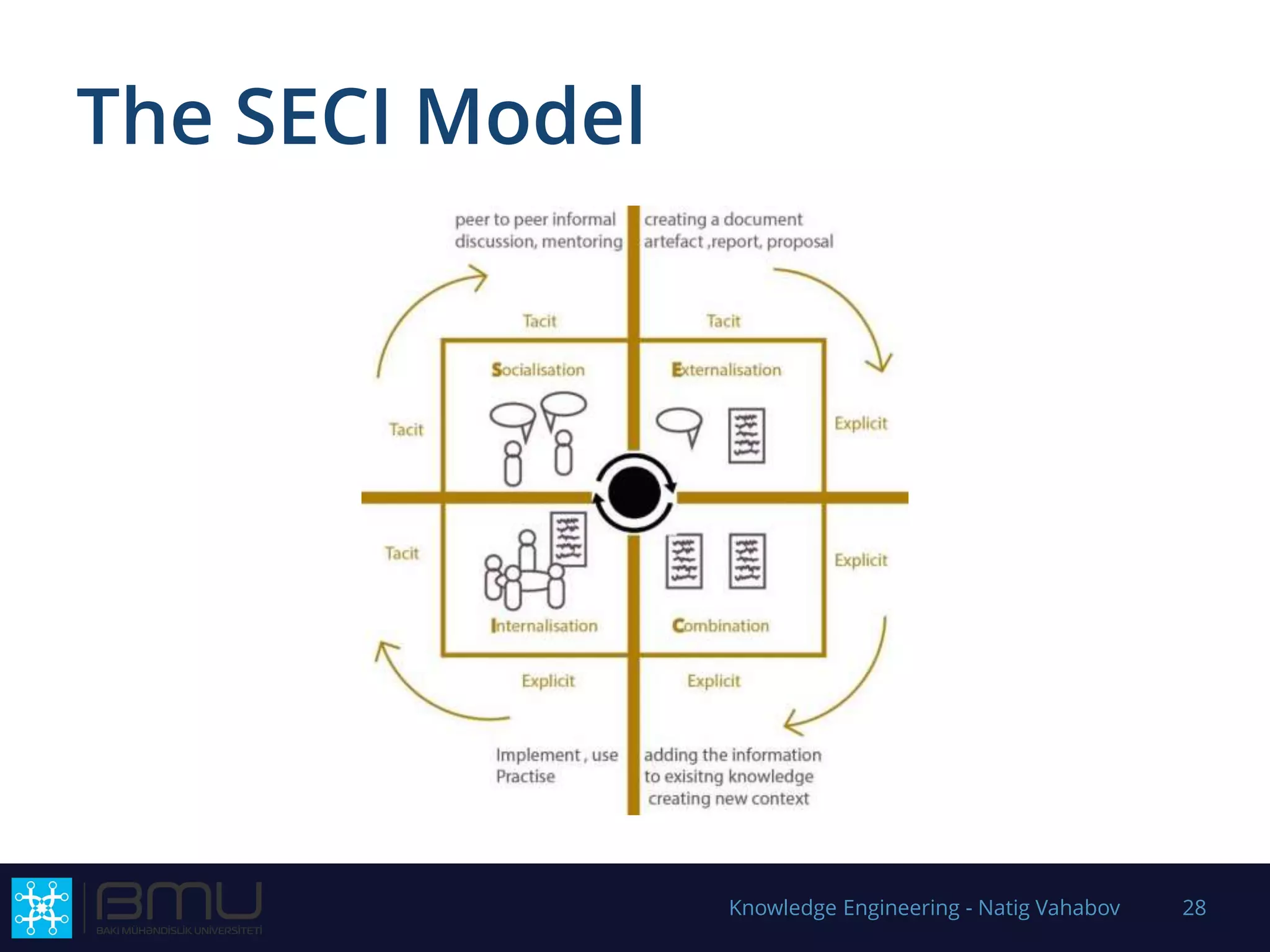
Knowledge Creation
Knowledge Creation is process to create new ideas through
interactions between explicit and tacit knowledge in individual
human minds.
Knowledge sharing and knowledge creation are the two vital
aspects of knowledge management which play an important role
in creating organisational value.
Ikujiro Nonaka introduced SECI Model in 1990 and Takeuchi
developed it, to share, spread and create new knowledge.
Knowledge Engineering - Natig Vahabov 26
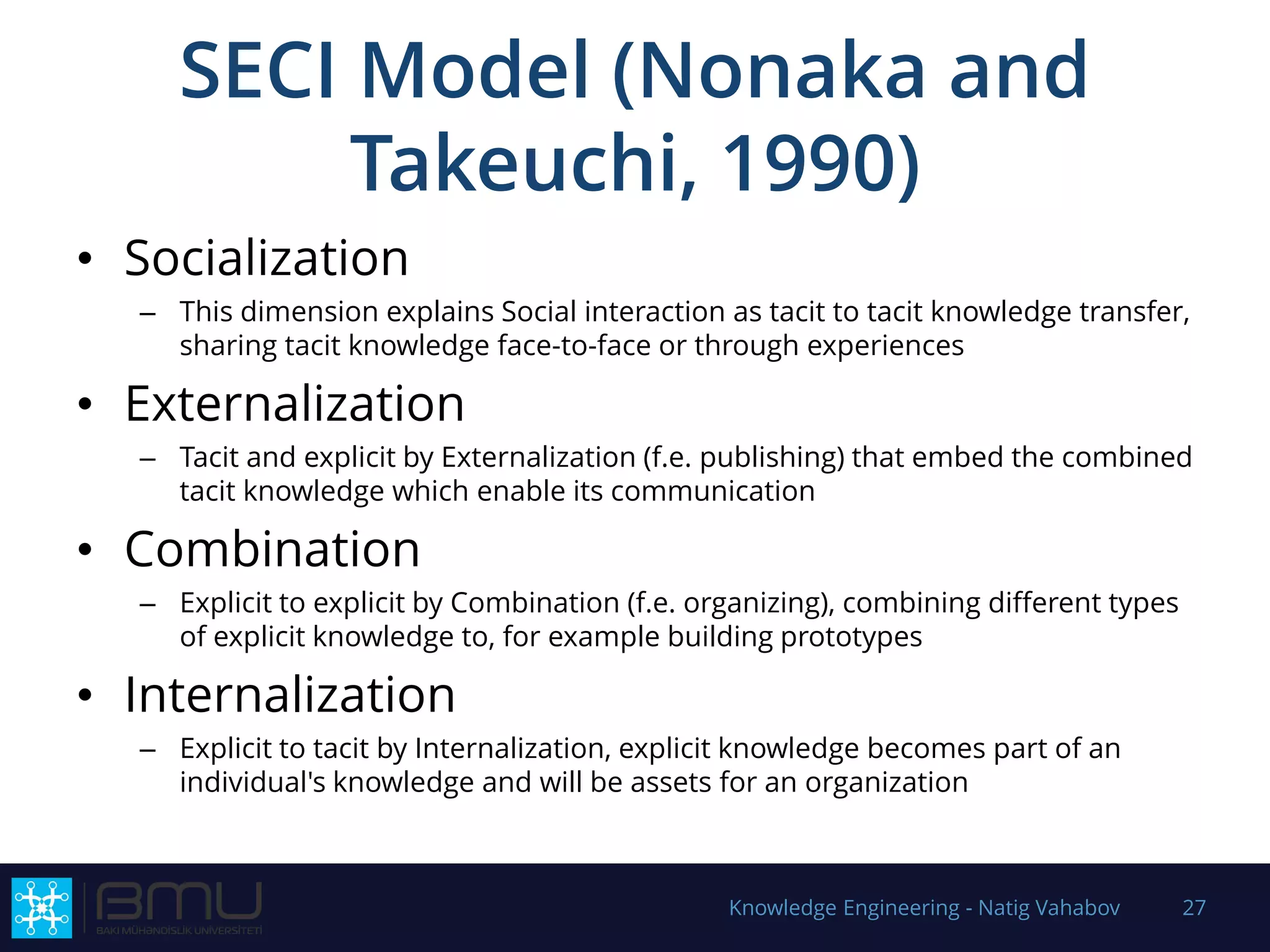
SECI Model (Nonaka and
Takeuchi, 1990)
• Socialization
– This dimension explains Social interaction as tacit to tacit knowledge transfer,
sharing tacit knowledge face-to-face or through experiences
• Externalization
– Tacit and explicit by Externalization (f.e. publishing) that embed the combined
tacit knowledge which enable its communication
• Combination
– Explicit to explicit by Combination (f.e. organizing), combining different types
of explicit knowledge to, for example building prototypes
• Internalization
– Explicit to tacit by Internalization, explicit knowledge becomes part of an
individual's knowledge and will be assets for an organization
Knowledge Engineering - Natig Vahabov 27
The SECI Model
Knowledge Engineering - Natig Vahabov 28
Knowledge Engineering
An engineering discipline that involves integrating
knowledge into computer systems in order to solve
complex problems normally requiring a high level
of human expertise
Feigenbaum and Pamela, 1983
Knowledge Engineering - Natig Vahabov 29
Knowledge Engineering
Knowledge engineering (KE) refers to all technical,
scientific and social aspects involved in building,
maintaining and using knowledge-based systems
(KBS)
Knowledge Engineering - Natig Vahabov 30
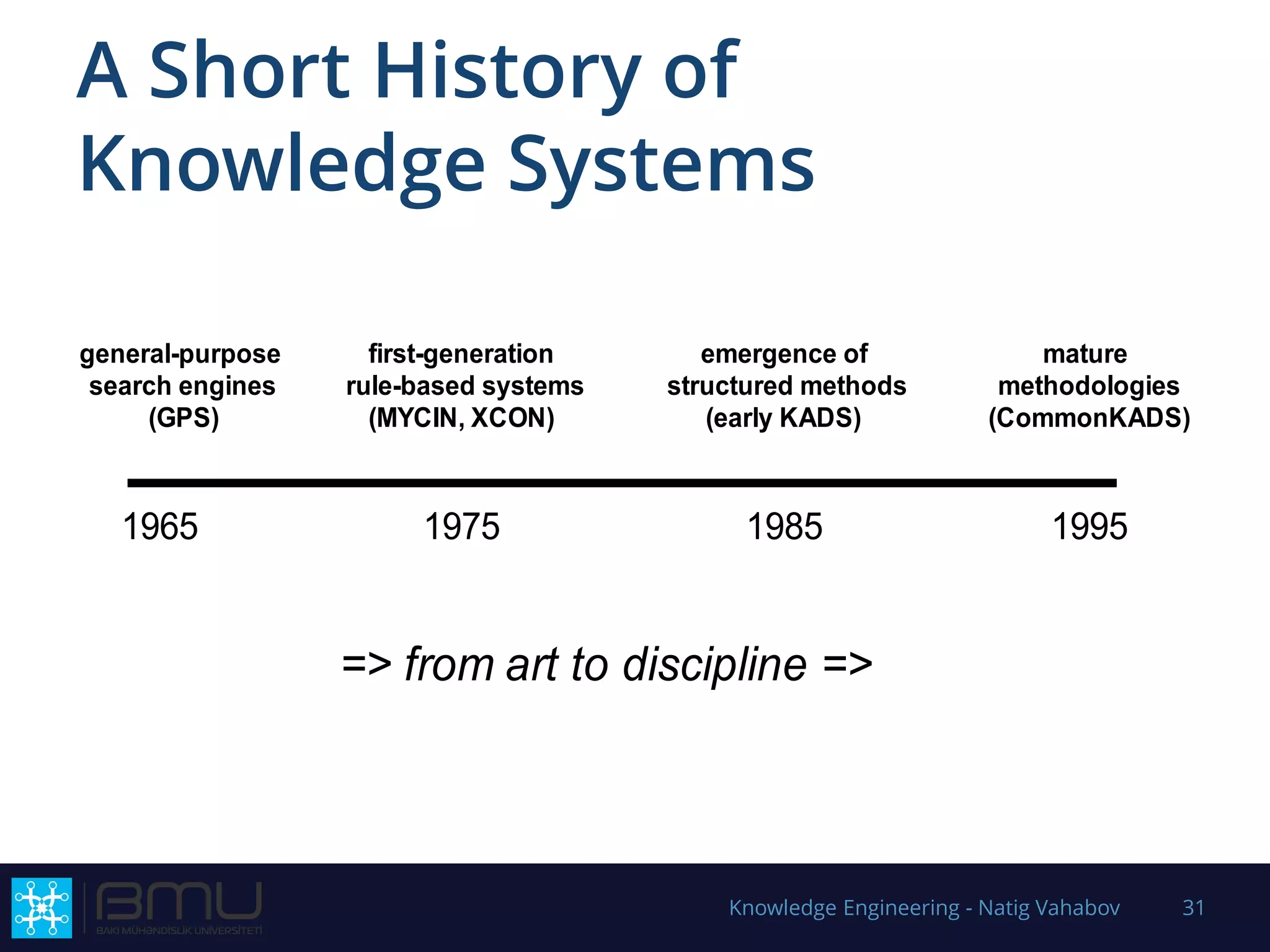
A Short History of
Knowledge Systems
Knowledge Engineering - Natig Vahabov 31
1965 19851975 1995
general-purpose
search engines
(GPS)
first-generation
rule-based systems
(MYCIN, XCON)
emergence of
structured methods
(early KADS)
mature
methodologies
(CommonKADS)
=> from art to discipline =>
MYCIN
Diagnosing and treating patients with infectious blood
diseases
• A rule-based expert system
• Developed at Stanford University – 1976
• Uses backward chaining for reasoning
• Incorporates about 500 rules
• Written in INTERLISP (a dialect of LISP)
Knowledge Engineering - Natig Vahabov 32
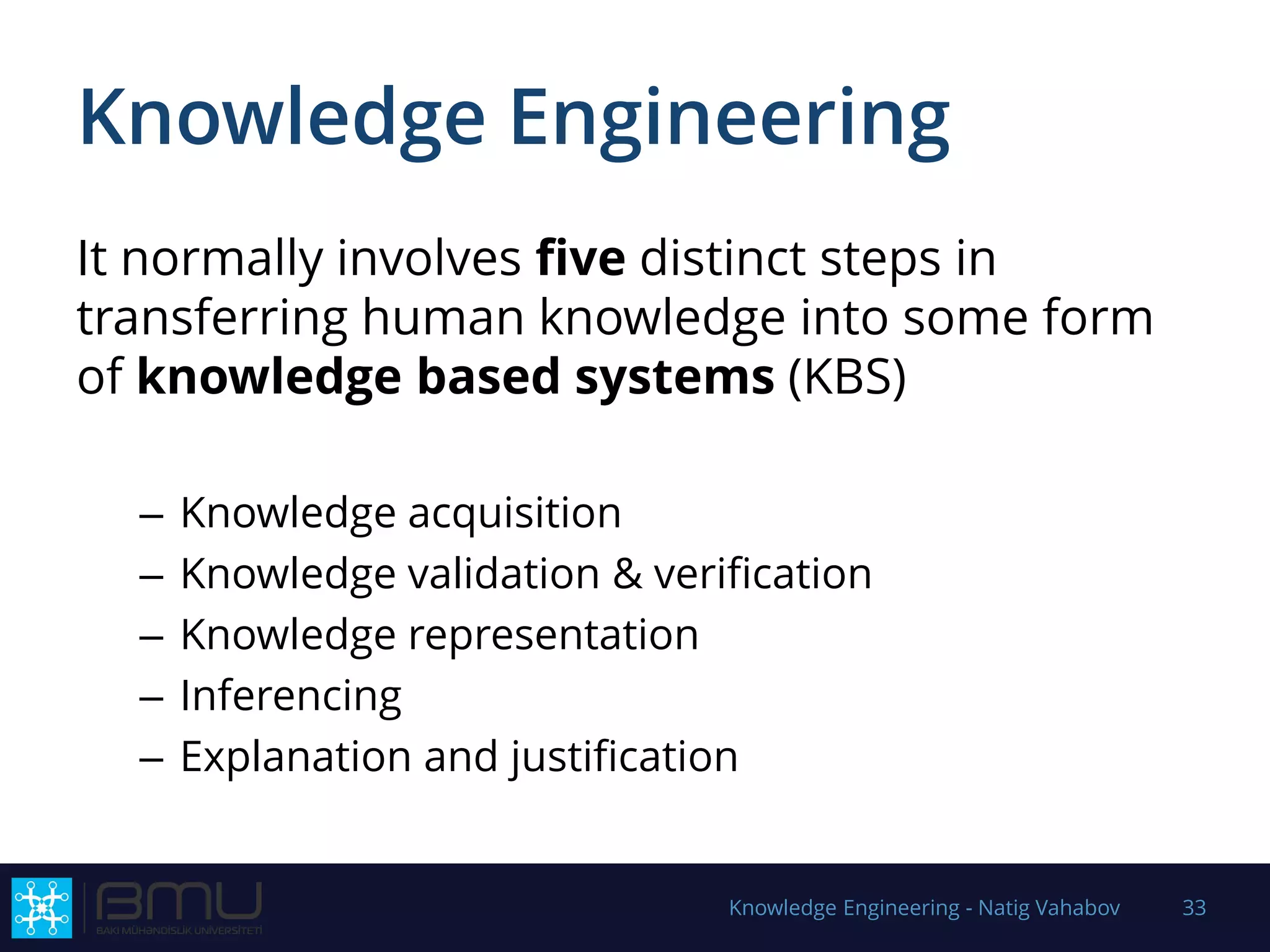
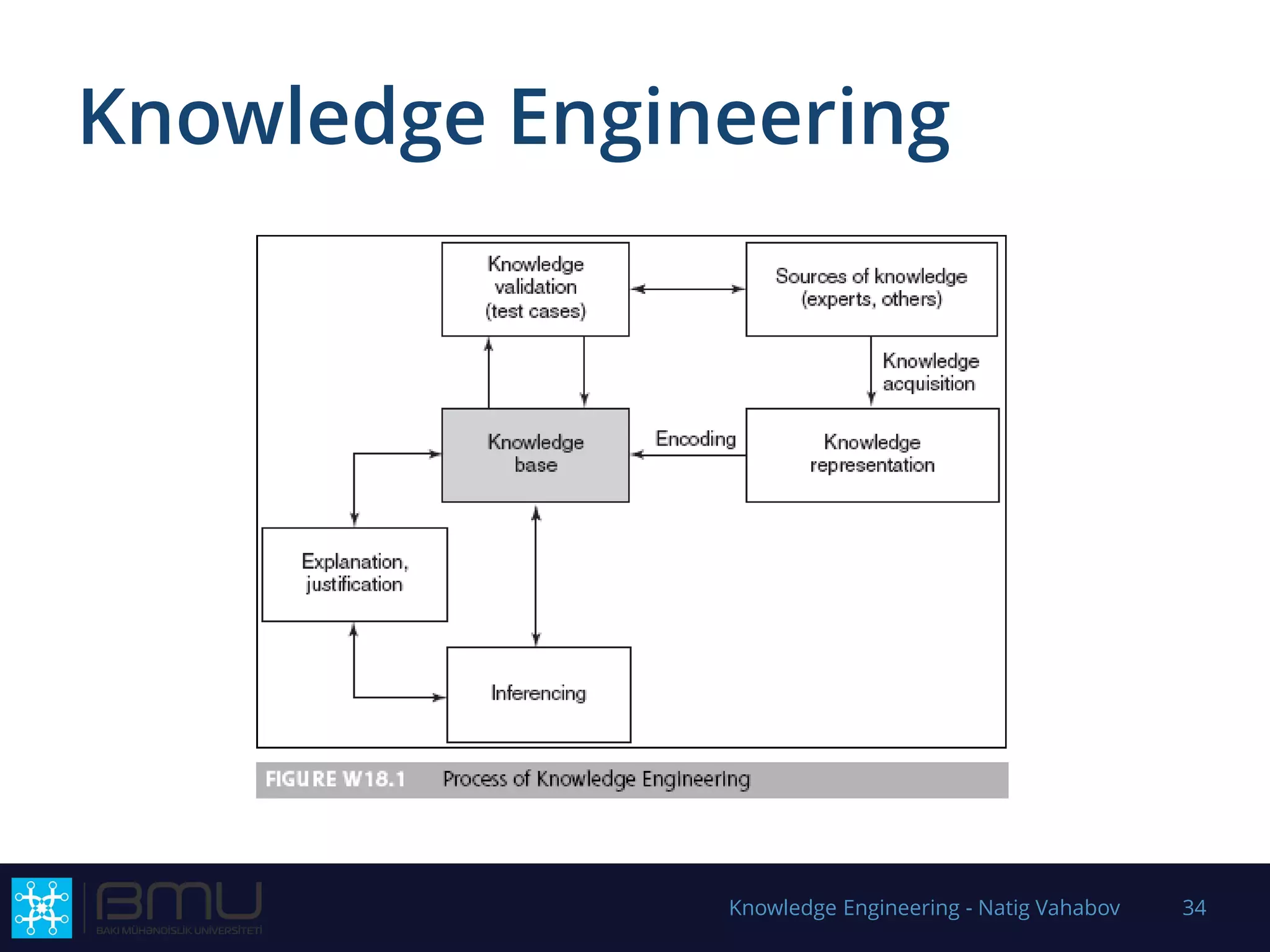
Knowledge Engineering
It normally involves five distinct steps in
transferring human knowledge into some form
of knowledge based systems (KBS)
– Knowledge acquisition
– Knowledge validation & verification
– Knowledge representation
– Inferencing
– Explanation and justification
Knowledge Engineering - Natig Vahabov 33
Knowledge Engineering
Knowledge Engineering - Natig Vahabov 34
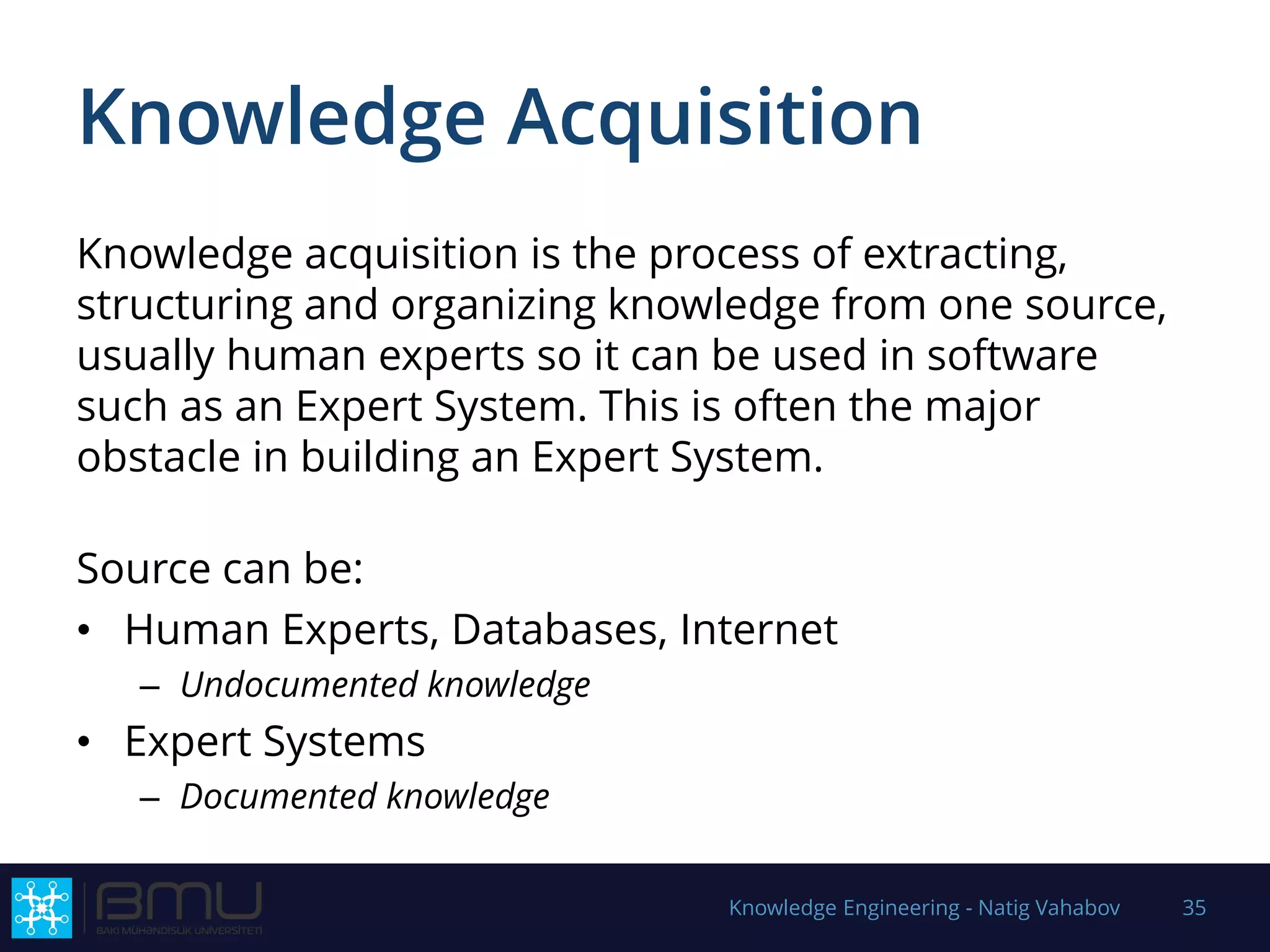
Knowledge Acquisition
Knowledge acquisition is the process of extracting,
structuring and organizing knowledge from one source,
usually human experts so it can be used in software
such as an Expert System. This is often the major
obstacle in building an Expert System.
Source can be:
• Human Experts, Databases, Internet
– Undocumented knowledge
• Expert Systems
– Documented knowledge
Knowledge Engineering - Natig Vahabov 35
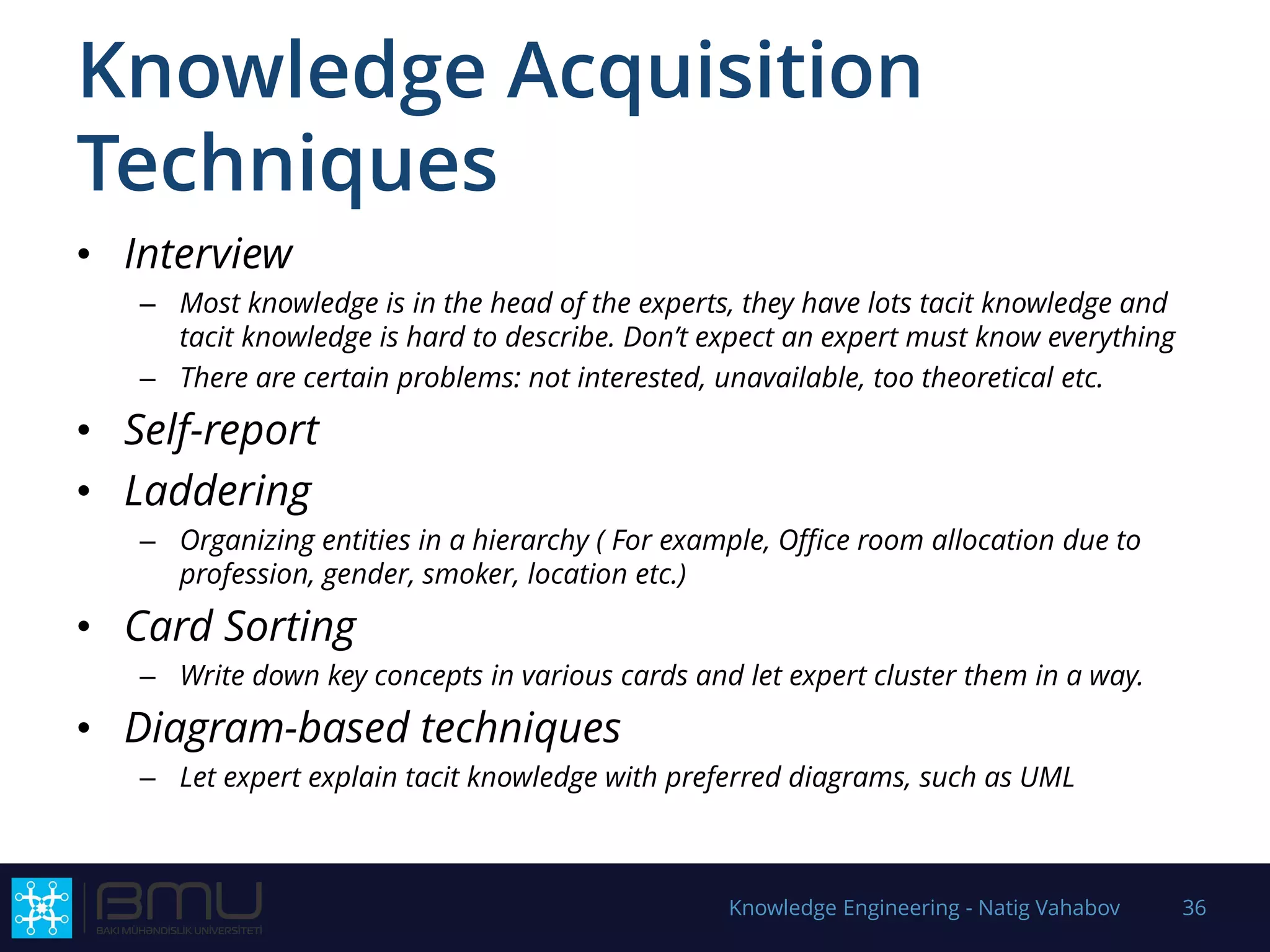
Knowledge Acquisition
Techniques
• Interview
– Most knowledge is in the head of the experts, they have lots tacit knowledge and
tacit knowledge is hard to describe. Don’t expect an expert must know everything
– There are certain problems: not interested, unavailable, too theoretical etc.
• Self-report
• Laddering
– Organizing entities in a hierarchy ( For example, Office room allocation due to
profession, gender, smoker, location etc.)
• Card Sorting
– Write down key concepts in various cards and let expert cluster them in a way.
• Diagram-based techniques
– Let expert explain tacit knowledge with preferred diagrams, such as UML
Knowledge Engineering - Natig Vahabov 36
Knowledge V&V
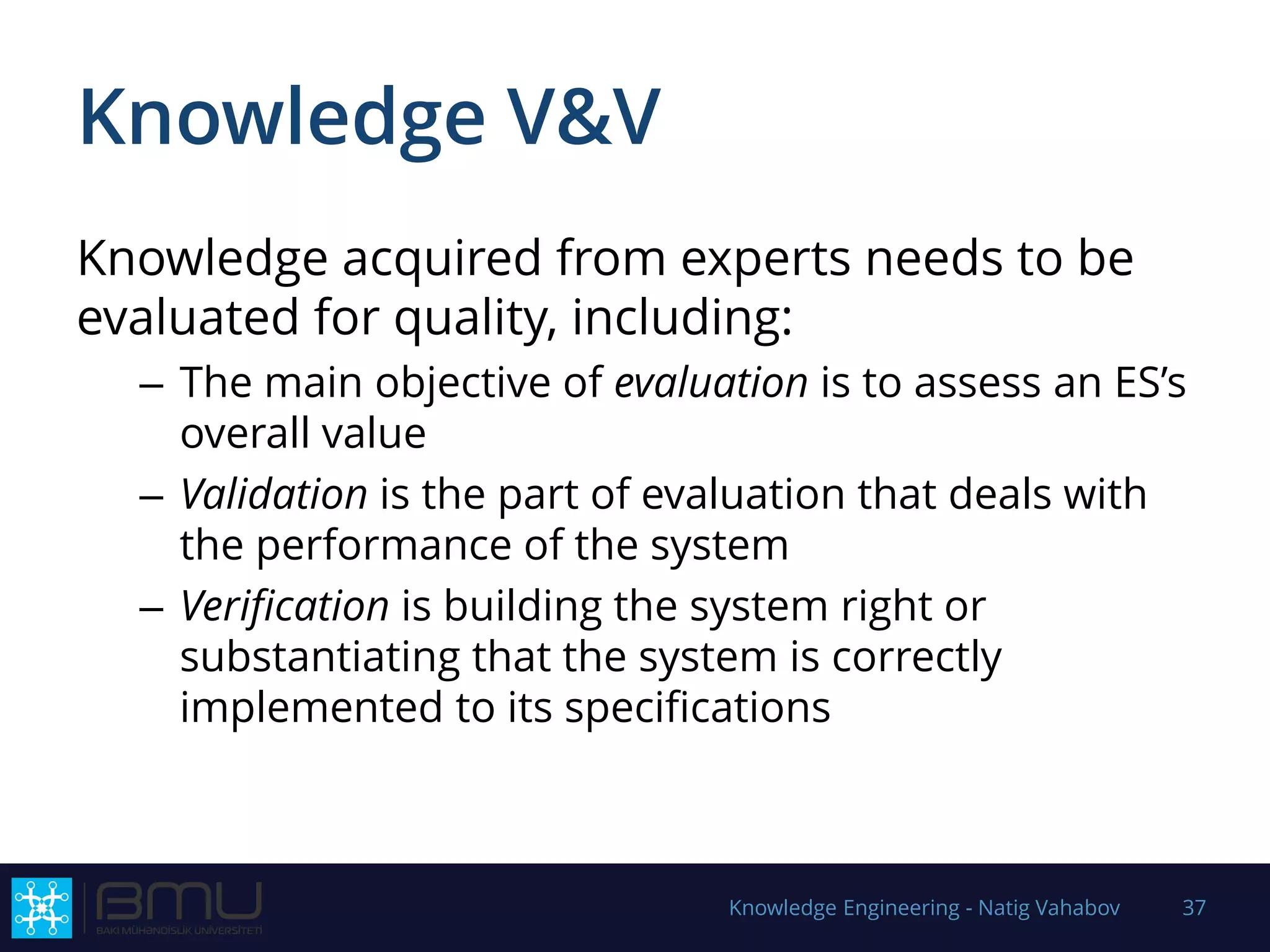
Knowledge acquired from experts needs to be
evaluated for quality, including:
– The main objective of evaluation is to assess an ES’s
overall value
– Validation is the part of evaluation that deals with
the performance of the system
– Verification is building the system right or
substantiating that the system is correctly
implemented to its specifications
Knowledge Engineering - Natig Vahabov 37
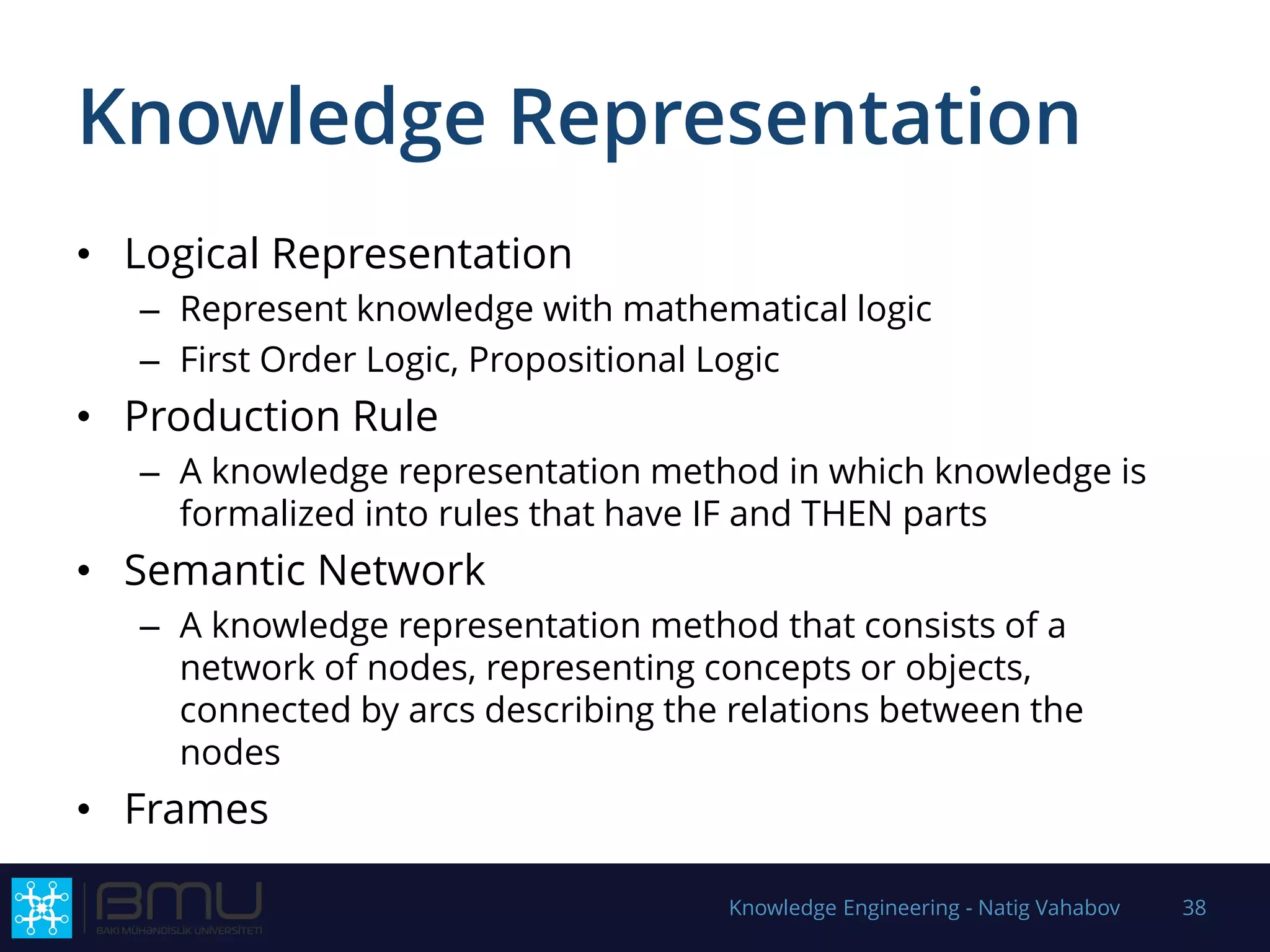
Knowledge Representation
• Logical Representation
– Represent knowledge with mathematical logic
– First Order Logic, Propositional Logic
• Production Rule
– A knowledge representation method in which knowledge is
formalized into rules that have IF and THEN parts
• Semantic Network
– A knowledge representation method that consists of a
network of nodes, representing concepts or objects,
connected by arcs describing the relations between the
nodes
• Frames
Knowledge Engineering - Natig Vahabov 38
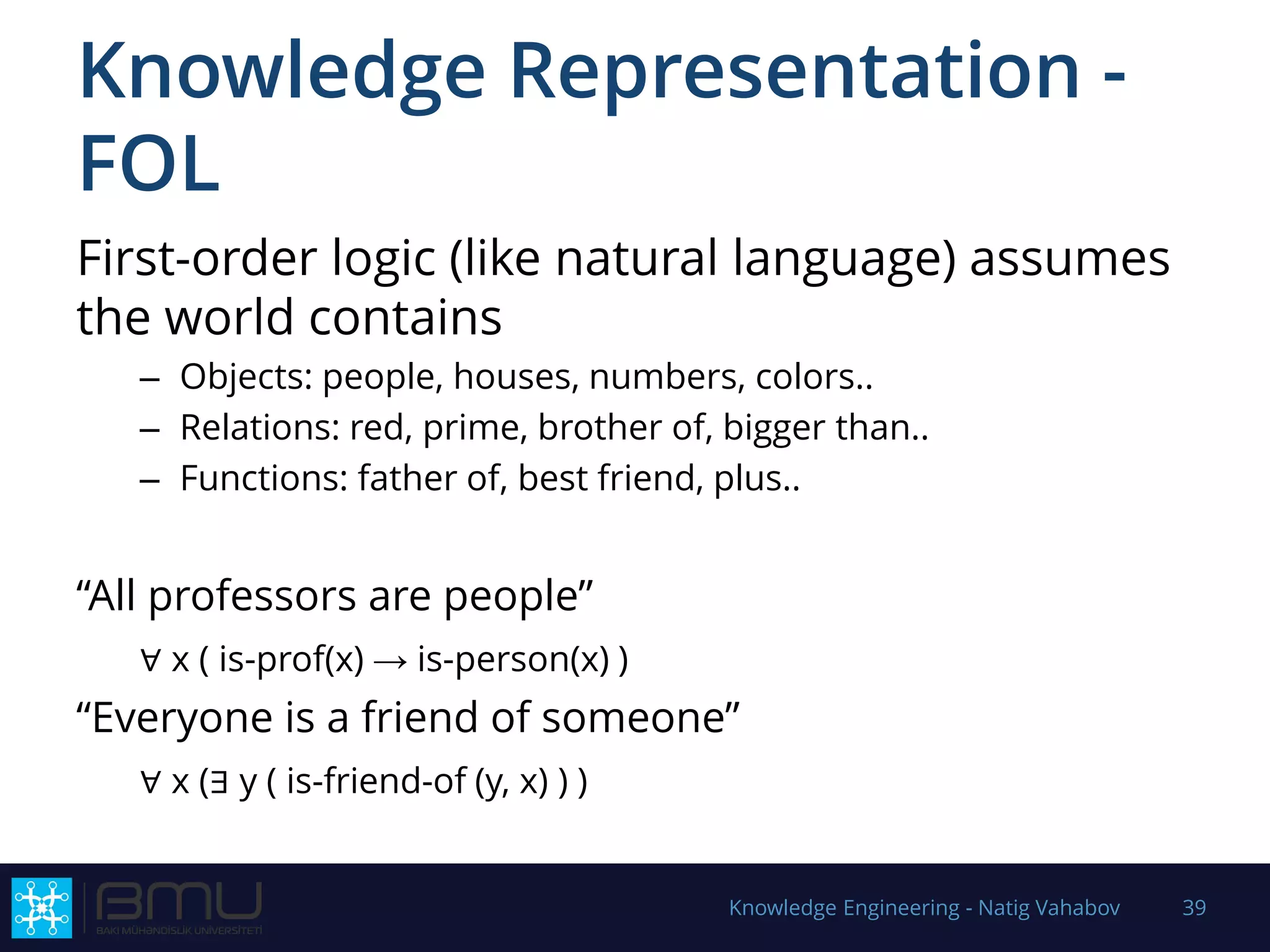
Knowledge Representation -
FOL
First-order logic (like natural language) assumes
the world contains
– Objects: people, houses, numbers, colors..
– Relations: red, prime, brother of, bigger than..
– Functions: father of, best friend, plus..
“All professors are people”
∀ x ( is-prof(x) → is-person(x) )
“Everyone is a friend of someone”
∀ x (∃ y ( is-friend-of (y, x) ) )
Knowledge Engineering - Natig Vahabov 39
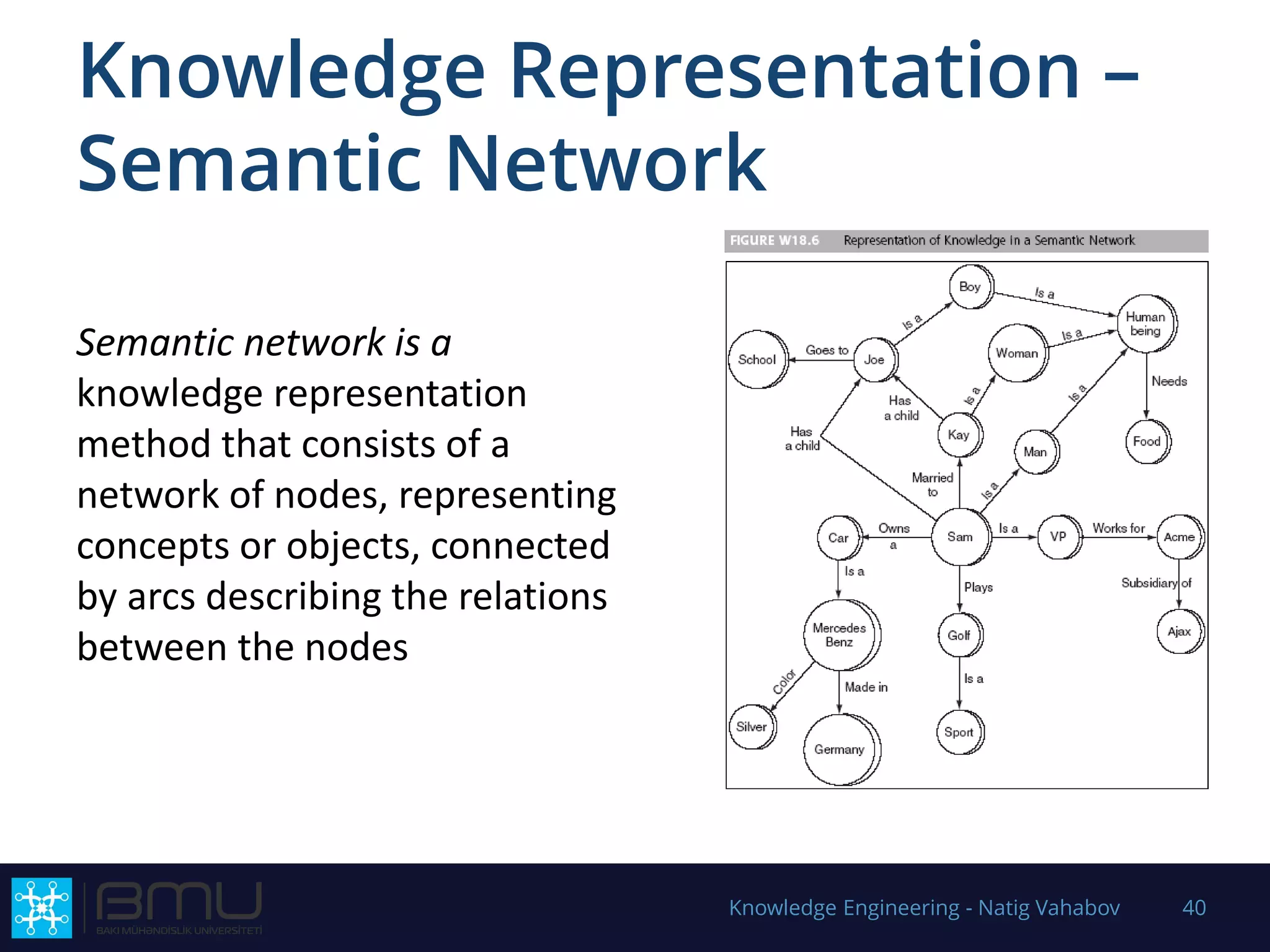
Knowledge Representation –
Semantic Network
Knowledge Engineering - Natig Vahabov 40
Semantic network is a
knowledge representation
method that consists of a
network of nodes, representing
concepts or objects, connected
by arcs describing the relations
between the nodes
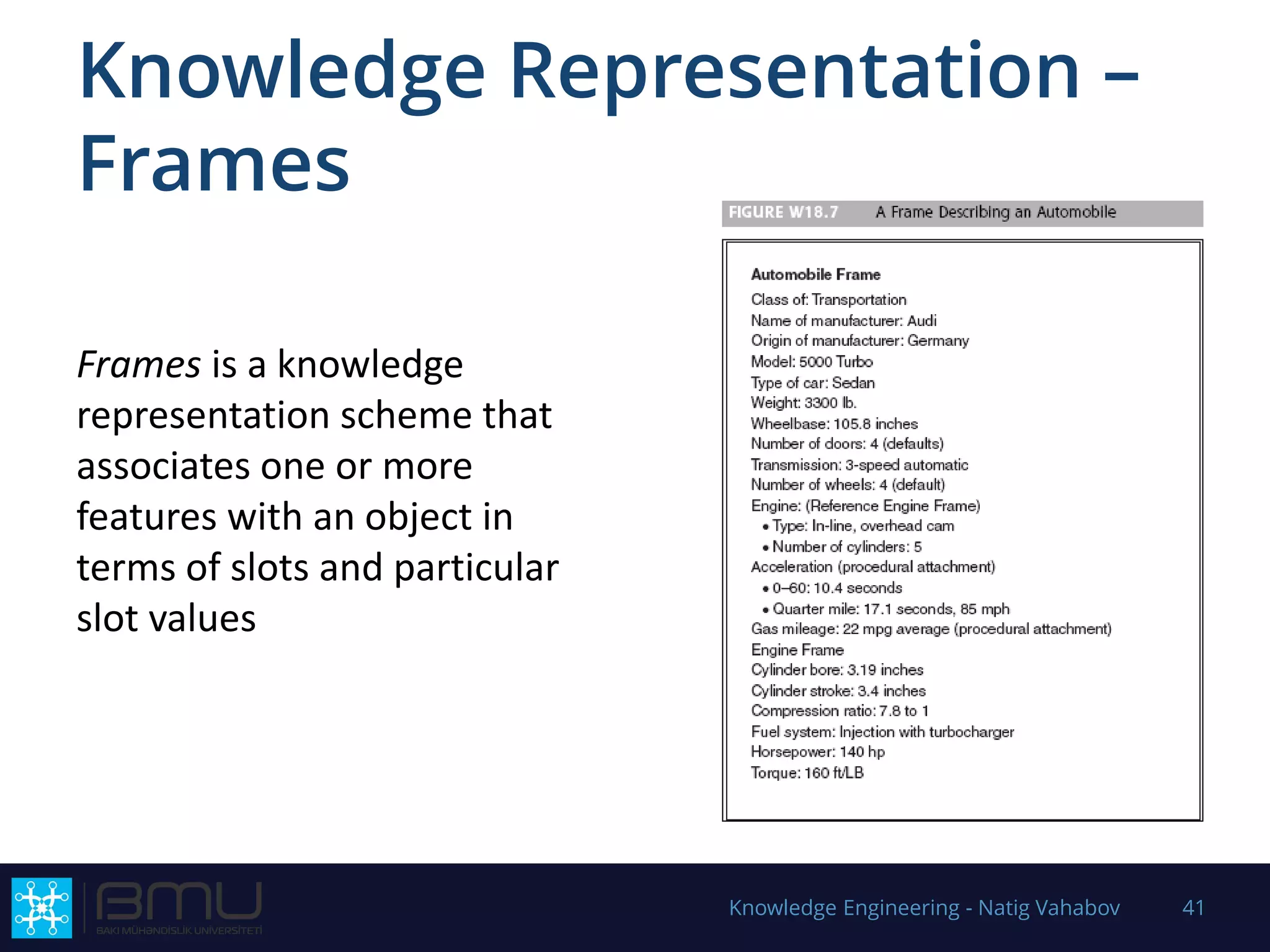
Knowledge Representation –
Frames
Knowledge Engineering - Natig Vahabov 41
Frames is a knowledge
representation scheme that
associates one or more
features with an object in
terms of slots and particular
slot values
Inferencing
This activity involves the design of software to
enable the computer to make inferences based on
the stored knowledge and the specifics of a
problem. The system can then provide advice to
non-expert users.
Knowledge Engineering - Natig Vahabov 42
Explanation and Justification
This step involves the design and programming of
an explanation capability (e.g., programming the
ability to answer questions such as why a specific
piece of information is needed by the computer or
how a certain conclusion was derived by the
computer).
Knowledge Engineering - Natig Vahabov 43
Importance of Knowledge
Engineering
• Knowledge is valuable and often outlives a
particular implementation
– knowledge management
• Errors in a knowledge-base can cause serious
problems
• Heavy demands on extendibility and
maintenance
– changes over time
Knowledge Engineering - Natig Vahabov 44
Problems in Knowledge
Engineering
• Complex information and knowledge is
difficult to observe
• Experts and other sources differ
• Multiple representations:
– textbooks
– graphical representations
– skills
Knowledge Engineering - Natig Vahabov 45
Views of Knowledge Engineering
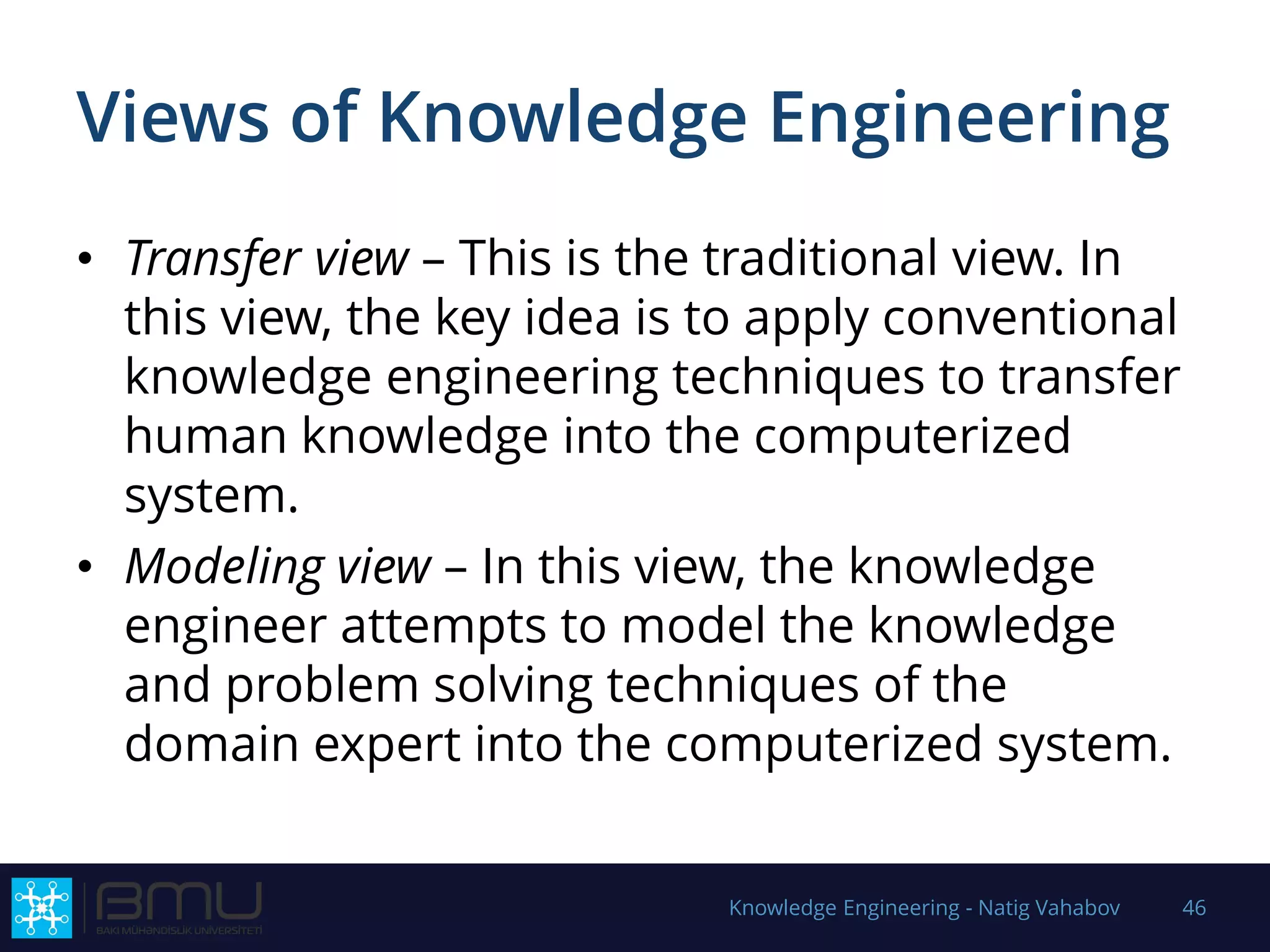
• Transfer view – This is the traditional view. In
this view, the key idea is to apply conventional
knowledge engineering techniques to transfer
human knowledge into the computerized
system.
• Modeling view – In this view, the knowledge
engineer attempts to model the knowledge
and problem solving techniques of the
domain expert into the computerized system.
Knowledge Engineering - Natig Vahabov 46
Transfer View
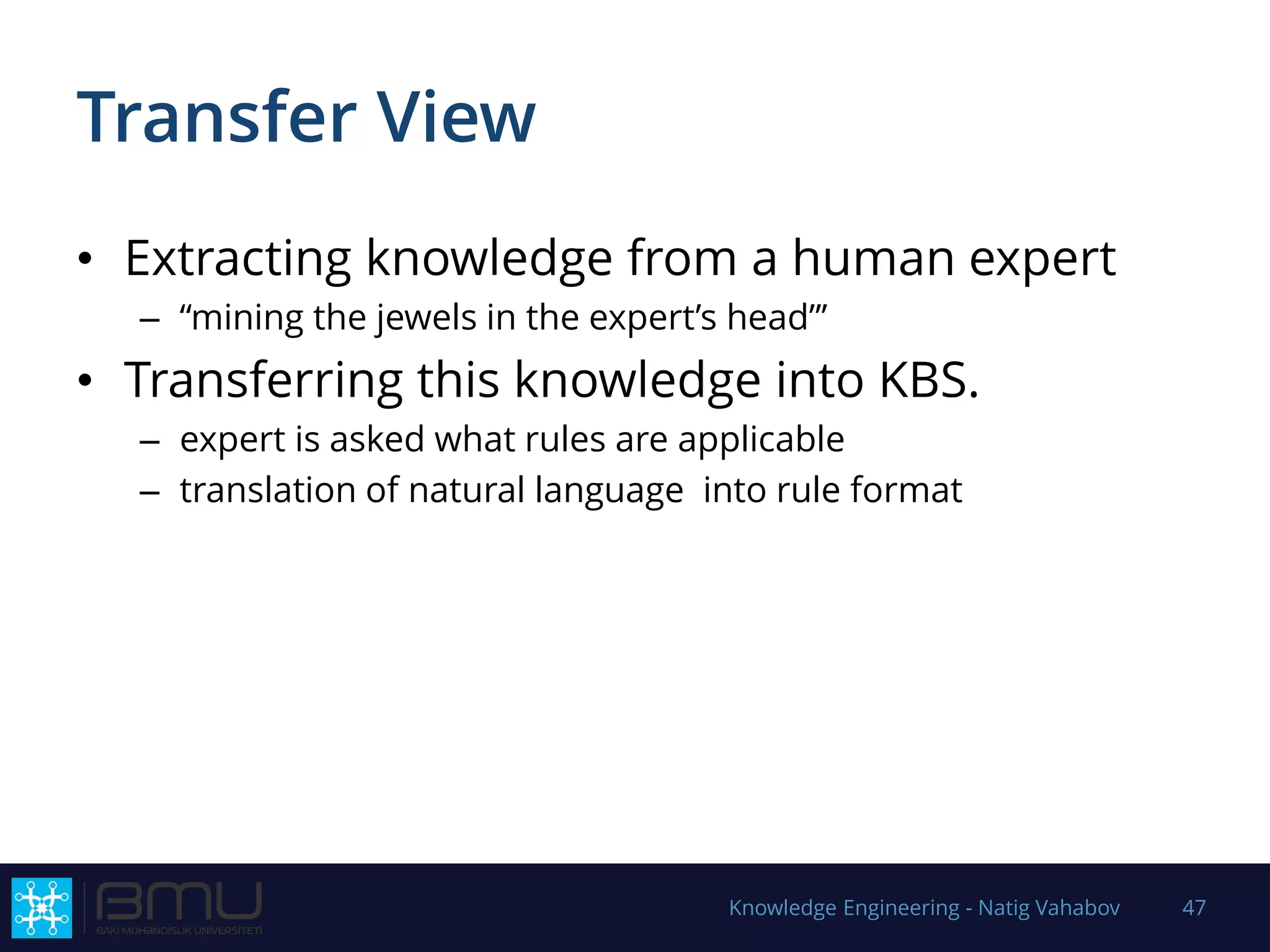
• Extracting knowledge from a human expert
– “mining the jewels in the expert’s head”’
• Transferring this knowledge into KBS.
– expert is asked what rules are applicable
– translation of natural language into rule format
Knowledge Engineering - Natig Vahabov 47
Problems with Transfer View
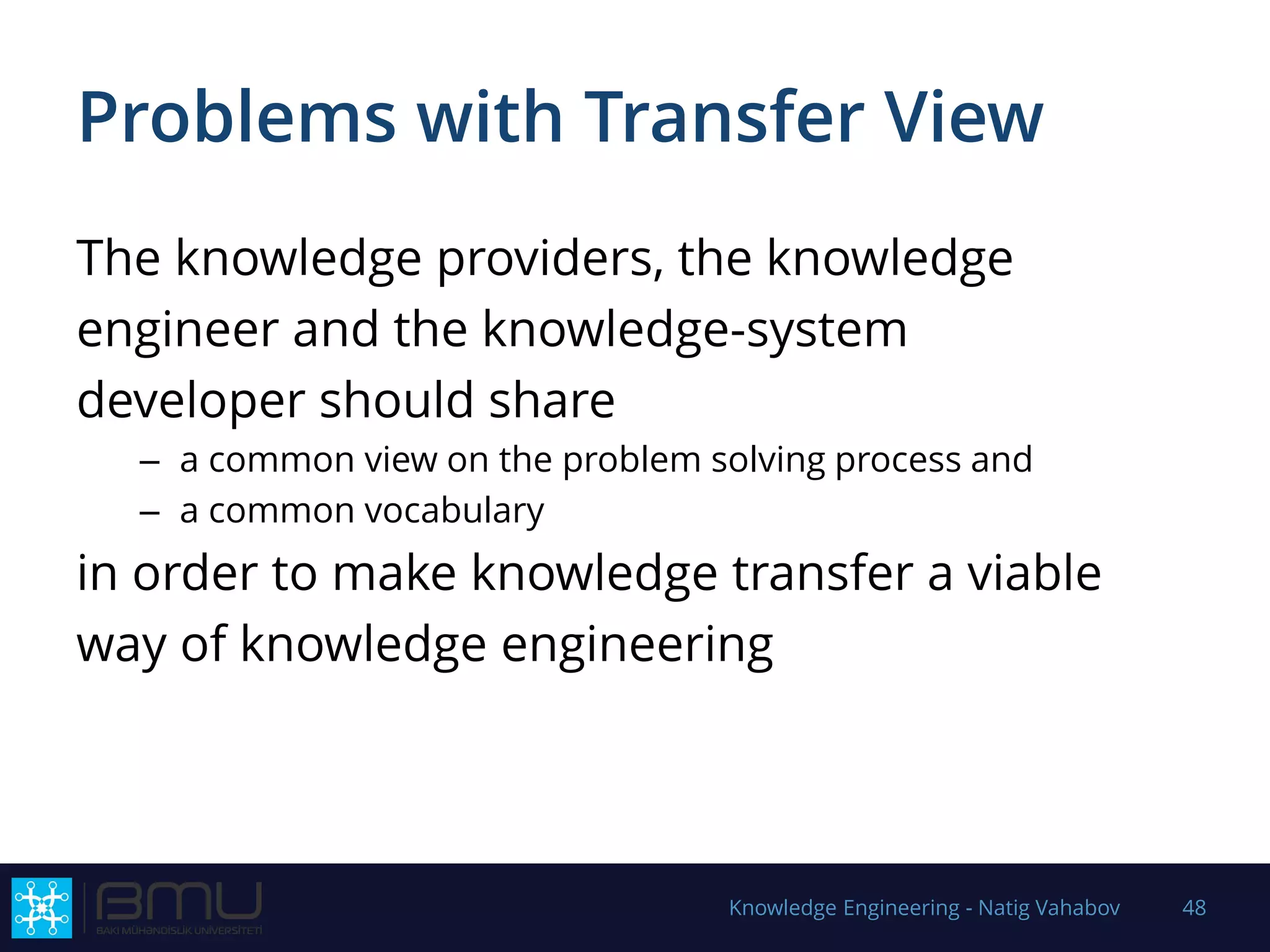
The knowledge providers, the knowledge
engineer and the knowledge-system
developer should share
– a common view on the problem solving process and
– a common vocabulary
in order to make knowledge transfer a viable
way of knowledge engineering
Knowledge Engineering - Natig Vahabov 48
Model View
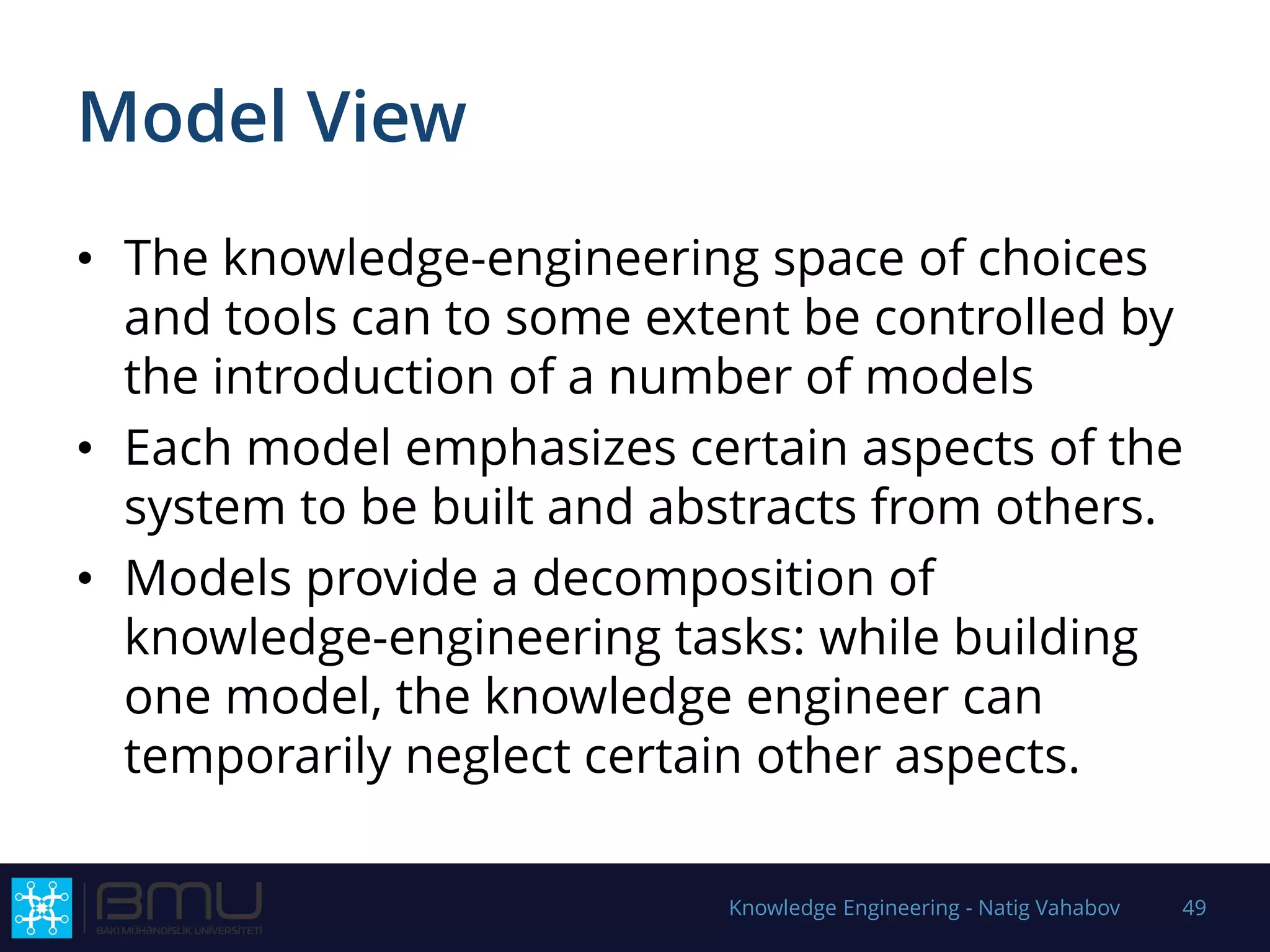
• The knowledge-engineering space of choices
and tools can to some extent be controlled by
the introduction of a number of models
• Each model emphasizes certain aspects of the
system to be built and abstracts from others.
• Models provide a decomposition of
knowledge-engineering tasks: while building
one model, the knowledge engineer can
temporarily neglect certain other aspects.
Knowledge Engineering - Natig Vahabov 49
CommonKADS
CommonKADS (Knowledge Acquisition and
Documentation Structuring) is the leading methodology
to support structured knowledge engineering. It has
been gradually developed and has been validated by
many companies and universities in the context of the
European ESPRIT IT Programme.
It is now the European de facto standard for knowledge
analysis and knowledge-intensive system development,
and it has been adopted as a whole or has been partly
incorporated in existing methods by many major
companies in Europe, as well as in the US and Japan
Knowledge Engineering - Natig Vahabov 50
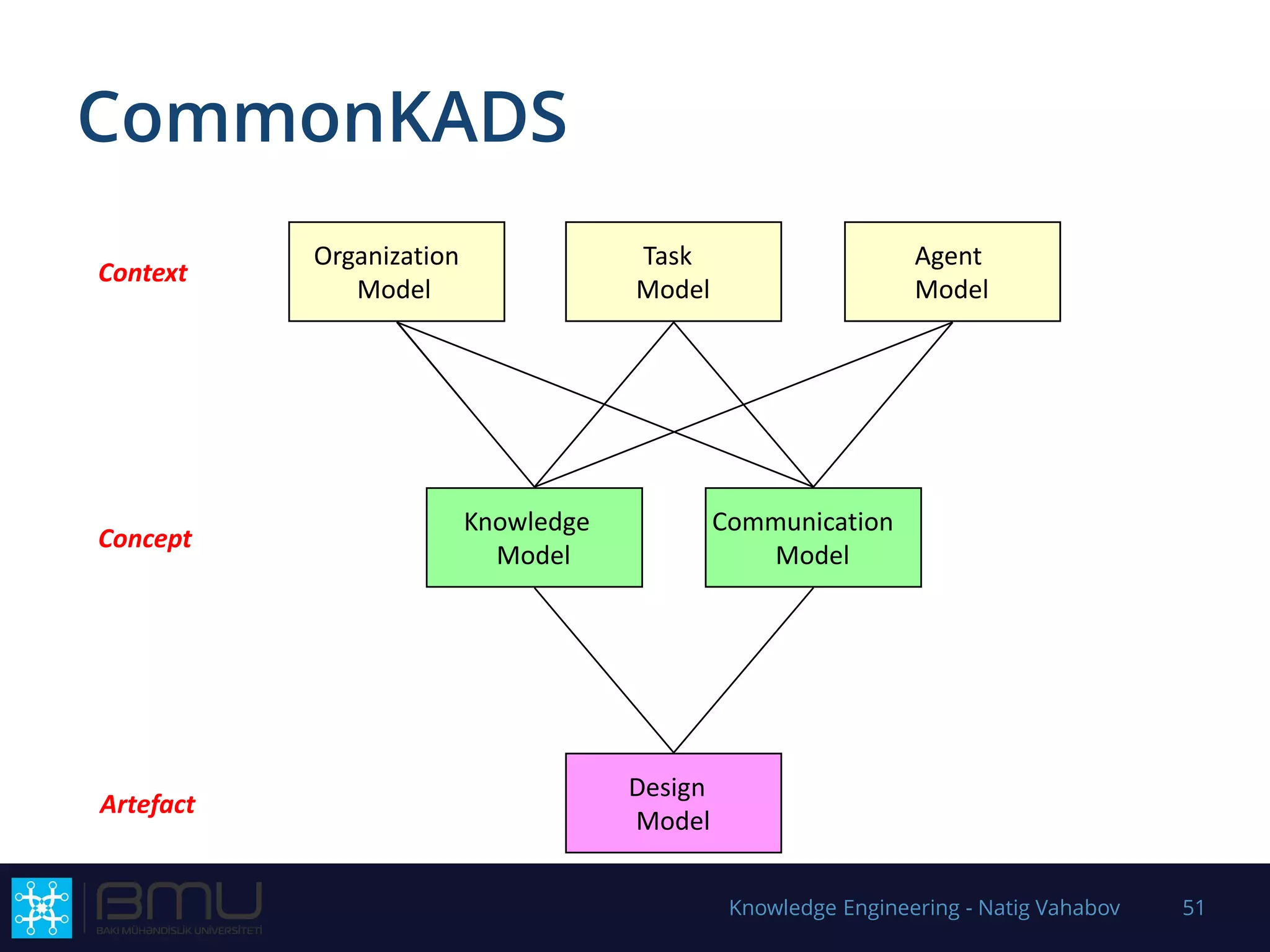
CommonKADS
Knowledge Engineering - Natig Vahabov 51
Organization
Model
Task
Model
Agent
Model
Knowledge
Model
Communication
Model
Design
Model
Context
Concept
Artefact
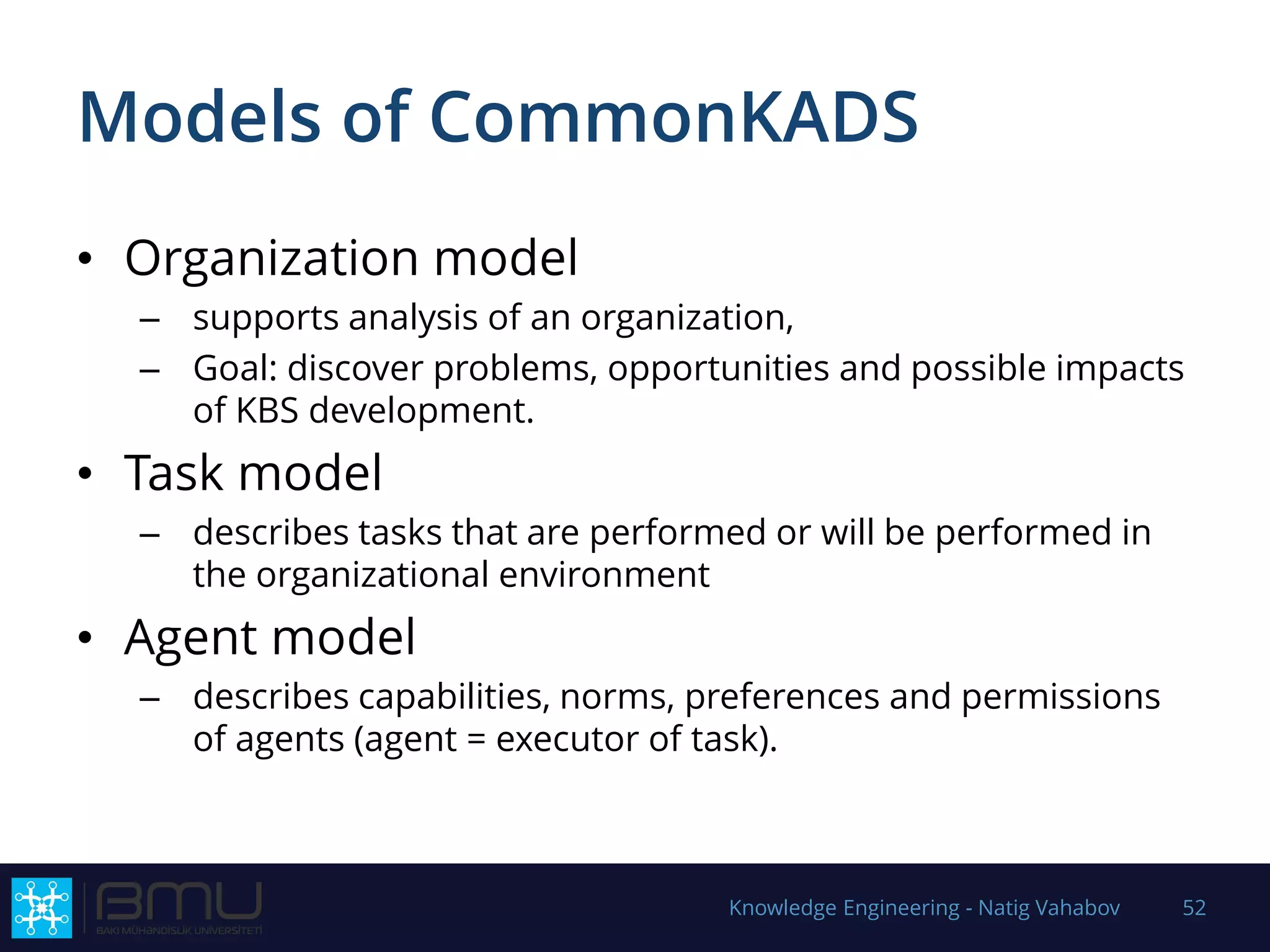
Models of CommonKADS
• Organization model
– supports analysis of an organization,
– Goal: discover problems, opportunities and possible impacts
of KBS development.
• Task model
– describes tasks that are performed or will be performed in
the organizational environment
• Agent model
– describes capabilities, norms, preferences and permissions
of agents (agent = executor of task).
Knowledge Engineering - Natig Vahabov 52
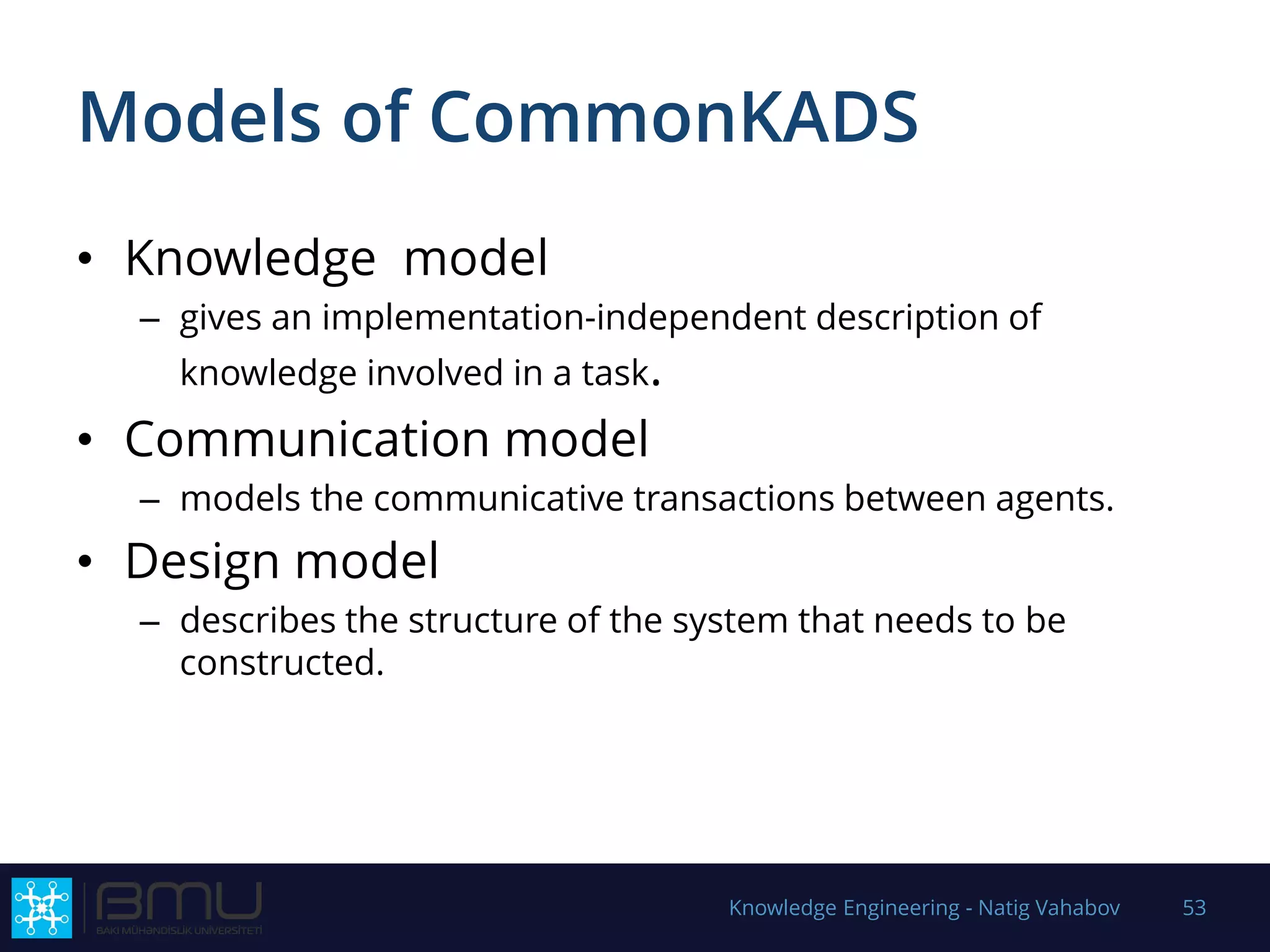
Models of CommonKADS
• Knowledge model
– gives an implementation-independent description of
knowledge involved in a task.
• Communication model
– models the communicative transactions between agents.
• Design model
– describes the structure of the system that needs to be
constructed.
Knowledge Engineering - Natig Vahabov 53
Principles of CommonKADS
• Divide and conquer.
• Configuration of an adequate model set for a
specific application.
• Models evolve through well defined states.
• The model set supports project management.
• Model development is driven by project
objectives and risk.
• Models can be developed in parallel.
Knowledge Engineering - Natig Vahabov 54
Roles in knowledge-system
development
• Knowledge provider
• Knowledge engineer/analyst
• Knowledge system developer
• Knowledge user
• Project manager
• Knowledge manager
Knowledge Engineering - Natig Vahabov 55
Knowledge Provider
• “traditional” expert
• person with extensive experience in an
application domain
• can provide also plan for domain
familiarization
– “where would you advise a beginner to start?”
• inter-provider differences are common
• need to assure cooperation
Knowledge Engineering - Natig Vahabov 56
Knowledge Engineer
A knowledge engineer is responsible for obtaining
knowledge from human experts and then
entering this knowledge into some form of KBS.
In developing KBS, the knowledge engineer
must apply methods, use tools, apply quality
control and standards, plan and manage
projects, and take into account human, financial,
and environmental constraints.
! should avoid becoming an "expert"
Knowledge Engineering - Natig Vahabov 57
Knowledge-system Developer
• Person that implements a knowledge system
on a particular target platform
• Needs to have general design/implementation
expertise
• Needs to understand knowledge analysis
– but only on the “use”-level
• Role is often played by knowledge engineer
Knowledge Engineering - Natig Vahabov 58
Knowledge User
• Primary users
– interact with the prospective system
• Secondary users
– are affected indirectly by the system
• Level of skill/knowledge is important factor
• May need extensive interacting facilities
– explanation
• His/her work is often affected by the system
– consider attitude / active role
Knowledge Engineering - Natig Vahabov 59
Project Manager
• Responsible for planning, scheduling and
monitoring development work
• Liaises with client
• Typically medium-size projects (4-6 people)
• Profits from structured approach
Knowledge Engineering - Natig Vahabov 60
Knowledge Manager
• Knowledge Manager works with the KM
Program or Project Manager to implement KM
initiatives
• Knowledge Manager should have the
following responsibilities
– manages KM efforts
– general understanding of knowledge architecture
– extensive experience and senior technical expertise in the
field of Knowledge Management
• Looks across KM processes to capture tacit and
explicit knowledge
Knowledge Engineering - Natig Vahabov 61
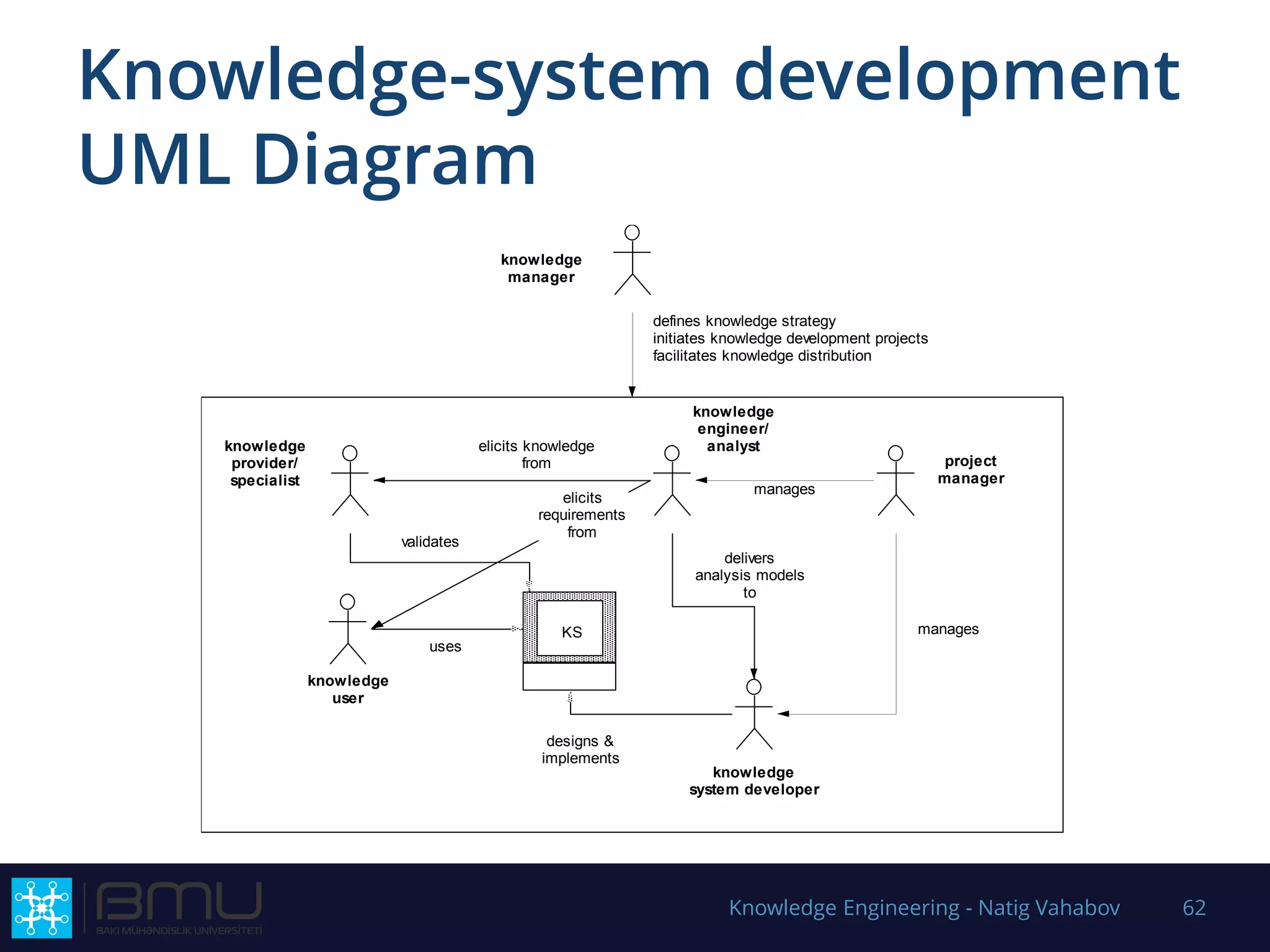
Knowledge-system development
UML Diagram
Knowledge Engineering - Natig Vahabov 62
knowledge
provider/
specialist
project
manager
knowledge
system developer
knowledge
engineer/
analyst
knowledge
manager
knowledge
user
KS
manages
manages
uses
designs &
implements
validates
elicits knowledge
from
elicits
requirements
from
delivers
analysis models
to
defines knowledge strategy
initiates knowledge development projects
facilitates knowledge distribution
References
• Russell, Stuart; Norvig, Peter (1995). Artificial Intelligence: A
Modern Approach
• Kendal, S.L.; Creen, M. (2007), An introduction to knowledge
engineering, London: Springer
• Feigenbaum, Edward A. Knowledge engineering: the applied side
of artificial intelligence. No. STAN-CS-80-812. STANFORD UNIV CA
DEPT OF COMPUTER SCIENCE, 1980.
• Schreiber, Guus, et al. "CommonKADS: A comprehensive
methodology for KBS development." IEEE expert 9.6 (1994): 28-
37.
• Gourlay, Stephen. "The SECI model of knowledge creation: some
empirical shortcomings."
Knowledge Engineering - Natig Vahabov 63

01 Introduction to Knowledge Engineering

  • 1.
  • 2.
  • 3.
    scientia potentia est KnowledgeEngineering - Natig Vahabov 3 “Knowledge is power” Sir Francis Bacon, 16th century English philosopher
  • 4.
    Agenda • Knowledge asa weapon • Knowledge pyramid • Information Processing Views of Knowledge • Philosophy of knowledge – Plato’s Formula, Gettier Problem • Taxonomies of knowledge – Types, Classifications, Levels • Knowledge Creation – SECI Model • Knowledge Engineering – History, MYCIN, KBS, Knowledge Steps, FOL, Semantic Network, Views • CommonKADS • Roles in Knowledge Engineering Knowledge Engineering - Natig Vahabov 4
  • 5.
    Knowledge as aweapon In 2017, China’s government put out its plan to lead the world in AI by 2030 By the end of 2019, with a $14 trillion GDP(gross domestic product), China is predicted to account for over 35 % of global economic growth. AI’s deployment will add $15.7 trillion to the global GDP by 2030. What are 4 main factors help China to become a world giant? Knowledge Engineering - Natig Vahabov 5
  • 6.
    Knowledge as aweapon • Mass government funding and support – Government have already spent more than $300 billion Knowledge Engineering - Natig Vahabov 6
  • 7.
    Knowledge as aweapon • Mass government funding and support – Government have already spent more than $300 billion • Hungry entrepreneurs – AI giant Alibaba has unveiled plans to invest $15 billion in international research labs from the US to Israel, with others following suit Knowledge Engineering - Natig Vahabov 7
  • 8.
    Knowledge as aweapon • Mass government funding and support – Government have already spent more than $300 billion • Hungry entrepreneurs – AI giant Alibaba has unveiled plans to invest $15 billion in international research labs from the US to Israel, with others following suit • Growing AI expertise – Meanwhile, Baidu, Didi, and Tencent have all set up their own research labs. China’s Face++ now leads the world in face and image recognition AI, beating out top teams from Google, Microsoft and Facebook at the 2017 COCO image-recognition competition Knowledge Engineering - Natig Vahabov 8
  • 9.
    Knowledge as aweapon • Mass government funding and support – Government have already spent more than $300 billion • Hungry entrepreneurs – AI giant Alibaba has unveiled plans to invest $15 billion in international research labs from the US to Israel, with others following suit • Growing AI expertise – Meanwhile, Baidu, Didi, and Tencent have all set up their own research labs. China’s Face++ now leads the world in face and image recognition AI, beating out top teams from Google, Microsoft and Facebook at the 2017 COCO image-recognition competition • Abundant Data Knowledge Engineering - Natig Vahabov 9
  • 10.
    Knowledge as aweapon Abundant Data - Government prohibited to use of west world social medias. - WeChat platform alone has over one billion monthly active users. That’s more than the entire population of Europe. - Chinese AI giants like Tencent have created unified online ecosystems that concentrate all your data in one place. - China’s facial recognition capacities explode, these maps are increasingly populated with faces even when you’re not online. - Chinese mobile payments exceeded $9 trillion just in 2016 - Mobile payment platforms like WeChat Wallet and Alipay have data on everything Knowledge Engineering - Natig Vahabov 10
  • 11.
  • 12.
    Raw data toknowledge Knowledge Engineering - Natig Vahabov 12
  • 13.
    Information Processing Views ofKnowledge • Hierarchical view • Reversed hierarchical view • Non-hierarchical view Knowledge Engineering - Natig Vahabov 13
  • 14.
    Information Processing Views ofKnowledge Hierarchical view – Information is the input or raw material of new knowledge – Knowledge is authenticated/personalized information Knowledge Engineering - Natig Vahabov 14
  • 15.
    Information Processing Views ofKnowledge Reversed hierarchical view – Knowledge must exist before information can be formulated and before data can be collected Knowledge Engineering - Natig Vahabov 15
  • 16.
    Information Processing Views ofKnowledge Non-hierarchical view – Knowledge is needed in converting data into information – Knowledge is the accumulation of experiences and knowledge is created through conjectures and refutations. Knowledge Engineering - Natig Vahabov 16
  • 17.
    Philosophy of knowledge ‘Knowledgeis a familiarity, awareness, or understanding of someone or something, such as facts, information, descriptions, or skills, which is acquired through experience or education by perceiving, discovering, or learning’. Wikipedia Knowledge Engineering - Natig Vahabov 17
  • 18.
    Philosophy of knowledge Inphilosophy, the study of knowledge is called epistemology The philosopher Plato defined knowledge as ‘justified true belief’. Can we formulate knowledge? Knowledge Engineering - Natig Vahabov 18
  • 19.
    Philosophy of knowledge Personknows that Subject If and only if • S is TRUE • P BELIVES that S is TRUE • P is JUSTIFIED in BELIEVING that S is TRUE This is formula according to Plato, but is it totally accurate? Knowledge Engineering - Natig Vahabov 19
  • 20.
    Philosophy of knowledge AmericanPhilosopher Edmund Gettier, in 1963 introduced three-page paper with two counterexamples against Plato JTB statement. One of Gettier Problem is: if P looks at the clock which just stopped working few days ago, but shows the correct time, then does it mean P knows S? Knowledge Engineering - Natig Vahabov 20
  • 21.
    Philosophy of knowledge Personknows that Subject If and only if • S is TRUE • P BELIVES that S is TRUE • P is JUSTIFIED in BELIEVING that S is TRUE • It is ON TRUE GROUNDS that P BELIEVES that S Knowledge Engineering - Natig Vahabov 21
  • 22.
    Taxonomies of Knowledge SixTypes of Knowledge • Meta-knowledge – Knowledge about knowledge • Declarative knowledge – Know-about • Procedural knowledge – Know-how • Causal knowledge – Know-why • Conditional knowledge – Know-when • Relational knowledge – Know-with Knowledge Engineering - Natig Vahabov 22
  • 23.
    Taxonomies of Knowledge Knowledgecan be classified as: • Tacit vs. explicit – Tacit knowledge is deeply rooted in actions, experience, and involvement in a specific context. On the other hand, Explicit knowledge refers to knowledge that is transmittable in formal, systematic language. • Theoretical vs. practical • Individual vs. social – Individual knowledge is created by and exists in the individual whereas social knowledge is created by and exists in the collective actions of a group. Knowledge Engineering - Natig Vahabov 23
  • 24.
    Knowledge Levels • Shallowknowledge – A representation of only surface level information that can be used to deal with very specific situations – For example “If gasoline tank is empty, then car will not start “ • Deep knowledge – A representation of information about the internal and causal structure of a system that considers the interactions among the system’s components Knowledge Engineering - Natig Vahabov 24
  • 25.
    Deep Knowledge Example KnowledgeEngineering - Natig Vahabov 25
  • 26.
    Knowledge Creation Knowledge Creationis process to create new ideas through interactions between explicit and tacit knowledge in individual human minds. Knowledge sharing and knowledge creation are the two vital aspects of knowledge management which play an important role in creating organisational value. Ikujiro Nonaka introduced SECI Model in 1990 and Takeuchi developed it, to share, spread and create new knowledge. Knowledge Engineering - Natig Vahabov 26
  • 27.
    SECI Model (Nonakaand Takeuchi, 1990) • Socialization – This dimension explains Social interaction as tacit to tacit knowledge transfer, sharing tacit knowledge face-to-face or through experiences • Externalization – Tacit and explicit by Externalization (f.e. publishing) that embed the combined tacit knowledge which enable its communication • Combination – Explicit to explicit by Combination (f.e. organizing), combining different types of explicit knowledge to, for example building prototypes • Internalization – Explicit to tacit by Internalization, explicit knowledge becomes part of an individual's knowledge and will be assets for an organization Knowledge Engineering - Natig Vahabov 27
  • 28.
    The SECI Model KnowledgeEngineering - Natig Vahabov 28
  • 29.
    Knowledge Engineering An engineeringdiscipline that involves integrating knowledge into computer systems in order to solve complex problems normally requiring a high level of human expertise Feigenbaum and Pamela, 1983 Knowledge Engineering - Natig Vahabov 29
  • 30.
    Knowledge Engineering Knowledge engineering(KE) refers to all technical, scientific and social aspects involved in building, maintaining and using knowledge-based systems (KBS) Knowledge Engineering - Natig Vahabov 30
  • 31.
    A Short Historyof Knowledge Systems Knowledge Engineering - Natig Vahabov 31 1965 19851975 1995 general-purpose search engines (GPS) first-generation rule-based systems (MYCIN, XCON) emergence of structured methods (early KADS) mature methodologies (CommonKADS) => from art to discipline =>
  • 32.
    MYCIN Diagnosing and treatingpatients with infectious blood diseases • A rule-based expert system • Developed at Stanford University – 1976 • Uses backward chaining for reasoning • Incorporates about 500 rules • Written in INTERLISP (a dialect of LISP) Knowledge Engineering - Natig Vahabov 32
  • 33.
    Knowledge Engineering It normallyinvolves five distinct steps in transferring human knowledge into some form of knowledge based systems (KBS) – Knowledge acquisition – Knowledge validation & verification – Knowledge representation – Inferencing – Explanation and justification Knowledge Engineering - Natig Vahabov 33
  • 34.
  • 35.
    Knowledge Acquisition Knowledge acquisitionis the process of extracting, structuring and organizing knowledge from one source, usually human experts so it can be used in software such as an Expert System. This is often the major obstacle in building an Expert System. Source can be: • Human Experts, Databases, Internet – Undocumented knowledge • Expert Systems – Documented knowledge Knowledge Engineering - Natig Vahabov 35
  • 36.
    Knowledge Acquisition Techniques • Interview –Most knowledge is in the head of the experts, they have lots tacit knowledge and tacit knowledge is hard to describe. Don’t expect an expert must know everything – There are certain problems: not interested, unavailable, too theoretical etc. • Self-report • Laddering – Organizing entities in a hierarchy ( For example, Office room allocation due to profession, gender, smoker, location etc.) • Card Sorting – Write down key concepts in various cards and let expert cluster them in a way. • Diagram-based techniques – Let expert explain tacit knowledge with preferred diagrams, such as UML Knowledge Engineering - Natig Vahabov 36
  • 37.
    Knowledge V&V Knowledge acquiredfrom experts needs to be evaluated for quality, including: – The main objective of evaluation is to assess an ES’s overall value – Validation is the part of evaluation that deals with the performance of the system – Verification is building the system right or substantiating that the system is correctly implemented to its specifications Knowledge Engineering - Natig Vahabov 37
  • 38.
    Knowledge Representation • LogicalRepresentation – Represent knowledge with mathematical logic – First Order Logic, Propositional Logic • Production Rule – A knowledge representation method in which knowledge is formalized into rules that have IF and THEN parts • Semantic Network – A knowledge representation method that consists of a network of nodes, representing concepts or objects, connected by arcs describing the relations between the nodes • Frames Knowledge Engineering - Natig Vahabov 38
  • 39.
    Knowledge Representation - FOL First-orderlogic (like natural language) assumes the world contains – Objects: people, houses, numbers, colors.. – Relations: red, prime, brother of, bigger than.. – Functions: father of, best friend, plus.. “All professors are people” ∀ x ( is-prof(x) → is-person(x) ) “Everyone is a friend of someone” ∀ x (∃ y ( is-friend-of (y, x) ) ) Knowledge Engineering - Natig Vahabov 39
  • 40.
    Knowledge Representation – SemanticNetwork Knowledge Engineering - Natig Vahabov 40 Semantic network is a knowledge representation method that consists of a network of nodes, representing concepts or objects, connected by arcs describing the relations between the nodes
  • 41.
    Knowledge Representation – Frames KnowledgeEngineering - Natig Vahabov 41 Frames is a knowledge representation scheme that associates one or more features with an object in terms of slots and particular slot values
  • 42.
    Inferencing This activity involvesthe design of software to enable the computer to make inferences based on the stored knowledge and the specifics of a problem. The system can then provide advice to non-expert users. Knowledge Engineering - Natig Vahabov 42
  • 43.
    Explanation and Justification Thisstep involves the design and programming of an explanation capability (e.g., programming the ability to answer questions such as why a specific piece of information is needed by the computer or how a certain conclusion was derived by the computer). Knowledge Engineering - Natig Vahabov 43
  • 44.
    Importance of Knowledge Engineering •Knowledge is valuable and often outlives a particular implementation – knowledge management • Errors in a knowledge-base can cause serious problems • Heavy demands on extendibility and maintenance – changes over time Knowledge Engineering - Natig Vahabov 44
  • 45.
    Problems in Knowledge Engineering •Complex information and knowledge is difficult to observe • Experts and other sources differ • Multiple representations: – textbooks – graphical representations – skills Knowledge Engineering - Natig Vahabov 45
  • 46.
    Views of KnowledgeEngineering • Transfer view – This is the traditional view. In this view, the key idea is to apply conventional knowledge engineering techniques to transfer human knowledge into the computerized system. • Modeling view – In this view, the knowledge engineer attempts to model the knowledge and problem solving techniques of the domain expert into the computerized system. Knowledge Engineering - Natig Vahabov 46
  • 47.
    Transfer View • Extractingknowledge from a human expert – “mining the jewels in the expert’s head”’ • Transferring this knowledge into KBS. – expert is asked what rules are applicable – translation of natural language into rule format Knowledge Engineering - Natig Vahabov 47
  • 48.
    Problems with TransferView The knowledge providers, the knowledge engineer and the knowledge-system developer should share – a common view on the problem solving process and – a common vocabulary in order to make knowledge transfer a viable way of knowledge engineering Knowledge Engineering - Natig Vahabov 48
  • 49.
    Model View • Theknowledge-engineering space of choices and tools can to some extent be controlled by the introduction of a number of models • Each model emphasizes certain aspects of the system to be built and abstracts from others. • Models provide a decomposition of knowledge-engineering tasks: while building one model, the knowledge engineer can temporarily neglect certain other aspects. Knowledge Engineering - Natig Vahabov 49
  • 50.
    CommonKADS CommonKADS (Knowledge Acquisitionand Documentation Structuring) is the leading methodology to support structured knowledge engineering. It has been gradually developed and has been validated by many companies and universities in the context of the European ESPRIT IT Programme. It is now the European de facto standard for knowledge analysis and knowledge-intensive system development, and it has been adopted as a whole or has been partly incorporated in existing methods by many major companies in Europe, as well as in the US and Japan Knowledge Engineering - Natig Vahabov 50
  • 51.
    CommonKADS Knowledge Engineering -Natig Vahabov 51 Organization Model Task Model Agent Model Knowledge Model Communication Model Design Model Context Concept Artefact
  • 52.
    Models of CommonKADS •Organization model – supports analysis of an organization, – Goal: discover problems, opportunities and possible impacts of KBS development. • Task model – describes tasks that are performed or will be performed in the organizational environment • Agent model – describes capabilities, norms, preferences and permissions of agents (agent = executor of task). Knowledge Engineering - Natig Vahabov 52
  • 53.
    Models of CommonKADS •Knowledge model – gives an implementation-independent description of knowledge involved in a task. • Communication model – models the communicative transactions between agents. • Design model – describes the structure of the system that needs to be constructed. Knowledge Engineering - Natig Vahabov 53
  • 54.
    Principles of CommonKADS •Divide and conquer. • Configuration of an adequate model set for a specific application. • Models evolve through well defined states. • The model set supports project management. • Model development is driven by project objectives and risk. • Models can be developed in parallel. Knowledge Engineering - Natig Vahabov 54
  • 55.
    Roles in knowledge-system development •Knowledge provider • Knowledge engineer/analyst • Knowledge system developer • Knowledge user • Project manager • Knowledge manager Knowledge Engineering - Natig Vahabov 55
  • 56.
    Knowledge Provider • “traditional”expert • person with extensive experience in an application domain • can provide also plan for domain familiarization – “where would you advise a beginner to start?” • inter-provider differences are common • need to assure cooperation Knowledge Engineering - Natig Vahabov 56
  • 57.
    Knowledge Engineer A knowledgeengineer is responsible for obtaining knowledge from human experts and then entering this knowledge into some form of KBS. In developing KBS, the knowledge engineer must apply methods, use tools, apply quality control and standards, plan and manage projects, and take into account human, financial, and environmental constraints. ! should avoid becoming an "expert" Knowledge Engineering - Natig Vahabov 57
  • 58.
    Knowledge-system Developer • Personthat implements a knowledge system on a particular target platform • Needs to have general design/implementation expertise • Needs to understand knowledge analysis – but only on the “use”-level • Role is often played by knowledge engineer Knowledge Engineering - Natig Vahabov 58
  • 59.
    Knowledge User • Primaryusers – interact with the prospective system • Secondary users – are affected indirectly by the system • Level of skill/knowledge is important factor • May need extensive interacting facilities – explanation • His/her work is often affected by the system – consider attitude / active role Knowledge Engineering - Natig Vahabov 59
  • 60.
    Project Manager • Responsiblefor planning, scheduling and monitoring development work • Liaises with client • Typically medium-size projects (4-6 people) • Profits from structured approach Knowledge Engineering - Natig Vahabov 60
  • 61.
    Knowledge Manager • KnowledgeManager works with the KM Program or Project Manager to implement KM initiatives • Knowledge Manager should have the following responsibilities – manages KM efforts – general understanding of knowledge architecture – extensive experience and senior technical expertise in the field of Knowledge Management • Looks across KM processes to capture tacit and explicit knowledge Knowledge Engineering - Natig Vahabov 61
  • 62.
    Knowledge-system development UML Diagram KnowledgeEngineering - Natig Vahabov 62 knowledge provider/ specialist project manager knowledge system developer knowledge engineer/ analyst knowledge manager knowledge user KS manages manages uses designs & implements validates elicits knowledge from elicits requirements from delivers analysis models to defines knowledge strategy initiates knowledge development projects facilitates knowledge distribution
  • 63.
    References • Russell, Stuart;Norvig, Peter (1995). Artificial Intelligence: A Modern Approach • Kendal, S.L.; Creen, M. (2007), An introduction to knowledge engineering, London: Springer • Feigenbaum, Edward A. Knowledge engineering: the applied side of artificial intelligence. No. STAN-CS-80-812. STANFORD UNIV CA DEPT OF COMPUTER SCIENCE, 1980. • Schreiber, Guus, et al. "CommonKADS: A comprehensive methodology for KBS development." IEEE expert 9.6 (1994): 28- 37. • Gourlay, Stephen. "The SECI model of knowledge creation: some empirical shortcomings." Knowledge Engineering - Natig Vahabov 63