FY2014 EI Paper Application Form
Title of the paper Changing the Perception of the Pharmaceutical Industry
Through Targeted Community Outreach
Company Name Eisai Inc., Andover, MA
Organization name Interdepartmental
Authors Natalie Twine ESI / Biology Research Oncology
Sarah Leacu ESI / US Biomarkers
Scott Potter Dr. An Wang Middle School / Teacher
Number of pages
(including this page)
12 pages
Attached material Yes
Summary of your activity/proposal
PatientView, a research, publishing and consultancy group recently published “The
Corporate Reputation of Pharma – The Patient Perspective 2014” in February 2015. For
the first time, Eisai has made an appearance on this patient perspective survey, which is
in its fourth edition. Eisai currently ranks 10th overall, when comparing patients’
perspective among 37 individual pharma corporations. Results are based on the
following indicators: Patient Centricity, Patient Information, Patient Safety, Useful
Products, Transparency and Integrity. A main driver of this achievement was patient
groups’ high ranking of Eisai as a provider of high-quality products. The press release
from PatientView, outlined activities in which patient groups feel the industry is lacking.
These include, but are not limited to; having good relationships with the media,
managing adverse news about products, providing services to patients outside its
business remit, being transparent in all corporate activities and practicing philanthropic
activities.
The Corporate Reputation survey looked at the pharma industry as a whole; but, what if
one considers the public opinion of the scientists who comprise these companies? In a
publication “Gaining trust as well as respect in communicating to motivated audiences
about science topics” in PNAS (September 16, 2014 | vol. 111 | suppl. 4 | 13593–13597),
Susan T. Fiske and Cydney Dupress described the public’s perception of the scientific
community based on an online survey of American adults. The scientific profession,
when compared to other typical American jobs, was perceived as highly-competent
(capability), low-warmth (inferring intent) and categorized as an “envied” profession.
Based on this research, scientists have earned the American public’s respect based on
their level of expertise; however, there is a sense that scientists lack warmth and
trustworthiness.
These studies concentrate on adults’ opinions of pharma and the scientific community.
But when are these perceptions formed? In two articles in Scientific American, “Start
Science Sooner” (February 1, 2010) and “What a Scientist Looks Like” (February 16,
2012), emphasis is placed on the premise that children as young as kindergarteners begin
to form negative opinions about science and have misconceptions about what a scientist
is and what scientists do.
Allie Wilkinson, multimedia journalist, is the creator of This Is What A Scientist Looks
Like, a community photo project aimed at challenging the stereotypical perception of a
scientist. When a group of 7th grade students was asked to draw what a scientist look
liked, an overwhelming image of old men in lab coats, balding and wearing glasses,
emerged. This image provides a narrow view of my colleagues’ diversity. Ms.
Wilkinson tries to promote the reality that there is no single clear-cut path to becoming a
scientist. A scientist can come from any background; there is no cookie-cutter mold of
what a scientist looks, sounds, or behaves like. There is no rule stating that scientists
can’t be multidimensional and can’t have fun.
Considering the misperceptions that surround who scientists are, the recent measles
epidemics, and the high level of politicized controversy around evolution and climate
change, it is alarming to realize the extent to which the American public is regularly
bombarded with “junk” science from uninformed/misinformed non-experts, including
politicians and celebrities. A prime example of this can be seen in the recent media
coverage of the measles outbreak and the debate over childhood vaccinations. This
growing trend for rapidly spreading, widely prevalent misinformation, coupled with the
public’s already inaccurate perception of the scientific community, further fosters a
growing mistrust of pharmaceutical companies among the general public.
Our employees attempt to interact with patients, as part of the Eisai hhc mission; often
during a very vulnerable and devastating time of those patient’s and their families’ lives.
We wanted to address the challenges surrounding this mistrust that; could impact a
person’s willingness to trust the healthcare system. In reality, everyone will be a patient
at some point. We sought to establish a connection with children from a skeptical, low
income community now, to prevent these inaccurate perceptions from taking firm root.
Our project of introducing science as a fun activity, practiced incidentally, by a variety of
people, stemmed from our dismay at the public perception studies as noted above.
Sarah Leacu and I seized an opportunity to interact with students attending the Dr. An
Wang Middle School, located in Lowell, MA. This invitation was extended to us by
Scott Potter, a 7th grade science teacher. The students come from very diverse
backgrounds, and most from very challenging home environments. Lowell,
Massachusetts, a city of approximately 106,519 people, has a 55% higher occurrence of
violent crime when compared to the rest of the country.1 In 2012, the education
attainment ranked lower for Lowell compared to the overall Massachusetts’ percentage
in almost every category.2 When compared to the state’s high school dropout rate
(10.3%), Lowell has doubled the frequency (22.7%). Individuals in these demographics,
commonly acquire a mistrust of the medical community at a very early age.
During our first interactions with the students, we began to rethink how we could begin
to improve some of the areas of deficiencies reported by PatientView. Hard evidence of
these attitudes became apparent when the students questioned whether we (scientists)
actually had the cure for cancer, but were just withholding it from the public. As
professionals working in the pharmaceutical industry, we were incredulous at this idea;
however, in these students’ world; this belief is not uncommon.
Though, on the surface, our project with the middle school students did not include
direct interactions with patients actively dealing with disease, we do feel that these
interactions provided the foundation for building a firm, positive relationship with
potential, future patients and care-givers. Even at the young age of 12-13, it quickly
became apparent, that children are learning bias based on information from numerous
social media outlets, community and familial opinions.
Eisai’s positive interactions with the general public, in the form of this outreach activity,
can aid us in establishing a foundation on which critical conversations about a patient’s
reality can occur. This activity starts with the students, who may then share with others
their positive experience. We are now creating a direct, transparent link between the
community and the pharmaceutical world. We strongly believe that this program not
only taught the students that science is accessible to them, but also showed them the
directly empowering example that by engaging with scientific professionals, they could
influence the way we view our work.
We want to continue working towards building a stronger relationship with these young
adults in our local, economically challenged communities. By opening our doors and
encouraging positive interaction with our employees, we intend to eliminate the
overwhelming mistrust of the pharmaceutical industry.
Our activity can be broken up into two separate, but related activities.
1. An outreach presentation from two molecular scientists to approximately 180 7th
grade middle school students attending Dr. An Wang Middle School.
2. On-site visit to Eisai Andover Site for 30 middle school students that participated in
the outreach presentation.
Outreach Presentation
During the month of March 2015, Sarah Leacu and I visited the Dr. An Wang Middle
School to provide presentations on the work of a molecular biological scientist. We
spoke to approximately 180 7th, plus some teacher-selected 8th grade students from six
different classes, working with three different teachers. Our presentation (Supplementary
Document A) covered our personal journeys towards our current careers, sharing our
personal and professional interests. We also shared our own personal stories of how
cancer has touched our lives. We explored with the students the scientific importance of
understanding the structure of DNA. We started from the discovery process, and moved
to a hands-on workshop, where we helped the students extract DNA from a banana. We
then discussed how we can gain health information about our family dogs just by
understanding their DNA. Utilizing these examples, we were able to draw parallels for
the students that enabled them to understand human disease and the treatment of cancer.
It was especially gratifying for us when each class exuberantly peppered us with
interesting and quite thoughtful questions.
Andover On-Site Visit
On April 7, 2015, 30 selected students participated in a field trip to the Andover Eisai
site. During this visit, they had the opportunity to interact with over 30 Eisai employees
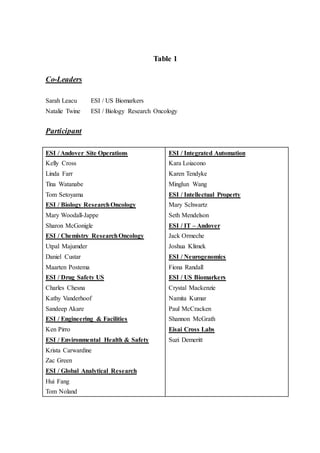
encompassing a multitude of different departments and a large array of positions. (Table
1) The students’ day begin with two presentations, one covering the importance of lab
safety and the other on the process of developing new cancer drugs. Following these
presentations, the students embarked on a six stop tour of the facility. Groups of
employees from a number of different departments, including ONC PCU, Engineering
and Facilities, Drug Safety, Global Analytical Research, Integrated Automation, IT and
BPM CFU, provided instructional demonstrations illustrating what role their functional
group contributes to product creation. During the afternoon session, students were given
the opportunity to participate in “speed networking”. During this time, Eisai employees
across the listed departments had 2 minutes with a small group of students, to describe
their particular job and to convince the students that their particular career was most
interesting. Students were then asked to vote on whether they would “date” or “dump”
that career. This unique opportunity gave the students the chance to interact with the
multitude of employees that comprise companies, like Eisai. It was very informal and
fun, gave the kids the chance to consider themselves in a host of different roles, and also
put them in charge of deciding which adults would win the contest and its prize provided
by the school. Approximately 20 feet of Andover hallway has been decorated with
beautiful thank you cards from the students.
Summary of your Socialization with patients which triggered your activity/proposal
In November of 2014, I had a serendipitous encounter at a local restaurant with Scott
Potter, who was my waiter. A casual exchange between us, led me to discover that in
addition to being a waiter, Scott was also a 7th grade science teacher. Upon learning this,
one of my friends was quick to point out that I worked as a scientist. Scott immediately
started speaking about “his kids” (his students). I was very moved by Scott’s clear
dedication to his students and enthusiasm for being a teacher. I offered to visit his class
to speak about what it is like to be a scientist. I could not have imagined that this small
gesture would create such a ripple effect.
Shortly after our first meeting, Scott and I met to get to know each other better and make
a plan for my visit to the school. Scott described that his educational mission is to
facilitate opportunities for his students, particularly ones that might not have been
accessible because of their circumstances. His philosophy is to show his students that
they are more than their circumstances. He thought it was interesting that I didn’t fit his
own perception of what a scientist looked like. He expressed that the female students in
his class had a particular struggle understanding that certain fields need not be gender
limited.
Basic concept obtained through externalization
After gathering this information from Scott, I discussed my planned activities with my
manager, Mary Woodall-Jappe, and with hhc site coordinator, Linda Farr, to receive their
approval. Both were very supportive. I was also granted permission from Andover Site
Head Tsutomo (Tom) Setoyama for the onsite visit.
Scott, with one of his colleague, came for a brief tour of our site to help identify what
areas would be of interest to the students. It was during this walk-through that they had a
chance to meet with other Eisai employees. Our employees had a very similar reaction to
Scott’s energy as I did. This led to Sarah Leacu to ask to join the project. Sarah added
her own unique perspective to the school presentation and took on the role of co-leader.
The enthusiastic support from Eisai employees to this project has been almost
overwhelming. Not only did more than 30 of our colleagues participate in the on-site
visit, but several also volunteered as judges at the school science fair, and several made
generous donations of office supplies for the students, when we pointed out our own
shock and dismay at learning how limited the teachers’ supply budget is.
We were delighted that the huge success of this project has gained us approval to this
continue this activity next year.
Innovativeness/Originality of your activity/proposal
This activity is new, demonstrates innovation and provides a different prospective on
how we can engage the community and patients. We hear of many wonderful and
inspiring experiences from our colleagues based on direct interactions with patients.
What we may not have considered are the demographics of the patients with whom we
have successful conversations. What populations do we not reach because of the
obstacles connected to poor reputations of the pharmaceutical industry and mistrust of
the healthcare industry? We could be missing very valuable information that should be
considered.
The conception of this project started with a single interaction, which blossomed into an
activity that was able to forge a link between Eisai and a local community. The students
were able to see the importance of reaching out to others, and sharing information, and
got to witness the support and encouragement of our employees. This different
perceptive could really change the course of the way they will interact with healthcare
providers in the future, and may allow us to better understand their unmet medical needs.
Sustainability of your activity/proposal
When Eisai supports of these types of outreach programs with our local communities, we
open up the dialogue and may allow us to take an active role, enabling us to start
addressing the areas of improvement that were identified as needs by PatientView. Our
program has the potential to expand in many unique ways. For example, The Eisai
participants are coming together to brainstorm new ways to create opportunities to focus
on re-educating the community with a more accurate reality of what it means to work in
the pharma industry.
Level of contribution to patients
Teacher’s Prospective (Scott Potter)
Every action and interaction shapes who we are, what we think, how we think and the
person who we are. Every one learns through prior experiences because all new learning
is filtered through our brain and past experiences in an attempt to make sense of new
information and experiences. I, as a teacher of adolescent children, have many goals for
my children such as helping them become good intentioned and compassionate citizens,
getting them passionate in something and see that whatever they are passionate about is
possible, and lastly I want them to be aware of all the possibilities that are available to
them. Thanks to Natalie, Sarah and the whole team at Eisai, I can say that you all truly
helped my children become aware of the possibilities out there that are available to them.
As one of the chaperones said, he wished more companies did more community outreach
like this because 7th grade is such a crucial time in a child’s life in determining their
future. He was so impressed at the ability of Eisai employees to break down such
complex scientific issues in a way that the general public could understand. It is through
Eisai’s transparency that not only can so many of my students see themselves in this very
field but I feel that they will be more informed consumers, patients, and care-givers in
the years to come. Many of my students had comments such as “this is life changing”, “I
want to be a scientist”, “This is the best field trip ever!” and lastly “I never realized it
took so many people, with different skills, to work together to make a drug”.
I was so happy for students to realize one undercurrent theme of this trip which is that it
takes all of us in this world to make anything happen and always understanding that not
only does everyone else’s actions and reactions shape us but also ours on them. It takes a
village to raise a child and without Eisai’s leadership and Natalie and Sarah’s countless
personal hours spent on this we would have much less informed 7th grade citizens. As a
man once said “We can never get a re-creation of community, and heal our society
without giving our citizens a sense of belonging.” I and my children will be forever
changed by this experience and all of the possible future re-incarnations of this new
relationship with Eisai that may happen as a result of my chance meeting with Natalie
Twine, one of the most amazing ladies I have ever met.
Natalie C. Twine
Having experienced the loss of my father from a rare form of cancer, I feel I can speak to
what it is like to go through the overwhelming flow of information that occurs at the time
of diagnosis. Disease information, treatment options and trying to find resources, all while
accepting that your loved one has terminal cancer, can be unreal. My scientific
background provided me with an advantage over other families lacking this knowledge.
At the time of my father’s diagnoses, I had an immediate outreach from my colleagues
with names of specialists for this rare cancer, available clinical trials and resources. All of
this information is available to the general public, but even so these resources can seem
unattainable to most. The daunting task of wading through the medical jargon presented to
patients and their families can feel incredibly defeating. In such a dire time, in which you
are trying to find ways to help save the life of a loved one, how comforting would it be to
have a past positive experience with the medical community?
This type of relationship would be even more unlikely if the patient and/or family
members already had a preconceived mistrust of the medical profession. The full effect
this project has had on the students we have met has yet to be realized. Based on the
positive feedback from the students, as we have described above, I feel that this project has
begun to breakdown those barriers for young students who perhaps once felt that a career
in science was unobtainable. By creating a glimpse into the lives of our employees,
hopefully we have caused a shift in the perception of what it is to be a scientist and create
an environment where we, members of the scientific community, can improve our image
of not being trustworthy. I can say that this project has changed my life forever. It has
given me a new perspective into the lives of people in one of our poorer communities, plus
given me some rather hard questions to ponder as we perform our daily work. All this
came from a chance meeting with a teacher and the innocent, unbiased questions from
young students.
Sarah Leacu
When I was two years old, my older sister was diagnosed with brain cancer. As a result, I
grew up within a family dealing with a child with the fears and emotional burdens
brought on by cancer. At the time, my family and I were living in Virginia, but we were
told Children’s Hospital in Boston Massachusetts would be the best location to get my
sister the help she would need. My sister, family and I were very fortunate to have an
incredible support team of doctors, nurses, and specialist by our side during this difficult
time. In hindsight, I realize that my sister's story may have turned out differently had it
not been for the miracles of modern medicine, and to this day, both I, and my family feel
a great debt to the people behind the scenes who research, discover and create such
incredible medicines. I have come to appreciate that if my parents did not have the
financial means to move to Boston, and could not afford adequate health insurance, I
may not have developed such positive feelings towards the healthcare industry
When Natalie mentioned she would be working on this project, I was compelled to join.
With my personal experience with my sister’s cancer, I wanted to demonstrate that Eisai is
not a pharmaceutical company trying to exploit those less fortunate, but in fact is a
company focused on patient realityand working towards creating medicines and therapies
which will make the lives of patients easier. I also felt a strongconnection with Lowell, for
I attended college in the city and felt part of the community.
Every interaction I had withthe students, whether we were extracting DNA from a banana,
or having a simple conversation of what they were learning in class, has positively
impacted me. Through this wonderful experience, I have realized I have several
responsibilities as a molecular scientist. I hold the obvious responsibilities, such as
practicing proper laboratory techniques, but I also hold the responsibility to educate and
be commutative with those whom may otherwise lack interactions with those of the
science industry. Working on this project has made me realize to also grasp opportunities
presented to you, for you never know what a simple interaction may lead to.
Table 1
Co-Leaders
Sarah Leacu ESI / US Biomarkers
Natalie Twine ESI / Biology Research Oncology
Participant
ESI / Andover Site Operations
Kelly Cross
Linda Farr
Tina Watanabe
Tom Setoyama
ESI / Biology ResearchOncology
Mary Woodall-Jappe
Sharon McGonigle
ESI / Chemistry ResearchOncology
Utpal Majumder
Daniel Custar
Maarten Postema
ESI / Drug Safety US
Charles Chesna
Kathy Vanderhoof
Sandeep Akare
ESI / Engineering & Facilities
Ken Pirro
ESI / Environmental Health & Safety
Krista Carwardine
Zac Green
ESI / Global Analytical Research
Hui Fang
Tom Noland
ESI / Integrated Automation
Kara Loiacono
Karen Tendyke
Minglun Wang
ESI / Intellectual Property
Mary Schwartz
Seth Mendelson
ESI / IT – Andover
Jack Ormeche
Joshua Klimek
ESI / Neurogenomics
Fiona Randall
ESI / US Biomarkers
Crystal Mackenzie
Namita Kumar
Paul McCracken
Shannon McGrath
Eisai Cross Labs
Suzi Demeritt
References:
1. https://suburbanstats.org/population/massachusetts/how-many-people-live-in-lowell
http://www.areavibes.com/lowell-ma/crime/
2. http://www.city-data.com/city/Lowell-Massachusetts.html

EIP2014 Application form_NCT_Final_05142014

  • 1.
    FY2014 EI PaperApplication Form Title of the paper Changing the Perception of the Pharmaceutical Industry Through Targeted Community Outreach Company Name Eisai Inc., Andover, MA Organization name Interdepartmental Authors Natalie Twine ESI / Biology Research Oncology Sarah Leacu ESI / US Biomarkers Scott Potter Dr. An Wang Middle School / Teacher Number of pages (including this page) 12 pages Attached material Yes Summary of your activity/proposal PatientView, a research, publishing and consultancy group recently published “The Corporate Reputation of Pharma – The Patient Perspective 2014” in February 2015. For the first time, Eisai has made an appearance on this patient perspective survey, which is in its fourth edition. Eisai currently ranks 10th overall, when comparing patients’ perspective among 37 individual pharma corporations. Results are based on the following indicators: Patient Centricity, Patient Information, Patient Safety, Useful Products, Transparency and Integrity. A main driver of this achievement was patient groups’ high ranking of Eisai as a provider of high-quality products. The press release from PatientView, outlined activities in which patient groups feel the industry is lacking. These include, but are not limited to; having good relationships with the media, managing adverse news about products, providing services to patients outside its business remit, being transparent in all corporate activities and practicing philanthropic activities. The Corporate Reputation survey looked at the pharma industry as a whole; but, what if one considers the public opinion of the scientists who comprise these companies? In a publication “Gaining trust as well as respect in communicating to motivated audiences about science topics” in PNAS (September 16, 2014 | vol. 111 | suppl. 4 | 13593–13597), Susan T. Fiske and Cydney Dupress described the public’s perception of the scientific
  • 2.
    community based onan online survey of American adults. The scientific profession, when compared to other typical American jobs, was perceived as highly-competent (capability), low-warmth (inferring intent) and categorized as an “envied” profession. Based on this research, scientists have earned the American public’s respect based on their level of expertise; however, there is a sense that scientists lack warmth and trustworthiness. These studies concentrate on adults’ opinions of pharma and the scientific community. But when are these perceptions formed? In two articles in Scientific American, “Start Science Sooner” (February 1, 2010) and “What a Scientist Looks Like” (February 16, 2012), emphasis is placed on the premise that children as young as kindergarteners begin to form negative opinions about science and have misconceptions about what a scientist is and what scientists do. Allie Wilkinson, multimedia journalist, is the creator of This Is What A Scientist Looks Like, a community photo project aimed at challenging the stereotypical perception of a scientist. When a group of 7th grade students was asked to draw what a scientist look liked, an overwhelming image of old men in lab coats, balding and wearing glasses, emerged. This image provides a narrow view of my colleagues’ diversity. Ms. Wilkinson tries to promote the reality that there is no single clear-cut path to becoming a scientist. A scientist can come from any background; there is no cookie-cutter mold of what a scientist looks, sounds, or behaves like. There is no rule stating that scientists can’t be multidimensional and can’t have fun. Considering the misperceptions that surround who scientists are, the recent measles epidemics, and the high level of politicized controversy around evolution and climate change, it is alarming to realize the extent to which the American public is regularly bombarded with “junk” science from uninformed/misinformed non-experts, including politicians and celebrities. A prime example of this can be seen in the recent media coverage of the measles outbreak and the debate over childhood vaccinations. This growing trend for rapidly spreading, widely prevalent misinformation, coupled with the public’s already inaccurate perception of the scientific community, further fosters a growing mistrust of pharmaceutical companies among the general public.
  • 3.
    Our employees attemptto interact with patients, as part of the Eisai hhc mission; often during a very vulnerable and devastating time of those patient’s and their families’ lives. We wanted to address the challenges surrounding this mistrust that; could impact a person’s willingness to trust the healthcare system. In reality, everyone will be a patient at some point. We sought to establish a connection with children from a skeptical, low income community now, to prevent these inaccurate perceptions from taking firm root. Our project of introducing science as a fun activity, practiced incidentally, by a variety of people, stemmed from our dismay at the public perception studies as noted above. Sarah Leacu and I seized an opportunity to interact with students attending the Dr. An Wang Middle School, located in Lowell, MA. This invitation was extended to us by Scott Potter, a 7th grade science teacher. The students come from very diverse backgrounds, and most from very challenging home environments. Lowell, Massachusetts, a city of approximately 106,519 people, has a 55% higher occurrence of violent crime when compared to the rest of the country.1 In 2012, the education attainment ranked lower for Lowell compared to the overall Massachusetts’ percentage in almost every category.2 When compared to the state’s high school dropout rate (10.3%), Lowell has doubled the frequency (22.7%). Individuals in these demographics, commonly acquire a mistrust of the medical community at a very early age. During our first interactions with the students, we began to rethink how we could begin to improve some of the areas of deficiencies reported by PatientView. Hard evidence of these attitudes became apparent when the students questioned whether we (scientists) actually had the cure for cancer, but were just withholding it from the public. As professionals working in the pharmaceutical industry, we were incredulous at this idea; however, in these students’ world; this belief is not uncommon. Though, on the surface, our project with the middle school students did not include direct interactions with patients actively dealing with disease, we do feel that these interactions provided the foundation for building a firm, positive relationship with potential, future patients and care-givers. Even at the young age of 12-13, it quickly became apparent, that children are learning bias based on information from numerous social media outlets, community and familial opinions.
  • 4.
    Eisai’s positive interactionswith the general public, in the form of this outreach activity, can aid us in establishing a foundation on which critical conversations about a patient’s reality can occur. This activity starts with the students, who may then share with others their positive experience. We are now creating a direct, transparent link between the community and the pharmaceutical world. We strongly believe that this program not only taught the students that science is accessible to them, but also showed them the directly empowering example that by engaging with scientific professionals, they could influence the way we view our work. We want to continue working towards building a stronger relationship with these young adults in our local, economically challenged communities. By opening our doors and encouraging positive interaction with our employees, we intend to eliminate the overwhelming mistrust of the pharmaceutical industry. Our activity can be broken up into two separate, but related activities. 1. An outreach presentation from two molecular scientists to approximately 180 7th grade middle school students attending Dr. An Wang Middle School. 2. On-site visit to Eisai Andover Site for 30 middle school students that participated in the outreach presentation. Outreach Presentation During the month of March 2015, Sarah Leacu and I visited the Dr. An Wang Middle School to provide presentations on the work of a molecular biological scientist. We spoke to approximately 180 7th, plus some teacher-selected 8th grade students from six different classes, working with three different teachers. Our presentation (Supplementary Document A) covered our personal journeys towards our current careers, sharing our personal and professional interests. We also shared our own personal stories of how cancer has touched our lives. We explored with the students the scientific importance of understanding the structure of DNA. We started from the discovery process, and moved to a hands-on workshop, where we helped the students extract DNA from a banana. We then discussed how we can gain health information about our family dogs just by understanding their DNA. Utilizing these examples, we were able to draw parallels for
  • 5.
    the students thatenabled them to understand human disease and the treatment of cancer. It was especially gratifying for us when each class exuberantly peppered us with interesting and quite thoughtful questions. Andover On-Site Visit On April 7, 2015, 30 selected students participated in a field trip to the Andover Eisai site. During this visit, they had the opportunity to interact with over 30 Eisai employees encompassing a multitude of different departments and a large array of positions. (Table 1) The students’ day begin with two presentations, one covering the importance of lab safety and the other on the process of developing new cancer drugs. Following these presentations, the students embarked on a six stop tour of the facility. Groups of employees from a number of different departments, including ONC PCU, Engineering and Facilities, Drug Safety, Global Analytical Research, Integrated Automation, IT and BPM CFU, provided instructional demonstrations illustrating what role their functional group contributes to product creation. During the afternoon session, students were given the opportunity to participate in “speed networking”. During this time, Eisai employees across the listed departments had 2 minutes with a small group of students, to describe their particular job and to convince the students that their particular career was most interesting. Students were then asked to vote on whether they would “date” or “dump” that career. This unique opportunity gave the students the chance to interact with the multitude of employees that comprise companies, like Eisai. It was very informal and fun, gave the kids the chance to consider themselves in a host of different roles, and also put them in charge of deciding which adults would win the contest and its prize provided by the school. Approximately 20 feet of Andover hallway has been decorated with beautiful thank you cards from the students. Summary of your Socialization with patients which triggered your activity/proposal In November of 2014, I had a serendipitous encounter at a local restaurant with Scott Potter, who was my waiter. A casual exchange between us, led me to discover that in addition to being a waiter, Scott was also a 7th grade science teacher. Upon learning this, one of my friends was quick to point out that I worked as a scientist. Scott immediately started speaking about “his kids” (his students). I was very moved by Scott’s clear
  • 6.
    dedication to hisstudents and enthusiasm for being a teacher. I offered to visit his class to speak about what it is like to be a scientist. I could not have imagined that this small gesture would create such a ripple effect. Shortly after our first meeting, Scott and I met to get to know each other better and make a plan for my visit to the school. Scott described that his educational mission is to facilitate opportunities for his students, particularly ones that might not have been accessible because of their circumstances. His philosophy is to show his students that they are more than their circumstances. He thought it was interesting that I didn’t fit his own perception of what a scientist looked like. He expressed that the female students in his class had a particular struggle understanding that certain fields need not be gender limited. Basic concept obtained through externalization After gathering this information from Scott, I discussed my planned activities with my manager, Mary Woodall-Jappe, and with hhc site coordinator, Linda Farr, to receive their approval. Both were very supportive. I was also granted permission from Andover Site Head Tsutomo (Tom) Setoyama for the onsite visit. Scott, with one of his colleague, came for a brief tour of our site to help identify what areas would be of interest to the students. It was during this walk-through that they had a chance to meet with other Eisai employees. Our employees had a very similar reaction to Scott’s energy as I did. This led to Sarah Leacu to ask to join the project. Sarah added her own unique perspective to the school presentation and took on the role of co-leader. The enthusiastic support from Eisai employees to this project has been almost overwhelming. Not only did more than 30 of our colleagues participate in the on-site visit, but several also volunteered as judges at the school science fair, and several made generous donations of office supplies for the students, when we pointed out our own shock and dismay at learning how limited the teachers’ supply budget is. We were delighted that the huge success of this project has gained us approval to this continue this activity next year.
  • 7.
    Innovativeness/Originality of youractivity/proposal This activity is new, demonstrates innovation and provides a different prospective on how we can engage the community and patients. We hear of many wonderful and inspiring experiences from our colleagues based on direct interactions with patients. What we may not have considered are the demographics of the patients with whom we have successful conversations. What populations do we not reach because of the obstacles connected to poor reputations of the pharmaceutical industry and mistrust of the healthcare industry? We could be missing very valuable information that should be considered. The conception of this project started with a single interaction, which blossomed into an activity that was able to forge a link between Eisai and a local community. The students were able to see the importance of reaching out to others, and sharing information, and got to witness the support and encouragement of our employees. This different perceptive could really change the course of the way they will interact with healthcare providers in the future, and may allow us to better understand their unmet medical needs. Sustainability of your activity/proposal When Eisai supports of these types of outreach programs with our local communities, we open up the dialogue and may allow us to take an active role, enabling us to start addressing the areas of improvement that were identified as needs by PatientView. Our program has the potential to expand in many unique ways. For example, The Eisai participants are coming together to brainstorm new ways to create opportunities to focus on re-educating the community with a more accurate reality of what it means to work in the pharma industry. Level of contribution to patients Teacher’s Prospective (Scott Potter) Every action and interaction shapes who we are, what we think, how we think and the person who we are. Every one learns through prior experiences because all new learning is filtered through our brain and past experiences in an attempt to make sense of new information and experiences. I, as a teacher of adolescent children, have many goals for
  • 8.
    my children suchas helping them become good intentioned and compassionate citizens, getting them passionate in something and see that whatever they are passionate about is possible, and lastly I want them to be aware of all the possibilities that are available to them. Thanks to Natalie, Sarah and the whole team at Eisai, I can say that you all truly helped my children become aware of the possibilities out there that are available to them. As one of the chaperones said, he wished more companies did more community outreach like this because 7th grade is such a crucial time in a child’s life in determining their future. He was so impressed at the ability of Eisai employees to break down such complex scientific issues in a way that the general public could understand. It is through Eisai’s transparency that not only can so many of my students see themselves in this very field but I feel that they will be more informed consumers, patients, and care-givers in the years to come. Many of my students had comments such as “this is life changing”, “I want to be a scientist”, “This is the best field trip ever!” and lastly “I never realized it took so many people, with different skills, to work together to make a drug”. I was so happy for students to realize one undercurrent theme of this trip which is that it takes all of us in this world to make anything happen and always understanding that not only does everyone else’s actions and reactions shape us but also ours on them. It takes a village to raise a child and without Eisai’s leadership and Natalie and Sarah’s countless personal hours spent on this we would have much less informed 7th grade citizens. As a man once said “We can never get a re-creation of community, and heal our society without giving our citizens a sense of belonging.” I and my children will be forever changed by this experience and all of the possible future re-incarnations of this new relationship with Eisai that may happen as a result of my chance meeting with Natalie Twine, one of the most amazing ladies I have ever met. Natalie C. Twine Having experienced the loss of my father from a rare form of cancer, I feel I can speak to what it is like to go through the overwhelming flow of information that occurs at the time of diagnosis. Disease information, treatment options and trying to find resources, all while accepting that your loved one has terminal cancer, can be unreal. My scientific background provided me with an advantage over other families lacking this knowledge. At the time of my father’s diagnoses, I had an immediate outreach from my colleagues with names of specialists for this rare cancer, available clinical trials and resources. All of
  • 9.
    this information isavailable to the general public, but even so these resources can seem unattainable to most. The daunting task of wading through the medical jargon presented to patients and their families can feel incredibly defeating. In such a dire time, in which you are trying to find ways to help save the life of a loved one, how comforting would it be to have a past positive experience with the medical community? This type of relationship would be even more unlikely if the patient and/or family members already had a preconceived mistrust of the medical profession. The full effect this project has had on the students we have met has yet to be realized. Based on the positive feedback from the students, as we have described above, I feel that this project has begun to breakdown those barriers for young students who perhaps once felt that a career in science was unobtainable. By creating a glimpse into the lives of our employees, hopefully we have caused a shift in the perception of what it is to be a scientist and create an environment where we, members of the scientific community, can improve our image of not being trustworthy. I can say that this project has changed my life forever. It has given me a new perspective into the lives of people in one of our poorer communities, plus given me some rather hard questions to ponder as we perform our daily work. All this came from a chance meeting with a teacher and the innocent, unbiased questions from young students. Sarah Leacu When I was two years old, my older sister was diagnosed with brain cancer. As a result, I grew up within a family dealing with a child with the fears and emotional burdens brought on by cancer. At the time, my family and I were living in Virginia, but we were told Children’s Hospital in Boston Massachusetts would be the best location to get my sister the help she would need. My sister, family and I were very fortunate to have an incredible support team of doctors, nurses, and specialist by our side during this difficult time. In hindsight, I realize that my sister's story may have turned out differently had it not been for the miracles of modern medicine, and to this day, both I, and my family feel a great debt to the people behind the scenes who research, discover and create such incredible medicines. I have come to appreciate that if my parents did not have the financial means to move to Boston, and could not afford adequate health insurance, I may not have developed such positive feelings towards the healthcare industry
  • 10.
    When Natalie mentionedshe would be working on this project, I was compelled to join. With my personal experience with my sister’s cancer, I wanted to demonstrate that Eisai is not a pharmaceutical company trying to exploit those less fortunate, but in fact is a company focused on patient realityand working towards creating medicines and therapies which will make the lives of patients easier. I also felt a strongconnection with Lowell, for I attended college in the city and felt part of the community. Every interaction I had withthe students, whether we were extracting DNA from a banana, or having a simple conversation of what they were learning in class, has positively impacted me. Through this wonderful experience, I have realized I have several responsibilities as a molecular scientist. I hold the obvious responsibilities, such as practicing proper laboratory techniques, but I also hold the responsibility to educate and be commutative with those whom may otherwise lack interactions with those of the science industry. Working on this project has made me realize to also grasp opportunities presented to you, for you never know what a simple interaction may lead to.
  • 11.
    Table 1 Co-Leaders Sarah LeacuESI / US Biomarkers Natalie Twine ESI / Biology Research Oncology Participant ESI / Andover Site Operations Kelly Cross Linda Farr Tina Watanabe Tom Setoyama ESI / Biology ResearchOncology Mary Woodall-Jappe Sharon McGonigle ESI / Chemistry ResearchOncology Utpal Majumder Daniel Custar Maarten Postema ESI / Drug Safety US Charles Chesna Kathy Vanderhoof Sandeep Akare ESI / Engineering & Facilities Ken Pirro ESI / Environmental Health & Safety Krista Carwardine Zac Green ESI / Global Analytical Research Hui Fang Tom Noland ESI / Integrated Automation Kara Loiacono Karen Tendyke Minglun Wang ESI / Intellectual Property Mary Schwartz Seth Mendelson ESI / IT – Andover Jack Ormeche Joshua Klimek ESI / Neurogenomics Fiona Randall ESI / US Biomarkers Crystal Mackenzie Namita Kumar Paul McCracken Shannon McGrath Eisai Cross Labs Suzi Demeritt
  • 12.