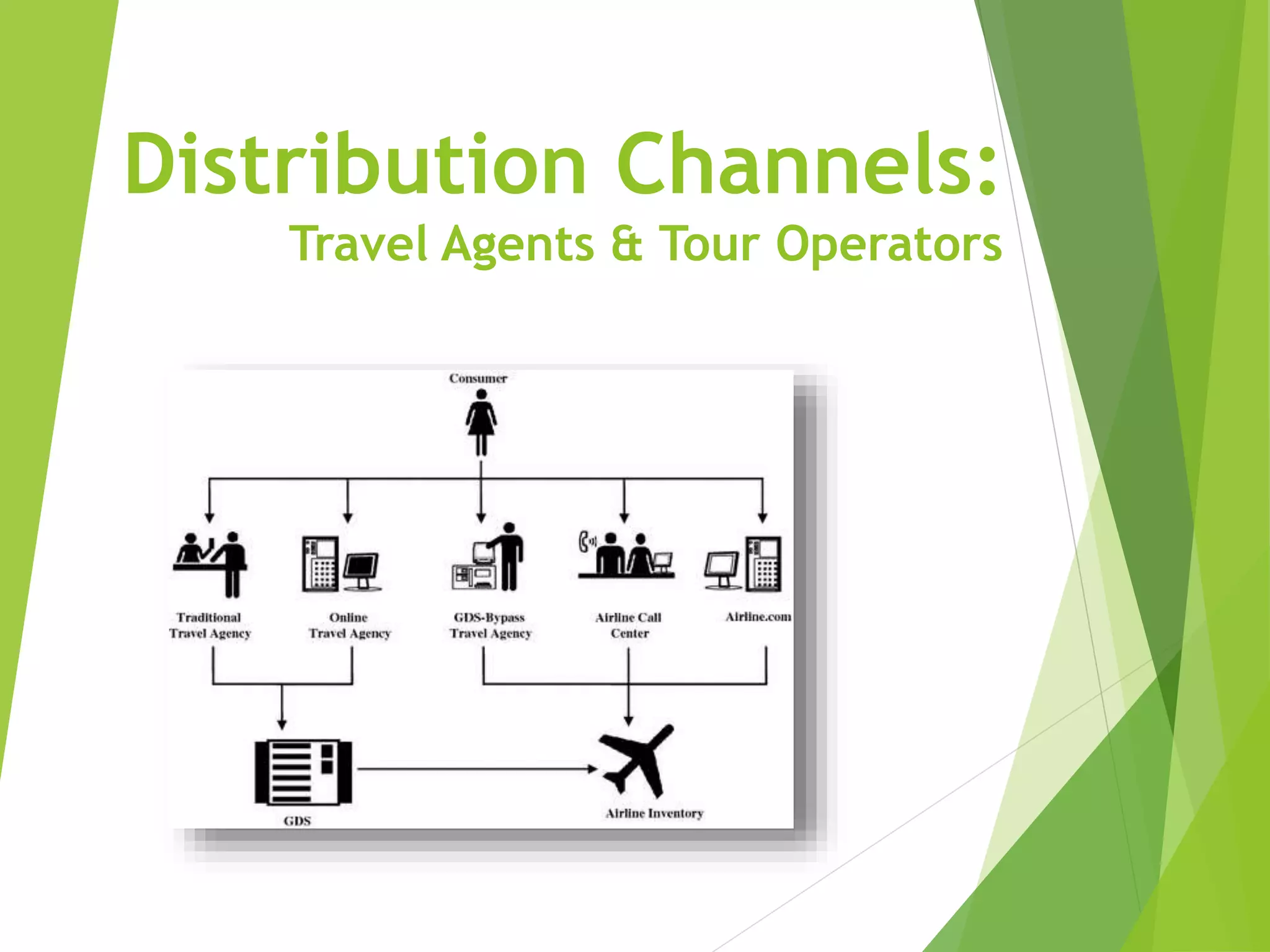
Distribution Channels:
Travel Agents & Tour Operators
Distribution System
Channels & Marketing Decisions
Distribution Channel Functions
Cont. . .
What is Channel Conflict?
 Vertical Conflict involve a disagreement between two
channel members on consecutive levels.
 For Example, if the toy manufacturer discovers its products are
arriving at retail stores later than scheduled, a conflict might
develop between the manufacturer and the wholesaler
responsible for shipping to retailers.
 Horizontal Conflict refers to a disagreement among two or
more channel members at the same level.
 For Example, suppose a toy manufacturer has deals with two
wholesalers, each contracted to sell products to retailers in
different regions.
 Multichannel Conflict occurs when a manufacturer has
established two or more channels that compete against each
other in selling to the same market.
 For example, a major tire manufacturer may begin selling its
tires through mass merchandisers, much to the dismay of its
independent tire.
Causes of Channel Conflict
Strategies for Managing
Channel Conflict
Channel Level
A layer of intermediaries that performs some work in
bringing the product and its ownership closer to the
final buyer.
Direct & Indirect Marketing Channels
Direct Marketing Channel:
A marketing channel that has no intermediary levels.
Indirect Marketing Channel:
Channel containing one or more intermediary levels.
1. Conventional Distribution Systems
It consist of one or more independent producers,
wholesalers and retailers. Each seeks to maximize its
own profits, and there is little control over the other
members and no formal means for assigning roles and
resolving conflicts.
Types of Marketing Systems
2. Vertical Marketing System
It provide channel leadership and consist of producers,
wholesalers and retailers acting as a unified system and
consist of:
 Corporate Marketing Systems
 Contractual Marketing Systems
 Administered Marketing Systems
3. Horizontal Marketing Systems
When two or more companies at one level join together to
follow a new marketing opportunity.
Companies combine financial, production or marketing
resources to accomplish more than any one company could
alone.
4. Hybrid Marketing Channels
When a single firm sets up two or more marketing
channels to reach one or more customer segments.
Channel Design Decisions
There are 4 steps in designing channel decisions:
1. Analyzing consumer needs
2. Setting channel objectives
3. Identifying major channel alternatives
4. Evaluation
Setting Channel Objectives
 Targeted levels of customer service
 What segments to serve
 Best channels to use
 Minimizing the cost of meeting customer service requirements.
Identifying Major Alternatives
 Intensive Distribution
 Exclusive Distribution
 Selective Distribution
Distribution Systems
Distribution Systems Cont. . .
Some of the other advantages are
 It is expensive for airlines to have their presence in every
high street and shopping malls around the world.
 Some passengers liked a personalised source of tickets, and
sometime they could turn to for advice and help.
 It reduce overhead burden on the airlines.
 Agents undoubtedly relieved airlines of a great deal of the
costly administrative work associated with air travel.
Travel Intermediaries
Travel Intermediaries cont. . .
The Impact of Technology on
Travel Distribution Systems
The Impact of Technology on
Travel Distribution Systems

Distribution Channels.pptx

  • 1.
  • 2.
  • 3.
  • 4.
  • 5.
  • 6.
    What is ChannelConflict?
  • 7.
     Vertical Conflictinvolve a disagreement between two channel members on consecutive levels.  For Example, if the toy manufacturer discovers its products are arriving at retail stores later than scheduled, a conflict might develop between the manufacturer and the wholesaler responsible for shipping to retailers.  Horizontal Conflict refers to a disagreement among two or more channel members at the same level.  For Example, suppose a toy manufacturer has deals with two wholesalers, each contracted to sell products to retailers in different regions.  Multichannel Conflict occurs when a manufacturer has established two or more channels that compete against each other in selling to the same market.  For example, a major tire manufacturer may begin selling its tires through mass merchandisers, much to the dismay of its independent tire.
  • 8.
  • 9.
  • 10.
    Channel Level A layerof intermediaries that performs some work in bringing the product and its ownership closer to the final buyer. Direct & Indirect Marketing Channels Direct Marketing Channel: A marketing channel that has no intermediary levels. Indirect Marketing Channel: Channel containing one or more intermediary levels.
  • 11.
    1. Conventional DistributionSystems It consist of one or more independent producers, wholesalers and retailers. Each seeks to maximize its own profits, and there is little control over the other members and no formal means for assigning roles and resolving conflicts. Types of Marketing Systems
  • 12.
    2. Vertical MarketingSystem It provide channel leadership and consist of producers, wholesalers and retailers acting as a unified system and consist of:  Corporate Marketing Systems  Contractual Marketing Systems  Administered Marketing Systems 3. Horizontal Marketing Systems When two or more companies at one level join together to follow a new marketing opportunity. Companies combine financial, production or marketing resources to accomplish more than any one company could alone.
  • 13.
    4. Hybrid MarketingChannels When a single firm sets up two or more marketing channels to reach one or more customer segments.
  • 14.
    Channel Design Decisions Thereare 4 steps in designing channel decisions: 1. Analyzing consumer needs 2. Setting channel objectives 3. Identifying major channel alternatives 4. Evaluation
  • 15.
    Setting Channel Objectives Targeted levels of customer service  What segments to serve  Best channels to use  Minimizing the cost of meeting customer service requirements.
  • 16.
    Identifying Major Alternatives Intensive Distribution  Exclusive Distribution  Selective Distribution
  • 21.
  • 22.
  • 23.
    Some of theother advantages are  It is expensive for airlines to have their presence in every high street and shopping malls around the world.  Some passengers liked a personalised source of tickets, and sometime they could turn to for advice and help.  It reduce overhead burden on the airlines.  Agents undoubtedly relieved airlines of a great deal of the costly administrative work associated with air travel.
  • 24.
  • 25.
  • 26.
  • 27.
    The Impact ofTechnology on Travel Distribution Systems
  • 28.
    The Impact ofTechnology on Travel Distribution Systems