CHAPTER# 16
Flow measurement
Introduction
 The rate at which fluid flows through a
closed pipe can be quantified by either
measuring the mass flow rate or measuring
the volume flow rate.
 Mass flow rate is the mass of substance
which passes through a given surface per
unit time. Its unit is mass divided by time,
so kilogram per second in SI units
 The volumetric flow rate is the volume of fluid
which passes through a given surface per unit time
(for example cubic meters per second [m3 s-1] in SI
units)
 Mass flow measurement is more accurate.
 In the case of the flow of solids, the choice is
simpler, since only mass flow measurement is
appropriate.
16.1 Mass flow rate
 The method used to measure mass flow rate
is largely determined by whether the
measured quantity is in a solid, liquid or
gaseous state.
 The main techniques available will be
discussed one by one.
16.1.1 Conveyor-based methods
 These methods are concerned with
measurement of the flow of solids that are
in the form of small particles.
 Such particles are usually produced by
crushing or grinding procedures in process
industries, and the particles are usually
transported by some form of conveyor.
 This mode of transport allows the mass flow
rate to be calculated in terms of the mass of
material on a given length of conveyor
multiplied by the speed of the conveyor.
 Figure 16.1 shows a typical measurement system
 The mass flow rate, Q, is given by:
 At some places a nuclear mass-flow sensor
is used, in which a gamma-ray source is
directed at the material being transported
along the conveyor.
 The material absorbs some radiation, and
the amount of radiation received by a
detector on the other side of the material
indicates the amount of material on the
conveyor.
16.1.2 Coriolis flowmeter
 The Coriolis flowmeter is primarily used to
measure the mass flow rate of liquids
 The flowmeter consists of either a pair of
parallel vibrating tubes or else a single
vibrating tube that is formed into a
configuration that has two parallel sections.
 The two vibrating tubes deflect according to
the mass flow rate of the measured fluid
that is flowing inside.
 Tubes are made of various materials, of
which stainless steel is the most common.
 They are also manufactured in different
shapes such as B-shaped, D-shaped, U-
shaped, triangular-shaped, helix-shaped
and straight.
 These alternative shapes are sketched in
Figure
 An electromechanical drive unit excites
vibrations in each tube .
 The vibrations in the two tubes are 180
degrees out of phase.
 The vibratory motion of each tube causes
forces on the particles in the flowing fluid.
 These forces induce motion of the fluid
particles in a direction that is orthogonal to
the direction of flow, and this produces a
Coriolis force.
 This Coriolis force causes a deflection of the
tubes that is superimposed on top of the
vibratory motion.
 The net deflection of one tube relative to the
other is given by:
 where k is a constant, f is the frequency of
the tube vibration and R is the mass flow
rate of the fluid inside the tube.
 This deflection is measured by a suitable
sensor.
 Coriolis meters uncertainties of 0.2%.
 They also have low maintenance
requirements.
 These are expensive (typical cost is £4000),
 Tubes are also subject to both corrosion
 Diversion of the flowing fluid around the
flowmeter causes it to suffer a significant
pressure drop
16.1.3 Thermal mass flow measurement
 Thermal mass flowmeters are primarily
used to measure the flow rate of gases.
 The principle of operation is to direct the
flowing material past a heated element.
 The mass flow rate is inferred in one of two
ways:
a) by measuring the temperature rise in the
flowing material
(b) by measuring the heater power required to
achieve a constant set temperature in the
flowing material.
 Typical measurement uncertainty is 2%.
16.2 Volume flow rate
 Volume flow rate is an appropriate way of
quantifying the flow of all materials that are
in a gaseous, liquid or semi-liquid slurry
form
 but measurement accuracy is inferior to
mass flow measurement.
 Materials in these forms are carried in
pipes, and various instruments can be used
to measure the volume flow rate as will be
discussed.
16.2.1 Differential pressure
(obstruction-type) meters
 Differential pressure meters involve the
insertion of some device into a fluid-
carrying pipe that causes an obstruction
and creates a pressure difference on either
side of the device.
 Devices used to obstruct the flow include
the orifice plate, the Venturi tube, the flow
nozzle and the Dall flow tube, as illustrated
in Figure.
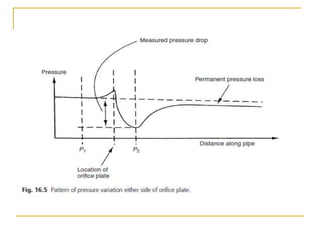
 When such a restriction is placed in a pipe,
the velocity of the fluid through the
restriction increases and the pressure
decreases.
 The volume flow rate is then proportional to
the square root of the pressure difference
across the obstruction.
 To measure pressure difference we use a
differential pressure transducer, which is
commonly a diaphragm type
Orifice plate
 The orifice plate is a metal disc with a
concentric hole in it, which is inserted into the
pipe carrying the flowing fluid.
 Orifice plates are simple, cheap and
available in a wide range of sizes.
 In consequence, they account for almost
50% of the instruments used in industry for
measuring volume flow rate.
 One limitation of the orifice plate is that its
inaccuracy is typically at least 2% and may
approach 5%.
 Also, the permanent pressure loss caused
in the measured fluid flow is between 50%
and 90%
 Other problems are that the sharp edges of
the hole wear away, and a tendency for any
particles in the flowing fluid to stick behind
the hole and thereby gradually reduce its
diameter as the particles build up.
 The latter problem can be minimized by
using an orifice plate with an eccentric hole.
Venturis and similar devices
 A number of obstruction devices are
available that are specially designed to
minimize the pressure loss in the measured
fluid.
 These have various names such as Venturi,
flow nozzle and Dall flow tube.
 They are all much more expensive than an
orifice plate but have better performance.
Green Hope High School physics laboratory, Cary, North Carolina
 The smooth internal shape means that they
are not prone to solid particles or bubbles
of gas sticking in the obstruction
 The smooth shape also means that they
suffer much less wear, and consequently
have a longer life than orifice plates
 They also require less maintenance and give
greater measurement accuracy.
Dall flow tube
 The Dall flow tube consists of two conical
reducers inserted into the fluid-carrying pipe.
 This construction is much easier to
manufacture and this gives the Dall flow tube
an advantage in cost over the Venturi
 Measurement inaccuracy is a little higher
(1.5%). Another advantage of the Dall flow
tube is its shorter length,
 loss imposed is only 5%
16.2.2 Variable area flowmeters
(Rotameters)
 In its simplest form, shown in Figure, the
instrument consists of a tapered glass tube
containing a float which takes up a stable
position where its submerged weight is
balanced by the upthrust due to the
differential pressure across it.
 The instrument is reliable and cheap and
used extensively throughout industry,
accounting for about 20% of all flowmeters
sold.
 Normally, this type of instrument only gives
a visual indication of flow rate, and so it is
of no use in automatic control schemes.
 The inaccuracy of the cheapest instruments
is typically 5%, but more expensive versions
offer measurement inaccuracies as low as
0.5%.
16.2.4 Turbine meters
 A turbine flowmeter consists of a multi-
bladed wheel mounted in a pipe along an
axis parallel to the direction of fluid flow in
the pipe, as shown in Figure.
 The flow of fluid past the wheel causes it to
rotate at a rate that is proportional to the
volume flow rate of the fluid.
 This rate of rotation has traditionally been
measured by constructing the flowmeter
such that it behaves as a variable
reluctance tachogenerator.
 This is achieved by fabricating the turbine
blades from a ferromagnetic material and
placing a permanent magnet and coil inside
the meter housing.
 A voltage pulse is induced in the coil as
each blade on the turbine wheel moves past
it, and if these pulses are measured by a
pulse counter, the pulse frequency and
hence flow rate can be deduced.
 Measurement inaccuracy can be as low as
0.2%.
 Turbine meters are particularly prone to
large errors.
 For instance, using a turbine meter
calibrated on pure liquid to measure a
liquid containing 5% air produces a 50%
measurement error.
 As an important application of the turbine
meter is in the petrochemical industries,
where gas/oil mixtures are common
16.2.5 Electromagnetic flowmeters
 Electromagnetic flowmeters are limited to
measuring the volume flow rate of
electrically conductive fluids
 The instrument, shown in Figure 16.10,
consists of a stainless steel cylindrical tube,
fitted with an insulating liner, which carries
the measured fluid.
 Typical lining materials used are Neoprene,
polytetrafluoroethylene (PTFE) and
polyurethane.
 By Faraday’s law of electromagnetic
induction, the voltage, E, induced across a
length, L, of the flowing fluid moving at
velocity, v, in a magnetic field of flux
density,B, is given by:
 L is the distance between the electrodes,
which is the diameter of the tube,
 The typical voltage signal measured across
the electrodes is 1mV when the fluid flow
rate is 1m/s.

flow measurment

  • 1.
  • 2.
    Introduction  The rateat which fluid flows through a closed pipe can be quantified by either measuring the mass flow rate or measuring the volume flow rate.  Mass flow rate is the mass of substance which passes through a given surface per unit time. Its unit is mass divided by time, so kilogram per second in SI units
  • 3.
     The volumetricflow rate is the volume of fluid which passes through a given surface per unit time (for example cubic meters per second [m3 s-1] in SI units)  Mass flow measurement is more accurate.  In the case of the flow of solids, the choice is simpler, since only mass flow measurement is appropriate.
  • 4.
    16.1 Mass flowrate  The method used to measure mass flow rate is largely determined by whether the measured quantity is in a solid, liquid or gaseous state.  The main techniques available will be discussed one by one.
  • 5.
    16.1.1 Conveyor-based methods These methods are concerned with measurement of the flow of solids that are in the form of small particles.  Such particles are usually produced by crushing or grinding procedures in process industries, and the particles are usually transported by some form of conveyor.
  • 6.
     This modeof transport allows the mass flow rate to be calculated in terms of the mass of material on a given length of conveyor multiplied by the speed of the conveyor.  Figure 16.1 shows a typical measurement system
  • 7.
     The massflow rate, Q, is given by:  At some places a nuclear mass-flow sensor is used, in which a gamma-ray source is directed at the material being transported along the conveyor.  The material absorbs some radiation, and the amount of radiation received by a detector on the other side of the material indicates the amount of material on the conveyor.
  • 8.
    16.1.2 Coriolis flowmeter The Coriolis flowmeter is primarily used to measure the mass flow rate of liquids  The flowmeter consists of either a pair of parallel vibrating tubes or else a single vibrating tube that is formed into a configuration that has two parallel sections.  The two vibrating tubes deflect according to the mass flow rate of the measured fluid that is flowing inside.
  • 9.
     Tubes aremade of various materials, of which stainless steel is the most common.  They are also manufactured in different shapes such as B-shaped, D-shaped, U- shaped, triangular-shaped, helix-shaped and straight.  These alternative shapes are sketched in Figure
  • 11.
     An electromechanicaldrive unit excites vibrations in each tube .  The vibrations in the two tubes are 180 degrees out of phase.
  • 12.
     The vibratorymotion of each tube causes forces on the particles in the flowing fluid.  These forces induce motion of the fluid particles in a direction that is orthogonal to the direction of flow, and this produces a Coriolis force.  This Coriolis force causes a deflection of the tubes that is superimposed on top of the vibratory motion.
  • 13.
     The netdeflection of one tube relative to the other is given by:  where k is a constant, f is the frequency of the tube vibration and R is the mass flow rate of the fluid inside the tube.  This deflection is measured by a suitable sensor.
  • 14.
     Coriolis metersuncertainties of 0.2%.  They also have low maintenance requirements.  These are expensive (typical cost is £4000),  Tubes are also subject to both corrosion  Diversion of the flowing fluid around the flowmeter causes it to suffer a significant pressure drop
  • 15.
    16.1.3 Thermal massflow measurement  Thermal mass flowmeters are primarily used to measure the flow rate of gases.  The principle of operation is to direct the flowing material past a heated element.  The mass flow rate is inferred in one of two ways: a) by measuring the temperature rise in the flowing material
  • 16.
    (b) by measuringthe heater power required to achieve a constant set temperature in the flowing material.  Typical measurement uncertainty is 2%.
  • 17.
    16.2 Volume flowrate  Volume flow rate is an appropriate way of quantifying the flow of all materials that are in a gaseous, liquid or semi-liquid slurry form  but measurement accuracy is inferior to mass flow measurement.  Materials in these forms are carried in pipes, and various instruments can be used to measure the volume flow rate as will be discussed.
  • 18.
    16.2.1 Differential pressure (obstruction-type)meters  Differential pressure meters involve the insertion of some device into a fluid- carrying pipe that causes an obstruction and creates a pressure difference on either side of the device.  Devices used to obstruct the flow include the orifice plate, the Venturi tube, the flow nozzle and the Dall flow tube, as illustrated in Figure.
  • 20.
     When sucha restriction is placed in a pipe, the velocity of the fluid through the restriction increases and the pressure decreases.  The volume flow rate is then proportional to the square root of the pressure difference across the obstruction.
  • 21.
     To measurepressure difference we use a differential pressure transducer, which is commonly a diaphragm type
  • 24.
    Orifice plate  Theorifice plate is a metal disc with a concentric hole in it, which is inserted into the pipe carrying the flowing fluid.
  • 25.
     Orifice platesare simple, cheap and available in a wide range of sizes.  In consequence, they account for almost 50% of the instruments used in industry for measuring volume flow rate.  One limitation of the orifice plate is that its inaccuracy is typically at least 2% and may approach 5%.  Also, the permanent pressure loss caused in the measured fluid flow is between 50% and 90%
  • 26.
     Other problemsare that the sharp edges of the hole wear away, and a tendency for any particles in the flowing fluid to stick behind the hole and thereby gradually reduce its diameter as the particles build up.  The latter problem can be minimized by using an orifice plate with an eccentric hole.
  • 27.
    Venturis and similardevices  A number of obstruction devices are available that are specially designed to minimize the pressure loss in the measured fluid.  These have various names such as Venturi, flow nozzle and Dall flow tube.  They are all much more expensive than an orifice plate but have better performance.
  • 28.
    Green Hope HighSchool physics laboratory, Cary, North Carolina
  • 29.
     The smoothinternal shape means that they are not prone to solid particles or bubbles of gas sticking in the obstruction  The smooth shape also means that they suffer much less wear, and consequently have a longer life than orifice plates  They also require less maintenance and give greater measurement accuracy.
  • 30.
    Dall flow tube The Dall flow tube consists of two conical reducers inserted into the fluid-carrying pipe.  This construction is much easier to manufacture and this gives the Dall flow tube an advantage in cost over the Venturi  Measurement inaccuracy is a little higher (1.5%). Another advantage of the Dall flow tube is its shorter length,  loss imposed is only 5%
  • 31.
    16.2.2 Variable areaflowmeters (Rotameters)  In its simplest form, shown in Figure, the instrument consists of a tapered glass tube containing a float which takes up a stable position where its submerged weight is balanced by the upthrust due to the differential pressure across it.  The instrument is reliable and cheap and used extensively throughout industry, accounting for about 20% of all flowmeters sold.
  • 33.
     Normally, thistype of instrument only gives a visual indication of flow rate, and so it is of no use in automatic control schemes.  The inaccuracy of the cheapest instruments is typically 5%, but more expensive versions offer measurement inaccuracies as low as 0.5%.
  • 34.
    16.2.4 Turbine meters A turbine flowmeter consists of a multi- bladed wheel mounted in a pipe along an axis parallel to the direction of fluid flow in the pipe, as shown in Figure.
  • 35.
     The flowof fluid past the wheel causes it to rotate at a rate that is proportional to the volume flow rate of the fluid.  This rate of rotation has traditionally been measured by constructing the flowmeter such that it behaves as a variable reluctance tachogenerator.  This is achieved by fabricating the turbine blades from a ferromagnetic material and placing a permanent magnet and coil inside the meter housing.
  • 36.
     A voltagepulse is induced in the coil as each blade on the turbine wheel moves past it, and if these pulses are measured by a pulse counter, the pulse frequency and hence flow rate can be deduced.  Measurement inaccuracy can be as low as 0.2%.  Turbine meters are particularly prone to large errors.
  • 37.
     For instance,using a turbine meter calibrated on pure liquid to measure a liquid containing 5% air produces a 50% measurement error.  As an important application of the turbine meter is in the petrochemical industries, where gas/oil mixtures are common
  • 38.
    16.2.5 Electromagnetic flowmeters Electromagnetic flowmeters are limited to measuring the volume flow rate of electrically conductive fluids  The instrument, shown in Figure 16.10, consists of a stainless steel cylindrical tube, fitted with an insulating liner, which carries the measured fluid.
  • 40.
     Typical liningmaterials used are Neoprene, polytetrafluoroethylene (PTFE) and polyurethane.  By Faraday’s law of electromagnetic induction, the voltage, E, induced across a length, L, of the flowing fluid moving at velocity, v, in a magnetic field of flux density,B, is given by:  L is the distance between the electrodes, which is the diameter of the tube,
  • 41.
     The typicalvoltage signal measured across the electrodes is 1mV when the fluid flow rate is 1m/s.