THEORETICAL
RESEARCH
By Morgan Glover-Evans, Jake Foulkes, and Oliver
Wain
NARRATIVETHEORY
By Morgan Glover
Todorov’s NarrativeTheory -
Introduction
Todorov was a Bulgarian-French literary critic, who generated a number of structural
theories that still find relevance today.While his main narrative theory was meant for
literature, it can still be applied to modern film.
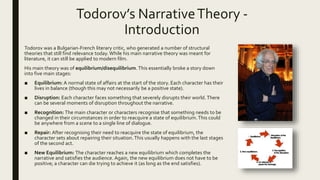
His main theory was of equilibrium/disequilibrium. This essentially broke a story down
into five main stages:
■ Equilibrium: A normal state of affairs at the start of the story. Each character has their
lives in balance (though this may not necessarily be a positive state).
■ Disruption: Each character faces something that severely disrupts their world.There
can be several moments of disruption throughout the narrative.
■ Recognition: The main character or characters recognise that something needs to be
changed in their circumstances in order to reacquire a state of equilibrium.This could
be anywhere from a scene to a single line of dialogue.
■ Repair: After recognising their need to reacquire the state of equilibrium, the
character sets about repairing their situation.This usually happens with the last stages
of the second act.
■ New Equilibrium: The character reaches a new equilibrium which completes the
narrative and satisfies the audience. Again, the new equilibrium does not have to be
positive; a character can die trying to achieve it (as long as the end satisfies).
Todorov’s NarrativeTheory – Example ‘I, Daniel
Blake’
A great modern example for this would be ‘I, Daniel Blake’ which is especially relevant as it is a social realist film.
■ Equilibrium: Sometimes, an equilibrium is inferred rather than shown to the audience.This is the case with ‘I,
Daniel Blake’; we meet the main character just after his heart attack where his struggles begin. As such, the
equilibrium was Daniel in a normal working condition, but that’s not shown within the narrative.
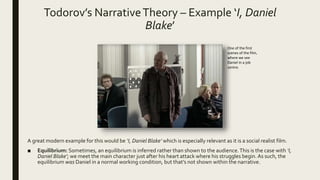
One of the first
scenes of the film,
where we see
Daniel in a job
centre.
Todorov’s NarrativeTheory – Example ‘I, Daniel
Blake’
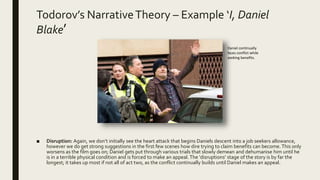
■ Disruption: Again, we don’t initially see the heart attack that begins Daniels descent into a job seekers allowance,
however we do get strong suggestions in the first few scenes how dire trying to claim benefits can become. This only
worsens as the film goes on; Daniel gets put through various trials that slowly demean and dehumanise him until he
is in a terrible physical condition and is forced to make an appeal. The ‘disruptions’ stage of the story is by far the
longest; it takes up most if not all of act two, as the conflict continually builds until Daniel makes an appeal.
Daniel continually
faces conflict while
seeking benefits.
Todorov’s NarrativeTheory – Example ‘I, Daniel
Blake’
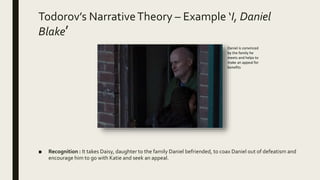
■ Recognition : It takes Daisy, daughter to the family Daniel befriended, to coax Daniel out of defeatism and
encourage him to go with Katie and seek an appeal.
Daniel is convinced
by the family he
meets and helps to
make an appeal for
benefits
Todorov’s NarrativeTheory – Example ‘I, Daniel
Blake’
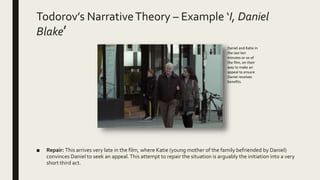
■ Repair: This arrives very late in the film, where Katie (young mother of the family befriended by Daniel)
convinces Daniel to seek an appeal.This attempt to repair the situation is arguably the initiation into a very
short third act.
Daniel and Katie in
the last ten
minutes or so of
the film, on their
way to make an
appeal to ensure
Daniel receives
benefits.
Todorov’s NarrativeTheory – Example ‘I, Daniel
Blake’
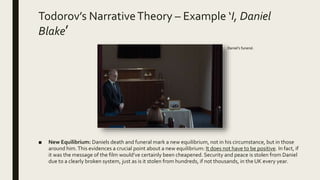
■ New Equilibrium: Daniels death and funeral mark a new equilibrium, not in his circumstance, but in those
around him.This evidences a crucial point about a new equilibrium: It does not have to be positive. In fact, if
it was the message of the film would’ve certainly been cheapened. Security and peace is stolen from Daniel
due to a clearly broken system, just as is it stolen from hundreds, if not thousands, in the UK every year.
Daniel’s funeral.
Todorov’s NarrativeTheory - Application
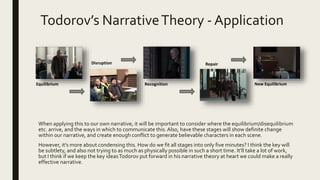
When applying this to our own narrative, it will be important to consider where the equilibrium/disequilibrium
etc. arrive, and the ways in which to communicate this.Also, have these stages will show definite change
within our narrative, and create enough conflict to generate believable characters in each scene.
However, it’s more about condensing this. How do we fit all stages into only five minutes? I think the key will
be subtlety, and also not trying to as much as physically possible in such a short time. It’ll take a lot of work,
but I think if we keep the key ideasTodorov put forward in his narrative theory at heart we could make a really
effective narrative.
Equilibrium
Disruption
Recognition
Repair
New Equilibrium
Propp’s NarrativeTheory - Introduction
Vladimir Propp was a Russian narrative scholar who popularised his theory on characters during
the 1920’s. While film was emerging at the time, his theory focused more on folk tales. As such,
it’s slightly dated, but provides a nice way to determine each character and their relation to the
narrative.
■ TheVillain –The one who opposes the hero in the strongest way throughout the story.
■ The Dispatcher –The one who issues the quest to the hero.
■ The Helper –The one who assists the hero during the journey.
■ The Princess/Prize –The main goal of the hero (especially if a romantic subplot is
involved).
■ The Donor – A character who aids the hero by donating one specific object or piece of
information.
■ The Hero –The protagonist; the one the audience roots for the succeed.
■ False Hero – A character close to the protagonist who reveals to be a false
protagonist.
Propp’s NarrativeTheory – Example
‘Moonlight’
To use another example of a social realist film, various characters in Moonlight can be applied to this theory.
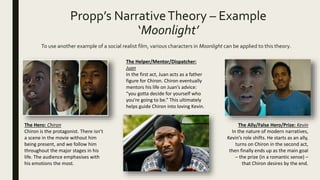
The Hero: Chiron
Chiron is the protagonist. There isn’t
a scene in the movie without him
being present, and we follow him
throughout the major stages in his
life. The audience emphasises with
his emotions the most.
The Helper/Mentor/Dispatcher:
Juan
In the first act, Juan acts as a father
figure for Chiron. Chiron eventually
mentors his life on Juan’s advice:
“you gotta decide for yourself who
you're going to be.” This ultimately
helps guide Chiron into loving Kevin.
The Ally/False Hero/Prize: Kevin
In the nature of modern narratives,
Kevin’s role shifts. He starts as an ally,
turns on Chiron in the second act,
then finally ends up as the main goal
– the prize (in a romantic sense) –
that Chiron desires by the end.
Propp’s NarrativeTheory –
Example/Application
Like most modern narratives, the fairy tale roles set out by Propp and his
theory are less clear in Moonlight. In fact, these typical roles are often
purposefully subverted in order to reflect the reality (or at least a
representation of that reality) in human beings. We change, we develop. We
never see ourselves as a villain, as a ‘blocker’ or sometimes even as a hero.
I think we definitely need to keep this in mind when moving forward. While
Propp’s theory on characters is useful in many ways, when applied to not only
a social realist film but a very short one at that, it may become less clear who
is our ‘prize’ and who is our ‘blocker’. However, we need to ensure that the
core elements, namely the ‘hero’ and the ‘villain’, play a role in our narrative
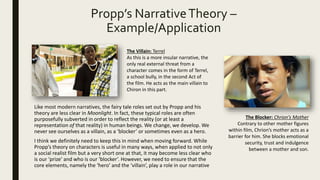
The Blocker: Chrion’s Mother
Contrary to other mother figures
within film, Chrion’s mother acts as a
barrier for him. She blocks emotional
security, trust and indulgence
between a mother and son.
The Villain: Terrel
As this is a more insular narrative, the
only real external threat from a
character comes in the form of Terrel,
a school bully, in the second Act of
the film. He acts as the main villain to
Chiron in this part.
McKee’s NarrativeTheory - Introduction
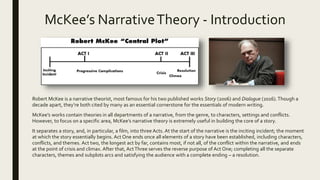
Robert McKee is a narrative theorist, most famous for his two published works Story (2006) and Dialogue (2016).Though a
decade apart, they’re both cited by many as an essential cornerstone for the essentials of modern writing.
McKee’s works contain theories in all departments of a narrative, from the genre, to characters, settings and conflicts.
However, to focus on a specific area, McKee’s narrative theory is extremely useful in building the core of a story.
It separates a story, and, in particular, a film, into three Acts. At the start of the narrative is the inciting incident; the moment
at which the story essentially begins. Act One ends once all elements of a story have been established, including characters,
conflicts, and themes. Act two, the longest act by far, contains most, if not all, of the conflict within the narrative, and ends
at the point of crisis and climax. After that, ActThree serves the reverse purpose of Act One; completing all the separate
characters, themes and subplots arcs and satisfying the audience with a complete ending – a resolution.
McKee's NarrativeTheory - Example
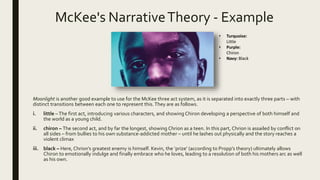
Moonlight is another good example to use for the McKee three act system, as it is separated into exactly three parts – with
distinct transitions between each one to represent this.They are as follows.
i. little –The first act, introducing various characters, and showing Chiron developing a perspective of both himself and
the world as a young child.
ii. chiron – The second act, and by far the longest, showing Chrion as a teen. In this part, Chrion is assailed by conflict on
all sides – from bullies to his own substance-addicted mother – until he lashes out physically and the story reaches a
violent climax
iii. black – Here, Chrion’s greatest enemy is himself. Kevin, the ‘prize’ (according to Propp’s theory) ultimately allows
Chiron to emotionally indulge and finally embrace who he loves, leading to a resolution of both his mothers arc as well
as his own.
• Turquoise:
Little
• Purple:
Chiron
• Navy: Black
McKee’s NarrativeTheory - Application
McKee’s theory is a brilliant modern benchmark for any narrative, and really helps with structuring an entire narrative
with a satisfying resolution. The trick, with all these theories, in fact, is to condense it down the scale of a five minute
film.
Essentially, we’ll have to take the most important parts of each act. Also, I don’t think we should get too caught up in
showing a complete narrative. Many films that are as short as ours only show a few scenes, or a few ideas, without
attempting to go into a huge amount of detail.
If we try to do everything, except to a low standard, we’ll get very little out of the entire production. However, if we
focus on a few key areas of our narrative, explore them, and present them in a thematic and emotional way, we could
end up with a really nice final product.
Overall, with any of these theories, it’s about context. We need to take the best parts of each to fir our own
production.
AUTEURTHEORY
By Morgan Glover
AuteurTheory – Introduction
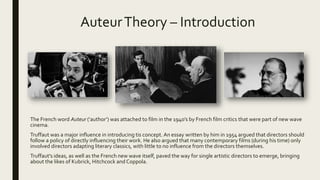
The French word Auteur (‘author’) was attached to film in the 1940’s by French film critics that were part of new wave
cinema.
Truffaut was a major influence in introducing tis concept. An essay written by him in 1954 argued that directors should
follow a policy of directly influencing their work. He also argued that many contemporary films (during his time) only
involved directors adapting literary classics, with little to no influence from the directors themselves.
Truffaut's ideas, as well as the French new wave itself, paved the way for single artistic directors to emerge, bringing
about the likes of Kubrick, Hitchcock and Coppola.
AuteurTheory – Example French New
Wave
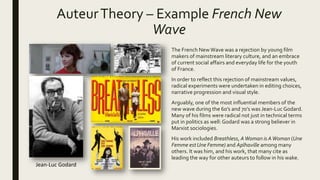
The French NewWave was a rejection by young film
makers of mainstream literary culture, and an embrace
of current social affairs and everyday life for the youth
of France.
In order to reflect this rejection of mainstream values,
radical experiments were undertaken in editing choices,
narrative progression and visual style.
Arguably, one of the most influential members of the
new wave during the 60’s and 70’s was Jean-Luc Godard.
Many of his films were radical not just in technical terms
put in politics as well: Godard was a strong believer in
Marxist sociologies.
His work included Breathless, AWoman is AWoman (Une
Femme estUne Femme) and Aplhaville among many
others. It was him, and his work, that many cite as
leading the way for other auteurs to follow in his wake.
Jean-Luc Godard
AuteurTheory – Example Ken Loach
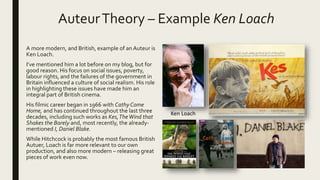
A more modern, and British, example of an Auteur is
Ken Loach.
I’ve mentioned him a lot before on my blog, but for
good reason. His focus on social issues, poverty,
labour rights, and the failures of the government in
Britain influenced a culture of social realism. His role
in highlighting these issues have made him an
integral part of British cinema.
His filmic career began in 1966 with Cathy Come
Home, and has continued throughout the last three
decades, including such works as Kes,TheWind that
Shakes the Barely and, most recently, the already-
mentioned I, Daniel Blake.
While Hitchcock is probably the most famous British
Autuer, Loach is far more relevant to our own
production, and also more modern – releasing great
pieces of work even now.
Ken Loach
AuteurTheory – Application
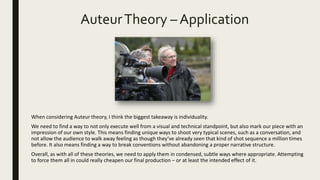
When considering Auteur theory, I think the biggest takeaway is individuality.
We need to find a way to not only execute well from a visual and technical standpoint, but also mark our piece with an
impression of our own style. This means finding unique ways to shoot very typical scenes, such as a conversation, and
not allow the audience to walk away feeling as though they’ve already seen that kind of shot sequence a million times
before. It also means finding a way to break conventions without abandoning a proper narrative structure.
Overall, as with all of these theories, we need to apply them in condensed, subtle ways where appropriate. Attempting
to force them all in could really cheapen our final production – or at least the intended effect of it.
AUDIENCE
THEORIES
By Jake Foulkes
Hypodermic Needle
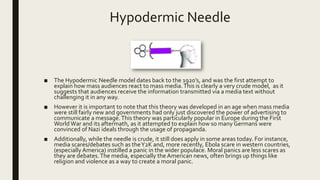
■ The Hypodermic Needle model dates back to the 1920’s, and was the first attempt to
explain how mass audiences react to mass media.This is clearly a very crude model, as it
suggests that audiences receive the information transmitted via a media text without
challenging it in any way.
■ However it is important to note that this theory was developed in an age when mass media
were still fairly new and governments had only just discovered the power of advertising to
communicate a message.This theory was particularly popular in Europe during the First
WorldWar and its aftermath, as it attempted to explain how so many Germans were
convinced of Nazi ideals through the usage of propaganda.
■ Additionally, while the needle is crude, it still does apply in some areas today. For instance,
media scares/debates such as theY2K and, more recently, Ebola scare in western countries,
(especially America) instilled a panic in the wider populace. Moral panics are less scares as
they are debates.The media, especially the American news, often brings up things like
religion and violence as a way to create a moral panic.
Two Step Flow Model
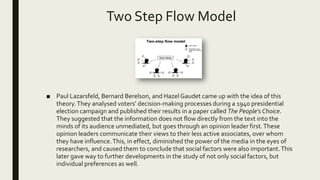
■ Paul Lazarsfeld, Bernard Berelson, and Hazel Gaudet came up with the idea of this
theory.They analysed voters' decision-making processes during a 1940 presidential
election campaign and published their results in a paper called The People's Choice.
They suggested that the information does not flow directly from the text into the
minds of its audience unmediated, but goes through an opinion leader first.These
opinion leaders communicate their views to their less active associates, over whom
they have influence.This, in effect, diminished the power of the media in the eyes of
researchers, and caused them to conclude that social factors were also important.This
later gave way to further developments in the study of not only social factors, but
individual preferences as well.
Two Step Flow Model – Examples
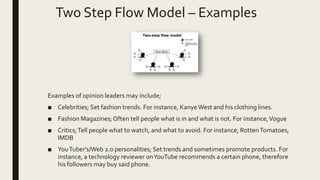
Examples of opinion leaders may include;
■ Celebrities; Set fashion trends. For instance, KanyeWest and his clothing lines.
■ Fashion Magazines;Often tell people what is in and what is not. For instance,Vogue
■ Critics;Tell people what to watch, and what to avoid. For instance, RottenTomatoes,
IMDB
■ YouTuber's/Web 2.0 personalities; Set trends and sometimes promote products. For
instance, a technology reviewer onYouTube recommends a certain phone, therefore
his followers may buy said phone.
REPRESENTATION
THEORIES
By Jake Foulkes & OllieWain
Explanation
Representation Theories are the theories in which it explains how and why characters or
genders are represented in the way they are in the media whether that be film, magazine or
Television. There are two main theories that revolve around this and they are the “Mulvey
Theory” and the “Gauntlett Theory”. Both of these theories talk about how the role of genders
are represented in the media. One more theory that effects men is the ‘men and violence
theory’ proposed by Earp and Katz. Other representation considerations in film and television
would be the use of:
• Stereotypes
• Hegemony/Pluralism
• Ideology
• Mediation
Another use of representation in the media could be the representation of colour in film, most
notably used in Fincher films. It is used to show mood and atmosphere in the picture or film.
RepresentationTheories
RepresentationTheories are the theories in which it explains how and why characters or genders are
represented in the way they are in the media whether that be film, magazine orTelevision.
There are two main theories that revolve around this and they are the “MulveyTheory” and the “Gauntlett
Theory”.
Both of these theories talk about how the role of genders are represented in the media.
Other representation considerations in film and television would be the use of:
■ Stereotypes
■ Hegemony/Pluralism
■ Ideology
■ Mediation
Another use of representation in the media could be the representation of colour in film, most notably
used in Fincher films. It is used to show mood and atmosphere in the picture or film.
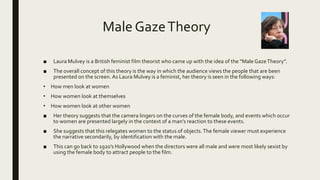
Male GazeTheory
■ Laura Mulvey is a British feminist film theorist who came up with the idea of the “Male GazeTheory”.
■ The overall concept of this theory is the way in which the audience views the people that are been
presented on the screen. As Laura Mulvey is a feminist, her theory is seen in the following ways:
• How men look at women
• How women look at themselves
• How women look at other women
■ Her theory suggests that the camera lingers on the curves of the female body, and events which occur
to women are presented largely in the context of a man’s reaction to these events.
■ She suggests that this relegates women to the status of objects.The female viewer must experience
the narrative secondarily, by identification with the male.
■ This can go back to 1920’s Hollywood when the directors were all male and were most likely sexist by
using the female body to attract people to the film.
Men andViolenceTheory
Earp and Katz proposed the men and violence theory in 1999. They studied male representations in the
media and found “a widespread and disturbing equation of masculinity and pathological control and
violence”. They claim that the media is responsible for a steady stream of images that define ‘manhood’
as connected with violence, dominance and control - and create it as a normal and accepted part of
masculinity. As this is seen so often in almost all films, it is one of the main theories that actually rubs off
on the consumers of the media. Furthermore, their theory also defines their vision of masculinity,
consistent of attributes such as:
• Rugged features and stubble
• Long hair
• Denim
• Open shirts and medallions
• Violent
• Action - active not passive
• General toughness
Application
Just like we have mentioned before, our aim is to break some conventions, especially when it comes to
negative representations. As a result, we will most likely just accept these representations in the media but
not apply them to our final piece at all. Not only is this going to be an example of diverting conventions,
but will have a positive impact on the consumers. Knowing of these theories has served to be a useful tool
as my group and I are able to avoid discriminating representations, the way in which they will be applied is
by being careful on costume choices and on certain topics, to avoid the cliché of the dad beating on his
wife and children because this is also an example of the men and violence theory. In a social realist short
film, the male gaze theory doesn’t tend to apply but there are some cases where they do.

A2 - Theoretical Research

  • 1.
    THEORETICAL RESEARCH By Morgan Glover-Evans,Jake Foulkes, and Oliver Wain
  • 2.
  • 3.
    Todorov’s NarrativeTheory - Introduction Todorovwas a Bulgarian-French literary critic, who generated a number of structural theories that still find relevance today.While his main narrative theory was meant for literature, it can still be applied to modern film. His main theory was of equilibrium/disequilibrium. This essentially broke a story down into five main stages: ■ Equilibrium: A normal state of affairs at the start of the story. Each character has their lives in balance (though this may not necessarily be a positive state). ■ Disruption: Each character faces something that severely disrupts their world.There can be several moments of disruption throughout the narrative. ■ Recognition: The main character or characters recognise that something needs to be changed in their circumstances in order to reacquire a state of equilibrium.This could be anywhere from a scene to a single line of dialogue. ■ Repair: After recognising their need to reacquire the state of equilibrium, the character sets about repairing their situation.This usually happens with the last stages of the second act. ■ New Equilibrium: The character reaches a new equilibrium which completes the narrative and satisfies the audience. Again, the new equilibrium does not have to be positive; a character can die trying to achieve it (as long as the end satisfies).
  • 4.
    Todorov’s NarrativeTheory –Example ‘I, Daniel Blake’ A great modern example for this would be ‘I, Daniel Blake’ which is especially relevant as it is a social realist film. ■ Equilibrium: Sometimes, an equilibrium is inferred rather than shown to the audience.This is the case with ‘I, Daniel Blake’; we meet the main character just after his heart attack where his struggles begin. As such, the equilibrium was Daniel in a normal working condition, but that’s not shown within the narrative. One of the first scenes of the film, where we see Daniel in a job centre.
  • 5.
    Todorov’s NarrativeTheory –Example ‘I, Daniel Blake’ ■ Disruption: Again, we don’t initially see the heart attack that begins Daniels descent into a job seekers allowance, however we do get strong suggestions in the first few scenes how dire trying to claim benefits can become. This only worsens as the film goes on; Daniel gets put through various trials that slowly demean and dehumanise him until he is in a terrible physical condition and is forced to make an appeal. The ‘disruptions’ stage of the story is by far the longest; it takes up most if not all of act two, as the conflict continually builds until Daniel makes an appeal. Daniel continually faces conflict while seeking benefits.
  • 6.
    Todorov’s NarrativeTheory –Example ‘I, Daniel Blake’ ■ Recognition : It takes Daisy, daughter to the family Daniel befriended, to coax Daniel out of defeatism and encourage him to go with Katie and seek an appeal. Daniel is convinced by the family he meets and helps to make an appeal for benefits
  • 7.
    Todorov’s NarrativeTheory –Example ‘I, Daniel Blake’ ■ Repair: This arrives very late in the film, where Katie (young mother of the family befriended by Daniel) convinces Daniel to seek an appeal.This attempt to repair the situation is arguably the initiation into a very short third act. Daniel and Katie in the last ten minutes or so of the film, on their way to make an appeal to ensure Daniel receives benefits.
  • 8.
    Todorov’s NarrativeTheory –Example ‘I, Daniel Blake’ ■ New Equilibrium: Daniels death and funeral mark a new equilibrium, not in his circumstance, but in those around him.This evidences a crucial point about a new equilibrium: It does not have to be positive. In fact, if it was the message of the film would’ve certainly been cheapened. Security and peace is stolen from Daniel due to a clearly broken system, just as is it stolen from hundreds, if not thousands, in the UK every year. Daniel’s funeral.
  • 9.
    Todorov’s NarrativeTheory -Application When applying this to our own narrative, it will be important to consider where the equilibrium/disequilibrium etc. arrive, and the ways in which to communicate this.Also, have these stages will show definite change within our narrative, and create enough conflict to generate believable characters in each scene. However, it’s more about condensing this. How do we fit all stages into only five minutes? I think the key will be subtlety, and also not trying to as much as physically possible in such a short time. It’ll take a lot of work, but I think if we keep the key ideasTodorov put forward in his narrative theory at heart we could make a really effective narrative. Equilibrium Disruption Recognition Repair New Equilibrium
  • 10.
    Propp’s NarrativeTheory -Introduction Vladimir Propp was a Russian narrative scholar who popularised his theory on characters during the 1920’s. While film was emerging at the time, his theory focused more on folk tales. As such, it’s slightly dated, but provides a nice way to determine each character and their relation to the narrative. ■ TheVillain –The one who opposes the hero in the strongest way throughout the story. ■ The Dispatcher –The one who issues the quest to the hero. ■ The Helper –The one who assists the hero during the journey. ■ The Princess/Prize –The main goal of the hero (especially if a romantic subplot is involved). ■ The Donor – A character who aids the hero by donating one specific object or piece of information. ■ The Hero –The protagonist; the one the audience roots for the succeed. ■ False Hero – A character close to the protagonist who reveals to be a false protagonist.
  • 11.
    Propp’s NarrativeTheory –Example ‘Moonlight’ To use another example of a social realist film, various characters in Moonlight can be applied to this theory. The Hero: Chiron Chiron is the protagonist. There isn’t a scene in the movie without him being present, and we follow him throughout the major stages in his life. The audience emphasises with his emotions the most. The Helper/Mentor/Dispatcher: Juan In the first act, Juan acts as a father figure for Chiron. Chiron eventually mentors his life on Juan’s advice: “you gotta decide for yourself who you're going to be.” This ultimately helps guide Chiron into loving Kevin. The Ally/False Hero/Prize: Kevin In the nature of modern narratives, Kevin’s role shifts. He starts as an ally, turns on Chiron in the second act, then finally ends up as the main goal – the prize (in a romantic sense) – that Chiron desires by the end.
  • 12.
    Propp’s NarrativeTheory – Example/Application Likemost modern narratives, the fairy tale roles set out by Propp and his theory are less clear in Moonlight. In fact, these typical roles are often purposefully subverted in order to reflect the reality (or at least a representation of that reality) in human beings. We change, we develop. We never see ourselves as a villain, as a ‘blocker’ or sometimes even as a hero. I think we definitely need to keep this in mind when moving forward. While Propp’s theory on characters is useful in many ways, when applied to not only a social realist film but a very short one at that, it may become less clear who is our ‘prize’ and who is our ‘blocker’. However, we need to ensure that the core elements, namely the ‘hero’ and the ‘villain’, play a role in our narrative The Blocker: Chrion’s Mother Contrary to other mother figures within film, Chrion’s mother acts as a barrier for him. She blocks emotional security, trust and indulgence between a mother and son. The Villain: Terrel As this is a more insular narrative, the only real external threat from a character comes in the form of Terrel, a school bully, in the second Act of the film. He acts as the main villain to Chiron in this part.
  • 13.
    McKee’s NarrativeTheory -Introduction Robert McKee is a narrative theorist, most famous for his two published works Story (2006) and Dialogue (2016).Though a decade apart, they’re both cited by many as an essential cornerstone for the essentials of modern writing. McKee’s works contain theories in all departments of a narrative, from the genre, to characters, settings and conflicts. However, to focus on a specific area, McKee’s narrative theory is extremely useful in building the core of a story. It separates a story, and, in particular, a film, into three Acts. At the start of the narrative is the inciting incident; the moment at which the story essentially begins. Act One ends once all elements of a story have been established, including characters, conflicts, and themes. Act two, the longest act by far, contains most, if not all, of the conflict within the narrative, and ends at the point of crisis and climax. After that, ActThree serves the reverse purpose of Act One; completing all the separate characters, themes and subplots arcs and satisfying the audience with a complete ending – a resolution.
  • 14.
    McKee's NarrativeTheory -Example Moonlight is another good example to use for the McKee three act system, as it is separated into exactly three parts – with distinct transitions between each one to represent this.They are as follows. i. little –The first act, introducing various characters, and showing Chiron developing a perspective of both himself and the world as a young child. ii. chiron – The second act, and by far the longest, showing Chrion as a teen. In this part, Chrion is assailed by conflict on all sides – from bullies to his own substance-addicted mother – until he lashes out physically and the story reaches a violent climax iii. black – Here, Chrion’s greatest enemy is himself. Kevin, the ‘prize’ (according to Propp’s theory) ultimately allows Chiron to emotionally indulge and finally embrace who he loves, leading to a resolution of both his mothers arc as well as his own. • Turquoise: Little • Purple: Chiron • Navy: Black
  • 15.
    McKee’s NarrativeTheory -Application McKee’s theory is a brilliant modern benchmark for any narrative, and really helps with structuring an entire narrative with a satisfying resolution. The trick, with all these theories, in fact, is to condense it down the scale of a five minute film. Essentially, we’ll have to take the most important parts of each act. Also, I don’t think we should get too caught up in showing a complete narrative. Many films that are as short as ours only show a few scenes, or a few ideas, without attempting to go into a huge amount of detail. If we try to do everything, except to a low standard, we’ll get very little out of the entire production. However, if we focus on a few key areas of our narrative, explore them, and present them in a thematic and emotional way, we could end up with a really nice final product. Overall, with any of these theories, it’s about context. We need to take the best parts of each to fir our own production.
  • 16.
  • 17.
    AuteurTheory – Introduction TheFrench word Auteur (‘author’) was attached to film in the 1940’s by French film critics that were part of new wave cinema. Truffaut was a major influence in introducing tis concept. An essay written by him in 1954 argued that directors should follow a policy of directly influencing their work. He also argued that many contemporary films (during his time) only involved directors adapting literary classics, with little to no influence from the directors themselves. Truffaut's ideas, as well as the French new wave itself, paved the way for single artistic directors to emerge, bringing about the likes of Kubrick, Hitchcock and Coppola.
  • 18.
    AuteurTheory – ExampleFrench New Wave The French NewWave was a rejection by young film makers of mainstream literary culture, and an embrace of current social affairs and everyday life for the youth of France. In order to reflect this rejection of mainstream values, radical experiments were undertaken in editing choices, narrative progression and visual style. Arguably, one of the most influential members of the new wave during the 60’s and 70’s was Jean-Luc Godard. Many of his films were radical not just in technical terms put in politics as well: Godard was a strong believer in Marxist sociologies. His work included Breathless, AWoman is AWoman (Une Femme estUne Femme) and Aplhaville among many others. It was him, and his work, that many cite as leading the way for other auteurs to follow in his wake. Jean-Luc Godard
  • 19.
    AuteurTheory – ExampleKen Loach A more modern, and British, example of an Auteur is Ken Loach. I’ve mentioned him a lot before on my blog, but for good reason. His focus on social issues, poverty, labour rights, and the failures of the government in Britain influenced a culture of social realism. His role in highlighting these issues have made him an integral part of British cinema. His filmic career began in 1966 with Cathy Come Home, and has continued throughout the last three decades, including such works as Kes,TheWind that Shakes the Barely and, most recently, the already- mentioned I, Daniel Blake. While Hitchcock is probably the most famous British Autuer, Loach is far more relevant to our own production, and also more modern – releasing great pieces of work even now. Ken Loach
  • 20.
    AuteurTheory – Application Whenconsidering Auteur theory, I think the biggest takeaway is individuality. We need to find a way to not only execute well from a visual and technical standpoint, but also mark our piece with an impression of our own style. This means finding unique ways to shoot very typical scenes, such as a conversation, and not allow the audience to walk away feeling as though they’ve already seen that kind of shot sequence a million times before. It also means finding a way to break conventions without abandoning a proper narrative structure. Overall, as with all of these theories, we need to apply them in condensed, subtle ways where appropriate. Attempting to force them all in could really cheapen our final production – or at least the intended effect of it.
  • 21.
  • 22.
    Hypodermic Needle ■ TheHypodermic Needle model dates back to the 1920’s, and was the first attempt to explain how mass audiences react to mass media.This is clearly a very crude model, as it suggests that audiences receive the information transmitted via a media text without challenging it in any way. ■ However it is important to note that this theory was developed in an age when mass media were still fairly new and governments had only just discovered the power of advertising to communicate a message.This theory was particularly popular in Europe during the First WorldWar and its aftermath, as it attempted to explain how so many Germans were convinced of Nazi ideals through the usage of propaganda. ■ Additionally, while the needle is crude, it still does apply in some areas today. For instance, media scares/debates such as theY2K and, more recently, Ebola scare in western countries, (especially America) instilled a panic in the wider populace. Moral panics are less scares as they are debates.The media, especially the American news, often brings up things like religion and violence as a way to create a moral panic.
  • 23.
    Two Step FlowModel ■ Paul Lazarsfeld, Bernard Berelson, and Hazel Gaudet came up with the idea of this theory.They analysed voters' decision-making processes during a 1940 presidential election campaign and published their results in a paper called The People's Choice. They suggested that the information does not flow directly from the text into the minds of its audience unmediated, but goes through an opinion leader first.These opinion leaders communicate their views to their less active associates, over whom they have influence.This, in effect, diminished the power of the media in the eyes of researchers, and caused them to conclude that social factors were also important.This later gave way to further developments in the study of not only social factors, but individual preferences as well.
  • 24.
    Two Step FlowModel – Examples Examples of opinion leaders may include; ■ Celebrities; Set fashion trends. For instance, KanyeWest and his clothing lines. ■ Fashion Magazines;Often tell people what is in and what is not. For instance,Vogue ■ Critics;Tell people what to watch, and what to avoid. For instance, RottenTomatoes, IMDB ■ YouTuber's/Web 2.0 personalities; Set trends and sometimes promote products. For instance, a technology reviewer onYouTube recommends a certain phone, therefore his followers may buy said phone.
  • 25.
  • 26.
    Explanation Representation Theories arethe theories in which it explains how and why characters or genders are represented in the way they are in the media whether that be film, magazine or Television. There are two main theories that revolve around this and they are the “Mulvey Theory” and the “Gauntlett Theory”. Both of these theories talk about how the role of genders are represented in the media. One more theory that effects men is the ‘men and violence theory’ proposed by Earp and Katz. Other representation considerations in film and television would be the use of: • Stereotypes • Hegemony/Pluralism • Ideology • Mediation Another use of representation in the media could be the representation of colour in film, most notably used in Fincher films. It is used to show mood and atmosphere in the picture or film.
  • 27.
    RepresentationTheories RepresentationTheories are thetheories in which it explains how and why characters or genders are represented in the way they are in the media whether that be film, magazine orTelevision. There are two main theories that revolve around this and they are the “MulveyTheory” and the “Gauntlett Theory”. Both of these theories talk about how the role of genders are represented in the media. Other representation considerations in film and television would be the use of: ■ Stereotypes ■ Hegemony/Pluralism ■ Ideology ■ Mediation Another use of representation in the media could be the representation of colour in film, most notably used in Fincher films. It is used to show mood and atmosphere in the picture or film.
  • 28.
    Male GazeTheory ■ LauraMulvey is a British feminist film theorist who came up with the idea of the “Male GazeTheory”. ■ The overall concept of this theory is the way in which the audience views the people that are been presented on the screen. As Laura Mulvey is a feminist, her theory is seen in the following ways: • How men look at women • How women look at themselves • How women look at other women ■ Her theory suggests that the camera lingers on the curves of the female body, and events which occur to women are presented largely in the context of a man’s reaction to these events. ■ She suggests that this relegates women to the status of objects.The female viewer must experience the narrative secondarily, by identification with the male. ■ This can go back to 1920’s Hollywood when the directors were all male and were most likely sexist by using the female body to attract people to the film.
  • 29.
    Men andViolenceTheory Earp andKatz proposed the men and violence theory in 1999. They studied male representations in the media and found “a widespread and disturbing equation of masculinity and pathological control and violence”. They claim that the media is responsible for a steady stream of images that define ‘manhood’ as connected with violence, dominance and control - and create it as a normal and accepted part of masculinity. As this is seen so often in almost all films, it is one of the main theories that actually rubs off on the consumers of the media. Furthermore, their theory also defines their vision of masculinity, consistent of attributes such as: • Rugged features and stubble • Long hair • Denim • Open shirts and medallions • Violent • Action - active not passive • General toughness
  • 30.
    Application Just like wehave mentioned before, our aim is to break some conventions, especially when it comes to negative representations. As a result, we will most likely just accept these representations in the media but not apply them to our final piece at all. Not only is this going to be an example of diverting conventions, but will have a positive impact on the consumers. Knowing of these theories has served to be a useful tool as my group and I are able to avoid discriminating representations, the way in which they will be applied is by being careful on costume choices and on certain topics, to avoid the cliché of the dad beating on his wife and children because this is also an example of the men and violence theory. In a social realist short film, the male gaze theory doesn’t tend to apply but there are some cases where they do.