Understanding the SR & ED Program Prepared By   SR & ED Management Inc.  Kevin William Angell, CMA [email_address] (519) 254-8661 August 2008
Background Canada’s largest tax incentive program Every progressive manufacturing company should be eligible Underused  due to lack of understanding and awareness  In the manufacturing sector, professional consultants often fail to identify client activities that may be eligible due to lack of understanding of core activities Cash or tax credit for money spent on SR&ED, filed with Federal corporate tax returns Depending on company structure, credit may be 33% to 68% on money spent / expenditures incurred
How to Use the Program First, you spend money for eligible SR&ED work Claim is filed with year end financial statements and tax returns CRA performs verification If the claim is filed within 180 days of year end, government will send money within 120 days of file date for “CCPC’s” companies (net 41.5% in Ontario) and within 240 days for larger companies (20% non refundable tax credits)
SR&ED Benefits Cash refunds as a financing source Significantly lower after-tax R & D “ Support” in Canada’s goal of increasing productivity “ Support” in Canada’s goal of increasing world-wide competitiveness through innovation http://www.cra-arc.gc.ca/txcrdt/sred-rsde/menu-eng.html
Definition of SR&ED ... systematic investigation or search carried out in a field of science or technology by means of experiment or analysis ... for scientific or technological advancement In the manufacturing sector, SR&ED may occur in both commercial activities or prototypes.
Program Requirements SR&ED Claims Comprise of Two Documents The technical submission (the science report) describes and supports the eligible projects and activities  Tax schedules  – T661 detailing the qualifying expenditures and calculating the earned ITC’s
Program Requirements The technical submission is unmistakably the most important part of the claim because: If the science activities do not meet the designated criteria the project will be disallowed; hence no ITC’s The SR&ED allowable expenditures are calculated based on the eligible activities Acceptance or rejection of SR&ED is not a black-or-white decision and considerable judgment may be required to interpret the virtues of a project CRA Science Advisor can confirm eligibility through on site pre project review before filing a claim
Defining SR&ED Important to distinguish between R&D and SR&ED R&D can be diverse activities, but SR&ED is defined in the Income Tax Act (ITA)within a narrower scope CRA has developed eligibility criteria through a co-operative effort with industry and the accounting profession Information Circular 86-4R3 forms the cornerstone for the criteria for eligibility Circulars and Bulletins for guidance found at: http://www.cra-arc.gc.ca/txcrdt/sred-rsde/menu-eng.html
Defining SR&ED  SR&ED defined in ITA as: “ systematic investigation or search that is carried out in a field of science or technology by means of experiment and / or analysis” The claimant must prove that a systematic scientific methodology was followed  trial & error / tweaking are not a scientific approach routine work with predictable outcomes based on standard engineer knowledge is not allowed First year claimants may be allowed some leniency for required documentation
Managing SR&ED Projects should be properly planned and documented Before undertaking a possible SR&ED project: Systematically plan actions Develop a hypothesis(es) Document all procedures and results for all testing, analysis, and counter measures
Eligible Fields of Science Basic Research An advancement of scientific knowledge without a specific practical application Applied Research An advancement of scientific knowledge with a specific practical application Experimental Development A technological advancement for the purpose of creating a new or improved product or process(es) typical in manufacturing
Eligible Fields of Science 1st timers often perceive only basic and applied research as eligible E.g. developing a cure for cancer Only 10 % of all SR&ED claims are research based Experimental Development, with a commercial focus, accounts for 90% of all eligible and allowed SR&ED claims
Defined Ineligible Activities Market research and sales promotion Quality control and routine testing Social sciences Prospecting, exploring or drilling for minerals, petroleum or natural gas Style changes Routine data collection
Criteria for Eligibility To be eligible, the project must meet three criteria as set out in IC 86-4R3 http://www.cra-arc.gc.ca/E/pub/tp/ic86-4r3/ic86-4r3-e.html Technological uncertainty Technological advancement Technological content
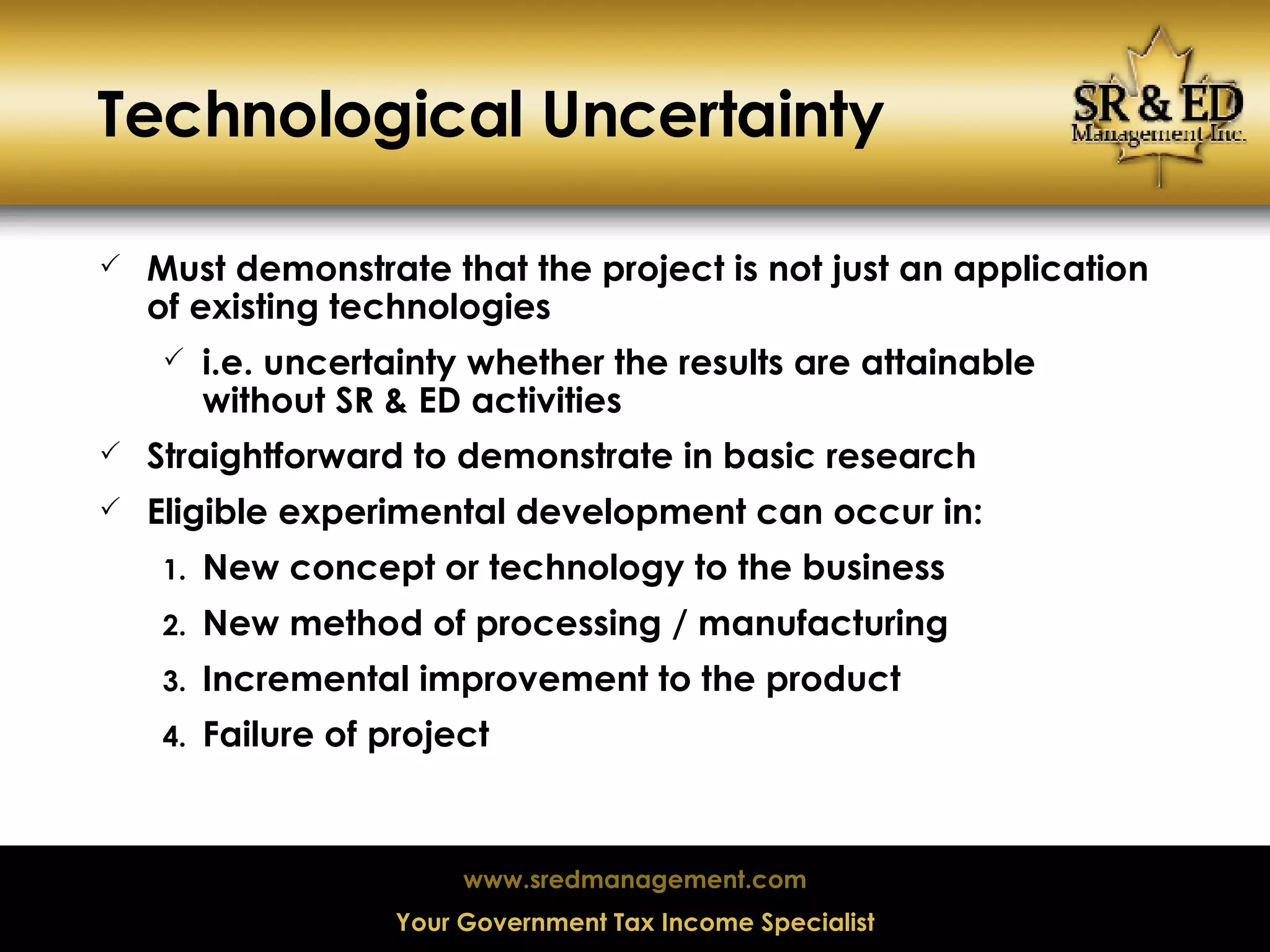
Technological Uncertainty Must demonstrate that the project is not just an application of existing technologies  i.e. uncertainty whether the results are attainable without SR & ED activities Straightforward to demonstrate in basic research Eligible experimental development can occur in: New concept or technology to the business New method of processing / manufacturing Incremental improvement to the product Failure of project
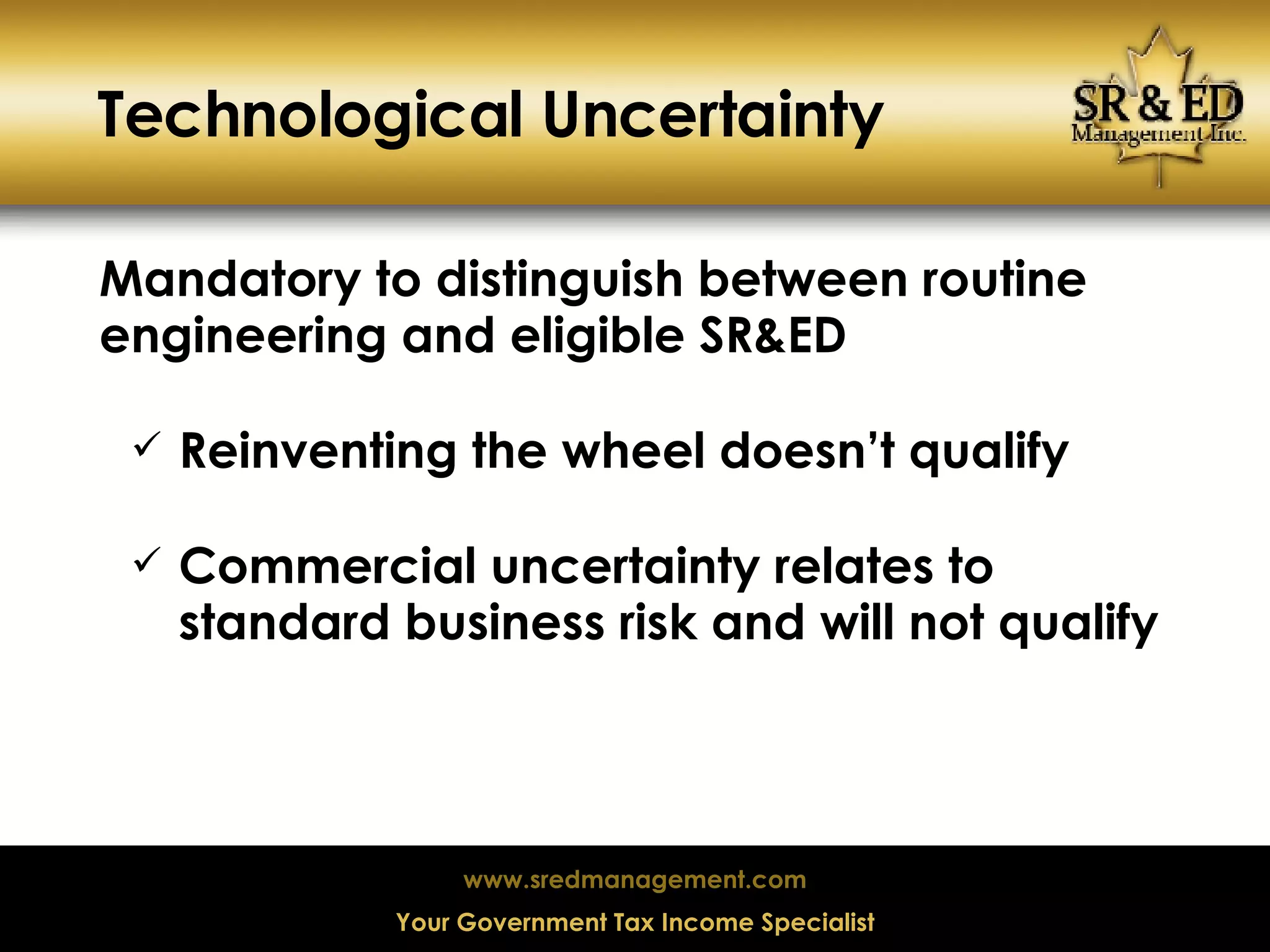
Technological Uncertainty Mandatory to distinguish between routine engineering and eligible SR&ED Reinventing the wheel doesn’t qualify Commercial uncertainty relates to standard business risk and will not qualify
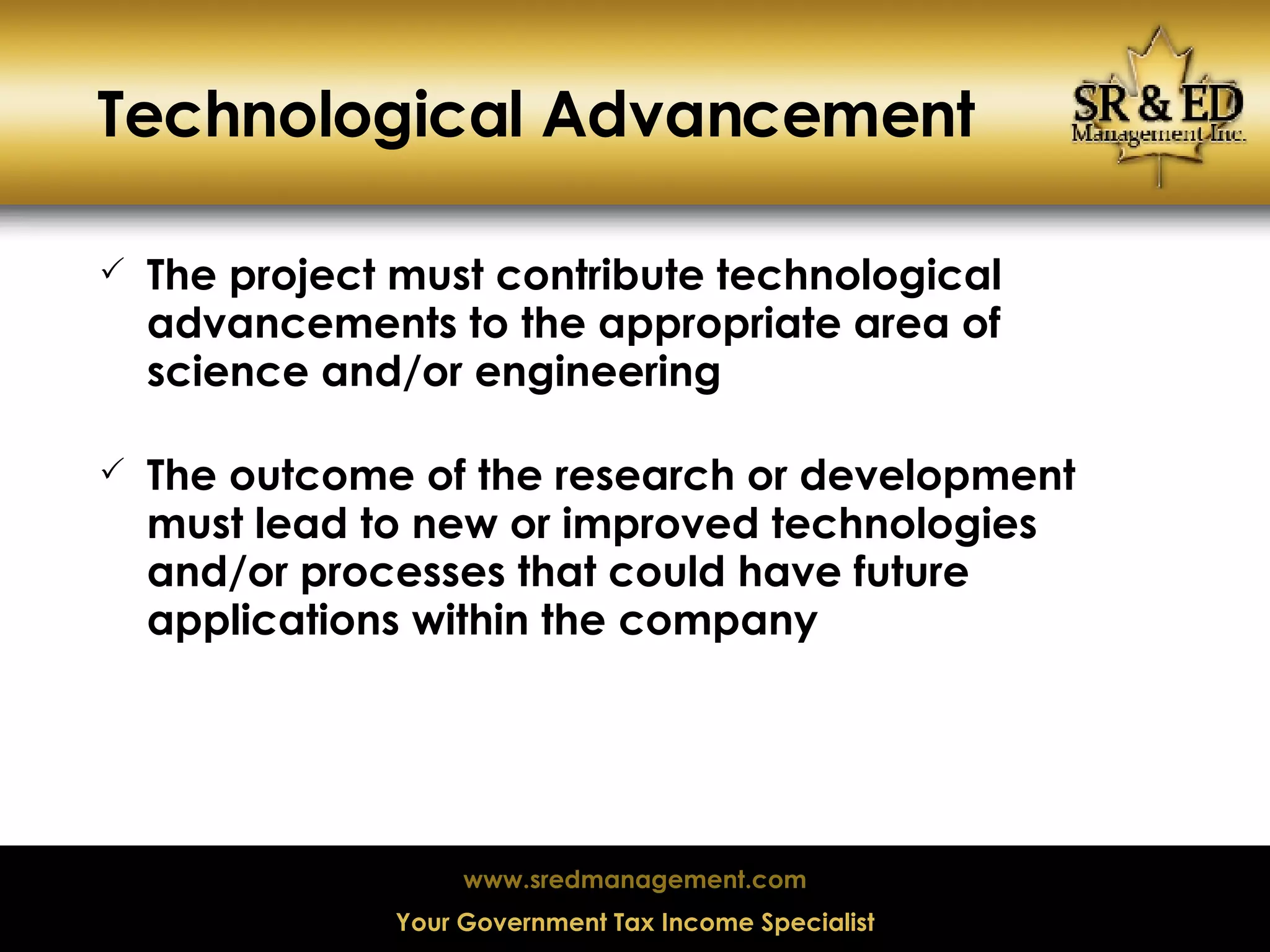
Technological Advancement The project must contribute technological advancements to the appropriate area of science and/or engineering The outcome of the research or development must lead to new or improved technologies and/or processes that could have future applications within the company
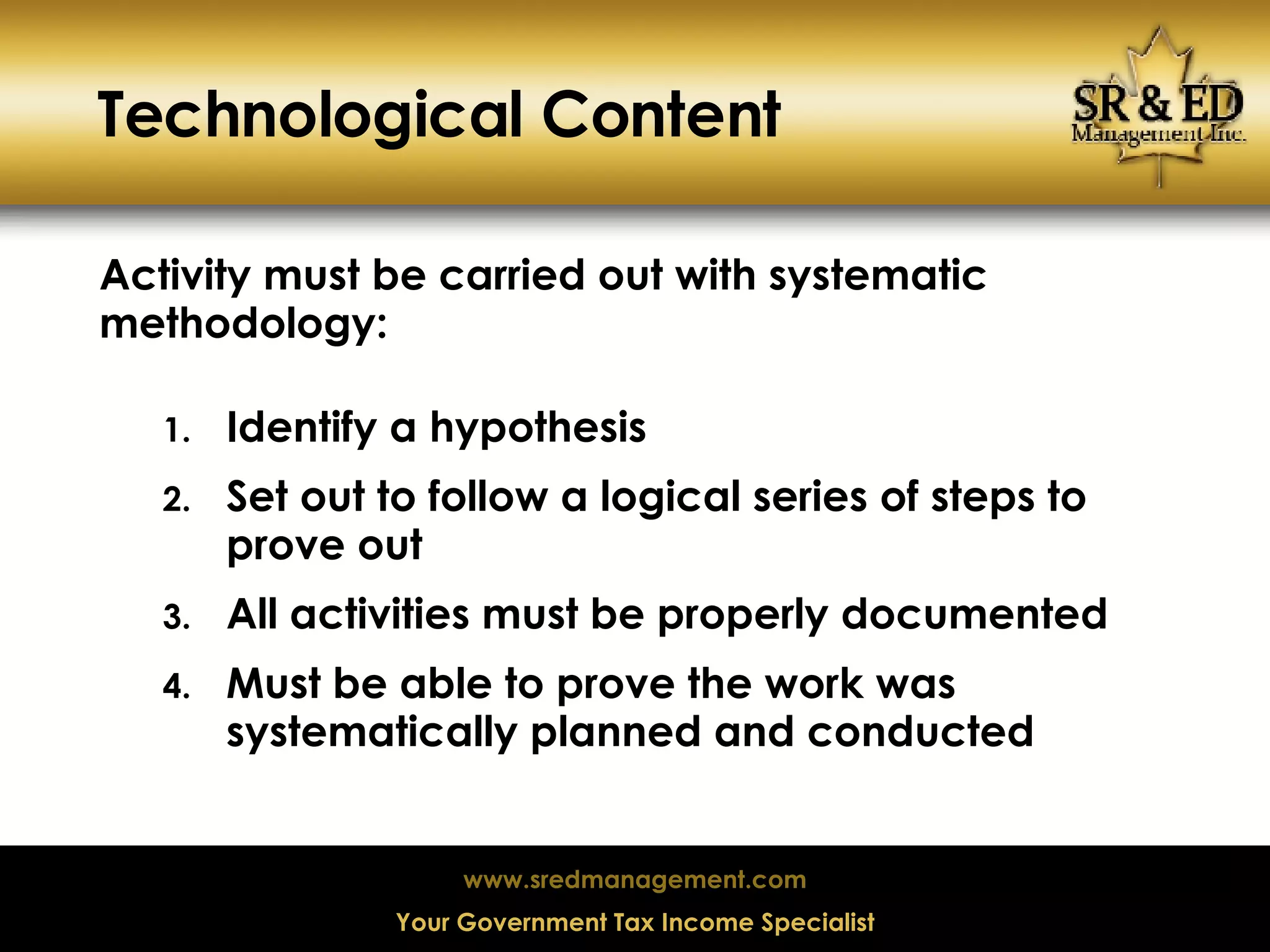
Technological Content Activity must be carried out with systematic methodology: Identify a hypothesis Set out to follow a logical series of steps to prove out All activities must be properly documented Must be able to prove the work was systematically planned and conducted
Technical Submission An accurately prepared technical submission must: Clearly identify the project activity(s) Indicate how the project is eligible under the definition of SR&ED Fully describe how it meets eligibility criteria CRA has many qualified Science Advisors, and the project description should articulate eligibility
Technical Submission Each Fiscal Year is independent and meet CRA requirements Just because a claim has succeeded in a prior year is no guarantee that it will continue to be eligible in the future Do not take eligibility of filed claims for granted
Identifying SR&ED Activities Indicators to evaluate  eligible SR&ED activity: Were qualified engineers and other personnel involved in the project? Were applications made for patents? Does the product or process have to meet new changes to industry standards? What is the industry? (CRA identifies 12 technology sectors) Did the company retain the intellectual property rights to any subcontracted work? Is the company trying to develop a new process or product with no precedent? Is this an improvement that requires new technologies to succeed? Did the company go through steps that failed?
Where SR&ED Occurs Uncertainties or technological issues resulting in SR&ED activities can occur anywhere in the product life cycle Feasibility assessment at the quote stage Design reviews prior to tooling kick off Process design Prototyping Design validation testing Production validation testing Initial product or process launch Customer concerns, product or process issues after launch
Identifying Allowable Expenditures Election must be made to file either a Traditional or Proxy Traditional   Attributable overhead expenditures are allowed (Rent, Taxes, Utilities, etc.) Proxy   In lieu of calculating attributable overhead expenditures, 65% of labour is added to eligible expenditures
Proxy Method A proscribed amount (65%) is calculated, based on SR&ED salaries and wages This “proxy amount” is included only within the qualified SR&ED expenditures for ITC purposes The proxy amount represents SR&ED-attributable overhead expenditures No actual overhead expenditures are to be included in the SR&ED claim Election in year is irrevocable for the year
Proxy Reflects Following Expenditures Office supplies General purpose office equipment Heat, water, electricity & telephones Support staff salaries or wages Travel and training (Not in all cases) Property taxes Maintenance/upkeep of SR&ED premises, facilities or equipment Any other exp. directly related to the prosecution of SR&ED that you would not have incurred if the SR&ED had not occurred
Proxy Allowable Expenditures Salaries & wages of employees directly engaged in SR&ED, for the incremental time engaged Cost of materials consumed in SR&ED Cost of materials transformed in SR&ED Contract payments (restricted) Lease costs 3rd Party Payments Capital expenditures [“ASA”]
Salaries & Wages Must be “Directly engaged in SR&ED” Directly engaged refers to ”Hands-on" work which would be performed by an employee and would include, for example: Preparing equipment and materials for experiments and analysis, but not maintaining equipment
Salaries & Wages Experimentation and analysis Recording measurements, making calculations, and preparing charts and graphs Performing work with respect to engineering or design, operations research, mathematical analysis, computer programming, data collection, testing and psychological research that is commensurate with the needs and directly in support of eligible SR&ED work
Materials Consumed’ Material is scrapped; rendered virtually useless as result of the SR&ED (e.g. Prototype tools, tryout parts) Material does not form part of inventory for future use, custom product or commercial asset Material was not used in experimental production, from which units were sold
Contract Expenditures Separate ‘Arm’s length’ contract costs from ‘non-arm’s length’ contracts Associated companies may elect to transfer qualified SR&ED expenditures SR&ED activity must have been performed in Canada to qualify for highest rates Minimum expenditures in USA allowed
“ PRESCRIBED EXPENDITURES ”  DO  NOT  QUALIFY FOR ITC Administration salaries (unless directly attributable) Legal or accounting fees, including annual fees Interest and other like fees Entertainment or convention expenses Advertising or selling costs Membership dues or fees Cost of equipment bought in used condition Acquisition of rights arising out of SR&ED
SR&ED Essential Management Documentation must start once a technological uncertainty is identified establishing the start of the SR&ED project Develop an system that identifies and segregates eligible activities from routine R&D Separate the technological issues from product development Use coding for R&D projects and sub-codes for tasks and activities Develop documentation that ties activities to the project plan Develop a time system to capture eligible activities
Documentation Potential sources of Evidence of Technological Advancement, Uncertainty or Content Feasibility studies, reviews of existing technology, beta products Internet searches Search for generally available info (library)‏ Project plan – objectives, hypothesis, plan, budget, staffing, deadlines Notebooks and logs Defect logs Minutes of meetings Open issues logs
Documentation Designs, plans sketches, charts Photographs, videos Digital voice recordings Prototypes and sample parts Internal correspondence (emails, memos)‏ 3rd party documentation – vendors, suppliers, contractors Personnel qualifications Corrective actions reports Continuous improvement reports Test reports Tryout reports
Financing Issues Many Canadian start-up and hi-tech companies rely on refundable ITC’s as a significant source of capital.  It is imperative that early extensive tax planning is conducted with tax professionals to attain Canadian Controlled Private Corporation (CCPC) status to be eligible for the maximum benefits (45% refundable versus 20% non refundable tax credits) Many growing technology companies carry forward non-capital losses, SR&ED pools and non refundable ITC’s worth future value A CCPC can be eligible for the $500,000 capital gains exemption or ABIL’s The aforementioned tax benefits are only available if the company retains its status as a CCPC
Financing Issues If a company is contemplating a sale of shares to become public or foreign controlled, they should plan carefully to avoid losing any unused tax advantages available to CCPC’s Tax issues facing companies raising capital can significantly affect the outcomes for all concerned.  Professional advice should be obtained before any financing deal is finalized

SRED Program Overview

  • 1.
    Understanding the SR& ED Program Prepared By SR & ED Management Inc. Kevin William Angell, CMA [email_address] (519) 254-8661 August 2008
  • 2.
    Background Canada’s largesttax incentive program Every progressive manufacturing company should be eligible Underused due to lack of understanding and awareness In the manufacturing sector, professional consultants often fail to identify client activities that may be eligible due to lack of understanding of core activities Cash or tax credit for money spent on SR&ED, filed with Federal corporate tax returns Depending on company structure, credit may be 33% to 68% on money spent / expenditures incurred
  • 3.
    How to Usethe Program First, you spend money for eligible SR&ED work Claim is filed with year end financial statements and tax returns CRA performs verification If the claim is filed within 180 days of year end, government will send money within 120 days of file date for “CCPC’s” companies (net 41.5% in Ontario) and within 240 days for larger companies (20% non refundable tax credits)
  • 4.
    SR&ED Benefits Cashrefunds as a financing source Significantly lower after-tax R & D “ Support” in Canada’s goal of increasing productivity “ Support” in Canada’s goal of increasing world-wide competitiveness through innovation http://www.cra-arc.gc.ca/txcrdt/sred-rsde/menu-eng.html
  • 5.
    Definition of SR&ED... systematic investigation or search carried out in a field of science or technology by means of experiment or analysis ... for scientific or technological advancement In the manufacturing sector, SR&ED may occur in both commercial activities or prototypes.
  • 6.
    Program Requirements SR&EDClaims Comprise of Two Documents The technical submission (the science report) describes and supports the eligible projects and activities Tax schedules – T661 detailing the qualifying expenditures and calculating the earned ITC’s
  • 7.
    Program Requirements Thetechnical submission is unmistakably the most important part of the claim because: If the science activities do not meet the designated criteria the project will be disallowed; hence no ITC’s The SR&ED allowable expenditures are calculated based on the eligible activities Acceptance or rejection of SR&ED is not a black-or-white decision and considerable judgment may be required to interpret the virtues of a project CRA Science Advisor can confirm eligibility through on site pre project review before filing a claim
  • 8.
    Defining SR&ED Importantto distinguish between R&D and SR&ED R&D can be diverse activities, but SR&ED is defined in the Income Tax Act (ITA)within a narrower scope CRA has developed eligibility criteria through a co-operative effort with industry and the accounting profession Information Circular 86-4R3 forms the cornerstone for the criteria for eligibility Circulars and Bulletins for guidance found at: http://www.cra-arc.gc.ca/txcrdt/sred-rsde/menu-eng.html
  • 9.
    Defining SR&ED SR&ED defined in ITA as: “ systematic investigation or search that is carried out in a field of science or technology by means of experiment and / or analysis” The claimant must prove that a systematic scientific methodology was followed trial & error / tweaking are not a scientific approach routine work with predictable outcomes based on standard engineer knowledge is not allowed First year claimants may be allowed some leniency for required documentation
  • 10.
    Managing SR&ED Projectsshould be properly planned and documented Before undertaking a possible SR&ED project: Systematically plan actions Develop a hypothesis(es) Document all procedures and results for all testing, analysis, and counter measures
  • 11.
    Eligible Fields ofScience Basic Research An advancement of scientific knowledge without a specific practical application Applied Research An advancement of scientific knowledge with a specific practical application Experimental Development A technological advancement for the purpose of creating a new or improved product or process(es) typical in manufacturing
  • 12.
    Eligible Fields ofScience 1st timers often perceive only basic and applied research as eligible E.g. developing a cure for cancer Only 10 % of all SR&ED claims are research based Experimental Development, with a commercial focus, accounts for 90% of all eligible and allowed SR&ED claims
  • 13.
    Defined Ineligible ActivitiesMarket research and sales promotion Quality control and routine testing Social sciences Prospecting, exploring or drilling for minerals, petroleum or natural gas Style changes Routine data collection
  • 14.
    Criteria for EligibilityTo be eligible, the project must meet three criteria as set out in IC 86-4R3 http://www.cra-arc.gc.ca/E/pub/tp/ic86-4r3/ic86-4r3-e.html Technological uncertainty Technological advancement Technological content
  • 15.
    Technological Uncertainty Mustdemonstrate that the project is not just an application of existing technologies i.e. uncertainty whether the results are attainable without SR & ED activities Straightforward to demonstrate in basic research Eligible experimental development can occur in: New concept or technology to the business New method of processing / manufacturing Incremental improvement to the product Failure of project
  • 16.
    Technological Uncertainty Mandatoryto distinguish between routine engineering and eligible SR&ED Reinventing the wheel doesn’t qualify Commercial uncertainty relates to standard business risk and will not qualify
  • 17.
    Technological Advancement Theproject must contribute technological advancements to the appropriate area of science and/or engineering The outcome of the research or development must lead to new or improved technologies and/or processes that could have future applications within the company
  • 18.
    Technological Content Activitymust be carried out with systematic methodology: Identify a hypothesis Set out to follow a logical series of steps to prove out All activities must be properly documented Must be able to prove the work was systematically planned and conducted
  • 19.
    Technical Submission Anaccurately prepared technical submission must: Clearly identify the project activity(s) Indicate how the project is eligible under the definition of SR&ED Fully describe how it meets eligibility criteria CRA has many qualified Science Advisors, and the project description should articulate eligibility
  • 20.
    Technical Submission EachFiscal Year is independent and meet CRA requirements Just because a claim has succeeded in a prior year is no guarantee that it will continue to be eligible in the future Do not take eligibility of filed claims for granted
  • 21.
    Identifying SR&ED ActivitiesIndicators to evaluate eligible SR&ED activity: Were qualified engineers and other personnel involved in the project? Were applications made for patents? Does the product or process have to meet new changes to industry standards? What is the industry? (CRA identifies 12 technology sectors) Did the company retain the intellectual property rights to any subcontracted work? Is the company trying to develop a new process or product with no precedent? Is this an improvement that requires new technologies to succeed? Did the company go through steps that failed?
  • 22.
    Where SR&ED OccursUncertainties or technological issues resulting in SR&ED activities can occur anywhere in the product life cycle Feasibility assessment at the quote stage Design reviews prior to tooling kick off Process design Prototyping Design validation testing Production validation testing Initial product or process launch Customer concerns, product or process issues after launch
  • 23.
    Identifying Allowable ExpendituresElection must be made to file either a Traditional or Proxy Traditional Attributable overhead expenditures are allowed (Rent, Taxes, Utilities, etc.) Proxy In lieu of calculating attributable overhead expenditures, 65% of labour is added to eligible expenditures
  • 24.
    Proxy Method Aproscribed amount (65%) is calculated, based on SR&ED salaries and wages This “proxy amount” is included only within the qualified SR&ED expenditures for ITC purposes The proxy amount represents SR&ED-attributable overhead expenditures No actual overhead expenditures are to be included in the SR&ED claim Election in year is irrevocable for the year
  • 25.
    Proxy Reflects FollowingExpenditures Office supplies General purpose office equipment Heat, water, electricity & telephones Support staff salaries or wages Travel and training (Not in all cases) Property taxes Maintenance/upkeep of SR&ED premises, facilities or equipment Any other exp. directly related to the prosecution of SR&ED that you would not have incurred if the SR&ED had not occurred
  • 26.
    Proxy Allowable ExpendituresSalaries & wages of employees directly engaged in SR&ED, for the incremental time engaged Cost of materials consumed in SR&ED Cost of materials transformed in SR&ED Contract payments (restricted) Lease costs 3rd Party Payments Capital expenditures [“ASA”]
  • 27.
    Salaries & WagesMust be “Directly engaged in SR&ED” Directly engaged refers to ”Hands-on" work which would be performed by an employee and would include, for example: Preparing equipment and materials for experiments and analysis, but not maintaining equipment
  • 28.
    Salaries & WagesExperimentation and analysis Recording measurements, making calculations, and preparing charts and graphs Performing work with respect to engineering or design, operations research, mathematical analysis, computer programming, data collection, testing and psychological research that is commensurate with the needs and directly in support of eligible SR&ED work
  • 29.
    Materials Consumed’ Materialis scrapped; rendered virtually useless as result of the SR&ED (e.g. Prototype tools, tryout parts) Material does not form part of inventory for future use, custom product or commercial asset Material was not used in experimental production, from which units were sold
  • 30.
    Contract Expenditures Separate‘Arm’s length’ contract costs from ‘non-arm’s length’ contracts Associated companies may elect to transfer qualified SR&ED expenditures SR&ED activity must have been performed in Canada to qualify for highest rates Minimum expenditures in USA allowed
  • 31.
    “ PRESCRIBED EXPENDITURES” DO NOT QUALIFY FOR ITC Administration salaries (unless directly attributable) Legal or accounting fees, including annual fees Interest and other like fees Entertainment or convention expenses Advertising or selling costs Membership dues or fees Cost of equipment bought in used condition Acquisition of rights arising out of SR&ED
  • 32.
    SR&ED Essential ManagementDocumentation must start once a technological uncertainty is identified establishing the start of the SR&ED project Develop an system that identifies and segregates eligible activities from routine R&D Separate the technological issues from product development Use coding for R&D projects and sub-codes for tasks and activities Develop documentation that ties activities to the project plan Develop a time system to capture eligible activities
  • 33.
    Documentation Potential sourcesof Evidence of Technological Advancement, Uncertainty or Content Feasibility studies, reviews of existing technology, beta products Internet searches Search for generally available info (library)‏ Project plan – objectives, hypothesis, plan, budget, staffing, deadlines Notebooks and logs Defect logs Minutes of meetings Open issues logs
  • 34.
    Documentation Designs, planssketches, charts Photographs, videos Digital voice recordings Prototypes and sample parts Internal correspondence (emails, memos)‏ 3rd party documentation – vendors, suppliers, contractors Personnel qualifications Corrective actions reports Continuous improvement reports Test reports Tryout reports
  • 35.
    Financing Issues ManyCanadian start-up and hi-tech companies rely on refundable ITC’s as a significant source of capital. It is imperative that early extensive tax planning is conducted with tax professionals to attain Canadian Controlled Private Corporation (CCPC) status to be eligible for the maximum benefits (45% refundable versus 20% non refundable tax credits) Many growing technology companies carry forward non-capital losses, SR&ED pools and non refundable ITC’s worth future value A CCPC can be eligible for the $500,000 capital gains exemption or ABIL’s The aforementioned tax benefits are only available if the company retains its status as a CCPC
  • 36.
    Financing Issues Ifa company is contemplating a sale of shares to become public or foreign controlled, they should plan carefully to avoid losing any unused tax advantages available to CCPC’s Tax issues facing companies raising capital can significantly affect the outcomes for all concerned. Professional advice should be obtained before any financing deal is finalized