Presented by
Vijay Kalra, CPA, CA
VIJAY KALRA
CPA Professional Corporation
Our Company
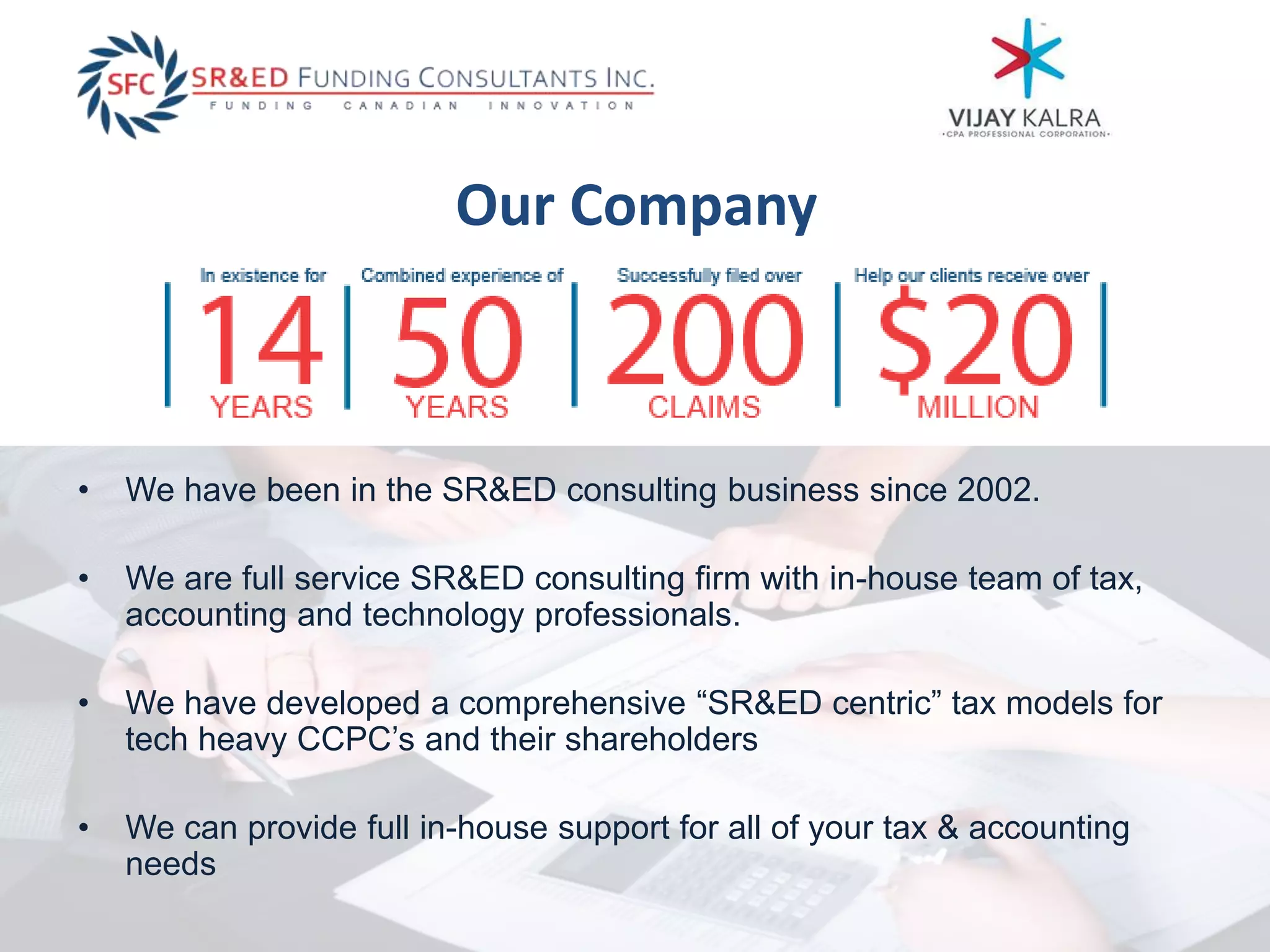
• We have been in the SR&ED consulting business since 2002.
• We are full service SR&ED consulting firm with in-house team of tax,
accounting and technology professionals.
• We have developed a comprehensive “SR&ED centric” tax models for
tech heavy CCPC’s and their shareholders
• We can provide full in-house support for all of your tax & accounting
needs
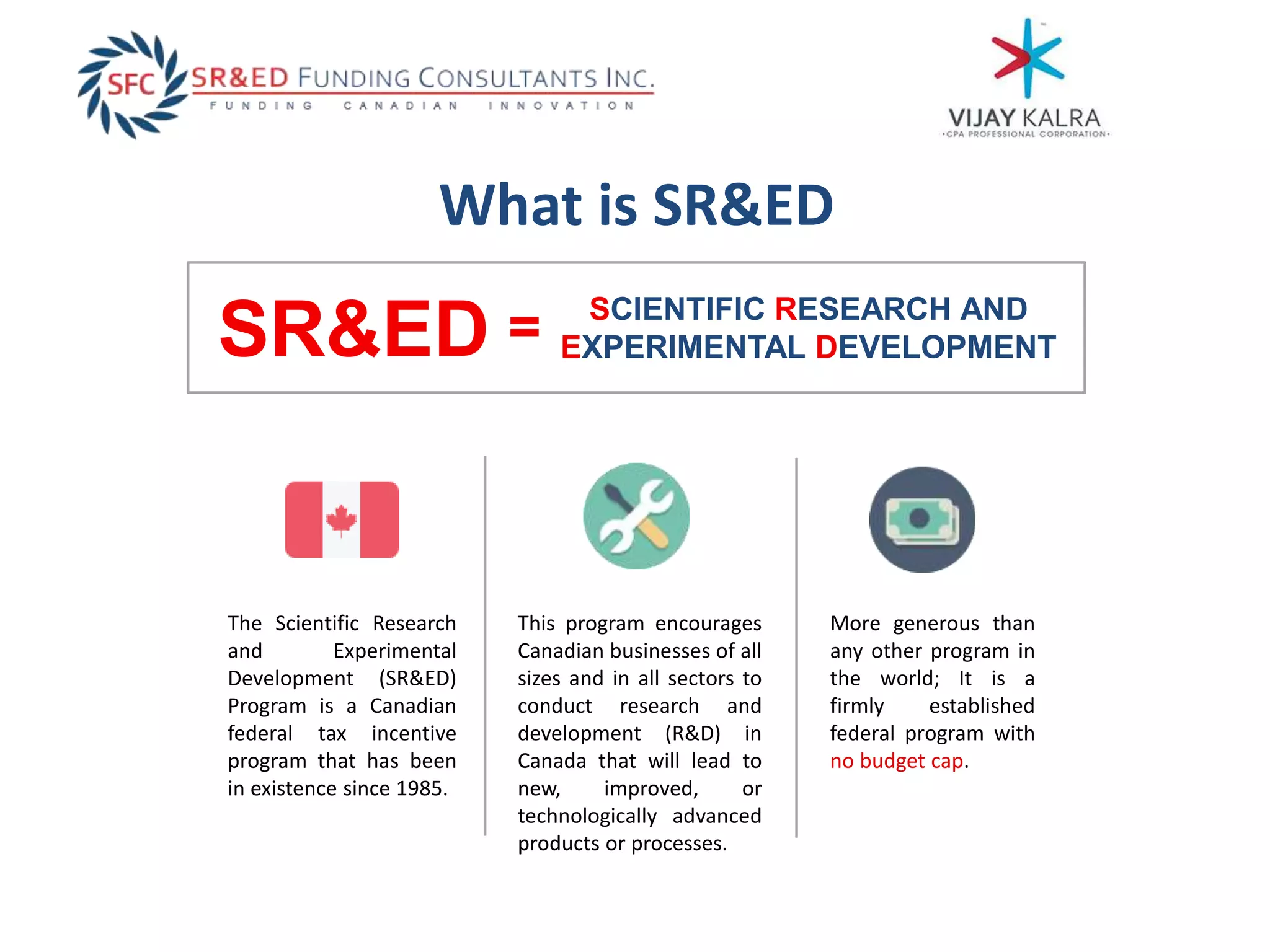
What is SR&ED
SCIENTIFIC RESEARCH AND
EXPERIMENTAL DEVELOPMENTSR&ED
This program encourages
Canadian businesses of all
sizes and in all sectors to
conduct research and
development (R&D) in
Canada that will lead to
new, improved, or
technologically advanced
products or processes.
More generous than
any other program in
the world; It is a
firmly established
federal program with
no budget cap.
=
The Scientific Research
and Experimental
Development (SR&ED)
Program is a Canadian
federal tax incentive
program that has been
in existence since 1985.
Introduction to SR&ED Program
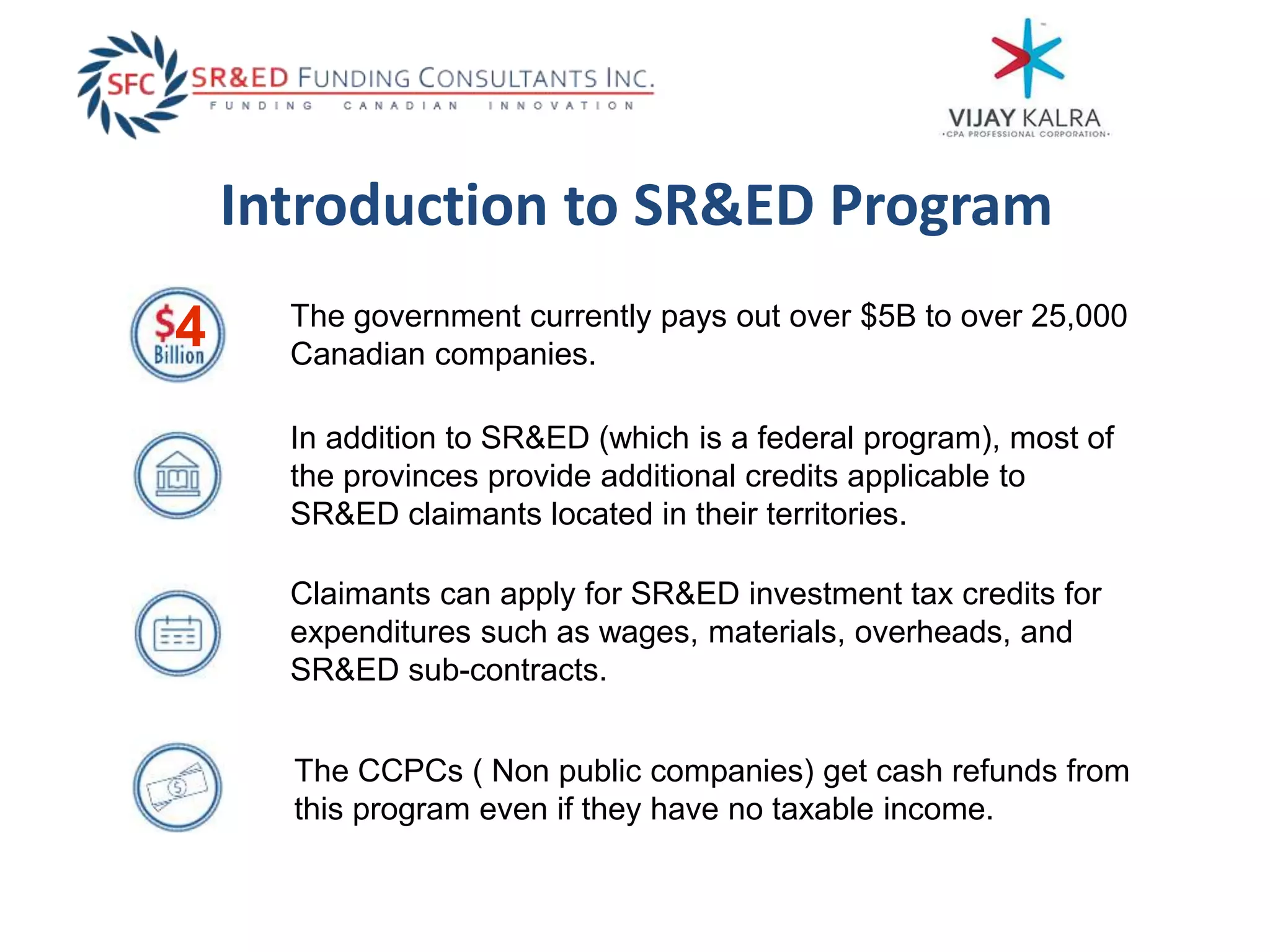
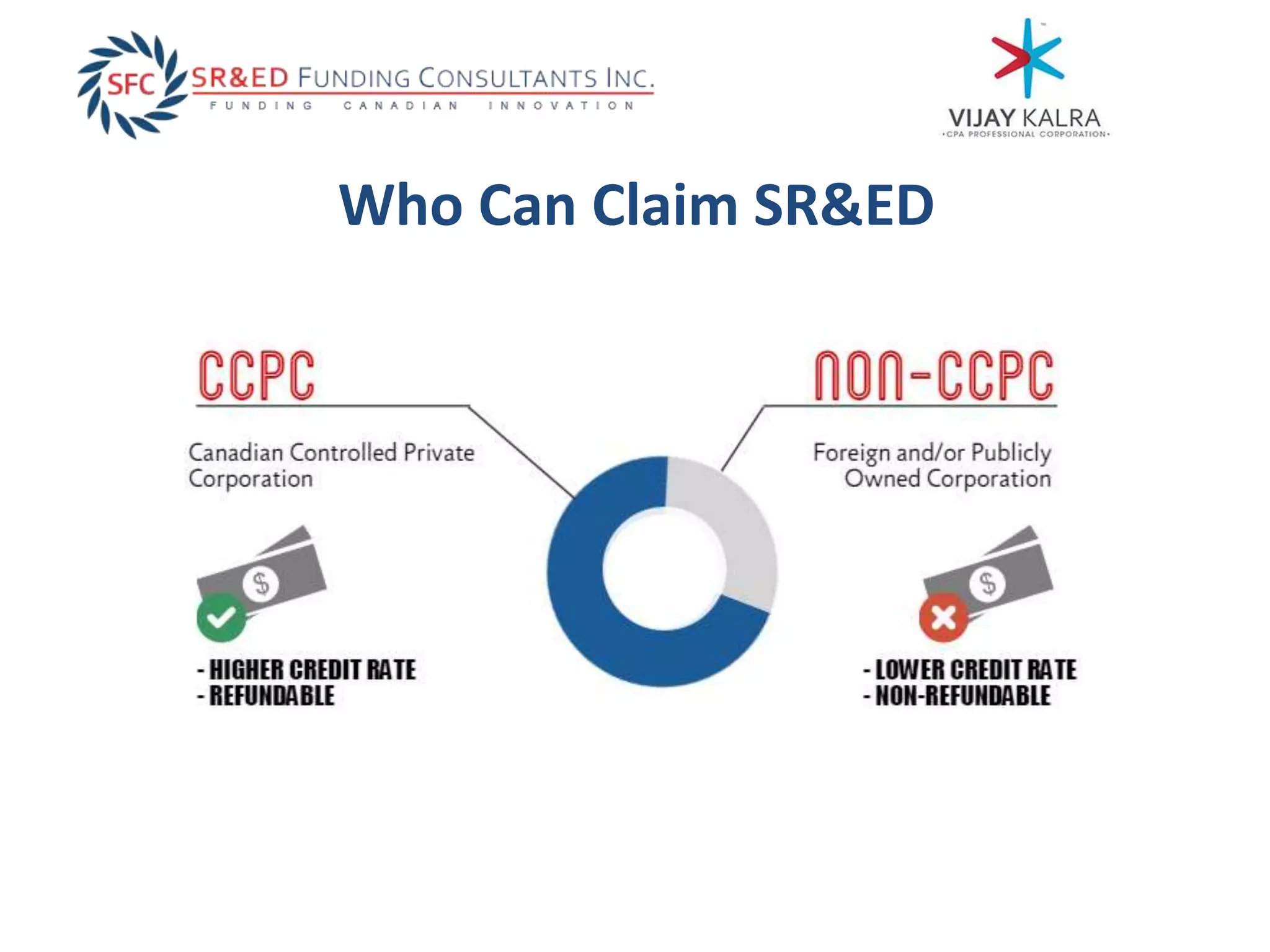
The CCPCs ( Non public companies) get cash refunds from
this program even if they have no taxable income.
Claimants can apply for SR&ED investment tax credits for
expenditures such as wages, materials, overheads, and
SR&ED sub-contracts.
In addition to SR&ED (which is a federal program), most of
the provinces provide additional credits applicable to
SR&ED claimants located in their territories.
The government currently pays out over $5B to over 25,000
Canadian companies.
4
Who Can Claim SR&ED
Things to Remember
• SR&ED is not specific to a particular industry. Historically IT and related
industries have got a disproportionate amount of money from this program
only because of early rapid development in that field. Manufacturing is the
most under claimed industry.
• SR&ED is activity specific. It is paid to a Canadian company for achieving
technological advancement by creating new, or improving existing materials,
devices, products or processes.
• The program applies to Canadian taxpayers (but includes foreign owned
companies duly set up in Canada) for work done on Canadian soil.
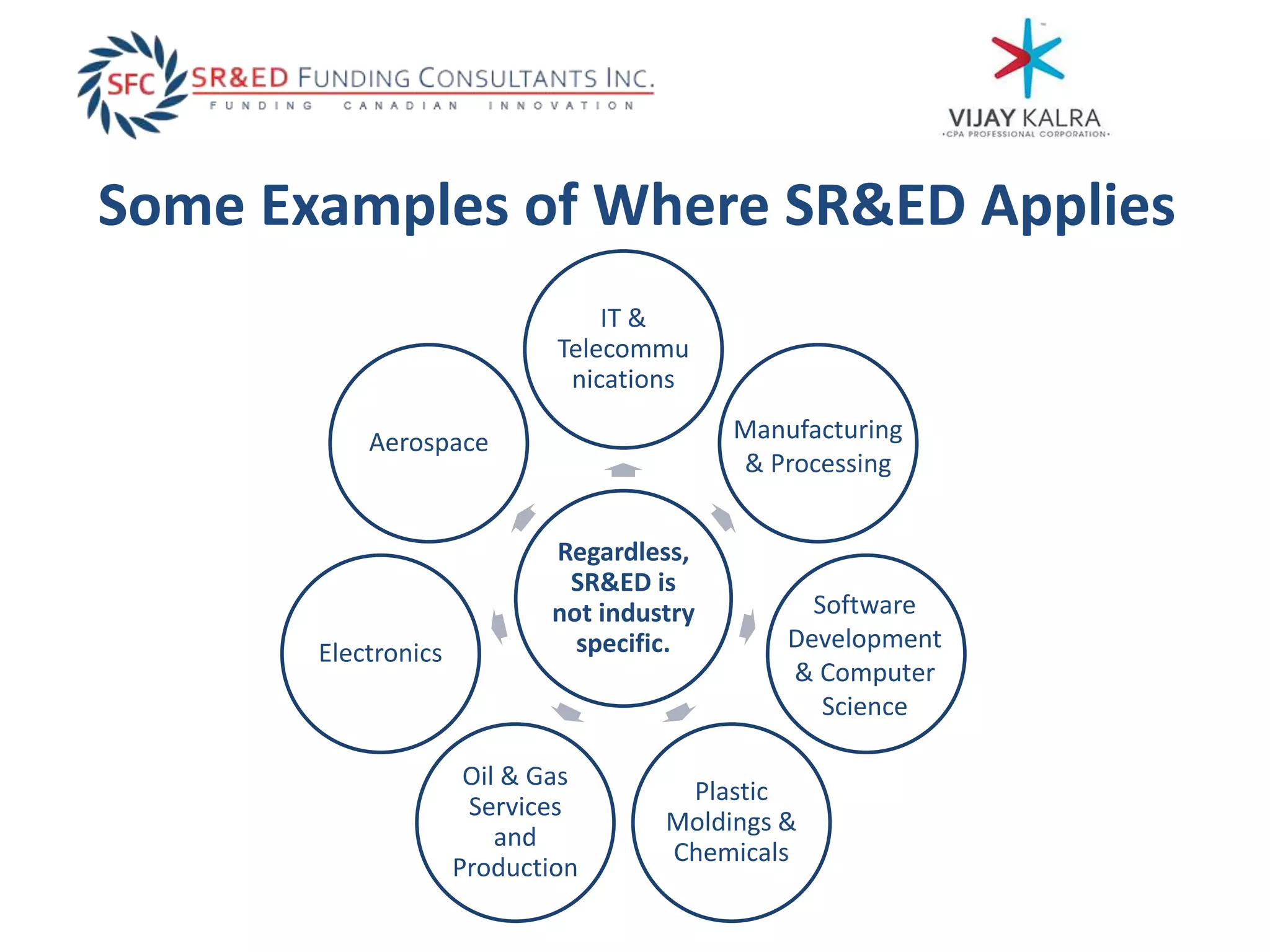
Some Examples of Where SR&ED Applies
Regardless,
SR&ED is
not industry
specific.
IT &
Telecommu
nications
Plastic
Moldings &
Chemicals
Oil & Gas
Services
and
Production
Electronics
Aerospace Manufacturing
& Processing
Software
Development
& Computer
Science
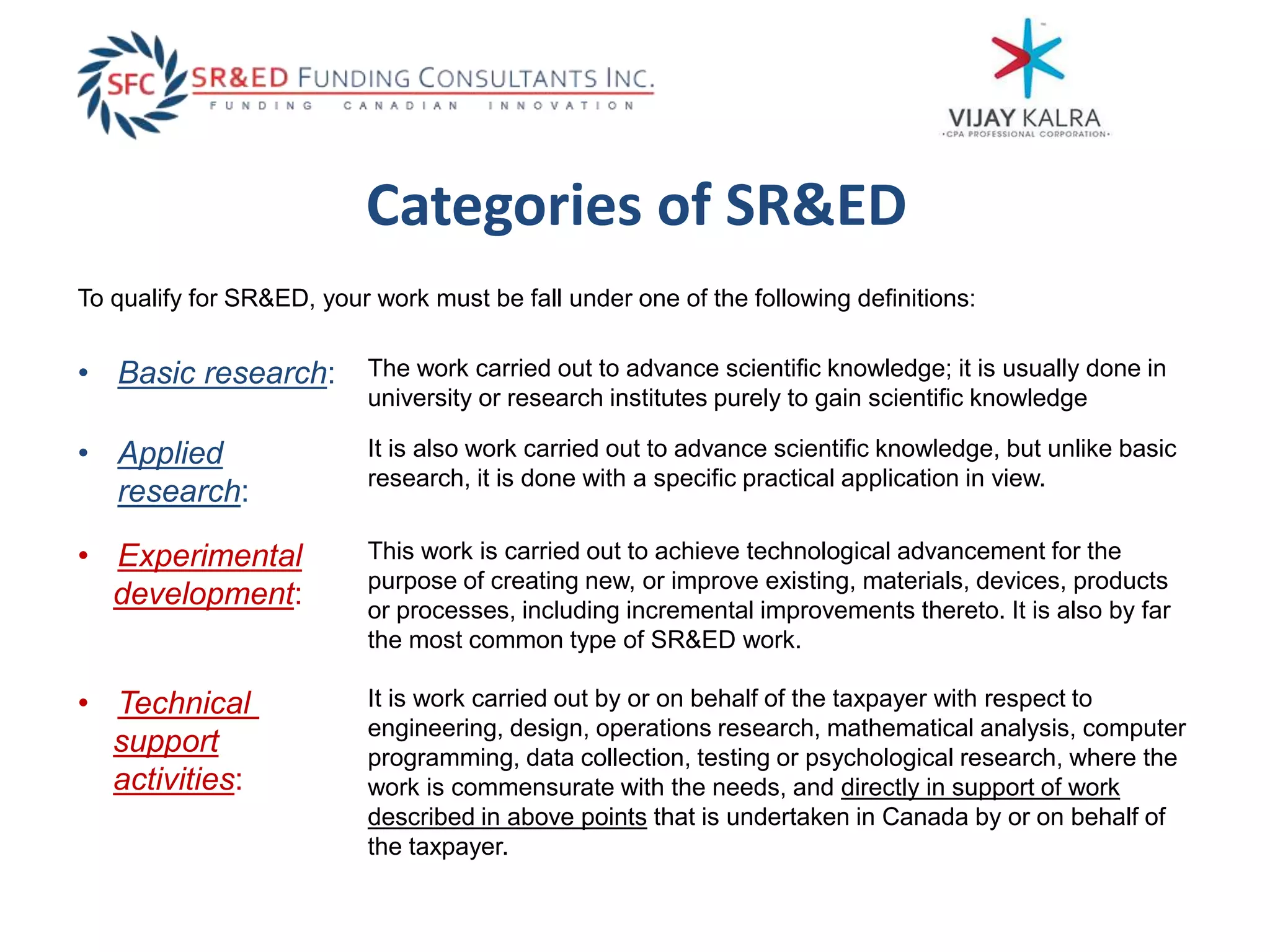
Categories of SR&ED
The work carried out to advance scientific knowledge; it is usually done in
university or research institutes purely to gain scientific knowledge
To qualify for SR&ED, your work must be fall under one of the following definitions:
• Basic research:
• Applied
research:
It is also work carried out to advance scientific knowledge, but unlike basic
research, it is done with a specific practical application in view.
• Experimental
development:
This work is carried out to achieve technological advancement for the
purpose of creating new, or improve existing, materials, devices, products
or processes, including incremental improvements thereto. It is also by far
the most common type of SR&ED work.
• Technical
support
activities:
It is work carried out by or on behalf of the taxpayer with respect to
engineering, design, operations research, mathematical analysis, computer
programming, data collection, testing or psychological research, where the
work is commensurate with the needs, and directly in support of work
described in above points that is undertaken in Canada by or on behalf of
the taxpayer.
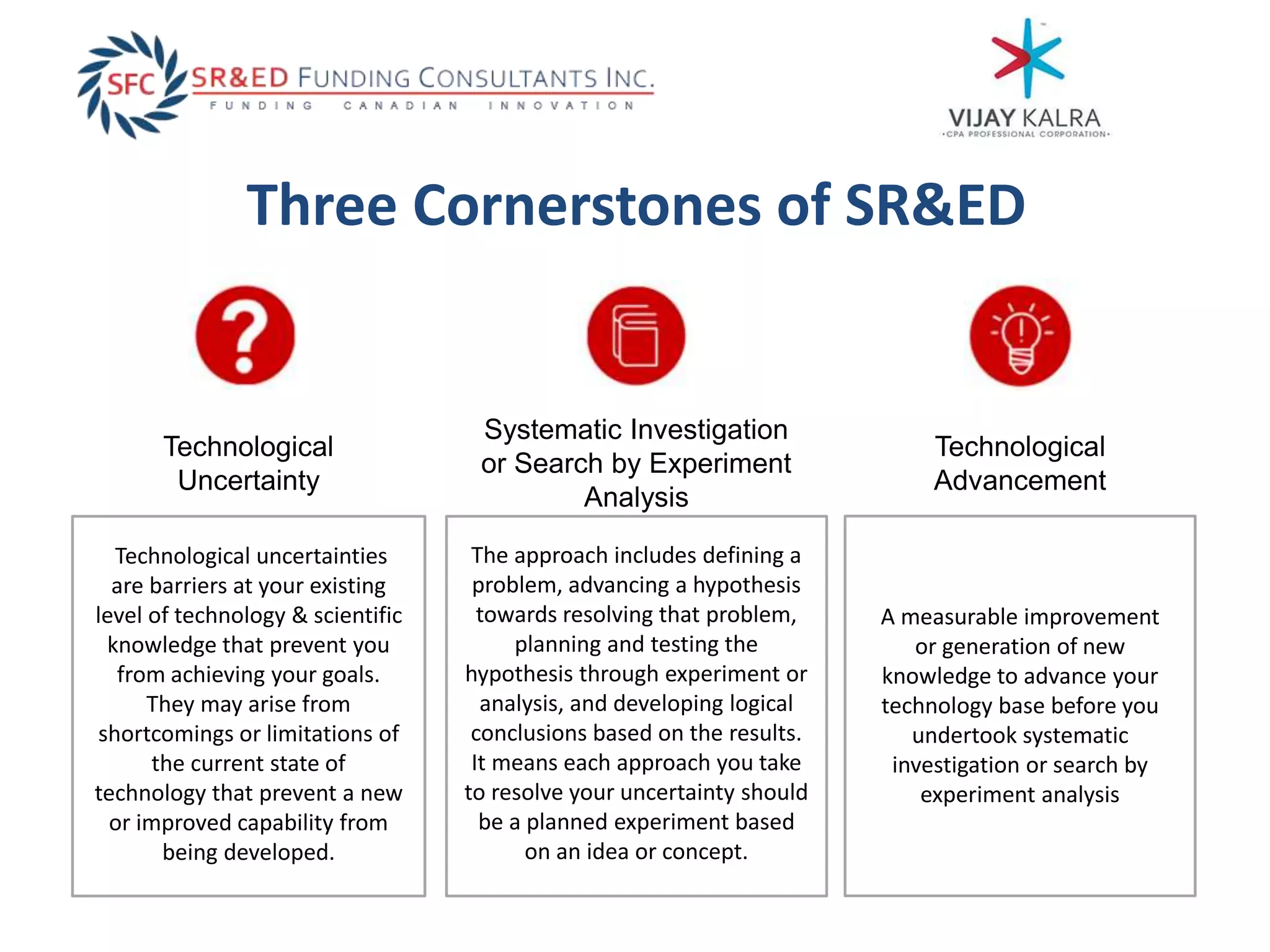
Three Cornerstones of SR&ED
Technological
Advancement
Technological
Uncertainty
Systematic Investigation
or Search by Experiment
Analysis
Technological uncertainties
are barriers at your existing
level of technology & scientific
knowledge that prevent you
from achieving your goals.
They may arise from
shortcomings or limitations of
the current state of
technology that prevent a new
or improved capability from
being developed.
A measurable improvement
or generation of new
knowledge to advance your
technology base before you
undertook systematic
investigation or search by
experiment analysis
The approach includes defining a
problem, advancing a hypothesis
towards resolving that problem,
planning and testing the
hypothesis through experiment or
analysis, and developing logical
conclusions based on the results.
It means each approach you take
to resolve your uncertainty should
be a planned experiment based
on an idea or concept.
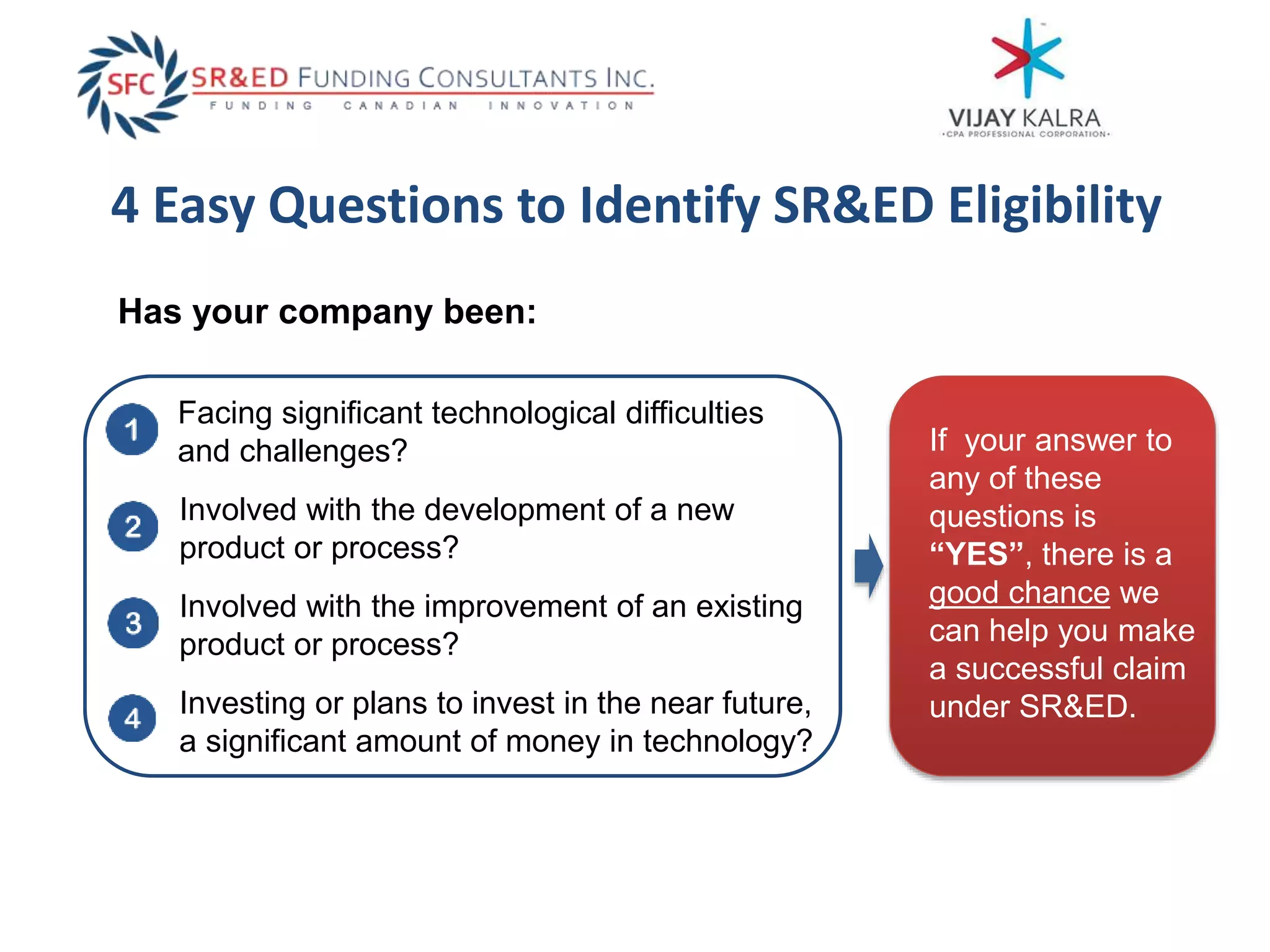
4 Easy Questions to Identify SR&ED Eligibility
Involved with the development of a new
product or process?
Facing significant technological difficulties
and challenges?
Involved with the improvement of an existing
product or process?
Investing or plans to invest in the near future,
a significant amount of money in technology?
Has your company been:
If your answer to
any of these
questions is
“YES”, there is a
good chance we
can help you make
a successful claim
under SR&ED.
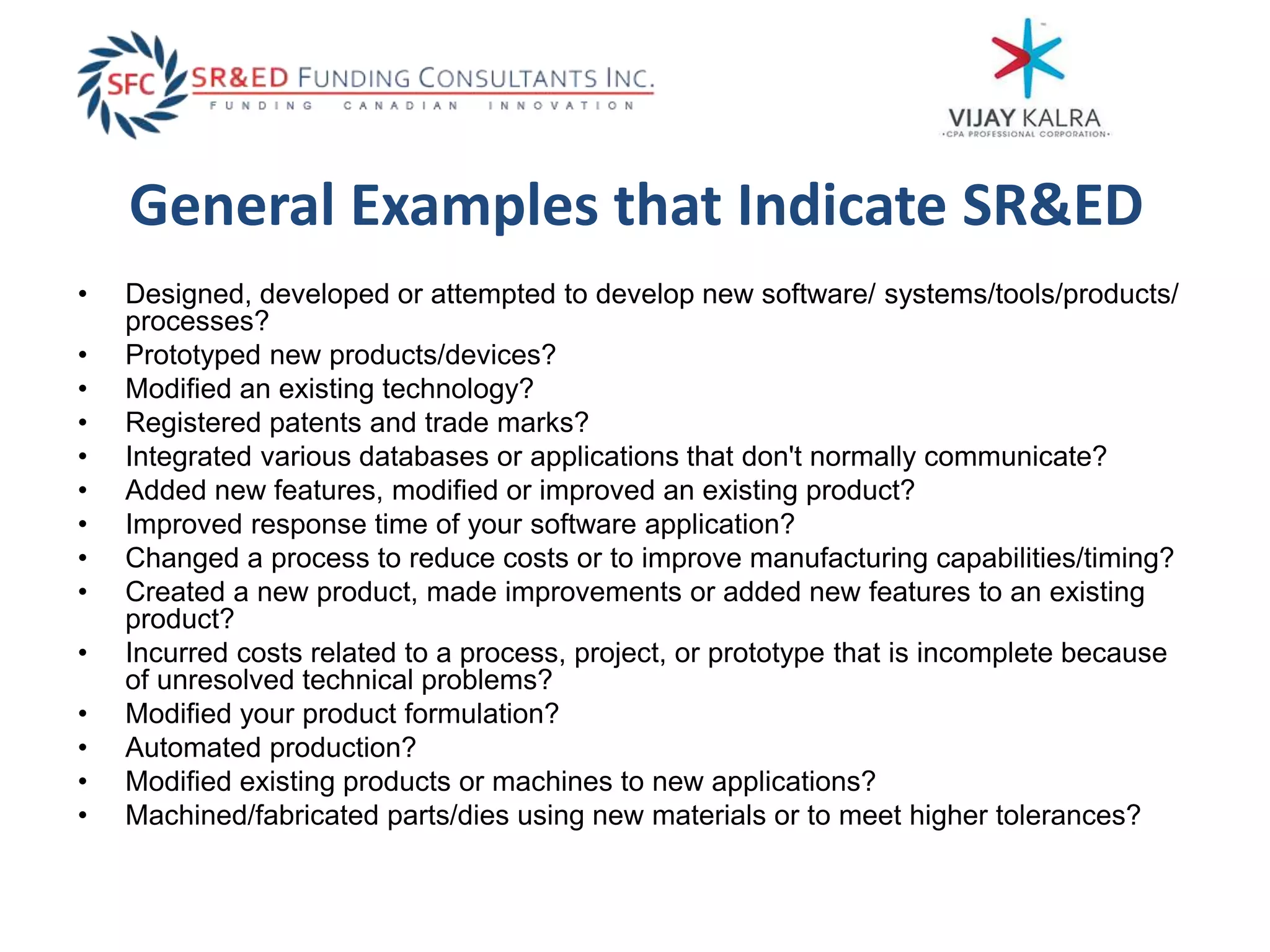
General Examples that Indicate SR&ED
• Designed, developed or attempted to develop new software/ systems/tools/products/
processes?
• Prototyped new products/devices?
• Modified an existing technology?
• Registered patents and trade marks?
• Integrated various databases or applications that don't normally communicate?
• Added new features, modified or improved an existing product?
• Improved response time of your software application?
• Changed a process to reduce costs or to improve manufacturing capabilities/timing?
• Created a new product, made improvements or added new features to an existing
product?
• Incurred costs related to a process, project, or prototype that is incomplete because
of unresolved technical problems?
• Modified your product formulation?
• Automated production?
• Modified existing products or machines to new applications?
• Machined/fabricated parts/dies using new materials or to meet higher tolerances?
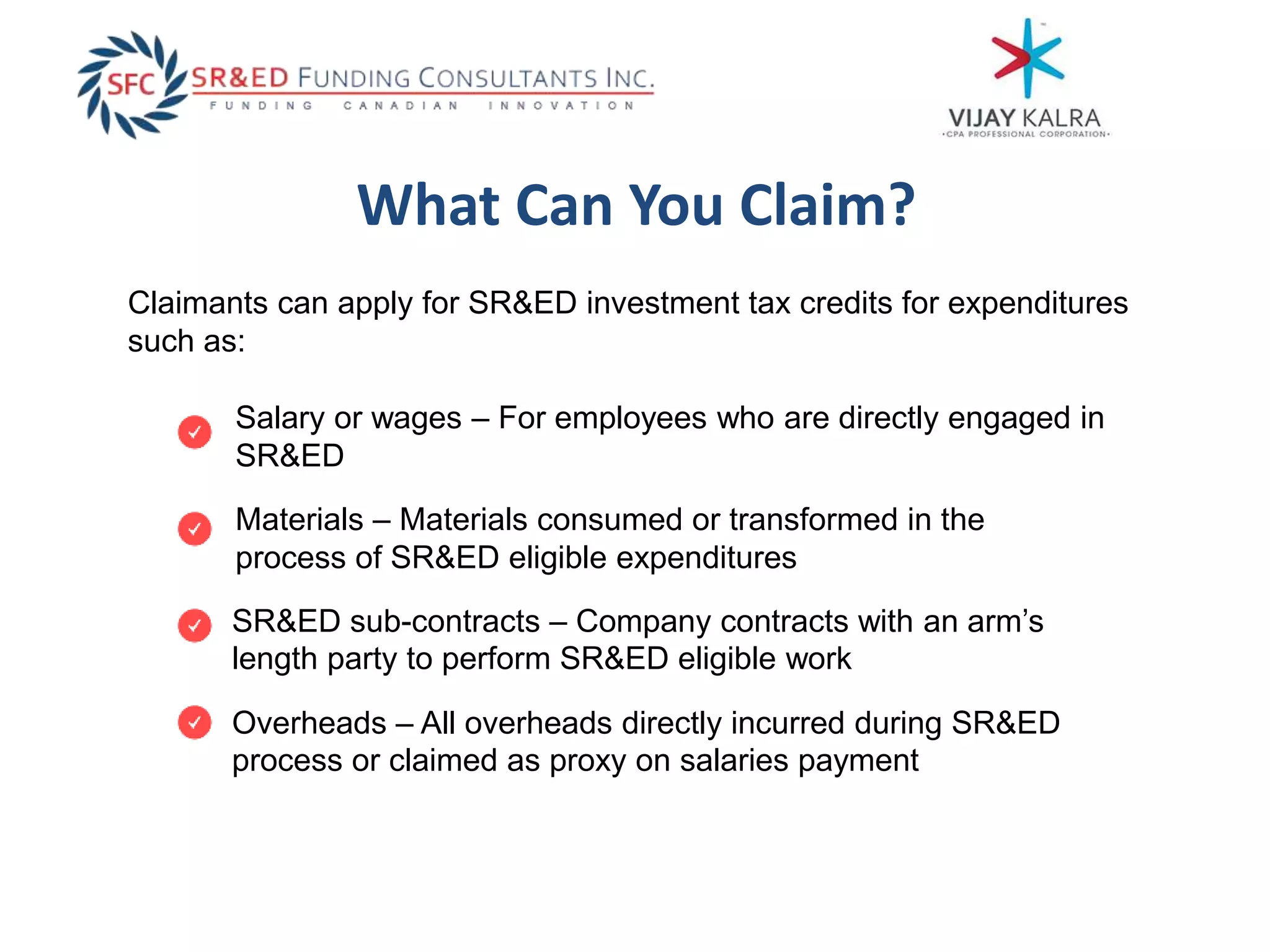
What Can You Claim?
Claimants can apply for SR&ED investment tax credits for expenditures
such as:
Salary or wages – For employees who are directly engaged in
SR&ED
Materials – Materials consumed or transformed in the
process of SR&ED eligible expenditures
Overheads – All overheads directly incurred during SR&ED
process or claimed as proxy on salaries payment
SR&ED sub-contracts – Company contracts with an arm’s
length party to perform SR&ED eligible work
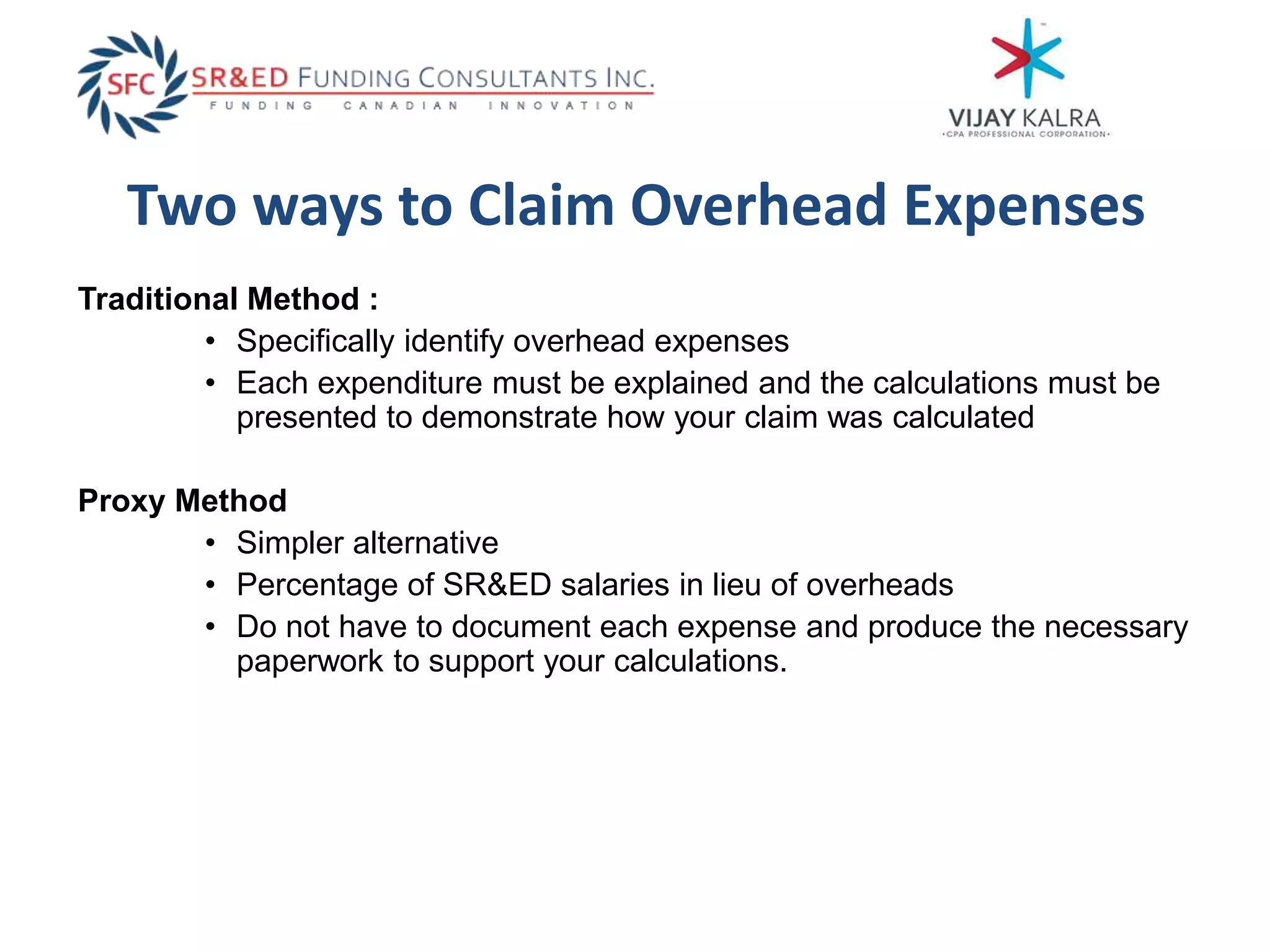
Two ways to Claim Overhead Expenses
Traditional Method :
• Specifically identify overhead expenses
• Each expenditure must be explained and the calculations must be
presented to demonstrate how your claim was calculated
Proxy Method
• Simpler alternative
• Percentage of SR&ED salaries in lieu of overheads
• Do not have to document each expense and produce the necessary
paperwork to support your calculations.
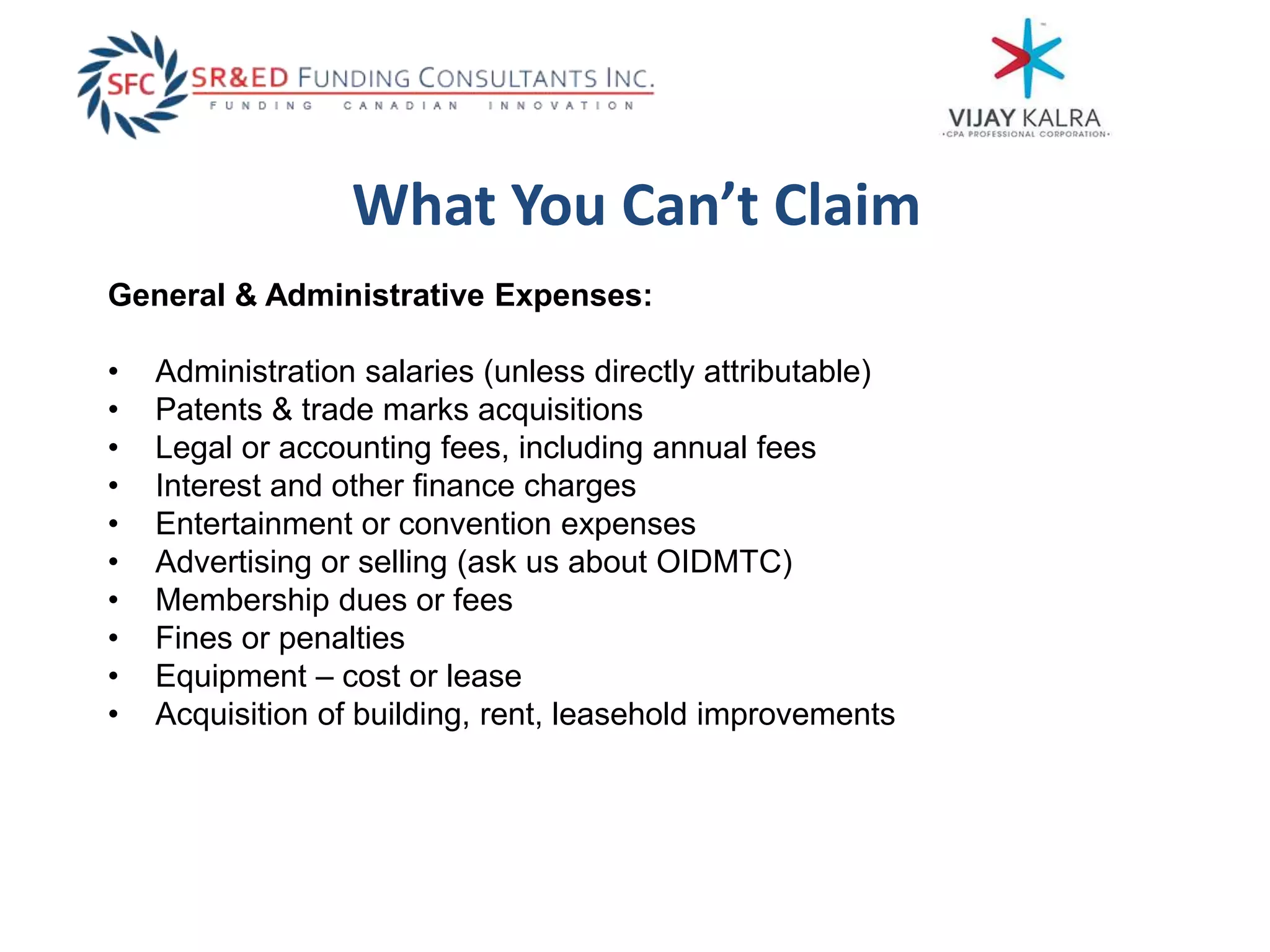
What You Can’t Claim
General & Administrative Expenses:
• Administration salaries (unless directly attributable)
• Patents & trade marks acquisitions
• Legal or accounting fees, including annual fees
• Interest and other finance charges
• Entertainment or convention expenses
• Advertising or selling (ask us about OIDMTC)
• Membership dues or fees
• Fines or penalties
• Equipment – cost or lease
• Acquisition of building, rent, leasehold improvements
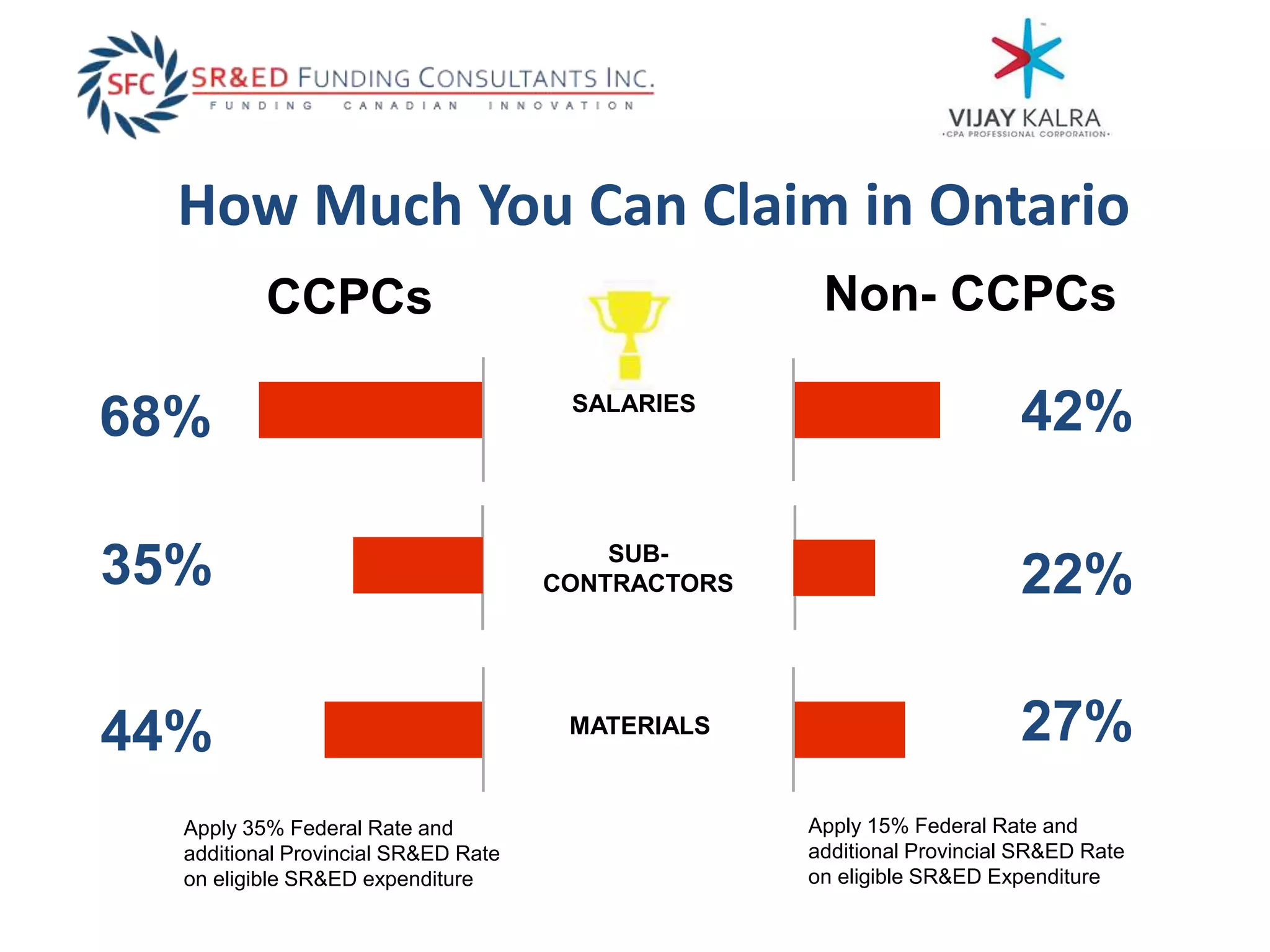
How Much You Can Claim in Ontario
CCPCs Non- CCPCs
SALARIES
SUB-
CONTRACTORS
MATERIALS
68%
35%
44%
42%
22%
27%
Apply 35% Federal Rate and
additional Provincial SR&ED Rate
on eligible SR&ED expenditure
Apply 15% Federal Rate and
additional Provincial SR&ED Rate
on eligible SR&ED Expenditure
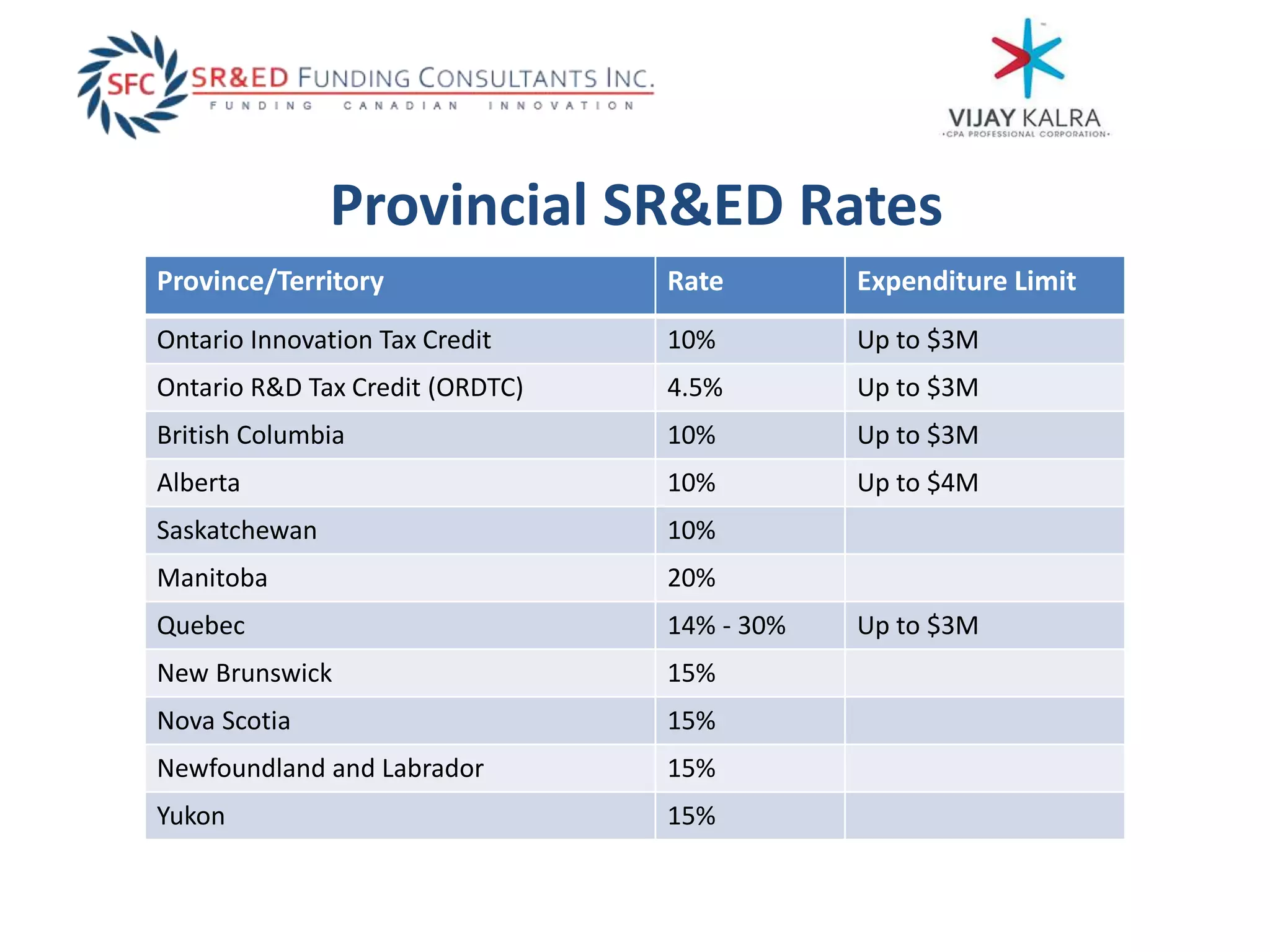
Provincial SR&ED Rates
Province/Territory Rate Expenditure Limit
Ontario Innovation Tax Credit 10% Up to $3M
Ontario R&D Tax Credit (ORDTC) 4.5% Up to $3M
British Columbia 10% Up to $3M
Alberta 10% Up to $4M
Saskatchewan 10%
Manitoba 20%
Quebec 14% - 30% Up to $3M
New Brunswick 15%
Nova Scotia 15%
Newfoundland and Labrador 15%
Yukon 15%
Supporting Documents
• Your documentation should help you answer the following questions:
Based upon a hypothesis developed,
• What were the challenges?
• What work was performed?
• For verification purposes, you must keep dated documentation &
evidence of:
• Original technological goals
• Work carried out & progress made
• Conclusions reached
CRA wants documents to be contemporaneous
and created during SR&ED process.
Examples of Technical Documentation
• Project plan & design documents
• Dated reports, developer notebooks, lab books, drawings or charts
• Analysis of problems, test data and results
• Prototypes
• Previous versions of software
• Records showing what was done by the personnel claimed
• Photographs or videos
• E-mails
Examples of Financial Documentation
• Records of resources allocated to the project, time sheets, activity
records, payroll records
• Purchase invoices and proof of payment
• Contracts, lease agreements
• Accounting records and financial statements
• Tax Returns – T2, T-4s, T-4As
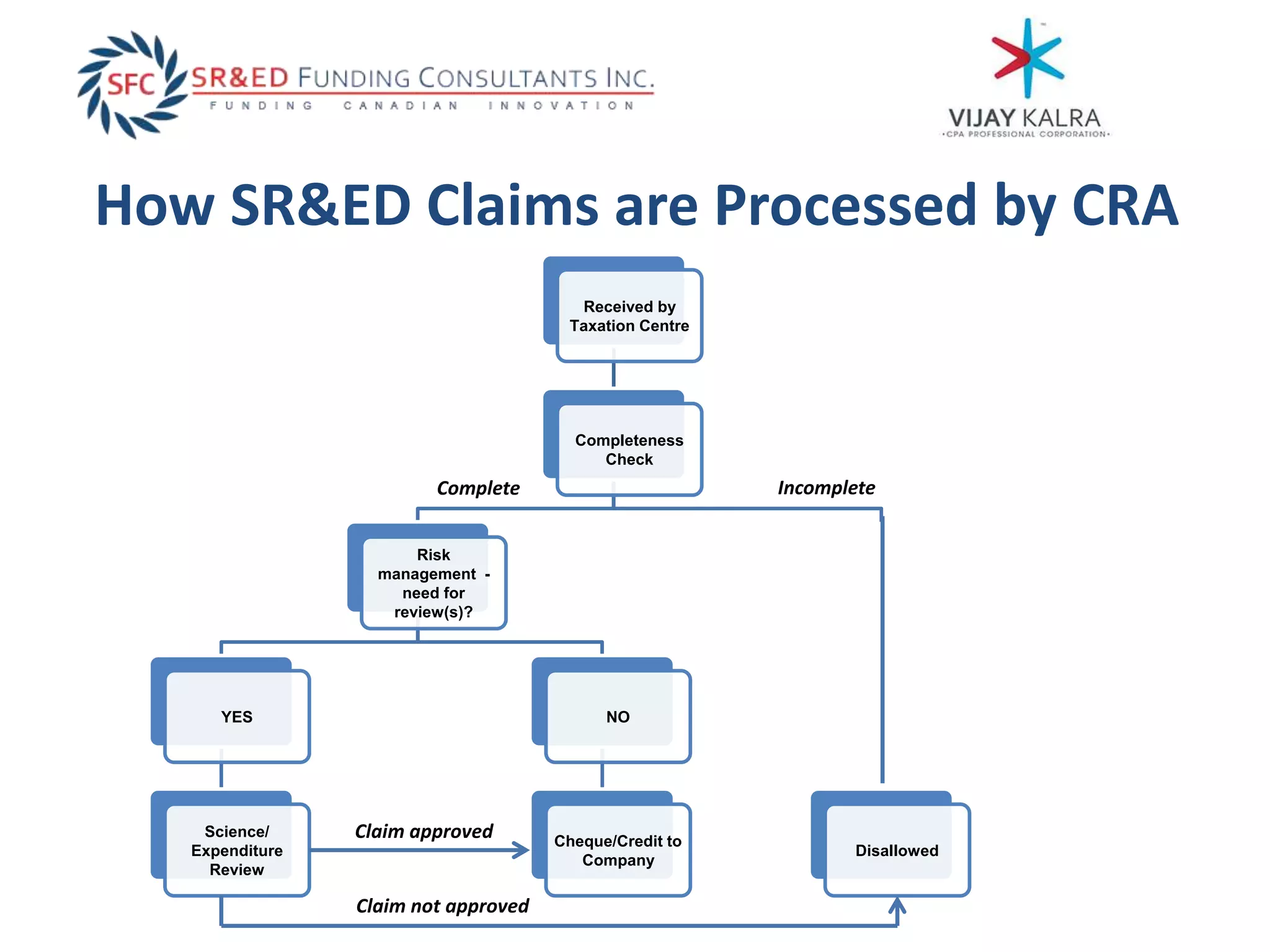
How SR&ED Claims are Processed by CRA
Received by
Taxation Centre
Completeness
Check
Risk
management -
need for
review(s)?
YES
Science/
Expenditure
Review
NO
Cheque/Credit to
Company
Disallowed
IncompleteComplete
Claim approved
Claim not approved
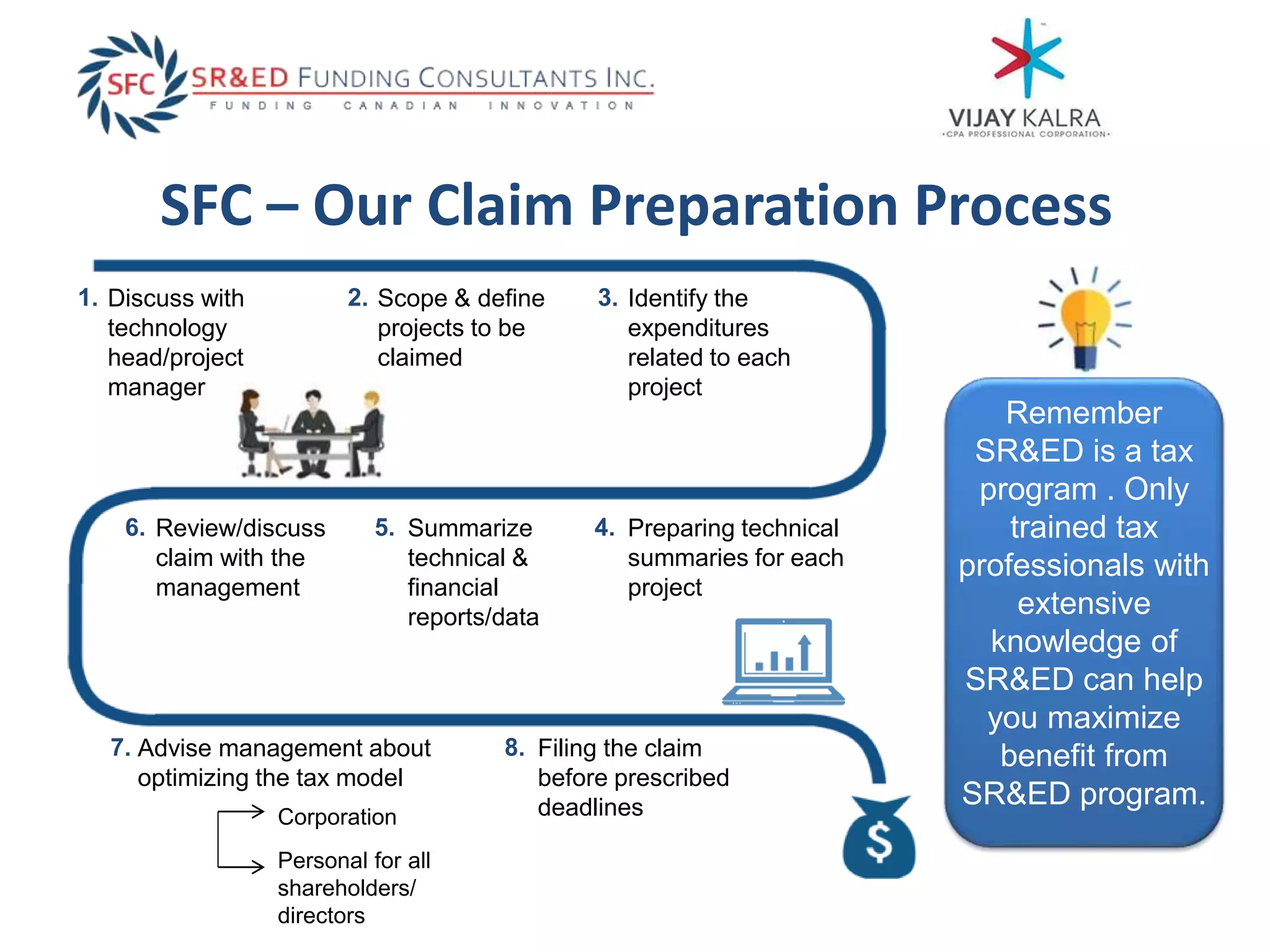
SFC – Our Claim Preparation Process
Identify the
expenditures
related to each
project
Preparing technical
summaries for each
project
Summarize
technical &
financial
reports/data
Advise management about
optimizing the tax model
Filing the claim
before prescribed
deadlines
Remember
SR&ED is a tax
program . Only
trained tax
professionals with
extensive
knowledge of
SR&ED can help
you maximize
benefit from
SR&ED program.
Corporation
Personal for all
shareholders/
directors
Review/discuss
claim with the
management
Discuss with
technology
head/project
manager
Scope & define
projects to be
claimed
1. 2. 3.
4.5.6.
7. 8.
SR&ED Funding Consultants Inc.
70 East Beaver Creek RD, Suite 201
Richmond Hill, Ontario, Canada L4B 3B2
1-888-852-5721 Toll-free
(416)893-3415 Direct Dial
info@sredfunding.com
www.sredfunding.com

Introduction to SR&ED

  • 1.
    Presented by Vijay Kalra,CPA, CA VIJAY KALRA CPA Professional Corporation
  • 2.
    Our Company • Wehave been in the SR&ED consulting business since 2002. • We are full service SR&ED consulting firm with in-house team of tax, accounting and technology professionals. • We have developed a comprehensive “SR&ED centric” tax models for tech heavy CCPC’s and their shareholders • We can provide full in-house support for all of your tax & accounting needs
  • 3.
    What is SR&ED SCIENTIFICRESEARCH AND EXPERIMENTAL DEVELOPMENTSR&ED This program encourages Canadian businesses of all sizes and in all sectors to conduct research and development (R&D) in Canada that will lead to new, improved, or technologically advanced products or processes. More generous than any other program in the world; It is a firmly established federal program with no budget cap. = The Scientific Research and Experimental Development (SR&ED) Program is a Canadian federal tax incentive program that has been in existence since 1985.
  • 4.
    Introduction to SR&EDProgram The CCPCs ( Non public companies) get cash refunds from this program even if they have no taxable income. Claimants can apply for SR&ED investment tax credits for expenditures such as wages, materials, overheads, and SR&ED sub-contracts. In addition to SR&ED (which is a federal program), most of the provinces provide additional credits applicable to SR&ED claimants located in their territories. The government currently pays out over $5B to over 25,000 Canadian companies. 4
  • 5.
  • 6.
    Things to Remember •SR&ED is not specific to a particular industry. Historically IT and related industries have got a disproportionate amount of money from this program only because of early rapid development in that field. Manufacturing is the most under claimed industry. • SR&ED is activity specific. It is paid to a Canadian company for achieving technological advancement by creating new, or improving existing materials, devices, products or processes. • The program applies to Canadian taxpayers (but includes foreign owned companies duly set up in Canada) for work done on Canadian soil.
  • 7.
    Some Examples ofWhere SR&ED Applies Regardless, SR&ED is not industry specific. IT & Telecommu nications Plastic Moldings & Chemicals Oil & Gas Services and Production Electronics Aerospace Manufacturing & Processing Software Development & Computer Science
  • 8.
    Categories of SR&ED Thework carried out to advance scientific knowledge; it is usually done in university or research institutes purely to gain scientific knowledge To qualify for SR&ED, your work must be fall under one of the following definitions: • Basic research: • Applied research: It is also work carried out to advance scientific knowledge, but unlike basic research, it is done with a specific practical application in view. • Experimental development: This work is carried out to achieve technological advancement for the purpose of creating new, or improve existing, materials, devices, products or processes, including incremental improvements thereto. It is also by far the most common type of SR&ED work. • Technical support activities: It is work carried out by or on behalf of the taxpayer with respect to engineering, design, operations research, mathematical analysis, computer programming, data collection, testing or psychological research, where the work is commensurate with the needs, and directly in support of work described in above points that is undertaken in Canada by or on behalf of the taxpayer.
  • 9.
    Three Cornerstones ofSR&ED Technological Advancement Technological Uncertainty Systematic Investigation or Search by Experiment Analysis Technological uncertainties are barriers at your existing level of technology & scientific knowledge that prevent you from achieving your goals. They may arise from shortcomings or limitations of the current state of technology that prevent a new or improved capability from being developed. A measurable improvement or generation of new knowledge to advance your technology base before you undertook systematic investigation or search by experiment analysis The approach includes defining a problem, advancing a hypothesis towards resolving that problem, planning and testing the hypothesis through experiment or analysis, and developing logical conclusions based on the results. It means each approach you take to resolve your uncertainty should be a planned experiment based on an idea or concept.
  • 10.
    4 Easy Questionsto Identify SR&ED Eligibility Involved with the development of a new product or process? Facing significant technological difficulties and challenges? Involved with the improvement of an existing product or process? Investing or plans to invest in the near future, a significant amount of money in technology? Has your company been: If your answer to any of these questions is “YES”, there is a good chance we can help you make a successful claim under SR&ED.
  • 11.
    General Examples thatIndicate SR&ED • Designed, developed or attempted to develop new software/ systems/tools/products/ processes? • Prototyped new products/devices? • Modified an existing technology? • Registered patents and trade marks? • Integrated various databases or applications that don't normally communicate? • Added new features, modified or improved an existing product? • Improved response time of your software application? • Changed a process to reduce costs or to improve manufacturing capabilities/timing? • Created a new product, made improvements or added new features to an existing product? • Incurred costs related to a process, project, or prototype that is incomplete because of unresolved technical problems? • Modified your product formulation? • Automated production? • Modified existing products or machines to new applications? • Machined/fabricated parts/dies using new materials or to meet higher tolerances?
  • 12.
    What Can YouClaim? Claimants can apply for SR&ED investment tax credits for expenditures such as: Salary or wages – For employees who are directly engaged in SR&ED Materials – Materials consumed or transformed in the process of SR&ED eligible expenditures Overheads – All overheads directly incurred during SR&ED process or claimed as proxy on salaries payment SR&ED sub-contracts – Company contracts with an arm’s length party to perform SR&ED eligible work
  • 13.
    Two ways toClaim Overhead Expenses Traditional Method : • Specifically identify overhead expenses • Each expenditure must be explained and the calculations must be presented to demonstrate how your claim was calculated Proxy Method • Simpler alternative • Percentage of SR&ED salaries in lieu of overheads • Do not have to document each expense and produce the necessary paperwork to support your calculations.
  • 14.
    What You Can’tClaim General & Administrative Expenses: • Administration salaries (unless directly attributable) • Patents & trade marks acquisitions • Legal or accounting fees, including annual fees • Interest and other finance charges • Entertainment or convention expenses • Advertising or selling (ask us about OIDMTC) • Membership dues or fees • Fines or penalties • Equipment – cost or lease • Acquisition of building, rent, leasehold improvements
  • 15.
    How Much YouCan Claim in Ontario CCPCs Non- CCPCs SALARIES SUB- CONTRACTORS MATERIALS 68% 35% 44% 42% 22% 27% Apply 35% Federal Rate and additional Provincial SR&ED Rate on eligible SR&ED expenditure Apply 15% Federal Rate and additional Provincial SR&ED Rate on eligible SR&ED Expenditure
  • 16.
    Provincial SR&ED Rates Province/TerritoryRate Expenditure Limit Ontario Innovation Tax Credit 10% Up to $3M Ontario R&D Tax Credit (ORDTC) 4.5% Up to $3M British Columbia 10% Up to $3M Alberta 10% Up to $4M Saskatchewan 10% Manitoba 20% Quebec 14% - 30% Up to $3M New Brunswick 15% Nova Scotia 15% Newfoundland and Labrador 15% Yukon 15%
  • 17.
    Supporting Documents • Yourdocumentation should help you answer the following questions: Based upon a hypothesis developed, • What were the challenges? • What work was performed? • For verification purposes, you must keep dated documentation & evidence of: • Original technological goals • Work carried out & progress made • Conclusions reached CRA wants documents to be contemporaneous and created during SR&ED process.
  • 18.
    Examples of TechnicalDocumentation • Project plan & design documents • Dated reports, developer notebooks, lab books, drawings or charts • Analysis of problems, test data and results • Prototypes • Previous versions of software • Records showing what was done by the personnel claimed • Photographs or videos • E-mails
  • 19.
    Examples of FinancialDocumentation • Records of resources allocated to the project, time sheets, activity records, payroll records • Purchase invoices and proof of payment • Contracts, lease agreements • Accounting records and financial statements • Tax Returns – T2, T-4s, T-4As
  • 20.
    How SR&ED Claimsare Processed by CRA Received by Taxation Centre Completeness Check Risk management - need for review(s)? YES Science/ Expenditure Review NO Cheque/Credit to Company Disallowed IncompleteComplete Claim approved Claim not approved
  • 21.
    SFC – OurClaim Preparation Process Identify the expenditures related to each project Preparing technical summaries for each project Summarize technical & financial reports/data Advise management about optimizing the tax model Filing the claim before prescribed deadlines Remember SR&ED is a tax program . Only trained tax professionals with extensive knowledge of SR&ED can help you maximize benefit from SR&ED program. Corporation Personal for all shareholders/ directors Review/discuss claim with the management Discuss with technology head/project manager Scope & define projects to be claimed 1. 2. 3. 4.5.6. 7. 8.
  • 22.
    SR&ED Funding ConsultantsInc. 70 East Beaver Creek RD, Suite 201 Richmond Hill, Ontario, Canada L4B 3B2 1-888-852-5721 Toll-free (416)893-3415 Direct Dial info@sredfunding.com www.sredfunding.com