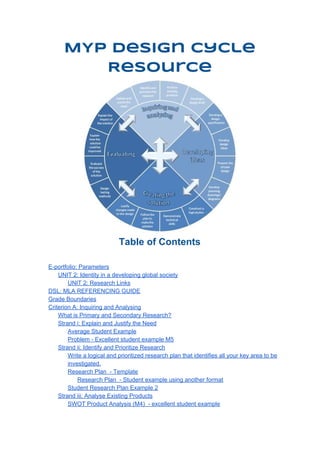
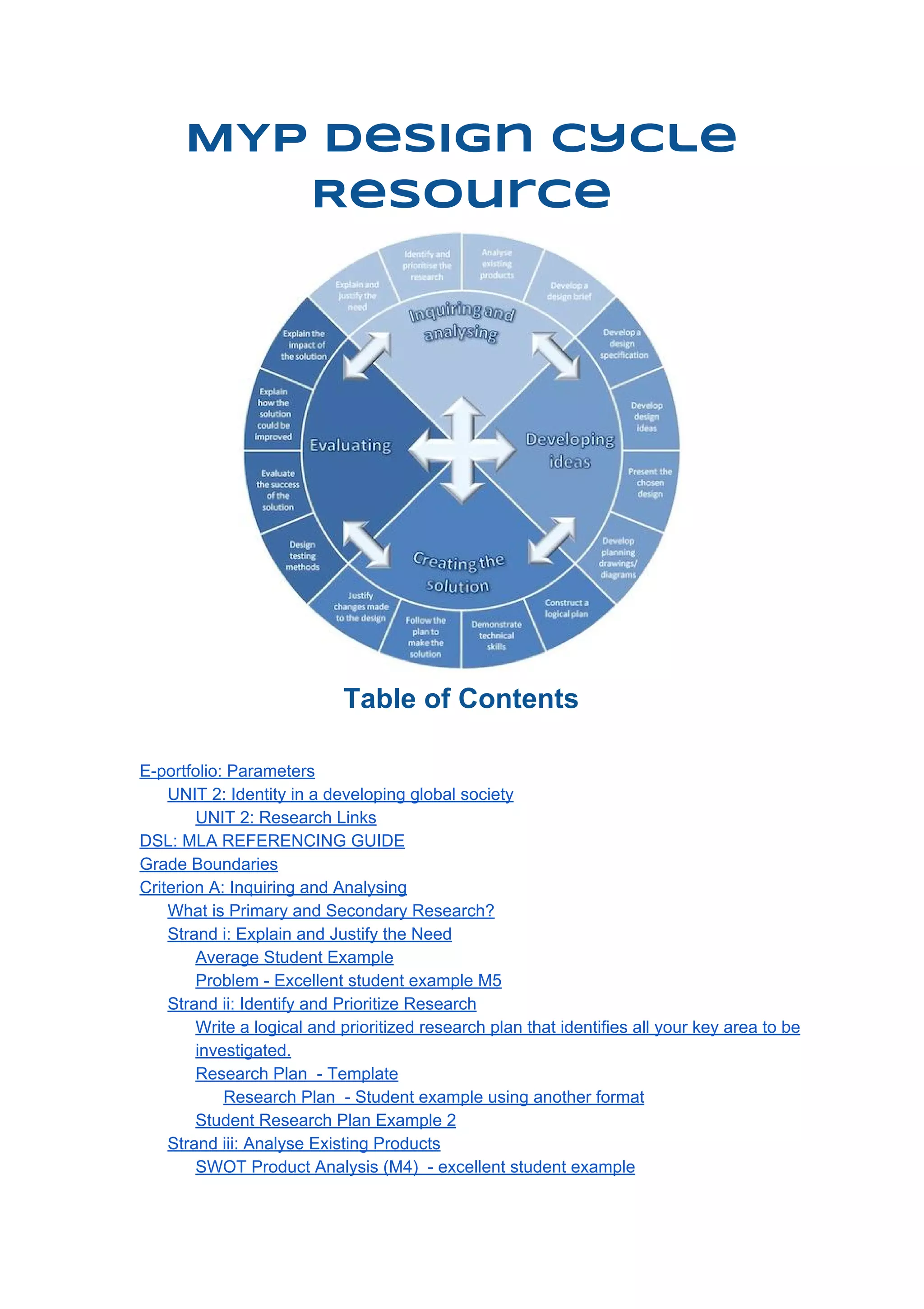
MYP Design Cycle
Resource
 
Table of Contents 
 
E­portfolio: Parameters 
UNIT 2: Identity in a developing global society 
UNIT 2: Research Links 
DSL: MLA REFERENCING GUIDE 
Grade Boundaries 
Criterion A: Inquiring and Analysing 
What is Primary and Secondary Research? 
Strand i: Explain and Justify the Need 
Average Student Example 
Problem ­ Excellent student example M5 
Strand ii: Identify and Prioritize Research 
Write a logical and prioritized research plan that identifies all your key area to be 
investigated. 
Research Plan  ­ Template 
Research Plan  ­ Student example using another format 
Student Research Plan Example 2 
Strand iii: Analyse Existing Products 
SWOT Product Analysis (M4)  ­ excellent student example 
 
2 
Strand iv: Develop a Design Brief 
M4 Design Brief  ­ excellent student example 
M5 Excellent Design Brief  ­ student example 
Example 3: DESIGN BRIEF 
Criterion A: Inquiring and analysing 
Criterion B: Developing ideas 
Strand i: Develop a Design Specification 
Testing Methods 
Student Example 1: Design Specification 
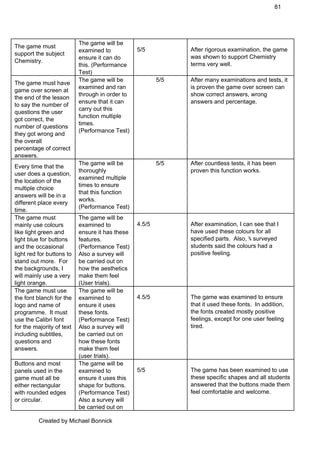
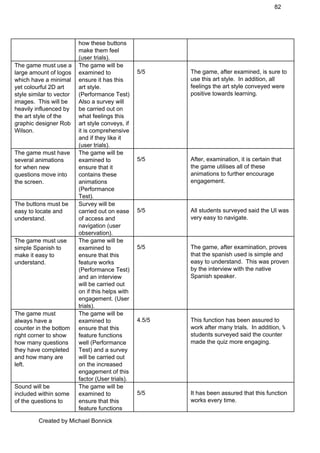
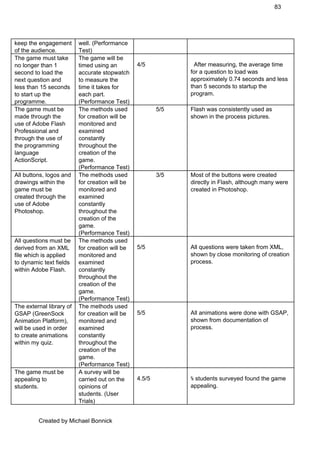
Student Example 2: Design Specification 
Strand ii: Develop Design Ideas 
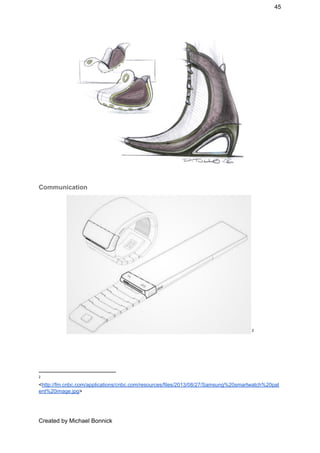
Examples of 3D hand drawn design ideas 
Architectural Concept Drawings 
Fashion 
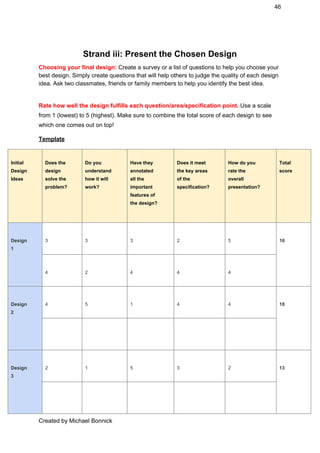
Communication 
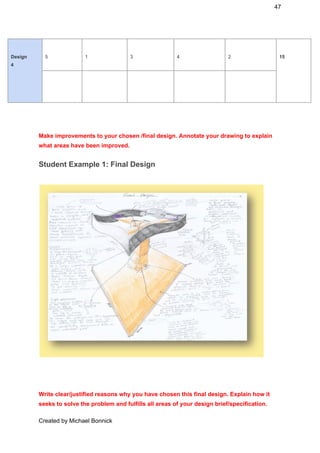
Strand iii: Present the Chosen Design 
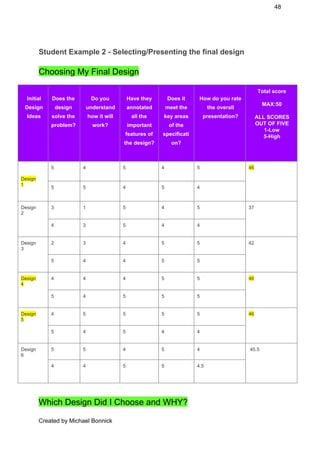
Student Example 1: Final Design 
Student Example 2 ­ Selecting/Presenting the final design 
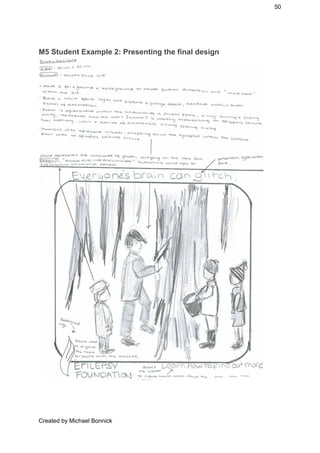
M5 Student Example 2: Presenting the final design 
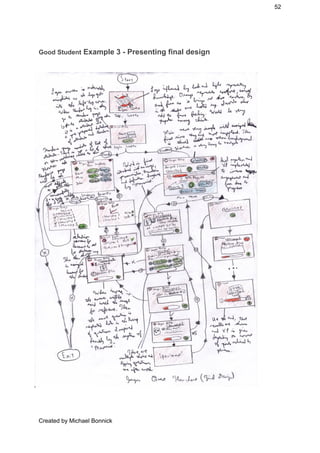
Good Student Example 3 ­ Presenting final design 
Strand iv: Develop Planning Drawing/Diagram 
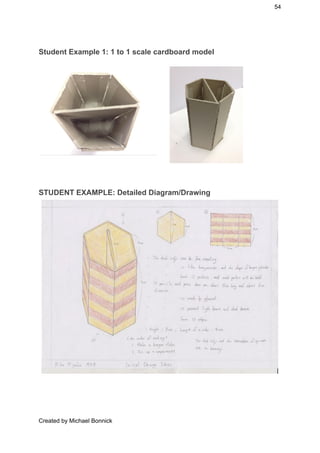
Student Example 1: 1 to 1 scale cardboard model 
STUDENT EXAMPLE: Detailed Diagram/Drawing 
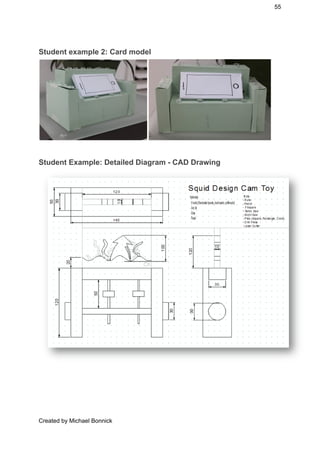
Student example 2: Card model 
Student Example: Detailed Diagram ­ CAD Drawing 
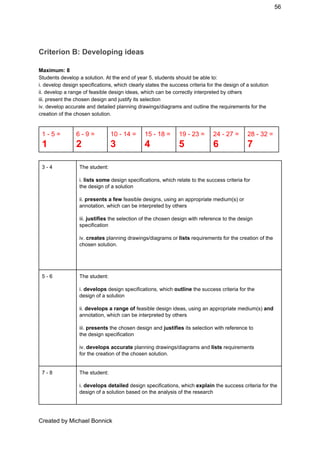
Criterion B: Developing ideas 
Criterion C: Creating your Product 
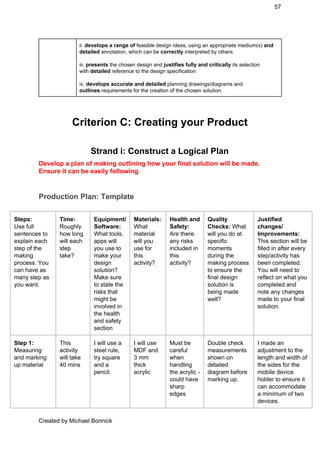
Strand i: Construct a Logical Plan 
Production Plan: Template 
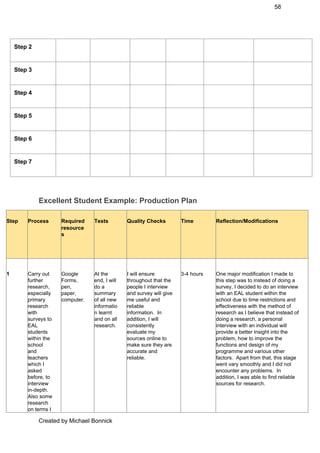
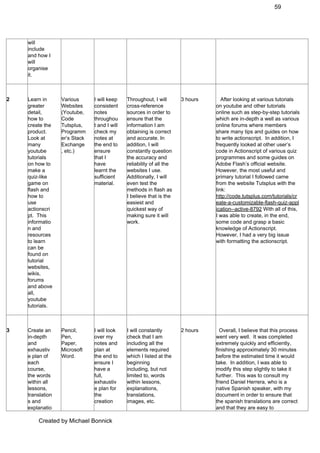
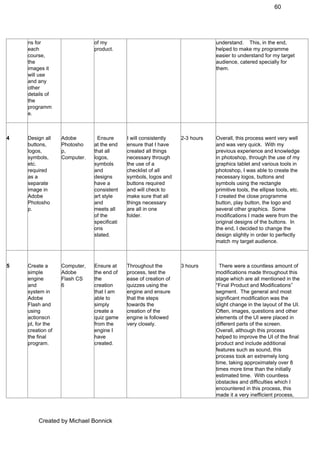
Excellent Student Example: Production Plan 
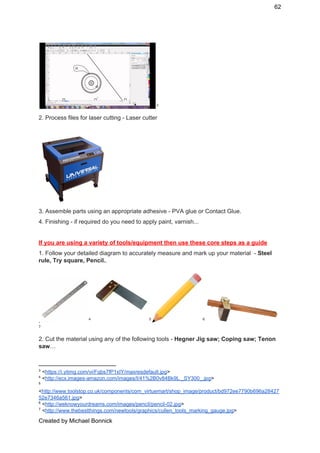
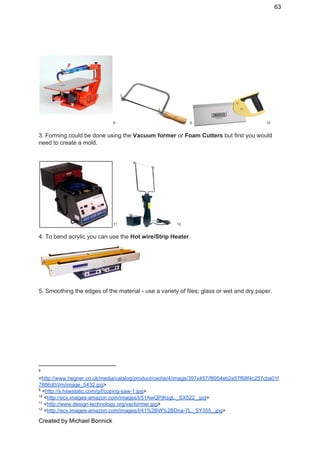
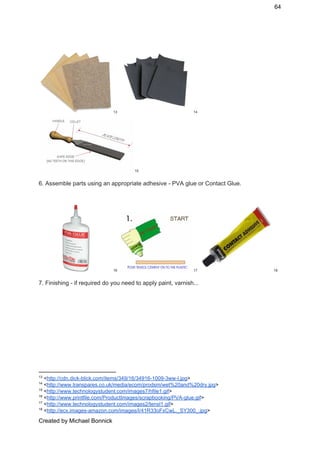
Core Steps/ Processes of Making 
Strand ii: Demonstrate Technical Skills 
Student example : Visually documenting the making Process 
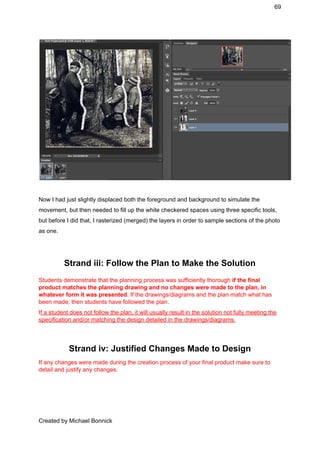
Strand iii: Follow the Plan to Make the Solution 
Strand iv: Justified Changes Made to Design 
Student Example 1: Final Product and Modifications 
Student Example 2: Final Product and Modifications 
Criterion C: Creating the solution 
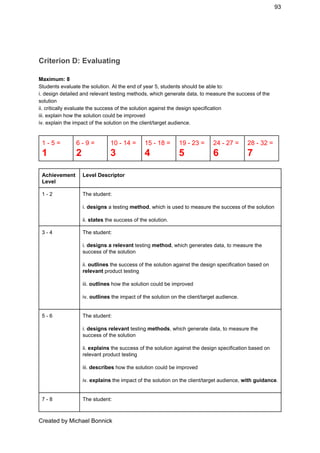
Criterion D: Evaluating 
Strand i: Design Testing Methods 
Student Example 1: 
Example 2: TESTING METHODS 
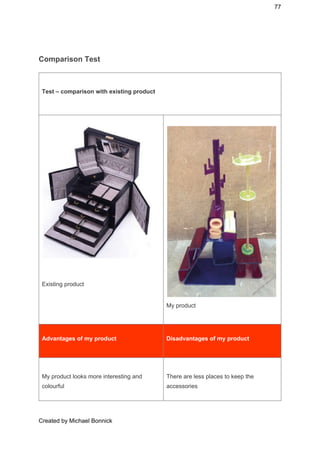
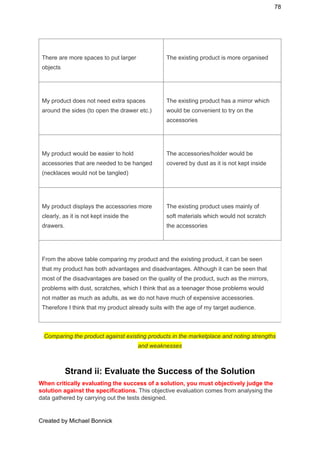
Comparison Test 
Strand ii: Evaluate the Success of the Solution 
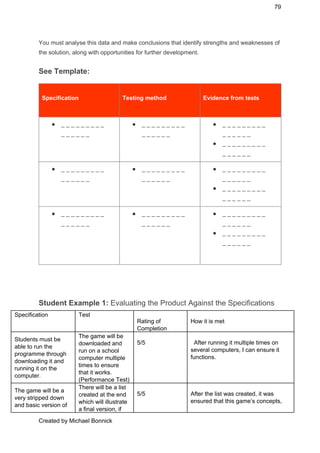
See Template: 
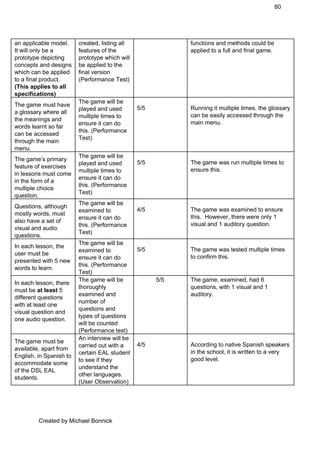
Student Example 1: Evaluating the Product Against the Specifications 
Created by Michael Bonnick 
3 
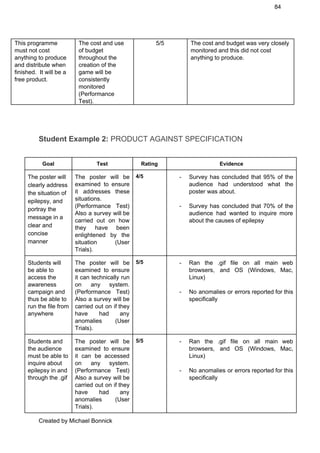
Student Example 2: PRODUCT AGAINST SPECIFICATION 
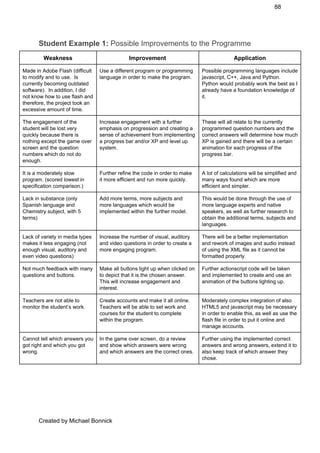
Strand iii: Explain How the Solution Could be Improve 
Student Example 1: Possible Improvements to the Programme 
Strand iv: Explain the Impact of the Solution 
Student Example 1: Impact on the Target Audience 
Student Example 2: Impact on the Target Audience 
Criterion D: Evaluating 
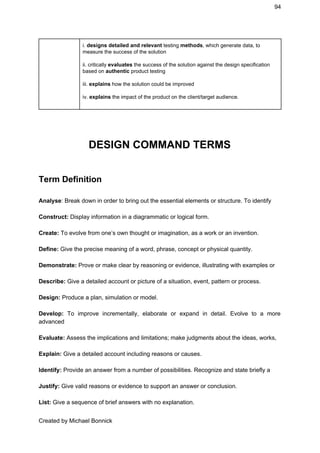
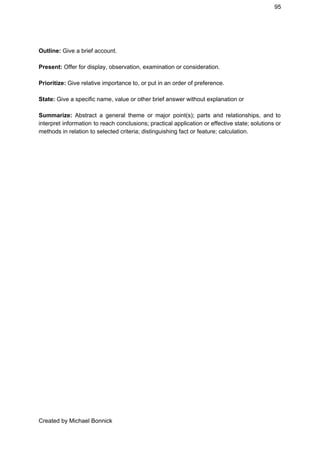
DESIGN COMMAND TERMS 
Term Definition 
 
E­portfolio: Parameters 
UNIT 2: ​Identity in a developing global society 
See below additional facts about the new unit: 
Global context and specific 
exploration: 
Personal and cultural expression: artistry, craft, creation, beauty 
 
Statement of inquiry:  Functions of design can help to develop and improve personal 
and cultural expression. 
 
Factual:  What is a custom?  What is a tradition?   What is a culture? 
Which artefacts, customs and traditions demonstrate cultural 
heritage?  
How do we preserve our cultural heritage? 
Conceptual:  How does design improve communication of personal / cultural 
heritage? 
What is the function of design in personal / cultural heritage? 
Debatable:  Should we be concerned about losing our cultural identity as we 
become global citizens? 
Is the right to personal expression more important than cultural 
sensitivity? 
 
Students must select one, or more, of the following target audiences/clients: 
● Infants, children and teenagers 
● People from a different culture 
● Visitors, tourists and exchange students 
Final solutions may be, but are not limited to, the following ideas: 
● A culinary experience which introduces techniques and produce specific to a culture 
● An application that allows others to access aspects of a culture 
● An interactive storybook which details the evolution of a culture 
● A multi­media solution which preserves memories 
Created by Michael Bonnick 
4 
● A textile based solution that encapsulates myths or legends 
● A toy or game that informs the audience of an aspect of the culture 
UNIT 2: Research Links 
 
● Beyond Foods, Festivals and Flags 
(​www.ascd.org/ASCD/pdf/journals/ed_lead/el200210_skelton.pdf​) 
● What is Cultural Heritage?​ (Khan Academy) 
(​https://www.khanacademy.org/humanities/art­history­basics/beginners­art­history/a/
what­is­cultural­heritage​) 
● History of Information 
(​http://www.historyofinformation.com/index.php​) 
● Google Cultural Institute 
(​https://www.google.com/culturalinstitute/u/0/home​) 
 
● UNESCO World Heritage List 
(​http://whc.unesco.org/en/list/​) 
● International Time Capsule Society 
(​http://crypt.oglethorpe.edu/international­time­capsule­society/​) 
● Quilt of Quilts ­ Share your quilt's story with the world 
(​http://www.vam.ac.uk/​) 
● Bayeux Tapestry 
(​http://www.bayeuxmuseum.com/en/accueil_en.html​) 
● From the World to the Museum. Product Design, Cultural Heritage. 
(​http://www.museudeldisseny.cat/en/exhibition/world­museum­product­design­cultura
l­heritage​) 
● Indian designers reinterpret traditional textile art 
(​http://www.bbc.co.uk/news/world­asia­india­32282069​) 
● World Cities Culture Forum ­ Themes 
(​http://www.worldcitiescultureforum.com/​) 
● A History of the World in 100 Objects. 
(​http://www.bbc.co.uk/ahistoryoftheworld/about/british­museum­objects/ 
● UNESCO What is Intangible Cultural Heritage? 
(​www.unesco.org/culture/ich/doc/src/01851­EN.pdf​) 
● Why we need to protect our cultural heritage sites 
(​https://www.globalcitizen.org/en/content/why­we­need­to­protect­our­cultural­heritag
e­sites/​) 
● Cultural Preservation through Digital Storytelling 
(​https://www.youtube.com/watch?v=AGMzDyFckpo​) 
 
 
Created by Michael Bonnick 
5 
 
 
The ePortfolios can include written, visual and/or audio materials. 
The file types and the maximum size that may be submitted are as 
follows: 
File type:  Maximum file size 
Text file (DOC, DOCX, PDF, RTF, TXT)  20Mb 
Audio file (AAC, M4A, MP3)  15 minutes 
Video file (F4V, FLV, M4V, MOV, MP4)  500Mb 
Image file (JPG, GIF)  5Mb 
 
 
Subject specific information 
Design 
Students complete a portfolio of work in the form of a design project 
Submission limits  ​(Moderators will not read beyond these limits)  
Written work  40 A4 pages 
Appendix (unassessed)*  10 A4 pages 
*An appendix can be used for ​Criterion A and Criterion D,​ This is a place for 
supporting research or raw data which would otherwise impact upon the overall page 
count maximum and will not form part of the assessment..(see guidance on how to 
prepare an appendix inclusive of a bibliography in Criterion A below) 


DSL: MLA REFERENCING GUIDE 
 
In­text citation and a bibliography is something that you need to do in every subject 
and in everyday life. It is extremely important that you understand how to do it 
properly. There are many different systems, but the IB requires you to use the MLA 
system. Below are some guidelines on how to do it properly. If you have any 
questions, just ask! 
 
You must acknowledge other writers’ work when you use it in your work, whether 
you have used the information from a book, magazine, newspaper or the internet. 
Even if someone has told you an idea, you should acknowledge it. Failure to do so 
amounts to plagiarism and is a serious offence. 
Created by Michael Bonnick 
6 
 
In any piece of written work you must acknowledge where the information comes 
from by referencing it in­text and listing it in a bibliography.  
 
1. ​In­Text Citation​ (within the body of an essay, presentation, etc) 
Last name of author & the page(s), where appropriate, are given in the text. ​The 
author's name may appear either in the sentence itself or in parentheses following 
the quotation or paraphrase, but the page number(s) should always appear in the 
parentheses, not in the text of your sentence. 
 
Marzano notes that “only one­third of British workers now work the normal nine to 
five day give or take an hour or two at each end” (45). 
OR 
“Only one­third of British workers now work the normal nine to five day give or take 
an hour or two at each end” (Marzano 45). 
 
2. ​Works Cited​ Section (bibliography) 
This section starts with the title Works Cited and each entry is sorted alphabetically 
using hanging indents. 
 
Book 
Author’s Last name, First name(s). ​Title​. City of publication: Publisher, year. Print. 
 
Gleick, James. Chaos: Making a New Science. New York: Penguin, 1987. Print. 
 
If there are two authors:​ The first given name appears in Last name, First name format; the 
second author’s name appears in First name Last name format. The other information 
remains as above. 
 
Gillespie, Paula, and Neal Lerner. ​The Allyn and Bacon Guide to Peer Tutoring​. 
Boston: Allyn, 2000. Print. 
 
Three or more authors:​ The first given name appears in Last name, First name 
format followed by et al. 
Wysocki, Anne Frances, et al. ​Writing New Media: Theory and Applications for 
Expanding the Teaching of Composition​. Logan: Utah State UP, 2004. Print. 
 
Corporate author:​ The name of the corporation then as above. 
Corporation. ​Title​. Place of publication: Publisher, year. Print. 
 
American Allergy Association. ​Allergies in Children​. New York: Random, 1998. Print. 
 
Magazine Article 
Author’s last name, First name(s). "Title of Article." ​Title of Periodical​ ​DD Mmm. 
YYYY​: pages. Medium of publication. 
 
Buchman, Dana. "A Special Education." ​Good Housekeeping​ Mar. 2006: 143­48. 
Print. 
 
Created by Michael Bonnick 
7 
Newspaper Article ​(same as a magazine but note the different page style in a 
newspaper) 
Brubaker, Bill. "New Health Center Targets County's Uninsured Patients." 
Washington Post 24 May 2007: LZ01. Print. 
 
Journal Article 
Author(s). "Title of Article." ​Title of Journal​ Volume. Issue (Year): pages. Medium of 
publication. 
 
Bagchi, Alaknanda. "Conflicting Nationalisms: The Voice of the Subaltern in 
Mahasweta Devi's ​Bashai Tudu​." ​Tulsa Studies in Women's Literature​ 15.1 
(1996): 41­50. Print. 
 
Article in an Online­only Scholarly Journal 
MLA requires a page range for articles that appear in Scholarly Journals. If the 
journal you are citing appears exclusively in an online format use the abbreviation ​n. 
pag. to indicate no page(s). 
 
Last name, First name. “Article title.” ​Journal title ​Volume number. Issue number 
(Year): n. pag. Web. Date of access (DD Mmm. YYYY).  
 
Dolby, Nadine. “Research in Youth Culture and Policy: Current Conditions and 
Future  
Directions.” ​Social Work and Society: The International Online­Only Journal​  6.2 
(2008):  
n. pag. Web. 20 May 2009. 
 
Information from the Internet 
Editor, author, or compiler name (if available). “Title of page.” ​Name of Site​. Name of 
institution/organization affiliated with the site (sponsor or publisher), date of 
resource creation (if available). Medium of publication. Date of access (DD 
Mmm. YYYY). <URL break only after slashes>. 
 
The Purdue OWL Family of Sites​. The Writing Lab and OWL at Purdue and Purdue 
U, 2008. Web. 23 Apr. 2008. <https://owl.english.purdue.edu/owl/>. 
 
Painting/Sculpture/Photograph 
Artist’s last name, first name. ​Title of work​. Date of composition (DD Mmm. YYYY). 
Name of the institution that houses the artwork, city of the institution. 
 
Goya, Francisco. ​The Family of Charles IV​. 1800. Museo del Prado, Madrid. 
 
Personal Interview 
Interviewee (Last name, First name). Personal interview. DD Mmm. YYYY. 
 
Purdue, Pete. Personal interview. 1 Dec. 2000. 
 
Note: Unknown date/publisher/page number(s) 
If it starts a new “sentence” it is capitalized. 
Created by Michael Bonnick 
8 
No date: N.d. (starting capital) or n.d. 
No publisher: N.p. or n.p. 
No page(s): N. pag. or n. pag. 
 
Visit Purdue OWL’s “MLA Formatting and Style Guide” for up to date citation 
guidance: ​https://owl.english.purdue.edu/ 
 
 
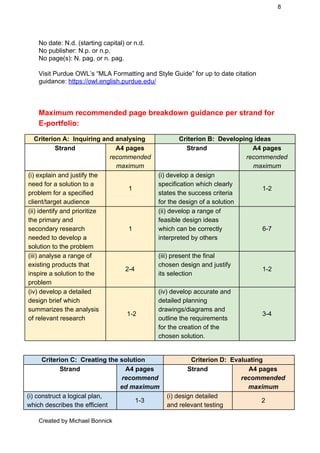
Maximum recommended page breakdown guidance per strand for 
E­portfolio: 
Criterion A:  Inquiring and analysing  Criterion B:  Developing ideas 
Strand  A4 pages 
recommended 
maximum 
Strand  A4 pages 
recommended 
maximum 
(i) explain and justify the 
need for a solution to a 
problem for a specified 
client/target audience 
1 
(i) develop a design 
specification which clearly 
states the success criteria 
for the design of a solution 
1­2 
(ii) identify and prioritize 
the primary and 
secondary research 
needed to develop a 
solution to the problem 
1 
(ii) develop a range of 
feasible design ideas 
which can be correctly 
interpreted by others 
 
6­7 
(iii) analyse a range of 
existing products that 
inspire a solution to the 
problem 
2­4 
(iii) present the final 
chosen design and justify 
its selection 
 
1­2 
(iv) develop a detailed 
design brief which 
summarizes the analysis 
of relevant research  
 
1­2 
(iv) develop accurate and 
detailed planning 
drawings/diagrams and 
outline the requirements 
for the creation of the 
chosen solution. 
3­4 
 
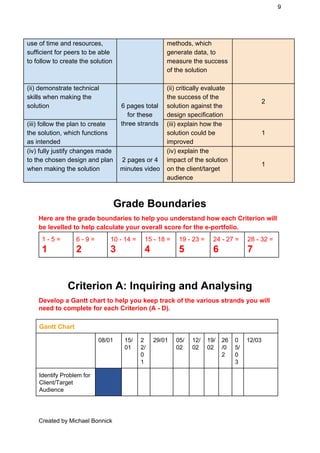
Criterion C:  Creating the solution  Criterion D:  Evaluating 
Strand  A4 pages 
recommend
ed maximum 
Strand  A4 pages 
recommended 
maximum 
(i) construct a logical plan, 
which describes the efficient 
1­3 
(i) design detailed 
and relevant testing 
2 
Created by Michael Bonnick 
9 
 
use of time and resources, 
sufficient for peers to be able 
to follow to create the solution 
methods, which 
generate data, to 
measure the success 
of the solution 
 
(ii) demonstrate technical 
skills when making the 
solution  6 pages total 
for these 
three strands 
(ii) critically evaluate 
the success of the 
solution against the 
design specification 
2 
(iii) follow the plan to create 
the solution, which functions 
as intended  
(iii) explain how the 
solution could be 
improved 
1 
(iv) fully justify changes made 
to the chosen design and plan 
when making the solution 
2 pages or 4 
minutes video 
(iv) explain the 
impact of the solution 
on the client/target 
audience 
1 
 
Grade Boundaries 
Here are the grade boundaries to help you understand how each Criterion will 
be levelled to help calculate your overall score for the e­portfolio. 
1 ­ 5 =  
1 
6 ­ 9 =  
2 
10 ­ 14 = 
3 
15 ­ 18 = 
4 
19 ­ 23 = 
5 
24 ­ 27 = 
6 
28 ­ 32 = 
7 
 
 
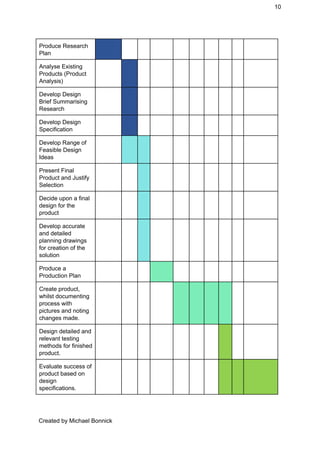
Criterion A: Inquiring and Analysing 
Develop a Gantt chart to help you keep track of the various strands you will 
need to complete for each Criterion (A ­ D). 
 
Gantt Chart 
  08/01  15/
01 
2
2/
0
1 
29/01  05/
02 
12/
02 
19/
02 
26
/0
2 
0
5/
0
3 
12/03 
Identify Problem for 
Client/Target 
Audience 
                   
Created by Michael Bonnick 
10 
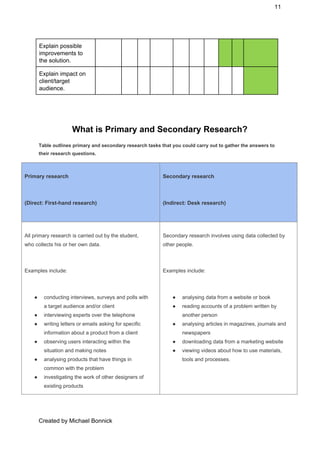
Produce Research 
Plan 
                   
Analyse Existing 
Products (Product 
Analysis) 
                   
Develop Design 
Brief Summarising 
Research 
                   
Develop Design 
Specification  
                   
Develop Range of 
Feasible Design 
Ideas 
                   
Present Final 
Product and Justify 
Selection 
                   
Decide upon a final 
design for the 
product 
                   
Develop accurate 
and detailed 
planning drawings 
for creation of the 
solution 
                   
Produce a 
Production Plan 
                   
Create product, 
whilst documenting 
process with 
pictures and noting 
changes made. 
                   
Design detailed and 
relevant testing 
methods for finished 
product. 
                   
Evaluate success of 
product based on 
design 
specifications. 
                   
Created by Michael Bonnick 
11 
Explain possible 
improvements to 
the solution. 
                   
Explain impact on 
client/target 
audience. 
                   
 
What is Primary and Secondary Research? 
Table outlines primary and secondary research tasks that you could carry out to gather the answers to 
their research questions. 
Primary research 
(Direct: First­hand research) 
Secondary research 
(Indirect: Desk research) 
All primary research is carried out by the student, 
who collects his or her own data. 
Examples include: 
● conducting interviews, surveys and polls with 
a target audience and/or client 
● interviewing experts over the telephone 
● writing letters or emails asking for specific 
information about a product from a client 
● observing users interacting within the 
situation and making notes 
● analysing products that have things in 
common with the problem 
● investigating the work of other designers of 
existing products 
Secondary research involves using data collected by 
other people. 
Examples include: 
● analysing data from a website or book 
● reading accounts of a problem written by 
another person 
● analysing articles in magazines, journals and 
newspapers 
● downloading data from a marketing website 
● viewing videos about how to use materials, 
tools and processes. 
Created by Michael Bonnick 
12 
● conducting market research such as 
surveys, questionnaires and interviews 
through focus groups 
● experimenting with materials, tools and 
processes. 
 
Strand i: Explain and Justify the Need  
Provide answers for each of the following questions when developing your 
Problem: 
● What is the nature of the problem? 
● Who is it a problem for? 
● Where is the problem occurring? 
● What is the cause of the problem? 
● What effect is the problem having? 
● What are the benefits of solving this problem? 
2.  Use paragraphs to help develop answers for each of the above stated questions. 
3.  Use secondary or primary research to help you better understand the problem: 
● identifying a target user by applying brainstorming or mind­mapping 
techniques 
● interviewing, surveying and/or polling potential clients 
● observing, filming and/or photographing users interacting with a product 
● collecting data from experts to confirm there is a real need for a solution to the 
problem 
4.  State the benefits of solving your design problem. You can use your initial 
research to help you do this. 
5.  Make sure not to state the exact solution to the problem!!! 
Average Student Example 
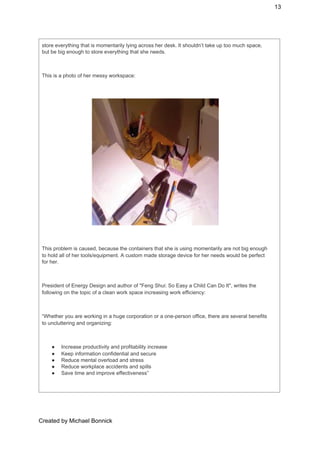
My mom’s desk is scattered with pens, pencils and other tools, such as glue sticks, scissors, 
rulers, tape, hole punchers, staplers, etc., she needs while doing paperwork. Therefore I want to 
solve this problem for her, by creating a storage device, which she can put on her desk and use to 
Created by Michael Bonnick 
13 
store everything that is momentarily lying across her desk. It shouldn’t take up too much space, 
but be big enough to store everything that she needs. 
This is a photo of her messy workspace: 
 
This problem is caused, because the containers that she is using momentarily are not big enough 
to hold all of her tools/equipment. A custom made storage device for her needs would be perfect 
for her. 
President of Energy Design and author of "Feng Shui: So Easy a Child Can Do It", writes the 
following on the topic of a clean work space increasing work efficiency: 
“Whether you are working in a huge corporation or a one­person office, there are several benefits 
to uncluttering and organizing: 
● Increase productivity and profitability increase 
● Keep information confidential and secure 
● Reduce mental overload and stress 
● Reduce workplace accidents and spills 
● Save time and improve effectiveness” 
Created by Michael Bonnick 
14 
(http://www.reliableplant.com/Read/16652/reduce­office­clutter­to­increase­productivity,­efficiency
­profitability) 
Considering these points, if my mom were to get a custom made storage device, she would be 
able to get a lot more done in a lot less time. She would be less stressed looking for her stuff and 
what she needs. There would be less accidents or things falling to the floor as she is searching for 
a pen. That way she would be done with her work a lot quicker, would be able to complete more 
on one day, and be much more relaxed overall. 
 
Problem ­ Excellent student example M5 
​Every year, our school, Dwight School London (DSL), welcomes numerous new                       
students. As an international school, it is expected that many of these students                         
come from a country where English is not the first language. These new students                           
are not only thrown into an unfamiliar and new learning environment but also, where                           
they cannot speak the language fluently. Within our school, as many others, an                         
excellent programme called the English as an Additional Language (EAL)                   
programme, also known as English B or ESL, is implemented in order to aid these                             
students in the school. This programme helps to teach greetings, grammar and                       
overall, how to speak, understand and write at a basic level of English (​"English as                             
an Additional Language (EAL) Support Service.")​. This programme has been proven                     
to be extremely effective, with many students eventually becoming reasonably fluent                     
in the language. 
However, these students still tend to struggle in classes outside of English such as                             
Chemistry, Physics, Music theory or Technology theory (​McCaffrey, Fiona.​). After                   
conducting an interview with several teachers from DSL, many teachers agreed that                       
non­native English Speaking students frequently struggle in their classes due to                     
language barriers. According to Fiona McCaffrey, a chemistry teacher at DSL, the                       
language barriers hinder and slow down the comprehension of the material being                       
taught. Due to this, a very exclusive learning environment is created where the EAL                           
students are not able to fully participate in the learning and class activities. This                           
problem significantly affects the ESL students as they are not able to learn to the full                               
extent in these classes and is a problem for teachers as they have difficulty teaching                             
these students. Furthermore, this is not only a problem in DSL, but is a nationwide                             
issue as the number of foreign students in the UK has risen by 20% in the last five                                   
years, according to Nick Morrison of the Guardian. According to a study conducted                         
by Angela Stevens on SAT test scores of EAL students, EAL students had                         
significantly lower test scores. In general, this issue has a detrimental effect on                         
exam scores, teaching ability and most of all, the inclusive learning environment we                         
strive for. 
Created by Michael Bonnick 
15 
 
Although many factors contribute to exclusion of EAL students in classes, such as                           
basic language barriers, different thought processes, cultural sensitivities and                 
previous education, these problems are often very quickly solved by the EAL                       
programme. However, one of the most significant and biggest causes of the issue,                         
which is not addressed by the EAL programme, is subject specific terminology.                       
According to the interview conducted, many teachers in DSL are finding that a lack                           
of knowledge in subject specific terminology is hindering the progress of EAL                       
students and that students would be able to learn significantly more if they knew                           
subject specific terminology. Therefore, I believe a solution to this problem would                       
evidently be focused on teaching EAL students subject specific terminology. 
Strand ii: Identify and Prioritize Research 
Write a logical and prioritized research plan that identifies all your key area to be 
investigated. 
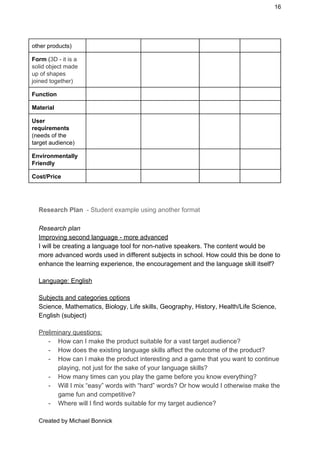
Research Plan ​ ­ Template 
 
Area of Research 
What are the main 
areas of your 
research? 
Priority  
(Highest 1 ­ 5 
Lowest) 
Rank your 
research areas 
according to their 
importance to 
helping you 
design a suitable 
product. 
Reason 
How will it help you 
design a product? 
Research 
Questions 
State any 
important 
questions 
you hope to 
find answers 
for. They 
should be 
linked to 
your areas of 
research. 
Research 
type 
Explain what 
type of 
primary or 
secondary 
research you 
hope to 
conduct. Be 
very 
specific!!! 
Aesthetics 
(appearance ­ 
colour, pattern, 
decoration…) 
1 Highest  I will examine 
modern day cars to 
better understand 
how and why they 
appeal to a wide 
variety of people so 
that I can develop 
an eye catching 
futuristic car. 
What are 
they 
attributes of 
a futuristic 
vehicle? 
 
I will conduct 
an in depth 
product 
analysis. 
Ergonomics​ (how 
easy is it to use a 
product) 
       
Unique Selling 
Point ​(what makes 
it stand out from 
       
Created by Michael Bonnick 
16 
other products) 
Form ​(​3D ­ it is a 
solid object made 
up of shapes 
joined together) 
       
Function          
Material         
User 
requirements 
(needs of the 
target audience) 
       
Environmentally 
Friendly 
       
Cost/Price         
 
 
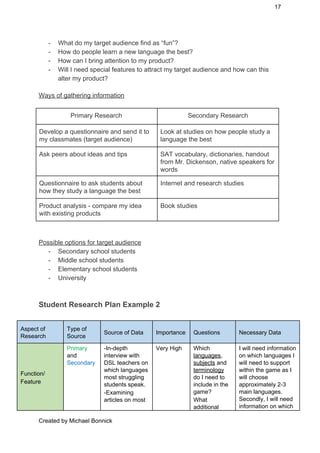
Research Plan ​ ­ Student example using another format 
 
Research plan 
Improving second language ­ more advanced 
I will be creating a language tool for non­native speakers. The content would be 
more advanced words used in different subjects in school. How could this be done to 
enhance the learning experience, the encouragement and the language skill itself? 
 
Language: English 
 
Subjects and categories options 
Science, Mathematics, Biology, Life skills, Geography, History, Health/Life Science, 
English (subject) 
 
Preliminary questions: 
­ How can I make the product suitable for a vast target audience? 
­ How does the existing language skills affect the outcome of the product? 
­ How can I make the product interesting and a game that you want to continue 
playing, not just for the sake of your language skills? 
­ How many times can you play the game before you know everything? 
­ Will I mix “easy” words with “hard” words? Or how would I otherwise make the 
game fun and competitive? 
­ Where will I find words suitable for my target audience? 
Created by Michael Bonnick 
17 
­ What do my target audience find as “fun”? 
­ How do people learn a new language the best? 
­ How can I bring attention to my product? 
­ Will I need special features to attract my target audience and how can this 
alter my product? 
 
Ways of gathering information 
 
Primary Research  Secondary Research 
Develop a questionnaire and send it to 
my classmates (target audience) 
Look at studies on how people study a 
language the best 
Ask peers about ideas and tips  SAT vocabulary, dictionaries, handout 
from Mr. Dickenson, native speakers for 
words 
Questionnaire to ask students about 
how they study a language the best 
Internet and research studies 
Product analysis ­ compare my idea 
with existing products 
Book studies 
 
 
Possible options for target audience 
­ Secondary school students 
­ Middle school students 
­ Elementary school students 
­ University 
 
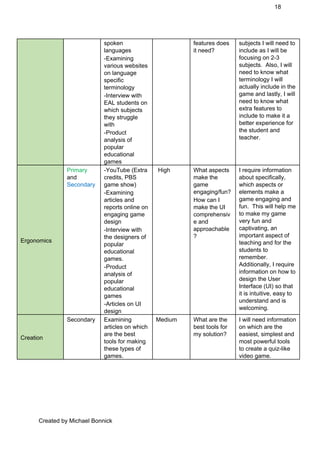
Student Research Plan Example 2 
 
Aspect of 
Research 
Type of 
Source 
Source of Data  Importance  Questions  Necessary Data 
Function/ 
Feature 
Primary 
and 
Secondary 
­In­depth 
interview with 
DSL teachers on 
which languages 
most struggling 
students speak. 
­Examining 
articles on most 
Very High  Which 
languages​, 
subjects​ and 
terminology 
do I need to 
include in the 
game? 
What 
additional 
I will need information 
on which languages I 
will need to support 
within the game as I 
will choose 
approximately 2­3 
main languages. 
Secondly, I will need 
information on which 
Created by Michael Bonnick 
18 
spoken 
languages 
­Examining 
various websites 
on language 
specific 
terminology 
­Interview with 
EAL students on 
which subjects 
they struggle 
with 
­Product 
analysis of 
popular 
educational 
games 
features does 
it need? 
subjects I will need to 
include as I will be 
focusing on 2­3 
subjects.  Also, I will 
need to know what 
terminology I will 
actually include in the 
game and lastly, I will 
need to know what 
extra features to 
include to make it a 
better experience for 
the student and 
teacher. 
Ergonomics 
Primary 
and 
Secondary 
­YouTube (Extra 
credits, PBS 
game show) 
­Examining 
articles and 
reports online on 
engaging game 
design 
­Interview with 
the designers of 
popular 
educational 
games. 
­Product 
analysis of 
popular 
educational 
games 
­Articles on UI 
design 
High  What aspects 
make the 
game 
engaging/fun? 
How can I 
make the UI 
comprehensiv
e and 
approachable
? 
I require information 
about specifically, 
which aspects or 
elements make a 
game engaging and 
fun.  This will help me 
to make my game 
very fun and 
captivating, an 
important aspect of 
teaching and for the 
students to 
remember. 
Additionally, I require 
information on how to 
design the User 
Interface (UI) so that 
it is intuitive, easy to 
understand and is 
welcoming. 
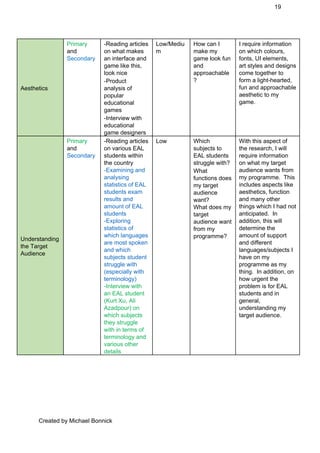
Creation 
Secondary  Examining 
articles on which 
are the best 
tools for making 
these types of 
games. 
Medium  What are the 
best tools for 
my solution? 
I will need information 
on which are the 
easiest, simplest and 
most powerful tools 
to create a quiz­like 
video game. 
Created by Michael Bonnick 
19 
Aesthetics 
Primary 
and 
Secondary 
­Reading articles 
on what makes 
an interface and 
game like this, 
look nice 
­Product 
analysis of 
popular 
educational 
games 
­Interview with 
educational 
game designers 
Low/Mediu
m 
How can I 
make my 
game look fun 
and 
approachable
? 
I require information 
on which colours, 
fonts, UI elements, 
art styles and designs 
come together to 
form a light­hearted, 
fun and approachable 
aesthetic to my 
game. 
Understanding 
the Target 
Audience 
Primary 
and 
Secondary 
­Reading articles 
on various EAL 
students within 
the country 
­Examining and 
analysing 
statistics of EAL 
students exam 
results and 
amount of EAL 
students 
­Exploring 
statistics of 
which languages 
are most spoken 
and which 
subjects student 
struggle with 
(especially with 
terminology) 
­Interview with 
an EAL student 
(Kurt Xu, Ali 
Azadpour) on 
which subjects 
they struggle 
with in terms of 
terminology and 
various other 
details 
Low  Which 
subjects to 
EAL students 
struggle with? 
What 
functions does 
my target 
audience 
want? 
What does my 
target 
audience want 
from my 
programme? 
With this aspect of 
the research, I will 
require information 
on what my target 
audience wants from 
my programme.  This 
includes aspects like 
aesthetics, function 
and many other 
things which I had not 
anticipated.  In 
addition, this will 
determine the 
amount of support 
and different 
languages/subjects I 
have on my 
programme as my 
thing.  In addition, on 
how urgent the 
problem is for EAL 
students and in 
general, 
understanding my 
target audience. 
 
 
Created by Michael Bonnick 
20 
 
Strand iii: Analyse Existing Products 
3. Create a SWOT product analysis using the table below. Analyse the strengths, 
weaknesses, opportunities and threats.  
 
Product design analysis means studying how well a product does its job. This involves answering the 
following questions 
● What is the ​function and purpose​ of the product? 
● What are the different parts of the product and how do they work together? 
● How does the product use ​shape, form, ergonomics, safety and aesthetics (colour, texture and 
decoration)? 
● What materials and ​components ​are used to make the product? 
● Which processes were used to make the product? 
● Who would buy this product and how much does it​ cost​? 
● How well does the product do its job compared with other similar products? 
● What is unique about the product and is it ​environmentally friendly​? 


Property  Example  Description 
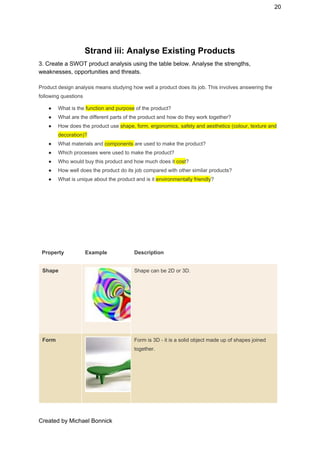
Shape  Shape can be 2D or 3D. 
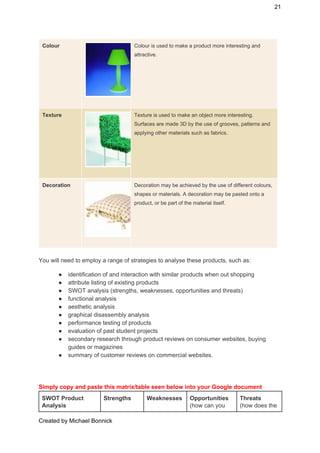
Form  Form is 3D ­ it is a solid object made up of shapes joined 
together. 
Created by Michael Bonnick 
21 
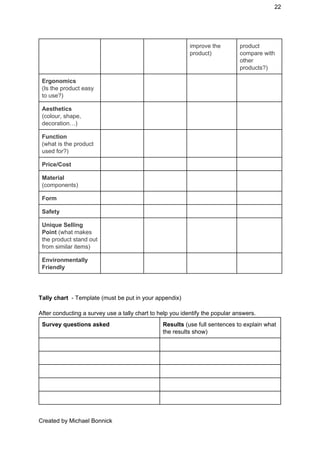
Colour  Colour is used to make a product more interesting and 
attractive. 
Texture  Texture is used to make an object more interesting. 
Surfaces are made 3D by the use of grooves, patterns and 
applying other materials such as fabrics. 
Decoration  Decoration may be achieved by the use of different colours, 
shapes or materials. A decoration may be pasted onto a 
product, or be part of the material itself. 
 
You will need to employ a range of strategies to analyse these products, such as: 
● identification of and interaction with similar products when out shopping 
● attribute listing of existing products 
● SWOT analysis (strengths, weaknesses, opportunities and threats) 
● functional analysis 
● aesthetic analysis 
● graphical disassembly analysis 
● performance testing of products 
● evaluation of past student projects 
● secondary research through product reviews on consumer websites, buying 
guides or magazines 
● summary of customer reviews on commercial websites. 
 
 
Simply copy and paste this matrix/table seen below into your Google document 
SWOT Product 
Analysis 
Strengths  Weaknesses  Opportunities 
(how can you 
Threats  
(how does the 
Created by Michael Bonnick 
22 
improve the 
product) 
product 
compare with 
other 
products?) 
Ergonomics  
(Is the product easy 
to use?) 
       
Aesthetics  
(colour, shape, 
decoration…) 
       
Function  
(what is the product 
used for?) 
       
Price/Cost         
Material 
(components) 
       
Form         
Safety         
Unique Selling 
Point ​(what makes 
the product stand out 
from similar items) 
       
Environmentally 
Friendly 
       
 
Tally chart ​ ­ Template (must be put in your appendix) 
 
After conducting a survey use a tally chart to help you identify the popular answers. 
Survey questions asked  Results ​(use full sentences to explain what 
the results show)  


Created by Michael Bonnick 
23 
 
 
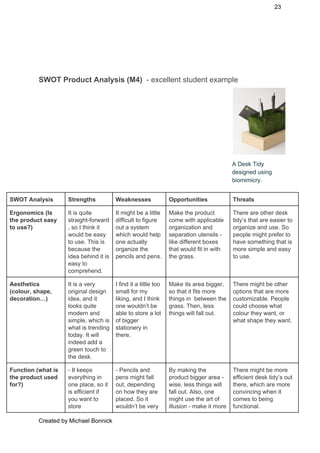
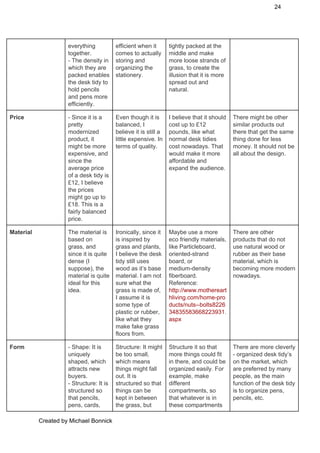
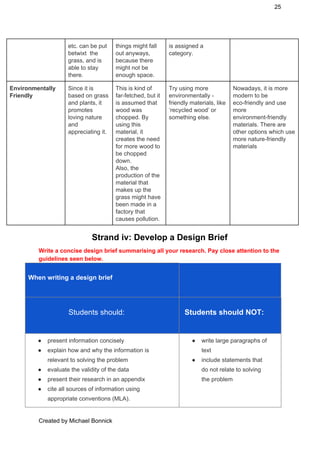
SWOT Product Analysis (M4) ​ ­ excellent student example 
A Desk Tidy 
designed using 
biomimicry. 
 
SWOT Analysis  Strengths  Weaknesses  Opportunities  Threats 
Ergonomics (Is 
the product easy 
to use?) 
It is quite 
straight­forward
, so I think it 
would be easy 
to use. This is 
because the 
idea behind it is 
easy to 
comprehend. 
It might be a little 
difficult to figure 
out a system 
which would help 
one actually 
organize the 
pencils and pens. 
 
Make the product 
come with applicable 
organization and 
separation utensils ­ 
like different boxes 
that would fit in with 
the grass.  
There are other desk 
tidy’s that are easier to 
organize and use. So 
people might prefer to 
have something that is 
more simple and easy 
to use. 
Aesthetics 
(colour, shape, 
decoration…) 
It is a very 
original design 
idea, and it 
looks quite 
modern and 
simple, which is 
what is trending 
today. It will 
indeed add a 
green touch to 
the desk. 
I find it a little too 
small for my 
liking, and I think 
one wouldn’t be 
able to store a lot 
of bigger 
stationery in 
there. 
Make its area bigger, 
so that it fits more 
things in  between the 
grass. Then, less 
things will fall out. 
There might be other 
options that are more 
customizable. People 
could choose what 
colour they want, or 
what shape they want.   
Function (what is 
the product used 
for?) 
­ It keeps 
everything in 
one place, so it 
is efficient if 
you want to 
store 
­ Pencils and 
pens might fall 
out, depending 
on how they are 
placed. So it 
wouldn’t be very 
By making the 
product bigger area ­ 
wise, less things will 
fall out. Also, one 
might use the art of 
illusion ­ make it more 
There might be more 
efficient desk tidy’s out 
there, which are more 
convincing when it 
comes to being 
functional. 
Created by Michael Bonnick 
24 
everything 
together. 
­ The density in 
which they are 
packed enables 
the desk tidy to 
hold pencils 
and pens more 
efficiently. 
efficient when it 
comes to actually 
storing and 
organizing the 
stationery. 
 
tightly packed at the 
middle and make 
more loose strands of 
grass, to create the 
illusion that it is more 
spread out and 
natural. 
Price  ­ Since it is a 
pretty 
modernized 
product, it 
might be more 
expensive, and 
since the 
average price 
of a desk tidy is 
£12, I believe 
the prices 
might go up to 
£18. This is a 
fairly balanced 
price.  
Even though it is 
balanced, I 
believe it is still a 
little expensive. In 
terms of quality.  
I believe that it should 
cost up to £12 
pounds, like what 
normal desk tidies 
cost nowadays. That 
would make it more 
affordable and 
expand the audience. 
 
There might be other 
similar products out 
there that get the same 
thing done for less 
money. It should not be 
all about the design. 
Material  The material is 
based on 
grass, and 
since it is quite 
dense (I 
suppose), the 
material is quite 
ideal for this 
idea. 
Ironically, since it 
is inspired by 
grass and plants, 
I believe the desk 
tidy still uses 
wood as it’s base 
material. I am not 
sure what the 
grass is made of, 
I assume it is 
some type of 
plastic or rubber, 
like what they 
make fake grass 
floors from. 
Maybe use a more 
eco friendly materials, 
like Particleboard, 
oriented­strand 
board, or 
medium­density 
fiberboard.  
Reference: 
http://www.mothereart
hliving.com/home­pro
ducts/nuts­­bolts8226
34835583668223931.
aspx  
There are other 
products that do not 
use natural wood or 
rubber as their base 
material, which is 
becoming more modern 
nowadays. 
Form  ­ Shape: It is 
uniquely 
shaped, which 
attracts new 
buyers. 
­ Structure: It is 
structured so 
that pencils, 
pens, cards, 
Structure: It might 
be too small, 
which means 
things might fall 
out. It is 
structured so that 
things can be 
kept in between 
the grass, but 
Structure it so that 
more things could fit 
in there, and could be 
organized easily. For 
example, make 
different 
compartments, so 
that whatever is in 
these compartments 
There are more cleverly 
­ organized desk tidy’s 
on the market, which 
are preferred by many 
people, as the main 
function of the desk tidy 
is to organize pens, 
pencils, etc. 
Created by Michael Bonnick 
25 
 
etc. can be put 
betwixt  the 
grass, and is 
able to stay 
there. 
things might fall 
out anyways, 
because there 
might not be 
enough space. 
is assigned a 
category. 
Environmentally 
Friendly 
Since it is 
based on grass 
and plants, it 
promotes 
loving nature 
and 
appreciating it.  
This is kind of 
far­fetched, but it 
is assumed that 
wood was 
chopped. By 
using this 
material, it 
creates the need 
for more wood to 
be chopped 
down.  
Also, the 
production of the 
material that 
makes up the 
grass might have 
been made in a 
factory that 
causes pollution. 
Try using more 
environmentally ­ 
friendly materials, like 
‘recycled wood’ or 
something else. 
Nowadays, it is more 
modern to be 
eco­friendly and use 
more 
environment­friendly 
materials. There are 
other options which use 
more nature­friendly 
materials 
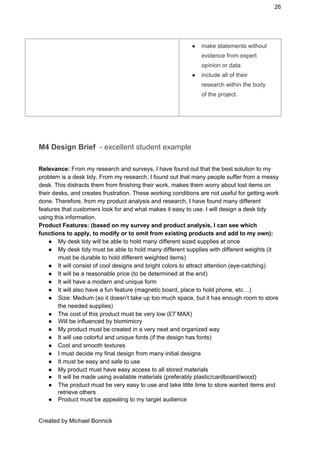
Strand iv: Develop a Design Brief 
Write a concise design brief summarising all your research. Pay close attention to the 
guidelines seen below. 
When writing a design brief   
Students should:  Students should NOT: 
● present information concisely 
● explain how and why the information is 
relevant to solving the problem 
● evaluate the validity of the data 
● present their research in an appendix 
● cite all sources of information using 
appropriate conventions (MLA). 
● write large paragraphs of 
text 
● include statements that 
do not relate to solving 
the problem 
Created by Michael Bonnick 
26 
● make statements without 
evidence from expert 
opinion or data 
● include all of their 
research within the body 
of the project. 
 
 
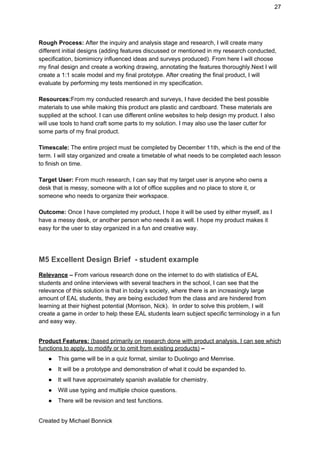
M4 Design Brief ​ ­ excellent student example 
 
Relevance: ​From my research and surveys, I have found out that the best solution to my 
problem is a desk tidy. From my research, I found out that many people suffer from a messy 
desk. This distracts them from finishing their work, makes them worry about lost items on 
their desks, and creates frustration. These working conditions are not useful for getting work 
done. Therefore, from my product analysis and research, I have found many different 
features that customers look for and what makes it easy to use. I will design a desk tidy 
using this information.  
Product Features: (based on my survey and product analysis, I can see which 
functions to apply, to modify or to omit from existing products and add to my own): 
● My desk tidy will be able to hold many different sized supplies at once 
● My desk tidy must be able to hold many different supplies with different weights (it 
must be durable to hold different weighted items) 
● It will consist of cool designs and bright colors to attract attention (eye­catching) 
● It will be a reasonable price (to be determined at the end) 
● It will have a modern and unique form 
● It will also have a fun feature (magnetic board, place to hold phone, etc…) 
● Size: Medium (so it doesn’t take up too much space, but it has enough room to store 
the needed supplies) 
● The cost of this product must be very low (£7 MAX) 
● Will be influenced by biomimicry 
● My product must be created in a very neat and organized way 
● It will use colorful and unique fonts (if the design has fonts) 
● Cool and smooth textures 
● I must decide my final design from many initial designs 
● It must be easy and safe to use 
● My product must have easy access to all stored materials 
● It will be made using available materials (preferably plastic/cardboard/wood) 
● The product must be very easy to use and take little time to store wanted items and 
retrieve others 
● Product must be appealing to my target audience 
 
Created by Michael Bonnick 
27 
Rough Process: ​After the inquiry and analysis stage and research, I will create many 
different initial designs (adding features discussed or mentioned in my research conducted, 
specification, biomimicry influenced ideas and surveys produced). From here I will choose 
my final design and create a working drawing, annotating the features thoroughly.Next I will 
create a 1:1 scale model and my final prototype. After creating the final product, I will 
evaluate by performing my tests mentioned in my specification. 
 
Resources:​From my conducted research and surveys, I have decided the best possible 
materials to use while making this product are plastic and cardboard. These materials are 
supplied at the school. I can use different online websites to help design my product. I also 
will use tools to hand craft some parts to my solution. I may also use the laser cutter for 
some parts of my final product.   
 
Timescale: ​The entire project must be completed by December 11th, which is the end of the 
term. I will stay organized and create a timetable of what needs to be completed each lesson 
to finish on time. 
 
Target User: ​From much research, I can say that my target user is anyone who owns a 
desk that is messy, someone with a lot of office supplies and no place to store it, or 
someone who needs to organize their workspace. 
 
Outcome: ​Once I have completed my product, I hope it will be used by either myself, as I 
have a messy desk, or another person who needs it as well. I hope my product makes it 
easy for the user to stay organized in a fun and creative way. 
 
M5 Excellent Design Brief  ­ student example 
Relevance​ – ​From various research done on the internet to do with statistics of EAL 
students and online interviews with several teachers in the school, I can see that the 
relevance of this solution is that in today’s society, where there is an increasingly large 
amount of EAL students, they are being excluded from the class and are hindered from 
learning at their highest potential (Morrison, Nick).  In order to solve this problem, I will 
create a game in order to help these EAL students learn subject specific terminology in a fun 
and easy way. 
 
Product Features: ​(based primarily on research done with product analysis, I can see which 
functions to apply, to modify or to omit from existing products)​ ​–  
● This game will be in a quiz format, similar to Duolingo and Memrise.   
● It will be a prototype and demonstration of what it could be expanded to. 
● It will have approximately spanish available for chemistry. 
● Will use typing and multiple choice questions. 
● There will be revision and test functions. 
Created by Michael Bonnick 
28 
● Engagement will be based mainly on a progression system. 
● Will primarily use a visual format to increase memorability and audio to teach 
pronunciation which has high importance in the classroom. 
 
Rough process​ – ​After the inquiry and analysis stage and research, I will plan out several 
programme ideas by creating flowcharts and ideas to design the UI.  Then, using Adobe 
Flash and Photoshop, I will create my game including all functions and aspects in the 
specifications. (Davey, Rich) 
 
Resources​ – ​From a lot of advice from others online and various articles stating the best 
programmes and resources for this type of game, I will be using the programmes Adobe 
Photoshop and Flash in order to create my game as these are the best and easiest tools to 
make this type of game.  (Davey, Rich) 
 
Timescale​ –​ The entire project must be completed in 10 weeks, due on the 12​th​
 of March. 
(assigned by the teacher) 
 
Target user​ – From various interviews with teachers within our school, I can confidently say 
that the target audience for this product is EAL students within our school, Dwight School 
London and the teachers of the subject who would use this programme to help these EAL 
students catch up on lessons. 
 
Outcome​ –​ Eventually, I hope that my product will be used within the school and will have 
an impact on creating a more inclusive learning environment for EAL students. 
 
Example 3: DESIGN BRIEF 
My product to solve this problem is based on an artistic approach to the situation. By                               
corroborating the information I have gathered from my primary research. It is a necessity to                             
target all ages and use typography in order to capture the audience attention. Empathy and                             
emotional appeal is what I am gearing towards portraying in my poster(s), as it is present                               
within all that were analysed. The product(s) being manufactured are ultimately free, as I am                             
designing them based on original pictures. Furthermore, I will not be printing these graphic                           
designs as several of them will be moving gifs, thus reducing the manufacturing costs even                             
further. 
 
Relevance: My product will be extremely related and relevant to the aspects stated above,                           
and is needed to be implemented as seems to be an increasingly serious problem. Stated                             
within the ​APPENDIX my interview with a neurologist, that specialises in epilepsy, I have                           
gathered that this topic is extremely under noticed and needs to be reviewed 
Created by Michael Bonnick 
29 
 
Function: ​The product will serve a powerful message in order to enlighten the general                           
public about the damages and struggles of people with neurological diseases. Is this mainly                           
based off of my ​PRODUCT ANALYSIS as targets within their posters share extreme                           
similarities as mine  
 
Resources: The only resource I will be using to create animations and professional posters                           
is Photoshop CS6, as within this software, I can able to perform a variety of action in order to                                     
fulfill my needs. 
 
Time Scale: ​The project will last around 10 weeks. I am hoping to finish my research and                                 
investigation by around the 4­5 week mark. This means I will then have a lot of time to then                                     
create and evaluate my product. I feel this is the necessary time needed, proved in the                               
APPENDIX  ​with my gantt chart. 
 
Target User: ​Again referring back to my interview with Ms. Marchisio, I feel my product is                               
ultimately targeted towards everyone, as this “... is a neurological disease that doesn’t                         
discriminate.”. This means I will try and create a poster that will appeal to everyone in some                                 
sort of way, either visually or with typography.  
 
Outcome: ​I hope for the outcome to be extremely successful, as I would like to use this as a                                     
proper campaign within the school as well. I feel with the data I have gathered up to this                                   
stage I feel my poster must have: 
­ A unique way to attract the audience's attention 
­ Factual and informative information about epilepsy 
­ An advertising device to help improve awareness on neurological diseases 
­ Campaign elements that are be brief, punchy, and to the point 
­ That the campaign needs to be eye­catching and attention drawing 
­ A message that the concise and uses literary techniques in order to appeal to all                             
ages the  
­ A campaign that is influential to everyone who views it 
Criterion A: Inquiring and analysing 
Maximum: 8 
Students identify the need for a solution to a problem. At the end of year 5, students should be able to: 
i. explain and justify the need for a solution to a problem for a specified client/target audience 
ii. identify and prioritize primary and secondary research needed to develop a solution to the problem 
iii. analyse a range of existing products that inspire a solution to the problem 
iv. develop a detailed design brief, which summarizes the analysis of relevant research. 
Created by Michael Bonnick 
30 
 
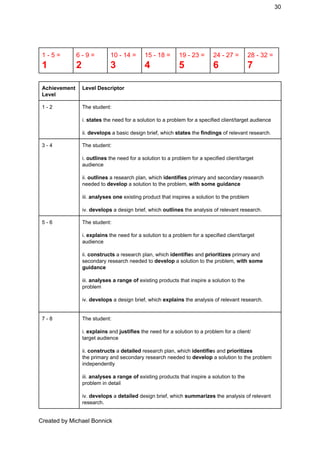
1 ­ 5 =  
1 
6 ­ 9 =  
2 
10 ­ 14 = 
3 
15 ­ 18 = 
4 
19 ­ 23 = 
5 
24 ­ 27 = 
6 
28 ­ 32 = 
7 
 
Achievement 
Level 
Level Descriptor 
1 ­ 2  The student: 
 
i. ​states​ the need for a solution to a problem for a specified client/target audience 
 
ii. ​develops​ a basic design brief, which ​states​ the ​findings​ of relevant research. 
3 ­ 4  The student: 
 
i. ​outlines​ the need for a solution to a problem for a specified client/target  
audience 
 
ii. ​outlines​ a research plan, which​ identifies​ primary and secondary research 
needed to ​develop​ a solution to the problem, ​with some guidance 
 
iii. ​analyses one​ existing product that inspires a solution to the problem 
 
iv. ​develops​ a design brief, which ​outlines​ the analysis of relevant research. 
5 ­ 6  The student: 
 
i. ​explains​ the need for a solution to a problem for a specified client/target  
audience 
 
ii. ​constructs​ a research plan, which​ identifie​s and ​prioritizes​ primary and  
secondary research needed to ​develop​ a solution to the problem,​ with some 
guidance 
 
iii. ​analyses a range​ ​of ​existing products that inspire a solution to the  
problem 
 
iv. ​develops​ a design brief, which ​explains​ the analysis of relevant research. 
 
7 ­ 8  The student: 
 
i. ​explains​ and ​justifies​ the need for a solution to a problem for a client/ 
target audience 
 
ii. ​constructs​ a ​detailed​ research plan, which ​identifie​s and ​prioritizes  
the primary and secondary research needed to​ develop ​a solution to the problem 
independently 
 
iii. ​analyses a range of ​existing products that inspire a solution to the  
problem in detail 
 
iv. ​develops​ a ​detailed ​design brief, which ​summarizes​ the analysis of relevant 
research. 
Created by Michael Bonnick 
31 
 
 
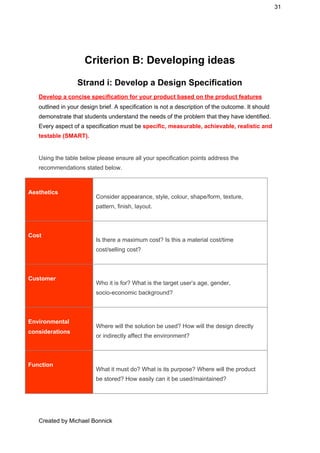
Criterion B: Developing ideas 
Strand i: Develop a Design Specification 
Develop a concise specification for your product based on the product features 
outlined in your design brief. A specification is not a description of the outcome. It should 
demonstrate that students understand the needs of the problem that they have identified. 
Every aspect of a specification must be ​specific, measurable, achievable, realistic and 
testable (SMART). 
 
Using the table below please ensure all your specification points address the 
recommendations stated below. 
Aesthetics 
Consider appearance, style, colour, shape/form, texture, 
pattern, finish, layout. 
Cost 
Is there a maximum cost? Is this a material cost/time 
cost/selling cost? 
Customer 
Who it is for? What is the target user’s age, gender, 
socio­economic background? 
Environmental 
considerations 
Where will the solution be used? How will the design directly 
or indirectly affect the environment? 
Function 
What it must do? What is its purpose? Where will the product 
be stored? How easily can it be used/maintained? 
Created by Michael Bonnick 
32 
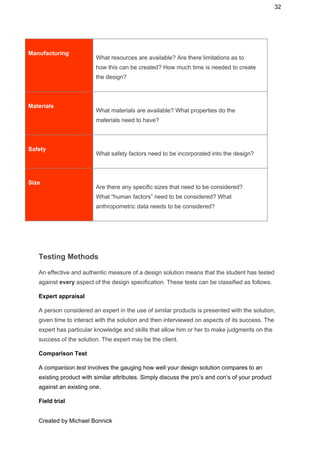
Manufacturing 
What resources are available? Are there limitations as to 
how this can be created? How much time is needed to create 
the design? 
Materials 
What materials are available? What properties do the 
materials need to have? 
Safety 
What safety factors need to be incorporated into the design? 
Size 
Are there any specific sizes that need to be considered? 
What “human factors” need to be considered? What 
anthropometric data needs to be considered? 
 
 
Testing Methods 
An effective and authentic measure of a design solution means that the student has tested 
against ​every​ aspect of the design specification. These tests can be classified as follows. 
Expert appraisal 
A person considered an expert in the use of similar products is presented with the solution, 
given time to interact with the solution and then interviewed on aspects of its success. The 
expert has particular knowledge and skills that allow him or her to make judgments on the 
success of the solution. The expert may be the client. 
Comparison Test 
A ​comparison test ​involves the gauging how well your design solution compares to an 
existing product with similar attributes. Simply discuss the pro’s and con’s of your product 
against an existing one. 
Field trial 
Created by Michael Bonnick 
33 
A ​field trial​ is a test of the performance of a solution under the conditions and situation in 
which it will be used. For example, an interactive information point (developed in HTML) for a 
museum exhibit may be tested by the exhibit visitors in the museum, structured as a user 
trial or user observation. 
Performance testing 
The performance of a solution is tested under the conditions in which it would normally be 
used. Quantitative data is collected through a variety of tests such as: 
● destructive tests assessing impact strength or flammability 
● cyclic tests 
● measurement of physical properties such as weight and size 
● timed tests for web pages to load 
● ease of navigation through an interactive story, game or website. 
User observation 
The user is presented with the solution and is set a task to achieve with little or no guidance. 
The user’s interaction with the solution is observed and recorded. 
 
 
User trials 
The user is presented with the solution and guided on how to use it. The user is asked 
questions as he or she interacts with the solution or is given a survey to complete. User trials 
may include focus groups. 
The design of interview or survey questions needs to be targeted to draw out responses that 
assess the solution against the specification. 
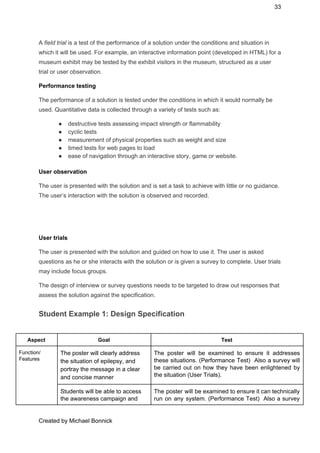
Student Example 1: Design Specification 
 
Aspect  Goal  Test 
Function/ 
Features 
The poster will clearly address 
the situation of epilepsy, and 
portray the message in a clear 
and concise manner 
The poster will be examined to ensure it addresses                 
these situations. (Performance Test) Also a survey will               
be carried out on how they have been enlightened by                   
the situation (User Trials). 
Students will be able to access 
the awareness campaign and 
The poster will be examined to ensure it can technically                   
run on any system. (Performance Test) Also a survey                 
Created by Michael Bonnick 
34 
thus be able to run the file from 
anywhere  
will be carried out on if they have had any anomalies                     
(User Trials). 
Students and the audience must 
be able to inquire about epilepsy 
in and through the .gif 
The poster will be examined to ensure it can technically                   
run on any system. (Performance Test) Also a survey                 
will be carried out on if they have had any anomalies                     
(User Trials). 
Each poster will feature a 
created logo 
The poster will be examined to ensure it uses my                   
created logo (Performance Test) Also a survey will be                 
carried out on the professionalism of the design (User                 
Trials). 
Posters will feature font that is 
clearly readable and 
understandable that ​connects to 
the audience 
The poster will be examined to ensure it uses the                   
specific font (Performance Test) Also a survey will be                 
carried out on the clarity of the message (User Trials). 
I will help enlighten the viewers 
about the effects of ​neurological 
diseases. 
The game will be examined to ensure it has the                   
necessary information. (Performance Test) Also a           
survey will be carried out on how effectively the                 
information has been processed (User Trials). 
The poster will evoke empathy 
within the viewer  
The poster will be examined to ensure it uses these                   
holds the necessary literary techniques. (Performance           
Test) Also a survey will be carried out on how the                     
poster has impacted them. (User Trials). 
A photoshop file that runs 
animation continuously (.gif) 
The poster will be examined to ensure it can technically                   
run on any system. (Performance Test) Also a survey                 
will be carried out on if they have had any anomalies                     
(User Trials). 
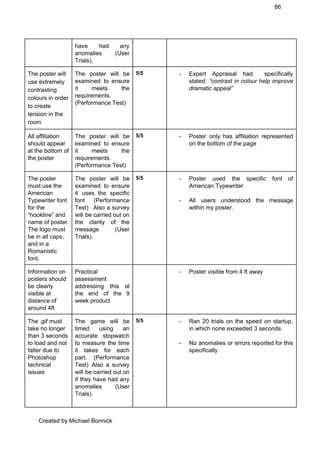
Aesthetics  The poster will use extremely 
contrasting colours in order to 
create tension in the room 
The poster will be examined to ensure it meets the                   
requirements. (Performance Test) 
All affiliation should appear at the 
bottom of the poster 
The poster will be examined to ensure it meets the                   
requirements. (Performance Test) 
The poster must use the 
American Typewriter font for the 
“hookline” and name of poster. 
The logo must be in all caps, and 
in a Romanistic font. 
The poster will be examined to ensure it uses the                   
specific font (Performance Test) Also a survey will be                 
carried out on the clarity of the message (User Trials). 
Ergonomics  Information on posters should be 
clearly visible at distance of 
around 4ft 
Practical assessment addressing this at the end of the                 
9 week product  
Efficiency  The .gif must take no longer than 
3 seconds to load and not falter 
The game will be timed using an accurate stopwatch to                   
measure the time it takes for each part. (Performance                 
Created by Michael Bonnick 
35 
due to Photoshop technical 
issues   
Test) Also a survey will be carried out on if they have                       
had any anomalies (User Trials). 
 
Makeup of 
File/Photo 
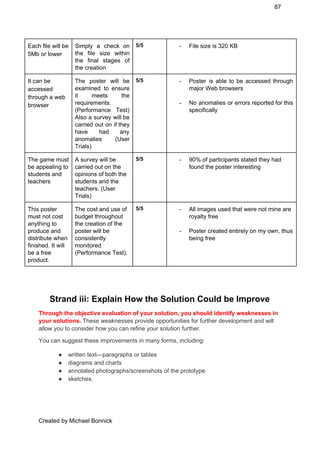
Each file will be 5Mb or lower  Simply a check on the file size within the final stages of                       
the creation 
It can be accessed through a 
web browser  
The poster will be examined to ensure it meets the                   
requirements. (Performance Test) Also a survey will be               
carried out on if they have had any anomalies (User                   
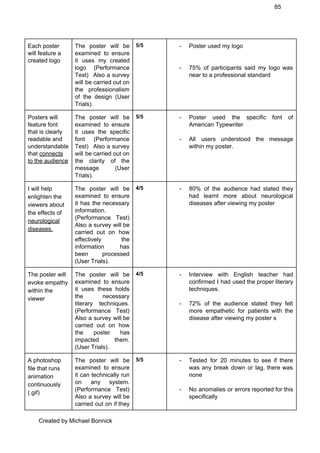
Trials) 
Target 
Audience 
The game must be appealing to 
students and teachers 
A survey will be carried out on the opinions of both the 
students and the teachers. (User Trials) 
Cost  This poster must not cost 
anything to produce and 
distribute when finished. It will be 
a free product. 
The cost and use of budget throughout the creation of 
the poster will be consistently monitored (Performance 
Test). 
 
 
Student Example 2: Design Specification 
 
Aspect  Specification  Test 
Function/ 
Features 
Students must be able to run the 
programme through downloading it and 
running it on the computer. 
The game will be downloaded and run 
on a school computer multiple times to 
ensure that it works. (Performance Test) 
The game will be a very stripped down 
and basic version of an applicable model. 
It will only be a prototype depicting 
concepts and designs which can be 
applied to a final product. ​(This applies 
to all specifications) 
There will be a list created at the end 
which will illustrate a final version, if 
created, listing all features of the 
prototype which will be applied to the 
final version (Performance Test) 
The game must have a glossary where all 
the meanings and words learnt so far can 
be accessed through the main menu. 
The game will be played and used 
multiple times to ensure it can do this. 
(Performance Test) 
The game’s primary feature of exercises 
in lessons must come in the form of a 
multiple choice question. 
The game will be played and used 
multiple times to ensure it can do this. 
(Performance Test) 
Questions, although mostly words, must 
also have a set of visual and audio 
questions. 
The game will be examined to ensure it 
can do this. (Performance Test) 
Created by Michael Bonnick 
36 
In each lesson, the user must be 
presented with 5 new words to learn.   
The game will be examined to ensure it 
can do this. (Performance Test) 
In each lesson, there must be ​at least​ 5 
different questions with at least one visual 
question and one audio question. 
The game will be thoroughly examined 
and number of questions and types of 
questions will be counted (Performance 
test) 
The game must be available, apart from 
English, in Spanish to accommodate 
some of the DSL EAL students. 
A survey will be carried out with certain 
EAL students to see if they understand 
the other languages. (User Observation) 
The game must support the subject 
Chemistry. 
The game will be examined to ensure it 
can do this. (Performance Test) 
The game must have game over screen 
at the end of the lesson to say the 
number of questions the user got correct, 
the number of questions they got wrong 
and the overall percentage of correct 
answers. 
The game will be examined and ran 
through in order to ensure that it can 
carry out this function multiple times. 
(Performance Test) 
Every time that the user does a question, 
the location of the multiple choice 
answers will be in a different place every 
time. 
The game will be thoroughly examined 
multiple times to ensure that this function 
works. (Performance Test) 
Aesthetics  The game must mainly use colours like 
light green and light blue for buttons and 
the occasional light red for buttons to 
stand out more.  For the backgrounds, I 
will mainly use a very light orange. 
The game will be examined to ensure it 
has these features. (Performance Test) 
Also a survey will be carried out on how 
the aesthetics make them feel (User 
trials). 
The game must use the font blanch for 
the logo and name of programme.  It 
must use the Calibri font for the majority 
of text including subtitles, questions and 
answers. 
The game will be examined to ensure it 
uses these fonts. (Performance Test) 
Also a survey will be carried out on how 
these fonts make them feel (user trials). 
Buttons and most panels used in the 
game must all be either rectangular with 
rounded edges or circular. 
The game will be examined to ensure it 
uses this shape for buttons. 
(Performance Test)  Also a survey will 
be carried out on how these buttons 
make them feel (user trials). 
The game must use a large amount of 
logos which have a minimal yet colourful 
2D art style similar to vector images. 
This will be heavily influenced by the art 
style of the graphic designer Rob Wilson. 
The game will be examined to ensure it 
has this art style. (Performance Test) 
Also a survey will be carried out on what 
feelings this art style conveys, if it is 
comprehensive and if they like it (user 
trials). 
The game must have several animations 
for when new questions move into the 
screen. 
The game will be examined to ensure 
that it contains these animations 
(Performance Test). 
Created by Michael Bonnick 
37 
Ergonomics  The buttons must be easy to locate and 
understand. 
Survey will be carried out on ease of 
access and navigation (user 
observation). 
Engagement  The game must use simple Spanish to 
make it easy to understand. 
The game will be examined to ensure 
that this feature works (Performance 
Test) and a survey will be carried out on 
if this helps with engagement. (User 
trials). 
The game must always have a counter in 
the bottom right corner to show how 
many questions they have completed and 
how many are left. 
The game will be examined to ensure 
that this feature functions well 
(Performance Test) and a survey will be 
carried out on the increased 
engagement of this factor (User trials). 
Sound will be included within some of the 
questions to keep the engagement of the 
audience. 
The game will be examined to ensure 
that this feature functions well. 
(Performance Test) 
Efficiency  The game must take no longer than 1 
second to load the next question and less 
than 15 seconds to start up the 
programme.   
The game will be timed using an 
accurate stopwatch to measure the time 
it takes for each part. (Performance 
Test) 
Makeup of 
Programme 
The game must be made through the use 
of Adobe Flash Professional and through 
the use of the programming language 
ActionScript. 
The methods used for creation will be 
monitored and examined constantly 
throughout the creation of the game. 
(Performance Test) 
All buttons, logos and drawings within the 
game must be created through the use of 
Adobe Photoshop. 
The methods used for creation will be 
monitored and examined constantly 
throughout the creation of the game. 
(Performance Test) 
All questions must be derived from an 
XML file which is applied to dynamic text 
fields within Adobe Flash. 
The methods used for creation will be 
monitored and examined constantly 
throughout the creation of the game. 
(Performance Test) 
The external library of GSAP (GreenSock 
Animation Platform), will be used in order 
to create animations within my quiz. 
The methods used for creation will be 
monitored and examined constantly 
throughout the creation of the game. 
(Performance Test) 
Target Audience  The game must be appealing to students.    A survey will be carried out on the 
opinions of students. (User Trials) 
Cost  This programme must not cost anything 
to produce and distribute when finished. 
It will be a free product. 
The cost and use of budget throughout 
the creation of the game will be 
consistently monitored (Performance 
Test). 
Created by Michael Bonnick 
38 
 
 
Strand ii: Develop Design Ideas 
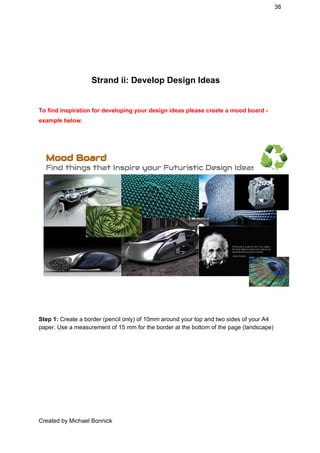
To find inspiration for developing your design ideas please create a mood board ­ 
example below. 
 
 
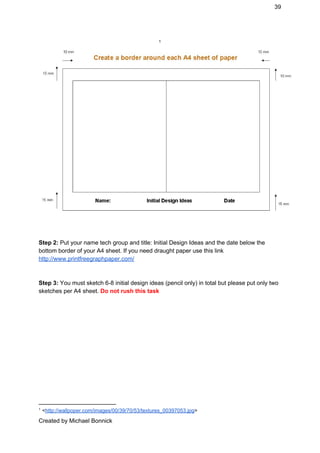
Step 1:​ Create a border (pencil only) of 10mm around your top and two sides of your A4 
paper. Use a measurement of 15 mm for the border at the bottom of the page (landscape) 
Created by Michael Bonnick 
39 
1


Step 2: ​Put your name tech group and title: Initial Design Ideas and the date below the 
bottom border of your A4 sheet. If you need draught paper use this link 
http://www.printfreegraphpaper.com/ 
 
 
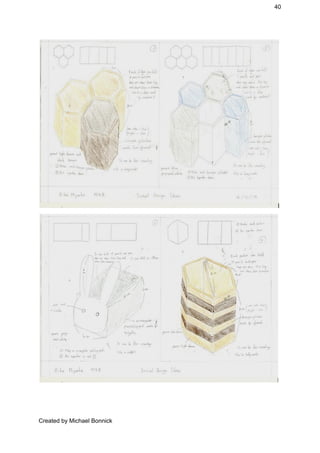
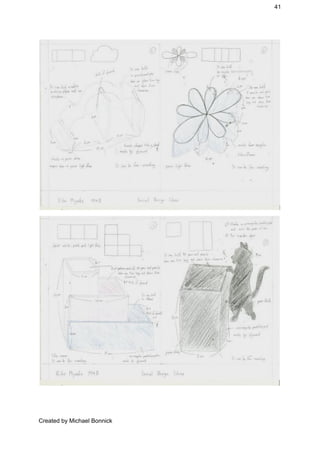
Step 3:​ You must sketch 6­8 initial design ideas (pencil only) in total but please put only two 
sketches per A4 sheet.​ ​Do not rush this task 
 
1
 <​http://wallpoper.com/images/00/39/70/53/textures_00397053.jpg​> 
Created by Michael Bonnick 
40 
 
 
Created by Michael Bonnick 
41 


Created by Michael Bonnick 
42 
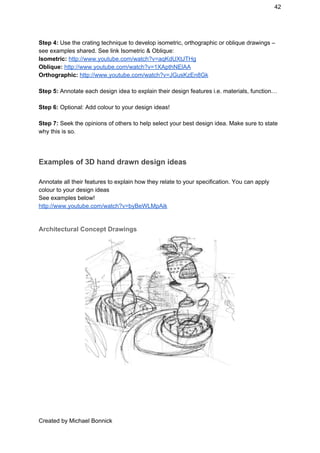
Step 4:​ ​Use the crating technique to develop isometric, orthographic or oblique drawings – 
see examples shared. See link Isometric & Oblique:  
Isometric:​ ​http://www.youtube.com/watch?v=aqKdUXtJTHg 
Oblique:​ ​http://www.youtube.com/watch?v=1XApthNElAA 
Orthographic: ​http://www.youtube.com/watch?v=JGusKzEn8Gk  
 
Step 5:​ Annotate each design idea to explain their design features i.e. materials, function… 
 
Step 6:​ Optional: Add colour to your design ideas! 
 
Step 7:​ Seek the opinions of others to help select your best design idea. Make sure to state 
why this is so. 
 
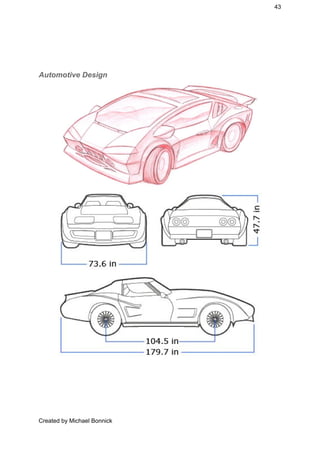
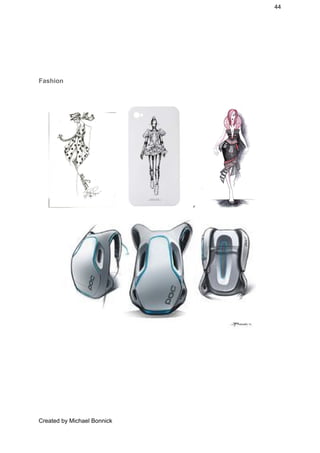
Examples of 3D hand drawn design ideas 
 
Annotate all their features to explain how they relate to your specification. You can apply 
colour to your design ideas 
See examples below! 
http://www.youtube.com/watch?v=byBeWLMpAik 
 
Architectural Concept Drawings 


Created by Michael Bonnick 
43 


Automotive Design 
 
 
Created by Michael Bonnick 
44 
 
 
Fashion  


Created by Michael Bonnick 
45 
 
 
Communication  
 2
2
 
<​http://fm.cnbc.com/applications/cnbc.com/resources/files/2013/08/27/Samsung%20smartwatch%20pat
ent%20image.jpg​> 


Created by Michael Bonnick 
46 
Strand iii: Present the Chosen Design 
Choosing your final design:​ ​Create a survey or a list of questions to help you choose your 
best design. Simply create questions that will help others to judge the quality of each design 
idea. Ask two classmates, friends or family members to help you identify the best idea. 
 
Rate how well the design fulfills each question/area/specification point.​ Use a scale 
from 1 (lowest) to 5 (highest). Make sure to combine the total score of each design to see 
which one comes out on top! 
Template 
Initial 
Design 
Ideas 
 
Does the 
design 
solve the 
problem? 
Do you 
understand 
how it will 
work? 
Have they 
annotated 
all the 
important 
features of 
the design? 
Does it meet 
the key areas 
of the 
specification? 
How do you 
rate the 
overall 
presentation? 
Total 
score 
Design 
1 
3  3  3  2  5  16 
4  2  4  4  4 
Design 
2 
4  5  1  4  4  18 
         
Design 
3 
2  1  5  3  2  13 
         
Created by Michael Bonnick 
47 
Design 
4 
5  1  3  4  2  15 


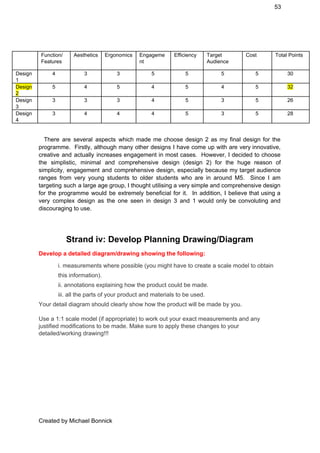
Make improvements to your chosen /final design. Annotate your drawing to explain 
what areas have been improved. 
Student Example 1: Final Design 


Write clear/justified reasons why you have chosen this final design. Explain how it 
seeks to solve the problem and fulfills all areas of your design brief/specification. 
Created by Michael Bonnick 
48 
Student Example 2 ­ Selecting/Presenting the final design  
 
Choosing My Final Design 
Initial 
Design 
Ideas 
 
Does the 
design 
solve the 
problem? 
Do you 
understand 
how it will 
work? 
Have they 
annotated 
all the 
important 
features of 
the design? 
Does it 
meet the 
key areas 
of the 
specificati
on? 
How do you rate 
the overall 
presentation? 
Total score 
 
MAX:50 
 
ALL SCORES 
OUT OF FIVE 
1­Low 
5­High 
 
 
Design 
1 
5  4  5  4  5  46 
5  5  4  5  4 
Design 
2 
3  1  5  4  5  37 
4  3  5  4  4 
Design 
3 
2  3  4  5  5  42 
5  4  4  5  5 
Design 
4 
4  4  4  5  5  46 
5  4  5  5  5 
Design 
5 
4  5  5  5  5  46 
5  4  5  4  4 
Design 
6 


5  5  4  5  4   45.5 
4  4  5  5  4.5 
 
Which Design Did I Choose and WHY? 
Created by Michael Bonnick 
49 
 
Which Design Did I Use? 
I chose to continue this project with​ Design 4​. I have chosen this design for a 
variety of logical reasons: 
Firstly, I believe that this design has more areas relating to biomimicry than 
my other designs. This design has taken influence from the aesthetics as well as the 
function areas of biomimicry. 
Additionally, I believe this design looks very modern and unique. According to 
my research conducted, I have found that the colors I have used are very eye 
catching. By using these colors, I will attract more customers. 
Relating this Design to my Problem 
Another reason I chose this design over the others is because it relates to my 
problem. This design relates to my problem because it is a solution to the problem: a 
desk organizer (my problem:​ Having an unorganized desk, having too much supplies 
to store, or having limited desk space to store what is needed.). ​This desk organizer 
keeps an organized desk by storing supplies. The desk is medium sized, so it can fit 
in most desk spaces. It also can hold many different items at once. 
Relating this Design to my Rating System 
This design was chosen by a rating system. I asked 2 classmates their 
opinions on my designs. The results ended in a 3 way tie. From here I chose this 
design because I believe it fits all the requirements from my problem, specification, 
and design brief. 
Relating this Design to my Specification/Design Brief 
Another reason I chose this design was because it meets all of the points 
mentioned in my design brief and specification. 
I also believe that this design is very easy and safe to use (which is a point 
mentioned in my specification). This design is very unique and can hold any different 
items of different weights (which are points in my specification as well). By using this 
desk tidy, it will make storing office supplies very easy and safe. 


Created by Michael Bonnick 
50 
M5 Student Example 2: Presenting the final design 
 
 
Created by Michael Bonnick 
51 
 
I have chosen this design for a variety of logical reasons. First of all, I believe that 
the general aesthetic of this particular design is the most alluring and practical in 
comparison with the rest of the remaining designs. To me this design is the one 
whose intricate designs remains pertinent to the concept behind this project which is 
to create a more inclusive community. The design is about a diligent and busy head 
that is in constant motion and remaining active in the community.  In order to make 
the design of the web page more interesting I have made circles scattered around 
the page that look as if they are the ideas of  what activities would be interesting of 
the head. This way, when you hover over each circle, detailed information will be 
shown instantly about that specific activity. Moreover, I chose this design to be my 
final because I believe it is really simple yet elaborate and contemporary. 
Furthermore, everything in this web page is accessible and lucid, everything can be 
seen from the home page and everything is explained thoroughly either on that very 
same page or 1 click away. Additionally, every single feature this web page has to 
offer is conspicuous, easy to see and easy to use making the sharing and emanation 
of information easy, fluid, proficient and fast. I believe this design stands out from the 
rest as I think it would be the most effective at augmenting the social life of the 
elderly whilst still minimizing their time spent on the computer to replace that with 
socializing in order to help combat loneliness. This website is compelling but it is also 
very simple, this will therefore reduce the amount of time people spend looking at 
websites and maximize their time spent bettering their lives. All in all this web design 
it the one that displays the most amount of useful information is the clearest and 
simplest form possible, making it such an elaborate and attractive place to begin to 
turn one’s life upside down.  


Created by Michael Bonnick 
52 
Good Student​ Example 3 ­ Presenting final design 
 
 
Created by Michael Bonnick 
53 
 
  Function/ 
Features 
Aesthetics  Ergonomics  Engageme
nt 
Efficiency  Target 
Audience 
Cost  Total Points 
Design 
1 
4  3  3  5  5  5  5  30 
Design 
2 
5  4  5  4  5  4  5  32 
Design 
3 
3  3  3  4  5  3  5  26 
Design 
4 
3  4  4  4  5  3  5  28 
 
There are several aspects which made me choose design 2 as my final design for the                                   
programme. Firstly, although many other designs I have come up with are very innovative,                           
creative and actually increases engagement in most cases. However, I decided to choose                         
the simplistic, minimal and comprehensive design (design 2) for the huge reason of                         
simplicity, engagement and comprehensive design, especially because my target audience                   
ranges from very young students to older students who are in around M5. Since I am                               
targeting such a large age group, I thought utilising a very simple and comprehensive design                             
for the programme would be extremely beneficial for it. In addition, I believe that using a                               
very complex design as the one seen in design 3 and 1 would only be convoluting and                                 
discouraging to use.   
 
Strand iv: Develop Planning Drawing/Diagram 
Develop a detailed diagram/drawing showing the following: 
i. measurements where possible (you might have to create a scale model to obtain 
this information). 
ii. annotations explaining how the product could be made. 
iii. all the parts of your product and materials to be used. 
Your detail diagram should clearly show how the product will be made by you.  
 
Use a 1:1 scale model (if appropriate) to work out your exact measurements and any 
justified modifications to be made. Make sure to apply these changes to your 
detailed/working drawing!!! 


Created by Michael Bonnick 
54 
Student Example 1: 1 to 1 scale cardboard model 


STUDENT EXAMPLE: Detailed Diagram/Drawing 
 
 
Created by Michael Bonnick 
55 
Student example 2: Card model 
 
 
Student Example: Detailed Diagram ­ CAD Drawing 


Created by Michael Bonnick 
56 
Criterion B: Developing ideas 
 
Maximum: 8 
Students develop a solution. At the end of year 5, students should be able to: 
i. develop design specifications, which clearly states the success criteria for the design of a solution 
ii. develop a range of feasible design ideas, which can be correctly interpreted by others 
iii. present the chosen design and justify its selection  
iv. develop accurate and detailed planning drawings/diagrams and outline the requirements for the 
creation of the chosen solution. 
 
1 ­ 5 =  
1 
6 ­ 9 =  
2 
10 ­ 14 = 
3 
15 ­ 18 = 
4 
19 ­ 23 = 
5 
24 ­ 27 = 
6 
28 ­ 32 = 
7 
 
3 ­ 4  The student: 
 
i. ​lists some​ design specifications, which relate to the success criteria for 
the design of a solution 
 
ii. ​presents a few​ feasible designs, using an appropriate medium(s) or  
annotation, which can be interpreted by others 
 
iii. ​justifies​ the selection of the chosen design with reference to the design 
specification 
 
iv. ​creates​ planning drawings/diagrams or ​lists​ requirements for the creation of the 
chosen solution. 


5 ­ 6  The student: 
 
i. ​develops​ design specifications, which ​outline ​the success criteria for the  
design of a solution 
 
ii. ​develops a range of ​feasible design ideas, using an appropriate medium(s) ​and 
annotation, which can be interpreted by others 
 
iii. ​presents​ the chosen design and​ justifies​ its selection with reference to  
the design specification 
 
iv. ​develops accurate​ planning drawings/diagrams and ​lists​ requirements  
for the creation of the chosen solution. 
 
7 ­ 8  The student: 
 
i. ​develops detailed​ design specifications, which ​explain​ the success criteria for the 
design of a solution based on the analysis of the research 
 
Created by Michael Bonnick 
57 
 
ii. ​develops a range of​ feasible design ideas, using an appropriate medium(s) ​and 
detailed ​annotation, which can be ​correctly​ interpreted by others 
 
iii. ​presents​ the chosen design and ​justifies fully and critically​ its selection  
with ​detailed​ reference to the design specification 
 
iv.​ develops accurate and detailed​ planning drawings/diagrams and 
outlines​ requirements for the creation of the chosen solution. 
 
Criterion C: Creating your Product 
 
Strand i: Construct a Logical Plan 
Develop a plan of making outlining how your final solution will be made. 
Ensure it can be easily following. 
 
Production Plan: Template 
 
Steps:  
Use full 
sentences to 
explain each 
step of the 
making 
process. You 
can have as 
many step as 
you want.  
Time: 
Roughly 
how long 
will each 
step 
take? 
Equipment/ 
Software: 
What tools, 
apps will 
you use to 
make your 
design 
solution? 
Make sure 
to state the 
risks that 
might be 
involved in 
the health 
and safety 
section 
Materials: 
What 
material 
will you 
use for 
this 
activity? 
Health and 
Safety: 
Are there 
any risks 
included in 
this 
activity? 
Quality 
Checks: ​What 
will you do at 
specific 
moments 
during the 
making process 
to ensure the 
final design 
solution is 
being made 
well? 
Justified 
changes/ 
Improvements: 
This section will be 
filled in after every 
step/activity has 
been completed. 
You will need to 
reflect on what you 
completed and 
note any changes 
made to your final 
solution. 
Step 1: 
Measuring 
and marking 
up material 
This 
activity 
will take 
40 mins 
I will use a 
steel rule, 
try square 
and a 
pencil. 
I will use 
MDF and 
3 mm 
thick 
acrylic 
Must be 
careful 
when 
handling 
the acrylic ­ 
could have 
sharp 
edges 
Double check 
measurements 
shown on 
detailed 
diagram before 
marking up. 
I made an 
adjustment to the 
length and width of 
the sides for the 
mobile device 
holder to ensure it 
can accommodate 
a minimum of two 
devices. 
Created by Michael Bonnick 
58 
Step 2             
Step 3             
Step 4             
Step 5             
Step 6             
Step 7             
 
Excellent Student Example: Production Plan 
Step  Process  Required 
resource
s 
Tests  Quality Checks  Time  Reflection/Modifications 
1  Carry out 
further 
research, 
especially 
primary 
research 
with 
surveys to 
EAL 
students 
within the 
school 
and 
teachers 
which I 
asked 
before, to 
interview 
in­depth. 
Also some 
research 
on terms I 
Google 
Forms, 
pen, 
paper, 
computer. 
At the 
end, I will 
do a 
summary 
of all new 
informatio
n learnt 
and on all 
research. 
I will ensure 
throughout that the 
people I interview 
and survey will give 
me useful and 
reliable 
information.  In 
addition, I will 
consistently 
evaluate my 
sources online to 
make sure they are 
accurate and 
reliable. 
3­4 hours  One major modification I made to 
this step was to instead of doing a 
survey, I decided to do an interview 
with an EAL student within the 
school due to time restrictions and 
effectiveness with the method of 
research as I believe that instead of 
doing a research, a personal 
interview with an individual will 
provide a better insight into the 
problem, how to improve the 
functions and design of my 
programme and various other 
factors.  Apart from that, this stage 
went vary smoothly and I did not 
encounter any problems.  In 
addition, I was able to find reliable 
sources for research. 
Created by Michael Bonnick 
59 
will 
include 
and how I 
will 
organise 
it. 
2  Learn in 
greater 
detail, 
how to 
create the 
product. 
Look at 
many 
youtube 
tutorials 
on how to 
make a 
quiz­like 
game on 
flash and 
how to 
use 
actionscri
pt.  This 
informatio
n and 
resources 
to learn 
can be 
found on 
tutorial 
websites, 
wikis, 
forums 
and above 
all, 
youtube 
tutorials. 
Various 
Websites 
(Youtube, 
Code 
Tutsplus, 
Programm
er’s Stack 
Exchange
, etc.) 
I will keep 
consistent 
notes 
throughou
t and I will 
check my 
notes at 
the end to 
ensure 
that I 
have 
learnt the 
sufficient 
material. 
Throughout, I will 
cross­reference 
sources in order to 
ensure that the 
information I am 
obtaining is correct 
and accurate. In 
addition, I will 
constantly question 
the accuracy and 
reliability of all the 
websites I use. 
Additionally, I will 
even test the 
methods in flash as 
I believe that is the 
easiest and 
quickest way of 
making sure it will 
work. 
3 hours     After looking at various tutorials 
on youtube and other tutorials 
online such as step­by­step tutorials 
which are in­depth a well as various 
online forums where members 
share many tips and guides on how 
to write actionscript.  In addition, I 
frequently looked at other user’s 
code in Actionscript of various quiz 
programmes and some guides on 
Adobe Flash’s official website. 
However, the most useful and 
primary tutorial I followed came 
from the website Tutsplus with the 
link: 
http://code.tutsplus.com/tutorials/cr
eate­a­customizable­flash­quiz­appl
ication­­active­8792​ With all of this, 
I was able to create, in the end, 
some code and grasp a basic 
knowledge of Actionscript. 
However, I had a very big issue 
with formatting the actionscript. 
3  Create an 
in­depth 
and 
exhaustiv
e plan of 
each 
course, 
the words 
within all 
lessons, 
translation
s and 
explanatio
Pencil, 
Pen, 
Paper, 
Microsoft 
Word. 
I will look 
over my 
notes and 
plan at 
the end to 
ensure I 
have a 
full, 
exhaustiv
e plan for 
the 
creation 
I will constantly 
check that I am 
including all the 
elements required 
which I listed at the 
beginning 
including, but not 
limited to, words 
within lessons, 
explanations, 
translations, 
images, etc. 
2 hours    Overall, I believe that this process 
went very well.  It was completed 
extremely quickly and efficiently, 
finishing approximately 30 minutes 
before the estimated time it would 
take.  In addition, I was able to 
modify this step slightly to take it 
further.  This was to consult my 
friend Daniel Herrera, who is a 
native Spanish speaker, with my 
document in order to ensure that 
the spanish translations are correct 
and that they are easy to 
Created by Michael Bonnick 
60 
ns for 
each 
course, 
the 
images it 
will use 
and any 
other 
details of 
the 
programm
e. 
of my 
product. 
understand.    This, in the end, 
helped to make my programme 
easier to understand for my target 
audience, catered specially for 
them. 
4  Design all 
buttons, 
logos, 
symbols, 
etc. 
required 
as a 
separate 
image in 
Adobe 
Photosho
p. 
Adobe 
Photosho
p, 
Computer. 
  Ensure 
at the end 
that all 
logos, 
symbols 
and 
designs 
have a 
consistent 
art style 
and 
meets all 
of the 
specificati
ons 
stated. 
I will consistently 
ensure that I have 
created all things 
necessary through 
the use of a 
checklist of all 
symbols, logos and 
buttons required 
and will check to 
make sure that all 
things necessary 
are all in one 
folder. 
2­3 hours  Overall, this process went very well 
and was very quick.  With my 
previous experience and knowledge 
in photoshop, through the use of my 
graphics tablet and various tools in 
photoshop, I was able to create the 
necessary logos, buttons and 
symbols using the rectangle 
primitive tools, the ellipse tools, etc. 
I created the close programme 
button, play button, the logo and 
several other graphics.  Some 
modifications I made were from the 
original designs of the buttons.  In 
the end, I decided to change the 
design slightly in order to perfectly 
match my target audience. 
5  Create a 
simple 
engine 
and 
system in 
Adobe 
Flash and 
using 
actionscri
pt, for the 
creation of 
the final 
program. 
Computer, 
Adobe 
Flash CS 
6 
Ensure at 
the end of 
the 
creation 
that I am 
able to 
simply 
create a 
quiz game 
from the 
engine I 
have 
created. 
Throughout the 
process, test the 
ease of creation of 
quizzes using the 
engine and ensure 
that the steps 
towards the 
creation of the 
engine is followed 
very closely. 
3 hours    There were a countless amount of 
modifications made throughout this 
stage which are all mentioned in the 
“Final Product and Modifications” 
segment.  The general and most 
significant modification was the 
slight change in the layout of the UI. 
Often, images, questions and other 
elements of the UI were placed in 
different parts of the screen. 
Overall, although this process 
helped to improve the UI of the final 
product and include additional 
features such as sound, this 
process took an extremely long 
time, taking approximately over 8 
times more time than the initially 
estimated time.  With countless 
obstacles and difficulties which I 
encountered in this process, this 
made it a very inefficient process, 
Created by Michael Bonnick 
61 
even though I closely followed the 
tutorial mentioned previously. 
6  Create 
program 
using the 
engine 
created in 
step 5, 
according 
to the 
specificati
ons. 
Adobe 
Flash, 
Computer 
Ensure at 
the end 
that the 
program 
created at 
the end 
meets all 
specificati
ons said 
earlier. 
Throughout the 
process of creation 
of the program, I 
will ensure that I 
am not changing 
the engine in any 
major ways and will 
consistently check 
the specifications 
2 hours    On the contrary to the previous 
step 5, this process went extremely 
smoothly and very efficiently.  I 
encountered almost no obstacles 
except for when inserting images 
and sound.  Apart from that, this 
step was completed in half the time 
initially estimated as I already had 
all terms and definitions within the 
word document created in step 3. 
In addition, with the engine using a 
very simple XML file in order to 
create the questions and insert 
images and audio files.  In the end, 
however, I did not make any major 
changes in this process. 
7  Export 
final 
program 
and 
distribute 
across 
school 
and 
screen 
record in 
order to 
publish on 
youtube. 
Adobe 
Flash, 
Computer, 
External 
Hard drive 
or USB 
stick. 
Ensure at 
the end 
that all 
teachers 
which I 
created 
the 
program 
for, knows 
how to 
access it 
and use it. 
Throughout the 
exportation and 
distribution 
process, I will have 
a specific checklist 
of which teachers I 
need to give the 
program to. 
0.25 hours    This stage was altered drastically 
as it was originally supposed to be 
the final product.  However, due to 
time constraints and limitations in 
ability and knowledge of Adobe 
Flash and Actionscript, I was not 
able to implement and create a 
finalised version of the product. 
Instead, I opted for creating a 
prototype in which I demonstrate 
how the UI will look, how the 
buttons will interact with each other, 
an example of the questions and 
answers as well as how it will be 
built in Flash using ActionScript.   
 
Core Steps/ Processes of Making 
Please find below some useful Core Steps and Processes to be incorporated into your 
production plan/plan of making 
 
If you are using CAD (Computer aided design) then use these core steps as a guide 
1. Use your detailed diagram/drawing to prepare all the parts for laser cutting using Corel 
Draw. Make sure to set your work within Corel Draw to 600 mm X 458 mm.  
 
Created by Michael Bonnick 
62 
 3
2. Process files for laser cutting ­ Laser cutter 
 
 
3. Assemble parts using an appropriate adhesive ­ PVA glue or Contact Glue. 
4. Finishing ­ if required do you need to apply paint, varnish... 
 
If you are using a variety of tools/equipment then use these core steps as a guide 
1. Follow your detailed diagram to accurately measure and mark up your material  ­ ​Steel 
rule, Try square, Pencil.​. 
.  4 5 6
 7
2. Cut the material using any of the following tools ­ ​Hegner Jig saw; Coping saw; Tenon 
saw​… 
 
3
 <​https://i.ytimg.com/vi/Fqbs7fP1xIY/maxresdefault.jpg​> 
4
 <​http://ecx.images­amazon.com/images/I/41%2B0v84Bk9L._SY300_.jpg​> 
5
 
<​http://www.toolstop.co.uk/components/com_virtuemart/shop_image/product/bd972ee7790b696a28427
52e7346a561.jpg​> 
6
 <​http://weknowyourdreams.com/images/pencil/pencil­02.jpg​> 
7
 <​http://www.thebestthings.com/newtools/graphics/cullen_tools_marking_gauge.jpg​> 
Created by Michael Bonnick 
63 
 8 9 10
3. Forming could be done using the ​Vacuum former​ or ​Foam Cutters ​but first you would 
need to create a mold. 
 
   11 12
4. To bend acrylic you can use the ​Hot wire/Strip Heater​. 
 
5. Smoothing the edges of the material ­ use a variety of files; glass or wet and dry paper. 
 
8
 
<​http://www.hegner.co.uk/media/catalog/product/cache/4/image/397x457/f8954eb2a57f68f4c257cba01f
7886d0/i/m/image_5432.jpg​> 
9
 <​http://s.hswstatic.com/gif/coping­saw­1.jpg​> 
10
 <​http://ecx.images­amazon.com/images/I/51AwQPjKsgL._SX522_.jpg​> 
11
 <​http://www.design­technology.org/vacformer.jpg​> 
12
 <​http://ecx.images­amazon.com/images/I/41%2BW%2BDna­7L._SY355_.jpg​> 
Created by Michael Bonnick 
64 
 13 14
 15
6. Assemble parts using an appropriate adhesive ­ PVA glue or Contact Glue. 
 
     16 17 18
7. Finishing ­ if required do you need to apply paint, varnish... 
 
13
 <​http://cdn.dick­blick.com/items/349/16/34916­1009­3ww­l.jpg​> 
14
 <​http://www.transpares.co.uk/media/ecom/prodsm/wet%20and%20dry.jpg​> 
15
 <​http://www.technologystudent.com/images7/hfile1.gif​> 
16
 <​http://www.printfile.com/ProductImages/scrapbooking/PVA­glue.gif​> 
17
 <​http://www.technologystudent.com/images2/tensl1.gif​> 
18
 <​http://ecx.images­amazon.com/images/I/41R33oFxCwL._SY300_.jpg​> 
Created by Michael Bonnick 
65 
   19 20
For those of you who plan to combine both CAD and machines/tools you just simply need to 
include the appropriate making process that best suits the product you hope to make. 
 
Please note you are expected to produce a plan that can be easily followed by myself or 
your peers. 


See next page 
19
 <​http://cdn3.benzinga.com/files/imagecache/1024x768xUP/varnish­250x250_0.jpg​> 
20
 <​http://belloflostsouls.net/wp­content/uploads/2014/08/paint­cans.png​> 
Created by Michael Bonnick 
66 
 
 
Strand ii: Demonstrate Technical Skills 
Visually document the key stages of making your final prototype/product by taking 
regular pictures. ​Make sure to insert the images into your document and add captions 
underneath to explain the process or step.  
Student example : ​Visually documenting the making Process 
Creating the .gif 
 
 
In order to create a moving .gif, the picture must be different within more than one frame in 
order to achieve movement. In my research, I had found that epileptics decreased their 
seizures more commonly as rapid eye movement. so in order to do that, I decided to 
displace the foreground and background slightly, to create that “twitch motion”. 
 
In the picture above, I have demonstrated how I captured the foreground, using the pen tool 
and highlighting what was necessary. 
Created by Michael Bonnick 
67 
 
After that within the path channel, in order to be able to grab the selection and move it, the 
path must be converted into an active path, shown by the moving dots surrounding the 
selection. This is completed by cmd+left clicking the path channel you want to make active, 
this is represent within the second picture. 
Created by Michael Bonnick 
68 
 
 
I simply just removed the selection using cmd+x, which in essence just temporary stores the 
layer. After that (looking at the picture below) I pasted the picture back into the software, but 
on a new layer, so it was separately tangible from the others. 
Created by Michael Bonnick 
69 


Now I had just slightly displaced both the foreground and background to simulate the 
movement, but then needed to fill up the white checkered spaces using three specific tools, 
but before I did that, I rasterized (merged) the layers in order to sample sections of the photo 
as one.  
 
Strand iii: Follow the Plan to Make the Solution 
Students demonstrate that the planning process was sufficiently thorough ​if the final 
product matches the planning drawing and no changes were made to the plan, in 
whatever form it was presented​. If the drawings/diagrams and the plan match what has 
been made, then students have followed the plan. 
I​f a student does not follow the plan, it will usually result in the solution not fully meeting the 
specification and/or matching the design detailed in the drawings/diagrams.  
 
Strand iv: Justified Changes Made to Design 
If any changes were made during the creation process of your final product make sure to 
detail and justify any changes. 
 
Created by Michael Bonnick 
70 
If students do not make any changes to their product or plan, this strand does not have to be 
addressed with evidence​. However, if any changes are made, students ​must​ address this 
strand. 
Remember if you have been vigilant in your efforts to note any changes made in the 
justification/modification section of your production plan, this can be used as 
evidence for this strand​. 
Student Example 1: Final Product and Modifications 
 
Modification to my Design 
Now that I have made a plan to follow and thought about all the materials, tools I am 
going to use and how much time the project is going to take, some features of my 
design changed. 
1. To start with, I changed the thickness of the circle of the sun which is where 
I am going to locate the clock mechanism. This is because the part of the 
clock mechanism that has to be drilled through the material is 6cm long. 
So, it is going to take a long time to drill a whole about 14cm deep on an 
18cm thick material. I thought it would take less time drilling a whole about 
2 cm deep on an 8cm thick material 
2. Now that I thought about how long it is going to take to create stickers, I 
decided make more Number Stickers. Before I made the plan, I thought it 
would take the longest time to create the stickers on the vinyl cutter; 
however, I realized it actually doesn’t. I was going to only make four 
stickers: 12, 3, 6 and 9. But, since it doesn’t take so much time creating 
them, I decided to make all twelve stickers. I also realized that while I am 
waiting for the stickers to be cut out by the vinyl cutter, I could be using the 
time and start working on the next step which is putting the clock 
mechanism on to the clock design. 
3. The last change I have made is to use spray paint for one or two parts. If I 
use paint, I have to paint several coats and dry them. Same goes for spray 
Created by Michael Bonnick 
71 
paint; however, if you compare the time on how long it takes to paint and 
spray a material once, to spray paint takes less time. 
 
 
Student Example 2: Final Product and Modifications 
  Throughout the entire creation process, with many thought processes occurring, but the 
biggest factor for modification being the ease, efficiency and overall, if it suited my ability as 
Actionscript and Flash were both very new to me in the beginning of the project.  All changes 
were added to the specifications and were reflected upon in the production plan.  Some of 
the most significant changes I made to my project included, but were not limited to: 
 
● Change in the layout of the general UI​­There were major changes to the main menu 
to suit the prototype and target audience.  Many buttons were simplified to make it 
easier for the average EAL student to understand it. 
● Use of GSAP​­The use of the GSAP library, instead of the standard flash animations, 
made the program much more efficient, compact and overall engaging with the 
included animations, which were all significant components of my specifications and 
what I wanted to achieve with my program from the beginning. 
● Use of several different fonts​­Although there were several fonts such as BPReplay 
which I planned to primarily use in the first steps of my creation, in the end, I used a 
very simple calibri for several reasons.  Firstly, it supports latin accents whereas 
BPReplay did not and secondly, I believe that calibri is a more familiar sans­serif font, 
therefore creating a more relaxed and comfortable learning environment for the user. 
● Use of an XML file​­This was simply due to efficiency. 
● Inclusion of question counter instead of progress bar­​Since the progress bar was 
very difficult to implement, I believed that a question counter would be very simple, 
yet would provide the sense of achievement and engagement. 
● Inclusion of shuffle feature​­This would make the game replayable and more 
interesting, therefore making the questions more interesting/engaging. 
● Use of the glossary instead of the layout shown​­Using this instead made sure that it 
suited the prototype model of the program. 
● Inclusion of a score screen­​The addition of this also increased engagement of the 
user and the sense of progression when they improve. 
 
The demonstration video for the final product can be found ​here​. 


Created by Michael Bonnick 
72 
Criterion C: Creating the solution 
 
Maximum: 8 
Students create a solution. At the end of year 5, students should be able to: 
i. construct a logical plan, which describes the efficient use of time and resources, sufficient for peers to  
be able to follow to create the solution 
ii. demonstrate excellent technical skills when making the solution 
iii. follow the plan to create the solution, which functions as intended 
iv. fully justify changes made to the chosen design and plan when making the solution 
a. present the solution as a whole 
 
1 ­ 5 =  
1 
6 ­ 9 =  
2 
10 ­ 14 = 
3 
15 ­ 18 = 
4 
19 ­ 23 = 
5 
24 ­ 27 = 
6 
28 ­ 32 = 
7 
 
Achievement 
Level 
Level Descriptor 
1 ­ 2  The student: 
 
i. ​demonstrates minimal ​technical skills when making the solution 
 
ii. ​creates​ the solution, which functions ​poorly​ and is presented​ in an incomplete 
form. 
 
3 ­ 4  The student: 
 
i.​ constructs a plan​ that contains some production details, resulting in peers having 
difficulty following the plan 
 
ii. ​demonstrates satisfactory ​technical skills when making the solution 
 
iii. ​creates​ the solution, which ​partially​ functions and is ​adequately​ presented 
 
iv. ​outlines​ changes made to the chosen design and plan when making the solution. 


5 ­ 6  The student: 
 
i.​ constructs a logical plan​, which considers time and resources, sufficient for 
peers to be able to follow to create the solution 
 
ii.​ demonstrates competent​ technical skills when making the solution 
 
iii. ​creates​ the solution, which functions ​as intended​ and is presented 
appropriately 
 
Created by Michael Bonnick 
73 
 
iv. ​describes​ changes made to the chosen design and plan when making the 
solution. 
 
7 ­ 8  The student: 
 
i. ​constructs a detailed and logical plan​, which ​describes ​the efficient use of 
time and resources, sufficient for peers to be able to follow to create the solution 
 
ii. ​demonstrates excellent ​technical skills when making the solution. 
 
iii. follows the plan to ​create​ the solution, which functions ​as intended ​and is 
presented ​appropriately 
 
iv. fully​ justifies​ changes made to the chosen design and plan when making the 
solution. 
 
 
Criterion D: Evaluating 
 
Strand i: Design Testing Methods 
Evaluate the effectiveness of your design solution using a wide range of tests against 
the requirements of the design specification ​(including expert appraisal, user trials, field 
testing and user observation). See examples below: 
Student Example 1: 
Expert Appraisal​ ­ From Mr. Nicholas Brown (Programmer and Design Technology 
Teacher) 
 
1. Design of the UI (is it easy to understand and is it intuitive? Is it easy to                                   
navigate?) 
 
The UI has a clear and consistent format. The interface is uncluttered and provides                           
only the necessary information. The colours are contrasting and it is clear which is                           
the question and which is the answer box. The use of page number and total page                               
number is a good way of providing feedback to the user on their progress. 
It would have been helpful for the chosen answer to change colour to provide                           
confirmation feedback to the user 
 
Created by Michael Bonnick 
74 
2.  The Program’s Objectives/Specifications 
 
If it is how effectively the goals of the program are achieved, then yes, clearly assists                               
Spanish EAL students access chemistry. It may have been helpful to provide English                         
translation of question as well to help their learning. 
 
3.  The program's engagement (how fun/engaging is it for the player?) 
 
Visually it is pleasant to look at and the transition between questions is fun. The                             
question content could perhaps have used richer and more varied media (more                       
images, animations, video etc) 
 
 
Example 2: TESTING METHODS 
 
     “Everyone’s Brain can Glitch”​ ­ Rhett Williams­Lee           ​“Become a Purple Day Hero”​ ­ Epilepsy 
Australia.  
Advantages of my 
Product 
Disadvantages of my 
Product 
Modifications 
Created by Michael Bonnick 
75 
My product draws the 
attention of the audience 
more, due to the grunge 
style that I have used. 
Lack the use of colour, 
which could deter 
younger members within 
my target audience 
(11­12 year olds)  
Little hints of colour 
could have helped to 
appeal to audiences of 
all ages, due to the 
overall contrast of colour 
Poster addresses the 
situation in a serious and 
essential manner, which 
is something needed to 
address a disease that is 
overlooked 
The existing product is 
more “friendly”, possibly 
meaning it could attract a 
larger audience. 
Trying to merge both 
serious and light hearted 
(happy) information to 
tone down the shock 
value of the piece. Such 
as cures and first hand 
experiences of people 
overcoming and battling 
epilepsy  
My product harnesses 
the use of animation not 
only to capture the 
public, but also to help 
people without epilepsy 
to empathise with their 
problem 
The existing product 
uses a day to help unite 
the audience for a 
specific cause, whilst my 
product simply 
demonstrates we need to 
enlighten ourselves 
about the disease  
Can definitely add in an 
aspect that helps unite 
people to learn about the 
disease together, which 
can tie into my slogan 
“everyone’s brain can 
glitch”   
Phrase “Everyone’s brain 
can glitch.” helps include 
that neurological 
diseases such as 
epilepsy does not 
discriminate, ever.  
The existing product 
uses the emotional 
appeal of the young girl 
to help attract the 
audience, whilst my 
product only emphasises 
we need to raise 
Possibly having one of 
the little boys’ face 
showing could improve 
emotional appeal to 
parent etc. 
Created by Michael Bonnick 
76 
awareness for this 
disease. 
My products purpose is 
clear and concise at first 
glance   
Typography could be 
larger, just in case some 
people are visually 
impaired  
Improve the size of font, 
especially the  


Expert Appraisal ­ Karen Strickland  
 
Hi Rhett, 
 
­ The piece has an immediate impact, with the viewer looking to understand for a                           
considerable time. this is always the intention of an artist.  
 
­ The image/ GIF is well thought out, which is where the artist steps in and uses an                                 
interesting moment to raise awareness.  
 
­ The animation is interesting, and leaves the viewer sympathising with the what could                         
be an epileptic first person perspective, or more likely a suggestion of what it is like to                                 
be epileptic. 
 
­ The text with the URL is clear and easy to read at a glance, and allows the viewer to                                     
inquire about the subject extremely easily  
 
­ This is an excellent piece of work, good use of branding, an interesting image, with a                               
really well thought out 


Created by Michael Bonnick 
77 
 
Comparison Test 
Test – comparison with existing product 
 
Existing product 
My product 
Advantages of my product  Disadvantages of my product 
My product looks more interesting and 
colourful 
There are less places to keep the 
accessories 
Created by Michael Bonnick 
78 
There are more spaces to put larger 
objects 
The existing product is more organised 
My product does not need extra spaces 
around the sides (to open the drawer etc.) 
The existing product has a mirror which 
would be convenient to try on the 
accessories 
My product would be easier to hold 
accessories that are needed to be hanged 
(necklaces would not be tangled) 
The accessories/holder would be 
covered by dust as it is not kept inside 
My product displays the accessories more 
clearly, as it is not kept inside the 
drawers. 
The existing product uses mainly of 
soft materials which would not scratch 
the accessories 
From the above table comparing my product and the existing product, it can be seen 
that my product has both advantages and disadvantages. Although it can be seen that 
most of the disadvantages are based on the quality of the product, such as the mirrors, 
problems with dust, scratches, which I think that as a teenager those problems would 
not matter as much as adults, as we do not have much of expensive accessories. 
Therefore I think that my product already suits with the age of my target audience. 
 
Comparing the product against existing products in the marketplace and noting strengths 
and weaknesses 
 
Strand ii: Evaluate the Success of the Solution 
When critically evaluating the success of a solution, you must objectively judge the 
solution against the specifications. ​This objective evaluation comes from analysing the 
data gathered by carrying out the tests designed. 
Created by Michael Bonnick 
79 
You must analyse this data and make conclusions that identify strengths and weaknesses of 
the solution, along with opportunities for further development. 
See Template: 
Specification  Testing method  Evidence from tests 
● _ _ _ _ _ _ _ _ _ 
_ _ _ _ _ _ 
● _ _ _ _ _ _ _ _ _ 
_ _ _ _ _ _ 
● _ _ _ _ _ _ _ _ _ 
_ _ _ _ _ _ 
● _ _ _ _ _ _ _ _ _ 
_ _ _ _ _ _ 
● _ _ _ _ _ _ _ _ _ 
_ _ _ _ _ _ 
● _ _ _ _ _ _ _ _ _ 
_ _ _ _ _ _ 
● _ _ _ _ _ _ _ _ _ 
_ _ _ _ _ _ 
● _ _ _ _ _ _ _ _ _ 
_ _ _ _ _ _ 
● _ _ _ _ _ _ _ _ _ 
_ _ _ _ _ _ 
● _ _ _ _ _ _ _ _ _ 
_ _ _ _ _ _ 
● _ _ _ _ _ _ _ _ _ 
_ _ _ _ _ _ 
● _ _ _ _ _ _ _ _ _ 
_ _ _ _ _ _ 


Student Example 1:​ Evaluating the Product Against the Specifications 
Specification  Test 
Rating of 
Completion 
How it is met 
Students must be 
able to run the 
programme through 
downloading it and 
running it on the 
computer. 
The game will be 
downloaded and 
run on a school 
computer multiple 
times to ensure 
that it works. 
(Performance Test) 
5/5    After running it multiple times on 
several computers, I can ensure it 
functions. 
The game will be a 
very stripped down 
and basic version of 
There will be a list 
created at the end 
which will illustrate 
a final version, if 
5/5  After the list was created, it was 
ensured that this game’s concepts, 
Created by Michael Bonnick 
80 
an applicable model. 
It will only be a 
prototype depicting 
concepts and designs 
which can be applied 
to a final product. 
(This applies to all 
specifications) 
created, listing all 
features of the 
prototype which will 
be applied to the 
final version 
(Performance Test) 
functions and methods could be 
applied to a full and final game. 
The game must have 
a glossary where all 
the meanings and 
words learnt so far 
can be accessed 
through the main 
menu. 
The game will be 
played and used 
multiple times to 
ensure it can do 
this. (Performance 
Test) 
5/5  Running it multiple times, the glossary 
can be easily accessed through the 
main menu. 
The game’s primary 
feature of exercises 
in lessons must come 
in the form of a 
multiple choice 
question. 
The game will be 
played and used 
multiple times to 
ensure it can do 
this. (Performance 
Test) 
5/5  The game was run multiple times to 
ensure this. 
Questions, although 
mostly words, must 
also have a set of 
visual and audio 
questions. 
The game will be 
examined to 
ensure it can do 
this. (Performance 
Test) 
4/5  The game was examined to ensure 
this.  However, there were only 1 
visual and 1 auditory question. 
In each lesson, the 
user must be 
presented with 5 new 
words to learn.   
The game will be 
examined to 
ensure it can do 
this. (Performance 
Test) 
5/5  The game was tested multiple times 
to confirm this. 
In each lesson, there 
must be ​at least​ 5 
different questions 
with at least one 
visual question and 
one audio question. 
The game will be 
thoroughly 
examined and 
number of 
questions and 
types of questions 
will be counted 
(Performance test) 
5/5  The game, examined, had 6 
questions, with 1 visual and 1 
auditory. 
The game must be 
available, apart from 
English, in Spanish to 
accommodate some 
of the DSL EAL 
students. 
An interview will be 
carried out with a 
certain EAL student 
to see if they 
understand the 
other languages. 
(User Observation) 
4/5  According to native Spanish speakers 
in the school, it is written to a very 
good level. 
Created by Michael Bonnick 
81 
The game must 
support the subject 
Chemistry. 
The game will be 
examined to 
ensure it can do 
this. (Performance 
Test) 
5/5  After rigorous examination, the game 
was shown to support Chemistry 
terms very well. 
The game must have 
game over screen at 
the end of the lesson 
to say the number of 
questions the user 
got correct, the 
number of questions 
they got wrong and 
the overall 
percentage of correct 
answers. 
The game will be 
examined and ran 
through in order to 
ensure that it can 
carry out this 
function multiple 
times. 
(Performance Test) 
5/5  After many examinations and tests, it 
is proven the game over screen can 
show correct answers, wrong 
answers and percentage. 
Every time that the 
user does a question, 
the location of the 
multiple choice 
answers will be in a 
different place every 
time. 
The game will be 
thoroughly 
examined multiple 
times to ensure 
that this function 
works. 
(Performance Test) 
5/5  After countless tests, it has been 
proven this function works. 
The game must 
mainly use colours 
like light green and 
light blue for buttons 
and the occasional 
light red for buttons to 
stand out more.  For 
the backgrounds, I 
will mainly use a very 
light orange. 
The game will be 
examined to 
ensure it has these 
features. 
(Performance Test) 
Also a survey will 
be carried out on 
how the aesthetics 
make them feel 
(User trials). 
4.5/5  After examination, I can see that I 
have used these colours for all 
specified parts.  Also, ⅚ surveyed 
students said the colours had a 
positive feeling. 
The game must use 
the font blanch for the 
logo and name of 
programme.  It must 
use the Calibri font 
for the majority of text 
including subtitles, 
questions and 
answers. 
The game will be 
examined to 
ensure it uses 
these fonts. 
(Performance Test) 
Also a survey will 
be carried out on 
how these fonts 
make them feel 
(user trials). 
4.5/5  The game was examined to ensure 
that it used these fonts.  In addition, 
the fonts created mostly positive 
feelings, except for one user feeling 
tired. 
Buttons and most 
panels used in the 
game must all be 
either rectangular 
with rounded edges 
or circular. 
The game will be 
examined to 
ensure it uses this 
shape for buttons. 
(Performance Test) 
Also a survey will 
be carried out on 
5/5  The game has been examined to use 
these specific shapes and all students 
answered that the buttons made them 
feel comfortable and welcome. 
Created by Michael Bonnick 
82 
how these buttons 
make them feel 
(user trials). 
The game must use a 
large amount of logos 
which have a minimal 
yet colourful 2D art 
style similar to vector 
images.  This will be 
heavily influenced by 
the art style of the 
graphic designer Rob 
Wilson. 
The game will be 
examined to 
ensure it has this 
art style. 
(Performance Test) 
Also a survey will 
be carried out on 
what feelings this 
art style conveys, if 
it is comprehensive 
and if they like it 
(user trials). 
5/5  The game, after examined, is sure to 
use this art style.  In addition, all 
feelings the art style conveyed were 
positive towards learning. 
The game must have 
several animations 
for when new 
questions move into 
the screen. 
The game will be 
examined to 
ensure that it 
contains these 
animations 
(Performance 
Test). 
5/5  After, examination, it is certain that 
the game utilises all of these 
animations to further encourage 
engagement. 
The buttons must be 
easy to locate and 
understand. 
Survey will be 
carried out on ease 
of access and 
navigation (user 
observation). 
5/5  All students surveyed said the UI was 
very easy to navigate. 
The game must use 
simple Spanish to 
make it easy to 
understand. 
The game will be 
examined to 
ensure that this 
feature works 
(Performance Test) 
and an interview 
will be carried out 
on if this helps with 
engagement. (User 
trials). 
5/5  The game, after examination, proves 
that the spanish used is simple and 
easy to understand.  This was proven 
by the interview with the native 
Spanish speaker. 
The game must 
always have a 
counter in the bottom 
right corner to show 
how many questions 
they have completed 
and how many are 
left. 
The game will be 
examined to 
ensure that this 
feature functions 
well (Performance 
Test) and a survey 
will be carried out 
on the increased 
engagement of this 
factor (User trials). 
4.5/5  This function has been assured to 
work after many trials.  In addition, ⅚ 
students surveyed said the counter 
made the quiz more engaging. 
Sound will be 
included within some 
of the questions to 
The game will be 
examined to 
ensure that this 
feature functions 
5/5  It has been assured that this function 
works every time. 
Created by Michael Bonnick 
83 
keep the engagement 
of the audience. 
well. (Performance 
Test) 
The game must take 
no longer than 1 
second to load the 
next question and 
less than 15 seconds 
to start up the 
programme.   
The game will be 
timed using an 
accurate stopwatch 
to measure the 
time it takes for 
each part. 
(Performance Test) 
4/5    After measuring, the average time 
for a question to load was 
approximately 0.74 seconds and less 
than 5 seconds to startup the 
program. 
The game must be 
made through the 
use of Adobe Flash 
Professional and 
through the use of 
the programming 
language 
ActionScript. 
The methods used 
for creation will be 
monitored and 
examined 
constantly 
throughout the 
creation of the 
game. 
(Performance Test) 
5/5  Flash was consistently used as 
shown in the process pictures. 
All buttons, logos and 
drawings within the 
game must be 
created through the 
use of Adobe 
Photoshop. 
The methods used 
for creation will be 
monitored and 
examined 
constantly 
throughout the 
creation of the 
game. 
(Performance Test) 
3/5  Most of the buttons were created 
directly in Flash, although many were 
created in Photoshop. 
All questions must be 
derived from an XML 
file which is applied 
to dynamic text fields 
within Adobe Flash. 
The methods used 
for creation will be 
monitored and 
examined 
constantly 
throughout the 
creation of the 
game. 
(Performance Test) 
5/5  All questions were taken from XML, 
shown by close monitoring of creation 
process. 
The external library of 
GSAP (GreenSock 
Animation Platform), 
will be used in order 
to create animations 
within my quiz. 
The methods used 
for creation will be 
monitored and 
examined 
constantly 
throughout the 
creation of the 
game. 
(Performance Test) 
5/5  All animations were done with GSAP, 
shown from documentation of 
process. 
The game must be 
appealing to 
students.   
A survey will be 
carried out on the 
opinions of 
students. (User 
Trials) 
4.5/5  ⅚ students surveyed found the game 
appealing. 
Created by Michael Bonnick 
84 
This programme 
must not cost 
anything to produce 
and distribute when 
finished.  It will be a 
free product. 
The cost and use 
of budget 
throughout the 
creation of the 
game will be 
consistently 
monitored 
(Performance 
Test). 
5/5  The cost and budget was very closely 
monitored and this did not cost 
anything to produce. 
 
 
Student Example 2: ​PRODUCT AGAINST SPECIFICATION  
 
Goal  Test  Rating  Evidence 
The poster will 
clearly address 
the situation of 
epilepsy, and 
portray the 
message in a 
clear and 
concise 
manner 
The poster will be       
examined to ensure     
it addresses these     
situations. 
(Performance Test)   
Also a survey will be         
carried out on how       
they have been     
enlightened by the     
situation (User   
Trials). 
4/5  ­ Survey has concluded that 95% of the             
audience had understood what the         
poster was about. 
 
­ Survey has concluded that 70% of the             
audience had wanted to inquire more           
about the causes of epilepsy 
 
  
Students will 
be able to 
access the 
awareness 
campaign and 
thus be able to 
run the file from 
anywhere  
The poster will be       
examined to ensure     
it can technically run       
on any system.     
(Performance Test)   
Also a survey will be         
carried out on if they         
have had any     
anomalies (User   
Trials). 
5/5  ­ Ran the .gif file on all main web               
browsers, and OS (Windows, Mac,         
Linux) 
 
­ No anomalies or errors reported for this             
specifically  
Students and 
the audience 
must be able to 
inquire about 
epilepsy in and 
through the .gif 
The poster will be       
examined to ensure     
it can be accessed       
on any system.     
(Performance Test)   
Also a survey will be         
carried out on if they         
have had any     
anomalies (User   
Trials). 
5/5  ­ Ran the .gif file on all main web               
browsers, and OS (Windows, Mac,         
Linux) 
 
­ No anomalies or errors reported for this             
specifically  
 
Created by Michael Bonnick 
85 
Each poster 
will feature a 
created logo 
The poster will be       
examined to ensure     
it uses my created       
logo (Performance   
Test) Also a survey       
will be carried out on         
the professionalism   
of the design (User       
Trials). 
5/5  ­ Poster used my logo  
 
 
­ 75% of participants said my logo was             
near to a professional standard 
Posters will 
feature font 
that is clearly 
readable and 
understandable 
that ​connects 
to the audience 
The poster will be       
examined to ensure     
it uses the specific       
font (Performance   
Test) Also a survey       
will be carried out on         
the clarity of the       
message (User   
Trials). 
5/5  ­ Poster used the specific font of           
American Typewriter 
 
­ All users understood the message         
within my poster. 
I will help 
enlighten the 
viewers about 
the effects of 
neurological 
diseases. 
The poster will be       
examined to ensure     
it has the necessary       
information. 
(Performance Test)   
Also a survey will be         
carried out on how       
effectively the   
information has   
been processed   
(User Trials). 
4/5  ­ 80% of the audience had stated they             
had learnt more about neurological         
diseases after viewing my poster 
The poster will 
evoke empathy 
within the 
viewer  
The poster will be       
examined to ensure     
it uses these holds       
the necessary   
literary techniques.   
(Performance Test)   
Also a survey will be         
carried out on how       
the poster has     
impacted them.   
(User Trials). 
4/5  ­ Interview with English teacher had         
confirmed I had used the proper literary             
techniques. 
 
­ 72% of the audience stated they felt             
more empathetic for patients with the           
disease after viewing my poster s 
A photoshop 
file that runs 
animation 
continuously 
(.gif) 
The poster will be       
examined to ensure     
it can technically run       
on any system.     
(Performance Test)   
Also a survey will be         
carried out on if they         
5/5  ­ Tested for 20 minutes to see if there               
was any break down or lag, there was               
none 
 
­ No anomalies or errors reported for this             
specifically  
 
Created by Michael Bonnick 
86 
have had any     
anomalies (User   
Trials). 
The poster will 
use extremely 
contrasting 
colours in order 
to create 
tension in the 
room 
The poster will be       
examined to ensure     
it meets the     
requirements. 
(Performance Test) 
5/5  ­ Expert Appraisal had specifically       
stated: ​“contrast in colour help improve           
dramatic appeal” 
All affiliation 
should appear 
at the bottom of 
the poster 
The poster will be       
examined to ensure     
it meets the     
requirements. 
(Performance Test) 
5/5  ­ Poster only has affiliation represented         
on the bottom of the page  
 
The poster 
must use the 
American 
Typewriter font 
for the 
“hookline” and 
name of poster. 
The logo must 
be in all caps, 
and in a 
Romanistic 
font. 
The poster will be       
examined to ensure     
it uses the specific       
font (Performance   
Test) Also a survey       
will be carried out on         
the clarity of the       
message (User   
Trials). 
5/5  ­ Poster used the specific font of           
American Typewriter 
 
­ All users understood the message         
within my poster. 
Information on 
posters should 
be clearly 
visible at 
distance of 
around 4ft 
Practical 
assessment 
addressing this at     
the end of the 9         
week product  
  ­ Poster visible from 4 ft away 
The .gif must 
take no longer 
than 3 seconds 
to load and not 
falter due to 
Photoshop 
technical 
issues   
The game will be       
timed using an     
accurate stopwatch   
to measure the time       
it takes for each       
part. (Performance   
Test) Also a survey       
will be carried out on         
if they have had any         
anomalies (User   
Trials). 
 
5/5  ­ Ran 20 trials on the speed on startup,               
in which none exceeded 3 seconds 
 
­ No anomalies or errors reported for this             
specifically  
Created by Michael Bonnick 
87 
Each file will be 
5Mb or lower 
Simply a check on       
the file size within       
the final stages of       
the creation 
5/5  ­ File size is 320 KB 
It can be 
accessed 
through a web 
browser  
The poster will be       
examined to ensure     
it meets the     
requirements. 
(Performance Test)   
Also a survey will be         
carried out on if they         
have had any     
anomalies (User   
Trials) 
5/5  ­ Poster is able to be accessed through             
major Web browsers  
 
­ No anomalies or errors reported for this             
specifically  
 
The game must 
be appealing to 
students and 
teachers  
A survey will be 
carried out on the 
opinions of both the 
students and the 
teachers. (User 
Trials) 
5/5  ­ 90% of participants stated they had 
found the poster interesting  
This poster 
must not cost 
anything to 
produce and 
distribute when 
finished. It will 
be a free 
product. 
The cost and use of 
budget throughout 
the creation of the 
poster will be 
consistently 
monitored 
(Performance Test). 
5/5  ­ All images used that were not mine are 
royalty free 
 
­ Poster created entirely on my own, thus 
being free 
 
 
Strand iii: Explain How the Solution Could be Improve 
Through the objective evaluation of your solution, you should identify weaknesses in 
your solutions.​ These weaknesses provide opportunities for further development and will 
allow you to consider how you can refine your solution further. 
You can suggest these improvements in many forms, including: 
● written text—paragraphs or tables 
● diagrams and charts 
● annotated photographs/screenshots of the prototype 
● sketches. 
Created by Michael Bonnick 
88 
Student Example 1:​ Possible Improvements to the Programme 
Weakness  Improvement  Application 
Made in Adobe Flash (difficult 
to modify and to use.  Is 
currently becoming outdated 
software).  In addition, I did 
not know how to use flash and 
therefore, the project took an 
excessive amount of time. 
Use a different program or programming 
language in order to make the program. 
Possible programming languages include 
javascript, C++, Java and Python. 
Python would probably work the best as I 
already have a foundation knowledge of 
it. 
The engagement of the 
student will be lost very 
quickly because there is 
nothing except the game over 
screen and the question 
numbers which do not do 
enough. 
Increase engagement with a further 
emphasis on progression and creating a 
sense of achievement from implementing 
a progress bar and/or XP and level up 
system. 
These will all relate to the currently 
programmed question numbers and the 
correct answers will determine how much 
XP is gained and there will be a certain 
animation for each progress of the 
progress bar. 
It is a moderately slow 
program. (scored lowest in 
specification comparison.) 
Further refine the code in order to make 
it more efficient and run more quickly. 
A lot of calculations will be simplified and 
many ways found which are more 
efficient and simpler. 
Lack in substance (only 
Spanish language and 
Chemistry subject, with 5 
terms) 
Add more terms, more subjects and 
more languages which would be 
implemented within the further model. 
This would be done through the use of 
more language experts and native 
speakers, as well as further research to 
obtain the additional terms, subjects and 
languages. 
Lack of variety in media types 
makes it less engaging (not 
enough visual, auditory and 
even video questions) 
Increase the number of visual, auditory 
and video questions in order to create a 
more engaging program. 
There will be a better implementation 
and rework of images and audio instead 
of using the XML file as it cannot be 
formatted properly. 
Not much feedback with many 
questions and buttons. 
Make all buttons light up when clicked on 
to depict that it is the chosen answer. 
This will increase engagement and 
interest. 
Further actionscript code will be taken 
and implemented to create and use an 
animation of the buttons lighting up. 
Teachers are not able to 
monitor the student’s work. 
Create accounts and make it all online. 
Teachers will be able to set work and 
courses for the student to complete 
within the program. 
Moderately complex integration of also 
HTML5 and javascript may be necessary 
in order to enable this, as well as use the 
flash file in order to put it online and 
manage accounts. 
Cannot tell which answers you 
got right and which you got 
wrong. 
In the game over screen, do a review 
and show which answers were wrong 
and which answers are the correct ones. 
Further using the implemented correct 
answers and wrong answers, extend it to 
also keep track of which answer they 
chose. 


Created by Michael Bonnick 
89 


Student Example 1:​ ​Suggested improvements example: Clock 
 
Created by Michael Bonnick 
90 
 
 
Strand iv: Explain the Impact of the Solution 
To identify or predict the impact that a solution will have on a client or target 
audience, ​you must refer to the original problem, the design brief, the specification 
and the evaluation.​ ​You should use these aspects to draw conclusions about how well the 
design brief has been met. These conclusions may be presented in written form, as a list or 
as a table. 
 
The following questions may help you to explain the impact of the solution of the client or 
target audience. 
● To what extent has the client’s or target audience’s problem been solved? 
● How does this solution improve the client’s or target audience’s situation? 
● To what extent has the design brief been met? 
● Are there any negative effects this solution could have? 
Student Example 1:​ Impact on the Target Audience 
Firstly, from the expert appraisal, I can tell that I have completed my product to a very high                                     
quality and extent, especially for my initial plans as I far exceeded and outdid my initial plans                                 
Created by Michael Bonnick 
91 
and expectations. This can also be reflected by the opinions, thoughts and analyses of Mr.                             
Nicholas Brown. He stated that the User Interface, in general, has a very clear and clean                               
design which is very simple, easy and very intuitive. He has described the user interface as                               
“consistent,” “​uncluttered and provides only the necessary information,” “clear” and that it                       
provides valid feedback, making the program very engaging. For the aesthetics, he has                         
described the program as “ pleasant to look at” and “ transition between questions is fun”.                                
Regarding the overall achievement of the program in terms of specifications and objectives,                         
he stated that “yes, clearly assists Spanish EAL students access chemistry.” However, he                         
did specified several weaknesses with the program. Firstly, he said that lighting up the                           
chosen answer would have improved the interactivity and feedback, therefore making the                       
program more engaging. Secondly, he stated that the variety in different media was very                           
limited as there were only images and audio. However, especially since these weaknesses                         
were less significant aspects of the program, overall, Mr. Brown expressed that I had                           
completed my program to a very high quality, considering specifications and objectives. In                         
addition, referring to the survey’s sent out, one anonymous student stated “without knowing                         
much about programming, I would say that this program has been designed to an extremely                             
high quality, with much thought put into the audience, logo, interface, and user experience,”                           
further supporting the previous allegation. In addition, after rigorously and closely analysing                       
my final product against my specifications, I have found that the level which I completed my                               
product at, was approximately 4.74 out of 5 points, after averaging all scores for each                             
specification. Therefore, the general consensus and fact is that my product has been                         
created to a great quality and solves the overarching problem to an excellent extent. 
 
By following my specifications, I created a product, which by targeting a very specific                             
audience of Spanish EAL students, was able to create a more inclusive community and                           
solve the problem of EAL students who fall behind classes, due to lack of knowledge in                               
subject­specific terminology. Generally, this problem is solved through the application of this                       
prototype model to a full­scale, functioning program with the same UI design, similar colour                           
scheme and same logo. Frequently, it is found that many EAL students are falling behind in                               
their studies and scoring lower in their exams because they don’t know enough                         
subject­specific terminology. Although, in EAL classes, the students learn basic English,                     
subject­specific terminology is often negated. This program solves this issue and helps EAL                         
students learn these subject­specific terms in a very fun, engaging and relaxing way outside                           
of class time and this can be proven by data collected, as mentioned in the previous                               
paragraph.   
Looking back to my initial design brief, I can also see that I have completed all of them to a                                         
very high standard. Firstly, with the relevance, the relevance and details of the problem                           
have only been proven over time throughout the entire process of the project. Secondly,                           
with function, my final product was able to complete most of these to a very high level. The                                   
quiz’s format was similar to Duolingo and Memrise, it was a prototype which can be                             
expanded, it had spanish available for chemistry, it uses multiple choice questions, there are                           
revision and test functions, engagement is based upon the question numbers and it uses a                             
somewhat visual and auditory format. Although I do not have typing questions, overall I                           
have completed most of these very well.   
 
Although this program functions as planned, it ​can have some negative effects as well. For                               
example, the program could very easily distract EAL students from learning and                       
comprehending the actual classes that they take since they are so focused on understanding                           
Created by Michael Bonnick 
92 
and recognising the terminology. Also, there could be the issue of the focus being centred                             
on learning terminology, instead of actual EAL classes and this program does not provide a                             
way to communicate. However, these are all minor problems so they did not affect or deter                               
my product from solving the problem. 
 
Student Example 2:​ Impact on the Target Audience 
The goal of my inclusive community project, was spread the awareness of the neurological                           
disease epilepsy, throughout my school, as I felt that is was an extremely overlooked                           
disease (stated multiple times within my problem and design brief) . By spreading awareness                           
on this disease specifically through the use of empathy hopefully it will bring on a much more                                 
inclusive change at my school current outlook on disabilities in general, due to the small                             
amount of disabled children being excluded from school activities. 
 
Looking at my product in comparison to my design brief, I feel I have definitely met the                                 
requirements specified during the beginning of my project, these being: 
 
­ A unique way to attract the audience's attention 
­ Factual and informative information about epilepsy 
­ An advertising device to help improve awareness on neurological diseases 
­ Campaign elements that are be brief, punchy, and to the point 
­ That the campaign needs to be eye­catching and attention drawing 
­ A message that the concise and uses literary techniques in order to appeal to all                             
ages the  
­ A campaign that is influential to everyone who views it 
­ An easy way to read further insight about epilepsy  
 
 
Within all of these points, I placed my utmost effort in trying to achieve the most professional, 
yet effective poster that, made people realise how challenging it can be living with a 
neurological disease in a society than sometimes overlooks them. 
 
In terms of negative issues brought by this campaign, the only thing it could possibly lack is                                 
the fact it is not an actual paper copy, thus meaning students can easily disregard the poster                                 
with just a simple click, but in saying that, my poster allows instant insight into the disease if                                   
the students/teachers are eager to know more about it, and I am sure that this poster will                                 
help begin a movement within my school that makes our school even more inclusive of it’s                               
members. 


Created by Michael Bonnick 
93 
 
Criterion D: Evaluating 
 
Maximum: 8 
Students evaluate the solution. At the end of year 5, students should be able to: 
i. design detailed and relevant testing methods, which generate data, to measure the success of the 
solution 
ii. critically evaluate the success of the solution against the design specification 
iii. explain how the solution could be improved 
iv. explain the impact of the solution on the client/target audience. 
 
1 ­ 5 =  
1 
6 ­ 9 =  
2 
10 ­ 14 = 
3 
15 ­ 18 = 
4 
19 ­ 23 = 
5 
24 ­ 27 = 
6 
28 ­ 32 = 
7 
 
Achievement 
Level 
Level Descriptor 
1 ­ 2  The student: 
 
i. ​designs​ a testing ​method​, which is used to measure the success of the solution 
 
ii. ​states​ the success of the solution. 
3 ­ 4  The student: 
 
i. ​designs a relevant​ testing ​method​, which generates data, to measure the 
success of the solution 
 
ii. ​outlines​ the success of the solution against the design specification based on 
relevant​ product testing 
 
iii. ​outlines​ how the solution could be improved 
 
iv. ​outlines​ the impact of the solution on the client/target audience. 
 
5 ­ 6  The student: 
 
i. ​designs relevant​ testing ​methods​, which generate data, to measure the 
success of the solution 
 
ii. ​explains​ the success of the solution against the design specification based on 
relevant product testing 
 
iii. ​describes​ how the solution could be improved 
 
iv.​ explains​ the impact of the solution on the client/target audience, ​with guidance​. 
 
7 ­ 8  The student: 
 
Created by Michael Bonnick 
94 
i.​ designs detailed and relevant ​testing ​methods​, which generate data, to 
measure the success of the solution 
 
ii. critically ​evaluates​ the success of the solution against the design specification 
based on ​authentic​ product testing 
 
iii. ​explains​ how the solution could be improved 
 
iv. ​explains​ the impact of the product on the client/target audience. 
 
 
DESIGN COMMAND TERMS 
 
Term Definition 
 
Analyse​: Break down in order to bring out the essential elements or structure. To identify  
 
Construct: ​Display information in a diagrammatic or logical form. 
 
Create:​ To evolve from one’s own thought or imagination, as a work or an invention. 
 
Define:​ Give the precise meaning of a word, phrase, concept or physical quantity. 
 
Demonstrate:​ Prove or make clear by reasoning or evidence, illustrating with examples or  
 
Describe:​ Give a detailed account or picture of a situation, event, pattern or process. 
 
Design:​ Produce a plan, simulation or model. 
 
Develop: ​To improve incrementally, elaborate or expand in detail. Evolve to a more                         
advanced  
 
Evaluate:​ Assess the implications and limitations; make judgments about the ideas, works,  
 
Explain:​ Give a detailed account including reasons or causes. 
 
Identify:​ Provide an answer from a number of possibilities. Recognize and state briefly a  
 
Justify:​ Give valid reasons or evidence to support an answer or conclusion. 
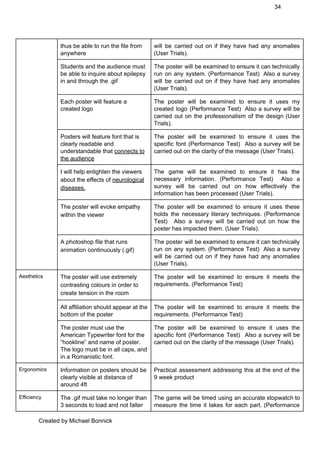
 
List:​ Give a sequence of brief answers with no explanation. 
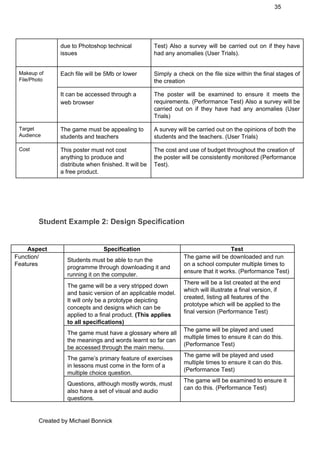
Created by Michael Bonnick 
95 
 
Outline:​ Give a brief account. 
 
Present:​ Offer for display, observation, examination or consideration. 
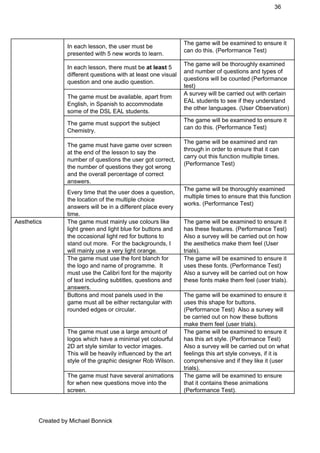
 
Prioritize:​ Give relative importance to, or put in an order of preference. 
 
State: ​Give a specific name, value or other brief answer without explanation or  
 
Summarize: ​Abstract a general theme or major point(s); parts and relationships, and to                         
interpret information to reach conclusions; practical application or effective state; solutions or                       
methods in relation to selected criteria; distinguishing fact or feature; calculation. 
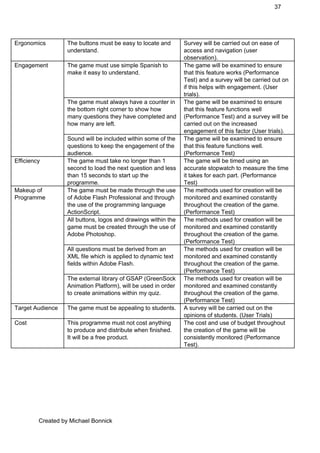
Created by Michael Bonnick 

MYP Design Cycle Resource