 Main program and pipeline – Mattias 
 2D correspondence extraction – Alexander 
 Non-linear optimization – Martin 
 Visualization – Gustav
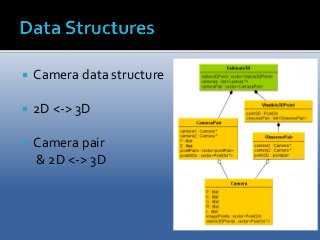
 Camera data structure 
 2D <-> 3D 
 Camera pair 
& 2D <-> 3D
 Difficult data set 
 Outliers 
 Long time before results are seen
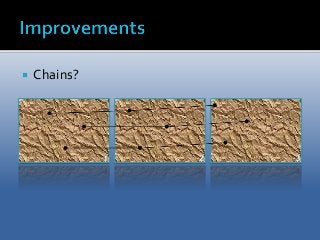
 Chains?
 Find feature points, using Harris response 
 Minimum relative quality 
 Minimum distance 
 Calculate descriptor, using SIFT 
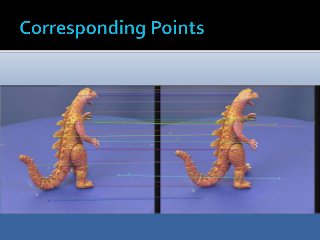
 Calculate correspondences, using Brute Force
 Initial relation between cameras is calculated 
from the essential matrix, according to 
algorithm described in an epic compendium 
by Klas Nordberg. 
 Results used as initial guess for PnP
 Implemented using the levmar API 
 Called three times in one pipeline iteration 
 Last step of Gold Standard algorithm 
 PnP pose estimation 
 Bundle adjustment 
 Minimizes squared re-projection error over 
specified parameters.
 Vector representation 
 Support exists in OpenCV: (cv::Rodrigues) 
 Allows for unconstrained optimization 
 Ambiguity in the representation
 Initial guess derived from F (R & t) 
 Use known correspondences from previous 
view 
 Threshold new points on re-projection error 
to remove outliers
 Same rotation parameterization as the one used 
for solving the PnP 
 Computation time scales badly with the number 
of points and views 
 Dinosaur set takes more than ten hours to complete 
(30 points per view) 
 Slow mainly because 
 No sparse pattern is used for Jacobian estimation 
 levmar was not built using LAPACK
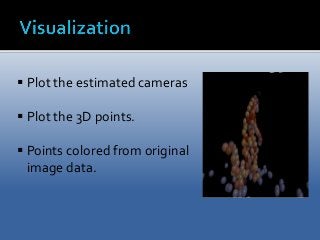
 Plot the estimated cameras 
 Plot the 3D points. 
 Points colored from original 
image data.
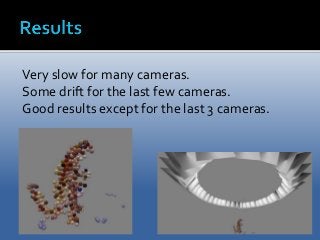
Very slow for many cameras. 
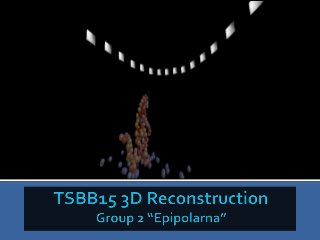
Some drift for the last few cameras. 
Good results except for the last 3 cameras.

Epipolarna - Project Presentation - 3D Reconstruction

  • 2.
     Main programand pipeline – Mattias  2D correspondence extraction – Alexander  Non-linear optimization – Martin  Visualization – Gustav
  • 4.
     Camera datastructure  2D <-> 3D  Camera pair & 2D <-> 3D
  • 5.
     Difficult dataset  Outliers  Long time before results are seen
  • 6.
  • 7.
     Find featurepoints, using Harris response  Minimum relative quality  Minimum distance  Calculate descriptor, using SIFT  Calculate correspondences, using Brute Force
  • 10.
     Initial relationbetween cameras is calculated from the essential matrix, according to algorithm described in an epic compendium by Klas Nordberg.  Results used as initial guess for PnP
  • 11.
     Implemented usingthe levmar API  Called three times in one pipeline iteration  Last step of Gold Standard algorithm  PnP pose estimation  Bundle adjustment  Minimizes squared re-projection error over specified parameters.
  • 12.
     Vector representation  Support exists in OpenCV: (cv::Rodrigues)  Allows for unconstrained optimization  Ambiguity in the representation
  • 13.
     Initial guessderived from F (R & t)  Use known correspondences from previous view  Threshold new points on re-projection error to remove outliers
  • 14.
     Same rotationparameterization as the one used for solving the PnP  Computation time scales badly with the number of points and views  Dinosaur set takes more than ten hours to complete (30 points per view)  Slow mainly because  No sparse pattern is used for Jacobian estimation  levmar was not built using LAPACK
  • 15.
     Plot theestimated cameras  Plot the 3D points.  Points colored from original image data.
  • 16.
    Very slow formany cameras. Some drift for the last few cameras. Good results except for the last 3 cameras.