
DEMONSTRATING DIGITAL TRANSFORMATION – REIMAGINING
ASSESSMENT AND FEEDBACK
5TH JUNE 2023
The UCL assessment journey
Simon Walker and Marieke Guy
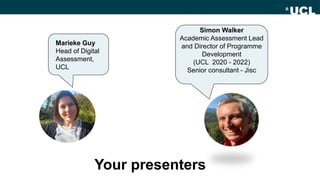
Simon Walker
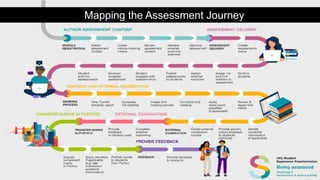
Academic Assessment Lead
and Director of Programme
Development
(UCL 2020 - 2022)
Senior consultant - Jisc
Marieke Guy
Head of Digital
Assessment,
UCL
Your presenters
UCL
(University College
London)
• 11 faculties, 60+ departments
• 43,800 students, 14,300 employees, 440
undergraduate programmes, 675
postgraduate programmes
• 53% international students, 150+
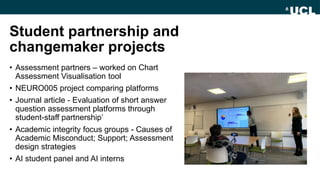
nationalities
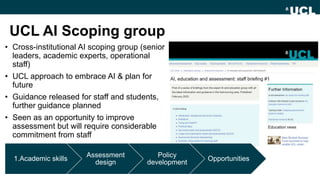
• C520,000 student to assessment
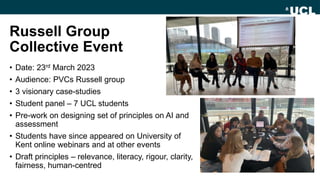
instances
Response to Covid – the
bump in the road!
Aims
1. Deliver and implement a secure solution for digital
assessment
2. Integrate with UCL’s student system (SITS)
3. Offer a range of assessment tools for departments
4. Enable departments to deliver their assessments
on dedicated assessment platform(s)
Lecturer
Examiner
Reviewer
Design
assessment
content and
send for
review
Review
assessment
and approve
Upload exam/
assessment
papers as file
Student
Academic
Services
Requirement
Priority:
MUST
SHOULD
Assessmen
t Design &
Review
Schedule
exams / assign
assessment
deadlines
SCIENTIA
[Exam
Timetable]
SITS / Portico
1.Student data
2. Module data
3. Examiner
data
4. Invigilator
data
5. Marks
Technical
Support/
ISD
Assessment Delivery
Department
s
Systems
Marking and Feedback Interfaces
Reporting
Examinations
Team
Student
Wellbeing &
Welfare Team
Digital
Education TBC
SORA
adjustments:
e.g. additional
time
Complete Mock
Exams / Access
Training
material
Access and
complete exam
Access and
complete
assessment
Lockdown
Browser: Closed
book/Remote
exams
Access
supporting
tools: timer;
ruler; calculator;
etc
Access
reference
material
Receive results
& feedback
Verify ID
Exams:
MCQ
Short
answer/SBA
Long answer
Open book
Closed book
Remote
Assessments:
Coursework
Groupwork
OSCE
Presentations
Video/Aural/Oral
Images/Blogs
Journals/WIKI
Raise support
call
Complete
exams in
different time
zones
Online/remote
Invigilation
Peer
Assessments
External
Examiner
Invigilator
Legend:
Process
Role
Receive
submission
receipt
Import student
assessment
data
System
requirements
& Support
Analytics
Various
roles
Dashboards
Run reports;
export into csv
Design
Rubrics and
marking
scales
Platform
access
Assign PIN /
Passcode for
student access
to exams
Track progress
of exams/
assessments
Access for
external users
[e.g. Token]
Provide remote
assistance to
end user
Turnitin
Role based
access
Single Sign On
access for
internal users
Marking methods:
Double marking
Blind marking
Comparative
Multiple markers Review and
agree marks
Marking against
Rubrics/Marking
scales
Marking modes:
Automated
Semi automated
Manual marking
Marks
reconciliation/
collaborate with
other markers
Provide
feedback to
students
Workflow
driven tasks
Reporting
Automated
upload of marks
into SITS
Network
resilience
[connectivity]
Security / Data
Accessibility
System
Maintenance
and Support
Import Exam
Times/Submissi
on deadlines
Anonymous
marking
Web based
system
System
interfaces
Control access
during exams
Delivery of
STEM
subjects; Art &
Design,
Medical &
Languages
Plagiarism
check
Marking
innovative
assessment
types
Make notes
Flag
assessment
for external
moderation
Active
Directory
What
we
wanted
Mapping the Assessment Journey
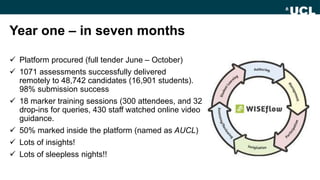
Year one – in seven months
 Platform procured (full tender June – October)
 1071 assessments successfully delivered
remotely to 48,742 candidates (16,901 students).
98% submission success
 18 marker training sessions (300 attendees, and 32
drop-ins for queries, 430 staff watched online video
guidance.
 50% marked inside the platform (named as AUCL)
 Lots of insights!
 Lots of sleepless nights!!
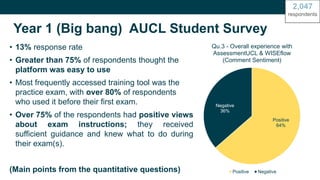
Year 1 (Big bang) AUCL Student Survey
• 13% response rate
• Greater than 75% of respondents thought the
platform was easy to use
• Most frequently accessed training tool was the
practice exam, with over 80% of respondents
who used it before their first exam.
• Over 75% of the respondents had positive views
about exam instructions; they received
sufficient guidance and knew what to do during
their exam(s).
(Main points from the quantitative questions)
Positive
64%
Negative
36%
Qu.3 - Overall experience with
AssessmentUCL & WISEflow
(Comment Sentiment)
Positive Negative
2,047
respondents
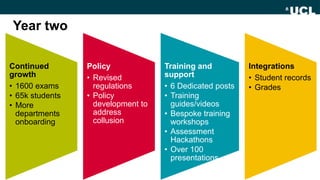
Year two
Continued
growth
• 1600 exams
• 65k students
• More
departments
onboarding
Policy
• Revised
regulations
• Policy
development to
address
collusion
Training and
support
• 6 Dedicated posts
• Training
guides/videos
• Bespoke training
workshops
• Assessment
Hackathons
• Over 100
presentations
Integrations
• Student records
• Grades
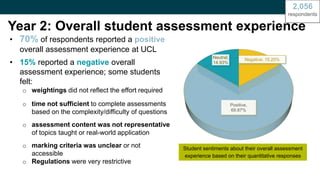
• 70% of respondents reported a positive
overall assessment experience at UCL
• 15% reported a negative overall
assessment experience; some students
felt:
o weightings did not reflect the effort required
o time not sufficient to complete assessments
based on the complexity/difficulty of questions
o assessment content was not representative
of topics taught or real-world application
o marking criteria was unclear or not
accessible
o Regulations were very restrictive
Year 2: Overall student assessment experience
Negative, 15.20%
Positive,
69.87%
Neutral,
14.93%
Student sentiments about their overall assessment
experience based on their quantitative responses
2,056
respondents
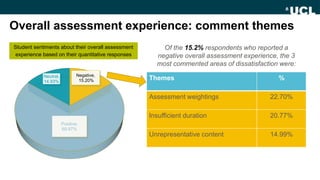
Overall assessment experience: comment themes
Of the 15.2% respondents who reported a
negative overall assessment experience, the 3
most commented areas of dissatisfaction were:
Themes %
Assessment weightings 22.70%
Insufficient duration 20.77%
Unrepresentative content 14.99%
Student sentiments about their overall assessment
experience based on their quantitative responses
Negative,
15.20%
Positive,
69.87%
Neutral,
14.93%
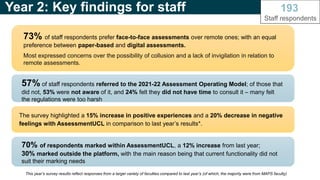
Year 2: Key findings for staff
The survey highlighted a 15% increase in positive experiences and a 20% decrease in negative
feelings with AssessmentUCL in comparison to last year’s results*.
193
Staff respondents
73% of staff respondents prefer face-to-face assessments over remote ones; with an equal
preference between paper-based and digital assessments.
Most expressed concerns over the possibility of collusion and a lack of invigilation in relation to
remote assessments.
57% of staff respondents referred to the 2021-22 Assessment Operating Model; of those that
did not, 53% were not aware of it, and 24% felt they did not have time to consult it – many felt
the regulations were too harsh
This year’s survey results reflect responses from a larger variety of faculties compared to last year’s (of which, the majority were from MAPS faculty)
70% of respondents marked within AssessmentUCL, a 12% increase from last year;
30% marked outside the platform, with the main reason being that current functionality did not
suit their marking needs
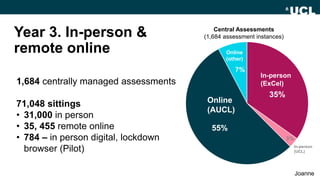
35%
3%
55%
7%
In-person
(ExCel)
Online
(AUCL)
Online
(other)
In-person
(UCL)
Central Assessments
(1,684 assessment instances)
1,684 centrally managed assessments
71,048 sittings
• 31,000 in person
• 35, 455 remote online
• 784 – in person digital, lockdown
browser (Pilot)
Joanne
Year 3. In-person &
remote online
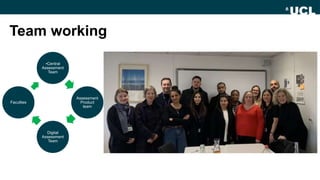
Team working
•Central
Assessment
Team
Assessment
Product
team
Digital
Assessment
Team
Faculties
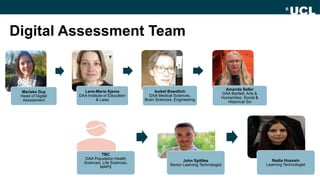
Digital Assessment Team
TBC
DAA Population Health
Sciences, Life Sciences,
MAPS
John Spittles
Senior Learning Technologist
Nadia Hussain
Learning Technologist
Marieke Guy
Head of Digital
Assessment
Lene-Marie Kjems
DAA Institute of Education
& Laws
Isobel Bowditch
DAA Medical Sciences,
Brain Sciences, Engineering
Amanda Seller
DAA Bartlett, Arts &
Humanities, Social &
Historical Sci
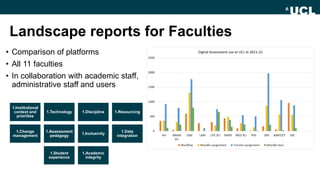
Landscape reports for Faculties
• Comparison of platforms
• All 11 faculties
• In collaboration with academic staff,
administrative staff and users
1.Institutional
context and
priorities
1.Technology 1.Discipline 1.Resourcing
1.Change
management
1.Assessment
pedagogy
1.Inclusivity
1.Data
integration
1.Student
experience
1.Academic
integrity
Quiz &
Poll
Video
Institutional
Departmental
File
upload
Portfolio
Group
work
Software
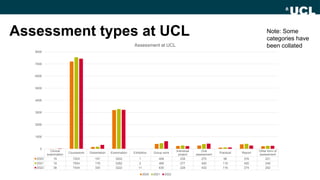
Assessment types at UCL
Clinical
examination
Coursework Dissertation Examination Exhibition Group work
Individual
project
Oral
assessment
Practical Report
Other form of
assessment
2020 19 7203 157 3202 1 408 238 275 96 376 221
2021 19 7554 178 3282 2 469 277 400 119 420 249
2022 38 7434 330 3222 11 630 228 432 116 274 252
0
1000
2000
3000
4000
5000
6000
7000
8000
Assessment at UCL
2020 2021 2022
Note: Some
categories have
been collated
Impact of AI
Assessment redesign
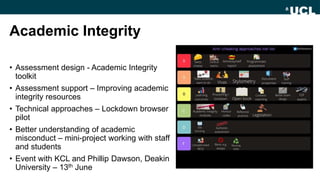
Academic Integrity
• Assessment design - Academic Integrity
toolkit
• Assessment support – Improving academic
integrity resources
• Technical approaches – Lockdown browser
pilot
• Better understanding of academic
misconduct – mini-project working with staff
and students
• Event with KCL and Phillip Dawson, Deakin
University – 13th June
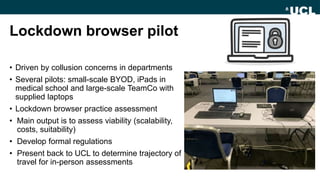
Lockdown browser pilot
• Driven by collusion concerns in departments
• Several pilots: small-scale BYOD, iPads in
medical school and large-scale TeamCo with
supplied laptops
• Lockdown browser practice assessment
• Main output is to assess viability (scalability,
costs, suitability)
• Develop formal regulations
• Present back to UCL to determine trajectory of
travel for in-person assessments
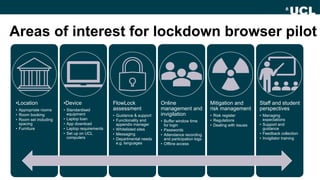
Areas of interest for lockdown browser pilot
•Location
• Appropriate rooms
• Room booking
• Room set including
spacing
• Furniture
•Device
• Standardised
equipment
• Laptop loan
• App download
• Laptop requirements
• Set up on UCL
computers
FlowLock
assessment
• Guidance & support
• Functionality and
appendix manager
• Whitelisted sites
• Messaging
• Departmental needs
e.g. languages
Online
management and
invigilation
• Buffer window time
for login
• Passwords
• Attendance recording
and participation logs
• Offline access
Mitigation and
risk management
• Risk register
• Regulations
• Dealing with issues
Staff and student
perspectives
• Managing
expectations
• Support and
guidance
• Feedback collection
• Invigilator training
Student partnership and
changemaker projects
• Assessment partners – worked on Chart
Assessment Visualisation tool
• NEURO005 project comparing platforms
• Journal article - Evaluation of short answer
question assessment platforms through
student-staff partnership’
• Academic integrity focus groups - Causes of
Academic Misconduct; Support; Assessment
design strategies
• AI student panel and AI interns
UCL AI Scoping group
• Cross-institutional AI scoping group (senior
leaders, academic experts, operational
staff)
• UCL approach to embrace AI & plan for
future
• Guidance released for staff and students,
further guidance planned
• Seen as an opportunity to improve
assessment but will require considerable
commitment from staff
1.Academic skills
Assessment
design
Policy
development
Opportunities
Russell Group
Collective Event
• Date: 23rd March 2023
• Audience: PVCs Russell group
• 3 visionary case-studies
• Student panel – 7 UCL students
• Pre-work on designing set of principles on AI and
assessment
• Students have since appeared on University of
Kent online webinars and at other events
• Draft principles – relevance, literacy, rigour, clarity,
fairness, human-centred
FUTURE
Planned areas of work
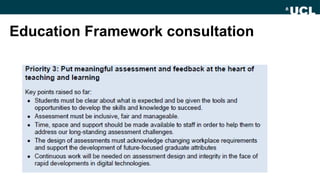
Education Framework consultation
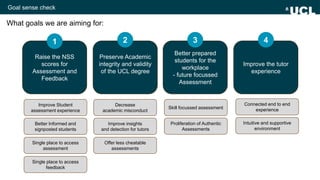
Goal sense check
What goals we are aiming for:
Raise the NSS
scores for
Assessment and
Feedback
Preserve Academic
integrity and validity
of the UCL degree
Better prepared
students for the
workplace
- future focussed
Assessment
Improve the tutor
experience
Improve Student
assessment experience
Better Informed and
signposted students
Single place to access
assessment
Single place to access
feedback
1 2 3 4
Decrease
academic misconduct
Improve insights
and detection for tutors
Offer less cheatable
assessments
Skill focussed assessment
Connected end to end
experience
Intuitive and supportive
environment
Proliferation of Authentic
Assessments
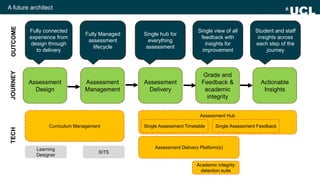
A future architect
Assessment
Design
Assessment
Management
Assessment
Delivery
Grade and
Feedback &
academic
integrity
SITS
Moodle
Actionable
Insights
JOURNEY
TECH
OUTCOME
Curriculum Management
Learning
Designer
Mahara
Turnitin
Fully connected
experience from
design through
to delivery
Fully Managed
assessment
lifecycle
Single hub for
everything
assessment
Single view of all
feedback with
insights for
improvement
Student and staff
insights across
each step of the
journey
Teams
Assessment Hub
Assessment Delivery Platform(s)
Academic integrity
detection suite
Single Assessment Timetable Single Assessment Feedback
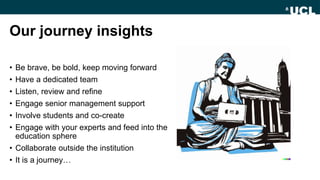
Our journey insights
• Be brave, be bold, keep moving forward
• Have a dedicated team
• Listen, review and refine
• Engage senior management support
• Involve students and co-create
• Engage with your experts and feed into the
education sphere
• Collaborate outside the institution
• It is a journey…

The UCL assessment journey

  • 1.
    DEMONSTRATING DIGITAL TRANSFORMATION– REIMAGINING ASSESSMENT AND FEEDBACK 5TH JUNE 2023 The UCL assessment journey Simon Walker and Marieke Guy
  • 2.
    Simon Walker Academic AssessmentLead and Director of Programme Development (UCL 2020 - 2022) Senior consultant - Jisc Marieke Guy Head of Digital Assessment, UCL Your presenters
  • 3.
    UCL (University College London) • 11faculties, 60+ departments • 43,800 students, 14,300 employees, 440 undergraduate programmes, 675 postgraduate programmes • 53% international students, 150+ nationalities • C520,000 student to assessment instances
  • 4.
    Response to Covid– the bump in the road!
  • 5.
    Aims 1. Deliver andimplement a secure solution for digital assessment 2. Integrate with UCL’s student system (SITS) 3. Offer a range of assessment tools for departments 4. Enable departments to deliver their assessments on dedicated assessment platform(s)
  • 6.
    Lecturer Examiner Reviewer Design assessment content and send for review Review assessment andapprove Upload exam/ assessment papers as file Student Academic Services Requirement Priority: MUST SHOULD Assessmen t Design & Review Schedule exams / assign assessment deadlines SCIENTIA [Exam Timetable] SITS / Portico 1.Student data 2. Module data 3. Examiner data 4. Invigilator data 5. Marks Technical Support/ ISD Assessment Delivery Department s Systems Marking and Feedback Interfaces Reporting Examinations Team Student Wellbeing & Welfare Team Digital Education TBC SORA adjustments: e.g. additional time Complete Mock Exams / Access Training material Access and complete exam Access and complete assessment Lockdown Browser: Closed book/Remote exams Access supporting tools: timer; ruler; calculator; etc Access reference material Receive results & feedback Verify ID Exams: MCQ Short answer/SBA Long answer Open book Closed book Remote Assessments: Coursework Groupwork OSCE Presentations Video/Aural/Oral Images/Blogs Journals/WIKI Raise support call Complete exams in different time zones Online/remote Invigilation Peer Assessments External Examiner Invigilator Legend: Process Role Receive submission receipt Import student assessment data System requirements & Support Analytics Various roles Dashboards Run reports; export into csv Design Rubrics and marking scales Platform access Assign PIN / Passcode for student access to exams Track progress of exams/ assessments Access for external users [e.g. Token] Provide remote assistance to end user Turnitin Role based access Single Sign On access for internal users Marking methods: Double marking Blind marking Comparative Multiple markers Review and agree marks Marking against Rubrics/Marking scales Marking modes: Automated Semi automated Manual marking Marks reconciliation/ collaborate with other markers Provide feedback to students Workflow driven tasks Reporting Automated upload of marks into SITS Network resilience [connectivity] Security / Data Accessibility System Maintenance and Support Import Exam Times/Submissi on deadlines Anonymous marking Web based system System interfaces Control access during exams Delivery of STEM subjects; Art & Design, Medical & Languages Plagiarism check Marking innovative assessment types Make notes Flag assessment for external moderation Active Directory What we wanted
  • 7.
  • 8.
    Year one –in seven months  Platform procured (full tender June – October)  1071 assessments successfully delivered remotely to 48,742 candidates (16,901 students). 98% submission success  18 marker training sessions (300 attendees, and 32 drop-ins for queries, 430 staff watched online video guidance.  50% marked inside the platform (named as AUCL)  Lots of insights!  Lots of sleepless nights!!
  • 9.
    Year 1 (Bigbang) AUCL Student Survey • 13% response rate • Greater than 75% of respondents thought the platform was easy to use • Most frequently accessed training tool was the practice exam, with over 80% of respondents who used it before their first exam. • Over 75% of the respondents had positive views about exam instructions; they received sufficient guidance and knew what to do during their exam(s). (Main points from the quantitative questions) Positive 64% Negative 36% Qu.3 - Overall experience with AssessmentUCL & WISEflow (Comment Sentiment) Positive Negative 2,047 respondents
  • 10.
    Year two Continued growth • 1600exams • 65k students • More departments onboarding Policy • Revised regulations • Policy development to address collusion Training and support • 6 Dedicated posts • Training guides/videos • Bespoke training workshops • Assessment Hackathons • Over 100 presentations Integrations • Student records • Grades
  • 11.
    • 70% ofrespondents reported a positive overall assessment experience at UCL • 15% reported a negative overall assessment experience; some students felt: o weightings did not reflect the effort required o time not sufficient to complete assessments based on the complexity/difficulty of questions o assessment content was not representative of topics taught or real-world application o marking criteria was unclear or not accessible o Regulations were very restrictive Year 2: Overall student assessment experience Negative, 15.20% Positive, 69.87% Neutral, 14.93% Student sentiments about their overall assessment experience based on their quantitative responses 2,056 respondents
  • 12.
    Overall assessment experience:comment themes Of the 15.2% respondents who reported a negative overall assessment experience, the 3 most commented areas of dissatisfaction were: Themes % Assessment weightings 22.70% Insufficient duration 20.77% Unrepresentative content 14.99% Student sentiments about their overall assessment experience based on their quantitative responses Negative, 15.20% Positive, 69.87% Neutral, 14.93%
  • 13.
    Year 2: Keyfindings for staff The survey highlighted a 15% increase in positive experiences and a 20% decrease in negative feelings with AssessmentUCL in comparison to last year’s results*. 193 Staff respondents 73% of staff respondents prefer face-to-face assessments over remote ones; with an equal preference between paper-based and digital assessments. Most expressed concerns over the possibility of collusion and a lack of invigilation in relation to remote assessments. 57% of staff respondents referred to the 2021-22 Assessment Operating Model; of those that did not, 53% were not aware of it, and 24% felt they did not have time to consult it – many felt the regulations were too harsh This year’s survey results reflect responses from a larger variety of faculties compared to last year’s (of which, the majority were from MAPS faculty) 70% of respondents marked within AssessmentUCL, a 12% increase from last year; 30% marked outside the platform, with the main reason being that current functionality did not suit their marking needs
  • 14.
    35% 3% 55% 7% In-person (ExCel) Online (AUCL) Online (other) In-person (UCL) Central Assessments (1,684 assessmentinstances) 1,684 centrally managed assessments 71,048 sittings • 31,000 in person • 35, 455 remote online • 784 – in person digital, lockdown browser (Pilot) Joanne Year 3. In-person & remote online
  • 15.
  • 16.
    Digital Assessment Team TBC DAAPopulation Health Sciences, Life Sciences, MAPS John Spittles Senior Learning Technologist Nadia Hussain Learning Technologist Marieke Guy Head of Digital Assessment Lene-Marie Kjems DAA Institute of Education & Laws Isobel Bowditch DAA Medical Sciences, Brain Sciences, Engineering Amanda Seller DAA Bartlett, Arts & Humanities, Social & Historical Sci
  • 17.
    Landscape reports forFaculties • Comparison of platforms • All 11 faculties • In collaboration with academic staff, administrative staff and users 1.Institutional context and priorities 1.Technology 1.Discipline 1.Resourcing 1.Change management 1.Assessment pedagogy 1.Inclusivity 1.Data integration 1.Student experience 1.Academic integrity
  • 18.
  • 19.
    Assessment types atUCL Clinical examination Coursework Dissertation Examination Exhibition Group work Individual project Oral assessment Practical Report Other form of assessment 2020 19 7203 157 3202 1 408 238 275 96 376 221 2021 19 7554 178 3282 2 469 277 400 119 420 249 2022 38 7434 330 3222 11 630 228 432 116 274 252 0 1000 2000 3000 4000 5000 6000 7000 8000 Assessment at UCL 2020 2021 2022 Note: Some categories have been collated
  • 20.
  • 21.
    Academic Integrity • Assessmentdesign - Academic Integrity toolkit • Assessment support – Improving academic integrity resources • Technical approaches – Lockdown browser pilot • Better understanding of academic misconduct – mini-project working with staff and students • Event with KCL and Phillip Dawson, Deakin University – 13th June
  • 22.
    Lockdown browser pilot •Driven by collusion concerns in departments • Several pilots: small-scale BYOD, iPads in medical school and large-scale TeamCo with supplied laptops • Lockdown browser practice assessment • Main output is to assess viability (scalability, costs, suitability) • Develop formal regulations • Present back to UCL to determine trajectory of travel for in-person assessments
  • 23.
    Areas of interestfor lockdown browser pilot •Location • Appropriate rooms • Room booking • Room set including spacing • Furniture •Device • Standardised equipment • Laptop loan • App download • Laptop requirements • Set up on UCL computers FlowLock assessment • Guidance & support • Functionality and appendix manager • Whitelisted sites • Messaging • Departmental needs e.g. languages Online management and invigilation • Buffer window time for login • Passwords • Attendance recording and participation logs • Offline access Mitigation and risk management • Risk register • Regulations • Dealing with issues Staff and student perspectives • Managing expectations • Support and guidance • Feedback collection • Invigilator training
  • 24.
    Student partnership and changemakerprojects • Assessment partners – worked on Chart Assessment Visualisation tool • NEURO005 project comparing platforms • Journal article - Evaluation of short answer question assessment platforms through student-staff partnership’ • Academic integrity focus groups - Causes of Academic Misconduct; Support; Assessment design strategies • AI student panel and AI interns
  • 25.
    UCL AI Scopinggroup • Cross-institutional AI scoping group (senior leaders, academic experts, operational staff) • UCL approach to embrace AI & plan for future • Guidance released for staff and students, further guidance planned • Seen as an opportunity to improve assessment but will require considerable commitment from staff 1.Academic skills Assessment design Policy development Opportunities
  • 26.
    Russell Group Collective Event •Date: 23rd March 2023 • Audience: PVCs Russell group • 3 visionary case-studies • Student panel – 7 UCL students • Pre-work on designing set of principles on AI and assessment • Students have since appeared on University of Kent online webinars and at other events • Draft principles – relevance, literacy, rigour, clarity, fairness, human-centred
  • 27.
  • 28.
  • 29.
    Goal sense check Whatgoals we are aiming for: Raise the NSS scores for Assessment and Feedback Preserve Academic integrity and validity of the UCL degree Better prepared students for the workplace - future focussed Assessment Improve the tutor experience Improve Student assessment experience Better Informed and signposted students Single place to access assessment Single place to access feedback 1 2 3 4 Decrease academic misconduct Improve insights and detection for tutors Offer less cheatable assessments Skill focussed assessment Connected end to end experience Intuitive and supportive environment Proliferation of Authentic Assessments
  • 30.
    A future architect Assessment Design Assessment Management Assessment Delivery Gradeand Feedback & academic integrity SITS Moodle Actionable Insights JOURNEY TECH OUTCOME Curriculum Management Learning Designer Mahara Turnitin Fully connected experience from design through to delivery Fully Managed assessment lifecycle Single hub for everything assessment Single view of all feedback with insights for improvement Student and staff insights across each step of the journey Teams Assessment Hub Assessment Delivery Platform(s) Academic integrity detection suite Single Assessment Timetable Single Assessment Feedback
  • 31.
    Our journey insights •Be brave, be bold, keep moving forward • Have a dedicated team • Listen, review and refine • Engage senior management support • Involve students and co-create • Engage with your experts and feed into the education sphere • Collaborate outside the institution • It is a journey…

Editor's Notes

  • #4  — 1st in England to welcome students of any religion or social background. — 1st in England to welcome women to university education. — 1st in England to teach English, German, Chemistry, Engineering. — A brave and progressive approach that has continued to this day. — 1st in England to have a fully open access university press.
  • #16 Marieke starts
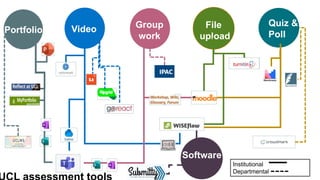
  • #19 This is just a little look at the assessment tools we currently have in the UCL ecosystem. Some are only used by particular deparments. Others are more widely used. Different tools support different pedagogic practice. For example MyPortfolio is UCLs version of Mahara, the eportfolio sister tool to Moodle (used for our Virtual Learning Environment). It is not well supported at UCL (by people or training) but could be more effectively used by many disciplines. Exploring this ecosystem and looking at how systems can be integrated or used in the future is an area we are very interested in.
  • #30  For everyone to gain an agreed set of goals and problems we are trying to solve t ensure we are all aligned
  • #31 A future architecture (maybe for another slide deck)