FREE subscription if you recommend Hot English Language Services to your company. E-mail classes@learnhotenglish.com / www.learnhotenglish.com / 39
10 ways to
improve your life!
W
ant to earn more
money, have more
time for yourself
and live a happier life? If so,
why not try incorporating a
few of these ideas into your
daily routine?
Get rid of any clutter. Go
through your drawers and
cupboards and throw out
any old magazines, keys
and batteries that you’ve
accumulated over the years.
Walk around your home and
identify 10 things you need
to fix: a broken light bulb,
a missing button, a broken
kitchen cupboard door. Then,
try to repair them one by one
for the next 10 weeks.
Psychologists say that one
of the best ways to motivate
yourself is to write down five
things you’re really grateful
for. Try it!
Make a list of 10 to 20 things
that you enjoy doing. For
example: walking in the park,
going to the cinema, chatting
with friends. Then, try to do at
least one of them every day.
Stop thinking about all the
things you should have
done or could have done
and focus instead on the
things that you can do and
will do. As soon as any
negative thoughts try to
creep in, start thinking of
something more positive.
Try to learn at least one new
thing every day: the name of
a tree that grows in the park
near your house, an unusual
word from the dictionary,
the composer of a piece of
music that you like...
Track every penny you spend
for the next four weeks.
Then, create a spending
plan and try to stick to it.
Also, look up any tips on
how to save money. For
example: go shopping with a
list, turn off lights any time
you leave the room, put on
a sweater instead of turning
on the heating...
Make a list of all the things
you’ve got to do and put
them into two columns:
“must do” and “would like to
do”. Then, prioritise the ones
on the “must-do” list and try
to cross off at least one every
week for the next few months.
Track how you spend your
time for 30 days. Then, use
the information to create a
time plan. You can decide
on the percentage of your
time that you want to devote
to each activity that you
engage in on a regular basis.
Also, set a time limit (one
hour, for example) for the
amount of time you spend
checking your e-mails,
visiting Facebook and
surfing the internet. And
try to watch a maximum
of one hour of television a
day. Instead of watching TV,
you could read a book or do
something else creative.
Spend a few minutes at the
end of each day organising
your desk, filing papers, and
making sure that your work
area is clean and orderly, so
that you can walk in to a neat
desk the next day. Also, do
the washing up and tidy up
the living room before you go
to bed. There’s nothing worse
than waking up to mess.
You’re probably feeling a
whole lot better already!
Answers on page 44
1 Pre-reading
What five things could you do
to improve your life right now?
Make notes.
2 Reading I
Read or listen to the article
once. Which ideas do you
like? Which ones could you
incorporate into your life?
3 Reading II
Read or listen to the article
again. Then, answer the
questions without referring
back to the article.
1.	 How does the writer
suggest you get rid of
any clutter?
2. 	What advice do
psychologists have for
motivating yourself?
3. 	What does the writer
say you should do if you
start having negative
thoughts?
4. 	How does the writer
suggest you can save
money?
5. 	What does the writer
say you should do with
the things on your
“must-do” list?
6. 	How much time does
the writer suggest
spending on web-
related activities?
Skills
Booklet
unit 13 page 70 Healthy times!
Objective To improve your listening and reading skills.
Think about it 	How do you organise your time? How could you improve your time management? Do you keep
track of your spending? Why? Why not? Do you have a filing system at home? How does it work? Would you describe
yourself as an organised person? Give examples. Which areas of your life would you like to improve? Why?
Exams This activity will help prepare you for English exams such as CAE, IELTS and TOEFL.
Track27:englishman&usman
Video
Watch this video on how to
improve your life. Search
YouTube for “How to Improve
Your Life By Thinking Outside
the Box”.
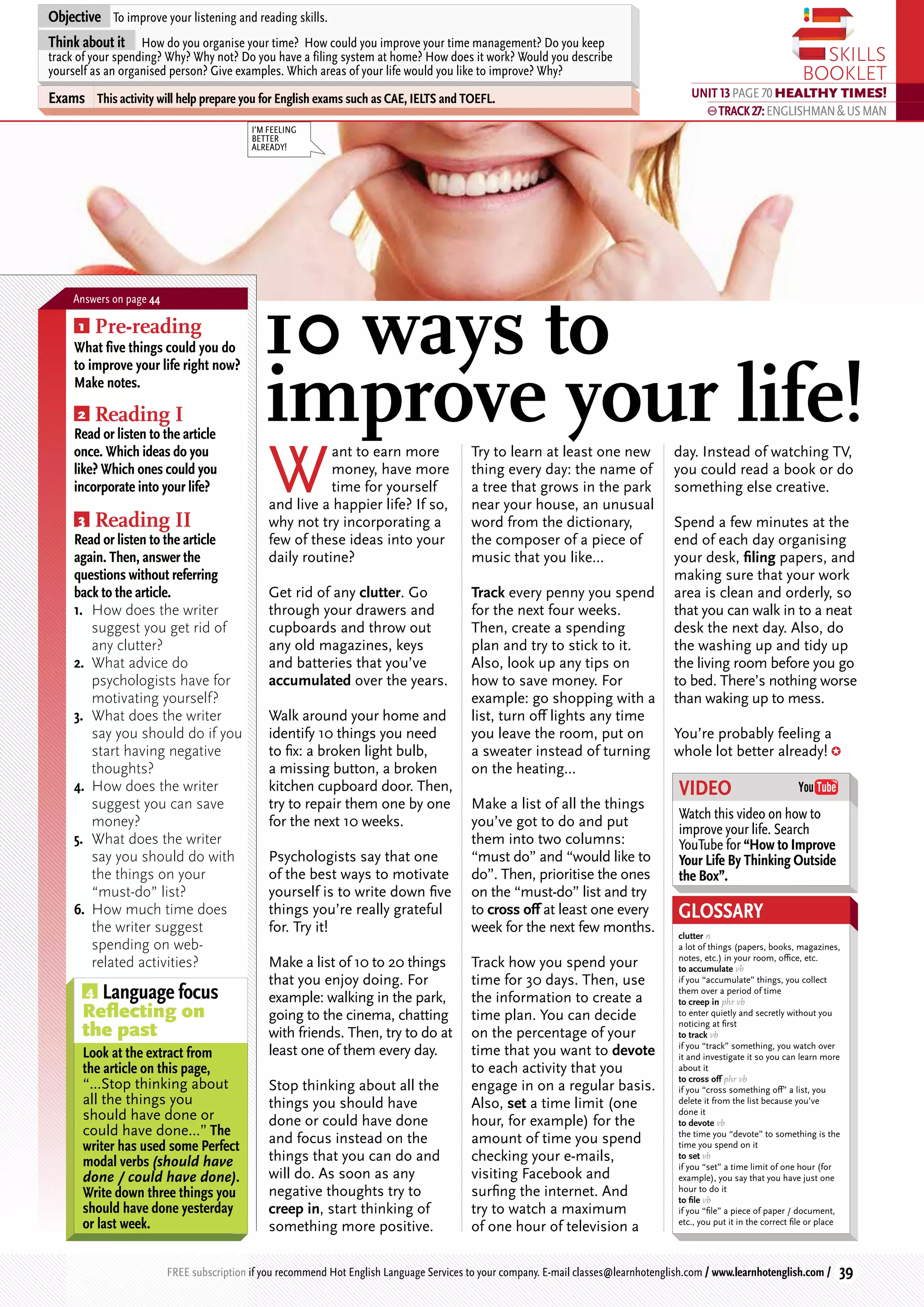
i’m feeling
better
already!
GLOSSARY
Look at the extract from
the article on this page,
“...Stop thinking about
all the things you
should have done or
could have done...” The
writer has used some Perfect
modal verbs (should have
done / could have done).
Write down three things you
should have done yesterday
or last week.
clutter n		
a lot of things (papers, books, magazines,
notes, etc.) in your room, office, etc.
to accumulate vb	
if you “accumulate” things, you collect
them over a period of time
to creep in phr vb	
to enter quietly and secretly without you
noticing at first
to track vb		
if you “track” something, you watch over
it and investigate it so you can learn more
about it
to cross off phr vb	
if you “cross something off” a list, you
delete it from the list because you’ve
done it
to devote vb		
the time you “devote” to something is the
time you spend on it
to set vb			
if you “set” a time limit of one hour (for
example), you say that you have just one
hour to do it
to file vb		
if you “file” a piece of paper / document,
etc., you put it in the correct file or place
4 Language focus
Reflecting on
the past

Improve life143

  • 1.
    FREE subscription ifyou recommend Hot English Language Services to your company. E-mail classes@learnhotenglish.com / www.learnhotenglish.com / 39 10 ways to improve your life! W ant to earn more money, have more time for yourself and live a happier life? If so, why not try incorporating a few of these ideas into your daily routine? Get rid of any clutter. Go through your drawers and cupboards and throw out any old magazines, keys and batteries that you’ve accumulated over the years. Walk around your home and identify 10 things you need to fix: a broken light bulb, a missing button, a broken kitchen cupboard door. Then, try to repair them one by one for the next 10 weeks. Psychologists say that one of the best ways to motivate yourself is to write down five things you’re really grateful for. Try it! Make a list of 10 to 20 things that you enjoy doing. For example: walking in the park, going to the cinema, chatting with friends. Then, try to do at least one of them every day. Stop thinking about all the things you should have done or could have done and focus instead on the things that you can do and will do. As soon as any negative thoughts try to creep in, start thinking of something more positive. Try to learn at least one new thing every day: the name of a tree that grows in the park near your house, an unusual word from the dictionary, the composer of a piece of music that you like... Track every penny you spend for the next four weeks. Then, create a spending plan and try to stick to it. Also, look up any tips on how to save money. For example: go shopping with a list, turn off lights any time you leave the room, put on a sweater instead of turning on the heating... Make a list of all the things you’ve got to do and put them into two columns: “must do” and “would like to do”. Then, prioritise the ones on the “must-do” list and try to cross off at least one every week for the next few months. Track how you spend your time for 30 days. Then, use the information to create a time plan. You can decide on the percentage of your time that you want to devote to each activity that you engage in on a regular basis. Also, set a time limit (one hour, for example) for the amount of time you spend checking your e-mails, visiting Facebook and surfing the internet. And try to watch a maximum of one hour of television a day. Instead of watching TV, you could read a book or do something else creative. Spend a few minutes at the end of each day organising your desk, filing papers, and making sure that your work area is clean and orderly, so that you can walk in to a neat desk the next day. Also, do the washing up and tidy up the living room before you go to bed. There’s nothing worse than waking up to mess. You’re probably feeling a whole lot better already! Answers on page 44 1 Pre-reading What five things could you do to improve your life right now? Make notes. 2 Reading I Read or listen to the article once. Which ideas do you like? Which ones could you incorporate into your life? 3 Reading II Read or listen to the article again. Then, answer the questions without referring back to the article. 1. How does the writer suggest you get rid of any clutter? 2. What advice do psychologists have for motivating yourself? 3. What does the writer say you should do if you start having negative thoughts? 4. How does the writer suggest you can save money? 5. What does the writer say you should do with the things on your “must-do” list? 6. How much time does the writer suggest spending on web- related activities? Skills Booklet unit 13 page 70 Healthy times! Objective To improve your listening and reading skills. Think about it How do you organise your time? How could you improve your time management? Do you keep track of your spending? Why? Why not? Do you have a filing system at home? How does it work? Would you describe yourself as an organised person? Give examples. Which areas of your life would you like to improve? Why? Exams This activity will help prepare you for English exams such as CAE, IELTS and TOEFL. Track27:englishman&usman Video Watch this video on how to improve your life. Search YouTube for “How to Improve Your Life By Thinking Outside the Box”. i’m feeling better already! GLOSSARY Look at the extract from the article on this page, “...Stop thinking about all the things you should have done or could have done...” The writer has used some Perfect modal verbs (should have done / could have done). Write down three things you should have done yesterday or last week. clutter n a lot of things (papers, books, magazines, notes, etc.) in your room, office, etc. to accumulate vb if you “accumulate” things, you collect them over a period of time to creep in phr vb to enter quietly and secretly without you noticing at first to track vb if you “track” something, you watch over it and investigate it so you can learn more about it to cross off phr vb if you “cross something off” a list, you delete it from the list because you’ve done it to devote vb the time you “devote” to something is the time you spend on it to set vb if you “set” a time limit of one hour (for example), you say that you have just one hour to do it to file vb if you “file” a piece of paper / document, etc., you put it in the correct file or place 4 Language focus Reflecting on the past