Applying System Thinking
in Teams
“Systems thinking is a discipline for
seeing wholes”
Peter Senge
Lorraine Steyn
@lor_krs
Ayesha Bagus
@ayesha_bagus
Systems Thinking is a discipline for seeing
wholes rather than parts,
patterns of change rather than static snapshots,
for understanding the subtle interconnectedness
that gives living systems their unique character.
Peter Senge
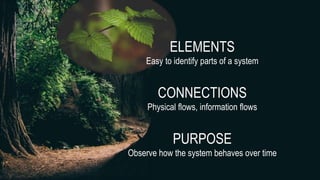
ELEMENTS
Easy to identify parts of a system
CONNECTIONS
Physical flows, information flows
PURPOSE
Observe how the system behaves over time
Balancing Feedback Loops
Reinforcing Feedback Loops
Causal Loop Diagrams
Hunger Food
-
+
B
Savings Acc
Interest
+
+
R
Money
Causal Loop Diagrams
Fishing Fish Population
-
-
R
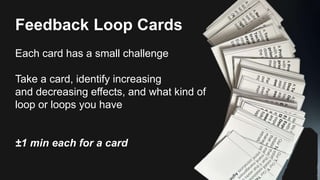
Feedback Loop Cards
Each card has a small challenge
Take a card, identify increasing
and decreasing effects, and what kind of
loop or loops you have
±1 min each for a card
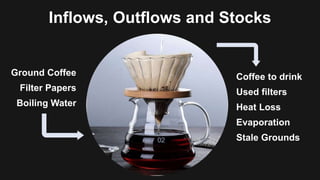
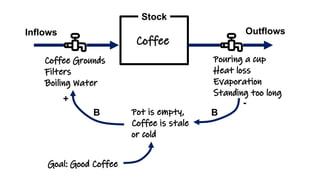
Inflows, Outflows and Stocks
Ground Coffee
Filter Papers
Boiling Water
Coffee to drink
Used filters
Heat Loss
Evaporation
Stale Grounds
Inflows Outflows
Stock
B B
+ -
Shifting our thinking to PEOPLE
Try it!
Examples of Team Stocks
Can we store it?
What creates the stock?
What depletes it?
Code as a Stock
Can we store it?
 Working Code
 Business value
 Is understood by Team
 Can be modified
Code Value is tied to Team Knowledge
Exercise:
What creates it?
What depletes it?
Image from Vincent Déniel
Code as a Stock
Boundaries
Shifting Boundaries
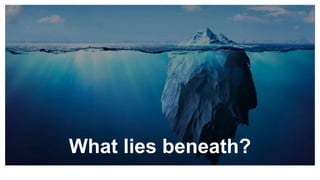
What lies beneath?
Microscope to Telescope
KRS Case Study
Offer more guidance
Wanted buy-in
Recognise all roles
Support diversity
Career Path Framework
R B
+ + +
-
Imagine, Research, Act
Purpose & Vision
A managers job
is to manage
the system not
the people
Sketch your ideal High Performing Team
Systems always behave exactly as they are designed,
just not always as they are intended.
Thinking in Systems – Donella Meadows
https://donellameadows.org/archives/envisioning-
video/
Intuition vs Analysis
Boundaries constrain the problem
(simplification)
More Great Systems Thinkers:
W Edwards Deming
Gerald Weinberg
Dr Russel Ackhoff
Peter Senge

Applying Systems Thinking in Teams.pptx

Editor's Notes

  • #2 Lor: Morning, ready for the day? Who has some background in ST? We’ll explain as we go, and we’ve got lots of exercises for you to practice ST 
  • #3 Lor; From CT, very windy, founder of a mid-sized software co, work closely with our various teams Ayesha: CT, 1ST AMS, People focused – ST LENS to support KRS, MOM
  • #4 AB – YOUR TURN  GAME to get to KNOW EACH OTHER  At your TABLE in GROUPS – 5 MINS FIND things in COMMON,  like PINEAPPLE on pizza, CATS or DOGS AVOID the obvious  Share interesting feedback – chocs for most interesting feedback
  • #5 Lor – how many devs in the room? Devs tend to be detailed people, and ST challenges us to look up and see the bigger picture To see patterns, and to see connections
  • #6 Lor – a system is defined not by its parts but by its purpose
  • #7 Lor - Bring variables back to a desired state – self correcting, stable
  • #8 Lor - Change is compounded to cause more change – instability, exponential growth, unstable
  • #9 Ayesha – Simple balancing loop – Hunger increases, eat, hunger decreases, back in balance
  • #10 Ayesha – Extra money, put in savings account, earn interest, get more money – Positive reinforcing loop
  • #11 Ayesha – Fishing, over fish, decreases the fishing population, which decreases the amount of fish available, this is a negative reinforcing loop.
  • #12 Ayesha –  to be discussed in teams Take a card explain the variables and verbs Variable= Element  Verb = Shows Action Idenitify loops
  • #13 Lor - Inflow outflow explanation with Team examples
  • #14 Lor
  • #15 Lor – Flipchart. What kind of stocks could a team need, or be? 2-3 Peppermint crisps
  • #16 Lor
  • #17 Lor
  • #18 Lor 1st gen developers have full mental models When the model breaks, you start to hack out pieces of the hedge to get anywhere!
  • #19 Lor Exercise for group 1st gen developers, library dependence, upgrades, mental models
  • #20 Ayesha: A conceptual line that divides the system you want to study from everything else A system can exist inside of a bigger system.  Different systems within the body.
  • #21 Ayesha Example: Learning to swim: Pool defined edges, shallow side Ocean: Vast, can be overwhelming, the ocean is often end goal,  As you build your systems mindset, start with a defined system boundary
  • #22 Ayesha conditions that influence the problem? issues, people or systems are working together to create what is seen above the water? ripple effects might be created by our solutions?
  • #23 Ayesha Able to wide your aperture, NOT just zoom in Maintain firm view of the landscape Balance holistic and reductionist thinking Move through these scales, shifting of perspectives to build a 3D worldview.
  • #24 Ayesha Conditioned - linear thinking, “cause-effect” thinking. Recognize relationships and interdependencies between  parts.  Look to feedback structure to understand why problems persist despite our best efforts. Seek to change the structure of the system by adding or removing feedback loops; strengthening or weakening loops.
  • #25 Lor we've been dealing with a concern around growing and developing people in our teams. We take on a lot of interns, and remote work has made it harder to help these developers grow. Even our seniors seem to be in a comfort zone, and not growing as we need. So we could blame the people, but Systems Thinking says we should look at how our systems support or hinder our people's growth. 
  • #26 Ayesha – Leadership team realised we need something to guide our careers, but not impose a very rigid framework Glue roles Diversity
  • #27 Ayesha
  • #28 Ayesha – SIMPLISTIC VIEW  Does this REALLY support our goal of increased AUTONOMY? INCREASE STRESS – Salary bands, demotions, do I MEET the NEEDS at my LEVEL? No BUY-IN  – How can we do this a BETTER way? Any IDEAS?
  • #29 Lor – Donella Meadows says that Vision should start with imagining your ideal scenario, research what is possible and then acting We jump to act and skip first 2 steps
  • #30 Lor – people are scared to think about ideal scenarios (Naive, neg words) What would be a great work environment, it's not pipe slides in the office (apologies to Lego) Let's imagine - What’s your idea of a great working environment? Arrive at desk, greet colleagues, happy? Type of work
  • #31 Lor - W Edwards Deming says a Bad System will beat a Good person every time
  • #32 Lor 2 part: 10 mins to discuss ideal team, 10 mins to discuss how systems prevent us reaching those ideals
  • #33 AB – beautiful COASTLINE, a common WALKING spot. These trees have been MOULDED by the wind we experience. Let's think about THAT when we are creating SYSTEMS.  At its HEART, seeing things through a WIDE LENS,  RECOGNISING how INTERCONNECTED we are,  and ACTING with EMPATHY and INNOVATION.
  • #34 Thank you for your time, we will open the floor for any questions, insights or comments.  Feel free to share personal stories or struggles you're having?