
A study on real/virtual
relationship through mobile
augmented reality applications

   Pier Giuseppe Rossi1, Laura Fedeli1,
   Annarita Bramucci1, Marco Polci2

   1
       University of Macerata , Italy

   2
       “Dante Alighieri” Institute, Macerata, Italy


       Learning & Teaching with Media & Technology
                   March, 7-9 2013 - Genoa, Italy
AR: the evolution
“any case in which an otherwise real environment is
  'augmented' by means of virtual (computer
  graphic) objects” (Milgram, Kishino, 1994).

“any system that 1) combines real and virtual, 2)
  is interactive in real time, and 3) is registered in
  three dimensions” (Azuma, 1995).

A conceptual issue that needs a new reference
  taxonomy: the relationship between real and
  virtual and the clarification of the processes of
  interrelation that defines if it’s either the “reality”
  or the “virtuality” to be augmented (Milgram and
  Colquhoun, 1998).
Aim of the research
 To clarify how the evolution of AR, as highlited by
  the literature, can be identified in the educational
  context and, specifically, in the class work;
 To go deeper in the concept of “mixed reality”.
AR in education
The school and the teaching/learning process must
  be interpreted also as the opportunity in which
  “the cultural practices of the use of mobile devices
  and their applications in everyday life need to be
  assimilated” (Pachler et al. , 2010, p. 2).

Considering the wider and wider interest in this field
  and its application in different educational context
  AR apps have been identified in the Horizon Report
  2013 as one of the technologies to be fully exploited
  in the next 3 years.
The research: goals
 To determine   if the use of AR applications to be
  used in a formal context through mobile devices,
  can create new perceptions of the relationship
  between real and virtual and, consequently, new
  practices in students in primary school.
 To make it explicit the nature of the “mixed reality”
  in which the student acts within the continuum
  real-virtual and the role played by the context in
  such a process.
The research framework
The research is framed in a qualitative approach and
  adopt a collaborative model . Specifically the
  university researchers didn’t develop their
  research process on primary school students and
  their teacher, but with them.

The collaboration between University and School
  takes into account the competence of the teacher in
  his context. That competence makes it proper to
  assign to the teacher the status of « collaborator »
  in the research (Desgagnè, Giddens, Schön).
The research questions
 Does the  involvement with AR apps modify the
  students’ perceptions of “real” and “virtual” and
  their relation?
 In what ways?
 What kind of conceptualization of “real”, “virtual”
  and their relation do the students have at the end of
  the AR project?
The participants


The research implied the participation of two classes
  of the Primary School “Fratelli Cervi”.
 Both classes are composed by 24 pupils aged 10;
 In both contexts the same teacher was involved as
  research collaborator.
The AR project
 Applyingthe “point at” app to connect trigger
 images to videos

 Both thetrigger image and the video are designed
 and created by pupils

 The final products are explored in class with i-
 PADs and that experience will be the focus of a
 collaborative reflection.
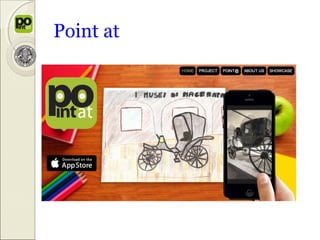
Point at
Showcase
“Point at”: how the app works
 The mobile AR app allows the recognition of physical
   objects and works as follows:
  Make a digital photo of the object (trigger image)
   and convert it with
   Qualcomm Vuforia Augmented Reality technology
   (trackable image);
  The trackable image is connected to a web resource
   (e.g. a video published on YouTube);
  The i-PAD rear camera points at the physical object
   and the app makes the connected web resource
   open.
The research timeline: 1
Preliminary step (December 2012) :
 Clinical interview with pupils;
 Description of AR apps and presentation of the aims of
  the class project;
 Negotiation of the macro topics to be addressed in each
  class and organization of the work in small groups.
The research timeline: 2


“Hands on” step (January /February 2013):
 First approach with audio and video editing free
  software;
 Storyboarding and video construction in small groups.
The research timeline: 3


Final step (February 2013):
 Conversion of the trigger images and connection with
  the videos published online;
 Experimentation of the app using i-PADs in class;
 Final clinical interviews with pupils.
The data: 1
Preliminary step
 Students seems to perceive a clear separation between “real”
  and “virtual”: “virtual stuff is like another life” “the daily life is
  real, the computer life is virtual”
 AR is a vague concept, a sort of “mixture” between what
  students call “reality” and what they identify as “technology”
The data: 2

“Hands on” step
   The two classes worked with a different modality (topic
    based groups, friendship based goups)
   The creation of the video project fostered students:
      Be a group in which each member helps and contribute
       in reaching a quality final product
      explore the web to find meaningful resources, select
       them and take into account the privacy and copyright
       issues
       Improve their expertise in the use of software.
The data: 3


 Final step
 Students report that:
  the work done to create the video is “real”
  “Real” is what you actually “do”, so the exploration activity
   and editing activities are perceived as “real”
  the AR app let users take advantage of an an added value:
   the “real” trigger image can be clarified (because enriched)
   by the video
Conclusion
The experimentation produced a reflection on the multiple
  dimensions of the connection between real and virtual.
The perception of “reality” seems to be consistent with the potential
  of action on the world (I’m creating something) and its
  perception (I can touch it).
The AR project seems to have had a role in stimulating a reflection
  on the nature of information both in the real world and in the
  virtual one.
The whole process created a serendipitous exploration by the pupils
  in different directions (personal, interpersonal and related to the
  subject matter).
While the AR app works in the same way of a QR code, trigger
  objects seems to have a different conceptual value in an
  educational perspectives, they work as conceptual nodes.

A study on real/virtual relationship through mobile augmented reality applications

  • 1.
    A study onreal/virtual relationship through mobile augmented reality applications Pier Giuseppe Rossi1, Laura Fedeli1, Annarita Bramucci1, Marco Polci2 1 University of Macerata , Italy 2 “Dante Alighieri” Institute, Macerata, Italy Learning & Teaching with Media & Technology March, 7-9 2013 - Genoa, Italy
  • 2.
    AR: the evolution “anycase in which an otherwise real environment is 'augmented' by means of virtual (computer graphic) objects” (Milgram, Kishino, 1994). “any system that 1) combines real and virtual, 2) is interactive in real time, and 3) is registered in three dimensions” (Azuma, 1995). A conceptual issue that needs a new reference taxonomy: the relationship between real and virtual and the clarification of the processes of interrelation that defines if it’s either the “reality” or the “virtuality” to be augmented (Milgram and Colquhoun, 1998).
  • 3.
    Aim of theresearch  To clarify how the evolution of AR, as highlited by the literature, can be identified in the educational context and, specifically, in the class work;  To go deeper in the concept of “mixed reality”.
  • 4.
    AR in education Theschool and the teaching/learning process must be interpreted also as the opportunity in which “the cultural practices of the use of mobile devices and their applications in everyday life need to be assimilated” (Pachler et al. , 2010, p. 2). Considering the wider and wider interest in this field and its application in different educational context AR apps have been identified in the Horizon Report 2013 as one of the technologies to be fully exploited in the next 3 years.
  • 5.
    The research: goals To determine if the use of AR applications to be used in a formal context through mobile devices, can create new perceptions of the relationship between real and virtual and, consequently, new practices in students in primary school.  To make it explicit the nature of the “mixed reality” in which the student acts within the continuum real-virtual and the role played by the context in such a process.
  • 6.
    The research framework Theresearch is framed in a qualitative approach and adopt a collaborative model . Specifically the university researchers didn’t develop their research process on primary school students and their teacher, but with them. The collaboration between University and School takes into account the competence of the teacher in his context. That competence makes it proper to assign to the teacher the status of « collaborator » in the research (Desgagnè, Giddens, Schön).
  • 7.
    The research questions Does the involvement with AR apps modify the students’ perceptions of “real” and “virtual” and their relation?  In what ways?  What kind of conceptualization of “real”, “virtual” and their relation do the students have at the end of the AR project?
  • 8.
    The participants The researchimplied the participation of two classes of the Primary School “Fratelli Cervi”.  Both classes are composed by 24 pupils aged 10;  In both contexts the same teacher was involved as research collaborator.
  • 9.
    The AR project Applyingthe “point at” app to connect trigger images to videos  Both thetrigger image and the video are designed and created by pupils  The final products are explored in class with i- PADs and that experience will be the focus of a collaborative reflection.
  • 10.
  • 11.
  • 12.
    “Point at”: howthe app works The mobile AR app allows the recognition of physical objects and works as follows:  Make a digital photo of the object (trigger image) and convert it with Qualcomm Vuforia Augmented Reality technology (trackable image);  The trackable image is connected to a web resource (e.g. a video published on YouTube);  The i-PAD rear camera points at the physical object and the app makes the connected web resource open.
  • 13.
    The research timeline:1 Preliminary step (December 2012) :  Clinical interview with pupils;  Description of AR apps and presentation of the aims of the class project;  Negotiation of the macro topics to be addressed in each class and organization of the work in small groups.
  • 14.
    The research timeline:2 “Hands on” step (January /February 2013):  First approach with audio and video editing free software;  Storyboarding and video construction in small groups.
  • 15.
    The research timeline:3 Final step (February 2013):  Conversion of the trigger images and connection with the videos published online;  Experimentation of the app using i-PADs in class;  Final clinical interviews with pupils.
  • 16.
    The data: 1 Preliminarystep  Students seems to perceive a clear separation between “real” and “virtual”: “virtual stuff is like another life” “the daily life is real, the computer life is virtual”  AR is a vague concept, a sort of “mixture” between what students call “reality” and what they identify as “technology”
  • 17.
    The data: 2 “Handson” step  The two classes worked with a different modality (topic based groups, friendship based goups)  The creation of the video project fostered students:  Be a group in which each member helps and contribute in reaching a quality final product  explore the web to find meaningful resources, select them and take into account the privacy and copyright issues  Improve their expertise in the use of software.
  • 18.
    The data: 3 Final step Students report that:  the work done to create the video is “real”  “Real” is what you actually “do”, so the exploration activity and editing activities are perceived as “real”  the AR app let users take advantage of an an added value: the “real” trigger image can be clarified (because enriched) by the video
  • 19.
    Conclusion The experimentation produceda reflection on the multiple dimensions of the connection between real and virtual. The perception of “reality” seems to be consistent with the potential of action on the world (I’m creating something) and its perception (I can touch it). The AR project seems to have had a role in stimulating a reflection on the nature of information both in the real world and in the virtual one. The whole process created a serendipitous exploration by the pupils in different directions (personal, interpersonal and related to the subject matter). While the AR app works in the same way of a QR code, trigger objects seems to have a different conceptual value in an educational perspectives, they work as conceptual nodes.