Role of dimensionality reduction in
segment-based classification of damaged building roofs
in airborne laser scanning data
Kourosh Khoshelham
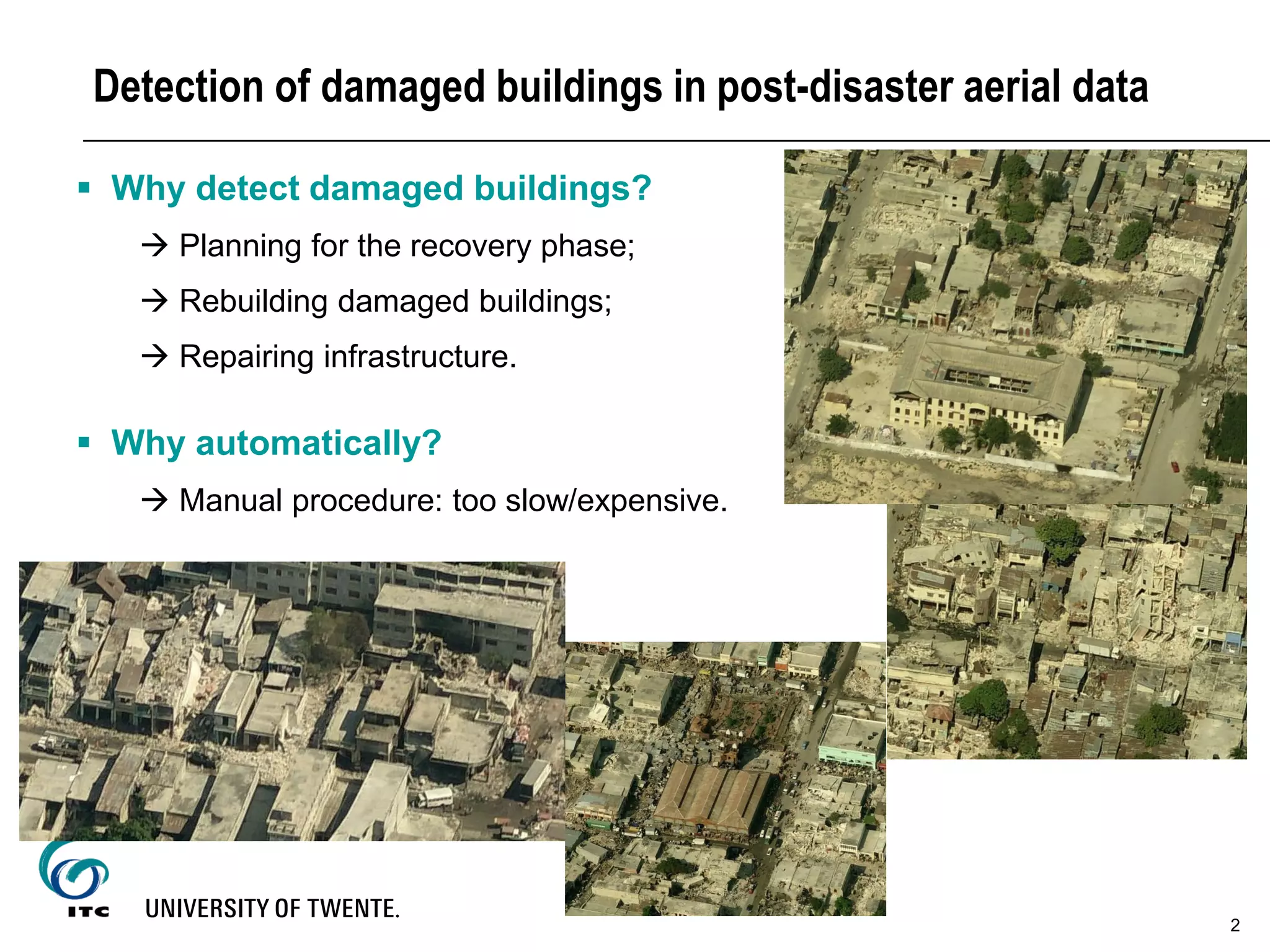
Detection of damaged buildings in post-disaster aerial data
 Why detect damaged buildings?
 Planning for the recovery phase;
 Rebuilding damaged buildings;
 Repairing infrastructure.

 Why automatically?
 Manual procedure: too slow/expensive.

2
Detection of damaged buildings in post-disaster aerial data
Aerial images:
 Convenient for human interpretation

Laser scanning point clouds:
 More accurate representation of
geometry;
 More accurate classification.

3
Segment-based classification of point clouds
 Assumption:
 Intact building roofs comprise a few large planar segments;
 Damaged roofs appear as many small segments.

 Possibly relevant features: segment size, planarity, orientation, height, …?

Training data

Segmentation

Feature extraction

Test data

Classification

Evaluation

4
Segment-based classification of point clouds
 Dimensionality problem:
 Lack of knowledge about relevant features;
 Include many features?
 More features = more training samples;
 Training samples insufficient due to difficulty of interpreting
point clouds;
 Complex classifiers?
Training data

Segmentation

Feature extraction

Test data

Classification

Evaluation

5
Classifier complexity

Linear discriminant classifier

Quadratic discriminant classifier

Nearest neighbor classifier

6
Dimensionality reduction
 Feature selection:

-

0.50

 Forward selection;
 Backward elimination;
1

 Plus l take away r.

0.41

2

3

0.28

0.39

4

0.37

 Branch and bound.
0.22
1,2 0.22

1,3 0.26

1,2,3 0.20

1,4 0.19

1,2,4 0.18

2,3 0.14

1,3,4 0.22

2,4 0.17

3,4

2,3,4 0.23

1,2,3,4 0.20

7
Dimensionality reduction
 Mapping features to reduced dimensions:
 Principal Component Analysis;
 Linear Discriminant Analysis.
PC 2

Feature 2

PC 1

Feature 1
LDA mapping
8
Experiments

Airborne laser data (3 pnts/m2) of
Port-au-Prince after the earthquake
of Jan. 2010.

Features extracted per segment

9
Results
Number of features Vs number of training samples
 With >50 training samples no contribution from last 6 features;
 With 50 training samples weaker features deteriorate classifier’s performance.

10
Results
Number of training samples
 Minimum 100 samples needed to avoid large bias (difference between test
error and training error).

11
Results
Classification with principal components of features
 Only the first 4 principal components are useful;
 Linear classifier outperforms more complex ones.

12
Results
Feature selection
 No global optimal subset;
 More selected features:
 1: number of points per segment;
 3: ratio of plane fitting outliers;
 10: mean height above DTM;
 11: ratio of points located near an unsegmented point.

13
Results
Comparison of feature selection methods
 Similar performance of feature selection methods;
 Linear classifier performs better than more complex ones.

14
Results
Feature selection Vs mapping to lower dimensions Vs complexity
 Dimensionality reduction in general improves classification results;
 LDC+BE = 84% classification accuracy
 LDC best, 1-NN worst, QDC improves more with dimensionality reduction.

15
Results

16
Results

17
Results

18
Results

19
Summary and concluding remarks
 Segment-based classification of laser data
 Relevance of features;
 Training data collection;
 More features = more training samples;

 Dimensionality reduction
 Both feature selection and mapping to reduced dimensions improve
classifier performance;

 Classifier complexity
 Less complex classifiers perform better when the number of training
samples in proportion to the number of features is small.

 Future work:
 Considering more classes (too avoid confusion between them).

20

Role of dimensionality reduction in segment-based classification of damaged building roofs in airborne laser scanning data

  • 1.
    Role of dimensionalityreduction in segment-based classification of damaged building roofs in airborne laser scanning data Kourosh Khoshelham
  • 2.
    Detection of damagedbuildings in post-disaster aerial data  Why detect damaged buildings?  Planning for the recovery phase;  Rebuilding damaged buildings;  Repairing infrastructure.  Why automatically?  Manual procedure: too slow/expensive. 2
  • 3.
    Detection of damagedbuildings in post-disaster aerial data Aerial images:  Convenient for human interpretation Laser scanning point clouds:  More accurate representation of geometry;  More accurate classification. 3
  • 4.
    Segment-based classification ofpoint clouds  Assumption:  Intact building roofs comprise a few large planar segments;  Damaged roofs appear as many small segments.  Possibly relevant features: segment size, planarity, orientation, height, …? Training data Segmentation Feature extraction Test data Classification Evaluation 4
  • 5.
    Segment-based classification ofpoint clouds  Dimensionality problem:  Lack of knowledge about relevant features;  Include many features?  More features = more training samples;  Training samples insufficient due to difficulty of interpreting point clouds;  Complex classifiers? Training data Segmentation Feature extraction Test data Classification Evaluation 5
  • 6.
    Classifier complexity Linear discriminantclassifier Quadratic discriminant classifier Nearest neighbor classifier 6
  • 7.
    Dimensionality reduction  Featureselection: - 0.50  Forward selection;  Backward elimination; 1  Plus l take away r. 0.41 2 3 0.28 0.39 4 0.37  Branch and bound. 0.22 1,2 0.22 1,3 0.26 1,2,3 0.20 1,4 0.19 1,2,4 0.18 2,3 0.14 1,3,4 0.22 2,4 0.17 3,4 2,3,4 0.23 1,2,3,4 0.20 7
  • 8.
    Dimensionality reduction  Mappingfeatures to reduced dimensions:  Principal Component Analysis;  Linear Discriminant Analysis. PC 2 Feature 2 PC 1 Feature 1 LDA mapping 8
  • 9.
    Experiments Airborne laser data(3 pnts/m2) of Port-au-Prince after the earthquake of Jan. 2010. Features extracted per segment 9
  • 10.
    Results Number of featuresVs number of training samples  With >50 training samples no contribution from last 6 features;  With 50 training samples weaker features deteriorate classifier’s performance. 10
  • 11.
    Results Number of trainingsamples  Minimum 100 samples needed to avoid large bias (difference between test error and training error). 11
  • 12.
    Results Classification with principalcomponents of features  Only the first 4 principal components are useful;  Linear classifier outperforms more complex ones. 12
  • 13.
    Results Feature selection  Noglobal optimal subset;  More selected features:  1: number of points per segment;  3: ratio of plane fitting outliers;  10: mean height above DTM;  11: ratio of points located near an unsegmented point. 13
  • 14.
    Results Comparison of featureselection methods  Similar performance of feature selection methods;  Linear classifier performs better than more complex ones. 14
  • 15.
    Results Feature selection Vsmapping to lower dimensions Vs complexity  Dimensionality reduction in general improves classification results;  LDC+BE = 84% classification accuracy  LDC best, 1-NN worst, QDC improves more with dimensionality reduction. 15
  • 16.
  • 17.
  • 18.
  • 19.
  • 20.
    Summary and concludingremarks  Segment-based classification of laser data  Relevance of features;  Training data collection;  More features = more training samples;  Dimensionality reduction  Both feature selection and mapping to reduced dimensions improve classifier performance;  Classifier complexity  Less complex classifiers perform better when the number of training samples in proportion to the number of features is small.  Future work:  Considering more classes (too avoid confusion between them). 20