ETHICAL ISSUES IN
ELECTRONIC DISCOVERY:
LESSONS FROM QUALCOMM
BY:
KIRBY DRAKE
Overview
• Background of Qualcomm v. Broadcom
• Lessons to be Learned
• Lessons for All
• Lessons for Outside Counsel
• Lessons for Clients
• Lessons for Courts and the State Bar
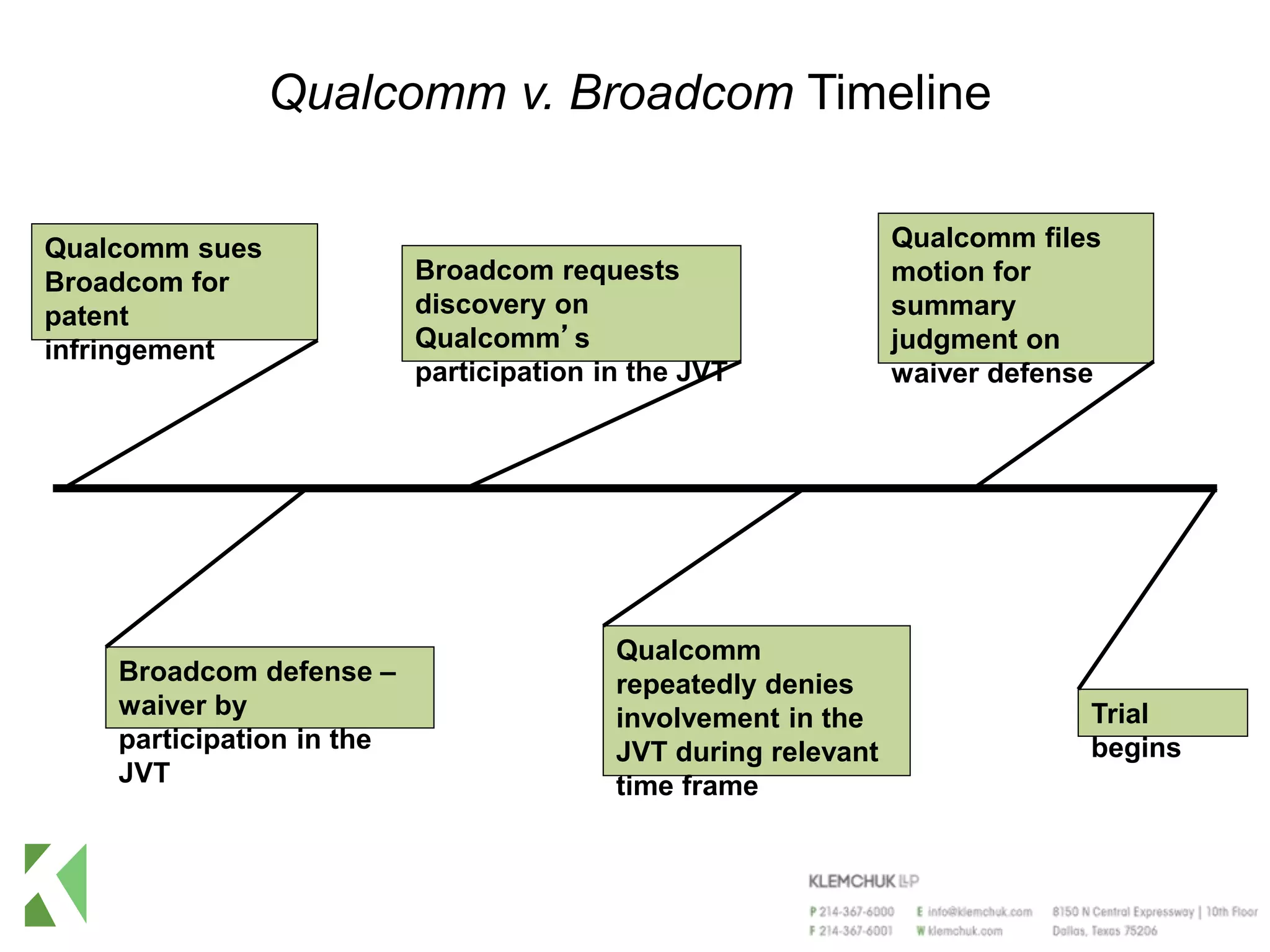
Qualcomm v. Broadcom Timeline
Qualcomm sues
Broadcom for
patent
infringement
Broadcom requests
discovery on
Qualcomm’s
participation in the JVT
Qualcomm
repeatedly denies
involvement in the
JVT during relevant
time frame
Qualcomm files
motion for
summary
judgment on
waiver defense
Broadcom defense –
waiver by
participation in the
JVT
Trial
begins
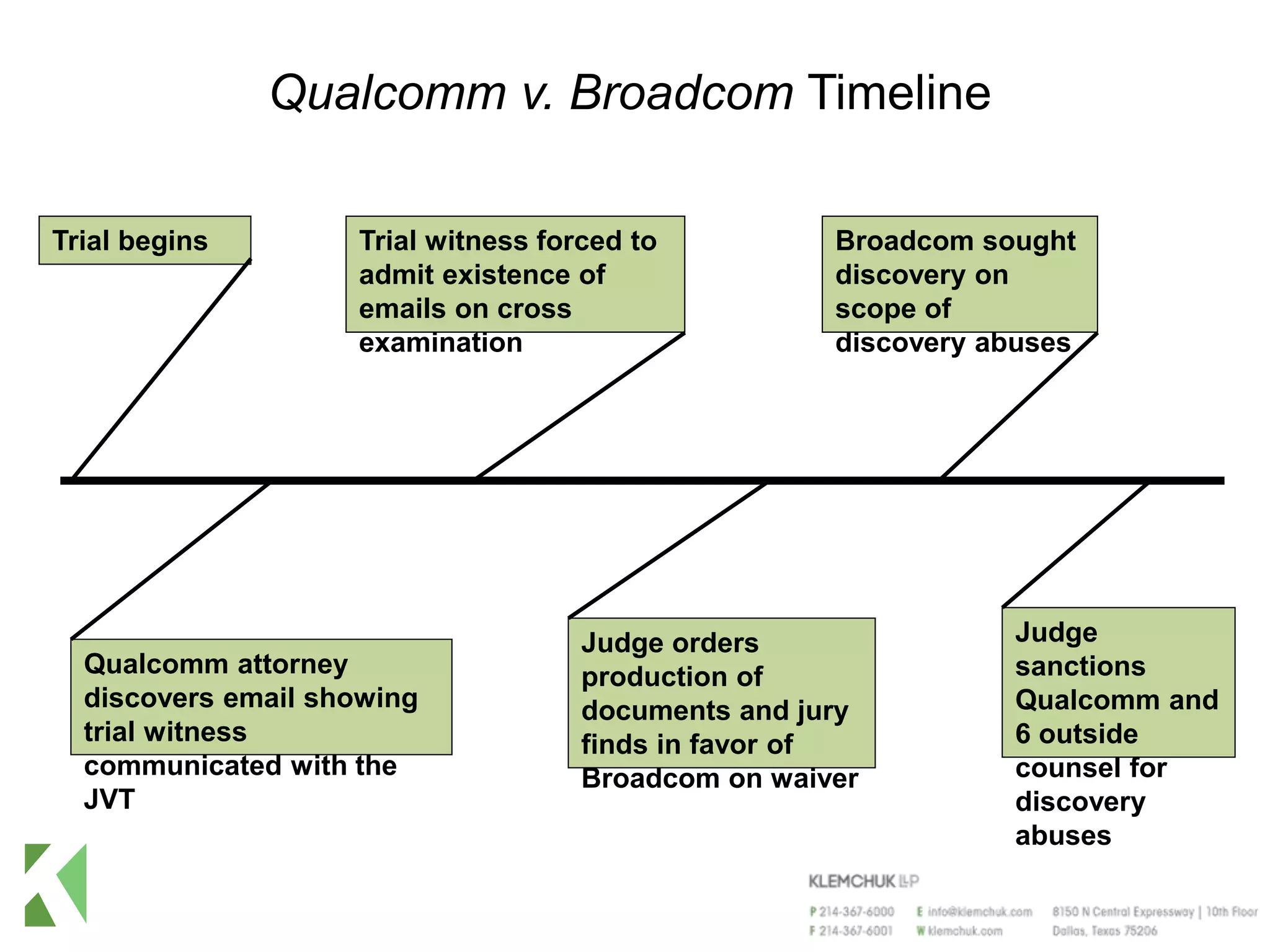
Qualcomm v. Broadcom Timeline
Trial begins Trial witness forced to
admit existence of
emails on cross
examination
Judge orders
production of
documents and jury
finds in favor of
Broadcom on waiver
Broadcom sought
discovery on
scope of
discovery abuses
Qualcomm attorney
discovers email showing
trial witness
communicated with the
JVT
Judge
sanctions
Qualcomm and
6 outside
counsel for
discovery
abuses
Qualcomm v. Broadcom - Sanctions
• Qualcomm ordered to pay $8,568,633.24
• Six outside counsel referred to the State Bar of
California for investigation of possible ethical
violations
• Qualcomm and outside counsel ordered to
participate in Case Review and Enforcement of
Discovery Obligations (“CREDO”) program
Qualcomm v. Broadcom – Sanctions for Most But Not
All
• Several outside counsel never sanctioned
because of steps taken to confirm accuracy of
facts
• Reviewed deposition transcripts and discovery
responses
• Circulated drafts of pleadings to more senior in-
house and outside counsel
• Investigated the facts surrounding the JVT
“He who must search a haystack for a
needle is likely to end up with the attitude
that the needle is not worth the search.”
Brown v. Allen, 344 U.S. 443,537 (1953)
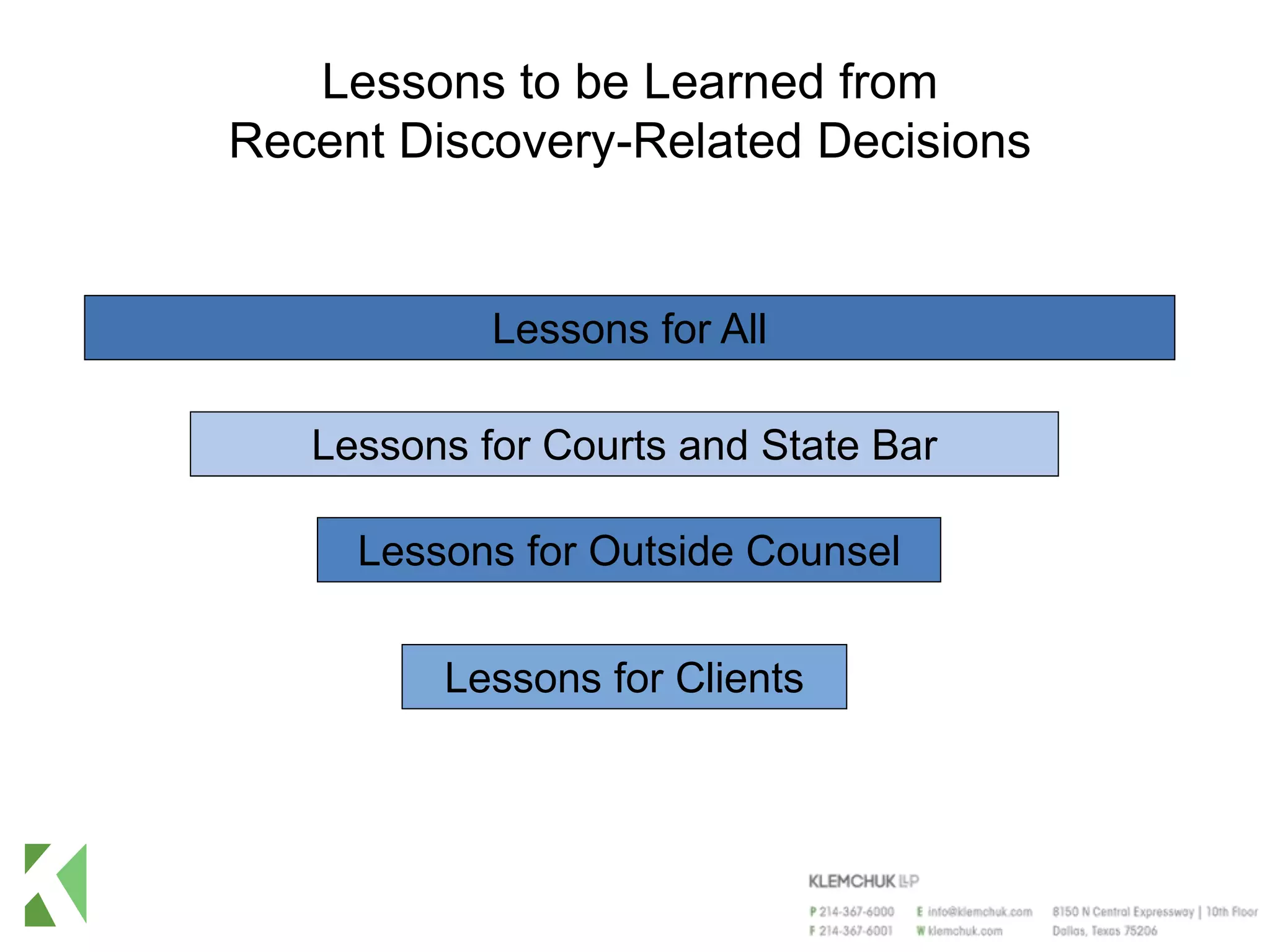
Lessons to be Learned from
Recent Discovery-Related Decisions
Lessons for All
Lessons for Courts and State Bar
Lessons for Outside Counsel
Lessons for Clients
Lessons for All:
1. The Truth Matters
• Often see failure to fully
adhere to the principle of
telling the truth
• Failure to admit when
wrong when it comes to
discovery issues
• Party and its outside
counsel often suffer the
consequences - sanctions
Lessons for All:
1. Do Not Tell a Lie
• Know the whole truth
• Make accurate representations to the other side as
well as to the judge and to the jury
• How?
• Find responsive information and produce it
• Make the team aware of responsive information early
• Allow witnesses/counsel to be prepared to face truth
about existence and contents of responsive information
before trial
Lessons for All:
2. Err in Favor of Production
• If you have to consider whether to produce,
probably should go ahead and produce it
• Often less harmful to produce
• Information may be responsive and discoverable
but not necessarily admissible
• Courts tending toward requiring production if
responsive to a party’s claims or defenses
Lessons for All:
2. Err in Favor of Production
Almost never incur wrath of
Court by producing (except
if it looks like a “document
dump”)
But feet can be held to the
fire for failure to produce
responsive information
Lessons for Outside Counsel:
3. Taking Responsibility for Ensuring Client Compliance with
Discovery
• Cannots
• Musts
Lessons for Outside Counsel:
3. Taking Responsibility for Ensuring Client Compliance with
Discovery
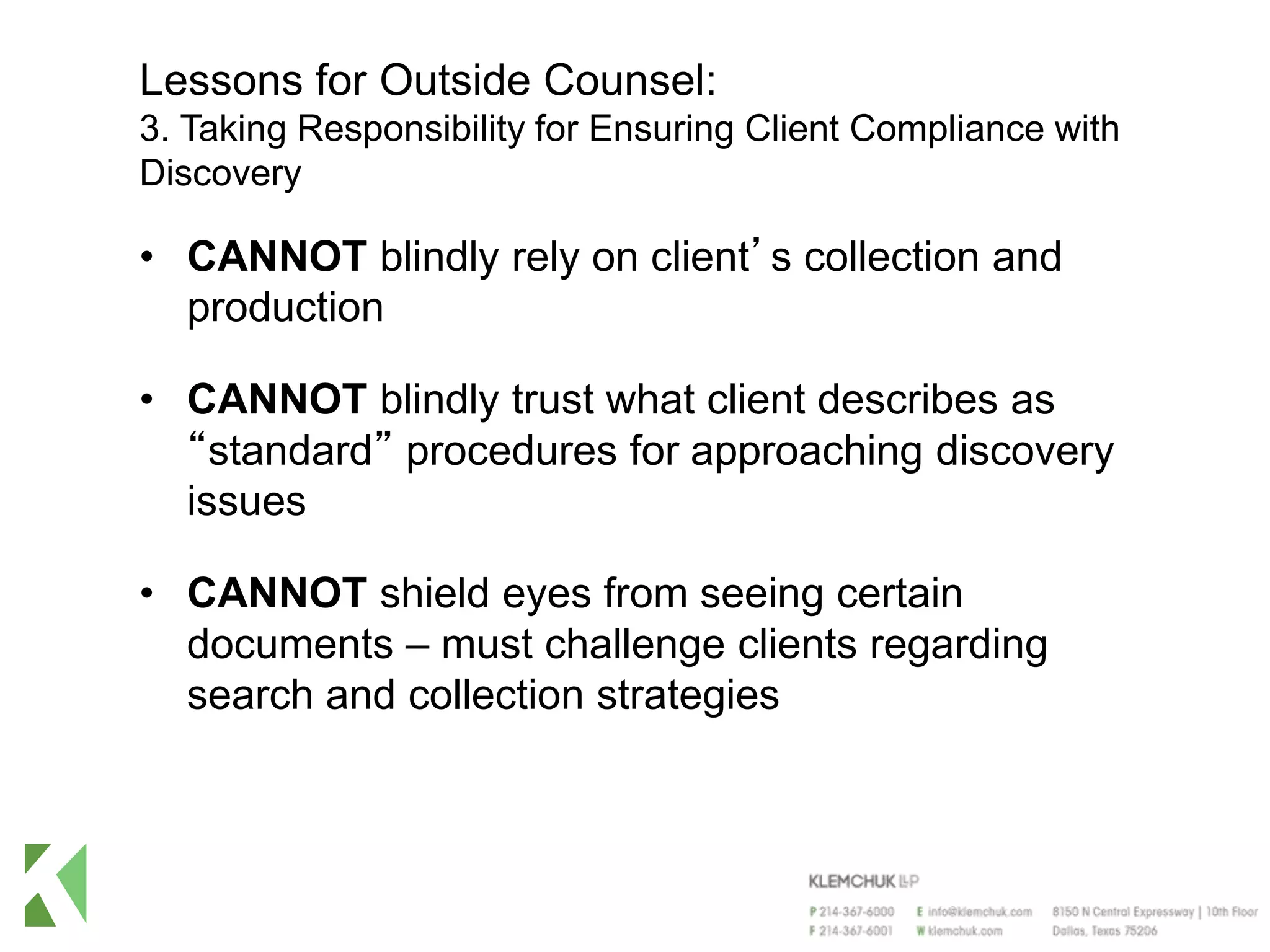
• CANNOT blindly rely on client’s collection and
production
• CANNOT blindly trust what client describes as
“standard” procedures for approaching discovery
issues
• CANNOT shield eyes from seeing certain
documents – must challenge clients regarding
search and collection strategies
Lessons for Outside Counsel:
3. Taking Responsibility for Ensuring Client Compliance with
Discovery
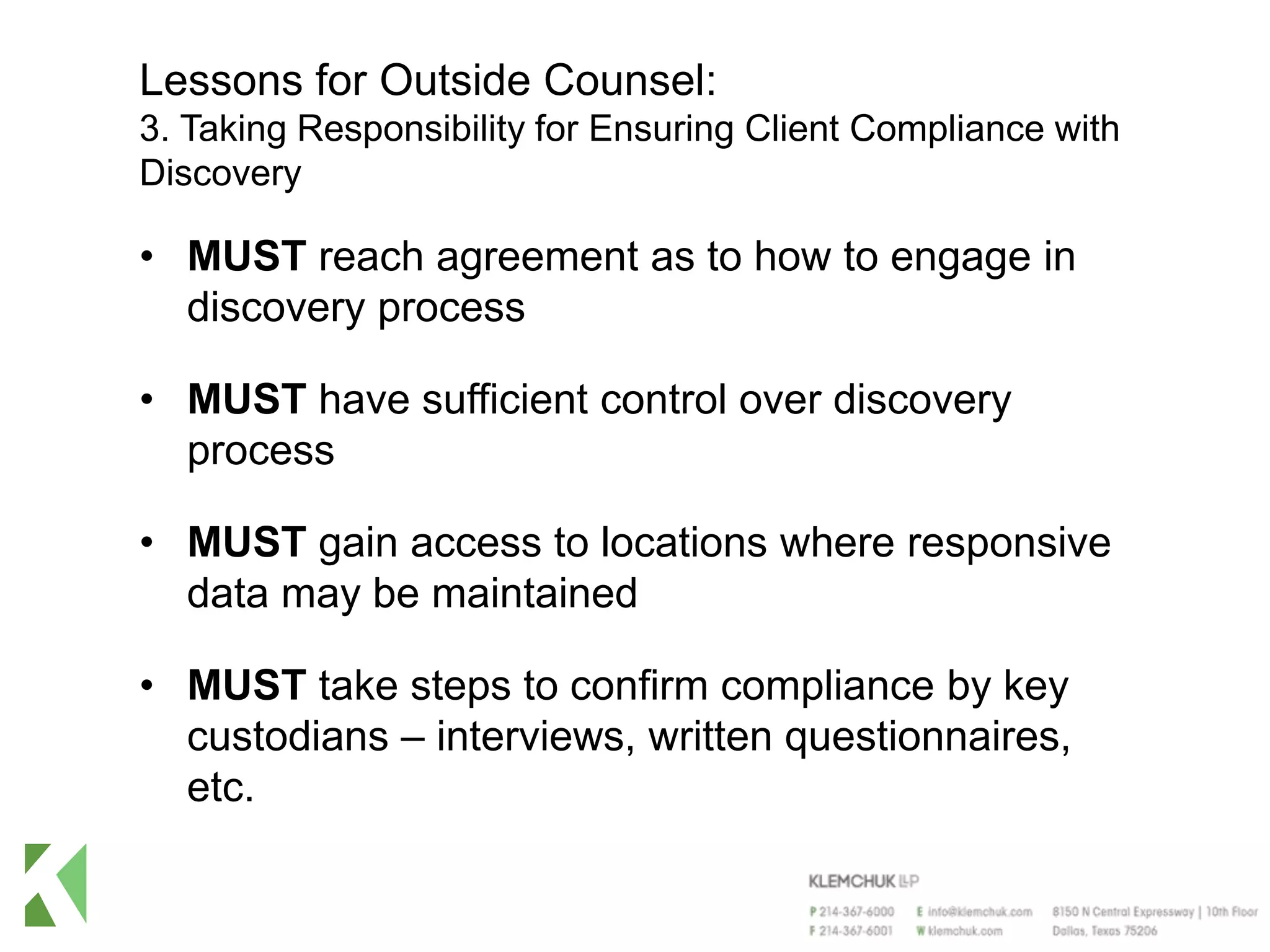
• MUST reach agreement as to how to engage in
discovery process
• MUST have sufficient control over discovery
process
• MUST gain access to locations where responsive
data may be maintained
• MUST take steps to confirm compliance by key
custodians – interviews, written questionnaires,
etc.
Lessons for Outside Counsel:
3. Taking Responsibility for Ensuring Client Compliance with
Discovery
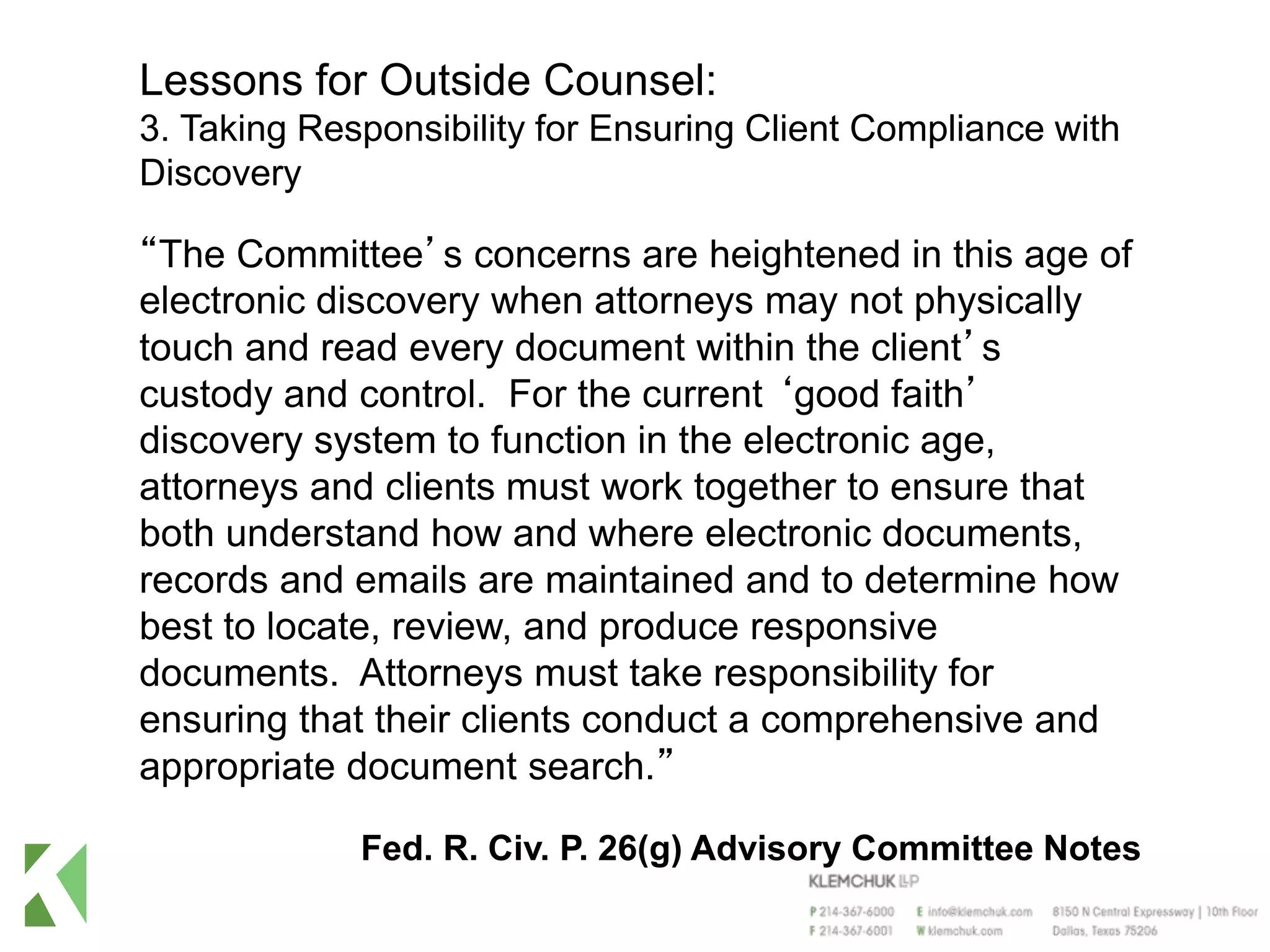
“The Committee’s concerns are heightened in this age of
electronic discovery when attorneys may not physically
touch and read every document within the client’s
custody and control. For the current ‘good faith’
discovery system to function in the electronic age,
attorneys and clients must work together to ensure that
both understand how and where electronic documents,
records and emails are maintained and to determine how
best to locate, review, and produce responsive
documents. Attorneys must take responsibility for
ensuring that their clients conduct a comprehensive and
appropriate document search.”
Fed. R. Civ. P. 26(g) Advisory Committee Notes
Lessons for Outside Counsel:
4. Document Your Discovery Efforts
• Keep a record of efforts with regard to document
search and collection
• Can potentially use record to defend discovery
efforts should a discovery dispute arise
• May need to seek agreement from client that
documentation of actions taken may be disclosed
if issues arise as to sufficiency of discovery efforts
Lessons for Outside Counsel:
5. If You Don’t Have a Plan, Make One
• MUST define who is responsible for ensuring discovery
duties are carried out
• MUST get IT personnel involved
• MUST issue document hold or preservation notice at
outset of litigation
• MUST inform employees that they have a duty to
manage information in accordance with written policies
– litigation or not
• MUST consider investing in management
technology/search tools
Lessons for Outside Counsel:
6. If You Have a Plan, Adhere to That
• Qualcomm allegedly had a plan in place for
collecting documents in response to discovery
requests
• Despite having plan, Qualcomm apparently did not
fully follow the plan
• MUST follow your plan – plan is only as effective
as care given in executing plan
Lessons for Outside Counsel:
7. Compliance Programs/Modify Rules
• CREDO Program
• Identify facts that contributed to discovery violation
• Create and evaluate procedures to correct deficiencies
• Develop and finalize protocol to prevent future violations
• Modifications to State Discovery Rules
• Consider state-promulgated electronic discovery rules
(i.e., California)
• Balance burdens/needs of requesting party and
producing party
Lessons Learned
Ethical Issues in eDiscovery - Lessons from Qualcomm

Ethical Issues in eDiscovery - Lessons from Qualcomm

  • 1.
    ETHICAL ISSUES IN ELECTRONICDISCOVERY: LESSONS FROM QUALCOMM BY: KIRBY DRAKE
  • 2.
    Overview • Background ofQualcomm v. Broadcom • Lessons to be Learned • Lessons for All • Lessons for Outside Counsel • Lessons for Clients • Lessons for Courts and the State Bar
  • 3.
    Qualcomm v. BroadcomTimeline Qualcomm sues Broadcom for patent infringement Broadcom requests discovery on Qualcomm’s participation in the JVT Qualcomm repeatedly denies involvement in the JVT during relevant time frame Qualcomm files motion for summary judgment on waiver defense Broadcom defense – waiver by participation in the JVT Trial begins
  • 4.
    Qualcomm v. BroadcomTimeline Trial begins Trial witness forced to admit existence of emails on cross examination Judge orders production of documents and jury finds in favor of Broadcom on waiver Broadcom sought discovery on scope of discovery abuses Qualcomm attorney discovers email showing trial witness communicated with the JVT Judge sanctions Qualcomm and 6 outside counsel for discovery abuses
  • 5.
    Qualcomm v. Broadcom- Sanctions • Qualcomm ordered to pay $8,568,633.24 • Six outside counsel referred to the State Bar of California for investigation of possible ethical violations • Qualcomm and outside counsel ordered to participate in Case Review and Enforcement of Discovery Obligations (“CREDO”) program
  • 6.
    Qualcomm v. Broadcom– Sanctions for Most But Not All • Several outside counsel never sanctioned because of steps taken to confirm accuracy of facts • Reviewed deposition transcripts and discovery responses • Circulated drafts of pleadings to more senior in- house and outside counsel • Investigated the facts surrounding the JVT
  • 7.
    “He who mustsearch a haystack for a needle is likely to end up with the attitude that the needle is not worth the search.” Brown v. Allen, 344 U.S. 443,537 (1953)
  • 8.
    Lessons to beLearned from Recent Discovery-Related Decisions Lessons for All Lessons for Courts and State Bar Lessons for Outside Counsel Lessons for Clients
  • 9.
    Lessons for All: 1.The Truth Matters • Often see failure to fully adhere to the principle of telling the truth • Failure to admit when wrong when it comes to discovery issues • Party and its outside counsel often suffer the consequences - sanctions
  • 10.
    Lessons for All: 1.Do Not Tell a Lie • Know the whole truth • Make accurate representations to the other side as well as to the judge and to the jury • How? • Find responsive information and produce it • Make the team aware of responsive information early • Allow witnesses/counsel to be prepared to face truth about existence and contents of responsive information before trial
  • 11.
    Lessons for All: 2.Err in Favor of Production • If you have to consider whether to produce, probably should go ahead and produce it • Often less harmful to produce • Information may be responsive and discoverable but not necessarily admissible • Courts tending toward requiring production if responsive to a party’s claims or defenses
  • 12.
    Lessons for All: 2.Err in Favor of Production Almost never incur wrath of Court by producing (except if it looks like a “document dump”) But feet can be held to the fire for failure to produce responsive information
  • 13.
    Lessons for OutsideCounsel: 3. Taking Responsibility for Ensuring Client Compliance with Discovery • Cannots • Musts
  • 14.
    Lessons for OutsideCounsel: 3. Taking Responsibility for Ensuring Client Compliance with Discovery • CANNOT blindly rely on client’s collection and production • CANNOT blindly trust what client describes as “standard” procedures for approaching discovery issues • CANNOT shield eyes from seeing certain documents – must challenge clients regarding search and collection strategies
  • 15.
    Lessons for OutsideCounsel: 3. Taking Responsibility for Ensuring Client Compliance with Discovery • MUST reach agreement as to how to engage in discovery process • MUST have sufficient control over discovery process • MUST gain access to locations where responsive data may be maintained • MUST take steps to confirm compliance by key custodians – interviews, written questionnaires, etc.
  • 16.
    Lessons for OutsideCounsel: 3. Taking Responsibility for Ensuring Client Compliance with Discovery “The Committee’s concerns are heightened in this age of electronic discovery when attorneys may not physically touch and read every document within the client’s custody and control. For the current ‘good faith’ discovery system to function in the electronic age, attorneys and clients must work together to ensure that both understand how and where electronic documents, records and emails are maintained and to determine how best to locate, review, and produce responsive documents. Attorneys must take responsibility for ensuring that their clients conduct a comprehensive and appropriate document search.” Fed. R. Civ. P. 26(g) Advisory Committee Notes
  • 17.
    Lessons for OutsideCounsel: 4. Document Your Discovery Efforts • Keep a record of efforts with regard to document search and collection • Can potentially use record to defend discovery efforts should a discovery dispute arise • May need to seek agreement from client that documentation of actions taken may be disclosed if issues arise as to sufficiency of discovery efforts
  • 18.
    Lessons for OutsideCounsel: 5. If You Don’t Have a Plan, Make One • MUST define who is responsible for ensuring discovery duties are carried out • MUST get IT personnel involved • MUST issue document hold or preservation notice at outset of litigation • MUST inform employees that they have a duty to manage information in accordance with written policies – litigation or not • MUST consider investing in management technology/search tools
  • 19.
    Lessons for OutsideCounsel: 6. If You Have a Plan, Adhere to That • Qualcomm allegedly had a plan in place for collecting documents in response to discovery requests • Despite having plan, Qualcomm apparently did not fully follow the plan • MUST follow your plan – plan is only as effective as care given in executing plan
  • 20.
    Lessons for OutsideCounsel: 7. Compliance Programs/Modify Rules • CREDO Program • Identify facts that contributed to discovery violation • Create and evaluate procedures to correct deficiencies • Develop and finalize protocol to prevent future violations • Modifications to State Discovery Rules • Consider state-promulgated electronic discovery rules (i.e., California) • Balance burdens/needs of requesting party and producing party
  • 21.