Patent Law Developments in
the Supreme Court and
Federal Circuit
Moderator: Mark C. Fleming
Panelists: Nathan K. Kelley, Suzanne D. Munck
Agenda
 Patent Eligibility: The Alice Effect
 Attorney’s Fees: The Octane/Highmark Fallout
 Indefiniteness: The Nautilus Voyage
 Patent Damages: Reasonable royalties after VirnetX and D-Link
 Injunctive Relief: eBay, Apple/Samsung, and the ITC
 Inter Partes Reviews: The Gathering Appellate Storm
 The Next Wave: Teva, Commil, Kimble, Google
The Alice Decision
 Drawing on its test from Mayo, the Court applied to a two-part test to
Alice’s computer implemented method of mitigating settlement risk:
 1) does the claim recite a patent-ineligible exception (law of
nature/abstract idea/natural phenomena)?
 2) if so, does the claim contain “something more” than merely the
routine or conventional application of the ineligible exception?
 USPTO followed with updated Subject Matter Eligibility Guidance
 incorporates principles from all recent cases (Alice, Myriad,
Mayo)—no longer subject-matter specific guidance.
 includes examples from both sides of the line, taken from actual
cases where possible.
Cases applying Alice
 The two most instructive cases so far post-Alice give a view of both
sides of the line:
 Ultramercial v. Hulu, 772 F.3d 709 (Fed. Cir. 2014)
 claims to showing an advertisement before delivering web-
based content held ineligible because they simply required the
routine implementation of an abstract idea.
 DDR Holdings v. Hotels.com, 773 F.3d 1245 (Fed. Cir. 2014)
 claims to e-commerce website emulation held eligible
because “the claimed solution is necessarily rooted in
computer technology in order to overcome a problem
specifically arising in the realm of computer networks.”
Results of Octane/Highmark
 In Octane, the Supreme Court expanded the situations in which a
district court could award attorney’s fees under 35 U.S.C. § 285
 “An ‘exceptional’ case is simply one that stands out from others with respect
to the substantive strength of a party’s litigating position (considering both the
governing law and the facts of the case) or the unreasonable manner in which
the case was litigated. District courts may determine whether a case is
‘‘exceptional’’ in the case-by-case exercise of their discretion, considering the
totality of the circumstances.”
 Highmark made it more difficult for the Federal Circuit to reverse
 Fee requests increased noticeably in 2014 (114, compared to 60-
80 annually in prior years, per Docket Navigator)
 Percentage of requests granted, however, remained about the
same (22% in 2014)
 Patentees still have greater success getting fees since Octane
(17/26 granted; defendants only 23/75)
Indefiniteness Post-Nautilus
 Supreme Court Rejected the “insolubly ambiguous” standard used
by the Federal Circuit when applying 35 U.S.C. § 112(b) (requiring
that claims “particularly point[] out and distinctly claim[]” the
invention).
 “[A] patent is invalid for indefiniteness if its claims, read in light of the
patent’s specification . . . and the prosecution history, fail to inform,
with reasonable certainty, those skilled in the art about the scope
of the invention.”
Cases applying Nautilus
 Warsaw Orthopedic, Inc. v. NuVasive, Inc., Appeal Nos. 2013-
1576, -77 (Fed. Cir. Mar. 2, 2015) (non-numerical dimensions of
human vertebrae not indefinite)
 DDR Holdings, LLC v. Hotels.com, L.P., 773 F.3d 1245 (Fed. Cir.
Dec. 5, 2014) (“look and feel” not indefinite)
 Interval Licensing LLC v. AOL, Inc., 766 F.3d 1364 (Sept. 10,
2014) (“unobtrusive manner” indefinite)
 Eidos Display, LLC v. AU Optronics Corp., Appeal No. 2014-1254
(Fed. Cir. March 10, 2015) (“a contact hole for source wiring and
gate wiring connection terminals” not indefinite)
Indefiniteness at the USPTO
 Both the USPTO and the courts apply the same statute but the
USPTO uses a lower threshold of ambiguity
 “[A] claim is indefinite when the boundaries of the protected
subject matter are not clearly delineated and the scope is
unclear.” MPEP § 2173.02
 In re Packard, 751 F.3d 1307 (Fed. Cir. 2014)
 Approved the Board’s application of MPEP § 2173
 An essential purpose of examination is to fashion particular and distinct claims
 Once the USPTO makes a well-founded prima facie case of lack of clarity, the
burden shifts to the applicant to rebut the prima facie case
Reasonable Royalty Developments
 Federal Circuit has continued to ensure that Daubert is properly
observed with respect to damages theories
 VirnetX: “[W]hen claims are drawn to an individual component of
a multi-component product, it is the exception, not the rule, that
damages may be based up on the value of the multi-component
product.”
 Rejected argument that when the smallest salable unit is used as the royalty
base, there is no further constraint on royalty base.
 Separately rejected the “Nash Bargaining Solution” as an “inappropriate ‘rule
of thumb’” when not tethered to the facts of the case
 Ericsson v. D-Link:
 apportionment instructions needed when licenses are based on products’
entire market value
 Instructions (including Georgia-Pacific) must be modified to reflect (F)RAND
commitments, avoid compensation for standard-essential nature
 Royalty stacking instructions may be needed where evidence shows stacking
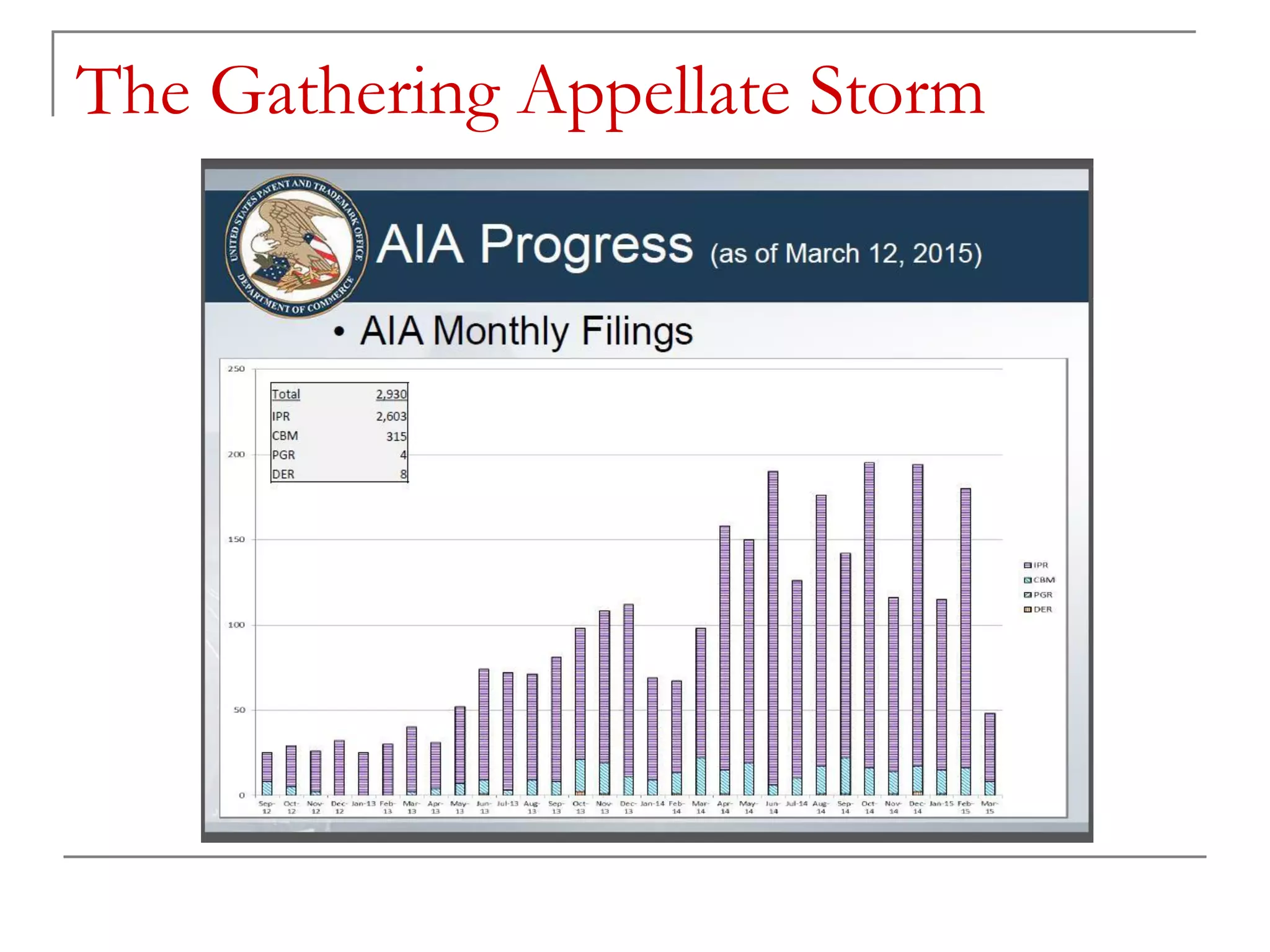
The Gathering Appellate Storm

Georgetown Univ. Law Center Conference: Patent Law Developments in the Supreme Court and Federal Circuit

  • 1.
    Patent Law Developmentsin the Supreme Court and Federal Circuit Moderator: Mark C. Fleming Panelists: Nathan K. Kelley, Suzanne D. Munck
  • 2.
    Agenda  Patent Eligibility:The Alice Effect  Attorney’s Fees: The Octane/Highmark Fallout  Indefiniteness: The Nautilus Voyage  Patent Damages: Reasonable royalties after VirnetX and D-Link  Injunctive Relief: eBay, Apple/Samsung, and the ITC  Inter Partes Reviews: The Gathering Appellate Storm  The Next Wave: Teva, Commil, Kimble, Google
  • 3.
    The Alice Decision Drawing on its test from Mayo, the Court applied to a two-part test to Alice’s computer implemented method of mitigating settlement risk:  1) does the claim recite a patent-ineligible exception (law of nature/abstract idea/natural phenomena)?  2) if so, does the claim contain “something more” than merely the routine or conventional application of the ineligible exception?  USPTO followed with updated Subject Matter Eligibility Guidance  incorporates principles from all recent cases (Alice, Myriad, Mayo)—no longer subject-matter specific guidance.  includes examples from both sides of the line, taken from actual cases where possible.
  • 4.
    Cases applying Alice The two most instructive cases so far post-Alice give a view of both sides of the line:  Ultramercial v. Hulu, 772 F.3d 709 (Fed. Cir. 2014)  claims to showing an advertisement before delivering web- based content held ineligible because they simply required the routine implementation of an abstract idea.  DDR Holdings v. Hotels.com, 773 F.3d 1245 (Fed. Cir. 2014)  claims to e-commerce website emulation held eligible because “the claimed solution is necessarily rooted in computer technology in order to overcome a problem specifically arising in the realm of computer networks.”
  • 5.
    Results of Octane/Highmark In Octane, the Supreme Court expanded the situations in which a district court could award attorney’s fees under 35 U.S.C. § 285  “An ‘exceptional’ case is simply one that stands out from others with respect to the substantive strength of a party’s litigating position (considering both the governing law and the facts of the case) or the unreasonable manner in which the case was litigated. District courts may determine whether a case is ‘‘exceptional’’ in the case-by-case exercise of their discretion, considering the totality of the circumstances.”  Highmark made it more difficult for the Federal Circuit to reverse  Fee requests increased noticeably in 2014 (114, compared to 60- 80 annually in prior years, per Docket Navigator)  Percentage of requests granted, however, remained about the same (22% in 2014)  Patentees still have greater success getting fees since Octane (17/26 granted; defendants only 23/75)
  • 6.
    Indefiniteness Post-Nautilus  SupremeCourt Rejected the “insolubly ambiguous” standard used by the Federal Circuit when applying 35 U.S.C. § 112(b) (requiring that claims “particularly point[] out and distinctly claim[]” the invention).  “[A] patent is invalid for indefiniteness if its claims, read in light of the patent’s specification . . . and the prosecution history, fail to inform, with reasonable certainty, those skilled in the art about the scope of the invention.”
  • 7.
    Cases applying Nautilus Warsaw Orthopedic, Inc. v. NuVasive, Inc., Appeal Nos. 2013- 1576, -77 (Fed. Cir. Mar. 2, 2015) (non-numerical dimensions of human vertebrae not indefinite)  DDR Holdings, LLC v. Hotels.com, L.P., 773 F.3d 1245 (Fed. Cir. Dec. 5, 2014) (“look and feel” not indefinite)  Interval Licensing LLC v. AOL, Inc., 766 F.3d 1364 (Sept. 10, 2014) (“unobtrusive manner” indefinite)  Eidos Display, LLC v. AU Optronics Corp., Appeal No. 2014-1254 (Fed. Cir. March 10, 2015) (“a contact hole for source wiring and gate wiring connection terminals” not indefinite)
  • 8.
    Indefiniteness at theUSPTO  Both the USPTO and the courts apply the same statute but the USPTO uses a lower threshold of ambiguity  “[A] claim is indefinite when the boundaries of the protected subject matter are not clearly delineated and the scope is unclear.” MPEP § 2173.02  In re Packard, 751 F.3d 1307 (Fed. Cir. 2014)  Approved the Board’s application of MPEP § 2173  An essential purpose of examination is to fashion particular and distinct claims  Once the USPTO makes a well-founded prima facie case of lack of clarity, the burden shifts to the applicant to rebut the prima facie case
  • 9.
    Reasonable Royalty Developments Federal Circuit has continued to ensure that Daubert is properly observed with respect to damages theories  VirnetX: “[W]hen claims are drawn to an individual component of a multi-component product, it is the exception, not the rule, that damages may be based up on the value of the multi-component product.”  Rejected argument that when the smallest salable unit is used as the royalty base, there is no further constraint on royalty base.  Separately rejected the “Nash Bargaining Solution” as an “inappropriate ‘rule of thumb’” when not tethered to the facts of the case  Ericsson v. D-Link:  apportionment instructions needed when licenses are based on products’ entire market value  Instructions (including Georgia-Pacific) must be modified to reflect (F)RAND commitments, avoid compensation for standard-essential nature  Royalty stacking instructions may be needed where evidence shows stacking
  • 10.