REPUBLIC ACT NO. 9994
EXPANDED SENIOR CITIZENS ACT
OF 2010
Who are considered as Senior Citizens?
Any Filipino citizen who is a resident of the Philippines, and
who is sixty (60) years old or above.
It may apply to senior citizens with "dual citizenship"
status provided they prove their Filipino citizenship and
have at least six (6) months residency in the Philippines.
Senior citizens are entitled to the following:
a) discount privileges,
b) free services,
c) exemptions,
d) incentives,
e) government financial assistance, and
f) priority in express lanes.
Discount Privileges granted to Senior Citizens:
a) 20% discount on the purchase of certain goods and
services,
b) special 5% discount on prime commodities and basic
necessities,
c) 5% utility discount on electric and water consumption,
and
d) 50% discount on electric, water and telephone
consumption of senior citizens centers and residential or
group homes.
What transactions by senior citizens are covered by
the 20% discount and VAT-exemption?
a. the purchase of medicines
b. the professional fees of attending physician
c. the professional fees of licensed professional health
workers providing home health care services
d. medical and dental services, diagnostic and laboratory
fees
e. actual fare for land transportation travel
f. actual transportation fare for domestic air transport
services and sea shipping vessels
g. the utilization of services in hotels and similar lodging
establishments, restaurants and recreation centers
h. admission fees charged by theaters, cinema houses and
concert halls, circuses, carnivals, and other similar places
of culture, leisure and amusement; and
i. funeral and burial services for the death of senior citizens
Comparison of Benefits:
How can senior citizens avail of the Discount
Privileges from business establishments?
A senior citizen, or a duly authorized representative, must
present an ORIGINAL AND VALID senior citizens
identification card issued by the Office of Senior Citizens
Affairs (OSCA) in the city or municipality where he/she
resides, with the necessary purchase booklet for medicines,
or the purchase booklet for basic necessities/prime
commodities, when applicable.
Can bedridden or incapacitated senior citizens avail of
discounted purchases through a representative?
Yes, but senior citizens can send their duly authorized
representative to purchase their medicines and grocery
items only. However, the representative must carry the
senior citizen’s OSCA ID, the senior citizen’s purchase
booklet, a document specifically authorizing the
representative, and a doctor’s prescription when necessary.
However, discounted food purchases cannot be by proxy or
through a representative owing to the limitation that it
should be for the exclusive use and enjoyment, or “personal
consumption” of the senior citizen only.
Does the 20% discount apply to food supplements
prescribed by an attending physician?
No, the 20% discount on drug and medicine purchases does
not extend to food or food supplements, even if prescribed
by a doctor for an elderly.
Vitamins and minerals specifically prescribed by an
attending physician for an elderly for the prevention,
treatment or diagnosis of a disease or illness can be
considered as medicine or drug purchases subject to the 20%
discount.
 The FDA came out with guidelines that classified health
supplements such as food and therefore are not covered
by the senior citizen discount privilege.
 Food supplements that are prescribed by doctors to senior
citizens should also be subject to a 20% discount since this
will provide full support to the improvement of the total
well-being of the elderly.
Government assistance that will directly benefit senior
citizens:
a) Monthly Social Pension of P500 to be given to indigent
senior citizens; and
b) Death Benefit Assistance of P2,000 to be given to the
nearest surviving relative who cared for the deceased senior
citizen until his/her death.
c) Mandatory PHILHEALTH coverage.
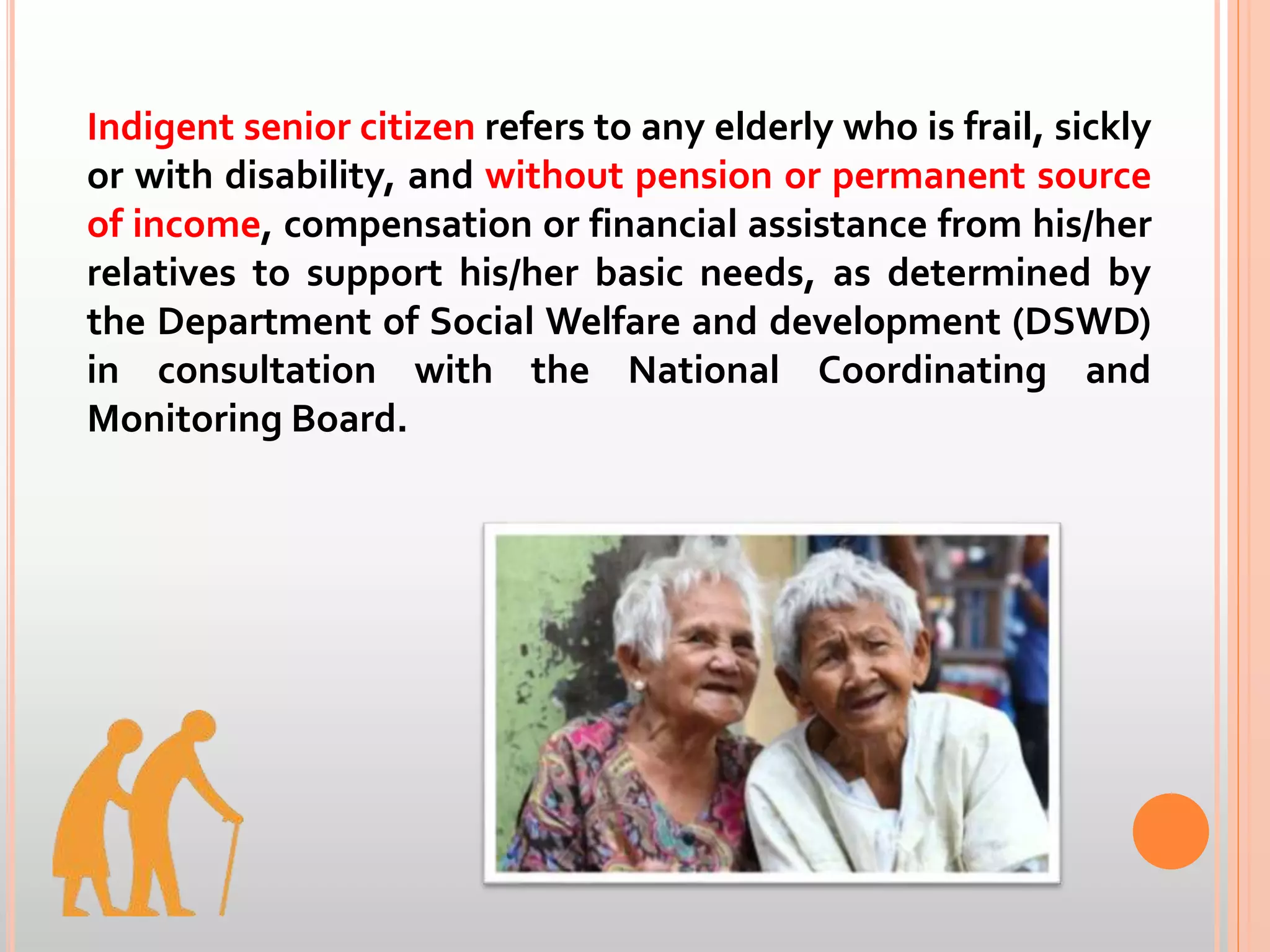
Indigent senior citizen refers to any elderly who is frail, sickly
or with disability, and without pension or permanent source
of income, compensation or financial assistance from his/her
relatives to support his/her basic needs, as determined by
the Department of Social Welfare and development (DSWD)
in consultation with the National Coordinating and
Monitoring Board.
 Based on the law, indigent senior citizens or those 60 years old
and above are entitled to monthly pension, however, due to
limited government resources only those 77 and above were
covered by the law up to 2014.
 A series of administrative orders issued by the Department of
Social Welfare and Development (DSWD) since 2010-2014
prioritized only those who are 77 years old and above.
 In 2012, DSWD issued AO No.4 classifying indigent seniors aged
76 and below as “potential social pensioners.” The releasing of
the P500 pension is subject to “availability of funds.”
 Senior citizens from remote areas can hardly avail of the
pension.
 Starting April 2015, indigent senior citizens aged 65 and
above will now receive the Social Pension.
 Only indigent senior citizens are mandatorily covered by
the national health insurance program of PhilHealth.
PENALTIES
 For the first violation, a fine of not less than Fifty thousand
pesos (Php 50,000.00) but not exceeding One hundred thousand
pesos (Php 100,000.00) and imprisonment for not less than two
(2) years but not more than six (6) years;
 For any subsequent violation, a fine of not less than One
hundred thousand pesos (Php 100,000.00) but not exceeding
Two hundred thousand pesos (Php 200,000.00) and
imprisonment for not less than two (2) years but not more than
six (6) years
 If the offender is an alien or a foreigner, he/she shall be deported
immediately after service of sentence without further
deportation proceedings.
 proper authorities may also cause the cancellation or
revocation of the business permit, permit to operate,
franchise and other similar privileges granted to any
person, establishment or business entity that fails to abide
by the provisions of this Act.
 If the offender is a corporation/organization, the official/s
directly involved shall be liable.
Sec. 5 par. (a) of RA 9994 provides government
assistance on employment of Senior Citizens:
"Senior citizens who have the capacity and desire to work, or
be re-employed, shall be provided information and matching
services to enable them to be productive members of
society. Terms of employment shall conform with the
provisions of the Labor Code, as amended, and other laws,
rules and regulations.”
 For SSS pensioners below 65 years old, re-employment
means stoppage of pension.
HB-1449
AN ACT INCREASING THE SUBSIDY AND BENEFITS ACCORDED
TO SENIOR CITIZENS OF THE SENIOR CITIZEN'S ACT OF 2010
AND AMENDING SECTIONS 4 AND 5 THEREOF FOR THAT
PURPOSE
 It includes grocery items which are not covered by doctor's
prescription but are necessary for the caregiving of the
frail, bedridden and/or ailing senior citizen such as but not
limited to milk, adult diapers, underpads, bed pans,
alcohol, cotton, tissue, wet wipes, and other similar items.
HB-639
AN ACT PROVIDING FOR FREE LEGAL ASSISTANCE FOR
SENIOR CITIZENS, AMENDING FOR THE PURPOSE REPUBLIC
ACT NO. 7342, AS AMENDED BY REPUBLIC ACT NO. 9994,
OTHERWISE KNOWN AS ‘AN ACT TO MAXIMIZE THE
CONTRIBUTION OF SENIOR CITIZENS TO NATION BUILDING,
GRANT BENEFITS AND SPECIAL PRIVILEGES AND FOR OTHER
PURPOSES'
 This bill recognizes the need of senior citizens to be
provided free legal services.
HB-595
AN ACT DIRECTING PUBLIC HOSPITALS OWNED BY THE
NATIONAL GOVERNMENT TO GRANT FREE HOSPITALIZATION
TO INDIGENT AND QUALIFIED SENIOR CITIZENS
 This proposal provides free hospitalization to qualified
senior citizens who are 70 yrs. old and above, provided,
that they are indigents

Expanded Senior Citizen Act

  • 1.
    REPUBLIC ACT NO.9994 EXPANDED SENIOR CITIZENS ACT OF 2010
  • 2.
    Who are consideredas Senior Citizens? Any Filipino citizen who is a resident of the Philippines, and who is sixty (60) years old or above. It may apply to senior citizens with "dual citizenship" status provided they prove their Filipino citizenship and have at least six (6) months residency in the Philippines.
  • 3.
    Senior citizens areentitled to the following: a) discount privileges, b) free services, c) exemptions, d) incentives, e) government financial assistance, and f) priority in express lanes.
  • 4.
    Discount Privileges grantedto Senior Citizens: a) 20% discount on the purchase of certain goods and services, b) special 5% discount on prime commodities and basic necessities, c) 5% utility discount on electric and water consumption, and d) 50% discount on electric, water and telephone consumption of senior citizens centers and residential or group homes.
  • 5.
    What transactions bysenior citizens are covered by the 20% discount and VAT-exemption? a. the purchase of medicines b. the professional fees of attending physician c. the professional fees of licensed professional health workers providing home health care services d. medical and dental services, diagnostic and laboratory fees e. actual fare for land transportation travel f. actual transportation fare for domestic air transport services and sea shipping vessels
  • 6.
    g. the utilizationof services in hotels and similar lodging establishments, restaurants and recreation centers h. admission fees charged by theaters, cinema houses and concert halls, circuses, carnivals, and other similar places of culture, leisure and amusement; and i. funeral and burial services for the death of senior citizens
  • 7.
  • 9.
    How can seniorcitizens avail of the Discount Privileges from business establishments? A senior citizen, or a duly authorized representative, must present an ORIGINAL AND VALID senior citizens identification card issued by the Office of Senior Citizens Affairs (OSCA) in the city or municipality where he/she resides, with the necessary purchase booklet for medicines, or the purchase booklet for basic necessities/prime commodities, when applicable.
  • 10.
    Can bedridden orincapacitated senior citizens avail of discounted purchases through a representative? Yes, but senior citizens can send their duly authorized representative to purchase their medicines and grocery items only. However, the representative must carry the senior citizen’s OSCA ID, the senior citizen’s purchase booklet, a document specifically authorizing the representative, and a doctor’s prescription when necessary. However, discounted food purchases cannot be by proxy or through a representative owing to the limitation that it should be for the exclusive use and enjoyment, or “personal consumption” of the senior citizen only.
  • 11.
    Does the 20%discount apply to food supplements prescribed by an attending physician? No, the 20% discount on drug and medicine purchases does not extend to food or food supplements, even if prescribed by a doctor for an elderly. Vitamins and minerals specifically prescribed by an attending physician for an elderly for the prevention, treatment or diagnosis of a disease or illness can be considered as medicine or drug purchases subject to the 20% discount.
  • 12.
     The FDAcame out with guidelines that classified health supplements such as food and therefore are not covered by the senior citizen discount privilege.  Food supplements that are prescribed by doctors to senior citizens should also be subject to a 20% discount since this will provide full support to the improvement of the total well-being of the elderly.
  • 13.
    Government assistance thatwill directly benefit senior citizens: a) Monthly Social Pension of P500 to be given to indigent senior citizens; and b) Death Benefit Assistance of P2,000 to be given to the nearest surviving relative who cared for the deceased senior citizen until his/her death. c) Mandatory PHILHEALTH coverage.
  • 14.
    Indigent senior citizenrefers to any elderly who is frail, sickly or with disability, and without pension or permanent source of income, compensation or financial assistance from his/her relatives to support his/her basic needs, as determined by the Department of Social Welfare and development (DSWD) in consultation with the National Coordinating and Monitoring Board.
  • 15.
     Based onthe law, indigent senior citizens or those 60 years old and above are entitled to monthly pension, however, due to limited government resources only those 77 and above were covered by the law up to 2014.  A series of administrative orders issued by the Department of Social Welfare and Development (DSWD) since 2010-2014 prioritized only those who are 77 years old and above.  In 2012, DSWD issued AO No.4 classifying indigent seniors aged 76 and below as “potential social pensioners.” The releasing of the P500 pension is subject to “availability of funds.”  Senior citizens from remote areas can hardly avail of the pension.
  • 16.
     Starting April2015, indigent senior citizens aged 65 and above will now receive the Social Pension.  Only indigent senior citizens are mandatorily covered by the national health insurance program of PhilHealth.
  • 17.
    PENALTIES  For thefirst violation, a fine of not less than Fifty thousand pesos (Php 50,000.00) but not exceeding One hundred thousand pesos (Php 100,000.00) and imprisonment for not less than two (2) years but not more than six (6) years;  For any subsequent violation, a fine of not less than One hundred thousand pesos (Php 100,000.00) but not exceeding Two hundred thousand pesos (Php 200,000.00) and imprisonment for not less than two (2) years but not more than six (6) years  If the offender is an alien or a foreigner, he/she shall be deported immediately after service of sentence without further deportation proceedings.
  • 18.
     proper authoritiesmay also cause the cancellation or revocation of the business permit, permit to operate, franchise and other similar privileges granted to any person, establishment or business entity that fails to abide by the provisions of this Act.  If the offender is a corporation/organization, the official/s directly involved shall be liable.
  • 19.
    Sec. 5 par.(a) of RA 9994 provides government assistance on employment of Senior Citizens: "Senior citizens who have the capacity and desire to work, or be re-employed, shall be provided information and matching services to enable them to be productive members of society. Terms of employment shall conform with the provisions of the Labor Code, as amended, and other laws, rules and regulations.”  For SSS pensioners below 65 years old, re-employment means stoppage of pension.
  • 20.
    HB-1449 AN ACT INCREASINGTHE SUBSIDY AND BENEFITS ACCORDED TO SENIOR CITIZENS OF THE SENIOR CITIZEN'S ACT OF 2010 AND AMENDING SECTIONS 4 AND 5 THEREOF FOR THAT PURPOSE  It includes grocery items which are not covered by doctor's prescription but are necessary for the caregiving of the frail, bedridden and/or ailing senior citizen such as but not limited to milk, adult diapers, underpads, bed pans, alcohol, cotton, tissue, wet wipes, and other similar items.
  • 21.
    HB-639 AN ACT PROVIDINGFOR FREE LEGAL ASSISTANCE FOR SENIOR CITIZENS, AMENDING FOR THE PURPOSE REPUBLIC ACT NO. 7342, AS AMENDED BY REPUBLIC ACT NO. 9994, OTHERWISE KNOWN AS ‘AN ACT TO MAXIMIZE THE CONTRIBUTION OF SENIOR CITIZENS TO NATION BUILDING, GRANT BENEFITS AND SPECIAL PRIVILEGES AND FOR OTHER PURPOSES'  This bill recognizes the need of senior citizens to be provided free legal services.
  • 22.
    HB-595 AN ACT DIRECTINGPUBLIC HOSPITALS OWNED BY THE NATIONAL GOVERNMENT TO GRANT FREE HOSPITALIZATION TO INDIGENT AND QUALIFIED SENIOR CITIZENS  This proposal provides free hospitalization to qualified senior citizens who are 70 yrs. old and above, provided, that they are indigents