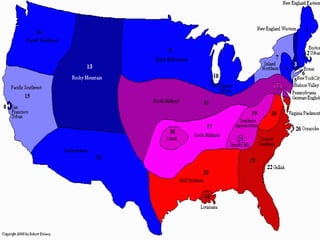
Dialects in the
United States
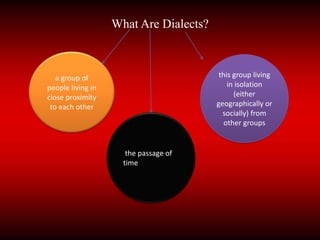
What Are Dialects?

this group living
in isolation
(either
geographically or
socially) from
other groups

a group of
people living in
close proximity
to each other

the passage of
time
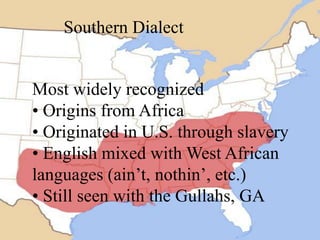
Southern Dialect

Most widely recognized
• Origins from Africa
• Originated in U.S. through slavery
• English mixed with West African
languages (ain’t, nothin’, etc.)
• Still seen with the Gullahs, GA
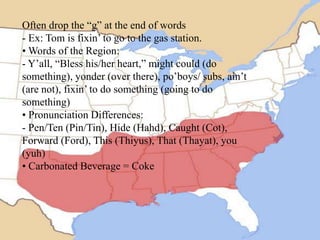
Often drop the “g” at the end of words
- Ex: Tom is fixin’ to go to the gas station.
• Words of the Region:
- Y’all, “Bless his/her heart,” might could (do
something), yonder (over there), po’boys/ subs, ain’t
(are not), fixin’ to do something (going to do
something)
• Pronunciation Differences:
- Pen/Ten (Pin/Tin), Hide (Hahd), Caught (Cot),
Forward (Ford), This (Thiyus), That (Thayat), you
(yuh)
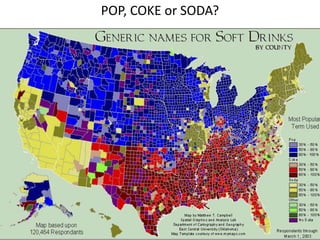
• Carbonated Beverage = Coke
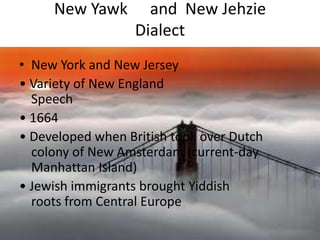
New Yawk

and New Jehzie
Dialect

• New York and New Jersey
• Variety of New England
Speech
• 1664
• Developed when British took over Dutch
colony of New Amsterdam (current-day
Manhattan Island)
• Jewish immigrants brought Yiddish
roots from Central Europe
•
•
•
•
•

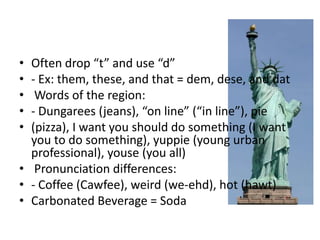
Often drop “t” and use “d”
- Ex: them, these, and that = dem, dese, and dat
Words of the region:
- Dungarees (jeans), “on line” (“in line”), pie
(pizza), I want you should do something (I want
you to do something), yuppie (young urban
professional), youse (you all)
• Pronunciation differences:
• - Coffee (Cawfee), weird (we-ehd), hot (hawt)
• Carbonated Beverage = Soda
Midland
• Rapid movement after Civil War
• People of Scotch-Irish origin
• Basis for Standard-English today
• Considered “without an accent”
• Divided into North and South Midland
Western Dialect
• Relatively recent in history (1840)
• Originated from Midland accent as
people continued to move westward
• Many foreign accents along West Coast
• Pronunciation differences:
- Elevator (allivator)
POP, COKE or SODA?
Диалекты США

Диалекты США

  • 1.
  • 2.
    What Are Dialects? thisgroup living in isolation (either geographically or socially) from other groups a group of people living in close proximity to each other the passage of time
  • 3.
    Southern Dialect Most widelyrecognized • Origins from Africa • Originated in U.S. through slavery • English mixed with West African languages (ain’t, nothin’, etc.) • Still seen with the Gullahs, GA
  • 4.
    Often drop the“g” at the end of words - Ex: Tom is fixin’ to go to the gas station. • Words of the Region: - Y’all, “Bless his/her heart,” might could (do something), yonder (over there), po’boys/ subs, ain’t (are not), fixin’ to do something (going to do something) • Pronunciation Differences: - Pen/Ten (Pin/Tin), Hide (Hahd), Caught (Cot), Forward (Ford), This (Thiyus), That (Thayat), you (yuh) • Carbonated Beverage = Coke
  • 5.
    New Yawk and NewJehzie Dialect • New York and New Jersey • Variety of New England Speech • 1664 • Developed when British took over Dutch colony of New Amsterdam (current-day Manhattan Island) • Jewish immigrants brought Yiddish roots from Central Europe
  • 6.
    • • • • • Often drop “t”and use “d” - Ex: them, these, and that = dem, dese, and dat Words of the region: - Dungarees (jeans), “on line” (“in line”), pie (pizza), I want you should do something (I want you to do something), yuppie (young urban professional), youse (you all) • Pronunciation differences: • - Coffee (Cawfee), weird (we-ehd), hot (hawt) • Carbonated Beverage = Soda
  • 7.
    Midland • Rapid movementafter Civil War • People of Scotch-Irish origin • Basis for Standard-English today • Considered “without an accent” • Divided into North and South Midland
  • 8.
    Western Dialect • Relativelyrecent in history (1840) • Originated from Midland accent as people continued to move westward • Many foreign accents along West Coast • Pronunciation differences: - Elevator (allivator)
  • 9.