Welcome to our
Horizon Europe
Consortia
Building
Webinar for
Cluster 1 and
Cluster 2
• Due to the large number of people registered all participants will be muted.
• After testing your speakers, please do remember to connect your audio by using the “Join
Audio” icon at the bottom left of the screen or dial in via phone using the number provided in the
joining instructions.
• If you have any technical problems, please use the chat to seek advice from the host
(Jess Dobbyne).
• Questions and Answers
• Please use and keep chat free for Q&A
PLEASE NOTE – THE WEBINAR IS PARTLY BEING RECORDED
The recording and slides will be made available via the KTN website
Agenda
09:00 | Pre-event virtual networking and 1-1 meeting opportunities
10:00 | Welcome and Introduction – KTN / UK National Contact Point Team
10:15 | Getting ready for Horizon Europe and finding the right partners – Jo Frost, Katie Dingley, Anni Laihanen
(UK National Contact Point Team)
11:15 | Break
11:25 | Pitching Session 1 (Cluster 1 and Cluster 2) – Each pitch will be max. 2-3 minutes long.
12:00 | Lunch & Virtual Networking Opportunities
12:45 | Pitching Session 2 (Cluster 1) – Each pitch will be max. 2-3 minutes long.
Virtual round-table discussions (Cluster 2) & 1-1 Meeting opportunity with Anni Laihanen (NCP Cluster 2)
13:45 | Parallel Sessions continued – Virtual round-table discussions with pitch presenters & 1-1 Meeting
opportunities with Jo Frost / Katie Dingley (NCPs for Cluster 1)
14:30 | 1-1 Meeting Opportunities
17:00 | Close
1-1 Meetings via Meeting Mojo
• You can organise 1:1 meetings with other registered users
• You will be able to create your profile, search other users’
profiles and book video chat meetings via the platform.
• You can search by organisation, by individual or by key
word.
• Don’t forget to confirm your requested meetings!
https://horizoneurope.meeting-mojo.com
• Will remain open until the end of July ‘21
European Framework Programmes
• Funding programmes created by the European Union/European Commission to support and foster
research and innovation
• Began in 1984 and each last for 7 years and align to the EU’s Multiannual Financial Framework (MFF)
Horizon 2020 ran from 2014 until 2020
• The previous Framework Programme (FP). Had its last call for proposals in 2020. Total budget for
Horizon 2020 was ~ €80 billion.
Horizon Europe will run 2021 to 2027
• The 9th FP and successor to Horizon 2020 with a €95.5 billion budget
• Work Programmes due to be published in June 2021 (tbc) although a few calls have already been
launched.
The UK has agreed to Associate to Horizon Europe
• UK entities will have equivalent participation rights to those from Member States can lead projects as
coordinators
• UK has continued access to Horizon Europe research and innovation funding, infrastructure and markets
• Able to access funding from all parts of the Programme including the ERC (European Research Council), MSCA (Marie
Skłodowska-Curie Actions), Partnerships, the EIT (European Institute of Innovation and Technology), the direct actions of
the JRC (Joint Research Centre). The UK will be an associate to the COST programme and to EURATOM and ITER. Can
access the majority of the EIC (European Innovation Council) the except the EIC Accelerator equity fund
• Work programme level exclusions only in exceptional and justifiable cases (e.g., some Defence & Security)
• Participation and influence on programme governance structures (e.g. programme committees)
• UK experts can continue to take part in peer review (register as an expert here)
• The ‘Associated Countries’ concept is not new - Horizon 2020 had 16 Associated Countries including Israel,
Switzerland, Norway and Turkey
• EU confirmation of UK participation
European Commission Q&A on the UK’s Participation in Horizon Europe
UK ‘Association’ means continued UK participation
The UK has agreed to Associate to Horizon Europe
Horizon Europe Structure €53.8bn
€24.9bn €13.4bn
• €95.5bn total funding agreed for 2021-2027
• NB budget figures exclude UK and other Associate Country contributions
• Others likely to associate incl. Switzerland, Norway, Turkey & Israel
• Canada, Japan, Australia etc. status TBC
Note: Info based on DRAFT WP
1) Staying healthy
in a rapidly
changing society
2) Living and
working in a
health-promoting
environment
3) Tackling
diseases and
reducing disease
burden
•Diet and health (obesity)
•Ageing & demographic change
•Mental health
•Digital empowerment
in health literacy
•Personalised prevention
•AI to predict disease risk
•Chronic inflammation
•Better diagnostics
•Personalised treatment
•Understanding diseases
•Infectious disease threats
•Innovative health tech.
•Scientific evidence, policy &
legal frameworks
•New/advanced therapies (NCDs)
Environmental, occupational
and socio-economic risk factors
to health, e.g. chemicals, non-
ionizing radiation (EMFs)
urbanisation, indoor &
outdoor air pollution, climate and
other environmental changes, socio-
economic inequalities, working
environments
4) Ensuring access to innovative,
sustainable and high-quality
health care
5) Unlocking the full potential of new tools,
technologies and digital solutions for a healthy
society
6) Maintaining an
innovative,
sustainable and
globally competitive
health industry
Fair access to high quality,
sustainable healthcare
for all citizens. Innovative,
feasible, implementable,
financially sound scalable
solutions (for governance,
financing, human and physical
resources, health services
and patient empowerment)
•Market access of innovative
tech. (medical, pharma,
biotech, digital)
•Novel methods and metrics
•Support for reg. authorities
•Safe and clinically validated
tools, technologies & services
•Greener pharmaceuticals and
health technologies
•Tools, technologies and
digital solutions for medical
devices and improved health
•Consider safety, effectiveness,
appropriateness, accessibility,
comparative value-added and
fiscal sustainability + ethical,
legal and regulatory issues
Health Cluster €8.3bn funding (2021-27) across 6 areas (“destinations”)
€1.75bn & 48 call topics (2021-22) as shown below
Note: Info based on DRAFT Work Programme (v6.2)
€289m
€350m
€490m
€240m
€270m
€113m
25 projects funded
39 projects funded
21 projects funded
72 projects funded
39 projects funded
19 projects funded
2021 deadline: 21 September tbc
2022 deadlines: 21 April (1-stage) tbc;
1 February, 6 September (2-stage) tbc
2021 Calls
Opening TBC
Deadline TBC
Cluster 2 - Culture, Creativity and Inclusive Society
2022 Calls
Opening 1 Dec
Deadline 15
March ‘22
TIMELINES
Destination 1: Innovative
research on democracy and
governance
Destination 2: Innovative research on
European cultural heritage and the
Cultural and Creative Industries
Destination 3: Innovative research
on social and economic
transformations
43
projects funded
30 projects funded
46 projects funded
106.5M€
88M€
101M€
1
• Inequalities & democracy
• Future of liberal democracy
• Economic models and modern democracies
• Feminisms for a new age of democracy
• Democratic politics in the EU’s neighbourhood
• Politics and governance in a post-pandemic world
• AI, big data and democracy
• Future of democracy and civic participation
• Education for democracy
• Political extremism
• Democracy, politics and media
• Global governance for a world in transition
2
• Green technologies and materials for cultural heritage
• Climate change & natural hazards and cultural heritage &
remediation
• Participatory management & sustainable financing of
museums/cultural institutions
• Games & culture shaping our society
• Coordination of European cultural heritage R&I
• CCI as a driver innovation and competitiveness
• Cultural heritage & advanced digital technologies
• Endangered languages in Europe
• Traditional crafts for the future
• European music ecosystem & filmmaking industry
3
• Irregular migration
• Decision-making processes of migrants
• Support in a changing world of work and social protection
• Socio-economic effects of aging societies
• New technologies in education & training
• Changing supply chains and declining trade intensities
• Impact of spatial mobility
• Gender & social, economic and cultural empowerment
• Inclusive labour market
• Successful development of skills matched to needs
1-1 Meetings via Meeting Mojo
• You can organise 1:1 meetings with other registered users
• You will be able to create your profile, search other users’
profiles and book video chat meetings via the platform.
• You can search by organisation, by individual or by key
word.
• Don’t forget to confirm your requested meetings!
https://horizoneurope.meeting-mojo.com
• Will remain open until the end of July ‘21
Getting ready for Horizon Europe
& finding the right partners
Presentedby
UKNCPsforCluster1(Health)
JoFrost–NCPforIndustry(ncp-health@innovateuk.ukri.org)
andKatieDingley–NCPforAcademia(ncp@mrc.ukri.org)
ThosefromothersectorspleasecontactbothJoandKatie.
UKNCPforCluster2(Culture,CreativityandInclusive Society)
AnniLaihanen(CCISNCP@esrc.ukri.org)
Slides happily shared
NCPs in other countries
Agenda
2
• National Contact Points
• Building a winning consortium
• Project types
• Eligibility criteria, Associated Countries, International participation
• Evaluation Criteria
• Developing a proposal outline
• Example call topic and evaluation comments
• EIT as a source of potential partners
• How to get started and next steps
• Q&A
What is a National Contact Point (NCP)?
NCP
Businesses
RTOs
Academia
UK Gov
EU
Commission
Global R&I
network
UK NCP network: Team of sector specific public servants
providing free support to UK participants to Horizon Europe
International NCP network: support in Europe and the rest of
the world
NCP services vary in each country/sector, but typically include:
Jo Frost
UK Health NCP
for industry
Katie Dingley
UK Health NCP
for academia
Informing, awareness raising – on Horizon Europe and other
EU programmes
Assisting, advising and training – to improve the quality of
Horizon Europe proposals
Signposting and cooperation – direct to relevant support and
work with each other to support consortium development
Anni Laihanen
UK NCP
for Cluster 2
What do ideal partners look like?
• Expert in their area
• Enthusiastic and committed
• Responsive to coordinator’s requests, able to communicate well (think about languages too?)
• Trustable
How to start building a consortium?
• What expertise is needed for the project? (Read the call topic very carefully)
• Which sectors and disciplines are needed? (Academia, Industry, stakeholders, patient groups…?)
• Are there people you have worked with before or know with suitable expertise? Friends of
friends?
• What expertise is still needed? Where might you find good partners with this expertise?
• How will people/organisations be involved? Partners? Advisory groups? To feed in/disseminate to?
• Think about ‘European Added value’
• Good to have some partners/orgs. with EU/collaborative experience (Especially as coordinator?)
Formal consortium building mechanisms
Participant portal – Every topic once published will have a ‘Partner Search’ function where you can
upload your profile and review others that have done so
Brokerage events – European Commission, Enterprise Europe Network, UK’s KTN, NCPs from around
Europe, Technology Platforms etc will virtual hold events with e.g., Meeting Mojo, B2B and some
have other tools like partner databases (for example EEN/EDGE, Innovative Medicines Initiative)
Partner Search – under the How to participate tab on the EU funding and tenders portal where you
can search for past projects and organisations
CORDIS – a more useful way of finding past projects and participants and allows you to contact them
Searching the formal consortium building
mechanisms is a bit like looking for a
needle in a haystack – they all look like
needles so finding the ones for you can
be difficult
EU Participant Portal – Call Topic pages
Demo
Example…
Demo
UKRI webpage with guidance on how to use the partner search tool
EU Participant Portal – Call Topic pages
CORDIS https://cordis.europa.eu/search/en
Demo: https://cordis.europa.eu/project/id/755667
CORDIS https://cordis.europa.eu/search/en
Cluster 1 (Health) Partnering & Infoday
Partnering form
• Can be circulated at any time
• Contact your NCP for a copy:
• Katie Dingley UK Health NCP for
academia
• Jo Frost UK Health NCP for industry
• NCPs in other countries
• UK NCPs plan to share incoming
partnering forms via their newsletters/
website (sign up by emailing ncp-
health@innovateuk.ukri.org)
European Commission Cluster 1 infoday
on 2 July
Partnering event for 2021 calls
5 July organised by Health NCPs, European
Commission, EEN
Cluster 2 (CCIS) Partnering & Infoday
The Cluster 2 NCP network share
information on those looking for
partners.
• UK organisations: contact Anni for
more information
(CCISNCP@esrc.ukri.org) and sign
up to her newsletters to see partner
searches circulated by others
• NCPs in other countries
European Commission Cluster 2
infoday on 1 July
Partnering event for 2021 calls
2 July organised by Cluster 2 NCP
network & the European Commission
The best ways to form winning teams
Being an effective networker is much more useful than submitting a profile into a portal and
awaiting contacts. Don’t wait to be invited to the party, push yourself forward
• Use your existing professional networks – if you don’t know who the sector leaders are in
Europe then you should find out
• Use Linked In to connect to people from possible consortium partners
• Search CORDIS for previous, related projects and contact the participants. All projects must
disseminate their results and often hold workshops, etc.
• Join the relevant networks, associations and partnerships
• Be an active member – say ‘hi’ when you join the virtual room. Ask questions, support
others’ opinions, act as if you are already well known to all in the virtual room
• Volunteer to draft working papers, take notes, send in useful information – be helpful
• Speak up at workshops – demonstrate Thought Leadership
• Show that you would be a valuable partner for collaborative projects and that without
you they won’t win – you have the secret sauce that is necessary for their success
What constitutes a winning consortium?
One that can deliver the expected outcomes within the stated scope and budget (and give the evaluators
confidence that they can)
There is no ‘typical’ or ‘model’ consortium structure/membership, it depends what is needed for the call
topic.
• Any type of organisation can be funded by Horison Europe. It is common to see universities, big business,
small business, research and technologies organisations, local/national authorities, patient groups,
charities, policy makers all within the one consortium.
Useful to include exploitation partners – someone who is going to take the outputs of the project and
actually implement them (e.g. in policy/industry/hospitals/patient care/civil society/cultural and creative
sectors) to show immediate impact. Many Health cluster call topics mention involving patient groups too.
Useful to include the end user community, possibly as an advisory board or associate partners (not direct
beneficiaries but costs e.g. travel can be included in ‘other costs’), again to demonstrate their involvement in
the design of your project so it suits their needs, and also to show a route to your project having impact.
Hints and Tips – Building a consortium
Questions to think about:
Who has the best expertise/reputation?
Who should you approach to be part of a consortium?
Not everyone has to have the same size role
Don’t include partners because you think it will look good or to pad the proposal out - each partner should
have a clear and defined purpose.
Have a good balance of countries – more than ~30% if the budget going to one country might be of concern
to the evaluators
The Project Types (in Clusters 1 & 2)
16
Research and innovation actions (RIA)
• Activities aiming primarily to establish new knowledge or to explore the feasibility of a new or improved technology,
product, process, service or solution.
• May include basic and applied research, technology development and integration, testing, demonstration and validation
on a small-scale prototype in a laboratory or simulated environment.
Innovation actions (IA)
• Activities directly aimed at producing plans and arrangements or designs for new, altered or improved products,
processes or services
• Possibly including prototyping, testing, demonstrating, piloting, large-scale product validation and market replication.
Coordination and support actions (CSA)
• Activities contributing to the objectives of the Horizon Europe Programme, excluding R&I activities (with some exceptions
– see the General Annexes to the Work Programme)
• Pre-commercial procurement actions (PCP)
• Public procurement of innovative solutions actions (PPI)
From the Work Programme 2021-2022 General Annexes
Eligibility and why collaboration is
important
Presented byAnni Laihanen
Slides happily shared
Eligibility criteria
There are several types of eligibility, and it does get confusing:
• Eligibility to take part in a consortium/project
• Eligibility to receive funding as part of a consortium/project
• Eligibility to be one of the minimum number of participants necessary in a consortium/project
Eligibility criteria explained
Stated in the General Annexes
• Any legal entity, regardless of its place of establishment, including legal entities from non-associated third
countries or international organisations (including international European research organisations) is eligible to
participate (whether it is eligible for funding or not) although exceptions may apply in specific topics so check
the text
• To be eligible for European Commission funding, applicants must be established in one of the eligible
countries, i.e.:
• Member States of the European Union, including their outermost regions;
• Overseas Countries and Territories (OCTs) linked to the Member States
• Eligible non-EU countries:
• Countries associated to Horizon Europe
• Low- and middle-income countries if country listed in the Horizon Europe Programme Guide
• Legal entities which are established in countries not listed above will be eligible for funding if provided
for in the specific call conditions, or if their participation is considered essential for implementing the
action by the granting authority
• Consortium Composition (RIAs and IAs):
• At least one independent legal entity established in a Member State; and
• At least two other independent legal entities, each established in different Member States or Associated
Countries
Associated Countries
• The UK has agreed to Associate to Horizon Europe – Association gives UK organisations access to
funding under the programme on equivalent terms as organisations in EU countries
• Countries that associated to Horizon 2020, and are expected to associate to Horizon Europe:
• Albania
• Armenia
• BosniaandHerzegovina
• FaroeIslands
• Georgia
• Iceland
• Israel
• Republic of North Macedonia
• Republic of Moldova
• Montenegro
• Norway
• Serbia
• Countries considering association include Canada, Japan, Australia and others
• Switzerland
• Tunisia
• Turkey
• Ukraine
• Can organisations from Associated Countries coordinate proposals? – Yes
• Can organisations from Associated Countries join Partnerships? – Yes
• Do the national governments or funding bodies from Associated Countries have any role in
pre-approving proposals for submission? – No
• Do Associated Countries have representation on Programme Committees? – Yes
European Commission has published Q&A on the UK’s participation in Horizon Europe
“UK entities including universities, research centres, scientists, innovative businesses,
industry, etc. will have full rights to participate in the first calls for proposals of Horizon
Europe as soon as they are published”
“In duly justified exceptional cases, restrictions may apply and these will be clearly specified
in the calls for proposals”
Frequently Asked Questions on UK’s Association
International Participation
‘International participation’ = by countries which are not EU Member States or Associated Countries
Some topics may state international participation is essential
Some topics state international collaboration is advised, e.g.
“International cooperation with partners from countries in the EU’s neighbourhood is strongly encouraged”
“International cooperation with partners from third countries of interest is encouraged in order to better
achieve the expected outcomes”
Most countries around the world have Horizon Europe National Contact Points – find their details here
The Commission also funds the participation of legal entities from Low and Middle Income Countries (LMICs) if the country
is listed in the Horizon Europe Programme Guide (This Programme Guide is not yet available, but should be soon)
For higher income countries outside of Europe (which are not associated countries):
• there are often national contact points who will be able to advise if any local funding is available to enable them to
participate. Sometimes the local funding is available to allow their researchers to participate in all calls, sometimes just
for specific call topics, and sometimes funding is not available locally.
• for the previous programme, Horizon 2020 the European Commission has published some “country page” specific
guidance (e.g. Brazil, India and China) with info and contacts. These documents are not yet available for Horizon Europe.
Why European collaboration is important
• Another source of funding for research/innovative organisations
• Higher funding rates & the only innovation funding for some sectors
• Solve global grand challenges through collaborative R&I
• Collaborate with world leading organisations to enhance UK/your capabilities
• Access cutting edge technologies, infrastructure, talent & markets
• Influence standards, regulations and research policies
• Collaborating to drive the direction of travel together (e.g. policy)
• Collaborative relationships frequently become transactional ones - exports
• Creating EU/UK jobs, growth and best practice
Increasing
Importance
International
Evaluation Criteria in Horizon Europe
Presented by Katie Dingley
Slides happily shared
Evaluation Criteria in Horizon Europe*
Excellence
Impact
Implementation
• Weighted equally for:
• Research and Innovation Actions (RIAs)
• Coordination and Support Actions (CSAs)
• Impact weighted at 1.5 for Innovation Actions (IAs)
• Scored 1-5
• Thresholds:
• 3/5 for each criteria
• 10/15 overall
• Two-stage calls: Excellence and Impact only,
threshold of 4 for first-stage
* unless otherwise stated in the Work Programme
Work Programme 2021-2022 General Annexes
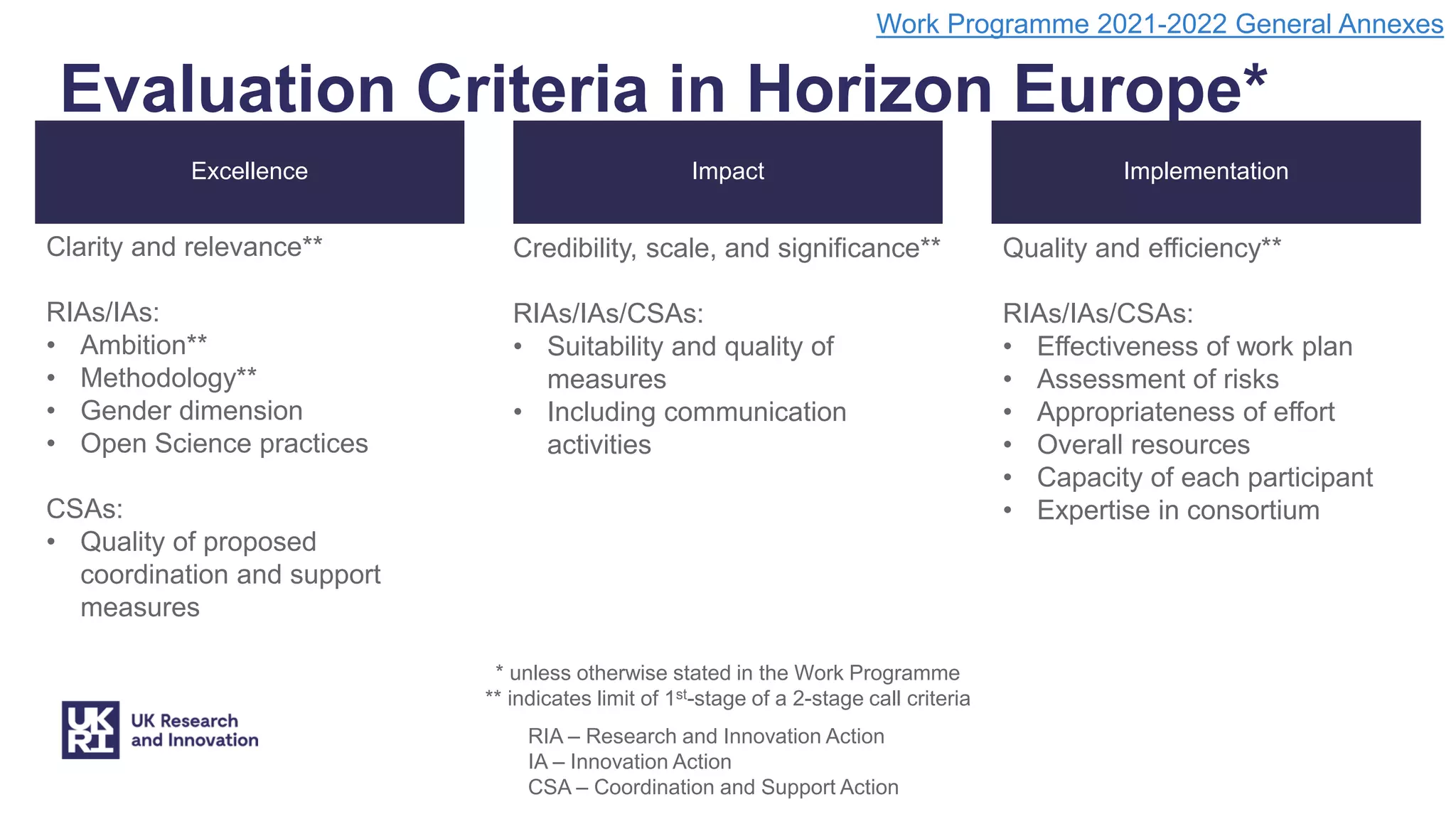
Evaluation Criteria in Horizon Europe*
* unless otherwise stated in the Work Programme
** indicates limit of 1st-stage of a 2-stage call criteria
Work Programme 2021-2022 General Annexes
Excellence Impact Implementation
Clarity and relevance**
RIAs/IAs:
• Ambition**
• Methodology**
• Gender dimension
• Open Science practices
CSAs:
• Quality of proposed
coordination and support
measures
Credibility, scale, and significance**
RIAs/IAs/CSAs:
• Suitability and quality of
measures
• Including communication
activities
Quality and efficiency**
RIAs/IAs/CSAs:
• Effectiveness of work plan
• Assessment of risks
• Appropriateness of effort
• Overall resources
• Capacity of each participant
• Expertise in consortium
RIA – Research and Innovation Action
IA – Innovation Action
CSA – Coordination and Support Action
Priority Order
Work Programme 2021-2022 General Annexes
For each group of proposals with the same score:
1. Address aspects of the call not covered by more highly-ranked proposals
2. Ranked by scores for Excellence, then Impact.
*Innovation Actions: Ranked by Impact then Excellence.
3. Gender balance of personnel
4. Geographical diversity, defined as the number of Member States or Associated
Countries represented in the proposal, not otherwise receiving funds from
projects higher up the ranking list (and if equal in number, then by budget).
5. Other factors relating to objectives of the call
Open Science
Work Programme 2021-2022 General Annexes
An approach based on open cooperative work and systematic sharing of knowledge and tools as early and widely
as possible, including active engagement of civil society
• Important policy area for European Commission
• May be incentivised or made mandatory:
• Involvement of citizens
• Use of European Open Science Cloud
• Excellence: sharing and management of research outputs, community engagement
• Implementation: previous Open Science practices
The gender dimension
Eligibility: Gender Equality Plan (applicable from 2022 onwards)
Participants that are public bodies, research organisations or higher education
institutions established in a Member State or Associated Country must have a gender
equality plan in place, fulfilling mandatory process-related requirements
Award Criteria: Integration of the gender dimension
Addressing the gender dimension in research and innovation content entails taking into
account sex and gender in the whole research & innovation process
Ranking Criteria (for tied scores): Gender balance
Third criteria - Gender balance among personnel named in the proposal who will be
primarily responsible for carrying out the research and/or innovation activities, and who
are included in the researchers table in the proposal
Developing a proposal outline/1-2 pager
Evaluation comments
EIT
Presented by Jo Frost
Slides happily shared
Developing a proposal outline (1-2 pager) for RIA/IA
31
Research and Innovation plan (and Excellence criteria)
• How will you address the call topic?
• Objectives (beyond the state of the art)
• Why should it be funded by the EU (‘European Added Value’)
• Any interdisciplinary approaches?
• Gender dimension & open science?
• Sharing and management of research output
• Engagement of citizens, civil society and end users?
Impact/outcome
• How will you address the outcome outlined in the work programme?
• How will you disseminate?
• How will you exploit your results?
• What is your communication plan?
Implementation
• Consortium – who will do what? (No redundancies/overlaps or gaps)
• Ensure that the consortium (and any advisory groups) that you are building has the necessary expertise
• Cost/workload/budget plan
Hints and Tips – Proposal Outline
32
• Good to have a one-page proposal to help focus ideas and for
consortium building
• WHY the project is being carried out
• WHAT is expected to be achieved…what is not expected to be
achieved
• Objectives
• WHO is going to do the work
• The consortium and the synergy and complementarity of the partners
• HOW the project is going to achieve the above
• Work plan and phases of work
• Means and resources to be used
Example topic – Cluster 1
Boosting mental health in Europe in times of change
(HORIZON-HLTH-2022-STAYHLTH-01-01-two-stage)
“Research should be multidisciplinary, including medical sciences, social sciences, the humanities, and the arts, if relevant.“
“Proposals should involve end-users (including civil society organisations) and/or strategic partners in the design and during the
course of the project.
Possible end-users and strategic partners could include
• local or regional authorities
• community services
• employers
• schools/universities
• cultural institutions
• insurance companies
• civil society organisations
• Communities
among others.
Proposals should adopt a patient-centred approach that empowers patients, promotes a culture of dialogue and openness
between health professionals, patients and their families, and unleashes the potential of social innovation.”
Example topics – Cluster 2
Evaluation Reports - Examples
35
Excellence
• “The multidisciplinary team is very relevant to carry out the project”
• “The consortium as a whole offers a very good complementarity, interdisciplinarity as well as cross-sectoral
involvement. All of the necessary expertise is provided within the consortium, with core partners having top
level expertise in their field”
• “Feedback from cancer survivors is central to the design and evaluation approach through the involvement of
cancer survivor associations”
• “…the use of stakeholder knowledge is not clearly explained”
• “Plans to directly involve patients, their relatives and patient associations in the co-design and evaluation are
unclear.” (and that was necessary for the proposal topic that they were applying to)
36
Impact/outcome
• “The consortium combines teams with relevant expertise with a balanced multidisciplinary profile and with a demonstrated
capacity for collaborative work.”
• “Communication activities are appropriately described by identifying the relevant target groups”
• “A suitable communication plan to reach appropriate stakeholders is presented”
• “Communication, dissemination and exploitation of results to local health professionals and researchers is well described”
• “The training of young researchers and PhD students should ensure the project has ongoing impact into the future.”
• “Dissemination is presented very generally and does not provide enough details that would link specific dissemination
methods to specific project results and partners”
• “Socioeconomic impacts are not sufficiently described”
• “The process for dealing with the IP and commercialisation is not sufficiently detailed”
Evaluation Reports - Examples
37
Implementation/Management
• “The consortium is well balanced, including partners from academia, industry and hospitals, with relevant and highly complementary
expertise.”
• “Partners have been allocated tasks according to their expertise, and all of them have a valid role in the project.”
• “The consortium has complementary research, clinical and technical skills that are appropriate to achieve the objectives.”
• “The multidisciplinary team contains groups with complementary expertise in the study area, including …..”
• “Important stakeholders to be involved in policy-making as a result of this research include cancer patient advocacy groups,
government health ministries, health professionals and pharmaceuticals industry.”
• “There is a majority representation of female leaders for the Work Packages (4 out of 7)”
• “The consortium as a whole does not convincingly bring together the necessary expertise.”
• “Allocation of tasks to individual participants is not clear due to very limited explanations of the work within work packages.”
Evaluation Reports - Examples
European Institute of Innovation and Technology (EIT)
Knowledge and Innovation Communities (KICS)
• The EIT brings together business, education and research bodies to create an environment
conductive to innovation and entrepreneurship in Europe
• It funds 8 long-term partnerships, KICs, each with a focus on a different societal challenges:
New KICs for Culture and
Creative Industries and
Water, Marine and
Maritime Sectors and
Ecosystems are
anticipated in 2022/3 and
2026 respectively
• Calls for projects starting this year have already closed but calls for projects starting in 2022 are
open or due to be open later this year and you can apply to become a partner at any time
• Calls for proposals are primarily open for existing partners. However, non-partners can participate
• You could look at the EIT KICs for potential partners for your Horizon Europe proposal
Like more info? UK NCP sharon.mchugh@innovateuk.ukri.org
Useful links: EIT Website / Link to all EIT KICS / All EIT Opportunities
EIT Health / EIT Health Opportunities / EIT Health Events
EIT KIC on Cultural & Creative Sectors &
Industries
▪ The European Institute of Innovation & Technology will launch a new Knowledge and Innovation Community
focusing on the Cultural & Creative Sectors & Industries
▪ Reduce fragmentation and catalyse regional development
▪ Power new ventures, technologies, and digitalisation
▪ Train the next generation of innovators in the CCSIs
▪ Publication of call text Oct/Nov 2021
▪ EIT Call Info Seminars Nov/Dec 2021
▪ Closure of call for proposals March 2022
▪ Designation of EIT Culture & Creativity June 2022
How to get started
&
Support available to applicants
Presented by Katie Dingley
Slides happily shared
What is a National Contact Point (NCP)?
NCP
Businesses
RTOs
Academia
UK Gov
EU
Commission
Global R&I
network
UK NCP network: Team of sector specific public servants
providing free support to UK participants to Horizon Europe
International NCP network: support in Europe and the rest of
the world
NCP services vary in each country/sector, but typically include:
Jo Frost
UK Health NCP
for industry
Katie Dingley
UK Health NCP
for academia
Informing, awareness raising – on Horizon Europe and other
EU programmes
Assisting, advising and training – to improve the quality of
Horizon Europe proposals
Signposting and cooperation – direct to relevant support and
work with each other to support consortium development
Anni Laihanen
UK NCP
for Cluster 2
Next steps: further information
• UK Health NCP newsletter: please email ncp-health@innovateuk.ukri.org
• UK Cluster 2 newsletter: please email CCISNCP@esrc.ukri.org
• The KTN Horizon Europe website includes
• Overview of Horizon Europe by UK NCPs (slides and recording)
• Overview of Health Cluster by UK NCPs (slides and recording)
• Overview of Cluster 2 by UK NCP (slides and recording)
• Links to European Commission webinars on proposal writing, submission,
evaluation etc
• UK Research Office (UKRO)
• Regularly updated factsheet on UK participation on EU funded programmes – accessible by all
• Those based at subscribing organisations can also get support on other areas of Horizon Europe and can register for
updates
Next steps: starting your proposal
• Read the (draft) Work Programmes
• Prepare a proposal summary
• Find out what has been funded already and which organisations are involved
• Approach potential partners
• Use your existing professional networks
• Join the relevant Partnership if any, ask your NCP for details
• Join the relevant networks and associations – again ask your NCP for suggestions
• Contact your NCP
• Contact the UK Knowledge Transfer Network (KTN)
Next steps: starting your proposal
• Check out the Reference Documents – if there is any conflicting information
this is the officially recognised correct source.
It contains:
• Work Programme in full including context and General Annexes
• Templates, guides, rules, etc
• Annotated Model Grant Agreement
• The on-line manual is very useful
Next steps: upcoming events
• European Commission Information Days (28 June – 9 July)
• Health Cluster Infoday on 2 July
• Cluster 2 Infoday on 1 July
• Consortia building events for Horizon Europe clusters organised by KTN and UK
NCPs (Other clusters 14/17/21 June). Registration stays open until event.
• Consortia building/partnering events organised by NCP network.
• 5 July for Health Cluster
• 2 July for Cluster 2
• European Research and Innovation Days - 23rd – 24th June
Thank you
Q&A
Further Info
Slides happily shared
Extra information covered in the Q&A & Chat (1)
Q: Under Horizon Europe, which Low and Middle Income Countries (LMICs) will the European Commission fund organisations
from?
A: We don’t have the list of countries yet unfortunately for Horizon Europe, but once it is available, it will be in the Horizon Europe
Programme Guide.
Meanwhile, if you want, you can see the countries that the European Commission funded in the previous programme (Horizon
2020) on page 3 of this document. However, there may be some changes to the list for Horizon Europe, so please be sure to use
the new list once it is available in the Horizon Europe Programme Guide.
Q: Can organisations from high income countries which are not EU Member States/Associated Countries get funding from the
European Commission?
A: This is not normally possible unless it is provided for in the specific call conditions, or if their participation is considered essential
for implementing the action by the granting authority. In either case please contact your NCP for personalised advice.
Q: Can higher income countries outside of Europe (which are not associated countries) get funding from anywhere else?
A: There are often national contact points in countries around the world who will be able to advise if any local funding is available
to enable them to participate. Sometimes the local funding is available to allow their researchers to participate in all calls,
sometimes just for specific call topics, and sometimes funding is not available locally.
For the previous programme, Horizon 2020 the European Commission has published some “country page” specific guidance (e.g.
Brazil, India and China) with info and contacts. Equivalent documents are not yet available for
Horizon Europe.
Please contact your NCP for personalised advice.
Extra information covered in the Q&A & Chat (2)
Q: What is the latest about Swiss Participation?
A: On 31 May the Swiss Health National Contact Points (based at www.euresearch.ch) sent us the following information:
“This is to confirm that any researchers, organisations or companies based in Switzerland who want to participate in an
Horizon Europe 2021 call (or other related programmes and initiatives) can do so without restrictions and submit as
coming from an Associated Country. (This conforms to the transition clause in Annex B of the Horizon Europe Work
Programme, according to which entities from all countries associated to Horizon 2020 are automatically considered as
based in an AC and are thus eligible for funding under Horizon Europe during project submission.)
You find on the official Swiss webpage the explanations, an extensive FAQ and explanations and with these the
confirmation that any Swiss partner in a successful Horizon Europe proposal will be fully funded, either by the EC if the
association of Switzerland goes through until the time of the signature of the GA, or by the Swiss Government, if the
association agreement is not in force when the Grant Agreement is signed.
Should a change in the status of participants from non-EU Member States (e.g. from beneficiary to ‘associated partner’)
become necessary, it can be adapted until the final phase of the GA preparation or throughout the project.
Please note that the decision of the Swiss Federal Council not to continue the discussions concerning the Institutional
Framework Agreement with the EU does not affect the situation of Swiss participants described above.
If you have any additional questions, do not hesitate to let us know or consult the official website“
Extra information covered in the Q&A & Chat (3)
Q: Does an organisation have to have a PIC (Participant Indentification Code) to apply to Horizon Europe?
A: Yes.
You can search for and register PIC numbers here: https://ec.europa.eu/info/funding-tenders/opportunities/portal/screen/how-to-
participate/participant-register
UKRI also has some guidance here: https://www.ukri.org/apply-for-funding/horizon-europe/apply-for-funding/#contents-list
ASEAN Partnering event
EURAXESS ASEAN are holding a few matchmaking/brokerage events to help create linkages between their
institutions/researchers and EU Member States and Associated Countries to help encourage more joint applicants.
Horizon Europe Launch Event ASEAN - Information & Partnering Brokerage - 28 - 30 June 2021
A virtual matchmaking event for institutional research actors from across ASEAN and the European Research Area
WHAT TO EXPECT?
Plenary sessions with European Commission representatives on International Cooperation in Horizon Europe. Receive
focused briefings on the application modalities for selected Horizon Europe Calls for Proposal in 4 thematic focus areas
1-1 matchmaking to help you build & expand your international research network.
WHO SHOULD PARTICIPATE?
Research institutions from the public and the private sector across ASEAN and the European Research Area (ERA) are
invited to attend. This includes universities, research institutes, industry actors, NGOs etc.
Participating institutions should have the capacity and intent of joining a Horizon Europe-funded research consortium.
Registration is free of charge. Seats are limited!
WHICH ARE THE THEMATIC FOCUS AREAS?
Health (AI & Health, Infectious Diseases, Health & Climate Change) / Civil Security for Society (Disaster Management,
Pandemic preparedness) / Digital, Industry, Space (Circular Economy) / Climate, Energy, Transport (Green Tech)
WHAT DOES THE AGENDA LOOK LIKE & HOW TO I REGISTER?
The agenda, detailed information & registration link are available on the event page. [Please click]
This event is organised by EURAXESS Worldwide ASEAN with the support of the European Commission.
Contact: euaseanhe2021@gmail.com

Horizon Europe - Cluster 1: Health & Cluster 2: Culture, Creativity & Inclusive Society

  • 1.
    Welcome to our HorizonEurope Consortia Building Webinar for Cluster 1 and Cluster 2 • Due to the large number of people registered all participants will be muted. • After testing your speakers, please do remember to connect your audio by using the “Join Audio” icon at the bottom left of the screen or dial in via phone using the number provided in the joining instructions. • If you have any technical problems, please use the chat to seek advice from the host (Jess Dobbyne). • Questions and Answers • Please use and keep chat free for Q&A PLEASE NOTE – THE WEBINAR IS PARTLY BEING RECORDED The recording and slides will be made available via the KTN website
  • 2.
    Agenda 09:00 | Pre-eventvirtual networking and 1-1 meeting opportunities 10:00 | Welcome and Introduction – KTN / UK National Contact Point Team 10:15 | Getting ready for Horizon Europe and finding the right partners – Jo Frost, Katie Dingley, Anni Laihanen (UK National Contact Point Team) 11:15 | Break 11:25 | Pitching Session 1 (Cluster 1 and Cluster 2) – Each pitch will be max. 2-3 minutes long. 12:00 | Lunch & Virtual Networking Opportunities 12:45 | Pitching Session 2 (Cluster 1) – Each pitch will be max. 2-3 minutes long. Virtual round-table discussions (Cluster 2) & 1-1 Meeting opportunity with Anni Laihanen (NCP Cluster 2) 13:45 | Parallel Sessions continued – Virtual round-table discussions with pitch presenters & 1-1 Meeting opportunities with Jo Frost / Katie Dingley (NCPs for Cluster 1) 14:30 | 1-1 Meeting Opportunities 17:00 | Close
  • 3.
    1-1 Meetings viaMeeting Mojo • You can organise 1:1 meetings with other registered users • You will be able to create your profile, search other users’ profiles and book video chat meetings via the platform. • You can search by organisation, by individual or by key word. • Don’t forget to confirm your requested meetings! https://horizoneurope.meeting-mojo.com • Will remain open until the end of July ‘21
  • 4.
    European Framework Programmes •Funding programmes created by the European Union/European Commission to support and foster research and innovation • Began in 1984 and each last for 7 years and align to the EU’s Multiannual Financial Framework (MFF) Horizon 2020 ran from 2014 until 2020 • The previous Framework Programme (FP). Had its last call for proposals in 2020. Total budget for Horizon 2020 was ~ €80 billion. Horizon Europe will run 2021 to 2027 • The 9th FP and successor to Horizon 2020 with a €95.5 billion budget • Work Programmes due to be published in June 2021 (tbc) although a few calls have already been launched. The UK has agreed to Associate to Horizon Europe
  • 5.
    • UK entitieswill have equivalent participation rights to those from Member States can lead projects as coordinators • UK has continued access to Horizon Europe research and innovation funding, infrastructure and markets • Able to access funding from all parts of the Programme including the ERC (European Research Council), MSCA (Marie Skłodowska-Curie Actions), Partnerships, the EIT (European Institute of Innovation and Technology), the direct actions of the JRC (Joint Research Centre). The UK will be an associate to the COST programme and to EURATOM and ITER. Can access the majority of the EIC (European Innovation Council) the except the EIC Accelerator equity fund • Work programme level exclusions only in exceptional and justifiable cases (e.g., some Defence & Security) • Participation and influence on programme governance structures (e.g. programme committees) • UK experts can continue to take part in peer review (register as an expert here) • The ‘Associated Countries’ concept is not new - Horizon 2020 had 16 Associated Countries including Israel, Switzerland, Norway and Turkey • EU confirmation of UK participation European Commission Q&A on the UK’s Participation in Horizon Europe UK ‘Association’ means continued UK participation The UK has agreed to Associate to Horizon Europe
  • 6.
    Horizon Europe Structure€53.8bn €24.9bn €13.4bn • €95.5bn total funding agreed for 2021-2027 • NB budget figures exclude UK and other Associate Country contributions • Others likely to associate incl. Switzerland, Norway, Turkey & Israel • Canada, Japan, Australia etc. status TBC Note: Info based on DRAFT WP
  • 7.
    1) Staying healthy ina rapidly changing society 2) Living and working in a health-promoting environment 3) Tackling diseases and reducing disease burden •Diet and health (obesity) •Ageing & demographic change •Mental health •Digital empowerment in health literacy •Personalised prevention •AI to predict disease risk •Chronic inflammation •Better diagnostics •Personalised treatment •Understanding diseases •Infectious disease threats •Innovative health tech. •Scientific evidence, policy & legal frameworks •New/advanced therapies (NCDs) Environmental, occupational and socio-economic risk factors to health, e.g. chemicals, non- ionizing radiation (EMFs) urbanisation, indoor & outdoor air pollution, climate and other environmental changes, socio- economic inequalities, working environments 4) Ensuring access to innovative, sustainable and high-quality health care 5) Unlocking the full potential of new tools, technologies and digital solutions for a healthy society 6) Maintaining an innovative, sustainable and globally competitive health industry Fair access to high quality, sustainable healthcare for all citizens. Innovative, feasible, implementable, financially sound scalable solutions (for governance, financing, human and physical resources, health services and patient empowerment) •Market access of innovative tech. (medical, pharma, biotech, digital) •Novel methods and metrics •Support for reg. authorities •Safe and clinically validated tools, technologies & services •Greener pharmaceuticals and health technologies •Tools, technologies and digital solutions for medical devices and improved health •Consider safety, effectiveness, appropriateness, accessibility, comparative value-added and fiscal sustainability + ethical, legal and regulatory issues Health Cluster €8.3bn funding (2021-27) across 6 areas (“destinations”) €1.75bn & 48 call topics (2021-22) as shown below Note: Info based on DRAFT Work Programme (v6.2) €289m €350m €490m €240m €270m €113m 25 projects funded 39 projects funded 21 projects funded 72 projects funded 39 projects funded 19 projects funded 2021 deadline: 21 September tbc 2022 deadlines: 21 April (1-stage) tbc; 1 February, 6 September (2-stage) tbc
  • 8.
    2021 Calls Opening TBC DeadlineTBC Cluster 2 - Culture, Creativity and Inclusive Society 2022 Calls Opening 1 Dec Deadline 15 March ‘22 TIMELINES Destination 1: Innovative research on democracy and governance Destination 2: Innovative research on European cultural heritage and the Cultural and Creative Industries Destination 3: Innovative research on social and economic transformations 43 projects funded 30 projects funded 46 projects funded 106.5M€ 88M€ 101M€ 1 • Inequalities & democracy • Future of liberal democracy • Economic models and modern democracies • Feminisms for a new age of democracy • Democratic politics in the EU’s neighbourhood • Politics and governance in a post-pandemic world • AI, big data and democracy • Future of democracy and civic participation • Education for democracy • Political extremism • Democracy, politics and media • Global governance for a world in transition 2 • Green technologies and materials for cultural heritage • Climate change & natural hazards and cultural heritage & remediation • Participatory management & sustainable financing of museums/cultural institutions • Games & culture shaping our society • Coordination of European cultural heritage R&I • CCI as a driver innovation and competitiveness • Cultural heritage & advanced digital technologies • Endangered languages in Europe • Traditional crafts for the future • European music ecosystem & filmmaking industry 3 • Irregular migration • Decision-making processes of migrants • Support in a changing world of work and social protection • Socio-economic effects of aging societies • New technologies in education & training • Changing supply chains and declining trade intensities • Impact of spatial mobility • Gender & social, economic and cultural empowerment • Inclusive labour market • Successful development of skills matched to needs
  • 9.
    1-1 Meetings viaMeeting Mojo • You can organise 1:1 meetings with other registered users • You will be able to create your profile, search other users’ profiles and book video chat meetings via the platform. • You can search by organisation, by individual or by key word. • Don’t forget to confirm your requested meetings! https://horizoneurope.meeting-mojo.com • Will remain open until the end of July ‘21
  • 10.
    Getting ready forHorizon Europe & finding the right partners Presentedby UKNCPsforCluster1(Health) JoFrost–NCPforIndustry(ncp-health@innovateuk.ukri.org) andKatieDingley–NCPforAcademia(ncp@mrc.ukri.org) ThosefromothersectorspleasecontactbothJoandKatie. UKNCPforCluster2(Culture,CreativityandInclusive Society) AnniLaihanen(CCISNCP@esrc.ukri.org) Slides happily shared NCPs in other countries
  • 11.
    Agenda 2 • National ContactPoints • Building a winning consortium • Project types • Eligibility criteria, Associated Countries, International participation • Evaluation Criteria • Developing a proposal outline • Example call topic and evaluation comments • EIT as a source of potential partners • How to get started and next steps • Q&A
  • 12.
    What is aNational Contact Point (NCP)? NCP Businesses RTOs Academia UK Gov EU Commission Global R&I network UK NCP network: Team of sector specific public servants providing free support to UK participants to Horizon Europe International NCP network: support in Europe and the rest of the world NCP services vary in each country/sector, but typically include: Jo Frost UK Health NCP for industry Katie Dingley UK Health NCP for academia Informing, awareness raising – on Horizon Europe and other EU programmes Assisting, advising and training – to improve the quality of Horizon Europe proposals Signposting and cooperation – direct to relevant support and work with each other to support consortium development Anni Laihanen UK NCP for Cluster 2
  • 13.
    What do idealpartners look like? • Expert in their area • Enthusiastic and committed • Responsive to coordinator’s requests, able to communicate well (think about languages too?) • Trustable
  • 14.
    How to startbuilding a consortium? • What expertise is needed for the project? (Read the call topic very carefully) • Which sectors and disciplines are needed? (Academia, Industry, stakeholders, patient groups…?) • Are there people you have worked with before or know with suitable expertise? Friends of friends? • What expertise is still needed? Where might you find good partners with this expertise? • How will people/organisations be involved? Partners? Advisory groups? To feed in/disseminate to? • Think about ‘European Added value’ • Good to have some partners/orgs. with EU/collaborative experience (Especially as coordinator?)
  • 15.
    Formal consortium buildingmechanisms Participant portal – Every topic once published will have a ‘Partner Search’ function where you can upload your profile and review others that have done so Brokerage events – European Commission, Enterprise Europe Network, UK’s KTN, NCPs from around Europe, Technology Platforms etc will virtual hold events with e.g., Meeting Mojo, B2B and some have other tools like partner databases (for example EEN/EDGE, Innovative Medicines Initiative) Partner Search – under the How to participate tab on the EU funding and tenders portal where you can search for past projects and organisations CORDIS – a more useful way of finding past projects and participants and allows you to contact them Searching the formal consortium building mechanisms is a bit like looking for a needle in a haystack – they all look like needles so finding the ones for you can be difficult
  • 16.
    EU Participant Portal– Call Topic pages Demo Example…
  • 17.
    Demo UKRI webpage withguidance on how to use the partner search tool EU Participant Portal – Call Topic pages
  • 18.
  • 19.
  • 20.
    Cluster 1 (Health)Partnering & Infoday Partnering form • Can be circulated at any time • Contact your NCP for a copy: • Katie Dingley UK Health NCP for academia • Jo Frost UK Health NCP for industry • NCPs in other countries • UK NCPs plan to share incoming partnering forms via their newsletters/ website (sign up by emailing ncp- health@innovateuk.ukri.org) European Commission Cluster 1 infoday on 2 July Partnering event for 2021 calls 5 July organised by Health NCPs, European Commission, EEN
  • 21.
    Cluster 2 (CCIS)Partnering & Infoday The Cluster 2 NCP network share information on those looking for partners. • UK organisations: contact Anni for more information (CCISNCP@esrc.ukri.org) and sign up to her newsletters to see partner searches circulated by others • NCPs in other countries European Commission Cluster 2 infoday on 1 July Partnering event for 2021 calls 2 July organised by Cluster 2 NCP network & the European Commission
  • 22.
    The best waysto form winning teams Being an effective networker is much more useful than submitting a profile into a portal and awaiting contacts. Don’t wait to be invited to the party, push yourself forward • Use your existing professional networks – if you don’t know who the sector leaders are in Europe then you should find out • Use Linked In to connect to people from possible consortium partners • Search CORDIS for previous, related projects and contact the participants. All projects must disseminate their results and often hold workshops, etc. • Join the relevant networks, associations and partnerships • Be an active member – say ‘hi’ when you join the virtual room. Ask questions, support others’ opinions, act as if you are already well known to all in the virtual room • Volunteer to draft working papers, take notes, send in useful information – be helpful • Speak up at workshops – demonstrate Thought Leadership • Show that you would be a valuable partner for collaborative projects and that without you they won’t win – you have the secret sauce that is necessary for their success
  • 23.
    What constitutes awinning consortium? One that can deliver the expected outcomes within the stated scope and budget (and give the evaluators confidence that they can) There is no ‘typical’ or ‘model’ consortium structure/membership, it depends what is needed for the call topic. • Any type of organisation can be funded by Horison Europe. It is common to see universities, big business, small business, research and technologies organisations, local/national authorities, patient groups, charities, policy makers all within the one consortium. Useful to include exploitation partners – someone who is going to take the outputs of the project and actually implement them (e.g. in policy/industry/hospitals/patient care/civil society/cultural and creative sectors) to show immediate impact. Many Health cluster call topics mention involving patient groups too. Useful to include the end user community, possibly as an advisory board or associate partners (not direct beneficiaries but costs e.g. travel can be included in ‘other costs’), again to demonstrate their involvement in the design of your project so it suits their needs, and also to show a route to your project having impact.
  • 24.
    Hints and Tips– Building a consortium Questions to think about: Who has the best expertise/reputation? Who should you approach to be part of a consortium? Not everyone has to have the same size role Don’t include partners because you think it will look good or to pad the proposal out - each partner should have a clear and defined purpose. Have a good balance of countries – more than ~30% if the budget going to one country might be of concern to the evaluators
  • 25.
    The Project Types(in Clusters 1 & 2) 16 Research and innovation actions (RIA) • Activities aiming primarily to establish new knowledge or to explore the feasibility of a new or improved technology, product, process, service or solution. • May include basic and applied research, technology development and integration, testing, demonstration and validation on a small-scale prototype in a laboratory or simulated environment. Innovation actions (IA) • Activities directly aimed at producing plans and arrangements or designs for new, altered or improved products, processes or services • Possibly including prototyping, testing, demonstrating, piloting, large-scale product validation and market replication. Coordination and support actions (CSA) • Activities contributing to the objectives of the Horizon Europe Programme, excluding R&I activities (with some exceptions – see the General Annexes to the Work Programme) • Pre-commercial procurement actions (PCP) • Public procurement of innovative solutions actions (PPI) From the Work Programme 2021-2022 General Annexes
  • 26.
    Eligibility and whycollaboration is important Presented byAnni Laihanen Slides happily shared
  • 27.
    Eligibility criteria There areseveral types of eligibility, and it does get confusing: • Eligibility to take part in a consortium/project • Eligibility to receive funding as part of a consortium/project • Eligibility to be one of the minimum number of participants necessary in a consortium/project
  • 28.
    Eligibility criteria explained Statedin the General Annexes • Any legal entity, regardless of its place of establishment, including legal entities from non-associated third countries or international organisations (including international European research organisations) is eligible to participate (whether it is eligible for funding or not) although exceptions may apply in specific topics so check the text • To be eligible for European Commission funding, applicants must be established in one of the eligible countries, i.e.: • Member States of the European Union, including their outermost regions; • Overseas Countries and Territories (OCTs) linked to the Member States • Eligible non-EU countries: • Countries associated to Horizon Europe • Low- and middle-income countries if country listed in the Horizon Europe Programme Guide • Legal entities which are established in countries not listed above will be eligible for funding if provided for in the specific call conditions, or if their participation is considered essential for implementing the action by the granting authority • Consortium Composition (RIAs and IAs): • At least one independent legal entity established in a Member State; and • At least two other independent legal entities, each established in different Member States or Associated Countries
  • 29.
    Associated Countries • TheUK has agreed to Associate to Horizon Europe – Association gives UK organisations access to funding under the programme on equivalent terms as organisations in EU countries • Countries that associated to Horizon 2020, and are expected to associate to Horizon Europe: • Albania • Armenia • BosniaandHerzegovina • FaroeIslands • Georgia • Iceland • Israel • Republic of North Macedonia • Republic of Moldova • Montenegro • Norway • Serbia • Countries considering association include Canada, Japan, Australia and others • Switzerland • Tunisia • Turkey • Ukraine
  • 30.
    • Can organisationsfrom Associated Countries coordinate proposals? – Yes • Can organisations from Associated Countries join Partnerships? – Yes • Do the national governments or funding bodies from Associated Countries have any role in pre-approving proposals for submission? – No • Do Associated Countries have representation on Programme Committees? – Yes European Commission has published Q&A on the UK’s participation in Horizon Europe “UK entities including universities, research centres, scientists, innovative businesses, industry, etc. will have full rights to participate in the first calls for proposals of Horizon Europe as soon as they are published” “In duly justified exceptional cases, restrictions may apply and these will be clearly specified in the calls for proposals” Frequently Asked Questions on UK’s Association
  • 31.
    International Participation ‘International participation’= by countries which are not EU Member States or Associated Countries Some topics may state international participation is essential Some topics state international collaboration is advised, e.g. “International cooperation with partners from countries in the EU’s neighbourhood is strongly encouraged” “International cooperation with partners from third countries of interest is encouraged in order to better achieve the expected outcomes” Most countries around the world have Horizon Europe National Contact Points – find their details here The Commission also funds the participation of legal entities from Low and Middle Income Countries (LMICs) if the country is listed in the Horizon Europe Programme Guide (This Programme Guide is not yet available, but should be soon) For higher income countries outside of Europe (which are not associated countries): • there are often national contact points who will be able to advise if any local funding is available to enable them to participate. Sometimes the local funding is available to allow their researchers to participate in all calls, sometimes just for specific call topics, and sometimes funding is not available locally. • for the previous programme, Horizon 2020 the European Commission has published some “country page” specific guidance (e.g. Brazil, India and China) with info and contacts. These documents are not yet available for Horizon Europe.
  • 32.
    Why European collaborationis important • Another source of funding for research/innovative organisations • Higher funding rates & the only innovation funding for some sectors • Solve global grand challenges through collaborative R&I • Collaborate with world leading organisations to enhance UK/your capabilities • Access cutting edge technologies, infrastructure, talent & markets • Influence standards, regulations and research policies • Collaborating to drive the direction of travel together (e.g. policy) • Collaborative relationships frequently become transactional ones - exports • Creating EU/UK jobs, growth and best practice Increasing Importance International
  • 33.
    Evaluation Criteria inHorizon Europe Presented by Katie Dingley Slides happily shared
  • 34.
    Evaluation Criteria inHorizon Europe* Excellence Impact Implementation • Weighted equally for: • Research and Innovation Actions (RIAs) • Coordination and Support Actions (CSAs) • Impact weighted at 1.5 for Innovation Actions (IAs) • Scored 1-5 • Thresholds: • 3/5 for each criteria • 10/15 overall • Two-stage calls: Excellence and Impact only, threshold of 4 for first-stage * unless otherwise stated in the Work Programme Work Programme 2021-2022 General Annexes
  • 35.
    Evaluation Criteria inHorizon Europe* * unless otherwise stated in the Work Programme ** indicates limit of 1st-stage of a 2-stage call criteria Work Programme 2021-2022 General Annexes Excellence Impact Implementation Clarity and relevance** RIAs/IAs: • Ambition** • Methodology** • Gender dimension • Open Science practices CSAs: • Quality of proposed coordination and support measures Credibility, scale, and significance** RIAs/IAs/CSAs: • Suitability and quality of measures • Including communication activities Quality and efficiency** RIAs/IAs/CSAs: • Effectiveness of work plan • Assessment of risks • Appropriateness of effort • Overall resources • Capacity of each participant • Expertise in consortium RIA – Research and Innovation Action IA – Innovation Action CSA – Coordination and Support Action
  • 36.
    Priority Order Work Programme2021-2022 General Annexes For each group of proposals with the same score: 1. Address aspects of the call not covered by more highly-ranked proposals 2. Ranked by scores for Excellence, then Impact. *Innovation Actions: Ranked by Impact then Excellence. 3. Gender balance of personnel 4. Geographical diversity, defined as the number of Member States or Associated Countries represented in the proposal, not otherwise receiving funds from projects higher up the ranking list (and if equal in number, then by budget). 5. Other factors relating to objectives of the call
  • 37.
    Open Science Work Programme2021-2022 General Annexes An approach based on open cooperative work and systematic sharing of knowledge and tools as early and widely as possible, including active engagement of civil society • Important policy area for European Commission • May be incentivised or made mandatory: • Involvement of citizens • Use of European Open Science Cloud • Excellence: sharing and management of research outputs, community engagement • Implementation: previous Open Science practices
  • 38.
    The gender dimension Eligibility:Gender Equality Plan (applicable from 2022 onwards) Participants that are public bodies, research organisations or higher education institutions established in a Member State or Associated Country must have a gender equality plan in place, fulfilling mandatory process-related requirements Award Criteria: Integration of the gender dimension Addressing the gender dimension in research and innovation content entails taking into account sex and gender in the whole research & innovation process Ranking Criteria (for tied scores): Gender balance Third criteria - Gender balance among personnel named in the proposal who will be primarily responsible for carrying out the research and/or innovation activities, and who are included in the researchers table in the proposal
  • 39.
    Developing a proposaloutline/1-2 pager Evaluation comments EIT Presented by Jo Frost Slides happily shared
  • 40.
    Developing a proposaloutline (1-2 pager) for RIA/IA 31 Research and Innovation plan (and Excellence criteria) • How will you address the call topic? • Objectives (beyond the state of the art) • Why should it be funded by the EU (‘European Added Value’) • Any interdisciplinary approaches? • Gender dimension & open science? • Sharing and management of research output • Engagement of citizens, civil society and end users? Impact/outcome • How will you address the outcome outlined in the work programme? • How will you disseminate? • How will you exploit your results? • What is your communication plan? Implementation • Consortium – who will do what? (No redundancies/overlaps or gaps) • Ensure that the consortium (and any advisory groups) that you are building has the necessary expertise • Cost/workload/budget plan
  • 41.
    Hints and Tips– Proposal Outline 32 • Good to have a one-page proposal to help focus ideas and for consortium building • WHY the project is being carried out • WHAT is expected to be achieved…what is not expected to be achieved • Objectives • WHO is going to do the work • The consortium and the synergy and complementarity of the partners • HOW the project is going to achieve the above • Work plan and phases of work • Means and resources to be used
  • 42.
    Example topic –Cluster 1 Boosting mental health in Europe in times of change (HORIZON-HLTH-2022-STAYHLTH-01-01-two-stage) “Research should be multidisciplinary, including medical sciences, social sciences, the humanities, and the arts, if relevant.“ “Proposals should involve end-users (including civil society organisations) and/or strategic partners in the design and during the course of the project. Possible end-users and strategic partners could include • local or regional authorities • community services • employers • schools/universities • cultural institutions • insurance companies • civil society organisations • Communities among others. Proposals should adopt a patient-centred approach that empowers patients, promotes a culture of dialogue and openness between health professionals, patients and their families, and unleashes the potential of social innovation.”
  • 43.
  • 44.
    Evaluation Reports -Examples 35 Excellence • “The multidisciplinary team is very relevant to carry out the project” • “The consortium as a whole offers a very good complementarity, interdisciplinarity as well as cross-sectoral involvement. All of the necessary expertise is provided within the consortium, with core partners having top level expertise in their field” • “Feedback from cancer survivors is central to the design and evaluation approach through the involvement of cancer survivor associations” • “…the use of stakeholder knowledge is not clearly explained” • “Plans to directly involve patients, their relatives and patient associations in the co-design and evaluation are unclear.” (and that was necessary for the proposal topic that they were applying to)
  • 45.
    36 Impact/outcome • “The consortiumcombines teams with relevant expertise with a balanced multidisciplinary profile and with a demonstrated capacity for collaborative work.” • “Communication activities are appropriately described by identifying the relevant target groups” • “A suitable communication plan to reach appropriate stakeholders is presented” • “Communication, dissemination and exploitation of results to local health professionals and researchers is well described” • “The training of young researchers and PhD students should ensure the project has ongoing impact into the future.” • “Dissemination is presented very generally and does not provide enough details that would link specific dissemination methods to specific project results and partners” • “Socioeconomic impacts are not sufficiently described” • “The process for dealing with the IP and commercialisation is not sufficiently detailed” Evaluation Reports - Examples
  • 46.
    37 Implementation/Management • “The consortiumis well balanced, including partners from academia, industry and hospitals, with relevant and highly complementary expertise.” • “Partners have been allocated tasks according to their expertise, and all of them have a valid role in the project.” • “The consortium has complementary research, clinical and technical skills that are appropriate to achieve the objectives.” • “The multidisciplinary team contains groups with complementary expertise in the study area, including …..” • “Important stakeholders to be involved in policy-making as a result of this research include cancer patient advocacy groups, government health ministries, health professionals and pharmaceuticals industry.” • “There is a majority representation of female leaders for the Work Packages (4 out of 7)” • “The consortium as a whole does not convincingly bring together the necessary expertise.” • “Allocation of tasks to individual participants is not clear due to very limited explanations of the work within work packages.” Evaluation Reports - Examples
  • 47.
    European Institute ofInnovation and Technology (EIT) Knowledge and Innovation Communities (KICS) • The EIT brings together business, education and research bodies to create an environment conductive to innovation and entrepreneurship in Europe • It funds 8 long-term partnerships, KICs, each with a focus on a different societal challenges: New KICs for Culture and Creative Industries and Water, Marine and Maritime Sectors and Ecosystems are anticipated in 2022/3 and 2026 respectively • Calls for projects starting this year have already closed but calls for projects starting in 2022 are open or due to be open later this year and you can apply to become a partner at any time • Calls for proposals are primarily open for existing partners. However, non-partners can participate • You could look at the EIT KICs for potential partners for your Horizon Europe proposal Like more info? UK NCP sharon.mchugh@innovateuk.ukri.org Useful links: EIT Website / Link to all EIT KICS / All EIT Opportunities EIT Health / EIT Health Opportunities / EIT Health Events
  • 48.
    EIT KIC onCultural & Creative Sectors & Industries ▪ The European Institute of Innovation & Technology will launch a new Knowledge and Innovation Community focusing on the Cultural & Creative Sectors & Industries ▪ Reduce fragmentation and catalyse regional development ▪ Power new ventures, technologies, and digitalisation ▪ Train the next generation of innovators in the CCSIs ▪ Publication of call text Oct/Nov 2021 ▪ EIT Call Info Seminars Nov/Dec 2021 ▪ Closure of call for proposals March 2022 ▪ Designation of EIT Culture & Creativity June 2022
  • 49.
    How to getstarted & Support available to applicants Presented by Katie Dingley Slides happily shared
  • 50.
    What is aNational Contact Point (NCP)? NCP Businesses RTOs Academia UK Gov EU Commission Global R&I network UK NCP network: Team of sector specific public servants providing free support to UK participants to Horizon Europe International NCP network: support in Europe and the rest of the world NCP services vary in each country/sector, but typically include: Jo Frost UK Health NCP for industry Katie Dingley UK Health NCP for academia Informing, awareness raising – on Horizon Europe and other EU programmes Assisting, advising and training – to improve the quality of Horizon Europe proposals Signposting and cooperation – direct to relevant support and work with each other to support consortium development Anni Laihanen UK NCP for Cluster 2
  • 51.
    Next steps: furtherinformation • UK Health NCP newsletter: please email ncp-health@innovateuk.ukri.org • UK Cluster 2 newsletter: please email CCISNCP@esrc.ukri.org • The KTN Horizon Europe website includes • Overview of Horizon Europe by UK NCPs (slides and recording) • Overview of Health Cluster by UK NCPs (slides and recording) • Overview of Cluster 2 by UK NCP (slides and recording) • Links to European Commission webinars on proposal writing, submission, evaluation etc • UK Research Office (UKRO) • Regularly updated factsheet on UK participation on EU funded programmes – accessible by all • Those based at subscribing organisations can also get support on other areas of Horizon Europe and can register for updates
  • 52.
    Next steps: startingyour proposal • Read the (draft) Work Programmes • Prepare a proposal summary • Find out what has been funded already and which organisations are involved • Approach potential partners • Use your existing professional networks • Join the relevant Partnership if any, ask your NCP for details • Join the relevant networks and associations – again ask your NCP for suggestions • Contact your NCP • Contact the UK Knowledge Transfer Network (KTN)
  • 53.
    Next steps: startingyour proposal • Check out the Reference Documents – if there is any conflicting information this is the officially recognised correct source. It contains: • Work Programme in full including context and General Annexes • Templates, guides, rules, etc • Annotated Model Grant Agreement • The on-line manual is very useful
  • 54.
    Next steps: upcomingevents • European Commission Information Days (28 June – 9 July) • Health Cluster Infoday on 2 July • Cluster 2 Infoday on 1 July • Consortia building events for Horizon Europe clusters organised by KTN and UK NCPs (Other clusters 14/17/21 June). Registration stays open until event. • Consortia building/partnering events organised by NCP network. • 5 July for Health Cluster • 2 July for Cluster 2 • European Research and Innovation Days - 23rd – 24th June
  • 55.
  • 56.
    Extra information coveredin the Q&A & Chat (1) Q: Under Horizon Europe, which Low and Middle Income Countries (LMICs) will the European Commission fund organisations from? A: We don’t have the list of countries yet unfortunately for Horizon Europe, but once it is available, it will be in the Horizon Europe Programme Guide. Meanwhile, if you want, you can see the countries that the European Commission funded in the previous programme (Horizon 2020) on page 3 of this document. However, there may be some changes to the list for Horizon Europe, so please be sure to use the new list once it is available in the Horizon Europe Programme Guide. Q: Can organisations from high income countries which are not EU Member States/Associated Countries get funding from the European Commission? A: This is not normally possible unless it is provided for in the specific call conditions, or if their participation is considered essential for implementing the action by the granting authority. In either case please contact your NCP for personalised advice. Q: Can higher income countries outside of Europe (which are not associated countries) get funding from anywhere else? A: There are often national contact points in countries around the world who will be able to advise if any local funding is available to enable them to participate. Sometimes the local funding is available to allow their researchers to participate in all calls, sometimes just for specific call topics, and sometimes funding is not available locally. For the previous programme, Horizon 2020 the European Commission has published some “country page” specific guidance (e.g. Brazil, India and China) with info and contacts. Equivalent documents are not yet available for Horizon Europe. Please contact your NCP for personalised advice.
  • 57.
    Extra information coveredin the Q&A & Chat (2) Q: What is the latest about Swiss Participation? A: On 31 May the Swiss Health National Contact Points (based at www.euresearch.ch) sent us the following information: “This is to confirm that any researchers, organisations or companies based in Switzerland who want to participate in an Horizon Europe 2021 call (or other related programmes and initiatives) can do so without restrictions and submit as coming from an Associated Country. (This conforms to the transition clause in Annex B of the Horizon Europe Work Programme, according to which entities from all countries associated to Horizon 2020 are automatically considered as based in an AC and are thus eligible for funding under Horizon Europe during project submission.) You find on the official Swiss webpage the explanations, an extensive FAQ and explanations and with these the confirmation that any Swiss partner in a successful Horizon Europe proposal will be fully funded, either by the EC if the association of Switzerland goes through until the time of the signature of the GA, or by the Swiss Government, if the association agreement is not in force when the Grant Agreement is signed. Should a change in the status of participants from non-EU Member States (e.g. from beneficiary to ‘associated partner’) become necessary, it can be adapted until the final phase of the GA preparation or throughout the project. Please note that the decision of the Swiss Federal Council not to continue the discussions concerning the Institutional Framework Agreement with the EU does not affect the situation of Swiss participants described above. If you have any additional questions, do not hesitate to let us know or consult the official website“
  • 58.
    Extra information coveredin the Q&A & Chat (3) Q: Does an organisation have to have a PIC (Participant Indentification Code) to apply to Horizon Europe? A: Yes. You can search for and register PIC numbers here: https://ec.europa.eu/info/funding-tenders/opportunities/portal/screen/how-to- participate/participant-register UKRI also has some guidance here: https://www.ukri.org/apply-for-funding/horizon-europe/apply-for-funding/#contents-list
  • 59.
    ASEAN Partnering event EURAXESSASEAN are holding a few matchmaking/brokerage events to help create linkages between their institutions/researchers and EU Member States and Associated Countries to help encourage more joint applicants. Horizon Europe Launch Event ASEAN - Information & Partnering Brokerage - 28 - 30 June 2021 A virtual matchmaking event for institutional research actors from across ASEAN and the European Research Area WHAT TO EXPECT? Plenary sessions with European Commission representatives on International Cooperation in Horizon Europe. Receive focused briefings on the application modalities for selected Horizon Europe Calls for Proposal in 4 thematic focus areas 1-1 matchmaking to help you build & expand your international research network. WHO SHOULD PARTICIPATE? Research institutions from the public and the private sector across ASEAN and the European Research Area (ERA) are invited to attend. This includes universities, research institutes, industry actors, NGOs etc. Participating institutions should have the capacity and intent of joining a Horizon Europe-funded research consortium. Registration is free of charge. Seats are limited! WHICH ARE THE THEMATIC FOCUS AREAS? Health (AI & Health, Infectious Diseases, Health & Climate Change) / Civil Security for Society (Disaster Management, Pandemic preparedness) / Digital, Industry, Space (Circular Economy) / Climate, Energy, Transport (Green Tech) WHAT DOES THE AGENDA LOOK LIKE & HOW TO I REGISTER? The agenda, detailed information & registration link are available on the event page. [Please click] This event is organised by EURAXESS Worldwide ASEAN with the support of the European Commission. Contact: euaseanhe2021@gmail.com