
Digital Security by
Design
Richard Grisenthwaite
SVP Chief Architect and Fellow
Richard.Grisenthwaite@arm.com
2 2019 Arm Limited
Security is the greatest challenge computing needs to
address to meet its full potential
3 2019 Arm Limited
New Architecture motivated by Security features
• “Architecture” meaning CPU “Instruction Set Architecture”
• Arm runs an incremental update process for the architecture
• Security is one of the stronger motivations for incremental architectural improvements:
• Privileged Access Never
• Hypervisor applied Execute-Never
• Pointer Authentication
• Branch Target Identification
• Introduction of Secure EL2
• Memory Tagging Extensions
• These changes are incremental improvements to the architecture
• Easy to deploy, small scale point improvements
4 2019 Arm Limited
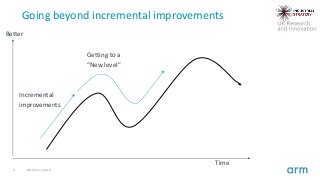
Going beyond incremental improvements
Incremental
improvements
Getting to a
“New level”
Better
Time
5 2019 Arm Limited
CHERI architecture in one slide
• CPU architecture adds 128-bit “capabilities” plus a memory tagging bit
• Capability contains the address, bounds information, permission information etc
• The memory tagging bit is metadata that distinguishes a capability from normal data
 This memory tagging bit prevents “forging” of a capability
 This functionality gives strong provenance of capabilities
• Architecture has the ability to “seal” capabilities as well as part of compartmentalisation
• Loads/stores using capabilities as addresses are checked to be legal
• Within address range and matching the supplied permissions
• Data processing on capabilities has rules to limit operations
• Bounds cannot be arbitrarily increased, permissions cannot be relaxed etc
• Capability is used in place of a normal pointer in some or all situations
• Exactly how when this happens is part of the software usage case
• Simply replacing all pointers with capabilities gives scope for strong spatial memory
protection
 But clearly is an ABI change and increases cache pressure
6 2019 Arm Limited
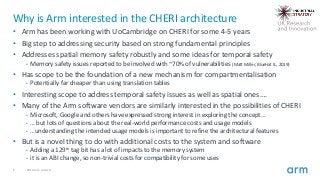
Why is Arm interested in the CHERI architecture
• Arm has been working with UoCambridge on CHERI for some 4-5 years
• Big step to addressing security based on strong fundamental principles
• Addresses spatial memory safety robustly and some ideas for temporal safety
• Memory safety issues reported to be involved with ~70% of vulnerabilities (Matt Miller, BlueHat IL, 2019)
• Has scope to be the foundation of a new mechanism for compartmentalisation
• Potentially far cheaper than using translation tables
• Interesting scope to address temporal safety issues as well as spatial ones….
• Many of the Arm software vendors are similarly interested in the possibilities of CHERI
• Microsoft, Google and others have expressed strong interest in exploring the concept…
• … but lots of questions about the real-world performance costs and usage models
• …understanding the intended usage models is important to refine the architectural features
• But is a novel thing to do with additional costs to the system and software
• Adding a 129th tag bit has a lot of impacts to the memory system
• it is an ABI change, so non-trivial costs for compatibility for some uses
7 2019 Arm Limited
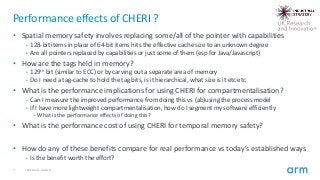
Performance effects of CHERI ?
• Spatial memory safety involves replacing some/all of the pointer with capabilities
• 128-bit items in place of 64-bit items hits the effective cache size to an unknown degree
• Are all pointers replaced by capabilities or just some of them (esp for Java/Javascript)
• How are the tags held in memory?
• 129th bit (similar to ECC) or by carving out a separate area of memory
• Do I need a tag-cache to hold the tag bits, is it hierarchical, what size is it etc etc
• What is the performance implications for using CHERI for compartmentalisation?
• Can I measure the improved performance from doing this vs (ab)using the process model
• If I have more lightweight compartmentalisation, how do I segment my software efficiently
– What is the performance effects of doing this?
• What is the performance cost of using CHERI for temporal memory safety?
• How do any of these benefits compare for real performance vs today’s established ways
• Is the benefit worth the effort?
8 2019 Arm Limited
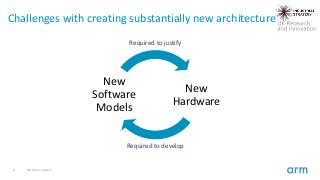
Challenges with creating substantially new architecture
New
Hardware
New
Software
Models
Required to justify
Required to develop
9 2019 Arm Limited
IP Position
• Today’s CPU architectures have largely the same basic functionality
• “Similar but different” approaches to most aspects of system architecture
• Small scale optimisations exist
• This position very beneficial for the porting of system software
• Anything that fundamentally changes the system software architecture is likely to be ignored
• Arm believes that this reality needs to continue with capabilities
• Implication is that we’d like the world’s leading architectures to adopt capabilities
• The Digital Security by Design program
10 2019 Arm Limited
The Morello Board
• An Industrial Demonstrator of a Capability architecture
• Uses a prototype capability extension to the Arm Architecture
• Prototype is a “superset” of what could be adopted into the Arm architecture
• Use of a superset of the architecture is very unusual
• Also unrealistic as a commercial product – there will be some frequency effects
• However, there are tight timescales so architecture is nearly complete now
• The superset of the architecture will allow a lot of software experimentation
• Various different mechanisms for compartmentalisation
• Collection of features for which the justification is unclear
• Techniques for holding the capability tag bit
• Architecture will have formally proved security properties (with UoC and UoE)
• Morello Board will be the ONLY physical implementation of this prototype architecture
• Learnings from these experiments will be adopted into a mainstream extension to the Arm architecture
• NO COMMITMENT TO FULL BINARY COMPATIBILITY TO THE PROTOTYPE ARCHITECTURE
– But successful concepts are expected to be carried forward into the architecture and can be reused there
11 2019 Arm Limited
Morello Board overview (subject to change)
• Quad core bespoke high-end CPU with prototype capability extensions
• Backwards compatibility with v8.2 AArch64-only
• Based on Neoverse N1 core
– Multi-issue out-of-order superscalar core with 3 levels of cache
• Build in 7nm process
• Targeting clock frequency around 2GHz
• Reasonable performance GPU and Display controller
• Standard Mali architecture core – not extended with capability
• Supports Android
• PCIe and CCIx interfaces including to FPGA based accelerators
• FPGA for peripheral expansion
• SBSA compliant system
• 16GB of System Memory (expandable to 32GB – tbc)
12 2019 Arm Limited
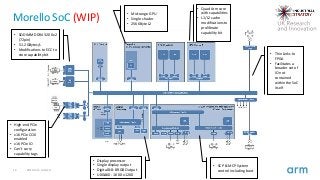
Morello SoC (WIP)
• Display processor
• Single display output
• Digital 8:8:8 RGB Output
• UXGA60 : 1600 x 1200
• Mid-range GPU
• Single shader
• 256KByte L2
• SODIMM DDR4 3200 x2
(72pin)
• 51.2 GBytes/s
• Modifications to ECC to
store capability bit
• SCP & MCP System
control including boot
• High-end PCIe
configuration
• x16 PCIe CCIX
enabled
• x16 PCIe IO
• Can’t carry
capability tags
• Thin Links to
FPGA
• Facilitates a
broader set of
IO not
contained
within the SoC
itself
• Quad Arm core
with capabilities
• L1/L2 cache
modifications to
proliferate
capability bit
13 2019 Arm Limited
Software and Tools on Morello Platform
• Initial toolchain development is focussed on the LLVM toolchain (including LLDB)
• GNU tools being developed as a secondary activity
• Initial OS focus is FreeBSD (developed with UoCambridge), Android
• Secondary focus: Windows PE, Yocto (Linux Distribution for IoT) ,
• Tertiary focus: Debian, RedHat Fedora, SuSE Tumbleweed,
14 2019 Arm Limited
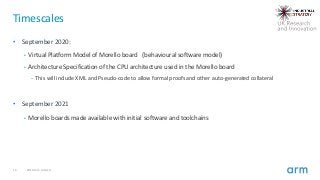
Timescales
• September 2020:
• Virtual Platform Model of Morello board (behavioural software model)
• Architecture Specification of the CPU architecture used in the Morello board
– This will include XML and Pseudo-code to allow formal proofs and other auto-generated collateral
• September 2021
• Morello boards made available with initial software and toolchains
15 2019 Arm Limited
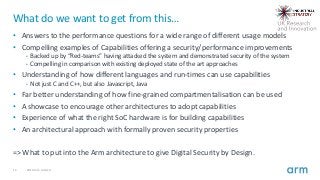
What do we want to get from this…
• Answers to the performance questions for a wide range of different usage models
• Compelling examples of Capabilities offering a security/performance improvements
• Backed up by “Red-teams” having attacked the system and demonstrated security of the system
• Compelling in comparison with existing deployed state of the art approaches
• Understanding of how different languages and run-times can use capabilities
• Not just C and C++, but also Javascript, Java
• Far better understanding of how fine-grained compartmentalisation can be used
• A showcase to encourage other architectures to adopt capabilities
• Experience of what the right SoC hardware is for building capabilities
• An architectural approach with formally proven security properties
=> What to put into the Arm architecture to give Digital Security by Design.
Questions?

Digital Security by Design: Technology Platform - Richard Grisenthwaite, ARM

  • 1.
    Digital Security by Design RichardGrisenthwaite SVP Chief Architect and Fellow Richard.Grisenthwaite@arm.com
  • 2.
    2 2019 ArmLimited Security is the greatest challenge computing needs to address to meet its full potential
  • 3.
    3 2019 ArmLimited New Architecture motivated by Security features • “Architecture” meaning CPU “Instruction Set Architecture” • Arm runs an incremental update process for the architecture • Security is one of the stronger motivations for incremental architectural improvements: • Privileged Access Never • Hypervisor applied Execute-Never • Pointer Authentication • Branch Target Identification • Introduction of Secure EL2 • Memory Tagging Extensions • These changes are incremental improvements to the architecture • Easy to deploy, small scale point improvements
  • 4.
    4 2019 ArmLimited Going beyond incremental improvements Incremental improvements Getting to a “New level” Better Time
  • 5.
    5 2019 ArmLimited CHERI architecture in one slide • CPU architecture adds 128-bit “capabilities” plus a memory tagging bit • Capability contains the address, bounds information, permission information etc • The memory tagging bit is metadata that distinguishes a capability from normal data  This memory tagging bit prevents “forging” of a capability  This functionality gives strong provenance of capabilities • Architecture has the ability to “seal” capabilities as well as part of compartmentalisation • Loads/stores using capabilities as addresses are checked to be legal • Within address range and matching the supplied permissions • Data processing on capabilities has rules to limit operations • Bounds cannot be arbitrarily increased, permissions cannot be relaxed etc • Capability is used in place of a normal pointer in some or all situations • Exactly how when this happens is part of the software usage case • Simply replacing all pointers with capabilities gives scope for strong spatial memory protection  But clearly is an ABI change and increases cache pressure
  • 6.
    6 2019 ArmLimited Why is Arm interested in the CHERI architecture • Arm has been working with UoCambridge on CHERI for some 4-5 years • Big step to addressing security based on strong fundamental principles • Addresses spatial memory safety robustly and some ideas for temporal safety • Memory safety issues reported to be involved with ~70% of vulnerabilities (Matt Miller, BlueHat IL, 2019) • Has scope to be the foundation of a new mechanism for compartmentalisation • Potentially far cheaper than using translation tables • Interesting scope to address temporal safety issues as well as spatial ones…. • Many of the Arm software vendors are similarly interested in the possibilities of CHERI • Microsoft, Google and others have expressed strong interest in exploring the concept… • … but lots of questions about the real-world performance costs and usage models • …understanding the intended usage models is important to refine the architectural features • But is a novel thing to do with additional costs to the system and software • Adding a 129th tag bit has a lot of impacts to the memory system • it is an ABI change, so non-trivial costs for compatibility for some uses
  • 7.
    7 2019 ArmLimited Performance effects of CHERI ? • Spatial memory safety involves replacing some/all of the pointer with capabilities • 128-bit items in place of 64-bit items hits the effective cache size to an unknown degree • Are all pointers replaced by capabilities or just some of them (esp for Java/Javascript) • How are the tags held in memory? • 129th bit (similar to ECC) or by carving out a separate area of memory • Do I need a tag-cache to hold the tag bits, is it hierarchical, what size is it etc etc • What is the performance implications for using CHERI for compartmentalisation? • Can I measure the improved performance from doing this vs (ab)using the process model • If I have more lightweight compartmentalisation, how do I segment my software efficiently – What is the performance effects of doing this? • What is the performance cost of using CHERI for temporal memory safety? • How do any of these benefits compare for real performance vs today’s established ways • Is the benefit worth the effort?
  • 8.
    8 2019 ArmLimited Challenges with creating substantially new architecture New Hardware New Software Models Required to justify Required to develop
  • 9.
    9 2019 ArmLimited IP Position • Today’s CPU architectures have largely the same basic functionality • “Similar but different” approaches to most aspects of system architecture • Small scale optimisations exist • This position very beneficial for the porting of system software • Anything that fundamentally changes the system software architecture is likely to be ignored • Arm believes that this reality needs to continue with capabilities • Implication is that we’d like the world’s leading architectures to adopt capabilities • The Digital Security by Design program
  • 10.
    10 2019 ArmLimited The Morello Board • An Industrial Demonstrator of a Capability architecture • Uses a prototype capability extension to the Arm Architecture • Prototype is a “superset” of what could be adopted into the Arm architecture • Use of a superset of the architecture is very unusual • Also unrealistic as a commercial product – there will be some frequency effects • However, there are tight timescales so architecture is nearly complete now • The superset of the architecture will allow a lot of software experimentation • Various different mechanisms for compartmentalisation • Collection of features for which the justification is unclear • Techniques for holding the capability tag bit • Architecture will have formally proved security properties (with UoC and UoE) • Morello Board will be the ONLY physical implementation of this prototype architecture • Learnings from these experiments will be adopted into a mainstream extension to the Arm architecture • NO COMMITMENT TO FULL BINARY COMPATIBILITY TO THE PROTOTYPE ARCHITECTURE – But successful concepts are expected to be carried forward into the architecture and can be reused there
  • 11.
    11 2019 ArmLimited Morello Board overview (subject to change) • Quad core bespoke high-end CPU with prototype capability extensions • Backwards compatibility with v8.2 AArch64-only • Based on Neoverse N1 core – Multi-issue out-of-order superscalar core with 3 levels of cache • Build in 7nm process • Targeting clock frequency around 2GHz • Reasonable performance GPU and Display controller • Standard Mali architecture core – not extended with capability • Supports Android • PCIe and CCIx interfaces including to FPGA based accelerators • FPGA for peripheral expansion • SBSA compliant system • 16GB of System Memory (expandable to 32GB – tbc)
  • 12.
    12 2019 ArmLimited Morello SoC (WIP) • Display processor • Single display output • Digital 8:8:8 RGB Output • UXGA60 : 1600 x 1200 • Mid-range GPU • Single shader • 256KByte L2 • SODIMM DDR4 3200 x2 (72pin) • 51.2 GBytes/s • Modifications to ECC to store capability bit • SCP & MCP System control including boot • High-end PCIe configuration • x16 PCIe CCIX enabled • x16 PCIe IO • Can’t carry capability tags • Thin Links to FPGA • Facilitates a broader set of IO not contained within the SoC itself • Quad Arm core with capabilities • L1/L2 cache modifications to proliferate capability bit
  • 13.
    13 2019 ArmLimited Software and Tools on Morello Platform • Initial toolchain development is focussed on the LLVM toolchain (including LLDB) • GNU tools being developed as a secondary activity • Initial OS focus is FreeBSD (developed with UoCambridge), Android • Secondary focus: Windows PE, Yocto (Linux Distribution for IoT) , • Tertiary focus: Debian, RedHat Fedora, SuSE Tumbleweed,
  • 14.
    14 2019 ArmLimited Timescales • September 2020: • Virtual Platform Model of Morello board (behavioural software model) • Architecture Specification of the CPU architecture used in the Morello board – This will include XML and Pseudo-code to allow formal proofs and other auto-generated collateral • September 2021 • Morello boards made available with initial software and toolchains
  • 15.
    15 2019 ArmLimited What do we want to get from this… • Answers to the performance questions for a wide range of different usage models • Compelling examples of Capabilities offering a security/performance improvements • Backed up by “Red-teams” having attacked the system and demonstrated security of the system • Compelling in comparison with existing deployed state of the art approaches • Understanding of how different languages and run-times can use capabilities • Not just C and C++, but also Javascript, Java • Far better understanding of how fine-grained compartmentalisation can be used • A showcase to encourage other architectures to adopt capabilities • Experience of what the right SoC hardware is for building capabilities • An architectural approach with formally proven security properties => What to put into the Arm architecture to give Digital Security by Design.
  • 16.

Editor's Notes

  • #5 Everyone can get behind incremental improvements – this conference Really successful companies can be really great at incremental improvements “Innovator’s dilemma” Passion for progress says we need to embrace more disruptive change too IPG re-org
  • #9 <don’t do the detail >