Joe Hill
 Linear narratives are the most common form of structure, every event that
takes place is in chronological order. Whilst non-linear narratives slice the
story into different segments, which are told in a specific order to serve a
greater purpose later on. An example of a linear story in books is the Harry
Potter series, they tell the story of the teenage wizard from beginning to end
in the present form. Alternatively, a book called Cloud Atlas is written in a
non-linear narrative style. The book compiles six different stories together,
and tells them in a different order. By the end of the book the audience
figures out the order of narratives, and workouts the overall plot from that.
Very few books are written in non-linear fashion.
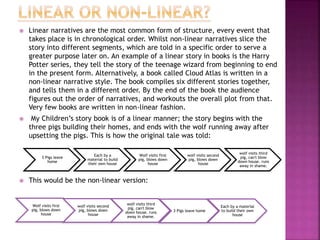
 My Children’s story book is of a linear manner; the story begins with the
three pigs building their homes, and ends with the wolf running away after
upsetting the pigs. This is how the original tale was told:
 This would be the non-linear version:
3 Pigs leave
home
Each by a
material to build
their own house
Wolf visits first
pig, blows down
house
wolf visits second
pig, blows down
house
wolf visits third
pig, can't blow
down house. runs
away in shame.
3 Pigs leave home
Each by a material
to build their own
house
Wolf visits first
pig, blows down
house
wolf visits second
pig, blows down
house
wolf visits third
pig, can't blow
down house. runs
away in shame.
 Open narratives have no true ending. They go on and on, instead
of reaching a final conclusion to the plot. They may have sub-
plots that take over a portion of the story, however the overall
narrative is never resolved/ completed. This type of narrative
commonly uses cliff-hangers to set up the next story. Closed
narratives are also the most common forms of narration found in
books. These stories follow a traditional form of storytelling:
opening, conflict/ enigma, climax, resolution. The story is one
plot, it begins and ends. In theory their shouldn’t be any loose
ends.
 My narrative is closed: the story begins, there is conflict and
there is a resolution. I stuck close to the original telling of the
classic tale. The story doesn’t need an open narrative, it is a
simple story for entertaining young children. If I were to come up
with an open ended narrative: then the wolf may be spiteful of
the situation at the end. And include one last line of speech
which says: “I’ll be back, and take revenge on those three little
pigs”. A simple concept, but it shows the wolf’s intentions on
coming back to cause more trouble. Suggesting to the audience
that a sequel narrative will come out showing the wolf’s new plan
for vengeance.
 It is most common for children’s story books to only follow one plot/ storyline.
This is because at a younger age, it is more difficult for them to understand
several stories going on at once. This is called a single strand narrative, it follows
one story beginning to end and everything that happens during that time is all part
of that one storyline. Multi-strand narratives are vice versa, they have several sub-
plots all happening at the same time. These plots tend to feature a variety of
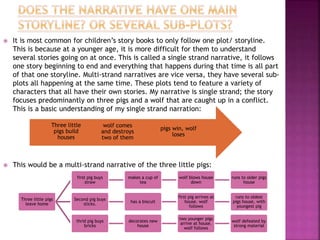
characters that all have their own stories. My narrative is single strand; the story
focuses predominantly on three pigs and a wolf that are caught up in a conflict.
This is a basic understanding of my single strand narration:
 This would be a multi-strand narrative of the three little pigs:
pigs win, wolf
loses
wolf comes
and destroys
two of them
Three little
pigs build
houses
Three little pigs
leave home
first pig buys
straw
makes a cup of
tea
wolf blows house
down
runs to older pigs
house
Second pig buys
sticks.
has a biscuit
first pig arrives at
house. wolf
follows
runs to oldest
pigs house, with
youngest pig
thrid pig buys
bricks
decorates new
house
two younger pigs
arrive at house.
wolf follows
wolf defeated by
strong material
 My narration is anti-realistic, the characters are humanized animals: they have
human like characteristics (such as speech, walking on two legs and they build
modern style homes). Non-realistic narrations are stories that couldn’t be true in
the real world; either the story/ circumstances faced in the narrative are
impossible or extremely unlikely to happen. And characters involved are not beings
that exist today. Many children’s stories follow this type of narration, wacky ideas
and characters are appealing and fun to young children. It helps to broaden their
imaginations.
 My children’s narrative follows this style of anti-realism. The wolf and pigs live in
a town alongside human beings; this wouldn’t be abstract if the pigs weren’t
buying building materials from the local B & Q. Animals (excluding ape’s and
chimps) also don’t have thumbs, so they would be unable to handle any tools that
help to build the house. It is easy to nitpick at all the impossibilities found in my
story. However, the plot itself is not that farfetched. When doing research? I found
many adaptations of the three little pigs. They took modern approaches and literal
narrative points. For example there was one which talked about businesses; it was
the same concept just with three different businessmen and how they invested
money. But this version was a bit boring for people of any age.
 Opening: My opening is only one page long. But it serves an important
purpose: it sets up the characters and their motivation. We are introduced to
the three little pigs (characters), and we learn that they are setting off to
build their own happy and independent lives (motivation).
 Development: The second page tells us that the pigs have begun their
independent journeys. They each go off to buy materials to build their own
homes. They have stuck to their ambition and are taking the first step.
 Conflict: When the wolf is introduced, we already see further plot
development and complications. This new character isn’t like the little pigs.
He may have good intentions at first, but we see the inconvenience he causes
for the pigs later on. The conflict is created when he tries to get involved
with the pigs.
 Partial climax: This isn’t the overall climax of the narrative because it is
repeated several times. Despite this, it is the first problem that the pigs have
to overcome. It sets up further motivation to stop the wolf. In this first small
climax the wolf has accidentally blown down the littlest pig’s house. The pig
runs away to his older brother’s house.
 Conflict: The wolf has followed the pig to the other pig’s home. This shows
the ever present threat that endangers the main protagonists. Although the
audience knows that this is less like conflict, and more of an apology: the pigs
still come across as distressed and passes this emotion onto the reader.
 2nd partial climax: This is the second problem the pigs have to overcome. The
wolf has turned up and has destroyed yet another house. Yet despite the fear
he brings when facing the pigs: he still follows them in an attempt to be civil
with them.
 Conflict: The wolf turns up at the oldest pig’s house. This time he is very
annoyed at the pigs and threatens to use his destructive powers to reduce
their hard work to rubble.
 Climax: The wolf builds up suspense with the iconic line: “I’ll huff, and I’ll
puff, and blow your house down”. We see the pigs are scared because the
wolf is now very angry. The wolf finally blows at the house. This is the climax
the audience anticipates. Although in the original version the climax would be
when the wolf climbs onto the roof and jumps down the chimney. In this
friendlier version we wait to see what the wolf will do. And how the pigs get
out of the predicament they have found themselves in.
 Resolution: The wolf’s attempt at blowing the house down ultimately fails; he
is now embarrassed and runs away. We see that the pigs managed to be smart
and get out of danger by being resourceful. Younger children will always
support the protagonist/ hero of the story, even if that hero (es) have many
flaws as the pigs did in this (they were provocative and rude). We see that the
story has come full circle, the pigs went out to make lives for themselves, and
they overcame obstacles and came out the other side with experience in
dealing with issues in life.
 Children’s stories are short and simple. It is because of this reason that I
chose to manipulate the timeline of the book, and the motion of time. The
book would have been twice as long and twice as boring if I showed every
journey the characters took. The pacing of the book would be greatly
reduced as well; explaining that the pigs walked through the forest just to
get to the market then breaks down all of the interesting narrative that is
being told.
 By manipulating space, I can have the characters suddenly appear at
different locations. By doing this correctly- making sense of where the pigs
would go/ explaining why they’re there- then it is easier for the audience to
understand why this location is significant to the story. It works parallel to
the manipulation of time as well; we understand the development that has
taken place during the parts of the book we don’t see. The original Brothers
Grimm version also manipulates time and space; it is useful and most
definitely an important use of a narrative technique to which I employed
into my story.

Narrative structure

  • 1.
  • 2.
     Linear narrativesare the most common form of structure, every event that takes place is in chronological order. Whilst non-linear narratives slice the story into different segments, which are told in a specific order to serve a greater purpose later on. An example of a linear story in books is the Harry Potter series, they tell the story of the teenage wizard from beginning to end in the present form. Alternatively, a book called Cloud Atlas is written in a non-linear narrative style. The book compiles six different stories together, and tells them in a different order. By the end of the book the audience figures out the order of narratives, and workouts the overall plot from that. Very few books are written in non-linear fashion.  My Children’s story book is of a linear manner; the story begins with the three pigs building their homes, and ends with the wolf running away after upsetting the pigs. This is how the original tale was told:  This would be the non-linear version: 3 Pigs leave home Each by a material to build their own house Wolf visits first pig, blows down house wolf visits second pig, blows down house wolf visits third pig, can't blow down house. runs away in shame. 3 Pigs leave home Each by a material to build their own house Wolf visits first pig, blows down house wolf visits second pig, blows down house wolf visits third pig, can't blow down house. runs away in shame.
  • 3.
     Open narrativeshave no true ending. They go on and on, instead of reaching a final conclusion to the plot. They may have sub- plots that take over a portion of the story, however the overall narrative is never resolved/ completed. This type of narrative commonly uses cliff-hangers to set up the next story. Closed narratives are also the most common forms of narration found in books. These stories follow a traditional form of storytelling: opening, conflict/ enigma, climax, resolution. The story is one plot, it begins and ends. In theory their shouldn’t be any loose ends.  My narrative is closed: the story begins, there is conflict and there is a resolution. I stuck close to the original telling of the classic tale. The story doesn’t need an open narrative, it is a simple story for entertaining young children. If I were to come up with an open ended narrative: then the wolf may be spiteful of the situation at the end. And include one last line of speech which says: “I’ll be back, and take revenge on those three little pigs”. A simple concept, but it shows the wolf’s intentions on coming back to cause more trouble. Suggesting to the audience that a sequel narrative will come out showing the wolf’s new plan for vengeance.
  • 4.
     It ismost common for children’s story books to only follow one plot/ storyline. This is because at a younger age, it is more difficult for them to understand several stories going on at once. This is called a single strand narrative, it follows one story beginning to end and everything that happens during that time is all part of that one storyline. Multi-strand narratives are vice versa, they have several sub- plots all happening at the same time. These plots tend to feature a variety of characters that all have their own stories. My narrative is single strand; the story focuses predominantly on three pigs and a wolf that are caught up in a conflict. This is a basic understanding of my single strand narration:  This would be a multi-strand narrative of the three little pigs: pigs win, wolf loses wolf comes and destroys two of them Three little pigs build houses Three little pigs leave home first pig buys straw makes a cup of tea wolf blows house down runs to older pigs house Second pig buys sticks. has a biscuit first pig arrives at house. wolf follows runs to oldest pigs house, with youngest pig thrid pig buys bricks decorates new house two younger pigs arrive at house. wolf follows wolf defeated by strong material
  • 5.
     My narrationis anti-realistic, the characters are humanized animals: they have human like characteristics (such as speech, walking on two legs and they build modern style homes). Non-realistic narrations are stories that couldn’t be true in the real world; either the story/ circumstances faced in the narrative are impossible or extremely unlikely to happen. And characters involved are not beings that exist today. Many children’s stories follow this type of narration, wacky ideas and characters are appealing and fun to young children. It helps to broaden their imaginations.  My children’s narrative follows this style of anti-realism. The wolf and pigs live in a town alongside human beings; this wouldn’t be abstract if the pigs weren’t buying building materials from the local B & Q. Animals (excluding ape’s and chimps) also don’t have thumbs, so they would be unable to handle any tools that help to build the house. It is easy to nitpick at all the impossibilities found in my story. However, the plot itself is not that farfetched. When doing research? I found many adaptations of the three little pigs. They took modern approaches and literal narrative points. For example there was one which talked about businesses; it was the same concept just with three different businessmen and how they invested money. But this version was a bit boring for people of any age.
  • 6.
     Opening: Myopening is only one page long. But it serves an important purpose: it sets up the characters and their motivation. We are introduced to the three little pigs (characters), and we learn that they are setting off to build their own happy and independent lives (motivation).  Development: The second page tells us that the pigs have begun their independent journeys. They each go off to buy materials to build their own homes. They have stuck to their ambition and are taking the first step.  Conflict: When the wolf is introduced, we already see further plot development and complications. This new character isn’t like the little pigs. He may have good intentions at first, but we see the inconvenience he causes for the pigs later on. The conflict is created when he tries to get involved with the pigs.  Partial climax: This isn’t the overall climax of the narrative because it is repeated several times. Despite this, it is the first problem that the pigs have to overcome. It sets up further motivation to stop the wolf. In this first small climax the wolf has accidentally blown down the littlest pig’s house. The pig runs away to his older brother’s house.  Conflict: The wolf has followed the pig to the other pig’s home. This shows the ever present threat that endangers the main protagonists. Although the audience knows that this is less like conflict, and more of an apology: the pigs still come across as distressed and passes this emotion onto the reader.
  • 7.
     2nd partialclimax: This is the second problem the pigs have to overcome. The wolf has turned up and has destroyed yet another house. Yet despite the fear he brings when facing the pigs: he still follows them in an attempt to be civil with them.  Conflict: The wolf turns up at the oldest pig’s house. This time he is very annoyed at the pigs and threatens to use his destructive powers to reduce their hard work to rubble.  Climax: The wolf builds up suspense with the iconic line: “I’ll huff, and I’ll puff, and blow your house down”. We see the pigs are scared because the wolf is now very angry. The wolf finally blows at the house. This is the climax the audience anticipates. Although in the original version the climax would be when the wolf climbs onto the roof and jumps down the chimney. In this friendlier version we wait to see what the wolf will do. And how the pigs get out of the predicament they have found themselves in.  Resolution: The wolf’s attempt at blowing the house down ultimately fails; he is now embarrassed and runs away. We see that the pigs managed to be smart and get out of danger by being resourceful. Younger children will always support the protagonist/ hero of the story, even if that hero (es) have many flaws as the pigs did in this (they were provocative and rude). We see that the story has come full circle, the pigs went out to make lives for themselves, and they overcame obstacles and came out the other side with experience in dealing with issues in life.
  • 8.
     Children’s storiesare short and simple. It is because of this reason that I chose to manipulate the timeline of the book, and the motion of time. The book would have been twice as long and twice as boring if I showed every journey the characters took. The pacing of the book would be greatly reduced as well; explaining that the pigs walked through the forest just to get to the market then breaks down all of the interesting narrative that is being told.  By manipulating space, I can have the characters suddenly appear at different locations. By doing this correctly- making sense of where the pigs would go/ explaining why they’re there- then it is easier for the audience to understand why this location is significant to the story. It works parallel to the manipulation of time as well; we understand the development that has taken place during the parts of the book we don’t see. The original Brothers Grimm version also manipulates time and space; it is useful and most definitely an important use of a narrative technique to which I employed into my story.