Welcome to our Bible
Study
24th
Sunday in the Ordinary Time C
11 September 2016
In preparation for this Sunday’s Liturgy
As aid in focusing our homilies and sharing
Prepared by Fr. Cielo R. Almazan, OFM
1st
reading: Exodus 32:7-11, 13-14
 7 The LORD said to Moses, "Go down at once to your people,
whom you brought out of the land of Egypt, for they have become
depraved. 8 They have soon turned aside from the way I pointed
out to them, making for themselves a molten calf and worshiping
it, sacrificing to it and crying out, 'This is your God, O Israel, who
brought you out of the land of Egypt!' 9 I see how stiff-necked this
people is," continued the LORD to Moses. 10 "Let me alone, then,
that my wrath may blaze up against them to consume them. Then
I will make of you a great nation." 11 But Moses implored the
LORD, his God, saying, "Why, O LORD, should your wrath blaze
up against your own people, whom you brought out of the land of
Egypt with such great power and with so strong a hand? 13
Remember your servants Abraham, Isaac and Israel, and how you
swore to them by your own self, saying, 'I will make your
descendants as numerous as the stars in the sky; and all this land
that I promised, I will give your descendants as their perpetual
heritage.'" 14 So the LORD relented in the punishment he had
threatened to inflict on his people.
The focus is God’s mercy and forgivenessmercy and forgiveness.
1st
reading: Exodus 32:7-11, 13-14
God to Moses
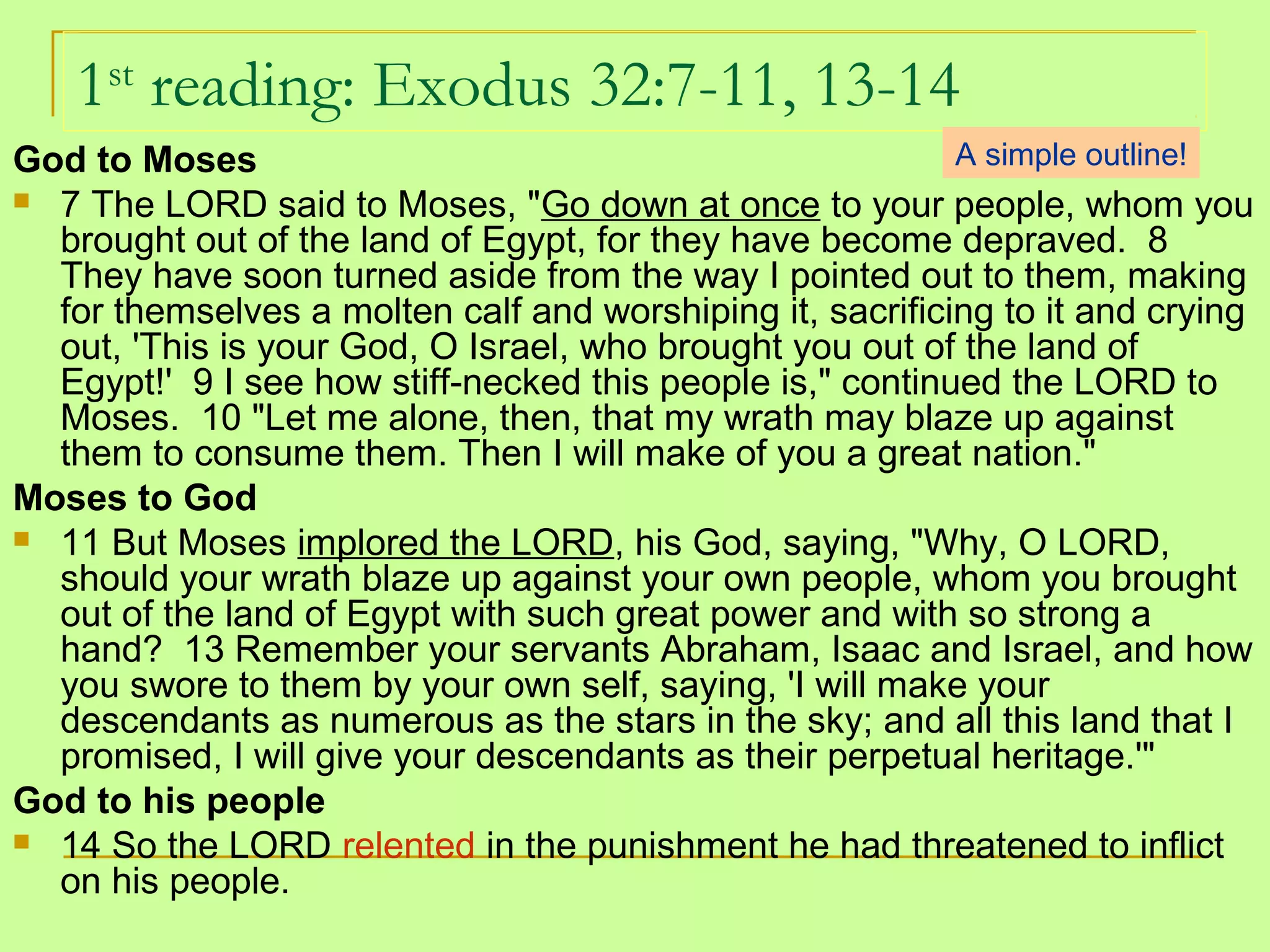
 7 The LORD said to Moses, "Go down at once to your people, whom you
brought out of the land of Egypt, for they have become depraved. 8
They have soon turned aside from the way I pointed out to them, making
for themselves a molten calf and worshiping it, sacrificing to it and crying
out, 'This is your God, O Israel, who brought you out of the land of
Egypt!' 9 I see how stiff-necked this people is," continued the LORD to
Moses. 10 "Let me alone, then, that my wrath may blaze up against
them to consume them. Then I will make of you a great nation."
Moses to God
 11 But Moses implored the LORD, his God, saying, "Why, O LORD,
should your wrath blaze up against your own people, whom you brought
out of the land of Egypt with such great power and with so strong a
hand? 13 Remember your servants Abraham, Isaac and Israel, and how
you swore to them by your own self, saying, 'I will make your
descendants as numerous as the stars in the sky; and all this land that I
promised, I will give your descendants as their perpetual heritage.'"
God to his people
 14 So the LORD relented in the punishment he had threatened to inflict
on his people.
A simple outline!
Textual Context of Exodus 32:7-11, 13-14
1. Exodus: Deliverance Traditions (1-18)
 A. Israel in Egypt (1)
B. Early Moses (2-4)
C. Plagues (5-11)
D. Passover (12:1-13:16)
E. Exodus from Egypt (13:17-15:21)
F. Wilderness Journey (15:22-18:27)
2. Sinai: Covenant Traditions (19-40)
 A. Theophany on the Mountain (19)
B. Law and Covenant (20-24)
 1. Ethical Decalogue (20:1-17)
2. Book of the Covenant (20:18-23:33)
3. Law Collections from Mesopotamia
 C. Covenant Confirmation (24)
D. Covenant Breaking and Remaking (32-34)
 1. Golden Calf (32-33)
2. Covenant Remaking (34)
 E. Tabernacle (25-31, 35-40)
1st
reading: Exodus 32:7-11, 13-14
God to Moses
 7 The LORD said to Moses, "Go down at
once to your people, whom you brought
out of the land of Egypt, for they have
become depraved. 8 They have soon
turned aside from the way I pointed out to
them, making for themselves a molten
calf and worshiping it, sacrificing to it and
crying out, 'This is your God, O Israel,
who brought you out of the land of Egypt!'
9 I see how stiff-necked this people is,"
continued the LORD to Moses. 10 "Let
me alone, then, that my wrath may blaze
up against them to consume them. Then I
will make of you a great nation."
Moses to God
 11 But Moses implored the LORD, his
God, saying, "Why, O LORD, should your
wrath blaze up against your own people,
whom you brought out of the land of
Egypt with such great power and with so
strong a hand? 13 Remember your
servants Abraham, Isaac and Israel, and
how you swore to them by your own self,
saying, 'I will make your descendants as
numerous as the stars in the sky; and all
this land that I promised, I will give your
descendants as their perpetual heritage.'"
God to his people
 14 So the LORD relented in the
punishment he had threatened to inflict
on his people.
Commentary
 In v.7, God orders Moses to go down
from Mt. Sinai to find out what the
Israelites have become.
 Under his leadership, the Israelites
were freed from the slavery of Egypt.
 But now they have become depraved
(corrupt).
 In v.8, God accuses them of
disobedience and idolatry.
 They made and worshipped a molten
calf (golden calf).
 They attribute their liberation to the
graven image.
 In v.9, God calls them stiff-necked
(hardheaded, pasaway).
 In v.10, God threatens to annihilate
them and makes a promise to Moses
to make of him a great nation.
1st
reading: Exodus 32:7-11, 13-14
God to Moses
 7 The LORD said to Moses, "Go down at
once to your people, whom you brought
out of the land of Egypt, for they have
become depraved. 8 They have soon
turned aside from the way I pointed out to
them, making for themselves a molten
calf and worshiping it, sacrificing to it and
crying out, 'This is your God, O Israel,
who brought you out of the land of Egypt!'
9 I see how stiff-necked this people is,"
continued the LORD to Moses. 10 "Let
me alone, then, that my wrath may blaze
up against them to consume them. Then I
will make of you a great nation."
Moses to God
 11 But Moses implored the LORD, his
God, saying, "Why, O LORD, should your
wrath blaze up against your own people,
whom you brought out of the land of
Egypt with such great power and with so
strong a hand? 13 Remember your
servants Abraham, Isaac and Israel, and
how you swore to them by your own self,
saying, 'I will make your descendants as
numerous as the stars in the sky; and all
this land that I promised, I will give your
descendants as their perpetual heritage.'"
God to his people
 14 So the LORD relented in the
punishment he had threatened to inflict
on his people.
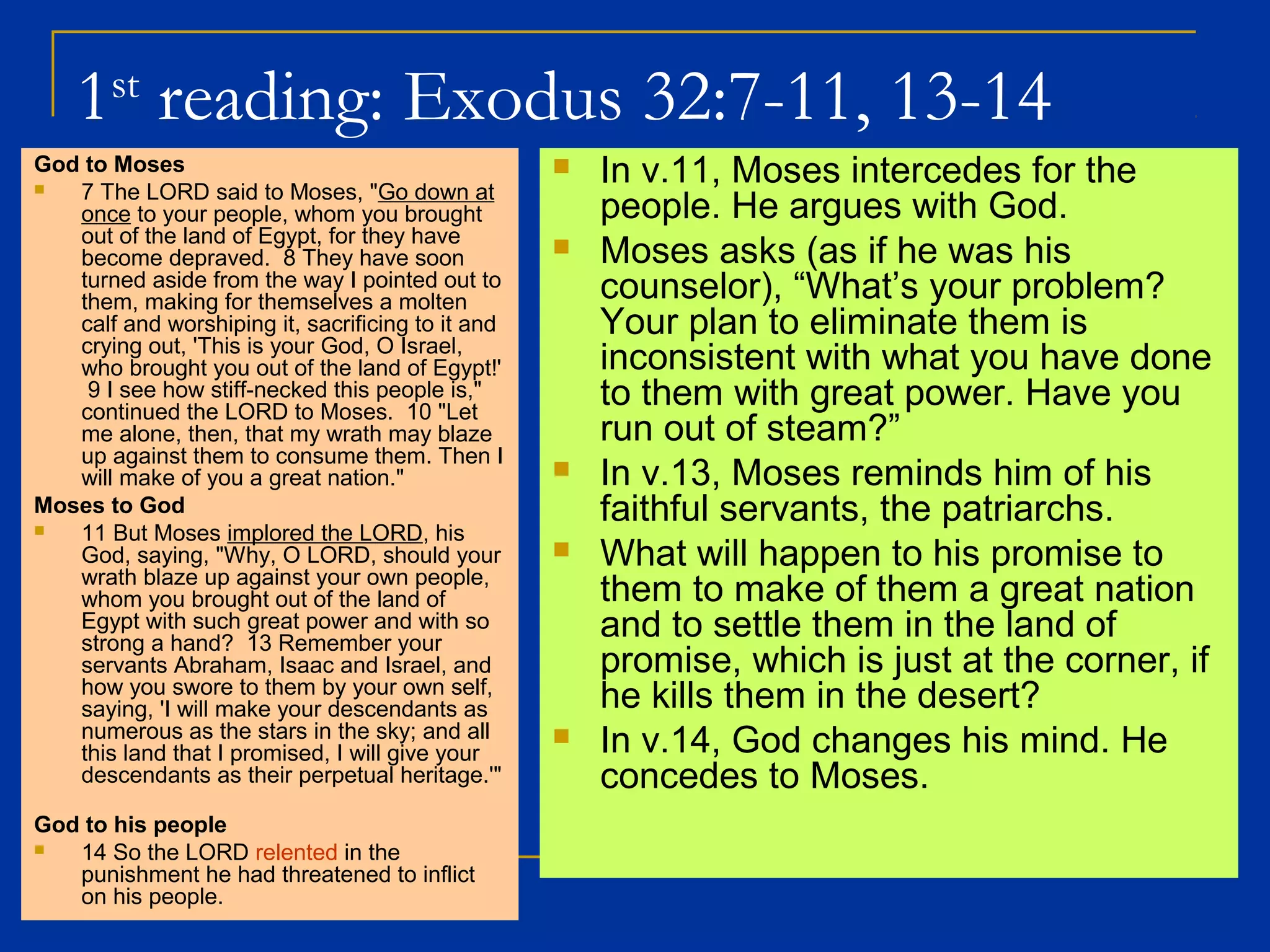
 In v.11, Moses intercedes for the
people. He argues with God.
 Moses asks (as if he was his
counselor), “What’s your problem?
Your plan to eliminate them is
inconsistent with what you have done
to them with great power. Have you
run out of steam?”
 In v.13, Moses reminds him of his
faithful servants, the patriarchs.
 What will happen to his promise to
them to make of them a great nation
and to settle them in the land of
promise, which is just at the corner, if
he kills them in the desert?
 In v.14, God changes his mind. He
concedes to Moses.
Reflections on the 1st
reading
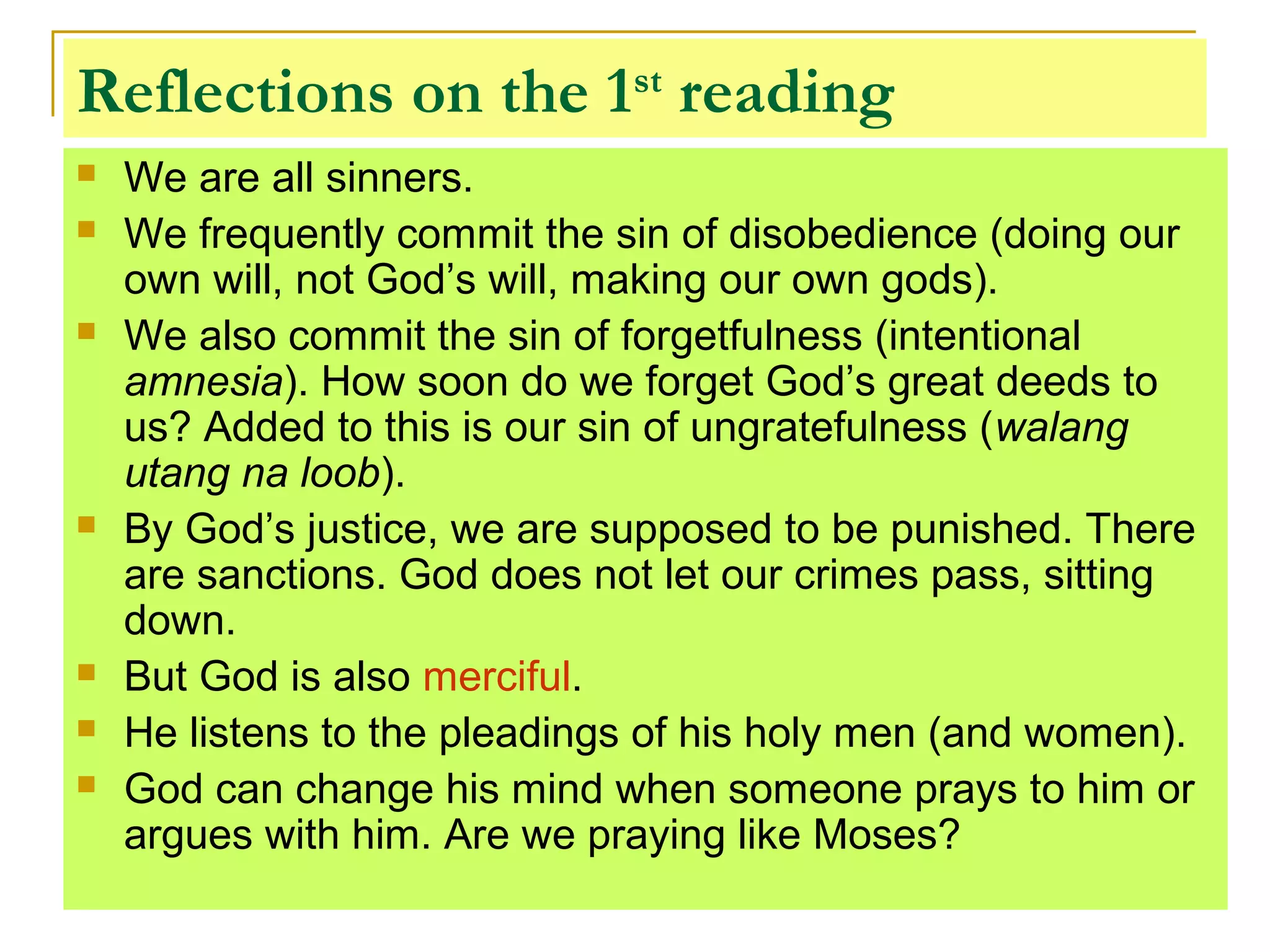
 We are all sinners.
 We frequently commit the sin of disobedience (doing our
own will, not God’s will, making our own gods).
 We also commit the sin of forgetfulness (intentional
amnesia). How soon do we forget God’s great deeds to
us? Added to this is our sin of ungratefulness (walang
utang na loob).
 By God’s justice, we are supposed to be punished. There
are sanctions. God does not let our crimes pass, sitting
down.
 But God is also merciful.
 He listens to the pleadings of his holy men (and women).
 God can change his mind when someone prays to him or
argues with him. Are we praying like Moses?
Resp. Ps 51:3-4, 12-13, 17, 19
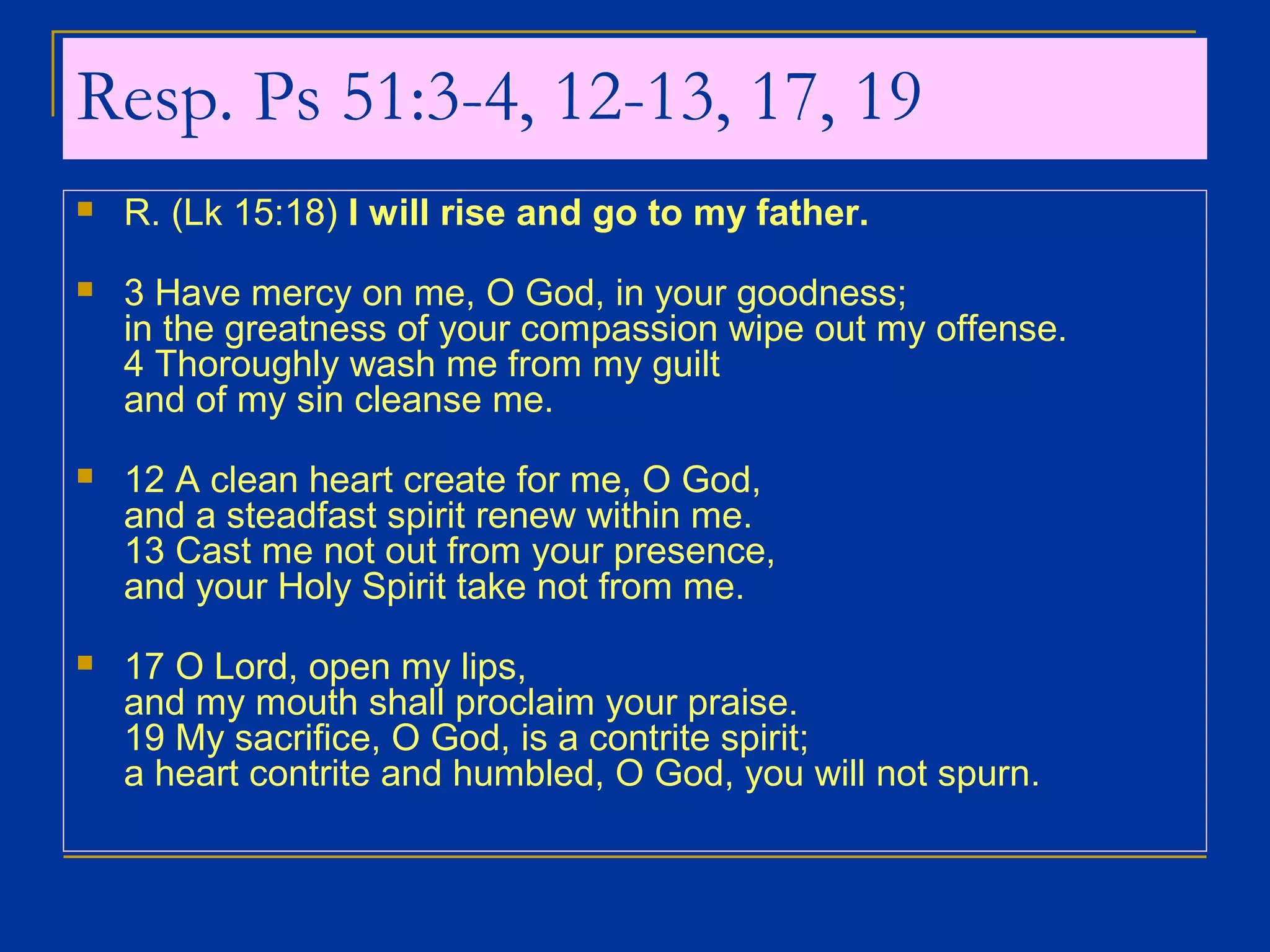
 R. (Lk 15:18) I will rise and go to my father.
 3 Have mercy on me, O God, in your goodness;
in the greatness of your compassion wipe out my offense.
4 Thoroughly wash me from my guilt
and of my sin cleanse me.
 12 A clean heart create for me, O God,
and a steadfast spirit renew within me.
13 Cast me not out from your presence,
and your Holy Spirit take not from me.
 17 O Lord, open my lips,
and my mouth shall proclaim your praise.
19 My sacrifice, O God, is a contrite spirit;
a heart contrite and humbled, O God, you will not spurn.
Resp. Ps 51:3-4, 12-13, 17, 19Resp. Ps 51:3-4, 12-13, 17, 19
 R. (Lk 15:18) I will rise and go to
my father.
 3 Have mercy on me, O God, in
your goodness;
in the greatness of your
compassion wipe out my offense.
4 Thoroughly wash me from my
guilt
and of my sin cleanse me.
 12 A clean heart create for me, O
God,
and a steadfast spirit renew within
me.
13 Cast me not out from your
presence,
and your Holy Spirit take not from
me.
 17 O Lord, open my lips,
and my mouth shall proclaim your
praise.
19 My sacrifice, O God, is a
contrite spirit;
a heart contrite and humbled, O
God, you will not spurn.
Commentary
 The psalm is a prayer for mercy and
forgiveness.
 Vv.3-4 present the prayer in parallel forms
 V.3 Have mercy, in your goodness // in your
compassion, wipe out my offense.
 V.4 wash me from guilt // of my sin cleanse
me
 In v.12, the psalmist-sinner uses another
expression to obtain God’s mercy and
forgiveness.
 Again, the psalmist uses parallelism.
 A clean heart create for me // steadfast spirit
renew within me.
 In v.13, the psalmist asks not to be
punished, in parallel form.
 Punishment for sin is to be cast out of God’s
presence (punishment of Cain)
 Another punishment is when the Spirit of God
is removed (punishment of King Saul).
 V.17 is the source of the opening formula of
the invitatory of the Christian Prayer.
 V.19 reveals the disposition of the one
praying: contrite, humbled
Reflections on the Psalm
 We must approach God with contrite hearts.
 We must realize how sinful we are in the presence
of the Most Holy God.
 When we ask for forgiveness, we must be prepared
to change.
 God abhors hypocrisy in our prayers.
 We don’t wait to be accursed by God, like Cain who
lived in isolation or lived like a vagabond. (palaboy
laboy, no permanent residence and work)
 Let not God’s Spirit be denied from us.
 God’s Spirit is our visa to heaven.
2nd
reading: 1 Timothy 1:12-17
 12 I am grateful to him who has strengthened me,
Christ Jesus our Lord, because he considered me
trustworthy in appointing me to the ministry. 13 I was
once a blasphemer and a persecutor and an arrogant
man, but I have been mercifully treated because I
acted out of ignorance in my unbelief. 14 Indeed, the
grace of our Lord has been abundant, along with the
faith and love that are in Christ Jesus. 15 This saying
is trustworthy and deserves full acceptance: Christ
Jesus came into the world to save sinners. Of these I
am the foremost. 16 But for that reason I was
mercifully treated, so that in me, as the foremost,
Christ Jesus might display all his patience as an
example for those who would come to believe in him
for everlasting life. 17 To the king of ages,
incorruptible, invisible, the only God, honor and glory
forever and ever. Amen.
The focus is God’s mercy, as felt by St. Paul.
2nd
reading: 1 Timothy 1:12-17
Paul’s gratefulness to Christ
 12 I am grateful to him who has strengthened me, Christ Jesus our
Lord, because he considered me trustworthy in appointing me to the
ministry.
Paul’s former sins
 13 I was once a blasphemer and a persecutor and an arrogant man,
Paul’s experience of Christ’s mercy
 but I have been mercifully treated because I acted out of ignorance in
my unbelief. 14 Indeed, the grace of our Lord has been abundant,
along with the faith and love that are in Christ Jesus. 15 This saying is
trustworthy and deserves full acceptance: Christ Jesus came into the
world to save sinners. Of these I am the foremost.
 16 But for that reason I was mercifully treated, so that in me, as the
foremost, Christ Jesus might display all his patience as an example for
those who would come to believe in him for everlasting life.
Paul’s doxology
 17 To the king of ages, incorruptible, invisible, the only God, honor and
glory forever and ever. Amen.
A simple outline!
2nd
reading: 1 Timothy 1:12-17
Paul’s gratefulness to Christ
 12 I am grateful to him who has
strengthened me, Christ Jesus our Lord,
because he considered me trustworthy in
appointing me to the ministry.
Paul’s former sins
 13 I was once a blasphemer and a
persecutor and an arrogant man,
Paul’s experience of Christ’s mercy
 but I have been mercifully treated
because I acted out of ignorance in my
unbelief. 14 Indeed, the grace of our
Lord has been abundant, along with the
faith and love that are in Christ Jesus.
15 This saying is trustworthy and
deserves full acceptance: Christ Jesus
came into the world to save sinners. Of
these I am the foremost.
 16 But for that reason I was mercifully
treated, so that in me, as the foremost,
Christ Jesus might display all his
patience as an example for those who
would come to believe in him for
everlasting life.
Paul’s doxology
 17 To the king of ages, incorruptible,
invisible, the only God, honor and glory
forever and ever. Amen.
Commentary
 The first letter to Timothy is not
written by Paul, according to the
scholars.
 It must have been written by a
follower of Paul, who used his name
to give credence to it.
 This follower wrote much later, after
the death of Paul, because it is
addressing new situations not
known to Paul himself.
 The letter is classified as a Pastoral
Letter (along with 2 Tim and Titus).
 The main point of the reading is
Christ’s mercy to Paul (to the
author).
 In v.12, Paul is happy to say that
Christ strengthens him.
 The reason: He considers him
worthy to be his minister.
2nd
reading: 1 Timothy 1:12-17
Paul’s gratefulness to Christ
 12 I am grateful to him who has
strengthened me, Christ Jesus our Lord,
because he considered me trustworthy in
appointing me to the ministry.
Paul’s former sins
 13 I was once a blasphemer and a
persecutor and an arrogant man,
Paul’s experience of Christ’s mercy
 but I have been mercifully treated
because I acted out of ignorance in my
unbelief. 14 Indeed, the grace of our
Lord has been abundant, along with the
faith and love that are in Christ Jesus.
15 This saying is trustworthy and
deserves full acceptance: Christ Jesus
came into the world to save sinners. Of
these I am the foremost.
 16 But for that reason I was mercifully
treated, so that in me, as the foremost,
Christ Jesus might display all his
patience as an example for those who
would come to believe in him for
everlasting life.
Paul’s doxology
 17 To the king of ages, incorruptible,
invisible, the only God, honor and glory
forever and ever. Amen.
 V.13 recalls Paul’s unworthiness.
 His big sins are blasphemy,
persecution, and arrogance. All these
are sins against faith and charity.
These sins disqualify him from being a
minister / leader or missionary.
 V.13b explains that he has been given
consideration / mercy.
 The reason/excuse: ignorance, naivete.
 V.14 affirms Christ’s abundance of
grace, faith and love.
 In v.15, Paul firmly affirms the purpose
of Christ’s coming: to save.
 Paul declares another reason for his
gratefulness: he is first to be saved.
 In v.16, Paul interprets the mind /
purpose of God: so that he will be used
by Christ to display his patience to
believers, to be saved like him.
 V.17 glorifies God as king of the ages,
etc. as a fitting conclusion of his
gratefulness.
Reflections on the 2Reflections on the 2ndnd
readingreading
 Truly God is merciful.
 He forgives all our sins. He wants to save us
and makes use of us, so that others, too, may
be saved.
 By showing us his mercy and forgiveness, he
is making us his instruments of salvation.
 If this is the case, we, all sinners, no matter
how bad we have been, have hope.
 Believing that we have been forgiven, we now
confidently begin our mission.
Gospel reading: Luke 15:1-32 or 15:1-10
Setting:
 1The tax collectors and sinners were all drawing near to
listen to him, 2 but the Pharisees and scribes began to
complain, saying, "This man welcomes sinners and eats
with them." 3 So to them he addressed this parable.
The Parable of the Lost Sheep
 4 "What man among you having a hundred sheep and
losing one of them would not leave the ninety-nine in the
desert and go after the lost one until he finds it? 5 And
when he does find it, he sets it on his shoulders with
great joy 6 and, upon his arrival home, he calls together
his friends and neighbors and says to them, 'Rejoice with
me because I have found my lost sheep.' 7 I tell you, in
just the same way there will be more joy in heaven over
one sinner who repents than over ninety-nine righteous
people who have no need of repentance.
The Parable of the Lost Coin
 8 "Or what woman having ten coins and losing one
would not light a lamp and sweep the house,
searching carefully until she finds it? 9 And when
she does find it, she calls together her friends and
neighbors and says to them, 'Rejoice with me
because I have found the coin that I lost.' 10 In just
the same way, I tell you, there will be rejoicing
among the angels of God over one sinner who
repents."
The Parable of the Lost Son
 11 Then he said, "A man had two sons, 12 and the
younger son said to his father, 'Father, give me the
share of your estate that should come to me.' So the
father divided the property between them. 13 After a
few days, the younger son collected all his belongings
and set off to a distant country where he squandered
his inheritance on a life of dissipation. 14 When he had
freely spent everything, a severe famine struck that
country, and he found himself in dire need. 15 So he
hired himself out to one of the local citizens who sent
him to his farm to tend the swine. 16 And he longed to
eat his fill of the pods on which the swine fed, but
nobody gave him any.
 17 Coming to his senses he thought, 'How many of
my father's hired workers have more than enough
food to eat, but here am I, dying from hunger. 18 I
shall get up and go to my father and I shall say to
him, "Father, I have sinned against heaven and
against you. 19 I no longer deserve to be called
your son; treat me as you would treat one of your
hired workers."' 20 So he got up and went back to
his father.
 While he was still a long way off, his father caught
sight of him, and was filled with compassion. He ran
to his son, embraced him and kissed him. 21 His
son said to him, 'Father, I have sinned against
heaven and against you; I no longer deserve to be
called your son.' 22 But his father ordered his
servants, 'Quickly bring the finest robe and put it on
him; put a ring on his finger and sandals on his feet.
23 Take the fattened calf and slaughter it. Then let
us celebrate with a feast, 24 because this son of
mine was dead, and has come to life again; he was
lost, and has been found.' Then the celebration
began.
 25 Now the older son had been out in the field and,
on his way back, as he neared the house, he heard
the sound of music and dancing. 26 He called one
of the servants and asked what this might mean. 27
The servant said to him, 'Your brother has returned
and your father has slaughtered the fattened calf
because he has him back safe and sound.' 28 He
became angry, and when he refused to enter the
house, his father came out and pleaded with him.
29 He said to his father in reply, 'Look, all these
years I served you and not once did I disobey your
orders; yet you never gave me even a young goat to
feast on with my friends. 30 But when your son
returns who swallowed up your property with
prostitutes, for him you slaughter the fattened calf.'
31 He said to him, 'My son, you are here with me
always; everything I have is yours. 32 But now we
must celebrate and rejoice, because your brother
was dead and has come to life again; he was lost
and has been found.'"
Commentary The three parables are all addressed to the scribes
and Pharisees, who question / object to his
association with sinners.
 The sinners are symbolized by the lost sheep, lost
coin and lost son.
 All the sinners are important to Jesus. He wants to
recover them all. He spends / leaves everything to find
them.
 He has the historical patience to find and to wait.
 He is sure he is going to find. He misses no one.
 There is so much joy when he finds them.
 He spends so much to celebrate. God is extravagant
in expressing his joy.
 No one can stop him or spoil his celebrations. God is a
determined God when it comes to finding sinners and
celebrating their return.
 Yet, the last parable indicates that God misses
someone, the one who refuses to recognize God’s
purpose.
 God cannot find someone, who does not allow
himself / herself to be found.
 God cannot work with the righteous, who think they
are never wrong.
 The elder child is the symbol of the scribes and
Pharisees, who refuse to associate with Jesus.
 They, too, are sinners in the eyes of God.
 So, they can’t accept God’s invitation to join him.
 The righteous people are the hardest people to
change. They can’t change. They are hopeless.
 Are we righteous?
Reflections on the gospel reading
 God is magnanimous and merciful to sinners, not
just sinners, but notorious / public sinners.
 He takes pain in locating / finding his lost people.
 God celebrates extravagantly even when only one
sinner repents.
 If this is our God, who are we not to go back home
to him?
 Come on, brothers and sisters, let us not be
righteous.
 Let us admit our sinfulness and God’s mercy.
Tying the 3 readings and the Psalm
 The first reading speaks of God’s mercy on the people
of Israel.
 The psalm is a prayer asking for mercy.
 The second reading speaks of the experience of Paul
and how God has extended his mercy upon him in-
spite of his sinfulness.
 The gospel reading speaks of the joy of the merciful
God when someone comes back to him.
How to develop your sharing / homily
 Can you identify someone who has shown you mercy,
compassion and forgiveness when you made a
blunder (stupid mistake), ruining relationships, business, losing
money, causing injuries or death, etc.
 How did he show his mercy to you?
 Have you felt that God has shown you mercy and
forgiveness?
 To appreciate God’s mercy and forgiveness, we must
first realize how sinful we are.
 If we have no concept of sin, it is impossible to ask for
forgiveness. God’s mercy is meaningless.
 In the first reading, the people offend God by
making a molten calf. A big violation to his
commandments.
 God threatens them, but Moses intercedes
for them and God changes his mind.
 God shows his mercy because of the
intelligent and passionate prayer of Moses.
 We should pray like Moses. Other people
need the prayer of the just man.
 In the second reading, Paul thank God for
having mercy upon him.
 Paul feels he has been forgiven and God’s
grace has been poured out upon him
because he is given a new assignment.
 Are we lucky like St. Paul?
 In spite of our blunders, God has not given up
on us. We are given another chance.
 This is to make us realize that Christ came to
save the world.
 Are we thankful of our new beginnings,
thanks to God’s mercy?
 The gospel reading exhibits God’s mercy to
sinners.
 He throws a big party on their return.
 God’s mercy is mysterious. Mercy is an
important attribute of God.
 God is not vindictive. He does not take our
offenses personally.
 Instead, he seeks to forgive us, to be
reconciled with us.
 Out of his prodigous love and mercy, he wants
us to enjoy life with him.
 How do we experience God’s mercy?
 As catholics we are told to go to confession.
 Do you go to confession?
 Born-again Christians confess directly to God.
 Do you share in their belief?
 Live like a Catholic, don’t mess up your faith.
 You will not grow as a true catholic.
 Many penitents line up for confession in some
churches.
 These people have been helped spiritually and have
found freedom with the help of the ordained and
intelligent confessors in the confessional.
 Don’t ask for a priest only when you are about to
die.
 The eucharist is a meal which celebrates
God’s infinite mercy, love and compassion for
us, sinners, who go back to him with humble
and contrite hearts.
 The eucharist is a joyful celebration of our
coming back to God.
 In the eucharist, God sits down with us to
nourish us, who are famished (starved) of
spiritual nutrients.
Our Context of Sin and Grace
 Living away from God
 Prodigal
 Un-judicious in spending
 Does not pray
 Unrepentant
 Self-righteous
 Does not know where he
erred
 No conscience
 Unforgiving to others (= can’t
forgive oneself)
 Worships modern idols and
mammon = shopping malls,
favorite actors and actresses,
hi-tech gadgets, guns.
 Prayerful
 Intercessor
 Humble and contrite
Hearts
 Compunction
 Change of heart,
change of mind
(metanoia)
 Regularly goes to
confession
 Very catholic
Suggested Songs
 Amazing Grace
 Lost and Found
 http://www.youtube.com/watch?v=XYy2M4dB1iw
 Come To Me
 http://www.youtube.com/watch?v=ID90ryPYU00
 Prodigal Son
 http://www.youtube.com/watch?v=ymK_ihMZk50
 Dear brothers and sisters,
 God rejoices at our return.
 Fr. Cielo

24th Sunday C

  • 1.
    Welcome to ourBible Study 24th Sunday in the Ordinary Time C 11 September 2016 In preparation for this Sunday’s Liturgy As aid in focusing our homilies and sharing Prepared by Fr. Cielo R. Almazan, OFM
  • 2.
    1st reading: Exodus 32:7-11,13-14  7 The LORD said to Moses, "Go down at once to your people, whom you brought out of the land of Egypt, for they have become depraved. 8 They have soon turned aside from the way I pointed out to them, making for themselves a molten calf and worshiping it, sacrificing to it and crying out, 'This is your God, O Israel, who brought you out of the land of Egypt!' 9 I see how stiff-necked this people is," continued the LORD to Moses. 10 "Let me alone, then, that my wrath may blaze up against them to consume them. Then I will make of you a great nation." 11 But Moses implored the LORD, his God, saying, "Why, O LORD, should your wrath blaze up against your own people, whom you brought out of the land of Egypt with such great power and with so strong a hand? 13 Remember your servants Abraham, Isaac and Israel, and how you swore to them by your own self, saying, 'I will make your descendants as numerous as the stars in the sky; and all this land that I promised, I will give your descendants as their perpetual heritage.'" 14 So the LORD relented in the punishment he had threatened to inflict on his people. The focus is God’s mercy and forgivenessmercy and forgiveness.
  • 3.
    1st reading: Exodus 32:7-11,13-14 God to Moses  7 The LORD said to Moses, "Go down at once to your people, whom you brought out of the land of Egypt, for they have become depraved. 8 They have soon turned aside from the way I pointed out to them, making for themselves a molten calf and worshiping it, sacrificing to it and crying out, 'This is your God, O Israel, who brought you out of the land of Egypt!' 9 I see how stiff-necked this people is," continued the LORD to Moses. 10 "Let me alone, then, that my wrath may blaze up against them to consume them. Then I will make of you a great nation." Moses to God  11 But Moses implored the LORD, his God, saying, "Why, O LORD, should your wrath blaze up against your own people, whom you brought out of the land of Egypt with such great power and with so strong a hand? 13 Remember your servants Abraham, Isaac and Israel, and how you swore to them by your own self, saying, 'I will make your descendants as numerous as the stars in the sky; and all this land that I promised, I will give your descendants as their perpetual heritage.'" God to his people  14 So the LORD relented in the punishment he had threatened to inflict on his people. A simple outline!
  • 4.
    Textual Context ofExodus 32:7-11, 13-14 1. Exodus: Deliverance Traditions (1-18)  A. Israel in Egypt (1) B. Early Moses (2-4) C. Plagues (5-11) D. Passover (12:1-13:16) E. Exodus from Egypt (13:17-15:21) F. Wilderness Journey (15:22-18:27) 2. Sinai: Covenant Traditions (19-40)  A. Theophany on the Mountain (19) B. Law and Covenant (20-24)  1. Ethical Decalogue (20:1-17) 2. Book of the Covenant (20:18-23:33) 3. Law Collections from Mesopotamia  C. Covenant Confirmation (24) D. Covenant Breaking and Remaking (32-34)  1. Golden Calf (32-33) 2. Covenant Remaking (34)  E. Tabernacle (25-31, 35-40)
  • 5.
    1st reading: Exodus 32:7-11,13-14 God to Moses  7 The LORD said to Moses, "Go down at once to your people, whom you brought out of the land of Egypt, for they have become depraved. 8 They have soon turned aside from the way I pointed out to them, making for themselves a molten calf and worshiping it, sacrificing to it and crying out, 'This is your God, O Israel, who brought you out of the land of Egypt!' 9 I see how stiff-necked this people is," continued the LORD to Moses. 10 "Let me alone, then, that my wrath may blaze up against them to consume them. Then I will make of you a great nation." Moses to God  11 But Moses implored the LORD, his God, saying, "Why, O LORD, should your wrath blaze up against your own people, whom you brought out of the land of Egypt with such great power and with so strong a hand? 13 Remember your servants Abraham, Isaac and Israel, and how you swore to them by your own self, saying, 'I will make your descendants as numerous as the stars in the sky; and all this land that I promised, I will give your descendants as their perpetual heritage.'" God to his people  14 So the LORD relented in the punishment he had threatened to inflict on his people. Commentary  In v.7, God orders Moses to go down from Mt. Sinai to find out what the Israelites have become.  Under his leadership, the Israelites were freed from the slavery of Egypt.  But now they have become depraved (corrupt).  In v.8, God accuses them of disobedience and idolatry.  They made and worshipped a molten calf (golden calf).  They attribute their liberation to the graven image.  In v.9, God calls them stiff-necked (hardheaded, pasaway).  In v.10, God threatens to annihilate them and makes a promise to Moses to make of him a great nation.
  • 6.
    1st reading: Exodus 32:7-11,13-14 God to Moses  7 The LORD said to Moses, "Go down at once to your people, whom you brought out of the land of Egypt, for they have become depraved. 8 They have soon turned aside from the way I pointed out to them, making for themselves a molten calf and worshiping it, sacrificing to it and crying out, 'This is your God, O Israel, who brought you out of the land of Egypt!' 9 I see how stiff-necked this people is," continued the LORD to Moses. 10 "Let me alone, then, that my wrath may blaze up against them to consume them. Then I will make of you a great nation." Moses to God  11 But Moses implored the LORD, his God, saying, "Why, O LORD, should your wrath blaze up against your own people, whom you brought out of the land of Egypt with such great power and with so strong a hand? 13 Remember your servants Abraham, Isaac and Israel, and how you swore to them by your own self, saying, 'I will make your descendants as numerous as the stars in the sky; and all this land that I promised, I will give your descendants as their perpetual heritage.'" God to his people  14 So the LORD relented in the punishment he had threatened to inflict on his people.  In v.11, Moses intercedes for the people. He argues with God.  Moses asks (as if he was his counselor), “What’s your problem? Your plan to eliminate them is inconsistent with what you have done to them with great power. Have you run out of steam?”  In v.13, Moses reminds him of his faithful servants, the patriarchs.  What will happen to his promise to them to make of them a great nation and to settle them in the land of promise, which is just at the corner, if he kills them in the desert?  In v.14, God changes his mind. He concedes to Moses.
  • 7.
    Reflections on the1st reading  We are all sinners.  We frequently commit the sin of disobedience (doing our own will, not God’s will, making our own gods).  We also commit the sin of forgetfulness (intentional amnesia). How soon do we forget God’s great deeds to us? Added to this is our sin of ungratefulness (walang utang na loob).  By God’s justice, we are supposed to be punished. There are sanctions. God does not let our crimes pass, sitting down.  But God is also merciful.  He listens to the pleadings of his holy men (and women).  God can change his mind when someone prays to him or argues with him. Are we praying like Moses?
  • 8.
    Resp. Ps 51:3-4,12-13, 17, 19  R. (Lk 15:18) I will rise and go to my father.  3 Have mercy on me, O God, in your goodness; in the greatness of your compassion wipe out my offense. 4 Thoroughly wash me from my guilt and of my sin cleanse me.  12 A clean heart create for me, O God, and a steadfast spirit renew within me. 13 Cast me not out from your presence, and your Holy Spirit take not from me.  17 O Lord, open my lips, and my mouth shall proclaim your praise. 19 My sacrifice, O God, is a contrite spirit; a heart contrite and humbled, O God, you will not spurn.
  • 9.
    Resp. Ps 51:3-4,12-13, 17, 19Resp. Ps 51:3-4, 12-13, 17, 19  R. (Lk 15:18) I will rise and go to my father.  3 Have mercy on me, O God, in your goodness; in the greatness of your compassion wipe out my offense. 4 Thoroughly wash me from my guilt and of my sin cleanse me.  12 A clean heart create for me, O God, and a steadfast spirit renew within me. 13 Cast me not out from your presence, and your Holy Spirit take not from me.  17 O Lord, open my lips, and my mouth shall proclaim your praise. 19 My sacrifice, O God, is a contrite spirit; a heart contrite and humbled, O God, you will not spurn. Commentary  The psalm is a prayer for mercy and forgiveness.  Vv.3-4 present the prayer in parallel forms  V.3 Have mercy, in your goodness // in your compassion, wipe out my offense.  V.4 wash me from guilt // of my sin cleanse me  In v.12, the psalmist-sinner uses another expression to obtain God’s mercy and forgiveness.  Again, the psalmist uses parallelism.  A clean heart create for me // steadfast spirit renew within me.  In v.13, the psalmist asks not to be punished, in parallel form.  Punishment for sin is to be cast out of God’s presence (punishment of Cain)  Another punishment is when the Spirit of God is removed (punishment of King Saul).  V.17 is the source of the opening formula of the invitatory of the Christian Prayer.  V.19 reveals the disposition of the one praying: contrite, humbled
  • 10.
    Reflections on thePsalm  We must approach God with contrite hearts.  We must realize how sinful we are in the presence of the Most Holy God.  When we ask for forgiveness, we must be prepared to change.  God abhors hypocrisy in our prayers.  We don’t wait to be accursed by God, like Cain who lived in isolation or lived like a vagabond. (palaboy laboy, no permanent residence and work)  Let not God’s Spirit be denied from us.  God’s Spirit is our visa to heaven.
  • 11.
    2nd reading: 1 Timothy1:12-17  12 I am grateful to him who has strengthened me, Christ Jesus our Lord, because he considered me trustworthy in appointing me to the ministry. 13 I was once a blasphemer and a persecutor and an arrogant man, but I have been mercifully treated because I acted out of ignorance in my unbelief. 14 Indeed, the grace of our Lord has been abundant, along with the faith and love that are in Christ Jesus. 15 This saying is trustworthy and deserves full acceptance: Christ Jesus came into the world to save sinners. Of these I am the foremost. 16 But for that reason I was mercifully treated, so that in me, as the foremost, Christ Jesus might display all his patience as an example for those who would come to believe in him for everlasting life. 17 To the king of ages, incorruptible, invisible, the only God, honor and glory forever and ever. Amen. The focus is God’s mercy, as felt by St. Paul.
  • 12.
    2nd reading: 1 Timothy1:12-17 Paul’s gratefulness to Christ  12 I am grateful to him who has strengthened me, Christ Jesus our Lord, because he considered me trustworthy in appointing me to the ministry. Paul’s former sins  13 I was once a blasphemer and a persecutor and an arrogant man, Paul’s experience of Christ’s mercy  but I have been mercifully treated because I acted out of ignorance in my unbelief. 14 Indeed, the grace of our Lord has been abundant, along with the faith and love that are in Christ Jesus. 15 This saying is trustworthy and deserves full acceptance: Christ Jesus came into the world to save sinners. Of these I am the foremost.  16 But for that reason I was mercifully treated, so that in me, as the foremost, Christ Jesus might display all his patience as an example for those who would come to believe in him for everlasting life. Paul’s doxology  17 To the king of ages, incorruptible, invisible, the only God, honor and glory forever and ever. Amen. A simple outline!
  • 13.
    2nd reading: 1 Timothy1:12-17 Paul’s gratefulness to Christ  12 I am grateful to him who has strengthened me, Christ Jesus our Lord, because he considered me trustworthy in appointing me to the ministry. Paul’s former sins  13 I was once a blasphemer and a persecutor and an arrogant man, Paul’s experience of Christ’s mercy  but I have been mercifully treated because I acted out of ignorance in my unbelief. 14 Indeed, the grace of our Lord has been abundant, along with the faith and love that are in Christ Jesus. 15 This saying is trustworthy and deserves full acceptance: Christ Jesus came into the world to save sinners. Of these I am the foremost.  16 But for that reason I was mercifully treated, so that in me, as the foremost, Christ Jesus might display all his patience as an example for those who would come to believe in him for everlasting life. Paul’s doxology  17 To the king of ages, incorruptible, invisible, the only God, honor and glory forever and ever. Amen. Commentary  The first letter to Timothy is not written by Paul, according to the scholars.  It must have been written by a follower of Paul, who used his name to give credence to it.  This follower wrote much later, after the death of Paul, because it is addressing new situations not known to Paul himself.  The letter is classified as a Pastoral Letter (along with 2 Tim and Titus).  The main point of the reading is Christ’s mercy to Paul (to the author).  In v.12, Paul is happy to say that Christ strengthens him.  The reason: He considers him worthy to be his minister.
  • 14.
    2nd reading: 1 Timothy1:12-17 Paul’s gratefulness to Christ  12 I am grateful to him who has strengthened me, Christ Jesus our Lord, because he considered me trustworthy in appointing me to the ministry. Paul’s former sins  13 I was once a blasphemer and a persecutor and an arrogant man, Paul’s experience of Christ’s mercy  but I have been mercifully treated because I acted out of ignorance in my unbelief. 14 Indeed, the grace of our Lord has been abundant, along with the faith and love that are in Christ Jesus. 15 This saying is trustworthy and deserves full acceptance: Christ Jesus came into the world to save sinners. Of these I am the foremost.  16 But for that reason I was mercifully treated, so that in me, as the foremost, Christ Jesus might display all his patience as an example for those who would come to believe in him for everlasting life. Paul’s doxology  17 To the king of ages, incorruptible, invisible, the only God, honor and glory forever and ever. Amen.  V.13 recalls Paul’s unworthiness.  His big sins are blasphemy, persecution, and arrogance. All these are sins against faith and charity. These sins disqualify him from being a minister / leader or missionary.  V.13b explains that he has been given consideration / mercy.  The reason/excuse: ignorance, naivete.  V.14 affirms Christ’s abundance of grace, faith and love.  In v.15, Paul firmly affirms the purpose of Christ’s coming: to save.  Paul declares another reason for his gratefulness: he is first to be saved.  In v.16, Paul interprets the mind / purpose of God: so that he will be used by Christ to display his patience to believers, to be saved like him.  V.17 glorifies God as king of the ages, etc. as a fitting conclusion of his gratefulness.
  • 15.
    Reflections on the2Reflections on the 2ndnd readingreading  Truly God is merciful.  He forgives all our sins. He wants to save us and makes use of us, so that others, too, may be saved.  By showing us his mercy and forgiveness, he is making us his instruments of salvation.  If this is the case, we, all sinners, no matter how bad we have been, have hope.  Believing that we have been forgiven, we now confidently begin our mission.
  • 16.
    Gospel reading: Luke15:1-32 or 15:1-10 Setting:  1The tax collectors and sinners were all drawing near to listen to him, 2 but the Pharisees and scribes began to complain, saying, "This man welcomes sinners and eats with them." 3 So to them he addressed this parable. The Parable of the Lost Sheep  4 "What man among you having a hundred sheep and losing one of them would not leave the ninety-nine in the desert and go after the lost one until he finds it? 5 And when he does find it, he sets it on his shoulders with great joy 6 and, upon his arrival home, he calls together his friends and neighbors and says to them, 'Rejoice with me because I have found my lost sheep.' 7 I tell you, in just the same way there will be more joy in heaven over one sinner who repents than over ninety-nine righteous people who have no need of repentance.
  • 17.
    The Parable ofthe Lost Coin  8 "Or what woman having ten coins and losing one would not light a lamp and sweep the house, searching carefully until she finds it? 9 And when she does find it, she calls together her friends and neighbors and says to them, 'Rejoice with me because I have found the coin that I lost.' 10 In just the same way, I tell you, there will be rejoicing among the angels of God over one sinner who repents."
  • 18.
    The Parable ofthe Lost Son  11 Then he said, "A man had two sons, 12 and the younger son said to his father, 'Father, give me the share of your estate that should come to me.' So the father divided the property between them. 13 After a few days, the younger son collected all his belongings and set off to a distant country where he squandered his inheritance on a life of dissipation. 14 When he had freely spent everything, a severe famine struck that country, and he found himself in dire need. 15 So he hired himself out to one of the local citizens who sent him to his farm to tend the swine. 16 And he longed to eat his fill of the pods on which the swine fed, but nobody gave him any.
  • 19.
     17 Comingto his senses he thought, 'How many of my father's hired workers have more than enough food to eat, but here am I, dying from hunger. 18 I shall get up and go to my father and I shall say to him, "Father, I have sinned against heaven and against you. 19 I no longer deserve to be called your son; treat me as you would treat one of your hired workers."' 20 So he got up and went back to his father.
  • 20.
     While hewas still a long way off, his father caught sight of him, and was filled with compassion. He ran to his son, embraced him and kissed him. 21 His son said to him, 'Father, I have sinned against heaven and against you; I no longer deserve to be called your son.' 22 But his father ordered his servants, 'Quickly bring the finest robe and put it on him; put a ring on his finger and sandals on his feet. 23 Take the fattened calf and slaughter it. Then let us celebrate with a feast, 24 because this son of mine was dead, and has come to life again; he was lost, and has been found.' Then the celebration began.
  • 21.
     25 Nowthe older son had been out in the field and, on his way back, as he neared the house, he heard the sound of music and dancing. 26 He called one of the servants and asked what this might mean. 27 The servant said to him, 'Your brother has returned and your father has slaughtered the fattened calf because he has him back safe and sound.' 28 He became angry, and when he refused to enter the house, his father came out and pleaded with him. 29 He said to his father in reply, 'Look, all these years I served you and not once did I disobey your orders; yet you never gave me even a young goat to feast on with my friends. 30 But when your son returns who swallowed up your property with prostitutes, for him you slaughter the fattened calf.' 31 He said to him, 'My son, you are here with me always; everything I have is yours. 32 But now we must celebrate and rejoice, because your brother was dead and has come to life again; he was lost and has been found.'"
  • 22.
    Commentary The threeparables are all addressed to the scribes and Pharisees, who question / object to his association with sinners.  The sinners are symbolized by the lost sheep, lost coin and lost son.  All the sinners are important to Jesus. He wants to recover them all. He spends / leaves everything to find them.  He has the historical patience to find and to wait.  He is sure he is going to find. He misses no one.  There is so much joy when he finds them.  He spends so much to celebrate. God is extravagant in expressing his joy.  No one can stop him or spoil his celebrations. God is a determined God when it comes to finding sinners and celebrating their return.
  • 23.
     Yet, thelast parable indicates that God misses someone, the one who refuses to recognize God’s purpose.  God cannot find someone, who does not allow himself / herself to be found.  God cannot work with the righteous, who think they are never wrong.  The elder child is the symbol of the scribes and Pharisees, who refuse to associate with Jesus.  They, too, are sinners in the eyes of God.  So, they can’t accept God’s invitation to join him.  The righteous people are the hardest people to change. They can’t change. They are hopeless.  Are we righteous?
  • 24.
    Reflections on thegospel reading  God is magnanimous and merciful to sinners, not just sinners, but notorious / public sinners.  He takes pain in locating / finding his lost people.  God celebrates extravagantly even when only one sinner repents.  If this is our God, who are we not to go back home to him?  Come on, brothers and sisters, let us not be righteous.  Let us admit our sinfulness and God’s mercy.
  • 25.
    Tying the 3readings and the Psalm  The first reading speaks of God’s mercy on the people of Israel.  The psalm is a prayer asking for mercy.  The second reading speaks of the experience of Paul and how God has extended his mercy upon him in- spite of his sinfulness.  The gospel reading speaks of the joy of the merciful God when someone comes back to him.
  • 26.
    How to developyour sharing / homily  Can you identify someone who has shown you mercy, compassion and forgiveness when you made a blunder (stupid mistake), ruining relationships, business, losing money, causing injuries or death, etc.  How did he show his mercy to you?  Have you felt that God has shown you mercy and forgiveness?  To appreciate God’s mercy and forgiveness, we must first realize how sinful we are.  If we have no concept of sin, it is impossible to ask for forgiveness. God’s mercy is meaningless.
  • 27.
     In thefirst reading, the people offend God by making a molten calf. A big violation to his commandments.  God threatens them, but Moses intercedes for them and God changes his mind.  God shows his mercy because of the intelligent and passionate prayer of Moses.  We should pray like Moses. Other people need the prayer of the just man.
  • 28.
     In thesecond reading, Paul thank God for having mercy upon him.  Paul feels he has been forgiven and God’s grace has been poured out upon him because he is given a new assignment.  Are we lucky like St. Paul?  In spite of our blunders, God has not given up on us. We are given another chance.  This is to make us realize that Christ came to save the world.  Are we thankful of our new beginnings, thanks to God’s mercy?
  • 29.
     The gospelreading exhibits God’s mercy to sinners.  He throws a big party on their return.  God’s mercy is mysterious. Mercy is an important attribute of God.  God is not vindictive. He does not take our offenses personally.  Instead, he seeks to forgive us, to be reconciled with us.  Out of his prodigous love and mercy, he wants us to enjoy life with him.
  • 30.
     How dowe experience God’s mercy?  As catholics we are told to go to confession.  Do you go to confession?  Born-again Christians confess directly to God.  Do you share in their belief?  Live like a Catholic, don’t mess up your faith.  You will not grow as a true catholic.  Many penitents line up for confession in some churches.  These people have been helped spiritually and have found freedom with the help of the ordained and intelligent confessors in the confessional.  Don’t ask for a priest only when you are about to die.
  • 31.
     The eucharistis a meal which celebrates God’s infinite mercy, love and compassion for us, sinners, who go back to him with humble and contrite hearts.  The eucharist is a joyful celebration of our coming back to God.  In the eucharist, God sits down with us to nourish us, who are famished (starved) of spiritual nutrients.
  • 32.
    Our Context ofSin and Grace  Living away from God  Prodigal  Un-judicious in spending  Does not pray  Unrepentant  Self-righteous  Does not know where he erred  No conscience  Unforgiving to others (= can’t forgive oneself)  Worships modern idols and mammon = shopping malls, favorite actors and actresses, hi-tech gadgets, guns.  Prayerful  Intercessor  Humble and contrite Hearts  Compunction  Change of heart, change of mind (metanoia)  Regularly goes to confession  Very catholic
  • 33.
    Suggested Songs  AmazingGrace  Lost and Found  http://www.youtube.com/watch?v=XYy2M4dB1iw  Come To Me  http://www.youtube.com/watch?v=ID90ryPYU00  Prodigal Son  http://www.youtube.com/watch?v=ymK_ihMZk50
  • 34.
     Dear brothersand sisters,  God rejoices at our return.  Fr. Cielo