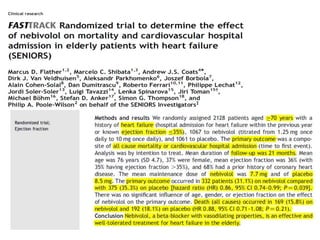
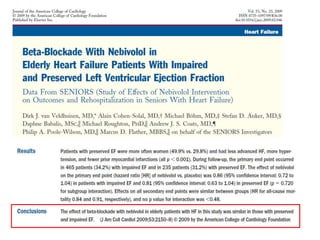
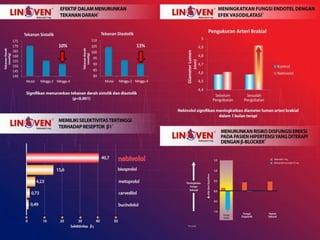
Beta-blocker in Heart Failure
Nebivolol
dr. ………………………, Sp
European J of Heart Fail, Volume: 22, Issue: 8, Pages: 1342-1356, First published: 01 June 2020, DOI: (10.1002/ejhf.1858)
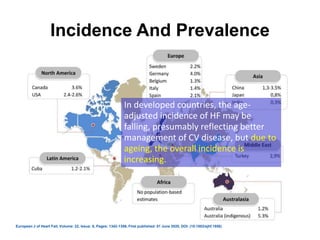
Incidence And Prevalence
In developed countries, the age-
adjusted incidence of HF may be
falling, presumably reflecting better
management of CV disease, but due to
ageing, the overall incidence is
increasing.
European J of Heart Fail, Volume: 22, Issue: 8, Pages: 1342-1356, First published: 01 June 2020, DOI: (10.1002/ejhf.1858)
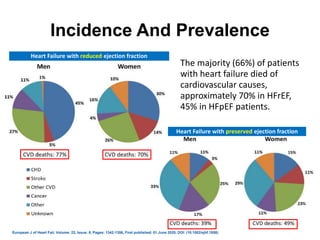
Incidence And Prevalence
Heart Failure with reduced ejection fraction
Heart Failure with preserved ejection fraction
The majority (66%) of patients
with heart failure died of
cardiovascular causes,
approximately 70% in HFrEF,
45% in HFpEF patients.
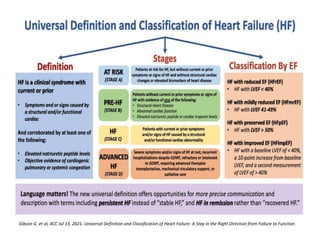
Gibson G. et al, ACC Jul 13, 2021. Universal Definition and Classification of Heart Failure: A Step in the Right Direction from Failure to Function
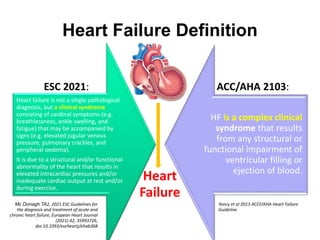
Heart failure is not a single pathological
diagnosis, but a clinical syndrome
consisting of cardinal symptoms (e.g.
breathlessness, ankle swelling, and
fatigue) that may be accompanied by
signs (e.g. elevated jugular venous
pressure, pulmonary crackles, and
peripheral oedema).
It is due to a structural and/or functional
abnormality of the heart that results in
elevated intracardiac pressures and/or
inadequate cardiac output at rest and/or
during exercise.
HF is a complex clinical
syndrome that results
from any structural or
functional impairment of
ventricular filling or
ejection of blood.
Heart Failure Definition
ESC 2021: ACC/AHA 2103:
Heart
Failure
Mc Donagh TA2, 2021 ESC Guidelines for
the diagnosis and treatment of acute and
chronic heart failure, European Heart Journal
(2021) 42, 35993726,
doi:10.1093/eurheartj/ehab368
Yancy et al 2013 ACCF/AHA Heart Failure
Guideline
Heart Failure Classification
Type of
Heart Failure
Description
LVEF
(Left Ventricle
Ejection Fraction
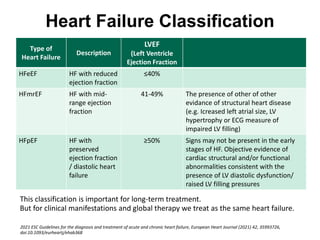
HFeEF HF with reduced
ejection fraction
≤40%
HFmrEF HF with mid-
range ejection
fraction
41-49% The presence of other of other
evidance of structural heart disease
(e.g. Icreased left atrial size, LV
hypertrophy or ECG measure of
impaired LV filling)
HFpEF HF with
preserved
ejection fraction
/ diastolic heart
failure
≥50% Signs may not be present in the early
stages of HF. Objective evidence of
cardiac structural and/or functional
abnormalities consistent with the
presence of LV diastolic dysfunction/
raised LV filling pressures
This classification is important for long-term treatment.
But for clinical manifestations and global therapy we treat as the same heart failure.
2021 ESC Guidelines for the diagnosis and treatment of acute and chronic heart failure, European Heart Journal (2021) 42, 35993726,
doi:10.1093/eurheartj/ehab368
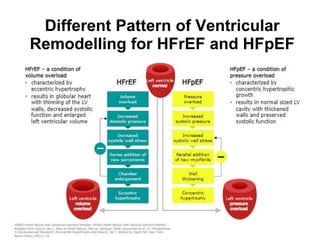
Different Pattern of Ventricular
Remodelling for HFrEF and HFpEF
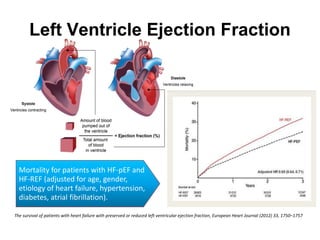
The survival of patients with heart failure with preserved or reduced left ventricular ejection fraction, European Heart Journal (2012) 33, 1750–1757
Left Ventricle Ejection Fraction
Mortality for patients with HF-pEF and
HF-REF (adjusted for age, gender,
etiology of heart failure, hypertension,
diabetes, atrial fibrillation).
Heart Failure Classification
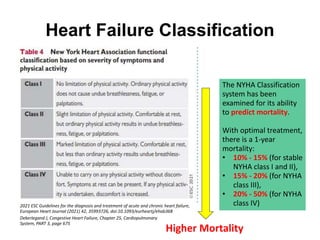
The NYHA Classification
system has been
examined for its ability
to predict mortality.
With optimal treatment,
there is a 1-year
mortality:
• 10% - 15% (for stable
NYHA class I and II),
• 15% - 20% (for NYHA
class III),
• 20% - 50% (for NYHA
class IV)
Higher Mortality
2021 ESC Guidelines for the diagnosis and treatment of acute and chronic heart failure,
European Heart Journal (2021) 42, 35993726, doi:10.1093/eurheartj/ehab368
Dekerlegand J, Congestive Heart Failure, Chapter 25, Cardiopulmonary
System, PART 3, page 675
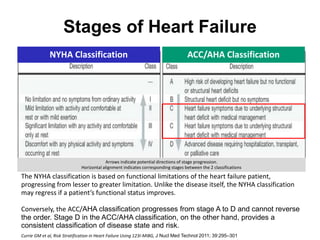
The NYHA classification is based on functional limitations of the heart failure patient,
progressing from lesser to greater limitation. Unlike the disease itself, the NYHA classification
may regress if a patient’s functional status improves.
Conversely, the ACC/AHA classification progresses from stage A to D and cannot reverse
the order. Stage D in the ACC/AHA classification, on the other hand, provides a
consistent classification of disease state and risk.
NYHA Classification ACC/AHA Classification
Stages of Heart Failure
Currie GM et al, Risk Stratification in Heart Failure Using 123I-MIBG, J Nucl Med Technol 2011; 39:295–301
Arrows indicate potential directions of stage progression.
Horizontal alignment indicates corresponding stages between the 2 classifications
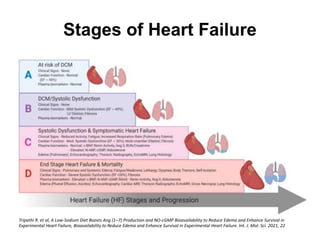
Stages of Heart Failure
Tripathi R. et al, A Low-Sodium Diet Boosts Ang (1–7) Production and NO-cGMP Bioavailability to Reduce Edema and Enhance Survival in
Experimental Heart Failure, Bioavailability to Reduce Edema and Enhance Survival in Experimental Heart Failure. Int. J. Mol. Sci. 2021, 22
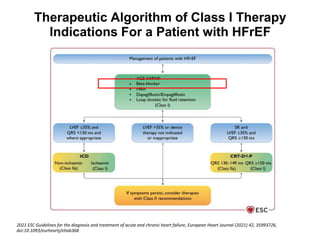
Therapeutic Algorithm of Class I Therapy
Indications For a Patient with HFrEF
2021 ESC Guidelines for the diagnosis and treatment of acute and chronic heart failure, European Heart Journal (2021) 42, 35993726,
doi:10.1093/eurheartj/ehab368
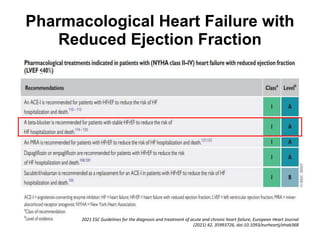
Pharmacological Heart Failure with
Reduced Ejection Fraction
2021 ESC Guidelines for the diagnosis and treatment of acute and chronic heart failure, European Heart Journal
(2021) 42, 35993726, doi:10.1093/eurheartj/ehab368
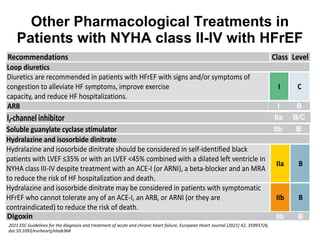
Other Pharmacological Treatments in
Patients with NYHA class II-IV with HFrEF
Recommendations Class Level
Soluble guanylate cyclase stimulator
Vericiguat may be considered in patients in NYHA class II-IV who have had worsening HF
despite treatment with an ACE-I (or ARNI), a beta-blocker and an MRA to reduce the
risk of CV mortality or HF hospitalization.
IIb B
Hydralazine and isosorbide dinitrate
Hydralazine and isosorbide dinitrate should be considered in self-identified black
patients with LVEF ≤35% or with an LVEF <45% combined with a dilated left ventricle in
NYHA class III-IV despite treatment with an ACE-I (or ARNI), a beta-blocker and an MRA
to reduce the risk of HF hospitalization and death.
IIa B
Hydralazine and isosorbide dinitrate may be considered in patients with symptomatic
HFrEF who cannot tolerate any of an ACE-I, an ARB, or ARNI (or they are
contraindicated) to reduce the risk of death.
IIb B
Other pharmacological treatments indicated in selected patients with
NYHA class II-IV heart failure with reduced ejection fraction (LVEF ≤40%) (3)
ACE-I = angiotensin-converting enzyme inhibitor; ARNI = angiotensin receptor-neprilysin inhibitor; CV = cardiovascular; HF = heart failure; LVEF = left ventricular ejection fraction;
MRA = mineralocorticoid receptor antagonist; NYHA= New York Heart Association.
Recommendations Class Level
Soluble guanylate cyclase stimulator
Vericiguat may be considered in patients in NYHA class II-IV who have had worsening HF
despite treatment with an ACE-I (or ARNI), a beta-blocker and an MRA to reduce the
risk of CV mortality or HF hospitalization.
IIb B
Hydralazine and isosorbide dinitrate
Hydralazine and isosorbide dinitrate should be considered in self-identified black
patients with LVEF ≤35% or with an LVEF <45% combined with a dilated left ventricle in
NYHA class III-IV despite treatment with an ACE-I (or ARNI), a beta-blocker and an MRA
to reduce the risk of HF hospitalization and death.
IIa B
Hydralazine and isosorbide dinitrate may be considered in patients with symptomatic
HFrEF who cannot tolerate any of an ACE-I, an ARB, or ARNI (or they are IIb B
Other pharmacological treatments indicated in selected patients with
NYHA class II-IV heart failure with reduced ejection fraction (LVEF ≤40%) (3)
Recommendations Class Level
If-channel inhibitor
Ivabradine should be considered in symptomatic patients with LVEF ≤35%, in SR and a
resting heart rate ≥70 b.p.m. despite treatment with an evidence-based dose of beta-
blocker (or maximum tolerated dose below that), ACE-I/(or ARNI), and an MRA, to
reduce the risk of HF hospitalization and CV death.
IIa B
Ivabradine should be considered in symptomatic patients with LVEF ≤35%, in SR and a
resting heart rate ≥70 b.p.m. who are unable to tolerate or have contraindications for a
beta-blocker to reduce the risk of HF hospitalization and CV death. Patients should also
receive an ACE-I (or ARNI) and an MRA.
IIa C
Other pharmacological treatments indicated in selected patients with
NYHA class II-IV heart failure with reduced ejection fraction (LVEF ≤40%) (2)
ACE-I= angiotensin-converting enzyme inhibitor; ARNI = angiotensin receptor-neprilysin inhibitor; b.p.m. = beats per minute; CV= cardiovascular; HF = heart failure;
LVEF= left ventricular ejection fraction; MRA = mineralocorticoid receptor antagonist; NYHA=New York Heart Association; SR = sinus rhythm.
www.escardio.org/guidelines
2021 ESC Guidelines for the diagnosis and treatment of acute and chronic heart failure
(European Heart Journal 2021 – doi:10.1093/eurheartj/ehab368)
Recommendations Class Level
Loop diuretics
Diuretics are recommended in patients with HFrEF with signs and/or symptoms of
congestion to alleviate HF symptoms, improve exercise
capacity, and reduce HF hospitalizations.
I C
ARB
An ARBa is recommended to reduce the risk of HF hospitalization and
CV death in symptomatic patients unable to tolerate an ACE-I or ARNI
(patients should also receive a beta-blocker and an MRA).
I B
Other pharmacological treatments indicated in selected patients with
NYHA class II-IV heart failure with reduced ejection fraction (LVEF ≤40%) (1)
ACE-I = angiotensin-converting enzyme inhibitor; ARB = angiotensin-receptor blocker; ARNI = angiotensin receptor-neprilysin inhibitor; CV = cardiovascular; HF = heart failure;
HFrEF = heart failure with reduced ejection fraction; MRA = mineralocorticoid receptor antagonist; NYHA= New York Heart Association.
aThe ARBs with evidence in HFrEF are candesartan, losartan, and valsartan.
www.escardio.org/guidelines
2021 ESC Guidelines for the diagnosis and treatment of acute and chronic heart failure
(European Heart Journal 2021 – doi:10.1093/eurheartj/ehab368)
Recommendations Class Level
Loop diuretics
Diuretics are recommended in patients with HFrEF with signs and/or symptoms of
congestion to alleviate HF symptoms, improve exercise
capacity, and reduce HF hospitalizations.
I C
ARB
An ARBa is recommended to reduce the risk of HF hospitalization and
CV death in symptomatic patients unable to tolerate an ACE-I or ARNI
(patients should also receive a beta-blocker and an MRA).
I B
Other pharmacological treatments indicated in selected patients with
NYHA class II-IV heart failure with reduced ejection fraction (LVEF ≤40%) (1)
ACE-I = angiotensin-converting enzyme inhibitor; ARB = angiotensin-receptor blocker; ARNI = angiotensin receptor-neprilysin inhibitor; CV = cardiovascular; HF = heart failure;
HFrEF = heart failure with reduced ejection fraction; MRA = mineralocorticoid receptor antagonist; NYHA= New York Heart Association.
aThe ARBs with evidence in HFrEF are candesartan, losartan, and valsartan.
www.escardio.org/guidelines
2021 ESC Guidelines for the diagnosis and treatment of acute and chronic heart failure
(European Heart Journal 2021 – doi:10.1093/eurheartj/ehab368)
Recommendations Class Level
Loop diuretics
Diuretics are recommended in patients with HFrEF with signs and/or symptoms of
congestion to alleviate HF symptoms, improve exercise
capacity, and reduce HF hospitalizations.
I C
ARB
An ARBa is recommended to reduce the risk of HF hospitalization and
CV death in symptomatic patients unable to tolerate an ACE-I or ARNI
(patients should also receive a beta-blocker and an MRA).
I B
Other pharmacological treatments indicated in selected patients with
NYHA class II-IV heart failure with reduced ejection fraction (LVEF ≤40%) (1)
ACE-I = angiotensin-converting enzyme inhibitor; ARB = angiotensin-receptor blocker; ARNI = angiotensin receptor-neprilysin inhibitor; CV = cardiovascular; HF = heart failure;
HFrEF = heart failure with reduced ejection fraction; MRA = mineralocorticoid receptor antagonist; NYHA= New York Heart Association.
aThe ARBs with evidence in HFrEF are candesartan, losartan, and valsartan.
I B
IIa B/C
IIb B
Recommendations Clas
Digoxin
Digoxin may be considered in patients with symptomatic HFrEF in sinus rhythm despite
treatment with an ACE-I (or ARNI), a beta-blocker and an MRA, to reduce the risk of IIb
Other pharmacological treatments indicated in selected patients with
NYHA class II-IV heart failure with reduced ejection fraction (LVEF ≤40
IIb B
2021 ESC Guidelines for the diagnosis and treatment of acute and chronic heart failure, European Heart Journal (2021) 42, 35993726,
doi:10.1093/eurheartj/ehab368
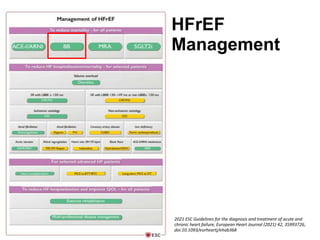
HFrEF
Management
2021 ESC Guidelines for the diagnosis and treatment of acute and
chronic heart failure, European Heart Journal (2021) 42, 35993726,
doi:10.1093/eurheartj/ehab368
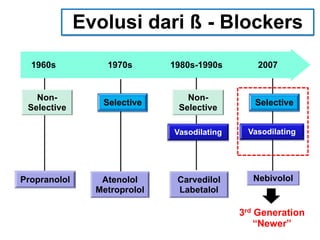
Apakah semua Beta-Blocker
itu sama saja ?
1960s 1970s 1980s-1990s 2007
Vasodilating
Non-
Selective
Non-
Selective
Selective
Propranolol Atenolol
Metroprolol
Carvedilol
Labetalol
Evolusi dari ß - Blockers
3rd Generation
“Newer”
Vasodilating
Selective
Nebivolol
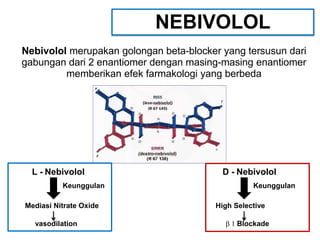
Nebivolol merupakan golongan beta-blocker yang tersusun dari
gabungan dari 2 enantiomer dengan masing-masing enantiomer
memberikan efek farmakologi yang berbeda
NEBIVOLOL
D - Nebivolol
High Selective
 1 Blockade
Keunggulan
L - Nebivolol
Mediasi Nitrate Oxide
vasodilation
Keunggulan
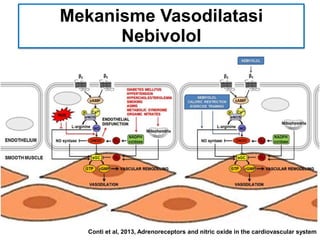
Conti et al, 2013, Adrenoreceptors and nitric oxide in the cardiovascular system
Mekanisme Vasodilatasi
Nebivolol
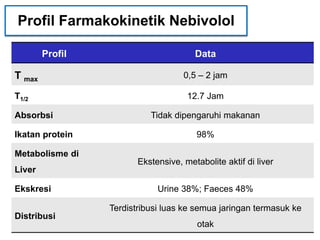
Profil Farmakokinetik Nebivolol
Profil Data
T max 0,5 – 2 jam
T1/2 12.7 Jam
Absorbsi Tidak dipengaruhi makanan
Ikatan protein 98%
Metabolisme di
Liver
Ekstensive, metabolite aktif di liver
Ekskresi Urine 38%; Faeces 48%
Distribusi
Terdistribusi luas ke semua jaringan termasuk ke
otak
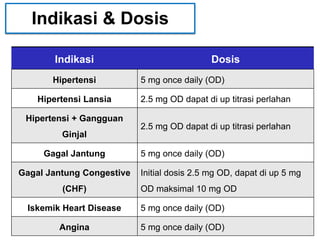
Indikasi & Dosis
Indikasi Dosis
Hipertensi 5 mg once daily (OD)
Hipertensi Lansia 2.5 mg OD dapat di up titrasi perlahan
Hipertensi + Gangguan
Ginjal
2.5 mg OD dapat di up titrasi perlahan
Gagal Jantung 5 mg once daily (OD)
Gagal Jantung Congestive
(CHF)
Initial dosis 2.5 mg OD, dapat di up 5 mg
OD maksimal 10 mg OD
Iskemik Heart Disease 5 mg once daily (OD)
Angina 5 mg once daily (OD)
PT Novell Pharmaceutical Proudly Present
NEBIVOLOL
TERIMA KASIH

Nebivolol in HF.ppt

  • 1.
    Beta-blocker in HeartFailure Nebivolol dr. ………………………, Sp
  • 2.
    European J ofHeart Fail, Volume: 22, Issue: 8, Pages: 1342-1356, First published: 01 June 2020, DOI: (10.1002/ejhf.1858) Incidence And Prevalence In developed countries, the age- adjusted incidence of HF may be falling, presumably reflecting better management of CV disease, but due to ageing, the overall incidence is increasing.
  • 3.
    European J ofHeart Fail, Volume: 22, Issue: 8, Pages: 1342-1356, First published: 01 June 2020, DOI: (10.1002/ejhf.1858) Incidence And Prevalence Heart Failure with reduced ejection fraction Heart Failure with preserved ejection fraction The majority (66%) of patients with heart failure died of cardiovascular causes, approximately 70% in HFrEF, 45% in HFpEF patients.
  • 4.
    Gibson G. etal, ACC Jul 13, 2021. Universal Definition and Classification of Heart Failure: A Step in the Right Direction from Failure to Function
  • 5.
    Heart failure isnot a single pathological diagnosis, but a clinical syndrome consisting of cardinal symptoms (e.g. breathlessness, ankle swelling, and fatigue) that may be accompanied by signs (e.g. elevated jugular venous pressure, pulmonary crackles, and peripheral oedema). It is due to a structural and/or functional abnormality of the heart that results in elevated intracardiac pressures and/or inadequate cardiac output at rest and/or during exercise. HF is a complex clinical syndrome that results from any structural or functional impairment of ventricular filling or ejection of blood. Heart Failure Definition ESC 2021: ACC/AHA 2103: Heart Failure Mc Donagh TA2, 2021 ESC Guidelines for the diagnosis and treatment of acute and chronic heart failure, European Heart Journal (2021) 42, 35993726, doi:10.1093/eurheartj/ehab368 Yancy et al 2013 ACCF/AHA Heart Failure Guideline
  • 6.
    Heart Failure Classification Typeof Heart Failure Description LVEF (Left Ventricle Ejection Fraction HFeEF HF with reduced ejection fraction ≤40% HFmrEF HF with mid- range ejection fraction 41-49% The presence of other of other evidance of structural heart disease (e.g. Icreased left atrial size, LV hypertrophy or ECG measure of impaired LV filling) HFpEF HF with preserved ejection fraction / diastolic heart failure ≥50% Signs may not be present in the early stages of HF. Objective evidence of cardiac structural and/or functional abnormalities consistent with the presence of LV diastolic dysfunction/ raised LV filling pressures This classification is important for long-term treatment. But for clinical manifestations and global therapy we treat as the same heart failure. 2021 ESC Guidelines for the diagnosis and treatment of acute and chronic heart failure, European Heart Journal (2021) 42, 35993726, doi:10.1093/eurheartj/ehab368
  • 7.
    Different Pattern ofVentricular Remodelling for HFrEF and HFpEF
  • 8.
    The survival ofpatients with heart failure with preserved or reduced left ventricular ejection fraction, European Heart Journal (2012) 33, 1750–1757 Left Ventricle Ejection Fraction Mortality for patients with HF-pEF and HF-REF (adjusted for age, gender, etiology of heart failure, hypertension, diabetes, atrial fibrillation).
  • 9.
    Heart Failure Classification TheNYHA Classification system has been examined for its ability to predict mortality. With optimal treatment, there is a 1-year mortality: • 10% - 15% (for stable NYHA class I and II), • 15% - 20% (for NYHA class III), • 20% - 50% (for NYHA class IV) Higher Mortality 2021 ESC Guidelines for the diagnosis and treatment of acute and chronic heart failure, European Heart Journal (2021) 42, 35993726, doi:10.1093/eurheartj/ehab368 Dekerlegand J, Congestive Heart Failure, Chapter 25, Cardiopulmonary System, PART 3, page 675
  • 10.
    The NYHA classificationis based on functional limitations of the heart failure patient, progressing from lesser to greater limitation. Unlike the disease itself, the NYHA classification may regress if a patient’s functional status improves. Conversely, the ACC/AHA classification progresses from stage A to D and cannot reverse the order. Stage D in the ACC/AHA classification, on the other hand, provides a consistent classification of disease state and risk. NYHA Classification ACC/AHA Classification Stages of Heart Failure Currie GM et al, Risk Stratification in Heart Failure Using 123I-MIBG, J Nucl Med Technol 2011; 39:295–301 Arrows indicate potential directions of stage progression. Horizontal alignment indicates corresponding stages between the 2 classifications
  • 11.
    Stages of HeartFailure Tripathi R. et al, A Low-Sodium Diet Boosts Ang (1–7) Production and NO-cGMP Bioavailability to Reduce Edema and Enhance Survival in Experimental Heart Failure, Bioavailability to Reduce Edema and Enhance Survival in Experimental Heart Failure. Int. J. Mol. Sci. 2021, 22
  • 12.
    Therapeutic Algorithm ofClass I Therapy Indications For a Patient with HFrEF 2021 ESC Guidelines for the diagnosis and treatment of acute and chronic heart failure, European Heart Journal (2021) 42, 35993726, doi:10.1093/eurheartj/ehab368
  • 13.
    Pharmacological Heart Failurewith Reduced Ejection Fraction 2021 ESC Guidelines for the diagnosis and treatment of acute and chronic heart failure, European Heart Journal (2021) 42, 35993726, doi:10.1093/eurheartj/ehab368
  • 14.
    Other Pharmacological Treatmentsin Patients with NYHA class II-IV with HFrEF Recommendations Class Level Soluble guanylate cyclase stimulator Vericiguat may be considered in patients in NYHA class II-IV who have had worsening HF despite treatment with an ACE-I (or ARNI), a beta-blocker and an MRA to reduce the risk of CV mortality or HF hospitalization. IIb B Hydralazine and isosorbide dinitrate Hydralazine and isosorbide dinitrate should be considered in self-identified black patients with LVEF ≤35% or with an LVEF <45% combined with a dilated left ventricle in NYHA class III-IV despite treatment with an ACE-I (or ARNI), a beta-blocker and an MRA to reduce the risk of HF hospitalization and death. IIa B Hydralazine and isosorbide dinitrate may be considered in patients with symptomatic HFrEF who cannot tolerate any of an ACE-I, an ARB, or ARNI (or they are contraindicated) to reduce the risk of death. IIb B Other pharmacological treatments indicated in selected patients with NYHA class II-IV heart failure with reduced ejection fraction (LVEF ≤40%) (3) ACE-I = angiotensin-converting enzyme inhibitor; ARNI = angiotensin receptor-neprilysin inhibitor; CV = cardiovascular; HF = heart failure; LVEF = left ventricular ejection fraction; MRA = mineralocorticoid receptor antagonist; NYHA= New York Heart Association. Recommendations Class Level Soluble guanylate cyclase stimulator Vericiguat may be considered in patients in NYHA class II-IV who have had worsening HF despite treatment with an ACE-I (or ARNI), a beta-blocker and an MRA to reduce the risk of CV mortality or HF hospitalization. IIb B Hydralazine and isosorbide dinitrate Hydralazine and isosorbide dinitrate should be considered in self-identified black patients with LVEF ≤35% or with an LVEF <45% combined with a dilated left ventricle in NYHA class III-IV despite treatment with an ACE-I (or ARNI), a beta-blocker and an MRA to reduce the risk of HF hospitalization and death. IIa B Hydralazine and isosorbide dinitrate may be considered in patients with symptomatic HFrEF who cannot tolerate any of an ACE-I, an ARB, or ARNI (or they are IIb B Other pharmacological treatments indicated in selected patients with NYHA class II-IV heart failure with reduced ejection fraction (LVEF ≤40%) (3) Recommendations Class Level If-channel inhibitor Ivabradine should be considered in symptomatic patients with LVEF ≤35%, in SR and a resting heart rate ≥70 b.p.m. despite treatment with an evidence-based dose of beta- blocker (or maximum tolerated dose below that), ACE-I/(or ARNI), and an MRA, to reduce the risk of HF hospitalization and CV death. IIa B Ivabradine should be considered in symptomatic patients with LVEF ≤35%, in SR and a resting heart rate ≥70 b.p.m. who are unable to tolerate or have contraindications for a beta-blocker to reduce the risk of HF hospitalization and CV death. Patients should also receive an ACE-I (or ARNI) and an MRA. IIa C Other pharmacological treatments indicated in selected patients with NYHA class II-IV heart failure with reduced ejection fraction (LVEF ≤40%) (2) ACE-I= angiotensin-converting enzyme inhibitor; ARNI = angiotensin receptor-neprilysin inhibitor; b.p.m. = beats per minute; CV= cardiovascular; HF = heart failure; LVEF= left ventricular ejection fraction; MRA = mineralocorticoid receptor antagonist; NYHA=New York Heart Association; SR = sinus rhythm. www.escardio.org/guidelines 2021 ESC Guidelines for the diagnosis and treatment of acute and chronic heart failure (European Heart Journal 2021 – doi:10.1093/eurheartj/ehab368) Recommendations Class Level Loop diuretics Diuretics are recommended in patients with HFrEF with signs and/or symptoms of congestion to alleviate HF symptoms, improve exercise capacity, and reduce HF hospitalizations. I C ARB An ARBa is recommended to reduce the risk of HF hospitalization and CV death in symptomatic patients unable to tolerate an ACE-I or ARNI (patients should also receive a beta-blocker and an MRA). I B Other pharmacological treatments indicated in selected patients with NYHA class II-IV heart failure with reduced ejection fraction (LVEF ≤40%) (1) ACE-I = angiotensin-converting enzyme inhibitor; ARB = angiotensin-receptor blocker; ARNI = angiotensin receptor-neprilysin inhibitor; CV = cardiovascular; HF = heart failure; HFrEF = heart failure with reduced ejection fraction; MRA = mineralocorticoid receptor antagonist; NYHA= New York Heart Association. aThe ARBs with evidence in HFrEF are candesartan, losartan, and valsartan. www.escardio.org/guidelines 2021 ESC Guidelines for the diagnosis and treatment of acute and chronic heart failure (European Heart Journal 2021 – doi:10.1093/eurheartj/ehab368) Recommendations Class Level Loop diuretics Diuretics are recommended in patients with HFrEF with signs and/or symptoms of congestion to alleviate HF symptoms, improve exercise capacity, and reduce HF hospitalizations. I C ARB An ARBa is recommended to reduce the risk of HF hospitalization and CV death in symptomatic patients unable to tolerate an ACE-I or ARNI (patients should also receive a beta-blocker and an MRA). I B Other pharmacological treatments indicated in selected patients with NYHA class II-IV heart failure with reduced ejection fraction (LVEF ≤40%) (1) ACE-I = angiotensin-converting enzyme inhibitor; ARB = angiotensin-receptor blocker; ARNI = angiotensin receptor-neprilysin inhibitor; CV = cardiovascular; HF = heart failure; HFrEF = heart failure with reduced ejection fraction; MRA = mineralocorticoid receptor antagonist; NYHA= New York Heart Association. aThe ARBs with evidence in HFrEF are candesartan, losartan, and valsartan. www.escardio.org/guidelines 2021 ESC Guidelines for the diagnosis and treatment of acute and chronic heart failure (European Heart Journal 2021 – doi:10.1093/eurheartj/ehab368) Recommendations Class Level Loop diuretics Diuretics are recommended in patients with HFrEF with signs and/or symptoms of congestion to alleviate HF symptoms, improve exercise capacity, and reduce HF hospitalizations. I C ARB An ARBa is recommended to reduce the risk of HF hospitalization and CV death in symptomatic patients unable to tolerate an ACE-I or ARNI (patients should also receive a beta-blocker and an MRA). I B Other pharmacological treatments indicated in selected patients with NYHA class II-IV heart failure with reduced ejection fraction (LVEF ≤40%) (1) ACE-I = angiotensin-converting enzyme inhibitor; ARB = angiotensin-receptor blocker; ARNI = angiotensin receptor-neprilysin inhibitor; CV = cardiovascular; HF = heart failure; HFrEF = heart failure with reduced ejection fraction; MRA = mineralocorticoid receptor antagonist; NYHA= New York Heart Association. aThe ARBs with evidence in HFrEF are candesartan, losartan, and valsartan. I B IIa B/C IIb B Recommendations Clas Digoxin Digoxin may be considered in patients with symptomatic HFrEF in sinus rhythm despite treatment with an ACE-I (or ARNI), a beta-blocker and an MRA, to reduce the risk of IIb Other pharmacological treatments indicated in selected patients with NYHA class II-IV heart failure with reduced ejection fraction (LVEF ≤40 IIb B 2021 ESC Guidelines for the diagnosis and treatment of acute and chronic heart failure, European Heart Journal (2021) 42, 35993726, doi:10.1093/eurheartj/ehab368
  • 15.
    HFrEF Management 2021 ESC Guidelinesfor the diagnosis and treatment of acute and chronic heart failure, European Heart Journal (2021) 42, 35993726, doi:10.1093/eurheartj/ehab368
  • 16.
  • 17.
    1960s 1970s 1980s-1990s2007 Vasodilating Non- Selective Non- Selective Selective Propranolol Atenolol Metroprolol Carvedilol Labetalol Evolusi dari ß - Blockers 3rd Generation “Newer” Vasodilating Selective Nebivolol
  • 18.
    Nebivolol merupakan golonganbeta-blocker yang tersusun dari gabungan dari 2 enantiomer dengan masing-masing enantiomer memberikan efek farmakologi yang berbeda NEBIVOLOL D - Nebivolol High Selective  1 Blockade Keunggulan L - Nebivolol Mediasi Nitrate Oxide vasodilation Keunggulan
  • 19.
    Conti et al,2013, Adrenoreceptors and nitric oxide in the cardiovascular system Mekanisme Vasodilatasi Nebivolol
  • 20.
    Profil Farmakokinetik Nebivolol ProfilData T max 0,5 – 2 jam T1/2 12.7 Jam Absorbsi Tidak dipengaruhi makanan Ikatan protein 98% Metabolisme di Liver Ekstensive, metabolite aktif di liver Ekskresi Urine 38%; Faeces 48% Distribusi Terdistribusi luas ke semua jaringan termasuk ke otak
  • 21.
    Indikasi & Dosis IndikasiDosis Hipertensi 5 mg once daily (OD) Hipertensi Lansia 2.5 mg OD dapat di up titrasi perlahan Hipertensi + Gangguan Ginjal 2.5 mg OD dapat di up titrasi perlahan Gagal Jantung 5 mg once daily (OD) Gagal Jantung Congestive (CHF) Initial dosis 2.5 mg OD, dapat di up 5 mg OD maksimal 10 mg OD Iskemik Heart Disease 5 mg once daily (OD) Angina 5 mg once daily (OD)
  • 24.
    PT Novell PharmaceuticalProudly Present NEBIVOLOL
  • 26.